Theology

Young Men Need a Model Not an ‘Übermensch’

The church can’t compete with “manosphere” influencers. But it doesn’t have to.

Christianity Today August 29, 2023
Illustration by Christianity Today / Source Images: Getty / WikiMedia Commons

The plight of young American men has become a serious concern of late. They’re earning fewer college degrees compared to women, falling out of the labor market, and dying from overdose or suicide more often than women. Many are addicted to porn, video games, or online outrage.

They’re “trying on new identities, many of them ugly, all gesturing toward a desire to belong,” writes Christine Emba in an incisive essay for The Washington Post. “It felt like a widespread identity crisis—as if they didn’t know how to be.”

What’s the cause of all this trouble? Some argue for a purely materialist explanation by looking at the decline of manufacturing jobs that used to provide a steady income for men without college degrees. Others suggest that men are merely entitled brats—so accustomed to patriarchy that now “equality feels like oppression.” Still others, like Richard Reeves in The Atlantic, point to problems with our education systems.

The sheer scope of the problem has led to “manosphere” influencers who offer a vision of masculinity and the steps to achieve it.

Aaron Renn has been a persistent critic of the church’s overfeminization, accusing both liberal and conservative Christians of “vicious negativity towards men and excessive pedestalization of women” that “repels men.” The popular psychologist Jordan Peterson has shaped these conversations for years. On the far right, Andrew Tate, the former champion kickboxer indicted on charges of sex trafficking, has a massive social media presence built from vulgar hedonism and brazen materialism.

If their collective followings are any indication, it’s clear that many young men are attracted to a vision of masculinity that draws more from Nietzsche than Jesus Christ. American Reformer contributor John Ehrett calls it vitalism.

Some commentators are warning that the post-Christian Right will seduce aimless young men grasping for a sense of self. They urge the church to embrace a “masculine Christianity” that emphasizes dominion, male leadership in the home and the church, and physical fitness to keep men from being drawn into the vile world that sees women as sex objects and pushes Nazi propaganda about superior races.

I won’t argue against positive role models and physical health. But here’s where these critics go wrong: Christianity can never compete with vitalism on vitalism’s terms, just like a church service will always be less exciting than a rock concert on a rock concert’s terms.

If a young man wants an ideology that allows him to treat women with contempt and consider himself Nietzsche’s Übermensch, social media gurus will always win out over Scripture. You can have a men’s conference with fireworks and a working military tank, but the Bible will still show us that the greatest man who ever lived submitted himself to a humiliating death and told us the meek are truly blessed.

The masculinity crisis has major consequences for the church. It feels harder than ever for young Christian women who want to get married and have children to find young men who make decent husbands and fathers. More broadly, congregations are suffering as young men that could be blessing the church are instead wasting their lives away in front of screens.

How should Christians respond?

The church has always struggled with gender imbalance, as Lyman Stone notes. As far back as the Roman era, more women than men have flocked to sanctuaries, and finding marriageable Christian men has never been easy.

Furthermore, every church is different. On the extremes, some still operate according to a more rigid gender hierarchy while others ignore the idea of God-given gender differences.

As a missionary in East Africa, I can tell you that a culture where gender differences are still respected doesn’t draw more men to church. Women still outnumber men here too. And the cultural commitment to traditional sexual ethics brings lots of problems, including much higher rates of violence against women.

The simplest fix might be to erase any gender distinctives and encourage each young man to simply be “a good person” rather than “a good man.” There’s some truth to this, as church is the place where men call themselves a bride and women can say they’re more than conquerors. The fruit of the Spirit are the same for both sexes.

However, as Emba puts it in a follow-up essay, “young men and boys are telling us, often literally, that they desperately need and desire direction, norms, and a concrete rubric for how to be a man.”

In theological terms, we are created in the image of God, male and female, and that distinction has consequences for how we think about ourselves. When one set of cultural currents is trying to erase those distinctions altogether by telling men their manhood isn’t real or meaningful, many of them will simply be discouraged from even trying to be good people.

In The Toxic War on Masculinity, Nancy Pearcey calls for a greater ministry focus on boys without fathers, and she’s absolutely right. Rather than compete with manosphere influencers who think expensive cars and sexual conquests define masculinity, we need Christian families to invite young men into their lives and homes. There, they can learn about the virtues of masculinity by observation rather than didactic (and often harmful) instruction.

Single people, elderly couples, and families with children can all participate. Helping care for others’ kids, sharing life together, and talking about something other than social media will do far more for young men than any blogs or podcasts. (Pro tip for young men who want to find a Christian wife: Do the dishes after dinner. Trust me on this one.)

The crisis of masculinity is real, and the church has a role to play. Rather than complaining about feminism or “beta male” pastors, we need to participate in mentoring and building relationships with young men. Military hardware and empty admonitions to “be a man” can’t substitute for genuine connections between people. The church has a calling to celebrate the goodness and beauty of God’s choice to create us in his image, male and female, and those distinct identities emerge best in community.

As we attend to the masculinity crisis, opening our doors and making space at our tables is something we can all do to keep lost boys from going astray.

Matthew Loftus lives with his family in Kenya, where he teaches and practices family medicine. You can learn more about his work and writing at matthewandmaggie.org.

Books

Put Off Your Old Self-Making

An interview with author Tara Isabella Burton on the history of self-creation—and how the habit usurps our need for God.

Christianity Today August 29, 2023
Illustration by Mallory Rentsch / Source Images: Unsplash / Getty

One of my most recent posts on Instagram is a picture of a loaf of bread I baked. I baked it because I like bread, especially fresh bread, hot out of a 450-degree oven and covered in far too much butter. But why, exactly, did I post the picture on Instagram?

Self-Made: Creating Our Identities from Da Vinci to the Kardashians

Self-Made: Creating Our Identities from Da Vinci to the Kardashians

PublicAffairs

288 pages

It’s a nice-enough loaf, but I’ve no great baking talent. Part of my motive was simple enthusiasm for work I enjoyed. But some of it, if I’m honest, was about my image—as a writer, as a keeper of my household newly back to full-time work after maternity leave, and as the sort of person you might find interesting at a cocktail party.

There, look, I remember briefly thinking as I hit “Share,” no one can say I’m slacking on the homemaking front. I made bread!

This is ridiculous and vain and embarrassing, of course. But I come by it honestly in an era of self-creation, in which social media has given each of us the opportunity to craft a public image that is objectively artificial yet imagined as a display of authenticity.

That very dynamic is the subject of Tara Isabella Burton’s Self-Made: Creating Our Identities from Da Vinci to the Kardashians, published earlier this year. I reached out to Burton to ask about the theological underpinnings of her book and how the modern urge to self-create comports with Christian faith.

This interview has been edited and condensed.

Let’s start with the trio of elevator questions I’m sure you’ve answered on a thousand podcasts by now: What is the book about? Why did you write it? And what readers did you have in mind?

Self-Made is an intellectual history of self-creation, the wider story of secular modernity’s idea that human beings not only can but should create themselves. By that, I mean not just that they shape their own destinies or change their social circumstances but that the cultivation of one’s own personality in accordance with one’s desires is basically the way that we are human.

And I see this as a religious story—a story that moves from the idea that we are created by God for a purpose beyond our immediate understanding toward one where we create ourselves and our own purpose. So, this is a theological story.

I wanted to write it for a variety of reasons. As a teenager, the idea of living life as art appealed to me, but it’s something I’ve increasingly come to critique. Then I did my doctoral thesis at Oxford on the theology of self-creation, looking at 19th-century French dandyism and decadence against the backdrop of secular modernity.

But in my professional life, I wrote much more about the modern internet. When I was a religion reporter for Vox, I wrote a lot about the “spiritual but not religious” and the idea that everyone’s making their own religion—which was the topic of my first nonfiction book, Strange Rites. [You can read CT’s review of Strange Rites here.]

So when I was looking for a follow-up project to Strange Rites, I started thinking that the obsession with personal branding that we have today—the way we’re all expected to tell our own stories and sell ourselves in the attention economy to a greater or lesser degree—that all of this idea of self-creation is actually part of the same story, part of the same idea that we exist to cultivate and perfect ourselves and live our “best lives.”

And the ideal reader I had in mind is someone asking, Why is everything so weird now?

I think all my work, to a greater or lesser extent, deals with that question. I wanted to appeal to readers, secular or religious, who have a sense that something is up—something is strange—but don’t necessarily have access to either the historical narrative or language to describe what’s going on.

You’ll have a long and productive career answering that question. In this book, though, I found it interesting that many—maybe most—of the people you profile would’ve been professing Christians, and that includes contemporary figures like Kim Kardashian and Donald Trump. I’m not asking you to render judgment on anyone’s soul, but I am curious about how you think these self-makers thought about their self-creation in relationship to—or maybe in tension with—their faith.

Without speculating on anybody’s particular soul, I think historically speaking, the self-made ideology has not necessarily been antireligious, but it has been anticlerical—because so much of this narrative, particularly in the Renaissance and then the Enlightenment, is understood to be contra the Catholic Church in particular.

This is reductionist both in terms of the figures I’m writing about and in the actual Catholic position, but the understanding of the theology is something like, God created everything, including human beings, in their particular place. What we are socially—our relations to one another—are part of that creation.

Part of Renaissance thought, and Enlightenment thought even more so, was a rejection of this external authority telling us what to do, how to be, how to live our lives. The self-creator is someone who rejects the authority of these external figures and instead follows his own desires in order to be truly free. Freedom is understood as freedom from society, and the Catholic Church takes on, in this narrative, the role of the big bad tyrant.

A central tenet from these figures, from the Enlightenment onward, is the idea that the self-creator is a kind of god or demigod, a divine or divinely powered figure. And as that narrative moves closer and closer to the present, the self-maker becomes someone who makes himself a kind of god.

I think the most explicit example of this is a line from Stewart Brand, an early techno-utopian pioneer, big in the ’60s’ counterculture, whose ethos, he says, is, “We are as gods, and we might as well get good at it.” Technological power allows a kind of divinization of the self. I think we need to take that seriously, theologically.

When I write about the importance of going to church, having that life together in an embodied community, I often get pushback that amounts to You can’t tell me to do that. My faith is just as good if I do it on my own. This rejection of authority you’re describing feels a lot like that.

Absolutely. It’s something that I find really interesting in both Christian culture and, particularly strongly, in the secular culture of New York, where I live: this idea that doing something that’s not in accordance with how we feel, with our desires, is automatically alienating and wrong.

I think there’s probably some small measure of truth to this: If we have a fundamental desire for the good and the true and the beautiful, and if these are elements of our ability to apprehend God, then a certain kind of internal reflection can be part of how we might apprehend truth.

But at the same time, human beings are very bad at (a) knowing what we want and (b) wanting things that are good for us. We are self-deceiving creatures.

And this is so much a part of literature that I find it very bizarre that there’s not a pervasive cultural sense of self-deception. Instead, it’s like, Well, if you feel this, your feelings are valid, and you should listen to them.

Let me return to the question of Christians self-making from a slightly different angle. Is this a mindset that could only develop in a Christian society, as an outgrowth or perversion of Christian ideas about individual human value and personal sanctification in Christ? Because it’s intriguing that this is a Christendom phenomenon, that it didn’t simultaneously develop in other societies that didn’t have that same Christian cultural foundation.

I think that’s right. In Christian thought, we find the theology of the Incarnation, the literal resurrection of the body, the dignity of each human being—which is not reducible to our circumstances, the biographical details of where and how we were born, our nationality or ethnicity or gender.

Theologically, I would say self-making is related to these Christian ideas about being made in the image of God. Better historians than I have made the case that what we think of as liberalism is deeply rooted in Christian views of the dignity of the person.

But at some point, in and after the Renaissance, I think your language of perversion of good is really useful here. Because at some point, the idea that God “became man, that man might become god”—as the Eastern Orthodox Christian tradition puts it—turns into We should just be gods. Like, Get rid of that other stuff. We should just be gods.

Skip to the good stuff.

Yeah, exactly. Get there faster. The idea that there’s some tension between our givenness, our createdness, and our creative power—and that this tension speaks to a truth about humanity that is revealed in its fullness in the Incarnation—becomes this cultural narrative of human transcendence in which we go after what we want and chase money or chase appearing a certain way.

I’m interested in how you personally think about self-making in two senses. First, as a Christian, because we have so many biblical passages about putting to death the old self (Rom. 6:5–7; Eph. 4:22) and things like those famous lines from the Heidelberg Catechism: “What is your only comfort in life and death? That I am not my own, but belong … to my faithful Savior Jesus Christ.”

But then also, as a writer. I experience this as well—we’re practically under contractual obligation to our publishers to self-make. There are very few nonfiction writers of our generation who get away with skipping all the personal branding stuff.

I hate it. It’s bad for me. My ideal for my career is to not have to do any self-promotion that is not talking about a book.

I think talking about interesting ideas is interesting. That’s something that I genuinely enjoy. But more broadly, all the things we are increasingly expected to do as writers in an attention economy—hawking your book and getting blurbs, being in the right places, networking—that expectation, I think, is really, really spiritually unhealthy. I am never less spiritually healthy than the month after a book of mine comes out.

I’m doing my best to find ways to check that. I have a bazillion blockers on all my devices in the hopes that there are parts of the day that I don’t have any internet access, and I can no longer access Twitter on my iPhone.

But I think that if there is any good to the horrific requirement to self-create, it’s that more and more of us are aware of what an unrewarding slog self-creation for profit is.

Privacy and being offline—these are luxury goods now. And I don’t think they should be luxury goods, in that you shouldn’t have to be rich to be able to unplug. But we are perhaps seeing the benefit of not having to do this all the time. I think there’s a growing, conscious sense of trying to protect some aspects of time and life from the panopticon.

Theology

J.D. Greear: Tim Keller’s Friendship Transformed My Preaching

Three lessons the late pastor-theologian taught me about the art of sermons.

Illustration by Christianity Today / Source: AP Images / Mark Humphrey / Redux / James Estrin

The first time I met Tim Keller I asked if we could be friends.

I said to him, “I quote you so often to my congregation. I tell them that I’ve listened to you so much that I don’t know where your thoughts end and mine start. It would mean a lot—since I quote you so much—if I could call you my friend. Do you mind if, next time I quote you, I say ‘my friend Tim Keller’?” He laughed and said yes.

My congregation is familiar with the story and still laughs when I reference “my friend Tim Keller’’ in a sermon. When I wrote my first book, Gospel—which had been influenced so much by Tim—he wrote the foreword. In fact, if you were to read the foreword, you would see evidence of this rather public inside joke we share. In the last paragraph, he calls me “my fellow pastor, J.D.”

I’m grateful for the humor infused into our friendship. But I’m also grateful for the ways Tim Keller encouraged me. One such occurrence was at the conclusion of a conference when I was walking him out of the venue. As we made our way toward the exit, he stopped. When I turned around and walked back to him, this six-foot-five man extended his arm, pulled me in, and said, “You’re doing really good work here.” It was the most awkward, most affirming hug I’d ever received.

Yet, what’s equally important to the humor and the encouragement is the way Tim Keller shaped me as a preacher. Before I encountered him years ago, my messages were heavy on how-tos and performance. Do this. Become that. But in every single sermon I preach today, I strive to direct people to worship Jesus and adore him more as opposed to inspiring them to work harder as Christians.

I believe Tim was quoting D. Martyn Lloyd-Jones when he said, “There ought to come a time in every message where the pen goes down and the eyes go up and you stop saying, ‘Oh my God, look at all the things I have to do for you. And you start saying, ‘Oh my God, look at all the things you’ve done for me.’”

That kind of moment of worship is something I’m always conscious of in my preaching because Tim would always say that good preaching doesn’t tell you to go and change. Rather, it changes you on the spot because you start to encounter something of such beauty that you just desire it and want to become it—you want to change.

A second way Tim Keller shaped my preaching is his unique platforming of the gospel. We tend to think that the gospel is the diving board off which we jump into the pool of Christianity. But the gospel, Tim showed me, is the pool itself. He used to say, “The gospel is not just the ABCs, but the A to Z of Christianity.” He would also say the gospel is not just the “escape valve” if you’ve messed up your life, you want God’s forgiveness, and you desire to be saved. But the power to become anything is found only in the finished work of Christ. It is incumbent upon pastors to convey that whatever you’re talking about—whether it was being generous or being a good husband—the power to do it is not found in any sort of resolution. It’s found in what God has already done.

Here’s what I mean: To become generous is to stand in all the generosity God has given. I learned that giving my congregation five steps to becoming a good husband is not nearly as powerful as explaining the steps that God took for me—for us. Those are the steps that will make me a better husband, not practical things I learned.

A third and critical way Tim Keller influenced my ministry is his approach to the spiritual life that centered sin on idolatry. He frequently would show that there’s a sin behind the sin and that every culture needs to have its idols questioned. And whether you’re a Republican or a Democrat, you’ve got some moral proclivities that are good and some that are bad. Both sides have good and bad, but there’s an idolatry behind them. Yet there’s a gospel that I can preach that unites the two. That’s how Tim Keller transcended tribes and reached people on the opposite ends of many spectra—by making the human heart and the gospel the focus.

The two of us spent a lot of time unpacking this together. Tim was a man who had deep political convictions, but he knew that God called him to reach Republicans and Democrats, Northerners and Southerners, and there’s a unifying message that idolatry is our problem. This is message expresses the gospel as a solution that doesn’t prevent us from talking about the other things. Rather, it beckons us to focus on the gospel in a way that the Republican and Democrat can both be convicted by the same sermon—and not led toward a culture war.

Gospel preachers are the only ones who can really talk about the idols held by left and right, older brother and younger brother. Because of Tim’s imprint on my life and ministry, that’s where I’m spending much of my time in sermon preparation. I might be wrong in my opinion on global warming, but I’m not wrong about the gospel. I don’t want my opinions on the former to keep people from hearing me on the latter. When it came to cultural analysis, preaching against idolatry, and the gospel as our only hope, those are things that Tim emphasized as so clear and so important. He never insinuated that the other matters are not important. It’s that someone like me and someone unlike me can find unity in the gospel.

In this way, Tim so exquisitely modeled what it was like to be a missionary in one’s context. He took his cues from the apostle Paul. Whenever he encountered a skeptic, he would take the approach of summarizing the situation, identifying the real questions, and explaining why that person’s system wasn’t working. He had a way of acknowledging the legitimacy of the skeptic’s objections to the faith, but he would also graciously show them why what they’d been searching for the whole time was the gospel. And the only way to do that was to say it in a way that legitimized the question, not that villainized the person.

To me and countless other pastors, Tim Keller was more than this amazing teacher. His teaching was an overflow of friendship. It’s important to note that Tim Keller wasn’t just a friend to the pastor; he was a friend to the unbeliever. Everybody felt like Tim was their friend. Any time he spoke—whether it was across a table or from a podium—it felt like hearing a friend address the questions I always carried deep in my soul but was, for some reason, afraid to ask. I have to believe Tim was modeling Jesus, because that’s how people heard Jesus when he delivered the Sermon on the Mount.

In the midst of all this busyness—and even at the hardest points in his life—Tim would still take time to encourage people and nurture his friendships. A few days before he went into the hospital for the final time he emailed me about a potential New York City visit in the fall. He also wrote to me at some of the hardest points of my SBC presidency, “I need you to know you’re doing good work and you’re the right leader for the right time.” He was a constant encouragement. There was no “Tim the preacher” versus “Tim the friend and counselor.” He was all one man—whether preaching the gospel from a pulpit, offering a word fitly spoken over the phone, or talking to you backstage, giving an awkward hug.

J.D. Greear is the pastor of The Summit Church in Raleigh-Durham, North Carolina.

Books

Never Read Tim Keller? Here’s Where to Begin.

Eight books that capture different dimensions of his life and ministry.

Illustration by Christianity Today / Source image: Envato

Apologist

The Reason for God: Belief in an Age of Skepticism

Keller excelled at appealing to urban skeptics of the sort who congregate in places like New York City. Mindful that some in his audiences viewed religious belief as intellectually antiquated or morally problematic, he presented compelling arguments for the rationality and goodness of Christian faith. The Reason for God, the book that first vaulted Keller to popularity in broader evangelical circles, showcases his gifts as an apologist (as does a 2016 follow-up, Making Sense of God).

Church Leader

Center Church: Doing Balanced, Gospel-Centered Ministry in Your City

For all his worldwide renown as an evangelical leader and spokesperson, Keller was a man of the local church—in his case, Manhattan’s Redeemer Presbyterian. Center Church lays out a vision of Christ-proclaiming ministry, distilling lessons from Redeemer’s efforts at building fellowship in an environment some Christians had deemed impregnably secular. This book represents Keller’s considered response to “church growth” movements and other ministry strategies that elevate methods or metrics above core concerns of faithfulness.

Pastor

Walking with God Through Pain and Suffering

Perhaps unsurprisingly, given Keller’s job title, his books have been praised as uncommonly “pastoral.” Rather than “preaching” at you, in the pejorative sense of lecturing sternly from imposing heights, they take you gently by the hand and shepherd you through the thorniest areas of Scripture and Christian doctrine. Keller plays the reassuring guide in Walking with God Through Pain and Suffering, tackling a subject no pastor can go long without needing to address.

Preacher

The Prodigal Prophet: Jonah and the Mystery of God’s Mercy

Several of Keller’s books arose from Redeemer Presbyterian sermon series, giving readers a window into his talents as a proclaimer and expositor of God’s Word. Among these is The Prodigal Prophet, his exploration of the Book of Jonah, which draws unlikely parallels between God’s rebellious messenger and his unfailingly obedient Son.

Counselor

The Meaning of Marriage: Facing the Complexities of Commitment with the Wisdom of God

Like suffering, the subject of marriage calls for a careful blend of biblical wisdom and situation-specific counsel. This is what Keller delivers in The Meaning of Marriage, packaging truths about God’s vision for matrimony with practical advice on living together as husbands and wives. The book is also notable for modeling Keller’s partnership with his wife Kathy, an astute theological mind in her own right.

Disciple

Prayer: Experiencing Awe and Intimacy with God

One reading Keller’s books and hearing his sermons might picture him as a Christian who enjoyed a devotional life of enviable depth and intimacy. But Keller, like any good disciple, knew his weaknesses—one of which he set out to correct by writing Prayer. A decade into his Redeemer pastorate, he realized he “was barely scratching the surface of what the Bible commanded and promised regarding prayer.” The resulting book aims to reach believers who desire richer prayer lives but aren’t sure where to start.

Advocate

Generous Justice: How God’s Grace Makes Us Just

Keller had no desire to jump into the political fray. But he occasionally preached about politics because the Bible speaks to our duties as citizens, and because Christians can be tempted to equate those duties with party platforms or ideological programs—none of which embody God’s perfect design for good government. Generous Justice reveals Keller’s penchant for seeing beyond the philosophies of Left and Right to discern what the Bible does (and doesn’t) say about forming just societies.

Laborer

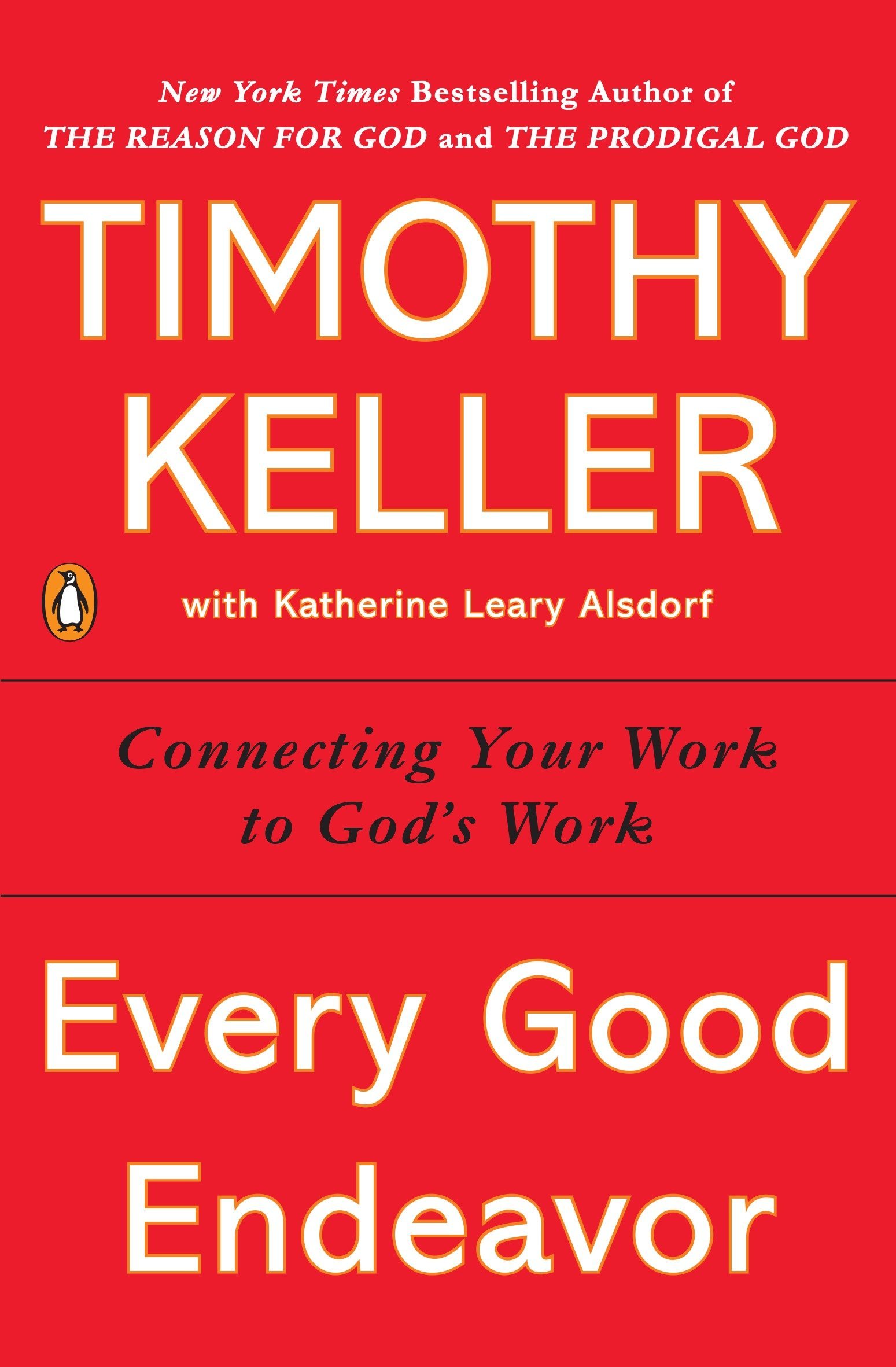
Every Good Endeavor: Connecting Your Work to God’s Work

As a pastor, Keller oversaw a flock that included a range of business leaders, artists, students, and ordinary wage earners. This meant he often encountered questions about finding purpose and serving God in various lines of work. Every Good Endeavor spells out the implications of laboring “for the Lord, not for human masters” (Col 3:23), a calling that puts pulpit ministry on a parallel footing with more “secular” vocations. The book leans into the hands-on experience of Katherine Leary Alsdorf, a former entrepreneur who founded and directed Redeemer’s Center for Faith & Work.

Tim Keller: The Pastor of Record

Tim Keller didn’t court the approval of ‘secular elites,’ but he did serve as a parson in their neighborhood.

Illustration by Robert Carter

Long before his passing this Spring, the legacy of Tim Keller’s ministry had been the subject of scrutiny. Few people were as capable as he of provoking scorn, as his work and witness seemed equally offensive to both ends of the political, theological, and ideological spectra. Every leader’s legacy deserves reflection, of course, and no one lives out his or her public life with a perfect record.

But in much of the debate around Keller’s philosophy of ministry and public witness, his critics aren’t merely attacking methods and ideas; they’re making an effort at revisionism—rewriting history in a way that makes the past rosier and the present harder, justifying their own polemics and hard-edged approach to public witness. In so doing, they reveal that not only do they misunderstand Keller’s influence both inside and outside the church, but they also misunderstand much about the church’s role in the life of cities, and the life of the world.

This debate began shortly after the 2016 election, when evangelicals began to reassess their posture and alliances in the public sphere. As polarizing as the election was, it was only a foretaste of the polarization that would unfold in the years that followed. A new populist consensus began to emerge on the Right and, with it, the sense that Trump’s rhetorical style—brash, combative, and insulting—was to be a feature, not a bug, of his evangelical supporters. The public witness of pastors in previous decades like that of Tim Keller and Rick Warren wouldn’t do.

Perhaps the clearest articulation of this idea came in February 2022, in an article at First Things titled “The Three Worlds of Evangelicalism.” In it, Aaron Renn argues that secularization in America has had three distinct phases, each of which required (or requires) a corresponding approach from evangelicals. The “positive world” stage describes America prior to 1994, when Christianity was generally seen as a positive force in our culture. He marks 1994–2014 as the “neutral world” stage, wherein secularism had taken hold enough for Christianity to lose its place of privilege, but not yet be disfavored. The final stage is the “negative world,” which kicked off about the time of the Obergefell decision instituting same-sex marriage and in which we find ourselves today.

Renn argues that people like Keller benefited from respectability among secular elites that was a privilege of the “neutral world” they inhabited. The public square—the pages of New Yorker and The New York Times, for instance—was open to the likes of Keller and other urbanite evangelicals in a way that it wouldn’t be after 2014. Today, one can choose either social respectability or doctrinal fidelity; one can’t have both.

As a result, many of the internecine battles among evangelicals since the Trump years have been, fundamentally, a collision of those who understand the times (Renn and the new populists on the evangelical right) and those who want to cling to a bygone era and the associated privilege that came with it. In essence, Renn says, people like Keller are less substantively opposed to the doctrine, rhetoric, and tactics of the new Right and more concerned about losing hard-earned status among liberal elites.

As I said at the beginning, though, this is a work of revisionist history. It fundamentally misunderstands and misrepresents the world prior to 2014. Keller’s success in the 1990s and 2000s was remarkable for the very reason Renn argues it’s a bad idea; the so-called “secular elites” were every bit as disinclined to take him seriously then as they are now. If we fail, it’s easy to miss what made his life and ministry remarkable, and we’ll foreclose possibilities for public witness that are desperately needed in the years ahead.

I know firsthand that this so-called “neutral” world was anything but; I was part of a church-planting team and staff from 2000 to 2015, living and working for most of those years in the Highlands, the most progressive neighborhood in Louisville’s urban core. From almost day one, the hostility from the surrounding community was palpable.

Just finding a place to meet in the city required a set of diverse skills. You had to build relationships with people on the Metro Council, had to understand the way neighborhood associations were governed, had to learn to apologize to your church for not having much in the way of parking and to your neighbors for blocking their driveways. There were times where your pursuit of a rental space needed to be driven by the church’s doctrine and values—believing that you’d find a like-minded school administrator or landlord—and times when it needed to be kept in your back pocket—such as when you had two weeks to nail down a place to meet for Christmas and your only hope was a public school whose principal had the final say. Ask any church planter who planted in a city about meeting spaces for years 1–5, and you’ll probably be able to watch his or her blood pressure spike in real time.

The simple fact was that most people didn’t want you in the neighborhood. If they weren’t hostile to your doctrine, they didn’t like the noise and crowds. (That’s especially true when the crowd was a bunch of tattooed 20-somethings who were chain-smoking on the front steps between services. And that was just the worship band.)

The first church we rented from kicked us out for reasons that were never quite clear, but we knew they didn’t like our doctrine. The second one made it very clear: They didn’t like our position on gender. Or our position on gay marriage. Or the bodily resurrection of Jesus. They kicked us out in early 2002.

In the years that followed, conflicts over the church’s orthodox commitments flared up on a steady basis. In 2008—six years before the “negative world”—the local independent newspaper featured a cover story on our church, describing how our progressive aesthetics were a mask for regressive beliefs about sex and gender. It led to a flood of angry phone calls, vandalism, and protests.

These made for hard seasons, especially when the efforts of activists forced us to shutter much of the work of our center for the arts, but we weren’t entirely surprised. We’d known the odds were stacked against us from day one.

Throughout those years, Keller was a guiding light. The 2000s were a wild time, filled with revolutionary and reformational rhetoric from the New Calvinists, the emerging church movement, and a dozen denominational church-planting initiatives. Encountering Keller was a breath of fresh air, a sober voice that was allergic to the hype that filled most of these other streams.

I first heard of him around 2003 or 2004. This was long before he’d published his first book, in the days when getting access to sermon MP3s wasn’t a simple thing (especially when they weren’t free and I was broke), so my discovery came through conversations with church planters who spoke in quasi-hushed tones about a booming church in Manhattan led by a former seminary professor. This guy had “figured it out,” which in church-planting-speak indicated that he’d found some secret recipe for successfully growing a church.

But the frustrating thing about Redeemer and Keller was that it was very difficult to figure out what the recipe was. Based on the success of other church planters in our orbit, I expected to go to New York to find a charismatic and energetic preacher, a church with modern design aesthetics, and edgy music written by Brooklyn hipsters.

I couldn’t have been more wrong. At my first visit to Redeemer, I found music that sounded a lot more like Broadway than Radiohead; the church’s design looked, well, Presbyterian; and while Keller was clearly whip- smart, he preached like a professor—soft-spoken, a little heady, no yelling, no rhyming. The service ended and I looked at a friend who came with me and said, “I don’t get it.”

The evening wasn’t over; the rest of the night would be an open forum. Keller came back out on the platform, sat in a chair, and invited the audience to line up at several mics stationed around the Hunter College auditorium. Audience members could ask whatever they wanted. The next 90 minutes was one of the most impressive things I’d ever witnessed.

A handful of the questions were related to the substance of his sermon that night, but the rest of the questions were hard-edged and sincerely asked. They covered topics like the sovereignty of God, eternal punishment, forgiveness, church membership, and more. The questioners ranged widely in age, but all seemed to have the bearing, edge, and inflection of New Yorkers—which is to say, these were his people.

Keller usually started his response by rephrasing the question, making it sharper and more difficult. His answers were clear, practical, and pastoral. He often said, “I’m not sure” or “I don’t know” when the topic took him beyond where he thought the text of the Bible was definitive, and he regularly challenged the questioners to reexamine their own assumptions.

At one point, someone asked him how he’d talk to someone who disagreed with him about same-sex marriage. How would he try to persuade the person to see it his way? He said, “I would start by asking whether or not we agree that Jesus rose from the dead. Because if we don’t agree on that point, nothing else I have to say is going to matter.”

When the night was over, I got it. That 90-minute forum wasn’t just a display of Tim’s brilliance; it was a revelation of something much deeper. Keller was able to speak with clarity and depth because he’d spent untold hours understanding the desires, anxieties, and hopes of the people in that room. He’d earned credibility not by catering to them (as some would suggest) but by being able to articulate their questions, fears, and objections with more clarity than they could.

To accuse Keller of catering to secular elites is to misunderstand what took place in the ministry of Redeemer. Great effort was made to contextualize the gospel—to speak the language of unbelievers who came to the church. But as Keller once said to me, the point of contextualization was to make the offense of the gospel clear, not to make the message any more palatable.

Once I came to understand what was happening at Redeemer, I felt both deeply inspired and deeply frustrated. On the one hand, the stories we’d heard made sense—the revival-like growth of the church, the ability to reach people who were at all points on the socioeconomic and cultural spectra.

On the other hand, the “method” wasn’t so much a method but a way of life: Immerse yourself in a group of people. Understand what they love and fear. Speak their language. Walk in their shoes. Embody the subtle and not-so-subtle cultural language and cues that indicate you’re one of them so that when you speak to ultimate questions, they can understand what you’re saying.

This isn’t just a matter of being “winsome” (a word often used to describe Keller). Winsomeness is what a bartender needs to de-escalate a brawl or a politician needs to calm down protesters. Winsomeness is something one can embody and perform without ever dealing with the human heart. Something much deeper is at stake for those who want to love their non-Christian, urban neighbors.

Keller described this deeper need in a talk at Biola University a few years ago. When you try to reach a city, he said, you’ll encounter four kinds of people. “Commuters” are just in the city to get something done—get a degree or a credential, earn a first million, and move away. “Survivors” are stuck in the city for economic reasons. “Tourists” love the energy and excitement of the city but have no real investment in its life. “Natives” are deeply invested, but they likely take it a bit for granted or take some pride in having survived it.

To reach a city though, you need a fifth kind of person: lovers. A leader who wants to reach a city needs to pray that God would make lovers of the other four—people who will be the core of a community that is committed to plant a church, serve the poor, or fulfill whatever purpose God has for them. Lovers will care about the streets, they’ll care about public safety, they’ll care about schools, they’ll care about the plausibility of the church’s witness, and—as he mentioned time and again over the course of his ministry—they’ll stay. The city won’t be a step on a ladder to something else; it’ll be a place to dig roots and devote a life to.

Keller put his money where his mouth was on this front. He moved to New York City in 1989, when Times Square was a dystopian den of drugs and sex shops and the crack epidemic was near its high point. He planted his roots, raised his family, and invested his life—and theirs—in the city, watching it experience a social and economic rebirth in the late ‘90s, witnessing the nightmare of 9/11, and serving as an elder statesman for a revival-like movement of church planting and evangelism in the mid-2000s.

That stability was a powerful witness to New Yorkers, and it was a powerful example for pastors like me, working in hard urban contexts. It’s exciting to see new businesses start, young creatives begin careers as artists or musicians, and ministry to the poor that results in helping people rediscover their own sense of dignity and value. The success stories projected an aura of cool around urban church planting during the 2000’s, but most people who actually did it—who actually moved into a city and tried to serve it and reach it with the gospel—were quickly mugged by reality. Sometimes literally, like being mugged on the way to a prayer meeting or having your vintage Ampeg amp stolen when the offices were vandalized.

Oftentimes, the toll of serving cities is much more subtle. It’s the weariness you feel the third or fourth time your car gets vandalized, when you find drug paraphernalia in your backyard, or when the police raid the neighborhood meth dealer’s house. Serving cities means inviting a slow, steady pressure that builds up in you and your family over months and years.

In ministry, if you don’t love the people around you, you’ll never last. That goes for the drug dealers at the car wash, the skateboarders vandalizing the building, and the angry progressives that are picketing events at your music venue. The moment those people become an obstacle to your ministry rather than the reason you went there in the first place, you’ve lost the thread of the story, and you’re on your way to burnout.

More than anything else, I suspect that this is what the revisionists don’t understand about Keller’s ministry or his legacy. They see his allergy to culture war and distaste for making performative public statements about hot-button issues, and they interpret it as weakness. They don’t see the pastor who moved to pre-Giuliani New York City with a young family to plant a church. They don’t see three decades of faithful presence—including faithful preaching on these contested issues. They don’t see the pastor who sat on stage for 90 minutes answering questions on eternal security and gay marriage after a day full of sermons. They don’t see the pastor who stood in front of a traumatized congregation on Sunday, September 16, 2001, and pleaded with them to stay in New York, no matter how bad things got in the days and months ahead—one who put his money where his mouth was and stayed until his own last breath. In short, they don’t see the love that shaped a lifetime of ministry, demanding performative gestures for their own benefit instead.

As a result, his appearances in the pages of The New York Times or New Yorker make no sense to his critics. They claim he made it there by placating liberals, compromising his doctrine, or playing footsie with leftist politics. The truth, however, is simple: Keller was the evangelical of record for “secular elites” because he was the local pastor. He’d been there for 30 years, through some of the city’s darkest moments, and they loved and respected him for it. He’d married and buried people they knew, prayed at civic events when asked, spoke passionately about his love for the city, and proved that love by sticking it out while countless others came and went.

Keller was a lover of New York, and in doing so, he became a native and a spiritual and intellectual fixture of the city. His influence among the elites had little to do with the specifics of his doctrine or politics and everything to do with love and proximity. This is his real legacy, one that transcends shifting cultural tides and political currents, a simple but potent life of faithful presence. He was, in the end, a faithful neighborhood parson; it just so happened that the parish was Manhattan. And because of that island’s outsized influence on our world, we came to know his name.

We are better for it, and despite the revisionist efforts to reframe this story, I’m confident that legacy will endure. Love, proven over time and tested with suffering, is an incredibly durable thing.

Mike Cosper is CT’s director of media.

Theology

Redeemer Church: My Haven After 9/11

A singer-songwriter reflects on Tim Keller’s New York City ministry amidst tragedy.

Illustration by Christianity Today / Source: Sasha Arutyunova / Getty / Joe Raedle

On a beautiful Tuesday morning in 2001 I stood on the roof of my East Village apartment on 2nd Street and watched the World Trade Center fall. Witnessing a mass murder on a Tuesday in perfect weather, I felt like the shallowest person I knew. If you could lose your life just going to work on a Tuesday, what is the real meaning of it? You see, I had moved to New York to be a famous singer, not to pursue anything spiritual.

But the weeks that followed 9/11 brought somewhat of a revival to New York City. So many people went to Redeemer Presbyterian Church on September 16 that someone stood outside on the steps and told people to come back in 90 minutes—a spontaneous decision to do the service again. It seemed like all the NYC churches were full that Sunday, but for many of those churches the attendance trickled off again through the fall.

At Redeemer the seats stayed full and attendance grew, as thousands of New Yorkers tried to figure out the meaning of life in the wake of 9/11. I found myself at Redeemer because I was one of them.

But this isn’t about me. This is about Tim Keller. I grew up in church, but it was October 2001 that I started going to Redeemer to listen to Tim, and I personally met Jesus. The city and everyone in it reeled and grieved, and I became new.

How can I describe the season of life that followed or what New York was like then? There was a sense that our 5000-member-strong Redeemer was part of a countercultural movement in New York. There’s no currency to being a Christian in NYC—no prestige in going to church with such and such dignitary. No country club or social circle benefits. You either believe in Jesus or you don’t.

But now there was a place you could bring your non-Christian friends to hear the gospel and not worry about it being confusing or intellectually unappealing. It’s one of the many gifts Tim gave us: You could invite your non-Christian friends to church, confident that Tim would talk across a table to them instead of down from a pulpit at them.

He didn’t believe in sugar coating Christianity or over-simplifying it to become more “seeker friendly.” Instead, he gave dignity to the arguments against the Christian faith, and then he blasted them to smithereens against the rock of the Resurrection. “You don’t believe in God?” he would say directly to the many atheists who would come to Redeemer on Sundays to check it out. “Chances are I don’t believe in that god either.” Or he would say “You have doubts about Christianity? Okay. But have you ever doubted your doubts? Shouldn’t you doubt your doubts?”

After some time, I started song leading at the evening services and came to know Tim as my friend. We’d talk about how tired his voice would get after preaching five services a Sunday. I would joke how we were both vocalists. He had the most beautiful rich speaking voice, but of course you already know that.

Later, in 2007, I needed a job. I was working in musical theater but really wanted to quit the theater scene and focus on songwriting. To support myself in the transition, I ended up as a coordinator at the Redeemer Church Planting Center and have no idea how I even got that job!

Instead of crossing paths with Tim only on Sundays, I ended up on a very small team and worked with him regularly. For the next 17 years (while slowly growing a songwriting career), I helped build what is now Redeemer City to City (CTC). CTC is the effort that Tim often referred to as one that would outlive him: starting churches in global cities and training indigenous leaders to preach the gospel in their contexts.

Looking back there were pivotal moments that signaled Tim’s ministry was exploding far beyond what anyone thought. Tim started to get famous—really famous. Offers would come in to syndicate sermons nationally for radio or the services for TV. The answer was always no. Fame and bestselling books were not on the Kellers’ agenda, and I never saw him gloat or pat himself on the back for any of the acclaim. Tim wouldn’t even put himself on screen to another Redeemer service, let alone get beamed into someone’s living room.

He figured if people could watch a Redeemer service online, then they might not attend their neighborhood churches. And besides, the church is about Jesus; the ministry is always about helping people find Jesus. Deep within Tim’s theological framework was an emphasis on the local neighborhood church as the ideal place for people to meet Jesus, do life together, and grow.

By 2019 CTC was active in almost 150 global cities and had trained over 40,000 leaders. I had just released my fifth singer-songwriter album and was also continuing to work with CTC, focusing solely on work with donors. Toward the end of 2019, I went to Tim’s apartment to set him up for a Zoom call. I wanted him to meet with some givers, but the travel schedule wasn’t working out. He had become eloquent beyond measure when asking for funds—a successful fundraiser—but deep down it made him uncomfortable. “Do you miss preaching?” I asked that day. (He had stepped down from Redeemer in 2017 to focus on CTC.)

He said, “All the years at Redeemer I can’t believe I didn’t have a heart attack.” Unwavering, steady Tim admitted the road had been hard. He said, “I think stepping down added years back to my life.”

In January 2020 we were in Malaysia for a conference. A cohort from Wuhan was asked not to attend because there were murmurings of a virus. This was heartbreaking for everyone involved because there are not many touchpoints for the Chinese church. Tim addressed over 1,000 Asian leaders during what was to be his last public-speaking appearance. By then he had expertly learned how to address a crowd while pausing for a translator.

It continued to stun me that this American theologian was catalyzing Christians across such varied contexts. How was this guy from Pennsylvania able to speak to a young church planter in Kuala Lumpur—or Johannesburg or Buenos Aires or London or any of the other cities he was able to reach?

In 20 years—I mean this—I never saw him cross, harsh, entitled, or demanding special food or special space or better conditions or whatever. Celebrity status never interested him. VIP treatment wore him out. At donor events he would go missing, and I’d find him in the kitchen, talking with the catering staff. We’d be traveling somewhere, and he’d get excited to stop off at Chick-fil-A—a treat before we had one in New York. Genius mind, simple pleasures. And always that beautiful, rich voice.

On the way home from Kuala Lumpur, Tim got food poisoning and fainted. He went to the hospital, and doctors randomly found a swollen lymph node. The doctors called it an “incidental pickup”—finding cancer while treating a patient for something else. I never saw him in person again. That one-off group Zoom call we did in 2019 became the entire delivery system for almost three years of content during the COVID-19 era.

We didn’t know it at the time, but Zoom allowed us to capture the full, final chapter of Tim’s teaching before he died. Every training call and seminary class was recorded and is currently being transcribed for the next generation of leaders.

And now here we are. All his words have been said, all his unique insights written. His beautiful speaking voice will never be heard live on earth again. Sometimes we talk about raising a glass in memory of a loved one. Well here’s what you can do in memory of Tim Keller: Invite a friend to church.

Melanie Penn is a Nashville-based singer-songwriter releasing her seventh album. She was a member of Redeemer for 20 years and continues to be an active fundraiser for City to City.

Theology

‘Everything Bad Is Going to Come Untrue’

Tim Keller: We often seek short-term satisfaction. But what Jesus offers is far better.

Illustration by Isabel Seliger

Editor’s note: Tim Keller’s ministry not only reached the ends of the earth; it also touched the city he loved in its most critical time of need. Just five days after the World Trade Center 9/11 terrorist attack, Keller’s sermon from John 11:1—44 fell on the ears and into the hearts of heartbroken New Yorkers. This is an adaptation from his September 16, 2001, sermon titled “Truth, Tears, Anger, and Grace.”

The governor and mayor, whether they know it or not, are using the gospel story line. It’s the best one there is. The moralistic story line is, “We are the good people; you are the bad people.” That doesn’t really help much in the long run. When your stance is, “We are the good people. We have been telling you that you have been sinning, and now you finally got what you deserved,” it doesn’t work terribly well.

The gospel story line is the one that works. To the extent that it is working in our culture right now, we can bring a better city out of the ashes. But Jesus says, “I can give you something so much more. If you want an even greater resource—the ultimate power to handle this apart from a kind of altruistic wishful thinking—you have to believe.”

Do you? I hope you do. What I am about to tell you is contingent on your having a personal encounter in faith with the Son of God.

Here is what he offers: not a consolation but a resurrection.

What do I mean by that? Jesus does not say, “If you trust in me, someday I will take you away from all this.” He does not say, “Someday, if you believe in me, I will take you to a wonderful paradise where your soul will be able to forget about all this.”

I don’t want a place like that right now. I am upset and mad about what we have lost. But Jesus Christ does not say he will give us consolation. He says he is giving us resurrection. What is resurrection? Resurrection means “I have come not to take you out of the earth to heaven but to bring the power of heaven down to earth—to make a new heaven and new earth and make everything new. I am going to restore everything that was lost, and it will be a million times better than you can imagine. This is the power of my future, the power of the new heaven and new earth, the joy and the wholeness and the health and the newness that will come, the tears that will be gone, and the suffering and death and disease that will be wiped out—the power of all that will incorporate and envelop everything. Everything is going to be made better. Everything is going to be made right.”

Every year or so, I have a recurring nightmare that my wife is very flattered by. The nightmare is that my wife dies. Something has happened to her, and I’m trying to make it without her. My wife is flattered because it is obviously my greatest fear. But let me tell you something really weird. I almost like having the nightmare now. Do you know why? Because the first minute after I wake up is so unbelievably great! To wake up and say, “Oh my, it was only a bad dream. Everything bad I was living through has come untrue.” It is not like being awakened to have someone give me something to make it better, in the sense of “Here’s another wife.” No. What I like about waking up is that the dream becomes untrue. It is a wonderful feeling to say, “It is morning. It was only a bad dream!”

Do you know what Jesus Christ is saying when he says, “I am the resurrection”? He is not saying that he will give us a nicer place. He is going to make everything that happened this week be a bad dream. He is not just giving you a consolation. He is going to make it come untrue. He is going to incorporate even the worst things that have ever happened to you. They will be taken up into the glory that is to come in such a way that they make the glory better and greater for having once been broken.

No one puts this truth better than Dostoevsky. The Brothers Karamazov contains this fascinating passage:

I believe like a child that suffering will be healed and made up for, that all the pitiful mirage … In the world’s finale, at the moment of eternal harmony, something so precious will come to pass that it will suffice for all hearts, for the comforting of all resentments, for the atonement of all the crimes of humanity, of all the blood they’ve shed; that it will make it not only possible to forgive but to justify all that has happened with men.

I feel like I am looking into a deep abyss when he says that. I know what he means. What he is trying to say is that we are not just going to get some kind of consolation that will make it possible to forget. Rather, everything bad is going to come untrue.

At the end of The Lord of the Rings, the hobbit Sam, who thought everything was going wrong, wakes up and the sun is out. He sees Gandalf, the great wizard. To me, this is the quintessence of Jesus’s promise. Sam says, “Gandalf! I thought you were dead! But then I thought I was dead myself. Is everything sad going to come untrue?” The answer of Jesus is “Yes.” Someday will be the great morning, not m-o-u-r-n-i-n-g, but m-o-r-n-i-n-g—the great morning that won’t just console us. Jesus will take all of those horrible memories, everything bad that has ever happened, and they will actually be brought back in and become untrue. They will only enrich the new world in which everything is put right—everything.

Do you believe this? Jesus says, “Do you believe this?” You say, “I want to believe this.” If Jesus is the Son of God who has come from heaven, if he is the incarnate Son of God who died on the cross so that we could be forgiven, so God could someday destroy evil and suffering without destroying us, he paid the penalty so that we could participate in this. Do you believe the gospel? If you believe the gospel, then you have to believe that.

There are a lot of people in this room who do believe the gospel, but they haven’t really activated it this week. That is what I am here to help you do. You have not thought about that. Your heart hasn’t leapt. You haven’t wept when you thought about it. I hope today is a start!

If, on the other hand, you do not really believe that Jesus is the Son of God, I ask you to keep coming and explore it. Jesus says, “Unless you believe in me, all this is just a pipe dream.” If there is a God up there who has never become human, and you are down here hoping that someday you will be good enough for him to take you to heaven, it won’t work. But if you believe in a God who is willing to come to die, to resurrect the whole world, a God who would come into our lives, that is the gospel.

In Mere Christianity, C. S. Lewis wrote, “If we let Him … He will make the feeblest and filthiest of us into a … dazzling, radiant, immortal creature, pulsating all through with such energy and joy and wisdom and love as we cannot now imagine, a bright stainless mirror which reflects back to God perfectly (though, of course, on a smaller scale) His own boundless power and delight and goodness. The process will be long … but that is what we are in for. Nothing less.”

Everyone is wondering what kind of power New York is going to put back. I know that God is going to put something back. In the new heavens and new earth, everything we have here—even the best things we have here—will be just a dim echo of what we are going to have there.

This sermon excerpt is used with permission from Gospel in Life.

Theology

Makoto Fujimura: Tim Keller’s Message to ‘Love the City’ Motivated Me as an Artist

How I found renewal through the late pastor’s ministry.

Illustration by Christianity Today / Source: Windrider Institute / Redeemer Church

In the fall of 1992 I walked into the worship service of a young church plant in New York City. A friend suggested I visit. “There are only a handful of churches left in New York City that are growing and not dying,” he told me. “Redeemer is one of them.”

At the time, New York City was known as the “graveyard of pastors.” Several major churches had closed in the preceding years, with many pastors leaving their positions. I walked into a small congregation of about 60 people (I was told that combined, there were up to 200 “regulars”) in a rented church.

I had just returned from my graduate school study in Japan, following my liberal arts education at Bucknell University. There I had learned from Nihonga (Japanese-style painting) masters to apply traditional Japanese techniques to contemporary art. God brought me to New York City with an ambition to be the best artist that I could be, but it was also clear to me that apart from Jesus, I lacked the courage to pursue such a dream in the greatest art city in the world. From my experience of being involved in evangelism through a parachurch movement as a new Christian, I knew that someone had to be a faithful presence in the art world. I was walking in faith into an impossible dream.

On that autumn day more than 30 years ago when I visited Redeemer Presbyterian, I heard Tim Keller preach the Bible for the first time, sprinkling in quotes from Flannery O’Connor and Shakespeare. I thought to myself, That was just like Bucknell humanities lectures, but it was centered on Jesus! I was riveted. The next week, Tim sent a handwritten letter, welcoming me to New York City as a fellow Bucknellian.

It took several years of sitting under Tim’s teaching and joining the elders’ board for me to decide to move my family into the city. In 1995, we moved into an underdeveloped area of downtown between Wall Street and SoHo that would eventually be known as Tribeca (the shortened form of Triangle Below Canal Street). This area we moved into would also later be known as “Ground Zero.”

Tribeca was then known for daily reports of violence and gang activities, but by the late 90s, NYC in general saw a great reduction of crimes and Tribeca became one of the posh neighborhoods. The typical pattern was true: Young couples living in Battery Park, for example, in units designed for DINKs (“dual income no kids”) decide to have children and stay because of the good new public schools in the neighborhood. Of course, the rent then skyrockets, and artists usually get kicked out, only to move to another pregentrified part of the city, like Williamsburg (which is now quite posh).

If attempting to make it as an artist was an impossible dream as a follower of Christ, then moving my family with three small children into the heart of New York (as friends told us) was ludicrous. But Tim exhorted us as leaders that to truly love the city, we had to be fully incarnate, present to live out our faith in the exilic city of New York: to “love the city” but not to be “of” or “against” the city. This formed the basis for my approach to culture at large, what I later called “culture care.”

Tony Carnes, a sociologist and fellow elder at Redeemer, stated that “it is seldom in history where we can carefully document a city being spiritually transformed as we can for New York City, starting in the early 90s.”

I remember the moment that Tim shared with us elders that we needed to relocate our services to Hunter College auditorium, which holds over 800 people. We looked at each other and asked, “Ok … are we all going to sit in front and huddle up? We’re going to look rather silly, with at most 100 people, with all the empty chairs.” That first service, we put ropes in the aisles of the empty rows, and all 50 of us sat in front.

After helping launch the Village Church (Redeemer’s first daughter church) in the mid-1990s, I often returned to evening services. The empty chairs began to fill up, and soon we (introvert artists) ended up in the balcony, listening to Tim preach from afar.

The rest is, literally, history. Redeemer’s growth corresponded to New York City’s transformation, as if it was an answer to Tim’s prayers to “seek the prosperity” of the exilic city that God called us to. As the city prospered, the Redeemer movement prospered.

Many credit the impact of 9/11 as the inflection point in the growth of Redeemer. I see this inflection point earlier—in the mid-90s when Redeemer chose to plant churches rather than grow exponentially into one huge church. Tim encouraged several leaders (I was the first to volunteer) to begin this process, looking first to Greenwich Village.

I gave Tim a ride home after he spoke to an arts fellowship group at NYU one day. As we drove in my old Camry wagon, looking over the East River on the bridge to Roosevelt Island where he and Kathy lived, he said, “You came to New York to have your ambition be molded. … I have as well. New York is the best place to grow as a Christian leader because the city will challenge you to bring out your best and, at the same time, challenge you to deal with the worst of you.” I found myself thinking about this often, as an extraordinary challenge to follow Christ in the city and realize my own limitations.

He called me one day after an elders’ meeting and mentioned an artist’s name that was on a long list of regulars for each of our elders to follow up with. I was surprised that he even remembered her name. (The congregation had doubled in a span of six months.) He asked me if I was following up with her, and I said “Yes, but after I call the other 20 on my list.” He said to me, “Mako, I know that in a growing church, it feels overwhelming to follow up with everyone. But it’s important to, even if it seems impossible to keep up.”

That was the number one lesson of pastoring: Follow up and do so even if it seems impossible and overwhelming. I did call her the next day. She was quite surprised that I did, and though we did not solve any issues that she wanted to address by the end of the conversation, I got to know her—and her art—better.

After 9/11, Redeemer did end up growing exponentially in terms of numbers. In the greater New York City area, Tim’s teaching and theology had an even more substantial impact. I accompanied Tim to join some serious heavyweights in the art world several times. These were early leaders in the LGBT community, well established outside the church.

I find it fascinating that so much of the pushback Tim received for his stance on marriage and women’s roles in the church came from Christian communities, while these leaders outside the church took to heart many things Tim shared—even issues they vehemently disagreed with.

That was because Tim deeply respected them, and many of them also respected Tim in return, both sides willing to spend time listening and learning from each other. To this day, I count it as my privilege to get to know brothers and sisters in communities that many evangelical leaders have labeled as plagues to avoid. Tim kept on reminding me—especially on days when I found myself frustrated that my artist friends were not seeing God’s love or when our church friends could not see the value in these same artists—“Mako, we have to believe that the gospel can change anybody.”

It was as early as the mid-1990s when the impact of Tim’s ministry to New York City began to be felt internationally. When I returned from my trips to Asia in those years, I would tell Tim about discovering that someone completely unrelated to Redeemer was listening to his sermon tapes. I was a willing accomplice to this growth, bringing a box full of audiotapes with me on my travels.

On the day Tim took his last breath, I was on my way to Shanghai for an exhibit at the C3 Museum that pairs my work with exquisite imperial Chinese porcelains in the museum’s remarkable collection. This exhibit was organized by a gallery that began when City to City church planter and Tim’s dear colleague Jay Kyle introduced me to a group of leaders in Taipei. Thus, indirectly, I was in Shanghai because of Tim and the City to City movement that Redeemer spurred.

When we walked into my exhibit at C3 Museum in Shanghai, I was startled to find my painting A Leaf by Niggle there. Of course, this had been planned months before with my approval by my gallery organizing the exhibit, but the painting greeted me unexpectedly like an old friend.

After about a hundred layers of finely pulverized azurite and malachite in thin washes of water, the tree in this painting was almost invisible. For many years, there was very little image there. But now, the subtle watermarks had become a fully embodied image. The leaves and the invisible watermark of the tree had become fully manifested.

This painting, like so many other things in my life, was influenced by Tim. It was Tim that encouraged me to read this little known J.R.R. Tolkien story of the same title: “It’s a fascinating tale, one of my favorites. A must-read for an artist,” he told me. Much of my theology (which I now call “theology of making”) is based in part on those conversations with Tim that highlighted Jesus as our Creator. Niggle came up many times in this context.

Those who know Tolkien’s story will appreciate the similarities to the transformation in my painting. I was startled to find, 22 years later, that the painting is completely whole now. As the watermarks revealed themselves more and more over the years, the tree had generatively become complete.

I suppose new creation is like that. Our efforts of faith, like watermarks, may remain invisible for many eons. And yet God’s indelible grace will eventually reveal the true art of our lives. May Tim now see the forests of Niggle’s leaf, so faithfully and well done.

When we drove into New York City after our trip to Shanghai, I felt my heart sink. There was a huge empty hole in the sky. I realized that I had not experienced the city I had come to love for over 30 years without Tim’s presence.

Perhaps in the decades to come, more sociologists will speak of the catalytic influence that Tim Keller had in New York City’s transformation. Perhaps he will be remembered as one of the greatest preachers of his generation, perhaps even of modern times. What I will remember is the story that Tim gifted me with—and the tenacity of stewardship to love the city and her artists, to follow up, to do the impossible of being a pastor of a growing church and a growing international movement unmatched by any Christian leader in recent memory.

When the elders looked at Tim incredulously after he told us that we should relocate to Hunter College, he said, “We only get one chance to do this.” I am glad I was in the room to hear that, to witness and affirm the conviction of a courageous leader who saw a Kingdom opportunity in front of him and pushed us forward into a whirlwind of grace over Manhattan and beyond.

Makoto Fujimura is a contemporary artist and is the author of several books including Faith and Art: A Theology of Making.

Theology

After Keller’s Death, Redeemer Members Carry on His Small Church Vision

The New York pastor never wanted to build a megachurch.

Illustration by Isabel Seliger

Redeemer Presbyterian Church’s building on West 83rd Street in Manhattan does not call attention to itself. The Crunch gym next door has a bigger, louder sign and doors plastered with offers for memberships. Redeemer’s building of glass and neutral brick blends into the buildings around it, except that if you look up, a cross shoots up above the fifth story. The church’s founding pastor, Tim Keller, was reluctant to even buy it.

“For years Tim didn’t want to be a megachurch,” said Andrea Mungo, Redeemer’s first staffer for its diaconate in the 1990s. “He wasn’t interested in purchasing a building. For years it was, ‘We want to rent so we can focus our money and energy into local ministry.’”

Keller, who died in May, was a globally known preacher, bestselling writer, leader of a 5,000-member church before before stepping down, and founder of big organizations like The Gospel Coalition in 2007. He spoke before the UK parliament and at Google’s headquarters. But for most of his adult life, he built small. His fame was derivative of his local church work.

People like Mungo—as well as Yvonne Sawyer, Justin Adour, Sobeyda Valle-Ellis, Peter Ong, and Mark Reynolds—aren’t globally recognized names but were the faces of the local church in New York and then beyond. They built an ecosystem of local institutions that are carrying on Keller’s vision of evangelicalism away from the spotlight. They planted churches and started community development organizations and counseling centers that are spreading the gospel and serving the disenfranchised.

Keller did not follow the American evangelical tradition of networking with the powerful, like Billy Graham. He did not build a megachurch; Redeemer’s different campuses in 2015 separated into independent, smaller churches in anticipation of his stepping down. In 1991, Graham led a crusade in Central Park that drew 250,000 people. Redeemer at that time was a church of about 800.

What Keller built with the church members around him for most of his career was not stadium size but showed a healthier American evangelicalism built on smaller, lesser-known institutions. Keller called it “human scale” in his final address to Redeemer churches.

Months ago, the different Redeemer churches in the city asked Keller to record a message for a gathering of all the congregations—which happened to fall on May 19, the day Keller died. In what would be his final words to the congregations, Keller said that “to have three churches of 800 people is better than having one church of 2400 people.”

Multiple smaller churches working in collaboration gives the ability to build “ministries that are megachurch in their quality,” allowing them to have better discipleship, provide better pastoral care, and better serve the surrounding neighborhoods, he said.

He concluded, “Forget about your reputation. Jeremiah 45:5, this is what Jeremiah says to his secretary, Baruch. ‘Seekest thou great things for thyself? Seek them not.’ … Ministers very often come to New York City to make a name for themselves. … Do what you can to lift up God’s name.”

Keller’s evangelicalism was locally focused, media averse, and built on suffering. In Collin Hansen’s biography of Keller, his wife Kathy Keller recalled chasing a TV crew for The 700 Club away from Redeemer’s services on 9/11 and telling them never to return.

Redeemer staff from over the years told CT about the unofficial policy to reject all interview requests. Yvonne Sawyer, an early staffer at the church, remembered many instances of people telling Keller that he should write a book or do media appearances. Eventually Keller agreed to do media interviews to support the release of The Reason for God, but he was 58 at that point, and he still turned down more interview requests than he accepted.

“For such a long time he resisted,” Sawyer said. “He didn’t want it to become a celebrity cult.”

Keller knew that leading “a healthy church takes a lot of time,” said Mark Reynolds, who worked with Keller for 20 years at Redeemer and City to City, a church-planting organization formed out of Redeemer. When Keller started having to travel and speak after The Reason for God, that was always a tension, even as subsequent books came out—“How much travel do I have to do?”

Keller began as a young pastor in Hopewell, Virginia, population 23,000. He had a congregation of about 90 people made up of blue-collar workers without college degrees.

He often talked about how formative this time was. He visited church members in the hospital, went to high school graduations, did counseling, and helped a widow identify the body of her husband in the morgue, according to Hansen’s biography. The Kellers had congregants to their house for dinner and prayer, and one member who went through a divorce recalled to Hansen that the Kellers took him on vacation with them.

Keller’s time at this small church also prompted him to work on his dissertation on deacons, which later was distilled in his book Ministries of Mercy. He argued that deacons had taken on custodial tasks instead of serving those in need. Shortly after he founded Redeemer, he insisted on building a robust diaconate.

Andrea Mungo was the first staffer for Redeemer’s diaconate, creating with Keller a manual for diaconates that would end up being used in churches around the country. Mungo was a relatively new Christian and worked as a social worker in a drug-heavy neighborhood in the South Bronx. She began attending Redeemer in 1992, when it was meeting at a Seventh-day Adventist church.

After the service she met Keller at a welcome for newcomers in the church basement. He introduced her to Yvonne Sawyer, who he said was hoping to start a nonprofit doing mercy ministry that would be tied to Redeemer. The organization that Sawyer went on to start became Hope for New York, which is now a $5 million organization supporting all kinds of mercy ministries in the city.

“I was so excited to meet another woman who had a strong vision for mercy and justice ministry,” Mungo remembered. “When I came to New York and started going to Redeemer, it all came together: Wow, the church really needs to be in the forefront of loving our neighbors … and we also need to be preaching the true gospel and not some watered-down social justice gospel.”

Mungo joined Redeemer’s diaconate, which grew to the point that in a few years it needed a staff person. The Redeemer diaconate was made up of male and female deacons when the parent denomination, the Presbyterian Church in America, permitted only ordained male deacons.

Redeemer offered Mungo a part-time job, and she took a dramatic pay cut from her social worker job. She loved the work building the program and she soon became full-time. Hope for New York became Redeemer’s outward-facing mercy ministry to the poor, and the diaconate was the inward facing ministry to people in the congregation who were unemployed, without housing, or in mental health crisis.

Keller mentored her through building the program, focusing on a strong training and vetting component to becoming a deacon. Keller would do trainings and talks with the deacons. Mungo remembered him being accessible to everyone in those days. Keller didn’t have an actual office, but there was a room where he could hold meetings and counseling sessions. He did premarital counseling for Mungo and her eventual husband.

By the time terrorists attacked the city on 9/11, Mungo had already built an expanded diaconate staff in addition to the ordained deacon volunteers. “Clearly God was preparing us for 9/11, to even have paid staff to respond,” she remembered.

The attacks on 9/11 brought a surge of demand for Redeemer’s diaconate and outward-facing ministries. The church had had a counseling center for years, but after 9/11, it needed to hire a lot more counselors, quickly. Some Redeemer attenders had worked with organizations at Ground Zero; others had lost loved ones. They had all seen and smelled the destruction of thousands of lives.

Sobeyda Valle-Ellis, a Christian therapist and social worker who had moved to the city two months before the attacks with her church-planting husband David Ellis, was one that the church’s counseling center hired that September.

“We were all scared,” Valle-Ellis remembered. She and her husband attended Redeemer while preparing to plant a church. Keller’s preaching on suffering at that time reminded them that “God doesn’t guarantee a life free of suffering, but he gives us a suffering Lord who understands and undoes our aloneness in the midst of suffering,” she said.

Keller’s teaching on idolatry, too, helped her realize that she was clinging to safety more than Christ in the wake of the attacks. Hearing his preaching in that time “felt like seminary to me. … Our trust had to be practical and day to day.”

Valle-Ellis worked at Redeemer Counseling Services until 2014 when she left to start her own counseling center in the city. Heart Matters NYC Counseling now has five therapists and an internship program. Her center incorporates Keller’s framework that was also in Redeemer’s counseling center, but as the Spanish-speaking daughter of immigrants, she focuses on Christians who are Black, indigenous, and people of color.

By 2014, the early Redeemer members had spread like seeds in the wind. Mungo left in 2007 to go start a similar diaconate at a smaller church plant, Astoria Community Church in Queens. She built a diaconate like Redeemer’s but with the church’s own set of mercy ministries in the neighborhood: ESL classes, financial literacy classes, a Bible club, tutoring, and support for parents at risk of having their children put in the foster system.

“I didn’t have any desire to go bigger,” said Mungo. “The way we can best as smaller churches live this part of the gospel out is on a local level.”

Sawyer, whom Mungo met in the basement of the Seventh-day Adventist church, also spread the seeds of Redeemer. She was the first full-time staffer Redeemer hired in 1990. She built the systems for the quickly growing church. Then she launched Hope for New York. In the late 1990s, she moved to Miami, Florida, and started an organization that became Hope for Miami, which is also a nearly $5 million operation like Hope for New York.

Redeemer emphasizes tailoring ministries to the local context. “You’re not going to replicate Hope for New York,” Sawyer said. Hope for Miami came out of multiple churches and nonprofits in Miami rather than the one church in New York. “You do what works for your people.”

As nonprofits and counseling centers spread, Redeemer was planting churches in New York. Peter Ong later joined the staff at one of Redeemer’s first plants in 2000, Living Faith Community in Flushing, Queens. The church serves a largely immigrant community, and Ong eventually led its mercy and justice outreach.

Seven years prior to Living Faith’s launch, Ong was not a Christian. He was a college student at New York University and started going to Redeemer in 1993 because of a Christian woman he was dating. He remembered posing “obnoxious” questions to Keller at the question time the church held after the service.

“I don’t remember his answers, but I do remember that he was incredibly polite,” said Ong. Ong and the woman broke up, but he became a Christian a few years later.

Ong continued attending Redeemer and began working with the youth ministries of Chinese Christian Herald in Manhattan’s Chinatown. Eventually working at the early church plant Living Faith, Ong started a community development corporation out of the church, and then planted another Queens church, King’s Cross, with the help of City to City. Ong said as Bible Belt pastors parachuted into the city after 9/11, Redeemer began backing more “indigenous” church leaders to plant.

Senior City to City leader Mark Reynolds remembered a 250-page blue manual for church planting that they used for training, which then began to be used all over. As the church-planting operation grew, the church plants were often not in the denomination or Reformed. But all of City to City’s training was based in deep Reformed theology.

“Leaders wanted a set of … ‘Here’s seven things you need to do,’ or ‘Here’s the laws of this and this,’” said Reynolds. “We have a lot of practical resources … but we were primarily focusing on, how do you have deep awareness of yourself, your context, and the gospel so that you can bring a healthy church there?”

The local church planting became bigger with City to City in 2008, which came out of Redeemer’s in-house church planting center where Reynolds was working. The founding pastor of Living Faith, Stephen Ro, now also does City to City trainings in Korea. City to City is now working in 65 cities around the world and has planted about 1,000 churches.

Staff at City to City “were not interested in brand recognition or loyalty,” said Pastor Neil Powell, who led an effort to plant 20 churches in a decade in Birmingham, UK with support from City to City.

When Justin Adour moved to New York 16 years ago, he had never heard of Tim Keller. He grew up in the Assemblies of God and became a pastor in that denomination, working in various ministries in the Bronx. One day he went to a men’s group in the city where Keller spoke. Adour went home and Googled Keller; he and his wife, Angela, began reading everything Keller had written and listening to all his sermons. Adour’s theology “shifted,” he said. “We joke we’re Presby-costals.”

When Reformed Theological Seminary (RTS) opened its campus in New York, in partnership with City to City, Adour was in the first class. Keller taught some of the classes. Keller processed some of Adour’s theological wrestling with him and they got to know one another.

Keller was “deeply Reformed,” Adour said but “he had a way of communicating that extended beyond the Reformed tradition.” Both of Adour’s parents are Assemblies of God ministers, but they weren’t upset with his move toward Presbyterianism—they saw “the faithfulness of Redeemer in the city,” Adour said.

The RTS program meant that Adour was in seminary classes with pastors who were all based in New York. Many were Pentecostal, Baptist, and other traditions who wanted more theological training that was tailored to New York. Before the RTS program Adour’s relationships were mostly in the Assemblies of God, and now he found himself with friends in a variety of evangelical streams.

In 2019, Adour became the pastor for a new Redeemer plant, Redeemer East Harlem, serving one of the poorer neighborhoods in Manhattan. The church has about 100 attendees now and a ministry center hosting several nonprofits serving the neighborhood.

Evangelical church attendance has been growing in New York City for several decades now. Keller arrived in New York in 1989. Evangelical churches were more numerous and vibrant in the city’s outer boroughs, often among immigrants and the working class, but churches were sparse in the city center. Tony Carnes, publisher of A Journey Through NYC Religions, has tracked the trends of the city’s churches in detail for decades. He counted only 10 evangelical churches in New York’s “center city” (most of Manhattan) in 1975.

By 2000, Carnes counted 120 evangelical churches in center city. In 2019, that number was 308, and Carnes projects a count of 368 for 2024. From 2009 to 2019, evangelical church attendance grew 65 percent in Manhattan’s center city, according to Carnes’s data; from 87,271 to 144,144 attending church on average.

“First and foremost, [Keller’s] ministry was in the local church,” said Adour. “His influence in all these different sectors was a function of how he discipled people in his congregation, who then went and worked in all these different areas of life. … He developed a church culture that was able to not only exist beyond him but flourish beyond him.”

This article has been updated to reflect that Peter Ong was not on staff at Living Faith Community Church when it was first planted.

Emily Belz is CT’s news writer.

Videos

Beyond the ‘Gender Roles’ Debate

As churches and denominations battle over the issue, these women are modeling a different way. Join them for conversations across the divide.

Christianity Today August 26, 2023

It’s no secret that evangelicals are deeply divided in their view of women’s roles in society. Differing interpretations of the Bible’s teaching on a woman’s status, especially as it relates to marriage and ministry, have sparked sharp disagreements among Christians who want to be faithful to biblical doctrine and denominational tenets while navigating modern expectations.

The debate has even inspired competing theological schools of thought: complementarianism versus egalitarianism. Both perspectives confess the essential equality of men and women as persons created in God’s image. However, complementarians believe the Bible sets clear limits on women’s leadership roles, while egalitarians advocate for women’s full equality in the church.

In our Christian battles over women’s roles in the family, church, and marketplace, can our complementarian and egalitarian perspectives coexist? Can Christians of good faith support each other and serve God together in the midst of this tension?

On August 23, CT’s Big Tent Initiative convened a group of influential Christian women for a spirited online discussion featuring voices from both sides of the complementarian/egalitarian divide. “The vision for this webinar is to encourage women and men with real examples of how friendship can help us bridge numerous divides,” said webinar host Nicole Massie Martin, who joined CT this year as the ministry’s chief impact officer.

Martin, an ordained minister, shared the virtual stage with author and CT board member Lauren McAfee for a conversation about their differences (McAfee holds to a complementarian view) and about where they find agreement (they’re both devoted wives, moms, and church volunteers).

“There have always been theological differences about how women should serve in the church,” said Martin. “But behind the scenes, women from various perspectives have been celebrating and supporting each other, overcoming the traditional divides. As we open up about these friendships, there’s a chance we could discover the tools to help us deepen relationships across other divides for our good and God’s glory.”

Joining Martin and McAfee were a diverse panel of teachers, preachers, and scholars including Trina Jenkins, Susie Owens, Lilly Park, and CT associate editor Kara Bettis Carvalho. Learn more about the panelists below, and watch the video recording of the webinar above.

Panelists

Trina Jenkins is the chief ministry officer and devoted senior pastor’s wife at First Baptist Church of Glenarden in Maryland. She and her husband, John K. Jenkins Sr., are the proud parents of six children and seven grandchildren. She has a BA in sociology from the University of Maryland and an honorary DDiv from Truth Bible College in Jacksonville, Florida. She preaches and teaches at churches and other widely attended events throughout the US and Africa, training Christian women to reach their full spiritual potential.

Lauren McAfee is the founder and visionary of Stand for Life. She is also director for ministry investments at Hobby Lobby and previously worked for Museum of the Bible. Lauren is the author of several books, including Beyond Our Control and Created in the Image of God. She has an MA in pastoral counseling and theological studies, as well as a ThM, and is currently pursuing a PhD in ethics and public policy with Russell Moore as her supervisor. She and her husband Michael live in Oklahoma City and have two daughters, Zion and Zara, through the blessing of adoption.

Susie C. Owens is an evangelist, author, radio host, and co-pastor of Greater Mt. Calvary Holy Church in Washington, DC, with her husband, Bishop Alfred A. Owens Jr. The Owenses’ international preaching ministries have taken them to churches and events around the world. Susie did her undergraduate studies at Bethel Bible Institute and Brooks College before receiving an MA in religious studies from Howard University School of Divinity and a DMin in African American leadership from Fuller Theological Seminary.

Lilly Park, PhD, serves as associate professor of biblical counseling at Southwestern Baptist Theological Seminary in Fort Worth, Texas. She joined the Southwestern faculty in 2020. Her research areas include theological anthropology, marriage and family, and cross-cultural competencies. Lilly is the author of numerous articles and essays.

Kara Bettis Carvalho is an award-winning journalist and associate features editor at Christianity Today. She earned her master of theology degree from The Southern Baptist Theological Seminary and has served in staff and lay leadership roles at her local church. Among the many stories she has written for CT, last year she wrote about “Scottish Complementarians Who Teach Women to Preach.”

Nicole Massie Martin is the chief impact officer for Christianity Today, an adjunct professor at Gordon-Conwell Theological Seminary, and the author of two books, Made to Lead: Empowering Women for Ministry and Leaning In, Letting Go: A Lenten Devotional. A nationally recognized speaker, Nicole earned a BA from Vanderbilt University, an MDiv from Princeton Theological Seminary, and a DMin from Gordon-Conwell. She resides in Maryland with her husband, Mark, and their two daughters.

addApple PodcastsDown ArrowDown ArrowDown Arrowarrow_left_altLeft ArrowLeft ArrowRight ArrowRight ArrowRight Arrowarrow_up_altUp ArrowUp ArrowAvailable at Amazoncaret-downCloseCloseellipseEmailEmailExpandExpandExternalExternalFacebookfacebook-squarefolderGiftGiftGooglegoogleGoogle KeephamburgerInstagraminstagram-squareLinkLinklinkedin-squareListenListenListenChristianity TodayCT Creative Studio Logologo_orgMegaphoneMenuMenupausePinterestPlayPlayPocketPodcastprintremoveRSSRSSSaveSavesaveSearchSearchsearchSpotifyStitcherTelegramTable of ContentsTable of Contentstwitter-squareWhatsAppXYouTubeYouTube