Culture

How Then Should Men Live?

Our culture won’t say what a man should be. The church can.

Christianity Today August 31, 2023
Rhett Noonan / Unsplash

Johnny Manziel doesn’t mention the gun until the third act of Untold: Johnny Football, the Netflix documentary, released this month, about his brief career as an NFL quarterback. But when he does, he’s aiming it at himself. By that point, his career had flamed out, and all bridges to family, friends, teammates, and coaches had been burned.

“I had planned to do everything that I wanted to do at that point in my life,” Manziel says, as images flash by of Johnny Football waving stacks of cash and partying in Vegas. “And then my plan was to take my life,” he continues. “I still to this day don’t know what happened, but the gun just clicked.”

Untold is an anthology, focused on sports past and present. But the series title is almost too on the nose for the Manziel chapter: It’s more revelatory in what it doesn’t say than what it does, coming right to the edge of an uncomfortable reality at the heart of the story but flinching every time.

The documentary has plenty of space for Manziel’s dissolution and plenty of furrowed brows lamenting his collapse. But it doesn’t reckon with how people who should have cared for him enabled his “$5 million bender.” Nor does it present an alternative vision, even at the end, of who Johnny Football could have been. Johnny survived, and thank God—but what now? What kind of man will he become?

Untold isn’t alone in its unwillingness to face that question. What a man is, what he should be, what roles men may fill—these all seem to be beyond the scope of our culture’s current conversations about masculinity. We increasingly know how to recognize and condemn “toxic masculinity,” and rightly so. But what about nontoxic ways to be a man? Better yet, what about going beyond merely avoiding toxicity to bring a constructive vision of masculine virtue to men in crisis?

Because we are in crisis, even if not so visibly as Manziel. The gap in his story is reflective of a larger gap in our cultural imagination. Richard Reeves, author of Of Boys and Men: Why the Modern Male Is Struggling, Why It Matters, and What to Do about It, describes it in terms of “social scripts.” In decades past, he says, the social script for men was fairly straightforward: Be a breadwinner, be a protector and guardian, and instill the values in your family that were handed down to you from your own father. It’s a script loaded with responsibility and purpose, and that was a burden most men felt eager to carry.

But the accompanying social script for women had serious flaws. The mid-century ideal gave women no sense of agency to choose a vocation outside the home, and women lacked the economic freedom to leave abusive and unfaithful marriages.

As women won economic independence, they not only rose to the challenge of equality but blew right past it. By almost every conceivable measure, women and girls are outperforming men and boys in education. And while the pay gap has been slower to close, evidence suggests it is indeed closing. (According to Reeves, when you adjust the numbers to account for women taking unpaid leave to care for children, men and women are paid about equally.)

The new social script for women is at once purposeful and libertarian. Girls can do anything, as the slogan goes, including—if they want—pursuing a traditional model of marriage and family. Meanwhile, Reeves says, men have yet to find our new social script. The old role of breadwinner, protector, and spiritual head of the household isn’t merely viewed as quaint; it’s often seen as paternalistic or worse.

For some progressives, the best social script for men seems to be the role of ally—someone who uses his privilege to lift up others. Director Greta Gerwig envisions this role in Barbie with the character of Allan. Played by Michael Cera, Allan is the remarkably forgettable friend of Ken, deliberately—as with many of Cera’s best roles—a bland nonentity.

Allan isn’t really a hero. He’s not a love interest for Barbie, and we don’t know what happens to him in the end. Barbie herself embraces embodied, gendered humanity as the gift that it was meant to be. Ken recognizes the failure of his own “Kendom” and the absurdity of his utopia, but we’re left wondering what he’ll do next. With Allan, we don’t really care—but that’s the point. He’s just Allan the ally, and his only job is to support Barbie.

Forgive me if this sounds harsh, but no man wants to be Allan. No man wants to go to war to help Barbie reclaim her kingdom and end up forgotten in the friend zone. Allyship alone is simply not a compelling vision of masculinity.

But good luck finding an acceptable alternative in progressive spaces. Describe other attributes men long embraced as marks of masculinity—desire for competition, aggression, or strength—and you’ll discover that they’re often treated as pathologies, indistinguishable from a toxic desire for sexual conquest. It seems the only acceptable masculinity is one that historically would not be recognized as masculine at all.

The problem is different on the right, especially the very online right, where transgression against progressive pieties is sometimes half the fun (and most of the clicks). But here, the social script doesn’t look like the old one either.

Instead, you’ll find arguments about prepping for economic apocalypse, avoiding seed oils, and determining whether a new father should ever change a single diaper. (He should change thousands, and if he’s a Christian, he almost certainly will.)

Unlike that of our grandfathers and great-grandfathers, this masculinity is performative and reactionary, interested in aesthetics and display on social media more than the serious, lifelong work of being a good and faithful man. To the extent that it’s meant to be taken seriously (and mostly it’s not), it doesn’t seem interested in the formation of virtues that would make masculinity distinctly Christlike—such as gentleness, self-control, sobriety, compassion, and generosity.

Evangelicals have sometimes tried to provide an alternative script, with varying degrees of success. While silly examples of hypermasculinity abound, movements like Promise Keepers or the work of writers like John Eldredge struck a chord with a broad group of men—particularly when they spoke biblically about the attributes of masculinity that relate to fatherhood and the Fatherhood of God.

These movements come and go, and I suspect that has as much to do with consumer cycles as any deeper cultural shift. But the core idea of a biblical, fatherhood-based vision of masculine virtue could resonate regardless of the cultural milieu. While not all of us will be fathers, and far too many of us grew up without fathers, we all share a universal longing for a father—and even the shape of that absence can inform a vision of masculinity. We long for a presence who watches over us, providing and protecting when we feel weak or vulnerable, blessing and filling us with courage when we face conflict or obstacles. The doctrine of adoption informs that vision too, wherein we find ourselves claimed as sons and daughters by God our Father (Rom. 8:14-17).

Evangelicals could articulate a social script for our moment that accounts for the economic realities of a post-feminist world without ceding ground on our theological commitments about the meaning of marriage, the nature of men and women, and the goodness of being made in the image of God. We could celebrate the mysterious ways men and women are similar and different without indulging in stereotypes or enshrining a single, midcentury household economic arrangement as a supposedly divine ideal.

We could tell a story about men’s unique responsibility to shape Christians’ understanding of God as Father. We could recognize that men’s strength is a gift meant to be used in service and protection of others and that gender differences—seen in our contrast with the feminine attributes of our wives and daughters—are likewise a means of grace to be dignified, not belittled or diminished in either direction.

This kind of masculinity could empower men without authorizing us to become tyrants. It could honor our strength while recognizing that it exists to serve others. It could inspire hard work and ambition without fostering the illusion that a man must always fit shallow ideals of productivity and success.

Johnny Manziel achieved that success as very few men do, but he still found himself facing a gun. And his story is hardly unique. In the absence of a meaningful script for our lives, men are in crisis. In the past 30 years, men have dramatically outpaced women in deaths of despair. Last year, nearly 40,000 men committed suicide in the US, four times the number of women who did so. A growing portion of them were in midlife, a season when many men are especially starved for purpose.

These deaths aren’t solely attributable to a missing social script, of course. But it should be no surprise that men starved for a constructive vision of masculinity would come to despair. Like preaching the message of the gospel, communicating a vision of embodied Christlikeness as men is necessary and regularly requires renewal. We need fresh language and new metaphors that are resonant with the longings of our moment and communicate to men not only who we can be but also who we are as bearers of God’s image.

Our culture is flinching away from this question. The church must not.

Mike Cosper is the director of CT Media.

Inkwell

Be in this World

Inkwell August 31, 2023
Photography by Merton Wu

be in the world but do not be of the world— 

in other words, my mother meant, 
do what you are told. do not fall in 
with heathens. do not be swayed. 
do not drink or smoke or kiss. 
do not start fires, do not engage— 

in other words, don’t love this world too much. 

ah, but i—i am buried in the soil 
with all my friends and enemies— 
these roots must not be exhumed; 
they must reach through the earth 
to touch the live lattice 
of experience—and feel, and feel. 
how i love the hallowed ground 
which cradles my well-worn skin. 
how i love this world, 
in its gore and grit and glory. 

so i will tell my children: 
the only thing i am certain of 
is that the heavens are best seen 
when one’s back is pressed 
into the soil. 
so do not be of this world, 
but for the love of God, 
please be in it. 

Jordyn Fouts is a poet & EFL teacher in Athens, Greece.

Ideas

In This House We Believe Creeds Are for Church, Not Politics

Staff Editor

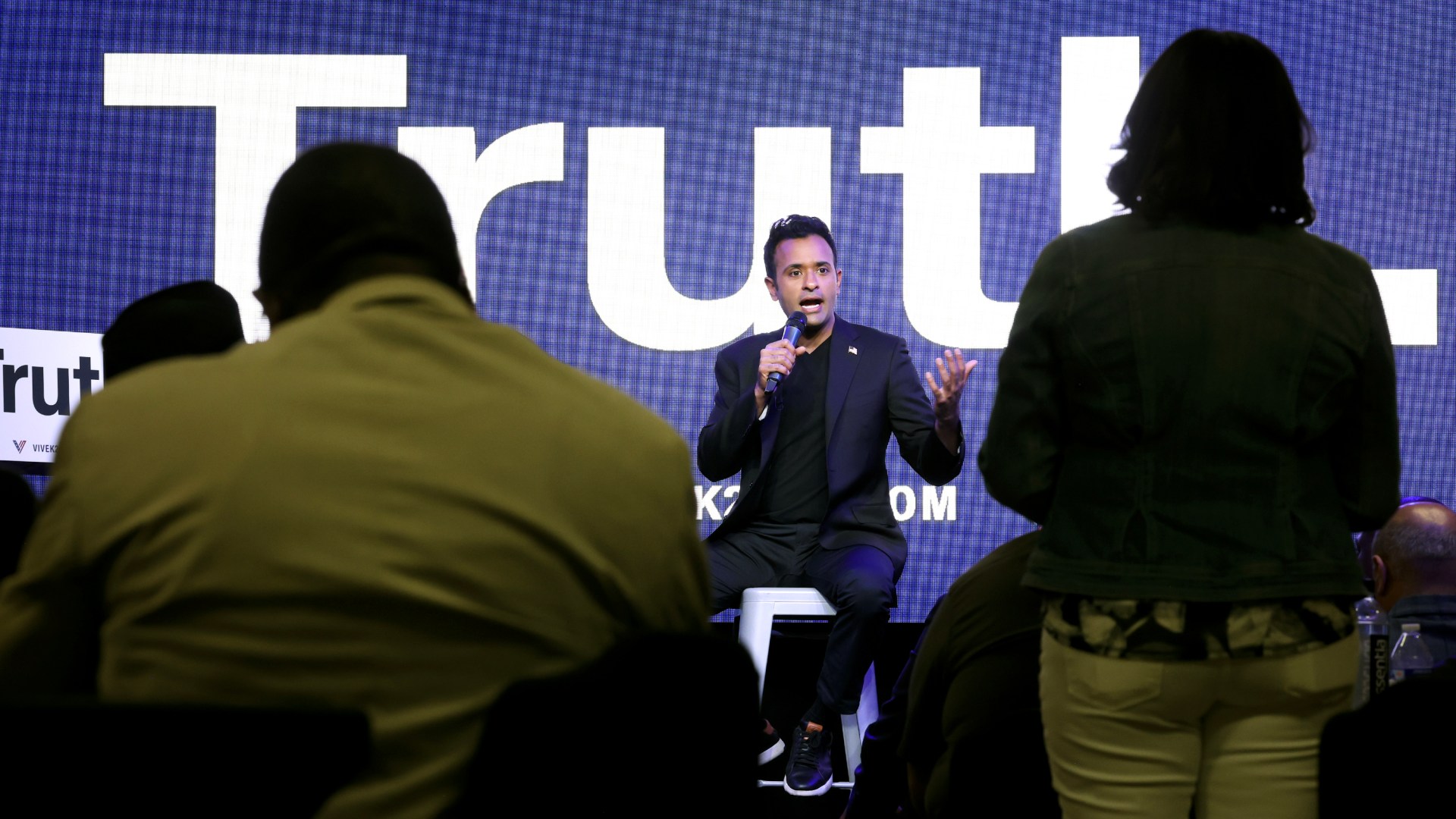
Vivek Ramaswamy’s right-wing satire of the popular progressive yard sign has the same flaws as its target.

Republican presidential candidate Vivek Ramaswamy speaks to residents during a town hall meeting.

Republican presidential candidate Vivek Ramaswamy speaks to residents during a town hall meeting.

Christianity Today August 30, 2023
Scott Olson / Getty / Edits by CT

Vivek Ramaswamy emails me, as does half the Republican presidential primary field, because I am on the mailing list of a GOP fundraising outfit that does not honor unsubscribe requests.

Ramaswamy’s latest email stood out from the daily deluge, though, for the simplicity of its conceit.

“I am not afraid to say these truths,” ran the subject line. Inside, the fundraising pitch was short and blunt: “TRUTH. There’s only one. Not yours, not mine. Just pure TRUTH,” read the brief note festooned with links to donate.

In the middle were the 10 affirmations Ramaswamy has increasingly placed at the center of his campaign messaging, rattling them off every chance he gets:

https://twitter.com/VivekGRamaswamy/status/1694546918662193510

Set aside, for a minute, the question of whether the list is as true as Ramaswamy claims, and look instead at the form. It’s familiar—or it should be, for Christians. This is undeniably a creed, and that’s precisely the problem.

Ramaswamy isn’t unique in taking a creedal approach to politics. The best-known contemporary example is the “In this house we believe” sign, which has become ubiquitous in many progressive neighborhoods in recent years.

https://twitter.com/DixieDenny904/status/1661074785227423744

As creeds go, In this house is remarkably efficient, dogmatic, and magisterial. Each line requires substantial knowledge of the faith: “Science is real,” for instance, invokes a whole host of beliefs about evolution, vaccination, climate change, masking, and more.

There are a few variants on the text—some later manuscripts, which I suspect are more common in states where oil pipelines or fracking is an imminent concern, add the statement “Water is life.” But you never see an In this house protestant posting a sign with a few of the lines crossed out. The creed is complete, and the faithful uphold it in its entirety.

Right-wing interest in mirroring and/or parodying the In this house mantra seems to match the original sign’s spread. When I first researched the phenomenon for an article at The Week in 2020, I came across a red, white, and blue version with lines like “Fetal rights are human rights” and “Immigration is a privilege.” Yet more often, it looked like bumper stickers, campaign signs, and American flags were the Right’s counterpart of choice.

Since then, however, the market appears to have expanded. There are jokey offerings (“We believe Bigfoot is real”) and theological ones (“We believe sola gratia, sola fide”) and a new political version that ignores abortion and immigration in favor of declaring socialism to be “the gospel of envy” and the news to be “propaganda.”

However popular they may be, none of those have made the cultural impact Ramaswamy likely hopes his list will achieve. As a write-up at Mother Jones observed, Ramaswamy’s 10 truths loosely follow In this house, but they’re less derivative than the explicit parodies.

Ramaswamy takes more freedom to include the dogmas he deems essential and adopts a soberer presentation than open mockery. His invocation of “TRUTH” is zealous but apparently serious—or, at least, as serious as anything else in modern American politics. It seems inevitable that his supporters will learn to recite his creed.

And that’s just the thing that unsettles me about all this. Contra the email’s claim to be sharing “pure” truth, it’s very much his creed.

This is not, like the Nicene and Apostles’ Creeds, the work of the church under the guidance of the Spirit—now ratified by more than 16 centuries of faithful Christian use. It is, as Ramaswamy told The Atlantic, the work of 15 minutes on an airplane. It is the work of a political candidate whose “one God,” affirmed in the first line, is not the same God as the one his typical evangelical supporter worships.

It is also the work of a man, as the same Atlantic article indicates, whose understanding of truth and belief is strikingly incoherent. Consider the following exchange:

[Ramaswamy] presents his ideas as self-evident, eternal truths. I asked him if he believes that truths can change over time. For instance, what did he make of the fact that most white Americans used to view it as a “truth” that Black people were genetically inferior—that they weren’t fully human?

“I don’t think that’s true,” he said.

“It is true,” I said. “That’s partly what justified slavery.”

“But it was a justification; it wasn’t a belief,” he said. “Look at emperors—Septimius Severus in Rome. He was Black. He had dark skin. They viewed dark skin as the way we view dark eyes.” [The Atlantic]

What Ramaswamy says here does not make sense. The part about Roman emperors is irrelevant to the matter at hand. The implication that a belief can’t be false is laughably wrong.

And though the Atlantic writer’s phrasing is unclear too—he speaks of truths “chang[ing] over time” but seems to mean that popular beliefs evolve—Ramaswamy’s answer is just as confused. He doesn’t really defend the idea of ultimate, changeless, and (at least partially) knowable truth. He simply defends his list.

The original In this house mantra has basically the same problem. Its author was a woman in Wisconsin. Her homemade sign went viral on Facebook, and then it went into mass production. I’d guess not one in a million adopters of her creed knows her name, though she wrote the very words by which they publicly define themselves.

Like many evangelicals, I did not grow up in a creedal tradition. Most of the churches in which I was raised were formally or functionally Baptist. As an adult, my longest church membership was in a Mennonite community where, like other Anabaptists, we had “no creed but Scripture.” These noncreedal churches had statements of faith and confessions, some of which were very similar (albeit usually more verbose) than the major Christian creeds, but we didn’t have the same doctrine of creedal authority.

For many years that made sense to me, and it still does, in theory. But in practice, I’ve learned that just because a community espouses “no creed but Scripture” doesn’t guarantee it will be marked by deep scriptural study and obedience. Instead, it can produce a community in which scriptural interpretation is an individual project undertaken without clear guardrails or a means of settling sincere disagreements about what the Bible means.

I’m now a member of a creedal church—in part because I think most of us need the creeds’ succinct and long-tested summary of our faith. I believe we have neither the scriptural knowledge nor the personal constancy and wisdom to do without them. Maybe creeds are training wheels; but I, for one, don’t have perfect balance.

The choice to adhere to a creed, though, is a weighty matter. And I think that’s why I have a strong instinct against creedal politicking. The In this house author and Vivek Ramaswamy may have many merits. That doesn’t mean their political agendas deserve creedal authority. Adopting a creed is too serious an expression of loyalty and identity for politics.

Creeds are important, and that’s why they only belong in church.

Bonnie Kristian is the editorial director of ideas and books at Christianity Today.

News

Covenant Families Frustrated by Tennessee’s Failure to Pass New Gun Laws

Special legislative session ends without measures to prevent mass shootings at schools.

Covenant parents Sarah Shoop Neumann, left, and Mary Joyce, center, react to the end of the special session of the Tennessee legislature.

Covenant parents Sarah Shoop Neumann, left, and Mary Joyce, center, react to the end of the special session of the Tennessee legislature.

Christianity Today August 30, 2023
AP Photo/George Walker IV

They hoped the Tennessee legislature would listen to them. They hoped the elected representatives would do something—something—to make their kids safer.

But at the end of the special session in Nashville on Tuesday, The Covenant School parents’ hopes were dashed. The legislature didn’t even vote on the bills that the families of children who survived a Nashville school shooting in March wanted to see made into law.

Wearing matching black T-shirts with the words “Get Used to Seeing These Faces,” the cofounders of Covenant Families for Better Tomorrows wept at the Capitol. And at a press conference after, some of them spoke of how hard it was going to be to explain all this to their children.

“We will go home and we’ll look at our children in the eyes,” said Mary Joyce, whose daughter was best friends with one of the girls murdered at the Presbyterian Church in America school. “They will ask what our leaders have done over the past week and a half to protect them.

The parents vowed this defeat would not be the end of their activism. Melissa Alexander, whose fourth-grade son stood silently against a wall while a shooter killed three of his classmates, addressed elected officials directly.

“The shooter confronted our children with guns,” she said. “Now you are stabbing our families and all Tennesseans in the back.”

There have been 477 mass shootings in America so far in 2023. Gun violence is the leading cause of deaths for children over the age of one, surpassing automobile accidents and cancer. Tennessee has had 17 mass shootings this year, leaving 32 people dead and 59 wounded.

One of those shootings happened in March, when a person identified as a former student reportedly in the process of changing their name and pronouns broke into The Covenant School carrying three guns—an AR-15 semiautomatic rifle, a 9 mm semiautomatic pistol-caliber carbine, and a 9 mm semiautomatic pistol.

The armed intruder fired 152 rounds in 14 minutes, killing six people before police fired back, killing the shooter.

The guns were purchased legally, even though the 28-year-old was under a doctor’s care for an undisclosed emotional disorder and the person’s parents felt they should not have access to firearms. Tennessee law does not allow adults to be deprived of their Second Amendment right to bear arms unless they have been convicted of a felony involving drugs or violence, received a restraining order with a specific prohibition against firearm possession, or are under the influence of drugs and alcohol at the time of possession. People who are mentally ill and have expressed a desire to hurt themselves or others can still buy guns.

In the aftermath of the shooting, Gov. Bill Lee proposed a limited “red flag law,” which would allow a court to evaluate a person’s mental health and temporarily deny them access to guns if re were deemed to be dangerous. Nineteen states—including conservative states like Florida and Indiana—have similar laws on the books.

A Vanderbilt University poll found that 72 percent of registered Tennessee voters support red flag laws. That includes half of self-identified “MAGA Republicans” and about 70 percent of non-MAGA Republicans and independents.

“There is broad agreement that this is the right approach,” Lee said in April. “I’m not saying it’s easy, but it is possible when we’re talking about the safety of our children, our teachers and innocent lives.”

Red flag laws are opposed, however, by the National Rifle Association and gun-rights advocates who say it’s just a sneaky way for governments to gain the power to take away a constitutional right. Lee’s proposal included additional protections for due process, but that didn’t make a difference. Tennessee House Republicans said such measures are “a nonstarter.”

The legislature, which is dominated by a supermajority of Republicans in both the House and Senate, did not take up the Republican governor’s proposal in the regularly scheduled legislative sessions. They did not offer any alternatives, either. The session ended in April.

Lee, who was family friends with two of the adults killed at Covenant, called legislators back for a special session in August.

“I think most lawmakers agree with that and agree that we should be continuously improving public safety,” he said. “We propose a framework but the General Assembly at the end of the day will decide what happens in that session.”

The governor did not line up sponsors for a bill, though, and did not spend much time campaigning on the issue. In one scheduled Rotary Club event, the opening prayer touched on gun violence. Lee did not mention his proposal or the need to make Tennessee safer in his speech.

The Covenant parents, meanwhile, started lobbying legislators as hard as they could. Most of them had no experience in politics and certainly no history of opposition to guns.

Alexander, for example, told The Washington Post that she is a lifelong Republican, a conservative Christian, and a gun owner. She taught both her son and daughter to shoot when they were five years old. Her husband and son hunt ducks, doves, and pheasants. She and the other Covenant parents are not interested in overturning the Second Amendment or banning specific types of guns.

But in the aftermath of the shooting that could have taken their children’s lives, they believed something had to be done. Alexander felt like God told her to create purpose from the pain and pursue change.

“As a native Tennessean and gun owner, I think it’s important to emphasize we are proponents of responsible gun ownership,” Alexander said. “However, I also think it’s important to intervene when there are clear signs that something is wrong.”

The Covenant parents met with more than 20 legislators. Some seemed sympathetic to them in private but then publicly said they would never support the legislation the families were interested in. Others said they wanted to focus on “small things” that they believed could make a difference, like shortening police response times to schools, eliminating taxes on gun safes, and declaring the Bible the official state book of Tennessee.

When the special session began, legislators in both houses considered dozens of bills, but most of them were tabled without serious discussions. No red flag law was considered.

A House committee did vote on a proposal to arm more people at schools. Chris Todd, one of the bill’s Republican sponsors from West Tennessee, said restricting guns wouldn’t have protected the children at Covenant.

If the shooter hadn’t had a gun, Todd said, “she probably would’ve had a car—she had a car. She probably would have driven over those kids when they went to recess.”

Several Covenant parents left the room after he said that, according to The Tennessean. Republicans attempted to call for a vote on the legislation before Covenant parents could testify against it and then had to shut the committee meeting temporarily as tempers flared. The bill ultimately died in a tie vote.

The only legislation that the House and Senate agreed on during the special session was a bill that would require the Tennessee Bureau of Investigations to create a new report on human trafficking. Representatives from the state law enforcement agency said they already report that data. The bill will go to the governor to be signed into law.

“I hoped for more,” said David Teague, who has two children who survived the shooting at Covenant. “A tremendous opportunity to make our children safer and create brighter tomorrows has been missed.”

Teague, who quoted both the New Testament and The Lord of the Rings, said the Covenant parents learned a lot about the limits of lobbying. Going forward, he said, they would need to get more involved in primary elections. He urged more “sane and reasonable” people to get into politics.

“As citizens of a representative democracy and as image-bearers of a just and merciful God, each and every one of us has a part to play that is ours and ours alone,” he said.

The families are, as one of them said, “still in the trenches of this trauma,” but they also say their faith has compelled them to try to make a change and not just give in to the darkness.

“We don’t give up,” said Sarah Shoop Neumann, whose kindergartener recently drew a picture of his school that included a coffin. “We’ve got faith unlike anything else. We’ve literally lived through hell and we’re here and we’re still united in it, and we’re going to keep showing up every January for regular session. … We will be back in January.”

Theology

I Skipped Church for Three Years

My spiritual loneliness brought me back.

Christianity Today August 30, 2023
Illustration by Christianity Today / Source Images: Getty

Faith and church have been tough for a lot of people coming out of the pandemic. I’m one of them. The last three years ushered my wife and me through two job changes, a cross-country move, and months spent hunkered inside, trying to keep our young children healthy and ourselves sane. By the time the world began to reopen, so much felt different.

Until recently, I could count on one hand the number of times I’d physically attended a church service since March 2020. I could give many reasons for our absence—a toddler and a newborn, disillusionment with a church tradition that was once home, enjoying a second weekend morning, sheer exhaustion, and more.

But if I’m really honest, one reason stands out: The further I get from church, the less Christian faith makes sense to me. The physical drift begets an intellectual one.

Although I might sound like a Christian upstart, I’m something of a thoroughbred. I was born and raised in what is now an evangelical megachurch. I graduated with a degree in religion and philosophy from a prominent Christian college, and I finished a seminary degree at another. I got chops.

But when it comes to believing my faith, it’s always been the same. During any season of life when I’ve been separated from like-minded Christians, my faith starts to feel as alien to me as it does to my non-Christian friends. Wait, you believe a man was God? That he actually rose from the dead? Like, his blood and guts cooled and then his heart just started beating again? It’s ludicrous, isn’t it?

Part of my experience of faith—and part of my constitution—is that I’ve always sought out the best arguments against my own positions. And with Christianity, there are plenty of good critiques. Feuerbach, Nietzsche, and Freud all offer substantial ones, describing the Christian faith as variations of wishful thinking. Hypocrisy is another good reason for doubt. The church past and present is full of Christians failing to be faithful to its message.

Arguably the best reason to disbelieve is the problem of pain, or theodicy, as they say in thinky circles. If God is so great, why is there so much evil and suffering in the world?

One particular horror story landed hard with me last year, in the middle of my church absence: news of the passing of Jonathan Tjarks, a staff writer for The Ringer who primarily covered NBA basketball. He’d written powerfully about facing a cancer diagnosis a year after the arrival of his firstborn son. I never met Jon, but we corresponded briefly about writing, faith, and sports. Jon, too, was a Christian, and I, too, am a sports nut.

On the website chronicling his cancer journey, in the final entry before his passing, Jon’s wife includes a picture of Jon in a hospital bed, clearly exhausted, his big frame broken down, being helped to kiss his son Jackson. After the pandemic had weakened my formidable insulation from death, the photo’s caption—“Jon’s last kisses to Jackson”—wrecked me.

That night, I wept at the bedsides of my own sleeping sons, ages five and two, kissing their warm foreheads. I wept for Jon. I wept for Jackson. I wept for my sons, at the thought of my own fragility and theirs. Really, I wept for all of us.

In the piece he’d written before he passed, Jon had talked about the importance of living life intentionally beside others, not just with his family but also with his church. Friends had asked him if he’d been extra careful to isolate during the pandemic. His reply? He didn’t have time to.

Jon’s story compelled me. A few months after his passing, my wife and I agreed it was time to go church hunting. We wanted our boys to grow up in church. And at times, we felt a dull ache on Sunday mornings that donuts and coffee couldn’t alleviate.

The process was hard. Between a graduate degree in theology and my inclination to question everything, I was a bit of a liability. I have enough squirminess about church culture that I knew we’d need to visit a lot of them.

One benefit of the pandemic’s streaming revolution was the ability to peek into a service without dedicating a whole Sunday to each visit. Some mornings, my wife and I would “visit” three churches without leaving our couch or even putting down the donuts. When we saw a non-starter—like, say, a prayer addressed to Mother Earth, or a pastor leading the congregation in “America the Beautiful”—we could jump off the feed and try the next one.

By the time we found a small church near our house, we loaded up our boys and gave it a go. The first handful of people we met there were kind and welcoming, and neither of our boys hated the kids’ care. So we went back. And we kept going back, enough to catch ourselves saying “our church” in conversations with family and friends.

The church was located downtown and transparent about its dedication to local residents, especially those hurting in the community. The services were fairly short, the sermons sometimes moving and sometimes not, the music unoffensive. The microphone crackled every Sunday, and every Sunday people scrambled to figure out why. After years spent in churches where fog machines outnumbered homeless visitors, the simplicity of the church was a balm.

Our first visit was last December, and since then, our family has been adjusting to a new/old Sunday morning routine. It hasn’t always been fun to have our Sunday mornings spoken for. But being there has been good. Deeply good. And by the time Easter came this spring, we knew where we’d be, and we were actually looking forward to it.

Getting out the door for church with young children is dependably Kafka-esque, and by the time we found parking and made it inside, even the dusty chairs in the sanctuary were full. Helpful members unstacked the dustiest ones for us. The service looked and sounded normal, aside from the crowd and the unmistakable electric edge of Easter mornings. We celebrated Christ’s triumph over death, and Christianity’s stake in the ground of human history. “Foolishness to the Greeks,” the apostle Paul said.

As I stood there singing, I couldn’t help reflecting on my time away. I’d missed standing in that dim glow, awash in the chorus of voices. I’d missed the gravity of an Easter morning, the intimate force of communion, the Lion and the Lamb.

Wishful thinking, I still say on my less faithful days.

Paul once prayed that the Ephesians would comprehend the massive scope of Christ’s love. He added an extra line, though: “I pray that you, together with all the saints, would have power to grasp how wide and long and high and deep is the love of Christ” (Eph. 3:18–19).

The strength of togetherness is one of the things I’ve noticed most about being back in church. These days, my faith feels less like a running tally of facts and more like a light switch. Being back together has reminded me that the light switch wasn’t always quite so heavy.

But I can’t help thinking of Jon and Jackson, either. As Jon wrestled through his diagnosis, at least in writing, he never came to some glorious peace about his departure. And to offer him (or anyone) glib answers in the face of that kind of suffering would be, to borrow from the author David Foster Wallace, “grotesque.” Jon still had to kiss his son goodbye, and that pain has a gravity all its own.

After my first Easter service back, I was still thinking of Jon and the passages of Scripture he kept coming back to as his odds got longer and his time shorter. Religion that God our Father accepts as pure and faultless is this: Learn to do right; seek justice. Defend the oppressed. Take up the cause of the fatherless; plead the case of the widow (James 1:27; Isa. 1:17).

Jon was thinking of his wife and son, of course. But if there’s one thing the past three pandemic years have taught us, it’s that we’re all in Jon’s predicament. All of our days are measured. We don’t get to decide how long we live. However, we do get to choose whether we spend those days with each other and for each other, even in our darkest seasons.

This, I’ve realized, is what I was looking for in a church: a community that takes James and Isaiah as seriously as it takes Paul’s writings about the Resurrection—a church whose care for the hurting can help me keep the light switch on when life feels so unbearably fleeting and mortal.

Luke Helm is a writer and coach working out of Grand Rapids, Michigan.

News

Have China’s Christians Peaked? Pew Researches the Data Debate

New report examines the challenges of measuring religion among Chinese Protestants, Catholics, Buddhists, Muslims, and other beliefs.

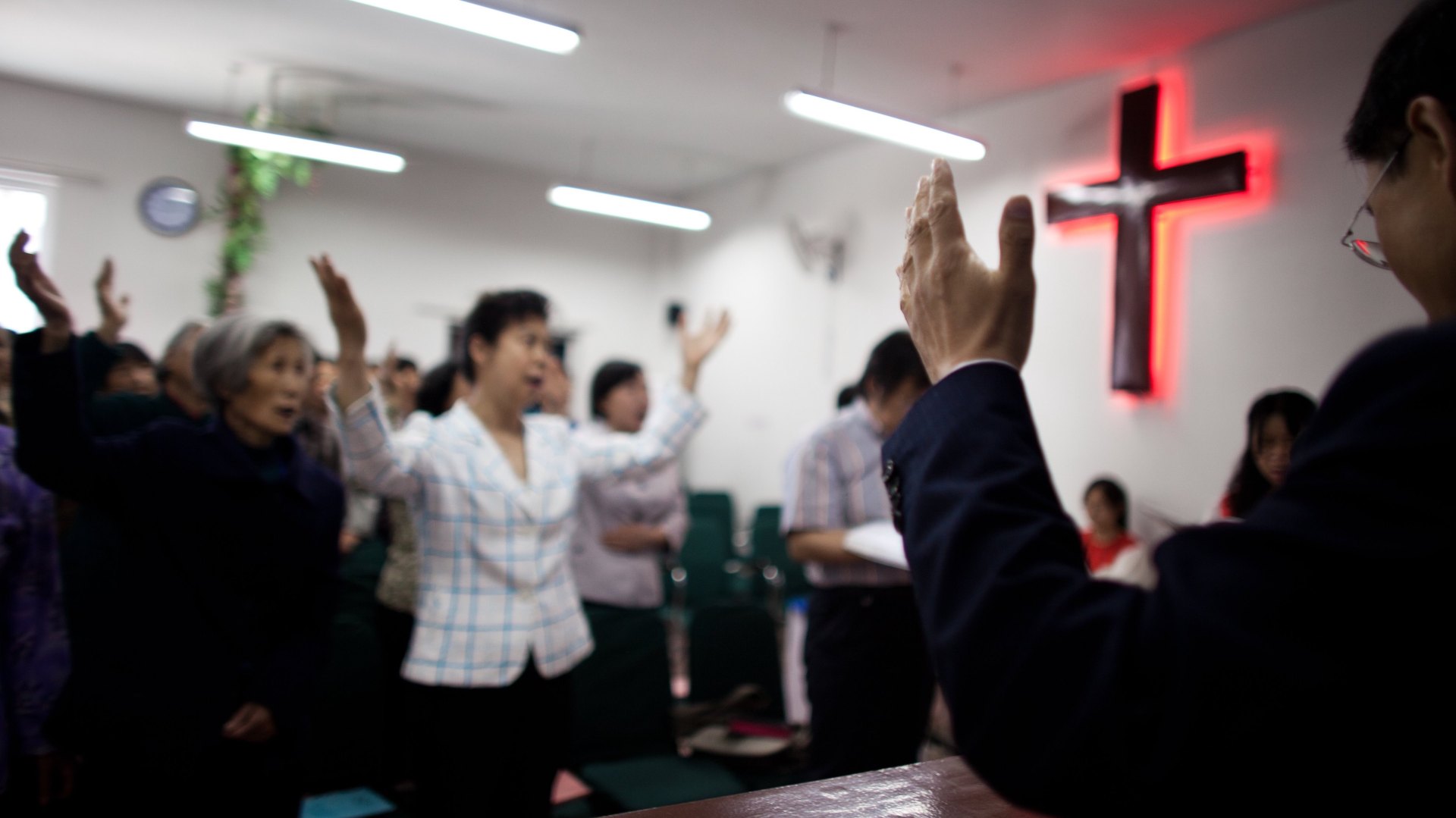
Members of a Chinese house church meet for Sunday worship in Beijing, China.

Members of a Chinese house church meet for Sunday worship in Beijing, China.

Christianity Today August 30, 2023
Jonathan Saruk / Getty Images

Christianity’s growth in China has stalled since 2010.

That’s according to a new Pew Research Center report measuring religion in China published today. In 2010, approximately 23.2 million adults in China self-identified as Christian. In 2018, 19.9 million adults did so, which Pew researchers say is not a “statistically significant gap.”

Among Chinese Christians, the percentages of zongjiao (Mandarin for “organized religion”) activity have also stagnated. Nearly 40 percent (38%) of Christians said they engaged in such activities once a week in 2010, but that figure dipped slightly to 35 percent in 2018.

“Some scholars have relied on a mix of fieldwork studies, claims by religious organizations, journalists’ observations and government statistics to suggest that China is experiencing a surge of religion and is perhaps even on a path to having a Christian majority by 2050,” the Pew report stated.

But more than a decade’s worth of data from surveys conducted in China provide “no clear confirmation of rising levels of religious identity in China, at least not as embodied by formal zongjiao (宗教) affiliation and worship attendance.”

Pew published its previous report on religion in China in May 2008 ahead of the Beijing Olympics. While that study did not touch on the rate of growth of the Christian faith in the country, it acknowledged the presence of “indirect survey evidence” that suggested a “potentially large number of unaffiliated, independent Christians.”

Its latest report highlighted statistics from the Chinese government that appeared promising at first glance as the number of Protestants in the country jumped from 700,000 to 38 million between 1949 and 2018. However, the two sets of data cannot be directly compared to one another as they utilized different sourcing and methodology and did not mention whether children were included in the count, Pew said.

Between 2016 and 2018, the number of Protestants increased by 10 million (from 28 to 38 million). However, the origins of this rise are uncertain, Pew said: It may be due to an influx of new converts or when Christians who previously worshiped in unregistered churches became recategorized and gained legal status.

“While many Chinese people convert to Christianity, some Chinese Christians apparently also leave the faith,” Pew researchers added.

One-third of the adults who identified as Christian in a 2016 survey by the China Family Panel Studies (CFPS) did not do so in the 2012 analysis. This meant that the number of Christian Chinese adults grew by 1 percent during this period.

In the same surveys, one quarter of the adults who said they were Christian in 2012 no longer identified as such in 2016. One in 5 of them also said they did not believe in Jesus Christ or Tianzhu (the Mandarin words for “God” in Catholicism) in 2018.

The Pew report highlighted the difficulty in representing Christianity in China accurately due to factors like the lack of available data, Mandarin-to-English translation gaps, and how culture and politics have impacted religious activity in the country.

As Pew was not permitted to conduct surveys within China, researchers analyzed surveys conducted by academic groups based in the country: the CFPS, Chinese General Social Survey (CGSS), the China Labor-force Dynamics Survey (CLDS), and the World Values Survey (WVS). It also examined data from the Chinese government and state-run religious associations like the China Christian Council and the Three-Self Patriotic Movement (TPSM).

There are also subtle differences in the Chinese words used to connote English terms like “religion” and “belief.” Zongjiao (宗教) refers to organized religion and encapsulates five officially recognized faiths in the country: Buddhism, Catholicism, Islam, Protestantism, and Taoism. Xinyang (信仰), which means “believe,” generally implies a formal commitment or serious conviction, while xiangxin (相信), which denotes “belief in,” does not always carry religious connotations.

Christian demographics and composition

An adult in China who says that Christianity is their zongjiao xinyang–a formal commitment to an organized religion or belief system–is likely to be a woman (72%), more advanced in age, who possesses a lower educational attainment than the average Chinese adult according to the 2018 CGSS.

There is a range of estimates for the number of Christians in China because of differences in sources and methods used, and also because some analyses have made adjustments to the limitations imposed by survey and government data, noted the Pew report.

For instance, the extent of geographical sampling coverage may affect the accuracy of Christian estimates. “Surveys may yield a slightly lower Protestant estimate if Wenzhou – said to be the most Christian city in China – is excluded from the sample,” Pew stated.

The government’s “heightened scrutiny” of Christian activities is another contributing factor that may add to the perception that Christianity is not growing in China, although this is a hypothetical notion as there is no available data to reflect it, said Pew. Nonetheless, researchers recognized that there are existing constraints in data collection, like how many Christians worship in underground churches (dixia jiaohui 地下教会) or house churches (jiating jiaohui 家庭教会) and will likely refrain from revealing their religious associations. Christians in the Chinese Communist Party (CCP), which prohibits members from holding any religion, may also withhold this information in a survey, said Pew.

Just two percent of Chinese adults, or 20 million people, picked “Christianity” as their religious belief according to the 2018 CGSS. Protestants make up close to 90 percent (18 million) of this figure and the remainder are mostly Catholics.

Other surveys reflect similar findings: two percent of Chinese adults said they “believe in” (xinyang) Christianity in the 2018 WVS, while three percent said they “belong to” (shuyu 属于) Christianity in a 2016 CFPS survey.

About 1 percent of respondents identified with Christianity in the 2021 CGSS, although Pew noted that the survey had a smaller respondent pool of 19 provinces, municipalities and autonomous regions, compared to 28 in the earlier 2018 survey.

Adults who formally identified Christianity as their religion (zongjiao) are more likely to say that religion is very important in their lives, compared to those who believe in Jesus Christ and/or Tianzhu but do not necessarily identify as Christian (61% vs. 29%). The former are also more likely to say they attend worship services once a week or more (55% vs. 21%).

In its broadest measures of Christian affinity, close to eight percent of Chinese adults have connections to Christianity as they identify as a believer, believe in the Christian God, or participate in a type of worship attendance common to Christians, Pew said.

The more beliefs, the merrier

What may also affect estimates of Christianity’s growth in China is that many Chinese adults hold multiple (albeit contradictory) religious beliefs and engage in various religious practices, even if only 1 in 10 formally identify with a particular religion like Christianity or Islam.

In East Asia, “people may practice elements of multiple traditions without knowing or caring about the boundaries between those traditions, and often without considering themselves to have any formal religion,” wrote Purdue University’s sociology professor Fenggang Yang.

About 40 percent of adults in China believe in at least one of the following: Jesus Christ, Tianzhu, Buddha and/or a bodhisattva, Taoist deities, Allah, or ghosts. One in five (20 percent) believe in more than one of these religious concepts and figures.

Less than 10 percent (7%) say they believe in Jesus or Tianzhu and only two percent say they hold this belief while rejecting all other gods and supernatural elements.

Cultural practices that have spiritual undertones, like visiting the gravesites of family members, choosing an auspicious day for special events, and belief in feng shui, are commonplace. For example, 75 percent of adults in China say they go to a family member’s gravesite at least once a year, especially during Qingming Festival (Tomb Sweeping Day), to pay their respects by engaging in religious rituals like burning incense and joss paper money as a form of ancestor veneration.

Chinese Christians may do likewise as a means of honoring their loved ones, but will often refrain from engaging in ancestor worship.

Church landscape

Protestant churches in China are also not proliferating.

The number of registered Protestant venues, which includes churches (jiaotang 教堂) and meeting points (juhuidian 聚会点) like apartments or office spaces, increased substantially between 1997 and 2008. But they have now “roughly leveled off” according to the Pew study.

There were approximately 60,000 “legal Protestant venues” in 2018, a slight increase from 58,000 venues in 2009, according to data from China’s State Council Information Office.

These numbers do not capture Protestant house churches or unofficial meeting points, Pew acknowledged. Some scholars, Pew added, also believe that underreporting occurs frequently to “appear compliant with the state’s goal to contain religion.” In the Fengxian district of Shanghai, local officials referred to 24 registered Christian worship sites in 2019 even though they reported having accepted 73 (out of 86) unauthorized Christian sites into the official system in 2018.

Familial ties

A majority of Christians in China did not grow up with Christian parents. About one third (31%) of Christians had a Christian mother, while one fifth (21%) had a Christian father.

Christians are also the least likely religious group (38%) to marry or cohabitate with someone who shares a similar faith according to the 2018 CGSS. By comparison, Buddhists (45%), adults who identify with folk religion (78%), and Hui Muslims (96%) are more likely to do so.

Religious ‘nones’?

A majority of Chinese adults (90%) say they hold no religious beliefs (zongjiao xinyang) in the 2018 CGSS. Another study by the WVS shows that 9 in 10 adults do not have any religious beliefs as well. But only one-third of Chinese adults identify as atheist (wu shen lun zhe 无神论者) according to the 2018 WVS.

The disparity in recorded figures may arise because zongjiao typically refers to belonging to a religious organization or belief system. Survey results may not accurately reflect Chinese adults’ understanding of the term “religion” as they may still continue to hold to certain spiritual beliefs. For example, some may not consider their beliefs in Buddha a religion, Pew observed.

Consequently, the proportion of adults who say they are irreligious is “far larger” than the proportion of adults who “reject any belief in gods or who never engage in spiritual activities.” What this distinction looks like numerically: only 61 percent of Chinese adults say they do not believe in (xiangxin) any gods or deities in the 2018 CFPS survey. But when belief in supernatural forces or participation in Chinese customs is included, “the rate of non-religion” drops further, although Pew did not reveal what this figure was.

CT interviewed experts and scholars on China’s religious landscape on what was surprising, concerning, and hopeful about the Pew report:

Fenggang Yang, founding director of the Center on Religion and the Global East at Purdue University

I’m most surprised by the boldness of the Pew Research Center in releasing this report at this time. The report is primarily based on secondary analysis of surveys, instead of Pew's usual practice of conducting their own surveys. The analyzed surveys in this report are sponsored and supervised by the Chinese Communist authorities. The Communist authorities under Xi Jinping since 2012 have increased restrictions and repressions on religion, cracked down on Christians and Muslims, and campaigned for atheist education in schools and propaganda through mass media.

In an environment that is increasingly hostile to religion, who would want to answer survey questions on religion? What is the response rate in each of the surveys included in the report? I can’t find any information about this. Moreover, it is very likely that many others declined to respond, refused to answer the religion-related questions, or selected options in the close-ended questions without taking it seriously.

The report admits some of the limits of these surveys. Nevertheless, it claims that these are the best surveys available for secondary data analysis. But, the word “best” here is not about the quality of the surveys, merely about the availability of some survey datasets. While the quality of the surveys is unknown or in serious doubt, the Pew Research Center is bold–probably too bold–to put out their findings in this report. They may have done the best they can in terms of technical analysis and presentation, but the numbers and charts cannot be taken for granted as revealing the reality, and is not even close to approximating it.

In short, great caution is absolutely necessary in reading this report. When information is lacking, some information is not always better than no information, because there is the danger of misinformation or misleading information.

The most hopeful or positive finding is that despite the increased repression of religion, a significant proportion of religious believers are courageous in openly admitting their religious beliefs and practices to strangers–survey interviewers who might be accompanied by local officials. In other words, the percentage of Christians here means that these are the most committed and open Christians who dare to be open about their religion in this increasingly hostile political environment.

Up to now, nobody has denied the rapid growth of the number of Christians in China in the last four decades or so. If so many ordinary believers have stood firm in the current political environment in response to surveys, I’m hopeful that Christianity will continue to grow in the coming years.

Chloë Starr, professor of Asian Theology and Christianity at Yale Divinity School

I don’t find much that is surprising. The Pew report is strong on the technical difficulties of accurately reporting religious adherence in China—such as discrepancies in reporting between registered and authorized sites; regional sampling issues for Christianity; variable terminology for belief—but is less focused on political or sociological speculation as to why there is a change in reported numbers.

For instance, the report reproduces data from the annual China General Social Survey reports showing the reported numbers of Protestant adults in sample years between 2010 and 2018. There’s a huge fluctuation in these numbers, with a 5 million loss from 2012 to 2013, then a 3 million gain by 2015, and a 9 million differential over this period, which is not credible. It is not at all surprising, however, that 2017 and 2018 should report lower numbers (16 and 18 million respectively) since this period saw new religious regulations and a changed political ethos, especially regarding unregistered churches. The data for these years is less likely to indicate fewer Christians than more cautious reporting on the part of believers.

It's concerning that we still can’t get accurate data from one of the most surveilled countries in the world, and the degree of engineered obfuscation points to a climate where authorities still downplay and discourage religious adherence, and believers are inhibited from attending worship and from self-identifying as Christian.

The report is helpful in deflating some of the hype on “potentially the greatest Christian nation on earth” that was prevalent when statistics were showing a rapid upsurge in belief, and in challenging a (Western?) fixation on statistics as an indicator of church “success” or import, given the impossibility of determining their accuracy. The Pew report itself points to the need for a variety of means of surveys and the particular issues with reporting in China.

One of the limitations of the grand Pew surveys is that they are inevitably five years out of date when published. The latest data incorporated into this survey is 2018, which predates COVID-19, the shift to online worship, and the (ongoing) recovery of church congregations, all of which have had a significant effect. The entrenchment of Xi Jinping’s policies is not yet fully reflected in this data, so we can probably expect a more marked decline in congregational worship and even greater fluctuations in adherence data in the next survey reporting on the present.

Joseph Tse-Hei Lee, director of the Global Asia Institute at Pace University

The findings indicate a rich and lively religious life, both formal and informal, in today’s Chinese society. Even though Christianity (Catholicism and Protestantism) remains a minority experience, its social and cultural influence is disproportionate to its small membership in the overall population. It is heartening to learn that at least before COVID, “the number of people with some connection to Christian faith is greater than zongjiao measures reveal.”

This has much to do with the extraordinary pastoral work and social service done by mainland Chinese Christians. Many registered and unregistered churches have developed charities, bookstores, cafés, private schools, and other social services to promote Christian values and practices among fellow citizens.

The survey also reveals “a subset of Christians who are more religious” and more well-organized “than those who say they believe in Jesus Christ and/or Tianzhu.” The Chinese Catholics and Protestants in both registered and unregistered churches are in a better position to respond to new and old challenges if they have developed their own networks of support and communication.

Pew’s report offers a helpful historical lens through which to evaluate the changing official policies towards organized and autonomous Christian communities, starting from Document 19 in 1982, through the less ideologically stringent rule under Jiang Zemin and Hu Jintao, to Xi Jinping’s call for the sinicization of religions. Today’s Chinese government is not turning the clock back to the Maoist era, but the overall trend is to enforce more regulatory restrictions on organized religious activities at the local level.

Although contemporary Western political discourse on China is characterized by decoupling and mistrust, the rich history of cross-cultural exchange since 1978 has provided a well of friendships and an extensive web of networks to sustain Chinese Christians. It is just difficult to collect information about the faith experience of these informal actors in the standard nation-based surveys.

Xi Lian, professor of World Christianity at Duke Divinity School

The most surprising finding in the report was the 7 percent who responded affirmatively to the question “Do you believe in Jesus Christ,” in contrast to the 2 or 3 percent who self-identified with Christianity (as a religious belonging) or believed in a “religion” in some surveys. The 7 percent figure may be more revealing and accurate because the survey question used the language of the believers.

Most Chinese Christians would say that what they believe in is not a religion, but a truth. After all, zongjiao (religion) is a term adopted by the secular elites in modern China and carries a stigma—something at odds with modernity. Imagine asking “Are you a religionist?” 7 percent is surprising because it is higher than the mainstream estimates of the percentage of Chinese who are Christians. The 2022 CIA World Factbook puts it at 5.1%.

The various surveys contain some inconsistencies, but they do suggest that the era of Christianity’s explosive growth since the 1980s is over. We need more time to find out if Christianity in China has peaked. There are regional differences, and the full implications of the recent, rapid urbanization for the Chinese church are yet to be seen. For instance, how much of the hemorrhage in the membership of rural churches has turned into new blood in urban churches?

What is concerning is seen indirectly in some surveys: the apparent leveling off of Christian identification suggests in part a hesitance to do so in view of increased hostilities of the Chinese state. The new restrictions, such as those directed at minors (under the age of 18) for church attendance, have indeed dented religious observance of both children and their parents. The rise of ultranationalism has also added to the chill facing Chinese Christians since Christianity is increasingly being identified with a hostile West.

Some of the new developments that I find most hopeful are not reflected in this report, such as the agility of many urban churches to adapt to the new political environment, breaking up into cell groups and moving worship services, Bible study, and pastoral training online. The 7 percent who self-identify as believing in Jesus Christ, even if it represents a larger-than-actual Christian following in China if stricter criteria are applied, still suggests a remarkable vitality and resilience of Christianity in China in the face of severe restrictions imposed in recent years, the intense competition from the new, state-sponsored religion of nationalism, as well as economic opportunities and pressures that make religious observance more difficult.

Jesse Sun, assistant professor of history of Christianity at Belmont University

It’s intriguing that the survey distinguishes between “believe in” (xiangxin) and “trust and uphold” (xinyang) when estimating the number of Christians in China. The former will predictably yield more results than the latter, as “xinyang” suggests an ideological competition with the Chinese Communist Party, which demands exclusive ideological loyalty from its members. This nuance is indeed a significant methodological advancement. Additionally, the survey's attempt to cross check individuals who believe in Jesus Christ while also believing in other religious figures is a nod to the complex religious landscape of China.

What’s most concerning is that the survey seems to privilege state and official statistics, which serves more as a testament to the difficulty of obtaining independent, voluntary, and representative data than as reliable evidence for the trajectory of Christian population growth in China. In an environment where many unregistered house churches are being shut down and can't even maintain regular worship, they are unlikely to respond to a survey or identify as Christian. This underreporting is a significant concern, especially since most scholars agree that the number of Christians in unregistered churches is at least as many as, if not more than, those in state-approved three-self churches.

It's encouraging to see a nuanced approach when estimating the number of Christian houses of worship. The survey notes discrepancies between various reporting levels: government officials tend to report the smallest numbers, while three-self church leaders may be more willing to disclose newly incorporated meeting points. This reflects the nuanced understanding of the Chinese terms for “register” (dengji or zhuce), which could be manipulated for political reasons. It's a sign that the surveyors are aware of the complexities involved in obtaining accurate data in a politically sensitive environment.

Overall, the survey is a commendable effort to map China's complex religious landscape and it indeed broadens our understanding in many aspects. Meanwhile, given the tradition of state dominance, where the government from imperial China to the present has always sought to monitor and reduce the influence of religion in society, I won't be surprised if official statistics keep suggesting that the number of Christians in China has plateaued.

Brent Fulton, Founder of ChinaSource

I’m surprised at the consistency across several surveys that found roughly 2-3 percent of respondents identified as Christians. At the same time, however, this figure must be treated with much caution. As the report points out, Protestant Christians tend to be concentrated in certain provinces and cities of China, and Catholic believers are even more geographically concentrated. We do not know the geographical distribution of the various survey respondents, but given the uneven distribution of Christians in China, they are likely underrepresented in the data.

What is concerning is that while it is impossible to know the true number of Christians in China or gauge the growth or decline of the church in a comprehensive manner, anecdotal evidence would seem to support the observation that the church’s growth has plateaued. Of particular concern is the state of the church among young adults and youth.

In the past fifty years, China’s church experienced two significant growth spurts: the explosion of the rural church in the 1970s and 1980s and the emergence of a vibrant urban movement in the 2000s. Those who grew up during the rural revival are now in their fifties and sixties. Many in the urban congregations are now middle-aged. In the years since these surveys were conducted, youth and student ministry, along with Christian-run schools and activities such as summer camps, have been severely curtailed due to the pandemic and to government restrictions on religious activities for children under 18. The survey data showing that Christians were the least likely to have grown up in homes with parents of the same faith also seem to suggest that Christianity is not being passed on generationally. How the church will meet the needs of its next generation remains a critical question.

What I find positive has less to do with the data itself and more to do with Pew’s transparency in acknowledging the formidable barriers to accurately quantifying religious believers in China. While considerable attention has been given over the past several decades to the question of how many Christians are in China, there is no way to answer this question definitively. When asked in the 1990s about the size of China’s church, veteran CIM missionary David Adeney responded, “As I recall, our Lord did not say ‘count my sheep,’ but ‘feed my sheep.’” Rather than fixating on statistics (as we in the West are prone to do), those who care about the church in China would do well to heed Adeney’s reminder.

Editor’s note: CT now offers hundreds of articles translated into Simplified Chinese and Traditional Chinese.

Ideas

My Pastor Friend Likes Trump’s Border Policy. He Also Shelters Migrants.

It’s politically convenient to treat migrants as “invaders.” But here in West Texas, reality is more complicated.

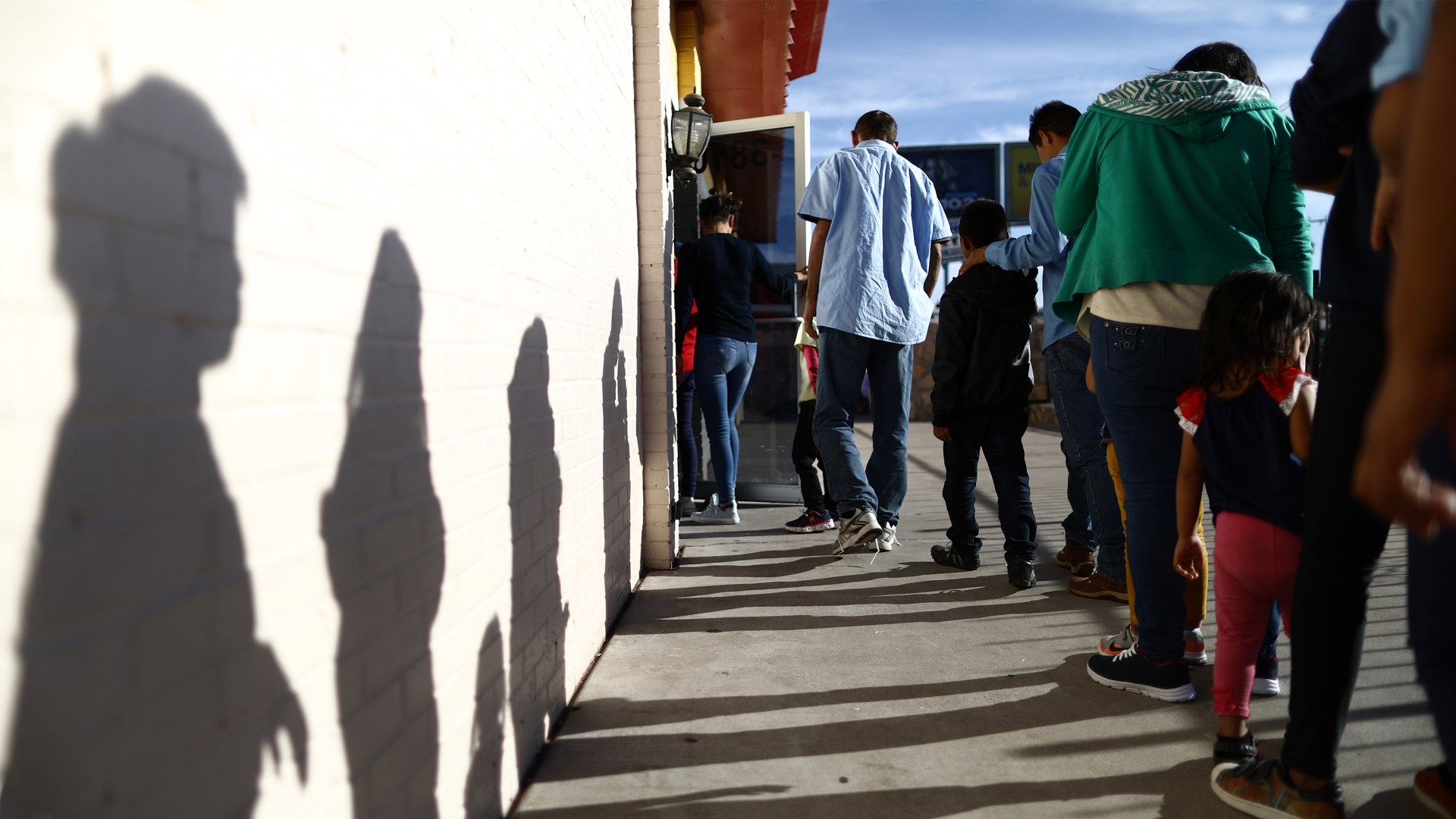
Recently arrived migrants from Central America line up to receive dinner at a church shelter for migrants who are seeking asylum in El Paso, Texas.

Recently arrived migrants from Central America line up to receive dinner at a church shelter for migrants who are seeking asylum in El Paso, Texas.

Christianity Today August 30, 2023
Mario Tama / Getty

Do you know of jobs for people like me? D. asks, typing out the sentence in Spanish into the translating app on her phone.

People like her. D. is Venezuelan, one of the millions of migrants who has arrived at the United States’ southern border over the last few years. She came with her husband on a perilous journey, desperate for her children to have a chance at the sort of life I take for granted for my family: food each day, an education, electricity, and healthcare. And now she’s sitting across from me at my kitchen table.

I met her a few months ago, not long after she arrived in town. A local friend of mine, Pastor E., was sheltering migrants at his church, a Spanish and English-speaking evangelical congregation here in Midland, Texas. The migrants at his church were granted permission by the United States to enter and pursue asylum claims, Pastor E. told me, but they typically have to wait six months or more for permission to work.

While they wait, Pastor E., his wife, and their congregation provide shelter and meals to some of the migrants who lack other connections in the US, and they also help them find cash-paying jobs with people who can be trusted to treat them fairly.

I type my next question for D. into the translation app on my phone, even though I know the answer: Do you have permission to work here? She shakes her head no. So far, all the migrants in Pastor E.’s care are still waiting for work permits.

I ponder her question: Do you know of jobs for people like me? I would know how to help D. find a pediatrician and enroll her child in school. I could help her find a math tutor or a realtor. But though we live in the same town, we are in two different worlds. And I do not know how to help her find a regular, fair, safe job in the world she inhabits.

I’m blessed, I start to type, my evangelical Christianese bubbling up reflexively. But the word looks dirty on my screen. I’ve heard D. singing hymns in Spanish. Is it God’s blessing that has put each of us in our respective places? I backspace and try to be more precise.

I’m fortunate, I say instead. Afortunada. Since I was born here, I do not have experience finding jobs that don’t require legal permits, and I’m not sure how to help.

As I tip the phone to show her my explanation in Spanish, my phone dings, and a text pops up. It’s a political ad: “Carrie, this is Amber with Texans for Strong Borders. Texas is facing an invasion due to the Biden Administration’s refusal to secure the border.” An invasion of people like D.

Disputed territory. That’s where it sometimes feels like I live as a follower of Jesus in a place saturated with both cultural Christianity and deep faith in Jesus. In West Texas, like much of America, political persuasion is predictable by zip code, and policy preferences can come as a package deal with church membership. It can be easy to forget or ignore the tension of conflicting values, even when national allegiance slowly consumes kingdom loyalty.

Like me, Pastor E. was born and raised in West Texas, though his family’s life has always meandered back and forth across the border with the languid ease of the Rio Grande itself. Politically conservative, E. is as red-blooded a Republican as your average West Texan. He can make a compelling case for why migration should be severely curtailed and the border made more secure.

And although E. doesn’t like former president Donald Trump’s abrasiveness, he appreciates his hardline stance on immigration, which he believes is more humane than Biden administration policies which extend an oblique welcome but leave it almost impossible to immigrate safely and legally.

At one point in each of our lives, E. and I shared a comfortable certainty in the common Republican refrain: I support immigration, but they need to enter legally. It seemed to draw a clear and even moral line of demarcation through the border crisis with the certainty of a topographer. Black and white. Right and wrong. Us and them.

But now that migrants sit at our kitchen tables, we’ve both learned it’s more complicated than that. Some migrants E. knows were granted permission to enter the United States more than two years ago and are still waiting for work permits.

“They have to create a subculture in order to survive,” he told me, describing the modern-day indentured servitude into which some migrants are ensnared. E.’s words hang between us, because we both know we’d take the same risks if that’s what it took to feed our own families.

“Immigration has never been addressed. Republicans and Democrats do not want to touch it,” E. told me, sharing that his political frustrations cut both ways. In fact, the relief work he’s doing brushes up against enough legal gray areas that attorneys counseled me and the editors at CT to keep E.’s identity anonymous to protect him from possible legal repercussions.

That this is even a concern—about a church ministry helping legal immigrants—reveals the cruel absurdity of the current asylum process, which many migrants pursue because it’s the only broadly available, licit immigration path for unskilled workers without family in the US: We allow migrants to enter the country, but don’t simultaneously give them permission to work.

This legal limbo exposes migrants to real dangers, including potential trafficking and labor abuses. And at the same, it requires them to navigate an inefficient and often inexplicable immigration process, though they typically don’t speak English, can’t afford a lawyer, and may not even be literate.

Rather than address the systemic problems in our immigration policies, politicians on both sides of the aisle use migrants as political fodder, doing nothing to care for these fellow image-bearers. The hard reality is this: We are living in a system where we rely upon illegal labor, yet we demonize those who provide it. To assuage our consciences, we pretend not to see, passing by on the other side of the road (Luke 10:25–37).

Pastor E. sees the migrants in our town now, and he’s committed to helping them though this act of kingdom loyalty is also civil disobedience. Yet by his own admission, E. spent years mostly ignoring the migrants who come through West Texas, confident in his politics and busy in his ministry.

Then, last fall, E. was driving in Ciudad Juárez, the Mexican city across the Rio Grande from El Paso where he helps shepherd three other churches. Along the river, he came upon a large encampment of migrants. A few blocks from the end of the rail line many had ridden north, they’d staked claim to a narrow patch of gravel between the water and a busy Mexican highway. Visible across the river was El Paso’s modern skyline, close yet impossibly far from the migrants’ makeshift tents of tarp and scavenged pieces of cardboard. Above the camp flew a Venezuelan flag.

Usually, he would have passed by. But this time, E. stopped and found himself asking God: What is our part in helping them? How did you call us to make a difference? He went home to Midland and, over the next two weeks, woke up nightly between 3 and 4 a.m. after dreaming of sheep and goats, migrants and the Shepherd who protects and sorts.

Each night, he’d wake with the words from Matthew 25:35–36 filling his mind: “I was hungry and you gave me something to eat, I was thirsty and you gave me something to drink, I was a stranger and you invited me in, I needed clothes and you clothed me, I was sick and you looked after me, I was in prison and you came to visit me.”

Each night, he’d try to go back to sleep with one clarion instruction from God reverberating in the quiet: “Don’t ask me why they came; ask me what to do now that they are here.”

E. grew more and more convicted that the “church had taken its eyes off what was needed,” he said—that he had taken his eyes off what was needed. “We had become so methodical in our way of doing things for God that we had lost his heart for those who really needed it.”

His political opinions about immigration have mostly stayed the same. But E.’s heart has changed. “God told me, ‘I want you to be my hands. My feet. My mouth. My eyes,’” E. said. “‘I want you to love them. Embrace them. Make them feel that they have a refuge, a family, and a place to learn about me.’”

With his partner congregations in Mexico and their pastors, E. soon built that refuge in a vacant building near the camp. Some church members cleaned. Others cooked. They fed spaghetti to nearly 300 migrants the first day and have served a meal every day since.

Within a week, the church teams installed five sinks with fresh water outside the building, giving the migrants a place to bathe their babies, wash their hands, and brush their teeth. Within ten days, the churches built showers and bathrooms; though migrants still lived in tents, fewer of them had to defecate outside.

As the weather grew colder, church volunteers pushed the tables and chairs against the walls at night, bringing in around 20 people to sleep inside, out of the cold. When the Mexican government began cracking down on migrants sleeping outside, they renovated a part of the building where the roof had collapsed so that more could move indoors. They designated spaces for single women and children, families, and single men, and now the building doubles as a day center for hundreds of people each day and a dormitory for around 130 people each night.

In the first four months, Pastor E. estimates nearly 15,000 migrants—from Venezuela, Nicaragua, Honduras, Guatemala, and even African countries—passed through. And when some migrants were given permission to enter the US but had nowhere to go after crossing the border, E. converted his Midland church into a shelter, spreading inflatable mattresses on the Sunday school floors, adding on a shower room to the existing bathrooms, cooking meals in the church kitchen, and trying to help the migrants find work. That’s how I met D.

“I doubt if it is the duty of any private person to fix his mind on ills which he cannot help,” C.S. Lewis once wrote. “This may even become an escape from the works of charity we really can do to those we know.”

The political power available to American Christians makes this difficult advice to follow. Especially in positions of leadership or influence, it’s easy to fix our minds on ills we cannot help, to stamp political platforms with a divine seal of approval and let our politicking replace—rather than complement—our concrete Christian responsibilities. I’ve mourned this many times, especially with issues, like immigration, that seem utterly intractable in the political sphere but can be tangibly addressed in our local communities.

But there is a different way, one I’ve watched Pastor E. traverse this last year. I’ve watched as he’s gone down the ladder of power rather than up, trading his political certainty for repentant humility and loving his neighbors instead of wishing they weren’t here. Rather than fine-tuning his personal stance on US immigration policy, E. is wrestling with a more profound and complicated question: What does love require of me?

This doesn’t mean he’s happy with our immigration policy—he’s not—or that he wants open borders—he doesn’t. But E. has grown to understand that questions like that aren’t his primary concern. Neither are they mine, nor, most likely, should they be yours. Most of us will never be in a position to steer US immigration policy, but we will have opportunities to love our neighbors well.

In her farewell newsletter for The New York Times, CT contributor Tish Harrison Warren observed that we all have a tendency “to prioritize the distant over the proximate and the big over the small. We can seek to have all the right political opinions and still not really love our actual neighbors, those right around us, in our homes, in our workplaces or on our blocks.”

When we busy ourselves with political debates we cannot solve and shrink the flesh-and-blood call to love our neighbors into a mere philosophical exercise, we make our lives, as Warren wrote, into an “abstraction”—a digitized, isolated, dehumanized existence. The incarnational way of Jesus is different. As Eugene Peterson puts it in his Message translation of John 1:14, “The Word became flesh and blood, and moved into the neighborhood.”

This is the way for us as well. We must embrace, as Warren concluded, the “fleshy, complicated, touchable realities right around us in our neighborhoods, churches, friends, and families.” That’s what Pastor E. did, and in the process, he opened the doors for those of us around him to wrestle with the same complicated reality, sometimes at our own kitchen tables.

It’s easy to label D. an “invader” when you’re sending a campaign robo-text. It isn’t so easy when you’re sitting across from her, watching as she wearily massages her temples and rests her eyes. In that moment, I don’t know how to reform US immigration law. But I do know she looks more like a sister than a threat.

Carrie McKean is a West Texas-based writer whose work has appeared in The New York Times, The Atlantic, and Texas Monthly Magazine.

News

Pastor in Trump Indictment Released After Supporters Cover His Bail

Illinois pastor Stephen Lee was back in church on Sunday, thanks in part to fundraising help from a Christian advocacy group.

Pastor Stephen Lee preaches days after his surrender in Georgia.

Pastor Stephen Lee preaches days after his surrender in Georgia.

Christianity Today August 29, 2023
Living Word Lutheran Church / Screengrab

Living Word Lutheran Church in suburban Chicago had expected to be without its pastor on Sunday since he surrendered to authorities in Georgia days before.

Chaplain Stephen Lee bought a one-way ticket to Atlanta and turned himself in Friday on charges related to election interference, the last of 18 people indicted along with former president Donald Trump. He wore a clerical collar in his booking photo.

Prosecutors allege that Lee went to the home of a Georgia election worker in an attempt to sway her testimony.

Lee ended up being released on bail, backed by the prayers of his congregation and financial support from a Christian advocacy group.

“I just have to say this. I am just so proud of you folks. … We were planning on possibly my absence today, but you didn’t skip a beat,” Lee told the congregation in Orland Park, Illinois, where he has been serving for three and a half years amid a pastoral vacancy.

Last Sunday morning, he preached from Isaiah and Romans, and the church lifted up his family with “prayers of guidance and blessings as they work through their current struggles, and a prayer of thanksgiving for support.”

Part of that support came from the Illinois Family Institute, which set up a legal defense fund to help cover 10 percent of his $75,000 bond for release. The Christian group has partnered with a company called Make Honey Great Again, which agreed to donate a portion of sales. Its honey comes in bottles shaped like Trump’s head.

Evangelicals hope president-elect Clinton will strive for consensus on social issues, not just for dramatic change.Family Research Council (FRC) receptionist Sheila Ervin had hardly stepped into the office on Wednesday, November 4, when the phones began to ring. “They started before 8 A.M., and they haven’t stopped yet,” she says. Some callers were distraught about the election of Bill Clinton and wanted to talk about how it could have happened. But most, she says, were looking to volunteer in efforts to stem the social changes they fear Clinton may bring about. “There are many sleeping Christians who see the battle ahead and want to join the ranks,” she says.In the wake of George Bush’s resounding re-election defeat last month, many media and political pundits have proclaimed evangelical activism irrelevant at best, and most likely dead. Voters turned down the evangelicals’ ideology, which was represented by George Bush, the rationale goes. But groups on the activist level disagree, saying that the election outcome was nothing more than a referendum on the economy. And many, like FRC, say they are already seeing a resurgence of grassroots interest to support their causes.As the dust settles, it is clear that the results of the November election have not laid to rest debates about the role and effectiveness of evangelical political involvement. Indeed, evangelicals garnered a prominent place in this election—one that is likely to continue as the nation’s political climate undergoes massive changes.Big Gop Voting BlocAccording to exit polls, evangelicals were among the most loyal groups voting for Bush, with some surveys showing as many as 61 percent of evangelicals and fundamentalists voting for him. A poll commissioned by Pat Robertson’s Christian Coalition (CC) found that 55 percent of self-identified white evangelicals voted for Bush, 28 percent for Clinton, and 17 percent for Ross Perot. The only two demographic groups Bush carried were born-again Christians and those who earn more than 0,000 a year.“If you compare 55 percent with the 38 percent of the general population who voted for Bush, there was a very dramatic level of support from evangelicals,” says John Green, director of the University of Akron’s Ray C. Bliss Institute of Applied Politics. That loyalty, coupled with an unprecedented voter turnout, has made evangelicals “the central voting bloc in the GOP,” Green says.Still, Green and other scholars acknowledge that significant numbers of evangelicals defected from the Bush coalition. Surveys in 1988 indicated that more than 80 percent of evangelicals voted for Bush. The economy appears to be a top motivator. Exit polls show that nearly half of all voters listed the economy as their top voting concern, and evangelicals, like everyone else, are affected deeply by the shape of the economy. But Green says other factors may also have moved evangelicals to vote for the Democratic ticket: Clinton and Gore’s Southern Baptist faith and their frequent use of religious imagery, their more moderate approach than most recent Democratic presidential contenders, and evangelicals’ longstanding unease with Bush.Many evangelicals who consider themselves politically moderate or liberal say they were attracted by Clinton’s positions on the environment, his health-care proposals, his apparent concerns for racial reconciliation, and his campaign theme of “putting people first.”Clinton and Gore may also gain approval from evangelicals across the political spectrum for their endorsement of the Religious Freedom Restoration Act, a bill that most evangelical groups support (CT, June 24, 1991, p. 52), and their strong human-rights stands in areas like China and the former Yugoslavian republics.Clashes AheadBut most observers believe major confrontations between the Clinton administration and evangelical Christians on social issues are virtually inevitable, particularly in such areas as homosexual civil rights and abortion. For the anti-abortion movement, especially, the results of this election were a major political setback. Not only did the nation elect a President who has pledged to expand abortion rights and appoint only prochoice Supreme Court justices, but prolifers lost 11 more seats in Congress.Just days after the election, a report in the New York Times said that Clinton, in his first 100 days in office, will likely issue a series of executive orders that will lift current abortion restrictions and expand homosexual rights. Even those evangelicals who voted for Clinton are uncomfortable with that kind of agenda. And just the thought of that has already energized more conservative Christians.“We’re experiencing the same thing that the liberal groups experienced when Ronald Reagan was elected in 1980,” says FRC president Gary Bauer. “The left-wing groups did not fade away and leave the battle. They redoubled their efforts.”Bauer says his group is willing to work with Clinton if they can find issues of common ground. But, he adds, they will be aggressive in defending traditional family values. “We intend to remind the President-elect that he was elected to do something about the economy, and not to follow some radical, left-wing social agenda.”New ChallengesHowever, some daunting challenges lie ahead for conservative religious activists. The next few months will be a key test of how committed they are to the battle for the long haul—especially in the face of some discouraging national defeats. A second, perhaps greater challenge will be to reconstruct a winning coalition within the Republican party. Even though evangelicals proved to be the most loyal GOP voters, many moderate Republicans are blaming the Religious Right for Bush’s loss.Intraparty struggles among various wings of the party began even before all the electoral votes were counted. Christian Coalition (CC) executive director Ralph Reed categorically denies that the blame lies anywhere other than with Bush’s poor handling of the economy. “I think the election demonstrates the indispensability of the evangelical vote to the rebuilding of the Republican party as we move into the future,” he says. Reed says his group is willing to work with all groups to rebuild the winning coalition. But are other Republicans willing to work with the CC? “They are going to have to, because they’re not going to be able to win without our active support at the grassroots,” he confidently asserts.Some observers say that before such coalition work can happen, conservative Christians must make some changes. “The Religious Right does need to learn how to temper its language … so that it does not scare away unnecessarily people who could be cobelligerents with them on the issue that they hold dear,” says Michael Cromartie, research fellow for Protestant studies at the Ethics and Public Policy Center.Some Religious Right electoral activities and rhetoric came under sharp criticism from people both outside and inside the religious community. For example, a coalition of 50 religious leaders held a press conference just prior to the election to denounce Operation Rescue founder Randall Terry’s mass mailing to churches, which proclaimed that “to vote for Bill Clinton is to sin against God.”Still, many experts on religious political efforts say conservative Christians are likely to emerge from this testing period stronger politically than ever. University of Maine professor Matthew Moen says the Religious Right is “better positioned” now than it was during its formation in the late 1970s. “Now, the Christian Right is again in the opposition, but this time they are much better organized, they are better led, and they have a clearer vision of what they are trying to do and where they are headed.”Moen, who is author of the book The Transformation of the Christian Right, says the movement’s new emphasis on the state and local levels will continue to reap rewards. In state and local elections last month, candidates with Christian ties appeared to do very well. The liberal lobby People for the American Way (PAW) says the Religious Right won in about 40 percent of the state and local races where they were involved. A PAW report released in October identified some 500 candidates in 33 states with ties to Religious Right groups.Moen expects the successes to continue. “It is just extraordinarily shortsighted to proclaim them dead on the basis of the November 3 election results,” he says. And John Green agrees. “All political movements prosper in opposition, and religious-based movements do particularly well in opposition because what makes them work is appeal to transcendent values,” he says. “I wouldn’t be at all surprised if some of these groups didn’t double in size in the next four years.”With the new administration, the three political options for evangelicals seem to be: seeking common ground, provoking confrontation, or retreating into uninvolvement.By Kim A. Lawton in Washington, D.C.

“You may like or dislike the bottle design, but it’s filled with healthy, pure, raw honey and we hope the uniqueness of the packaging will generate awareness, prayers, and donations for Chaplain Lee,” the Illinois Family Institute wrote.

Between Monday and Thursday of last week, the Illinois Family Institute’s fund had raised $4,000, and Herneitha Richardson, the host of a pro-Trump podcast called Diamond and Silk, covered the remaining $3,500 of his bail, according to Lee’s attorney David Shestokas. He called it a miracle that the pastor didn’t have to spend time in jail.

Lee’s indictment stems from his visits to the home of a Georgia election worker whom Trump falsely accused of pulling out “suitcases full of ballots” to interfere with the vote. He has been charged with violating Georgia’s RICO act as well as conspiracy to solicit false statements and writings, criminal attempt to influence witnesses, and influencing witnesses.

In the aftermath of the contentious presidential election in 2020, Lee went to Ruby Freeman’s house twice, and she called the police. Reuters reported that he told the officers, “I’m a pastor, and I’m also working with some folks who are trying to help Ruby out. And also get to some truth of what’s going on.” He had driven to Georgia from Illinois.

Shestokas and Lee’s supporters see his outreach to Freeman not as political maneuvering but as genuine pastoral concern.

“If this case in Georgia is successful and criminalizes election contests, providing legal advice, lobbying legislatures, free speech, freedom of religion, or even offering pastoral services—the basic underpinnings organizing society will be severely damaged,” read a press release from Shestokas.

The attorney said that as a former police chaplain, Lee was compelled to offer on-the-ground assistance at national crises, having ministered after the Columbine school shooting, September 11 attacks, Hurricane Katrina, the 2017 mass shooting in Las Vegas, and several natural disasters.

“If you consider Reverend Lee’s history of traveling to unusual settings, and offering this combination of law enforcement and pastoral experience to assist people that are under stress, it’s not out of character,” Shestokas told the Daily Beast.

“And it may not be something you do, or I do—I wouldn’t—but I don’t have the same history that he has. … You know, so many of the big stories that are headlines around the country in the last 30 years, he’s been there. He’s kind of the Forrest Gump of crises in America.”

The indictment, however, charges that Lee—along with Willie Lewis “Harrison” Floyd III of Black Voices for Trump and Trevian Kutti, a publicist—were there in an attempt to sway Freeman as Trump fought Georgia’s election results.

Stephen Lee
Stephen Lee

The prosecutors allege that Lee, Floyd, and Kutti misled Freeman “by stating that she needed protection and by purporting to offer help, with the intent to influence her testimony.”

According to the Northern Illinois district of the Lutheran Church–Missouri Synod, Lee is a retired pastor, emeritus, a designation given to pastors over 55 who “no longer serve under a call.” His church is currently searching to fill its pastor position. When queried by CT, the district declined to comment further on Lee’s case.

Illinois Family Institute executive director David E. Smith said the legal fund raised over $10,000 as of Tuesday. He told CT that there has been a lot of interest in Lee’s case, which he believes has implications for religious liberty.

“I think it’s fairly evident to people that the government is being weaponized,” Smith said. “It appears to me that Reverend Lee’s only mistake was knocking on a door … this is a precedent that cannot be permitted to stand.”

Shestokas says he and Lee regularly pray together, with the pastor thanking God for his provision and repeating that no matter the outcome “God is on his throne.”

Lee is awaiting the court arraignment in the case.

As of Monday, Trump’s arraignment has been slated for September 6. According to news reports, trial dates are uncertain in the Georgia case as individual defendants pursue varying legal strategies.

News

Brazilian Young People Love Jesus and Are Hungry for a Deeper Faith

According to a recent Barna report, nearly 75 percent of Brazilian teenagers say they want to learn more about Christ.

Christianity Today August 29, 2023
AGIFP / AP Images

At just 14 years old, Lavínia Fernandes competes with the other young people in her church, located in Recife, Pernambuco, northeast Brazil, to see who can bring the most friends from school to the Saturday services. There are now more than 10 people from her class at school who started attending church through her.

“My friends comment that I became kinder and happier after I became a Christian and that they can see God in my life,” said the teenager.

Like Fernandes, millions of other Christian teenagers throughout Brazil and other Latin American countries are experiencing something special in their journeys of faith. Recent research by the Barna Group reveals that Latin America is home to a “connected, digitally enabled generation” that is committed to their faith, engaged with the Bible, and hungry to learn more about Jesus.

Barna surveyed 3,320 young people, ages 13 to 17, from July 21 to August 24, 2021, in Brazil, Honduras, Mexico, and Colombia. Young people in all four countries revealed an enthusiasm and passion for their faith consistently higher than the global average. (Barna polled 26 countries around the world for this survey.) Brazilian teens, in particular, showed an especially heightened awareness of Christ and the Bible.

When asked what they really think about Jesus, 74 percent of Christian Brazilian teenagers said they believe he offers people hope, and 60 percent said Christ makes a real difference in today’s world.

https://datawrapper.dwcdn.net/kSQff

Just over half (55%) of Brazilian teenagers, however, believe that Jesus was God in human form.

https://datawrapper.dwcdn.net/CONgD

Brazilian teenagers are more likely to believe in Jesus’ miracles and his return.

Barna classifies committed Christians as those who identify as believers and claim to have a personal commitment to following Christ and nominal Christians as those who identify as believers but do not have a personal commitment to following Jesus. By those definitions, just under one in four teenagers around the world is a committed Christian, but among those surveyed in Latin America, that number rises to 37 percent—and among Brazilians, it rises even higher, reaching 45 percent.

https://datawrapper.dwcdn.net/j4OUG

The research also shows that teenagers who are more committed and engaged are more likely to have a significant experience of faith. When confronted with the statement “My relationship with Jesus brings me deep joy and satisfaction,” 76 percent of adolescents surveyed around the world strongly agreed, but this number increased to 84 percent among Latin Americans surveyed.

The number of evangelical churches in Brazil has jumped from 17,033 in 1990 to 109,560 in 2019, an increase of 543 percent, according to the latest data available. In 2019 alone, an average of 17 new evangelical churches opened per day in Brazil, according to researcher Victor Augusto Araújo Silva, at the University of Zurich, Switzerland.

Long a country dominated by Catholicism, the arrival of Baptists, Lutherans, and Calvinists to Brazil at the end of the 19th century helped usher in the arrival of the evangelical movement. In the 20th century, missionaries from the US brought the Pentecostal movement, predominantly to the north and southeast parts of the country. By the 2030s, evangelicals may outnumber Catholics, projects demographer José Eustáquio Diniz Alves.

For Nathan Zortéa, a youth pastor at the CCvideira church in Fortaleza, Ceará, a congregation in the northeastern part of the country, Brazilian teenagers reap the fruits of evangelical churches whose reach crossed socioeconomic and racial lines.

“The social inequality that exists in Brazil ends up showing our teenagers that the gospel is good news of justice and righteousness, of a God who is for you and not against you. Our churches have played a fundamental role in presenting these teenagers with a gospel that invites them to live something new,” said the leader of the A13, a youth ministry that currently has an average weekly attendance of more than a thousand teenagers.

In addition to being very engaged now, Brazilian and Honduran teenagers have been more motivated to keep learning about Jesus. The Barna survey shows that globally only 38 percent of those surveyed said they are “very motivated” to learn more about Christ, while that number jumped to 63 percent in Latin America and nearly doubled in Brazil (73%) and Honduras (74%).

For Jacó Adonias, pastor of teenagers at Cidade Viva Church in João Pessoa, Paraíba, a neighboring state, Gen Z is thirsty for the truths that only the gospel can offer.

“I can see in my ministry how true the numbers that were presented in the survey are. I know teenagers aged 13, 14, and 15 who have made a real difference in their communities and environments,” said the leader of Rede Livre, a ministry that brings together more than 600 teenagers weekly. “I always encourage the leaders we have here at the church not to underestimate the potential of these boys and girls.”

Increasing Bible engagement among young people is one area where church leaders will need to continually invest their efforts. Altogether, while 85 percent of teenagers studied in Latin America claimed to have a Bible at home, one in five (19%) never use one. Despite this, Brazilian and Honduran teens think highly of the Scriptures.

In Latin America, only 12 percent of Christian teens surveyed said they read the Bible every day. In Brazil, 66 percent said they prefer to read a printed version of the Scriptures versus 33 percent who read through an app on their smartphone or tablet.

https://datawrapper.dwcdn.net/ukQ0A

Additionally, the survey reveals that 67 percent of Brazilian Christians not only believe the Bible is the Word of God, compared with an overall 59 percent of Latin American teens who use or own a Bible, but also show a higher level of engagement with the Bible than believers from any country in the survey. Barna defines “engaged” as having a “high view” of the Bible (believing it to be the inspired and unerring Word of God) and reading it several times a week.

Those considered to be “open” to the Bible are defined as either having a “high view” of it and reading it less often than Bible-engaged teens (but more often than three or four times a year) or having a neutral view of the Bible.

https://datawrapper.dwcdn.net/vYKse

Teens in Latin America are highly motivated by a sense of social justice; 49 percent of committed Christians and 56 percent of Bible-engaged teens are “justice motivated.”

(This term refers to teens who strongly agree with all of the following: that it is important to “change conditions that cause individual suffering” and “protect the well-being of all people”; that they are confident that they can “make a positive impact on others’ lives” and “influence others to promote fairness and equality”; and that in the future they will “engage in activities that promote justice” and “work collaboratively with people in need.”)

The more the teenagers are engaged with the Bible, the more they feel motivated to seek justice.

https://datawrapper.dwcdn.net/y1wkS

Brazilian and Honduran teens also receive further training regarding their Bible studies from family and church leaders.

https://datawrapper.dwcdn.net/5e8qh

According to Barna, “Though teens are usually reluctant to precisely name barriers to Bible reading (the plurality selects “none”), Bible users and Christian teens in Latin America may sometimes struggle to understand or stay focused on the text.” Concentration difficulties may also be connected to increased smartphone use after the pandemic.

(A 2022 report analyzing data collected by 46 studies and involving nearly 30,000 children from various countries showed that the average amount of time teens spend in front of screens every day has skyrocketed by 52 percent since 2020. It has increased from 2.7 hours to 4 hours—an additional hour and twenty minutes of daily consumption.)

For leaders, Barna’s findings underscore the importance of their work in educating young people on the necessity and relevance of the Bible. For pastor Lucas Nagib, from Lagoinha Baptist Church in Niterói, Rio de Janeiro, one factor that has led young Brazilians to stand out in relation to those from other countries is these teenagers’ high commitment to expose their faith with their peers and friends through social media.

“Here in our church, we believe a lot in this generation, and we give them a lot of opportunity to grow and develop. We have many leaders who are teenagers, and they make a total difference in the life of the church,” said the leader of the Nexteen ministry, which has a weekly attendance of more than 500 teenagers.

Back in Recife, Fernandes has also organized a Bible study at her school, and it currently brings together more than 40 teenagers to pray, worship, and read the Bible together each week.

“It’s a huge responsibility, because everyone at my school is paying attention to my actions now,” she said. “If they won’t go to church, I want to bring the gospel to where they are.”

Theology

Young Men Need a Model Not an ‘Übermensch’

The church can’t compete with “manosphere” influencers. But it doesn’t have to.

Christianity Today August 29, 2023
Illustration by Christianity Today / Source Images: Getty / WikiMedia Commons

The plight of young American men has become a serious concern of late. They’re earning fewer college degrees compared to women, falling out of the labor market, and dying from overdose or suicide more often than women. Many are addicted to porn, video games, or online outrage.

They’re “trying on new identities, many of them ugly, all gesturing toward a desire to belong,” writes Christine Emba in an incisive essay for The Washington Post. “It felt like a widespread identity crisis—as if they didn’t know how to be.”

What’s the cause of all this trouble? Some argue for a purely materialist explanation by looking at the decline of manufacturing jobs that used to provide a steady income for men without college degrees. Others suggest that men are merely entitled brats—so accustomed to patriarchy that now “equality feels like oppression.” Still others, like Richard Reeves in The Atlantic, point to problems with our education systems.

The sheer scope of the problem has led to “manosphere” influencers who offer a vision of masculinity and the steps to achieve it.

Aaron Renn has been a persistent critic of the church’s overfeminization, accusing both liberal and conservative Christians of “vicious negativity towards men and excessive pedestalization of women” that “repels men.” The popular psychologist Jordan Peterson has shaped these conversations for years. On the far right, Andrew Tate, the former champion kickboxer indicted on charges of sex trafficking, has a massive social media presence built from vulgar hedonism and brazen materialism.

If their collective followings are any indication, it’s clear that many young men are attracted to a vision of masculinity that draws more from Nietzsche than Jesus Christ. American Reformer contributor John Ehrett calls it vitalism.

Some commentators are warning that the post-Christian Right will seduce aimless young men grasping for a sense of self. They urge the church to embrace a “masculine Christianity” that emphasizes dominion, male leadership in the home and the church, and physical fitness to keep men from being drawn into the vile world that sees women as sex objects and pushes Nazi propaganda about superior races.

I won’t argue against positive role models and physical health. But here’s where these critics go wrong: Christianity can never compete with vitalism on vitalism’s terms, just like a church service will always be less exciting than a rock concert on a rock concert’s terms.

If a young man wants an ideology that allows him to treat women with contempt and consider himself Nietzsche’s Übermensch, social media gurus will always win out over Scripture. You can have a men’s conference with fireworks and a working military tank, but the Bible will still show us that the greatest man who ever lived submitted himself to a humiliating death and told us the meek are truly blessed.

The masculinity crisis has major consequences for the church. It feels harder than ever for young Christian women who want to get married and have children to find young men who make decent husbands and fathers. More broadly, congregations are suffering as young men that could be blessing the church are instead wasting their lives away in front of screens.

How should Christians respond?

The church has always struggled with gender imbalance, as Lyman Stone notes. As far back as the Roman era, more women than men have flocked to sanctuaries, and finding marriageable Christian men has never been easy.

Furthermore, every church is different. On the extremes, some still operate according to a more rigid gender hierarchy while others ignore the idea of God-given gender differences.

As a missionary in East Africa, I can tell you that a culture where gender differences are still respected doesn’t draw more men to church. Women still outnumber men here too. And the cultural commitment to traditional sexual ethics brings lots of problems, including much higher rates of violence against women.

The simplest fix might be to erase any gender distinctives and encourage each young man to simply be “a good person” rather than “a good man.” There’s some truth to this, as church is the place where men call themselves a bride and women can say they’re more than conquerors. The fruit of the Spirit are the same for both sexes.

However, as Emba puts it in a follow-up essay, “young men and boys are telling us, often literally, that they desperately need and desire direction, norms, and a concrete rubric for how to be a man.”

In theological terms, we are created in the image of God, male and female, and that distinction has consequences for how we think about ourselves. When one set of cultural currents is trying to erase those distinctions altogether by telling men their manhood isn’t real or meaningful, many of them will simply be discouraged from even trying to be good people.

In The Toxic War on Masculinity, Nancy Pearcey calls for a greater ministry focus on boys without fathers, and she’s absolutely right. Rather than compete with manosphere influencers who think expensive cars and sexual conquests define masculinity, we need Christian families to invite young men into their lives and homes. There, they can learn about the virtues of masculinity by observation rather than didactic (and often harmful) instruction.

Single people, elderly couples, and families with children can all participate. Helping care for others’ kids, sharing life together, and talking about something other than social media will do far more for young men than any blogs or podcasts. (Pro tip for young men who want to find a Christian wife: Do the dishes after dinner. Trust me on this one.)

The crisis of masculinity is real, and the church has a role to play. Rather than complaining about feminism or “beta male” pastors, we need to participate in mentoring and building relationships with young men. Military hardware and empty admonitions to “be a man” can’t substitute for genuine connections between people. The church has a calling to celebrate the goodness and beauty of God’s choice to create us in his image, male and female, and those distinct identities emerge best in community.

As we attend to the masculinity crisis, opening our doors and making space at our tables is something we can all do to keep lost boys from going astray.

Matthew Loftus lives with his family in Kenya, where he teaches and practices family medicine. You can learn more about his work and writing at matthewandmaggie.org.

addApple PodcastsDown ArrowDown ArrowDown Arrowarrow_left_altLeft ArrowLeft ArrowRight ArrowRight ArrowRight Arrowarrow_up_altUp ArrowUp ArrowAvailable at Amazoncaret-downCloseCloseellipseEmailEmailExpandExpandExternalExternalFacebookfacebook-squarefolderGiftGiftGooglegoogleGoogle KeephamburgerInstagraminstagram-squareLinkLinklinkedin-squareListenListenListenChristianity TodayCT Creative Studio Logologo_orgMegaphoneMenuMenupausePinterestPlayPlayPocketPodcastprintremoveRSSRSSSaveSavesaveSearchSearchsearchSpotifyStitcherTelegramTable of ContentsTable of Contentstwitter-squareWhatsAppXYouTubeYouTube