From the Archives: Views on Universalism

A selection of CT articles about the eternal fate of humankind.

Christianity Today April 19, 2023
Illustration by Mallory Rentsch / Source Images: Unsplash

“This is typical of the kind of discussion that universalism arouses: it is never abstract, but is always charged with emotion, for it has to do with the love of God.”

This quote by G. C. Berkouwer appeared in Christianity Today’s pages in 1957, demonstrating that universalism is hardly a recent source of theological concern. Browse the CT pieces below on the topic that include overviews of historical universalist thought, J. I. Packer’s reflection on the fate of the “Old Testament faithful,” and a 2021 Pew Research survey about how Christians see the issue now.


Click here for more from the CT archives.

Books
Excerpt

Love, Joy, and Peace Are a Package Deal

Don’t ignore their ordering in Paul’s passage on the fruit of the Spirit.

Illustration by Rick Szuecs / Source images: Envato

In Paul’s fruit-of-the-Spirit passage (Gal. 5:22–23), joy is sandwiched between love and peace, which points us toward a deeper understanding of genuine joy.

An Invitation to Joy: The Divine Journey to Human Flourishing

An Invitation to Joy: The Divine Journey to Human Flourishing

243 pages

$16.95

Those who have a version of joy without love can be very self-centered. You may know someone who appears joyful but whose joy is shallow; they retain it by being oblivious to the needs of others.

Similarly, peace without love and joy is a counterfeit peace. In the 1970s, as a campus minister, I watched students who were attending the Erhard Seminars Training weekends (known as EST). They would pay good money for the experience of being treated abusively, insulted, and forbidden to talk to fellow participants or go to the bathroom for hours at a time. The goal was apparently to experience a sort of peace or tranquility, to remain calm in the face of fearsome treatment. But I saw students who came back with a glassy-eyed, detached calmness, which is a counterfeit to real, biblical peace and joy. God’s peace is not a tranquilizer.

Christian peace does not come from the annihilation of feelings and desires, which is more characteristic of stoicism or certain Eastern religions. Similarly, God’s gift of joy is not a passive denial of or resignation to the pain and unpleasant experiences of life, but rather an honest acceptance of this pain in light of God’s goodness, mercy, and love.

Jesus conveyed his peace to his disciples by saying, “Peace I leave with you; my peace I give you. I do not give to you as the world gives” (John 14:27). Paul later states that Jesus not only offers peace; he himself is our peace (Eph. 2:14). Commenting on this passage, Walter Wilson, a Missouri medical doctor who later became a preacher, recalled the days when he used to make house calls. Often, he would enter a home where a woman was in labor or where someone was deathly ill. The whole house would be in a panic. But when he entered, an amazing calm and peace took hold. His presence was their peace, and Jesus’ presence is our peace.

And he is our joy. I have seen the power of prayer to turn panic into peace. When I was a young pastor, a woman called our church for help. She had seen the movie The Exorcist, and she was terrified that she was under attack. As we prayed, she invited Jesus into her life. I watched a peace come over her. The she beamed with joy. She suddenly realized that some sounds she was hearing were simply from a rusty gate. Later, as a campus minister, I watched this kind of transformation take place in the lives of scores of students, turning fear into peace and joy.

Adapted from An Invitation to Joy: The Divine Journey to Human Flourishing by Daniel J. Denk (Eerdmans: 2023). Reprinted by permission of the publisher.

New & Noteworthy Books

Compiled by Matt Reynolds.

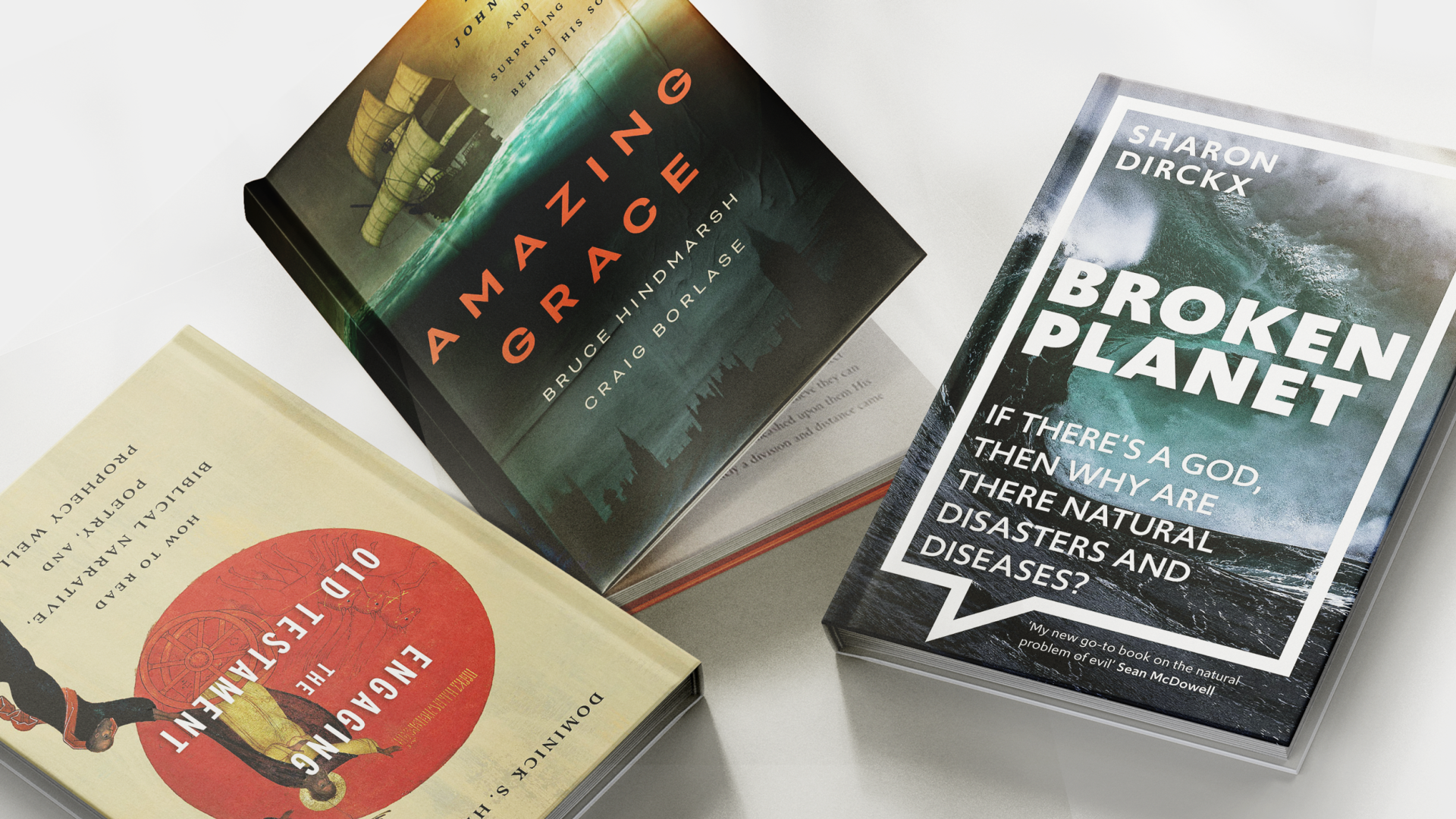
Broken Planet: If There’s a God, Then Why Are There Natural Disasters and Diseases?

Sharon Dirckx (IVP)

We often refer to natural disasters as “acts of God,” a fact that helps explain why skeptics of Christian faith invoke them as stumbling blocks to belief. In Broken Planet, Sharon Dirckx of the Oxford Centre for Christian Apologetics explores how to defend God’s goodness in light of events like tsunamis, hurricanes, earthquakes, famines, and pandemics. The book also includes extensive firsthand testimonies from a range of believers, including rescue workers, local residents, and other eyewitnesses.

Amazing Grace: The Life of John Newton and the Surprising Story Behind His Song

Bruce Hindmarsh and Craig Borlase (Thomas Nelson)

This year marks the 250th anniversary of the writing of “Amazing Grace,” John Newton’s iconic hymn. To mark the occasion, historian Bruce Hindmarsh and writer Craig Borlase have teamed up to write what they call a “dramatized biography” of the former slave-ship captain, one “with the feel of a film or a life play.” Like the song that inspires it, Amazing Grace summons readers to consider the arc of redemption in their own lives.
Engaging the Old Testament: How to Read Biblical Narrative, Poetry, and Prophecy Well

Dominick S. Hernández (Baker Academic)

For many believers, the Old Testament seems bafflingly inconsistent with the picture of God we receive from the New Testament. This can tempt us to neglect it, downgrade it, or read it selectively. Dominick S. Hernández, a professor at Biola University’s Talbot School of Theology, wants to correct these tendencies in this survey of Old Testament interpretation. “If Christians … ignore or renounce attributes of the revealed character of God (in either the Old or the New Testament),” he writes, “then we necessarily disregard parts of the plan of redemption.”

Books
Review

Conflict Between Science and Religion Is Always Possible but Never Inevitable

A new history challenges perceptions that the two are either completely autonomous or completely at odds.

Illustration by Abigail Erickson / Source Images: Getty, Unsplash

Nicholas Spencer’s latest book, Magisteria: The Entangled Histories of Science and Religion, opens and closes with references to Stephen Jay Gould’s depiction of science and religion as nonoverlapping magisteria, or “NOMA.” By this, he meant that science is about the natural, religion the supernatural, and never the twain should meet. Each is magisterial, or authoritative, in its own domain—but not beyond it.

Magisteria: The Entangled Histories of Science & Religion

Magisteria: The Entangled Histories of Science & Religion

480 pages

$34.97

Gould, a popular science writer and avowed secularist, advanced this concept in 1997, at the height of America’s latest public dustup over teaching so-called creation science and intelligent design. He thought NOMA could defuse the controversy while removing religion from science education.

Neither side wholly bought NOMA then. On the one hand, proponents of secular scientism like Richard Dawkins, who want science enthroned as the arbiter of all truth in the modern mind, rejected the notion that religion is magisterial anywhere. On the other hand, theists such as the noted geneticist Francis Collins denied that religion was cordoned off from the natural world—otherwise, why would believers pray for physical (or even mental or emotional) health?

Nor does Spencer, a senior fellow at London’s Theos think tank, buy NOMA now. In Magisteria, he argues from history that science and religion are (and have always been) deeply entangled. This is nothing new. Spencer begins his book by noting that, since the 1980s, historians have uncovered a complex relationship between science and religion, and he names ten leading scholars in this enterprise. (Full disclosure: I’m listed as number six.) Spencer draws on this body of scholarship to compile a narrative history of science and religion since ancient times. His story mainly covers the Christian West but also touches on the Islamic world and the Asian context.

Any sweeping history, especially one emphasizing entanglement, necessarily moves in fits and starts over time and space. Skipping vast periods and various places, the narrative focuses on discrete, well-known encounters between religion and individual scientists or persons involved with science (broadly defined so as to range from ancient natural philosophy to modern social sciences). Accordingly, the book unpacks such fabled episodes as Galileo’s persecution by the Catholic church, Thomas Huxley’s debate on evolution with bishop Samuel Wilberforce, and the Scopes Monkey Trial. Among other subjects, Spencer tackles astrology, heliocentrism, physio-theology, the fossil record, phrenology, evolution, modern physics, Freudian psychology, Marxism, and sociobiology, concluding with the challenge to religion posed by artificial intelligence.

Embracing complexity, Spencer treats each encounter on its own terms. Conflict characterizes some, harmony others. NOMA-like separation emerges in Michael Faraday’s revolutionary work in electromagnetism, while labored accommodation drove the effort to fit ancient fossils into a day-age interpretation of Genesis. As Spencer depicts them, battles over authority spur some episodes, particularly where a literal reading of Scripture clashes with scientific findings, while parochial politics or personal pride enflame others. Nothing seems inevitable about any of the outcomes except that both science and religion survive and persevere.

Befitting his role as a public commentator on religion in public life, Spencer strives (with mixed success) to find something about humanity and human morality underlying each encounter. “Time and again, when it seemed as if people were arguing about the power of planets, the composition of the body, the order of the cosmos, the design of nature, the origin of life, the age of rocks or the development of species, they were really talking about the nature of the human beast,” he claims. “What (or who) is the human, and who (or what) gets to say? These two questions run through the histories of science and religion.” Religion rightly refuses to defer to science on such questions, he maintains, and science cannot definitively answer them, because humans, uniquely of all creation, mix the natural and the supernatural. Spencer sees this tension driving the entanglement between science and religion. Both have something significant to say about humanity.

Spencer warns against basing science on religion or religion on science. They don’t work that way. In his view, Galileo had it about right when, in defending his heliocentric model of the solar system, he wrote that the role of religion “is to teach us how one goes to heaven, not how the heavens go.” Presuming that the first use of heaven means a supernatural abode and the second denotes the natural cosmos, then religion should illuminate the former and science the latter.

Yet the history recounted in Magisteria shows that Galileo’s aphorism can be devilishly hard to apply in particular cases. Modern science has made the average human life longer and healthier, Spencer notes, but not (as in cases like phrenology and eugenics) always better. “In some places, NOMA makes sense. But the human being is emphatically not one of them,” he writes. “Humans are both ‘material’ creatures, which are measurable and explicable according to the methods of science, and ‘spiritual’ ones, who talk about and aspire to things like meaning, significance, transcendence, purpose, eternity and love, which have always been the building blocks of a religious understanding of reality.”

(Although Spencer does not quote him, Francis Collins made a similar point as director of the Human Genome Project. “Science,” he predicted in 2002, “will certainly not shed any light on what it means to love someone, what it means to have a spiritual dimension to our existence, nor will it tell us much about the character of God.”)

“Precisely because they overlap across the human, the potential for conflict between science and religion is always a live one, whether talking about algorithms in the twenty-first century or astrology in the fourth,” Spencer concludes. “And yet, if the long history of science and religion has anything to teach us, it is that this conflict is only potential, not inevitable.” He hopes these entangled magisteria can work together, each in its proper sphere, to advance the commonweal. Although his accounting of the past offers no assurances about the future, it does portend that science and religion will remain entangled on matters important to humanity.

Edward J. Larson is a historian and legal scholar teaching at Pepperdine University. He is the author of Summer for the Gods: The Scopes Trial and America’s Continuing Debate over Science and Religion.

Books
Review

The Power and Peril of Spiritual ‘Evolution’ Stories

They can encourage people on similar journeys. They can also misconstrue one’s own.

Illustration by Jack Richardson

In an episode of NBC’s sitcom The Office, Michael Scott offers a humorously self-serving accounting of his weaknesses as a boss: “I work too hard, I care too much, and sometimes I can be too invested in my job.” Asked to list his strengths, he replies, “Well, my weaknesses are actually strengths.”

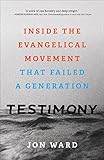
Testimony: Inside the Evangelical Movement That Failed a Generation

Testimony: Inside the Evangelical Movement That Failed a Generation

Brazos Press

256 pages

$9.99

Call it the Michael Scott paradox. In telling stories about our lives, we have a habit of casting ourselves as the hero. Every day is a new chapter confirming that we alone are truly empathetic, courageous, and reasonable. Our strengths are obvious (or at least they should be). And our weaknesses are really strengths.

This penchant for valorizing our choices and motivations speaks to the fundamental fallenness of our nature. It tempts us to misremember, misconstrue, and misunderstand not only ourselves but those around us. This is the peril of spiritual-transformation memoirs such as Testimony, a new book from Yahoo News political reporter Jon Ward. Few things are as compelling and as invulnerable to disputation as a great personal story. And yet few things can slip away from the teller’s grasp as quickly or as totally.

Too often, Ward’s book succumbs to this latter tendency. Its subtitle (Inside the Evangelical Movement That Failed a Generation) promises a sweeping analysis of a religious community and a postmortem on that community’s fall from grace. And traces of this are sprinkled throughout the book, especially in its depiction of a church culture that prizes performance over grace.

But as a whole, Testimony struggles to overcome the Michael Scott mindset. Its memories of a conservative evangelical childhood are tainted by retroactive moralizing. Testimony is not so much a portrait of an evangelical movement as a snapshot of one evangelical’s attempt to process his past. As such, its lessons for readers are less about the dangers of institutions and beliefs out there than about the inner workings of our own hearts.

Testimony begins the way many testimonies do: at home. In the first several chapters, Ward narrates a childhood and adolescence spent within a conservative evangelical church culture anchored by his parents, especially his father (one of the few religious mentors the book portrays in a positive light). Many readers who grew up in conservative Christian settings will see familiar sights. Ward goes to church a lot; he and his siblings groan during family devotions and are kept away from alcohol and profanity.

The way Ward describes these mundane details is sometimes strange and off-putting. In one anecdote, he rebukes his pastor-father, who asks him to “participate more enthusiastically” in church: “I spoke up. ‘Dad, you’re just telling me to do that so you’ll look good to other people.’ To my dad’s credit, he admitted I was right and left me alone.” This exchange may be meant to convey something of the author’s youthful incisiveness, but I read it with grief. Perhaps Ward’s father genuinely wanted his son to take more joy in spiritual things. Could there have been more to this story?

This is unfortunately the beginning of a pattern that persists throughout Testimony, one marked by the absence of self-critique and a tendency toward assumption. In one especially miscalculated passage, he describes watching his mother play piano, which was “one of the few things I remember Mom doing for herself. … Gradually, any hopes and dreams she might have had for a life of her own, even a hint of something she could call hers outside of raising us kids, kept getting smaller.”

This comment, of course, expresses Ward’s concerns regarding traditional gender roles. But it struck me as misguided because Ward’s mother is not a subject in the book. She never speaks, and there’s no indication that his conclusion about her quiet desperation is fair or true. Too much of Ward’s memoir seems filled with unresolved tension between a son and his parents, and the lack of meaningful self-doubt gives it a revisionist vibe.

As Ward gets older, he becomes progressively dissatisfied with his family and the church he attended for several years, Covenant Life Church in Maryland. Its pastor at the time, former Sovereign Grace Churches head C. J. Mahaney, has faced charges of mishandling allegations of sexual abuse and leading in a headstrong manner. Clearly, Ward believes his experience at Covenant Life (and within conservative Calvinism writ large) is a microcosm of broader trends in American evangelicalism. He is critical of Mahaney, and he recounts having a crisis of faith and departing Covenant Life during a period when he was being “groomed for leadership” within the church.

Ward’s narration of this crisis is fascinating, both for what it includes and what it leaves out. He recalls reading through his Covenant Life–era journal entries and finding “mountains of BS cloaked in religious language.” But he tells us nothing about searching the Scriptures to better disentangle bad interpretation from true doctrine. Indeed, the Bible is conspicuously absent in many of the book’s most important moments. Ward looks Christian hypocrisy straight in the eye, often rightfully so, but his tendency is to confront this hypocrisy despite Scripture rather than with Scripture.

The appearance of Donald Trump halfway through the book highlights another major theme in Ward’s story: how politics can drive theology rather than the other way around. Many readers will resonate with Ward’s description of church politics and how struggles around leadership and institutional survival can poison our spiritual lives. And many will appreciate his criticism of Trump and the seemingly unconditional support he received from some evangelicals.

But there’s a tension within Testimony that Ward never resolves. Take, on the one hand, his robust opposition to Trumpism. He straightforwardly blasts “White evangelical churches” and their support of Trump in the aftermath of the 2017 white supremacist rally in Charlottesville, Virginia. “I couldn’t understand how fellow Christians could be so committed to remaining inside a spiritual bubble that they wouldn’t squarely look at the conflict and division engulfing our nation,” he writes. “All of it was being stoked and encouraged and inflamed by the sitting president.” In a startling chapter, he gives a detailed, blow-by-blow account of an escalating argument with his parents and siblings over Trump, a disagreement that appears to have wounded their family.

When it comes to Trump, then, Ward is unequivocal: He was a wicked president, and evangelicals who supported him are morally tainted. Yet it’s a similar attitude of moral certainty that Ward distrusts within the evangelical tradition of his youth. He criticizes statements of faith, contrasting them against “the kind of faith that is a lifelong journey of growth in which one never truly arrives but is constantly seeking and growing and evolving.” He declares that the “roots of evangelical anti-intellectualism run deep,” exemplified by the way his church “promoted absolutism,” leaving “no room for nuance” and making “no allowance for complexity or shades of gray.”

For Ward, it seems, evangelicalism is hopelessly dogmatic on some issues (like doctrinal statements or claims of biblical authority) and insufficiently dogmatic on others (like the proper stance on Christianity’s relationship to conservative politics). What explains the difference? It’s hard to escape the conclusion that Ward may simply care more about one set of issues than the other.

There is always an intrinsic danger to telling one’s story. We are all fallible narrators. Even the purest intentions cannot cure a mistaken memory or a misunderstood moment. These things do not make our self-histories worthless; they simply make them human.

Yet telling our stories of theological, political, or intellectual transformation carries a distinct risk: that our gratitude for where we are now lures us into ignoring or distorting the grace that met us at a much different place. This isn’t just a factual problem. It’s a spiritual one as well.

Many of us raised in evangelical subcultures must admit that we are very different people today than we were while living with our parents, attending this Sunday school class, or sitting under that youth pastor. Many of us will look back at the things we were taught and see problems—some minor, others serious.

Yet this transformation shouldn’t leave us with contempt for the people and places of our past. When we’re honest with ourselves, we should acknowledge that even the ways we change are deeply rooted in the things that were poured into us when we were too young to refuse them.

Ward’s book certainly showcases the power of the evangelical “transformation” memoir. His experiences of hypocrisy and cynical church cultures will be familiar to many. His frustration with his family and those who mentored him is often quite relatable. Many will see themselves following a similar trajectory, and Testimony will give them words to describe what they had felt but not yet named.

Yet the peril of this genre is overwhelmingly present as well. More than any theological or political point, I came away from Testimony freshly aware of my own tendency to see myself in the purest light, and to apply grace to my own journey but deny it to others. Indeed, this is the peril of all our testimonies. We see even our own lives only as through a mirror dimly.

Most of us will not publish a spiritual memoir, but in a way, we are all writing one every day. The church needs these stories. But our stories need the church too. When we look into our lives for reasons to feel better about ourselves, we tend to stare straight past the mercy, the forgiveness, and the love that God pours into us through others. Instead, we should see our testimonies the way Christ sees them: as a vindication not of our wisdom, but of his glory.

Samuel D. James is an acquisitions editor at Crossway and a writer. He is the author of a forthcoming book, Digital Liturgies: Rediscovering Christian Wisdom in an Online Age. His Substack is Digital Liturgies.

Books

What Singleness Reveals about the World to Come

Unmarried Christians can live as signposts of the new creation.

Illustration by Abigail Erickson / Source Images: Getty, Pexels, Unsplash

With rates of long-term singleness on the rise across Western societies, evangelicals are increasingly reflecting on the challenges this poses for the church. In The Meaning of Singleness: Retrieving an Eschatological Vision for the Contemporary Church, Danielle Treweek reframes the discussion around the Bible’s picture of the creation to come. Author and theologian Barry Danylak spoke with Treweek—founding director of the Single Minded ministry and an Anglican deacon in Sydney—about cultivating a robustly theological understanding of singleness.

The Meaning of Singleness: Retrieving an Eschatological Vision for the Contemporary Church

The Meaning of Singleness: Retrieving an Eschatological Vision for the Contemporary Church

336 pages

$21.99

What are some the challenges you see with defining singleness?

Singleness is a modern concept that carries lots of baggage. It can mean different things in different contexts. We don’t open 1 Corinthians 7, for instance, and see Paul talking about singleness specifically, but rather a host of related concepts like virginity and betrothal. And elsewhere in Scripture we see categories like widowhood and examples like the eunuchs in Matthew (19:12). So we need to be flexible in how we talk about singleness, recognizing some of the assumptions we’re bringing to that concept.

What is the chief problem with how today’s evangelicals understand singleness?

The chief problem is that, by and large, we have an impoverished theological understanding of singleness. And I see two problematic tendencies that have brought us to this state.

The first problem arises from the fact that we’re very good at looking over our shoulder to Genesis and developing a theology of marriage from Scripture’s account of creation. As Christians, however, we also look forward to what is ahead, to the new creation that Scripture promises. So we have to work out what it means to live in light of this reality we’re heading toward, one that Scripture tells us has already been inaugurated.

The second is failing to realize how much we are products of the world we live in. Paul warns in Romans 12 against being conformed to the patterns of this world (v. 2). But when it comes to matters of marriage, romance, sex, friendship, and community, we’re being discipled by the world without realizing it.

You point out that many popular evangelical writers view personal sanctification as one of the primary purposes of marriage. Why do you see this perspective as mistaken?

Marriage certainly can be helpful for sanctification. But we shouldn’t assume that getting married is the best way to become like Jesus. The Holy Spirit works within us in the context of all our relationships, marital or otherwise. I can certainly see how the Spirit uses marriage bonds to challenge our sinfulness. But you don’t need a spouse to have your sinfulness challenged, either by the Spirit or those around you.

What are some ways singleness is theologically significant?

The typical approach to understanding the theological significance of singleness relies on its instrumentality. In other words, it’s a matter of what you’re doing with your singleness.

Of course, that category really is important. But I’m trying to explore whether there’s something theologically significant about the status of being unmarried, in and of itself. Looking at singleness through the lens of eschatology, we can see how it has implications for things like sex, romance, companionship, community, parenthood, and family. What keeps coming back to me is how a faithful theology of singleness is essential for our ecclesiology—for understanding who we are as the church.

You argue that celibate Christian singles might inform a more expansive, biblically authentic understanding of sexuality. How can this play out?

Too often, the church sees celibacy as oppressive rather than expansive. There are two reasons I think that’s wrong.

The first is that single people committed to honoring God with their bodies can testify to others that they’re not enslaved to sexual longings. In a world that celebrates sexual desire as the total of who you are, celibate singles can show that we have rich and fulfilled lives.

The second reason takes things further into an eschatological perspective. As resurrected people in God’s new creation, we’re going to be our most perfected human selves. We will retain our male or female sexual natures, but as we see from Matthew 22, we won’t express those natures through sex in marriage (v. 30). If, in eternity, I’m my most perfected self, and that self is celibate, then this suggests that human sexuality is oriented toward relationship more broadly. Single Christians get to remind the world that there’s more to being sexual than having sex.

How do we actually inspire today’s Christian singles—and for that matter, the church as a whole—to see singleness as theologically significant?

In my pastoral ministry, the vast majority of singles I’ve gotten to know desire marriage. So how do I handle that theologically and pastorally?

I think the answer is helping them to see their singleness the way God sees it. Our world can send the message that your singleness is only as good as you feel about it. If you’re happy and content being single, then your singleness is good. But if you’re unhappy and struggling, then your singleness is a bit tragic. My desire is to think beyond the personal experience of singleness to see the significance God has imbued it with.

For the church as a whole, the answer is much the same. Let’s be willing to go back to Scripture and look afresh at God’s purposes for marriage and singleness alike. Of course, that always feels like a cop-out, because people are keen to ask how the church should address singleness on a practical level. And that’s important to wrestle with. But without considering the underlying theology, we’re only applying Band-Aids to a gaping wound.

How has your own experience with singleness informed your work?

I became interested in this subject because I was single, and remaining so as fewer of my friends were. This compelled me to think theologically about God’s purposes for this part of my life. But what really cemented it for me was working in ministry and being exposed to lots of single women grappling with similar questions—not only never-married women, but widows and divorcees as well.

And even though this is a more pragmatic way of looking at things, it’s still true: I don’t think I could have done all this research and reflection had I been married with kids over the last eight years. Being a single woman in ministry has allowed me to invest in this project, which is a great gift to me and hopefully for others as well.

What advice would you give Christian believers struggling with their singleness?

First, take that struggle seriously. You don’t need to feel shameful because you’re struggling. There are real griefs involved in all sorts of life circumstances, singleness very much included.

But don’t be content to remain in that struggle. Prayerfully ask God and other believers to help you seek Christian growth and contentment. And ask that you can find a comfort and peace rooted in God’s sovereignty over your life. Even amid grief, we can move toward the joy the gospel gives us, particularly as we look toward the new creation that awaits us.

Testimony

New Age Thinking Lured Me into Danger. Jesus Brought Relief.

He made himself real at a moment of intense spiritual fear.

Alex Boerner

As a child, I was fascinated by the unknown. Staring up at the stars, I would think about everything beyond our ordinary perceptions: space travel, alternate realities, aliens, astrology, Egyptology, and all things science fiction. I was drawn to anything esoteric. These interests planted a deception and led me down a path to a life without Jesus.

I was never an atheist, which made no sense logically or when observing the beauty of the world. I believed in some kind of divine creator, but despite being exposed to Christianity as a child, I did not heed its message.

My biggest roadblock was intellectualism. I was a seeker with an insatiable hunger for wisdom. I tried to absorb and decipher countless books, articles, and websites. In my mind, being well-educated meant you could not resort to trivial faith. Yet I was drawn to other world faiths, never questioning them as harshly as I questioned Christianity.

In the mid-2000s, my obsession with science fiction and aliens led me to metaphysics and then eventually to New Age spirituality, including Eastern mysticism, enlightenment, and reincarnation. (Only later would I discover that the New Age is essentially ancient paganism in repackaged form.) The lure of the esoteric world was too powerful to resist.

My first transformative experience with the New Age happened around 2008. A woman I knew had been reading something that piqued my curiosity. When I asked about it, she glanced at me, clearly scrutinizing my intent. I sensed her hesitation to reveal her secret, almost as if she were pondering whether I was worthy of hearing it.

Finally, with a sly smile, she told me what she was reading—a book about a purported “ascended master.” I ordered the book soon after, and its antibiblical teachings hooked me immediately. I believed I had finally discovered the real path of esoteric knowledge. Unaware of the Bible’s warnings against interpreting signs and omens, I later convinced myself I was experiencing supernatural congruences, with every number, word, or coincidence representing some kind of message from beyond.

In 2011, I bought my first deck of oracle cards, which are divination tools forbidden by God. I relied on them for answers, entertainment, and comfort, mistakenly believing that the universe was guiding me. Meanwhile, I began attending spiritualist events, services, and conventions. These take different forms, but they often incorporate spiritual readings, talks about metaphysical topics, sales of New Age goods and paraphernalia, and experiential workshops like nature hikes in search of spirits.

I became progressively immersed in the New Age, engaging in practices like divination, meditation, affirmations, visualization, crystal and energy healing, and chakra clearing. I saw these practices as the best route to self-improvement and enlightenment. All the while, I told myself that nothing I was learning and doing could be evil because it was all about “love and light.” I knew nothing of the Bible’s teaching that your heart can deceive you (Jer. 17:9), and I failed to appreciate how Satan, the father of lies, can further that deception.

New Age spirituality feeds your ego by teaching that there is no right, no wrong, no objective truth—just a landscape of experiences that your soul goes through. It gives you false idols to worship, starting with yourself, teaching that you are always perfect where you are. It also teaches you to rely on spiritual experiences rather than rationality.

In 2013, as New Age thinking had me firmly in its grip, tragedy struck when my twin daughters died after I went into preterm labor. I delivered them on two separate days, holding each daughter in my arms as they took their final breaths. I had always been obstinate and resilient, but this experience broke me. I sought relief in New Age practices, never stopping to ask what I needed relief from. But I also began praying and calling out to God for help.

Things began to shift in late 2016. I attended a spirituality event and saw a presentation from a world-renowned New Age leader. She was engaging and endearing as she preached immense love and forgiveness in front of the lights, cameras, and audience.

Later, standing in her book-signing line, I could hardly wait to express gratitude for her teachings. I figured she would revel in my praise, but her reaction was sobering in its coldness. She barely made eye contact. Her body language was dismissive. She uttered not a single word of compassion but just nodded robotically. It seemed she could hardly wait to leave.

Feeling embarrassed and confused, I left the room wondering what I had done. I wondered why I was even there. I was convicted by God. In the following weeks, he showed me I was worshiping idols. He allowed me to see that the teachers I had been following were ordinary people with ordinary problems, not enlightened masters. They presumed to teach others how to overcome the limitations of human nature, but deep down they were all basic people—just like me—full of errors, weaknesses, and sin, and in desperate need of Jesus.

A few weeks after that event, I had an episode of sleep paralysis. At some point in the night, I awoke with a sudden awareness that I could neither move nor speak. Waves of fear pressed down—a palpably spiritual fear. I knew in those moments that I had walked a dangerous path, putting my soul at risk. I tried casting the fear aside with my “positive thinking” techniques, but nothing changed. In my mind, I called out to my husband who was fast asleep inches away. Then my mind called out to my mother, pleading in childlike desperation, even though I knew she was not there. But the feelings of fear and suffocation only intensified. I should have been visibly hyperventilating, but my body was motionless and the room silent.

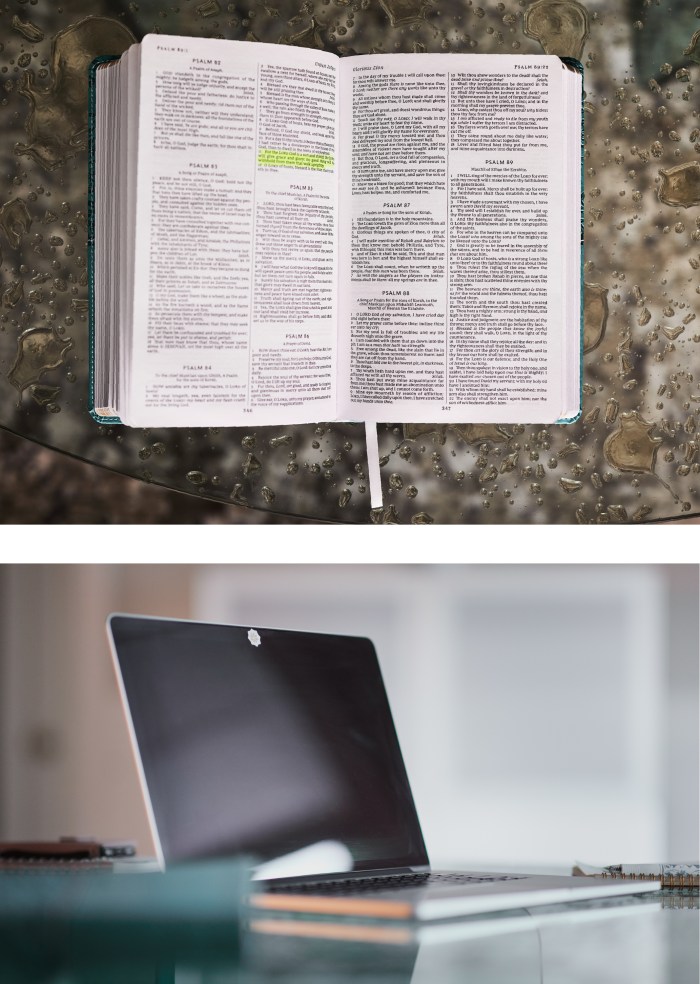
Top: Tina Kolniak's personal Bible. Bottom: Kolniak attends church online.Alex Boerner
Top: Tina Kolniak’s personal Bible. Bottom: Kolniak attends church online.

Then I called out to Jesus, and everything stopped. I could move again. I breathed in and out heavily. I was safe. As the agony dissipated, I knew Jesus was real. I knew the Bible was real. And I knew that Jesus had rescued me from spiritual warfare. The relief was indescribable. I felt gratitude and awe for Jesus. That night changed me forever.

But over the next three years, I went through turmoil as God worked on my heart. I craved humility, peace, and refuge from my sins of divination and idolatry, among many others. It took me a long time to truly understand the gospel. I made many mistakes during that time, mostly by mixing New Age ideas with biblical truth. My intention to walk with God was unshakeable, but I had much to learn, specifically that humanity has a sinful nature and that redemption comes through Jesus alone. Through this new lens, I had to reassess core beliefs about my behavior, my relationships with others, the reality of objective truth, and solving emotional problems.

I yearned for God’s Word, for repentance, for his forgiveness—and for a new life. I discarded thousands of dollars’ worth of New Age materials. I prayed daily. I began watching online church services and Bible studies. I read the Bible online and bought several Bible translations. And I studied works of Christian apologetics, discovering abundant rational evidence for the authority and truthfulness of Scripture.

Since coming to Jesus, I have shared the gospel despite ridicule or dismissal by self-professed “free thinkers” and educated intellectuals who believe they are beyond faith. I was once there, and my empathy runs deep for those who are lost in the same worldly delusions. My prayer is that the Holy Spirit would help them realize that New Age spirituality, with its egoistic focus and false promises of peace, is a dangerous replacement for our true savior, Jesus Christ.

Tina Kolniak is an attorney and a writer currently working on a Christian-themed novel for young adults.

Ideas

Christianity Is a Birth Story

Columnist; Contributor

From the Exodus to the Gospels, Scripture is shot through with images of labor pains leading to joy.

Illustration by Christianity Today / Source Images: Unsplash / Pexels

We all know what it feels like to walk into a room while someone is midway through a story, then spend the next few minutes trying to work out what kind of story it is. For the sake of argument, imagine the story goes like this:

A long period of waiting is building to a climax. Groans of agony are clearly heard. Midwives appear, commending suffering women for their fortitude in labor. There are ten waves of pain, gradually increasing in intensity and culminating in the threatened loss of life.

Finally the moment arrives; the delivery comes at night, marked by blood, water, more cries of anguish, and a dangerous journey—followed by a great celebration. Soon our nascent protagonist is crying out for food and drink, which he quickly receives. Yet he will continue fussing and whining for the rest of the story, even as his father instructs him, teaches him to walk, corrects him, shows him how to make things, and eventually gives him his own room.

This, of course, is the story of the Exodus. Israel is God’s child; the dramatic narrative of slavery, plagues, Passover, Red Sea–crossing, and wilderness-wandering is a tale of labor, birth, and infancy. We often talk about nations being “born”—mine in 1066, and yours, perhaps, in 1776—but in Israel’s case, this is more than a metaphor. God’s nation-child is born in the Book of Exodus and spends the rest of the Torah being trained and growing up.

By itself, these connections may not seem to matter much. Hopefully they illuminate the story of Exodus while bringing aspects of Leviticus, Numbers, and Deuteronomy into sharper relief. But the practical application for Christians in the 21st-century West might appear minimal. If so, then it is worth pondering another biblical book where childbirth—albeit childbirth of a different sort—serves as a dominant metaphor.

John’s gospel, famously, omits a nativity story. But its opening verses are filled with birth imagery: coming into the world (1:9); becoming children (v. 12); being born of God as opposed to blood, flesh, or human will (v. 13); and becoming flesh to dwell among us (v. 14). The main drama begins at a wedding and moves quickly to a detailed conversation about birth, in which entrance to the kingdom involves being “born again” or “born from above,” not by climbing back into the womb but by being “born of water and the Spirit” (3:3–5, NIV and NRSV).

The image of impending labor pains haunts John’s gospel. Consider a woman in childbirth, Jesus says. She “has pain because her time has come” (16:21). In one short phrase, Jesus reframes all those times in John where we hear that his hour “is coming” or “had not yet come” (2:4; 5:28; 8:20)—to say nothing of the time when he acknowledges being troubled because his own hour has come (12:23, 27).

Although childbirth is painful and often perilous, there is great rejoicing once the child is born. As Jesus explains, the mother “forgets the anguish because of her joy” (16:21). Likewise, he assures his disciples, their grief will eventually turn into rejoicing (v. 22).

Even John’s account of the crucifixion reads like a birth story. Jesus has his clothes removed (19:23) and asks for pain relief. Surrounded by women, he exclaims, “Woman, here is your son” and “Here is your mother” (vv. 26–27), at which point his mother takes the young man he addressed home. After Jesus’ triumphant cry of “It is finished,” blood and water come gushing from his side (vv. 30, 34), a detail only John records. (Along with Luke, he also records the scars and marks that remain on Jesus’ body even after the Resurrection.) John persists with the theme in his letters, repeatedly describing salvation as being “born of God” and famously insisting on the witness of Spirit, water, and blood (1 John 5:1–8).

Christianity is a birth story. Life comes as we are born from above, aided and sustained by sacraments that evoke spilt blood and the breaking of waters. We grow as we move from milk to solid food (Heb. 5:11–14). Sufferings are labor pains we’ll forget one day in the joy of new life (Rom. 8:22–25). In all this, God’s love is like that of a breastfeeding mother (Isa. 49:15) or a father teaching his children to walk (Hos. 11:3). And we are safe in his arms.

Andrew Wilson is teaching pastor at King’s Church London and the author of Remaking the World.

May We Never Lose Sight

Unlike Hezekiah, let’s embrace our impact on future generations.

UnSplash / Chris Curry / Joseph Chan

God’s Word is full of nuances and moments that catch us by surprise. From the nuances of creation to the spectacular moments of redemption, the entirety of Scripture has the potential to captivate and transform us with each divine twist and turn. While listening to Scripture one morning, one such nuance made me stop in my tracks.

It was the last verse of Isaiah 39, which marked the end of King Hezekiah’s reign and the beginning of Babylonian captivity. It was the note that sealed a prophetic word of destruction and confirmed the generational consequences of sin. Upon hearing Isaiah say that everything he owned would be carried off to Babylon and his descendants would soon be taken away, Hezekiah replied, “The word of the Lord you have spoken is good” while thinking, “There will be peace and security in my lifetime.”

As I listened to this Scripture, my heart sank and I began to weep. I was overcome with grief, realizing how easy it is for one generation to forget its impact upon another and for one person’s blessing to cause them to forget about another’s plight. To be fair, Hezekiah was not the sole reason for the captivity of Israel. But Isaiah intentionally highlighted this moment as one of the nuances in the story that sealed the destiny of a people for a significant time.

If we are not careful, we can fall into the same trap as Hezekiah. Enamored with our own successes and captivated by our own blessings, we can lose sight of the larger picture of God’s kingdom and our footprint upon it. We can become so caught up in the American story that we can neglect to see the significance of what God is doing in the global church. We can become so engrossed in our own cultural and denominational narratives that we ignore or even demonize the grand diversity that makes up the body of Christ. And, if we’re not careful, we can become so distracted by our sense of security in our lifetime that we minimize our impact on the generations that follow.

Though Hezekiah turned his back on the world around him, the redemptive power of the gospel invites us to lean in. At CT, we are leaning in to the richness of Christ at work in the world through our global initiatives. We are embracing the multi-dimensionality of the kingdom through our Big Tent Initiative. And when the world declares exile for the next generation, we are telling the story of God—who reminds us that it is not good for any of us until it is good for all of us.

We invite you to join us as we tell the story of God’s work throughout the world, with all its nuances and redemptive movements. With God’s help, every gift you give will be a seed sown for today and for future generations, until Christ comes for us again.

Nicole Massie Martin is chief impact officer at Christianity Today.

Cover Story

Our Worship Is Turning Praise into Secular Profit

With corporate consolidation in worship music, more entities are invested in the songs sung on Sunday mornings. How will their financial incentives shape the church?

Illustration by Matt Chinworth

When worship leader Jonathan Anderson selects the song “Lion and the Lamb” for a service, he thinks about what it means for his multigenerational Assemblies of God church to sing about the return of Christ and his final victory: Every knee will bow before the Lion and the Lamb.

“We have older people who love to imagine seeing God’s face, who look forward to that, to seeing pure beauty,” said Anderson, who serves at Bethel Church in Tallmadge, Ohio.

Songwriter and recording artist Leeland Mooring (who performs with the band “Leeland”) started composing the song at a worship event. He found himself and those with him profoundly moved by the words and music as they took shape.

Mooring told NewRelease Today, “We were just weeping, and there wasn’t a dry eye in the room …. God dropped the whole chorus of the song on me right there.”

Eight years after its release, “Lion and the Lamb” remains among the top 30 contemporary worship songs sung in churches on Sunday, with recordings by popular bands including Leeland, Shane & Shane, and Big Daddy Weave.

The song’s continued popularity means congregations lift those powerful words in praise each week, as Mooring and his cowriters (industry veterans Brenton Brown and Bethel Music’s Brian Johnson) hoped. And each time churches like Anderson’s sing “Lion and the Lamb,” it adds up—especially if the service is livestreamed—for Christian music licensing companies, corporate labels, and private investors who have come to see the Christian corner of the industry as a previously untapped income stream.

A portion of the rights and royalties for Mooring’s song, which would have once been continuously paid out to the song’s creators and label, were sold at auction in 2020 as part of a $900,000 package to a private investor. The bundle of songs had made $156,393 the year before, more than three-quarters from the use of “Lion and the Lamb.” The investor who made the winning bid was quoted an industry-projected return of nearly 15 percent.

The words and melodies that stir hearts to worship each Sunday are also intellectual property (IP) on the market, caught up in a recent surge of acquisitions across the music industry. The investment activity has become a “feeding frenzy,” according to industry executive Hartwig Masuch, with worship hits a small part of the billions invested in IP and royalty streams.

As churches worldwide sing, play, and live-stream songs like “Lion and the Lamb,” “How Great Is Our God,” and “10,000 Reasons (Bless the Lord),” the popularity of these songs has ushered Christian music further into the mainstream music industry and the vast economic ecosystem adjusting to make a profit in a new era.

Trends toward IP acquisition, lucrative arena tours, and corporate consolidation have helped drive record-setting revenues over the past two years—the touring industry saw $6.28 billion in 2022, and recording revenues in the US reached an all-time high of $15.9 billion, growing for the seventh consecutive year.

Many Christian artists, including those whose careers and brands are built on worship music, are benefiting from this growth.

Making money from the genre is nothing new. Christian music has turned a profit for American investors for centuries, ever since bookseller Hezekiah Usher distributed the Bay Psalm Book in 1640, the first book printed in the colonies. What’s new is the complicated web of demand, creation, and moneymaking in today’s version of the industry. The more corporate entities stand to profit from worship hits, the more they are positioned to introduce incentives and exert pressure along the way.

In the worship music landscape, each participant has its priorities: Churches seek out songs to serve their congregations, artists create music to minister to the church, the industry provides a platform and finds ways to profit from popular media, and investors look for promising assets.

Among writers, performers, agents, publicists, tour organizers, record labels, publishers, and investors, all are looking for new worship songs to become hits and for hit worship songs to stay popular and profitable. But not all of these people have equal sway in a song’s trajectory, and not every push toward success is morally or theologically neutral.

As worship music is further integrated into the economic landscape of the mainstream music industry, can it retain its distinct spiritual purpose? Will the powerful incentives of the business—fame and celebrity and financial success—influence the way worship songs are produced and promoted?

Contemporary worship music has gained the intensifying interest of the mainstream entertainment industry over the past two decades. Worship artists fill the country’s largest arenas. Instead of Christian artists crossing over with secular hits, worship songs make their way into the mainstream: Justin Bieber performs “Jireh” and “How He Loves” with Chandler Moore; contestants on The Voice sing “Oceans”; the Today show and Fox and Friends feature sets by Taya, Maverick City Music, and Hillsong United.

Songwriters and worship artists “love the church and want to provide songs that serve the church,” said Shannan Baker, a postdoctoral fellow in digital humanities at Baylor University’s Center for Christian Music Studies. But today’s top worship artists and songwriters face these intensified market pressures.

“I’m hesitant about the role money can play in elevating certain worship songs,” Baker said, sharing one concern about the industry. “It’s a music business. Money drives decision-making at the upper levels.”

Financial gain—especially financial excess—is not a neutral incentive and can narrow the kinds of artists who make it to the top.

“For evangelicals, the market has always been a way of proving God’s blessing,” said Adam Perez, assistant professor of worship studies at Belmont University in Nashville—the hub and headquarters for the Christian music industry. “Investment is a lagging indicator of success.”

“Any time someone increases their access to capital, it increases their access to power,” he said. “Now, how will that power be exercised?”

More mainstream companies and investors have recognized opportunities for profit in hit Christian artists and songs, particularly as major corporations consolidate ownership. This interest has led to major arena tours once reserved for rock stars and royalty auctions to get a cut of worship hits.

Capitol Christian Music Group (CCMG), for example, has acquired major Christian labels Sparrow Records, Hillsong Music, and sixstepsrecords. CCMG is part of Universal Music Group, which held a market share of just over 37 percent in the music industry at the end of 2022. Its artists now include Chris Tomlin, Hillsong United, Brooke Ligertwood, Crowder, Cody Carnes, Jesus Culture, and the Newsboys. Last year, it claimed to have 60 percent market share of the top 10 worship songs used in churches.

These songs get licensed for services and events through Christian Copyright Licensing International (CCLI). The organization began as a resource to keep churches from violating copyright when using lyrics and music from worship artists.

Now the music industry has begun to see popularity on CCLI as an indicator of a song’s ongoing profitability, since over a quarter million churches worldwide license their worship music through the ministry. A listing selling royalties for the “Lion and the Lamb” package noted that two-thirds of the annual profits could come from CCLI—$100,000—and that the earnings were stable.

CCLI also ranks songs based on weekly usage as reported by churches its licensing protection covers. According to CCLI, “Lion and the Lamb” landed among the top 30 songs sung at churches as of spring 2023, eight years after its release.

“A Christian radio hit makes a little money for a little while,” said Andrew Osenga, director of artists and repertoire (A&R) for Integrity Music. “Evergreen [worship] songs bring in a lot of income.”

The “song-centric” nature of the worship music market works to its advantage. In a rapidly changing industry (How often do you pay to listen to music?), revenue from songwriting and publishing royalties in the niche have remained reliable sources of income.

Osenga noted that since the beginning of the pandemic, royalty revenues for worship music have increased substantially because of the sudden rise in churches livestreaming and posting service recordings to YouTube. Before 2020, most churches covered by CCLI for the use of contemporary worship songs were paying $170–$215 per year for licensing. The right to legally stream performances of those songs required churches to add a new streaming license, which can cost another $110 a year based on church attendance of 400 people per week (the cost increases with church size).

“Think about the number of church services that are streamed,” said Osenga. “If ‘Good Good Father’ is sung in thousands of churches, many of which are livestreamed, the revenue of that copyright is huge.”

Illustration by Matt Chinworth

Worship songs typically don’t have a very long lifespan, but a few favorites like “How Great Is Our God” and “In Christ Alone” make it to the CCLI top 100 and stay there. A recent study found that between 2015 and 2019, the average lifespan of a worship song was four years. Between 1995 and 1999, it was 11 years.

The most successful recording artists have still been able to achieve longstanding hits on the CCLI charts; their songs now appear on sites like Royalty Exchange, where investors can evaluate them as financial assets.

Historically, there has been very little interest in back catalogs of Christian artists.

“In contrast to the general market,” ethnomusicologist Andrew Mall said in his 2021 book God Rock, Inc.: The Business of Niche Music, “in the Christian market there is comparatively little demand for (or even awareness of) older music and artists.”

But Hipgnosis Songs Fund, a Blackstone-backed music rights investment company, recently acquired a stake in the back catalogs of Third Day and Jason Ingram, a producer and songwriter who has worked with Chris Tomlin, Matt Maher, Kari Jobe, Lauren Daigle, David Crowder, and Christy Nockels. Hipgnosis is the same entity that acquired the rights to Justin Bieber’s catalog in January 2023 in a high-profile $200 million deal.

Hipgnosis’s website touts Ingram as a force in the Christian music industry who “has helped shape the genre in a modern distribution world.” Ingram cowrote “Goodness of God” by Bethel Music, No. 1 on the CCLI Top 100 in 2023, as well as two others in the top 10: “Great Are You Lord” by All Sons & Daughters and “King of Kings” by Hillsong Worship.

In January 2022, the privately funded publishing and talent management company Primary Wave Music acquired a stake in worship artist Matt Redman’s entire publishing catalog. His song “Blessed Be Your Name” has spent 20 years in the CCLI top 100.

“It’s a good deal on both sides,” said Andrew Osenga. (Redman is currently signed with Integrity Music, Osenga’s employer.) An artist like Redman or Ingram can take a buyout, a lump sum from a company willing to bet that their songs will bring in additional earnings. It’s a smart way for a musician to pay off a home or send kids to college. Earnings on future songs they write will still be theirs.

The language used by entities like Primary Wave, Hipgnosis, and Royalty Exchange lays bare the purely financial motivation behind their investment in worship music. In a press release, Primary Wave described the move to acquire Redman’s catalog as one that would continue to “strengthen its position in the faith-based market.”

The Royalty Exchange listing for the 2020 auction of the asset package with “Lion and the Lamb” even named CCLI as a “notably unique and lucrative income source,” whose “earnings are quite stable year-over-year.” The listing also clarified that 78 percent of the catalog’s income came from “Lion and the Lamb,” referring to the song as “the star of this collection.”

Investors may or may not have any interest in the spiritual aspect of the music, but since their profits rely on songs’ continued use by church congregations, they have a financial interest in what churches sing on Sunday mornings.

It’s too soon to say how the relationships between investors and worship artists’ back catalogs will influence the future use or trajectory of hit worship songs. However, with financial backers poised to profit from the continued use of some songs and not others, those with a stake in a particular hit could look for ways to reintroduce it and keep it fresh in the minds of worshipers, through covers, new recordings by popular artists, or novel arrangements.

The royalties marketplace is just one example of how the revenue streams in the worship music industry—and the music industry more broadly—have introduced new stakeholders, incentives, and pressures to the process. For artists who are popular enough to draw huge crowds, touring presents the opportunity to generate revenue with less interference from labels and publishers, who take cuts of recorded work.

The Christian industry mirrors the financial incentives and structures of the mainstream music industry, so it makes sense that Christian artists would rely on touring for income. Over the past three decades, as worship artists make their way onto arena stages, the bigger venues add to the public’s awareness of monetization in the industry. “Christian listeners are increasingly encountering worship music in entertainment contexts that used to be the domain of pop/rock,” wrote Mall.

The line between entertainment and worship in these contexts has grown blurrier, even as touring artists explicitly frame performances as worship services or experiences. Chris Tomlin toured in 2022 with Hillsong United, telling the Gospel Music Association, “I always say, there’s nothing like the sound of the people of God, singing the praises of God, in the presence of God and to be able to experience that night after night is truly a gift.”

Big names like Hillsong and Bethel hold arena tours, sometimes with VIP packages and experiences like early entry, custom merchandise, premium seating, and staged photo ops. And, like Coldplay, Taylor Swift, or others performing in stadiums, they’re subject to ticket scalping.

Last year, Elevation Worship had to clarify that a $1,000-plus front-row ticket listed for their show wasn’t the sticker price but an inflated resale value.

The 2022 Chris Tomlin–Hillsong United tour—playing Target Center in Minneapolis, the United Center in Chicago, and the Banc of California Stadium in LA—initially offered a VIP ticket option for purchase, but in response to online backlash from fans, the tour removed the VIP option and replaced it with two tiers of “experience packages.”

Chris Tomlin performs on stage at the Tomlin United Tour that included Hillsong United on April 11, 2022.AP
Chris Tomlin performs on stage at the Tomlin United Tour that included Hillsong United on April 11, 2022.

The “Tomlin-United Experience” included a close-up seat, early access to the venue, a photo opportunity on the catwalk, a “pre-show merchandise shopping opportunity,” an “intimate on-stage experience with Chris Tomlin and United,” and “limited gift items specifically designed for VIPs by the artists.”

Christian artists often promote worship concerts or “worship experiences” as more than just performances, and the delivery of a sermon or short message can make the event feel like a heavily produced church service. And some are troubled by the prospect of paying to attend—or get VIP access to—something billed as a worship service.

“Should we ever pay to attend a worship event?” wrote UK-based worship leader and songwriter Tom Read in a column for Premier Christianity about the Tomlin-United Tour in October 2021. “Let’s be honest, there is a significant difference between paying an artist for their work and buying VIP tickets so you can have a photo on a catwalk at a worship event. What is so problematic here is the leveraging of the worship of God for the creation of personal fame and fortune.”

Winter Jam often lands among the music industry’s highest-ranking tours for the first quarter of the year. Organizers have kept ticket prices low—just $15 at the door—hoping to make each stop an accessible evangelistic event. But those looking for a more exclusive experience can still purchase additional access by joining Jam Nation, a tiered fan club with options for groups and individuals.

Attendees who join Jam Nation Max for $149.99, the highest-tier option, will get a meet-and-greet and photo with We The Kingdom and recording artist Jeremy Camp, seating in an “exclusive reserved section,” merchandise discounts, a T-shirt, and early admission.

The highly successful tour illustrates the increased blurring of the distinction between performative Christian music (like radio hits) and worship music. Winter Jam isn’t billed explicitly as a worship concert or experience, but worship and a gospel presentation are part of the event. The 2023 tour included popular worship bands Thrive Worship and We The Kingdom.

The increased consolidation of popular contemporary worship music under fewer companies—entities like CCMG—means the industry has a bigger incentive to promote worship music and bigger artists have a better chance at making solid revenue.

It also means that CCMG has an incentive to gain greater access to the Christian music market, especially anyone looking for worship music.

CCMG owns Worship Together, an online resource for worship leaders that promotes new music, puts out blogs and podcasts, and hosts an annual conference. The featured performers at its 2023 conference will be Hillsong United and Cody Carnes, both CCMG artists.

Despite the involvement of players like CCMG in the promotion and marketing of worship music, Andrew Osenga has faith in songwriters’ commitment to serving the church and in worshipers’ sense of what music belongs in their sanctuaries.

“We don’t want to sing a product,” said Osenga, a former member of the band Caedmon’s Call. “We want to sing a song that is genuine.”

He isn’t worried about increased corporate investment in worship music because he and the artists he works with still approach writing worship music as a calling and spiritual practice.

“You can see short-term attempts to monetize [worship], but they feel outside of the community,” Osenga reflected. “It’s hard to fake it.”

Earlier this year, worship artist Dante Bowe told CT, “If someone’s getting into writing Christian music for the money, they’re in the wrong genre,” given the risk and sacrifice involved.

“A lot of these guys could write anything or do anything. But they haven’t,” said Bowe, who previously sang with Maverick City Music and is launching his own label. “They’ve made a choice to serve the church locally and worldwide.”

Consolidation under major conglomerates offers new access to the marketing and promotional machinery of the music industry, access that many in the industry have welcomed.

Nearly a decade ago, the Gospel Music Association’s review of the industry touted partnerships between Christian artists and NASCAR, McDonald’s, and Coca-Cola. GMA executive director Jackie Patillo expressed optimism that the report would attract new commercial partners by providing strong evidence that Christian music could be an effective marketing tool. It’s only become more lucrative since.

But the boost from corporate partnerships and music conglomerates has also widened the gap between hitmakers on the worship charts and the vast majority of songwriters.

Most people making worship music see their royalties quickly dwindle as their songs fall lower on the CCLI lists and out of use among churches—if they ever become that popular in the first place. CCLI licenses over 450,000 songs; most of them have never been performed in a stadium or streamed hundreds of thousands of times.

“You’ll get your first royalty check, and maybe you’ll be able to take your wife out for coffee,’” said Chris Juby, a songwriter with Resound Worship. “You know you’ve made it when the check covers a nice dinner.”

Juby, manager of UK-based Jubilate Hymns Ltd. and director of worship, media, and arts at King’s Church Durham, expects that corporate consolidation in Christian music will also affect the range of theological themes present in the worship of the church.

“Worship songs bear so much liturgical burden in the content of the service,” he said. “The range of [music] that could ever be successful via those channels is so much narrower than the range of what the church should be singing.”

Jonathan Powers, assistant professor of worship and associate dean of the school of mission and ministry at Asbury Theological Seminary, shares Juby’s concern.

“A lot of people are getting their theology from music,” said Powers, who recently edited the Wesleyan Our Great Redeemer’s Praise hymnal. “There is a piety being formed by music in the church—ideas of who God is, what God does.”

When left up to industry promotion and market forces, Christian worshipers often don’t get as broad of a range of expressions, themes, and doctrines as in the curation of a hymnal.

“How many songs of lament appear on the CCLI Top 100?” Powers said, remarking that it’s easy to find songs of adoration or joy but much more difficult to find songs that reflect true lament and sorrow. CCLI’s SongSelect service can sort selections by theme, with 8,658 songs assigned to “adoration” and another 19,914 to “praise.” There aren’t categories for lament or mourning; “sorrow” has 336 songs, “weeping” 35.

“With a hymnal, we’re very intentional. We want to make sure these themes are covered. We want to teach our doctrine. We want to use this to say, ‘This is who God is,’” Powers said. “Our relationship with God, God’s character, all of these ideas are being formed in worship, but I think it’s in very limited ways when the market is driving it.”

A significant portion of worshipers now attend churches where lyrics on screens have replaced hymnals, and song selection is influenced by what leaders hear on the radio, stream online, and see on the CCLI charts.

Worship songs don’t make money and climb the charts unless leaders at churches see them as theologically sound and valuable resources. As the industry seeks stable revenue, experts expect it will keep looking to the songwriters, recording artists, and worship brands that have already proven themselves profitable.

So even with more money to be made in worship songs, this inclination to stick to what works narrows the model for new artists and songs.

“Think about the limited canon of songs. A limited witness to the diversity of God’s kingdom. Limited expressions of beauty, because of a ‘market-shaped’ sound,” said Nelson Cowan, director of the Center for Worship and the Arts at Samford University. Worshipers recognize—and leaders try to recreate—the guitar-hook-with-delay Hillsong United perfected in the early ’00s in songs like “The Stand” and “Mighty to Save,” and the distinct vocal styles of singers like Kari Jobe and Jenn Johnson.

“This self-replicating process is extremely disheartening for me, as a worship leader, a pastor, and a theologian,” Cowan said.

Songwriter Krissy Nordhoff, who wrote the 2010 hit song “Your Great Name,” told CT last year that it’s harder than ever for a song to get in front of anyone in the business unless you’re a recognizable figure or have some powerful connections.

The model set by celebrity worship leaders trickles down to the local level, where worship leaders are expected to emulate everything from guitar effects and vocal styles to physical attractiveness and fashion taste.

“There’s such a real sense that, ‘Well, I could never be a good worship leader because I can’t carry the image,’” Powers said.

At the Asbury University revival in February, he saw Gen Z students reject celebrity performers for “nameless” worship leaders. That commitment to obscurity and humility is difficult to maintain when faced with a powerful industry with even greater interest in elevating an artist’s creative work, even if that work was created for God’s glory and not their own.

As worship songs become assets in the marketplace and the names associated with them draw crowds to arenas, local congregations continue to faithfully worship using songs that speak to their members as tools to corporately sing praise to God.

“Lion and the Lamb” still ministers to congregations like Jonathan Anderson’s every week. The song has special meaning for Anderson; it was one of the first songs he learned as a new worship leader years ago. It has become part of his church’s regular music rotation.

As he works on his first album, he hopes to record a cover of “Lion and the Lamb.” The song has transcended its connection to any particular artist or recording; in a way, it belongs to him and his church.

And yet, with every use in worship, and every stream on Spotify and YouTube, the song continues to generate revenue. It proves itself to be a smart investment. The profound impact of the song on its creators and those who use it for worship is exactly what has made it profitable. Industry and investors are taking notice.

Kelsey Kramer McGinnis covers worship music for CT. She is a musicologist with a PhD from the University of Iowa, specializing in music in Christian communities.

Apple PodcastsDown ArrowDown ArrowDown Arrowarrow_left_altLeft ArrowLeft ArrowRight ArrowRight ArrowRight Arrowarrow_up_altUp ArrowUp ArrowAvailable at Amazoncaret-downCloseCloseEmailEmailExpandExpandExternalExternalFacebookfacebook-squareGiftGiftGooglegoogleGoogle KeephamburgerInstagraminstagram-squareLinkLinklinkedin-squareListenListenListenChristianity TodayCT Creative Studio Logologo_orgMegaphoneMenuMenupausePinterestPlayPlayPocketPodcastRSSRSSSaveSaveSaveSearchSearchsearchSpotifyStitcherTelegramTable of ContentsTable of Contentstwitter-squareWhatsAppXYouTubeYouTube