Books
Review

Early Americans Read the Bible in a Way That Nearly Destroyed America

Mark Noll surveys the effects of an “independence-first” approach to Scripture.

Christianity Today July 18, 2023
Illustration by Christianity Today / Source Images: WikiMedia Commons

Thomas Paine threw gasoline-soaked ink on the fiery spirit of American independence by publishing his pamphlet Common Sense six months before the Declaration of Independence in 1776. Upon independence from King George III, Paine promised, “The birthday of a new world is at hand.”

America's Book: The Rise and Decline of a Bible Civilization, 1794-1911

America's Book: The Rise and Decline of a Bible Civilization, 1794-1911

Oxford University Press, USA

864 pages

This new world would be born free from a king. Citing the Gospel of Matthew, the Book of Judges, and 1 Samuel 8 (where Israel demands to be ruled royally like other nations), Paine argued that “the Almighty hath here entered his protest against monarchical government.” Common Sense was an enormous success; over 100,000 copies sold within months. You know the rest of the story about 1776: America echoed Paine’s call and claimed independence.

Eighteen years later, Paine authored more advice for his devoted readers. In 1794, he published the first of three parts of The Age of Reason, in which he trumpeted his deist beliefs about the Bible. It too was an immediate bestseller. As Paine declared on the opening page, “I believe in one God, and no more.” He added, “I do not believe in … any church that I know of. My own mind is my own church. … [Churches are] human inventions set up to terrify and enslave mankind, and monopolize power and profit.” Paine dissected the Bible, book by book, concluding, “Search not the book called the Scripture, which any human hand might make, but the Scripture called the Creation.”

As Mark Noll explains in America’s Book: The Rise and Decline of a Bible Civilization, 1794–1911, figures like Paine were instrumental in shaping America’s commitment to independence, which in turned shaped how its people engaged the Bible. In Paine’s mind, and in the minds of many of his contemporaries, Americans had the right to use the Bible however they saw fit, lest they bite the hand—independence—that fed them their freedom.

A tool to guide independent citizens

Noll is a preeminent historian of American Christianity who spent 27 years at Wheaton College before finishing his career at the University of Notre Dame. America’s Book picks up where Noll left off in his 2016 publication In the Beginning Was the Word: The Bible in American Public Life, 1492–1783, which examined the Bible’s impact on American politics from Christopher Columbus to the signing of the Treaty of Paris. America’s Book develops several themes explored in Noll’s earlier work: the influence of Paine, the prevalence of the King James Bible, the tendency of Americans to imagine themselves as a type of Israel, their habit of enlisting Scripture to support republican and democratic principles—and the intersection of slavery with all this and more.

Noll organizes his 30 chapters in six parts. The first part lays the groundwork to help readers understand the first of Noll’s two main arguments: America’s commitment to independence shaped how Americans utilized the Bible from the very beginning.

How do you govern a nation of independent free citizens? Noll explains that part of the answer is in “voluntary reliance on Scripture”—with special emphasis on “voluntary.” He adds, “While Scripture remained indispensable for personal religion and church order, it also became the tool for ensuring the well-being of a free people in a free society.” In early America the Bible was a tool to guide independent citizens. Noll quotes an early historian of the Bible in America, who wrote in 1844, “Nothing but the Bible can make men the willing subjects of law; they must first acquiesce with submission to the government of God before they can yield a willing obedience to the requirements of human governments.”

Part two shows how the Bible emerged seemingly everywhere in the new republic. American towns, mountains, and children were given biblical, and often Old Testament, names—embracing the sense of America as a new Israel. Meanwhile, an astonishing number of King James Bibles filled churches and homes, aided by the creation of the American Bible Society.

Noll’s second primary argument emerges in the third and fourth parts of the book: An independence-first approach to the Bible that prioritizes proof-texting and “Bible only” reasoning ended up fracturing America when its politicians, pastors, and citizens could not agree on what the Bible taught regarding slavery. These fractures surfaced in the Missouri Compromise (1820), Denmark Vesey’s attempted uprising (1822), William Lloyd Garrison’s Liberator magazine calling for immediate emancipation (1831), Nat Turner’s slave revolt (1831), and ruptures among Northern and Southern Methodists and Baptists (1845). Independent interpretation of the Bible allowed for Joseph Smith’s reinterpretation in The Book of Mormon (1830), Bible-based calculations of the timing of Christ’s return among Millerites (1843), and new views regarding the rights of women.

The climax of the book arrives when Noll shows that America’s failure to agree on what the Bible taught about slavery fractured the nation completely in the Civil War. As Noll explains, “when arguments over Scripture and slavery exposed conflicting opinions about what common sense revealed, American Protestant theology began to divide, as it remains divided to this day.”

Noll provides exhaustive details of the arguments made for proslavery and antislavery readings of the Bible. He admits that he changed his mind regarding which side provided stronger arguments to the people of that era. In his 2006 book The Civil War as a Theological Crisis, Noll had contended that the proslavery position won greater support on account of its simplicity. His current book reexamines previous evidence and draws on new materials, the weight of which convinced him that the antislavery argument should have been sufficient to carry the day.

I admire Noll’s willingness, as a senior scholar, to reconsider the evidence and reverse his previous conclusion. And he does well to specify what he might have told antebellum Bible interpreters regarding slavery, explaining “what could have been the strongest weapon in their arsenal”: If “Americans claimed to follow the Bible alone, or even the Bible as the chief witness alongside other authorities, and Scripture contained almost no examples of African slaves—and no credible directives that only Africans should be enslaved—the proslavery arguments should not have enjoyed the importance they so obviously did enjoy.”

Declining influence

The final two parts of the book document the place of the Bible in the 50 years after the Civil War. Noll argues that the place of the Bible declined in America because white Protestants “created a popular perception that religion had nothing reliable or coherent to say about the greatest American issue of the nineteenth century,” meaning slavery. Near the dawn of the 20th century, as some Protestants insisted on the inerrant nature of the Bible as a hermeneutical starting point, fewer Americans were listening. Between increased immigration among non-Protestant groups and the catastrophe of the Civil War, Noll writes, “English-speaking white Protestants no longer controlled public space.”

In 1911, the 300th anniversary of the creation of the King James Bible was celebrated in London, New York, and Chicago. Commemorations featured remarks from the British prime minister, national ambassadors, President William Howard Taft, and King George V. Looking back, their words functioned as eulogies for the prominent role the Bible once played in England and America. Noll believes that near the turn of the 20th century, “large numbers also turned away entirely from religious guides in favor of social authorities or complete preoccupation with life in this world.”

There is plenty to chew on in Noll’s meaty book, which runs over 800 pages. While reading it, I formed three questions that I hope Noll’s future writing might discuss or inspire others to address.

Noll rightly argues that Americans made their arguments, good and bad, “not because they were stupid but because they lived with a different universe of assumptions.” So, I ask first, how can Americans become more aware of how our current assumptions about democracy and independence influence the way we use and interpret our Bibles? Second, how might a new era of Americans cultivate Christian virtue if history has shown us that we are unlikely to come to any consensus on interpreting Scripture? And third, might Noll continue his project in a third book that picks up after 1911 to help us understand how Americans have engaged the Bible in the last century? I hope he does.

Sean McGever is area director for Paradise Valley Arizona Young Life and an adjunct professor at Grand Canyon University. He speaks, teaches, and ministers across the United States, Canada, and the UK. His books include Born Again: The Evangelical Theology of Conversion in John Wesley and George Whitefield.

Theology

Ancient Chinese Sacrificial Rituals Resemble Those of the Israelites. Does This Matter?

What Jesus’ death means for how I make sense of my culture’s traditional religious practices.

Christianity Today July 18, 2023
Feng Li / Staff / Getty

If you ever visit the Temple of Heaven in Beijing—ancient China’s largest center for high-level rituals—you might be struck by its lack of Buddhist and Taoist idols. The design of the Chinese place of worship displays some of the characteristics of the ancient Chinese tradition of ritual sacrifice to heaven, which seem to bear many similarities to the rituals for worshiping God recorded by Moses in the Pentateuch of the Old Testament.

No known records exist suggesting that Judaism inspired Chinese spirituality. In fact, a second-century B.C. Confucian classic, The Rites of Zhou (周禮 Zhouli), records these acts of worship, and archaeologists have discovered the bronze ritual vessels with Chinese characters depicting sacrifices of animals such as ox and sheep, confirming that these practices are thousands of years old.

Conducted by the royals until the end of the imperial dynasties in the early 20th century, these official rituals gradually drifted from their Confucian origins. But as a Chinese Christian, rather than grieve this separation, I’m grateful that I know Jesus, whose death supersedes these ancient sacrifices and whose resurrection offers redemption for eternity.

The will of heaven

In 1982, the Chinese American scholar Ray Huang released 1587: A Year of No Significance (萬曆十五年). The bestselling book highlighted the Ming dynasty’s religious practices, including a famous example from 1585 of an emperor using the Temple of Heaven to pray for rain. After months of drought, Emperor Wanli fasted for three days before leading his officials from the imperial palace to the temple and holding a special ceremony for the weather change. Upon arriving at the Temple of Heaven, the Ming dynasty emperor knelt on the lowest step of the Circular Mound Altar, burned the sacrificed animals, prayed, offered incense, and prostrated to the “God of the Highest Heaven” (皇天上帝 huang tian shang di). (上帝 or shang di are the characters used for “God” in many Chinese versions of the Bible.)

After the ritual, Wanli spoke to his officials at the Altar of Heaven. He explained that he believed the great drought had come because he and his officials had failed to be virtuous and had allowed corrupt officials to exploit commoners. As he understood it, this behavior disturbed heaven’s harmony and caused heaven to withhold rain. To show he understood heaven’s will and intention, the emperor expressed remorse over his own moral failure and his expectation that the corrupt officials would repent and change their ways. The emperor’s act of worship offers a window into how Chinese spirituality understood the relationship between heaven and earth.

In his remarks to his officials, Wanli used a name for God that had been adopted in a 1538 ceremony performed by his grandfather, Emperor Jiajing. To reinforce his legitimacy to the throne (as he was only a nephew to his predecessor, who had died without a male heir), Jiajing replaced the name God of the Vast Heaven (昊天上帝, hao tian shang di)—which had been used for several thousand years—with God of the Highest Heaven (皇天上帝, huang tian shang di).

Although both huang (皇) and hao (昊) contain the meaning of “grand, great, or magnificent,” huang (皇) is more frequently used in the words related to the royal family (皇室) or the emperor (huang di, 皇帝), underscoring a close connection between heaven and the royal power. Through this name change, then, the emperor was elevating his own authority over heaven, which at that time was regarded as the most symbolic and powerful source in Confucian politics.

As part of the 1538 sacrificial ceremony, officials sang 11 songs of praise to this God. One of these was titled “The Coming of God” and included a description of the beginning of the universe reminiscent of the first chapter of Genesis:

Of old in the beginning, there was the great chaos, without form and dark. The five elements [planets] had not begun to revolve, nor the sun and the moon to shine. In the midst thereof there existed neither forms nor sound. Thou, O spiritual Sovereign, camest forth in Thy presidency, and first didst divide the grosser parts from the purer. Thou madest heaven; Thou madest earth; Thou madest man. All things with their reproducing power got their being.

‘To the God of heaven’

Despite their newer venue, the practices of these emperors were similar to rituals initiated by people from the Western Zhou (1045–771 B.C.) dynasty, which also reflected the various animal sacrifices described in the Book of Exodus.

Ancient Israelites’ burnt offerings, sin offerings, and peace offerings all involved the butchering of unblemished animals—bulls, sheep or goats, doves or pigeons, depending on the sacrifice. After the animal was killed, the priest burned its carcass. As part of sin offerings, priests sprinkled the animal’s blood on the altar, representing the washing of the believer’s sins with the blood of the sacrifice. Priests also butchered cattle and sheep as part of ancient Chinese rituals of sacrifice to heaven.

By the time of the Ming dynasty, the annual ritual sacrifice to heaven was considered a great ceremony. Five days before the sacrifice, the emperor himself would go to the place where sacrificial animals were kept and personally study their appearances and states of health, ensuring that the animals were unblemished and without defect.

Afterward, the emperor fasted and purified himself for three to five days leading up to the ceremony, before burning the selected animals as part of the event. People hoped that the smoke from the burning animals would rise up to the God of heaven so that he would send down blessings. The Confucian classic Shijing (Classic of Poetry), whose earliest contributions date back to the 11th century B.C., contains a hymn with the line “The fragrance of the sacrifice rises; the God of heaven is surrounded by the fragrance; how wonderful is the fragrance!” After describing the entire process of the ritual, the last line says, “After Houji established the sacrifice ceremony (to heaven), people no longer feel guilt.”

The Shijing commentary suggests that the Zhou people began sacrificing to the God of heaven to “no longer feel guilt for their sin,” to express respect of the divine, to seek his protection, and to pray for peace and prosperity for the country.

The real sacrificial lamb

Under the surface of these cosmetic similarities lie nuanced differences in the meanings of Israelite sacrifices in the Old Testament and ancient Chinese ritual sacrifices to heaven. The former sought God’s forgiveness and pardon. In contrast, the original motivation for the latter was to stop feeling guilt for sin—and even this goal was gradually de-emphasized over time.

China had established an official ritual system since before the time of Confucius (551–479 B.C.). But while the philosopher affirmed these practices, he also held that human beings could transform the world by observing five particular virtues. This focus on the temporal greatly influenced Chinese society. Over time, royal authority slowly transferred from the “will of heaven” to political succession ostensibly based on virtue.

Yet how does the ethical system of Confucianism interact with the entire Confucian system of ritual, including ritual sacrifice to heaven? And how do the will of heaven and the virtue of humanity interact with each other? The Confucian classic Mencius, Lilou II, which dates back to when Chinese leaders still practiced sacrifices regularly, said, “Though a man is evil, if he fasts and cleanses himself, he might yet offer sacrifices to God.” In other words, whether through fasting and cleansing or by slaughtering the cattle or sheep and burning sacrifices to heaven, in the ancient Chinese worldview there was no permanent way to solve humanity’s sinful nature.

How do we as Christians look at the sacrifice ceremony to God? In the Book of Hebrews, the author explores at length the relationship between the Old Testament sacrificial rituals and Christ on the cross.

Hebrews 9:8 says, “The way into the Most Holy Place had not yet been disclosed as long as the first tabernacle was still functioning.” According to the writer of Hebrews, then, before Jesus’ birth and crucifixion, the Hebrews’ sacrificial rituals could not take lasting effect. The high priest’s sacrifices in the Most Holy Place could not truly and completely remove people’s sins. Instead, his actions only foreshadowed what was to come through Christ.

For humanity to indeed be rid of sin, we had to wait for our only truly effective sacrificial lamb—Jesus, whose death tore the tabernacle curtain separating human beings and God. Because of this, people can now enter the Holy of Holies and meet God when covered by Jesus’ blood.

If we trace the source of the traditional Chinese characters, we can find the origin of the butchering of cattle and sheep for sacrifice to the heavenly God. The Chinese character for “ritual” (禮) has a radical on the left representing an altar (示) and a container (“豆”) on the bottom right; above the container is a representation of the offering.

Shuowen Jiezi, an early and authoritative Chinese dictionary, defines the word ritual (禮) as “serving the divine in order to prosper.” And the word for righteousness (義) has a lamb on the top, with “a hand holding a weapon in order to kill the sheep” on the bottom—literally meaning people can become righteous by butchering the lamb. According to the writer of Hebrews, the ancient Israelites’ sacrifice ceremonies foreshadow the coming of Jesus as the real Lamb for atoning human beings’ sins.

I personally believe that these ancient Chinese rituals foreshadow Christ in a common grace sense and that their presence serves as a reminder that he is the sacrificial Lamb of God offered on behalf of all. Yet we believe that the blood of Jesus Christ not only saves us from feeling guilty but also redeems us from our sins. We all have personal access to Jesus, not mediated by an emperor or priest. Thanks be to the true God of the highest heaven!

Jixun Hu has a master of divinity from Garrett-Evangelical Theological Seminary and is a minister of East Bergen Christian Church in New Jersey.

News
Wire Story

6 Reasons Bedside Baptist and Church of the Holy Comforter Are So Popular

Survey examines how weather, sports, and sleep affect if and when churchgoers go to church.

Christianity Today July 17, 2023
Josh Applegate / Unsplash

Jesus said the gates of hell will not prevail against His church, but sleet and hail will keep many churchgoers out of the pew on a Sunday. In fact, some may even skip to get a little extra sleep or watch their favorite team.

A Lifeway Research study of U.S. adults who attend a religious service at a Protestant or non-denominational church at least monthly finds several reasons some will miss church at least once a year.

Respondents were asked how often they would skip a weekly worship service for six different scenarios—to avoid severe weather, to enjoy an outdoor activity in good weather, to get extra sleep, to meet friends, to avoid traveling when it’s raining, or to watch sports.

One in 10 Protestant churchgoers (11%) say they would never skip for any of these reasons. Twice as many (22%) say they would never skip due to the five options besides severe weather situations.

“Churchgoers are not on autopilot. Each week they are faced with a choice of whether to attend church, and there is more than one tradeoff when it comes to this decision,” said Scott McConnell, executive director of Lifeway Research.

Lifeway Research

Severe and sunny weather-related absences

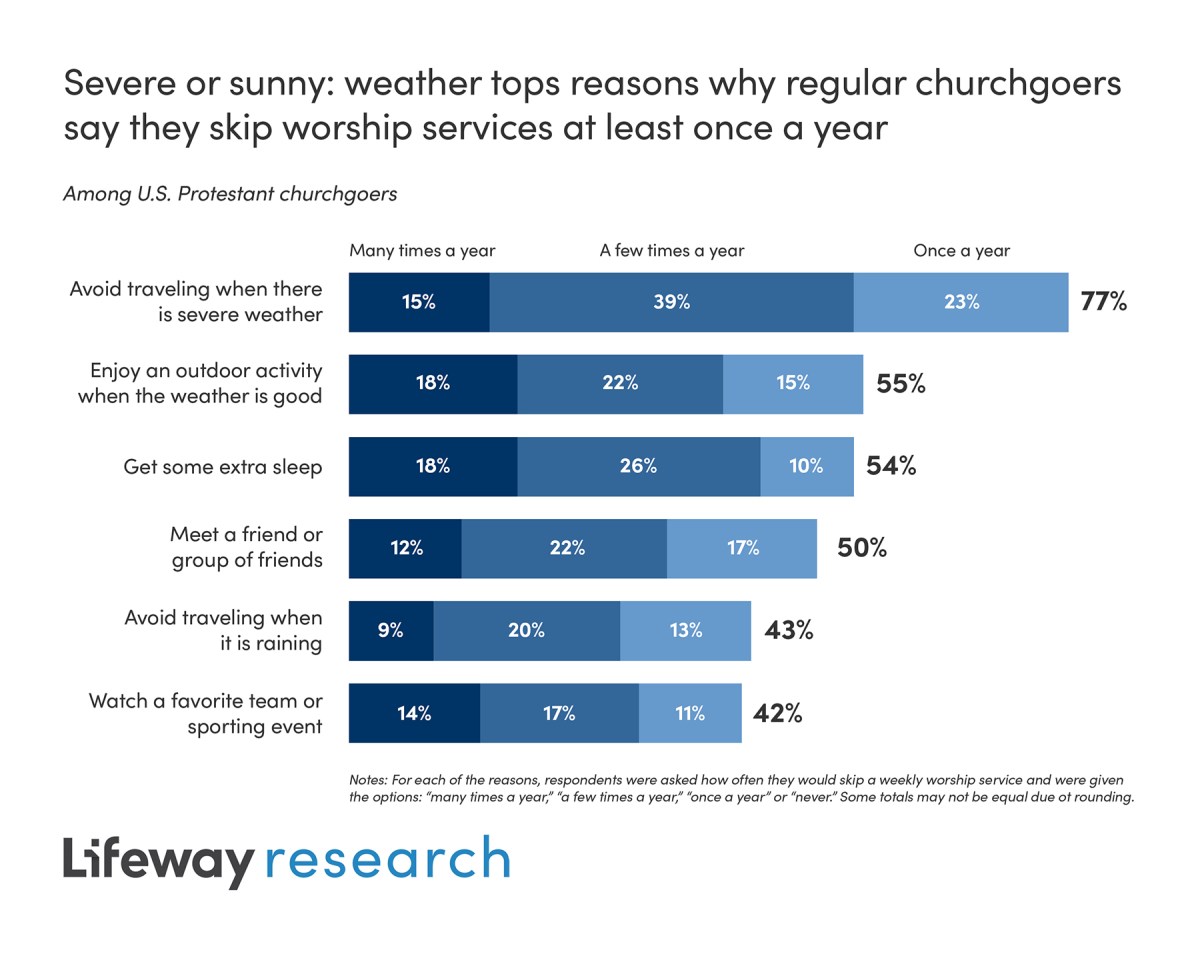
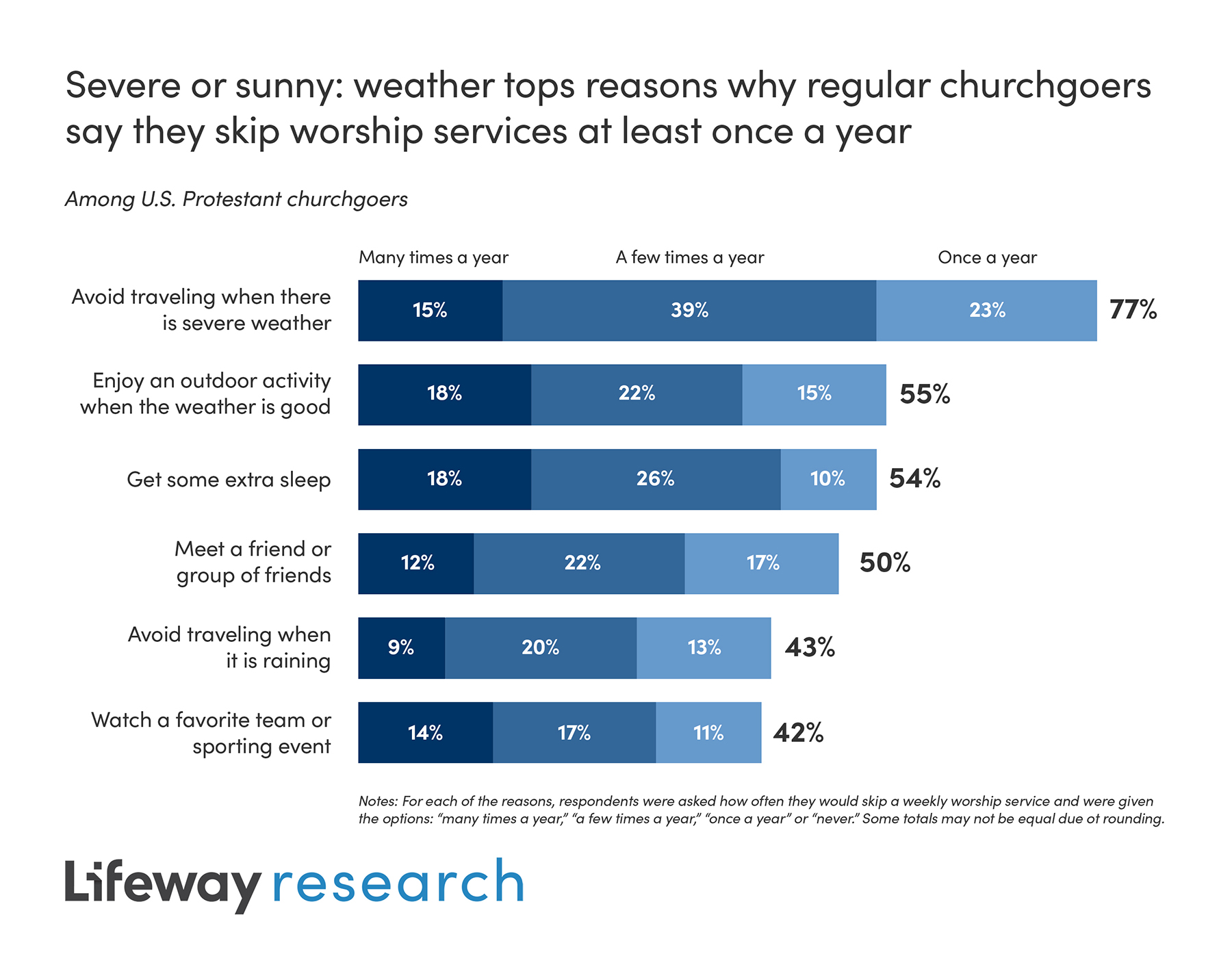
Most regular churchgoers say they would miss a weekly worship service at least once a year to avoid traveling in severe weather (77%), to enjoy an outdoor activity (55%), or to get some extra sleep (54%). Half (50%) would do so to meet a friend or group of friends. Fewer say they’d skip to not have to travel when it was raining (43%) or to watch a sporting event or their favorite team (42%).

“Sometimes churchgoers conclude it’s safer to skip church and not be on the roads,” said McConnell. “But many will also skip church if they feel they have a better option.”

More than 3 in 4 churchgoers (77%) would skip church if there were snow, ice, a tornado watch, or other severe weather, including 23 percent who would do so once a year, 39 percent a few times a year, and 15 percent many times a year. Almost a quarter (23%) say they would never intentionally miss a worship service for this.

On the opposite end of the weather spectrum, most churchgoers (55%) say they would miss weekly worship at least occasionally to enjoy an outdoor activity during nice weather. For 15 percent, they’d do so once a year, 22 percent say a few times a year and 18 percent would skip many times a year. Still, 45 percent say they’d never miss church to go outside during good weather.

Other reasons for skipping services

More than half (54%) of churchgoers say they’d miss church to stay in bed a little longer, including 10 percent who say they would skip once a year to get some extra sleep, 26 percent a few times a year and 18 percent many times a year. Sleep is never a reason to miss for 46 percent of U.S. churchgoers.

Churchgoers are even split on missing a service to meet friends. Half (50%) would do so, including 17 percent once a year, 22 percent a few times a year, and 12 percent many times a year. Half (50%) say they’d never skip a weekly worship service to meet a friend or group of friends.

Most U.S. Protestant churchgoers say rain won’t keep them away. But 43 percent say they may miss church to avoid traveling during rainy weather. For 13 percent, they’d miss once a year, 20 percent say a few times a year, and 9 percent say many times a year. Almost 3 in 5 (57%) would never skip a worship service because it was raining.

Despite major sporting events often happening on Sundays, watching sports is the least likely of the six reasons churchgoers say would cause them to skip church. Slightly more than 2 in 5 (42%) say they’d miss a worship service to watch a sporting event or their favorite team, including 11 percent who say once a year, 17 percent a few times a year, and 14 percent many times a year. For 58 percent of US Protestant churchgoers, sports would never cause them to miss church.

“There is a good reason some churches are in the habit of noting the weather conditions when they record their worship attendance,” said McConnell. “The weather, both good and bad, is part of the decision-making process for many churchgoers.”

Different groups, different reasons

Some churchgoers are more likely to skip for specific reasons. Churchgoers in the Midwest are the least likely to say they’ll miss many times a year to watch sports (8%). Men (46%) are more likely to say they’d stay home to watch their favorite team at least once a year than women (39%), while women (47%) are more likely to miss because of rain than men (37%).

Those under 50 are more likely to miss worship services to enjoy an outdoor activity and meet friends than those 50 and older. In addition, the younger a churchgoer is, the more likely they are to stay in bed and sleep on Sunday mornings at least occasionally.

Perhaps unsurprisingly, churchgoers who attend four times a month or more are less likely to say they’d ever miss for any of the six options than those who attend one to three times a month. Also, evangelicals by belief are less likely to say they would skip for any of the listed reasons than those without such theological convictions.

Additionally, the oldest group of churchgoers (65+) and those of other ethnicities (not white, Hispanic, or African American) are frequently among the least likely to say they’d miss for those reasons.

Denominationally, Presbyterians are among the least likely to say they’d ever miss church for any of the reasons. Meanwhile, Methodist churchgoers are among the most likely to say they would skip at least once a year for each of the six reasons. Those who attend Restorationist movement congregations are also among the most likely to miss services for five of the six options at least occasionally.

For more information, view the complete report.

News

Christians in Northwest India Want a Political Party to Speak for Them

Other believers warn that’s the wrong response to Hindu nationalism.

Voters line up to cast their ballots in the Punjab state elections.

Voters line up to cast their ballots in the Punjab state elections.

Christianity Today July 17, 2023
Saqib Majeed/SOPA Images/Sipa USA/AP Images

They wanted a party of their own.

In a Pentecostal church in a village in northwestern India, a well-known pastor announced earlier this year that the time had come. Hindus, Sikhs, and Muslims all have their respective political parties, and now Christians would too.

As the number of Christians has grown in Punjab, a northern Indian state bordering Pakistan, they’ve faced increased scrutiny, criticism, and false accusations, not to mention insulting public statements about Jesus. Christians have existed in Punjab for nearly 200 years, but Pentecostal ministries with an emphasis on signs and wonders have drawn new crowds, new converts—and a new need for political representation.

In April, pastor Harpreet Deol at Open Door Church said the United Punjab Party (UPP) would be launched under the auspices of the Pentecostal Christian Parbandhak Committee, organizing Christians into an electoral force. They would start with state elections before going national.

“Christians in Punjab aim to forge a collective voice, advocating for their concerns and promoting harmony,” the president of UPP, Albert Dua, who is Catholic, told CT. “The launch of the United Punjab Party by Christians in Punjab represents a significant step forward in the quest for political representation and protection of the rights and interests of the Christian community.”

The UPP, however, was not welcomed with open arms by Christians across the country. Some Christians in India think that politics is dirty and that Christ followers should stay out of it. But even believers who are actively involved in winning elections and advancing an agenda did not greet the creation of this new party with joy.

Pushpanathan Wilson, a Christian member of Parliament from the southern state of Tamil Nadu, said he expected the UPP to make things worse for Christians in India.

“Fighting elections by forming a Christian political party is disastrous,” he said. “Starting a separate party would only weaken the secular forces who are strong enough to fight Hindu fundamentalists. … We will be putting our future generations at risk of being isolated and ignored in our country.”

Ruling federally for nearly a decade, the Hindu nationalist Bharatiya Janata Party (BJP) has largely been perceived as being ideologically opposed to India being a pluralist, secular democracy, where everyone has equal access to the public square and equal rights, regardless of religion. BJP members promote “Hindutva,” or Hinduness, and advocate for a Hindu nation, which may or may not tolerate cultural and religious differences.

Christians are a distinct minority in India, making up less than 3 percent of the population. There are some pockets where Christians have concentrated numbers, including Goa, Kerala, Tamil Nadu, and now parts of Punjab—but not enough to make them a potent political force.

“If success is measured in getting a Christian candidate elected, we [will] fail,” said Atul Aghamkar, director of the National Center for Urban Transformation, which is a wing of the Evangelical Fellowship of India. “Christians are a scattered minority and lack the consolidated numbers needed to win elections.”

Where they have been politically successful in India, Christians have, for the most part, worked in secular parties. In the early days of the independence movement, many Christians were active members of the Indian National Congress. Many continue to show loyalty to the center-left party, and Christians are generally seen as a reliable bloc of voters for the Indian National Congress.

There have been, however, a number of efforts to launch specifically Christian political organizations over the years. Some have managed to have success at the state level. In Tamil Nadu, there’s the Indian Christian Front, the Christian Democratic Front, and the Christian Munnetra Kazhagam. In Telangana, the Indian Christian Secular Party. In Andhra Pradesh, the Indian Christian Party.

Most of these are very small and have not managed to exert any significant influence, especially when it comes to national politics. Organizing believers in India in any effective way on a national scale is incredibly difficult.

Ashish Shinde, a Christian politician from Maharashtra who belongs to the Hum Bhartiya Party, said that Christian modes of organization just don’t lend themselves to voter mobilization. Hindus support other Hindus, Sikhs support Sikhs, and Muslims, Muslims; but Christians do not always believe their interests will be best represented by fellow believers.

“There is not only a very strong denominational divide but also membership divide,” Shinde said. “A Methodist will not worship in any Methodist church; he will go to his own specific Methodist church which he is a member of. So, when one Christian who represents the entire community wants to fight an election, he is not accepted by the entire community.”

Practically, according to Shinde, it makes more sense to build coalitions with non-Christians who share a vision of India that will allow Christians to flourish along with everyone else.

“They should work with like-minded politicians,” he said.

John Dayal, the spokesperson of the All India Catholic Union and a veteran news editor, agrees. He thinks it’s important for Christians to get involved in politics in India. But they can do that by forming alliances and seeking out common ground.

“Indian Christians are duty bound to exercise their franchise and to seek political office,” he said. “They may remain independent political activists or join any political party whose ideology they agree with.”

There’s really no chance a Christian party would win a significant number of seats, according to Dayal.

“Unless they have a candidate of real caliber and some real resources, they will not get the results they have been hoping for, even praying for,” he said. “It is not a good idea to start a party unless one is convinced that they have the numbers to win the elections.”

This is a practical consideration, but also better ideologically, according to many Christians involved in politics in India. By embracing secular parties and working with religiously diverse coalitions, Christians can show they are seeking not just their own selfish interests but the common good of all Indians.

Which is what the party in Punjab ended up doing. For both practical and ideological reasons, the new Christian party decided to seek cooperation with another party ahead of the May election. Instead of putting up its own candidates for a parliamentary election in the Jalandhar Lok Sabha district, the UPP urged supporters to cast their votes for the Aam Aadmi Party (the Common Man Party). When the votes were tallied, the Aam Aadmi candidate, Sushil Rinku, won by a margin of more than 58,000 votes. And news reports gave some credit to the UPP’s Christian voters.

While the election did not likely “forge a collective voice” for Christians in Punjab, UPP leaders still hope it is the beginning of a big change in the way Christians engage in politics in India.

“While challenges remain, the UPP's endeavor is poised to shape the political landscape,” the president of the party, Albert Dua, told CT, “and contribute to the inclusive development of the state.”

Theology

How Breath Prayers Helped Me ‘Pray Continually’

As a busy mom, I had to find new spiritual disciplines to connect with God.

Christianity Today July 14, 2023
Illustration by Abigail Erickson / Source Images: Getty, Unsplash

I used to be a “prayer warrior.”

When I was single and had no kids, I would enjoy praying for long periods of time. Each morning, I would turn on worship music, sing, and meditate on God’s Word. Then I’d spend time interceding for my friends, my family, my neighbors, and for our lost world. I even went on a solo prayer retreat for three days once.

These spiritual habits were instilled in me by the Korean churches in New York and Maryland I attended growing up. Daily early morning prayer services would start at 5:30 or 6 a.m., allowing believers to start the day by gathering at church for a short worship service followed by an extended time of prayer before heading to work. This type of early morning prayer service dates back to 1907 and quickly spread across Korea. It ignited a revival in the country and became one of the most important spiritual disciplines to Korean Christians.

Today, I am a mom to two young children. As I listen to my preschooler screaming for Mommy and my toddler throwing a tantrum, I know there are no prayer retreats in my near future. When even taking a shower without interruptions seems like a luxury, finding a long period of time to pray feels impossible. When I finally find the time to be alone with God after my kids go to bed, I find myself too exhausted for extended prayer.

I started feeling guilty that I couldn’t spend long hours with God like I used to and felt my walk with God grow stale. At the same time, I realized that I needed God more than ever when my toddler made yet another mess at mealtime and my kids bickered and screamed at each other. I desired to come to God, but I struggled to find that chunk of time.

That is when my spiritual director, Ellen Hsu, reminded me that I was in a different season from when I was single. She encouraged me to put aside the false guilt of not meeting my self-imposed expectations of spiritual disciplines. Instead, she advised me to be more gracious with myself and to practice breath prayers throughout the day.

Breathing through prayers

Breath prayers are short prayers that coincide with inhaling and exhaling. They originate from the “Jesus Prayer” practiced by the Eastern Orthodox Church beginning as early as the third and fourth centuries by Egyptian desert monks. The most well-known Jesus Prayer was inspired by Mark 10:47: “Lord Jesus Christ, Son of God, have mercy on me.”

In the 13th century, Nicephorus the Hesychast connected this form of prayer to breathing. The publication of Philokalia (1782), a collection of Greek Christian monastic texts, and The Way of a Pilgrim (1884)—a story of a pilgrim who was practicing the Jesus Prayer—helped the practice gain wider exposure.

In breath prayers, the Christian begins by focusing his or her heart and mind on God. The prayer is then divided into a few words on the inhale and a few words on the exhale. For example, one would inhale and pray, “Lord Jesus Christ, Son of God,” and exhale with, “have mercy on me.”

Whether a Scripture verse or a theological couplet, breath prayers are meant to be short. This allows them versatility so Christians can pray wherever they are, while doing anything. Ellen advised me that breath prayers could help shift my attention to God throughout the day while I’m busy with my daily tasks.

Seeing Jesus as a friend

Despite the practicality of breath prayers, I didn’t immediately embrace them.

Were these short prayers I could pray while cooking or walking good enough for God? As a 1.5 generation Korean American who grew up in the US, I had internalized values from the Korean church.

Koreans have a high power distance culture. Followers yield and submit to authority. I did not view my pastor or leader as my friend. I could not call them by their first name; I needed to address them formally, showing a lot of respect.

When approaching God, this high power distance is even greater. The Korean churches I attended emphasized the need for reverence before God, and I viewed God as primarily high and mighty.

I heard stories about how church leaders would pray to God in their best attire even in their home, coming before God on their knees. My parents kneeled to pray in their rooms. Through these images I gleaned the need for formality when addressing the Lord.

This understanding of prayer started to crack in grad school. While visiting my Caucasian Christian friend’s house, I watched with surprise as she prayed aloud while applying makeup. I could not believe someone would dare speak to God in that way. In the Western world, the low power distance culture seems to shape a person’s view of approaching Jesus. Jesus is seen more as a friend than an almighty, reverent God. The two cultures focus on different aspects of Jesus.

As a Korean, I had a hard time coming to God as a friend. But the more I read Scripture and learned about worship, I realized that God is approachable. My worship studies professor Andrew Hill taught that the Hebrew word nāgash or qārab, which is translated into “worship” in our English bibles, literally means “draw near.” Drawing near to God is part of our Christian worship.

This is quite counter-cultural to my Korean culture, as well as the culture in Malaysia, where I currently live. But the King of Kings and Lord of Lords wants us to come to him and be his friend.

And how often does the God Most High want us to come to him? Constantly.

1 Thessalonians 5:17 commands us to “pray continually.” However, “continually” is a hyperbole similar to Jesus’ words to his disciples in Luke 18:1 (“they should always pray and not give up”), according to Gene Green in The Letters to the Thessalonians.

The command should not be taken literally where you cease to do everything except pray. Rather, it should be taken as an instruction to approach God and talk to him often during the day. Prayer should be less of a one-time event and more of a common and constant component throughout the day. When prayer becomes a regular rhythm of your life, it will feel like you are always praying.

Praying continually in the everyday

Breath prayers are an excellent spiritual exercise that enables us to pray often and throughout the day. If I’m cooking and want to pray, I don’t need to go into my bedroom and kneel to say a prayer to God. While I’m in the kitchen, I can breathe in and say, “Lord Jesus Christ,” and then breathe out with “give me strength for today.”

When my child is throwing a tantrum on the floor and I’m channeling every single fiber not to lose my temper, I can approach Jesus in that moment. Breathe in, “Lord Jesus.” Breathe out, “give me patience and understanding.” Even while doing mundane things such as grocery shopping, I can breathe in, “Jesus,” and breathe out, “let me know that you are with me.”

These short breath prayers throughout the day add up. They become spiritual exercises that help us build a healthy spiritual life, similar to building a healthy physical life. Research shows that when a 30-minute workout is broken up into shorter mini sessions throughout the day, the health benefit is the same.

Likewise, whether it’s praying 30 minutes in one sitting, or saying 10-second breath prayers 180 times a day (that does feel like “praying continually,” doesn’t it?), I’ve found the spiritual health benefits are similar. Both the early morning prayer service and the breath prayers throughout the day are ways of coming before God.

In this season of my life, breath prayers are my offerings to the Lord. Perhaps I can still be a “prayer warrior” like I used to be, but my prayer times look much different. Nowadays, whenever I hear someone’s prayer request or hear about the devastating news in the world, I then and there say several short breath prayers for them.

Breath prayers help me realize that I can come into God’s presence anywhere, at any time. I’m able to ask for God’s strength and wisdom throughout the day. I’m also able to give praise and adoration to him all day long. The more often I pray breath prayers, the more I am aware of God’s omnipresence. I now see that God is, and has been, walking with me on this challenging yet wonderful journey of motherhood.

So I breathe in, “Jesus, my God,” and breathe out, “thank you for being a friend who is with me always.”

Esther Shin Chuang, who holds a Doctorate of Worship Studies, is an award-winning concert pianist, worship leader, and international worship educator. She is currently a lecturer at Malaysia Baptist Theological Seminary in Penang, Malaysia.

Church Life

Lessons on Living Locally

More Americans are staying put. But how can we live with intention?

Christianity Today July 14, 2023
Szabo Viktor / Unsplash

Our church’s lament service took place in March; we had moved to Cincinnati the previous summer. I didn’t attend the service with my own sadness in mind—but it found me, in the dark and somber silence consecrated for those who showed up. The grief of our recent uprooting caught up with me in the pew that late winter night. Leaving home, even voluntarily, incurs a litany of losses.

I might have believed the COVID-19 pandemic contributed to an increase in geographical mobility, as companies—like my husband’s—sold their headquarters and opted for a fully remote workforce. Such flexibility allowed us to relocate to care for an aging parent, and the majority of Americans still report the desire to work from home full-time (while only 13 percent do).

Recent data, however, reveals that for four decades, geographical mobility has been on the decline in the United States. Although pandemic disruptions led to an initial increase in dislocation (often from urban areas to suburban or rural ones), these numbers have stabilized. More Americans are staying put.

Perhaps our national appetite for transience is waning. Still, I confess to feeling pessimistic about our collective commitment to geographical rootedness and responsibility. In our new telework, telehealth, telechurch environments, it seems nearly as easy to opt out of belonging to a place as it is to opt in. With socially mediated lives, there aren’t immediate and acute absences to fill if you change your address. With remote work arrangements, there are fewer opportunities to make new friends. In fact, what’s curious to me, in comparing our move in 2022 with that in 2011, is how little stands to change despite a change in geographical location.

Increasingly, there seems to be nothing inevitable about living locally. We can work from home, shop from home, socialize from home, worship from home. (According to Pushpay’s State of the Church Tech report published in January 2023, 89 percent of churches are still offering a hybrid model of online and in-person services, the latter of which has suffered a 5 percent decline.) The near totalizing of our digital environment mimics the material alienation of the American suburb that developed in the mid-20th century—though now, the garage door need never open.

As it grows more difficult to live in place, it grows more urgent for churches to inhabit a local identity and commit to loving real geographical neighbors.

Geographical belonging may seem incidental to human flourishing in a mobile society, but according to the biblical story, place is one of God’s first gifts to his people. In Craig Bartholomew’s Where Mortals Dwell, the Old Testament scholar relocates the familiar narrative arc of creation, fall, redemption within the context of place.

As Bartholomew narrates it, in the very beginning, God’s people were implaced—given a physical home with God in the Garden of Eden, which he had planted for them. The curse of sin wasn’t just estrangement from God; it was displacement—exile from the garden and loss of geographical stability. The story of salvation, then, is about a recovery of all aspects of lost shalom, including the blessing of a physical, geographical home. In the New Jerusalem, we will be reconciled to God—and reimplaced in a city whose lights never dim.

No doubt, it takes intentional effort today to receive place as a gift rather than constraint. There is interruption and contingency—friction—in the physical world that I can elect to avoid by opting for a virtual experience of life. There are real neighbors suffering their lives, and if I allow open contact, their needs can easily impose in inconvenient ways—like the day a neighbor recently confided in me, ten minutes before a work call, a heart-wrenching anguish.

Even with a commitment to responsibly love our places, our efforts can be stymied by ignorance. With the demise of local news over the last decade, we have fewer resources to learn about the contemporary problems facing our neighborhoods and cities and towns. When local newsrooms disappear (and with them, reporting from city council meetings, school board meetings, and community fundraisers), this corresponds to “lower voter turnout, increased polarization, [and] a general erosion of civic engagement,” as McKay Coppins from The Atlantic has reported. It is difficult to love a place well apart from knowing its longings and hopes, its pains and problems.

Churches, serious about their local identities, can disciple in their people a love for a place and its people—but this too will require intentionality. It obliges church leaders to say frankly and gently, “Unless your health prevents you, get yourself here.” It requires churches to learn about their places—and to bring that learning into the corporate worship experience.

Admittedly, there is one particularly formative part of our church’s liturgy in Toronto—Prayer for the Church and the City—that I deeply miss. It was the part of the service when we prayed for the teachers’ union that was threatening to strike; when we lifted to God our municipal leaders by name; when we praised God for our city parks. Weekly worship always lifted my eyes and drew my attention to the concrete realities of my city and its needs. I suspect this is a more rare than common experience, many churches finding it easier, and perhaps less divisive, to speak of the next world rather than this one.

But if Christian faithfulness is embodied (and it always is), living locally is not optional. Love can’t be lobbed from afar. Often, it’s delivered in the form of homemade lasagna, which showed up at my door last September when a congregant from my new church learned I was sick. (We’d been to church a mere six times.) I might as easily have ordered a delivery from Uber Eats, but this would have prevented me from experiencing the blessing of learning to belong to my new household of faith.

We have just marked the one-year anniversary of our move to Cincinnati and two months of membership at a local church. There is so much I’ve yet to learn about my new city, so much outstanding effort to be made to love my new neighbors well. But I’m grateful to feel less the stranger, especially at church.

“Welcome,” they say on Sunday mornings, handing me a bulletin. And I think they mean it.

Jen Pollock Michel is a podcast host, speaker, and author of five books, including In Good Time: 8 Habits for Reimagining Productivity, Resisting Hurry, and Practicing Peace (Baker Books, 2022).

Theology

Robot ‘Church Fathers’ Might Curate New Canons

Generative AI and the rise of “Bible GPTs” could radically shape our engagement with Scripture.

Christianity Today July 14, 2023
Illustration by Midjourney / Edits by Christianity Today

The pace of adoption for artificial intelligence is unprecedented.

By the end of January, ChatGPT—an AI chatbot that generates brand original content when prompted—had logged 100 million visitors to its site. Before that, it reached 1 million users in the first five days after its release in late November. By comparison, Instagram took 2.5 months to reach 1 million users, and Facebook 10 months.

Generative AI systems like ChatGPT, which can produce humanlike responses to users’ prompts, will undoubtedly shape how we, as the Book of Common Prayer puts it, “read, mark, learn, and inwardly digest” the Scriptures. Indeed, there are already multiple tailor-made AI-driven chatbot systems being used for Bible engagement—which I’ve dubbed “BibleGPTs”—including IlluminateBible.com, SiliconScripture.org, Bible.ai, and OpenBible.info’s AI-assisted Bible Study.

As a digital theology expert, I believe these kinds of “BibleGPTs” will continue to advance, proliferate, and eventually become proprietary systems. And as this happens, the church and its leaders will be prompted to make some momentous decisions about the Christian canon. This will, in turn, influence how we interpret the Bible and impact the future of our faith and practice.

AI-led Scripture engagement will generate new problems.

First, BibleGPTs could reify what I call “concentric canons.” Their databases will require us to precisely define what writings are included in our Christian traditions.

Scripture is our primary canon. When handwritten scrolls became recognized as distinct books, the early church fathers confirmed which writings were considered canon and which were not.

Likewise, with today’s AI databases, someone will soon have to decide which denominational writings and perspectives should be included in the training data of the GPT (which stands for Generative Pre-trained Transformer). And in some sense, these can act as secondary canons—much like the concentric growth rings of a tree trunk.

Imagine a Reformed database, an Orthodox database, and an Anabaptist or Catholic database: Each would require someone to decide which doctrinal writings should be included (“canonized”) and which should be left out. Who will decide, and how? Will it be denominational leaders within these traditions? Will it be tech leaders? Or possibly book publishers who control intellectual property?

The answers to these questions matter, and there’s bound to be controversy surrounding these decisions.

And while the input logic of these databases may be transparent to their creators, end users will likely have little to no visibility or understanding about which writings qualify as canon and why. In the past, extrabiblical writings like the Apocrypha and the Gospel of Thomas have raised such questions, but these new databases will multiply these concerns exponentially.

Second, BibleGPTs could create canonical mashups, because it’s easier for users to blend various Christian traditions and denominations together.

What would John Calvin think about megachurch governance? How would Mother Teresa respond to prosperity preaching? What would Martin Luther say about Martin Luther King Jr.? Questions like these—while intriguing—may or may not have clear answers based on church tradition. And yet these AI systems make it easier to ask such hypothetical questions, and therefore more likely.

The result could be Christians arguing over speculative theology rather than seeking to deeply understand the hard-won historical perspectives and traditions that a BibleGPT claims to represent.

Our traditions have built incredible creeds and confessions—architectural gems that house meaningful differences and fruitful diversity. Yet BibleGPTs risk razing these edifices and paving over them with a flattened understanding of faith that anyone can skim over.

This is why it’s important for AI designers to build into these systems a firm grasp of respective Christian church traditions, so that they do not cause “canon confusion” for the user.

Third, BibleGPTs can make it easier for users to ask “culture-bound” questions that the Bible doesn’t directly address.

What does the Book of Leviticus say about artificial intelligence? Is the Bible Democrat or Republican? Or, more seriously, what does the Bible say about eating disorders or child abuse?

Questions like these relate to culture-bound issues that are far removed from the Bible’s context. Such questions may be irrelevant or simply asking something that is outside the Bible’s sphere. We might extrapolate possible answers from Scripture—this is the work of theologians—but it’s important for users to know the difference between authors’ original intentions and contemporary applications.

Culture-bound questions are a user-driven problem. Nonetheless, kingdom-minded AI designers will want to account for this tendency when building any BibleGPT. Otherwise, the ease of asking these kinds of hypothetical questions could easily distract users from more worthwhile Bible engagement—and from understanding what questions are relevant and appropriate.

In response, BibleGPTs risk “hallucinating” heresies.

When we ask a BibleGPT questions the Bible doesn’t directly address, it may produce confident-sounding answers—whether they correspond to biblically orthodox beliefs or not. In fact, the BibleGPT might manufacture an entirely nonfactual response or “hallucinate” a heretical statement. And from these hallucinations, users can end up with a misleading or warped theology.

Experimenting with speculative questions may generate interesting responses that make decent theological arguments—but the user cannot be certain of the logic the GPT uses to reach its conclusions. Only when GPT systems are evaluated on hundreds or thousands of instances, not just a handful, do their biases begin to appear.

Ultimately, bad questions will lead to bad answers. And while many of these issues already happen in online queries, GPTs will amplify them and make it easier to retrieve inaccurate responses.

One hopes that GPT users will be discerning, but my guess is that pastors know just how likely some Christians are to asking questions like this. And if BibleGPTs ever reach even a fraction of YouVersion’s hundreds of millions of users, these edge cases seem inevitable.

Fourth, the loudest traditions will win. Because GPTs are based on statistical probabilities, the most probable theology will be overrepresented.

Whichever writings or denominational traditions the GPT databases include more of are likely to get the most visibility, as more prolific traditions pull the probability in their direction. This means that the loudest traditions will dominate the discussion. The prolific Presbyterians will win over the quiet Quakers. The popularity contest that already exists online will get reified in our databases.

When people warn about “AI bias,” this is partly what they’re talking about. This is why leaders of various Christian traditions will need to deeply consider which writers and whose writings are included or omitted in any BibleGPT database. It’s a question of representation.

But there’s a potential upside to this, too. BibleGPTs could keep us rooted more firmly in the broad historical orthodoxy by providing us with the best answers to biblical questions—the ones most frequently cited and best defended over the centuries—rather than serving up responses from fringe theologies.

Fifth and finally, AI users risk offloading Bible reading. On-demand answers may replace our efforts to engage the Bible and wrestle with what is written.

There’s something important about reading the Bible itself—and for ourselves. Something in the way it draws us into the story and invites us to face questions about who we really are. GPTs may provoke a Google reflex, where we instinctively search for an answer before wrestling with the question. This Google mindset assumes that access to Scripture is the same as knowledge of Scripture.

Pre-digested Bible content generated by GPTs isn’t a direct path to spiritual formation. We must remember that the ultimate purpose of reading the Bible is to encounter God, to be transformed by that encounter, and to be equipped to participate in what God is doing in the church and the world.

Christians can participate in solving these problems.

BibleGPTs may very well have a place in God’s kingdom, but wherever they oppose the purposes of Scripture itself, we must rethink their design and use. How can these systems be shaped to serve us well?

First, reverse the interrogation. GPTs serve Bible readers better by generating more questions than answers. We must let BibleGPTs interrogate us.

As Christians, we believe it is God who speaks first—not the internet, and not us. Bible scholar Scot McKnight writes, “We may argue with God and the Bible and we may ask questions, but that all comes after we listen.” God feeds us with his Word. Eugene Peterson takes a page from the prophet Ezekiel and the apostle John when he says, “Eat this book.” The Bible is food that energizes us and equips us for the good works he planned for us (Eph. 2:10).

One way I’ve reversed the interrogation with a GPT is to ask it what questions or issues a given Scripture passage asks me to wrestle with. The GPT has helpfully captured some of the key challenges that the passage presents. These questions spark my curiosity and invite me deeper into the passage, to read it more closely and to consider what it says and how I might need to respond.

Second, use AI as a supplement, not a replacement for the Scriptures themselves.

Reversing the interrogation is a great practice that BibleGPT users will benefit from. But they must choose to do that because GPTs won’t default to it. Reversing the interrogation keeps readers in the loop—in their role of Bible engagement, not Bible replacement.

This habit also keeps GPTs in the role of Bible supplement, not Bible substitute. For Christians who truly desire to encounter God and be transformed by him, we need to pay careful attention to who and what is mediating our interaction with Scripture.

Third, BibleGPTs should prompt users to practice more holistic Bible engagement.

Remember those old VCRs that always flashed 12:00? Few ever bothered to reset the clock after the power went out. The default settings of any technology will powerfully influence our choices and habits, and we often do what’s easiest. It’s why every app’s first question is “Allow push notifications?”—because app makers know that defaults can nudge users into the habits they want.

But defaults can prompt positive habits as well. Just one example is a GPT system that defaults to generating questions instead of answers, which can nudge users toward deeper Bible reading.

How else could defaults help users to move past culture-bound questions toward a healthier diet of Bible reading? Perhaps defaults might incorporate a notable and reputable Christian thinker’s systematic theological framework or schema for biblical interpretation? Either way, ideal default settings should guide users toward a more holistic experience of Scripture and the church.

Fourth, what I call “conscientious canons” could help broaden readers’ horizons.

BibleGPTs could broaden exposure to Christianity’s diverse history. We can work toward that by being intentional about how we gather and include writings from various Christian traditions.

If “concentric canons” reify Christian traditions into fixed databases, how might GPT systems alert its users about the traditions it represents? How could it create an awareness of various views or highlight the traditions or sources the ideas come from? Maybe it constantly reminds users, “Being the Quaker BibleGPT that I am …”

Fairly representing denominational traditions is vital. Deciding which preachers, which writers, which perspectives get included—and left out—deserves great scrutiny and care. Any BibleGPT should gather input from a broad range of voices from Christian history to speak into theological questions. These voices should go well beyond evangelicalism and Protestantism.

This is not merely a matter of denominational politics, but of how we as Christians love our neighbors and our enemies as Jesus taught.

Fifth, BibleGPT systems should be aligned to the purposes of Bible reading.

A BibleGPT will not rise to the intentions of the designers—it will fall to the habits of the users. For that reason, Christian AI designers must anticipate how users will engage with a BibleGPT. Nudges and defaults are important; while any system must give users freedom, it can also encourage them toward a more holistic experience of reading the Bible.

The systems and defaults we program into BibleGPTs must be trained for the purposes of Scripture reading. Careless BibleGPTs can lose valuable insights and critical context in translation, but conscientious ones can deepen the significance and comprehension of Scripture for its users.

The GPT training data sets have already absorbed plenty of Christian-oriented content, as well as plenty of toxic content as well. In her recent PhD dissertation, “Righteous AI,” Gretchen Huizinga writes that “crowd-sourced wisdom does not reflect divine wisdom. It gives equal weight to the wise and the foolish and ignores the absolute and transcendent.”

This means that, for Christians, discernment will be vital.

Innovative Christians have an opportunity to create BibleGPTs that will make our Scripture diet healthier and more holistic. But this requires an intentional effort—in our design as much as our doctrine, and in our strategy as much as in our theology.

In 1943, Winston Churchill said, “We shape our buildings and afterwards our buildings shape us.” Likewise, as we shape our AI systems, they will shape us for years to come. The landscape of Bible engagement is indeed already changing—the skylines are not what they were even a year ago.

If we don’t think proactively about BibleGPTs, we will reap the consequences. But if we are clear and conscientious in how we design them, the opportunities are incredible. The best designed BibleGPTs will do what the Bible itself does: encourage and enable Christians to connect with God in ways that transform them and equip them for mission.

This is why Christians must approach BibleGPTs with extraordinary care and a global vision—the future of Bible reading depends on it.

Adam Graber is a consultant in digital theology and cohosts the Device & Virtue podcast.

News

Evangelicals Rejoice at the Church of England’s Fossil Fuel Divestment

“Unless Jesus returns we face a catastrophic future.”

Protestors urge divestment from oil and fuel companies.

Protestors urge divestment from oil and fuel companies.

Christianity Today July 13, 2023
Loredana Sangiuliano / SOPA Imag / Sipa USA / AP

Sometimes, late at night, when her kids have gone to bed and Eleanor Getson is doing the dishes, she is hit with an almost crippling fear.

“Glaciers melting. Islands of plastic in the Pacific Ocean. Forest fires wiping out millennia of history,” said Getson, a 40-year-old evangelical living in Bradford, England, with her husband and two boys. “I can’t stop scrolling through stories about climate change. … It’s too much to think about, and I get this anxiety about what my children will suffer because of us.”

That’s why Getson was delighted to hear the news that the Church of England, which she grew up in, has made the momentous decision to divest from fossil fuels. Last month, the Anglican Church Commissioners and Pensions Board announced its decision to pull all financial investments from gas and oil companies because of the way burning fossil fuels is driving climate change.

Pressure on the Church of England to divest from fossil fuel companies has been building for several years, as an increasing number of clergy, bishops, and dioceses have made divestment commitments and called for fossil-free pension schemes.

Among them have been evangelicals bringing their own distinctive arguments and motivations to the campaign. For years, evangelically inclined organizations like Operation Noah, Tearfund, United Society Partners in the Gospel (USPG) and Christian Aid have been calling for the Church of England to fully divest from fossil fuel companies

Ruth Valerio, director of advocacy and influencing at Tearfund, a Christian relief and development organization based in the UK, told CT that the church has a huge role in calling on policies and practices that do not harm the natural world, such as cutting down on carbon emissions, switching to green-energy providers, and divesting from fossil fuels.

“I often think of the church as being like a sleeping giant: We’re starting to stir from our slumber, but if the church could really wake up, we would be a massive force for good around the world,” she said.

Cameron Conant, a trustee with Operation Noah, said the Church of England’s divestment is a “very big deal” because of Anglicans’ global influence. But it’s also important, he said, because the campaign, which Operation Noah helped mobilize, has won the support of a wide range of Protestants. Prominent evangelicals in the Church of England backed divestment, including Archbishop Justin Welby, an open evangelical who previously worked as an oil company executive.

In a public statement, Welby said he has been moved by the science of climate change and the call of his faith.

“The climate crisis threatens the planet we live on, and people around the world who Jesus Christ calls us to love as our neighbors,” he said. “It is our duty to protect God’s creation, and energy companies have a special responsibility to help us achieve the just transition to the low carbon economy we need.”

According to Operation Noah, the change in the Church of England has been led by people in local parishes—grassroots organizers in the High Church, Low Church, and Broad Church wings of Anglicanism.

“Divestment campaigners have cycled hundreds of miles, prayed outside places of worship, circulated letters, submitted motions and pleaded with church leaders to stop funding fossil fuels,” said Darrell Hannah, chair of Operation Noah. “The world changed thanks to their efforts.”

One of those campaigners is evangelical mission priest Jon Swales. A church planter in West Yorkshire, not far from Bradford, the 46-year-old pastor regularly preaches on the perils of climate breakdown and Christians’ calling to do something about it as a matter of justice and discipleship.

Evangelical convictions aren’t at odds with caring about the climate, he said.

“If we take the Bible seriously and believe God speaks to us through it,” he said, “he is calling us to abandon the idols of our age.”

When Swales reads the prophets or Revelation, he sees direct lessons for Christians today. He compares the warnings about bowing down to Baal and Babylon to more modern principalities and powers, such as unrestrained capitalism, consumerism, and individualism.

“The Bible may not be directly about the Anglican church and divestment,” he said, “but there are parallels.”

Swales wasn’t always persuaded that climate change should be a major concern. He didn’t reject the science of global warming before. He tried to recycle and reduce the amount he drove his car around West Yorkshire, but in the end, he wasn’t all that concerned.

But he went through a change of heart about five years ago when his daughter was on a climate march and he went with her to hear some speeches. He heard one speaker who reminded him of prophets like Amos and Hosea, John and Jonah, warning that we need to act now to avert catastrophe.

“I realized climate breakdown was eschatological,” he said. “Unless Jesus returns, we face a catastrophic future.”

Swales’s conversion corresponds with a general sea of change in British public opinions on climate change and appropriate responses to it. Multiple polls since 2019 have shown an increase in the number of Britons reporting they are concerned. According to a November 2022 poll conducted by the UK-based research and analytics firm YouGov, more than two-thirds of the British public (67%) are worried, and a majority (62%) believe it will take “drastic change” to avert the worst impacts.

Another poll showed that many want to see a significant shift in the financial sector. Sixty percent of people in Great Britain would like banks and financial institutions to ditch investments in coal, oil, and gas.

Amid this momentum, Swales said evangelicals need to be asking about what discipleship will look like in a society heading rapidly toward collapse. “Divestment is one way to avert the worst-case scenarios,” he said.

Another parish priest who has campaigned for divestment is Vanessa Conant, rector of St. Mary’s Walthamstow in northeast London, where she has served for the last eight years.

Conant, who is married to Cameron at Operation Noah, grew up in what she called the “more evangelical wing” of the Church of England. She sees the divestment campaign, which Operation Noah has been leading since 2013, as a faithful continuation of the evangelical heritage of justice movements, such as efforts to expand education and abolish slavery.

“These were huge movements to integrate our faith in Jesus Christ,” she said, “and use our life to further the kingdom of God.”

As with those movements, much of British Christians’ climate change activism is rooted in the life of the parish, Conant said. In her church, she opens the Word and asks questions like these: What does it mean to lay down one’s life for a friend? What does it look like to pick up your cross in a warming world?

In response, she’s seen the congregation look for new ways to cherish what God has made and take steps to better care for their neighbors. Some of that looks like campaigning for divestment, but there are also quieter efforts to apply the gospel in context. Their churchyard has been set aside as a haven for biodiversity. The congregation has thrown itself into A Rocha International’s Eco Church program, marching to silver status. The laity lead a Climate Sunday service each year.

Divestment is just one piece of climate change activism in the church, she said. And she is encouraged to see how much hope Christians have, pursuing positive change as an act of faithful witness.

“So much of climate talk necessarily has a huge element of fear in it, and we have to recognize there is an urgency. But there is a huge amount of joy in responding to this call,” Conant said. “Although there is fear and anxiety, at the heart this is about returning us to the beauty of living in right relationship with God, creation, and others. We were made for this.”

Theology

A Buddhist Nun Walked into an Anglican Church

How God pursued me even when I was certain I’d already found truth.

Christianity Today July 13, 2023
Illustration by Mallory Rentsch / Source Images: WikiMedia Commons / Unsplash

On a warm summer’s day in 1991, I sat in Amaravati Buddhist Monastery, a temple north of London, my heart full of confusion and inner turmoil. I had begun seriously to doubt my faith.

It didn’t make sense. I thought I had found the truth in Buddhism and had given up everything necessary to become a Buddhist nun seven years earlier. In the temple led by American monk Ajahn Sumedho, life was strict and disciplined, involving many ascetic practices designed to simplify daily existence and help us detach from earthly things. Our lives were based around meditation practice; we were celibate, slept little, and ate only one meal a day. I was known for my strong faith in Buddhism, and had not ever really doubted the purpose of living by its teachings.

Until now.

Suddenly I found myself, with my shaven head and robe, spontaneously rushing down to the traditional Anglican church in the nearby village. “I’ve got to talk to somebody, I’ve got to understand what’s happening to me,” I thought.

Upon entering, I looked around anxiously for the priest. “Could you pray for me, please?” I asked when I spotted him. “I’m very confused.” Unfazed, he graciously guided me to the Holy Communion rail and asked me to kneel. He laid his hands on my shoulders and prayed. As he did so, I broke down sobbing uncontrollably.

As the tears abated, the priest’s compassionate eyes met mine, and he said, “We need to talk.” We agreed to meet the following week.

After being prayed for, I felt a great release of the emotions and conflict deep inside of me. I was expectant that this man of God might be able to help me. How things had changed from my certainty about Buddhism to barely being able to contain my excitement about my appointment with an Anglican priest!

Finding solace in Buddhism

I was born in 1956 near Liverpool, England. Both my parents were unusually bitter and angry towards the church, my mom preferring to visit palm readers and fortune tellers instead.

My father, having grown up in an orphanage, said that the only thing he ever got from the church was the money he stole from the offering bag to alleviate his hunger. My brother and I naturally took on the opinions of our parents.

I left home at 18 to study in London. I led quite a self-indulgent lifestyle, including partying and promiscuity. However, upon finishing my studies, I was beset by questions: “Who am I?” “What's life about?” My spiritual side, which had been suppressed for years, now demanded answers.

At age 21, the search for truth became my life’s quest. Living in London provided me with a plethora of spiritual options. I met a Sri Lankan Buddhist monk and began to frequent his temple. He was a patient, scholarly man who appeared to have answers to my questions.

I especially liked that God was nowhere to be found in Buddhism. Buddha taught that he was only a man and that his insights were due to his own endeavors and intelligence. His spiritual goal was to be completely free of suffering. After a period of various spiritual practices and intensive meditation, Buddha concluded that to exist in any form whatsoever—for instance, as a human, animal, or ghost—would give rise to suffering. He claimed to have found the way that led to the end of suffering.

Buddha’s goal of nirvana is described as extinction, or not to be born in any form at all, where all becoming ceases. This felt to me like a breath of fresh air after experiencing the other extreme of self-indulgence and world-weariness.

Over the next six years, my commitment to Buddhism increased. This included going on a Buddhist pilgrimage in India and attending meditation retreats in Sri Lanka and Thailand.

Several years into this spiritual journey, while staying in a temple in northeastern Thailand, I decided I wanted to become a Buddhist nun with Ajahn Sumedho’s community. So in 1984, I boarded a plane back to England and prepared to join Chithurst Forest Monastery.

A Christian awakening

As an ordained nun, I rarely if ever doubted the teachings of Buddha. However, with time, it became clear that God was reaching out to this rebellious one. One evening in the temple, we watched The Law of Love, a documentary about Jackie Pullinger, a British Christian missionary serving the poor in Hong Kong. (The mother of the film’s producer was a Buddhist and shared it with us.) I saw Jackie and her helpers praying in the name of Jesus and by the power of the Holy Spirit. God moved through them to touch and heal people, including drug addicts who were miraculously freed from their addictions.

Beyond their physical healing, I could see they had a certainty in their spiritual life, a deep inner freedom and truth that I was searching for but now knew I had not found in Buddhism. It made me feel spiritually destitute and barren, as though I had nothing by comparison.

Something deep and foundational within me had been disturbed and awakened. A huge spiritual struggle ensued which lasted for months. I found myself seeking to learn more about Christianity, including reading Jackie’s books, then rejecting it again for Buddhism by trying to “let go” of that desire. It was an unbearable tension: two forces pulling hard in opposite directions, vying for my commitment.

However, as the weeks passed, I experienced an overriding desire to attend church, to be baptized, and to pray—even though I didn’t really know what those things meant.

In the height of my confusion, I rushed to the local church that Sunday morning. When I met with the priest a couple of days later, he read to me Jesus’ words in John 14, telling me to not let my heart be troubled. He was preparing a place for me in his Father’s house: “And if I go and prepare a place for you, I will come back and take you to be with me that you also may be where I am.”

The priest told me he believed the Lord had touched me and that I had come to know God. I knew deep inside that what he said was right. One week later, I disrobed and before long left the Buddhist temple. One of the nuns wept, asking what had happened to my strong faith. Another was concerned, warning me that “if you change your mind and decide to come back, you’ll have to start from the beginning again.”

I did not argue with them, instead remaining silent. What had happened to me perplexed the nuns and monks that I had lived with for so long, but they treated me with respect.

Nothing wasted in God’s economy

I returned home to Colchester, a town in Essex, where I joined an amazing church. There the pastor and his wife taught me the basics of the Christian faith and nurtured me as a believer. After three years, I joined Jackie Pullinger's ministry in Hong Kong, a truly fruitful period of learning and growth.

However, after a few years, I started to feel something else stir in me—a clear call to Thailand, where about 95 percent of the population are Theravada Buddhists. What a profound apprenticeship God had given me by allowing me to delve so deeply into Thai Buddhism!

I arrived in Bangkok in late 1999 with a suitcase and a vision to help disciple and strengthen Thai Christians in their faith, and have been based in Thailand ever since. I spent the first 10 years in Bangkok and I now live in Ubon Ratchathani, not far from the Buddhist temple that I used to visit. My main ministry focus involves leading a discipleship and inner healing ministry to help Thai Christians, whether church leaders or new believers, grow and mature in their faith.

Most of the people that we help come from a Buddhist background. My own experience with Thai Buddhism has been invaluable: Whether I’m with Thai Christians or Buddhists, they recognize that I have some understanding of where they are coming from and can often speak into their experience.

Once redeemed by Jesus, it seems that nothing is wasted in God’s economy.

This article has been adapted from Esther Baker’s two books: I Once was a Buddhist Nun (IVP UK, 2009) and Buddhism in the Light of Christ (Wipf and Stock USA, 2014). Esther’s name is a pseudonym due to sensitivities in Thailand where she is based.

Books
Review

Rainn Wilson’s Spiritual Revolution Gets Spirituality Partly Right and Jesus Mostly Wrong

“The Office” star offers a welcome critique of privatized faith. His other ideas are harder to swallow.

Rainn Wilson

Rainn Wilson

Christianity Today July 13, 2023
River Callaway / Contributor / Getty

I promised myself only one The Office reference in a review of Soul Boom: Why We Need a Spiritual Revolution, written by Rainn Wilson, the actor who portrays Dwight Schrute on the show. So here goes: In season five , Dwight and his longtime girlfriend, Angela, the most religious person on the show, break up. Dwight is crushed and confides to a coworker, “She introduced me to so many things. Pasteurized milk, sheets, monotheism, presents on your birthday, preventative medicine.”

Soul Boom: Why We Need a Spiritual Revolution

Soul Boom: Why We Need a Spiritual Revolution

Hachette Go

304 pages

Where Dwight was a latecomer to the merits of monotheism, Rainn Wilson has made promoting it a major part of his life’s calling, bending his significant celebrity and resources to projects that promote human spirituality in media, entertainment, and social activism. Soul Boom is his latest effort and, despite its shortcomings, is one of the most compelling non-Christian apologetical works I have read.

Anticipating shared values

Wilson is a member of the Baha’i faith, a religion introduced in the 19th century by Baháʼu'lláh (1817–1892), who claimed to receive a new revelation that, roughly speaking, placed him in the genealogy of “Manifestations of God” stretching back to Abraham and including Krishna, Zoroaster, Buddha, Jesus Christ, and Muhammad. The religion now claims around six million followers globally.

The teachings of Baháʼu'lláh, as well as his son and grandson and the Universal House of Justice, the faith’s governing body since 1963, are quite ecumenical. For starters, they draw widely from world religions to form the basis of their teachings. In addition—and more provocatively, at least from this Christian’s perspective—the faith rejects the exclusivist claims of world religious leaders, making figures like Jesus far less consequential than he appears in any historic Christian creed.

All that said, Soul Boom, which calls for a worldwide spiritual revolution along the lines of “an ever-advancing civilization” and “collective” spiritual maturity, is a powerful presentation of the Baha’i faith’s perspective on spirituality. After putting down the book, readers will likely appreciate the Baha’i faith’s amiability and think highly of Wilson’s character, whatever they think of his views.

The book is funny, irenic, and regularly revealing. At one point Wilson describes how his attempts to develop a television show exploring spiritual themes met rejection in Hollywood because God was deemed “too controversial.” As Wilson observes, the depths of depravity, violence, and voyeurism on television go deeper every year, but somehow God is a “four-letter word.” Someone so familiar with elite cultural production brings a potent and trenchant critique of its aversion to anything overtly spiritual.

Like all good apologetical works, Wilson’s book starts by anticipating shared values and then moves toward claims that might be a harder sell for outsiders. The second half of the book suggests (in somewhat tongue-in-cheek fashion but seriously enough) that we need to create a “new religion” called SoulBoom that will help usher Wilson’s real interest—a global spiritual revolution advancing spiritual progress and cosmic unity. This religion looks a lot like the Baha’i faith, which includes no clergy and promotes practices of prayer and meditation. In making his case, he diagnoses many problems Christians would also highlight in American society: consumerism, loneliness, violence, and partisanship. His solutions, however, are harder to swallow.

Soul Boom failed to make a convert out of me (among other reasons because following his religion would make one a … Boomer?). Even so, the book is valuable for its contribution to a broader spiritual dialogue and as a skillful apologetic for the Baha’i faith. Wilson wishes his readers to embrace a spirituality that adheres to some key precepts drawn from his faith tradition. Christians, who in many contexts today might find themselves with only slightly more cultural resonance than someone from the Baha’i faith, can take note of the way Soul Boom searches for cultural common ground and offers its distinctive prescriptions to the uninitiated.

Key to Wilson’s winsomeness is that Soul Boom is laced with popular culture metaphors. In the dominant one introduced in the first pages, Wilson describes the “twofold path” of spirituality through two television shows: Kung Fu and Star Trek. The former represents the personal, internal journey toward mental wellness and self-mastery, while the latter represents what Wilson calls the “spiritual evolution of a species [humanity].” Both pathways, in Wilson’s telling, are needed, even as spirituality in 21st-century America has largely focused on the themes of Kung Fu. But to quote Star Trek’s Captain Picard, “We work to better ourselves and the rest of humanity.” Wilson is keen on getting readers interested in the social potential of spirituality.

I work at a Christian study center serving a large public university, so the trends of “nones” and the “spiritual but not religious” are present every day. Wilson should be lauded for breaking down the artificial “privatization” of spirituality that reduces faith to an individualistic pursuit of self-actualization or a distant set of dogmas. To the extent that SoulBoom’s spirituality fosters values that make it possible for people to become more Christlike, Christian readers can affirm the value of Soul Boom’s intervention.

At the same time, Wilson treats Christianity like Star Trek does religion. Star Trek is often as condescending to religion as any of the Hollywood shows Wilson critiques, a lesson I learned while becoming a Trekkie as a missionary kid in the ’90s. In describing one species’ development, for example, Captain Picard remarks, “Millennia ago, they abandoned their belief in the supernatural … the dark ages of superstition and ignorance and fear.”

So, while Wilson is friendly to world-religious figures like Jesus, his compliments smell like they could have come from Picard. Jesus taught the Golden Rule and called for justice. He also claimed to be the Jewish Messiah, to be the only way to God, to be the king of an unseen kingdom. He died and rose again, which, if true, would be the hinge point of all history. It is no surprise that these teachings, which are present even in the parts of the Gospels that SoulBoom acknowledges, are completely absent from Soul Boom.

Human and divine agency

I read Soul Boom right after another book, Biblical Critical Theory by Christian scholar Christopher Watkin. Among the merits of Watkin’s biblical approach to critical theory is teasing out what makes the biblical understanding of the world distinct. Two overriding Christian commitments are that the God of the Bible is a personal God and that the biblical worldview is “emplotted” in a storyline of creation, fall, redemption, and consummation that shapes everything the Bible talks about and teaches.

These two features of the biblical portrayal of reality oppose SoulBoom at a fundamental level. In the first case, the God of SoulBoom, like the God of the Baha’i faith, is something far different than the God of the Bible. In the second case, SoulBoom, like the Baha’i faith, has a very different (if equally clear) story line: The world is moving toward a unity of spirit and matter, with human spirituality as the driving force.

Here’s the rub: Wilson’s “emplottment” of Jesus into the story line of SoulBoom conscripts Jesus and the Bible into a narrative—and an entire worldview—the biblical authors wanted nothing to do with.

The God of SoulBoom is distant and elusive—a “Big Guy/Gal/Force/God/Creator thingy,” in Wilson’s words—that mostly just has “our best interests in mind.” Although Wilson’s theism moves beyond a vapid “spirituality” and includes a public, rather than simply private, dimension of faith, it does not do enough to differentiate itself from what sociologist Christian Smith has termed “moralistic therapeutic deism.” In contrast, the God of the Bible is engaged and relational, constantly drawing close to his creation and expressing love, concern, anger, and sacrifice toward humans, who reflect God’s own image.

The story of SoulBoom concerns a humanity that must essentially save itself by living up to and evolving its own spiritual potential. If so, writes Wilson, humanity will “mature and collectively make increasingly moral, compassionate choices” to achieve cosmic unity and “arise from the individual to the whole.” The story of the Bible goes in the opposite direction. It tells of a good creation dashed by rebellion and sin and the king of that order working to make things right, with salvation that is for us but not because of us, culminating not in humans ascending into unity with God but in God’s descending and dwelling with his creation.

The agency of the story in SoulBoom lies with humanity. As Wilson states, it is people who must change, through “recognizing that we are, in fact, spiritual beings having a collective human experience” who can be open to “the soul-level transformations we’re going to need to make.” The agency of the biblical story is God’s. It begins with God creating and ends with God dwelling; we work as co-stewards and God works through us, but we are never the stars of the show.

Further contrasts only reinforce the point that the biblical story chafes within the boundaries of SoulBoom and thus in the prescriptions for Wilson’s spiritual revolution. Like in the Baha’i faith, SoulBoom’s reduction of Christian truth to humanistic moral insights that align with other world religions makes the original appeal of Christianity problematic and the remaining appeal little more than one of taste.

An oasis, not a destination

Even so, Christians can affirm some ideas that Wilson advances, none more than the truth that answering the question of “Who am I?” must begin outside oneself. Every force in our culture pushes in the opposite direction, from debates over identity politics to our culture’s commodification of personal identity. In the Bible’s understanding, the question of “Who am I?” transforms (in Watkin’s phrasing) into “Whose am I?”—an interrogation that launches us on the road to Jesus. As with Augustine in his Confessions, it ushers us deeper and deeper into the paradox of losing oneself for the sake of the gospel in order to find our true identities in Christ.

Wilson affirms a generalized version of this basic truth that, if widely adopted by his nonreligious readers, would be progress indeed. His aim is to “advance a conversation about the importance of the divine dimension of existence and how it can influence our lives and our futures, collectively and individually.” This echoes C. S. Lewis’s self-diagnosis that he possessed “an unsatisfied desire which is itself more desirable than any other satisfaction.” Lewis called this “joy,” an emotion that Wilson also affirms as the antidote to the world’s cynicism. There is more, though no less, to this world than what our senses apprehend.

In a Western world devastated by disenchantment, disillusionment, and cynicism—functionally materialist in its institutions—a more robust recognition of a spiritual dimension to reality can be an oasis. The value of Soul Boom is not so much the new religion of SoulBoom but Wilson’s apologetic for monotheism in a culture increasingly averse to organized religion. Even if Wilson’s view falls far short of the beauty of the Christian witness, Christians can accept Wilson as an ally in holding forth for a deeper and wider sense of reality that includes the supernatural.

Yet while Wilson’s contribution might lead us to an oasis, it is hardly the destination. If I do the reverse of Wilson and “emplot” SoulBoom into the biblical story line, we realize quickly that it cannot contain the mysteries of the Incarnation, the Crucifixion, the Resurrection, and the Second Coming. It cannot make sense of one modern hymn’s contemplation of the ancient mystery, “Yet not I, but through Christ in me.”

On its own terms, SoulBoom does resemble Star Trek. Implicitly, SoulBoom treats those things that make Christianity unique as remnants of Captain Picard’s “superstition and ignorance and fear.” In fact, Star Trek’s creator, Gene Roddenberry, was an avowed atheist and opposed organized religion in all its forms. Yet not all writers for Star Trek were quite as hostile. In a later series, Star Trek: Deep Space Nine, produced after Roddenberry’s death, a devout religious character named Kira is confronted with the idea that all cultures should believe in each other’s gods for the sake of self-fulfillment and galactic peace. Rather than assent to this pragmatic approach to religion, she instead points out, “There’s just one thing—we can’t both be right.”

It is only from this vantage point of unbridgeable difference, paradoxically, that a truly openminded exploration of spirituality can begin—one that takes the various traditions on their own terms rather than presuming they fit together into some harmonious spiritual whole. Using Wilson’s categories, SoulBoom remains stuck in the frame of Roddenberry’s vision of Star Trek, when what we need in our cultural conversation about spirituality is a dose of Deep Space Nine that moves us toward, rather than away from, the biblical story.

The apostle Peter understood early on who Jesus is. “You are the Messiah, the Son of the living God,” he says in Matthew 16:16. Any true spiritual revolution will seek not to diminish this bold claim but rather to understand its vast implications. And it will center the question that prompted Peter’s reply and on which a true grasp of Jesus’ nature depends: “Who do you say I am?”

Daniel G. Hummel is a historian and the director for university engagement at Upper House, a Christian study center located on the campus of the University of Wisconsin–Madison. He is the author of The Rise and Fall of Dispensationalism: How the Evangelical Battle Over the End Times Shaped a Nation.

addApple PodcastsDown ArrowDown ArrowDown Arrowarrow_left_altLeft ArrowLeft ArrowRight ArrowRight ArrowRight Arrowarrow_up_altUp ArrowUp ArrowAvailable at Amazoncaret-downCloseCloseellipseEmailEmailExpandExpandExternalExternalFacebookfacebook-squarefolderGiftGiftGooglegoogleGoogle KeephamburgerInstagraminstagram-squareLinkLinklinkedin-squareListenListenListenChristianity TodayCT Creative Studio Logologo_orgMegaphoneMenuMenupausePinterestPlayPlayPocketPodcastprintremoveRSSRSSSaveSavesaveSearchSearchsearchSpotifyStitcherTelegramTable of ContentsTable of Contentstwitter-squareWhatsAppXYouTubeYouTube