Ideas

In Nashville, Death Hangs Over Our Doorways

Columnist

But our community also feels covered by the shadow of God’s presence.

Christianity Today April 5, 2023
Edits by CT / Source Image: Getty

On March 27, I dropped my kids off at their schools in Nashville. My youngest, who goes to preschool three days a week at The Covenant School, was home with me that day. As I drove home in the spring sun, I turned on a morning prayer meditation and heard Jesus’ words over my car speakers: “I am the light of the world. Whoever follows me will never walk in darkness but will have the light of life” (John 8:12).

As I listened, I pondered this paradox of light and dark and wondered how Christians are supposed to live into it during hard circumstances. Psalm 23 assures us that we can walk through the valley of the shadow without fear. Psalm 91:1 says we “rest in the shadow of the Almighty.” Different parts of Scripture reference this unique contrast: We walk in the shadow of death, yet in Christ, we’re covered by God’s protective shadow. Even in darkness, the only shadow over us is his.

At 10:18 a.m. that morning as I was thinking about these ideas, I received a text from my husband at his office at Covenant Church saying, “Pray for Covenant right now.” In the 10 minutes that followed that message, the terrifying shooting at our church and school unfolded. Fear and uncertainty gripped me, and as I prayed, my morning meditations became immediately and stunningly personal to our community. The shadow of death invaded our hallways, ushering in chaos that we haven’t yet been able to make sense of.
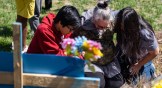
Since those moments, I have found few words to pray. But I have looked to the Psalms for comfort: “Be merciful to me, O God … for in you my soul takes refuge; in the shadow of your wings I will take refuge, till the storms of destruction pass by” (Ps. 57:1).

When the shadow of death hovers near, we find refuge in the shadow of the Almighty. We take solace in the visual image of God’s tender presence like a mother bird protecting her young from danger. If God our Father cares for his children this way, then we can re-envision tragedy with the Lord’s wings spreading over us. We can see him standing between us and death’s shadow.

Those of us in the Covenant School community may take years to reckon with this divine mystery of what has come to pass and what we still do not understand. In our aching questions about these events, we can simply hold onto and be held by the weeping Christ. We can take comfort from his Word and confess that, whether in life or in death, those who belong to him are secure in his peace.

On the night of the shooting, the Covenant community gathered for a worship service at a sister church down the road. I stood in the back row singing “It Is Well With My Soul” and “In Christ Alone” through tears. At intervals, I had to let the people around me sing the words that I could not. I’m sure others did the same. In that communal space of grief, we came closer to understanding Christ’s tears at the tomb of Lazarus in John 10.

As we go through the aftershocks of the shooting, we feel like the fragile creatures we are. Huddled together, we find strength and solace beneath the shade of God’s covering. We don’t understand why these events happened, yet we see glimpses of God’s mercy gently pressing in upon us like those sheltering wings. We have to believe that in him alone, this story somehow holds together. As The Message articulates Paul’s words to the Colossians:

From beginning to end he’s there, towering far above everything, everyone. So spacious is he, so expansive, that everything of God finds its proper place in him without crowding. Not only that, but all the broken and dislocated pieces of the universe—people and things, animals and atoms—get properly fixed and fit together in vibrant harmonies, all because of his death, his blood that poured down from the cross. You yourselves are a case study of what he does. (Col 1:17–22, MSG)

I see this redemptive work going on right now. Nashville is a music hub—a harmony city. It has been thrown into dissonance, but God is weaving that dissonance back into harmony. Even as our hearts break, we can sing of his truth and beauty. We can sing in light of his death and resurrection. And we can grieve with hope.

Every Sunday, Christians at Covenant Church are sent out through two big wooden doors to love and serve the city and the world beyond it. We don’t know what awaits us at our jobs and schools. But we live into this paradox of light and dark. Although Jesus made it look easy, I find it more difficult than ever. And what he has accomplished is ours in faith.

As our community goes through loss, we grasp and groan. We each grieve differently. Healing is messy and slow-going. But love is patient. The Holy Spirit is our helper. And we rest on the character of God.

That means we don’t have to force our theology into words or pontificate on this tragedy, as if our best political or theological solutions might add something to the resurrection of Jesus Christ. Yes, we have to engage in restorative work. But we’re also called to simply rest in Jesus’ promise that death will not have the final word.

In this Easter season, my community is seeing the one who brings order out of chaos and new creation out of death. We praise God, who is our living hope while we wait (1 Pet. 1:3). We pray especially for the comfort and healing of families who’ve lost loved ones. As we pass through the valley of the shadow, God’s tender wings cover us with peace beyond our understanding, and the shadow that hovers over us most closely is his own presence.

Theology

In Times of Tragedy, I Find Solace in Scriptural Art

As the world reels from yet another school shooting, we can find a refuge in the Bible on canvas.

Christianity Today April 4, 2023
Loïc Manegarium / Pexels / Edits by CT

As a pastor serving a local church near my alma mater, Michigan State, I was invited to stand at a listening post along with comfort dogs the day after last month’s shooting.

Campus was unnervingly empty as yellow barricade tape flapped in the breeze, restricting our access to the buildings. Clusters of candles marked where each of the three victims had died—while a lone undergraduate student ran back and forth with a lighter trying, hopelessly, to keep them all lit.

Although campus was devoid of students, it was thronging with media crews and reporters. Everyone who was usually on campus had gone home to mourn, while those from outside had come in to gaze at us through their camera lenses and television screens—inviting the public eye to witness private moments of pain and hurt in our community.

A similar spectacle is playing out right now at the Covenant Christian School in Nashville, Tennessee—as it has at schools in Uvalde, Texas; Oxford, Michigan; and MSU. And the same scene will play out at the next mass shooting, an occurrence that seems mercilessly inevitable.

There is something real and peculiar about the human fascination with looking at pain and hurt, crisis and tragedy. For centuries, people have made pilgrimages to the theater to watch Hamlet hold up a skull or to see the misfortunes that befell Desdemona, Emilia, Roderigo, and Othello. More commonly, the highway becomes a stage whenever traffic slows to stare at a car accident.

Tragedy is magnetizing. And yet, it can also be healing. In times of personal pain and hurt, I have found solace in religious art depicting tragedy. It has helped me contemplate the raw pain of human life.

The First Mourning by William-Adolphe BouguereauWikiMedia Commons / Pexels / Edits by CT
The First Mourning by William-Adolphe Bouguereau

When my wife and I experienced multiple miscarriages, William-Adolphe Bouguereau’s painting The First Mourning became meaningful to me in the midst of crisis. The work of art depicts Adam clutching at his rib while his murdered son, Abel, is lifelessly sprawled across his lap. Eve, the boy’s mother, is unable to look as she hides in Adam’s embrace.

It is a visceral and arresting image, evoking a pain that the artist knew well—as four of Bouguereau’s five children had died before him. And today, the same root of sin that caused Cain to kill Abel continues to bring death to our children in school shootings.

Religious art can help us see in times of tragedy far better than the horror shows depicted by modern media—which, if we are not cautious, can leave us callous to pain and hurt.

In his book Only the Lover Sings, German Catholic philosopher Josef Pieper suggests that we are blinded by the visual noise of contemporary life. When there is so much to see, our sight can become shallow or incapacitated. Pieper puts it like this: “We do not mean here, of course, the physiological sensitivity of the human eye. We mean the spiritual capacity to perceive the visible reality as it truly is.”

Because of modern technology, we can see more today than ever before. But, curiously and conversely, this can inhibit our ability to see beyond the surface. To borrow an image from Nicholas Carr in his book The Shallows, we are like Jet Skiers bouncing across the water instead of deep-sea divers who patiently venture below into matters of substance.

Pieper warns that something is lost when all we do is glance but never gaze: “Going below a certain bottom line quite obviously will endanger the integrity of man as a spiritual being. It seems that nowadays we have arrived at this bottom line.” These words are even more prescient today than in Pieper’s time—before the age of social media, smartphones, and school shootings.

The antidote for living in a world of visual noise and occluded seeing is, according to Pieper, creating and viewing works of art. Artists as well as viewers of art linger over the intricacies of human life—including all of its pain and hurt. The unhurried gaze and leisurely lingering over a work of art provides room for reflection, insight, and healing.

Pieper suggests that viewing art fosters “a deeper and more receptive vision, a more intense awareness, a sharper and more discerning understanding, a more patient openness for all things quiet and inconspicuous, an eye for things previously overlooked.”

The Entombment of Christ by CaravaggioWikiMedia Commons / Pexels / Edits by CT
The Entombment of Christ by Caravaggio

Along with William-Adolphe Bouguereau, I often reflect on the work of Michelangelo Merisi da Caravaggio. The 19th-century art critic John Ruskin once described Caravaggio’s work as being marked by vulgarity and impiety. Ruskin said that Caravaggio’s paintings revealed “horror and ugliness, and filthiness of sin.” While Ruskin meant that as a critique of Caravaggio, I think it is what makes his work so meaningful.

For example, Caravaggio’s The Entombment of Christ depicts the lifeless Jesus being carried by Nicodemus and John the Evangelist. Meanwhile, three women—Mary of Cleophas, Mary Magdalene, and Mary the mother of Jesus—mourn in their own particular ways. One looks at the dead body of Jesus, one cries, and one cries out to heaven.

Just as Ruskin said, this painting shows the full horror, ugliness, and filthiness of the sin that led to Jesus dying on the cross. It is also worth noting that Caravaggio scandalized people in his day by using human models from off the street for his paintings. The hurting people in this painting may very well have been students, laborers, mothers, or drifters.

Caravaggio’s painting of the entombment of Christ is in the chapel of the Pieta in St. Peter’s Basilica in Vatican City. In that very same space, Michelangelo’s Pietá sculpture depicts Mary (a very iconic figure in religious art) holding a lifeless Jesus sprawled across her lap. Jesus rests across the lap of Mary in the very same pose as Abel resting across the lap of Adam in Bouguereau’s The First Mourning.

These three works of art help us see a coherent narrative amid the incoherence of endless school shootings: the pain and hurt of sin finds a horizon of healing in Jesus and the empty tomb of Easter.

A. Trevor Sutton is a Lutheran pastor in Lansing, Michigan, and the author of two books: Redeeming Technology: A Christian Approach to Healthy Digital Habits and Clearly Christian: Following Jesus in This Age of Confusion.

News

Syria Has Six Months to Receive Your Earthquake Aid

US waiver temporarily allows for funds to bypass sanctions against the Assad government. Christian charities experience mixed results.

A convoy delivers aid in northwest Syria.

A convoy delivers aid in northwest Syria.

Christianity Today April 4, 2023
Rami Alsayed / NurPhoto via AP

Syria has been suffering for 12 years, plagued by civil war, jihadist violence, foreign occupation, and autocratic governance. Yet widening US economic sanctions have made it increasingly harder to help—until now.

A February waiver offers a 180-day window for earthquake relief.

“If God has put it on your heart to give to Syria, be generous,” said Nabil Costa, executive director of the Lebanese Society for Educational and Social Development (LSESD), also known as the Baptist Society. “Find trusted organizations, because it is not easy to get it to the right place.”

On March 10, the World Evangelical Alliance (WEA) joined the World Council of Churches (WCC) and Catholic charity Caritas to detail the “chilling effect” sanctions have on the ability of faith-based and other NGOs to transfer money and goods to struggling Syrians. Most banks have deemed such transactions too risky to facilitate.

Therefore, unlike in neighboring Turkey, the February 6 earthquake was not followed by an immediate outpouring of international aid. Despite a death toll of 6,000 and an estimated 500,000 more displaced amid the rubble, United States and European Union policy—and distrust of the Bashar al-Assad government—prevented most nations and international humanitarian organizations from rushing to the scene.

A false step could result in a $1 million fine and 20 years in prison.

US sanctions against Syria began in 1979 with a declaration that it was a state sponsor of terrorism, and tightened in 2004 for its undermining of the war in Iraq. In 2011, Syria’s repression of civil protest resulted in additional sanctions, subsequently strengthened throughout its civil war—especially after the use of chemical weapons in 2017.

Two years later, after a whistleblower smuggled out alleged evidence of the torture of civilians, the Caesar Act implemented secondary sanctions against anyone conducting business with the Syrian government.

Legislation permitted humanitarian exemptions for food and medicine, and in 2022 allowance was made for unfettered aid into regions outside of government control. Turkey and various rebel entities occupy territory in northwest Syria, while a US military base supports Kurdish forces administering large swaths of the northeast.

The United Nations designated a number of humanitarian aid corridors from Turkey, but Russia and China vetoed all but one—in protest of their ally's dwindling sovereignty. Iran and Hezbollah have also backed Assad militarily, while Israel occupies the Golan Heights and regularly bombs the alleged transport of weapons near its frontier and before crossing into Lebanon.

Amid it all, Syria’s Christians help who they can.

Following the earthquake, Aleppo’s churches hosted hundreds of frantic neighbors fleeing their cracked and crumbling homes. But the WEA report, written prior to the tragedy, outlined how many faith-based organizations lacked the resources and legal expertise necessary to navigate the myriad regulations to apply for permitted exemptions. Costa said LSESD did not attempt it, relying instead on “existing channels” to get aid into Syria.

“Everything we do is transparent,” he said, “but not everything is advertised.”

Even large NGOs like Caritas have struggled.

“It should be like math, one plus one equals two,” said Karam Abi Yazbeck, Caritas’s regional coordinator for the Middle East and North Africa. “But I can’t make sense of why certain documents are required sometimes, and others not.”

Organized as a confederation, Caritas affiliates in the US, Europe, and around the world interacted with American and EU authorities to obtain the necessary paperwork to facilitate aid. Abi Yazbeck said Caritas’s Syria office has been bolstered considerably since the war.

His office is based in Lebanon, where local banks and their intermediary partners have delayed transfer of funds amid snail-paced investigations. It is a very human problem, he said. Bank personnel themselves do not know the regulations and protect against institutional risk.

Thus the 180-day comprehensive waiver.

“I want to make very clear that US sanctions in Syria will not stand in the way of life-saving efforts for the Syrian people,” stated Wally Adeyemo, deputy secretary of the US Treasury Department. “Those providing assistance can [now] focus on what’s needed most: saving lives and rebuilding.”

The waiver, issued three days after the quake, preceded even Assad’s authorizing of two additional border crossings from Turkey. Within the first month, the US provided $50 million in humanitarian aid.

A Treasury Department Q&A outlined the new reality. Financial institutions are specifically authorized to process earthquake-related transactions, even if interacting directly with the Syrian government.

The impact was dramatic—for some.

“The process has not changed,” said Michel Abs, secretary general of the Middle East Council of Churches (MECC). “But donations, previously delayed, have now been processed quickly.”

Some transactions had taken up to nine months of investigation. One transfer of $800,000 was blocked completely, causing the donor to repurpose the aid. But working through a Lebanese bank with an affiliate entity in Syria, MECC’s aid money is now flowing far more easily.

In fact, donations can now be direct. Among many local partners, the WCC-affiliated ACT Alliance has been approved to transfer funds to the MECC office in Damascus. Its leaders there are training a team to carry out humanitarian oversight of relief distribution, working in tandem with the Ecumenical Joint Church Committee of Aleppo, formed by the regional body.

In addition to distributing food and hygiene kits to more than 1,500 households, MECC has partnered with church-linked engineers and local authorities to inspect over 500 buildings to date, with preparations made for 20 requiring the most substantial repair. Others are helped with educational, medical, and psychosocial needs.

The greatest benefit, Abs said, was Syria’s adjustment of monetary exchange. Keeping US currency out of local circulation, authorities required that every dollar brought into the country be traded at the official rate. But for earthquake-related transactions the government gives nearly one-third more, depending on fluctuations in the parallel market.

Edward Awabdeh is waiting to see if he can benefit.

When the president of the Christian Alliance Church in Syria and Lebanon tried first his Beirut bank, they told him the US waiver pertained only to goods, not funds. Then the manager revised the message to permit specifically designated earthquake aid. But with relative pennies currently in the account, Awabdeh doesn’t yet have enough money to test it.

Like LSESD, his denomination had also been using “existing channels” to support a network of 5,000 needy families prior to the earthquake. Amid a poverty rate of 90 percent, 4 million Syrians were already reliant on humanitarian aid, according to UN figures.

And then roughly 200 people in Aleppo suddenly found themselves housed in Alliance churches. Whatever donations come from sister churches in Lebanon, the US, and elsewhere, Awabdeh said, will be added to the comparative widow’s mite from Syria. With 50 neighbors still sleeping among the pews, local believers in Damascus—on a monthly salary of $30—gave $4,500 to support them.

“Sanctions hurt our people also,” said Awabdeh. “But whatever rationale used to justify them, God’s grace is sufficient, and his power made perfect in weakness.”

Not part of the Aleppo council, the Alliance church is cooperating with the area NGO network that ensures no one is left out. And even the government is facilitating Awabdeh’s wider work, permitting three trucks of relief supplies to cross from Lebanon to the affected area. Traditionally comfortable with the Orthodox and Catholic majority, authorities issued official permits for his evangelical body to help.

“God has been faithful as we have stewarded small things,” said Awabdeh. “Maybe now he is giving us the favor that can facilitate larger challenges.”

Not all have been as fortunate. Amnesty International reported that the government blocked 100 trucks of aid sent to Kurdish areas of Aleppo, while opposition militias barred 30 shipments to Turkish-occupied Afrin. Up to 40 percent of assistance coming from the Kurdish northeast is diverted to rebel families, and The New York Times reported that the local Red Crescent and Syria Trust charities, which have close ties to the government, deliver only a fraction of aid to earthquake victims.

Some say this is evidence for why sanctions should stay in place. If Assad cannot be trusted to work with international agencies during a natural disaster, the national tragedy will only metastasize if funds flow freely.

“The regime has inflicted thousands of times more damage on the country than the recent earthquake,” stated Wa’el Alzayat, the CEO of Emgage, a Muslim American advocacy organization, and a former Middle East policy expert at the US State Department. “If the sanctions are lifted today, the war will simply heat up again.”

Yet Syria’s churches have found multiple partners to advocate otherwise, on humanitarian grounds. Chief among them is Alena Douhan, UN special rapporteur on the negative impact of unilateral coercive measures (UCM) on the enjoyment of human rights.

Another name for sanctions, UCMs are illegal under international law, she said. While Douhan welcomes the waiver, it does not “fully open the floodgates” for what is needed.

Take water as an example. The US announcement lists the liquid along with food and medicine as allowed relief, and also specifically states that critical infrastructure damaged during the earthquake can be repaired.

Does the water processing plant qualify? Douhan said that sanctions prevented the restoration of facilities damaged during the war. Notwithstanding the recent outbreak of cholera, presumably these are still off-limits.

But how to interpret water service in Aleppo?

“If any bank manager sees a request resembling reconstruction, it will be interpreted as risk,” said Douhan. “But he is not the one who should decide.”

The US has not responded to her official UN communication.

But the EU, which began sanctioning Syria in 2011, defended its policy, stating that it does not cause the severe suffering of targeted nations and that it has received positive feedback from advice given to querying nations and NGOs.

Issued in 2022, the EU response only mentioned “over 15” such questions.

Most, including the gatekeeping bankers, do not ask. So while Abi Yazbeck’s colleague in Damascus was contacted by the local bank, saying it could now process Caritas’ earthquake relief to Syria, it has been one month with four transactions still pending. The bank manager blames intermediaries.

“No one was willing to work with Syria after the Caesar Act,” Abi Yazbeck said. “Many, it seems, are still uncertain.”

For donors eager to try, LSESD provides advice.

First, be certain that aid is clearly labeled “for earthquake relief.”

Second, limit outside conditions for use. Aid agencies and churches alike are overwhelmed with the scope of need, are not competent in all areas, and need flexibility with discretionary funds.

Third, keep the medium and long terms in view. Beyond food and medicine, rent support will be necessary for a while, fuel for running generators is often overlooked, and local volunteers must be sustained through a viable income received for their services.

Fourth, ensure accountability. More money means more temptation.

In the meanwhile, sources encourage generosity. The waiver is temporary, and even if renewed on August 8, the suffering will continue. Syria will not be rebuilt soon.

“If you make it harder for me, that is your decision,” said Costa. “But no one can stop us from helping the people in need, and no one has yet. God has a plan, and it is moving forward.”

News

Florida Pastors Worry Immigration Bill Would Criminalize Church Rides

Evangelicals who minister to and among the undocumented call the state’s proposal “an assault to religious liberty.”

Migrants pray at a church in Hialeah, Florida.

Migrants pray at a church in Hialeah, Florida.

Christianity Today April 3, 2023
Marta Lavandier / AP

Churches may face criminal penalties for giving undocumented immigrants rides to worship services and Bible studies if a bill before the Florida state legislature becomes law. A diverse coalition of church leaders in the Sunshine State is calling the bill a threat to religious freedom.

“It’s heartbreaking that this assault to religious liberty has been proposed,” said Myal Green, president and CEO of the evangelical humanitarian organization World Relief, “a proposal that would criminalize sharing the love of Jesus with some of the most vulnerable people in society.”

During a press conference hosted by World Relief and the Evangelical Immigration Table last Thursday, Florida church and ministry leaders detailed what they believe will be chilling effects on churches if Senate Bill 1718 is signed into law.

Not only could transportation to church events be in jeopardy, the seven local leaders said, but also churches’ ministries of transporting immigrants to hospitals, doctors’ appointments, attorneys’ offices, and schools. Churches with bus ministries could run particular risk.

With an estimated 700,000 undocumented immigrants in Florida, the legislation’s impact could be broad.

Gabriel Salguero, president of the National Latino Evangelical Coalition and an Orlando Assemblies of God pastor, said he has contacted Republican Gov. Ron DeSantis’s office about SB 1718, and a group of Hispanic evangelicals delivered letters of concern to the governor’s office. So far, however, they have not received a response.

“I haven’t heard from them,” Salguero told CT. “I don’t even know if they have considered the impact of this possible legislation. I think in their attempts to address immigration concerns, they overlooked the religious liberty concerns of pastors like me.”

The measure, sponsored by Tampa-area Republican Blaise Ingoglia, is aimed a curbing illegal immigration on multiple fronts. It would increase penalties against businesses that hire undocumented workers; ban local governments from funding the production of identification cards for undocumented immigrants; and track how much money is spent on illegal immigrants in emergency rooms. It would also repeal a 2014 state law allowing undocumented immigrants to practice law in Florida.

The provisions raising concerns for their religious liberty implications target human smuggling. The bill makes it a third-degree felony if a person “transports into or within this state an individual whom the person knows, or reasonably should know, has illegally entered the United States.”

Each person transported constitutes a separate offense, the bill states. Five or more offenses during a single episode would constitute a second-degree felony, which can carry a penalty in Florida of up to 15 years in prison. Third-degree felonies can yield five years in prison.

The Senate Rules Committee approved the measure 15-5 along party lines in mid-March. Dozens of people spoke against the bill prior to the vote, according media reports. Among them was Sen. Shevrin Jones, a Democrat from the Miami area.

“What we are about to vote on today is not only an economic nightmare, it is an education nightmare,” Jones said. “It is an operational nightmare. It is a criminal-justice nightmare and, most importantly, it is a human-rights nightmare.”

Federal law already addresses transportation of undocumented immigrants, but the proposed Florida legislation takes the matter a step further. Federal law criminalizes transporting undocumented persons when the transportation is “in furtherance of such violation of law,” according to an analysis by the staff of the Florida Senate Rules Committee. The Florida bill apparently would criminalize all transporting of undocumented immigrants, regardless of why the person was being transported.

Dale Schaeffer, a north and central Florida district superintendent with the Church of the Nazarene, said fixing the bill may be relatively simple.

“Courts have generally found that the federal law makes it illegal to enter the country unlawfully and to help [undocumented immigrants] evade immigration law enforcement,” he said, “but not incidental transportation of individuals who happen to be undocumented immigrants.” Without a “clarifying phrase, [Senate] Bill 1718 could very reasonably be interpreted to mean it could be illegal to drive an elderly neighbor to church. … It could be a felony for a youth pastor to pick up a teenager in a church van.”

Other church and ministry leaders say they are seeking to determine whether the bill can be fixed or whether it should be abandoned altogether. The public policy arm for Florida’s Southern Baptists says it is studying the bill.

“Our current position is on pause while we are studying the language in SB 1718 to determine the impact, if any, on the customary operations of a church ministry and if an amendment would be necessary to maintain the status quo of church ministry in Florida,” said Bill Bunkley, president of the Florida Baptist Convention’s Ethics & Religious Liberty Commission.

Ingoglia did not respond to CT’s requests for comment. He told a Senate panel in mid-March he is not “demonizing immigrants.” Rather, “we are demonizing illegal immigrants” and pressing the federal government to enact immigration reform.

“I feel for the immigrant community. I feel for the illegal immigrant community,” Ingoglia said. “This is the point we are at now. We have to fix this system, and [federal officials] continue to refuse to do it. They will only act when they have to and when an external force pushes back. Florida is that external force right now.”

Even if SB 1718 becomes law, some Christians say they will continue to minister to immigrants and face any penalties that come. Among those is Gary Shultz Jr., pastor of First Baptist Church in Tallahassee.

“We would have to communicate the possible legal ramifications of this bill,” Shultz said. “My hope is that we would continue to do what we’re doing to minister to all of those populations.”

David Roach

News

Amid the Languish of Lebanon, Christians Lead with Resilience and Prayer

The conflict over daylight saving is the latest moment of chaos in a country where believers’ management principles—shared in a new book—challenge the regional authoritarian mindset.

Beirut, Lebanon

Beirut, Lebanon

Christianity Today April 3, 2023
Lucas Neves / AP

For four days, Lebanon had two time zones.

Scheduled to switch for daylight savings on March 26, the nation’s Sunni and Shiite political heads postponed it until the end of Ramadan to ease Muslim fasting.

Christian politicians ignored it and carried on with the international standard. Airlines stuck to the government decision, throwing schedules into confusion. Some schools adjusted, others refused, and parents juggled clocks to show up at work on time.

Not that there is much work these days. The government eventually relented.

But these decisions were taken while Lebanon has no president, no prime minister, and a fractured parliament. The economy is in free fall, emigration is soaring, and justice still escapes the victims of the 2020 Beirut port explosion.

It is the last place one would look for lessons on leadership.

While laughing at the absurdity of the four days, Mike Bassous believes differently. Author of Leadership … in Crisis, published last July, he says Lebanon is uniquely situated to assist an entire region regularly subject to chaos. Surrounded by dictatorships, there are not many traditional examples to choose from.

“For books on leadership, the Arabic library of the Middle East is empty,” Bassous said. “But Lebanon can absorb the best of Western principles and contextualize them for the East.”

Such is the goal of his book, combining personal experience, the professional corpus, and Christian reflection. And as general secretary of the Lebanon Bible Society, he is offering his insight to Protestant, Catholic, and Orthodox friends around the region—starting in his home country.

Last year, 44 Lebanese leaders gathered in Cyprus for a retreat from the crisis in their country.

“We need this in our churches—from A to Z, we need it all,” said Linda Macktaby, principal of Blessed, a school in Beirut for special-needs children. “We teach the youth the Bible, but not how to lead.”

One of Bassous’ key principles is confrontation.

Serving at Blessed since 2010, Macktaby resolved to address the Arab assumptions about leadership head on. Contrary to the “typical manipulators” who avoid conflict, promising solutions while buying time amid acolytes reluctant to make any decisions, she instead empowers her staff.

Each is given a “kingdom,” she called it, with authority to carry out assigned responsibilities. And if she interferes, her staff is instructed to confront her.

Since this is not an easy adjustment, Macktaby implemented an exercise where everyone stood in a circle to symbolize their equality, holding hands in prayer. And drawing names, each first took the baby step of publicly saying something good about the colleague picked.

The final test was criticism—herself included. No one knew how to do it, she said.

“They want to receive critique, just not from me,” said Macktaby. “It took two years for them to get it, but confrontation is necessary when you care.”

Once exemplary, the Orthodox Youth Movement (OYM) is trying again.

Formed in the 1940s, the social and humanitarian protest movement revived knowledge of the church fathers and devoted itself to poor villages and urban centers, clashing with many hitherto inactive priests and bishops. Surging in popularity after the 15-year civil war that ended in 1990, leaders facilitated over 1,000 prayer and study groups that kept solidarity despite clerical opposition.

Over time, many OYM graduates entered the hierarchy, and relations improved—but at a cost. Fadi Nasr, elder statesman and spokesman for the youth movement, said the graduates lost their edge.

“We used to be very critical [of clerics], and now we are appeasing them,” he said. “We thought cooperation would increase our unity, but this spirit has been lost already.”

A top-down institutional mindset, Nasr found, curbed the dynamism of their charitable outreach. Amid overall Lebanese emigration their membership dwindled, though 300 groups remain active. To recover, they had to go it alone once more. But despite it all, they kept going.

It illustrates Bassous’ principle of stamina.

Following the port explosion, the OYM created the Beirut Community Center, designed it to be independent and professional, and appointed a younger member as director. But while these gains align with the OYM heritage, amid a new beginning, Nasr reflected on the opportunities lost.

“We needed more self-criticism,” he said, “and failed to turn it over to the next generation.”

Ramy El Khoury has already identified his successor.

A Greek Orthodox serving with World Vision since 2018, he said leadership development in Lebanon is rare, even in the NGO community. But as the economy tumbled, the traditional organizational expertise in development had to pivot on the fly to relief work.

And it needed to implement Bassous’ principle of agility.

But first El Khoury faced a challenge from his church, fielding countless calls from officials asking him to hire from within its patronage networks.

He is descended from seven generations of priests.

“We follow a process,” El Khoury said. “And when we sensed a crisis coming, we sought out training for our leadership team.”

In early 2020, Lebanon’s early currency devaluation amid the COVID-19 pandemic was already stretching the team. Specialists were brought in to coach four area managers and five program managers, who communicated the skills they learned to a total of 25 middle-management personnel. They extended it to 100 employees—just in time to cope with the Beirut explosion.

Proud of World Vision’s professionalism, El Khoury initially balked at one thing: weekly devotions. He came to the job with 15 years of experience and found no use for the institutional imperative. But when his national director told him it was “crucial,” he semi-reluctantly instituted it among his interfaith staff.

It changed his life—and leadership.

“We honor God in every activity we do,” El Khoury said. “We wouldn’t be as responsive without the hand of God.”

But God’s hand does not eliminate hard decisions. Sensing a coming crisis in summer 2019, the Lebanese Society for Education and Social Development (LSESD) emptied its accounts to pay salaries and settle debt. The intuition proved crucial by October, when banks froze dollar withdrawals, allowing only a trickle of local currency at now-devalued rates.

And then LSESD had to cut salaries in half. Running the umbrella organization for Baptist institutions that include a school, seminary, and publishing house, Nabil Costa had to draw deeply on 25 years of trust.

So doing, he proved Bassous’ principle of resilience.

“We communicated from the start about the difficult situation and spoke transparently,” said Costa. “We showed vulnerability as leaders and struggled along with them.”

Prayer was central to the common cause. Distributed meals also helped keep up morale. And key was a sliding compensation scale that weighted any extra funds received to go to lower-ranking employees.

Patiently enduring, LSESD was eventually able to restore all the salaries initially reduced. But it was hardly a happy ending, as the understandably self-centered focus on survival convinced Costa that his team needed an extra boost—for others.

With essential medicines disappearing from Lebanese pharmacies, LSESD designated funds for its staff to be able to help their needy friends and relatives.

“Blessing others helped us pass the test,” Costa said. “But with our social capital expended, how do we keep staff from emigrating now?”

United Nations data reports 24 per 1,000 Lebanese leaving, the highest tally in the world. Suffering a yearly net population loss since 2018, the rate has accelerated rapidly since the 2019 economic crisis.

Costa’s brother Nadim has found an answer.

“Thinking of ministry as a job will ruin the ministry,” said the younger Costa. “But when you see God at work, it becomes addictive—and you want more and more.”

It illustrates Bassous’ ultimate goal. After absorbing chaos and calming nerves, a leader must find a way to impart a hopeful vision for the future. For Costa, it was the thrill of a disciple-making movement.

NEO Leaders provides social services to vulnerable communities, such as refugees, the disabled, and the abused. The Near East Organization model is decentralized, working with over 300 local churches. But these networks have a clear purpose, he said: to lead people to a personal relationship with God and live it faithfully in the marketplace.

Relying on volunteer leaders, themselves scraping by, the outreach exploded.

“No one should respond more actively than the church,” Costa said. “We did not want to waste the crisis.”

And neither did his team. Of 18 local full-time employees, only one left the country. But this was possible in part since the vision was also shared by over 150 staff in NEO Leaders’ 20 countries of service, who each donated a month of their salary to their hard-hit colleagues in Lebanon.

Yet also helpful is Costa’s own practice.

Devotional, he has all personnel pray before serving. Motivational, he bucks cultural norms by yielding the leadership stage to subordinates. And confrontational, he once had to remove a key staff member from service—but kept the man on full salary for three months, walking with him until he could be restored.

The staffer’s loyalty—and devotion to Christ—are now sky high.

“Model Jesus to people,” Costa said, “and they will want to become like him.”

For Bassous, Christian leaders already have the right starting point.

Jesus’ servant nature is an antidote to the authoritarian spirit. At the same time, many of the Lebanese reflected that the lessons in Bassous’ training—drawn largely from Western principles—added a further antidote to their cultural leadership foibles.

Seminars are scheduled next for Iraqis and Jordanians.

“Jesus’ movement grew stronger when he left, and top CEOs stay put for only a few years,” said Bassous. “Let us develop our leaders and not reinvent the wheel.”

Theology

Why Jesus’ Resurrection Is So Important to Palestinian Christians in Israel

The dawning of a new kingdom heralds hope for reconciliation and relief from oppression.

Christianity Today April 3, 2023
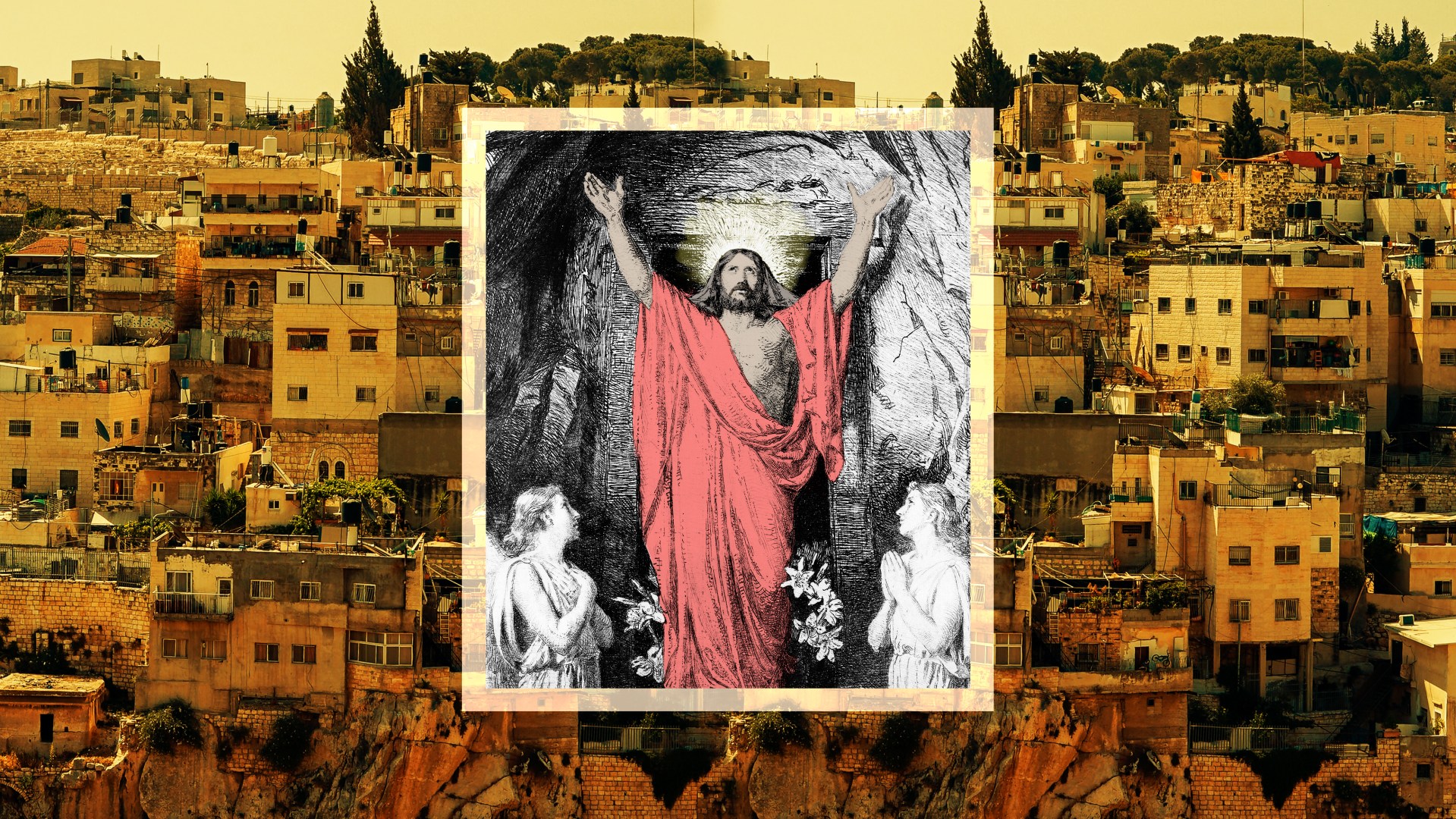
Source images: Toa Heftiba / Unsplash / Statens Museum for Kunst / CCO / Edits by CT

During Holy Week, we consider how the Cross reconciles humanity with God. But for Palestinian Christians living in Israel who face oppression and discrimination on a regular basis, the Resurrection and its power to reconcile Jews and Gentiles offers them the greatest hope.

“The resurrection of Christ is the ultimate proof that the world can be changed,” said Palestinian Israeli theologian Yohanna Katanacho.

Palestinian Christians celebrate Easter on both Eastern and Western dates. Approximately 160,000 Palestinian Christians currently hold Israeli citizenship, and around a third of them live in the West Bank and Gaza.

Katanacho was born in 1967 and grew up amid the decades-long Arab-Israeli war that stoked hatred and enmity between Jews and Arabs. The former proponent of atheism accepted Christ at the age of 19 and is now the academic dean and biblical studies professor at Nazareth Evangelical College in Israel.

Katanacho’s book, Reading the Gospel of John through Palestinian Eyes, explores John’s reinterpretations of traditional Judaism in light of Christ. “John sees that having Christ is the biggest blessing ever, and without Christ, we have nothing (John 3:36). As a result, space, time, history, identity, and land are reread in light of the centrality of Christ,” Katanacho said.

Global books editor Geethanjali Tupps spoke with Katanacho about the significance of the Easter resurrection for Palestinian believers and how his reading of John’s gospel challenges the global church.

How did you become a believer?

My family was Roman Catholic, but I became an atheist as a teenager. When I was 19, I had a life-changing experience with God. At 3 a.m., I heard the sound of bells ringing. When I awoke, I was not able to move my hands or legs. I was terrified. I tried to liberate myself with every possible idea in my mind, but it didn’t work. At 5 a.m., I said to God, “If this is from you, I promise I will look for you.” The moment I said that, I was able to move again.

After this experience, I started visiting a small Christian and Missionary Alliance church in the Old City of Jerusalem. While there, I said to God, “How come you are the God of Israel and not the God of the Palestinians?” I prayed to give God my heart and mind and then dreamed of a face that brought peace and tranquility to my heart. When I woke up, I felt someone whisper in my ears, “Yohanna, this is the difference between grace and deeds. If you want to follow me by your own effort, you can’t. But if you are in Christ, you are protected and he is my gift to you.”

The barriers in my mind started collapsing and my spiritual journey began. Instead of advocating atheism, I started a Bible study at Bethlehem University, and other Christian ministries started growing in other Palestinian universities thereafter.

What led you to focus your scholarship on the Gospel of John?

When people around the world read the Gospel of John, they view it as anti-Semitic. That is unjust because, first of all, John is a Jew. This is an internal Jewish debate between Jews who followed Jesus Christ and Jews who did not. John needs to be vindicated in that area, and his message needs to be heard more clearly.

The idea for my book began when I asked the question “How is John struggling with his identity?” I noticed that the Gospel of John has a large focus on identity-related questions in the “I am” statements (John 6:35; 8:12; 10:7, 11; 11:25; 14:6; 15:1).

As a Palestinian who has Israeli citizenship, I wrestle with my identity among the Jewish majority. I want to celebrate the multiple identities that God has designed for me. However, in reality, these identities are in conflict because of political agendas and cultural values that are incompatible with Scripture. My multiple identities as Palestinian, Israeli, and follower of Jesus make some people feel uncomfortable, and they consequently seek to mute the parts of my identity that they do not like.

Studying the Gospel of John gives Palestinian Christians like myself an opportunity to explore the layers of complexity inherent in our identities. John is a follower of Jesus Christ in a majority-Jewish context. I am a Christian living amid a Jewish majority in Israel. We both struggle with our identity and how to lead missional lives in our particular contexts, which entails developing relationships that are rooted in loving God and neighbor and to bring the kingdom of love to a world full of hate.

What events in Holy Week does your book explore?

I write about the social-political realities of the Crucifixion on Good Friday. In many evangelical circles, the Cross represents redemption. But the Cross has other important theological dimensions as well, such as how it serves as a symbol of peacemaking.

Where Rome tried to usher in peace by the sword during the Pax Romana (Latin for “Roman peace”), Christ did so by dying on the cross. Where Rome introduced peace by silencing prophetic voices and perpetuating injustice, Christ’s peace offers forgiveness by transforming the oppressors’ hearts and opening doors for reconciliation with God (Luke 23:34, 47).

What forms of oppression do Palestinians living in Israel face?

We are treated as second-class citizens. We face oppressive laws and structural injustice. If you are a Palestinian Israeli citizen and you marry a Palestinian from the Palestinian territories, your spouse cannot acquire Israeli citizenship or even an ID card, which makes it extremely hard for them to work or get medical coverage from the Israeli government.

Israel has not established one single Arab town since its foundation. Some of these towns in the Negev have not been recognized by the Israeli government since Israel was founded in 1948. Palestinian Israeli towns receive limited funding, even though people pay their taxes in full. As a result, the infrastructure of Palestinian Israeli towns is deficient. They do not have medical, educational, or government services. People’s homes are continually demolished because they are viewed as illegal dwellings.

How do the events of Holy Week speak into your ongoing reality?

Jesus deals with the Roman Empire by exposing their penchant for violence on the cross. He displays their evilness through suffering with those who are suffering, as seen with the thieves who were crucified beside him (Luke 23:32–43).

Jesus supported women, the poor, and the marginalized not only by empowering them or healing them but also by creating a new world. The power of this new world is resurrection. Through Christ’s suffering of the cross, we come to this resurrection moment. We see that hope and transformation are possible.

The Resurrection ended enmity between Jews and Gentiles. The dawning of this new “civilization” ended a kingdom with second-class citizens and created a kingdom where all inhabitants are first-class citizens. Jews and Gentiles are equal in Christ.

Jesus’ resurrection encourages me to see how love, mercy, and equality all point to this new “civilization,” which Christians are missionaries of. How can we offer justice and true forgiveness in paving the way toward reconciliation? We do so by suffering with those who are suffering unjustly and by fighting injustice because it hurts both Jews and Palestinians.

Why is your book important for the global church?

My book invites the global church to reflect not only on the Gospel of John but also on the contextual theology of Palestinian citizens of Israel, particularly in the issues of equality and identity.

Geopolitical discussions often focus on creating two separate states, one for Palestine Arabs and another for Israeli Jews. But more than 20 percent of Israeli citizens are Palestinian. When I speak Hebrew to my Jewish neighbors, my accent reveals that I am a Palestinian citizen of Israel. If a bomb threat arises in Israel, I too am under threat. I will not be considered an Israeli citizen but a Palestinian. Part of my identity will be under attack.

The same situation happens with Peter. When Peter goes to Jerusalem, his accent reveals his Galilean roots (Matt. 26:73). Peter feels the tension of being a Galilean among Jews in Jerusalem. He denies his cultural and linguistic identity, leading him to deny his ethical standards and consequently deny Christ.

This has contextual and missional value: How can we affirm our linguistic and cultural identities and affirm Christ at the same time? What should I do as a Palestinian citizen of Israel, and how can I prevent my Christian faith from being marginalized? These are legitimate questions for me.

Why is your book also important to Palestinian readers?

Jews want Jesus to be a Jew. Palestinians want Jesus to be a Palestinian. I think both approaches are nationalistic and detract us from worshiping Jesus as our Lord and Savior.

There is a prevalent belief that the state of Israel is for people who are ethnically Jews. This excludes people who are not Jews even if they are Israeli citizens. This is not the gospel understanding of Jesus’ Jewishness.

Jesus’ Jewishness can be understood eschatologically. He redefines Judaism in inclusive ways and has embodied its deepest hopes. He is the perfect human who represents a loving and welcoming humanity, rather than one that is exclusively ethnocentric.

The Old Testament dreamed about having the law written on Israel’s heart (Jer. 31:33), which refers to knowing God deeply and personally. This dream is embodied in Jesus. New Testament authors like Paul understood that Jesus’ Jewishness is eschatological when he said that circumcision is not “merely outward and physical” but requires an inward transformation where our hearts are circumcised by the Spirit (Romans 2:28–29).

Jesus’ eschatological Jewishness is not a threat to Palestinians. It is a Jewishness that invites Palestinians and Israelis to be one in Christ, rather than an exclusive Jewishness that pushes people of other ethnicities out. This is what the church desperately needs to proclaim.

Theology

Sissy Goff: After Another Shooting, Let Your Kids Ask Questions

Christian parents need to be prepared, more than ever, to discuss this difficult topic with our children.

Christianity Today April 3, 2023
Courtesy of AP Images / Wade Payne

Where I live in Nashville, it has been a dark time of unspeakable tragedy. Six lives were lost: three wonderful children and three amazing adults.

Nashville is a very small big town. We’re all connected, one way or another—which means we’ve all been impacted by the lives and the loss of all six of these individuals. I personally knew one of the victims, Katherine Koonce; and for the rest of my life, I will feel the loss of the brilliance, strength, kindness, and humor she brought to our community.

As a therapist, I’ve sat with thousands of families in 30 years of counseling children. I know the heartache and panic that comes with trying to walk kids through trauma. So when I first heard of the shooting, my first thought was that we should never have to have these conversations with anyone, let alone kids.

But as I have had the immense, heart-wrenching privilege of spending time with the Covenant families—both in the reunification center and in a meeting for the parents and teachers—I realized they wanted help in knowing how to talk to their kids about what feels unspeakable.

How can parents navigate telling their kids about what happened, both here in Nashville and at other schools across the nation?

First, stay calm as you are talking with your kids. They need to feel like you are a safe place to ask questions and process their feelings.

Second, try to be the primary source of information for your kids. They need to hear about the situation not just factually but also age-appropriately.

Third, let them lead the conversation and ask the questions. Children have the innate ability to ask for the information they need.

Fourth, ask them what feelings they are experiencing, and give them space to feel all the emotions.

Fifth, don’t process your feelings out loud with them. Instead, carve out other time in your day to process your own thoughts and emotions without them.

Sixth, talk about what they can control. What can they do when they get nervous or scared? Ask them what will help them feel safe at school.

Seventh, think about the helpers involved (the teachers, police officers, etc.), and determine ways your own family can become helpers in the situation.

Eighth, don’t feel like you must have all the answers.

Ninth, remind them of the facts you do know. Return to the foundational truths that God is with you and that God was with them. And God loves them. And God is sad too.

On Tuesday morning, I was asked to do an interview for CNN about this very topic.

And when I drove to the address given to me, I didn’t realize it was across the street from Covenant. I hadn’t dressed warmly enough for an outside interview. I found myself standing next to the reporter, about to go live on national TV. I’m not sure whether it was from the cold or nervousness, but I found myself shaking and choking back tears—and I was struggling to pull myself together.

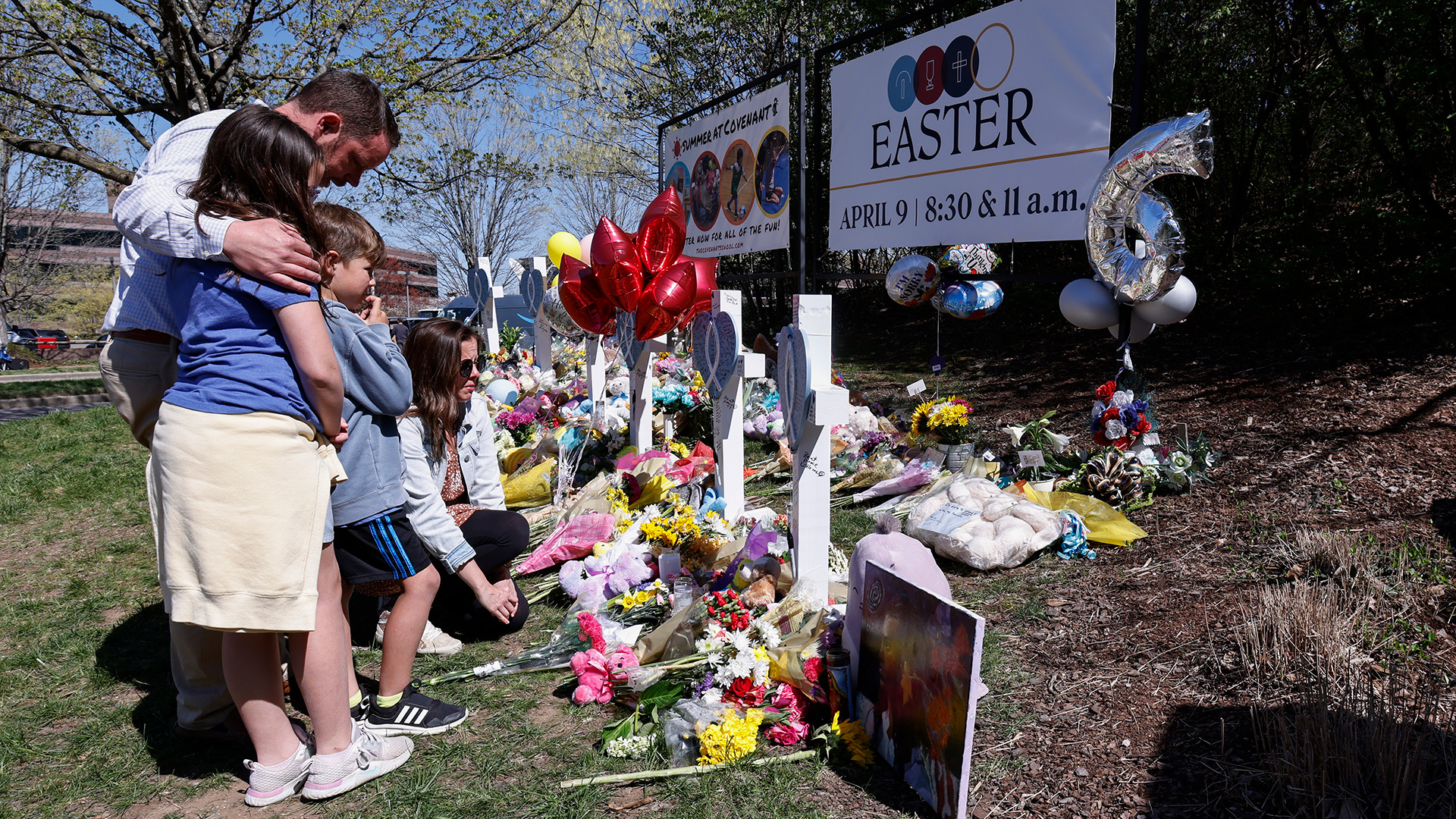
But when I looked across the street at Covenant, I saw two banners. One sign was for the school and church, and the other was announcing the upcoming Easter service next week. And for some reason, seeing those two signs brought me immense comfort in that moment.

The only real answer we have right now, our only light in these dark days, is Easter. Christ has died. Christ is risen. Christ will come again.

Sissy is the Director of Child and Adolescent Counseling at Daystar Counseling Ministries in Nashville. Follow her and Raising Boys and Girls for more parenting resources.

Books
Excerpt

The Bible Is Literature. It’s Also Your Boss.

We owe to Scripture something we don’t owe any other book: our obedience.

Christianity Today April 3, 2023
Illustration by Mallory Rentsch / Source Images: Getty / Unsplash

I grew up in a home that prioritized reading. My father was a first-generation college student, and he majored in business to support his family. He allocated a portion of his monthly wages to the Book of the Month club through Easton Press. He and my mom would dine on bologna boats (mashed potatoes and cheese on fried bologna) so that he could afford to receive a great book in the mail each month.

Reading for the Love of God: How to Read as a Spiritual Practice

Reading for the Love of God: How to Read as a Spiritual Practice

Brazos Press

208 pages

$24.99

Those leather-bound copies with gilded pages made a strong impression on me as a kid. From those beautiful editions I read The Adventures of Tom Sawyer, Walden, Jane Eyre, and because of their beauty, I knew they were a different sort of reading from my R. L. Stine paperback novels.

Similarly, Christians recognize the Bible as a different sort of book from all other books. While God may inspire an artist, or the Holy Spirit draw a reader toward a divine revelation through art, the Bible is more than a mere literary experience.

Recognizing the Bible as literature opens us up to a fuller appreciation of the holy book than if we treat it like an instruction manual or to-do list. It is a bibliography of genres, including poetry, song, lament, prophecy, history, narrative, parables, letters, dreams, and so forth. We should practice reading to enjoy the fullness of that literary experience.

However, as a book divinely authored by God, the Bible also stands apart from all literature penned by human authors. God inspired human writers to pen the words, but God also authorized those pages. No matter what other beauty, truth, and goodness may be found elsewhere, other works of literature lack the authority that Scripture has over Christians.

In Paul’s second letter to Timothy, he assures the young disciple, “All Scripture is God-breathed and is useful for teaching, rebuking, correcting and training in righteousness, so that the servant of God may be thoroughly equipped for every good work” (2 Tim. 3:16–17). Our Judeo-Christian Scriptures provide an assurance of their authority—literally, their author is God—as well as their usefulness for forming readers into righteous servants. This authority relieves readers of the burden of sifting through what is fallible and what is divine.

Over years of reading, we may begin to trust certain authors and regard them as teachers, but there remains a difference between their genius and the authority of the apostles. I trust Fyodor Dostoevsky, Eugene Peterson, and Fleming Rutledge. By God’s grace, any person, any book or artwork, or any element of God’s creation may speak to someone’s heart. But no matter how much truth or beauty these writers engender, they do not possess the apostolic authority granted to the writers of Scripture.

In 1847, Søren Kierkegaard outlined the difference between an apostle and a genius: “Genius is what it is of itself, i.e., through that which it is in itself; an Apostle is what he is by his divine authority.”

He reminds readers that Paul’s letters belong to a different category of assessment. “When someone with authority says to a person, go! and when someone who has not the authority says, go! the expression (go!) and its content are identical; aesthetically it is, if you like, equally well said, but the authority makes the difference.”

Whether or not you the reader approve of an apostle’s style matters less in view of eternity than whether you heed the message and submit your life to its authority.

Other literature may act as a gloss on divine Scripture, responding to the authoritative book with exposition, praise, poetry, narrative creations, and so forth, but none of them carry the weight of the inspired Word. When reading works by geniuses, to use Kierkegaard’s label, the reader must evaluate those works as true, good, or beautiful. Unlike the fealty we show to Paul, we owe no obedience to Rembrandt, García Márquez, or Tchaikovsky.

While comparing a genius to a bird, Kierkegaard writes, “It is modest of the nightingale not to require any one to listen to it; but it is also proud of the nightingale not to care whether anyone listens to it or not.”

Like the nightingale, the genius has an “immanent telos,” Kierkegaard says, meaning that the end of the work lies within this plane of existence. The genius’s book or artwork may extend through time, but ultimately it isn’t eternally mandated. An artist or writer might highlight glimpses of eternity, but those reflections of divine reality are not sanctioned in the genius. Instead of the obedience owed to the apostles, geniuses request only our attention.

As we engage the Bible, then, we should read it not for our own gain but as a spiritual practice—always open to how the Lord is planting seeds in our heart, teaching us more about him, and showing us ways of living more like Christ in the world.

This essay was adapted from Reading for the Love of God by Jessica Hooten Wilson, ©2023. Used by permission of Brazos Press.

Theology

What Christ Accomplished Before ‘It Is Finished’

Don’t diminish Jesus’ ministry in your celebration of his work on the cross.

Christianity Today March 31, 2023
Illustration by Mallory Rentsch / Source Images: WikiMedia Commons

Good Friday services were well celebrated within my Afro-Baptist ecclesial tradition. And unlike liturgical settings, where gathered worshipers depart from the service in silence to await the jubilant praise of Easter Sunday, our Good Fridays were often the most energetic services of Holy Week. They were also the zenith of each preaching year and usually featured sermons on Christ’s seven last words.

Many of us have heard a sermon preached on the sixth word, “Tetélestai!,” which is commonly translated into the English phrase “It is finished!” It is one of the few transliterated Greek verbs many believers are familiar with. On that dark day, Jesus shouted this word from the cross shortly before giving up his spirit—conveying the hope of Good Friday.

Tetélestai comes from the Greek verb teleō. In most ancient Greek contexts, the verb means “to finish, accomplish, or complete.” We rightly view this proclamation as Jesus signaling that his death has satisfied the wrath of God fully and forever—that he alone has accomplished the work of atonement, of redemption, and of mediating the way to God.

This statement seems to be the peak of John’s presentation of the salvation story—the time to play the Hammond organ, grab the tambourines, lift holy hands, and sing “Hallelujah,” for Jesus has paid it all!

But there is another moment in John’s Gospel where Jesus states he has finished his work: just one day earlier, on Maundy Thursday—a day that was foreign to me before I stepped into my first pastorate.

Although my childhood church held revival services throughout Holy Week, there was no event held to celebrate the fifth day. And even when I was first introduced to a Holy Thursday service in a church that observed it, I didn’t understand the significance of this day.

That is, until I discovered something in John 17, after the account of the Last Supper and before Jesus is betrayed in Gethsemane.

In between these two significant events, Jesus prays a high priestly prayer that begins with “Father, the hour has come.” And in verse 4, he says, “I glorified you on earth, having accomplished the work that you gave me to do” (ESV). The phrase “having accomplished” is translated from the Greek word teleiōsas, which is not the same verb that gives us tetélestai, although they share similar definitions.

And just like Good Friday often eclipses Maundy Thursday, teleiōsas (from teleioō, or “Little t”) has suffered an identity crisis due to the influence of its better-known big cousin verb, tetélestai (from teleō, or “Big T”).

That’s because many biblical scholars interpret the verb teleiōsas (“having accomplished”) in John 17:4 as pointing toward tetélestai (“It is finished”) in 19:30. They argue that Jesus is speaking prophetically—looking forward to the work he will complete on the cross with certainty, as if he already has accomplished it.

Grammatically, however, the aspect of this verb does not support this interpretation—and by “aspect,” I mean the kind of action, not the time of action, described by the verb.

It would be as if I said, “I made the pound cake” when I had not even begun the process of creaming the butter and sugar. The aspect of “made” must refer to something in the past; it cannot refer to something in the future.

The aspect of teleiōsas points backward, referring to something that has already been completed in the past. It cannot be read as forward-pointing, looking to something that will be achieved in the future. This means that Jesus’ statement in John 17:4 (“having accomplished the work you gave me to do”) is not a foreshadowing of the work of salvation that is “finished” on the cross.

Instead, it is a reference to the completion of another task: making the Father known.

In John’s prologue, the climax of Christ’s coming is found in this verse: “No one has ever seen God, but the one and only Son, who is himself God and is in closest relationship with the Father, has made him known” (John 1:18). Consider Jesus’ response to Philip’s request to see the Father in John 14:9–11:

Jesus answered: ”Don’t you know me, Philip, even after I have been among you such a long time? Anyone who has seen me has seen the Father. How can you say, ‘Show us the Father’? Don’t you believe that I am in the Father, and that the Father is in me? The words I say to you I do not speak on my own authority. Rather, it is the Father, living in me, who is doing his work. Believe me when I say that I am in the Father and the Father is in me; or at least believe on the evidence of the works themselves.

Jesus spent three years revealing the Father to his disciples through his words and his works. As he said previously, “Whatever the Father does the Son also does” (John 5:19). And as he later described salvation, “Now this is eternal life: that they know you, the only true God, and Jesus Christ, whom you have sent” (17:3).

Every one of the signs and wonders, “I am” statements, and discourses mentioned in the Book of John point to Christ’s revelation of the Father as its primary theme. And so, as it turns out, the “Little t” verb in 17:4 is carrying the weight of 16 of the 21 chapters of John’s Gospel.

As Hilary of Poitiers wrote, “The Son reveals by works of power to the ignorance of the heathen and to the foolishness of the world, Him from Whom He is. … The Father is glorified on earth because the work which He had commanded is finished.”

While there is some disagreement with the grammatical interpretation, this view of John 17:4 is argued by late NT scholar Barnabas Lindars and follows the theory of verbal aspect championed by Steve Runge, Mark Dubis, Nicholas Ellis, and Michael Aubrey. The main issue, is again that the popularity of Tetélastai on Good Friday often overshadows the teleiōsas of Maundy Thursday.

And yet it is the accomplished work of Christ proclaimed by “Little t” (“having accomplished”) that makes the work of “Big T” (“It is finished”) even possible. That is, before we can call on Christ for eternal life, we must know the identity of God the Father.

Christ proclaimed the accomplished work of revealing the Father—who is the final object of our salvation, as the one to whom we are being saved in Christ. Jesus came to reveal the Father to those who would trust him for salvation and place their faith in him. And this ultimately points to our hope of knowing the Father wholly and of growing in that inexhaustible knowledge for all eternity.

So, we should shout “Tetélestai” along with fellow believers everywhere on Good Friday, recognizing that redemption is finished in Christ for us. Hallelujah! Amen! But before that, let us remember to also jump for joy and shout “Teleiōsas!” on Maundy Thursday—for the work Christ accomplished in his time on earth by revealing God the Father to us.

Eric C. Redmond is professor of Bible at Moody Bible Institute, associate pastor of preaching and teaching at Calvary Memorial Church in Oak Park, Illinois, and teaching fellow at the C. S. Lewis Institute in Chicago.

News

Liberty Appoints Retired General, Air Force Chaplain as New President

Alumnus Dondi E. Costin steps in to lead years after Jerry Falwell Jr.’s scandal.

Dondi E. Costin

Dondi E. Costin

Christianity Today March 31, 2023
Courtesy of Liberty University

Two and a half years after Jerry Falwell Jr. stepped down in scandal, Liberty University named its new president on Friday: Dondi E. Costin, the outgoing president at Charleston Southern University and a retired US Air Force major general and chaplain who earned a pair of master’s degrees from Liberty.

Costin’s appointment represents the first time the school hasn’t had someone named Jerry at the helm, as he succeeds interim president and longtime board chair Jerry Prevo and the two Jerry Falwells before him. Liberty’s founding family is still represented in leadership; pastor Jonathan Falwell—son of the late Jerry Falwell Sr. and brother to Jerry Falwell Jr.—has been appointed chancellor.

Costin, an Air Force Academy graduate who concluded a 32-year military career as chief of chaplains at the Pentagon, spent the past five years leading Charleston Southern, a Christian college of around 3,500 students in South Carolina.

“There are fewer differences than one might imagine between the processes and procedure of the military and higher education,” Costin told CT’s Creative Studio in 2019. “If you can survive and thrive in a complex bureaucracy like the Pentagon, then you can do it in a complex bureaucracy like higher education.”

At the Lynchburg, Virginia, campus, some high-profile challenges linger. Last year, Department of Education officials launched an investigation into the school’s handling of sexual assault claims, following a lawsuit from Jane Doe survivors and a campus movement calling for an audit of the school’s Title IX office. Former president Jerry Falwell Jr. continues to challenge the terms of his departure, suing earlier this month over millions in retirement benefits.

But Liberty remains one of the biggest and best-known Christian colleges in the world, with a massive student body and an early, expansive presence in online education. Liberty offers 700 programs of study, 600 online. In 2022, total enrollment exceeded a record 130,000 students—many of them, like Costin, military service members and veterans.

“Of the school’s current undergraduate online population, 35 percent are military affiliated,” Liberty reported last year. “Over 38 percent of students enrolled in graduate online education are military students.”

Costin earned five master’s degrees and two doctorates, including a master’s in religion and a master’s in counseling from Liberty in the early 1990s. While a chaplain, he belonged to the Liberty Baptist Fellowship, which was founded by Jerry Falwell Sr.

When he spoke at a divinity school graduation at Liberty in 2015, he told students “Liberty is my home.” He shared about his call to the chaplaincy, which eventually led him to lead the 2,000-person Air Force Chaplain Corps.

“When I was called into ministry, I told the Lord ‘No thank you’ over and over again,” Costin said. “Similarly, Moses was in an impossible situation, and God asked him to do things that seemed impossible, and God told him not to worry. God gave him exactly what he needed to get the job done, and He will do the same for you.”

Two years ago, Liberty announced that it would split Falwell Jr.’s former role of president and chancellor into two positions. Focused on business and outspoken in politics, Falwell Jr. oversaw and directed Liberty as it expanded from a small Bible college to a major university, with a vision “to build for evangelical Christians what Notre Dame is for Catholic young people or what Brigham Young is for Mormon youth.”

The search process for Liberty’s new president, through the firm CarterBaldwin, took eight months. Jonathan Falwell, who followed his father as pastor of Thomas Road Baptist Church, currently serves as the campus pastor and executive vice president for spiritual affairs at Liberty. Prior to 2021, Jonathan Falwell had not held a formal position on campus; the new role of chancellor is his highest level of leadership and involvement at the school.

Johnnie Moore, a former campus pastor and senior vice president at Liberty, celebrated the new leadership, saying, “Coupling the appointment of the new president with the reestablishment of the position of chancellor further anchors the university in its founding mission and vision.”

Members of the Liberty community and critics have continued to call for more transparency and investigation around the board’s oversight of Falwell Jr.’s leadership.

“To this point, Liberty has avoided a reckoning. Instead, it has promised investigations that two years on seem little more than appeasement and impression management,” former Liberty professor Marybeth Baggett wrote for CT in 2022. “As more Falwell and Liberty coverage mounts, we have a responsibility to no longer accept those fig leaves.”

Others will also be looking to see how Costin handles the challenges he inherits from Liberty’s past.

“The new president will arrive at a chaotic time—an ongoing federal investigation, multiple lawsuits—and they need to address some serious problems,” tweeted Save71, a group calling for leadership change at Liberty, including around the response to sexual assault. “We hope to meet with them and candidly share what we believe are crucial and common sense reforms.”

Correction: An earlier version of this article said Costin was Liberty’s first president not named Jerry; Jerry Falwell Sr. was the school’s founder and chancellor, and Jerry Falwell Jr. held the position of president and chancellor.

Apple PodcastsDown ArrowDown ArrowDown Arrowarrow_left_altLeft ArrowLeft ArrowRight ArrowRight ArrowRight Arrowarrow_up_altUp ArrowUp ArrowAvailable at Amazoncaret-downCloseCloseEmailEmailExpandExpandExternalExternalFacebookfacebook-squareGiftGiftGooglegoogleGoogle KeephamburgerInstagraminstagram-squareLinkLinklinkedin-squareListenListenListenChristianity TodayCT Creative Studio Logologo_orgMegaphoneMenuMenupausePinterestPlayPlayPocketPodcastRSSRSSSaveSaveSaveSearchSearchsearchSpotifyStitcherTelegramTable of ContentsTable of Contentstwitter-squareWhatsAppXYouTubeYouTube