Theology

Trump’s Indictment Demands a Distinctly Christian Response

It’s easy to celebrate or critique based on partisanship, but Christians can model a better way.

Former U.S. President Donald Trump arrives for his arraignment at Manhattan Criminal Court.

Former U.S. President Donald Trump arrives for his arraignment at Manhattan Criminal Court.

Christianity Today June 14, 2023
Michael M. Santiago / Staff / Getty

Donald Trump has always been a bit of a history maker.

In 2016, he was the first person elected US president without prior government or military service. His three Supreme Court appointments in four years were the most in half a century. He was the third president to be impeached, and the first to be impeached twice. And this month, Trump became the first president to be indicted on federal criminal charges.

To be clear, these charges are different from those announced in March by New York prosecutor Alvin Bragg. That state indictment centered on Trump allegedly paying an adult film star to keep their relationship secret during the 2016 presidential campaign, and then effectively laundering the payment as a business expense.

The New York Times’s David French—hardly a Trump apologist—cast doubt on the wisdom of Bragg’s prosecution, describing that legal process as “one that [Bragg’s] predecessor didn’t choose to seek and that relies on federal criminal claims that the Department of Justice declined to prosecute.”

The federal indictment, on the other hand, is based on Trump’s handling of classified documents after leaving the White House. Specifically, federal prosecutors allege Trump took a trove of documents with him from the White House to his estate in Florida.

Some of these documents, they charge, contained classified and sensitive information—including about military readiness and possible attack plans. When asked to secure and return these documents, the indictment says, Trump refused and obstructed government officials’ efforts to reclaim them.

Make no mistake: These charges are serious.

Compared to the New York indictment, these federal charges are not just better documented; they highlight far more serious legal infractions. Yes, if the charges in the New York case are true, then Trump broke the law to conceal immoral activity. But if the charges in the federal indictment are true, then not only did Trump break the law, but he did so in a way that may have exposed America and its allies to serious harm.

William Barr, who served as attorney general in the Trump administration, admitted as much in an interview on Fox News: “He is not a victim here. … Those documents are among the most sensitive secrets the country has.”

The response to this indictment was swift. Trump’s critics praised the Department of Justice as taking a necessary step to check lawless behavior from a former (and potentially future) president. Mitt Romney stated Trump “brought these charges on himself” and claimed his actions were “offensive to the national interest.”

Erick Erickson at World magazine connected the indictment to Trump’s “poor judgment” and “regular lack of impulse.” And CT editor in chief Russell Moore issued what has become his familiar two-word response: “Character matters.”

Trump’s defenders, meanwhile, blasted the indictment as politically motivated and dangerous. Senator Josh Hawley complained that the indictment was an effort by the Biden administration to “take out” Trump, the presumptive Republican nominee for president.

Senator J. D. Vance said the indictment amounted to illegal election interference and was further evidence of America’s transformation into a “banana republic.” And House speaker Kevin McCarthy predicted the indictment would “disrupt this nation because it goes to the core of equal justice for all, which is not being seen today.”

But if the reaction to Trump’s indictment was swift, it was also unsurprising.

Research on political polarization has routinely shown that most of us do not react to political developments in a vacuum. Instead, we tend to treat our preferred candidate or party with the utmost charity while casting our opponents in the harshest of lights. We are prone to judge the motives and actions of political elites through the lenses of ideology and partisanship, with truth and objectivity too frequently taking a back seat to whatever framing helps us beat our opponents.

This approach to politics may be the norm for our society, but that doesn’t mean it should be acceptable. This is especially true for Christians. Followers of Jesus should not be counted on to respond in predictable and scripted ways to the political and legal developments of our day. Just as we are called to bring salt and light to a flavorless and dark world (Matt. 5:13–16), we should also adopt a political presence markedly different from what is expected by the broader culture.

What does this mean considering the charges brought against Donald Trump? Among other things, it means confronting the seriousness of the indictment without pivoting to the misdeeds and failings of other political actors. It means distinguishing between what Trump is charged with and Joe Biden’s careless handling of classified materials—and, crucially, how both men acted following these revelations. And it means treating the evidence from this indictment objectively and dispassionately, letting the facts of this case lead where they may.

A distinctly Christian response to this indictment implicates both of our major political parties. For Republicans, it means admitting that even if Trump is preferable to Biden (or any Democratic candidate), he is far from the martyr he so often paints himself to be. And for Democrats, it means refusing to celebrate or revel in the indictment of a former president and instead treating it as the lamentable development it is.

As Christians, we must adopt a posture of humility and consistency when reacting to the failings—legal, moral, or otherwise—of our political leaders, along with the recognition that people on “our team” can be as flawed as those on the “other side.” Just as Trump voters should be honest about the ways in which Trump’s actions are to blame for his current predicament, Biden voters must pair their criticism of Trump with honesty about the ways in which Biden’s presidency has fallen short, particularly concerning the unborn and human sexuality.

We are less than 18 months away from our country’s next presidential election. And while it’s clichéd to say that this will be unlike any presidential election in history, it does feel particularly true now. How could it not be? In the likeliest scenario, one candidate will be nearly 82 years old on Election Day—with another four years of the most demanding job on earth in front of him—while the other could be engaged in not one but two criminal trials, with jail time a very real possibility.

The year ahead will likely be a stress test for American political institutions and the guardrails of our representative democracy. The loudest voices among us will be selling scripts of hyperbole, fear, and anger to a population increasingly hungry for this reactionary rhetoric. It will be tempting for Christians to fall in line with the prevailing partisan sentiments.

Yet we should confidently reject this temptation—choosing instead to approach the political sphere with consistency, discernment, and a humility not of the world, but from the mind of Christ.

Daniel Bennett is an associate professor of political science at John Brown University and assistant director at the Center for Faith and Flourishing. His forthcoming book is Uneasy Citizenship: Embracing the Tension in Faith and Politics.

Speaking Out is Christianity Today’s guest opinion column and (unlike an editorial) does not necessarily represent the opinion of the publication.

Theology

‘Conscious Uncoupling’ from Church Is the New Temptation

Dones and “umms” are leaving the sanctuary or loitering outside the door. But when have they actually left?

Christianity Today June 14, 2023
Illustration by Mallory Rentsch / Source Images: Unsplash

I have a friend who faded away from church during his undergraduate years. First, his church involvement became sporadic. Then he stopped attending events that featured worship or fostered Christian community. For a while, he continued to claim he was a Christian. A year later, he dropped the label.

Some may think he’s still a Christian because he once “got saved” and was baptized. He doesn’t. I don’t either. Regardless of one’s theory of salvation, it’s clear that, although God hasn’t given up on him, he has quit church.

My friend is not alone. He’s among the many convinced there may be something to this whole Jesus business but who’ve disconnected from Christian community.

“People who say they don’t have a religious identity—though many still embrace some Christian beliefs and engage in various spiritual practices—are projected to rise from about 30 percent today to as much as 52 percent in 50 years,” writes CT reporter Daniel Silliman in response to recent Pew Research Center data.

The pandemic is also part of the faith picture in America. In “Rise of the Umms,” CT writer Mike Moore suggests that, just as COVID-19 exposed weaknesses in our systems and relationships, “this same accelerated unveiling has descended on the church, revealing a major decline in congregational involvement.”

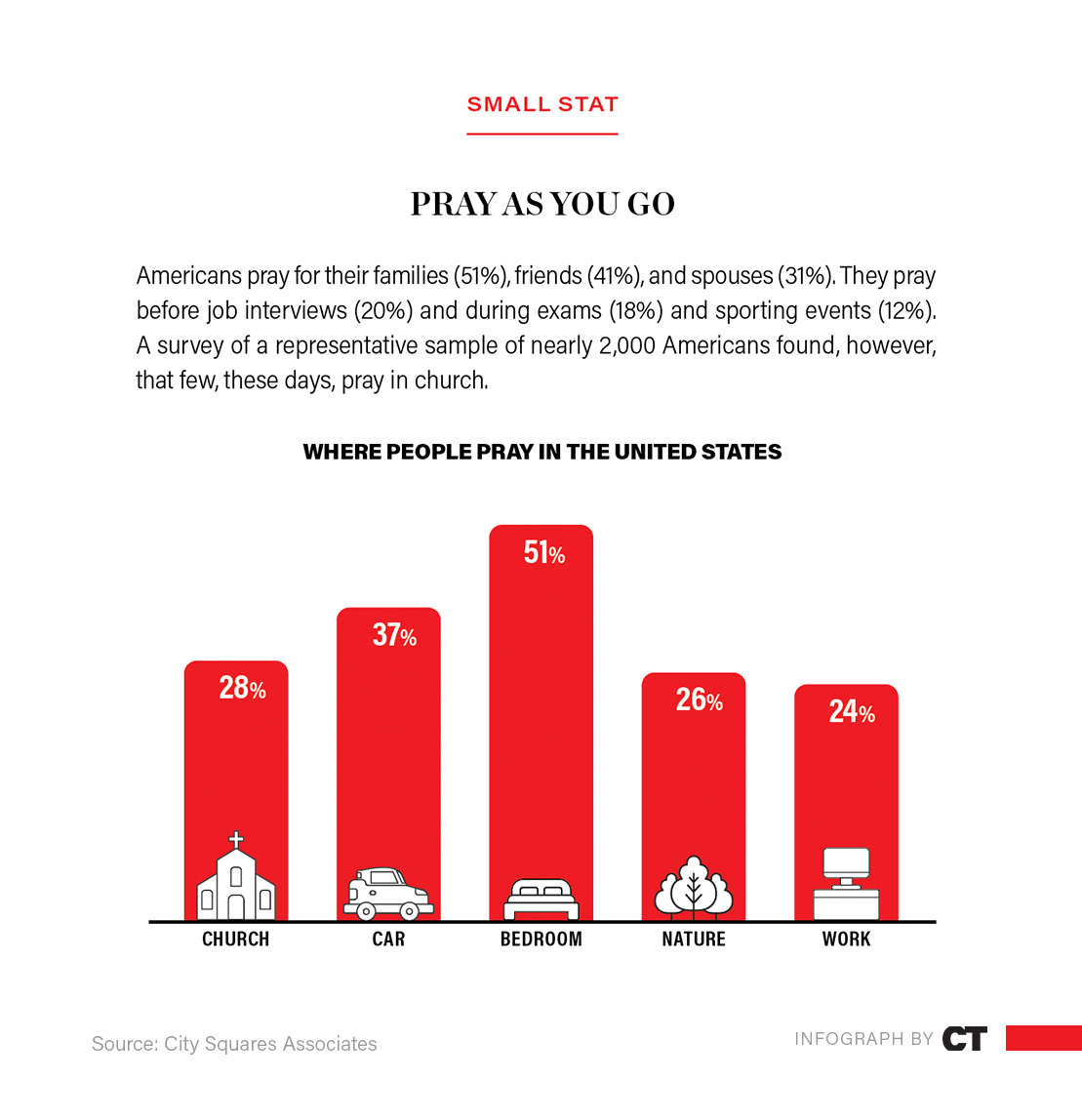
“Recent data shows a majority of churches are below their pre-pandemic attendance,” he writes. “A study released early this year reveals that church attendance is down by 6 percent, from 34 percent in 2019 to 28 percent in 2021.”

For whatever reason—busyness, laziness, fatigue, deconstruction, or trauma—many have abandoned ship. For now. Some say they want to stay involved in Christian activities but never quite make it happen, or they intend to reengage once they get fresh bearings, but the future hasn’t arrived. Perhaps it never will.

These downward trends point to big questions: How do we know when someone has decisively quit church? When have they officially left the fold? And perhaps more importantly, is Christian community necessary for salvation, so that it forms part of the essential definition of what it means to be Christian? These aren’t new questions, per se, but they carry new urgency.

Scripture gives us absolutes on what it means to enter Christian community. It also gives us guidelines that help us discern our spiritual condition in relationship to that community.

According to Jesus, the church began when he asked Peter, “Who do you say I am?” After Peter confessed, “You are the Christ” (Matt. 16:15–16; Mark 8:29), Jesus replied by saying, “On this rock I will build my church” (Matt. 16:18).

Christians might disagree about how the church should be administered, but they should agree that it started with Peter’s profession and grows when others declare the same. To respond to the gospel in a saving fashion is to pledge pistis (“faith” or “allegiance”) to Jesus as the Christ, the forgiving and restoring King.

The standard way to make an oath of fealty to King Jesus in the New Testament was by calling upon his name as part of the baptismal process (such as in Acts 22:16). It should be no different today. When a person expresses “faith” (loyalty) in him as Lord or King, that person becomes part of the one true church—the community where the Holy Spirit is present.

Praying a certain prayer, studying Scripture, or attending a worship service is not sufficient by itself. A person must pledge fealty to King Jesus and persist in that profession. The church, then, is a group of people that authentically declares “Jesus is the Christ” in such a way that the Holy Spirit is sovereign in their midst.

It’s a common truism to say the church isn’t equivalent to the building. But we need to add that it is not synonymous with official Christian fellowships, ministries, or organizations. “Church” happens whenever two meet, provided they are gathering under Jesus’ banner: “For where two or three gather in my name, there am I with them” (Matt. 18:20).

No matter the size or nature of the gathering, if Jesus is given authority to rule, then he is present and “church” is occurring right there.

To quit the church, then, is to cease being part of the people that collectively proclaim Jesus is the King. When a person no longer gathers with others under that banner, they miss out on the Holy Spirit’s sovereign direction over the corporate body, as well as the Spirit’s gifts and special rescuing benefits.

Apart from these basics, there is no definitive way to measure whether a person has left the church. To add absolutes beyond pledging fidelity to King Jesus is to risk falling afoul of God’s grace. (This is the problem Paul was combating in Galatia; see Galatians 5:1–6.) Those who add requirements fail to see that God, through the gracious gift of Jesus the rescuing Christ, has created one and only one righteous family—and that family is uniquely defined by allegiance to Jesus as the Christ-King.

So in weighing what it means for a person to leave the church, consider what follows a helpful gauge rather than a rigid yardstick:

First, is the Holy Spirit urging reconnection?

While comparing the church to a body with many different parts, Paul says, “we were all baptized by one Spirit so as to form one body” (1 Cor. 12:13). That is, common immersion in the Holy Spirit brings diverse Christians into unity. Moreover, “we were all given the one Spirit to drink.” That means the Holy Spirit courses through the body to maintain our unity: “The eye cannot say to the hand, ‘I don’t need you!’ And the head cannot say to the feet, ‘I don’t need you!’” (v. 21).

In other words, if a person is convinced they can be a Christian all by their lonesome and have no need for other parts of the King’s body, then in all likelihood, they’ve quit church. Those who have completely numbed the desire to gather with others under Jesus’ lordship are those who have likely left.

By contrast, if they’re still under the authority of Jesus’ kingship, then his sovereign Spirit will not permit an “I don’t need you” mindset. If they still yearn to reconnect, it’s safe to say that person is still allowing the Holy Spirit some space to sovereignly direct.

Second, is a person using their body to serve others and obey Jesus?

It’s easy to play mind games, and when it comes to sinful choices, most of us are Jedi-level masters. I can personally attest to this fact. Selfish delusion and sinful rationalizations are never far away: “Yes. I do deserve …” (Fill in your own non-cross-shaped blank.) Yet Scripture points us to bodily obedience in the midst of community.

The Bible is replete with warnings to pay the utmost attention to our physical actions. Scripture reminds us that our behavior reliably tracks whether we are really united to King Jesus: “Anyone who loves me will obey my teaching. My Father will love them, and we will come to them and make our home with them” (John 14:23). In context, Jesus is speaking about the coming of the Advocate and Teacher, the Holy Spirit (v. 26).

Likewise, the apostle John exhorts us to scrutinize our behavior: “We know that we have come to know him if we keep his commands” (1 John 2:3). “Anyone who claims to be in the light but hates a brother or sister is still in the darkness” (2:9). “No one who lives in him keeps on sinning” (3:6, 9). We need to study our actions, because they reveal whether we’re truly attached to King Jesus and his body.

In other words, we must not be fooled by our own mind games. If what we identify as saving “belief” or “faith” is disembodied, it’s not only useless—it’s not faith at all. It’s a corpse (James 2:20, 26).

Our obedience will never be perfect, of course. But if a person claims to have faith and makes no real attempt to offer bodily loyalty to King Jesus, then it’s safe to say that person has quit church.

Third, is a person participating in Christian mission?

The gospel is about how King Jesus is bringing about restoration from rebellion through his incarnation, death, resurrection, enthronement, kingship, and return. His victory has created a people that he’s in the process of rescuing—namely, the church. If we are not responding to the good news that Father, Son, and Holy Spirit are in the process of creating a restored people, then we remain in rebellion against the King’s authority.

If we are trying to be less selfish, that’s good but beside the point. If we’re seeking to serve others, that’s great but still not the point. We need to seek virtues not for their own sake but for the Messiah’s sake and his gospel’s sake (Mark 9:35). The cross-carrying life is specific to Jesus’ kingdom purposes.

When we’re on mission with Jesus, there is no war-free zone where we can “opt out” of the church to pursue our own moralities, values, and agendas. If we are not gathering with King Jesus, then we are scattering (Matt. 12:30). There is no neutral, insulated space where we can deconstruct, take a break from Christian community, and figure things out for ourselves. Even while tearing down in order to rebuild, we have to remain under Jesus’ authority through Scripture and the Holy Spirit, for our own sake and the sake of others.

Our mission is to cultivate allegiance to King Jesus by being obedient disciples who teach others how to be disciples. As part of King Jesus’s restorative gospel, the Holy Spirit guides those disciples together into ever greater levels of obedience.

I teach undergraduates. Although the picture is partial, the future face of the world—and Christianity within it—stares at me when I stand at my lectern.

I see emerging trends amid my students that frighten me—eyes fixed on screens, apathy, lack of concern for God’s moral standards, and dwindling church attendance. But one thing scares me above all else: When they first enter my classroom, most of my students seem to believe that even if Christianity happens to be fully true, it doesn’t really matter.

In response, I encourage students to see that Jesus is reigning right now—socially, politically, morally—and that genuine, this-world harm follows when we ignore his directives. (Check back in a few years, and I’ll tell you if I’m making any headway.)

I also see heartening trends. In comparison with a decade prior, my current students show a deep concern for the social well-being of others. They are more welcoming to outcasts, loners, and misfits. That sounds a lot like King Jesus, right?

They also yearn to connect with others authentically, even as they struggle to learn how to do that through a thousand intervening screens. They are primed not simply to hear a Billy Graham–style gospel invitation in a stadium but to connect with fellow Christians who want to help them grow in loyalty.

It is safe to say the church’s future depends on making allegiant disciples in the name of King Jesus. It always has.

Jesus has won the victory and will bring his rescuing intentions to a climax. Jesus is King now and forever more. That can never change. But when we wonder if we or others are in or out of the church, only one question matters: Is Jesus permitted to rule?

Matthew Bates is associate professor of theology at Quincy University and the author, most recently, of Why the Gospel?: Living the Good News of King Jesus with Purpose.

News

Southern Baptists Reject Rick Warren’s Saddleback Appeal

The move to disfellowship churches with female pastors in top positions has spurred a larger debate.

Rick Warren at the 2023 SBC annual meeting

Rick Warren at the 2023 SBC annual meeting

Christianity Today June 14, 2023
Sonya Singh / Baptist Press

Nobody expected Rick Warren’s appeal to be successful—not even Rick Warren. But he still stood up in front of 13,000 Southern Baptists gathered in New Orleans to make his case.

“No one is asking any Southern Baptist to change their theology! I’m not asking you to agree with my church,” he insisted, reading from a printout at a microphone on the floor of the convention hall during a three-minute speech. “I am asking you to act like a Southern Baptist, who have historically agreed to disagree on dozens of doctrines, in order to act on a common mission.”

For messengers at the SBC annual meeting, employing women pastors was not an agree-to-disagree issue. A vast majority—88 percent—voted to uphold the decision made back in February to disfellowship Saddleback.

The vote concludes two years of scrutiny and criticism toward the California megachurch for ordaining female pastors from its stage, welcoming a female teaching pastor to preach on Sundays, and naming a female campus pastor. This was the only chance to appeal.

After the vote, Warren said he wasn’t counting the appeal to succeed. Instead, “I wanted to push the conversation that’s been stagnant for years.”

Warren, who founded Saddleback and led the church for 43 years until his retirement last September, did not leave quietly. In the weeks before the meeting, the fourth-generation pastor launched a campaign in his church’s defense, with dozens of tweets, a website, three videos, an open letter, and a four-page messenger’s guide arguing that removing Saddleback violates the fellowship’s belief in church autonomy.

“I wanted to speak up for millions of Southern Baptist women … I believe their spiritual gifts, their leadership gifts and talents, are being wasted,” said Warren, who considered himself well-positioned to make the case given his prominence, “tender heart, and thick skin.”

But the messengers were largely unified against the appeal. As Warren offered up arguments for Saddleback, Southern Baptists online and at events ahead of the meeting countered with their own defense of the SBC’s historic stance and their own complementarian convictions.

“Southern Baptists decided this is not just a matter of church polity, this is not just a matter of hermeneutics, it’s a matter of biblical commitment—to a Scripture we believe unequivocally limits the office of pastor to men,” said Southern Seminary president Albert Mohler, who offered a rebuttal to Warren’s appeal.

The messengers also voted to uphold decisions to disfellowship Fern Creek Baptist, another church removed for having a female pastor, and Freedom Church, which was found to have mishandled abuse allegations.

At the direction of SBC president Bart Barber, the messengers were largely silent as the results of the appeals were announced on Wednesday morning. A small smattering of applause broke out from the back of the giant hall when the Saddleback results were read.

This year was the first time Southern Baptists have removed churches over female pastors, declaring Saddleback and four others “no longer in friendly cooperation” with the convention.

The move fueled a much bigger debate over how the SBC handles churches with women pastors.

Some saw the Saddleback decision as evidence that the process was working; the credentials committee was able to identify a church as out of alignment with the denomination’s Baptist Faith and Message’s position against female pastors and disfellowship it. Others saw a bigger issue looming, saying that far more churches in the SBC employed women as pastors, and a change needed to be made.

The SBC voted to amend its constitution to list male pastors as a requirement for cooperating SBC churches, a stance already included in its statement of faith. It states that churches must appoint “only men” as “any kind of pastor or elder as qualified by Scripture.”

The constitutional amendment follows similar additions in 2019 and 2021 to explicitly name ethnic discrimination and disregard for abuse as grounds for removal from the SBC. It will have to be passed again next year to go into effect.

“Of everything we do at this convention this year, I think dealing with Saddleback correctly is the top thing,” said Denny Burk, a professor at Southern Seminary’s Boyce College, during a 9Marks discussion of the issue on Monday night. “If we don’t get that right, that’s really bad … but the amendment is really important too.”

The vast majority of Southern Baptist leaders believe Scripture restricts lead and preaching pastor roles—the pastor-elder-overseer designation in the New Testament—to men. And many also believe that women using the title of “pastor” in other positions (think “children’s pastor”) is confusing at best.

The discussion continued around the convention, in meetings of the Executive Committee, and in proposals from the floor. Among a group who share convictions about what Scripture says about male pastors, is this a debate about titles? About ministry roles? About the function of a confessional fellowship?

The messengers also approved a change to the statement of faith wording to add “elder/overseer” to pastor—an attempt to clarify the biblical office being referenced.

And they authorized a task force studying terms of “friendly cooperation,” how closely a church must comply with the SBC’s statement of faith. The task force, which will report back at next year’s convetion, was proposed by Georgia pastor James Merritt, surrounded by a group of fellow former SBC presidents, including Ed Litton and J. D. Greear.

Almost all of the debates have been among male leaders. During a Baptist21 panel on Tuesday, Greear brought up the position of women—especially women serving on church staffs—while this issue takes center stage.

“As tragic as getting complementarian wrong and going egalitarian would be,” Greear says he also sees a failure to “recognize the role, integrity, dignity, and calling” of women in the convention.

“There’s a lot of discouragement there because they’ve been turned into a battleground,” he said.

News

The Presbyterian Church in America Has an Abuse Crisis Too

Women thought the PCA, with its robust system of governance, might provide some accountability. They found that was not the case.

Pastor Tim LeCroy and other PCA leaders presented their report on abuse in the PCA at the denomination’s 2022 general assembly.

Pastor Tim LeCroy and other PCA leaders presented their report on abuse in the PCA at the denomination’s 2022 general assembly.

Christianity Today June 13, 2023
Youtube.com / Edits by Christianity Today

With a robust governing structure and a 400-page Book of Church Order (BCO) that requires strict standards for those in church leadership, the Presbyterian Church in America should be a denomination that’s good at handling abuse.

“I told friends I picked the PCA because I know I have somewhere to go if something goes wrong,” Kristen Hann, a former director of women’s ministry at Surfside Presbyterian Church in South Carolina, told CT.

She and other women in the denomination have found that was not the case.

The denomination meets for its annual general assembly this week and is marking its 50th anniversary. Over those decades, it has not experienced the reckoning with abuse that has occurred in the Southern Baptist Convention or the Catholic Church.

But survivors within the PCA say the denomination’s problems with abuse are just unaddressed. The denomination has not commissioned an investigative report like the SBC on its response to abuse cases.

At its denominational meeting in Memphis this week, PCA elders will consider a significant number of overtures (church legislation) related to abuse. Among them are two different proposals allowing anyone to be a witness in church courts for abuse cases—currently only those who believe in God, heaven, and hell are allowed to be witnesses. Another overture would require criminal background checks for new ministers and ministers transferring presbyteries or denominations.

Ordained male elders vote at the PCA meeting, while SBC messengers can be men and women.

The PCA, with its ostensible system of leadership accountability, may demonstrate how every denomination needs to have a reckoning with abuse from the outside. The denomination has the structure for abuse accountability in theory, PCA elders say, but not in practice.

The BCO is a thick document for governing a church, but “it doesn’t have anything in it to help us adjudicate any abuse cases or reports,” said Ann Maree Goudzwaard, who leads a church-based ministry in the PCA called Help[H]er for women in crisis. She has become a point person for women reporting abuse in the denomination, which is not a role she sought out. She receives daily calls from abuse survivors.

“People are still saying there’s not as much as we think there is,” Goudzwaard said. “It’s an avalanche.”

Last year, a denominational committee made up mostly of PCA elders as well as outside experts like Goudzwaard and Rachael Denhollander released a 220-page report with recommendations for how churches should handle domestic abuse and sexual assault (known as the DASA report). It was designed to be a resource for the PCA’s local church leaders. In the absence of a denominational reporting mechanism for abuse, victims have contacted the committee, which was not designed for that purpose.

The denomination made the committee’s report nonbinding, and committee members know of few presbyteries that have begun training based on the report. The abuse committee members have recommended that churches need third-party help when abuse cases come before them.

“The DASA report had phenomenally rich theology on abuse,” Denhollander told CT. The report has informed work on abuse in the SBC, she said. But the PCA’s court systems, which handle church discipline, are the denomination’s only mechanism for addressing abuse. Without change there, “in the PCA it's ultimately the same question as in the SBC: Will they allow the rich theology of justice and holiness that Scripture calls us to to impact their actions and systems?”

The PCA is not a denomination with top-down governance but rather a collection of local churches that form regional presbyteries that govern those churches under the BCO laws. How well an abuse case is handled depends on the presbytery.

Many presbyteries have put survivors through a procedural grinder that survivors say was worse than the abuse itself. Multiple cases CT reviewed that went through the church court process had thousands of pages of documentation, and sometimes stretched out for years. Laypeople were bewildered trying to file formal charges based on the BCO.

Male elders who make up presbytery leadership are adjudicating these cases, so victims often are cross-examined by a group of men who all know each other and may have no experience handling abuse cases. Some abuse advocates say that a presbytery can be an “old boys network” if elders are protecting their friends instead of listening to allegations.

In April, the PCA’s Standing Judicial Commission (SJC)—essentially the supreme court of the PCA courts—unanimously exonerated PCA pastor Daniel Herron, who had sued for defamation two former members of his church who accused him of sexual harassment. The SJC declared him not guilty on the charges of harassment, his use of lawsuits against accusers, and his overall character as a minister. On Herron suing his accusers, the SJC ruling argued that church teaching in 1 Corinthians 6 and the Westminster Confession of Faith allows Christians to file civil lawsuits in certain cases.

The PCA’s church court process stretched on for nearly four years after the women brought their complaints about the pastor. The trial transcript for the hearing in the case ran for 1,966 pages.

The ruling is not yet public but will be announced at the general assembly this week.

SJC rulings are only binding on the parties involved, according to the BCO, but the rest of the denomination must give SJC rulings “due consideration,” which means a ruling in the Herron case sets some level of precedent.

From victims’ perspective, the denomination just gave a green light to pastors suing accusers for defamation. Several abuse victims and advocates CT interviewed said the ruling meant more victims would be afraid to report their abuse.

As the denomination wrestles with these big questions, stories from local churches show how its procedural approach affects people in the pews.

A bungled Presbyterian response to abuse

Kristen Hann, the former director of women’s ministry at Surfside Presbyterian Church in Myrtle Beach, South Carolina, lost her job last year after objecting to how the church handled an abuse case.

In 2021, Kappie Reynolds, a member at Surfside, reported that an elder groped her under her clothes, exposed himself to her, pulled her pants down, and attempted anal penetration. Reynolds requested that the elder’s name not be used in this story, as the case is still being litigated confidentially through the church court process.

The encounter, which took place at an acquaintance’s home, was “out of the blue,” Reynolds said, and they had a “platonic” relationship before. She did not report the alleged assault to the police. The first person at the church Reynolds confided in told her not to ruin the elder’s reputation, she said.

Surfside’s church leadership declined to comment on the case, saying “it would be unwise and reckless for us to discuss church discipline, member care, or employment matters in a public forum.”

Two months after the incident, Reynolds told Hann what had happened, and Hann and Reynolds reported the incident to Surfside’s pastor, Brian Peterson.

In the following weeks, Reynolds said no staff at the church other than Hann reached out to see how she was doing. Reynolds quit going to Surfside. For a time she could not get out of bed.

The accused elder, a lay leader and not on staff, was quietly stripped of his ordination in the PCA (something the session, a group of governing elders of a church, has the power to do) and asked to attend another church. But church leadership did not communicate the reasons to the congregation.

In the months that followed, Hann wanted the church leadership to talk about what happened with the congregation and bring in an outside investigator. They did neither. They consulted with one abuse expert but did not follow her major recommendations.

“They didn’t know how to navigate,” said Jeremy Reynolds, Kappie’s husband.

One year after the alleged assault and repeated confrontations over Reynolds’s case, the church leadership granted Hann a requested two month paid leave. But a month into the leave, the church asked Hann to resign, take severance, and sign a non-disparagement agreement and release from liability. She refused, and then was fired by email.

The months of fighting “makes you want to die,” said Hann. “They’re not listening, and I didn’t do anything wrong.”

In the fallout of Hann’s firing, the pastor finally held a meeting with the congregation and took questions about the elder who had been stripped of his office, saying he had confessed to “sexually deviant sin,” according to Hann’s husband, Aaron, who took notes on the meeting.

The leadership never described it as an assault. Peterson, the pastor, told the congregation that Hann and church leadership had an untenable working relationship because of the tensions around the handling of the case of “sexual sin.” They did not commission a third-party investigation, which Hann thought could have turned up more wrongdoing by the elder as well as addressed the pastor’s handling of the case.

Meanwhile, Reynolds figured out how to file a formal complaint under the BCO addressed to the presbytery. The presbytery ruled her complaint “out of order” on grounds that it “preceded the timely response from the proper court.” Hann has also filed charges in church courts, including a request for an investigation of Peterson’s handling of the case and treatment of the women involved. The SJC is now weighing charges related to the case.

Goudzwaard, who served on the denomination’s commission on abuse, said she no longer counsels victims to go through the church court process.

“It is not designed to help [victims],” Goudzwaard said. “I had a best-case scenario on a case, and it should have resulted in a deposition of a pastor and it did not. It had a GRACE [Godly Response to Abuse in the Christian Environment] report, multiple witnesses.” Deposition in the PCA means a removal of ordination.

When hearing charges, presbyteries tend to say either that how a church handled an abuse case was within their purview or that there isn’t enough evidence, she said.

One church brings in third-party investigators

When one PCA church did communicate about an abusive leader and investigate, it found more cases of abuse.

In 2018, a student reported an unsettling incident with a PCA pastor to the student’s campus minister, who reported it to the pastor’s presbytery in Georgia. Once confronted, the pastor, Brad Waller, confessed to abusing men and boys in the congregation with sexual foot massages. The pastor’s church, Grace Church of the Islands, stripped Waller of ordination over the abuse.

The presbytery also communicated what happened to a PCA church where Waller served previously for more than a decade, Tates Creek Presbyterian in Lexington, Kentucky. Within 10 days of receiving the news, Tates Creek’s session met, and then they communicated the news to the congregation.

The church leadership received many stories of abuse in response. The church initiated a third-party investigation by GRACE. That approach was “scary for the session,” said then-pastor Robert Cunningham, but the vote was unanimous. In 2019, GRACE issued its report, which the church publicly posted.

“We didn’t do this through the church courts,” Cunningham said. “Presbyteries and elders–none of us are trained in abuse and trauma. … Bring in experts.” In other situations, he noted, “churches aren’t scared to reach outside the church and bring in the legal experts to tell them what to do!”

Tates Creek is the exception, abuse advocates say, while Surfside is more of the rule in the PCA’s response to abuse.

In the wake of her firing, Kristen Hann’s family had to move, and she now works at a Starbucks. Kappie Reynolds has gone through counseling and is recovering. Every Friday at 3 p.m., Hann now prays a litany for those abused in the PCA: “It’s what I can do.”

This article has been updated to clarify that witnesses in PCA courts don’t need to be Christians but must believe in God, heaven, and hell.

Theology

Baptism by Flood: Kherson Christians Persevere After Ukraine Dam’s Destruction

Occupied, liberated, and now underwater, Kherson remains on the frontline of fighting—and faith, as a local seminary president explains.

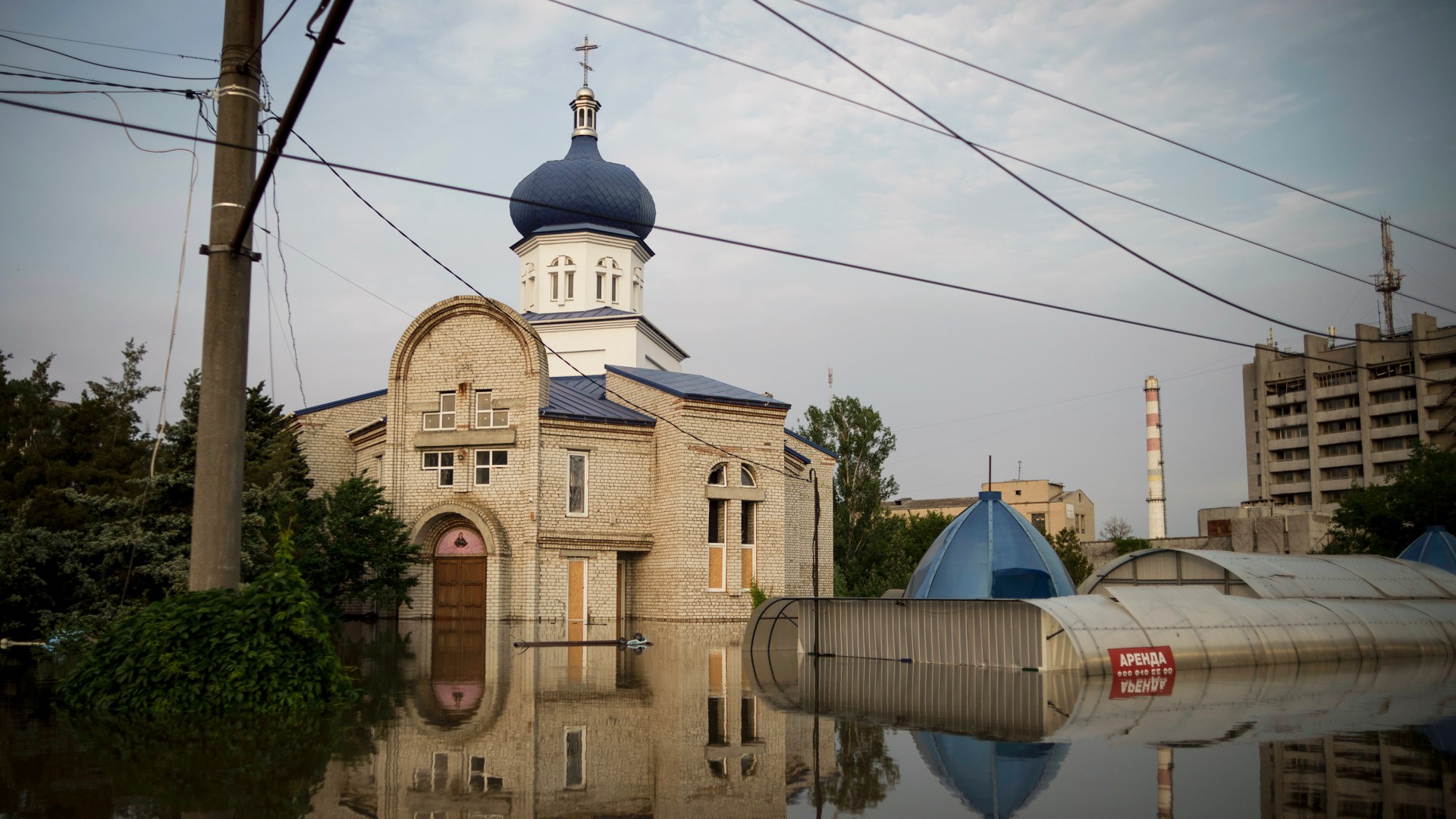
A flooded church in Kherson, Ukraine.

A flooded church in Kherson, Ukraine.

Christianity Today June 12, 2023
Felipe Dana / AP Images / Edits by CT

For eight months, the Ukrainian city of Kherson endured Russian occupation.

Now—along with at least seven churches—it is underwater.

Experts estimate that the collapse of the Nova Kakhovka dam, 44 miles upstream, released an amount of water equal to the Great Salt Lake. A new wave of evacuations is underway in southern Ukraine, with 25,000 people in Russian-controlled areas and 17,000 in Ukrainian-held territory advised to leave.

An estimated 2,000 houses have been flooded, with 16,000 people made homeless. A lack of drinking water, electricity shortages, and floating land mines have contributed to the humanitarian and ecological disaster.

The dam’s reservoir contributed 2,600 tons of fish to the local economy. Wheat prices have spiked, as 94 percent of Kherson’s irrigation system has lost its supply. And 150 tons of machine oil have been carried toward the Black Sea.

But that is just the physical damage.

Tavriski Christian Institute (TCI) in Kherson is a spiritual casualty. Liberated from Russian occupation last November, the seminary’s riverside properties suffered a new blow with the deluge. Early in the war, TCI president Valentin Siniy evacuated west with his wife, two children, and much of the student body. Today he continues education from Ivano-Frankivsk as he oversees relief efforts over 500 miles away.

CT spoke with Siniy about the state of the seminary campus, the emotional impact of the flood, and the rising challenges to faith that have led to newfound spiritual insights:

What is the situation with your seminary?

When the Russian military descended upon our cherished seminary, it was an emblem of knowledge and spiritual growth. They stripped it of its essence. Equipment from our printing shop vanished, books were burned, and I would say their very presence desecrated our sacred space.

A friend later retrieved one of my favorite pictures: an image of Jesus’ crucified feet.

But even after liberation, Russian missiles destroyed our buildings and sniper fire kept people away. I visited several times, but it was too dangerous to remain. Our once-vibrant campus, composed of five buildings, lay in ruins, mirroring the devastation that ravaged our nation.

And just when we thought we had faced the worst, the catastrophic flooding submerged our greenhouse farm. It had been a source of sustenance and support for our students and area residents—even as it remained in occupied territory on the east bank of the Dnipro River.

Now that the waters are slowly receding, our manager—also a local pastor—tells us that much can be repaired. But he has been threatened by the Russians, who also killed a pregnant volunteer woman while they confiscated the boats of those assisting others.

The Russian government is godless and immoral; it simply destroys people.

How have evangelicals been able to help?

There is a lot of dirt and debris floating about. Cemeteries and cesspools have been flooded; viruses and diseases are spreading. Our volunteers are helping on the liberated west bank, and we have delivered ten pumps with another ten on their way. Unfortunately, most of the damage has been in Russian-controlled areas.

Through the United World Mission-Overseas Council partnership, we are addressing the lack of drinking water by providing filters alongside dry food rations. And our churches continue to serve as refugee hubs, receiving again those displaced from their homes.

How are local residents dealing with yet another tragedy?

These trials have left an indelible mark on our emotions and spiritual state. War and environmental disaster have reshaped our perceptions of the world. In the face of extreme violence and suffering, our once-unwavering beliefs have undergone profound revision.

Questions about the presence of God have become more prevalent, as individuals seek solace amid their pain. They yearn for a faith that transcends simplistic assertions and embraces the complexities of their reality.

Faith is not a passive endeavor. It is a journey that demands deep introspection and unwavering commitment. Times of suffering force us to reevaluate our understanding of the relationship between faith and well-being. It is in these moments that the witness of Christians becomes most relevant—not through sermons alone, but through our presence and assistance to those who suffer. It is through practical acts of love and compassion that the essence of our religion is revealed.

It is not easy, and some are losing their faith.

What is the main issue believers struggle with?

For many, their belief had been superficial. But even among believers, in the past we used to operate according to Psalm 37 where David said, “I have never seen the righteous forsaken, or their children begging bread” (v. 25). We trusted that if we lived a moral life, God would give us a prosperous life. And if we sinned, we would suffer, but we knew that we—or others—deserved it.

Even with a more mature faith, we used to interpret 1 Corinthians 10 that our trials would not be more than we could bear. But my “sin” was not equal to this devastation, nor my “sanctification” proportionate to the level of suffering. My “righteousness” could not endure this terrible war.

So many of us were left confused—even scared—of the impact this great pain would have on our faith. I don’t know how to understand these verses now; however, I do know that Jeremiah and Job came to different conclusions. Job’s righteousness was vindicated; there was no link between his suffering and sin.

In this case, the pain simply comes from Russian aggression.

How do you answer your fellow Ukrainians who are overwhelmed?

It does not help to speak about the love of God at times like this; it is usually best just to sit in silence with them. But C. S. Lewis wrote about how suffering burns away the formalism of faith, inviting people into a deeper relationship with God. We want to be ready to help spiritually, when they are ready to inquire.

And some are. Last week, I preached at a service where three young people were baptized.

After the service, an older man approached me and asked how I have the strength to stand firm. I quoted from 1 Peter 1 about our “inheritance that can never perish, spoil, or fade.” And while we still have to “suffer grief in all kinds of trials,” through faith, we are “shielded by God’s power” (vv. 4–6).

These verses have become a source of inspiration and solace. They speak of the hope that is bestowed upon us through our faith in God. And it reminds me that the strength to endure extreme violence and unspeakable suffering does not come from within ourselves, but emanates from God’s strength.

What does “shielding” mean, in the face of so much loss?

It was the flood that helped me think through this passage. Later in his letter, Peter connects baptism to the time of Noah, and how faith helped them escape in the ark. His family lost so much in the world, yet they were preserved—trusting in God’s promise.

It is not our possessions that are shielded, as they were swept away in the floodwaters. Nor is it our emotions that are shielded, as we still go through pain. But what I have found is that God shields our hope, enabling us to trust in his sovereignty.

It was by God’s word that the world was created, and one day by his word it will crumble like paper. But not one word of his promises will go unfulfilled, and in Romans 8 he tells us that “all things work together for good” (v. 28, ESV). Our salvation comes through his strength—even now—as it gives us a future orientation.

This is our anchor, grounding us in the present, as we await God there.

Donations to Tavriski Christian Institute for refugees and reconstruction are collected here.

Editor’s note: CT offers select articles translated into Ukrainian and Russian.

You can also now follow CT on Telegram: @ctmagazine (also available in Chinese and Russian).

News

Liberty Whistleblower Continues to Defend Fraud Claims

A former dean alleges over $1 million in staff kickbacks and payouts as his case against the university goes to court.

Liberty University

Liberty University

Christianity Today June 12, 2023
Joshua Hanson / Unsplash

Four months after Liberty University filed a motion to dismiss a whistleblower’s lawsuit, the former dean suing the school amended his complaint with more detail about the alleged fraud he reported to authorities. He alleges that the school offered payouts to third parties and concealed the use of university funding for business expenses.

According to the suit, John Markley made “repeated good faith reports of disturbing violations” of state and federal law at Liberty, only to be terminated from his role as administrative dean for academic operations in June 2022.

“Dr. Markley’s position provided an eye-opening perspective on the inner workings of a multi-billion-dollar enterprise that operated to maximize profits without ethics and at the expense of truth and those willing to fight for it, and to the detriment of the students, and professors,” the lawsuit says.

The university maintains that Markley was let go as part of a reorganization and that his allegations are without merit.

Markley’s original suit lists 15 “improper activities” he said he raised concerns about, including potentially fraudulent management of Liberty charitable organizations and corporate subsidies, the intentional misrepresentation of acceptance rates and enrollment numbers for financial gain, and a compensation scheme for LU business executives.

In a public statement obtained by CT, Strelka Employment Law—which represents Markley—said Liberty filed a demurrer to dismiss the case, arguing that Markley’s allegations “were not sufficiently specific.” The Lynchburg Circuit Court filed an order for Markley to amend his complaint.

The update, filed last Thursday, includes specific allegations about potentially fraudulent management of Liberty charitable organizations in the use of textbook sales, with Markley claiming various Liberty professors started nonprofit or not-for-profit enterprises to sell textbooks directly to Liberty.

According to Markley, this allowed professors to make money from required book sales without paying taxes on the sales or income. Markley also questioned “the academic quality and relevance of the textbooks pushed by professors in this manner,” per the statement.

The updated complaint also details the widespread use of payouts by Liberty to third parties—dubbed “professional fees”—which Markley alleged provided special deals and kickbacks to “friends” of Liberty.

In one instance, Markley said he reported large transactions totaling $1 million “that had been suspiciously withdrawn from the Academic Affairs Budget in line with previous suspicious transactions.”

Finally, Markley alleged various fraud to the public and the government regarding improperly classified workers, the misrepresentation of acceptance rates and enrollment numbers, and the submission of false academic data to the Department of Education.

“In Court, Mr. Markley’s attorney Thomas Strelka cautioned that adding heighted allegations in a public document regarding Liberty University’s wrongdoing would likely not be in Liberty University’s best interest,” the Strelka statement says. “Mr. Markley reported a multitude of illegal, unethical, and immoral activities on the part of Liberty University in the years, months, and weeks leading up to his termination.”

Liberty said in a statement that Markley’s claims “are still without merit” and that the school did not learn about his communication with a federal agency until several months after he left.

“During his time of employment at the university, Dr. Markley expressed his opinions on certain administrative matters. His opinions were taken seriously and addressed appropriately, even when unfounded,” Liberty said, using the same language as in November. “While Liberty wished Dr. Markley well, we are confident that the university has treated him appropriately and look forward to vigorously defending against these unfounded claims.”

In January, Liberty said it would file a point-by-point refutation of Markley’s allegations, beginning with the fact that he was let go from the university as a result of an administrative reorganization.

Liberty included the same language in its statement last Tuesday.

“Liberty has already successfully challenged and dismissed the claims from the original complaint which were not legally sufficient,” the statement said. “This case is still working its way through the appropriate, legal processes.”

The amended complaint, at 15 pages, is double the length of the original lawsuit and provides more details to Markley’s allegations, including timelines of each report. According to his filing, Markley began voicing concerns in 2018—a decade after he started working at the university and a year after he was given a full-time position. The lawsuit says Markley acted as a whistleblower until his termination.

The amended lawsuit alleges that his supervisor at the time of termination, Liberty provost Scott Hicks, “referred openly to Dr. Markley as a ‘whistle blower’ and referred to concerns Dr. Markley had over his contract as ‘whistle blower stuff.’”

Erika Cole, an attorney who advises churches and faith-based organizations on legal matters, said the complaint demonstrates the importance of workplaces having clear whistleblower policies.

“Whistleblower policies really began in the for-profit arena, but we are now starting to see that these kinds of policies are absolutely essential in the nonprofit arena,” said Cole, who serves as a senior editorial advisor for CT’s Church Law and Tax. “Even in the Christian arena where we don’t often think of it being most applicable.”

Liberty does have a whistleblower policy, approved as of November 2021. The policy includes a list of “wrongful conduct” that can be reported under the policy, along with the process and procedures. “Individuals must not be subject to retaliation for Good Faith reporting of Wrongful Conduct,” the policy reads.

Cole said it’s crucial that employees know about any whistleblower policy, and that its purpose is part of an organization’s culture.

“And ultimately, I always say it’s not just about having a policy,” she said. “It’s about following a policy.”

Nathan Salsbery, executive vice president and partner at the nonprofit consulting firm CapinCrouse, agrees. Best practices for whistleblower policies often use a hotline system monitored by an independent party that reports directly to the board, as “ultimate fiduciary responsibility rests with the board.”

“As with any human institution, the fallenness of humanity is never fully eradicated even by the most effectively designed internal controls. But they can help minimize the damage,” Salsbery said. “The primary lesson, and this holds true for every institution, is to ensure proper policies are in place, and to regularly train the board, executive leadership, and staff on such policies so they are effectively implemented and are part of a culture of integrity and good stewardship.”

Neither Salsbery nor Cole commented directly on the specifics of Markley’s case or complaints, but on best practices regarding whistleblowers.

Tim Lee, an evangelist who serves as Liberty’s board chair, did not reply to a request for comment.

In addition to outlining various funding schemes, the amended complaint also alleges that Markley witnessed and reported attempts to obstruct Title IX and efforts to combat sexual assault at Liberty.

In July 2021, 12 women sued Liberty University for fostering an unsafe campus environment and mishandling Title IX complaints. Within months, 10 other Jane Does joined the lawsuit. Liberty settled the Jane Doe lawsuit in May 2022, announcing that it “had already undertaken various initiatives” to better protect women on campus. Advocates have called for an audit by an independent third party as the findings from the investigation commissioned by Liberty’s board in 2020 into “all facets of Liberty University operations” were not disclosed publicly at its conclusion.

Former LU president Jerry Falwell Jr. resigned in August 2020, and the board commissioned an outside firm to investigate business operations during his presidency, “including but not limited to financial, real estate, and legal matters.” The findings have not been made public.

Multiple stories by Politico reported on self-dealing at the multibillion-dollar university, such as construction and real estate projects going to family and friends of the Falwells. In March, two and a half years after Falwell’s resignation, Liberty University named Dondi E. Costin as its new president.

Markley’s lawsuit, which asks for $20 million in financial compensation and for reinstatement to his job, is similar to one filed in October 2021 by Scott Lamb, Liberty’s former spokesman. Lamb alleged that he was fired for criticizing Liberty’s response to sexual assault.


The school said that “played no role in his termination.” Norman Moon, the district judge in the case, granted Liberty’s dismissal motion in March 2022, citing a lack of “factual allegations.” Lamb filed a counterclaim against Liberty last week.

News

Ghana’s Christians Divided Over Proposed Monument to National Unity

Economic woes halt progress on President Nana Akufo-Addo’s planned cathedral as criticism turns increasingly religious.

An artists rendition of the national cathedral to be build in Accra, Ghana.

An artists rendition of the national cathedral to be build in Accra, Ghana.

Christianity Today June 12, 2023
Youtube screengrab / Ghana National Cathedral

The national cathedral was supposed to unite Ghana. Instead, the unfinished project and its ballooning costs have divided the country and become, for some, a symbol of failed policies and presidential vanity.

President Nana Akufo-Addo pledged to build the cathedral before he became president in 2016. He proposed a structure designed by a world-renowned architect, with a 5,000-seat auditorium, a Bible museum, and a garden filled with plants mentioned in Scripture. It would be a place for worship and national ceremonies: inaugurating the president, holding state funerals, and conducting national thanksgiving services.

Now Akufo-Addo is half way through his second four-year term, and construction is still ongoing. Costs have risen from an initial budget of about $100 million to four times that amount, and the country is struggling with an economic crisis with 50 percent inflation. Allegations of misappropriation of funds have only deepened public skepticism.

But Akufo-Addo is not turning back.

“The National Cathedral will be a unifying monument around which to elevate shared conversations on faith and on national transformation,” he said, according to the cathedral’s website. “It will also serve as a rallying platform to promote deep national conversations on how, collectively, we can build the progressive and prosperous Ghana we desire.”

In recent days, however, some of the public criticism has taken on a decidedly religious hue. One outspoken member of parliament opposed to the project, Sam George, cited the New Testament during debate over additional government “seed money” earlier this year.

“Suppose one of you wants to build a tower. Won’t you first sit down and estimate the cost to see if you have enough money to complete it?” he said, quoting Luke 14:28. “For if you lay the foundation and are not able to finish it, everyone who sees it will ridicule you, saying, ‘This person began to build and wasn’t able to finish.’”

Ransford Gyampo, professor of political science at the University of Ghana, says the country has misplaced priorities. The government shouldn’t put a building project ahead of things like the development of a school lunch program. He makes the argument in explicitly religious terms:

“God will not be happy with us,” he told Al Jazeera. “Who said God lives in cathedrals?”

But many of Ghana’s 23 million Christians do support plans for the cathedral, which will occupy a prime piece of real estate not far from the country’s parliament. Churches across the country—including Baptists, Methodists, Presbyterians, Seventh-day Adventists, and many Pentecostal congregations—have contributed more than 2.2 million Ghanaian cedis ($195,000) to the building fund.

The prominent Ghana Pentecostal and Charismatic Council (GPCC) has echoed the president’s arguments, saying the cathedral will be a monument that represents all Ghanaians. About 70 percent of the country is Christian. Eighteen percent are Muslim, 5 percent practice indigenous religions, and 6 percent say they have no religious identity.

The project’s board of trustees is also headed up by theologian and televangelist Kwadwo Opoku Onyinah. He has repeated that he is committed to working hard to complete the building.

"We are here to do what God has asked us to do,” he said.

He also used his and the board’s personal reputation to counter the allegations about corruption that have surrounded the initial phase of construction.

“We are not seeking fame or name,” Onyinah said. “We are not asking for money.”

Not everyone is convinced the cathedral is God-ordained, though. Younger Christians, in particular, seem skeptical of the idea of a national cathedral.

Jojo Quansah, a media and telecommunications consultant who is Pentecostal, said the project was flawed from the start. The country doesn’t lack churches, he said. It lacks development. Women in some parts of the country have their babies in hospitals without beds, and some children still attend school not in classrooms but under trees, he pointed out.

“If the state has excess money to burn, they are better off spending it on making more people’s lives better,” he told CT. “In Matthew 25:31–46, Christ made it absolutely clear that for any leader purporting to profess Him, their best foot forward is how they positively impact ‘the least of these brothers and sisters.’”

Like many Ghanaians, Quansah was scandalized when existing buildings, including a passport office, a diplomatic residence, and a block of office buildings, were demolished to make way for the cathedral.

“To think that we demolished pretty okay state buildings to claim land for the cathedral, when we are struggling for growth in several areas of our economy, is miles away from any consideration of Christianity,” he said.

Quansah is also skeptical of the secondary argument for the cathedral. Promoters say it will draw tourists, turning Ghana’s capital into “a hub for international pilgrimage and tourism.” The designs for the cathedral have been drawn up by renowned Ghanaian architect David Adjaye, who was also the lead designer of the eye-catching National Museum of African American History and Culture in Washington, DC. The proposed Bible museum with the cathedral will be larger than two similar museums in the United States. Tourism is Ghana’s fourth largest industry, behind cocoa, gold, and fossil fuels.

But the telecom consultant said the idea that a new church in Ghana will compete with ancient religious landmarks and draw tourists away from Westminster Abbey and Notre Dame “is just funny.” Quansah points out a similar church construction project in Ivory Coast has not worked out so well. The Basilica of Our Lady of Peace in Yamoussoukro, ranked by the Guinness Book of World Records as the largest church in the world, was designed to accommodate 18,000 worshipers, but only a few hundred attend services regularly.

Ghana’s government has reportedly invested $339 million Ghanaian cedis ($30 million) in the project so far, to kickstart construction. The rest is supposed to be funded by private donations. As the country has been overtaken by economic problems, though, cathedral construction has become less of a priority. The country just received a much-needed bailout worth $3 billion from the International Monetary Fund to be paid over the next three years. It’s money that will need to be spent not on cathedrals but on boosting economic growth.

Construction, meanwhile, appears to be in limbo.

Akosua Asamoabea, a Ghanaian student at a school in the US, saw the construction site in December when she was visiting her family in Accra. It was all boarded up and quiet. The large cranes were still.

Asamoabea, a Christian who grew up in the Baptist church, was upset to see the many buildings that had been leveled to make way for what she termed the “president’s passion project.” And she mourned the destruction of ancient trees that once lined the roads in that part of the capital.

“As long as I have been alive, those trees have existed, and I believe they existed long before me,” the 27-year-old told CT. Now they’ve been felled “for really what is going to be a glorified auditorium.”

She believes that Christians should build churches. But for the government, it doesn’t seem right.

“Young people don’t have jobs or are unable to envision a future in the way that our parents did,” she said. “A cathedral? It doesn’t make sense to me.”

News

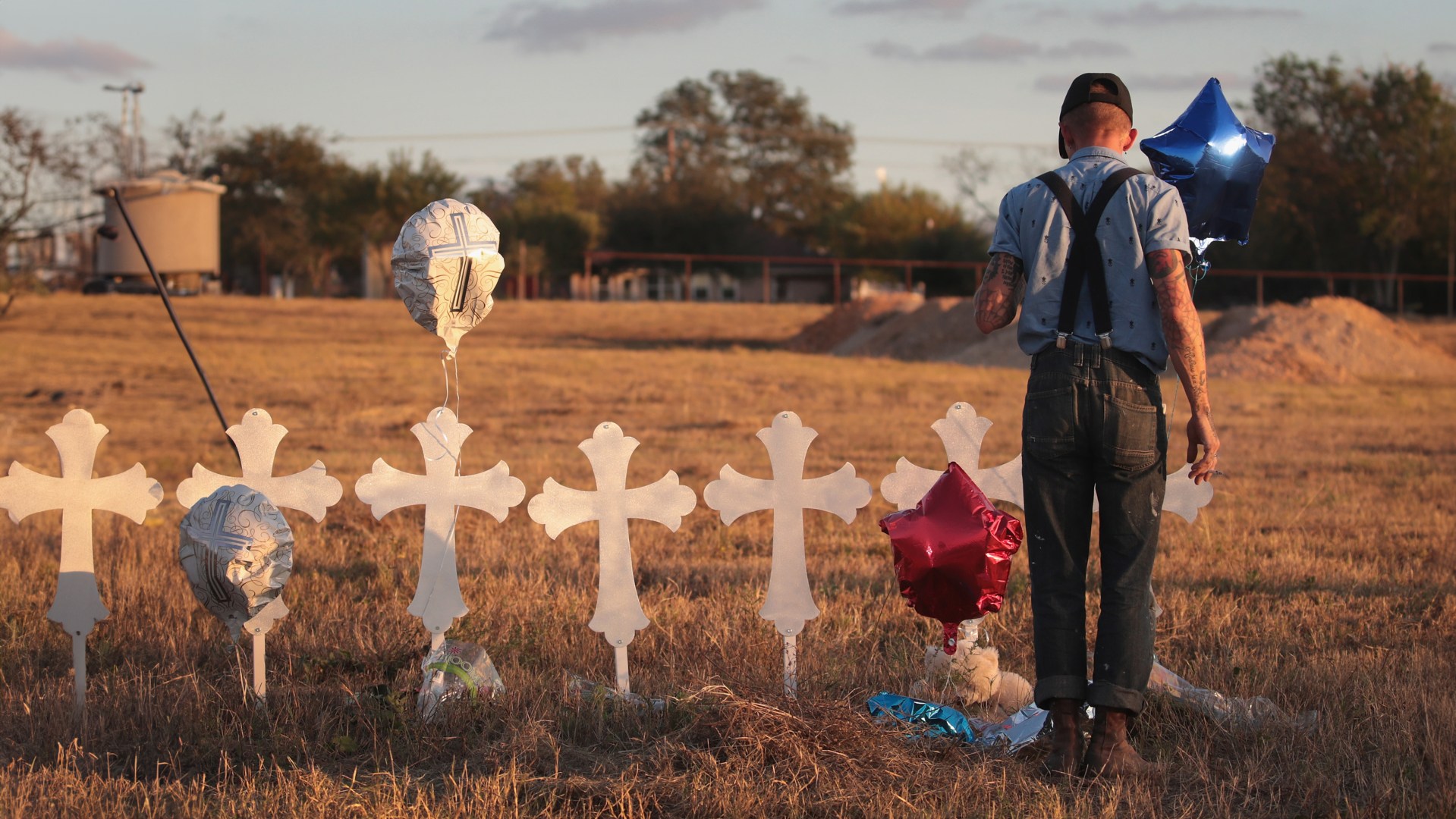
Church Shooting Victims to Receive $144.5 Million

And other news briefs from Christians around the world.

Scott Olson / Staff / Getty

The United States Department of Justice has agreed to pay $144.5 million to those hurt in a 2017 Texas Baptist church shooting. The US Air Force failed to supply information about a domestic assault conviction to the FBI. A former airman should have failed the background check necessary to purchase a semiautomatic rifle. Instead, he was allowed to buy the gun; go to the church his ex-wife occasionally attended in Sutherland Springs, Texas; and fire off hundreds of rounds in 11 minutes, killing 26 people.

United States: NDAs are sharply limited

The National Labor Relations Board issued a clarifying memo on employment-based non-disclosure and non-disparagement agreements (NDAs), saying the government does not consider them valid if they make sweeping claims about confidentiality. Commonly used in church employment and settlement agreements, NDAs can only properly protect proprietary trade secrets, must have a time limit based on “legitimate business justifications,” and cannot have a “chilling effect” that prevents people from speaking to the media. A Christian group called #NDAfree has been pushing for churches to eschew the legal tool.

El Salvador: Conversion best option for gang exit

A study of El Salvador prisoners found that religious conversion is the most accepted way out of gang life. The survey of nearly 1,200 people serving time found that there is no standard practice for ending membership in MS-13, 18th Street, or other smaller gangs. But 97 percent said church membership was an acceptable way to “calm down,” or reduce participation, and a little more than half said conversion could allow for complete disaffiliation. The gangs watch converts closely and challenge the authenticity of new religious commitments. Roughly 15 percent of those in the US State Department–backed survey were attending evangelical worship services every week.

France: Christians propose extra episode of documentary

The French Protestant Federation offered to assist the broadcaster ARTE in making an additional episode of a documentary series on evangelicalism that would focus on the 745,000 believers in France. The series only briefly mentioned French evangelicals and did not distinguish them from Christian nationalists in the US or Brazil, prompting accusations of bias. ARTE did not respond to the offer.

Mozambique: Missionary pilot out of prison

Mission Aviation Fellowship (MAF) pilot Ryan Koher, an American, was released from prison after four months. Koher was arrested while transporting supplies to an orphanage in Cabo Delgado, a region rich in natural gas gripped by conflict with Islamic State Mozambique. Koher still stands accused of providing supplies to terrorists but has not been charged.

Saudi Arabia: Signs point to slow movement toward legal church services

A state-sanctioned pastoral visit from Coptic Orthodox bishop Antonious Marcos is encouraging Christians to hope that Saudi Arabia might eventually allow congregations to meet legally. There are currently about two million Christians in the kingdom, including an estimated 500,000 evangelicals, but allowing them to worship together would be seen by many Muslims as a violation of the holy sites of Medina and Mecca.

Crown prince Mohammed bin Salman has slowly pushed religious liberty reforms, while also cracking down on political dissent, since he took power in 2017. He cautions, however, that Christians cannot be allowed to officially meet without becoming targets for terrorism. The world’s leading Muslim scholars signed a religious liberty charter in Mecca in 2019, calling on Muslim governments to protect houses of worship and the rights of religious minorities. In 2022, the nation also hosted an interfaith gathering that included Catholic and Orthodox leadership, 15 prominent rabbis, and the head of the World Evangelical Alliance.

Eritrea: Religious restrictions prevent pastor’s burial

A Mennonite pastor was denied burial for more than two weeks because he did not belong to a state-recognized religion. Eritrea only allows people to identify as Sunni Muslim, Ethiopian Orthodox, Roman Catholic, or Lutheran. Tesfay Siyum, a founder of the Meserete Kristos Church, spent more than 10 years in prison for violation of the state’s religious restrictions. He was released two months before his death. State officials rejected his family’s burial applications for two cemeteries for bureaucratic reasons before he was finally laid to rest in the capital city of Asmara.

Russia: Evangelical wins draft exemption

A St. Petersburg court ruled the conscription of an evangelical pacifist to fight in Ukraine is not legal. Pavel Mushumansky, who did alternative service in 2019, was drafted in Vladimir Putin’s “partial mobilization” and sent to fight in 2022. He appealed. “If I pick up arms and take another’s life,” the 23-year-old said, “God will ask me why I took the life of a person whom God had died for, and whom he loves.” Mushumansky said he would be happy to do more alternative service. Tens of thousands of Russians have resisted the mobilization, many fleeing the country. This is the first successful legal challenge of its type in Russia.

Malaysia: Sporting event stirs fears of evangelism

A government official in the state of Selangor threatened to take action against a nonprofit organization encouraging religious tolerance through interfaith sports. The law prohibits inviting Muslims to churches. Impact Malaysia, which works with the Ministry of Youth and Sports, planned an event at a church in the city of Klang. The group insisted no Muslim youth were invited to the event. Religious affairs executive Zawawi Ahmad Mughni warned Impact Malaysia to be careful to avoid any such misunderstandings in the future.

Books
Excerpt

The Lord’s Supper Is a Multiethnic Love Feast

Why our church emphasizes a meal where all are welcome.

Illustration by Erin Sullivan

The room was dark, and the lights were dim. Between the lobby and the sanctuary, I (Jamaal) was reminded by five people that there was no need for me to dress up to come to church. One member even said, “Dude, you can relax here.”

In Church as It Is in Heaven: Cultivating a Multiethnic Kingdom Culture

In Church as It Is in Heaven: Cultivating a Multiethnic Kingdom Culture

IVP

224 pages

Okay, I thought. They didn’t realize I had come straight from preaching at a local Black church. I had rushed to this service because a friend had been inviting me for months to check out his church. After putting it off, I thought I might as well go and surprise my friend.

Once I found my friend and my seat, I felt weird but excited. The weirdness was because I was the only person of color there and the only one dressed up for church. The excitement came from the energy in the room. You could tell people knew they were about to experience something thoughtful and beneficial. I came with this sort of excitement too because the church had an excellent reputation not only for faithfulness to Scripture but also for its contributions to the community.

The time of worship and the sermon were spiritually uplifting. I was spiritually fed, and I could see why people spoke highly of the church. Its leaders were reaching a certain demographic of people, and they were trying to reach the rest of the community as well.

Then, after the sermon, something strange happened. People started walking to the front of the sanctuary, just like the congregants in my historically Black church did during the time of offering. But this wasn’t time to tithe, and there wasn’t any upbeat music playing. They were going to the front to take and eat, because it was time for Communion.

Those who participated in Communion tore off a piece of bread from a common loaf. They then dipped the bread in wine or juice, depending on what their consciences allowed. Finally, they ate as they returned to their seats. This was a bit disconcerting to me, because I don’t even share a cup with my own wife. Why would I eat a piece of bread torn from a loaf 500 other people have touched?

And yet, that’s what they did in this church. Years later, we still do.

That was the first service I ever attended at Sojourn Church Midtown in Louisville. Nearly a decade after that first awkward encounter, I would become a lead pastor here. At first, my germophobic tendencies kept me from appreciating how Communion happened at Sojourn, but it eventually grew on me. There is something powerful about watching everyone come forward and partake of the same bread. And now, years later, there’s something even more powerful when you see a multiethnic, multisocioeconomic, multigenerational congregation take Communion together.

This holy meal was instituted by Jesus nearly 2,000 years ago. During a Passover celebration with his disciples, Jesus transformed the Exodus meal into a banquet that signified the tearing of his flesh and the shedding of his blood for his people.

When Jesus ate the Last Supper with his disciples, those reclining next to him were people from different walks of life. They didn’t share the same socioeconomic backgrounds, careers, skill sets, or family situations.

Two decades later, however, an opposite approach to the Lord’s Supper was taking place in the province of Achaia, and that’s why Paul sends such a stern warning in his first epistle to the church in Corinth. Paul’s goal in this letter isn’t to lay out a theology of the Lord’s Supper. It’s to rebuke the church about what taking this meal in vain would do and had already done (1 Cor. 11:29–30). The main issue in Paul’s letter is that people were taking the holy sacrament in a way that separated people into social classes instead of uniting them as one.

When first-century Christians gathered to eat, bread and wine weren’t the only items on the menu. They shared an agape meal, or “love feast”—an entire meal meant to be a time of fellowship and encouragement. The Lord’s Supper happened in the context of this agape meal. The problem in Corinth was that those in higher social classes were treating the Christian love feast like a pagan banquet, during which the wealthy ate first and consumed the finest parts of the meal, leaving those who were socially and economically disadvantaged to scrape a meal together from the leftovers.

Paul regarded this as a humiliation of the community and an abuse of the Supper of the Lord, whose own example contradicts such status divisions. He tells the people they are despising the church and undermining the gospel. Christ had told his disciples, “This is my body, which is for you; do this in remembrance of me. … This cup is the new covenant in my blood; do this, whenever you drink it, in remembrance of me” (1 Cor. 11:24–25). This “remembrance” included Christ’s suffering, but also what he taught and how he lived. Jesus had spent his life serving the marginalized, the overlooked, and the diseased. And so to celebrate the Lord’s Supper in a way that reinforces classism or segregation is to reject its very meaning.

That’s why Paul informs the Corinthian church that they are sinning against the very “body and blood of the Lord” (1 Cor. 11:27). He goes on to give this command: “When you gather to eat, you should all eat together” (v. 33). What Paul intends here is for Christians to honor one another by eating together, making sure the haves and the have-nots enjoy the same meal.

Then and now, Communion is a reminder that Christ has broken down the barriers between us in his body and through his blood. I often wonder what Paul would say if he toured our city and stopped in a few churches on Sunday. Would his heart be broken by the ways one congregation seems to consist entirely of one ethnicity and social class while another is limited to a different class or ethnicity? Do our Communion tables bring together the tax collector and the zealot, the hip-hop-culture kid and the Latino immigrant, the bank president and the hotel worker?

“In this loaf of bread,” Augustine said to a group of new Christians before they participated in the Lord’s Supper, “you are given clearly to understand how much you should love unity.” Surely this unity should reach beyond people who look like ourselves.

Yes, there are separations in many of our contexts that stand outside our control. But what are we doing to bring together different social classes to the full degree that’s possible in the places where we are?

Illustration by Erin Sullivan

Communion is a holy ordinance. No habit that we describe here can compare to a sacrament given to the church by Jesus himself in which our Savior is spiritually present. At the same time, there are other habits of life we can repeat to reinforce what God does among us through the Lord’s Supper. These habits can help us remember that we’re a part of Christ’s universal church and that he died to purchase a people from every nation, tribe, and tongue.

Share a monthly agape meal with family and friends whose backgrounds are different from your own. Intentionally pursue relationships with people who aren’t like you. Don’t make your discussions about differences in worldviews or politics. Instead, seek to be learners. Approach the feast with joy and curiosity. People are amazing, like galaxies waiting to be explored. Listen to one another’s stories. Laugh at yourselves when questions turn out to be more awkward than you intended.

One church has pursued this pattern of life by launching “Dinners of 8” as an organized way to encourage the development of cross-ethnic friendships. Assigned to a diverse group of eight people, members meet once a month for dinner at the home of someone in the group. They talk about their stories, their families, church, faith, work, and a host of other topics. They meet for four to six months, and then they form new groups. The result is an increasing network of cross-cultural connections in which people know one another’s stories.

Try to learn the story of your place through habits of weekly reading, walking, and praying. Sometimes, we don’t know the story of the location where God has placed us. As a result, we don’t always recognize the pain people around us may have faced.

Are you aware of how the ethnic and socioeconomic demographics of your state developed, or how segregation shaped the neighborhoods in your city? Choose a book to help you understand the racial and ethnic issues in your area. Gather a reading group and meet weekly as you work through the book together—but don’t meet in a cozy, comfortable spot to talk about these issues from a distance. Go together to places mentioned in the book you’ve chosen.

Develop habits of walking and praying together in these locations. As you get to know your place, you may learn you live in a region where lynchings took place. If so, do some research and learn as much as you can about the people who were murdered in your city or county. Take your group to the locations where these atrocities happened. Spend time lamenting, repenting, and praying together for ethnic reconciliation.

When you partake in the Lord’s Supper, consider the future culmination of God’s story. In the Book of Revelation, John depicts a future meal sometimes known as the marriage supper of the Lamb (Rev. 19:7–10). Among the Jews, a feast with family and friends followed the initial wedding ceremony. The Lord’s Supper points to a greater and better marriage banquet when all of God’s people throughout all time will gather with Jesus to celebrate the marriage covenant he has made with us—the church—as his bride.

When that happens, we will be stunned first and foremost by the beauty of Jesus, but I suspect we will also be surprised by the unity and beauty of Christ’s multiethnic bride.

With this in mind, write a prayer that goes something like this and place it in your Bible: “Lord, one day I will be with you and your multiethnic bride forever. Help me to yearn for that day and rejoice that I am part of this bride even now. Give me opportunities to love brothers and sisters from every culture, color, and language. Amen.” Each time your church partakes in the Lord’s Supper, pull this paper from your Bible and silently raise this plea to God.

By God’s grace at Sojourn Church Midtown, we have grown to see multiethnic gatherings in which Communion points us toward the marriage supper of the Lamb. Little by little, God is filling our church with every shade of melanin, and we are thankful.

We’ve come a long way, but Lord knows we still have a long way to go.

Neighborhoods in our city are racially divided. These divisions shape people’s habits, which in turn shape their lives. White lives don’t naturally intersect with Black lives, and we don’t naturally develop diverse networks of relationships.

And that’s why, whenever a church is filled with a multiplicity of ethnicities, the world around us is glimpsing something supernatural at work, regardless of whether they admit what they are seeing. This doesn’t prove the full truth of the gospel, but it does call into question some of the most popular secular explanations of how such a community can be formed and sustained.

According to Jesus, the oneness of his people provides a sign to the world that God the Father sent him. “I [am] in them and you [are] in me,” Jesus prayed on the night he was betrayed, “so that they may be brought to complete unity. Then the world will know that you sent me and have loved them even as you have loved me” (John 17:23).

The implications of this plea reach far beyond diversity in the church. And yet, multiethnic, multigenerational, and multisocioeconomic communities are at least one of the ways this oneness provides evidence of the power of Jesus at work among us. Because of the ethnic divisions fragmenting our world, a multiethnic community of faith participating in Communion together pictures this power in a particularly visible way, and the formation of a multiethnic kingdom culture in your church can help move this vision from hope to reality.

Multiethnic kingdom culture won’t make us loved and approved by the world. But then again, that’s never been our goal. The world will never approve of what we have to offer because what we offer first and foremost is a king who died and rose again and now demands rebellious human beings everywhere to recognize his rightful glory. Our goal is not to witness the world’s love for us; it is to be witnesses of God’s love for the world. That’s our hope for our church and yours as we work together to cultivate multiethnic kingdom cultures that reach from our neighborhoods to the nations.

Jamaal E. Williams and Timothy Paul Jones are pastors at Sojourn Church Midtown in Louisville, Kentucky. This article is adapted from In Church as It Is in Heaven: Cultivating a Multiethnic Kingdom Culture by Jamaal E. Williams and Timothy Paul Jones. Copyright © 2023 by Jamaal Williams and Timothy Paul Jones. Published by InterVarsity Press, P.O. Box 1400, Downers Grove, IL, 60515, USA. www.ivpress.com.

Ideas
Excerpt

What Does It Profit a Christian to Protect an Institution but Lose Their Soul?

Columnist

Our ambition should take a back seat to our conscience.

Illustration by Ūla Šveikauskaitė

The late pastor Eugene Peterson, in a letter to his son, also a pastor, wrote that the primary problem for the Christian leader is to take responsibility not just for the ends but also for the “ways and means” by which we guide people to pursue those ends. “The devil’s three temptations of Jesus all had to do with ways and means,” he wrote. “Every one of the devil’s goals was excellent. The devil had an unsurpassed vision statement. But the ways and means were incompatible with the ends.”

Losing Our Religion: An Altar Call for Evangelical America

Losing Our Religion: An Altar Call for Evangelical America

Random House Books for Young Readers

272 pages

As Peterson put it, the discipleship that Jesus calls us to is one “both personally and corporately conducted in which the insides and outsides are continuous. A life in which we are as careful and attentive to the how as to the what.”

This is because, Peterson counseled, “if we are going to live the Jesus life, we simply have to do it the Jesus way—he is, after all, the Way as well as the Truth and Life.” There are no emergency escape clauses from the way of the Cross.

What seems to be popular in this moment is not so much a prosperity gospel as a depravity gospel. In this depravity gospel, appeals to character or moral norms are met not with appeals of “Not guilty!” but with dismissals of “Get real!”

Yet this depravity gospel tries to lure us in. It doesn’t matter if you get to it by adopting it outright, with glee at cruelty and vulgarity, or if it drives you to the kind of cynicism that doesn’t ever expect anything better.

That way lies nihilism. You will find yourself in situations, and you may be in one of those situations already, where you have a responsibility for holding an institution accountable. Maybe it’s simply as a voter. You can just shrug and give your assent to anyone your party tells you to support. That will change you, over time. Maybe it’s as a church member or a part of some denomination or Christian ministry.

Do not confuse giftedness with character, in yourself or in anyone else. You shouldn’t expect your leaders to be sinless. They will sin, but there’s a difference between a sinning, repenting human being and a pattern of corruption. If the latter, you will have to ask yourself how to address it. Is it through staying where you are and seeking to effect change? Or is it by leaving and finding a new place to live and to serve? I don’t know. Much of that is contingent on factors you often just can’t know. I would suggest that you ask yourself where your vulnerabilities are.

Are you the kind of person who normally defaults to leaving a situation? If so, then find all the reasons you should stay and make change, before you leave. Are you the kind of person who tends to just adapt yourself to a situation, out of obligation or loyalty or nostalgia? If so, strongly consider leaving.

The accountability of our institutions matters. They are what form us into what we consider to be “normal.” When awful behavior starts to feel normal to you, it’s not just you who is in danger.

A conscience is more than just an internal prompter saying, “Do the right thing.” Conscience is a way of knowing—like reason and imagination and intuition—that is embedded deep in the human psyche.

Conscience alerts us to the fact that we live in a morally structured cosmos, and that our lives exist in a timeline that is moving us toward a day of accountability (Rom. 2:15–16), a judgment seat before the one who endured, for us, his own judgment seat (John 19:13).

What that does is equip a person to have a long-term view of the universe, and of one’s own life. With a short-term view (of, say, a hundred years or so), one could easily conclude that ambition is the driver of life. One could conclude, as do the psalmist and Job, that the ruthless prosper and that therefore the way to prosperity is through ruthlessness. Conscience, when functioning well, points a person to a broader scope—toward the day when everything is brought to accountability and one’s life really begins.

That starts with being rather than doing. That’s precisely what evangelical movements of all sorts emphasize. “For by grace you have been saved through faith. And this is not your own doing; it is the gift of God, not a result of works, so that no one may boast” (Eph. 2:8–9, ESV throughout). This is immediately followed with this: “For we are his workmanship, created in Christ Jesus for good works, which God prepared beforehand, that we should walk in them” (v. 10).

The morality is important, but morality is rooted in life, not the other way around. If you are in Christ, your sins are forgiven. You are crucified with Christ, and raised with him. There is nothing to earn. That’s why, at its best, evangelical Christianity has pointed to morality—or, in better biblical language, sanctification—as an outworking of who we already are in Christ, not as a way to earn favor with God.

Morality, then, is opposed to moralism or legalism. As Martin Luther put it, “We do not become righteous by doing righteous deeds but, having been made righteous, we do righteous deeds.”

Morality must be something defined outside of the person and outside of the situation. The Cross is a definitive judgment against objectively defined sin. So is hell. Sin has to do not just with what you are doing (although it certainly includes that) but also with what kind of person you are becoming. We have different points of vulnerability, which is why we have to bear one another’s burdens. Watch in your own life where those weak points are. What is the ambition that drives you? Who are the people you want to like you?

A nonfunctioning conscience is informed by the priorities of ambition and safety and belonging. That’s how Pontius Pilate ended up a crucifier of Jesus. It’s not because he was plotting to see this Messiah killed, but because he was “wishing to satisfy the crowd” (Mark 15:15). Pilate, Matthew writes, “saw that he was gaining nothing, but rather that a riot was beginning,” so he washed his hands of the matter (Matt. 27:24). That’s how it happens. Pilate saw the stakes as being about what he was gaining or losing—in that moment, or in the sweep of his life. He defined his mission in terms of ambition and security rather than in terms of conscience. And so his conscience adjusted to his ambition, not the other way around.

The same can happen to you—no matter if you work in a grocery store produce department or in an accounting firm or in a screenwriting guild or as a missionary. The pull will always be to quiet the conscience because you can’t afford what you fear it may ask of you. In that direction lies disaster.

The problem is not that you will find yourself moving in ways you never wanted to move—but, rather, that you will not notice at all how you are moving. You will not even see that you are chasing the imprimatur of whatever crowd to which you want to belong, to whatever goal you want to achieve. Only after it is too late do you see that you no longer recognize yourself.

That clamor for ambition and belonging will lead not to an absence of conscience but to a misdirected conscience, one that feels shame about what is not shameful and feels nothing about what is. Character formation works from the inside out too. Jesus said, “The good person out of the good treasure of his heart produces good, and the evil person out of his evil treasure produces evil, for out of the abundance of the heart his mouth speaks” (Luke 6:45).

A clear conscience does not lead, as we imagine, to inner tranquility, at least not right away. A clear conscience is a conscience that is alive—and thus is vibrating with prompts to repentance and redirection and pleas for mercy. But, in the long run, a clear conscience leads to peace—because it casts out fear.

If your ambition is your standard, you are enslaved to whatever can take away your ambition. If your belonging in your tribe is your standard, then you will be terrified by any threat of exile. But if your mission lines up with your conscience and your conscience lines up with the gospel, then you have no need to live in paralyzing fear, and you also have no need to live in defense of yourself.

That’s why Jesus told his disciples, “So have no fear of them, for nothing is covered that will not be revealed, or hidden that will not be known. What I tell you in the dark, say in the light, and what you hear whispered, proclaim on the housetops” (Matt. 10:26–27).

If you are aware that there is a Judgment Day to come, you do not need to call your own judgment day now. And if anyone asks anything of you at the cost of your integrity, know that the price is too high.

Russell Moore is CT’s editor in chief. Adapted from Losing Our Religion: An Altar Call for Evangelical America by Russell Moore. Copyright © 2023, in agreement with Sentinel, an imprint of Penguin Random House LLC.

addApple PodcastsDown ArrowDown ArrowDown Arrowarrow_left_altLeft ArrowLeft ArrowRight ArrowRight ArrowRight Arrowarrow_up_altUp ArrowUp ArrowAvailable at Amazoncaret-downCloseCloseellipseEmailEmailExpandExpandExternalExternalFacebookfacebook-squarefolderGiftGiftGooglegoogleGoogle KeephamburgerInstagraminstagram-squareLinkLinklinkedin-squareListenListenListenChristianity TodayCT Creative Studio Logologo_orgMegaphoneMenuMenupausePinterestPlayPlayPocketPodcastprintremoveRSSRSSSaveSavesaveSearchSearchsearchSpotifyStitcherTelegramTable of ContentsTable of Contentstwitter-squareWhatsAppXYouTubeYouTube