Church Life

Tim Keller Wanted to Learn from the Global Church. Even Secularizing Europe.

What the Reformed pastor saw in the continent’s Christians—and why it earned him the respect of its church planters.

Christianity Today May 24, 2023
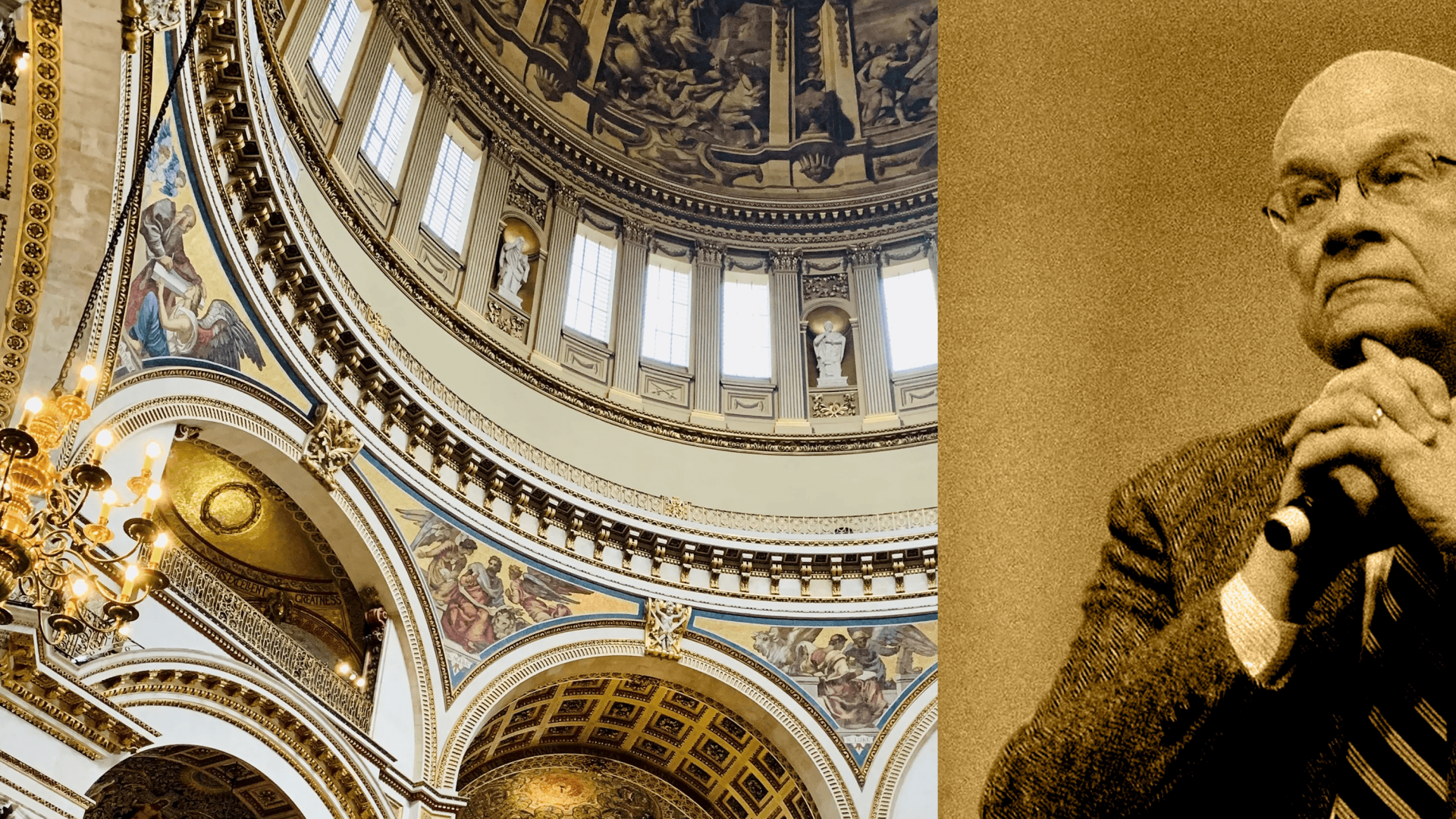
Illustration by Christianity Today / Source Images: Redeember City to City / Unsplash

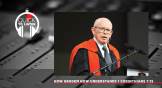
When Timothy Keller visited Rome in 2014, he addressed city pastors, gave an apologetic talk at the Italian Senate, and answered questions from students at Sapienza University of Rome, the largest university in Europe.

As a pastor who had planted a church next to Sapienza, I was struck by seeing Keller minister in my own context. On that campus, my wife and I had distributed flyers, held picnics, engaged students, and helped some of them pray for the first time. Two years before, a crowd of students gathered in the university’s central lawn for a debate on the existence of God, in which I tried my best to interact with an atheist professor and commend the Christian faith.

As Keller held an extensive Q and A session, responding to the toughest questions posed by the students, I admired the thoughtfulness of his answers. Then I was struck by his servant posture. Keller had rolled up his sleeves, served alongside local workers, and happily accepted questions from young, secular Italians.

That moment encapsulated the capacious, humble spirit that had gained the respect of many European Christian leaders. In Keller, they found theological robustness in an age of pragmatism and technique, a reconciling spirit in an age of division, and a rediscovery of the gospel in a time when preachers are tempted to reduce it to inspiring stories and practical advice.

“He was the premier North American evangelical statesman of his generation,” said Lindsay Brown, the former secretary-general of the International Fellowship of Evangelical Students. Keller’s death brought to his mind words spoken at John Stott’s funeral: In 2011, the theologian Chris Wright paid tribute to Stott by describing Stott “as the greatest in the West and the humblest.”

“I’d say the same about Tim Keller,” Brown said. “He exemplified the spirit of partnership. He was a man of conviction in terms of biblical truth, but it was graciously and compassionately applied.”

Attentive Europeans could see the layers of European Christianity that had shaped Keller, from the Reformers and Puritans to the poignant preaching of George Whitefield, the evangelical spirituality of John Newton, the Dutch theology of Herman Bavinck and Abraham Kuyper, and mid-20th century Oxford writers such as C. S. Lewis and J. R. R. Tolkien.

When Keller felt daunted by the challenge of planting a church in New York in the 1980s, he drew inspiration from the previous generation of London pastors who demonstrated that center-city churches fed on expository preaching could reach urban professionals.

John Stott’s All Souls, Martyn Lloyd-Jones’ Westminster Chapel, and Dick Lucas’ St. Helen’s Bishopsgate inspired Keller much like how Redeemer Presbyterian Church would help Europeans feel hope that their own cities could be reached by the gospel one generation later.

For Pangiotis Kantartzis, pastor of First Greek Evangelical Church in Athens, Greece, missional church planting was a new concept. “I had never seen in my life and ministry a new church grow out of intention and not out of division or out of convenience,” he said. He confessed to becoming anxious about the idea of growing a gospel movement that planted multiple churches, created an ecosystem that trained leaders, and served the needs of the Greek capital and the influx of immigrants.

Since then, First Greek Evangelical has helped birth churches for Greek professionals, Iranian immigrants, and the youth activists that populate Exarcheia, Athens’s anarchist-leaning neighborhood.

“Seeing what God was doing in New York and the analysis of it through the various papers Keller wrote played a decisive role in inspiring and shaping me in how I develop a vision for a gospel movement in the city,” said Kantartzis.

For Tiago Cavaco, a Baptist pastor and punk-rock singer in Lisbon, Keller’s vision and writings helped develop his approach toward cultural engagement. At that point, Cavaco was already hosting events and dialogues with non-Christian thinkers. “When I started following Keller, I realized he had a much more mature and experienced approach that, although happening in New York, could apply to us in Portugal.”

Cavaco emphasized Keller’s listening posture as the key to engaging Europeans. “Keller was a rare example of a [successful] American preacher available to our common Christian European experiences of frustration, [who] was completely receptive to what being a Christian meant in a different place than his,” he said. “Zero patronizing, full attention.”

Keller encouraged fellow Americans to adopt the same posture and learn from the global church, even secularizing Europe and its numerically smaller Church. In Movements of the Gospel, a 2018 volume of essays by European church planters, he stated, “We must watch the European church and learn from its successes and failures because our own cultures are shaped by the same secularism and materialism more and more.”

“Keller believed that we Europeans are ‘on the frontline’ of a new, much more secular and multireligious era. That is not only a realistic perspective but also a very encouraging one,” said Tim Vreugdenhil, an Amsterdam pastor who pioneered a method of interactive evangelism to reach the city’s secular professionals.

“He helped me to believe that our generation of theologians and church planters are not ‘the last men and women standing’ but the pioneers of a different sort of Christianity: much smaller in size and numbers but, God willing, more influential in gospel preaching.”

Keller’s experience and humility drew European leaders to learn from him at conferences organized by City to City, the organization Keller founded to equip the next generation of churches in the world’s global cities. He seemed equally at home in a Paris cathedral or Krakow movie theater.

Several other European leaders also remembered Keller’s visits to the continent.

In a tribute to the man he referred to as “a global point of reference for the evangelical archipelago,” Leonardo de Chirico, pastor of Breccia di Roma church, reminded readers of Keller’s Italian heritage.

“When he came to Rome, among the noises of the city and the flavors he tasted, he confided that he felt a strange sensation: that of the rekindling of sounds and the reactivation of sensations that he had experienced as a child when he participated in the noisy and tasty ‘ritual’ of a Sunday lunch [with his] immigrant family,” de Chirico wrote.

Others felt like he helped them appreciate their own contexts more fully.

“Tim Keller taught me to love Dublin,” said Seán Mullan, a church planter in Dublin. “He knew the gospel lands differently in different cultures and respected that.”

For Xavier Memba, who helped plant Ciutat Nova church, Keller helped him look at his ministry in Barcelona in a different light.

“Training with Tim Keller offered me a new perspective on the church in the modern world, highlighting how it must adapt to its cultural and urban context without forgetting the gospel message,” he said.

Northern Europe leaders agreed.

“Many of us here in Norway are deeply grateful for the rich legacy of Tim Keller – a legacy that both engages and challenges us,” added Lars Dahle, an associate professor at NLA University College Kristiansand. “He was gospel-centered as a preacher, unifying as a leader, and strategic as a missionary.”

Keller’s passing on May 19 has been a deeply felt loss for many in Europe. His commanding role as an urban missiologist, evangelical theologian, and reference point for global church leaders is hardly replaceable. But the network of leaders shaped by Keller has learned that it takes many churches to reach a city and many voices to refract Jesus’s ever-fascinating gospel.

“Our teams running evangelistic actions and discipleship projects in over 100 cities have benefitted from Keller’s material,” said Luke Greenwood, the Europe director of Steiger, a missions organization that reaches European youth in creative ways. “Tim’s heart for the lost and [his] willingness to personally engage in the difficult conversations has been a source of solid teaching and theological framework for what we do.”

In recent years, Keller has sought to ensure that the work continued after his death, said Tim Coomar, a church planter in Athens and leader within City to City Europe.

“As we mourn the loss of Tim and wonder how we will continue moving forward, I think Tim prepared for his departure by ensuring that although no one person could do what he did, all of us together could develop further and deeper what he started.”

René Breuel is the founding pastor of Hopera Church in Rome and the author of The Paradox of Happiness.


Theology

Yes, You Can End an Abusive Marriage

How Christians can differentiate suffering in a destructive relationship from acting self-sacrificially in a godly partnership.

Christianity Today May 24, 2023
Illustration by Mallory Rentsch / Source Images: Unsplash / Getty

About a decade ago, I attended the funeral of a woman of faith that my family and I had known for decades. This longtime friend had passed away after battling cancer, and the farewell was painful. She was the kind of person whose departure meant the world had lost some of its tenderness.

At her funeral in our midwestern Brazil hometown, I heard people remark that “she got sick because of her sorrow” and that “now she would finally rest,” and I finally put together what I was too young to comprehend before: She had endured an abusive relationship until the day she died.

What made our friend stay in such a cold relationship and toxic situation? Her faith that her husband would one day change and her conviction that divorce could cause her to lose her salvation.

Devastatingly, she believed that it was God’s wish that she remain faithfully married, regardless of her husband’s abuse, and this stance was only reinforced by her pastors. They advised her to keep fasting, praying, and putting her all into her marriage—practices she kept until the day she passed away.

Requiring someone to submit to a violent marital burden is a slow, sadistic death sentence whose origins can be traced back to years of sinful abuse of power. Surely, our calling to die to ourselves every day extends into our personal relationships, because all of them entail a measure of self-sacrifice. But it’s a completely different thing to distort Scripture to the point of equating spiritual sacrifice with enduring spousal violence. There’s a crucial difference between these types of death: one is rooted in perfect love, while the other is rooted in destructive sin.

The marital burden

When justifying maintaining such a violent and deadly marital burden, I’ve heard many pastors and Christian leaders quote 1 Peter 3:1–2: “Wives, in the same way submit yourselves to your own husbands so that, if any of them do not believe the word, they may be won over without words by the behavior of their wives, when they see the purity and reverence of your lives.”

In these verses, Peter is addressing women who believe in God but are married to men who do not and explaining that they have an opportunity to be a witness of faith to their unbelieving husbands. At no point whatsoever is Peter telling women to submit to violent husbands, often Christian, so that they are “won over without words” by their wives’ behavior—an argument I have often heard.

On the contrary, the Bible condemns this violence, as Malachi 2:16 shows: “‘For I hate divorce,’ says the Lord, the God of Israel, ‘and him who covers his garment with violence,’ says the Lord of armies” (NASB). It is worth noting that in the same verse in which God says “I hate divorce,” the Lord also clearly says that he hates violence.

Therefore, a marriage grounded in submission to abusive behavior has nothing to do with godliness, nor is it based on the Word of God. It is not a bond of love but more like an arrow fastening a slain animal to a wall. When the predator fakes love through emotional appeals for forgiveness and promises of change, these gestures amount to little besides spraying perfume to conceal the putrefaction of his sins on the decomposing prey.

But how do you differentiate suffering in an abusive relationship from acting self-sacrificially in a godly marriage? In the latter, both spouses follow Jesus’ words to deny themselves and pick up their crosses. Each of them is denying his or her own urges and desires out of love for the other. Through this dying of their own separate flesh comes a new life, a resurrection embodied through this marriage.

Whose responsibility?

Despite Scripture’s message to the contrary, rarely have I seen church leaders hold perpetrators responsible for the state of the marriage. Some pastors hold that divorce is a tragedy to be avoided at all costs, as it is too great of a sin.

Church leaders may praise a woman who stays in an abusive marriage for acting as a “good wife” and persevering in a trying situation. Since Christians believe that God changes people, some think that the wife is responsible to change her husband and that her persistence will be attested later when he finally changes—which to them seems way more virtuous than “simply divorcing.”

Too often, Christians believe that the wife needs to view this situation as an opportunity to be full of virtue and that she’s being ungodly if she files for divorce. Blaming the woman for a divorce in cases of domestic violence shifts the guilt and implies that she is ultimately responsible for her husband’s actions. Giving wives the spiritual responsibility of masculine redemption is asking them to transform men’s worst into their best—in other words, to perform the work of Jesus. What’s more, this work often means that women bear the wounds of change.

The idea that a woman should bear this marital burden while enduring a violent household, as if this is an intrinsically feminine role, is not only immoral but also unbiblical. It collides with the ideal of marriage according to Paul in Ephesians 5:25–28, which places the man as a Christlike redeemer who gives his life for his bride. In this sense, many have inverted the biblical standards, where sacrificial love is primarily and specifically required of the man. The biblical marital covenant is a covenant not of predatory death but of resurrection, where the loving sacrifice is inspired by the sacrifice of Christ.

God can restore everyone, even a violent or adulterous man. But he should bear the consequences of his actions, and this restoration should not take place where he still has access to those he has harmed. Jesus already carried our wounds, and inner transformation is a work of the Holy Spirit. Thus no woman needs to compulsorily risk her life for the love of any human being’s soul, not even that of her own husband.

A welcome change

Earlier this year, CT reported on an American church whose leaders had advised domestic violence victims to stay in a marriage. The story was wrenching, but the reception to it revealed that many Christians now see these leaders’ actions as inappropriate and understand that even if this behavior was considered “normal” or acceptable in the past, it is wrong. Perhaps the question to ask now isn’t just “How did we get to this point?” but rather “How did we stay that way for so long?” or “How can we change this situation for good?” In 2019, amid an explosive discussion among evangelicals regarding confrontation of violence against women, the complementarian theologian Wayne Grudem shared with CT his reinterpretation of 1 Corinthians 7:15. After almost 40 years of ministry, Grudem shared a hermeneutical shift that allowed him to recognize violence and abuse as causes for divorce (in addition to adultery and desertion). As someone who has counseled domestic violence victims for years, I welcomed such significant change.

Advising women to stay married when they don’t know whether they will stay alive tomorrow will certainly not work to preserve the institution of marriage. Advising desperate women that there are biblical arguments for this kind of submission is perverting the Word to maintain a false and superficial marital image when the marriage covenant itself is already broken.

As CT’s editor in chief Russell Moore wrote last year, “If one spouse abandons the home, the Bible reveals, it is not the fault of the innocent party. And if a spouse makes the home a dangerous place for the other spouse (or their children), that is not the fault of the innocent party either. In those cases, divorce is not a sin but is, first of all, a recognition of what is already the case—that the one-flesh union covenant is dissolved—and the abused spouse should feel no condemnation at all in divorcing.”

My most fervent prayer is that women suffering spousal abuse may find comfort and support from their pastors and, whenever people fail them, that they may witness the Father’s protection. There is a God who sees them (Gen. 16), and he is not demanding that they continue in covenants of death. Rather, he came that they might have life and that they might have it to the full (John 10:10). God does not need a woman to die or be beaten as a sacrifice for a man’s life. Christ has already made the supreme and ultimate offering (Heb. 10:12–14).

Bruna Santini has worked in family law and advised domestic violence victims in Brazil and the United States, where she lives today with her family. She is currently pursuing her master’s in theological studies at the Reformed Theological Seminary in Atlanta.

Theology

O for a Thousand Tongues of Fire

The Spirit’s descent at Pentecost is a model for diverse and distributed leadership.

Christianity Today May 24, 2023
Illustration by Mallory Rentsch / Source Images: Getty / Unsplash

The modern church in the West has a suspicious relationship with power. When it serves our interests or protects our privilege, we justify evil in many forms—from denying racism to protecting sexual predators.

The problem is not new, nor is it distinctly Western, but modern projects like investigative journalism and social media have increasingly exposed it as our problem nonetheless. No denomination is blameless. No theological tribe or form of church governance is immune to corruption. Our track record of protecting the powerful makes us look like any other institution.

Along with hurting our witness in the world, the church’s perverse relationship with power has created a crisis among believers. In recent years, young Christians in particular have felt betrayed and disillusioned by their leaders’ loyalties to the status quo.

“When it comes to faith, [Gen Z Christians] are open to Jesus and his teachings but skeptical about institutions and leaders putting on a façade,” writes Liz Lykins, reporting on recent data from the Barna Group. Their desire for authentic relationships “stems from struggles with skepticism and hypocrisy in leadership.”

Even younger church leaders like me feel jaded and ambivalent. To us, “power” feels like an enemy to avoid—or at least to distrust.

The story of Pentecost is an antidote to our pessimism. It reminds us that the church’s original relationship to power was not for evil but for good. It was the reception of God’s gift for the sake of his mission. In his last promise to his disciples, Jesus said, “You will receive power when the Holy Spirit comes on you; and you will be my witnesses in Jerusalem, and in all Judea and Samaria, and to the ends of the earth” (Acts 1:8).

Pentecost reframes power for a fearful church by recalling God’s purpose for those who receive his gift. We get a sense of that intent from who was in the upper room when the Spirit first fell and who benefited from the multilingual praise that came after. It must have been a diverse enough group to remind Peter of Joel’s prophecy, which he quotes in his sermon:

In the last days, God says, I will pour out my Spirit on all people. Your sons and daughters will prophesy, your young men will see visions, your old men will dream dreams. Even on my servants, both men and women, I will pour out my Spirit in those days, and they will prophesy. (Acts 2:17–18)

At Pentecost, the same power was given to both young and old, male and female, rich and poor. The Spirit’s outpouring was not a singular or merely sentimental experience. It revolutionized the church’s understanding of leadership. Immediately following Pentecost, early Christians embraced models of shared authority that were ethnically and socioeconomically diverse (Acts 6:3–5; 13:1; Romans 16:1–12).

The Spirit’s descent on all believers doesn’t eliminate hierarchy, of course, but it does disrupt homogeneity.

It also empowers a greater number of people. Christian leaders often operate with a scarcity mentality, fearful that others—especially those who are different—will take away limited resources and opportunities. But God’s generosity at Pentecost suggests they have nothing to fear.

Another striking aspect of the Spirit’s power is what it produces in people.

On Pentecost, those who experienced the Spirit’s indwelling spoke in “other tongues” (Acts 2:4). These early believers presumably didn’t understand the words they were speaking and didn’t appear normal to the mocking crowd (2:13). They went on to act in other strange, seemingly foolish ways, like selling their possessions to live in common with others (2:44–45), following the Spirit into the desert (8:26), getting thrown in jail (12:4–5), and being martyred (7:54–60).

In other words, the Spirit made them less powerful in the world’s eyes, not more. Their efforts to witness brought them persecution and death, not political and social prominence. They followed the example of Christ, who charged his disciples to seek greatness by becoming servants, “just as the Son of Man did not come to be served, but to serve, and to give his life as a ransom for many” (Matt. 20:26–28).

“When we take on the mindset of Christ,” writes Dominique Dubois Gilliard, “we do nothing out of selfish ambition or conceit and refrain from exploiting our status and positions for selfish gain. We also, in humility, empty ourselves for the sake of the kingdom and our neighbors.”

True power is subversive because it’s self-effacing and God-glorifying. The earliest believers preached Christ, whether that elevated them in the public eye or landed them in prison. The same goes for the church today. God resources us for the advancement of his kingdom, not our own kingdoms. If we can learn to embrace that vision, we don’t need to fear or resent power. Instead, we can rediscover it as a gift offered in service of love.

Some of us are called to glorify God from positions of worldly privilege, while others minister from positions of perceived weakness and insignificance. But all of us are called to walk in step with the Spirit, who was given so that our lives might bear witness to Christ.

“How easy it is for us to forget that all power is derivative,” writes Diane Langberg in In Our Lives First: Meditations for Counselors. “Any of us who exercise power in positions of leadership exercise delegated authority. … Any power we have is to be used on God's behalf, never our own, for the fulfillment of His purposes in the service of others. Any power exercised outside of obedience to God is not neutral or harmless but utterly destructive.”

In a world concerned with protecting endowments, Twitter followings, and political campaigns, Pentecost remains prophetic. Our birthright is to steward a power we were never meant to use for our own advancement. We have the privilege of renouncing what Paul calls “disgraceful, underhanded ways” in our ministry—whatever the cost—knowing that the all-surpassing power “belongs to God and not to us” (2 Cor. 4:2, 7, ESV).

The church was born for this witness.

Hannah King is a priest and writer serving at Village Church Anglican in Greenville, South Carolina.

Theology

They Sang ‘a Heavenly Song’ in a Dark Chinese Jail

Two Chinese Christian women ministered to their cellmates and prison guards with stories, prayers, and hymns.

Christianity Today May 24, 2023
Illustration by Mallory Rentsch / Source Images: Unsplash

“About midnight Paul and Silas were praying and singing hymns to God, and the prisoners were all listening to them” (Acts 16:25). This happened in a jail cell in Macedonia about 2,000 years ago.

Many years later in a jail cell in northern China, two Christian friends, Yang Xiaohui and Chen Shang (both are pseudonyms for security reasons) sang their own worship songs from prison. In a place of despair, their words to heaven rang out in the darkness.

“We started singing. Then everyone was singing,” said Xiaohui. “They said, ‘Such a good song with such beautiful music and lyrics. Sing for us again!’”

Xiaohui first learned about Jesus by singing. At home, her husband taught her Christian songs. At church, she sang with the kids.

Late in the summer of 2022, police seized Xiaohui from her home. Only eight months after her husband went to jail for his faith, authorities apprehended Xiaohui while she cooked dinner for her family in the kitchen. She was accused of “illegal gathering for religious activities.”

Several hours after she was first detained, the police threw Xiaohui into a cell with eight or nine others in the middle of the night. Xiaohui was nervous. But she believed God put her in this place to share his light.

“I forced myself to preach the gospel and to exalt God,” she said.

Xiaohui and the others in her cell swapped stories of how they ended up in jail. People from all walks of life end up in Chinese prison. Xiaohui met women in jail for fighting, prostitution, theft, gambling, protesting a broken contract, and violating immigration laws.

Xiaohui tried to explain to these women that she had been put in jail for gathering with other Christians. Though the government had banned her church, the congregation had continued to gather.

But her cellmates could not make sense of her story. To them, Xiaohui looked like a law-abiding citizen, yet the police claimed she was a danger to society because she joins others to worship God—which is against some government regulations of religion. Even the police officers sent to interrogate her seemed a little baffled. Knowing little about Christian faith and persecution of Christians in China, Xiaohui’s cellmates made fun of her for being jailed for a silly reason.

Xiaohui did not take offense to their mocking. When guards told the prisoners they had to clean their cell each day, the other cellmates refused. Xiaohui wiped the bathrooms, scrubbed the floors, meticulously folded all the blankets, and cleaned.

“I could sense that although they were laughing at my arrest, in fact, they secretly respected me. I took the task as a grace from God,” she said.

At night, the women took turns standing two-hour shifts while the others slept, a form of discipline tactic mimicking military practice. The rules were strict: no looking sideways, no moving, just standing motionless and silently staring at their cellmates. Guards watched them closely on the video monitor. If they moved slightly, the guards would screech through the monitors and wake the whole cell: “Stop moving. Stand straight!”

Early on in her time in jail, Xiaohui fainted during one of her night shifts. When she woke, the officer said Xiaohui could get someone else to finish in her place. But to spare the other prisoners from the deprivation of rest, she finished on her own. The next day, the other women couldn’t understand why she had sacrificed herself to allow them to rest. Xiaohui realized something had shifted in the atmosphere, and her cellmates began to look at her differently.

Jail began to take a toll on Xiaohui. Her body ached from consecutive poor nights of sleep. Though it was the summer, by night, the air grew cold and the building had little heat or insulation. Guards had cut the side of her dress, and her only outer layer was a vest, which didn’t keep her warm. She struggled to stay awake during her overnight shifts. Then guards began to transfer her from cell to cell for reasons she did not know.

The daylight hours were tedious. The prisoners sat for hours on stools, not allowed to chat or walk around.

“We were all terribly bored,” she said. “When people are bored, they love stories. … They would come to me and say, ‘Tell us some stories.’ So I told them stories about Jesus.”

As Xiaohui moved from cell to cell, she told her new roommates about Jesus and his sacrificial love. She told so many prisoners about Jesus that a police officer reprimanded her. After he interrogated her about gathering to worship with her house church, he said,You can’t gather here in the detention center either.”

“I was a bit startled hearing that.” Xiaohui said. “Did he see me sharing the gospel through the security camera? But I thought, ‘You were the ones who put me in here. You were the ones who locked 12 people up in a 20-square-meter space, not me.’”

Xiaohui didn’t just share stories about Jesus. Each night, as she stood guard, she prayed for her cellmates and their families, asking God to meet the needs she had heard about in conversations with the other women.

After about a week, Xiaohui was transferred to Cell Number One, where the jail held its best-behaved prisoners. There she found a familiar face: her friend Shang.

Shang had been seized the day after Xiaohui while eating lunch. Her husband had also been imprisoned for his faith. Just as with Xiaohui, police were trying to keep Chen Shang from attending the court debate during her husband’s trial. Shang’s health had remained strong during her time in the detention center, and she nursed her now gravely sick friend back to health.

Although Cell Number One was ostensibly the best place for those being held to be, officers still cursed and screamed at the prisoners most of the day.

“It was as if the officers could not say anything beyond curse words,” said Xiahui. “The prisoners in the jail were like that, too. They were scared of the officers, but they screamed at each other.”

Despite her own traumatic experience, Xiaohui also began to worry about the officers. She fretted over their personal lives. Perhaps, out of habit, they returned home and yelled at their children? Maybe their anger would make them physically ill?

“I was moved to think about the officers in my heart all the time, so I also prayed for them,” she said.

And just like it had been with her mocking cellmates, something changed.

“I didn’t know if it was because I prayed, but I saw the harshest officer actually smile while talking to me,” she said.

Later, he gave her water and offered to let her sit instead of stand during her guard shift while she was sick. Other officers gave her medicine.

During her time in the detention center, Xiaohui realized in a fresh way that God was real and was with her.

The Bible tells believers to “overcome evil with good” (Romans 12:21). and that “the light shines in the darkness, and the darkness has not overcome it” (John 1:5). While in jail, these verses became more than words on a page. Although it seemed Xiaohui was helpless, in reality, the others in the detention center did not have the power of light that she possessed.

“Having been Christians for years, we may forget about the kind of hopelessness and despair one can experience without God,” she said.

But for Xiaohui, there was no shame in that shameful place. Her spirit was unshackled: “I learned to deal with hardship one day at a time. I was not overwhelmed by the circumstances or physical illnesses. Even when I was locked up in a jail cell, my soul was still free.”

Unlike in the other cells, in Cell Number One, the officers encouraged the women to chat with one another. In this cell, Shang and Xiaohui sang Sing a Heavenly Song, a Chinese hymn loved by many house churches. In English, the song translates:

River of life, river of joy

Slowly flows into my heart

I want to sing the song

Sing the heavenly song

The darkened clouds over my head

The saddened tears of my heart will all be gone.

At first, just the two Christians sang. But before long, everyone joined in. In the darkness of prison, a river of life and joy flowed in and through Xiaohui’s heart.

“There were times when your bottom hurt from sitting, when your legs swelled from standing, when you had no energy to work but had to anyways, when you felt tired after you finished praying for people, when you tried to avoid the mosquitos and couldn’t, when it was too hot because there was no air conditioner or fan, and when you had a hard time listening to all the cussing…and yet, I really experienced the miracle that with the Lord, a thousand years is as one day,” said Xiaohui. “Indeed, 15 days was but just a blink of an eye.”

This is an excerpt from The House Church in China, a new podcast telling true stories of today’s persecuted churches in China.

E. F. Gregory is the editor for China Partnership’s blog and the writer for The House Church in China podcast. She and her family live in the San Gabriel Valley outside of Los Angeles.

Church Life

She Was Born into Slavery. She Became a Missionary to Africa at 56.

How an American school teacher spread God’s love in King Leopold’s Congo.

Maria Fearing

Maria Fearing

Christianity Today May 23, 2023
Illustration by Mallory Rentsch / Source Images: WikiMedia Commons

At the turn of the 20th century, the Congo Free State was one of the hardest places to be a human. For several decades, Belgian soldiers and business owners brutalized thousands of Congolese locals. They pursued rubber profits at whatever cost, taking the lives of men, women, and children who were forced to serve the whims of King Leopold.

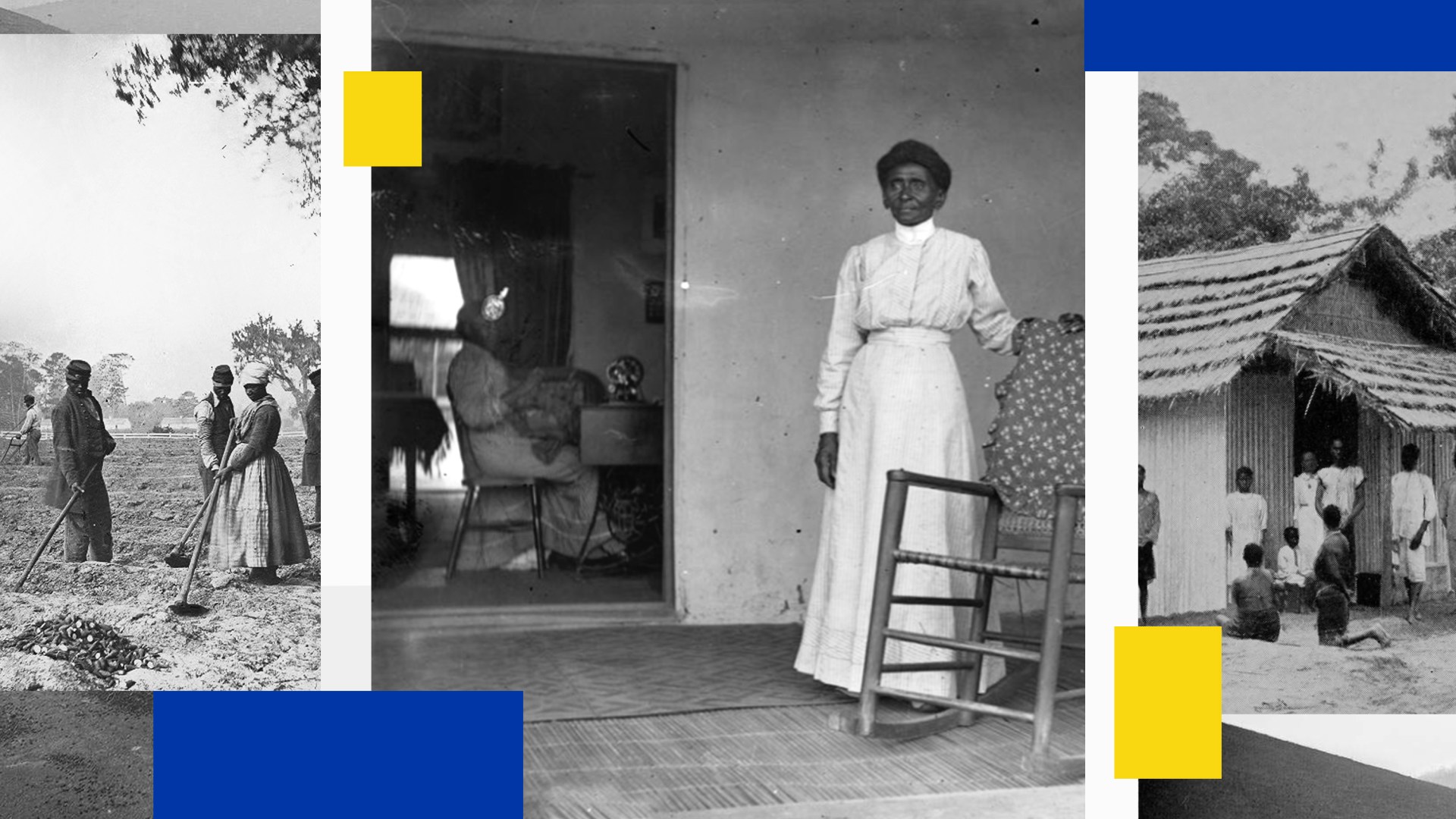
During this time, an American missionary, Maria Fearing, ran Pantops Home for Girls, one of the region’s few places of sanctuary. Using her own salary and donations from her supporters, Fearing created a place in Luebo, Congo, where several dozen girls received a comprehensive education and heard about Christianity for the first time. Fearing’s students nicknamed her Mama wa Mputu (“mother from far away”) to show their love and appreciation.

As a young child growing up enslaved on an Alabama plantation, Fearing had no idea that the God who created her would liberate her from physical and spiritual slavery, or that she would one day travel across seas to the shores of Africa, carrying that message of freedom and new life to those who lived on the same continent as her ancestors.

The “homeland”

In 1836, Mary Fearing gave birth to a baby girl that she and her husband Jesse named Maria (Ma-rye-ah). The Fearing’s lived outside of Gainesville, Alabama, and their daughter arrived just shy of thirty years before legal emancipation and the obliteration of the chattel slave system. Historians know little of Maria’s childhood and her family life while she was enslaved, but it’s believed that she had faith in Christ at an early age, as Four Presbyterian Pioneers in Congo and Maria Fearing, A Mother to African Girls both note.

Her family shared Scripture, Bible stories, and the character of God with her, while the Winston family who claimed ownership over them taught her Presbyterian catechism. From both sides, she heard tales of missionaries in Africa. These stories of “mission work” in a “homeland” she had never known, nevertheless impressed her with a burden she would never be able to shake.

“I will go to Africa someday if I can,” she prayed.

After her legal emancipation in 1865, Fearing studied at the Freedman’s Bureau School in Talladega while supporting herself as a seamstress. Newly-freed people made education a high priority and teacher-training schools popped up across the south to satisfy the hunger for education. Many of these schools later became what we today know as historically black colleges and universities, or HBCUs, which for years provided education for those whom predominately white institutions denied.

After completing her education, Fearing became a teacher. As an older, hard-working single woman committed to Christ, she became a valuable and industrious citizen who made vital contributions to the community and the local church.

Fearing was promoted to assistant matron of the boarding department of Talladega College. She paid a student’s tuition through the college. She even purchased her own home in Anniston, Alabama.

Yet the stories she had heard about Africa continued to pull at her heart. As a woman of deep faith, she probably prayed often for God to make sense of this burden she felt for a place she had never seen.

Maria Fearing (Left) Freedman's School established by the American Missionary Association to educate newly freed slaves (Right) Mallory Rentsch / Sources: WikiMedia Commons
Maria Fearing (Left) Freedman’s School established by the American Missionary Association to educate newly freed slaves (Right)

One day at work, Fearing heard a presentation from a group of missionaries living out their faith among the indigenous people of the Free State of Congo.

Presbyterian missionaries William and Lucy Sheppard, the first African American-led mission team sent from America, had an announcement: They were searching for volunteers to join their work in the Congo.

Fearing believed Sheppard’s invitation was the answer to her lifelong prayer. It didn’t matter that the mission board questioned her age– 56– and her ability to handle Central Africa’s tropical climate. She sold her home and belongings, bade farewell to her beloved students, and set off to the African continent.

She and the Sheppard team, which included Alonzo and Althea Edmiston and other African American missionaries, traveled from New York to West Africa by steamer, then sailed 1,200 miles up the River Congo for two months before arriving at the Luebo mission station.

Another unconventional journey

Fearing’s team leader, William Sheppard, was born free in 1865 in Virginia. His father, also free, worked as a janitor in an all-white Presbyterian church and used his salary to send William to the Hampton Institute, another prominent HBCU, where Booker T. Washington was one of William’s instructors. After graduating in 1883, he attended the Tuscaloosa Theological Seminary (now Stillman College) to become a pastor.

Sheppard was ordained a minister in the Presbyterian Church in the United States (PCUS) (originally the Presbyterian Church in the Confederate States of America and the granddaddy of the Presbyterian Church in America). While serving as the pastor of Zion Presbyterian Church in Atlanta, he felt a growing burden to serve in Africa.

After pastors who were still entrenched in Confederate ideology repeatedly denied his applications to mission work, he traveled to the PCUS headquarters to confront the mission board face to face. They finally accepted his proposal to go to the Congo as a foreign missionary, but under one condition: A white missionary must supervise him.

Sheppard countered that he would only take along someone white as a co-laborer and brother in Christ, not as a supervisor. A young white minister named Samuel Lapsley volunteered to go on these biblical terms. The two sailed to the Congo in 1890, defying the mission board and treating each other as equals. When Lapsley died of a fever after only two years on the field, it was a deep loss for Sheppard, who counted him as a friend and brother.

Nevertheless, Sheppard stayed the course. He married his wife Lucy and together they learned the native language of the Bakuba people of Congo.

Life under Leopold

Fearing knew she was entering a volatile situation in the Congo. The territory had just seen a bloody war in 1893, when Belgian Colonial ruler King Leopold II’s forces clashed with Arab traders who also wanted access to the area’s natural resources.

William Henry Sheppard (Left) Sheppard with a banjo, singing to native children (Right)Mallory Rentsch / Sources: WikiMedia Commons
William Henry Sheppard (Left) Sheppard with a banjo, singing to native children (Right)

In 1885, the European partition of Africa gave the Congo to Leopold. His eventual victory over Arab forces gave him total control over the Sheppard team’s destination: the Congo Free State.

Leopold presented himself as eager to bring the benefits of Christianity and Western civilization to his new territory, but it was a ruse that exploited both the gospel and the people. Instead of benefitting the Congolese, he brutalized them, using them as forced labor to supply the global demands for rubber and ivory.

By the time his reign of terror in the region ended in 1908, death toll estimates rose as high as 10 million people.

Sheppard team achieved worldwide fame when they helped expose the dictator’s human rights abuses to the international press, as William E. Phipps’s William Sheppard: Congo's African American Livingstone and Pagan Kennedy’s Black Livingstone: A True Tale of Adventure in the Nineteenth-Century Congo recount.

When the Sheppard’s were recalled to the States due to indiscretion on William’s part, Fearing and the Edmistons remained in the Congo and doubled down on their ministry. Fearing helped Althea create and publish a dictionary and grammar for the local language, and translate portions of the Bible into the Bakuba language.

The spiritual mother

Though Fearing never had biological children, her experiences in the Congo watered a heart that blossomed into spiritual motherhood. In 1901, she wrote in the local Kassai Herald Journal that her Luebo neighbors “took great pride in telling us about their parents,” and were eager to share about their lives.

She tells of hearing the cries of a newborn whose very young mother was trying to feed the four-day-old infant large amounts of kwanga, or bread. “I felt sorry for the little creature,” Fearing wrote, with deep empathy for both baby and mom.

These maternal seeds came to full flower when Fearing asked local families to allow their daughters to board at her home to protect them from Leopold’s forces. She promised to educate and encourage them to live for Christ. As word got out about Fearing’s efforts, more and more families sent their young girls to live at the mission.

Fearing also paid the ransoms of kidnapped children, enslaved children, and children trapped in the rubber and ivory trades. She purchased their freedom through goods like scissors, cloth, salt, and other items, and soon she was housing more than 40 young women. Through her own money and donations from her supporters, Fearing constructed a multi-room house, where she established a community where the girls took care of one another and attended a missionary day school to learn how to read and write.

For more than 20 years, Fearing worked tirelessly among the children of the Congo. When she turned 78—teeth all gone and eyesight failing—her denomination gently encouraged her to retire. She returned to the United States to the sight of loved ones greeting her at the New York harbor and in her Alabama hometown. The many years apart had not dulled their affection or admiration, and though she deeply missed life in Luebo, witnesses said the joy of reunion was palpable.

In 1918, the Southern Presbyterian Church honored Fearing in the Alabama Women’s Hall of Fame. Though she longed to return to the Congo and be buried there, she contented herself with teaching at her church school in Selma.

In 1937, at 99 years old, Christ called Mama wa Mputu home. Surrounded by her loving nieces and nephews, she rested from her labors with her name and story finally fulfilled in the greatest genealogical list of all: the Lamb’s Book of Life.

Her dearest friend and teammate Althea Edmiston, who was still serving in the Congo, heard reports that Fearing’s life was in twilight and wrote these words of comfort for their community at home and abroad:

Fully realizing that the end of life is fast approaching, and with that same childlike faith, Miss Fearing is patiently awaiting, calm and fearless, the welcome call of her Lord, and is ever listening to hear the whir and hum of the “Sweet Chariot,” accompanied by a band of angels, singing low, coming for to carry her home.

Epilogue

There’s a common notion that African Americans have been absent from global mission efforts. In reality, there are many people such as Maria Fearing and the Edmistons who dot mission history. Their stories show that African American presence in mission is hardly a new stream, but rather a rich, ongoing flow into which we may step boldly, whether our own mission efforts are local or global. Imperfect yet faithful, they teach us that America’s minorities have richly contributed to the expansion of God’s kingdom. K.A. Ellis is the director of the Center for the Study of the Bible & Ethnicity at Reformed Theological Seminary in Atlanta and author of Maria Fearing: The Girl Who Dreamed of Distant Lands. She holds master’s degrees from Yale University and Westminster Theological Seminary and is an advocate for the global persecuted church.

Theology

Our Loved Ones Don’t Become Angels When They Die

Despite what Chinese religions and pop culture might suggest, they stay human—and that’s a good thing.

Christianity Today May 23, 2023
Ellie O / Unsplash

On May 14, 2023, Taiwanese media reported on the first TV appearance of the famous singer couple Yu Tian and Li Yaping since their daughter died of cancer. In the TV program, the couple talked about their mourning and love for their daughter, and the audience was much moved when Li said, “My daughter has gone to heaven. … She has finally become an angel.”

It is not uncommon for people in Taiwan to believe their loved ones become angels (or some other forms of beings higher than humans) when they die. Personally, I have not only heard children say that about their grandparents who passed away but have also seen many internet discussions about “Do we become angels when we die?” Every year during the Qingming tomb sweepings, many people—including Christians—stand in front of the tombstones, telling their deceased loved ones about their life events and praying for blessings. The idea is even taught or implied by some pastors in Taiwan, especially at Christian memorial services.

Influence from pop culture and Chinese religions

But is the belief in our becoming angels after dying consistent with the Bible and orthodox Christian beliefs?

To people in Taiwan, Christianity is a foreign religion. According to a survey published in 2019 by the Academia Sinica of Taiwan’s Institute of Sociology, only 5.5% of the Taiwanese population are Protestant and 1.3 percent are Catholic, with the majority of the population following traditional folk religions (49.3%), Buddhism (14%), Taoism (12.4%), or no religion (13.2%). The majority of Taiwanese still understand Christianity through the popular culture of European and American films, television programs, plays, novels, and picture books. Thus, many Taiwanese—Christians and non-Christians alike—believe that good people will go to heaven and become angels after death because that is the impression they get from such (post-Christian) pop-cultural influences.

In addition, the belief about becoming angels after death stems from the influence of traditional Chinese culture. Chinese Buddhism, Taoism, Confucianism, and traditional folk religions all believe that “devout” believers become higher beings than humans after they die and can bless future generations. Therefore, Chinese religious logic reasonably deduces that devout Christians will become “angels” (which, for them, is the Western name for sanctified higher beings).

Confucian religion emphasizes joining heaven and earth to promote all things to thrive in harmony. This is done through cultivating one’s inner heart and inner nature, starting as a normal person, then becoming a gentleman, a wise man, and finally an eternal sage, teaching and transforming all things.

The Buddhist view of the universe centers on the Six Paths. One ascends level by level through spiritual discipline, going from human to asura to deva and finally liberated from reincarnation, entering nirvana as an eternal buddha and working to deliver all people.

Taoism seeks immortality through practicing Qi, finally becoming one with the Way and flying away as an immortal to bless all people. And traditional folk religion believes that after death one becomes a spirit to watch over one’s descendants.

Under the guidance of such religious views, the goal of spiritual discipline becomes that of striving to ascend and become sages, buddhas, or immortals.

Unbiblical superstition

However, the Bible contains no teaching of humans becoming angels or higher beings. Humans are humans, angels are angels, and the two are completely different created beings.

Genesis 1:1 says, “In the beginning God created the heavens and the earth.” The Hebrew words, הַשָּׁמַיִם for “the heavens” and הָאָרֶץ for “the earth” show that God created two worlds. The first is a supernatural world invisible to the human eye (commonly known as the spiritual world): the “heavens” (plural in many English versions, although that is not observable in Chinese translations). The other is the world visible to the human eye, the world in which humans live: this “earth.”

Psalm 115:16 makes this idea of the difference between heavens and earth even clearer: “The highest heavens belong to the Lord, but the earth he has given to mankind.” The concept of the heavens is also found in 2 Corinthians 12:2, where Paul refers to himself as being caught up to the third heaven, implying that there are “heavens” invisible to the human eye—the supernatural world.

And the climax of creation on “the earth” was humans. Humans were created in God’s image (צֶלֶם) and likeness. The word צֶלֶם can also refer to the setting up of royal images. Humans are the most honored and glorious created beings that God has set up on this earth, and they are God’s representatives in the created world.

Humans work for six days, reflecting how God created the heavens and earth, and all created things can see God’s wisdom and power continued through human work. Human work is a God-glorifying act, and humans are God’s representatives in governing this earth. After six days of work comes one day of rest, in which no work is done. On that day, humans are to wholeheartedly remember and honor God, knowing that the world runs because of the Lord, not because of humankind. On that day, humans look back on the work of their hands and thank, praise, and glorify the Creator God for his wisdom, creativity, and brilliance reflected in these achievements.

Other biblical passages show comparisons between human beings and angels. In Psalm 8:4–8, upon looking at the heavens God has made and at the moon and the stars he has set up, the psalmist says, “What is mankind that you are mindful of them, human beings that you care for them? You have made them a little lower than the angels and crowned them with glory and honor. You made them rulers over the works of your hands; you put everything under their feet: all flocks and herds, and the animals of the wild, the birds in the sky, and the fish in the sea, all that swim the paths of the seas.”

Some Christians believe this passage implies that humankind is a lower creation than angels. However, an increasing number of biblical scholars feel that in this passage “angel” is a poor translation of the Hebrew word אֱלֹהִים. It is usually translated as “God,” and other words such as מַל ְאָךְ are used for “angels.” Newer Chinese Bibles, including the Revised Chinese Union Version (RCUV) and Today’s Chinese Version (TCV), translate this verse as “You have made them a little lower than God” because it echoes Genesis 1.

The psalmist praises God’s creation and praises God for sending humans to represent him and govern all he has created. How are humans given such a special honor?

Put simply, God created two worlds. Angels, cherubim, and the four living creatures are the created beings of the heavenly world, whereas the sky, the waters, the land, the sun and moon, animals and plants, and humans are the created beings of this earthly world.

Humans and angels are completely different created beings. When this earth passes away and the new heaven and new earth arrive, humans will not turn into angels. Those who believe in Jesus have already become new creations in Jesus. Humans are humans. Angels are angels.

In fact, in the Bible, humans may be given more important status than angels. Angels were not made in the image and likeness of God. Furthermore, when angels fell, Jesus the Son did not become flesh and die on the cross for their salvation.

Implications for spiritual discipline

Our understanding of what beings we become after we die affects our view of spiritual discipline. The purpose of spiritual discipline in Confucian religion is to become a sage, in Buddhism to become a buddha, in Taoism to become an immortal, and in traditional folk religion to become a spirit. Under the influence of religious views on becoming a sage, a buddha, an immortal, or a spirit, many Christians in Taiwan assume that the purpose of spiritual discipline in Christianity is to strive upward: to become an “angel” and perhaps ultimately a god.

Most Christians understand spiritual discipline to generally involve reading the Bible, singing hymns, and praying. But some bring their understanding of becoming a sage, a buddha, an immortal, or a spirit into their practice of spiritual discipline, incorporating practices from various world religions—a form of syncretism.

The Bible doesn’t indicate that spiritual discipline is for the purpose of striving to “become a higher level of created being.” In fact, the Bible emphasizes many times that humans are created beings filled with God’s glory. Reading the Bible, singing hymns, and praying are all for the purpose of learning more about the Father, the Son, and the Holy Spirit; of understanding the vastness of God’s grace in our lives; of reflecting him in all that we do; and of giving him all the glory.

If we had to state a purpose for Christian spiritual discipline, I would argue that it is to cultivate the fruit of the Spirit: love, joy, peace, forbearance, kindness, goodness, faithfulness, gentleness, and self-control (Gal. 5:22–23). The purpose of spiritual discipline is to strive for the new self to better understand love than the old self did, to love God and love our neighbors. That is what Jesus came for.

The Holy Spirit, our advocate, helps those who believe in Jesus so that the quality of their character gradually matures. We can be set free from sin’s bondage and reflect the righteousness and love of God, because we are created in God’s image and likeness.

We need not desire the Buddhahood or immortality because we know that no other creatures—not even the angels—are made in the image and likeness of God. Therefore, Christians can praise God for creating us as human beings. We do not have to believe that angels are higher beings than we are. We are lower than God alone. He has given us a crown of glory and honor and sent us to rule over the works of his hands. Jesus loved us and died on the cross to save us, not the angels.

Virginia Chen is a Bible professor at a seminary and chief editor at bible.fhl.net. She is studying for an Old Testament PhD at Taiwan Theological College and Seminary. She holds a master of theology in New Testament from Taiwan Theological College and Seminary and a master of divinity from China Lutheran Seminary.

Translation by Christine Emmert and Sean Cheng

Blessed Are the Meek Missionaries in Thailand

A Thai couple has spent the past 50 years teaching and practicing contextualized evangelism in their country.

Christianity Today May 23, 2023
Illustration by Mallory Rentsch / Source Images: Unsplash / Pexels

For the first nine years of Nantachai and Ubolwan Mejudhon’s university ministry in Bangkok in the ’70s, the couple approached Thai students and passersby with a yellow booklet, a friendly smile, and the question, “Have you heard of the Four Spiritual Laws?”

Following Cru’s evangelism strategy, they walked students through God’s love, their sin, Jesus’s death, and their need to receive Jesus. Some students would politely agree to accept Christ to get out of an uncomfortable conversation. Not surprisingly, many of the “converts” quickly lost faith in God.

The results of Western-style evangelism in Bangkok left the Mejudhons, who found Christ while studying abroad in the West, discouraged and with little fruit to show for their well-intentioned work.

Their challenges are common in the history of missions in Thailand. Even though the Southeast Asian country is a hotspot for missionaries due to its religious liberties, accessibility, and low cost of living, Christianity has been slow to spread in a country where Buddhists make up 93 percent of the population. After nearly 200 years of Protestant missions, only 1 percent of the country is Christian.

In the last installment of Engaging Buddhism, Sage, a Thai-Chinese Australia in Sydney, mentioned that “there’s something about the soil that has prevented the gospel from taking root in the way it has in other parts of the world.” In this installment, we ask: Is there a better way to reach the Thai people? The Mejudhons have spent the past 50 years seeking to answer that question. From their time working on Bangkok campuses and ministering in a rural town in northern Thailand, the Mejudhons have developed a contextualized form of evangelism that flows from Thai sensibilities: Approaching people with meekness.

After seeing their early attempts at evangelism fail, the Mejudhons began to focus on cultivating genuine friendships, speaking positively about Buddhism-infused Thai culture, and presenting the gospel in a way that shows Thais the benefits of the faith rather than confronting them. This allowed the gospel to permeate through their relationship, rather than trying to convince Thais to believe in Christ through apologetics and theological presentations.

Over time, 10 to 20 times more people ended up with a saving faith in Jesus, they said. For the past 23 years, the Mejudhons have been teaching their form of ministry through meekness to missionaries coming to Thailand. Through intensive seminars at their church, Muang Thai Church in Bangkok, Nantachai and Ubolwan (who are now 79 and 77 respectively) have trained 400 missionaries.

In Nantachai’s 1997 dissertation, he boiled down their philosophy: “A combination of Thai culture and biblical approach is more practical to the Thai than the current combination of Western culture and theological approach.”

From Buddhism to Christianity

The Mejudhons came from devout Buddhist backgrounds. Like most young Buddhist men on their path to adulthood, Bangkok-born Nantachai became a Buddhist monk at age 18 for three months. Ubolwan, who is from Chonburi in eastern Thailand, studied and later taught Buddhist philosophy at a university.

In 1970, the Thai government sent the two scholars abroad to study. Nantachai went to California to study engineering. Ubolwan, his fiancé at the time, went to New Zealand to study English and became a Christian there. During their long-distance relationship, the couple wrote a total of 700 letters discussing Buddhism and Christian theology as Nantachai tried to persuade her to return to Buddhism. (They later published some of these letters in a book.)

Finally, Nantachai decided he needed to do his own research before declaring there was no God. He walked two and a half miles to buy a Bible at a bookstore, which he read from cover to cover, studying it for 10 hours each day. The more he read, the more he felt the Bible was special. He fell in love with Jesus, started going to church, and committed his life to Christ after reading 1 Corinthians 13.

In 1972, Nantachai and Ubolwan began their ministry to university students in Bangkok. As they watched Western missionaries talk to Thai students about heaven and hell, they realized that the message didn’t translate well because Thais tend to value the present over the future. Religion in Thailand is felt, not rationalized, Nantachai said, and what resonated more was conveying how Christ was a “man for others” in that he can deliver people from their fears.

Nantachai and Ubolwan went abroad again to pursue their doctorates at Asbury Theological Seminary in the ’90s, both writing dissertations about the importance of meekness in missions in Thailand. A number of Christian groups in Thailand purchased their theses after it was published, and the positive responses they received led them to host seminars for missionaries in their church.

‘Blessed are the meek’

One way the Mejudhons seek to respect Thai culture in their evangelism is by engaging whole families rather than individuals. When a Thai becomes a Christian, it creates division in the family as parents view their acceptance of a different faith as a rejection of their Thai identity. This is often a great source of tension and isolation for new believers. So, when the Mejudhons first get to know their students, they begin forming a relationship with the parents as well. This way, the missionaries are not seen as “stealing” their family members.

The Mejudhons always instruct new Christians to ask their family for permission to accept Christ as their Savior and to be baptized. If the parents said no, they ask students to temporarily postpone their baptisms and obey their parents’ wishes. The Mejudhons would wait to see how the student’s demonstration of Christlikeness would influence the family. If the parents still refused to give permission after the waiting period, they would go ahead and baptize the child.

During the baptism, the church honors parents by inviting them to be a part of the ceremony by having them present a Bible to their children. They encourage parents to teach their children to be faithful to what they believe, even if their parents are Buddhists.

“Our attitude toward the family of those new converts will determine the response of the Buddhist family,” Nantachai said.

In the Western mind, the word “meekness” connotes weakness or a wavering spirit, but the Mejudhons use it to describe someone who is gentle, humble, considerate, and friendly. Jesus was meek and meekness is a fruit of the Spirit, Nantachai pointed out.

In order to reach Thais in a spirit of meekness, Western missionaries need to shift their mindsets and their methods. Rather than expecting to see large numbers of converts when they arrive in Thailand, Nantachai encourages them to understand missions as a long-term commitment to building genuine relationships with no strings attached. By living in Thai communities and forming friendships, foreign missionaries can slowly build up an understanding of how to present the gospel there.

“A number of missionaries have the idea that Christians have to count souls and report numbers of people saved to a church or organization as a way of evaluating their success,” Nantachai wrote in his dissertation. Yet, the question “how many members do you have in your church?” was never asked in the New Testament.

Buddhist beliefs as a stepping-stone to Christianity

To understand the worldview of the people they are ministering to, missionaries first need to understand Buddhism, say the Mejudhons.

Many missionaries studied the Thai language, but didn’t study Buddhism or Thai culture in an immersive manner, and consequently came off as aggressive when they skipped over relationship-building, focused on outcomes, and ignored the Thais’ value system, Nantachai said.

When sharing their faith, missionaries and Thai Christians should study, respect, and note Buddhism’s positive aspects and recognize that God loved Siddhartha Gautama, also known as the Buddha, Nantachai added. They should understand that certain aspects of Buddhism that are true are God’s truths, since God is the ultimate truth, and acknowledge that God loves every person because he created them.

With this mindset, missionaries “have more capacity…to listen to their wrong ideas in their belief systems, to empathize with their stubbornness in their own faith, and to have patience, kindness, and understanding, in searching for more understanding from them,” Nantachai argued in his dissertation.

Thais are concerned with religion’s practical outcomes. If Christianity helps and benefits them, they will be more interested in it, Nantachai said. While Buddhism focuses on human needs and actions, Christianity focuses on God’s purpose and provision. When calamities or crises occur, Buddhists are forced to look for help outside of themselves, sometimes going to the temple or finding other ways to cope.

This is an ideal time for Christians to gently introduce how God is a provider and brings hope, said Nantachai. Christianity offers something that Buddhism can’t: A personal relationship with a spiritual power, he noted.

“It is when people feel that they [can] no longer cope by themselves and they need help [from] outside that Christianity offers good news,” Nantachai wrote. “Christianity attracts people in trouble for it tells them that they can turn to God and depend on God's help.”

Planting seeds of the gospel in rural Thailand

After completing their dissertations, the Mejudhons moved to a small village in Roi Et province in northeastern Thailand to see how witnessing through meekness worked in a different context. For 14 years, they taught at a local school and invested in the lives of both their students and their families.

Teachers are highly regarded in Thai society, so their positions granted them access into the villagers’ lives. They developed friendships with students’ parents, visited their homes, helped them plant and harvest rice, and listened to their problems.

Because the Mejudhons had a good relationship with the school staff, they were able to share the gospel with the students. One hundred students became Christian during their years in Roi Et. Some of their families chose to follow Christ as well.

“Many of them became Christians not because I shared the gospel, but because we loved them, cared for them, and were concerned about their social welfare,” Nantachai said. “Your duty is not to ‘pull’ them to become a Christian, but rather to love them in a sincere way. And when the relationship is so strong, then you can share whatever you want to share, and they will listen to you, and they will become Christian.”

At the same time, they faced challenges in getting new believers to stay committed to their faith. “It’s easy for them to leave Christianity if they see Christianity isn’t giving them what they want or need,” Nantachai said. It seemed that the mindset of “easy to believe, easy to throw away” was true of both Buddhism and Christianity. To address this, Nantachai found it important for Thais to start hearing the gospel in elementary school age so God’s Word would be grounded in their hearts and minds.

The couple started a church in the town and left it in local hands when they moved in 2014. Today, they are in Ranong, a town in southern Thailand, where they are planting another church and teaching English in their home. Compared to the north, the locals find it more difficult to believe and accept Christ, but once they do, they continue to follow Jesus their entire lives. All six students in their first class in Ranong became Christians and are now studying in university.

One of their former students from Roi Et, Ex Moo Ko, who is ethnically Burmese but born in Thailand, recently became a Christian because of their witness. Currently a senior in high school, Ex Moo Ko has known Nantachai and Ubolwan since the third grade.

The Mejudhons are different from other teachers because they tried to understand her and the other students, Ex Moo Ko said.

“They listened well, and they are wonderful counselors,” she said. “They never criticized or scolded us. They tried to understand and adapted themselves to my friends and me.”

The couple never forced their faith on her, and because of their relationship, she wanted to listen to Nantachai preach on Sundays, Ex Moo Ko said.

“When he stopped teaching [at the school], we pleaded with him to continue the teaching because we benefit from putting the Word into practice,” she said.

Theology

The Birds and the Bees: How Over-Spiritualizing Sex Dismisses Creation

The current debates about sexuality are missing an ecological perspective.

Christianity Today May 23, 2023
WikiMedia Commons / Edits by Christianity Today

I first learned about sex in the barnyard. Milking goats taught me the hows and whys of reproductive hormones; flocks of chickens offered lessons in fertilized eggs; and when the cat gave birth under my grandmother’s bed, I learned how to identify the sex of kittens when I was just five years old. Given the shape of modern life, my experience is increasingly uncommon. And it shows in our conversations about sex. We don’t lack knowledge of our own urges so much as we lack an ecology in which to place them. As a result, we keep getting sex wrong. In evangelical circles, this increasingly means getting the relationship between material and immaterial realms wrong as well.

For example, much of the ongoing debate around Josh Butler’s A Beautiful Union stems from his often misguided attempt to “creationize sex.” While some argue his errors come from theology that inappropriately centers male sexuality, his first mistake might be centering human sexuality in the first place.

An ecological perspective puts things back in balance. It invites us to be quiet long enough to “hear the voice of the earth,” as theologian Katharine Dell puts it. It requires us to shift our focus away from ourselves, reframing our questions about sex within a set of larger questions about God’s work in the world. And it forces us to accept that our dialogue often stalls because we’re starting in the wrong place. To riff off Chesterton, how much larger would the world be if our sex lives could become smaller in it? An ecological perspective also helps us avoid over-spiritualizing sex in order to make sense of it—a move that Butler makes in rather unfortunate ways. After all, if we lack understanding of our relationship to creation, the only categories we have left are esoteric and metaphysical ones.

Given how often we appeal to nature in debates about sexual ethics, the tendency to over-spiritualize sex may not be immediately apparent. But too often this approach uses the natural world as a proof text and values it primarily for its metaphorical potential.

Put another way, an ecological approach reminds us that human sexuality is first and foremost a question of the material realm. It is not a way to escape the mundane or ascend to heaven. It is not a mystery any more than good food, good drink, or beautiful art. Sex belongs to the realm of bodies and bodily delights, and it is precisely this fact that makes it such a lovely gift from our Creator. Because of its earthy nature, sex is not something to be spoken of in hushed tones, hidden away, or blushed at. Nor should it be conceived of as if it held the secrets of the universe.

I don’t mean to suggest that sex isn’t powerful, good, or awe-inspiring, or that couples shouldn’t protect their intimate secrets. I only mean we don’t need to “creationize sex” because it is already part of creation. We don’t need to enchant something that’s already enchanted. In God’s cosmology, material things are wondrous things. Even more to the point, placing sex within the ecology of the material world invites us to understand the science of sex. It gives context for conversations about sexual identity, sexuality, conception, arousal, pleasure, acts of coupling, and the psychological realities behind them. These are not first and foremost abstractions or political debates. They are questions about the very material bodies of very real people and the purposes God gave them. Just as sex invites human partners into relationship with each other, it also shows them the interdependence between human activity, the cosmos, and God.

Consider how Genesis introduces the first human couple. We meet them after the world already exists. To put it more bluntly, the earth was not waiting for them to show up to give it meaning. They define themselves as part of creation and distinct within it, and that allows them to relate rightly not only to each other but also to God and to the earth.

Ultimately, sex is given to humans for the same reason it’s given to other creatures: It equips us to fulfill our unique callings in the world. As Duke Divinity professor Norman Wirzba puts it in The Agrarian Spirit: Cultivating Faith, Community, and the Land, “it is precisely in each creature realizing its unique potential that God is glorified.” With the rest of creation, we are driven onward by a God-like, God-given impulse toward life, but we pursue this impulse in a distinct way. Questions about human sexuality—with whom, how, when, and even whether we engage in sexual activity—are less about the shape of ultimate reality and more about our identity and vocation.

For Christians, human identity and vocation are rooted in the call to love God and our neighbors as we love ourselves. Our sexuality flows from the same invitation. In this way, its meaning is best understood ecologically. Sex is about cultivating relationships and communities that create and sustain life, and defining it as such can just as quickly lead us to refrain from coupling. But when we use sex for individualistic and selfish purposes, we reject our God-given vocation to love him and others as ourselves, and we reveal our uniquely human capacity for sin. After all, it is humans who use sex to dominate and abuse others. It is humans who use sex to numb our pain. It is humans who use sex to shame and control. It is humans who use sex to replace true spirituality. It is humans who use sex as a shortcut to God.

No other creatures do this because no other creatures have our capacity to willfully rebel against God. No other creatures take good gifts and turn them into idols. In that context, an ecological perspective reveals our need for the One who can make us whole again.

With all creation, we are invited to enter into the work of Christ, through whom all things were created and through whom all things will be restored, “whether things on earth or things in heaven, by making peace through his blood, shed on the cross” (Col. 1:19-20). If we receive Christ’s healing, generative work, we can put sex in its proper place. We can see how we fail to steward our sexuality. We can learn to confront and expose abuse. We can reject pornified culture that wrongly names fellow human beings as objects. We can receive our own bodies as good gifts and learn to treat the bodies of others with dignity, care, safety, and love. And we can find a wisdom and glory to human sexuality that is made all the more beautiful by virtue of its very earthiness.

Hannah Anderson is the author of Turning of Days, Humble Roots: How Humility Grounds and Nourishes Your Soul, and The World God Made.

News
Wire Story

Fewer Christians Know Families Who Foster or Adopt

While churches offer more support and encouragement, attendees say they’re less likely to see personal involvement.

Christianity Today May 22, 2023
Courtesy of Sven Brandsma / Unsplash

More pastors are encouraging members to adopt and provide foster care at a time when adoptions have declined in the US.

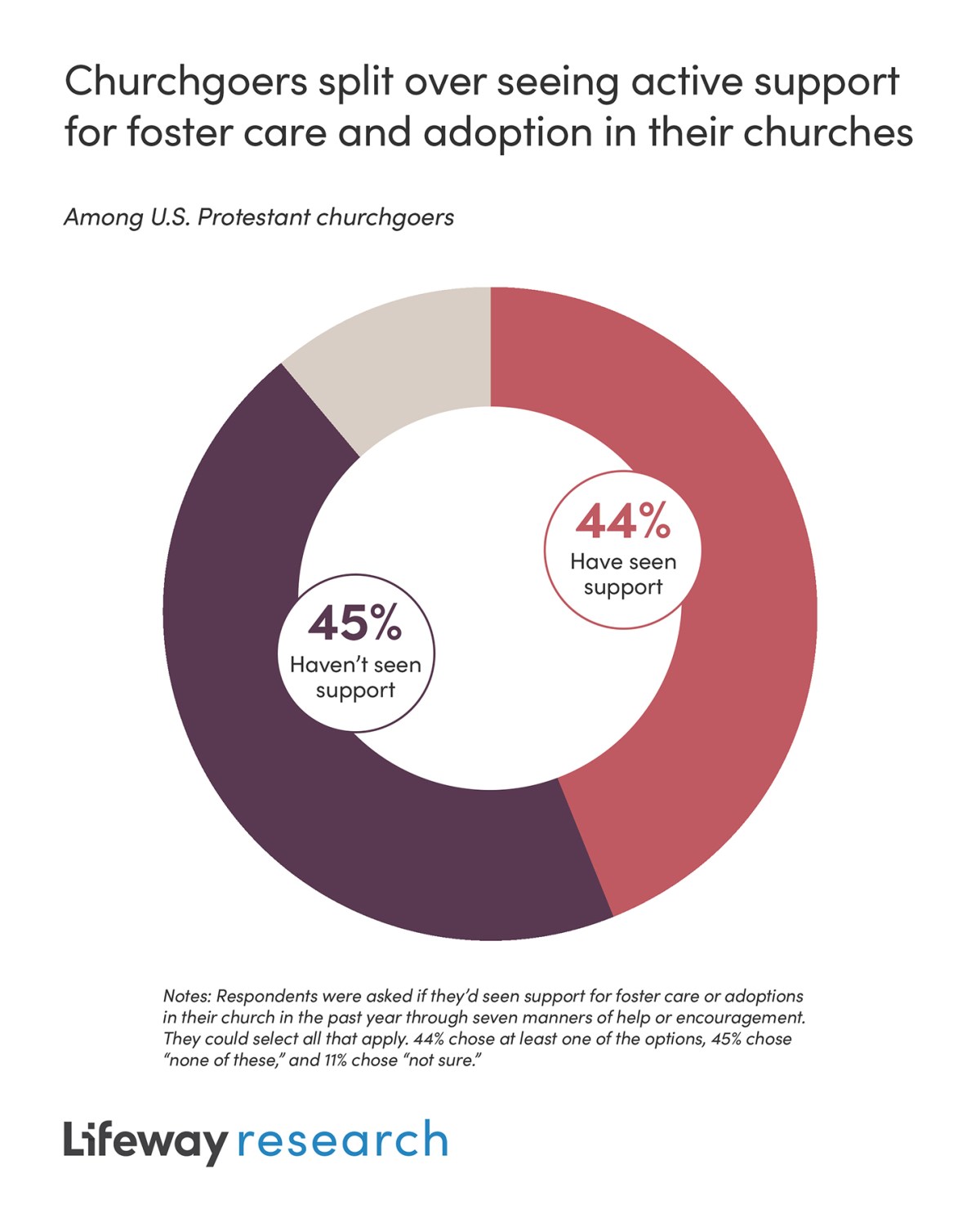
A Lifeway Research study found more than 2 in 5 US Protestant churchgoers (44%) say their congregation and its leaders are proactively involved with adoption and foster care in at least one of seven ways.

A similar percentage (45%) say they haven’t seen other churchgoers or leaders provide any of the specific types of care or support, while 11 percent aren’t sure.

“Caring for the fatherless is repeatedly prioritized throughout Scripture,” said Scott McConnell, executive director Lifeway Research.

“But the Bible does not pretend caring for another like your own child is convenient or easy.”

Personally involved

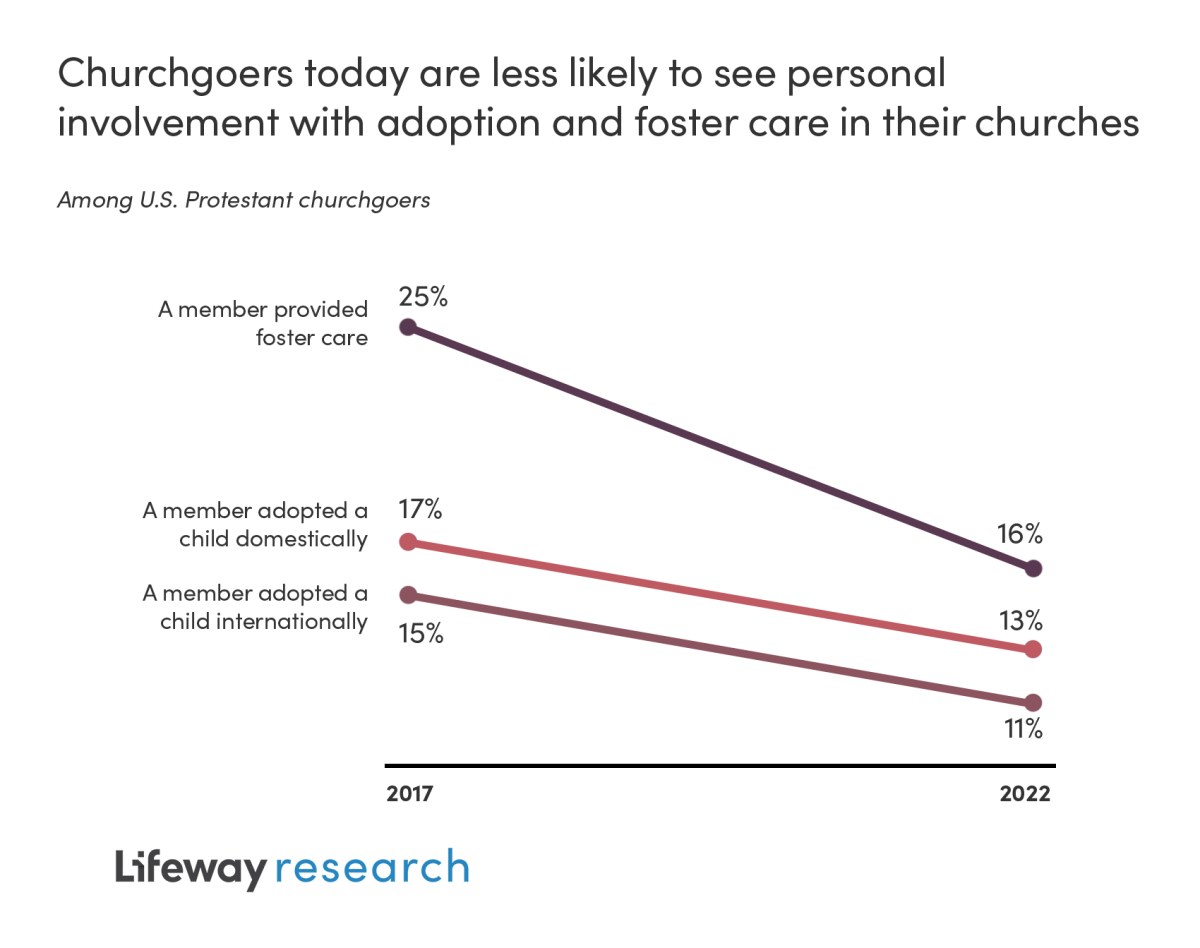
More than 1 in 10 churchgoers say someone in their congregation has provided foster care (16%), adopted a child from the US (13%) or adopted a child from another country (11%) within the last year.

Compared to five years ago, fewer churchgoers say they’ve seen members of their church actively participate in adoption and foster care. In a 2017 Lifeway Research study, 25 percent of US Protestant churchgoers said a church member provided foster care, 17 percent said someone adopted domestically and 15 percent said a member adopted internationally in the past year.

Lifeway Research

Adoptions and the prevalence of foster care have fallen among all Americans in recent years. The number of US children in foster care dropped from 436,556 with 124,004 waiting to be adopted in 2017 to 391,098 with 113,589 waiting to be adopted in 2021, according to a report from the Adoption and Foster Care Analysis and Reporting System. Adoptions, both domestically and internationally, have declined as well.

Some experts have speculated, however, that the overturning of Roe v. Wade will result in increased strain on the foster care system and additional children in need of adoption.

In a Lifeway Research study conducted just prior to the Supreme Court’s decision on abortion rights, around 3 in 4 Americans (74%) said churches and religious organizations in states that restrict access to abortion have a responsibility to increase support and provide options for women who have unwanted pregnancies.

“It is likely the pandemic limited some families in considering foster care or adoption,” said McConnell. “But the need is still great in the US and could grow larger in states with abortion restrictions.”

Lifeway Research

Churchgoers in the parenting age range are often more likely to say they’ve seen someone in their church step up in these areas in the past year.

Those 18-34 (19%) and 35-49 (22%) are more likely than those 65 and older (10%) to say someone in their congregation has provided foster care. Churchgoers 35-49 (16%) are twice as likely as those 50-64 (8%) and 65 and older (9%) to say someone at their church adopted internationally, while those 18-34 (19%) and 35-49 (20%) are twice as likely as those 50-64 (10%) and 65 and older (8%) to have seen a domestic adoption in their church within the last year.

Nondenominational churchgoers (22%) are among the most likely to have seen foster care in their churches. Methodists are among the most likely to say a fellow church member has adopted either internationally (18%) or domestically (31%).

Raising awareness

Despite the decrease in churchgoers seeing members actively participate, many say within the last year they’ve heard leaders broach the subject and seek to support the issue in other ways.

Around 1 in 6 say their church leaders have raised funds for families who were adopting (18%), encouraged families to provide foster care (17%) or encouraged families to consider adoption (16%). Additionally, 10% say their church leaders have provided training for foster parents in the last year.

Churchgoers are more likely now to say they’ve seen leaders help in these ways compared to 2017. Five years ago, 12 percent of churchgoers said leaders encouraged members to provide foster care, 8 percent saw leaders raise funds for families who were adopting and 6 percent said leaders provided training for foster parents.

“While some forms of encouragement have become more common in churches in the last five years, 4 in 5 churchgoers have not seen or heard each of these forms of help or encouragement,” said McConnell.

Lifeway Research

Again, proximity to parenting age increases the likelihood of someone having seen leaders encourage members in these ways.

Churchgoers under 50 are more likely than those 50 and older to say they’ve seen leaders raise funds, encourage providing foster care and encourage adoption. Those 65 and older (4%) are the least likely to say they’ve seen leaders at their church provide foster care training.

Methodists are among the most active in providing assistance and encouragement. They’re among the most likely to say they’ve seen leaders raise funds for adoption in the past year (42%) and the most likely to say their leaders have encouraged churchgoers to consider adoption (48%) and provide foster care (41%).

Lacking assistance

Comparable to 2017, 45 percent of US Protestant churchgoers say their church hasn’t helped in any of these ways in the past year.

“Not every exhortation from pastors and church leaders is heard or understood by laity, but only a minority of churchgoers recognized encouragement for families to adopt or provide foster care this last year,” said McConnell.

Churchgoers 65 and older (59%) are the most likely to say they haven’t seen their church provide any of the assistance or support asked about in the study. Females (49%) are more likely than males (39%) to select “none of these.”

Denominationally, Presbyterian/Reformed (60%), Lutheran (55%) and Baptist (50%) churchgoers are more likely than Restorationist movement (26%) and Methodist churchgoers (20%) to say they their churches haven’t helped in these ways.

News

Died: Superstar Billy Graham, Teenage Evangelist Who Became a Wrestling Legend

In the ring and life, Wayne Coleman was a “heel” who wanted to be a “babyface.”

Christianity Today May 22, 2023
Photo courtesy of Valerie Coleman / Facebook / edits by Rick Szuecs.

Wayne Coleman, a teenage Pentecostal preacher who became a professional wrestler and took the name of the world’s most famous evangelist to perform as Superstar Billy Graham, died on Wednesday at age 79.

Coleman was a charming, flamboyant, and braggadocious performer who brought bodybuilding into wrestling and influenced some of the biggest stars, including Jesse “The Body” Ventura, the Iron Sheik, “Stone Cold” Steve Austin, Ric Flair, and Hulk Hogan, who borrowed Superstar Billy Graham’s speech and style.

“This is the most copied guy in the business,” the wrestler Triple H once said. “He was the guy who broke the wall in terms of where you could go with entertainment. He paved the road for Hulkamania. He paved the road for all of us.”

For most of Coleman’s career, he played a heel, as professional wrestlers call the villain. Crowds across the country would boo and hiss as he flexed, posed, and boasted that he was “the reflection of perfection,” “the sensation of the nation” and “the number one creation.” But Coleman desperately wanted to become the babyface, or hero. He struggled to get World Wide Wrestling Federation (WWWF) chairman Vince McMahon to script him the redemptive, transformational narrative arc he longed for. He rose to the top of the WWWF, defeating champion Bruno Sammartino in 1977, only to learn the coming storyline would treat him as a transitional figure to be defeated by the next babyface, Bob Backlund. He was defeated in Madison Square Garden in 1978.

Coleman disappeared from wrestling, mounted an ill-fated comeback, and then quit for good. He suffered extensive physical pain from decades of steroids abuse. He returned to ministry in his later years, joining a Christian athletes organization to share his testimony with young people and prison inmates.

“I never fell away from my faith and belief in God and Christ, but I certainly fell away from living the testimony,” Coleman said in 1997. “If I had to do it all over again, I wouldn’t have gone into wrestling. I would have stayed in the ministry.”

Coleman was born in Paradise Valley, Arizona, on June 7, 1943. He was the fourth child of Juanita Bingaman Coleman, who had moved from Arkansas to Arizona escape an overbearing father. Her husband and the father of three of her children, Eldridge John Coleman, followed and found work erecting power poles for the electric company before he developed multiple sclerosis. The elder Coleman drank too much and beat and berated his young son, according to family members. The younger Coleman grew up mean and wild and spent much of his teenage years fighting other kids on the street.

“I went out with trouble on my shoulder,” he wrote in his coauthored autobiography, “always looking for a fight.”

Coleman found refuge in competitive bodybuilding, which was becoming widely popular in the United States at the time. He won the West Coast Teenage Mr. America competition in 1961 and got his picture in a popular bodybuilding magazine.

That prompted a Pentecostal woman named Beverly Swink Welch to show up at his front door. She said someone she had met through the Full Gospel Business Fellowship had seen Coleman’s photo in the magazine and felt compelled to ask her to tell him about Jesus. (“I believe in God,” Welch recalled, “but this was freaking me out.”) She tracked Coleman down and invited him to church with her family.

Coleman declined, but a short time later he stumbled across a revival tent in Phoenix with a big sign that read Ye Must Be Born Again. He went inside and heard the fundamentalist Baptist John R. Rice preaching on the doctrine of eternal salvation. Once you were saved by Jesus, Rice said, there was nothing you could do to separate yourself from the grace of God. Even if you were “in the arms of a harlot with heroin in your veins” when Christ returned on a cloud of glory, Rice preached, “you will still make the Rapture.”

When it came time for the altar call, the fundamentalist looked directly at the gawking young bodybuilder and said, “Come on, son. … It’s your turn to be saved.”

Coleman called Welch afterward and said he would like to go to church after all. He joined the Assemblies of God and soon started traveling to give his testimony. Evangelist Jerry Russell took Coleman under his wing and started mentoring him. He taught Coleman everything from how to tell his story, how to shave his armpits to reduce the sweat smell while preaching, how to make a big entrance at the start of the night, and how to get someone to respond to the message.

It was “pure show business,” Coleman said, but that didn’t make him cynical. He was, in fact, enthralled.

In his autobiography, Coleman remembered riding with Russell through the countryside in a powder blue Cadillac and thinking he had found his calling.

“Here I was, man,” he wrote. “I was going to be a Holy Ghost preacher.”

He struggled, though, with sexual temptation. He frequently had sex with women after evangelistic events, he said, then felt bad about it, then did it again in the next town.

After a while, he started to see the secret lives of the ministers around him too, and though he didn’t lose his faith in Jesus or the power of the Holy Spirit, he was deeply confused and conflicted about evangelism and revivals. One minister confessed to Coleman that he was homosexual. Another snuck off to strip clubs. Russell was accused of sexually assaulting a child and would eventually spend the end of his life in prison.

Coleman drifted away from evangelism. He got a job as a bouncer in a Phoenix bar and then tried out for professional football. When that didn’t work out, he was invited to join some Canadian players in their off-season job in Calgary: wrestling.

He was hired by Stu Hart—the “mentor of mayhem” and head of promotion company Stampede Wrestling—and learned the basics of the craft, especially how to “get over,” performing the moves in a way that wouldn’t hurt other wrestlers but would convince the audiences they had gotten their money’s worth. He found out he was good at it. He could always get a reaction from the crowd.

Coleman was then recruited by wrestling legend Jerry Graham to be part of his wrestling “family.” To join, Coleman had to change his name, and he decided to adopt the moniker of the famous evangelist.

“The reverend was one of my heroes,” he said.

If audiences found it a bit incongruous to see a heel named after the most respected religious figure in the country, they just chalked it up to the way wrestling was. In the early 1970s, Coleman added “Superstar,” inspired by the popularity of the rock opera Jesus Christ Superstar. He was always finding new ways to provoke a crowd.

“Man, he was crazy,” said Arnold Schwarzenegger, who knew Graham from bodybuilding competitions. “The way he knew how to work an audience was truly fantastic.”

Even as Coleman rose in the wrestling world, becoming more and more successful and famous, however, his private life was full of pain and chaos. He married and divorced three times before he met and started dating a bank teller named Madelyn “Bunny” Miluso. Their marriage quickly soured too, but they had two kids together. The couple stayed married, with Coleman spending most of his time on the road.

He was also secretly struggling with drug use. He started taking anabolic steroids in the late 1960s, when the synthetic male hormones were legal and prescribed by doctors who disregarded or didn’t know about the side effects. Coleman later said he thought steroids were “a wonder drug.”

“We were totally ignorant, we knew nothing about steroids, and they were easily accessible. Even the doctors had no clues,” Coleman said.

The long-term effects, though, can include liver, kidney, and heart damage, male infertility, extreme mood swings, paranoia, and depression. The performance-enhancing drugs also make people more prone to injury. Coleman hurt his hip and had to have it replaced, and then his ankles hurt so bad he could barely stand to wrestle.

Coleman also developed an addiction to amphetamines and barbiturates, attempting to regulate his moods with pills.

At the height of his career, however, a young woman named Valerie Irwin came into his life, bringing with her the possibility of a return to faith. Irwin, 19, was a committed, born-again Christian. She liked Coleman, who was 34 at the time, but refused to have sex with him. Instead, they talked, sometimes spending all night on the phone. They talked about how much they loved God and what they were reading in the Bible. Coleman was especially fascinated with creationism and the biblical account of Noah’s ark.

The couple got married in July 1978.

“Maybe I hadn’t known him for very long, but already I knew him better than anybody else,” Valerie Coleman said. “He literally is one of the best people I know, in his heart. He wants to be good. He isn’t very good at it. But he wants to be good.”

After Superstar Billy Graham was defeated by wrestling’s newest babyface champion, Coleman returned to Phoenix with his new wife and tried to get out of wrestling. He struggled financially, at one point installing sprinkler lines for a landscaper, and continued to be dogged by addiction. He returned to wrestling briefly in the 1980s, attempting to recast himself as a monk-trained karate master, but he didn’t know any martial arts and most fans thought the gimmick seemed like a gimmick.

Coleman finally, briefly, got to wrestle as a babyface in the Southeast. The bookers gave him a storyline where he was part of a satanic cult but went out into the desert, died, and came back wearing all white to save young girls from the Satanists.

Physical pain, combined with ongoing conflicts with Vince McMahon and the management of the rechristened World Wrestling Entertainment, forced him to quit for good in the early 1980s. He just missed wrestling’s entry into mainstream entertainment with cable television. In 1984, Hulk Hogan won the championship looking exactly like Superstar Billy Graham. Hogan even called people “brother,” just as Coleman had—an innovation he adapted from the way people addressed each other at revivals.

Coleman, meanwhile, had to hawk his and Valerie’s wedding rings to pay for a place to stay. He went on disability and moved into an extended-stay hotel. He also decided it was finally time to go back to church.

That’s where he met Jeff Fenholt, the Jesus Christ Superstar Broadway performer who converted to Christianity. Fenholt convinced Coleman he was still called to ministry, even after everything that had happened.

“You were called,” Fenholt said. “We can walk away from the calling, but the calling is always there. The Lord has allowed you to come full circle.”

Coleman joined Athletes International Ministries and spent his later years sharing his testimony and inviting people to accept Christ as their personal savior. He also reconciled with McMahon and apologized, publicly, for the way he’d left wrestling and tried to hurt the organization when he was angry.

“Sometimes with the born-agains,” McMahon said at the time, “you wonder if it’s an angle or not. I felt that Billy was telling me the truth.”

Coleman died of sepsis and multiple organ failure in a medical facility in Phoenix. He is survived by his wife, Valerie, and his two children from a previous marriage, Capella and Joey.

addApple PodcastsDown ArrowDown ArrowDown Arrowarrow_left_altLeft ArrowLeft ArrowRight ArrowRight ArrowRight Arrowarrow_up_altUp ArrowUp ArrowAvailable at Amazoncaret-downCloseCloseellipseEmailEmailExpandExpandExternalExternalFacebookfacebook-squarefolderGiftGiftGooglegoogleGoogle KeephamburgerInstagraminstagram-squareLinkLinklinkedin-squareListenListenListenChristianity TodayCT Creative Studio Logologo_orgMegaphoneMenuMenupausePinterestPlayPlayPocketPodcastprintremoveRSSRSSSaveSavesaveSearchSearchsearchSpotifyStitcherTelegramTable of ContentsTable of Contentstwitter-squareWhatsAppXYouTubeYouTube