Theology

Theological Education Can’t Catch Up to Global Church Growth

Unless seminaries leave the ivory tower for local leaders in the public square. Like these ones have.

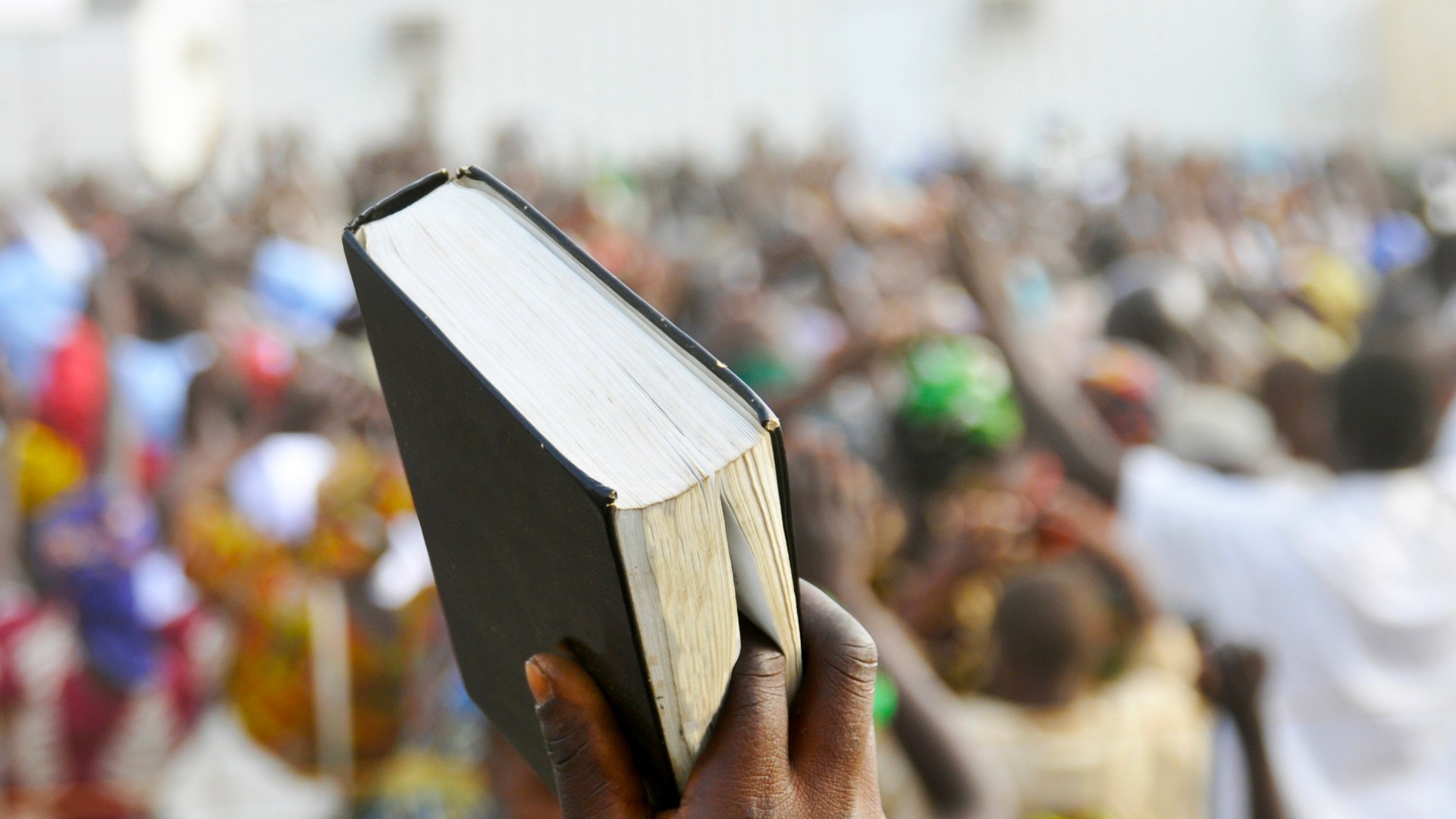
A Bible is raised during a worship service in Africa.

A Bible is raised during a worship service in Africa.

Christianity Today June 2, 2023
Rob Birkbeck / Lightstock

I recently received a handwritten letter from a pastor in India.

His name is Roy, but I didn’t know this gentleman, and we had never corresponded. Somehow he contacted me and told me about the two congregations he leads in Andhra Pradesh and of his great desire to study the Bible.

His ending struck me: “I have no money.”

Roy is not alone. Countless pastoral leaders worldwide are eager to faithfully lead their churches, but they lack access to training. This is especially the case in majority world contexts in Latin America, Africa, and Asia where the gospel continues to rapidly grow—with hundreds of new congregations birthed daily.

Founded in 1846, the World Evangelical Alliance (WEA) now represents churches in over 130 countries and estimates there are 50,000 new baptized believers each day. These believers need pastoral leaders who are trained to effectively lead their congregations.

The challenge is highlighted when we draw a contrast with the United States, where there is one trained pastor for every 230 people. By comparison, majority world churches have one trained pastor for every 450,000 people.

This colossal leadership imbalance will only expand as the majority world church continues to surge and spread. Already, theological education is struggling to keep up, and unless something changes, the gap will only increase in the future.

If we are to meet the training needs of thousands of pastors like Roy, the worldwide trajectory must be reset. Theological education, no matter the form, has a long history of being fragmented, with most programs operating in silos, lacking a sense of collegiality. Regrettably, this inward posture makes training even less accessible to local ministries, weakening the collective capacity to prepare leaders for the Lord’s church.

A new theological education posture is needed.

Last November in Izmir, Turkey, it was evident. The 18th consultation of the International Council for Evangelical Theological Education (ICETE), first launched by the WEA in 1980, gathered roughly 500 leaders from 80 countries—representing over 290 worldwide training ministries—to envision an integrated global approach for the leadership demands of the church today and in the years to come.

Uniting a network of nearly 1,000 seminaries from every region of the world, ICETE has historically been viewed as a service umbrella for the formal sectors of theological education. American examples include Lancaster Bible College, Wesley Biblical Seminary, and Moody Bible Institute, alongside international counterparts such as the Ethiopian Graduate School of Theology, Asian Theological Seminary, and Bethlehem Bible College.

But over the past three years, our constituency base has expanded significantly to include nonformal and less-structured theological education. In fact, at that time we had none of these institutions.

Recently welcoming training ministries such as the Cru-based International Leadership Consortium, Trainers of Pastors International Coalition (TOPIC), and Increase Association’s network of training programs for church leaders throughout Asia, ICETE honors their desire to benefit from our global interconnectedness. This includes creating relationships with the traditional seminaries to share with nonformal students the tools and short courses often associated with higher education—such as Bible commentaries, simplified theology, and innovative homiletics.

Additionally, many of these programs want to ensure quality control, validated under the guidance of academic leaders. By elevating their credibility, nonformal programs offer pathways toward not only better ministry effectiveness but also more rigorous education.

Today, nearly half of our associate members are nonformal institutions.

The formal side of theological education has also welcomed greater interaction. Seminaries worldwide have struggled to operate at full strength, especially since COVID-19, and have gradually diminished in their capability to understand and meet contextual church leadership needs.

Through dialogue with nonformal leaders who are usually more closely connected to church life, seminaries become better aware of pew-level realities and can adjust their programs to produce more field-ready graduates. Inspired by the ICETE conference, Shalom Bible Seminary in India has already collaborated with parachurch organizations to create a new course for next-generation church leadership.

Around the globe, leaders from every region and from all types of ministries are growing in their conviction that whatever the task before them, it is too large for any one of them alone. The theme in Izmir was “Formal and Nonformal Theological Education: Beyond Dialogue,” and we already see hints of practical renewal taking place.

Standards to measure effective spiritual formation training are being developed in Nigeria and India. Oral pastoral leadership programs have started in South Sudan, Uganda, and Ethiopia—and will soon in Tanzania and Senegal. And regional collaboration hubs are being established in South America and Africa, to link partners in similar local contexts.

ICETE has also been asked to gather key leaders to discuss quality assurance through micro-credentials and competency-based theological education. As these innovative approaches are further refined, they will open new opportunities to certify a wider number of programs, strengthening collaboration across the sectors of theological education.

In every region ICETE represents, we hear reports on how our conference stimulated serious reflection that has already set our agenda for the next global consultation in March 2025: How can the whole of theological education come together to equip the next generation?

Though we know the Lord Jesus will ultimately build his church, during our present era we must do all we can to come alongside this effort, that it may be strengthened to stay on mission until Christ’s return. We cannot continue with disconnected, fragmented theological education and expect to meet the needs of church leaders like Roy in India and countless others like him. Renewal has begun, and ICETE will serve to cultivate it.

On the opening night of our week in Izmir, I led the gathering to recite with me the following plea: “Lord, may our consultation not be measured by our numbers, but by our mutuality in one common aim—to strengthen Christ’s church.”

May this be our ongoing prayer.

Michael Ortiz is the ICETE international director.

News

Died: Paul Eshleman, Who Brought ‘Jesus’ Film to the Ends of the Earth

The Campus Crusade evangelism strategist wanted everyone in the world to hear the good news that God loved them.

Christianity Today June 1, 2023
Paul Eshleman / edits by Rick Szuecs

Paul Eshleman, an evangelism strategist who organized one of the largest outreach efforts of the 20th century so that everyone in the world could hear at least once that God loved them, died on May 24 at age 80.

Eshleman was the director of the Jesus Film Project, producing the 1979 feature for Campus Crusade for Christ (now Cru) in partnership with Warner Bros. and overseeing its translation into more than 2,000 languages. Eshleman arranged for the film to be shown across the world, from places in rural Asia and Africa where people had never seen electric lights before, to national television broadcasts in places like Peru, Cyprus, and Lebanon. According to Cru, nearly 500 million people have indicated they made a decision to accept Jesus as their Lord and Savior after seeing the film.

“I’m driven every day to say, ‘Who hasn’t had a chance to hear yet, and how can I make that possible?’” Eshleman once explained. “We are strategists for Christ, thinking of new ways to reach people with the message of life.”

Saddleback Church founder Rick Warren called Eshleman a “dear friend” and praised him for his “global impact.” Evangelist Franklin Graham said, “God used his life greatly.”

According to Steve Sellers, current Cru president, “Paul was a champion for the cause of Christ and challenged the Church to consider innovative ways to evangelize.”

Eshleman was born October 23, 1942, the eldest son of Viola and Ira Eshleman. His father was an evangelical minister who moved the family from Michigan to Florida in 1950 to launch a Christian resort. He purchased 30 acres of a closed army base in Boca Raton for $50,000, starting a church and a vacation community that the evangelist Billy Graham dubbed “Bibletown.”

Eshleman committed his life to Christ as a boy, but growing up, he was less interested in ministry than business. He decided he wanted to become the head of an oil company or perhaps an auto manufacturer.

Eshleman went to Michigan State University, where he studied business administration, marketing, and finance. He joined a Campus Crusade fellowship group but wasn’t particularly serious about his faith. He later said he only really kept going so he could tell his mom he was part of a Christian group but not have to go to church on Sunday mornings.

Things changed when a girl he had dated told him he was just “fooling around with God” and it was time to get serious or break it off. Eshleman just got mad and told her about all the time he’d spent in church growing up, but later that night he couldn’t stop thinking about what she said. He started to worry that God was hardening his heart, like he had hardened Pharaoh’s in Exodus 7–11.

“I couldn’t sleep,” Eshleman said. “I got by my bed, and I said, ‘Lord, here’s my life.’”

The next morning he called a Campus Crusade leader: “I’m on your side now. What do you want me to do?”

Eshleman was taught how to share the gospel through the four spiritual laws and sent to talk to students in the fraternities. The second one he spoke to committed his life to Christ, and Eshleman was convinced this was more important work than running a large company.

He joined Campus Crusade in 1966 and went to the University of Wisconsin–Madison. The school was roiled by student antiwar protests targeting Dow Chemical Company, which made the flammable gel the US military was using in the jungles of Vietnam. In 1967, the campus became the scene of what some historians say is the first university protest in the country to turn violent. Eshleman found this was “a wonderful environment for doing ministry,” he said. In one year, he organized 72 evangelistic meetings in dorms, fraternities, and sororities across campus.

“In the middle of all that chaos,” he said, “we had people continually coming to Christ.”

A few years later he was tapped to organize a mass youth event that Billy Graham told reporters was going to be the Christian answer to Woodstock. It would be a great Jesus rally, a “spiritual explosion,” or “Explo,” in Dallas in 1972.

The event had been dreamed up by Campus Crusade founder Bill Bright. He said he had a vision: There would be masses of young people and music, and they could train 100,000 college students to evangelize their peers. Bright’s top staff, however, didn’t like the idea and deftly ducked the assignment, according to historian John G. Turner, who wrote a history of the founding of Cru.

“It was an old trick,” one staffer said. “He’d have a vision and then we’d have to put arms and legs to it.”

Eshleman was offered the job. Naïve and passionate, he jumped at the opportunity. He was given a generous budget but little staff support. He managed, nevertheless, to pull it off. He booked Johnny Cash, Andraé Crouch, and newer “Jesus freak” acts like Larry Norman and the Armageddon Experience. He secured the use of the Cotton Bowl for four nights, reserved hotel rooms in 65 locations across Dallas-Fort Worth, and even arranged for three hours of music and preaching to be broadcast on television nationwide.

The event attracted only 30,000 college students, but Eshleman opened it up to high schoolers and managed to recruit another 35,000, for a total of 75,000 young people who, between the musical performances, learned how to share their faith. Another 10,000 came as guests, and Explo ’72 was deemed a success.

The Jesus film started, similarly, as a Bill Bright vision that would be difficult if not impossible to pull off. The idea got financial underwriting, however, from oil tycoon Nelson Bunker Hunt and drew the interest of John Heyman, a Jewish film producer in Great Britain who wanted to produce something related to the Bible. The project got a green light, and though Eshleman had never worked in film before, he was given the job of fixer, gofer, and all around problem solver.

The film, which hews closely to the text of the Gospel of Luke, was released in 1980 and shown in about 300 theaters. Critics didn’t think it ranked with William Wyler’s Ben-Hur or Cecil B. DeMille’s The Ten Commandments, but church groups and Christian schools liked it, and it wasn’t a financial disaster for Warner Bros.

Then the film was turned over to Eshleman for broader and more creative, innovative distribution. He worked with Campus Crusade staff to translate the film into 21 languages in 18 months and connect with missionary groups around the world to show it in places where people had never seen the life of Jesus on the silver screen—or any movies at all.

For about $25,000, Eshleman could dub the film into another language, produce a new print, ship the film and projection equipment to a mission field—navigating customs and censorship authorities in the process—and set up a showing for as many people as could gather in a field. Ten of the first showings were in India. People walked more than three miles to see the film.

By 1985, Eshleman’s team had translated the film into 100 different languages. They planned to produce the film in every language with more than 100,000 speakers. They simplified and sped up the dubbing process with new technology and soon shipped Jesus everywhere from Estonia to Ecuador.

Everywhere, the film seemed to have a powerful effect.

“When soldiers whip Jesus, you could hear grown adults crying,” said Brian Helstrom, a Church of the Nazarene evangelist who showed the film in Africa. “'You could see them physically jump back at the sight of the serpent tempting Jesus.”

Eshleman, who oversaw a team of 300 people, occasionally got to attend a screening of the film. The experience, he said, was unforgettable.

“You … sit on a log out under the stars,” he recalled, “and watch people who have never seen a film before—their first time seeing an electric light—and the person of Jesus comes on the motion picture screen. You see their eyes light up.”

A cynical film executive once joked to Eshleman that if he showed Dirty Harry instead of Jesus to people with no exposure to 20th-century technology, they’d fall down and worship Clint Eastwood’s vigilante cop as the Son of God. But Eshleman rejected the idea that the power of the Jesus film was its medium and not its message. A Maasai warrior in Kenya might enjoy Dirty Harry, Eshleman said, but to understand that God loved him and had a wonderful plan for his life, he had to see the Word made flesh made celluloid.

By the year 2000, Eshleman’s team had translated Jesus into 600 languages and could turn out a new translation in nine days. The Guinness Book of World Records recognized Jesus as the most-translated film of all time.

At the same time, Eshleman had started to track all the people groups that didn’t have any Christian workers to help with translations. The number varied, depending on how one counted groups, but he figured that hundreds of millions of people had never been engaged with a gospel message.

At a nine-day gathering of 10,000 evangelists in Amsterdam, Eshleman and several others organized a strategy session to coordinate efforts to reach these “untargeted” people. Out of that session came Finishing the Task, a network of Christian organizations committed to completing the Great Commission, reaching every nation. The goal, Eshleman said, was to make sure everyone in the world had the chance, at least once, to hear that Jesus loves them.

“They have waited long enough,” Eshleman said. “It is time for us to finish.”

Eshleman became the director, and by 2017, he said Finishing the Task had mobilized missionaries to 2,000 new people groups and planted 101,000 churches. Reaching every nation on earth looked like a real possibility.

“If I could choose any time in which to be alive,” Eshleman said, “this would be the time.”

Paul is predeceased by his wife Kathy. He is survived by his second wife, Rena, and two adult children, Jennifer and Jonathan.

News

Manipur Christians: ‘The Violence Has Shattered Us’

Many from India’s tribal Kuki community have fled their homes. Amid ongoing violence, returning isn’t an option.

Evening worship at the Delhi Relief facility.

Evening worship at the Delhi Relief facility.

Christianity Today June 1, 2023
Photo by Surinder Kaur

Lun Tombing was hiding in the bushes with her husband and three- and six-year-old daughters several weeks ago when they saw a mob burn down their home, car, and church.

Tombing and her family had heard reports of mob violence in and around Imphal, the capital city of Manipur, the eastern Indian state where they live, and fled to their church. More than 50 Christians hid in the building, even as a Hindu mob vandalized its outside. When the attackers briefly drove away, the Christians made a run for it.

“With every burning of a vehicle, the mob would clap their hands and shout victory-shouts, as we witnessed all this while trembling behind the bushes constantly afraid of being discovered,” Tombing said.

The group stayed outside for nearly 12 hours, only narrowly avoiding a direct confrontation with the rioters. Despite her mother’s order to maintain absolute silence, Tombing’s eldest daughter repeatedly asked why the mob was destroying their neighborhood.

When the military finally arrived half a day later, they sent the survivors to a local refugee camp. Several days later, the traumatized family, along with hundreds of other Manipur Christians, arrived at the nation’s capital with little more than medicine for the children and some extra clothes.

Since sheltering with a relative in Delhi, both of Tombing’s daughters have struggled to sleep deeply and disruptions as minor as a TV channel changing have startled them awake.

“Even after we reached Delhi, whenever my daughters heard a bang or a sudden noise, they would start to scream, ‘Mummy, they are coming,’” Tombing said.

Between May 3 and May 5, mob violence claimed 75 lives and displaced 35,000 people, according to Manipur’s government. But L. Kamzamang, a Kuki pastor who ministers to northeastern Indian Christians in Delhi, believes that 65,000 people have fled—some internally and others across the border to Myanmar, which borders Manipur—and that more than 100 have been killed.

“There are no fixed numbers,” said Lhingkhonei Kipgen, who fled with her husband and two young daughters and is sheltering in an Evangelical Fellowship of India (EFI) relief camp in Delhi. “There are corpses still lying here and there, some that were burned along with their vehicles and are not even identifiable.”

Children sit and listen to worship at the Delhi Relief facility.

The surge in violence came as tensions between Manipur’s Kuki tribe and the Meitei, the state’s largest minority group, began to climb in earnest in April after the state’s high court greenlit the Meiteis’ request for Scheduled Tribe status. The designation gives communities special constitutionally backed protections including reserved seats in the parliament and state legislatures, affirmative action in education and employment, and property protections.

In fear that this recognition would cost them their own affirmative benefits, the Kuki, the majority of whom are Christians, opposed the proposed change. When they organized local protests on May 3, the violence broke out in several locations.

“[The Meiteis’] main aim was to rid the hills from Kuki presence, and they have been successful at it,” said Thangkholal Haokip, a Manipur social worker who is now living at the refugee camp. “They have instilled fear, uncertainty, and we are now homeless.”

A divided Manipur

While the Kuki protest became the mob’s catalyst for its recent rampage, territorial disputes, competition over resources, deep-seated historical grievances, and religious tensions have kept the tribal community and the Meitei at odds with each other for years.

“India’s northeastern region boasts of a rich tapestry of ethnic groups. But some of these communities have clashed over matters such as land, resources, and political power,” said Vijayesh Lal, EFI’s general secretary. “This is perhaps the first time that the religious angle has been seen in the ongoing violence in Manipur.”

Within Manipur, nearly equal numbers of residents (41% each) practice Hinduism and Christianity. But while the Hindus are largely Meitei, the Kuki and other tribals make up the majority of the Christians.

In recent years, tensions over land have been exacerbated by the political influence of the Hindu nationalist organizations Rashtriya Swayamsevak Sangh (RSS) and the Bharatiya Janata Party (BJP), which have sought to promote their ideology in northeast India and have used the Meitei community to advance their political agenda in the state, Christian leaders from Manipur say.

The conflict is “two sides of the same coin—religious motivation on one side and political motivation on the other, both intersecting at this point [where it has resulted in large scale violence],” Kamzamang said.

To him and other Kuki leaders, the Hindu Meitei mobs’ religious motivation became evident when their violence also included burning down Meitei churches and attacking Meitei Christians.

Walter Fernandez, who leads the North Eastern Social Research Centre in neighboring state of Assam, believes that the attacks were preplanned.

“The conflict [about land and tribal status] has been there for many years,” Fernandez said. “There was a major blockade in 2010, then major conflict in 2015, again in 2018. For the first time, religious places have been attacked, and this time it is systematic by organized paid gangs who were carrying lists of religious places.”

The point of no return

The majority of those fleeing Manipur have sought refuge in the neighboring state of Mizoram. Only a handful have made the 1,500-mile trip to Delhi. Currently about 70 of the displaced are staying in EFI’s relief center, a group that includes breastfeeding babies, their parents, college students, and the elderly.

Few say they see a future for themselves in Manipur.

Paojamang Haokip was two months away from graduating with an engineering degree.

“The violence has shattered us. We find ourselves somewhere unknown. … We don’t know where we can head to,” he said. “The situation is far from getting normalized. We will not go back.”

Back in Manipur, tensions have not dissipated and violent incidents have continued, even in the lead-up to a visit this week from India’s home minister, Amit Shah.

Last week, the army used tear gas on a mob after it set multiple abandoned homes on fire in a Kuki neighborhood in the capital city of Imphal. The government responded to the incident by instituting a curfew and suspending internet service in the area.

But the latest violence also included Kukis, who were furious at their situation and have taken matters into their own hands.

A mother holding her child at the evening of worship at the Delhi Relief facility.

In the first 24 hours after violence broke out in Churachandpur, Kuki village volunteers did not retaliate, reported The Wire. Later, however, when they saw that the police force was not responding to the fires and physical violence, and they took up arms, inflicting causalities on the mobs and the police.

Starting on May 24, in less than a week, three different mobs, including one of mostly women, attacked the homes and, in some cases, possessions, of three BJP ministers based in Manipur.

In the 24 hours leading up to the Shah’s arrival on Tuesday, the Indian army came under heavy fire from armed groups, an attack that killed 10 people.

Following his visit, Shah tweeted that peace and prosperity of Manipur is the government’s “top priority” and that he had instructed the Indian army and the central government and state’s police to “strictly deal with any activities disturbing the peace.”

During his visit, the Times of India reported that the army had killed 33 “militants” and arrested 25 others. A state government statement from last week also claimed it had killed at least 40 people whom government officials have referred to as “terrorists.”

However, a Kuki spokesperson refuted this language.

“It’s confusing what the [the government official] means when he says ‘40 terrorists.’ The people killed were all village guard volunteers who were armed with licensed guns. There are no militants here,” he said.

As the number of causalities continues to rise, Fernandez places the death toll around 150. Meanwhile, the weekend’s violence displaced close to 2,500 people, with some victims alleging that security forces themselves had attacked them.

Given the situation, few of those who have fled feel confident returning.

“We have no security or even the assurance of it that we would not be targeted again. We cannot live our lives in fear every single day,” said one Manipuri father who asked not to be identified for security reasons. “Even if the Manipur government assures us at a later stage of things getting normalized, the government agencies will still stay mute spectators if we are attacked again. We are on our own.”

Theology

Don’t Pretend the Ugandan Homosexuality Law Is Christian

Not everything that’s a sin is a crime—let alone one punishable by death.

A protest against Uganda's anti-homosexuality bill.

A protest against Uganda's anti-homosexuality bill.

Christianity Today June 1, 2023
Themba Hadebe / AP Images

This piece was adapted from Russell Moore’s newsletter. Subscribe here.

In this day of social media mobs and troll-fueled extremism, it’s not unusual for a politician to be digitally attacked for being too weak and “not really one of us”—on a seemingly infinite number of topics.

Even so, one might be surprised to see Sen. Ted Cruz (R-Texas)—not known for repudiating the far extremes of his base—labeled on various social media platforms as soft, weak, and compromising. Some even suggested that Cruz was rejecting the Word of God itself. His radically “progressive” idea? That Uganda shouldn’t criminalize homosexuality and execute gay people.

Normally, a social media controversy is the most ephemeral of pseudo-events. People who want to be noticed post shocking and even ridiculous things (“Y’all! It’s not just Target that’s gone woke; let’s boycott Chick-fil-A too!”) to get attention, knowing they’ll be denounced and quote tweeted, which will amplify their reach. They think that retweets and followers will somehow give them the belonging and significance they crave. Often, the best course is to ignore such things in the spirit of Proverbs 26:4—“Do not answer a fool according to his folly, or you yourself will be just like him.”

Sometimes, though, their kind of trolling can lead to two catastrophic ends that should concern those of us who follow Christ: the unjust killing of human beings made in the image of God and, at the same time, the bearing of false witness about what the Christian gospel actually is.

At issue is a harsh new law signed by Uganda’s president Yoweri Museveni that would not only outlaw homosexuality but also mandate conversion-therapy-type “rehabilitation” for gay people who are arrested and require a kind of surveillance culture in which citizens are criminally liable for not turning in people they know to be gay. But most chilling of all, the law would impose the death penalty on categories deemed to be “aggravated homosexuality.”

Of course, repressive regimes violate human rights all the time and all around the world—and there are vast limits on how much other nations can do about it. But in this case, many are wondering whether the primary problem is that Uganda is taking the Bible out of context.

Some of those sniping at Cruz—especially for his categorization of the Ugandan law as “horrific” and “wrong”—argue that the senator’s issue is really with God. After all, they say, doesn’t the Bible dictate that “if a man has sexual relations with a male as one does with a woman, both of them have done what is detestable [and] are to be put to death” (Lev. 20:13)?

I am an evangelical Christian committed to the verbal inspiration of the Bible, meaning I believe that every word of it is exactly what God intended it to be, by the power of the Spirit. I am also committed to the inerrancy of the Scriptures: that the Word of God speaks truthfully. Jesus’ view of the Bible—“Scripture cannot be broken” (John 10:35, ESV)—settles those issues for me.

I am also a Christian who agrees with the teaching of both the Scriptures and the church—Orthodox, Catholic, and Protestant, for 2,000 years—which is that marriage is a one-flesh covenant between a man and a woman and that sexual expression outside of that covenant is wrong.

And yet my repulsion at the Ugandan state violence in this law is not despite those commitments but precisely because of them.

One does not honor the authority of Scripture if one obscures its meaning. Leviticus 20 explicitly condemns almost every form of sexual immorality—premarital sex, extramarital sex, and nearly every other kind of nonmarital sexual expression. Sexual sins are included alongside occultic practices, necromancy, and the cursing of one’s mother and father.

Of course, this is consistent with the rest of the biblical witness (whatever one thinks of its authority). Yet the penalties of death that come with those violations are situated in a very specific context in redemptive history. God revealed that the theocratic civil code, as well as its punishments, was for a purpose: to separate his people from the rest of the nations to prepare them to enter the inheritance of the land (Lev. 20:26).

To cite such passages of the old-covenant civil law as a mandate for a civil state outside that covenant is a misinterpretation that doesn’t fit with any historic, apostolic teaching of Christianity. In fact, it’s in line with those who would argue against any ethical content of the Christian faith by saying, “Yeah, well, if the Bible’s true, we couldn’t eat shellfish either.”

The moment one hears this, one knows that the arguer either isn’t aware of the old covenant/new covenant distinctions in the ceremonial and food laws (which is a major emphasis in the New Testament) or isn't arguing in good faith. The same applies to those who would say, “Well, the church in the Book of Acts shared their possessions in common” as an argument for the state-imposed communist totalitarianism of Lenin, Stalin, or Mao.

In the New Testament church, the apostles resolved the question of the Law in a Council at Jerusalem. They did not, as some might argue, wipe away the moral content of the Old Testament Law. For instance, Christians—whether Jew or Gentile—were still to abstain from sexual immorality (Acts 15:20). But the new covenant community was not a reconstruction of the Old Testament code of criminal penalties for violations of holiness.

In fact, we have example after example of Jesus and the apostles teaching the opposite. I hold as authentic Scripture the passage in John in which Jesus stops the stoning of an adulterous woman (“Let any one of you who is without sin be the first to throw a stone,” 8:7). I know some Christians believe it to be a later textual addition, but even if that were true, Jesus’ posture toward sinners was consistent throughout the Gospels.

In writing to the church in Corinth, the apostle Paul rebuked an example of sexual immorality explicitly mentioned in the text of Leviticus 20—having sex with the wife of a family member. Paul also quoted, “Purge the evil person from among you” (1 Cor. 5:13, ESV) —a text that was used in the Old Testament civil law to denote the death penalty (Deut. 13:5; 17:7; 22:21).

Yet Paul did not use this language to call for any criminal penalty by the state—and certainly not execution. Instead, he saw the “you” of the new covenant as applying to the church, not to the state. And the church is not given the power of the sword (Matt. 26:52; Rom. 13:1–7; 2 Cor. 10:4).

Moreover, Paul specifically notes in his letter that the church does not have judgment over outsiders. The local church should remove a sexually immoral person—if finally unrepentant—from membership in their community, but this does not mean they should stop associating with those who do the same things on the outside: “What business is it of mine to judge those outside the church? Are you not to judge those inside?” (1 Cor. 5:12).

The word judge here does not mean to make moral assessments of what’s right and what’s wrong but rather to identify who is accountable to whom. In other words, the world is not accountable to the church. The church is accountable to the church—and, even then, not with physical or criminal penalties but with the spiritual means of Word and sacrament.

The revered late Presbyterian biblical theologian Edmund P. Clowney noted the disastrous consequences of those who use the Bible without being able to situate its texts in their redemptive-historical context. In fact, he said that using the Bible as a collection of moral examples—unhinged from the broader story of God’s purpose to sum up everything in the crucified and risen Christ—leads to a situation in which biblical history is “a chaotic jumble.”

“Those who find only collected moral tales in the Bible are constantly embarrassed by the good deeds of patriarchs, judges, and kings,” he wrote in Preaching and Biblical Theology. “Surely we cannot pattern our daily conduct on that of Samuel as he hews Agag to pieces, or Samson as he commits suicide, or Jeremiah as he preaches treason.”

“Dreadful consequences have ensued when blindness to the history of revelation was coupled with the courage to follow misunderstood examples,” Clowney wrote. “Heretics have been hewed in pieces in the name of Christ, and imprecatory psalms sung on the battlefields.”

In the unveiling of his purpose, God did indeed demonstrate his judgment through Samuel’s sword and Samson’s self-sacrifice and so on, but that moment in redemptive history is not where we are situated now. “Christ has not now given the sword but the keys to those who are charged with authority in his name,” Clowney wrote. “The sanctifying of God’s name in spiritual church discipline reflects in our situation the theocratic obedience of Samuel.”

Misinterpreting this is the equivalent of concluding that one should sacrifice a lamb on the church Communion table during a sermon series on Leviticus. At this time in history, God has commissioned us not to subdue the world with violence but to bear witness to the One he sent: “For God did not send his Son into the world to condemn the world, but to save the world through him” (John 3:17).

Not everything that’s a sin is a crime. To equate all sin with crime, without the authority to do so, is itself a sin against God—to take the name of the Lord our God in vain. If the historic Christian vision of marriage and family is true and good and beautiful, as I believe it is, then we demonstrate that truth, goodness, and beauty to our unbelieving neighbors through our witness—not by threatening to kill them.

Unleashing the violence of state-ordained execution, imprisonment, and surveillance on gay and lesbian Ugandans is a condemnable act of authoritarianism and a violation of the self-evident and unalienable rights to life, liberty, and the pursuit of happiness. To do such a thing is a matter of power, not of conviction. It demonstrates not a commitment to the Bible’s authority but a rejection of it.

Call it what you will, but don’t for a minute call it Christian.

Russell Moore is the editor in chief at Christianity Today and leads its Public Theology Project.

Church Life

It’s Time to Forgive Each Other Our Pandemic Sins

As the COVID-19 emergency ends, the church can lead the world into a spirit of amnesty.

Christianity Today June 1, 2023
Illustration by Mallory Rentsch / Source Images: Getty / Unsplash

This week, an Axios poll found that 62 percent of Americans believe the pandemic is over—weeks after the World Health Organization announced that COVID-19 is no longer a “public health emergency of international concern.”

More than three years after the virus first swept the globe and governments around the world shut down businesses, schools, and public venues, we can finally say the pandemic has ended.

The WHO estimates the coronavirus killed 20 million people worldwide. Even if the figure is inflated, anything near the ballpark of 20 million is a ghastly toll on humanity. Untold numbers still struggle with debilitating aftereffects made worse by the uncertainty about how long and how serious those aftereffects will be.

While COVID-19 will be with us forever, we can celebrate that the state of emergency is over. But some are not in a celebratory mood. In my conversations with students, pastors, friends, and family, I often hear an undercurrent of anger, even bitterness, when the pandemic comes up. Some seem eager to relitigate who said what about masking, social distancing, infection rates, or church closures years after the fact.

Now is a good time to declare a “pandemic amnesty.” As Emily Oster suggested in The Atlantic last fall, let’s start assuming each other’s good faith and “forgiving the hard calls that people had no choice but to make with imperfect knowledge.” Christians especially can lead the world in an attitude of grace for the things we collectively said and did during a confusing and unprecedented time.

The pandemic was hard. Navigating the complex medical, political, legal, economic, theological, and humanitarian concerns was difficult. Few of us were truly knowledgeable about every aspect: The epidemiologist could tell us about the likely course of infections, but not the legal issues involved in lockdowns. The lawyer could tell us about public health law but not about economic tradeoffs.

The economists could talk about the effect on GDP growth but could not weigh that against the human cost in either lost lives or prolonged isolation. The theologians could tell us to submit to government but also to protect our churches’ freedom, and each congregation had to do the balancing act on their own.

We got things wrong. Masks were not terribly useful unless you used an N95 and wore it just right. Some public schools stayed closed far longer than necessary. Social distancing was unnecessary outdoors. A lot of disinfection in public places was just hygiene theater.

Yet it was right to treat COVID-19 as a serious emergency and to act with an abundance of caution. Flippancy about masks and social distancing, especially early on when we did not know much, was unwise. Treating the virus as unimportant or unthreatening was grossly insensitive to older and immunocompromised people who were at extreme risk.

As much as we find it easy to criticize governments for the decisions they made in the spring of 2020, they likely could have made the pandemic shorter and less severe had they acted even faster, earlier, and more decisively than they did. Some officials made mistakes in the early days; that should not deter future decision-makers from doing all they can to protect public health in the next emergency.

The same is true for our local churches.

Churches faced a difficult decision about whether and how long to remain closed. Should they obey the government, or insist on their right to stay open? Should they close for the sake of elderly or infirm congregants most at risk from the virus? Or should they open for the sake of everyone else? Obey Romans 13, or Hebrews 10?

Different churches made different choices—and it isn’t clear to me that one answer was the right one for every church in every circumstance. Governments have legitimate authority in this field, and on balance, most churches should and did adopt a general posture of deference to the state in matters of public health. Some churches with a larger share of elderly members even chose to stay closed longer than legally required.

But churches in jurisdictions with a track record of hostility to religious freedom were justified in viewing pandemic restrictions with suspicion. While few churches had to resort to lawsuits, a few did, and they were almost entirely vindicated. We all benefit from the legal precedents that were established or strengthened from those legal victories.

We should recognize that different churches in different places had reason to approach COVID-19 differently. Indeed, that spirit of grace would have made the past three years more bearable. During the pandemic, churches split and pastors quit.

Last spring, over 40 percent of pastors said they had given serious consideration to leaving ministry, mostly because of loneliness, isolation, political divisiveness, and stress. Some church members were a burden, not a blessing, to their spiritual leaders by turning their church’s stance on COVID-19 into a litmus test of spiritual faithfulness.

Such divisiveness was unhelpful then—but carrying those divisions and hurts into the future would be worse. Let’s extend grace to one another. None of us had lived through a once-a-century global pandemic before, and Lord willing, none of us will again (though localized epidemics are likely).

That kind of grace requires both humility and patience. Faced with the unknown—do masks really work?—it is okay to admit, “I don’t know.” When we must make choices anyway—open or close the church?—it is okay to have different opinions.

When decision-makers make decisions we think are wrong, our natural desire to hold leaders accountable should be leavened by the grace that comes from knowing how hard leadership is in a confusing and unprecedented situation. Above all, we should remember that love “keeps no record of wrongs” (1 Cor. 13:5).

We can disagree on such matters and still enjoy Communion together. The unity of the body of Christ is—should be—far more important.

Paul D. Miller is a professor of the practice of international affairs at Georgetown University, a research fellow with the Ethics and Religious Liberty Commission, and a veteran of the war in Afghanistan. His most recent book is The Religion of American Greatness: What’s Wrong with Christian Nationalism.

News

Cyrus, Pharaoh, or Xerxes: Nigerian Christians Seek Parallels for New President They Opposed

Bola Tinubu spurned tradition to pick a fellow Muslim as his running mate. Believers wonder if he will champion greater Islamization, be the figure able to resist it, or listen to his evangelical wife.

Bola Ahmed Tinubu waves to people after being sworn in as Nigeria's new president at a ceremony in Abuja, Nigeria, on May 29, 2023.

Bola Ahmed Tinubu waves to people after being sworn in as Nigeria's new president at a ceremony in Abuja, Nigeria, on May 29, 2023.

Christianity Today June 1, 2023
Sodiq / Xinhua / Getty Images

Bola Tinubu, the 16th president of Nigeria, has “absolute” faith in God.

“I know that his hand shall provide the needed moral strength and clarity of purpose,” he stated during his inaugural speech on Monday, “when we seem to have reached the limits of our human capacity.”

But what if the limits are self-imposed?

Tinubu, who infuriated many Christians by nominating a fellow Muslim as his running mate, became the West African nation’s first president to enter office with less than 50 percent of the vote. Despite record voter registration, only 29 percent of the electorate cast ballots. Tinubu, affiliated with the incumbent APC party, won 37 percent.

Atiku Abubakar of the opposition PDP party captured 29 percent, while the third-party surge of Peter Obi, a Christian, fell short with 25 percent. Neither candidate attended the inauguration, as they contest in court the validity of the electoral results.

The Christian Association of Nigeria (CAN), an umbrella grouping of the five main denominations, vociferously protested the Muslim-Muslim ticket, urging a vote for any other candidates. But with the nation roughly divided 50-50 along religious lines, results show that no candidate was able to marshal a conclusive sectarian advantage.

In breaking political protocol, Tinubu, two-term governor of the southwestern megacity of Lagos, stated the choice of Kashim Shettima as vice president simply reflected his personal competency. But most analysts linked it instead with the candidate’s northern origin.

Everyone jostled over this mostly Muslim bloc of votes.

Competition led the PDP to break regional political protocol in nominating a Fulani from the north, when outgoing APC president Muhammadu Buhari, also Fulani, per tradition should have been succeeded by a southerner. Obi also picked a northern Muslim as his presidential partner.

Tinubu, who helped secure Buhari’s victory eight years earlier, had long been acclaimed as a powerful political boss and kingmaker for others. Running for office himself, he declared at the start of his campaign: It’s my turn.

Yet despite alleged fraud and campaigns of voter intimidation, Tinubu lost APC electoral strongholds in the north to Abubakar, and his home city of Lagos to Obi. He enters office amid deep political division, worrying economic conditions, and a host of Christian leaders deeply wounded by his campaign.

“What he did shows no regard for Christians,” said Esther Ayandokun, rector of the Baptist College of Theology in the southern state of Oyo. “We are not happy, but there is nothing we can do.”

She urged prayer, and good conduct as good citizens. Protests are not advised, she said in frustration, even though if the situation was reversed she believes some Muslims would respond in bloodshed. She wondered if there was a secret plan to Islamicize Nigeria, but noted that the only other Muslim-Muslim ticket, in 1993, was met with a military coup.

Tinubu is the fifth president since the 1999 restoration of democracy in Africa’s most populous nation.

If there is hope, said Ayandokun, it is found in her biblical namesake.

“A woman knows how to speak to her man,” she said. “Oluremi Tinubu may be the Esther of our time.”

Nigeria’s new first lady is the administration’s most ardent Christian supporter. A senator herself, Oluremi is also an ordained pastor in the Redeemed Christian Church of God (RCCG), one of the nation’s largest homegrown denominations with affiliated churches worldwide. Mother to three of Tinubu’s six children, in a 2020 interview she stated that despite their Muslim names, Tinubu’s liberal faith permits her to raise them as Christians.

“I call on Christian leaders all over Nigeria to please pray for us,” Oluremi asked during the official interdenominational Christian service held this past Sunday, one day prior to the inauguration. “Our country shall make progress.”

Ayandokun will keep an open mind.

“With a Muslim-Muslim ticket, anything can happen,” she said. “Maybe God can use her in his house, to spare us.”

Tosin Awolalu was similarly disappointed with Tinubu’s choice of running mate. But from his experience in Lagos, he noted the former governor’s positive record in office and penchant for selecting a good team.

“Selecting Shettima was for political mathematics, not because he is a bigot,” said the director of administration for West Africa Theological Seminary. “A man who allows his wife to practice her faith should be respected—and trusted.”

If he governs well, it will be an answer to prayer, Awolalu said. If not, both Muslims and Christians will be in opposition. Personally, he hopes for the best—and sees a different biblical parallel.

“Cyrus was an unbeliever, and was called God’s beloved,” said the RCCG bi-vocational pastor. “God can use anyone and turn the heart for his purposes.”

In this contemporary reading of politics, it was the PDP that sought to further entrench Muslim control of Nigeria in selecting its candidate. It was good that CAN opposed the same-faith ticket, Awolalu said, but now Christians must unite in prayer to support this hopeful agent of God’s good will.

Many in CAN are leading the way.

The association’s chairman in Lagos stated that Tinubu “has been wonderful to the church in the past.” CAN’s national youth wing congratulated his “well deserved” victory and looked forward to cooperation in developing the “brotherhood of all peoples.”

Daniel Okoh, the new CAN national chairman, welcomed the new president, calling this a “new chapter” for Nigeria. But at a pre-inaugural peace forum in the national capital of Abuja, he was more cautious than his colleagues.

He noted election irregularities while calling on Christians to trust the judicial process. And he asked Tinubu to pursue an inclusive agenda, to address the polarizing issues of religious and ethnic identity.

“Nigerians should be able to lay claim and gain access to economic and sociopolitical benefits in any part of the country where they chose to reside,” stated Okoh. “[And] the total right to freedom of belief or worship should be granted unhindered to citizens, to freely subscribe to any religion of their choice.”

Tinubu earlier called Okoh a “worthy and distinguished leader.”

Gideon Para-Mallam, whose foundation organized the forum, said that Okoh’s statement “says volumes” in assuring Muslims that Christians do not oppose them in principle. While certain elements in Tinubu’s administration will push an Islamic agenda, he said, believers should “wait and see” what the president does.

“Winning elections is one thing; governing well is quite another,” said Para-Mallam. “I only hope Tinubu will offer a different national meal for Nigerians than the sour taste Buhari left in our mouths.”

Much of its pungency centered on the continuing violence—often with religious overtones—that continues to plague the nation. Mass killings took place recently in Kaduna, Benue, and Jos. One death, of prominent peacemaker Yakubu Sankey whose wife served on the court of appeals, was blamed on kidnapping marauders.

“Why are we so quick to excuse such crimes as mere criminal activity?” said Para-Mallam of his friend and fellow church member. “He was a mild man, able to bring Muslims and Christians together.”

Many are pessimistic that Tinubu can do so.

“This is not the government God approved for us,” stated Elijah Ayodele, head of the INRI Evangelical Spiritual Church, one of many to speak against Tinubu. “APC [and election authorities] colluded to steal the will of the people, and God will definitely fight for the cause of the people at the appropriate time.”

Ayodele had prophesied Abubakar as “God’s choice” in the elections.

Samson Auta called for monitoring Tinubu.

“I don’t think he is the legitimate president of Nigeria,” said the northwest regional coordinator for the Interfaith Mediation Center (IMC), speaking in his personal capacity. “And those with power use all in their means to keep it.”

Despite high expectations that a new electronic voting system would increase transparency, the new technology failed to upload many results from the polling stations of origin. In some locations armed thugs destroyed ballots, altered others, and compelled officials to upload false results. Direct violence was less than in previous elections; however, confusion characterized the overall process.

Civil society—Muslim and Christian—must watch for continued corruption.

Auta, who attends an Assemblies of God church in northern Nigeria, credits religious leaders as responsive to community concerns when the IMC’s early warning–early response alerts them to possible tensions. He quotes Ecclesiastes to anticipate the full-scale blooming of these local seedlings of hope.

“There is a time and a season for everything,” said Auta. “Which means one day we can escape this period, and live together in harmony.”

But at this moment, many Igbo Christians find harmony hard to anticipate. Though several community leaders supported candidates from the two traditional parties, ordinary Igbo rallied behind Obi in their southeastern homeland. The ethnic group is Nigeria’s third-largest, after the Hausa-Fulani and Yoruba; yet no Igbo has been president since the first largely ceremonial, post-independence head of state. Observers said voting disruptions were particularly pronounced in Igbo areas of Lagos. And in a telling sign for some, no Igbo was included in Tinubu’s 13-member inauguration committee.

James Akinyele fears their sense of marginalization will only grow.

“It is difficult to speak about legitimacy in this election,” said the secretary general of the Nigeria Evangelical Fellowship. “The only redress now is the court of law.”

Unfortunately, a 2021 survey found that 71 percent of Nigerians lack trust in the courts. Akinyele sees an ominous sign in the rejection of one lawsuit already, where judges stated the PDP lacked standing to contest Shettima’s initial double candidacy for vice president and senate.

The electoral law stipulates 180 days for any challenge to reach a verdict, with an additional 60 days for appeals. Though Tinubu is already sworn in, it may take until November for the nation to learn if his mandate will stand.

But the judge’s urgency makes some expect a decision within three weeks.

“We must pray and ask God to intervene, trusting his sovereignty,” said Akinyele. “And if the Supreme Court upholds the result, we must hold the government accountable.”

While previous elections have seen lower-level results invalidated, never has a president been legally removed. So whereas some Nigerians see Cyrus as a biblical parallel, Akinyele said, he favors the leading interpretation that cites the figure of Moses. As Israel was oppressed by Pharaoh, so is Nigeria by politicized Muslims—and in need of miraculous deliverance.

Obi could yet be that figure, pending the court decision.

“If God in his sovereignty does something like this,” he said, “it would be a story to tell.”

But it is a false hope to imagine an honest president will make the difference. The transformation of a nation rests in the church, said Akinyele, which must redouble its efforts to prepare its members to be God’s ambassadors in politics and in the marketplace.

All sources stated this was a Christian responsibility, only lately pursued.

“Four years is a long time,” Akinyele said. “The church gained huge momentum last elections, and now must build upon it.”

There is much to do, for all. Nigeria—which by 2050 may be the third-most populous nation in the world—suffers from 37 percent unemployment, 22 percent inflation, and 63 percent of its people in multidimensional poverty.

Half of its youth want to leave the country.

Tinubu has a plan to fix things. His early agenda calls for greater investment in the security forces, redistribution of funds from subsidies to development, and combatting widespread theft of Nigeria’s oil resources.

So whether or not Tinubu is Esther’s husband Xerxes, God’s chosen Cyrus, or Moses’ foil Pharaoh, he projected at his inauguration the characteristics of both the singularly confident leader and the supplicant of God.

“With full confidence in our ability, I declare that these things are within our proximate reach because my name is Bola Ahmed Tinubu, and I am the President of the Federal Republic of Nigeria,” he stated. “May God bless you and may he bless our beloved land.”

Theology

Amazing Grace, How Sweet the Asian Girl Name

How did a name the Puritans made popular take off in Japanese, Korean, and Chinese immigrant circles?

Christianity Today May 31, 2023
Illustration by Christianity Today

As a freshman at Biola University, Grace Brannon (née Kim), 28, encountered many Korean and Korean American women with the same first name. When several of them became part of the same friend group, they started to call themselves Grace 1, Grace 2, and Grace 3.

“This was like an inside joke among our friend group. It was funny,” Brannon said. “They knew a lot of other Graces too.”

The ubiquity of the name Grace among predominantly East Asian and East Asian American women has been both anecdotally remarked upon and at times given larger cultural attention. When I shared social media posts asking to connect with Asian women named Grace for this story, one person tweeted, “I know fifty.” Another said that CT would need “3 issues and a podcast” to adequately represent the plethora of Graces in Asian American communities.

In 2005, filmmaker Grace Lee even made a documentary as a way to uncover the stereotypes and social expectations people had for women bearing, in this case, both her first and last name.

“In the US, most of the Graces I know are Chinese or Korean,” said Grace Chan McKibben, 55, the executive director of the Coalition for a Better Chinese American Community in Chicago. She moved to America from Hong Kong in high school.

“My grandma, aunt, and sister-in-law are all named Grace,” she added.

What’s so amazing about the name Grace? Why do so many Asian Christian women in North America have this name? Perhaps the name represents a believer’s cry while living in a foreign land, and a proclamation of thanksgiving for receiving undeserved kindness from God.

Divine intervention

Grace comes from the Latin word gratia and was not particularly common in the English-speaking world until the 17th century, when the Puritans began naming their children “virtue names” like Felicity and Prudence. More recently, Grace peaked in the US in 2004 when it ranked 13th on the Social Security Administration’s list of female baby names. Last year, it was No. 35. In Canada, Grace ranked 31st in a list of most popular female baby names in 2020.

Little seems to have changed since the Grace Lee documentary. The name is still going strong today in Korean and Chinese immigrant circles. As one Harvard social sciences researcher discovered, Grace is five times more popular than most names among Chinese Americans.

The name was also common among the wartime generation of Japanese Americans. During World War II, 636 women of Japanese descent named Grace were incarcerated by the US. Many of them have since spoken up about their horrific experiences in these prison camps as a way of reclaiming their stories. Grace Oshita, a San Francisco native, has traveled around Salt Lake City for 40 years to talk about her incarceration in California and Utah, and Grace Amemiya, who was detained at 21 years old and spent a year in an Arizona camp, chose to “radiate grace” and forgiveness toward the American government.

In other words, move over, Connie: Grace is the real Asian baby name trend. But whereas the proliferation of Connie traces back to one very famous journalist, the nine Graces who spoke with CT offered diverse explanations for how their parents found their name.

Left Two Photos: Grace Boneschansker (née Nagasuye). Right Two Photos: Grace NoblezaCourtesy of Grace Boneschansker and Grace Nobleza
Left Two Photos: Grace Boneschansker (née Nagasuye). Right Two Photos: Grace Nobleza

Grace Nobleza, in her mid-50s, and Grace Boneschansker (née Nagasuye), 64, both Canadian residents, cited Grace Kelly, the former princess of Monaco, as their parents’ inspiration. When they were born, the American actress had recently married Prince Rainier and was a well-loved icon around the world.

Others had Christian parents who found the name an important representation of God’s undeserved favor, like Grace Liaw Bliss, 33, who is Malaysian Chinese and moved to the US to attend Wheaton College. (Her sister’s name: Mercy.)

Several women also have Chinese and Korean names that are synonymous with their English names. Chan McKibben’s Chinese name, Ben En, contains the character 恩 (en) for “grace.” Grace Chen, 40, is a New York-based occupational therapist whose Chinese name, Zhen En, means “precious grace” and was given by her paternal grandfather.

Brannon’s Korean name, Si-eun, has the Korean character 은 (eun) for “grace” as well. Grace Park, 40, has a popular Korean name that translates as “grace” or “favor” in English: Eun-hye. (Park’s last name is a pseudonym, as she has served as a missionary in a sensitive context for 12 years.)

Left Photo: Grace Ju Miller as a child. Right Photo: The Miller FamilyCourtesy of Grace Ju Miller
Left Photo: Grace Ju Miller as a child. Right Photo: The Miller Family

The name also reflects miraculous instances of God’s hand at work, as it was for Grace Ju Miller, Taylor University’s dean of natural and applied sciences. When Miller’s mother was pregnant with her in the Philippines, she discovered a cyst in her womb and a doctor advised her to abort the child. A second doctor, however, said the baby was fine and put her on bed rest. The bleeding stopped, and Miller, now 64, was born a perfectly healthy baby.

Grace Cho, 26, was born in South Korea and immigrated to the US at 18 months so her father could pursue a theology degree. While in South Korea, Cho’s mother did not know she was pregnant and went to the hospital to receive antibiotics for treating an illness. Doctors told her that it was unlikely her baby would survive after taking the medication.

Cho’s mother decided to consult doctors at a Christian hospital instead. There, hospital staff said they would pray for both mother and child. Cho was born nine months later without any ill effects, and her birth was a sign of God’s grace in her parents’ eyes.

“To me, the name Grace represents how I’m meant to be here, [even when it’s been] difficult to fit in,” Cho said. “I love my name.”

An evangelical impulse

Nevertheless, for North American–born Graces, the popularity of the name cannot be attributed simply to its celebrity factor, its commonality with words in other languages, or as a celebration of God’s faithfulness. Evangelicalism has also influenced the name’s prevalence in this part of the world.

Left Two Photos: Grace Cho. Right Two Photos: Grace Brannon in second grade (to the left) and the Brannon family.Courtesy of Grace Cho and Grace Brannon
Left Two Photos: Grace Cho. Right Two Photos: Grace Brannon in second grade (to the left) and the Brannon family.

Grace reflects “one of the core values of the evangelical tradition,” Park, the missionary, mused. “There’s not many words … that could be translated into a child’s name. Maybe this has become one of those acceptable words.”

“Even when picking anglicized names for their kids, immigrant Asians have tended to gravitate toward a short list of options—generally, biblical names, reflecting the relatively high percentage of evangelicals among later waves of Korean and Chinese immigrants,” wrote then–SF Gate reporter Jeff Yang in 2006.

Christian names like Grace may well be an easy way for immigrants of Asian descent to assimilate into a foreign country like America or Canada.

In a society where “Christianity has cultural, social, political power, it helps you to be Protestant, to have that affiliation, and have Christian names,” said Daniel D. Lee, Fuller Seminary’s academic dean for the Center for Asian American Theology and Ministry.

“Biblical names are quite American.”

Historically, converting to Christianity and attending church improved immigrants’ status and helped them appear more “American” and less foreign.

The majority of Chinese and Korean immigrants arrived in North America from 1965 onwards, after legislation in the US and Canada repealed decades of discriminatory measures intended to keep them out. Those who had managed to migrate earlier contended with legislation that often kept them second-class citizens.

Becoming a believer, or adopting a Christian name at the very least, may have been a helpful response in these Christianized contexts.

“Christianity and prosperity were conflated together, which is problematic, right? But that’s how they perceived it. It was white, Christian, prosperous, and powerful. That’s how a lot of immigrants perceived [the] US to be,” Lee said.

Great expectations

For all these efforts at assimilation, the name’s religious connotations may well add another layer of complexity to formulating one’s identity in North America.

“In the US context, the racialization of Asian American women has meant that they are portrayed as exotic, sexualized, subservient, quiet, nice. Religious [names] add the expectation that this person is going to be kind and won’t make a fuss,” said Sabrina Chan, InterVarsity Fellowship’s national director of Asian American Ministries.

Modesty and compliance were some of the common attributes for Asian American women named Grace Lee in the 2005 documentary. “The attributes [in the film] feel really relatable. These are the same kind of values that are encouraged in Asian girls,” said Park, who was born in South Korea and moved to Southern California when she was 10 years old. “I live up to all those kinds of expectations,” she quipped.

Most of the Graces CT interviewed said that they have received overwhelmingly positive responses about their names from people inside and outside the church, such as “You live up to your name” and “I want to name my kid that.”

Some regard their name as a powerful way to evangelize. “I was a rebellious teenager. God turned [my life] upside down,” said Boneschansker, the Japanese Canadian. “I feel special. It’s very biblical. I get to use [my name] as a witness to non-Christians.”

Others, however, have struggled with the overtly Christian expectations that are typically associated with the name.

Left Photo: Grace Liaw Bliss and her sister, Mercy. Right Photo: Grace Liaw Bliss with her family.Courtesy of Grace Liaw Bliss
Left Photo: Grace Liaw Bliss and her sister, Mercy. Right Photo: Grace Liaw Bliss with her family.

Bliss’s parents would often say to the siblings, “You’re Grace and Mercy. Don’t fight. Share with each other.” “They used our names as motivation: ‘You should be like this,’” said Bliss, a homemaker who still lives in Wheaton.

“Right now, people in general will say, ‘Your name is fitting.’ It’s a compliment, but also pressure. [I feel like] I better measure up to this expectation,” Bliss added.

Nobleza, who works as a psychotherapist in Vancouver, Canada, often felt pressured to show grace to everyone she met. This perspective arose from being subsumed in a largely Catholic environment in the Philippines which colored her worldview into one that focused predominantly on doing good works. Displaying nasty or rude behavior to someone was not a good reflection for someone with the name Grace, she said.

“The realization that I need to receive grace for myself only happened in my 40s,” Nobleza said.

Brannon spent her college years as “Gracey” before reverting to “Grace” two years after graduation, as she felt it sounded more professional in the workplace. (Brannon was previously a marketer at CT.) For her, a living example of God’s grace to her family is her one-and-a-half-year-old daughter, who also bears an explicitly Christian name: Faith.

“When I was pregnant, I thought a lot about my parents and the heritage of faith they left. By earthly standards, they don’t have a lot. They don’t have money, investments, or property. Their biggest gift and inheritance they passed on to us is their faith,” Brannon said.

“My desire as a parent is to pass on this legacy of faith from my grandparents down to my own daughter. As long as she comes to trust the Lord, I will be happy.”

What’s in a name?


For decades, immigrants have attempted to integrate into North American society by changing their names. Korean and Chinese immigrants have been no exception.

The abundance of people from East Asian countries taking on English names has led one critic to call it a “postcolonial hangover.” And sometimes names have only been replaced for convenience, whether someone tires of teaching strangers a new name or correcting mispronunciations, or an outsider decides it’s easier to say something else.

But others have pointed out certain advantages of having an English name. It frees a person from the “cultural hierarchies” inherent in a Chinese context, where people are often addressed based on their seniority, argues Chinese American writer Huan Hsu. An English name does not replace one’s birth name and simply serves as an additional moniker, says Chinese writer Haiyun Wu.

Having a recognizable English name helps to ameliorate the difficulties of pronouncing a Chinese or Korean name in North America, acknowledged some of the women CT interviewed.

Brannon’s legal first name is “Si-eun,” but she received the name “Grace” in first grade when her family moved from South Korea to the US for her parents’ missions training. “It was common and easy to pronounce,” she said.

Such reasoning reflects a form of linguistic accommodation, as the name

Grace

is not an intuitive word for native Chinese and Korean speakers to enunciate. In Mandarin, there is no word that ends with an “s” sound. Hence,

Grace

is often pronounced as a two-syllable word, like “gray-se,” instead. In the Korean language, English words like

France

and

sauce

bear two syllables in Korean because the final character for these words, when translated into Korean, is pronounced “seu.”

Church Life

Jordan’s Churches Approve Law on Equal Inheritance for Christian Women

Draft law agreed to by 11 major denominations now needs approval by parliament.

St. George Coptic Orthodox Church in Amman, Jordan

St. George Coptic Orthodox Church in Amman, Jordan

Christianity Today May 31, 2023
mtcurado / iStock / Getty Images Plus

An unusual act of Christian unity in Jordan this month could inspire a revolutionary change in the region.

The leaders of all the Christian denominations in the Hashemite Kingdom agreed May 11 on the final draft of a proposed law on inheritance that guarantees equality in distribution between Christian male and female heirs. It would also allow female heirs to ensure their share of inheritance is not distributed to male relatives.

The recommended text, submitted by lawyers and Christian social activists, was years in the making and drafted after repeated appeals by Christian families. It will still need to be approved by the Jordanian government and pass the legislature.

Jordan’s constitution, which doesn’t discriminate based on religion (Article 6), allows for the creation of religious courts that can adjudicate issues of family law such as marriage, divorce, and alimony (Article 109). For decades, Christian ecclesiastical courts have been allowed to work freely and rule in the name of King Abdullah II on all family issues—except on inheritance.

The issue of distributing the assets a deceased Jordanian leave behind is detailed in Article 1086 of the kingdom’s Civil Code, which holds that all Jordanians—irrespective of their religion—must abide by Islamic sharia when it comes to the distribution of an estate. Sharia law gives males twice the share of inheritance that females get; if the heirs are all female, a portion of the estate is given to a male uncle or a male cousin.

In Jordan, as in all Middle East countries (including Israel), all issues of personal status are based on religion. A citizen cannot marry, divorce, adopt, or inherit based on civilian law. Some countries give importance to a will; however in most, a will has moral but not legal powers.

While local Christian communities once enjoyed equal rights in inheritance when they followed Byzantine law, that policy changed with the establishment of the Trans-Jordan emirate in 1921. A few years after the establishment of Israel in 1948, the West Bank (including Jerusalem) became part of the Hashemite Kingdom and so Palestinians there generally fall under the same law when it comes to applying Islamic sharia in relation to inheritance.

Many Christian families put pressure on their female members to relinquish even the half portion that Islamic law stipulates for female heirs. For generations, and especially in rural areas, the idea has been that land ownership by male brothers helps keep valuable land in a family’s domain.

There are stories of Christian men who have pressured a married sister, almost immediately after the death of the family patriarch and while she is still mourning, to sign away her rights in the family land to her male siblings. The problem has become so prevalent—both among Christians and Muslims—that a few years ago the government of Jordan forbade any transfer of land rights to heirs for at least three months after a death.

The current campaign was triggered by some brave women—especially in families with no males—who believe the current law discriminates in favor of male relatives, giving them rights to a home or land to which they had no connection. A campaign initiated in 2018 by Lina Nuqul, a courageous Christian woman from a well-to-do family, mushroomed into a nationwide effort that has now culminated in the approval by Jordanian churches of the draft law.

“I am very happy that this issue has finally been taken seriously,” Nuqul told Christianity Today, “and that the churches have approved it.”

This latest effort follows previous failures in which male Christian members of Jordan’s parliament quashed a prior attempt initiated by Nuqul five years ago. Jordan’s 130-seat parliament has nine Christians, who win their seats in fulfillment of a quota. The rest of the parliamentarians were not willing to change the law for Christians while the Christian parliamentarians were not on board.

The previous impasse might reoccur. This time, however, the Councils of Christian Denominations is on board supporting the change.

There are many Bible verses on managing money, but on gender equality scholars often cite this verse in Galatians 3: “There is neither Jew nor Gentile, neither slave nor free, nor is there male and female, for you are all one in Christ Jesus” (v. 28). Another verse often invoked about the need to keep an inheritance in the direct family and not divert it to any male uncles or cousins is in Proverbs 13: “A good person leaves an inheritance for their children’s children” (v. 22). And the Old Testament story of the daughters of Zelophehad in Numbers 27:6–8 has the Lord instruct Moses to grant equal inheritance to female heirs.

Today Jordanian women are also much more aware of their rights. And society has changed over the years as most families, especially Christian families, have moved from the more conservative male-dominated village areas to the more liberal cities. Christian families are also smaller in size, which means that there are more cases in which a family of two or three children might not have a male child. Rumors also are afloat that the government and the king are not opposed to the current effort to approve a law giving Christian women equal rights.

Nidal Qaqish, a former council member of the city of As Salt and a member of the Orthodox Society, told CT that the approval of church leaders would not have happened without the strong push from the community. “I know for sure that the public support helped sway the Bishop of Jordan to support it,” he said.

Some observers of the Christian community in Jordan say that while a change is happening among younger Jordanian Christians, the older landowners are still opposed to the idea of equal distribution of wealth—especially land. Some suggest that one way to overcome this problem is to allow males who want to keep land in their family name to compensate their female siblings for the market cost. But most church courts will not deal with such an idea and therefore it will have to be done outside the court system.

Jordan’s population, which has swelled by more than a million to 11 million due to the Syrian refugee crisis, is largely young. A third of all Jordanians are under the age of 13, while the median age is 23.8. Official statistics place the number of urban Jordanians at 91 percent of the population. Christians comprise 2 percent.

Legal experts are divided over the best approach to enact what has been agreed to by Christian activists and the 11 major denominations. Some argue that it needs to be codified into national law and passed in the parliament, while others believe that ecclesiastical courts have the right to apply the new regulation with a minimum of change. One suggestion is to add to the article about sharia law an exception for Christians, in accordance with the 2014 law regulating Christian communities’ personal status issues.

Yacoub al Far, a member of the legal committee drafting the agreement, told Christianity Today that article 109 of the Jordanian constitution provides the power to the religious courts to deal with all personal status issues.

“While there is article 1086 that says all Jordanians must abide by the Islamic Sharia law, the constitution is a higher set of laws and therefore the ecclesiastical courts can simply rule on issues of inheritance without worrying about the lower court article,” he told CT. “At best maybe a word addition saying that Christian courts are exempt from article 1086 … can be voted on to ensure that there is no misunderstanding.”

Jordan, which expects a robust political process in the coming months due to political and election reforms initiated by the king, has seen the revitalization of a multi-party system. Leaders of some of the newly established parties have met with Jordanian Christian activists to gain their membership and support in elections due to take place in 2024. For many Jordanians, including the non-Christian majority, are looking to see if this law will become the law of the land.

Egyptian Christians—the region’s largest Christian community by far—likewise hope that Jordanian Christians will prevail in passing the new law in a relatively conservative country whose king is a direct descendent of the prophet Mohammad. Syrian and Lebanese Christians don’t have this problem of gender inequality in inheritance; in Palestine, the Lutheran and Anglican ecclesiastical courts distribute inheritance equally while Orthodox and Catholic courts have not made the change away from the Jordanian prevailing law that existed before the 1967 Israeli occupation.

The small evangelical communities in Jordan and Palestine don’t have ecclesiastical courts of their own, so they normally resort to the Anglican court for personal status issues. Evangelicals publicly support the new draft law, like the other denominations, despite the fact that they are not able to enforce it in their own court.

“Even though the evangelical council is not represented in the council of church leaders, we are supporting it,” David Rihani, pastor of the Assemblies of God church in Jordan, told CT. “In fact, a number of evangelical lawyers were involved in the drafting of the draft law that the churches’ council later supported.”

In Tunisia, the government approved a law of equality between male and female heirs in 2018, but that decision has not been fully implemented yet. However, in the North African nation the absence of male heirs doesn’t mean that part of a family’s inheritance can go to a male relative.

The Jordanian parliament, now in recess, is expected to reconvene in October. Meanwhile, Christian activists are working hard to lobby their parliamentary representatives to ensure that the current effort produces results that the majority of the Jordanian Christian community is overwhelmingly behind.

Daoud Kuttab is a Palestinian Christian journalist working in Jerusalem and Amman. He is a former Princeton University journalism professor and former board member of the Jordan Evangelical Council. Follow him on Twitter @daoudkuttab

News

Vengeance Was Theirs: Armenia Honors Christian Assassins, Complicates Path to Peace

Pastors and professors reflect on the ethical dilemma of extrajudicial justice against Ottoman officials responsible for genocide, and on commemorating their killers today.

Operation Nemesis monument in Yerevan, Armenia

Operation Nemesis monument in Yerevan, Armenia

Christianity Today May 30, 2023
Courtesy of Visit Yerevan

Surveying the scene on a rainy day in Berlin, the Protestant gunman recognized his target. Living hidden under an assumed name in the Weimar Republic, the once-famous official exited his apartment, was shot in the neck, and fell in a pool of blood.

For many, the 1921 killing vindicated the blood of thousands.

Neither were Germans. Both would eventually be immortalized.

But the cloak-and-dagger story took another twist when a Berlin court ruled the assassin “not guilty.” The trial captivated the local press, brought a nation’s tragedy to the public eye, and set off a philosophical chain of events that eventually coined a new term and established an international convention meant to render unnecessary any similar future acts.

It was already too late.

Two decades after the trial, the Nazis murdered six million Jews. Hitler, preparing the Holocaust, is said to have justified it in reference to the already forgotten history of 1.5 million people killed by Germany’s then-ally in the fallout from World War I.

The gunman, Soghomon Tehlirian, was an Armenian. The official, Mehmed Talaat, was an Ottoman Turk. And the term created by Polish lawyer Raphael Lemkin—genocide—continues to haunt the world today.

But the chain of events has not concluded.

Nazi Germany, seeking Axis partners in World War II, repatriated Talaat’s remains to Turkey in 1943, where dozens of memorials and streets are named in his honor. Once the grand vizier of the Ottoman sultan, he is celebrated today as one of the leading “Young Turks” who forged the creation of the modern-day secular nationalist republic.

The descendants of his victims, scattered around the world, consider Talaat—known commonly as Talaat Pasha with his honorific title—the architect of the Armenian Genocide.

Tehlirian, who in prison pending trial was given a Bible by a local Protestant pastor, eventually settled in the United States. He is buried in Fresno, California, where his obelisk-shaped grave marker is adorned with a gold-plated eagle, slaying a snake.

And last month, more than a century after the trial, the city council of Yerevan, the capital of Armenia, erected a memorial to honor 16 heroes of Operation Nemesis. Conducted between 1920–22, the campaign secretly authorized by the ruling party of the newly independent nation assassinated eight Turkish and Azerbaijani officials.

It was named after the Greek goddess of divine retribution.

Incorporating a fountain of flowing water, the memorial’s towering structure was built based on a petition from the Descendants of the Avengers of the Armenian Genocide. Tehlirian is at the center, beneath an empty space in the shape of a cross, directing one’s gaze upward to heaven.

Does heaven approve—now or then?

“If I was at the planning meeting, I couldn’t do it because of my faith,” said Craig Simonian, an Armenian pastor. “But people reap what they sow.”

Also the Caucasus Region coordinator for the World Evangelical Alliance’s (WEA) Peace and Reconciliation Network, Simonian said he would struggle with calling the operation morally wrong. The sultan whom Talaat served was a “butcher,” he said, and the pastor’s own relatives were driven from the region of Diyarbakir.

“You can’t understand how it feels that so many of those guys got away with it,” Simonian said. “But even so, ‘Thou shalt not murder’ does not come with 30 footnotes.”

Tehlirian exempted himself from the label.

“I do not consider myself guilty because my conscience is clear,” he said to the court a century ago. “I have killed a man. But I am not a murderer.”

Instructed not to flee the scene, Armenian plotters desired the trial and turned it into a referendum on the genocide. The defense strategy portrayed Tehlirian as traumatized by loss, and called witnesses to describe the rape, killing, and death marches suffered at the direct order of Talaat and others.

The court was convinced, as Khatchig Mouradian is today.

“As there was no international legal framework to hold them accountable, the survivors took justice into their own hands,” said the Columbia University historian. “Lemkin felt that Tehlirian ‘upheld the moral order of mankind,’ so I’ll side with him on this one.”

In the chaotic aftermath of World War I, new Ottoman leadership brought 63 court-martial cases against 200 officials, handing out 16 death penalties—most in absentia. Talaat and others were found guilty, but escaped. Others were captured by the British, but were traded for compatriot prisoners. And when Young Turk sympathizers returned the movement to power, the local judicial process was abandoned.

But it gave birth to the global cause.

That “fateful encounter on the streets of Berlin,” said Mouradian, led directly to the 1948 United Nations Genocide Convention. But though Operation Nemesis—which in Greek means “to give what is due”—commands the widespread respect of the Armenian people, the Armenian Apostolic Orthodox church was a bit uncomfortable. Tehlirian approached the Constantinople patriarch for funds, but only received a blessing.

“I cannot take part in such endeavors, my son,” said Zaven Der Yeghiayan, as recounted in the assassin’s memoirs.

The church today is similar.

“From the point of view of Christian ethics, any murder is considered a sin,” said Shahe Ananyan, dean of Armenia’s Gavorkian theological seminary, relating the official church position on the operation. “But it should also be seen in the context of resistance and self-protection.”

Calling the Ottoman plans “demonic,” the Apostolic priest said that Armenian efforts to defend their people—even when using violence—qualified as legitimate just-war measures to protect the innocent. But in contrasting this with Turkish denial and the contemporary movement to honor the Young Turks, Ananyan fears the rise of new “genocidal tendencies.”

In protest to the new monument, Turkey closed its airspace to Armenia.

But Operation Nemesis, said Ananyan, is similar to Jewish acts of revenge against the Nazis, and simply reflected a longing for the restoration of justice.

One contemporary Turk agrees.

“Unfinished justice pushes individuals to take justice into their own hands—this is the testimony of history,” said Taner Akcam, author of Killing Orders: Talat Pasha’s Telegrams and the Armenian Genocide. “Alongside revenge, the cry for justice runs very deep in the human species.”

A third instinct—recognition of suffering—is reflected in Yerevan’s monument.

Widely recognized as one of the first Turkish scholars to study this period, Akcam directs the Armenian Genocide Research Program at UCLA. But even more valuable than the Tehlirian court proceedings, he said, would be the evidence collected by the Ottoman military tribunals—including hundreds of telegrams and the testimonies of bureaucrats.

Today, he said, Turkey buries it.

While the official archives are open, Akcam said that when asking about the “Special Operation” which oversaw the deportation of Armenians, “no one knows” where the records are.

And when the government decided in 2006 to open the deed office to researchers, national security quickly shut it down. It would have revealed the pre-genocide property ownership of thousands of Armenians. In 1926, the government assigned such property to the relatives of Talaat and other assassinated officials.

“Without an honest accounting of history,” Akcam said, “Turkey isolates itself more and more from the civilized world.”

The scholar, however, is not the only Turk unsettled in spirit. When Simonian visited a mosque in Adana on Turkey’s southeastern Mediterranean coastline, local guides told him it was built with the gold seized from deported Armenians.

And later when interacting with a young Turkish woman who thought he was a simple tourist, Simonian told her his visit was a pilgrimage to discover the land of his forefathers. Startled, she tearfully replied: I don’t know how our grandparents did this, to yours.

She accepted his prayers, then told him that God had removed a great weight.

“Our ancestors bring us either blessing or curse,” Simonian said. “But it is hard to go deeper into the past, when we have real issues to discuss right now.”

Among them is the ongoing blockade of Nagorno-Karabakh.

The mountainous Caucasus enclave is home to over 100,000 ethnic Armenians, who call their historic homeland Artsakh. But the international community recognizes the land as Azerbaijani territory—recaptured from independence-seeking Armenian control in 2020 after a 44-day war. Only one road connects it to Armenia, and since December Azerbaijani activists have sealed off the area from all but humanitarian deliveries, ignoring an International Court of Justice ruling.

Like Turkey, Baku leaders have denounced the memorial.

Azerbaijan insists upon Armenian recognition of its sovereignty over Nagorno-Karabakh. Last week, Armenian prime minister Nikol Pashinyan signaled readiness to accept, if local rights are guaranteed. Many Armenians, however, dismiss Azerbaijani statements about accepting Armenians as citizens, and focus instead on Baku’s expanding territorial hints that reach even to Yerevan.

But peace is needed also toward Armenia’s west.

On-and-off again negotiations resumed following Yerevan’s delivery of humanitarian aid to victims of the earthquake in Turkey, and appeared to be making progress. But with the closure of airspace, Turkish officials said further retaliatory measures would be taken if Armenia did not remove the monument.

The speaker of Armenia’s parliament said it was not meant as an “unfriendly act,” and did not represent official foreign policy. Pashinyan called installation of the memorial a “wrong decision” taken by the local council, not the national government.

“But by being always guided by the logic of … not being called traitors,” the prime minister stated, “we actually keep betraying the state and national interests of our country.”

Vazgen Zohrabyan agrees, beyond his training as a political analyst.

“Anything that suggests revenge worries me as a pastor,” said the leader of Abovyan City Church, northeast of Yerevan. “Such approaches will not bring any benefit in terms of the reconciliation of nations, or the reconciliation of peoples.”

Proud of Nemesis as an operation, Zohrabyan said that Tehlirian is a symbol of justice and that Protestants have always been active in the national cause. He cited the 1915 defense of Musa Dagh as an example, with significant leadership provided by evangelical pastors. And the retribution against Ottoman officials addressed the deep wound caused by the Armenian people’s uprooting from a historic homeland.

Artyom Yerkanyan has similar reflections.

His father, Aram, is enshrined on the monument for the assassination of an Azerbaijani official responsible for the killing of 30,000 Armenians in Baku.

“Can you imagine what would have happened if Operation Nemesis hadn’t happened? We would be a sick nation, suffering from psychological complications,” he stated at the public ceremony.

“I often compare them to psychiatrists. They made us feel worthy.”

But the unfortunate result today, said Zohrabyan, is that the memorial serves to cement animosity. It is understandable, as hostile rhetoric has increased from Azerbaijan, backed by the historic Turkish enemy. The task, however, is to work with both neighbors toward peace—and avoid needless antagonism.

“We are obliged to take steps so that the Turks consciously apologize for what was done,” said Zohrabyan, “and that the Armenians can find the strength to forgive.”

Such ruminations about the memorial, said Eric Hacopian, an Armenian political analyst, put the pastor in a distinct minority. Few ordinary citizens even noticed its installation, let alone felt a moral dilemma.

“The whole issue is a nothingburger,” he said, with national sentiment worried about cross-border attacks and a possible new genocide in Artsakh. “I don’t expect much soul searching about it.”

Should Americans, he asked, be disturbed by the killing of Osama bin Laden? And while there is little popular sentiment aligned with the Yerevan government about the timing of the monument, almost no one in Armenia would oppose it in principle.

Neither does Simonian.

Unlike Zohrabyan, he does not equate the memorial with commemorating vengeance, which is prohibited to the believer. Instead, like statues in America of slaveholding national heroes, it reflects the reality of history and prompts further conversation.

Yet despite his WEA mandate, amid Turkish “hypocrisy” he believes there is little reconciliation on the horizon.

“You can’t reconcile with someone who is still hurting you,” Simonian said. “What the monument says is that we need this to end.”

As for Operation Nemesis itself, it forced the world to recognize the genocide. He hopes the current controversy will bring attention to the crisis in Artsakh. But while the recognition of missing justice can be a salve to a suffering people, no one should think—as he once felt himself—that they got away with it.

And this truth, more than any memorial, facilitates genuine healing.

“Nothing Tehlirian did can compare with God’s justice on an unrepentant heart,” said Simonian. “This truth allows us to forgive, if we can submit our desire for revenge to the sovereignty of God.”

Books
Review

How to Stay Hitched When Your Wife Ditches You

Harrison Scott Key’s latest book gives a tragi-comic take on the Christian humility required to stay married.

Christianity Today May 30, 2023
Illustration by Mallory Rentsch / Source Images: Unsplash

“What happened was, my wife for a billion years—the mother of our three daughters, a woman who’s spent just about every Sunday of her life in church—snuck off and found herself a boyfriend. … He has a decorative seashell collection and can’t even grow a beard. I am not making this up.”

How to Stay Married: The Most Insane Love Story Ever Told

How to Stay Married: The Most Insane Love Story Ever Told

Avid Reader Press / Simon & Schuster

320 pages

So begins Harrison Scott Key’s third memoir How to Stay Married: The Most Insane Love Story Ever Told. If you’ve read his first two books The World’s Largest Man, which won the Thurber Prize for American Humor, and Congratulations, Who Are You Again? you may not be able to imagine one of the nation’s funniest writers exploring such a serious issue. Who writes a comedic memoir about their failed marriage?

But here’s the surprise: His book is about a failure that was redeemed—a marriage resurrected.

In many ways, How to Stay Married is Key’s most Christian memoir. He talks explicitly about his faith and makes clear that his story makes sense only if the Christian God is real. Just as Hosea fought for Gomer, Harrison fights for Lauren, his wife of 14 years.

As I was reading, I thought of all the times I had been blindsided by dissolved relationships. Before I was married, I was a bridesmaid ten times, and four of those ended in divorce before I had celebrated my tenth anniversary. At the start of the book, Key, too, admits that he would hear of other people’s divorces and say, “Wait. What?” But this time, he faces his wife’s request to end the relationship and has to say a very personal version of “Wait. What?”

He writes of these and other moments in their marriage with an authenticity, vulnerability, and comedy that’s missing in most books on this topic. Elizabeth Gilbert’s Eat, Pray, Love or Rachel Hollis’s Didn’t See That Coming don’t challenge American readers to see past the nose on their face. They pat you on the back for embracing autonomy, seeking pleasure, or riding whatever emotional wave carries you.

By contrast, Key reveals his worst decisions, his friends’ best advice, the well-meaning but ineffective prayers of pastors, and the faults he’s been too afraid to name. After his wife’s revelation, he sees his marriage as a freshly murdered body.

“We had a crime to solve,” he writes, “and I had no interest in being a person of interest.”

Over the five years after Lauren’s cataclysmic revelation, he discovers that the move from self-absolution to confession is the necessary way forward when a marriage falls apart. “We are all guilty,” Dostoevsky writes in The Brothers Karamazov. The person who objects “Not me” will be the liar left alone in the corner.

As Key strives to solve the crime of his murdered marriage, he discloses a litany of sins from A to Z. He starts with “Assface,” divulging how he regularly ruins family movie night with his unrequested commentary. Then he ends with “Zinger,” an exploration of his hurtful wisecracks: “Life had turned me into a lethal comedy hedgehog, with quills I could aim with deadly precision.”

Key refrains from vengeful attacks on his wife’s former boyfriend or indictments of her misdeeds. Instead, he holds before readers the same unflattering mirror that God placed before him so that, after hearing his sins, we can reflect on our own. “Nobody told me fighting for my marriage would be less a fight than a kneeling in humiliation at the feet of my enemy,” he writes.

Despite his desire to beat the adulterous neighbor with a Louisville slugger or his pastor’s recommendation to excommunicate Lauren, Key crouches by his bed and prays the most honest of prayers: “God, … Help.”

In his attempt to know God, Key reads the whole Bible front to back. He joins a worship band. He helps start a church with friends who give him space to share about his broken marriage and his “ugly heart.” And he leans on God for grace:

I knew that the only way this could work was for me to own my part in whatever wicked thing had happened and then do the harder thing: to use this information to become a less s—ty person.

Before the threat of impending divorce, Key had thought his role in the marriage was fulfilled by paying bills and hiring others to mow his lawn. But his wife’s temporary absence from the home forces him to become not only family financier but also dad and husband.

“They say God is love,” Key writes. “I’d heard this remarkable axiom all my life, and I think I finally understood. Heaven and hell and smitings and virgin births and fishes and loaves, it was all a story to celebrate and make sense of the strangest fact of all: love is what saves you.”

In spite of rejections, lies, and personal limitations, Key learns the true nature of love. And when all of his pitiful attempts fall flat, God—as the source of love—overwhelms him.

“Marriage is a duel to the death,” G. K. Chesterton writes in his novel Manalive, “which no man of honor should decline.”

Too often, we fall for the world’s false story of what marriage is—the romcom, the Brides magazine cover, the Nicholas Sparks novel. But Sparks got divorced after 25 years of marriage, and “till death do us part” are fearsome words left out of Disney-fied fairy tales.

Key sees his wife’s story as Titanic II: Jack Is a Merman, in which “she was Kate Winslet and Chad [the boyfriend] was Leo and I was Billy Zane, the cruel villain.” Her narrative is a lie: “Last I checked, your soulmate doesn’t compel you to abandon your family and burn down a beautiful, if imperfect, life.”

In Scripture, Jesus allows for divorce in the case of unfaithfulness. But allowing is not the same as recommending (except in cases of abuse, of course).

“While divorce is sometimes necessary,” writes Russell Moore, “it is never ‘good.’ Divorce, after all, is not just the rearrangement of a living situation or the moving of a name from one government registry to another. Divorce is dismemberment. In the union of marriage, a husband and wife are, as Jesus teaches, ‘one flesh.’”

Key doesn’t offer a one-size-fits-all description of marriage. He knows the variety of travails that spouses go through. Despite the “How to” of the title, the book is not an advice column or Christian living book. It’s a memoir that tells one story of an unhappy marriage that was authentically saved by grace.

If I could, I’d give everyone a copy of How to Stay Married. As I was reading it, my husband listened to me laugh aloud and begged to hear what was so funny. I read most of it in one night because the drama kept me flipping pages. When I’d finished the book—after reading at least a third of it aloud to my husband—we both wanted to try marriage counseling. “Like a tune-up,” my husband said.

Every marriage should have checkups. Key advises spouses to imagine divorce so they “then have to imagine staying married.”

The “prophets of this present age,” as he calls them, want us to believe that marriage “should exist solely for the benefit of the people in it.” But, Key asks, “What if the prophets are wrong?” He can ask these questions because he’s faced them himself.

“What if marriage, at its very best,” he wonders, “exists to remake us into beautiful new creatures we scarcely recognize? What if, in some cosmically weird way, escaping a hard marriage is not how you change? What if staying married is?”

Unlike the marriage gurus who get divorced or the puritanical stoics who refuse to fathom separation at all, Key has walked through the valley of possibility. He knows that marriage is a battlefield.

As Christians, we have the option of fighting for a relationship, even after it dies, because we know death is not the end of the story.

Jessica Hooten Wilson is the inaugural Seaver College Scholar of Liberal Arts at Pepperdine University and a senior fellow at The Trinity Forum. She is the author of several books, most recently Reading for the Love of God: How to Read as a Spiritual Practice.

addApple PodcastsDown ArrowDown ArrowDown Arrowarrow_left_altLeft ArrowLeft ArrowRight ArrowRight ArrowRight Arrowarrow_up_altUp ArrowUp ArrowAvailable at Amazoncaret-downCloseCloseellipseEmailEmailExpandExpandExternalExternalFacebookfacebook-squarefolderGiftGiftGooglegoogleGoogle KeephamburgerInstagraminstagram-squareLinkLinklinkedin-squareListenListenListenChristianity TodayCT Creative Studio Logologo_orgMegaphoneMenuMenupausePinterestPlayPlayPocketPodcastprintremoveRSSRSSSaveSavesaveSearchSearchsearchSpotifyStitcherTelegramTable of ContentsTable of Contentstwitter-squareWhatsAppXYouTubeYouTube