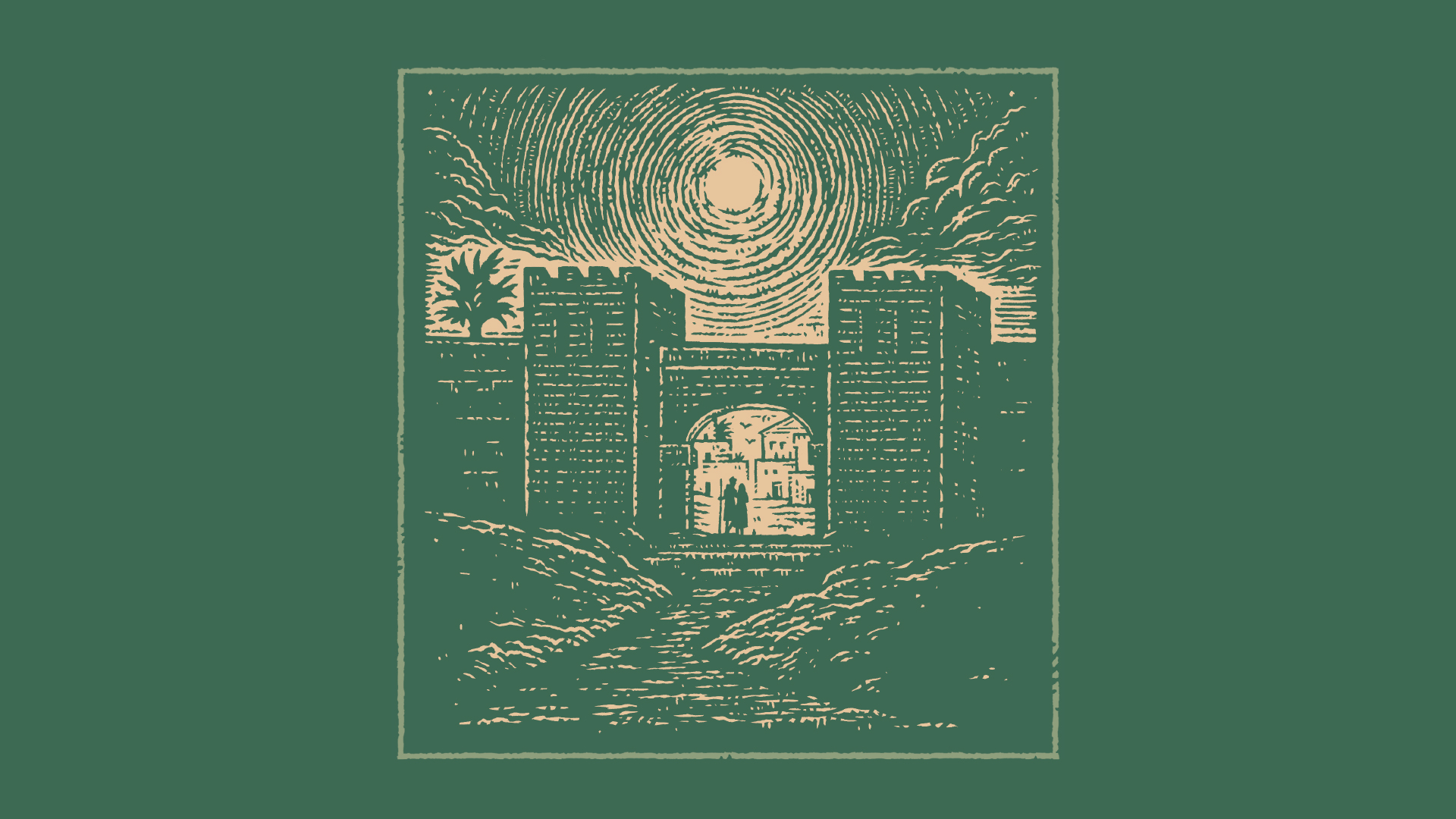
Christ in Ten Thousand Places

An Advent reading for December 16.

Stephen Crotts

Week 3: The Light of the World


Scripture uses the motif of darkness and light to describe the Promised One—and Jesus identified himself as this prophesied light. In him, we experience salvation and spiritual illumination. But Jesus is not only the light for us as individuals—he is a light for all nations. Jesus is the Light of the World.

Read 2 Corinthians 4:4–6 and Ephesians 1:15–23; 5:8–11

In Plato’s famous Allegory of the Cave, people live imprisoned in chains, staring ahead at a wall with a fire casting light from behind them. Unbeknownst to them, puppets and moving objects behind them are creating the shadows they see on the wall. They believe the shadows are reality. They have no idea that there is a bright sunlit world outside. Even when others tell them about the real world, they still don’t want to leave their cave.

The allegory reminds me of Paul’s words: “The god of this age has blinded the minds of unbelievers, so that they cannot see the light of the gospel that displays the glory of Christ, who is the image of God” (2 Cor. 4:4). In contrast, when we are born anew in Christ, we become children of the light—children of the sunlit world (Eph. 5:8). God illuminates our hearts and minds through the gospel so we can see Christ in his glory. As we fix our eyes on Jesus and remain in him, God progressively puts everything in its proper perspective. The result is that the church collectively and people individually are better able to discern good from evil. We grow to see and discern the details of beauty, goodness, and truth—to see the world and people aright. No doubt, we need each other to remain in the light to experience God’s shalom—to see and to love.

Ephesians 5:9 reveals something breathtakingly beautiful about the fruit born of light. The fruit is “all goodness, righteousness and truth.” Gazing at the face of Christ, we start to see him more and more in our lives and in our world. We see Jesus showing up in thousands of ways and in all sorts of places—sometimes quite unexpectedly. We’re enabled to find the goodness, righteousness, and truth present even in difficult or painful circumstances. Similarly, others see these virtues manifested in our own lives and give thanks to God.

The knowledge revealed to us through God enlightening our hearts fills us with overflowing joy and enduring hope (Eph. 1:18). It is hope for the present because of the “incomparably great power” we have through the Spirit to do God’s will in the world (v. 19). This hope is further buttressed by the knowledge that God is ever for us. And we also have hope for the future because we catch glimpses of our glorious inheritance.

Indeed, as we remain in Christ and connected to one another, we know at a deep level that evil is the counterfeit, the shadow world. As Gerard Manley Hopkins described in his poem “As Kingfishers Catch Fire,” we grow to see Christ playing “in ten thousand places” and the glory of God shining everywhere. This is Advent light.

Marlena Graves is assistant professor of spiritual formation at Northeastern Seminary. She is the author of several books, including The Way Up Is Down.


Consider 2 Corinthians 4:4–6 and Ephesians 1:15–23; 5:8–11.
How do these passages describe what spiritual illumination looks like? How has faith in Jesus—the Light—enlightened your own life?

He Shines in the Darkness

An Advent reading for December 17.

Stephen Crotts

Week 3: The Light of the World


Scripture uses the motif of darkness and light to describe the Promised One—and Jesus identified himself as this prophesied light. In him, we experience salvation and spiritual illumination. But Jesus is not only the light for us as individuals—he is a light for all nations. Jesus is the Light of the World.

Read John 1:1–18

The apostle John contextualizes his account of the words and deeds of his good friend Jesus with an opening prologue that crackles with energy and wonder. Jesus, John wants to tell us, is the very Word of God. He was with God at the creation of the world. He is God. He is life itself, and that life is the light of the world.

Then comes verse 5: “The light shines in the darkness, and the darkness has not overcome it.” At least that’s what it says in my 2011 edition of the NIV. But here’s a striking thing: My older edition of the NIV (the 1984 translation) reads differently. It says, “The light shines in the darkness, but the darkness has not understood it.”

The Greek word alternatively rendered “overcome” and “understood” is katalambanó—which means to “take hold of” or “grasp.” We need more than one English word to try to hint at the full gist of what John is saying here.

John has seen the Light of the World with his own eyes. He’s gone fishing with him. He’s eaten with him. He’s prayed with him. And he’s watched him endure the most horrific death imaginable and then come back to life. So John knows that there is no darkness in the universe that can permanently grasp and defeat this light. The darkness cannot overcome it.

But John also knows that our human minds, left to their own devices, cannot begin to grasp the love on offer in the astonishing fact of the Incarnation. The darkness cannot understand it.

John’s prologue culminates with a breathtaking meditation on the lengths to which God has gone to reach us with his illuminating love. “The Word became flesh,” he writes, “and made his dwelling among us.” Or, as The Message paraphrase renders it, the flesh-and-blood Word “moved into the neighborhood.”

The Mighty God came in the staggeringly vulnerable form of a human baby. The Prince of Peace allowed himself to be birthed into a world of sin and chaos—God made huggable, woundable, kissable, killable.

Only the Light of the World can give us the power to begin to understand what God has offered us in the birth of Jesus. So, this Advent, let us pray the prayer the apostle Paul offered the Ephesians (3:18): that we, “being rooted and established in love, may have power, together with all the Lord’s holy people, to grasp how wide and long and high and deep is the love of Christ.”

Carolyn Arends is a recording artist, an author, and the director of education for Renovaré. Her most recent album is In the Morning.

Ponder John 1:1–18.
What does this passage emphasize about the Word? About Jesus as the Light of the World? About the Incarnation? What questions, thoughts, or feelings does it stir up in you? Express your response to God in prayer.

Waiting On a Promise

An Advent reading for December 18.

Stephen Crotts

Week 4: Immanuel


As we journey through the events surrounding the Nativity, we contemplate the Incarnation. Jesus—the Mighty God, the Prince of Peace, the Light of the World—became flesh and dwelt among us. As Isaiah’s prophecy foretold, he is “God with us.” Jesus is Immanuel.

Read Luke 1:5–25

The Old Testament concludes with a promise of one who would reconcile the hearts of fathers to their children. Those words ending the book of Malachi echoed over centuries of silence. In the period of waiting between the Old and New Testaments, our Mighty God was setting up the tumultuous world stage for the coming of the Prince of Peace.

There is a time for everything, and Luke 1 is an intricate tapestry of divine appointments. The setting was an appointed time in history: during the reign of Herod. Zechariah was appointed for a once-in-a-lifetime priestly duty. Elizabeth’s long years of infertility were an appointed impossible situation that set up the miraculous conception of John the Baptist. The couple’s priestly lineage was an appointed heritage for raising an anointed son. And Gabriel was the appointed messenger to announce God’s appointed purpose for John the Baptist.

When they were young and starting out their life together, Zechariah and Elizabeth were likely full of hopeful expectations about their future. But as infertile months turned into years, the hope of having a child ebbed away and felt like a burden of “disgrace” (Luke 1:25).

When we’re introduced to this couple, they’re now “very old” yet are continuing to walk with God. This faithfulness deserves our commendation—rather than criticism of Zechariah’s moment of unbelief. After all, this aged man had grown so familiar with disappointment.

Zechariah had persevered in prayer through seemingly dark and silent years. But on this day, as he performed the priestly duty of lighting the fire to burn incense, Gabriel appeared and announced that God had heard his prayer. God was with Zechariah—even when heaven seemed silent. The Light of the World had not forgotten; he was sovereignly preparing history for the appointed time.

Zechariah and Elizabeth’s story offers us perspective on our own seasons of waiting. We’re reminded that there’s no expiration date on our prayers. The faithfulness of this couple unfolded into a life-giving season of joy as God’s promise came to fulfillment through their child, the forerunner of the Messiah.

But as we enter into their story, there is also no skipping over their decades of infertility. We enter into this painful part of their lives too. For in their long sorrow, we see their strong faith.

Elizabeth understood that in this miracle, God had shown her special favor. Many biblical heroes did not receive what they hoped for or what had been promised them this side of eternity (Heb. 11:39). The ultimate fulfillment of their faith was beyond them—as it also is for us. This Advent, in our waiting, there is a bigger picture being painted—in God’s appointed time. Immanuel—God with us—is still faithful to his promises today.

Dorena Williamson is a church planter, speaker, and the author of ColorFull, The Celebration Place, Crowned with Glory, and Brown Baby Jesus.

Reflect on Luke 1:5–25.
How do you see faithfulness in this story? Zechariah and Elizabeth’s faithfulness? God’s? How do you see God’s sovereignty? God’s presence?

The Beautiful Paradox

An Advent reading for December 19.

Stephen Crotts

Week 4: Immanuel


As we journey through the events surrounding the Nativity, we contemplate the Incarnation. Jesus—the Mighty God, the Prince of Peace, the Light of the World—became flesh and dwelt among us. As Isaiah’s prophecy foretold, he is “God with us.” Jesus is Immanuel.

Read Luke 1:26–38

The abstract concept of power brings to mind earthquakes and thunderstorms or maybe presidents and billionaires. Raw power stops us in our tracks, causing us to give heed to whatever or whoever wields it. Few of us, however, associate power with the womb. Yet Mary’s womb carried true power, hidden in darkness, unseen, hard to imagine.

Here we encounter one of the most beautiful paradoxes of the Christian faith: The Holy Spirit brought into being a tiny baby boy in this woman’s womb, her own flesh and bone, her firstborn son; this same baby boy was none other than the Son of God, identified as the “Son of the Most High.”

So is Jesus Mary’s son or God’s Son? Human or divine? Yes! Both are true in one person, this one baby boy. We can imagine God bringing salvation, or we can picture a heroic human doing revolutionary things. But a single person who is at the same time both fully God and fully human, without compromising the integrity of either? This is truly a beautiful paradox—a paradox at the heart of human salvation.

This power is not a bare, infinite force abstracted from all other definition but the compassion of the eternal, glorious, holy God clothed in human flesh. His power takes the form of weakness in divine solidarity with humankind, all driven by his holy love.

The angel proclaimed a glorious event to Mary—and to us. Jesus gets his full humanity from Mary, becoming like the rest of us in all ways except that he refuses sin (Heb. 4:15). Yet Mary’s son existed before Mary, for this is the eternal Son of God who, as the Nicene Creed declares, is “very God of very God.” Having the eternal nature of God, the Son comes by the Spirit from the Father, never ceasing to be the Mighty God yet truly becoming what he was not: a humble human creature. Jesus—truly God and truly human.

As Leo I (400–461) wrote in a letter, commenting on the Son’s incarnation, “What he did was to enhance humanity not diminish deity. That self-emptying of his, by which the invisible revealed himself visible and the Creator and Lord of all things elected to be reckoned among mortals, was a drawing-near in mercy not a failure in power.” From the womb of Mary comes the savior-king, whose “kingdom will never end.” May we, like Mary, respond as the “Lord’s servant,” willing to trust the Almighty God who has loved his creation enough to dwell in it by becoming this man, thus bringing new life into the world. His full divinity and full humanity proclaim his power, and he tells us, “Do not be afraid.”

Kellu M. Kapic is a theologian at Covenant College and the author or editor of numerous books, including Embodied Hope and You’re Only Human.

Consider Luke 1:26–38.
What strikes you most in Gabriel’s message? How do you desire to respond to Jesus and to the beautiful paradox of his incarnation?

The Invitation of Incarnation

An Advent reading for December 20.

Stephen Crotts

Week 4: Immanuel


As we journey through the events surrounding the Nativity, we contemplate the Incarnation. Jesus—the Mighty God, the Prince of Peace, the Light of the World—became flesh and dwelt among us. As Isaiah’s prophecy foretold, he is “God with us.” Jesus is Immanuel.

Read Luke 1:39–56

Few interruptions in life are as disruptive as travel, especially with the fatigue and morning sickness that often accompany early pregnancy. Mary’s journey from Nazareth to the hills of Judea was neither easy nor safe. Still, emboldened by her faith but also in need of support, Mary braved the trek pregnant, poor, and probably perplexed. Why choose to go at all?

Gabriel had told Mary that her relative Elizabeth was also expecting a child—a miracle for a woman of her advanced age. Recognizing that Elizabeth was the only person on earth who might understand what she was going through, Mary went to her. And when she arrived, Elizabeth offered the exact affirmation Mary needed: “Blessed are you among women, and blessed is the child you will bear!” Elizabeth praised Mary for her response of faith. With those words, I imagine Mary’s fears tied to her unexpected pregnancy and its unknown consequences for her life faded into greater faith.

Elizabeth’s encouragement reminded Mary that the Lord’s interruption of her plans was also an invitation—not only to carry and give birth to Immanuel, “God with us,” but also to engage in a deeper sense of community, “us with us.” Heartened by Elizabeth’s blessing, Mary responded with a song of praise. And she reflected on this invitation into interdependence in the closing words of her Magnificat: “He has helped his servant Israel, in remembrance of his mercy, as he spoke to our fathers, to Abraham and to his offspring forever” (ESV). In her rejoicing, Mary meditated on how the very same God who “spoke to our fathers” all the way back to Abraham had now spoken to her and to Elizabeth.

Mary believed in “God with us,” and she said yes when Gabriel appeared to her. But her faith still needed nurturing. The Incarnation meant a major interruption in Mary’s life; it was wonderful, yes, but it was also weighty. Something was happening to her that had never happened before in the history of the world, and she needed support and help to accept and prepare for it.

So she turned to faithful Elizabeth. We can only imagine how strengthening it was for Mary to hear Elizabeth’s words of blessing. In fact, I’d argue that we would not have Mary’s Magnificat without Elizabeth’s Encouragement.

That’s the power of interdependence, of faith in community. In our individualistic society, opening ourselves up to be blessed by others is often difficult. We are conditioned to consider the possibilities of harm more than the potential helpfulness of community. But the truth is that, like Mary, we all need Elizabeth-like encouragement. The Incarnation is an interruption and an invitation to know “God with us” and also to embrace “us with us.”

Rasool Berry serves as teaching pastor at The Bridge Church in Brooklyn, New York. He is also the host of the Where Ya From? podcast.

Contemplate Luke 1:39–56.
What truths do you see in this passage about Jesus—God with us? How do Elizabeth’s words and her role in Mary’s life speak to you, too, about the “us with us” nature of faith?

God of Mercy and Power

An Advent reading for December 21.

Stephen Crotts

Week 4: Immanuel


As we journey through the events surrounding the Nativity, we contemplate the Incarnation. Jesus—the Mighty God, the Prince of Peace, the Light of the World—became flesh and dwelt among us. As Isaiah’s prophecy foretold, he is “God with us.” Jesus is Immanuel.

Read Luke 1:57–80

We humans do not hold mercy and power in tension well. Those who gain power often enjoy it and tend to seek more, while those who are gracious tend to surrender power (or have it taken from them). Undoubtedly there are exceptions, but by and large, we know and can observe that this balance is not easy to achieve. But unlike us, God is somehow both the most powerful and the most merciful, perfect in his display of each.

We see God’s gracious might highlighted in several ways in this story about John the Baptist’s birth and early days. In fact, this theme of gracious might is hidden in plain sight for us English readers. We learn that Elizabeth wants to name the boy John in keeping with the message that Gabriel gave to Zechariah (Luke 1:13). Those around her are surprised; this didn’t cohere with the custom of naming a child after someone in the family. So why John (Yohanan)? It means “God is gracious,” and this boy will proclaim God’s gracious works on behalf of the whole world.

Zechariah has been unable to speak since the day he learned his wife would have a child. But as soon as he writes the boy’s name, his speech is restored, and he erupts in praise. Through this sign, the people know this boy is special. They ask one another, What will he be?

But Zechariah casts their gaze in the right direction. Yes, the boy has a special role, but the Lord is to be praised. The powerful Lord of all “will come to us,” Zechariah says, and will be in the midst of his people.

But the Lord’s display of power will not be oppressive. Instead, it will be liberative. The Lord has “raised up a horn of salvation” in order to “show mercy to our ancestors” and to “rescue us.”

The idea of God showing mercy is linked to the idea of God’s people being in sin. Like their ancestors who received similar prophecies (1 Sam. 2:10; Mic. 7:20; Ezek. 16:60), they deserve punishment but they receive an outpouring of grace.

Why does God do this? So we can serve him. This is a gift so that we might truly experience “God with us.” The Song of Zechariah promises forgiveness of our sins and illumination to guide us on the “path of peace.” As Luke continues his gospel, he will return to these themes many times, highlighting how the coming of the Messiah ushers in restoration and justice—true and lasting peace.

Madison N. Pierce is associate professor of New Testament at Western Theological Seminary. Her books include Divine Discourse in the Epistle to the Hebrews.

Meditate on Luke 1:57–80.
Where in this passage do you see the mighty power of God? Where do you see the mercy and grace of God? Pray, expressing your response to God.

Theology

For to Us a Child Is Born…

Daily devotional readings for Advent 2022.

Stephen Crotts

Introduction to Advent 2022: The Promised One


Read Isaiah 9:6-7

During Advent, we prepare our hearts to celebrate the arrival of this child—the infant Jesus, laid in a manger, loved by Mary and Joseph, worshiped by shepherds and wise men. But Advent—which means “arrival”—invites us to prepare for much more than the holy night of his birth.

Throughout church history, Advent has been a season of anticipation. It began in the early centuries of Christianity as a penitential period in preparation for Epiphany—the celebration of Jesus’ appearance and the manifestation of his identity, which was also a day set aside for the baptism of new believers. Soon Advent began to focus on the anticipation of another appearance: the second coming of Christ. By the Middle Ages, the themes we tend to associate with Advent today had become part of the church’s observance, as Christians included celebratory anticipation of Christmas alongside their contemplation of Jesus’ return.

Each of these historical themes interweaves throughout Advent’s traditional Scripture readings, as the Bible’s promises and prophecies speak expansively about Jesus’ identity and purpose. As we delve deep into these truths, our worship of the babe in the manger is enriched, for we kneel before the one who would make his identity manifest through miracles of great power. We bow before the one who will one day come again in glory to judge the living and the dead.

Isaiah contains some of the most compelling prophecies pointing to Jesus. We read of a promised son who would be called Immanuel—God with us (7:14). We learn of a light that will dawn upon people living in darkness (9:2). And we encounter this resounding promise:

For to us a child is born, to us a son is given, and the government will be on his shoulders. And he will be called Wonderful Counselor, Mighty God, Everlasting Father, Prince of Peace. Of the greatness of his government and peace there will be no end. He will reign on David’s throne and over his kingdom, establishing and upholding it with justice and righteousness from that time on and forever. (9:6–7)

Scripture’s prophecies of the Promised One often have layers of meaning and multiple fulfillments. They frequently point toward a fulfillment in the prophet’s own time but also direct our gaze toward the Messiah and his first coming as well as the Second Advent we await.

In this CT devotional resource, we explore what Scripture tells us about the Promised One, deepening our faith in the Savior we know and love. The daily reflections delve into key passages that help us understand more about who Jesus is. And each weekly theme centers around a core aspect of Jesus’ identity drawn from Isaiah’s prophecies.

The Mighty God

The traditional first readings of Advent can feel jarringly at odds with our Christmastime expectations. Rather than holly and candlelight, we read of end-times horrors. Instead of rejoicing angels, we begin with a prophet calling loudly for repentance. These passages shock us out of our cozy mindset to remind us that Jesus is the Mighty God. The Savior whose birth we are preparing to celebrate is the very Son of Man who will one day return to judge the living and the dead. He is the one for whom God sent a messenger to prepare the way: John the Baptist, who cried out in the wilderness, testifying to Jesus’ power and glory. The child in the manger is the Mighty God whose kingdom will never end.

The Prince of Peace

Many of Advent’s Old Testament passages prompt us to reflect on the personal peace we can experience with God and to envision the ultimate peace the Promised One will one day bring. War, violence, and pain will come to an end. Nations and people groups who have long been divided will worship together as one. But Scripture pushes us beyond our tendency toward a sentimentalized vision of peace, challenging us to see that the peace Christ brings is robust and comprehensive. This peace comes not only through Jesus’ love, but also through his mighty power—for his peace is tied in directly with his justice. His peace is connected to his righteous judgment. And the peace he brings was bought at a price.

The Light of the World

From the beginning to the end of Scripture, we see light used as a metaphor to help us understand God’s presence, salvation, the life of faith, and Jesus himself. We read promises of a light that would brightly shine, unhindered by darkness. When Jesus walked upon the earth, he identified himself as this promised light—the same light whose very presence will one day illuminate the city of God (Rev. 21:23). And, crucially, Jesus is the light not just for you and for me, but for the world. As Scripture makes plain over and over, he is the Promised One for all nations, ushering in his global, multiethnic kingdom.

Immanuel

This final week of Advent, we focus on the events surrounding the Nativity when the Promised One—the Mighty God, the Prince of Peace, the Light of the World—entered into humanity as a newborn child. Here was Immanuel, God with us. Here was the Word made flesh, dwelling among us (John 1:14). The centuries-old promises spoken about him reverberate in the acclamation of angels, the message of the shepherds, the prophetic praise of an elderly man and woman, and the joyful worship of Gentiles who’d journeyed from afar to bow before the King of Kings.

He Is the Promised One

This Advent, as we prepare to celebrate the birth of Jesus, may we deeply contemplate Scripture’s promises of who he is and what he came to do. As we worship at the manger, may we marvel that this very child is the Mighty God, he is the Prince of Peace, and he is the Light of the World. He is the one who came to die. He is the one who rose triumphant, who ascended, and who will keep his promise to come again in glory. He will enact justice and bring to culmination his kingdom of peace. He is Immanuel, God with us.

Christ, the Everlasting Lord

An Advent reading for November 27.

Stephen Crotts

Advent Week 1: The Mighty God


The infant wrapped in swaddling clothes and laid in a manger is the glorious Creator and sustainer of all things. We hear of his power and might in the teachings of John the Baptist. We anticipate his promised return and his ultimate reign. Jesus is the Mighty God.

Read Isaiah 9:6–7; Colossians 1:15–20; and Hebrews 1:1–12

Of all the common signs of this season leading up to Christmas—lights strung upon homes, Nativity scenes set out on display, trees decorated with ornaments—the one I most look forward to is the music. The songs of Advent and Christmas invite us to picture the familiar events: the holy family at the crèche, angels singing to awestruck shepherds, wise men journeying toward the “little town” of Bethlehem. These beloved hymns and carols warm our hearts.

Yet within many of our favorites are woven lyrics that break through our familiarity and declare an astonishing theological reality: The newborn in the manger is the Mighty God.

“Hark the Herald Angels Sing” and “We Three Kings” exhort us to comprehend who this infant truly is: “Veiled in flesh the Godhead see; hail the incarnate Deity.” “Glorious now behold him arise; King and God and sacrifice.”

“Come Thou Long Expected Jesus” sounds out this profound paradox in simple words: “Born a child and yet a King.” These lyrics resound with the truth of Isaiah 9:6–7: This child is the Promised One who will reign eternally on David’s throne, establishing his kingdom of justice, righteousness, and peace.

It’s an unfathomable mystery the New Testament also invites us to dwell upon. The author of Hebrews proclaims, “The Son is the radiance of God’s glory” and the “heir of all things” (1:2–3). Paul emphasizes that “in him all things were created: things in heaven and on earth, visible and invisible. … In him all things hold together” (Col. 1:16–17). Jesus Christ is supreme over all things and the fullness of God dwells in him.

This is the promised child God’s people awaited and whose birth we are preparing to celebrate. This is the Lord for whom God sent a messenger to prepare the way, preaching a message of repentance. This is the Savior who, in his mission of love and redemption, would defeat the power of sin and death through his sacrifice on the cross and victorious resurrection. And this is the one whose return we await in hope, trusting in “the King of kings and Lord of lords, who alone is immortal and who lives in unapproachable light” (1 Tim. 6:15–16).

This reality—that the child in the crèche is the Mighty God—is far beyond what we can fully comprehend. And yet it is true. In awe and humility, we heed the exhortation in “Oh Holy Night”—“Fall on your knees!” In humble gratitude, we worship him.

Let all within us praise his holy name. Christ is the Lord! O praise his name forever! His power and glory evermore proclaim! His power and glory evermore proclaim!

Kelli B. Trujillo is Christianity Today’s print managing editor.

Ponder Isaiah 9:6–7; Colossians 1:15–20; and Hebrews 1:1–12. Optional: Also read 1 Timothy 6:13–16.


Which description of Jesus’ might and power in these passages draws your attention? Why? How can this truth shape your worship this Advent season?

Jesus Deserves All the Attention

An Advent reading for November 30.

Stephen Crotts

The infant wrapped in swaddling clothes and laid in a manger is the glorious Creator and sustainer of all things. We hear of his power and might in the teachings of John the Baptist. We anticipate his promised return and his ultimate reign. Jesus is the Mighty God.

Advent Week 1: The Mighty God

Read John 1:19–34 and 3:22–30

“He must increase, but I must decrease” (KJV). I remember hearing this verse as a child and imagining Jesus growing bigger and bigger while John the Baptist shrank! The context of John’s statement clarifies his meaning: John’s disciples have told him that “everyone is going” to Jesus, so John declares, “He must become greater; I must become less.”

John’s ministry began before Jesus’ did, so John watched the number of Jesus’ followers grow from zero to a lot more than John had. This could have been heartbreaking, because “the whole Judean countryside and all the people of Jerusalem” had been going out to the wilderness to see John (Mark 1:5).

The Gospel of John, however, consistently depicts John the Baptist merely as a witness—one who bears testimony—to the identity and greatness of Jesus. Each portion of today’s two passages shows John explaining who he is and isn’t or who Jesus is. Jewish leaders from Jerusalem question John about his identity, and he denies being any kind of Messiah. He is just preparing the way for the Christ. Yes, he has a ministry of water baptism, but his status is greatly inferior to that of the coming one. John points out Jesus as God’s sacrificial lamb, who will take away the sins of the world, and who will immerse people into the power of the Holy Spirit.

Later, when Jesus’ followers have eclipsed John’s in number, John insists this is fully appropriate. He likens himself simply to the best man in a wedding, where Jesus is the groom. John’s analogy in 3:29 is striking, particularly when we understand its cultural context. Ancient Jewish custom called for the best man to wait outside the bedroom when the bride and groom consummated the marriage. Traditionally, the groom would shout for joy to confirm their new marital intimacy, and the best man would share that joy.

The Christian life is all about deferring more and more to Jesus, the Mighty God. A generation later, Paul would say in Philippians 1:18 that “the important thing is that in every way … Christ is preached. And because of this I rejoice.”

I have recently retired and need to learn this lesson more than ever. Being in the limelight is not the point. Humbly magnifying Jesus is. I need to shrink.

Craig L. Blomberg is distinguished professor emeritus of New Testament at Denver Seminary and the author of numerous books, including his Matthew commentary and Interpreting the Parables.

Consider what John the Baptist’s example shows us about who Jesus is. How is John’s posture instructive for your own spiritual life? How might you “become less”?

Meditate on John 1:19–34 and 3:22–30.

Jesus Will Reign

An Advent reading for December 1.

Stephen Crotts

The infant wrapped in swaddling clothes and laid in a manger is the glorious Creator and sustainer of all things. We hear of his power and might in the teachings of John the Baptist. We anticipate his promised return and his ultimate reign. Jesus is the Mighty God.

Advent Week 1: The Mighty God

Read Matthew 24:29–44

Questions arise with the first word of this passage: “Immediately”!

Most of the rest of the content in verses 29–31 has almost always been understood to describe Christ’s return, depicted poetically in the language of Isaiah 13:10 and 34:4 as involving cosmic upheaval. (Some have instead taken it as a sort of invisible coming of Jesus in judgment through Rome’s destruction of Jerusalem in A.D. 70—though the idea of gathering the elect from one corner of the world to another doesn’t fit that interpretation.)

When will Christ come back? This message on the Mount of Olives was provoked by Jesus’ disciples asking him when he would come back (Matt. 24:3). He itemized a long list of what must happen first (vv. 4–26) and now says, in essence, “Watch for these things to know when my coming is near,” just as a fig tree in leaf portends the arrival of summer.

Examples of all “these things” occurred by A.D. 70, so the church in every generation since has believed it might see his return. Jesus is not saying he will return in the disciples’ lifetime, merely that all the preparatory events will have occurred. “These things” in verse 34 have to be the same as “these things” in verse 33—which show that Christ’s return “is near” but not yet here. So they can’t include his actual return—just the signs that prepared for his return. When he returns, he will no longer be merely “near, right at the door,” but he will have arrived!

We can’t know the precise timing of all this, so we must always be prepared. Those who aren’t will be caught off guard by the suddenness and surprise of the final events. If we remain alert at all times, we don’t have to worry about a midnight burglar. Of course, Jesus isn’t coming back to steal anything from us; it is the idea of unexpectedness he’s highlighting in this comparison.

But what about “immediately after the distress of those days”? Perhaps the distress here is the distress that characterizes the entire period between Christ’s two comings. After all, 2 Timothy 3:12 promises persecution to all the godly (even amid the many joyous moments in the Christian life).

However we interpret it, here is testimony to Jesus as the Mighty God who will put all things right in his perfect timing. Today, many Christians have recovered the biblical call for justice in this life, and rightly so—we should do all we can to help others. But war, sickness, natural disaster, injury and disability, poverty, and broken relationships all require us to ultimately trust God for complete restitution and restoration in eternity. And in the grand scheme of eternity, his return will probably seem to all of us like it indeed happened “immediately”!

Craig L. Blomberg is distinguished professor emeritus of New Testament at Denver Seminary and the author of numerous books, including his Matthew commentary and Interpreting the Parables.

Contemplate Matthew 24:29–44.


What questions does this passage raise for you? What feelings does it stir up? Pray, reflecting on how it points your focus toward Jesus’ might and power.

Apple PodcastsDown ArrowDown ArrowDown Arrowarrow_left_altLeft ArrowLeft ArrowRight ArrowRight ArrowRight Arrowarrow_up_altUp ArrowUp ArrowAvailable at Amazoncaret-downCloseCloseEmailEmailExpandExpandExternalExternalFacebookfacebook-squareGiftGiftGooglegoogleGoogle KeephamburgerInstagraminstagram-squareLinkLinklinkedin-squareListenListenListenChristianity TodayCT Creative Studio Logologo_orgMegaphoneMenuMenupausePinterestPlayPlayPocketPodcastRSSRSSSaveSaveSaveSearchSearchsearchSpotifyStitcherTelegramTable of ContentsTable of Contentstwitter-squareWhatsAppXYouTubeYouTube