Theology

I Don’t Want to Be a Universalist

Richard Mouw says the best forms of the doctrine still disappoint those counting on God to do the right thing.

Illustration by Sarah Gordon / Source Images: Getty / Wikimedia

I am not a universalist. There is nothing surprising about my saying that. Having spent my career in evangelical institutions, I have signed many theological statements affirming the realities of heaven and hell, and I have always done so in good faith.

But here is something that would surprise many of my fellow evangelicals: I don’t even want to be a universalist. I have often heard the opposite from evangelical friends: “I would like to be a universalist, but I really see no biblical basis for the view that everyone will be saved in the end.” It is reassuring that those who express this sentiment usually acknowledge that the Bible is clear on the subject. I do worry, though, about their wishing that it were not so clear.

I am convinced that the idea of universal salvation fails to capture some important elements in the Bible’s teachings about the requirements of divine justice. The Scriptures make it clear that God heeds the cries of the oppressed and that on the Day of Judgment all evildoers will be dealt with according to their deeds (Rev. 20:12). Universalism tries to get around the unspeakable harm that people do to each other, evading the need for repentance, while detracting from the Cross and a real joy in God’s justice.

There are certainly some aspects of evangelicals’ traditional teachings about hell that do trouble me. I don’t want to hear repeats of the fire-and-brimstone sermons of my youth. These are similar to the infuriating message of folks who carry signs at funeral gatherings declaring that the deceased person will burn for all eternity.

To be sure, the hellfire images are there in the Bible, as in Matthew 25:41, when Jesus tells those on his left, “Depart from me, you who are cursed, into the eternal fire prepared for the devil and his angels.”

But those biblical images have become so much the stuff of caricature that unbelievers can make fun of the imagery while ignoring the clear biblical message that persistent unbelief has eternal consequences. Such frivolity works in the same direction—away from the joy and the seriousness of salvation—as does unloving glee. We evangelicals have gained a reputation for being mean-spirited people, and I am glad when my friends look for ways to tone down the rhetoric while not compromising the essential message.

I hold out for a wideness in God’s saving mercies. I take my cue on this from Charles Spurgeon, who observed in one of his wonderful sermons, “Heavenly Worship,” that while the Bible tells us “there is to be a multitude that no man can number in heaven,” he has not found anything in the Bible that says “that there is to be a multitude that no man can number in hell.”

Suppose an evangelical said, “I would really like to believe that Jesus was not divine, but just one of the great ethical teachers, but the Bible does not allow that.” How could we trust such a person’s faith?

But the case of universalism is different. A desire to believe in universalism is usually born out of concern for loved ones. We rightly don’t feel betrayed by those wishing for the eternal joy of Heather or Bradley, loved ones they pray for fervently. Or perhaps they are thinking about their wonderful non-Christian neighbors. We can empathize with those concerns.

Nevertheless, the biblical depiction of a state of eternal separation from God is real. As N. T. Wright puts it in Surprised by Hope, when we study “the New Testament on the one hand and the newspaper on the other,” we cannot avoid the conclusion that divine justice requires a decisive end-time accounting for the grave injustices that occur in our world. For example, a man who sells 13-year-old girls into sexual slavery and enjoys living off the profits will face ultimate condemnation. So will murderers, blackmailers, and hypocrites of all kinds.

This does not mean that we can give up on any human being in our witness to God’s amazing grace. When we sing, “To God Be the Glory,” we affirm that wonderful promise that “the vilest offender who truly believes that moment from Jesus a pardon receives.” In our hope that vile offenders will come to true faith, we must also find ways of assuring their victims that the Lord will not ignore the demands that justice be done. God’s forgiveness is still just.

Wright says that individuals who persistently rebel against God eventually become so dehumanized that they irreparably damage the image of God in which they were created. When they pass on from this life, he says, after having “inhabited God’s good world, in which the flickering flame of goodness had not been completely snuffed out,” they enter into “an ex-human state, no longer reflecting their maker in any meaningful sense.”

As the psalmist observes, sinners become like the idols whom they worship (115:8). And as Wright points out, this dehumanizing pattern turns us into creatures who are “not only beyond hope but also beyond pity.” Wright reinforces his point by citing C. S. Lewis’s observation in The Great Divorce that the Lord will eventually proclaim to unrepentant sinners, “Thy will be done.”

In order to keep myself honest on this subject, I do keep up on defenses of universalism. Although many who argue for universalism make no effort to reconcile the Bible with their disbelief in hell, there are some arguments that stay within the pale of Christianity and are worth paying attention to.

The most recent and significant argument is set forth by David Bentley Hart in his book That All Shall Be Saved: Heaven, Hell, and Universal Salvation, which has received much attention. A couple of my evangelical friends have recommended it to me as “fascinating” and “challenging.”

Hart discusses the topic on a number of fronts, but I could not get past his refusal to pay attention to biblical specifics. All that the Bible provides, he tells us, “are a number of fragmentary and fantastic images that can be taken in any number of ways, arranged according to our prejudices and expectations, and declared literal or figural or hyperbolic as our desires dictate.” In other words, hell might not be hell. And if it isn’t, no one goes there, of course. Nor could God be taken as serious at all about avenging evil.

But what if we can get to universalism by proving that each person will eventually want Jesus as Lord—that no one chooses hell when they see him? This is a much stronger argument than simply that the God we love wouldn’t (despite what he said) condemn people. This is also what Hart argues. He says we have to ask whether a proper understanding of human nature allows us to believe that “this defiant rejection of God for all eternity is really logically possible for any rational being.”

This argument for universalism relies on people being reasonable, sooner or later, leading to their saving faith. But there is no evidence that each person will finally be repentant, as well as enlightened.

Adolf Hitler looms large as an example of persistent defiant rejection. Haven’t the monstrous deeds for which Hitler is responsible put him beyond any claim to God’s mercy? Hart directly addresses this question, using Hitler as his case in point. No human being could ever willfully choose, he says, to “fulfill the criteria necessary justly to damn himself or herself to perpetual misery.”

The fact is that “the character of even the very worst among us is in part the product of external contingencies.” To follow Hart’s argument, we would have to assume that “somewhere in the history of every soul there are moments when a better way was missed by mischance, or by malign interventions from without, or by disorders of the mind within,” as he put it.

And then, to underscore the point he is making, he observes that “rather than any intentional perversity on the soul’s own part,” these are precisely the kinds of factors at work in a case like Hitler’s.

The horrible deeds of a Hitler, which are surely “infinitely evil in every objective sense,” are still “prompted into action by a hunger for the Good, [and] could never in perfect clarity of mind match the sheer nihilistic scope of the evil it perpetrates.” By this logic, a Hitler could not rationally “resist the love of God willfully for eternity.” Hart tells us that he is drawing upon insights here from Byzantine orthodoxy. His argument clearly accepts the Byzantine fondness for Plato’s philosophy.

Plato taught that since evil is the absence of the Good, no one willingly chooses that which is evil. This perspective allows Hart to argue that what we might want to label in the Hitler case as “intentional perversity” is in reality a state of ignorance—due to the “external contingencies” that Hart has listed.

Hart includes the influence of “disorders of the mind within” as one of the factors that could have kept Hitler from clearly grasping the Good. What Hart likely has in mind—in line with his Platonism—is the ways in which some of Hitler’s past experiences or brain chemistry might have kept him from seeing facts clearly. Or maybe Hart thinks that Hitler could not grasp the truth because he relied on unreliable sources for his information.

For those of us who do not want to set the Bible aside in thinking about these matters, we cannot ignore Jesus’ extensive teachings, such as those in Matthew 25 on how some will be welcomed and some shut out, followed by his warning that those who despise the gifts of God will not only be thrown out into the outer darkness but also lose what they were given.

Nor can we forget what the apostle Paul says about willful disobedience to the Good: “The wrath of God is being revealed from heaven against all the godlessness and wickedness of people, who suppress the truth by their wickedness, since what may be known about God is plain to them … . [They] are without excuse” (Rom. 1:18–20).

I have taught many courses on Plato’s dialogues, and I have pointed my students to this Pauline teaching that people who deny God are without excuse. In light of it, we must reject the Byzantine insistence that it is not possible for a human being to knowingly choose that which is evil.

However, the Bible does describe a (non-Platonistic) process of rejecting the Good without what we would normally call willfulness. We can fail to follow the truth we see in what seem like minor ways, leading us to wander further from the path of wisdom. Our spiritual lives have a fundamentally directional character. We are each on a trajectory toward God or away from him. The Westminster Shorter Catechism highlights this factor in its first question and answer, in telling us that our “chief end” as human beings is “to glorify God and to enjoy him forever.”

Redeeming grace restores our ability to pursue that end once again. We Christians are in a process of moving toward the end for which God creates and redeems us. This reality is captured beautifully in 1 John 3:2: “Now we are children of God, and what we will be has not yet been made known. But we know that when Christ appears, we shall be like him, for we shall see him as he is.”

In classic theological terms, this is about sanctification as a process and glorification as the goal. When the Spirit plants new life in the deep places of a person’s being, the person begins a process of becoming sanctified, moving toward the eschatological goal of being glorified. That end product is what we will be when Christ appears. In the present preglorification stage of our journeys, we live with the mystery of what we will be like when our chief end is reached.

In his “Weight of Glory” essay, Lewis captures the mystery of how—as the KJV puts it—“it doth not yet appear what we shall be”in the Christian journey. Lewis observes that while we have little problem thinking much about our own future glory, we are in no danger of reflecting too much on the future glory of others. It would be spiritually healthy, Lewis says, for us to reverse this pattern: “The load, weight, or burden of my neighbour’s glory should be laid daily on my back, a load so heavy that only humility can carry it, and the backs of the proud will be broken.”

It is a good spiritual exercise for us to “remember that the dullest and most uninteresting person you talk to may one day be a creature which, if you saw it now, you would be strongly tempted to worship.” This is a compelling observation, and understandably it is frequently cited.

But there is a brief clause that concludes Lewis’s observation that is less frequently quoted. He immediately adds that, in addition to those who will be marvelously glorified, there are some human beings who, if we could catch a glimpse of them in their final state, we would witness “a horror and a corruption such as you now meet, if at all, only in a nightmare.” For those who are heading in a direction opposite to that of glorification, it is also true that “it doth not yet appear” what their destination will be like. The ultimate lost-ness of hell is real.

I don’t mean to be harsh with my evangelical friends who wish they could be universalists. They are often motivated by a concern for the souls of loved ones who have not accepted Christ. I am concerned, though, about theological slippage in our evangelical community. To tell our younger generation that we wish the Bible were not so clear about the reality of hell could encourage them simply to take the step that we resist taking.

Embracing universalism means theological and spiritual loss. We miss out on the glory of redeemed people and the fullness of the divine glory. In a universalist future, God brushes off the degradation of his creatures. The wedding supper is not filled with guests dressed in the clothes of righteousness but with people trying to pass off their sins as inevitable, and therefore able to be dismissed. And God lets them. I find such a present (and such a hypothetical future) to be disheartening. I find it to be something far short of the joyful and triumphant repudiation of wrong the Bible promises.

While I don’t want to be a universalist, I do pray for unbelievers whom I love, even as I pray for justice for victims of oppression. And I do so in hope, as Abraham said in Genesis 18:25: “Will not the Judge of all the earth do right?”

Richard Mouw served as president of Fuller Theological Seminary for 20 years.

Theology

‘Why Church?’ Is the Wrong Question

Private devotion, community service, and entertainment aren’t what the local congregation is for.

Photo-illustration by Mitchell McCleary

Those who ask the wrong questions will get the wrong answers. In my discipline, theology, perhaps the more common error is getting the right answer to the wrong question.

Perhaps it is unfair to call the usual debates about cosmology, theodicy, and miracles the “wrong questions.” Insofar as they are asked in good faith, such questions can generate insight. But they often encourage humans to continue to ask and answer human questions about God.

Theology proper should provoke humans to think, as Thomas Aquinas put it, after God—to seek to speak of God as God is, to search after the “unsearchable riches of Christ” (Eph. 3:8, ESV).

That is, theology means nothing other than acquainting oneself through Scripture and the worship of the church with the God who can only be known through a glass darkly (1 Cor. 13:12).

Seeking knowledge of God and the Christian faith through the lens of God’s unknowability is not the most comfortable or common starting point. It feels to some like a dodge and to others as if I were suggesting that their faith is uncertain. It feels to others too flaccid, lazy even, when there are thousands upon thousands of words written about Christian doctrine that imply, Is it not better to attempt to solve all the potential problems of the Christian faith?

My answer is that the goal of Christian theology, for me at least, is Christian belief, not a conclusion to what can be said or what can be inquired. Complete comprehension and belief are not the same.

At the end of the Book of John, the resurrected Jesus appears to his disciples. They have returned to the Sea of Tiberias to take up fishing. This fact is poignant in itself. They were once fishermen who were called away from their profession to follow the Lord, the one who would save Israel. They followed him, forsaking their livelihood in the meantime, and this faithfulness seemed to end at the death of the one they loved.

This time between the death of Christ and the Ascension is a pregnant pause in the Christian tradition. Christ has died, Christ has risen—yet what this means for the disciples has not yet been fully revealed. There is a question, at this point, about the meaning of the resurrected one in their midst: What is the power, or the agency, by which they will carry forth the message of Christ?

And so they return to their former profession—fishing—and they spend all night on the sea. They catch nothing. You can imagine the sadness, the despair even, of such a night. They have seen their Lord die, and with him their hopes for the renewal of Israel. Some of them have seen him raised, but even so, the risen Christ was with them only briefly, and in a quite different form. And now their attempts to return to their former source of provision are also thwarted. What message will they proclaim? What can they offer to the world? How will they even feed themselves? All of these questions are, for the moment, unanswered.

You can imagine their confusion. They had believed that the Lord was the promised Messiah. Jews at the time of the disciples believed that the Messiah would return and bring an earthly, messianic kingdom. They believed this had immediate political ramifications for their lives in the Roman empire. When Jesus was instead crucified as an enemy of the state, their framework shattered. The echoes of this heartbreak can be heard in the words of the men on the road to Emmaus: “We had hoped that he was the one who was going to redeem Israel” (Luke 24:21).

We had hoped.

The disappointment in this statement is pregnant, about to burst open with loss and even grief. It is certainly the case that the death of Christ had dashed the expectations of many who had expected that his life would instead usher in a new theocracy, a new reign of God on earth. But their question—How can the one who has died save Israel?—was, for the moment, the wrong question.

Photo-illustration by Mitchell McCleary

One question I encounter regularly these days is why the local church matters. This, I think, is the wrong question.

Disaffected Christians want to know why they should attend church when it has sheltered so much harm. Pastors and leaders want to know how to communicate to others, especially young adults, what good the church has to offer.

We are in a crucible that should burn off wrong answers about the church. Two years of pandemic-related church shutdowns has led many congregations to move their worship online. Church services were livestreamed and accessed in people’s living rooms. Communion was sometimes taken at the kitchen table, or not at all. Music was streamed virtually. And Christians gathered—or didn’t—with their immediate families to worship.

It would be misguided to suggest that such arrangements are not worship. Indeed, the psalmist says, “The heavens declare the glory of God,” and the Lord himself says, “Where two or three gather in my name, there am I” (Ps. 19:1; Matt. 18:20). The instinct that God can be encountered in living rooms, in nature, and even on a TV is not wrong. The entire Christian tradition insists that God is not hindered by anything and can be near people through matter—even when conveyed by data packets to a screen. God indeed dwells with his people, gathered in homes across the world.

Yet it would be incorrect also to call such a presence “church.” The church is not God’s guiding, consoling presence in one’s heart or the very real consolation and correction that can come when a group of Christians meets to pray. Nor is it what we name the occasional gathering of Christians to sing and study in homes or around tables worldwide.

In the Bible, the concern of God in creating the church is not to form persons but to form a people. Abraham’s call was to be a blessing to the nations; David’s was to be a king of Israel, not simply a man after God’s own heart; and the judges convicted the sin of Israel’s leaders in order that the nation might be led into holiness.

This pattern of God speaking to, instructing, and correcting discrete individuals for the service of a holy people is the story of God’s work among God’s people. All kinds of Christian gatherings and gatherings of Christians can be avenues for God’s gracious work among his people, yet not all of these gatherings are “church.”

The main temptation in defining church is to instead articulate its ends. The wrong question that we are inclined to ask about church is why it matters. But it might not “matter” in the way we expect.

The minute we ask why church “matters,” we are tempted to identify its concrete goods or its contribution to society. Sociologist of religion Peter Berger argues in The Sacred Canopy that religions are now offered in the marketplace of experiences from which individuals might choose. If Berger is right, religions are among many options that Americans and others in similarly secularized societies might choose in order to relieve their consciences, to soothe their anxiety, or to produce moral outcomes. Those would be seen as purposes of the church. But the soul is a remarkably inefficient reality, and as its care becomes optional, the priority of its care diminishes.

If it functions in a marketplace of sorts, the church therefore must market itself as something people might want. Once it does this, it becomes very difficult to imagine the church (or any religion) as something other than an outcome-producing good that people might choose.

It also becomes very difficult for religious leaders not to behave as if they were marketing these outcomes to individuals. Perhaps the church is full of more moral people than other clubs. Perhaps it has better music. Perhaps it has very young, hip leaders.

But what happens when the church is not more moral, more entertaining, or more attractive? What happens when it exhibits deep sinfulness and outdated forms of worship and people who grow tired of one another? Other, better options are often available to individuals if what they are looking for is good company or entertainment.

Sometimes churches attempt to demonstrate how they matter by adding something good to a community or addressing a problem. The problem here is not that volunteer service is bad; it is, of course, a true fruit of the gospel. The problem is that if the goal of church is seen to be social transformation, then volunteering for United Way could be just as effective—if not more effective.

If the product of the church is identified as social benefit, it would be sensible for a Christian to decide to volunteer on a Tuesday night and have brunch instead of church on Sunday. After all, the United Way has clearer outcomes, and the coffee might be better too.

Serving the local community and addressing issues of injustice is a great and important vocation. But one doesn’t need Jesus in order to do that.

If success is measured by growth, the church is doing quite poorly. Churches are shrinking, and church attendance—especially among young adults—has diminished significantly.

And who could blame them? If success is maintaining a set of values, many perceive that church leaders and members violate such values repeatedly. We have told our society that the church is supposed to be a force for good in the world and that Christians are supposed to be morally superior people. The Bible says Christians will be identifiable by their love (John 13:35).

Even the church’s leaders seem let down by the church. A high and rising proportion of pastors are reporting significant burnout and, after managing the pressures of the past few years, are citing immense stress, loneliness, political divisions, and hopelessness and conflict about the future of their churches.

If neither the church nor its leaders are the best at any of the things they do, it might seem that the church is seldom required—it’s redundant.

When we ask what social good the church can provide, or how we can market ourselves to the world, we’re asking the wrong questions.

Photo-illustration by Mitchell McCleary

More than 30 years ago, Stanley Hauerwas and William H. Willimon wrote a book titled Resident Aliens. Their concern was that the church was missing the opportunity for a new adventure, an adventure as radically peculiar Christians living in exile.

The authors said that because Christianity was, by their read, such a part of the American experience, it had become difficult to discern what was uniquely Christian about the church. Churches offered admonishments to be “good people,” to not lie or cheat on your taxes, and to help your neighbors when they were in distress. None of these admonishments required a belief in the Resurrection.

What God called for, however, was not a moral or powerful people, but a peculiar one. Now it is true that part of the church’s peculiarity should exhibit itself in a certain morality. But morality itself is not peculiar in this particular way. What makes the church peculiar is its knowledge of itself as called by God to be his representative on the earth, to be marked by unwieldy and inconvenient practices like forgiveness, hospitality, humility, and repentance. It is marked in such a way by its common gathering, in baptism and Communion, remembering the Lord’s death and proclaiming it until he comes.

A peculiar church is one that realizes that its existence is to witness to another world, one where the Ascension is not a sorrow alone but an invitation to live into a new moment when the Son is indeed seated at the right hand of the Father. Its witness to another kingdom, a commonwealth in heaven (Phil. 3:20–21), is what justifies its existence.

This is not to say that churches should become internally preoccupied and aloof from their communities. The church has an implicit social ethic, as Hauerwas discusses, and is guided by Jesus’ call to imitate him in love for neighbor and sacrificial concern.

But the church’s reshaped community is formed out of its worship, which witnesses to another world where the Lord is King. The authors conclude, “The church, as those called out by God, embodies a social alternative that the world cannot on its own terms know.”

I spoke to my friend Sarah Hinlicky Wilson, an American Lutheran pastor serving in Japan. Sarah is a trained theologian, a pastor, and an expatriate. Serving in Japan has given her a unique vantage point to the challenges of church ministry in a secular context. Wilson says, America is “ignorantly Christian.” There is a cultural consensus that caring for the poor is good (though differences remain on how to do so), a value on the weak and marginalized, and a broad consensus that all life is valuable—Christian ideas not shared by all societies.

“Japan is not post-Christian,” Wilson says. “It is never-was-Christian.” She says the poor and indigent can often depend entirely on government services for aid. “From where I am sitting in Japan, all of the basic diaconal needs have long since been met.”

But she points to signs of spiritual destitution in a consumerist society: “It seems to me people are lonely, have so few meaningful relationships, [and] no serious relationship to any higher power,” Wilson says. “The thing people need is God.” This is something that only the church can provide.

This does not make evangelism an easy task in Japan. Indeed, Japan’s crisis of loneliness preceded America’s. The isolation of individuals, the lack of family ties, and the obsession with work are epidemic.

“But it’s hard to get them to consider church or even see what the problem is,” Wilson says, so neglected is the idea of spiritual care.

If American churches feel challenged to prove their value to a culture preoccupied with social and material needs, Wilson’s challenge in Japan is demonstrating the value of the human spirit. She is answering the right question. It’s not that spiritual needs are the only needs people have. It is that spiritual needs are the ones that only the church can meet. In her words, “How do you persuade people that all you have to offer is the gospel?”

Wilson’s observations square well with Willimon and Hauerwas’s concerns. In both countries, people’s attention is directed away from spiritual realities. The church’s “reality-making claim” does not deny that the challenges of the world are pressing, that evil is real, or that it is gaining ground. It is not withdrawn or ignorant or politically uninvolved. But it says that the Lord is King while the nations rage and the peoples plot in vain (Ps. 2:1).

It’s not that spiritual needs are the only needs people have. It is that spiritual needs are the ones that only the church can meet.

In The Great Passion, Eberhard Busch recorded an event in Karl Barth’s life when a shell exploded through a church’s roof during a service. Despite this, they went on singing the “Magnificat.” Barth praised this, saying that the church had its priorities straight.

I am often asked if I am “asking too much” by insisting that the church’s worship form people in this rigorous way. But it seems to me that this kind of demand is the only thing that ultimately makes Christianity believable. If it is true, it’s worth betting your life on. If it is not, you are better off choosing something else.

When the church becomes preoccupied with defending itself to the world, it eventually becomes incoherent. The only way to be a church is to speak the peculiar language of peace, of forgiveness, of repentance and resurrection.

When we do not do our job, the church becomes understandable to the world but loses its mission. It is no longer peculiar, even if it is now coherent to a culture that is anything but Christian. We need that friction, that impossible question of how church works, that puzzlement over what the church does, because what it does is often inconceivable to those outside it.

The church today is at risk of merely reinstating the world’s favored social outcomes and policies. It will continue spinning its wheels to advertise for and recruit people who hope for something like joining the board of a local nonprofit. Unless it remembers its task—to continue on with the worship of God—it will lose its identity entirely.

We must resist the temptation to ask the wrong questions about the church. We must refuse to justify the church’s existence by stating what good we offer, what our contribution is, or whether we can promise that our people will resist temptation or refuse improper use of power or never harm each other.

The church matters because only there is the truth about the world spoken—because only there is the Lord proclaimed as King.

I am sometimes asked by local pastors what they can do to attract young people to their church. I tell them that there are no good ideas for such intent; indeed even asking the question means they would misunderstand my answer.

The only one that will bring people to church is the Spirit. The church must busy itself making the world’s boundaries clear by being a people called by the Spirit.

As Emmanuel Célestin Suhard wrote, “To be a witness does not consist in engaging in propaganda, nor even in stirring people up, but in being a living mystery. It means to live in such a way that one’s life would not make sense if God did not exist.” It means to be peculiar in the face of a world that is looking for the next solution or stopgap measure—to sing a song of praise while danger is at hand.

The disciples at the Sea of Tiberias had finished a long night of fishing. They had caught nothing. Jesus met them, though they didn’t recognize him at first.

Cast your nets on the other side, he said. They did and received an abundance of fish. Jesus had made a fire at the shore, and he fed them breakfast (John 21:1–14).

In this moment, what mattered was not the how of the Resurrection or the why of their grief or the what-next of their situation. What mattered was being fed on Christ, as his friends.

The disciples did not in this moment ask the wrong question. Instead, they ate and bore witness to the one whose recorded works the whole world would not have room for (v. 25).

They caught fish because they followed his commands. This is the only justification for the church worth giving.

Kirsten Sanders (PhD, Emory University) is a theologian and founder of Kinisi Theology Collective.

Our March Issue: Illumination and Illusion

Heeding the testimony of the church in Ukraine.

Outside a church in Kherson, Ukraine, Sophia Lee interviews pastors and volunteers.

Outside a church in Kherson, Ukraine, Sophia Lee interviews pastors and volunteers.

Photograph by Joel Carillet for CT

As an Asian woman, I stick out in this train,” our global staff writer Sophia Lee tweeted this past December. “A concerned elderly woman with red lipstick approached me. We had language problems but I think she was trying to make sure I knew where I was going, because she kept pointing to our train and repeating, ‘Kyiv!’”

Sophia was traveling into Ukraine to meet with pastors in cities like Kherson, Vorzel, Irpin, and Kyiv. Though I rarely engage with Twitter, I found myself repeatedly checking for more of Sophia’s tweets as our staff prayed for her and her interviewees during each stage of her journey.

“We’ve crossed into Ukraine. They shut off all the lights in the train so that the Russians cannot target us,” Sophia wrote. “This is the first time I’ve viscerally felt the presence of war. Feels surreal, sitting in darkness, listening to the creak and clang of the train.” She described passing by war-ravaged homes in frigid conditions without power or heat, writing, “my heart clenches” as she thought of elderly Ukrainians who “either cannot or will not leave their homes.”

Throughout her reporting trip, Sophia posted stories of sorrow, terror, and brutality—as well as vibrant ministry, zealous prayers, and baptisms of new believers. “Ministers in Ukraine Are ‘Ready to Meet God at Any Moment’” details several of these accounts, along with photographs from Joel Carillet.

One picture, in particular, stands out to me: a nearly black image Sophia took from her seat within that darkened train car, illuminated only by the soft light of her Kindle. “Outside & inside, it’s pitch dark,” she wrote. “The only glow of light is from our devices.” That simple image captures the essence of what she was traveling to report on: the light of the church shining amid darkness.

Train-ride during overnight blackout in Ukraine.Sophia Lee
Train-ride during overnight blackout in Ukraine.

While their reality ought not to be sentimentalized—these Ukrainian believers are carrying a tremendous burden of trauma and grief, and they continue to face severe, ongoing danger—their testimony challenges us. Daily, they’re grappling with a question that for many of us feels merely hypothetical: How would I minister if any day, any moment, could be my last?

Yet, as God teaches us to “number our days” (Ps. 90:12), we see that any sense of that question being hypothetical is pure illusion. This question is in fact true for each of us, whether we live in a war zone or in much safer circumstances. The answer exemplified by many of these Ukrainian Christians is one of resilient faithfulness—relying on the Spirit to do the work of the church by loving their neighbors and proclaiming the Good News. Even in blackout conditions, they shine as a city on a hill.

Kelli B. Trujillo is print managing editor of Christianity Today.

The Stage or the Cross?

Why we tell the stories of Christlike servants.

Illustration by Abigail Erickson / Source Images: Getty

Recently I passed an old acquaintance in a crowded room. We exchanged a friendly nod, and then I froze midstride. I had to ask him a question. In the past, he had convened stadium-sized events devoted to Christian leadership. People (mostly men) would gather by the thousands and listen to dazzling speakers on everything from biblical principles of leadership to the pragmatics of building a platform and increasing your productivity. I wondered how he thought back on that chapter in evangelicals’ collective story.

The problem was not any single event or speaker. The problem was that there was once in American evangelicalism a booming industry of leadership development that was swiftly followed by a catastrophic season of leadership failure. Had the Christian leadership industry yielded a generation of faithful and effective leaders? Or had it attracted, encouraged, and equipped too many who sought leadership for the wrong reasons?

Many books, events, and courses with leadership in the title offer important insights. Not all are the same. But something felt awry, even those years ago. Advertisements featured fashionable men in dashing poses. Sometimes there was a nod toward “servant leadership,” but this felt more like the sanctification of human ambition. What was glorified was the sage on stage—typically a speaker wearing a slick headset mic while unfolding some profound point or clever anecdote.

Was the point to be a leader in the imitation of the Son of God, who humbled himself unto the point of death? Or was it to be observed as a leader on a stage, admired and adored? I confess I’ve developed an allergic reaction to the language of leadership. It used to be that the call to the pastorate—or ministry of any sort—was to die to oneself, to sacrifice, to suffer in obscurity but in fellowship with God. The best leaders tend to be those who want nothing to do with it. The New Testament does not really talk about leadership, platform, and power. It talks about servanthood, the cross, and surrender.

In this issue, you’ll meet some extraordinary servants, people who do not aspire to be leaders but whom God elevates because they bring glory to him in the ruins of Ukraine or the mountains of Nepal, in Mississippi or the former East Germany. We will continue in Christianity Today to shine a light on those who exemplify Christlike servanthood.

As for the friend who once filled stadiums for leadership events? He said he won’t do it anymore. Now he meets—offline and off the stage—with smaller groups of servants who want to follow Jesus in their brokenness. Perhaps that’s a good sign.

Timothy Dalrymple is Christianity Today’s president and CEO.

Ideas

6 Ways to Parent Your Kids for the New Creation

As Christian caretakers, we view our kids’ schooling in light of eternity.

Illustration by Donna Grethen

Education in America is in a predicament. As the country polarizes, so do the nation’s schools. State-run institutions are managing conflict over book bans and sexuality (again) while Christian-run ones go to war over origin-of-life science and critical race theory.

Although the public-private education debate has gained fresh momentum in the postpandemic era, educators across the spectrum (including homeschoolers) still face an old challenge: how to define success.

“Data confirm that parents are right to seek out better neighborhoods, early-care environments, and K–12 schools,” writes Nate Hilger for The Atlantic. These variables and others “can mean a difference of hundreds of thousands of dollars in future income,” which is correlated with health and happiness.

For Christians, this kind of analysis offers a helpful but very limited picture of success. Of course, faithful parents across the socioeconomic spectrum are morally bound to pay attention to social and academic factors as best they can. But it’s easy to go too far by overvaluing elite schools, special programs, and college acceptance contests.

Our own institutions, too, can reflect these superficial commitments. Private Christian K–12 administrators like to talk about character formation, but that sometimes turns out to be thinly veiled upper-middle-class etiquette training. These same school leaders tend to praise kids’ test scores and conformity to classroom codes more than, say, their volunteer time at the local soup kitchen.

“The idol of academic achievement entices us with its promise to win success,” writes Chelsea Kingston Erickson for The Gospel Coalition. And Justin Giboney, in a CT piece on evangelicals and education, argues that socially conscious Christians often suffer from “more than a hint of elitism.”

Irrespective of where our kids go to school—public, private, or home—we’re called to modify this achievement-centered model by doing something uniquely Christian: viewing education in light of eschatology.

As parents and caretakers, the vision for our kids’ flourishing starts here on earth but extends all the way into eternity. We’re teaching them to govern creation now but also raising them to co-rule with God in the new creation. As we shape their lives, then, we should pay attention to the principles of eschatological education.

First, we need to see our kids’ future influence, earning capacity, and social mobility in the context of stewardship, not success. Do we want them to do well? Of course. Success and stewardship aren’t mutually exclusive. But one serves the other, so our worldly goals for our children have to be continually subjugated to higher purposes. Did our children “store up [God’s] commands” within them (Prov. 2:1)? That’s the most important “acquisitive” metric.

Second, we treasure knowledge, but not at the expense of wisdom. Our communities need young, smart Christians who can harness their intellectual powers for the good of the church and the world. But they also need discerning prophets who understand the spirit of the times. That requires teaching our kids not just to gather information and develop critical thinking skills but to “hate what is evil [and] cling to what is good” (Rom. 12:9).

Third, we value God’s general revelation to our children through science, nature, art, and literature. But we also seek and receive his special revelation by way of Scripture and the Holy Spirit. In the context of discipleship, we can teach our kids to explore realms seen and unseen (Eph. 6:12) through listening prayer and other practices.

Fourth, we pay heed to the spiritual formation that happens in community. In Christian circles, schooling discussions tend to focus on curricula, library offerings, and mandated programs (on sexuality, for example). But the nonpropositional aspects of education are just as important as the propositional ones. The question of peer influence is especially key: Who is shaping my child in the lunchroom, by the water fountain, and on the soccer fields? Those relationships affect our kids’ temporal and eternal lives (1 Cor. 15:33).

Fifth, we raise our kids to worship. The Bible instructs us to sit in awe and fear before our Maker—what Daniel Block calls a posture of “submission and homage before God the Father and Jesus the Son.” As caretakers, we model that disposition for our children as we prepare them to someday fall before “him who sits on the throne” (Rev. 4:10). Nothing could be more central to an eternity-minded education.

And finally, we raise our kids as pilgrims. Although parents have a duty to give their children the best available education, the end goal is not frictionless living, nor is it feeling at home. Instead, Scripture calls our sons and daughters to be strangers in a foreign land with hearts “set on pilgrimage” (Ps. 84:5). Their final “goal horizon” is the new creation, not this one, which means they need the courage to suffer.

Success in this world is not intrinsically bad—it depends on how our children use it. But as caretakers, our main measure of gain still starts with a different, more demanding question: Did we prepare our kids to co-rule the cosmos with God? Of all the tests, that’s the one worth passing.

Andrea Palpant Dilley is online managing editor at CT.

Testimony

I Was the Proverbial, Drug-Fueled Rock and Roller

Until a chance encounter with my mom’s old Bible opened my eyes.

Eli Hiller

I grew up a small-town country boy in Ohio, the youngest of eight. Our home was a Christian home, and as a child I heard the message of salvation many times. I remember asking Jesus into my heart on our family stairway when I was eight years old. In fact, I remember asking Jesus into my heart on several occasions, but I don’t believe I did so out of any genuine faith.

What I wanted, more than anything, was to be special—on my own terms. Watching my older brothers being good at fixing and building things, I longed to be good at something too.

Over time, that something became music. I loved music and how it helped me feel better when I was down. I viewed it as my ticket to belonging.

Our church needed a bass player, and I was quick to fill the part. Wielding a modest, hand-me-down bass guitar and a pocket tuner, my love of music began to bloom. Finally, I had found somewhere to fit in. But my longing to impress others was an appetite that was impossible to satisfy.

Eventually, I started to jam outside of the church, in settings where people often drank alcohol or smoked more than cigarettes. Before long, I was joining in and enjoying this new lifestyle. Meanwhile, I was delving into movies and books about rock-and-roll history. Learning about the drug-fueled exploits of some of my favorite musicians, I figured that drinking and drugging would help me become a more creative songwriter.

Raging addiction

After turning 18, I got in trouble with the law for drinking, which got me kicked out of the church band. That was when I started playing in bars and nightclubs. As the shows grew bigger, so did my habit of drinking and getting high. On some level, I was scared to fail and feel like I didn’t fit in.

As I turned 20, my life began turning numb. On Christmas day, we found out that my mom had breast cancer, and nine months later she died. On the day of her funeral, I got a bag of dope and a bottle of whiskey and jammed all night, wondering how my Jesus-loving mom could have suffered such an unjust fate. I cursed God for it and decided I didn’t want to believe anymore. I didn’t know how to grieve my mom’s death except by writing and playing music.

But my addiction was raging out of control. For nearly 10 years, I was popping pills, consuming whiskey like water, and snorting or smoking anything that would get me higher. I was in the process of losing myself, my friends, and eventually almost everything I had. Music might have been my ticket into the party, but my rock-and-roll lifestyle ensured that I was continually getting kicked out. It was hardly unusual for me to fall off the stage during a show because of my drugged stupor.

Love of music seemed to be the only thing that kept me hanging on. One day, our band got a pair of incredible opportunities. Arthur Williams, a blues harp player who had performed with some of the greatest blues legends like B. B. King, Muddy Waters, and John Lee Hooker, was interested in playing on our album. We jammed and drank Mississippi moonshine at his home before opening for none other than the legendary Chuck Berry, credited by many as the father of rock and roll.

I was over-the-moon excited to meet these icons. But the experience changed me in ways I didn’t expect. As I looked into their eyes, I somehow realized that music wouldn’t ever fill my emptiness.

Meanwhile, my addiction deepened to include morphine, OxyContin, and heroin. And my girlfriend kicked me out of her house, sending me away with only my guitars in hand. I responded in the worst way possible, bingeing for what seemed like two months. But the drugs weren’t working because the music wasn’t working. Almost every night I blacked out and woke up in my own filth, wondering how I had managed to make it back to my apartment.

At the bottom of this downward spiral, I called a longtime friend, Missy—the woman who would one day become my wife. I told her I was sick. She spoke life into me! Sharing the gospel, she told me that Jesus has a plan and purpose for my life, but that I needed to quit drinking and drugging.

The conversation rang in my ears as I pondered whether Jesus could offer the fulfillment that drugs no longer brought. Lying on a borrowed couch in an apartment with no electricity, I looked through the only thing I had left from my childhood—a green tub of odds and ends—hoping I could find something to give my heart peace and rest. Underneath a chessboard with no pieces sat my mom’s Bible, with the cover worn off and her handwriting all over it.

I partied again that night and again woke up a mess, full of remorse and sadness. But I also awoke with a new conviction, as though I had seen a light in my darkness. I started asking Jesus to forgive me for all the sinful things I had ever said, for everything I had done to alienate my family, friends, and all those around me. The amazing thing is that I felt this forgiveness change me from the inside out.

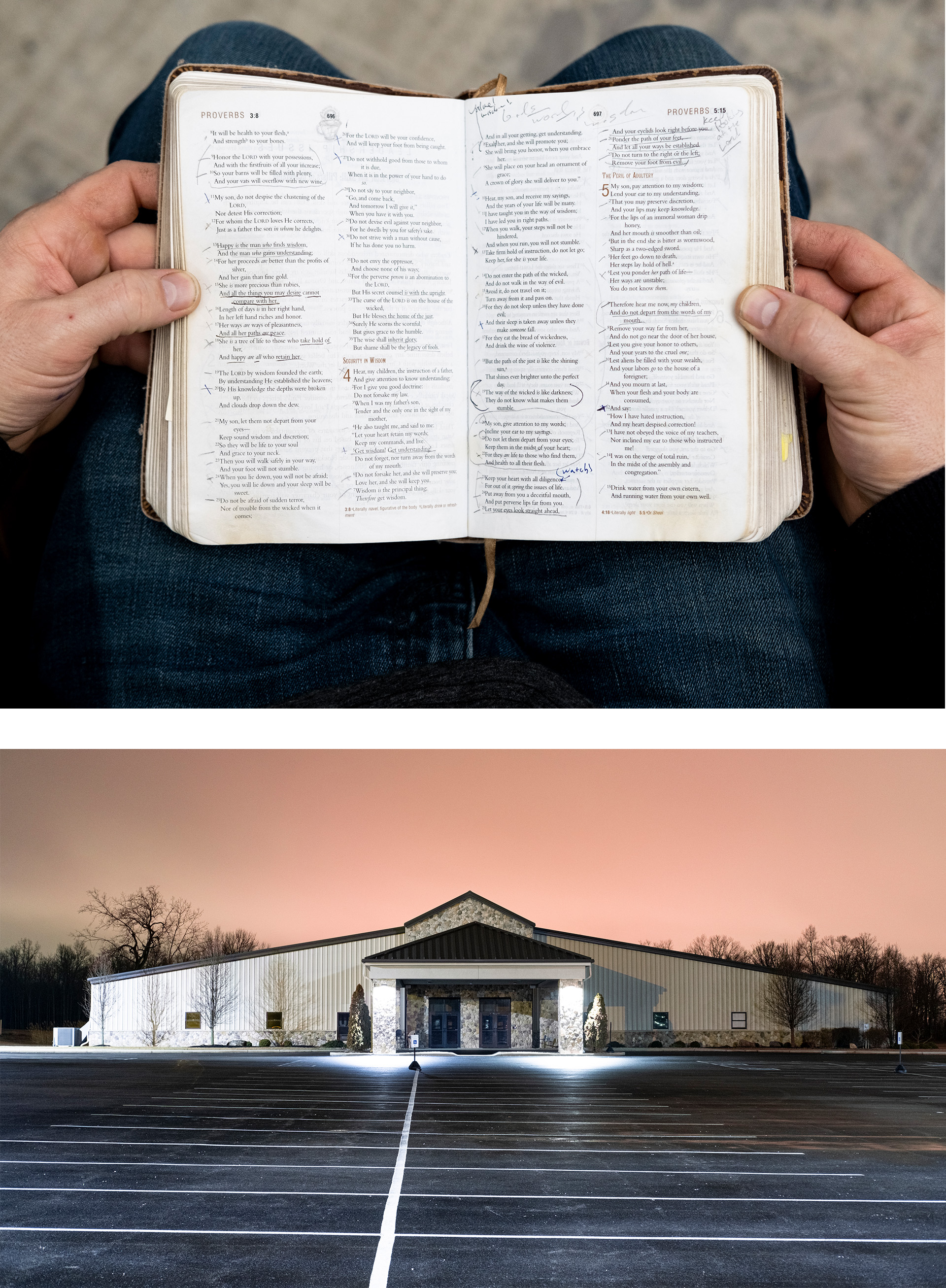
Top: Benjamin’s personal bible. Bottom: Benjamin’s church in Lima, Ohio.Eli Hiller
Top: Benjamin’s personal bible. Bottom: Benjamin’s church in Lima, Ohio.

Needless bruises and bloodshot eyes

I started reading my mom’s Bible, turning to the Book of Proverbs because that’s what my dad would read to us growing up. Many passages grabbed my attention. “Who has woe? Who has sorrow? Who has strife? Who has complaints? Who has needless bruises? Who has bloodshot eyes?” (23:29). That was me, for sure.

I read these words: “Wine is a mocker and beer a brawler. Whoever is led astray by them is not wise” (20:1). Then these: “For drunkards and gluttons become poor, and drowsiness clothes them in rags” (23:21). But the verse that really stopped me in my tracks was Proverbs 4:19: “The way of the wicked is like deep darkness; they do not know what makes them stumble.”

I realized I was stumbling through life because I was always trying to fit in. To be something I wasn’t. Drinking and drugging to win approval from the crowd. But all it did was push me down an increasingly dark path. I saw clearly that my wickedness was my selfishness. I had pushed everyone away, and in return, everyone was gone, leaving me with loneliness and addiction.

I cried out to Jesus, and he saved me. He also started changing me by the power of his Spirit. This didn’t happen overnight, and even though I didn’t desire drugs or alcohol anymore, I continued playing with my bar band for the next year. By God’s grace I avoided falling back into addiction. Meanwhile, God gave me a greater desire to pray and read his Word.

Missy and I have now been married for 11 years, and I’ve been free from drugs and alcohol the entire time. We’ve been blessed with the opportunity to do outreach ministry together, in part by hosting an event called Night of Hope, a concert geared toward helping and encouraging people facing all types of addiction. We have seen the mighty hand of God moving in people’s lives to change and rearrange them from hopelessness to new life in Jesus Christ. Praise God that I can share the hope of having a relationship with Jesus that truly turns one’s darkness to light.

Benjamin Budde is the author of War a Good Warfare: Fighting the Battles Within as well as a children’s book, The Tale of Louie the Lion Tamer. He and his family live in St. Marys, Ohio.

Ideas

Divine Abundance Is More Than a Charismatic Hobbyhorse

Columnist; Contributor

The language of extravagant blessing is thoroughly biblical—even if it’s sometimes abused.

Illustration by Rick Szuecs / Source Images: Tomas Kirvela / Unsplash / Envato

Pentecostal and charismatic Christians love the theme of divine abundance. Hopefully all Christians do, but my tradition tends to stress it. We love talking about the bounty of God, the overflow of the Spirit, and the extravagant riches of Christ. We are more likely to name our churches “Abundant Life” than “Main Street Bible Church.” Our songs and prayers reflect a confidence that God will surpass our expectations by a country mile.

From a distance, this conviction can be misunderstood. Many associate it with an unhealthy interest in money. And at its worst, the language of fullness and abundance can be (and has been) distorted to promise material comfort to those who believe enough, declare enough, or give enough.

But there is no need to throw the baby out with the bathwater. At its best, celebrating divine abundance simply reflects the emphasis of Scripture: the garden filled with fruit, the land flowing with milk and honey, the temple festooned with gold and purple, or the mighty crystal river cascading from God’s throne, bringing healing and fruitfulness wherever it goes.

In particular, divine abundance reflects the emphasis of John’s gospel. Most of us are familiar with John 10:10, where Jesus famously declares, “I have come that they may have life, and have it to the full.” This is not an incidental or isolated remark. Coming halfway through the gospel, it is sandwiched between two “I am” statements: “I am the gate” (v. 9) and “I am the good shepherd” (v. 11). Jesus pictures himself as a doorway to salvation and a shepherd laying down his life for his flock, and between these images comes the key contrast between his ministry and that of the “thieves and robbers” who came before him (v. 8). They came to take; he comes to give. They sought destruction; he seeks abundance.

John has been building toward this statement for a long time. In chapter 1, he describes the ministry of Christ as an outpouring of divine fullness: “From his fullness we have all received, grace upon grace” (v. 16, ESV). In chapter 2, we visit a wedding where Jesus produces an absurdly large quantity of outstanding wine. In chapter 6, he does the same with bread, creating so much that everyone is full and 12 basketfuls are left over.

Jesus’ signs are repeatedly expansive, excessive, and needlessly generous. Individuals are healed after being paralyzed for 38 years (5:1–9), being blind since birth (9:1–7), or even being dead for four days (11:38–44). Over 150 large fish are summoned from the deep, caught, counted, and barbecued (21:11). These are just a small fragment Jesus’ lavish, life-giving deeds—if we had written them all down, John suggests, all the books in the world couldn’t possibly contain them (21:25).

The dialogues in John tell the same story. We learn that Jesus “speaks the words of God,” who gives “the Spirit without limit” (3:34). We learn that he comes to grant “a spring of water welling up to eternal life” (4:14), to do “greater works than these, so that you will be amazed” (5:20), to bequeath “rivers of living water” for people to drink (7:38). He compares himself to a seed that dies and thus bears “much fruit” (12:24, ESV) and a vine in whom his disciples will abide and bear much fruit as well, so that their “joy may be complete” (15:11). Even in Jesus’ death, we see blood and water pouring out of his body, streams of living water flowing from his innermost being (19:34).

John could not make it clearer. Jesus is full—of grace and truth, Spirit and joy, bread and wine, light and life, works and water, and fish and fruit. Divinity professor David Ford puts it simply in his recent commentary: “John is a Gospel of abundance.”

Perhaps we emphasize divine abundance too much. Maybe our obsession with material wealth and welfare results from too much time reflecting on God’s fullness. My suspicion, however, is the exact opposite: that we grab what we can because we think our Father’s resources will run out. Only by reflecting on his bounty—the vats of wine, the baskets of bread, the grace upon grace—do we cultivate lives that are generous and hearts that are filled with joy unspeakable. As Jesus says in Matthew 10:8, “Freely you have received; freely give.”

Andrew Wilson is teaching pastor at King’s Church London and the author of God of All Things.

Ideas

Let’s Rethink the Evangelical Gender Wars

Columnist

Maybe the lines of division between egalitarians and complementarians were in the wrong places.

Illustration by Abigail Erickson / Source Images: Getty

Last year I came across stinging words of rebuke against the ministry of Beth Moore. Her preaching and teaching was a “gateway drug to radical feminism,” said a young conservative. I found the rhetoric appalling, but I couldn’t tell that to the author of those words because he no longer exists. He was Russell Moore, circa 2004.

I was wrong about Beth Moore, but I’m even more chastened by the phrase gateway drug. The gender debate between complementarians and egalitarians was often fraught because it was a debate about just that: which views were “gateway drugs” to what abyss, which “slippery slopes” led to what error.

Some were convinced that egalitarians would lead us away from what the Bible declares to be good: that God designed us as male and female, that we need both mothers and fathers, that sexual expression is limited to the union of husband and wife. Meanwhile, others warned that complementarian arguments wrongly used Scripture the way an earlier generation did to defend white supremacy and slavery.

In recent years, many of us have seen old coalitions and old certainties torn apart. We’ve also discovered “slippery slopes” in unpredictable places. For those who are more traditional, the frustration started with an ever-narrowing definition of complementarian, measured increasingly by countering one’s “enemies” rather than by finding actual biblical consensus. First-order issues that define the catholicity of the church were treated as in-house debates while secondary or tertiary matters of “gender roles” were treated as matters of conciliar-like boundary-definition.

More importantly, recent scandals have demonstrated that the slippery-slope arguments of egalitarians were at least partially right—by pointing out that, for some, what lay behind a zeal for “male headship” was not responsibility before God but a psychologically stunted loathing of women or, worse, a cover for the sadistic silencing of women and girls. We see this not only in the uncovered horrors themselves but also in those who give no evidence of meeting the 1 Timothy 2 requirements for ministry—who, rather than putting away “anger” and “disputing” (v. 8), are the most eager to apply the rest of the chapter to castigate women leaders who’d dare to be a church’s guest speaker on Mother’s Day.

Whatever one might think of the “servant leadership” rhetoric of Promise Keepers a generation ago, we should agree that it’s quite a fall from that to today’s “theobro” vision of opposing such allegedly feminizing attributes as empathy and kindness. Turns out, there really was more John Wayne than Jesus, more Joe Rogan than the apostle Paul, in a lot of what’s been said to be “biblical.”

Many evangelical egalitarians have found themselves “homeless” too. They’ve been labeled in progressive circles as not “real feminists” precisely because, for them, the issue is how best to interpret inspired, authoritative Scripture—including Paul’s letters—not to deconstruct it. Today, when there really is a slippery slope of gender ideology that challenges the male-female binary, evangelical egalitarians spend more of their time in the outside world defending the idea that there is a complementarity of male and female, just not of the patriarchal sort.

As one woman minister told me, “I can’t go to the conferences I want to attend—with people I agree with on 99 percent of everything—because they think I’m ‘liberal,’ while some of the people who would celebrate that I’m ordained are horrified that I will never give up the essential biblical language of God as Father, Son, and Holy Spirit.”

Many of us are rethinking who we once classified as “enemy” and as “ally.” Maybe the lines of division were in the wrong places all along. Those who hold to believer’s baptism, for example, have more in common with evangelicals who practice infant baptism than with Latter-day Saints who immerse adults. Those who disagree on how Galatians 3:28 fits with Ephesians 5 but who want to see men and women fully engaged in the Great Commission have more in common with each other than with those who would make gender either everything or nothing.

A new generation of Christian men and women is coming. When it comes to teaching them how to stand together, and how to equip one another to teach and lead, I trust Beth Moore much more than 2004 Russell Moore to show them the way.

Russell Moore is editor in chief of CT.

Ideas

God’s Yoke for the Decision Fatigued

Columnist

The way out of overcommitment runs through God’s temple.

Illustration by Rick Szuecs / Source Image:Stockcam / Getty

I often begin writing a new song—or even something as ordinary as a letter to a friend—because I have seen a spark, a shimmer of God’s renewal in the world. But sometimes I have to weather a few false starts. Some seeds we plant seem to sprout overnight, while others take time.

Much of life is like this. Recently, we had plans to take the family to a local concert. I was hoping the tickets might present an opportunity for family bonding or even a new tradition. But I had just returned from travel, and my idealized imaginings of a happy annual outing fizzled as we were all pulled in different directions: One family member needed dinner; another was not feeling well; one had a homework backlog; another had a last-minute school event.

We were about halfway to the venue, driving in the rain, when we gave up on the concert. I felt a mix of relief and disappointment as we turned toward home. When logistical tornados like this one swirl, my resolve goes soft and my commitment falters. Should we push through and stick to the plan? Or should we hang back to accommodate the needs of the moment?

When our plans become too much and our days too full, it’s easy to get stuck. We’re overextended, and we stumble into indecision like it’s quicksand. The harder we try to climb out, the more we sink down. We try to discern what plans to make or which priorities to keep by reducing them to something like a math equation. We ration out resources to our competing desires.

It’s a logical approach. So why is it so hard sometimes to figure out what the one thing is that really matters?

Maybe because—as happens often in such moments—none of the options we’re choosing from is the one that really matters. “One thing have I asked of the Lord, that will I seek after: that I may dwell in the house of the Lord all the days of my life, to gaze upon the beauty of the Lord and to inquire in his temple” (Ps. 27:4, ESV).

Psalm 27 whispers wisdom into our small, overwhelmed moments. Many things come up in a day: a water leak, a medical bill that slipped by, a birthday card to send. But our anxieties can hold us hostage to vague ideas when we could be taking active, imaginative steps toward bringing about God’s beautiful plan for us and for his world.

“To inquire in his temple” sounds like a big idea. How do we go about that? It can begin small, maybe simply with the act of stopping to wonder at the beauty of God. When I stop to wonder about the thoughts God may be having today, in this moment, in real time, my own thoughts are reordered. My priorities change.

What does God think about the plans we’re making for dinner? What does he think about the local election coming up? What does he notice in the meeting at work that he whispers to me in my spirit? Who does he see in my social orbit today I might have overlooked?

These kinds of questions are not meant to put us into some state of overspiritualized paralysis. They are meant to free us from the other questions that do and to help us slow and still ourselves long enough to pay attention to God’s presence.

We want to create meaning in our lives, but sometimes we miss the main idea. Even after years of practicing this, sometimes I still don’t recognize the best decision until I’m halfway to where I was going and make a tearful U-turn.

This is not simply mindfulness. It is transformation by beauty. When my aim is delight, I am not as easily taken with distraction. If we delight in his plans over our own plans, we find alternate outcomes. When we have taken delight in his beauty and glory, we can rest when we need to rest. We take his freedom as our own. We don’t have to be enslaved to the demands of our desires or our relationships. We become lighter in spirit. A view of his glory turns our own plans and ideas into a truer reflection of his. We are free to be more than “pleasers” or to just put out the fires of the urgent requests of our day.

The more we gaze upon him, the more our lives are illuminated by the shimmer of his glory. It is like glitter in a preschool classroom: His glory goes everywhere. It stays, it sticks, it shines when you spend time near him.

Sandra McCracken is a singer-songwriter and author in Nashville. She is also the host of The Slow Work podcast produced by CT.

To Keep Gen Z in the Pews, One Singapore Church Lets Them Run the Service

Churches also find that having them in community with older members and answering their “whys” help them stay in the church.

Young people at Heart of God Church in Singapore run all aspects weekend worship.

Young people at Heart of God Church in Singapore run all aspects weekend worship.

Christianity Today February 10, 2023
Courtesy of Heart of God Church

Since Heart of God Church in Singapore started more than 20 years ago, it’s succeeded in attracting a hard-to-capture demographic: The average age of its congregants has remained steady at 22 years old.

Today, about 5,000 people attend Heart of God Church each Sunday. Cecilia Chan, the church’s co-founding senior pastor affectionately known as Pastor Lia, noted their strategy: “Youths need to be invited, included, involved, before they can be influenced and impacted.”

That means teens as young as 12 are given responsibilities like designing slides, filming church livestreams, running the soundboard, or even helping coordinate Sunday services. At the same time, they are mentored by others a few life stages ahead of them.

Churches in Singapore face similar struggles as their counterparts around the world in keeping Gen Z engaged, as the digital natives are bombarded with distractions and noise from the rest of the world. Many young people’s views on issues like sexuality or what comprises a family unit are no longer defined by Asian societal norms. A 2020 census found that a growing number of young people (ages 15-24) say they have no religious affiliations: The number rose from 21 percent in 2010 to 24 percent in 2020.

Singaporean students, who are known for their chart-topping test scores, also experience high levels of anxiety and stress about doing well academically. With pressure from their parents as well as their peers, students spend afterschool hours in tutoring and enrichment classes. In their remaining free time, many spend it on their phones. Activities that provide opportunities to interact face-to-face and don’t focus on schoolwork are a breath of fresh air.

Christianity Today spoke with three Singaporean churches that have bustling youth ministries to see how they are reaching this demographic. These congregations are getting young people involved, providing interaction across generations, building in-person relationships, and pressing deeper into why the Bible and God can be trusted. “I feel empowered”

Goh Xin Yi, 19, started attending Heart of God Church six years ago after a friend from school invited him to the church’s Easter service. “It was interesting to see so many young people at one place outside of school and [tutoring] centers,” he said.

As a new member, he attended a ministry training program which introduced him to more than 80 ministries in which he could serve. At the same time, he took part in Bible studies to learn more about God.

Goh chose to serve in the church’s live-feed team before becoming the camera director at 16. Now at 19, he is the leader of media operations, supervising 50 others.

“Serving in the ministry gives me a sense of belonging,” Goh said. “I feel empowered. I feel trusted to be given a chance to handle the very expensive equipment.”

More than 80 percent of the congregation serve in various ministries, with seven “generations” of leaders working alongside each other. Each generation is about three to five years apart and forms its own youth group. The first generation includes homegrown pastors in their 30s, while the newest generation incorporates leaders as young as 13.

In Goh’s case, he is mentored by a 27-year-old leader who heads the entire media team of more than 300 people. And Goh himself works with young teens who are 12 and 13.

“They offer very raw thoughts and fresh perspectives,” Goh said of his mentees. “I like to empower them like how I used to be given responsibilities when I was at their age.”

Left: Service at Heart of God venue, Imaginarium. Right: Three Generations serving together as photography trainer, crew, and supervisor.Courtesy of Heart of God Church
Left: Service at Heart of God venue, Imaginarium. Right: Three Generations serving together as photography trainer, crew, and supervisor.

Lia noted that giving young people opportunities to lead and train helps keep them engaged. “Older generations are not replaced but reinforced as the younger generations join the ranks” and serve with them, she said.

Finding a family in the church

Over at the Chinese-language congregation at All Saints Church, leaders are using a different strategy to reach young people. One challenge the congregation faces is that young Singaporeans are more comfortable speaking English than Chinese, so they often attend English-speaking churches.

Yet All Saints Church is seeing its Chinese-language youth ministry, which currently has 70 members, grow at about 6 percent each year. It builds on its strength of being a multigenerational church by creating activities for both teens and the elderly to participate in together.

For instance, the church organizes an annual camp for students at Anglican High School, which is connected to the church. The elderly church members serve food during camp and pray for camp members, while the young adults oversee camp programming and lead the church camp small groups.

“In a Chinese church like ours, the family culture and tradition is more pronounced,” said Fu Weikai, an associate pastor at All Saints Church who oversees the Chinese youth ministry.

According to Fu, some young people find in the church the kinship or family bonding missing in their own homes. "We have this program called Dinner with the Elders where couples in their 50s open their homes to young adults for dinners and fellowship with them.”

Clement Ong, 29, joined the church when he was 16 after participating in the Anglican High School’s student camp. Today Ong serves in the youth ministry. He has observed that in some dual-income families, a child’s support system has shifted from their nuclear family to the church family.

“With Instagram and social media, we leaders are also more tuned in to the lives of the youths,” Ong said. “When we see certain updates, we will check in on them more often, dropping them a text and meeting them one-on-one for meals.”

But such technology has a flip side. Fu noted that many young people’s worldviews are formed through their smartphones.

“What they know about their friends are from the Instagram stories and TikTok videos,” Fu said. “Some youths are actually awkward in social situations as most of them communicate virtually.”

That’s why Fu and the church’s other leaders are intentional about building in-person relationships. The church has a space for Anglican High School students to gather and get to know some of church workers during recess. In this air-conditioned environment, students can also play with the onsite guitar or drum set to unwind.

Thinking about how young people engage with information, Fu has also changed the way he delivers sermons and what he covers in the youth ministry. “I cannot nag at them for 40 minutes,” Fu said. “It used to be when we ask them to jump, they say ‘How high?’ Now they ask, ‘Why jump?’” said Fu.

Now he caps his sermons at about 20 minutes and no longer has a list of dos and don’ts. For instance, when he preaches on the topic of pride, he can’t just tell them to stop being prideful. “It is about explaining the problem of pride, acknowledging the presence of pride in our lives, and how to lean on God’s faithfulness to deliver us.” said Fu. Answering the “whys”

Eddie Ho, a pastor at Faith Methodist Church who oversees its youth ministry of 200 members, said young people often ask him, “why should I trust the Bible?”

This is different from the past, when teens would more willingly accept what their parents and teachers tell them. Now with easy access to the internet, young people seek other points of views and alternative perspectives.

“We cannot assume they are convinced that the Bible is the truth,” said Ho. “We have to provide the ‘why.’ We need to tell them the underlying principle behind God’s commandments.”

For instance, Ho’s sermons dig deeper into the question of why Jesus commanded his followers to love their neighbors as they love themselves: “Because we are all created in His image,” Ho said. “We love God, we love his image, we love our neighbors.”

Once a month, the church hosts youth services with a panel of speakers discussing relevant topics like serving in church, social media and online games, sexuality, and apologetics. Afterwards, there is time for students to discuss and reflect on the topic, and sometimes they gather for a meal.

Ho believes one-on-one ministry is important in an age when young people want quick answers to their questions. “We need to equip good youth leaders to connect with the youths, especially at this age when youths rather listen to their friends than their parents.”

Yet even with the best efforts of their parents and their congregation, young people can still stray from the church and from God. Ho encourages those with wayward children or loved ones: “Look further ahead, some youths may not attend church now, but we as parents, as spiritual parents, and families should continue to show love and plant the [seed], and prayerfully wait for God to do His work on these youths.”

addApple PodcastsDown ArrowDown ArrowDown Arrowarrow_left_altLeft ArrowLeft ArrowRight ArrowRight ArrowRight Arrowarrow_up_altUp ArrowUp ArrowAvailable at Amazoncaret-downCloseCloseellipseEmailEmailExpandExpandExternalExternalFacebookfacebook-squarefolderGiftGiftGooglegoogleGoogle KeephamburgerInstagraminstagram-squareLinkLinklinkedin-squareListenListenListenChristianity TodayCT Creative Studio Logologo_orgMegaphoneMenuMenupausePinterestPlayPlayPocketPodcastprintremoveRSSRSSSaveSavesaveSearchSearchsearchSpotifyStitcherTelegramTable of ContentsTable of Contentstwitter-squareWhatsAppXYouTubeYouTube