News

What Would Jesus Do in North Minneapolis? Buy a Gas Station.

Facing poverty, crime, and closing businesses, Christians look to transform their corners.

Christianity Today February 14, 2023
Courtesy of Sanctuary Covenant Church

Most people don’t take real estate advice from a drug dealer behind a gas station in North Minneapolis. But Larry Cook, bishop of Real Believers Faith Center, is not most people.

About a year ago he confronted some young men selling narcotics in the alley between his church and the corner store that seemed to do more business in illegal goods than snacks or fuel. Things got heated pretty quickly. Voices were raised.

“The owner don’t care about it,” one of the young man yelled, as Cook and his wife, Sharon, recall the confrontation. “If you want to do something about it, you need to buy the gas station.”

“I will,” Cook responded. “I absolutely will.”

What the man selling drugs didn’t know is that Cook had actually been thinking about buying the store for the past 25 years. He believed he was being called and when the time was right, God would expand his ministry to include this sore spot in the neighborhood, the store at the corner of a busy intersection.

This fall, the store came up for sale, and Cook and his wife put everything they had toward the purchase of the $3 million property. They’ve now reopened it under the name the Lion’s Den, a testament to faith surrounded by danger and their belief that even urban blight can be redeemed.

“This is what Jesus would do,” Sharon Cook told CT. “If he was walking in 2023, he would buy this gas station. He would feed the hungry. He would lend a helping hand to the elderly the same way we’re doing.”

North Minneapolis has struggled for a long time. In the 1950s, there was a thriving African American community, with lots of families, churches, and Black-owned businesses. Then there was a wave of white flight, followed by racial unrest that scared away financial investors, and the construction of an interstate that cut Near North off from downtown. Today, the area is marked by instability and poverty.

“There have been chronic patterns of violence over many years, but in the last three years … it’s been exacerbated by the fallout effect after the murder of George Floyd and everything that cascaded down from that,” said Carl Nelson, president of Transform Minnesota, an evangelical organization that brings churches together to wrestle with social issues.

Crime has increased as policing has declined in the area, resulting in a lawsuit over “minimum force levels.” Last year, the Minnesota Supreme Court sided with eight northside residents and ordered the city to hire more police officers.

Several key businesses that serve the area have also decided to leave. Aldi, one of the few grocery stores that is easily accessible to people without cars, closed last weekend. Walgreens is closing too, citing “the dynamics of the local market.”

Nelson, who has lived in the area for 25 years and drives past Real Believers Faith Center almost every day, said some of the remaining corner stores and gas stations have become magnets for crime. When they’re run by people who are not personally invested in the community, nothing is done about the drugs, robbery, and shootings outside.

“You look at the city and the landscape—the social fabric of the city—and it’s just dismaying,” he said. “In some cases, the business owners are making a lot of money. They put up bulletproof glass for their registers to sit behind, and they just put up with the danger and continue making their money.”

One force that’s been able to stand against the violence has been local churches. Last May, a group of ministers led by New Missionary Baptist pastor Jerry McAfee occupied street corners as part of a project McAfee called 21 Days of Peace.

“In those places where they were able to be, they disrupted and changed the cycle of violence,” Nelson said.

Buying a corner store could have the same effect, according to Nelson.

“It’s a creative and direct way for a church to say we’re going to do something very tangible in our community,” he said, “try and affect the safety and livability of the streets right outside our parking lot.”

A few blocks away from the Lion’s Den, another church is working to transform another corner of North Minneapolis. At the intersection of West Broadway and Lyndale Avenue is a gas station known locally as “murder station.” Leaders at Sanctuary Covenant Church, located at that same intersection, have petitioned the city to take action to reduce crime in the area. Last summer, the front door of the church was hit by bullets 14 times.

“We knew as we built our church that we were planting in a place that has seen decades of trauma and violence,” said Andrea Lee, church director of operations. “It is our calling to be right where we are.”

Since Sanctuary was planted 20 years ago, the church has launched a resource center that houses a food pantry and two nonprofits helping young people and people with addictions. Recently, the congregation decided it would try to tackle the ugliness in the corner parking lot.

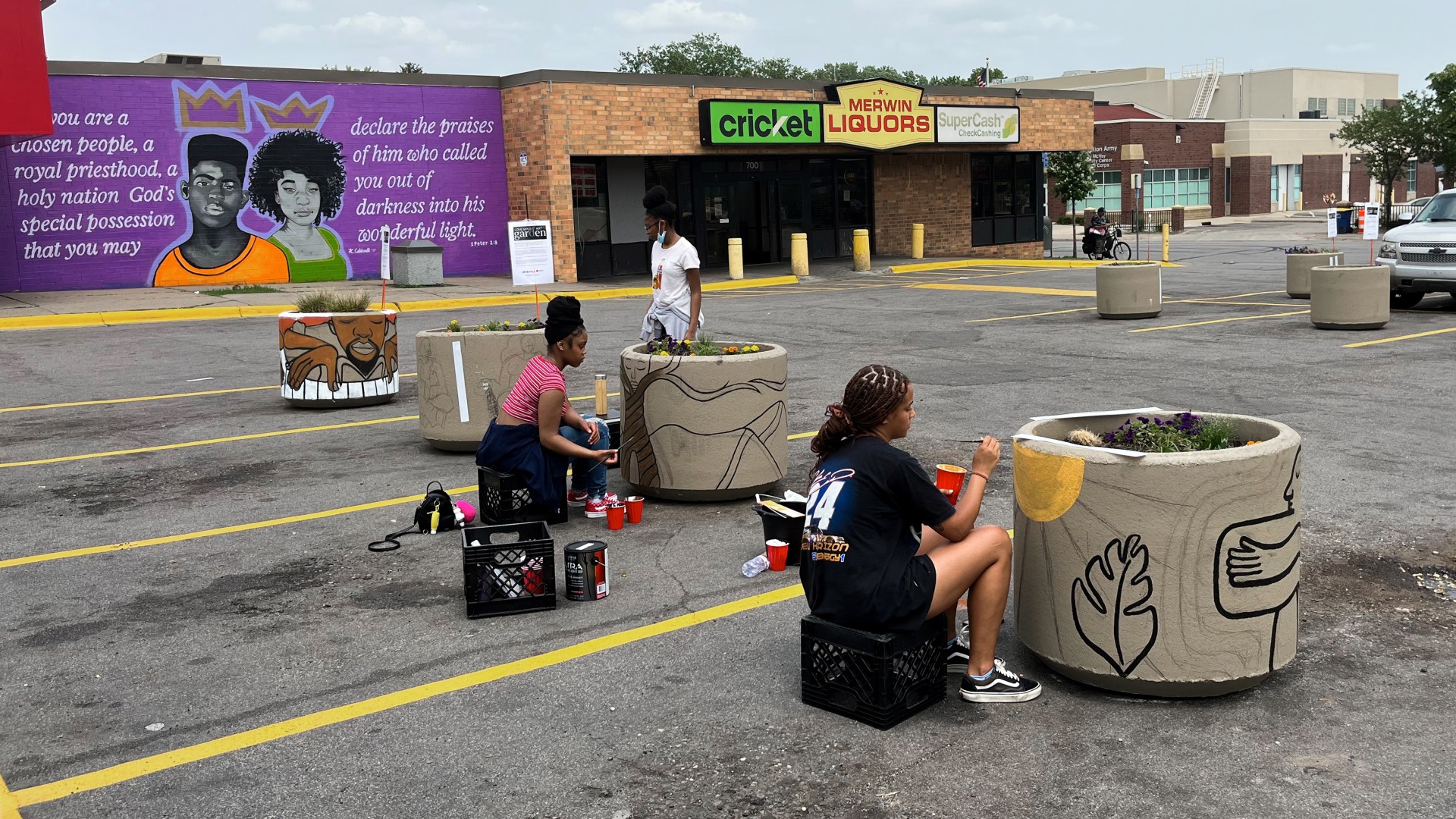
They added speed bumps and concrete planters as well as more than 100 feet of raised garden beds. Sanctuary hired young artists from the neighborhood to paint the planters and care for the gardens. The cumulative effect is an area less conducive to crime and a message to the neighborhood that someone cares about that parking lot and that the church believes in the possibility of transformation.

“The image of these youth working in the lot, making it beautiful was so healing for our northside community,” Lee said. “We tried to stand against what happens in that lot every year during warmer weather by encouraging art, gardens, and positive interactions with people.”

All those working to make the city better, know that change takes time, however.

If there was any idea that transforming the property and the neighborhood around Real Believers Faith Center (RBFC) would be completed with the purchase, Sharon Cook said that ended the first day, when she witnessed another drug deal taking place in broad daylight.

The church took heart by recalling God’s long faithfulness. When Larry Cook planted RBFC in 1998, there were just eight people in the pews some Sundays. There was no financial backing from a denomination or church-planting network, so the congregation had to operate without a safety net.

“There was no savings and no money and no credit,” Cook said. “It was a dog fight every single day.”

Amid the struggles, the church saw new life and real transformation. People who were once addicted found freedom. People who were violent found another way to live. The church now averages around 200 people on Sundays and has a membership of more than 500.

“More than half of the congregation of my church was unchurched and comes from selling drugs and being on the streets and using drugs,” he said. “There’s no way I can look at people who haven’t made that transition yet and say there is no value.”

Cook reminds people, too, that even buying the corner store once seemed impossible. He remembers walking out of church one Wednesday night with his congregation and telling them of his vision that one day he would buy that property.

“I told the people that we were going to lay hands on this property around us because God is going to give us the land,” he said.

“Bishop, it’s going to be expensive,” people told him.

But he just said, “God’s got a way of making it happen for us.”

On November 1, Cook signed the papers, and then he went and laid hands on the property again, giving thanks to God. The corner store is set up as an independent entity, but the church sees it as a place for ministry.

As Larry Cook goes from the church to the store and the store to the church, he proclaims with his life that change is possible. He knows it is, because it’s already happening.

“It’s like we’re having an evangelism day every day now,” Larry said. “Ministry just walks up to me. I’m able to minister to people, lay hands on people, pray for the sick, feed the hungry. It’s a nonstop effort.”

Sometimes Cook even sees the young man who told him to buy the store. He stopped in to buy snacks shortly after the purchase.

“You all really bought it,” he said. “You know what, I can’t even be mad. Respect.”

Larry and Sharon Cook at the front counter of The Lion's Den.
Larry and Sharon Cook at the front counter of The Lion’s Den.
Theology

Bee My Valentine: A Saint’s Guide to Creation Care

Like Valentine, patron saint of beekeeping, Christians have a duty to love and learn from the earth God made.

"Saint Valentine" by Tyrolean in the 16th Century

"Saint Valentine" by Tyrolean in the 16th Century

Christianity Today February 13, 2023
Illustration by Mallory Rentsch / Source Images: WikiMedia Commons / Unsplash

As a lifelong Protestant, only recently have I begun to discover the delightful array of patron saints within the Catholic and Orthodox traditions. (And as my Episcopal friends would remind me, they have them too.)

There’s one for angina sufferers (Swithbert), flight attendants (Bona of Pisa), and embroiderers (Clare). There is a patron saint for those who survive an earthquake (Gregory the Wonderworker) and one for those who’ve misplaced items (Anthony). When I lost my voice for weeks on end last summer, I didn’t pray to Bernardine of Siena, but I did feel a real kinship with him—and a comfort in knowing that the church considered, named, and prayed for my plight.

My evangelical upbringing taught me a thorough knowledge of the Bible, but it was weak on Christian history and tradition. It was rare we spoke of anyone from the 2,000 or so years between the apostle Paul and Billy Graham.

At Wheaton College, I was introduced to Augustine, Thomas Aquinas, and Hildegard of Bingen—saints of the Catholic church, all. When I expressed concern, wondering why we were studying their teachings at an evangelical institution, a kindly professor quipped, “Courtney, before the Protestant Reformation, basically all Christians were Catholic or Orthodox.” Mic drop.

And so, on the cusp of Valentine’s Day, let us turn our attention to the spiritual wisdom to be gleaned from the saint whose name carries the day. A clergyman and physician in the third-century Roman empire, Valentine is the patron saint of courtly love, epilepsy sufferers—and beekeepers.

No one is certain when humans first decided to keep bees, cultivating hives rather than simply harvesting wild honey, but art depicting beekeeping has been found dating as far back as 2400 B.C. in Egypt. “It’s the second oldest profession,” joked Wayne Hughes, founder of Sweet Harmony Apiaries in Marietta, Georgia.

It is not uncommon for modern-day monasteries, convents, and Catholic missions to have apiaries. The Monastery of Christ in the Desert, a Benedictine community in Abiquiu, New Mexico, features beehives. St. Ignace de Loyola, a Jesuit school in Bedou, Haiti, includes beekeeping as part of its educational curriculum.

The Prince of Peace Abbey in Oceanside, California, hosted 50 hives under the supervision of Brother Blaise Heuke, a monk who invited children from the community to come harvest and sample honey for over four decades, until his death at the age of 80 in 2018.

The practice of apiculture is unique, requiring slow, careful movements, attention to detail, and a working knowledge of apiology, or the study of bees. “The keeping of bees is very tied to the contemplative,” said Christopher Russo, a high school English teacher, Baptist, and apiarist in Long Island, New York. “It’s quiet, slow work.”

Russo’s hobby has deepened his belief in the human responsibility to steward creation. “There’s this verse in Proverbs about a righteous person regarding the life of his animal,” he said, referencing Proverbs 12:10. “It’s my responsibility to take care of [the bees] well.”

He described the delight he experiences in witnessing his insects’ instinct and skill. “You talk about God’s design!” he said. “They have a language. A dance. They kind of wiggle to tell each other where the other flowers are. It’s just amazing to see how they operate.”

Hobby apiarist Anne Ferris serves as the director of short-term small groups at Ada Bible Church in Grand Rapids, Michigan. She finds inspiration in her bees’ collectivity. “[In winter] they stay in this cluster and beat their little wings to stay warm,” she said. “They rotate through so no one is on the outside for long. It’s absolutely fascinating how they work together as this unit.”

She drew a parallel to human communities: “[What] if humans could learn to work together like this?” she asked. “[What] if the church could learn to work together like this?”

For many an apiarist, beekeeping leads to a renewed interest in larger themes of creation care. Bees are both resilient—surviving brutally cold winters even though they do not hibernate—and fragile. Pesticides, severe weather, and diseases like colony collapse disorder threaten their longtime survival. Beyond the obvious tragedy of losing any animal to extinction, beekeepers say we should all have a vested interest in maintaining healthy bee populations. And as Ferris put it, “If we don’t have bees, we don’t have food.”

Robert Brown, a Presbyterian, lives in Oklahoma where he watches over his hives with help from a neighbor. “I don’t sell honey,” he said. “I give it away. I just tell everybody that I equate it with grace. It’s nothing I did to deserve it, and so I just give it to other people because … it’s not deserved. And it’s sweet.”

Brown, an agricultural economist by trade, marvels at the complexities within his hives as well as within each individual bee itself. “God’s created these little tiny creatures that [themselves] create complex carbohydrates. They create hydrocarbons—which just blows my mind. Beeswax is a hydrocarbon. It actually burns!”

Wayne Hughes began beekeeping on his family farm just over a decade ago. He is in the process of joining the Greek Orthodox church and, as part of his conversion, was invited to choose a patron saint.

His choice? Modomnoc, an ancient beekeeping monk who followed his bishop’s order to sail from Wales back to Ireland. Tradition says Modmonoc said goodbye to the bees he’d tended at his Welsh monastery, but they then followed him across the sea. “I thought about choosing Saint Valentine,” Hughes admitted, “but it was Saint Modomnoc who actually kept bees.”

Hughes says beekeeping has deepened his appreciation for the interconnectedness of all living things.

“Just seeing a beehive at work—it fills you with awe and wonder about the complexities of God’s creation,” said Hughes. “You could argue that it’s the body of Christ on full display because as a bee develops, they do different jobs. There are nurse bees, … housecleaning bees, … guard bees, … foragers. It’s everybody doing their part and everybody working together in complete harmony.”

Eighteenth- and 19th-century English folklore taught that bees belonged to the families of their keepers not simply as possessions, pets, or farm animals but as valued members of the family. When a major life event such as a birth, marriage, or death occurred, the beekeeper would make sure to inform the bees. This tradition was in full display in 2022. When Queen Elizabeth II died, Buckingham Palace’s beekeeper, John Chapple, was required by tradition to inform the bees.

This tender—albeit perhaps a touch superstitious—custom of paying attention and respect to these small, winged insects offers us an insight into creation care. Stewardship over the earth and its creatures is commanded by God. This biblical imperative reminds us of the interconnectedness of the created world and the loving Creator who spun it all into being. Creation care can be an exercise in joyful communal purpose as we, like the bees, each take up the unique task before us.

Look at the birds, Jesus tells the gathered crowd during his Sermon on the Mount. Consider the lilies. He used examples from the flora and fauna around him to draw larger lessons of God’s provision and care. But his first command was simple: Pay attention to creation. Lift your eyes and tilt your ears to notice nature—to appreciate the beauty, intricacy, fragility, and wonder of all that God has made.

Let this Valentine’s Day be an invitation for each of us to extend the deep love of God to one another—and the chance for us to enjoy and steward the earth God created.

Courtney Ellis is a pastor, birder, host of The Thing with Feathers podcast, and author of Present: The Gift of Being All In, Right Where You Are (Tyndale House).

Theology

Arranged or Not, Indian Christians Praise God for Their Marriages

What husbands and wives think of others’ unions and what they’d recommend for their children.

Christianity Today February 13, 2023
Rupinder Singh / Unsplash

India’s arranged marriage culture became the source of international attention thanks to Netflix’s controversial hit Indian Matchmaking. But while the rest of the world may have been fascinated by the “foreign” phenomena, the majority of Indian married couples are the result of unions facilitated by their families.

While Indian culture can be heavily stratified by religion, caste, and ethnicity, arranged marriages—at least those that take place within these divisions—are favored by nearly every group. An overwhelming 93 percent of couples said that their marriage was an arranged marriage, according to a 2018 survey of 160,000 households.

Arranged marriages broadly encompass situations where the parents only introduce the bride and groom to each other and either person can decline the match to situations, more common in rural contexts, where neither party can opt out.

Christianity Today spoke to eight Indian Christian married couples: four in love marriages and four in arranged marriages. Husbands and wives weighed in on the following questions:

· What do you envy most about the other kind of marriage?

· What role has your faith played in sustaining your marriage?

· What type of marriage do you want for your children?

Love Marriages

Monica and Amit Chand, married 19 years Lucknow, Uttar Pradesh

Monica: I envy the element of surprise and excitement that is missing in a love marriage.

The more I invite God into my life and marriage, the more he takes control of my life. There have been difficult times and trials in our marriage, and I see that God was there all along. The more I seek him, I see him more clearly.

I advocate that my children go for love marriage and have a developed understanding of each other before they enter into marriage. I do insist that they marry according to God’s will.

Amit: I envy that couples in arranged marriages get to know each other after marriage, thus the novelty of their relationship would be longer.

Christianity is a unique and beautiful faith, and the attraction and adoption of it have been a core part of our marriage since Monica coming in from a non-Christian background.

No, I don’t insist on anything for the kids, because I don’t know what God’s plan is for them. I can only pray that they be led by God into whatever he finds perfect for them.

Koki and Johnny Desai, married 42 years Marriage counselors, Ahmedabad, Gujarat

Koki: I am very happy with my love-cum-arranged marriage [where the couple choose each other and reveal their liking for each other to their parents/elders and the family gets them married]. Seeking God's will was my priority before I said yes to Johnny.

With Jesus Christ as the active partner and a close friend in our marriage, we have thoroughly enjoyed our marriage. He has been a solution, solace, comfort, counselor, guide, and guardian to us. I wonder how people manage without God.

We gave our three daughters the freedom of choice and decision for their own marriages. We taught them that most importantly they needed to be born again and please God in every decision of their life, may it be career, marriage, or whatsoever. We are happy they chose to bring God in their lives

Johnny: Even though I proposed [to my parents that I marry] Koki, we fasted for 75 days (only taking a single meal) and prayed to get confirmation from God. I believe marriage must have both love and arrangement of honoring healthy culture.

Marriage does not just involve biological, physical, social issues; it has a spiritual component as well. Jesus makes all the difference. He teaches and enables us [to have] love and forgiveness and grace.

Whether arranged or love, unless a person knows Jesus, he or she is not ready for marriage.

Angela and Rohit Mathew, married 21 years St. John the Baptist Church, Meerut, Uttar Pradesh

Angela: I don’t envy as such, but the one difference is that one enters an arranged marriage without too many expectations. One learns about the other gradually, and people tend to be more accommodating and cooperative. Getting to know each other and growing together in love slowly would be a great experience too.

Our faith is the center of our marriage. We both always turn to God—in good times and bad times. When we are faced with questions or decisions, we seek God’s guidance.

I really do not advocate a particular kind of marriage, either love or arranged. For my own child I pray that God’s will be done in her life and that he reveals to her the life partner he has chosen for her. I always remember my parents covering me in their prayers for this, and I do the same for her. I pray for God’s will, God’s way, and God’s timing for my child’s marriage.

Rohit: I do not envy anything, to be honest. I don’t think I am missing anything in my love marriage.

My faith has cultivated in me patience and understanding in my marriage. I understood that every relationship needs time and when you give it the necessary time, things fall in place.

As parents we have told our child to see the good in a person. We have tried to explain that in relationships there are some adjustments that need to be made. So whosoever the child chooses as a partner—all we have asked for is that they be of the faith and a good human being.

Salome and Philip Yalla, married 9 years Bengaluru, Karnataka

Salome: Christ is the core of our marriage. He holds us when we feel limited to hold on to each other. He helps us think of the other’s best, sacrificially serve the other. Marriage is God’s means to sanctify us, and it has deepened our bond and our love for each other. We love being partners in ministry and working with people together as a couple. Our faith touches almost every realm in our marriage.

As marriage counselors, we encourage couples who are considering marriage (love or arranged) to walk through premarital counseling where they have the opportunity to get to know each other and develop a common understanding of each other. It isn’t possible to fully know who you’re marrying and have a full understanding of what marriage means before getting married. But having that initial time to begin the process is helpful. We encourage them to see the larger purpose of marriage—as being a process through Christ’s sanctifying means for us—and to stay turned to each other and constantly walk in repentance and forgiveness.

Philip: I don’t necessarily envy arranged marriage. Though most of the getting to know each other and growing in love has happened after marriage, however, I do feel that love marriages with a significant courtship period can have a slight advantage over arranged marriages.

I would encourage other Christians and my children to take a similar route like mine and to use courtship less for “checking compatibility” and more for cultivating a deep friendship and choosing to love the other person well. I see an extra bit of beauty in starting this journey before the relationship is formalized, however, not to discount the unique beauty of beginning this journey with “I do.”

In our case, the journey of fostering a beautiful marriage came with its own joys and challenges, given our unique set of strengths and brokenness. If not for trusting in the redemptive power of the gospel, I can’t imagine growing and thriving in our marriage, particularly when we pass through dark times.

Arranged Marriages

Sara Chonghoikim and Lalditsak Inbuon, married 26 years Churachandpur, Manipur

Sara: My marriage was arranged by my church leaders. I did not want to pursue relationships outside of God’s Word and will. However, like everybody else there were many challenges in my marriage too. Sometimes I feel [that] being in a relationship before marriage, getting to know each other well, and then entering a marriage would have been much better.

I married by faith; I move forward by faith; I take my vows very seriously. Whatever challenges there are, I look to God and his Word for a solution. Amazingly, God is more than enough for all the challenges. When we honor God, when we honor our marriage, God has many ways to solve our problems.

I am not sure what I would advocate. … It depends on their spiritual maturity. The decision I made may not apply to them. But whatever the case, a believer must know and follow what God says a believer must do. Whether arranged or love marriage, they must honor God and include God in their marriage.

Lalditsak: I do not envy love marriages, because arranged marriages are the kind of marriages where you seek God’s will first and decide. In a love marriage, you fall in love first and then start to seek God’s will, and once you have already made your choice, your mind is in no way to receive “no” as an answer from the Lord.

I truly believe that it is God who gave me a suitable coworker. But more than my faith, it is God’s grace and his loving care, his faithfulness [that have] sustained my married life.

Anujit Kaur and Vijay Paul Emerson, married 17 years Patiala, Punjab

Anujit: I envy love marriages as couples get to know each other and each other’s weaknesses and strengths before they decide to get married. One has a choice to say no to a person who has vices that you actually cannot live with, like smoking and alcoholism. These vices might stay hidden in an arranged marriage and later result in a shock, thus affecting a marriage.

My Christian faith plays a major role in my marriage. I firmly believe that God has arranged this marriage for us just as God had arranged Eve for Adam, and in low times I remind myself of this.

I am open to either type of marriage for my children. I just want my children to go for a person that God has chosen for them, be it arranged or love.

Vijay: A person who goes for a love marriage gets to choose a partner according to his/her desire. One has the liberty to choose what he really wants in his partner.

My faith in God has always helped me to go through the hard and tough times in my marriage. My faith helps me to stay in the fear of God and carry out my responsibilities with fear. The Holy Spirit compels me to obey the Word of God and to be faithful to the vows I have made.

I will never force my children for arrange marriage. My only desire is that, that person should be a believer – who loves God and that they should be compatible.

Priya and Jude Prabhu, married 17 years Dubai, United Arab Emirates (originally from Mangaluru, Karnataka)

Priya: What did I envy from not having a love marriage? I did not get to go on dates like people in love do. I missed the pampering, the gifts, the chocolate, and flowers which girls during courtship get.

Being in an arranged marriage, we had our own struggles, difference of opinions. We are going strong because Christ is the center of our marriage and family. The church we attend and the Word which is preached in the church have strengthened our relationship.

I would suggest my daughters ask for God’s wisdom when choosing their partners. Whether love or arranged, the foremost thing is that their spouse should be a believer and Christ should be the center of their home.

Jude: I envy the feeling of love at first sight, the sleepless nights, the anxiousness to meet your lover the next day. Forgetting everything, you only focus on your beloved. The romance on special days—birthdays or Valentine’s Day.

There are things that you might discover about your partner that you might not like. But when you are embedded in Christ and you consider him the center of your married life, you try to change yourself. Faith teaches us to adjust ourselves and to take care of one another.

Both love and arranged marriages have their pros and cons. It does not matter which one you choose. What is important is that your partner should be rooted in Christ and the parents of the bride and the groom should also be rooted in Christ to have a healthy marriage.

Shilpa and Mohit Singh, married 19 years Noida, National Capital Region

Shilpa: Arranged marriages are great! I love the surprise element in an arranged marriage. I think one is more patient and less expectant. We give more time to each other, getting to know each other. It is like opening a gift box. With every layer, you discover something new. The only thing I envy about love marriage is the before-marriage romance, meeting in secret, revealing it to families, and the family opposition drama. In my case everything happened in perfect harmony.

Undoubtedly, our Christian faith is the pillar that has kept us together in times of major disagreements, and we tried to follow the biblical rules, which were a guiding force in our marriage. They have helped us to forgive, forget, and love each other.

I would not give preference to arranged marriage over love marriage or vice versa as every single case of marriage is unique depending upon many factors, like family support or opposition, partners’ compatibility, their willingness to adjust and make sacrifices, etc.

Love or arranged, I believe if the rock of marriage is Jesus it will work out. He can mend everything and make it work.

Mohit: The courtship period is something that clearly stands out in a love marriage. Couples know each other, meet each other, and cherish those memories for a lifetime.

God’s faithfulness and his guidance help us to stay united in our thoughts despite the challenges we face. He helps us to make our marriage work and accept with humbleness and thanksgiving that it is his doing. Faith in God and his teaching has helped me to accept the decisions of my better half, and they have helped our marriage incredibly.

I strongly believe that our kids should trust in the counsel of their parents and God to find their life partners and seek his counsel in their married lives.

Theology

Asbury Professor: We’re Witnessing a ‘Surprising Work of God’

Why I’m hopeful about the revival breaking out in our chapel and its implications for the campus and beyond.

Revival services at Asbury University in Kentucky have been ongoing since February 8.

Revival services at Asbury University in Kentucky have been ongoing since February 8.

Christianity Today February 13, 2023
Alex Griffith / Courtesy of Baptist Press

Most Wednesday mornings at Asbury University are like any other. A few minutes before 10, students begin to gather in Hughes Auditorium for chapel. Students are required to attend a certain number of chapels each semester, so they tend to show up as a matter of routine.

But this past Wednesday was different. After the benediction, the gospel choir began to sing a final chorus—and then something began to happen that defies easy description. Students did not leave. They were struck by what seemed to be a quiet but powerful sense of transcendence, and they did not want to go. They stayed and continued to worship. They are still there. I teach theology across the street at Asbury Theological Seminary, and when I heard of what was happening, I immediately decided to go to the chapel to see for myself. When I arrived, I saw hundreds of students singing quietly. They were praising and praying earnestly for themselves and their neighbors and our world—expressing repentance and contrition for sin and interceding for healing, wholeness, peace, and justice.

https://twitter.com/AustinWofford_/status/1623683279399399425

Some were reading and reciting Scripture. Others were standing with arms raised. Several were clustered in small groups praying together. A few were kneeling at the altar rail in the front of the auditorium. Some were lying prostrate, while others were talking to one another, their faces bright with joy.

They were still worshiping when I left in the late afternoon and when I came back in the evening. They were still worshiping when I arrived early Thursday morning—and by midmorning hundreds were filling the auditorium again. I have seen multiple students running toward the chapel each day.

By Thursday evening, there was standing room only. Students had begun to arrive from other universities: the University of Kentucky, the University of the Cumberlands, Purdue University, Indiana Wesleyan University, Ohio Christian University, Transylvania University, Midway University, Lee University, Georgetown College, Mt. Vernon Nazarene University, and many others.

The worship continued throughout the day on Friday and indeed all through the night. On Saturday morning, I had a hard time finding a seat; by evening the building was packed beyond capacity. Every night, some students and others have stayed in the chapel to pray through the night. And as of Sunday evening, the momentum shows no signs of slowing down.

Some are calling this a revival, and I know that in recent years that term has become associated with political activism and Christian nationalism. But let me be clear: no one at Asbury has that agenda.

My colleague Steve Seamands, a retired theologian from the seminary, told me that what is happening resembles the famous Asbury Revival of 1970 he experienced when he was a student. That revival shut down classes for a week, then went on for two more weeks with nightly services. Hundreds of students went out to share what happened with other schools.

But what many don’t realize is that Asbury has an even more extensive history with revivals—including one that took place as early as 1905 and another as recent as 2006, when a student chapel led to four days of continuous worship, prayer and praise.

https://twitter.com/drleahpayne/status/1624507669238419456

Many people say that in the chapel they hardly even realize how much time has elapsed. It is almost as though time and eternity blur together as heaven and earth meet. Anyone who has witnessed it can agree that something unusual and unscripted is happening.

As an analytic theologian, I am weary of hype and very wary of manipulation. I come from a background (in a particularly revivalist segment of the Methodist-holiness tradition) where I’ve seen efforts to manufacture “revivals” and “movements of the Spirit” that were sometimes not only hollow but also harmful. I do not want anything to do with that.

And truth be told, this is nothing like that. There is no pressure or hype. There is no manipulation. There is no high-pitched emotional fervor.

To the contrary, it has so far been mostly calm and serene. The mix of hope and joy and peace is indescribably strong and indeed almost palpable—a vivid and incredibly powerful sense of shalom. The ministry of the Holy Spirit is undeniably powerful but also so gentle.

Asbury Revival 2023: A capacity crowd of 1,500 gather at Hughes Auditorium on the campus of Asbury University on February 10.Alex Griffith / Courtesy of Baptist Press
Asbury Revival 2023: A capacity crowd of 1,500 gather at Hughes Auditorium on the campus of Asbury University on February 10.

The holy love of the triune God is apparent, and there is an inexpressible sweetness and innate attractiveness to it. It is immediately obvious why no one wants to leave and why those who must leave want to come back as soon as they can. I know that God moves in mysterious ways; Jesus tells us that the Spirit blows where it wills (John 3:8). And sometimes God does what Jonathan Edwards called “surprising work” and what John Wesley referred to as “extraordinary” ministry.

I firmly believe that much of what is important and vital in the Christian life happens in the everyday moments—in the daily disciplines and liturgies (whether formal or informal), in the in-the-moment decisions to pursue righteousness, in acts of sacrificial love of neighbor, in prayers breathed in quiet desperation.

I know that these “extraordinary” acts of God are no replacement for the “ordinary” ministry of the Holy Spirit through Word and sacrament. Likewise, the “surprising” works of God are not a substitute for the long road of discipleship. If that were the case, as my colleague Jason Vickers reminds me, we would be dependent on this experience—rather than the Holy Spirit who graciously gives the experience—to sustain us. But I also believe that we should be willing to recognize and celebrate these astounding encounters with the Holy Spirit. Our Lord promises that those who “hunger and thirst for righteousness” will be filled. He promised that he would send “another Comforter” (KJV)—and indeed that it would be better for him to go away and send his Spirit.

And anyone who has spent time in Hughes Auditorium over the past few days can testify that this promised Comforter is present and powerful. I cannot analyze—or even adequately describe—all that is happening, but there is no doubt in my mind that God is present and active.

Several current students and recent alumni tell me that for several years they have been praying together for a move of God, and they are thrilled beyond words to see what is happening. I am teaching a class in theological anthropology at the university this semester, and as we met last Friday, I reminded my students that we are creatures made for worship and communion with Father, Son, and Holy Spirit. This is our telos, the end for which we were created. We are never more fully alive and whole than when we worship. And what we are experiencing now—this inexpressibly deep sense of peace, wholeness, holiness, belonging, and love—is only the smallest of windows into the life for which we are made.

Clearly this is not the beatific vision of seeing Christ in all his glory—but if what we are seeing is even the faintest shadow of that reality, then what lies before us is unspeakable joy and holy love.

Asbury Revival 2023: Ella Blacey and Lauren Powell pray during a worship service at Asbury University.Alex Griffith / Courtesy of Baptist Press
Asbury Revival 2023: Ella Blacey and Lauren Powell pray during a worship service at Asbury University.

I also reminded my students that we were created to worship God together in unity and in communion with one another. Thus, the worship we are experiencing in the chapel must have real-life implications for our fellowship outside of it. This is especially important as we are currently working through difficult issues around race and ethnicity.

In previous revivals, there has always been fruit that has blessed both the church and society. For instance, even secular historians acknowledge that the Second Great Awakening was pivotal to bringing about the end of slavery in our country. Likewise, I look forward to seeing what fruit God will bring from such a revival in our generation.

At lunch on Friday, my son Josiah found me and told me that he and his friends had been kneeling at the altar and praying together. There were four people in his group, and they were each praying in a different language. He later asked me, “Is this something like heaven will be?” I told him I thought it was, albeit the faintest reflection of what “no eye has seen, what no ear has heard.” It is as if a tiny slice of heaven is meeting us here on earth.

The Gospel is not only true but also luminously wonderful and mysteriously beautiful. Every time I leave the chapel auditorium, I feel I have tasted and seen that the Lord is good.

Thomas H. McCall is Timothy C. and Julie M. Tennent professor of theology at Asbury Theological Seminary in Wilmore, Kentucky.

Church Life

A Scottish Farmer Started the World’s First Chinese-Language Magazine

Before he died at age 37, missionary William Milne had produced a publication promoting Christianity, science, and general knowledge.

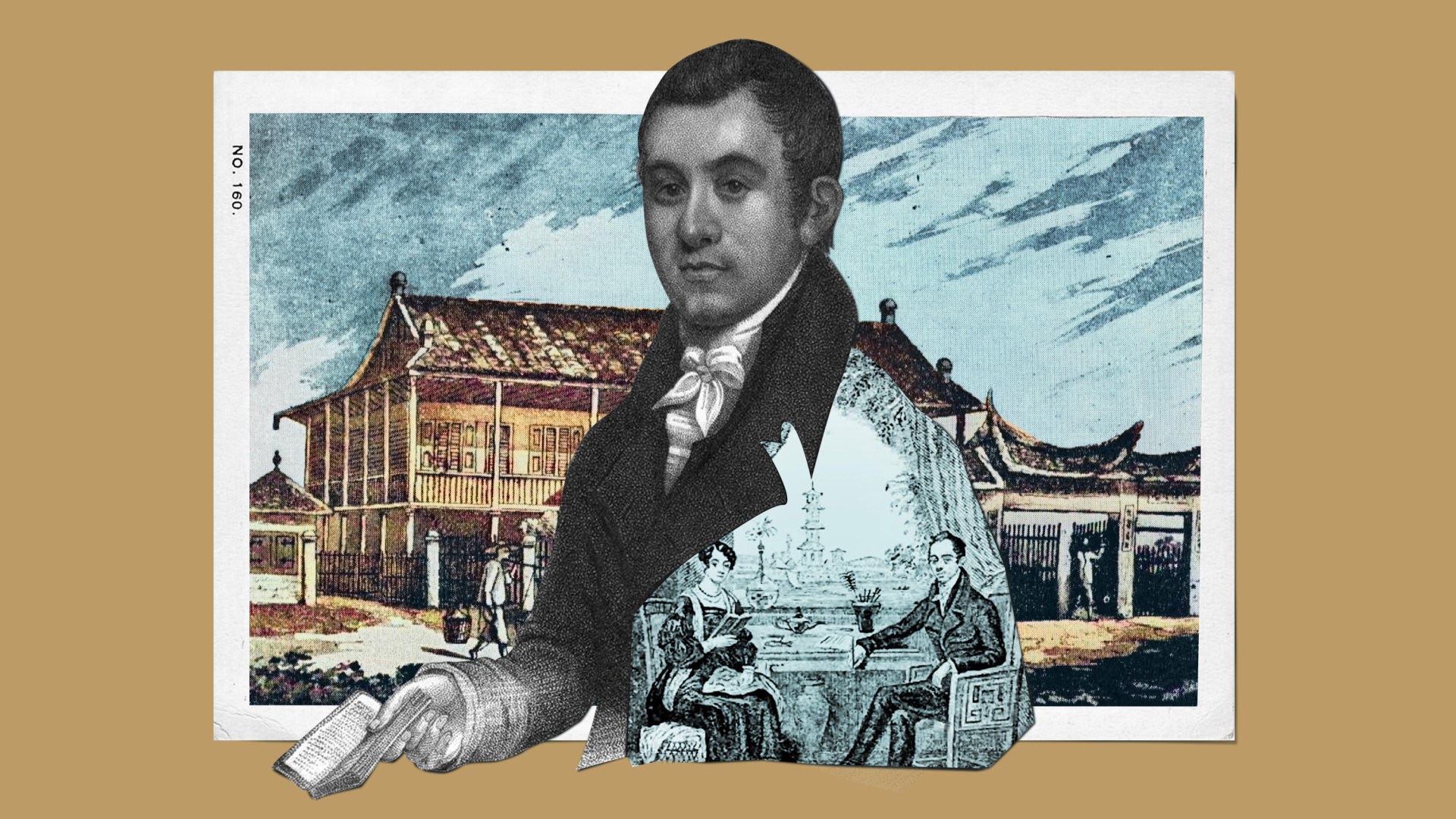
William Milne

William Milne

Christianity Today February 13, 2023
Illustration by Mallory Rentsch / Source Images: WikiMedia Commons

During William Milne’s nine years of ministry in Asia, the second Protestant missionary to China printed Chinese books, helped translate the Bible into Chinese, and cofounded the well-known Anglo-Chinese College. Perhaps his greatest legacy was creating the first modern Chinese periodical, Chinese Monthly Magazine.

Before Milne, only the imperial court or local government representatives disseminated information in China. Milne and fellow missionary Robert Morrison first published Chinese Monthly Magazine on woodblock in August 1815 in Malacca, a trade port in the Malay Peninsula. The periodical combined portions of the New Testament, explanations of Christian doctrines, as well as stories on science, technology, and current events.

The paper stopped publication six years later when Milne fell sick in 1821 then died the next year from lung disease. Despite his early death, Milne’s contributions to China and the Chinese diaspora in Southeast Asia are immense. Chinese Monthly Magazine was followed by other missionary presses. These newspapers had a large influence on Chinese society and led to the creation of secular publications. By the time of the 1911 Xinhai Revolution, there were 500 newspapers and periodicals in the country.

All this by a farmer from Scotland.

Humble beginnings

Born in Aberdeenshire, Scotland, in 1785, Milne came from a poor family with little education. He worked as a farmer, carpenter, and shepherd, as his father died when he was six.

Despite his humble origins, Milne grew up in the church and was greatly influenced by the godly men there and by reading Christian books. In 1801, at the age of 16, Milne accepted Christ as his Savior and was baptized. After reading the stories of missionaries, consulting friends, and praying, Milne decided he wanted to be a missionary and applied to the London Missionary Society (LMS). He was rejected.

Milne begged the committee to reconsider, eager to serve even if just “a hewer of wood, or a drawer of water,” according to Baiyu Andrew Song’s Training Laborers for His Harvest. In 1809, LMS relented and accepted 24-year-old Milne, sending him to three years of training. Once he graduated, he married Rachel Cowie and a month later left for Macao with his new wife.

Milne worked with Morrison, who had arrived in Portugese-ruled Macao seven years earlier as the first Protestant missionary to China. Catholic clergy in Macao forced Milne to leave immediately, so he sailed to Canton (Guangzhou) where he hid in a warehouse to escape the notice of Chinese authorities. Unlike Morrison, who had ties with the East India Trading Company working as a translator, Milne was unable to stay in either place. He spent the time learning Chinese.

Like many foreigners before and after him, Milne struggled to master the language. Milne noted that to learn Chinese well, foreigners must have “bodies of brass, lungs of steel, heads of oak, hands of spring-steel, eyes of eagles, hearts of apostles, memories of angels, and lives of Methuselah!”

World’s first Chinese periodical

As the anti-foreigner sentiment in China prevented Morrison and Milne from preaching to mainland Chinese, they focused their energies on Christian literature and Bible translation. In the spring of 1815, Milne and his family settled in Malacca where he established a mission headquarters. He built a printing press, and in 1815, the missionaries founded the Chinese Monthly Magazine.

Milne described the magazine’s purpose: “To promote Christianity was to be its primary object; other things, though, were not to be overlooked. Knowledge and science are the hand-maids of religion, and may become the auxiliaries of virtue.”

As the editor, Milne used the pseudonym Bo Ai Zhe (博爱者) or “Practitioner of Goodness.” The name appeals to Confucius’s teaching that one should “listen widely, select what is good and follow it.” About 85 percent of the content consisted of Christian material—including the New Testament he and Morrison had been translating, according to Xiantao Zhang’s The Origins of the Modern Chinese Press. The paper also discussed astronomy, world history, geography, and current events. At first, Milne printed and disseminated 500 copies to Chinese residents and the diaspora. The circulation jumped to 1,000 after the first three years.

The magazine also created new Chinese words for proper nouns. For example, prior to the publication, Chinese writers used ying ji li (英咭唎), the transliteration of “English” to refer to Great Britain. In an issue of Chinese Monthly Magazine in 1820, the name of the nation was translated as ying guo (英囯) for the first time. Since then, this translation has been used as the standard Chinese term for England.

Although the publication lasted only six years, it encouraged missionaries to start their own publications. The Protestant missionary press included Karl Gutzlaff’s Eastern Western Monthly Magazine in 1833. The first periodical established on Chinese soil, Eastern Western focused less on providing Christian material and more on increasing Sino-Western understanding by translating articles from foreign magazines.

Perhaps the most influential missionary newspaper was Wanguo Gongbao (A Review of the Times) created by American Methodist missionary Young John Allen in 1868. While the newspaper was initially focused on the Christian community, it soon shifted to promoting reform in China. With commentary calling for China to modernize and news from the West, the newspaper had a great influence on reformers Kang Youwei and Liang Qichao. Many of the Chinese contributors to the newspaper also went on to start newspapers themselves.

Zhong Haiping, former vice president of Jishou University in Hunan, wrote that the significance of Chinese Monthly Magazine was not only its contribution to the technique of magazine printing but also its philosophy of journalism.

“Facing a crisis of moral decline and the loss of humanities [today], it undoubtedly gives prophetic enlightenment to people blinded by money,” Zhong wrote in 2011.

“Newspapers and periodicals must guide people with correct public opinion and become ‘good books’ so that ‘those with little knowledge can understand, fools can be wise, the evil can repent and become good, and the good can cultivate all virtues,’” he said, quoting Milne.

Milne’s work in literature and education

Milne also influenced the people around him. In 1815, Liang Fa, the printer who had helped Morrison and Milne print the Chinese New Testament, came to Malacca to help Milne print Chinese Monthly Magazine. Under Milne’s influence, Liang Fa embraced the Christian faith and was baptized in November 1816. Liang was the second Chinese Christian led to Christ by a Western missionary (the first was Choi Kou, led by Morrison) and later became the first Protestant Chinese pastor in the nation’s church history.

In addition to Chinese Monthly Magazine, Milne published the English-language quarterly journal The Indo-Chinese Gleaner beginning in 1817 until his death. He also wrote 21 publications in Chinese and three in English, the most well-known being Dialogues between Chang and Yuen (1819). Originally printed as a series of articles in the magazine, the story used questions and answers between two fictional Chinese friends—one Christian and one believing in Chinese traditional religions—to express important issues of the Christian faith.

The series was so popular that missionaries reprinted it as tracts, making it the most reprinted and circulated tract in the 19th century. Subsequent missionaries used it as a model for their own literature evangelism.

Milne also worked with Morrison on completing the Chinese translation of the Bible. Beginning in August 1817, Milne helped revise portions of the New Testament and translated the Old Testament from Deuteronomy to Job. They finished the translation in November 1819, but Milne did not live to see its publication in 1823.

Their translation became the one most used by missionaries in the Chinese-speaking world. Even though the translation was at times awkward or even incorrect, Yung Wing, the first Chinese to graduate from a US university, noted, “The importance and bearing of [Morrison’s] dictionary and the translation of the Bible into Chinese, on subsequent missionary work in China, were fundamental and paramount.”

At the same time, Milne also wanted to equip a group of believers in Malacca to become preachers and return to China to preach the gospel. However, he faced a shortage of teachers, space, equipment, and students, as almost all local Christians were illiterate. So in 1815, he opened a small school in Malacca in a stable with less than 10 students. For the first half of each day, private tutors taught reading and writing Chinese characters. In the second half of the day, missionaries taught the Bible and catechisms.

In 1818, Morrison and Milne expanded the school into the Anglo-Chinese College. Milne served as the first principal and taught many of the classes, including geography, English, and ethics. Despite facing difficulties and several temporary closures, the school is now a well-known secondary school for boys in Hong Kong. With more than 200 years of history, it is the oldest school in Hong Kong, where it moved to in 1843.

“His whole soul was in his work”

Milne and his wife lost two newborns in 1816 and 1817, before Rachel fell ill and died after giving birth to their youngest son, William, in 1819. The pressures of his work along with caring for his four surviving children took a toll on Milne’s health. He died three years after his wife and was buried next to her in a Dutch cemetery in Malacca.

During Milne’s nine years in Asia, he had an immense impact on Chinese literature, Chinese journalism, and the Chinese church. His friend and colaborer, Morrison, expressed his sorrow over Milne’s death.

“Great is the loss to this mission which the early removal of that faithful, devoted, and successful Chinese Missionary, has occasioned,” said Morrison. “His attainments in the difficult language of this great empire were eminent. His whole soul was in his work.”

Kuo-An Wu holds master’s degrees from National Taiwan University and Chung Yuan Christian University and a PhD in theology from the University of Edinburgh. He previously taught at Alliance Seminary in Hong Kong, Baptist Seminary in Taiwan, and Singapore Bible College. Wuis currently an associate professor of church history and systematic theology at the China Evangelical Seminary in Taipei.

Translation by T. N. Ho

The Bono Interview: Plaudits and Problems

Responses to our December issue.

Edits by Christianity Today / Source Image: Unsplash

For our final issue of 2022, Mike Cosper spoke with U2 frontman Bono—rock star, Christian, and author of a new memoir—about lament, grief, hope, and “punk rock prayers.”

Some readers expressed gratitude for the rocker’s reflections, reminiscing about how his music shaped their faith through car radios and stadium concerts. Others praised an “activism that stems from his passion for Jesus.” (Bono is founder of the ONE campaign, which works to end poverty and preventable disease.) One social media commenter wrote, “What I admire about his hope in Christ is that he still considers himself a pilgrim who is continuously seeking the deeper things of God rather than someone who considers himself to have arrived.”

But several readers also wrote to us because they were troubled by the profile’s omissions—mostly Bono’s positions on abortion and LGBT issues. In 2018, U2 publicly supported Ireland’s repeal of its abortion ban. “Sometimes I’m not sure who Bono thinks Jesus is,” one reader commented. “Jesus Christ is Lord. … If God became flesh in a womb, can we ever truly justify actively removing a life from the womb?”

Kate Lucky, senior editor, audience engagement

What Is a Missionary Kid Worth?

As a former MK, I can definitely say there were traumatic experiences and abuse, and I appreciate Rebecca Hopkins bringing up what makes the MK experience unique: namely, the idea that your actions have direct consequences on your parents’ ministry and that speaking up or struggling is interfering with it. I don’t think my parents pushed that much if at all, but my boarding school sure did, as did the churches that “sent us out.” I think it was a huge factor in my developing and almost dying from anorexia at age 14.

@justyouraveragejoy (Instagram)

Our Advent Waiting Goes Back to Eden

How tender of our God to choose both an older man and an older woman to be there waiting for him, praying for him at the temple on his first visit as a tiny baby!

@livinglovedtoday (Instagram)

Why Are We So Cynical About Peace on Earth?

Too many evangelicals have decided peace has to do with political power and sway—instead of what peace actually is: a baby slipping into humanity, anonymous. Peace is a person, but it’s far more palatable for us to believe peace is a set of principles.

@CarolynUpNorth (Twitter)

When the Best Bible-Reading Tool Made Bible Reading Worse

I wonder if all of our Bible “helps” don’t in some way work against internalizing biblical truth. The scientific method may stimulate the mind, but does it transform the heart?

Jack Scott Batavia, IL

Bible Apps Are the New Printing Press

As a child I sat in church and witnessed the Word being read from a side pulpit and preached from the other side. Today I sit in church and see the Word on a screen, read off a screen by the pastor while I look at it on a front side screen, the Scripture pulpit unused. The digital age will impact how we do church, our liturgy, not just how we study and read the Bible. Do we need a digital theology of worship? Do seminaries prepare pastors accordingly?

T. D. Proffitt Santa Ana, CA

Why Christmas Is Bigger Than Easter

Grateful to the visual design team on the article I wrote for @CTmagazine this month, especially artist Michael Marsicano. The whole spread is well done, but just consider the secondary illustration: This baby hand powerfully upholds the message. Let me count the ways.

Composition: The chubby hand held in midair is placed in the foreground, setting Mary and Joseph in the shadowy background. That’s appropriate emphasis. It also makes the shape of the baby’s hand a kind of sheltering welkin overarching his own family. Preach that!

Color palette: The highly saturated blue and purple, which shows up especially well on the two-page spread, follows the visual logic of purple=starry heaven, blue=Mary (that is, humanity). So once that is established by the big illustration, bring on the baby hand! Strongly lit from above, it combines the two natures of blue and purple, but reversed: The space above the hand is Marian blue, and the shadow under it is purple sky. All reflected in the glowing skin tone of the incarnate one.

Layout: The callout text under the baby-hand illustration connects it to the article’s argument that the Son of God took hold of human nature. I wrote, “reaching out and drawing it in,” and the illustration and layout show it.

Writers don’t always love the editorial process, but this time around I can testify that @kbtrujillo and her team improved the work in some obvious ways, including ways you can see.

@FredFredSanders (Twitter)

The Incarnation is both the means and end of grace. However, the same can be said of crucifixion and resurrection. One (resurrection) presupposes the other (crucifixion). In the Baptist tradition under which I was raised, the gospel has not been preached until you go by Calvary. It is Christ crucified, died, rose, ascended, and coming again.

Leander C. Jones Northport, AL

Correction: The January/February 2023 article “Selling Books Without Selling Your Soul” incorrectly described NavPress and Tyndale House Publishers’ relationship on page 66. Though Tyndale sells and markets NavPress books, NavPress retains editorial control over the titles it publishes.

Cover Story

Ministers in Ukraine Are ‘Ready to Meet God at Any Moment’

Pastors and church leaders who stayed behind serve as if every day might be their last.

Sandbags in the windows of a Kherson church.

Sandbags in the windows of a Kherson church.

Photography by Joel Carillet for CT

James offers so many prayers in a day, they puff from his mouth like vapor in Ukraine’s bitter winter.

For the senior pastor of a large church in Kherson, prayer is not only an occupation. It is a lifeline. He prays aloud when Russian missiles shake the walls of his church and his four-year-old son cries. He prays aloud before driving to nearby villages to deliver bread. He prays aloud when he’s scared to death, which is often.

And so, on a frigid Tuesday morning in December, James, who asked to be identified by his English nickname, gripped the wheel of his dusty yellow van and prayed in Ukrainian. He turned toward a bridge leading to a manmade island along the muddy Dnipro River that locals simply call “the island.” Russian shelling had shattered several windows of a small church there, and James was carrying plywood to board them up.

The island is a frequent target of Russian attacks. Directly across the river is the eastern part of Kherson Oblast that’s still under Russian occupation. Every day since November, when tens of thousands of Russian troops fled Kherson, the province’s capital city, in a hasty retreat, they have flung rockets, grenades, tank shells, and mortars across the river as if in vengeance, killing at least one person a day.

Today, would it be him?

But a church’s windows needed fixing. Of the island’s original population of 30,000, only about a quarter of residents remained—mostly those too old, too disabled, or too stubborn to evacuate. The church is the only one on the island offering shelter and supplies. So James gritted his teeth and crossed the bridge.

Ukraine’s Christians no longer see “the last days” as some far-off, eschatological era sketched in Revelation. “We live as though today is our last day,” one of them told me, echoing a sentiment I heard from so many Ukrainians. And should they ever forget that life is a vapor, explosions and frequent blackouts return them quickly to the truth: We’re here a little while, and gone tomorrow.

A Ukrainian pastor and volunteers load plywood to board up a church in Kherson’s island community.Photography by Joel Carillet for CT
A Ukrainian pastor and volunteers load plywood to board up a church in Kherson’s island community.

When Kherson fell to the Russians, James and his wife opted to remain in the city with their family: “If we die, we die together.” They have four children, ages 4 to 17. They remember Russian shelling shaking their fifth-floor apartment like a Jenga block, their second daughter screaming hysterically, then gathering their kids and rushing to the church.

It was a difficult but obvious decision to stay, James said. “We saw the despair in people’s eyes. They couldn’t see tomorrow. Who gives them hope if I run to America or Europe?”

For three weeks, they slept underneath the church stairs. About 300 others sheltered in the church basement, some for months. People slept sitting up, and in the men’s restroom. A family with an eight-month-old squeezed into a closet with a five-foot ceiling.

James had been their senior pastor for barely a year.

James’s choice to remain with his family in occupied territory is noteworthy. More commonly, Ukrainian pastors on the frontlines evacuated their families to safety, particularly those with young kids. Others left with their families, or stayed for as long as they could before eventually fleeing.

Today, a year into the full-scale invasion, many pastors who left have no church to return to. Their congregations have scattered, their church buildings were destroyed, or their war-beaten congregations are wary of having them back.

“We call them ‘orphan pastors,’” said Valeriy Antonyuk, president of the Baptist Union of Ukraine, the nation’s largest Protestant community. Antonyuk estimates that of the 2,100 Baptist pastors in Ukraine, about 200 evacuated. Roughly 200 more were called to military duty. Half of those who evacuated have returned, though many had to be reassigned to another church. For some, the reintegration with their church was “painful,” Antonyuk said. Certain congregants harbored resentment and hurt that their pastors had left during a crisis, while others were apprehensive about veterans continuing to serve as ministers.

Such are the troubles that war has forced upon many churches in Ukraine. Pastors say that some ministers who stayed were arrested, threatened, and tortured by Russian forces. Others simply disappeared. Horror stories rippled across congregations.

Pavel Smolyakov is the head pastor of Baptist churches in Kherson Oblast. His church, Calvary Baptist, is the denomination’s flagship congregation in Kherson. A day after the invasion, Calvary took in 46 orphans, ages 4 months to 4 years, from a local orphanage. Russian forces were bombarding the region, and the orphanage, with its large windows, was unsafe.

For two months, the church housed the children in its basement. Church members helped feed, clean, and warm the kids, some of whom had special needs and required round-the-clock care. Volunteers spread throughout the city, queuing for hours to procure medicine, milk, and other baby supplies that would run out by evening.

Smolyakov battled anxiety and the weight of responsibility for the children’s lives. Russian soldiers, he feared, wanted to take them and use them as wartime propaganda. Most days, occupation officials banged on the church door, peppering the staff with questions: Who was responsible here? Why did they have these orphans?

Then, a week before Easter, a uniformed Russian official appeared one morning with armed soldiers and gave Smolyakov two options: Either the remaining orphanage staff and volunteers could escort the children back to the orphanage, or the soldiers could take the orphans by force.

The pastor helped take the children back, and the rest was predictable: Smolyakov says a picture of him soon appeared on Russian television, the Russians claiming to have rescued the orphans from traffickers and accusing him and the church of harvesting children’s organs for the American black market. “That’s when I knew my life was in danger,” Smolyakov said. It took him and his wife four days to skirt Russian checkpoints and sneak out to Odessa.

The last the pastor heard, according to a Telegram post from the governor of Kherson Oblast, the children had been taken to Russian-annexed Crimea.

As Smolyakov told me this story, our interpreter, a youth pastor with two young kids of his own, paused to wipe his eyes.

Smolyakov remained matter-of-fact. “It’s not easy to talk about emotions right now,” he said.

Ukrainian ministers who chose to evacuate, like many other Ukrainians, struggle with guilt. They worry about the flocks they left behind. One pastor told me he escaped an occupied city in September, after Russian forces shut down his church in the middle of a Sunday service and ransacked his house. “I know it’s not a heroic act,” he said, “but we decided it’s better to be alive.” Most of his congregation also evacuated, but about 200 remain, mostly elderly people.

The pastor, who asked for anonymity to protect church members who are still in occupied territory, is now effectively homeless, bouncing among friends’ houses, waiting for a time when he can return to his church, whose building is being used by the Russian military. Online, he is in touch daily with parishioners who have fled across Ukraine and the world—in some ways, a forced return to the kind of fellowship they learned during the COVID-19 pandemic.

“I wasn’t taught in seminary how to be a pastor of a church in occupied territory,” he said. “I wasn’t taught in seminary how to be a pastor of a church that’s scattered across 15 different countries.”

At James’s church, three out of five elders left Kherson. Most of the ministry leaders are gone—the worship band, the Sunday school teachers, the youth pastor. In the early days of the invasion, the church had dozens of volunteers helping to fill the leadership holes. But as conditions worsened, many were forced to evacuate.

When hundreds of hungry, desperate people gathered outside his church, James felt the sheer limitations of his one human body. When he considers all the people in surrounding remote villages who for months have endured an unusually cold winter without power, heat, and water, he aches that he can’t reach them all.

A food distribution at a Khershon church.Photograph by Joel Carillet for CT
A food distribution at a Khershon church.

But then he looks at those who stayed—his steadfast wife, his kids, and the handful of consistent church volunteers—and he thinks, I have enough for today’s work. They have been for him the rod and the staff of Psalm 23, God’s comfort in the valley of the shadow of death.

There are, for instance, two men in their 20s who have stayed with James since the beginning of the war, helping with whatever’s needed at the church. Over the past year, they’ve grown closer than family. (Both asked for their names not to be used for fear the Russians would target them as aid workers.)

They make an odd trio: James, in his 40s with a rumpled dark beard, passionate eyes, and black jeans, gives off a vibe of renegade-youth-pastor-meets-Gandalf. One of his sidekicks plays the jester, incessantly ribbing his pastor and cracking jokes. The other, a strawberry-haired, slim violinist with wire-rim glasses and a sweet tooth, is thoughtful and intentional.

They sleep on thin mattresses in the church basement, and the two younger men take turns keeping watch upstairs in the night. “We are the church guardians,” one of them told me. Few young people stayed in Kherson if they had the choice. He stayed, he said, “because there are people who need help.”

On the Tuesday when I accompanied James to bring plywood to the island church, both of his assistants rode along. The pastor’s old van has no backseats, so the young men perched behind him on wobbly plastic children’s chairs.

If there are orphan pastors, the church they were visiting is an orphan church. Its pastor fled with his young family the first day of the invasion. The majority of his congregation also fled.

James appointed one of his church members, a sound engineer with no formal pastoral qualifications, to lead this church. The engineer, who asked to be identified by his nickname, Nevod, lives in an apartment across the street. After Russian missiles destroyed the concert hall where he used to work, he found himself running a church that doubles as a bomb shelter and social service center.

On any given day, up to 600 cellphones charge at the building, courtesy of its generator. Roughly 200 people can shelter in the basement during shelling.

“He’s the pastor now,” James told me when we entered the church.

Nevod shook his head. “No, no,” he protested. “Not a pastor, just a volunteer.”

James insisted, “Yes, you are a pastor.” He typed something Ukrainian into Google Translate and showed me his phone. Sacrificial man, it displayed in English. “That’s him,” James gestured. “For nine months without pay he was here, serving Christ.”

Nine months. The duration of the Russian occupation of Kherson. Long enough, under the circumstances, to live multiple lives.

Kherson is the first key city and the only regional capital that the Russians have seized since the invasion, falling almost immediately when the war began. Once a thriving, economic hub with rich agrarian soil, the city became a ghost town overnight. For months people hunkered in their homes, scurrying out only for necessities. By early afternoons, the streets were bare except for stray dogs.

“It plays with your head,” one pastor told me: After months of billboards heralding, “Russia is here forever!” many people began believing it.

On November 11, when Ukrainian tanks paraded into downtown Kherson with blue-and-yellow flags and dancing civilians took selfies in the streets, James at first couldn’t believe his city was actually liberated. What tricks were the Russians playing this time? Russian soldiers were known to dress as civilians or Ukrainian soldiers to ferret out pro-Ukrainian sentiments.

By the time it sank in, he had little time to rejoice. Amid the celebrating, people were already lining up at his church for bottled water and bread.

Retreating Russian forces had destroyed critical infrastructure in the region. For about three weeks, there was no electricity, water, heat, or phone service. By the end of the first day of freedom, with the streets pitched in total darkness, 7,000 people had queued outside the church for help.

In some ways, postliberation Kherson was in worse shape than Russian-occupied Kherson. When I visited in early December, many places still had no power. Shops, banks, restaurants, and schools were still closed. People had no jobs. Playground swings swayed, empty of children. The city settled into uneasy silence after a 7:30 p.m. curfew, and sporadic bombings shook the city throughout the night—a constant reminder that the enemy stood just across the river.

The day we visited the island, Russians shelled Kherson 51 times, according to the Kherson government, striking mostly civilian areas, killing two and injuring one.

The first shelling we heard that day was at 10:20 a.m. James and Nevod were talking logistics outside the church when two women, one elderly and one late in a pregnancy, approached to ask for help. They had barely finished speaking when the telltale boom-boom-boom cluster explosions of Russian Grad rockets sounded close by. The older woman put her arms around the younger one, and they hurried into the church with Nevod.

“We need to go,” James shouted, waving his arms toward his van. “Let’s go!”

We jumped into his van. James hit the accelerator and we sped out of the church compound and across the bridge off the island.

James says he has seen worse: Russian tanks shooting at schools, children starving while Russian soldiers partied at cafés, Russians plundering crops and equipment from Kherson’s farmers. “This is not war,” he said, stamping his finger firmly. “This is genocide.”

On the drive back to his own church, James pointed to a downtown building that looked like a trampled sand castle. It had been a Russian base, he said, before the Ukrainian military destroyed it with a US-supplied HIMARS rocket launcher. The pastor flashed a toothy grin. “I like it,” he exclaimed with what little English he knew. “HIMARS, forever!”

War has marked every area of Ukraine, not just occupied territories.

On a Saturday evening in Vyshneve, a densely populated suburb of Kyiv, the winter daylight was short: The sky remained indigo at 8 a.m. and darkened by 3 p.m. The thick clouds of an approaching snowstorm loomed.

That made the rolling blackouts, a staple of life now as Russian forces attack the Ukrainian power grid, even blacker. The city, which preinvasion had a population of 42,000, was as dark as a medieval European village. Streetlights and building signs were off. Apartment buildings were colorless cubes, save for flashes of yellow emitting from several units with generators. Vehicle headlights bounced off snow, and pedestrians stepped gingerly on icy sidewalks glinting beneath headlamps and flashlights.

In the frigid darkness, Salvation Church glowed and hummed like an oasis. Wafts of coffee and toasted buns warmed the air. The church was the only community building in Vyshneve offering power during the blackouts. Every day, it opened its youth center, which includes a café and a basement, for community members to warm up, sip hot cappuccinos, and work on their laptops.

Kyiv Oblast has come a long way since the early months of the invasion, when Russian troops swooped in to key cities surrounding the capital. On a Sunday late last year, churches filled with worshipers. Pastors dunked new believers into a baptism pool. A choir sang at a new church plant in Vorzel, a village outside Kyiv that, just months prior, was a junkyard of mines, abandoned tanks, and dead bodies. Stores and pharmacies and coffee stands were open. Young people licked grease off their fingers at McDonald’s, and babushkas pushed bundled-up babies in strollers.

At Salvation Church, a group of girls wearing sweatpants and holding giant white feathers practiced a dance routine for the upcoming Christmas performance. They floated and pranced to tinkling music underneath a ceiling with the declaration “Jesus is King” inscribed on all four corners.

“That’s my daughter, the tallest girl there,” said pastor Mykola Savchuk, pointing.

Savchuk has two children, a 15-year-old daughter and a 13-year-old son. The second day of the invasion, when he saw Russian tanks penetrating a city close to his home, he immediately drove his family to his parents in western Ukraine: “I couldn’t bear to see my kids suffer.” Savchuk returned to Kyiv by himself in time for Sunday service. When Russian forces withdrew in April, he brought his family back home by Easter.

Were things returning to something like normal?

“On the outside, yes,” Savchuk said. “But inside, no.” It’s too early to measure the level of psychological trauma in the nation. Those who know what life in Ukraine was like before the war see the mental stress: the changes big and small, the daily miracles of survival—the resilience, the persistence, the determined grasp for the mundane.

Left: Worshipers attend a church plant in Vorzel, outside Kyiv. Right: The streets are quiet around Salvation Church in the Kyiv suburb of Vyshneve.Photography by Joel Carillet for CT
Left: Worshipers attend a church plant in Vorzel, outside Kyiv. Right: The streets are quiet around Salvation Church in the Kyiv suburb of Vyshneve.

In the early months of war, Salvation Church lost 90 percent of its 3,000-member congregation. Half evacuated abroad; the others to western Ukraine. That first Sunday after the February 24 invasion, Savchuk walked up to the pulpit wondering how many people would show up. He was surprised to see 300, about 10 percent. Half of his 16 pastors evacuated. Some leaders who stayed, Savchuk advised to leave; he could see their mental health buckling.

Like James in Kherson, Savchuk went to bed each night thinking, This could be the last night of my life. That constant uncertainty takes a toll. Five days into the invasion, when the shock had finally worn off, Savchuk woke up alone in the middle of the night and sobbed.

But there is a time to lament, and there is a time to act. The immediate needs were severe and urgent—medicine, food, supplies. All the stores were closed. People needed shelter and help evacuating, and they knocked on church doors because churches were the swiftest, most efficient, and most flexible institution offering aid.

Despite losing congregations and ministers, Ukrainian church leaders say they are seeing more unbelievers entering their doors than ever before. Salvation Church added a 10-minute sermon to its regular Sunday services to explain the basic gospel to the unchurched. Savchuk estimates that 20 to 40 newcomers have responded to altar calls each Sunday. Salvation Church had always placed strong emphasis on evangelism, but he said wartime heightened the urgency to preach the gospel. “Life can end at any moment. I had to look into the eyes of my God: What am I doing?”

“This is a very special time,” said Valeriy Antonyuk, the Baptist Union president. “In times of trials like this, we see how God multiplies his grace. It’s difficult. We cry a lot. But we see God at work … . We have all this harvest. This is the season to sow.”

The war has exacerbated the need for ministers in Ukraine, especially those trained in trauma care. Even before the invasion, the Baptist Union could have used about 500 more pastors, according to Antonyuk. He said the conflict has prompted hundreds of young people—many who used to sit in the back pews—to apply to Ukrainian seminaries. The problem is, “Pastors don’t grow up in two years.”

At a Baptist strategy meeting in Irpin, about 200 pastors and ministry leaders gathered from across the country to discuss how war has impacted their work. There was weariness, but also great excitement: The challenges to ministry during wartime are giant, but ministry would not stop.

“Everyone is scared, but we are in ministry,” Antonyuk addressed them as the meeting concluded. “War is a new reality. We don’t know what will happen tomorrow. But we all have to die some day. If it’s 2023, so be it.”

Two days after the liberation of Kherson, Pavel Smolyakov drove straight to Calvary Baptist Church. He had evacuated to Odessa a week after Easter—after Russian media had spun tales of him being an orphan trafficker—and had not been back in Kherson for seven months.

The drive was harrowing. He had to maneuver his car around minefields and corpses lying untouched on the streets. But the reunion with his congregation was joyful. They hugged. They cried. They prayed and worshiped.

When Smolyakov finally entered his apartment, it felt eerily still. Everything was exactly how he had left it more than half a year earlier: the bedsheets, the mugs, the familiar creases and knickknacks. It was as if time inside his home had stood still while the whole world outside had changed.

All the pastors in Kherson—those who returned and those who never left—are “dead busy,” Smolyakov said. As a regional leader, he’s encouraging weary ministers, training new ones, and helping returning evacuees. But don’t expect your church to be the same, he warns. Many churches have hollowed out. Three-fourths of the 400 church members at his own congregation scattered throughout Ukraine and Europe. Out of its six pastors, only Smolyakov has returned to Kherson.

And yet. Throughout the occupation, the remaining church members of Calvary still came together every morning at 10 to pray. Like the early Christians in Acts 2, they gathered daily to break bread, share their food, and praise God. And like in Acts, God has added day by day to the church.

Today, 300 new faces have become regular attenders at Calvary. It’s going to be challenging when leaders and members come back to an unfamiliar church body, Smolyakov said, but it’s a happy challenge—a heartening reminder that the church never stopped doing what a church should do.

James’s church in Kherson is not the same church it was before the war, either. Of 400 church members, only 50 remain. Sunday service used to be filled with the laughter and screams of 150 children. Now there are barely 20. A skeleton crew remains, and with the daily Russian shelling, James says, those who left “would be crazy to come back.”

When I visited, a few weeks before Christmas, he walked me into the dark, freezing sanctuary. It’s a big auditorium with all the fancy stage lights and media equipment—even a harness for performers who once floated onto the stage. Now the media team is gone. The theater team is gone. There is no one to play the drums or guitar.

Last December, they put on a vibrant Christmas production to a packed audience. James had no idea how many people would show up for the service in 2022. He might have to play recorded worship songs.

But in the church all around James, a different kind of service was taking place. Older women poured rice into little sacks for distribution. A cook who lost his restaurant simmered cabbage and mashed potatoes in the church kitchen with his wife and mother-in-law. James’s wife was on her feet all day, running between homeschooling her kids and serving the hungry. A dozen volunteers formed a human chain linking a delivery truck to the church storage room, unloading bags of food donated by other churches.

Outside, the boom-boom-boom of Russian rockets thundered off and on, so frequent that they blurred into the background, like traffic horns.

“Do you miss the old services?” I asked.

“No,” James said without hesitation. “Before, the people here were all already believers. Now we see new people who have never heard the gospel.”

James seemed both young and old, vigorous and weathered. He’d seen and heard too much in the past year but was somehow always able to pull out fresh energy—an effect, perhaps, of all those prayers he utters.

James drives back from the island in Kherson after shelling cut short a visit with a church.Photography by Joel Carillet for CT
James drives back from the island in Kherson after shelling cut short a visit with a church.

Lord knows he needs them. Once, while he was delivering food and supplies to a village, a Russian tank smashed into several cars at a spot where he had been driving only minutes before. He didn’t dare look back but just drove on, cold-sweating from the realization of how close his wife had been to becoming a widow and his children fatherless.

I thought of my own seven-month-old back home in Los Angeles. “Don’t you ever regret staying in Kherson?” I asked.

“Regret? No! No! Never!” James said. “We are on God’s frontlines. We are ready to meet God at any moment.”

Beside him, one of his right-hand men cracked a joke, and the other giggled.

James’s expression loosened. His eyes crinkled into laughter. He may have been on the frontlines, and these may have been his last days, but Lord willing, with his church beside him, he would live them with a smile.

Sophia Lee is global staff writer at Christianity Today.

Editor’s note: CT now offers select articles translated into Ukrainian and Russian.

You can also now follow CT on Telegram: @ctmagazine (also available in Chinese and Russian).

Books
Excerpt

The Bible Gives Investors Like Me a New Perspective on Risk

If we believe all that God promises, we won’t always opt for playing it safe.

Illustration by Abigail Erickson / Source Images: Getty

Editor’s note: A version of this excerpt first appeared in the October 2022 issue of Lead magazine.

Faith Driven Investing: Every Investment Has an Impact--What’s Yours?

Faith Driven Investing: Every Investment Has an Impact–What’s Yours?

Tyndale Momentum

240 pages

Hedging is a common term in the investing world, but the idea existed long before the stock market. In fact, you may have heard people describe the “hedge around the law” that the Pharisees built in Old Testament times.

For example, while the Law required that Israelites not work the 24 hours of the Sabbath, some Pharisees would teach that people should not work for 25 hours, just to be safe. While this mindset may have been well-intentioned, it completely missed the purpose of what God was trying to teach his people.

Now, we’re seeing that mindset creep into the hearts of investors. We opt for playing it safe, “just in case.” Paul instructs us to “not conform to the pattern of this world, but be transformed by the renewing of [our] mind[s]” (Rom. 12:2). Yet the pattern of this world instructs us to have a large retirement account, diversified investments, or a financial nest egg.

If I look at my life, much of what I do regarding my investments amounts to a hedge. When we spend all our energy and efforts hedging against risk, hedging against inflation, hedging against this or that, our entire life becomes a hedge. And when we avoid risk, we often end up avoiding what God is doing in the world.

A few years ago, an entrepreneur contacted me to share about his real estate company in Moldova. I thought he had contacted the wrong person. I’m not sure how to calculate a cap rate, and at the time I wasn’t even sure that Moldova was a country. We talked, and after hearing his pitch, I politely told him that we couldn’t invest in what he was doing.

The entrepreneur thanked me for my time, but before he let me go, he asked if I would set up more time to help him understand what it meant to be a “faith-driven entrepreneur” (to cite the ministry I cofounded). He knew my background and knew that faith was important to me, so much so that he still wanted to talk, even if he wouldn’t receive any money.

Just moments before, I had all but written this phone call off. Frankly, I had only agreed to talk out of obligation. Perhaps a better ending to this story would have involved me taking a huge risk and making a substantial profit. But that’s not what happened. What happened is I caught myself ignoring what God was doing in a country halfway around the world. From then on, my perspective on risk changed completely.

Adapted from Faith Driven Investing by Henry Kaestner, Timothy Keller, Andy Crouch, Cathie Wood, et al. Copyright © 2023. Used by permission of Tyndale House Publishers, a division of Tyndale House Ministries. All rights reserved.

Books

New & Noteworthy Books

Compiled by Matt Reynolds.

Blood and Fire: Revival Movements That Transformed Culture and Society

Nigel Scotland (Cascade Books)

From Northampton, Massachusetts, to Lowestoft, England, the locations where revivals erupt can feel as unpredictable as the Spirit who kindles them. In Blood and Fire, religion scholar Nigel Scotland explores 10 revivals that occurred in the United States and Great Britain, touching on familiar episodes and more obscure events alike. As Scotland explains, studying these spiritual outpourings can furnish us with a “deeper awareness of [God’s] concern and compassion for the world and its peoples.”

Theology That Sticks: The Life-Changing Power of Exceptional Hymns

Chris Anderson (Church Works media)

When it comes to varying styles of church music, Chris Anderson, a self-described “music junkie,” might check the box for “all of the above.” His great passion, though, is for hymns—he’s written dozens—and in Theology That Sticks, he unpacks their virtues. “Great Christian music,” writes Anderson, “is a means of grace. It helps you grow in your faith, delight in your God, and even combat your sin.”

Redeeming Vision: A Christian Guide to Looking at and Learning from Art

Elissa Yukiko Weichbrodt (Baker Academic)

Looking at art, for some, counts as a highbrow hobby. But even those who disclaim the artsy label are deeply shaped by an array of images, from the mundane to the sublime. Weichbrodt, an art history professor at Covenant College, writes Redeeming Vision “for the museumgoers, yes, but also for the Instagram scrollers, the meme gatherers, the magazine readers, the ad watchers, the graphic novel lovers, the coffee table book flippers, and the cell phone photo editors.” The book walks believers through various tools for seeing and grappling with the world of artwork around them.

Books
Review

What Women Miss When They Go Missing from Church

An appeal to return from someone who walked away herself.

Illustration by Donna Grethen

Ericka Andersen wants you to have FOMO (or “Fear of Missing Out”). She wants you to wonder what everyone else is doing. She wants you to suspect they might be getting more satisfaction than you are. She wants you to conclude that staying home was probably the wrong decision.

Reason to Return: Why Women Need the Church and the Church Needs Women

And she wants you to feel this way on Sunday morning at 11 a.m.

“I don’t usually recommend having FOMO,” writes Andersen in Reason to Return: Why Women Need the Church and the Church Needs Women, “but in this case, I do. You should fear missing out on what God has for you! Fear missing the transformation, healing, and growth that will happen when you invest your faith life through church community.”

Reason to Return appeals to women who want to develop a richer life of faith but who aren’t sure how—and aren’t convinced that church is the place to do it. These women may have been part of a church in the past, but some combination of disillusionment, hurt, or pandemic strains has led them to spend their Sundays elsewhere.

Andersen writes out of personal experience, detailing how she questioned the place of church in her life during an earlier struggle with an eating disorder and a more recent struggle with alcohol. For a time, she writes, she walked away from church entirely.

She’s since come back, and she’d like to invite other women to join her.

An inviting picture

The first part of Reason to Return runs through the reasons many women are staying away from church these days. Drawing from interviews with women who have come and gone from church (and often come back again), Andersen explores a variety of hindrances to church commitment. Chapters in this section cover such topics as insufficient time, disillusionment with past churches, personal discomfort, and spiritual doubts.

For women in particular, uncomfortable relationship dynamics loom large, and Andersen is right to spend substantial time exploring them and also offering the hope of healthier relationships in the future.

Andersen is also wise to tackle reservations that may be based on false perceptions. In chapter 10, for example, she acknowledges the harm of politically partisan teaching in the church while also citing research that most churches are not overtly political at all. According to a 2016 Pew Research study, only 1 percent of churchgoers heard their pastor speak favorably of Donald Trump, and only 6 percent heard a favorable statement about Hillary Clinton. Some of our reasons for staying away, Andersen implies, may be largely in our imaginations.

The book’s second and third sections explore incentives to return to church—reasons to commit yourself to being part of a local body and spending time with its members in worship and fellowship. In part two, Andersen unpacks some of these reasons: our own spiritual growth, our need for friendship, and discipleship of our children, among other benefits of showing up on Sunday.

Several times in the book, she repeats this statement: “The church of your past doesn’t have to be the church of your future.” But Andersen is no Pollyanna. She repeatedly acknowledges that returning to church comes at a cost; it will require emotional involvement, relational discomfort, and even money. She helpfully compares the work of committing to a local church to the work of giving birth: “The process of labor and waiting is incredibly difficult,” she affirms, “but you know the reason behind this pain.” So too, we bring our questions and hesitations to the local church, trusting that God has good for us there in the end.

One of my favorite stories in the book involves Andersen’s own discomfort with a man in her church small group. The former drug addict prone to unflagging optimism and talking too much about himself and his wife, Andersen reports, had been “getting on my nerves.” One night, though, he shared his testimony of finding Christ and of the incredible joy that transformed a life previously characterized by prison sentences and suicidal thoughts. Hearing this story, Andersen suddenly understood the man’s over-the-top cheerfulness and learned to love him and the work God had done in his life. In the church, she writes, “we can actually hear someone and, in turn, begin to feel safe enough to share parts of ourselves.”

In part three, Andersen turns to practical tools for prioritizing local church involvement. These chapters include diagnostic questions, suggestions for reflection, and specific resources that may help someone locate a church where she can flourish. (It’s worth noting that Andersen skips any discussion of doctrine and ecclesiology, which assumes the reader can already identify a biblical church that aligns with her theological convictions.)

Throughout, Andersen writes gently and sympathetically, encouraging rather than berating readers who haven’t prioritized church. She calls on the promises of Scripture, painting an inviting picture of what it can look like when the people of God love one another. But she’s not afraid to offer a judicious challenge to our complacency, like the one in the book’s final pages: “Our global brothers and sisters in Christ find it worth facing punishment and persecution [to join a church]. It’s important to ask why? Why would they risk their lives in this way, if we, as Christians, don’t need church to have a relationship with God?”

This is a prod toward FOMO of a different sort, and one we probably need more than we think. It’s worth asking if we are missing out, not only on joy and fellowship but also on the “reproach of Christ” that Moses and the saints considered “greater wealth than the treasures of Egypt” (Heb. 11:26, ESV). Being “mistreated along with the people of God” (v. 25) doesn’t sound like an ideal inducement to join a church, but, as Andersen points out, saints throughout history and around the world today have laid down their lives for the privilege.

More than a support group

I appreciate Andersen’s unflagging commitment to the church at a time when many are questioning its value. And Reason to Return makes helpful points about why Christian women need relationships with other Christians. The book falters, however, by implying that “church” is synonymous with Christian fellowship.

Andersen is absolutely right that the life of faith is enriched by (even dependent on!) the mutual love and accountability experienced within a group of believers who are seeking to follow Christ together. The repeated “one another” commands of Paul’s epistles underscore this point: We need one another. But the church is not merely a support group for a richer life of faith. Andersen largely overlooks the other vital, biblical truths about what the church is and why God established it.

In chapter 1, Andersen defines the church as “a holy gathering of two or more specifically meant to glorify God—to hear from Him, worship Him, and align hearts with His.” She casts the local church net widely, including examples of a Roman Catholic Mass, “Messy Church” for families, and an online-only church for NASCAR fans started by her friend. To Andersen, church is “a group of people willing to offer their brokenness at a kitchen table before one another and admit they don’t have anything figured out. It’s people showing up when they’ve got nothing to say but need someone else to hold them up. It’s about believing God when he says we need one another.”

But such an expansive definition of “church” muddies the waters by categorizing all kinds of dysfunctional gatherings as churches (including one Andersen explicitly calls a “cult”). In truth, church is not just any group of self-proclaimed Christians, and simply joining something that someone calls “church” doesn’t mean it is one.

People recovering from spiritual harm need a clearer definition of a biblical church. They need to acknowledge that what they previously experienced may not have been a church at all. And going forward, they should be encouraged to seek a church consistent with biblical patterns, not merely a group of people that appears to meet their needs.

Absent from the book is the importance of being shepherded by godly “pastors and teachers” like those described in Ephesians 4:11–12, who “equip [God’s] people for works of service, so that the body of Christ may be built up.” There are only passing references to the Lord’s Supper and baptism—those church-administered means of grace that nourish our souls and testify that we belong to the Lord. There’s little about the power of the Word of God proclaimed by the help of the Spirit in the company of God’s people to make us holy (Eph. 5:25–27). There’s scant mention of the church as Christ’s evangelistic mission organization, designed by him to proclaim the good news of salvation and make disciples in every place where it gathers (Matt. 28:18–20).

And, ultimately, the church is not about what it does for those who belong. It’s about the sovereign God who calls it into existence, organizes it according to his wisdom, directs it according to his Word and Spirit, and commands his people to join it.

After finishing Reason to Return, a reader might conclude that the church is simply about finding other Christians to help her be a better Christian. While this is an important benefit of the church, it’s not its only function. And when church disappointments continue to multiply, we’re going to need more than one reason to go back.

Megan Hill is the managing editor for The Gospel Coalition and the author of A Place to Belong: Learning to Love the Local Church. She and her family live in Massachusetts, where they belong to West Springfield Covenant Community Church.

addApple PodcastsDown ArrowDown ArrowDown Arrowarrow_left_altLeft ArrowLeft ArrowRight ArrowRight ArrowRight Arrowarrow_up_altUp ArrowUp ArrowAvailable at Amazoncaret-downCloseCloseellipseEmailEmailExpandExpandExternalExternalFacebookfacebook-squarefolderGiftGiftGooglegoogleGoogle KeephamburgerInstagraminstagram-squareLinkLinklinkedin-squareListenListenListenChristianity TodayCT Creative Studio Logologo_orgMegaphoneMenuMenupausePinterestPlayPlayPocketPodcastprintremoveRSSRSSSaveSavesaveSearchSearchsearchSpotifyStitcherTelegramTable of ContentsTable of Contentstwitter-squareWhatsAppXYouTubeYouTube