The Bible Condemns Police Brutality

The Scriptures denounce officials who abuse their authority to harm rather than protect the people they serve.

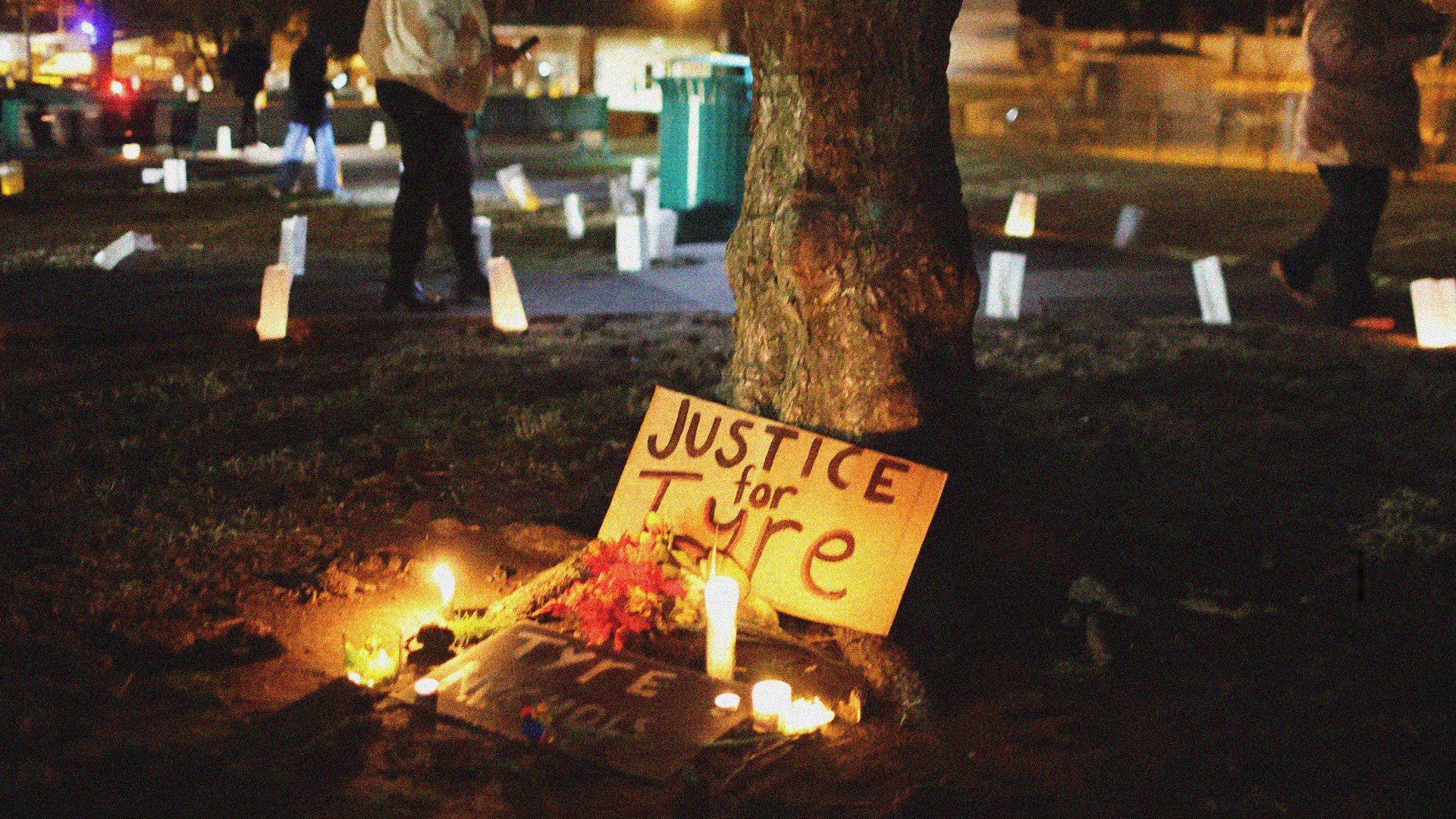
People attend a candlelight vigil in memory of Tyre Nichols in Memphis, Tennessee.

People attend a candlelight vigil in memory of Tyre Nichols in Memphis, Tennessee.

Christianity Today February 2, 2023
Scott Olson / Getty

This piece was adapted from Russell Moore’s newsletter. Subscribe here.

The nation stands shocked, once again, by a video of horrific violence by police officers against a young Black man beaten to death—this time Tyre Nichols of Memphis.

We instinctively flinch from watching this video because most people with a functioning conscience intuitively know it to be evil. At this moment, Christians should acknowledge not only that the Bible condemns this sort of police behavior but also why.

Whenever a violent revelation like this occurs, some are immediately defensive, saying, “Not all police officers are like this; most are good.” And, of course, that is true; but that truth makes such actions even worse.

That’s why, among those I know, police officers are some of the angriest of everybody at this kind of behavior. They see it in the same way I might view preachers using the Bible to “justify” their financial grifting or sexual predation. I realize what they’re doing and, even further, how awful it is. Good police officers see such horrors the same way.

This killing would be a grave moral evil no matter what group of people carried it out. Tyre Nichols was a human being made in the image of God, and to take his life not only robs his family of their loved one but also assaults his Creator. But the fact that this violence was carried out by those entrusted with maintaining justice perverts the situation even more.

Police brutality is wrong not because the idea of policing is wrong. However one interprets Romans 13, we can all agree the apostle Paul acknowledged the legitimate authority of those charged with keeping order and restraining injustice. Paul recognized this in his own life.

However, when he was unjustly imprisoned, Paul refused to go away quietly, as the police asked. Instead, he challenged them to send a message back to the magistrates for whom they worked: “They beat us publicly without a trial, even though we are Roman citizens, and threw us into prison. And now do they want to get rid of us quietly? No! Let them come themselves and escort us out” (Acts 16:37).

When police officers—or anyone else charged with public responsibility—carry out unjust atrocities, they are misusing power. This is not of incidental concern to the Christian life.

When John the Baptist preached by the Jordan, some of those who repented and got baptized were Roman centurions and tax collectors. Tax collectors were reviled by their fellow Israelites, and for good reason. After all, they collaborated with a pagan empire that occupied a throne that belonged to the house of David by the covenant of God.

When we hear the term tax collectors, we often think in contemporary, bureaucratic accounting terms, like the equivalent of Internal Revenue Service agents. But in the first century, tax collectors were feared for their potential to defraud people and do grave harm. After all, they worked for an empire that displayed its power and bloodthirstiness by crucifying people—especially would-be rebels—and posting their bodies along the roadways.

Not only that, but tax collectors and Roman soldiers often used their given authority to satisfy their own appetites. When they were baptized, they asked John the Baptist, “What should we do?” (Luke 3:12, 14). His response to the repentant taxmen instructed, “Don’t collect any more than you are required to” (v. 13).

And to the soldiers, John said, “Don’t extort money and don’t accuse people falsely—be content with your pay” (v. 14). For both groups, the call to repentance was a call to stop using their authority—and with it the implicit threat of violence—to do wrong.

Jesus did the same when he encountered Zacchaeus, another tax collector who repented and gave back four times the money he’d taken from those he defrauded (Luke 19:8). Jesus also raged when religious authority was used to do the same thing—accusing the officials of turning the temple of God into a “den of robbers” (Matt. 21:13; Mark 11:17; Luke 19:46).

Part of the old life Paul grieved over and left behind on the road to Damascus was his misuse of authority. “On the authority of the chief priests I put many of the Lord’s people in prison, and when they were put to death, I cast my vote against them,” he said while later on trial for his Christian beliefs. “Many a time I went from one synagogue to another to have them punished, and I tried to force them to blaspheme. I was so obsessed with persecuting them that I even hunted them down in foreign cities” (Acts 26:10–11).

Perhaps this is why Paul was especially sensitive to the fact that the apostolic authority Jesus gave him was “for building you up rather than tearing you down” (2 Cor. 10:8). When authority is perverted, those who are without power are devoured.

In his book Corruptible: Who Gets Power and How It Changes Us, political scientist Brian Klaas writes that the stakes are high when those with law-enforcement authority cannot be trusted: “Who do you call if your abuser is the police?” The way to deal with these abuses, he argues, is not just through better training and legal accountability—as necessary and important as those are.

Klaas mentions a video that went around of a small-town police department proudly displaying a military-style armored vehicle. The problem wasn’t the technology but the message it communicated to people who might be good police officers, as well as to those who might not be. Most people who see that video, he writes, think This is insane. He continues, “But others watch it and think, ‘Sign me up!’”

Such a show of strength draws people who think of policing as an occupying army at total war with an enemy, as opposed to those who recognize law-enforcement authority as a responsibility to protect and serve their community. The former are the kind of people whose civilian cars bear decals of Marvel’s the Punisher—another symbol of violent vigilantism that is totally at odds with the vocation of law enforcement.

Maybe even more importantly, Klaas argues that the display of aggressive power in the armored-car video might weed out prospective police officers who have a balanced sense of integrity in authority.

“Departments are thinking too much about how to change the behavior of police officers they already have while thinking too little about the invisible would-be police officers they don’t have,” Klaas writes. “To fix policing, we need to focus less on those who are already in uniform, and more on those who’ve never considered putting one on.”

The unhinged violence we watched in that video from Memphis is immoral and unjust beyond words. It’s made worse by the fact that those carrying out such evil aren’t hiding from the authority meant to restrain them. Instead, they are using that very authority to carry out these atrocities. Our consciences know this is wrong, and the Bible says so too.

Russell Moore is the editor in chief and leads the Public Theology Project at Christianity Today.


2022 Year in Review

Thank you to our ministry’s 1,750 donor partners in 2022.

2022 Year in Review

Download an infographic to see key CT highlights in 2022 and what our ministry’s donor partners made possible. Download now.

The Life-Changing Joy of Giving

Sara Maier believes generosity can change our lives—if we let it.

The Life-Changing Joy of Giving
Photo courtesy of Sara Maier

Looking back at where she’s been and forward to where she hopes to go, Sara Maier can see a thread of generosity pulling her through life.

One defining value Sara feels she learned from her dad growing up was how to be generous. She remembers at a young age, actions like taking bags of groceries to people at her church or caring for their cousins so they wouldn’t have to enter foster care. Her family was always open to caring for others, and that family value grew into one of her own.

After falling away from God in her late teen years and early 20s, it was the generosity of God’s grace that pulled Sara back into the faith. While attending college at Metropolitan State University of Denver, Sara drove past the school of Theology and realized she didn’t know if she believed anymore.

“That realization really scared me, and I was unsure how I had gotten to that place”, said Sara.

A few days later Sara prayed that God would show her if he was real. That very day Sara had an encounter with God in a local bookstore and decided to take her faith more seriously and start going to church again. That’s when she found Scum of the Earth, a local church that didn’t make her feel ashamed about the things she had experienced when she was far from God, but helped her realize everyone is in need of God’s generous grace, including her.

“I didn’t experience grace until that church—grace that was for everybody, actually everybody,” recalled Sara. “That’s where I fell in love with homeless ministry; it’s the thing that brought me back to Christ. Homelessness has always been a place where I found God’s upside-down kingdom, sitting with the people God sees as kings and queens. That’s where I fell in love with ministry.”

After that, Sara changed her major to nonprofit administration and started on a new path. After college she began working for a local homelessness nonprofit. Sara thought she would go into programing work, but God had other plans and she ended up working with donors.

“Working with donors has been one of the greatest joys of my life,” Sara confessed.

She has tons of stories about working with donors—too many God stories to tell! Sara feels as though she has been brought into people’s lives to help them share their own personal experiences. She has had donors tell her stories about how they lost children to drug addiction or spent a season of their life being homeless. They trusted her with the personal reasons why they wanted to give to her organization.

“It’s beautiful to walk with people along their journey and see how giving back to those organizations can be so life changing to them,” Sara said.

But generosity isn’t just something Sara asks other people to participate in. She believes in practicing what she preaches, and as someone working in donor relations, she believes it’s important to give. It’s something she takes seriously for herself and her own family. Sara and her husband have made generosity a priority.

“The act of generosity is part of my faith walk, and without it my faith is incomplete,” Sara declared. “Adding generosity into your faith walk increases your faith and commitment and helps you see the world differently. It can impact both the local and global church. This is what I love.”

Sara first donated to Christianity Today because of this generosity.

She feels strongly about giving to CT, because “I don’t want to just be a consumer, but I want to give back to the organizations that are feeding me spiritually and helping me grow in my faith. I see CT as one of those organizations.”

One CT project that helped Sara grow spiritually this past year was The Rise and Fall of Mars Hill podcast. Sara would listen to new episodes as they came out and then discuss them with her friends. One aspect of the podcast that moved Sara and her friends was how it modeled accountability, especially accountability around abuse.

“There aren’t a lot of organizations doing that right now,” she said. “Taking responsibility for hard things or speaking out against them. It’s important to be accountable to God and ourselves as a church family, and I see CT doing that. I believe this is important and life-changing work. I wanted to give to CT to see similar things to The Rise and Fall of Mars Hill come to fruition.”

Sara also loves how CT has increased its focus on the global church. Christianity is a global religion, but Sara has seen how the American church tends to focus too much on itself. She is grateful CT is helping adjust that focus by reporting on the global church and creating content like The Globe Issue.

When asked what pieces from CT had recently moved her, Sara mentioned the article “If Troubled, Look for God’s Comfort. If Restless, Look for His Lordship.”, and how she continued to think about the article weeks after she read it.

She also mentioned “Go Ahead. Pray for Putin’s Demise” and how the humor and lightheartedness to the war in Ukraine helped her bring to light and process through all that was happening in the world.

As Sara continued to grow and learn from Christianity Today’s content, she and her family felt compelled to give to the ministry. Sara not only wanted to consume what CT was creating, but to contribute so CT can continue to create the kind of content that she loved.

Sara’s generosity to Christianity Today will allow CT to grow and impact even more people. As Sara said, “The ministry of generosity is life changing.”

Caitlin Edwards is marketing and sales manager at Christianity Today.

History

Seeing Color Matters in Black History

This month, white Christians can love their Black siblings in the church by seeing their struggles in context.

Christianity Today February 1, 2023
Edits by Christianity Today / Source Image: Unsplash

When I was a college student, Black History Month came around and my church took the time to celebrate. People dressed in African garb, sermons addressed the struggles Black people everywhere faced, and the congregation took action steps to help marginalized people.

But my Bible college at the time did nothing. There were no school-sponsored events or presentations on this topic, and professors avoided the topic altogether. I sat in class, shifting uneasily between anger and sadness. I could not understand how a topic so important in one culture could be so completely ignored and buried in another.

Confused, I asked one of my white friends to explain why nobody acknowledged Black History Month. His response was like that of his colleagues. “I don’t see color,” he replied, delivering this line as if it were a mic-drop moment.

To him, it was a no-brainer. But what my friend failed to realize is that when Black and brown people hear the words “I don’t see color,” what we really hear is that our color—which makes us who we are—can be easily dismissed. It tells us that the way God created us is somehow invalid and that only without color are we worthy to be recognized and valued.

Every single time a white brother or sister says this to me, it makes me feel the weight of my ancestors’ mistreatment and suffering. Imagine telling people who wake up Black every single day that they live in a society that doesn’t see color—when every experience they have suggests otherwise!

And herein lies the problem. Because many white Christians have not witnessed racial injustice firsthand, they feel no need to discuss the topic.

The dialogue tends to go something like this: Yes, we know a lot of bad things happened in the past. That’s terrible, but every nation has its blind spots. Fortunately, America is different, and we have moved past all that. Sure, some people have certain advantages, but if you work hard enough and pull yourself up by your bootstraps, you should be able to get along just fine!

And for many, the conversation ends there.

Why talk about George Floyd, Ahmaud Arbery, Breonna Taylor, and so many others who have lost their lives at the hands of the racially violent? What good does it do to bring up “outlier cases” that do not represent what most of the population believes? Doesn’t this move our nation backward? Shouldn’t colorblindness be the goal of every American? Wasn’t that what MLK and others in the civil rights movement fought to accomplish?

This is something of a hot-button topic with me—I am bothered when I hear public figures or politicians quote King and then institute racist agendas that discriminate against the very people he sought to protect.

As Esau McCaulley points out, “King’s point was never that ethnicity and culture are irrelevant, but that they should not be the cause of discrimination.” And McCaulley rightly goes on to note in his book Reading While Black that “King often called on African Americans to take pride in their culture and heritage.”

Nowhere in Scripture does God present colorblindness as the ideal for his followers. In fact, the opposite is true. If there were a place where this might be a reality, it would be in heaven. But in John’s vision in Revelation 7:9, he looks and sees a “great multitude that no one could count, from every nation, tribe, people and language, standing before the throne and before the Lamb.”

Unfortunately, in some white Christians’ quests to avoid seeing color, they have become blind to the beautiful differences that make others unique.

To say to Black persons “I don’t see your color” is not only an obvious misstatement of fact but also a willful decision to ignore what makes them who they are. When someone says this to me, what I hear is that she does not see the generations of injustice and their impact on Black lives today.

To put it another way, one of the basic constructs of good exegesis is understanding the context of Scripture. You do not open the Bible and start speaking from Joel 2 without describing the backstory of the northern kingdom of Israel and the southern kingdom of Judah.

It’s impossible to celebrate the Israelites’ journey into Canaan without discussing their slavery in Egypt. In fact, the entire message of the Cross makes little sense without this historical context. Only if you acknowledge the Jewish people’s years of captivity and longing for a Savior does the Cross make sense.

To make this connection does not diminish the power of the Cross—it emphasizes it. Only then can we behold the larger picture of God’s work in human history. It makes books like the four Gospels, Acts, and Romans come alive.

When my white peers tell me they do not see color, I know they are not trying to be hurtful or intentionally calloused. Rather, they are responding through the lens of their own limited experience. Because their upbringing differs greatly from mine, they see my reality in a different light. They did not grow up in the Black community, attend a Black church, or sit down beside Black grandparents.

Yet this lack of understanding can cause unspeakable division. Ignoring a person’s historical shaping is like intentionally pushing someone away; there is no close connection without it, and the relationship will always remain surface-level.

If you are white, you might think to yourself, Terence, this conversation feels a bit lopsided. It seems like you go out of your way to point out the problems in white churches while ignoring the issues in Black churches. I hear you, and I would be the first to point out that I have had more than a few white professors and colleagues over the years that I have learned from and gleaned support and encouragement.

However, the reason my appeal might seem tilted is because the conversation itself rests on a slanted foundation. For example, if I speak to a room full of white people and ask them to name some of the ways Black people have been marginalized, I receive a series of quick responses: “slavery,” “slave patrolling,” “Jim Crow,” “Black shootings,” “segregation,” “the War on Drugs,” “mandatory minimums,” and so forth.

But when I flip the question and ask for ways Black people have historically discriminated against white people, the room grows quiet. And when I mention this discrimination, I am talking about having the power to do structural and systemic harm to those who are predominantly white.

The reason for this can be summarized in a single word: power. Like it or not, in many social, political, and religious communities, white people have held the power in the United States—and in many ways, they still do. If racial healing is to occur, it will require confronting this truth and laying that power down.

This looks like white pastors treating their Black brothers and sisters as equals and centering Black, indigenous, and people of color—elevating their voices, experiences, histories, and the ways they have helped shape this country. It means refusing to reframe the conversation in a way that appeals to white audiences. It involves being true to the minority narratives that are often overlooked by the dominant ones.

Public conversations and panel discussions at churches are all very well. Unfortunately, the power dynamic of these conversations is often tilted. How many times have we seen racial reconciliation conversations happen when white leaders invite a Black or brown person to speak on their terms, using language that makes their congregations feel comfortable? I have been a part of these conversations, and I cannot even begin to express the emotional trauma I have carried away from them.

This needs to change. When we look at the New Testament and the divide between Jewish and Gentile believers, it was the gospel that bridged that gap. And when Peter and other Jewish leaders stumbled due to their cultural and ethnic biases (Gal. 2:11–21), it took Paul stepping up to put them back on the right path. This is what needs to happen in churches today: We must confront the issues right before our eyes in a way that is healthy.

As someone who speaks out against social, economic, and racial injustice, I am used to discussing topics that make others feel uncomfortable. But understanding these topics comes only through meeting people where they are.

Several years ago, I spent a week living on the streets among those experiencing homelessness in Atlanta. On another occasion, my family allowed me to live on the streets for a month and a week. Even though I had already experienced homelessness, I chose to live unhoused to advocate on behalf of the unhoused to get them access to more resources in the city. I entered this time with some trepidation, scarcely sleeping a wink the night before.

Part of me knew what to expect: cold nights with little food or other resources at my disposal. That said, I was unprepared for the conversations and public stigmatization I experienced. Businesspeople who would have previously said “Good morning” suddenly crossed the street to steer clear of me and my new friends.

Both experiences lasted a month and a half combined, and they changed me. I wasn’t up in an ivory tower, philosophizing about how to end homelessness in Atlanta. Instead, I went down to where the people were and did life with them. I listened to their concerns and experienced their pain. My time among those experiencing homelessness shifted my viewpoint more than any conversation could.

And although class and race are two different things, in both realms there is something life-changing about drawing near to someone’s unique life experience and standing in solidarity. It would be life-changing for the white church to get close to matters of racial justice. If you want to be part of the healing process in the church, you must start by being comfortable with awkward conversations.

Opening ourselves up to the hurts of others, hearing their stories and what it’s like to walk in their shoes, not only changes us but also starts us on a path of doing the real work. We live in a time when it is critical to not rely on hearsay about any community. Instead, we must get to know that community, particularly those who are hurting, and come close enough feel their pain. In doing this, we learn that each one of God’s children has a unique story to tell.

If we are committed to practicing solidarity, this is the work we must do. As Dr. Christina Edmondson says in Faithful Antiracism, the book she coauthored with Chad Brennan, being a faithful antiracist means living and “working against the forces that sustain racism.”

Working against racism isn’t like chopping down a tree, where one focused act of exertion can bring the entire structure to its knees. Instead, being a faithful antiracist is more like being a vigilant gardener. It’s a commitment to careful nurturing and a daily determination to remove any weeds that might rear their ugly heads.

The way we understand someone’s historical shaping is by decentering ourselves and remembering the universe does not revolve around us. It’s about not allowing our narrative to dominate the space such that someone else’s storyline or history becomes a footnote. It’s about learning how to be with people and be immersed in their lives so that we can learn a new narrative.

Adapted from the forthcoming title All God's Children: How Confronting Buried History Can Build Racial Solidarity by Terence Lester. ©2023 by Terence Brandon Lester Used by permission of InterVarsity Press. www.ivpress.com.

Books
Review

The Struggles of Men Are a Problem for Everyone

From school and work to fatherhood and friendship, we need a vision of manhood that both sexes can celebrate.

Christianity Today February 1, 2023
Illustration by Mallory Rentsch / Source Images: Unsplash

Years ago, a friend told me about an awkward conversation with a female coworker. In between meetings, he had mentioned a Wall Street Journal article about declining college enrollment for men across America, a trend so advanced that men now trail women by record levels and colleges are ramping up their efforts to recruit men. Expecting a sympathetic response, he was caught off guard when she declared, in a nonplussed tone, “And now whose fault is that?”

Of Boys and Men: Why the Modern Male Is Struggling, Why It Matters, and What to Do about It

Of Boys and Men: Why the Modern Male Is Struggling, Why It Matters, and What to Do about It

Brookings Institution Press

256 pages

At this point, he remembered that his coworker was a strong advocate for women’s rights. He guessed her harsh response was pinned to a belief that sympathy for men would detract from women’s longstanding struggle for gender equity. Yet he didn’t want to picture these causes as locked in a zero-sum contest. As he put the question to me one afternoon, “Can’t we care both about women’s rights and vulnerable men and boys at the same time?”

It’s a good question.

Richard Reeves’s groundbreaking book Of Boys and Men: Why the Modern Male Is Struggling, Why It Matters, and What to Do about It makes a convincing case that men across the modern world are indeed struggling and need our attention.

Losing ground

Reeves, a Brookings Institution scholar, marshals an array of eye-opening statistics to make his point. For instance, did you know that girls regularly outperform boys in education? Girls are 14 percentage points more likely than boys to be “school ready” at age five, and by high school, girls now account for two-thirds of students ranked in the top 10 percent, according to GPA. The gender gap widens even further in higher education: In the US, 57 percent of bachelor’s degrees are awarded to women, and women receive the majority of law degrees. In contrast, men are significantly more likely to “stop out” (pause their studies) or drop out of college.

Men are also losing ground in the labor market. Labor force participation among prime-age men (25–54) has dropped by 7 percent in the past half century, due at least in part to automation and a shift away from well-paying manual-labor jobs to a service economy. The median real hourly wage for working-class men peaked in the 1970s and has been dropping since. And while it is true that men tend to make more than women, Reeves shows that the gender pay gap is largely a parenting gap, in that it has all but disappeared for childless young adults. We primarily have women, not men, to thank for rising middle-class incomes since the 1970s.

And dads are increasingly in short supply. Traditionally, the male role was culturally defined as a provider for the family. But with greater economic independence for women (a good thing), men are increasingly unable to fill the traditional breadwinner role. “The economic reliance of women on men held women down, but it also propped men up,” Reeves writes. “Now the props have gone, and many men are falling.” If men aren’t necessary as providers anymore, many men question whether they’re really necessary to families at all.

What’s puzzling scholars is that interventions to help men seem to not be helping. Take, for example, Kalamazoo, Michigan. Thanks to a group of benefactors, students in its K–12 education system can get their tuition covered for almost any college in the state. Women in the program experience large gains, including a 45-percent increase in their college completion rates, but men, as Reeves observes, “seem to experience zero benefit.”

Researchers have found similar results elsewhere. A student-mentoring program in Fort Worth; a school-choice program in Charlotte, North Carolina; a program to help low-income wage earners in New York—each shows significant gains for women and girls but not for boys and men. When asked why this is, researchers simply say, “We don’t really know.”

Something is wrong with men. And it’s a phenomenon Christians—both men and women—need to seriously consider.

Male malaise

Of Boys and Men has garnered widespread praise, and for good reason.

Reeves isn’t content to simply point out a dispiriting social problem and be on his merry way. He offers solutions. He argues eloquently that we should adopt policies that start boys a year later in the classroom to give their brains time to develop. He makes the case that we need to get men into “HEAL” occupations, meaning jobs in health, education, administration, and literacy—both because these jobs track with forecasts about the future of the workforce and because they help remove the stigma against men in traditionally “female” jobs, like nursing or elementary education.

Beyond this, Reeves argues, we need to make a major investment into fatherhood. “Engaged fatherhood,” he writes, “has been linked to a whole range of outcomes, from mental health, high school graduation, social skills, and literacy to lower risks of teen pregnancy, delinquency, and drug use.” It’s time to think about paid leave for dads, equal child-custody rights for dads after a divorce, and father-friendly, flexible job structures.

Reeves has written a tremendously thought-provoking, well-researched, and convincing book on the plight of the modern man. As a policy wonk, he proposes policy solutions. And yet, as a Christian, I couldn’t help thinking past the question of what to do, essential though it is, and wondering more about the question of why. What kind of male malaise is spreading in our culture?

In a piece for the journal National Affairs, Reeves offers a succinct answer: “The problem,” he writes, “is not that men have fewer opportunities; it’s that they’re not seizing them. The challenge seems to be a general decline in agency, ambition, and motivation.” Though this problem appears particularly bad for working-class men, professional men too are experiencing a broad, global slump in desire.

Since Reeves himself argues that policy interventions are rarely helping men, I couldn’t help but wonder: Have shifting economic and cultural norms around male roles have caused not just a social crisis but a spiritual one?

Humility and compassion

What does it mean to be a man? It’s a hard question for evangelicals to answer. Many Christian men know what they shouldn’t be. They shouldn’t conflate Jesus and John Wayne, say, or join the ranks of Christian nationalists. Despite their biological wiring to be more aggressive, risk-taking, and sexually driven than women (there really is science behind this), they know they shouldn’t be domineering or unfaithful. In short, they shouldn’t live down to the stereotypes of what we often call “toxic masculinity.”

It’s easy to mock chest-beating men’s ministries or criticize the “good old boys club” in a local chamber of commerce. It’s much harder, though, to come up with a pro-social definition of masculinity. Yet many men who’ve lost their sense of direction and purpose long for exactly this: a vision of manhood that both women and men can celebrate.

Of course, there are wonderful examples. Peter Ostapko’s beautiful Kinsmen Journal, a magazine heralding faith, fatherhood, and work, comes to mind. As does Arthur Brooks’s call to faith, work, family, and friendship. I think even an appreciation of the art of manliness can help. Yet these calls to healthy masculinity are too rare.

Christians can get to work here. We can normalize conversations among men about both work and fatherhood. We can—and should—invest more time in friendships. We can support lower-income neighbors and coworkers, we can embrace sexuality as a gift of God within marriage, and we can redefine “men’s work” to better include a wider array of occupations.

But can we graciously have a theological conversation about God’s design for both men and women? Can you imagine if women’s ministries discussed Of Boys and Men and men’s ministries discussed Beth Allison Barr’s The Making of Biblical Womanhood? Humility, after all, is a core virtue of the Son of Man.

I’m not sure this will happen any time soon. But after reading Reeves’s balanced, thoughtful book, I can confidently say that if you’re a woman and you know a man, he’s probably having a hard time. Show him compassion.

And if you are a man, well, let’s at least find a way to struggle together.

Jeff Haanenis a writer and entrepreneur. He’s the founder of Denver Institute for Faith and Work and the author of An Uncommon Guide to Retirement: Finding God’s Purpose for the Next Season of Lifeas well as the forthcoming books Working from the Inside Out and God of the Second Shift.

Theology

Sometimes, God’s Provision Is Prozac

My battle with postpartum anxiety challenged the limits I’d placed on how God can heal us.

Christianity Today January 31, 2023
Edits by Christianity Today / Source Image: Unsplash

Pregnancy and postpartum hormones make the world go round—they can create lives and sustain them, but they can also make mothers feel like monsters.

Hormones are the guardians of our sanity, and mine went barreling down the black diamond trail after I had both of my daughters. The challenge of raising a newborn is substantial for those who have normal levels of estrogen and progesterone, but it can be far worse when those hormones are out of balance.

My two girls, Elaine and Olivia, are the apples of my eye, but giving birth to them did a number on me. Within 24 hours of each delivery, I became wracked with anxiety and started losing touch with reality. Icy panic shot through my veins on an hourly basis. I felt exiled from a world of banal, peaceful rhythms.

I can’t remember ever once standing over my newborns’ crib to dote while they slept. I was completely preoccupied with my own sleep, or lack thereof. I rolled in the sheets, listening to my husband’s heavy breathing with envy. I felt completely isolated, abandoned. I tried to sleep everywhere, anywhere. Under my desk. On the floor. Far away from the crib. In my tiny sedan outside.

I eked out a few hours here and there, but each night as the sun set, my anxiety would skyrocket as that “what-if” monster straddled my brain: What if I can’t sleep and I fall apart and lash out at my loved ones and fail to care for my newborn and I disappoint everyone? I wondered, hourly, if I would ever see my girls laugh, toss their hair, and run together in the grass.

The first time around, I didn’t understand what was happening to me—I had heard of postpartum depression, but not anxiety. I had a smooth pregnancy and a natural birth resulting in a healthy pink bundle of love. My child was not colicky, my husband was present and supportive, and we had a family that was thrilled by this new little life. Why was I so consumed with dread? To make matters worse, I reflected on all these reasons that I ought to be in baby bliss and felt guilty about its absence.

Of course, I had a darker, more complicated backstory to help explain things—including a complicated relationship with my own mother, which enhanced my fears of becoming an unstable mother. But predictive as it was of my postpartum insomnia and panic attacks, that alone didn’t fully explain my circumstances. Something else was roiling beneath the psychological surface, in a collision of brain and spirit that seemed hell-bent on forcing me to choose between caring for this new life and taking my own.

I needed medical help—but there was one problem: In my mind, to make any chemical do what only the Cross was supposed to do demonstrated a lack of trust in Jesus. My faith had blossomed in a church that forbade drinking alcohol and taking mind-altering drugs. I recall sermons focused on the importance of “clean Christian living” and warnings that booze and weed were at odds with the things of God.

Ephesians 5:18 was often invoked in these moments and was always—at least in my memory—quoted from the King James Version: “Be not drunk with wine, wherein is excess; but be filled with the Spirit.” This sat well with me since I had grown up in the shadow of alcoholism, with a grandfather whose regular stints of sobriety were possible only because of my grandma’s hawk-like surveillance.

For much of my life, the obvious answer to addiction was a fundamentalist theology. This was the lens I had when first I encountered the infamous work of Damien Hirst on a vacation to Italy. At some point in Venice, we visited a small art gallery exhibition open to the public—and there, in a city filled with religious icons, we walked into what appeared to be a holy shrine to pharmaceuticals.

Everywhere I looked, there were Christian symbols decorated with medical pills of every shape and hue. On the walls were Stations of the Cross posters covered in phrases hearkening to specific moments in the biblical narrative, with Scriptures cited along with prescription bottles imaged in various concentrations. In each piece of artwork, devotion was visually conflated with the promotion of brand-name drugs. And amidst all the displays were a variety of human skulls lacquered in brilliant colors.

But one comparatively understated piece was the most striking to me, and it remains lodged in my memory: a simple cedarwood cross with pills fixed in resin in the center of its beams.

At that point in my personal history—years before my double bout with postpartum mental illness—I could see two different but equally valid ways to interpret this artwork. The first was blatantly obvious: It was a statement about the addictive power of religion, an artistic representation of Karl Marx’s statement that religion is “the opiate of the masses.”

When God becomes an idea or belief system rather than a loving and active being, we end up using that god to protect us from reality. In that sense, I felt indicted by the artwork. I had been guilty of this in my younger years of faith, when religion gave me distance from my family’s pain.

The other interpretation was to point out how pharmaceuticals, both legal prescriptions and medically necessary mind-altering drugs, had become a replacement for God in contemporary society. After all, who needs prayer, community, and trusting surrender when Valium can take your hurting and loneliness away? Who needs Christ’s atonement when you have anxiety pills?

And even though at that point in my life I cognitively understood there were legitimate medical reasons to take painkillers, sedatives, and antidepressants, I couldn’t separate that from the alcohol abuse I’d witnessed as a child. How is someone who opens a bottle of booze in times of anxiety any different than someone who turns to a bottle of pills?

But today, I look at Damien Hirst’s crucifix quite differently. More than an indictment or warning, it has become a symbol of hope. And yet that was only after immense suffering, transformed by the Holy Spirit, altered my vision. It was only after I experienced the kind of self-implosion that drives people to drink and anesthetize.

I remember one night, deep in postpartum anxiety, when I tried to keep my thoughts of self-harm at bay by focusing on a mental image. The best I could come up with was a picture of my own hand cutting mini crosses in my flesh. Over and over, I made the sign of the cross and was finally able to fall asleep—a rare win.

All I wanted was some blessed rest—because with it, I thought, I could be a capable mother and not fail my new little one. But like grace itself, sleep slips away the more we strive to grasp it. And the pursuit is simply maddening.

I didn’t know how to help myself. What I knew, what I had been taught in my childhood, was to cope through self-shame. But shame is to anxiety what gasoline is to fire. And when I look back, I see a sad irony that the very thing I feared—failing as a mother—was what would have happened if I had listened to the voice of despair and ended my life.

I spent whole days in prayer—prayers that were as heartfelt as they had ever been and at times loud enough to disturb the neighbors. I was surrounded by community and leaned into my family like I have never done before. I also discovered a wonderful Christian therapist and started faithfully employing cognitive behavioral therapy techniques. I even found a Christian naturopath who helped me with supplements to revitalize my exhausted body.

After weeks on end of insomnia and panic attacks, I had won some significant battles. But overall, I was losing the war. I still needed pharmaceutical help.

Ultimately, my battle with the physiological illness of postpartum anxiety became an invitation to a deeper spiritual life. I had to confront my deep fear of a material world where chemicals can destroy us. But what I had not considered was that the material, the chemical, and the physical might save us.

I’d grown up reading Scriptures affirming Jesus’ incarnation and its importance for our salvation, but I hadn’t yet integrated it with my own lived experience until I was an adult.

The church has always wrestled with God’s embrace of the material world through the Incarnate Christ. This is evident in the Christological controversies in the fourth century. For instance, Arius and Apollinaris struggled to accept the fact that Jesus was “fully human in every way” (Heb.2:14-17, emphasis mine).

In response to this and other heresies of his time, Gregory of Nazianzus explained that only Christ’s holistic humanity can atone for our sin and all its effects—for “that which is not assumed is not healed.” In other words, Jesus had to become fully human to fully heal our broken humanity.

I didn’t need Jesus to just strengthen my spirit in these moments of crisis—I needed him to heal my body as well. And whether that healing comes through supernatural or natural means, we know that every good and perfect thing comes from him (James 1:17).

Slowly, with the Holy Spirit’s illumination, I began to see my shiny anti-anxiety pills as part of God’s good provision for the good body he created, not signs of a weak faith. For just as Jesus embraced his physical body, so should we.

Today I brush my daughters’ hair and supervise as they brush their teeth. They can hardly stand still for the ritual, and soon they’re bounding off to play chase. From my bathroom, I hear them giggle as I fill a glass of water and take my Prozac.

I swallow, and it does feel like a kind of blessed sacrament—an affirmation of the body Jesus created, which will one day be fully healed like his resurrected body.

Katherine Lee is a poet and a mom working on a memoir about the ways her motherhood has been defined by the women in her family. Her master’s in theology has informed these pursuits in surprising ways.

News

Pro-Life Protestor Acquitted in Federal Case

The case of Mark Houck was one of more than two dozen the DOJ has pursued against pro-life protestors since “Dobbs.”

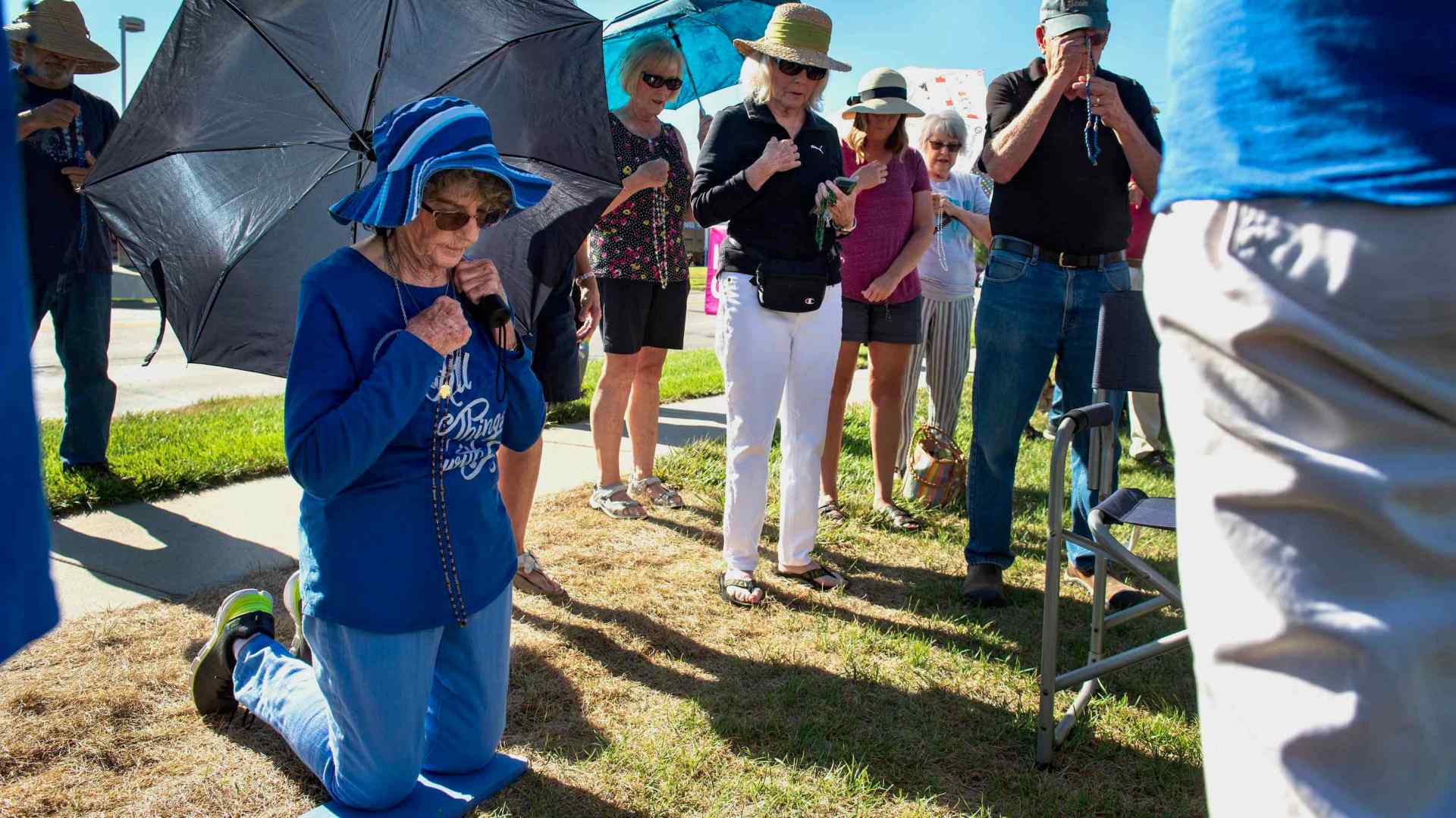
Pro-life demonstrators recite prayers outside of the Planned Parenthood Clinic on Tuesday, Aug. 9, 2022, in Lincoln, Nebraska.

Pro-life demonstrators recite prayers outside of the Planned Parenthood Clinic on Tuesday, Aug. 9, 2022, in Lincoln, Nebraska.

Christianity Today January 30, 2023
Kenneth Ferreira/Lincoln Journal Star via AP

Update (January 30, 2023): On Monday, a jury acquitted pro-life protestor Mark Houck of federal charges related to pushing an abortion clinic escort.

Houck’s federal case, where he faced up to 11 years in prison, was one of more than two dozen filed against pro-life protestors in the months after the US Supreme Court’s ruling in Dobbs v. Jackson.

The charges fell under the federal Freedom of Access to Clinic Entrances Act, or FACE Act, which makes it a crime to impede access to clinics. In Houck’s federal trial in Pennsylvania last week, the judge had asked whether the FACE Act was “stretched a little thin here,” according to Catholic News Agency.

A Catholic, Houck had been volunteering alongside his 12-year-old son in 2021 with 40 Days for Life, a Christian group that organizes prayer vigils outside abortion clinics, when he got into an altercation with a 72-year-old clinic escort. Forty Days for Life said the clinic escort began to “verbally abuse” Houck’s son, and the indictment said Houck pushed the escort. The escort testified in the trial that he skinned his elbow and bruised his palm, according to the Philadelphia Inquirer.

The case drew particular attention–including a night of prayer before the trial began last week–because of its handling by federal officials. After local prosecutors declined to file charges, federal prosecutors took the unusual approach of treating Houck as a flight risk and arrested him with a team of FBI agents a year after the clinic incident.

In a statement following the verdict, Houck’s attorney Peter Breen called the case “harassment from day one.”

Some pro-lifers have complained that the DOJ has not pursued cases against those vandalizing pregnancy centers as zealously as the cases against pro-life protestors.

That may be shifting a little. Last week the DOJ filed the first federal charges against two people who had vandalized Florida pregnancy centers, and the FBI recently announced it was offering a $25,000 reward for information about a string of arsons at other faith-based pregnancy centers.

Original post (October 20, 2022): In the past month, the Department of Justice (DOJ) has indicted more than a dozen pro-life protestors across the country for obstructing access to abortion clinics.

Such prosecutions have been rare historically, with just a case or two annually for the past decade. But after the US Supreme Court reversed Roe v. Wade this summer, the DOJ announced a task force to pursue more enforcement against anyone obstructing access to abortion clinics. Many of those protestors facing charges are Christian.

The Freedom of Access to Clinic Entrances Act, or FACE Act, prohibits obstruction of access to, threats toward, and destruction of clinic property. In these recent charges, protestors face up to 11 years in prison. Pro-life activists say the recent prosecutions seem politically motivated; some are now facing charges for incidents that date back more than a year.

An October 5 indictment of 11 protestors in Tennessee was about an abortion clinic blockade in March 2021. One case filed October 14 against a pro-life protestor concerned an incident from two years ago, when a group of protestors allegedly tied themselves with ropes and chains inside a clinic, blocking access.

Edward Mechmann, a former federal prosecutor who now is the director of public policy for the Catholic Archdiocese of New York, told CT it was “strange for the feds to go searching for old cases, especially for relatively minor crimes that would usually be dealt with by local prosecutors.”

Mechmann said he was surprised by “the heavy hand” in the blockade indictments. Though blockading a clinic is a violation of FACE, he thinks the DOJ could have pursued civil remedies without going straight to criminal prosecution.

“My suspicion is that a directive has gone out from main Justice [the DC office of the DOJ] to all the US attorneys offices to find FACE cases to bring,” he said. “Clearly, these cases are message prosecutions: Stay away from abortion clinics.”

After the Roe v. Wade ruling in 1973, pro-life protestors began the tactic of lying down and blocking abortion clinic entrances. Demonstrators shifted to less aggressive tactics after the FACE Act was signed in 1994, following the shooting injury of late-term abortion provider George Tiller.

In more recent years, pro-life demonstrations outside clinics have again been growing. In 2015, the National Abortion Federation tallied 22,000 protestors outside abortion clinics; that number rose to 99,000 over the next three years. The newer generation of protestors tend to focus on praying outside clinics instead of trying to block women from entering.

One of the recently indicted protestors, Mark Houck, was a volunteer with 40 Days for Life, a Christian group that mobilizes pro-lifers to stand and pray outside of clinics.

The organization requires its volunteers to sign a peace statement for protesting outside clinics, which reads in part, “I will pursue only peaceful, prayerful and lawful solutions to the violence of abortion by supporting life from natural conception to natural death.” If women engage volunteers in conversation, they will offer referrals to services to support them in their pregnancies.

A year ago, Houck, a Catholic who leads a ministry for young men, was praying outside a Planned Parenthood in Philadelphia. According to the federal charges, he shoved a 72-year-old volunteer escort of abortion clinic patients to the ground, which “resulted in bodily injury.”

Houck and 40 Days for Life dispute those charges. According to 40 Days for Life, the escort began to “verbally abuse” Houck’s 12-year-old son. The organization said Houck and the abortion clinic volunteer got into an “altercation,” then local law enforcement was called and determined no charges should be made.

At the end of September, a year after the incident, Houck said a large team of agents came to his house and arrested him at gunpoint in front of his children. The FBI has said it was a peaceful arrest, and that agents knocked on the door and asked him to come with them. The charges had been sealed until Houck’s arrest, treating him as a flight risk.

Some 40 Days for Life vigils are going on now. Jill Gadwood is currently leading one in Bethesda, Maryland, praying outside an abortion clinic belonging to LeRoy Carhart, who is famous for offering late-term abortions. The public sidewalk is far from the clinic entrance, so the volunteers don’t usually interact with any women going to the clinic.

“I personally am not worried about it,” said Gadwood, about facing charges.

Pro-life activists have also raised concerns that federal law enforcement has pursued these obstruction cases while ignoring the recent incidents of firebombing and vandalism at Christian pregnancy centers in the wake of Dobbs.

The legal fight around abortion clinic protesters has also intensified in the United Kingdom, where proposed legislation would ban even peaceful protest—prayer, hymn-singing, and the sign of the cross.

In response to the federal charges, Shawn Carney, the head of 40 Days for Life, put out a video on whether it was still safe to participate in 40 Days for Life.

“We’ve never had an ordeal happen like this before,” Carney said, calling it “persecution” by the FBI. “We will continue to go out and peacefully pray. … We cling to the cross, we cling to Jesus Christ, and we go out unintimidated, we go out peacefully, we go out lawfully. We pray to end abortion by offering his hope and his mercy.”

News

Report: Jean Vanier’s L’Arche Hid ‘Mystical-Sexual’ Sect for Decades

An independent commission concluded that dozens of women were violated by Vanier and his mentor under exploitative spiritual disciplines.

Jean Vanier

Jean Vanier

Christianity Today January 30, 2023
Tiziana Fabi / AFP / Getty Images

Two years after abuse allegations against L’Arche’s late founder Jean Vanier were made public, an investigation shows the secret was “carefully maintained for decades.”

From the famous Christian community he developed in Trosly-Breuil, France, the Catholic theologian and leader perpetuated a hidden “mystical-sexual” sect. Over a nearly 70-year period, Vanier violated at least 25 women—all of them adults without disabilities—during prayer and spiritual devotion.

The results of the two-year investigation, commissioned by L’Arche in 2020, were released in an 868-page report on Monday. A half dozen of Vanier’s victims spoke up for the first time following his death in 2019 at age 90.

An interdisciplinary team of scholars consulted 1,400 private letters of Vanier’s, including hundreds from a secret folder. They interviewed 89 people, including eight of Vanier’s victims.

L’Arche became well-known and spread around the world as an organization bringing together people with and without intellectual disabilities. While the ministry brought dignity and fellowship to the vulnerable over the decades, the report suggests that Vanier founded L’Arche as a cover to reunite a group who practiced contemplation and spiritual direction with nudity and sexual touch.

“The courage of the women and Vanier’s death in 2019 led to archival research that revealed … that Vanier was part of a small sectarian group that subscribed to … predatory and deviant doctrine and practices,” wrote Tina Bovermann, executive director of L’Arche USA. “L’Arche’s members, partners and friends were lied to and deceived by Vanier.”

The findings “stunned” L’Arche leaders, Bovermann told Sojourners, which broke the news of the new report and is also releasing a podcast on the fallout of the revelations around Vanier.

“We were left with many questions,” she said. “How are we to understand L’Arche’s founding story?”

The commission describes a French ministry called L’Eau vive (Living Water), which had been led in the 1950s by Vanier’s spiritual mentor, a Dominican priest named Thomas Philippe. After a mystic experience involving the Virgin Mary, Philippe developed “theological arguments to justify his sexual practices with nuns or young lay women aspiring to a religious vocation,” the report said.

Philippe’s behavior led him to be barred from public or private ministry by the Catholic Church, but he remained clandestinely in touch with Vanier and other members of L’Eau vive, who went on to found L’Arche in 1964. Jacqueline d’Halluin, an aspiring nun who also became a disciple of Philippe’s and whose letters describe a sexually intimate relationship with Vanier, came up with the organization’s name. Philippe became the director of L’Arche’s spiritual center La Ferme through 1991.

Over the years, as the organization spread to Canada, India, and more than 30 countries, Vanier, Philippe, and others continued to abuse dozens of women while serving at L’Arche and on its property, the commission said. None of the victims were found to be people with disabilities. Vanier’s victims were mostly Catholics from “privileged social backgrounds,” some of whom had taken religious vows.

“It was within the community of Trosly that the majority of the cases of control and sexual abuse investigated by the commission took place. People accused of sexual abuse have been members and have held positions of responsibility there, victims still live nearby,” they wrote.

Of the 25 women who experienced “a sexual act or intimate gesture” from Vanier, 14 remained members of L’Arche.

A synthesis of the commission’s report details the physical and sexual “prayer” Vanier engaged in with women:

From the end of the 1960s to the 2010s, the posture regularly described is that of Jean Vanier (this is also the case with Thomas Philippe and [his brother and fellow priest] Marie-Dominique Philippe) on his knees, his head resting on the bare chest of the “accompanied” person.

Tactile gestures intensify during prayer and accompaniment (holding hands, heads close together, foreheads touching, hugging each other). The different stories evoke a similar range of touching gestures, covering in particular “kisses on the mouth each time more intense, more passionate,” “voluptuous, avid,” and caresses on the erogenous zones of both partners, particularly the female’s breast.

In several cases, the touching progressed to acts of sexual assault. Partial nudity, the absence of coitus as well as the spiritual justification of sexual abuse led Jean Vanier to consider that these were non-sexual practices.

The women who initially spoke up about abuse by Vanier described how he considered sexual acts as a part of spiritual direction, allegedly saying lines like, “This is not us, this is Mary and Jesus,” and “It is Jesus who loves you through me.”

The report noted Vanier’s use of spiritual terms with sexual connotations throughout his correspondence, sometimes subtly—“they ‘penetrate’ (the mysteries through Love), they are ‘hidden in the bosom’ (of the Immaculate one)”—and sometimes in “hardly veiled terms” referring to his arousal.

During his lifetime, Vanier was renowned for his faith, his gentleness, and his embodiment of friendship to those with disabilities. He was awarded the 2015 Templeton Prize.

L’Arche USA has condemned “the insidious grooming, the psychological and spiritual exploitation, the intentional use and abuse of power, the sexual violence, the lies, manipulation, and deceit” employed by Vanier and Philippe and apologized for the suffering caused by not being able to stop these abuses. Allegations against Philippe did not arise until 2014, decades after his death.

Despite the founders using L’Arche as a cover for their mystical and sexual practices, the researchers concluded that “L’Arche as a project and as an organization has nothing to do with a sect” and that the beliefs of L’Eau vive hadn’t spread to L’Arche leaders elsewhere.

The report notes that more victims may come forward, but “since 2014 a process of individual and collective awareness has been developing within L’Arche.”

They called it “astonishing” that the sectarian practices hadn’t proliferated more widely, noting the small number of former L’Eau vive members in proportion to the many who joined the work of L’Arche for its stated mission around intellectual disabilities.

Books
Review

Is God a Woman or a Man?

Two recent books discuss how our conception of gender relates to our perception of God.

Christianity Today January 30, 2023
Illustration by Mallory Rentsch / Source Images: WikiMedia Commons

Two books published last year by Wm. B. Eerdmans are attempting to confront our assumptions about the gender of God from two different angles.

Women and the Gender of God

Women and the Gender of God

Wm. B. Eerdmans

286 pages

God Is, by Mallory Wyckoff, is more personal and more expansive in its role casting of the divine, while Women and the Gender of God, by Amy Peeler, is more scholarly, systematic, and orthodox in its claims about God’s nature.

To be candid, I nearly wrote the foreword for Wyckoff’s book because I was so excited by its approach to the topic. God Is counters the “default notion of God as an old male figure in the skies” by showing God is, as one chapter title intimates, “more than we’ve been led to believe.”

Wyckoff addresses a dozen-plus potentially new “God is” statements: “Mother,” “Midwife,” “Hostess,” “Home.” It is a brave book with more to learn from than to disagree with. However, I was not merely uncomfortable with the chapters where God is “Sexual Trauma Survivor” and “Wisdom Within”; I found them heterodox. The former pushes the boundary of analogy in a way that doesn’t fit, and the latter is the title of a heresy.

For Wyckoff, the more you learn about yourself, the more your conceptions of God change. In part, this observation rings true. As we grow in life and faith, we should move from milk to meat, as the apostle Paul implies (1 Cor. 3:2–6). Wyckoff notes that aging moved her into new ways of imagining God: “In each season of life, with each iteration of myself, I have seen God reflected in multiple lights. I have encountered various images of the God who is all and none of them.” Likewise, she wants to expand our notions of God and move us from “a small God—a small you” to an abundance of metaphors.

While I appreciate how Wyckoff expands on the Deity’s personhood beyond the “one or two metaphors for God—all decidedly masculine,” she ignores some important boundaries. Her lack of parameters around God’s identity allows her to absorb non-Christian mysticism as sources of truth, while asserting that “Christians don’t own the concept of God.” More egregiously, Wyckoff integrates her knowledge of God with her own self-concept, like “two waves in a rhythmic dance, separate from one another but moving as one,” neglecting their separate realities.

A good dose of G. K. Chesterton’s Orthodoxy could weed out the untenable claims of this book from the real blooms. Chesterton discerns that someone with arms open too wide is not capable of holding everything but instead holds on to nothing. In refuting what he calls “the god within” heresy, Chesterton writes, “That Jones shall worship the god within him turns out ultimately to mean that Jones shall worship Jones.”

In contrast to consulting the god within, he explains, Christianity asserts that “one had not only to look inwards, but to look outwards, to behold with astonishment and enthusiasm a divine company and a divine captain.”

And while we should magnify our imagination of God beyond masculine images, this amplification of the divine nature should not also increase the size of our ego. “If a man would make his world large,” Chesterton advised, “he must be always making himself small.” Likewise, if we desire a great and holy God, we must recognize our creaturely nature.

Peeler agrees with Wyckoff that God is misidentified as strictly male and that this image has led to the diminishment of women. In fact, she opens with two grand assertions that are repeated throughout her book: “God does indeed value women” and “God the Father is not male.”

Because of the gendered connotations of Father, many people assume the masculinity of God. This assumption leads to an inaccurate hierarchy of being between men and women. Wyckoff lists misogynist quotes from church tradition and then quips, “The reality is these men remain some of the most lauded and influential thinkers who fundamentally shaped what we know as Christianity.” For this reason, Wyckoff chooses new sources for her metaphors.

However, Peeler remains within the church tradition to refute our incorrect assertions about God’s masculinity. In no way does Peeler attempt to make God into a feminist icon—nor does she overturn the gender hierarchy to favor women over men. Instead, she uses logic and Scripture to correct certain claims about God that have gained prominence despite their error. As Peeler rightly asserts, “All humans suffer when God is more like some than others.” She dismantles insufficient arguments for God’s maleness and exalts the prominence of women in the Christian narrative, all while upholding orthodox theological positions and credal affirmations.

Before reading Peeler’s book, I had never reckoned with the reality that God is incarnated through female flesh. For while Jesus is fully male, his human composition was supplied by the body of a woman through his mother, Mary. “The incarnation says a clear and singular no to misogyny,” Peeler writes. God appears to a woman, requests her permission for a divine assignment, deigns to reside within her womb, and uplifts her body as a holy place.

Peeler delineates how Jesus’ incarnate body intimately relied on Mary: “This is the body that the Holy Spirit prepared from the flesh of Mary alone and the body that entered the world through Mary, the body that was sustained by Mary’s milk and handled by Mary’s arms.” In this way, the Eucharist is given through Mary’s flesh—for out of her comes the body of Christ.

Although Peeler denounces the heresy of God as male or masculine and uplifts women, she argues for Christians to continue to employ the language of Father and Son, as instituted by the Scriptures and Jesus. While “God does exhibit both masculine and feminine characteristics,” the language found in Scripture, ecclesial tradition, and Jesus’ own words emphasizes his sonship and God’s fatherhood. Peeler believes that Christians should submit to how God names himself—but that “all God-language” should be “interpreted through the lens of the incarnation.”

In her exploration of Jesus as “The Male Savior,” Peeler again resists the temptation to stray outside orthodoxy. She acknowledges misinterpretations in church tradition of what Jesus’ maleness means for Christian men and women. For instance, C. S. Lewis and other theologians have mistakenly asserted that women cannot “represent God” in church leadership because it would confuse congregants into thinking “God is like a good woman” and thus lead to believing in a “religion other than the Christian one.”

By contrast, Peeler seeks to remind the church at large that Jesus is “a male-embodied Savior with female-provided flesh.” Woman was first created from man, but the new man is created from woman. Peeler draws on Augustine to bolster her argument: “He was born of a woman; don’t despair, men; Christ was happy to be a man. Don’t despair, women; Christ was happy to be born of a woman.” Whether readers agree with Peeler’s claims regarding women’s role in the church, she makes a compelling argument to reckon with.

Before she concludes, Peeler moves on from assertions about God’s gender to implications for women’s vocation. Peeler first exalts the example of Mary, through whom God “provides inestimable honor to motherhood.” She then walks through the ways that God called Mary to serve on behalf of his kingdom by listing other roles she filled—including singing to Elizabeth, instructing servants at Cana, and testifying to crowds at Pentecost. According to Peeler, “the God of the New Testament does not silence the verbal ministry of women.”

Something I admire in Wyckoff’s book is her reassurance that using feminine images of God does not mean having a feminist agenda. Women are granted permission—and even applauded—for finding ways that we image God in the world. Wyckoff’s book seeks to empower women’s voices in the church, which are too often neglected or silenced. On top of that, her book is also funny and refreshing.

What I like most about Peeler’s book is how she demonstrates that a systematic interpretation of God’s Word supports our intuitions about the beauty of womanhood. Rather than merely trusting our personal experience, which can lead us awry, Peeler backs up her assertions with evidence from the Scriptures and church tradition. With her expert authority as a biblical scholar, Peeler shows us that women matter and that—thankfully—God is not a mere man.

Jessica Hooten Wilson is the inaugural Seaver College Scholar of Liberal Arts at Pepperdine University and a senior fellow at The Trinity Forum. She is the author of several books, most recently Reading for the Love of God: How to Read as a Spiritual Practice.

Ideas

America’s Brash Grandiosity

Staff Editor

Looking to the monarchy can show us the pitfalls of prideful politics.

U.S. President Joe Biden, accompanied by the First Lady Jill Biden signs a book of condolence at Lancaster House in London, following the death of Queen Elizabeth.

U.S. President Joe Biden, accompanied by the First Lady Jill Biden signs a book of condolence at Lancaster House in London, following the death of Queen Elizabeth.

Christianity Today January 30, 2023
WPA Pool / Pool / Getty

This essay was originally commissioned for a private convening of British and American Christian leaders organized by The Center for Christianity and Public Life and the UK-based Faith in Public.

After the death of Queen Elizabeth in 2022, many commentators insisted that the time for monarchy has passed. The crown is a gaudy bauble unsuited to the modern, utilitarian state, so arguments generally went, not to mention a medieval anachronism that makes a messy mix of religion and politics.

I’m sensitive to the appeal of both arguments, especially the latter. But with a view from the States after eight years of acrid and tumultuous politics—and with another presidential campaign on the verge of further embittering our national life—the monarchy has begun to look pretty handy.

Its use is not, as critics tend to assume, in creating a grandiosity of state. It is rather in containing it, attaching it to a figure whose relative permanence, undemocratic selection, and minimal real power allow him to absorb outbursts of national feeling instead of such outbursts loosing their chaos into workaday politics and governance. Give us a king like the other nations have, I am increasingly inclined to plead, so that he might provide a stabler outlet for our anger, fear, and aspirations.

That’s not to say, of course, that the United Kingdom’s politics are never vitriolic or overwrought. But the contrast in how the US and UK handle our respective heads of government is telling.

There, an unpopular prime minister may be ignominiously tossed out in a matter of weeks. Here, presidential elections have stretched into two-year sagas, each dubbed the most important of our lifetimes and treated as an existential battle for democracy and/or freedom as we know it.

There, as Boris Johnson demonstrated last year, a prime minister can at least get a wrist slap for lawbreaking with comparatively little fuss. Here, in everything from petty deception to war crimes, the president’s license to disregard the rule of law as he pleases remains in practice, inviolate, and any investigation is dismissed by his supporters as nothing but politics.

For all possible qualifications and counterexamples, America seems to be more susceptible to—or, to choose a darker phrase, farther gone in—a popular political grandiosity and the ills it tends to promote.

We could simply call the phenomenon I’ll sketch a political type of pride. It’s the pride in which “a man despises others and wishes to be singularly conspicuous,” to borrow from Thomas Aquinas, who relied in turn on Gregory the Great to list characteristics including “‘frivolity of mind,’ by which a man is proud of speech”; boasting, which refuses to “maintain silence until one is asked”; “‘arrogance,’ whereby a man sets himself above others”; “‘presumption,’ whereby a man thinks himself capable of things that are above him”; “defense of one’s sins”; and “‘license,’ whereby a man delights in doing freely whatever he will.”

Scale these tendencies to party and polis and you’ll have a workable model of American politics today.

But grandiosity is a more specific label because it emphasizes several aspects of the phenomenon well, such as how self-glorifying this mode of politics tends to be. Our rivals are not merely imprudent or ignorant but evil; we and our allies are not just practical or principled but contending for the very soul of the nation. This is a Manichaean model of the public square and, in a democratic system like ours, lets each voter tell herself she’s aligned with the forces of good, living on the right side of history, aware of “what time it is,” to take a phrase from the new right.

Indeed, political grandiosity runs on fear and anger toward the outgroup and often baseless boasts about the ingroup. Grandiosity teaches us not just to tolerate exciting times but to relish them. It precludes contentment with playing the loyal opposition and demands total triumph or, at least, endless carping about any loss. From a Christian perspective, it actively encourages misplaced and even idolatrous hope in political figures and movements as a source of meaning, security, and power.

As has become uncomfortably clear in America in recent years, this grandiosity doesn’t stay confined to politics proper. How we think about and behave in public life has relational, epistemic, and spiritual ramifications, and those effects make the shape of our political grandiosity worth closer scrutiny. I’ll consider four pieces here: hobbyism and LARPing, tribalism, conspiracist mindsets and movements, and conversation-ending norms of cancel culture.

Hobbyism and LARPing. “Many college-educated people think they are deeply engaged in politics,” began a widely shared Atlantic article published shortly before the COVID-19 pandemic. “They follow the news—reading articles like this one—and debate the latest developments on social media. … Mostly, they consume political information as a way of satisfying their own emotional and intellectual needs.”

This is political hobbyism, contended the article’s author, Eitan Hersh, and it is less real politics (the pursuit and use of power) than a form of entertainment and self-flattery. In this it has much in common with the political LARPing the political hobbyist would disdain.

In Hersh’s characterization, hobbyists often lean left, pride themselves on being well informed, and have, if not quite high-brow, certainly an upper-middle-class tone. LARPing—or “live-action role-playing,” which in its earliest form involved wielding foam swords to play at knighthood—is low-brow and cross-partisan.

Hobbyism and LARPing alike depend on a gross mismeasure of one’s own political significance and influence. Perhaps more destructive for day-to-day life, however, is the excess of attention to politics and political media they entail (and, less visible, the loss of that attention to other, better things).

Perhaps this aspect of grandiosity is inevitable when everyone has a public platform. At the very least, the constant invitation to air our views can deceive us about their quality and importance. It can lead us to prioritize playing politics over more loving speech and more beneficial uses of our time.

Internet tribalism. Americans’ descent into tribalism and negative partisanship—“in which the parties hang together mainly out of sheer hatred of the other team, rather than a shared sense of purpose,” write Alan Abramowitz and Steven Webster in Politico Magazine—is a feature of our politics broadly recognized in poll and anecdote alike.

We’ve long since acquired the “spirit of party” George Washington famously warned against, which “serves always to distract the public councils and enfeeble the public administration. It agitates the community with ill-founded jealousies and false alarms; kindles the animosity of one part against another; foments occasionally riot and insurrection.”

It shapes our media consumption too, leading in the worst case to reflexive dismissal of unwanted reports and outlets (“Fake news!”) and reflexive acceptance of ones we find gratifying and convenient. This too is made newly possible by recent technological changes and the fragmentation of media they have produced. Now, instead of arguing about what political ends are good and how to best achieve them, we often end up talking past one another, arguing for how to fix a world our neighbors can’t see.

The flaws in this tribal partisanship are easy to see from the outside, whether we’re looking from one party at the other or at both from outside party lines. But from within, grandiosity makes it difficult to notice the spirit of party’s malevolence and distortion, especially when tailored information intake seems to confirm its worst suspicions at every turn.

“As I’ve told a lot of people, if you had the information inflow that a lot of my neighbors have, you’d be MAGA also,” conservative commentator David French, who lives in Tennessee, has explained. “A lot of it is just a product of information that makes it not that hard to support Trump.” Once the spirit of party takes hold, it will not easily loosen its grip.

Conspiracist mindsets and movements. Durability is part of this next ill as well. The issue at hand is not discrete conspiracy theories, which come and go and will always be part of American politics. It’s rather conspiracism as a mindset and the grandiose movements it can generate.

Any given conspiracy theory may be right or wrong. Sometimes conspiracies do happen, so sometimes the theory is correct. But conspiracism as a mindset—at once cynical and credulous, often fearful and seeking reassurance, content to treat rumor as research and accusation as proof—is always epistemically and politically poisonous.

And with social media, conspiracism can move from mindset to group activity. It can become the basis of an enjoyable community, even supplanting or rending real-life communities like family and church. Conspiracist communities are a digital update to C. S. Lewis’s “inner ring”: “the sacred little attic or studio, the heads bent together, the fog of tobacco smoke, and the delicious knowledge that we—we four or five all huddled beside this stove—are the people who know.”

The ring is not just a friendly spot but a flattering one, an assurance that in sharing and growing their “knowledge” together, the conspiracists are actively working for good and against evil. Their cause, often explicitly identified with God’s will (as in the QAnon movement), is not simply winning elections and setting good policy. It’s saving the country, if not the whole human race.

Conversation enders. “Cancellation, properly understood, refers to an attack on someone’s employment and reputation by a determined collective of critics, based on an opinion or an action that is alleged to be disgraceful and disqualifying,” The New York Times’ Ross Douthat argued in a 2020 column parsing what cancel culture is and is not.

Among the key distinctions: Cancellation doesn’t involve criminal behavior or legal consequences. Its punishments are typically disproportionate and long-lasting. And it isn’t simple insult, heckling, or critique.

In fact, as Graeme Wood would later write at The Atlantic, “Cancellation is not criticism; cancellation is the absence of criticism.” It’s not about accountability, which would require engaging with the opinion or action in question and with the person responsible to assess what he did and why. Cancel culture skips straight ahead to judgment.

It is a conversation ender, a means of simply declaring victory rather than persuading someone she was wrong or muddling through to some workable compromise or new understanding.

Cancel culture is in many cases well intended. The goal is to punish wrongdoing, expose injustice, and reject systems of oppression. But in practice, these conversation enders rely on a graceless assumption of moral superiority and the right to silence or punish.

American Christians—as individuals, families, and congregations—can refuse this politics of grandiosity. We can cultivate faith, community life, and epistemic virtues that encourage us to love our enemies, to practice forbearance and intellectual honesty, and to be humble in our treatment of others as well as in our assessment of our own importance.

With T. S. Eliot, we can ask, “What life have [we] if [we] have not life together?” And we can answer, “There is no life that is not in community, and no community not lived in praise of God.”

Still, it’s natural to look at problems on this societal scale and want solutions to match: If we could better moderate social media … If we could tamp down misinformation … If we could get Democrats and Republicans working together … If we could reform how our elections work …

But I suspect no big fix is forthcoming. No new law or corporate policy will save us from our own grandiosity, and while the culture may in some ways shift (already it seems the appetite for cancellation is waning), the trend line for much of what I’ve described here is clear: As a society, we are becoming more disproportionately attentive to politics, more negatively tribal, more conspiracist in our thinking, more inclined to shut down conversation than work through it.

For Christians on the other side of the Atlantic, then, the prideful politics in which US Christians find ourselves should serve as a warning. Let our grandiosity be a reminder that structural and cultural safeguards against following in our footsteps are worth preserving.

addApple PodcastsDown ArrowDown ArrowDown Arrowarrow_left_altLeft ArrowLeft ArrowRight ArrowRight ArrowRight Arrowarrow_up_altUp ArrowUp ArrowAvailable at Amazoncaret-downCloseCloseellipseEmailEmailExpandExpandExternalExternalFacebookfacebook-squarefolderGiftGiftGooglegoogleGoogle KeephamburgerInstagraminstagram-squareLinkLinklinkedin-squareListenListenListenChristianity TodayCT Creative Studio Logologo_orgMegaphoneMenuMenupausePinterestPlayPlayPocketPodcastprintremoveRSSRSSSaveSavesaveSearchSearchsearchSpotifyStitcherTelegramTable of ContentsTable of Contentstwitter-squareWhatsAppXYouTubeYouTube