Books
Review

Liberalism Comes in Right-Wing and Left-Wing Varieties. Christians Should Reject Both.

Governments can’t be indifferent to the moral and spiritual health of the governed.

Christianity Today October 17, 2022
Illustration by Mallory Rentsch / Source Images: WikiMedia Commons

“Liberalism” is a word with many meanings, some compatible with Christianity, some arguably demanded by it. In its original sense, to be liberal is to exemplify the virtue of liberality, as in broadmindedness or generosity of spirit. More typically, in the United States, liberalism refers to left-wing political views, though “classical” liberalism references a relatively gentle variant of libertarianism.

Liberalism and Its Discontents

Liberalism and Its Discontents

Farrar, Straus and Giroux

192 pages

$13.98

In his new book, Liberalism and its Discontents, however, eminent political scientist Francis Fukuyama sets out to defend liberalism in what may be its deepest sense: the focus on freedom as the highest political good that unites the mainstream American left and right.

Both major political parties, and most American Christians, have embraced this liberal perspective. Republicans tend to seek so-called “negative liberty,” ensuring that the state leaves individuals alone, while Democrats tend to seek “positive liberty,” or state empowerment of the individual. Republicans emphasize economic freedom, while Democrats emphasize sexual freedom. Fukuyama’s treatment reveals, however, why the liberalism at the heart of both approaches is deeply at odds with the Christian political tradition.

Fielding criticisms

Fukuyama opens with a pair of definitions that seem innocuous enough. He calls liberalism a doctrine advocating legal limitations on government and institutional protections for individual rights. In his view, all variants of liberalism 1) favor the individual over the collective, 2) recognize humans as morally equal, 3) emphasize human unity over cultural diversity, and 4) are optimistic about the improvability of the social world.

Chapter 1 lays out three overarching arguments for liberal ideology. First, liberalism allows diverse populations to coexist in society without descending into infighting. If limitations on government take deeply divisive moral and religious questions off the table, the stakes of politics are lowered and the odds of violence decrease. Second, a person’s ability to freely make her own life choices is the foundation of her human dignity. Individual rights safeguarding autonomy are thus a moral imperative. Finally, liberalism is good for the economy.

As its title suggests, much of Liberalism and Its Discontents is devoted to fielding criticisms of liberalism. Chapters 2 and 3 suggest that the last 50 years of US politics illustrate the perils of taking a liberal distrust of government intervention in markets to an unhealthy extreme. The doctrine itself is correct, Fukuyama maintains, but right-wing liberals failed to acknowledge the necessity of state regulation to protect human goods beyond simple material prosperity and to mitigate the harm free trade can inflict on individuals.

Similarly, in chapters 4 and 5, Fukuyama argues that left-wing liberals have taken a healthy focus on individual autonomy and stretched it into an unhealthy obsession. Whereas a sensible early liberalism encouraged tolerance for diverse concepts of the ultimate good, contemporary left-wing variants sometimes erode any ability to make judgments about moral character. But some virtues, like thoughtfulness and openness to self-improvement, are necessary even to maintain liberal society. Fukuyama also acknowledges left-wing complaints that liberalism’s emphasis on constitutionalism makes rectifying harms to women and minorities slow and painful.

Fukuyama’s responsive strategy is consistent: He embraces critiques of right- and left-wing liberal excesses, but notes that these excesses don’t discredit liberalism itself. Likewise, he acknowledges the procedural slowness of liberal constitutionalism, but argues that its benefits outweigh its costs.

Beneficent nudges

There is substantial good to be found in Fukuyama’s work. His call for moderation as a political value should be welcome in an era when a disturbing number of Americans are being drawn to extremes. His ability to acknowledge the value of markets or the impact of race without turning either into an obsession is key to this temperate outlook. Also welcome is his acknowledgment that moral character has implications for society, making it at least somewhat a matter of legitimate state interest.

The last-mentioned strength, however, hints at the fundamental problem with Fukuyama’s work for Christians: The liberalism he defends, by its essential nature, forbids the state from seeking the holistic good of the governed. The purpose of government, for liberals, is freedom, not virtue. Its goal is empowering individuals to achieve whatever they autonomously choose to be their good, not to foster real human excellence.

At the root of Fukuyama’s first and second arguments for liberalism is the famous dictum that the right is prior to the good. That is, the question of how government should treat individuals is purely a question of justice, and the answer shouldn’t favor any particular religious, moral, or philosophical viewpoint.

Despite moderating this aspect of liberalism, as described above, Fukuyama is not shy about spelling out its implications. “The most fundamental principle enshrined in liberalism,” he writes, “is one of tolerance: you do not have to agree with your fellow citizens about the most important things, but only that each individual should get to decide what they are without interference from you or from the state.” Moral commitments “need to be observed in private life and not imposed on other people.”

Liberalism therefore forbids government from “interfering” to foster the moral and spiritual health of the governed. “Liberalism sought to lower the aspirations of politics,” writes Fukuyama, “not as a means of seeking the good life as defined by religion, but rather as a way of ensuring life itself, that is, peace and security.” Rulers must provide material security and empower individuals to achieve whatever they define as their good. They must not attempt to nudge their citizens in the right direction.

This approach is fundamentally at odds with the Christian tradition, in which the purpose of governance is to foster the holistic—and real—good of the ruled. As Paul puts it, Christians are to foreswear vengeance precisely because rulers exist to carry out (the real) God’s wrath on (real) evildoing. “For the one in authority is God’s servant for your good,” according to Romans 13:4. “But if you do wrong, be afraid, for rulers do not bear the sword for no reason. They are God’s servants, agents of wrath to bring punishment on the wrongdoer.” As Thomas Aquinas would theorize centuries later, governance exists not only to protect people from one another, but also to habituate the governed to goodness: The “law, even by punishing, leads men on to being good.”

By making it somewhat more difficult to obtain pornography, for instance, or by withholding a firearm from a potentially suicidal youth, Christian governance can nudge a community in the direction of spiritual health. Christians who instead embrace liberalism’s moral agnosticism, in either its left- or right-wing forms, abdicate their duty to love those around them by seeking their good, in governance as in all of life.

Fukuyama’s response to this line of reasoning is to dismiss Christian governance as impracticable given the fact of cultural and religious diversity. Any attempt to impose Christianity would require an ugly authoritarianism, he writes, because “restoring a shared moral horizon defined by religious belief is a practical non-starter.” Consequently, he argues, channeling Winston Churchill’s famous quip about democracy, “liberalism is the worst form of government, except for all the others.”

This response, however, is literally incoherent. Liberalism is not a form of government, but an ideology. Should Christians adopt that ideology and abandon our duty to follow the Second Great Commandment in politics, simply because others are not convinced of Christianity’s truth? Not remotely. Christian theorists have always cautioned against heavy-handed use of political power, which is more likely to do harm than good. That is sound prudential advice. But for Christians to give up the goal of using politics to foster the moral and spiritual health of our communities in principle is to deliberately violate our duty to our highest sovereign.

Christian governance

The surface-level difference between liberal and Christian politics may in fact be quite subtle, but it is deeply important. Christian governance in the US does not look like Fukuyama’s nightmare of a fascist Christian state. It does not look like abandoning constitutionalism or toleration. It looks like Christian citizens going about the ordinary business of politics—but accounting for the moral and spiritual impact of their actions as they reason about policies and candidates.

Fukuyama is right to note a stirring Christian discontent with the liberalism embraced by both major US political parties, but wrong to fear it. Liberalism demands that rulers foster the individual’s ability to seek a personalized conception of the good. Christianity demands that rulers, gently and cautiously, foster that individual’s good as it really is.

Jonathan Ashbach is assistant professor of politics at Oklahoma Baptist University. His work has appeared in scholarly journals and popular publications from Philosophia Christi to Patheos.

Theology

Conversation Is Hospitality—Even on Social Media

Remote disagreements and lasting fellowship can come together, as Paul demonstrated.

Mark Wang

After 18th-century literary icon Samuel Johnson had dinner at a friend’s house, his biographer, James Boswell, asked if the conversation had been any good. “No, Sir,” he said. “We had talk enough, but no conversation; there was nothing discussed.”

Johnson’s friend had offered one kind of hospitality at that dinner party, but not another kind: discussion. Conversation, whether remote or in person, is an exercise in hospitality, or welcoming the other. When we engage someone in conversation, we invite them into our thinking.

Jesus set an example of this, from his first encounters with the disciples to his theological discussion with the woman of Samaria to his many confrontations with the religious leaders who opposed him. Conversation was a primary tool in Jesus’ and the apostles’ ministries.

We live in a world where words abound but conversation is scarce. And it’s easy to think of a place where the ratio of words to conversation seems worst: social media, which 72 percent of Americans use, Pew Research Center says.

One can only wonder what Johnson would have to say about the culture of discourse today, especially in the realm of social media.

But more important is what the Bible says. With Jesus’ and the apostles’ word-based approach to evangelism and discipleship, it is unsurprising that Paul repeatedly warned Christians to demonstrate their faith not only by living well but also by good conversation (Col. 4:6; 1 Tim. 4:12).

Paul not only engaged people directly in discussions about Christ but also wrote voluminously about the faith.

It’s through these writings—which have some surprising similarities to today’s social media context—that Paul has discipled the generations of the church. One similarity, for example, is that Paul’s letters are remote interactions between specific people that the rest of us can listen in on. They also tend to be about news items, highlights, and problems (although there’s plenty of perspective on real and hoped-for relationships). And Paul’s recipients had trolls in the background contradicting, misinforming, undermining, and discouraging Christians.

Paul’s handling of remote, semipublic communication should guide how we approach social media. How did Paul converse in such circumstances? The apostle’s method can be boiled down to the three simple rules he outlines in 1 Thessalonians 5:21–22 as a response to prophecy: Test everything. Cling to what is good. Reject every kind of evil.

Many times, our exchanges on social media are more about gut reactions than careful thought or reflection. They do not foster reflection or thoughtful deliberation. Social media is a realm more conducive to outbursts and slogans than extended discussion. It is a medium designed to provoke its users to scan and click.

But Paul presents conversation as a proving ground where ideas should be tested. Through discussion and debate, he proved the gospel’s truth and exposed the fallacies of those who opposed it.

His advice means that testing and disagreement sometimes go together. Disagreement and deliberation have been important features of the church’s conversational life since its inception (Luke 22:24; Acts 15:2; 1 Cor. 6:1–2). The church’s first internal crisis was sparked when the majority community, made up of believers from a Jewish background, overlooked the Hellenistic widows in the daily distribution of food (Acts 6:1–7).

The solution came in part through deliberation, but not without drama. The problem surfaced as a complaint, and those who were aggrieved demanded the apostles address the need.

Likewise, the church’s first major theological crisis, which also grew out of ethnic conflict, was resolved after “much discussion” (Acts 15:7). One striking feature of the corresponding Greek phrase (polys zētēsis) in this verse is the variety of tones it may signify. It can imply debate, disputing, discussion, or argument. In other words, this watershed disagreement was probably resolved only after a lengthy and passionate conversation where differences of opinion were expressed.

These were serious debates where relationships were stretched; some people (like Peter in Galatians 2:11–14) were reproved; and others (like Paul and Barnabus in Acts 15) parted angry.

Such drastic measures are seldom justified. Instead of making public arguments the default, we must make a genuine effort to understand each other and to hold on to our relationships.

It is clear from interactions on social media that we have not lost the capacity to disagree. Nor are disagreements always destructive. Disagreement can be a catalyst for positive change and even conflict resolution.

Unfortunately, debates may also have the opposite effect. Rather than bringing us close together in Christ, they may drive us further apart—or off course.

I believe we have lost our stomach for the kind of deliberation or disagreement that can preserve and even strengthen our fellowship, the kind that helps us reconsider and improve our course. We post memes. We shout. We grumble. We accuse. We declaim. There is talk enough but no conversation. We no longer know how to discuss with one another so as to test the truth and also keep our friendships.

Without an honest attempt to test the truth of someone’s assertion, we can end up worse than when we started. In their paper on whether discussion brings better results, Cass Sunstein and Reid Hastie write, “Agreement from others tends to increase confidence, and for this reason like-minded people, having deliberated with one another, become more sure that they are right and thus more extreme.” This “ideological amplification” is a danger to Christians as well.

In his book Think Again, Adam Grant observes that people tend to adopt one of three roles when relating to those with whom they disagree: preacher, prosecutor, or politician.

“The risk,” he writes, “is that we become so wrapped up in preaching that we’re right, prosecuting others who are wrong, and politicking for support that we don’t bother to rethink our views.”

And we can get so wrapped up in the responses of bystanders, when our disagreement is on social media, that our ability to reason degenerates even faster.

Grant describes what he calls “constructive conflict.” Conflict that’s about how to best get a job done (as opposed to relationship conflict, trying to change someone else’s personality and preferences) “can be constructive when it brings diversity of thought, preventing us from being caught in overconfidence cycles,” Grant explains.

In order for a conversation to flourish, there must be a willingness to tolerate others’ expression of ideas with which you strongly disagree. This kind of communication requires many factors, including the discipline of patience and a mutual spirit of goodwill.

Stephen Miller observes in his book Conversation: A History of a Declining Art that wit and patience are essential ingredients of a successful conversation. “One cannot be a good conversationalist if one lacks a sense of humor,” he explains. “Equally important is being a good listener.”

Not all debates are healthy. Some are damaging not only because of their subject matter but also because of what motivates them. Paul warned Timothy not to have anything to do with “foolish and stupid arguments, because you know they produce quarrels” (2 Tim. 2:23).

Many of our online debates are foolish and stupid. Their aim is not to persuade or facilitate understanding so much as to provoke—to strain a relationship or hurt someone else. When someone’s post begins, “I don’t know who needs to hear this …” “I’m sorry, but …” or “I don’t know the details, but …” you can expect the ensuing post to not be worthwhile.

Grant says that when we fight about someone’s personality or the way they do things (relationship conflict), it limits our ability to discern and change our position. “When a clash gets personal and emotional, we become self-righteous preachers of our own views, spiteful prosecutors of the other side, or single-minded politicians who dismiss opinions that don’t come from our side.”

Paul indicates we need to watch our tone. Certainly, there is a place for passion and even anger. But the way we speak the truth is important. “The Lord’s servant must not be quarrelsome but must be kind to everyone, able to teach, not resentful,” Paul says in 2 Timothy 2:24.

In his book Numb, Charles Chaffin describes social media as “a high-powered outrage machine.” Moral outrage has a place. Paul expressed outrage, sometimes using language that might seem immoderate (Acts 23:3; Gal. 1:6; 5:12).

Jesus showed anger at the hardheartedness of the religious leaders in the synagogue when he healed a man with a shriveled hand (Mark 3:5). Theologian B. B. Warfield explains in “The Emotional Life of our Lord,” “Precisely what is ascribed to Jesus, then, in this passage is that indignation at wrong, perceived as such, wishing and intending punishment to the wrong-doer, which forms the core of what we call vindicatory justice.”

This raises an important question, especially for Christian conversation: To what degree should we entertain ideas that we find untrue or offensive? Is it even possible to have an honest conversation with someone when you know beforehand that you will never be able to accept their ideas?

Outrage is not justified simply because we
feel it.

Just as there are limits to the degree to which I am willing to extend hospitality to others, I am also limited in the degree to which I can entertain some ideas. The fact that I invite someone into my house does not mean I want them to live there. The respect I grant to another in conversation does not mean I find their assertions believable.

We are warned against aiding and abetting those whose teaching denies fundamental truths of the Christian faith (2 John 1:10–11). There may be occasions where it is in my best interest—and even in theirs—not to entertain such ideas at all (Rom. 16:17; 2 Tim. 3:5). Scripture warns believers to avoid godless chatter, foolish controversies, and false teachers (2 Tim. 2:16; Titus 3:9).

The context in which the conversation occurs makes a difference. Within the church, we are to set boundaries against contradicting the essential truths of the Christian faith in conversation.

One implication for social media is that we should be more guarded in to what and to whom we give our attention. We cannot control whose voices can be heard on social media and probably should not. Outside the church, they are welcome to make their case in the realm of public discourse.

This freedom is essential to the peace of a society where diverse and mutually exclusive worldviews coexist. But it does not mean we have to grant them a forum to spread their views within the church. We exercise control over whose words we will attend to and how much attention we will give them.

Regardless, any outrage we feel must be tempered by discernment, grace, and love, or we will become trolls.

Outrage is not justified simply because we feel it. We do not always have all the facts. Our perception may be skewed or even incorrect. Sometimes what we perceive to be vindicatory justice is only a sentimentalized counterfeit of justice—the rage of those who enjoy the luxury of being angry from a distance.

With godly humility, we could treat disagreements as opportunities to negotiate, with an assumption that both parties share something of value. We might also see them as an education, a chance to learn about and understand another.

Even when we know ourselves to be on the correct side of a disagreement and we believe the issue has importance, vitriol doesn’t have a place.

Paul points out in 2 Timothy 2:25–26, “Opponents must be gently instructed, in the hope that God will grant them repentance leading them to a knowledge of the truth, and that they will come to their senses and escape from the trap of the devil, who has taken them captive to do his will.” It is in hope of people coming to their senses that we gently instruct, rather than attack. Gentleness is to be our default tone.

Our predilection for outrage ignores the combined evidence of science and personal experience, which shows that successful disagreement is built on a history of positive interactions. In the case of the Christian, it’s built on love.

Research by John Gottman and Robert Levenson into differences in handling conflict between happy and unhappy couples shows that there is a “magic ratio.” Those who disagree successfully have five positive interactions for every negative one, even while they are arguing.

There is more to exhortation and correction than catching people in their mistakes. Paul counseled those who wanted to help another believer caught in a sin to apply the remedy with gentleness and humility (Gal. 6:1). Although he confronted Peter publicly, apparently behind the scenes they were able to maintain a cordial enough relationship that Peter could refer to him as “our dear brother” (2 Pet. 3:15).

Paul’s letters—his remote, semipublic communication—reveal an ability to integrate truth and love. It might be better to say they demonstrate his ability to infuse the truth with love (Eph. 4:15).

Illustration by Mark Wang

This is more than a matter of tone. The mark of love is not fair speech or even a nice manner but genuine concern for the other and time spent together in happy fellowship. Again, I think of hospitality. Hospitality recognizes the vulnerability and needs of the guest.

Most cultures recognize that the burden of hospitality places certain obligations upon the one who grants it. What do we owe our guests? For one thing, we owe it to them to treat them with gentleness and civility, to consider their needs.

Within the hospitality of conversation, this does not necessarily mean we must agree. But we have to treat others with respect by acknowledging that the ideas they express are valued by those who share them. If we reject their assertions, we must do so accurately and fairly.

One of the weaknesses of online interactions is their depersonalized nature. We comment from a distance without actually seeing how our remarks affect others. Frequently, we are speaking in forums where most of those who read our remarks are unknown to us.

This anonymity provides a shield that allows us to be harsher than we might otherwise have been. It gives the illusion that the person who is the subject of our remarks isn’t vulnerable. When we are hospitable in conversation, even online, we take responsibility for the safety and well-being of the welcomed guest; when they are out of sight, we imagine them to be humans with human responses.

Truth, when it has not been infused with love, can be as damaging as false teaching. In A Little Exercise for Young Theologians, Helmut Thielicke tells the story of a student who got into an argument with his landlord over doctrine. The student’s aim was not to inform or even correct. His goal was merely to win. Instead of shining a light, he wielded the Bible like a weapon, intending to “crush the man by the impression of an overpowering erudition to which he could never attain, and thus to reduce him to a feeling of helplessness.”

Thielicke wrote these words long before the era of the internet. Yet the pattern he depicts is all too familiar: “Here truth is employed as a means to personal triumph and at the same time as a means to kill, which is in starkest possible contrast with love.”

We have many examples of this online. And we may be tempted to feel that it’s a holy role to play. But launching our digital arguments in one another’s direction from the safety of our ideological corners is not the way that Christians are to approach disagreement. We are to have real conversations. The apostle Paul shows the way: Speak the truth in love. Test everything. Cling to what is good. Reject every kind of evil.

John Koessler is a writer, podcaster, and author of 15 books. His latest book, When God Is Silent, will be released by Kirkdale Press in August 2023.

Ideas

A New Solution to Gun Violence: Neighborly Care

What if we applied Christian imagination to protecting our children?

Illustration by Juan Bernabeu

As I pull into the parking lot of Cincinnati Hills Christian Academy, I notice a plainclothes man with a visibly holstered gun emerge from the car beside me. He is one of the school’s recently hired safety officers. Their armed presence is the reason I’ve arranged to speak with head of school Dean Nicholas.

Our family is new to the school, returning to the United States after 11 years in Canada. Those years were grimly bookended by significant American school shootings: Sandy Hook Elementary in December of 2012 and Robb Elementary School in May of 2022.

In the decade of our expatriation, four of the five deadliest school shootings in American history have taken the lives of more than 70 teachers and students. With gun violence becoming a more credible threat in the US (if still exceedingly rare), many schools like ours are taking action.

At least 29 states allow guns on school grounds. A new state law in Ohio, where we live, allows teachers to carry guns with a minimal 24 hours of training by permission of their local school board, bypassing the more than 700 hours of “peace officer basic training” formerly required. This executive action came as a relief for some teachers.

The New York Times reported on a kindergarten teacher whose “school is in an older building, with no automatic locks on classroom doors and no police officer on campus.” Her district-issued emergency supplies—“wasp spray, to aim at an attacker, and a tube sock, to hold a heavy object and hurl at an assailant”—seemed inadequate.

On the morning of my interview with Nicholas, Proverbs 22:3 appeared in my daily Bible reading plan: “A prudent person foresees danger and takes precautions. The simpleton goes blindly on and suffers the consequences” (NLT). The verse seemed to underscore the wisdom practiced by academy leadership. “You install sprinklers in your school,” Nicholas explained by way of analogy. “You hope to never have to use them.”

Still, the decision to arm security at the doors of my children’s school surprised me. Perhaps my greater shock registered when I learned of the broad, almost univocal support for the decision by the school’s teachers and parents at its suburban and urban campuses. While I want my 14-year-old twin sons to be safe, I have lived elsewhere in the world where parents have worried far less for their children’s safety at school.

We have a uniquely American problem—and tired American answers. More guns. Fewer guns. Likely, the national debate about guns at school will continue to stall along partisan lines. It makes me wonder about the role Christians have to play in the US school safety debate.

What if Christians, as the late British missions historian Andrew F. Walls put it, sought to “embody alternatives that challenge the culture and invite it toward a life in which injustice, violence, and oppression are overcome”? They could know we are Christians not simply by our love—but by our imagination.

The Violence Project maintains a mass shooter database that begins with the 1966 shooting at the University of Texas in Austin, where a 25-year-old gunman killed 15 people and injured 31 others. The data suggest at least two commonalities between school shooters: first, that these young men have frequently suffered trauma; second, that they are often known to the communities they seek to harm. Other studies have shown that these teens may show symptoms of future actions by displaying a lack of empathy, experiencing loss, bullying others, or struggling with severe anger.

What we know about the perpetrators of school shootings doesn’t offer us easy answers, and the FBI warns against attempting to create a profile that might unfairly label nonviolent students. The best tactic, they’ve advised, is to identify specific, plausible, and direct threats. In fact, most school shooters made threats that went ignored.

I find this strangely hopeful news. If school violence is random, we are playing a murderous game of Russian roulette. But if violence frequently erupts from stories of family breakdown by abuse or divorce or death, we can better attune ourselves to warning signs—perpetrators’ pain “leaking” before homicidal events—and create mechanisms for reporting these to school authorities. And if school shooters are more likely community members than strangers, we can pursue proactive strategies of care for the troubled faces we recognize.

The Bible tells us that we are a comforted people and a people fitted to comfort others (2 Cor. 1:3–7). Our God is a sufferer and a sympathizer. The comfort we receive from him in our pain allows us to look with mercy on the bruised, the battered, and those who feel they don’t belong. Care, in its most Christian expression, assumes collective brokenness. Everyone needs loving care.

But strategies of care—as a line of defense—suggest a kind of social attention difficult to exercise today, even for Christians. Because American family life is breathlessly busy; because loneliness is epidemic; because technology impersonalizes human relationships; because post-pandemic grief is our collective experience.

Who has time to comfort? Energy to care? Those who can afford it might be tempted to professionalize care, to outsource its inefficiencies. For those struggling to make ends meet, it’s easy to be consumed with our own struggles.

Care as an element of social cohesion seems to have gone the way of black-and-white television. Volunteerism rates have been falling for two decades, according to a 2018 analysis. I wonder what might happen if we saw renewed participation in community care—treatment centers, suicide hotlines, domestic violence supports, food pantries, grief counseling, marriage ministry, conflict resolution workshops, and restorative justice initiatives—as safety measures?

What if every Christian in every neighborhood across this country took seriously the call to be their brother’s keeper?

Less formally, we might consider radical intervention: compassionately engaging with our child’s school bully and his or her family, or making an effort to meet our reclusive neighbor.

What if every Christian in every neighborhood across this country took seriously the call to be their brother’s keeper? We can’t eliminate every threat, but we can tighten the weave of our social fabric, believing that safety is everyone’s task.

Maybe one of the most radical forms of countercultural resistance we practice as God’s people, even in our hopes of addressing threats of school violence, is protecting the margin of time required for care. Care requires a willingness to be interrupted and inconvenienced. Care is often an unscheduled act. It cultivates an unhurried predisposition to notice, to listen.

Care is best expressed by community in its many varied forms: families, neighborhoods, schools, churches. Care comes as casseroles and phone calls. Clean sheets and free coffee. Bus fare, resume-writing services, and AA meetings in a damp church basement. Care can also look like involving the police when the lives of our neighbors are unraveled by violence and abuse.

We come to danger primally, intuiting fear and safety as socially located, embodied human beings. We interpret risk through the lens of gender, race, national identity, or past trauma. A gun serves as consolation to some, though certainly not to all. But care? These cups of cold water are taken in hand and rarely misunderstood.

Care is not a Pollyanna solution or a replacement for other mitigating measures. But it is a distinctly Christian approach, one that reminds us that we are citizens of another kingdom—one naive enough to believe that swords can be beaten into plowshares.

Jen Pollock Michel is the author of five books, including In Good Time: 8 Habits for Reimagining Productivity, Resisting Hurry, and Practicing Peace (Baker Books, December 2022). Speaking Out is Christianity Today’s guest opinion column.

Ideas

The Collateral Damage of Sin

Columnist

Worse than what “missing the mark” does to our soul is what it does to our neighbors.

Illustration by Paige Vickers

Eight-year-old Aryanna Schneeberg was playing in her backyard when she was struck in the back with an arrow. A neighbor was attempting to shoot a squirrel, but his weapon missed its intended target and instead penetrated the child’s lung, spleen, stomach, and liver. She bears the scars that come with surviving such an injury. We ought to think of Aryanna every time we hear a preacher explaining the Greek word for sin, hamartia, as “missing the mark.”

Like most pulpit clichés, this one points to something that’s partly right. The problem, though, is that most Western Christians’ imaginations, shaped by Robin Hood, exceed their actual experience with archery. We think of a bucolic setting where we are shooting our arrows toward a target on a bale of hay. The metaphor is almost comforting: We see ourselves not as criminals or rebels but as being off our game now and then. We reach into our quiver for one more chance to get it right.

That’s not how the Bible describes sin. The Bible says sin is lawlessness (1 John 3:4). When it categorizes sins, it consistently does so in terms that imply both perpetrators and victims: enmity, dissension, oppression of orphans and widows, adultery, covetousness.

In that light, sin is less like target practice on some isolated piece of countryside and more like loosing arrows on a city sidewalk in the midst of a pressing crowd. All around us are bodies, writhing or dead, struck down by our errant arrows.

In a sermon on sin, a preacher might also quote the Puritan John Owen: “Be killing sin or it will be killing you.” That’s true too. And yet it doesn’t quite say enough: Our sin might also be killing those around us. “The wages of sin is death,” the Bible tells us (Rom. 6:23). That death might not simply be one’s own, but also one’s neighbors.

The Book of Revelation is a circular letter to very different churches. Some of those congregations were actively persecuted by Rome, and some were comfortable with and capitulated to Rome. The particular sins and temptations differ, but the promise is the same: God will judge. The rest of the book shows how that judgment falls on the world, depicted as Babylon. But it starts with the church. And the question for God’s people is whether we will be a preview of Babylon or the New Jerusalem.

One reason the Apocalypse seems so foreign to so many is the often-cryptic imagery—a beast emerges from the sea, a prostitute sits on seven hills (13:1; 17:9). Yet at its most mysterious, does this book not describe the dilemmas faced by all of us right now?

Rome—the city of seven hills—is at the time the opulent, rich, idolatrous city that rides on a monstrous, powerful beast—a vast, subjugating empire. The beast controls with fear of suffering. The prostitute controls with seductions of luxury and comfort. The beast says, Join with me and I will give you access to power. The prostitute says, Join with me and I will give you access to pleasure. Behind all of that, though, is a counterfeit. The beast is an attempted mimicry of the Lamb who is wounded, overcomes, and marks out a people for himself. Babylon is a distortion of the kingdom of God.

It is not just literal empires that can become beastly. Ministries can too. We can think we are pointing to the Lamb when we are just replaying the ways of the beast. We can think we are serving the kingdom when we are really just building Babylons that will fall in a single hour (Rev. 17:12).

What we should identify and uproot is not just one single idol—sexual iconoclasm or white supremacy or Christian nationalism or religious syncretism or just old-fashioned envy, rivalry, and greed—but all of them. We should not divide ourselves between those who justify certain “personal” sins and those who justify certain “social” sins.

Do we really believe that our sin really hurts people? Do we believe that our ministries can, and have, really hurt people? If so, let’s remember what makes us “evangelical” in the first place. We are those who say to the world, and to ourselves, not simply “Believe the Good News” but “Repent and believe the Good News.”

God is a God of grace, a God who forgives us sinners through the blood of his Son. But he is also a God of judgment—one who can tell the difference between Jerusalem and Babylon, between a lamb and a beast. In this time of unveilings, we should listen to what the Spirit is saying to the churches, even when our metaphors miss the mark.

Ted Olsen is executive editor at CT.

Ideas

What’s Wrong with Winsomeness?

Columnist

The fruit of the Spirit still apply in a hostile culture.

A friend sent me a clip of two Christian political commentators arguing that their cultural opponents were so sinful that they had sunk to the level of the subhuman. “This is demonic. Our enemies are demonic,” one said. “There’s no turning the other cheek; there’s no being winsome.”

This trope is so common at this point that I wasn’t even jarred to hear a professed Christian dismiss the literal words of Jesus Christ, breathed out in Holy Scripture—that his followers are to, when struck, turn the other cheek. In fact, several years ago, I started hearing from pastors getting pushback from political factions in their congregations if their sermons included even a glancing allusion to “love your enemies” or “turn the other cheek.”

What’s startling to me is not the seeming biblical illiteracy of those assuming the actual words of the incarnate Son of God are liberal slogans along the lines of “visualize world peace.” It’s that when pastors explain they are quoting Jesus from his Sermon on the Mount, the response doesn’t change. “That was fine for those times,” the counterargument will go, “but not in a culture this hostile to Christianity. That doesn’t work anymore. For this, we can’t be weak; we have to fight.”

Yet here we have even more biblical illiteracy than if Christians merely confused the words of Jesus for a Bob Marley song or a “coexist” bumper sticker. The Sermon on the Mount was delivered not in Mayberry but in Roman-occupied territory. A collaborator with a literally pagan, sexually libertine empire was seated on the throne of David. Crosses lined the roads for those who would dissent. And Jesus was speaking to those he knew would be arrested or tortured or killed. It’s hard to get more hostile than crucifixion.

It’s hard to get
more hostile than crucifixion.

The idea that kindness, gentleness, endurance, and self-control don’t work anymore comes up often. A common critique of evangelical pastor Tim Keller is that his patient explanation of the gospel, his belligerence against sin but not against sinners, works in a “neutral” culture of the past, but not in a “hostile” culture like this one. Setting aside the question of whether New York City in the late modern age could be considered neutral to evangelical Christianity, the larger point is that the idea of a culture neutral to Christianity is itself a liberalizing religion.

The Bible tells us that people, from Eden on, are not divided into those hostile to the gospel and those not. The apostle Paul writes, “There is no one righteous, not even one; there is no one who understands; there is no one who seeks God” (Rom. 3:10–11). Hostility to God can show itself as felt hatred of God, but it also can—even more perniciously—show itself as the attempt to use God or Christianity for one’s own gain and goals (Acts 8:18–23).

To think that pretend Christianity—claiming the goals of Jesus while ditching his ways, embracing Christian values without individual new birth—is somehow closer to Christ than is outright paganism is the opposite of what Jesus himself told us (Matt. 21:31).

Interesting too is that those who seek to engage their opponents without giving up Christlike character are frequently dismissed as following a strategy that no longer works—as though any of these things were ever a “strategy” in the first place. The way of Jesus and the fruit of the Spirit do not work—and never have—by the metrics of the world. Lifelong marital fidelity doesn’t work either—if the goal is to maximize each man’s spreading of genetic material. For that, orgies work far better than one man and one woman giving their lives only to each other.

If we obey Jesus only when the culture is neutral enough to allow us to do so and still win on our own terms, then Jesus is not Lord and we are not his disciples—he is our disciple and we are his lord. And if we must adopt anti-Christlike character to win Christian victories over a secular culture, then perhaps we should wonder what’s gone wrong. When the centurions start to look more valiant than the crucified, then maybe our culture wars have taken us away from the Cross and toward something else.

If the American church thinks “Turn the other cheek” is surrender and weakness, wait until they hear “Take up your cross and follow me.”

Russell Moore is editor in chief of Christianity Today.

Ideas

Lament Is More Than a Country Song

Columnist

Why the world needs the church to sing about sorrow.

Illustration by Abigail Erickson / Source Images: Getty Images

I remember the trumpets, June Carter’s background vocals, and the expressive warble in Johnny Cash’s ocean-deep voice: “I fell into a burning ring of fire …” That song, “Ring of Fire,” was frequently played in our home back in the ’80s. I recognized it as a love song, but there was more than a hint of danger in that refrain.

I recognize that same danger when I open up my hymnal. George Matheson wrote the poetry of “O Love That Wilt Not Let Me Go” with keen awareness that his joy was wrestling with sorrow:

O Joy that seekest me through pain,
I cannot close my heart to thee.
I trace the rainbow through the rain,
and feel the promise is not vain,
that morn shall tearless be.

We are wired for love songs. But sooner or later in life, we’ll find we need songs of lament at least as much. The more we hope for things to be as they should be, the more we are confronted by our disappointments.

In moments when it would be easy to throw in the towel, to assume that the end of the story will be tragic because of what we’ve seen, lament helps us push back against hopelessness. For victims of the war in Ukraine, for those awaiting a transplant or a treatment or an adoption, or for those who just need to hear some good news, lament is a practice of hope in the waiting. It joins us to a great cloud of witnesses—from persecuted believers to sibling-betrayed Joseph—who have called on the name of the Lord and found him trustworthy in the valley of the shadow.

A number of articles and books have been written in recent years rediscovering the value of lament. Still, we don’t always understand it well. Lament is not a country song or a sentimental mood. And as Johnny Cash’s songs taught me, lament is not always a slow song. Lament is, in its simplest form, pouring out our hearts to God (Ps. 62:8). In doing so, we sensitize and strengthen our hearts.

It is not intuitive to lean into pain. But by acknowledging the brokenness around us and with us, we become more like our heavenly Father. As we ask God to mend, heal, and restore, we watch him work and learn to love what he loves and to see what he sees.

In lament, we learn that it is okay to lay out our questions before our compassionate Father, who holds all things. We learn to look also to Jesus, our brother, the Man of Sorrows, who weeps with us (Isa. 53:4). We discover that the Holy Spirit comforts us and gives us godly wisdom in real time.

Lament songs are often missing in our churches, at a time when we desperately need to relearn how to deal with sorrow. Our culture craves vulnerability, but it’s drawn to songs like Billie Eilish’s ballads, which depict a sadness that seems to want to stay inside itself. In worldly sorrow, there is no one to help. If pain is all there is, then we might as well revel in it.

But the gospel offers us something better. Jesus has carried our sorrows, he has taken them upon himself and gives us healing in exchange. Lament is not some new work for us to do. It is his work. Jesus resurrects us out of the prison of self-pity and into the freedom of his generative love. His love abounds to us and through us.

Lament draws us closer to him (Ps. 34:18) and draws us closer to one another. Through lament, God’s Spirit makes us more compassionate, more childlike, and more teachable.

As we make space and time to pray and sing songs of lament, it can diffuse the buildup of hurt and anger that we might be needlessly carrying (or throwing back toward one another). In God’s presence, we can become more clear on who we are (Rom. 8:17) and what it is we want (Mark 10:51–52).

Heartbreak may sell country music, but Biblical lament is more than self-expression. God is close to the brokenhearted, and he has nothing to sell. Jesus Christ has accounted for every loss, even those we have yet to experience. And he walks with us in the valley of the shadow. Although we lament, we see now the darkness is passing and the true light is already breaking in (1 John 2:8).

Sandra McCracken is a singer-songwriter in Nashville and the author of Send Out Your Light: The Illuminating Power of Scripture and Song.

In a Sea of National Tragedies, Look to Buffalo’s Christians

Those who lived through the racially motivated attacks are focusing on the local to see progress.

Kyria Stephens in Buffalo NY

Kyria Stephens in Buffalo NY

Photography by Brandon Watson for Christianity Today

Driving to the East Side of Buffalo, to the Tops grocery store, you take “the 33,” a highway built in the 1950s and 1960s that wiped out a Frederick Law Olmsted–designed green space and cut through a Black neighborhood.

Before construction of the 33—also known as the Kensington Expressway—a schoolteacher whose house was a few blocks from where the Tops would eventually open wrote to the local newspaper, mourning what the highway would do to the neighborhood and the Olmsted park land.

“Only a complete materialist could ride the mile-and-a-half of this street without being thrilled by its beauty,” Cornelia Metz said.

But much more was lost than scenery. The highway isolated the East Side of Buffalo economically and racially, segregating Black families. Today the East Side has zip codes with poverty rates almost double that of the region and a low Black homeownership rate compared with white homeownership in the region.

The racial isolation was evident on May 14, 2022: Authorities said the white supremacist shooter who went to Tops that day chose the store because he was looking for a place with a high concentration of Black residents. He killed 10 and wounded three. After the shooting, the economic isolation was evident when Tops closed and the neighborhood was left without a grocery store.

Six months later, it would be easy for a violence-weary nation to forget about what happened at Tops. There have been at least a dozen mass shootings in America since. The problem can seem as large and intractable as a concrete freeway, a new reality simply to be endured.

But in Buffalo, some Christians do not see it that way. A handful of Black leaders on Buffalo’s East Side have decided they do not have to sit at a distance and feel hopeless. Instead they want to model how, by drawing near a wound, they can help heal it. As one leader told me, “Until those people become your people, and you have skin in the game, there’s no real call to action.”

Christian community-development practitioners have long argued that a community’s healing, whether from violence or poverty, begins locally. It begins with the community’s own assets and continues with assistance from nonprofits and government programs.

East Buffalo may not have other grocery stores, but it has assets. The Buffalo News counted at least 15 houses of worship within six blocks of Tops. One churchgoer, Quintella “Queenie” Cottrell, told the News that her church will “forgive that guy [the shooter], as painful and as hard as that is.” She added: “We are not going to let him and others like him destroy our community and neighborhood.”

In fact, young Black Christians who grew up in the neighborhood were already working to change their city before May 14. When a gunman took the lives of close friends, it spurred them on to more love and good works.

“That community is still standing there not because of all the help that came in—though that is helpful—but because the bones of that community were really strong,” said Brek Cockrell, pastor of Renovation Church in Buffalo, who has a lot of relationships in the East Side. “What they bear is crazy.”

Left: The 33 in Buffalo, Right: Kelly Diane GallowayPhotography by Brandon Watson for Christianity Today
Left: The 33 in Buffalo, Right: Kelly Diane Galloway

On the day it all happened, Kelly Diane Galloway, 36, had planned a lovely afternoon for the girls in the East Side neighborhood where she grew up. Forty girls, from second grade to high school, piled into limos wearing dresses and fascinators.

Galloway runs a local anti-human trafficking organization, Project Mona’s House, and she noticed over the years that the women her organization helped were getting younger and younger. She now leads an “academy” to teach Black girls from her neighborhood about their value and dignity. May 14 was their graduation.

When Galloway and the girls returned from the celebration and turned on their phones, they saw the news about the shooting. At that point, no one knew who had been killed—was it an uncle, an aunt, a friend who worked at the grocery store? Some of the girls went home, changed out of their dresses, and biked over to Tops in the rain. They saw the bodies on the ground outside the store.

Galloway also went to Tops, still in her fascinator and makeup, and told the girls to go home to their parents. She was calling everyone she could think of to make sure they were alive.

The East Side is close knit and full of Galloway’s extended family. Her relatives own a coffee shop, Golden Cup, right next to Tops. She remembered the day Tops opened, and she remembered her grandma sending her and her cousins down to the store when they were old enough to walk by themselves. Her grandpa would give them a little money to get ice cream, money her grandma didn’t know about.

Now she has new memories there. Her friend’s son Zaire Goodman was one of the wounded—she went to his birthday party the week after the shooting. She knew the murdered security guard, Aaron Salter.

Galloway has energy. She wakes up at 5:30 a.m. to work out, and last year she led a group walking 900 miles of a route of the Underground Railroad ending in Buffalo, to raise awareness about modern trafficking.

The day after the attack, Galloway and others got to work: They fed 300 people (she also chairs the board of a local food bank) and led a worship service by the grocery store.

The Monday after the shooting, they fed people again, and Tuesday was the first large vigil and worship service (led by Galloway and another young Black leader from the East Side, Jamil Crews). All her days after that were full: She organized a solidarity bike ride, therapy sessions for the community, and plans to get local food trucks to the grocery store.

She also helped bring a truck from New York City called the Peacemobile that provides spa services. At one point, Galloway allowed herself to sit in the Peacemobile, and they put headphones on her playing relaxing bird sounds while putting lavender on her hands. That was the first time she’d had quiet since the shooting, and when she closed her eyes she saw the bodies on the ground again. She started crying and couldn’t catch her breath.

“People are tired of being afraid. We’re just tired,” she said. “We don’t have no way to feel right now. Being numb is very dangerous. Because God created our feelings for a reason. We want to be able to feel happy moments.”

For a while, Galloway couldn’t post the pictures of the girls’ graduation from that night because it didn’t feel right. She tried to keep the girls in her program from seeing the video of the shooting online; but some of them happened upon it anyway.

After the shooting, some of the girls began acting out in school, and Galloway did “healing circles” all summer to talk about their feelings and give them coping mechanisms.

Ten days after the shooting, between funerals for the victims, Galloway was sitting in her Project Mona’s House office planning summer programs and coordinating a food distribution for that evening near Tops. One wall of her office was a whiteboard covered with to-dos. The writing extended in erasable ink to the office’s glass doors. Her phone kept ringing.

At that moment in May, Galloway hoped for big things for six months after the shooting: for America as a nation to have more empathy. But she also hoped for smaller, more measurable things: that Tops would reopen, that there would at least be plans for two more grocery stores on the East Side.

“Six months from now, I would hope the Black community doesn’t have to be as strong,” she said. “The reason being that our white brothers and sisters are helping to carry the load.”

Christian Community Development Association founder John Perkins, now 92, mourned his brother’s death by a white police officer and experienced racial violence as a leader in the civil rights movement when police beat and tortured him for hours one night.

Though he experienced unjust systems, and accounts for them in his body of work, he focused on the local church as an agent of transformation. If the local church is not committing resources in its immediate local community, “it cannot be prophetic,” Perkins said in a 1982 interview with CT.

In his 2018 book, One Blood, which he has described as his last manifesto, Perkins emphasized that the problem of racial reconciliation in the country is “too big” for anything other than God working through local churches.

Perkins has a framework for development and racial reconciliation in poor neighborhoods. He describes a local neighborhood thriving through the “relocators,” people who moved to the neighborhood to build it up; the “returners,” people who were born and raised, left for a better life, but came back; and the “remainers,” those who stayed in the neighborhood despite hardships. Buffalo’s East Side has all of those—relocators, returners, and remainers—working through local churches. And the returners and remainers were working to improve the community long before any mass shooting.

Top: Kyria Stephens, Bottom: Buffalo NYPhotography by Brandon Watson for Christianity Today
Top: Kyria Stephens, Bottom: Buffalo NY

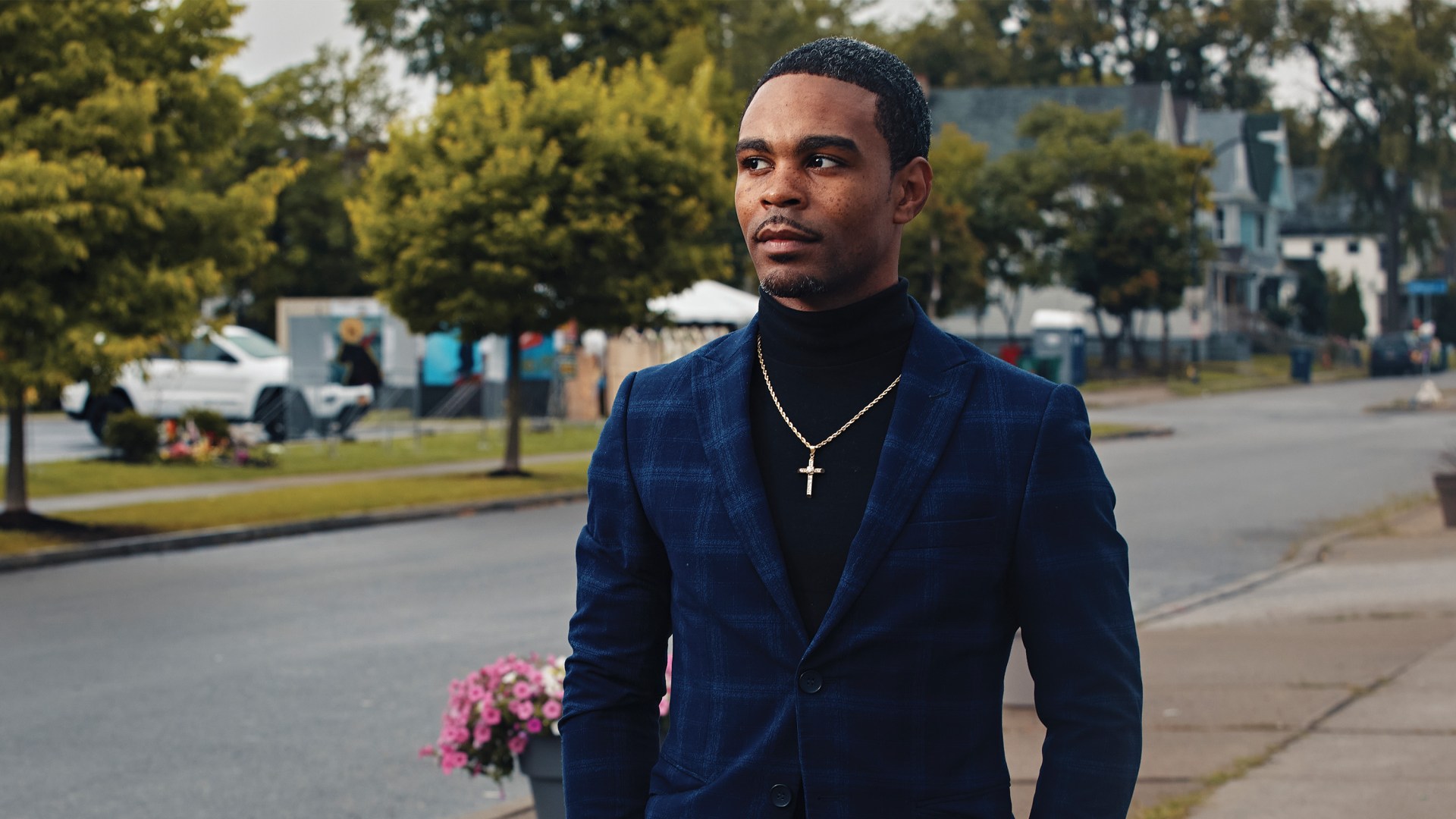
Kyria Stephens grew up with Galloway on the East Side. He worked as a pastor and had a professional rap career. Now married, he has three children and is the director of inclusion and community initiatives at the Buffalo Niagara Medical Campus.

Stephens, Galloway, and other Christian friends protested after the murder of George Floyd in the spring of 2020. They were at the protest where Buffalo police officers pushed an elderly man to the ground, inflicting a brain injury (charges against the officers were later dismissed).

Stephens said he learned during that protest that work had to be multigenerational, so he hopes Buffalo’s future changes would come from the young and the old.

During those protests Stephens, wrote a song, “A.L.T.P.” In it, he raps, “Somebody tell the church they need to do more than pray. … Y’all be playing with my life like it’s just a game.” At the end of the song, he recites all of Psalm 13: “How long, O Lord? Will you forget me forever? How long will you hide your face from me? How must I take counsel in my soul and have sorrow in my heart all the day?” (vv. 1–2, ESV).

After the Tops shooting, Stephens organized a collaborative group of 25 leaders to make plans for the future of the East Side, a group that included Galloway. As recovery money pours into Buffalo from the government and corporate donations, the group wants to have a seat at the table to help figure out the best way to use it. A $5 million survivor fund that was established, for instance, opened complex conversations about who counts as a survivor.

Stephens wanted big changes in his city, but he wept when he talked about smaller moments, like a conversation with his 13-year-old about the shooting. He hated seeing her “questioning her place” in society and whether her white friends secretly harbored hatred toward her. He told her to share with her closest white friend how she felt, one small way of fighting isolation between communities.

“George Floyd woke people up to injustice,” Stephens said. “But just like anything, when something happens, if it happens to somebody that isn’t close to them, it’s like, ‘Aw, that’s terrible, I hate that.’ But when it happens in your own community it hits you in a different way.”

Stephens wants Christians from different backgrounds in the city to go to each others’ birthday parties and weddings. In August, a group of Buffalo churches, suburban and urban, continued a nearly 20-year tradition called Breakout, where they hold block parties together in different neighborhoods for a week. They have food, music, face painting, games, and worship. This year, one of the block parties was in front of Tops. Stephens, who has a rental company on the side, provided bounce houses for the week. Hundreds of people came out, and the churches filled a big tub to baptize people.

Cockrell, a white pastor who leads a mostly Black and Latino church in Buffalo, knows Galloway and Stephens. He’s watched them and other young Black Christian leaders go unrecognized for years.

“They understand what time it is and the hurt and the struggle, but they’re not fatalistic,” Cockrell said. “They’re creating things.”

Viewed through John Perkins’s lens, Cockrell is a “relocater,” a white pastor who moved to Buffalo 20 years ago and has built a web of relationships on the East Side. His church has been involved in holistic ministries providing everything from housing to medical needs.

Galloway takes women in her antitrafficking program to churches around the city they might want to attend, and she remembered visiting Cockrell’s church when it was packed with “Black people, white people, Hispanic people, wealthy people, poor people.”

“The first time I heard that man preach, I wept. Because I had never seen a white man speak so boldly against racism,” she remembered. She went up to him after and said, “Listen, Imma rock with you.”

Cockrell will call white Christians and tell them about Galloway’s organization and say, “You need to know who she is.” Those little conversations, relationships, and moments are how locals sense some change.

How does a nation change, heal, and grow after a white supremacist attack?

Months after the Buffalo shooting, local churches hosted panel discussions on race. Galloway and Stephens watched and spoke on some of those panels, but they didn’t see much come from them.

Jennifer Berry Hawes, a longtime reporter for The Post and Courier in Charleston, South Carolina, wrote a book on the 2015 Emanuel AME church shooting, Grace Will Lead Us Home. In her years covering the aftermath of the attack, in which a white supremacist killed nine Black elders at a Bible study, she didn’t see much result from the high-level conversations on race. She remembered a unity march across one of Charleston’s big bridges a few days after the shooting and people wondering whether that was enough to move on.

But some people in Charleston didn’t move on, in her view.

“The changes that were made were very local,” she told CT. “They were made by local people with the connections they made here.”

The shooter killed Myra Thompson, the wife of Anthony Thompson, pastor of Holy Trinity Reformed Episcopal Church in Charleston. Thompson made it a priority to see changes in the city and to preach the power of forgiveness anywhere people would listen to him. He had spoken at the shooter’s bond hearing, telling him, “I forgive you. … But we would like you to take this opportunity to repent. Repent. Confess. Give your life to the one who matters most: Christ. So that he can change it.”

After the attack, four predominantly white churches in the city asked Thompson to have pulpit exchanges and meals together. Thompson agreed because, as he said to CT, “The church has … to take the lead to tell people what they need to do for healing.”

A pastor of one of the white churches invited Thomas to a church gathering at his house but warned him that not everyone was happy about him coming. Thompson went and saw what he meant, although some in the congregation came up to him with welcoming faces and conversation.

“I … went over to people who didn’t want me to be there. They were not paying me no attention, not saying ‘hi’ or nothing, eating off little plates,” Thompson. “I would say, ‘Excuse me!’ I stood right up there in front of them.”

Over the years of pulpit exchanges and church suppers together, “some of them came around,” he said. One 90-year-old woman came up to him one day after he spoke and said loudly, so others could hear, that after getting to know him, “I learned I was a racist.”

When people said things like that to him, he would say, “I forgave all of y’all a long time ago.”

Thompson got to know Charleston’s mayor, John Tecklenburg, who seemed genuinely grieved by what happened. Tecklenburg, who took office in 2016, spearheaded the removal of a 120-foot statue to slavery and states’ rights defender John C. Calhoun from a downtown square in 2020. The city also passed a resolution in 2018 apologizing for its role in “regulating, supporting, and fostering slavery and the resulting atrocities,” which had never been done before. It promised to rebury and memorialize the remains of a number of African Americans, likely slaves, that had been recently discovered throughout the city.

Thompson, who grew up in Charleston, was surprised.

“Never in my lifetime did I expect anything like that,” he said. “This was a great surprising and shocking change.”

In August, Thompson was planning a march to landmarks of racism around Charleston, where they would discuss their history and “[pray] to the Lord to remove this attitude from the hearts of people so they will not perpetuate acts.”

All of those activities are a lot to expect from victims’ families. Thompson said he is feeling the “wear and tear … I really, really need a break.” He knows Buffalo’s hurt. “I am one of them. I know it’s going to take a lot for some of them to find peace and the comfort they need right now.”

On July 15, the Tops on Jefferson Avenue reopened.

Stephens was at the reopening. People from the community gathered and broke out into the song “Total Praise” before touring the renovated building. Stephens felt tears coming down his face as he went in the store.

And maybe some of Galloway’s dreams, of Tops reopening and more grocery stores coming to the community, will come true. Bishop Michael Chapman, head of St. John Baptist Church, which also has a large community development footprint in Buffalo’s Fruit Belt neighborhood, said his church’s community development arm pushed for a grocery years ago but couldn’t get it approved. After the shooting, city officials greenlit the project, which will go up in Fruit Belt neighborhood, about eight blocks from Tops.

“The power of God is moving and in the midst of all of this tragedy,” Chapman said.

And the Kensington Expressway? The state now has a plan to cover the highway and return it to a green space, reconnecting a neighborhood divided.

Healing, forgiveness, and recovery don’t run in straight lines upward. Tops employees who were in the store during the shooting had a hard time returning during renovations and hearing a jackhammer, according to The Buffalo News. Stephens’s wife works at a bank, and when someone recently dropped something on the floor with a big bang, everyone panicked.

And Galloway was frustrated about limited buy-in from white Christians in her sphere. While she was working with the girls in her program to not be resentful toward white people, she didn’t hear much from white Christians she knew in the city, even just asking how she was doing.

Cockrell, the longtime pastor of Renovation, along with two other white pastors from Vanguard Church, stayed in touch and visited. Some predominantly white churches sent more volunteers to her organization, but not money. Maybe they are supporting some other East Side project, she thought.

“I can’t make white people love us,” Galloway said. “All I can do is help my community to be better. I can help hold elected officials accountable. I’m done trying to convince people I’m a child of God too.”

In his 1982 interview with CT, Perkins shared a harsh criticism of the Moral Majority: “They will leave it to the blacks totally to deliver themselves.” If the Moral Majority were serious, he said, it would help a Black community in Atlanta or Chicago start a Black Bible college. Local change, in Perkins’s mind, was indicative of national change.

Galloway looks at the example of Nehemiah, who walked around Jerusalem when it needed to be rebuilt and took inventory.

“Nehemiah addressed all the elders of the city and told them, basically, We’re going to rebuild the city, but build the part in front of your house,” Galloway said. “As long as we’re all building, it will get better.”

Emily Belz is a news writer for CT.

News

Environmental Train Wreck: Houston’s Black Churches Fight Pollutants

Leaders and activists petition to hold a railway company to account for decades of carcinogen use.

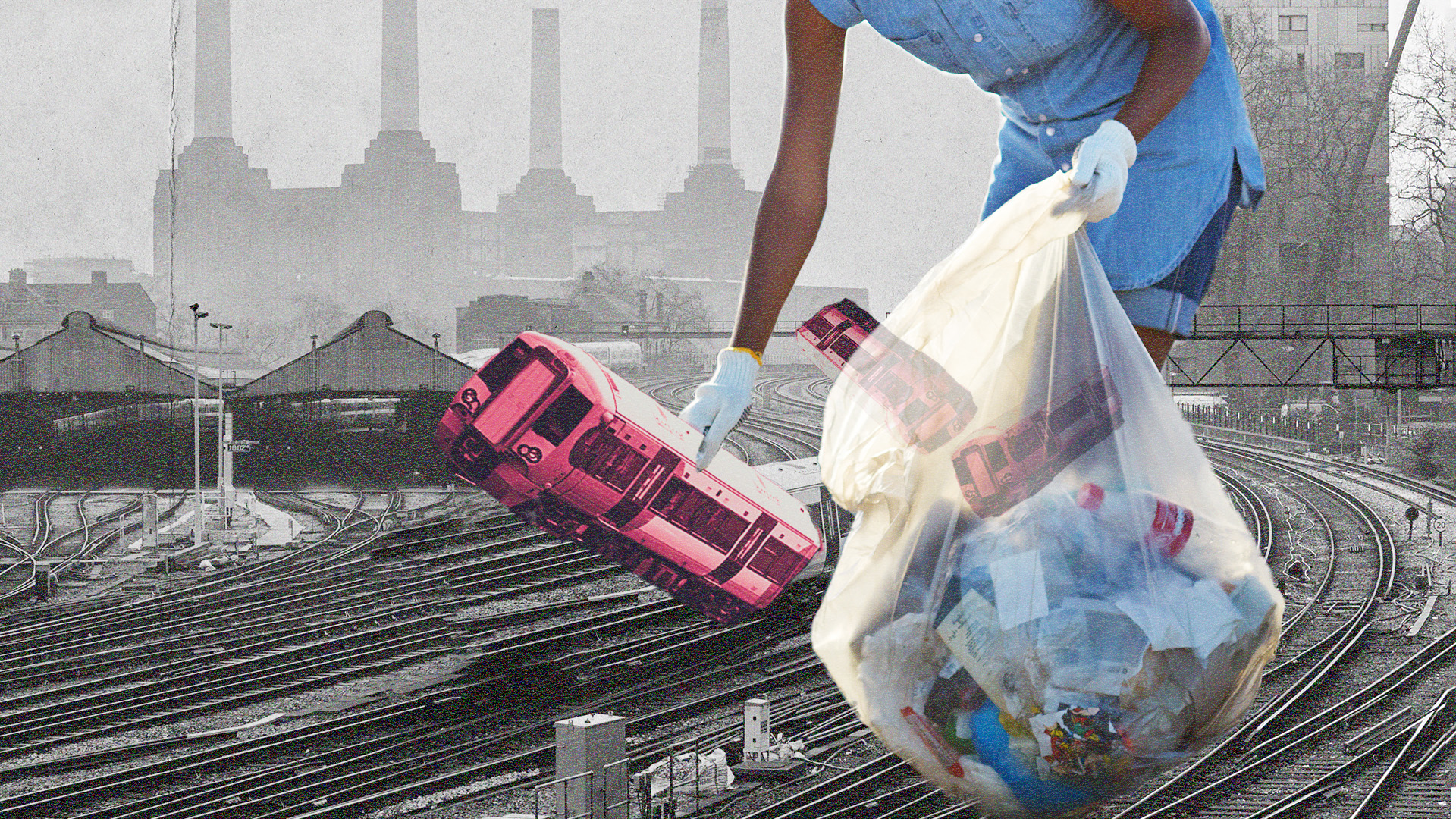
Illustration by Abigail Erickson / Source Images: Getty Images

Long before two cancer clusters were discovered in their Houston neighborhood, residents and fledgling activists met in churches and community centers across the Greater Fifth Ward, slowly building what would become a groundswell of environmental justice work in one of the city’s historically Black communities.

“It was all God’s doing,” said James Joseph, a minister at Lyons Unity Missionary Baptist Church and the founder of the Fifth Ward’s Neighborhood Enrichment Xchange. “He planted me here.”

The northeast corner of Houston is home to communities like Fifth Ward, Kashmere Gardens, and Trinity–Houston Gardens—African American neighborhoods with churches dotting most street corners. For decades, residents have been calling attention to the area’s compounding environmental issues, from drainage problems and air pollution to poor water quality.

For Christians like Joseph, exposing the health risks and fighting for change is a way to “walk in the light” and “serve God and his people.” Their faith has given them the patience to wait for media and politicians to pay attention to their calls for change and, hopefully, reform policies to better protect their neighbors and the place they call home.

More than a decade ago, people meeting at Joseph’s church began addressing concerns like stopped trains blocking traffic or horns blasting throughout the night. And then they heard about the creosote. From there, Joseph said it felt like they were “connecting the dots” between the different environmental issues plaguing the neighborhood.

On a 33-acre site between Fifth Ward and Kashmere Gardens, Southern Pacific Railroad operated a wood-preserving facility from 1911 to 1984, treating railroad ties with creosote, a black, inky substance distilled from tar. According to the Environmental Protection Agency, creosote is a possible carcinogen. Union Pacific (UP), which took over the site 25 years ago, maintains “there is not a complete [creosote] exposure pathway” from the facility to area residents. But residents, activists, and officials say otherwise.

EPA Administrator Michael S. Regan meets with officials and leaders in Houston's Fifth Ward, including Mayor Sylvester Turner and professor Robert Bullard.Courtesy of COCO
EPA Administrator Michael S. Regan meets with officials and leaders in Houston’s Fifth Ward, including Mayor Sylvester Turner and professor Robert Bullard.

A 2019 state health department report found the number of lung, esophagus, and throat cancer cases “were statistically significantly greater than expected” in Fifth Ward and surrounding areas, including parts of Kashmere Gardens, Trinity Gardens, and Denver Harbor.

And the following year, Texas released a second report, expanding the analysis to look at childhood cancer within a two-mile radius. The state agency discovered that the rate of acute lymphoblastic leukemia, the most common type of childhood cancer, was “significantly greater than expected,” particularly in an area close to the railyard.

That was just the start. A report by the Houston Chronicle indicated hazardous waste mixed with creosote at the rail site is thought to be responsible for even more health problems. And Houston’s health department discovered another highly toxic pollutant—dioxin—in soil near the facility.

Sandra Edwards grew up steps away from the facility and remembers her dad walking barefoot in that soil. When he died of bone cancer, the Fifth Ward native quickly drew her own conclusions. She knew the smell that came from the railroad, some days so bad that “you could not breathe.”

After Edwards’s father died, she began talking to her neighbors, many of whom had their own stories.

“They told me to come talk to the people at the church,” Edwards said. “They were talking about the railroad.”

Eventually, Edwards took the lead at what would become Impact Fifth Ward, a community organization for residents affected by the creosote contamination.

A few months ago, Harris County, the City of Houston, and the nonprofit Bayou City Initiative joined Fifth Ward and Kashmere Garden residents in the fight, threatening to sue the railroad “for the imminent and substantial endangerment from environmental contamination from UP’s facilities.” The multipronged effort came about thanks in part to the efforts of Fifth Ward’s faithful like Joseph.

“We definitely took names, did petitions, all leading up to now. Thank God,” Joseph said.

“Everyone might not be the one to finish the work, like Moses, but there’s a Joshua somewhere.”

The company has entered remediation discussions for the former wood-tie-preserving facility. More than 2,000 Fifth Ward residents, including Edwards and Joseph, are seeking compensation for damages. Ultimately, Edwards said, she’d like to see UP “pay for our wrongs and make it right … make us whole again.”

The lawsuits represent a major step, but the fight to protect their community continues as they grapple with air and water quality, illegal dumping, housing, and infrastructure issues, with Black churches naming the “environmental racism” in their neighborhoods and working to address it.

All of these problems “are connected,” according to James Caldwell, a Fifth Ward native and a minister who leads the Coalition of Community Organizations (COCO). The organization is petitioning for safer, cleaner drinking water and better air quality.

“This is not a sprint, and it ain’t a 26.2-mile marathon. This may be 262 miles,” Caldwell said. “In other words, are you prepared to be patient and fight that good fight of faith? That’s what it’s going to take.”

At Texas Southern University, a historically Black college in Houston, researcher Robert Bullard found the same pattern of contamination in other communities of color.

“Even when you discover that this is an environmental and health problem, communities have to wait longer to get a response from government and a response from the companies,” said Bullard, a professor of urban planning and environmental policy and the author of Dumping in Dixie.

In many of the affected communities, the Black church has taken the lead in shining a spotlight on pollution and environmental injustice.

Volunteers work at the Northeast Houston Redevelopment Council's (NEHRC) community garden in Houston's Trinity Gardens neighborhood.Courtesy of Huey German-Wilson
Volunteers work at the Northeast Houston Redevelopment Council’s (NEHRC) community garden in Houston’s Trinity Gardens neighborhood.

“The church has to preach the gospel, but it also has to somehow take care of its flock, its congregation,” Bullard said. “The same theology of the Black church also gave impetus to the environmental-justice framework, in that we were fighting another evil system of oppression in the form of environmental racism.”

In July, the Department of Justice announced an investigation into the City of Houston regarding illegal dumping in Huey German-Wilson’s neighborhood of Trinity–Houston Gardens—initiated thanks to her longtime efforts.

“It is the church’s responsibility,” said German-Wilson, who is a member of Trinity Gardens Church of Christ. “When you sit in these neighborhoods and you don’t offer the things the neighborhood needs, you’re doing a disservice to your church.”

At her church, members have tackled food insecurity by starting a community pantry and donating land for a community garden. Around 2018, Caldwell invited German-Wilson and her team to come alongside Impact Fifth Ward to help uncover the community-wide consequences of creosote seeping into soil and water.

Especially in 2022, churches across the Fifth Ward have lost aging pastors and installed new ones. German-Wilson emphasizes the church’s role in calling out the environmental degregation.

“In terms of the theology of it all, I know that God gave me a purpose, and I’ve tried to walk and work in that purpose,” German-Wilson said. “My church tells me repeatedly, ‘Whatever it is you’re working on, we will support you in that.’”

Phoebe Suy Gibson is a freelance writer based in Houston.

Myanmar’s Christians Fight for Peace

A former beauty queen is a part of the widespread resistance taking a stand against the brutal military regime.

Hannah Yoon

Angel Lamung had been in the public spotlight since she was a teenager. In Myanmar, she won beauty pageants, appeared in commercials, acted in movies, and sang pop songs.

But last year, when news anchors read her name on the nightly broadcast and the state-run paper printed her photo alongside other popular celebrities’, the coverage was different.

The government had put her on a wanted list.

After the military overthrew the democratically elected leadership in Myanmar (also called Burma) in a coup in February 2021, the then-23-year-old Christian was among the crowd who took to the streets and social media in protest. It changed her career forever.

The new regime responded swiftly with escalating violence to quell demonstrators and harsh criminal penalties for those who voiced opposition, especially public figures. Lamung was among 20 celebrities charged under a new law outlawing dissenters. By the United Nations’ count, 1,500 people were killed in demonstrations and more than 10,000 were “unlawfully detained” in the first year after the coup.

Lamung managed to escape last spring, fleeing to the United States as a refugee. From the safety of a spare bedroom in a family friend’s house on the East Coast, she fundraises for humanitarian aid and speaks out in support of the largest civil disobedience movement in Myanmar’s history.

“I would rather leave everything that I love than give in to the dictatorship,” Lamung remarked in a clip on her YouTube channel.

Back in Myanmar, the government froze Lamung’s bank accounts and she faces arrest if she returns. Her friends and fellow activists send dispatches from the Thai and Indian borders, where they’re waiting to flee to safety, or from Yangon, the nation’s largest city, where police stop to check their social media accounts for signs that they support the resistance, such as displaying red or black on their pages. Many activists carry burner phones or censor their profiles.

Protests became too dangerous once the police switched from rubber bullets to real ones, but civil disobedience continues. Civil servants like health care staff and teachers refuse to work under the regime; by the military’s own estimates, nearly 30 percent of public employees have participated. Some are boycotting the state-owned power company or telecommunications company (internet connectivity has worsened and tripled in price since the coup).

Lamung still repeats the pleas she made to the Lord each night when she got home from the vigils and protests right after the coup—for him to bring safety and peace to Myanmar. “I can’t yet see the result of our prayers,” she said, “but God also gave us hands, feet, and a mouth to speak out for justice.”

https://www.instagram.com/p/CLj3N6zgbC5/

Lamung was born and raised Baptist, the largest Protestant group in a country that’s over 90 percent Buddhist. Her family is Kachin, one of Myanmar’s majority-Christian ethnic groups. In provinces on the country’s perimeter, the Kachin, Chin, Karen, and Kayah have suffered persecution by the army for years and fought against it in favor of democracy.

These Christian groups, unsurprisingly, took a stand against the 2021 takeover in official statements and in their involvement in demonstrations, rallies, and other forms of civil disobedience. What was more remarkable, scholars pointed out in The Review of Faith & International Affairs, was how all types of citizens in Myanmar were evoking their religious beliefs in the aftermath of the coup.

There had been uprisings in the past—the country has a decades-long history of military rule—but never before were Buddhists, Catholics, and Protestants so publicly involved at once, bringing faith and prayer into their protest. Evangelicals in Myanmar share Lamung’s passion for the resistance, calling on a God who takes the side of the oppressed and against evil.

They quote the Exodus narrative and the story of Daniel’s captivity. Churches rally money and supplies for the civil disobedience movement. They refer to the military, known as the Tatmadaw, as “terrorists.” Even when it comes to armed resistance, pastors pray for the thousands of young people who have left the cities to train with rebel militias in the provinces, asking that their missions would be successful.

“Theologically, I don’t think it’s wrong. Our God is a fighter,” one pastor in Yangon told CT, asking that his name not be used for safety reasons. “It’s not my choice because I’m a shepherd and a pastor, but I understand.”

Lauren Decicca / Getty

The military junta has targeted civilians in ways that humanitarian groups deem “war crimes” and “crimes against humanity,” including planting landmines in homes, farmlands, and church property.

Mana Tun, director of the Peace Studies Center at the Myanmar Institute of Theology, wishes there were better alternatives for those who feel called to join the armed conflict. He doesn’t find it incompatible with a Christian understanding of peace, though, when fighting to free a country from rulers who continue to bomb, execute, and torture their own people. Tun teaches students to see peacemaking as engaged, active, and responsive; forced silence and compliance is not peace.

“Peace is possible anywhere. It can be protest. It can be a struggle. People being resilient in such oppressive times is a form of peace,” said Tun, who arrived in the US in August for his doctorate studies. “You can still love your enemies by protesting, resisting, and even fighting. Love is always standing up for good.”

But these responses also carry real consequences in Myanmar. People and organizations who oppose the regime can lose access to their bank accounts, since the system is government-run. Police raid, search, and make arbitrary arrests without due process. Prisons torture detainees, and four revolutionaries were executed by the military government in July.

Even in the early weeks, Lamung knew the risks that came with speaking out as a public figure, but her convictions would not let her stay silent.

After being named Miss Intercontinental Myanmar at 17, Lamung saw her influence as a gift to steward. When the pandemic hit in 2020, she wrote a song called “Ar Tin Nay Bar” (“Stay Strong”) to encourage fans facing hard times.

Hannah Yoon

When she prayed about joining the resistance after the coup, she said God gave her peace about the decision. She quoted Proverbs 4:14: “Do not set foot on the path of the wicked or walk in the way of evildoers.”

“I have many fans and influence,” said Lamung, who cofounded the organization Passion for Hope to help those displaced by government violence. “I want to stand for what I believe in; I want people to know what the military is doing; I want people to stand for justice.”

Half the population of Myanmar is under 30, like Lamung and her followers. Young people—Buddhist and evangelical alike—feel “angry” and “depressed and useless,” a 19-year-old Christian in Yangon said in an interview with CT. Under the civil disobedience movement, they don’t go to school and it’s tough to find jobs, so many are eager to join the fight.

Young Christians, at least, have the church. “In the past I took everything for granted,” the teen said. “I’m more grateful for Christian community.”

Passion for Hope started as a vehicle for Lamung and her friends to do something tangible for those suffering under the military regime. It’s become her way to continue to serve the people and place she loves.

Passion for Hope collects donations for first aid supplies and basic resources. After the coup, while hospitals were understaffed and pharmacies were closed, Passion for Hope helped provide life-saving oxygen for COVID-19 patients. It distributed meals and snacks to villages ransacked by military attacks. It supplied 200 first-aid kits to frontline medical teams. And for kids, it partnered with missionaries to give away 300 copies of The Jesus Storybook Bible in Burmese.

https://www.instagram.com/p/Cc8AIpLr8BI/

Finances are tight in Myanmar as costs rise and some citizens are forgoing their paychecks from civil servant jobs, so the civil disobedience movement has gotten an influx of support from the Burmese diaspora, including churches in Asia, Australia, and the US. Lamung targets international donors as well as humanitarian organizations looking for a way to help.

Lamung had lined up plans to produce a version of Michael Jackson’s “Heal the World” with fellow celebrities singing in local languages, but the project stalled as artists feared the government could punish them for participating. For now, she’s focused on a new campaign to provide supplies to kids whose schooling has been disrupted by civil disobedience or violence, and she’s looking for new collaborators.

An estimated five million children in Myanmar have been displaced by airstrikes, some of them runaways separated from family. The more Lamung processes her own trauma from the safety of the US, the more she dreams of funding better social, emotional, and spiritual care for the youngest generation back home.

Lamung says she can’t be in crowds without feeling panic; that’s why she hasn’t committed to attending a church in the States. She misses “the old her” and asks God if she’ll ever feel like herself again.

Hannah Yoon

But she believes her depression and her faith can coexist. She’s shared about it with followers on social media, where she continues to post occasional outfit photos and day-in-the-life video clips alongside updates on the political situation in Myanmar.

Praying to God when she’s feeling down gives her strength. Thinking of her work gives her perspective.

“I have a room. I have American water,” Lamung said. “There are children running under airstrikes.”

Citizens in Myanmar have gone through one nightmare scenario after another over the past year and a half: police violence against unarmed citizens, coronavirus outbreaks without stable health care, economic downfall, attacks in villages, unjust arrests, deaths.

“I was seeing all this violence and desperation. … I kept asking, ‘Where could I find hope?’ ” said Tun, the director of the seminary’s peace center. “I couldn’t find hope at all. I focused on God’s presence. It was that faith that sustained my life.”

As he talked to families who lost people to sickness or violence, he relied on the theology of a suffering God, telling them that God died with their loved one and that God is risen with them.

A pastor in Yangon said his worship leader, also a local musician, was arrested for organizing a resistance group. The pastor now visits the worship leader in prison, where he has suffered so much torture—the pastor likened it to the Nazis or North Korea—that he no longer knows who he is. The pastor believes that even in this context, the gospel goes forth; he prays for the soldiers and witnesses to the prison guards.

Before he left, Tun helped organize spaces where Christian leaders could process what they were going through. Even without a lot of previous engagement in the realm of mental health and self-care, churches are starting to see the “urgent need.”

“Living in a context like Myanmar, you don’t need a reason to fear,” he said. “What was I afraid of? I don’t know. But every day, I woke up afraid.”

The state of fear has spiritual implications too. A Christian theologian from Myanmar, who asked not to be named to protect his family’s safety, said, “Christians feel helpless. They ask, ‘Why has God allowed the military regime to oppress the people?’ They question the presence of God and the power of God.”

He pointed to God’s deliverance of Israel from Egyptian oppression. “Eventually,” he said, “we will enter the promised land.”

Lamung doesn’t know what the pathway to peace could look like back home or when she’ll get to return.

In the span of a year, she saw her life transform entirely. She lost her savings and stepped away from her career as a model and actress. When she’s not working on Passion for Hope, she makes a paycheck as a server at a Chinese-American fusion restaurant.

Her days are quiet. Lamung misses the noise of her mom making breakfast and shouting for her to wake up. Anxious over parties filled with new people, she wishes for a carefree night out with her friends back home.

She told CT that this is not what she ever dreamed of—but she senses God’s hand and call just the same.

“Believing God isn’t like all the problems will go away. It’s giving you a way,” she said. “I thank God for that.”

Kate Shellnutt is Christianity Today’s editorial director of news and online journalism.

Ideas

Jeffrey Dahmer and Killing Our True Crime Obsession

When serial killer stories rank among the country’s top shows, we’re guilty of fueling a dark trend.

American serial killer and sex offender Jeffrey Dahmer indicted on 17 murder charges between 1978 and 1991.

American serial killer and sex offender Jeffrey Dahmer indicted on 17 murder charges between 1978 and 1991.

Christianity Today October 17, 2022
Marny Malin / Getty

There are thousands of things to watch on Netflix—but right now, two of the top ten shows on the platform are about serial killer Jeffrey Dahmer.

Dahmer – Monster: The Jeffrey Dahmer Story, a drama series produced by Ryan Murphy, broke Netflix records in its opening week last month, according to the Los Angeles Times, and remains the platform’s most popular English language series. Conversations With a Killer: The Jeffrey Dahmer Tapes, a docuseries, debuted a week ago. Both portray one of the most gruesome serial killers in American history.

The popularity of these series is no surprise given the growth of true crime as an entertainment genre—everything from podcasts to narrative journalism to television series and films entrance audiences with storytelling, suspense, and a collective longing for justice.

But the popularity of these programs, especially those that reiterate the horrifying acts of serial killers, reveals a rotten reality about our society. Seeing Monster at the top of Netflix’s trending list should prick our consciences and drive us to consider how such shows affect us and the real-life people whose stories are flattened for our screens. The dark rise of serial killer true crime has moral weight for those who aim to reflect a God of light and life.

Monster dramatizes the horrific crimes of a man who brutally slaughtered and in some cases cannibalized 17 young men, many of whom were Black and gay, in Milwaukee between 1978 and 1991. Families of victims have spoken out against the show, confronting Netflix for not consulting them and challenging viewers to consider the real people still impacted by Dahmer’s despicable crimes. TV critics have needled the show’s failure to handle difficult issues.

“[Director Ryan] Murphy and his collaborators are obviously aware of how exploitative it can be when the stories of serial killers are sold to a murder-obsessed public and how hurtful it is when victims are diminished,” Jen Chaney writes for Vulture, “but the show never figures out a way to avoid committing the same crime.”

Eric Perry, a relative of victim Errol Lindsey, told the LA Times, “We’re all one traumatic event away from the worst day of your life being reduced to your neighbor’s favorite binge show.”

True crime entertainment has exploded in the years since Serial, the record-breaking 2014 podcast that investigated a murder case in Baltimore. Now, shows such as Crime Junkie, My Favorite Murder, and Morbid rank among the top 10 podcasts in the country. Streaming networks have launched dozens of docuseries, including the previous Netflix hit Making a Murderer.

The effects haven’t been all bad: Cold cases have been solved, and wrongful convictions have been overturned (Adnan Syed, the person at the heart of Serial, was recently cleared of all charges). Many true crime fans tune in to examine the flaws of the justice system and celebrate these victories.

But it’s much harder to defend the value of scripted productions like Monster, which harness the lurid details of killers’ crimes to turn reality into drama (Monster is classified as a thriller).

“By focusing on the larger-than-life media images of socially constructed ‘celebrity monsters,’ the public becomes captivated by the stylized presentation of the criminals rather than the reality of their crimes,” writes criminologist Scott Bonn in his book Why We Love Serial Killers.

Bonn lists three reasons why people are fascinated by these criminals:

  • Fear and a need to understand the killer in order to reduce that fear
  • Empathy or a drive to relate (which is connected to that need to understand)
  • Visceral appeal—i.e., the adrenaline jolt that comes with being scared

But rather than driving understanding (and at some level, serial killers just aren’t understandable), our Netflix queue or podcast feed often makes it easier to lose sight of the fact that these are not just stories. Dahmer wasn’t just a character in a horror novel. He was a real person. And his victims were real people who endured the terrifying torture that sends shivers up our spines. Their surviving families face that trauma all over again when their real-life worst nightmare is usurped for our entertainment.

How can we participate in God’s kingdom of restoration that “binds up the brokenhearted” (Ps. 147:3) if our habits tear those bandages away? We’re called to “mourn with those who mourn” (Rom. 12:15), not to continue reopening wounds.

While we can cast blame on producers, writers, and directors, audiences demand this content. People want to watch movies and shows and documentaries and dramatizations of serial killers. (In the case of Monster, consumption was over 700 million hours in a week.)

The decision to engage with true crime may be a matter of discernment and Christian freedom. After all, different people possess different sensitivities. If I were to watch Monster, I’m sure I’d have nightmares for weeks—just researching the show for this piece turned my stomach—while another person wouldn’t even look over their shoulder on a dark street. As Jesus explained, we’re not defiled by what goes into us, but by what comes out of us (Mark 7:18–23). But we should still think carefully about why we’re drawn to this media and how specific shows impact ourselves and others.

The voyeuristic pleasure that comes with another serial killer story, or another version of a familiar killer’s story, is evidence of a gross fixation. If anything, the industry that produces such depictions of violence and profits from it enables the expression of what is already true: We’re fascinated with evil.

Human thrall with the gruesome has a long history. The Roman Colosseum drew crowds to cheer on gladiators fighting to the death. Hangings, beheadings, and other executions historically were a public affair that entire communities gathered to watch. Less than 100 years ago, white Americans assembled in town squares for lynchings of innocent Black men.

We look back and cringe at how others cheered death, their cruelty and heartlessness so stark in hindsight, but is the popularity of serial killer shows all that different?

To be people of light in the dark kingdom of this age, we need to take seriously Paul’s direction to think on what’s true, honest, just, pure, lovely, and admirable (Phil. 4:8) and join the psalmist in his commitment to “not look with approval on anything that is vile” (Ps. 101:3).

I’m not saying we should turn our faces away from the difficult realities of life, to ignore a world plagued with theft, kidnappings, abuse, and murder. After all, the Christian walk is one that steps into suffering for the good of others.

But relishing another morbid account of another person possessed by the worst of urges is not how we love God and our neighbors well. And worse, by pressing play, we’re helping others profit off strangers’ pain and encouraging the production of more.

Meredith Sell is a freelance writer and editor in Colorado.

Speaking Out is Christianity Today’s guest opinion column and (unlike an editorial) does not necessarily represent the opinion of the publication.

Apple PodcastsDown ArrowDown ArrowDown Arrowarrow_left_altLeft ArrowLeft ArrowRight ArrowRight ArrowRight Arrowarrow_up_altUp ArrowUp ArrowAvailable at Amazoncaret-downCloseCloseEmailEmailExpandExpandExternalExternalFacebookfacebook-squareGiftGiftGooglegoogleGoogle KeephamburgerInstagraminstagram-squareLinkLinklinkedin-squareListenListenListenChristianity TodayCT Creative Studio Logologo_orgMegaphoneMenuMenupausePinterestPlayPlayPocketPodcastRSSRSSSaveSaveSaveSearchSearchsearchSpotifyStitcherTelegramTable of ContentsTable of Contentstwitter-squareWhatsAppXYouTubeYouTube