Ideas

Salman Rushdie Is the Canary in a Free Speech Coal Mine

But the liberty at stake is moral and spiritual, not just intellectual.

Christianity Today August 23, 2022
WikiMedia Commons

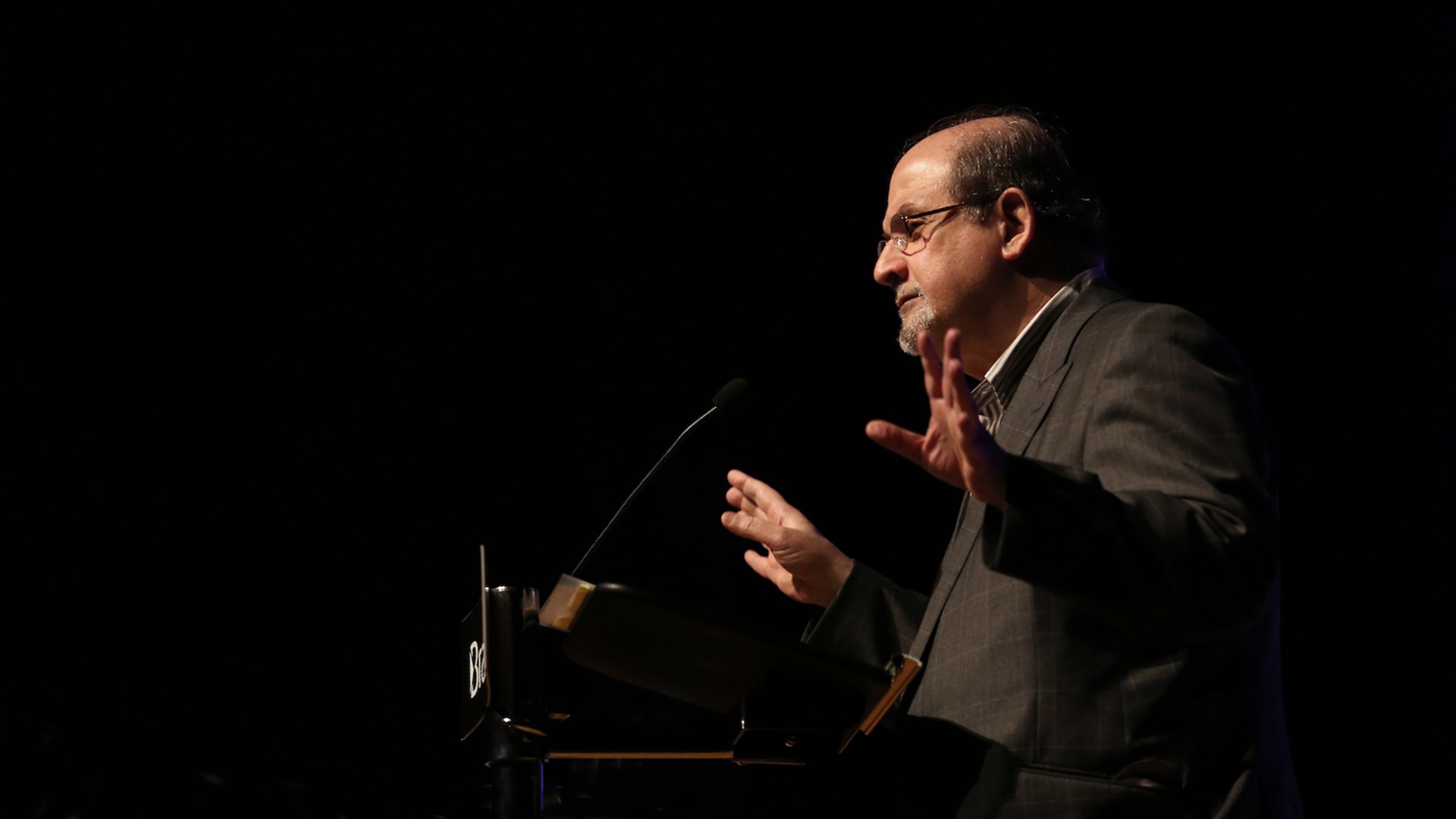
In the days since a brutal attack on Salman Rushdie, the world has seen an outpouring of solidarity. The phrase “We are all Salman Rushdie” appeared on Twitter profiles and in countless articles, acknowledging that threats to one person’s freedom of expression are a threat to all.

In the New Yorker, Adam Gopnik anticipated efforts “to somehow equalize or level the acts of Rushdie and his tormentors and would-be executioners.” That approach is despicable, he wrote, “because the right to be insulting about other people’s religions…is a fundamental right, part of the inheritance of the human spirit. Without that right of open discourse, intellectual life devolves into mere cruelty and power seeking.”

In The Atlantic, Graeme Wood eviscerated “those who muddle the distinction between offense and violence, and between a disagreement over ideas and a disagreement over whether your head should remain attached to your body.” He continued, “Now that Rushdie’s head has been partially detached, and on American soil, I hope these distinctions will need no further elaboration.”

These articles, like countless others, anticipated mealy-mouthed responses condemning the attacks while suggesting the novelist maybe had it coming. But instead of that debate, the attack has renewed extant culture wars related to moral boundaries and who draws them.

School boards across the country are a particularly combustible battleground. Phrases like “cultural genocide,” “erasure,” “heteronormativity,” and “CRT” are hurled like grenades at board members responsible for adjudicating objections to curricula and library shelves.

Is Huckleberry Finn a racist apologia? Is I Know Why the Caged Bird Sings anti-white? Should schools allow Ibram X. Kendi in their libraries? Or Harper Lee? Or Dr. Seuss? Or Ann Coulter? Or Toni Morrison?

Some of these debates might be worth having, but far more often, they illustrate a belief that if we win, we’ll remake the world in our image and keep it that way forever. Losing, though, is just as delicious, confirming our animating grievance and readying us for the next fight.

As a result, all sides in a political debate will make competing claims of victimhood—in this case, who can claim solidarity with Salman Rushdie. “We” (the righteous oppressed) are Rushdie, and “they” (our opposition) are the Ayatollahs.

But thinking of Rushdie that way gets the stakes precisely backward. It’s not that we should stand with Rushdie because he’s innocent and must be defended from injustice. Rather, we should stand with Rushdie because his ideas are dangerous and confront otherwise-settled minds with ambiguity and complexity.

Rushdie believes that stories should provoke, and the best of them always have. In an essay titled “Wonder Tales,” he revisits what inspired him as a child—stories that have captivated readers across continents and centuries. In particular, he examines The Arabian Nights (also called 1,001 Arabian Nights), a 1200-year-old story that stirred its own controversy in Egypt when a new translation was published in 2010.

The story centers on a king and his brother, who kill their unfaithful wives and start a murderous ritual: Every day they marry a virgin, take her to bed, and execute her in the morning.

One of the women, Scheherazade, actually volunteers to be given to the king, and as he drifts off to sleep, she tells him a bedtime story with a cliffhanger. The king is anxious to hear what comes next, so he keeps her alive for one more night. The pattern repeats for 1,001 nights in all. On that final evening, Scheherazade pleads for her life. The king then confesses his love for her and ends his own reign of terror, along with his brother’s.

One can’t overstate the power differential between the tyrannical ruler and his would-be victim, Scheherazade. But she understands something about the world that he never could: Even the most brutal heart can be transformed by the wit and beauty of a good story. As James K. A. Smith once put it, “When our imagination is hooked, we’re hooked.”

The king never stood a chance.

Scheherazade, Rushdie writes, is “telling stories to save her life, setting fiction against death, a Statue of Liberty built not of metal but of words.” She “trusted her imagination to stand against brutality and overcome it not by force but, amazingly, by civilizing it.”

Her character embodies the subversive power of the artist, who responds to injustice and violence with what Makoto Fujimura calls “generative creativity.” She releases something new and beautiful into the world, and it disarms the king.

Similarly, we impoverish our moral imaginations if we think of the Rushdie affair as merely a symbol in the culture war. Those battles are merely about what we defend and attack. Rushdie started healthy trouble because of what he made, and his creative act should remind us of the power of speech, storytelling, and beauty to confront injustice and reveal the world as God intended it.

Christians in particular need this reminder now as much as ever. Faced with a secular onslaught, the church’s witness—simple, repetitive, telling the same story week after week—seems profoundly outmatched. We’re tempted to believe that the right censorship, the right political hero, or the right branding will spark revival and remake our world. But short of Christ’s return, these utopian aspirations will always lead to nowhere.

Instead, we ought to have the greatest confidence in the power of mere speech, even during the absurd and confused times we live in. Even more, we ought to have confidence in the power of story to awaken our humanity, invoke empathy, and reveal our deepest desires.

As a church, we’re bound together through a biblical narrative, and when we read the Gospels or the Book of Acts, we see stories within the story—parables told by Jesus and testimonies by the apostles. It’s almost as if the Author of our sacred texts knew if our imaginations were hooked, we’d be hooked.

J. R. R. Tolkien once wrote to his son Christopher that “man the storyteller would have to be redeemed in a manner consonant with his nature: by a moving story.”

Scheherazade’s whispers to a vengeful king reveal the power of narratives to transform the moral imagination. Rushdie has embodied that same courage—by being a storyteller who faced death and didn’t flinch.

Together, they merely hint at a larger drama that can change (and save) the world, and their fortitude reminds us that whatever darkness might confront us, it’s no match for a great story.

Evil doesn’t have a chance.

Mike Cosper is Christianity Today’s director of podcasts.

Speaking Out is Christianity Today’s guest opinion column and (unlike an editorial) does not necessarily represent the opinion of the publication.

News
Wire Story

Most Evangelical Pastors Say Women Can Lead Bible Studies, Ministries

In a recent survey, Baptists are the least likely to endorse women in deacon or senior pastor roles.

Christianity Today August 23, 2022
Thomas Vitali / Unsplash

Most Protestant pastors say a woman could be the senior pastor at their church, but that varies dramatically among denominational groups.

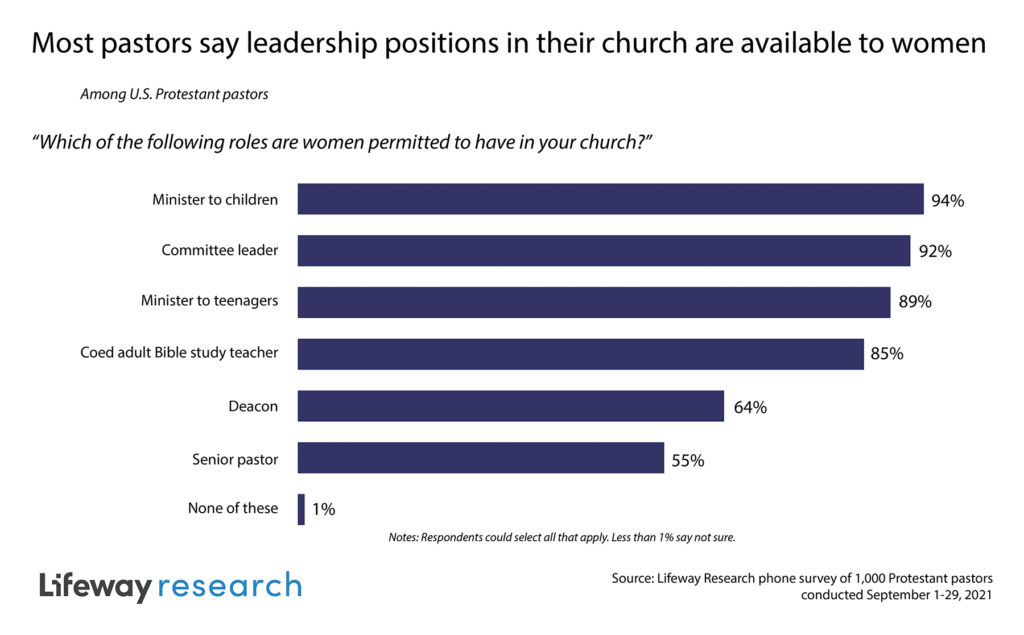
A Lifeway Research study asked US Protestant pastors about six potential leadership roles and if women are permitted to hold them in their congregations. While a slight majority say the position of senior pastor is open to women, a broader consensus exists for other positions.

Close to 9 in 10 pastors say women could be ministers to children (94%), committee leaders (92%), ministers to teenagers (89%), or coed adult Bible study teachers (85%) in their churches. Fewer say a woman could be a deacon (64%) or senior pastor (55%), while 1 percent say none of these roles are open to women. Fewer than 1 percent say they are not sure.

“Someone without context may think differences of opinion on where women can serve in church are simply fickle or archaic perspectives. But these are not questions of opinion as much as biblical interpretation,” said Scott McConnell, executive director of Lifeway Research. “This question has been debated for centuries with biblical scholars in different denominations coming to different conclusions about what Scripture means.”

Denominational differences

Due to specific convictions about biblical interpretation, different Protestant denominations have varying levels of openness to women serving in certain leadership positions. In general, pastors at mainline congregations say their churches have fewer restrictions on the roles in which a woman can serve compared to evangelical churches.

Large majorities of pastors at both evangelical and mainline churches say women can be ministers to children (94% and 97%), committee leaders (93% and 95%), ministers to teenagers (89% and 95%), and coed adult Bible study teachers (84% and 95%).

A divide emerges over the roles of deacon and senior pastor. Eight in 10 mainline pastors (79%) say the role of deacon is open to women, while 56 percent of evangelical pastors agree. Among mainline pastors, 76 percent say a woman could be the senior pastor at their churches. Less than half of evangelical pastors (44%) say the same.

“The reason some pastors make a distinction between women leading as pastors or deacons or even teaching men compared to other leadership roles is because of how they interpret the Bible,” said McConnell. “In the Apostle Paul’s letters, he gives instructions to churches regarding these specific roles. But Protestant churches disagree on his intent.”

Most pastors in all denominational groups say women could be ministers to children, ministers to teenagers, committee leaders, or coed adult Bible study teachers in their churches.

Specifically, Methodist and Pentecostal pastors are slightly more likely than Restorationist movement, Lutheran and Baptist pastors to say women could be ministers to children or teenagers. Methodists are among the most likely to say women can be committee leaders (98%) and the most likely to permit women to be coed adult Bible study teachers in their churches (100%). Lutheran (77%), Baptist (74%), and Restorationist movement (62%) pastors are the least likely to say their churches are open to women serving as coed Bible study teachers.

Most Methodist (88%), Pentecostal (83%), Presbyterian/Reformed (81%), nondenominational (79%), and Lutheran (60%) pastors state their churches allow women to serve as deacons. Around half of Restorationist movement (49%) pastors agree. Baptists (29%) are the least likely to say a woman can be a deacon at their churches.

More than 3 in 4 Methodist (94%), Pentecostal (78%), and Presbyterian/Reformed (77%) pastors say a woman can be the senior pastor at their churches. Those at Lutheran (47%) and nondenominational (43%) churches are more split, while fewer Restorationist movement (25%) and Baptist (14%) pastors say their congregations are open to women senior pastors.

“While individual denominations in these historic branches of Protestantism are too small to analyze separately in this study, it is worth noting that denominations within these categories can differ greatly on this topic as is often seen among different Lutheran and Presbyterian denominations,” said McConnell.

Other demographic differences

Denominations aren’t the only factor that reveals differences in the roles of women within their churches.

Older pastors and those at smaller churches are more likely to say women can serve as senior pastors. Older pastors—those 55 to 64 (60%) and 65 and older (59%)—are more likely than pastors 18 to 44 (49%) to say their churches permit a woman to be the senior pastor. Pastors at churches with fewer than 50 people in attendance (66%) and those with 50 to 99 people (59%) are more likely than pastors at churches with 100 to 249 (46%) and those with 250 or more (41%) at worship services to say a woman can be the senior pastor in their congregations.

African American pastors are most likely to say women can serve in their church as ministers to teenagers (97%) and more likely than their white counterparts to say a woman can be a coed Bible study teacher (95% vs. 84%).

Pastors at churches in the Northeast are also more open to women leading in certain ways. They are among the most likely to say a woman can lead in their congregation as a deacon (77%) or a coed Bible study teacher (89%).

“While the Apostle Paul mentions differences in a couple of specific church roles, any difference in the standing of women and men in the church ends there,” McConnell said. “When discussing a person’s relationship with God, he teaches, ‘There is no Jew or Greek, slave or free, male and female; since you are all one in Christ Jesus’ (Gal. 3:28, CSB).”

For more information, view the complete report.

News

Save the Girl: India’s Christians Lead Hindus, Muslims, and Sikhs on Ending Gendercide

With 9 million girls “missing” due to sex-selective abortions over the past two decades, Pew report examines changes in “son preference” or “daughter aversion” among India’s biggest faiths.

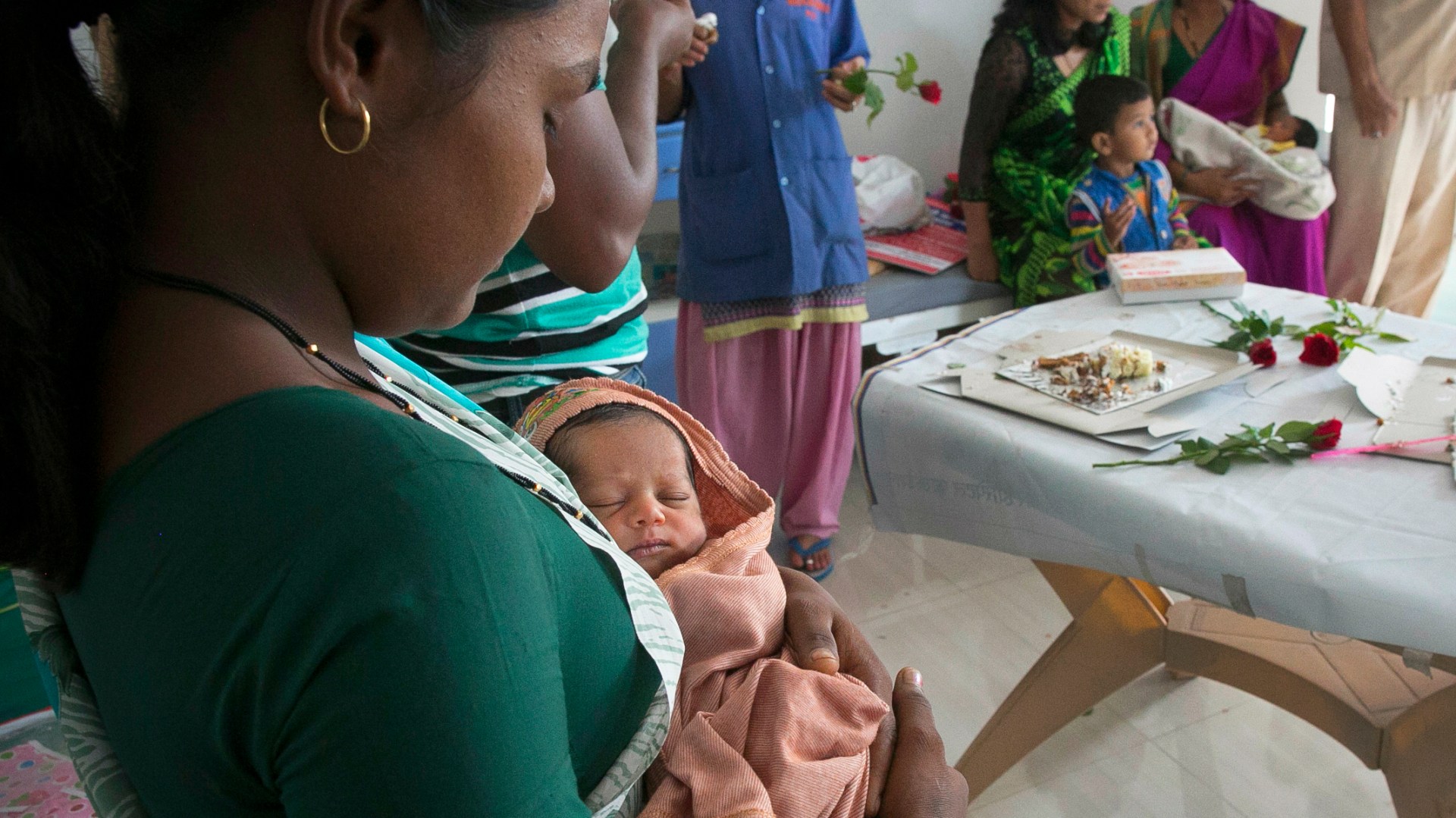
A celebration for newborn baby girls at a Pune hospital offering free medical care for female patients in an effort to reduce "missing girls," as India's birth ratio has been heavily skewed by sex-selective abortions.

A celebration for newborn baby girls at a Pune hospital offering free medical care for female patients in an effort to reduce "missing girls," as India's birth ratio has been heavily skewed by sex-selective abortions.

Christianity Today August 23, 2022
Allison Joyce / Getty Images

Nine million girls have gone “missing” in India over the past two decades due to sex-selective abortions, according to a new report on sex ratios and gendercide in the world’s second-most populous nation.

The problem rests mainly within the Hindu and Sikh communities, according to government-backed data, while the subcontinent’s Christians have maintained a “natural balance” of sons and daughters since 2001, according to a Pew Research Center analysis released today.

Pew estimates that Christians account for 53,000 of the missing girls in India, whereas Hindus account for 7.8 million girls, Muslims account for 590,000 girls, Sikhs account for 440,000 girls, and other religious groups such as Buddhists and Jains account for 110,000 girls.

The tallies were disproportionately high for Hindus, who comprise 79.8 percent of India’s population yet 86.7 percent of the missing girls, as well as for Sikhs, who comprise 1.7 percent of the population yet 4.9 percent of the missing. The tallies were disproportionately low for Muslims, who comprise 14.2 percent of India’s population yet 6.6 percent of the missing girls, as well as for Christians, who comprise 2.3 percent of the population yet 0.6 percent of the missing.

However, bias toward sons is waning among all religious groups in India, and researchers concluded the annual number of missing girls has dropped from about 480,000 in 2010 to about 410,000 in 2019.

“The new data suggests that Indian families are becoming less likely to use abortions to ensure the birth of sons rather than daughters,” stated Pew research associate Yunping Tong. “This follows years of government efforts to curb sex selection—including a ban on prenatal sex tests and a massive advertising campaign urging parents to ‘save the girl child’—and coincides with broader social changes such as rising education and wealth.”

Classic and contemporary excerpts.Forget the numbersThere never has been a power so dramatically opposed to Christianity as the daily press. Day in and day out the daily press does nothing but delude [people] with the supreme axiom of this lie, that numbers are decisive. Christianity, on the other hand, is based on the thought that truth lies in the single individual.—Søren Kierkegaard in Purity of Heart Is to Will One ThingWhat if God is ugly?The question “What if God is ugly?” has been going through my brain for about a year. The more I think about it the more sense it makes to me. Whenever we see something we think is beautiful (based on our own concept of beauty), we think of God. But we all have a different (cultural, individual) sense of beauty. So in heaven a lot of people will be disappointed.…In my creativity class, students have to make a list of ugly and beautiful items. And the lists always surprise me. Under the heading “ugly” I will find the words “spider” and “feet”! How can they claim these are ugly?… What we call ugly is only our appraisal. My lifelong sermon message has been to acknowledge life wherever you are and whatever it is. For the ordinary is special.—Reinhold Piper Marxhau in a letter to Martin Marty (Christian Century, March 23–30, 1988)What’s the difference?The standard of practical holy living has been so low among Christians that very often the person who tries to practice spiritual disciplines in everyday life is looked upon with disapproval by a large portion of the Church. And for the most part, the followers of Jesus Christ are satisfied with a life so conformed to the world, and so like it in almost every respect, that to a casual observer, there is no difference between the Christian and the pagan.—Hannah Whitall Smith in The Christian’s Secret of a Happy LifeA losing raceTechnology is so far ahead of human relations! As for the latter, we are still in the Stone Age. Why do we human beings learn so much, so soon, about technology, and so little, so late, about loving one another?—Henri Nouwen in New Oxford Review (June 1987)God and the mediaIt could not possibly be the case that something men have invented, like the media, could never be serviceable to God.… For instance, once when I was standing waiting for a train in an underground station, a little man … came up to me and asked permission to shake my hand. I gladly, and rather absentmindly, extended a hand.… As we shook hands, he remarked that some words of mine in a radio program had prevented him from commiting suicide. The humbling thing was that I couldn’t remember the particular program he had in mind; doubtless some panel or another, to me buffoonery, and yet a human life had hung on it.—Malcolm Muggeridge in Christ and the MediaAPSALMON TWA FLIGHT 81High above the cloudssix miles over earthI think of Timeand Lifenot timeless lifeof coffee tea or milknot living waterbread of lifeof landingon hard concrete stripnot flying on to meetYou.I guess I fear that.Earthbound in theheavensLord not heavenbound.Lord have mercy.Joseph Bayly inPsalms of My Life:Calligraphy by Tim Botts

Pew’s latest report on religion in India examines the sex ratio at birth among Hindus, Muslims, Christians, and Sikhs, as other religious communities were too small to study. The report found “signs of normalization” in the ratio of baby boys to baby girls, with “son preference” or “daughter aversion” declining “sharply” among Sikhs which previously had the greatest gender imbalance.

While acknowledging geographic variations in laws and norms within India, Pew explained:

Around the world, sex selection is often attributed to “son preference” (or “daughter aversion”), a form of gender bias in which families prioritize having sons over daughters for economic, historical or religious reasons. In India, son preference may be tied to cultural practices that make daughters more costly to raise than sons. In Indian tradition, only sons pass down the family name, thereby carrying on the family lineage, and Hindu sons are expected to perform last rites for deceased parents, including lighting the funeral pyre and scattering their ashes. Sons have also been a way for families to preserve ancestral property because males generally dominate inheritance lines (even though most Indian inheritance laws now prohibit gender discrimination).

Daughters, meanwhile, often take wealth away in the form of large dowries at the time of marriage, with payments sometimes continuing throughout a daughter’s life. And while sons continue to live in the parental home after marriage, with wives who often become the primary caregivers for aging in-laws, a daughter is expected to move away from her parents and into her husband’s family home.

The natural sex ratio at birth is approximately 105. The advent of prenatal testing and legalized abortion in India in the 1970s led to a rise in sex-selective abortions that skewed its sex ratio to a recorded high of 111.2 male births per 100 female births in 2010. This put India among the most skewed nations in the world from 2000 to 2020, alongside China, Vietnam, Albania, Armenia, and Azerbaijan. (The United Nations estimates that China accounts for 51 percent of missing girls and India 32 percent.)

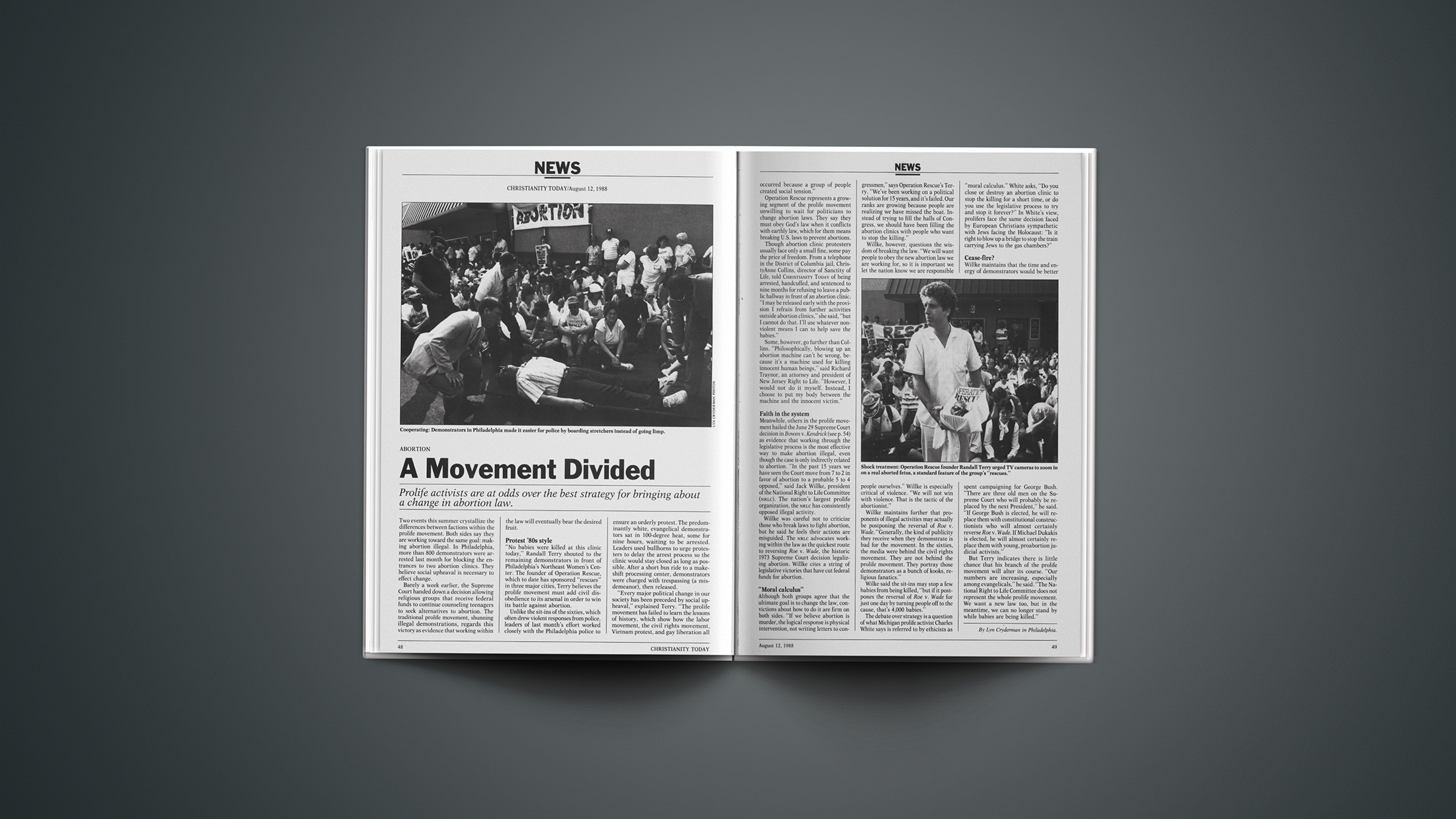
NEWSABORTIONProlife activists are at odds over the best strategy for bringing about a change in abortion law.Two events this summer crystallize the differences between factions within the prolife movement. Both sides say they are working toward the same goal: making abortion illegal. In Philadelphia, more than 800 demonstrators were arrested last month for blocking the entrances to two abortion clinics. They believe social upheaval is necessary to effect change.Barely a week earlier, the Supreme Court handed down a decision allowing religious groups that receive federal funds to continue counseling teenagers to seek alternatives to abortion. The traditional prolife movement, shunning illegal demonstrations, regards this victory as evidence that working within the law will eventually bear the desired fruit.Protest 80S Style“No babies were killed at this clinic today,” Randall Terry shouted to the remaining demonstrators in front of Philadelphia’s Northeast Women’s Center. The founder of Operation Rescue, which to date has sponsored “rescues” in three major cities, Terry believes the prolife movement must add civil disobedience to its arsenal in order to win its battle against abortion.Unlike the sit-ins of the sixties, which often drew violent responses from police, leaders of last month’s effort worked closely with the Philadelphia police to ensure an orderly protest. The predominantly white, evangelical demonstrators sat in 100-degree heat, some for nine hours, waiting to be arrested. Leaders used bullhorns to urge protesters to delay the arrest process so the clinic would stay closed as long as possible. After a short bus ride to a makeshift processing center, demonstrators were charged with trespassing (a misdemeanor), then released.“Every major political change in our society has been preceded by social upheaval,” explained Terry. “The prolife movement has failed to learn the lessons of history, which show how the labor movement, the civil rights movement, Vietnam protest, and gay liberation all occurred because a group of people created social tension.”Operation Rescue represents a growing segment of the prolife movement unwilling to wait for politicians to change abortion laws. They say they must obey God’s law when it conflicts with earthly law, which for them means breaking U.S. laws to prevent abortions.Though abortion clinic protesters usually face only a small fine, some pay the price of freedom. From a telephone in the District of Columbia jail, ChristyAnne Collins, director of Sanctity of Life, told CHRISTIANITY TODAY of being arrested, handcuffed, and sentenced to nine months for refusing to leave a public hallway in front of an abortion clinic. “I may be released early with the provision I refrain from further activities outside abortion clinics,” she said, “but I cannot do that. I’ll use whatever nonviolent means I can to help save the babies.”Some, however, go further than Collins. “Philosophically, blowing up an abortion machine can’t be wrong, because it’s a machine used for killing innocent human beings,” said Richard Traynor, an attorney and president of New Jersey Right to Life. “However, I would not do it myself. Instead, I choose to put my body between the machine and the innocent victim.”Faith In The SystemMeanwhile, others in the prolife movement hailed the June 29 Supreme Court decision in Bowen v. Kendrick (see p. 54) as evidence that working through the legislative process is the most effective way to make abortion illegal, even though the case is only indirectly related to abortion. “In the past 15 years we have seen the Court move from 7 to 2 in favor of abortion to a probable 5 to 4 opposed,” said Jack Willke, president of the National Right to Life Committee (NRLC). The nation’s largest prolife organization, the NRLC has consistently opposed illegal activity.Willke was careful not to criticize those who break laws to fight abortion, but he said he feels their actions are misguided. The NRLC advocates working within the law as the quickest route to reversing Roe v. Wade, the historic 1973 Supreme Court decision legalizing abortion. Willke cites a string of legislative victories that have cut federal funds for abortion.“Moral Calculus”Although both groups agree that the ultimate goal is to change the law, convictions about how to do it are firm on both sides. “If we believe abortion is murder, the logical response is physical intervention, not writing letters to congressmen,” says Operation Rescue’s Terry. “We’ve been working on a political solution for 15 years, and it’s failed. Our ranks are growing because people are realizing we have missed the boat. Instead of trying to fill the halls of Congress, we should have been filling the abortion clinics with people who want to stop the killing.”Willke, however, questions the wisdom of breaking the law. “We will want people to obey the new abortion law we are working for, so it is important we let the nation know we are responsible people ourselves.” Willke is especially critical of violence. “We will not win with violence. That is the tactic of the abortionist.”Willke maintains further that proponents of illegal activities may actually be postponing the reversal of Roe v. Wade. “Generally, the kind of publicity they receive when they demonstrate is bad for the movement. In the sixties, the media were behind the civil rights movement. They are not behind the prolife movement. They portray those demonstrators as a bunch of kooks, religious fanatics.”Wilke said the sit-ins may stop a few babies from being killed, “but if it postpones the reversal of Roe v. Wade for just one day by turning people off to the cause, that’s 4,000 babies.”The debate over strategy is a question of what Michigan prolife activist Charles White says is referred to by ethicists as “moral calculus.” White asks, “Do you close or destroy an abortion clinic to stop the killing for a short time, or do you use the legislative process to try and stop it forever?” In White’s view, prolifers face the same decision faced by European Christians sympathetic with Jews facing the Holocaust: “Is it right to blow up a bridge to stop the train carrying Jews to the gas chambers?”Cease-Fire?Willke maintains that the time and energy of demonstrators would be better spent campaigning for George Bush. “There are three old men on the Supreme Court who will probably be replaced by the next President,” he said. “If George Bush is elected, he will replace them with constitutional constructionists who will almost certainly reverse Roe v. Wade. If Michael Dukakis is elected, he will almost certainly replace them with young, proabortion judicial activists.”But Terry indicates there is little chance that his branch of the prolife movement will alter its course. “Our numbers are increasing, especially among evangelicals,” he said. “The National Right to Life Committee does not represent the whole prolife movement. We want a new law too, but in the meantime, we can no longer stand by while babies are being killed.”By Lyn Cryderman in Philadelphia.

Studying birth data from 2001 to 2021, Pew found that Christians in India have maintained a natural sex ratio of 105 or below, while Muslims have a ratio of 106, down from 109 in the 2011 census. Hindus have dropped from 112 to 109, while Sikhs have dropped from 121 to 110.

Binita Behera, a Christian sociologist in Bhubaneshwar, the capital of the eastern state of Odisha (formerly Orissa), focuses on female feticide and works with SALT, a department of the Evangelical Fellowship of India focused on issues of gender equality. She credited the healthy sex ratio for Christians to the teaching that “children are a gift from God.” She also noted that “not worrying about giving dowry in a daughter’s marriage is a big relief for Christians.”

Among Indian women ages 15–49, the share of Christians who want more sons than daughters has dropped over the past two decades from 20 percent to 12 percent. By comparison, Muslims have dropped from 34 percent to 19 percent, Hindus have dropped from 34 percent to 15 percent, and Sikhs have dropped from 30 percent to 9 percent.

Meanwhile, Indian Christians have the highest preference for more daughters, both in share (7 percent) and change (up two percentage points). And only 49 percent of Christian women with no living sons want to have more children, close to the 43 percent with no living daughters who want the same.

Yet Christian fertility rates have also declined over the past two decades, from 2.4 by 1999 to 1.9 by 2020. So have rates for all faiths: from 3.6 to 2.4 for Muslims, from 2.8 to 1.9 for Hindus, and from 2.3 to 1.6 for Sikhs.

Based on the available data on births to Christians (see sidebar below), Pew estimates:

  • 12% of Indian Christian women want more sons than daughters
  • 7% want more daughters than sons
  • The fertility rate for Indian Christians is 1.9
  • 52% of Indian Christian children are boys

“Christians know from the Bible that God created humankind as male and female and that he values them both. This is what shapes their worldview,” said Vidush Bhandari, principal of Doon Bible College in Dehradun, Uttarakhand in Northern India.

“The Bible affirms that male and female are created equal, gifted equally, and both are called by God to make his glory known in the world.”

Pew noted its report is the first to estimate “missing” girls in India by religious group. But researchers also noted that differences in sex ratios at birth are not solely due to religion.

After all, the founder of Sikhism, Guru Nanak, insisted that women deserve the same treatment as men, and Sikh holy scriptures emphasize equal rights for men and women. Meanwhile, Hindus worship divinity in female form as Shakti, as well as many female deities and consorts of male gods.

The skewed sex ratios are predominantly due to social and not only religious reasons, said Bhandari.

Pew noted that demographic factors such as wealth, education, and urbanness also play a role. So does caste.

Christians comprise 47 percent of Indian adults with 10 years of schooling, 26 percent of Indian households in the top wealth quintile, and 39 percent of Indian households in urban areas. Meanwhile, a previous Pew survey of 30,000 Indians found that 3 in 4 Christian households “belong to a historically disadvantaged caste, including 22 percent who say they are members of a Scheduled Caste.”

Pew explained:

Of India’s four major religious groups, Sikhs on average are the wealthiest, by a wide margin. Approximately six-inten Sikh households fall in the highest wealth quintile, according to the NFHS wealth index, which includes measures such as whether a household has certain appliances and where it obtains drinking water. This may be tied to their geographic concentration in India’s northwest, which is home to a disproportionately high share of wealthy households. But even within regions, Sikhs tend to be more affluent than other religious groups.

According to NFHS data, Christians are the second wealthiest group, with a quarter of Christian households (26%) in the top wealth quintile, followed by roughly one-in-five Hindus and Muslims. Although nearly half of India’s Christians are concentrated in the affluent South, the remainder reside mainly in the relatively impoverished Northeast and East, so Christians overall lag far behind Sikhs.

Christians and Muslims tend to be more urban than Hindus and Sikhs. About four-in-ten Christian and Muslim households are in urban areas, compared with roughly three-in-ten Hindu and Sikh households. Cities usually offer more advanced hospitals, public transportation and other essential facilities. However, Muslims who live in cities tend to be concentrated in poorer urban areas with limited access to basic services such as water, health care, education and sanitation. The same is true of other socially disadvantaged groups, such as Dalits and tribal communities.

Premjeet Titus, pastor of Ekklesia Christian Fellowship in Mohali, Punjab, believes that dowry culture is the primary reason for female feticide.

“The moment a girl child is born, poor parents start to think about somehow arranging for 10,00,000 rupees [USD 12,500] for her marriage,” he said. “… They don’t spend on the education of their children but instead start to save for the marriage. Because it is so hard, it’s easier for them to kill the girl child in the womb.”

A dowry prohibition act has existed since 1961, but is not enforced. Titus thinks the government should enforce it, while churches should educate their members and create opportunities for equality.

“The church has a vital role to play. The church has to go out,” said Titus. “Let’s not wait for a crowd; 1-on-1 conversation has a greater effect.”

Lack of education is a major factor maintaining the societal bias against female offspring, said Rajan Baby, senior pastor of Indian Christian Assembly in Chandigarh, the joint capital of the northern states of Punjab and Haryana. After leading his church for 40 years, he believes awareness campaigns and intentional effort on the part of the society can overcome the gap.

“Children are a gift of God, and must be treated as such,” he said. “Life is sacred and should not be snuffed out in this manner.”

“We grow up to be what we have observed while growing up,” said Behera. She noted how in the Northeast both men and women cook, unlike in other parts of India. “When a boy grows up watching his dad help his mom in the kitchen, he grows to become a man who knows that work is not gender sensitive.”

Behera believes Christians can aid gender equality. “We must continue to reiterate—in all our retreats, youth programs, seminars, and Sunday school events—and to practice gender equality conduct.” For example, at a youth retreat assigning the responsibility of buying vegetables to the boys and sweeping to the girls. “By bringing gender equality in our churches, we will be giving rise to a different practice.”

The Indian government has been running a massive advertising campaign urging parents to “save the girl child.” In December 2021, the Parliamentary Committee on Empowerment of Women reported the flagship BBBP campaign—“Beti Bachao, Beti Padhao,” or “Save the girl child, educate the girl child”—launched in 2015 had spent 80 percent of its funds only on media advocacy, according to The Hindu newspaper.

Pew’s methodology and analysis rely mostly on India’s last census, which dates to 2011 because a 2021 update was delayed, and its government-supported National Family Health Survey (NFHS), most recently conducted from 2019 to 2021.

“Aborting females may have consequences that reverberate beyond the families making the choice,” noted Tong. “International research shows that societies with high rates of sex-selective abortions typically suffer within a couple of decades from a shortage of marriageable women and a surplus of men seeking brides. This ‘marriage squeeze’ can trigger a variety of social problems, such as increases in sex-related violence and crimes and trafficking of women.

“Even if India’s sex ratio at birth continues to normalize, the large number of girls ‘missing’ from its population could continue to have profound consequences on Indian society for decades to come.”

What is the creation account trying to tell us?Evangelicals agree that the Bible is the inspired Word of God. And they reject in unison any approach that treats Scripture with a profound skepticism regarding its historical credibility. Yet when they read Genesis 1:1–2:3, there is anything but unanimity.While there seems to be great variety of opinion, we can generally divide evangelical scholars who study the early chapters of Genesis into two groups: concordists and nonconcordists.The concordists try to harmonize (or find concord between) Genesis 1:1–2:3 and scientific descriptions of Earth’s origins. Some (called scientific creationists) harmonize science with their straightforward reading of the Bible. Others (called creation scientists) harmonize the Bible with science.The creation scientists, in turn, are composed of various subgroups: progressives (who construe the “days” of Genesis as immense periods of time) and re-creationists (who reckon with more than one creation). In addition, there are transformationalists, who argue for a pre-Genesis Earth and time. They may belong to either kind of concordist. Re-creationists and transformationalists reject the traditional reading of Genesis 1:1–3, which understands those verses to describe the beginning of Earth-time, when God created the Earth from nothing.The second group, nonconcordists, may disagree about the meaning of “days” and the syntax of Genesis 1:1–3. But they agree that Genesis teaches neither straightforward history nor science, and needs no reconciliation with the kind of history and science devoted exclusively to what can be observed and measured.Which of these groups you find yourself in depends on how you answer three big questions about the biblical Creation account:• What kind of literature is Genesis 1:1–2:3?• What does the author mean by the word day?• How are the phrases and sentences of Genesis 1:1–3 related?Let us examine them in reverse order.How Is Genesis 1:1–3 Put Together?Knowing how the various parts of a statement are related can make a big difference in our understanding. For instance, I might write: “I went to my office today. The telephone system wasn’t working right. I felt discouraged. I went home early.” That is rather inelegant writing, in part because I did not explicitly connect the ideas with words that showed time relationships or cause-and-effect patterns. You would probably read some relationships into that passage—that the malfunctioning telephones caused my discouragement—and you might be right; but you might be wrong.Likewise, the first few sentences of Genesis are not connected in a clear way. Thus, scholars suggest relationships between the sentences and come to different understandings of the text.• One group of scholars sees Genesis 1:2 as contemporaneous with Genesis 1:1. This is a traditional view in which 1:1 recounts God’s original creation of the Earth, and 1:2 gives us three situations belonging to the same time period: (a) the Earth was “formless and empty”; (b) there was “darkness over the surface of the deep”; and (c) “the Spirit of God hovered over the waters.” Following this line of thought, Calvin commented: “For Moses simply intends to assert that the world was not perfected at its commencement …”All schools of thought see God’s activity of 1:3 (“Let there be light”) as later than the situation in 1:2. But this school sees all of 1:1–5 (from “In the beginning” right through the end of the first day’s creation) belonging to the same chronological grouping.In its favor, this view has the support of the classic Hebrew grammar, Gesenius-Kautzsch-Cowley. And theologians prefer it to a transformational theory that reads God’s “In the beginning” creation of 1:1 as earlier creation attempts than the one described in the six days recounted in the rest of the chapter.But there are insurmountable problems with this traditional interpretation. This passage contains pairs of words called syntagmes, words that occur together in various contexts to denote one unique notion. One scholar explained it this way: “In language, as in chemistry, a compound may be found to possess qualities absent from its constituent elements. For example, anyone who does not know what ‘broadcast’ denotes, will not be able to guess the connotation of the word from its separate elements ‘broad’ and ‘cast’ ” (U. Cassuto, A Commentary on the Book of Genesis).Let us take the word-pair heaven and earth. Like our phrase night and day, it is a statement of opposites to indicate totality. Night and day means “all the time.” Likewise, heaven and earth signifies “the entire organized universe” or “the cosmos.” Brevard Childs of Yale Divinity School concludes that this syntagme never stands for disorderly chaos, but always for an ordered world. And John Skinner says it “is a Hebrew designation of the universe as a whole … the organized universe, not the chaotic material out of which it was formed.”Next let us look at empty and formless. This word pair (which reads tohu wabohu in Hebrew) is a rhyming syntagme, something like the English phrase hanky-panky. It stands for “chaos,” and it is the antithesis of the “cosmos” of verse 1. Logically, the disorderly chaos and the orderly cosmos cannot be applied to the same thing and the same time—and thus verses 1 and 2 simply cannot be contemporaneous.• Another way to understand the relationship between the sentences of Genesis 1:1–3 is to see verse 2 as following verse 1 in time.According to re-creationists, verse 2 tells of a second Creation that happened after the original Creation recorded in verse 1. The first Creation, they say, may have occurred millions of years ago but was reduced to chaos by divine judgment on disobedient spiritual beings; and the second Creation happened around 4000 B.C. According to this so-called gap theory, most fossils are relics of the first Creation.Although it was the Scofield Reference Bible that popularized and sanctioned this view in 1909, it has its roots in early Jewish tradition and has been held throughout the history of the church. Moreover, the verb translated “was” in verse 2 may mean “became”—“The earth became formless and empty.” Finally, the condition “formless and empty,” when it occurs in other Old Testament contexts (Jer. 4:23, Isa. 34:1), is the result of divine judgment.But this interpretation faces an insurmountable problem: the “and” that introduces the “formless and empty” description of verse 2 does not imply a subsequent situation (unlike the “and” introducing verse 3: “And [then] God said: ‘Let there be light’ ”). Also, although the formlessness and emptiness in Isaiah and Jeremiah result from God’s fury, it is not logically necessary (or even likely) that this chaos arises from his wrath. Peter knows of only two divine judgments on the whole Earth: a past flood and a future fire (2 Peter 3:5–7).• A third way to understand the relationship between the Bible’s first sentences is to see verse 1 as a dependent clause, with verse 2 as either a parenthesis or the principal clause—as in several recent translations:When God began to create the heaven and the earth—the earth being unformed and void …—God said …(Jewish Publication Society, 1962)In the beginning, when God created the heavens and the earth, the earth was a formless wasteland.… Then God said …(New American Bible, 1970)In the beginning of creation, when God made heaven and earth, the earth was without form and void.… God said …(New English Bible, 1970)All three endorse a transformational view of Creation, entailing a pre-Genesis time and chaotic space.The eminent scholar of Hebrew Scriptures, Harry Orlinsky, argued that the cumulative evidence—from the study of lexicons, syntax, context, and comparable Near Eastern stories of how the universe began—favors this interpretation. Indeed, no lexical or grammatical objections can be raised against it. But the context and the comparisons with other Near Eastern creation stories favors the next view we shall examine. Moreover, with two notable exceptions, Jewish and Christian traditions have understood verse 1 as an independent clause.• A fourth way of understanding the relationships in these verses (and perhaps the best way) is to see verse 1 as a summary statement that matches the concluding summary statement of Genesis 2:1: “Thus the heavens and the earth were completed”; and to see verse 2 as a circumstantial clause modifying verse 3.Thus understood, Genesis 1:1–3 could be translated: “In the beginning God created the cosmos. Now [this is how it happened]. The earth was chaotic …, and then God said …” Like the third option, this reading also entails a pre-Genesis time and Earth.Read this way, Genesis 1:1–3 would be similar in structure to the introduction of the other Creation story in Genesis 2:4–7, as well as with other ancient Near Eastern tales of how it all began.An obvious theological objection will be raised against this transformationalist view. Where did the negative conditions originate? The question is best answered with another question: Where did Satan originate? The origins of both moral evil and natural evils (like tornadoes and malaria) remain a mystery in monotheism, and Genesis offers a relative beginning with respect to each. Nevertheless, by comparing Scripture with Scripture, transformationalists should conclude that both evil and matter are temporal in contrast to the eternal (see Jer. 10:16; John 1:3; Col. 1:16).Since Genesis seems to presume pre-existent matter and time, scientific creationists would do better to argue for an old Earth rather than a young one.How Long Are The “Days” Of Genesis?Part of the problem science poses for the interpreter of Genesis is the long periods of time required to lay down the fossil record. Obviously, those who wish to harmonize Bible and science must in some way read the seven days of Creation as something other than 24-hour days.Progressive creationists—who tend to minimize divine, special intervention and to maximize the operation of natural law—make room for the long ages in two ways:First, some interpret the days of Genesis as successive days on which God revealed his creative process to Moses. Back in the last century, J. H. Kurtz wrote that God revealed to his prophet, Moses, through visions seven progressive scenes of pre-Adamite creation. And in 1936, P. J. Wiseman suggested that God told Moses the story over six days. In this approach, the six visions are presented in logical, but not strictly chronological, order. Wiseman embellishes the theory by noting that Babylonian Creation accounts were customarily put on six tablets with a concluding colophon. And so in Genesis, he alleges, there was a day of revelation for each tablet followed by “the colophon of Genesis 2:4.”This interpretation of “day” faces the objection that it adds to Scripture. Genesis 1:1–2:3 contains nothing comparable to the introduction in Genesis 15:1: “And the word of the LORD came to Abram in a vision.” And in any case, the verb “made” cannot be changed into “showed” in Genesis 2:2: “And on the seventh day, God ended his work which he had made, and he rested on the seventh day.”Second, some progressive creationists interpret the days as ages, which they correlate with the successive epochs recorded in the geological column. These advocates of the “day age” theory (which W. B. Riley called, “The Devil’s Counterfeit”) argue that the Hebrew word yom can have other meanings than “a 24-hour period.” For example, in Genesis 2:4, we find the phrase “in the day,” referring to the whole creative process recorded in Genesis 1:1–2:3. Gleason Archer of Trinity Evangelical Divinity School also argues cogently that the events recorded in 2:4–25 (the making of Adam, the planting of the garden, the naming of the animals, and the gift of a bride) cannot be squeezed into a sixth 24-hour period.This view, however, satisfies neither the text nor science. Terence E. Fretheim of Lutheran Northwestern Theological Seminary linguistically validates the assertion that the author of Genesis intended to write of 24-hour days. And Robert C. Newman of Biblical Theological Seminary shows that they were intended to be chronologically successive. Moreover, in Genesis, against scientific understanding, plants precede marine organisms and even the sun, and birds precede insects. Problems, such as the chronological tension of so much happening on the sixth day, are better explained by an artistic-literary approach.What Kind Of Literature Is Genesis 1:1–2:3?The strongest evidence that Genesis 1:1–2:3 should be read as a historically and scientifically accurate narrative is that this traditional interpretation seems to be the plain, normal sense of the passage. When the fourth commandment gives God’s six days of creation and one day of rest as a pattern for human work and Sabbath, it seems to clinch the argument (Exod. 20:11).But there are two acute contradictions between Genesis and normative science about terrestrial origins: How long the process took, and in what order events took place. These contradictions have driven some biblical scholars to suspect that the passage was not intended to be taken in so straightforward a manner. They have asked just what kind of literature it is, and have compared and contrasted their own preunderstandings with those of the biblical writers. Even if the prodigious research, debates, and diligent publications of the scientific creationists should fully harmonize science with Genesis, Bible scholars can never again read the text through uncorrected lenses.Former Barrington College President Charles Hummel noted that Genesis 1:1–2:3 is unlike science in these ways:• Its subject is God, not the forces of nature;• Its language is everyday speech, not mathematics and technical jargon;• It is prescriptive (answering the questions who, why, and what ought to be), not descriptive (answering the questions what, how, and what is);• It is written for the covenant community and is validated by the Spirit, not for a scientific community or validated by empirical evidence.To pit the biblical claim of Ultimate Cause (“God created the heavens and the earth”) against scientific claims of immediate causes is as mischievous as pitting David’s theological assertion “You created my inmost being” (Ps. 139:13) against genetics. The Bible shows a marked disinterest in the mechanics of Creation (compare the one chapter devoted to the origins of the Earth and life to the numerous detailed chapters in Exodus, Leviticus, Chronicles, and Ezekiel devoted to recounting the formation of Israel’s formal worship system). And certainly science cannot answer questions of the creation’s purpose or value.In addition, nonconcordists say Genesis 1 conflicts with the aims of modern historians, who exclude ultimate cause and stress brute fact. In contrast to that kind of history writing, the Bible editorializes to the point that it rearranges the order of events in order to make theological points. For example, D. J. A. Clines of Sheffield University shows that the Table of Nations in Genesis 10 (which must chronologically follow the scrambling of languages at the Tower of Babel in Genesis 11) was dischronologized for theological reasons: The author wants to present mankind under God’s blessing to be fruitful and to fill the Earth. And while Exodus (7:14–11:10) reports that God inflicted ten plagues on Egypt, beginning with blood, the poet-theologian of Psalm 105 (vv. 28–41) feels free to reduce the number to seven and begin with darkness (to contrast with God’s three miracles in the desert that begin with light). Similar rearrangements of events in the synoptic Gospels are well known.Ronald Youngblood of Bethel Seminary West has demonstrated that Genesis 1:1–2:3 has also been dischronologized. In brute history, he argues, it seems unlikely that God created light and “separated light from darkness” on the first day, and then created luminaries as the means “to separate light from darkness” on the fourth day, or that evening and morning existed on the first three days before he created the heavenly lights to mark off days.These obvious incongruities in the text suggest to more and more evangelicals that a literary reading of Genesis 1:1–2:3 is called for. Systematic theologian Henri Blocher of the Faculté Libre de Théologie Evangélique labels the genre as “historico-artistic.” According to him, the interpreter should understand “the form of the week attributed to the work of creation to be an artistic arrangement … not to be taken literally.” “It is possible,” he adds, “that the logical order [the author] has chosen coincides broadly with the actual sequence of events of the facts of cosmogony; but that does not interest him. He wishes to bring out certain themes and provide a theology of the sabbath.” This approach not only relieves tensions within the narrative itself and with science, but also with the second Creation story (Genesis 2:4–25).Australian scholar N. Weeks offers a plausible objection: “There is no logical reason why the presence of a structure should prove that a passage is not to be taken literally.” But Weeks fails to address the tensions within the text as well as the figurative elements we shall note later. And Blocher argues against this objection by applying the philosophical principle that prefers simple solutions to multiplied hypotheses.R. Clyde McCone, professor of anthropology and linguistics at California State University, also objects to a literary approach. He complains, with some justification, that literary theories shift the focus of study away from God to the text and “present little substantive revelation of God.” This may be true of many literary approaches, but it certainly is not necessary.Even as exegetes call for a literary rereading of the text as an artistic achievement, theologians, professional and self-taught, are calling for a figurative approach. Howard Van Till of Calvin College notes that God’s actions in Creation “are presented in highly figurative and anthropomorphic language.” Even the eminently conservative commentator E. J. Young points to the repeated formulae, “God said,” and “God called,” and reminds us that “God did not speak with physical organs of speech nor did he utter words in the Hebrew language.” These expressions and others portray the transcendent God and his activity in human forms so that earthlings may understand him. So nonconcordists ask: In the light of these obvious and numerous anthropomorphisms, is it not plausible to suppose that the first week is also an anthropomorphic representation of the Creator’s work and rest, so that the covenant people could bear witness to him and imitate his pattern?If Moses did not intend to write a straightforward history, but an artistic literary account in anthropomorphic language (so that God’s people might imitate him), this would also give us a clue to the meaning of the fourth commandment.While calling Genesis 1:1–2:3 a literary work, nonconcordists shy away from using the word myth. For most people, that slippery term implies a fanciful, untrue story. Besides, there is actually very little similarity between this story and pagan accounts of the beginning and ordering of the universe. Indeed, some have pointed out that Genesis 1:1–2:3 reads like a polemic against pagan cosmogonies.Having surveyed the answers to the three big questions, we can draw some conclusions. Perhaps it is best to regard Genesis 1:1–2:3 as a creation story in torah (“instruction”), which is a majestic, artistic achievement, employing anthropomorphic language. As H. J. Sørenson said in the New Catholic Encyclopedia: “The basic purpose is to instruct men on the ultimate realities that have an immediate bearing on daily life and on how to engage vitally in these realities to live successfully. It contains ‘truths to live by’ rather than ‘theology to speculate on.’ ”Moses intended no distinction between historical data and its theological shaping, and Bible students should resist the temptation to separate the two. Historical critics evaporate history, but nonconcordist evangelicals must take history seriously and compare Scripture with Scripture, a task that some accomplish better than others: In Literary Approaches to Biblical Interpretation, for example, Westminster Theological Seminary’s Tremper Longman helps readers walk gingerly between the promise and pitfalls of the literary approach to the Old Testament. In The Fourth Day, however, Howard Van Till seems to lose his balance when he writes that the primeval history in Genesis 1–11 is not concerned with whether the events actually happened.This literary approach may unsettle some who cling to the Reformers’ claim that Scripture is perspicuous. But note: The literary approach to Genesis 1:1–2:3 changes no doctrine of the church while it helps us to see some of them more clearly.Bruce Waltke is professor of Old Testament at Westminster Seminary, Philadelphia. He is coauthor of the newly published Obadiah, Jonah, Micah volume in the Tyndale Old Testament Commentary series (InterVarsity Press).

Additional reporting by CT editors. Pew’s specific analysis of Christians is posted below:

Spotlight on Christians: Low rates of sex selection


Among Christians, the sex ratio at birth has consistently stayed between 103 and 105 in each of the datasets in this analysis. Partially due to their concentration in the South, Christian women ages 15 to 49 are less likely than the average Indian woman in this age group to say they would prefer to have more sons than daughters (12% vs. 15% for all Indian women ages 15 to 49) and more likely to say they would prefer to have more daughters than sons (7% vs. 3%, respectively).

Some scholars suggest Christians’ balanced sex ratio at birth is due in part to the religion’s history in India, and the prevalence of Christian social programs and cultural practices that focus on girls and women.

Many of India’s Christians are descendants of Dalit Hindus who converted to Christianity in part to escape caste-based discrimination. Large-scale conversions are reported to have taken place in the late 19th and early 20th centuries in connection with famines, natural disasters, epidemics and other crises that resulted in economic hardship. After conversion, missionary organizations often provided low-caste Christians with educational opportunities, and converts could take jobs that previously had been denied to them based on caste status.

Some scholars suggest that low-caste Hindus who converted to Christianity gained more than just material benefits. Converting may have given former Dalit Hindus a new self-image, eased the transition away from their traditional, “unclean” occupations and made new educational opportunities possible for their children.

Women, in particular, may have benefited from these types of changes. Christian missions in India have emphasized evangelical work among women since the 19th century, operating schools for girls as well as for boys. There were also missionary programs dedicated to educating women and training them for employment, such as the Mukti (Salvation) Mission. In addition, many Christian organizations prioritize maternal and child health by improving women’s access to health care facilities. Some scholars trace Christian missionary work to long-lasting benefits for Christians and cite the Christian emphasis on empowering women as a partial explanation for Christian girls’ better health outcomes.

This history may help explain why Christians are the least likely of India’s religious groups to engage in sex-selective abortions, and why the share of Christians who would prefer to have more daughters than sons (7%) is several percentage points greater than other religious groups. Nevertheless, Pew Research Center estimates that Christians have practiced sex selection at least to some extent, given the roughly 53,000 female births missing among Christians in India between 2000–19. To some degree, the estimate reflects the pervasive influence of son preference throughout Indian society. Christians, especially those who live in the North and West, may not be immune to this bias and the practice of sex selection. For instance, in the most recent census, the sex ratio at birth among Christians in these two regions was around 110 boys per 100 girls.

What is the creation account trying to tell us?Evangelicals agree that the Bible is the inspired Word of God. And they reject in unison any approach that treats Scripture with a profound skepticism regarding its historical credibility. Yet when they read Genesis 1:1–2:3, there is anything but unanimity.While there seems to be great variety of opinion, we can generally divide evangelical scholars who study the early chapters of Genesis into two groups: concordists and nonconcordists.The concordists try to harmonize (or find concord between) Genesis 1:1–2:3 and scientific descriptions of Earth’s origins. Some (called scientific creationists) harmonize science with their straightforward reading of the Bible. Others (called creation scientists) harmonize the Bible with science.The creation scientists, in turn, are composed of various subgroups: progressives (who construe the “days” of Genesis as immense periods of time) and re-creationists (who reckon with more than one creation). In addition, there are transformationalists, who argue for a pre-Genesis Earth and time. They may belong to either kind of concordist. Re-creationists and transformationalists reject the traditional reading of Genesis 1:1–3, which understands those verses to describe the beginning of Earth-time, when God created the Earth from nothing.The second group, nonconcordists, may disagree about the meaning of “days” and the syntax of Genesis 1:1–3. But they agree that Genesis teaches neither straightforward history nor science, and needs no reconciliation with the kind of history and science devoted exclusively to what can be observed and measured.Which of these groups you find yourself in depends on how you answer three big questions about the biblical Creation account:• What kind of literature is Genesis 1:1–2:3?• What does the author mean by the word day?• How are the phrases and sentences of Genesis 1:1–3 related?Let us examine them in reverse order.How Is Genesis 1:1–3 Put Together?Knowing how the various parts of a statement are related can make a big difference in our understanding. For instance, I might write: “I went to my office today. The telephone system wasn’t working right. I felt discouraged. I went home early.” That is rather inelegant writing, in part because I did not explicitly connect the ideas with words that showed time relationships or cause-and-effect patterns. You would probably read some relationships into that passage—that the malfunctioning telephones caused my discouragement—and you might be right; but you might be wrong.Likewise, the first few sentences of Genesis are not connected in a clear way. Thus, scholars suggest relationships between the sentences and come to different understandings of the text.• One group of scholars sees Genesis 1:2 as contemporaneous with Genesis 1:1. This is a traditional view in which 1:1 recounts God’s original creation of the Earth, and 1:2 gives us three situations belonging to the same time period: (a) the Earth was “formless and empty”; (b) there was “darkness over the surface of the deep”; and (c) “the Spirit of God hovered over the waters.” Following this line of thought, Calvin commented: “For Moses simply intends to assert that the world was not perfected at its commencement …”All schools of thought see God’s activity of 1:3 (“Let there be light”) as later than the situation in 1:2. But this school sees all of 1:1–5 (from “In the beginning” right through the end of the first day’s creation) belonging to the same chronological grouping.In its favor, this view has the support of the classic Hebrew grammar, Gesenius-Kautzsch-Cowley. And theologians prefer it to a transformational theory that reads God’s “In the beginning” creation of 1:1 as earlier creation attempts than the one described in the six days recounted in the rest of the chapter.But there are insurmountable problems with this traditional interpretation. This passage contains pairs of words called syntagmes, words that occur together in various contexts to denote one unique notion. One scholar explained it this way: “In language, as in chemistry, a compound may be found to possess qualities absent from its constituent elements. For example, anyone who does not know what ‘broadcast’ denotes, will not be able to guess the connotation of the word from its separate elements ‘broad’ and ‘cast’ ” (U. Cassuto, A Commentary on the Book of Genesis).Let us take the word-pair heaven and earth. Like our phrase night and day, it is a statement of opposites to indicate totality. Night and day means “all the time.” Likewise, heaven and earth signifies “the entire organized universe” or “the cosmos.” Brevard Childs of Yale Divinity School concludes that this syntagme never stands for disorderly chaos, but always for an ordered world. And John Skinner says it “is a Hebrew designation of the universe as a whole … the organized universe, not the chaotic material out of which it was formed.”Next let us look at empty and formless. This word pair (which reads tohu wabohu in Hebrew) is a rhyming syntagme, something like the English phrase hanky-panky. It stands for “chaos,” and it is the antithesis of the “cosmos” of verse 1. Logically, the disorderly chaos and the orderly cosmos cannot be applied to the same thing and the same time—and thus verses 1 and 2 simply cannot be contemporaneous.• Another way to understand the relationship between the sentences of Genesis 1:1–3 is to see verse 2 as following verse 1 in time.According to re-creationists, verse 2 tells of a second Creation that happened after the original Creation recorded in verse 1. The first Creation, they say, may have occurred millions of years ago but was reduced to chaos by divine judgment on disobedient spiritual beings; and the second Creation happened around 4000 B.C. According to this so-called gap theory, most fossils are relics of the first Creation.Although it was the Scofield Reference Bible that popularized and sanctioned this view in 1909, it has its roots in early Jewish tradition and has been held throughout the history of the church. Moreover, the verb translated “was” in verse 2 may mean “became”—“The earth became formless and empty.” Finally, the condition “formless and empty,” when it occurs in other Old Testament contexts (Jer. 4:23, Isa. 34:1), is the result of divine judgment.But this interpretation faces an insurmountable problem: the “and” that introduces the “formless and empty” description of verse 2 does not imply a subsequent situation (unlike the “and” introducing verse 3: “And [then] God said: ‘Let there be light’ ”). Also, although the formlessness and emptiness in Isaiah and Jeremiah result from God’s fury, it is not logically necessary (or even likely) that this chaos arises from his wrath. Peter knows of only two divine judgments on the whole Earth: a past flood and a future fire (2 Peter 3:5–7).• A third way to understand the relationship between the Bible’s first sentences is to see verse 1 as a dependent clause, with verse 2 as either a parenthesis or the principal clause—as in several recent translations:When God began to create the heaven and the earth—the earth being unformed and void …—God said …(Jewish Publication Society, 1962)In the beginning, when God created the heavens and the earth, the earth was a formless wasteland.… Then God said …(New American Bible, 1970)In the beginning of creation, when God made heaven and earth, the earth was without form and void.… God said …(New English Bible, 1970)All three endorse a transformational view of Creation, entailing a pre-Genesis time and chaotic space.The eminent scholar of Hebrew Scriptures, Harry Orlinsky, argued that the cumulative evidence—from the study of lexicons, syntax, context, and comparable Near Eastern stories of how the universe began—favors this interpretation. Indeed, no lexical or grammatical objections can be raised against it. But the context and the comparisons with other Near Eastern creation stories favors the next view we shall examine. Moreover, with two notable exceptions, Jewish and Christian traditions have understood verse 1 as an independent clause.• A fourth way of understanding the relationships in these verses (and perhaps the best way) is to see verse 1 as a summary statement that matches the concluding summary statement of Genesis 2:1: “Thus the heavens and the earth were completed”; and to see verse 2 as a circumstantial clause modifying verse 3.Thus understood, Genesis 1:1–3 could be translated: “In the beginning God created the cosmos. Now [this is how it happened]. The earth was chaotic …, and then God said …” Like the third option, this reading also entails a pre-Genesis time and Earth.Read this way, Genesis 1:1–3 would be similar in structure to the introduction of the other Creation story in Genesis 2:4–7, as well as with other ancient Near Eastern tales of how it all began.An obvious theological objection will be raised against this transformationalist view. Where did the negative conditions originate? The question is best answered with another question: Where did Satan originate? The origins of both moral evil and natural evils (like tornadoes and malaria) remain a mystery in monotheism, and Genesis offers a relative beginning with respect to each. Nevertheless, by comparing Scripture with Scripture, transformationalists should conclude that both evil and matter are temporal in contrast to the eternal (see Jer. 10:16; John 1:3; Col. 1:16).Since Genesis seems to presume pre-existent matter and time, scientific creationists would do better to argue for an old Earth rather than a young one.How Long Are The “Days” Of Genesis?Part of the problem science poses for the interpreter of Genesis is the long periods of time required to lay down the fossil record. Obviously, those who wish to harmonize Bible and science must in some way read the seven days of Creation as something other than 24-hour days.Progressive creationists—who tend to minimize divine, special intervention and to maximize the operation of natural law—make room for the long ages in two ways:First, some interpret the days of Genesis as successive days on which God revealed his creative process to Moses. Back in the last century, J. H. Kurtz wrote that God revealed to his prophet, Moses, through visions seven progressive scenes of pre-Adamite creation. And in 1936, P. J. Wiseman suggested that God told Moses the story over six days. In this approach, the six visions are presented in logical, but not strictly chronological, order. Wiseman embellishes the theory by noting that Babylonian Creation accounts were customarily put on six tablets with a concluding colophon. And so in Genesis, he alleges, there was a day of revelation for each tablet followed by “the colophon of Genesis 2:4.”This interpretation of “day” faces the objection that it adds to Scripture. Genesis 1:1–2:3 contains nothing comparable to the introduction in Genesis 15:1: “And the word of the LORD came to Abram in a vision.” And in any case, the verb “made” cannot be changed into “showed” in Genesis 2:2: “And on the seventh day, God ended his work which he had made, and he rested on the seventh day.”Second, some progressive creationists interpret the days as ages, which they correlate with the successive epochs recorded in the geological column. These advocates of the “day age” theory (which W. B. Riley called, “The Devil’s Counterfeit”) argue that the Hebrew word yom can have other meanings than “a 24-hour period.” For example, in Genesis 2:4, we find the phrase “in the day,” referring to the whole creative process recorded in Genesis 1:1–2:3. Gleason Archer of Trinity Evangelical Divinity School also argues cogently that the events recorded in 2:4–25 (the making of Adam, the planting of the garden, the naming of the animals, and the gift of a bride) cannot be squeezed into a sixth 24-hour period.This view, however, satisfies neither the text nor science. Terence E. Fretheim of Lutheran Northwestern Theological Seminary linguistically validates the assertion that the author of Genesis intended to write of 24-hour days. And Robert C. Newman of Biblical Theological Seminary shows that they were intended to be chronologically successive. Moreover, in Genesis, against scientific understanding, plants precede marine organisms and even the sun, and birds precede insects. Problems, such as the chronological tension of so much happening on the sixth day, are better explained by an artistic-literary approach.What Kind Of Literature Is Genesis 1:1–2:3?The strongest evidence that Genesis 1:1–2:3 should be read as a historically and scientifically accurate narrative is that this traditional interpretation seems to be the plain, normal sense of the passage. When the fourth commandment gives God’s six days of creation and one day of rest as a pattern for human work and Sabbath, it seems to clinch the argument (Exod. 20:11).But there are two acute contradictions between Genesis and normative science about terrestrial origins: How long the process took, and in what order events took place. These contradictions have driven some biblical scholars to suspect that the passage was not intended to be taken in so straightforward a manner. They have asked just what kind of literature it is, and have compared and contrasted their own preunderstandings with those of the biblical writers. Even if the prodigious research, debates, and diligent publications of the scientific creationists should fully harmonize science with Genesis, Bible scholars can never again read the text through uncorrected lenses.Former Barrington College President Charles Hummel noted that Genesis 1:1–2:3 is unlike science in these ways:• Its subject is God, not the forces of nature;• Its language is everyday speech, not mathematics and technical jargon;• It is prescriptive (answering the questions who, why, and what ought to be), not descriptive (answering the questions what, how, and what is);• It is written for the covenant community and is validated by the Spirit, not for a scientific community or validated by empirical evidence.To pit the biblical claim of Ultimate Cause (“God created the heavens and the earth”) against scientific claims of immediate causes is as mischievous as pitting David’s theological assertion “You created my inmost being” (Ps. 139:13) against genetics. The Bible shows a marked disinterest in the mechanics of Creation (compare the one chapter devoted to the origins of the Earth and life to the numerous detailed chapters in Exodus, Leviticus, Chronicles, and Ezekiel devoted to recounting the formation of Israel’s formal worship system). And certainly science cannot answer questions of the creation’s purpose or value.In addition, nonconcordists say Genesis 1 conflicts with the aims of modern historians, who exclude ultimate cause and stress brute fact. In contrast to that kind of history writing, the Bible editorializes to the point that it rearranges the order of events in order to make theological points. For example, D. J. A. Clines of Sheffield University shows that the Table of Nations in Genesis 10 (which must chronologically follow the scrambling of languages at the Tower of Babel in Genesis 11) was dischronologized for theological reasons: The author wants to present mankind under God’s blessing to be fruitful and to fill the Earth. And while Exodus (7:14–11:10) reports that God inflicted ten plagues on Egypt, beginning with blood, the poet-theologian of Psalm 105 (vv. 28–41) feels free to reduce the number to seven and begin with darkness (to contrast with God’s three miracles in the desert that begin with light). Similar rearrangements of events in the synoptic Gospels are well known.Ronald Youngblood of Bethel Seminary West has demonstrated that Genesis 1:1–2:3 has also been dischronologized. In brute history, he argues, it seems unlikely that God created light and “separated light from darkness” on the first day, and then created luminaries as the means “to separate light from darkness” on the fourth day, or that evening and morning existed on the first three days before he created the heavenly lights to mark off days.These obvious incongruities in the text suggest to more and more evangelicals that a literary reading of Genesis 1:1–2:3 is called for. Systematic theologian Henri Blocher of the Faculté Libre de Théologie Evangélique labels the genre as “historico-artistic.” According to him, the interpreter should understand “the form of the week attributed to the work of creation to be an artistic arrangement … not to be taken literally.” “It is possible,” he adds, “that the logical order [the author] has chosen coincides broadly with the actual sequence of events of the facts of cosmogony; but that does not interest him. He wishes to bring out certain themes and provide a theology of the sabbath.” This approach not only relieves tensions within the narrative itself and with science, but also with the second Creation story (Genesis 2:4–25).Australian scholar N. Weeks offers a plausible objection: “There is no logical reason why the presence of a structure should prove that a passage is not to be taken literally.” But Weeks fails to address the tensions within the text as well as the figurative elements we shall note later. And Blocher argues against this objection by applying the philosophical principle that prefers simple solutions to multiplied hypotheses.R. Clyde McCone, professor of anthropology and linguistics at California State University, also objects to a literary approach. He complains, with some justification, that literary theories shift the focus of study away from God to the text and “present little substantive revelation of God.” This may be true of many literary approaches, but it certainly is not necessary.Even as exegetes call for a literary rereading of the text as an artistic achievement, theologians, professional and self-taught, are calling for a figurative approach. Howard Van Till of Calvin College notes that God’s actions in Creation “are presented in highly figurative and anthropomorphic language.” Even the eminently conservative commentator E. J. Young points to the repeated formulae, “God said,” and “God called,” and reminds us that “God did not speak with physical organs of speech nor did he utter words in the Hebrew language.” These expressions and others portray the transcendent God and his activity in human forms so that earthlings may understand him. So nonconcordists ask: In the light of these obvious and numerous anthropomorphisms, is it not plausible to suppose that the first week is also an anthropomorphic representation of the Creator’s work and rest, so that the covenant people could bear witness to him and imitate his pattern?If Moses did not intend to write a straightforward history, but an artistic literary account in anthropomorphic language (so that God’s people might imitate him), this would also give us a clue to the meaning of the fourth commandment.While calling Genesis 1:1–2:3 a literary work, nonconcordists shy away from using the word myth. For most people, that slippery term implies a fanciful, untrue story. Besides, there is actually very little similarity between this story and pagan accounts of the beginning and ordering of the universe. Indeed, some have pointed out that Genesis 1:1–2:3 reads like a polemic against pagan cosmogonies.Having surveyed the answers to the three big questions, we can draw some conclusions. Perhaps it is best to regard Genesis 1:1–2:3 as a creation story in torah (“instruction”), which is a majestic, artistic achievement, employing anthropomorphic language. As H. J. Sørenson said in the New Catholic Encyclopedia: “The basic purpose is to instruct men on the ultimate realities that have an immediate bearing on daily life and on how to engage vitally in these realities to live successfully. It contains ‘truths to live by’ rather than ‘theology to speculate on.’ ”Moses intended no distinction between historical data and its theological shaping, and Bible students should resist the temptation to separate the two. Historical critics evaporate history, but nonconcordist evangelicals must take history seriously and compare Scripture with Scripture, a task that some accomplish better than others: In Literary Approaches to Biblical Interpretation, for example, Westminster Theological Seminary’s Tremper Longman helps readers walk gingerly between the promise and pitfalls of the literary approach to the Old Testament. In The Fourth Day, however, Howard Van Till seems to lose his balance when he writes that the primeval history in Genesis 1–11 is not concerned with whether the events actually happened.This literary approach may unsettle some who cling to the Reformers’ claim that Scripture is perspicuous. But note: The literary approach to Genesis 1:1–2:3 changes no doctrine of the church while it helps us to see some of them more clearly.Bruce Waltke is professor of Old Testament at Westminster Seminary, Philadelphia. He is coauthor of the newly published Obadiah, Jonah, Micah volume in the Tyndale Old Testament Commentary series (InterVarsity Press).
NEWSABORTIONProlife activists are at odds over the best strategy for bringing about a change in abortion law.Two events this summer crystallize the differences between factions within the prolife movement. Both sides say they are working toward the same goal: making abortion illegal. In Philadelphia, more than 800 demonstrators were arrested last month for blocking the entrances to two abortion clinics. They believe social upheaval is necessary to effect change.Barely a week earlier, the Supreme Court handed down a decision allowing religious groups that receive federal funds to continue counseling teenagers to seek alternatives to abortion. The traditional prolife movement, shunning illegal demonstrations, regards this victory as evidence that working within the law will eventually bear the desired fruit.Protest 80S Style“No babies were killed at this clinic today,” Randall Terry shouted to the remaining demonstrators in front of Philadelphia’s Northeast Women’s Center. The founder of Operation Rescue, which to date has sponsored “rescues” in three major cities, Terry believes the prolife movement must add civil disobedience to its arsenal in order to win its battle against abortion.Unlike the sit-ins of the sixties, which often drew violent responses from police, leaders of last month’s effort worked closely with the Philadelphia police to ensure an orderly protest. The predominantly white, evangelical demonstrators sat in 100-degree heat, some for nine hours, waiting to be arrested. Leaders used bullhorns to urge protesters to delay the arrest process so the clinic would stay closed as long as possible. After a short bus ride to a makeshift processing center, demonstrators were charged with trespassing (a misdemeanor), then released.“Every major political change in our society has been preceded by social upheaval,” explained Terry. “The prolife movement has failed to learn the lessons of history, which show how the labor movement, the civil rights movement, Vietnam protest, and gay liberation all occurred because a group of people created social tension.”Operation Rescue represents a growing segment of the prolife movement unwilling to wait for politicians to change abortion laws. They say they must obey God’s law when it conflicts with earthly law, which for them means breaking U.S. laws to prevent abortions.Though abortion clinic protesters usually face only a small fine, some pay the price of freedom. From a telephone in the District of Columbia jail, ChristyAnne Collins, director of Sanctity of Life, told CHRISTIANITY TODAY of being arrested, handcuffed, and sentenced to nine months for refusing to leave a public hallway in front of an abortion clinic. “I may be released early with the provision I refrain from further activities outside abortion clinics,” she said, “but I cannot do that. I’ll use whatever nonviolent means I can to help save the babies.”Some, however, go further than Collins. “Philosophically, blowing up an abortion machine can’t be wrong, because it’s a machine used for killing innocent human beings,” said Richard Traynor, an attorney and president of New Jersey Right to Life. “However, I would not do it myself. Instead, I choose to put my body between the machine and the innocent victim.”Faith In The SystemMeanwhile, others in the prolife movement hailed the June 29 Supreme Court decision in Bowen v. Kendrick (see p. 54) as evidence that working through the legislative process is the most effective way to make abortion illegal, even though the case is only indirectly related to abortion. “In the past 15 years we have seen the Court move from 7 to 2 in favor of abortion to a probable 5 to 4 opposed,” said Jack Willke, president of the National Right to Life Committee (NRLC). The nation’s largest prolife organization, the NRLC has consistently opposed illegal activity.Willke was careful not to criticize those who break laws to fight abortion, but he said he feels their actions are misguided. The NRLC advocates working within the law as the quickest route to reversing Roe v. Wade, the historic 1973 Supreme Court decision legalizing abortion. Willke cites a string of legislative victories that have cut federal funds for abortion.“Moral Calculus”Although both groups agree that the ultimate goal is to change the law, convictions about how to do it are firm on both sides. “If we believe abortion is murder, the logical response is physical intervention, not writing letters to congressmen,” says Operation Rescue’s Terry. “We’ve been working on a political solution for 15 years, and it’s failed. Our ranks are growing because people are realizing we have missed the boat. Instead of trying to fill the halls of Congress, we should have been filling the abortion clinics with people who want to stop the killing.”Willke, however, questions the wisdom of breaking the law. “We will want people to obey the new abortion law we are working for, so it is important we let the nation know we are responsible people ourselves.” Willke is especially critical of violence. “We will not win with violence. That is the tactic of the abortionist.”Willke maintains further that proponents of illegal activities may actually be postponing the reversal of Roe v. Wade. “Generally, the kind of publicity they receive when they demonstrate is bad for the movement. In the sixties, the media were behind the civil rights movement. They are not behind the prolife movement. They portray those demonstrators as a bunch of kooks, religious fanatics.”Wilke said the sit-ins may stop a few babies from being killed, “but if it postpones the reversal of Roe v. Wade for just one day by turning people off to the cause, that’s 4,000 babies.”The debate over strategy is a question of what Michigan prolife activist Charles White says is referred to by ethicists as “moral calculus.” White asks, “Do you close or destroy an abortion clinic to stop the killing for a short time, or do you use the legislative process to try and stop it forever?” In White’s view, prolifers face the same decision faced by European Christians sympathetic with Jews facing the Holocaust: “Is it right to blow up a bridge to stop the train carrying Jews to the gas chambers?”Cease-Fire?Willke maintains that the time and energy of demonstrators would be better spent campaigning for George Bush. “There are three old men on the Supreme Court who will probably be replaced by the next President,” he said. “If George Bush is elected, he will replace them with constitutional constructionists who will almost certainly reverse Roe v. Wade. If Michael Dukakis is elected, he will almost certainly replace them with young, proabortion judicial activists.”But Terry indicates there is little chance that his branch of the prolife movement will alter its course. “Our numbers are increasing, especially among evangelicals,” he said. “The National Right to Life Committee does not represent the whole prolife movement. We want a new law too, but in the meantime, we can no longer stand by while babies are being killed.”By Lyn Cryderman in Philadelphia.
Classic and contemporary excerpts.Forget the numbersThere never has been a power so dramatically opposed to Christianity as the daily press. Day in and day out the daily press does nothing but delude [people] with the supreme axiom of this lie, that numbers are decisive. Christianity, on the other hand, is based on the thought that truth lies in the single individual.—Søren Kierkegaard in Purity of Heart Is to Will One ThingWhat if God is ugly?The question “What if God is ugly?” has been going through my brain for about a year. The more I think about it the more sense it makes to me. Whenever we see something we think is beautiful (based on our own concept of beauty), we think of God. But we all have a different (cultural, individual) sense of beauty. So in heaven a lot of people will be disappointed.…In my creativity class, students have to make a list of ugly and beautiful items. And the lists always surprise me. Under the heading “ugly” I will find the words “spider” and “feet”! How can they claim these are ugly?… What we call ugly is only our appraisal. My lifelong sermon message has been to acknowledge life wherever you are and whatever it is. For the ordinary is special.—Reinhold Piper Marxhau in a letter to Martin Marty (Christian Century, March 23–30, 1988)What’s the difference?The standard of practical holy living has been so low among Christians that very often the person who tries to practice spiritual disciplines in everyday life is looked upon with disapproval by a large portion of the Church. And for the most part, the followers of Jesus Christ are satisfied with a life so conformed to the world, and so like it in almost every respect, that to a casual observer, there is no difference between the Christian and the pagan.—Hannah Whitall Smith in The Christian’s Secret of a Happy LifeA losing raceTechnology is so far ahead of human relations! As for the latter, we are still in the Stone Age. Why do we human beings learn so much, so soon, about technology, and so little, so late, about loving one another?—Henri Nouwen in New Oxford Review (June 1987)God and the mediaIt could not possibly be the case that something men have invented, like the media, could never be serviceable to God.… For instance, once when I was standing waiting for a train in an underground station, a little man … came up to me and asked permission to shake my hand. I gladly, and rather absentmindly, extended a hand.… As we shook hands, he remarked that some words of mine in a radio program had prevented him from commiting suicide. The humbling thing was that I couldn’t remember the particular program he had in mind; doubtless some panel or another, to me buffoonery, and yet a human life had hung on it.—Malcolm Muggeridge in Christ and the MediaAPSALMON TWA FLIGHT 81High above the cloudssix miles over earthI think of Timeand Lifenot timeless lifeof coffee tea or milknot living waterbread of lifeof landingon hard concrete stripnot flying on to meetYou.I guess I fear that.Earthbound in theheavensLord not heavenbound.Lord have mercy.Joseph Bayly inPsalms of My Life:Calligraphy by Tim Botts

Church Life

Father Stan Swamy: Courageous Indian Priest Accused of Terrorism

He fought the government over how it treated its most vulnerable. They hit back.

Christianity Today August 22, 2022
WikiMedia Commons

On January 1, 1818, the British-led army of 800 Dalit soldiers defeated a 2,000-person battalion composed almost entirely of high-caste Brahmin elite. The battle was one of the many confrontations that ultimately led to the British overthrow of the ruling Peshwa. Today, thousands of Dalits gather annually in the village of Bhima Koregaon, in the modern-day West Indian state of Maharashtra, to commemorate the anniversary of the group’s victory there.

In the months leading up to the 2018 battle bicentennial, high-caste Maratha and right-wing Hindu groups began to voice displeasure with the planned celebration, arguing it was an anti-national act to celebrate the victory of the British. On the first day of the year, hundreds of thousands of celebrators and protesters arrived. Clashes broke out between Maratha and the lower-caste Mahar, killing one person and injuring five.

Initially police investigated Hindutva leaders as possible instigators of the violence. But within six months, they identified new culprits: human rights activists and attorneys who had organized a public meeting that they called Elgaar Parishad on December 31, 2017, in the city of Pune.

Over the course of the next couple years, the police arrested 16 human right defenders, social activists, attorneys, and church leaders—including Father Stanislaus Lourduswamy, the oldest person to be accused of terrorism in the country.

A priest who stood up for the rights of tribal and Dalit youth in East India, Father Stan Swamy insisted he had never attended Elgaar Parishad, yet he remained under police custody for months. Then, last summer, he died while still incarcerated. He was 84.

A fight for justice

At the time of his death, Swamy (also known as Father Stan) had devoted more than three decades to working for the welfare of his country’s most vulnerable. Born in the southern state of Tamil Nadu in 1937, the Jesuit priest spent much of his ministry working in Jharkhand fighting on behalf of tribals and Dalits, especially when their interests intersected with issues of land, forest, water, and labor rights. He questioned why the government had not implemented constitutional provisions for the well-being, protection, and development of the local tribals, Dalits, and natives.

Father Stan helped the natives earn livelihoods, said Damodar Turi, a community activist who worked alongside the priest for 16 years. And he would liaison for them when the local government seized their land despite laws designed to protect it. Father Stan also intervened to help women in these communities, fighting against discrimination, dowries, and honor killings.

In 2017, Swamy began advocating on behalf of roughly 3,000 tribal and Dalit youth whom the government had started arresting indiscriminately around the time that the Bhartiya Janata Party (BJP) came to power in Jharkhand in 2014. He and other activists sued the government, challenging its authority to detain the youth. That case is ongoing.

While Father Stan faced the ire of the local BJP government and was implicated in a case of sedition in July 2018, even more controversy had begun to stir.

About a week after Elgaar Parishad, a local businessman filed a formal complaint arguing that human rights activists and attorneys who had taken part in the event were at least partially at fault for the 2018 bicentennial’s violence. (Citizens must file formal complaints for the government to open a case.)

From the ensuing investigation, authorities alleged that Father Stan had conspired with the activists who were initially arrested in the case.

Over the next few years, Swamy endured two police raids. One was conducted by officers from Maharashtra, the state where the bicentennial had occurred, roughly 1,000 miles away, and the other by the National Investigation Agency (NIA), India’s counterterrorism task force.

In July 2020, members of the NIA interrogated Father Stan about his role at Elgaar Parishad. That September, the NIA requested he present himself in Mumbai, the capital of Maharashtra, for further interrogation. Swamy offered to proceed with the interrogation via videoconference but refused show up in person due to health reasons, citing advanced Parkinson’s, old age, and various ailments, as well as the exorbitant rise in pandemic cases and the country being on red alert.

Swamy knew his work for the tribals and Dalits had made him a target. His lawsuit against the government, he said in a video message, had become “a bone of contention with the state.” He said, “They wanted to put me out of the way, and one easy way was to implicate me in some serious cases,” even though Bhima Koregaon was “a place I [had] never been to in all my life.”

“He was definitely a ‘thorn in the flesh’ for the [BJP] government, and they found it convenient to get him away from there because he was one of the few who was empowering the tribals and actually pleading their case in the court of law,” said Father Frazer Mascarenhas, a fellow Jesuit, who was appointed a custodian of Swamy while he was in the hospital.

In the video, Father Stan also said government officials questioned him about email extracts reportedly found on his computer that linked him with the Communist Party of India, a Maoist organization that the government has deemed a terrorist group. He denied these claims.

Wired published a report alleging that law enforcement used hacking tools to plant “false incriminating files on targets’ computers that the same police then used as grounds to arrest and jail” the human rights defenders and attorneys arrested in connection with the Bhima Koregaon violence.

No mercy

After Father Stan refused to travel to Maharashtra, on October 8, authorities arrested him at his home and flew him overnight to Mumbai.

Within weeks, Father Stan applied for bail on medical grounds and was rejected. In November, he sought permission to obtain a straw and sipper cup, as his advanced Parkinson’s left him unable to hold a glass securely. The government denied his requests for several weeks before finally relenting.

“If things continue this way, then I might die soon,” Father Stan, who was barely able to speak, told the Bombay High Court via video conferencing in May 2021. “Please grant me medical bail so that I can be with my people…during my last days.”

Just a few days later, his health condition began to deteriorate. He tested positive for COVID-19 while in jail and was hospitalized, placed in the intensive care unit, and put on ventilator support. Father Stan suffered cardiac arrest and died on July 5, 2021, the day before his bail trial date.

Mascarenhas said that while in the hospital, Father Stan referred to the government’s treatment of him as “targeted maltreatment.”

The quest for justice

One year after his death, for several days at the beginning of July this year, Christians and Indians from all backgrounds gathered in Delhi, Mumbai, Kolkata, Jharkhand, and Bengaluru to commemorate Swamy’s life and contribution.

But his death and the larger Elgaar Parishad controversy have not gone unnoticed by leaders in India and around the world. In 2020, P. Chidambaram, a senior politician, questioned whether Father Stan and the 15 others arrested for their alleged role in the events surrounding the bicentennial violence were being treated justly.

https://twitter.com/PChidambaram_IN/status/1286536576303083525

Jairam Ramesh, a leading politician from the opposition Congress Party, had his own questions.

https://twitter.com/Jairam_Ramesh/status/1411981389184917504

“There is no excuse, ever, for a human rights defender to be smeared as a terrorist, and no reason they should ever die the way Father Swamy died, accused and detained, and denied his rights,” wrote Mary Lawlor, a UN human rights expert, in the days following Swamy’s death.

Outside the country, in July of this year, a resolution seeking independent inquiry into Stan Swamy’s death was introduced by a California congressman. And in June, Father Stan posthumously received the Martin Ennals Award, an honor for human rights activists.

In the aftermath of his death, Swamy’s Catholic order has tried to clear his name.

“Father Stan Swamy didn’t die for nothing. We really want to fight this till the end,” Swamy’s attorney Mihir Desai, who demanded a judicial inquiry into his death, told The Wire. “This case is no more about just Father Swamy’s death. We want to expose the state prison and the investigating agency (NIA) whose criminal action has led to this.”

Father Stan’s quest for justice, human rights, and kingdom values cost him dearly, says Denzil Fernandes, executive director of the Indian Social Institute in Delhi.

“He is an example of people who are ready to risk their lives, to risk being jailed, yet they stand by the truth and not buckle down under pressure,” he said.

Swamy’s advocacy extended to Christians and non-Christians alike.

“Father Stan has always stood with the cause of humanity. Be it mob lynching against the Muslim community, or wherever human rights violation took place, Father Stan was always there,” said Dayamani Barla, a tribal leader and award-winning journalist. “Nobody ever perceived him as exclusively working for his community.”

Aakash Ranjan, a community leader who worked alongside Father Stan to offer food to the hungry, described him as “the backbone of all the movements in Jharkhand and a role model to us youngsters.”

Swamy’s words may be one way that he continues to encourage his colaborers even after his passing. While in prison, with help from others, Father Stan reached out to friends and coworkers through letters, which have since been compiled and added to his memoir.

In those letters, he shared about the hardships he had endured at the hands of the police and the country’s legal system. He noted that these trials nevertheless brought “a sense of brotherhood and communitarianism where reaching out to each other is possible even in this adversity.”

In the prologue of his memoir, penned in 2019, he wrote, “‘Why truth has become so bitter, dissent so intolerable, justice so out of reach?’ Because truth has become very bitter to those in power and position, dissent, so unpalatable to the ruling elite, justice, so out of reach to the powerless, marginalized, deprived people.”

“Yet,” he continued, “truth must be spoken, right to dissent must be upheld, and justice must reach the doorsteps of the poor. I am not a silent spectator.”

Ideas

Don’t Run for the School Board

Staff Editor

Education is important. But the answer lies in family discipleship, not culture wars.

Christianity Today August 22, 2022
Illustration by Mallory Rentsch / Source Images: Dorin Musat / 500px / Getty

Back to school this election year will mean back to school-board battles. Back to viral clips of distraught parents reaming out officials; back to politicized debates about parental rights; back to enjoinders, both earnest and conniving, for evangelicals and political conservatives to take over their school districts because America’s future depends on it.

This is but the latest iteration of a longstanding strategy, the result of primary education’s re-emergence as a source of partisan realignment in the last two years, significantly because of the COVID-19 pandemic. The basic argument is familiar culture-war fodder.

When I was an evangelical kid in the 1990s, worries around the moral devolution of American public schools felt ubiquitous. Then controversies emerged over evolution, sex ed, and school prayer. America was in trouble because we’d “taken God out of schools.” Now the focus is policies and curricula on race and gender. Again we hear that America is in trouble because we’ve “taken God out of schools” and that the solution is to claim political power and force God back into the schoolhouse.

There’s a compelling logic to this plan. Whatever your politics, the core idea of joining or regularly lobbying the school board to improve our kids’ education has an obvious appeal. Who doesn’t want their child’s schooling to be virtuous, rigorous, and healthy? It may seem not only sensible but glaringly obvious to seize this power where available.

But what if culture war is the wrong approach entirely? What if we’re confusing a symptom for the illness itself and therefore applying a mistaken remedy?

More than 70 years ago, C. S. Lewis confronted very similar concerns in the preface of a 1946 book called How Heathen Is Britain? It was increasingly heathen, he answered, and in no small part because “the content of, and the case for, Christianity, are not put before most schoolboys under the present system.”

Yet Lewis did not go on to recommend a political agenda to bring God back into public education. It wouldn’t work, he said, because no one “can give to another what he does not possess himself”:

You may frame the syllabus as you please. But when you have planned and reported ad nauseam, if we are skeptical we shall teach only skepticism to our pupils, if fools only folly, if vulgar only vulgarity, if saints sanctity, if heroes heroism.

Education is only the most fully conscious of the channels whereby each generation influences the next. It is not a closed system. Nothing which was not in the teachers can flow from them into the pupils. We shall all admit that a man who knows no Greek himself cannot teach Greek to his form: but it is equally certain that a man whose mind was formed in a period of cynicism and disillusion, cannot teach hope or fortitude.

A society which is predominantly Christian will propagate Christianity through its schools: one which is not, will not. All the ministries of education in the world cannot alter this law.

The culture-war instinct is to respond to this passage with a new battle plan: So the school boards aren’t enough; we need to control the school administrations too. Then we can put a Christian teacher and a Christian curriculum in every public classroom in America. Then, finally, we’ll turn all this around.

But—besides being politically impossible, constitutionally impermissible, and oblivious to the fact that many public-school teachers and board members are Christians—this is only an escalated version of the same fundamental mistake, a larger iteration of the “futility of many schemes for education” that Lewis described.

Education, as he wrote, is not a closed system. By their very nature, public schools will reflect our country as a whole. If the way public schools handle race and gender is changing, it is because the way our society thinks about race and gender is changing.

Winning some local elections or haranguing those who do might be effective for shifting more pragmatic things like a district’s COVID-19 policy. It might even be possible to force some curricular or library stock updates.

Whether they’ll be changes for the better is very much an open question. Politicized history curricula of all sorts tend toward reductive morality tales, as historian Jonathan Zimmerman recently argued at The Washington Post, and if you toss out any library book someone in the local community dislikes, the shelves will soon be bare, bland, and even Bible-free.

But political victories can’t and won’t isolate public schools from cultural shifts, including rapidly declining religiosity, in the broader public. Those shifts will tag along daily with most staff and students and especially through their nearly unlimited screen time. As Lewis observed, people’s “minds are formed by influences which government cannot control. And as they come to be, so will they teach,” including—or perhaps especially—peer to peer. No school board can change that.

The real problem, then, is outside the scope of the culture war, which despite its spiritual mask amounts to a variant of power politics. The real problem is how we have come to be. For Christian parents worried about our children’s education, the real (and most realistic) remedy is discipleship.

What that means in practice will vary by family. For some, it may entail choosing a different school, perhaps a Christian school, charter school, or homeschooling, rather than waging embittering political fights. (If you have the time, wherewithal, and resources to run for school board, you’re probably also capable of taking on the costs and inconveniences of other schooling options.) For others, public education will be a missional choice—or simply the only feasible one.

Of course, “there are no smug guarantees for our kids,” as Northern Seminary theologian Beth Felker Jones has observed. Christian education certainly has its flaws, and its history in America is marred by the still-recent shame of segregation academies. Still, these options make it at least possible for discipleship to be a formal part of the school day instead of an addition or counterbalance to it.

Discipling children toward a mature Christian faith goes well beyond our decisions about education. This isn’t something we can leave to chance or politics. Discipleship has to be deliberate, and you can’t do it by voting or campaigning or bickering on Twitter.

And in our context, attention to tech use must be an unusually big part of discipleship. You can review your child’s curricula and library books. You can’t review the hundreds of video clips they can watch in a single unsupervised hour on TikTok.

Wisdom is available to us—I can already recommend Andy Crouch’s The Tech-Wise Family (a CT book award winner with good reason), and am looking forward to reading Justin Whitmel Earley’s Habits of the Household and Sarah Cowan Johnson’s Teach Your Children Well—but it will be hard to put it into practice.

For all the voices calling our attention and energy to school-board politics right now, discipling our kids in a holistic and faithful way is a more constant, difficult, and worthwhile task.

Church Life

Chine McDonald on the UK’s ‘Beautifully Messy’ Diverse Churches

The author and new director of Theos offers a look at the race and faith conversation from the other side of the pond.

Chine McDonald, director of Theos

Chine McDonald, director of Theos

Christianity Today August 22, 2022
Courtesy of Chine McDonald

They didn’t teach her about James Cone at Cambridge.

Chine McDonald says she came late to the Black theologian but wishes she had been reading him at university. Lately, more Black American authors have stacked up on her book shelf: Esau McCaulley, Austin Channing Brown, Dante Stewart.

McDonald—the new director of the London-based evangelical think tank Theos—is one of the most prominent Black evangelical voices in Britain, but she has one eye gazing across the pond as she considers the dynamics of race and faith in her home country.

“I think one of the differences is that in the UK we have fooled ourselves to thinking we’re not like [America],” she told CT. “The past few years are showing us that actually we haven’t moved as forward as we would have liked to in terms of race and racial justice in our country.”

For one, “there’s almost this unwritten understanding in the UK that you can never be British if you’re not white,” she remarked.

Yet, Black Christians like McDonald represent one of the most vibrant and growing segments of the British church. Black-majority churches, filled with third- and fourth-generation immigrants, are responsible for boosting church attendance and growth in London as Anglican parishes shrink. McDonald spoke with CT in 2019 about how the growth of African and West Indian Christianity is changing the UK.

Both in England, where she grew up, and in Nigeria, where she was born, McDonald’s faith came through a British cultural lens. It wasn’t until her 20s that she began to rethink the expectations that came with it. Last year, she wrote a book called God is Not a White Man: And Other Revelations.

“I write about how actually that was one of many revelations for me as both a Black and a woman and a Christian in understanding my identity, my relationship with God,” she said.

Formerly on staff at the charity Christian Aid and the UK Evangelical Alliance, McDonald serves at the Bear Church in London. At the start of the year, she joined Theos, where she leads a team weighing in on religious and societal issues. She spoke with CT about race and the church, the influence of American evangelicalism, and her calling to her new role.

How vital do you think it is that all Christians, Christians everywhere get that realization that God is not a white man?

I think it is vital because it speaks to the heart of what the Christian faith is about. The Christian faith ultimately is about the Incarnation, about God becoming human, God becoming like us, and God entering into relationship with us. Now, obviously the Incarnation actually meant that God came into the form of a Middle Eastern man, despite the whitewashing of Jesus throughout centuries. But I think there is something really important in not excluding people who are not white from this understanding of what it is to be in relationship with God, a God who is like us, who steps into humanity and who steps into our mess. And through him we can come to a relationship with God.

There is something fundamental in understanding that God isn’t like just those people over there, God is like me, and God came to earth because of me also. So to me it’s vital. There is also a wider understanding around what it means to be children of God, family of God, the church as a place that reflects the diversity of the Trinity, reflects the diversity of creation and a God who is creative.

Tell me little about your background in the faith.

I grew up in a Christian home, with Nigerian parents who themselves are Christian. My great-grandfather was an Anglican priest in Nigeria, ordained in 1940, so he and my great-grandmother ran a school for Christian wives in Nigeria. I tell the story in the book, but I came to understand that what they meant by Christian school was a place where Nigerian women would come before they were about to get married and learn how to bake cakes and drink tea and basically act like English people. I think from many years before I was born, my Christianity has been intertwined with Englishness, but that’s a separate story.

We moved to the UK from Nigeria when I was four. Me and my parents and two younger sisters arrived in the UK, lived in London and the southeast of England. I guess most of my life I’ve been to lots of different types of churches, Baptist churches, and for many years I was part of a movement called New Frontiers in the UK where I spent most of my formative faith years. I got baptized at 14 when I came to understand the Christian faith was something not just from my parents or something I did, but actually something that I had to take a decision for myself.

What was it like to study at Cambridge?

I came to a crisis point during that first year at university where I hadn’t really questioned my faith much before, and I was presented with all these existential questions about what I believe, why I believed things, and was presented with lots of challenges from people who believed in academics and their field and all these areas. And almost to counteract that, on a Sunday morning I would sometimes go to three different church services. I wanted more of God to kind of displace the anti-God stuff I was learning at university. I would go to an evangelical Anglican church in the morning, I would go to a new church mid-morning, and then go to college chapel in the evenings because I was so desperate.

But then I remember coming to a point where I realized that God is big enough to handle these questions. God is big enough to handle all these challenges to the Christian faith, and my relationship with God couldn’t be questioned. I came to a place where I felt at peace with studying these theories. As an academic, as a journalist I wanted to be, you could ask questions but could rest in the knowledge that God was big enough to handle them.

I’m really grateful for those three years at university because I feel like I have a robust faith. I’m not thrown about why people may question this. There’s no argument against God’s existence I haven’t heard. I’m really grateful for that.

How big of an influence has American Christianity been on your faith? How much does it affect Christianity in the UK?

In the evangelical churches that I grew up in, we listened to American Christian music, we watched American Christian TV. There was much less of that in the UK anyway; there was one British Christian band I could name—Delirious?—and we didn’t have many Christian fiction authors, didn’t have many famous Christian TV people. America has a huge influence on British Christianity and mirrored parts of that. Growing up in an immigrant community and an immigrant family in the UK, we often looked to America. We have family over there, so a huge influence.

In recent years, I’ve looked at lots of American Christian writers who talk about these issues—issues of race particularly—more than we have in the UK. Often British people kid ourselves into thinking that race issues are really bad in America but they’re not so bad here; but it’s just in different forms.

When I came to write my book, I realized I hadn’t ever read a book about race and Christianity written by a Black British woman, and lots of writers on this subject are people that are from America. I couldn’t get away from the fact that so much of Black theology, Black Christian culture, comes from America.

What experiences have you had as a Black Christian woman in the UK that altered or determined the trajectory of your faith walk?

I’ve never had any big racist incidents. I’ve never been called the N-word, I’ve never experienced violence because of being Black. But many times over my life I’ve experienced an othering, or what we call microaggression, where there are subtle ways in which we are made to feel like we don’t belong. I guess I’ve been most disappointed when I’ve experienced that in church.

I’ll always remember being maybe like 10 or 11 years old where we visited a Baptist church, my family. We arrived at the door, and then the person who welcomed us said, “Welcome, what made you choose this church to come to today, rather than the Black church down the road?” What? My parents, growing up in Nigeria, had gone to lots of different types of churches; I don’t think they ever expected that they would come to the UK to a church, their family too, and someone would say, “Oh, why are you here?”

Those kinds of instances have been profoundly disappointing because I think the church should be better than that. The church should be the place where you go and everyone is welcome, no matter where you come from. [Those experiences] have altered my faith journey in that I have felt called to call those things out, to write about those things, challenge the predominantly white church that I have been part of all my life. God calls us into communities that are diverse, are beautifully messy, and I think that’s increasingly what I feel called to speak about, and that’s the way it’s altered.

How did you come to feel called to Theos and the work you’re doing now?

My sweet spot is that intersection between Christianity or faith in general and the secular and the mainstream.So here I present something called Thought for the Day on BBC Radio 4’s Today program, which is the opinion-forming daily news program. They have a three-minute segment in which people of different faith lead a reflection on what’s happening in the world. I’m a regular presenter of that, and that for me is the exact space I want to be in: the place that highlights the relevance of the Christian faith for today, for what’s happening in society and culture and politics and entertainment and economics.

Theos is something that’s been very close to my heart for many years, and when the role came up, almost every day someone would send me a message; people I knew and people I didn’t know would say, “Have you thought about applying for this job?” I would wake up in the middle of the night looking at the job description, and I just really felt a call from God to just go for it and see what would happen, because it’s the only job like that in the UK: “seeks to enrich the conversation about the role of faith and Christianity in Western society.”

It brings together lots of the things I had been doing in my life: journalism, theology, and thinking about contemporary issues and how Christianity might have something to say, to be useful and wise in the biggest issues of our day. So yeah, absolutely felt called to Theos.

I can get a sense of what it will mean for you, but what do you think it will mean for Theos and public theological debate in the UK to have a Black woman at the helm?

I think having a Black woman at the helm really sends a message, and although, yes, I’m a Black woman, also I feel like I’m the right person to be leading at this time because of my identity but also because of my experience in journalism and theology.

I’m not in any doubt that I will potentially find myself in more situations in which I will be the only Black person or the only Black woman, because lots of the kind of public intellectuals who speak from a theological perspective…the voices come from white men of a certain age. I think as the Black woman, I’m able enter those conversations in a way that some cannot.

What would you say are maybe the top one or two important issues for UK Christians in the next couple of years that Theos will be engaging with?

We are coming to the end of a big three-year project on looking at science and Christianity. In a world where, increasingly, people think that those two things are incompatible, we are going to show how theology and science are not enemies. So that’s one major thing.

We’re also exploring issues around death and dying and how we speak about those things well in a post-COVID world. We’ve experienced so much grief and been confronted with our mortality in ways that I’ve not experienced in my lifetime. There are lots of other things around, economic justice and equality, artificial intelligence, lots of things that we are exploring this year and will continue to.

Chandra White-Cummings is a freelance writer. She is the founder of CWC Media Group and creator of the Race@Home project.

News
Wire Story

TobyMac ‘Put Words to Grief’ in First Album Since His Son’s Death

His DC Talk bandmates are back as collaborators.

TobyMac

TobyMac

Christianity Today August 22, 2022
Dominik Bindl / Getty Images

Since Truett McKeehan, an aspiring rapper, died at age 21 in 2019 after an accidental drug overdose, his father, the Grammy-winning Christian artist TobyMac (also known as Toby McKeehan), has not produced much original music, releasing a few “lost” demos and a concert recording that included “21 Years,” a song mourning the loss of Truett.

Now, a new album reflecting the trajectory the songwriter has traveled in the almost three years since the death of his oldest son was released on Friday, a collaboration with Truett’s sister, Marlee, Sheryl Crow, and TobyMac’s former bandmates from DC Talk—the Christian rap trio formed at Liberty University that launched TobyMac’s career.

Life After Death is filled with songs of lament and sadness, as well as a mourning father’s declaration about the goodness of God.

“God has been kind enough to show me that there is life after death,” TobyMac told an intimate gathering of dozens of fans, staff, and donors at WGTS, a Christian music radio station in Rockville, Maryland, on the night before the album’s release. “It’s hard to even say because I almost at times don’t want life. I think I’m cheating somehow on my son. But somehow or another I’ve learned that God is good.”

But in an indication that the album’s title refers to those Truett left behind, TobyMac points to a song he performs with DC Talk veterans Michael Tait and Kevin Max.

“The second verse on that song is my favorite lyric on the record,” said TobyMac. “It says: ‘Would you step across a party line? Would you walk into my cold cell? Can you see me in a different light? Would you meet me at the well?’”

TobyMac, 57, who calls himself primarily a songwriter and a “follower of my King Jesus,” talked to Religion News Service about writing about his grief and his belief, whether future performances with DC Talk are possible, and how cornhole tournaments fuel his arena tours. The interview has been edited for length and clarity.

You have said you never thought you would be able to write another upbeat song after losing Truett, but the new album has more than one. How did you get to that point?

Yeah, I mean, it was a long process. I came out of Truett’s passing and wanted to write a tribute to him so I wrote “21 Years,” a really hard and sad song. But I wanted to honor him, so I pushed through and I wrote it. And I didn’t write for a while. I kind of laid it down, just too broken up.

And I thought, my daughter always sits at the piano and plays. Maybe I’ll ask her to write a song and then try singing something together. It ended up with a song called “Everything About You.”

I thought it would be maybe therapeutic. Maybe it would help both of us, put words to our grief, put words to the pain. Marlee’s never recorded anything or never really written a song with me. So it was just really nice to do that together, and I think it was good for us.

And then after three, four really hard sad songs I said I’ll never write another up-tempo, I’ll never write another joyful song. And then I read a Scripture in Isaiah—and it actually mentions this in the Psalms, too—where it says that God is rolling up his sleeves, and I just couldn’t get that imagery out of my mind. So I started writing this song “Help Is on the Way,” which was up-tempo but not joyful.

“Rolling up your sleeves” comes from The Message. Is that a Bible version that you go to often?

In a time in life where everything seems to be so polarizing, people want to divide with anything you say. I make sure people know: Look, I grew up reading King James Version. I moved to NIV (New International Version). I go back to NIV. I go to King James. I go to American Standard. I go to Message. I’m not standing on the Message as the version for me. That was one of the versions I read that verse in.

Those words were also in the song “The Goodness,” which you performed with Nigerian-born singer Blessing Offor.

It was months later, after “Help Is on the Way.” It just came up in my heart from my time in God’s word: There’s still the goodness in my life. Something happened from believing help is on the way to sort of feeling the goodness of God and even stepping out a little further in believing that God loved Truett and he loves me and somehow or another maybe this is good for him and for me, even though it doesn’t feel like it.

Years ago, you worked with Michael Tait and Kevin Max in DC Talk, and now with Sheryl Crow and your own family on this album. How have your feelings about collaboration shifted over the years?

I’ve always loved collaboration. My first career—I’ve had two—the first mountain I climbed with DC Talk. We did it together, three college roommates, locking arms and climbing a mountain together. We laughed together; we loved each other; we fought and argued and laughed some more. I always like to have three voices trading off on songs. It was part of this vocal arsenal, I would call it, and it makes you listen differently when a new voice comes in. I set out on this record to really collaborate, and I think some of that might have been in the back of my mind, maybe subconsciously knowing I needed some of my friends to help me get through this record.

Is collaborating with Michael Tait and Kevin Max likely to happen again, as DC Talk?

I would say that we’ve never, ever said it won’t happen. The thought of it happening would be exciting to me. Not something that I would shy away from.

The song that we sing (on the new TobyMac album) is actually called “Space.” And the song is about the space that comes between us in life. You are locked arm in arm and then you look up and you don’t even mean to, but you have a family, they have a family; you have a career, they have a career. And this space has sort of inevitably gotten between you. It wasn’t like, Oh, I don’t like that person. Sometimes space comes between us for that reason. Many times it’s just life takes over and you look up and what you thought was going to be an “Intermission,” which is what we called our last record, our greatest hits, ended up to be, well, this is where we are in life now.

Switching from music to sports: From a driveway to a cruise ship, you have played cornhole with family, friends, and fans. Could you please explain your attraction to this form of recreation?

(laughs) Well when you’re sitting around backstage in an arena, you can sit around or you can put your hands in something. I grew up more in athletics than I did in music. I grew up in an athletic family. Played college golf. Backstage there’s lots of things you can do. But we chose to do something competitive. It might be pingpong. It might be cornhole. Cornhole is a fun game because you can involve a lot of people. Backstage we usually have sets of boards back there, and we’re playing each other. Sometimes even between sets, we play a quick game.

There are YouTube videos out there of you playing “extreme” cornhole. How do you take it to that level?

(laughs) I don’t know that you can take it to an extreme level. But we go ultra-competitive with it. At least twice a tour we set up brackets and do a whole tournament. I’ve always believed that the real sign of a tour, if it’s done well, is the temperature backstage. If love is happening backstage and kindness, compassion, and cheering for each other versus being competitive is happening backstage, I can assure you it’s going to be a great tour onstage for the people.

Now that you’ve resumed after Truett’s death, are there more songs coming?

I don’t have any more right now. Usually, I take a little break after I finish a record. But I sang something into my voice memo yesterday that I think will end up a song. That’s how I do it: I live life, meet people, get inspired, live through some pain, sweat a little, get hurt or get lifted up, watch humanity, and write songs.

Reply All

Responses to our May/June issue.

Edits by Christianity Today / Source Image: Lumina Images / Getty

Our Pulpits Are Full of Empty Preachers

As a retired pastor, I cannot help but reflect on the financially transactional nature of the pastoral “calling.” The question I ask of any active pastor today, whether struggling in frustration or soaring in satisfaction, is “If you won the lottery tomorrow, would you still be an institutional pastor in 12 months’ time?” The answer tells me everything I need to know about the nature of the situation.

Brad Gustafson Charleston, SC

When Doubters Declare the Glory of God

Worship tunes—“corporate” in community and commerce—often feature lyrics of such positivity that they are simplistic and narrow, even to the point of banality. The best Christian art, music included, emanates from and speaks to the soul with nuance, even ambiguity.

Tom Hynes (Facebook)

I question the use of doubters. Secular doesn’t mean nonbeliever. There are many Christians and people of other religions who aren’t in Christian music. In some ways, the mainstream artists who are Christian can reach others who may not listen to Christian or gospel music. Even some of the artists that didn’t always promote a Christian lifestyle will still [mention] God, heaven, and Christian themes. Bob Dylan went through an evangelical Christian period. He returned to his Jewish roots. I wouldn’t label him a “doubter” either.

James Hucke (Facebook)

The Scottish Complementarians Who Teach Women to Preach

For a few weeks, my May/June CT had been sitting out waiting for me. I was intrigued by the [text] on the cover: “Scotland’s Brave Women.” I was amazed to find an eight-page spread about Niddrie Community Church (NCC). My sister’s husband is an elder of this church. They joined NCC about three years before Mez McConnell was hired. For a hundred years, Niddrie had been a dependent mission station of Charlotte Chapel Baptist Church, the big, rich, historic church in the center of Edinburgh—a paternalistic relationship. Mez was just the right person to lead Niddrie as it became an independent church, and he has gone far beyond that in providing leadership with 20schemes. I love visiting NCC whenever I’m over visiting my family. In the 1930s my grandmother moved to Niddrie, about 200 yards from NCC, as new social housing was built. But my mother lived with her grandmother a few miles away. I was born in Edinburgh but lived there only sporadically, as my parents were missionaries. Whenever I would be there with my relatives, I was in a matriarchal world with a distrust of men who were considered unreliable, just as the article described. A big thank you to Kara Bettis for writing such a fine article, and to CT for publishing it.

Bernard Bell Cupertino, CA

They Might Be Giants. (Or Angels. Or Superhuman Devils.)

Another explanation of the Nephilim is that this text represents a long-held folk memory of Neanderthals. It is well established that Neanderthals and humans interbred, and there is fossil evidence in Israel. The text continues, “They were the heroes of old, men of renown.” The scientific probability that Neanderthals were physically stronger than humans would fit well. But what about Numbers 13 reporting that the 12 spies stated, “We saw the Nephilim there” (v. 33)? This reports the spies’ own interpretation of what they saw. Scripture itself is not claiming that the Nephilim were still living at this time.

David Misselbrook London, UK

As for Me and My Household, We’ll Resist Mammon

The Biblical life I experience fits neither the utopia Andy Crouch describes nor the “Mammon” he imagines to be its antithesis, so I have to wonder what the Scriptural support is. Other than the one verse setting an unexplained Mammon against God, Crouch gives us nothing. This appears to be a book excerpt, but nothing here leads me to believe that paying for and taking the time to read the rest of the book would answer my questions. That’s disappointing in a piece that purports to offer us something better than the status quo.

Tom Pittman Grants Pass, OR

I agree that Mammon and technology have put us in the service of things and that we need to do something about it. What it left me wondering is if the household is enough of an answer. Unless we can take back our communities and relearn to depend on our neighbors, there is little hope for change.

Rick Voss Stafford, VA

Secularism Doesn’t Have to Be Bad

Our ecclesiology is taken from contemporary American culture, and it’s resulted in few disciples being made. We’re also trying to be a “Christian nation,” which isn’t the interest of Jesus.

Marcus McClain (Facebook)

Is There a Tiny Puritan Living in Your Head? Tell Him to Get Lost.

I loved this article. Good reminder that God has joy in seeing us joyful. Thank you, CT.

Angelin Higgins (Facebook)

Books
Excerpt

Those God Sends, He First Humbles

Isaiah 6 filled me with world-changing zeal. But I needed to reckon with the whole passage.

Illustration by Abigail Erickson / Source Images: Unsplash

I am of the “Don’t waste your life!” generation, a generation of young people in the church who believed their greatest call was to not settle for mediocrity in their Christian life.

Curious Faith

Curious Faith

Brazos Press

192 pages

$7.55

I will never forget going to a young adult conference in my early 20s where we heard Isaiah 6 preached with such a fervor that even if we were saved already, we got saved again. Passion was the proof of salvation, zeal was the evidence of our faith, “Send me!” was our mantra, and “world changers” was our identity. We all wanted to be used by God, but none of us wanted to fold up the chairs afterward.

By the time I reached my late 20s, I was so worn out from trying so darn hard to be used by God that I felt, literally, used by God. Used up by him, so emptied out by him that I had nothing left to give anyone, including my own self. I beat my fists against my steering wheel, shouting expletives at him on my drive to work at a church. I sobbed on my bedroom floor at night and showed up to serve at our college ministry. I penciled question after question to him in my notebooks and then pretended to have the answers at Bible studies. I was the definition of the whitewashed tombs Jesus spoke about in Matthew 23:27: pretending to be clean on the outside but rotting to death on the inside.

We love the “Here am I. Send me!” part of Isaiah 6 (v. 8). We even love the vision of the throne room, the cherubim and seraphim flying back and forth, eternally singing the praises of the Holy One. Of course we want to serve the Lord God Almighty. Of course we want to be sent out by him. Of course we wouldn’t dare say anything else in the sight of that holiness.

Except Isaiah does. And if we miss what Isaiah says before he answers the Lord’s question, then we miss everything. He stands before glory and becomes undone. “Woe to me! … I am ruined! For I am a man of unclean lips, and I live among a people of unclean lips, and my eyes have seen the King, the Lord Almighty” (v. 5).

When we come to the end of ourselves, we begin to see that a faith built upon our skills, gifts, charisma, or good deeds for God is a house of cards. Otherwise, I just don’t know how we can have the “Send me!” moment. Not really. Not sustainably.

Somewhere along the way, we’re going to come smacking against a wall in our faith where our questions and doubts are insurmountable because the work we do stops seeming so grand or rewarding.

That’s when we see that the glory we were trying to capture was mostly for ourselves. And we discover that serving the Lord is more like carrying a cross than standing on a stage.

Lore Ferguson Wilbert, A Curious Faith, Brazos, a division of Baker Publishing Group, © 2022. Used by permission of the publisher. www.bakerpublishinggroup.com.

Books
Review

There Is No One Fully Optimized, Not Even One

How a “low anthropology” pushes back on perfectionistic assumptions about human nature.

Illustration by Iker Ayestaran

The moment of revelation came over a meal of polenta and chicken. I was in my third year of theological study at a residential college where we all not only ate the same meals but also studied the same subjects, shared the same friends, and lived in the same building.

Low Anthropology: The Unlikely Key to a Gracious View of Others (and Yourself)

It hit me as I sat there, idly contemplating whether I even liked polenta: After three years living the same life as everyone else, I was convinced my peers were all doing it much more successfully than I was.

The opening pages of David Zahl’s Low Anthropology: The Unlikely Key to a Gracious View of Others (and Yourself) instantly transported me back to that moment. Zahl, founder and director of Mockingbird Ministries, readily acknowledges that we all-too-frequently feel that “everyone else is happy and not struggling.” The solution, he contends, lies in readjusting our anthropology.

Before that impressive-sounding word puts off his readers, he quickly explains that anthropology simply means understanding what it is to be human. “Whether we realize it or not,” he writes, “our personal anthropology funds expectations in our relationships, jobs, marriages, and politics. Its bearing on our worldview—and therefore our happiness—cannot be overstated.”

Three pillars

Zahl plots anthropologies on a linear spectrum. Up one end is a “high anthropology,” characterized by optimistic—in fact, perfectionistic—assumptions about human nature. Down the other end is a “low anthropology,” which represents a far more modest—though not hopelessly pessimistic—alternative.

In the first part of his argument, Zahl analyzes what he calls the three pillars of low anthropology. In the second, he investigates the mechanics of why we avoid low anthropology and what fruit it can bear when we embrace it. And in his final part, Zahl explores practical applications of low anthropology in the realms of self, relationship (read: marriage), politics, and religion.

Zahl’s analysis of the three pillars is a compelling read, especially for any sufferers of chronic impostor syndrome (ahem). First, he confronts his readers with their inevitable limitations, arguing that high anthropology’s goal of “full optimization” is nonsensical because humans are “bound by time and biology and history and all sorts of other factors.” In embracing the reality “that we are creatures with limited capacities,” low anthropology provides a strange but welcome liberation.

Second is what Zahl terms “doubleness,” meaning “the complicated nature of human motivation” and “the baffling divergence between what we think we want and what we actually do.” Low anthropology, he argues, meets these internally confounding and often conflicting compulsions with acknowledgment, patience, and compassion—both for ourselves and for others.

Finally, Zahl turns to the pillar that barely needs extrapolation—our self-centeredness. He contends that low anthropology “proceeds from the foundational insight that human beings are egocentric.” As a result, it can equip us to confront and counterbalance our own biases while making patient allowances for those of others.

This first part of Zahl’s book resonated with deep and disquieting discernment. I found myself reflected in his remarks far too often for comfort. The same section also lays the groundwork for some pertinent and constructive considerations. These include the way low anthropology critiques cancel culture by discouraging “pigeonholing [of] the bad actor as an inhuman villain,” pushes against ideological tribalism, and critiques the modern idol of the authentic self by recognizing that, “to the extent it exists at any given moment, [it] may not be our best self.”

In all these ways (and more), Zahl demonstrates that his low anthropological finger is firmly on the pulse of human experience in our Western cultural moment. And yet, this strong resonance with collective human experience led me to question the methodological consistency of the book’s argument. Zahl urges us to adopt low anthropology because it allows us to see “people as they truly are.” And yet our capacity to do that is undoubtedly compromised by the very things he identifies as anthropologically problematic—our inherent limitations, our tendency toward doubleness, and our tragic self-centeredness.

Put another way, if low anthropologists extrapolate “from what they see inside themselves,” on what basis can we really trust their insight?

I found myself hungering, then, for a more objective grounding of low anthropology. Specifically, I was waiting for sustained theological reflection. My margins are filled with hopeful questions: “Is he going to explore how our knowledge is limited and corrupted due to sin making our thinking futile?” “Will he relate ‘doubleness’ with our refusal to submit to God and draw near him?” “Does he frame our selfishness as a work of the flesh rather than merely a regrettable human weakness?”

For sure, Zahl provides glimpses of these things. There are brief moments in which Bible verses (not always in context) are co-opted to sustain a point. We see limited insights offered through the lens of Augustine or other theologians, along with some acknowledgment of how a faith perspective might frame the discussion, and so on. But it isn’t until the final chapter (more on that in a moment) that Zahl engages in any substantial theological or biblical argument.

As a result, most of Low Anthropology reads as broadly sociological rather than specifically Christian. Yes, it has hints of Christian flavor. However, before the final chapter, these moments tend to frame Christianity as one particular way of understanding what it is to be human, and not necessarily the most perceptive or truthful one.

This comes across most clearly in Zahl’s presentation of sin. He first introduces “The S-Word” as the Judeo-Christian way to speak about self-centeredness (as opposed to the more theological picture of self-centeredness as one manifestation of sin). Elsewhere, he writes, “As I see it, sin is a word for describing the predisposition against flourishing that appears to be encoded in human DNA.”

Astute Christian readers will have (at least) two critical reservations about this definition. First, sin is not a hardwired component of our DNA. After all, our DNA is God’s handiwork, and God is not the author of sin. Instead, sin is the horrific condition we have inherited from our fallen forebear, Adam, and have each tragically gone on to embrace for ourselves. Second, sin’s poor implications for human flourishing are secondary to its primary essence: the suppression of the truth of who God is and who we are in relationship to him, each other, and the world.

Zahl’s anemic definition of sin results in underdeveloped proposals for how low anthropology can address it. He acknowledges that “sin cries out for reconciliation and forgiveness,” that “perhaps faith, then, is the ultimate fruit” of low anthropology, and that mercy is required “in the midst of mutually failed expectations.” But for most of the book, readers are left to determine the meaning of these foundational concepts for themselves.

The true gateway to God

But then, finally, comes the last chapter (“Low Anthropology in Religion”) and with it a clear, compelling, and glorious presentation of the gospel. At last, the reader receives meaningful insight into a specifically Christian understanding of forgiveness, hope, mercy, grace, faith, and what it is to be human. Yet regrettably, this chapter proves problematic for two reasons—one functional and the other theological.

Functionally, Zahl’s relation of low anthropology to the gospel simply comes too late. The chapter seems intended as a big reveal—Ta-da! The answer was Jesus all along! However, this last-minute shift is jarring after spending the previous nine chapters reading as many appeals, if not more, to secular sociology than to the Bible or Christian theology. As such, the Christian reader is likely to experience a case of whiplash, while the non-Christian reader must feel like the victim of a bait and switch.

The final chapter is also theologically problematic. While Zahl wonderfully expounds the gospel in its pages, the book’s broader argument doesn’t prepare the ground adequately for revealing Jesus as the ultimate answer. To observe why, consider two quotes, one from the beginning of the book and one from the end.

In his first chapter, Zahl asserts that “any discussion of theology, who or what God is, must begin with an accurate appreciation of who we are—in other words, an accurate anthropology.” That is to say, Zahl argues that we must understand and know ourselves before we can hope to understand and know God. But Scripture tells us that the fear of the Lord is the beginning of wisdom (Ps. 111:10) and that from his mouth comes knowledge and understanding (Prov. 2:6). That is, God’s Word says we can only hope to know ourselves if we first know him. After all, he is the creator of humanity, the author of anthropology.

Zahl’s topsy-turvy starting premise is carried right through to the other bookend. “This is ultimately why a low anthropology carries such unparalleled urgency,” he concludes. “Because it forms the gateway to God, the source of love and life.”

But this conclusion is deeply dissatisfying! Anthropology—whether low or high—is not the gateway to God. Access to the source of love and life does not come through self-understanding. Instead, as Jesus told his disciples, “I am the way and the truth and the life. No one comes to the Father except through me” (John 14:6).

Though Zahl’s account of low anthropology has much to recommend itself, it is not, as he suggests, the unlikely key to a gracious view of ourselves (and others). Such an accolade belongs to Jesus alone. Only the gospel of Jesus Christ carries unparalleled urgency. Because it forms the gateway to God, the source of love and life.

Danielle (Dani) Treweek is an author, a theological researcher, and a deacon within the Anglican Diocese of Sydney, Australia. She is the founding director of Single Minded, which promotes a biblical vision of singleness, marriage, and relationships.

Apple PodcastsDown ArrowDown ArrowDown Arrowarrow_left_altLeft ArrowLeft ArrowRight ArrowRight ArrowRight Arrowarrow_up_altUp ArrowUp ArrowAvailable at Amazoncaret-downCloseCloseEmailEmailExpandExpandExternalExternalFacebookfacebook-squareGiftGiftGooglegoogleGoogle KeephamburgerInstagraminstagram-squareLinkLinklinkedin-squareListenListenListenChristianity TodayCT Creative Studio Logologo_orgMegaphoneMenuMenupausePinterestPlayPlayPocketPodcastRSSRSSSaveSaveSaveSearchSearchsearchSpotifyStitcherTelegramTable of ContentsTable of Contentstwitter-squareWhatsAppXYouTubeYouTube