Church Life

Eusebio Prays for the President

How a shrewd response forged a path for greater influence.

Cover Photograph by Alex Azabache

The names in this story have been changed for the community’s protection

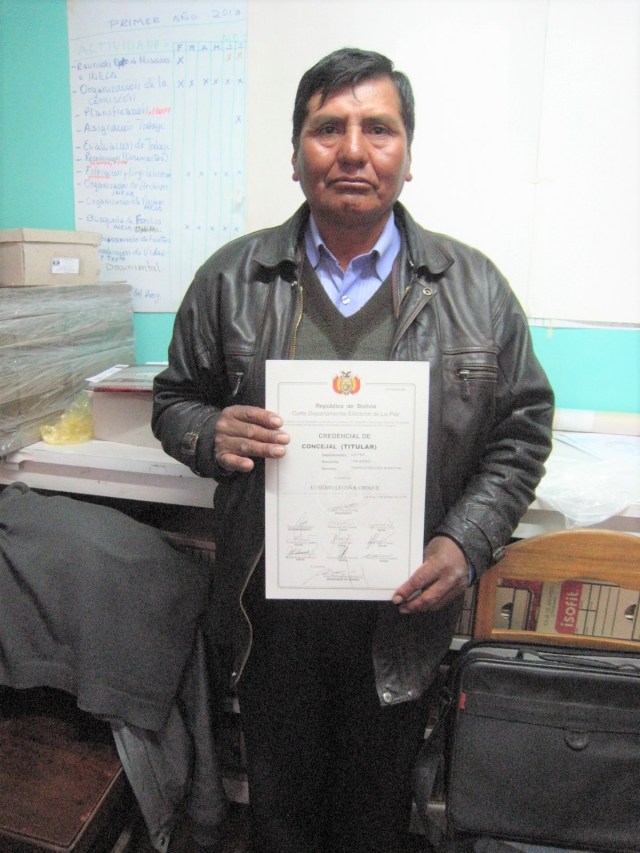
Eusebio Quispe felt out of place and extremely uncomfortable. The Aymara man from the Andean plateau was seated at a banquet along with mayors and council members from across the large Bolivian state of La Paz. Also present was the man who had requested the gathering: Evo Morales, then president of Bolivia. As the South American nation’s first indigenous head of state, Morales inspired the respect and fear of all the native peoples of the high plains, valleys, and jungles.

As the first course of soup was being served, Morales—an Aymara himself—loudly said, half in jest, “Shouldn’t we say a prayer? Aren’t there any Christians in this group?”

A few people tittered, but a mayor pointed directly at Eusebio and said, “There’s your man!”

Now Eusebio felt panic. Even so, he knew what to do. He stood up…

The Aymara have been a significant presence in Bolivia and neighboring Peru for more than a millennium. Today about 2.5 million are spread across the rugged Altiplano, roughly 12,000 feet above sea level.

After the arrival of the first Protestant long-term missionaries at the turn of the 20th century, the Aymara proved receptive to the good news. Quaker missionaries first came in the 1930s and began preaching and forming churches among the Aymara. Eusebio’s branch of the Friends Church currently contains approximately 200 Aymara congregations.

The Friends missionaries recognized decades ago that the Bolivian church was independent and no longer needed a foreign presence. So they left.

The Aymara church continues to be strong—Bolivia now has the second-highest number of Quakers in the Americas, after the United States—but certainly is not without conflicts. Some stem from the nature of being Aymara, which is widely recognized in Bolivian society as a culture of conflict. And some stem from the early impact of the missionaries.

The first American missionaries came to Bolivia out of the vibrant Methodist revival movement in the US and brought with them its doctrines and behavioral standards. Aymara culture favors formality and set rules and procedures, so it was a good fit for this imported faith from the beginning.

While most of these emphases were positive and produced the fruit of a growing church, some proved troublesome. Among these was the teaching that Christians need to separate themselves from the world—a true doctrine theologically that can become false when taken to extremes.

The Aymara are a communal culture, with the community as well as the extended family playing an important role. As each Aymara boy reaches adulthood, he steps into a network of community obligations. These year-long service opportunities come up as an Aymara man progresses through life.

The problem for Aymara Christians is that the obligations include numerous fiestas where ritual acts and drunkenness are expected. A good leader takes his turn supplying the liquor for the gathering. In addition, these times of service require participation in animistic sacrifices to the spirits believed to protect the community.

Because of these dubious aspects, early Protestant teaching demanded that Aymara Christians refuse their community service. This produced severe tension between the church and the community.

Over the years, individuals in evangelical denominations have responded to this tension in different ways. Some believers have completely refused to participate; of these, some have suffered persecution, including loss of property. Many others have announced they are retiring from the church during their years of service; they then perform all the obligations. Some of these return to church after their years concludes, publicly confess, receive forgiveness, and are reinstated into their congregation. Others never return.

And then there are those believers who take the difficult path and manage both to serve their communities and to maintain their Christian testimonies. Eusebio is one of these.
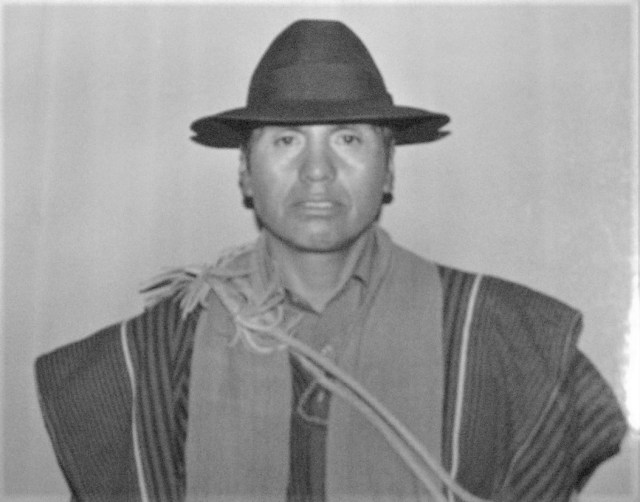

Eusebio is a member of the Ch’ojasivi Friends Church on the Altiplano. As a young man, soon after his conversion in 1975, he moved to La Paz to attend Bible school in hope of becoming a pastor. Upon graduation, he married and moved back to his community, serving a few years as his church’s pastor.

When Eusebio decided to go ahead and fulfill his obligatory time of community responsibility, he asked his congregation to support and pray for him—telling them of his determination not to compromise his beliefs.

During that first year, he discovered he could apply to his new role the administrative skills he had learned in Bible school (e.g., the importance of doing things carefully and in order, following established rules and regulations, adhering to careful financial accounting, and so on). This contrasted with how the tasks had been carried out by previous leaders. Other community leaders noticed this and affirmed him.

His work made a difference, and Eusebio discovered a new vocation in serving his community. He voluntarily continued year after year, fulfilling different roles, climbing the ladder of responsibilities, and eventually leading at the provincial level. As of my interview with him in 2018, he had dedicated more than 30 years to this kind of service.

Since community work demands so much time, Eusebio found it necessary to resign his leadership roles in the church, including as a pastor. However, his church affirmed his calling and continued to be supportive—in contrast to many congregations in other towns. Eusebio has been able to maintain faithful attendance at worship. He started the practice of coming every Sunday at 5 a.m. to pray until the service began. Sometimes others joined him; often he prayed alone.

Eusebio kept his commitment to a strong Christian testimony during his community service—not an easy task given its expectations and pressures. From the beginning, Eusebio let it be known that he was an evangelical Christian and was not wealthy and could not divert much money into sponsoring fiestas; neither would he drink or buy alcohol for them. Once, when it was his turn to sponsor a fiesta, he refused but offered instead to provide a meal for the whole community after the gathering—a more expensive alternative. The result was much appreciated.

Because of Eusebio’s lack of compromise and his commitment to hard work and honesty, his town and the surrounding region respect him and often ask him to pray at the beginning of meetings and events. Tangible contributions he has made to Ch’ojasivi include the constructing of a clinic and a police station, working with a reforestation committee to set up a tree nursery, and serving four years as a high school music teacher.

At the banquet with provincial mayors and the president, after Eusebio prayed over the meal, Morales engaged him in conversation, asking how long the fellow Aymara had been a Christian. Morales then shared that his grandmother used to take him to a Baptist church when he was a boy. Morales especially remembered “I Have Decided to Follow Jesus” as a song that he enjoyed singing as a child. When the waiter served the drinks, Morales asked that they serve a soft drink to Eusebio.

Eusebio’s testimony is not just negation—a refusal to drink alcohol, participate in pagan fiestas, or give offerings to spirits—but a commitment to serve with honesty and integrity, bringing the best of his education and abilities to improve life in his community.

He has a deep concern that the church teach its young people positive ways to fulfill their community responsibilities. Eusebio joins a good number of other Aymara Christian theologians and leaders who are recognizing the holistic nature of the gospel, that along with preaching the word of Jesus and establishing churches, attending to the poor and serving their communities are also part of furthering God’s kingdom on earth.
Church Life

Learning to See Beauty Through the Scars of War

How a journey through a war-torn land changed a scholar’s mind.

Cover Photograph by Jessé Manuel

On August 12, 2021, Scottish church historian and missiologist Andrew Walls died at the age of 93. He knew and understood the history and people of Africa—and he cared. Walls opened my eyes to historical patterns; he helped us better understand the Bible. It was his work that would eventually and fundamentally alter my perspective on the global body of Christ.

Walls made two profound observations in summarizing the phenomenal work of Kenneth Scott Latourette’s A History of the Expansion of Christianity. First, he explained that “Christian faith must go on being translated, must continuously enter into the vernacular culture and interact with it, or it withers and fades.” And second, “Crossing cultural boundaries has been the life blood of historic Christianity,” and “the energy for the frontier crossing has come from the periphery rather than the centre.”

As I immersed myself in Walls’s powerful writings, I worked as a professor of congregational studies and missiology at Stellenbosch University in South Africa. At the time, I was involved in a rapidly expanding network of theological schools on our continent called the Network for African Congregational Theology—or NetACT for short. In 2003, NetACT received a proverbial Macedonian call from Angola to visit and to help. 

The Portuguese began trading with the peoples of Angola in 1560 and had subjugated the Angolans by 1590. A history of exploitation, corruption, and the slave trade continued until 1960 when liberation movements began to rebel, demanding independence. This struggle continued until 1975 when the Portuguese had a change in government and independence was granted to Angola. 

The MPLA (Movimento Popular de Libertação de Angola) won control of the country with the support of Cuba and the former USSR. Their rule was opposed by the UNITA (União Nacional para a Independência Total de Angola) movement backed by South Africa and the United States. Sixteen years of civil war followed until a peace agreement in 1991. Afterwards, elections were held, but UNITA did not accept the results, which caused fighting to break out again, persisting until the death of the UNITA leader, Jonas Savimbi, on April 4th, 2002. The fathers of the leaders of the three independence movements were all Protestant pastors.

By June 2004, most major Angolan roads, once littered with landmines, had been cleared. Seven of us from NetACT traveled to Angola in a Land Rover and a mine-resistant vehicle (that, to me, looked very much like a daddy long-legs spider straddling the road). Our purpose was to visit churches and theological schools. It also coincided with a research project I embarked on. I asked three questions wherever we met Angolan Christians: “What happened to the church during the 40 years of war? Did it grow or did it decline? What happened to theological education?”  

Our first meeting was in Lubango, the biggest city in southern Angola. On the day after our arrival, we had a morning appointment with church leaders. However, their key spokesperson, who was fluent in English, was late. The local leaders insisted that we wait for the arrival of Pastor José Evaristo Abias, who was general secretary of the UIEA (União de Igrejas Evangélicas de Angola) and chairperson of the AEA (Angolan Evangelical Alliance). When he eventually turned up, his face was shining. Skipping protocol, we simply had to ask: “Something happened to you, Pastor, please share it with us!”

He nodded and the story tumbled out in swift and jubilant words. 

“I am responsible for the repatriation of refugees, and last night I received a call informing me that a few truckloads of refugees are due to arrive early this morning. Thirty-six years ago, in 1969, when I was 15 years old, our village was attacked. In the utter chaos that ensued, everybody scattered. Over time, members of my village regrouped and survived in small groups in uninhabited areas in the countryside. Our family, too, managed to regroup. However, my sister, Adelaide, was missing and we never found her or heard from her again. This morning, the trucks arrived from Zambia. Crates were put in place so that the exhausted passengers could scramble down from the truck. I saw a woman climbing down. She looked so familiar that I could not take my eyes off her. When she turned around to orient herself, she saw me staring at her. She hesitated and then in slow, uncertain steps started moving towards me.

I managed to utter one word: ‘Adelaide?!’ 

She started running to me and cried: ‘José!’” 

In the silence that followed his story, Pastor José’s eyes were brimming with tears, but his posture radiated the wonder of this “resurrection from death.” Each of us were wiping the tears from our eyes. 

Some 250 miles north of Lubango is Huambo, Angola’s second biggest city and the place where some of the worst fighting during the civil war took place. We started our trek to Huambo early on a Friday morning. We had an appointment at a seminary that afternoon on the last day of their semester.

We soon realized that we were in trouble. Google Maps and cellphones are not functional in most of Angola. Road signs were nonexistent. We simply had to follow the wreckage from all kinds of vehicles—especially those of tanks and other armed machines. The main road that connects Lubango to Huambo was a succession of potholes and land mine craters. We were still far off from Huambo when darkness overtook us at a friendly village called Catata. 

To our surprise, when we arrived in Huambo late the next day, the theological school’s staff and students were clearly unfazed by our tardiness—they welcomed us with song and dance. Laughingly, they told us it was impossible to travel from one city to the other in just one day. Besides, they explained, they did not mind waiting for us, as we were the first foreign visitors they had received in many years. 

We stayed in Huambo for a few days and the principal of the school insisted on showing us the city. It was a traumatic experience. The city was devastated. Buildings and other infrastructure were bombed to pieces. Nothing seemed to be working; sewage ran off in little streams along the streets and eventually into dirty rivers of garbage. One could barely stand the smell of it all. The roads were full of potholes, crisscrossed above with electricity cables. I had never seen so many people with amputated limbs and other physical scars of war in my entire life. In the meantime, Pastor Alexandre dos Santos Mioco was happily telling us stories about life in Huambo. 

Struggling to keep our composure, we stopped him with a simple question: “How do you live in a city like this?” 

There was a sudden silence. In his eyes, we sensed an incomprehension at our question—even shock and hurt. After a few awkward seconds, he replied: “We have peace now. A year ago, nobody in this city was safe, every day people died here, we lived in fear…” 

It took me a long time to understand the gravity of what took place on that morning: the local pastor and a visiting group of foreign guests were driving through the same city, laying eyes upon the same sights and situations, but our perceptions were radically different. Coming from South Africa, I saw only utter chaos. Our Huambo friend on the other hand saw a city free from fear and fighting. I later realized that I was not really listening to our host. In the terminology of Andrew Walls, I did not have the pastoral sensitivity to cross interpretational boundaries. I was stuck in my own framework. Without the ability to cross boundaries, we remained worlds apart. And yet, there is the constant invitation to see through another’s eyes. 

Our last stop was in northeastern Angola, at Kinkuni, in Uíge Province. We visited a Reformed theological school, the Instituto Teológico da Igreja Evangélica Reformada de Angola. Before independence, the Portuguese colonial government and the Roman Catholic Church had an agreement: Protestant churches were allowed to operate in Angola, but a specific denomination was allowed in one province only. The Reformed Church was allowed to be in the rural Uíge province but not in any of the other 17 provinces. 

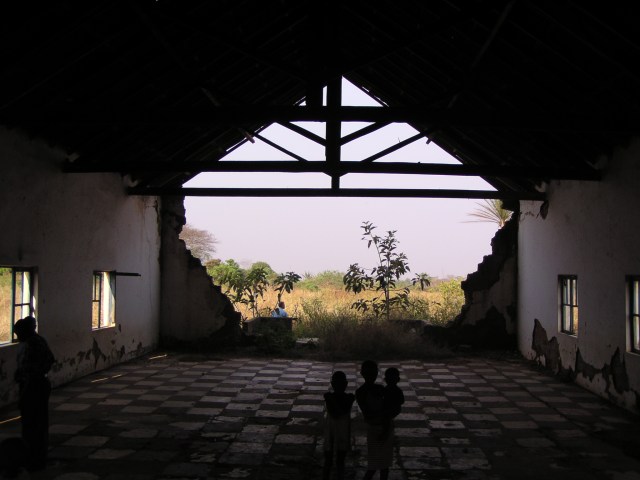
The Reformed seminary at Kinkuni was established in 1940 and twice destroyed. First in 1961 by the Portuguese (who resented the Protestants’ critique of their colonial policies). After the church rebuilt it, the seminary was again destroyed in 1978, this time by the postindependence MPLA Marxist forces (on grounds that Christianity had a negative effect on the people). 

I was invited to address the students and staff at the opening of the theological school semester. The title of my paper was: “The future of the church and the church of the future.” A student with a big radio-tape recorder stood in front of me, recording the presentation. After the presentation, most of the staff and all the students moved outside. They listened to the recording under a nearby tree and a loud and enthusiastic discussion ensued. 

In Angola, whenever I would inquire about the theological training these students received, the answer was always “discipleship training.” I never really grasped what was meant by this, but now we could get an explanation. 

We were told that it was difficult—at times impossible—to receive formal theological education. The military leaders in charge of the provinces were mostly Marxist and strongly opposed Christianity, which meant that believers had to meet in secret. 

As the church adapted, three types of congregations evolved. Some held formal church meetings in refugee camps in adjacent countries. In most Angolan towns, members of former flourishing congregations met in smaller groups in houses or under trees, disguised to look like ordinary informal friendship gatherings. Others, mostly those in rural areas, existed as small groups that were fleeing, hiding, or simply surviving and living off the land. All groups had pastors and all pastors were discipling one or two members of the group to take over if the pastor was killed or if the members had to flee and were separated from one another. In 2004, most pastors in Protestant churches in Angola still received this “discipleship training.” 

Everywhere I went, I asked how many congregations a specific denomination had and how many members it was composed of. The answers were usually the same. They would laugh, throw their arms in the air, and admit they had no idea. They were constantly discovering new congregations now that the war was over, even in far-flung provinces. The war had scattered the faithful across provincial boundaries. The refugees from one denomination and province were all too thankful to find groups of Christians elsewhere. Denominational differences were of little concern. 

In retrospect, I feel rather ashamed of my capitalistic and academic mindset that asked about church growth and decline in order to get data to write an article for a theological journal. However, in my defense, and thankfully so, it all happened in a process where my South African colleagues and I were crossing our own boundaries, literally, on the roads of Angola. However, as the journey continued, deeper boundaries—our single-minded interpretive frameworks—were discovered, faced, and crossed. 

We got to know and love people who taught us about ourselves and our many shortcomings. We crossed into their territories, and they crossed into ours. It was mutually beneficial. In fact, it is more than beneficial. It is essential if we ever want to grasp something of what the kingdom of God is about.  

One of the most lasting memories of our 2004 Angolan journey was that there was no gift more exuberantly welcomed than the gift of a new Portuguese Bible. The longer the war lasted, the more precious the Word became. When one is “at the end of one’s rope,” faith focuses us on God and a Bible helps us to listen to God. During this time, the Angolan church experienced spectacular growth. Faith entered vernacular culture, war, and hardship, and helped people to make sense of the senseless, to survive from day to day. 

Teaching theology in a classroom context is a product of the Enlightenment. I no longer think it is adequate alone to prepare pastors for ministry. One should follow Jesus’ example and go to where it hurts, to the “poor.” Being “rich” needs to be redefined. We were enriched in Angola, in 2004 and ever since. If we cross boundaries and interact with vernacular cultures, we will see the kingdom of God unfolding among us. This kingdom is not an academic pursuit, and it is not a game of church or denominational numbers. It is the power of God at work among his people. 

Church Life

A Phoenix Rises After ISIS Enslavement

How one woman’s journey led her from the hands of ISIS to hope in Jesus.

Cover Photograph by Isaak Alexandre Karslian

This story contains content that some may find disturbing

The sun blazed over the outskirts of Mosul on that day. It was 2018, and the coalition forces were pursuing a lead about an ISIS hideout. The atmosphere was tense. There were reports of suicide bombers ambushing the troops in a final, desperate attempt to resurrect the fading dreams of the Caliphate. 

When the soldiers broke into the house, they found no remaining ISIS soldiers but dozens of women and children chained to the walls. ISIS kept them as human shields or suicide bombers. The soldiers assured the prisoners they were now safe, and ISIS could no longer harm them. They transported the women and children to a trauma center in a nearby city. This is where we first met Nora. 

She walked into the reception room and stood before us in palpable agony. She trembled, covered in dirt, sweat, and blood. Tears streamed down her face. She looked as though she hadn’t eaten in days, yet her only concern was to cover her macerated body with the rags that had once been clothes. 

In 2014, ISIS gunmen sweeping through western Iraq came to Nora’s rural community and declared her people infidels. Most historians of the Islamic state agree that ISIS was founded by jihadists who wanted to fuel the war between Sunnis and Shiites in Iraq and establish an Islamic caliphate that would eventually take over the world. ISIS believed their extremist version of Islam was the only right way. They killed or imprisoned anyone who disagreed—even fellow Muslims who held a moderate view of Islam. 

When ISIS militias infiltrated Nora’s region, they captured thousands of women and girls as sex slaves and slaughtered many men. Abducted from her house, Nora witnessed the murder of several of her family members on the village streets. She lived in ISIS captivity in Mosul until coalition forces freed her four years later.

After coming to the governmental trauma center, Nora received clothing, blankets, toiletries, and food from our Impact Middle East (IME) team. She reconnected with her extended family, and they went to live in a makeshift tent in a refugee camp in Northern Iraq. 

During the ISIS takeover of Iraq and Syria, about 7,000 Muslim, Yazidi, and Christian children and women like Nora were taken as slaves. While many have now been rescued, 2,768 are still missing. Along with the IME Center, many other Christian ministries work with victims to serve their emotional, mental, and physical needs.

Through the winding and painful roads of her journey, Nora spent her days inside a tent, with any remnant of hope dwindling by the day. How was she to know that in the midst of her sadness, waiting out her days in a refugee tent, her life was about to change?

On a blistering day, as the sand scattered and blended in the wind, an Arab Christian named Jamila arrived in the camp with the sole intent of visiting Nora. 

Years earlier, Jamila had left a high-paying job in her own country and moved to Iraq to work with former sex slaves in refugee camps. Driven by a burning desire to see God heal the brokenhearted, she had studied trauma care and counseling. Now Jamila was a staff member with IME who made it her mission to work with a local church at a nearby community center. 

When Jamila found Nora, she invited her to a tailoring workshop and a trauma care group where a team from the church taught her sewing skills and gave her a loan to start a small business. After the sewing sessions, the women would gather with Jamila in group therapy and one-on-one counseling sessions. 

As Jamila and Nora formed a bond, Nora slowly opened up about the horrors she had faced. “ISIS fighters put us in cages and held an auction to sell us to the highest bidder. They called us sabaya [and] female slaves. We were reduced from human beings into commodities that could be bought and sold.” Nora confided in Jamila about how she was sold or gifted from one jihadist to another and how they raped and beat her, calling her an infidel.

As Nora shared her horrific stories, it became clear to Jamila that Nora blamed herself for the abuse that happened to her, and that she struggled with deep confusion and even suicidal thoughts. Nora had convinced herself that she might have done something wrong—or not done enough to stop it. With this burden, Jamila was led to her knees to pray for Nora every day. 

Levi Meir Clancy

As Jamila led her tailoring classes, hearing the stories of former ISIS slaves, she taught them how to understand their trauma and build emotional resiliency. She offered them hope that healing was possible. Over a span of months, many women showed remarkable improvement and a genuine desire to reclaim their agency and independence. 

Nora, however, continued to struggle. The faces of her murdered family haunted her dreams. She often fainted and fell during sewing class, striking her head on the ground. Jamila was heartbroken for her. One night, she returned from the refugee camp to her home and locked herself in her room for hours, weeping and crying out to God.

The following morning, Jamila returned to the IME Center and encouraged Nora to stay after class. Jamila asked her permission to pray over her in the name of Jesus. Nora knew of Jesus, but believed he was a prophet and nothing more. Nonetheless, desperate for healing, Nora agreed. Jamila held her hands and closed her eyes. As they prayed, Jamila experienced what she perceived to be a vision from the Lord. She saw Nora standing in her tent with a knife at her wrists, attempting to take her own life. 

Jamila immediately stopped praying and asked Nora if she had tried to commit suicide. She described the picture she had seen, the clothes Nora was wearing, and the room she was in. Nora was terrified because her secret had been uncovered. She had always worn long sleeves to hide the scars of her attempt. Weeping, she asked Jamila in disbelief, “How could you know that about me? How could you see that?”

Jamila replied, “Our God is a loving Father. He sees you. He sees your pain and your suffering, and he cares for you. He wants you to know he was with you in the tent that night that you tried to kill yourself.” 

For the first time in her life, Nora prayed to God as her Father. She had been taught since childhood to regard God as a demanding master, but that night she experienced the unconditional love of a heavenly Father to work a miracle in her life amid overwhelming pain and suffering. In the following weeks, Jamila started to disciple Nora, teaching her about the compassion and care God has for her. 

In the beginning of her journey with this newfound faith, Nora still struggled with the question, “Where was God when ISIS attacked my village? How can a loving Father allow so much evil and suffering?” Jamila walked with her through the consequences of free will and the pain of sin. God not only cares about our pain, Jamila said, he also suffers with us. 

The words of revelation resonated with hope in her war-torn frame, the promise that there will come a day when God will wipe away every tear, and “there will be no more death or mourning or crying or pain, for the old order of things will pass away” (Rev. 21:4).

After a few months of this revelation of divine love, Nora prayed with Jamila from her most heartfelt place: “Abba taught me that I am loved, that I am beautiful, that I am precious. He told me that he is a masterful artist who binds up the brokenhearted, sets the captive free, and brings beauty out of ashes.”

Church Life

A Way in the Wilderness

How prayers for a boy brought reconciliation to a land.

Cover Photograph by Taryn Kaahanui


The first time I saw Tim, I saw only a teenager with severe autism, slouched beside his caregiver, his body obviously tired from the pain it carried, his eyes far away. 

But there was more to Tim than met the eye. His appearance in our community in 2015 would expose old divisions I didn’t even know were there—and spark a chain reaction of miracles that transformed my town and its churches.

Every two weeks during that school year, Tim and other teens with disabilities rode by bus 20 minutes from Inverell, our nearest substantial town, to Danthonia, the community in Australia where I live and teach. The teens would join our high school students for several hours. I loved watching the interaction as my students responded to their new friends and engaged them in simple activities: holding guinea pigs and rabbits, stroking cats (for however long they complied), looking at picture books, throwing a ball, and simply sprawling on the grass in the sunshine. And, of course, everyone looked forward to morning tea with chocolate chip cookies warm from the oven.

These were the kinds of scenes my husband, Chris, and I had hoped for 13 years earlier, when we moved our family from Pennsylvania to join a fledgling project in communal living in what to us was a strange land. Situated 15 miles from Inverell, in the Northern Tablelands farming district of New South Wales, Danthonia is one of more than 20 Bruderhof communities worldwide. A century ago in Germany, our founders read Acts 2 and 4 and the Sermon on the Mount and decided they could follow these teachings only by pooling their possessions. 

Our spiritual moorings are in the Anabaptist tradition; the name Bruderhof dates to the Radical Reformation of the 1500s and translates literally as “place of brothers”—although Bruderhof communities have always included women, families, and singles. 

The more Tim was in our life, however, the more I could see how much ground he was losing. I knew that Tim had exhibited autism from a young age and had never been able to talk. But with each visit his ability to communicate was in decline, his seizures more frequent. His protective helmet, once worn only on “bad days,” was now his constant shield.

Tim’s mother accompanied him on one of the last visits he would make to Danthonia. She told me how distraught she and her husband were becoming as they tried to provide the constant care their tall, once-strong son needed. I could only listen, and assure her of our prayers.

Around that time a friend gave me a verse, Isaiah 43:19: 

See, I am doing a new thing!
         Now it springs up; do you not perceive it?
I am making a way in the wilderness
         and streams in the wasteland.

My friend knew I was still struggling to make this country my home and wanted to encourage me. But in the brown landscape of rural Australia, this verse only seemed to taunt me. We’d lived through two droughts, and my heart seemed mired in a wasteland of its own creation. I was unable to believe in any new thing. That’s when the Holy Spirit began to move.

Like church leaders in many towns in many parts of the world, the pastors of Inverell were in the habit of holding a monthly meeting. Tim’s father, a minister of a well-established congregation, was a regular attendee, as was a pastor from my Bruderhof church community.

The meetings typically started with devotions and prayer, then worked through a fixed agenda and announcements in a collegial but rather businesslike manner. But at the meeting in March 2015, my pastor told me, something different occurred.

One of the pastors shared about his incarcerated and estranged son. That moment of vulnerability opened the door for another and another, and through these moments of brokenness the Holy Spirit entered. This continued in the months that followed, and a space was created for pastors across denominational lines to carry each other’s burdens. A gathering that had previously felt like a chore became a time to look forward to.

At one meeting, Tim’s father asked for prayer for his son. Soon every congregation in our town was praying for Tim and his family, uniting friends and strangers. Support came in tangible ways, too. One minister and his wife, who were not part of Tim’s family’s church, volunteered as part-time caregivers for Tim so that his parents could get a break.

Yet even as this string of a common cause began to tie communities together, it was clear to everyone that Tim’s body was worn out. Despite excellent medical care and the selfless dedication of those who loved him most, Tim was ready to go home.

Manuel Meurisse

In October 2015, we assembled our high school students to tell them that their friend Tim had died following a short hospitalization due to complications from pneumonia. He was 15 years old. Hundreds of others from the community gathered with us at the high school gym to bid farewell to Tim with singing and tears. His helmet lay on the stage, a symbol that his body was freed from its earthly constraints. His family testified to the peace and love that had pervaded Tim’s hospital room in his final days. They credited the atmosphere to the many prayers that had lifted the burden of Tim’s illness from their shoulders and brought it to the Cross.

In the months after Tim’s death, the pastors continued to meet with renewed purpose, often over a shared meal. Among other things, they prayed for a blessing on our town, and for better collaboration with the town’s civic leadership. States in Australia are divided into local shires administered by elected councils, and the pastors wanted to be Christ’s hands and feet in the wider community by finding ways to support council members in their work.

One day, as two pastors approached a senior council official to pitch the idea for increased civic engagement, they were taken aback at the response: The council had no interest in working with the churches until they made reparation for how unwelcoming they had been toward our community when it was first established in 1999, 17 years earlier.

This was news to the clergy in the fellowship, none of whom had been in church leadership when the Bruderhof arrived. But with a little research, they learned the history: Nearly all Inverell’s churches had snubbed our community, and in some cases had actively sought to influence government decision-making against its development.

And so, on a late summer evening in early 2016, a miracle happened when a group of leaders from Inverell churches arrived at Danthonia to meet with Bruderhof members. Tim’s parents were present, and it was the first time Chris and I had seen them since their son’s funeral.

Each pastor spoke. Many shed tears as they told how they’d learned of their churches’ past coldness toward our community. They named hostility, anger, suspicion, and gossip as sins to be repented of and barriers preventing us all from working together as a body. They asked our forgiveness. Tim’s illness and death had begun to unite our town in prayer, they said. Now, unexpectedly, a new door towards unity was being opened, if our community would be willing to forgive.

It was our turn to be taken aback. My father-in-law, who had been the direct recipient of some of the early hostility, offered assurance. “Don’t worry at all, that’s water under the bridge. We’ve moved on long ago.”

“Moving on is the Australian way,” Tim’s father responded. “But it’s not Jesus’ way. Repentance is the way of Christ, and we are here to repent.”

Over the next months, follow-up meetings were held as we did the hard work of reconciliation. Our community asked for forgiveness, too: for misunderstandings and failures in communication, for the times when we chose to settle for negative assumptions instead of assuming the best of our Christian neighbors.

Because the opposition to our community had been public, the Inverell pastors wanted the repentance and forgiveness to be public as well. On a Sunday in May, we held a reconciliation service at our community hall. The room was full of people: people of faith from across the spectrum of church expressions; people who professed no particular faith but whose steadfast friendship from the outset of our community had been truly heartwarming; representatives of local government.

As the service began, Inverell’s church leaders stood at the front, before their congregants and the Bruderhof members. They stood hand in hand, heads bowed, and asked for forgiveness. The president of the ministers’ fellowship read a statement of apology, and Danthonia’s pastor responded in acceptance and offered forgiveness and our apology as well. Together, we acknowledged mutual repentance.

We stood as one body. As a testament to the unshakable bedrock of our shared faith, we spoke with one voice repeating the Apostles’ Creed, followed by the Lord’s Prayer. We ended the service by standing and singing the “Hallelujah Chorus” from Handel’s Messiah

It was a determined declaration that we were fully restored and reconciled as brothers and sisters under the united headship of Christ, ready to get up and on with the task of building his kingdom together. 

Over the following year, another miracle happened. As we reconciled, still more doors opened for our churches to work together and serve our region as one body. As ever, God’s timing was impeccable, because the year after the reconciliation our country was plunged into a record-breaking, two-year season of drought and fires. Congregations worked together as a combined whole to care for the vulnerable populations of our town. Instead of competition and division, there was cohesion and compassion.

The rains came, the drought ended, and COVID-19 arrived. I remember bringing vegetables to an elderly woman in the early days of the pandemic and nearly tripping over grocery bags and kindling on her porch as I tried to reach the doorbell. Once again, food, firewood, and friendship were distributed to those who needed it most—not from any church in particular but from “the church of the region.”

In addition, the reconciliation efforts gave birth to a beautiful tradition we now call “Worship, Prayer, Food” (or, as Chris calls it, showing his priorities, “Eat, Pray, Love”). One Sunday a month, all the congregations of our region are invited to worship and eat together. Churches take turns hosting, and friendships continue to grow. Each time we meet to break bread, we are reminded of the miracle of healing and wholeness that was impossible to imagine only a few years ago.

We know that what has happened here in Inverell can happen anywhere. It happened in spite of us all, not because of us. “See, I am doing a new thing!”

To restore relationships and work as a united team is not an impossible goal. Sometimes all it takes to get started is one request for forgiveness—one crack in the façade, small enough for a grain of mustard seed to slide through, for something new to take hold and grow. There was no budget or agenda, no conference or seminar, just a simple welcoming of the Holy Spirit into hearts and homes and backyards. That, and a dying child who united us in prayer and shone a light on dark places in need of renewal.

Today, our town’s interchurch relationships aren’t perfect. But we serve a God who is forever writing new and better chapters, who can create paths where none were before, who can replenish and restore wilderness into fertile fields and unite disparate bodies into one. 

Church Life

Breaking Slavery on Lake Volta

How the largest man-made lake became a place to untangle the bonds of slavery.

Cover Photograph by Jeremy Snell | International Justice Mission

This story contains content that some may find disturbing

Anita Budu stepped to the water’s edge and searched the horizon. Lake Volta is the most expansive artificial reservoir in the world. The sun had risen high and the heat was merciless, but Budu and her colleagues didn’t dare leave in search of shade. 

They had lost contact with the boats. They could return at any minute. When they came, the children would need their help immediately. 

That is, if they came. If there were children. If the Lord gave success to this mission after months of preparation. Her prayers swirled. Please, Lord, keep them safe. Please give them success. Help us save some boys today.

“We had done so much planning,” says Budu, who directs operations in Ghana for International Justice Mission (IJM). “We were just helpless.” 

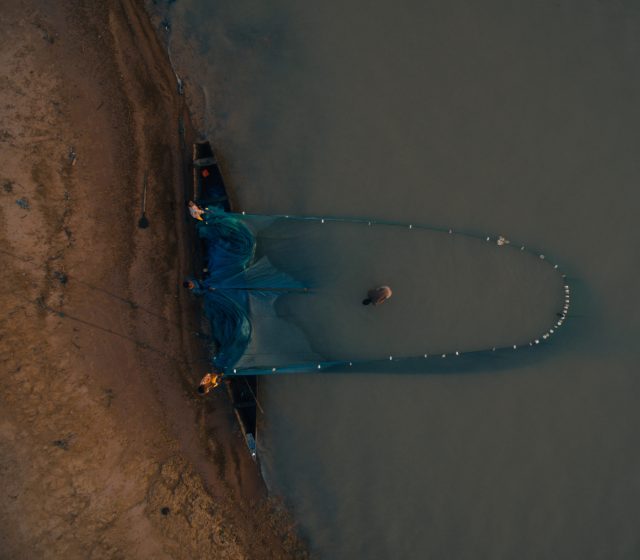
She looked at the water again. What was so beautiful on the surface hid the leviathan underneath. When the Akosombo Dam was completed in 1965, the water from the White Volta River and the Black Volta River crept over land and up tree trunks until entire forests disappeared beneath the flood. The dam produced enormous amounts of power, and vast populations of fish darted through the immersed branches. 

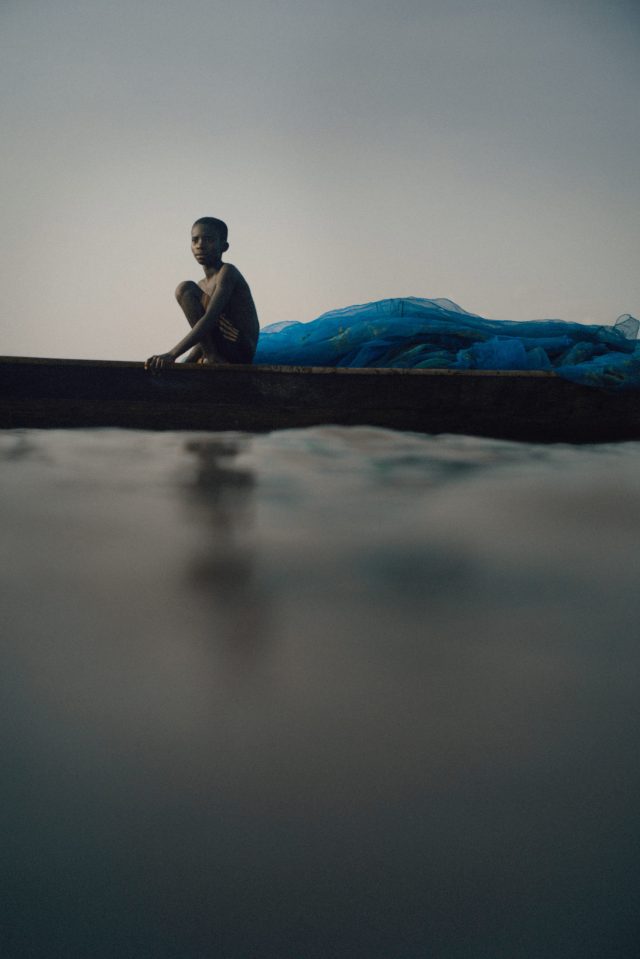
The lake changed the region. Farmers turned into fishermen and glided over the treetops in wooden boats. But when the nets settled into the dark water, they caught on sharp branches. Someone had to dive in and untangle them. Soon the fishing market was supported by tens of thousands of boys. Traffickers told their families the boys would work for only a little while and would receive care and education. In truth the boys, sometimes shockingly young, rose well before dawn and worked under brutal conditions with barely enough food to survive. 

When the nets catch, the boys are thrown overboard to find their way through the tangle of branches and un-snag the lines. Some are beaten. Some drown. All face hunger, abuse, trauma, and the desperation of slavery. 

IJM began its work with the Ghana government and founded a local office in 2014. Their plan took the shape of an enlarging net: they would investigate, educate, encourage arrests and convictions, rescue the enslaved, and care for the survivors. Their early studies interviewed 800 children working in the area and concluded half or more were trafficked. That meant tens of thousands were enslaved on the massive lake.

“Our aim,” says Budu, “is to see that justice is available for all people, especially the most vulnerable in society.”

The obstacles multiplied. Lake Volta presents 3,000 miles of shoreline, and the Ghana authorities didn’t have boats. Although Ghana opposes child slavery, the cultural norm of childhood apprenticeship means that building a case must show clear infringement. But getting child victims to testify has been difficult. Many are traumatized, abused, and injured, and multiple dialects are spoken on the lake. 

So it was that IJM sent out boats with law enforcement and aftercare partners in March 2015, and Anita Budu stood upon the shore. It would be—if it worked—their first rescue. 

At last, the boats came into sight. Budu rushed into the mire and helped the vessels ashore. Ten boys were rescued, as young as five years old, all of them bewildered, undernourished, and barely dressed in threadbare clothes. A bus delivered them to shelter and medical care. Some of their oppressors had been arrested as well. 

The IJM plan to attack child trafficking at all levels was taking shape. They raised awareness on the truth of the trade. They encouraged the identification, arrest, and conviction of perpetrators. They provided shelter, healing, and education to the survivors. As Budu recalls, “You could see the life come back in them.” 

But change rarely comes without stops and starts. Fishing on Lake Volta constitutes a significant part of the country’s economy. The work of IJM and its partners was also buffeting cultural norms. So when some officials raised objections, the Ghanaian government revoked the memorandum of understanding that permitted IJM to do its work. 

The rescues stopped. Slavery continued. More boys were lost to the abyss. 

The IJM world team prayed. They lamented. They waited. And they worked. They followed the lines and untangled the misunderstandings. They met with every government and civilian entity they could, found the common concerns, and laid the groundwork for collaboration. Slowly, gently, the team gained a deeper understanding of the nuances of the local culture and governance. The team learned to articulate the difference between apprenticeship and bondage.

“We always knew many more rescues were ahead,” Budu recalls.

So when the memorandum of understanding was reinstated 19 months later, they were ready. Ready to rescue children from the deep. Ready again to see the sadness on the faces of the boys melt away as they realized the slavery nets no longer held them.

Jeremy Snell | International Justice Mission

Six years after that first rescue, IJM in Ghana now has a staff of 23 people. IJM in Ghana has trained 19,000 government employees, made 189 arrests, won 38 convictions, and rescued more than 300 children. Of course, the traffickers have adjusted. Many have moved into more remote, hidden areas on Lake Volta. The marine police face greater threats of violence, and they still have no boats of their own for patrols. And considering the thousands of children still lost to the trade, 300 seems a drop in the bucket.

“In human eyes, it is too hard, it is impossible,” says Budu. But “God’s heart is close to each and every single child who is in this situation. What gives me hope is seeing the transformation in these young lives: from a life of darkness, a life of pain, a life of suffering, feeling that I’m not worth anything, feeling that nothing is ever going to come of me and my life is going to end here on a tree stump in the middle of this deep, deep lake—to all of the sudden one day all that’s changing.”

“In a humble way,” she says, “we are bringing God’s light to the darkness.” 

Church Life

It Wasn’t the Tear Gas that Surprised Me

How pastoring in the midst of protests changed one man’s perspective.

Cover Photograph by Thomas Chan

At the end of my street, just a few yards beyond my apartment building, a wisp of tear gas curled around the corner of the road. Hundreds of protesters were fleeing in the other direction, doing their best to seek cover from the unseen clash just beyond my view.

Despite the desperation of the scene, it wasn’t the tear gas that surprised me. After three months of weekly clashes between protesters and police in my neighborhood, the acrid stinging in my eyes had become a familiar experience. What surprised me was a person.

My eyes were drawn to him immediately. He was not dressed like the other protesters, adorned with the masks and umbrellas of the city’s front-liners. He had nothing on him to protect himself from the chemical onslaught. He stood still, facing against the rushing tide of people. While everyone else fled in the other direction, he stood rooted in place.

At first I thought this was an act of defiance—a brave display of nonviolent resistance. But as I stood watching, I noticed his mouth was moving as his head shifted from side to side. The expression on his face was not fear or anger, but concern. He was speaking to the fleeing protesters, but he wasn’t trying to get them to stand their ground and fight back. Instead, he seemed concerned for their well-being and care. He stood against the tide, at the cost of his own safety, to offer some kind of calming presence. His posture was not provocative. It was pastoral. 

As I watched this all unfold, I felt an uncomfortable move of the Holy Spirit inside me. I have been a pastor in Hong Kong for 20 years, but this man embodied the power of the church more in that moment than I ever have. Like Caleb and Joshua standing before the majority opinion of the returning spies, this man carried with him a different spirit. I realized, soberly, that I did not. 

The church in Hong Kong is at an inflection point for the gospel. Alongside a global pandemic, our city has experienced a complete social and political upheaval in the past three years as a result of the protests and China’s response in its attempt to restore order. Many have welcomed the return of peace and calm to the streets, while many others have been left bruised and conflicted. And the church must now decide how to respond.

Will we become a bold and central voice of hope, faith, and identity in the years ahead, courageously rooting ourselves in the fertile soil of the gospel? Or will we feebly shrink into the shadows of our own self-concerns and self-preservation? Will the church reach out to a divided city, willing to plant our pastoral presence within the hardest of circumstances? Or will we settle for a comfortable gospel that keeps the lights on in our church buildings but extinguishes our prophetic light in the public square?

In my local community in Hong Kong, the kind of halfhearted cultural Christianity that seeks God’s favor—minus the sacrificial obedience needed to follow Jesus—is no longer an option. Perhaps it never was. If the church in our city has any future, it must shift from the pursuit of relevance to the pursuit of a fresh kind of gospel resilience that is forged in the fires of dramatic societal change. And we need pastors, like that man standing before the tear gas at the end of my street, who are able to offer brave pastoral hope in fearful political times. 

John Chan is one such pastor who has bent his knee to this call. Born and raised in Hong Kong in the ’80s, he studied Karl Barth in Germany before returning to Hong Kong to pursue a pastoral and academic career. Now in his early 40s, Chan is smart, engaging, deeply theological, and courageously able to connect Scripture and social change together in a way that invites people to process their traumatic experiences. He is willing to stand at the end of the proverbial street as the political tear gas creeps around the corner. He there offers a stable presence of hope.

“I grew up in a time of Hong Kong that was fabulous,” John says as we sit together over coffee. “A time when the culture was strong, when we all dreamed of a good future, when the youth of this city had hope and expectation. So much has now changed.”

Chan’s pastoral concerns for Hong Kong are centered around the young adults of the city, a generation caught between the affluent success of the over-40s and the relative innocence of the under-20s. “My generation grew up focused on making money and were mostly politically neutral. But the current generation is much more politically engaged and concerned. Which presents an important but challenging environment for the church.”

This was especially apparent in 2014, the year Occupy Central began. Signaling the first political student protest movement, the key leaders confessed publicly to their Christian faith. As an academic at the time, Chan noticed how his students were looking toward the Christian institutions in the city to offer guidance. “Our seminaries needed to quickly shift from teaching political theology to teaching political ethics. We suddenly needed a praxis more than a theory.”

This need for praxis in a time of rapid social change had to flow eventually from the halls of academia to the pulpits of the local churches, but such a shift was slow to come. Many pastors were not equipped to deal with the issues that the political upheaval was creating. As Chan observes, “Very few pastors felt able to address the major issues impacting their congregants, often from fear of being labeled too political. So at the time something significant happened, the pulpit slowly became disconnected from the people.” 

This sense of disconnection raised its head again in the summer of 2019, about the time that tear gas crept around the corner of my street. “With the second wave of student protests in 2019,” Chan says, “the church seemed to have learned little from last time, and many of the same mistakes were made. And this led to a lot of young people leaving the church. Not leaving Jesus, just leaving the church.”

This exodus led Chan to plant a new church that would be flexible enough to embrace a new generation of Christians who wanted Jesus and social justice to sit side by side, while continuing to deepen the gospel through sacrificial discipleship. He called it Flow Church, and within just a few years it has grown to more than 400 people, most of them young adults.

“Flow Church exists because Hong Kong Christians have a unique challenge different to the west,” he says. “Our issue is not one of the relationship between church and state. Our issue is how to live in a society with a disproportional imbalance of power.”

This imbalance of power is more than just a postcolonial hangover. As Chan puts it, “We have a unique situation because our empire is our motherland.” It is this unchangeable situation that has caused some to give up hope for their future, with a growing number choosing to emigrate from Hong Kong. But for Chan, he stands rooted to a particular passage that has become the foundation of his renewed pastoral ministry. “John 10:10 promises us that Jesus came so we can have abundant life. This is not conditional on a particular place or time, or a particular station in life. Despite how hard things appear for Hong Kong right now, I believe our people can know the fullness of life and joy.”

It is this vision of a full life that drives Chan’s ministry. He and his church are digging deeper roots in the soil of the city. His church desires to be a stable and sure presence of pastoral care in the wild rush of change around them. And this will require no small amount of courage, sacrifice, and strength. 

As a pastor alongside Chan in the ministry of this city, I find myself reinvigorated by his bravery. I don’t want to remain down the street, a distant observer to the spiritual courage of others. Like Chan, I want to be able to stand amongst those who are hurting with a resolve in my heart despite the stinging in my eyes.

This different spirit—as seen in Caleb and Joshua and my friend John—is defined by a wholeheartedness toward God. This sobers me, for I sense my own heart is divided, torn apart by fear, self-preservation, and institutional concerns. I need a new heart for this new calling. A new wineskin, if you will. And that is always a move of God’s spirit.

As a friend recently put it, “The hardest calling is our first one: death to self.” Like that man at the end of that street, staring down the tear gas and offering comfort to others, may we take the dying side so others can take the living side.

Church Life

The Wounded Sparrow

How God’s eye on the sparrow offers comfort to a whole family.

Cover Photograph by Annie Spratt

Kuruvilla was the name given to me. It means “one belonging to the Lord.” The name is common among the Christians of Kerala, in the south of India, who trace the origins of their community back to St Thomas Didymus, the “doubter” and the twin.

As I matured into adulthood, I chose “Kuru” as a nickname. It sounded dignified. But I had another nickname first, in my college years. I was called “Kuruvi.” It means sparrow in my native Malayalam language. 

I wish I had kept that name. 

My son’s middle name is Kuruvilla, and, in a curious turn of events, my son-in-law’s middle name is also Kuruvilla. At one time in our family’s life, all three of us and our wives experienced a series of crises. That was when I first thought about our family as a little flock of sparrows. Jesus said that our father in heaven cares for the sparrows. We needed his promise to ring true through the flesh, bones, bricks, and stones of our family.

In India, people do not build houses for birds to nest in. Rather, we set up screen doors and wire mesh shutters on windows to keep the birds and insects out. In earlier times, it was a familiar sight to see birds flittering in and out of church buildings, where they would find a place to nest in the high rafters. While we might chase the birds out, God does nothing of the sort. He made them. He wants them to inhabit his world. As David poetically proclaims, “Even the sparrows have built a nest, and the swallows have their own home; they keep their young near your altars” (Psalm 84:3). 

Earlier this year, I experienced a profound moment that once again reminded me that God takes care of his kuruvi. 

As birds find a place in God’s habitation, our heavenly Father is not one who stands by helplessly. As my family of sparrows nested in his presence, he nestled us, offering the peace of his presence and the fellowship of prayer surrounding us. 

Each month, I take a variety of blood tests and the reports go to my oncologist and diabetologist. On a Monday in March of 2021, after the blood extraction had been completed, I stopped at three shops to pick up supplies for our home, including a dozen eggs in a plastic bag. Having finished my errands, I steered my scooter through the bustling streets of Trivandrum on my route home at a speed of about 40 kilometers per hour. 

Suddenly and without warning, I lost consciousness and momentarily blacked out. When I regained my senses, I found myself about to collide with the back end of a large, stationary lorry. With a sickening thud, my left shoulder rammed into its sharp edge. I lost control and toppled off the scooter. I stood immediately, and promptly fainted again.

The next thing I knew, a group of men had picked me up and carried me to the side of the road. After the chaos of the situation settled, I inspected the results of the accident. My knees were bruised and swollen, and a long gash had opened on my shoulder. A passing van driver gave me a lift home and the lorry driver rode my scooter back. The two men helped me to my flat and stayed for about half an hour to ensure I would be all right. 

In my part of India, government hospitals are often crowded and medical attention delayed by lengthy administrative procedures. To avoid the congestion in the midst of my injuries, my wife took me to a hospital run by Catholic nuns who are famed all over India for their medical institutions and nursing homes. The doctor examined my shoulder and said there were no bones broken, but the swelling under my left knee had collected blood and would need to be drained surgically the next morning.

After the initial attention to my shoulder, my wife and I had to undergo COVID-19 testing and waited restlessly together in the hospital. While awaiting the test results, I received a lab report that sent a shock through our system: my platelet count was down to 15,000, far below the healthy minimum of 150,000.

Before I was diagnosed with chronic lymphocytic leukemia, a hematological cancer, I had no idea what platelets were and what purpose they serve in the body. I quickly found out that they are required for blood to clot. If you don’t have enough platelets, you can easily bleed to death.

In that moment, we decided to relocate to the private hospital where my oncologist and his team work. There followed four days of treatment to raise the count of platelets, and then I was sent home to continue with oral medication.

As I arrived home, I went to check the consequences of my accident. I inspected the bag I had been holding on my scooter at the time of the crash. Shockingly, no eggs had broken during the carnage. It seemed one small miracle of many that day. First, slamming the metal edge of a lorry at 40 kilometers should have shattered my shoulder bone, but it didn’t. Next, with such a low count of platelets I should have bled severely and unstoppably, but that didn’t happen, either. Finally, the blood reports coming in while waiting for COVID-19 results saved me from undergoing a surgical procedure that might have killed me. That day, clearly, God had his eye on this one sparrow that had fallen.

In India, these creatures are often viewed as nuisances and people take every measure to drive them out of their homes. They are not worth much. They do not offer even a mouthful to eat. Yet God cares what happens to them. “Not even a sparrow, worth only half a penny, can fall to the ground without your Father knowing it. And the very hairs on your head are all numbered. So don’t be afraid; you are more valuable to Him than a whole flock of sparrows” (Matt. 10:29-31).

As I have come to a fuller understanding of the power of my name and the promise it holds, I know now that God cares for each sparrow. God knows and God allows what happens to my little flock—my sons and daughters and their families too. When he allows trial and troubles, he also gives us the grace to endure, and the wisdom and discernment to handle difficult situations. He gives us strength. He gives us hope.

I return time and again to the work of Ethel Waters, who often sang at Billy Graham’s Crusades. She famously sang the gospel song “His Eye is on the Sparrow.” 

Waters was born to a 12-year-old who had been raped by a white man. She chose the name of the song for the title of her autobiography because she felt that God had watched over the little sparrow she was. I echo her sentiments. I have lived my life as a sparrow that God cares for.

“Why should I feel discouraged,
Why should the shadows come,
Why should my heart be lonely,
And long for heaven and home,
When Jesus is my portion?
My constant friend is He,
His eye is on the sparrow,
And I know He watches me
I sing because I’m happy,
I sing because I’m free,
For His eye is on the sparrow,
And I know He watches me.”

What happens to us here is not the end. The individuals and institutions, principalities and powers that attempt to destroy us are ascendant in India today. They will not succeed. A new day comes. God watches over his sparrows. I know I belong to him. I know he watches me. And I know one day he will bring us home and we will nest among the rafters in his holy habitation.  

Church Life

When the Story Doesn’t Have a Happy Ending

Learning to find redemption in unfinished stories.

Cover Photograph by Martin Jernberg

We’d been on the mission field only six months, and we were already experiencing every missionary’s dream story: a Muslim convert. We participated in his baptism, guided his discipleship, and supported him through persecution. We had so much to write home about.

It all started when Gil and I—both just 24 years old—moved to a large city in Tanzania in 2001. We lived in the heart of the Indian section of the city, serving a subgroup from Southeast Asia who had flourished there for generations. We lived in a tiny, 600-square-foot, concrete block house, and all day long we could hear ripe fruit from our giant mango tree slam onto our tin roof. 

Right outside the gate of our compound, a dusty road hosted small fruit stands, a butcher shop, and taxis that bumped through the potholes. Just down the street, a Muslim school educated hundreds of young Indian boys. Soon after we arrived, the school asked Gil to coach volleyball, and that’s how we first met the young man I’ll call Abbas. 

Abbas was 19—only a few years younger than we were. We joined an Indian church plant, and when Gil started inviting the boys on his volleyball team to the youth group, Abbas jumped right in. Gil and Abbas quickly became fast friends. It wasn’t long until Abbas spent nearly every afternoon at our little house—playing chess or volleyball and arguing with Gil over soccer teams.

Abbas got used to my American cooking and developed a special affinity for cheese. I can still remember him imploring me daily, “Hey, Amy, do you have any cheeeeese?” He’d also scold me for throwing away the chicken neck because “that was the best part.”

He had eyes that danced and an infectious smile. During the regular greeting time at church, he’d make us all laugh by personally greeting every person in the room. He was smart, he was a jokester, and he was hungry to know about Jesus.

Abbas began meeting with Gil twice a week to study the Bible. We didn’t want to pressure him, so we let him set the time and determine the length of study. “How many weeks do you want to meet?” Gil asked. “Until I understand,” was Abbas’s reply.

Not long after Gil and Abbas began meeting together, through tears Abbas said he desired to become a follower of Jesus. A few months later, he asked to be baptized. The Indian congregation gathered on the nearby beach, our toes curling under the warm sand while the breeze tousled our hair and rustled the palm fronds. After his baptism, Abbas leaped out of the water and ran ashore, radiating joy.

David Radomysler

But Abbas’s Muslim community was furious when they found out about his newfound faith. He was excommunicated—forbidden to attend the mosque or other social events. One day, Abbas woke up to find that someone had poisoned the tropical fish he raised to sell to pet stores. 

Another morning, I got into our car at 6 a.m., ready to make the long commute to the school where I taught. Abbas gave me the fright of my life when he suddenly popped up in the backseat, still with his ready smile. His family had kicked him out the night before, he explained, and he had nowhere to sleep. It had been too late to wake us up, so he’d spent the night in our car. Despite all this, Abbas remained eager to grow in his faith. We were amazed at all he had learned and asked ourselves, “Who taught him that? It wasn’t us.”

Abbas told us that he was willing to die to see his family come to know Christ. We were awestruck . . . but maybe not all that awestruck. After all, wasn’t this how missions were supposed to go? Hadn’t we expected this? We’d read about miraculous missionary stories and now it seemed we were living one. So we filled our newsletters with reports about Abbas; he became the shining star of our ministry. This was why people were sacrificing to send us to Africa. This was why God had called us there.

So we were incredulous when another youth group member told us she suspected Abbas was stealing money from us. It wasn’t possible. No, there was no way! But she gave us enough details that we had to consider her accusations. 

Because we lived in a cash-based society, we always had cash in our house. We kept it locked up but had become careless about where we left the key. So we started paying closer attention and, after a few days went by, we could not deny it: Abbas was stealing from us. When he realized we were onto him, he made a partial confession. This revelation came only a few weeks before the end of our two-year term when we’d return to the United States so Gil could finish seminary. Our realization about what Abbas had been doing was too much for our young minds to process. The confusion, the disillusionment, the sense of betrayal was so overwhelming that we couldn’t even talk about it—with Abbas or anyone else. Our identity as missionaries had become wrapped up in Abbas. Shame and failure threatened to strangle us, and both of us fell into depression when we returned to the States.

After we left, we learned that Abbas stole from another youth leader. When he was confronted, he slunk away from church gatherings. The seed that had so fervently sprung up seemed to have withered under the hot sun. Eventually, Abbas immigrated to Europe and, from what we could tell, he hadn’t returned to Islam but wasn’t following Christ either. Over time, we lost contact.

We never told our supporters what had happened with Abbas. We never told our teammates. It took years before the two of us could even talk about it between ourselves.

We’d absorbed the unwritten rule in missions: Failure is unacceptable. I’d grown up immersed in missions culture, yet I couldn’t remember a single time that a missionary story, presentation, or newsletter ever included failure.

I know better now. But even today, missionaries are reluctant to share defeat, depression, or despair. Maybe there is too much at stake. Hundreds of people are donating thousands of dollars for you to do this work. Everyone craves numbers: numbers of converts, numbers of churches planted, and so on. 

The “successful” missionaries always have lots of numbers. They fill their newsletters with compelling stories and photographs of large groups of believers. But nobody gives presentations about evangelistic events where no one showed up, or posts a picture of the local pastor who abused his daughter, or writes a newsletter about the exciting convert who just slowly disappears.

Perhaps we grab onto the happy ending way too soon. After all, the church-planting movement that’s spreading like wildfire could quickly become syncretistic. The young pastor we’re investing in could leave his wife. The church that thrived for five years could dissolve under internal conflict. When we measure success, at what point do we measure it?

We could swing to the other side of the pendulum and throw our hands up in the air, saying, “Let’s not measure success. Let’s just measure faithfulness.” Of course, faithfulness is vital. But could this attitude be a cop out? God knows my heart, we say. We meant well, and that’s all that matters. But if that’s true, then we aren’t leaving room to learn from our mistakes. We don’t look for better methods or strive for greater effectiveness.

Could we have done anything different with Abbas to prevent his falling away from faith? At the time, we were so consumed by our own hurt that we never helped him explore the root cause of the theft. Maybe we could have taught him to lean more heavily on grace—and reminded ourselves to do the same. Maybe we could have remembered that missionary stories in a broken world rarely end with a “happily ever after.” Until that day when all things are made new, life is always going to be messy.

When Gil finished seminary, we returned to Tanzania for 14 more years. We saw many more victories in ministry and just as many tragedies. Time and maturity gave us a different perspective: The ways of God are mysterious. We don’t often see the beginning and the end of the story; we see only bits and pieces here and there. What we see as tragedy, God may be transforming into redemption. What we see as victory may be the impetus for destruction. 

“Oh, the depth of the riches of the wisdom 
     and knowledge of God! 
How unsearchable his judgments, 
    and his paths beyond tracing out! 
Who has known the mind of the Lord? 
    Or who has been his counselor?” (Rom. 11:33–34).

Perhaps this is why we missionaries must ground ourselves in the sovereignty of God. We must learn to be steadfast in faith no matter the circumstances. We must hold loosely to both the victories and the tragedies, knowing that it will only be in the end—in the very, very end—that all will be revealed for what it truly is. And when we know Christ, we can take joy in how the most important Story will end.

Out of the blue, Abbas contacted us a few years ago. He planned on visiting his former home and wanted to see us. Of course, we were happy to agree. We had long since let go of the pain and shame of the past. When he visited, we spent a few hours together, reminiscing about old times and catching up on each other’s lives. After all, we’d shared a lot of great memories. Just before we said goodbye, Abbas became quiet and emotional. Very simply, he apologized for what he had done to us 14 years previously. It was a sacred moment. We’re still not sure what God is doing in his life, but we are certain that God is not done with Abbas. We serve a God of grace and redemption; we cannot possibly imagine what is just around the corner. The story is still being written.

News

Bucha Evangelical Leader Sees Russian Atrocities, Looks for God’s Hand

His home looted by retreating soldiers, Ukrainian seminary president Ivan Rusyn describes the spiritual impact of Christians serving amid death and devastation.

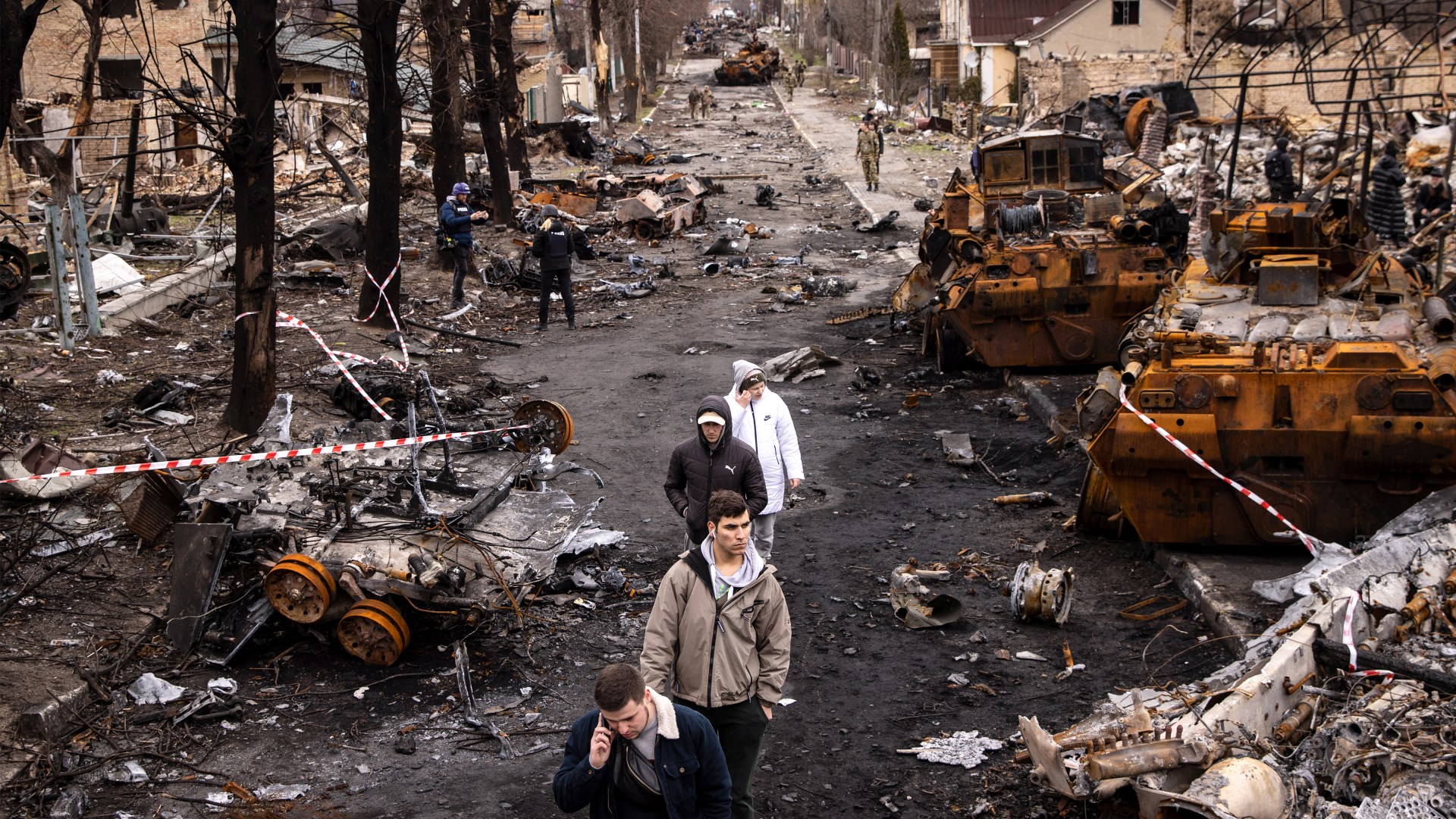
People walk through debris and destroyed Russian military vehicles on a street in Bucha, Ukraine, on April 6, 2022.

People walk through debris and destroyed Russian military vehicles on a street in Bucha, Ukraine, on April 6, 2022.

Christianity Today April 7, 2022
Chris McGrath / Staff / Getty

The atrocities are shocking. Ukrainian authorities have said 410 civilians were killed in the suburbs of Kyiv, discovered after the Russian army withdrew from its positions. At least two were found with their hands bound; several were shot in the head.

Many bodies were burned.

One resident said the occupiers were polite, and shared their meal rations. But others told of ransacked apartments; one was tied to a pole and beaten. Soldiers even shot a cyclist, who had dismounted and turned a corner on foot.

It could have been Ivan Rusyn.

President of Ukrainian Evangelical Theological Seminary (UETS), he had been coordinating aid from a safe house in Kyiv. But riding his bicycle into Russian-controlled Bucha to deliver medicine to a neighbor, he became an eyewitness to the atrocities.

Russia has called the images fake; satellite evidence contradicts.

Christianity Today

interviewed Rusyn to hear his firsthand report. He spoke about the spiritual impact, becoming a more authentic church, and how evangelicals have been helping the reclaimed suburbs—where he lived the past eight years:

Tell me about your neighborhood.

If you look at Bucha on Google Maps, I live in one of the five apartment blocs opposite Toscana Grill. It is an expensive restaurant, but sometimes I have eaten there. I run in the municipal park nearly every day, and with friends on Saturday. The seminary in Kyiv is six miles away, and it would take me 25 minutes to drive there, with traffic.

I noticed Google now says it will take an hour and a half.

The bridge was destroyed on the second day of the war. Russian helicopters and soldiers landed first at the Hostomel airport, three miles from our home. There was heavy combat, and I took shelter in my basement for the next five days. Then I left to the seminary, following that Google Maps route to skirt around Kyiv to the northeast. After two days we evacuated, and I found my way to a safe house in the city.

Now when we bring food and provisions into Bucha, Irpin, and Hostomel, we see many destroyed Russian tanks. The bridge is still out, but we can navigate it carefully with minibuses. It is dangerous, but if you go slow the journey now takes about one hour.

When did you return?

Four days ago (April 3). We were escorted by police because we had a long line of buses full of provisions, and to evacuate citizens. It was the same day that President (Volodymyr) Zelensky was in Bucha.

But I went once even before that, by bicycle.

My neighbors were sheltering in the basement, there was no way to contact them, and an evacuation route was being prepared. They also needed medicine. Irpin was under Ukrainian control at the time, so I went first to the military checkpoints there, but they didn’t permit me to go into Russian-occupied Bucha.

So I went to the nearby shallow stream, used my bike and a small tree to balance through the water. I saw dead bodies—civilians and soldiers. I saw people carrying children on their shoulders with their hands raised. I saw elderly people trying to find a way out.

And when I saw Russian soldiers, I had to hide. At one point I felt stuck in a bombed-out building, afraid I would have to spend the night. But I moved along small streets as much as possible, avoiding the main roads.

When I arrived, it was hard for my neighbors to leave, they were so afraid.

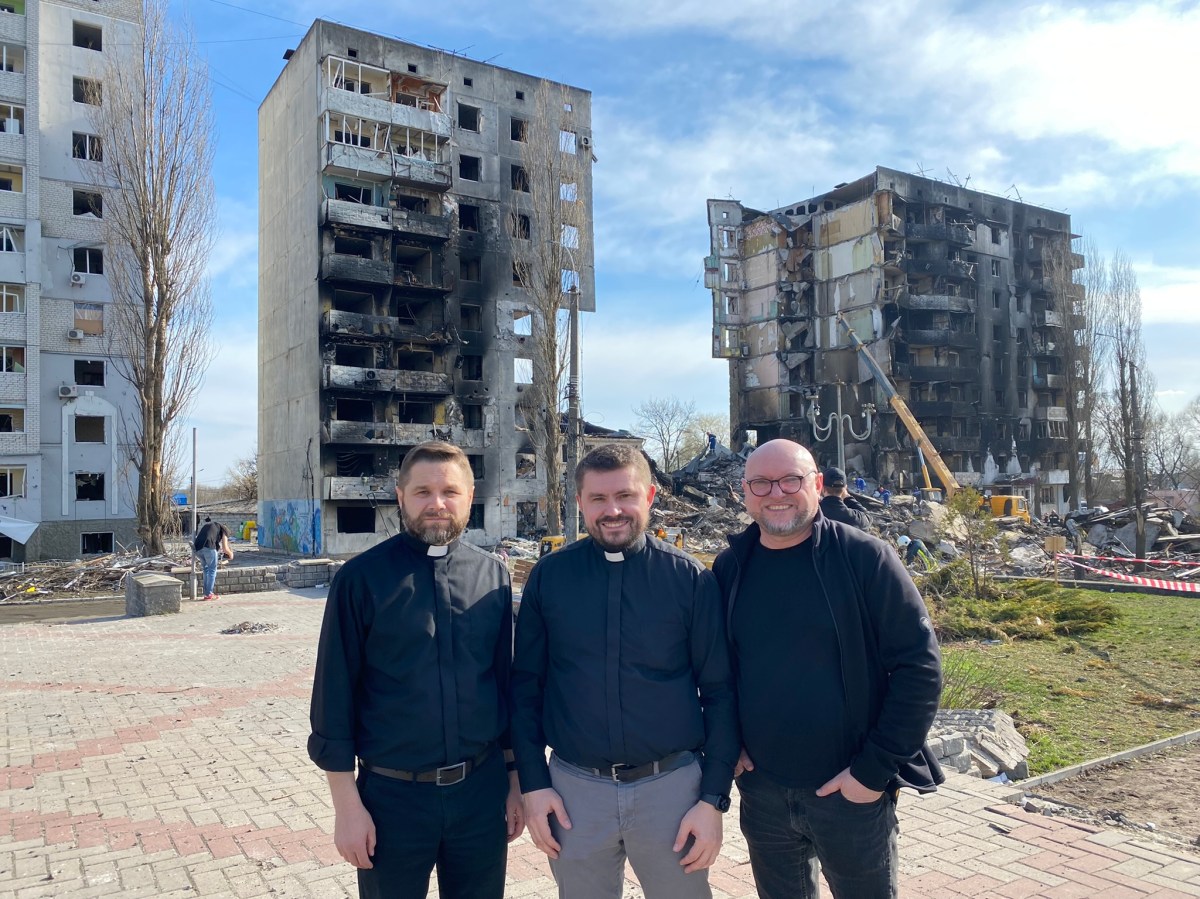
UETS seminary president Ivan Rusyn (center) in Hostomel, Ukraine.

What was it like when you returned in peace?

The first time, my apartment was without electricity but otherwise alright. The second time, the doors were broken into. I was robbed, and there was a Russian soldier’s coat left behind. But they didn’t just steal things, they smashed the TV, my computer monitor, and other appliances.

My neighbor, Nina Petrova, told me Russian soldiers came to her apartment and put a gun to her head, forcing her to show them all her valuables. Every apartment has been broken into. In some they even put a knife through the family photos.

I had an interesting psychological reaction, that others have also mentioned. Because an enemy—a killer—was in my apartment, I felt like it is not my own. I don’t care about things that I lost; I have peace in my heart. But the hardest thing is to come to terms with the Russian soldiers walking around my home.

What is it like to see a body on the street?

The last thing you think about is taking photos. And you don’t stop to examine who it is. But I found that in such a stressful situation I could mobilize myself to act. When I come back to our base, when I see the photos and read reports—I don’t know if it is okay to say this—but many of us are crying every evening.

But when I return to Bucha to help, I’m okay.

Two days ago, we visited Hostomel, and everything was destroyed. Then people started showing up, one by one, dirty. One lady came to me, and I noticed her hands. She said they are cooking over firewood. Her husband was killed, and she buried him right at the entrance to her apartment.

And then she hugged my colleague.

I heard at least 15 stories of people who told me they buried their loved ones. Yesterday we evacuated two ladies; one buried her husband in the yard. Another, very old, had been staying in an apartment without windows, very cold, no water, no electricity, nothing. A woman had been bringing her food every day and asked us if we could help her.

There are thousands of people like this. Younger people are more resourceful, able to evacuate. But old people have nowhere to go. They told me they went through hell.

Crosses are seen by a mass grave near a church on April 4, 2022 in Bucha, Ukraine.

Are there any evangelical casualties?

One of our graduates has been arrested, and we still have no idea where he is. But his son-in-law, taken at the same time, was found in a mass grave in Motyzhyn. Yesterday was the funeral, with a proper burial.

The dean of a seminary was also found dead. He was shot, and his body had been lying on the road for at least a few days, alongside his friend.

These are people we know personally.

In the first days of the war, you said that “God, break the bones of my enemy” has now become as holy as a “Hallelujah.” But now you have seen atrocities firsthand. What has your spiritual journey been like since then?

At that moment I could say it very clearly. But over the past 43 days, it has gone deeper. Our emotions are not as strong. We speak more slowly and quietly. Maybe professionals would say we are wounded psychologically. We try to say we are okay (smiling), but anger and pain are still present, penetrating to the deepest part of our identity.

I don’t know how to express it, even in Ukrainian. It is like being frozen. It is destructive. It is constantly thinking and recalling the suffering you have seen. It remains with you, and I am afraid it will not go away soon.

I still support that statement. My whispered cry to God is to intervene.

How has it affected relations with Russian evangelicals?

This war was not provoked by Ukraine. I don’t pray for Russians. Well, rarely. Over the past several years we had a pattern with them. We tried to adapt. You don’t understand Ukrainian? Alright, we will speak Russian, no problem. You don’t like the reports from the Donbas? Okay, we will be quiet.

But why do we have to be quiet?

Now we are hearing the same voices again. The situation is not clear. The photos you show us are hurtful. But why should we be quiet? We feel like they are trying to teach us how to forgive, but they don’t want to hear our voice. Only a few people reached out to me.

I understand Russian Christians will not go to Red Square to protest, and no one requires them to. But they could send us a message, even if encrypted: We can’t do anything here in Russia, but we are with you. We are against this war.

What is the impact on seminary education?

We will carry on as best we can. But sometimes I desire to reflect theologically, and other times I don’t want to think theologically at all. But I believe that we will become stronger.

No, not stronger—more authentic.

Of course we have a lot to share. But our authenticity will be expressed in our ability to listen, demonstrating sympathy without any words. My collar helps: People see I am a pastor, and we have red crosses on our buses.

The seminary will be less active in speaking for awhile, but we will serve our society through presence. I have received more hugs from strangers these past 43 days than from all my relatives the past five years.

We are developing a counseling ministry in our psychological department. Trauma is everywhere, and many Christians want to help. They have the best of motives; but with no experience, approaching the wounded will make things worse.

But my Christianity, my theology of mission, is in the process of being reshaped. Every week we are serving communion, experiencing God’s presence and solidarity with strangers and soldiers, in the open air. There are hundreds and thousands of churches actively serving, and evangelical Christianity will become more and more a part of society.

Sometimes you turn away from theology. Have you struggled with God?

I have been a Christian for a long time, involved in theological education for many years. There were times when I had questions for God, and of course I have them now.

Before the war, my wife and I were reading about the Holocaust—Elie Wiesel’s book. We visited museums in Kyiv and the site of the massacre in Babi Yar. This might sound academic, but it is not. I don’t know how to explain it, but sometimes in God’s silence, I hear his voice. This is a very contradictory statement. But in his absence, I feel his presence.

I can tell you honestly, there is no question for me if God exists or not. I once had an epistemological crisis, when I was starting my journey in theology. But amid this war, I never doubt that God exists.

Or that he loves you?

I think yes. I haven’t thought about it that way. Maybe I haven’t had time.

To our students, I explain that God’s actions are often clearer when you look backwards. I believe Ukraine will be a great nation, and a blessing to many others. Our unity, solidarity, and generosity—with strangers we never knew—is amazing. I hope that we will be able to see his logic later, but right now the price is very high.

The Russian Federation is destroying our nation. We don’t care about the buildings. But they consider our values a threat. I ask the global community to continue supporting Ukraine, not only with humanitarian assistance but also with all political and military help possible.

We are fighting a giant.

I want to say I see God’s hand at work. Here in the safe house, I can. But when I go back to Bucha tomorrow, can I say it to the old woman? Can I tell her that God is working in her life? Theologically, I believe he is. But in front of such suffering, I lack the strength to communicate it.

Follow CT’s Russia-Ukraine war coverage on Telegram: @ctmagazine (also available in Chinese and Russian).

Select articles are offered in Russian and Ukrainian.

Theology

6 Ways to Vet a ‘Word from the Lord’

Prophetic words about a Christian’s calling should be subject to biblical discernment.

Christianity Today April 7, 2022
Illustration by Mallory Rentsch / Source Images: WikiMedia Commons

It has always been popular in Christian circles to claim God’s leading when it comes to one’s personal and professional decisions. But in the past few years, a few high-profile figures made the news for claiming to hear from the Lord in their predictions about the last presidential election and their choices to switch or leave their denominations.

Is there any pastor in America who has not, at one time or another, been told that the reason a church member is doing something is because “God is leading” him or her? That phrase tends to be a conversation stopper for most Christian leaders. After all, if God Almighty, the Creator and Lord of the universe, has spoken, who are we to object?

The truth is, God does speak today. He created the universe by speaking. “Thus says the Lord” is the repeated refrain of Israel’s prophets. The distinction between the God of Israel and every other god in the ancient world was that he speaks—while idols cannot (Ps. 115:4–5). And it’s a sign of God’s judgment throughout Scripture whenever he stops speaking (1 Sam. 3:1).

Unlike the God of deism, the God of the Bible is personally involved in the affairs of earth, leading his church and caring for his children. One major way he leads is by speaking. Our job is to learn to recognize his voice, listen well, and wisely discern how to obey what he is saying.

But those of us in church leadership are often left wondering what accountability looks like in this area. That is, how can we assess whether a word is from God or not—and what vetting criteria should we consider when the Lord seems to speak to us or someone under our care?

I know personally that God speaks. My life was dramatically changed by a word from the Lord.

I was married, had young children, was an elder at our small church, and was thriving in my dream job: teaching law in the MBA program at the Ohio State University (OSU). But after coming to Christ at age 18, I had always felt drawn to full-time ministry—I just was never quite sure God had called me. A friend challenged me to ask the Lord for a sign. “Pastors kick Gideon around all the time,” he said, “but God answered his request.”

So, while participating on a conference ministry team with Vineyard in England, I decided to ask God for a sign. I gave the Lord no specifics—only that he would speak to me before I was to call home to my wife in three days. First day, nothing. Second day, nothing.

On the third day, the conference keynote speaker, John Wimber, began his evening session by saying, “Some of you here are praying about full-time ministry. You’ll know it’s the Lord speaking when it is the last hour!” I began gripping my seat as Wimber went through a long list of things uniquely relevant to me and my situation.

Then for good measure, a member of the ministry team shared a dream he had about me, which was followed by a prophetic word from someone else—all answering my question about full-time ministry with a resounding “Yes! I have called you.”

When I shared my experience with fellow elders at our church, they unanimously confirmed it. Unbeknownst to me, they had believed for some time that I was to leave OSU and become our first senior pastor. They were just waiting for God to speak to me.

The Lord also spoke clearly to my wife, and we decided to take a radical step of faith. I left my tenure-track position as a professor at Ohio State and entered full-time ministry. For the next 35-plus years, I pastored and led our “little” church that became Vineyard Columbus.

God is infinitely creative in the ways that he speaks. He speaks through nature. He speaks through dreams at night and visions in the day. He speaks through images and impressions. He speaks through prophetic words and actions. He speaks through our consciences, preaching, wise counsel, circumstances, and experiences; he speaks through the history of the church, through the books we read, and through our minds and emotions.

However, he speaks most clearly and infallibly through the Bible (the written Word of God) and through Jesus (the incarnate Word of God).

The problem is that we can unfortunately be entirely mistaken about whether God has spoken and about what he has said. The apostle Paul reminds us that in this present age “we know in part and we prophesy in part. … For now, we see only a reflection as in a mirror” (1 Cor. 13:9, 12).

Our partial knowledge, imperfect prophecy, and difficulty in hearing have led sincere Christians to wrongly believe (for example) that God has told them exactly when Jesus will return, that God will bring about revival at this place and time, or that God wants this particular candidate elected president.

In the same way, we must accept the reality of human limitations whenever believers claim the Lord’s leading . We must hold truths in tension as we seek to correctly discern words from God—welcoming the possibility that God still speaks today while acknowledging that we don’t always hear clearly. As Paul says, we should neither despise prophesy nor naively embrace prophetic words without first testing to see whether they are from God (1 Thess. 5:19–22).

We are told not to believe everything we hear when people claim a word from the Lord, but instead we must “test the spirits to see whether they are from God,” as 1 John 4:1 advises. So how do we discern whether someone is being led by God in their words and actions? Here are a few safeguards for biblical discernment that I have found helpful over the years:

1. God’s written Word is the standard by which we judge any word of prophecy or claim of leading. For example, any word that contradicts God’s written revelation concerning what is true, what is moral, or what is his expressed will must be rejected.

2. Jesus, the incarnate Word is also the standard by which we judge any word of prophecy or claim of leading. For example, words that are manipulative or self-seeking, harmful to others or out of sync with the Spirit of Jesus are suspect. Jesus is full of wisdom, kindness, gentleness, truth, grace, and patience, so words or “leadings” that don’t reflect his character should be rejected.

3. Humility should characterize anyone offering a prophetic word or claiming a leading from God. For example, rather than confidently asserting “Thus saith the Lord” or “God is leading me,” it is more honest to say (because of our human frailty), “I think God may be saying” or “I have a sense God may be leading.”

4. Community discernment is a major safeguard against mistakes in hearing and applying a word from God. The mind of Christ is not the private possession of an elite few (e.g., the pastor and his or her inner circle). Paul reminded the whole church in Corinth that “we have the mind of Christ” (1 Cor. 2:16, emphasis added)—in other words, not just you!

One question I frequently ask engaged couples is “Are there any people you know, in your family, among your friends, or in Christian leadership who have expressed reservations or concerns about your upcoming marriage?” I want to know whether this couple is open to input from the community around them and willing to hear their counsel or whether they are closed, acting independently and autonomously. 5. Transparency is another mark of genuine prophecy or leading from God. Words delivered and decisions made in secret are always suspect. The eyes and ears of others and their objectivity and sensibility are safeguards. It is easy to convince (deceive) ourselves into believing that in this particular case, because people just wouldn’t understand or because it will take too long to explain, we cannot include others. Secrecy is a great indication that something is seriously wrong! God’s word can always stand the light of day!

6. Accountability is key regarding any prophecy, leading, or major decision. Does the pastor or leader who claims God is leading have any meaningful check of his discernment and actions? Is there a board or leadership team empowered with authority, or do they simply function as a rubber stamp? Is the leader open to be challenged? Has the leader ever acknowledged being wrong—that what she thought was the voice of God was in fact not God speaking at all? Does the leader respond well to legitimate questions, or does he evade them by claiming “God has spoken! Who are you to object?” Accountability is particularly critical when money, power, and/or position are involved. If the person who claims “God is leading” personally benefits from that leading, basic knowledge of human nature demands that tough questions be asked. I have much more confidence in the authenticity of a word from God that involves substantial sacrifice and a cross than one that results in personal advancement and financial gain!

It is true that phrases like “The Lord is leading” get attached to silly ideas and selfish desires. It is easier to be cynical and dismiss outright the notion that God still speaks today outside his written Word.

But just like Gideon’s fleece, as well as my own story of entering ministry, sometimes we need a timely word, nudge, or reminder from the Lord. As Jesus said, “Man shall not live on bread alone, but on every word that comes from the mouth of God” (Matt. 4:4, emphasis added).

Rich Nathan is the founding pastor of Vineyard Columbus, a multiethnic congregation in Columbus, Ohio and was their senior pastor for 34 years. He is the author of three books: Empowered Evangelicals, Who Is My Enemy? and Both-And.

Apple PodcastsDown ArrowDown ArrowDown Arrowarrow_left_altLeft ArrowLeft ArrowRight ArrowRight ArrowRight Arrowarrow_up_altUp ArrowUp ArrowAvailable at Amazoncaret-downCloseCloseEmailEmailExpandExpandExternalExternalFacebookfacebook-squareGiftGiftGooglegoogleGoogle KeephamburgerInstagraminstagram-squareLinkLinklinkedin-squareListenListenListenChristianity TodayCT Creative Studio Logologo_orgMegaphoneMenuMenupausePinterestPlayPlayPocketPodcastRSSRSSSaveSaveSaveSearchSearchsearchSpotifyStitcherTelegramTable of ContentsTable of Contentstwitter-squareWhatsAppXYouTubeYouTube