News

Supreme Court Rules Against Maine Policy Denying Christian School Aid

Update: Justices say that exempting religious schools amounts to discrimination.

Christianity Today June 21, 2022
franckreporter / Getty Images

The Supreme Court ruled Tuesday that a Maine policy covering tuition for private schools but not religious schools violates the First Amendment.

Maine offers the tuition assistance in rural districts that do not have public schools. The challenge involved two private Christian schools, Bangor Christian Schools and Temple Academy, which didn’t meet the state’s “nonsectarian” requirement for families to qualify.

The court said such a requirement infringes on free exercise protections and that there was “nothing neutral” about the program.

“The State pays tuition for certain students at private schools— so long as the schools are not religious. That is discrimination against religion,” the court ruled in a 6–3 opinion authored by Chief Justice John Roberts. “A State’s antiestablishment interest does not justify enactments that exclude some members of the community from an otherwise generally available public benefit because of their religious exercise.”

The Carson v. Makin decision upholds the court’s 2020 ruling against a Montana scholarship program that also barred religious schools from receiving the funding.

————-

Original post (December 6, 2021): The latest Supreme Court case over public funding for religious schooling examines a policy in Maine, a state dotted with small towns too tiny to run their own public schools. Over half of the state’s school districts (officially called “school administrative units” or SAUs for short) contract with and pay tuition costs to another nearby school of the parents’ choice—public or private.

And that’s where the hangup lies. By law, Maine mandates that partnering private schools be “nonsectarian in nature, in accordance with the First Amendment of the United States Constitution” to receive the funding, and three Christian families in the state are challenging the requirement.

The Supreme Court will hear their case, Carson vs. Makin, this week. The decision could set further precedent in defining the distance between church and state and the approach to religious freedom itself, as it makes a distinction between barring public funding due to religious identity of the recipient and barring funding to the religious purpose it would be used to advance.

The families in the case argue that the requirement violates their free exercise of religion since the state bars them “from using their SAUs’ tuition assistance to send their children to religious schools.”

Two of the families, the Carsons and the Gillises, send their children to Bangor Christian School, a primary school whose philosophy is based on educating children “with a biblical worldview.” The other family, the Nelsons, would like to send their daughter to Temple Academy, another Christian school that integrates academic studies with the “truths of Scripture.”

Neither family had actually applied for the tuition assistance program, but they cite Maine’s “nonsectarian” requirement as a key factor that makes an attempt to even apply for the tuition assistance program a futile endeavor.

Both Bangor Christian and Temple, because of their biblical principles, refuse to hire LGBT teachers and wouldn’t accept tuition assistance from the state if doing so would mean adhering to Maine’s Human Rights Act, which prohibits discrimination in hiring on the basis of factors including sexual orientation and gender identity.

“As a threshold matter, the Court will have to decide whether the families have constitutional standing to sue,” Kimberly Wehle, professor of law at the University of Baltimore, wrote for The Atlantic. “Their schools of choice are unwilling to participate in the funding in the first place, so a ruling in their favor would not redress any concrete injury, which is required to access the federal courts.”

Threshold notwithstanding, what the 6-3 conservative leaning Supreme Court could decide in Carson, according to Wehle, is whether Maine’s nonsectarian requirement draws a distinction based on the religious status of these schools or if Maine’s law was made based on a school’s proposed use of public funding for religious purposes.

As it stands now, any government—state or national—can’t discriminate funding for institutions based on religious status, but it can deny use of public funds if the funds in question would go toward religious functions.

Some critics of the policy, such as Charles L. Glenn at First Things and columnist George F. Will at The Washington Post, view the distinction as the state penalizing distinctly religious schools from a particular tradition while allowing funding for schools who teach broader, “universal” spiritual values. Glenn writes, “There is a real risk that faith-based schools will soften their religious identity in order to become more acceptable to the government.”

Although there have been court cases at the appeals and Supreme Court level that had addressed similar issues, the Supreme Court ruled most recently in June 2020’s Espinoza vs. Montana Department of Revenue that Montana’s ban on religious schools from its state scholarship program was unconstitutional.

This ruling, suggesting states can’t discriminate based solely on sectarian status, could serve as precedent for a Carson v. Makin ruling.

When Carson vs. Makin went to the US Court of Appeals earlier this year, the court interpreted that the difference between the Espinoza and Carson cases was between the distinction of use and status. A government can’t discriminate when offering funds to religious organizations because of its religious identity alone; but, the court argued, it can discriminate if the funds would be used toward “religious” purposes.

The Becket Fund for Religious Liberty, a leading advocacy organization on the religious freedom front who joined other advocates in submitting friend of the court briefs to the Supreme Court, disagrees with the use/status distinction found in the Court of Appeals ruling.

“The First Amendment prohibits the government from discriminating against religious people just because they are religious,” Diana Thomson, senior council at Becket, wrote. “If the government excludes religious groups because they use the funds in a religious manner due to their religious beliefs, that is no better than excluding them because they hold those beliefs.”

According to Americans United for the Separation of Church and State, an overruling of Carson v. Makin would mean that the taxpayer, regardless of faith background, would fund religious education even if they don’t share or support those beliefs.

“Our country has a long tradition of not forcing taxpayers to fund religious activities, including religious education,” said Alex Luchenitser, associate vice president and associate legal director at Americans United.

“That tradition has long been recognized and affirmed in Supreme Court decisions. Ensuring that religious education is funded solely by private dollars protects the freedom of conscience of taxpayers and guards religious institutions from governmental interference.”

Maine has 707 schools, and roughly 18 percent of them are private schools. Of the private schools, 14 percent are classified as “sectarian.”

This case will not only affect Maine’s students, but students across the country if this case sets a new precedent for public funding, particularly as families are increasingly drawn to educational alternatives. Education Next named 2021 a “breakthrough year” for school choice, with “18 states enacting seven new educational choice programs and expanding 21 existing ones.”

Michael W. McConnell, director of Stanford University's Constitutional Law Center, former federal judge on the 10th Circuit Court of Appeals, wrote a friend of the court brief to the Supreme Court on behalf of the plaintiffs in this case. He believes that a ruling in favor of the plaintiffs would actually put religious families and entities on equal footing with secular ones.

“If the court decides Carson in favor of the families and schools, this will complete the Court's transition from the idea of no-aid separationism to the idea of neutrality toward religion,” said McConnell.

“This will align the Court’s jurisprudence with the historic purposes of the Establishment Clause, and with common-sense understandings of governmental neutrality, in which private entities are treated equally, with no advantage to the secular and no advantage to the religious.”

Other legal scholars hold that public funding of Christian curricula would be a clear violation of First Amendment principles.

“The mountain of case law and legal tests produced under the auspices of the amendment’s sparse text underscores that there is no obvious, black-and-white answer to whether the Constitution recognizes a parental ‘right’ to obtain a taxpayer-funded religious education if nonsectarian schools are eligible,” wrote Wehle in The Atlantic.

“If a fractured Court winds up mandating the use of public education funds to teach ‘a thoroughly Christian and biblical worldview’ under these circumstances, the obliteration of America’s long-standing separation of Church and state has begun.”

Reply All

Responses to our April issue.

Source Image: Envato Elements

Christ Conquered Death. He Didn’t Cancel It.

Ms. Rosner’s assertion that the church’s bifurcation of life and death during Holy Week is somehow disorienting and dehumanizing is not something I can agree with. I believe that, because of Christ’s triumph over the tomb, we no longer have to feel doomed by our own mortality. Easter, the most glorious day in all Christendom, gives us hope, nay assurance, of eternal life.

Ron Elkins Bonita, LA

Sometimes it feels like Protestants look to Judaism so much but ironically ignore Catholics and Orthodox, who have kept many Jewish traditions or transformed them in ritual.

@meagankclark (Instagram)

Embezzlement Bedevils Global Church Giving

My grandpa helped uncover embezzlement at his church over 50 years ago. This isn’t new, but it is vital to do everything to stop it!

@molliejohanson (Instagram)

I can’t thank you enough for this kind of journalism. Whenever Christians turn a blind eye to things like this, it makes me feel a little more crazy. Like, “Is nobody seeing what I’m seeing?!”

@alexandragrace7 (Instagram)

As someone who fundraises for a nonprofit, this saddens me so much. I hate that people are skeptical to donate because some people and organizations are fraudulent. But I also hope people know that the vast majority of charities are stewarding funds properly. If you’re in doubt, ask to see the org’s financials. Make sure you can trust where you’re directing your charitable giving.

@jenyin28 (Instagram)

Don’t Make the Church Leadership Crisis Worse

Perhaps we accept cheap imitations of leaders if it means we can push back our disenchantment for a couple hours on Sunday.

Paul Konkol Mead, CO

What Atonement Theories Tell Us About Our Politics

The April 2022 issue has several very fine articles and columns, mostly written by women. As a layperson that has at least a basic understanding of penal substitution, it is nice to have names to refer to other atonement theories. I have also read C. S. Lewis, and now I can call what Aslan does a representation of Christus Victor. Then Tish Harrison Warren’s column shows we need three parts to be at least close to complete in our lives. I’ve long had a problem with Christians who teach that “God is love” but seem to hate a lot of people. It is good to know that Christianity Today is not afraid to engage with a wide variety of issues in a fair manner.

Mark Phillips Kansas City, MO

Leon Morris stated that none of the writers of the New Testament puts forth a theory (explanation) of “how” the atonement of Christ works, and then he went on to say [in a 1961 CT article] why penal substitution is correct. Why do we need a “theory” to explain what the Holy Spirit alone can make real in our hearts? The words in the Scriptures are spiritual words, not words of human logic and wisdom. Is the Spirit unable to reveal what is necessary for salvation to the human spirit? First Corinthians 4:6 (ESV): “I have applied all these things to myself and Apollos for your benefit, brothers, that you may learn by us not to go beyond what is written.”

Douglas Staples Kalamazoo, MI

Visiting Prisoners in Jesus’ Day

We can and should learn from history both when the church did things well and when they failed. It is not an accident that, throughout Europe, there are towns called Spital. The name is Latin for hospital, where monks would provide care for the sick and the elderly. They would also try to meet the needs of the poor and imprisoned. However, one mistake the Reformers made was to try to disconnect the church from this activity. It took until the late 1700s for the church to pick up this role again. Prison reform came about through the work of Quaker Elizabeth Frye.

David Parish Cambridge, England

Black Christian Homeschoolers Are Redefining the Movement

I remember not liking how Eurocentric and procolonization typical homeschool curriculum was when I was a homeschooled teenager myself! And not much has changed in the mainstream since then, sadly. Thanks for the resource for bringing diversity to schooling!

Amanda Girvan (Facebook)

Great article. I’m thankful for McPhaull’s Oh Freedom! curriculum and all of the hard work she put into putting it together. It’s heavy stuff, but it’s important information for my kids and myself to learn. We are going through it at a slower pace, but really learning so much.

Grace Chance Markey (Facebook)

It’s not just about wanting our kids to have a Christian education. Any parent of color knows they have to heavily supplement our children’s education and fill in the blanks of omission and counter the outright lies present in American public school education. My mom took pains to provide curriculum that told the whole story of [people of color].

Laura Spencer (Facebook)

Correction: The April article originally titled “Preaching Truth in the Land of Disinformation” said on page 16 that the 1908 Alphabet Congress was organized by the Bible Society. It was not. One of the organizers was a Protestant who also worked for the Bible Society.

Books

5 Books for Getting to Know the Desert Fathers and Mothers

Chosen by Andrew Arndt, author of “Streams in the Wasteland: Finding Spiritual Renewal with the Desert Fathers and Mothers.”

Wikimedia Commons

The Way of the Heart

Henri Nouwen

Nouwen’s little classic was where I first met the likes of Anthony, Arsenius, and Theodora. The Way of the Heart is indispensable reading for understanding how solitude, silence, and prayer mark the life of holiness. Writes Nouwen: “The words flee, be silent, and pray always summarize the spirituality of the desert. They indicate the three ways of preventing the world from shaping us in its image and are thus the three ways to life in the Spirit.”

The Wisdom of the Desert

Thomas Merton

Few have lived the wisdom of the desert as radically as the Trappist monk Thomas Merton. His book of collected sayings gives a beautiful glimpse into what motivated the Fathers and Mothers. As Merton observes, “What the Fathers sought most of all was their own true self, in Christ. And in order to do this, they had to reject completely the false, formal self, fabricated under social compulsion in ‘the world.’” Amen to that.

The Desert Fathers: Sayings of the Early Christian Monks

Transalted by Benedicta Ward

At some point, getting into the desert fathers and mothers means immersing yourself in primary-source material. Which brings us to these translations from Benedicta Ward, one of the foremost modern authorities on desert spirituality. Her volume organizes desert sayings and stories by theme, making it a handy guide. (Mine is a mess of notes and markings and dog-ears.) A must-have for those looking to go deeper.

John Cassian: Conferences

Translated by Colm Luibhéid

One reason we know about the desert fathers and mothers at all is because of John Cassian. As a young man, Cassian traveled to Palestine and Egypt to drink from the wells of desert wisdom. Twenty-five years later, he founded a monastery near Marseilles, France. Benedict of Nursia later used Cassian’s writings to found his own monastic communities, which shape Benedictine, Cistercian, and Trappist life to this day.

Where God Happens: Discovering Christ in One Another

Rowan Williams

This book blends the sayings of the desert with Williams’s unmistakable theological clarity and cultural analysis, showing just how relevant the wisdom of the desert is to our increasingly polarized time. As Williams writes, “What is to be learned in the desert is clearly not some individual technique for communing with the divine but the business of becoming a means of reconciliation and healing for the neighbor.”

Books

New & Noteworthy Fiction

Chosen by Amanda Dykes, author of “All the Lost Places,” “Yours Is the Night,” and other novels.

Until Leaves Fall in Paris

Sarah Sundin (Revell)

Historical novelist Sarah Sundin marries sweeping story to impeccable research in this captivating World War II tale of personal sacrifice and costly courage. We follow the journey of ballerina-turned-bookshop-owner Lucie Girard as she navigates the complex world of occupied Paris, discovering the hidden gifts of challenged perceptions, seemingly impossible adversity, and a question so many face: What can we do to help, each in our own unique spheres, when the troubles of the day are daunting in scope? Heart-filling and inspirational, Until Leaves Fall in Paris skillfully weaves together charm and grit.

A Midnight Dance

Joanna Davidson Politano (Revell)

Politano’s latest masterpiece introduces Craven Street Theater, a world of lore that haunts not only the hidden corners of the theater’s ballet company, but also its newest dancer, Ella Blythe. With mysterious fires, legendary figures, and an uncertain future intricately tied to the secrets of the past, Politano deftly weaves together beloved gothic literature tropes and original ideas, with a generous sprinkling of luminous story magic. She plumbs depths that invite readers to ponder such questions as: Does art only have value when it has an audience? To what extent do our pasts define us? And how does forgiveness reshape our lives?

A Gentleman in Moscow

Amor Towles (Penguin)

This book has swept the world with its lush language, keen insight, and enduring poignancy. When Count Alexander Rostov is sentenced to a lifetime of confinement inside a luxury hotel, we see his worldly riches decline alongside a growth in other forms of riches, like unlikely friendship, found family, and hard-won beauty during a dark time in history. Though written for a secular market (and containing elements that might trouble some readers), the book features valuable themes and exquisite turns of phrase. With quick wit and delight-filled language reminiscent of P. G. Wodehouse, and vibrant character interweaving to rival Charles Dickens, this is a modern classic.

Books

The Christian Case for Reading Black Classics

Why James Baldwin, Toni Morrison, and other African American masters deserve an audience among all believers.

Source images: Alejandro Escamilla / Unsplash / Wikimedia Commons

Claude Atcho was shopping at Target when a display of James Baldwin books got him thinking: Who would read them? Or get lost trying? At that moment, Atcho—a Charlottesville, Virginia, pastor who had taught African American literature at the collegiate level—was inspired to write a guide for Christians on reading and discussing Black classics (like Baldwin’s Go Tell It on the Mountain). The result, Reading Black Books: How African American Literature Can Make Our Faith More Whole and Just, applies a literary and theological lens to these classics. Journalist and mystery novelist Patricia Raybon spoke to Atcho about his invitation to readers.

Reading Black Books

Reading Black Books

Brazos Press

208 pages

What is a Black book? How do you define it?

For me, it’s those classic, canonical texts that look at African American experience, hope, and concern but also—as literature—have stood the test of time. It’s not just about having an interesting plot; these books take up significant themes and ask important questions about human experience universally, but Black experience in particular.

What’s an example?

I remember reading Richard Wright’s novel Native Son as an undergraduate and being just floored by the power of the writing and the portrayal of human existence it puts forth. It rocked my world. I just remember thinking: What does this story mean for me as a Christian? I felt this burning urge to talk about the book from a literary and religious perspective—as a matter of theology and lived faith alike.

How can books like Native Son—or Ralph Ellison’s Invisible Man, or Toni Morrison’s Beloved—move readers to a deeper theological understanding of, say, the imago Dei?

With Invisible Man, for instance, you can begin to wonder: How do I actually see people? For white Christian readers, for example, it’s unlikely they would deny that an Asian American, African American, African, or immigrant is made in God’s image. But by reading these novels, we learn that when we habitually see people in certain ways, filling our minds with particular stereotypes, then we’re not truly seeing them. So, reading these books can be a corrective that produces empathy. And I would hope that for Christian readers, our empathy would be Christian empathy, rooted in what Christ displayed for us.

What do Christians miss when they avoid or condemn Black books?

What’s missed is the story of God at work—and God’s not at work just among one people. We’re shutting the door and closing ourselves from a view of God’s faithfulness from below, as it were. From the African American experience, we can see what it means for God to be with, among, and faithful to people going through trial and suffering—people who, in the words of theologian Howard Thurman, are disinherited, rejected, and despised. Avoiding these books cripples our imagination, which leads to a truncated faith and practice. If we take the plunge of humility to read and learn beyond our perspective, we can grow in lived righteousness.

What can Black books offer to Black readers themselves?

What faith “from below” produces in the hearts of people who are suffering is a power almost beyond words. When people who feel the world crushing them in every way possible can say, “Here is Jesus Christ, the Lord of Glory; he knows exactly what I’ve experienced, and I can look at his crucifixion and know he cares”—what that puts into a person’s soul, I don’t think you can really quantify. It makes concrete the truth of God’s love and presence for people who have experienced immeasurable pain and suffering.

African American literature, in particular, depicts suffering people looking to the Suffering Servant and finding the hope and comfort that the Bible speaks of. That’s the gift of attending to this literature in a literary and theological way. We’re guided into a fuller biblical picture of who God is and what God is calling us to.

How do you answer complaints that some Black books are too explicit or violent?

Part of our faith is being honest about human experience: that it can be beautiful, but also very grimy. True literature is going to deal with that in uncomfortable ways. But we are called to enter into the pain and stories of others. Maybe somebody isn’t ready to step straight into reading a novel like Beloved. But you can read Margaret Walker’s poetry or James Baldwin’s Go Tell It on the Mountain. There are all sorts of different entry points if we’re willing to have the posture of a learner and to learn with others.

Are there advantages, then, to reading these books communally?

That’s the way we read best—when we’re reading, discussing, and processing books together. When we can say to each other, “What did that feel like to you? Here’s how it felt to me.” In reading communally, we rely not only on our own understanding, but also on the strength of the community to process together, and that’s where the best learning and transformation will emerge.

You declare that sin has a systemic dimension—that it isn’t just an individual’s isolated failing. Why do some Christians resist that view?

There’s a fear that affirming the social dynamics of sin—that sin can be found in systems or organizations—has the effect of denying individual responsibility for sin and our individual need for forgiveness. But if you read Native Son, for example, and take it seriously, it paints a fuller picture of sin—that it’s not just a volitional choice of one person but also a power that lords over us and has social dynamics and connections that go deeper than we care to admit.

As we read our Scriptures, like the Book of Romans, it’s clear that sin is both a verb and a noun. It impacts individuals, but also the whole world. As people made for fellowship with God and one another, our sin creates fractures that run both vertically and horizontally. We can debate how far those ripples go, but those ripples do, in fact, go downstream.

Your book was conceived during the summer of 2020, in a moment of racial reckoning. Since then, we’ve seen a period of pushback. Do you ever worry that your book missed the moment?

The time is still right because, with God, the time is always right. The kingdom of God is at hand. So there’s always hope to be had. And on a practical level, I just couldn’t go back into Target and see all these books lined up on the shelf without wanting to say, “Let me be a guide to people who might buy James Baldwin books while they get their groceries. Let me try to contribute something for people who might pick up these great works and then wonder: What does this mean for me?

Your book closes on the theology of hope, as shown in Margaret Walker’s poem “For My People.” But the poem only feels hopeful in the last stanza. Why, then, do you recommend it?

In the poem, Walker traces through all these trials and stumbles that define African American experience—including what she calls the “unseen creatures who tower over us omnisciently and laugh.” Yet, in closing, she still summons up the hope to say, “Let a new earth rise. Let another world be born.” This is the invading nature of hope. There’s a sort of cosmic evil at work in the world, which means we need an invading hope whose arrival is almost unexplainable. I couldn’t imagine anything but this poem to close the book.

Claude Atcho is pastor of Church of the Resurrection in Charlottesville, Virginia.

Ideas

The Unexpected Parenting Comfort of Ecclesiastes

Columnist

When the world calls everything unprecedented, God’s provision remains unchanging.

Illustration by Rick Szuecs / Source images: Envato / Vlada Karpovich / Pexels / Rosmarie Wirz / Getty

At a recent parenting forum on children and technology at my church, I offered a discreetly told example of failure from my years of parenting teenagers. Even in the retelling, I could feel the knot of panic in my stomach the same as when the events were playing out in real time.

Nothing stirs fear in us quite like when our responsibilities as parents intersect with the tough realities of our world. And parents today face their share of legitimate fears.

Between social media, shifting sexual ethics, sex abuse scandals, pandemics, pornography, and all of the usual challenges of raising kids, the consensus is clear: Parenting today is hard. Christian parents are afraid, perhaps more than I’ve seen in my 25 years in ministry.

We want to protect children from temptation and negative influence, but the task feels insurmountable. We can feel powerless, asked to sail through uncharted waters with monsters left and right. But in the middle of my parenting fears, the Lord brought to mind timeless help to serve as a compass: He reminded me about what does not change.

Did my children face unprecedented challenges with technology and social pressures? In one sense, yes. But on closer observation, these were old challenges with new wrappings. The Book of Ecclesiastes goes to great lengths to drive home the point that there is nothing new under the sun.

I had always regarded this message to be a bit of a downer, but in tumultuous times, it emerged as the stabilizing force I needed. These challenges were not unprecedented. These waters were not uncharted. The eternal God looks down on this generation and sees no new problems. Not only that, he stands ready, as he always does, to be faithful to this generation and all generations.

Were my children certain to be overwhelmed by the temptations before them? Praise God, no. I had long appreciated the assurance in 1 Corinthians 10:13 that God always provides a way of escape from temptation. But parenting teens helped me to meditate on that verse: “No temptation has overtaken you except what is common to mankind.” The temptations of this generation are not novel or unforeseen. They are as old as human history.

What appears unprecedented to us is just another mechanism for committing an old sin, a modern method for giving in to an ancient temptation. Technology gives us new ways to succumb to the old temptation of lust. Cultural trends give us new ways to succumb to the old temptations of self-determination, self-will, and self-worship. Anxious parents can remember these common sins come with God’s same provision of escape.

Parents of all generations wrestle with fears both legitimate and illegitimate. I suspect that Christian parents from previous generations who raised children in famine, persecution, poverty, plague, enslavement, and war would question whether we face exceptional challenges in ours.

The same deep wells of wisdom that were available to them are available to us. The same escapes from common temptations are available to us and to our children. The same God who was their rock and fortress is ours today.

Much as we may want to, we cannot keep our kids safe from the world. What we can do is parent with the right fears in view, educated to the risks around us, anchored in reverence for God.

As Tim Kimmel has noted, our task is not to raise children who are safe, but to raise children who are strong. Children have sensitive “spiritual noses.” They can smell fear in us. We owe them the fragrance of Christ in our daily interactions with them. Let our parenting be motivated, then, not by the fears of our generation but by the fear of the Lord.

The fear of the Lord is the beginning of wisdom. Parents motivated by fear rightly placed will carry the distinct aroma children need to be surrounded by to grow strong in a world that is, has always been, and will always be unsafe.

When we as parents model calm in the face of uncertainty and wisdom in the face of temptation, we invite our children to that same strength of character. We invite them to fear as they ought in an unexceptional age.

Theology

The Foreigner’s Blessing That Broke Me

Among Ukrainian exiles, I found miraculous perseverance in the absence of deliverance.

Sophia Lee reporting in Poland

Sophia Lee reporting in Poland

Christianity Today June 21, 2022
Photos by Joel Carillet

Six months before I flew to Poland to report on Ukrainian refugees, a truck hit my mother-in-law, killing her instantly. Six weeks before I flew to Poland, I discovered I was 23 weeks pregnant.

A lot was on my mind when I boarded the plane to Warsaw. I had just started a new job. My husband’s grief was still raw, and I sometimes heard him crying in his sleep, dreaming vivid memories of his mother. Neither my husband nor I felt ready to become parents in less than three months. And there I was, unborn child tumbling in my belly, his rolls and jabs as turbulent as my thoughts and emotions. I tried to pray then, but all I could muster was: “Oh Lord, how I need you.”

In times of war and hardship, we seek stories of extraordinary courage and resilience. As a Christian journalist, I wasn’t sure what to expect in my reporting, but I knew what I hoped to find: powerful testimonies, inspiring images of the gospel at work, quote-worthy statements of faith.

I found all of those things in Poland as I visited churches, refugee shelters, train stations, and border crossings. It wasn’t hard to find heartwarming stories of the faithful: One Ukrainian pastor in Zabki, a suburb of Warsaw, invited more than 10 refugees to stay with his family in their tiny home. The day I visited his church shelter, Ukrainian refugee children gathered on the steps to sing a sweet Ukrainian hymn about God’s protection, forgiveness, and mercy.

I also saw giant steps of faith. Almost every church in Poland is helping Ukrainian refugees, but most can only offer short-term stays. The Church for the City in Krakow realized they needed a longer-term strategy. At first, the church began praying about hosting 700 refugees for six months. But the lead pastor, Zbigniew Marzec, wondered, “Why only 700? Why not shoot for 1,000? Why not stretch our faith and go bigger, without limiting God?” Hosting 1,000 refugees for six months would cost $5 million. The church decided to pray for 1,000. Marzec chuckled as he told me their vision: “To think that three weeks ago, we were struggling to buy sound equipment that costs $300!”

It warmed my heart to hear confident, definite statements of faith, to see self-sacrificing, purpose-driven Christians working on the front lines of war. I longed for that expression of faith for myself, especially as so many things were uncertain and heavy in my own life.

But that wasn’t the only expression of faith I witnessed in Poland. Not every Christian I met had a well-defined testimony, particularly the refugees whose lives have been torn apart by war, by loss, by a looming future of uncertainty and instability.

One refugee I met, Daniell, broke down as he recalled his horrible year even before the war. His firstborn daughter was born with a permanently damaged brain due to a botched delivery. Sometimes she suffered more than 300 seizures a day, and Daniell and his wife had spent sleepless nights trying to keep their little baby alive. Because of their child’s condition, evacuating Ukraine was near-impossible, even as shelling and bombing rattled their home. Through the help of other Christians, they were at least able to flee to Warsaw.

Daniell didn’t quote verses about God working all things for the good or testify about finding purpose in his sufferings, which have not ended. He recounted the past year with hollow eyes: “We lived life as though already dead.”

But Daniell, too, has an expression of faith—a real, living one. He continues to pray. He doesn’t pray “leap of faith” prayers declaring healing over his daughter; his lips burned through miracle-seeking prayers long ago. And yet, he prays. There is a name he calls out to, even if his prayers aren’t red-hot passionate or peppered with statements of profound conviction and Bible passages. He prays because, he explains simply, “I can’t imagine any other way of living.” His faith isn’t anchored in mission, in purpose, or in the miraculous. It is more like breathing, even when those breaths sometimes rasp out in gasps.

While I was interviewing refugees, back home in Los Angeles, my husband woke up one morning alone and sobbed. It was his mother’s birthday. She loved birthdays. She always went out of her way to make sure everyone felt special on their birthdays, and liked feeling special on hers, too. Had she been alive, my husband would have been receiving an email from her reminding him about her birthday. That morning, no email came.

One of the hardest struggles for my husband was the senselessness and suddenness of her death. “Your mother’s in a better place with Jesus,” people murmured, words that brought no comfort, only anger and confusion. But why? Why did it happen? Why like this, with no closure or greater meaning?

Such was my husband’s expression of faith: He wrestled, not just with grief, but with God. He couldn’t perform his usual daily devotions. All he could do was turn on worship music and listen to words of praise and joy he didn ’t yet have the strength or heart to sing himself.

In the several months after his mother died, I watched my husband’s faith evolve. It’s not as exuberant and self-assured as before. It’s simpler now, quieter, humbler, but in many ways, a lot more authentic. I saw similar expressions of faith in the stories of some refugees. One refugee told me she used to pray fervently out loud for God to stop the war. She had believed the war would cease in a week or two, but as the weeks dragged into months and the body count grew, her prayer changed. It now bears the wounds of much more pain, and her tone and expectations are not the same. And yet, she still prays. Like Daniell, like my husband, she prays, even if it’s short and simple, because he is listening.

My last day in Poland, I visited a church-run warehouse in Warsaw that was sending supplies to hot zones in Ukraine. It was a tense day. The Russians had just bombed a critical bridge to Chernihiv, blocking the only way across the river. Meanwhile, they had eight trucks, each full of about $40,000 worth of emergency supplies, stymied on one side of the bridge. The team at the warehouse decided to build rafts out of 50 barrels that would be sturdy enough to carry 160 refugees and several tons of food across the river.

Volunteers were still discussing this when a white-haired Ukrainian missionary gestured to my seven-month-pregnant belly with a smile: “Boy or girl?” He beamed, then asked, “Can we pray for you and the baby? We would love to pray. It’s so important to pray for a new life.”

I was taken aback. I had not expected a busy group of Ukrainians, besieged with the stresses and logistics of war, to pause their day to pray for a stranger from America. The missionary called everyone immediately to their feet and they gathered around, placed their hands on my shoulders, and began praying in unison in Ukrainian, with loud voices and raised palms and pumping fists. I had no idea what they were saying, but I understood their hearts and I soaked it all in: beautiful foreign words of faith, of blessing, of love and joy over a new life colliding with the presence of death and grief.

It took all my willpower not to burst out crying. I had not had much mental and emotional space to be still and pray. I didn’t realize how much I had needed this—an expression of faith declared by someone else over me, for me, to me.

On the flight back to Los Angeles, I felt like a dam had broken. I had left with a heart in turmoil and was returning with a heart full. What I witnessed was diverse expressions of faith in the body of Christ; each was rich and powerful and alive in its own way, but woven together, they portrayed the image of Christ in his full glory and beauty. And now, beholding the glory of the Lord, what other response could I have, but cry out?

So I did. In my seat I prayed, “Oh Lord, you are good.” A cry, and a worship. And in my womb, the baby danced. He wiggled and jiggled, did the booty pop and a pirouette—his own expression of faith, I suppose.

Sophia Lee is global staff writer at Christianity Today.

History

Disasters Often Bring Revelation Rather than Punishment

An 18th-century earthquake and a 21st-century pandemic can teach us about enlightenment and judgment.

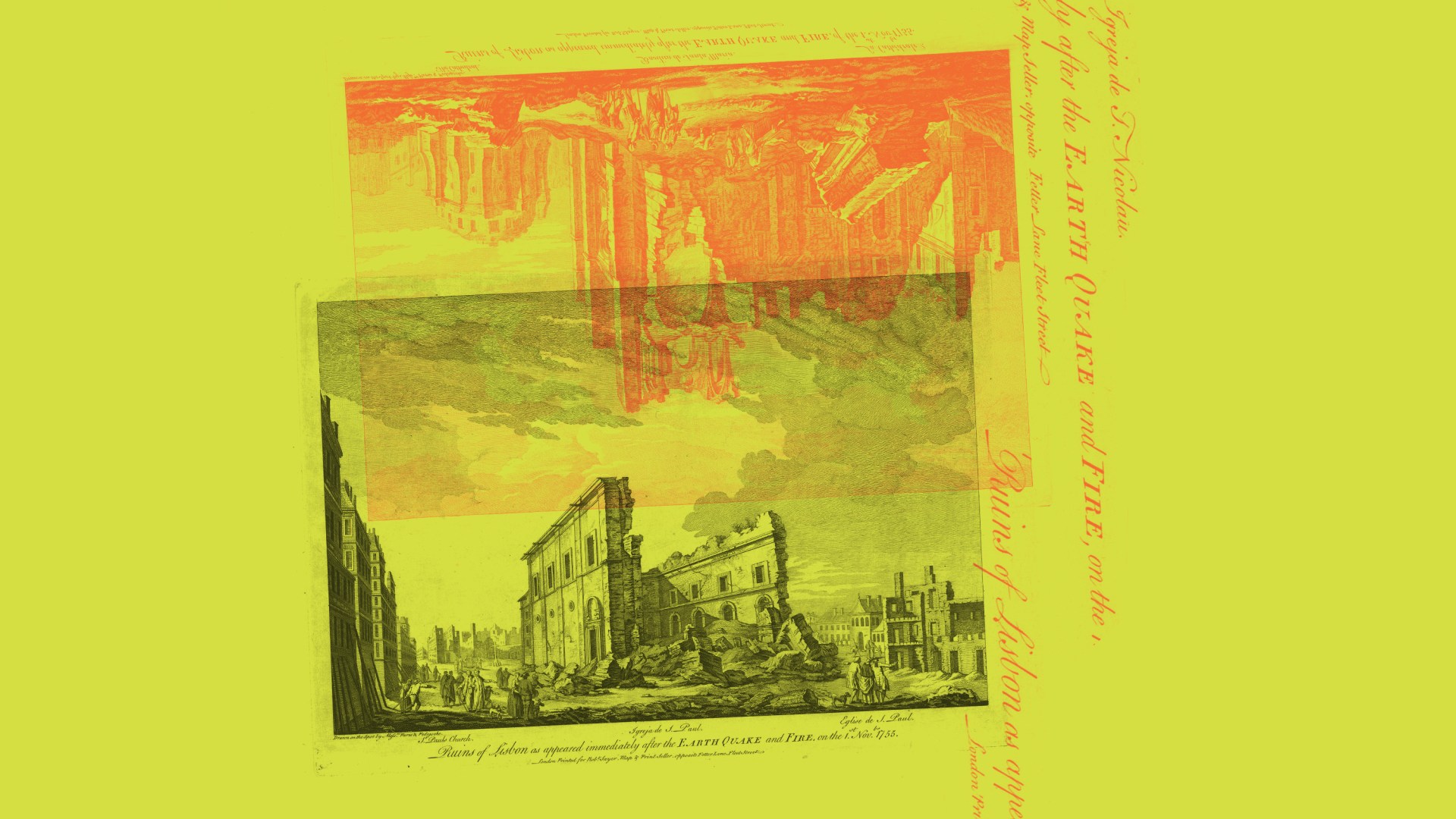
Edits by Christianity Today. Source: Jacques-Philippe Le Bas / Wikimedia Commons

November 1, 1755, was a sunny day in Lisbon. One of the busiest trading ports in Europe, the Portuguese city was both fabulously wealthy and extremely religious. It was a center for trading goods and, abhorrently, slaves. The city and those who did business there profited greatly from that industry.

Lisbon also had 40 parish churches, 90 convents, and 150 associated brotherhoods and religious societies; more than 10 percent of Lisbon’s residents were members of a religious order.

November 1 was also All Saint’s Day, and the many churches of Lisbon were filled with parishioners for the second mass of the day, around 9 a.m., when a giant earthquake struck.

The earthquake was large enough to be felt across much of western Europe and northwest Africa. It triggered a tsunami, with waves observed as far away as England, and then a fire that destroyed much of what had been left standing.

When all was said and done, 10 percent of the population of Lisbon had died, and almost every important church in the city had been destroyed.

Then, as now, people assumed there was meaning in tragedy and sought to explain it based on the nature of the world or the failure of humans to do right. And both meaning and God’s judgment are there—but not, perhaps, in the ways we expect.

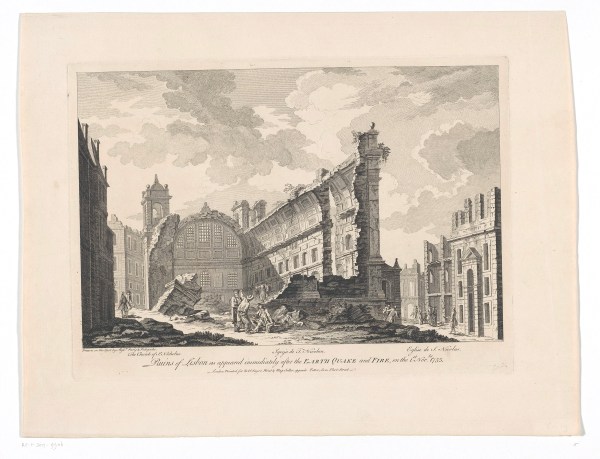
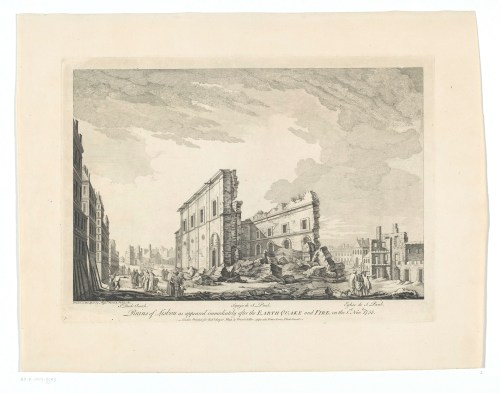
The Church of St. Nicholas, drawn on location immediately after the earthquake and fires in Lisbon in 1755.Jacques-Philippe Le Bas / Wikimedia
The Church of St. Nicholas, drawn on location immediately after the earthquake and fires in Lisbon in 1755.

A tidy, positive view of the world prevailed during the Enlightenment. Philosophers in the 18th century argued that the universe was ordered according to a consistent set of rules. By observing nature and using one’s reason, they said, God’s ways could be deduced. God could thus be known through the orderly world.

In his 1710 book Theodicy, Gottfried Wilhelm Leibniz argued that the world that God created was good enough to excuse the occurrence of occasional evils; indeed, this world we have is the “best of all possible worlds.”

Any good world might, in his understanding, contain tragedy, but the goodness outweighed the sorrow. Leibniz wasn’t arguing that events that seemed to be bad were in fact right, but that any alternate reality would be worse, even if it didn’t have the same problems as ours.

And we could depend on the world to be only, exactly, as God designed. If God were a clockmaker, then the clocks worked as God intended. People who saw room for improvement were in error; God fashioned perfect clocks, and the kind of perfection critics demanded wasn’t, in fact, perfection.

So too with creation: It was as it was intended to be. If we could not always discern the good meaning in it, goodness was nevertheless there.

Alexander Pope’s Essay on Man affirms these principles:

All Nature is but Art, unknown to thee;
All Chance, Direction, which thou canst not see;
All Discord, Harmony not understood;
All partial Evil, universal Good.
And, spite of Pride, in erring Reason’s spite,
One truth is clear, “Whatever is, is right.”

This view of events led to a spirit of optimism about human affairs: Nothing could really go wrong. Indeed even the word optimisme was coined in 1733 to describe, as literature professor Nicholas Shrady writes, the “spirit of the age.”

So the spirit of the age left Enlightenment Europeans under the impression that they could figure out the explanation for anything, and that it would be a satisfying explanation.

You can imagine the distress that set in when a natural disaster of biblical proportions hit the city of Lisbon only 20 years after “optimisme” came to be. How could anyone dismiss such destruction as “partial evil” in the service of “universal good”?

Certainly the Lisbon earthquake and its immense, unfair damage was not the best of all possible worlds. Would not the best of all possible worlds have prevented thousands of men, women, and children from being killed in church during an earthquake? Indiscriminate death and destruction rightly do not fit in any optimistic view.

Rather than leading to optimism, a view of this world and its course of events as our best (and only) option could just as easily lead to a fatalism about human affairs.

In this way, surprisingly, deism—in which God set things in motion and stopped intervening—and fatalism—in which neither humans nor even God can affect the course of events—are closely related, as they present God as removed from human outcomes.

This would lead us to think it’s no good appealing to God or getting all worked up when bad things happen. Whether God intends all that happens or whether he is not at all involved in what happens, whatever is, will be.

As with optimism, fatalism can’t satisfy the outrage and grief we feel when we see calamity strike the obviously innocent. Would pessimism suffice? Such an approach to the Lisbon earthquake is where Voltaire landed. He wrote his famous “Poem on the Lisbon Disaster” and articulated the famous three-pronged dilemma that has occupied theologians ever since: If God is good, and God is powerful, then how did this hellish thing happen?

If whatever is, is right, then God is a bad dude. Or we can dismiss the idea of a sovereign God.

In Voltaire’s words,

Come philosophers who cry “All is well,”
And contemplate the ruin of this world…
As the dying voices call out, will you dare respond
To this appalling spectacle of smoldering ashes with:
“This is the necessary effect of the eternal laws
Freely chosen by God?”

Voltaire rightly rejected Leibniz’s consolation that this was “the best of all possible worlds.” He—and others—weren’t able to suppress their judgment that the Lisbon earthquake should not have happened if all were well. If this is the best of all possible worlds, show me the others!

A theodicy that could explain disaster did not have to involve an unjust or unsovereign God. Despite Voltaire’s objections, viewing Lisbon’s catastrophe as God’s direct response to its sins made for a tidy narrative, one in which God was still righteous and in control.

In particular, it was easy for Protestant figures to call the disaster a divine judgment on Catholic Lisbon. Almost every important Catholic church in the city had been destroyed by a cataclysmic conflation of earthquake, water, and fire. The Estaus Palace, headquarters of the Portuguese Inquisition, was also destroyed. The enormous wealth of Lisbon and its participation both as a center for the Inquisition and for the slave trade made it a particularly ripe candidate for blame. The optics were just too tempting.

Religious figures of the day found the biblical parallels irresistible. God had destroyed the earth once before with a flood (with Noah, in Genesis 7) and had also used fire to burn a sinful city (with Sodom, in Genesis 19). Earthquakes are sometimes portended as a sign of divine judgment in the Bible (Luke 21:11).

So it is not surprising that figures like John Wesley interpreted the event as a sign of God using natural means to assign judgment. His brother, Charles Wesley, even wrote a hymn based on the events, commemorating God’s judgment in song:

Woe! To the men, on earth who dwell,
Nor dread th’ Almighty frown,
When God doth all his wrath reveal,
And shower his judgments down!
Sinners, expect those heaviest showers,
To meet your God prepare,
When lo! The seventh angel pours
His vial in the air!

Shrady notes that “neither the burning of Rome or London nor the sacking of Carthage or Constantinople” was equal to Lisbon’s destruction.

It was not only Protestants who drew the conclusion that God was punishing Lisbon for spiritual unfaithfulness. The Jesuit missionary Gabriel Malagrida also forcefully declared the Lisbon earthquake to be a sign of God’s wrath:

Learn, O Lisbon, that the destroyers of our houses, palaces, churches, and convents, the cause of death of so many people, and the flames that devoured vast treasures, are your abominable sins, and not comets, stars, vapors, and exhalations, and similar natural phenomena.

Making comparisons to Sodom and Gomorrah or Jericho seemed obvious.

For the most part, modern people reject the view that natural disasters are divine judgment. We are less likely than in some past eras to preach sermons or write hymns about the fittingness of God destroying the world through an earthquake.

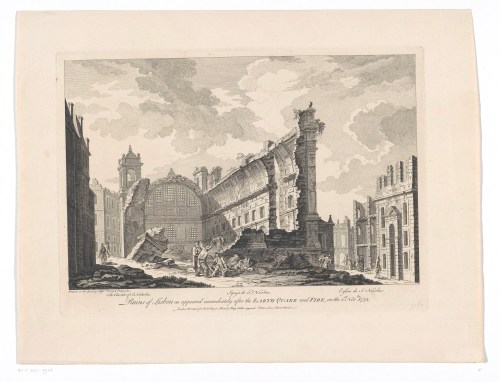
The Church of St. Nicholas, drawn on location immediately after the earthquake and fires in Lisbon in 1755.Jacques-Philippe Le Bas / Wikimedia
The Church of St. Nicholas, drawn on location immediately after the earthquake and fires in Lisbon in 1755.

We believe we know how to discern a divine act from anatural one, and we believe we prefer scientific explanations to supernatural ones.

And yet “natural disasters” do reveal something about the human situation and God’s rightful judgment of it.

Though we are reticent to consider divine judgment to be the cause of human disaster, or to think of disasters as being sent to punish people, we can still say that such events can reveal truths when they occur. What is revealed, often, is what we believe about God and each other and how we have failed to follow God’s commandments.

There are two meanings of the word judgment to understand.

The first is a negative series of events that God deploys because he is angry at the recipients. This form of judgment is targeted and proportional. This is the judgment one imagines with fire and brimstone and eternal torment. All things considered, those who are affected by this kind of divine judgment deserve it.

This sort of judgment does happen in the real world. The first example is in the story of Noah. We are told that the wickedness of humans had increased to intolerable levels: “So God said to Noah, ‘I am going to put an end to all people, for the earth is filled with violence because of them. I am surely going to destroy both them and the earth’” (Gen. 6:13).

Though God promises never again to destroy humankind through a flood, there are further examples of disaster as judgment for sin. God destroys Sodom through an ordained natural disaster (Gen. 19).

Judgment in this sense is not usually a helpful lens to describe devastating modern events. It is also usually an incorrect theological lens. Jesus himself rejects such a line of thinking in John 9, where he contradicts sin as a reason for a man’s blindness.

Think also of the Book of Job, where the text says that God found Job righteous and faithful before the deaths of his children, the loss of his wealth, and his suffering from disease (1:8).

Near the end of the book, God tells Job’s friends that he was angry with them “because you have not spoken the truth about me” when they reasoned that Job’s sin was the explanation for the disasters he endured (42:7).

It is never theological best practice to interpret tragic human events as the result of sufferers’ sins. As Job’s friends learned, God may be far from pleased when people use calamity—such as a cancer diagnosis or a flood—as evidence that someone needs to repent.

However, in the Old Testament, God did send messages that he would bring judgment as punishment if people did not change their behavior. For example, many prophets, including Jeremiah (Jer. 21:11–14), prophesied a direct connection between people’s behavior and a specific punishment that would follow, such as exile. In such an instance, when God warns a community through the prophets, tragedy can be attributed to divine judgment.

But this is not the only meaning judgment can have. The second form of judgment is an evaluation. One makes a judgment after a restaurant dinner or an oral defense for a master’s degree, evaluating the conditions and presentation that one observed.

People might also make judgments after they are caught driving intoxicated—realizing, perhaps, that their drinking has gotten out of hand or that they need help.

Judgment in this sense is less a punishment and more a revelation of the conditions that already exist. It is where we gain a new, realistic perspective. It can be a turning point.

In this way, a devastating event can reveal something we needed to know that needs to be addressed. The daily drink seemed harmless before; after a DUI, we see it as part of habitual overconsumption that demands action.

We might call this second form of judgment “judgment-for-revelation.” Judgment-for-revelation might allow us to discern important things about God, ourselves, and the world because of a tragedy.

Though theologians are quick to separate the reality of “natural” and “moral” evil (a tsunami versus an invasion), it is often the case that natural disasters show human failure.

When an earthquake hits, people living in inadequate, temporary housing risk much greater loss. When hurricanes approach land, those without transportation and financial resources aren’t as able to quickly evacuate.

Consider that, when Hurricane Katrina hit Louisiana in 2005, Americans were properly outraged not at the “natural” part of the natural disaster but at the failures to govern well.

For example, a decades-long engineering project to protect New Orleans against the expected event of storm surges hadn’t been completed, despite the clear necessity. Four Category Three hurricanes and dozens of deaths occurred in the interim.

Racial disparities that preceded Hurricane Katrina were also apparent in disaster recovery. The scarcity of resources that plagued Black New Orleanians before the hurricane continued throughout the event itself in the form of inadequate resources for evacuation and rebuilding.

In this second sense of judgment-for-revelation, natural disasters can reveal things as they really are. Real lives are lost. Survivors experience real suffering. These aren’t drills. But they also don’t prove God’s weakness, absence, or callousness. Instead, they prove the quality—or lack thereof—of people’s stewardship.

Too often, leaders have been neglectful and exploitative, the poor have unjustly been left with only bad options, the engineering we trusted our lives with was fudged, and neighbors have failed to care for each other. Though we should learn from Jesus and from Job’s friends not to call hurricanes God’s punishment, Hurricane Katrina did serve as a revelation of how far we had fallen from our call to care for the poor and the oppressed (Isa. 1:17) and steward the earth (Gen. 1:28).

The citizens of Lisbon saw total destruction of their city. They discovered that their view of how the world worked was broken. They had thought that theirs was “the best of all possible worlds,” but now they had to consider what it meant to affirm that God was good and had created a good world.

It took events that pushed their theodicies to the limits to reveal the inadequate ways they thought about God’s power. This, too, is divine judgment.

St. Paul’s Church, drawn on location immediately after the earthquake and fires in Lisbon in 1755.Jacques-Philippe Le Bas / Wikimedia
St. Paul’s Church, drawn on location immediately after the earthquake and fires in Lisbon in 1755.

In our own way, we have been through a season of disaster—a pandemic that has killed more than million people in the United States alone, destructive fires and devastating floods, significant social unrest, and eroding trust in social and political institutions.

The prevalent Enlightenment explanations for disaster—that it was an insignificant slip-up in a good world, a good thing if you could just look at it the right way, or just events set in motion by a neutral or helpless God—were not satisfying explanations. And the idea that God is punishing people whenever things go wrong is a too-satisfying explanation that is nevertheless usually incorrect.

We aren’t past these errors. In updated language, we too often claim that mass casualty events aren’t really big problems, that they must be faced without a trustworthy God, or that personal holiness (or some other characteristic) would have prevented them.

Just as the Lisbon earthquake collided with Enlightenment Europeans’ optimism and faith, so this season may have shaken our society. The coronavirus pandemic revealed how weakened the foundations of our confidence had become.

For some who prized their health and independence, this time has revealed how vulnerable and interdependent they actually are. Differences in preferences for risk, cooperation, and autonomy have led to broken relationships.

In this way, the pandemic—a “natural” event—has in fact served as a judgment. We might be shown something by this season of disruption, which has come as an unlikely left-handed judge (Judges 3).

We might see how much we have assumed our health would continue and that diseases would be easily addressed. We might see how much we have neglected community bonds and preferred our privacy and relationships of our own choosing.

But a truth about the world has been revealed to us in these years: All of us are deeply susceptible to disease, division, and the anguish that both can exacerbate.

A fissiparous people, we are quick to abandon community, quick to prefer our own comfort, and hasty to forsake the assembly of believers in every form it takes. We have not only preferred the company of those who agree with us but also rejected those who don’t.

We have in this way indeed found ourselves judged, as our churches empty and our communities are marked by loneliness. We are much more susceptible than we’d like to think. We have perhaps been judged by God, as our empty pews witness to a failure to bear with one another in love, to quickly forgive, and to embrace the ideological stranger.

The church goers of Lisbon found their religious celebrations interrupted by earthquake and fire. The great thinkers of their age found their basic beliefs about the world contradicted by water and flames.

We too may find that our greatest achievements—our technology, our models for church, our political systems—have been disrupted by natural events. Without seeing the pandemic as sent by God as a punishment, perhaps we can receive it as a revelation, and respond as those in need of repair.

Kirsten Sanders is founder of the Kinisi Theology Collective, a public theology project.

Theology

What Should We Do If Our Compassion Runs Out?

1 in 7 of my medical patients dies. But I don’t want to stop grieving or hoping.

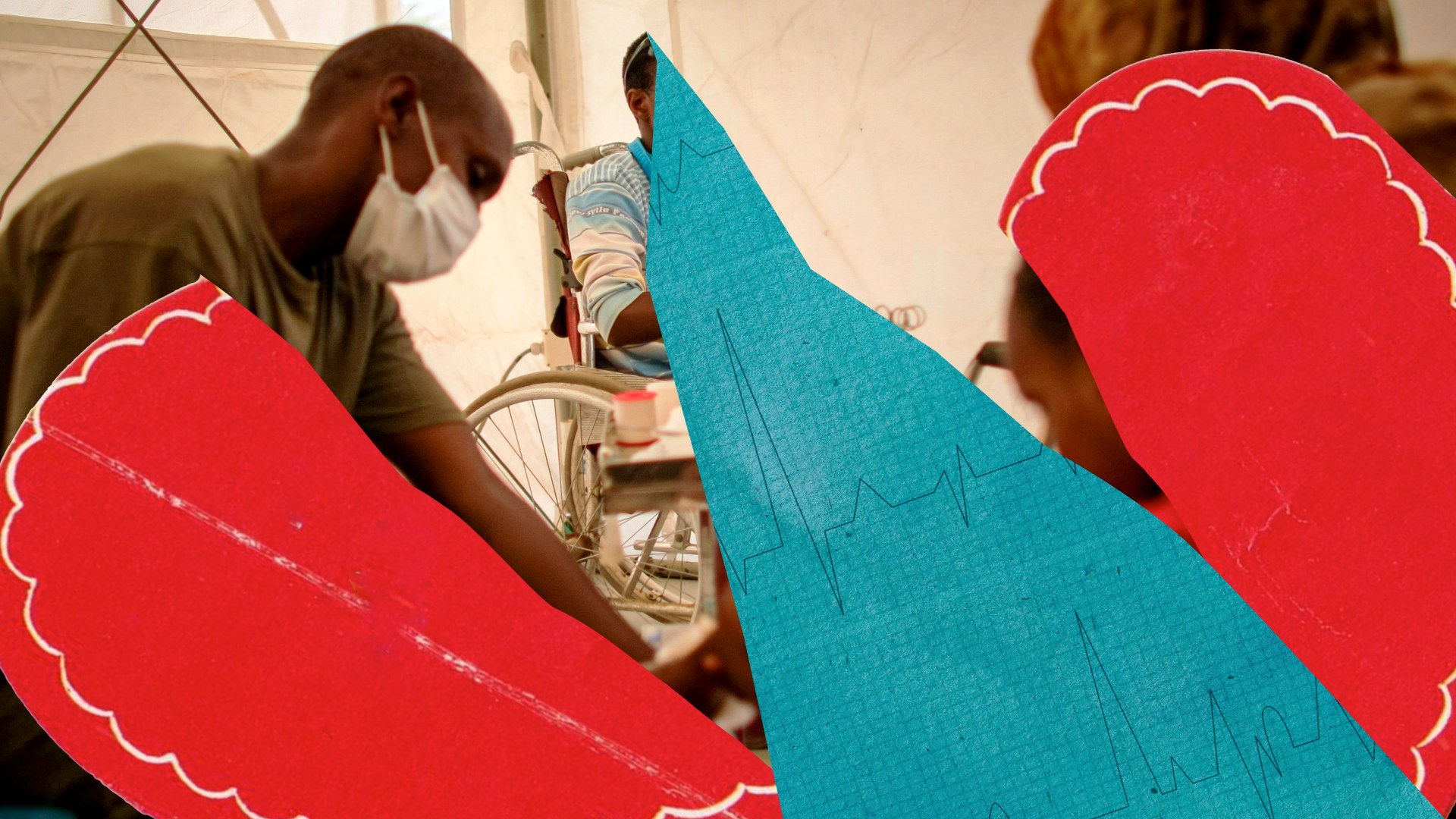
Illustrations by Sarah Gordon / Source Images: Wikimedia commons / Getty

Euphraim is about 30 years old, but the wheelchair he rides into my consulting room is older than that and much the worse for wear. Yesterday, a doctor saw him then asked him to stay overnight so he could see me this morning. That doctor now guides Euphraim’s wheelchair over the concrete bump at the doorway and onto the hodgepodge tiles of the exam room floor.

The first thing that anyone would notice about Euphraim is the myriad flesh-colored skin lesions that cover his face and entire body, almost like berries hanging off his skin. But he’s had those his whole life, and they’re not why he’s here.

For the past several months, the left side of his body has slowly stopped working. He uses his right hand to move his useless left arm from the armrest of the wheelchair to his lap. The problem is getting worse and worse. Now he’s unable to stand.

Talking with him and examining him a bit, it’s clear that his weakness is coming from a problem in his brain, and the facts start to come together: His skin lesions are typical for a relatively rare genetic disease called neurofibromatosis. Neurofibromatosis is associated with lots of different brain tumors, many of which are not cancerous and could be removed with surgery. Euphraim is likely to have developed one of these brain tumors. As it grows bigger and bigger, it causes more and more problems for him.

To figure out if he has such a tumor, though, Euphraim needs a CT scan, which would cost him about $100. But he doesn’t even have the money to pay for transportation to one of the three hospitals in the country with a scanner.

Even if he did, there is no surgeon within our national borders who would operate on his brain. This is Burundi, which by most measures is the world’s poorest country.

It couldn’t have been easy for Euphraim, with his significant disability, to get to the hospital and wait overnight in some borrowed bed, just to be able to talk with me, hoping I could fix this problem. I can’t fix it, but what’s worse is that no one will.

We talk about his problem. We analyze what we can do to make his life better, given that a cure is out of his reach. We seek out one of our hospital chaplains to spend some time praying with him.

And all the while, the line of other sufferers extends down the bench outside my door.

For the past eight years in rural Burundi, one in seven of my hospitalized patients has died before being discharged.

The reaction of my heart to Euphraim’s tragic story is not the same as it would have been 15 years ago. I can see the sadness, but I don’t feel connected to it the way I used to. Who am I becoming?

After describing the neighborliness of the Good Samaritan, Jesus told the expert in the law to “go and do likewise” (Luke 10:37). In this parable perhaps most clearly, Jesus shows he wants his people to care for those in dire straits.

Not all of us will (or should) do this professionally, of course. But of those called to care professions, many will be repeat witnesses to danger, death, and suffering. Many of us return over and over to situations where we try to improve and even save lives. But sometimes it seems like our efforts are wasted.

Compassion fatigue, and the similar experiences known as vicarious trauma or secondary traumatic stress, are a response to dealing with people in traumatic situations. It has been receiving growing attention for several years now, with an uptick in interest because of the COVID-19 pandemic.

Our world’s disasters keep getting upstaged by worse ones: overloaded hospital units, deaths by the million, mental health crises, civil unrest, wartime atrocities—it seems impossible for our hearts to not feel worn out.

It’s hard to track the prevalence of compassion fatigue or whether it has in fact increased during the pandemic. Compassion fatigue can mimic or even open a pathway to posttraumatic stress disorder (PTSD).

Compassion fatigue doesn’t always take you to PTSD, though. Sometimes, it just leaves you feeling exhausted, hopeless, irritable, and dreadfully responsible. It imposes a perspective that leaves no room for awe, gratitude, and grace. Most characteristically, it muffles or eliminates your ability to care appropriately.

Though compassion fatigue certainly keeps company with burnout, it has an additional layer of challenge: While you can burn out on anything, compassion fatigue is the challenge of persevering precisely where you have decided to open your heart to someone else’s trouble.

The word compassion means literally to “suffer with” another. Thus it’s not surprising that our compassion feels limited and risks depletion. Theologian Frederick Buechner calls compassion a “sometimes fatal capacity.”

There are times when I have thought that a good callus on my heart would come as a relief, but my experience is usually the opposite. Sometimes, when the 15th Euphraim-like patient sits down in front of me, my heart just dries up. Far from feeling compassion, I want to shout that it’s unfair for all their suffering to enter my life. My heart closes.

Yet instead of feeling relief, the realization that I’ve lost my compassion—my orientation toward suffering with someone else—compounds my sense of having drifted from my vocation and purpose.

As Christians, our vocation is fundamentally to love—with our actions and our minds, but also with our hearts. We know that we are called to compassion, but the obstacles can seem overwhelming.

How necessary is compassion to Christian calling? “Weep with those who weep,” Romans 12:15 (ESV) tells us in a list of ways to live in loving community. The words are Paul’s, but they also describe Jesus. Jesus, moved with compassion by the crowds of sufferers. Jesus, weeping with Mary in the grief of Lazarus’s death.

Even at the pinnacle of the Triumphal Entry, a celebratory and joyful event, Jesus breaks into tears for Jerusalem’s coming sorrow (Luke 19:41).

Compassion—real, suffering compassion—is not exceptional in the Christian life. It is everywhere. As in the Triumphal Entry, it is even commingled with our joy. This centrality of compassionate sorrow is consistent with a biblical narrative that shows, as Timothy Keller says, “The road to the best things is not through the good things but usually through the hard things.”

Compassion is a type of self-giving,and I believe, quite ardently, in this kind of self-giving. My decision to pursue a career in medicine and specifically medical missions in Africa is born directly from a conviction that there is greater joy to be found in giving myself away than in walling myself off from suffering.

But it can be so hard. Hard to put one foot in front of the next, and even harder to keep my heart open to suffering with the next person who comes to me for help.

There are some known ways to help people with compassion fatigue, which can and often does heal. We should pursue changing our work systems to minimize risk factors, like too many work shifts in a row, bullying, or other elements of a hostile work environment. We can and should screen early and often for acute stress, depression, and trauma in caregivers. We should call attention to symptoms like insomnia, taking bad risks, and angry outbursts. We should encourage people—especially those whose work puts them at risk—to take real sabbaths and to make adjustments that help them maintain a healthy lifestyle and perspective.

But as the world talks more about burnout and compassion fatigue, it is crucial to note that these problems are not fundamentally technical problems with technical solutions. We cannot ignore their theological nature, the call to and consequences of suffering with others.

Where do we find strength to keep our hearts open to people in our lives and world who need our compassion? There are probably as many answers to that question as circumstances that threaten our hearts.

For a starting point to address compassion fatigue theologically, we can look at lament. Biblical passages of lament give voice to hearts that have been stretched to the breaking point. The deepest question of lamenters in the Bible is addressed to God, asking if our hope will let us down. Perhaps this is the deepest question for those in a heart battle against compassion fatigue.

I remember Odette, a young woman in her 20s who was hospitalized in Burundi with terrible kidney failure. By “terrible,” I mean most American doctors would not believe that someone with kidney disease this severe would still be alive.

Odette’s family was willing to pool their money to send her to a kidney specialist in the city. But as we discussed it, knowing that long-term dialysis was not an option, it wasn’t clear the expense of such a trip would change anything for her. Still, her family decided to try, and so they went to the city.

A month later, I was at home answering some interview questions via email regarding my work. “How have you overcome the fear of hoping in order to reach for God’s promise of hope?” As soon as I read the question, my heart sank because the question was asking how I did something that I felt utterly incapable of doing.

I fear to hope sometimes. My recent weeks had been filled with tragedies like Odette’s. More than that, there had been several times when it seemed like someone was going to recover but then suddenly died. “Hope deferred makes the heart sick,” says Proverbs 13:12. Exactly; my heart was sick.

Sitting at my computer, I stared blankly out the open window onto the bright green of a day in equatorial Burundi, unable to answer the question. After a minute, my phone chimed.

Actually it chimed half a dozen times in a row, a sure sign the message was from a Burundian colleague, since Burundians tend to send their messages in a staccato series of short sentences.

Looking down at my phone, I saw that the messages were from a friend named Onesphore, who was once my student and then my coworker. Now he works at a hospital in the city.

Good morning doctor, he wrote. I just wanted to let you know that we have been caring for Odette. The young woman that you had seen last month. We have not been able to do much. But some fluids and careful observation have resulted in her kidneys returning almost to normal! We’re sending her home today. I just thought you would want to know. Praise God!

The goodness of this news was obvious. Not only was Odette healed, but I got to know about it from someone I had helped to train for his current job.

This was all fantastic and encouraging, but what really struck me was that the message arrived precisely when I was sitting there thinking about how afraid I was to hope and how I had no idea how to reply to those asking me how to hold on to hope.

I turned my head and saw my own reflection in the glass of the window pane. The idea that God was present was no longer theoretical; it was real and sudden. In a moment, the revealing of this whole story filled me with tearful joy, not a small amount of fear, and a renewed hope.

We cannot continue in compassion without hope. Where do we find it? Just as Jesus allowed Thomas to put his hand in his side (John 20:27), he also warned the disciples that following him would require many to live by faith without getting to examine all the evidence (v. 29). That is, sometimes we can see God overturning evil. At other times, we may be unable to see what God is doing. Because God actually is at work in the world, hope may come as an unexpected gift. But we also need to cultivate hope by thinking about these struggles in light of what we believe about the character of God.

The story of Odette’s healing and Onesphore’s texting unfolds like a small eucatastrophe, where at the end, victory is snatched out of the jaws of defeat. It was both a surprise and a new perspective on the whole story. As J. R. R. Tolkien (who coined the term) pointed out, the incarnation of Christ and the resurrection of Christ were eucatastrophes.

Those who seek to preserve compassion and hope in the daily work of a broken world must keep in mind that God is the God of eucatastrophes, both big and small. He seems to have a penchant for surprising us with his unexpected victories. He glories to show his strength in our weakness. Not all turns are turns for the worse. We want to know that we are not alone in our labors. “My Father is always at his work to this very day, and I too am working,” says Jesus in John 5:17. Still, when good news is infrequent, we sometimes feel there is a paucity of evidence for this.

Sometimes hope grows slow and steady like a field of healthy crops, but more often than not, if we have eyes to see it, there is a surprise that teaches us what we so desperately need to know: that the good, redeeming work of God in the world belongs to him, not to us.

Years of medical training and practice mean that, when I walk through the local village market, I can’t help but see things I wouldn’t have before. Swollen feet, a particular kind of gait, a scar where a thyroid surgery was done. A habit of searching out such things has taught me to see what was invisible before. Some of them indicate lives saved and hope restored.

In a similar way, maybe we can find hope more often if we have a persistent curiosity and trust that there is hope to be found.

If we follow God’s call to enter the world with compassion, we should not be surprised if we find ourselves identifying with Jacob, wrestling with God in the dark and facing our fears in the morning with a permanent limp.

Such moments often feel like God’s absence but may actually be a sign of his presence. Indeed, our lives can be like that, but that is not the end of the story. God is with us, and he is doing something. His tendency toward eucatastrophes means that we have good reason to look for unexpected hope.

Years ago when I lived at a hospital in rural Kenya, a woman named Mercy came to us with difficulty breathing. Our initial tests suggested heart failure. She was just a few years older than me, and she spoke some English. She would greet me every day, and I would shake her hand and the hands of her two small children who accompanied her. As days passed, I was puzzled by her lack of improvement on our heart-failure treatment. She just wasn’t getting better.

Around 10 days into her hospitalization, her left leg swelled up. As soon as I saw her leg, all my assumptions about her problem resorted themselves. Her swollen leg meant a big clot in her vein, which meant that her difficulty breathing was due to a clot that went to her lungs.

What’s more, when I told her this, she mentioned she had had a clot like this before. She hadn’t told me that before, and I hadn’t asked. We changed her treatment immediately, but the next day, while walking to the shower, she fell over and died.

And maybe, if I had been more thorough, or more perceptive, or more attentive, and we had changed her treatment sooner, she would have lived. Maybe not. But maybe.

Mercy is one of a thousand stories that haunt me. I could have done more. I should have done more. I know the counterarguments and the words of reassurance, and I believe them, for the most part. But sometimes I have a hard time not feeling like they are excuses.

The most famous scene in the film Schindler’s List is like a mirror for me. Oskar Schindler helped save hundreds of Jews from the Holocaust, and to thank him, a large group of those he saved present him with a gold ring.

Schindler is overwhelmed, dropping the ring, sobbing, exclaiming that he could have done more. He could have sold his car or his gold pin and saved more people, but he didn’t. Those around him attempt to console him by pointing out all that he did do, but he is impervious to these consolations.

Keller commented in a sermon that the reason Schindler is not comforted is that Schindler is right and he knows it: He could have done more, and he didn’t. He is haunted by this truth, and no one can change his mind or his heart. My own experience as a medical missionary is completely in agreement.

What is going on in our haunted hearts? Why do we always feel like we have never done enough?

I think we are wanting God to tell us that we have done enough. We want to hear “Well done, good and faithful servant.” But we know that we have left work undone, and we’re not sure that God would say we have done enough. If we haven’t done enough, will he still love us?

God, do you love me? The answer to this question is important in our fight to have compassion without compassion fatigue. We can only persevere in giving what we believe we have received. He is the well, but our tendency is to think the well is only as full as we deserve it to be, and not as full as God says it is.

God’s love is not, and has never been, contingent on us having done enough or done well enough. We proclaim again the gospel of Christ: that God’s love is a free and unmerited gift.

Such love is the only starting point for a heart that would serve compassionately. Anything else, and we will be Oskar Schindler.

But also, as Paul says in 2 Corinthians 1:4, we give comfort out of the comfort that we have received. The same compassion, co-suffering, that breaks us open in tears flows from a heart restored by the unmerited grace of God.

And so compassion, like hope, is also a gift. For most Christians, this is not news. But it may be a new application as we consider the suffering around us. It is, at any rate, a necessary application for people who have been troubled by a lack of compassion and hope.

Jesus, when faced with the sure knowledge of what he was to suffer—and that the friends he was speaking to would abandon him—said, “In this world you will have trouble.” Work and weep for it with compassion for the suffering. “But take heart!” Be hopeful. “I have overcome the world” (John 16:33).

God’s compassion doesn’t wear out or go cold. This compassion he gives us to give others doesn’t wear out or go cold. For those striving to persevere serving those in need in Jesus’ name, such an image feels beautiful but perhaps impossibly aspirational. After all, the exhaustion and disappointment are real.

In a world so full of brokenness and suffering, where the call of Christ to enter the brokenness is nevertheless so relentless, lament is an appropriate first response. How can we recover, let alone persevere, not just in our actions but in our heart responses? We know the fragility of our hearts, and we are so afraid. It feels like we cannot possibly remain deeply engaged in a world such as this.

Nevertheless, our cries of lament have answers. God will mend and renew—and he often does! We find hope in the knowledge that the work before us is ultimately God’s, and that his love is always ours.

Eric McLaughlin is a missionary doctor at Kibuye Hope Hospital in Burundi and the author of Promises in the Dark: Walking with Those in Need Without Losing Heart.

Books

The Gospel and All That Jazz

A theologian (and amateur musician) explores the connection between them.

Illustration by Joe Anderson

William Edgar’s new book, A Supreme Love: The Music of Jazz and the Hope of the Gospel, is itself a work of love. Edgar, professor of systematic theology at Westminster Theological Seminary, describes himself as a “decent amateur” of jazz who has played, studied, and written about it not from any career aspirations but out of a lifelong attachment. He is an amateur in the truest sense of the word’s origin, the French amateur: “one who loves.” This affection spills out of the margins, inviting readers to dive into a subject presented with joyful attention to detail and collegial warmth.

A Supreme Love: The Music of Jazz and the Hope of the Gospel

A Supreme Love: The Music of Jazz and the Hope of the Gospel

IVP Academic

224 pages

The book is a friendly read, dotted with Edgar’s own asides (“In my opinion, this was the best of his albums” or “Personally, I don’t think this is quite true”) like a friend sharing opinions about a concert over a drink. But the love of jazz is far from Edgar’s sole motivation. He writes, “By knowing the historical roots of jazz and by being better listeners, I believe that we will hear something that is deeply embedded in jazz: a supreme love—the love of God.”

This affectionate approach does not preclude academic rigor. The book presents a comprehensive and deep account of both the historical and technical aspects of jazz, as evidenced by its extensive engagement with important works of jazz scholarship. Edgar proceeds chronologically, from jazz’s origin in African diaspora music to the development of its “background genres,” namely spirituals, gospel, and the blues. Readers will come away better informed about the history of jazz, including its central figures, internal debates, and present innovations.

Edgar’s own proficiency at jazz also shines through with his attention to what makes jazz musically distinctive, from the structure of 12-bar blues to the parallels in form between ragtime and sonatas to the performance techniques of Miles Davis. Indeed, so thorough is the book’s recounting of the history and ongoing development of jazz that, for certain stretches, readers might be tempted to imagine that its theological interests are an afterthought. Yet in the end, Edgar’s greatest passion is the gospel itself—how it lives, sometimes disguised or obscured, at the heart of jazz.

From misery to joy

The influence of the Christian story on jazz is perhaps most evident in its earliest stages, upon which Edgar focuses most heavily. The book’s first half covers the development of jazz before 1900, depicting a distinctly African American style of music that drew inspiration from the experience of slavery. This section highlights one of the book’s most striking aspects: its unflinching narration of the connections between the development of jazz and the history of slavery and racism in America.

Edgar makes it clear that the history of jazz is the history of the oppression of Black people in America, as well as the history of their persistent resilience, protest, and occasional triumph. Readers who bargained for a brief introduction to what they regard as elevator music will be disappointed.

Instead, we see a forthright account of the injustices visited upon slaves paired with insights on the use of music as a tool of paternalistic oppression by slave owners intent on convincing themselves that slaves were happy. But we also see how jazz was employed subversively: to give directions on the underground railroad, sing about freedom and inextinguishable hope, recall the drums of an almost-forgotten homeland, and sometimes stymie slave owners just for fun.

Edgar delves into the way members of the African diaspora used elements of their cultural heritage to create music all their own, birthing a tool of protest and a form of defiant joy. The language of this defiance drew on biblical themes, reflecting the shocking conversion of many slaves to Christianity. This is the context, Edgar argues, from which jazz derives its characteristic “movement from misery to joy,” which evokes the deep injustice African Americans experienced while joyfully asserting their humanity in a world that constantly denied it. He goes so far as to describe the blues themselves as a form of theodicy.

A Supreme Love emphasizes the theological dimensions of jazz, and Edgar is determined to see a connection between jazz and the gospel. There are many ways one might go about evaluating whether, or to what extent, this connection exists. Should we look to the biographical details of influential jazz figures? Examine how the form of jazz might lend itself to theological metaphors? Explore the lyrics of jazz music?

Edgar engages with each of these facets, offering a holistic account of how jazz might communicate or evoke gospel truths. He points out that many key jazz figures came from deeply religious backgrounds. Even among those whose connection with Christianity was somewhat fraught, he notes, there remained a stubborn spiritual impulse, a sense that music expressed, revealed, or opened something divine to them.

Likewise, Edgar offers close readings of many lyrics, indicating how frequently they engage biblical themes and how even those that concern ostensibly secular subjects suggest patterns of sympathy toward a Christian worldview or the wisdom of Scripture. His more sustained theological engagements with jazz rest on two central ideas: the coexistence of joy and sorrow in jazz as a parallel of Christian hope in a broken world, and a confidence in the goodness of creation that makes all our experiences, including jazz, fertile ground for encountering and worshiping God.

In the tragedy and triumph of African Americans, as expressed in jazz, Edgar sees an analog to the gospel. As he writes, “Both the sorrow and the joy found in jazz resonate with the deep pain and the incredible hope that stand at the heart of the Christian faith.” In this way, Edgar goes to great lengths to honor the experience and pain of African Americans.

There are, however, dangers in this approach. At one point Edgar describes the early developments of jazz music as a “bright spot in the midst of bondage.” Though Edgar would never intend to imply that the former justified the latter, statements like this jeopardize the book’s moral credibility; it is unacceptable to countenance any argument that could seem to justify slavery because it helped bring about a genre of music. Indeed, it is easy to see this inadvertently playing into the very tropes that Edgar rightly condemns of the slave as a happy, entertaining individual.

To his credit, Edgar observes that “a good deal of caution is called for” in drawing these connections. But it seems to me that the stakes of such comparisons are so high they are probably better left undrawn. Although jazz may be a good thing that came out of great evil, no one should entertain the possibility that it went any way toward redeeming the atrocities of slavery and segregation. It is a mistake the size of a needle, through which an entire camel could surely fit.

In my view, the stronger theological thread tying the book together is its natural theology of jazz. Traditionally, natural theology explores the ways in which the natural world itself might, through common grace, communicate something about God. At its best, Edgar’s book acts as a sustained natural theology of jazz, attending to how the hope of the gospel might be perceived through a particular musical form.

As Edgar argues, none of this requires that jazz mention God or explicitly evoke the hope of the gospel, because, as he puts it, “everything somehow belongs to God.” He even goes beyond theologian James H. Cone’s notion of blues as a “secular spiritual,” rejecting its implied separation between the sacred and the secular and insisting, in the psalmist’s words, that “The earth is the Lord’s, and everything in it” (Ps. 24:1).

Giving jazz a chance

In this sense, jazz, like all creation, can reveal something of God’s love and character. However, it seems that Edgar goes even further, suggesting something essential in jazz—something in the way it evokes the “deep misery and inextinguishable joy” of life—draws us to a gospel that encompasses both the tragedy of the Cross and the improbable triumph of the Resurrection. When we pay attention, Edgar suggests, jazz shows us new dimensions and textures of this reality; and when the gospel shapes us, we see it clearly in jazz.

And Edgar does want us to pay attention to jazz. The goal of the book seems not merely to inform readers about the rich and varied history of jazz, to reflect on its theological implications, or to observe its continual evolution in the present day. Instead, Edgar invites us to consider enjoying jazz as a form of spiritual practice.

Consider the book’s closing lines: “Have I at least given it a chance? Growing to love jazz may take a lifetime. Yet it moves—and moves us—from deep misery to inextinguishable joy. There is no greater love. A supreme love!” For Edgar, paying attention to jazz, giving it a chance, means opening ourselves to an art form that carries within itself the gospel of hope. To attend to it is to draw close to the origin of that hope: love. He hopes we will love jazz too.

And with such a warm and knowledgeable guide, readers will feel compelled to explore the riches of jazz—if not for the first time, then at least with a fresh perspective and renewed enthusiasm. I know I certainly have.

Joy Marie Clarkson holds a doctorate from the Institute for Theology and the Arts at the University of St Andrews in Scotland. She is the author of Aggressively Happy: A Realist’s Guide to Believing in the Goodness of Life.

addApple PodcastsDown ArrowDown ArrowDown Arrowarrow_left_altLeft ArrowLeft ArrowRight ArrowRight ArrowRight Arrowarrow_up_altUp ArrowUp ArrowAvailable at Amazoncaret-downCloseCloseellipseEmailEmailExpandExpandExternalExternalFacebookfacebook-squarefolderGiftGiftGooglegoogleGoogle KeephamburgerInstagraminstagram-squareLinkLinklinkedin-squareListenListenListenChristianity TodayCT Creative Studio Logologo_orgMegaphoneMenuMenupausePinterestPlayPlayPocketPodcastprintremoveRSSRSSSaveSavesaveSearchSearchsearchSpotifyStitcherTelegramTable of ContentsTable of Contentstwitter-squareWhatsAppXYouTubeYouTube