
News
Wire Story

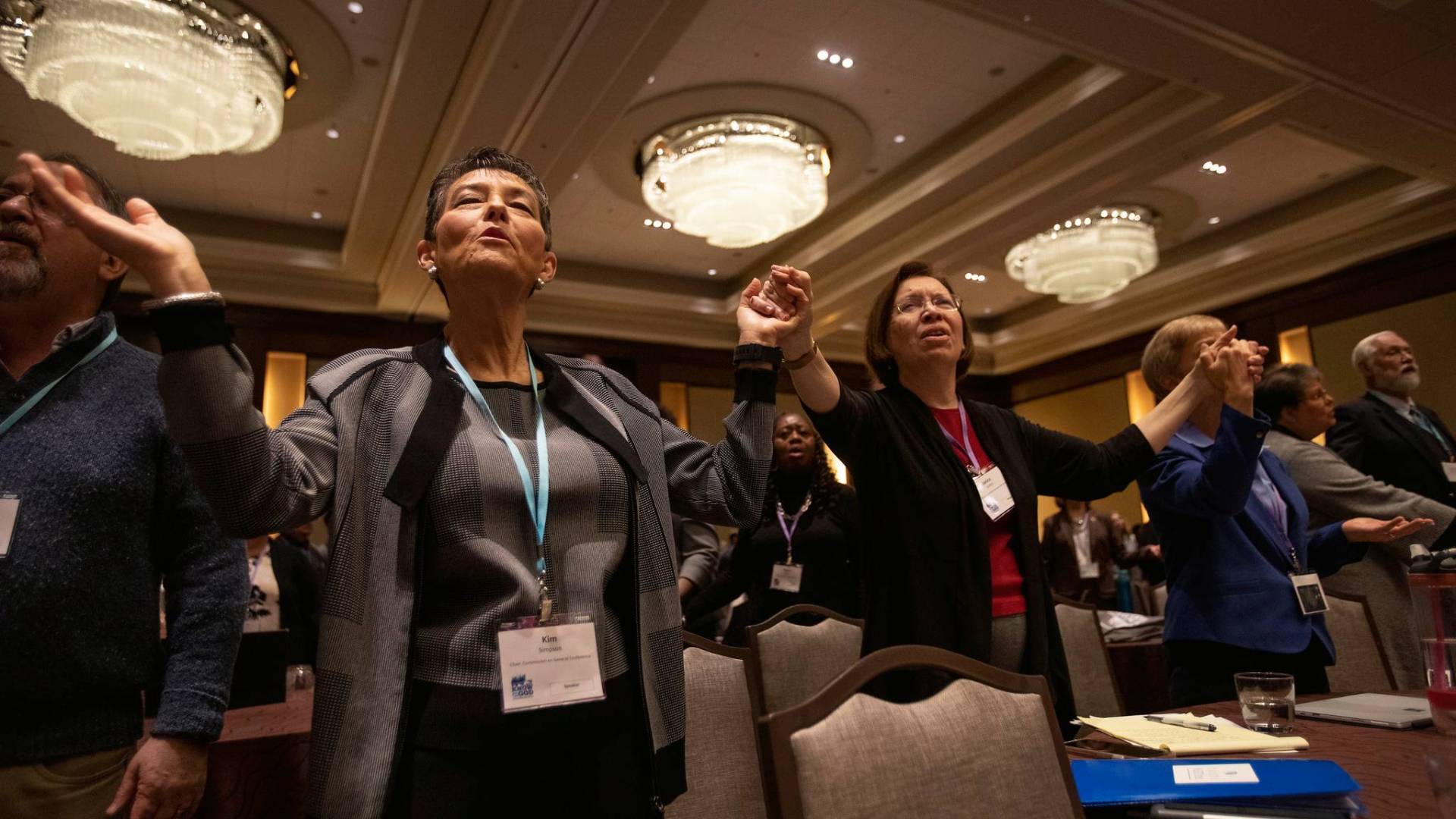
Another UMC Conference Delay Prompts Conservative Churches to Leave

New breakaway denomination moves up its launch as the United Methodist Church announces it’ll be two more years before voting on a split over LGBT stances.

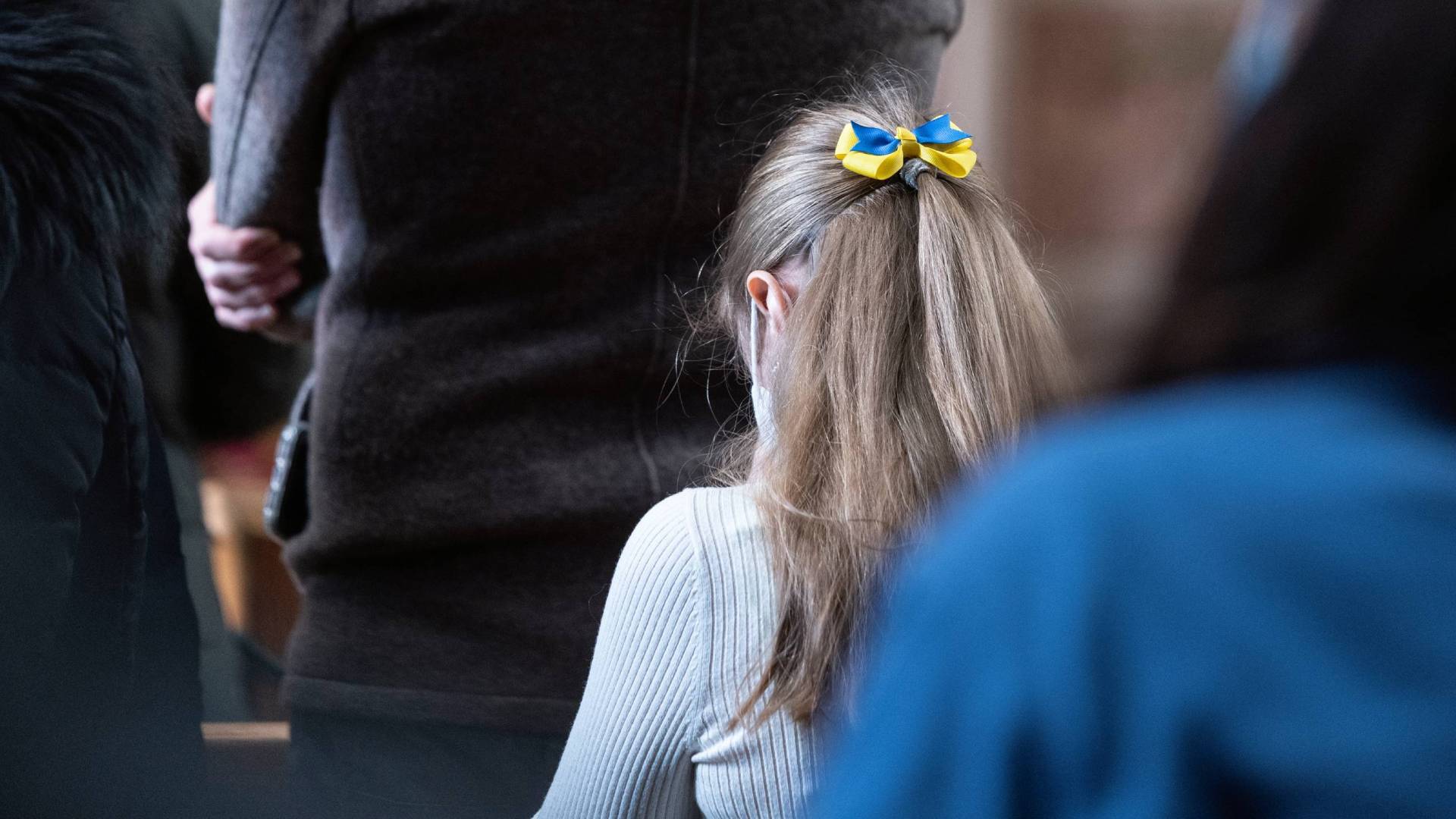
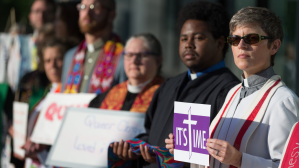
The United Methodist Church prepared to host its quadrennial General Conference in 2020 but have delayed the event three times due to the pandemic.

The United Methodist Church prepared to host its quadrennial General Conference in 2020 but have delayed the event three times due to the pandemic.

Christianity Today March 3, 2022
Kathleen Barry / UM News

In this series

The United Methodist Church has delayed its General Conference meeting for a third time due to the continuing COVID-19 pandemic. In response, some conservative United Methodists have announced they will preemptively leave the denomination rather than wait for the long-anticipated meeting.

Delegates to the General Conference were expected to take up a proposal to split the denomination over disagreements on the full inclusion of its LGBTQ members at the meeting of its global decision-making body scheduled for August 29 to September 6 in Minneapolis.

But General Conference organizers announced Thursday evening they are postponing that meeting to 2024 because of the continuing COVID-19 pandemic.

Obtaining vaccines and travel visas remains a challenge for delegates traveling outside the United States, according to the Commission on General Conference.

“We engaged in a fair, thorough, integrity-filled discussion of the alternatives,” said Kim Simpson, chairperson of the Commission on General Conference.

“The visa issue is a reality that is simply outside our control as we seek to achieve a reasonable threshold of delegate presence and participation. Ultimately our decision reflects the hope that 2024 will afford greater opportunity for global travel and a higher degree of protection for the health and safety of delegates and attendees.”

But one group of theologically conservative United Methodists said Thursday it is not willing to wait any longer to discuss a split and announced plans, through its Transitional Leadership Council, to launch the Global Methodist Church on May 1.

“Many United Methodists have grown impatient with a denomination clearly struggling to function effectively at the general church level,” said Keith Boyette, chairman of the Transitional Leadership Council that has been guiding the creation of the Global Methodist Church for the past year and president of the Wesleyan Covenant Association.

“Theologically conservative local churches and annual conferences want to be free of divisive and destructive debates, and to have the freedom to move forward together. We are confident many existing congregations will join the new Global Methodist Church in waves over the next few years, and new church plants will sprout up as faithful members exit the UM Church and coalesce into new congregations.”

Meantime, the Reconciling Ministries Network, which advocates the full inclusion of LGBTQ United Methodists, said Thursday it supports the commission’s decision to once again postpone the General Conference.

“Let us be honest here: holding a pandemic-era General Conference with myriad barriers to safe and equitable participation would not have been a Christ-like way to be the Church,” the group said in a written statement.

Still, the statement said, leaders of the Reconciling Ministries Network lament the delay in discussing a possible split. “These circumstances only prolong the road to justice for our LGBTQ+ kin and to parity in the global Church,” it said.
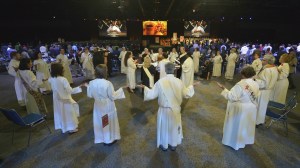
The General Conference, which usually gathers delegates from across the globe every four years, originally was planned for 2020. But the Commission on General Conference postponed the denominational meeting twice because of the continuing COVID-9 pandemic, delaying an expected vote on a proposal to schism after a decades-long debate over whether LGBTQ United Methodists can marry or be ordained.

The commission’s latest decision comes as United Methodists have published letters and statements arguing for and against postponing the 2022 meeting.

Last month, 170 delegates from around the globe sent a letter to the commission urging its members to delay the conference until 2024 to “properly ensure the health, safety, and participation of all attendees.”

Travel still carries health risks in 2022, according to the letter. And the General Conference doesn’t have the kind of technology and systems it would take to make sure delegates from all over the world could fully participate in the meeting.

“Especially because of the seriousness of the legislation that this General Conference will be debating, including the possibility of ‘amicable separation,’ it is important that the Commission on the General Conference err on the side of caution and ensure that no delegate, particularly those from Central Conferences”—the denomination’s regional bodies outside the United States—“is precluded from full, in-person participation because of the ongoing COVID pandemic,” the letter read.

Meantime, competing letters from African delegates argued both for and against another postponement.

The 2020 General Conference originally had been set for May 5–15, 2020, in Minneapolis. That meeting was rescheduled for August 29–Sept. 7, 2021, when the Minneapolis Convention Center announced it was restricting events during the pandemic.

It was rescheduled again for 2022 at the same venue.

It is not immediately clear whether the postponed 2020 General Conference will replace the regularly scheduled 2024 General Conference.

Delegates to the General Conference are expected to take up a proposal to split the denomination, called “A Protocol of Reconciliation and Grace Through Separation. The proposal, negotiated by 16 United Methodist bishops and advocacy group leaders from across theological divides, would allow churches and conferences to leave with their buildings and other assets to form new Methodist denominations, including a conservative “traditionalist” Methodist denomination that would receive $25 million over the next four years.

Calls to split one of the largest denominations in the United States have grown since the 2019 special session of the United Methodist General Conference approved the so-called Traditional Plan strengthening the church’s bans on the ordination and marriage of LGBTQ United Methodists.

Church Life

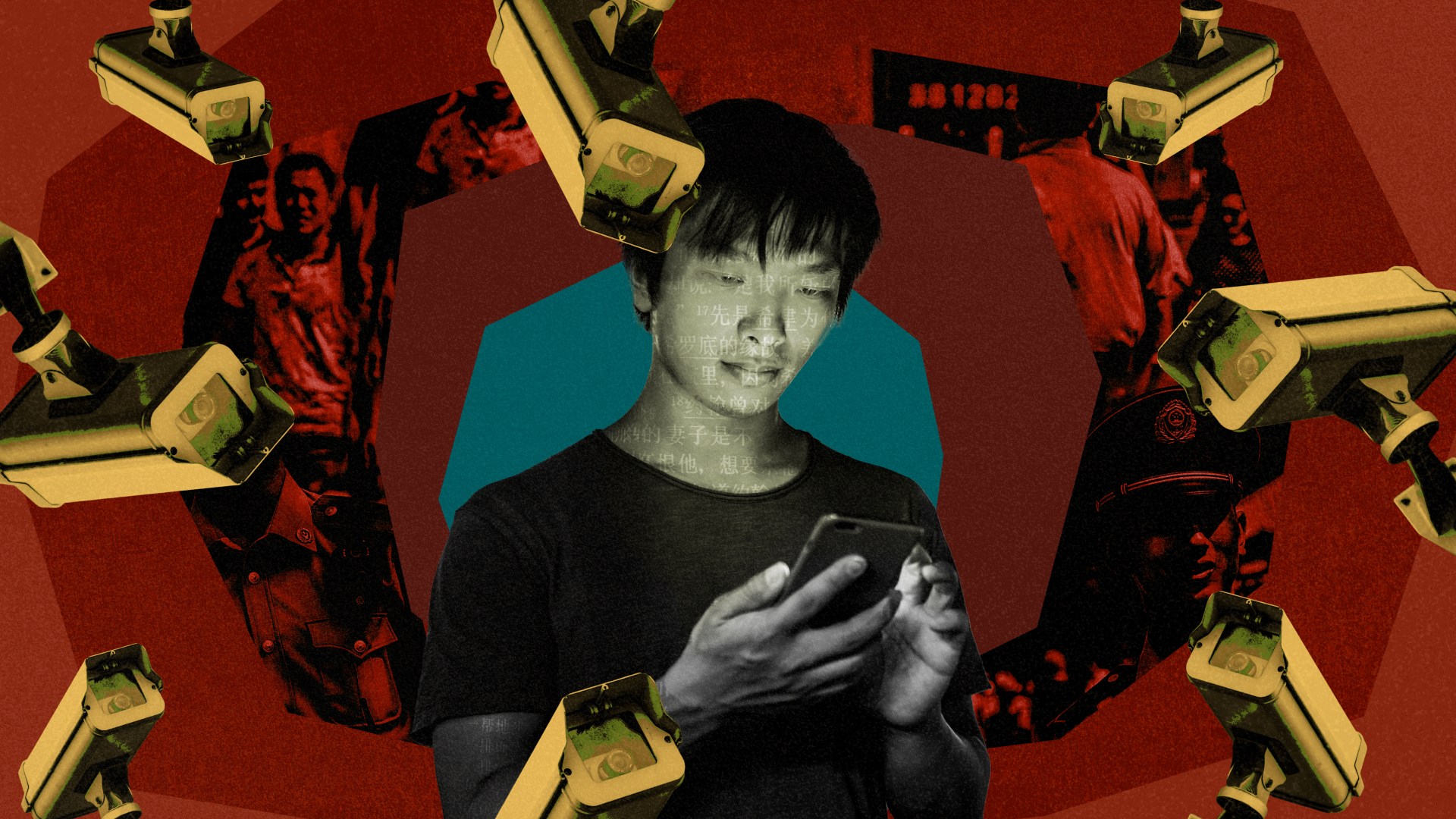
Can China’s New Regulations Really Stop Evangelism on the Internet?

While some church leaders are concerned that online religion restrictions may scare off Christians, others hope Chinese believers will continue to sow the digital mission field.

Christianity Today March 3, 2022
Illustration by Rick Szuecs / Source images: Envato Elements / Hitesh Choudhary / Pexels

China’s new internet regulations went into effect March 1, laying out broad restrictions on religious communication, teaching, and evangelism.

The new rules put into writing unofficial penalties that some Christians already faced for their online activity, so Chinese believers aren’t sure how the rules will be implemented and how much it could hamper missions.

The regulations were announced at the end of last year by China’s State Administration of Religious Affairs (SARA) and allow only religious groups with government approval to share information on the internet. According to the new Measures on the Administration of Internet Religious Information Services:

Organizations and individuals must not proselytize online and must not carry out religious education or training, publish preaching, or repost or link to related content; must not organize the carrying out of religious activities online; and must not broadcast religious rites … through means such as text, images, audio, or video either live or in recordings.

On February 28, the Chinese government issued a press release answering questions about the new regulation, stating the government “will have close and thorough cooperation to ensure the implementation of the measures.”

How will the implementation of these new measures affect the use of the internet for evangelism and mission by Chinese Christians? Will Christians in China no longer be able to do anything online? As the new measures come into force during the ongoing pandemic, where will the internet mission of Chinese churches in China and overseas now go?

CT Asia editor Sean Cheng interviewed several Chinese pastors and Christians (for security reasons, the names of Christians in China are pseudonyms), including:

  • Jerry An, new media mission pastor and Chinese director of Reframe Ministries in Grand Rapids, Michigan
  • Eva Xu, member of an evangelical church in Los Angeles who has a master’s degree in theology from Fuller Theological Seminary
  • Shi Ming, pastor of a church in China who has an M.Div from an American seminary
  • Sean Lu, youth pastor of a church in China, now studying for a PhD in theology in the US
  • Zhu Yalun, pastor of a church in China who has an M.Div from a Korean seminary
  • Lynn Han, member of a Chinese church in Tokyo and host of a Christian WeChat group
  • Zhang Qiang, big data expert and veteran media worker who lives in China

CT: How do you think the regulations will affect Chinese Christians’ use of the internet for evangelism and mission?

Shi: First, these are just “measures,” which, in essence, authorize the government to carry out certain operations and can be used as a management tool. They may claim to have the force of law, but they do not have the same degree of binding power of a law.

Second, these measures are not much more than the practices that already existed (e.g., deleting posts, blocking social media accounts, public security authorities summoning violators for admonishment, or even suing them for the crime of “picking quarrels and provoking trouble”). In other words, the measures merely fix on paper some exemplary practices that have already existed, in order to authorize and legitimize the government agents to do these things. This is not an overnight escalation of strict control.

Third, I don’t think this will have much impact on Chinese Christians’ use of the internet for evangelism and mission. Zoom meetings may be disrupted, and WeChat public accounts may be blocked, but these have always been the possibilities.

The only impact that is certain is that some Chinese Christians will stop their ministry out of fear. But Christians should not dance to the baton of such regulations in how we serve God and people. We should do everything we can to be faithful stewards of God’s resources until God takes them back.

Zhu: The impact remains to be seen, as it depends on the actual implementation. There has always been room for ambiguity in Chinese regulations, and the authorities will adjust the intensity and scope of implementation depending on the situation. And being restricted on WeChat may not be a bad thing. Too many Chinese today (including Christians) rely too much on WeChat, which has become the main means for many to obtain information, and that in itself is unhealthy. WeChat is full of misinformation and twisted value.

Han: The impact of the new regulations can already be seen on WeChat. Christians are afraid to forward Bible-related audio, pictures, and text, and many evangelical WeChat public accounts have been deleted. Words like Jesus, Jehovah, and amen cannot be written out and have to be replaced with pinyin abbrevations (e.g., “JD” for Christ and “JDT” for Christian). Brothers and sisters in Japan have gradually moved to social media apps outside China (such as Line).

An: The intimidating effect of the regulation has already been seen, and many Christians have become more cautious in their communication on the internet or have used riddle-like codes for words that sound religious.

The government’s control over the speech of all sectors of society, not just Christianity, is unprecedented. And in spite of this high degree of control, the Xuzhou chained mother incident has created an unprecedented tsunami of public opinion, with many deleted posts gaining more attention and spreading more widely after being reposted outside China. This once again proves the subversive nature of the new media compared to the traditional communication model.

I am optimistic that after a short period of recession, the new regulations will inspire Chinese Christians to value internet ministry more and to use the new technologies more creatively and with a greater sense of mission.

Lu: The church must prepare for the worst and respond for the best. If, as the authorities say in the press release, the government will “ensure that the measures are implemented,” this is likely to have a big impact on the government’s goal of “de-religionizing the internet.” Of course, this is only relative because it is impossible to eradicate religious contents in an absolute sense.

If, as the authorities expect, cyberspace will no longer be a “special zone for religious activities” or an “enclave for religious ideas,” then the internet will become a veritable mission field. It will be a challenging mission and spiritual warfare, just like any offline mission field where people are hostile to the gospel. We must rely on the power of the Holy Spirit to meet the challenges and to plough the frozen ground and sow.

CT: How can Chinese Christians continue online ministry after March 1? What kind of adjustments will they need to make?

Xu: Actually, Bible study meetings, theology lectures, and even online worship can still be done using Zoom. The only difference is that in the past the Zoom login information was usually posted in the WeChat groups, but now we are more concerned about security, so we use other methods to notify participants.

A few adjustments are still needed, such as avoiding the use of sensitive words that can easily trigger censorship. Christians are called to be both innocent as doves and shrewd as snakes (Matt. 10:16). When WeChat doesn’t work, more phone calls can be made to reach out to the seekers, and home visits can be a better option when the pandemic subsides.

Shi: I don’t think we need to make many adjustments because we are not suddenly in a “bitter winter” of the internet. We should continue to do what we have been doing until we are blocked, removed, or the tools are no longer available.

I want to say to Chinese Christians overseas that you are in a special position. You have to use software programs, platforms, or resources from China, but you are not bound or governed by the laws of China.

And these software programs, platforms, and resources have a desire to enter the global market. I think God has given you a special status for “such a time as this” (Esther 4:14) to sue or protest these software and platforms in your own country for their infringements on freedom of speech, to reduce their influence and market share in the diaspora Chinese communities. Although this is not enough to change many things, perhaps God can use your present status to make an impact through such actions.

Zhu: I think what Chinese Christians need most now is to learn to circumvent the GFW (Great Firewall) using VPN and reduce our dependence on WeChat.

Break out of the wall, and the truth will set us free, and things will be much easier in the future: Churches or organizations that can afford it can set up their websites on off-GFW servers; Christian public accounts can move their platforms to uncensored social media (such as Telegram); and Christian individuals can also use social media outside the GFW. Telegram is highly recommended. After the past few years of trial and error, we think it is a very good one-stop platform that can completely replace WeChat in terms of functionality.

Lu: The fact that this unjust law is coming into effect does not mean that the Chinese church should retreat from cyberspace altogether or silence itself. Both individual believers and the church community need more courage, wisdom, and creativity from God to identify and seize new opportunities.

Churches and missions need to equip and send well-trained “internet missionaries” into this new mission field and spiritual battlefield in a more targeted and strategic manner. At the same time, we need to create the “new wineskins” of symbols, language, metaphors, and stories to carry the “old wine” of the gospel (Mark 2:22) in the face of an increasingly narrow public space and a rapidly changing online culture.

The Chinese church needs to create our own Narnia and Lord of the Rings by our own C. S. Lewis and J. R. R. Tolkien. (For example, can Chinese Christian writers create literary works based on Chinese mythology that do not have Christian “sensitive words” but are creative and spiritually profound in carrying the gospel message?)

An: From a personal perspective, tighter controls may prompt us to live out our faith not just by talking about it, but by living it out. We as individuals sharing the gospel on new media should pay more attention to relationship building and whether what we share in our circle of social media friends has the fruit of the Spirit and can exude the aroma of Christ.

Organizations and churches need to adjust their strategies to respond (for examples, transitioning to platforms outside the GFW or sharing the gospel with more creativity). In the “bitter winter,” everything is still growing, and it is also a season for us internet missionaries to work hard and wait patiently.

Zhang: Internet mission is a window into the converging interactions of technology and culture opened in the first two decades of the 21st century with globalization. Twenty years later, the world is not more tolerant but more polarized, not more united but more divided because of the internet connections.

The gospel can work through economic, demographic, technological, political, legal, and educational changes; only the effects may not be immediately apparent. The seeds sown in the past 20 years of internet mission will grow to be visible in the next 20 years. We need to pay attention to the changing seasons of people, cultures, and hearts.

This new season of authentic, community-focused, local, and deeper human engagement needs the truth of life to be truly understood and lived out by the believers, not just spoken with keyboards and screens.

CT: What have been the challenges and opportunities for online ministry during the pandemic? What hope do you have for the future?

Xu: The biggest challenge to evangelism from the pandemic is the reduction of face-to-face opportunities. There are fewer outreach activities, such as basketball or ping-pong, arts and crafts, etc. The seekers don’t always watch the videos or audio, or read the articles we forward, and they don’t always answer the phone.

But the pandemic has forced people stay at home, and now there’s time for people to be willing to read something more profound, or to consider questions about life, death, and eternity. Christian online seminars and books that discuss how to deal with personal relationships are currently more suitable to recommend to friends, family, and colleagues.

Han: The pandemic has restricted Christians from going out, but it has increased the time we all have to communicate on the internet. We currently have two to three hundred brothers and sisters living in Japan, China, the US, Canada, and Europe reading three chapters of the Bible a day together in a WeChat group.

Half of us have been faithfully punching in daily for two years already, and there is a regular weekly Bible study on Zoom. Having more time to study God’s Word in depth has been a great joy shared by all and has been very helpful in overcoming the anxiety caused by the pandemic.

Zhang: The pandemic brought enormous anxiety even to healthy people, not to mention those who already had depression. It also brought about a backlash against small-circle mentality and echo chambers. This also reminds us that internet missions need to “become flesh” and move from symbolic communication to experiential, real-life scenarios. Christians with mature spiritual lives can serve this generation through professional service in their own workplace, creating new opportunities to build relationships with people and preach the gospel of Christ.

An: The pandemic has forced all churches to go online, and internet ministry has received unprecedented attention. Many churches and Christians have begun to actively explore church development and internet ministry in the “new normal” of the post-pandemic era.

But there is also backward thinking, superficiality, jealousy, and self-boasting. In the past five years, we at Reframe Ministries have conducted extensive surveys and analysis of active Christian WeChat public accounts and found that Christian public accounts as a whole show a phenomenon of “bad money driving out good money,” with for-profit marketing accounts and fake news proliferating, and a general lack of public concern and the ability to engage in public dialogue.

During the past two US elections, many Christians’ social media contributed to the spread of fake news and conspiracy theories and lost their Christian witness. This shows that the Chinese church has long lacked a deep understanding of media and new media as well as profound and mature research of the church’s social engagement and public theology. We still have a lot to do to catch up.

Shi: Internet ministry needs to lead the targeted people to the local church, to real and personal connections. It can also lead to fantasy, deception, and self-gratification. An internet celebrity, writer, or host engaged in internet ministry is likely to over-exalt himself because of his interaction with his fans or listeners.

What he hears from his followers will reinforce his self-perception and eventually, although he still goes to church, his true identity will actually be on the internet. This is very dangerous and harmful to both himself and his followers.

I especially hope that those involved in online evangelism will view their endeavor properly and see it as a resource that God has given in this age, but not as a substitute for Bible reading, prayer, and participation in the local church.

Interviews and English translation by Sean Cheng

She Calls Christianity Today a Lighthouse and a Life Preserver

Why Ronna Bauman has found significant solace and encouragement from the ministry in recent years.

She Calls Christianity Today a Lighthouse and a Life Preserver
Photo Courtesy of Ronna Bauman

Several years ago, while sitting in an office waiting room, Ronna Bauman picked up an issue of Christianity Today (CT).

“Inside was a raw, honest article about the emerging cocktail culture among Christians,” said Bauman. “I thought, ‘Well, that’s honest, and touching on something people don’t normally want to talk about. It felt refreshing to witness the writer tackling something complicated without shaming the reader. Because it was so thoughtful, I went home and subscribed.”

“I think it was indicative of all the CT articles I’ve read since then,” she said. “They ask, why do we think the way we think? They present ideas from multiple perspectives.”

Bauman had known about CT since she was a kid. Raised in a loving Christian home, where her sister first led her to Christ as a young child, she grew deeper in her faith through a crucifixion drama she witnessed as a preteen, and a one-month Bible study retreat in the UK that she attended at 16.

In adulthood, Bauman and her husband Kris, active-duty Air Force, ministered with Cru’s Military Ministry. After having five children, they focused on investing in the local church, moving around a number of times. Today, Bauman works for a nonprofit that helps single moms exit homelessness and domestic violence. The couple has returned to their home base of Colorado Springs, where her relationships with her family, old and new friends, and her community form the center of her life.

Several years ago, over Christmas time, the family read an op-ed from CT’s president and CEO, Tim Dalrymple, where he articulated whom he hoped the publication would give voice to. It made Bauman cry.

“That article gave voice to what I’d been feeling for so long as I felt sort of unmoored within evangelicalism in such a divisive time,” said Bauman. The turbulent political time had left her “grieving.”

“I felt despair that within the Church, we weren’t listening to one another. We didn’t pursue understanding each others’ narratives,” she said. “But the article was healing.”

The article also put CT on her kids’ radar and made them curious to learn what else CT would have to say. CT’s addition of Ekstasis, which frequently publishes beautiful poetry and stunning photography, also excited them as fans of the artforms.

Beyond CT and Ekstasis, Bauman raved about the hit podcast, The Rise and Fall of Mars Hill (RFMH) and its production values.

The Rise and Fall of Mars Hill is appealing to really seasoned podcast listeners because of its cutting-edge production,” said Bauman. “I feel proud to pass it on to people. Host Mike Cosper’s voice is soothing and non-judgmental. You don’t feel yelled at. It’s not a bashing session—it’s a ‘let’s take an internal look and see why we are attracted to narcissistic leadership.’”

RFMH also spoke to conversations Bauman has had with her family.

“In the final episode of the podcast, Paul David Tripp urges us all to deconstruct our faith on a regular basis, to question what part of our faith is Jesus, and what part of our faith is American culture?” said Bauman. “This call of grace is compelling to me as I love hanging out with young people who have done a fair amount of this. It removes the ‘finger-wagging’ or the shaming of those who are in the midst of deconstructing. Faulty theology or toxic leadership culture create pain. Instead, compassion and liberty—for us and for others—are needed in that space as we discern truth from error.”

Bauman and her husband recently decided to give to CT above and beyond their subscription and have invited others over for dinner several times to dialogue over engaging CT content, as well as to learn about and participate in the ministry’s mission. During a recent Christmas, Bauman gave magazine gift subscriptions to many people in her circles.

“CT appeals across generations because it’s still true to Billy Graham’s vision of being theologically sound, politically objective, and globally relevant, while including voices of women, people of color, and the international church,” she said. “In 2022, we’re all saying, ‘We don’t know what’s going to happen next,’ but we can trust the thoughtfulness and humility with which CT will lead and curate stories and ideas of the kingdom of God. CT is a lighthouse: it shines a light on the whole world, and yet it is also a life preserver. Through its research and elevation of thought leaders, it gives us something to grab onto.”

Morgan Lee is global media manager at CT.

News

Hundreds of Russian Pastors Oppose War in Ukraine

(UPDATED) Ukrainian evangelicals demand more Bonhoeffers, as Russian evangelicals debate whether public protest under Putin can achieve more than prayer.

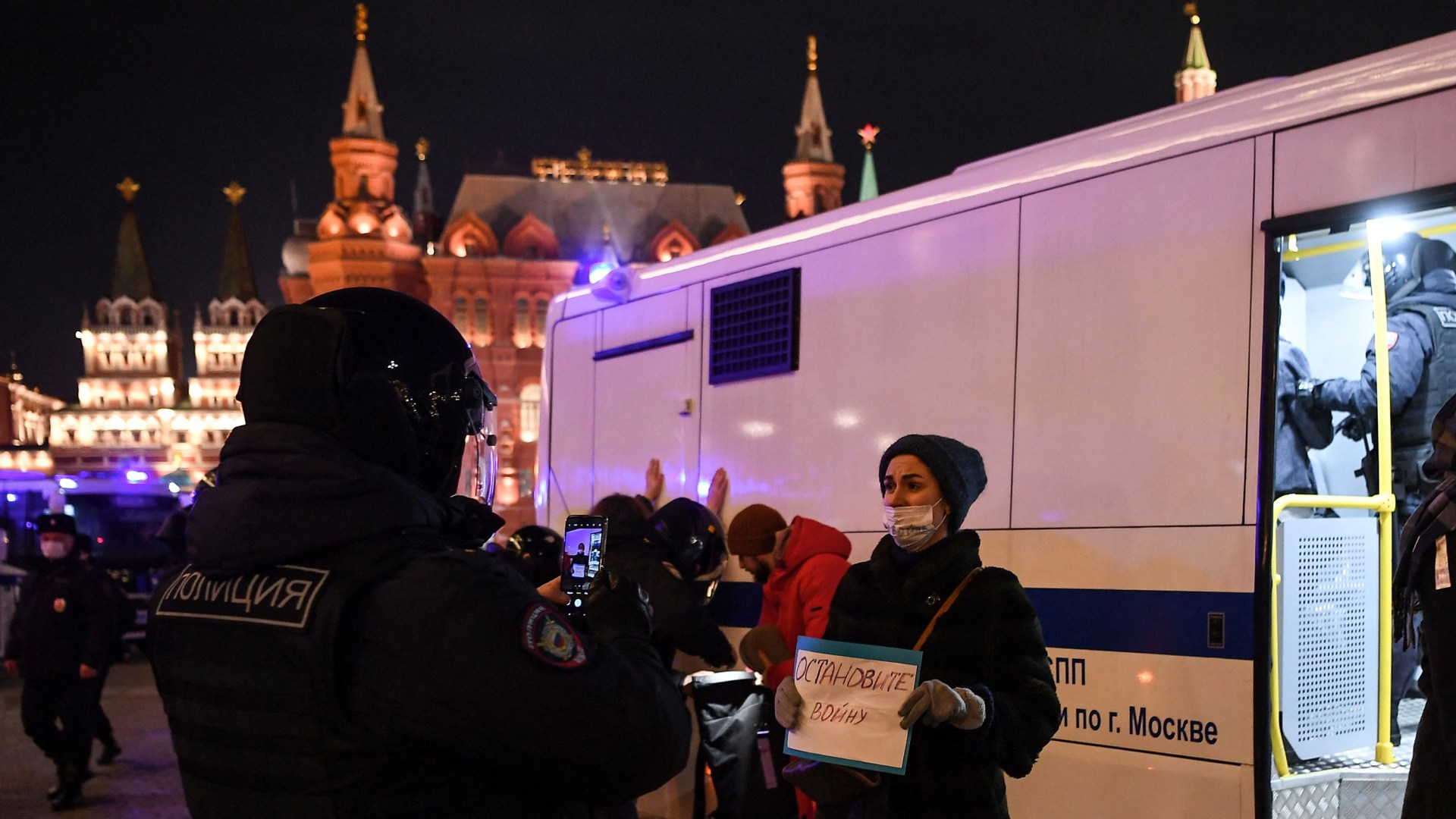
A woman holds a "Stop the war" placard in central Moscow during a protest against Russia's invasion of Ukraine, on March 3, 2022.

A woman holds a "Stop the war" placard in central Moscow during a protest against Russia's invasion of Ukraine, on March 3, 2022.

Christianity Today March 3, 2022
Contributor / AFP / Getty Images

Ukrainian evangelicals have had enough.

Battered by a week of war, they have heard numerous prayers for peace uttered by their Russian colleagues. But they did not hear condemnation.

“Your unions have congratulated Putin, giving thanks for freedom of belief,” said Taras Dyatlik, the Overseas Council regional director for Eastern Europe and Central Asia. “The time has come to make use of that freedom.”

As Kyiv, Kharkiv, Kherson, and other cities have suffered missile strikes, the United Nations reports the death of more than 200 civilians. Ukraine’s State Emergency Service reports more than 2,000. The military casualties are disputed, with both nations claiming thousands of fatalities among the other’s ranks.

But rather than focusing on the numbers, Dyatlik, who coordinates a regional network of dozens of Protestant seminaries, turned to the Bible.

“Remember Mordechai and Esther,” he wrote March 1 in an open letter. “Do not be like Jehoshaphat, who entered into an alliance with Ahab, and was silent when God spoke through the prophet Micaiah.”

Dyatlik accused his Russian colleagues of buying into national rhetoric—first in 2014, when Russian-backed forces invaded the eastern region of Donbas—and again today. But “begging on my knees,” he leveraged his reputation with the heads of Russia’s evangelical unions—while acknowledging their difficult reality.

“You fear prison,” he said. “[But] do not be faithful to Putin. Be faithful to the body of Christ.”

Recently passed amendments to the Russian criminal code establish up to a 15-year prison sentence for “fake” claims about the violence in Ukraine, as authorities crack down on Russians who call the “military operation” a “war.”

Discrediting the armed forces can now result in three years in prison; calling for anti-war rallies could merit five years. Based on level of severity, such actions by Christians and other Russian citizens risk fines and compulsory labor.

Dyatlik was not the only one frustrated. But instead of drawing from Scripture, his colleague Valerii Antoniuk appealed to history.

“Where are your Bonhoeffers, where are your Barths?” asked the head of the All-Ukrainian Union of Churches of Evangelical Christians-Baptists. “Your silence now is the blood and tears of Ukrainian children, mothers, and soldiers—that is on your hands.”

Pavel Kuznetsov, meanwhile, simply wants the correct word used—law or no law.

“Many believers in Russia are praying about the ‘situation’ in Ukraine. The situation is called WAR,” the pastor of Word of Life church in Boyarka, 15 miles southwest of Kyiv, wrote on Facebook. “And when you pray again, tell God it’s war, and we are being killed here.”

As of publication, more than 300 Russian evangelicals had reportedly received the message.

“The time has come when each of us must call things by their real names, while we still have a chance to escape punishment from above, and prevent the collapse of our country,” stated an open letter signed by a group of Russian pastors and other Protestant leaders. “We call on the authorities of our country to stop this senseless bloodshed!”

Their message was also biblical.

It quoted Jeremiah 18:7–8, that the nation that turns from its evil ways will be spared.

It referenced Cain committing the sin of fratricide against his brother Abel.

And it called for their nation to implement the words of Jesus: “Put your sword back in its place … for all who draw the sword will die by the sword” (Matt. 26:52).

Dyatlik received the statement with great joy—but also fervent prayer.

“They literally are risking their lives,” he said. “But they show their love to the Lord and his body: we are one in the Spirit.”

The open letter is available on the website of Mirt Publishing House, a small evangelical publisher in St. Petersburg, and is signed by mostly Russian Baptists and Pentecostals affiliated with churches or seminaries in Moscow, St. Petersburg, and more than 40 other cities.

[Editor’s note: The petition was closed after gathering 400 signatures within two days.]

“This is an extraordinarily courageous step compared to evangelical timidity previously under Putin,” said Mark Elliott, editor emeritus of East-West Church Report, a journal focused on explaining Eurasian Christianity to Christians in the West for 29 years. “I am amazed and heartened that these brave people are defending Ukraine. They will suffer for this unless Putin is dethroned. Lord have mercy.”

“The letter is not a typical reaction by Russian Protestants. Staying away from politics has been their primary stance for decades,” said Andrey Shirin, a Russia-born Baptist seminary professor in Virginia. “They have been routinely accused by Soviet authorities of being anti-government. In response, they said they were believers, not politicians.

“Many Russian Protestants are maintaining this stance in the current conflict,” he said. “But some desire greater social involvement, and the tragedy developing in Ukraine has struck a raw nerve.”

One cosigner, however, pushed back against the expectation that all Russian Christians must do likewise.

Alexey Markevich, one of nine Russian Protestants to officially sign the letter before it was circulated publicly, said not everyone needs to be a Bonhoeffer.

“The church’s first calling is the proclamation of God’s Word … [and] this proclamation happens in many different ways: pastors preach, theologians write, philanthropists give out bread, people weep with those who weep, activists take to the square,” he said. “It is important for each of us to see our calling and fulfill it honestly before God, serving him and people.”

Moreover, Bonhoeffer and other famous figures who struggled against evil, while models of faithfulness in themselves, do not directly apply to the demands Ukrainians are making of Russians today.

“Their examples are important and relevant to us,” said Markevich. “But [they did not go] out to picket, and [Bonhoeffer] did not conduct any public activity.”

It would be difficult to achieve results through such actions, in his view. Evangelicals in Russia have no political influence to stop the war, whether they write letters or fill the city squares. Some will still try, as Markevich said he has done since 2014. But true power lies elsewhere.

“War can be stopped by God,” he said. “That’s why we cry out to him.”

Though with less risk but still significant ecclesial cost, some Moscow-affiliated Orthodox priests in Ukraine are calling on their local bishops to disavow Patriarch Kirill of the Russian Orthodox Church.

“This unprecedented … wrenching tragedy that has been ignited by the malignant conspiracy and malicious inaction of a person whom we cannot recognize as our patriarch,” stated 10 priests in the Cherkasy diocese of the Ukrainian Orthodox Church (UOC), 120 miles southeast of Kyiv, in a joint statement.

“We demand the severance of all relations with the Russian Orthodox Church, and the restoration of eucharistic communication with the ecumenical patriarch.”

In 2019, the Istanbul-based ecumenical patriarch of the Orthodox Church, Bartholomew I, recognized the national independence of the breakaway Orthodox Church of Ukraine (OCU). Many parishes in Ukraine rejected this and chose to remain under the Moscow patriarchate, as has been historic precedent. (Exact figures for OCU- and UOC-affiliated churches in Ukraine are difficult to determine.)

But now bombed by Russian forces, the ten priests addressed their letter to Metropolitan Onufriy, the UOC leader, and demanded that their local bishop break ties with Kirill.

They also were biblical, referencing Esther and Proverbs 24, which oblige the believer to not pretend ignorance but to rescue those who are facing death.

“We will find the strength to stand not with weak-minded people,” they stated, “but with Christ, who is our true pastor, father, and protector, to whom be the honor and glory for all time. Amen.”

Their action was followed by the UOC priests of Lviv, which became the first diocese to unanimously call to break with Moscow.

“Today the masks are off. It is obvious to everyone that behind the words about brotherly love and the creation of a single spiritual space of the ‘Russian world’ was a man-made desire to bury and ignore the free and God-loving Ukrainian people,” they said in their statement, comparing Putin to the biblical Cain.

“Staying in prayerful and eucharistic unity with the Moscow Patriarchate … makes the UOC faithful look like enemy collaborators, and traitors.”

The world sees a similar reality.

The United Nations General Assembly voted 141–5, with 35 abstentions, to condemn Russia and call for an end to hostilities. Only Belarus, Syria, North Korea, and Eritrea joined Russia in opposing the measure.

Sergei Ryakhovsky, head of the Russian Union of Christians of Evangelical Faith, one of the two largest Pentecostal associations in the country, was quoted in Vzglyad, an online Russian newspaper, as praying for the “Russian military operation”—Putin’s preferred terminology—to end by Easter on April 24, as well as noting John the Baptist’s defense of soldiers.

“Any Christian of any denomination is against violence,” he said, according to the Vzglyad article. “But at the same time I understand that peace is achieved by different methods, including force, as in this situation.”

Ryakhovsky later denounced the interview as fake in an Instagram story post. “Dear brothers and sisters, if in the near future you will read in the press my quotes about Ukraine, know that they are fake,” he posted Friday.

Many analysts are predicting a drawn-out conflict.

“Most likely, the occupiers will only increase their efforts, destroying our country and lives,” said Roman Soloviy, director of the Eastern European Institute of Theology in Lviv. “Therefore, we cannot give up. … Amid chaos, pain, and death, we must remain God’s instruments of comfort, help, and hope.”

And some of that has now come from Russia, even as its government has moved to censor its media. Liberal news sources Dozhd and Ekho Moskvi were recently shuttered. But some evangelical leaders continue to speak.

“No political interest or goal can justify the deaths of innocent people,” the open letter stated. “War destroys not only Ukraine, but also Russia—its people, economy, morality, and future.”

Editor’s note: This article was updated on Friday, March 4, to note Sergei Ryakhovsky’s Instagram statement that his interview in Vzglyad is fake.

Theology

Bomb Shelter Ministry in My Ukrainian Town

Thanks to air raid sirens, neighbors and refugees are hearing more about the gospel than ever.

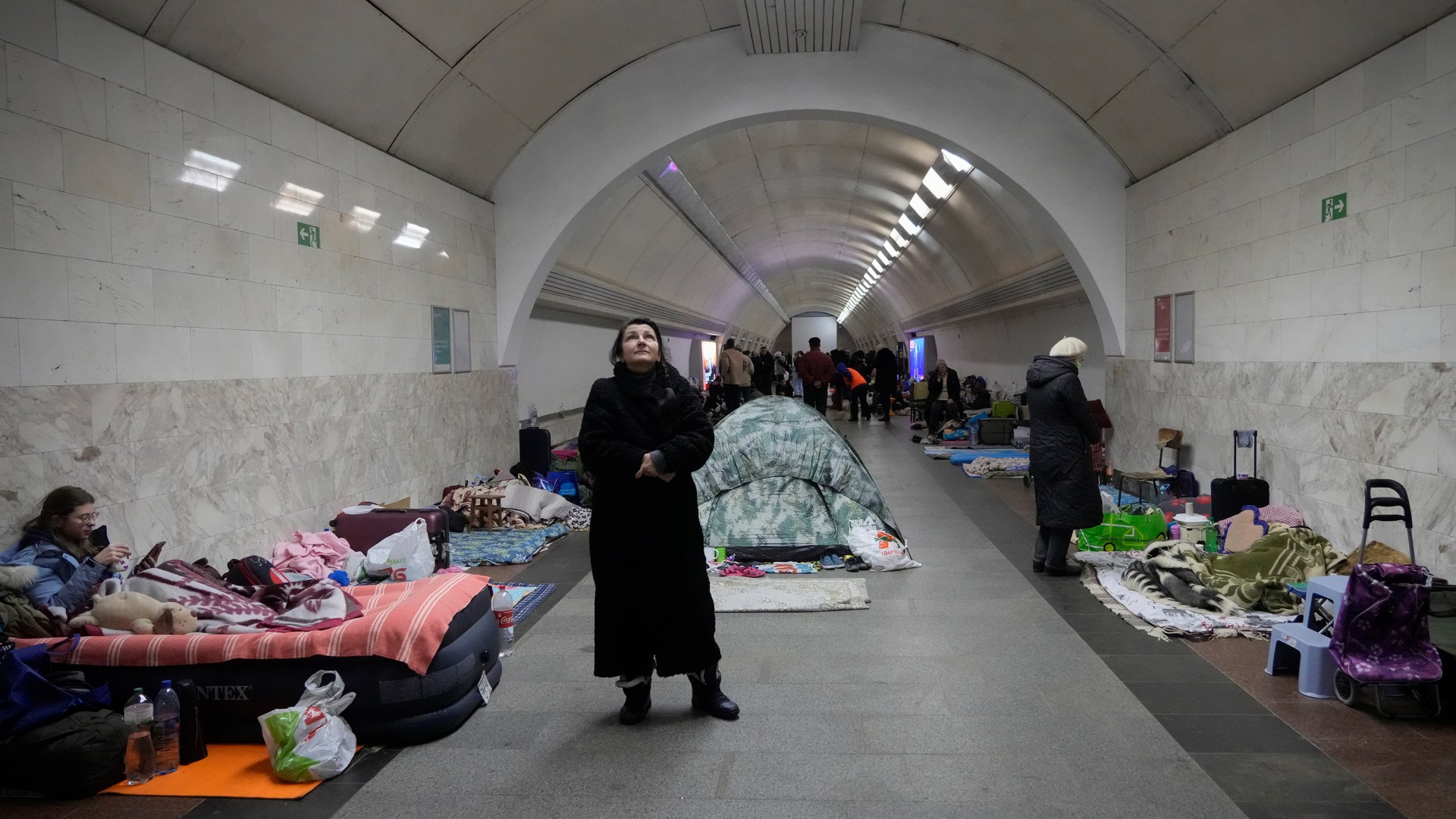
People gather in the Kyiv subway, using it as a bomb shelter.

People gather in the Kyiv subway, using it as a bomb shelter.

Christianity Today March 3, 2022
Efrem Lukatsky / AP Images

We are now a full week into open war with Russia. Of course, Russia has been warring against Ukraine since 2014, but this is an unprecedented phase. Still, it’s amazing how quickly one gets used to the mundane realities of war.

On day one, the news of other cities being bombed caused great anxiety in the city of Svitlovodsk, where my family and I live. Of course, the fact that the news woke us up before dawn and was very unexpected made it much worse. The intent to cause panic seemed planned.

Now, on day seven, the adrenaline has worn off. We are used to the 8 p.m. curfew and sitting in a dark apartment at night. We find ourselves ignoring some of the air raid sirens—especially the ones in the middle of the night, since we’re so exhausted. We’ve also learned that not every siren means a bomb might drop on our heads.

But whenever we do head to the bomb shelter, my family and I take the opportunity to share the hope of Christ with our neighbors.

“Bomb shelter ministry” is, I must admit, not a ministry profile I thought I’d ever have. And yet, we are already seeing how fruitful it’s been. Our neighbors have heard more about Christ, heard more Scripture, and been led in more prayer in the last week than most of them probably have in their lives.

In addition to the “Our Father” prayer, I’ve taken to reading various Psalms with them—a particularly fitting book for us in Ukraine, as David often cries out amid being hunted by his enemies.

One of our neighbors is the equivalent of our building superintendent. The other night in the bomb shelter, she said with tears in her eyes how thankful she was to have neighbors like us. She said she can’t understand “where we came from.” We got to remind her that if there is something different, it is only because of the hope Christ gives us.

I’ve also gotten questions down there about how to read the Bible properly. The grandpa who asked me got a crash course on the Christocentricity of Scripture! It has often been the case that we stay down there discussing matters of faith long after the sirens have stopped.

Despite significant time spent in the bomb shelter during air raids, our city has so far avoided any actual bombing. The practical reasons include its smaller size (population of 45,000) and lack of strategic targets nearby. This, along with the fact that we are at a crossroads in the country, has made Svitlovodsk a refugee destination—that and God’s providence.

The brutal bombing of civilian targets in Kharkiv, Ukraine’s second largest city, has led to another wave of refugees over the last 24 hours. Previously the targets had been mostly military. This meant that our church welcomed 16 more refugees tonight, 10 in our building and 6 with a family from our church.

One of the young fathers of the families who stayed in our church is into Hindu spirituality and had a lot of great questions about Christianity. I ended up talking with him about what makes the gospel different than other religions (i.e., grace) for nearly an hour. I think he came to see Christianity in a new light. We exchanged numbers to stay in contact as they head further west in the coming days.

This is the case with most refugees who make it this far. We are just an inn for weary travelers on the way. But we hope to serve them and help them experience the love and peace of Christ, even if only for a few hours. It is not our job to force them into faith—an evangelistic approach that rarely produces good results. Rather, we will play whatever role God grants us: to plant a seed, to water—or to harvest when ready. He is the one who brings the fruit in his time, and we can rest in that.

All these stories should remind us of a vital truth: that God’s victory is always subversive. Whatever the Enemy intends for evil, God always takes and uses for good. This means the more the Enemy rages, he only brings his own destruction closer. God turns the Enemy’s weapons against him, just as David did with Goliath’s sword—and what Christ ultimately did in his death on the cross.

When the Enemy thought he finally had Jesus right where he wanted him, it turned out he was dealing his own death blow. Our Lord overcame by using the Enemy’s own weapons against him. We take comfort in that—especially as Ukraine faces an enemy who rages, both in the Devil who loves to “steal, kill and destroy” and in those pseudokings who are the Devil’s pawns.

I believe both will shortly find themselves overthrown by God’s wonderfully ironic victory. But in the meantime, we covet your prayers.

Pray for the many refugees we are expecting over the next days, particularly from Kharkiv. Pray that we will serve them well and show them the love of Christ and that God would open doors. Pray for God to provide for all of them.

Pray for strength and wisdom amid so many needs. Everyone is scrambling around the clock and not getting enough sleep. Please pray for the ministry team in our church. Pray that I might use every invitation for interviews, articles, podcasts, and more to glorify the one who is our rock and refuge.

Pray for my friends who were mentioned above to come to know the beauty of the gospel in their lives.

Pray for God’s subversive victory to come swiftly against the tyrant terrorizing our country. Pray for God to be glorified in humbling the pride of man.

Benjamin Morrison is the pastor of Calvary Chapel Svitlovodsk, Ukraine, which is raising support for refugees. He is an American missionary veteran of 20 years, and he and his Ukrainian wife have two children.

News

Died: Gary North, Who Saw Austrian Economics in the Bible and Disaster on the Horizon

The prolific writer promoted Christian Reconstructionism, libertarian Ron Paul, the gold standard, and fears of Y2K.

Christianity Today March 3, 2022
Courtesy of Gary North / edits by Rick Szuecs

Gary North, a leading Christian Reconstructionist who argued for the biblical basis of free market economics and urged people to prepare for societal collapse, has died at 80.

North was a prolific writer, simultaneously penning a 31-volume Bible commentary on Austrian economics; turning out regular warnings about financial catastrophe; and firing off a seemingly endless stream of columns on the gold standard, government overreach, God’s covenants, and the greatness of libertarian Ron Paul.

He was perhaps most mainstream when he supported Paul’s longshot presidential bid in 2012. He boosted the candidate throughout the Republican Party primaries, alternately explaining monetary policy to newly converted libertarians and hyping the chances that the Texas politician could actually win the White House.

He was most well-known, though, for his warnings about Y2K. North was convinced that a computer programing shortcut—coding years with two digits instead of four—was going to lead to catastrophic crashes when the year 99 became the year 00 and the world’s digital infrastructure reset itself. He eagerly—even gleefully—heralded the collapse of civilization and coached Christians on how to stockpile food, gold, and guns.

For his part, North thought his most important work and true calling was explaining how the alternative economic theories of Ludwig von Mises and Murray Rothbard (both nonpracticing Jews) were deeply biblical. Free market economics should be grounded, he believed, in the Bible’s account of God’s covenants, the scarcity that follows the Fall, and the divine mandate in Genesis 1:28 that people should take “dominion” over the earth (KJV).

North conceived his magnum opus as a Christian version of Adam Smith’s The Wealth of Nations but acknowledged it would probably never have the influence or the readership that he wanted. Really, he said, he was writing for a very small group of people.

“Who are the likely readers? A remnant,” he wrote. “I mean those Christians who are convinced that there are serious problems with the modern economies of the world. I also mean those who are convinced that there are biblical alternatives to the collapsing secular humanism of our era. I write for those who are convinced that there had better be a distinctly Christian economics, and not baptized Marxism, baptized Keynesianism, or baptized Friedmanism, let alone the unbaptized varieties.”

When North died in hospice care in Dallas, Georgia, on February 24, his books were available for free online.

A political awakening

North was born on February 11, 1942, in Horn Lake, Mississippi, to Peggy and Samuel W. North Jr. The family relocated to Southern California in Gary’s childhood, so his father could surveil the Socialist Worker’s Party for the FBI.

It was a deeply conservative home, committed to anti-Communism, but North nevertheless experienced a political awakening at 14 when he heard a lecture by Australian Fred Schwarz, head of the Christian Anti-Communism Crusade, about beating global Communism, “the unbeatable foe.” Soon the teenager was not only opposed to Marx and Lenin, but also Franklin Roosevelt, the New Deal, and Social Security.

North became a regular at the Betsy Ross Book Shop, a critical hub of Southern California conservatism, and a faithful reader of The Freeman, the libertarian magazine produced by the Foundation for Economic Education (FEE), the first free market think tank in the United States.

At 17, he became a Christian and became fascinated by the idea of connecting libertarian economics with his faith. Several people claimed to be doing this at the time, but in North’s estimation, they fell short. A Dutch Calvinist businessman was republishing the work of Austrian economist Eugen von Böhm-Bawerk and calling it “Progressive Calvinism,” but it wasn’t notably more religious than the work of other Austrian theorists. J. Howard Pew, the Presbyterian oil magnate and Christianity Today financier, was publishing a twice-monthly journal called Christian Economics, but it didn’t seem to be particularly Christian.

“The authors were first-rate free market economists, and many of them were Austrian school economists,” North later recalled. “But there was no attempt by the authors to integrate what they were writing on economics with the Bible.”

By the time he was 18, North was personally committed to this project. He decided he would do what others hadn’t and show how the “whole counsel of God” supported capitalism.

Meeting Rushdoony

The most significant moment in North’s development came in 1962, when he met R. J. Rushdoony, a Presbyterian pastor who developed a theology he called Christian Reconstructionism. Rushdoony said that everyone—and in fact everything and every intellectual discipline that started from objective, observable “facts”—was in rebellion against God and needed to be brought under God’s authority. He argued a truly Christian society would be a “theonomy,” under divine law.

North embraced Christian Reconstructionism to the point that he would, over the years, make the argument that a truly Christian country would reinstitute the practice of public stoning.

“That modern Christians never consider the possibility of the re-introduction of stoning for capital crimes indicates how thoroughly humanistic concepts of punishment have influenced the thinking of Christians,” he would write. “Christians have voluntarily transferred their allegiance from the infallible Old Testament to contemporary God-hating and God-denying criminologists and economists.”

North spent one summer working with Rushdoony at a libertarian think tank and kept in touch.

After he graduated with a PhD in history from the University of California, Riverside, he went to work for FEE, directing seminars at the Irvington, New York, think tank, and writing articles for The Freeman. He wrote about gold, inflation, financial depressions, and the theology at work in economic theories (“Men have a tendency to get their religious presuppositions confused with economic analysis,” he said).

In 1972, North married Sharon Rushdoony, R. J.’s daughter. The next year he quit FEE, partly in a dispute over rights to his writing and public lectures, and went to work for his new father-in-law. He edited the new journal of Christian Reconstructionism, the Chalcedon Report, assisted with the research for Rushdoony’s Institutes of Biblical Law, and published his first book, a collection of articles titled An Introduction to Christian Economics.

“Is there such a thing as a distinctively Christian economics?” North asked in the introduction. His answer was “Yes.” The first chapter looked Old Testament prophets’ condemnations of “dross” and drew out implications for monetary policy.

Working for Ron Paul

In 1976, North took a brief break from the world of think tanks to go work for Ron Paul in Washington, DC. The Texas obstetrician won a special election and went to the capital promising to fight the Federal Reserve and return the US to the gold standard. He needed staff, and hired North to write twice-monthly newsletters to his constituents.

The job only lasted until Paul lost reelection in November. North was considered for a position in Congressman Dan Quayle’s office but didn’t get it, and decided he wanted nothing more to do with government work.

“Seldom in the history of man have so many incompetents, cronies, idiots, goof-offs, hangers-on, and nincompoops been assembled in one geographical area,” he wrote. “These people are yo-yos. You would not believe how second-rate these people are. I am speaking about the conservative staffers.”

Leaving Congress, North moved to Durham, North Carolina, where he could access an academic library. He started working in earnest on his economics Bible commentary.

To fund the work, he founded the Institute for Christian Economics. He sold self-published books by direct mail for $10 and then got book-buyers to subscribe to his newsletter, Remnant Review, for $45 per year. He grew the subscriber base from 2,000 to more than 22,000, grossing $1.2 million in 1979. What North didn’t use for his Bible commentary he poured into building up Christian Reconstructionism.

Prepping for catastrophe

In the early 1980s, North moved to Tyler, Texas, be closer to other Christian Reconstructionists. At the same time, North had a bitter falling out with Rushdoony. The disagreement started with an article about the lambs’ blood on the doorposts in the Passover story in Exodus.

The esoteric debate quickly escalated. North told his father-in-law he was going to be replaced by younger, more vigorous men. Rushdoony replied, “Your letter is written with your usual grace and courtesy.”

The Texas Reconstructionists were also increasingly fixated on impending catastrophes, becoming “preppers” and survivalists. North wrote that the AIDS epidemic would lead to civilizational collapse, predicted numerous recessions and depressions caused by inflation or government debt, and frequently urged people to buy gold and silver before it was too late.

The peak of his apocalyptic fervor came in the late 1990s. North became convinced that a computer programing shortcut would end modern life as we know it, resulting in “a nightmare for every area of life, in every region of the industrialized world.”

To North, it was clear this was divine punishment for a world that had strayed from God. He called it “a good, old-fashioned Deuteronomy kind of thing” and launched a website with advice on postapocalyptic bartering, gardening, food storage, generators, where to move to best avoid murderous hoards, and of course, why you should buy gold.

When the predicted day of doom came and went, North noted that he had been incorrect, but said “Y2K’s effects, so far, have taken all of the specialists by surprise.” He believed, regardless, that gold was a good investment and people were better off, prepared for disaster in out-of-the-way parts of the world.

Culmination of a life’s work

North moved on from predicting disasters and turned to more mainstream commentary in the next decade, when he became a regular columnist for the libertarian and anarcho-capitalist website LewRockwell.com.

He advocated for the Tea Party movement and the gold standard while attacking social security, “fiat money,” leftist evangelical Jim Wallis, and Franklin Roosevelt. He occasionally defended conspiracy theories, speculated about a conspiracy behind the terrorist attacks of 2001, and when his old boss Ron Paul started gaining momentum, he wrote about Paul.

As the libertarian candidate’s quest for the Republican nomination fizzled, North finally finished the 8,511-page book he had first dreamed of in 1960 and had started writing in 1973: An Economic Commentary on the Bible.

No one has ever attempted a Bible commentary like this: what the Bible has to say about the details of an academic discipline,” North wrote. “The culmination of my life’s work is here.”

North posted the final, revised, and typeset PDF of the commentary online on January 29, 2021. He died a little more than a year later.

He was predeceased by his son Caleb and survived by his wife, Sharon, and their children Darcy North, Scott North, and Lori McDurmon.

Theology

Ash Wednesday in a Time of War

Putin’s denial of death reminds Christians why we serve a Lord who conquered the grave.

Christianity Today March 1, 2022
Illustration by Mallory Rentsch / Source Images: Duncan Kidd / Unsplash / Vladyslav Trenikhin / Getty

This piece was adapted from Russell Moore’s newsletter. Subscribe here.

Early in the Russian invasion of Ukraine, some longtime observers of Vladimir Putin speculated that he might soon use what he did before: mobile crematoriums.

These incinerators aren’t for the combatants killed on the other side but for the bodies of Putin’s own troops. Such ghoulish machines would be employed to hide the number of fatalities to avoid humiliation abroad and loss of support at home.

Regardless of whether these experts’ predictions are right, Putin’s impulse is to hide what his invasion will bring for Russian armies: death.

As Christians around the world mark Ash Wednesday, perhaps we can remember that the Christian way of death is opposite of this invading tyrant’s. For both Christians who observe the church calendar and those who don’t, this Ash Wednesday may be especially poignant this year.

Many of us are only just now catching our breath after two years of a pandemic that has killed countless people and upended the lives of everyone who survived it. And on all our television screens and social media feeds are images of brave Ukrainians holding their own against those invading their homes and communities.

In the backdrop of all this are possibilities we almost dare not even mention: a war spreading all across Europe or even, given the evident instability of the Russian dictator, the prospect of nuclear war.

Putin operates out of what intelligence services and diplomats tell us is a nostalgia for the old superpower days of the Soviet Union. To do this, he projects an image—the shirtless warrior riding a horse, for example. The last thing he wants the world to see is the corpses of Russian soldiers. Such would suggest weakness.

The Ukrainians, led by President Volodymyr Zelensky, seem to want the world and their own countrymen to see the opposite: a vulnerable people who are willing to die with honor—and who are in desperate need of help.

Putin’s denial of death is not uncommon in the history of the world, especially in tyrants with delusions of empire. The pyramids of the pharaohs tried to present rulers who could, in some ways, transcend death. So did the images that other emperors employed of their own immortality or even godhood.

To the prince of Tyre, God delivered an oracle through the prophet Ezekiel: “Will you then say, ‘I am a god,’ in the presence of those who kill you? You will be but a mortal, not a god, in the hands of those who slay you” (Ezek. 28:9).

The fallen human view of ultimate power wants to project two things: I can hurt you, and I cannot be hurt. One would be hard pressed to find a better symbol of both projections than the cross of the Roman Empire. Every crucifixion represented a threat—this can happen to our enemies—all from an Eternal City aspiring to godhood.

Jesus upended all of that.

Ash Wednesday is appropriate for wartime because it points to a deeper, and even more dangerous, war. The Bible says the human condition wants to conquer death, but not in the way God intends, through the dependence that comes from eating from the Tree of Life.

Instead, we have listened to a different voice telling us, “You will not certainly die” if only we eat at his direction, in order to become invulnerable, to become “like God” ourselves (Gen. 3:1–6). At the end of that is ashes.

We became subject, the Bible says, to lifelong slavery to “him who holds the power of death—that is, the devil” (Heb. 2:14). The power the evil one has held over us is “fear of death” v. 15). The more we fear death, the more we clamor for the kind of power and glory we can display to forget that we are but dust and to dust we will return.

The gospel answers that slavery to fear not by a display of carnal strength but by the One who was “crowned with glory and honor” through experiencing the very thing we dread most: the suffering of death (Heb. 2:9). The answer to our slavery to fear is what seems to be shameful to a world that loves power: the cry of a desperate infant, “Abba, Father!” (Rom. 8:15).

This Ash Wednesday, Christians all over the world are standing with the people of Ukraine. Various church communions have planned vigils and calls to prayer. And we do so not because Ukraine is the more powerful nation or because we admire their strength in some social Darwinist way.

The church prays with Ukraine because their cause is just and because they, like we, are vulnerable and imperiled, and they know it.

Ash Wednesday is about remembering that we will die, and that’s important. We are told to “number our days” (Ps. 90:12) and to remember that life is a vapor soon to vanish (James 4:14).

But it is also about how we died. Joined to Christ, we have died with him—in the most humiliating and shameful way possible. The way to glory is not the way of Rome, of Russia, or of our own desire to exalt or protect ourselves. The way to glory is the way of the cross.

In wartime, dictators should remember that, win or lose, they will die and that there will be no invading or conquering the kingdom of God. At Ash Wednesday—and all year round—we should remember this too.

Russell Moore leads the Public Theology Project at Christianity Today.

News

Died: Ray Bakke, Who Believed Christians Are Called to Cities

Urban missiologist urged evangelicals to cross racial and cultural lines for the sake of the gospel.

Christianity Today February 28, 2022
Courtesy of Ray Bakke / edits by Rick Szuecs

Ray Bakke believed that “Jesus loves the little children / All the children of the world,” and he thought evangelicals did too. So he was surprised when so many fled from racial diversity when their children’s schools were integrated.

“It was the biggest shock of my life,” he told CT in 2021. “The whole Moody-Trinity-Wheaton establishment, all of them singing ‘red and yellow, Black and white,’ but when those kids showed up at their kids’ schools, they panicked and they fled.”

Bakke went the opposite direction. He moved his family into Chicago in 1965 and stayed through white flight, racial unrest, riots, bombs, fires, and gangs. He adopted a Black son and became a leading proponent of urban missiology, arguing that the Great Commission called Christians into American cities.

Bakke was a critic of suburban Christianity and a bold voice opposing church growth strategies that embraced and encouraged de facto racial segregation.

“He taught us urban missiology in ways few of us were prepared to see in the ’80s,” said David Fitch, chair of evangelical theology at Northern Seminary. “He gave us a vision for how God works in the teeming diversities of urban centers. He had a giant presence wherever he spent time with pastors and students.”

Bakke died on February 4 at the age of 83. His family requested that CT hold his obit until February 28 to give them time to grieve.

The author of The Urban Christian and A Theology as Big as the City was raised about as far from city lights as one could get. His parents, Tollef and Ruth Bakke, settled in Saxon, Washington, about 90 miles north of Seattle, in a valley between the Cascade Mountains and Lake Whatcom, where a community of immigrant loggers and farmers raised children and cows.

Tollef and Ruth both came from Norwegian families but spoke in different dialects and couldn’t understand each other, so the first language in their home was English. Tollef had once hoped to go to Bible school, but the dream was interrupted by the Great Depression. He had a dairy farm, drove a truck, and was an active member of a local Lutheran church with a deep commitment to personal faith, prayer, and Bible reading.

Ray Bakke was born May 22, 1938, the oldest of four. He was taught Sunday school by “a busted-up Swedish logger,” he told CT, who believed Christians should love God, follow Jesus, and serve the world.

A high school history teacher and football coach encouraged Bakke to go study at Moody Bible Institute and “get a little Bible under your belt.” He left Washington on a bus at 18, with a box of chicken and sandwiches his mother had packed.

“I didn’t know where Moody was,” Bakke said in an interview two months before his death. “When we came down Lake Shore Drive in Chicago, I was in awe of everything I saw. I was captured by Moody.”

Studying to be a pastor from 1956 to 1959, Bakke was exposed for the first time to the racial divisions in America.

One of the people he learned from was Corean Jantz, a piano major and pastor’s daughter from Missouri. Jantz was the pianist for the Moody choir, and her roommate, the choir’s best soloist, was Anita Bingham, a Black woman. When the choir traveled, school officials called ahead to warn churches that the choir was integrated. Bakke was startled to learn that some Christians would refuse to let a Black student into their homes.

Bakke married Jantz in 1960, and the young couple moved to Seattle, where Bakke pastored at a Swedish Baptist church and continued his education at Seattle Pacific University.

As a young pastor, Bakke said, he learned he also had to be a part-time sociologist. To minister to his congregation, he had to understand the social pressures impacting their faith. When a local Boeing plant lost a government contract and laid off large numbers of employees, the effect was felt at the Swedish Baptist church.

“I began, overnight, to lose men,” he said. “When the lunch bucket group, working-class men, are unemployed, they stop coming to church. They’ve lost their identity. If they don’t have a job, they don’t have an identity. These sturdy evangelical believers found it difficult to come to church.”

Bakke decided he needed more education. Then the family suffered a personal tragedy when a daughter died at birth. They buried her and left Seattle. The family—Ray, Corean, and sons Woody and Brian—moved back to Chicago in 1965.

Bakke enrolled in Trinity Evangelical Divinity School and pastored a church in the Edgewater neighborhood of Chicago, where about 60,000 people lived in a 1.25-square-mile area, including immigrants from about 25 percent of the nations of the world. He recognized his cultural context was, in some important ways, similar to the urban context of Christians in the Roman Empire. Paul wrote to churches in diverse metropolises; Augustine wrote about the Trinity while ministering to Christians in the port city of Hippo.

And yet, in an evangelism class at Trinity, he learned there was no major scholarship on urban evangelism and that some even argued that Christianity couldn’t thrive in cities, because the Bible was a rural book for rural people.

As an evangelical, though, Bakke felt called to love God, follow Jesus, and serve the world. And the world’s people were increasingly urban.

“We can all be timid Christians, when faced with modern urban conditions,” Bakke later wrote. “But it is only by living in a city, with a theological vision for the city, that we can attempt to reach the city’s people.”

When Bakke graduated from Trinity, he entered the doctoral program at McCormick Theological Seminary, writing his dissertation on urban pastoral work in the Roman Empire and laying the foundation for a modern urban missiology.

As a doctoral student, he cofounded the Seminary Consortium for Urban Pastoral Education, which is now a school at Christian Theological Seminary. When he graduated, he took a position as professor of ministry at Northern Seminary and joined the Lausanne Committee for World Evangelism as the senior associate for large cities.

Bakke’s work ran against popular trends in the study of evangelism, though. Many evangelicals in the 1980s and ’90s embraced a church growth strategy based on the “homogeneous unit principle” that said more people will convert to Christianity if they don’t have to cross racial, linguistic, or class barriers.

Bakke personally quarreled with Fuller professor C. Peter Wagner about church growth theology.

“Peter once pushed up against the wall of a bookstore,” Bakke said. “He said, ‘If 2 billion have never heard the gospel, isn’t it true that reaching them is more important than your theology of the city?’

“I told him that gangs are segregated and they grow, but that doesn’t mean they’re good. There is something missing if your church growth theology isn’t better than what the gangs are preaching.”

At the same time, integration wasn’t an abstract idea for Bakke. His sons were enrolled in public school, and Woody, his eldest, frequently brought friends who didn’t have enough to eat to the Bakke house. One of them, a boy named Brian Davis, stayed for weeks and then months, until the Bakkes finally asked if he wanted to be a permanent part of the family.

“People talk about how hard it is to integrate,” Bakke told CT. “It only cost me $80 to adopt him.”

In 2001, Bakke cofounded Bakke Graduate University. The school focused on teaching pastors to apply theology to trends in urban migration and the growth of global cities. Two-week intensive courses are held in six continents, and each student must cross an ocean at least once as part of the program. Bakke worked there as chancellor and professor until he retired in 2011.

He continued to be frustrated, though, that so many white evangelicals didn’t seem to believe the Sunday school song about Christ’s love for racial diversity.

“I watched the evangelical movement panic and turn inwards,” he said a few months before his death. “We’ve become fearful as the country has become fearful, and politicians have played on that fear. Too many white evangelicals have forgotten who we are. We are the people who believe in crossing oceans and jungles and talking to people in their own languages. Now we’re moving into all-white neighborhoods and hoping the globalization stuff will go away.”

Bakke said he hoped Christians would reread Psalm 107 when he died and remember that God is on a mission in the motion of people around the globe.

He was predeceased by his son Brian Davis in 2018 and wife, Corean Jantz Bakke, in 2021. He is survived by his sons Woody and Brian Bakke.

News

Ukrainian American Churches Deploy Praise as a Weapon

Evangelical Ukrainian churches in the home of the largest Ukrainian population in the United States wept and prayed Sunday. Having escaped persecution in the Soviet Union themselves, they already have testimonies of God’s faithfulness. 

Christianity Today February 28, 2022
Lev Radin / Sipa USA / Sipa via AP Images

On Sunday, Ukrainian evangelicals in New York City gathered in their churches and wept, vented, and sang, feeling the existential threat to their loved ones and their homeland alongside people around the world.

As President Vladimir Putin put his nuclear forces on high alert, the Ukrainian Americans called their praise songs “weapons of war.” Outside the churches on a blue-skied morning, fellow New Yorkers continued protests against the Russian invasion, with some worshipers joining after their services.

New York City has the largest Ukrainian population in the United States, a community of about 150,000, historically concentrated in the East Village of Manhattan and Brighton Beach in Brooklyn. Thousands had come to the United States as religious refugees, most of them Baptist or Pentecostal, under a special asylum for those fleeing Soviet religious persecution.

In the East Village, some of those refugees attend Cornerstone First Ukrainian Assembly of God, where elderly women in traditional headscarves worship alongside young people in sweatshirts. The Pentecostal congregation now includes Russians, Nigerians, and Belarusians, with services in a mix of Ukrainian, Russian, and English.

Many at Cornerstone have family in Ukraine and fear their fate as the war continues day by day. On Sunday, one woman with white hair wept softly through the whole service.

“What can we do but stay in prayer and cry to God?” said elder Peter Pristash, who lived much of his life in Ukraine and is now a US citizen.

As the nuclear threat escalated tensions, people in the service were in disbelief about how quickly the situation had spiraled.

“Our minds fail to understand: How is this possible in this day and age?” said Pristash before the congregation. “God allowed this to happen, and we do not know why. But we know God is sovereign, and he is on his throne. There are people who think if they kill someone it will accomplish a goal.”

Cornerstone’s worship team that day included a Ukrainian jazz saxophonist, Andrey Chmut, who was touring in the United States and recording an album with American jazz pianist Bob James when the war broke out.

Now he can’t get back to Ukraine, and his wife and young daughter are stuck there. His flight was supposed to leave Monday, but with all commercial flights to Ukraine grounded due to the war, he came to the Sunday service with his saxophone.

“Our hope is in the Lord, the one who holds things together,” Chmut said to the church after sharing his situation and thanking them for prayer. “No matter how things fall apart, the Lord created this world, and he holds things in his hands.” People murmured amens and let out sniffles.

Two of Chmut’s musician friends in Russia who spoke publicly against the invasion are now in prison, he said after the service. Ukrainian culture and the arts were “flourishing” the last few years, but “now it’s in jeopardy. … I don’t want to live under Putin’s regime.”

He played through tears. He was trying to figure out if he could get to Poland, despite not having a visa, and somehow meet his wife and daughter there. All he could think about was a nuclear attack. His wife and daughter “don’t know even how tonight is going to be,” he said.

Even if a nuclear attack happens, Chmut told the church in Ukrainian, “the hope we have is we go home. And we will be together with Jesus, the one we know will help us.” One of the members translated his words to the congregation in English.

During the service, people quietly scrolled through news articles on their phones. Paul Oliferchik, one of Cornerstone’s pastors, acknowledged that many in the congregation might wish they could be in Ukraine since they don’t know how to help from the US.

“Be the nonanxious presence of Christ that transcends human conflict,” he urged them. “Maybe all you have to offer to God is prayer in tears … It is important to create time to lament before God.”

Pristash, the elder, said he was too old to serve in the army, but he had imagined what he would do if he could. “Today our weapons are here,” he prayed. “We can call upon God and pray to him.” He quoted Ephesians 6:12 that “our struggle is not against flesh and blood.”

With a church of people with different backgrounds, Oliferchik said after the service that the pastors have been praying against conflict in the church on this topic. He said they have been unified so far that “none of us wants this.”

Oliferchik was born in Moscow and his parents are from Belarus, though he grew up in the United States. His grandfather was imprisoned for his Pentecostal faith in the Soviet Union. He said his parents were regularly mocked for their faith. Throughout the service, Oliferchik hopped up to translate in Ukrainian or Russian. He and his wife both have relatives in Ukraine.

“This is pure evil from Putin’s regime,” he said. Thinking about his grandfather and the persecution of evangelicals in Russia, he said, “We don’t want history to repeat.”

Communities of Slavic evangelicals grew in the 1990s around US churches, with the largest population of evangelical refugees settling in Sacramento, California, according to historian Catherine Wanner in Communities of the Converted: Ukrainians and Global Evangelism. The 1989 Lautenberg Amendment, which gave special asylum to those fleeing Soviet religious persecution, continues to this day.

Cornerstone has served an “oasis” for immigrants, said Pristash, and he hopes it will be a landing place for anyone who is fleeing Ukraine and comes to the United States.

His church was not alone in its laments on Sunday. A Korean congregation with ties to the church showed up in solidarity and filled the back quarter of the pews. As the church sang “How Great Is Our God” in Ukrainian, the Korean church members sang along in English with hands lifted.

The pastor thanked them for coming, and said afterward how glad the Cornerstone congregation was to have other Christians to “sit with those who were suffering.”

Culture

Kids Can Sing and Shout. How Do We Teach Them to Worship?

From Isaac Watts to Shane & Shane, songwriters have seen the power of music for the minds of young believers.

Christianity Today February 28, 2022
Ocamproductions / Lightstock

In the preface to Divine and Moral Songs for Children, a collection of songs and verse published in 1715, Isaac Watts wrote, “My friends, it is an awful and important charge that is committed to you. The wisdom and welfare of the succeeding generation are intrusted with you before-hand, and depend much on your conduct.”

“What is learnt in verse is longer retained in memory and sooner recollected,” wrote Watts, the English hymn writer and theologian whose works include “Joy to the World” and “O God, Our Help in Ages Past.”

“[These verses] will be a constant furniture for the minds of children, that they may have something to think upon when alone, and sing over to themselves. This may sometimes give their thoughts a divine turn, and raise a young meditation.”

No pressure, parents. Here is a tool that, if used properly and faithfully, may help you inspire “divine” thoughts and worship in your children.

There are a lot of reasons to teach children using music. It promotes language acquisition and literacy, it’s participatory, it captures their attention and sentiment, and it helps them commit important information to memory.

Naturally, we use it to convey some basic ideas about God and the gospel starting at a young age. “Jesus loves me, this I know,” “This is the day that the Lord has made”—these simple phrases are meant to be early, lasting impressions that begin as rote song memorization and hopefully become firm beliefs.

But Christians don’t just aim to use songs as a learning tool. They want to raise kids to become worshipers themselves.

Worship in the Word, a new album out last month by artists Shane Barnard and Shane Everett, known as Shane & Shane, seeks to be a bridge between what we think of as “Sunday school songs” and the music kids will encounter in corporate worship with their parents. They designed accompanying music videos as tools to teach Scripture while modeling worship.

Teaching kids how to participate in musical worship may seem odd or unnecessary. For those who grew up in church services and Sunday school, the transition from singing about God to consciously singing to God was gradual and effortless, in hindsight.

But parents of digital natives are keenly aware that their children have easy access to more music and other entertainment media than any previous generation. As a result, many Christian parents have become more intentional with how they engage their children in worship.

As a “newish” dad, Brett McCracken wrote for The Gospel Coalition, “Fully aware that a few hours at church on Sundays will pale in comparison to the dozens of hours each week they’ll be formed by secular ideas (through friends, school, phones, TV, music, everything), I’m already thinking about what I can do to surround my sons with Christian truth throughout their day-to-day lives. Music is one tactic.”

Now more than ever, searching Christian parents are met with a barrage of musical resources: contemporary worship hits sung by peppy children’s ensembles, Scripture and catechism memory songs, and lullabies so that your kids can fall asleep listening to praise music. And of course, the entire VeggieTales catalog.

With new resources like Worship in the Word and music for kids coming from artists at Hillsong, Bethel, and Elevation, there is also the opportunity (and potential accompanying pressure) to shepherd kids into a particular style of worship.

Learn by doing

Watts’s collection of songs for children included a combination of praise hymns like “Praise to God for our Redemption,” moral verses like “Against Lying” and “Obedience to Parents,” and doctrinal songs like “Heaven and Hell.” Heavy-handed? Yes, but Watts was trying to encourage the singing of lessons or ideas and the singing of praises to God. Contemporary writers of Christian music for children try to encourage this balance as well.

“We’re [singing] about God’s character, who he is, and trying to help [children] connect, to create that bridge of understanding for them,” said Jason Houser, founder of Seeds Family Worship, an organization that creates kids’ songs by setting Scripture to original music.

Balance between music that teaches principles and music that introduces a posture of worship allows children to enter in and explore spiritual ideas interactively, developing deeper understanding as they mature.

Parents can take comfort in the reality that children learn to participate in musical worship as they grow in community. The burden of teaching children is to be shared, even though the foundation is laid at home.

“The number one influence is going to be parents and families,” said Angie Rumschik, early childhood ministry director at Grace Bible Church in Ann Arbor, Michigan. “But I know that when kids go into a main service with their families, the music seems to be what captures their attention. … They’re watching everybody worship together and whatever is going on onstage. That’s exciting to them.”

Over time, children come to understand their prayers and songs as communication with God. They learn by observing and then doing it themselves.

“While the experience of God in worship leads to knowledge of God,” wrote Jerome Berryman and Sonja Stewart in Young Children and Worship, “the primary mode of knowing is by participation.”

If kids learn about musical worship by observing the practices of their families and churches, is kids’ music really necessary? Should children simply participate in worship alongside their parents on Sunday morning?

“I think it’s really important for families to bring their kids every now and then into service, to be a part of that,” said Rumschik. Author Jen Wilkin also argues that families ought to be worshiping together on a regular basis.

“But kids are going to grow up, and they need to make their faith their own too,” said Rumschik. Singing and playing with peers are ways for kids to experience being part of a little faith community separate from their parents.

The playful worship that happens in a classroom or auditorium full of children is valuable. Children engage with spiritual truths with their whole hearts, minds, and bodies, even if their understanding of the divine is in its infancy.

“Some [worship music] does resonate with kids, and some of it is a little bit inaccessible,” said Tad Daniels, CEO of the Worship Initiative. “It’s filled with extended metaphors and language that’s not something you and I might use day to day. We understand it well, and we love to worship with it, but it may be just a little bit out of reach for kids.”

Raising the bar for kids’ worship music

At the same time, said Daniels, much of kids’ music is too simple, both musically and thematically, especially for children in mid to late elementary school. In his view, there just isn’t enough music for kids who have outgrown “Jesus Loves Me” and “Deep and Wide” but are still building a vocabulary of faith.

The artists at the Worship Initiative, a ministry started by Barnard and Everett, are creating music to bridge the gap. The 10 new songs on Worship in the Word, released in January, don’t immediately register as kids’ music. They aren’t overly simple or repetitive, the melodies aren’t trite, and the songs aren’t thematically shallow.

Daniels noted that it was important to keep rich, challenging themes but present them in a vocabulary that would be understandable for an eight-year-old.

“What does it look like to tell kids that Jesus loves? What does it look like to tell kids that God is holy?” said Daniels. “Let’s not pretend that they don’t know anything.”

In “First Things First (Matthew 6),” Shane & Shane sing, “My worry can’t add to Your purpose / My questions don’t hinder Your plan / My future is held in the hollow of Your hand.”

The songwriters considered what it would look like to help kids understand that they can talk to God about their fears. Daniels recounted a conversation with one of the songwriters about the anxiety his children have experienced during the past two years.

This father told Daniels, “I get home from work, and all my daughters do is tell me about what they’re worrying about. … I think my kids are becoming self-protective balls of anxiety.”

Themes of worry and casting cares are woven through the album in songs like “Take Heart” and “You Know Everything.”

Even younger kids can benefit from both intergenerational worship in the sanctuary and specialized kids’ programming. Watts’s vision for the use of children’s music was a one-way educational project. Something more mutual and relational is possible in today’s Christian communities.

“Kids can tap into the wonder that, I think sometimes with adults, gets covered up. With kids, it’s fresh,” said Houser.

“There’s energy and joy,” he said, “And I think that sometimes there’s space for adult worship to just have more energy and express joy and excitement.”

Daniels advises worship leaders to be willing to let go of perfect, polished sets in order to invite kids into worship space and reminds worshippers not to see squirmy, dancing, off-key kids in the service as distractions.

If we take Jesus at his word, that he does want the little children to come to him as they are, we need to allow them to worship in their full childlikeness.

“Jesus said to go to these little ones. These are the example of what it looks like to be in the kingdom of heaven,” said Daniels.

Apple PodcastsDown ArrowDown ArrowDown Arrowarrow_left_altLeft ArrowLeft ArrowRight ArrowRight ArrowRight Arrowarrow_up_altUp ArrowUp ArrowAvailable at Amazoncaret-downCloseCloseEmailEmailExpandExpandExternalExternalFacebookfacebook-squareGiftGiftGooglegoogleGoogle KeephamburgerInstagraminstagram-squareLinkLinklinkedin-squareListenListenListenChristianity TodayCT Creative Studio Logologo_orgMegaphoneMenuMenupausePinterestPlayPlayPocketPodcastRSSRSSSaveSaveSaveSearchSearchsearchSpotifyStitcherTelegramTable of ContentsTable of Contentstwitter-squareWhatsAppXYouTubeYouTube