Theology

God Chose Moms to Carry Out His Plans

The Scriptures are full of stories spotlighting the vital role of motherhood in God’s mission.

Christianity Today May 6, 2022
Edits by Christianity Today / Source Images: WikiMedia Commons

Though the American holiday of Mother’s Day is only about 100 years old, various cultures have set aside time to pay homage to mothers for millennia.

For Christians, this celebration involves honoring motherhood through the lens of God’s revelation at the heart of our faith. Our scriptural narrative discloses the inclusion of mothers in God’s divine purposes from creation to new creation.

God’s original plan is that humans would fill the earth and steward it (Gen. 1:28). That project is unsustainable without mothers who give birth to the humans who will cultivate God’s good creation. Even after the first created woman (and man) tarnishes the goodness, beauty, and simplicity of that plan with disobedience, God never gives up on her or the plan.

It is after their transgression and the entrance of pain, division, and even death that Adam sees evidence of God’s grace in his partner—who is fittingly named Eve (3:20). because she will be mother of the living (Eve and living are closely related in Hebrew). Death will not have the final word, and the hope of God’s plan will continue through her because she will bring forth life. The narrator allows her to proclaim God’s grace in the birth of her children (4:1, 25).

Mothers recede into the background as most of the genealogies focus on fathers and sons—but without mothers, of course, these family lines would not continue at all. Over and over again, God invites the participation of women in the divine plan of life.

At times, however, the narrative spotlight of Scripture does fall upon mothers. Time would fail me to recount all the mothers in the Bible who heard and accepted the call to join God’s mission on earth—but some stories are too good not to mention.

Early on, the divine plan for a good creation focuses on one family—and a scandalously imperfect one at that. Abraham and Sarah are admittedly the focus of the drama, but for a while Hagar steals the show.

Not only was she born outside of the chosen family, but she is their slave. As such, she has no rights over her body but is made to play one role of motherhood that Sarah could not. Her story is painful, infuriating, and more complex than I trust myself to navigate, but she belongs in the hall of faithful mothers.

When she and her son are cast out, God sends an angelic messenger directly to her. And as Adam recognized and proclaimed the hopeful truth about Eve by naming her, Hagar recognizes and names the hopeful truth of God’s identity—by declaring God to be El Roi, the God who sees (Gen. 16:13).

God hears her cry and saves her and the boy from death so that he too might multiply and fill the earth. In this act, God sees and cares for a despised Egyptian slave mother.

If we fast forward to the part of the biblical story where the Egyptians are no longer the slaves but the enslavers, another mother grabs our attention.

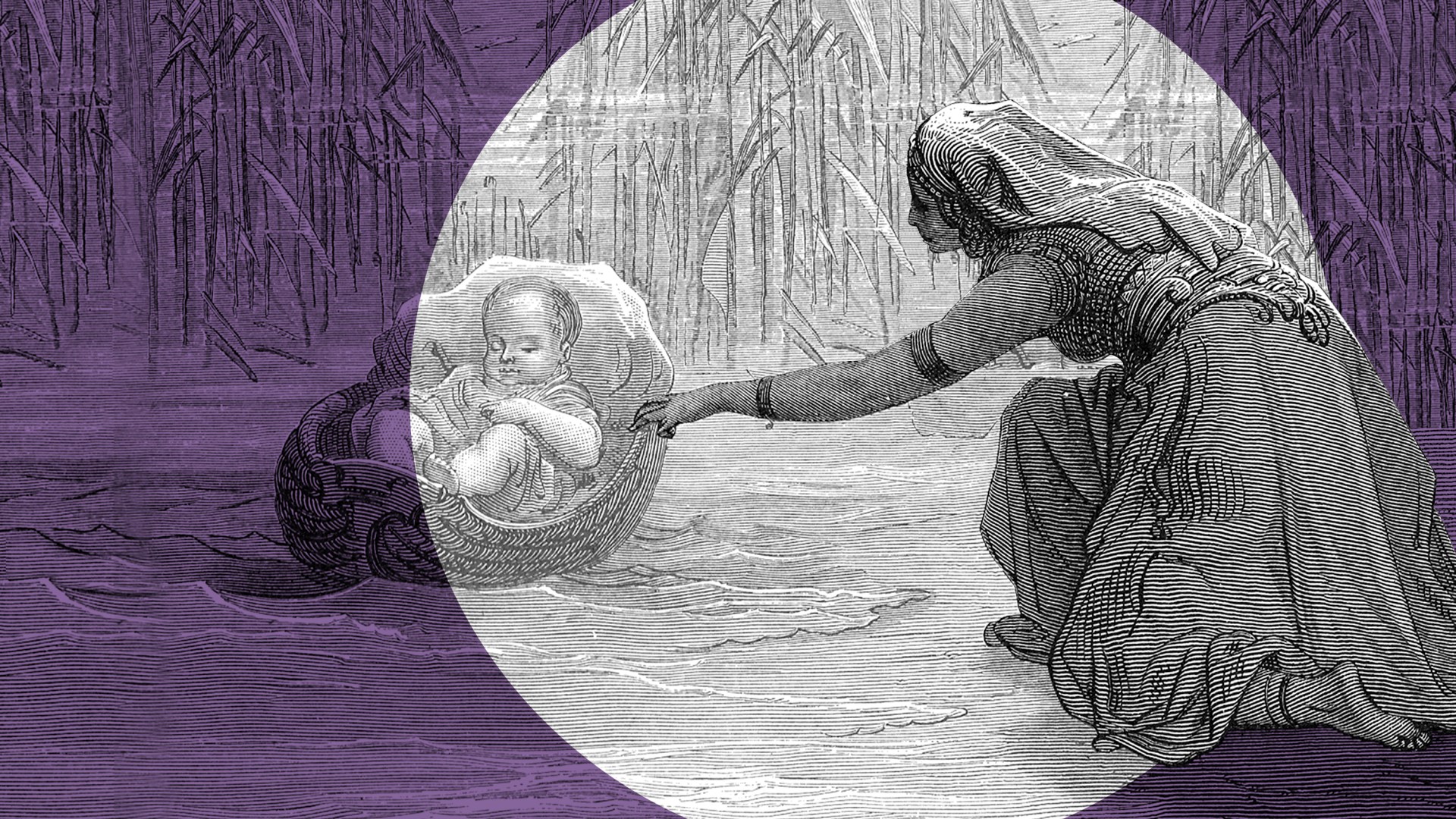
Jochebed finds herself pregnant in an era of genocide—but instead of throwing her newborn infant into the Nile, she hides him for three months.

In addition to the physical weariness and lack of sleep in the early weeks after giving birth, she shoulders the constant fear for his life. And when she can no longer hide his cries, she again resists the forces of death by placing him in a homemade basket on the banks of the Nile. We know this placement is not haphazard since Pharoah’s daughter often came to that part of the river to bathe.

But Jochebed returns home by this point, leaving her daughter to keep watch. As a mother, I imagine she could not bear to stand by and hear the cries of her increasingly hungry infant. I can also imagine the relief of this breastfeeding mother, emotional and physical, when her daughter Miriam returns with her baby and says, He’s alive! You can feed him, and you will be paid for doing so!

As one who was given the incredible blessing of nursing my own children, I cannot read this story without feeling it in my body. Jochebed protects her baby Moses—whose name sounds like the Hebrew word for “to draw out.” This baby becomes the man God chooses to lead the people of Israel out of slavery. And yet without Jochebed’s ingenuity, care, and grit, God’s deliverance through Moses would not have happened.

At another pivotal moment in the biblical story, the fervent prayers of one woman open the pathway leading to the king of Israel. The book of 1 Samuel opens to Hannah, a barren woman who expresses her longing to be a mother to God with great cries and tears, year by year. While she prays at the temple, she is so earnest in her distress that the priest Eli thinks she is drunk.

When God grants her request and opens her womb, she cares for her son until he is weaned and then delivers him to the temple so that he might serve God. The boy is attentive to the voice of the Lord—a skill befitting the child of a praying woman—and he grows to be the very prophet who anoints the famous shepherd-turned-king-of-Israel David due to a word from the Lord.

Hannah’s prayers were answered by his birth, and her own faithfulness contributed to his discernment. She not only plays a vital role in Samuel’s story, but she also voices a powerful and influential hymn of praise (1 Sam 2:1–10). God ordains the words of this mother as Scripture—in an exhortation for readers to magnify the God who lifts up the downtrodden.

In the New Testament, Jesus interacts with several mothers—including his striking exchange with a Syrophoenician woman.

When the woman, who remains unnamed, hears that Jesus has arrived in her territory, she wastes no time in going to him and begging him to heal her daughter. At first, Jesus seems to rebuff her, disassociating her from the children of Israel and associating her with wild dogs (Mark 7:24–29).

But this mama bear will not be turned away. In fierce commitment to her daughter, she calls him out on his own metaphor. If he really is the Lord who brings abundance, there should be more than enough bread for the dogs to enjoy the crumbs that fall from the table of full-bellied children.

In response, Jesus praises her faith (Matt. 15:28) and heals her daughter. It is her bold humility—both kneeling at Jesus’ feet but also expecting God to be who God is, just as in the psalmist’s laments (Ps. 42)—that gives us a template for the kind of faith that pleases God. Her faith, like that of so many others in the gospel, sets the stage for Christ’s restoration of God’s good creation.

In fact, her words are said weekly by Christians across the globe in the Prayer of Humble Access: “We are not worthy so much as to gather up the crumbs under your table, but you are the same Lord whose property is always to have mercy.” For herself and countless others, her posture of humble boldness teaches us how to pray for God’s will to be done on earth as it is in heaven.

To contemplate and celebrate every mother’s story recounted in Scripture would require far more time than a single day on the calendar. But as intriguing and often important as they are in God’s plan, most of these mothers’ brave deeds were not strictly necessary.

God could have chosen a different person to lead the Exodus than a man who was saved by the wisdom of his mother. God could have communicated the necessity of humbly bold faith through someone other than the persistent mother from Syrophoenicia.

The fact that God freely chose to communicate to and accomplish the divine plan through women tells us that the imago Dei in women is expressed by their participation in building God’s kingdom.

But it is Eve who, as mother of all living human beings, provides the template for every mother who followed. God orchestrated the divine design of biological life such that women are necessary to the continuation of the human race. Mothers give of their bodies, their energy, their time, and their love so that new humans can live and flourish.

The same is true for eternal life.

God chose to redeem an errant and corrupted creation by entering into it as a creature when God became human in the person of Jesus Christ—the foundational act that enabled our redemption. Genesis 3:15 is often called the protoevangelium, the pre-gospel. In it, God says to Eve that the tempter will attack her and her offspring—but that her Son would crush the enemy’s head.

God could have chosen to redeem the world in any way aligned with his divine character but chose Incarnation. He chose to invite Mary, a poor young Jewish woman, to participate in that process. The triune God of heaven chose Mary of Nazareth to be the mother of Jesus, the eternal and only begotten Son. From her body, God took on flesh. From her milk, God received sustenance. Under her instruction, God the Son grew in wisdom and favor with his Father and fellow man (Luke 2:52).

The multifaceted stories of mothers throughout Scripture are tethered to this center. As Jochebed protected her son from the threat of death, so did Mary. As Hannah sang God’s praise, so did Mary. The body-and-soul investment of her motherhood was indispensable to a divine redemptive plan realized in Jesus the Messiah—Son of God and Son of Mary.

Motherhood is not something Christians should regard as a mere cultural or familial issue. Motherhood is the vehicle by which God chose to redeem the world. “Women’s issues” aren’t ancillary to Christian theology—they are at the heart of our story!

Celebrating motherhood is a Christian act. Not only do we give thanks to God for our very lives, made possible by our mothers, but we also praise God for accepting Mary’s tenacious faith—and designating her body to bear the source of our eternal life.

Mothers, God honors you. The silent sacrifices that no one else sees—of your body, soul, and spirit—are seen and celebrated by your Father in heaven. These are the very ingredients the Lord uses to accomplish his ongoing reconciliation of all things.

Amy Peeler is associate professor of New Testament at Wheaton College and associate rector at St. Mark’s Episcopal Church in Geneva, Illinois. Daughter of Pam, Amy could complete this essay because her mom came to visit and cleaned her kitchen. Look for her book on Mary, Women and the Gender of God (Eerdmans, October 2022).

News

White Evangelicals Twice as Likely to Want to Ban Abortion

Ahead of a possible decision to rescind Roe v. Wade, Pew Research finds most Americans and most believers hold convictions with exceptions.

Christianity Today May 6, 2022
Drew Angerer / Getty Images

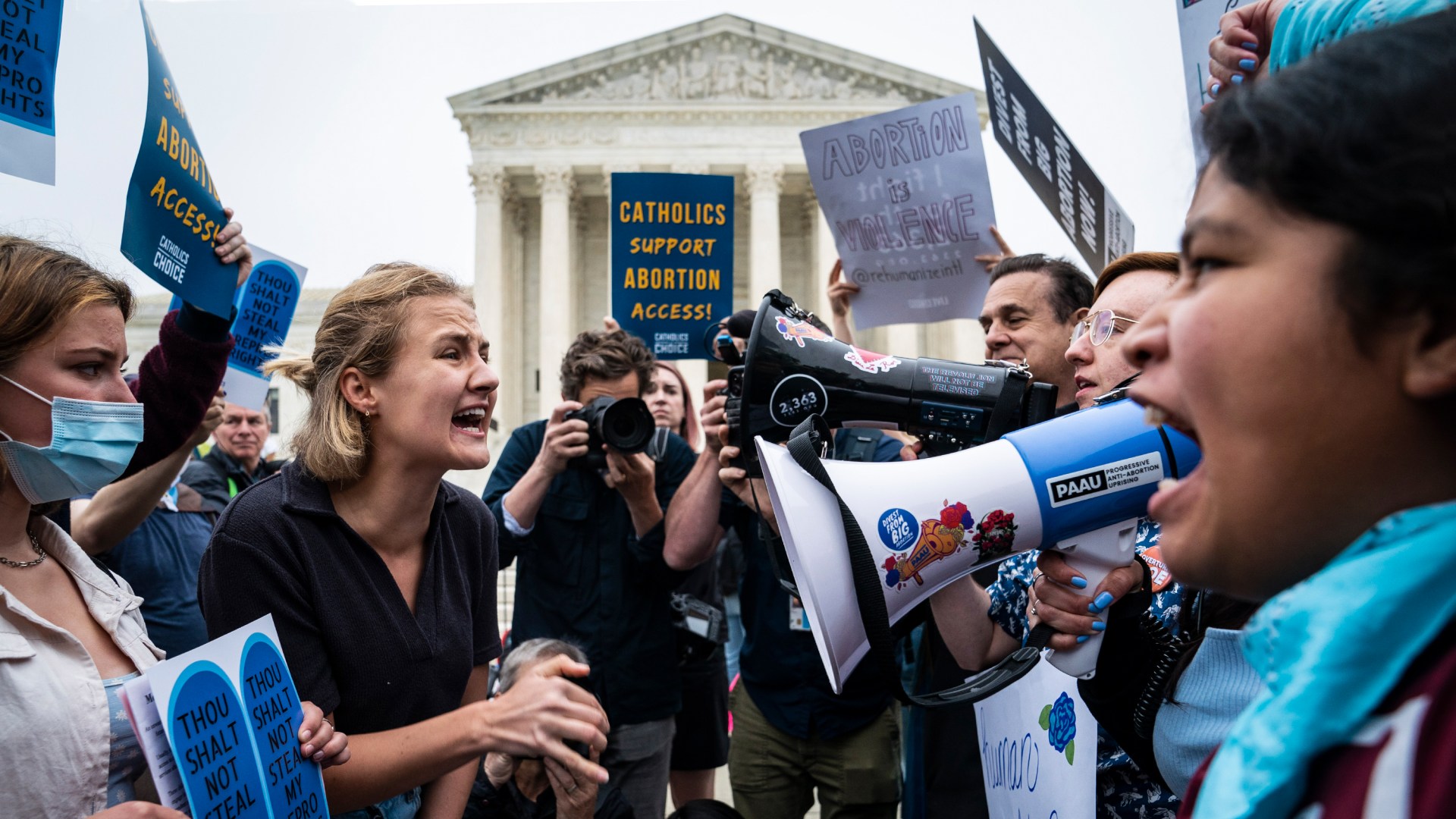
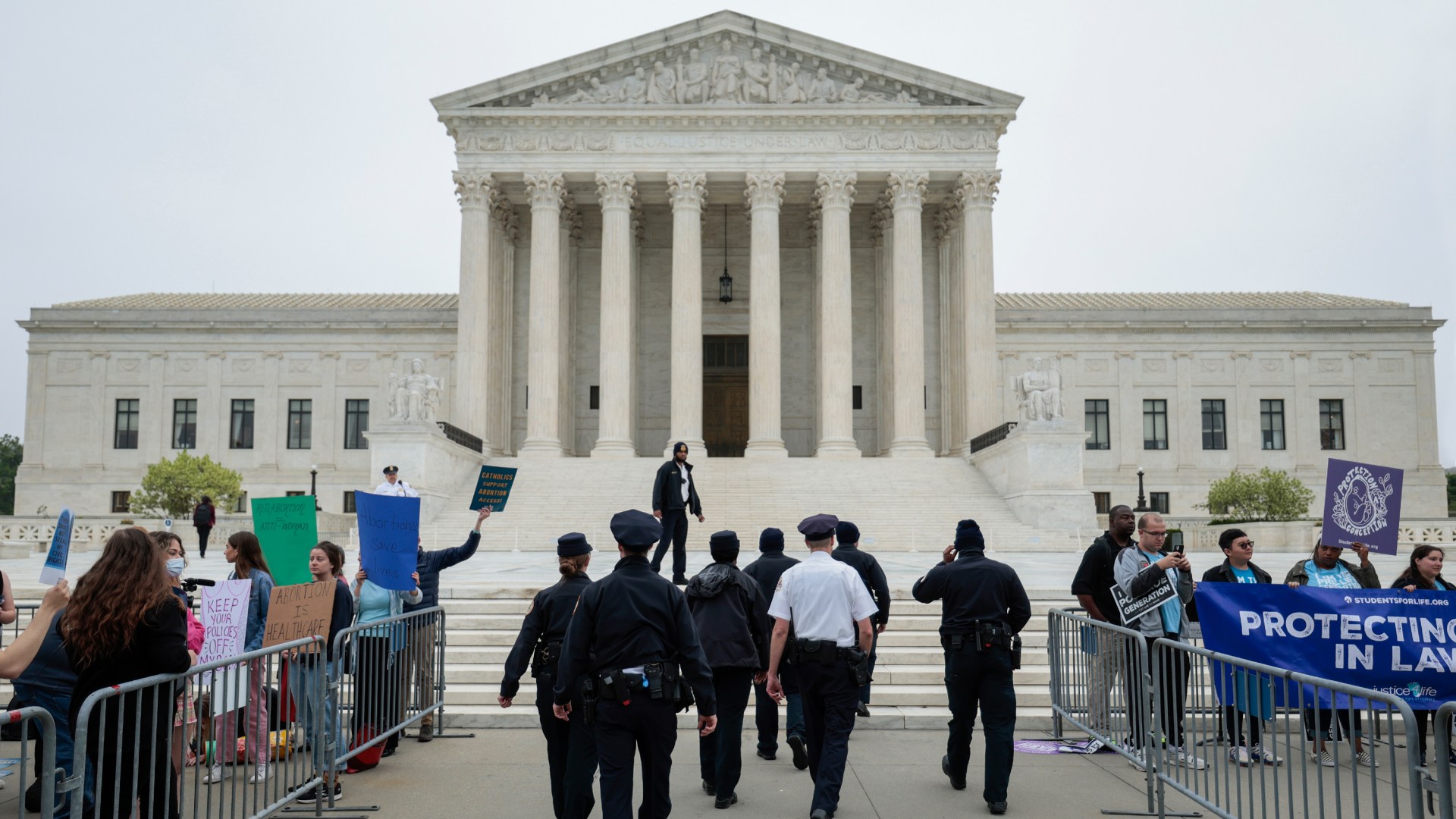
As the country awaits a landmark Supreme Court ruling that could overturn Roe v. Wade, Americans are conflicted about abortion. They’re not just in conflict with each other, but in many cases hold varying moral and legal positions in their own minds.

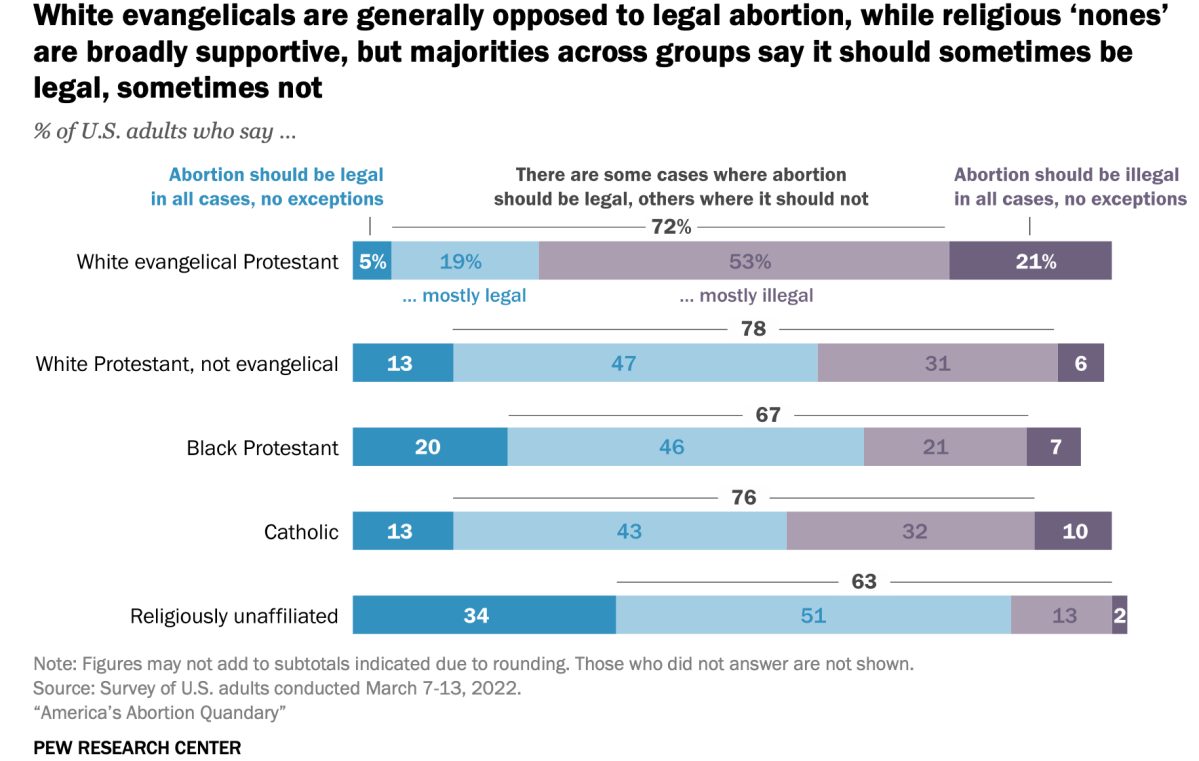
A new report from the Pew Research Center shows that the most common answer to the question of whether or not abortion should be legal remains “it depends.” Even among groups with the strongest positions on the issue—including white evangelical Protestants—only a minority want to legalize or ban abortion outright.

The survey was conducted in March 2022, several weeks prior to the leaked draft opinion that indicated the Supreme Court could overturn Roe v. Wade in its upcoming ruling in Dobbs v. Jackson Women’s Health Organization.

Three-quarters of white evangelicals say abortion should be illegal, with half (53%) allowing for exceptions and 21 percent saying it should be banned in all cases—about the same levels as in recent years.

White evangelicals were more likely than other faith groups and twice as likely as Americans overall to say abortion should be illegal.

An uneasy calm has settled over the plateau states of northern Nigeria. It was in that region last March that week-long religious riots left at least 25 people dead, 152 churches and four mosques burned, and a large number of businesses, homes, and vehicles destroyed (CT, April 17, 1987, p. 43).
At first, it was thought the violence was sparked by uncomplimentary statements about the Quran made at a Christian meeting held at a teachers’ college. But four months after the turmoil took place, evidence suggests that the rioting was not a spontaneous reaction. Rather, it may have been a planned attack against things militant Muslims see as corrupting Islam.
The targets included churches and homes of Christians, as well as hotels, bars, and restaurants associated with alcohol and prostitution, vices outlawed by Islam. Most of those businesses were operated by less devout Muslims and others who moved into the area from southern Nigeria.
Several observers said the rioters must have known their targets in advance in order to miss, to a large degree, homes and businesses owned by Muslims from the North. A source in Nigeria said there is evidence that many involved in the initial rioting in Kafanchan were outsiders brought in by bus. In other cities—Zaria, Kaduna, Kano, Funtua, Kankia, and Katsina—mobs of local residents roamed the streets, burning churches, homes, businesses, and occasionally, people who got in the way.
When army troops and police finally responded to the situation with orders to “shoot on sight,” hundreds of rioters, ages 9 to 14, were arrested. Many told police they were paid the equivalent of .25 and given gasoline and matches to burn certain targets. Some have led authorities to the homes of influential Muslims who they say hired them.
The Christian community in Zaria was especially devastated, with only two churches left standing. Among the 72 destroyed were Catholic, Baptist, Anglican, Pentecostal, and the Evangelical Church of West Africa. Homes used as Christian meeting places were also burned. In Funtua, nearly all the homes owned by Muslims from southern Nigeria were destroyed. The only church and hotel that escaped destruction were situated next to the homes of Muslims from the North.
Christians have been uneasy since January 1986, when President Ibrahim Babangida, a Muslim, secretly enrolled Nigeria in the Organization of Islamic Conference, a group dedicated to the furtherance of Islam. Muslims represent about half of Nigeria’s 90 million people and live primarily in the North. Extremist groups have pressured Babangida to establish a Muslim state. But he recently said: “This country has no state religion, but will continue to provide an umbrella under which all religions can thrive.” Christians presently make up about 34 percent of the population.
The government has said it will punish those responsible for the religious violence. It set up a panel to investigate the incidents, and some million has been promised to help rebuild churches that were burned.
Said Assemblies of God missionary John York: “If Christians react … positively [to the strife], if we move in compassion rather than retaliation, … then out of these ashes things are going to grow.”

About three-quarters of white evangelicals say faith shapes their views on abortion, as do over half of Black Protestants, though Black Protestants favor legalization.

White evangelicals are also far more likely than most Americans to call abortion morally wrong. According to Pew, 81 percent of white evangelicals see it as morally wrong compared to 46 percent of Americans overall.

Yet more than half of evangelicals who think abortion is immoral say there are some cases where it still should be legal.

“Across both political parties and all major Christian subgroups”—including Republicans and white evangelicals, the report said—“there are substantially more people who say that there are situations where abortion should still be legal despite being morally wrong than there are who say that abortion should always be illegal when it is morally wrong.”

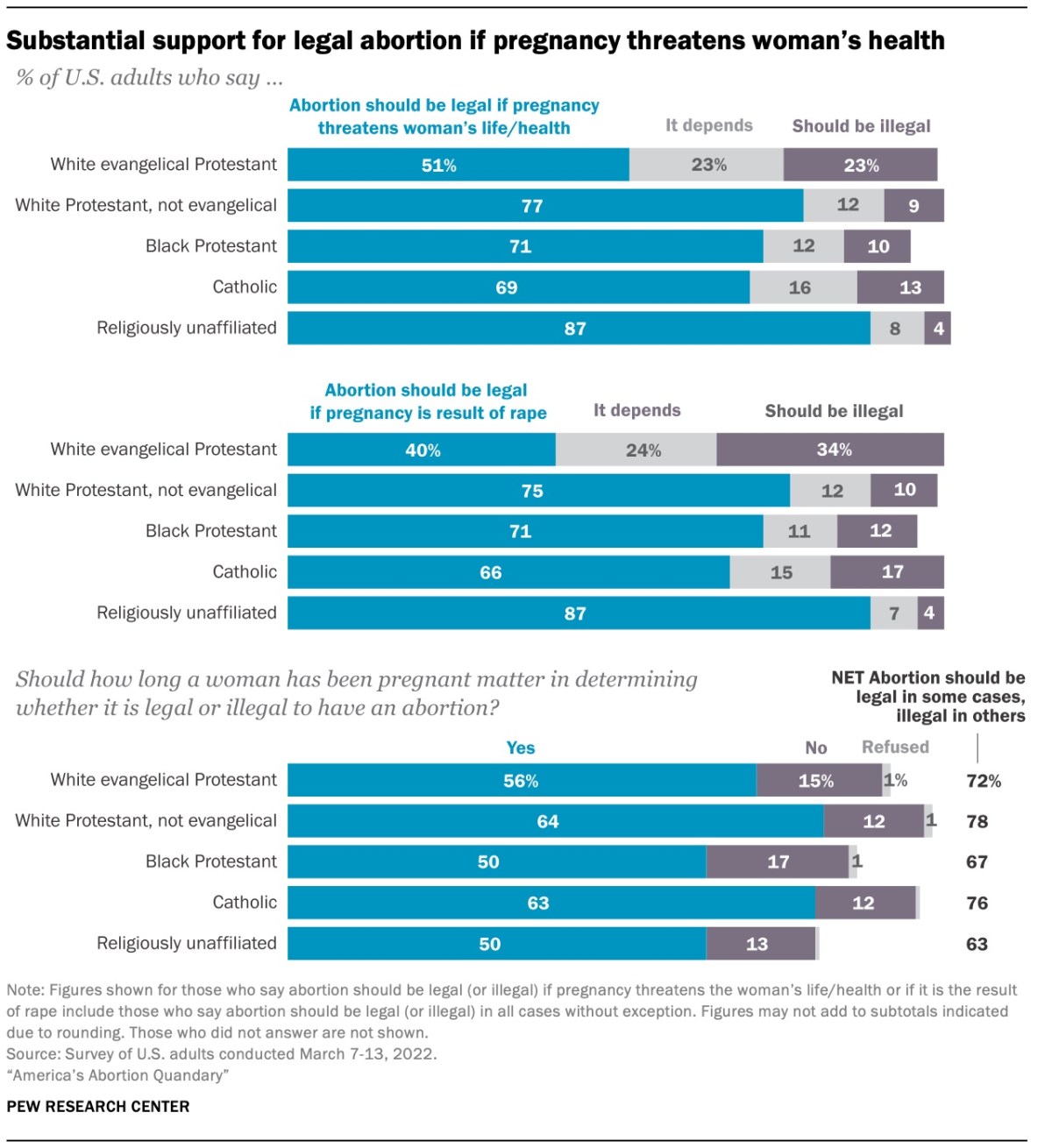
Even if white evangelicals agree on the legality of abortion in the abstract, when asked about specific situations, far fewer of them were willing to lend their support.

Most Americans want to allow abortion when carrying the baby would endanger the mother or when a pregnancy is the result of rape, but half or fewer evangelicals agree. Allowing abortion in the case of babies with diagnosed with severe disabilities or health problems was even less popular; half of Americans wanted abortion legal in such circumstances, and fewer than a quarter of evangelicals.

Pew did find common ground over abortion bans based on how far along a woman is in her pregnancy. Of those who supported some legal restrictions, half or more of respondents across religious groups said stage of pregnancy should be a factor.

The case before the Supreme Court now involves a Mississippi law that bans abortions after 15 weeks, which is earlier than the point of viability standard set in Roe v. Wade. Other states including Texas have enacted restrictions that fall even sooner in pregnancy, as early as six weeks.

While over half of Americans said abortion should be legal at the six-week mark—around when a heartbeat can be detected—just 41 percent said so for 14 weeks and 29 percent for 24 weeks, Pew found.

If the court overturns Roe and rescinds federal abortion rights, states will be free to set their own standards and exemptions. Americans are already seeing the possibilities play out in a swath of trigger laws—legislation that will go into place in at least 13 states as a result of the decision. Those states together represent more than 100,000 abortions annually, according to Guttmacher Institute data analyzed by the Washington Post.

“Overturning Roe v. Wade will put abortion laws back at the state level, which only means that pro-life work is far from over. Some states will pursue liberal laws. Some, as we have been seeing recently, will have more restrictive laws,” author and Southeastern Baptist Theological Seminary professor Karen Swallow Prior wrote for Religion News Service.

“Yet the definition of human lives is not a matter for the people or the state to decide. The right to life is endowed on all by our creator and the highest purpose of human law is to protect human life.”

The researchers also examined how Americans consider the two rights that are often at the center of the pro-choice/pro-life discourse: a mother’s right to choose and the personhood rights of a fetus.

The vast majority of white evangelicals—86 percent—believe life begins at conception and that a fetus in the womb is a person with rights. More than half of Americans agree.

And many of them still leave the decision on whether to have an abortion up to the mother.

“Analyzing certain statements together allows for an examination of the extent to which individuals can simultaneously hold two views that may seem to some as in conflict,” the report said.

One in three US adults—and one in three white evangelicals—said that “both the statement ‘the decision about whether to have an abortion should belong solely to the pregnant woman’ and the statement ‘human life begins at conception, so the fetus is a person with rights’ reflect their own views,” it found.

Pew found that, overall, respondents who personally knew someone who had an abortion were more open to legal abortion. Yet white evangelicals were just as likely to know someone who had an abortion and remain less likely to support abortion rights.

They also were in favor of punishing women who get abortions in situations where it’s illegal. Two-thirds of white evangelicals say they should be penalized in some way, whether jail time, a fine, or another consequence, compared to half of Americans overall. Black Protestants were among the least likely to say women should be penalized for illegally obtaining an abortion; just 42 percent said so.

The Texas law that allows private citizens to sue anyone who “aids or abets” abortion after six weeks targets those who help the woman seeking abortion and not the woman herself.

Much of the momentum even from the pro-life movement has focused on those who perform abortions rather than those who get them, but that could change.

“No argument is going to persuade immediatists that we shouldn’t charge mothers who abort their children with murder. But some incrementalists are also unsure of why refraining from prosecuting such women is the most justice-promoting action we can take,” Joe Carter wrote last month for The Gospel Coalition.

One factor in questions of punishment is the increased accessibility of medication abortion. More than half of US abortions in 2020 used this method. During the pandemic, some women were allowed to use the method without a doctor present.

The March 2022 Pew survey did not specifically ask about Roe v. Wade. A Fox News poll conducted in the days following the leaked opinion from Justice Samuel Alito found that most Americans aren’t hoping to see Roe reversed. Sixty-three percent wanted to let it stand while 27 percent said the Supreme Court should overturn the 1973 ruling.

Theology

There’s No Substitute for Presence. So I Uprooted My Family.

How the conviction to honor my aging parents convinced me to move home.

Christianity Today May 6, 2022
Illustration by Rick Szuecs / Source images: Kali9 / Getty / Anastasia Shuraeva / Huỳnh đạt / Odnae Production / Rodolfo- Clixs / Pexels / Choreograph / Envato Elements

I don’t necessarily believe God advertises on billboards—but I had to wonder last August.

My husband and I were sitting in a Chicago park, talking about our pressing responsibilities to our aging parents. It was the first time since the beginning of the pandemic that we had crossed the Canada–United States border to visit them: my mother in Ohio, my husband’s mother in Illinois. My mother had particularly suffered from the year of social isolation, a hardship compounded by the toll of caring for her ailing husband. For the first time since moving to Toronto a decade before, we wondered, Is it time to go home?

That question hung in the August heat, and presumably, it was answered by the billboard I then noticed on the other side of the Edens Expressway.

Tired of Illinois taxes? Move to Ohio!

In 2011, my husband accepted a Toronto-based position with his American company. We expected, as the company did, that this would be a short-term opportunity for our family. We quickly plugged into a wonderful church in Toronto and grew to love our new city. Though our initial visa was approved only for three years, we chose to extend it. Then extend it again. And again. In 2017, we finally gained permanent resident status in Canada. We bought a house. We spent two years renovating that house. We moved back into the house in October 2019 and intended to stay.

Until last summer—and the billboard and fears for our aging parents.

We spent the fall praying and involving our community in a process of discerning God’s will. And what became unavoidably clear to me, especially as I plodded through my daily Bible reading plan, was the emphasis in Scripture on honoring one’s parents. A host of proverbs, like Proverbs 23, hailed over me:

Do not despise your mother when she is old.

May she who gave you birth be joyful!

What a pleasure to have children who are wise.

Those proverbs chastened me. Though my husband and I never wanted to neglect our parents, neither had they been an important consideration in our decisions. We moved for jobs; we moved for graduate school. We moved for opportunity—and opportunity always seemed to call.

But here seemed a different invitation: to return a debt of gratitude to God and our parents. In a culture as heartily individualistic as ours, this certainly wasn’t the script I’d been handed, and it’s true I’ve wrestled with the meaning of this. I have met my own hard-edged resistance to surrendering our permanence here in Toronto and, more importantly, to abandoning the entitlement I feel to autonomy.

To be blunt, I don’t want the interruption that providing practical support to our parents will impose on our already-busy lives, even while I realize that ordinary help—advising on financial matters, attending appointments, even regularly opening the mail—is difficult to do from a distance. I’ve also begun to see that the emotional elements of caregiving as people age and face new anxieties aren’t easily met by proxy.

There’s no doubt we’re facing a global crisis of care for the aging, who are outliving previous generations. When elderly family members living in long-term care facilities died at disproportionate rates during the COVID-19 pandemic, many adult children began to reconsider the care they had planned for their aging parents. As research is now showing, multigenerational living appears to be on the rise, and this can benefit both the young and the old.

The options, however, are limited for seniors facing severe physical and cognitive decline, people who need more care than an adult child can provide. In the United States, professional home health aides are underpaid and contend with dangerous, unregulated work conditions. Their services are hard to employ and hard to retain.

And while government programs like the Program for All-Inclusive Care for the Elderly (PACE) continue to expand, accessibility is limited, and the alternative of private care remains exorbitantly expensive. Even with the generous long-term care insurance my mother and stepfather purchased years ago, the benefits are inadequate to support the monthly costs of their assisted living, especially in inflationary times.

One current response to this crisis of care is technological. In Japan, the world’s “grayest nation,” dementia has reached epidemic proportions, and cities like Itami—a suburb of Osaka—have turned to digital surveillance to monitor those who wander.

To be sure, there are life-saving benefits to tools like security cameras and tracking devices, but one can’t help but identify the irreplaceable need for human caregiving, the kind described by Arthur Kleinman in The Soul of Care. Kleinman is a professor of psychiatry and medical anthropology at Harvard, and when his wife, Joan, was diagnosed with dementia in her late 50s, he shouldered the burden of her care for many years.

As Kleinman explains in his book, caregiving is always too great a role for one person, especially in the case of dementia, and he understood early on that his wife needed a “system of care.” At the same time, he valued “presence” as a vital aspect of caregiving—and one that couldn’t simply be bought. He wanted to be with Joan and to walk with her through the valley of the shadow of death.

It was a journey that lasted more than a decade.

A secular Jew, Kleinman did not necessarily characterize his call to care for his wife as issued by God. Nevertheless, he used biblical language when expressing his willingness: “Here I am. I am ready,” he wrote.

Moving closer to care for my aging mother, that’s what I seem to be saying to God. Truth be told, I worry about my own incapacity to do this new work, but I’ve read Kleinman’s concluding words with great hope:

“You do what you can,” Kleinman writes, “and your very actions put you in the life of another with his or her needs. You cannot respond this way all the time, but that is not really the issue, is it? The genuine question is whether you can find it in yourself to respond with care some of the time, or at bottom, any time.”

Here I am, I’ve said to God, knowing my own inadequacies for the task. I don’t imagine it will be easy, and I don’t expect to do it alone. Maybe most importantly, I hang tight to God’s promise to care for me. As the prophet Isaiah wrote, God is a nursing mother—and it is impossible for him to forget his own compassion.

Jen Pollock Michel is a writer, podcast host, and speaker based in Toronto. She’s the author of four books and is working on a fifth: In Good Time: 8 Habits for Reimagining Productivity, Resisting Hurry, and Practicing Peace (Baker Books, 2022).

Theology

Our Pro-Life Advocacy Shouldn’t Be Limited by Tribal Loyalty

As Christians, we must not let political allies selectively dictate who our neighbors are.

Christianity Today May 5, 2022
The Washington Post / Contributor / Getty Images

This piece was adapted from Russell Moore’s newsletter. Subscribe here.

From all indications, the Supreme Court seems poised to overturn the almost-50-year precedent enshrining legal abortion as a constitutional right. As expected, this does not sit well with those who support Roe v. Wade (which is much of the country, according to most polls).

Some are suggesting this is a manifestation of a kind of soft theocracy—that those of us who are pro-life are now imposing our religious views on the rest of the country. For others, the charge is not that pro-life Americans are too consumed with abortion, but that abortion is just a stalking-horse for the real issues, which are white supremacy and Christian nationalism.

The first argument is one that goes back almost to the days of Roe itself: the idea is that most people who oppose abortion do so because of a religious commitment. Sure, there might be an atheist pro-lifer here or there, the argument goes, but most people at the March for Life or working at the crisis pregnancy center near you are Roman Catholics, evangelical Protestants, or, sometimes, Orthodox Jews.

According to this reasoning, to oppose legal abortion is to impose a certain religious viewpoint upon other people, and thus violate the religious freedom of those who don’t believe the fetus to be a human person.

That would be true, of course, if what anyone sought to do was to impose a religious dogma. That’s why I oppose, for instance, public school teachers offering a gospel invitation at the close of a class period or municipal governments declaring that the Trinity is the truth. A religion cannot and should not be coerced.

I believe in religious freedom for everybody—Jews, Muslims, Wiccans, atheists, my fellow evangelical Christians, etc.—because I believe in the founding principles of this country. But I also believe in it because I believe, on the basis of biblical revelation, that the gospel must be received by faith, not by force.

I care about not coercing people to accept my religious doctrines, not only because I think that’s demonstrably bad for society, but because I think it confuses the gospel and hurts the church. But that doesn’t mean religious motivations shouldn’t inform what Christians, or others, care about.

There are all sorts of issues one could be concerned with today. The question is always why someone is motivated to pay attention to some of them. In my community, working with Afghan refugees, helping them to resettle, find work, and provide for their families, is carried out by people with multiple different motives for doing so.

One person might be, like me, an evangelical Christian who believes that because my storyline in Christ includes being on the run from Pharaoh and Herod, that I ought to care about people in a similar place of vulnerability. Someone else might care about these refugees because she was a refugee from Cuba a generation ago and feels a kinship with those hurting in that way.

One person might be an Afghanistan War veteran who saw the humanity of the Afghans suffering under Taliban rule and so wants to help them. Someone else might find President Joe Biden politically offensive and is motivated by his blaming the administration for the suffering after pulling out from the country.

Each of us is serving refugees for very different motivations—ones we often do not share with each other. That tells you why each of us is spurred to action, but it doesn’t tell you whether the action is right or wrong.

In some places, laws are being written to criminally charge homeless people for sleeping in public parks. The person who opposes this because he realizes that he can’t mistreat homeless people when Jesus himself was homeless—is he imposing his religion on everyone else? No. He’s telling you why he’s motivated to care about certain human beings.

His religion dictates his responsibilities to the homeless neighbor in front of him—and the notion that they are human beings is not a specifically religious teaching. The fact that the Qur’an tells Muslims to care for the poor doesn’t make homeless shelters the outworking of Sharia Law. The fact that the Bible tells Christians to care for “widows and orphans in their distress” (James 1:27) doesn’t make foster-care safety nets a sign of theocracy.

The second charge often leveled—that the pro-life issue is really about white supremacy—is plausible to many people right now. That is because we have seen awful realities revealed in the church and the world over the past several years, which I’ve written about repeatedly.

Christian nationalism is real. It is a threat to the witness of the church, and it’s a repudiation of the gospel of Jesus Christ. And, yes, we’ve seen the pro-life issue sometimes used by people whose viewpoints—about women, refugees, the disabled, and other vulnerable people—do not in any way reflect a holistic pro-life vision with any integrity or consistency.

In his book Bad Faith: Race and the Rise of the Religious Right, historian Randall Balmer argues against the idea that Roe v. Wade mobilized evangelicals into political action, saying that this a myth. Balmer contends that the motivating factor was, in fact, religious conservatives’ backlash against Carter administration initiatives to remove tax exemptions from racist all-white “segregation academies” run by church groups.

Balmer is hardly the only one to make this case.

Almost 30 years ago, historian Godfrey Hodgson quoted pastor Ed Dobson, a key lieutenant of Jerry Falwell Sr., as saying: “The Religious New Right did not start because of a concern about abortion. I sat in the non-smoke-filled back room with the Moral Majority, and I frankly do not remember abortion ever being mentioned as a reason why we ought to do something.”

Over the past several years, a lot has been revealed. We have seen many moral causes championed by Christian leaders who later didn’t seem to care about those things, but only wanted the power those issues could bring with them. It can be disorienting.

Maybe you watched a pastor preach about evangelism and now you find he was really just trying to amass numbers for his own personal empire. But does that cynical use of the Great Commission mean the Great Commission is a lie?

Using the call to evangelism was cunning precisely because that pastor was exploiting something true for false ends. That doesn’t mean everyone who has witnessed door to door or mustered the courage to talk about faith with their neighbors is motivated by ego and power.

Even with the most cynical view possible, the question is not whether some leaders used abortion when their real objectives were contradictory, immoral things instead. The question is, if that’s the case, why emphasize abortion? Why not simply mobilize people to protect segregation? One can only mobilize people with something they actually care about.

When one looks past the power brokers and politicians, one can see countless small pro-life ministries around the country, where people genuinely believe in caring for the suffering of their neighbor—for the unborn child in danger of dying, the pregnant woman in peril of facing violence or poverty, or the born child in need of food or a home.

Are there those who use abortion as simply a cudgel to say, “If you don’t vote for otherwise reprehensible candidates or policies, you are guilty of murder?” Yes. And are there pro-choice employers who pressure women to abort because they refuse to provide the support and benefits for women with small children? Sure. Does either case nullify the central question? Are there people who support democracy because it’s the way they can get votes to hold office? Yes. Does that mean that’s all democracy is? No.

Do not let your allies determine who your neighbor is.

Once, while putting together an event on human dignity from womb to tomb, someone told me that he would participate, but only if I promised not to mention race, refugees, or migrant children. He said it was because he thought “pro-life” applied only to abortion.

I asked if we could also talk about adoption and foster care. He said yes. I asked if we could talk about the wrongness of euthanasia. He said yes. About the sexual exploitation of women and girls? Yes. About genetic engineering and other bioethical questions? Yes. I realized he didn’t want anything mentioned about race or migrants or refugees because that would get him in trouble with his political allies.

I was urged to make some people invisible because an acknowledgement of their presence would be inconvenient to someone with power. But to me, that sounded exactly like the abortion culture, and I refused to avoid talking about those “inconvenient” people.

I’ve seen it work the other direction too. People will work diligently on matters of migrants, refugees, the trafficked, or the poor but who will blanche at the mention of the unborn—not because they don’t believe the unborn are persons deserving of protection, but because it would put them in a camp with people they don’t like or respect.

Whichever way that goes, Jesus told us that defining our neighbors according to the expectations of our tribal allies can lead to nowhere good. That’s why Jesus chose a Samaritan as the neighbor in his parable about the man by the Jericho Road. It’s also why Jesus did not care that his fellow Jews thought he shouldn’t talk to Zacchaeus because he was a tax collector who collaborated with Rome (Luke 19:1–10). Jesus cared about Zacchaeus, not about his tribal standing.

And neither should we.

If the unborn are made in the image of God, and I believe they are, let’s care for them. If women are in the image of God, and I believe they are, let’s care for them. If white supremacy and Christian nationalism are of the Devil—and I believe they are—let’s oppose them.

Let’s be pro-life even if that makes some of our “pro-justice” allies uncomfortable and let’s be pro-justice even if that makes some of our “pro-life” allies uncomfortable. And whenever our group tells us that the price of admission is to make some other category of person invisible to us, then let’s tell them that price is too high.

Russell Moore leads the Public Theology Project at Christianity Today.

News

These Homeless Ministries Changed in the Pandemic. They’re Not Changing Back.

The rotational model of church shelters was hit hard by COVID-19.

Christianity Today May 5, 2022
Spencer Platt/Getty Images

Lebanon County Christian Ministries (LCCM) had to pivot to a new model for housing homeless families in a matter of hours.

LCCM is the only family-based shelter for people temporarily without housing in its southeastern Pennsylvania community. Before the COVID-19 pandemic, the ministry worked with about a dozen churches, rotating families from congregation to congregation for two weeks at a time. But Bryan Smith, who spent 25 years as a paramedic before becoming the executive director at LCCM, watched as the coronavirus arrived in the US in early 2020 and quickly swept across the country.

He knew he had to figure out an alternative.

On March 13, 2020, the day President Donald Trump declared a national state of emergency, Smith reached an agreement with a local hotel. He informed the management that LCCM would transfer guests “in the next week or two.” Two hours later, at 3 p.m. on a Friday, the contact person at the current host church informed Smith the congregation was shutting down its building and wouldn’t be able to house anyone that week.

“We immediately called the hotel and said, ‘Yep, now,’” Smith recalled. “We moved our guests into the hotel that night, and that really changed the next two years of our shelter.”

Today, LCCM is not planning to go back to the old model. The ministry has a temporary shelter, which opened in February 2022, as it explores possibilities for a permanent location. Churches send volunteers to help, and LCCM continues to assist the congregations of Lebanon County in reevaluating how they will serve the community.

LCCM isn’t the only homeless ministry where temporary changes have become permanent. Across the country, organizations serving people experiencing homelessness have had to adjust. And many of them have changed for good.

COVID-19 hit the rotational shelter model suddenly and hard, said Cara Bradshaw, chief impact officer with Family Promise, a New Jersey–based nonprofit with more than 200 affiliates in 43 states. Family Promise is not faith-based but has worked closely with religious congregations since it started in the 1980s.

For more than 30 years, Bradshaw said, congregations have provided emergency and temporary shelter, hosting homeless families overnight, preparing meals, and welcoming them into their community. Family members leave to spend the day at work, in school, or in day centers and return to the church or synagogue.

COVID-19 disrupted that model.

“The shelter model is highly dependent on volunteers, and a lot of the congregations have older, retired members who were involved,” she said. “Of course, those folks, understandably, may not have felt comfortable spending the night in close proximity.”

Affiliates had to quickly secure hotels, motels, vacant apartments, and even second homes and rental cabins to house homeless families, Bradshaw said.

The change was meant to be temporary, but affiliates were surprised to find that there were some advantages to housing people in hotels instead of rotating them through churches. Resolving a homeless family’s situation can take up to six months, and under the rotational model, that family moves from one host congregation to another every week or two. That can be disruptive and add complications to an already complicated time in people’s lives.

Despite the uncertainty and the dramatic change for affiliates, religious communities maintained “a similar level of involvement all through the pandemic,” Bradshaw said, “delivering meals to someone’s apartment or motel, trying to figure out transportation solutions. They still tried to find a way to stay committed to the mission and to help families.”

Churches mourned the loss of connection to the people they were helping, though.

Vintage Church in Lawrence, Kansas, was so committed to temporarily housing people that the nondenominational church had also made space available to Family Promise for staff and leadership training, according to Deacon Godsey, the lead pastor.

“But that all went away,” Godsey said.

The number of his church’s volunteers with Family Promise decreased out of necessity during the pandemic, according to the pastor, but the number of people donating to help the homeless increased. Still, it was difficult to see one of the church’s fundamental values unfulfilled.

“That was hard for everybody to not be able to welcome the community into our space and to meet people and let our people interact with them and to honor the dignity of their humanity with a basic conversation and a shared meal,” he said. “It was the right thing to do because of the danger involved, but it was still a big challenge.”

Another church in the area, First Baptist, is putting more energy into food security now. If the congregation can’t house people, it can still feed them, said senior pastor Matt Sturtevant.

He has noticed that losing regular contact with the individuals and families his church serves causes volunteers to not be “quite as energized” at times. But during the pandemic, he and his congregation have rediscovered how essential relationships are in ministering to their community.

“When there are moments of connection,” Sturtevant said, “they seem to be even more powerful and more beautiful.”

Dana Ortiz, executive director of Family Promise of Lawrence, Kansas, who coordinated housing with 13 hosting congregations in the community, has heard this a lot in recent days.

“They miss that contact with the families—so, that personal connection, which I think is a beautiful testament to how they viewed this work,” she said. “It wasn’t just transactional; it was relational.”

But she is also hopeful and grateful because the last two years have raised awareness about homelessness and led to—forced, even—new models for homeless ministries and organizations. The challenges with providing shelter during COVID-19, Ortiz said, have placed a focus on the importance of stabilization and prevention in helping homeless families.

“Both sides of the equation have become really critical to us,” she said. “That’s the solution. The complication of that when it involves our churches is figuring out ways we can incorporate that loving community into that equation.”

After more than a decade working to serve families experiencing homelessness, though, Oritz is especially glad to put the last two years behind her.

“It’s been a hard two years,” she said. “It feels like a decade and a half for all of us.”

News

UK Christians Welcome Refugees amid Frustrations with Immigration Process

The churches are willing. But the bureaucracy is weak.

Christianity Today May 5, 2022
Christopher Furlong/Getty Images

When Wai Lin Wong arrived in Bristol from Hong Kong in April 2021, one of the first things she did was look for a new church.

“I logged onto Facebook; I searched Google,” she said, “and found churches with webpages translated into Chinese, groups of other Hong Kongers, and sanctuaries full of people like me.”

That happened a lot, said Mark Nam, an Anglican priest in Bristol. As the Chinese government clamped down on the democratic freedoms of the former British colony in 2020, thousands of Hong Kongers fled to the UK thanks to a visa program that allows them to live and work in Britain with a pathway to full citizenship.

Hundreds of churches announced they would welcome the Hong Kongers with open arms. They did. And cities like Bristol have since seen their churches swell with newcomers, Nam said. Anglican parishes, Chinese Protestant churches, and evangelical congregations all grew dramatically in the last year.

“It’s been wonderful to see the welcome,” Nam said last year.

In recent months, UK Christians responded to another influx of refugees, this time from Ukraine.

The Sanctuary Foundation, which supports potential sponsors and assists the government in rolling out its Homes for Ukraine program, said over 2,000 churches, businesses, and schools plugged into their programming or volunteered to help in some way since March.

But in both cases, along with the surge of compassion, support programs, and congregational growth, there have come a host of challenges—from bureaucratic inertia to worrying signs of prejudiced double standards.

Sanctuary Foundation’s founder Krish Kandiah, who has been working with refugees since the 1990s, said his organization has been seeing churches welcome thousands of newcomers from Hong Kong, Afghanistan, Syria, and Ukraine.

The outpouring of generosity by congregations, individuals, and local organizations has been immense. Amid the rush from Ukraine alone, more than 1,000 UK churches stepped up to host refugees, he said.

However, enthusiasm on the part of Britain’s churches has not always been met with efficiency or empathy by their government.

Shifts in public opinion in recent years have resulted in new legislation and changes in the UK Home Office’s asylum policies. Particularly since Brexit in 2019, Britain has tried to revamp the control of its borders, stem the flow of migrants, and build more checks and balances into the asylum application process. This has meant that even if a visa program is in place—such as in the case of Hong Kongers or Ukrainians—processing can be agonizingly slow.

Nevertheless, migrants and asylum seekers continue to come. According to the United Nations High Commissioner for Refugees, a total of 133,094 refugees and 61,968 asylum seekers were living in the UK in 2019. In 2021 alone, the UK received 48,540 asylum applications, the highest total in nearly two decades and 63 percent more than in 2020.

But the “root and branch” change of the immigration system since Brexit has “made it more and more difficult to come to the UK and claim asylum,” said Kandiah.

This has led to a fair share of frustration among British Christians looking to warmly welcome the stranger.

Even as thousands of households, numerous institutions, and many churches signed up to host and help make newcomers neighbors, many then stood by as visa applications were processed in a timespan ranging anywhere from five weeks to nine months or more.

That can be frustrating, Kandiah said, but it can also be doubly-traumatizing for those fleeing conflict, political repression, or persecution—their lives existing in limbo as applications laboriously make their way through an overstretched system.

Although Kandiah sympathizes with the discontent, he said that churches must remain patient. Likening the UK’s revamped immigration system to an oil tanker headed in one direction for the last three years, he said that it will take time to turn the ship around. “The UK built a system that is designed to turn away as many people as we can,” he said. “Now, we are trying to accept as many people as we can, as fast as we can.”

There is also noticeable exasperation about what looks like a two-tier system for those seeking asylum.

Nathaniel Jennings, area mobilizer with OMF International’s mission in Belfast, Northern Ireland, said it was particularly ironic timing when Prime Minister Boris Johnson’s government announced a plan to partner with Rwanda to manage migration even as Johnson touted the UK as a “a beacon of openness and generosity” for Hong Kongers, Ukrainians, Syrians, and Afghans.

Under the plan, announced mid-April, some asylum seekers who cross the English Channel—with a focus on single men arriving on boats or in trucks—will be sent directly to Rwanda, a landlocked country in central Africa, for processing.

From his vantage point in Belfast, Jennings said it is frustrating to see that “while we are opening our nation to some people, we seem to be closing it down to everyone else.”

While he said the situation with people from Ukraine and Hong Kong caught people’s hearts, imaginations, and minds, it is disheartening to still see “hotels full of asylum seekers from Africa and the Middle East that were pretty much neglected.”

He hopes that as Christians respond and welcome people from Hong Kong and Ukraine into their homes, churches, and lives, it might also stir them to rethink how they are treating others. Jennings said, “It’s awful what is happening. We aren’t taking any joy in it, but God can bring good out of this.”

Echoing Kandiah, he said this process will take time and courageous leadership from pastors and parishioners in local churches and networks across Britain.

Jennings pointed to groups like Welcome Churches, whose vision is “for every refugee in the UK to be welcomed by their local church.” He said they have been exemplary in facilitating church sign-ups and helping churches respond to pressing refugee and asylum seeker needs.

For their part, the West of England Baptist Network (Webnet) took the step of hiring pastor Candy Choy to assist with ongoing arrivals of Hong Kongers in the southwest of England. A pastor in Hong Kong for 20 years, Choy now works with Webnet to establish and encourage connections between new arrivals from Hong Kong and local congregations.

As Hong Kongers pay a personal, professional, and financial price to make a new life in the UK, Choy said it is important for various civil society institutions to provide support to help them polish their English, buy property, or find jobs. She pointed to initiatives like the Bristol Friendship Festival scheduled for May 21 and the website UKHK.org as prime examples of how the government can provide what she called “physical living guides for Hong Kongers” while the church provides mental, spiritual, and emotional care.

With more asylum seekers expected this summer, Choy said churches are preparing Alpha courses, providing bilingual English and Cantonese services, offering empty chapels for use by Hong Kongers, or revamping their youth ministries to receive children and teenagers coming with their families.

“There are different models, but most churches see it as a golden time to reach newcomers,” Choy said. “They have been open and welcome to Hong Kongers and invest a lot of themselves for us.”

Kandiah said it is important for Christians to focus on good examples like these in what he said is “an incredible cultural moment” for the UK.

Exhorting Christians to “attack the policies and not the politicians,” Kandiah said it’s important to partner with a wide range of partners in civil society—from the government to the media and local industry—to mobilize forces for good and catalyze positive change so that the country will be ready for the next influx.

“There are naysayers that say it’s just trendy that people care about Ukraine or Hong Kong,” Kandiah said, “but I say it’s better to catch someone doing good and encourage them in the right direction rather than just critiquing the process.”

The Roe Leak Spotlights America’s Crisis of Credibility

Abortion and the lost trust in institutions are two parts of the same problem.

Christianity Today May 3, 2022

As I write this, pro-life Americans don’t know whether to celebrate, and pro-choice Americans don’t know how to protest. That’s because all of us are looking at the news—a leaked-but-not-yet delivered majority opinion from the United States Supreme Court overturning the Roe v. Wade decision from almost 50 years ago.

For years, many of us working in the pro-life space have anticipated the day that the Supreme Court would announce the repeal of Roe v. Wade. Years ago, when my team and I were working at the Ethics & Religious Liberty Commission (ERLC), we planned a pro-life event called Roe50 to mark the anniversary of the decision. I was the one arguing that the branding team should prepare for the distinct possibility that Roe wouldn’t even make it to 50 years.

Those working in the opposite space, on the abortion rights side, were likewise prepared for such an announcement. None of us were prepared for an announcement quite like this, for an “announcement” that is no announcement at all.

This has never happened before—where a leak from inside the Supreme Court delivers internal memos revealing what the court is planning to do. The resulting confusion means that most people are about 98 percent certain of what the court now plans to do. But we cannot really act on it, because there is always a possibility that the majority could change their mind between now and the release of the opinion.

Behind the confusion, though, there’s a simmering outrage. Last night my phone started vibrating with message after message from lawyers and politicians—most of them pro-life—outraged by the way this alleged ruling was leaked. Some speculated that a pro-choice clerk had leaked it, hoping public pressure might cause a reversal of the opinion before it’s released.

Others were sure that it was a pro-life staffer wanting to “seal” the decision before justices could change their minds. But for all of them, especially those who are attorneys, there was a sense that the institution of the judiciary could not survive this kind of lack of confidentiality in deliberation.

Whatever the cause, this is not actually a “leak” in the sense that we ordinarily use the word. What some would decry as leaking in other aspects of American life—say in the legislative process of back-and-forth negotiations on matters of public policy—are a longstanding expectation.

The same is true in terms of the executive branch. A president will often leak information ahead of time to see what sort of public response will come. Even within nongovernmental institutions, “leaks” are often what those seeking to evade accountability will call whistleblower reports of misbehavior by those in power.

While we do not know who leaked the opinion early, we do know that behind the leak was a loss of trust.

None of those situations, though, describe what happened here. Whatever the cliché about the court looking at election returns, the judiciary branch is not the same as a legislative body and, indeed, exists partly to protect minority interests from any majority.

Moreover, in this case there was no “Pentagon Papers” sort of scandal—it wasn’t an whistleblower leaking news of misconduct. Instead, this was a decision the “leaker” either agreed with and wanted to lock down, or disagreed with and wanted to stop.

If this practice becomes the norm, every major decision will be a skirmish between the branches of government and between the court and public opinion. Not only that, but there will also be contention among anonymous figures seeking to marshal public opinion to sway the legal process—a process that must not be moved by polling data or activist mobilization but by constitutional mandate in order to maintain public legitimacy.

That’s especially true when almost every institution in American life—from the Congress to public health offices to the Boy Scouts to churches—are under the stress and strain of crises of credibility. Some of these crises are rooted in a “burn it all down” mindset at the moment, but many of them grounded in the failures of these institutions themselves.

The temptation right now would be to separate the opinion from these other questions of institutional stability. After all, they appear to be two different questions. One can support or oppose the outcome of the decision and have the exact opposite view of the chaos surrounding its release.

And yet, the questions really aren’t all that separate. While we do not know who leaked the opinion early—or why he or she did so—we do know that behind the leak was a loss of trust. This clerk or staffer or (far less likely) justice did not trust the justices to deliver a ruling based on their deliberation on the Constitution. That or they did not trust the public to accept this ruling. Indeed, Roe itself was a response to a kind of loss of trust.

Those who support legal abortion would say the Roe ruling trusted women to make these choices. Those of us who oppose legal abortion would say that the Roe court didn’t trust the people to persuade each other through the political process of establishing the right policy. So they bypassed that process with an intricate ruling of abortion based on stage or trimester—only banning abortion past a certain point in the pregnancy. And later, the concept of “viability” somehow emerged from the Fourteenth Amendment of the Constitution.

More importantly, however, abortion itself is the sign of a dangerous loss of trust. The relationship between mother and child—especially during pregnancy, the time of greatest vulnerability for both—is severed by violence against one or both.

Moreover, the reason we have abortion at all is because of the loss of the sort of social trust that would enable communities and governments and religious bodies to care for women in crisis and for children, born or unborn. All of these groups need to be, as my friend Michael Gerson wrote 20 years ago, “protected in law and welcomed in life.”

A baby is dependent on the trust of his or her mother, in the safety of a secure attachment from the womb onward. A mother is dependent on the trust of her community—ideally of the father and of her extended family. But she is also dependent on those who recognize the responsibilities of the community to care for her and her child. That is not only in the best of circumstances but also in cases that the first-century church called “widows and orphans in their distress” (James 1:27).

A society in which violence is employed as a solution to pregnancies in crisis is a society that has lost trust and credibility. And a nation that is left wondering whether the court has ruled on the most contentious issue of the past century—all because we don’t know whether to believe an anonymous person—also signals a crisis of trust and credibility.

If in fact Roe is overturned, those of us who are pro-life must work to convince our neighbors that we can and will love and protect both mothers and children. But whatever the outcome, the court must work to rebuild the credibility needed to be seen as something other than just another institution tottering among others that have fallen.

In the absence of trust, all that’s left is power; and that path is what led us to an abortion culture. And it’s the past that has led us to this moment of cynicism—an inability to even believe what our leaders have done or said, and much less to trust their motives.

So, in the end, abortion and institutional trust are not really two separate issues.

Russell Moore leads the Public Theology Project at Christianity Today.

News

Billionaire Who Invested ‘According to the Word of God’ Charged with Multibillion-Dollar Fraud

Bill Hwang is at the center of what white-collar crime experts see as Wall Street’s biggest indictment since Bernie Madoff.

Archegos Capital founder Bill Hwang leaves federal court in Manhattan after being indicted on fraud charges.

Archegos Capital founder Bill Hwang leaves federal court in Manhattan after being indicted on fraud charges.

Christianity Today May 3, 2022
Spencer Platt / Getty Images

When the founder of Archegos Capital Management, Bill Hwang, was charged in a multibillion-dollar criminal case last week, the federal district attorney said the Christian investor’s “massive fraud … nearly jeopardized our financial system.”

The allegations come a decade after Hwang settled a civil case for insider trading. In the years since, the Korean-born fund owner has worked with evangelical institutions as a donor, board member, and voice in the faith-and-work conversation. If convicted, Hwang would join a list of spectacular securities fraud cases like Bernie Madoff’s and face multiple life sentences in prison.

The US government alleges that Archegos under Hwang’s direction engaged in market manipulation—buying up large portions of stocks in companies to inflate the price—and then lied about its market exposure to banks to get more and more funding.

In a few days in 2021, the government says that scheme resulted in losses of $10 billion directly to banks financing Archegos and the destruction of more than $100 billion of value in a dozen or so companies that Archegos was trading.

Though he had a huge position in the stock market, Hwang was not a famous investor, and his New York lifestyle was not flashy for a billionaire. The son of a pastor, he spoke at small Christian conferences, hosted Bible readings at his firm’s Midtown office, and gave visitors Christian books.

He was known for his Christian philanthropy through the Grace and Mercy Foundation that he founded. Archegos is named for ἀρχηγός, the Greek word used to describe Christ as the “author” of our salvation (Heb. 2:10) and the “prince” of life (Acts 3:15).

Hwang told fellow Christians how he believes investment helps set a “fair price” for stocks, and that that work is honoring to God. In a comment reported in the indictment, Hwang referred to a stock price going up because “it is a sign of me buying,” followed by a laughing emoji, which federal prosecutors took as a sign of market manipulation.

“In many countries, people make ‘speculations’ rather than investments,” Hwang said in an interview in Korean at the 2018 Yonsai University Conference on Faith & Work. “While reading the Bible I realized that God likes setting a fair value. … Helping companies establish an appropriate market price by making investments and supporting them to do well is all part of doing God’s work.”

“I try to invest according to the Word of God and by the power of the Holy Spirit,” he continued. “In a way, it’s a fearless way to invest. I’m not afraid of death or money. The people on Wall Street wonder about the freedom that I have, actually.”

Financial losses compare to Madoff

Based on the dollar amount, the indictment of Hwang appears to be the biggest white-collar indictment of an individual since that of Bernie Madoff in 2008, which was the largest fraud case in Wall Street history. Individual investors put an estimated $17.5 billion into Madoff’s Ponzi scheme, though those investors in the end believed they had holdings of $60 billion because of Madoff’s representations. Madoff was sentenced to 150 years in prison and forfeiture of all of his assets.

Hwang faces up to 380 years in prison, a maximum reflecting the monetary amounts involved and the potential impact on the financial system, but his lawyer Lawrence Lustberg told The New York Times that the charges had “absolutely no factual or legal basis” and were “overblown.” Hwang has pleaded not guilty to all of them.

Lustberg did not respond to a request for comment from CT. Two top Archegos employees have pleaded guilty and are cooperating with the government.

Though white-collar crime experts told CT that some elements of the case may complicate the prosecution, they agreed Hwang’s indictment is a big deal.

Deputy Attorney General Lisa Monaco, No. 2 at the US Justice Department, traveled to Manhattan for the announcement of Hwang’s indictment, which experts said is highly unusual. The judge at the initial hearing set Hwang’s bond at $100 million, among the highest bails in US history, which he secured through $5 million in cash bail and two properties.

David Miller, a former assistant US attorney at the Southern District of New York who now does white-collar defense at a private firm, said this case is a “very significant prosecution.”

He told CT it was “highly atypical” to see Southern District prosecutors include Racketeer Influenced and Corrupt Organizations Act (RICO) charges in a securities fraud case, as they did in the criminal charges against Hwang and Archegos chief financial officer Patrick Halligan. RICO has historically targeted organized crime, and prosecutors here are alleging that Archegos acted as a criminal enterprise.

Just including that charge would require approval from the criminal division at the Justice Department in Washington, DC. RICO charges come with “significant forfeiture consequences” Miller said, meaning the government could take more Archegos-connected assets.

Federal prosecutors generally secure convictions in above 90 percent of their cases. “They love to win, they love their careers, they love their won-loss records,” said David Shapiro, an expert on financial crimes at the John Jay College of Criminal Justice.

Miller agreed that most federal cases end with a guilty plea, but he added that “there can be complex issues with securities fraud cases, as a general matter.”

Some of the complexity of charges here, as well as the alleged market impact, make the case exceptional, Miller said.

The global investment bank Credit Suisse losing billions over the Archegos collapse is not as emotionally affecting as the individual investors and charities that put their money in Madoff’s hands. But with the indictment, the federal government clearly wants to make a statement about the kind of investing Hwang was doing.

“When those positions had to be sold and this whole thing collapsed, it not only affected the banks who lent these assets, but it affected the market,” said Justin Sher, a lawyer who handles white collar defense cases in New York, representing clients in the financial industry. “In that way, the effects are almost greater than Madoff. All these shareholders who held stock in companies—a lot of those prices were inflated by Archegos’s big holdings and activities. So when Archegos collapsed and pulled away, that froth that maybe wasn’t real disappeared.”

“The commonality is they were bamboozled,” Shapiro said about investors, whether illegal or not. In both situations, he said, people thought, “‘This guy is great!’ You put another million in, and you find out, ‘Hey, it was made up.’”

The “This guy is great!” mentality is partly why Hwang was welcomed back to Wall Street and Christian circles after his earlier insider trading conviction.

Back in 2012, Hwang and his hedge fund Tiger Asia Management paid a civil settlement of $44 million over Securities and Exchange Commission (SEC) charges related to insider trading. The fund itself separately pleaded guilty to a criminal fraud charge, resulting in a year’s probation and a $16 million forfeiture. In 2013, Hwang converted Tiger Asia to Archegos, a family office instead of a hedge fund, which meant the firm was managing his wealth.

As he built a good investment record again, more banks were interested in giving him their money. And his charitable foundation grew.

Christians asking him about faith and finance rarely brought up the insider trading charges, and he did not acknowledge the case either except to say he “made a lot of mistakes.” In one talk at a ministry, he said he had a “bad business problem … I knew I had to go to the Scripture.”

It remains unclear how the case will affect the Grace and Mercy Foundation, Hwang’s Christian philanthropy arm.

The foundation had given away at least $80 million over the past decade to grantees such as Fuller Theological Seminary, Ravi Zacharias International Ministries, Prison Fellowship, and New York nonprofits like the Bowery Mission. It had about $580 million as of the latest tax filing from 2019, before the alleged crimes took place.

Christian groups scrub Hwang’s talks

Now some ministries have pulled videos of Hwang and other Christian leaders at Archegos speaking at their events.

Fuller removed a video of Hwang speaking on faith and work, and it no longer lists Hwang as a trustee.

Faith Driven Investor deleted a 2019 talk at Redeemer Presbyterian Church by Andy Mills, who served as Archegos’s executive chairman starting in 2014 and then became the co-CEO in 2019. (Mills, a former president of The King’s College, does not list Archegos in his current King’s College bio. He is not mentioned in the indictment, nor is there any evidence of any wrongdoing on his part.)

Prior to Archegos’s 2021 collapse, Christians turned to Hwang for advice on money and theology.

In a 2019 talk at Metro Community Church in New Jersey, lead pastor Peter Ahn asked Hwang, “You have a lot of money. There’s this desire, people want to have it, they think it’s the root of joy, they want to have more. … What wisdom could you impart to the people here so they could continue to see money not as their god, but to see money as a way to bless God’s kingdom?”

Hwang responded by talking first about the positive work that money can do.

“God wires us so differently. You could probably handle fame really well,” he said to Ahn. “I handle money fairly well, because I grew up in a pastor’s family. We were poor, but somehow my mother and father always gave things away.”

Hwang’s father was a Korean pastor, and Hwang moved to the United States when he was about 18. He talked about working in a hotel laundromat as his first job. He went to college at the UCLA, earned an MBA at Carnegie Mellon University, and then started working in finance.

“I enjoy what God has given us,” he continued. “I go to nice restaurants. I confess to you I cannot live very poorly. But I live a few notches below where I could live. I’m just so happy about that. I think Tim Keller and other people say, all the things that entice us, it’s like fire. So money for me is like fire. I love fire, I love watching fire. I love using fire to heat up my home, cooking. But when fire comes out, it’ll kill you.”

News

This Is and Isn’t the Moment Pro-Life Evangelicals Have Waited For

“Roe v. Wade” opponents celebrate the Supreme Court’s move to overturn federal abortion rights while raising concerns about the leaked decision.

The US Supreme Court after the abortion opinion leak on Monday night.

The US Supreme Court after the abortion opinion leak on Monday night.

Christianity Today May 3, 2022
Kevin Dietsch / Getty Images

It’s the moment pro-life evangelicals had been working toward for decades. It came in a way none were expecting.

A leaked decision to overturn Roe v. Wade signals a win for the sanctity of life and a potential blow to the sanctity of the US Supreme Court.

On Monday night, Politico reported that the majority of justices are poised to strike down federal abortion rights in their upcoming ruling on a Mississippi abortion case. The source? A first draft of a majority opinion written by Justice Samuel Alito.

This early version of his 98-page decision, published on the outlet’s website, doesn’t just uphold the state’s restrictions on abortion—as some had predicted the conservative-leaning court would do—but rejects the landmark Roe case as “egregiously wrong from the start,” and returns the issue of abortion restrictions to state legislatures.

The court was expected to release its ruling on Mississippi’s 15-week abortion ban in Dobbs v. Jackson Women’s Health Organization before its term ends in June. Having a draft of the majority opinion made public is unprecedented. The process is notoriously secretive. Even the timing of decisions, or how many decisions will be issued in a given day, isn’t revealed in advance.

If the court’s final ruling in this case is similar to Alito’s leaked draft, it will represent the most significant move on abortion in a generation. Bolstered by Alito’s arguments, the pro-life faithful are looking to the post-Roe horizon, when they hope fewer and fewer young lives will end due to abortion. Yet, their reactions are tempered with questions over whether the draft reflects where the high court will finally land, when the decision will be made official, and how the draft was leaked.

“This is truly a breathtaking development. Assuming it truly remains a majority opinion—which could still change—it means we are one step closer to ending the Roe-Casey abortion framework that has stalked this nation for nearly 50 years. It feels almost like a dream to be able to state that,” Brent Leatherwood, acting president of the Southern Baptist Convention’s Ethics & Religious Liberty Commission, told CT on Monday.

“But this leak also represents an incredible rupture of the protocol that has seemingly governed court deliberations since its inception.”

White evangelicals are the most pro-life religious group in the country—they’re twice as likely as the average American to want to make abortion illegal. After generations of pro-life activism and a flurry of conservative appointments, including three justices under President Donald Trump, the Supreme Court is finally poised to overturn the 1973 landmark abortion case—only the news doesn’t come from the steps of the Supreme Court but from a leak to the media.

Mark Caleb Smith, politics professor at Cedarville University, said that the leak appears designed to put pressure on Alito and the justices in the majority, while spurring Democrats to act on legislation to protect abortion rights.

“Expect the court, and the justices themselves, to be the epicenter of protests. In their shoes, I would be worried about intimidation and violence,” Smith said. Within minutes of the report going up online Monday, the Supreme Court building was barricaded.

Leatherwood shared Smith’s concerns, worried about behind-the-scenes political efforts trying to get the court to change course. “I will be praying for each justice and their safety, for this majority to hold firm for life, and for them collectively to have the fortitude to withstand the torrent of criticism that is likely coming their way,” he said.

https://twitter.com/DavidAFrench/status/1521296694100561920

Ed Whelan, distinguished senior fellow and Antonin Scalia chair in constitutional studies at the Ethics and Public Policy Center, called the version of the draft opinion leaked Monday “powerful and meticulous” and “a systematic dismantling of the illegitimate Roe/Casey regime.”

In the document, Alito described Roe as “exceptionally weak” and said the previous Supreme Court decision’s “survey of history ranged from the constitutionally irrelevant to the plainly incorrect.” According to Alito, “The inescapable conclusion is that a right to abortion is not deeply rooted in the Nation’s history and traditions.”

Politico reported that Clarence Thomas, Neil Gorsuch, Brett Kavanaugh, and Amy Coney Barrett had sided with Alito in a vote after oral arguments in December. Chief Justice John Roberts—who during oral arguments seemed to favor a middle-ground decision that wouldn’t reverse Roe—did not. The final outcome could change if Roberts and another conservative justice join an opinion with the three liberal-leaning justices.

It’s also possible for justices to change their minds in between the first and final draft. Sometimes even on the day the ruling comes out. In Planned Parenthood of Southeastern Pennsylvania v. Casey, the 1992 Supreme Court was ready to reverse Roe, but after further negotiation ended up affirming it instead.

But now that the court’s position on the Mississippi case has been made public, there will be more scrutiny of where the justices stand, notes Liberty University law professor Rena M. Lindevaldsen.

“The released opinion is a legally persuasive opinion that is heavily sourced to reveal to the objective reader that Roe lacked constitutional basis. However, as the oral arguments in Dobbs revealed, there will be those who believe any overruling of Roe is inherently political,” she told CT.

“But if in response to the certain public outcry by pro-abortionists that will follow this released draft, those justices who have initially voted to overturn Roe change their votes to affirm Roe, it will epitomize the political nature of the court’s abortion precedent,” she added. “At this point, they simply cannot change their votes without appearing to succumb to political pressure.”

Pro-life groups are urging the court to make the decision final now that the draft is out. March for Life president Jeanne Mancini tweeted that “given the leak the court should issue a ruling as soon as possible.”

An early decision would shift the timeline for subsequent state-level moves on abortion up at least a month.

“For pro-life people, I am not sure it changes all that much. Assuming this is the final opinion, and Roe is overturned, it just means the struggle starts now instead of in June,” said Smith, the Cedarville professor. “States will become the political battleground for abortion, with very conservative states limiting the procedure significantly and very progressive states allowing abortion throughout the pregnancy.”

https://twitter.com/matthewsmithUS/status/1521314389701402630

Overturning Roe will also have implications for how churches and ministries care for pregnant moms and vulnerable families. In the weeks following Texas’s law restricting abortion to around six weeks, evangelical-run crisis pregnancy centers saw a shift in clientele, with women eager to confirm pregnancy earlier so they would have time to get an abortion before the cutoff.

https://twitter.com/ChelsPat/status/1521317586515943424

A statement from the pro-life Susan B. Anthony list mentioned the ongoing need for an “ever-growing pro-life safety net” as well as the organization’s commitment to “build consensus for the strongest protections possible for unborn children and women in every legislature.”

Overturning Roe would not be the end of the anti-abortion fight.

“It’s not enough to send abortion back to the states,” tweeted Lila Rose, founder of Live Action. “We will not have true Justice until every human being’s right to life is legally protected from the moment of fertilization. The Constitution is not silent on abortion. The 14th Amendment’s guarantee of equal protection and due process should make abortion illegal nationwide.”

“We are just getting started in our defense of human life,” she continued. “We must be in every statehouse, the halls of Congress, and we will even be back to the Supreme Court to advocate for our preborn brothers and sisters.”

Mary Ziegler, a legal historian focused on abortion, said the argument in the leaked opinion indicates the Supreme Court could go on to rule further on the issue after Roe. “The easy way to distinguish abortion is what Alito does—to focus on the state's interest in life,” she tweeted. “But that will intensify efforts to convince the Court to declare that abortion is unconstitutional. If this is how the Court determines the pedigree of rights, it may well not stop at abortion.”

While many pro-life evangelicals are relieved at the move toward overturning Roe, political and legal experts caution against overlooking the implications of how the groundbreaking news was made public and the longer-term implications for the court. SCOTUSblog called the leak “the gravest, most unforgivable sin.”

https://twitter.com/SCOTUSblog/status/1521295411545260035

“We desperately need the court to maintain its legitimacy for the good of our society. The court is designed to be objective, insulated from political pressure, and removed from public opinion,” said Smith. “When partisans start to see the court as merely a tool in their arsenal, and they use the court, pack it, or twist it to achieve their goals, we run the very real risk of losing those minority protections. This can only work if there is a general, cultural understanding of the court as fair, neutral, and apolitical.”

Charles Camosy, the Catholic author of Beyond the Abortion Wars, suggested that while there is a lot of common ground favoring some restrictions on abortion, extremist views threaten that unity.

“If what was leaked is basically what the opinion ends up becoming, it is a huge victory for a consistent vision of human rights. It creates the conditions for the possibility of prenatal justice which doesn’t pit women against their own children,” he wrote in a column for Religion News Serviceon Monday.

“But the leak, which puts the very notion of the legitimacy of the Supreme Court at stake, has more to say, perhaps about where the abortion debate is headed. The leaker seems to believe the stakes are so high as to be willing to destroy the Court’s ability to function.”

News

Supreme Court: Boston Should Have Let the Christian Flag Fly

In a unanimous ruling, justices agree the city violated the First Amendment by keeping religious views out of a space being used as a public forum.

Boston's City Hall Plaza

Boston's City Hall Plaza

Christianity Today May 2, 2022
Jorge Antonio / iStock / Getty Images

By hoisting 50 other flags up the city hall flagpole but turning down one Christian flag, the city of Boston violated the Constitution and denied a Christian group its free speech rights, the US Supreme Court ruled Monday.

The unanimous decision declared that because Boston’s flagpole hadn’t been used for government speech but as a public forum for hundreds of groups to use, the city discriminated against the group—Camp Constitution—that applied for the ecumenical flag to fly for a day.

“When the government does not speak for itself, it may not exclude private speech based on ‘religious viewpoint,’” wrote outgoing Supreme Court justice Stephen Breyer in the opinion; “doing so ‘constitutes impermissible viewpoint discrimination.’”

Christian religious liberty advocates are celebrating the ruling as a win, coming just over a month after the high court sided with the religious rights of a Texas death row inmate requesting prayer at his execution.

“In one of the last opinions Justice Breyer will ever write (he retires at the end of the term), he says, ‘…Boston’s refusal to allow petitioners to raise their flag because of its religious viewpoint violated the Free Speech Clause,’” tweeted John Litzler, an attorney in Texas who represents Christian nonprofits.

“This is the 2nd of 4 different religious liberty cases being decided by SCOTUS this term,” Litzler added. “The decisions thus far have been 8-1 and 9-0 in favor of those asserting religious liberty claims. Freedom of religion & religious speech are not controversial or partisan issues.”

Brent Leatherwood, acting president of the Southern Baptist Ethics and Religious Liberty Commission, called the decision “a welcome addition to free speech jurisprudence.”

Pastor Chris Butler, a board member for the And Campaign and a US congressional candidate in Illinois, said the 9–0 decision was “spot-on” and that “religion MUST NEVER be the basis for exclusion.”

The court’s opinion focused on how readily Boston approved permits to fly other flags on one of three flagpoles outside of city hall, allowing 50 unique flags at 284 ceremonies between 2005 and 2017, including LGBT flags and flags of other countries.

“Indeed, the city’s practice was to approve flag raisings without exception—that is, until petitioners’ request,” Breyer wrote.

The plaintiff in the case, Hal Shurtleff, had asked to fly the Christian flag—a white flag with a blue box and red cross in the corner—in front of city hall on Constitution Day as a way to honor Christians’ civic contributions. His organization, Camp Constitution, promotes the country’s “Judeo-Christian moral heritage.”

The fact that the city of Boston emphasized accommodation and framed City Hall Plaza as a public forum rather than an outlet for its own views undercut its argument that allowing a religious flag would be government speech rather than private expression by citizens like Shurtleff.

The decision notes that “nothing prevents Boston from changing its policies going forward,” and other cities have been more selective in approving flags and designate that their poles are not a forum for free expression.

“This 9–0 decision from the Supreme Court strikes a victory for private speech in a public forum,” said Mat Staver, whose organization Liberty Counsel represented Shurtleff.

“This case is so much more significant than a flag. Boston openly discriminated against viewpoints it disfavored when it opened the flagpoles to all applicants and then excluded Christian viewpoints. Government cannot censor religious viewpoints under the guise of government speech.”

Justices Samuel Alito and Neil Gorsuch each penned concurring opinions with differing reasoning for why Boston’s rejection of Shurtleff’s permit application was wrong.

Gorsurch focused on the city’s claims that allowing the Christian flag to fly would violate the establishment clause. He criticized Boston’s use of the 1971 Lemon v. Kurtzman decision, which had to do with schools and church-state separation.

“For as long as the First Amendment means anything, government policies that discriminate against religious speech and exercise will only invite litigation and result in losses like Boston’s,” Gorsuch wrote.

“Today’s case is just one more in a long line of reminders about the costs associated with governmental efforts to discriminate against disfavored religious speakers.”

addApple PodcastsDown ArrowDown ArrowDown Arrowarrow_left_altLeft ArrowLeft ArrowRight ArrowRight ArrowRight Arrowarrow_up_altUp ArrowUp ArrowAvailable at Amazoncaret-downCloseCloseellipseEmailEmailExpandExpandExternalExternalFacebookfacebook-squarefolderGiftGiftGooglegoogleGoogle KeephamburgerInstagraminstagram-squareLinkLinklinkedin-squareListenListenListenChristianity TodayCT Creative Studio Logologo_orgMegaphoneMenuMenupausePinterestPlayPlayPocketPodcastprintremoveRSSRSSSaveSavesaveSearchSearchsearchSpotifyStitcherTelegramTable of ContentsTable of Contentstwitter-squareWhatsAppXYouTubeYouTube