News

During Sunday Siege, Ukraine’s Churches Persevere

(UPDATED) As David is preached on Dnieper River, Russian pastors promote peace from Moscow.

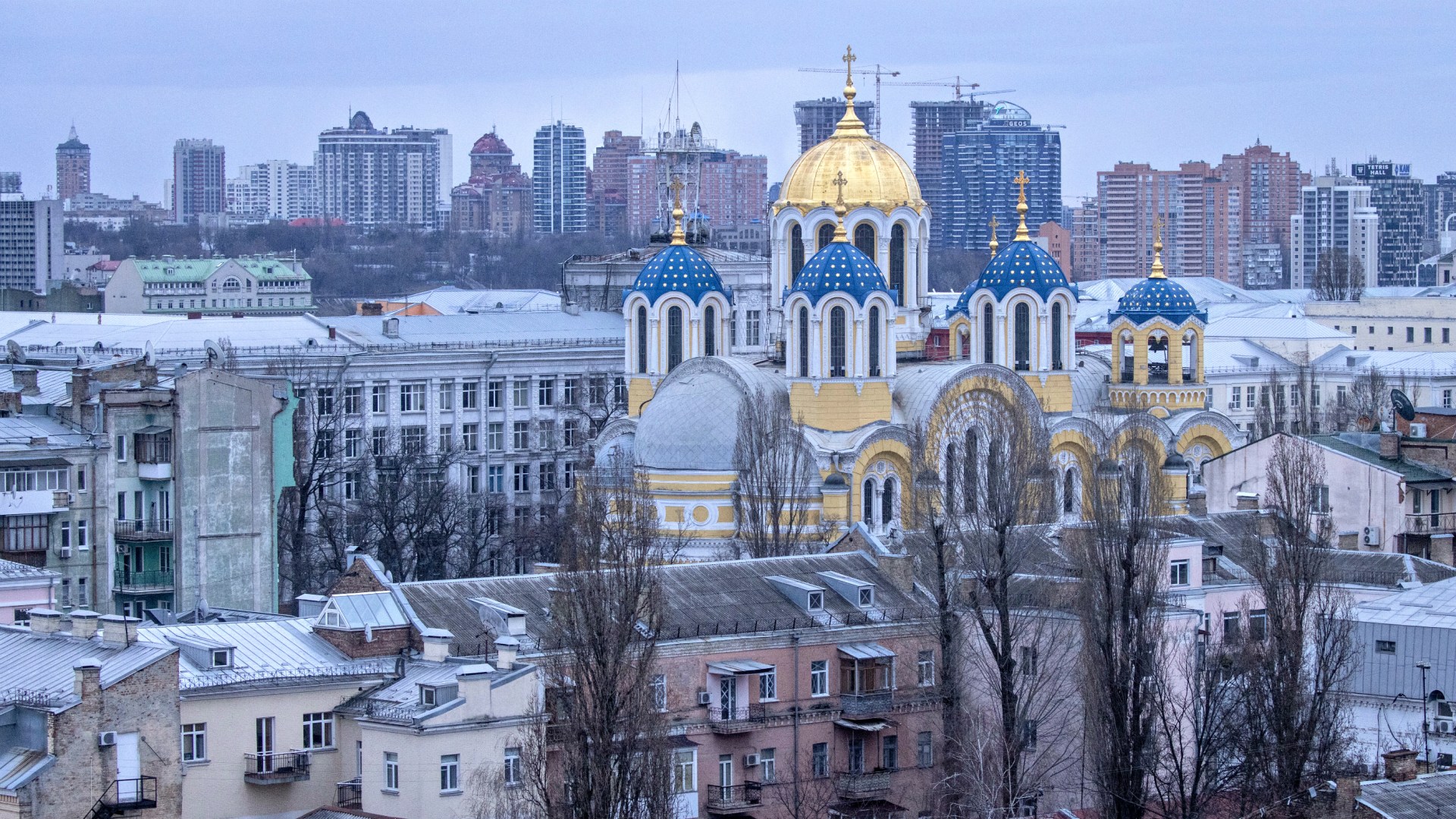
St. Volodymyr's Cathedral is seen against the capital city skyline during a weekend curfew on February 27 in Kyiv, Ukraine.

St. Volodymyr's Cathedral is seen against the capital city skyline during a weekend curfew on February 27 in Kyiv, Ukraine.

Christianity Today February 27, 2022
Chris McGrath / Getty Images

[Українська]

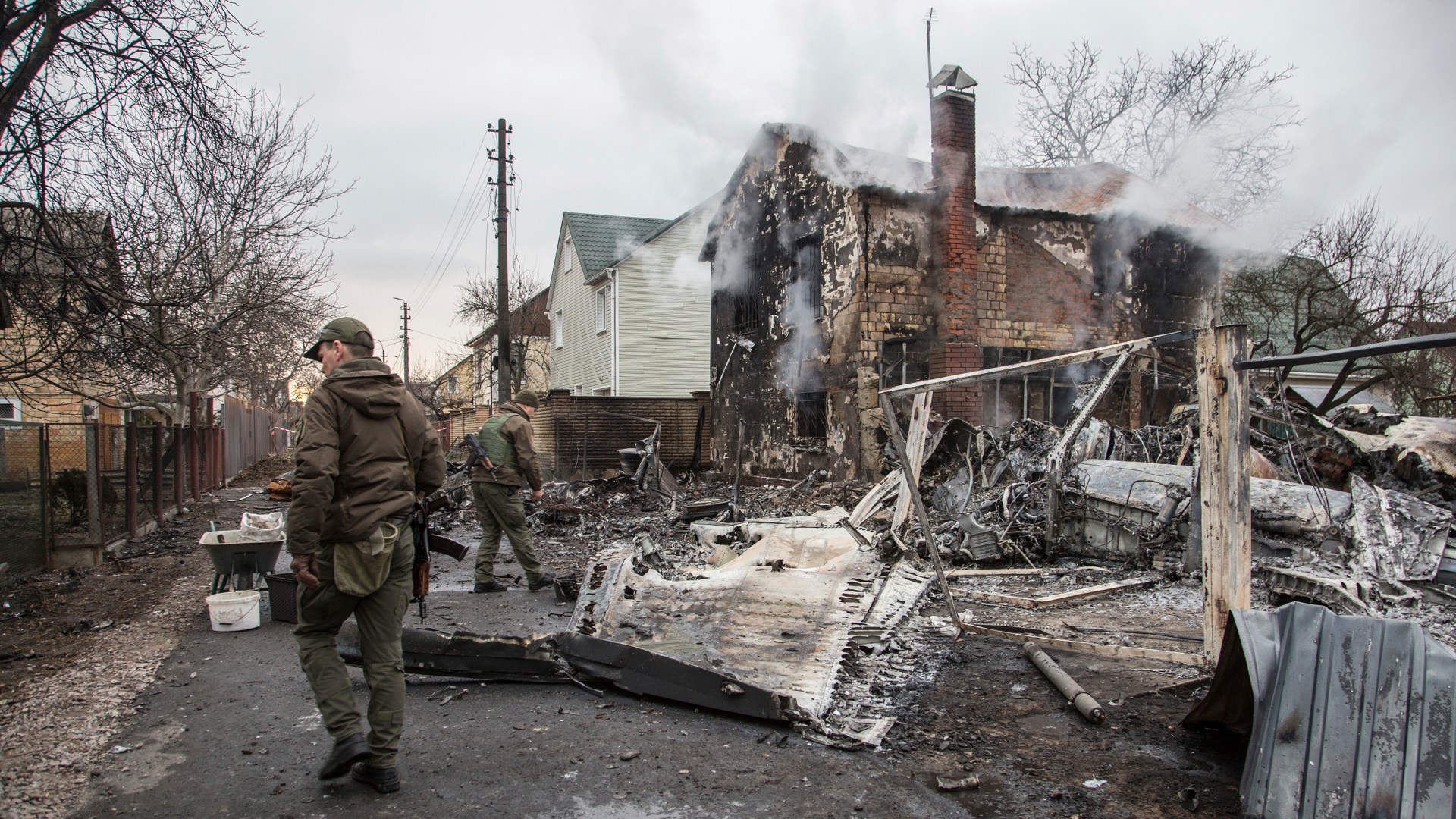
As Russian troops met stiffer resistance than expected from Ukrainian soldiers and citizens in Kyiv and other cities, pastors in both nations adapted Sunday worship services appropriately.

“The whole church prayed on their knees for our president, our country, and for peace,” said Vadym Kulynchenko of his church in Kamyanka, 145 miles south of the capital. “After the service, we did a first-aid training.”

Rather than a sermon, time was given to share testimonies from harrowing days of air raids. Many psalms were offered, and Kulynchenko’s message centered on Proverbs 29:25. Fear of man will prove to be a snare, but whoever trusts in the Lord is kept safe.

Both disruption and ordinary life were on display at Calvary Chapel of Svitlovodsk.

Andrey and Nadya, displaced from Kyiv by the Russian missile barrage on Thursday, exchanged wedding vows amid great celebration.

Scheduled to be married this weekend in the capital, the couple was instead sent fleeing to Nadya’s home church 185 miles southeast along the Dnieper River—with a request for an impromptu wedding.

“In the middle of a war? That doesn’t make sense!” said Benjamin Morrison, with irony. “But during war is when it makes the most sense. What better reminder that even war cannot stamp out love. And what better way to say that we serve a higher King than to rejoice in the midst of chaos?”

They were married on Saturday, as planned.

On Sunday, the congregation of about 80 people—just beginning to swell with newcomers seeking refuge—regathered to hear a sermon on David and Goliath.

“Yes, David still had to fight. Yes, it was still hard and scary—but God was his confidence,” concluded Morrison, an American missionary veteran of 20 years and married to a Ukrainian.

“May he be ours as well, and may he cut off the head of the enemy.”

Ukraine claimed today that 3,500 Russian soldiers have been killed so far. Russia has not released an official casualty figure.

Regarding its own losses, Ukraine’s Health Ministry counted more than 350 civilians dead and almost 1,700 wounded as of Sunday night. The reported tally combines civilian and military casualties, but broke out 14 child deaths and 116 wounded.

Taras Dyatlik, regional director for Eastern Europe and Central Asia at Overseas Council, did the math. If correct, in three days of fighting 40 Russian soldiers died every hour; one soldier every minute and a half.

“These are mostly 19- to 25-year-old children,” he lamented. “The depth of our human brokenness can only be healed by the Holy Spirit.”

Metropolitan Epiphanius, head of the Orthodox Church of Ukraine (OCU), pleaded for the dead with Patriarch Kirill, Moscow-based head of the Russian Orthodox Church (ROC).

“If you cannot raise your voice against aggression,” he stated, “at least take the bodies of Russian soldiers whose lives have become the price for [your and your president’s] ideas of the ‘Russian world.’”

Prior to the war, President Vladimir Putin asserted that Ukraine was simply an extension of Russia, with no historic independent existence. Epiphanius said that the Ukrainian government was seeking to coordinate with the International Committee of the Red Cross to repatriate the dead bodies, yet receiving no response.

Kirill tread carefully, given his flock on both sides of the border. In 2019, the Istanbul-based ecumenical patriarch of the Orthodox Church, Bartholomew I, recognized the national independence of the breakaway OCU, while many parishes in Ukraine rejected this and chose to remain under the Ukrainian Orthodox Church (UOC) which is part of the ROC, as has been historic precedent. (Exact figures for OCU- and UOC-affiliated churches in Ukraine are difficult to determine.)

Expressing his belief that the warring sides will overcome their divisions and disagreements, Kirill called on “the entire fullness of the Russian Orthodox Church to offer a special, fervent prayer for the speedy restoration of peace.”

As a foundation, he cited the common centuries-old history of the two peoples.

Epiphanius, however, closed his message to the patriarch by noting the Orthodox church calendar marks this Sunday for remembrance of the Last Judgment.

Putin ordered his nuclear forces to a higher level of alertness.

Western allies of non-NATO Ukraine increased their sanctions against leading Russian banks and politicians—including Putin. While they stopped short of the financial nuclear option of cutting Russia off entirely from the international SWIFT system for banking transfers, many approved the sending of additional defensive aid to Kyiv.

Meanwhile, 10 regional Protestant seminaries—including Kyiv Theological Seminary and Evangelical Reformed Seminary of Ukraine—put out a joint statement on Facebook that drew more than 650 shares.

“We are called to speak the truth and expose deceit,” they stated. “We … strongly condemn the open and unjustified aggression aimed at destroying the statehood and independence of Ukraine, based on blatant lies” from Putin “which are clearly contrary to God’s revelation.” They noted:

We confess the real and unlimited power of God over all countries and continents (Ps. 24:1), as well as over all kings and rulers (Prov. 21:1); therefore, nothing in all creation can interfere with the fulfillment of the good and perfect will of God. We, together with the first Christians, affirm “Jesus is Lord,” and not Caesar.

We express solidarity with the people of Ukraine. We share the pain of those who have already lost their loved ones. We pray that all of the aggressor’s plans would be thwarted and put to shame. We call on all people of good will around the world to resist the lies and hatred of the aggressor. We call on everyone to petition for a cessation of hostilities and to exert every possible influence on the Russian Federation in order to stop the unmotivated aggression toward Ukraine.

Five seminaries are based in Ukraine. Two, granted anonymity, are based in Russia.

Bolder still were a number of pastors within Russia.

Victor Sudakov, senior pastor at New Life Church in Yekaterinburg, the fourth-largest city in Russia, changed his Facebook profile photo on Thursday to incorporate a small Ukrainian flag. On Saturday, he changed his cover photo to display the flag and the tryzub, the gold trident from Ukraine’s official coat of arms.

The action by the Pentecostal pastor, part of the Associated Russian Union of Christians of Evangelical-Pentecostal Faith (ROSKhVE), drew hundreds of comments. “Brother I always thought and said that you were a brave man,” stated one. “There is no price tag for what you are doing now!”

On Sunday, Sudakov linked to a Change.org petition intended for Russians who oppose the war in Ukraine. More than 960,000 people had signed it as of Sunday evening.

On Friday, ROSKhVE released an official statement quoting the Book of Acts in reference to God’s appointed places for people to live.

“Regardless of the causes, war is a terrible evil,” the group stated. “God has called us to love [and] the primary values should not be the specific outlines of borders, but human souls.”

Praying for peace “to be restored as quickly as possible,” the evangelical union called for fasting “until the divine resolution of the fratricidal conflict.”

Like Kirill, ROSKhVE cited as a foundation the centuries-old history of unity between Russian and Ukrainian evangelicals. Many of the latter’s missionaries, it stated, now serve as pastors and bishops of churches. They are hopeful this will speed an early reconciliation.

“I am so sorry that my country attacked its neighbor,” stated Constantin Lysakov, a pastor at Moscow Bible Church. “No matter how we call this event, no matter how we justify it, … there is no shifting blame when you are repenting. And we all should repent over what took place.”

“There is only one source of comfort in all of this for me,” he wrote on Facebook. “Christ is on the throne, God the Father holds everything in His hands, the Holy Spirit fills the hearts of those who trust in Him and nothing can overcome His might. God does the greatest works of redemption when everything seems hopeless. … I pray for the peace.”

At the outbreak of war, Yevgeny Bakhmutsky spoke similarly.

“My soul is grieved, my heart is torn with horror and shame, and my mind is shocked by human insanity,” said the pastor of Russian Bible Church in Moscow. “We are not politicians, we are children of God. We are not called to remake the geopolitical map of the world to please this or that ruler. … Let the world see that the children of God love and accept one another, not because of language [or] nationality … but because they have been accepted by Christ.”

A scriptural text often cited in Russian evangelical churches the Sunday after the warfare erupted was Psalm 2:1. Why do the nations conspire and the peoples plot in vain?

Other churches focused on solidarity and prayer.

Across Russia on Sunday, the approximately 700 churches within the 26 Protestant unions that compose the All-Russia Commonwealth of Evangelical Christians jointly declared a time of prayer and fasting for peace, said Pavel Kolesnikov, former ARCEC chairman and Eurasia regional director for the Lausanne Movement. “This is our action,” he told CT.

Their prayer agenda included five emphases:

1) For peace between the fraternal peoples of Russia and Ukraine
2) For the authorities and “rulers” to have the fear of God, strength, and will for peacemaking
3) For the safety of the people of Ukraine, as well as Christians living in Ukraine in places of armed conflict
4) For the Church, that God may preserve it from divisions and conflicts amid the aggravated situation
5) Understanding how every association of churches can respond to the needs of people affected by warfare

At his own church, Zelenograd Baptist Church in Moscow, Kolesnikov asked attendees at the morning service to join hands—every man, woman, and child—to pray for peace and wisdom for the governments of both countries. His church has also been collecting supplies, as many Russian churches are, to aid Ukrainian refugees in neighboring nations.

“It is not our war,” he said. “We love our Ukrainian brothers and sisters.”

Joining in the fast on Sunday, the Russian Union of Evangelical Christians-Baptists (RUECB) called on believers to be peacemakers.

“Bless restless nations and send peace, repentance. We are asking for your mercy upon all,” said Sergey Zolotarevskiy, pastor of Central Baptist Church in Moscow, without mentioning the conflict directly.

Oleg Alekseev, pastor of Source of Living Water, the oldest Baptist church in Voronezh in central Russia, used Psalm 2 as the main text for his message.

“The real victories do not happen there, nor does well-being originate there,” he said, referring to the battlefield. “It originates [in the church], when we faithfully [pray for] kings, rulers, and all peoples.”

Ruslan Nadyuk, pastor of Word for the Soul Baptist Church in Moscow, said the appropriate Christian response is one of incessant silent prayer that the conflict be resolved peacefully and according to God’s will. He cited the testimony of James 5:16. The prayer of a righteous person is powerful and effective.

Conditioned during decades of persecution under the tsars and communists, many Russian believers have decided that protesting is useless at best and dangerous at worst. Among the effects was a deepening of their prayer life, said Andrey Shirin, a Russia-born seminary professor in Virginia who surveyed sermons and Facebook comments by Russian pastors on behalf of CT.

“When upheavals begin, Russian evangelicals do not say much about them—particularly when they are political in nature,” said Shirin. “However, Russian evangelicals pray a lot. In fact, they believe this response is the most potent one.”

As Bakhmutsky, the Moscow pastor, stated on Facebook, “Do not rush to judge others through the prism of your culture, situation, and conscience. Do not think of prayer as something insignificant or useless. For most of us, that’s all we have left.”

But some pastors were more direct in their comments.

Yuri Sipko, former head of the largest Baptist denomination in Russia, said that first and foremost, Christians should respond with prayer. Jesus’ response, however, would respond to the events in Ukraine with the words of John 15:13. “Greater love has no one than this: to lay down one’s life for one’s friends.”

For Ukrainians, he said, this should be their wartime guiding principle.

Andrey Direenko expressed his dismay. “Pain, tears, horrors of bloodshed tear our hearts apart,” said the Pentecostal bishop from Yaroslavl in central Russia. “It seems like a nightmare, but it is horrible reality.”

And in the middle of it, ministries responded.

“I ask all families with orphans, as well as families raising children with disabilities and who want to move to safer areas, to write under this post,” stated Nicolai Kuleba, the evangelical ombudsman for children in Ukraine. “Leave comments, provide a number and we will contact you.”

Many churches within Ukraine are providing shelter. But so are those abroad.

“We are but a small church, thus our capacity to help is limited, perhaps up to a few dozen families or so,” said Péter Szabó, who pastors a Presbyterian church in Budapest. “But our greatest hope is not what we can or will do but what our King, the Lord Jesus Christ can and will do.”

Preaching from Acts 13, he reminded that the Christian life is never the series of failures, but that the “golden thread of God’s grace” gives the believer a sure hope for the future.

In desperate need of such perspective, about 78,000 refugees have fled to Hungary, he said. The UN reported a westward migration totaling 386,000, including Poland, Slovakia, and other bordering nations.

Thousands of Ukrainians have crossed into Moldova. At Kishinev Bible Church, a Russian-speaking nondenominational congregation in the country’s capital, several refugee families visited services for the first time Sunday morning.

The church and its partners, ministries whose offices are now turned into hostels, have shuttled refugees and supplies since the war broke out. Evghenii “Eugene” Solugubenco choked up as he preached on a topic he had slated months ago: God’s faithfulness.

“Those words mean little to us when we’re going to lunch in the afternoon after church. But when you’re a refugee they mean more. … I prayed for God to hug these people and let them know he loves them because he’s faithful,” said Solugubenco, who opened with Lamentations 3:23-24. They are new every morning; great is your faithfulness. I say to myself, “The Lord is my portion; therefore I will wait for him.”

“People are usually pretty reserved in this part of the world,” he said. “They don’t come up to the pastor after the service. But today they did.”

And some Ukrainians are seeing the divine.

“Soldiers and officers are telling me they are witnessing miracles from above,” said Oleksiy Khyzhnyak, a Pentecostal pastor in Bucha, 27 miles northwest of Kyiv, which witnessed Sunday’s most severe fighting. “‘It is not our achievement,’ they said.”

Khyzhnyak told Yuri Kulakevych, foreign affairs director of the Ukrainian Pentecostal Church in Kyiv, that rockets reportedly fell without explosion and Russian tanks ran out of fuel. Soldiers, lost in unfamiliar locations, are asking villagers for directions—and even bread.

A Netherlands-sponsored bread mission in Brovary, 15 miles east of Kyiv, is struggling to provide enough. Already supplying neighbors and those displaced from the east, they hope to scale up to include hospitals and the Ukrainian military.

But under pressure from the conflict, their own pool of labor is shrinking, headed west.

“We want to start baking 24/7 from Monday,” it stated, “but at the moment we don’t have enough bakers.”

Morrison can relate. His church, Calvary Chapel, just purchased 1.5 tons of flour. But as many pastors expressed to CT, the situation is draining. Constant air raid sirens give little peace. The immense needs allow little rest.

“This morning I woke up feeling like a truck had run over me,” he said. “But though we are all feeling exhausted, we press forward—believing that Christ has put us here for this moment.”

Additional reporting by Kate Shellnutt.

Correction: Metropolitan Epiphanius is head of the Orthodox Church of Ukraine (OCU), not the Ukrainian Orthodox Church (UOC).


Theology

The Ukrainian Needed Prayer. The Russian Volunteered.

How two Christian friends, divided by borders but united by their passion for evangelism, brought a prayer meeting to tears as war raged.

Alexey S. and Angela Tkachenko

Alexey S. and Angela Tkachenko

Christianity Today February 27, 2022
Edits by Christianity Today / Source image courtesy of Angela Tkachenko

The following dialogue is a retelling of an emergency global prayer meeting held by Lausanne Europe on Thursday:

Angela Tkachenko:

My mother entered my room in the middle of the night. “The war has started.”

I live in Sumy, a Ukrainian city of about 250,000 people that sits near the Russian border. One week ago, my husband insisted that I take our kids and my mother and evacuate. While we made it to the United States, he stayed behind.

I immediately began panicking on Thursday. What was happening in Sumy? Where was my husband? Was he safe? When I finally got ahold of him, he told me he had woken up to the sounds of bombs. He was now snarled in traffic as he tried to drive out of the city. I scrolled through pictures on my phone of long gas station lines and people sleeping in metro stations, and read the government announcement banning men between the ages of 18 and 60 from leaving the country. Will I see my husband again? When? My 93-year-old grandma is alone… my team… my friends… our house….

I struggled to make it through the day. In the afternoon I joined an international prayer call organized by the Lausanne Movement in light of the invasion. When the host asked how I was doing, I cried. I was angry. I felt betrayed, broken, and stepped on by Russia. I told everyone I was scared for my husband and for my friends in Kyiv praying at that moment about whether they should evacuate.

Then the host asked if someone could pray for me. My friend Alexey volunteered. My Russian friend, Alexey.

Alexey S:

I woke up Thursday morning startled to learn that my country had invaded Ukraine. I was in Moscow for a ministry trip, more than 2,000 miles away from my family in Novosibirsk, Siberia. It was a cold morning and I watched the news in silence as I struggled to eat breakfast. Shame that my country was starting a war against another—a country I’d visited no less than four or five times—began to come over me. I felt afraid for the future of the world and I grieved for my Ukrainian brothers and sisters who would live or die in the aftermath of this decision.

I was born and raised in the Soviet Union in Siberia. After the USSR collapsed, I became a Christian at the age of 23 after hearing the gospel preached at my mother’s rehab center. For me, finding faith in Christ was more than accepting that I was God’s child—it was realizing that I had brothers and sisters around the world. One of those was my Ukrainian friend Angela.

I met Angela seven years ago, at the Lausanne Conference in Jakarta. I was struck by her boldness when sharing the gospel. One of her initiatives involved mobilizing teams to enter nightclubs in various Ukrainian cities to initiate conversations with people who would never enter a church! Since then we became good friends and have supported each other in our ministries. In 2018, Angela brought a team to Moscow during the World Cup to share the gospel in the streets. These memories kept coming back as I watched the news.

Later that day, I joined Lausanne’s prayer call and felt grateful to see Angela was also there. It was heartbreaking to hear what she and other Ukrainians on the call were going through. It felt awful that my country was causing her so much personal distress. When the facilitator asked who would volunteer to pray for her, I said yes and began talking to God as I wept.

Angela:

I’ve always loved my Russian friends, even though when I was growing up there were no “Russians” or “Ukrainians.” We all were one nation called the Soviet Union. As a kid, numerous times I hopped on a train at 5 p.m. in Sumy, arriving at 11 a.m. the next morning in Moscow where my aunts and cousins still live. Over time, things changed. In 2014, after Russia annexed Crimea, I soon realized Russians saw the situation entirely differently than me. Few understood where I was coming from. At times, I was mocked.

In 2018, I visited Moscow for a street evangelism trip during the World Cup. For three weeks, we stood in Red Square, sharing the gospel and praying with Russians and those visiting from around the world. Ten months later, 150 teams from Russia had registered for my ministry’s global evangelism day. Many later told us they had previously not dared to preach publicly but they felt inspired after seeing us. I was touched by the bravery and courage of our brothers and sisters in Russia.

Last fall, Alexey asked me over the phone about my dreams for reaching the next generation for the Lord. I told him I was looking for partners to help lead five mission intensives in Russia. Alexey offered to support my efforts and then shared his heart with me. He wanted to unite mission leaders from our countries to pray and fellowship together around a cup of tea. I remember thinking to myself: “This is the type of leader I’d follow, and I know young people would too.”

As I heard Alexey’s heartfelt prayer for me, my family, and my country Ukraine, I could not contain my tears. His pain was real. His words reminded me that I was part of a family not based on nationality, skin color, or status. Only Jesus.

Out of all the people that God could have used to comfort me that day, he used a Russian brother to give me a glimpse of his heart.

Alexey:

After I finished praying, the host asked me to share how I was feeling. I told them I felt terrible. I was utterly ashamed of my country’s actions.

I will never forget the look in my Ukrainian friends’ eyes. Instead of condemnation, I saw compassion. Angela wanted to pray for me. She asked God to show himself to Christians in Russia who felt powerless and afraid. She prayed for revival in Russia and Ukraine, a longing we had shared in our hearts for years.

On the day that Russia invaded our neighboring country, God used a Ukrainian sister to give me a further glimpse of his grace.

Angela:

The enemy wants to divide us these days, sowing hatred and separation between the church in Ukraine and Russia. Indeed, it hurts when I watch some Christian leaders in Russia not taking an open stand for Ukraine. Maybe some think that if they speak up they or their children might be in danger? I know the fear and danger are real, and I try not to judge, as I am not God. It is still painful though.

But I believe that the most important thing for us Christians is to remember that we are one bride, one body of Christ. His blood is in our veins, and we are all united by his Spirit.

Russia is currently bombing my country and killing its people. But, amid this pain, the body of Christ needs to stand together, cry together, and pray together. My good friend Alexey exemplified this.

Alexey:

Brothers and sisters in Russia, Ukraine, or any other country, we all have one Heavenly Father and we are all members of the same family. This is not a war within our peoples. I don’t care about your political views or your theology of power. When one of my loved ones is in pain, I want to be there for you.

To my Ukrainian friends in particular, thank you for being ready to cry and pray with me and for accepting my feelings of fear and regret, despite the fact that I am Russian. This gives me confidence that Satan will be defeated once again, and the church of God will continue to demonstrate the love of Jesus.

Angela Tkachenko is director of Steiger Ukraine. Alexey S. lives in Russia. As told to Sarah Breuel, director of Revive Europe and evangelism training coordinator for IFES Europe.

Follow CT’s Ukraine-Russia coverage on Telegram: @ctmagazine (also available in Chinese and Russian).

Church Life

5 Ukrainian Worship Songs for War and Peace

In the midst of violent conflict, Christians in Ukraine are still declaring their God is “Mighty to Save.”

Christianity Today February 26, 2022
Daniel Schaffer / Unsplash

As the people of Ukraine face war, believers across the country, including many evangelicals, are still gathering to worship the Lord wherever they are.

In international news outlets, we’ve seen images and heard reports of people praying—huddled to intercede in town squares and underground bunkers—as well as finding refuge in churches, and singing in public places. Their perseverance in the midst of tribulation is a testimony to the power of prayer and praise in the darkest of times.

Since Ukraine’s independence in 1991, most Ukrainian worship music consisted of Western praise songs translated into Ukrainian. But as an American professor, missionary, and worship leader who makes regular teaching trips to Ukraine, I’m part of a rising movement encouraging the creation of original Ukrainian worship music—written by and for Ukrainians—including songs represented in this Spotify playlist.

My hope is that someday, Western Christians will start translating Ukrainian songs and singing them in English. As we gather in church this Sunday, let this be a reminder to “Pray for Ukraine.”

1. “God the Great One!” (Prayer for Ukraine)

This is the “national spiritual anthem” of Ukraine, МОЛИТВА ЗА УКРАЇНУ, a hymn that is familiar to most Ukrainians. This version has a video with views of many different parts of the nation. The English lyrics are as follows:

Lord, oh the Great and Almighty,
Protect our beloved Ukraine,
Bless her with freedom and light
Of your holy rays.

With learning and knowledge enlighten
Us, your children small,
In love pure and everlasting
Let us, oh Lord, grow.

We pray, oh Lord Almighty,
Protect our beloved Ukraine,
Grant our people and country
All your kindness and grace.

Bless us with freedom, bless us with wisdom,
Guide into kind world,
Bless us, oh Lord, with good fortune
For ever and evermore.

2. “To You,” by Andriy Hryfel

This song is titled “до Теье”, which means “To You,” which is a pretty well-known song, especially in evangelical circles. The artist, Andriy Hryfel, was a significant young leader, pastor/elder, worship leader and songwriter who died suddenly last year. The translated lyrics are as follows:

I run to You Lord, I run to Your Lord.
The warmth of Your hands restores faith in my every step
Your grace gives me the strength to go
You are my wisdom, in You I can go through everything.

I have longed for you all my life
I look forward to meeting You in heaven

To Thee my love, To Thee my paths,
I obey you again to keep my faith.
I long for you as a baby longs for mother,
As the dry land longs for the rain, I long for You.
I look at you when I am exhausted in the struggle,
I pray to You, because I believe my victory is in You,
I stand on the Word, this world will not overcome Your love

I love you, I live for you, you are my God.

3. “I will Sing,” by Maria Kuchurian & Diana Yakovyn

This is a newer song, written by two recent seminary graduates, which just won a national award for worship music. Here are the lyrics in English:

He is the One who lifts up and surrounds with peace.
His love is great! I will hold on to Him.
When the heart is heavy, He takes away the stone,
Gently hugs. O my holy Jesus!

I will sing, I will sing, I will sing to the Risen King!

His hand is with me. He's near, here, I know
I feel in my heart, I pray to Him!
He warms with love and wipes away tears
Loyal Friend forever. His name is Jesus!

You chose me and set me up, You chose me, raised me up!
You chose me and forgave me, You chose me, raised me!
You chose me and filled me, You chose me, raised me!

4. “The Lord’s Prayer”

The Lord’s Prayer unites Ukrainian Christians, including those in the Orthodox Church, which is the majority religious tradition in the country. At any interdenominational gathering, everyone stands to pray it together as an act of worship. This setting is from an Orthodox Easter liturgy.

5. “Mighty to Save,” by Hillsong Ukraine

The Hillsong song “Mighty to Save,” which came out in 2006, has been sung in Ukraine for almost that long. The video above was recorded just a day or so ago, showing students worshiping together with the lights out—as the battle for Kyiv began not many miles away.

Significantly, this is being sung in Russian, not Ukrainian. It is very important to note that not everyone who speaks the Russian language is Russian, despite the propaganda out there. These are true Ukrainians who happen to speak Russian. Most Ukrainians are functionally bilingual to one extent or another.

Fred Heumann heads MusicWorks International and since 2012 has been working alongside a seminary in Kyiv, Ukraine, teaching students and partnering in conferences for worship leaders.

Theology

Despite Censorship, Chinese Christians Speak Out for Xuzhou Chained Woman

Five believers in China and US offer reflections on the tragedy still dominating WeChat discussions.

Xuzhou woman found in chains prompts Chinese debate on WeChat.

Xuzhou woman found in chains prompts Chinese debate on WeChat.

Christianity Today February 26, 2022
Illustration by Christianity Today / Source Images: Screengrab from TikTok / JJ Ying / Unsplash

Last month, a short video of a “mother of eight children” in the countryside of Xuzhou, a large city northwest of Shanghai, caused an uproar on the Chinese internet. The footage showed a woman with iron chains around her neck answering a visitor’s questions with a slurred accent in a freezing shed with old, cold food on the floor. The image of the poorly dressed woman with disheveled hair and missing teeth shocked the nation.

Millions of Chinese netizens expressed concern for her, wondering if she was a victim of human trafficking and abuse, and criticized the local government ’s inaction. While officials have investigated the situation, the inconsistencies of their reports—as well as lingering questions about the woman’s origin, identity, and mental and physical health—have sustained heated online discussions, although many critical responses have been censored.

Chinese Christians in China and overseas have also spoken out online on behalf of the Xuzhou woman. Last week, one writer, “Li’l Engineer Wan,” published an article questioning why the government, which monitors the movement of citizens in its fight to control the spread of COVID-19, is not able to detect human traffickers and protect women and children. WeChat quickly deleted her article. A day later, FRI Chinese reported that several “Chinese American Christians launched a global Christian appeal in solidarity with the chained mother of eight in Xuzhou.”

CT Asia editor Sean Cheng spoke with five Chinese Christians about the incident (for security reasons, those within China use pseudonyms):

  • Zhang Rumin, pharmaceutical research scientist and elder of Rutgers Community Christian Church in New Jersey
  • Agnes Tan, Christian media worker, Christian counselor, and editor-in-chief of Behold magazine in Los Angeles
  • Jerry An, new media mission pastor and Chinese director of Reframe Ministries in Grand Rapids, Michigan
  • Joseph Jun Yi, pastor of an evangelical church in Beijing
  • Jasmine Qi Wan, member of an evangelical church in Shanghai

CT: As a Christian, how do you see the problems of Chinese society exemplified by the Xuzhou chained woman?

Zhang: The most prominent and serious problem is the discrimination suffered by women. According to media reports, thousands of young women (including female college students) are trafficked and disappeared every year in China. Some of them have suffered a fate similar to that of the Xuzhou chained woman. They are trafficked to the countryside and essentially become sex slaves and fertility machines for men who had difficulty finding a wife. In today’s modern civilization, this is really horrific, dark, unimaginable evil. Given the Mao-era political propaganda slogan of “women holding up half of the sky,” many people mistakenly believe that women have equal social status with men in China. But that is not the reality in today’s China.

The image of the woman in chains cries out at a decibel level that should convict the dark corner of the human heart. Her accusation against her fellow villagers is “Everyone here is a rapist!” Whether it is the longstanding tradition of foot binding in Chinese history (which Western missionaries to China advocated for its eradication), the murder of baby girls by drowning, the trafficking of women into prostitution by human traffickers, or the unbearable suffering like that of the Xuzhou woman in chains, all testify to the total depravity of human beings.

Qi Wan: On the surface, this is an issue of human trafficking. In reality, it’s about the lack of stability at the bottom of Chinese society. No matter how much we cover our bodies with the clothes of civilization today, when we lift up these garments, the inside remains the same: the traditional Chinese beliefs of “passing on the family gene is the bottom line” and “women are inferior to men.” If these women resist and run away, their captors may be punished. Instead, they are deemed “dangerous” and chained.

Incidents like what happened to the Xuzhou chained women are not uncommon in the regions where the Yellow River floods (the provinces of Henan, Anhui, and Jiangsu), where the tough criminal traffickers are often protected by corrupted local officials. People are shocked by the inaction of the judicial administration, but also by the fact that some officials are always thinking about their own economic interests first and are covering up the crimes. These are old illnesses in China that have never been cured.

Tan: This incident is an expression of the ultimate extension of patriarchy: the instrumentalization and objectification of women. Women’s inherent value is seen as inferior to men and women are regarded as lesser beings. This is not only a problem in the general Chinese society, but Chinese Christians may also be influenced by such a culture. Some Christians even use Bible verses such as Genesis 2:18 and 3:13–20 to support patriarchal ideas, ignoring the fact that the Bible makes no distinction between men and women, whether it refers to the grace of salvation in life or the gift of the Holy Spirit to build up the church after salvation.

Before sin entered the world, God created male and female in His own image (Gen. 1:27). The dichotomy of male and female relationships, with the desire to rule over each other, was not in accordance with God’s original intent. In contrast, while the Bible does not advocate for female superiority over men, instead it records heroes and villains, wise people and foolish people, without prioritizing gender. Sexism is actually inconsistent with the Christian faith, and Christians should not use the Bible to endorse a culture of male superiority and female inferiority.

CT: From the point of view of caring for the victims, how can Christians do better?

Tan: Christians should pray for the damage done to these eight children. The victims of this incident are obviously the mother of the eight children first and foremost, but the media and the masses seem to have ignored the eight children growing up in this family, who are in fact direct victims as well. I am concerned about the adult son who went off to work when he was 14 or 15 years old. How does he view women when he enters society? Will he spend his life in frustration, conflict, confusion, and pain that he cannot understand?

Since the video has been released, the second son, who is about 12 years old, has been hounded and bullied by citizen journalists, and has had to handle frequent visits from outsiders looking to donate to the family but also from the police as they investigate the situation. I worry about what kind of self-image, outlook on life, and values he will develop as he enters the key period of adolescent growth.

I noticed in the video that none of the other six children ever approached their mother voluntarily. Will they grow up with a lifelong sense of absence, low self-esteem, anger, or confusion? I am also concerned about who will take care of these children once their father is arrested and their mother is sent to the mental hospital. Who will heal their wounded hearts and correct their distorted vision, besides feeding and clothing them? Who will care about the revision and enforcement of laws regarding children’s welfare and rights?

Jun Yi: From the perspective of the Christian faith, the mother of eight children in Xuzhou was made in the image of God and cherished by God with compassion. Therefore, she has precious dignity that should be respected and preserved. Doing harm to the dignity of another person is an offense to the glory of God and a violation of his law. The beating, chaining, and sexual abuse of the mother of eight is a naked trampling on human dignity. God cares for human souls and he also cares for their well-being in this world.

The other aspect of the matter is social reconciliation requires that people who accuse others realize that they are not totally righteous, but sinners. We may also have in our hearts the lust to commit adultery, the desire to threaten and control others, and to dominate our spouses. The father of the eight children needs repentance and God’s grace as much as we do.

CT: There is currently very strict censorship of speech in China. Speaking out may risk retaliation and persecution. In an environment of increasingly harsh speech control, is it right to ask Christians to stand up for justice? Is it fair to equate silence with complicity?

Qi Wan: Over the past couple of weeks, I have witnessed women trying their best to speak up for women. The most intense discussions and retweets on WeChat are mostly from women. There are also women who show bravery in offline real life. Two female netizens went to Feng County to visit the chained woman with a bouquet of flowers and a card saying “Sister, the world has not abandoned you,” They were not allowed to meet the chained mother.

Instead, several unidentified men forced black cloth bags over their heads and took them to the police station to be interrogated. After a few days of intense questioning, the women were released. However, they documented their lives in detention and gave us a glimpse of another kind of slavery. The female netizens were ahead of many media outlets, not only in seeing the truth, but also in bringing comfort to the chained woman, whom they regarded as their sister.

Whether it’s the women who braved Feng County with warmth, or the women who paid close attention to the aftermath events, they all started with the question “Who is the chained woman?” and then moved on to other questions: “Who am I? As a woman, can I truly escape the fate of being trafficked and enslaved? Can I guarantee that my daughter will not be subjected to the same destruction? Do I also live in sin and have the same evil in my heart?”

An: The Winter Olympics are over and the Chinese community is still concerned about the mother in chains. The situation is much like the praise of the late Dr. Li Wenliang, the whistleblower of the COVID-19 epidemic in Wuhan, two years ago. The courage to speak up is especially valuable today when speech is more tightly controlled in China. To a large extent, what people are expressing is also a backlash against this high level of speech censorship.

Late last year, the Chinese government announced new regulations about religious information services on the internet, which prohibits unauthorized posting of sermons, seminars, lectures, training, and even link sharing. Frankly, as the online censorship in the chained woman case reminds us, Christianity is by no means the only target of online speech control, and Christians are not the only group who face serious restrictions on the internet. Chinese Christians and all other people in the Chinese society are “in the same boat,” and we all endure and experience all kinds of storms together.

Zhang: While it is true that Christians should speak out for righteousness, we also need to be wise and loving in the face of censorship. We should be tolerant rather than judgmental toward brothers and sisters who choose to remain silent or who have different views from us. We should not fall into self-righteousness when condemning evil.

Interview and English translation by Sean Cheng

Theology

This Present Global Darkness

The “angels of nations” described in Scripture remind us that cosmic evil shapes the politics of earthly warfare. Let’s pray accordingly.

Christianity Today February 26, 2022
Oleksandr Ratushniak / AP Images

War is terrible. My wife and her family were in her home country of Congo-Brazzaville (Republic of the Congo) for 18 months, and the sociopolitical forces that took tens of thousands of lives there can only be described as evil. The Great Lakes War that claimed millions of lives in neighboring Congo-Kinshasa (Democratic Republic of the Congo) enlarges the evil to another scale. The darkness of Adolf Hitler’s Third Reich dwarfs comprehension.

Now in 2022, the war in Ukraine brings violent evil to the fore once again and threatens to reshape our global future in ways we can only imagine.

Human selfishness and greed are among the sins that spawn wars: “Where do the wars and where do the conflicts among you come from? Is it not from your passions that make war within your members?” (James 4:1, NAB). Collectively, however, the scale of human suffering at the hands of others also seems to presume a dimension of cosmic evil that defies even our recognition of human depravity.

There are reasons for that. The Book of Daniel speaks not just of a succession of world empires but of the spiritual forces behind them. The angelic prince of Persia delayed an answer to Daniel’s prayers until Michael, Israel’s prince, intervened; the angelic prince of Alexander’s empire would follow (Dan. 10:13, 20–21; 12:1). God had sovereignly allotted times in history for various angels and their empires, but his angelic and human servants must continue to work for his purposes until he causes them to prevail.

The Greek translation of Deuteronomy mentions that God appointed angels over the various nations, and Jewish thought increasingly recognized such heavenly rulers and authorities—what later rabbis called angels over the nations. These beings were typically hostile toward God’s people, but in the end, God would give the kingdom to his persevering people.

Because our king, Jesus, has already come, Satan has been defeated. Jesus’ exaltation corresponds with the angel Michael’s heavenly triumph over the dragon (Rev. 12:7–8).

In explaining this story, scholars often invoke the World War II analogy between D-Day and V-Day. In D-Day, the success of the Normandy invasion decided the outcome of the war, and the defeat of the Nazi regime and its allies was merely a matter of time. Yet until V-Day—the final surrender of the Axis powers—battles continued and casualties mounted.

In the same way, all enemies—including the final one, death itself—will be subdued when Jesus returns (Ps. 110:1; 1 Cor. 15:25–26), but his servants face continuing battles until then.

In Ephesians, Paul emphasizes that Jesus is already enthroned above heavenly rulers and authorities (Eph. 1:20–22) and we are spiritually enthroned with him (1:22-23; 2:6). In a letter that heavily underscores the unity between Jews and Gentiles in Christ’s body, this enthronement above angels of nations and empires means that our unity in Christ is greater than all the ethnic and national divisions fomented by such angels. Believers are no longer subject to the prince of this world (Eph. 2:1–3).

A statue of Michael the archangel in Independence Square, Kyiv, Ukraine.Kipp74 / Getty
A statue of Michael the archangel in Independence Square, Kyiv, Ukraine.

For Paul, this triumph over divisions has spiritual warfare ramifications, even for the interpersonal dimensions of our lives. In Ephesians 4, for example, denying the devil an opportunity means having integrity and controlling our anger (v. 25–27). In Ephesians 6:10–20, it means taking hold of the defensive armor of truth, faith, and righteousness, plus a weapon for invading hostile territory: the mission of the gospel.

I have sometimes seen brothers and sisters trying to engage in spiritual warfare by rebuking and commanding the heavenly rulers. However, this activity misunderstands our role. We are enthroned with Christ, and yes, someday we will judge angels, but we can’t confuse D-Day with V-Day. Scripture expressly warns against reviling angelic authorities (2 Pet. 2:10), pointing out that even their fellow angels can confront them only by divine authorization (2 Pet. 2:11; Jude 9).

Trying to cast down heavenly powers is different from casting demons out of those they afflict on earth. We are the ground forces, not the air force. This doesn’t mean we don’t have a vital role in cosmic-level spiritual warfare. It just means our modern taste for instant results won’t be met.

In the Book of Daniel, God’s answer was immediate (Dan. 10:12). But Daniel persevered in prayer for three weeks before he received his answer (10:2–3). God showed him that empires would rise and fall but the future did not belong to them.

The Book of Revelation offers the same picture: Satan stands behind the beast of a world empire, Babylon the Great. But the future belongs not to Babylon, the prostitute, but to New Jerusalem, the bride.

The Bible reminds us that not all spiritual forces are the bad guys. God is at work even in the present world, and Scripture leads us to expect that prayers can make a difference in times of war and conflict.

Before Jacob would have to confront his brother Esau’s armed band, he wrestled all night with an angel. Although later rabbis thought it was Edom’s guardian angel, it was the Lord himself (Hos. 12:3–5). But the rabbis were right, at least, that winning the spiritual battle first made the difference for the imminent earthly conflict.

The same lesson appears when Moses’ uplifted hands determined the battle against the Amalekites (Ex. 17:11–13). Our earthly actions have heavenly consequences. (See Ephesians 6:12 in the context of 6:10-20, and the likely meaning of Luke 10:17-18.)

Indeed, on the cosmic level, God’s forces easily outnumber the hostile ones. Elisha’s apprentice learned that lesson when God opened his eyes to see the mountain full of chariots of fire (2 Kings 6:16–17). On that occasion, the Lord miraculously blinded an entire army to allow a peaceful resolution instead of a costly human battle (6:18–23).

In another war story, God gave David victory in battle once he heard the Lord’s heavenly hosts marching for him (2 Sam. 5:24; 1 Chron. 14:15). Joshua likewise achieved victory after meeting the captain of the Lord’s army (Josh. 5:13–15).

In other words, God hears us when we pray. In the Book of Daniel, arrogant nations appear as nothing more than pawns in God’s larger plan for history. By contrast, the angel announces that Daniel, the man of prayer, is precious to God (Dan. 10:11).

Here’s why this common theme matters: The final outcome is already decided, but in the meantime, earthly battles continue, and individual lives remain in the balance. The prayers of a righteous person count more before God than the plans of arrogant powers in heaven or on earth.

I confess that, were it not for my faith in Scripture, these claims would sound pretty hollow to me in times of mass suffering. But because I do believe the Bible, I take courage for the future. Likewise, it was my wife’s faith in Christ and God’s Word that nourished her hope and enabled her survival in the face of war in the Congo.

In the current war in Ukraine and other conflicts around the world, we do not yet see all of Jesus’ enemies visibly under his feet, and casualties remain high. But Jesus’ exaltation over angels and authorities and powers (1 Pet. 3:22) has already decided the final outcome of the cosmic war of the ages. We can rest in that truth.

Craig Keener is professor of biblical studies at Asbury Theological Seminary. He is the author of Christobiography: Memories, History, and the Reliability of the Gospels.

News
Wire Story

Ketanji Brown Jackson Thanks God for Supreme Court Nomination

President Biden’s pick would be the first Black female justice.

Christianity Today February 25, 2022
Drew Angerer / Getty Images

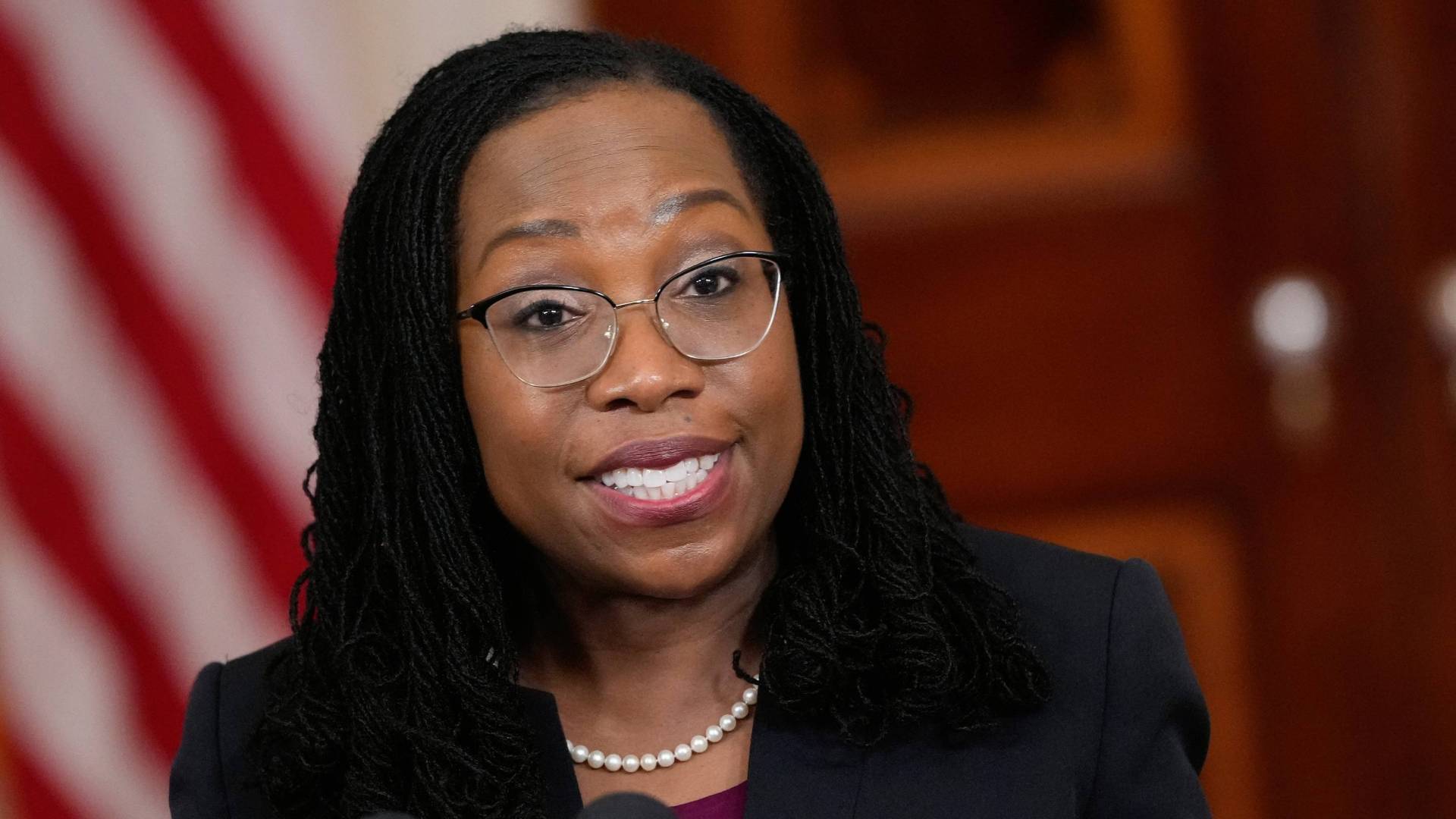
Immediately after President Joe Biden introduced Judge Ketanji Brown Jackson as his nominee to the US Supreme Court at a White House event on Friday, the federal appeals court judge stepped up to the podium and appealed to the divine.

“I must begin these very brief remarks by thanking God for delivering me to this point in my professional journey,” she said. “My life has been blessed beyond measure, and I do know that one can only come this far by faith.”

Jackson’s words marked the beginning of what promises to be a historic confirmation process: If approved by the US Senate, Jackson, 51, who currently serves on the D.C. Court of Appeals, would be the first Black woman to serve on the Supreme Court.

“If I’m fortunate enough to be confirmed as the next associate justice of the Supreme Court of the United States, I can only hope that my life and career, my love of this country and the Constitution, and my commitment to upholding the rule of law and the sacred principles upon which this great nation was founded, will inspire future generations of Americans,” she said.

Biden noted the landmark nature of Jackson’s nomination during his introduction, making good on a campaign promise to push for a Black woman on the country’s highest court.

“For too long, our government, our courts, haven’t looked like America,” he said. “I believe it’s time that we have a court that reflects the full talents and greatness of our nation with a nominee of extraordinary qualifications. And that we inspire all young people to believe that they can one day serve their country at the highest level.”

While outlining Jackson’s professional credentials and personal story—such as her two Harvard degrees and family members in law enforcement—Biden argued that she “strives to be fair, to get it right, to do justice.”

If confirmed, Jackson would also be the first federal public defender on the Supreme Court and would bring the total number of women serving on the bench to four—the most in US history.

Jackson did not mention a specific faith tradition in her remarks, so it was not immediately clear whether she would alter the religious makeup of the Supreme Court, which currently consists primarily of Catholic and Jewish justices (Justice Neil Gorsuch was raised Catholic but attended an Episcopal Church in Colorado).

[CT editor’s note: Jackson would fill the spot on the bench left by Stephen Breyer, for whom Jackson served as a clerk during the court’s 1999-2000 term. Breyer, 83, announced his plans to retire a month ago.]

Lawmakers and liberal religious organizations celebrated Jackson’s nomination.

“I applaud the historic nomination of Judge Ketanji Brown Jackson to the Supreme Court. Georgians want a nominee who is fair, qualified, and has a proven record of protecting Americans’ constitutional rights and freedoms. I look forward to reviewing this nomination,” Georgia Sen. Raphael Warnock, himself a pastor, said in a statement.

Longtime racial justice activist the Rev. Al Sharpton, who runs the National Action Network, tweeted out a statement of support for Jackson, calling her “exceptionally well qualified” and possessing the “experience, character, integrity, and dedication to the Constitution and the rule of law to serve on the nation’s highest Court.”

The National Council of Jewish Women also praised Biden’s choice of Jackson.

Religion has been a point of interest in recent Supreme Court nomination battles, particularly the debate over Justice Amy Coney Barrett. When she was nominated by former President Donald Trump in 2020, many observers questioned whether her conservative brand of Catholic faith would influence how she approached issues such as abortion.

Although Jackson reportedly has not ruled on a case narrowly focused on abortion, her appointment nonetheless drew attention of groups concerned about the issue. Jeanne Mancini, president of March for Life Education and Defense Fund said in a statement she expects Jackson to be “a reliable vote for the far left and the Biden administration’s radical abortion agenda.”

Meanwhile, Jamie L. Manson, president of Catholics for Choice praised Jackson as a jurist with “a long and distinguished record of legal work and judicial decisions that protect and advance the constitutional rights of marginalized Americans, including women and pregnant people, immigrants, and people with disabilities.”

Manson also made mention of Jackson’s April 2021 Senate confirmation hearing to serve on the US Court of Appeals. Manson said Jackson expressed “a clear and firm commitment to the principle that true religious liberty involves both freedom of and freedom from religion.”

During that hearing, Missouri Republican Sen. Josh Hawley noted Jackson had served on the board of Montrose Christian School. The Maryland school, which has since been closed, operated under a statement of faith that declared “we should speak on behalf of the unborn and contend for the sanctity of all human life from conception to natural death” and outlined a belief that marriage exists only between a man and a woman.

In responding to Hawley, who said he agreed with the statements, Jackson distanced herself from the school’s beliefs. She said she did not “necessarily agree with all of the statements,” and was not previously aware of their existence.

She went on to express support for religious liberty, describing it as a “foundational tenet of our entire government.”

News

Lincoln Christian University Announces Plan to Close

The Christian college had dropped most undergraduate majors, athletics, and residential life last year in favor of Bible degrees.

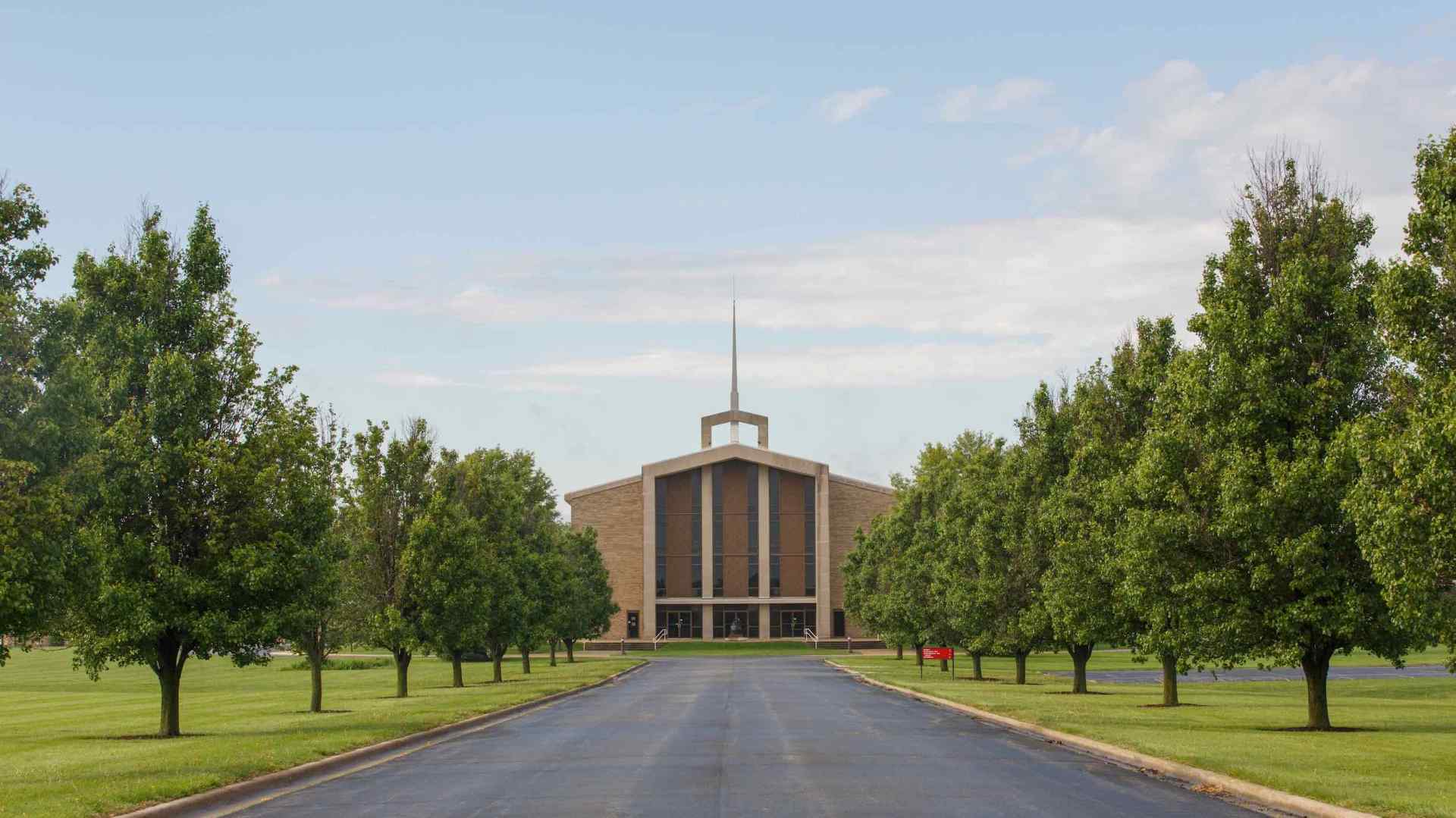
Lincoln Christian students have worshiped together every week in the campus chapel.

Lincoln Christian students have worshiped together every week in the campus chapel.

Christianity Today February 25, 2022
Courtesy of Lincoln Christian University

Update (October 12, 2023): Lincoln Christian University announced it will close at the end of this school year, and Ozark Christian College will acquire its seminary, which will retain the name Lincoln Seminary.

“There is no small amount of grief behind this news, but it is Christian grief of high order—not without hope,” said university president Silas McCormick in a statement.

—————

A small Christian college with sharply declining enrollment announced it had to “face the facts” this week and either change or die. Lincoln Christian University (LCU), in Lincoln, Illinois, is hoping deep cuts and a directional shift are enough to save it, but president Silas McCormick said the school had reached “the end of our runway” with its current model.

Lincoln Christian has about 500 students in undergraduate and graduate programs on a campus built for about 2,000, and it announced this week that it would be cutting most undergraduate majors, offering only Bible and Theology as well as Christian Ministry, and focusing instead on seminary education and vocational training at partner churches. The school is affiliated with the fellowship of Independent Christian Churches.

It will end most campus and residential activities and shut down athletics, but current students can finish out their degrees. It is considering what to do with its campus property.

“You have to face the hard facts,” said Tamsen Murray, the chair of Lincoln Christian’s board. “For me, this becomes a stewardship issue. … We will ask you to continue to invest kingdom dollars but in this new way that we think is sustainable.”

The school saw enrollment decline by 50 percent over the last decade and had a total net operating deficit of $3.5 million over that span. School leadership noticed that students were less interested in living on campus in downstate Illinois where the population was declining.

“There’s a lot of advantages to experiencing college in a residential setting,” McCormick told CT. “But you can’t force people to buy products that they don’t want.”

Many smaller Christian colleges and universities have seen declines in enrollment in recent years, although overall enrollment in Christian colleges showed a small uptick between 2010 and 2020, according to analysis of federal data by the Detroit Free Press. Schools historically similar to Lincoln Christian, like Grace University in Omaha, Nebraska, have closed. Small colleges without an endowment as a backstop have had trouble in a changing education environment.

Murray said the pandemic didn’t help.

COVID-19 “was the cherry on the sundae,” she said. Enrollment dropped “precipitously” from the fall to the spring semester, coinciding with the new omicron wave. “Illinois tightened things up again. … Schools in states that are less restrictive had fewer problems” with enrollment, she said.

LCU hopes its new idea works. The idea behind the institutional shift, according to McCormick, is that churches in their fellowship tend to train their own ministers. So LCU will focus recruitment not on 18-year-olds but on older adults who feel called to ministry and need additional theological education.

Leadership was trying to avoid a sudden closure like that in 2019 of Cincinnati Christian University, which was part of the same fellowship of Independent Christian Churches as Lincoln Christian. In late fall 2019, Cincinnati Christian announced that it was closing at the end of the semester. It had invested heavily in athletics as one last-ditch effort to save the school, but that seemed to worsen its financial problems.

By contrast, Lincoln Christian is cutting athletics completely and instead focusing more intensely on its original historic mission of training ministry leaders. Founded in 1944 as a Bible institute, LCU expanded to offer degrees in fields from business to philosophy. The university is a member of the Council for Christian Colleges and Universities (CCCU) and has remained in good standing with creditors and accreditation agencies.

But Lincoln Christian’s president’s memo about the changes is a frank assessment of problems at the school, from faculty morale to financial holes to windows that have needed fixing for years.

The memo even goes into detail about how a younger generation of students has been more hostile to professors over “any perspective that pushes back against their own” and adds that instead of engaging and resolving conflict, students will leave the school.

“When you factor these generational and cultural tendencies in with the fact that our residential student body has become very small, the result is what many of our students identify as one of our primary weaknesses: that they have not found the sense of community here that they—or we—expected,” he wrote. Later in the memo he says, “Collectively, the wind in our sails dissipated, and we are now a community in considerable need of hope.”

McCormick hopes a transparent approach helps build trust with staff, students, donors, and parents for this new chapter. McCormick and Murray wrote a note to alumni and donors saying that the greatest risk of this new plan failing was in the next 24 months and asking for their support.

Parents responding on the school’s Facebook page were largely on board with the changes, though sad. One parent, Jamie Glasford, mentioned that her son, a senior at Lincoln Christian, had already been through this because he was a student at Cincinnati Christian when it closed.

“I am … incredibly sad for all of the students who now must make some very difficult decisions,” Glasford wrote. “Too many of our Christian colleges are shutting their doors.”

“This is tough news to read not only as an alumni but as a pastor who is sending a student to LCU for next fall,” wrote Blake Canterbury. “To have them so excited, start to get things in place, and now find out that that degree they are going there for is being eliminated. It's sad and frustrating but mostly sad. I love LCU, the staff, and my time there. I pray for this strategy and leadership decision to be fruitful.”

Murray, the board chair, graduated from the LCU seminary in 1975. In her decades in Christian higher education, she has worked at small Bible colleges that had to close or merge with other schools.

“No one wants to see the mission abandoned,” she said. But she said the LCU board had been given information consistently that “this isn’t looking good.” It helped that the board adds two or three new people every year, she said, and this past year two accountants joined.

She said Cincinnati Christian is an “example of not facing the facts” and that its sudden closure produced “shockwaves” for the churches in their fellowship.

“I would say to another board of trustees, face the facts,” said Murray. “Don’t wait until the facts lead you to only one conclusion.”

Books
Review

Scripture Interprets Scripture. This Book Shows How.

Pastors and scholars can now explore cross-references throughout the Old Testament.

Christianity Today February 25, 2022
Illustration by Rick Szuecs / Source images: Sixteen Miles Out / Jonathan Castellon / Nathan Dumlao / Unsplash / Envato

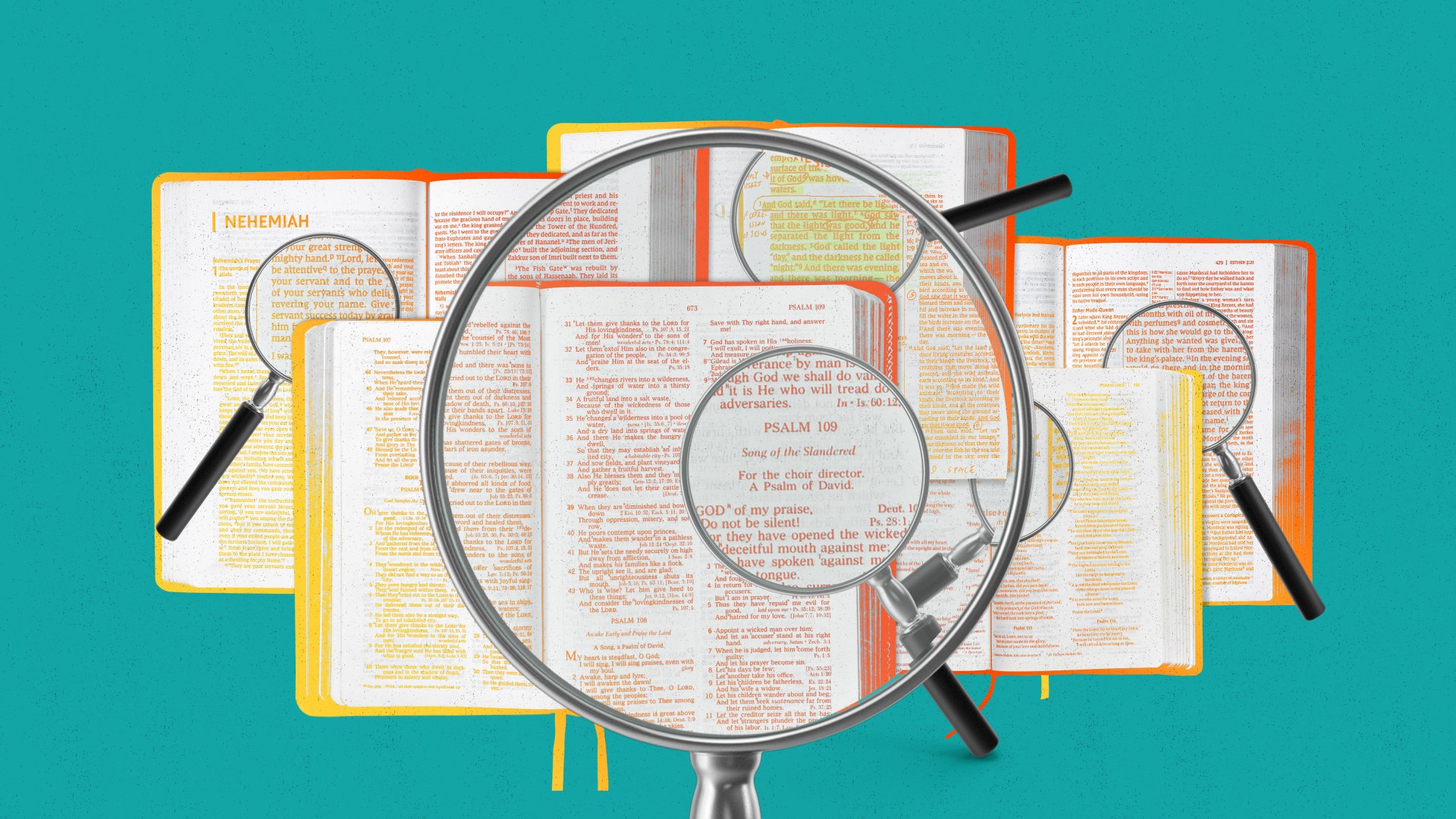
Zondervan Academic recently released a new biblical reference tool that is sure to end up in pastors’ personal libraries.

Old Testament Use of Old Testament: A Book-by-Book Guide

Old Testament Use of Old Testament: A Book-by-Book Guide

HarperCollins Children's Books

1104 pages

$37.50

The book is titled Old Testament Use of Old Testament: A Book-by-Book Guide by Gary Edward Schnittjer. Weighing in at over four pounds, with over a thousand pages, it promises to be the definitive work on the Scripture’s use of Scripture for years to come.

Preaching on the New Testament without a firm grasp on the Old Testament bears some resemblance to a child’s retelling of her parents’ romance story—which can blend multiple events or conversations into one and confuse identities or timelines.

The truth is, a whole lot happened in history before Matthew or Paul showed up on the scene in the first century—but that fact can sometimes be missed when reading a standard Bible.

Some Bibles include footnotes for verses in the New Testament that refer to Old Testament passages—but they do not show how a particular phrase or theme evolved within and across the Old Testament itself. Simply identifying the Old Testament background of a New Testament text often collapses the trajectory of its development into a single reference point.

To tell the story of Scripture well, we must trace an idea’s full development before it showed up in the New Testament. Because by the time the authors of the New Testament appeal to an Old Testament text, it has often already had its own history of interpretive reuse within the OT.

While several reference tools explore how New Testament authors quote or allude to Old Testament texts, this work presents how Old Testament authors quote other Old Testament texts.

Schnittjer does not answer all the exegetical questions at play in each instance, but he organizes the data based on shared linguistic or thematic similarities in the text. His organizational approach allows readers to explore exegetical allusions throughout the Bible—where Scripture interprets Scripture.

To my knowledge, no one has attempted anything quite like this before.

Old Testament Use of Old Testament is rigorous in its methodology, creating a helpful system to classify allusions in the text. In each instance, Schnittjer assesses the likelihood that biblical authors were interpreting or cross-referencing based on another Old Testament text.

To illustrate how a pastor might use this tool to prepare for a sermon, I will offer an example. Imagine a pastor is preaching through Hebrews and comes to chapter 2, verses 6–8:

But there is a place where someone has testified:

“What is mankind that you are mindful of them,
a son of man that you care for him?
You made them a little lower than the angels;
you crowned them with glory and honor
and put everything under their feet.”

In putting everything under them, God left nothing that is not subject to them. Yet at present we do not see everything subject to them.

It is widely recognized that Hebrews 2:6–8 references a quotation of Psalm 8. However, Psalm 8 is itself dependent on an earlier Old Testament passage, Genesis 1:16, 26, 28—and it is further evoked in Job 7:17. So before we ever interpret Hebrews 2, we should first develop a clear sense of how Psalm 8 is interacting with these Old Testament texts.

For those unable to read Hebrew and Greek, Schnittjer’s tool provides a comparison of the following passages for English Bible users to highlight the similarities:

Then God said, “Let us make mankind in our image, in our likeness, so that they may rule over the fish in the sea and the birds in the sky, over the livestock and all the wild animals, and over all the creatures that move along the ground.” (Gen 1:26)

When I consider your heavens, the work of your fingers, the moon and the stars, which you have set in place,” what is mankind that you are mindful of them, human beings that you care for them? You have made them a little lower than God and crowned them with glory and honor. You made them rulers over the works of your hands; you put every thing under their feet: all flocks and herds, and the animals of the wild, the birds in the sky, and the fish in the sea, all that swim the paths of the seas. (Ps 8:3–8[4–9]. V. 5[6] lit.)

In the tool, bold and italics indicate use of the same words in Hebrew, underlined words are similar, and the dotted underline (depicted in bold italics above) draws attention to interpretive aspects of the text.

In the discussion that follows, Schnittjer considers whether the statement “Let us make mankind” in Genesis 1:26 is a reference to the divine council. He decides in favor of this view but notes the act of creation is still written in the masculine singular form: God alone makes humanity in his image alone.

This question ties to Psalm 8:5, which reads “God” in Hebrew and “angels” in Greek and is echoed in Heb 2:7, 9 as “angels.” Schnittjer considers possible explanations for this shift, noting that the Septuagint often employs euphemistic language.

He concludes that “the psalmist uses Elohim from Gen 1 in its sense as ‘God’; the Septuagintal translators use ‘celestial delegates’ as a euphemism; and the author to the Hebrews takes advantage of the Septuagint’s translation to advance revelation concerning Messiah”.

In other words, Schnittjer does not take Hebrews 2 as offering the definitive interpretation of Psalm 8; rather, he sees it as faithfully advancing revelation about Jesus. And whether one agrees with this assessment or not, Schnittjer’s insights have made plain what is at stake.

Finally, we turn to Schnittjer’s chapter on Job, where again he identifies the exegetical allusion as correlating to Psalm 8:4. In the section on Job 7:17, we encounter another two-page discussion of its allusion to Psalm 8, with attention to the role of Psalm 144.

As before, Schnittjer has helpfully laid out the relevant passages and flagged repeated words (bold or italics) and used a dotted underline line (in bold italics below) to indicate interpretive activity:

What is mankind that you are mindful of them, human beings that you care for them? You have made them a little lower than the angels and crowned them with glory and honor. You made them rulers over the works of your hands; you put everything under their feet. (Ps 8:4-6)

Yahweh, what are human beings that you care for them, mere mortals that you think of them? They are like a breath; their days are like a fleeting shadow. (144:3-4)

[Job] What is mankind that you make so much of them, that you give them so much attention, that you examine them every morning and test them every moment? Will you never look away from me, or let me alone even for an instant? If I have sinned, what have I done to you, you who sees everything we do? Why have you made me your target? Have I become a burden to you? (Job 7:17–20)

Schnittjer discusses this development and provides an interpretation of the allusion. In this case, he argues that Job is unhappy with the conditions outlined by Psalm 8—in which humanity is the center of God’s attention. By contrast, Job would prefer to be left alone by God.

Eliphaz also evokes Psalm 8 in Job 15:14, exposing his distorted view of how retribution works—a theme that Job picks up again in 19:19.

In his summary, Schnittjer concludes that “all of this demonstrates ways that the use of scriptural traditions in the debates in Job challenge the book’s readership to rethink and modify their faulty views of retribution.”

Careful attention to the contours of these exegetical allusions suggests that Job draws on a previous paradigm from Psalm 8 (and perhaps Psalm 144), which itself is an allusion to Genesis 1. A sermon on Hebrews 2, then, has a rich field of texts from which to draw insight.

Being aware of these possibilities helps pastors and scholars determine what to look for as they teach on both Old and New Testament passages—so they can present their congregations with a richer view of God and a fuller picture of Jesus as the fulfillment of the scriptural narrative.

Carmen Joy Imes is associate professor of Old Testament at Biola University and the author of Bearing God’s Name: Why Sinai Still Matters (InterVarsity Press). She’s currently writing a follow-up book, tentatively titled Being God’s Image: Why Creation Still Matters.

News

Hungarian Evangelical Fellowship Raided amid Ongoing Conflict with Viktor Orbán

Allegations of tax fraud latest trial for Wesleyan pastor who has spoken out against Christian nationalism.

Christianity Today February 25, 2022
Courtesy of the Hungarian Evangelical Fellowship

The wounds of a friend may be faithful, but Hungarian prime minister Viktor Orbán has not forgiven his former pastor for criticizing him and says he will not, ever.

“He called me a fascist,” Orbán told The Atlantic in 2019. “And that is the only thing for which I cannot forgive him.”

The years-long conflict between the nationalist political leader and Hungarian Evangelical Fellowship pastor Gábor Iványi led to a federal raid on Monday, amid allegations of “large-scale budgetary fraud.”

The evangelical association, which employs about 1,000 people, allegedly owes 156 million forints in payroll taxes, plus a 90 million forints fine (about $742,000 total). Orbán’s government revoked the fellowship’s legal status as a church in 2011, so Hungarian Christians cannot designate part of their paychecks as tithes, a standard way of funding churches in much of Europe.

The government also stopped paying the fellowship for social services it has been providing since 1989. The charitable arm of the church association provides food, health care, legal assistance, and social work for the nation’s poor and vulnerable. Iványi told the independent news organization Telex that the government owes the charity about 12 billion forints ($36 million)—more than enough to pay the tax bill.

The National Tax and Customs Administration does not appear to agree with that accounting.

On Monday, dozens of revenue agents searched the Budapest offices of the fellowship, homeless shelter, hospital, and theological college. Hungary Today reported they seized computers and documents, which they said could contain evidence and information about “assets.”

The mayor of Budapest, an Orbán opponent, dismissed the allegations against the fellowship and condemned the raid as a personal vendetta.

The mayor said Iványi is the “conscience of the Hungarian nation,” whose witness reminds Orbán of “the democrat he once used to be, who betrayed everything he once stood for.”

Iványi told local journalists he can still recall how Orbán rose up as a democratic leader opposed to the Communist dictatorship, but recent events make him wonder what happened to the man he once ministered to.

“I mourn him and have a hard time processing what happened,” the pastor said. “He was unspoiled, courageous, and pure in speech. I couldn’t have imagined that this man, who seemed to be the iconic figure of the flag’s desire for freedom, would ruin everything we fought for together two decades later.”

Orbán achieved national prominence in 1989 when he gave a bold speech demanding free elections and the withdrawal of Soviet troops. He was elected to Parliament the following year, and before the decade was out, he became prime minister. He was only 35.

In the transition from Communism to democracy, Hungary experienced a burst of religious freedom and Orbán, as a rising political leader, committed himself publicly to Christianity. He and his wife renewed their marriage vows in a church and had their first two children baptized.

For all three services, Orbán chose Iványi to preside.

Iványi, the son of a Methodist minister and a schoolteacher, first clashed with the Communists in 1968, when he was in high school. In 1974, he was expelled from a Hungarian seminary for opposing government control over church affairs. He became an independent Wesleyan, spent two brief stints in jail, and was occasionally forced to preach in the street when Communist authorities locked him out of his church.

In 1981, a group of separatist Wesleyans were allowed to form an association and founded the Magyarországi Evangéliumi Testvérközösség, or Hungarian Evangelical Fellowship. The fellowship is not part of the national evangelical alliance, where the Hungarian Methodist Church is a member, but acts as an independent denomination. It is an association for “sincere Christians who seek salvation through the atoning sacrifice of Jesus Christ, conform to His gospel, and follow Him.”

When the country first held free elections, Iványi and Orábn were part of the same broad group of new leaders pushing for reforms. However, the relationship grew cold, according to The New York Times, when Iványi declined to publicly endorse Orbán for reelection in the early 2000s.

Orbán lost, but his party came back into power in 2010 with a sweeping victory. When the minister-elect invited the pastor to pray at an official event, he declined and wrote a public letter objecting to Orbán’s Christian nationalism. Orbán proposed to transform Hungary into what he called an “illiberal democracy,” centralizing government power and restricting civil liberties to fight against multiculturalism, immigration, feminism, LGBT ideology, “wokeness,” and anything else that would erode the dominant cultural order.

Iványi and other evangelicals were especially alarmed because Orbán claimed that Christianity could survive only when defended by a strong state. In one famous speech, the prime minister explained that “the essence of illiberal democracy is Christian liberty and the protection of Christian liberty.”

One of the first actions of the Orbán government was to strip more than 200 mostly smaller churches of their legal status. The Hungarian Evangelical Fellowship was one of the groups targeted.

The nation’s top court overturned the ruling, saying it violated constitutional protections of religious freedom, but the fellowship’s legal status has remained in limbo since then. The fellowship has about 18,000 members and 40,000 people who have elected to contribute part of their paychecks to the fellowship’s charitable work, if that is legally allowed.

The ambiguous legal victory was followed by trouble with the National Tax and Customs Administration.

Some Christians in America have applauded Orbán and his vision for what they call “national conservatism.” Rod Dreher, author of The Benedict Option, argues that the soft totalitarianism of the Left may leave Christians no option but to seek political power as a “bulwark against cultural disintegration.”

Dreher cautions that he doesn’t know if Orbán’s approach—using the government, for example, to shut down gender studies programs at universities and banning children’s books that talk about homosexuality—will actually work. But, he said, “this is what an actual pro-family, socially conservative government acts like.”

Iványi, now 70, says Orbán’s approach does work, but it shouldn’t be called Christian. It gives one party power to shut down churches and ministries and to limit free speech, free assembly, and freedom of the press, while claiming to defend “Christian liberty.”

True Christian liberty, he argues, cannot be protected by a government. It is given to Christians by grace in baptism.

In 2019, the Hungarian Evangelical Fellowship released a statement condemning Orbán’s politics. It was modeled on the Barmen Declaration, when German Christians including Martin Niemöller, Karl Barth, and Dietrich Bonhoeffer condemned Nazi attempts to co-opt Christianity.

The Hungarian Christians called their statement the Advent Statement.

“We are concerned about the arrogance of power that mixes the language of national identity with the language of Christian identity in a manipulative way,” it said. “The authoritarian exercise of power … deliberately eliminates political differences of opinion through the eradication of independent media, spreading fake news, discrediting and character assassination, and harassment by authorities.”

That may be why Iványi wasn’t surprised to see government agents blocking the door to the fellowship offices on Monday. An independent video journalist, broadcasting live, showed the pastor walking up to the door, a disposable mask partly covering his large white beard, and addressing the agents calmly, before going inside to see what they took.

In this political climate, Iványi has said before, he is called to go straight into a headwind that might sweep his entire ministry away. But he trusts God.

“If it is swept away now, I will say that with the blessing of God we have endured [so many] years in the hurricane,” he told a Hungarian journalist. “As a deep believer, of course, I am convinced that our mission will not end when the head of government decides on it, but when the Eternal decides that he no longer needs this work. … My job is to go to the wall and trust firmly in the wisdom and mercy of the Good God, as he is one level above the [tax authority] and the head of government.”

Theology

Theology Cannot Save Us

The recent splinters in evangelicalism arise more from tribal loyalties and political rhetoric than doctrinal differences.

Christianity Today February 24, 2022
Illustration by Mallory Rentsch / Source Images: Tim Marshall / Tim Wildsmith / Unsplash

This piece was adapted from Russell Moore’s newsletter. Subscribe here.

Once when I was a youth pastor, a woman pleaded with me to let her rebellious son go to youth camp even though he missed the deadline to sign up.

“I just want him to get tired enough that he’s moved to walk down the aisle one time,” she said. “Then I’ll know that no matter what he does after that, at least he’ll be in heaven.”

I sighed at the cultural Christianity I’d come to know all too well—one that substituted a momentary repetition of words for the gospel. The problem was that I thought theology was the answer. Many of us did.

The folk religion and human-centeredness of much of American revivalism contrasts with a “big God” theology and a focus on fidelity to confessions of faith. This makes sense. A thorough-going pragmatism can lead quickly into a “whatever works” mindset. This kind of anticreedalism leads not to the absence of creeds but to the proliferation of unwritten and unspoken creeds.

At the same time, many of us thought the problem could be solved by connecting the rootlessness and overemphasis on novelty in American evangelicalism with an older theological tradition.

In one sense, I still think that’s valid. A church that learns from John Calvin or John Wesley is tied to a deeper stream, since Calvin and Wesley are themselves connected to Augustine, Irenaeus, and so on.

And yet, the quest for novelty and for narrowing parameters often turned out to be just as present in theologically focused evangelicals—and perhaps even more so. It’s easy, after all, to skip straight from the apostle John to John Calvin to Jonathan Edwards to the guy with the Jonathan Edwards portrait as his Twitter avatar.

Likewise, many of us thought a more theologically robust evangelicalism would keep us from fragmenting. After all, unlike those who believe that doctrine divides, we knew that a people who share deep and abiding convictions would be united, come what may.

But that’s not exactly how it worked.

The divides in American evangelicalism—and in various denominations—did not end up splitting along the lines we all thought they would: Calvinist vs. Arminian, complementarian vs. egalitarianism, revivalist vs. emerging church, or traditionalist vs. seeker sensitive.

Some of the people my 2007 self might have dismissed as theological pragmatists have ended up showing some of the most grit and conviction of anyone in the past several years. Alternatively, we saw some who were doctrinally precise do the exact opposite.

To imagine telling my younger self, 15 years ago, which people would now be considered allies and which ones would no longer be speaking to one another is jarring—especially when some who once emphasized the sufficiency of Scripture now align with activist atheists to critique the theology of evangelicals who should belong to the same tribe.

None of that would have been, as the cliché goes, on my 2007 bingo card.

Turns out, a lot of what we thought was evidence of a Christian worldview for some evangelicals turned out to be the same tribal loyalties and political rhetoric they would have employed if Jesus were still dead.

Some of that has to do with what we’ve discussed here before—the idea of “revealed preference,” mentioned in a political context by writer David Frum. Over time, we start to realize that even people who held the same views held them for different reasons. And often the differences were between what one saw as a central issue and what one saw as peripheral.

There’s a huge contrast between the complementarian who believes that the Pauline epistles prescribe, in a very limited number of callings, some differentiation between men and women and the complementarian for whom gender is the grid through which almost every cultural phenomenon is situated.

The egalitarian who thinks 1 Timothy 2 addresses a contextually local problem in Ephesus and that God gifts both men and women for pastoral leadership in the church differs from the egalitarian who thinks that Father, Son, and Holy Spirit are patriarchal words that must go away.

One Calvinist might see unconditional election as an explanatory doctrine meant to undergird what all Christians already believe—that Jesus “sought me and bought me with his redeeming blood.” Another might see predestination as a central theme of the Bible.

Likewise, a charismatic who believes all the gifts of the Spirit still operate for building up the church is radically different from the charismatic who believes that speaking in tongues or prophecy distinguishes “anointed” Christians from lifeless ones.

Sometimes theology leads us to another kind of pragmatism—for instance, a “seeker sensitivity” in which the seekers are defined as angry Christians looking to fight for the sake of fighting. Some forms of revivalism have confused a heightened emotional experience for conversion.

This has led to some Christians holding on to that felt experience for assurance and others despairing that their felt experience wasn’t dramatic enough. Still others fake the emotion, hoping that if they emote long enough, they’ll eventually find the real thing.

That can happen not only with emotions but also with the mind. A confession of faith can become a revival testimony for people who can’t cry at an altar or speak in tongues.

Theology matters. Obviously, I still believe that, or I wouldn’t spend my life connecting Christian theology to culture. But if we’ve seen anything in the evangelical meltdown of the past five years, it’s that theology is not enough. And left on its own, theology can become just as much of a prop for a cultural, politicized Christianity as anything else.

We cannot, as scientist and philosopher Alfred Korzybski put it about a very different matter, confuse the map for the territory—just as we cannot confuse our weather app for what’s actually happening outside. Theology is a word about God, which always points us back to the Word who became flesh and dwelt among us.

There’s a kind of theology that can illuminate how to worship God and be on mission in the world. But there another kind of theology that becomes defined by winning debates in whatever current controversy is trying to separate the Christian wheat from the Christian tares.

Theology defined by the Bible sees itself as the map, not the territory. It refuses to yield to the idea that faith is amorphous and without content. God has spoken and He has spoken in words.

Yet this sort of theology also will acknowledge that God has given us both clarity and mystery, speaking to us as whole persons—minds, hearts, consciences, intuitions. The God of the Bible cannot be reduced to a syllogism. But those who try to do so can easily replace a confession of faith for faith itself; ideology for the gospel; a theological tribe for the one holy, catholic, and apostolic church; or, worst of all, Christology for Christ Jesus himself.

When Jesus said that he was going away, he told his disciples, “You know the way to the place where I am going.” Thomas said exactly what I would have said: “Lord, we don’t know where you are going, so how can we know the way?” What he wanted was an abstraction, a map.

Jesus said, “I am the way and the truth and the life. No one comes to the Father except through me” (John 14:4–6). We need truth and life if we are to follow the Way. He never told us, “Here, memorize this.” He simply said, “Come, follow me.”

Theology is necessary, but it is not enough. Let’s not confuse the map for the territory.

Russell Moore leads the Public Theology Project at Christianity Today.

Apple PodcastsDown ArrowDown ArrowDown Arrowarrow_left_altLeft ArrowLeft ArrowRight ArrowRight ArrowRight Arrowarrow_up_altUp ArrowUp ArrowAvailable at Amazoncaret-downCloseCloseEmailEmailExpandExpandExternalExternalFacebookfacebook-squareGiftGiftGooglegoogleGoogle KeephamburgerInstagraminstagram-squareLinkLinklinkedin-squareListenListenListenChristianity TodayCT Creative Studio Logologo_orgMegaphoneMenuMenupausePinterestPlayPlayPocketPodcastRSSRSSSaveSaveSaveSearchSearchsearchSpotifyStitcherTelegramTable of ContentsTable of Contentstwitter-squareWhatsAppXYouTubeYouTube