Reply All

Responses to our December issue.

Garrhet Sampson / Unsplash / Edits by Rick Szuecs

Joseph’s Simplicity Was Actually Spiritual Maturity

I received this article in the print edition the week before I was scheduled to preach about the angel speaking to Joseph. It was perfect timing. I loved the parallels the article made between Joseph and internally displaced persons.

Jared Martin (Facebook)

My Boss Is a Jewish Construction Worker

I found myself wondering if “construction worker” culturally connotes Jesus’ place in society even more than “builder.” The idea of a builder can still cause one to envision an entrepreneur who designs and builds impressive structures, while a construction worker is more of a manual laborer working for others. But perhaps I am carrying it further than Monson (and the original Greek language) intended.

Kristen Kansiewicz Springfield, MO

Regional building practices in the US, and elsewhere, reflected local availability much more when long-distance transport of heavy materials was less practical. Such architectural evidence is apparent in older buildings and other structures throughout the world. So maybe carpenter and unemployed would have been synonymous in Nazareth. The author seems to imply that the King James Version translators originated the use of carpenter in English in Mark 6:3, although he doesn’t state that directly. Carpenter was, though, used in that verse in earlier English translations by Wycliffe and Tyndale, Matthew’s Bible, and the Geneva Bible.

Maynard Wright Citrus Heights, CA

As a former employee at the University of Northwestern, KTIS, I am proud of the diligent research you’ve done to identify Jesus as a common man. We think of the one who set aside the riches of heaven to take the form of a servant!

Wayne Pederson Naples, FL

We’ve No Less Days to Sing God’s Praise, But New Worship Songs Only Last a Few Years

As the worship teams keep a new rotation, those in the pew don’t know most of these new songs. The up-front folks should be prompters … not star actors!

George Williams Franklin, TN

If a Social Issue Matters to God, the Church Should Be Praying About It

This article says all that I have been thinking for a while about intercessory prayer and gives some fresh ideas how to “do” such prayers in contemporary worship. I would only add 2 Chronicles 20:12: “For we are powerless against this great horde that is coming against us. We do not know what to do, but our eyes are on you” (ESV). I have used that in intercessory prayers and feel it gets the plight and the answer.

John Faris Bangor, Northern Ireland

No One Took Christ Out of Christmas

I am surprised to see no mention of the Puritan view that heavily influenced Great Britain and the British colonies for almost two centuries and the rehabilitation of Christmas in the 19th century, including Dickens’s A Christmas Carol. His Scrooge says several things that indicate that he was not only a miser because of his unfortunate childhood, but that he was also raised as a Puritan and espoused a view of Christmas that was very common.

Wendy Pradels Strasbourg, France

It always brings a smile to my face when I am at a grocery store and “O Holy Night” comes on. Amazing! Especially love the second-to-final paragraph where Dr. Larsen puts the onus on us to celebrate “Christmas in a Christian manner.”

@SundaytoSaturd1 (Twitter)

Disowning ‘Evangelical’ Is a Denial of Responsibility

Perhaps I’m just very old, but evangelical does not seem to mean what it did when I first heard of it, decades ago. In fact, it seems to have gone through several iterations of meaning. In this article, the author neglected to provide even a brief definition of what the term generally refers to for those of us who, being of (old-fashioned and in my case, not Calvinist) mainstream Protestant denominations, are not even sure if we still qualify as “evangelical.” That would make it easier to know if the call to “own it” is speaking to me, too.

Gay Gragson Athens, GA

5 Books on the History of Christmas

I have benefitted greatly both personally and professionally from CT. That is why I am writing with a concern. The last line of one review says, “There is a special place in Hollywood hell for Santa Claus Conquers the Martians.” I don’t believe “Hollywood hell” is a term that CT truly wants to use. It minimizes hell, which is a real place where people who don’t know Christ actually go to experience the eternal, conscious torment all our sins deserve. This is like the opposite of using God’s name in vain, but I believe just as serious.

Luke Hatfield Ripon, WI

Ideas

Not All That Glitters Is Photoshopped

Columnist

When everything seems fake, Jesus says, “Put your hand in my side.”

Illustration by Rick Szuecs & Mallory Rentsch / Source Images: Europeana / Tirza van Dijk / Unsplash

We recently took a family road trip to the coast of Florida. Along the beach, the white sand pressed up around sprouts of tall, wavy grass. If you looked at it just right, the sand looked like snow.

A few weeks later, on another trip, we passed through New Mexico and encountered an unexpected snowfall. In that moment, the high desert looked a lot like the Florida coast, with tufts of grass poking out through a white blanket. This time, the snow looked like sand.

We all know that things aren’t always what they seem. Context is essential. Without the smell of the air or the sensation of temperature, you wouldn’t have known whether to bring your wool socks or your flip-flops.

And yet, we regularly act as if things are always what they seem. We see photographs on social media and news feeds and immediately forget that our perspective is limited, convinced that we know what we’re looking at. We communicate with one another in compartmentalized ways. We label others before asking deeper questions—and we often label ourselves before questions can be asked of us. We trade fuller expressions of ourselves for symbols and sound bites shared before abstract audiences of acquaintances.

Context can be cumbersome, yes. But without it, someone may attempt to convince us we’re near the coast when in fact we’re in the mountains. Someone may add their own captions to our stories in ways that mislead or misrepresent the truth.

And without context, we can even be tempted to affirm false narratives others spin about ourselves because we crave community and don’t want to risk isolation by denying the crowd. Given enough social pressure, we may become convinced we’re on the beach, only to find ourselves caught in a snowstorm unprepared.

When we experience this—and so many of us have—it is disorienting. We ask how we can know what’s real, what’s sand and what’s snow.

When it comes to faith, it’s popular today to respond to this challenge by mistrusting everyone, escaping out the back door, and deconstructing whether we believe sand or snow exist at all. We wonder if everything we saw was just photoshopped. Like Thomas, we doubt and withdraw to our private judgments.

To our suspicion Jesus says: “Put your finger here; see my hands. Reach out your hand and put it into my side. Stop doubting and believe” (John 20:27).

We can’t physically touch Jesus’ wounds, of course. But they still abide with us, when we meditate on these words with humility and hope, when we sing together, when we take someone a meal. There will be questions. But the truth of Christ is making itself known right here, in whatever real circumstances we are facing right now.

Seeing accurately is a gift. Where the truth is, there’s freedom. But seeing accurately takes effort. It takes holding the lens of Scripture up to our current events, our social media posts, our public and private conversations.

When we fail to do this, it’s not just that we cease to know the truth. We lose touch with our God, who is higher and who gives ultimate context to the truth.

He’s seen firsthand the Great Flood and the chaos that existed before creation, and he is the maker of both the sand and the snow. He is the culmination of all experience and wisdom.

Every day seems to bring the same old fears and temptations dressed up in some new fashion. Trends and half-truths come as relentlessly as the waves of the sea. But we can be unmoved. God’s peace is our light, even in dark times, taking hold of our hand, giving us help:

For I am the Lord your God
who takes hold of your right hand
and says to you, Do not fear;
I will help you. (Isa. 41:13)

God reveals himself to us in Spirit and in truth (John 16:13). So take courage, roll down the window, and find out if the air is cold or if it smells like ocean salt. Truth is knowable, and Jesus is Lord over every inch of this world. See for yourself, in bare feet or in boots.

Sandra McCracken is a singer-songwriter in Nashville and author of Send Out Your Light: The Illuminating Power of Scripture and Song.

We Live in a Global Generation

CT’s growing international team will serve the world’s growing church.

Illustration by Rick Szuecs / Source images: ShotPot / Los Muertos / Pexels / Usen Parmanov / Unsplash / Envato


When I was courting the brilliant woman who became my wife, I approached visits to her hometown of Atlanta with a certain trepidation. She belonged to a close-knit Chinese American Christian community. Most of the members of the older generation had immigrated from Taiwan for their graduate studies, built successful careers, and invested in their families and church. I was an outsider in more ways than one, and there was a no small amount of skepticism that our relationship could work.

So it meant a great deal when one of the elder statesmen of that community—let’s call him Thomas, because he never took credit for his own good deeds—welcomed me with open arms. He told me stories about the Atlanta church he had labored alongside his friends to build and about other churches he loved and served back in his homeland. It was all, at the end of the day, one church, one kingdom, one body of believers on every continent united by the Spirit of God.

Thomas died early in the coronavirus pandemic, leaving behind for a season a wife who loves him dearly and two sons who do him enormous credit. He also leaves behind a generation impacted by him and his love for the global church.

I’ve thought often about Thomas as we hired our first CT Asia editor. Sean Cheng comes to us through our friends at a missionary organization that has long served the people of East Asia. He is a deeply experienced editor and innovator in digital media. With time stateside and time overseas, Sean will help us source more stories on what God is doing among the fellowship of believers in that part of the world. We are also presently hiring editors or building our presence in strategic cities in South Korea, India, Southeast Asia, and the Middle East.

The American church itself is increasingly global, populated by men and women who come from far-flung places. It’s filled with people like Thomas, who inspire people like me to remember that the kingdom of God stretches immeasurably beyond our shores. CT’s Global Initiative is an effort to embrace and encompass that fact.

The kingdom of God is far greater than any of us can capture in a single glance. It is capacious and colorful, broken and beautiful, wise and joyful, and lovely in all its complexity. There is so much we have to learn from one another, so much we might do together. We hope the Global Initiative will raise up the next generation of Thomases: men and women who see the church as one many-colored garment wrapped around the planet, striving to serve the least and the lost.

Timothy Dalrymple is the president and CEO of Christianity Today.

Theology

Our March Issue: Defining Deconstruction

Why attempts at a synonym fail.

So it’s just what people are calling apostasy these days?”

My friend was trying to understand Christianity Today’s articles on people “deconstructing” their faith. I admitted that yes, it’s often apostasy. For example, when former pastor Joshua Harris announced on Instagram, “I am not a Christian,” he added, “I have undergone a massive shift in regard to my faith in Jesus. The popular phrase for this is ‘deconstruction,’ the biblical phrase is ‘falling away.’”

Others using the word, I told my friend, remain Christian but are disturbed by discovering how institutional conditioning and cultural assumptions have shaped many of their beliefs. Once you see how insidious and pervasive racism, sexism, and consumerism can be, Paul’s command to test all things (1 Thess. 5:21) takes on special urgency.

“Right,” my friend said. “ ‘Do not conform to the pattern of this world, but be transformed by the renewing of your mind’ (Rom. 12:2). That’s not deconstructing faith. That’s Christian faith. Or just call it ‘changing your mind.’”

As an editor, I assured him I usually prefer precise words to ambiguous ones like deconstruction. But at CT, I’m surrounded by good words that require constant clarification and differentiation, evangelical chief among them. In fact, frustration with the increasing ambiguity of evangelical is a common starting point for many who now describe themselves as deconstructing.

In this month’s cover story, theologian Kirsten Sanders offers a helpful definition of deconstruction: “the struggle to correct or deepen naive belief.” Even more helpfully, she rightly sees that struggle as akin to our theological work of knowing and loving God more deeply.

For my friends who identify as actively deconstructing, that struggle sometimes looks like questioning. Sometimes it’s more like fatigued despair or anger. But that’s how the great restorationist movements that have reformed churches and societies looked, too. Puritans, Hussites, Anabaptists, Moravians, Methodists, and even those hard-to-define evangelicals came together because they were horrified by sin, idolatries, and passive cultural Christianity. Yes, deconstruction must eventually give way to reformation. You can’t correct or deepen simply by staying angry at sin.

But you can’t rush the struggle, either. We won’t correct or deepen anything if we agree that the right biblical phrase is “falling away.” Instead, it’s the “You deceived me” of Jeremiah, the “How long” of the psalmist, the “They have taken my Lord away” of Mary at the tomb, and the “We had hoped” on the road to Emmaus.

Ted Olsen is executive editor of Christianity Today.

News

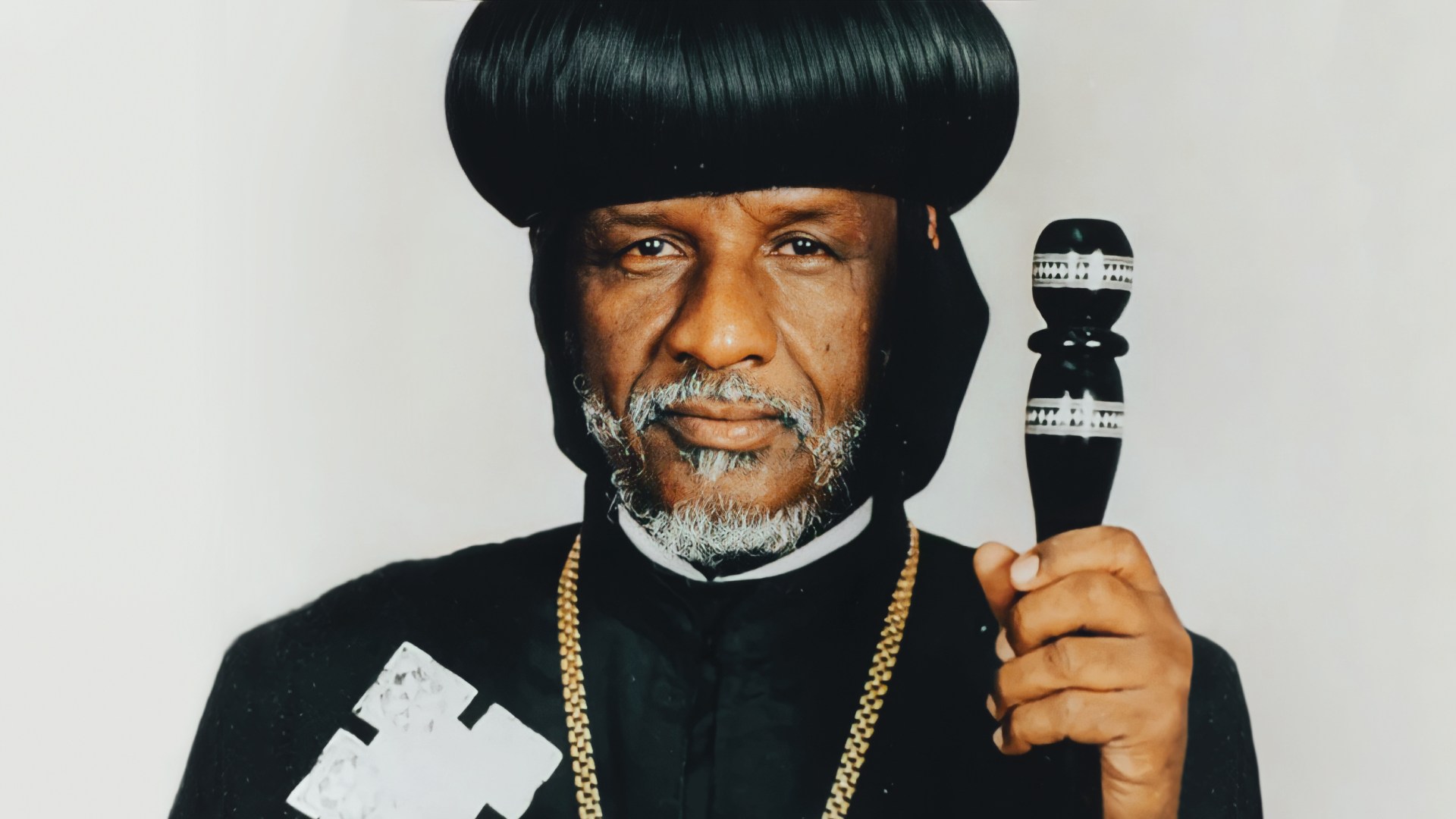
Eritrean Patriarch Abune Antonios Dies After 16 Years in Detention

Former Orthodox leader was long confined for resisting government requests to excommunicate thousands of members.

Abune Antonios, Eritrean Orthodox Patriarch

Abune Antonios, Eritrean Orthodox Patriarch

Christianity Today February 11, 2022
Photo courtesy of HRCE

Abune Antonios, a confined Eritrean Orthodox Church patriarch and the longest-serving prisoner of conscience in the Horn of Africa, died on February 9 at the age of 94.

He was still serving detention in the Eritrean capital, Asmara, after his arrest in 2006 just two years after his installation as the third patriarch of the Eritrean Orthodox Church. For 16 years, he was kept in solitary confinement under the orders of the country’s authoritarian leader, President Isaias Afwerki, for his resistance to government interference in the ancient church.

Eritrea has long been on the US State Department’s list of worst religious freedom violators, and ranks No. 6 on Open Doors’ 2022 list of where Christian persecution is worst.

Rashad Hussain, the newly confirmed US religious freedom ambassador, said in a tweet yesterday that he was “saddened by the news” and that “Patriarch Abune Antonios was a true leader.”

“It is very unfortunate that the patriarch died while in detention. There was no reason for the government of Eritrea to put him in detention,” Francis Kuria, the secretary general of the African Council of Religious Leaders, told RNS. “The Orthodox Church in Eritrea and elsewhere is always very supportive of the people’s development.”

Archbishop Angaelos of the Coptic Orthodox Church in London announced the loss on social media, saying the patriarch had passed away “after a long battle with illness, and an even more painful battle with injustice.”

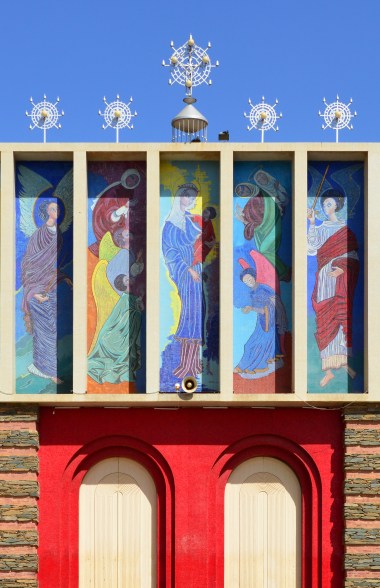
The facade of Enda Mariam Coptic Cathedral of the Eritrean Orthodox Tewahedo Church, in Asmara, Eritrea.

Antonios was buried yesterday in Asmara at a monastery to which he belonged. A large crowd gathered at the burial site, many of whom had traveled long distances on foot, according to reports.

“We pray repose for His Holiness, and comfort and support for our #EritreanOrthodox sisters and brothers in Eritrea, Britain and around the world,” said Angaelos in a February 9 tweet.

The patriarch’s death in detention is likely to widen the split in the Eritrean Orthodox Church, triggered by Antonios’ removal and mistreatment.

In 2007, with the support of the Eritrean government, Antonios was replaced as patriarch by Abune Dioskoros. However, many adherents and clergy both in Eritrea and in the diaspora continued to follow Antonios during his detention.

One of the patriarch’s consistent advocates, the US Commission on International Religious Freedom (USCIRF), explains:

Very early in his reign as Patriarch, Abune Antonios confronted state interference within his church. He resisted government requests that he excommunicate 3,000 members and protested the arrest of priests. On January 20, 2006, authorities notified Patriarch Antonios he would be removed as Patriarch and placed him under house arrest.

One year later, on January 20, 2007, authorities confiscated Patriarch Antonios' personal pontifical insignia. On May 27, 2007, the Eritrean government replaced Patriarch Antonios with Bishop Dioscoros of Mendefera, forcefully removed the Patriarch from his home, and detained him at an undisclosed location. Patriarch Antonios continues to be held incommunicado and is reportedly being denied medical care despite suffering from severe diabetes. On July 16, 2017, authorities allowed Antonios to make a public appearance for the first time in over a decade. While under heavy security, Antonios attended mass at St. Mary's Cathedral in Asmara, but was prevented from giving a sermon or subsequently speaking with congregants. Three days later, on July 19, the government moved Antonios to a new location, reportedly to provide better living conditions.

In 2019, bishops of the Holy Synod of the Eritrean Orthodox Tewahedo Church excommunicated Antonios, accusing him of heresy. The move was condemned by the Standing Conference of Oriental Orthodox Churches.

Antonios’ death brought back into focus the continued persecution and lack of religious freedom in Eritrea.

Eritrea’s authoritarian regime, one of the most repressive in the world, often arbitrarily arrests, detains, and imprisons its people because of their faith, according to human rights and anti-persecution groups.

The US State Department estimates there are thousands of prisoners held for their faith. USCIRF includes more than 45 cases on its Victims List; Abune Antonios was listed as Prisoner #260.

At the moment, only the Roman Catholic Church, Coptic Orthodox Church, Sunni Islam, and the Lutheran Church-affiliated Evangelical Church of Eritrea are the legally permitted religious groups.

Some religious leaders from the Orthodox, Full Gospel, and Jehovah’s Witness faiths have remained in imprisonment for more than 15 years, according to human rights organizations. World Watch Monitor chronicles many incidents.

“We appeal to the government of Eritrea to create a conducive environment where freedom of religion and belief is fully exercised. There should be no reason to jail religious (people for their faith),” said Kuria. “The government should support religious leaders as partners. The action to constrain religion and religious leaders is counter productive.”

According to Kuria, the problem in Eritrea is that the government clamps down on any alternative voices—even the very mild and conservative—in a desire to be the only source of authority.

Antonios was arrested after he became critical of government excesses and resisted continued interference in Orthodox Church affairs by officials.

While in detention, Antonios had been denied the right to attend church services and was not allowed any visitors, including his followers, clergy, or relatives. He was not given a chance to challenge his detention in a court of law.

“Despite 16 years of unremitting pressure, mistreatment, and defamation, the patriarch never compromised, even when it would have led to his reinstatement,” said Mervyn Thomas, founder and president of CSW (Christian Solidarity Worldwide), in a February 10 statement. “He chose instead to protect the integrity and doctrine of the church with which he had been entrusted at the cost of freedom and comfort in his twilight years.”

Thomas urged the international community to honor the patriarch’s courageous stand for freedom of religion by galvanizing efforts to secure the release of three Orthodox priests for whom Antonios advocated as well as thousands of others detained on account of conscience, religion, and belief.

Additional reporting by CT

History

Why John Perkins Didn’t Want More White Christians like Jonathan Edwards

A violent and sinful history calls for a clearer presentation of the gospel.

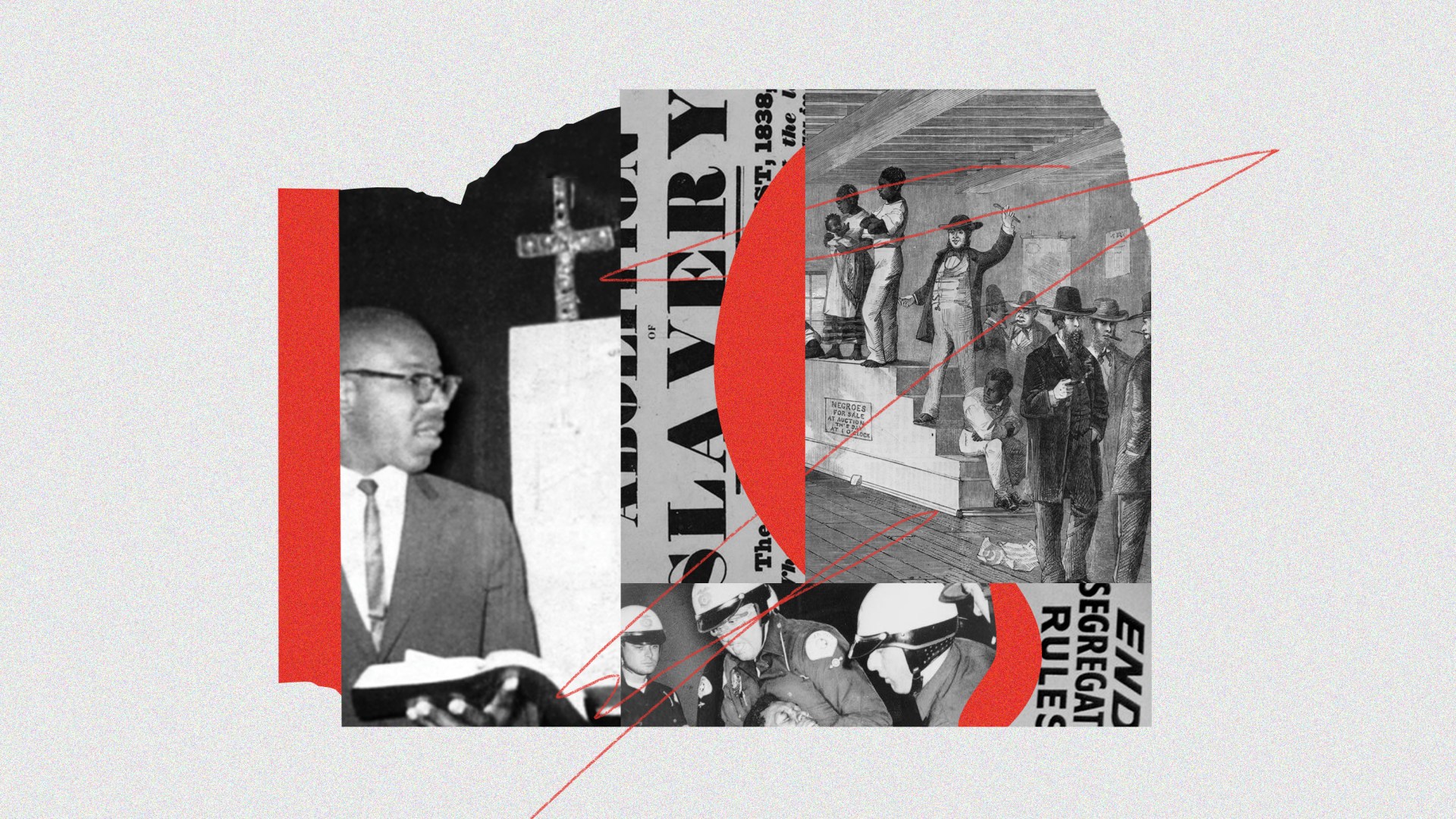
Left image: John M. Perkins preaching in 1961

Left image: John M. Perkins preaching in 1961

Christian History February 11, 2022
Illustration by Mallory Rentsch / Source Images: Courtesy of John and Vera Mae Perkins Foundation / WikiMedia Commons / Rischgitz / Stringer / Getty

John Perkins stood up at a planning meeting for a Billy Graham crusade in Jackson, Mississippi, in 1975.

The Black pastor and civil rights activist was invited to the meeting, along with a group of African American clergy from the area, because Graham himself had insisted the evangelistic event would be desegregated. Black and white Mississippians would hear the gospel together. Perkins loved Graham and his powerful gospel message, and he was excited to hear that the world’s leading evangelist was taking practical steps to end segregation in the church.

So he went to the Holiday Inn in Jackson and sat down on the Black side of the conference room, with all the Black pastors, and looked over at the white side, with all the white pastors.

Then he stood up.

He asked the white pastors whether their churches were committed to accepting new converts from the crusade into their congregations if the born-again brothers and sisters were Black.

He didn’t think they were ready for that in Mississippi. And if they weren’t ready, he didn’t know whether he was either.

“I don’t know whether or not I want to participate,” Perkins said, “in making the same kind of white Christians that we’ve had in the past.”

He was thinking of all the white Christians who had closed the doors of their churches to Black people. And the white Christians who had supported the Mississippi Plan to stop Black people from voting so they could, as one state legislator described it at the time, “establish white supremacy in the State, within the limits imposed by the Federal Constitution.”

He was thinking of the white Christians whose only response to racist violence perpetrated on Black bodies was to say, “Wait.” And the white Christians who not only had not been moved by the injustice of Jim Crow to join the civil rights protests but also had seen Black churches in their own towns obliterated—burned and bombed—and never said a thing.

And he may also have been thinking of Jonathan Edwards.

Opponents of abortion on demand had hoped the U.S. Supreme Court would rule in favor of an Illinois statute that restricts abortion. But in a decision early last month, all nine justices refused—on procedural grounds—to decide the case. The Court’s action has the effect of upholding an appeals court ruling against the law.The Illinois statute required doctors to provide information about abortion procedures and the unborn child to women seeking abortions. Doctors were required as well to use techniques most likely to preserve the life of a fetus that might survive an abortion.The law initially was challenged in federal district court by doctors who perform abortions. The court ruled that parts of the law that would impose criminal penalties on physicians were unconstitutional, in light of the Supreme Court’s Roe v. Wade decision legalizing abortion. An appeals court later affirmed the district court ruling against the Illinois law.A prolife physician named Eugene F. Diamond then appealed the case, known as Diamond v. Charles, to the Supreme Court. The state of Illinois, whose law was at stake, did not enter an appeal, but merely filed a “letter of interest” in the case. The Supreme Court refused to rule on the case, saying Diamond, acting on his own, did not have sufficient legal standing to appeal the case.The high court concluded that Diamond could not prove he had any direct stake in the case, even though he disagrees with the practice of abortion. “The presence of a disagreement, however sharp and acrimonious it may be, is insufficient by itself,” the Court said, to seek a resolution in the federal court system. The Supreme Court holds that persons seeking federal court action must show they suffered some actual or threatened injury in the matter that is being appealed.Douglas Johnson, of the National Right to Life Committee, said the ruling “should not discourage future efforts to defend state laws” restricting abortion. However, Johnson said, it is essential that state officials be party to those cases.WORLD SCENEIRELANDA Referendum on DivorceVoters in the Republic of Ireland could decide as early as this month whether to lift a constitutional ban on divorce.The government announced last month it would introduce legislation to hold a referendum on the divorce ban. The 1937 constitutional provision can be changed only by a majority of the popular vote in a referendum.Opinion polls indicate as many as 77 percent of the Irish population favor allowing divorce “in certain circumstances.” However, the same polls show only a narrow majority willing to vote for the complete removal of the constitutional prohibition.If the ban is removed, the government says divorce would be allowed only in cases where a marriage can be shown to have failed and the failure has continued for a period of five years. The Roman Catholic Church, which claims 90 percent of the Irish population, opposes divorce. However, Ireland’s bishops are divided over how actively they should oppose efforts to lift the constitutional ban.HUNGARYChurches Help Drug AddictsSeveral churches in Hungary are launching drug rehabilitation programs with the government’s permission. Hungarian Christians say the efforts are contributing to the relaxation of tensions between church and state in the communist country.Baptists in Budapest have established a coffee house that seeks to minister to people with drug and alcohol dependencies. They are also setting up a rehabilitation center about 125 miles from the city. Pentecostal churches are opening a rehabilitation center just outside Budapest. And the Free Christian Church Council is planning to establish treatment facilities.These developments gained impetus from meetings conducted last year by American evangelist Nicky Cruz. A former drug addict and New York City gang leader, Cruz visited Hungary at the invitation of Hungarian churches.The nation’s communist government earlier had asked the churches to help combat the growing problem of drug and alcohol dependency among young people.More than 5,000 people heard Cruz speak at two evangelistic meetings. In addition, physicians and church leaders from five East European nations attended a seminar on drug addiction led by Cruz.The evangelist stressed the spiritual component in rehabilitation, saying, “Only after they have truly received Christ and are born again will they begin to consider the way they talk, the way they dress, the company they keep, the places they go, the things they do.”LATIN AMERICAOpposing WEF MembershipMeeting in Venezuela, delegates to a general assembly of the Confraternity of Evangelicals in Latin America (CONELA) voted against joining the World Evangelical Fellowship (WEF).CONELA’s executive committee had recommended that the Latin American group join WEF. But a delegation from Mexico led an effort against the proposal, saying WEF needs to make itself better known among Latin American church leaders. While voting against WEF membership, the assembly did accept an invitation to send observers to WEF functions.After the vote, a CONELA official said most evangelical church leaders in Latin America object to the practices and policies of the World Council of Churches. As a result, he said, they view with suspicion any unknown international and interdenominational agency.In other action, delegates to the CONELA general assembly approved a declaration that calling it “another gospel [that offers] temporary liberation from physical problems such as poverty and certain political dictatorships.” The declaration calls for renewed evangelism across Latin America and asks both leftist and rightist governments to respect the “personal rights” of individuals.Delegates elected Virgilio Zapata, general secretary of the Evangelical Alliance of Guatemala, as CONELA’s new president. Outgoing president Marcelino Ortiz of Mexico will continue to serve on the organization’s executive committee. Formed four years ago in Panama, CONELA includes 206 denominations and Christian service agencies.ROMECompetition from ‘Sects’The Vatican has released a report recommending changes in Catholic parish life to help stem the loss of members to other religious groups. Chief Vatican spokesman Joaquin Navarro Valls says competition from non-Catholic groups is “one of the major dangers facing the church.”The 27-page document, titled “Sects or New Religious Movements: A Pastoral Challenge,” says sects have flourished because of “needs and aspirations which are seemingly not being met in the mainline churches.” Non-Catholic religious movements succeed because they provide “human warmth, care and support in small close-knit communities … [and] a style of prayer and preaching closer to the cultural traits and aspirations of the people.“The challenge of the new religious movements is to stimulate our own renewal for a greater pastoral efficiency,” the report states. The document cites “deficiencies and inadequacies in the actual behavior of the church which can facilitate the success of sects.” And it calls on the Catholic church to consider changes, including the creation of “more fraternal” church structures that are “more adapted to people’s life situations.… Preaching, worship and community prayer should not necessarily be confined to traditional places of worship.”The document drew from information contained in questionnaires completed by some 75 bishops’ conferences around the world. Luis Eduardo Castano, ecumenical officer for the Latin American Catholic Bishops’ Conference, said the church is concerned about the growth of fundamentalist and charismatic Protestant groups in Latin America.

Shaking Christians and convicting sinners

Edwards, of course, was a Puritan theologian and pastor in New England who had died more than 200 years before. He had a marked influence on American revivalists, from Charles Finney to Billy Graham. And he deeply shaped a number of notable 20th-century preachers, including John MacArthur and John Piper, who once said that Edwards’s writings were, for him, “more Christ-exalting, more God-revering, more Bible-illuminating, more righteousness-beckoning, more prayer-sweetening, more missions-advancing, and more love-deepening than any other author outside the Bible.”

For most of American history, Edwards was known specifically for his role in the Great Awakening. He preached an incredible sermon about hell and spiders that spurred on the fire of revival.

The sermon was so iconic, so central to what revivalistic-minded Christians in America meant when they said “revival,” that Billy Graham once preached the same sermon. In Los Angeles in 1949, Graham told his audience he was going to do something a little different and instead of preaching his own words, he was going to preach Jonathan Edwards’s.

“It’s not too long,” he said. “I’m going to read it, and extemporize part of it, but I want you to feel the grip, I want you to feel the language. I’m asking tonight the same blessed Holy Ghost that moved in that day to move again tonight in 1949 and shake us out of our lethargy as Christians and convict sinners that we might come to repentance.”

Perkins probably didn’t know that, though he was in LA at the time. He had fled to California from Mississippi two years before, after a white sheriff’s deputy killed his brother. But Perkins had not yet accepted the gospel and come to Jesus.

It wasn’t until 1957 that Perkins went to a Sunday school class with his son and heard and accepted the truth that he was loved by God. Then he went and studied how to be a preacher with John MacArthur’s father, Jack, and returned to Mississippi to start a ministry with the same name as Jack MacArthur’s radio program: Voice of Calvary Ministries.

So Perkins probably didn’t know that Graham had once preached “Sinners in the Hands of an Angry God.”

He probably also didn’t know that Edwards defended slavery and himself purchased two Black children in his life—a 14-year-old girl and a 3-year-old boy. Edwards’s argument for owning humans with a different skin color wasn’t published.

Buying humans

Edwards’s biographers briefly mentioned slaves and slavery but didn’t go into the details about how the minister had, at 27, personally driven more than 130 miles to pay 80 pounds for a 14-year-old girl who was named Venus by the men who stole her from Africa. When he returned home, the girl’s body, her work, and all her future children and their bodies and their work belonged to him by law. He had the receipt in his pocket that said she was his to “Use and behoof”—make use of—“for Ever.”

Nor did the biographers mention how, at 52, Edwards bought another human, a toddler named Titus. He paid 30 pounds for the three-year-old. When the boy was five, Edwards included him in his will, in a list of animals that he owned.

But if Perkins didn’t know about the famed preacher’s personal relationship to slavery or private defense of the practice, he did know that nothing in Edwards’s great sermon about sin had convinced anyone in Mississippi that slavery, race-based segregation, or white supremacy was wrong.

He knew the white Christians could embrace revivalist Christianity, from Edwards to Graham, without ever questioning the injustice that was visited on the Black people around them.

He knew that some white Christians in Mississippi even named their children Jonathan Edwards. And some of those children grew up to be violent racists.

Perkins knew one of them himself. So when he stood up in the evangelistic planning meeting and said “I don’t know whether or not I want to participate in making the same kind of white Christians that we’ve had in the past,” he may well have been thinking of that Jonathan Edwards.

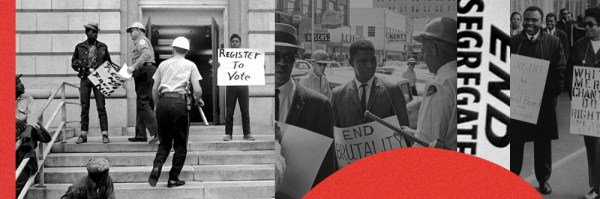
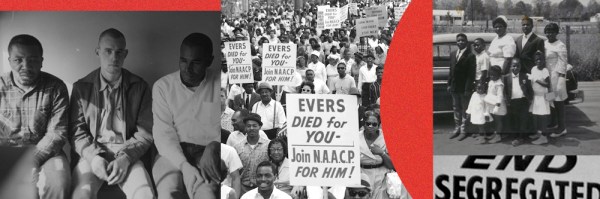
Left: Perkins arrested after protest in 1970 Middle: Medgar funeral march in 1963 Right: The Perkins Family in 1960

The other Jonathan Edwards

That other Edwards—Jonathan R. Edwards—was elected sheriff of Rankin County in 1962. One of the things he mentioned to voters in his campaign, besides his six years as a deputy and his deep roots in the community, was that he was a lifelong Baptist.

The month after he took office, Edwards was called to the Rankin County courthouse because three Black men were attempting to register to vote. At the time, there were 6,944 African Americans in Rankin County, but only 43 of them could vote. If these men registered, that would make it 46.

But Edwards and his deputies made sure that didn’t happen. The sheriff walked up to one of the men and hit him.

“I hit him and kept on hitting him,” Edwards later testified in court. “And if he hadn’t run I would have kept on hitting him.”

The Black man, who may have been trained by the Student Nonviolent Coordinating Committee, did not meet the sheriff’s violence with violence. That didn’t stop Edwards from hitting him more.

“I slapped him down the first time,” Edwards said. “I knocked him down and he fell here and I got in on him, and I don’t know how many times I hit him, just as many as I could.”

The judge in the case ruled that Edwards hadn’t violated the man’s civil rights. He said the sheriff wasn’t attempting to keep anyone from voting and it was “purely incidental” that the beating happened in the registrar’s office.

Besides, the judge concluded, this was a “past event” and “there was no reasonable justification to believe that such an incident would ever occur again.”

It did happen again. That time, the sheriff with the name of the great American preacher assaulted John Perkins.

In 1970, Perkins led more than 100 demonstrators in a march protesting segregated businesses in Mississippi. They chanted, “Do right, white man, do right.” On their way home from the march, 20 college students were arrested and taken to the Rankin County jail. Fearing the students might be lynched, Perkins and two other boycott leaders rushed to bail them out.

They found the sheriff’s deputies drinking corn whiskey. The deputies had forcibly shaved the heads of two protestors and were pouring the liquor over their raw scalps.

When Edwards saw Perkins coming into the jail, he recognized him as the leader. He said, “This is the smart n—.” Then he started beating him.

He hit Perkins, possibly with a blackjack, a weapon made out of wood and lead wrapped in leather. Perkins went down and Edwards kicked him, brutally and repeatedly, stopping only to retuck in his shirt.

When the beating was finished, the sheriff made the minister get up and mop his own blood off the floor.

Edwards later testified that Perkins had thrown an unprovoked punch at him but missed. No one else saw it. Perkins also had a pistol in his car, though he hadn’t brought it in with him and the sheriff didn’t know about it until after the arrest when he went and searched the car.

Edwards told the court, nevertheless, that the violence was justified.

“Sure they were roughed up,” he said, “but they asked for it.”

What the gospel can do

Perkins almost died from his injuries. In the hospital, he thought a lot about the racism that had put him there. He thought about white people—white Christians—who would name their son Jonathan Edwards and have him grow up to be a racist sheriff.

“I came to the conclusion, the hard conclusion,” Perkins later said, “that Mississippi white folks were cruel. And they were unjust. And the system was totally bankrupt. … I stayed with the idea that it had to be overthrown.”

As a Christian, Perkins believed the gospel could overthrow that system. God could reconcile sinners to himself and each other. Jesus could take hate from human hearts and replace it with love. The Holy Spirit could move people to give up power instead of defending it with violence.

Perkins would preach and protest and risk injury again because he believed in the power of the gospel.

It couldn’t be a gospel, though, that produced more Jonathan Edwardses.

Which is why he stood up in 1975 and asked the people planning a Billy Graham crusade a question that still resonates in America today: Will the gospel you are preaching produce a different kind of white Christian than it has in the past?

News

Super Bowl Betting Is a $7.6 Billion Problem Fewer Evangelicals Care About

As society doubles down on online sports gambling, older activists see a chance to renew the Christian conscience around the practice.

Christianity Today February 11, 2022
Julio Cortez / AP

The 1990s were a busy time for Christians combatting gambling at local levels: fighting a casino here or lottery expansions there.

Tom Grey, a Methodist minister, traveled 250 days a year with the National Coalition Against Legalized Gambling, which now goes by the name Stop Predatory Gambling. He can remember major wins, like keeping a casino out of Gettysburg, Pennsylvania, with the help of filmmaker Ken Burns.

“The problem is [gambling companies] just have to win once, and they’ve got it,” Grey said. “Mayors and other people would stand up and say, ‘We don’t want your casino.’ Now there aren’t choices any longer. Churches feel it’s over.”

Grey, 81, is retired, but now he is watching the latest iteration of the industry take off: sports betting.

The Super Bowl on Sunday will be the first big windfall in many states for online sports betting. Companies like Draft Kings and FanDuel have been running ads throughout game broadcasts and all over sports news sites, urging fans to put money on their favorite teams or fantasy leagues.

The American Gambling Association has projected a record 31.4 million Americans will put down $7.6 billion on this year’s LA Rams–Cincinnati Bengals matchup. That’s up more than one-third from last Super Bowl, as more states have legalized online betting. Sports betting is now legal in 30 states and Washington, DC. In some states, such betting happens at a physical venue, while others have begun allowing it online.

After the US Supreme Court ruled in favor of the practice in 2018, states lined up to legalize sports betting to get a slice of the tax revenue from the multibillon-dollar industry. State-level Christian organizations that tried to fight off the recent legalization of sports betting or put guardrails around it found that there was too much money on the other side of the issue and not much appetite for fighting in the pews.

Few Christians see sports gambling as a problem. A 2016 survey from Lifeway Research found that only 36 percent of Christians thought sports betting was morally wrong. Pastors carry more reservations, with a majority telling Lifeway in 2019 that betting on sports is morally wrong and three-quarters believing it should not be legal.

People responding on social media to critiques of gambling on Desiring God or The Gospel Coalition argued that the authors were being “legalistic” and that betting was no different than investing in the stock market or a 401(k).

Putting bucks on the big game through a few clicks on an app or sports site doesn’t have the social stigma that casino gambling used to carry. The 2020 Gallup figures on the issue showed that 71 percent of Americans said gambling was morally acceptable, the highest level in the 18 years it had done the survey.

But those who continue to be involved in antigambling activism say it’s still harmful.

“I think there’s going to be a lot of devastation to individuals and families the following weeks,” after the Super Bowl, said Anita Bedell, who worked to fight gambling in Illinois for decades as the head of Illinois Church Action on Alcohol and Addiction Problems. “What do you do when you’ve lost all that money? Paying it back, that could take a lifetime.”

After working on the issue since 1990, Bedell—known in the statehouse as the “Church Lady”—retired last week. She said it was “disheartening” how quickly sports betting has swept the state and the nation.

“They disregard the problems that could happen,” Bedell said. “Churches are going to see all the harm and there will be an outcry … it’s too accessible, there’s no safeguards for young people, or to prevent people from losing everything.”

For now, churches aren’t very interested in the issue. Grey says churches are “worn out” and have to “pick their issues to fight.” He said the Methodists and Baptists were the firewalls against gambling in recent decades, and “the Baptists still hold Alabama,” which largely bans any form of gambling.

The Southern Baptist Convention’s Ethics and Religious Liberty Commission (ERLC) puts out every year an antigambling church bulletin insert, which lays out in bullet points why gambling is a “sin against God.” The Assemblies of God adopted a position paper in 2015 calling gambling “unwise” and “a compromise of Christian ethics and witness.”

These leaders and denominations point not only to the biblical wisdom on the nature of work, stewardship, and avoiding greed, but also to the idea that the few who gain from it are doing so at the expense of the many–including the poor. The ERLC bulletin insert emphasizes that opposition to gambling is based on love for neighbor.

Jason McGuire, who heads up the evangelical organization New Yorkers for Constitutional Freedoms, fought the legalization of online betting in the state last year. His organization opposes online betting for similar reasons that the more liberal New York Daily News editorial board has consistently opposed it: They both see it as a tax on the poor. He also adds that the Bible prohibits making money from “ill-gotten gain” and that people underestimate the addictive side of gambling.

“The Christian community needs to understand, this is devastating to families that are impacted if people get caught up in this,” he said. “On the anonymity of their cellphone in the living room, they’re gambling away their mortgage money. The whole world is setting people up for failure.”

The New York Council on Problem Gambling, a state-funded group, estimates that two million Americans “meet the diagnostic criteria for disordered gambling.” (Gambling interests point out that is a tiny percentage of gamblers.) Grey said that the creation of state-funded groups for responsible gambling allowed politicians to feel at ease with the addictive side of betting—that they were using some of the revenue for treatment.

A study in Spain showed a significant increase in “young pathological gamblers” after the country legalized online gambling, adding that the immediacy and accessibility of online gambling made it “more addictive than any other type of game.”

Despite their gloom about the immediate impact, the Christians who worked on the issue for decades are a bit more optimistic about the future. “This is the third historical wave of gambling in America,” said Grey. “It has a boom-bust cycle to it. Why? Because it doesn’t work.”

Sports betting has surged recently without any curbs. That makes the problems with gambling more visible to Americans, he thinks, and will spur bipartisan interest in regulating the industry.

He remembered in 1999 arranging a meeting between Green Party presidential candidate Ralph Nader and Focus on the Family president James Dobson to discuss gambling, and the two wrote a joint letter calling gambling “the bane of millions of Americans.” Nader targeted Republicans who supported casino interests, and Dobson targeted Democrats.

“It’s that’s kind of movement that’s needed today … the same right-left combination, this is something we agree on,” said Grey. “Let’s call for more regulation and get advertising under control. Those are doable things.”

Books
Excerpt

The Waters of Baptism Flow Toward Humanity at Its Neediest

Just as Jesus’ baptism launched his public ministry, our own baptisms ordinate us to a life of humble obedience and costly service.

Christianity Today February 11, 2022
Sindre Strøm / Pexels

All four Gospels tell the story of Jesus’ baptism, as if every reader needs to hear it. Jesus’ cousin John, outfitted in a garment made of camel’s hair and a rustic leather belt, has set up camp in an unmarked wilderness to preach and prophesy. Everyone comes out to listen: the pious and the profane. The bankrupt and the ruined. The broken and the eccentric. Religious misfits and spiritual castoffs. All get a dose of John’s caustic threats and stern warnings. Each hears the message of impending judgment. Many confess and are baptized, one repentant sinner after another. And then Jesus, the Messiah, gets in line as if he’s in a Costco checkout.

Living Under Water: Baptism as a Way of Life (The Calvin Institute of Christian Worship Liturgical Studies (CICW))

Living Under Water: Baptism as a Way of Life (The Calvin Institute of Christian Worship Liturgical Studies (CICW))

Wm. B. Eerdmans

266 pages

$19.99

Each Gospel offers its own angle on the story. Mark starts his Gospel with it, skipping Christmas as incidental and quickly launching into Jesus’ ministry. Luke copies much of Mark’s detail, following the gist of his telling but refusing to mention the involvement of the eccentric cousin. John emphasizes the Spirit lingering on Jesus like a dove, avoiding any awkward mention of an actual baptism.

The unique feature of Matthew’s version is the cousin conversation. John admires Jesus. He believes in Jesus. That’s exactly why he rebuts Jesus. He can’t stomach Jesus’ baptismal plan. Not one to hold back his opinions, John protests: Jesus shouldn’t be in the same line as the dreck of humanity. John’s baptismal liturgy is consistent: Repent, be baptized, live a new life. Why is Jesus in that line? What does he have to repent of?

The baptizer’s harsh, prophetic words can’t apply to the Savior. So he asserts that Jesus’ baptismal plans are backward. If one cousin is to baptize the other, Jesus should baptize him. The innocent should be the one baptizing, not the professional baptizer. “I need to be baptized by you,” John says, “and do you come to me?” (Matt. 3:14).

Heaven opens

It’s easy to imagine that in dusty first-century Palestine, where water was precious and dirt ever-present, a person might consider ritual cleansing a necessary preparation for meeting God. But when John talked about baptism, he emphasized repentance. And it wasn’t just proselytes who needed baptismal washing. Everyone did. Baptism meant repentance. It meant embracing the need for profound moral change. It still does.

Missionary-turned-Bible-commentator Dale Bruner calls Jesus’ baptism his “first miracle.” Standing in line, waiting his turn, dunked into murky water, Jesus forever identifies himself with the shadowy reality of humanity’s brokenness and our human need for repentance. His baptism miracle was his first step of humble obedience, setting him on a course to his death and resurrection.

At the very first Christian baptism, Jesus identified with sinners. It’s what he was ordained to do. Like his cousin, we may prefer that Jesus stay clear of scandalous connection with religious underachievers, but that’s how Jesus includes us. He didn’t need the heavens opened. But we do. As John Chrysostom explains, the heavens were opened to “inform thee that at thy baptism also this is done.”

Baptisms today aren’t usually accompanied by a voice like thunder or a visible flyover of the Holy Spirit. But the early church believed that the triune fullness of God is present at our baptisms. It’s as if heaven opens again. God gets to us. And maybe we get to God. The Spirit of healing and wholeness descends to make an ordinary person holy. And the Father’s voice issues another adoption decree; heaven opens and we understand that this is God’s beloved child.

Following Gospel footsteps, early church leaders taught that Jesus’ baptism identified him with forgiven sinners and launched his ministry. It was, to put it in Old Testament terms, his anointing. Jesus publicly recognized and accepted his special relationship with God and so began his public ministry.

Baptism, not Christmas, starts the story. Baptism is the set of glasses through which we can see all of Jesus’ life. His other miracles, his teaching, his friendships, his loving or tough words to broken people, his death on the cross—all are a working out of his baptism. “When the New Testament strikes the note of baptism,” Bruner writes, “all the overtones of the great chord of God’s salvation can be heard.”

Our baptisms too are anointings. Each baptism, in its specific place and time, marks the beginning of a life of baptism. Our entire postbaptismal life is lived under water. Every decision, each career move, and each sentence we speak is an overflow of baptismal waters, the outpouring of the Holy Spirit. In his baptism Jesus links himself to us, and in our baptisms we get linked to him. In faith we work with the Spirit toward humble obedience, to multiply life, to live our anointed calling, just as Jesus did.

That’s why, former archbishop of Canterbury Rowan Williams notes, we expect to find the baptized living out their ordination “in the neighbourhood of chaos … near to those places where humanity is most at risk, where humanity is most disordered, disfigured and needy.” Williams has witnessed thousands of Christians living their baptisms in ordinary or desperate places. “If being baptized is being led to where Jesus is,” he says, “then being baptized is being led towards the chaos and the neediness of a humanity that has forgotten its own destiny.”

Like Jesus, Williams adds, the baptized need not fear being contaminated by the mess of humanity because “they have a new level of solidarity with them.” It seems a contradiction that the baptized could both be in the center of God’s joy and pleasure and at the same time the center of mission. “And that of course means that the path of the baptized person is a dangerous one. Perhaps baptism really ought to have some health warnings attached to it: ‘If you take this step, if you go into these depths, it will be transfiguring, exhilarating, life-giving and very, very dangerous.’ To be baptized into Jesus is not to be in what the world thinks of as a safe place. Jesus’ first disciples discovered that in the Gospels, and his disciples have gone on discovering it ever since.”

Barbara Brown Taylor remembers reading about two paramedics who, on seeing the chaos and misery left by a flood in Honduras, immediately left their home to help. They had no Spanish-language skills. They had no place to stay. They had no illusions. They knew they would be pulling dead bodies out of the mud. But they “thought it might help the families to give them back their loved ones for burial.” They were simply living their baptismal ordination.

Living our ordination

When I was a pastor in small-town Minnesota, a friend who managed the local hardware store phoned me to say, “You’re going to want to come and see this.” New to small-town life, I was only slowly becoming aware of its tempos and rhythms. Of course, I knew we were in a drought; we had been praying for rain every Sunday for weeks. But the level of desperation had somehow missed me. Only a couple of our attendees were directly involved in agriculture.

When I drove, as directed, to the site of our sister church, I saw a row of semi trailers. A group of men, some of whom I knew but many of whom were unfamiliar, ambled about. Each truck bed was overflowing with hay—food that would feed livestock. Food that would mean these farmers could survive the season. A group of farmers from the other side of the state, which had experienced a few more “lucky” thunderstorms that summer, had heard about the plight of their neighbors from hundreds of miles away and had come to help. There were no news outlets recording the event. There was no public spotlight. There was just a group of unassuming farmers living their baptism ordination.

Again, we are challenged by Rowan Williams, “Baptism does not confer on us a status that marks us off from everybody else” so we might imagine ourselves more elite people who can “claim an extra dignity” or a “sort of privilege.” Rather, baptism moves us beyond ourselves. It calls us to an “openness to human need” and a “corresponding openness to the Holy Spirit.”

The baptized still struggle to be decent human beings. We are still tempted to be less than God created us to be. But in Jesus, God gives us spiritual power to choose a higher and better way. Because of our baptisms, we live inside the promise that we are loved and can live love.

Adapted from Living under Water: Baptism as a Way of Life by Kevin Adams (Eerdmans). Reprinted by permission of the publisher.

2021 Year In Review

Thank you to our ministry’s 2,049 donor partners in 2021.

2021 Year In Review

Download an infographic to see key CT highlights in 2021 and what our ministry’s donor partners made possible. Download now.

Theology

Love Lessons from an Arranged Marriage

I often lost hope that my husband and I would make it. Here’s why we did.

Christianity Today February 10, 2022
Rajat Sarki / Unsplash

On July 7, 2021, my husband and I celebrated 20 years of marriage. Every year when that date rolls around, I always wake up thinking, How did we ever make it? How did we ever survive?

The thought never lasts more than a few seconds. That’s because, over the past 20 years, we’ve spent most of our anniversaries surrounded by family members. So even if I had wanted to marinate on that thought, celebrating with others has always been the primary focus.

In the past two years, however, thanks to the global pandemic, I’ve had a little more time to reflect on how our marriage managed to survive.

At the ages of 27 and 23, my husband and I were brought together by mutual friends and family into a traditional Indian arranged marriage. Arranged marriages were all we had ever known. Generations of people before us had made it look successful and even easy. And since this existing formula had worked for centuries, I didn’t think it would be difficult for us.

But it was. The culture and community that had formed him and me—and the script that went with it—did not seem to work for us. Or to be more precise, it did not work for me.

Throughout our early years of marriage especially, I struggled, floundered, and wondered if it would be easier to just walk away. It was hard and painful, and there seemed to be no reward in sight.

Our romantic relationship did not look like it did in Indian movies—where boy meets girl, and they fall in love and run around trees together. And neither did it look like our married peers, who seemed to be getting along so much better than us.

In our Indian Christian community, our social caste, and our generation, parents arrange the marriage—preferably between an engineer boy and engineer girl or doctor boy and engineer girl.

After the couple gets married, both partners continue to work. Then, after a year or so, God willing, they have a child. Then they buy a home, or their parents gift them one. And then they have their grandparents or nanny care for the child. With each step in the formula, life is meant to move on seamlessly.

Our lives could have looked remarkably similar, but we decided to complicate things by packing our bags and moving to the United States. It was here that the real work of our marriage began. With no maid to care for the home and no nanny or granny to care for our children, we had to learn to navigate our relationship and family independently.

We did not have the natural guardrails of our family surrounding us, nor did our extended Indian community help us balance the arguments, disagreements, and spats that consumed our relationship.

We were in our late 20s with two children, navigating life in a country that was so different from the one we were familiar with. It looked like we had a perfect life on the outside, but it was another story on the inside.

I had been questioning everything that was expected of me since I was 22. The formula had not worked, so why was I still invested in this relationship? Yet even in my fledgling faith, I knew this thinking pattern was wrong. I knew I had tried to navigate this marriage through my own strength for years, and the time had come for me to surrender.

Twenty years later, I know now that God works in mysterious ways, and he has taught me some life-altering lessons that have changed my perspective on arranged marriage and marriage more generally.

1. The purpose of marriage is to make us holy.

In his book Sacred Marriage, Gary Thomas asks, “What if God designed marriage to make us holy more than to make us happy?”

This challenged everything I knew about marriage. It was a profound foundational shift in my thinking pattern that forced me to contend with a lot of my early formation.

I may not have been taught that marriage was intended to make us happy, but it was displayed in the culture and community that formed me. And no one ever told me that holiness was integral to marriage.

As far as I was concerned, God owed me. If I did everything right and was the perfect, dutiful wife, then it was my right to be happy. Moreover, my husband owed it to me to keep me happy no matter what.

In many aspects, my marriage was charmed. But we were two flawed, broken people who did not understand what it meant to live under the rule of a God who calls us to be holy because he is holy (1 Pet. 1:15–16).

When I started looking at my marriage as a way for God to refine me from my selfishness and immaturity, I learned the deeper truths and mysteries he had for us as a couple.

Worth noting: I am not advocating for staying in an abusive situation. Any who find themselves trapped in domestic violence should seek help. God’s heart is never for his people to suffer any kind of abuse.

But for the rest of us, holiness is still the mandate.

2. Our culture shapes our expectations of marriage.

Our upbringing, community, and culture shaped what my husband and I came to expect of marriage.

Although we belonged to the same caste and had similar backgrounds, we were raised very differently and brought different expectations to the table. I felt uncomfortable because I did not fit into the expected mold—and I was not entirely sure of what I brought to the relationship.

“Our culture says that feelings of love are the basis for actions of love,” writes Tim Keller in The Meaning of Marriage. “And of course that can be true. But it is truer to say that actions of love can lead consistently to feelings of love.” Keller likens marriage to a kind of spiritual friendship that “is eagerly helping one another know, serve, love, and resemble God in deeper and deeper ways.”

I did not start out with feelings of romantic love, but I grew familiar with the discipline of love. I began reminding myself that regular actions of love would eventually lead to feelings of love.

Through this process, I learned how to surrender and trust God. I needed to lean into my discomfort, let go of my control, and allow him to guide me. I learned to recognize my cultural expectations. And once I was able to let go of them, I found the freedom to discover what God was trying to teach me through my marriage.

Laying down what my culture expected of me and turning toward what God expected of me began to radically alter my expectations of marriage.

3. The Holy Spirit works in ways we cannot by our own strength.

There was a point in my marriage when I felt I could not move forward anymore, nor did I want to. It was too hard. I tried to quit and walk away.

I remember sitting and crying on the floor one morning, asking God for strength. Instead, I chose to surrender my will and my pride, to allow him to work his plan for us.

We both needed patience, gentleness, kindness, and self-control. But for that, we needed the Spirit of God to move in our marriage.

Love, in general, is at the bottom of the list in an arranged marriage. Honor and duty toward your spouse and your spouse’s family usually dictate the beginning of an arranged marriage. It did for me. But did love grow? Yes, the Spirit of God fostered in me a passion for the Lord and a love for my husband, which can only be called supernatural—the kind of love that grows out of embers and becomes a mighty flame.

John Piper’s definition of love from his book Desiring God is “the overflow of joy in God that gladly meets the needs of others.” God chose us before creation and loved us. His love changes us and gives us the ability to love others around us.

Agape love results from the covenant we make to God to love each other well. I needed him to search my heart and try me, refine me by fire, and keep removing the dross (1 Pet. 1:6–7). And in the process, God used my marriage to draw me closer to him.

My husband and I often talk about how our marriage has evolved over the years. To be fair, he had more faith that it would survive than I did. I did not think we would make it. There were many times I had lost hope. But God always met me during those times of despair, giving me faith and the spiritual sustenance needed to persevere.

A few years ago, when my husband and I visited India, one of our family members looked at us and said, “You both have changed since the early years of marriage. Something is different.” While she never expounded on the difference, I knew what it was. This comment was a meaningful gift I will never forget—and one that points to God’s enduring faithfulness.

Sherene Joseph Rajadurai is a third culture Indian American Christian and graduate of Dallas Theological Seminary.

Apple PodcastsDown ArrowDown ArrowDown Arrowarrow_left_altLeft ArrowLeft ArrowRight ArrowRight ArrowRight Arrowarrow_up_altUp ArrowUp ArrowAvailable at Amazoncaret-downCloseCloseEmailEmailExpandExpandExternalExternalFacebookfacebook-squareGiftGiftGooglegoogleGoogle KeephamburgerInstagraminstagram-squareLinkLinklinkedin-squareListenListenListenChristianity TodayCT Creative Studio Logologo_orgMegaphoneMenuMenupausePinterestPlayPlayPocketPodcastRSSRSSSaveSaveSaveSearchSearchsearchSpotifyStitcherTelegramTable of ContentsTable of Contentstwitter-squareWhatsAppXYouTubeYouTube