Church Life

It Wasn’t the Tear Gas that Surprised Me

How pastoring in the midst of protests changed one man’s perspective.

Cover Photograph by Thomas Chan

At the end of my street, just a few yards beyond my apartment building, a wisp of tear gas curled around the corner of the road. Hundreds of protesters were fleeing in the other direction, doing their best to seek cover from the unseen clash just beyond my view.

Despite the desperation of the scene, it wasn’t the tear gas that surprised me. After three months of weekly clashes between protesters and police in my neighborhood, the acrid stinging in my eyes had become a familiar experience. What surprised me was a person.

My eyes were drawn to him immediately. He was not dressed like the other protesters, adorned with the masks and umbrellas of the city’s front-liners. He had nothing on him to protect himself from the chemical onslaught. He stood still, facing against the rushing tide of people. While everyone else fled in the other direction, he stood rooted in place.

At first I thought this was an act of defiance—a brave display of nonviolent resistance. But as I stood watching, I noticed his mouth was moving as his head shifted from side to side. The expression on his face was not fear or anger, but concern. He was speaking to the fleeing protesters, but he wasn’t trying to get them to stand their ground and fight back. Instead, he seemed concerned for their well-being and care. He stood against the tide, at the cost of his own safety, to offer some kind of calming presence. His posture was not provocative. It was pastoral. 

As I watched this all unfold, I felt an uncomfortable move of the Holy Spirit inside me. I have been a pastor in Hong Kong for 20 years, but this man embodied the power of the church more in that moment than I ever have. Like Caleb and Joshua standing before the majority opinion of the returning spies, this man carried with him a different spirit. I realized, soberly, that I did not. 

The church in Hong Kong is at an inflection point for the gospel. Alongside a global pandemic, our city has experienced a complete social and political upheaval in the past three years as a result of the protests and China’s response in its attempt to restore order. Many have welcomed the return of peace and calm to the streets, while many others have been left bruised and conflicted. And the church must now decide how to respond.

Will we become a bold and central voice of hope, faith, and identity in the years ahead, courageously rooting ourselves in the fertile soil of the gospel? Or will we feebly shrink into the shadows of our own self-concerns and self-preservation? Will the church reach out to a divided city, willing to plant our pastoral presence within the hardest of circumstances? Or will we settle for a comfortable gospel that keeps the lights on in our church buildings but extinguishes our prophetic light in the public square?

In my local community in Hong Kong, the kind of halfhearted cultural Christianity that seeks God’s favor—minus the sacrificial obedience needed to follow Jesus—is no longer an option. Perhaps it never was. If the church in our city has any future, it must shift from the pursuit of relevance to the pursuit of a fresh kind of gospel resilience that is forged in the fires of dramatic societal change. And we need pastors, like that man standing before the tear gas at the end of my street, who are able to offer brave pastoral hope in fearful political times. 

John Chan is one such pastor who has bent his knee to this call. Born and raised in Hong Kong in the ’80s, he studied Karl Barth in Germany before returning to Hong Kong to pursue a pastoral and academic career. Now in his early 40s, Chan is smart, engaging, deeply theological, and courageously able to connect Scripture and social change together in a way that invites people to process their traumatic experiences. He is willing to stand at the end of the proverbial street as the political tear gas creeps around the corner. He there offers a stable presence of hope.

“I grew up in a time of Hong Kong that was fabulous,” John says as we sit together over coffee. “A time when the culture was strong, when we all dreamed of a good future, when the youth of this city had hope and expectation. So much has now changed.”

Chan’s pastoral concerns for Hong Kong are centered around the young adults of the city, a generation caught between the affluent success of the over-40s and the relative innocence of the under-20s. “My generation grew up focused on making money and were mostly politically neutral. But the current generation is much more politically engaged and concerned. Which presents an important but challenging environment for the church.”

This was especially apparent in 2014, the year Occupy Central began. Signaling the first political student protest movement, the key leaders confessed publicly to their Christian faith. As an academic at the time, Chan noticed how his students were looking toward the Christian institutions in the city to offer guidance. “Our seminaries needed to quickly shift from teaching political theology to teaching political ethics. We suddenly needed a praxis more than a theory.”

This need for praxis in a time of rapid social change had to flow eventually from the halls of academia to the pulpits of the local churches, but such a shift was slow to come. Many pastors were not equipped to deal with the issues that the political upheaval was creating. As Chan observes, “Very few pastors felt able to address the major issues impacting their congregants, often from fear of being labeled too political. So at the time something significant happened, the pulpit slowly became disconnected from the people.” 

This sense of disconnection raised its head again in the summer of 2019, about the time that tear gas crept around the corner of my street. “With the second wave of student protests in 2019,” Chan says, “the church seemed to have learned little from last time, and many of the same mistakes were made. And this led to a lot of young people leaving the church. Not leaving Jesus, just leaving the church.”

This exodus led Chan to plant a new church that would be flexible enough to embrace a new generation of Christians who wanted Jesus and social justice to sit side by side, while continuing to deepen the gospel through sacrificial discipleship. He called it Flow Church, and within just a few years it has grown to more than 400 people, most of them young adults.

“Flow Church exists because Hong Kong Christians have a unique challenge different to the west,” he says. “Our issue is not one of the relationship between church and state. Our issue is how to live in a society with a disproportional imbalance of power.”

This imbalance of power is more than just a postcolonial hangover. As Chan puts it, “We have a unique situation because our empire is our motherland.” It is this unchangeable situation that has caused some to give up hope for their future, with a growing number choosing to emigrate from Hong Kong. But for Chan, he stands rooted to a particular passage that has become the foundation of his renewed pastoral ministry. “John 10:10 promises us that Jesus came so we can have abundant life. This is not conditional on a particular place or time, or a particular station in life. Despite how hard things appear for Hong Kong right now, I believe our people can know the fullness of life and joy.”

It is this vision of a full life that drives Chan’s ministry. He and his church are digging deeper roots in the soil of the city. His church desires to be a stable and sure presence of pastoral care in the wild rush of change around them. And this will require no small amount of courage, sacrifice, and strength. 

As a pastor alongside Chan in the ministry of this city, I find myself reinvigorated by his bravery. I don’t want to remain down the street, a distant observer to the spiritual courage of others. Like Chan, I want to be able to stand amongst those who are hurting with a resolve in my heart despite the stinging in my eyes.

This different spirit—as seen in Caleb and Joshua and my friend John—is defined by a wholeheartedness toward God. This sobers me, for I sense my own heart is divided, torn apart by fear, self-preservation, and institutional concerns. I need a new heart for this new calling. A new wineskin, if you will. And that is always a move of God’s spirit.

As a friend recently put it, “The hardest calling is our first one: death to self.” Like that man at the end of that street, staring down the tear gas and offering comfort to others, may we take the dying side so others can take the living side.


Church Life

The Wounded Sparrow

How God’s eye on the sparrow offers comfort to a whole family.

Cover Photograph by Annie Spratt

Kuruvilla was the name given to me. It means “one belonging to the Lord.” The name is common among the Christians of Kerala, in the south of India, who trace the origins of their community back to St Thomas Didymus, the “doubter” and the twin.

As I matured into adulthood, I chose “Kuru” as a nickname. It sounded dignified. But I had another nickname first, in my college years. I was called “Kuruvi.” It means sparrow in my native Malayalam language. 

I wish I had kept that name. 

My son’s middle name is Kuruvilla, and, in a curious turn of events, my son-in-law’s middle name is also Kuruvilla. At one time in our family’s life, all three of us and our wives experienced a series of crises. That was when I first thought about our family as a little flock of sparrows. Jesus said that our father in heaven cares for the sparrows. We needed his promise to ring true through the flesh, bones, bricks, and stones of our family.

In India, people do not build houses for birds to nest in. Rather, we set up screen doors and wire mesh shutters on windows to keep the birds and insects out. In earlier times, it was a familiar sight to see birds flittering in and out of church buildings, where they would find a place to nest in the high rafters. While we might chase the birds out, God does nothing of the sort. He made them. He wants them to inhabit his world. As David poetically proclaims, “Even the sparrows have built a nest, and the swallows have their own home; they keep their young near your altars” (Psalm 84:3). 

Earlier this year, I experienced a profound moment that once again reminded me that God takes care of his kuruvi. 

As birds find a place in God’s habitation, our heavenly Father is not one who stands by helplessly. As my family of sparrows nested in his presence, he nestled us, offering the peace of his presence and the fellowship of prayer surrounding us. 

Each month, I take a variety of blood tests and the reports go to my oncologist and diabetologist. On a Monday in March of 2021, after the blood extraction had been completed, I stopped at three shops to pick up supplies for our home, including a dozen eggs in a plastic bag. Having finished my errands, I steered my scooter through the bustling streets of Trivandrum on my route home at a speed of about 40 kilometers per hour. 

Suddenly and without warning, I lost consciousness and momentarily blacked out. When I regained my senses, I found myself about to collide with the back end of a large, stationary lorry. With a sickening thud, my left shoulder rammed into its sharp edge. I lost control and toppled off the scooter. I stood immediately, and promptly fainted again.

The next thing I knew, a group of men had picked me up and carried me to the side of the road. After the chaos of the situation settled, I inspected the results of the accident. My knees were bruised and swollen, and a long gash had opened on my shoulder. A passing van driver gave me a lift home and the lorry driver rode my scooter back. The two men helped me to my flat and stayed for about half an hour to ensure I would be all right. 

In my part of India, government hospitals are often crowded and medical attention delayed by lengthy administrative procedures. To avoid the congestion in the midst of my injuries, my wife took me to a hospital run by Catholic nuns who are famed all over India for their medical institutions and nursing homes. The doctor examined my shoulder and said there were no bones broken, but the swelling under my left knee had collected blood and would need to be drained surgically the next morning.

After the initial attention to my shoulder, my wife and I had to undergo COVID-19 testing and waited restlessly together in the hospital. While awaiting the test results, I received a lab report that sent a shock through our system: my platelet count was down to 15,000, far below the healthy minimum of 150,000.

Before I was diagnosed with chronic lymphocytic leukemia, a hematological cancer, I had no idea what platelets were and what purpose they serve in the body. I quickly found out that they are required for blood to clot. If you don’t have enough platelets, you can easily bleed to death.

In that moment, we decided to relocate to the private hospital where my oncologist and his team work. There followed four days of treatment to raise the count of platelets, and then I was sent home to continue with oral medication.

As I arrived home, I went to check the consequences of my accident. I inspected the bag I had been holding on my scooter at the time of the crash. Shockingly, no eggs had broken during the carnage. It seemed one small miracle of many that day. First, slamming the metal edge of a lorry at 40 kilometers should have shattered my shoulder bone, but it didn’t. Next, with such a low count of platelets I should have bled severely and unstoppably, but that didn’t happen, either. Finally, the blood reports coming in while waiting for COVID-19 results saved me from undergoing a surgical procedure that might have killed me. That day, clearly, God had his eye on this one sparrow that had fallen.

In India, these creatures are often viewed as nuisances and people take every measure to drive them out of their homes. They are not worth much. They do not offer even a mouthful to eat. Yet God cares what happens to them. “Not even a sparrow, worth only half a penny, can fall to the ground without your Father knowing it. And the very hairs on your head are all numbered. So don’t be afraid; you are more valuable to Him than a whole flock of sparrows” (Matt. 10:29-31).

As I have come to a fuller understanding of the power of my name and the promise it holds, I know now that God cares for each sparrow. God knows and God allows what happens to my little flock—my sons and daughters and their families too. When he allows trial and troubles, he also gives us the grace to endure, and the wisdom and discernment to handle difficult situations. He gives us strength. He gives us hope.

I return time and again to the work of Ethel Waters, who often sang at Billy Graham’s Crusades. She famously sang the gospel song “His Eye is on the Sparrow.” 

Waters was born to a 12-year-old who had been raped by a white man. She chose the name of the song for the title of her autobiography because she felt that God had watched over the little sparrow she was. I echo her sentiments. I have lived my life as a sparrow that God cares for.

“Why should I feel discouraged,
Why should the shadows come,
Why should my heart be lonely,
And long for heaven and home,
When Jesus is my portion?
My constant friend is He,
His eye is on the sparrow,
And I know He watches me
I sing because I’m happy,
I sing because I’m free,
For His eye is on the sparrow,
And I know He watches me.”

What happens to us here is not the end. The individuals and institutions, principalities and powers that attempt to destroy us are ascendant in India today. They will not succeed. A new day comes. God watches over his sparrows. I know I belong to him. I know he watches me. And I know one day he will bring us home and we will nest among the rafters in his holy habitation.  

Church Life

When the Story Doesn’t Have a Happy Ending

Learning to find redemption in unfinished stories.

Cover Photograph by Martin Jernberg

We’d been on the mission field only six months, and we were already experiencing every missionary’s dream story: a Muslim convert. We participated in his baptism, guided his discipleship, and supported him through persecution. We had so much to write home about.

It all started when Gil and I—both just 24 years old—moved to a large city in Tanzania in 2001. We lived in the heart of the Indian section of the city, serving a subgroup from Southeast Asia who had flourished there for generations. We lived in a tiny, 600-square-foot, concrete block house, and all day long we could hear ripe fruit from our giant mango tree slam onto our tin roof. 

Right outside the gate of our compound, a dusty road hosted small fruit stands, a butcher shop, and taxis that bumped through the potholes. Just down the street, a Muslim school educated hundreds of young Indian boys. Soon after we arrived, the school asked Gil to coach volleyball, and that’s how we first met the young man I’ll call Abbas. 

Abbas was 19—only a few years younger than we were. We joined an Indian church plant, and when Gil started inviting the boys on his volleyball team to the youth group, Abbas jumped right in. Gil and Abbas quickly became fast friends. It wasn’t long until Abbas spent nearly every afternoon at our little house—playing chess or volleyball and arguing with Gil over soccer teams.

Abbas got used to my American cooking and developed a special affinity for cheese. I can still remember him imploring me daily, “Hey, Amy, do you have any cheeeeese?” He’d also scold me for throwing away the chicken neck because “that was the best part.”

He had eyes that danced and an infectious smile. During the regular greeting time at church, he’d make us all laugh by personally greeting every person in the room. He was smart, he was a jokester, and he was hungry to know about Jesus.

Abbas began meeting with Gil twice a week to study the Bible. We didn’t want to pressure him, so we let him set the time and determine the length of study. “How many weeks do you want to meet?” Gil asked. “Until I understand,” was Abbas’s reply.

Not long after Gil and Abbas began meeting together, through tears Abbas said he desired to become a follower of Jesus. A few months later, he asked to be baptized. The Indian congregation gathered on the nearby beach, our toes curling under the warm sand while the breeze tousled our hair and rustled the palm fronds. After his baptism, Abbas leaped out of the water and ran ashore, radiating joy.

David Radomysler

But Abbas’s Muslim community was furious when they found out about his newfound faith. He was excommunicated—forbidden to attend the mosque or other social events. One day, Abbas woke up to find that someone had poisoned the tropical fish he raised to sell to pet stores. 

Another morning, I got into our car at 6 a.m., ready to make the long commute to the school where I taught. Abbas gave me the fright of my life when he suddenly popped up in the backseat, still with his ready smile. His family had kicked him out the night before, he explained, and he had nowhere to sleep. It had been too late to wake us up, so he’d spent the night in our car. Despite all this, Abbas remained eager to grow in his faith. We were amazed at all he had learned and asked ourselves, “Who taught him that? It wasn’t us.”

Abbas told us that he was willing to die to see his family come to know Christ. We were awestruck . . . but maybe not all that awestruck. After all, wasn’t this how missions were supposed to go? Hadn’t we expected this? We’d read about miraculous missionary stories and now it seemed we were living one. So we filled our newsletters with reports about Abbas; he became the shining star of our ministry. This was why people were sacrificing to send us to Africa. This was why God had called us there.

So we were incredulous when another youth group member told us she suspected Abbas was stealing money from us. It wasn’t possible. No, there was no way! But she gave us enough details that we had to consider her accusations. 

Because we lived in a cash-based society, we always had cash in our house. We kept it locked up but had become careless about where we left the key. So we started paying closer attention and, after a few days went by, we could not deny it: Abbas was stealing from us. When he realized we were onto him, he made a partial confession. This revelation came only a few weeks before the end of our two-year term when we’d return to the United States so Gil could finish seminary. Our realization about what Abbas had been doing was too much for our young minds to process. The confusion, the disillusionment, the sense of betrayal was so overwhelming that we couldn’t even talk about it—with Abbas or anyone else. Our identity as missionaries had become wrapped up in Abbas. Shame and failure threatened to strangle us, and both of us fell into depression when we returned to the States.

After we left, we learned that Abbas stole from another youth leader. When he was confronted, he slunk away from church gatherings. The seed that had so fervently sprung up seemed to have withered under the hot sun. Eventually, Abbas immigrated to Europe and, from what we could tell, he hadn’t returned to Islam but wasn’t following Christ either. Over time, we lost contact.

We never told our supporters what had happened with Abbas. We never told our teammates. It took years before the two of us could even talk about it between ourselves.

We’d absorbed the unwritten rule in missions: Failure is unacceptable. I’d grown up immersed in missions culture, yet I couldn’t remember a single time that a missionary story, presentation, or newsletter ever included failure.

I know better now. But even today, missionaries are reluctant to share defeat, depression, or despair. Maybe there is too much at stake. Hundreds of people are donating thousands of dollars for you to do this work. Everyone craves numbers: numbers of converts, numbers of churches planted, and so on. 

The “successful” missionaries always have lots of numbers. They fill their newsletters with compelling stories and photographs of large groups of believers. But nobody gives presentations about evangelistic events where no one showed up, or posts a picture of the local pastor who abused his daughter, or writes a newsletter about the exciting convert who just slowly disappears.

Perhaps we grab onto the happy ending way too soon. After all, the church-planting movement that’s spreading like wildfire could quickly become syncretistic. The young pastor we’re investing in could leave his wife. The church that thrived for five years could dissolve under internal conflict. When we measure success, at what point do we measure it?

We could swing to the other side of the pendulum and throw our hands up in the air, saying, “Let’s not measure success. Let’s just measure faithfulness.” Of course, faithfulness is vital. But could this attitude be a cop out? God knows my heart, we say. We meant well, and that’s all that matters. But if that’s true, then we aren’t leaving room to learn from our mistakes. We don’t look for better methods or strive for greater effectiveness.

Could we have done anything different with Abbas to prevent his falling away from faith? At the time, we were so consumed by our own hurt that we never helped him explore the root cause of the theft. Maybe we could have taught him to lean more heavily on grace—and reminded ourselves to do the same. Maybe we could have remembered that missionary stories in a broken world rarely end with a “happily ever after.” Until that day when all things are made new, life is always going to be messy.

When Gil finished seminary, we returned to Tanzania for 14 more years. We saw many more victories in ministry and just as many tragedies. Time and maturity gave us a different perspective: The ways of God are mysterious. We don’t often see the beginning and the end of the story; we see only bits and pieces here and there. What we see as tragedy, God may be transforming into redemption. What we see as victory may be the impetus for destruction. 

“Oh, the depth of the riches of the wisdom 
     and knowledge of God! 
How unsearchable his judgments, 
    and his paths beyond tracing out! 
Who has known the mind of the Lord? 
    Or who has been his counselor?” (Rom. 11:33–34).

Perhaps this is why we missionaries must ground ourselves in the sovereignty of God. We must learn to be steadfast in faith no matter the circumstances. We must hold loosely to both the victories and the tragedies, knowing that it will only be in the end—in the very, very end—that all will be revealed for what it truly is. And when we know Christ, we can take joy in how the most important Story will end.

Out of the blue, Abbas contacted us a few years ago. He planned on visiting his former home and wanted to see us. Of course, we were happy to agree. We had long since let go of the pain and shame of the past. When he visited, we spent a few hours together, reminiscing about old times and catching up on each other’s lives. After all, we’d shared a lot of great memories. Just before we said goodbye, Abbas became quiet and emotional. Very simply, he apologized for what he had done to us 14 years previously. It was a sacred moment. We’re still not sure what God is doing in his life, but we are certain that God is not done with Abbas. We serve a God of grace and redemption; we cannot possibly imagine what is just around the corner. The story is still being written.

News

Bucha Evangelical Leader Sees Russian Atrocities, Looks for God’s Hand

His home looted by retreating soldiers, Ukrainian seminary president Ivan Rusyn describes the spiritual impact of Christians serving amid death and devastation.

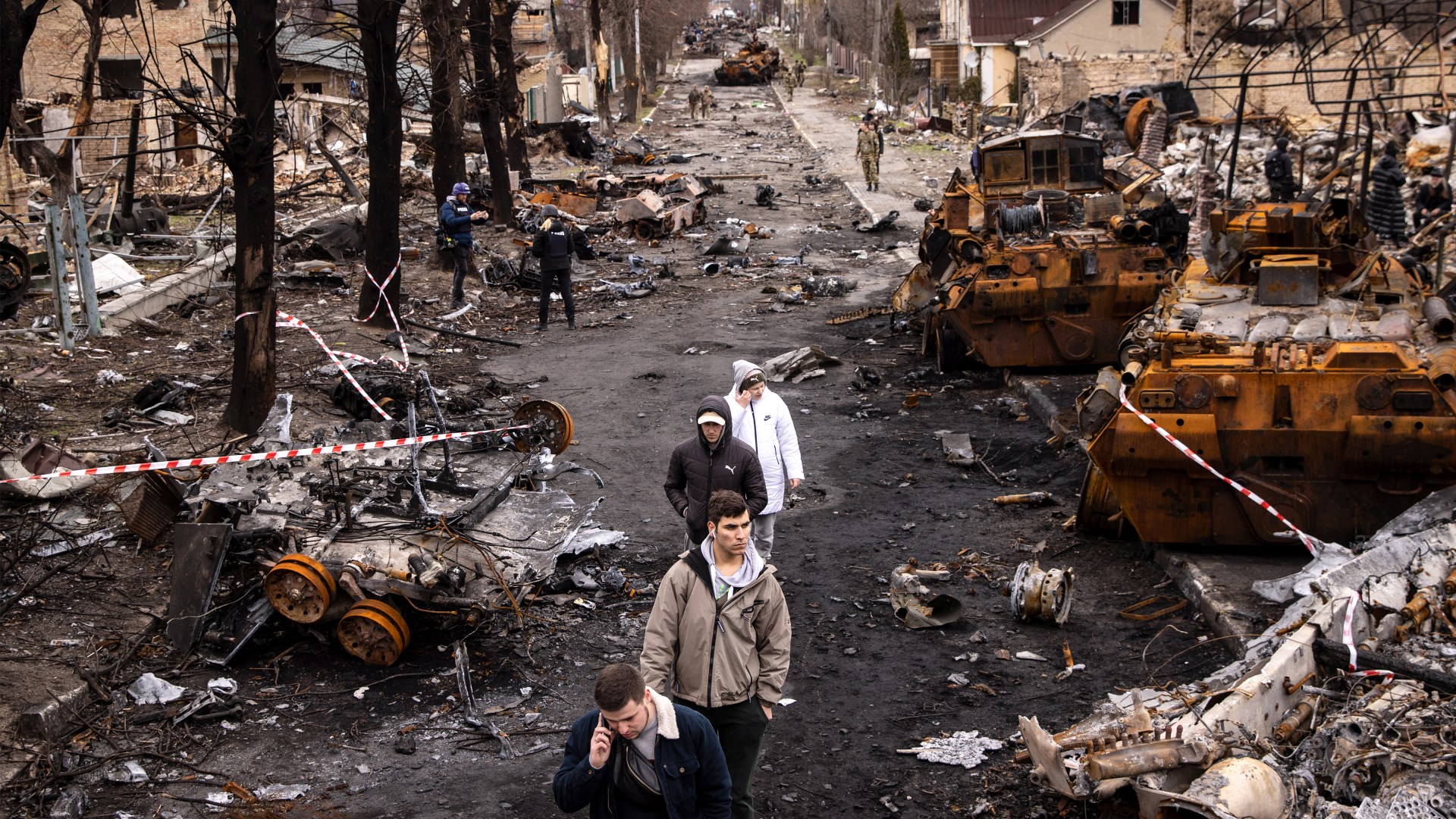
People walk through debris and destroyed Russian military vehicles on a street in Bucha, Ukraine, on April 6, 2022.

People walk through debris and destroyed Russian military vehicles on a street in Bucha, Ukraine, on April 6, 2022.

Christianity Today April 7, 2022
Chris McGrath / Staff / Getty

The atrocities are shocking. Ukrainian authorities have said 410 civilians were killed in the suburbs of Kyiv, discovered after the Russian army withdrew from its positions. At least two were found with their hands bound; several were shot in the head.

Many bodies were burned.

One resident said the occupiers were polite, and shared their meal rations. But others told of ransacked apartments; one was tied to a pole and beaten. Soldiers even shot a cyclist, who had dismounted and turned a corner on foot.

It could have been Ivan Rusyn.

President of Ukrainian Evangelical Theological Seminary (UETS), he had been coordinating aid from a safe house in Kyiv. But riding his bicycle into Russian-controlled Bucha to deliver medicine to a neighbor, he became an eyewitness to the atrocities.

Russia has called the images fake; satellite evidence contradicts.

Christianity Today

interviewed Rusyn to hear his firsthand report. He spoke about the spiritual impact, becoming a more authentic church, and how evangelicals have been helping the reclaimed suburbs—where he lived the past eight years:

Tell me about your neighborhood.

If you look at Bucha on Google Maps, I live in one of the five apartment blocs opposite Toscana Grill. It is an expensive restaurant, but sometimes I have eaten there. I run in the municipal park nearly every day, and with friends on Saturday. The seminary in Kyiv is six miles away, and it would take me 25 minutes to drive there, with traffic.

I noticed Google now says it will take an hour and a half.

The bridge was destroyed on the second day of the war. Russian helicopters and soldiers landed first at the Hostomel airport, three miles from our home. There was heavy combat, and I took shelter in my basement for the next five days. Then I left to the seminary, following that Google Maps route to skirt around Kyiv to the northeast. After two days we evacuated, and I found my way to a safe house in the city.

Now when we bring food and provisions into Bucha, Irpin, and Hostomel, we see many destroyed Russian tanks. The bridge is still out, but we can navigate it carefully with minibuses. It is dangerous, but if you go slow the journey now takes about one hour.

When did you return?

Four days ago (April 3). We were escorted by police because we had a long line of buses full of provisions, and to evacuate citizens. It was the same day that President (Volodymyr) Zelensky was in Bucha.

But I went once even before that, by bicycle.

My neighbors were sheltering in the basement, there was no way to contact them, and an evacuation route was being prepared. They also needed medicine. Irpin was under Ukrainian control at the time, so I went first to the military checkpoints there, but they didn’t permit me to go into Russian-occupied Bucha.

So I went to the nearby shallow stream, used my bike and a small tree to balance through the water. I saw dead bodies—civilians and soldiers. I saw people carrying children on their shoulders with their hands raised. I saw elderly people trying to find a way out.

And when I saw Russian soldiers, I had to hide. At one point I felt stuck in a bombed-out building, afraid I would have to spend the night. But I moved along small streets as much as possible, avoiding the main roads.

When I arrived, it was hard for my neighbors to leave, they were so afraid.

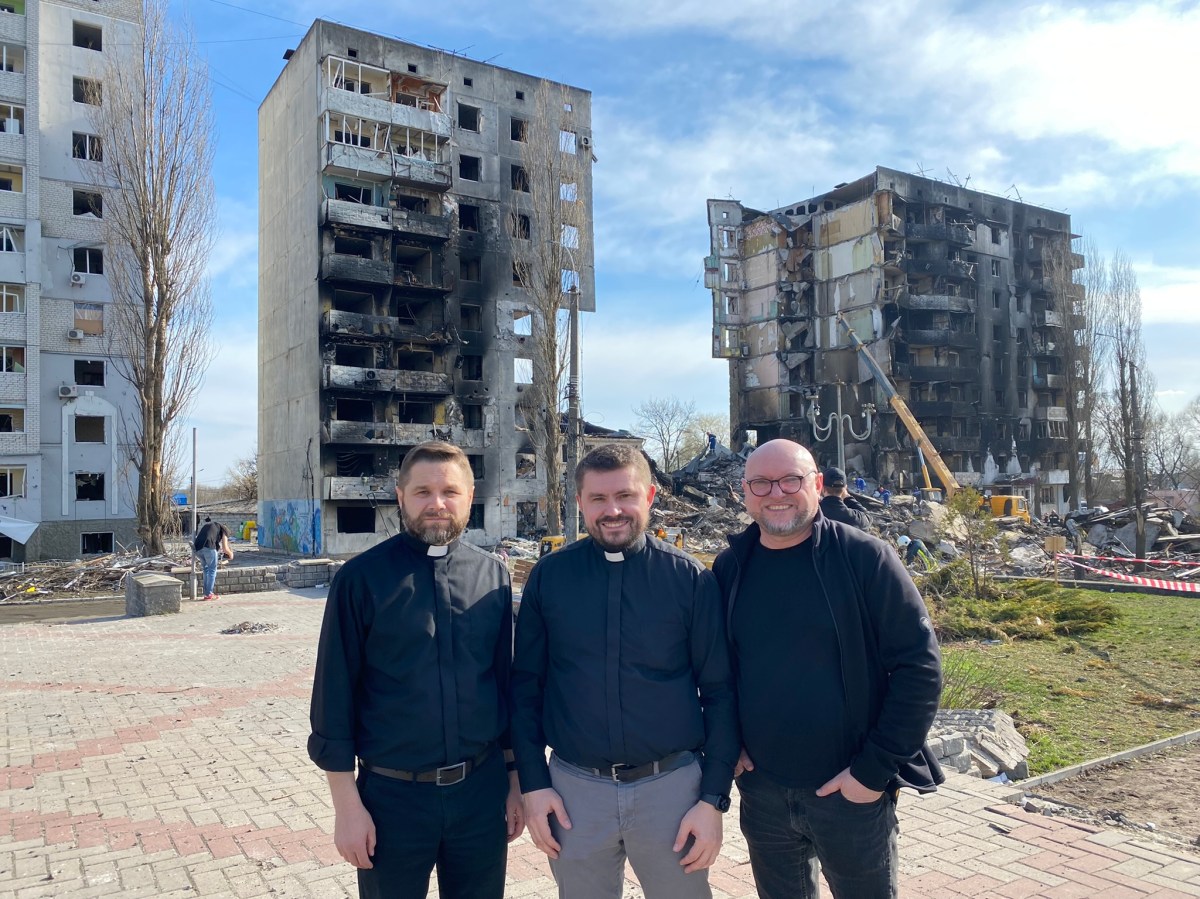
UETS seminary president Ivan Rusyn (center) in Hostomel, Ukraine.

What was it like when you returned in peace?

The first time, my apartment was without electricity but otherwise alright. The second time, the doors were broken into. I was robbed, and there was a Russian soldier’s coat left behind. But they didn’t just steal things, they smashed the TV, my computer monitor, and other appliances.

My neighbor, Nina Petrova, told me Russian soldiers came to her apartment and put a gun to her head, forcing her to show them all her valuables. Every apartment has been broken into. In some they even put a knife through the family photos.

I had an interesting psychological reaction, that others have also mentioned. Because an enemy—a killer—was in my apartment, I felt like it is not my own. I don’t care about things that I lost; I have peace in my heart. But the hardest thing is to come to terms with the Russian soldiers walking around my home.

What is it like to see a body on the street?

The last thing you think about is taking photos. And you don’t stop to examine who it is. But I found that in such a stressful situation I could mobilize myself to act. When I come back to our base, when I see the photos and read reports—I don’t know if it is okay to say this—but many of us are crying every evening.

But when I return to Bucha to help, I’m okay.

Two days ago, we visited Hostomel, and everything was destroyed. Then people started showing up, one by one, dirty. One lady came to me, and I noticed her hands. She said they are cooking over firewood. Her husband was killed, and she buried him right at the entrance to her apartment.

And then she hugged my colleague.

I heard at least 15 stories of people who told me they buried their loved ones. Yesterday we evacuated two ladies; one buried her husband in the yard. Another, very old, had been staying in an apartment without windows, very cold, no water, no electricity, nothing. A woman had been bringing her food every day and asked us if we could help her.

There are thousands of people like this. Younger people are more resourceful, able to evacuate. But old people have nowhere to go. They told me they went through hell.

Crosses are seen by a mass grave near a church on April 4, 2022 in Bucha, Ukraine.

Are there any evangelical casualties?

One of our graduates has been arrested, and we still have no idea where he is. But his son-in-law, taken at the same time, was found in a mass grave in Motyzhyn. Yesterday was the funeral, with a proper burial.

The dean of a seminary was also found dead. He was shot, and his body had been lying on the road for at least a few days, alongside his friend.

These are people we know personally.

In the first days of the war, you said that “God, break the bones of my enemy” has now become as holy as a “Hallelujah.” But now you have seen atrocities firsthand. What has your spiritual journey been like since then?

At that moment I could say it very clearly. But over the past 43 days, it has gone deeper. Our emotions are not as strong. We speak more slowly and quietly. Maybe professionals would say we are wounded psychologically. We try to say we are okay (smiling), but anger and pain are still present, penetrating to the deepest part of our identity.

I don’t know how to express it, even in Ukrainian. It is like being frozen. It is destructive. It is constantly thinking and recalling the suffering you have seen. It remains with you, and I am afraid it will not go away soon.

I still support that statement. My whispered cry to God is to intervene.

How has it affected relations with Russian evangelicals?

This war was not provoked by Ukraine. I don’t pray for Russians. Well, rarely. Over the past several years we had a pattern with them. We tried to adapt. You don’t understand Ukrainian? Alright, we will speak Russian, no problem. You don’t like the reports from the Donbas? Okay, we will be quiet.

But why do we have to be quiet?

Now we are hearing the same voices again. The situation is not clear. The photos you show us are hurtful. But why should we be quiet? We feel like they are trying to teach us how to forgive, but they don’t want to hear our voice. Only a few people reached out to me.

I understand Russian Christians will not go to Red Square to protest, and no one requires them to. But they could send us a message, even if encrypted: We can’t do anything here in Russia, but we are with you. We are against this war.

What is the impact on seminary education?

We will carry on as best we can. But sometimes I desire to reflect theologically, and other times I don’t want to think theologically at all. But I believe that we will become stronger.

No, not stronger—more authentic.

Of course we have a lot to share. But our authenticity will be expressed in our ability to listen, demonstrating sympathy without any words. My collar helps: People see I am a pastor, and we have red crosses on our buses.

The seminary will be less active in speaking for awhile, but we will serve our society through presence. I have received more hugs from strangers these past 43 days than from all my relatives the past five years.

We are developing a counseling ministry in our psychological department. Trauma is everywhere, and many Christians want to help. They have the best of motives; but with no experience, approaching the wounded will make things worse.

But my Christianity, my theology of mission, is in the process of being reshaped. Every week we are serving communion, experiencing God’s presence and solidarity with strangers and soldiers, in the open air. There are hundreds and thousands of churches actively serving, and evangelical Christianity will become more and more a part of society.

Sometimes you turn away from theology. Have you struggled with God?

I have been a Christian for a long time, involved in theological education for many years. There were times when I had questions for God, and of course I have them now.

Before the war, my wife and I were reading about the Holocaust—Elie Wiesel’s book. We visited museums in Kyiv and the site of the massacre in Babi Yar. This might sound academic, but it is not. I don’t know how to explain it, but sometimes in God’s silence, I hear his voice. This is a very contradictory statement. But in his absence, I feel his presence.

I can tell you honestly, there is no question for me if God exists or not. I once had an epistemological crisis, when I was starting my journey in theology. But amid this war, I never doubt that God exists.

Or that he loves you?

I think yes. I haven’t thought about it that way. Maybe I haven’t had time.

To our students, I explain that God’s actions are often clearer when you look backwards. I believe Ukraine will be a great nation, and a blessing to many others. Our unity, solidarity, and generosity—with strangers we never knew—is amazing. I hope that we will be able to see his logic later, but right now the price is very high.

The Russian Federation is destroying our nation. We don’t care about the buildings. But they consider our values a threat. I ask the global community to continue supporting Ukraine, not only with humanitarian assistance but also with all political and military help possible.

We are fighting a giant.

I want to say I see God’s hand at work. Here in the safe house, I can. But when I go back to Bucha tomorrow, can I say it to the old woman? Can I tell her that God is working in her life? Theologically, I believe he is. But in front of such suffering, I lack the strength to communicate it.

Follow CT’s Russia-Ukraine war coverage on Telegram: @ctmagazine (also available in Chinese and Russian).

Select articles are offered in Russian and Ukrainian.

Theology

6 Ways to Vet a ‘Word from the Lord’

Prophetic words about a Christian’s calling should be subject to biblical discernment.

Christianity Today April 7, 2022
Illustration by Mallory Rentsch / Source Images: WikiMedia Commons

It has always been popular in Christian circles to claim God’s leading when it comes to one’s personal and professional decisions. But in the past few years, a few high-profile figures made the news for claiming to hear from the Lord in their predictions about the last presidential election and their choices to switch or leave their denominations.

Is there any pastor in America who has not, at one time or another, been told that the reason a church member is doing something is because “God is leading” him or her? That phrase tends to be a conversation stopper for most Christian leaders. After all, if God Almighty, the Creator and Lord of the universe, has spoken, who are we to object?

The truth is, God does speak today. He created the universe by speaking. “Thus says the Lord” is the repeated refrain of Israel’s prophets. The distinction between the God of Israel and every other god in the ancient world was that he speaks—while idols cannot (Ps. 115:4–5). And it’s a sign of God’s judgment throughout Scripture whenever he stops speaking (1 Sam. 3:1).

Unlike the God of deism, the God of the Bible is personally involved in the affairs of earth, leading his church and caring for his children. One major way he leads is by speaking. Our job is to learn to recognize his voice, listen well, and wisely discern how to obey what he is saying.

But those of us in church leadership are often left wondering what accountability looks like in this area. That is, how can we assess whether a word is from God or not—and what vetting criteria should we consider when the Lord seems to speak to us or someone under our care?

I know personally that God speaks. My life was dramatically changed by a word from the Lord.

I was married, had young children, was an elder at our small church, and was thriving in my dream job: teaching law in the MBA program at the Ohio State University (OSU). But after coming to Christ at age 18, I had always felt drawn to full-time ministry—I just was never quite sure God had called me. A friend challenged me to ask the Lord for a sign. “Pastors kick Gideon around all the time,” he said, “but God answered his request.”

So, while participating on a conference ministry team with Vineyard in England, I decided to ask God for a sign. I gave the Lord no specifics—only that he would speak to me before I was to call home to my wife in three days. First day, nothing. Second day, nothing.

On the third day, the conference keynote speaker, John Wimber, began his evening session by saying, “Some of you here are praying about full-time ministry. You’ll know it’s the Lord speaking when it is the last hour!” I began gripping my seat as Wimber went through a long list of things uniquely relevant to me and my situation.

Then for good measure, a member of the ministry team shared a dream he had about me, which was followed by a prophetic word from someone else—all answering my question about full-time ministry with a resounding “Yes! I have called you.”

When I shared my experience with fellow elders at our church, they unanimously confirmed it. Unbeknownst to me, they had believed for some time that I was to leave OSU and become our first senior pastor. They were just waiting for God to speak to me.

The Lord also spoke clearly to my wife, and we decided to take a radical step of faith. I left my tenure-track position as a professor at Ohio State and entered full-time ministry. For the next 35-plus years, I pastored and led our “little” church that became Vineyard Columbus.

God is infinitely creative in the ways that he speaks. He speaks through nature. He speaks through dreams at night and visions in the day. He speaks through images and impressions. He speaks through prophetic words and actions. He speaks through our consciences, preaching, wise counsel, circumstances, and experiences; he speaks through the history of the church, through the books we read, and through our minds and emotions.

However, he speaks most clearly and infallibly through the Bible (the written Word of God) and through Jesus (the incarnate Word of God).

The problem is that we can unfortunately be entirely mistaken about whether God has spoken and about what he has said. The apostle Paul reminds us that in this present age “we know in part and we prophesy in part. … For now, we see only a reflection as in a mirror” (1 Cor. 13:9, 12).

Our partial knowledge, imperfect prophecy, and difficulty in hearing have led sincere Christians to wrongly believe (for example) that God has told them exactly when Jesus will return, that God will bring about revival at this place and time, or that God wants this particular candidate elected president.

In the same way, we must accept the reality of human limitations whenever believers claim the Lord’s leading . We must hold truths in tension as we seek to correctly discern words from God—welcoming the possibility that God still speaks today while acknowledging that we don’t always hear clearly. As Paul says, we should neither despise prophesy nor naively embrace prophetic words without first testing to see whether they are from God (1 Thess. 5:19–22).

We are told not to believe everything we hear when people claim a word from the Lord, but instead we must “test the spirits to see whether they are from God,” as 1 John 4:1 advises. So how do we discern whether someone is being led by God in their words and actions? Here are a few safeguards for biblical discernment that I have found helpful over the years:

1. God’s written Word is the standard by which we judge any word of prophecy or claim of leading. For example, any word that contradicts God’s written revelation concerning what is true, what is moral, or what is his expressed will must be rejected.

2. Jesus, the incarnate Word is also the standard by which we judge any word of prophecy or claim of leading. For example, words that are manipulative or self-seeking, harmful to others or out of sync with the Spirit of Jesus are suspect. Jesus is full of wisdom, kindness, gentleness, truth, grace, and patience, so words or “leadings” that don’t reflect his character should be rejected.

3. Humility should characterize anyone offering a prophetic word or claiming a leading from God. For example, rather than confidently asserting “Thus saith the Lord” or “God is leading me,” it is more honest to say (because of our human frailty), “I think God may be saying” or “I have a sense God may be leading.”

4. Community discernment is a major safeguard against mistakes in hearing and applying a word from God. The mind of Christ is not the private possession of an elite few (e.g., the pastor and his or her inner circle). Paul reminded the whole church in Corinth that “we have the mind of Christ” (1 Cor. 2:16, emphasis added)—in other words, not just you!

One question I frequently ask engaged couples is “Are there any people you know, in your family, among your friends, or in Christian leadership who have expressed reservations or concerns about your upcoming marriage?” I want to know whether this couple is open to input from the community around them and willing to hear their counsel or whether they are closed, acting independently and autonomously. 5. Transparency is another mark of genuine prophecy or leading from God. Words delivered and decisions made in secret are always suspect. The eyes and ears of others and their objectivity and sensibility are safeguards. It is easy to convince (deceive) ourselves into believing that in this particular case, because people just wouldn’t understand or because it will take too long to explain, we cannot include others. Secrecy is a great indication that something is seriously wrong! God’s word can always stand the light of day!

6. Accountability is key regarding any prophecy, leading, or major decision. Does the pastor or leader who claims God is leading have any meaningful check of his discernment and actions? Is there a board or leadership team empowered with authority, or do they simply function as a rubber stamp? Is the leader open to be challenged? Has the leader ever acknowledged being wrong—that what she thought was the voice of God was in fact not God speaking at all? Does the leader respond well to legitimate questions, or does he evade them by claiming “God has spoken! Who are you to object?” Accountability is particularly critical when money, power, and/or position are involved. If the person who claims “God is leading” personally benefits from that leading, basic knowledge of human nature demands that tough questions be asked. I have much more confidence in the authenticity of a word from God that involves substantial sacrifice and a cross than one that results in personal advancement and financial gain!

It is true that phrases like “The Lord is leading” get attached to silly ideas and selfish desires. It is easier to be cynical and dismiss outright the notion that God still speaks today outside his written Word.

But just like Gideon’s fleece, as well as my own story of entering ministry, sometimes we need a timely word, nudge, or reminder from the Lord. As Jesus said, “Man shall not live on bread alone, but on every word that comes from the mouth of God” (Matt. 4:4, emphasis added).

Rich Nathan is the founding pastor of Vineyard Columbus, a multiethnic congregation in Columbus, Ohio and was their senior pastor for 34 years. He is the author of three books: Empowered Evangelicals, Who Is My Enemy? and Both-And.

Theology

What Russian War Criminals Teach Us About Excusing Evil

Blurring the line between good and evil happens in all human hearts.

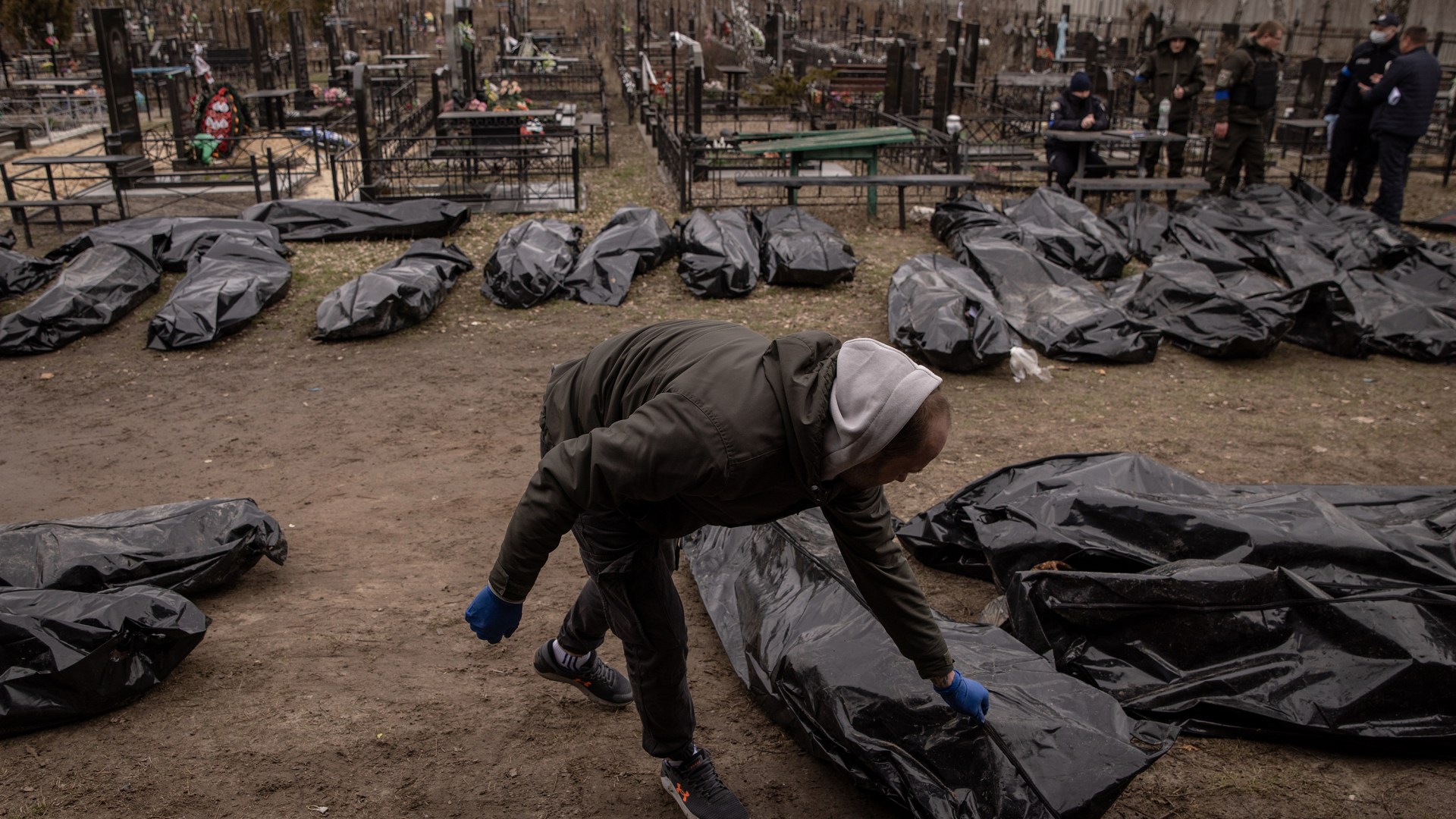
Policemen and forensic personnel catalogue 58 bodies of civilians killed in and around Bucha, Ukraine.

Policemen and forensic personnel catalogue 58 bodies of civilians killed in and around Bucha, Ukraine.

Christianity Today April 7, 2022
Chris McGrath / Getty

This piece was adapted from Russell Moore’s newsletter. Subscribe here.

The Western world said “Never again” after the gas chambers of the Third Reich—and yet here we are.

Russian troops deployed by war criminal Vladimir Putin are committing atrocities across Ukraine, murdering innocent civilians in cold blood as they move from invasion to occupation to attempted genocide. One of the reasons it’s difficult to see the images of these slaughtered innocents is because most people wonder, “What can we do to stop it?”

While the Ukrainians have shown grit and valor beyond what anyone could have predicted, by all accounts there is still a long slog ahead. The war crimes will continue.

Perhaps, somehow, this invasion will be stopped quickly and the Russian war criminals will be brought to justice in a Nuremberg-style trial, as Ukrainian president Volodymyr Zelenskyy has called for.

But if not, these murders and crimes may not be called to an account for a long time—maybe even a lifetime. In fact, that’s what the war criminals are counting on.

The world should watch what these criminals are doing—to call it what it is and hold them to account whenever the time comes. But Christians in particular should watch and recognize something we often want to ignore: how the human heart can justify great evil.

Human beings are capable of horrific depravity. This we know. Humans, however, are not like wild animals or constructed machines. We have consciences that alert us to what sort of people we are becoming. To carry out criminality of this degree, a Russian soldier must somehow learn to silence that conscience—or at least muffle it.

While few, if any, of those reading this are guilty of war crimes, every one of us has grappled with our conscience—and in many cases, we have followed the same path, even when the sins are not as heinous and the stakes not as high.

So how does this happen?

One of the first steps is to emphasize power over morality. An easy way to do this is to characterize the situation as an emergency, requiring a dispensing of the ordinary norms of behavior. Every criminal regime has done this—usually by identifying scapegoats, blaming them for the people’s ills, and framing the situation as an existential threat.

Acting within the bounds of conscience is painted as a luxury, for times that are not as dire as these. This can happen even with situations that appear morally unproblematic. We may rationalize that the mission is too important for us to hold the leader accountable for his or her treatment of people.

In church, such reasoning might say, “How could we waste time on these niceties when people are going to hell without the gospel?” In politics, it might take the form of “These theories about character in office or constitutional norms are nice and all. But get in the real world; we’re about to lose our country.” In wartime, it can be framed as “We can hear about your ethical qualms with torture later; if we don’t act now, terrorists will destroy us.” And so on.

Those carrying out injustices of any kind must lie to evade accountability. But the most dangerous form of lying is not the propaganda people give to others but the lies they tell themselves—to quiet their consciences.

Again, this can happen in matters that fall far short of war crimes. People can wall off certain categories of sin and refuse to view them as such—placing the blame for the sin not on themselves but on those who would label it sin.

For instance, one can define sin merely in social terms: “As long as I don’t seem to be hurting anyone else in any kind of public way, then why is it anyone’s business what I do in my private life?” Or one can do the opposite and define sin as merely personal, acting as though questions of social injustice are of no moral consequence.

This is how some American preachers at the Baptist World Alliance meeting in Berlin just prior to World War II were able to excuse Nazi Germany’s authoritarianism and demonization of Jews. Those were just “social” issues, they reasoned.

On the moral questions these preachers really cared about—the “personal” ones—some of them said the Reich could teach decadent America a thing or two: Adolf Hitler didn’t drink or smoke. Women were dressed modestly, not like back home.

To read the accounts in light of what was to come is chilling. And yet we hear of the same sort of machinations all the time—at times even within our own hearts.

Sometimes an evil is too great to ignore altogether. The conscience must reckon with it, but it does so by projecting that evil onto some other person or group. Rather than grappling with the indictment of one’s own sense of right and wrong, one can short-circuit the blame by locating it elsewhere.

This is how, for instance, Russian war criminals—while carrying out the very same tactics as Nazi storm troopers—can claim that they are fighting to “de-Nazify” Ukraine.

Again, this doesn’t have to happen on the huge moral scale of geopolitical atrocity. You can see this in your own work breakroom or church foyer. For example, you would be surprised at how many of the most strident culture warriors—identifying “compromise” in fellow Christians in the fight against “sexual anarchy”—are addicted to porn.

Our consciences work by pointing our psyches to ultimate accountability. The apostle Paul wrote that the conscience bears witness to the day “when God judges people’s secrets through Christ Jesus” (Rom. 2:16). One cannot bear the weight of that. Either we convince ourselves that such a reckoning will never come, or we find some authority—maybe even a spiritual one—to reassure us that we will never be found out.

The “Butcher of Bucha,” a Russian commanding officer of a unit that massacred civilians in Ukraine was reportedly blessed by a Russian Orthodox priest—just before the grisly mission in which his troops left the bodies of innocent civilians lying in mass graves or in the streets.

The “butcher” allegedly spoke of his mission as a kind of spiritual warfare in which he was fighting on the side of God. And, of course, this is just one example of how the Russian Orthodox Church is not just complicit but celebratory of the crimes of Putin’s regime.

Again, this is also not unusual. Every evil king in the Bible searched out prophets who would tell him that his actions were sanctioned by God. And even in the smallest of transgressions, the first thing we often want to do when carrying out evil is to find some moral authority that will tell us what we are doing is right.

Perhaps the most dangerous step of all, however, is when the conscience gives up altogether and begins to say that this is just the way the world is. It shifts to saying depravity is realistic, while morality is not. We can see this in the smirk behind Putin’s words and in the throat-clearing whataboutism of his Western defenders. This is all rooted in the idea that accountability will never arrive.

And yet it will.

We were born into this century, this moment in history, and we have a responsibility to do everything that we can to stand against the murder and genocide of innocent people. We have a responsibility to call evil what it is.

We also have a responsibility to take warning—to recognize the ways in which we excuse or reassure ourselves in the same way, while not to the same degree, as the most vicious war criminal.

Because for us, as for them, Judgment Day is coming.

Russell Moore leads the Public Theology Project at Christianity Today.

Follow CT’s Russia-Ukraine war coverage on Telegram: @ctmagazine (also available in Chinese and Russian).

Select articles are offered in Russian and Ukrainian.

Church Life

Our Names Become Bridges

How a heritage of naming revealed cultural identity and gospel hope.

Cover Photograph by Eibner Saliba

On April 14, 1521, the Portuguese explorer Ferdinand Magellan and his Spanish companions presided over the first Christian baptism in the Philippines. As Father Pedro de Valderrama performed the rite, 800 tribal inhabitants went down into the churning waters and arose as new Christian converts.

The local chieftain, Rajah Humabon, and his wife, Hara Humamay, were the first to receive new “Christian names.” After the ocean’s womb enveloped them, they were reborn as Carlos and Juana, bearers of Christ’s presence on the island. Their former identities were replaced. The names given by their tribe were rendered obsolete. They became the first of many in the Philippines whose conversion to Christianity would include the act of renaming. 

“But aren’t the names Carlos and Juana just Spanish names?” I asked my father as we discussed this historical event. He chuckled as we drove past enormous cathedrals under the scorching summer heat of Cagayan de Oro City in the Philippines. Parishioners bustled into the church sanctuaries, thirsting for communion with God.

My father replied, “That is very perceptive. They are Spanish names.”

I closed my eyes in confusion. “Then why are they called ‘Christian names’? What makes them Christian if they’re just Spanish?”

My father’s chuckle crumbled into a sigh. “Because they forgot where they were. ‘Spanish’ became synonymous with ‘Christian’ wherever they went. That’s how we got our last name.”

My family inherited our surname, Melo, from our ancestors. It means “one who hailed from Merlo, Portugal.” Ironically, I was neither from Merlo nor did I see myself as Portuguese. I grew up in the small city of Cagayan de Oro on the island of Mindanao where I was called Kagay-anon by my tribe and people group.

I knew where I grew up, and I knew the identity marker my land and culture gave me. But what did not make sense to me was my surname. It pointed to an ancestral origin thousands of miles away from the home I knew in the Philippines. My name claimed me as Portuguese, but my heart longed for my cultural heritage as a Kagay-anon and my sense of place in the city I loved.

I stared out the window of our car, watching Cagayan de Oro blur into the distance, as the music of church bells dissolved into the clang of steel and metal. Lamenting the Philippines’ history and the story of my people, I broke down in tears. The burden of my name weighed heavily upon my heart.

In 2016, my family migrated from Cagayan de Oro to Chicago, Illinois. Our surname traveled with us. Many Americans struggled to pronounce it correctly, asking, “Is it meh-low or mee-luh?” I remember visiting my first Starbucks in the United States where—in classic Starbucks fashion—they misspelled my last name: “Mellow.” It was as if my name had become an alien language. 

I thought I’d find relief among fellow Christians, but instead I encountered ridicule. In youth groups and summer camps, others jokingly rhymed my last name with the word melon. Eventually, the mockery became so unbearable that I removed my last name from my social media accounts. 

I soon decided to go by an entirely different name—one that might be more accessible to my American peers. So I began calling myself Ryan in an effort to be known, accepted, and loved by the people around me—in an effort to belong.

But in the process of renaming myself, I forgot where I came from. In my deep desire to be loved by the communities I sought to be a part of, I forgot who I was. I no longer even wanted to be called Filipino. 

It seemed to me that being Christian in the United States was synonymous with being American—and that Christian unity meant sameness. So I “rebaptized” myself with a new name to fit in. At the time, it felt like a necessary sacrifice that had to be made—a performance that seemed like the right thing to do.

Despite these efforts and all the pain they represent, over time I came to recognize a different divine reality. God became human and bore the name Jesus. He walked on the borders of society, the margins that separated people—rich and poor, sinner and saint, Jew and Gentile, women and men. Suddenly, those lines of separation were blurred as people found themselves eating and laughing around the same table with Jesus at the center. And amid the cultural tensions, in the liminal spaces that divided worlds, Jesus spoke a new way of life into existence. A new community formed around his voice.

As Jesus walked along the edge of the Jordan River and was himself baptized into the deep, he arose and began his ministry that continues today through God’s mission in the church. The proclamation of the gospel continues to stretch into the farthest reaches of the world. This great commission of Jesus says, “Go and make and disciples of all nations, baptizing them” (Matt. 28:19). 

Tragically, my personal experience and family history represents a “cultural baptism” that involved renaming and the erasure of local identity. This is an experience I share with many sisters and brothers of color around the world due to the effects of colonialism. Throughout history, there were times when Christian unity was confused and conflated with the efforts of European nations to expand their empires. Because of this, many people in the world have forgotten their own names—the names that come from their tongue and their tribe.

But what Christ did—and continues to do—is bridge the gaps. His name does not erase our names but instead gives them new meaning. The renaming of Abram to Abraham, for example, pointed toward God’s desire to see all peoples and nations reconciled, saying, “You will be the father of many nations” (Gen. 17:4). And in Christ, this covenant is being fulfilled. 

In Acts 2, we read about the Holy Spirit’s indwelling, which unifies diverse peoples around the name of Jesus. The Pentecost miracle manifested in the speaking of tongues, where Christ bridged the differences between languages. They spoke in their native tongues yet were able to understand one another through the work of the Spirit. Afterward, they migrated to the very edges of the world to proclaim the gospel and embody the promise once given to Abraham: “All nations on earth will be blessed” (Gen. 22:18).

Just like the early church, we’re called to reconcile the nations through the gospel. As Jehu Hanciles writes, “The mission of God starts on the margins.” Indeed, the gospel finds itself in the spaces where worlds collide. And in Christ, our names have become bridges. 

Eryka Rose Raton

Sometimes I wonder what my indigenous name would have been. What if the Iberians had never arrived? What if Raja Humabon and Hara Humamay had never been renamed Carlos and Juana? Who knows what might have been? 

But I know there is no way to reverse the consequences of colonialism. My name remains my name, and it can never be erased. Unlike the disconnect and discomfort I once felt with my name, today I believe the irony of my name is precisely where Christ meets me. My name literally represents a bridge between the Filipino and the Portuguese. Though it signifies the consequences of colonialism, God is redeeming it. For my name reminds me that Christ is on a mission to reconcile the nations away from the pangs of division and into his loving embrace.

I still lament how my name has been a constant reminder of my displacement from the Philippines and colonialism’s legacy. But in Christ, my name has also become something to be celebrated. It symbolizes for me Christ’s restorative work that seeks to reconcile nations by creating new communities where the powerful are humbled and the lowly are exalted. Our names are more than just words. Every name is a story, bringing to life worlds, realities, and ancestors through their utterance. The problem is when we don’t see those stories—when we push them to the peripheries of our imaginations. The problem is when we sacrifice those stories on the altar of convenience and personal comfort.

But God sees our names. He knows the stories they carry. Our Creator became a person to know us, to hear us, and call us by name, saying, “I am the good shepherd. I know my own, and my own know me” (John 10:14, CSB). One day, he will once again descend from the heavens and will return to us the true meaning of our names—to reorient our lands, stories, and cultures around the healing and holy presence of the Messiah. We will be welcomed into God’s kingdom where all peoples and nations belong.

May we prepare ourselves for the coming of our king who bridges the gaps of racial and ethnic divisions. For Christ is calling us to meet each other in the in-between—in the thin spaces where the gospel brings us together, as different as we are, to share meals and commune with Jesus. 

As Christ reminded his early first-century followers in Revelation 2 and 3, he also reminds us today: “Let anyone who has ears to hear listen to what the Spirit says” (CSB). May we learn to listen once again. Indeed, may we learn to seek the glory of Christ’s hope, coming to heal and restore our names to beauty.

Church Life

The Statistic that Nobody Believes

How a former NFL player became an advocate for the most vulnerable.

Cover Photograph by Ali Karimibo

This story contains content that some may find disturbing

I remember the conversation like it was yesterday. Over the dinner table, my wife, Libby, explained to me what seemed incomprehensible: There were more than 40 million people living in slavery around the world, and each year millions of young girls were sold in the sex slave trade. My immediate response to the magnitude and depravity of this information was that there was no way a man would do something like that to a little girl. It just was not possible. How little I knew then of the dark world of human trafficking.

That day 15 years ago was the first step on a journey that radically changed my perspective. To help me begin to get a grasp on the dark realities of human trafficking, Libby encouraged me to read Half the Sky by Nicholas Kristof and Sheryl WuDunn as well as Good News About Injustice by Gary Haugen. These books cut me to my core and spurred me to learn more through reading, watching documentaries, examining Scripture through the lens of the poor, and studying the promises of God in Isaiah 58.

I’d spent ten years of my professional career playing outside linebacker for the Denver Broncos as a member of the legendary “Orange Crush” defense of the late ’70s and early ’80s. In the world of the NFL, accolades and honor are given for popularity, power, and fame. And in that era, locker room conversations about the experiences of racism, exploitation, and oppression seldom took place. We didn’t really know about the scale of violent oppression of the poor and the many forms that oppression takes. So years later, as I was confronted with these devastating realities, I had to determine what I would do with the power given to me to serve the vulnerable.

As I learned more, I became like a sponge, ready to absorb these stories. One that powerfully impacted me was my wife’s own experience of working in an orphanage in a developing country during a college summer. She recalled that, for the first time in her life, she was confronted with the brutal reality of harsh oppression of the poor. Libby witnessed how unjust systems robbed people of their dignity and life. 

Libby’s worldview completely changed through the life of one particular girl named Hazel. Hazel had been brought to the orphanage after having been abandoned at a train station. The orphanage workers were afraid of her because she had cerebral palsy. They thought her condition was contagious or that she had bad karma that might transmit to them. So they kept Hazel in a cold, damp, concrete room all by herself and made her sit on a small pot so she could go to the bathroom without having to be moved. Hazel couldn’t speak, was cross-eyed, and was bent over like an old woman. Once a day, someone would feed Hazel a single spoonful of rice. Though she was 15 years old, Hazel only weighed about 35 pounds. 

Libby began to visit Hazel covertly to feed her, bathe her, and help her try to walk. One day, while Libby was bathing Hazel, she tried to open Hazel’s clenched fist. When she was finally able to open Hazel’s hand, she found a swarm of maggots. In that moment, Libby broke down and cried out, “God, where are you? How can you let Hazel suffer like this?” 

Then Libby recalled the essence of Jesus’ teaching in Matthew 25: When you feed the hungry, you are feeding me. When you visit the sick, you are visiting me. When you do these things for the least of these, you are doing them for me. As the maggots fell from Hazel’s tiny hand, she looked up at Libby with her crossed eyes and frail body and, for the first time, Libby realized she was helping Jesus. 

Libby’s entire understanding of serving God was transformed that day. “I realized how arrogant I had been serving at the orphanage,” she said. “I had thought, ‘Aren’t these children so blessed to be ministered to by me? I have sacrificed my summer to do something good.’ I was shocked how truly far away I was from understanding the meaning of life in Christ.”

After Libby returned to college, the orphanage director put a lock on Hazel’s door. Some friends found a hole in her window and began sneaking food in for her. They asked the local church to help, but were told that Hazel was not “strategic for evangelism.” 

That fall, Hazel succumbed to starvation. News of Hazel’s death plunged Libby into depression, as she wrestled with difficult questions: Where is God in the suffering of the poorest in the world? Why doesn’t he show up? Why did Hazel die so brutally? 

One day, Libby came across a verse in Scripture that resounded deeply. Proverbs 13:23 says, “The fallow ground of the poor would yield much food, / but it is swept away through injustice” (ESV). Libby came to realize that Hazel lived in a country where there was plenty of food for her to eat—and it wasn’t God who kept it from her. It was people in positions of power—people who didn’t care about her or see her worth. Unfortunately, it was also local believers in Jesus who kept food from her, unwilling to help because they didn’t see her as an image-bearer of God who was worthy of life. 

Libby says that day she understood that “if people have the power to sweep away justice, then that means I have the power to give justice to people—and that’s how God shows up, through people. We are the hands and feet of Jesus, and that’s how he works.” 

Possessing a newfound understanding of justice, Libby join the staff of Cru, where she focused on the injustice of human trafficking and helped forge a partnership with International Justice Mission. For 12 years, the ministries collaborated to mobilize students in the fight against human trafficking—and that collaboration still grows today. Libby has since joined the staff of Love Justice International, to help develop their strategy of transit monitoring: intercepting and rescuing people as they are being trafficked before they reach their endpoint of potential exploitation.

My heart was pierced by the stories Libby told me, and the idea of 40 million modern-day slaves loomed large, permeating my daily pursuit of God. How could we do something meaningful and practical to address this great need? I felt led to respond, but our own resources seemed paltry in comparison to the scope of the need. I despaired over our inability to make a dent in this tragic reality. 

Then I came across Isaiah 58:6 and God changed my mind:

“Is not this the kind of fasting 
    I have chosen: 
to loose the chains of injustice 
     and untie the cords of the yoke, 
to set the oppressed free 
     and break every yoke?”

I realized God was calling me to take action—and I needed to trust him to lead me toward the next step he desired me to take. 

Soon after Isaiah 58 changed my perspective, Libby and I were enjoying a summer stroll through a local art show in Beaver Creek, Colorado. Amid dozens of exhibits, we came across an artist who was painting a portrait of a Rwandan woman. We stopped and introduced ourselves. We learned her name was Judy Dickenson; she and her husband, Jeff, a pastor, used their gifts to serve widows in Rwanda. Jeff provided pastoral care by listening to widows’ life stories, and Judy painted portraits of the women to capture those stories visually. 

A light went on in my head. I asked, “What if we created paintings of people who’d been intercepted and rescued from human trafficking as a way to tell their stories in a dignified way?” 

Without hesitation, Judy replied, “I’ll do your first painting.” In that moment, the vision for the Freedom 58 Project was born.

We shared our idea with Love Justice International and several other Christian organizations. Soon we received photos of people who’d been rescued from human trafficking. We began the process of creating, with consent, a painting of each individual. First Judy painted a beautiful portrait of a young girl who’d been rescued from a brothel. I shared her painting with artists around the country, asking if they would like to participate in this project. The response was immediate and enormous.

We received messages from artists all around the world asking to be a part of the project. Several artists told us they’d long desired for their work to make a global impact. We eventually received portraits of rescued individuals on a daily basis from artists as far away as Canada, Ireland, Mexico, and Thailand. Today we work in partnership with three anti-trafficking organizations and have collected more than 230 paintings. These make up our Faces of Freedom art exhibit—a traveling exhibition that raises awareness of human trafficking.

The artists replace injustice with dignity, beauty, and honor. They bring light to the true stories behind the scourge of slavery and violent oppression. The exhibit invites visitors to follow survivors’ real-life journeys from oppression to rescue, restoration, and ultimately freedom. The paintings—which are not sold—give viewers a chance to enter into a victim’s experience, reflect on personal stories of injustice, and be inspired to take action.

One of the featured paintings conveys the story of Claire. Many years ago, she was given the false impression that she was traveling to China for a reputable job. In reality, her traffickers were using her to smuggle drugs into Iran. Claire didn’t make it past the border, where the drugs her traffickers had hidden in her possession were discovered. Claire was promptly arrested and subsequently spent five years in an Iranian prison where she awaited execution.  

“The Saint” by Johanna Spinx

During her darkest hours, Claire says she trusted in God for her release and “shared the love and truth of Jesus Christ with the other inmates.” Although she was originally sentenced to death by hanging, through a series of strange and miraculous interventions she was released. Her journey eventually led her to Love Justice Uganda, where she works to ensure others are protected from experiencing the horror and injustice that she endured. 

California artist Johanna Spinks created Claire’s portrait in a classic iconographic style. In the image, a halo of gold surrounds Claire’s smiling face, bestowing honor, dignity, and a saintly image to represent Claire’s courage and faith.

In its own unique way, each work of art uplifts those who are closest to God’s heart in their suffering. As visitors proceed through the paintings, confronted by the beauty and tragedy of numerous stories like Claire’s, they are encouraged to consider a series of questions and invited to learn how to join the fight against violent oppression of the poor.

I’ve learned a lot since I first became aware of the shocking and dark reality of modern-day slavery. I’m still learning. If there is one thing God’s taught me on this journey, it’s that God is listening. This is true, even if the silence seems deafening or we are faced with years of waiting. When God decides to act, he does more than we can ask for or imagine.

Theology

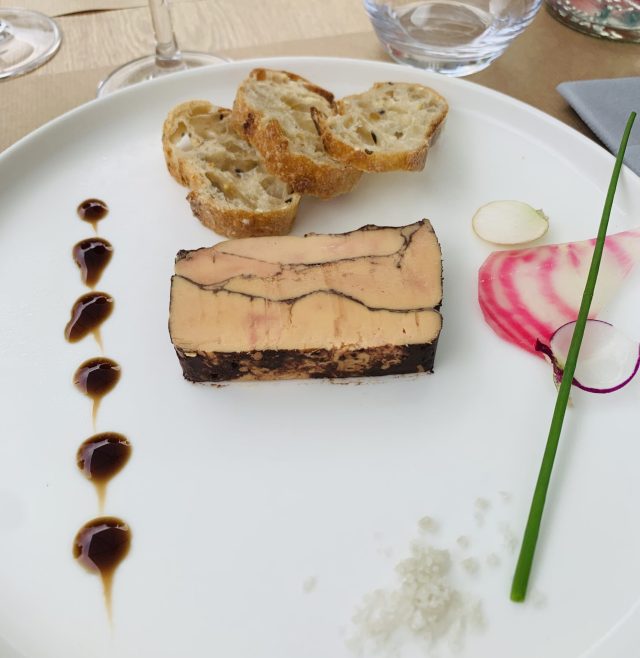
Scripture Feeds my French Appetite

How delighting in luxury led one woman to the feast of scripture.

Cover Photograph by Klara Kulikova

Cumin. Cilantro. Cinnamon. Cardamom. Chai. Chile. Colors and smells enthralled my senses as our guests walked in the door, bringing into our French home much more than food to share. We had invited them for a most unusual culinary journey, asking each guest to bring their favorite homemade dish to share over an hours-long sit-down banquet.

The feast arrived sealed within every shape and color of earthenware, cast-iron, glass, and basket; but no container could contain the aromas that boldly wove around us, the first hints of new discoveries yet to be tasted.

The table was set and the fare unveiled: Lebanese tabbouleh, Indian chapati, Greek mezze, Spanish paella, Thai curry, Korean kimchi, Brazilian meat, French duck confit, New-York style cheesecake, and Italian tiramisu. I even baked French croissants for the occasion.

We took our seats around my casual red-and-white checkered tablecloth and white porcelain plates. My husband’s garden-grown flowers added the festive je-ne-sais-quoi, symbolic of the ambiance the next few hours would hold. One by one, each guest presented their offering of love, providing personal stories and favorite memories, inviting us to experience their culture through our five senses. Each tasteful bite was matched only by the extravagant displays and textures, the delightful laughter of easy conversation, and, the indescribable fragrance of this exceptional menu. For a day, our home became a cradle for culinary cultures.

Watching my guests interact with the unusual fare was enlightening. While some kept the bowl of salt-and-pepper potato chips safely nearby, the more daring discovered delightful new experiences for their taste buds. 

Watching my friends dine inspired me to wonder: What flavors have I yet to encounter to enhance my spiritual journey? Do I approach the Bible expecting a burst of deliciously spiced novelty, or do I satisfy myself with the same old bland scriptural potato chips? Do I look to the church universal, across time and space, to enrich my experience of intimacy with my precious Lord, or do I stick to what I already know? 

I am French, which means I am culturally wired to love good food. I am also a former devout atheist, which means my passion for and gratitude to Jesus flavor my every moment. And, because I have lived on three continents in four countries through six professional roles, I have learned to decipher traditions and language to taste the cultural beauty surrounding me. 

Now, as a native French woman living in the United States, I am still living and ministering cross-culturally. This unique global experience has taught me to encounter Scripture through the same lens of language, food, culture, and spice; I have learned to camp at the intersection of culture and Scripture. God challenged me almost 30 years ago, when I was a very convinced atheist, to dare to “taste and see that he is good.” Since then, I have tasted how God is like dark chocolate: both addictive and good for you.

My illuminating experience with Scripture revealed to me that our marvelous Lord is culturally savvy: He took that food-related verse (“taste and see,” Psalm 34:8) to challenge me in a way my heart could understand.

I love the French word for delight: it is the word, délice. In French, we have only that one word for the two English words delight and delicious. The poetic beauty cannot escape you: in French, God is both delightful and delicious. Spiritually speaking, when we aim to make God’s glory our delight, we also aim to savor his goodness. That is why my personal motto is, “God’s glory, our delight.”

We French are famous for our passion for all things hedonistic, and I’ll be the first to admit it: outside of Christ, we have taken things down the wrong path. But allow me to redeem a little something that is precious to my French heart—our definition of luxury. In America, luxury might be defined by the abundance and quality of possessions; in France we like to think of luxury as “a feast of the five senses.” When your five senses are involved in an experience, that moment is luxurious. Think of your first bite of a warm, crisp, buttery croissant: your senses of smell, sight, touch, taste, and even hearing are all involved. That is luxury.

Spiritual luxury is being so immersed in our relationship with God that all five senses are involved. We delight in God with our whole heart, mind, soul, strength, and spirit. We long for him more than the deer pants for water or the child for a mother’s embrace. God told Jeremiah and Ezekiel that his Word is like honey. I would like to suggest it is like a French croissant, too.

The croissant is part of our daily routine in France, and I dare say that no culinary luxury is complete without one. It necessarily accompanies my morning coffee—black, no sugar—while I meet with God before the sun arrives. To me, daily spiritual luxury tastes like French roast.

From my morning coffee onward, I purposefully plan my day to steer clear of insipid sameness and instead, integrate creative change. I apply the same diversity to my spiritual routine, drawing from the spice pantry of the traditional spiritual disciplines to counter the dreaded staleness. Our spiritual spice rack offers such variety that I never should experience tastelessness as I seek to ground my faith: Scripture memorization, prayer, Bible study, journaling, acts of service, fasting, worship, singing, and reading inspiring authors, from the past and from the present both. 

Just like the manifold items at our potluck meal, these spice jars provide different textures and flavors that will enthrall and challenge my mind and heart, inviting me into spiritual luxury and beckoning my five spiritual senses. They teach me to love the Lord my God will all my heart, mind, soul, strength, and spirit.

There is a final element of spiritual luxury that draws me deeper into the throne room in awe and worship every day: in Christ, success is guaranteed. In other words, when I decide to make God’s glory my delight every day, I align myself with God’s will for me, and am therefore poised for a satisfying, fulfilling, delightfully successful life. Just like my potluck guests were bound to succeed in their cooking efforts because they were showcasing their identity, delighting in God is the way to and result of a well-grounded identity in him. That is the spice of life, and the ultimate spiritual luxury.

I cannot adequately convey to you the matchlessness of a fresh French croissant without handing you one to taste. Similarly, we cannot understand what it means to be in awe of God by simply being told, we must experience him. 

As God’s child, I am created to delight in his glory every day—that is the ultimate spiritual luxury and definition of success. It will look different for each one of us, because God is too creative to do things twice the same way. As my teenage daughter likes to remind me, originals are worth more than copies. 

And in that sense, our multicultural potluck dinner provided a taste of eternal spiritual luxury; each contribution was truly one-of-a-kind and together all pointed to a reality greater than each part—greater than the individual spices and flavors could ever have achieved. As we connected around tastes, smells, textures, sights, and laughter, we enjoyed the fellowship that every tongue, tribe and nation will soon experience forever. To delight in God’s glory is the deepest longing of the human heart and the most satisfying banquet we can ever join. So grab a chair and join the feast. You are awaited.

Theology

Faith in the Face of Bullet Fire

What happens when steadfast faith collides with wartime trauma?

Cover Photograph by Jeremy Cowart

This story contains content that some may find disturbing

Deep breaths, Beth.” I repeated the words as I stood above the hospital bed. “Deep breaths.” 

I had met Joseph Ndekezi 12 years earlier when my life had already profoundly changed. Experiences of trauma in my own life, as well as my PhD in Psychology, had led me to participate in trauma healing initiatives in a war zone. Children in the Democratic Republic of the Congo, some as young as six years old, were being ripped away from their families and conscripted into local armies. They suffered horrible abuse, including beatings and rape, and the extraordinary psychological trauma of being forced to kill. As I returned to the United States, I began to imagine what it might look like if these children, who had seen the worst of war, might find peace in themselves and bring peace to their people. 

I had been praying for an African teammate who might share the same vision of redemption for Congo’s war-affected youth when I met Joseph. He was already providing care to rescued child soldiers, many who no longer had homes or could never return to them. He took the children people had cast aside as too broken, too wounded, and demonstrated the love of God. Since he saw them as image bearers of Jesus, they began to view themselves in the same way. 

We dreamt together of what might be. What if children shown the horrors of war might grow up to bring those horrors to an end? What if they might not only heal from their trauma, but transform their pain into purpose, to teach peace and forgiveness?

So, we began building Exile International in Congo. We started with 25 survivors of war, using the creative arts to help them process their experiences. There are now over 2,000 youth in our programs, which include trauma healing, peacebuilding, and leadership development. 

But none of that would have been possible without the wisdom, vision, and love of Papa Joseph, our steadfast one. Papa Joseph, whose body lay in ruins before me. 

Standing over his hospital bed felt like an out-of-body experience, except my stomach twisted and churned. I felt that part of my body perfectly well. 

We were in the intensive care unit at King Faisal Hospital. Every conversation repeated the distressing words, “rebel ambush,” “bullet,” or “paralysis.” Our African team was exhausted, traumatized, and yet somehow full of faith. I felt like a faithless child in their presence, learning from spiritual giants. 

The ambush had taken place a few days before. Joseph, two counselors, and a driver were returning home after providing art-focused trauma care and holistic rehabilitative care to rescued child soldiers and children orphaned by war. The purpose of this visit was to welcome new war-affected children into our sponsorship program. When the program concluded and the group made their way home, the long dirt roads led to a violent roadblock reception.

It happened in the thick of the jungle, between Karumba village and the Congo base. Three rebel militia stepped out of the trees and onto the path of the vehicle. They lifted their AK-47s, and suddenly the air was filled with chaos. Amid the gunfire, the smoke, and the shouting, Joseph was struck five times. The bullets damaged his lung, broke his bones, and paralyzed him from the waist down. 

The militia robbed our team and stole away. It was clear Joseph’s life was in danger and he needed immediate care. As the team members rushed to get him medical attention, the damaged vehicle sputtered and died. They frantically arranged another car, and dealt with another interruption when a tire burst. Finally the team arrived at the nearest hospital, three-and-a-half hours after Joseph had been shot. The following day he had been transferred to the best hospital we could find for spinal cord injuries, in Rwanda, as I flew on a whirlwind of emotions, logistics, and prayer across the Atlantic. 

“My sister… you came.” 

Joseph struggled to speak as I entered the hospital room. He attempted to turn his head toward me but the broken bones in his neck would not allow it. “You came so far so quickly,” he whispered. “I could not have imagined you would come. How are you? You must be tired.” 

So much frailty. So many wires and machines. So much noise. We were in one large room where the patients were arranged about six feet apart around a nurse’s station in the middle. Many of the patients moaned in the midst of their pain and confusion. Some stared at the ceiling, unresponsive. 

Two of the bullets had gone right by his head and struck the back of the vehicle. Joseph had come so close to death. 

Of course, he had known death might come for him. He had known this was a possibility when he followed God’s call to minister to children of war in remote parts of the Congo. This was a war of flesh and blood, armed forces and spiritual forces, and Joseph was like a wounded soldier returning from battle. He told me that would gladly die for the cause. He had always spoken hope and life with every word and deed, and he did so even now. 

Of course, I too had known. I thought I had been prepared for an excruciating call from our team alerting me that one of the youth in a remote and rebel-saturated village had been shot or kidnapped. Perhaps I had even been prepared to hear that we had lost one of our staff members living in the heart of the red zone. But I had not been prepared for this, for the sight of a weak and frail Joseph whispering in pain in a hospital bed. Not for the Papa of so many children, the children who had been with us from the start. How could this be happening to Joseph? In the center of my gut, I knew the answer: the enemy was going for the jugular to force us to give up. But we weren’t giving up. We were digging in.

The following weeks were a blur of research and discussion and organization. In the midst of the heartache and medical uncertainty, the faith of the Exile International staff was like nothing I had ever witnessed. It kept me afloat. Their prayers were infused with hope. Their gratitude was pure. Their hearts reflected Jesus.

I met with the doctors with Christine, Joseph’s wife. They updated us on the extent of Joseph’s severe injuries. They told us he only had a four percent chance of walking again. The numbers felt like a punch in the stomach. 

I dreaded breaking the bad news to the team. They were waiting for me in the hallway. I began to share the prognosis, but before I could explain further, I was interrupted with one word from our program coordinator, Etienne.

“Hapana.” 

The Swahili word word means no. Etienne was saying, “No. Negative. We will not accept this.” 

“This,” she said, “is where God comes in.”

It was one of many moments when our African staff taught me how to be a faith-filled follower of Jesus. I had been raised a preacher’s kid with a passion for life and a deep love for Jesus that was considered odd even in my own community. But my hometown culture could never have taught me the kind of radical faith I have seen in my African brothers and sisters. 

While we overflow with riches and comfort in North America, we live in grave spiritual poverty. Our friends in developing countries often lack what we consider necessities, but they abound in spiritual wealth. They dance in the face of war. They trust when it seems naïve. Their cup runs over with surrendered faith and irrepressible joy.

As Joseph lay in the hospital bed, he shared out of the treasure of his spirit. 

“Can you imagine?” he said. “I might not have lived. But because of the grace of God, I am alive. He did good things for me. What he has done is enough. Even if I never walk again, what he has done is enough. Even if my legs do not work, I will be there to work for God, lead the children, and encourage the youth in Jesus’ name. I have been blessed to work with children in war for 15 years, and I believe God will add 15 more.”

I was undone. For days afterward, as I stared out of the window, I wrestled with the simple power of Joseph’s declaration, “What he did is enough.”

It was a moment of worlds colliding. In the world in which I was raised, was there ever such a thing as “enough?” I felt it in myself, this restlessness, this constant striving for more in my relationships, my work, my body, and my need for approval. 

So I sat with the question, “What if my life became enough?” 

Joseph taught me and my husband so many of the deep things of life. His story didn’t end in that hospital bed. A new chapter was just beginning. 

Joseph went on to receive a year’s worth of rehabilitation in South Africa. From his hospital bed, he was an irresistible force, discipling nurses, doctors, and his fellow patients, and declaring to everyone who listened how God had saved his life. 

He received permission to start a “hospital church” on Sunday mornings, and preached the first sermon reclined in his hospital bed. Papa Joseph became Pastor Joseph. After some of the patients mentored by him were discharged, they began planting churches of their own. 

As if that weren’t enough, we began to see a miracle. In a testament to Joseph’s never-ceasing faith, after months of rehabilitation he began slowly moving his feet. Next, he moved his legs. Then he walked with the support of parallel bars, which led to walking with the help of crutches.

Over a year after his body had been shattered by bullets and the cruelty of war, Joseph began taking a few steps on his own, holding onto nothing but faith. He has also returned to the work he loves, helping survivors of war become servants of peace. Perhaps God will give him another fifteen years.

Children so broken they cannot be redeemed? A man so wounded he cannot be healed?

Hapana. This is where God comes in.

addApple PodcastsDown ArrowDown ArrowDown Arrowarrow_left_altLeft ArrowLeft ArrowRight ArrowRight ArrowRight Arrowarrow_up_altUp ArrowUp ArrowAvailable at Amazoncaret-downCloseCloseellipseEmailEmailExpandExpandExternalExternalFacebookfacebook-squarefolderGiftGiftGooglegoogleGoogle KeephamburgerInstagraminstagram-squareLinkLinklinkedin-squareListenListenListenChristianity TodayCT Creative Studio Logologo_orgMegaphoneMenuMenupausePinterestPlayPlayPocketPodcastprintremoveRSSRSSSaveSavesaveSearchSearchsearchSpotifyStitcherTelegramTable of ContentsTable of Contentstwitter-squareWhatsAppXYouTubeYouTube