Church Life

What the Darkness Doesn’t Obscure

How life as a traveling astronomer’s daughter revealed universal truths.

Cover Photograph by Daniel Olah

Into the moonless night of the desert outside the Chilean town of San Pedro de Atacama, our party of eight excitedly clambered out of the car. In the daytime, Valle de la Luna (Valley of the Moon) exhibits barren, unearthly scenery and rock formations in a kaleidoscope of pastel colors. But at night, as the car engine clicked off, we were submerged in vast darkness.

The familiar sense of adrenaline filled my 10-year-old body. Looking straight ahead, I could wave my hand in front of my face without a flicker of detection. Closing my eyes or opening them, there was no difference—but keeping them closed made the darkness feel smaller and safer.

In 2004 we were on the cusp of our move from Chile to South Africa. Not only a new home, but a new continent. The fourth one within my first ten years of life. Maybe my insistence on keeping my eyes closed reflected my refusal to accept the fact that we really were leaving. Self-imposed darkness seemed easier to handle than the darkness of the unknown. 

I heard whispers around me—my sister, three years younger, had not gotten out of the car yet. “Where is the flashlight, Daddy? I can’t see anything.” Although slightly panicked, she whispered out of shared reverence for the night. It seemed natural to respect the dark, as if noise would disturb the vastness of it.  

Some keep quiet because we are trained to assume sleepiness in the dark; or the implicit correlation of secrecy with nighttime activities. When we work in the dark, people assume we have something to hide. But many useful things happen in the dark. Newspapers are printed and delivered, streets are cleaned. My father studied the stars.

“Just give your eyes a chance to adjust,” he replied, like I knew he would. Ever since I can remember, turning on a flashlight in nature at night bordered on sacrilege in our family. My mild-tempered, soft-spoken dad, an astronomer, never admonished us directly, but instead guided gently with information.

“It takes hours for your night vision to become fully activated, as the rod cells in your eyes are very shy and will only activate properly once they’re totally sure it is dark. Every time an unnatural light source hits your eyes, your eyes assume it is day and go back to daytime vision. The night vision process must begin again. And that’s just a waste of time, isn’t it? Time where you could be enjoying the view.”

A comforting hand squeezed my shoulder. Did he know my eyes were still closed? “There’s no view,” I sighed, “we are surrounded by darkness.”

But that is not how my father saw it. What he saw was light that had traveled thousands of lifespans to reach us exactly where we were. When he explained this to me, I knew there was no point walking around with my eyes closed, wrapped up in my own unfruitful darkness. So, I held my breath and opened my eyes wide, welcoming in the light. Because that is what eventually all natural darkness reveals—the faintest of light. 

Looking up from the Chilean desert, slowly we watched the other world start to open. My pupils dilated to receive the night sky. Stray dots connected into a constellation, a sword hanging from Orion’s belt. What was a blanket of black suddenly revealed the streak of the Milky Way as it folded within the light of other smaller and further galaxies. 

Christian jargon and everyday speech have taught us to walk in the light and stay away from darkness. We are called to “bring light to the dark places,” to “drive out the darkness of evil with the light of truth.” But it is also true that there is no greater joy than that which comes after suffering, there is no starker truth than that which stands out from the confusion of lies. The beauty of life often comes from contrast. 

When everything around us is too bright, it becomes difficult to see the small lights. A city on a hill is not easy to hide, but how often does a single window in a skyscraper catch our eye? I found out that darkness was a gift because it discloses the light.

In my childhood there were many nights like these. At times we would be looking for a specific cosmic event. At other times we would hunt for satellites. The one who spotted first received the honor of wielding the laser beam, which seemed strong enough to reach all the way to the skies. 

I thought satellites were more fun to spot than shooting stars. They lasted longer, and I could share the joy of my find with others and track one across the whole sky instead of that flash of a shooting star that disappeared before I could put it into words. 

We would lie on the beach in Cape Town, or on a hilltop in Santiago, and my dad would describe, in the vein of Antoine de Saint-Exupéry´s The Little Prince, how we were at the cusp of the planet, on the very edge of a giant mass hurtling through space at 220 km per second. We would lie there in awe, staring out into the expanse of universe spreading out in front of us. We imagined we could feel the speed in our fingertips, entranced with how stable the constant motion seemed.

Those nights impressed on me how small I am in the face of the universe. How far I am from its center. How near I am to its Creator. 

How great our Creator must be to hold it all in his hands. As a child, I believed him to stand upon on a cloud somewhere. Then I imagined a physically massive presence holding the universe in his hands. Eventually I just accepted that he is, in all and through all. 

Those distances between galaxies that are impossible for humans to traverse, he holds together; those black holes that stretch existence into oblivion, he oversees. Through years of research and study, my earthly father understood many of the things that occur in space, but my Creator Father knows the beginning, middle, and end of all things because he is, has been, and always will be.

Vincius Henrique

Perhaps my father sensed my apprehension that night in the Chilean desert. Taking the laser beam, he directed it at the Southern Cross, the constellation of stars that directs us to true south. “You can never be totally lost if you just look up to what the darkness does not obscure.” 

This realization helped me in the next move that followed. Even though Cape Town was a new and foreign city, when we sat on the shore of the Atlantic Ocean watching the sky grow dark, those familiar lights started to reappear. The planets, Jupiter and Venus, reflected the sun. Sirius, the brightest star, hinted at where the Southern Cross would soon appear. I couldn‘t be lost when so much had stayed the same. Not all the light could be blocked out by the darkness of uncertainty.

My father’s passion for the universe intertwined with our everyday lives. We traveled to see eclipses and vacationed with telescopes. We lived at the South African Astronomical Observatory, and waved at the Hubble telescope passing by in space. I lived these things and knew no different. I assumed it was a normal life, and only when I left home did I finally grasp the rarity of my father’s profession, the uniqueness of my own upbringing. 

As an adult, I feel the lasting imprint of my childhood as an astronomer’s daughter. I categorize people in my life as either shooting stars or satellites—those who are a brief, bright presences versus those who patiently plod alongside for longer. 

I now live in Austria, on the opposite hemisphere from where I grew up, but I still orient myself by the stars. And now, when others say that it is too dark to see anything, I look up at the sky and I wait for my eyes to adjust. I do not own a flashlight. 

Instead of the Southern Cross pointing me to true south, the Big Dipper helps me figure out which way is true north, and I sense the Creator more clearly than I ever have. I look up and know that there are constants in life. I look up and know that I am not alone—that behind the universe is a changeless Creator who is higher and greater than all that I see.

Church Life

Our Body Groans for Unity

How a diverse church in Djibouti reveals God’s difficult plans.

Cover Photograph by Samuel Martins

In 2018, my husband and I baptized our 17-year-old son in the Red Sea at a dusty beach off the coast of Djibouti. One hundred meters behind us was the International Airport of Djibouti and the security fences of Camp Lemonnier, the American military base. 

On that humid morning, we gathered together as a church community made up of people from Madagascar, Korea, the United States, Kenya, and the Congo. As the sun rose over the ocean, we shared communion, baptized my son in warm, salty water, and then ate breakfast together. 

I don’t know what stories the Djiboutian airport guards told their families that evening–maybe something about a teenager getting shoved into the water, followed by a lot of singing from a strange, international gathering of people. But I do know the Malagasy couple and the Congolese family in our church have been a part of my son’s life since he was four years old. And I do know the Korean family, new to Djibouti, had tears in their eyes when they thanked me for inviting them. “God is with this church,” they said. 

The story of our community is one of faithfulness and hope. But it’s also one of compromise. My family has lived in Djibouti since 2004, and for most of these years, we have attended l’Eglise Protestante Evangelique de Djibouti, or EPED. Main services are on Sunday evening and predominantly in French. 

Even though French language and culture permeate our church, the transient community includes almost no French members. At potlucks, we feast on Indian, Djiboutian, Ethiopian, and Burundian cuisine and tangle up the Malagasy names of our fellow parishioners, which often include up to 25 letters. 

Our current pastor is from Senegal, the choir director from Madagascar, the administrator from Congo, the drummer from Korea, and the guitarist from Kenya. The parish council includes eight members who hail from five different nations and eight different denominational traditions. We gather in our only common language, native to few. We come out of our weekly work contexts–where our neighbors, teachers, coworkers, and friends are Muslim–and enter the church compound eager to share what unites our small, complicated community: a commitment to Jesus. 

It might be tempting to call our church a little slice of heaven and quote from Revelation 7:9-10: “After this I looked, and there before me was a great multitude that no one could count, from every nation, tribe, people and language, standing before the throne and before the Lamb.” 

Marcus Santos

We are in fact Christians from many tribes, peoples, and languages gathered to worship God, so that picture is true to some extent. But it is also simplistic. Every time we come together, each of us brings with us not only linguistic and cultural differences, but also theological and stylistic preferences. Those clashing perspectives can make it challenging for our church to worship together. 

They can also affect me personally. At the end of a demanding week of cross-cultural life, I might feel exhausted by services in which I strain to understand the sermon, where I may not feel moved by the music, and where fellowship requires effort. But only if I attend church expecting wholly to receive.

“It can take practice to find God in the midst of our differences and not just bemoan the more wearing parts of the adjustment,” writes Mark Labberton, President of Fuller Theological Seminary, in Called: The Crisis and Promise of Following Jesus Today. “We may say we want to be part of a vigorously multiethnic congregation and that we want it to be economically mixed, but this can make church more complicated. It means adjusting our expectations.” 

This insight is situated in a chapter about the church in exile, where Labberton addresses Christian community as a counter-cultural group set against the secular world of American consumerism or, in my case, a surrounding Muslim culture. Christians are welcome in Djibouti, but we are an extreme minority, so the imagery of exile hits close to home. The idea of adjusted expectations also resonates deeply with me. 

The compromises we make at our church have enabled us to experience vibrant Christian life. As a congregation, we consciously choose to set aside personal preferences, honor one another above ourselves, and hold fast to primary theological issues while we “agree to disagree” on secondary ones. To a watching world, we offer a radical testimony of humility, love, and the power of God. 

The world around us is watching. On high holidays like Easter and Christmas, French and Djiboutian soldiers armed with rifles guard the gates of the church compound. The pastor keeps a list of members so he can share openly with the government, should they inquire. My husband has been asked by former university coworkers why he goes to church—meaning they’re well aware that he does. When we enter the church building, local children approach us, beg for food or money, and ask us what we do inside and why. 

We are a city on a hill, not a lamp hidden beneath a bowl. Our good deeds—by grace, may they be good!—shine before others. 

“There is a grande richesse,” says Tshimanga Mukendi Pierre, our church’s administrator, music leader, and the longest-term member of the community. “A spirit of openness and not of judgment.” 

That ecumenism starts inside our church and extends beyond our walls. On special occasions, Catholics and Protestants in the area worship together. For a season, our church didn’t have a pastor, and when a member died, a local Catholic priest performed the funeral. The few Christians here partner for social service activities, like caring for street children, or helping out with education programs for low-income families. There’s also a women’s prayer group that includes Catholics, Protestants, Orthodox, and others.

“You would never see this in Congo,” Mukendi Pierre said, who arrived in 2002 and brought his family from Congo in 2008. “But here, we live with others, and we are enriched by our differences as we put aside our prejudices and judgment.”

Social collaboration is one thing. Dealing with difficult theological differences is quite another. But by God’s grace, we’ve been able to do that too.

The pastor before our current one was a German man unfamiliar with more Pentecostal expressions of faith. One afternoon in 2005, an Ethiopian church gathered on EPED property and performed an exorcism on a young woman. While she screamed and writhed in the yard of our church compound, the pastor, who didn’t know what to do, told Mukendi Pierre to call the police. But by the time that pastor left in 2017, he had hosted monthly prayer gatherings to deal with spiritual possession and attack. 

“I came to Djibouti to teach the Word of God,” he said in his final sermon at our church. “But I am leaving Djibouti having been taught the Word of God by Christians here.”

Mukendi Pierre’s wife, Eliane, emphasizes a similar message. “We must set aside fear of something different so that we can learn and change,” she told me. “It takes courage to ask, ‘What is good for or about this other person?’” 

God has done miraculous things in and through EPED. Members have been healed of cancer. One pastor, paralyzed in half his body from a beach accident, was able to walk again after receiving prayer. A young boy at a church picnic was pulled unconscious from the ocean and saved. Broken marriages have been reconciled, victims of serious car accidents healed without medical intervention, and explosive house fires narrowly averted.

We have also seen pain in the form of death, disease, financial devastation, divorce, and disagreements. With so many of our members living away from blood relatives and support networks, we’re learning to be the family of God for each other in times of both celebration and sorrow.

“We are a small community,” Mukendi Pierre said, “but we have a big vision of God. This is what gives me hope.”

It is hard to gather in a foreign language and reach across theological and cultural differences. Sometimes I step outside during a church service, just to take a few deep breaths and get some distance from others. I’m sure they do the same thing in response to me. But I don’t go to this church for personal fulfillment. I attend because from Christ “the whole body, joined and held together by every supporting ligament, grows and builds itself up in love, as each part does its work” (Eph. 4:16).

That truth holds for all of us around the globe. As we practice dying to self, church becomes a place where we encounter God in the imago Dei of someone we might disagree with. We remain together, because corporately, we can cling to a bigger vision of God than one we could hold to alone. Right there in that space, we’re transformed more and more into God’s likeness, and church becomes a sacred gift.

Church Life

What I Learned Under the Red Lights

How caring for women in the sex trade taught a missionary new truths.

Cover Photograph by Gene Brutty

This story contains content that some may find disturbing

On a blazing hot day in June of 2021, I make my way across the bustling cityscape of Taipei to the Pearl Family Garden Woman’s Center, where I have worked for the past 12 years. Cutting through Bangka Park, I see the homeless scattered across long concrete benches around a grassy patch. They’re wearing masks and sitting apart. A fountain nearby plays music on the hour and displays colorful lights at night.

Located in Wanhua, Taipei City’s red-light district, our ministry reaches out to women in prostitution, the elderly, and others on the margins. Our center is situated a stone’s throw from Longshan Temple, one of the oldest in Taiwan. I can normally smell incense wafting from the altars, but the temple is closed due to the recent lockdown.

Before the virus outbreak in May, the neighborhood thronged with people filling its roadside food stalls, secondhand flea market, and shops selling herbs and traditional foods. One would have to be careful not to step on rubbish, dog waste or the fibrous remains of betel nut, a stimulant favored by working-class men. Throughout 2020, life had continued pretty much as usual, numbering 253 consecutive days with no domestic infections.

Now, the streets are empty. The government announced a batch of cases traced to two tea houses in Wanhua. Thousands of women work there as hostesses, offering their company to mostly middle-aged and elderly men drinking tea or alcohol and singing karaoke. Some of the women are involved in prostitution. Since May, all 172 tea houses and lounges here have been closed. Most of the buildings in the area are old. Some are decrepit. Many elderly and poor are crammed into basements or rooms without proper ventilation.

My destination is a nondescript four-story shophouse formerly occupied by an illegal betting operation. This is home to the Pearl Family Garden Women’s Center, which moved here in 2019 after ten years in a smaller apartment.

As I step into the center, my team leader greets me. This is my first time seeing Tera van Twillert after my three-month furlough in Singapore, and my first day back at work after the mandatory quarantine for travelers. An OMF worker from the Netherlands, Tera is one of the most gracious, patient, and faithful people I know. At 5 feet, 8 inches, she towers over most Taiwanese, but her cheerful smile, gentle demeanor, and twinkling blue-gray eyes make them feel welcome.

Called to missions at the age of 16, Tera has always been drawn to people on the margins. She came to Wanhua 28 years ago and took up residence on this very street. For 14 years, she served in a church for homeless people before starting the Pearl Family Garden ministry.

Pauline, our Taiwanese co-worker, likes to tell this story about Tera. “When I went around the neighborhood with her, one lady said, ‘Ah Jen [Tera’s Chinese name] loves us.’ How many people would say the same thing about a pastor walking around his neighborhood?” I’ve also seen homeless people greet Tera with great enthusiasm and come up to hug her (even though most Taiwanese are not accustomed to such signs of affection).

Tera and I set up tables and lay out instant noodles, rice, and canned food, which our low-income neighbors can prepare even without a kitchen. Tera has called some of our regulars—people who would be struggling since tea shops, KTV hostess lounges, and the sex trade on the streets have been shut down—to get supplies.

Shaoli is the first to arrive. Her mask is askew and reveals her missing teeth. Dyed an unnatural blond, her hair gives her a youthful look that belies her actual age of 62. She’s dressed in shorts and a top that barely covers her belly button. Following government regulations, I take down her name and telephone number for contact tracing. “Can you please adjust your mask and keep your distance? Tell me what you want and I’ll put them in this bag for you.”

Shaoli ignores me and grabs the instant noodles. I feel a frisson of fear and frustration.“Can I use the bathroom?” she asks. Public lavatories in the area have been closed for months.

I let Shaoli use the bathroom. Then Tera chats with her and they pray. When Shaoli leaves, I disinfect the toilet. I wonder if it’s wrong that I’m afraid of the people I came to serve. 

A week goes by. I return to the center and find Tera patiently listening to an old friend. Hwee is speaking with great agitation. Her mask hangs loosely to one side. I say (only) half-jokingly, “Hwee, can you leave now? Let other people come in to get stuff.” With a nervous smile I gesture to her to move on.

Tera does not let fear hold her back from her mission. Last summer she was due to take her furlough in the Netherlands but postponed it. I asked her what led to the change. 

“I realized that being present for people is more important than protecting myself,” she explained. “God called me, first into missions, then to ministry with marginalized people, then to women on the margins, and finally, to this particular street. God called us to be here. He put us here for a purpose, for a season, for the bigger community. Only when you’re on the ground, can you see and feel what people are going through.” 

By opening the center once a week, we are not just meeting physical needs, but also emotional, mental, and spiritual ones. Often, women just want to come in, enjoy the air-conditioning on a hot summer’s day, and talk to another human being. In the past, they would spend most of their waking hours outside, hanging around the park or the neighborhood. But the month-long lockdown changed all that. For people living on their own in cramped living quarters, the struggle with loneliness and boredom is especially acute. One of our friends, Madam Lai, sometimes walks 15 minutes from her home just to sit on our street and watch people go by.

It takes time and patience to have a meaningful conversation. I struggle against my own fear. I want people to come, take what they need, and leave. I can see some of the women crave conversation more than they need supplies, but talking to anyone for more than a few minutes makes me anxious.

At home later, I think back on the day. My anxiety makes it hard for me to be close to people. Ironically, since most ministry activities have ceased in the pandemic, being physically present with the women who come in for supplies or conversation is the only “productive” thing I can do. I too often focus on “getting the job done” and forget that the real job, the real calling, is to make God’s love and grace present to the people he brings before me. 

Crises drive us to yearn for the status quo. However, as the Chinese saying goes, “A crisis is an opportunity for change.” Perhaps when the old ways of ministering are set aside, we can press on and discover new ways to minister the love of Christ others. 

The pandemic has forced us all to confront our mortality. The first time Tera returned to the neighborhood during the outbreak, she met Mr. Ho. An elderly man living on his own, he looked forlorn. He had recently suffered two strokes. While Tera prayed for him, she felt the Holy Spirit prompting her to ask Mr. Ho, “Do you want to accept Jesus as your Lord and Savior?” Without hesitating, he replied with a firm “Yes!”

A heavy heart and an open mind, ready to receive God’s word. All we have to do is sow the seed. The result? An unexpected moment of light. A celebration in heaven.

Week after week, Tera put two stools on the sidewalk and met Mr. Ho outside the center to listen to his story and in response, share God’s story. 

Watching their relationship blossom, I was forced to ask: Do I truly love the people that I serve? I’ve never liked the phrase “serving the poor” but I could never articulate why until I read Father Greg Boyle’s book, Tattoos on the Heart: The Power of Boundless Compassion. It taught me the concept of mutuality, where we view others through a perspective of oneness and kinship. There is no mutuality in “serving the poor,” only a barrier that says “us versus them.”

Mutuality and kinship speak instead of a relationship between equals. There can be no sense of superiority or pity. As Father Boyle says, “Finding and seeing, beyond our sense of being separate, our mutuality with the other is hard won. Bridging the gulf of mutual judgment and replacing it with kinship is tricky indeed.”

I once asked Tera to describe her relationship with the women who come to our center. She said, “They are my friends. You show up for your friends in tough times.”

I think of Hwee, of her agitation and stress when she came to our center to pick up supplies. “It is too hot in my room,” she says. She cannot sleep. She has nowhere to go for meals. After Tera prays with her, Hwee calms down. Then Tera buys her some eggs, milk powder, and bananas. Tera tells me afterward, “What do I know about her struggles? It’s no big deal for me to do something for her.”

Father Boyle says, “Serving others is good. It’s a start. But it’s just the hallway that leads to the Grand Ballroom. Kinship — not serving the other, but being one with the other.”

For many cross-cultural workers, unspoken boundaries or professional distance sometimes separates us from the people we serve. To enjoy mutuality and kinship, we must be willing to “waste time” and not constantly monitor the boundaries of our private time and space.

The moments where we enter others’ worlds, and they enter ours, can be precious. Several years ago, I visited Jinjin on Christmas Eve. For a long time after, I recalled the warmth of the red bean soup we shared at the night market, as we remembered the birth of Jesus together.

Carnation, Tera, and I used to attend church in another part of the city. After services, we would have lunch together and I would venture to try new things. I remember Carnation’s excitement the first time we had naan and curry together. Even now, I can still picture her blissful expression as she sipped an aromatic chai latte.

Incarnational ministry is the only way to truly embody the spirit of Jesus in serving others. It requires that we learn the culture, language, and worldview, and live a lifestyle that reflects our identification with our neighbors.

Jesus is the fulfilment of incarnational ministry. The Word of God had to take on flesh so that we could see the Father through his Son (John 14:9). Christ could have stayed in heaven, enjoying the praises of the angels and the fellowship of the Trinity. Instead, he was born into a humble family. His earthly father was not a king but a craftsman. As a baby, he slept in a manger, not in a gilded crib. As an adult, he was an itinerant preacher who did not know where he would sleep from one day to the next. As he explained, “Foxes have dens and birds have nests, but the Son of Man has no place to lay his head” (Luke 9:58).

Jesus ate with sinners and tax collectors. He visited homes and accepted hospitality. He spent time talking to the Samaritan woman at the well. We often focus on “doing” for the sake of ministry. Building relationships and trust, however, requires “being” with others. It requires us to slow down and communicate, “You are important to me.”

Rather than going home right after work, Tera likes to walk around the block to greet people. For more than a year, she spent an afternoon each week visiting neighbors and shops on the street, making friends and giving out tracts. She might not live in this neighborhood now, but she has become part of the community. One place she visits on her walkabouts is the restaurant next door. Before Tera went home on furlough, Ah Leng, the restaurant owner said to her, “We love you very much.” As Jesus’ ambassadors in this neighborhood, we mediate his love to people through our presence, words and deeds. 

After six months of being shut down, the tea shops and KTV hostess lounges have reopened. This time around I am not paralyzed by fear or excessive caution. With a colleague, I venture into the poorly ventilated establishments to visit ladies at work. 

On Sundays, I gather ladies at the center to watch an online service and share a meal. The ladies tell me that the worst part of lockdown was the rejection they faced from their own families. Madam Lai said, “I wanted to go to my family in central Taiwan for Mid-Autumn Festival, but they were scared and told me not to come.” Hence, being able to gather physically as God’s family was very precious for her.

God is changing lives in the midst of this crisis. Some women have left the sex trade, some have found help through social services. Others have stepped into our center for the first time and heard about Jesus.

Tera’s willingness to take risks and put the needs of others before her own, challenges me to consider the reasons behind my fear. Her calm demeanor is a contrast to my anxiety and impatience. I have a choice. I can allow myself to be paralyzed by fear, or I can ask God for the wisdom and courage to take prayerful risks. 

The more time I spend in this ministry, the more I recognize that Jesus shapes me through mutual relationships as much as he shapes the women I serve. He uses the ladies, my co-workers, and others with different attitudes, views, and circumstances to challenge my fears and biases. I gain new insights and my trust in God grows deeper. 

When our Lord heard that his friend Lazarus was ill, he said, “This sickness will not end in death. No, it is for God’s glory so that God’s Son may be glorified through it” (John 11:4). Do we believe that our Lord Jesus may be glorified through this pandemic, even if this sickness may end in physical—but never spiritual—death for his followers?

May our Lord grant us the grace to overcome fear and anxiety. May love and compassion, not self-preservation, motivate all we do. By our faithful response in this pandemic and beyond, we can bring glory to his name.

Church Life

My Playground a Wasteland

How one girl held to her faith in the middle of a spiritual wasteland.

Cover Photograph by Natalya Letunova

This story contains content that some may find disturbing

For most of his childhood, my father lived right beside Beirut’s green demarcation line in a clumsy, battered two-story landmark with coral walls and green shutters. Though much of it has crumbled, and its walls bear the scars of war, still it stands, hidden among the more sturdy buildings on Mar Maroun Street. 

The playground of the nearby school was a stark reminder of the terror that once infected the area. My dad had told me, “When Ain El Remmaneh was besieged, whoever died was placed in a plastic bag and thrown into the playground of Seid School. That playground was filled with the corpses of those who died without a cause.”

A train compartment positioned sideways in the street blocked the passage from East to West Beirut. Sand-filled shipping containers were stacked on top to prevent snipers from shooting the passersby. People could not walk along the street to carry out their errands. Whenever they needed to go to the store, they hurried from building to building through holes in the walls.

“We couldn’t even open the windows,” my father would tell me. “We would lay out our mattresses in the inner corridor of our house whenever the shelling started. A shell had to penetrate two walls before it reached us. Once, a bomb exploded right above our bedroom, and sometimes as I looked outside, I would see bullets coming towards us and leaving their marks on the exterior walls… We had no electricity, no phone lines, and no water. Moldy bread was a regular meal. The worst part was the arbitrary killing and kidnapping.” 

Dystopian snapshots of Beirut flood my mind whenever my parents share stories of war. Like my parents, many Lebanese had to live long after the war with what Samir Khalaf called “the distinctive residues of collective terror and strife.” That series of proxy wars fought on our land ended with no clear resolution. The massacres and colossal damage were futile.

Where do I begin to recount the woes that befell this country in the past century or so? Shall I start with the 1860 Druze-Christian war that killed thousands? Shall I tell of the Lebanese mass starvation during the Great War, as the 400-year-rule of the Ottoman Empire shuddered and collapsed and the 1920 French mandate brewed underground?

Marten Bjork

In 1946, French troops left Lebanon. In retrospect, we know too well that the jubilation over the arrival of our long-awaited autonomy soon turned to mourning. A series of calamitous events mixed with external interference led to the 1975 Civil War—that piece of history that is left out of our school textbooks because it is too controversial. I was not there to witness the atrocities, but their shadows still follow me and will follow generations to come.

I was born in December 1991. The war had recently ended, and Lebanon was off to a fresh start—or so we would have liked to believe. For the next three decades, the country continued to sink deeper into the pit while rivalries festered. Every time the country tried to stand back on its feet, another blow sent Lebanon to its knees, panting for breath, begging for life.

I hadn’t always clung to my country. Growing up, I never felt I belonged here. I longed to escape to foreign lands. At 14, it seemed that my dream was coming true. A high school in Illinois awarded me a scholarship, and if all went well, I would pursue my college degree in America. My paperwork and plane ticket were ready. The school sent the I-20 form, and my host family was expecting me. But two things happened that year. 

The July 2006 Israel-Hezbollah war broke out. I remember July 12 being uncharacteristically cold and gloomy for a summer day. The Israeli army raided Lebanon, and the Beirut International Airport shut down. If that wasn’t enough to deter my travels, I was denied a visa due to my young age. I remember feeling an inexplicable serenity as I stared at the sea from outside the consulate. 

“I am so proud of you,” my mother said after we had arrived home. “You were so confident.” We both burst out laughing. Then, her laughter turned into tears, and my soldierly restraint dissolved. But in the years to follow, I no longer wished to run away. 

I was born to a Maronite Christian family, but it was at a small evangelical school that I met Christ. Whenever I think of that school, I can almost hear the faint screams of delight from children echoing through the winter playground, and the sound of their shoes squeaking on the slippery floor. I can almost hear the singing during morning chapels and the principal telling us about God’s marvelous love. 

In 2006, war was not the only thing that was ushered into my life. Amid the gnawing fear of airstrikes, a newfound peace glowed within me that summer. I had found Jesus. I meant to follow him even when my loved ones–and society at large–opposed me. As a young girl, that wasn’t always an easy task. 

The past two years have smothered many of the dreams I once had for this country. But I would like to believe that God is not yet done with Lebanon. My eyes have seen his followers’ responses to the recent tragedies. I have seen it in my own workplace. The faithfulness and compassion of the people at the Arab Baptist Theological Seminary (ABTS) have left an irreversible mark on me. 

“I grew up during the Lebanese civil war when the Church was mostly silent and in hiding,” ABTS President, Elie Haddad, shared in an article right after the 2020 Beirut explosion. “If you go to Beirut today, you don’t have to look far to see the hands and feet of Jesus.”

These healing hands and feet moved into action the Saturday after the Beirut explosion, when a taxi arrived on campus with the first traumatized family. The family’s clothes were stained with blood and Betadine. They had nothing but their medicine in a small plastic bag. Elie listened to a woman as her hands trembled and her eyes welled with tears. He comforted her, and he assured her that the people at ABTS would do all they could to help.

“My mother often told the story of how she had fled her home at the start of the Lebanese civil war—a baby boy in her arms and a little girl tagging along,” Elie shared in an interview. Although this encounter brought back recollections of war, in his words, “It reminded me that we are here for a Divine cause. As long as God wants to use us, we must be ready to give our lives away.” 

I cannot resort to false optimism and say that Lebanon will rise up from the dust. I cannot lecture about the need for repentance of lethargy, the need to withstand the pain so that life may spring from death. As high and resonant as it might sound, given our current circumstances, I fear that my words may border on the absurd and dismissive. Sometimes, one cannot help but think that, in our hapless state, something waits around the corner to pounce on Lebanon as soon as it becomes weak enough. When the Lebanese people have nowhere else to go, will they most willingly sell their souls to the first fraudulent voice that promises to save them? Or will they finally give their souls to the One who actually can?

What do people hold on to when everything is laid waste?

In 1922, modernist poet T. S. Eliot published his well-known poem, “The Waste Land.” The poem’s five sections portray life in London in the aftermath of World War I. To portray the fragmentation and sterility of the modern world, the poem uses rhetorical discontinuity and the juxtaposition of allusions to numerous works, including the Bible, Shakespeare, St. Augustine, Baudelaire, and Wagnerian opera. The poem also reflects Eliot’s era in its references to gramophones, motorcars, and typists.

“April is the cruelest month,” the poem opens, for spring reminds people of the stirrings of life that might rouse them from their dormancy. Coming back to life is not without its own pain. The poem ends with the triple repetition of the Sanskrit word “Shantih,” which Eliot translates as “the peace which passeth understanding.”

I find myself clinging to this hope, both for myself and for my country.

China’s Public Schools Are Failing Christian Families

Whether it’s atheism in the classroom or high-pressure academic environments, parents struggle to find a space that best serves their children.

Illustration by Mallory Rentsch / Source Images: Carol Yepes / Getty

In his early teens, Huang Jian began to withdraw into himself. (Huang and others throughout this piece have been given pseudonyms for their own safety.) A once-happy child, the Chinese middle-schooler gradually became silent. Jian’s father, Huang Yuzhou, blamed the behavioral shift on school “trauma,” a high-pressure environment that sapped his will to learn and engage. Uncertain how to help, the family made a drastic decision: They would homeschool their son, an educational choice currently illegal in China.

“Many Christians, by faith, have decided to give their children a Christian education,” said Huang, a house church pastor in northern China. “They do this in order to prevent their children from losing their faith, and to give them a better education that is in line with spiritual growth.”

Chinese Christian parents raising their children to follow Christ in a society that opposes their beliefs must confront the question of how to educate and spiritually nurture the next generation without a blueprint. Chinese state school curriculum teaches that God does not exist and compares religious belief to foolish superstition. Many first-generation Chinese Christians struggle in discerning how to pass their faith to their children, especially as they face increasing religious restrictions.

Huang’s son has now graduated. His wife continues to homeschool their youngest child, who is in early elementary school. Huang himself is currently jailed on charges related to his own religious activities. He and his family were inspired to try homeschooling after they learned more about Christian education and hoped it could help their son through his mental health crisis.

“We were watching a child stuck in despair,” Huang said. “It was not until we went down the road of homeschooling that we were able to see a turnaround.”

Lu Jinxiong sent his teenage daughter to study in the United States after she had her own difficulties with an oppressive social environment at school.

“As Christian parents, we have a great burden for the education of our kids,” the Shanghai professional said. “[The government] forces them to go to state school, and homeschooling is illegal. … This is a very big challenge to many of our brothers and sisters.”

Through a series of what they describe as administrative and financial miracles, Lu and his wife were able to send their daughter abroad. While they are grateful for the opportunity, they do not see themselves as a model for other parents agonizing over how to raise their children in the Lord.

“There is really no one true answer on how to face the question of what to do with our children,” Lu said, “because every family is different. Pray that [Chinese] parents will have wisdom on how to face these issues.”

A struggle to educate their kids

Most Chinese families have only one officially sanctioned educational option: state schools. (International and private schools exist, but these are heavily restricted or inaccessible for most families.) Many Christian parents find it painful to place their children in an ardently atheistic system that belittles a life of faith.

The government has long banned evangelism, and religious instruction for minors under the age of 18 is illegal in China. Still, over the past few decades, many officials have looked the other way as Christians found ways to pass on their faith. Some believers have relied on their churches to continue Sunday school lessons. Others, like Huang, fretted that churches were not able to raise up enough pastoral care to assist in spiritual formation for families.

Beginning roughly around the turn of the millennium, more and more Christians across China began to start small church schools to give their children a Christian education. Other families chose to teach their children at home. Both options had become increasingly popular for house church believers, although the space for church schools has constricted in the past few years.

It is difficult to find official figures on homeschooling in China, but estimates placed the number at around 18,000 (a miniscule fraction of China’s 200 million school-age children) in 2013. Still, over the past few decades, homeschooling has grown in popularity as Chinese Christian families in house church circles have learned more about the option.

Opting out of the Chinese system is not easy: Families who educate outside the system through the upper grades are unable to test into universities within China. They must either send their children to college overseas (which is difficult due to both finances and language) or forgo higher education altogether.

These are harsh choices. While many Chinese families aspire to overseas higher education, it is prohibitively expensive. With no remaining domestic options, these decisions shut young people entirely out of higher education. For Chinese Christians, this is sadly nothing new—during the Cultural Revolution, many Christian families lost out on education completely because of their faith.

Last summer, the government announced new regulations governing education in China, further complicating the situation. Much publicity has surrounded the regulations, many of which are aimed at reducing the pressure put on Chinese families to spend extravagant sums on after-school enrichment classes and tutoring as they seek to give their child all the resources they need for future success. Although the expressed aim is reducing pressure on children, these heavy-handed regulations increase the likelihood local officials will deal harshly with out-of-the-box education—such as church schools—within their purview.

These recent regulations plus a general harshening of religious persecution across the country have all but dismantled the education infrastructure believers so painstakingly built across China. Only a few years ago, Christians involved in the education sector estimated the burgeoning movement had as many as 500 schools across China.

Today, believers say the Christian school movement has nearly been suffocated. Small, church-run schools have increasingly been unable to operate since the government turned its attention toward shutting down these schools in the past several years, and among themseles, Christians discuss their fear that homeschooling may be next.

As the public space for church schools continues to diminish, some have been shut down; others have moved completely online—not due to the pandemic, but because of persecution. (Schools across China closed for several months when the pandemic hit in early 2020, but almost all Chinese schoolchildren attended physical, in-person class beginning in fall 2020. Very recently, Chinese schoolchildren have again faced remote school as China again deals with lockdowns due to the advance of the omicron COVID-19 variant.)

Last spring, officials stormed and shut down a Christian school in Anhui Province, arresting four teachers. Two of those teachers remain in jail today; the others were only recently released. Many families from that school have now sent their children back to state schools, and some report their children have been discriminated against and publicly humiliated by their teachers. Parents from the school have also been harassed by the larger community and local officials. In October, police in Jiangsu Province seized a homeschool curriculum salesman and five others associated with him.

Like church schools, homeschooling is also illegal in China. However, homeschoolers have not yet faced the draconian crackdown that church schools have recently endured, although Christian communities are buzzing with concerns that homeschoolers may be the next to undergo systematic pressure.

In the past year, homeschooling parents across the country have been questioned or even detained for their educational endeavors. Last summer, Zhao Weikai, a homeschooling dad in Taiyuan, Shanxi Province, was arrested on charges related to homeschooling his three children. (Because his case has been publicized elsewhere, Zhao is the only name in this piece which is not a pseudonym.) He remains in jail even now. All this is nothing new in China: The change lies in the scope and reach of recent crackdowns, which appear less isolated and more comprehensive across the country, as opposed to a regional focus on a specific group or network.

One day at a time

Those who follow Jesus ought to expect persecution, says Huang, the pastor currently in prison.

“Of course, we, as house churches, are merely a minority in society. We may encounter persecution and are discriminated against and excluded from mainstream society,” he said. “Since God's people are in this fallen world, and since the Lord Jesus Christ is not accepted by fallen sinners, it is impossible for disciples to be exalted above their master.”

Last summer, a prayer update circulated in a group of house church leaders read: “The educational space in Chinese civil society is shrinking dramatically and is about to be reduced to the point of no return. … Christian education is a part of [this trend and] faces even greater difficulties and dilemmas. Lord, we lack wisdom and do not know how to proceed on the road ahead. Please help us!”

Despite the pressure, many Chinese families refuse to be a part of the public education system. Christians are not the only ones with issues with the education system; many non-Christian families also eschew the state school system because of the intense pressure and the lack of emphasis on creativity and original thought.

“The biggest reason I chose to homeschool is freedom,” said a mother of two who lives in Shanghai. Although she is a Christian, she is homeschooling primarily because of frustration with the rigid structure of state schools.

“I do not like the Chinese public education method,” she said. “It is too formulaic and lacks creativity, and it fills up the children’s entire day. There is no time to read, no time to exercise.”

Her husband’s reasons are more faith-based: He prefers homeschooling because it allows them to develop close relationships with and raise their children in a Christian environment.

This mother said she and her husband have not been questioned about their homeschooling, but they have concerns about the future. Still: “Worrying does not help with anything, so we will take it one day at a time. Sufficient to the day is its own trouble.”

Lu, the Shanghai dad whose daughter left China to study overseas, said he does not know how to help young families struggling with these issues in his own community.

His family’s experience is unrealistic for most, even if finances were not an issue; many teens would flounder if they moved overseas alone. And while overseas education may provide for some children, many of these children might choose to permanently immigrate instead of returning to China to build up the Christian community there.

Lu doesn’t doubt the intentions of other Chinese Christian parents who long for their children to know Christ—but he worries that many families seem to be making an idol of their children’s education.

“We do need to warn ourselves,” Lu said. “You may think you are depending on God, but you are really depending on yourself. You may think you are leading your child down a path where he will be influenced by Christ, but it may be a path of self- righteousness. … Bottom line, look to God. Is your child entrusted to you by the Lord?”

E. F. Gregory is the blog editor for China Partnership, which serves, trains, and resources the Chinese house church.

News

Despite Drop in Deportations, Turkey Still Troubles Christians

Hate speech rises as evangelicals grow more prominent on social media, amid ongoing difficulties to train pastors and register churches.

Christianity Today April 6, 2022
Chris McGrath / Staff / Getty

Last year, Protestant Christians in Turkey suffered no physical attacks.

There were no reported violations of their freedom to share their faith.

And there was a sharp reduction in foreign missionaries denied residency.

But not all is well, according to the 2021 Human Rights Violation Report, issued March 18 by the nationally registered Association of Protestant Churches (APC).

Hate speech against Christians is increasing, fueled by social media.

Legal recognition as a church is limited to historic places of worship.

And missionaries are still needed, because it remains exceedingly difficult to formalize the training of Turkish pastors.

“Generally there is freedom of religion in our country,” stated the report. “But despite legal protections, there were still some basic problems.”

Efforts to unite Turkey’s evangelicals started in the mid-1990s, and the APC began publishing its yearly human rights reports in 2007. Today the association, officially registered in 2009, represents about 85 percent of Christians within Turkey’s 186 Protestant churches, according to general secretary Soner Tufan.

Only 119 are legal entities.

And of these, only 11 meet in historic church buildings. The great majority rent facilities following their establishment as a religious foundation or a church association. While generally left alone, they are not recognized by the state as formal places of worship and thus are denied free utilities and tax exemption.

And if they present themselves to the government in pursuit of such benefits, officials often warn they are not a church and threaten closure. Sometimes the authorities even try to recruit informants. And some Christians who have refused have lost their jobs.

Other Turkish Protestants are simply harassed.

“Dead priest walking,” said residents of Arhavi to a local pastor as he walked the streets of the Black Sea coastal city following an online campaign associating the church with missionary activity. The local political party leader responsible ceased his incitement after the pastor met him personally.

But in Kurtuluş, in southwest Turkey along the Aegean Sea, authorities detained a person behind threats of beheading given to Turkish believers—and then released him.

Tufan said the climate of impunity encourages more online threats. But it is also a sign of greater awareness. Churches have become active on social media, broadcasting live sermons and posting videos.

“The attitude has always been present,” he said. “But with leaders becoming more visible, hate speech finds a target.”

And more congregations are fighting back. Rather than simply lodging a complaint at the police station, last year 70 churches began court proceedings against their harassers, Tufan estimated, up from 50 the year before.

But the primary complaint of Protestants—education—mirrors that of Turkey’s traditional Orthodox community. Their Halki Seminary, established in 1844, remains closed since a 1971 decision placing religious training under state control.

Turkey’s foreign ministry said the Orthodox patriarchate “refuses” to open it.

Protestants would gladly join the system. Currently Turkish pastors are trained informally, with a small percentage able to travel abroad. The majority of discipleship is provided by local believers, but there is still a need for missionary assistance.

Last year there were 13 cases of deportation, refusal of entry, or denial of residency permit renewal for foreign Christian workers. Three of these were Americans, and overall, counting wives and children, 25 people—many of them with long years of service in Turkey—had to uproot their lives.

But the number is going down.

In August 2018, President Donald Trump sanctioned Turkey for its prosecution of American pastor Andrew Brunson on charges of supporting terrorism. He was released in October 2018 after spending two years in prison.

But in 2019, 35 missionaries were denied residency, including 15 Americans. In 2020, there were an additional 30 cases, including 10 Americans, eight Brits, and eight Koreans. Overall, 185 individuals with no criminal activity have been barred from their adopted home since the Brunson standoff.

The tally includes foreign wives of Turkish pastors. In four such cases, the pastors relocated abroad, forced to choose between their citizenship and their family.

One who did not is keeping a low profile while ignoring the 10-day notice to leave the country. After submitting her residency request, the pastor, who wishes to remain anonymous, was interrogated about his conversion to Christianity—a protected freedom in the officially secular state.

He has appealed the case to Turkey’s Constitutional Court.

The APC notes that there have been a few positive decisions from the Turkish judiciary. But these have been ignored by the bureaucracy, which maintains the negative filing marks issued by national intelligence. The N-82 code designation is most common, which requires prior approval that is never given. Less frequent is the G-87, for those deemed a security threat.

Some have appealed to the European Court of Human Rights.

In the past year, Turkey has sought to mend fences with its neighbors. After years of conflict, overtures have been made with Israel, the Gulf states, and even Greece. While seeking to maintain some balance with Russia, the government has also strongly condemned the war in Ukraine.

There is no impact on Protestants, Tufan said.

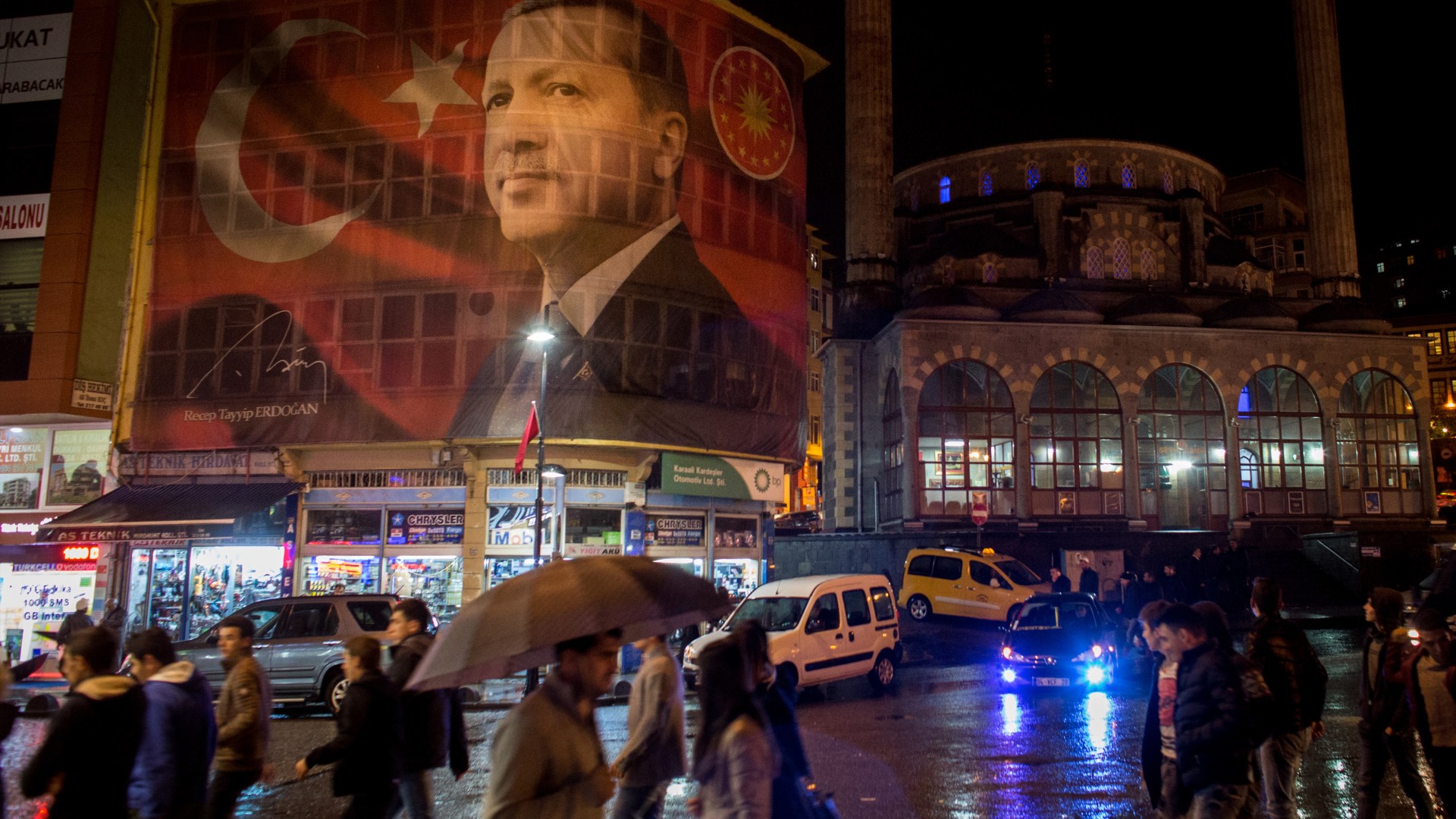
Instead, he attributes the recent decline in missionary denials to government distraction. The Turkish economy is in terrible condition with rampant inflation, and opposition parties are uniting to challenge President Recep Tayyip Erdoğan’s longstanding grip on domestic politics.

And missionaries are simply traveling less. Issues occur more often at the border than the renewal office, Tufan said. And some have also limited their involvement with the Turkish church in order to better maintain their ministry.

“If Turkey was trying to improve its reputation with the West,” he said, “we would be seeing positive results in the cases that already exist.”

As an example, after three years of very loud protests over the killing of Jamal Khashoggi in Saudi Arabia’s Istanbul consulate, the Turkish prosecutor requested to suspend the trial of 26 Saudi citizens and transfer jurisdiction to the kingdom.

Additionally, foreign policy shifts do not affect internal religious affairs. This Ramadan, the Hagia Sophia is hosting traditional evening prayers for the first time in 88 years.

COVID-19 prevented gatherings since the historic church’s reconversion to a mosque (from a museum) in 2020.

But Protestant complaints extend beyond training pastors and receiving missionary assistance. Believers in Istanbul tried to register a Christian school in 2020, first as an association, then as a business. Getting no response, they tried again with different names to simply establish a regular private school. State investigations easily connected those involved, and their efforts ceased.

There are problems also with religious education in the public system. The teaching of Islam is mandatory, and a 2015 study by the US Commission on International Religious Freedom found bias in the way Christianity and other religions are presented.

Exemptions are accepted upon request, by law, Tufan said. But it creates a stigma. For example, his high school son is the only Christian among 3,500 students. Some teachers question why he does not attend. And 9 in 10 Protestant families do not file the paperwork necessary, Tufan estimated, to avoid social complications for their children.

And such is the situation for Turkish evangelicals in general. Able to practice their faith—and even to file a report on violations of their religious freedom—they have learned their limitations.

“Things are the same, not better or worse,” said Tufan. “Government policies have not changed.”

Theology

A Century Later, the Chinese Union Version Still Dominant

Chinese church historian analyzes five reasons for the long-lasting influence of the CUV Bible translation.

Christianity Today April 6, 2022
Edits by Christianity Today / Source Image: WikiMedia Commons / Sixteen Miles Out / Unsplash

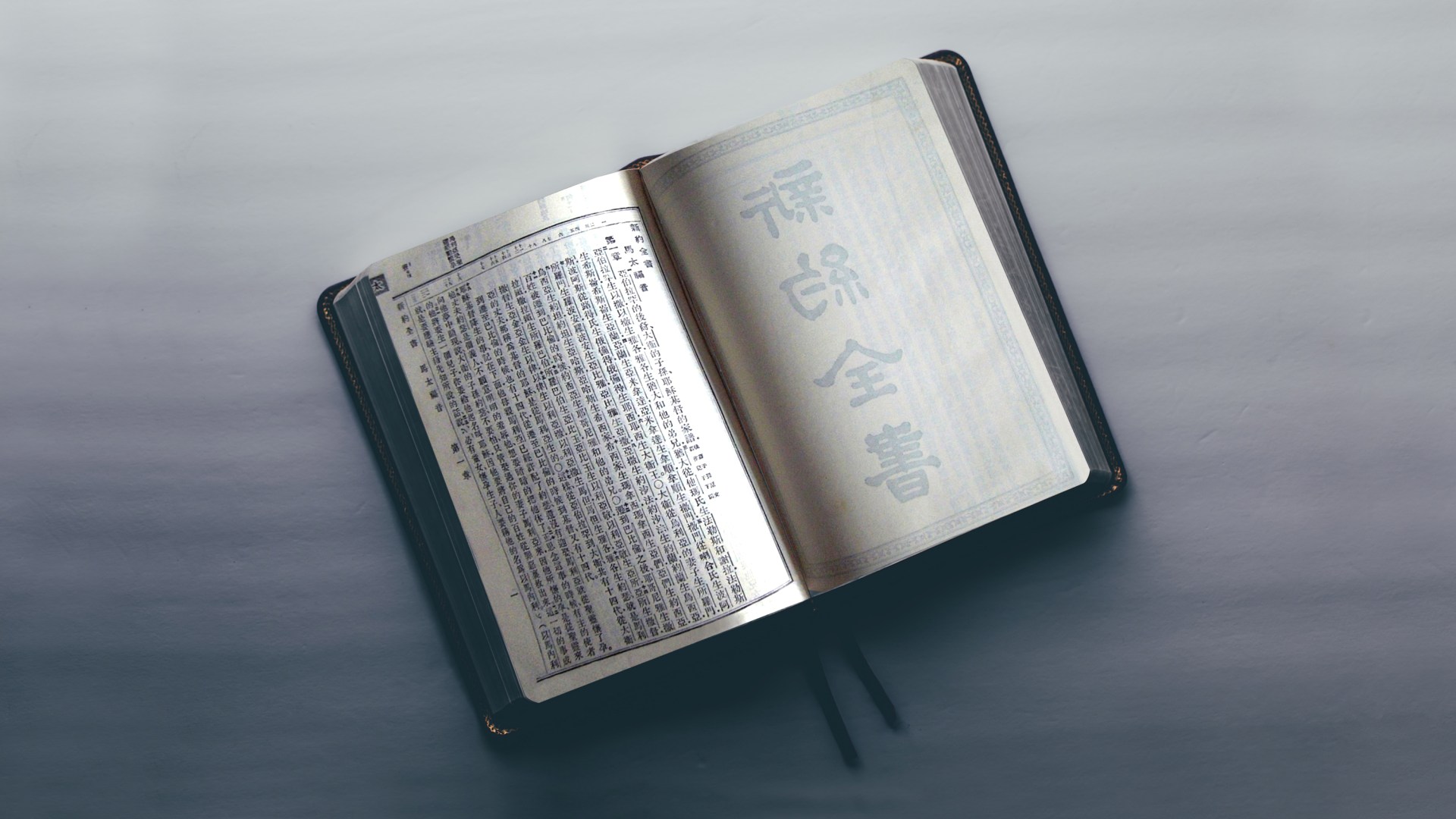
Since its publication in 1919, the Chinese Union Version (CUV) of the Bible has become the most dominant and popular translation in Chinese. Despite numerous changes to the Chinese language and a significant increase of new translations, its dominance is unabated and unshaken.

“It could well be the most influential ‘Chinese text’ among the Chinese readers for the past one hundred years and also in the future,” Taiwan-based scholar Chin Ken-pa wrote in the anthology Ever Since God Spoke Chinese. “Undoubtedly, even if we cannot claim it has become a ‘canon’ in the Chinese world, it is certainly an ‘authority.’”

The translation team of CUV included 16 Western missionaries and a few Chinese Christian experts, including Americans Calvin Wilson Mateer and Chauncey Goodrich; Englishmen George Sidney Owen and Frederick William Baller, and Chinese scholars Cheng Jingyi, Liu Dacheng, and Wang Zhixin. The translation of the Mandarin New Testament started in 1872, and the whole Bible was published in 1919. The guiding principles of translation included that it must be in the national language (not local vernacular), simple enough to be understood by people from all walks of life, and faithful to the original text without losing the rhythm of the Chinese language.

The translation of the Scriptures is essential to Christian tradition, as the missiologists Lamin Sanneh and Andrew Walls argue. Bible translation into Chinese has been crucial to the development of Christianity in China. Since the beginning of Protestant missions in China, Bible translation has been a major part of mission work.

For most Chinese Protestants, the CUV unquestionably remains an authority with the status of “God’s Word.” While there are multiple Chinese versions of the Scriptures, occasionally Chinese Christians declare on the internet that only the CUV is the true Bible, and all other versions are erroneous and even heretical (although it is now very rare to hear Chinese pastors and church leaders teaching “the inerrancy of CUV”).

Indeed, how fast the CUV rose to dominance and how enduring its dominance has turned out to be are truly mind-boggling phenomena. How can we explain this? As a historian of Chinese Christianity, I would like to highlight the following factors:

1. The CUV played a pivotal role in providing and shaping the theological vocabulary of the Chinese Protestant Church.

In their long and painstaking process of translating the Scriptures into Chinese in the early 19th century, Western and Chinese translators accumulated a rich repository of theological notions and terms in Chinese languages. The CUV inherited and integrated them into its language.

The CUV came out as Western missionaries’ dominance came to an end and the Chinese church came of age. Chinese Christians began to share leadership responsibilities and initiate indigenous evangelical revivals that swept across the country. This was the formative time for indigenous Protestant theological understanding and tradition.

The timely arrival of the CUV provided the Chinese Protestant community with a ready-made set of theological notions and vocabulary that Chinese believers immediately received and embraced. It did not take long for the CUV’s translation of such key biblical terms as faith, sin, salvation, and grace to become the standard “language of faith” used by church leaders, theologians, and evangelists as well as the average churchgoer on a daily basis.

The CUV’s translation of key biblical terms has been deeply ingrained in the theological DNA of the Chinese Protestant community around the world. It is fair to say that this is the only theological language system known and used unquestionably by this community up to today. In contrast, one can hardly identify any single, vernacular translation of the Bible which has had such a commanding and lasting impact on church life in the West.

2. The CUV helped shape a universally, unifying identity for Chinese Protestant communities around the globe.

Before the CUV, previous Chinese translations of the Scriptures had been done in either classical Chinese—only understandable to the educated elites in Chinese society—or in particular dialects for certain parts of the country. Therefore, the CUV’s aim to produce a translation understandable to all people from all parts of the country and all social classes turned out to be hugely strategic. It has served to unite all Chinese Protestant believers under one single Chinese version of the Scriptures.

Today, when you worship with any Chinese congregation in mainland China or the Chinese diaspora, you can easily feel the presence of a common, universal, Chinese Protestant tradition cemented by a shared set of spiritual vocabulary, classical hymns, and common version of the Bible, despite very different contexts. The CUV plays a big part in the forging and maintaining of this common identity among Chinese Protestant believers worldwide.

3. The CUV accompanied the Chinese church through its trials and suffering.

The past 100 years have been a turbulent time for the Protestant church in China. It endured numerous wars, revolutions, constant pressure from an atheist regime, and finally all-out persecution during the Cultural Revolution (1966–1976). Many Chinese believers would attest to finding comfort and strength in the CUV. They greatly loved to read and even memorize texts from handwritten copies of the CUV during the darkest years of the Cultural Revolution. The CUV is part of the Chinese church’s collective memory and heritage attesting to its perseverance and cross-bearing under tremendous suffering. There is a strong emotional bond between the CUV and the Chinese Protestant community that will not easily fade away.

4. The CUV’s exquisite rendering of the biblical texts gives it a special quality and lingering charm.

Linguistically speaking, the CUV does have its own advantage in the contemporary context. It is largely based on the vernacular of northern China but integrates some elements of classical Chinese. This combination reflects the genius of the original translating team. It makes the CUV understandable to ordinary folks but also appealing to the educated segments of society.

Having classical Chinese elements sometimes does make certain wordings read awkwardly or seem old-fashioned today. However, in reality, the CUV’s combination of the vernacular and classical may play to its advantage. Many Chinese believers, especially the more educated ones, would say they prefer the CUV over other more colloquial translations of the Scriptures precisely because a special charm comes with its unique style.

5. The CUV contributed to the emergence of the modern Chinese national language and the New Culture Movement and still commands significant respect within the greater Chinese society.

The longevity of the CUV’s popularity also has to do with its influence beyond the church. Since the late 19th century, China’s modernization project has gradually led to the transformation of a traditional dynasty into a modern nation-state. As part of this nation-building process, attempts were made to replace the single written language (classical Chinese) and diverse dialects with one single, unified, written and spoken language for the entire nation.

The breakthrough came in the form of the May Fourth New Culture Movement of the early 20th century, right around the time the CUV was published. The Bible emerged as one of the very few texts that met the goal of a vernacular, Mandarin-based, unified national language and immediately won popular endorsement.

As both Christian and non-Christian scholars agree, the CUV is a masterpiece of the modern Chinese language. It has served as an example for the May Fourth New Culture Movement and also benefited from the movement’s successful, rapid popularization of the new vernacular based upon the Chinese national language.

The CUV’s contribution in this regard is still widely recognized today by Chinese academia. Scholar George Kam Wah Mak even claims in Ever Since God Spoke Chinese that “as John the Baptist paved the way for Jesus, these vernacular Mandarin translators of the Bible are the pioneers in making vernacular Mandarin a national language.” Not surprisingly, the CUV’s role in China’s nation-building is compared to the roles of Bible translation in nation-building in modern Europe (as scholar Liu Lixia explains in the same book).

Additionally, the CUV is the most cited Bible translation when the biblical terms and texts are quoted by secular academia today. In other words, the CUV enjoys de facto status of being the scholarly norm in China.

In conclusion, the reasons behind the enduring popularity of the CUV among Chinese Protestants and in society run deep historically and presently. For most Chinese believers, the CUV is much more than just another Chinese translation of the Scriptures; it is very close to their hearts. That is why, with all the criticism of the CUV’s “antiquity” and “inaccuracy,” there is virtually no sign that its dominance will change in the foreseeable future.

We can ask whether it is theologically correct to equate the CUV with the Word of God, and whether some Chinese believers have a tendency to turn the CUV into an idol. However, the reality is if any viable revision of the CUV has a chance to win popular acceptance, it has to keep the CUV’s original texts intact as much as possible and make as few changes as possible.

The CUV is a precious gift to the Chinese church from God and has been used by him to nurture generations of believers. How much longer is God going to use the CUV for his glory in China? God alone knows.

Kevin Xiyi Yao is associate professor of world Christianity and Asian studies at Gordon Conwell Theological Seminary.

Originally published by ChinaSource.

Theology

Even the Rocks and the Cacti Cry Out

A recent trip to Joshua Tree National Park brought home the wilderness of Lent.

Christianity Today April 6, 2022
Will Truettner / Unsplash

Joshua Tree gives me the creeps. The landscape unnerves me—dirt, dust, cactus, and, of course, the trees themselves, scaly and spiky and twisted. They’re lined out like a crop, too intentional to make sense. How did they get here? At the top of Ryan Mountain, my husband and I study the brown land. No cell connection. No water! We keep our own jugs in the back of the car.

Boulders shaped like skulls and arches and cathedral spires interrupt the desert. These are enormous rocks, nonsensical rocks, rocks that people climb with ropes and hooks or slip in between: See the “Hall of Horrors,” a slot canyon narrower than outstretched arms. These are rocks you can tumble from, cracking bones. While the sun sets, we visit 12 square miles of granite—called the Wonderland of Rocks—and scoot among the formations.

Eventually, we lose the path. I am nervous. In the twilight, the looming boulders feel unpredictable. Who knows what they’ll transform into? But there, in the narrow inlets of sand between them, we see wildflowers, growing in lavender and periwinkle and violet. They give indications of life, of some preposterous plan—like the cactus garden that stretches out along the highway, smelling of creosote, birds building nests among the spines. Again: Who put this here? Near the Hall of Horrors, a jackrabbit bounds into the shadows.

The Joshua trees themselves march on, row after row after row. The story goes that 19th-century Mormon settlers named them for the biblical prophet because their arms look like they’re raised in supplication. Supplication. An especially deferential plea. Still urgent, though, even with its acknowledgement of limited power, limited means.

The arms jut and branch and double back on themselves, sometimes fulsome and sometimes sparse. They look uncomfortable. They’re trying everything. Trying to survive. Trying to find something to drink, far away from the oases that feed palm trees. They look how I feel here: buffeted and chapped, standing next to a tent that’s flapping and throwing up dust as we try to lash it into place.

Landscapes can agitate me like this.

On another vacation, much further west, I stood before Haleakalā, the dormant volcanic crater on Maui, and wanted only to leave. Down below, back in town, there were mai tais and banana bread. Up there? Just things as they were. Too deep, too shadowy, too dormant—and yet, still alive, cooled lava flows and cinder cones holding shifting light and fog.

“Your fear of immensity,” my husband calls it, when I start to get restive and pensive and quiet on our trips: when we’re driving at the edge of sea cliffs on California’s Highway 1 or listening to howls in the night from the spare shelter of our tent. And he’s right. I’m not afraid of heights or driving or coyotes or water, which don’t concern me in other circumstances. I’m afraid of being swallowed up whole. Decentered. Caught up in something. Seeing or hearing too much.

Right now, during Lent, I’m reading a book of sayings by the Desert Fathers and Mothers, early Christian ascetics and mystics who lived as hermits or in small monastic communities. Their home: the Scetes Desert, full of large, prehistoric fossils and lakes saturated with salt. They prayed and wrote and meditated in large expanses and difficult conditions.

The desert, of course, is the place for reckoning. Forty days of temptation for Jesus. Forty years of exile for the Israelites. They wandered in circles, seeing the same things again and again, trying not to be broken by them. They were uncertain of water, uncertain of food, trusting (and doubting) provision.

Nature is where we go for glory and peace. I think of the landscapes of my Oregon childhood, familiar as the faces of friends: Douglas fir forests, mountain lakes, overcast beaches. The river running over the silt.

But nature is also terrifying and dangerous. It can uncover us. It can even disturb. Creatures prowl and directions fail. Beauty becomes too hot to the touch, too harsh, too steep, too much, unable to be captured by a camera or even a mind. Nature certainly “puts things in perspective,” but not always in a pleasant way. God meets us there in his omnipotence—in control even of the utterly wild.

The Desert Fathers and Mothers give instructions that make sense anywhere: Don’t be prideful. Give away your money. Don’t be gluttonous. Be grateful. But to imagine them in the context of the desert, dusty and defeated, gives the words a different meaning.

Even in extremity, they’re still doing battle with the temptations of the mind and the longings of the heart, still bound by the same jealousies and complaints of any city dweller. They’re only more aware. Their whole lives were more of a Lent than mine ever will be: all penance, reckoning, and preparation, with ultimate questions always on the surface—as given as salt in the lake. How could you not think about death when it awaited you with one misstep, one stream run dry?

Somehow, they stayed among those clear, painful realities. Here, back at home, those realities are often obscured. From my vantage point, the human condition looks like comfort—electricity, cell service, running water, a souvenir mug decorated with a Joshua tree, photos on a phone—everything sized to fit my hands and designed for my convenience. It’s easy to forget the stakes.

Out there at the edges, on the plains, above the void, we see things as they really are: everything, always, an act of supplication.

Kate Lucky is senior editor of audience engagement at Christianity Today.

News

How Bread Became Engrained in Ukrainian Christian Life

In the breadbasket of Europe, ministries bring loaves for hungry bodies and spiritual nourishment for the soul.

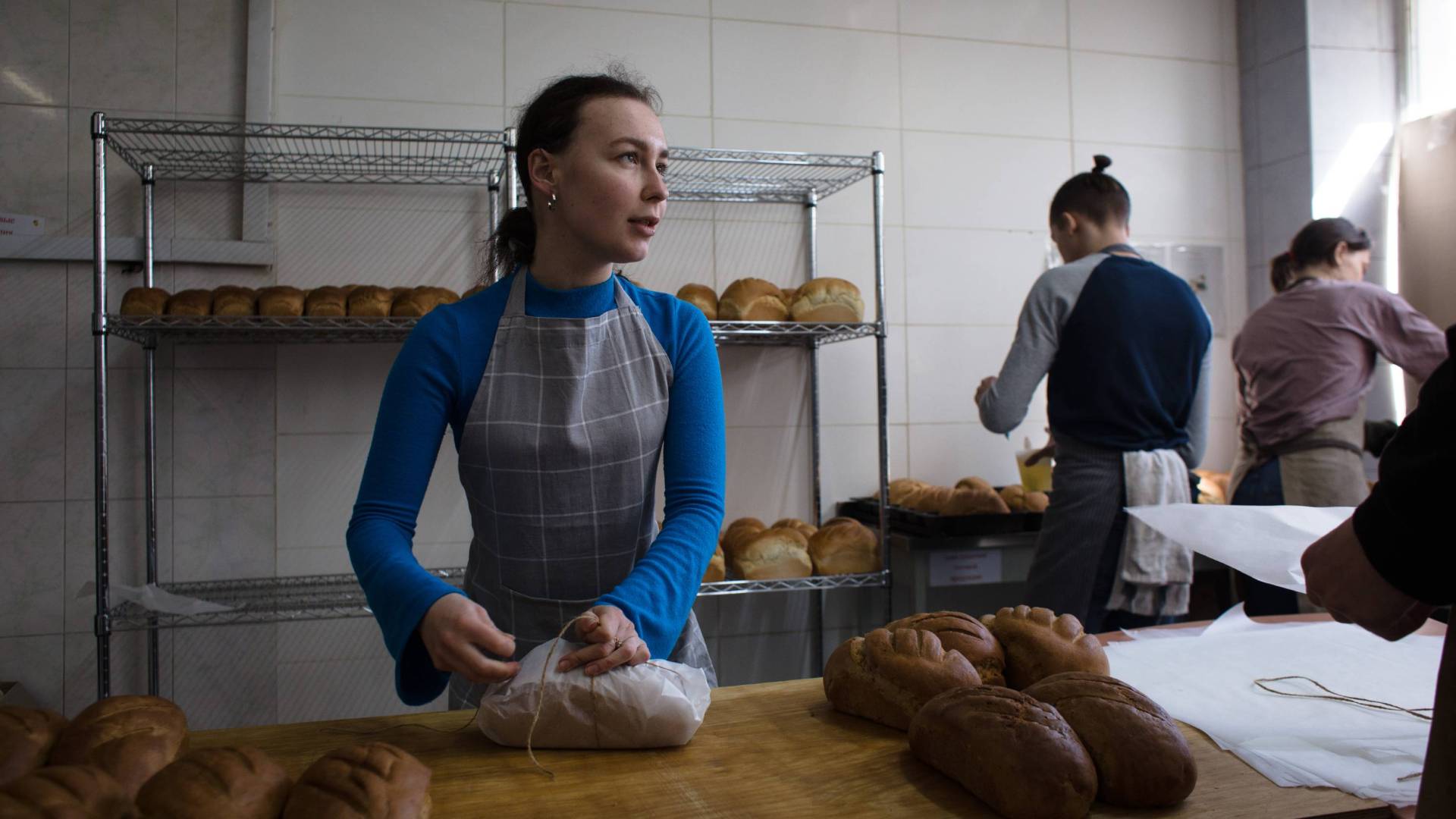
The Good Bread from the Good People bakery in Kyiv, Ukraine, reopened in March to make bread to distribute for free.

The Good Bread from the Good People bakery in Kyiv, Ukraine, reopened in March to make bread to distribute for free.

Christianity Today April 4, 2022
Anastasia Vlasova/Getty Images

For Ukraine, Europe, bread is a way of life. Ukraine’s flag—now displayed around the world in solidarity—proclaims the nation’s agricultural heritage, with the yellow representing wheat fields and the blue representing the sky above.

“Bread is very important in our culture, but Jesus has said that we do not live by bread alone,” said pastor Fedir Raychynets, the head of the theology department at Ukrainian Evangelical Theological Seminary (UETS). “There is something invisible, something intangible, something that is beyond just physical bread.”

As the war continues, pastors and churches across Ukraine are working to bring people both the bread they need to feed their bodies and the bread they need for their souls.

Inspired by the line in Isaiah 58:7 about sharing bread with the hungry and housing the poor, BREADtrust is one of several ministries helping get loaves into the hands of Ukrainians.

The UK-based charity funds local pastors who have remained in the country to continue to serve. They’re able to purchase bread, other food, and supplies for neighbors in need.

“There are those that feel deeply committed and called to where they are,” said BREADtrust project coordinator Phil Downward. One pastor and his family stayed until their apartment building was bombed and they had no choice but to leave. “That takes a level of faithfulness and courage that is utterly remarkable.”

Some ministries continue to bake the bread they distribute. In the days after the war broke out, a Dutch outreach through Oekraïne Zending, located outside Kyiv in Brovary, wanted to rally enough bakers to continue baking bread 24/7. They pass out loaves to hospitals and the army, along with notes containing Bible verses. (When Russia took over Crimea several years ago, CT highlighted the Bread of Life ministry in Maryinka, a bakery that gave away “one-fourth of its 2,000 loaves of daily bread, alongside Bibles.”)

Slavic Missionary Outreach, in an update sent in March, said that since grocery stores have not been open as much, its staff has tried to buy bread wholesale or make it themselves. Some of their neighbors had been going days without food.

“We have our own small bread factory that bakes 1,700 loaves of bread daily, which are then distributed to hungry people by our staff,” they wrote in a letter soliciting support. “We don't know how much longer we can do this. We are trying to buy leftover flour stocks from large bread factories that have closed.”

Ukraine is known as the breadbasket of Europe. The war’s impact on its wheat crop will extend globally. Already, reports expect the disruption will affect Lebanon and Egypt, which rely on imports for government-subsidized bread to feed the hungry. Together, Russia and Ukraine provide almost a third of the world’s wheat and barley exports.

And as the Russian invaders attempt to cut off Ukrainians from their own crops and supplies, the oldest generations recall the deadly famine caused by Joseph Stalin’s seizure of goods the century before. The Soviet dictator had seized crops, livestock, and food itself.

Following the conflict in Crimea, Ivan Rusyn, president of UETS, reflected on this history in Bible Study Magazine:

For Ukrainians, bread is very significant. In 1932 and 1933, we had the Holodomor—a man-made famine. Up to six million Ukrainians starved to death. … Because of this, bread is sacred in our culture. You can’t throw bread away.

The metaphor of Jesus as the bread of life has a lot of meaning for Ukrainians, and the image that the Bible is bread for our souls is very important. We use this to help others understand how vital the Bible is to our lives.

In September, some Ukrainian churches celebrate Harvest Day. During the church service, one pastor will hold up a loaf of bread while another holds up an open Bible. They pray for both, recognizing the need for both. The physical and spiritual needs for bread are not competing but complementary.

Sergey Nakul, pastor of Grace Reformed Church in Kyiv, recently posted a video showing how certain parts of the supermarket, like the meat and seafood counters, were completely empty but thanking God that there was still bread.

“Yes, we have bread,” he said, “but in this period of time we better understand words of Lord Jesus, ‘I am the Bread of Life.’”

Ukrainian churches have developed a network for sharing supplies during the war. In the early days, they helped people evacuate. Now, they’re distributing supplies to those who are staying, like the elderly who have nowhere to go or refuse to leave their homes.

The sirens go off so frequently that some of them simply remain in the basements of the buildings instead of going up and down the stairs each time. It's there that volunteers distribute bread and offer whatever encouragement they can. Additionally, the team distributes supplies to families of soldiers.

Among the military, bread again offers them a reminder of hope when Raychynets offers Communion. His team brings New Testaments with highlighted passages of hope and encouragement. Around two or three dozen soldiers typically take copies.

From his background during the Balkan War and visits to other countries like Lebanon, Israel, and Northern Ireland, Raychynets has experienced the uncertainty, fear, and pain of people in traumatic circumstances. He never tries to impose his faith on them, but when people come to him with questions about God and suffering, he engages them in a conversation.

“I personally don’t believe in answers. I believe in good questions. When they ask me questions, I can ask counter-questions to [encourage] them to think further, to think deeper, to think wider about the situation,” Raychynets said.

Many Ukrainians don’t know where their next meal will come from. Many of their famed wheat fields may not bear a crop this year. However, those faithfully serving in Ukraine hope that there will be a harvest in the country all the same.

“When you are in a situation like these people, you are more sensitive to the divine, to something that is beyond our humanity,” Raychynets said. “We need a physical bread as nourishment for our bodies, but then we need also a spiritual bread. The Word of God feeds our souls.”

Follow CT’s Russia-Ukraine war coverage on Telegram: @ctmagazine (also available in Chinese and Russian).

Select articles are offered in Russian and Ukrainian.

Books
Review

The Gods of ‘Techtopia’ Giveth, and They Taketh Away

Silicon Valley showers its workers with “spiritual” perks, but only at the cost of absolute devotion.

Christianity Today April 4, 2022
Illustration by Rick Szuecs / Source images: Envato Elements

As someone who grew up in Silicon Valley, I can sometimes forget what a peculiar place this is. There are, for example, certain coffee shops and brunch restaurants where you can overhear entrepreneurs pitching to venture capitalists any day of the week. It’s not uncommon to be approached by strangers and asked to beta-test their new apps. The median home price is well above As someone who grew up in Silicon Valley, I can sometimes forget what a peculiar place this is. There are, for example, certain coffee shops and brunch restaurants where you can overhear entrepreneurs pitching to venture capitalists any day of the week. It’s not uncommon to be approached by strangers and asked to beta-test their new apps. The median home price is well above $1 million, every fourth car on the road seems to be a Tesla, and everyone knows someone who works for a giant tech firm like Google, Apple, or Facebook. million, every fourth car on the road seems to be a Tesla, and everyone knows someone who works for a giant tech firm like Google, Apple, or Facebook.

Work Pray Code: When Work Becomes Religion in Silicon Valley

Work Pray Code: When Work Becomes Religion in Silicon Valley

Princeton University Press

272 pages

Having spent all my life in the church, I can also forget that Silicon Valley is one of the least religious regions in the United States. The Pew Research Center has found that 35 percent of adults in the San Francisco Bay Area are religiously nonaffiliated. Only 20 percent of adults identify as Protestant, and another 25 percent are Catholic. In comparison, 71 percent of the general population in the US identifies as Christian.

Yet, argues sociologist Carolyn Chen in her fascinating new book Work Pray Code: When Work Becomes Religion in Silicon Valley, this doesn’t mean that high-skilled workers aren’t spiritual. They are, in fact, as hungry for meaning, belonging, and personal transformation as anyone else. But their church, as it were, is the workplace. Their community is made up of coworkers. And they are being shepherded—through not only their careers but also their overall lives—by an array of supervisors, human-resource managers, executive coaches, and meditation gurus.

Meaning-making institutions

It’s no secret that many of the profit-rich corporations of Silicon Valley provide extraordinary perks for their employees, including gourmet meals three times a day, onsite gyms, dry-cleaning services, and free shuttles from the suburbs to the office. In recent years these perks have become increasingly spiritual in nature as corporations compete with one another to offer the best coaching, meditation classes, mindfulness workshops, multiday retreats, and talks by renowned spiritual leaders like Vietnamese Zen master Thich Nhat Hanh.

These are the very trends Chen is examining in Work Pray Code, and her findings should interest (and perhaps alarm) anyone who cares about the health and growth of the American church. Young, high-skilled knowledge workers, who drive not only Silicon Valley but also industries in urban centers throughout the country, are becoming less interested in traditional forms of religion and spirituality. “The decline of religious affiliations and participation, however, does not mean that religious needs have disappeared. They’ve just been displaced,” explains Chen. “Religion exists in the sacred cosmos of a work-centered world.” So strong is the pull of workplace spirituality that some of Chen’s research subjects, who had previously been very devout, drifted away from their faith after beginning to work in Silicon Valley.

All this attention to mindfulness, authenticity, and spiritual health is an outward expression of a larger ethos that has developed in the region’s dominant industries, one that promises to “unlock” your true self and true purpose—so you can be as productive as possible for your employer. The promise of discovering yourself and meeting your full potential is extremely appealing, and it’s backed up by every possible workshop, amenity, and expert that money can buy.

In places like Silicon Valley, the church’s greatest “competitor” for souls may not be other religions, atheism, or even hedonism or greed. It could very well be multinational corporations that offer the promise of changing the world, as well as their employees, through work. “Today, companies are not just economic institutions,” writes Chen. “They’ve become meaning-making institutions that offer a gospel of fulfillment and divine purpose in a capitalist cosmos.” That “God-shaped hole” in our hearts that evangelicals like to reference? It’s being filled by companies with deep-enough pockets to meet their people’s every need—mind, body, spirit.

I’ve seen this firsthand. Ask any entrepreneurs or startup employees in Silicon Valley, and they will sincerely tell you—without a hint of irony or humor—that their companies are going to change the world. The business might be built on an app that finds parking spots, delivers beer via clowns, or makes it look like you got booted off a Zoom call when you want a break (all real apps); nevertheless, it gives their lives purpose. These individuals are as devout and committed as the most zealous of Christians.

Those of us on the outside can see clearly that this promise of fulfillment is ultimately empty, especially when the end goal is utilitarian: to leech as much knowledge, leadership, and productivity out of people as possible. High-skilled professionals gain much, but only by giving much, including 70-plus-hour workweeks and their absolute commitment. Firms will gladly lavish their employees with spiritual perks, teaching, and values, but when someone leaves a job—by choice or not—all of that is terminated as well. This form of religious devotion ultimately will not end well for image bearers of God.

Valuable lessons

Throughout the book, Chen asks this question: What are the larger implications for a society that worships work, that subsumes traditional faith and spirituality under the quest for profit and productivity? She doesn’t really answer this question until the last chapter of the book—which seems insufficient in light of the great and still-growing power, influence, and wealth of the tech industry. Work Pray Code is at its best when Chen contextualizes the findings of her research within broader historical and sociological concepts, such as corporate maternalism, the constant productivity push, and reduced civic engagement.

I wish Chen had supported her claims with additional quantitative research about, for example, the psychological impact of such devotion to work, the connection between high-tech jobs and declining civic participation, or the way corporations in other geographic regions are also trying to “change the world” and help their employees pursue “wholeness.” Instead, she relies so heavily on the quotes and perspectives of a limited number of research subjects that her conclusions—repeated almost ad nauseum—can come across as anecdotal rather than widely applicable. She also misses the opportunity to discuss how the move toward permanent remote work after the pandemic could alter the workings of “Techtopia,” as she calls it. Since the most tangible way corporations attempt to meet their employees’ spiritual needs is through onsite, in-person activities, the ramifications could be very significant.

That said, what Chen communicates is still extremely salient to the American church. There may even be valuable lessons here for church leaders to better understand what millennial and Gen Z professionals are yearning for nowadays: for starters, to be seen as whole, integrated individuals whose work, play, relationships, and spirituality are all deeply intertwined and in need of purpose.

Understandably, how these trends impact the Christian church is outside the scope of Chen’s research and not addressed in the book. There are important clues, though, in her conclusion: “In Techtopia,” she writes, “people don’t belong to neighborhoods, churches, or cities. They belong to work. Instead of building friendships, trust, and goodwill within their communities, they develop the social capital of their companies.”

With the rise of the worship of work, professionals are becoming less engaged and connected with the rest of the world. They believe all their needs are already being met; they are not searching for more. How can the church draw them out of their isolated workplace “cults” (as Chen calls them) toward an eternal and far more dependable promise of fulfillment? How can we compete for souls against institutions with limitless resources?

It may be time for Christians and churches to take a page from the strategic plans of businesses, ensuring that we are clearly articulating the value proposition and competitive advantages of our faith and demonstrating those in bold, irresistible ways. “By this everyone will know that you are my disciples, if you love one another,” Jesus declared (John 13:35). And in writing to the church in Ephesus, the apostle Paul said, “For it is by grace you have been saved, through faith—and this is not from yourselves, it is the gift of God” (Eph. 2:8).

Unconditional love and all-encompassing grace—not mentioned a single time by any of the research subjects in Work Pray Code—could be a good place to start.

Dorcas Cheng-Tozun is a writer, communications consultant, and the editorial director of the Christian nonprofit Pax. She is a former columnist for Inc.com and has written two books on entrepreneurship: Start, Love, Repeat: How to Stay in Love with Your Entrepreneur in a Crazy Start-up Worldand Let There d.light: How One Social Enterprise Brought Solar-Powered Products to 100 Million People.

addApple PodcastsDown ArrowDown ArrowDown Arrowarrow_left_altLeft ArrowLeft ArrowRight ArrowRight ArrowRight Arrowarrow_up_altUp ArrowUp ArrowAvailable at Amazoncaret-downCloseCloseellipseEmailEmailExpandExpandExternalExternalFacebookfacebook-squarefolderGiftGiftGooglegoogleGoogle KeephamburgerInstagraminstagram-squareLinkLinklinkedin-squareListenListenListenChristianity TodayCT Creative Studio Logologo_orgMegaphoneMenuMenupausePinterestPlayPlayPocketPodcastprintremoveRSSRSSSaveSavesaveSearchSearchsearchSpotifyStitcherTelegramTable of ContentsTable of Contentstwitter-squareWhatsAppXYouTubeYouTube