Theology

The Rise of the ‘Umms’

Unlike “Nones” and “Dones,” many church-adjacent Christians want to return to a local body—but they feel stuck.

Christianity Today March 29, 2022
Illustration by Rick Szuecs / Source images: Jonathan Perez / Pexels / Raw Pixel / Priscilladu Preez / Stefan Spassov / Unsplash

For the first time in my nearly 40 years, I do not belong to a church body.

Each Sunday I awake with a longing to gather around song, Scripture, and sacrament. Most of those mornings my wife and I walk to the nursing home to celebrate the Eucharist with a faithful but forgotten few.

This year my wife and I want to plant a church in Chicagoland, but many weeks I am left wondering, Where do we fit in?

Recently, I was lamenting this season with a friend. He echoed my sentiment, “I’m also floating without a church—it isn’t ideal, just the way it is.” Our exchange wasn’t significant, just two friends consoling each other through ecclesial purgatory. Later that week, I heard similar thoughts repeated by my neighbors who are new parents.

Again, this sentiment was echoed by a friend who works at a large Christian nonprofit. Over text messages and phone calls, my old roommate and my denominational executive repeated a similar status. But what really caught my attention is when I heard my students and colleagues at Northern Seminary describe themselves and their congregants in much the same way.

All expressed a strong commitment to Jesus and a desire to be part of the church, but they are not active in a local congregation. This growing segment of believers is what I am labeling the “umms.”

Dones, nones, and umms

COVID-19 has been described as a global x-ray, revealing what was hidden in our systems and relationships all along. To be more precise, COVID-19 seems to be an accelerated x-ray, revealing and amplifying these hidden truths at an expedited pace.

Acquaintances became strangers as relational ties grew strained. Economic inequalities became glaringly obvious. And with more attention on the news, the nation was gripped by the murder of George Floyd and forced to reckon with the structural racism that too often stays muted in our country.

This same accelerated unveiling has descended on the church, revealing a major decline in congregational involvement.

Over the past few years, comprehensive research has chronicled the rise of the “nones” and “dones.” The nones are ostensibly those who do not self-identity with any religious affiliation, most prevalent among zoomers and millennials. The dones are those exiting established religions, most notably Christianity. For a variety of reasons, they are done with church.

Early research in the pandemic suggested that up to one-third of churchgoers stopped attending church. More recent data shows a majority of churches are below their pre-pandemic attendance. A study released early this year reveals that church attendance is down by 6 percent, from 34 percent in 2019 to 28 percent in 2021.

People end up far from church for lots of reasons, as the nones and dones demonstrate—but the umms represent yet another distinct group worth talking about. I would argue that many of those who have distanced themselves from church attendance, both in-person and online, might be described as umms.

Umms are a different category altogether, and the ones I have spoken with share several common characteristics. They are fond of the local church and were active members in the past. They take Jesus seriously and want to belong to a local congregation. They are not bitter or cynical—in fact, if anything, umms are uncomfortable with not being committed to a church body.

As a result, there is a gap between their desire and their situation. They are umms because they are uncertain and hesitant about how to reengage with the church. And although their individual stories are myriad and diffuse, I would like to present four potential types of umms and their struggles: disoriented, demotivated, discouraged, or disembodied.

Disoriented: Over the last two years, these folks became new parents or had to move back in with their parents. Some lost their jobs and are looking for employment, while others have changed jobs and are still adjusting to a new vocational calling. The helter-skelter rhythms of the pandemic have upset the stability of their lives, which the church used to provide. Thus, amid major life changes, these people are no longer active in church.

Demotivated: These umms are demotivated because of the array of problems they witness in the church. Perhaps they have reexamined their faith after the public downfalls of esteemed pastors and the ongoing sins of racism and sexism, but they by no means want to sever ties. The failures of the church have pushed many umms away from being part of a congregation.

Discouraged: The weight of suffering and collective grief of the last two years has discouraged many umms. They are struggling with their mental health and motivation. Many of their family members, neighbors, friends, and church members have died. The loss of relationships, whether through death, divorce, or distance, has left a residue of malaise that has estranged some umms from the local church.

Disembodied: Another sentiment I’ve often heard from umms is that online worship does not work for them. Early COVID-19 research suggested that Sunday-centric churches struggled to retain large swaths of their parishioners. These umms grew more removed from their churches as the services went digital—and when some congregations began to regather in person, they did not return.

Many umms have been displaced physically and relationally, uprooted from place and people. They are wandering around, looking for another church to call home. I spoke with 20 or so friends and acquaintances who would classify as umms about what their reentry into the church might look like.

It turns out that for many, it will most likely not be through a Sunday morning worship service. In this, some umms are similar to the dones and nones, who have no interest in walking into a church service on the Lord’s Day.

For churches who have centered their ministries around Sunday morning worship services, this presents a problem. If Sunday morning is not the on-ramp to community and pastoral care it once was for some people, this leaves us with two important questions: What are Sunday-centered churches to do? What are umms to do?

Reimagining God’s home

As the oft-quoted poet Robert Frost mused, “Home is the place where, when you have to go there, they have to take you in.” Home is a tremendously weighty word—filled with smells and sounds and memories of pain and hope.

Home is also a golden thread weaved throughout the biblical narrative. As theologian Douglas Meeks comments in his book God the Economist, God is “incessantly seeking to create a home, a household, in which God’s creatures can live abundantly.”

If my instincts are right and Sunday morning is no longer the primary entry point for some believers, then we need to further reflect on the idea of a “church home.” Specifically, we must reconsider the physical places where we gather.

I would like to suggest that rediscovering the biblical theme of home can help us interpret the current social architecture of the church, diagnose its challenges and limitations, and provide a faithful way forward for church leaders and umms alike.

In the biblical story, God’s home is the place where he dwells with his people—functioning as the earthly coordinates of God’s presence.

In the beginning, God’s home was a plot of land in the Garden of Eden, where God walked with Adam and Eve in the bliss of a pre-fall abode. Next, God instructed Israel to build a mobile home during the Exodus called the tabernacle—a property that served as a portable “sanctuary” and dwelling for the Lord (Ex. 25:8).

After David’s rule, his son Solomon built a stationary home called the temple—the place where God would dwell with his chosen people. Yahweh promised that in the temple, “I will live among the Israelites and will not abandon my people Israel” (1 Kings 6:13).

But subsequent generations drifted into sin—and despite prophetic warnings, the temple was destroyed and Israel was exiled. Although the temple was rebuilt during the ministry of Ezra and Nehemiah, it never returned to its former glory. Instead, for the next four centuries or so, Israel continued to be occupied by foreign powers, which indicated the absence of God’s presence.

Then, in the first century, the Messiah arrived, and suddenly God “made his dwelling among us” (John 1:14). In one person, Jesus, the fullness of God came to dwell! Jesus became God’s new temple, the very coordinates of God’s presence, the exact place where heaven and earth met.

Then, after Jesus’ crucifixion, resurrection, and ascension, the Holy Spirit descended on the disciples on the Day of Pentecost. And from then on, it would be the people of God , the church, with whom God would make his home.

All of this is good news for umms.

Finding home again

Although my wife and I have not been part of a formal church for the last few months, we still gather with friends every Monday night to eat, pray, and meditate on Scripture. We have a loose collection of friends with whom we fast every Wednesday. A small group of mentors have joined us on a Zoom call once a month to pray for our future.

None of these are formally connected to an organized church, but they are just a few examples of how umms might navigate this liminal time—finding unique ways of “not giving up meeting together, as some are in the habit of doing, but encouraging one another” (Heb. 10:25).

Remember, our distancing does not have to be permanent. As I noted earlier, most umms grieve the loss of Christian community, and many look forward to returning to a church body. And while it may be tempting to remain at a distance and be critical of the church, like so many, we must remember that the church—with all its beauty and blemishes—includes umms!

So, whenever you are ready to sink your roots into a local church once again, first consider the people in your life who are already active in their churches. Approach them in their homes and beyond—or better yet, invite them around your table. Such people can act as the front doors of the church and can pray alongside you as you seek to reassimilate.

If you are “cold-calling” churches, prioritize ones near your home that emphasize a mission beyond Sunday gatherings. Whether it be the local laundromat or food pantry, the sidewalk or a PTO meeting, neighborhood communities and public facilities can become unconventional places for umms, dones, and nones to encounter God’s people.

Lastly, in this time of displacement, we can cultivate the virtues of courage and long-suffering that have marked believers for generations.

In fact, this uncertain time for umms corresponds with the Lenten season of prayer and fasting. There is much to lament in being displaced, so we join the global church in the cacophony of prayers for help. In our fasting, we physically feel the pangs of being distanced from fellowship.

When Christian practices like these are done in community, they become a corporate way to discern and engage with what God is doing in the world. These rituals of faith open us to the presence of Jesus in the intimate confines of our home.

One of the many reasons my wife and I want to plant a church is because it is the very place to foster such virtues and practices! The church gathers to announce that even in the midst of feeling disoriented, demotivated, discouraged, and disembodied, God has not abandoned us.

In a season that is marked by so much death and distance, we confess our need for an in-breaking of the Spirit. My hope for the umms is that our love for and wonder of the triune God will not grow stagnant—and that in years to come, we will yet be able to testify, “Great is Thy faithfulness.”

And for pastors who want to reach the umms in their areas, it helps to think beyond the current social architecture of church (i.e., Sunday service in a building). Many pastors are already doing this, but for those who aren’t, try to envision unique ways for “church” to happen in the homes of your congregation during the week—where people become the primary entry points for ministry.

I am not suggesting pastors sell their buildings or cancel Sunday worship. Buildings are incredible resources and Sunday gatherings facilitate large-scale celebrations of people marked by resurrection hope. But when Sunday gatherings are the only entry point to the church, we will most certainly miss many of the umms, nones, and dones in our midst.

To fully address the realities highlighted and amplified by the ongoing pandemic, the church and its pastors must seek to recover a social architecture that centers on people rather than properties.

Perhaps pastors and leaders could mark on a map the homes of their church members and consider them extensions of their sanctuaries—encouraging them to invite neighbors over for dinner. Many umms, dones, and nones may not join your worship service on a Sunday morning, but they might enjoy a BBQ on a Saturday afternoon in one of your parishioners’ backyards.

How would that invigorate your church’s mission or realign your resources?

Now I know that for my pastoral colleagues, this could sound like yet another weighty task—in addition to the mask mandates, budget gaps, funerals, and chaos of coronavirus church life you are already navigating.

But hear these words from Jesus: “Come to me, all you who are weary and burdened, and I will give you rest” (Matt. 11:28). Jesus intends for us to receive rest from him, and our physical homes are one of the sacred places we do that—practicing both sabbath and hospitality with boundaries.

I also recognize that for some, physical homes are not an option because of safety, size, or cultural norms. Regardless, my proposal remains: The social architecture of the church can and should extend beyond buildings and into the social spaces wherever God’s people dwell.

All of us, the people of God, are constituted by the person of Jesus. As Jesus extended God’s presence beyond the temple and into the homes of Simon and Andrew, Mary and Martha, Zacchaeus and Jairus—he still knocks on our doors today. May the King of glory come in and make himself at home.

Mike Moore is the director of the Theology and Mission Program at Northern Seminary (Lisle, IL), a local mission leader with Resonate Global Mission, and church planter in Chicago. He cohosts the Theology on Mission podcast and is ordained with the Christian Reformed Church.

News

Died: Gospel Singer LaShun Pace, Who Praised God from 1970s Revivals to 2020s TikTok

She sang through betrayal, divorce, and death.

Christianity Today March 29, 2022
LaShun Pace / Edits by Rick Szcues

LaShun Pace sang of God’s power. With a voice that could hold an angelic note or drop down to a sinner’s growl, she declared the Lord’s victory on a revival circuit in the 1970s, on the Billboard charts in the 1990s, and on TikTok in the 2020s. She sang of a God revealed in times of trouble—belting it out, even as she went through her own unbearable suffering.

Pace, a founding member of the Anointed Pace Sisters and a solo gospel singer with eight studio albums, died on March 21 at age 60.

She was remembered as the voice of the Black church experience, one of “the greatest singers to ever touch this planet,” and a gospel music legend.

“My mother was a genuine, authentic woman of God,” daughter Aarion Rhodes told an Atlanta TV news station. “She sang the Word of God. She preached the Word of God. But more importantly she lived it.”

Tarrian LaShun Pace was born on September 6, 1961, in Poole Creek, Atlanta, a Black community that would disappear almost without a trace with the expansion of the Hartsfield-Jackson Atlanta International Airport. Her father, Murphy, worked as a carpenter. Her mother, Bettie Ann, cleaned classrooms at a school. Both parents were active ministers in the Church of God in Christ (COGIC).

Pace was the fifth of 10 children. She had one brother, Murphy III, called M.J., and eight sisters: Duranice, Phyllis, June, Melonda, Dejuaii, Leslie, Latrice, and Lydia.

When the large and growing household started to get out of control and some of the older children started to get in trouble, Bettie Ann prayed for help. She felt God tell her to gather the children to sing.

“And so she did,” Pace later wrote in her memoir. “God moved through her crying out and praying to him.”

The girls soon formed a gospel group. They sang at church and around the Atlanta area and won a national COGIC award for best gospel group. Then they went out on the road with Gene Martin and the Action Revival Team. Martin had worked closely with A. A. Allen, a white faith healer with racially integrated meetings, until Allen died in 1970. Martin traveled a circuit of Black churches and camp meetings, holding revivals that focused on music and preaching. The Paces joined around 1977 and became known as the Anointed Pace Sisters.

By the time LaShun Pace was in her 20s, she was also working with major up-and-coming gospel musicians, including Edwin Hawkins, best known for his arrangement of “Oh Happy Day,” and Jonathan Greer, known for the COGIC standard “Just Jesus.”

Pace got married to a gospel music manager named Edward Rhodes Jr. at 25. When the minister at the Black Baptist church asked, “Who gives this woman to be married to this man?” her father said, “I do.” But he didn’t let go of her right away. Later she would wonder if he knew the marriage was a bad idea.

Within a year Pace discovered that her husband was cheating on her with men. She found a love letter from a boyhood friend, and when she confronted him, Rhodes confessed to having 10 or 12 homosexual affairs, including several men she knew.

In 1986, Pace writes in her memoir, Rhodes was diagnosed with HIV, the virus that can cause AIDS.

The couple nonetheless tried to make their marriage work, and Pace got pregnant with her daughter Xenia. Pace and Rhodes continued to argue and fight, however, disagreeing about everything at home and almost everything in the studio.

“I would see myself and I hated what I saw,” Pace wrote. “We were supposed to be Christians, saved people, not carrying on like sinners, but we were and we did.”

Pace didn’t tell her mother what was happening but went to her one day and asked for prayer. Bettie Ann came back and said she’d heard from the Lord: “The Lord said you can’t depend on mother’s prayers anymore but now you’ve got to know him for yourself.”

As Pace continued to struggle in her marriage, she produced her first solo gospel album, He Lives. She praised God for his power in her life.

“He keeps on doing great things for me,” she sang on the first track. “Oh, he keeps right on doing great things for me, for me. … He keeps, keeps, right, right, right on doing great things for me.”

The album went to No. 2 on Billboard’s gospel charts.

He husband continued to cheat and the couple continued to fight, however, until Pace asked God to let her out of the marriage.

“God, Lord please forgive me,” she prayed. “But I can’t take this no more.”

She immediately felt a divine assurance that God was going to take care of her.

“I knew down on the inside that everything was going to be alright,” Pace later wrote. “Now I didn’t know how long it was going to take before everything was going to be alright but all I knew was [that] he told me, and that was it.”

She had her second child without her husband—her sisters gathered around the delivery room singing “Amazing Grace” while she gave birth to Aarion—and then went on to make her second album, Shekinah Glory. The album went to No. 5 on the Billboard charts.

Pace’s older daughter, Xenia, died of a heart problem in 2001 at age 11. That same year, Pace released her fifth solo album, God Is Faithful.

Pace believed that whatever happened, the Holy Spirit would carry her and she would continue to praise Jesus. In 2007, she told the Atlanta Voice that the pain in her life had only drawn her closer to God.

“It has helped me know God a little better,” she said. “I’ve grown closer to him and learned to listen to him and watch for the signs that he gives.”

Pace started struggling with her health in the 2010s, though she continued to sing in church. In 2022, a snippet of her 1996 song “Act Like It” went viral on TikTok. It appeared in hundreds of thousands of videos, briefly reviving interest in another album, before Pace’s health further declined.

Pace is survived by her daughter Aarion and seven of her sisters. A funeral is planned for April 2.

Theology

What Lent Teaches Me About the Vices of Time

Fasting resists our society’s expectations about efficiency and instant gratification.

Christianity Today March 29, 2022
Illustration by Rick Szuecs

Several days after the dinner party, I was still thinking about the perfect disk of salami I’d wanted to eat—and didn’t. As I write this, several days later, it is still Lent, and I am still craving the meat I’ve sworn off these 40 days.

When Ash Wednesday arrived a couple of weeks ago, I was in the mood for renunciation. Relinquishing seemed a good and right thing. Time, however, threshed my willpower from spiritual endurance. Never has the book of Numbers—providentially scheduled in my Bible reading plan for the Lenten season—spoken with such force: “If only we had meat to eat!” (Num. 11:4).

Lenten fasting is hard, though not for all the reasons I’ve expected. It’s not just my immoderate appetite for food that has been checked these 40 days, even if I persist in pining for that slice of salami. Perhaps even more importantly, what’s been exposed is my disordered relationship with time. I want the quick fix of transformation. I do not want the slow burn of 40 days of prayer and persistence and reliance on grace.

In his book Fasting, Scot McKnight reminds us that fasting is not instrumental. It is not a season of giving up food in order to get blessing from God. There are many reasons Christians throughout the centuries have committed to the practice of fasting.

Augustine saw the benefit of denying ourselves “licit” pleasures in order to grow our capacity for denying “illicit” ones. In the Middle Ages, Gregory the Great believed fasting could check our patterns of eating “too daintily, too sumptuously, too hastily, too greedily, too much.” Even more-contemporary Christian thinkers, like the late Dallas Willard, have emphasized the connection between our embodied experience and our desires for spiritual renovation. “We live from our bodies,” Willard wrote.

According to McKnight, fasting is one of seven ancient practices Christians have inherited from Judaism. Fixed-hour prayer, Sabbath, following a liturgical calendar, and pilgrimage are practices that govern how we live in time, writes McKnight. The other three practices— fasting, tithing, and the Eucharist—inform how we live in our bodies and in space.

My own Lenten fasting has given me pause, however, to consider that this practice (and all the others McKnight mentions) confronts not just how I live in my body but also how my body moves through time. Rebecca DeYoung, author of Glittering Vices, noticed something similar when her Lenten fasting reduced her productivity: “Lord, I gave you my eating. I did not give you control of my schedule and all my plans for what needs to get done.”

The “inefficiency” of a Lenten fast might be one of its greatest benefits. In 21st-century America, a society ruled by the clock’s iron fist, timekeeping is inevitably at the heart of the discipleship project. Whose time will we tell? Fasting reminds me that I live the time of the kingdom, a time measured by the slow rising of yeast, the slow growing of trees. To read the Bible as a record of God’s timekeeping is to notice God will not be hurried.

Productivity thinking has become the primary framework for analyzing the organization of time today in the United States. A good day is the day you get things done, the day you reach the end of your to-do list. Time, in this economical mode, is always money. It must be managed and multiplied, invested and well spent.

Frighteningly, time grows ever scarcer. According to German social theorist Hartmut Rosa, time, in a technological world, is moving faster. Though it took 38 years for radio to reach 50 million listeners, it took only 13 years for television to reach 50 million spectators, and only 4 years for the internet to reach 50 million connections. According to Andrew Root, who explored Rosa’s work in The Congregation in a Secular Age, the “now” of right now grows shorter and shorter. Today, people sleep less, eat faster, and walk more quickly than previous generations.

I’ve come to wonder if sin, as it’s manifested today, isn’t somehow an expression of time intemperance. We live in fear of time running out, and because of this, we are ill-practiced in habits of waiting. DeYoung’s Glittering Vices explores the seven deadly sins and notices how each might be related to time.

I’ve come to wonder if sin, as it’s manifested today, isn’t somehow an expression of time intemperance.

Vainglory, for example, favors shortcuts. Rather than cultivating real virtue, it will settle for image instead. Envy isn’t simply begrudging another’s successes; it’s refusal to develop—slowly, incrementally—one’s own vocational capacities.

Acedia, or sloth, is a resistance to love’s demands, especially the daily diligence required for loving God and loving our neighbor. Avarice hoards not only money but also the time that is money. Wrath short-circuits the long arc of God’s justice; by nature, it is impatient. Gluttony is not only eating too much; it can also be, returning to Gregory the Great, the habit of eating “too hastily.” And finally, lust seeks to gratify one’s pleasures outside the temporal bounds of enduring marital commitment and its lifetime I-do.

Seen in this light, Lenten fasting isn’t simply about forswearing dessert or coffee or sugar or meat. It’s about abandoning the impulse to gain spiritual good in record time. It’s about noticing how briefly a spiritual mood can last, then falling back to the adagio beat of God’s grace. It’s about growing the virtue of endurance, which God’s people have always needed to keep the steady practice of hope in a broken and splintering world.

As the writer of Hebrews reminds his readers, “You need to persevere so that when you have done the will of God, you will receive what he has promised. For, ‘In just a little while, he who is coming one will come and will not delay’” (Heb. 10:36–37).

Lenten fasting is a practice for inhabiting a consecrated season that tells a different kind of story about time. Christians rehearse a finished and also future work: Jesus Christ has absorbed the debts of sin, including all that I, as a limited human being, will inevitably leave undone. He is coming again to put the world to rights. During Lent, I remember I don’t have to run to earn my existential real estate. Whatever God has for me to do and to become, hurry can’t be involved.

According to Psalm 1, those who belong to God grow from seed to sapling to shady oak. Their discipleship is daily: They meditate on God’s law “day and night” (v. 2). As it turns out, the deeply rooted life isn’t even a 40-day project. It’s the business of a lifetime.

Jen Pollock Michel is a writer, podcast host, and speaker based in Toronto. She’s the author of four books and is working on a fifth: In Good Time: 8 Habits for Reimagining Productivity, Resisting Hurry, and Practicing Peace (Baker Books, 2022).

Books
Review

Evangelicals Have Four Proposals for Harmonizing Genesis and Evolution

Loren Haarsma maps out the prevailing schools of thought on the origins of humanity and sin.

Christianity Today March 28, 2022
Illustration by Mallory Rentsch / Source Images: WikiMedia Commons / Lertsakwiman / Getty.

The past few years haven’t been kind to evangelicalism. Every other month a new scandal or controversy seems to appear. Sexual and spiritual abuse. Patriarchy and toxic masculinity. Critical race theory and racism. The list goes on. Following in the wake of these self-inflicted wounds, deconstruction and exvangelical have become buzzwords in Christian discourse. No one should be surprised.

When Did Sin Begin?

When Did Sin Begin?

Baker Academic

288 pages

Given the circumstances, it seems almost quaint to revisit questions of evolution, original sin, and the historical Adam and Eve. How do these decades-old theological controversies bear upon our present predicament? The answer is simple. Despite appearances, the phenomenon of deconstruction isn’t new, and the story researcher David Kinnaman told in his 2011 book, You Lost Me: Why Young Christians Are Leaving Church … and Rethinking Faith, still rings true. Younger people have been leaving the faith in increasing numbers for decades, and one of the main reasons is the perceived anti-science mindset of the church.

The anti-mask, anti-vaccine stance of far too many conservative pastors and pundits added fuel to the fire, but the evangelical problem with science ultimately comes down to resistance to “secular” evolutionary science, which is set in opposition to the biblical narrative. Of course, all evangelical Christians feel a duty to be faithful to Scripture, but is it possible leave room for evolution and remain faithful to the inspiration, authority, and inerrancy of God’s Word?

The issues in play

In his book When Did Sin Begin? Human Evolution and the Doctrine of Original Sin, Calvin University physics professor Loren Haarsma outlines various evangelical proposals for harmonizing human evolution and original sin. Drawing from a dozen recent books on the subject, Haarsma runs through the four main options:

  1. God selected Adam and Eve from an existing population to represent all of humanity. Since they represented everyone, the consequences of their failure immediately affected everyone.
  2. God selected Adam and Eve from an existing population to represent humanity, but after being expelled from the Garden, their sinfulness was spread to others by culture or genealogy.
  3. Adam and Eve aren’t literal individuals. Rather, Genesis 2–3 is a stylized retelling of many human events compressed into a single archetypal story. Although God occasionally revealed his will to individuals or groups, people persisted in disobedience.
  4. Adam and Eve are symbolic figures in an archetypal story. Over a long period of time, humans became morally accountable through general revelation (Rom. 1:18–20), yet they chose sin.

Haarsma, the husband of BioLogos president Deborah Haarsma, has been involved in faith-and-science dialogues for decades, and his expertise shows throughout. The sort of “harmony” Haarsma seeks isn’t a one-to-one correspondence between the details of Scripture and science. Instead, he advocates “a harmony reminiscent of J. S. Bach’s counterpoint,” which employs two melodies played simultaneously. Each can be enjoyed independently, but “played together, they form a richer whole.”

Before discussing the strengths and weaknesses of each view, Haarsma spends the first half of the book reviewing the theological and scientific issues that come into play: scriptural interpretation, divine action, natural evils, and human evolution. The opening chapter covers principles of biblical interpretation, invoking John Calvin’s well-known principle of divine accommodation—how God, knowing our limitations, speaks to us in something resembling “baby talk”—to explain the “ancient science” in the Bible. Haarsma concludes that science doesn’t dictate interpretation, but “scientific discoveries are one of several ways that the Holy Spirit has prompted the church to reinterpret specific passages.”

On divine action, Haarsma focuses on addressing the common objection that many aspects of evolution rely on random processes, which nonspecialists characterize as “without purpose” or “meaningless.” When scientists use the term “random,” however, they simply mean “unpredictable” from a human standpoint, which doesn’t rule out God’s purposes or control of the processes.

Similarly, his discussion of natural evil addresses the common misconception that animal suffering and death are consequences of human sin and the Fall. Although there is “abundant scientific evidence,” he writes, that “death was a natural part of both animal and plant existence from the beginning,” Haarsma turns also to Genesis, Job, and Romans 8 to make his case, helpfully ending with a word of pastoral advice that in Christ, “God gave us the mandate to ease the suffering of others.”

The chapter on human evolution begins with a review of the genetic and fossil evidence for common ancestry, particularly the fact that species start from a population, not a single pair. Haarsma points out that the early sapiens population was geographically spread out and never very large, but he stumbles a bit on a population bottleneck between 100,000–200,000 years ago. Recent research has ruled that out, but it’s a minor flaw in an otherwise good discussion.

From there, the chapter shines in its treatment of human sociality and gene-culture coevolution. The terms may be unfamiliar, but the concept isn’t hard to understand. Coevolution simply involves a “feedback loop” between genetic and cultural change. For example, the genetic changes that led to larger brains also required more calories to feed and more time to learn and mature. Human survival techniques and social structures had to adapt as a result. As Haarsma explains, “Each generation inherited both genes and cultural practices from their ancestors, and both were important for survival and reproduction.”

This chapter is practically required reading for those unfamiliar with recent developments in evolutionary thought. Briefly, animals exhibit behaviors that we would label “naughty” or “nice,” writes Haarsma, but “humans do much more than this. Humans develop moral codes to regulate and improve behavior and transmit these codes through actions and words.” Animals have learned “rules” of behavior, and they have methods of communication, but they lack language, which is necessary for truly human morality.

Appropriately, the chapter on human evolution marks a turning point in the book. Going forward, Haarsma poses pointed theological questions about the soul, the image of God, Adam and Eve in Scripture, the historical doctrine of original sin, the definition of sin, and so on. He considers the answers posited by the four main evangelical schools of thought, and he weighs the pros and cons of each in their attempts to reconcile Scripture and scientific evidence.

This approach is both a strength and a weakness. I greatly appreciate the fact that Haarsma asks the right questions without coming down on one side or the other. Unlike most who write about these subjects, including myself, he doesn’t express a preference, instead challenging his readers to consider the options and choose for themselves. The downside isn’t a weakness in his evidence or reasoning; it’s purely stylistic. The format lends itself to a certain repetitiveness, but perhaps that was unavoidable. I found it an occasional distraction, but no more than a fly bumping against a windowpane.

Keeping Jesus in view

I’ll forego a detailed critique of the rest of the book, respecting Haarsma’s decision not to provide answers, but I do have a few nits to pick and highlights to hit.

Early on, I was concerned by several references to sin as “a violation of God’s revealed will.” This shorthand definition is problematic. First, it requires special revelation from God, which would mostly rule out the fourth scenario—that over a long period of time humans became morally accountable and chose sin. Second, it implies that people who are unaware of God’s will (for instance, those who “never heard”) could not sin. That said, Haarsma’s chapter on sin did more than allay my fears—it was worth the price of admission on its own. In particular, Haarsma’s treatment of Romans 2 and general revelation was handled beautifully.

Although I understand it as a marriage of convenience, I also didn’t care for genealogy and culture being lumped together as possible mechanisms for the transmission of sin. No one has offered a clear mechanism for the transfer of sinfulness along genealogical lines. Simply asserting the possibility isn’t an explanation. Lines on a family tree don’t make a person a sinner. On the other hand, the method of cultural transfer is obvious. The fruit eaten in the Garden was from the Tree of the Knowledge of Good and Evil. Knowledge is learned, not inherited in the genes or by genealogy. Passing down knowledge from one generation to the next is virtually the definition of “culture.” It’s hard to equate those two very different explanations.

Fittingly, the book ends on another high note: “God’s Answer Is Still Christ.” A common complaint of those who build Noah’s Ark theme parks is that an evolutionary view of creation removes the need for Christ’s atonement. As Haarsma thoroughly demonstrates, that charge is not true. Across the spectrum of evangelical interpreters who accept the science of evolution, none denies the need for Christ’s atonement. To his credit, Haarsma keeps Jesus in view throughout the book. I appreciated that even more than his even-handed treatment of the various options for understanding Adam and Eve.

A 2017 Gallup poll showed that, for the first time, there were as many people who believed in God-guided evolution as people who believed that humanity began with two people named Adam and Eve. Including the minority (19%) who deny God’s involvement in human evolution, most Americans (57%) accept the scientific evidence. If a concern for evangelism is still one of the hallmarks of evangelicalism, pastors and lay leaders especially need to stop drawing needless lines in the sand on evolution and the interpretation of early Genesis. It only pushes people away from Christ.

If anyone has serious questions whether a person can believe both Jesus and evolution, I recommend Haarsma’s book. The problem isn’t a lack of faithful options. If anything, there are too many.

Jay Johnson has written about evolution, original sin, and Adam and Eve for Canadian-American Theological Review, BioLogos, the Lutheran Coalition for Faith, Science & Technology, and God and Nature magazine. His website is becomingadam.com.

Church Life

The Missionary Kids Are Not Alright

Third culture kids are struggling with a crisis of care in the church, experts say.

Christianity Today March 25, 2022
Illustration by Mallory Rentsch / Source Images: WikiMedia Commons / Elīna Arāja / Pexels / Tony Sebastian / Unsplash

“How are you doing?” my professor asks me as I enter the empty classroom. “They’re bombing my city” is all I can say. “Oh no,” they mutter. They remember where I’m from. — A portion of a poem by Abigail de Vuyst, age 18, American missionary kid from Ukraine

American missionary kid and college freshman Abigail de Vuyst already missed her lifelong home of Ukraine while figuring out college classes in Michigan. Now she spends her days worrying about her friends. Are they safe in their cellars? Will they be able to get out?

“It’s hard just sitting and watching everything happen,” she said.

Home is a complex concept for missionary kids (MKs)—whose citizenship is in one country and whose upbringing is in another. The MK’s world, even in the best of circumstances, is “shifting sand,” said MK advocate and author Michele Phoenix. And now?

“We’re wrecked,” said Annie Wiltse, a teacher at the international school in Ukraine that de Vuyst used to attend. She and her students had just 24 hours to pack for their evacuation. “This is … in some cases the only home that they have ever known.”

Records aren’t available for the number of kids living with their missionary parents in other countries, but World Christian Database’s 2020 figures show there were an estimated 6,000 Christian missionaries in Ukraine and 425,000 foreign missionaries around the world.

Some American missionary kids, feeling powerless, are stuck in the United States because of COVID-19 restrictions, others are waiting in Kansas for an unknown amount of time because of kidnappings in Haiti, and many kids who make the transition to colleges each fall are leaving home countries in turmoil.

MKs grow up traveling the world, enjoying rich cultural experiences, and often staying connected to strong communities of faith. But even for those raised in countries not torn by war, that’s not the whole story, experts say. Many experience losses, identity confusion, faith crises, and neglect.

In fact, latest research indicates the level of trauma missionary kids experience is much higher—nearly double—than that of kids who grow up in the United States. And yet their needs are often overlooked by missions agencies, local church partners, and even their own families on and off the mission field.

“It is a myth that children are naturally resilient,” said author and MK advocate Lauren Wells. “Resiliency has to be built and nurtured and cared for.”

I’m a third-culture military kid myself, a parent of three MKs from our 14 years serving in Indonesia, and a journalist who has also written for an MK audience for the past couple of years since returning to the United States. I thought I understood well the difficulties they face. But my interview with Wells and research about MK trauma and neglect were eye-opening.

Thankfully, there is a growing contingency in the missions community who are finally starting to pay attention to the critical needs of missionary kids. Experts, advocates, and supporters—many of them former MKs themselves—are offering guidance on how to address the unique problems MKs face.

Not only must missions communities be willing to talk about difficult topics, but they must also make plans to provide longer-term intentional care, these experts say. And the global church has an important role to play in that effort.

Too often, missionary families are seen as “super Christians” who are invulnerable to the negative consequences arising from their many sacrifices for the mission of God. And so, while missions agencies have a special responsibility to help MKs, local churches who partner with missionaries must also recognize that these kids are paying a high price for their parents’ commitment to God’s kingdom.

“The church needs to be aware that missionary kids need to be cared for, not put up on a pedestal,” Wells said.

The trauma behind the smiles

Missionary kids are just one type of third culture kid (TCK), a term coined by anthropologists John and Ruth Useem in the 1950s to describe kids who don’t identify fully with the cultures of their parents and of the country where they live, forming instead a “third culture.”

They experience frequent transition and are expected to move to their parents’ country of origin, also termed their “passport country,” to attend university. TCKs are known for the ability to interact well with various cultures and be bridge builders, but one question will stump them: “Where are you from?”

“There are so many different answers to that simple question,” said author Dan Stringer, an MK who grew up in Nepal, Philippines, Democratic Republic of Congo, Canada, and the United States. “Where was I born? Where are my parents from? Where do I know the best? Where do I currently live?”

Such transitions can be traumatic experiences—especially when the losses include not only friends and a city but also a country, language, culture, foods, sounds, and smells. Which is why MKs and TCKs often show signs of complex post-traumatic stress disorder (PTSD) as adults, Wells said.

“It’s a loss of a universe every time,” said Phoenix.

Now advocates have the research to educate parents and organizations. Preliminary findings from TCK Training show that TCKs’ adverse childhood experience (ACE) scores are higher than what American kids experience, said Wells, CEO of the organization, who led the research with Tanya Crossman. About 20 percent of adult TCKs report experiencing four or more ACE factors—compared to about 12.5 percent of the general US population.

The differences are particularly surprising considering that most higher ACE scores from the States often come from a lower socioeconomic status, Wells said. Yet many TCKs grow up with comparative privilege.

“Just because things look really great does not mean they’re not exposed to an even higher level of developmental trauma,” Wells said.

The study, which will be published later this year, shows unsurprisingly that TCKs see a lot of death and poverty, Wells reported. But some of the traumas are unexpected. For instance, if they’ve been left with a nanny who doesn’t speak their language—a common practice seen as an opportunity for the language immersion it provides—some TCKs may experience it as emotional neglect.

“From the child’s perspective, the person who’s supposed to be caring for my needs can’t understand anything I’m saying and there isn’t anybody around who I can ask for that from,” Wells said. “Sometimes we can mitigate these traumas by educating on things like that.”

Family neglect was also measured in the study. About 32 percent of TCKs believed their parents didn’t think they were special or important, while 24 percent felt that their families didn’t support each other, Wells reported.

In the recent past, various missions organizations required parents to send their children to boarding schools from age six on, and some parents still opt to do so for the quality of education. But for some TCKs, that can feel like abandonment by both their parents and God, advocates say.

This problem is not limited to the United States. In fact, missionary kids are increasingly nonwhite and non-American, experts say. The Global South now collectively sends out more missionaries than the United States does, according to the World Christian Database’s 2020 estimates.

Brazil is the second-largest sending country after the United States, with an estimated 40,000 outgoing missionaries. Brazilians often join an English-speaking team in other countries. Their kids may attend English-speaking international schools, which adds an additional language they must learn, said Alicia Macedo, who is the MK coordinator for the Brazilian Association of Cross-Cultural Missions.

Regardless of where these kids are from, however, the problems they face are largely universal.

When God is your employer

For missionary kids, the answer to the question of who sent them overseas is much clearer: God did. That adds complexity—and sometimes pain—to the MK experience.

Many missionary kids have grown up in a culture in which negative feelings are dismissed. They feel lost in the bigger purpose of God’s mission, and their grief gets hidden away. God is not seen as a safe place for some, said Wells.

“The faith piece for MKs makes them unique because God is the instigator of all the greatness and all the painful parts of growing up cross-culturally in ministry,” Phoenix said. “Everything in their life is faith-related.”

I first talked to Phoenix when she was presenting at an education conference in Thailand. I was a homeschooling mom of MKs living in Borneo, trying to figure out how to better teach my struggling reader. She opened my eyes to some of these deeper struggles.

Even when MKs report more positive faith and family experiences, advocates say, they still need the freedom to examine their beliefs.

“I’ve been doing that from the beginning because I’ve been making comparisons,” said Rachel Kuo, an American MK who grew up in Hong Kong and Taiwan but made visits to the States. “I would be baffled at the American church and wonder, Why is it so prosperous? Why does it meet in such big buildings?”

Some MKs have used their own processing as an invitation to the American church to see a bigger picture. Stringer, who wrote Struggling with Evangelicalism: Why I Want to Leave and What It Takes to Stay, uses the diversity of his Christian experiences to encourage American Christians in their faith.

“I’ve experienced how much faith varies by geography, by race,” he said. “I know that we’re just one place on a big map. It helps me sift through what are the essential things that any Christian would value and what are the things that are unique to America.”

Many MKs who wrestle with trauma or abuse in missions, their sexuality or mental health, end up desconstructing their faith, Phoenix said.

For instance, when Josh’s family moved to East Asia when he was six, he lost all his friends in the US. (Josh’s last name is being withheld for security reasons because of where his parents still serve.) It took him years to learn the language well enough to make local friends in his new home.

Years later, he moved back to the States for college and struggled to find his place once again. And just as he was trying to adjust to his new life, he lost a close MK friend to suicide. He began struggling with depression and couldn’t find support in the church. He blamed God and walked away from the faith.

“Of all the people who could actually claim to be God’s children, I feel like TCKs should have the best right to that because we’re a nomadic people group, traveling in his name, bringing his word and life to the nations,” he said. “And yet we’re the ones that are seemingly cast aside and not loved and not taken care of by the church body.”

Another MK encouraged him, and he eventually returned to faith and the church. Now he’s preparing to move with his wife to Spain to support MKs in the mission field. Their goal is to help MKs process traumatic experiences as kids before they harden into obstacles that must be overcome as adults.

Hidden immigrants on deep journeys

There are many ways for local churches to come alongside missionary kids in their networks.

For instance, what if every congregation took the time to reach out to the missionary families they partner with—asking specifically how they can support the children? Or what if churches hosted special events for these kids whenever their families returned for furlough or “home assignment”?

It could be as simple as a family with similarly aged kids taking them out to lunch after service or bringing their teenagers to youth group or church camps. And in the age of social media, there are many ways to continue to stay in touch with MKs who are struggling abroad.

As for MKs who return to the States for college and join a nearby church, it may take a different approach—being willing to ask deeper questions and being prepared to hear difficult answers.

“Listening is hospitality,” said Rachel Kuo.

Ask how MKs are truly doing and what has been hard about their experiences, advocates say. But also set aside your differences and listen to people who come from another world of experience, Kuo urged.

Another piece was mentioned by several of the people I interviewed for this story: MKs today are asking, How can missionaries and the churches supporting them reach out to prostitutes in Asia but not welcome well people who think and believe differently into their own lives?

MKs’ journeys aren’t just wide, spanning the globe, but also deep, Kuo said. They’re trying to find themselves when their families sit in the middle of big, complex conversations involving missions and colonialism, institutional racism, and human suffering.

In fact, one of the times when TCKs need the most support from parents and their church communities is when they move to their passport countries, MK advocates say, especially since they often feel resentful about having to leave their home countries.

For instance, these so-called “hidden immigrants” may look like Americans on the outside, but they don’t feel like they belong here, said Josh.

“In foreign countries we’re given grace,” Josh said. “When you come back to the States, everybody treats you like an idiot because ‘How could you not know that?’”

Sometimes even the simplest things can reveal those differences—like not knowing how an American bank or hospital works. Many MKs arrive in the States for college unable to drive.

“We need a lot more help than we’ll ever admit,” Josh said.

In the US, MK Harbor Project is a network for people willing to help MKs with these kinds of practical things. Colleges are figuring out how to do this too.

Some Christian colleges are finding ways to ask questions about international upbringing, said Tammy Sharp, director of MuKappa, which is an MK ministry on 20 college campuses. Some even hold a separate orientation for MK freshmen. Others are connected to ministries that house MKs who want to live with fellow MKs while they attend school.

For her part, Kuo is inviting TCKs who attend the Urbana global missions conference this year to a special TCK lounge “to wrestle with some of the things that are coming up.” But mostly, it’s a place where they can feel like they belong.

“Belonging” may be too much to ask right now for MKs fleeing the war in Ukraine. But Wiltse hopes that giving her students a voice will help them find their way. She wakes up early in Michigan—by 3 a.m.—to teach class to her students in Europe.

She guides them through times of free writing. She brags about their advocacy for Ukraine. And she posts poetry that de Vuyst wrote for all the world to see.

“How are you doing?” I sigh; I know I am safe with them. “It’s been a hard day.” They help me process, Cry with me and pray with me.

Abigail de Vuyst

Rebecca Hopkins is a journalist living in Colorado.

News

Court: Prayer and Laying on of Hands Protected at Execution

Prison officials may limit religious practices at time of death, but only if they show there are no better options.

Christianity Today March 25, 2022
Joshua Roberts / Stringer / Getty Images

Update (March 25): The state of Texas isn’t wrong to worry that prayer in the execution chamber might be disruptive or even dangerous, the Supreme Court said in an 8 to 1 ruling on Thursday. But before the state can sharply limit a condemned man’s right to have his pastor lay hands on him and commit his soul to God’s care, Texas has to show its restrictions are the least restrictive they could be.

John Henry Ramirez, sentenced to die for the brutal stabbing of a convenience store clerk in 2004, has the right to ask that his Southern Baptist minister touch his foot at the time of death and say a few words out loud, the court decided.

“We agree that prisons have compelling interests in both protecting those attending an execution and preventing them from interfering with it,” Chief Justice John Roberts wrote. “Even so, Texas’s categorical ban on religious touch is not the least restrictive means of furthering such interests.”

In the year 2000, Congress passed the Religious Land Use and Institutionalized Persons Act (RLUIPA), which said the government may place a “substantial burden” on the free exercise of religion, but only if it serves a compelling state interest and the rules aren’t any more burdensome than necessary.

That metric for measuring legitimate restrictions has become important in recent court cases. In Burwell v. Hobby Lobby, in 2014, the Supreme Court said the US government had a good reason for wanting women to have access to birth control, but didn’t show that forcing religious employers to provide insurance that covered all forms of birth control was the best way to provide access.

In 2015, in Holt v. Hobbs, the court said an Arkansas prison had legitimate reasons to value security, but couldn’t ban a Muslim inmate from growing a short beard unless it proved that caused a real security risk. In 2020 and 2021, the court decided in two cases that people being executed should be allowed to have a spiritual advisor in the room.

The majority returned to the RLUIPA standard in Ramirez v. Collier this week.

“By passing RLUIPA, Congress determined that prisoners like Ramirez have a strong interest in avoiding substantial burdens on their religious exercise, even while confined,” Roberts wrote. “Because it is possible to accommodate Ramirez’s sincere religious beliefs without delaying or impeding his execution, we conclude that the balance of equities and the public interest favor his requested relief.”

Justice Brett Kavanaugh said in a concurring opinion that there are problems with the RLUIPA standard. In oral arguments last year, he expressed concern the courts were being asked to micromanage prisons, deciding ever more specific questions about religious practices.

“What does ‘compelling’ mean,” Kavanaugh wrote, “and how does the Court determine when the State’s interest rises to that level? And how does the Court then determine whether less restrictive means would still satisfy that interest? Good questions, for which there are no great answers.”

He urged the court not to rely on its own intuitive sense of best prison policy for assessing acceptable risk, but instead look to common practices in the states and in history.

“Although the compelling interest and least restrictive means standards are necessarily imprecise, history and state practice can at least help structure the inquiry and focus the Court’s assessment,” he wrote.

The lone dissent from the ruling came from Justice Clarence Thomas. He argued that Ramirez isn’t really interested in prayer, but is using the legal system to delay execution. It isn’t about religious liberty, Thomas said, but “gamesmanship.”

The other eight justices, including his fellow conservatives, disagreed. They found “ample evidence of the sincerity of Ramirez’s religious beliefs,” and pointed out he wasn’t asking for anything unusual.

"Ramirez seeks to have his pastor lay hands on him and pray over him during the execution,” Roberts wrote. “Both are traditional forms of religious exercise.”

—–

Original report (Nobember 9, 2021): If you give a man in a Texas execution chamber the right to a prayer, is he entitled to two?

Or three?

Can he ask for candles?

Or Communion?

If the United States Supreme Court says a condemned man has the religious right to have his pastor touch his foot while the state injects a lethal dose of chemicals into his veins, then will the court also have to allow a pastor to touch a man’s hand, his head, or even the place where the needle pierces the skin?

The justices quizzed attorney Seth Kretzer about the slippery slope of death penalty prayer on Tuesday morning, as they weighed whether the First Amendment and the Religious Land Use and Institutionalized Persons Act (RLUIPA), passed by Congress in 2000, give 37-year-old John Henry Ramirez the right to have his pastor lay hands on him and pray aloud when the state of Texas puts him to death.

Ramirez committed a brutal murder in 2004. He stabbed a convenience store clerk 29 times and slashed his throat to steal $1.25 in a drug-related robbery. Before a jury sentence him to death, Rarmirez was asked whether there were any mitigating circumstances he wanted them to consider. He submitted Psalm 51:3: “For I acknowledge my transgressions and my sin is ever before me” (KJV).

Today, Ramirez does not argue that he should be spared execution, but he has entrusted his life to Jesus; become a member of the Second Baptist Church of Corpus Christi, Texas; and accepted the spiritual guidance of pastor Dana Moore. He would like Moore to be with him when he dies, touch him, and pray aloud.

The Texas prison allowed this from 1982, when the death penalty was reinstated, until 2019. A former spokeswoman for the Texas Department of Criminal Justice, filing a friend-of-the-court brief on behalf of Ramirez, said that she personally witnessed about 300 executions between 2000 and 2012. In all but a few cases, a chaplain touched the condemned at the time of death.

The state of Texas changed the rules after the Supreme Court ruled in Murphy v. Collier in 2019 that a person is entitled to have a spiritual advisor from the religion of their choice present at time of death, even if the state does not have any official chaplains from that religion.

According to the Texas prison officials, a state chaplain could be trusted to touch a dying person without interfering with the execution. An outside person, even though they have been vetted and have agreed to terms and safety protocols, raises unacceptable security risks.

According to a friend-of-the-court brief filed by several Christian organizations, however, including the National Association of Evangelicals, the Ethics and Religious Liberty Commission of the Southern Baptist Convention, and the Anglican Church in North America, it is not clear what those security risks are.

“The State has not provided specific evidence of how audible prayers or touching the condemned prisoner would necessarily create security problems implicating compelling governmental interests,” says the brief written by attorneys Thomas Berg and Kimberlee Wood Colby. “Throughout its filings, the State has asserted concerns about order and security in an array of generalized terms rather than identifying specific problems.”

The attorneys general and solicitors general for nine states argue, on the other hand, that the Supreme Court should not get involved in micromanaging executions, “given the always compelling state interest in safety and security.”

During oral arguments, Justice Brett Kavanaugh said religious accommodation might hinge on the acceptability of risk.

“I think the state’s compelling interest is challenging for us to analyze, because I think it’s in reducing risk, risk of something going wrong in in the execution chamber. And I think the state is saying, ‘We want the risk to be zero. We want the risk to be as close to zero as possible.’ Why isn’t that a compelling interest?”

Kretzer answered that there is no statistical evidence of risk, since no spiritual advisor in Texas history or in other states has interrupted an execution or caused something to go wrong during an execution. The state has also already agreed that Ramirez’s pastor can be in the room at the time of death but required that he stay silent and not lay hands on Ramirez.

According to Kavanaugh, however, “people are moving the goal posts on their claims in order to delay executions, or at least that’s the state’s concern.”

Justice Samuel Alito asked Kretzer whether he could “say anything to us to relieve of us of the fear that we are going to get an unending stream of these types of things, about touching different parts of the body, about the type of prayer, singing, chanting, number of people in the room? Is this just what’s going to happen? The lower courts are going to have to deal with this on the eve of every execution?”

Kretzer respond that condemned people are entitled to accommodations if the rules place a substantial burden on their religious practices and their beliefs are sincere. After that, the burden is on the state to show a compelling interest and demonstrate that the restrictions on religion are as light as they can possibly be.

Justice Sonya Sotomayor underscored that point in a follow-up question.

“RLUPIA … whether we like it or not, requires the state to address each individual person’s need and a risk analysis that talks about generally about a compelling need is not the standard that RLUPIA sets,” she said. “Congress has told us that’s what petitioners are entitled to. Correct?”

“Yes,” Kretzer said.

“And prisons have to work in good faith to accommodate those needs?

“They’re supposed to. Yes.”

The court will consider the arguments and is expected to issue a ruling on Ramirez v. Collier in 2022.

News

US Will Accept 100K Ukrainian Refugees. Polish Pastors Face Millions.

Evangelical churches in Poland transform into care centers, seek more funds for heat and fuel.

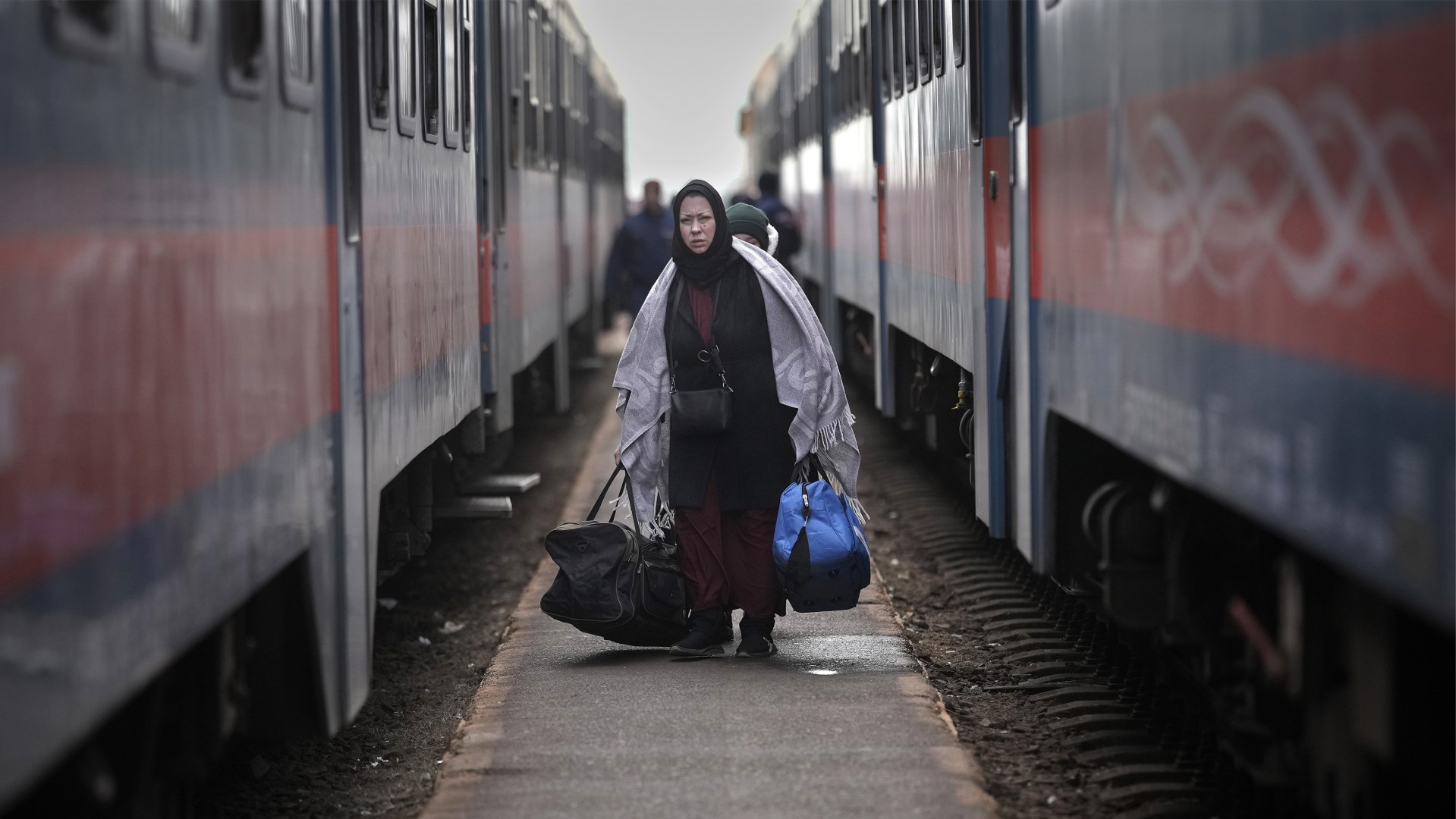
Refugees fleeing Ukraine arrive at the border train station of Zahony, Hungary, on March 8, 2022.

Refugees fleeing Ukraine arrive at the border train station of Zahony, Hungary, on March 8, 2022.

Christianity Today March 25, 2022
Christopher Furlong / Staff / Getty

The United States will accept up to 100,000 Ukrainians fleeing Russian aggression, President Joe Biden announced Thursday.

Details of the plan are still being worked out, but both the US refugee resettlement program and the humanitarian visa program will be utilized, with an emphasis on reuniting families. The US hosts the third-largest Ukrainian diaspora in the world, after Russia and Canada.

Biden also pledged $1 billion in humanitarian assistance for Ukrainians internally displaced by the war. World Relief, which has resettled 7,300 Ukrainian refugees—representing 4 out of 10 admitted to the US—over the past decade, welcomed the announcement.

“We are in close contact with many of these individuals, almost all of whom have loved ones now at risk in Ukraine,” stated president and CEO Myal Greene in a press release, “and we’re grateful that President Biden’s announcement today seems to open up the likelihood of expedited family reunification and other avenues of protection.”

World Relief also noted its current work with local churches in Western Ukraine, Slovakia, Romania, Moldova, Poland, and Hungary.

Editor’s note:

You can now follow CT’s Ukraine-Russia coverage on Telegram: @ctmagazine (also available in Russian)

“Most Ukrainians who make the difficult decision to leave their homes are relatively safe in neighboring European countries, where most would prefer to stay, in part because they hope and pray to return soon to a safe, free Ukraine,” stated Greene. “But for those who have family in the US or for whom voluntary repatriation is impossible, some may prefer the option of resettlement to the US, where we are also eager to welcome and support them as they replant their lives.”

Valentin Siniy, president of Tavriski Christian Institute (TCI) in Kherson, told CT that Ukrainians “are grateful to everyone who helps us in such a difficult period of our history.” But he noted the length of time and uncertain process that any relocation to the US would require.

More than 4 in 10 Ukrainian families have now been separated by the war. His evangelical seminary and its city are now under Russian control. “We all have to learn how to live in a different reality,” he said.

Siniy has observed that governments often respond to refugees based on the level of hospitality that private citizens are already offering—and especially to the extent local churches have gotten involved.

“It is very important for the modern church to raise its bold prophetic voice in denouncing the evil that is present, such as war, and to encourage society towards virtues and human relations,” he said.

https://datawrapper.dwcdn.net/FURKC

Over the past week, CT visited nine churches and church-run refugee centers in Poland, including in Warsaw, Krakow, and smaller cities near the Polish-Ukrainian border.

Local pastors told CT they don’t know of any evangelical church in Poland that’s not involved in helping Ukrainian refugees in some way, whether hosting them, picking them up at the border, feeding and clothing them, finding longer-term accommodation, providing transportation to other cities or countries, or sending trucks and vans full of supplies to Ukraine.

“I’d be surprised to know of any church that isn’t involved,” said Czeslaw Kushider, lead pastor of Nazaret Pentecostal Church in Przemysl, a city about a 20-minute drive from the Ukrainian border. His congregation has turned every room in the church building, including his pastor’s office, into sleeping areas for passing refugees, with volunteers working round-the-clock.

Most evangelical churches in Poland are small, averaging about 80 to 100 members per congregation. But from the day the Russian military invaded Ukraine on February 24, causing now more than 2 million people to flee into Poland, churches were one of the first groups to respond, mobilizing at a speed and efficiency rivaling or surpassing government agencies and big humanitarian organizations.

For example, Chelm Baptist Church, an 80-member congregation about a 30-minute drive from the border, was already hosting up to 200 refugees a day in its church building within the first week—a full week before city officials opened up a bigger government-run refugee center in Chelm. Within the first two weeks, this little Baptist church had already hosted more than 3,000 refugees with its small team of volunteers comprised of church members and neighbors.

Part of the reason churches were able to move so quickly, Polish pastors told CT, is because these churches already have existing relationships with churches in Ukraine and other churches across Poland and Europe. Since most of the refugees are women and children, many worry about the risk of human trafficking but trust churches as places of refuge. For those who don’t know where to go, churches from other cities and towns in Poland, or from countries as far out as Spain, connect with each other and help refugees transit from one church to another.

Kushider, the pastor in Przemysl, said like many churches in the US his congregation has been divided amid the pandemic. But today, he’s witnessing a unity within his church and others that he hasn’t seen before.

“This challenge changed us. People are working together,” he told CT.

“If someone had told us that we would be able to do what we’re doing now, we would have said that’s impossible. But God surprised us and said ‘With me, it’s possible,’” said Kushider. “This experience has expanded our horizons of what we can do as a church together.”

https://twitter.com/SophiaLeeHyun/status/1505909951595696129

However, many of these churches are also running out of resources. One pastor in Warsaw told CT his church used to operate its building about once a week. Now it’s running 24/7, and he’s dreading the electricity and heating bill coming at the end of this month.

Every Polish pastor CT talked to said they don’t need more people from other countries flying into Poland, especially in large groups with volunteers who don’t speak Ukrainian, Russian, or Polish. They need every space they can get for the refugees.

Instead, what they need most is money to fund the already-existing efforts on the ground. They need money to pay bills and rent, and to fuel the cars and buses and trucks that deliver supplies and evacuate refugees. (Gas is one of the biggest expenses right now.)

Polish pastors also urge Christians across the globe to pray.

“We never expected that 75 years after World War II, and 67 years after the collapse of Stalin, someone else would rise up with the same evil spirit,” said Marek Kaminski, bishop of the Pentecostal Church of Poland. “Pray globally. Fast globally. We need this war to be stopped.”

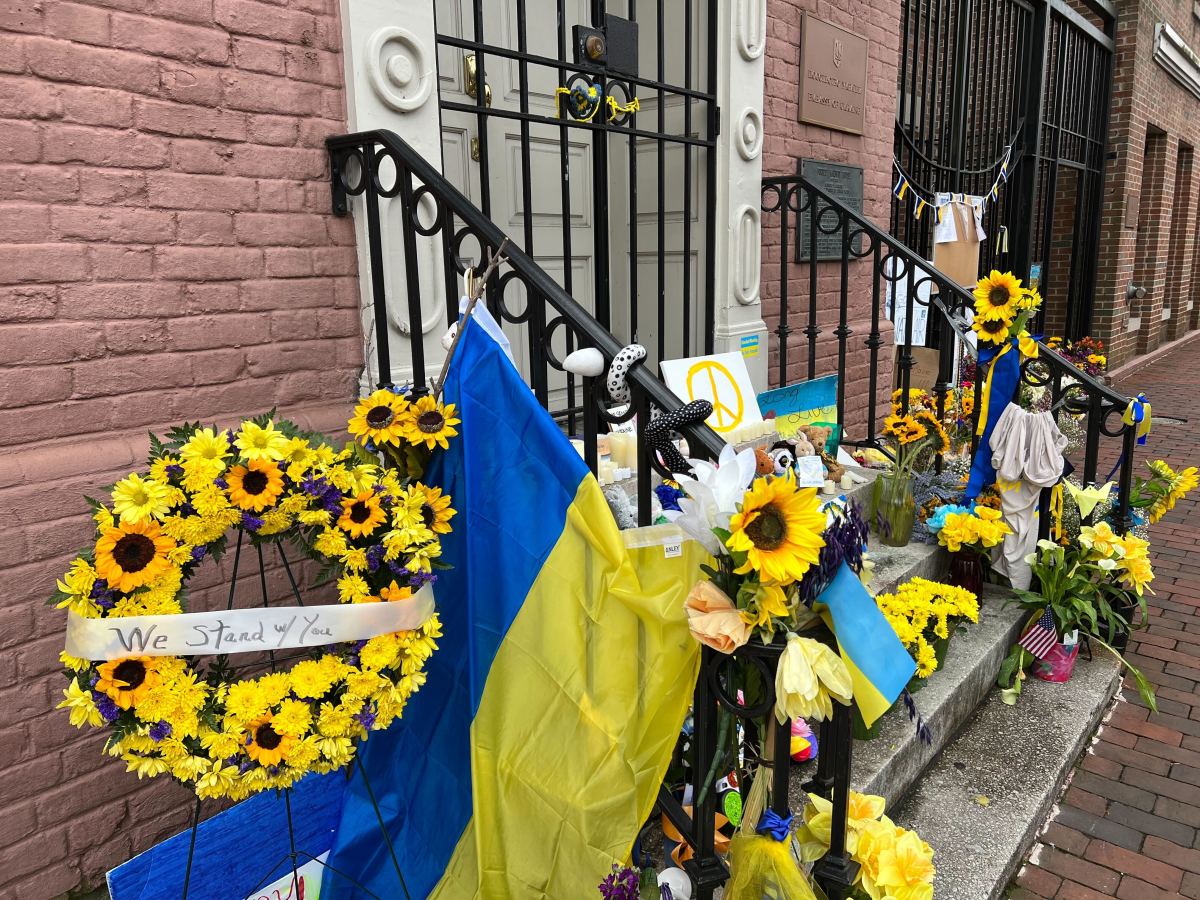
Signs of support placed in front of the Ukrainian Embassy in Washington DC on March 24, 2022.

This article will be updated.

Sophia Lee reported from Warsaw, Poland. Jeremy Weber reported from Washington, DC.

News

Is It ‘Christian’ for Europe to Welcome Refugees from Ukraine but Not Syria?

Middle Eastern and European evangelicals assess the vastly different continental response and the Bible’s teachings toward the stranger.

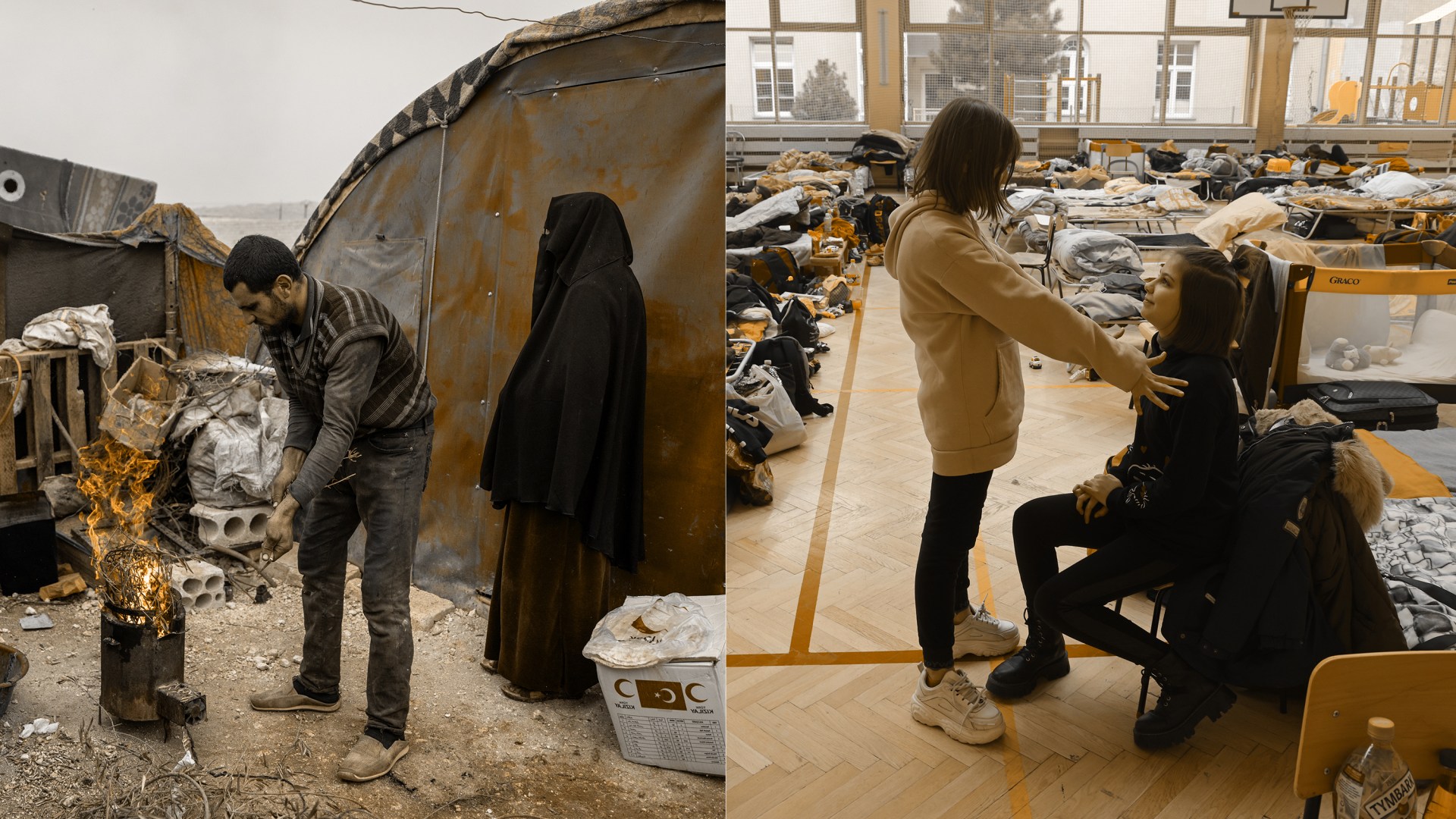
Left: Displaced Syrians light a fire outside their tent at a refugee camp. Right: Ukrainians in Poland seeking refuge from Russian invasion.

Left: Displaced Syrians light a fire outside their tent at a refugee camp. Right: Ukrainians in Poland seeking refuge from Russian invasion.

Christianity Today March 25, 2022
Edits by Christianity Today / Source Images: Chris McGrath / Sean Gallup / Getty

As Ukraine continues to be battered by Russia, Syrian refugees know what to pray for better than most.

“This is what happened to us,” said refugee students at the Together for the Family center in Zahle, Lebanon. “We don’t want it to happen to others.”

Born in Homs, Syria, to a Baptist pastor, Izdihar Kassis married a Lebanese man and then founded the center in 2006. She shifted her ministry to care for “her people” when the Syrian civil war started in 2011. About 50 traumatized teenagers find counseling there every year, and 300 have graduated from the center’s vocational programs.

As the refugees discussed the “horrible” situation in Europe during the weekly chapel service, Kassis suggested intercession. The 40 children and 30 Syrian staff and volunteers bowed their heads.

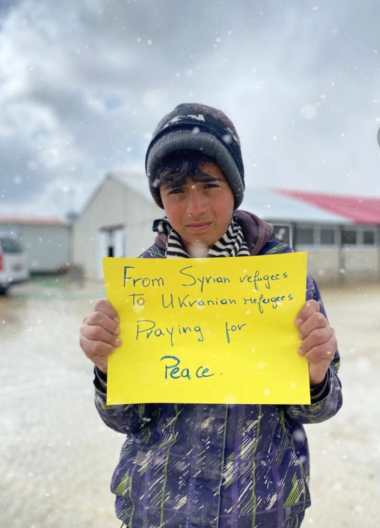
But one child wanted to be sure the Ukrainians would know of their solidarity. He went outside into the cold and snow of the Bekaa Valley, where most of Lebanon’s 1.5 million Syrian refugees take shelter.

His sign proclaimed, “Praying for peace.”

A Syrian refugee in Zahle, Lebanon

Since the invasion, about 4 million of Ukraine’s population of 43 million have become refugees. Another 6.5 million are internally displaced.

Yet 11 years since its civil war, most of Syria’s 6.8 million refugees—out of a population of 20 million—still live in limbo. Europe largely shut its doors, certainly in comparison to its warm welcome of those fleeing Russian aggression.

Many have taken offense.

“There is the perennial double standard and selective outrage of global news media, Western governments (and, sadly, even Western Churches) when it comes to reporting on wars, conflicts and the plight of refugees,” stated Vinoth Ramachandra from Sri Lanka, a senior leader with the International Fellowship of Evangelical Students (IFES), affiliated with InterVarsity.

“If Ukrainians were not blonde and blue-eyed, would their plight have occasioned [this] outpouring of compassion?”

It is a fair question. Is European hypocrisy—even racism—on full display?

Arab Christians are not quick to judge.

Born in Syria, Joseph Kassab today heads the Beirut-based Supreme Council of the Evangelical Churches in Syria and Lebanon. He notes the more than one million countrymen taken in by Europe—Western Europe, primarily. Eastern nations, he said, are still recovering from the communist era and have not yet developed the same sense of human rights.

There should be no discrimination, yet even this he understands. The early church struggled to open its mission to non-Jews.

“Racism is in every society,” Kassab said. “But Europeans have been more welcoming to the Syrians than many Lebanese.”

Being Muslim is a factor, said Elie Haddad, president of Arab Baptist Theological Seminary in Beirut. But also important is that most are rural, uneducated farmers. Legitimate or not, people are uncomfortable with difference.

Europe is a bit hypocritical, but so is he.

“If a faculty member needs shelter, I will open my home,” Haddad said. “For a stranger, not so much.”

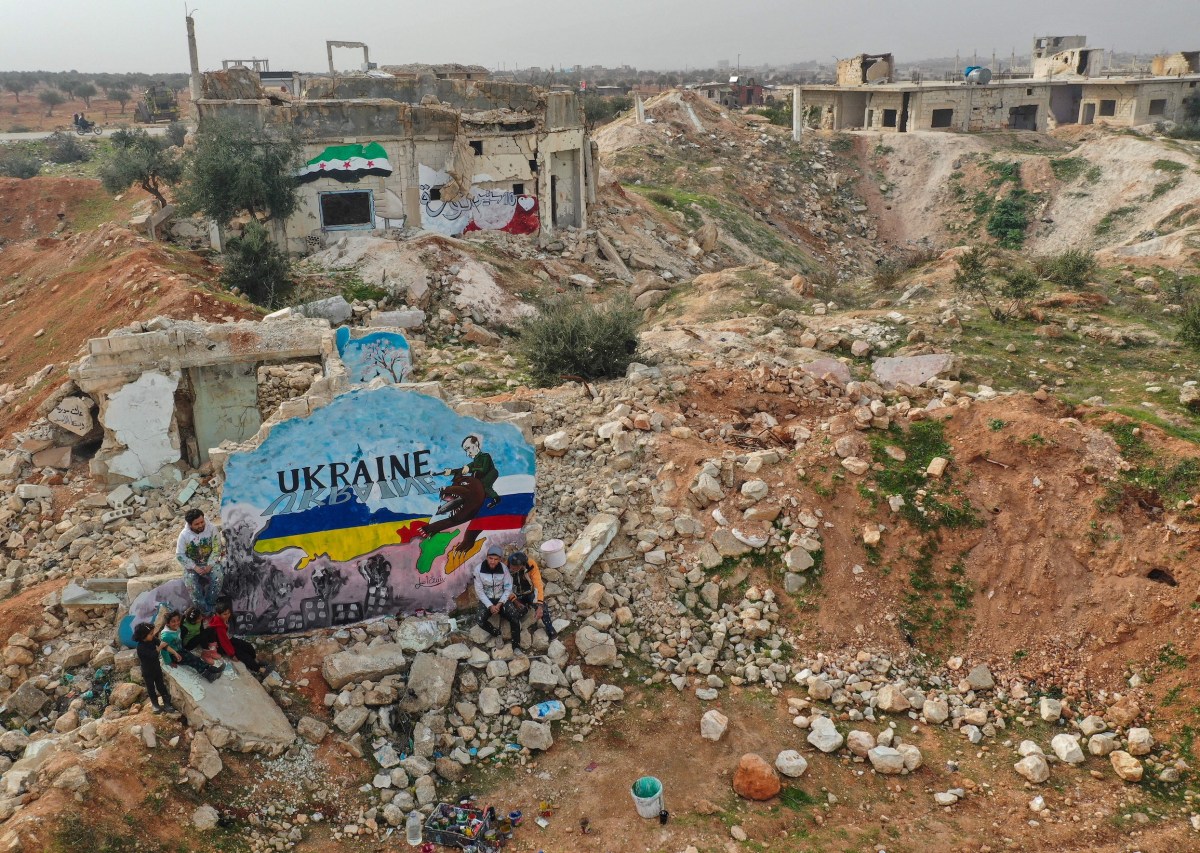
A mural painted by Syrian artists to protest against Russia's military operation in Ukraine, amid the destruction in the rebel-held town of Binnish in Syria's northwestern Idlib province on February 24, 2022.
A mural painted by Syrian artists to protest against Russia’s military operation in Ukraine, amid the destruction in the rebel-held town of Binnish in Syria’s northwestern Idlib province on February 24, 2022.

One who did open his home is a Frenchman of Lebanese descent in Nice.

A nurse at a local hospital, in 2018 François Nader was the only available Arabic speaker to assist a refugee family whose working-age son needed emergency kidney dialysis. He walked them through the necessary paperwork and for three months gave boarding to the recovering Syrian. Nader even offered him above-average wages for housework, providing informal work since French law forbade formal employment.

Yet France today is permitting Ukrainians up to three years of residence and employment (per a European Union directive).

And Nader, now in Bordeaux and married to a Russian with Ukrainian relatives, applauds. A simple phone call from authorities validated the legality of four refugees he now has in his home. A nondenominational Christian, he believes the gospel calls people to treat everyone the same.

But not nations.

“Muslim values are totally opposite to ours,” Nader said. “It needs generations to have their mind adapt to the European way.”

The fear of terrorism is an issue. But so is adaptation. Muslims concentrate in the banlieues, ghettos that reinforce a separatism damaging to French society, he said. Meanwhile, Ukrainian tourists visit the Louvre, where their children behave, he said. On the tramway they sit quietly, reading books.

“It is a stereotype, and it is a little bit cruel,” Nader said. “I’m sorry to say this, but it is also human.”

But is it biblical?

God has created both similarity and difference, said Leonardo De Chirico, chair of the theological commission of the Italian Evangelical Alliance. According to Galatians 6:10, he said, it is proper to give preference.

“The principle of proximity calls us to give special attention to those who are near us,” he said, “in the faith, in the family, in the nation, and in our surrounding context.”

While this applies to ethnicity, it does not apply to culture or education, said De Chirico. All should be welcomed and helped to integrate. But where resources are limited and governments overwhelmed, it is not wrong to discriminate.

The Bible even does so, he said, as the original Hebrew differentiates between “aliens.” The gerim (Lev. 19:33–34) are to be treated justly like fellow Jews, but the zarim (Ex. 12:43) are barred from celebrating Passover.

A modern distinction is between refugee and migrant.

“Freedom of movement is not absolute,” said Marc Jost, general secretary of the Swiss Evangelical Alliance. “I like diversity, but it entails risks that must be regulated.”

Cultural proximity led Switzerland to waive for Ukrainians the case-by-case examination required for Syrians. Jost rejects the privilege many wanted to give for faith and ethnicity, but Swiss authorities thought distinction necessary to weed out potential terrorists.

Still, the difficulties of integration are real, and the government wanted to reduce the “pull factor,” especially for economic migrants seeking a better life. Those “threatened by life and limb” should be permitted with no discrimination.

But many say such cases are the minority.

Greece has accepted nearly 5,000 Ukrainians since the war began. Up to 30,000 could be accommodated, authorities said. The Mediterranean nation has been especially attentive to Mariupol, repatriating nearly 200 nationals from an area originally settled by Greeks in the sixth century B.C.

But Greece already hosts about 42,000 refugees from various countries. Many others are turned away by boat. The Greek government stated that as it processes applications, 7 out of 10 applicants are not refugees.

“We should not equate migrants with refugees,” said Slavko Hadžić, Langham preaching coordinator for the West Balkans, from Bosnia. “Migrants can use legal means to apply for jobs.”

His nation has been criticized for “inhumane” migrant camps. But according to a 2020 report by Human Rights Watch, out of 18,000 asylum seekers, Syria was only the fifth-most-common nation of origin, behind Pakistan, Afghanistan, Bangladesh, and Iraq.

Churches helped them all, said Hadžić, as they should. But he criticized an idea heard frequently in Eastern Europe about the preservation of “Christian civilization.” While believers have a special responsibility to help all followers of Jesus, this does not include the nominal in faith.

“Whatever label a secular government puts on itself,” he said, “there are no Christian nations in the world.”

But it is good there is Christian heritage, said Samuil Petrovski, president of the Serbian Evangelical Alliance, and it should be protected against new waves of Western-imported identity politics. But as the government should “bring light to dark places,” it must not be at the expense of refugees or migrants, regardless of their religion, he said. The Bible teaches that assistance should be given to all who are truly in need.

Hungary simply defines them differently.

Prime Minister Viktor Orbán calls his nation a “Christian democracy,” and the Catholic-majority country maintains a cabinet-level ministry to support persecuted Christians in the Middle East. But, while now saying Ukrainian refugees are coming to a “friendly place,” two months before the war Orbán stated, “We are not going to let anyone in.”

Eastern Europeans have held onto the heritage of Christendom longer than their Western neighbors. But it is an old Orthodox idea—rejected as heresy in 1872 by the Council of Constantinople—that merges political nationalism with an ethnic church. And given Russia’s argument that Ukraine properly belongs to the Moscow patriarchate, over 1,100 Orthodox clerics and scholars condemned phyletism again.

“The battle is won in the hearts and minds of others, not in restrictive laws, even when created with good intentions,” said Bradley Nassif, author of The Evangelical Theology of the Orthodox Church and a former professor of theology at North Park University. “The best approach would be for the state to support the church without enacting laws and policies against religious minorities.”

Jost believes that to defend a nation’s Christian heritage, it must continually be demonstrated to benefit society as a whole. Human rights, he said, are derived from Christian ethics.

But other evangelical leaders protested. De Chirico, from majority Roman Catholic Italy, said a Christian identity of a state is “fraught with problems.” Kassab said if the Middle East promotes its Islamic identity, it would “multiply the misery” of Christians.

The state should protect the heritage and identity of all, said Tom Albinson, president of the International Association for Refugees, an affiliate of the World Evangelical Alliance (WEA). There is good reason for communities to serve through networks and relationships of trust. And it is within the rights of a nation to protect its borders and to deport migrants.

But it is not right to pit the migrant against the refugee.

“Many nations today are spending much more money and energy on finding ways to prevent refugees and asylum seekers from ever crossing their border than they are in protecting people who have been robbed of place and are among the most vulnerable people on the planet,” said Albinson. “This needs to be exposed and confronted for what it is.”

Mixed migration confuses the issue, and human traffickers prey on them all. Meanwhile the refugees among them are often treated as guilty until proven innocent.

Having served eight years as the WEA’s ambassador for refugees until last year, Albinson counsels nations to invest in the infrastructure necessary to process claims fairly. Currently 86 percent of the world’s refugees are hosted by developing nations, he said. And out of a total of 26 million, only 1 percent are resettled in any given year.

The church, he counsels, should fill in the gaps.

“Government services and nongovernmental humanitarian agencies can offer help, but they are not able to strengthen hope,” Albinson said. “We are at our best when we care for those unlike ourselves, those who are strangers to us.”

And who is stranger to a Ukrainian than a Syrian?

Mother’s Day in the Arab world falls in March. Besides offering prayer, Together for the Family is collecting advice from Syrian wives and widows on how to deal with life when torn from husbands and sons.

They will send cards—and the little money they can spare. Graduates from the center’s carpentry program earn $2.25 per week. But due to the shortage in imported Ukrainian grain, their daily bread now costs 75 cents.

“The Lord has helped them here and lifted them up,” said Kassis. “They want to encourage Ukrainian women in the same way.”

Editor’s note:

You can now follow CT’s Ukraine-Russia coverage on Telegram: @ctmagazine (also available in Chinese and Russian).

News

Christian Ministries: Say No to Orphanages

COVID-19 crisis puts pressure on hard-hit nations with millions of caregivers dead. But family care is still preferred.

Christianity Today March 25, 2022
Anthony Kwan/Getty Images

More than 5.2 million children around the world have lost a caregiver to COVID-19, according to a new report released by The Lancet Child & Adolescent Health journal.

The number of newly bereaved children increased so rapidly between March 2020 and October 2021, experts in Christian orphan-care ministries can compare the crisis only to the one caused by HIV/AIDS, which has orphaned a total of 16.5 million people since the 1980s. The response, they hope, will be as earnest as it was in response to AIDS—but different.

Orphan-care ministries see the current crisis as an opportunity to fully turn away from institutionalization, throwing all their support to a family-care model.

“We’ve learned from the past,” Elli Oswald, executive director of the Faith to Action Initiative, told CT. “We know that residential care facilities, orphanages, and children’s homes are only Band-Aid responses that don’t address the real challenges that children and families are facing—and in fact they can cause more trauma and harm to children.”

In the 19th century, Christian organizations built orphanages as a swift solution to the dire need of abandoned and neglected children. American Protestants funded orphanages around the world, and Christians became the primary provider of orphan care. What might have been seen as a temporary solution, however, became in many cases permanent.

“While it was incredibly generous and well-meaning, it caused harm that we didn’t realize,” Oswald said.

American Christians give an estimated $3.3 billion to orphanages annually. And orphanages may still sometimes be the best available option in the short term in some situations, Oswald said. But long term, the Faith to Action Initiative and other leading orphan-care ministries seek to support family and community solutions.

A coalition of faith-based ministries, led by the Faith to Action Initiative, wrote a letter to the United Nations last fall in support of family-based care. At the time, 1.5 million children had lost a caregiver to COVID-19.

In 2019, the United Nations passed a resolution prioritizing family-based care and calling for the eventual elimination of institutional homes. Every member state signed on to the resolution. The current crisis, however, could cause some nations to become desperate for easier options. Christian ministries hope the UN will help them solidify government support for best practices.

“As we did during the HIV/AIDS epidemic, World Vision seeks to be a leader in a global response to support families ensuring that children can remain with their loving caregivers,” said Lisa Bos, director of government relations with World Vision US. “But we also need government leaders to prioritize children and address issues like caregiver loss in their COVID response.”

Jenny Yang, senior vice president of advocacy and policy at World Relief, said the pandemic has wiped away 20 years’ worth of work at decreasing extreme poverty around the world. The hardest-hit nations—including India and Brazil—are feeling the urgent need to respond to the crisis.

“The earlier we’re able to intervene, the [better] we’re able to address the root causes of what is causing extreme poverty to rise,” she said.

Even in a time of crisis, though, there’s a reason to support families, whether that means a single-parent home, a relative, or an extended family.

“Families are the God-given institution through which children can experience social, emotional, and economic support,” Yang said, “so … making sure that orphans are able to be with family, if they’re able to care for them, is extremely important.”

Having a family member care for a child is not only in line with biblical principles, but there is evidence it’s the most practical solution, according to Phil Green, one of the coauthors of The Lancet report and a leader with World Without Orphans. There is a variety of research on the topic, he said, but it generally shows family-based care is more cost effective.

“The myth that building orphanages is cheaper and countries can’t afford to do it other ways really doesn’t stand up to the evidence,” he said. “We know what works. Let’s make a difference in the lives of these children—because children are resilient and can go on to thrive.”

Green said his research has also allowed organizations to see the areas of greatest need. The majority of caregiver deaths have been male, depriving many children of fathers. The majority of children impacted by COVID-19 deaths (64%) are between the ages of 10 and 17.

They face increased vulnerabilities to poverty, sexual violence, and other kinds of exploitation. There is potential for the negative impacts of losing a caregiver to ripple into the future, but there is also an opportunity for the church to act now to prevent future harms, Green said.

Religious organizations that might once have taken responsibility for running orphanages can play a pivotal role in placing children in families. Religious leaders can be intimately integrated with a community, according to Green, which enables them to identify needs, empower communities to find solutions, and connect people with necessary resources.

“We’re seeing around the world that churches are an excellent place to do that family-strengthening piece,” he said.

That’s how Bethany Christian Services sees it too.

“We have social workers on the ground that are walking alongside the families and providing them and connecting them with services so they can be strengthened and empowered,” said Leena Hill, vice president of global services at Bethany.

Over the years, their social workers have also learned that it’s important to help in the right way.

She said the natural response when looking at horrific statistics from COVID-19 is to want to do something—anything. And that’s good, but it’s important to respect and strengthen the communities that need help.

“Often the solution is available in the communities themselves,” she said. “More often than not, these children do have a living relative.”

The great need to care for orphans could send some back to old models, but Hill hopes people will instead think about how to help pair the children with local solutions or work alongside local solutions already in place.

It could be, she said, a really critical moment for Christians.

“What an amazing opportunity,” she said, “to demonstrate more powerfully the love of Christ by responding well.”

Theology

Hillsong Leaders Need Character More than Charisma

Brian Houston’s resignation reminds us we need godly pastors, not just gifted ones.

Christianity Today March 24, 2022
Marcus Ingram / Contributor / Getty

In Sydney this week, Hillsong megachurch founder and senior pastor Brian Houston resigned in light of a pending court case and following revelations of pastoral misconduct.

The court case pertains to Houston’s alleged concealment of his father sexually abusing a boy in New Zealand in the 1970s. Although Houston removed his father from ministry, reported him to denominational authorities, and has publicly acknowledged that the abuse took place, New South Wales state police claim that Houston “knew information relating to the sexual abuse of a young male in the 1970s and failed to bring that information to the attention of police.”

The trial is scheduled for October this year.

More recently, the Hillsong global board wrote an email to members about two complaints against Houston. The first, which took place ten years ago, “involved inappropriate text messages from Pastor Brian [Houston] to a member of staff, which subsequently resulted in the staff member resigning.” This indiscretion was explained as the accidental result of Houston being “under the influence of sleeping tablets.”

The second complaint took place in 2019 when Houston knocked on the door of a hotel room with a female occupant and spent a significant amount of time in the room. Similar to the other case, his behavior was explained away as the unfortunate result of anti-anxiety medication mixing with alcohol in his system.

Hillsong has made a significant international impact by planting churches all over the world and taking Pentecostalism into the digital age. But with success comes the temptation to do anything to keep the machine running, protect the minister and the ministry, and maintain the rivers of money flowing in—even if it means turning a blind eye to indiscretions or giving excuses for the inexcusable.

What I find disappointing are the explanations for Houston’s actions. While medication can adversely affect a person’s mental state, it is never a justification for inappropriate behavior. These excuses ring hollow, especially for victims of sexual harassment.

One obvious issue, rightly noted by the Hillsong board, is that “Hillsong’s governance model has historically placed significant control in the hands of the senior pastor.” Freighting one person with authority is not indicative of a healthy leadership culture. We would do well, then, to reflect on which model of church governance and which style of leadership are more conducive to transparency and accountability.

As biblical scholar Andy Judd suggests, we should always ask, “Where is power distributed? how are decisions made and reviewed? and what happens next when a leader is forced to move on?”

But more important than leadership structures is a person’s character. The biblical qualifications for a pastor don’t rely on clicks, downloads, book sales, revenue, conference circuits, the number of bums in pews, or how many celebrities attend your church.

Instead, they require a pastor to be “above reapproach” and “self-controlled, respectable, hospitable, able to teach, not given to drunkenness, not violent but gentle, not quarrelsome, not a lover of money” (1 Tim. 3:2–3). Jesus taught that “the greatest among you will be your servant. For those who exalt themselves will be humbled, and those who humble themselves will be exalted” (Matt 23:11–12).

During my time in seminary, I joined a wonderful Bible-believing church, and when I was being considered for a place as a pastoral intern, I met with one of the pastors. Having known me only for a little while, he was optimistic about my potential but wisely cautious about my character.

He said, “I know you’re gifted, but I don’t know if you’re godly.” Those words have stuck with me ever since.

There is a difference—a big one—between being gifted and being godly. It’s the difference between the show you can put on and what desires you harbor in your heart, between what you do on stage and what you do when you think nobody is watching you.

The events surrounding Houston are a reminder that the evangelical world needs leaders who demonstrate Christlike character, not simply public confidence; who grow disciples, not groom sycophants; who see themselves as naked before Christ, not robed in the prestige of their platforms. We need leaders who know that when success becomes an idol, cover-ups become a sacrament.

Michael Bird (PhD University of Queensland) is academic dean and lecturer in New Testament at Ridley College in Melbourne.

addApple PodcastsDown ArrowDown ArrowDown Arrowarrow_left_altLeft ArrowLeft ArrowRight ArrowRight ArrowRight Arrowarrow_up_altUp ArrowUp ArrowAvailable at Amazoncaret-downCloseCloseellipseEmailEmailExpandExpandExternalExternalFacebookfacebook-squarefolderGiftGiftGooglegoogleGoogle KeephamburgerInstagraminstagram-squareLinkLinklinkedin-squareListenListenListenChristianity TodayCT Creative Studio Logologo_orgMegaphoneMenuMenupausePinterestPlayPlayPocketPodcastprintremoveRSSRSSSaveSavesaveSearchSearchsearchSpotifyStitcherTelegramTable of ContentsTable of Contentstwitter-squareWhatsAppXYouTubeYouTube