Church Life

How White Rule Ended in Missions

Western missionaries championed racial equality abroad while struggling with it in their own ranks.

Illustration by Jared Boggess / Source Images: NSA Digital Archive / Volody Myrzakharov / Getty

After the horrors of the Second World War, global attitudes on race began to change as secular and religious leaders called for both civil rights and an end to white rule. While historians usually recount the civil rights movement in the United States with little reference to events in the wider world, religious and secular leaders of the period understood American civil rights as part of part of a larger campaign against global racism.

World Christianity and the Unfinished Task: A Very Short Introduction

World Christianity and the Unfinished Task: A Very Short Introduction

Cascade Books

172 pages

$22.37

Attitudes of ethnic superiority were pervasive throughout the Western world, and white, colonial rule was viewed as an expression of the racist worldview. In 1942, a chorus of Protestant leaders began calling for the equality “of other races in our own and other lands.” In 1947, two years after the war ended, the Lutheran theologian Otto Frederick Nolde produced a series of essays arguing for global racial equality, calling for the church to lead the way:

The Christian gospel relates to all men, regardless of race, language or color. … [T]here is no Christian basis to support a fancied intrinsic superiority of any one race. The rights of all peoples of all lands should be recognized and safeguarded. International cooperation is needed to create conditions under which these freedoms may become a reality.

The call for racial equality was part of a worldwide movement that demanded freedom for “all peoples of all lands.” In 1948, the global community adopted the Universal Declaration of Human Rights (UDHR), a watershed event in the worldwide battle against racism. American Protestant missionaries were highly influential in the language of the UDHR and became vocal proponents for religious freedom as well as global human rights. Attitudes were shifting in the Western world, and missionaries were helping lead the way. W. E. B. Du Bois, who is perhaps best known as an American civil rights activist, is more properly understood as a prophetic voice calling for an end to global racism and white oppression. Though he was an atheist, Du Bois worked alongside Western missionaries in the adoption of the UDHR in 1948 and expressed his belief that Western missionaries had an important role to play in putting an end to global racism.

Yet racism remained an acceptable sin following the Second World War, even among many evangelical Christians. The “problem of the color bar” was a problem among some Christian mission societies during the first half of the 20th century.

During my doctoral studies, I examined the organization that became the century’s largest Protestant mission agency on the African continent. It was in turmoil over how to handle the issue of racial integration in the 1950s. Executives balked at the suggestion by some of its missionaries that it should accept “colored Evangelicals” as full-fledged members of the mission community. Officials in the home office wondered aloud (mostly in closed-door meetings) how they would address the question of equal compensation as well as problems that would arise when the children of Black American missionaries wanted to attend school with the children of their white colleagues. Mission authorities suggested that perhaps they could create separate mission stations that “were staffed entirely by negroes” in Africa.

So some missionaries were working to change racist attitudes abroad, while others were coming to terms with such attitudes in their own ranks. But there is something else I became more aware of as I was toiling away in dusty archives: Those same changing attitudes on global human rights and white rule became a crisis for some missionaries and mission societies even as they tried to remain focused on their primary work of gospel proclamation.

As an example, the mission I became most familiar with was forced to reposition itself due to the rise of nationalism and anti-white sentiment in the 1950s during the Mau Mau Conflict (circa 1952–56). The changes sweeping the African continent created political pressure to “Africanize” all spheres of society (including the church). In the decade that followed Kenyan independence from Great Britain (the process began in about 1958 and independence was announced in 1963), the all-white mission initially resisted pressure from African church leaders for a peaceful handover of its property and power. In spite of assurances otherwise, missionaries feared they would then be pressured to leave the country (thus ending their work).

The mission finally relinquished its authority in the 1970s after African church leaders threatened a hostile takeover, though it was not until 1980 that a complete handover had taken place due to the demands of the African church’s stalwart bishop, who grew weary of what he called the “mission station mentality.” (He was referring to the failure of missionaries to fully “integrate” with the African church.) Foreign control by whites—whether in the nation, the church, or mission societies—was out of step with the times. Even mission organizations that were not fully on board with the changing times brought by decolonization were forced to adjust.

It is important for Western Christians who are engaged in world missions to understand that white supremacy in all its forms has been rejected by the non-Western world. During the latter 20th century, missionaries serving in the non-Western world were keenly aware of this global mood. Throughout the African continent during the second half of the 20th century, colonies rebelled against their Western masters, buoyed by the fight for human freedom and the end of global racism. As former colonies became independent, Western missionaries from various denominations, Catholic and Protestant, were forced to relinquish ecclesiastical authority.

The transitions “from mission to church” (referred to as “devolution”) in various denominations were often tense and uneven. Progressive voices within mission circles called for devolution as soon as possible. Max Warren (1904–77), who served as the vicar of Holy Trinity, Cambridge from 1936 to 1942, and the general secretary of the Church Missionary Society from 1942 to 1963, was especially persuasive in convincing the global mission community to adjust to the changes sweeping the world during decolonization.

In most cases, missionaries and mission societies responded with alacrity, preparing local leaders for positions of authority as quickly as possible, often out of concern that they would be forced to leave the country by new government regimes that might be hostile to Western workers (as in China in 1949 and the Belgian Congo in 1960).

In newly independent nations where mission societies were allowed to continue working, missionaries sometimes felt compelled to relinquish control of the church, fearing that they might be perceived as antigovernment or even racist. Conditions in South Africa were even more complex, with church and state intertwined in private and public spheres, and racial tensions continuing well past the end of apartheid (1994) up to the present day. In China and India, most Western missionaries had already been pressured to return home by 1950 due to anti-Western sentiment, and mission societies had no choice but to hand over the leadership of the church to indigenous leaders. In Latin America, while nations had experienced political freedom more than a century earlier, frustrations mounted in the middle of the 20th century over the elitism that was displayed by church hierarchy.

Christian leaders, both Catholic and Protestant, expressed solidarity with the poor and oppressed through the espousal of liberation theology in the 1950s to the 1990s. This form of theology, drawing heavily on the Exodus motif, argued that God is on a mission to set his people free, both spiritually and politically. The rhetoric of liberation theology was often anti-Western, and some of the criticisms of liberation theologians were directed toward Western missionaries who were viewed as neocolonialists. From the 1940s through the 1990s, Western missions societies were pressured to adjust to the rapidly changing world around them. “White rule” in all its forms was being rejected in Africa, Asia, and Latin America.

I learned about the growth of Christianity in the non-Western world during my sabbatical in Kenya in 2006, and I also learned a lot about the attitudes of non-Western Christians toward Western missionaries. A research project I undertook while in Kenya showed that Africans not only resented the legacy of Western control and racism (this did not surprise me), but they also believed that mission societies had displayed attitudes of cultural and racial superiority. Many Africans believed that the reluctance of Western missionaries to provide adequate ministerial preparation for local leaders was an expression of cultural and racial superiority.

While I was lecturing in the church history department at the Nairobi Evangelical School of Theology that year, a pastor from Ukambani (near Machakos, Kenya) came by my cottage one evening to deliver a copy of Joe de Graft’s literary masterpiece Muntu. The African play was performed in 1975 at the World Council of Churches gathering in Nairobi and is now considered a classic in African literature.

In the play, the Waterpeople arrive while the sons and daughters of Africa are fighting among themselves over how to govern their own affairs. The “First Water-man” is a Christian missionary who has come to Africa to make converts; the second is a trader who sets up a shop for buying and selling; the third is a white settler in search of land; the fourth is a colonial administrator with plans to build a railway for exporting gold.

The Waterpeople were brandishing muskets, and even the missionary proved to be an excellent marksman. The African pastor who handed me the play explained that de Graft’s work would help me understand the mindset of many Africans, especially those who were university educated. African Christians, I was to learn, remember that the Western missionary arrived along with the settler, the trader, and the colonial administrator—often on the same ships. More discerning Christians, he informed me, understood that the missionary had different aims. However, he continued, it was important for me to understand that a new generation of African leaders had emerged who would not abide anything that resembled Western superiority. The end of white rule in non-Western nations, he wanted me to understand, also meant the end of any hint of white rule in the African church.

Christians in Africa, Asia, and Latin America want (and deserve) to work with the church in the Western world as coequals in the gospel for the cause of global missions. Church leaders in the non-Western world are keenly aware of the history of subjugation that they and their forefathers have endured. They do not want to be ignored, bypassed, looked down on, or patronized by the Western church—arriving in their country to carry out their work independently as though no African, Asian, or Latin American church actually exists. They want the Western church to serve with them in common witness. They also want Western church leaders to acknowledge them, respect them, and listen to them. They want Western Christians to first understand their needs and then come and serve alongside them.

It is easy to mistake the hospitality offered by the people of the non-Western world to Western visitors for willing subservience. But it is critical to understand that attitudes toward North Americans and Europeans have changed during the 20th century and that even hospitable hosts are aware of the long history of cultural and racial superiority.

Bishop Oscar Muriu is an influential Christian leader on the African continent who has also become a personal friend. I have been the recipient of his kind hospitality on many occasions, and he has been a guest in my home on more than one occasion. We have had many frank discussions over good meals. In a recent exchange, I was soliciting his counsel on a matter related to missions, and he opined (again) about “all the white people from the West…dreaming [about missions] in the 2/3 world.”

Our non-Western brethren want us to be engaged in mission, but they don’t want to be ignored, especially when we are planning mission initiatives in their own backyard! As the Kenyan activist and photojournalist Boniface Mwangi put it in a 2015 op-ed published in the The New York Times: “If you want to come and help me, first ask me what I want…then we can work together.” It is not the “The White Man’s Burden” to save the world; it is the responsibility of the whole church to take the whole gospel to the whole world.

Adapted from World Christianity and the Unfinished Task, by F. Lionel Young III. Used by permission of Wipf and Stock Publishers, www.wipfandstock.com.

Books

Evangelicals Have Made The Trinity a Means to an End. It’s Time to Change That.

For 2,000 years, church leaders held to the same Trinitarian doctrine. How did we lose our way?

Illustration by Jared Boggess / Source Images: Fotograzia / Digitalhallway / Laurence Monneret / Leo Patrizi / Getty

The story of Ebenezer Scrooge, read afresh each year at Christmas, reminds us what to live for, what in life really matters. What could be worse than a life lived and nearly finished only to be full of regrets, haunted by the past? Thanks to the Ghost of Christmas Past, Scrooge is scared sober, with still enough time to change his ways. And change he does.

Simply Trinity: The Unmanipulated Father, Son, and Spirit

Simply Trinity: The Unmanipulated Father, Son, and Spirit

Baker Books

368 pages

$13.20

But it’s not just individuals who can be haunted by the past; entire movements and historical eras can be too. Sometimes we are so nearsighted that we cannot see the big picture of where we’ve been and where we’re headed. And so, the haunting begins—if we’re lucky enough for a ghost to scare us stiff.

Lewis Ayres, one of today’s leading experts on the Trinity, tells us that there is a great divide between the biblical, orthodox doctrine of the Trinity, which can be traced back to the Nicene Creed, and the modern understanding of the Trinity over the past hundred years.

However, this modern Trinity has snuffed out the biblical, orthodox Trinity, even pretended to be the orthodox Trinity, until there is little of orthodoxy that remains. It’s not merely, Ayres writes, that “modern Trinitarianism has engaged with pro-Nicene theology badly.” The situation is way worse: “It has barely engaged with it at all. As a result the legacy of Nicaea remains paradoxically the unnoticed ghost at the modern Trinitarian feast” (emphasis added).

Not that long ago, this ghost went unnoticed at the Trinitarian party, but now it haunts us, and its moans are only growing louder, its blinding light so bright no candle snuffer can extinguish it. To see why, we must walk through the rooms in this haunted house we call modern Christianity, rooms that explain and expose the recent past.

But don’t be fooled; it’s our recent past. It’s my recent past too. I was once taught a modern view of the Trinity as if it were the Bible’s view of the Trinity. But the Ghost of Orthodoxy Past kept haunting me.

What I discovered in these haunted rooms will be frightening for us to see: The Trinity of the Bible, our Trinity, has been manipulated beyond recognition. The guest of honor at the Trinitarian feast is not the biblical, orthodox Trinity at all. Trinity drift is real. And we are its victims.

The Trinity goes social

One of the most influential theologians of the past century—and that is no exaggeration—is Jürgen Moltmann, well-known for his belief in a God who suffers. As it turns out, two Karls—Karl Rahner and Karl Barth—taught him the Trinity when he was a student. But Moltmann believes his mentors got the Trinity wrong: By starting with “the sovereignty of the One God,” they were “then able to talk about the Trinity only as the ‘three modes of being’ or the ‘three modes of subsistence’ of that One God.”

Moltmann may detest Barth’s trinitarianism the most because it prides itself on the way God reveals himself as Lord. This obsession with lordship can only be the outcome of a Western, individualistic preoccupation with the one divine substance and monarch. Moltmann even criticizes the Nicene Creed, that historic standard of orthodoxy, as “ambivalent where the question of God’s unity is concerned.” For it “suggests a unity of substance between Father, Son, and Spirit” with all its talk about the Son being homoousios (of the same essence) with the Father, begotten from the Father’s essence from all eternity.

Moltmann bucks against this Western emphasis on lordship because it stems from an unwavering commitment to monotheism—a most terrible word in Moltmann’s opinion. The “unity of the absolute subject is stressed to such a degree that the trinitarian Persons disintegrate into mere aspects of the one subject”; this stress on unity leads “unintentionally but inescapably to the reduction of the doctrine of the Trinity to monotheism.”

By contrast, he has “decided in favour of the Trinity.” No one who calls themselves a Christian decides in disfavor of the Trinity, so what does Moltmann mean exactly? “I have developed a social doctrine of the Trinity, according to which God is a community of Father, Son, and Spirit, whose unity is constituted by mutual indwelling and reciprocal interpenetration.”

Notice what word social Trinitarians like Moltmann use to define the Trinity: community. The Trinity is a community or society, a cooperation of divine persons, each with his own center of consciousness and will. Since each person in this society is equal, equality is distributed and hierarchy eliminated.

By redefining the Trinity as social, Moltmann now has the solution for the evils that plague society. If his social Trinity is the way to go, then “we find the earthly reflection of this divine sociality, not in the autocracy of a single ruler but in the democratic community of free people, not in the lordship of the man over the woman but in their equal mutuality, not in an ecclesiastical hierarchy but in a fellowship church.”

Countless Christian philosophers today have embraced a social view of the Trinity, even at the risk of tritheism.

Moltmann rejoices that feminist theologians can now fight for the equality of the sexes thanks to the Trinity being an equal society of persons—God himself is no longer patriarchal but bisexual, giving matriarchy a divine voice. Moltmann cheers on a liberation gospel as well. We can now champion the cause of the oppressed in society over against “political monotheism” thanks to the lack of hierarchy in the triune community.

Is Moltmann alone in his social agenda? As it turns out, he launched a social crusade carried on by one of his own students and one of today’s most popular thinkers: Miroslav Volf.

The Trinity is our social program

Volf is from Croatia, but he has been influential in America. Much of his career has been devoted to political and public theology, so it is not surprising that Volf has something to say about the Trinity and society. In fact, the title of his book says it all: After Our Likeness: The Church as the Image of the Trinity.

Volf is just as convinced that the historic doctrine of the Trinity must be modified or even rejected, at least if the Trinity is to serve as a model for church and society, which it must. The Trinity, in some sense at least, is to be our social program. With his aim set on the church in particular, Volf concludes that there must be a direct correspondence between the type of community we see in the church and the Trinity.

We must understand what Volf was responding to. Some social Trinitarians said the secret to the Trinity was to redefine God’s being as communion. Rather than defining the “being” of the Trinity as the Great Tradition did, as an essence with three modes of subsistence, it was argued instead that “being” refers to the interpersonal love relationships or communion that the persons have with one another. Just as there is hierarchy in the Trinity, the Father at the top, so too, this group argued, there is hierarchy in the church, the bishop at the top.

Volf, too, is a social Trinitarian. “Amen!” he says to interpersonal, societal relationships of love. “Amen!” he says to being as communion. But the Trinitarian communion is one of equality rather than hierarchy, and since the Trinity is the paradigm for church and society, then so too should the church’s polity reflect such equality. Authority rests in the gathering of the whole, not in a single patriarch or bishop at the top. In a word, the church is to be as congregational as the Trinity and the Trinity as congregational as the church.

With all this talk about church, don’t miss the real issue: To meet the agenda of the church, the Trinity has been redefined. But don’t miss the irony either: Social Trinitarians are coming to opposite conclusions; some want hierarchy, others want equality.

To see such revisionism with crystal clarity, let’s travel to Brazil and meet a theologian whose name just happens to sound similar to Miroslav Volf. His name is Leonardo Boff. What’s so unique about Boff is this: He believes the Trinity is the prototype not only for the church but for politics as well. Boff has been a long-standing voice for liberation theology, especially in South America.

Liberation theologians read the Bible and conclude that its main message is the promise and hope that the oppressed in society will be set free from their oppressors. The gospel is not the triune God’s plan to send his Son, as if Jesus substituted himself for us, taking the penalty for our sin so that we can be forgiven and receive eternal life. Rather, the gospel is social and political liberation, setting free those pushed down in society from those in power.

So why did Jesus die? “The incarnate Son died as a protest against the slaveries imposed on God’s sons and daughters,” Boff writes in Trinity and Society. That redefinition of the gospel assumes a redefinition of the Trinity, to be sure.

Redefining the Trinity begins with swapping out the orthodox definition of person for a modern one: “The modern notion of person is basically that of being-in-relationship; a person is a subject existing as a centre of autonomy, gifted with consciousness and freedom.” In this one sentence, Boff sums up social trinitarianism. But Boff anticipates an objection: If this modern redefinition of person is applied to the Trinity, how can it not result in tritheism? Boff is convinced he escapes this heresy because the “stress is laid on relationship, the complete openness of one person to another.”

Redefining person as one who is in relation ship with others, Boff then redefines the Trinity as a society and a community. Boff looks to the human society for help. “Society is not just the sum total of the individuals that make it up, but has its own being woven out of the threads of relationships among individuals, functions and institutions, which together make up the social and political community.” The outcome: “Cooperation and collaboration among all produce the common good.”

So too, then, with the Trinity: It is a divine society where the individuals are persons in relationships with one another, persons who cooperate and collaborate as would a human community. Human society is a “pointer” to the Trinity, and the Trinity is the “model” for society.

The Trinity is a “community vision”: “God is a community of Persons and not simply the One; God’s unity exists in the form of communion (common-union).” Such community means there is “total reciprocity” between the Father, Son, and Spirit, a “loving relationship” one to another.

Evangelicalism is no exception

But wait, the Ghost of Orthodoxy Past is not finished. Evangelicals, too, have contributed to Trinity drift.

For example, countless Christian philosophers today have embraced a social view of the Trinity, even at the risk of tritheism. They propose a social Trinity where Father, Son, and Spirit are “distinct centers of knowledge, will, love, and action.” What defines the persons as persons? They are “distinct centers of consciousness,” writes Cornelius Plantinga. Together they form a “community” or “society,” so that “the Holy Trinity is a divine, transcendent society or community of three fully personal and fully divine entities.” With such an emphasis on distinct wills and centers of consciousness, the historic Nicene affirmation of simplicity will just not do anymore.

Others are bolder still. William Lane Craig and J. P. Moreland argue that the “central commitment” of social trinitarianism is this: “In God there are three distinct centers of self-consciousness, each with its proper intellect and will.” Three wills, three centers of self-consciousness—this is the very DNA of social trinitarianism. No Trinity otherwise. Rejecting the classic affirmation of divine simplicity, they conclude, “God is an immaterial substance or soul endowed with three sets of cognitive faculties each of which is sufficient for personhood, so that God has three centers of self-consciousness, intentionality, and will.”

However, they also feel the pressure to explain why three wills and centers of consciousness is not tritheism. They even acknowledge that their view contradicts many of the church’s creeds, including the Athanasian Creed. Nevertheless, they find comfort in an appeal to sola scriptura.

Evangelical theologians are no exception either. Take Stanley Grenz, one of the most renowned evangelical thinkers of the past century. The Trinity is a social reality, said Grenz, and the defining mark of this community is love. Love is the all-controlling attribute of God and the defining mark of the society we call Trinity, binding the persons in unity. Their benevolent fellowship, bound by the Holy Spirit in particular, is what keeps the persons united as one single being.

But it takes self-dedication: Each person must be committed to relationships of societal, cooperative love. Grenz rebukes the Great Tradition for emphasizing God’s being, a being with three modes of subsistence. According to Grenz, that creates a fourth person. Instead, we must define the persons as those who pursue eternal love relationships with one another.

The New Calvinist movement is not immune to social trinitarianism either, as much as it thinks it is. Evangelicals like Wayne Grudem and Bruce Ware have also redefined the Trinity as a society of persons defined by societal “roles” and “relationships,” cooperating with one another as distinct agents.

In the 20th century, social Trinitarians redefined persons as relationships of mutuality and self-giving love to support equality in society, especially between the sexes.

But Grudem and Ware believe this society of relationships in the Trinity is defined by functional hierarchy. The Son, for example, is subordinate to the supreme, absolute authority of the Father within the immanent Trinity, a novel view known as EFS (eternal functional subordination). Their social agenda comes through just as strong, if not stronger, than social Trinitarians before them, when they then argue that authority-submission inside the Trinity, within the eternal Godhead, is the paradigm and prototype for hierarchy in society, especially wives submitting to their husbands in the home.

Revival or departure?

Many who have experienced the resurgence of interest in the Trinity have drawn the conclusion that there has been a revival of Trinitarian thought. Despite the dismissive attitude of old school Protestant Liberalism, the Trinity matters after all. Through doctrinal CPR, the Trinity has been resuscitated, and never has it been more relevant for society.

But the Trinity they’ve resuscitated is neither the orthodox one nor the biblical one. To be blunt, they have not revived the orthodox Trinity, but they have killed it, only to replace it with a different Trinity altogether—a social Trinity—one that can be molded, even manipulated, to fit society’s soapbox. With the arrival of the 21st century, it’s now conspicuous that there are as many Trinities as modern theologians. With each new Trinity arrives a new social program.

Quests for the Trinity are in the end not about God but about me and my social agenda. As Karen Kilby writes, the Trinity is now a “pretext”: We claim to have a new “insight into the inner nature of God” but only so that we “can use it to promote social, political or ecclesiastical regimes.” I have experienced this firsthand. Within evangelical circles, both in the classroom and the church, contemplating and praising the Trinity was not the end goal (as it should be), but the Trinity was used merely as a means to other ends.

I am not alone in such a conclusion. With a detailed analysis of modern thought, Stephen Holmes voices a lament just as sobering: “The explosion of theological work claiming to recapture the doctrine of the Trinity that we have witnessed in recent decades in fact misunderstands and distorts the traditional doctrine so badly that it is unrecognizable. … [These are] thoroughgoing departures from the older tradition, rather than revivals of it.”

Trinity drift is real. We have not only drifted away from the biblical, orthodox Trinity, but we have manipulated the Trinity to meet our social agendas.

Adapted from Simply Trinity: The Unmanipulated Father, Son, and Spirit by Matthew Barrett (Baker Books, a division of Baker Publishing Group, 2021). Used by permission.

Books

Are the Arts a Tool, a Temptation, or a Distraction?

In “Discovering God Through the Arts,” Terry Glaspey says Christians haven’t always been suspicious of creative expression.

Illustration by Mallory Rentsch / Source Images: WikiArt / Chance Anderson / Unsplash / Tawanlubfah / Getty

One day I was sitting in the lunchroom where I worked, thoroughly engaged in reading a novel by Kurt Vonnegut. His books have always made me laugh even as they challenged my thinking, and it must have been the snort of mirth I released that made Carl determine that this would be a good time to interrupt me.

“Whatcha reading?” he asked, gently closing the Bible that sat on the table in front of him as a sign he wanted to chat. Honestly, I didn’t want to talk right then, as I was kind of lost in my book, but I knew the polite response would be to answer him. So, I did.

“It’s a really great novel by Kurt Vonnegut,” I answered, holding it up so he could see the cover.

“Hmmm,” was his only response, and I detected a disapproving tone in it.

“Yeah, Vonnegut is so creative and such a great cultural critic,” I offered.

“Oh.”

“Have you read any of his books?” I asked, thinking it likely that he had at least been assigned Cat’s Cradle or Slaughterhouse-Five at some point.

“Nope. I don’t really have time for reading fiction,” he explained. “I mostly just want to read books that will help me in my life or help me grow closer to God. Life is too short to read about things that never really happened. I figure that if I mostly just read the Bible, I am going to learn everything I need to know.” He knew that I was a Christian, so I imagine he thought I would find this convicting somehow.

As we chatted further, I learned that he also didn’t go see movies unless they had a strong Christian message (or at least no swearing or dirty bits), that he rarely listened to anything other than worship music, and that, outside the Bible, his reading was pretty much limited to popular faith-based books about how he could be a better Christian or how he could overcome certain sinful tendencies that he struggled with. Carl felt that it was dangerous to pay too much attention to art and culture, as it might cause a person to doubt or your choices might cause others to stumble.

He was completely sincere, and I knew him to be a person who tried to walk out the implications of his faith. I understood his passion to place every area of his life under the lordship of Jesus. But I found his thoughts to be a little shortsighted and actually not in line with what the Bible teaches or with what Christians have believed down through time.

Such thinking, I suggested, could actually cut him off from tools that God might want to use to help him in his spiritual growth. After some back and forth, I could tell he had decided I was a lost cause on this issue, at least until he could gather some more ammunition for arguing his views. So he suggested we agree to disagree, and he let me go back to wasting my time with my book. I gladly did so.

There have always been Christians who were suspicious about the value of the arts. It is a conversation that Christians have been having since the early days of the church.

Some early leaders suggested that any focus on the visual instead of the verbal or written was potentially dangerous, and, quoting the second commandment, they warned against making any “graven image” (Ex. 20:4–5, KJV). While that passage is focused on forbidding idolatry, some were concerned that a revered piece of art might easily become an idol. Such fears arose again during the Reformation, based on a concern about the excesses of previous centuries; their artistic creations may have, at times, brought people perilously close to confusing the divine with a human creation.

In some cases, these artistic artifacts were believed to have spiritual powers as direct connections with the divine. Some thought, for example, that touching a statue of the Virgin or of a revered saint could heal them of their diseases.

In response, some of the Reformers took a hard line and stripped their churches of all adornments, even to the point of busting statues, whitewashing over frescoes, melting down gold furnishings, and destroying religious paintings.

Martin Luther, however, suggested a different approach. He was open to the arts as long as it was clear that they were only symbols of divine truth and not actually direct channels of any divine power. He saw that art and music could help people understand the new Reformation theology. He even collaborated with his friend, painter Lucas Cranach the Elder, to create new altarpieces with a more distinctly Protestant message to replace the previous Catholic ones.

And outside the walls of the church buildings, Reformation polemics on all sides were often carried out by the popular media of broadsheets, paintings, and prints, made possible by the new technology of printing and distributed to the common folk as visual tracts. Or art could be useful for explaining the meaning of the new Protestant theology in simple terms, as in this wonderfully didactic picture by Lucas Cranach. Such work was art as instruction.

Art as a helpful tool. Art as a dangerous temptation. Both views of art survive into our own time. While some remain cautious, others have seen the great power of the arts to move the human soul and assist believers along their spiritual journey.

Altarpiece by Lucas Cranach the ElderWikiMedia Commons
Altarpiece by Lucas Cranach the Elder

The Bible does not forbid using art as part of religious practice. In fact, it encourages it. The prohibition against graven images, writes Francis Schaeffer, “does not forbid the making of representational art, but rather the worship of it.”

Artists are free to exercise their creativity but must never confuse the work of art with that which it points toward.

The tabernacle and then later the temple were places where worship took place for the ancient Israelites. As we read their descriptions in the pages of the Old Testament, we discover that each was a work of architectural artistry and each was embellished with elaborate ornamentation. When God gave directions for what he wanted these buildings to look like, he did not order up a straightforward or simple design, nor did he instruct the craftspeople to only create the expected religious imagery. Instead he had them use images of natural objects such as flowers, trees, and animals. When building God’s temple, King Solomon called for the walls to be encrusted with precious stones. The purpose of such ornamentation was not utilitarian. Its purpose was that it be beautiful (2 Chron. 3:6).

The designs for the tabernacle and the temple are a good reminder that God, the one who created everything, delights in creativity and sees it as a way of pointing toward his truth. And God takes art so seriously that he handpicked a man named Bezalel to undertake this work of creativity and filled him “with the Spirit of God, with wisdom, with understanding, with knowledge and with all kinds of skills—to make artistic designs for work in gold, silver and bronze, to cut and set stones, to work in wood, and to engage in all kinds of crafts” (Ex. 31:3–5). It was not enough, in God’s eyes, to create something functional; he wanted something that was exquisitely artful.

Art has been part of the Christian heritage from the earliest days. Deep in the catacombs of Rome, early believers left behind images that reflected their faith and their struggles against persecution. It is really a miracle that any early Christian art still exists today, but some has survived the persecution of the faith, the ravages of time, and the suspicion of some early church leaders about the appropriateness of representing the sacred in a visual form.

In the early days, there were no public places (no church buildings) to display art and, for the first few centuries, scant financial resources in the churches to patronize artists. With all the challenges, art went underground. Literally. Creative believers left behind their pictures in these burial chambers to celebrate the new faith.

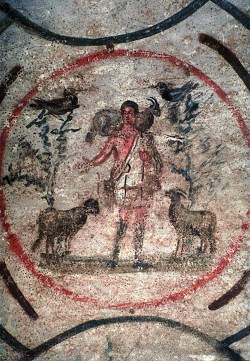
Good Shepherd image in the CatacombsWikiMedia Commons
Good Shepherd image in the Catacombs

Many of these images focused on Old Testament stories of deliverance, such as the three Hebrews in the fiery furnace, Noah and the ark, Daniel in the lion’s den, and Jonah, whose three days in the belly of a whale was a prefiguration of the three days Jesus spent in the tomb before his resurrection.

Other images illustrate stories of Jesus’ miraculous healings or celebrate him as the Good Shepherd. There are, in fact, more than 120 instances of the Good Shepherd image in the catacombs. This image was never intended to be a literal portrait of Jesus, but it was a potent symbol of his love and care.

As early as A.D. 215, the church father Hippolytus allowed new believers to become or remain artists as long as they didn’t make idols. By the time of Gregory the Great (A.D. 600), a tradition of valuing the arts as a way of communicating truth had become generally accepted, though there would still be a drawn-out iconoclastic controversy, which ultimately had as much to do with political motivations as religious ones. Finally, when the rhetoric cooled and the dust settled, the church came down on the side of embracing the value of images.

Gregory famously wrote, “Pictorial representation is made use of in churches for this reason: that such as are ignorant of letters may at least read by looking at the walls what they cannot read in books.” He saw the arts as a way to educate the largely illiterate population of his time in theology and spirituality. This perspective was responsible for an explosion of visual art, sculpture, mosaics, and church architecture in the centuries that followed.

The views of such thinkers might be encapsulated in this quote from Robin Margaret Jensen, a prominent historian of early church art:

Art crystalizes, or perhaps materializes, certain points of doctrine which, while based on scripture, are sometimes more often encountered in theological arguments than in ordinary daily experience. Images can make the bridge between the material and the intellectual. . . . Visual images also speak directly and clearly, even to the simplest believer.

So artistic images continue to speak to us today, as well as other art forms that comment on the Scripture text, reinforcing Scripture’s power and bringing it to life with dramatic effect. They help us understand the complexities of theology and of life and awaken our spirits to the wonder of God’s Word and God’s world.

Music found an easier acceptance in the church because of its connection with worship in ancient Israel. From the song of Moses (Ex. 15) to the poetic expression of the Psalms, there is a strong tradition of valuing music in the Bible.

The New Testament records that Jesus and the apostles sang a hymn after celebrating the last supper (Mark 14:26), Paul and Silas sang in prison (Acts 16:25), and singing was part of the early gatherings of the church (Acts 2:46–47). In Ephesians 5:19, Paul celebrates “psalms and hymns and spiritual songs” (ESV). Many scholars even suggest that several Pauline passages may be quotes from hymns of his day, such as 1 Timothy 3:16 and 2 Timothy 2:11–13, which were used as quick summaries of key doctrinal beliefs.

Then there is the book of Revelation, which is filled with instances of worship and singing. Singing, it seems to imply, is nothing less than a foretaste of heaven.

Luther was a proponent of the great value of music in the church. He recognized its ability to communicate the truths of Scripture in a way that could stir the hearts of every man and woman. In fact, he wrote that “next to the Word of God, the noble art of music is the greatest treasure in the world.” He wrote at least 36 hymns and made music and singing a centerpiece of worship. He reveled in the joy that music could bring to the human heart, and memorably said:

This precious gift has been bestowed on men to remind them that they are created to praise and magnify the Lord … one begins to see with amazement the great and perfect wisdom of God in this wonderful work of music, where one voice takes a simple part and round it sing three, four, or five other voices, leaping, springing round about, marvelously gracing the simple part, like a folk dance in heaven with friendly bows, embracing, and hearty swinging of partners. He who does not find this an inexpressible miracle of the Lord is truly a clod.

Each of the artistic disciplines—visual art, music, literature, poetry, architecture, filmmaking, photography, and more—can be not only a source of enjoyment but also a tool for spiritual growth and formation. The arts can change and transform us within, which is why they are indispensable for our lives. And hey, you don’t want to be a “clod,” do you?

Adapted from Discovering God Through the Arts: How We Can Grow Closer to God by Appreciating Beauty & Creativity by Terry Glaspey (©2021). Published by Moody Publishers. Used by permission.

Our Jan/Feb Issue: Words in the Wild

Our books issue offers a jungle of Christian ideas to lose yourself in.

Illustration by Jared Boggess / Source Images: New York Public Library / Getty / cyano66 / Hemera Technologies / George Marks / SerkanBg

As a bachelor, I tended to house my books haphazardly. Browsing my shelves, you might have spied, say, a biography of Winston Churchill next to a John Stott Bible commentary next to a volume of Civil War history next to a Charles Dickens novel next to goodness knows what else. I couldn’t even manage to keep the seven Chronicles of Narnia bundled together.

After I got married, my wife thought it wise to bring some order to this chaos. She reasoned that the pleasures of serendipity ought to give at least some ground to practical considerations, like actually being able to find the book you’re looking for. And so I embraced my inner librarian, sorting and classifying my way toward something better resembling a tidy garden than a teeming rainforest.

But one great thing about bookshelves is that you can’t squelch serendipity, no matter how determined you are to impose rationality or functionality. Apply the rigors of Dewey and his decimal system all you like, but it won’t change the fact that no one book is exactly like its next-door neighbor. As readers, we should savor that kind of irreducible variety. It furnishes our minds. It enlarges our hearts. It stokes fires of curiosity. It testifies that the world is a big, beautiful, fallen, and endlessly fascinating place where, whatever you think you know, you have a thousand times as much left to discover.

This book-focused issue of CT leans into this tension between cultivation and wildness. Alongside our annual Book Awards, it includes a dozen adapted book excerpts covering a range of topics. Featured books were finalists in their respective awards categories, and some were winners. Excerpts were selected based on space considerations and on their capacity, as a collection, to surprise. But all were outstanding examples of Christian writers bringing biblical and theological insight to matters of contemporary concern.

It’s fair to wonder whether the resulting mix of authors and ideas feels like a hodgepodge. How, for instance, does the sun’s divine symbolism relate to the improbable mid-century evangelical influence exercised by Henrietta Mears? And why are stories of lives transformed by the Beatitudes bumping up against Percy Shelley’s poetic foreshadowing of the sexual revolution?

But even the apparent miscellany gestures toward a Christian approach to books. As believers, we weigh our reading choices carefully, doing our best to discern truth from error, wisdom from folly. We also roam freely across the literary landscape, cracking open whatever tickles our fancy, secure in the hymnwriter’s conviction that “This is my Father’s world / He shines in all that’s fair.”

Matt Reynolds is books editor of Christianity Today.

Books

John Stott’s Global God

The evangelical leader invested resources in Christian leaders around the world. Now those leaders are blessing the Western church.

Illustration by Mallory Rentsch / Source Images: Unsplash

John Stott believed strongly in mutuality and reciprocity within the global church. Though a son of the Western church, Stott, like the apostle Paul, was passionately committed to the worldwide body of Christ. He not only knew and loved so many church leaders in many denominations outside the West, but he also wanted to enable their voices to be heard, to affirm their leadership, and to facilitate the development of their giftings, academically and spiritually. “We must be global Christians,” he used to say, “with a global vision, because our God is a global God.”

Living Radical Discipleship: Inspired by John Stott

Living Radical Discipleship: Inspired by John Stott

134 pages

$1.59

I have sometimes said that John Stott was both apostolic and Abrahamic. There was something apostolic about his evangelistic commitment to the gospel and to the faithful teaching of biblical truth. And there was something Abrahamic about his “all nations” perspective. Not only was he himself a blessing to many nations; he also modeled and taught the “obedience of faith” (to quote Paul) that characterized Abraham’s combination of faith demonstrated in works (Rom. 1:5, ESV; James 2:20–26).

So for John Stott, to strengthen the leadership of the church outside the West would be to strengthen global church leadership, including the West. He prayed and longed for the greater health and maturity of the worldwide church, including the West. So whatever he could do to strengthen the Majority World church, the whole body of Christ would benefit.

Stott recognized an additional benefit that would adorn the truth of the gospel. As the leadership of the global church outside the West was strengthened, resourced, and recognized, then the truly international, multicultural nature of the church itself would be far more visible and more in line with the biblical portrait of the church.

We who are Western Christians need help. We need to acknowledge that we are the minority church in global terms. We need to recognize the vast and alarming extent to which, like the people of Israel before the Exile, we have succumbed to a range of idolatries and syncretisms—“going after the gods of the people around us” (to paraphrase the frequent warnings of Deuteronomy). We should be lamenting the way many who profess to be Christian succumb to frightening collusion with political leaders and policies that bear no resemblance whatsoever to the teachings and demands of Christ.

It is from Asia, Africa, and Latin America that God is already raising up leaders, scholars, thinkers, writers, and preachers who can speak with the authenticity of their contexts (and especially the authenticity of suffering for the Word of God and the testimony of Jesus Christ) into the moribund churches of the West. And some of those emerging (and already fully emerged and established) leaders are undoubtedly part of the fruit of John Stott’s vision and initiatives, including the Langham Partnership, which equips and publishes theologians. As Tim Keller has said in commending Langham’s work, “John Stott foresaw the rise of Christianity in the Global South before most anybody. He got there and saw the need for training. … This ministry has been a game changer.”

So there is, in my view, a rather delightful irony about how John Stott’s vision has turned out. His initiatives for theological education and literature were initially born of his desire that the well-resourced Western church should come alongside the underresourced churches of the Global South with generous assistance. But in God’s long-term providence and the grand sweep of church history, there will most likely be a reverse impact. Stott’s efforts will have helped to empower and equip the non-Western churches to come to the aid of the Western church in its decline.

We in the West are already finding ourselves the recipients and beneficiaries of the spiritual, missional, and theological leadership in the non-Western church that is in part the fruit of such investment over decades.

Adapted from Living Radical Discipleship, edited by Laura S. Meitzner Yoder, Langham Global Library, Carlisle, UK (2021). Available at langhamliterature.org.

News

Coup Reversal Divides Sudan’s Christians

Controversial deal to bring back deposed prime minister turns many protesters against him. Sudanese believers debate if he did the best he could.

A Sudanese man waves a flag at a Day of Resistance protest on November 13, 2021 in Omdurman, Sudan.

A Sudanese man waves a flag at a Day of Resistance protest on November 13, 2021 in Omdurman, Sudan.

Christianity Today December 10, 2021
Stringer / Getty Images

As a young mother in Sudan, Susanna al-Nour struggled like many others with rising prices and shortages of goods. International support pledged after the 2019 revolution was slow to materialize. The government struggled to disburse promised aid. And tribal groups protesting in the east were blocking access to essential imports coming through the Red Sea city of Port Sudan.

And then this October things got worse.

Citing divisions among politicians, Abdel Fattah al-Burhan, the general heading Sudan’s mixed military-civilian Sovereign Council, launched a coup against the popularly selected prime minister, Abdalla Hamdok.

Phone and internet connections were cut, Hamdok was detained, and security forces raided neighborhoods to arrest supporters of his government, roughing up others. Thousands poured into the streets, including Nour’s husband, an evangelist and pastor’s assistant at Faith Baptist Church in the Soba area of the capital, Khartoum.

“With a small child, I couldn’t go because of the tear gas,” she said. “But it was necessary to demonstrate against the regime.”

Sudan’s Christians were then solidly in support of Hamdok, sources told CT. Two months later, sources no longer speak in consensus.

A gathering of Christians in Khartoum

At the time, enraged and without communication, the nation went into a standstill. Nour’s online studies through a seminary in Lebanon became impossible. So did her husband’s student ministry—as most young people were marching to reverse the coup.

Back in 2019, Hamdok quickly became the symbol of the revolution. Chosen by consensus among the political and revolutionary groups that deposed the 30-year Islamist dictatorship of Omar al-Bashir, his leadership was one of the few unifying factors in a rapidly fraying partnership between civilians and the military.

And then he wasn’t.

Amid international condemnation of the October 25 coup and efforts to suppress demonstrations, last month Burhan announced his welcome for Hamdok’s return—without politicians.

His originally technocratic government had added them following the October 2020 Juba Peace Agreement with rebel forces in Darfur and elsewhere. But this was in response to militia leaders then joining the Sovereign Council, disturbing the military-civilian balance.

The additions threw confusion into an agreement to hand over council leadership to a civilian figure by May 2021. Burhan and Hamdok celebrated an end to the conflict that had riddled Sudan for decades. But the military’s conflict with civilians was increasingly spilling out into the open.

The May deadline came and went, with no clarity. An office established after the revolution to remove Bashir-era corruption from government began challenging the resulting military dominance of the economy. Bashir himself became a point of negotiation, to be handed over to the International Criminal Court in The Hague. But other military officials were implicated also, not only for crimes in Darfur but also for the killing of civilians during the 2019 demonstrations.

And thus came the coup. Burhan denied ill intention, saying he acted to protect the democratic transition from the squabbling politicians. Under house arrest, Hamdok was a crucial lynchpin. He was welcome to return—but only with a technocratic government.

After three weeks of pressure, on November 11 he agreed. Too much blood had been shed in protest, he said. The military couldn’t be allowed to take over everything, he hinted. And the economy needed international support, suspended after the coup.

Hamdok’s 14-point agreement with Burhan returned Sudan to constitutional legitimacy, reestablishing a military-civilian partnership. Political detainees were released, and a civilian government was promised after democratic elections in July 2023. Promised steps toward a legislature, judiciary, and constitutional convention would also be expedited.

But by then Burhan had already hand-picked new civilian members of the Sovereign Council, and there was no mention of a midway switch in leadership.

The streets exploded in anger—this time also against Hamdok.

Christians, however, were not so sure.

Susanna al-Nour in Khartoum

“Most Christians support Hamdok in returning to his position,” said Nour. “But a smaller part rejects him, saying he should not cooperate with a criminal.”

At issue, however, is “most.”

“Christians are in great disagreement with this step,” a Sudanese Christian leader told CT, requesting anonymity because of the sensitivity of the situation. “Some in Khartoum support him, but they are very few.”

This leader spoke of Bashir-era evangelicals who cooperated with the government in order to seize control of church properties. And after the coup, Burhan moved to place members of Bashir’s now-dissolved political party into key positions of the administration. Hamdok has since called for a review of all recent dismissals and appointments, but the damage had been done—he aligned with the coup.

“The military is causing all the problems it lists as reasons to intervene,” said this leader. “The state is controlled by security, but it is not offering security to the people.”

In addition to the at least 44 demonstrators killed since Hamdok was deposed, about 100 have been killed in renewed ethnic conflict in Darfur. Dozens more have been killed in the Nuba Mountains. And the tribal blockade in East Sudan, the leader asserted, was coordinated from the beginning by the military.

“The Juba Peace Agreement has not brought peace,” said Aida Weran, academic officer for Nile Theological College, which has campuses in Khartoum and Juba. “But it was a way to delay democratic progress.”

She respects Hamdok for not breaking his oath, as he returns to office with constitutional legitimacy. This is unlike the most prominent Christian in the government, Raja Nicola. The sole joint selection in the Sovereign Council, the Coptic Sudanese accepted reappointment under Burhan’s coup.

But it was a mistake to add politicians to the government, Weran said, and their opposition to the coup is driven by partisan interest. They should instead prepare for their own legitimacy through coming elections, as a technocratic government—led by Hamdok—is a good result given all that has come before.

But she is still protesting.

“Entering our third year, we are still at the starting block, with no justice and no real freedom,” Weran said. “And while we demonstrate, people are going hungry. Even this is a delay.”

Not demonstrating at all is Hassan James.

“As Christians, we have the responsibility—as a minority—to be neutral,” said James, the assistant bishop of the Anglican diocese of Kadogli, in the Nuba Mountains state of South Kordofan. “Supporting one side or the other is not wise.”

James believes that stability is paramount. Currently Sudan is in a “fog,” while constant protests amid regional violence are filling many with fear. But democratic transition is impossible without peace, he said, and partnership with the military is necessary.

“What happened has divided us as a people,” he said. “But no one side can afford to isolate the other, and none can lead the country alone.”

Guma Komey reached the same conclusion but from an entirely different path.

“If someone has a gun, how can you take him to the gallows?” said the head of peace programs at Sudan’s branch of the Carter Center in Khartoum. “The country is held hostage by the collective concern of Sudan’s military leaders.”

An elder in the Evangelical Presbyterian Church in Bahri, Khartoum, Komey served as an official advisor to Hamdok before taking his current position. Amnesty was discussed behind the scenes, he said, to be granted after the democratic transition was complete.

But as the military-civilian partnership began to “drastically deteriorate,” rhetoric from certain politicians called to sideline the military and fully investigate their role in the deaths of protesters. Threatened, Burhan decided to fight.

Hamdok did the best he could in a tough situation, said Komey. And while Christians have no unified position toward the prime minister, they cannot put him in the same box as Burhan and Bashir. (Burhan gave the order to overthrow Bashir during the revolution.)

Yet many Sudanese do. Though numerous, these are only the loudest voices on the street, and the ones who control the social media accounts of political and revolutionary movements. But others, like Weran, are protesting also.

A different approach is needed, said Komey. Some sort of “package deal” is needed to institute a program of transitional justice while putting the generals at ease. The deal made could have been better, but it was the best of a bad situation. The protesting youth want democracy, but in their zeal must first ensure they can reach power.

“If the opposition weakens Hamdok, it strengthens the military leadership,” said Komey. “He is under extensive pressure, but I think he will absorb it over time.”

There is a window of opportunity. The United Nations general secretary expressed sympathy for protesters, but stated that “common sense” demands working together. The US has called it a good “first step” but stated that more progress is needed before resuming its $700 million in suspended aid to Sudan.

In the meanwhile, Nour and her husband have returned to ministry, paying home visits to church members without working electricity. Internet service has resumed, tribal leaders unblocked Port Sudan after the coup, and most importantly, the prime minister has returned.

“Hamdok is intelligent and wise, and knows how to plan,” said Nour. “I believe he will put things right in Sudan.”

News

Died: Patrick Marsh, Ark Encounter and Creation Museum Designer

Visionary artist built Noah’s Ark and world of Genesis with experience gained at the Olympics and Universal Orlando.

Christianity Today December 10, 2021
Answers in Genesis / edits by Rick Szuecs

Patrick Marsh worked on the design of the 1984 Summer Olympics in Los Angeles and then turned around to help with the renovation of the Statue of Liberty in New York Harbor, which reopened to great fanfare in 1986.

He played a key role in designing two popular rides at Universal Orlando when it opened in 1990—Jaws and Kongfrontation—and then moved to Japan to design cutting-edge theme parks in Tokyo and the foothills of Mount Fuji.

But he didn’t think he had reached the height of his career until he got to Kentucky. He didn’t like the mud, he told a local newspaper reporter, but he loved the work—designing the Creation Museum and Ark Encounter.

“That’s probably the most incredible thing I’ve had a chance to do,” Marsh said. “I just feel like all the things that the Lord has been working on my life has led up to actually coming here to Answers in Genesis” (AiG).

Marsh, the creative force behind the creationist attractions in Petersburg and Williamstown, Kentucky, died on December 2. He was 77.

“Calling him a ‘genius’ is not an overstatement,” Ken Ham, AIG founder and CEO, said in the organization’s official announcement. “Patrick’s fingerprints are all over the Creation Museum and Ark Encounter. I have never worked with a more creative person.”

Anthropologist James Bielo, who wrote a book about the process of designing the full-scale recreation of Noah’s ark and the opening of the park in 2016, said there was always a creative give-and-take between Marsh and his team, and Ham had to sign off on every decision, but Marsh was the undisputed “maestro.”

“Patrick would bring Ken Ham fully fleshed-out design ideas,” Bielo told CT. “And they butted heads though, from what I saw, Patrick won out whenever it was about design. Patrick had a vision. And the artists had total respect for him.”

Marsh was born in 1944 and raised in Southern California. He was a creative child and spent much of his time making things. If he saw something on TV that he wanted but couldn’t afford, he would try to create it himself. He once sewed a cowboy jacket—an accomplishment he remained proud of decades later.

He wasn’t very religious but, as he recalled in later years, he never accepted theories about evolution. Life seemed like it needed a designer.

“I know how much work and tears go into making something, and it does not come easily,” Marsh said. “Every living thing is so complex, so wonderful, so beautiful: each leaf, each insect, each person, each sunset. God is ‘in’ everything all around us, and we have to be blind not to see that the world was purposefully made by a Designer who cares about everything.”

Marsh studied at the University of California, Los Angeles, earning an undergraduate degree and a Master of Fine Arts in design. He graduated in 1971 and went to work in design. By the early 1980s, he had landed a position at Sussman/Prejza & Co. in Santa Monica. The new firm was working on urban branding and heralded for “carnivalesque modernity,” inspired by punk and postmodernism, as part of the broader New Wave design movement, which broke away from grid structures and stretched the limits of legibility.

At 40 years old, Marsh had proved himself enough to be given responsibility for a team of 50 designers as Sussman/Prejza took on the Olympics account.

After that, he helped with the Statue of Liberty and played a major role in development of several rides for Universal Studios Escape, a theme park designed to let visitors “ride the movies.”

“Just a momentary escape”

He loved the work—creating an interactive story, engineering the moods that would affect people, designing every piece of the machine and the illusion and seeing it all come to life exactly as he’d imagined it in his mind—but he did wonder, sometimes, if there was any point to it all.

“It was just for fun,” he explained to an Orlando Sentinel reporter. “Just a momentary escape.”

In Japan, Marsh worked on Sanrio Puroland, also known as Hello Kitty Land. He met and married to a Japanese woman named Sakae and had a religious conversion.

“The Bible is the only thing that gives you the full picture,” he said. “Other religions don’t have that, and as for scientists, so much of what they believe is pretty fuzzy about life and its origins.”

A few years later, in 2001, Marsh read about Answers in Genesis’ plans for a creation museum and wrote an email asking if there was any way he could be part of it.

“I want to use my talents for the Lord,” Ham recalled the email saying. “I want to come and help you build the Creation Museum. Please, will you employ me to build the Creation Museum.”

Marsh took over the design for the Creation Museum and brought the 60,000-square-foot vision to life. It opened in 2007. It was popular with conservative Christians and church groups—but also won a strange respect from self-identified critics and culture war opponents who hated it but also thought it was really well done and, worse, kind of fun.

A New York Times culture critics gave it marks for “sheer weirdness and daring.”

“Whether you are willing to grant the premises of this museum almost becomes irrelevant as you are drawn into its mixture of spectacle and narrative,” he wrote. “Its 60,000 square feet of exhibits are often stunningly designed by Patrick Marsh.”

Atheist blogger Hemant Mehta described it as “nothing more than an expensive way to confuse and indoctrinate children,” but even he had to admit that the design “really is beautiful.”

Drawing people in

Marsh, for his part, wasn’t worried about whether the museum convinced anyone of creationism or the literalism of the biblical account of Genesis 1 and 2. That wasn’t his job.

“Either God is going to call you and open your heart to believe what I’m showing you, which is really God showing you, or he won’t. That’s what the Bible says,” he said. “If I can get you to be curious about the Bible, and you actually read it and you read stories about the Ark and you read whatever it is, maybe God is going to speak to you and open your heart.”

To create the spaces that would draw people in, Marsh and his team studied other museums together. One of his favorites was the Lincoln Museum in Springfield, Illinois. The design team studied the way it created an embodies sensory experience. Another place they looked at was the Holy Land Experience in Florida. According to Marsh, it was a good idea poorly executed. The problem, he said, was the designers didn’t seem to understand the spiritual message.

It wasn’t a mistake he would make, and in 2010, Marsh got to demonstrate his vision, planning Ark Encounter with Ham from day one. It started with a 500-foot replica of Noah’s biblical craft, but for the designer of the ’84 Olympics and Hello Kitty Land, it didn’t end there. He envisioned a Tower of Babel and a ten plagues ride, complete with sound effects, for a theme park starting with Noah’s story but expanding across Genesis.

“You never know where God is going to take you in life,” he said. “He gives you all these experiences, and you want to be able to use them. What a privilege to have the kind of job that I have, and be able to take all those things that I’ve enjoyed in life and bring them together. I can’t imagine doing anything else.”

In 2016, a few days before the grand opening of Ark Encounter, Marsh got to turn the lights on for the first time.

“I kept wanting to see what it looked like,” he said. “I designed the lighting in here, and I didn’t get it turned on until last week.

“You visualize in your mind what it’s going to look like, but until you see it—I didn’t know. Once they got the lights in, and turned on the switch…it looks exactly the way that I hoped it would look.”

Marsh is survived by his wife, Sakae. Funeral arrangements have not been announced.

News

State of Giving: Pandemic Trends Defy Ministry Expectations

Camps and conferences, a sector that had been dramatically affected by COVID-19 shutdowns, actually saw the biggest boost in funds and historic levels of support.

Christianity Today December 9, 2021
Ezra Shaw / Getty

When the pandemic took off last year, evangelical ministry leaders had two concerns in mind: how would they continue their mission amid the COVID-19 restrictions and how would they stay afloat financially to keep operating into the future.

Many of those leaders are now praising God for his provision, as donations to evangelical nonprofits increased in 2020. Even organizations whose ministry activity took drastic hits saw outsized support from donors, according the Evangelical Council for Financial Accountability (ECFA) annual State of Giving report.

During a year when cabins and retreat centers remained empty, camps and conference ministries saw the biggest boost in giving compared to any sector, with a 21 percent surge in 2020.

Hume Lake Christian Camps in California raised $7.75 million, around double the camp’s typical annual fundraising, to make up a $6 million shortfall. During the initial lockdown, camp staff placed 10,000 calls to reach out to supporters and pray for them.

Then the donations to its relief fund kept coming—from former campers who gave their life to Christ in Hume Lake’s cabins, couples who had their marriages restored at its retreats, and even a grandma who wanted to sponsor a new camper and wrote a check to give the $8,000 she made selling homemade jam at a roadside stand.

“People sacrificially gave to a ministry that touched their lives or that they believed so deeply in,” said John Boal, chief development officer at Hume Lake.

Other camps experienced similar levels of fundraising success.

“Donors stepped up and filled the gap,” said Jake Lapp, vice president of membership and accountability at ECFA. “We talked to many [in the camps and conferences sector] who said that it was their biggest year ever.”

A 75-year-old camp located in Fresno, Hume Lake had hosted around 20,000 kids a summer before the pandemic, so calling off spring and summer programming last year meant losing $17 million in revenue during a year when finances seemed unpredictable.

“It felt daunting,” said Boal. “But when giants come my way, whether professionally or personally, I try to step back and look at my theology. And my theology is that God’s in control and God will provide.”

Prior to starting its $6 million relief fund campaign, Hume Lake had to tap into its cash reserves. Among ECFA members, Christian camps and conferences were more likely than any other type of evangelical nonprofit to deplete their reserves, with 10 percent spending all their reserves in 2020 and 14 percent doing so in 2021.

Overall, three-quarters of ECFA nonprofits and churches left their cash reserves untouched the first year of the pandemic and two-thirds left them untouched this year.

Pulling from financial information from 2,600 members, the new State of Giving report offers the clearest picture so far of how evangelical groups fared financially during the pandemic, and as with the boost in the camp sector, some of the biggest takeaways were unexpected.

Even though Americans were making less money due to the economic crisis, they were giving more away. While wages were down 2.9 percent, donations to ECFA members were up 3.2 percent—a gap of more than 6 percent.

The financial trends defied some historic patterns for nonprofits. Churches and ministries that were steadily growing prior to the pandemic were actually less likely to experience a pandemic bump in support than those whose giving had been declining. Fifty percent of growing organizations saw donations increase, compared to 65 percent of declining organizations, the report said.

Giving was up in 26 of 36 nonprofit sectors, with camps and conferences, rescue mission and homeless, discipleship, anti–human trafficking, and health services organizations seeing the most growth.

https://datawrapper.dwcdn.net/t3H2u

More than half of ECFA member churches in 2020, and nearly two-thirds in 2021, said their giving was the same or higher than the year before. But the trends were less positive across the board for congregations.

Churches saw cash giving dip 1.2 percent last year, according to the State of Giving. Among ECFA members, the biggest megachurches—with over $20 million in annual revenue and 8,000 attendees—had a 6 percent increase in giving in 2020, while giving levels for smaller churches dropped.

“Larger churches tend to have a wider range of economic levels among their members, which might help explain why they’ve been able to weather the pandemic better, as some of their more financially established members have had consistent giving to their church during the pandemic,” said Warren Bird, senior vice president of research and equipping at ECFA.

Digital giving platforms, which were correlated with more consistent and higher giving levels before the pandemic, became a crucial tool for financial stability once churches were no longer gathering in person. Bird noted that while larger churches may have been more likely to offer digital giving in the early months of COVID-19, churches of all sizes have since embraced the technology.

“Since early 2020, we have seen a huge uptick in the online presence of many churches, which has also resulted in increased giving across the board,” said Justin Dean, director of marketing at Tithe.ly, one popular giving platform.

“What we’ve seen is that it doesn’t matter if you’re a large church with staff and resources, or a small church with just a few staff members wearing multiple hats. What matters is embracing technology that will come alongside you and grow with you, and staying consistent with it.”

The ECFA findings, which are based on members’ financial information from the 2020 fiscal year, follow previous surveys that have shown that most churches ended up with steady or improving budgets, despite the fears of economic downturn.

Last month, a survey by Lifeway Research found that most pastors report giving in 2021 was at or above 2020 levels. But for a minority of congregations, the decline is acute. One in 14 churches saw giving drop by 25 percent.

News

Died: Bill Glass, Football Star Who Changed Evangelical Approach to Sports and Prisons

The Cleveland Browns defensive end was good at sacking quarterbacks, but his real passion was witnessing for Christ.

Christianity Today December 9, 2021
Baylor University / Edits by Rick Szuecs

Bill Glass, a football player turned evangelist who pioneered evangelical sports ministry and prison ministry, died on December 5 at age 86.

The six-foot-five, 250-pound defensive end had an impressive resume in professional football, with four Pro Bowl selections, a National Football League championship, and the Cleveland Browns team record for career sacks. But Glass would have pointed to a different set of metrics as far more consequential: In 2019, his evangelistic prison ministry, Bill Glass Behind The Walls, reported that up to that year in their ministry’s history, they had “trained 58,550 Christians to share their faith, reaching 6,056,432 incarcerated men, women and youth, with over 1.2 million commitments to Jesus recorded.”

Glass could also point to the chapel services held before NFL, Major League Baseball, and National Basketball Association games. Evangelical outreach to professional athletes, and the work of organizations such as Baseball Chapel and Pro Athletes Outreach, exists in no small part because of Glass.

Glass brought fans to their feet as a star defensive end, but it was through his pioneering ministry work that his imprint on evangelicalism is most apparent today. When Glass was born in 1935, sports ministry and prison ministry were not a major focus for evangelicals. Glass helped change that.

“His passion for evangelism, training the church in evangelism, and reaching the incarcerated with the gospel was unprecedented,” said Karen Swanson, director of the Correctional Ministries Institute at Wheaton College. “His legacy lives on in the countless lives he touched.”

And Glass “personified a reengaged combination of faith and athleticism conducive to institutionalization,” according to historians Tony Ladd and James Mathisen. “He provided an early model for ministry among athletes that his fellow evangelical muscular Christians would soon perfect.”

Finding confidence in football

Born in Texarkana, Texas, Glass moved with his family to Corpus Christi when he was five. It was there, at 14, that his father died of cancer. That loss would shape his future ministry efforts, which often focused on the importance of father figures.

An awkward, clumsy kid at the time, Glass developed confidence as he poured himself into football, inspired by his high school football coach, a man who became like a second father. It was in high school, too, that Glass had a born-again conversion at his local Baptist church. Faith and football would be central to his life from then on.

Glass enrolled at Baylor University in 1953, where his talent, work ethic, and size opened up future possibilities in the sport. Baylor also brought Glass and his wife, Mavis, together. She was drawn to Glass after reading a newspaper story about a football player who taught a Sunday school class. The two clicked immediately and were married six months after first meeting. They spent 60 years together—Mavis passed away in 2017—and raised three children.

Baylor set the trajectory of Glass’s life in one more way: It introduced him to a brand-new organization formed by a basketball coach in Oklahoma: the Fellowship of Christian Athletes (FCA). Over the next two decades, the FCA galvanized a growing network of evangelical athletes within sports, and Glass was a key player in its rise.

Glass’s identification with the emerging Christian athlete community came at a transitional time for evangelical engagement with professional sports. While Catholic and mainline Protestant athletes were willing to play on Sundays, evangelicals saw this as a clear violation of the Fourth Commandment. As late as 1960, CT lambasted Christian athletes who played professional football and thereby “yielded to the lure of money and added fame, and joined in the desecration of the Lord’s Day.”

At first Glass followed this line of thinking. After graduating in 1957, All-American honors in tow, he spurned the Detroit Lions, who had drafted him in the first round, and chose to play in the Canadian Football League (CFL). But one year later, Glass had a change of heart. Turning away from what he described as his “legalistic” perspective, he decided he would play in the NFL after all.

Witnessing to atheletes

“I just couldn’t believe,” Glass later wrote , “that God was willing for all pro sports to go without a witness just because of Sunday game days.” To equip himself for the work of witnessing, he enrolled at Southwestern Baptist Theological Seminary, spending six off-seasons taking classes before graduating in 1963.

With the Lions, Glass started a practice that would follow him throughout his NFL career: holding Bible study and prayer meetings at the team hotel before games. It began as a one-on-one session with Detroit sportswriter Watson Spoelstra, who later founded Baseball Chapel. Although twice as old as Glass, Spoelstra—who had recently experienced a dramatic conversion—gravitated toward the young defensive end, seeing him as a spiritual mentor.

When Glass was traded to the Cleveland Browns in 1962, he became more intentional and strategic. Along with pregame devotionals, he launched a team Bible study with a simple format: Players would read a chapter of the New Testament together and then rewrite the chapter in their own words, using contemporary language.

Glass’s intense drive to excel and grow earned the respect of teammates, even those who did not share his faith commitments. Bernie Parrish, who played with Glass in the early 1960s, described him as “a kind of paradox, a fundamentalist preacher off the field but a lusty, physical man” who “laughed at himself as well as anyone.”

Glass also inspired an entrepreneurial Florida minister named Ira Lee “Doc” Eshleman. In 1964, Glass invited Eshleman to join a devotional service before a game against the Philadelphia Eagles. “It was heartwarming,” Eshleman said at the time. “I was amazed to think there were that many on one pro team who would place such emphasis on the importance of prayer.”

Two years later Eshleman launched a new career as a self-described pro football chaplain, organizing pre-game services in the NFL. Pro Athletes Outreach, the leading evangelical ministry in pro sports today, began as an offshoot from Eshleman’s ministry in 1971.

Concerns about racial injustice

As Glass became a leading voice for Christian athletes, he occasionally spoke up about issues of moral concern in American society, including racial discrimination. In his first book, Get in the Game! (1965), Glass urged fellow white Southerners to support racial integration. His approach to race followed that of many other white evangelicals. He was not involved with the civil rights movement, focusing instead on person-by-person change and colorblind rhetoric: “Forget color and treat everyone alike,” Glass urged.

Yet Glass also demonstrated sensitivity to the continued reality of racial injustice. His admiration for Cleveland teammate Jim Brown—an outspoken advocate for civil rights—played a role in this.

“Even if a black athlete is treated fairly by the coaches, he still has to live in a prejudiced society,” Glass admitted.

He saw housing discrimination and other forms of inequality as evidence that Black people could be “accepted as a black athlete but rejected as a black human being.”

Ultimately, however, Glass saw himself as an evangelist in the style of Billy Graham, and he took steps toward that path even as he spent his fall Sundays crashing into quarterbacks. Throughout the 1960s, Glass filled his off-seasons with speaking engagements at evangelistic rallies and events. He also began to write, publishing Get in the Game!, the first of more than a dozen books, in 1965.

“I don’t fancy myself as being any great scholar or certainly not a great writer,” he later said. “But I do think you’ve got to write down what you do or otherwise it won’t last.”

Most of Glass’s books were practical guides to Christian living, combining a basic evangelical perspective on sin and salvation with a focus on success and positive thinking. But Don’t Blame The Game: An Answer to Super Star Swingers and a Look at What’s Right with Sports (1971), cowritten with seminary professor William Pinson, Jr., took a different approach. Written as a conservative defense of the social value of sports, it challenged recent books by athletes like Joe Namath and Dave Meggyesy that glorified promiscuous sexual behavior (Namath) or blasted professional football for fostering militarization and dehumanization (Meggyesy).

Glass positioned himself and fellow Christian athletes as constructive defenders of the status quo. Yet Glass later came to wish he had been more circumspect. He especially regretted singling out individual athletes like Joe Namath. “I was picking up stones and throwing them at Namath and all the sinners,” he said last year. “I think I would have had a better witness to him if I just quietly went about witnessing behind the scenes.”

Going into prisons

Glass retired from football after the 1968 season and founded the Bill Glass Evangelistic Association to support his new career as a preacher of the gospel. His evangelistic events were modeled after Billy Graham’s popular “crusades.” In 1972, at the behest of a friend, Christian businessman Gordon Heffern, Glass held his first event inside a prison.

Initially his interest in prisons was limited, but when the Marion, Ohio, prison event proved successful, Glass began thinking about new possibilities for ministry to incarcerated people, gradually adding more prisons to his national crusade itinerary. A few years later, Glass moved to full-time prison evangelistic work, part of a larger “prison revival” taking place in the 1970s, where evangelical ministries innovated new forms of correctional outreach.

Glass developed a sports-themed program, bringing other stars—professional baseball and football players as well as Olympic athletes—inside correctional facilities to perform athletic feats and share the gospel. Many would play catch or accept physical challenges from prisoners, the theatrics at the events guaranteeing large crowds.

Occasionally the showmanship proved dangerous. In 1982, a young University of North Carolina basketball player named Michael Jordan joined Glass in a prison visit and volunteered for a samurai swordsman’s demonstration that involved cutting a watermelon on Jordan’s stomach. The swordsman’s blade went too far, leaving Jordan with a gash that required three stitches at the local emergency room.

Glass was horrified by the accident, but he also believed that athletic spectacles offered him a chance to share the gospel with people who might not otherwise be interested. In classic entrepreneurial evangelical style, he intentionally avoided ministry expressions that appeared “churchy” and eschewed prison chapels as sites for his events. He chose instead to hold most of his crusades outdoors, on the yard or on prison ballfields. He believed that many incarcerated people had no interest in the chapel, and “those are usually the inmates we are the most concerned about reaching.”

Blessing incarcerated people

While his crusades’ feats showcased athletic prowess and power, Glass’s messages in his preaching and writing were intensely relational, stressing the importance of intimacy and emotional connection. Glass often spoke of the need for incarcerated men to experience “the Blessing,” a sense of love and belonging. In Glass’s estimation, many prisoners were incarcerated precisely because they lacked unconditional love, encouragement, and physical affection from father figures. They needed to know the love of their heavenly Father and experience the intimate fellowship of Christian believers (including Christian prison volunteers) who might act as “substitute fathers.

Because of his focus on fatherhood and changing individual prisoners’ hearts, Glass rarely spoke of systemic injustices or the problems of the criminal justice system itself. And while he saw racial reconciliation as an outcome of his prison work, his avowed colorblind racial emphasis could reinforce a blindness to racial disparities.

But Glass’s gospel message resonated with many incarcerated people, evidenced by testimonies and letters from prisoners thanking him for his ministry’s positive impact in their lives and his clear concern for their spiritual and emotional well-being. Glass also inspired many other Christians to get involved in prison ministry, often after they had volunteered to work at one of his crusades.

“The thing we did for prison ministry,” Glass said near the end of his life, “was that we popularized it. We made it something people wanted to do.”

By the end of his career, Glass claimed he had been in more prisons than “any man that’s ever lived.” It’s impossible to verify the claim, but it is certain that Glass made a lasting impact in prisons and on playing fields.

“Christianity does not teach a withdrawal from life, but an infiltration of it,” Glass explained in his first book. By ministering in spaces that evangelicals had previously avoided, Glass taught future generations of evangelicals to do the same.

Glass is survived by his three children, Billly, Bobby, and Mindy. A memorial service will be held December 18 at Waxahachie Bible Church in Waxahachie, Texas.

News

Josh Duggar Found Guilty in Child Sex Abuse Materials Case

Advocate: “The right result happened not because of the faith community, not the family, or even the church.”

Christianity Today December 9, 2021
Patsy Lynch/ MediaPunch / IPX / AP

Update: On May 25, 2022, Josh Duggar was sentenced to more than 12 years in prison for his crime. One count was dropped by the judge, and he faced a maximum of 20 years. The US Attorney cited his “history of sexually abusing minors and the grave risks associated with his potential to recidivate” as factors in the length of his sentence.

Josh Duggar has been convicted of receiving and possessing material that depicts the sexual abuse of children, a decision that provides a moment of consolation for Christian victims and advocates fighting against abuse coverup.

Duggar, the oldest sibling in the Christian homeschooling family made famous by the reality show 19 Kids and Counting, was taken into custody after the federal jury delivered the guilty verdict at a court in Arkansas on Thursday. He faces up to 40 years in prison.

“For everyone who was abused within their households or in their religious communities where nothing was done, where the male was given a second chance, where there was some excuse or minimization used, seeing Josh Duggar go to prison gives them some vindication or maybe some hope that the right result can happen,” said Boz Tchividjian, a sexual abuse attorney and advocate who founded GRACE (Godly Response to Abuse in the Christian Environment).

“But the right result happened not because the faith community, not the family, or even the church, rose up and said, ‘Absolutely not. We cannot tolerate this type of crime.’”

Federal investigators found the illegal material on his computer at the car lot where he worked in May 2019. One investigator said the images of young children including toddlers were the worst he had seen in his career.

The Duggars, who are independent Baptists, rose to national prominence in the mid-2000s and came to represent a segment of Christian homeschoolers known for large families, conservative attire, and adherence to teachings from Bill Gothard. Their fame meant Josh Duggar was covered heavily when news broke in 2015 that he had molested five girls back when he was a teenager.

Knowing his history and seeing family and church leaders come to his defense, some Christians have questioned whether Josh Duggar could have had a different trajectory, and abuse could have been prevented, if the 33-year-old had been held accountable and given necessary treatment earlier.

“It’s impossible to see this current conviction outside of the context of what happened when he was a teenager, sexually abusing his sisters, and the way that his family responded to that,” said Jacob Denhollander, a victims advocate who grew up one of 13 siblings in “the same homeschooled circles as the Duggars.”

Denhollander, husband to survivor and fellow advocate Rachael Denhollander, tweeted that it’s “hard to feel jubilation” when “there is so much harm that has been done in this situation and in this family.”

At the trial, judges permitted testimony about the abuse that took place when Duggar was 15. A church friend told the court that the Duggars invited her and her husband over to their house, and Josh Duggar confessed to inappropriately touching four girls between 2002 and 2003, including a five-year-old who sat on his lap during Bible study.

At the time, church leaders agreed to address the issue by sending Josh Duggar to an Arkansas training program through Bill Gothard’s Institute in Basic Life Principles. Months later, Jim Bob Duggar said he notified a friend in law enforcement, also a church elder, of the incidents but he didn’t take it any further. (That officer went to prison in 2012 for 10 counts of distributing, possessing, or viewing material depicting child sex abuse.) When the incidents came up again in 2006, Josh Duggar made a statement to police, but no charges were filed.

In a pretrial hearing, Jim Bob Duggar said he couldn’t remember the details of what his son had confessed as a teenager and called the case “sealed” since Josh was a juvenile at the time. Two of Jim Bob’s daughters, Josh’s sisters, had come forward in 2015 as his victims.

The defense argued against permitting testimony from Jim Bob Duggar and the church friend, saying it should fall under clergy privilege, but the court disagreed. In the ruling allowing testimony around Josh Duggar’s abuse as a teen, the judge wrote, “The Court found Mr. Duggar’s selective lapse in memory to be not credible; he was obviously reluctant to testify against his son.”

Author and blogger Sheila Wray Gregoire said the case reminded her of a biblical story. “When Jim Bob took the stand last week and couldn’t recall the abuse, I thought of King David,” said Gregoire in an interview with CT, referencing the 2 Samuel story of Amnon’s rape of Tamar.

“On a broader scale, we see repeatedly the evangelical world choosing to side with abusers over the abuse … it stems from one simple belief: All men struggle with lust; it’s every man’s battle,” Gregoire wrote on her blog, where she chronicles and critiques evangelical teachings on sex and marriage.

During a widespread evangelical reckoning around abuse and the church’s response, pastors are paying attention to the Duggar verdict and its implications for their ministry.

“If there’s any beauty coming out of these ashes of this Duggar trial—other than with regard to victims seeing some hope—it might be for a moment in time where at least pastors who are paying attention go, ‘Wow, I want to learn [about responding to sexual abuse],’” said Tchividjian. “Not because they don’t want to get sued. It’s not about risk management. It’s about loving children and honoring them.”

Tchividjian said for pastors, that starts with acknowledging what they don’t know and being willing to listen and learn. GRACE offers training, as do other organizations that investigate and advocate for abuse victims. The Southern Baptist Convention developed a 12-lesson program called Caring Well.

Denhollander, whose dissertation examines how beliefs on penal substitutionary atonement inform Christian understands of abuse, said there is also a theological dimension to Josh Duggar’s example.

“I think the first lesson would be to seriously consider the cost of cheap forgiveness,” he said, calling out the faulty idea that forgiveness allows people to avoid confronting and addressing the wrong that has been done.

Denhollander also warned against focusing on the sin of an individual over the impact on his victims.

“Oftentimes, it’s looked at as a ‘moral failing’ on his part without recognition that his moral failing carried with it significant psychological, physical, physiological damage to other people,” he said. “Even with child sexual assault material, he was feeding the most horrific industry, the most horrific way of enslaving children that could be imagined.”

Justin Holcomb, a theologian who studies sexual abuse and has written a Christian children’s book about protecting bodies, previously told CT how a lack of accountability for young perpetrators can put more potential victims at risk and keep them from fully reforming their sexual thoughts and behavior.

“If you don’t get a young sex offender holistic, therapeutic care before he’s an adult—because there’s significant psychological development taking place—it almost solidifies the recidivism,” said Holcomb, describing how sexual abuse and pornography establish pleasure pathways in the brain. “The chances that he will repeat again are through the roof. It’s nearly hopeless.”

Following Thursday’s verdict, Holcomb reshared a blog post detailing the harm caused by porn addiction.

It can be tempting to dismiss a case like Duggar’s as an abherrant example. But the sad truth is that these cases are more common than most people assume, and church communities are not exempt.

The level of online material depicting sexual abuse is multiplying at a terrifying rate, while criminal convictions for the producers and viewers of such clips (once called “child pornography”) lag behind. Christian resources like Covenant Eyes, meant to report instances of suspicious internet use to an accountability partner, only work as well as a person’s commitment to abide by them. There are workarounds, as Josh Duggar allegedly found.

The news of Josh Duggar’s abusive conduct became public six years ago, when he lost his place on the family’s TLC show and his job with the Family Research Council. He went on to also confess to infidelity and to porn addiction in his marriage. Josh Duggar now has seven children with wife Anna. Since he was charged in May, he was permitted to see his children only under supervision.

According to The Associated Press, the federal investigation against Duggar was prompted by a Little Rock detective who found images depicting sexual abuse of children as young as toddlers being shared by a computer traced to him.

The defense in the case argued that someone else had acquired and viewed the images on Josh Duggar’s device. Experts said the technology had been set up with Duggar’s password, a version of which was once associated with the Duggar family Instagram account.

The trial also brought up Duggar’s use of the screening and reporting software Covenant Eyes. A Covenant Eyes report indicated that he had previously been blocked from downloading uTorrent and accessing an anonymous browser that was later used to download the child sexual abuse material.

Judge Timothy Brooks said sentencing will take place in about four months.

Apple PodcastsDown ArrowDown ArrowDown Arrowarrow_left_altLeft ArrowLeft ArrowRight ArrowRight ArrowRight Arrowarrow_up_altUp ArrowUp ArrowAvailable at Amazoncaret-downCloseCloseEmailEmailExpandExpandExternalExternalFacebookfacebook-squareGiftGiftGooglegoogleGoogle KeephamburgerInstagraminstagram-squareLinkLinklinkedin-squareListenListenListenChristianity TodayCT Creative Studio Logologo_orgMegaphoneMenuMenupausePinterestPlayPlayPocketPodcastRSSRSSSaveSaveSaveSearchSearchsearchSpotifyStitcherTelegramTable of ContentsTable of Contentstwitter-squareWhatsAppXYouTubeYouTube