News

RZIM Spent Nearly $1M Suing Ravi Zacharias Abuse Victim

Ministry-funded assessment shows the board didn’t ask questions but came up with creative ways to redirect donor funds.

Christianity Today February 23, 2022
Screengrab / RZIM Canada YouTube

Ravi Zacharias International Ministries (RZIM) spent nearly $1 million to defend its founder and namesake against allegations of sexual misconduct in 2017 and then lied about it, according to an RZIM-funded assessment obtained by CT.

RZIM approved an external review last year to examine the ministry culture and practices that enabled apologist Ravi Zacharias to sexually abuse multiple women and almost completely cover it up. Investigators found that the board used deceptive financial maneuvers to fund the RZIM founder’s federal lawsuit against a woman he sexually abused.

Bills were sent to a board member, records were kept in a confidential financial file, settlement money was given to Zacharias as a personal loan, and the personal loan was paid off with a bonus. When the lawsuit came to light in 2017, the ministry officially misstated the fact that “no ministry funds were used.”

The executive committee of the board and some members of the RZIM leadership team knew the statement was false, according to the 78-page assessment completed by Guidepost Solutions. None of them corrected the record.

“There are no immediate consequences,” an RZIM accountant said in an email to the chief financial officer in 2017, which was forwarded to the CEO the same day. “I just pray the ministry is never challenged or brought to account.”

Five months and more than 55 interviews

RZIM hired Guidepost Solutions, a corporate consulting firm that specializes in reviewing how organizations handle sexual misconduct, in February 2021. The review followed a four-month investigation by another firm, which uncovered a pattern of abuse by Zacharias and a lack of accountability by RZIM.

Guidepost set up a system for additional victims to come forward but was told to focus on assessing the “structures, culture, policies, processes, finances, and practices” of the world’s largest Christian apologetics ministry.

The assessment included interviewing more than 55 people about RZIM’s response and reviewing “a voluminous number of documents and video” over the course of five months. A near-final draft of the report with 22 recommendations was sent to the board and CEO in July 2021.

The report concludes that RZIM’s reputation was severely damaged not only by Zacharias’s moral failures but also by catastrophic lapses of ministry oversight and leadership.

According to Guidepost, it is unclear “how and even if” RZIM can continue with its crippled credibility, but if it does continue, the ministry needs “new, diverse, independent” board members who do “not have any deep personal relationships with Zacharias or his family members.”

CT obtained a copy in February 2022.

The document was sent to CT anonymously one year after CEO Sarah Davis said RZIM leadership “painfully and increasingly recognize organizational failures that have occurred and the repentance that needs to take place in both heart and action.”

Davis, who is also Zacharias’s eldest daughter, has since left RZIM. She was replaced by Garth Morrison, a business adviser who specializes in “turnarounds” for troubled corporations.

Morrison confirmed the July report was a draft and provided CT with the final version, dated August 3. The assessment was posted to RZIM’s website on Wednesday morning. The final version shows minor edits, but no substantial changes.

“Although we are releasing this report, we do not agree with everything in it,” the board said in a statement. “Regardless, we believe this report provides an important assessment of our organization’s actions to investigate Zacharias and the steps we sadly failed to take. The report highlighted that the work environment at RZIM was largely positive, and that organizational and financial processes were sound.”

Chose not to ask questions

The Guidepost investigators did not find any evidence that anyone inside RZIM knew about Zacharias’s sexual abuse of massage therapists before it was exposed. Some knew about his financial involvement in Atlanta-area spas, some knew he traveled alone with a female massage therapist, and some knew he used an RZIM scholarship fund to give large sums of money to at least three massage therapists, but they told investigators they did not consider any of that morally questionable.

Zacharias legitimately needed massages for his injured back, and RZIM leaders worried only about the possible perception of impropriety.

When a law firm hired by RZIM confirmed allegations of abuse reported by CT, many of the top leaders and board members seemed to believe that they were “duped,” Guidepost found. They saw themselves as innocent victims of Zacharias’s master manipulations—not unlike the women he sexually abused.

According to Guidepost, it “may be true” that they were duped, but the board and ministry leadership also actively chose not to ask questions when it was their job to do so.

“RZIM heavily and unjustifiably relied on Zacharias’s representations, many of which were discernibly dubious,” the report says. “Their veneration (bordering on devotion) for Zacharias and his family contributed to a culture that discouraged honest and open discussion about Zacharias’s conduct and valued loyalty to Zacharias above almost all else.”

The most egregious example may be the way the board responded to allegations that Zacharias had exchanged sexually explicit texts and solicited nude photos from a Canadian woman named Lori Anne Thompson.

According to Guidepost, the RZIM board was stubbornly incurious about the facts of the matter, while the executive committee found creative ways to fund an expensive legal defense.

Thompson and her husband’s lawyer sent Zacharias a letter on April 27, 2017, outlining the allegations and stating a demand—not unusual in the run-up to a lawsuit—for $5 million. Within a few days, the executive committee passed a resolution committing RZIM to “all payments made to legal counsel and related parties pertaining to the legal matter involving Ravi Zacharias.”

The executive committee did not investigate the abuse allegations at that time, according to Guidepost, but assumed Zacharias had not done any of the things the Thompsons said. When the full board was informed of the allegations, there is no record that anyone on the board asked for any further inquiry.

One member of the executive committee connected Zacharias with the law firm Nixon Peabody and arranged to have a donor make unrestricted gifts to RZIM that could be redirected to pay legal fees, according to Guidepost.

Nixon Peabody filed a federal lawsuit against the Thompsons in August 2017, alleging extortion and racketeering. Before the lawsuit was settled two months later, RZIM paid Nixon Peabody more than $560,000. “RZIM repeatedly wired funds to the law firm,” the report says, “to cover Zacharias’s legal expenses.”

Legal bills paid in unusual way

The payments, however, were not processed with other invoices. The law firm did not send bills to RZIM’s financial office. It sent them instead to one board member, who would personally contact the chief financial officer, who then instructed finance personnel to pay the bills without reading them, according to Guidepost.

The legal bills were placed in a confidential file where, the report says, they were “not subject to the usual recordkeeping and approval processes.” According to Guidepost, RZIM had no policies for deciding what ended up in the confidential file, creating a convenient loophole for hiding payments.

At any point during the Zacharias-Thompson lawsuit, board members could have asked to review the evidence that the lawyers gathered, preparing for Zacharias’s defense. Nixon Peabody in fact put together a binder of email exchanges between Zacharias and Thompson. The executive committee agreed, however, that only one of them would have designated access to the binder.

That person told Guidepost he did not look at the evidence until after the lawsuit was settled.

When it was settled for $250,000, Zacharias told the board that the non-disclosure agreement he signed prevented him from giving them any details. Meeting minutes show board members did not ask any questions about the non-disclosure agreement or the settlement. According to Guidepost, “the matter was treated as closed.”

The following month, the report shows, the executive committee authorized a “general purposes loan from RZIM to Dr. Ravi Zacharias” for $260,000, covering the settlement and associated costs. RZIM had a policy against making personal loans but appears to have ignored it in several instances.

Zacharias worked successfully to keep the settlement a secret, omitting any mention of it in the official statement given to CT in December 2017. In an email the following day, Zacharias explained to his lawyers that “I don’t want to get into a magazine’s platform to fight this out.”

RZIM employees, donors, and supporters were left with the impression that there was no settlement and that each side had been left to pay its own legal bills. Zacharias’s official statement, reproduced by CT in its entirety in 2017, also specifically said no ministry money was used for the legal defense.

“This inaccuracy,” the Guidepost report says, “has been left to stand for years.”

The RZIM board’s official statement on Wednesday apologized for letting the misstatement stand, but noted that “the payments were legal and properly accounted for.”

In the spring of 2018, the executive committee found another creative way to help Zacharias. The committee gave Zacharias a $400,000 bonus—$260,000 to pay off the loan it gave him, plus $140,000 to cover taxes. According to Guidepost, the resolution approving the bonus said it was given with “the expectation that Ravi will use the funds to immediately pay off in full the entire amount of his financial indebtedness to the ministry.”

Combined with the funds given to the law firm, RZIM spent $960,000 of ministry money on Zacharias’s lawsuit against the Thompsons.

‘Bombshell evidence’

The Guidepost report appears to confirm the allegations of the lawyers suing RZIM in federal court on behalf of donors who believe their contributions were misused.

According to the class-action lawsuit, RZIM “deceived faithful Christians” and “bilked tens—if not hundreds—of millions of dollars from well-meaning donors” by taking money intended for apologetics and using it to enable and defend a sexual predator.

“If it’s true that RZIM used any money—let alone $1 million of donor funds—to participate in Ravi’s cover-up, then that is bombshell evidence in this case,” Drew Ashby, an attorney representing RZIM donors, told CT. “RZIM should immediately disclose it to the court.”

In a court hearing in Atlanta in September, RZIM’s lawyers told Judge Thomas W. Thrash Jr. that RZIM wasn’t involved in the lawsuit against Thompson. The ministry was “not a party to that litigation … not a party to that settlement.”

The Guidepost report, however, shows that while the ministry didn’t have its name on the lawsuit, the settlement, or the NDA, it was paying the bills—and using donor money.

Lisa Yearwood, a former RZIM supporter who estimates her family gave several million dollars to the ministry over the years, said knowing the board secretly directed donations to Zacharias’s legal defense just adds to the cycle of grief and anger she has felt since learning of the allegations against him in 2020.

“For us it isn’t about the money,” she told CT. “It’s the deception and the cover-up and that people we knew and trusted were part of covering up what he did. It’s been going on for years and it continues to this day.”

News

Arab Christian Scholars: Trade Minority Mindset for Abundant Life

Urging a new political engagement and commitment to witness, academics call region’s Christians to seek refuge in God, not their regimes.

Christianity Today February 23, 2022
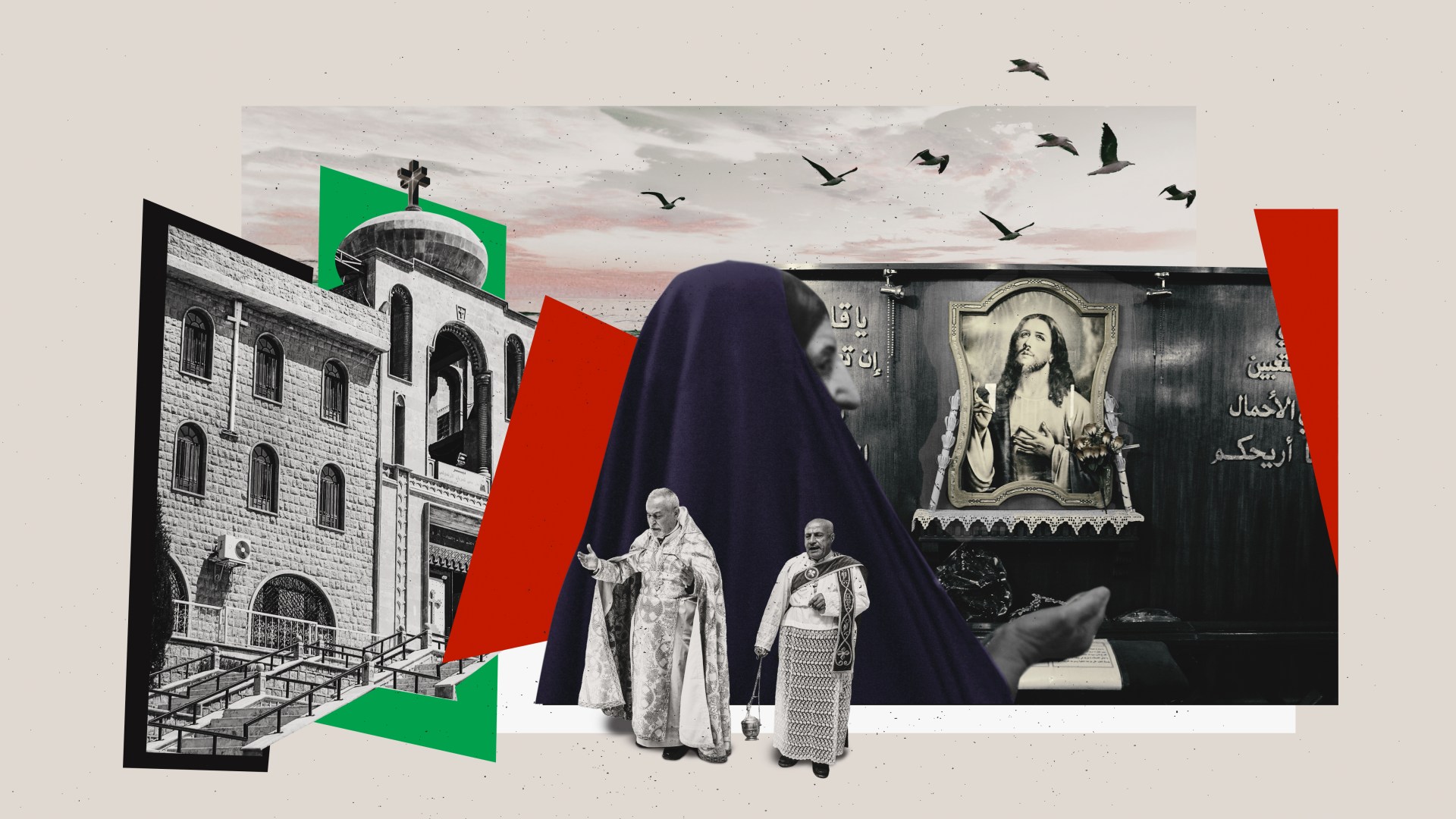
Illustration by Rick Szuecs / Source images:Joe Raedle / Staff / Carl Court / Staff / Getty / Frank Mckenna / Unsplash / Wikimedia Commons

A group of academic Christians in the Middle East has thrown down the gauntlet: The local church, bound in fear to its minority mindset, needs to walk afresh in the Holy Spirit.

“We must tell the truth and call for freedom,” said Souraya Bechalany, coauthor of “We Choose Abundant Life,” a document released last September that makes 20 recommendations. “We are powerful in Jesus Christ, but too often we don’t believe it.”

Bechalany, a professor of theology and ecumenism at the University of St. Joseph in Lebanon, joined 14 other scholars across the region to challenge local Christians to give up their self-understanding of being a minority and to work for the rights of citizenship for all in a changing society.

Local clergy, they say, have instead often wedded themselves to the regimes.

Surveying experience from the Ottoman Empire onward, the document laments how many Christians have taken refuge in sectarianism, turning their vision inward toward survival.

Arab nationalism provided an escape, as Christians took leading roles in developing a common political discourse independent of religion. So did relationships with Western churches, as Catholics and Protestants pioneered modern education and built hospitals to serve society.

But as the region’s nation-states increasingly sacrificed democratic norms in favor of political stability—whether secular or Islamic—church leaders tended in one of two directions: Ally with the authorities, or plead to patrons in the West.

“If we continue in this direction,” said Gabriel Hachem, a Melkite Catholic priest and editor in chief of the French-language journal Proche Orient Chretien, “there is no future for us in the region.”

For now, the regimes are winning, as the challenge of ISIS and political Islam have pushed Christians to support the pillars of authority in alliances of minorities. But in doing so, they sided against human rights and dignity. This is inherently unstable, Hachem said, and Christians suffer also.

Their rate of emigration is rapidly increasing.

The ecumenical Abundant Life is the product of a three-year consultation involving 100 experts, youth, clergy, and selected Middle Eastern Muslims and Jews. The document also critiques Christians in their interactions with these communities.

Toward Muslims, it criticizes the church’s “doublespeak” of “dissembling courtesy” that engages in superficial dialogue while promoting theories of systematic persecution.

Toward Jews, while criticizing religious Zionism and its Western promotion, it nonetheless calls for a “new page” of “serious dialogue.” In some nations of the Middle East, such outreach can land one in jail.

The controversial nature of Abundant Life, in fact, led 4 of the 15 drafting committee members to shield their names. Of the signatories, Lebanon leads with nine, reflective of the nation’s greater level of freedom. Other publicly identified scholars came from Palestine and Jordan.

Those from Syria, Iraq, and Egypt, however, declined to identify themselves.

“The document denounces the regimes but does not call for revolution,” said Hachem. “We are not pretending to say what they should do.”

The heads of churches, however, should lead the way in careful collaboration. A better strategy is needed, said Bechelany, to work with moderate Muslim leaders aligned with the principles of Abundant Life .

Needing full approval from clerical representatives, the Middle East Council of Churches (MECC) has not endorsed the document.

But this has not deterred the authors, many of whom have lengthy experience working with the MECC. Moving beyond the document, they formed the We Choose Abundant Life Group in order to spread their ideas beyond academic circles. Youth have been particularly engaged.

“We cannot wait for church authorities to accept everything before we do anything,” said Rouphael Zgheib, national director of the pontifical mission societies in Lebanon. “This is the faithful, prophetic voice, and the task of theologians.”

In fact, mission is a key theme in Abundant Life, and witness is repeated throughout.

“Christians misunderstand the meaning of their presence,” said Hachem. “It is not to play a role within these societies, but to witness to Jesus Christ, the resurrected one, and call for his universal salvation.”

For too long, he explained, Christians have relied on the leveraging of their institutions to gain influence in society. It has worked well, as they have educated generations of Muslims and healed them in their hospitals.

But now, Muslims are catching up, and will no longer need this Christian role.

What they really need is the witness to Jesus.

“I have to work on behalf of the gospel—quietly, with wisdom, love, and respect,” said Bechalany. “But I have to be a witness, or they will never know him.”

Within Islam, most Muslims do not recognize the right of religious conversion, or to publicly give up their faith.

A former secretary general of the MECC, Bechalany said she challenges Muslims to respect the right of religious conscience, without calling them specifically to Christianity. But Christians she challenges toward unity. Securing this “paradigm shift” will mean nothing if the church is not prepared to receive any who show interest in Jesus.

“How can we be witnesses to Christ’s resurrection when we are divided?” Bechalany said. “We have to work on ourselves first.”

Abundant Life calls for full engagement with the MECC, which it rattled by promoting a contextual approach that includes lessons from sociology and cultural anthropology, Zgheib said. The church, unfortunately, relies on dogmatism and resists frank discussion in an atmosphere of freedom, he said.

But the whole church is needed, and Abundant Life calls for better incorporation of youth and women into leadership and decision-making. It even commended Protestants for their ordaining of female pastors.

One of them, Najla Kassab, a Lebanese Presbyterian, served on the drafting committee. She was joined by two others of Reformed heritage, George Jabra al-Kopti, an Anglican from Jordan, and Mitri Raheb, a Lutheran from Palestine.

And the document won endorsement from the evangelical SAT-7 television ministry.

“This is a group that wants to see change in the church,” said George Makeen, executive director for Arabic programming. “They have thrown a rock into the still waters.”

Makeen believes the document’s call to witness is consistent with SAT-7’s understanding. But it goes further. If traditional Christians have been focused on survival and their role in society, evangelicals in the Middle East have often reduced it to belief and moralism.

“We witness to the power of Jesus Christ,” Makeen said, “and how it changes us to work for the restoration of the world.”

And therefore, he also praises Abundant Life’s political orientation.

“For centuries we lived in the mentality of the victim, thanking the Lord we still endure,” he said, with special reference to his Egyptian heritage. “But here the core message is to develop a Christian character that will stand against injustice and inequality.”

Just be sympathetic with those who in the face of violence find whatever refuge they can, Makeen said. Abundant Life proscribes no method of either political activism or spiritual outreach. But to the Syrian, Palestinian, or Egyptian, he said the charge is clear:

“Witness is essential. Do not sacrifice it for existence.”

It calls for a level of faith most in the West cannot imagine, Makeen said.

And to some degree, even by the drafting committee. Some in the group were threatened not to affix their signature, said Bechalany.

“Do we have the courage to witness to the truth?” she asked. “Jesus Christ offered his life. We must be willing to do the same.”

Recommendations for Mideast Christians


A selection from the choices and policies section of the document, on the “profound change of mindset” needed to find abundant life:


• The social, political, and theological realities in the Middle East today, with all the challenges they pose, place before Christians crucial choices that require a profound change of mindset. This change requires us to move from an obsession with existence and survival to taking the risk of presence and witness. It means building durable policies based on biblical principles and enshrined in the prophetic role we need to play, the significance of our witness to the resurrected Christ, and our engagement in our societies with their different geopolitical contexts.

• The prophetic role of the Christians of the Middle East requires us to be biased towards the causes of freedom, justice, human rights, the right to self-determination, democracy, and the regular peaceful transfer of power in all the countries of the region.

• Christians in the Middle East should refuse to adhere to dictatorial political regimes, whether ideologically secular, theocratic, or feudal, or to identify with them. They must also reject a “minority alliance” and the choice of calling for protection. They must refrain from politicizing religion and religionizing politics, and from any authoritarian gains, influence guarantees, or personal benefits, while preserving their positive social role.

• We also urge the churches to develop strategies and undertake positive and practical initiatives to help Christians stay in their countries, and foster their involvement in the public sphere and the struggle for a civil state, a state of constitution and institutions, governed by full citizenship that will embrace diversity and be ruled by modern civil law.

• Hosting refugees and displaced people on the basis of human brotherhood/sisterhood is an obligation referred to several times in both Old and New Testaments … It is important for Christians in the Middle East to be in solidarity with the oppressed and support those whose rights have been violated, to defend them, to empower them, to expose their oppressors, and to establish processes for calling those oppressors to account within the bounds of justice.

• Media and communication are a supporting pillar in establishing Christian and human values. … Churches must give [them] utmost priority … in terms of vision, policies, and technologies when mainstreaming their values, especially when it comes to living together with respect for diversity. We urgently need to develop a joint ecumenical action plan for media that would encourage a professional discourse in the service of mission and foster human dignity, speaking to both mind and heart, and free from rigid tradition, fake piety, and apologetic debate.

• Our Christian presence must be founded on service to every human being, dedicated love, and genuine forgiveness, in obedience to the will of God. Our aim must be a more just and humane society in which the kingdom of God may be fulfilled, so that human beings may receive life as God has desired it for them, according to the words of Christ in the Gospel of John: “I have come that they may have life, and have it abundantly.”

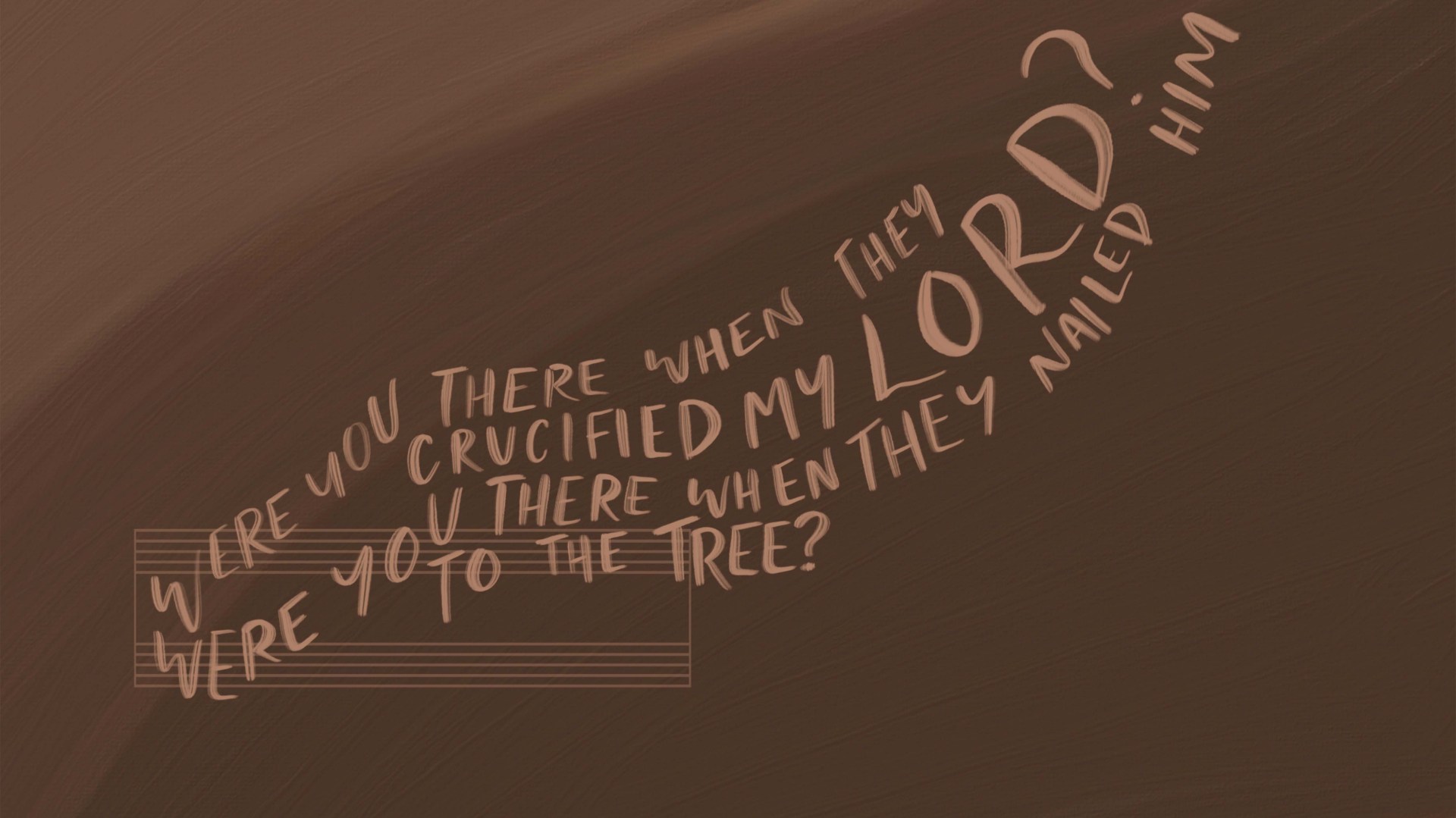
Were You There When They Crucified My Lord?

There are no easy answers to the spiritual’s convicting questions.

Illustration by Cassandra Bauman

I’m standing in the big house at a plantation in Nashville. It’s an impressive structure. Big white pillars. A long, wide porch is dotted with wooden rocking chairs—all of them filled now with tourists like us, people waiting for a tour guide to walk them around the grounds and recount the day-to-day life of a slaveholding family’s massive operation—all 5,400 acres run by 136 enslaved Black men, women, and children.

Still, inside the grand house, a tourist’s hand goes up and a wearying question gets asked. “But weren’t some slave owners good?” The room grows quiet. I pull my little grandchildren closer. But the tourist persists: “Didn’t they take good care of their slaves? After all, they’d invested in them.”

I’ve heard such questions before—perhaps we all have. Still, I stifle a groan. To feel better perhaps, some still yield to the common impulse to look away from horror, to sanitize history. To diminish the reality of evil.

But were you there?

Piercing Questions

This year, Passion Week will likely find our same tone-deaf singing of one of Christianity’s most boldly convicting songs. Most of us may sing it—with its piercing questions—without a lick of context or historical reflection. Sadly, some may sing, too, without deep pondering of the visceral realities of the Cross.

Yet it’s at the Cross, when we dare to look, that we see Jesus most needing us to be fully there. Except for his mother, Mary, and a few other faithful, stalwart women—who stayed during his entire ordeal—Christ comes to history’s most pivotal moment joined only by mocking Roman soldiers and two convicted thieves.

Just days before, he was hailed by “a very large crowd” who spread their cloaks on the road or cut palm branches from trees and laid them before him, shouting, “Hosanna to the Son of David!” (Matt. 21:8–9). But at his crucifixion, Jesus would face its cruelty as a reviled outcast, with even his disciples fleeing.

Listen to “Were You There?” and the rest of the songs featured in

The Wondrous Cross

here:
MoreCT.com/EasterPlaylist.

What irony then, that to recall his passion and suffering, we blithely sing a song born from slavery’s most disgusting pains, so often forgetting what it deeply asks—both about Jesus and the first singers of the song—when it whispers, “Were you there? 

It’s a profound question, one easily sidestepped because of the song’s haunting, awful beauty. As a child, in my humble Black church, we leaned into its minor chords with our actual bodies—folks throwing back their heads, groaning out the song’s pleading Ohs.

It didn’t have to be Good Friday or even close to Easter. After a rousing sermon or maybe during the altar call, a determined preacher—or some man or woman just sitting on a church pew—might stand up and start to sing. Were you there when they crucified my Lord?

As a child, I heard the question but didn’t understand what it was asking. Nobody unpacked the inquiry, not even in my Black church. As with so many of us, I just loved the music. At some point in my childhood, I realized it was Negro music—and, thus, to me, a little Black girl growing up during the draining insults of Jim Crow, the music meant something important, even if I didn’t try to articulate what or why.

By then, at age 12, I’d given my life to Christ, heard Black preaching every Sunday of my life, celebrated a dozen Easters, heard the Seven Last Words sermonized the same number of times, taken part in Easter plays, stood under rude wooden crosses in fellowship halls portraying one of the women at the cross.

But was I there when they crucified him? Understanding all that his sacrifice meant? Let alone appreciating all that the iconic Negro spiritual song, with its repeated refrain of questions, means to any believer?

What it asks should convict, indeed, the deepest recesses of our souls.

The Double Message

As with many slave melodies, the song presents a double, hidden message—in this case, a brash challenge to the institution of slavery, particularly to those owning and selling humans as property. Therefore, it asks: If you were there for this Jesus you preach about all the livelong day, why do you chain me up? Whip and rape my sister, mother, and daughter? Rip apart my family? Work me without mercy? Feed me dregs? Insist that I’m a brute and inhuman? Refuse me the right to read, write, and study? Live in your fine home with carpets and rugs but house me in a shack with a dirt floor? Then demand I sing about the Savior you claim to love?

If you can’t answer, is it because you were not there? When they crucified “my” Lord?

It brings chills, indeed, to consider the hypocrisy that the song confronts. Thus, it’s not so different than what Christ himself told the hypocrites of his day. In fact, the lie that you live, as Jesus told teachers of the law, is so abhorrent, says this song, it causes me to tremble.

Thus, there’s no place to sit in comfort when singing this song. No matter our views on injustice or other sources of sorrow, the song offers no respite. It’s about suffering. And for most, our relationship with suffering may be half-hearted and tentative. Suffer like Christ? Do any of us deliberately choose such pain?

Choosing to Remember

For answers, I can read scholars who’ve developed the theological insight, wisdom, and guts to enter the reality of both Christ’s crucifixion and this song we choose to celebrate it. Theologian David Bjorlin, a minister in the Evangelical Covenant Church, writes precisely and bravely about the anamnesis of “Were You There”—pointing to the Greek word meaning “to remember”—challenging those who sing the song to “re-member the past to the present, to bring these historic events to bear on the now and make them part of our story.”

But instead of remembering, some push back. We live in a world ruled not by anamnesis but by a deliberate amnesia. Efforts across history to ignore the past, to bury racial history, to even outlaw the speaking or teaching of it, still ignite the sad support of fearful, denying hearts.

Seeing these developments gives fresh urgency to the Lord’s Upper Room command not to turn from pain but to remember it—by remembering him, celebrating what his passion, suffering, and death daily gives to us. Thus, after he took bread, gave thanks, broke it, and gave it to his disciples, he said, “This is my body given for you; do this in remembrance of me” (Luke 22:19).

In a similar way, the song “Were You There,” as Bjorlin puts it, “is meant to bring the past events of Christ’s suffering and death into the present and transform us in its light.” Otherwise, we too easily forget. Likewise, we’d rather not hear poet Langston Hughes’s own withering question—because a Black life may be filled with laughter and “deep with song,” do we not think that soul hasn’t suffered after holding pain “so long”?

Or maybe we’d rather not think at all about suffering, neither Christ’s nor the slaves’ who sang spiritual laments. Across the years, the song’s lyrics have been tweaked, seemingly to fit certain racial sensibilities. Thus, some churches sing, “Were you there when they nailed him to the cross?” Others, more boldly, sing: “Where you there when they nailed him to the tree?” An undeniable reference to lynching, that lyric seems to signal exactly how a singer interprets this song that arose from slavery’s communal horror and burden. Those words suggest a solace or connection with Jesus’ suffering, as well, and how it brings mysterious comfort to believers in our own suffering.

Still, were some slave owners “good”? To those still asking the question—still looking for individual exceptions to an institutionalized system—Frederick Douglass spared no discomfort describing the “flesh-jobbers” of his day, driving their victims by the dozens, chained, usually in the darkness of night, wailing from their “bleeding footsteps,” beaten bodies, and torn family ties.

But were you there? The song invites us not to sing it without answering, refusing to let us forget what happened, and what still goes on in sorrowing places. Thus, may we tremble as we sing it—in gratitude to the Christ who died for every one of those lashed, starved, maimed, and dehumanized, and for those still facing injustice, near and far, waiting on us to respond. But were you there? Was I? If not, our lowly Lord’s passion requires that we understand this: He died for us all.

Read Matthew 27:45–61

, reflecting on the experience of those who were there as Jesus suffered, died, and was buried. What might it have been like to be there? What does it mean for us today to truly grapple with the question “Were you there”?

Patricia Raybon is a writer who explores the intersection of faith and race. Her books include the recent mystery novel All That Is Secret and her nonfiction work My First White Friend.

This article is part of The Wondrous Cross which features articles and Bible study sessions reflecting on the meaning of Jesus’ death and resurrection. Learn more about this special issue that can be used during Lent, the Easter season, or any time of year at MoreCT.com/Easter.

Culture

Jesus Is the God of Ground Zero

In grief, he is our consolation.

Illustration by Cassandra Bauman

Right after September 11, 2001, theologian Calvin Seerveld told singer-songwriter Michael Card: “The church has no such songs (of lament) to sing.” Our contemporary praise music does not seem to account for such a national tragedy as 9/11 or even for funerals, no dirge or lamentation appropriate to express loss beyond words.

As a survivor of 9/11—my family lived three blocks away from the World Trade Center and I was trapped in a subway stop underneath the collapsing towers—I can testify to this lack. Today, we may similarly pause to ask, “Do we have songs to sing during a pandemic?”

There was one piece of music that was played over and over during the period after 9/11 on classical music radio stations. It was Lux Aeterna by Morten Lauridsen. In this choral piece, the overwhelming cascade of voices coalesces and moves deeply into our lament, yet the music rises above the nadir of our common despair and somehow reframes our hopes.

Listen to Lux Aeterna and the rest of the songs featured in

The Wondrous Cross

here: MoreCT.com/EasterPlaylist.

Several years after 9/11, I had an opportunity to reflect on Lauridsen’s composition and honor him. I was appointed to the National Council on the Arts by president George W. Bush and worked on the nominations for the 2007 National Medal of the Arts. The council selected Lauridsen as one of the award recipients. I was the table host designated to welcome him to the list of great artists and arts advocates including the likes of Andrew Wyeth and Henry Steinway. Lauridsen’s legacy will be known with other great composers who’ve received this high honor, such as Aaron Copeland and John Williams.

As Lauridsen looked around the room, he said, “What am I doing here?” I responded: “Sir, millions of people sing your songs; I think you deserve this honor.”

Lauridsen composes music that the vocal range and singing capacity of a typical community choir can handle; in other words, he makes his music accessible to all. Perhaps that accounts, in part, for the popularity of his music in the classical and choral music world. But how is it that this communal music can carry the weight of our common curse yet manage to infuse hope in us?

‘Thou Best of Consolers’

My dear friend James Jordan, the master choral director of Westminster Choir College, told me that Lux Aeterna is “a work of sound art that is humanly honest, because of its Gregorian chant roots.” It makes sense that some of the text of this choral work was first created out of a community—a community of ordinary saints seeking to renew their daily faith through their monophonic plainchants. Such an integrated, authentic song from a community many centuries past does not fit neatly into our contemporary categories like “secular” or “sacred” or “Christian music.” And precisely because it does not, it is a song for eternity that resonates in all areas of human experience, lifting all of us to the heavens in worship.

Lux Aeterna, Latin for “eternal light,” begins with the movement “Introitus.” Its words, translated from Latin to English, read:

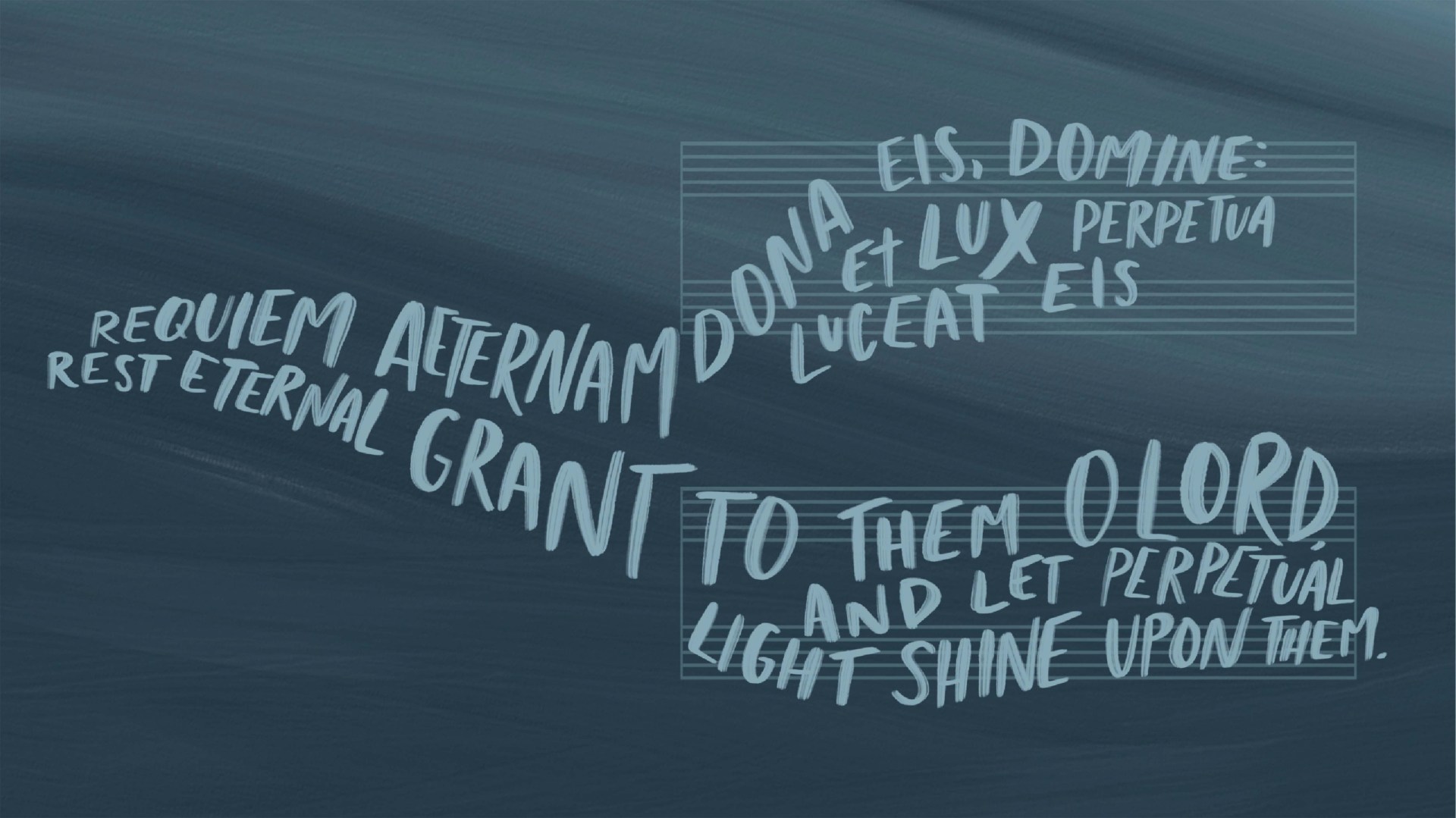
Rest eternal grant to them, O Lord,
And let perpetual light shine upon them
A hymn befits thee, O God in Zion.
And to thee a vow shall be fulfilled in Jerusalem:
Hear my prayer,
For unto thee all flesh shall come.
Rest eternal grant to them, O Lord,
And let perpetual light shine upon them.

These lines are repeated over and over in the piece, providing an echo of voices that seems to embrace our stricken hearts. Cello undergirds the movement of rising voices, giving the movement gravity. The line “Rest eternal grant to them” is like a whisper, a mother’s voice to calm a troubled soul.

Then, in the fourth movement, “Veni, Sancte Spiritus,” we hear:

Thou best of consolers,
Sweet guest of the soul
Sweet refreshment.
In labor, thou art rest,
In heat, the tempering,
In grief, the consolation.

The triumphant last movement of Lux Aeterna, “Agnus Dei,” awakens our hearts toward the beatific hope, then the choir settles into the cascade of restrained hush at the end. The closing “Amen” is sung as if a last breath in unison.

The life, death, and resurrection of Jesus—or the “life after life after death” as N. T. Wright puts it—provides an entry point for us into new creation. “Just as the sufferings of Christ are abundant for us,” the apostle Paul wrote, “so also our consolation is abundant through Christ” (2 Cor. 1:5, NRSV). We are consoled by the voice of the one who suffered and took the penalty of sin away by giving his life on the cross. “In grief, the consolation” matters to Jesus because he chose to be executed as a common criminal so that we can be redeemed. Jesus is the God of ground zero.

Thus, in my personal ground zero, the choral voices in Lux Aeterna called me to persevere and also to see the experience as a starting point—as a “zero” point of cancellation of my sins and brokenness, my transgressions against my Maker. The voices carry me beyond my transgressions into the hope of Easter morning.

Mending to Make New

This past fall, as I wrestled with the 20th anniversary of 9/11, Lux Aeterna continued to hover over me and allowed me to move into my pain again, haunting me and releasing me as I journeyed through a difficult day. In Lux Aeterna, I hear the dissonance of brokenness, and yet, like the gold veins in a kintsugi bowl, I hear mending to make new.

In a unique way, the music highlights and captures the spirit of a single line from John 11, the shortest sentence in the entire Bible: “Jesus wept” (v. 35). These words frame a central thesis in my book Art + Faith: A Theology of Making:

In John 11, Lazarus is found sick and dies. Jesus comes to the scene late, intentionally. Before showing his power as the Son of God to resurrect Lazarus, he does something that has no practical purpose: He “wastes” his time with Mary, to weep with her. Theology of Making hinges on this gratuitous act of Jesus … on a kind of culture that flows out of the tears of Christ.

There is a sense of such gratuity in Lux Aeterna, in the music’s power to slow down time. It’s as if all that is violent and torn, explosive and horrifying, is made to obey the silent rhythm of the ordinary. What I detected in the music as I navigated our post-9/11 struggle was the depth of a profound Presence and the powerful pauses of refrains that were at once both vulnerable and refocused. Lux Aeterna traces the flow of Jesus’ tears into our stricken desert of ashes; and what seems extravagantly wasteful, like the nard Mary poured out on Jesus’ feet (John 12:3), becomes then absolutely necessary. Music and art can make the extraordinary ordinary and accessible, the peaceful and beautiful chants of our days sung into our despair-filled ground zeros.

Our Holy Saturdays

Though Lux Aeterna has themes of both sorrow and hope, I don’t primarily think of Lux Aeterna as Good Friday music or as Easter Sunday music. I think it’s most appropriate to consider Lux Aeterna Holy Saturday music. Holy Saturday sits in between the devastation of Good Friday and the triumph of Easter Sunday. It is a day of darkness, of waiting—a day that echoes in our own experiences of waiting and darkness. The choral voices of Lux Aeterna arise out of that restrained pause. Like new bulbs taking root deep beneath dark, frozen earth, Lux Aeterna captures that invisible life growing even in times when we can only see the snowy, cold ground.

“In my end is my beginning,” T. S. Eliot wrote, and Lauridsen’s Lux Aeterna captures the same diction of the heart as Eliot’s post-war masterpiece Four Quartets. It points us toward the one who promises, “Behold, I am making all things new” (Rev. 21:5, ESV). As we stand on the ashes of our common curse of the pandemic today, the profound meditations and music of Lux Aeterna can guide us toward the new, not by “fixing” but by mending to make new. It resonates into my own fragmented journey, into my life and my art, and composes my own life of loss and joy.

Read 2 Corinthians 1:3–5.

Reflect on a time you experienced sorrow or tragedy—or upon the recent painful realities of the pandemic. How has Christ been your consolation? How have you experienced “mending to make new”?

Makoto Fujimura is a contemporary artist who has served on the National Council on the Arts. He is the author of several books including Art + Faith: A Theology of Making.

This article is part of The Wondrous Cross which features articles and Bible study sessions reflecting on the meaning of Jesus’ death and resurrection. Learn more about this special issue that can be used during Lent, the Easter season, or any time of year at MoreCT.com/Easter.

Christ the Lord Is Risen Today!

Reflections on Wesley’s great hymn of suffering and salvation.

Illustration by Cassandra Bauman

In the First United Methodist Church of Wichita Falls, Texas, Easter brought no surprises. The liturgy, combined with a music director devoted to replicating the same service year after year, meant that my childhood memories of church on Easter Sunday would look virtually identical to those of my stepmother from 25 years earlier and those of her mother before her. If you craved novelty, you had better find it in your Easter basket. Once you entered the carved doors of the sanctuary, the service would proceed by rote. And gloriously so.

The same Easter lily procession, the same redolent scent of those white blooms, the same vestments and banners, the same congregational greeting and response (“He is risen!” “He is risen, indeed!”), the same sermon text, the same doxology and benediction. And the same hymns.

I have not worshiped in a liturgical church nigh on these 35 years. Novelty is the norm in my Easter gatherings, but each Easter my heart still wakes with the notes of Charles Wesley’s “Christ the Lord is Risen Today” surging through my memory.

Listen to “Christ the Lord Is Risen Today” and the rest of the songs featured in

The Wondrous Cross

here:
MoreCT.com/EasterPlaylist.

Hymn No. 302 in the United Methodist Hymnal is as much a sermon as a song, a poetic exposition of the 15th chapter of 1 Corinthians. Though the version I grew up singing had only six verses, the original contained a full 11. Eleven verses to extol the risen Christ, now ascended to the right hand of God.

It is often noted that Charles Wesley wrote over 6,500 hymns in his lifetime, but he also preached extensively. His was a mind and heart saturated in the truth of the Scriptures. Typical to form, his best-known Easter hymn is not merely musical; it is deeply theological. It preaches not just the Resurrection but also the doctrines of original sin, atonement, union with Christ, justification, sanctification, and glorification. And it does so with elegant rhyme, meter, and melody.

Of all its stanzas, the words that arrest me most are these:

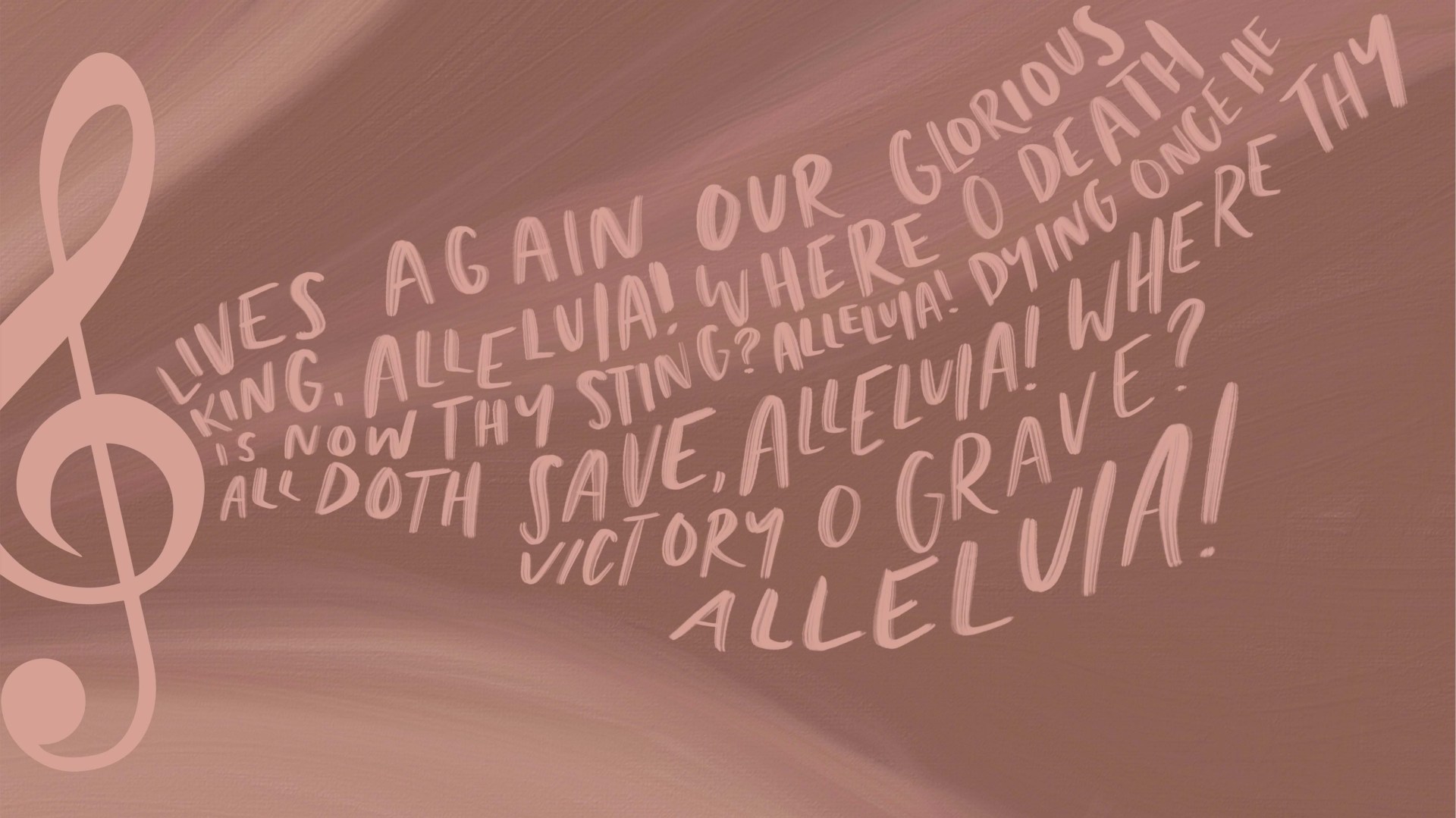
Lives again our glorious King, Alleluia!
Where, O death, is now thy sting? Alleluia!
Dying once he all doth save, Alleluia!
Where’s thy victory, O grave? Alleluia!

The third verse. The one where the thrum and clarion of the organ fall silent, and the unadorned voices of the congregation swell into the rafters. Wesley skillfully paraphrases 1 Corinthians 15:55, layering in a truth from Romans 6:10: “The death he died, he died to sin once for all; but the life he lives, he lives to God.” One efficacious death for all sin. One cruel death to remove the sting of death. One victorious death to end the victorious reign of death over humanity. One death to crush once for all Eden’s lisping lie of You will not surely die.

Where thy victory, O grave? Where thy sting, O death? The words Paul quotes from the prophet Hosea speak to the hope of the good news of Easter. But we sing them in a world that indeed reels under the sting of death, and in which, by all appearances, the grave still triumphs. Through tears, tight-chested, we bury those old and full of years, those born without breath, and those with years cut short by illness or violence, by accident or natural disaster, or even—God help us—by hopelessness itself.

When Wesley penned his great hymn in 1739, it was no different. If anything, daily awareness of death’s dominion was even greater. Wesley himself was born the 18th of 19 children, 10 of whom did not survive to adulthood. He buried five of his own eight children in infancy. He lived during a time in which the average life expectancy was a mere 37 years. The prevalence of poor nutrition and infectious disease meant those who lived past adolescence would likely experience the loss of young loved ones multiple times over.

And when loved ones died, they died at home. Only fairly recently in human history has death and its physical aftermath become a process that occurs elsewhere, relatively out of sight. Home was both the setting for death and the setting for burial customs. The “laying-out” of the body took place in the home, as did the wake. Long after the funeral procession to the churchyard, the sting of death would have lingered, readily associated with the very rooms in which daily life took place.

I imagine Charles Wesley walking the distance from home to church on Easter morning, passing through the churchyard with those five small headstones bearing his surname, entering through the carved doors of the sanctuary to sing his own words back to God. Singing hope into sorrow. Singing a balm into the sting. Carrying a costly sacrifice of praise into the house of the Lord. I am reminded that my own sorrows can find rest in the declaration of hope. Certainly, Wesley knew to grieve as one with hope. He knew the Son of Man would one day split the eastern sky, with power and authority to resurrect the dead. Visit an old English churchyard and note the direction of the headstones. You will find them facing resolutely east, expectantly.

Like the church of my upbringing, the Hebrew temple was a building devoted to repetition and remembrance. From its articles to its observances to its architecture, it called worshipers to remember the sting of death and to long with hope. For centuries, the blood of goats and rams ran thick in the temple court. For centuries, the high priest offered blood on the horns of the golden altar to atone for the sins of the many. Sacrifice upon sacrifice. The sting of death in the house of the Lord. Rivers of blood, year after year, spilled onto the stones of a sanctuary facing resolutely east, expectantly.

Until at last, Christ offered for all time a single sacrifice for sins. Until at last, death itself was put to death in one final sufficient spilling of blood. Dying once, he all doth save. Yet, the holy one would certainly not be abandoned to the realm of the dead, nor would the faithful one see decay. After he had suffered, he would certainly see the light of life. The grain of wheat that fell to the ground would certainly yield a harvest. Hope was certainly alive.

In Jerusalem 2,000 years ago, Easter brought no surprises. The angel’s words to the women trembling at the tomb testified to the sheer predictability of the morning: “He has risen, just as he said” (Matt. 28:6, emphasis added). Just as the prophets had said. An ancient liturgy, repeated century after century, was at last culminating in its glorious fulfillment. The seed of the woman had crushed the serpent’s head, once for all. The words once lisped in falsehood are proclaimed by Christ in truth to all who call upon his name: You will not surely die! And so, on Easter, we look to the east and raise the cry of victory in the house of the Lord. Lives again, our glorious King. He is risen. He is risen, indeed.

Read Matthew 28:1–10

. How are these events a “glorious fulfillment” of “an ancient liturgy” as Wilkin puts it? What gives you joy as you celebrate the truth that “He has risen, just as he said” (v. 6)?

Jen Wilkin is a Bible teacher and the author of several books, including Women of the Word and Ten Words to Live By, and serves as a cohost of the Knowing Faith podcast.

This article is part of The Wondrous Cross which features articles and Bible study sessions reflecting on the meaning of Jesus’ death and resurrection. Learn more about this special issue that can be used during Lent, the Easter season, or any time of year at MoreCT.com/Easter.

Ain’t No Grave Gonna Hold Our Bodies Down

What does the Resurrection tell us about God’s plans for us?

Illustration by Cassandra Bauman

1934

Twelve-year-old Claude Ely was dying in Virginia, stricken with tuberculosis. As his family huddled in prayer around his bedside, the boy began to sing:

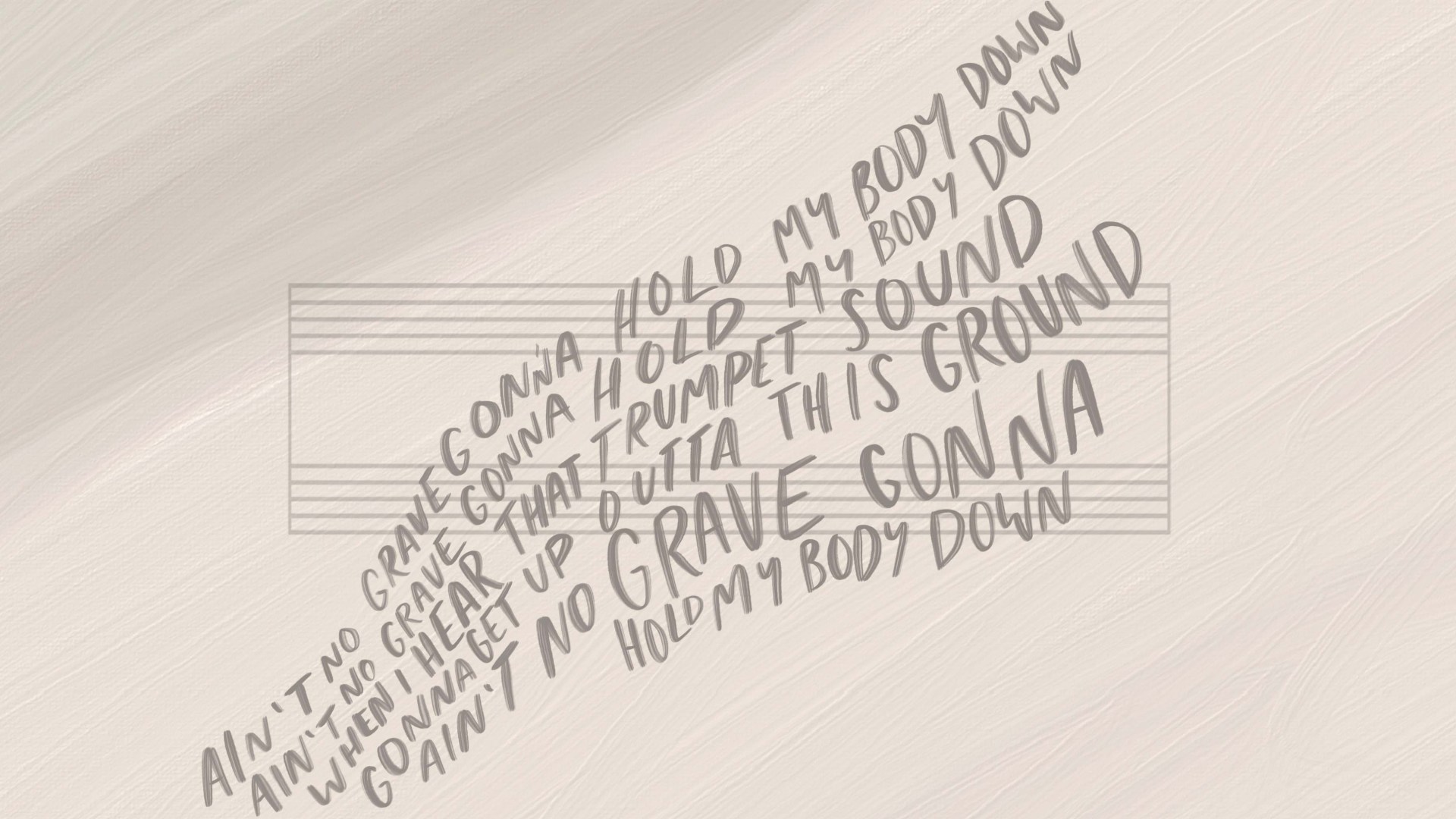
Ain’t no grave
Gonna hold my body down
Ain’t no grave
Gonna hold my body down
When I hear that trumpet sound
Gonna get up outta this ground
Ain’t no grave
Gonna hold my body down

Claude eventually recovered. And the healing in his lungs was so complete that he grew up to become a singer and preacher known for his freight-train volume and Pentecostal gusto. In adulthood, he traveled the South as the “Gospel Ranger,” proclaiming the resurrection power of Jesus in one righteously raucous revival meeting after another.

On October 12, 1953, almost 20 years after Brother Ely’s boyhood healing, King Records captured him in a “live worship” recording session at the Letcher County courthouse in Kentucky. The audio for “Ain’t No Grave” has been preserved, and listening to it is a visceral experience. “Ain’t no …” Claude sings, like he’s pulling a boulder back in a slingshot. “Graaaaaaaaaaaave,” he hollers, like he’s letting the boulder fly. Other worshipers join him, shout-singing and clapping on off beats in a Spirit-fueled Pentecostal Holiness style, overpowering the microphones with gloriously distorted exuberance.

Listen to “Ain’t No Grave” and the rest of the songs featured in

The Wondrous Cross

at MoreCT.com/EasterPlaylist. You can also watch Arends and other contributors discuss their articles in this webinar.

If Ely delivered “Ain’t No Grave” like a sonic earthquake, perhaps it’s because he could trace the song’s conviction back to a literal earthquake. Consider how Matthew describes the moment in history that makes the song true: “After the Sabbath, at dawn on the first day of the week, Mary Magdalene and the other Mary went to look at the tomb. There was a violent earthquake, for an angel of the Lord came down from heaven and, going to the tomb, rolled back the stone and sat on it” (28:1–2).

That angel must have made quite a sight, reclining on the boulder the Roman army had been certain would keep Christ sealed in his tomb. Then he delivered the news that changed absolutely everything: “He is not here; he has risen, just as he said” (v. 6). As Brother Ely might have declared it, no grave could hold his body down!

The “violent earthquake” in Jerusalem that morning was nothing compared to the seismic shift in the cosmos. Every person who encountered the risen Jesus was confronted with the magnificent reality that, in the words of C. S. Lewis in Miracles, “[Jesus] has forced open a door that has been locked since the death of the first man. He has met, fought, and beaten the King of Death. Everything is different because He has done so. This is the beginning of the New Creation: a new chapter in cosmic history has opened.” Maybe it’s only right that Ely’s performance of “Ain’t No Grave” is more battering ram than melodious choir.

Still, Ely’s honky-tonk rendition is only one of many versions of this song. Earlier recordings include an exquisitely soulful 1942 performance by a domestic worker named Bozie Sturdivant, as well as a 1946 barrel-house piano rendition by Sister Rosetta Tharpe, who sang the song at her own mother’s funeral. These renditions have a familiar, well-worn feeling to them, suggesting, as some music historians believe, that earlier variations of “Ain’t No Grave” appeared in Negro spirituals dating back at least to the late 1800s.

The core refrain of “Ain’t No Grave” seems to be more of a primal human expression than the property of any one artist. The song has since been adapted by countless musicians over the years, including Tom Jones, Russ Taff, Robert Duvall, and Molly Skaggs. Many of us first encountered the song through Johnny Cash.

2003

American country legend Cash was days away from death. With the help of his friend and producer Rick Rubin, he continued to sing and record almost to his last breath.

Well, look way down the river
What do you think I see?
I see a band of angels
And they’re coming after me
Ain’t no grave can hold my body down

When the recording was released on the posthumous album American VI: Ain’t No Grave (2010), listeners encountered a fragility in his legendary voice that made the performance porous and transcendent. Rock critics struggled to find words to describe the effect. The Washington Post’s Bill Friskics-Warren wrote about the “spiritual, even biblical” quality of the music. More pragmatically, Ann Powers, a writer at the LA Times, dubbed the project Cash’s “Hospice Record.” Which, by all accounts, was exactly what it was.

2018

My mother was in hospice. I was lying on the couch next to her bed, holding my own breaths in the pauses between her increasingly shallow ones. She’d been unresponsive for days, and I knew her body would soon be in the grave.

“To be absent from the body is to be present with the Lord,” I whispered (2 Cor. 5:8). She seemed absent from her body already. All that remained was an illness-ravaged shell. And yet, it was still a body I loved.

I held her hand and enacted the code she taught me in childhood: Three squeezes mean “I love you.” I traced the remnants of her final manicure on the edges of her fingernails, evidence of her love of color and her enjoyment of chats with the salon technician. I adjusted her pillow and remembered the way her shoulders would shake next to mine when something struck us funny at church and we tried to suppress our laughter.

I found myself thinking of a stanza in Cash’s version of “Ain’t No Grave,” one you don’t find in many of the other renditions:

Well meet me, Mother and Father
Meet me down the river road
And Mama, you know that I’ll be there
When I check in my load
Ain’t no grave can hold my body down

That’s when I was almost startled to remember that, because I am a Christian, I believe not only in the resurrection, but in the resurrection of the body. The resurrection of this body, the one right in front of me. No grave could hold my mother’s body down.

The doctrine of the resurrection of the body has never come naturally to me. I was a mature student in graduate theological studies before I realized I had never seriously considered the final portion of the Apostles’ Creed: “I believe in the Holy Spirit, the holy catholic church, the communion of saints, the forgiveness of sins, the resurrection of the body and life everlasting” (emphasis added). I was sold on “life everlasting.” But subconsciously, I think I imagined it in a decidedly unbodily form. How could the bodies that we know decay in the ground (or, in some cases, we cremate into ashes) be a part of our future?

A professor instructed me to read Paul’s first letter to the Corinthians, chapter 15. When I did, it seemed like the apostle was reading my mail. Paul reminded me that if we are convinced Christ has truly overcome death, then belief in the resurrection of our bodies is not only plausible, but essential.

If it is preached that Christ has been raised from the dead, how can some of you say that there is no resurrection of the dead? If there is no resurrection of the dead, then not even Christ has been raised. And if Christ has not been raised, our preaching is useless and so is your faith. (vv. 12–14)

Then, as if sensing my tendency to divorce our resurrected bodies from the ones we have now, the apostle pressed further.

But someone will ask, “How are the dead raised? With what kind of body will they come?” How foolish! What you sow does not come to life unless it dies. … So will it be with the resurrection of the dead. The body that is sown is perishable, it is raised imperishable; it is sown in dishonor, it is raised in glory; it is sown in weakness, it is raised in power; it is sown a natural body, it is raised a spiritual body. If there is a natural body, there is also a spiritual body. (vv. 35–36; 42–44)

It began to dawn on me that our spiritual bodies will be a transfiguration (rather than an obliteration) of our current ones. The God who made bodies loves them and has truly wonderful plans for them. “The old field of space, time, matter, and senses is to be weeded, dug, and sown for a new crop,” suggests Lewis. “We may be tired of that old field; but God is not.”

In the Gospels, all who met the risen Christ encountered him in corporeal human form—yet he could walk through walls, disappear at will, and ascend into heaven when the time was right. “The body we will rise with will be like Christ’s glorified body,” muses Peter Kreeft, “immortal and perfect yet truly body, as Thomas found when he touched the Lord’s wounds.”

The early church surmised that our risen bodies will be characterized by subtlety (matter and spirit so in sync that walls are no longer a barrier), agility (the ability to travel wherever we want instantaneously), impassibility (immunity to illness or injury), and glory (like the luminosity of Christ at the Transfiguration). No wonder Brother Ely found the resurrection something to hoot and holler about.

Today … and the Future

Today, Brother Ely, Bozie Sturdivant, Sister Tharpe, and Johnny Cash are in the presence of the Lord yet still anticipating the Day of Resurrection. (So, for that matter, are the apostle Paul, C. S. Lewis, and my mama.) What a moment it will be when “in a flash, in the twinkling of an eye … the trumpet will sound, the dead will be raised imperishable, and we will be changed” (1 Cor. 15:52).

Maybe then, as we grin at each other and admire our same-but-different, gloriously transformed bodies, we’ll sing it all together:

When I hear that trumpet sound
I’m gonna rise right out of the ground
Ain’t no grave can hold my body down!

Read 1 Corinthians 15.

How does Christ’s resurrection point toward a triumphant future? How does that future impact your life in the here and now?

Carolyn Arends is director of education for Renovaré as well as a recording artist whose most recent album is Recognition. She lives with her family in British Columbia.

This article is part of The Wondrous Cross which features articles and Bible study sessions reflecting on the meaning of Jesus’ death and resurrection. Learn more about this special issue that can be used during Lent, the Easter season, or any time of year at MoreCT.com/Easter.

Theology

May We Be Shaped by the Songs of the Cross

Devotional readings for Lent from Christianity Today.

Illustration by Cassandra Bauman

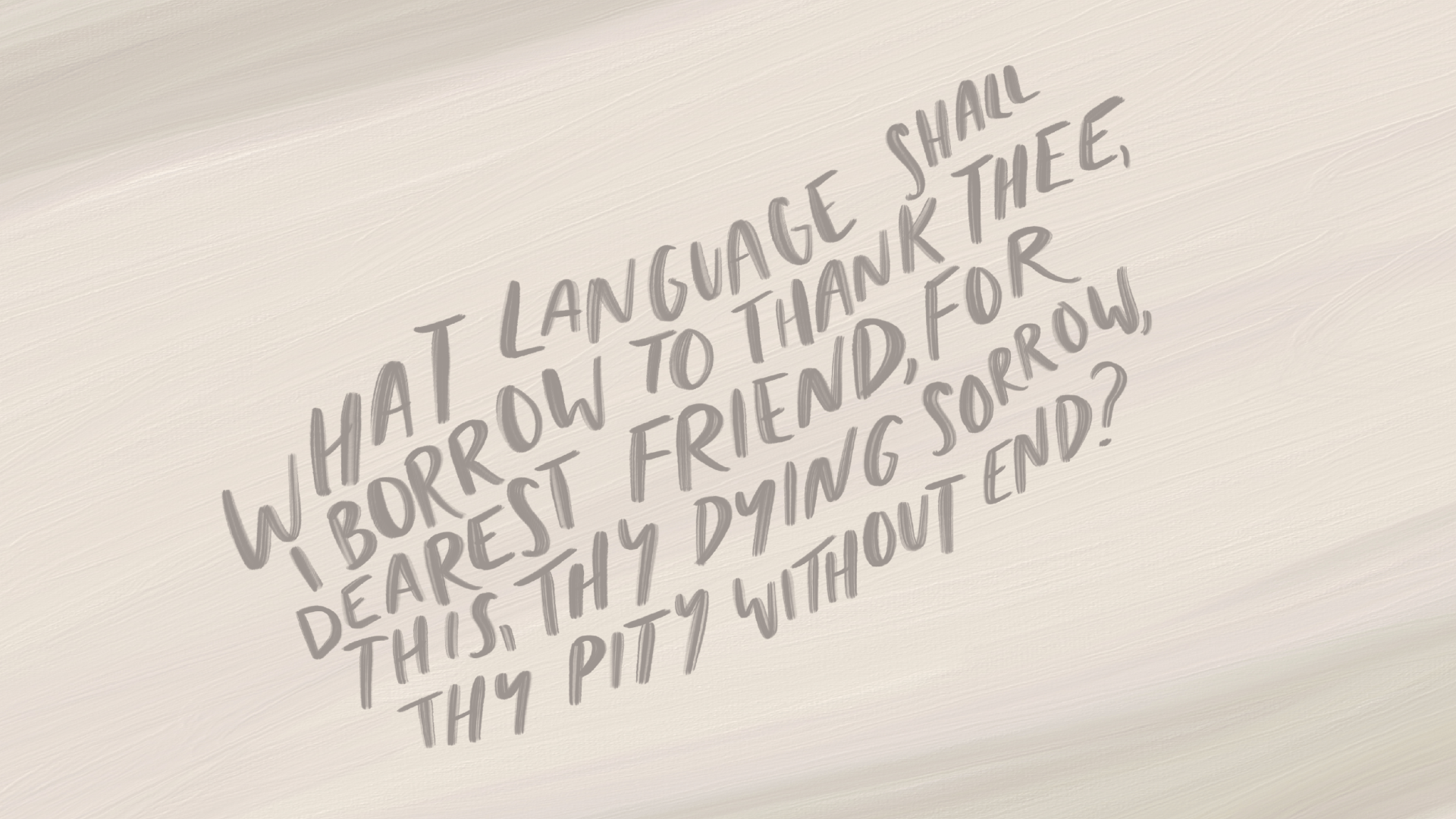
What language shall I borrow
to thank thee, dearest Friend,
for this, thy dying sorrow,
thy pity without end?

Each year during Lent and Holy Week I find myself singing this question, day after day, again and again. This line from “O Sacred Head Now Wounded” captures the utter wordlessness I feel as I contemplate the Cross. As I see Christ there, wounded and suffering. As I consider the deep, deep love of Jesus that compelled him to die for me and, indeed, for all the world. My own words feel meager and inadequate in response to the magnitude of this sacrifice. And so I borrow language to thank him.

We all do—and what a gift it is. We borrow the rich language of early Christian poetry, of hymnody and revival meetings, of spirituals sung out in defiance of injustice. And we hear, expressed in the music itself, truths that transcend words—sorrow and sacrifice, conviction and devotion, victory and joy.

The songs of the Cross give form and voice to the resounding response of our souls. As we sing them, consider them, and pray them, these songs help us enter into the meaning of Christ’s sacrifice. They express the Good News that reverberates even in the darkest moments of Jesus’ passion—and in the darkest moments of our own lives.

Listen to “O Sacred Head Now Wounded” and the rest of the songs featured in

The Wondrous Cross

here:
MoreCT.com/EasterPlaylist.

The Wondrous Cross is CT’s 2022 special issue for Lent and Easter. Each of the articles in this series draws upon a piece of music to reflect on Jesus’ death and resurrection—to wrestle with difficult questions, to meditate upon key moments in Christ’s passion, to delve into the mystery of salvation, and to celebrate Jesus’ victory over sin and death.

When we contemplate the wondrous cross, may this borrowed language give voice to our own worship as we fall before Jesus in gratitude and thank the Savior who is truly our dearest friend.

Kelli B. Trujillo is Christianity Today’s projects editor.

The Wondrous Cross features articles and Bible study sessions reflecting on the meaning of Jesus’ death and resurrection. You can learn more about this special issue that can be used during Lent, the Easter season, or any time of year at MoreCT.com/Easter.

Theology

When We Survey the Wondrous Cross

Lent invites us to gain perspective by facing our mortality.

Illustration by Cassandra Bauman

In 2013, Paul Kalanithi was completing his medical residency and was on his way to becoming a neurosurgeon at Stanford University when he was diagnosed with stage IV lung cancer. He’d just turned 36. Kalanithi began to write, and his memoir was eventually published as the book When Breath Becomes Air. In it, he recites words his oncologist and friend Emma Hayward shared with him as he reckoned with his impending death: “This is not the end. Or even the beginning of the end. This is just the end of the beginning.”

Kalanithi died in 2015. He was raised in a Christian home, eventually strayed from faith, but seems to have found God again during his final years. Hayward’s words ring resolutely true in light of the gospel. For followers of Jesus, death is not the end, or even the beginning of the end. It is simply the end of the beginning and the beginning of eternity.

While most Christians intellectually believe this to be true, our avoidance of death and even the talk of death seems to betray that belief. This is in part because, as anthropologist Anita Hannig observes, “In the United States the end of life has become so medicalized that death is often viewed as a failure, rather than as an expected stage of life.” We’ve been conditioned, in large part by our cultural fixation on pleasure, to ignore, deny, and even try to subvert death. As a result, we fail to ponder, deeply consider, and look upon it. We forget the psalmist’s reminder to “number our days” (Ps. 90:12), a call to reckon with our own limitations and the finitude of this life.

The journey toward Easter Sunday always begins with Ash Wednesday, when we remember that we are dust and will one day die. Before we arrive at the Resurrection, we must first reckon with the Cross. Isaac Watts’s “When I Survey the Wondrous Cross” calls us to this necessary work. Though we may think of the word survey in more technical terms these days, early on, the word actually meant something more along the lines of contemplate. Surveying the Cross isn’t a mechanical, morbid lurking in and out of nihilism. It’s an invitation to contemplate death and, according to the great hymn, to begin the journey toward clarity. Looking upon the Cross clarifies what truly matters now as we consider what is to come, for each and every one of us. And, what awaits us beyond.

Listen to “When I Survey the Wondrous Cross” and the rest of the songs in our special issue here: MoreCT.com/EasterPlaylist. You can also watch Kim and other contributors discuss their articles in this webinar.

Watts published his hymn in 1707, and it may be the most well known of the more than 600 songs he wrote. Though it was originally composed as a Communion hymn, over the centuries it has become an anthem of the Lenten journey toward Easter. At least part of the inspiration for the lyrics are Paul’s words in Galatians 6:14: “May I never boast except in the cross of our Lord Jesus Christ, through which the world has been crucified to me, and I to the world.”

The first line of the second verse—“Forbid it, Lord, that I should boast save in the death of Christ, my God!”—offers us the clearest parallel. But the theme of dying to the world and to earthly longings at the cross of Christ is strewn throughout the hymn:

My richest gain I count but loss,
And pour contempt on all my pride.

All the vain things that charm me most,
I sacrifice them to his blood.

And in one of Watts’s original stanzas that’s often omitted today,

Then am I dead to all the globe,
And all the globe is dead to me.

The Cross is the great revealer, exposing the temporary stuff of earth and directing our hearts and minds toward the everlasting substance of eternity. Human value systems are upended. Worldly riches, pride in our self-sufficiency, vain pursuits—all of these and more lose their splendor and shine in the shadow of Calvary.

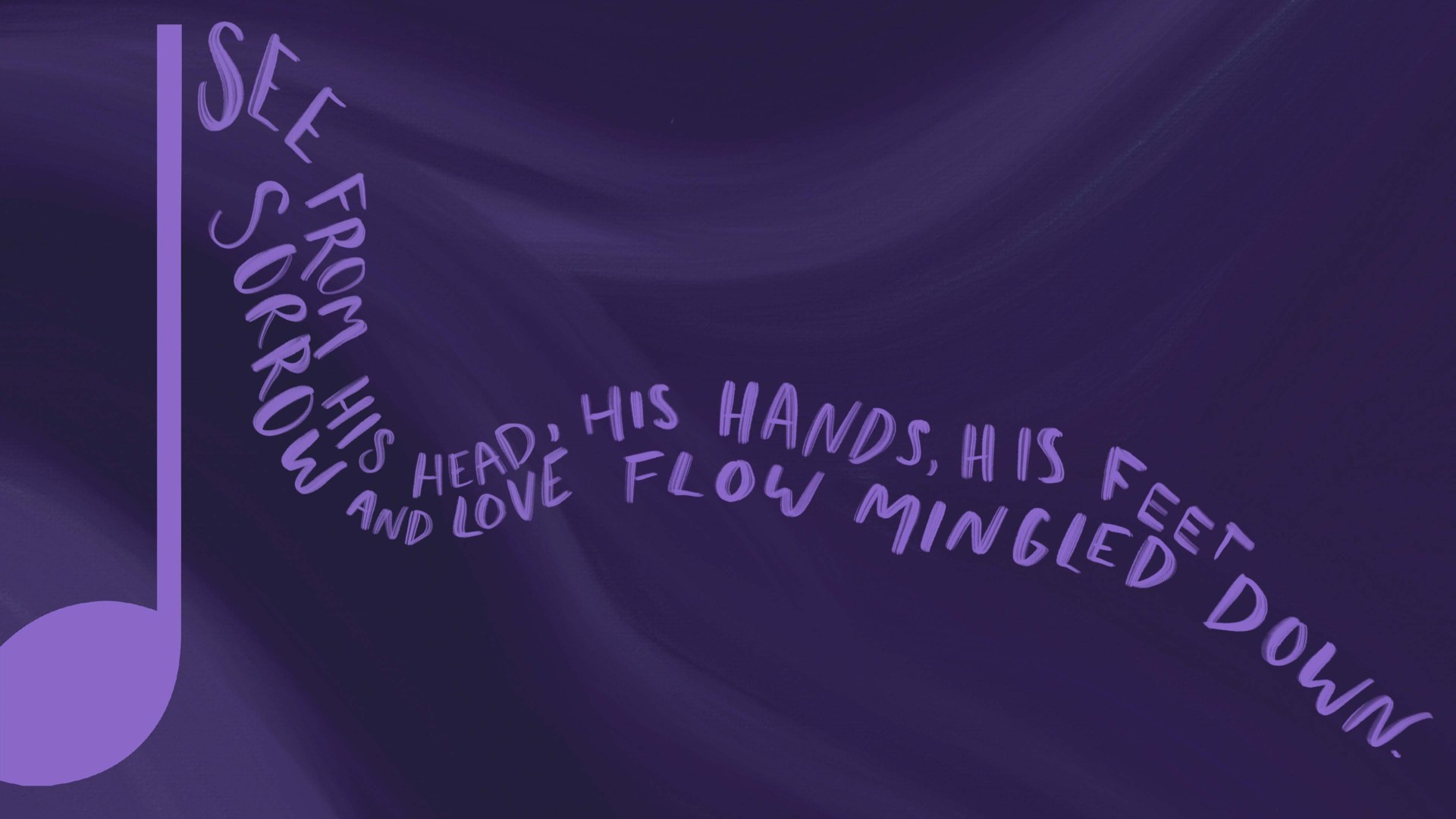
As our gaze begins to shift away from the deceptive gloss of earthly pleasures and toward the wondrous cross of Christ, and we see “sorrow and love flow mingled down,” we are faced with the question, “Did e’er such love and sorrow meet, or thorns compose so rich a crown?” And eventually, we’re compelled toward the reality that a “love so amazing, so divine, demands my soul, my life, my all.”

Secularism tells us that, ultimately, there is only life and death. It tells us that our lone option is to revel in the former before eventually and inevitably succumbing to the latter. And culture at large is at the ready, offering us endless temporary pleasures designed to keep our eyes fixed on shallow versions of the present. This is dangerous because, in the famous adage derived from a William Blake poem, “We become what we behold.” For the Christian, beholding the Cross is a way of breaking free from the morbid, nihilistic shortsightedness of secularism in order to live more fully into the hopeful, eternal story unfolding in the present and awaiting us in the future.

Reflecting on the death of her father, Flannery O’Connor wrote in her journal, “The reality of death has come upon us and a consciousness of the power of God has broken our complacency like a bullet in the side.” This is why Ash Wednesday is so powerful: We’re reminded not only of our certain demise but also, maybe more importantly, of what truly matters.

We’re reminded that all of this—delights and pleasures, life and breath—is ephemeral. It’s all hevel, in the language of the Ecclesiastical poet—vapor, mist, here and then gone. This is the gift we receive when we survey the Cross—the gift of an impeccable scale by which to measure, with precision and perspective, our values system, to consider what truly matters and what doesn’t.

My friend Gerry Breshears has spent decades pouring his life into church leaders as a seminary professor and as a pastor to pastors. This past fall, Gerry was diagnosed with cancer, not his first go around. He updated friends and family on this news with this reminder: “Jesus is in the present, look for Him. … He is easy to miss.” Though the future can seem chock-full of what ifs, in reality, the Cross has already written and finished the story. We know how this ends.

Gerry’s steadiness amid suffering comes from his cross-shaped vision for all of life and eternity—a vision I long to grasp and embody myself. It’s a vision acquired only and always through a deep and consistent contemplation of the Cross. It’s a vision that reveals to us that the crucified, resurrected, and ascended Christ is here, now, with us, guiding us toward a future where there are no more tears, death, mourning, crying, or pain (Rev. 21:4).

In the words of Paul in Romans 14:8–9, “If we live, we live for the Lord; and if we die, we die for the Lord. So, whether we live or die, we belong to the Lord. For this very reason, Christ died and returned to life so that he might be the Lord of both the dead and the living.” There is no fear, no anxiety, no doom and gloom. The Cross has erased all of that—this ancient instrument of death that has now become our great emblem of life and life to the full, both now and forever.

The poet George Herbert described how time (and mortality) was once “an executioner” but in light of Christ’s coming, “Thou art a gard’ner now.” We look upon the cross because it declares that death has been disarmed; it is no longer an executioner, ending our stories, but rather a gardener, tilling the fertile soil from which resurrection life rises. As we survey the wondrous cross, we come to know ever more deeply that “It is not the end. It is not even the beginning of the end. It is only the end of the beginning.”

Read

Galatians 6:14.

In your own words, what does it mean to

survey

the Cross? To

boast in

the Cross? How does the Cross put the rest of earthly life into perspective?

Jay Y. Kim serves as lead pastor at WestGate Church. He’s the author of Analog Church and the forthcoming Analog Christian. He lives in the Silicon Valley with his family.

This article is part of The Wondrous Cross which features articles and Bible study sessions reflecting on the meaning of Jesus’ death and resurrection. Learn more about this special issue that can be used during Lent, the Easter season, or any time of year at MoreCT.com/Easter.

Theology

’Tis Mystery All! The Immortal Dies!

How can we even begin to understand this astonishing, amazing love?

Illustration by Cassandra Bauman

When we sing praise to God, we often confess what we, in joy, know of the God we worship: God’s goodness and mercy, his glorious handiwork in creation, his gracious covenant with Abraham, his mighty and loving work in Jesus. We’ve been given knowledge of the Lord’s great acts that we offer back in praise.

And yet, when we consider the mighty works of God, the King who took on flesh, died, and rose again in Jesus, our praise can also recognize the limits of our understanding. In a posture of awe, we can admit that the God we worship is incomprehensible, that even in our knowledge, we are blinded by the mystery of God’s light.

This wonder is at the heart of our faith: The Holy God has taken on our flesh in Jesus Christ, who suffered, died, and rose for our sake. Our words are laughably inadequate in expressing the depths of this mystery, the mystery of God’s covenant faithfulness. Yet, in song, even our incomprehension can bow before the incarnate, crucified, and risen Lord, in awe of the mystery of his extravagant love.

Words of Wonder and Bewilderment

In his hymn “And Can It Be,” Charles Wesley (1707–1788) gives us a song that overflows with this form of praise, exaltation, and wonder. As the writer of thousands of hymns, Wesley displays an exquisite love for language that reflects the extraordinary acumen of his first teacher, his mother Susanna, who took joy in languages, including Latin, Greek, and French along with English. By the time of the writing of this hymn in 1738, the language of Scripture had been shaping Wesley’s imagination for many years. Wesley had even studied the church’s theology formally, leading to ordination in the Church of England in 1735.

Listen to “And Can It Be That I Should Gain” and the rest of the songs featured in

The Wondrous Cross

here:
MoreCT.com/EasterPlaylist.

And yet his faith and awe burst forth like a waterfall of energy through the lyrics of “And Can It Be,” reflecting the Spirit’s moving in his life anew just three days before his brother John said his heart had been “strangely warmed” in his famous encounter at Aldersgate Street. This hymn expresses old truths being perceived anew, amid surprise and astonishment. Indeed, Wesley’s words of faith are expressed in questions of “unbelief”—of incomprehension, amazement. How could this be true? How could the sacrifice of Christ apply not only to others but to me?

And can it be that I should gain
An int’rest in the Savior’s blood?
Died he for me, who caused his pain?
For me, who him to death pursued?

We do not approach Christ as innocent observers, but as sinners in need of deliverance. How could it be that, in Christ, we who made ourselves enemies of God become his friends?

And then, the song’s repeated underlying question—a vast and cosmic one—a question about the Incarnation and the Cross, about Christmas and Easter:

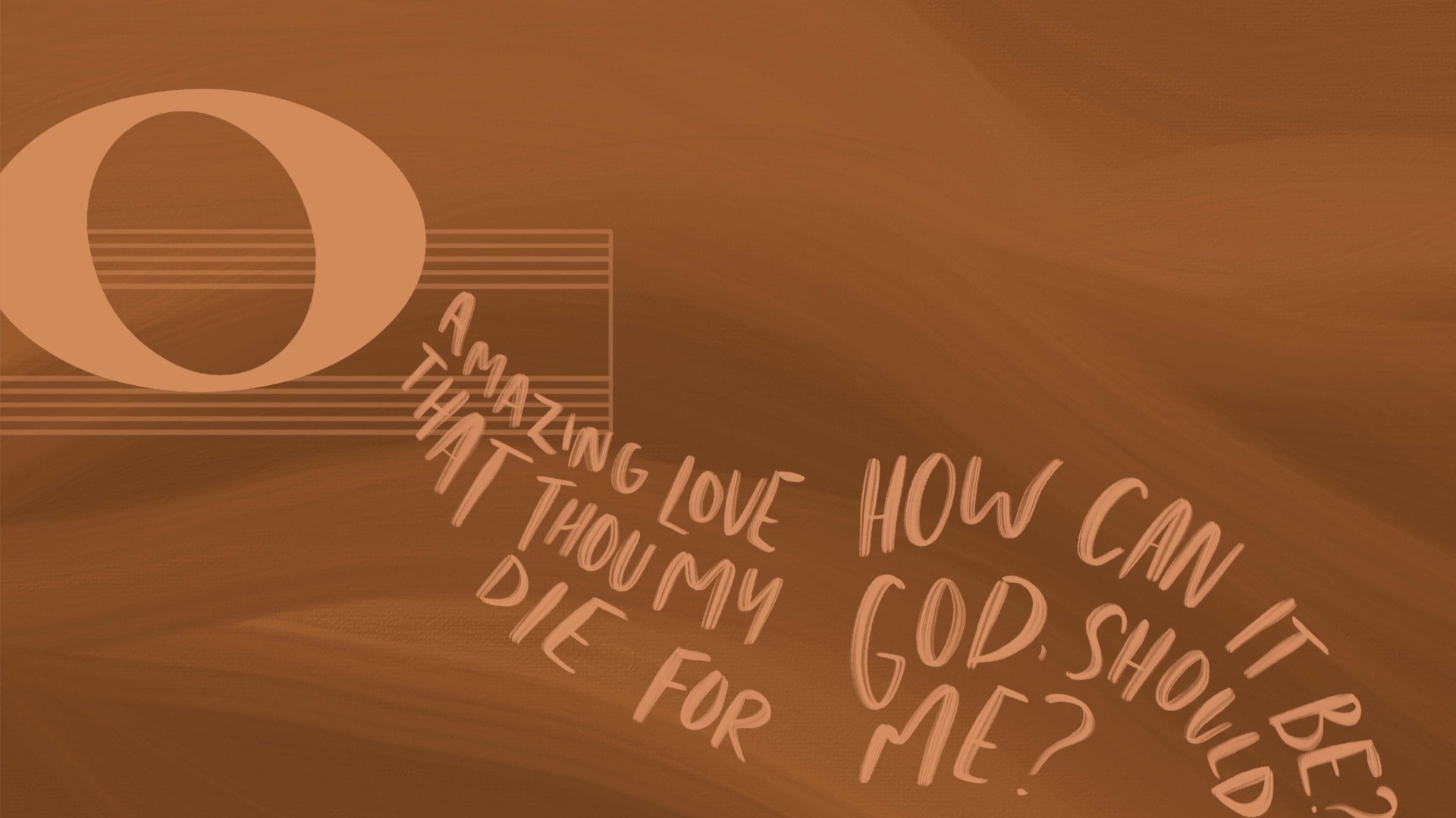
Amazing love! How can it be
That thou, my God, should die for me?

For many of us, this refrain has become so familiar that we may struggle to see how utterly shocking it is. As Psalm 90 confesses, in contrast to our short mortal lives, “Before the mountains were born or you brought forth the whole world, from everlasting to everlasting you are God” (v. 2). And in the words of the apostle Paul, it is God “who alone is immortal” (1 Tim. 6:16). It would be hard to find a more widespread biblical theme about this fundamental difference between God and creatures: God is everlasting. We are not.

This language of God dying for us sounds strange and may even seem scandalous. And yet, such language (referred to in technical terms as “the communication of properties” in the person of Christ), has an ancient history in the church. It was used not only by various church fathers, but also by John Calvin, Charles and his brother John Wesley, and many others.

A few years ago, a hymnal committee asked for me to act as a theological consultant to address concerns about some songs that they planned to include in the hymnal. “And Can It Be” was on the list. They wondered: How could it be biblical to sing, “That thou, my God, should die for me?” Isn’t it more proper to say that Jesus, our Savior, died? How could it be fitting to ask a question like this in a hymn’s refrain? Although such language has a long Christian pedigree, it’s a good question that brings us right to the heart of Wesley’s hymn.

He Came to Die

Wesley’s words approach the Cross from the standpoint of the Incarnation. While in Holy Week, as we may focus on particular moments in the days before Jesus was crucified, Wesley brings a wide-angle lens to remind us of something profound: that this cross-formed path that Jesus walked was taken up by none other than the Lord of the universe, the one in whom and through whom all things were made (John 1:3; Col. 1:16). Jesus’ cross was not a sideshow or ancillary to his calling. In a very real sense, he came to die.

I don’t mean this in a reductive sense, in a way that downplays the significance of Jesus’ preaching, his miracles, his friendships with sinners, or any other aspect of his ministry. But all of these fit within the larger context of God’s astonishing love in being willing to take on suffering and dying human flesh for our sake. The Cross itself discloses the way in which God’s extravagant love was on display in each moment of Jesus’ ministry.

When Jesus’ disciples discussed how they desired places of honor in the kingdom inaugurated by Jesus, he countered by telling them how his whole life, as the true Messiah and King, is shaped by a cross-formed love: “Whoever wants to become great among you must be your servant, and whoever wants to be first must be slave of all. For even the Son of Man did not come to be served, but to serve, and to give his life as a ransom for many” (Mark 10:43–45).

https://www.youtube.com/watch?v=mISbGETVr84&t=3s

The Book of Hebrews describes this reality in powerful terms. On the one hand, Jesus is the Son who “is the radiance of God’s glory and the exact representation of his being, sustaining all things by his powerful word. After he had provided purification for sins, he sat down at the right hand of the Majesty in heaven” (1:3). Yet the Son did not disclose his radiant glory and redeeming power from a distance. In his astonishing love, the eternal God took on mortal flesh and blood as his own to save flesh-and-blood mortals like us.

To bridge the alienation that disrupted God’s relation to creation, “he had to be made like them, fully human in every way, in order that he might become a merciful and faithful high priest in service to God, and that he might make atonement for the sins of the people” (2:17).

This loving act of God in the Incarnation and the Cross meets us not only in our sin, but also in our dying bodies, our flesh and blood. This is astonishing! Amazing! Indeed, because it was none other than God who took on human flesh in Jesus, he has pioneered the path in and through our most universal fear: death. “He suffered death, so that by the grace of God he might taste death for everyone” (2:9).

As church leaders in the fourth and fifth centuries discerned through sermons and debates that resulted in ecumenical creeds at Nicea, Constantinople, and Chalcedon, the Incarnation and the Cross are tightly intertwined. In the words of the fourth-century church father Athanasius, the eternal Word took on flesh because “in no other way would the corruption of human beings be undone except, simply, by dying.”

‘The Depths of Love Divine!’

Charles Wesley’s words are anything but careless and unbiblical. They are deeply theological. But to truly ask the question he poses—“How can it be that thou, my God, should die for me?”—is also personally shocking. It brings us to a place where our words fall short, where even poetry falls short. After the first time through the scandalous refrain, verse 2 circles this mystery with stark beauty:

’Tis mystery all! Th’ Immortal dies!
Who can explore his strange design?
In vain the firstborn seraph tries
To sound the depths of love divine!
’Tis mercy all! Let earth adore,
Let angel minds inquire no more.

Who can explain or understand this astonishing love? The immortal God makes death his own in Jesus? Can the highest of the angels understand this? No. But in wonder, we rightly adore this illuminating mystery: that our expectations of God's kingship are confounded by the Lord who makes the mortal life of a servant his own, who delivers us with a love that is beyond our understanding.

In our day, when we hear the word mystery, some of us think of an ominous type of “hiddenness”—perhaps the government, a political party, or a family member is hiding something from us, and thus there is a “mystery.” But Wesley’s acclamation, “ ’Tis mystery all!” could hardly be further from such a conception. This mystery is not deep darkness but blinding light—a love so great and deep that it is unfathomable. A sovereign King so deeply in love with rebels like us that he makes even death his own to defeat death’s final sting.

In this strange, cross- and resurrection-shaped victory, we discover a brother in our flesh who has pioneered a path through human suffering and even death. In the victory of his cross and resurrection, he secures what we could never grasp ourselves: freedom from slavery to the fear of death which so often holds us captive (Heb. 2:15). This is amazing love that bids our voices to sing. And also leaves us speechless.

Read

Mark 10:43–45

. What’s your response to Jesus’ description of his purpose? How do the questions and wonder expressed in Wesley’s song echo your own reaction to Jesus?

J. Todd Billings is the Gordon H. Girod Research Professor of Reformed Theology at Western Theological Seminary in Holland, Michigan. His most recent book is The End of the Christian Life.

This article is part of The Wondrous Cross which features articles and Bible study sessions reflecting on the meaning of Jesus’ death and resurrection. Learn more about this special issue that can be used during Lent, the Easter season, or any time of year at MoreCT.com/Easter.

The Stunning Humility of God

Jesus’ gruesome death didn’t happen randomly or accidentally. He knew very well what was coming his way.

Illustration by Cassandra Bauman

Many times I’ve stared at Titian’s famous painting “Christ on the Way to Calvary,” which depicts Simon of Cyrene as he helped Jesus carry the cross up the hill to Golgotha. In the painting, it looks as though there is some kind of communication happening between the two—Christ sorrowfully glancing up over his left shoulder and Simon gazing down with kindness at the face of Jesus. What would I have said were I in Simon’s shoes? Maybe it would have been something along the lines of “Ah, holy Jesus, how have you offended, that mortal judgement has on you descended?”

That’s Jesus right there

The other day, as I was driving my 12-year-old daughter Ruby to school, we saw a weather-beaten woman sitting at the top of the freeway exit, begging for money in the Albuquerque sun. I said to Ruby, “That’s Jesus right there.”

“What do you mean?” she asked. I explained how Christ continually identified himself with the downtrodden and marginalized in the world—with beggars, lepers, tax collectors, harlots, thieves—with the “least of these,” according to the society of his day. She still looked at me quizzically. Thrilled to have gained her attention on the subject, I said, “The humility of God is a pearl of great beauty in this desolate world.”

Afraid I might lose her attention, I found myself awkwardly blathering on about the world and its mad lust for fame, influence, riches, stature. I talked about the Kardashians, Donald Trump, Joe Biden, Kim Jong Un, Elon Musk, and other influencers and powerful figures who are on Ruby’s radar. I described how the life Jesus led was in the sharpest contrast to the values of the most influential people living in his day and in ours. Then we talked about the humble and beautiful way in which God became a man and the shocking humiliation of the way he died.

Perfect humility

“This will be a sign to you: You will find a baby wrapped in cloths and lying in a manger” (Luke 2:12). Jesus—the Messiah, the King of Kings, the Lord of the universe—entered into this world through a human birth canal. He was covered in blood and afterbirth then wiped clean by tender, though perhaps clumsy, hands. Too weak and undeveloped to lift his own tiny head, the creator of the stars was held up to his mother’s breast so that he could drink his first meal. He who created all things was now utterly dependent on Mary and Joseph, whom Jesus himself had breathed into existence! It’s a striking image to ponder. The birth of Jesus is a stunning and glorious moment in the history of this cold, calloused world.

The death of Jesus is stunning, too—the humility of God again fully on display, but under the most brutal and savage of circumstances. Consider the prophetic description in Isaiah 50:6–7:

I offered my back to those who beat me,
my cheeks to those who pulled out my beard;
I did not hide my face from mocking and spitting.
Because the Sovereign Lord helps me,
I will not be disgraced.
Therefore have I set my face like flint,
and I know I will not be put to shame.

Titian’s painting poignantly portrays the exhaustion and agony in Jesus’ eyes as he props himself up on a stone embedded in the hard ground. Simon’s visage is tender and compassionate. I imagine however, that the painting does little to accurately depict the unbearable agony that was physically taking place in his tortured body at that moment in Jesus’ slow, brutal march up that hill.

Listen to “Ah, Holy Jesus, How Have You Offended” and the rest of the songs featured in

The Wondrous Cross

here: MoreCT.com/EasterPlaylist. You can also watch Ortega and other contributors discuss their articles in this webinar.

When we sing the hymn “Ah, Holy Jesus” by Johann Heermann every year at our church’s Tenebrae service on Good Friday, it has a unique way of casting me as a Simon-like character in a Passion play. I feel as though I’m walking right next to Jesus and asking him these rhetorical questions as he takes the final steps toward his crucifixion. Who did this to you, Lord? Why are they doing this? What have you done wrong?

Of course, the questions are devastatingly answered in the second verse of the hymn with these words that are almost unbearable to sing:

’Twas I, Lord Jesus,
I it was denied you,
I crucified you.

My daily rejection of the sovereignty of Jesus in my life comes painfully into focus—my moment-by-moment insistence that I’m the one who determines the trajectory of my life. Yet here I am, caught up in the pathos of this extraordinary hymn. My own needy, imperfect humility becomes intimately commingled with the perfect humility of Jesus as we continue the grueling walk up the hill.

No one takes it from me

The third verse of the hymn is now given perfect context. It is a confession, an acknowledgement, that the congregation sings together:

For me, dear Jesus,
Was your incarnation
Your mortal sorrow
And your life’s oblation;
Your death of anguish
And your bitter passion,
For my salvation.

Like many parents, sometimes I imagine what it would be like to have to step into harm’s way in order to protect my daughter Ruby from danger, to save her from being injured or killed. I would gladly do it in a heartbeat. I would not hesitate. But if I were asked to do something like that for a stranger, let alone for an angry group of people who were mocking me, taunting me, swearing at me, and shouting their hatred for me, it would be a radically different story.

Yet, the vast, immeasurable, unsearchable, perfect love of Jesus welled up in him in the very climax of his agony, and he called out to God and said, “Father, forgive them, for they do not know what they are doing” (Luke 23:34). Then Jesus died and darkness fell over the earth.

Jesus’ gruesome death was not something that happened randomly or accidentally. It was not simply that an innocent man was savagely tortured and nailed to a cross because he happened into the wrong place at the wrong time. Jesus knew very well what was coming his way after his arrest in the Garden of Gethsemane, and this is what he’d already said of the matter: “The reason my Father loves me is that I lay down my life—only to take it up again. No one takes it from me, but I lay it down of my own accord. I have authority to lay it down and authority to take it up again” (John 10:17–18, emphasis added).

Jesus came into this world in meekness, tenderness, and humility. Even though he was spotless and without sin, he willingly suffered to die a death that was reserved for the very vilest of vile criminals. Philippians describes Jesus’ “death on a cross” with these simple words: “He humbled himself” (2:8).

Our prayer

I don’t know what Simon felt or understood the day he was forced to help carry Jesus’ cross, though it’s hard to believe that it left him unmoved. Scripture and tradition hint that he and his family may have become part of the early church. When I imagine myself in the scene in Simon’s place, knowing what I know about the meaning of Jesus’ humiliation and willing sacrifice as he climbed the hill to Golgotha, my ardent and passionate response echoes the love and commitment expressed in the prayer that concludes our hymn.

Therefore, dear Jesus,
Since I cannot pay you,
I do adore you
And will ever pray you,
Think on your pity
And your love unswerving,
Not my deserving.

“Ah, Holy Jesus, How Have You Offended?” is a hymn that requires a bit of work to sing with integrity. The text beckons us to concentrate with mind and with soul and to bravely enter into its narrative, to look full upon Jesus’ humiliation, and to be comforted by the transcendent kindness and mercy of our Lord.

Read

Luke 22:63–65; 23:26–37.

Picture these events in your mind’s eye and imagine Jesus’ suffering. What does it mean to you that he endured this willingly, out of his love for us? How do you desire to respond?

Fernando Ortega is a composer, pianist, and vocalist based in Albuquerque. His albums include The Crucifixion of Jesus and Come Down O Love Divine.

This article is part of The Wondrous Cross which features articles and Bible study sessions reflecting on the meaning of Jesus’ death and resurrection. Learn more about this special issue that can be used during Lent, the Easter season, or any time of year at MoreCT.com/Easter.

addApple PodcastsDown ArrowDown ArrowDown Arrowarrow_left_altLeft ArrowLeft ArrowRight ArrowRight ArrowRight Arrowarrow_up_altUp ArrowUp ArrowAvailable at Amazoncaret-downCloseCloseellipseEmailEmailExpandExpandExternalExternalFacebookfacebook-squarefolderGiftGiftGooglegoogleGoogle KeephamburgerInstagraminstagram-squareLinkLinklinkedin-squareListenListenListenChristianity TodayCT Creative Studio Logologo_orgMegaphoneMenuMenupausePinterestPlayPlayPocketPodcastprintremoveRSSRSSSaveSavesaveSearchSearchsearchSpotifyStitcherTelegramTable of ContentsTable of Contentstwitter-squareWhatsAppXYouTubeYouTube