Theology

Can a Podcast Fix Your Bible-Reading Habits?

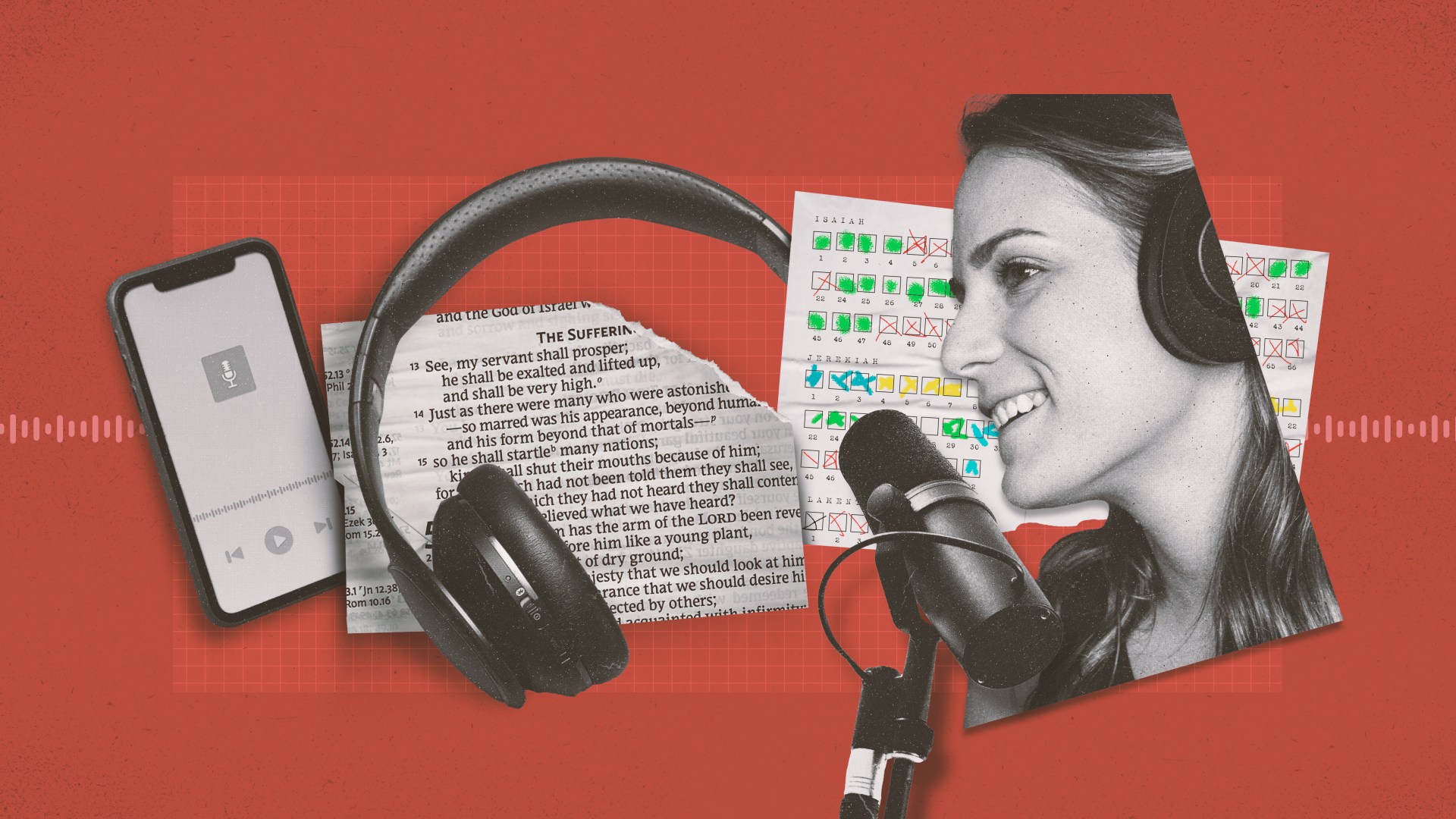
The Bible in a Year and The Bible Recap started 2022 as the most popular podcasts and have held onto listeners verse by verse.

Christianity Today March 8, 2022
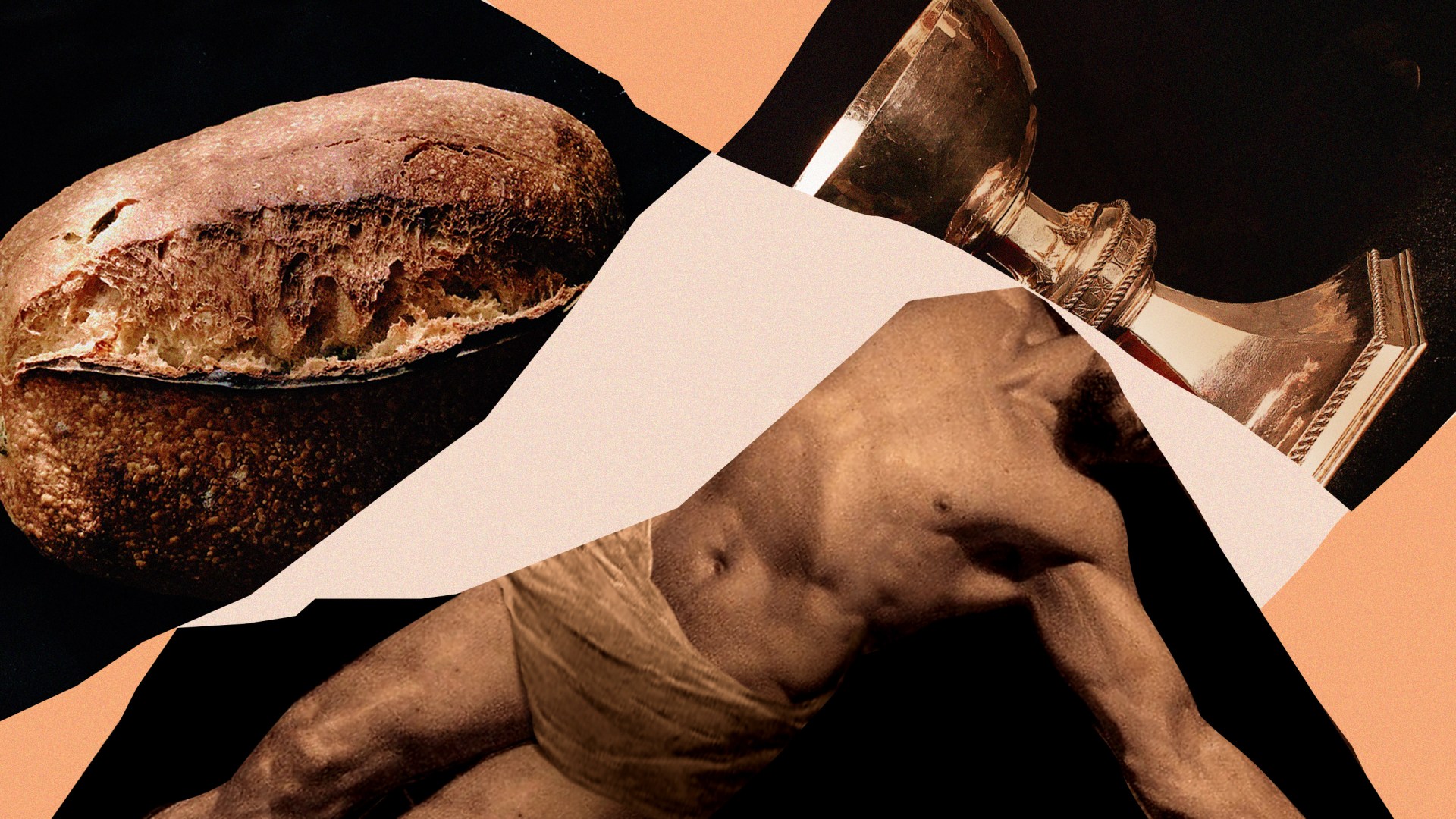
Illustration by Rick Szuecs / Source images: Soundtrap / Thom Bradley / Tim Wildsmith / CDX PDX / Jon Tyson / Unsplash

The Bible is the best-selling book of all time, but in a new technological era, podcasts about the Bible are topping charts as well.

Two podcasts geared toward reading the Bible in a year swiped the No. 1 and No. 2 spots on Apple Podcasts January 2022, as Christians restarted their Bible-reading plans.

The Bible in a Year with Father Mike Schmitz has taken the top podcast spot for the past couple Januaries, and The Bible Recap with Tara-Leigh Cobble ranked second this year. But their sustained popularity and the proliferation of Bible podcasts reveal something deeper than an annual resolutions bump.

During the pandemic, when people are reassessing priorities and picking up new rhythms, the podcast platform is offering believers another way to get in the Word and study alongside a community of listeners.

Cobble, who lives in Dallas, is the founder of D-Group, which organizes small group Bible studies focused on discipleship. As a next step in her mission to keep the Bible front and center for Christian discipleship, she started The Bible Recap four years ago.

The podcast came out of her own love for Scripture and a desire to help others “overcome any obstacles that keep them from reading, understanding, and loving God’s Word,” she told Christianity Today. It’s been downloaded more than 80 million times.

The Bible Recap is a chronological journey through the Bible. Each day, there is a reading assignment for listeners to complete on their own and a podcast episode where Cobble—in about eight minutes—breaks down Scripture, often zooming in particularly confusing passages. The episodes end with a “God shot,” where Cobble delivers what she calls a “snapshot of God and his character.”

“It’s not a deep theological dive, but just a five-minute breakdown of what I read,” said Jerri Ann Henry, a listener in Washington, DC. “What makes it work for me is that it’s tied to my Bible reading and makes things short and simple.”

In addition to the podcast, followers can join Cobble on Patreon, paying monthly for extras like transcripts and a short prayer podcast (The Bible Kneecap). Nearly 10,000 patrons from around the world support the community today.

“I’ve been blown away by the wide range of people I’ve met who do The Bible Recap,” Cobble said. “From five-year-olds who listen with their moms to 95-year-olds who listen on their desktop computers to a Hindu student at a university in Mumbai.”

If listeners keep up with the daily readings and episodes, they will finish the full Bible in one year. Cobble plans to keep doing the podcast each year, adding updates and revisions along the way: “There’s always something new to learn about God.”

Cobble is currently reading through the Bible for the 15th time. She says the more she repeats the cycle, the more she wants to continue reading.

“The things we think about change our lives, the things we learn about change our minds, the relationships we build with God change our hearts,” she said. “Even at eight minutes a day, people attest to the fact that their hearts are falling deeper in love with God as a result of listening to this short podcast.”

Reading the Bible in a year is a goal for many Christians, but the success rate is low. According to Lifeway, only 11 percent of Americans have read the entire Bible. And yet, there is good news: The American Bible Society’s 2021 State of the Bible report found 24 percent of adults reported reading Scripture more frequently last year than they had the year before.

The report’s authors noted that as more Americans engage Scripture for the first time, “these new Bible explorers often find the Bible difficult to navigate and understand … they will also need relational guides to help them and digital tools to improve their access to Scripture.”

More than half of Bible readers under 40 prefer the Bible in app, digital, or audio format, the 2021 report found, with about a quarter of all Bible readers saying an app was their first-choice medium and 8 percent saying audio. Apps and podcasts have made it more accessible than ever to listen—no need to make your way through a stack of tapes or CDs to hear a book of the Bible.

In some ways, Bible podcasts are a callback to a time before written text was widely available and Scripture was read aloud. Meditating on Scripture with others, through podcasts, creates a new devotional experience—one that may be “stickier” and more appealing to auditory learners or inexperienced readers.

“It’s helpful to remember that for the bulk of human history, this is how people consumed Scripture,” said Cobble. “Because most didn’t have access to a Bible, and even if they did, most people couldn’t read.”

The popularity of Bible podcasts follows more accessible audio Bible features through Bible apps like YouVersion and Dwell, which have brought Scripture to our headphones, where we can listen as we commute, walk, or do chores. The podcast form adds an additional degree of structure, with a host as a guide to offer commentary and pacing out the passages in a manageable way.

Listeners can also speed up or slow down the audio to meet their individual needs for listening. Listening also embeds people in a community of other fans who are following along with the same passages each day. Because the episodes land each morning in subscribers’ feeds, listening becomes an easy, practical habit.

In his book, Habits of the Household: Practicing the Story of God in Everyday Family Rhythms, Justin Whitmel Earley writes about the power of ritual in shaping our spiritual lives. Mornings, he says, are one of the most important times to form habits—things like prayer, Scripture reading, and gratitude. Though phones can be a distraction from spiritual formation, they can also be used in positive ways.

“It’s ironic I listen to Scripture on my phone while ignoring my phone,” wrote Earley, meaning he shuts off social media and email while listening to the audio Bible. “Redeeming our use of technology is much less about banishing it than cultivating the patterns of using it well.”

Ascension Press, the Catholic publishing company that produces Bible in a Year, never expected the incredible success it’s seen.

“Our very modest goal was to place near the top of the Religion & Spirituality charts,” said Marisa Beyer, associate general manager of media at Ascension. “We were completely stunned when the podcast shot to the No. 1 spot on Apple Podcasts in all categories when it launched in January 2021.”

As of January 2022, Bible in a Year had seen 125 million downloads and had 3 billion minutes of total listening time. Unlike the shorter Bible Recap, Father Mike Schmitz reads through the passages of the Bible and includes commentary, reflection, and prayer for episodes of about 25 minutes each day.

Whitney Athayde listened through Bible in a Year in 2021 and said it helped her finally finish the entire Bible for the first time.

“Father Mike is filled with the Holy Spirit,” said Athayde. “It was just enough context and encouragement to motivate me and keep me going. Athayde said that even though she’s Presbyterian, not Catholic, the podcast still resonated, and was accessible, to her.

The Bible in a Year Facebook group has over 100,000 members, and Ascension hears testimonies from listeners who returned to church, broke free from addiction, or reconciled with family members as they followed along with the podcast.

“Most importantly,” Beyer said, “people are learning to truly hear God's voice in Scripture, and that brings us such joy.”

Other Bible-focused podcasts are drawing in the Bible-curious. The Bible Project podcast, for example, lasers in on particular themes to study in Scripture. For the past seven years, the project’s cofounders Timothy Mackie and Jonathan Collins have made connections through the broader story of Scripture and talked through difficult questions in the text.

They discuss the Bible as friends, with Mackie speaking as the Bible scholar and Collins as the creative storyteller.

“Because you’re listening to real people explore a topic in an unscripted way, it’s a learning environment that feels less intimidating and more engaging than taking a class or reading a book,” said Mike McDonald, chief global focus and strategic relationships officer at The Bible Project.

The ministry also offers videos, classes, and other resources, but the podcast has drawn people in with how it mirrors “the way biblical authors often used repeated words and patterns to help listeners connect what they are hearing to other parts of the scriptural collection,” McDonald said.

He too noted that podcasts harken back to ancient days when Scripture was read aloud, prayed over, and meditated on in a large group. The Bible Project’s new app, launched this year, includes an annotated podcast experience that highlights key biblical passages from the episodes and give space for listeners to pause and dig deeper on their own.

“Our goal is that the podcast, videos, resources, and app experience become a motivator for people to pick up a Bible and learn how to read and meditate in their own communities,” said McDonald.

For those not quite ready to study on that level, another Bible podcast is sparking interest from the faith-curious. The Bible Binge, hosted by Jamie Golden, Knox McCoy, and Erin Moon, highlights Bible stories in a more casual way. The hosts, who are Christian, say their pop-culture-saturated approach isn’t “out of disrespect, but in an effort to better understand the stories.”

The show isn’t a read-along and instead offers episodes focused on Bible characters like Joseph and Job as well as discussions on faith topics and Christian culture (like “Jesusween” and Hobby Lobby). Golden said she’s surprised by the number of listeners who were not previously engaged with the Bible or a church community. “We have found all these people who have either left the church or never been a part of one,” Golden told CT. “I’m a firm believer that the Word never returns void, because people have heard these stories and been moved by them.”

Like The Bible Recap, The Bible Binge has a Patreon upgrade. Listeners can also join the Bible Binge Seminary, a community of over 2,700 people who pay $5 a month for extra content like ad-free episodes, Q&As, and a book club. Golden said the “seminary” includes a wide variety of people, from Christians to Jews to Muslims, ranging in age from their 20s to their 60s.

With over six million downloads of The Bible Binge, it’s clear there is a hunger for the content, though Golden asserts there are no overarching goals for evangelizing.

“We can be the people that are watering a seed someone else has planted, or maybe we’re planting a seed, holding it loosely,” she said.

“Because we’re not connected to a church, it doesn’t feel like there’s an agenda there. I think it’s fueled a lot of people finding something they could hold on to.”

Ericka Andersen is a freelance writer in Indianapolis and host of the Worth Your Time podcast.

News

Ministries Evacuate as Russians Reach Irpin, the Evangelical Hub of Ukraine

Churches in the “Wheaton of Ukraine,” a suburb of Kyiv, help residents escape war as one member gives his life to save a fleeing family.

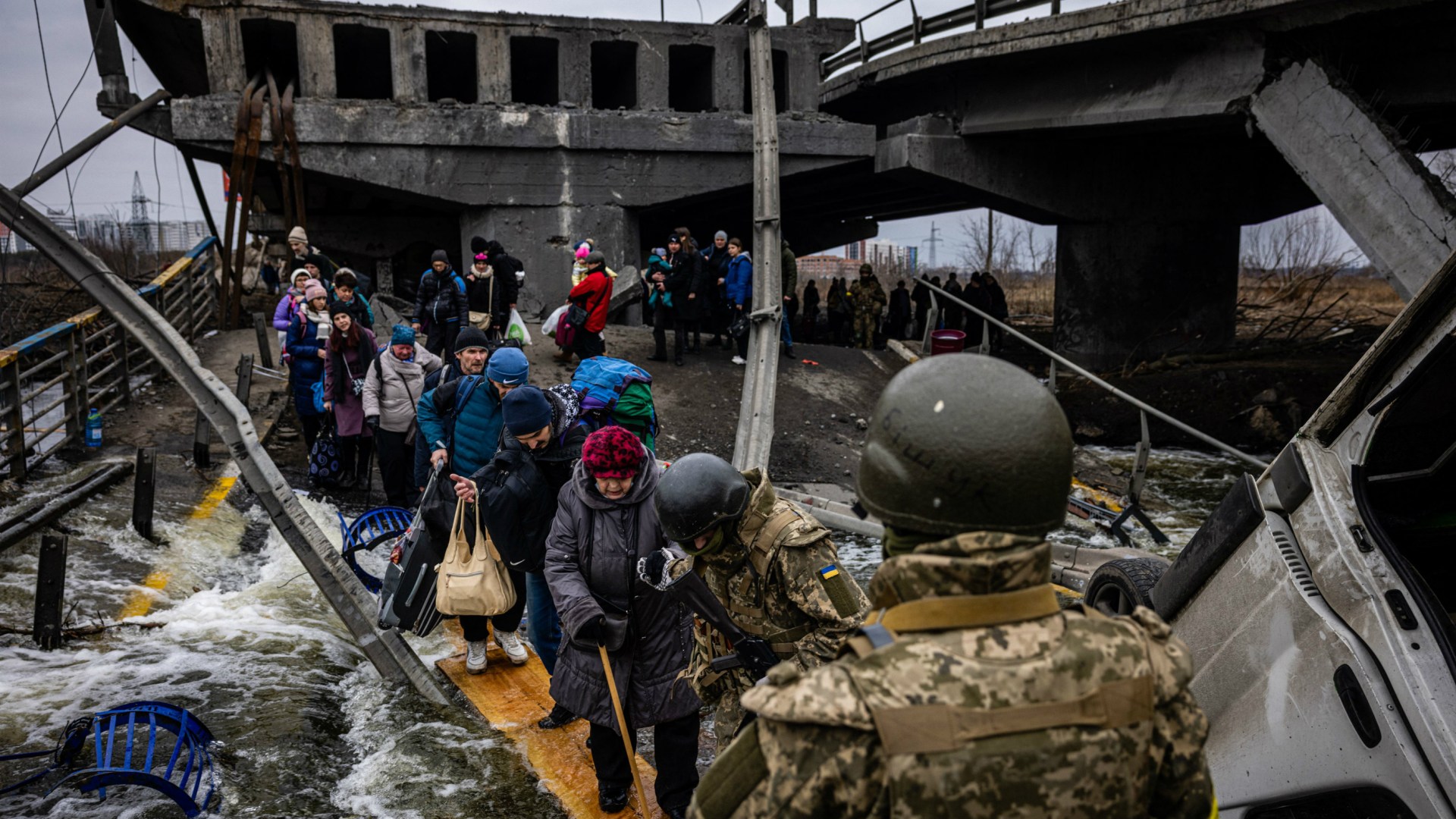
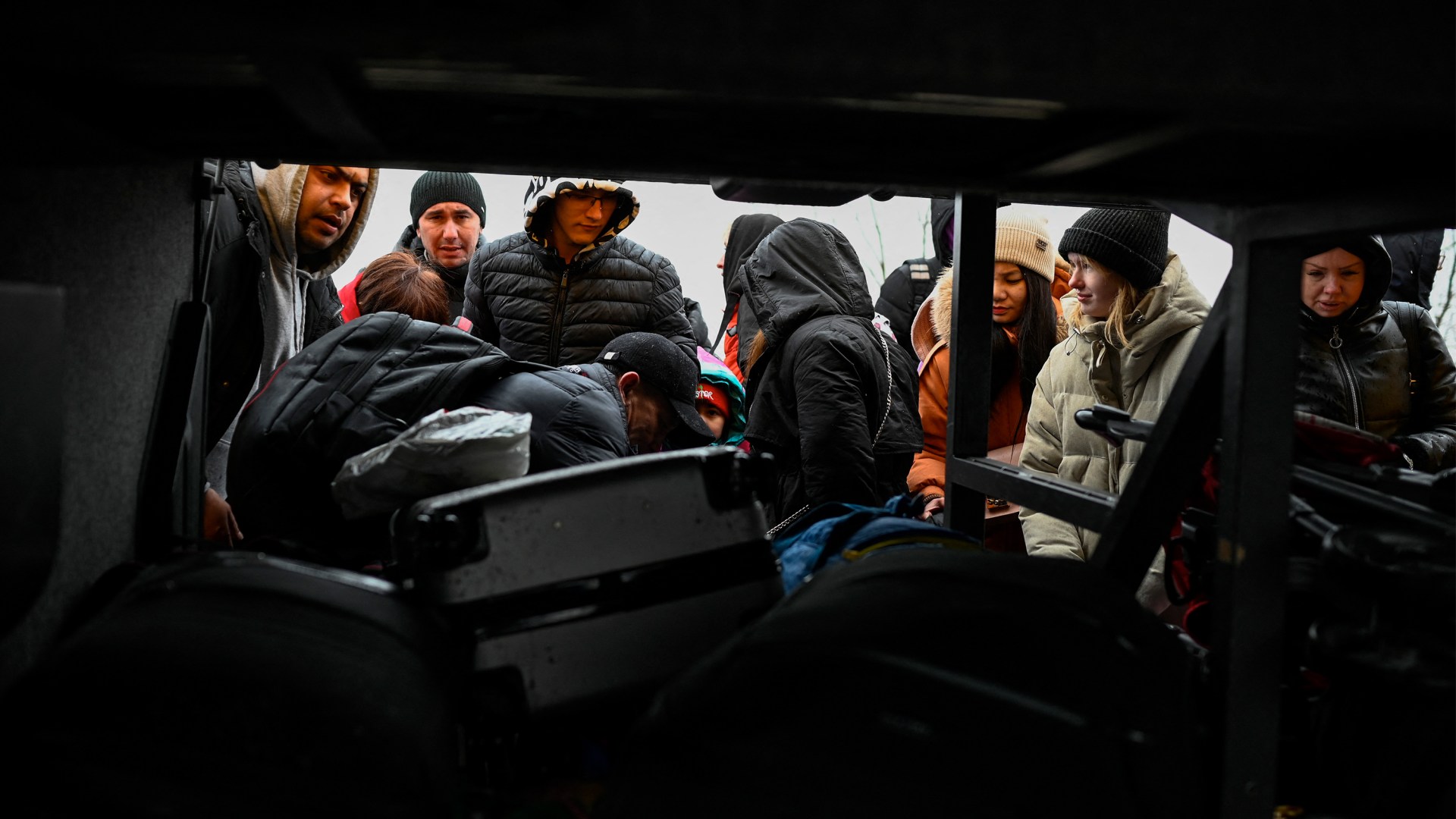
Evacuees cross a destroyed bridge as they flee the city of Irpin, northwest of Kyiv, on March 7, 2022.

Evacuees cross a destroyed bridge as they flee the city of Irpin, northwest of Kyiv, on March 7, 2022.

Christianity Today March 7, 2022
Dimitar Dilkoff / AFP / Getty Images

Anatoly, a 26-year-old member of Irpin Bible Church (IBC), is with the Lord.

His last act on earth was to carry the suitcase of a young mother and her two children, hurrying them across Irpin’s collapsed bridge to safety from Russian shelling.

All four died, when a bombshell landed in the middle of their would-be humanitarian corridor. Eight total died in the suburb of Kyiv yesterday, as Russian troops pressed hard to encircle the Ukrainian capital.

“Anatoly was deeply spiritual, with a good Christian character,” said his pastor, Mykola Romanuk. “When he saw a need, he tried to help.”

Negotiations over the weekend led to several ceasefires for civilian evacuation, only to be quickly broken. Each side blamed the other, and Russia has denied targeting civilians.

But Ukrainian sources describe cities now littered with bombed schools, hospitals, and residential districts—not least in Irpin, known in evangelical circles as the “Wheaton of Ukraine.”

After the fall of the Soviet Union, Ukraine’s “evangelical patriarch” Gregory Kommendant invited Christian ministries to join him in his hometown, 16 miles northwest of the capital, where he served as president of the All-Ukraine Baptist Union.

As of a few days ago, about 25 ministries operated out of Irpin, including Child Evangelism Fellowship, Youth With a Mission, Youth for Christ, the International Fellowship for Evangelical Students, and Samaritan’s Purse.

Once home to a single evangelical church, Irpin now boasts 13.

“We were here for 20 years, and neighbors never set foot in our church,” said Romanuk. “Now they are living in our basement, praying with us, and have become our friends.”

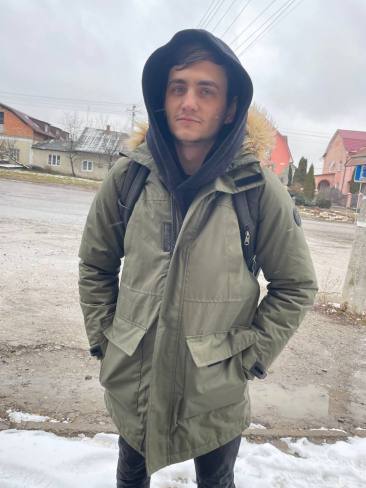
Anatoly, a 26-year-old Ukrainian Christian, was among the civilians who died in Russian attacks on Sunday.

Describing Irpin as “secular,” Romanuk described his 700-member Baptist congregation as the largest church in the city of 60,000 people. But now, only a team of five remain, called to stay behind and minister to those under siege.

Led by the head of the missions committee, a deacon’s wife—a real estate agent—is the chief cook. She prepares three meals a day for 200 people, as others volunteer to evacuate the shellshocked citizens to western Ukraine.

Since the war began, the church has transported 100-200 evacuees every day, Romanuk said. As the Russians approached, they bused out 3,000. Early on, the government took notice of their efforts and thereafter directed everyone to the church.

Anatoly was one who returned.

Originally from Luhansk in the Donbas region, he began attending Irpin Bible Church in 2020, becoming a member last year. An IT professional in a local company, he served in media ministry with Romanuk’s son.

After evacuating his wife Diana and other family members to safety in the west, he joined the church’s skeleton crew on Friday. The shelling began in earnest on Saturday, and they hustled out as many people as they could, crossing the bridge the Ukrainian army had damaged to slow the Russian advance.

On Sunday he went missing. Friends worried, prayed, and scanned social media for photos of the dead. They saw his sneakers in one, his sweater in a second. A few minutes later, the third photo revealed his face.

“We miss him very much, it is a tragedy for his family and the church,” said Romanuk. “God has a plan beyond our understanding, but it is difficult.”

Igor Bandura, a fellow pastor at IBC, is now counseling Anatoly’s brother, in Lviv. Deep in grief, he is trying to find someone to take the reverse journey, 335 miles back east to Kyiv, for the funeral.

“We had to leave everything behind. Some of us did not even have time to take the necessary clothes with us,” said Bandura, vice president of Ukraine’s Baptist Union. “We don’t know what fate has befallen our homes. We don’t know if there will be a place to come back to.”

At least there is a way back in. The nearby suburb of Bucha—home to the president of Ukrainian Evangelical Theological Seminary (UETS) in Kyiv—is completely under Russian control.

But Ivan Rusyn refuses to evacuate.

“This war has completely redefined my understanding of mission and holistic ministry,” he said. “You cannot show compassion from a distance.”

Rusyn and his seven remaining colleagues coordinate relief from the offices of the Ukrainian Bible Society, where he sleeps at night on the floor.

The seminary is now only 1,000 feet from the front lines.

Evacuated on Friday, today UETS sent the final nine of 300 faculty, staff, students, and family members to safety in the western part of Ukraine. But each day his team sends a bus to Irpin with daily food, water, and medicine.

“It is a catastrophe,” he said. “There is fear in the eyes of the children.”

Tearing up from the experience, Rusyn said he carried the disabled on his shoulders to reach the evacuating buses. But then he spoke of his joy, seeing the smiles on Ukrainian soldiers who know that the prayers of pastors and priests remain.

“Our commitment is that no one here will be left hungry,” he said, promising to stay in the capital as long as President Volodymyr Zelensky. “Christian leaders that remain in Kyiv and other cities are the incarnated witness of Jesus Christ.”

But it is felt elsewhere, too. Care for the 1.7 million refugees is being given across Eastern Europe. Many have given up their beds, said Sergey Rakhuba, president of Mission Eurasia, and are now sleeping on mattresses.

“I’m devastated, tired, and overwhelmed,” he said, currently supervising work in Poland. “My heart has broken into a million pieces.”

But his organization was also based in Irpin, and the 12 staff members who remain in Ukraine have reorganized in two western cities.

There is a catastrophic shortage of medicine, he said. But an even greater need for pastoral care.

“I asked for their prayer requests,” Rakhuba said, recalling with tears. “The refugees mention their husbands, their fathers, and their sons—and when they hug you, they don’t let go.”

Born in Donbas, he married his Russian wife in 1983 and lived in Russia for the next 15 years. He often heard them call Ukrainians “brothers.” Mission Eurasia relocated to Ukraine from Moscow in 2007, due to government pressure against foreign influence. But today’s complete change in spirit is jarring, and makes him think of the demonic.

“Irpin became a spiritual capital,” Rakhuba said. “Alongside the military aggression, now it is a place of spiritual warfare.”

Mark Elliott, editor emeritus of East-West Church Report, once was on the faculty at Wheaton College—and watched the American evangelical relocation to Colorado Springs. The comparison to Irpin was obvious, especially once ministries started coming from Moscow.

“It was both a push and a pull,” he said. “Increasing Russian restrictions facing non-Orthodox believers and institutions, over against the robust religious tolerance of Ukraine.”

For 70 years the nation was under the bondage of Soviet communism, Rusyn said. But the church used well the 30 years of freedom that followed. If it is not protected now—he calls for a no-fly zone to be imposed—its loss will sour the taste of freedom for Western friends who are doing their best to help, but whose governments stop short of full involvement.

“We preached the gospel, we sent missionaries, we haven’t harmed anyone,” he said. “Our message to the Russians is just leave us alone.”

Zelensky has called for a more robust sanctions plan—even a full embargo.

The weekend’s damage has been far wider than Irpin.

In Mariupol, where an estimated 200,000 people are trying to flee, one of the few buildings remaining intact is Central Baptist Church. Built in the early 1990s, the founding pastor’s daughter said people originally complained that the basement was too big.

Yesterday, as shelling closed a negotiated corridor, over 75 people gathered below for Sunday worship.

https://twitter.com/eric_costanzo/status/1500589430742163457

Less fortunate, reported pastor Vyacheslav Voronin to Taras Dyatlik, Overseas Council regional director for Eastern Europe and Central Asia, was the Baptist congregation in Izyum, established in 1998. Located near the fighting in the region of Kharkiv, the church served the displaced until it was hit last night by a Russian shell and caught on fire. Most families are now evacuating to western Ukraine.

And in the seaside port of Odessa, Alexander Boichenko returned after evacuating his family to continue serving in his church’s disaster relief center. Three weeks ago, they were planning the June wedding of their daughter.

“My wife leaned in and whispered quietly, ‘Might this be forever?’” he said. “I smiled at her comfortably, but my soul burst into tears.”

His work is not in vain. Ukrainian sources are all clinging to God.

“The most important task for the church right now is to continue preaching,” said Rakhuba. “Churches have become a lighthouse of hope.”

This is despite the “brutal and inhumane” aggression of the Russian army, whose tanks are pressing toward Kyiv, said Bandura.

“But we pray and work—with hope and faith—that God will prevail,” he said, “and reveal his glory in Ukraine.”

The significant damage does not deter them.

“We might lose our campus, but after a conflict there is a chance to build anew,” said Rusyn. “Evangelical churches will become stronger and an integral part of our society.”

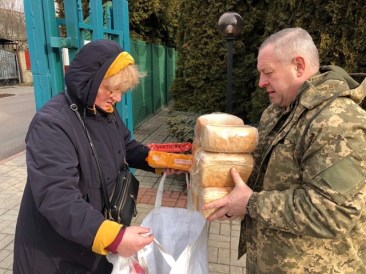
Staff from the Irpin Bible Seminary distribute bread to refugees and those at a local hospital.

The scattered believers will do what they can.

Irpin Bible Church had 67 small groups before the war, said Romanuk. His pastoral team will contact each member, and offer whatever help possible.

But then he will encourage them: Each one should form a new small group, wherever they are, and join the local evangelical church.

Today, however, he evacuated also. Headed west to his family in Lviv, his Google calendar notification reminded him a 400-person pastoral conference was about to begin back in Irpin.

“God has given us a new ministry,” Romanuk said. “Our conference is now with the homeless, the handicapped, and the nonbelievers of our town.”

News

Moldova Welcomes 100K Ukraine Refugees, With Evangelicals Opening Doors

The neighboring country focuses on hospitality while hoping Russian violence doesn’t cross its border.

Christianity Today March 4, 2022
Nikolay Doychinov / Getty Images

Eugen Cozonac has spent the past week focused on refugees.

More than 112,000 have crossed Ukraine’s southwestern border into his home country of Moldova, a landlocked nation that’s not much bigger than the state of Maryland. As a cabinet-level director within the government, Cozonac arranged facilities to receive donations and house refugees—everywhere from exhibition halls and sports complexes to film studios and resorts.

As he worked on Tuesday, his cellphones pinging from companies and volunteers, Cozonac paused to remember a certain group of refugees who had come to the capital city of Chișinău to escape an invasion from Russian-backed fighters: his own family.

It was on March 2, 1992—30 years ago to the day—that the Transnistria War erupted in the area now along the Moldova-Ukraine border. Cozonac was a kid at the time, fleeing with his parents and brother. Their house was bombed.

Like fellow Eastern European neighbors and the rest of the watching world, the people of Moldova did not expect the recent Russian invasion of Ukraine to happen so suddenly, to send a million people from their homes in just a week. But they have long known the threat from Russia.

On Wednesday, Moldova applied for membership into the European Union (Ukraine and Georgia have as well), and its president reiterated a call for Russia to withdraw the 1,000-plus troops that have remained in the country since the war three decades before.

Amid the escalating violence and the steady demand for humanitarian aid, Cozonac said he’s been able to stay focused in part because of his experience as a refugee and the faith he discovered then. During his family’s displacement, Cozonac started reading a children’s Bible and attending church. Now, he says, “I have a sense that I’m in the right place at the right time, in God’s providence.”

Evangelicals have also kept focused on what they can do to serve the initial wave of refugees—about half of whom are passing through on their way to Romania and half of whom need to stay longer. The demand for assistance has taken their minds off their grief over Ukraine and the possibility of violence coming their way.

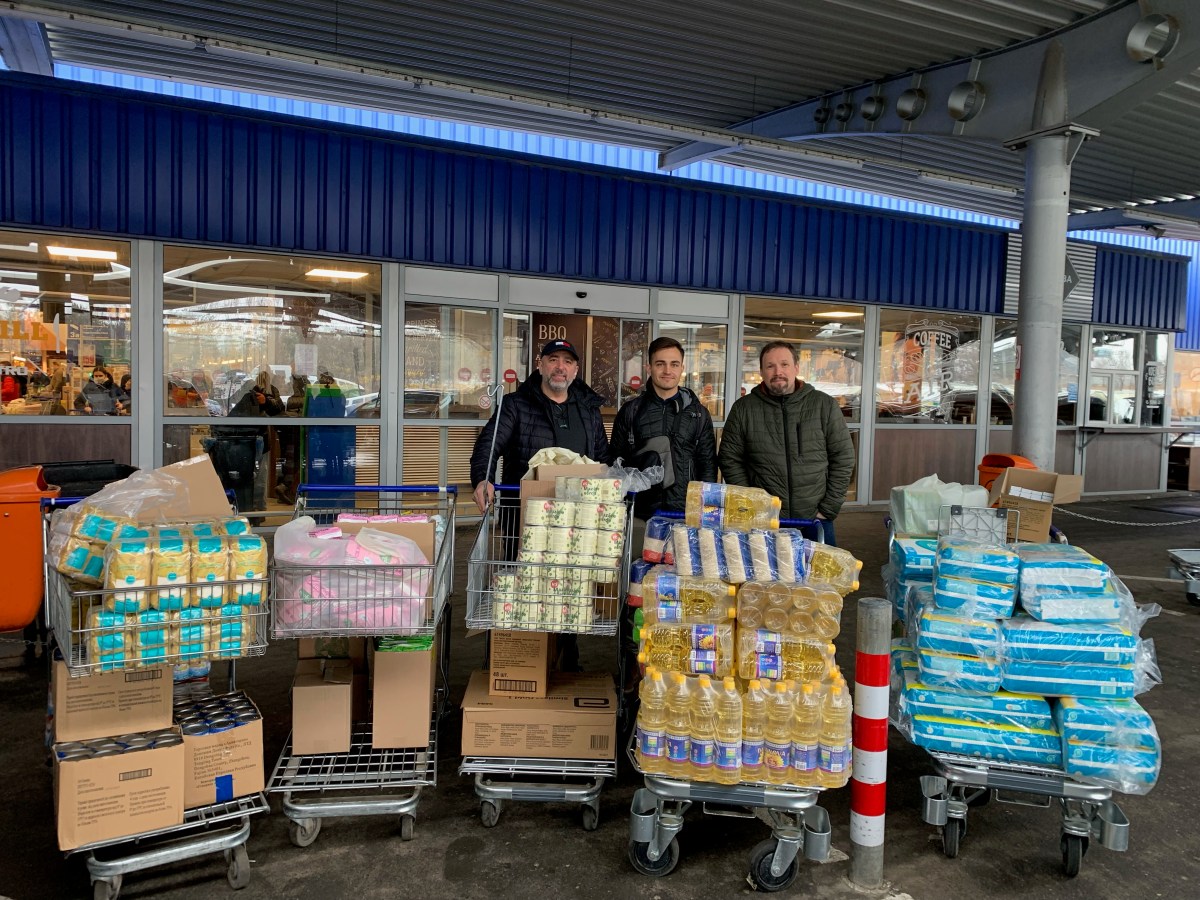
Cozonac’s church had begun planning for refugees about 10 days before the war began. Kishinev Bible Church, Church Without Walls, Mission Eurasia, and others from Moldova’s evangelical minority have been showing up around the clock at border checkpoints, with vans full of supplies and offering free rides to shelter.

They’re manning tables with water, sandwiches, and Bibles and telling weary arrivals where they can go to warm up, get a free SIM card, or just rest.

“If you’re sitting and thinking, you’re worrying about things you can’t control,” said Evghenii “Eugene” Solugubenco, pastor of Kishinev Bible Church. “We’re going to do the work that’s in front of us. We’re going to help that person and then help someone else.”

Alex Belev (left) and Eugene Solugubenco (right) shop for supplies for refugees.

Kishinev Bible Church set up a booth about a mile into Ukraine to offer food, information, and spiritual care 24/7 to people while they were still in the lines, where they’ve had to wait for half a day or more to enter Moldova.

In Chișinău, Cru and Church Without Walls turned their buildings into refugee hostels, with pastor Alex Belev immediately announcing that the church was “ready” and willing to help. Cru has hosted up to 80 people a night, and local ministries bought a laundry unit and refrigerator for the building. Similarly, among the Eastern Orthodox (90% of the population), monasteries have also opened up to new arrivals. Christian summer camps have offered up their spaces too, but those will be a last resort since many don’t have heat and it’s below freezing at night.

Belev is meeting people at the border crossings each day. On Thursday, at the Palanka crossing point, he connected with a family with 15 children: 12 foster children and three homeless children they picked up on their way.

“They are not denying entrance to anyone, even if the person doesn’t have all the right documents for them, their children, or their transportation,” said Belev, who arranged for the family to get food and shelter while they procure the documents to travel into Europe. “Every person can be safe from war, from threat to their lives. Every person who arrives to the territory of Moldova receives food, accommodation, warmth, and care.”

More than 1,400 families from Protestant churches have signed up to receive and help refugees, said Nicholai Vozian, president of the Union of Churches of Moldova, in a call on Monday. He told the Council of the Euro-Asian Federation of Evangelical Christian-Baptist Unions that churches were “overburdened.”

Moldovan evangelicals minister at the border with Ukraine.

But leaders say they also sense God at work in their efforts. Solugubenco described seeing “small miracle after small miracle” with how smoothly the partnerships have gone between his community, fellow Christians, and the government.

Over the weekend, he shared on Facebook that the church spent $3,500 on a vanload of food and supplies like toilet paper for the refugees, and a donor immediately sent $3,500 to cover it. Within the past couple days, a Samaritan’s Purse team has arrived to help too.

After last Sunday’s service, when he preached in Russian on the faithfulness of God, Solugubenco spoke with refugees attending for the first time. There was a “big old guy” from Mykolaiv who came to Moldova with his family. He was feeling useless and wanted to help. Solugubenco turned around, spoke with a member of the congregation, and arranged for the refugee to get a woodworking job.

After past struggles with corruption, Moldovans are now scrambling to help in any way they can and even trusting the government enough to send them money to assist with humanitarian aid. Cozonac returned to his homeland last August to serve in the new Moldovan government after 20 years living in the US. He sees the current generosity as a signal that “a new set of values” taking hold.

“What struck me upon returning from the diaspora,” he said, “was how many people started telling me, ‘I pray’ … or how many people throw in their speech ‘Lord-willing’ or ‘we need to pray about that.’”

Cozonac believes people’s greater willingness to acknowledge God and faith at peacetime—by Orthodox and Protestant alike—has led to this greater desire to love their neighbors.

Especially during the first several days, the refugees arrived traumatized and overwhelmed. They’d continue weeping or remain silent when Christians went to speak with them.

“So then we just open our arms, and if they are willing, we hug them and start praying for them. In our prayer, we ask God for peace, God’s mighty mercy, and protection for everyone,” Belev said, asking for Christians around the world to pray for endurance so the church in Moldova can continue to minister to the refugees. “The Scripture passages that we mainly share with them are those that that talk about God who can restore destroyed lives, destroyed country, and about a sovereign God who can intervene into any situation.”

News

Church Asks for Help Feeding People and Animals in Ethiopia

Christians share grazing pasture as climate crisis devastates the region.

Christianity Today March 4, 2022
Elias Meseret / AP Images

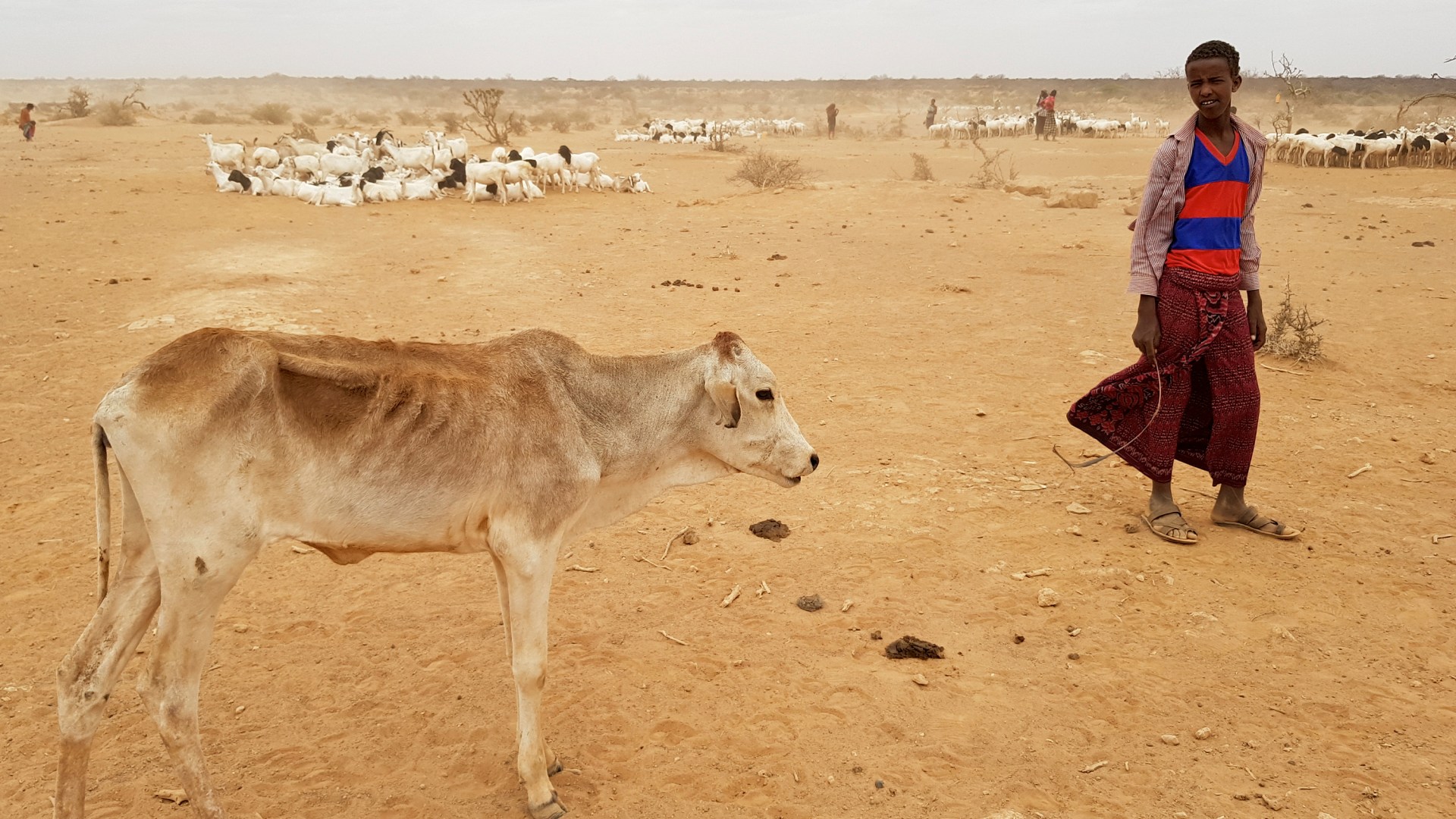
In one picture, dozens of pale-skinned cattle lie dead or dying in the baking heat. In another, a cow with its bones visible beneath its skin drinks from a green plastic bowl of water supplied by its owner.

“The situation is heartbreaking and painful,” said Yishak Yohanes Dera, president of the South Ethiopia Synod of the Ethiopian Evangelical Church Mekane Yesus (Place of Jesus).

As the senior official of one of Ethiopia’s leading Protestant churches, with more than 10 million members, Dera is appealing for help to prevent starvation in four of country’s low-lying regions. They are in the grip of a devastating drought.

He is talking to aid agencies, faith-based organizations, and government bodies, asking them to “come to Borena and save the lives of our people.”

The church, which is part of the World Lutheran Federation and has associations with the Missouri Synod Lutherans and the Reformed Church in America, has dispatched its humanitarian and development organization to work in the Borena Zone, in the Oromia Region. This is one of the worst-affected areas.

In Borena alone, 420,000 people urgently need food aid, Dera said, while more than 400 schools have no water, and most of the children have left.

“The situation is expected to worsen,” he told CT. “During this lean period, more animals are expected to die. This may push many children, women, and old-aged people into famine and unexpected death.”

More than 90 percent of the 1.2 million people in Borena live off their flocks of sheep, cattle, goats, and camels. The loss of water leads to loss of livestock, and loss of livestock to loss of livelihood.

World Vision reported last June that across six countries in East Africa, more than seven million people are on the edge of starvation in a crisis caused by climate change, COVID-19, and ongoing military conflicts.

In Oromia and the neighboring Somali Region, UNICEF reported in February that nearly a quarter of a million children are malnourished, and that 6.8 million people across the four affected regions—Oromia; Somali; Afar; and the Southern Nations, Nationalities, and Peoples’ Region—would need humanitarian assistance by mid-March.

UNICEF warned that children were at risk of contracting diarrhea, a major cause of death among children under five, from drinking contaminated water.

“As humans it is so sad to see such a disaster,” said Wondimu Wallelu, an official from the Ethiopian Evangelical Church’s Development and Social Services Commission who is working to deliver aid in Borena. “On the other hand, it is pleasing to have opportunities to reach these communities through aid from our partners.”

The commission has received a grant for 23.5 million birr (about $470,000) from the German protestant church aid agency, Bread for the World, to help feed people in Borena. The money will be used for food for children and breastfeeding women, fodder for livestock, and to rehabilitate wells that have dried up.

But the needs are massive, and hard to fill, for both humans and animals.

More than 240,000 animals have died from starvation across southern Ethiopia in recent months, and more than two million bales of hay are needed to keep the survivors alive.

The church’s humanitarian organization and the 16 other aid agencies operating in Borena are currently only able to supply about 154,000, according to Wallelu.

Oromia, which is the home province of Prime Minister Abiy Ahmed, is familiar with natural calamities, including outbreaks of locusts, invasive thorn scrub that takes over pastures, and drought. But lately, the frequency and intensity of the droughts has been increasing, Wallelu explained.

“Back in the 19th and 20th centuries, droughts occurred once in every eight years, and the impact was relatively insignificant,” he said. “Very recently, drought has been occurring every two years.”

This is not unexpected. The US Agency of International Development analyzed trends in Ethiopia a decade ago and found that “substantial warming across the entire country has exacerbated the dryness.” If trends continued, the US government said, “warming will intensify the impacts of droughts.”

Borena’s Christians are praying and encouraging one another and sharing what they have. Districts that still have grazing available invite neighbors to bring their livestock, Ethiopian Evangelical Church leaders said.

In the Killenso Parish, for instance, a Turkuma congregation is hosting 10 families and their 300 cattle from a neighboring district.

In Yavelo town, congregants collected 120,000 birr ($2,341) during a single Sunday service to help with relief efforts.

These are the small fragments of hope in a desperate and much wider regional climate crisis that is also gripping parts of neighboring Somalia and Kenya.

In mid-February, the UN Food and Agriculture Organization's director for emergencies and resilience, Rein Paulsen, said the lower-than-expected rains from October to December had placed the entire Horn of Africa on “the brink of catastrophe.”

Forecasts for the next rainy season, from March to May, are not hopeful. If there is another drought, that will be region’s worst dry spell in 40 years, according to the UN’s Office for the Coordination of Humanitarian Affairs and “one of the worst climate-induced emergencies seen in the Horn of Africa,” the agency said last month.

In Ethiopia, the drought is compounding other domestic problems that include a war in the northern Tigray region that has displaced more than two million people.

The Ethiopian Evangelical Church works there too, and in the neighboring Amhara region, to help internally displaced people, according to Abeya Wakwaya, a commissioner for the church’s humanitarian organization.

He said the church was originally founded more than a century ago to preach the gospel and meet the material needs of people in Ethiopia. In the 1970s, the church adopted a mission statement committing to serve “the whole person.” In these dry days, however, it is hard to keep body and soul together.

In the midst of ethnic conflict, war, and more climate crisis on the horizon, though, the Christians believe that mission is more important than ever.

“We have to be exemplary,” Wakwaya said, “to show it’s possible to help each other.”

Books
Review

Meet the Middling Musician Who Helped Launch the Gospel Music Industry

Homer Rodeheaver was an unexceptional trombonist. But he had an ear for great songs and a knack for promoting them.

Homer Rodeheaver

Homer Rodeheaver

Christianity Today March 4, 2022
Illustration by Mallory Rentsch / Source Images: WikiMedia Commons

Like most kids growing up in mainstream Protestant denominations in the mid-20th century, I associated the name Homer Rodeheaver—if it came up at all—with hymnals and gospel songs, most notably my grandmother Allie’s beloved “The Old Rugged Cross.” As an adult immersed in Black gospel music, I’ve paid little attention to the mostly sketchy scholarship on Rodeheaver. His Billy Sunday–styled revivalism, mass community sings (involving mostly white singers), and trombone-heavy stylings seemed to barely intersect with my work. His association with Sunday was especially troublesome in an Elmer Gantry sort of way.

Homer Rodeheaver and the Rise of the Gospel Music Industry (Music in American Life) (Volume 1)

Homer Rodeheaver and the Rise of the Gospel Music Industry (Music in American Life) (Volume 1)

University of Illinois Press

350 pages

As it turns out, I was wrong on nearly every count.

Homer Rodeheaver has quite a lot to do with all kinds of gospel music, as Kevin Mungons and Douglas Yeo demonstrate in their fascinating, eminently readable biography of a wildly underrated and rarely appreciated figure who made a significant impact on sacred music, Black and white. Homer Rodeheaver and the Rise of the Gospel Music Industry introduces readers to a man who was clearly long overdue for a scholarly reappraisal.

Mungons is a well-respected writer and researcher; Yeo a master of the trombone, having performed with major symphonies and taught at the university level. Together, they untangle a number of personal, professional, and musical knots in Rodeheaver’s fast-paced, eventful, and woefully underdocumented life.

Barnstorming the nation

In the authors’ telling, Rodeheaver emerges as a complex, creative, entrepreneurial marvel, capable of predicting (and profiting from) future trends in sacred music. They reveal how he was able to promote African Americans and their gospel songs even as he (apparently) turned a blind eye to some of the mechanisms of the Ku Klux Klan. All told, the book raises the possibility that Rodeheaver had a more enduring impact than his original patron, Billy Sunday.

Coming of age just after the dawn of the 20th century, Rodeheaver was a young man of unexceptional musical skills. Even so, he was blessed with a mightily engaging personality. People liked him. Throughout his life, they trusted him. They wanted him to succeed. And they invariably helped him to succeed.

The authors explore Rodeheaver’s modest (but by no means impoverished) beginnings in rural Hocking County, Ohio. As he grew up, his sprawling religious family was feeling the early influence of the revivalism movement sweeping the American South and Midwest, fueled by evangelism from the likes of Dwight L. Moody and newfangled gospel songs from Ira D. Sankey, William Bradbury, Philip P. Bliss, and others. At Ohio Wesleyan University, the young Rodeheaver took up public speaking, acting, singing, selling hymnals door to door, and—for whatever reason—playing the trombone.

In the hands of what Mungons and Yeo describe as Rodeheaver’s “effervescent, outgoing personality,” the trombone became his personal “brand,” his distinguishing characteristic as he led the singing for ever-larger revivals, community sings, and evangelistic meetings. Here Yeo’s expertise yields a significant insight: “Homer’s trombone playing wasn’t very good.” But for a man with a million-dollar personality (and plentiful ambition), it never really seemed to matter.

From there, Rodeheaver gravitated to the regional revival circuit, moving from one evangelist to the next, leading the music that was essential to the boisterous services. All the while, he was becoming something of a draw himself, and by 1908, he had connected with the influential “fraternity” of gospel music publishers in Chicago. The twin sides of Rodeheaver’s professional life—as a charismatic song leader and a gospel publisher with an ear for great music—fed and empowered each other. He learned quickly that the secret to success (besides a winning personality; an adept, instinctive understanding of how to generate media coverage; and, well, a trombone) was singing the songs people wanted to hear—and then turning around and selling them those very songs.

Within the pre–World War I revival circuit in the United States, Billy Sunday was the dominant figure: a passionate orator who achieved rock-star status in Middle America for preaching the gospel to mammoth, adoring crowds. To Mungons (who is also a musician) and Yeo, there was a certain inevitability to the ultimate partnership between the nation’s fastest-rising song leader and its preeminent evangelist. Young, folksy, dashingly handsome, and very single, Rodeheaver eventually replaced Sunday’s longtime song leader Fred G. Fischer, and by 1910 the team was barnstorming the nation.

What separated Rodeheaver from the song leaders affiliated with other top revivalists (many of whom were also adopting trombones) was his early relationship with the Chicago gospel publishing houses. His innate likability endeared him to publishers and popular gospel composers alike, and his hymnals and songbooks became staples of the Billy Sunday tours, which routinely packed purpose-built 10,000-seat arenas night after night, creating an inexhaustible demand for the songs they featured. In time, Rodeheaver founded his own hugely successful publishing house.

Fueled by a catchy and inspirational (rather than evangelical) theme song, “Brighten the Corner Where You Are,” Rodeheaver’s star eventually eclipsed that of Sunday’s, who found the crowds dwindling in the post–World War I era. Rodeheaver recorded “Brighten the Corner” dozens of times, performed it thousands more, and hawked it throughout his life as an example of the power and importance of community singing, the central theme of his career. His popularity was such that he was able to withstand the lone major scandal of his career: allegations by a Miss Georgia Jay that Rodeheaver had callously broken off their engagement.

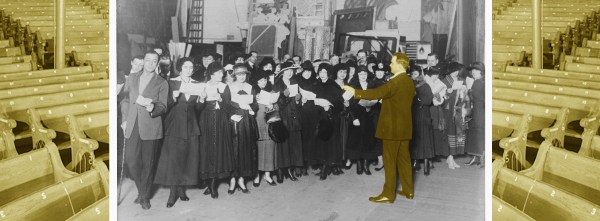
Homer Rodeheaver training chorus girls.Illustration by Mallory Rentsch / Source Images: WikiMedia Commons
Homer Rodeheaver training chorus girls.

From medium to medium

Rodeheaver, who had foreseen the decline of the great revivals, watched his publishing company flourish, as it purchased (or bought the copyrights to) the hymns and gospel songs the nation wanted to sing, including “The Old Rugged Cross.” When much of the gospel publishing industry faltered in the 1920s, Rodeheaver bought the failing houses—and their vast stores of hymns and songs. He was also among the first major religious artists to move into the new recorded music industry, and in short order he took ownership of popular recording studios and a seminal religious record label, Rainbow Records. When radio emerged as the next big thing, Rodeheaver was there, too. Somehow, write Mungons and Yeo, he unerringly “leapfrogged from medium to medium,” mostly with great financial success, well into the 1940s.

Rodeheaver eventually became friends with the most promising of the young generation of evangelists, Billy Graham, along with Graham’s longtime song leader Cliff Barrows, who also incorporated a trombone in the team’s early days. But a punishing travel schedule, one that would have exhausted a much younger man, soon took its toll, leading to Rodeheaver’s death in December 1955.

Beyond providing a detailed biography, Mungons and Yeo also devote fascinating chapters to Rodeheaver’s importance to the early days of the recorded music industry, his unwavering support of African American spirituals, and his complicated relationship with Jim Crow. While Rodeheaver forged friendships with well-known African Americans of the day, including Thomas Dorsey, he also participated in segregated evangelistic meetings and saw some of his best-known copyrights used and subverted by the Klan. From today’s standpoint, of course, these things are wholly unacceptable. But the authors also make a persuasive case for the genuineness of Rodeheaver’s lifelong support of African American causes and his love of Black sacred music.

Like virtually all the books in the University of Illinois’s much-honored Music in American Life series, Homer Rodeheaver and the Rise of the Gospel Music Industry fills in significant blanks in our understanding of different aspects of music history. Mungons and Yeo elevate their contribution with meticulous detail and research; a penchant for finding fascinating, revealing stories and anecdotes; and a sparkling, highly readable prose style that’s all too rare in most academic books.

Robert F. Darden is professor of journalism, public relations, and new media at Baylor University. He is the author of two dozen books, most recently Nothing but Love in God’s Water, Volume 1: Black Sacred Music from the Civil War to the Civil Rights Movement and Nothing but Love in God’s Water, Volume 2: Black Sacred Music from Sit-Ins to Resurrection City.

News
Wire Story

Another UMC Conference Delay Prompts Conservative Churches to Leave

New breakaway denomination moves up its launch as the United Methodist Church announces it’ll be two more years before voting on a split over LGBT stances.

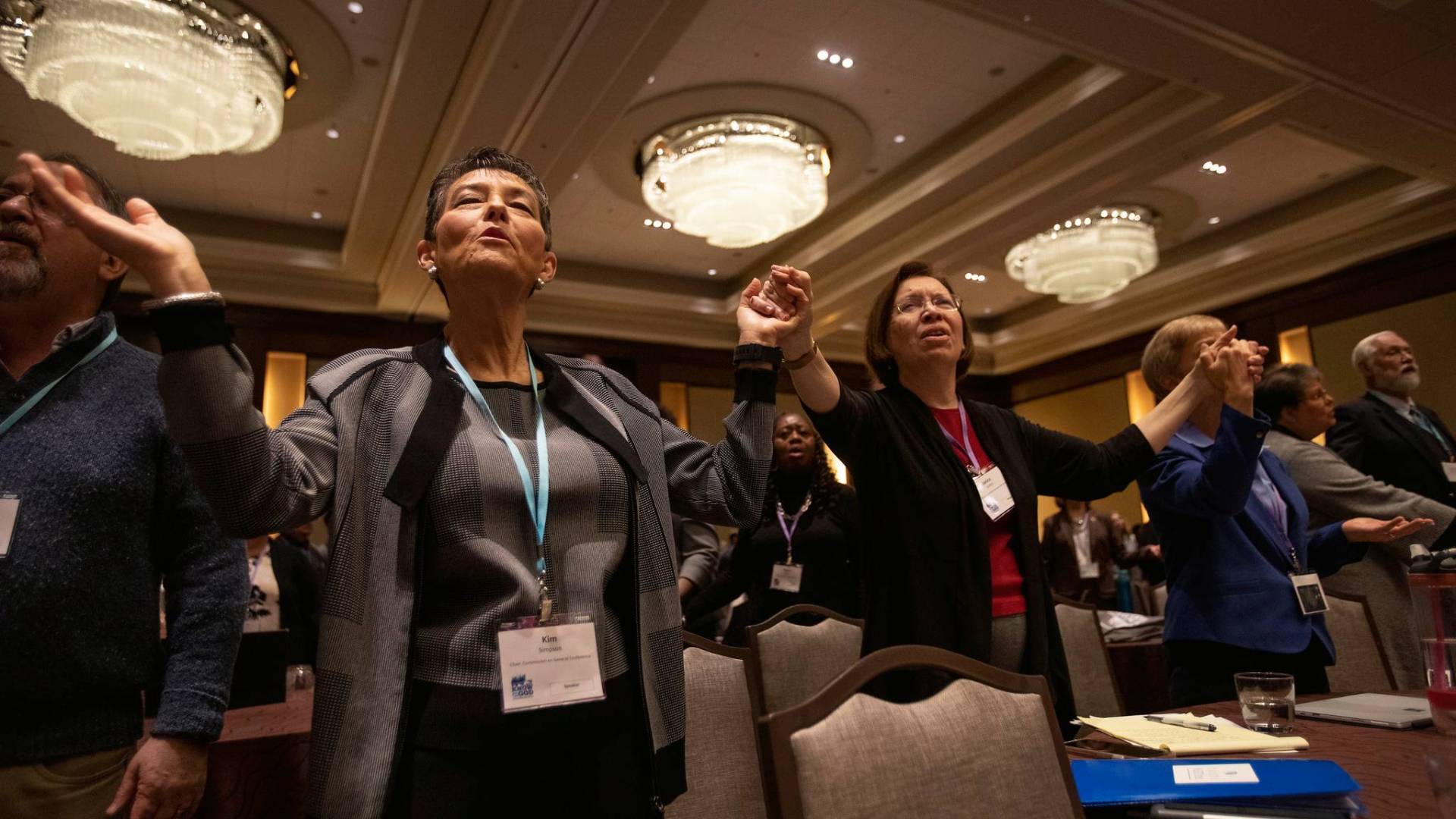
The United Methodist Church prepared to host its quadrennial General Conference in 2020 but have delayed the event three times due to the pandemic.

The United Methodist Church prepared to host its quadrennial General Conference in 2020 but have delayed the event three times due to the pandemic.

Christianity Today March 3, 2022
Kathleen Barry / UM News

In this series

The United Methodist Church has delayed its General Conference meeting for a third time due to the continuing COVID-19 pandemic. In response, some conservative United Methodists have announced they will preemptively leave the denomination rather than wait for the long-anticipated meeting.

Delegates to the General Conference were expected to take up a proposal to split the denomination over disagreements on the full inclusion of its LGBTQ members at the meeting of its global decision-making body scheduled for August 29 to September 6 in Minneapolis.

But General Conference organizers announced Thursday evening they are postponing that meeting to 2024 because of the continuing COVID-19 pandemic.

Obtaining vaccines and travel visas remains a challenge for delegates traveling outside the United States, according to the Commission on General Conference.

“We engaged in a fair, thorough, integrity-filled discussion of the alternatives,” said Kim Simpson, chairperson of the Commission on General Conference.

“The visa issue is a reality that is simply outside our control as we seek to achieve a reasonable threshold of delegate presence and participation. Ultimately our decision reflects the hope that 2024 will afford greater opportunity for global travel and a higher degree of protection for the health and safety of delegates and attendees.”

But one group of theologically conservative United Methodists said Thursday it is not willing to wait any longer to discuss a split and announced plans, through its Transitional Leadership Council, to launch the Global Methodist Church on May 1.

“Many United Methodists have grown impatient with a denomination clearly struggling to function effectively at the general church level,” said Keith Boyette, chairman of the Transitional Leadership Council that has been guiding the creation of the Global Methodist Church for the past year and president of the Wesleyan Covenant Association.

“Theologically conservative local churches and annual conferences want to be free of divisive and destructive debates, and to have the freedom to move forward together. We are confident many existing congregations will join the new Global Methodist Church in waves over the next few years, and new church plants will sprout up as faithful members exit the UM Church and coalesce into new congregations.”

Meantime, the Reconciling Ministries Network, which advocates the full inclusion of LGBTQ United Methodists, said Thursday it supports the commission’s decision to once again postpone the General Conference.

“Let us be honest here: holding a pandemic-era General Conference with myriad barriers to safe and equitable participation would not have been a Christ-like way to be the Church,” the group said in a written statement.

Still, the statement said, leaders of the Reconciling Ministries Network lament the delay in discussing a possible split. “These circumstances only prolong the road to justice for our LGBTQ+ kin and to parity in the global Church,” it said.

The General Conference, which usually gathers delegates from across the globe every four years, originally was planned for 2020. But the Commission on General Conference postponed the denominational meeting twice because of the continuing COVID-9 pandemic, delaying an expected vote on a proposal to schism after a decades-long debate over whether LGBTQ United Methodists can marry or be ordained.

The commission’s latest decision comes as United Methodists have published letters and statements arguing for and against postponing the 2022 meeting.

Last month, 170 delegates from around the globe sent a letter to the commission urging its members to delay the conference until 2024 to “properly ensure the health, safety, and participation of all attendees.”

Travel still carries health risks in 2022, according to the letter. And the General Conference doesn’t have the kind of technology and systems it would take to make sure delegates from all over the world could fully participate in the meeting.

“Especially because of the seriousness of the legislation that this General Conference will be debating, including the possibility of ‘amicable separation,’ it is important that the Commission on the General Conference err on the side of caution and ensure that no delegate, particularly those from Central Conferences”—the denomination’s regional bodies outside the United States—“is precluded from full, in-person participation because of the ongoing COVID pandemic,” the letter read.

Meantime, competing letters from African delegates argued both for and against another postponement.

The 2020 General Conference originally had been set for May 5–15, 2020, in Minneapolis. That meeting was rescheduled for August 29–Sept. 7, 2021, when the Minneapolis Convention Center announced it was restricting events during the pandemic.

It was rescheduled again for 2022 at the same venue.

It is not immediately clear whether the postponed 2020 General Conference will replace the regularly scheduled 2024 General Conference.

Delegates to the General Conference are expected to take up a proposal to split the denomination, called “A Protocol of Reconciliation and Grace Through Separation. The proposal, negotiated by 16 United Methodist bishops and advocacy group leaders from across theological divides, would allow churches and conferences to leave with their buildings and other assets to form new Methodist denominations, including a conservative “traditionalist” Methodist denomination that would receive $25 million over the next four years.

Calls to split one of the largest denominations in the United States have grown since the 2019 special session of the United Methodist General Conference approved the so-called Traditional Plan strengthening the church’s bans on the ordination and marriage of LGBTQ United Methodists.

Church Life

Can China’s New Regulations Really Stop Evangelism on the Internet?

While some church leaders are concerned that online religion restrictions may scare off Christians, others hope Chinese believers will continue to sow the digital mission field.

Christianity Today March 3, 2022
Illustration by Rick Szuecs / Source images: Envato Elements / Hitesh Choudhary / Pexels

China’s new internet regulations went into effect March 1, laying out broad restrictions on religious communication, teaching, and evangelism.

The new rules put into writing unofficial penalties that some Christians already faced for their online activity, so Chinese believers aren’t sure how the rules will be implemented and how much it could hamper missions.

The regulations were announced at the end of last year by China’s State Administration of Religious Affairs (SARA) and allow only religious groups with government approval to share information on the internet. According to the new Measures on the Administration of Internet Religious Information Services:

Organizations and individuals must not proselytize online and must not carry out religious education or training, publish preaching, or repost or link to related content; must not organize the carrying out of religious activities online; and must not broadcast religious rites … through means such as text, images, audio, or video either live or in recordings.

On February 28, the Chinese government issued a press release answering questions about the new regulation, stating the government “will have close and thorough cooperation to ensure the implementation of the measures.”

How will the implementation of these new measures affect the use of the internet for evangelism and mission by Chinese Christians? Will Christians in China no longer be able to do anything online? As the new measures come into force during the ongoing pandemic, where will the internet mission of Chinese churches in China and overseas now go?

CT Asia editor Sean Cheng interviewed several Chinese pastors and Christians (for security reasons, the names of Christians in China are pseudonyms), including:

  • Jerry An, new media mission pastor and Chinese director of Reframe Ministries in Grand Rapids, Michigan
  • Eva Xu, member of an evangelical church in Los Angeles who has a master’s degree in theology from Fuller Theological Seminary
  • Shi Ming, pastor of a church in China who has an M.Div from an American seminary
  • Sean Lu, youth pastor of a church in China, now studying for a PhD in theology in the US
  • Zhu Yalun, pastor of a church in China who has an M.Div from a Korean seminary
  • Lynn Han, member of a Chinese church in Tokyo and host of a Christian WeChat group
  • Zhang Qiang, big data expert and veteran media worker who lives in China

CT: How do you think the regulations will affect Chinese Christians’ use of the internet for evangelism and mission?

Shi: First, these are just “measures,” which, in essence, authorize the government to carry out certain operations and can be used as a management tool. They may claim to have the force of law, but they do not have the same degree of binding power of a law.

Second, these measures are not much more than the practices that already existed (e.g., deleting posts, blocking social media accounts, public security authorities summoning violators for admonishment, or even suing them for the crime of “picking quarrels and provoking trouble”). In other words, the measures merely fix on paper some exemplary practices that have already existed, in order to authorize and legitimize the government agents to do these things. This is not an overnight escalation of strict control.

Third, I don’t think this will have much impact on Chinese Christians’ use of the internet for evangelism and mission. Zoom meetings may be disrupted, and WeChat public accounts may be blocked, but these have always been the possibilities.

The only impact that is certain is that some Chinese Christians will stop their ministry out of fear. But Christians should not dance to the baton of such regulations in how we serve God and people. We should do everything we can to be faithful stewards of God’s resources until God takes them back.

Zhu: The impact remains to be seen, as it depends on the actual implementation. There has always been room for ambiguity in Chinese regulations, and the authorities will adjust the intensity and scope of implementation depending on the situation. And being restricted on WeChat may not be a bad thing. Too many Chinese today (including Christians) rely too much on WeChat, which has become the main means for many to obtain information, and that in itself is unhealthy. WeChat is full of misinformation and twisted value.

Han: The impact of the new regulations can already be seen on WeChat. Christians are afraid to forward Bible-related audio, pictures, and text, and many evangelical WeChat public accounts have been deleted. Words like Jesus, Jehovah, and amen cannot be written out and have to be replaced with pinyin abbrevations (e.g., “JD” for Christ and “JDT” for Christian). Brothers and sisters in Japan have gradually moved to social media apps outside China (such as Line).

An: The intimidating effect of the regulation has already been seen, and many Christians have become more cautious in their communication on the internet or have used riddle-like codes for words that sound religious.

The government’s control over the speech of all sectors of society, not just Christianity, is unprecedented. And in spite of this high degree of control, the Xuzhou chained mother incident has created an unprecedented tsunami of public opinion, with many deleted posts gaining more attention and spreading more widely after being reposted outside China. This once again proves the subversive nature of the new media compared to the traditional communication model.

I am optimistic that after a short period of recession, the new regulations will inspire Chinese Christians to value internet ministry more and to use the new technologies more creatively and with a greater sense of mission.

Lu: The church must prepare for the worst and respond for the best. If, as the authorities say in the press release, the government will “ensure that the measures are implemented,” this is likely to have a big impact on the government’s goal of “de-religionizing the internet.” Of course, this is only relative because it is impossible to eradicate religious contents in an absolute sense.

If, as the authorities expect, cyberspace will no longer be a “special zone for religious activities” or an “enclave for religious ideas,” then the internet will become a veritable mission field. It will be a challenging mission and spiritual warfare, just like any offline mission field where people are hostile to the gospel. We must rely on the power of the Holy Spirit to meet the challenges and to plough the frozen ground and sow.

CT: How can Chinese Christians continue online ministry after March 1? What kind of adjustments will they need to make?

Xu: Actually, Bible study meetings, theology lectures, and even online worship can still be done using Zoom. The only difference is that in the past the Zoom login information was usually posted in the WeChat groups, but now we are more concerned about security, so we use other methods to notify participants.

A few adjustments are still needed, such as avoiding the use of sensitive words that can easily trigger censorship. Christians are called to be both innocent as doves and shrewd as snakes (Matt. 10:16). When WeChat doesn’t work, more phone calls can be made to reach out to the seekers, and home visits can be a better option when the pandemic subsides.

Shi: I don’t think we need to make many adjustments because we are not suddenly in a “bitter winter” of the internet. We should continue to do what we have been doing until we are blocked, removed, or the tools are no longer available.

I want to say to Chinese Christians overseas that you are in a special position. You have to use software programs, platforms, or resources from China, but you are not bound or governed by the laws of China.

And these software programs, platforms, and resources have a desire to enter the global market. I think God has given you a special status for “such a time as this” (Esther 4:14) to sue or protest these software and platforms in your own country for their infringements on freedom of speech, to reduce their influence and market share in the diaspora Chinese communities. Although this is not enough to change many things, perhaps God can use your present status to make an impact through such actions.

Zhu: I think what Chinese Christians need most now is to learn to circumvent the GFW (Great Firewall) using VPN and reduce our dependence on WeChat.

Break out of the wall, and the truth will set us free, and things will be much easier in the future: Churches or organizations that can afford it can set up their websites on off-GFW servers; Christian public accounts can move their platforms to uncensored social media (such as Telegram); and Christian individuals can also use social media outside the GFW. Telegram is highly recommended. After the past few years of trial and error, we think it is a very good one-stop platform that can completely replace WeChat in terms of functionality.

Lu: The fact that this unjust law is coming into effect does not mean that the Chinese church should retreat from cyberspace altogether or silence itself. Both individual believers and the church community need more courage, wisdom, and creativity from God to identify and seize new opportunities.

Churches and missions need to equip and send well-trained “internet missionaries” into this new mission field and spiritual battlefield in a more targeted and strategic manner. At the same time, we need to create the “new wineskins” of symbols, language, metaphors, and stories to carry the “old wine” of the gospel (Mark 2:22) in the face of an increasingly narrow public space and a rapidly changing online culture.

The Chinese church needs to create our own Narnia and Lord of the Rings by our own C. S. Lewis and J. R. R. Tolkien. (For example, can Chinese Christian writers create literary works based on Chinese mythology that do not have Christian “sensitive words” but are creative and spiritually profound in carrying the gospel message?)

An: From a personal perspective, tighter controls may prompt us to live out our faith not just by talking about it, but by living it out. We as individuals sharing the gospel on new media should pay more attention to relationship building and whether what we share in our circle of social media friends has the fruit of the Spirit and can exude the aroma of Christ.
Organizations and churches need to adjust their strategies to respond (for examples, transitioning to platforms outside the GFW or sharing the gospel with more creativity). In the “bitter winter,” everything is still growing, and it is also a season for us internet missionaries to work hard and wait patiently.

Zhang: Internet mission is a window into the converging interactions of technology and culture opened in the first two decades of the 21st century with globalization. Twenty years later, the world is not more tolerant but more polarized, not more united but more divided because of the internet connections.

The gospel can work through economic, demographic, technological, political, legal, and educational changes; only the effects may not be immediately apparent. The seeds sown in the past 20 years of internet mission will grow to be visible in the next 20 years. We need to pay attention to the changing seasons of people, cultures, and hearts.

This new season of authentic, community-focused, local, and deeper human engagement needs the truth of life to be truly understood and lived out by the believers, not just spoken with keyboards and screens.

CT: What have been the challenges and opportunities for online ministry during the pandemic? What hope do you have for the future?

Xu: The biggest challenge to evangelism from the pandemic is the reduction of face-to-face opportunities. There are fewer outreach activities, such as basketball or ping-pong, arts and crafts, etc. The seekers don’t always watch the videos or audio, or read the articles we forward, and they don’t always answer the phone.

But the pandemic has forced people stay at home, and now there’s time for people to be willing to read something more profound, or to consider questions about life, death, and eternity. Christian online seminars and books that discuss how to deal with personal relationships are currently more suitable to recommend to friends, family, and colleagues.

Han: The pandemic has restricted Christians from going out, but it has increased the time we all have to communicate on the internet. We currently have two to three hundred brothers and sisters living in Japan, China, the US, Canada, and Europe reading three chapters of the Bible a day together in a WeChat group.

Half of us have been faithfully punching in daily for two years already, and there is a regular weekly Bible study on Zoom. Having more time to study God’s Word in depth has been a great joy shared by all and has been very helpful in overcoming the anxiety caused by the pandemic.

Zhang: The pandemic brought enormous anxiety even to healthy people, not to mention those who already had depression. It also brought about a backlash against small-circle mentality and echo chambers. This also reminds us that internet missions need to “become flesh” and move from symbolic communication to experiential, real-life scenarios. Christians with mature spiritual lives can serve this generation through professional service in their own workplace, creating new opportunities to build relationships with people and preach the gospel of Christ.
An: The pandemic has forced all churches to go online, and internet ministry has received unprecedented attention. Many churches and Christians have begun to actively explore church development and internet ministry in the “new normal” of the post-pandemic era.

But there is also backward thinking, superficiality, jealousy, and self-boasting. In the past five years, we at Reframe Ministries have conducted extensive surveys and analysis of active Christian WeChat public accounts and found that Christian public accounts as a whole show a phenomenon of “bad money driving out good money,” with for-profit marketing accounts and fake news proliferating, and a general lack of public concern and the ability to engage in public dialogue.

During the past two US elections, many Christians’ social media contributed to the spread of fake news and conspiracy theories and lost their Christian witness. This shows that the Chinese church has long lacked a deep understanding of media and new media as well as profound and mature research of the church’s social engagement and public theology. We still have a lot to do to catch up.

Shi: Internet ministry needs to lead the targeted people to the local church, to real and personal connections. It can also lead to fantasy, deception, and self-gratification. An internet celebrity, writer, or host engaged in internet ministry is likely to over-exalt himself because of his interaction with his fans or listeners.

What he hears from his followers will reinforce his self-perception and eventually, although he still goes to church, his true identity will actually be on the internet. This is very dangerous and harmful to both himself and his followers.

I especially hope that those involved in online evangelism will view their endeavor properly and see it as a resource that God has given in this age, but not as a substitute for Bible reading, prayer, and participation in the local church.

Interviews and English translation by Sean Cheng

She Calls Christianity Today a Lighthouse and a Life Preserver

Why Ronna Bauman has found significant solace and encouragement from the ministry in recent years.

She Calls Christianity Today a Lighthouse and a Life Preserver
Photo Courtesy of Ronna Bauman

Several years ago, while sitting in an office waiting room, Ronna Bauman picked up an issue of Christianity Today (CT).

“Inside was a raw, honest article about the emerging cocktail culture among Christians,” said Bauman. “I thought, ‘Well, that’s honest, and touching on something people don’t normally want to talk about. It felt refreshing to witness the writer tackling something complicated without shaming the reader. Because it was so thoughtful, I went home and subscribed.”

“I think it was indicative of all the CT articles I’ve read since then,” she said. “They ask, why do we think the way we think? They present ideas from multiple perspectives.”

Bauman had known about CT since she was a kid. Raised in a loving Christian home, where her sister first led her to Christ as a young child, she grew deeper in her faith through a crucifixion drama she witnessed as a preteen, and a one-month Bible study retreat in the UK that she attended at 16.

In adulthood, Bauman and her husband Kris, active-duty Air Force, ministered with Cru’s Military Ministry. After having five children, they focused on investing in the local church, moving around a number of times. Today, Bauman works for a nonprofit that helps single moms exit homelessness and domestic violence. The couple has returned to their home base of Colorado Springs, where her relationships with her family, old and new friends, and her community form the center of her life.

Several years ago, over Christmas time, the family read an op-ed from CT’s president and CEO, Tim Dalrymple, where he articulated whom he hoped the publication would give voice to. It made Bauman cry.

“That article gave voice to what I’d been feeling for so long as I felt sort of unmoored within evangelicalism in such a divisive time,” said Bauman. The turbulent political time had left her “grieving.”

“I felt despair that within the Church, we weren’t listening to one another. We didn’t pursue understanding each others’ narratives,” she said. “But the article was healing.”

The article also put CT on her kids’ radar and made them curious to learn what else CT would have to say. CT’s addition of Ekstasis, which frequently publishes beautiful poetry and stunning photography, also excited them as fans of the artforms.

Beyond CT and Ekstasis, Bauman raved about the hit podcast, The Rise and Fall of Mars Hill (RFMH) and its production values.

The Rise and Fall of Mars Hill is appealing to really seasoned podcast listeners because of its cutting-edge production,” said Bauman. “I feel proud to pass it on to people. Host Mike Cosper’s voice is soothing and non-judgmental. You don’t feel yelled at. It’s not a bashing session—it’s a ‘let’s take an internal look and see why we are attracted to narcissistic leadership.’”

RFMH also spoke to conversations Bauman has had with her family.

“In the final episode of the podcast, Paul David Tripp urges us all to deconstruct our faith on a regular basis, to question what part of our faith is Jesus, and what part of our faith is American culture?” said Bauman. “This call of grace is compelling to me as I love hanging out with young people who have done a fair amount of this. It removes the ‘finger-wagging’ or the shaming of those who are in the midst of deconstructing. Faulty theology or toxic leadership culture create pain. Instead, compassion and liberty—for us and for others—are needed in that space as we discern truth from error.”

Bauman and her husband recently decided to give to CT above and beyond their subscription and have invited others over for dinner several times to dialogue over engaging CT content, as well as to learn about and participate in the ministry’s mission. During a recent Christmas, Bauman gave magazine gift subscriptions to many people in her circles.

“CT appeals across generations because it’s still true to Billy Graham’s vision of being theologically sound, politically objective, and globally relevant, while including voices of women, people of color, and the international church,” she said. “In 2022, we’re all saying, ‘We don’t know what’s going to happen next,’ but we can trust the thoughtfulness and humility with which CT will lead and curate stories and ideas of the kingdom of God. CT is a lighthouse: it shines a light on the whole world, and yet it is also a life preserver. Through its research and elevation of thought leaders, it gives us something to grab onto.”

Morgan Lee is global media manager at CT.

News

Hundreds of Russian Pastors Oppose War in Ukraine

(UPDATED) Ukrainian evangelicals demand more Bonhoeffers, as Russian evangelicals debate whether public protest under Putin can achieve more than prayer.

A woman holds a "Stop the war" placard in central Moscow during a protest against Russia's invasion of Ukraine, on March 3, 2022.

A woman holds a "Stop the war" placard in central Moscow during a protest against Russia's invasion of Ukraine, on March 3, 2022.

Christianity Today March 3, 2022
Contributor / AFP / Getty Images

Ukrainian evangelicals have had enough.

Battered by a week of war, they have heard numerous prayers for peace uttered by their Russian colleagues. But they did not hear condemnation.

“Your unions have congratulated Putin, giving thanks for freedom of belief,” said Taras Dyatlik, the Overseas Council regional director for Eastern Europe and Central Asia. “The time has come to make use of that freedom.”

As Kyiv, Kharkiv, Kherson, and other cities have suffered missile strikes, the United Nations reports the death of more than 200 civilians. Ukraine’s State Emergency Service reports more than 2,000. The military casualties are disputed, with both nations claiming thousands of fatalities among the other’s ranks.

But rather than focusing on the numbers, Dyatlik, who coordinates a regional network of dozens of Protestant seminaries, turned to the Bible.

“Remember Mordechai and Esther,” he wrote March 1 in an open letter. “Do not be like Jehoshaphat, who entered into an alliance with Ahab, and was silent when God spoke through the prophet Micaiah.”

Dyatlik accused his Russian colleagues of buying into national rhetoric—first in 2014, when Russian-backed forces invaded the eastern region of Donbas—and again today. But “begging on my knees,” he leveraged his reputation with the heads of Russia’s evangelical unions—while acknowledging their difficult reality.

“You fear prison,” he said. “[But] do not be faithful to Putin. Be faithful to the body of Christ.”

Recently passed amendments to the Russian criminal code establish up to a 15-year prison sentence for “fake” claims about the violence in Ukraine, as authorities crack down on Russians who call the “military operation” a “war.”

Discrediting the armed forces can now result in three years in prison; calling for anti-war rallies could merit five years. Based on level of severity, such actions by Christians and other Russian citizens risk fines and compulsory labor.

Dyatlik was not the only one frustrated. But instead of drawing from Scripture, his colleague Valerii Antoniuk appealed to history.

“Where are your Bonhoeffers, where are your Barths?” asked the head of the All-Ukrainian Union of Churches of Evangelical Christians-Baptists. “Your silence now is the blood and tears of Ukrainian children, mothers, and soldiers—that is on your hands.”

Pavel Kuznetsov, meanwhile, simply wants the correct word used—law or no law.

“Many believers in Russia are praying about the ‘situation’ in Ukraine. The situation is called WAR,” the pastor of Word of Life church in Boyarka, 15 miles southwest of Kyiv, wrote on Facebook. “And when you pray again, tell God it’s war, and we are being killed here.”

As of publication, more than 300 Russian evangelicals had reportedly received the message.

“The time has come when each of us must call things by their real names, while we still have a chance to escape punishment from above, and prevent the collapse of our country,” stated an open letter signed by a group of Russian pastors and other Protestant leaders. “We call on the authorities of our country to stop this senseless bloodshed!”

Their message was also biblical.

It quoted Jeremiah 18:7–8, that the nation that turns from its evil ways will be spared.

It referenced Cain committing the sin of fratricide against his brother Abel.

And it called for their nation to implement the words of Jesus: “Put your sword back in its place … for all who draw the sword will die by the sword” (Matt. 26:52).

Dyatlik received the statement with great joy—but also fervent prayer.

“They literally are risking their lives,” he said. “But they show their love to the Lord and his body: we are one in the Spirit.”

The open letter is available on the website of Mirt Publishing House, a small evangelical publisher in St. Petersburg, and is signed by mostly Russian Baptists and Pentecostals affiliated with churches or seminaries in Moscow, St. Petersburg, and more than 40 other cities.

[Editor’s note: The petition was closed after gathering 400 signatures within two days.]

“This is an extraordinarily courageous step compared to evangelical timidity previously under Putin,” said Mark Elliott, editor emeritus of East-West Church Report, a journal focused on explaining Eurasian Christianity to Christians in the West for 29 years. “I am amazed and heartened that these brave people are defending Ukraine. They will suffer for this unless Putin is dethroned. Lord have mercy.”

“The letter is not a typical reaction by Russian Protestants. Staying away from politics has been their primary stance for decades,” said Andrey Shirin, a Russia-born Baptist seminary professor in Virginia. “They have been routinely accused by Soviet authorities of being anti-government. In response, they said they were believers, not politicians.

“Many Russian Protestants are maintaining this stance in the current conflict,” he said. “But some desire greater social involvement, and the tragedy developing in Ukraine has struck a raw nerve.”

One cosigner, however, pushed back against the expectation that all Russian Christians must do likewise.

Alexey Markevich, one of nine Russian Protestants to officially sign the letter before it was circulated publicly, said not everyone needs to be a Bonhoeffer.

“The church’s first calling is the proclamation of God’s Word … [and] this proclamation happens in many different ways: pastors preach, theologians write, philanthropists give out bread, people weep with those who weep, activists take to the square,” he said. “It is important for each of us to see our calling and fulfill it honestly before God, serving him and people.”

Moreover, Bonhoeffer and other famous figures who struggled against evil, while models of faithfulness in themselves, do not directly apply to the demands Ukrainians are making of Russians today.

“Their examples are important and relevant to us,” said Markevich. “But [they did not go] out to picket, and [Bonhoeffer] did not conduct any public activity.”

It would be difficult to achieve results through such actions, in his view. Evangelicals in Russia have no political influence to stop the war, whether they write letters or fill the city squares. Some will still try, as Markevich said he has done since 2014. But true power lies elsewhere.

“War can be stopped by God,” he said. “That’s why we cry out to him.”

Though with less risk but still significant ecclesial cost, some Moscow-affiliated Orthodox priests in Ukraine are calling on their local bishops to disavow Patriarch Kirill of the Russian Orthodox Church.

“This unprecedented … wrenching tragedy that has been ignited by the malignant conspiracy and malicious inaction of a person whom we cannot recognize as our patriarch,” stated 10 priests in the Cherkasy diocese of the Ukrainian Orthodox Church (UOC), 120 miles southeast of Kyiv, in a joint statement.

“We demand the severance of all relations with the Russian Orthodox Church, and the restoration of eucharistic communication with the ecumenical patriarch.”

In 2019, the Istanbul-based ecumenical patriarch of the Orthodox Church, Bartholomew I, recognized the national independence of the breakaway Orthodox Church of Ukraine (OCU). Many parishes in Ukraine rejected this and chose to remain under the Moscow patriarchate, as has been historic precedent. (Exact figures for OCU- and UOC-affiliated churches in Ukraine are difficult to determine.)

But now bombed by Russian forces, the ten priests addressed their letter to Metropolitan Onufriy, the UOC leader, and demanded that their local bishop break ties with Kirill.

They also were biblical, referencing Esther and Proverbs 24, which oblige the believer to not pretend ignorance but to rescue those who are facing death.

“We will find the strength to stand not with weak-minded people,” they stated, “but with Christ, who is our true pastor, father, and protector, to whom be the honor and glory for all time. Amen.”

Their action was followed by the UOC priests of Lviv, which became the first diocese to unanimously call to break with Moscow.

“Today the masks are off. It is obvious to everyone that behind the words about brotherly love and the creation of a single spiritual space of the ‘Russian world’ was a man-made desire to bury and ignore the free and God-loving Ukrainian people,” they said in their statement, comparing Putin to the biblical Cain.

“Staying in prayerful and eucharistic unity with the Moscow Patriarchate … makes the UOC faithful look like enemy collaborators, and traitors.”

The world sees a similar reality.

The United Nations General Assembly voted 141–5, with 35 abstentions, to condemn Russia and call for an end to hostilities. Only Belarus, Syria, North Korea, and Eritrea joined Russia in opposing the measure.

Sergei Ryakhovsky, head of the Russian Union of Christians of Evangelical Faith, one of the two largest Pentecostal associations in the country, was quoted in Vzglyad, an online Russian newspaper, as praying for the “Russian military operation”—Putin’s preferred terminology—to end by Easter on April 24, as well as noting John the Baptist’s defense of soldiers.

“Any Christian of any denomination is against violence,” he said, according to the Vzglyad article. “But at the same time I understand that peace is achieved by different methods, including force, as in this situation.”

Ryakhovsky later denounced the interview as fake in an Instagram story post. “Dear brothers and sisters, if in the near future you will read in the press my quotes about Ukraine, know that they are fake,” he posted Friday.
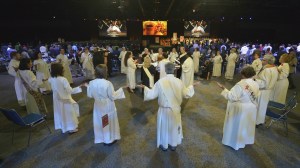
Many analysts are predicting a drawn-out conflict.

“Most likely, the occupiers will only increase their efforts, destroying our country and lives,” said Roman Soloviy, director of the Eastern European Institute of Theology in Lviv. “Therefore, we cannot give up. … Amid chaos, pain, and death, we must remain God’s instruments of comfort, help, and hope.”
And some of that has now come from Russia, even as its government has moved to censor its media. Liberal news sources Dozhd and Ekho Moskvi were recently shuttered. But some evangelical leaders continue to speak.

“No political interest or goal can justify the deaths of innocent people,” the open letter stated. “War destroys not only Ukraine, but also Russia—its people, economy, morality, and future.”

Editor’s note: This article was updated on Friday, March 4, to note Sergei Ryakhovsky’s Instagram statement that his interview in Vzglyad is fake.

Theology

Bomb Shelter Ministry in My Ukrainian Town

Thanks to air raid sirens, neighbors and refugees are hearing more about the gospel than ever.

People gather in the Kyiv subway, using it as a bomb shelter.

People gather in the Kyiv subway, using it as a bomb shelter.

Christianity Today March 3, 2022
Efrem Lukatsky / AP Images

We are now a full week into open war with Russia. Of course, Russia has been warring against Ukraine since 2014, but this is an unprecedented phase. Still, it’s amazing how quickly one gets used to the mundane realities of war.

On day one, the news of other cities being bombed caused great anxiety in the city of Svitlovodsk, where my family and I live. Of course, the fact that the news woke us up before dawn and was very unexpected made it much worse. The intent to cause panic seemed planned.

Now, on day seven, the adrenaline has worn off. We are used to the 8 p.m. curfew and sitting in a dark apartment at night. We find ourselves ignoring some of the air raid sirens—especially the ones in the middle of the night, since we’re so exhausted. We’ve also learned that not every siren means a bomb might drop on our heads.

But whenever we do head to the bomb shelter, my family and I take the opportunity to share the hope of Christ with our neighbors.

“Bomb shelter ministry” is, I must admit, not a ministry profile I thought I’d ever have. And yet, we are already seeing how fruitful it’s been. Our neighbors have heard more about Christ, heard more Scripture, and been led in more prayer in the last week than most of them probably have in their lives.

In addition to the “Our Father” prayer, I’ve taken to reading various Psalms with them—a particularly fitting book for us in Ukraine, as David often cries out amid being hunted by his enemies.

One of our neighbors is the equivalent of our building superintendent. The other night in the bomb shelter, she said with tears in her eyes how thankful she was to have neighbors like us. She said she can’t understand “where we came from.” We got to remind her that if there is something different, it is only because of the hope Christ gives us.

I’ve also gotten questions down there about how to read the Bible properly. The grandpa who asked me got a crash course on the Christocentricity of Scripture! It has often been the case that we stay down there discussing matters of faith long after the sirens have stopped.

Despite significant time spent in the bomb shelter during air raids, our city has so far avoided any actual bombing. The practical reasons include its smaller size (population of 45,000) and lack of strategic targets nearby. This, along with the fact that we are at a crossroads in the country, has made Svitlovodsk a refugee destination—that and God’s providence.

The brutal bombing of civilian targets in Kharkiv, Ukraine’s second largest city, has led to another wave of refugees over the last 24 hours. Previously the targets had been mostly military. This meant that our church welcomed 16 more refugees tonight, 10 in our building and 6 with a family from our church.

One of the young fathers of the families who stayed in our church is into Hindu spirituality and had a lot of great questions about Christianity. I ended up talking with him about what makes the gospel different than other religions (i.e., grace) for nearly an hour. I think he came to see Christianity in a new light. We exchanged numbers to stay in contact as they head further west in the coming days.

This is the case with most refugees who make it this far. We are just an inn for weary travelers on the way. But we hope to serve them and help them experience the love and peace of Christ, even if only for a few hours. It is not our job to force them into faith—an evangelistic approach that rarely produces good results. Rather, we will play whatever role God grants us: to plant a seed, to water—or to harvest when ready. He is the one who brings the fruit in his time, and we can rest in that.

All these stories should remind us of a vital truth: that God’s victory is always subversive. Whatever the Enemy intends for evil, God always takes and uses for good. This means the more the Enemy rages, he only brings his own destruction closer. God turns the Enemy’s weapons against him, just as David did with Goliath’s sword—and what Christ ultimately did in his death on the cross.

When the Enemy thought he finally had Jesus right where he wanted him, it turned out he was dealing his own death blow. Our Lord overcame by using the Enemy’s own weapons against him. We take comfort in that—especially as Ukraine faces an enemy who rages, both in the Devil who loves to “steal, kill and destroy” and in those pseudokings who are the Devil’s pawns.

I believe both will shortly find themselves overthrown by God’s wonderfully ironic victory. But in the meantime, we covet your prayers.

Pray for the many refugees we are expecting over the next days, particularly from Kharkiv. Pray that we will serve them well and show them the love of Christ and that God would open doors. Pray for God to provide for all of them.

Pray for strength and wisdom amid so many needs. Everyone is scrambling around the clock and not getting enough sleep. Please pray for the ministry team in our church. Pray that I might use every invitation for interviews, articles, podcasts, and more to glorify the one who is our rock and refuge.

Pray for my friends who were mentioned above to come to know the beauty of the gospel in their lives.

Pray for God’s subversive victory to come swiftly against the tyrant terrorizing our country. Pray for God to be glorified in humbling the pride of man.

Benjamin Morrison is the pastor of Calvary Chapel Svitlovodsk, Ukraine, which is raising support for refugees. He is an American missionary veteran of 20 years, and he and his Ukrainian wife have two children.

addApple PodcastsDown ArrowDown ArrowDown Arrowarrow_left_altLeft ArrowLeft ArrowRight ArrowRight ArrowRight Arrowarrow_up_altUp ArrowUp ArrowAvailable at Amazoncaret-downCloseCloseellipseEmailEmailExpandExpandExternalExternalFacebookfacebook-squarefolderGiftGiftGooglegoogleGoogle KeephamburgerInstagraminstagram-squareLinkLinklinkedin-squareListenListenListenChristianity TodayCT Creative Studio Logologo_orgMegaphoneMenuMenupausePinterestPlayPlayPocketPodcastprintremoveRSSRSSSaveSavesaveSearchSearchsearchSpotifyStitcherTelegramTable of ContentsTable of Contentstwitter-squareWhatsAppXYouTubeYouTube