Why We Sing Such a Bloody Song

The power of “There Is a Fountain” is its insistence that Jesus’ death was real, was messy, and made all the difference.

Illustration by Cassandra Bauman

I wasn’t sure how to tell them. I could already envision their uncomfortable stares, the way they’d look down at the floor to avoid my eyes or pretend they hadn’t heard. I felt my own embarrassment rise, and then shame at being embarrassed. As I walked to my weekly banjo class, I turned over again and again in my mind how to tell my classmates that the song I’d prepared that week was titled “There Is a Fountain Filled with Blood”—how to explain that it was one of my favorite hymns to sing at church.

If you’ve ever heard the tune played on a five-string banjo, you know that the old-time melody is perfectly constructed for the instrument. It has a joyful, vibrant quality, bright as June. You’ll find yourself whistling it hours later, straining for the high notes with a smile.

Could there be a starker contrast between music and lyrics?

There is a fountain filled with blood
Drawn from Immanuel’s veins …

To modern ears—the educated, empathetic New Englanders in my class with me—how can this sound like anything but barbarism? This isn’t some scrape that cauterizes quickly. In this hymn, the amount of blood literally fills a structure; we’re immediately told to picture in our mind’s eye a traditionally quaint park decoration in a horrific incarnation. Worse still, this isn’t merely runoff from a butchery or pig farm. We’re invited to sing out that this overwhelming amount of blood is from a single man, taken from his very veins, an IV gone wrong.

Listen to “There Is a Fountain Filled with Blood” and the rest of the songs featured in

The Wondrous Cross

here:
MoreCT.com/EasterPlaylist.

The amount of blood featured throughout the hymn, the dying Lamb, and the open wounds seem to testify to something ancient and dangerous. A thief hangs miserable on a cross. “Sinners,” that aggressive jeremiad of a term, are “plunged beneath that flood,” an action that looks like a drowning, forceful and sure. This embodied darkness, this celebrated violence, stands in stark contrast to what is prized in contemporary spirituality.

The spirituality of many today, including for many Christians, is symbolic, therapeutic, perhaps even an attempt to escape from the bodies that constantly betray us and disobey us. Our mind and emotions are engaged; the spiritual realm is thought of as beyond, ineffable, invisible. Who has need for such bloody plunging? Isn’t it just a little much, a little macabre? Surely this must be a metaphor—perhaps one we can outgrow.

There is a fountain filled with blood,
Drawn from Immanuel’s veins,
And sinners, plunged beneath that flood,
Lose all their guilty stains.

The delicate tension of this hymn is that it is both metaphor and utterly real. We rush to the metaphor side for the obvious reason that Christians do not practice immersion in or sprinkling by blood. We celebrate water baptism, in our various ways, as our Lord commanded. At a baptism, the basin or baptismal is filled not with blood but with water, or we celebrate it in a natural body of water such as a lake or stream. The candidate doesn’t get washed with soap, scrubbed at in a physical way. The imagery of baptism is clean, restorative, and wholesome. The person emerges from under the water to thunderous applause, or the baby makes a funny face at the poured liquid, and our hearts fill with warm joy. This is the fountain we know. This is a stream we would gladly be led by.

Yet without the historic blood that ran from Jesus Christ at his death on the cross, our rituals are sentimental delusions of a cleansing not actually obtained. Jesus himself explained on the Emmaus Road that the Messiah had to suffer (Luke 24:26), and Paul routinely showed from the Old Testament that same necessity (Acts 17:2–3). Only by entering “the Most Holy Place once for all by his own blood” (Heb. 9:12) could God the Son incarnate provide redemption for us.

The power of “There Is a Fountain” is its repeated insistence that the death of Jesus was real, was messy, and made all the difference. It insists, along with all of the biblical witness, that the type of cleansing we need simply cannot be achieved any other way. Perhaps in our modern sensibilities we hear these lyrics and shudder, asking, Why? The answer back is this: the depth and horror of our sin.

The dying thief rejoiced to see,
That fountain in his day,
And there may I, though vile as he,
Wash all my sins away.

A blood that covers sin was hinted at when God himself killed the animals and dressed Eve and Adam’s nakedness with foreign skins (Gen. 3:21). A blood that rescues was rubbed on Israelite doorways, stolen from lambs so that firstborns would be spared (Ex. 12:12–13). A blood that removes guilt, sin, and uncleanness was shown over and over in Leviticus through an endless parade of bulls, goats, sheep, and birds (Lev. 1–7). The altar was stained, the priests intimate with the smell of blood. Every drop of it, every instance, pointed forward to the dying Lamb of God who healed us by his wounds (Isa. 53:5; John 1:29; 1 Pet. 2:24). Ours has always been a bloody faith because there has always been blood on our hands that needed atonement.

But this is not a hymn primarily of indictment. It is a song of sweet rescue. The first incredulous why is indeed because of our evil; that is why this blood was necessary, why we must be plunged into it. But there is another why in answer to the startling puzzle of this imagery.

Why did Immanuel, God with us, submit to such pain and shame? The blood of Jesus was given because of God’s love for his creation, specifically for us. He bled in our place and for us. For God so loved the world that he gave his only Son that whosoever believes in him shall not perish but have eternal life. We must repent of our sin and believe in the gospel.

This is why the dying thief rejoiced. It would be insane for one dying man to look at another and ask, “Remember me when you come into your kingdom” (Luke 23:42). A corpse doesn’t come into anything except a tomb. A fountain filled with blood cannot clean; it can only defile. So what did that thief see hidden in the battered, broken body of Christ? He had the faithful audacity to see Jesus’ victory and that the victory was won in order to be shared even with someone as guilty and lost as the thief himself. Jesus used some of his last breath to promise him, “Truly I tell you, today you will be with me in paradise” (v. 43).

This is why the hymn demands the major key, the lilt of celebration. This is why the theme is redeeming love and not shame:

E’re since by faith I saw the stream
Thy flowing wounds supply,
Redeeming love has been my theme,
And shall be till I die.

The majority of the lyrics startle, even frighten us. We may wonder if children should sing them, or if our guests at church won’t quietly grab their things and leave once they see what’s on the slide deck. But they are a faithful reminder of what our washing cost and how much we are valued by the one who saw our stains better than we ever could.

Singing such a song marks us as strange indeed. Yet we can have no other theme. And we must keep singing, calling others to join us:

Dear dying Lamb, thy precious blood
Shall never lose its pow’r,
’Til all the ransomed church of God
Be saved to sin no more.

This hymn contains not only the gospel but also the mission. Jesus declared that he had sheep outside the fold that must be brought in; Paul eagerly pressed to reach the nations. The faith has been passed down, down, down, the time and distance from Jesus’ death not in any way diminishing its effectiveness. Not just as an individual person, as precious as that is, but as the entire church are we ransomed, being transformed, to someday be presented without spot, wrinkle, or blemish. We will be beautiful in the holiness Christ bought for us and that the Spirit applied to us—beautiful because of the blood.

Read Luke 23:32–43

, imagining these events from the perspective of “the dying thief” who cried out to Jesus. How does their simple interaction—in the context of their brutal and bloody deaths—enrich your sense of the why behind Jesus’ sacrifice?

Rachel Gilson serves on Cru’s leadership team for theological development and culture. She is the author of Born Again This Way: Coming Out, Coming to Faith, and What Comes Next.

This article is part of The Wondrous Cross which features articles and Bible study sessions reflecting on the meaning of Jesus’ death and resurrection. Learn more about this special issue that can be used during Lent, the Easter season, or any time of year at MoreCT.com/Easter.

News

Amid War and Rumors of War, Ukraine Pastors Preach and Prepare

(UPDATED) Sunday sermons from Baptists and Pentecostals focus on peacemaking but also aftermath of any Russian invasion, as Putin on Monday recognizes independence of Donetsk and Luhansk.

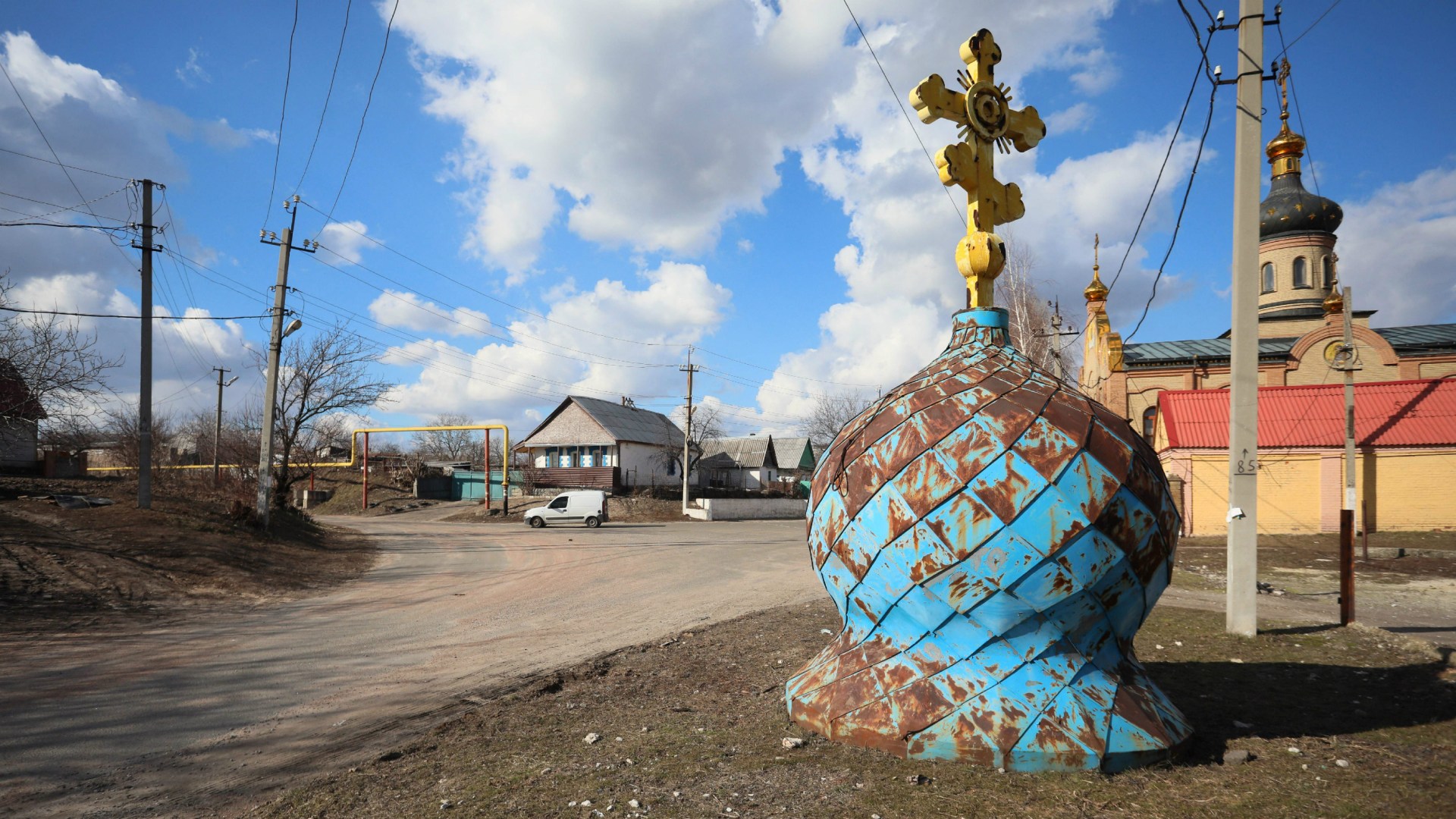
A cupola of a destroyed Orthodox church is seen in the town of Avdiivka in the Donetsk region located on Ukraine's frontline with Russia-backed separatists on February 21, 2022.

A cupola of a destroyed Orthodox church is seen in the town of Avdiivka in the Donetsk region located on Ukraine's frontline with Russia-backed separatists on February 21, 2022.

Christianity Today February 21, 2022
Aleksey Filippov / AFP / Getty Images

Update (Feb. 24): Pastors are staying to serve now that Russia has invaded Ukraine.

Facing imminent war, Ukrainian evangelicals preached peace the day before Russian President Vladimir Putin dramatically escalated tensions by recognizing the independence of two separatist regions on Monday evening.

“Go closer to meet those who are against you or fighting you,” Yuriy Kulakevych, foreign affairs director of the Ukrainian Pentecostal Church, told his congregation on Sunday, February 20, at God’s Peace Pentecostal Church in the capital, Kyiv.

“We are not only to enjoy peace ourselves, but to share it.”

Preaching on the Sermon on the Mount’s injunction toward peacemaking, Kulakevych continued his laser-sharp focus on the possible Russian invasion. Five weeks ago, as the separatist conflict in the eastern Donbas region began to escalate, he surveyed the Bible for its teaching on “wars and rumors of war.”

He followed that with an application of “Do not let your hearts be troubled” and, on the next Sunday, a treatise on worry. Last week, he tried shifting to include more mundane examples in a sermon on Jesus calming the storm, such as pandemic, career, and relationship difficulties. But the Russian threat did not dissipate.

“Protect yourself and your family by all possible means,” Kulakevych told the church. “And serve as a mentor for people in a bad state.”

The latter spirit is also animating Ukraine’s Baptists.

“Pastors in the gray area are not leaving the area,” said Igor Bandura, senior vice president of the Baptist Union of Ukraine, describing the frontline. “Christians are determined to take an active part in the needs of the people around them.”

They have already, planting 25 churches in the past five years.

At Irpin Bible Church in suburban Kyiv, Bandura quickly changed the sermon he had prepared on marriage. Instead, the focus turned to prayer: for wisdom, courage, ministers in the occupied territories, the national army—and even the enemies of Ukraine.

“I do not know in what mood you came here,” he challenged his listeners, “but I know for sure that if you open your heart to the Lord, you will come out renewed, strengthened in Jesus Christ, and ready for anything that is challenging our life.”

And on Sunday evening at Grace Church of Evangelical Christians in Kyiv, over 1,000 people gathered to pray for the unity, peace, and blessing of Ukraine. Representatives of many evangelical denominations were present, said Jaroslaw Lukasik, director of Eastern Europe Reformation.

[Editor’s note: More sermon examples from last Sunday are listed below.]

For weeks the Eastern European nation has lived in tension as an estimated 150,000 Russian troops amassed on the border. But the “gray area” has experienced this friction for much longer. The stretch of land in the Donbas, representing about 40 villages, lies between Ukrainian government control and Russian-backed militias in the occupied regions of Donetsk and Luhansk.

In 2014, Russia invaded Ukraine in support of the separatists. It annexed the Crimean Peninsula on the Black Sea and recognized the proclaimed independence of the two “republics.”

Last week, Elijah Brown of the Baptist World Alliance conducted a solidarity visit to Kyiv, the seventh most-populous city in Europe.

“The tension is real; you can feel it in this frozen air,” he said in a video from the capital. “Should there be chaos and confusion, the Baptist churches could be lighthouses in their community.”

Standing in front of St. Sophia Cathedral, the oldest church in Ukraine and an 11th-century “rival” to Constantinople’s Hagia Sophia that helped spread the Orthodox faith through the Russian world, Brown said the Baptists have invested $2 million into local aid, relief, and development.

The All-Ukrainian Union of Evangelical Baptist Churches, the largest Protestant community in Ukraine, reports among its ranks 2,272 churches, 320 missionary groups, and 113,000 adult believers.

Many of these believers are mobilizing. Bandura explained that plans are underway to turn church basements into refugee centers, as they stock up on supplies. Members with medical backgrounds are readying for service.

“We very much hope that our house of prayer will not be needed to shelter people,” said Volodymyr Nesteruk, pastor of Regeneration Baptist Church in Rivne, 200 miles west of Kyiv. “But we are preparing so that people can come here, if necessary, to find safety and shelter.”

Far from the eastern gray zone, Rivne is only 100 miles south of the border of Belarus, a Russian ally where 9,000 troops have gathered for war drills.

But preparations are being made even further west.

“If something happens, we will open our homes and our churches to you,” said Yaroslav Pyzh, president of the Baptist seminary in Lviv, only 40 miles east of Poland.

In recent days, Ukrainian officials have tried to downplay the threat of an invasion, especially from the Belarussian north. The troops gathered there are not sufficient for a rapid assault on Kyiv, they said.

But conflict has been spiking in the Donbas, threatening Baptist unity.

“Christians are being forced to go to war against Ukraine,” said a pastor in Luhansk, who requested anonymity, referencing reports he received from local churches.

“The brothers received summonses stating that they had to report to the military commissariat. … In case of disobedience, they will be held accountable.”

Since 2014, about 14,000 people have been killed in the war. But until now the trend was downward. Only 25 civilians were killed in 2021, the lowest figure since the conflict began.

Ukrainian positions were shelled 80 times on Sunday, according to a military spokesman. Two soldiers were killed, and troops were given orders not to return fire. Separatist authorities, however, said four civilians were killed by Ukrainian shelling.

Evangelicals in Donbas give conflicting accounts.

Amid a general conscription announced this past Saturday, only the women, children, and elderly are permitted to leave the occupied areas, said the Luhansk pastor. About 100,000 have done so, receiving 10,000 Russian rubles (about $127) in refugee camps near the Black Sea port of Rostov. But there is no reason to evacuate, he said, as the Ukrainian military is not pushing forward.

Pavel Karamyshev, who directs an evangelical camp in Donetsk, confirmed the news about shelling and mass migration. But he said both sides were firing, though he was not sure who initiated.

“As the Lord lives, and blessed is our protector,” he said, “let us intensify prayers for the protection of Donbas.”

His remarks were given to Vitaly Vlasenko, general secretary of the Russian Evangelical Alliance, who had trouble believing Ukraine could be behind the shelling.

“It is not wise for Ukraine to start anything; don’t provoke aggression,” he said, “Something wrong is going on.”

Confident that Russia was not directly instigating things either, he said the provocation could be from either side. Perhaps the military was seeking to stymie negotiations between Russian President Vladimir Putin and US President Joe Biden.

But seeing patterns from czarist and Soviet history, he worried that the rebels might be starting a fight—ready to call on Russia for help.

Vlasenko’s Church of the Annunciation of Evangelical Christian Baptists, in Moscow, held a special prayer for peace and reconciliation on Sunday.

While there was no special emphasis in the sermon, assistant pastor Vladimir Tripolski shared a poignant testimony from his flight with his family from Chechnya, two decades earlier, when Muslim separatists fought for independence from Russia.

“I didn’t know where I would go, but a Baptist church gave me shelter,” Tripolski said, drawing tears from the audience. “Let us turn our hearts toward the refugees.”

Vlasenko said discussions are underway about how the Russian evangelical alliance can assist in the camps outside Rostov.

Brown expressed his thanks to both Ukrainians and Russians who are demonstrating faithful witness.

“As one Baptist family rooted in Jesus Christ as Lord,” he said, “we bear witness to the biblical truth that ‘if one member suffers, all the members suffer with it.’”

Some Ukrainians, however, are calling out the Russians.

“Do you still sing ‘spiritual’ songs on Sundays … despite the bloodshed daily, on your behalf, by your troops, by your government of murderers, liars, and usurpers?” asked Gennadiy Mokhnenko, pastor of the Church of Good Changes. “Go on, don't be distracted from your … fake Christianity.”

Mokhnenko, active in orphan ministry, has reason to fear the creation of more children in need. His church is in Mariupol, 30 miles from the Russian border. It is the second-largest city in the Donetsk region and its redesignated capital, as it remains under Ukrainian government control on the frontlines of the conflict.

Though the situation remains unstable, Putin and Biden tentatively agreed to a coming summit later this month—if there is no invasion. But then Russia proceeded to recognize the independence of the two breakaway regions today, and authorized the sending of “peacekeeping functions.”

(Update: On Wednesday [Feb. 23], the Ukrainian Council of Churches and Religious Organizations sent an open letter to Putin. “[We] appeal to you with a request in the name of the Almighty—to stop the growing fire of war, because it is in your power,” wrote Hryhorii Komendant, chairman of the council and president of the Ukrainian Bible Society. “We authoritatively and unanimously testify that the Ukrainian people do not seek war, and we consider it a common duty of believers to stop it before it is too late.”)

Despite the current escalation, the anonymous pastor in Luhansk said that grocery stores and communication networks remain open, though gas lines have begun to form. And Yuriy Ochkalov, pastor of House of the Gospel church in Donetsk, posted a call to prayer, noting the beautiful Sunday weather outside his place of worship.

All parties do the same.

“If the occupation of these territories is a foreshadow of what may come to Ukraine,” said Brown, recalling Baptists being designated as terrorists and 40 of their Donbas churches shut down, “it should lead all of us to pray with greater fervor.”

Bandura agreed, anticipating victory.

“We believe that the Lord of Hosts will bless Ukraine,” he said, “and the plans of the devil and his servants will be destroyed.”

Kulakevych, however, directed the message back to his congregation—and anyone listening in. However perilous the political situation, there is a greater spiritual battle.

“In the face of the growing aggression of war, we remain the ambassadors of Christ,” he concluded his sermon. “Peace comes through reconciliation with God.”

Examples of Ukrainian Baptist Pastors’ Sermons from Sunday (Feb. 20):


• Christians should not be intimidated, preached Vasyl Furta in Vyshneve, near Kyiv. Concentrating on Isaiah 41:13, where God says he takes hold of our right hand, the pastor reminded believers of God’s presence, his strength, and support.

• “Why does God allow war?” asked Pavlo Marchenko in Shostka, 200 miles northeast of Kyiv near the border of Russia and Belarus. Preaching on Psalm 135:6 that the Lord does what he pleases, the pastor reassured listeners that God is not indifferent to Ukrainians. But at times he will “disturb” us, said the pastor, that people might turn to him in repentance, both for themselves and their people.

• God is our protection and help, preached Alexander Pakhai in Dubno, 230 miles west of Kyiv. But drawing from examples in Psalm 44, the pastor reminded listeners that while sometimes God delivers miraculously, at other times he led his people through times of destruction. But in all cases it is for his glory, that people may know that he is God.

• “Is our faith sufficient?” asked Eduard Bondarovsky in Korsun-Shevchenkivskyi, 90 miles south of Kyiv. Making a comparison to a swimmer able to navigate a small river but not the high seas, the pastor warned the troops that may cross the border are far from friends. Will we be ready to continue in hope, he challenged believers, certain that God is still our protector?

• War at the gates of the city came when the people chose new gods, remarked Dmytro Polyarush in Zhashkiv, also 90 miles south of Kyiv. Preaching on Samson from the book of Judges, the pastor dismissed the idea that God enjoys such punishment. Instead, Polyarush encouraged the faithful that God was already at work preparing the next deliverer.

• Be grateful for US and British intelligence, said Vyacheslav Shcherbakov in Zhytomyr, 85 miles west of Kyiv. Comparing Russia to the enemy Tobias in Nehemiah 4, the pastor remarked how the work of spies thwarted the aggression against Jerusalem. Neither Putin nor anyone else can separate us from the love of God, he emphasized.

Theology

Teach Black History Better by Learning from Jesus

How Christian teachers can tell the story of Black history in culturally relevant ways.

Christianity Today February 21, 2022
Illustration by Mallory Rentsch / Source Images: Maskot / MirageC / Getty / Sixteen Miles Out / Unsplash

As a kid, my friends and I believed that the designation Black History Month in February was due to a racist conspiracy because it was the shortest month of the year.

Thankfully, I learned as an adult that Dr. Carter G. Woodson chose to designate Negro History Week as the week of Frederick Douglass’ and Abraham Lincoln’s birthdays because of the role these men play in the liberation journey of Black people.

For Woodson, Black history was as much about the retelling of American history in a culturally informed way as about revisiting the past and present accomplishments of Black peoples throughout the US and the African diaspora. Those lessons carry forward into the classroom.

Critical race theory (CRT) is the debate du jour in America, and current efforts are underway in several states to pass bills that ban CRT from school curriculum. Many of these bills restrict lessons on Black history, but some of the bans extend to a broader set of concepts related to racial diversity, equity, and inclusion.

Studies show that teaching Black history in its proper context is beneficial, if not essential, to the success of Black children in school. According to sociologists Brian Wright and Sheretta Butler-Barnes, et al., Black kids excel inside and outside the classroom when they develop a positive view of their own racial-ethnic identity.

Rather than wade into the muddy waters of CRT, however, educators might consider pivoting toward another acronym to address the history of race in America: CRP. That is, culturally relevant or responsive pedagogy, which seeks to connect past sins with present problems to craft future solutions.

According to American pedagogical theorist Gloria Ladson-Billings, CRP rests on three propositions: student learning; student awareness of their own culture, history, and experiences (as well as that of at least one other); and student sociopolitical consciousness, or awareness of how their knowledge applies to real-world problems and the solving of those problems.

CRP is about empowering students to frame for themselves how they can use what they learn to confront injustice in the world and defeat it.

What does CRP look like for Christian teachers in particular? To learn how to treat Black history as American history and to teach it with accuracy and integrity, we need not look any further than the pedagogical example found in the person of Jesus Christ.

The Bible portrays Jesus as a master teacher, dating back to the age of 12 years old when he held court at the synagogue (Luke 2:46–47). But we find the nucleus of Jesus’ teaching methodology in John 13:34: “A new command I give you: Love one another. As I have loved you, so you must love one another.”

In this command, we see three things: Jesus knew his disciples, Jesus loved his disciples, and Jesus was the model for his disciples. His approach to teaching rested on those three premises.

First, Christian teachers must know the audiences that are entrusted to them by being culturally fluent and aware of the experiences of their students.

Second, the teachers must genuinely love their students, such that their needs take priority over whatever discomfort the teachers may have with lessons and conversations about race.

Third, these teachers must serve as models for their students by becoming students of Black history and liberation. You cannot teach what you do not know yourself.

We can further look to Jesus’ teaching style to find three specific strategies Christian teachers can employ during Black History Month.

Jesus often taught by telling stories and parables.

Storytelling is a culturally responsive teaching tool.

National data from the Early Childhood Longitudinal Study program shows that storytelling is particularly important for developing early literacy skills in Black children, stemming in part from the cultural and historic influences that have fostered a preference for orality among African Americans.

When teaching Black history, tell the whole story of the history makers—not only the what or the how but also the why. Cultivating an educational environment of storytelling can make teaching and learning Black history feel more natural.

Jesus’ teaching related to the people of his day.

When Jesus taught in parables, he often used illustrations that were familiar to the experiences and environment of his audience.

In his lessons, Jesus referred to everyday first-century objects and people, like a lamp (Matt. 5:14–16), sewing and garments (Matt. 9:16), farmers (Mark 4:1–20; 12:1–12), servants (Mark 13:34–37) and fishermen (Matt. 13:47–50).

In the same way, Christian teachers must utilize what their students are most familiar with to teach them the skills and competencies they need to know. Christian teachers can imitate Jesus by relating lessons to their students’ backgrounds.

In the case of Black History Month, they can teach and explain the impact of Black history makers on students’ individual lives and on society as a whole.

Jesus taught parables with a higher purpose.

Parables are stories that illustrate a greater biblical or kingdom principle.

For example, the parable of the unforgiving servant (Matt. 18:23–35) was a riveting story that captured his audience’s attention. But the moral of the story was that we must forgive our debtors as God has forgiven our debts (Matt. 6:12) or we risk suffering the same fate as those we chose not to forgive.

Likewise, when teaching Black history, it isn’t nearly enough to simply teach names, places, and events. Christian teachers must integrate their Black history lessons with biblical objectives that acknowledge and defend Black humanity—because if not, the sin of racism threatens to consume us all.

Had I encountered this kind of education as a K–12 student, perhaps I wouldn’t have been tempted to believe that Black history in February was simply a racist conspiracy. For starters, I am not sure whether my grade-school teachers had the wherewithal to prove me wrong.

But perhaps these lessons can benefit the next generation.

This year and every year, Christian teachers have the privilege of incorporating Black history into their lessons throughout the school calendar, not just in February.

Above all, they have the chance to be good models for their students by loving Black people in their personal lives and not just when they stand at the front of their classrooms. The benefits of doing all this are far-reaching—not only for Black children but for all children.

Christian teachers who implement the instructional strategies rooted in Christ’s example can go a long way to support the critical work of Black History Month.

Rann Miller is director of anti-bias and DEI initiatives as well as a high school social studies teacher for a Southern New Jersey school district. He's also a freelance writer and founder of the Urban Education Mixtape, supporting urban educators and parents of students in urban schools.

News

How Will the SBC Move Forward After ‘Unprecedented’ Committee Exodus?

The Executive Committee is meeting for the first time since the contentious decision to turn over privileged documents in an ongoing abuse investigation.

Christianity Today February 21, 2022
Brandon Porter / Baptist Press

When the Executive Committee (EC) of the Southern Baptist Convention gathers in Nashville this week, it will no longer face the debate over waiving attorney-client privilege in an abuse investigation, the topic that dominated a contentious series of meetings last fall.

But it will be hard to ignore the fallout of that decision and how the disagreement highlighted deeper divides in the SBC.

Seventeen members of the Executive Committee have resigned since June. All but one left because of the conflict over waiving privilege in an investigation into the EC’s response to abuse. The choice to waive attorney-client privilege was approved near-unanimously by thousands of messengers at last year’s annual meeting.

Included among the resignations were committee officers Robyn Hari and Robert Showers. Three executives have also resigned since October: president Ronnie Floyd, executive vice president Greg Addison, and chief financial officer Jeff Pearson.

The departures were largely the result of the consequences EC members feared they could face due to waiving privilege, from losing insurance coverage to exposing the organization to legal liability that could bankrupt it.

About half of the resigning members indicated that the potential breach of fiduciary duty that might result from waiving privilege could put their professional status at risk, including attorneys, CPAs, a financial adviser, and a licensed counselor.

Southern Baptist historian and pastor Bart Barber told CT that thus far, none of the things about which members were warned have transpired.

“I know some of the people who stepped aside. I think they had been led to believe and genuinely held the belief that all of these risks were severe,” Barber said.

Many of those who left their elected EC positions said that they were leaving “because they were convinced that waiving attorney client privilege would cause a lot of bad things to happen,” he added. “That didn’t happen.”

An exodus of trustees on this scale is unprecedented in the SBC, according to multiple historians consulted by CT. But it does not affect the committee’s ability to carry out its mandate to disburse funds from the convention’s funding mechanism, known as the Cooperative Program, and act on behalf of the convention ad interim.

Executive Committee bylaws specify that action can be taken when a quorum of existing members is present, and though the normally 86-member committee currently has only 68 members, the committee could legally function with as few as three members.

The controversy over the vote to waive privilege and the ensuing resignations signal a deeper divide within the convention related to politics, sexual abuse, racial reconciliation, women’s role in the church, the legacy of Paige Patterson (known as the architect of the SBC’s “conservative resurgence” in the 1980s), and the degree to which fields of study like critical race theory can have any value for the church.

According to Barber, the Conservative Baptist Network (CBN)—a group in the SBC linked to Patterson that has criticized a purported liberal drift in the SBC—had an outsized presence on the EC and among its officers, and for a number of reasons they opposed waiving privilege. The CBN Steering Council includes immediate past EC chairman Mike Stone, former vice chairman Tom Tucker, former secretary Joe Knott, current officer Jim Gregory, and former officer Rod Martin. Tucker finished his term in June of last year, and Martin resigned in the fall.

Many in the SBC believe that waiving attorney-client privilege in the EC investigation has implications for Augie Boto in particular, since he served as EC vice president and in-house counsel during the 20 years covered by the inquiry. Boto has recently been in legal trouble regarding his connection to Patterson and an alleged plan to redirect foundation monies away from Baylor and Southwestern Seminary, which fired Patterson in 2018.

“If you are someone who has a sense of loyalty and connection to the Pattersons and to the penumbra of people around the Pattersons, and if you see something that poses a risk to Augie,” Barber said, “maybe there’s some personal reasons that people would look and say, ‘This is one of our guys. I like him; he’s a friend of mine. He really doesn’t want this to go forward. And so I’m against it too.’ I think personal affiliations always plays a role in everything in the Southern Baptist Convention.”

Patterson has been accused of mishandling allegations of rape at two SBC seminaries and has denied the accusations. CBN members say they are committed to opposing abuse and abusive pastors in the SBC, but its leaders have also suggested that the issue has been overblown and put undue suspicion on the many pastors in the convention who aren’t abusive.

Of the multiple matters before the EC ahead of this week’s meeting, replacing missing members is not on the agenda. That task is left to the Committee on Nominations, which brings a slate of candidates to the convention’s annual meeting each summer to replace all vacancies among the denomination’s 12 entities and two other committees.

According to Leah Finn, chair of this year’s Committee on Nominations and the first woman to serve in that role, the 24 vacancies to be filled for the Executive Committee—which includes both the resignations and those whose second term is expiring—constitutes more than a quarter of the total vacancies within the convention.

“I don’t think there’s ever been that number of resignations,” Finn said. “And having 24 that we’re replacing all at once, it has to be the highest” number of vacancies to occur in a single year, she added.

EC chairman Rolland Slade told CT that the real challenge for the EC was overcoming staffing challenges in the wake of three C-suite resignations. He also expressed confidence in the officers’ recent appointment of Willie McLaurin as interim president, a role the bylaws stipulate must be filled by an EC vice president.

For a denomination that has long reckoned with its history regarding racism, Slade—the first African American chair of the EC—was hopeful at the appointment of McLaurin, who is the first-ever Black entity head in the SBC.

“This, to me, is a signal of good things in the sense that God has given men opportunities and raised them up for such a time as this,” Slade said. “Willie served on state staff in Tennessee for 15 years. So, you know, he has experience. He’s well qualified.”

McLaurin has also served as an interim pastor at a number of churches throughout his career, and he said that experience will serve him well in this season.

“My role as an interim has been to shepherd the people patiently with the love of God, help the church remember its main mission, keep the church moving forward, and provide stability in a time of instability,” he told CT in a statement. “As the interim president and CEO at the SBC Executive Committee, I will focus on serving our staff team and caring for them well.”

Regarding the historicity of his appointment—which must be ratified by the EC this week—McLaurin told CT he was honored and thankful, particularly for those who had gone before him.

“This is the first time in 177 years that an individual of non-Anglo descent has served as the interim or head of any SBC entity,” he wrote. “I am prayerful this moment will signal the Southern Baptist Convention is actively engaged in erasing the stain of racism.”

The committee will hear a report on the status of the sexual abuse investigation from SBC president Ed Litton and form a search committee that will be tasked with finding Floyd’s replacement.

One criticism of some of the EC’s fall meetings was how often they invoked the use of executive session, typically used to handle legal or personnel matters not open to the public. Slade said that he intends for as much as possible of this week’s meeting to take place in open session.

“I’m confident that we’re going to conduct ourselves in a different tone,” Slade said of this week’s meeting. “We’re really honed in on doing what it is that we are tasked to do and serving the Southern Baptist Convention.”

News

Southern Baptist Missionaries See Baptisms and Converts Surge With COVID-19

Leaders cite missiological methods and the work of the Spirit as the reasons for the surprising statistics.

Christianity Today February 21, 2022
Rob Birkbeck / Lightstock

The Southern Baptist Convention fell on hard times last year, with a contentious sexual abuse investigation, racial tensions, and shrinking US baptism numbers. But amid the gloom, there was a bright spot: international missions.

During the COVID-19 pandemic ’s first year, the number of new believers harvested by the 3,552 missionaries serving with the convention ’s International Mission Board (IMB) increased 62 percent from the previous year. Baptisms were up 81 percent from 2019 to 2020 (the most recent year for which data is available), and salvation testimonies continue to pour in.

The increases are particularly significant in a denomination where many cite missions as their reason for joining and staying.

A 53-year-old Thai man with chest pain went to see an IMB medical missionary outside Bangkok. The man collapsed in the clinic and regained consciousness only after the IMB missionary, a physician, performed emergency medical procedures.

As they waited for an ambulance, the man prayed to receive Christ, prompting the doctor to ask, “When did you start to become interested in God’s story?”

The man pointed to the place on the floor where he collapsed and said, “Right there. Before that, I had never been interested at all. But when I collapsed, I heard God call my name three times, and I knew he was warning me.”

That wasn ’t an isolated incident, according to IMB reports. The evangelistic surge, missiologists say, is attributable to effective methodology, the pandemic, and the sovereign work of the Holy Spirit.

“We ’ve seen the Holy Spirit working across the globe in mighty ways,” said Wilson Geisler, IMB director of global research. One missionary team “saw the first believers among an incredibly tough-to-reach people group.” Another “saw more people coming to faith in 2020 than in the previous three years combined.”

In a video report ahead of February’s Executive Committee meeting, IMB president Paul Chitwood noted that even with canceled short-term missions trips keeping tens of thousands of Southern Baptists at home, full-time missionaries’ international work was able to continue and thrive.

Despite fewer face-to-face evangelistic encounters thanks to COVID, IMB personnel and their partners around the world “found innovative, often virtual, ways to present the gospel,” according to the IMB’s 2020 Annual Statistical Report.

The 535,325 people who heard a gospel witness in 2019 increased to 769,494 in 2020. The approximately 89,000 new believers recorded in 2019 increased to 144,000 in 2020, with a corresponding jump in baptisms from 47,929 to 86,587.

IMB statisticians are sparing in the information they release about their counting methodology. They say data reflects the work of IMB personnel and “their baptistic partners,” though neither the number of partners nor the groups they represent are specified. Several years ago, under David Platt, the IMB saw a dramatic decline in converts, baptisms, and church plants, as the agency transferred ministries from missionaries to national partners. (See CT’s 2016 article on how missions agencies count converts.)

Additionally, IMB cautions against parsing the numbers too closely because the number of missionaries and ministers reporting varies from year to year.

“For security reasons,” Geisler said, “in each part of the world, the number of personnel and close partners who provide data for the report is not provided. This means it will always be unclear how many individual report givers contributed” to annual statistics. “Field research teams and our US-based Global Research Department review reports for anomalies.”

Despite the IMB’s qualification and hedging of the numbers, they argue the increase is incredible.

“I was not surprised at the increase,” said John Brady, IMB vice president of global engagement. “Rather, I was amazed.” He said the increase can be attributed in part to a discipleship plan coming to fruition in parts of the world.

The plan starts with discipling new Christians through 35 Bible passages “which teach the necessity and power of transformation that comes from God,” Brady said. The new believers share those key passages with their neighbors “and repeat the process.” Then they “go on to other studies such as a biblical plan to teach key doctrines and leadership development.”

Most of the reported evangelistic increase occurred in South Asia. Eighty-nine percent of 2020 baptisms (76,904) and 97 percent of new churches (17,772) were reported in that region.

While COVID-19 has caused death and infection in South Asia (with 510,000 reported deaths in India to date, according to the World Health Organization), the pandemic has not interrupted daily life there as it has in the West.

“We have heard anecdotally from South Asian pastors that because many people survive by daily labor, within two weeks of government-sanctioned lockdowns, people had to ignore those in order to feed their families,” Geisler said. “In urban areas of South Asia, we’ve also heard from personnel that COVID provided more opportunities for gospel witness and disciple making.”

Missiologist David Garrison, a former IMB leader in South Asia, attributes the increases to an explosion of church planting. He retired from the IMB in 2015 after 35 years of service, including publication of a 2004 book that has become a standard work on church planting movements.

“When we entered the region, only 4 percent of the IMB’s personnel were serving in this densely populated region,” Garrison said. The explosion of Christians and churches stems from “the multiplication of church planting movements that are an essential part of the vision and DNA of the missionaries in that region. This factor is even more evident in the new churches started in South Asia.”

Not all missiologists agree with Garrison ’s analysis. The term church planting movement (CPM) refers to a specific methodology in the missions world—one that has drawn critique in some evangelical circles and that the IMB says it does not utilize.

The traditional model of church planting focuses on preaching and launching churches with a preaching pastor, said Ted Esler, president of the missions network Missio Nexus, which includes IMB.

The CPM model focuses on starting house churches and utilizing Socratic discussions about Scripture—with the discussion led sometimes by a nonbeliever and almost always by someone from the indigenous culture rather than a missionary. Esler sees the reported IMB numbers as plausible due to IMB’s use of CPM methodology—even if it prefers not to use that terminology.

“All forms of church planting are awesome,” Esler said. “But most of the action in the world is with the movements. In Missio Nexus, we have 320 mission agency members. My guess is that among those that do church planting, 80 percent have some sort of movement-oriented ministry going.”

Among CPM critics are Reformed evangelicals like John Piper ’s ministry Desiring God and the church health organization 9Marks, who argue CPM methodology tends to lack quality controls and at times neglects the biblical task of preaching. CPM advocates reply that preaching is just a method and that Scripture requires only that churches teach the Bible.

In 2006, then-IMB missionary John Massey, now dean of Southwestern Baptist Theological Seminary ’s evangelism and missions school, penned a friendly critique of the IMB’s use of CPM methods, claiming they wrongly elevated speed as a goal of church planting at the expense of biblical fidelity.

“In CPM methodology, quick results take short-term precedence over long-term sustainability,” he wrote.

But Massey told Christianity Today that “much has changed in the IMB leadership” since his critique was written, “with each successive IMB president distancing the organization from CPM methodology.”

Massey is “doubtful” the 2020 baptism increase “was in any way the result of CPM methodology, which has enjoyed less and less favor among Southern Baptists.”

Garrison continues to defend his CPM framework and insists it is “widespread in the IMB and throughout the international church-planting community.” Yet whatever label is used to describe the IMB’s church-planting work, Garrison said the organization is “being very faithful” to Southern Baptist standards outlined in the Baptist Faith and Message as well as the IMB’s Foundations document, which sets forth “12 characteristics of a healthy church.”

The pandemic itself drove some of the growth in conversions. “When the COVID-19 lockdown started, many Muslims in our area were out of work and in need of food,” according to the South Asia section of the 2020 Statistical Report. “Southern Baptists generously provided food for those in need. Local evangelists then had the joy of going house-to-house in Muslim communities providing food and sharing the gospel.”

The leader of IMB work in the Asia-Pacific Rim region reported similar stories from South America and East Asia. One part of Asia saw 191 professions of faith among Buddhists in six weeks through a food distribution ministry. In South America, a woman and her three children “had not eaten in two days.” When an IMB worker arrived with food, “the woman fell at this missionary ’s feet.”

Yet not all IMB statistical increases can be explained by missiological methods or doors opened by COVID-19, such as with a movement of the Holy Spirit among one of the people groups IMB serves in East Asia.

Last fall, a group of adults gathered in an apartment for Bible study and worship while their children met in a nearby apartment to study Acts 16, the story of Paul and Silas sharing their faith in prison. Just then, police raided the gathering, eventually arresting three leaders.

Like the biblical characters they were studying, the leaders shared the gospel in jail. Now more than 20 formerly unengaged people have access to the gospel, along with their families and friends.

“IMB personnel and partners, regardless of the difficulty of the soil, are laboring diligently and with their best efforts, trusting God with the results,” Geisler said.

The IMB’s statistical report for 2021 is expected this spring.

David Roach is a freelance reporter for CT and pastor of Shiloh Baptist Church in Saraland, Alabama.

News
Wire Story

New Novavax Shot Could Appeal to Pro-Life Christian Skeptics

Though Catholic and evangelical leaders have endorsed existing options, this vaccine is the first without links to fetal-derived cell lines.

Christianity Today February 18, 2022
Chip Somodevilla / Getty Images

Could a much-delayed COVID-19 shot finally win over religious vaccine skeptics?

That’s the question swirling around a vaccine made by Novavax, a Maryland biotech firm that submitted its request to the US Food and Drug Administration last month for emergency use authorization of its COVID-19 shot, also known as NVX-CoV2373.

Although more than a year behind competitors such as Moderna and Pfizer/BioNTech, which were both cleared for emergency use in late 2020, Novavax’s two-dose vaccine has already been approved for use in other countries such as the UK, and the company hopes to aid global inoculation efforts.

But Novavax may have another unusual selling point: the potential to woo vaccine skeptics who reject other widely available vaccines because of distant links to abortion they say violate their morals and their faith.

“No human fetal-derived cell lines or tissue, including HEK293 cells, are used in the development, manufacture or production of the Novavax COVID-19 vaccine candidate, NVX-CoV2373,” a Novavax spokesperson told Religion News Service via email.

About 64 percent of the US population has been fully vaccinated against COVID-19 as of February 18, with 28 percent having received an additional booster shot, according to The New York Times.

Public health experts say the unvaccinated population is harboring vaccine hesitancy or outright anti-vaccine sentiment, some of it driven by faith. According to a December 2021 survey by Public Religion Research Institute and the Interfaith Youth Core, 10 percent of Americans say they believe getting a COVID-19 vaccine conflicts with their religious beliefs.

Among their objections is that in developing or testing their vaccines, Moderna, Pfizer-BioNTech, and Johnson & Johnson all used cell lines in various ways that trace their origins to aborted fetuses from the 1970s and 1980s. The most commonly used in medical laboratories are known as HEK293 and PER.C6.

Bishop Joseph Strickland of the Diocese of Tyler, Texas, has defied Catholic Church hierarchy by taking a hardline stance against COVID-19 vaccines because of the controversial cell lines.

“I WILL NOT take an abortion tainted vaccine, I wish other bishops had joined me months ago,” Strickland tweeted in April 2021. But he linked from the tweet to an article from the website Catholic Culture, which promoted Novavax’s shot in a separate December 2020 post as “apparently developed and produced without any involvement of fetal tissues.”

Novavax CEO Stanley Erck has expressed hope his vaccine could win over vaccine skeptics in general. “In the US, the primary market I think in 2022 is going to be to supply a vaccine, our normal two-dose regimen, to a lot of people who have been hesitant to get other vaccines,” Erck told CNN in November.

Some prominent anti-vaccine activists, such as Robert F. Kennedy Jr., have been cautious but notably less hostile toward Novavax because it uses protein-based technology, a more traditional approach than the mRNA-based vaccines created by Moderna and Pfizer. The animal cells employed in its development, Novavax notes, come from moths.

The company claims the shot was up to 90 percent effective in preventing the original strain of COVID-19 and announced in December that it also generates an immune response against the omicron variant.

Abby Johnson, a prominent anti-abortion activist who has repeatedly condemned many COVID-19 vaccines because of their connection to fetal cell lines, celebrated Novavax’s approach.

“It is my understanding that (Novavax) has been used successfully in several countries with a high efficacy rate,” she told RNS in a statement. “It is also my understanding that there are not any ethical concerns regarding Novavax, which is hopeful for pro-lifers who have avoided the vaccine due to those objections.”

Scientists and faith leaders have dismissed criticism of HEK293 and other cell lines, explaining that the cells used today are clones many steps removed from the original tissue and not present in the mRNA-based vaccines themselves.

Both the Vatican and the US Conference of Catholic Bishops have issued statements declaring it morally permissible for Catholics to get Moderna, Pfizer and Johnson & Johnson shots despite use of the cell lines.

Texas pastor Robert Jeffress, onetime adviser to former-President Donald Trump, has similarly derided the cell line argument, pointing out that they are used to develop a host of common medicines.

“Christians who are troubled by the use of a fetal cell line for the testing of the vaccines would also have to abstain from the use of Tylenol, Pepto Bismol, Ibuprofen, and other products that used the same cell line if they are sincere in their objection,” Jeffress told the Associated Press in September.

Yet religious arguments have continued to crop up among those who oppose vaccine mandates. A major protest in Washington, DC, last month began with a musical number that characterized vaccine mandates as “a war on religion.” What’s more, vaccine controversy has spurred fusions of Christian nationalism and anti-vaccine rhetoric.

Novavax’s distance from the cell lines might not be enough for some, however. Asked about the Novavax shot, Sarah Quale, president of the anti-abortion Personhood Alliance Education, pointed to a scientific study of Novavax’s vaccine that referred to the use of HEK-293 cells.

“The Personhood Alliance’s official position on vaccine ethics asserts that the use of aborted fetal cell lines at any point in vaccine creation is morally unacceptable,” Quale said via email. “All currently available SARS-CoV-2 vaccines in the US used aborted fetal cell lines at some point in the design, production, and/or testing processes.”

Pressed about the study, a Novavax spokesperson said the company “did not use HEK-293 cells in the testing of NVX-CoV2373.”

“The reference in the Science paper to HEK293 cells was based on well-established scientific knowledge, did not include our vaccine protein, and is completely independent of Novavax COVID-19 vaccine development,” the spokesperson said in a followup email.

Quale remained skeptical, noting Novavax has “not made information available as to which cells were used in testing.”

Meanwhile, Johnson noted that while any use of the cell lines would change her opinion of the shot, she’s “not seeing any evidence that they were, and Novavax is denying they were used.”

Stacy Trasancos, who recently left her post at the St. Philip Institute of Catechesis and Evangelization and co-leads the anti-abortion group Children of God for Life, both of which are tied to Bishop Strickland, called Novavax’s initial response “confusing,” but did not immediately respond to the company’s clarification.

Whether Novavax’s efforts will be enough to win over Strickland or those who agree with him is an open question.

The marriage of anti-vaccine sentiment and opposition to vaccine mandates has emerged as a political force all its own, and many who oppose vaccines root their views in a variety of conspiracy theories, not just faith. Even if it does convert some of the unvaccinated, it’s unclear if the shift would be significant.

But as the US nears 930,000 deaths attributed to COVID-19, according to the Centers for Disease Control, any increase in vaccinations may make a difference.

News
Wire Story

Survivors Remain Skeptical of Anglican Diocese Investigations

As a suburban Chicago ACNA church moves forward with examining sexual abuse and leaders’ responses, critics worry the process hasn’t been independent.

Christianity Today February 18, 2022
Google Maps

As investigations into sexual abuse and abuse of church power get underway in the Anglican Church in North America’s Upper Midwest Diocese, at least five individuals who say they experienced sexual or spiritual abuse in the diocese say they will not participate in one or both of the investigations due to concerns about transparency.

In an announcement by the 13-year-old denomination on Sunday, survivors of abuse were given information about how to contact two firms, Husch Blackwell and Telios Law Firm, that will conduct parallel investigations into sexual abuse and abuse of ecclesiastical power, respectively. The denomination also furnished a number for ACNA’s confidential support hotline and said that there is a fund to assist sexual abuse survivors.

But the announcement did little to answer accusations from a group called ACNAtoo and others that the investigations do too much to protect the church. It comes weeks after three of eight people appointed to a Provincial Response Team to oversee the sexual abuse investigation resigned, saying the team’s process “never felt survivor-centered.”

Ten people have come forward since 2019 to accuse Mark Rivera, a former lay minister in the Upper Midwest Diocese, of sexual assault and child sexual abuse. Others have said Bishop Stewart Ruch III, who has been on a leave of absence since July, and other church leaders created a toxic culture of submission and control at Church of the Resurrection, the diocesan headquarters.

ACNA, a denomination of about 127,000 people, began as a group of dissenters from the Episcopal Church who disagreed with its stances on same-sex marriage and LGBTQ ordination.

One woman whose young daughter reported being sexually abused by Rivera in 2019 echoed the demands of ACNAtoo, which has asked ACNA to waive attorney-client privilege and disclose the letter of engagement, or contract, between Husch Blackwell and ACNA.

“I have no reason to believe that anything about this investigation is independent,” said Cherin Marie, who asked that her last name not be used, to protect her family’s privacy.

Because of that lack of independence, Cherin Marie said, her daughter won’t participate. “Witnesses are in essence being asked to undergo interviews by the ACNA’s lawyers, who have a fiduciary duty to the ACNA, not the survivors,” she said.

A woman named Holly who is another alleged victim, and who also asked to keep her last name private, has likewise declined to participate in the sexual abuse investigation. “ACNAtoo has been fighting for a safe investigation on my behalf and the ACNA has chosen to completely disregard the wishes and requests of many of Mark’s victims, including mine,” she said.

Amers Goff, who says they experienced ecclesial abuse in the Upper Midwest Diocese, told Religion News Service they were still deciding whether to participate in the investigation into abuse of church power. Goff attended Church of the Resurrection, headquarters of the Upper Midwest Diocese, between 2004 and 2010.

“I haven’t chosen to participate so far because I don’t think my story will be taken seriously,” said Goff, who is nonbinary. Goff said they are concerned about trusting their story with an institution that is not affirming of LGBTQ individuals.

Joanna Rudenborg, who has reported being sexually abused by Rivera, echoed Goff’s concerns about the lack of clarity around what ACNA might consider spiritual abuse.

In Sunday’s announcement, ACNA leadership said, “We will not shield anyone who has committed abuse or engaged in misconduct from the scrutiny of an impartial and objective investigation that seeks the truth. Our great desire is that the Anglican Church in North America will be a safe place for adults and children, the broken-hearted and the vulnerable.”

While some individuals have said church leaders in the Upper Midwest Diocese exposed them to conversion therapy or pressured them to stay in abusive marriages, “the Province’s interpretation may be that these are just differences of theology,” Rudenborg told RNS.

Rudenborg said the recent resignations of three ACNA Provincial Response Team members have only added to her concerns about participating in the investigations.

Autumn Hanna VandeHei, Gina Roes, and Christen Price resigned on January 17 and, in a public letter, said the Provincial Response Team had dismissed their recommendations about being sensitive to survivors in public communications and failed to promptly deliver financial assistance to victims.

They also told RNS that while the Provincial Response Team received correspondence from survivors of abuse and concerned friends and family, “almost none of that correspondence was even mentioned, let alone forwarded, to us.”

Days after the three resigned, the remaining team members issued a response saying “it would not serve the survivors or the investigative process to debate them at this time.” They have not specified what points of disagreement they may have.

The three former team members also told the RNS that they have not seen Husch Blackwell’s contract with ACNA. Price, an attorney whose role on the team was to assist with vetting and choosing an investigative firm, said other members of the team declined to show her the contract prior to her resignation.

The former team members told RNS that ACNA leadership ought to “apologize to the survivors, include the Province within the scope of the investigation, and waive attorney-client privilege.”

Kathleen McChesney, former executive director of the Office of Child Protection for the US Conference of Catholic Bishops, said that ACNA might learn from the Catholic Church’s response to abuse crises. “The most important lesson … is that the ACNA should respond to persons who report abuse with care and concern—and listen to what they have to say,” she said.

Ideas

3 Lessons for Chinese Churches from Herman Bavinck

The Dutch theologian’s concern for the catholic, contextual, and public nature of the Christian faith can help congregations overcome sectarianism and stereotypes.

Herman Bavinck and the Chinese Church

Herman Bavinck and the Chinese Church

Christianity Today February 18, 2022
Image: Illustration by Rick Szuecs / Source Images: Wulingyun / Getty / Wikimedia Commons

A hundred years after his death, Herman Bavinck no longer belongs to the Dutch church. The 19th-century theologian has gone global in the 21st.

But does he belong to the Chinese church? He should.

The neo-Calvinist luminary passed away in 1921. For the next eight decades, the study of his theology was largely confined to Dutch communities, both within the Netherlands and its diaspora. But the past two decades have seen a surge of Bavinck studies in English-speaking theological circles.

Many of his works have now been translated into English. Many scholars have written about him, offering now a worldwide selection of secondary sources. Calvin Theological Seminary in Grand Rapids, Michigan, has established an institute, society, and journal to further promote the Bavinck research boom.

Especially thanks to the publication of his four-volume Reformed Dogmatics (2003–2008), Bavinck is no longer a theologian restricted to the Dutch. He has transcended the Netherlands and entered the conversations of the global church.

As a Chinese scholar who studied Bavinck for my dissertation, for me this momentum begs the question: What does a Dutch theologian born in the 19th century have to do with the Chinese church in the 21st century? And how can Chinese Christians better understand and apply his beliefs?

Bavinck is technically no stranger to Chinese churches. A popular digest of his dogmatics, Our Reasonable Faith, was translated into Chinese as early as 1989. However, the Chinese church has only scratched the surface of his theology with a superficial understanding, as it was not until 2014 that a second tome, The Philosophy of Revelation, a series of lectures he gave at Princeton Theological Seminary, was published in mainland China.

Meanwhile, North American theologians and seminaries have dominated the Chinese church’s understanding of his thought. The Bavinck in works by the likes of Cornelius Van Til and Louis Berkhof became the standard portrait in the minds of Chinese Christians. Yet recent studies show that these conventional readings of Bavinck’s thought are incomplete and lack a deeper consideration of his historical background and theological contextualization.

In his latest book, Bavinck: A Critical Biography, James Eglinton draws a vivid portrait. We encounter a Bavinck who, in the tension between modernism and the Reformed tradition, seeks to construct a theological system that is embedded with catholicity based on the doctrine of the Trinity and to portray a vision of a Christian worldview. This portrait is of great significance for Chinese churches today, as well as for the evangelical church in North America, because of Bavinck’s three emphases:

1) The Christian faith is catholic

Since the 1980s, theological education in churches in mainland China has flourished, with Reformed theology at the forefront of this growth. The Reformed evangelical movement led by Stephen Tong has played an important role in this development, as have Chinese translations of works by North American New Calvinists such as Tim Keller and John Piper.

However, this development in many churches in mainland China has gradually bred a pathological theological complex that only holds the Reformed faith as orthodox. Believers and churches with such a complex presuppose that only Reformed theology is the truth, placing it in opposition to other traditions.

For example, many newer urban Reformed churches more often than not cannot get along with older traditional house churches (think pietist networks started by Watchman Nee or Wang Mingdao) in mainland China. Chinese Reformed adherents normally turn down the traditions of these indigenous churches and are instead enthusiastic about importing Reformed confessions and Presbyterian polity from Western countries. Even worse, they sometimes regard one particular Western Reformed theologian (e.g., Van Til) as the yardstick by which they measure the truth of all theological discourse.

This narrow-minded theological stance has often invited much criticism of Chinese Reformed churches and incurred misunderstanding of actual Reformed theology. It has also spread to Chinese churches outside of China.

As a Reformed theologian in the modern age, Bavinck constructed a theological system that was deeply concerned about, as he wrote, “The Catholicity of Christianity and the Church.” For him, this catholicity “is based on the conviction that Christianity is a world religion that should govern all people and sanctify all creatures irrespective of geography, nationality, place, and time.”

His magnum opus, Reformed Dogmatics, is both profound and beautiful—full of meaningful words worthy of savoring. In dealing with many theological issues, he always had an expansive vision and a kingdom mind. Bavinck tirelessly absorbed the best of various theological and philosophical traditions—for example, his appreciation and critical appropriation of German theologian Friedrich Schleiermacher ¹—in the spirit of Christian catholicity, seeking to manifest the goodness of God in every sphere of human life. In addition, he emphasized that the catholic nature of the church transcends the limits of time and space. It possesses all the doctrines that human beings need to know concerning visible and invisible things.

In Bavinck’s view, that is the strength of Reformed theology: It provides a holistic view of life and of the world that helps believers live out this catholic faith. Thus, although he came from the separatist Christian Reformed Churches, Bavinck cooperated painstakingly with Dutch statesman and theologian Abraham Kuyper to promote unity among congregations that broke away from the Netherlands’ state-endorsed church. In 1892, they achieved the union of Kuyper’s Doleantie (“the Sorrowful”) churches with Bavinck’s denomination to form the Netherland’s second-largest Protestant denomination, the Reformed Churches in the Netherlands.

The Chinese church’s neglect of the catholic nature of the Christian faith needs to be addressed urgently in order to correct any pathological complexes and narrow-minded ecclesial positions, such as those held by some Reformed churches in mainland China. Bavinck, who lived in the Netherlands a century ago, gives us golden words in this regard: “Universal, catholic, is the Christian confession in this sense, that it spreads itself over the whole earth, includes all true believers, applies to all people, and has significance for the whole world.²” Any Christian church must not be narcissistic but should participate in fellowship with the global church and practice peaceful coexistence in its own region.

2) The Christian faith is contextual

It is true that Christianity was introduced to China from Western nations. Thus, the stereotype of Christianity as a “foreign religion” has long been prevalent in Chinese society. Yet interestingly, the practice of many Chinese churches seems to be an endorsement of this stereotype.

It is a common phenomenon that the Chinese Christian community often wishes to import the ideas of many Western theological traditions or theologians while neglecting to consider their own situation here and now. In particular, the Reformed boom of the last 40 years in mainland China has witnessed this non-contextualized theological mindset. Many of the emerging Reformed churches have been quick to introduce Reformed confessions and apply them to their churches without sufficient discernment or reflection. This approach often makes a Chinese church look more like a “foreign church” that lacks the power to communicate the Christian faith in the Chinese context.

In “The Future of Calvinism,” Bavinck argues: “Calvinism wishes no cessation of progress and promotes multiformity. It feels the impulse to penetrate ever more deeply into the mysteries of salvation, and in feeling this honors every gift and different calling of the Churches. It does not demand for itself the same development in America and England which it has found in Holland. This only must be insisted upon, that in each country and in every Reformed Church it should develop itself in accordance with its own nature and should not permit itself to be supplanted or corrupted by foreign ideas.”

Beyond Calvinism, Bavinck’s argument can be applied to the church’s articulation and communication of the faith in every region. In other words, while the Chinese church can draw on the rich theological legacies of other nations to promote its own articulation of the Christian faith, it must always preach the gospel in its own cultural context according to the unique gifts God has given to it. In doing so, Chinese communities will realize that the Christian faith is also a religion that belongs to and is oriented toward the Chinese people.

Furthermore, Bavinck’s emphasis on the contextuality of the Christian faith is a particular reminder for the unregistered church in mainland China. Due to their tensions with the government, contemporary house churches are reluctant to contextualize Christianity in order to address Chinese atheism, socialism, New Confucianism, digital authoritarianism, and other local challenges. This is because the government has enacted a policy of “sinicization” of religion, defined as “religion conforming to socialism with Chinese characteristics.”

Many house churches fail to distinguish between this politicized sinicization and a biblical contextualization of the Christian faith. As a result, they often implicitly proclaim an uncontextualized or “acontextual” Christianity. Bavinck’s view of Christian contextuality can remind unregistered congregations that the church that is rooted in the mysteries of salvation is called to contextualize God’s revelation.

3) The Christian faith is public

Bavinck was raised in a separatist church community. While there was no shortage of people in his denomination who proposed to participate in society from their own position of faith, there were still many who were hostile to the modern culture of the time. This tension has long existed in the church, which in every age has needed to think about the public nature of faith and to address the question of Tertullian, “What indeed does Athens have to do with Jerusalem?”

Such a question is especially pertinent amid transition from a Christian to a secular civilization. Because of its position on this transition, the rise of fundamentalism in North America in the first half of the 20th century by and large showed a tendency toward separatism and anti-modernism. Even by the end of the 1950s, separatism became the test of fundamentalism (as established by George Marsden in Reforming Fundamentalism).

Under the influence of this fundamentalism, the North American church was in a state of cumulative incompatibility with public society and culture. Through the writings of Gordon-Conwell Seminary professor Kevin Xiyi Yao, it is clear that in the 1920s and 1930s North American fundamentalism reached China through the Western missionary movement, which gave birth to Chinese churches gradually developing a separatist posture toward their surrounding culture.

Bavinck strongly opposed separatism by churches. In his view, this approach is at variance with the gospel of Christ. He argues: “The Gospel is a joyful tiding, not only for the individual person but also for humanity, for the family, for society, for the state, for art and science, for the entire cosmos, for the whole groaning creation.” In his view, the true gospel is not silent and weak when it faces the world, but delivers a joyful message from God in all areas of society.

It is worth noting that Bavinck also cautions the church to avoid a cultural triumphalism when addressing the public nature of the Christian faith. In his early career, in the article “The Kingdom of God, the Highest Good,” Bavinck pointed out that if someone tries to gradually win the world and have it transformed into the kingdom of God through actions such as evangelistic missions, charity or politics, that person harbors a naïve optimism. In other words, Bavinck believes Christian actions cannot triumph over all evil and, consequently, transform culture into being Christian completely and universally. After all, God’s kingdom cannot be fully realized on earth through human endeavor.

The public nature of the Christian faith, as presented by Bavinck, means it is neither “world-conformity” nor “world-flight” but is “in the world.” The Christian church does not belong to the world, nor can it leave the world; rather, it is in the world spreading the gospel of Christ to every sphere of human life.

The growing body of Bavinck studies reveals that scholars believe the theological system he constructed more than a century ago continues to offer benefit to the church today. Now the challenge is to help congregations—whether Chinese or not—better understand his emphasis on the catholic, contextual, and public nature of the Christian faith so that they can better flourish in their communities.

Simeon Ximian Xu is a post-doctoral research fellow in theology and ethics of artificial intelligence at the University of Edinburgh School of Divinity. His monograph, Theology as the Science of God: Herman Bavinck’s Wetenschappelijke Theology for the Modern World, is forthcoming in the series Forschungen zur Reformierten Theologie (Research in Reformed Theology). He is founding editor of the Chinese-language Studies in Dutch Neo-Calvinism series.

English translation by Sean Cheng

Footnote 1: See Cory Brock’s latest monograph, Orthodox yet Modern: Herman Bavinck’s Use of Friedrich Schleiermacher

Footnote 2: Herman Bavinck, The Sacrifice of Praise: Meditations before and after Admission to the Lords Supper, trans. and eds. Cameron Clausing and Gregory Parker Jr. (Peabody, Massachusetts: Hendrickson, 2019), 51.

How Putin’s Politics Threaten the Church’s Witness

American evangelicals can learn from Russia—by not treating religion as a tool to maintain power.

Christianity Today February 17, 2022
Alexei Nikolsky / AP Images

This piece was adapted from Russell Moore’s newsletter. Subscribe here.

As Vladimir Putin’s Russia threatens the existence of a free Ukraine, it would be easy for American evangelicals to conclude that this is one more distant foreign policy question.

However, Putinism is much more than a geopolitical threat; it’s also a religious threat. And the question for evangelical Christians is whether the way of Vladimir Putin will become the way of the American church.

The threat to Ukraine hangs over far more than just the Ukrainian people. NATO worries about the stability of the European order. The US State Department worries about any remaining Americans, fearing a repeat of the Afghanistan debacle. Germans wonder whether their dependence on Russian natural gas will lead to an energy crisis. And the whole world worries about whether the move will embolden China to invade Taiwan.

Lost in all of this is another world figure contemplating his next move: the pope.

The Ukrainian Orthodox Church’s independence from the Russian Orthodox Church has been a firestorm of controversy since 2018. And in The Pillar, JD Flynn and Ed Condon explain that Ukrainian Catholic and Orthodox leaders are charging the Russian Orthodox Church with complicity in Putin’s military posturing towards the Ukraine and its people.

The question now, the authors note, is whether Pope Francis will meet any time soon with the patriarch of the Russian Orthodox Church—and if so, whether that would signal a tolerance for the potential subjugation of the Ukraine and its national church.

For American evangelicals, there are real questions too—not only about how we will respond to Putin’s use of religion for political purposes, but about whether we will emulate it.

Several years ago, before the tumult of the Trump era, I was seated with other evangelicals on a secular national news program that was broadcast on Easter morning. In one sense that weekend, we were all united—affirming together the most important truth of the cosmos: the bodily resurrection of Jesus from the dead.

But we parted ways on the subject of Vladimir Putin. I saw him then the same way I do now—as an enemy. Yet some of the others defended the authoritarian strongman as a defender of Christian values.

At the time, I thought we just disagreed about a matter of foreign policy. But looking back now I can see that, at least for some evangelicals, there was a larger disagreement we didn’t yet know existed: the question of what “Christian values” are in the first place.

Take the issue of abortion. Not only is the abortion rate in Russia high, but even when pro-government forces articulate something akin to a “pro-life” view, it is usually in terms of curbing demographic decline, rather than protecting vulnerable human lives.

The animating principle is not “Every life is precious” but “Make Russia great again.” This is even more pronounced in the Russian government’s treatment of the children who are filling orphanages and “baby hospitals” around the country.

Without a vibrant adoption culture in the former Soviet Union, many of these children age out of the system and enter into terrifying lives of immediate substance abuse, sexual exploitation, and suicide. But that didn’t stop Putin from doing everything he could to end the adoption of these orphans by Americans and others—all as a salve for the wounded Russian national pride and a geopolitical game of strength.

The situation is even worse when one looks at Putin’s response to the gospel itself. He has carefully cultivated the Russian Orthodox Church—even to the point of approving mosaics of himself, Stalin, and the Crimean invasion to be installed in a Russian Orthodox cathedral dedicated to the military.

Moreover, the Russian regime has relentlessly pursued snuffing out the freedoms of minority religions—especially those of the relatively tiny band of evangelicals and evangelical missionaries from abroad.

Why would Putin—a former KGB official who said that the end of the Soviet Union was an awful disaster—want to partner with a church? Perhaps it is because he believes, along with Karl Marx, that religion can be a useful tool for maintaining political power.

And, indeed, religions are useful when they focus on protecting nationalism and national honor. Religions can turn already-passionate feelings of tribalism and resentment of outsiders into transcendent and unquestionable sentiments. All of that makes perfect Machiavellian sense—unless Jesus is, in fact, raised from the dead.

If only this tendency were limited to the former Soviet Union, we might have the luxury of ignoring it. Pay attention, though, to anyone who looks behind the former Iron Curtain to find the future.

Many religious conservatives—most notably Roman Catholics, but some evangelical Protestants too—have allied themselves with Hungary’s authoritarian strongman, Viktor Orbán. As libertarian commentator Matt Welch notes, the Hungarian prime minister “makes for an odd champion of American-style Christendom.”

“Abortion is uncontroversially legal in Hungary, the people aren’t particularly religious, and Orbán has exercised kleptocratic control over churches that dare to dissent from his policies,” Welch argues. The key reason for the attraction to Eastern European strongmen, Welch concludes, is that they fight the right enemies and “win.”

If this were just a skirmish between those of us who believe in liberal democracy and those who find it expendable, that would be one thing. But the other, larger problem with this authoritarian temptation is the gospel itself.

If the church is simply a cultural vehicle for national stability and pride, then one can hardly expect dictators to do anything other than manipulate it. But if the church is made up, as the Bible says, of “living stones” brought in by regenerated hearts through personal faith in Jesus Christ (1 Pet. 2:4–5), then external conformity to a set of values for civilization falls woefully short of Christianity.

That would be true even in a place that promoted more-or-less Christian values. Yet it’s all the more true when the church is blessing an authoritarian leader, like Putin, who is known by his own people for poisoning his enemies.

In the latter case, the witness of the church itself is at stake—because a religion that dismisses bloodthirsty behavior doesn’t even believe its own teachings on objective morality, much less in a coming judgment seat of Christ. Why would anyone listen to such a religion on how to find peace with God and gain entrance into the life to come?

Evangelical Christians should watch the way of Vladimir Putin—and we should recognize it whenever we are told that we need a Pharaoh or a Barabbas or a Caesar to protect us from our real or perceived enemies.

Whenever that happens, we should remember how to say, in any language; “Nyet.”

Russell Moore leads the Public Theology Project at Christianity Today.

Church Life

Studying Great Evangelicals’ Lives Made Me Less Ambitious

To avoid hurting our marriages and families, we can learn from forerunners in the faith.

Christianity Today February 17, 2022
Illustration by Rick Szuecs / Source images: Yagi Studio / Getty / Wikimedia Commons

Back in 2015, while my wife played with our three children on our neighborhood playground, I stared in dumbfounded disbelief after reading a puzzling tweet by former pastor Tullian Tchividjian: “Welcome to the valley of the shadow of death… thank God grace reigns there.”

I quickly learned that this quote referred to the recently revealed marital indiscretions of both Tchividjian and his wife. This popular icon in the Reformed resurgence movement had, like so many, been found out for disastrous misdeeds that led to the dissolution of their marriage.

When the news broke, I had just accepted an associate pastorate at Calvary Memorial Church in Oak Park and was a couple months shy of beginning doctoral studies in Christian history at Trinity Evangelical Divinity School.

For the next seven years, I went on to study the history of evangelicals. All the while, I kept on the lookout for the same historical pattern, one I didn’t want to ignore in the literature—especially since its repetition and consequences continued to play out in the 21st-century evangelical world I inhabited.

The all-too-common pattern I discovered is this: Great evangelical figures throughout history often had tragic personal and family lives. This trope winked at me repeatedly as I came across it in biographies and historical accounts of evangelical pastors, revivalists, and activists.

Evangelical history happens to provide numerous cautionary tales for what happens when ambition goes unbridled. And while some evangelicals would rather gloss over these tales or conceal them, that would be to our detriment. These warnings can be a service to the future of the evangelical story—and heeding them may prompt us to curb our ambition, set healthy limits and expectations, and attend to the little church in our homes.

Personally, I want to learn from their mistakes by protecting my family and guarding myself against tragedies of my own making.

Recently, while reading W. R. Ward’s Early Evangelicalism, I came across a segment on the life of August Hermann Francke (1663–1727), a figure who stood at the headwaters of evangelical history. Francke was mentored by famous theologian Philipp Jakob Spener and led the way for the second generation of German pietism in the later 17th and early 18th centuries.

His public activism and institutional work circulated through the evangelical press and social network of correspondence, which gained him widespread credibility and regard among early evangelicals. Later evangelicals, like John Wesley, repeated the pattern of Francke’s work ethic and strategy in their own ministries, sadly to the detriment of their personal lives as well.

You see, while Francke engaged himself in marvelous kingdom work, his marriage to Anna Magdalena Francke suffered from the disappointment of unmet needs. By midlife, Anna and August became estranged, and in 1715, their separation became public. Ward also hints that August paid scant attention to their daughter, Sophia, while he fulfilled his theological ambitions.

So while Francke’s public evangelical ministry and activism flourished, the health of his household languished. Surely, something was amiss here, I thought—there must have been a disconnect between Francke’s public ministry and his private interior religion.

Upon reading this historical recountal of Francke from Ward, I tweeted, “As a historian who has read much about the tragic private lives of great evangelical figures in history, I have, as a result, become much less ambitious. No achievement is worth the cost of a healthy family.”

But the Francke story that prompted my tweet was merely the most recent tragedy among a litany of others I had come across in my research.

One figure of this historical movement that has drawn my curiosity is Abraham Kuyper. Much like the Anglican C. S. Lewis, some historians would be reticent to portray Kuyper as a self-conscious early evangelical forerunner. Nonetheless, both figures have heavily influenced the development of the modern evangelical mind, including my own.

Abraham Kuyper (1837–1920) was both precocious and ambitious. He became known for his Protestant work ethic and commitment to a Christian mission to transform all of society. Many evangelical thinkers and their written works have lauded this pivotal figure in ecclesial history—but the majority of them do not tell the full story.

Kuyper is oft remembered by evangelicals for the following quote: “There is not a square inch in the whole domain of our human existence over which Christ, who is sovereign over all, does not cry, ‘Mine!’” And yet the truth is, he struggled in the domain of his personal and family life.

Kuyper suffered from debilitating anxiety and depression, which at times left him bedridden. He learned to cope with the symptoms of being overworked by frequently withdrawing for long periods of solitude in holidays and hikes. As a result, his wife and children hungered for his presence during these long absences while he recovered from the rigors of his missional work.

Unfortunately, Francke and Kuyper are just the tip of the iceberg when it comes to the costs evangelical families have paid for their loved ones’ Reformed Protestant work ethic.

Recently, someone asked me to offer some examples, and I reluctantly gave a few names—some of which I know from my own archival research and others I learned from other historians’ work. The problem with naming names and being fascinated by “who’s done it” is that it can lead to a voyeuristic or unproductive historical fascination rather than to a healthy discussion.

I think what evangelicals actually need is less fascination with the dark sides of our fallen heroes and more appreciation for the quiet, daily faithfulness of pastors, professors, revivalists, and activists who managed to swim against the powerful social and cultural currents of their times that often placed an unrealistic demand on their output and performance.

Evangelical leaders throughout history have carried a heavy weight, and they continue to bear the unrealistic expectations of many institutions, publishing houses, and ministries that dominate the evangelical marketplace. Over time, some of these leaders give in to the temptations that come with notoriety and ultimately forsake their better judgment. And sadly, evangelical organizations also have a history of giving into avarice for the sake of success—and they too willingly eat the expense of their leaders’ private failures and choose to keep them concealed.

When I observe the professional output of some evangelical peers, I pray earnestly for God to protect them and their families. While I’m thrilled for their successes, I recognize and fear the cost that comes with always saying “Yes!” to every opportunity. Far too often, it sets people up for failure, especially if they do not remain accountable to their individual or familial bodies.

For my part, I have become altogether less ambitious as a result of studying evangelical history. As I’ve said, no achievement is worth sacrificing a healthy family life. But this conviction is not only built on my knowledge of the past and present downfalls of evangelical leaders.

My caution toward ambition is also derived from my own lived history. Just as evangelical ambition has slayed the credibility of so many forerunners in the faith, I recall a time not too long ago when it crouched at my own door.

I have been a burned-out pastor who stood at the crossroads, looking down the potential path toward private tragedy. I have experienced the grinding expectation to blog a certain amount, gain a certain number of followers on social media, publish more journal articles, curate the perfect CV, and make myself known to the “right” people. I feel fatigued when I think back to the many temptations I experienced and the various tactics I employed to achieve my ambitions.

Some years ago, I had a personal crisis while attempting to be a full-time pastor and full-time doctoral student. This crisis caused me to reset myself and reorient my ambitions. My wife and I went to couples therapy and to individual therapy for a year. I reprioritized my schedule and set some professional limits on my life. I started looking for ways to reinvest in time with my children, and eventually we relearned how to value sabbath rest together as a family.

I know that people are called to make sacrifices for the cause of Christ. But even the apostle Paul argued that married people, especially those with children, carry a certain worldly weight. This requires them to have a balance—between how much of their lives they lay down for the cause of Christ and how much time and energy they reserve for their families.

That is, we should all seek to weigh our commitment to the Protestant work ethic and the mission of God along with our dedication to building little churches in our homes. And in this area, evangelicals can learn from our forerunners’ failures—by keeping our missional ambitions in their proper place and spurring on our family’s devotion to God through selfless service.

Joey Cochran is the husband of Kendall and the father of Chloe, Asher, Adalie, and Clara. Presently he is guest faculty at Wheaton College and Trinity Evangelical Divinity School and coordinates social media for the Conference on Faith and History.

addApple PodcastsDown ArrowDown ArrowDown Arrowarrow_left_altLeft ArrowLeft ArrowRight ArrowRight ArrowRight Arrowarrow_up_altUp ArrowUp ArrowAvailable at Amazoncaret-downCloseCloseellipseEmailEmailExpandExpandExternalExternalFacebookfacebook-squarefolderGiftGiftGooglegoogleGoogle KeephamburgerInstagraminstagram-squareLinkLinklinkedin-squareListenListenListenChristianity TodayCT Creative Studio Logologo_orgMegaphoneMenuMenupausePinterestPlayPlayPocketPodcastprintremoveRSSRSSSaveSavesaveSearchSearchsearchSpotifyStitcherTelegramTable of ContentsTable of Contentstwitter-squareWhatsAppXYouTubeYouTube