Theology

Good, Severe News

An Advent reading for December 9.

Advent Week 2: Sin and Redemption


John the Baptist played a crucial role in preparing people for the Messiah. This week, we consider what Scripture says about John’s purpose. We reflect on how his teachings about sin and repentance can speak to our own lives of Christian discipleship.

Read Luke 3:7–18.

John the Baptist’s blazing sermon of repentance is not the “ABC gospel” of many evangelical churches. John doesn’t want people to simply admit their sin, believe in Jesus, and confess their faith in him. According to the Baptizer, repentance initiates life change. Love the poor! Be honest! Conduct your business with integrity! There’s no tolerance here for religious dabbling. To sign up for John’s baptism was to submit oneself to spiritual and moral cleansing, and according to Luke, these were words of “good news” (v. 18)!

Obedience to God had always been central to Israel’s calling. Their family status was not dependent on their religious performance. Rather, their identity as God’s treasured possession provided the foundation for their vocation of obedience. Through Abraham’s family, God’s people would represent God in the world: his holiness, his mercy, his steadfast love, and his faithfulness. “You will be for me a kingdom of priests and a holy nation,” God told Moses before giving the Ten Commandments (Ex. 19:6). But Israel failed that calling, falling into idolatry and being cast from the Promised Land.

Even though God’s people eventually returned to the land, the Roman occupation still signaled exile. So when John spoke of repentance, of return, it brought to mind God’s blessings and their calling—and crowds flocked to hear.

The enthusiastic response to John’s caustic language seems surprising. The Baptizer is no slick televangelist. His sermon text doesn’t soothe with platitudes. It doesn’t peddle moral evasions or play loose with God’s “coming wrath” (Luke 3:7). It says clearly: Each of you is guilty of sin, and sin will be judged. Given our self-esteem culture, we might wonder who would have signed up for this spiritual straight talk. But, as anyone knows, if cancer is eating your lungs, you want it found and cut out. Or, as John the Baptist would say, spiritual health isn’t possible without an ax (v. 9).

There’s love in this warning, compassion in this severity. There’s also hope beyond self-effort. God was sending another Baptizer (v. 16) who would make true repentance possible. “If I am told, over and over, to repent, to change, to orient my life to God, nothing will ever happen,” Fleming Rutledge writes in Advent. “I don’t need to hear exhortations to repent. I need power from outside myself to make me different.” When the Messiah would come, he would baptize his followers by his Spirit—and leave none of them the same.

Jen Pollock Michel is a writer, podcast host, and speaker based in Toronto. She’s the author of four books, including A Habit Called Faith and Surprised by Paradox.
Reflect on Luke 3:7–18.

How is John’s confrontational message “good news”? What might you need to heed in John’s words? Pray, asking the Holy Spirit to work within you, producing fruit in your life that reflects repentance.

Theology

Amazing, Cleansing Grace

An Advent reading for December 10.

Advent Week 2: Sin and Redemption


John the Baptist played a crucial role in preparing people for the Messiah. This week, we consider what Scripture says about John’s purpose. We reflect on how his teachings about sin and repentance can speak to our own lives of Christian discipleship.

Read Matthew 3:1–12.

The Gospel writer Matthew preserves the historical setting for John the Baptist’s ministry with a simple timestamp: “In those days” (v. 1). To read the previous chapter (as well as Luke 3) is to understand these were the days of megalomaniacal rulers—like Herod the Great who, in bloodthirsty rage, killed the little boys of Bethlehem. After Herod died and his son had risen to power, Joseph remained afraid for his family and moved them to Nazareth “so that what was spoken by the prophets might be fulfilled, that he would be called a Nazarene” (2:23, ESV).

Matthew’s gospel is insistent upon the fulfillment of God’s prophetic promises. “God said—and it was accomplished,” Matthew emphasizes over and over again. This notion isn’t to be treated as self-evident, of course, not when visible reality suggests evil is winning. When babies are dead at the hands of an evil king, for example, can we really trust that heaven is breaking in, as John preaches (3:2)?

John the Baptist cuts the figure of Elijah in the Old Testament, dressed in camel’s hair, eating locusts and wild honey. Elijah was another prophet who ministered under an evil regime. King Ahab, like Herod, also killed for ambition. After Elijah’s dramatic victory over the prophets of Baal, his Queen Jezebel put a price on Elijah’s head.

Repent, for the kingdom of heaven is at hand. This is essentially the word preached by all of God’s prophets, and by God’s grace, it is a word that arrives in the darkness. It’s a word of good news: There’s been a change of administration. This proclamation, preached both by John and Jesus, anticipates that another king will ascend to the throne. As the prophet Isaiah himself declared many hundreds of years earlier, the government of this king, unlike the government of King Ahab or King Herod, will be one of peace (Isa. 9:6–7).

To follow King Jesus is not simply to be saved by him; it’s to be changed by him. According to Paul, the gospel tells us that Jesus “gave himself for us to redeem us from all wickedness and to purify for himself a people that are his very own, eager to do what is good” (Titus 2:14).

We know the working of amazing, saving, cleansing grace when God’s people turn from sin and surrender themselves wholly to God. If Advent is the dawning of light, repentance is the daily habit of walking in it.

Jen Pollock Michel is a writer, podcast host, and speaker based in Toronto. She’s the author of four books, including A Habit Called Faith and Surprised by Paradox.
Contemplate Matthew 3:1–12.

How does the idea that the kingdom “has come near” (v. 2) or “is at hand” (ESV) add context to John’s call to repent? What does this statement reveal about Jesus? How does it enrich your understanding of the gospel? Of cleansing grace?

Theology

Behold the Lamb

An Advent reading for December 11.

Advent Week 2: Sin and Redemption


John the Baptist played a crucial role in preparing people for the Messiah. This week, we consider what Scripture says about John’s purpose. We reflect on how his teachings about sin and repentance can speak to our own lives of Christian discipleship.

Read John 1:29–34.

The Old Testament is replete with shepherds. Abraham was a shepherd, as were Jacob and Rachel, as well as Moses, King David, and the prophet Amos. Shepherding was an important job because the community of God’s people in the Old Testament needed sheep. They needed lambs, a lot of lambs, in order to fulfill the requirement of sacrifices to God.

The thought of a seemingly endless slaughter of lambs can be unsettling for us. Just imagine how unsettling it must have been for those who participated in these bloody offerings! Yet because of sin, God required a sacrifice. He required a lamb. But not just any lamb. The lamb had to be spotless, without blemishes or defect (Lev. 22:21–22). In other words, it had to be perfect.

Even though God’s people were tasked with choosing the most perfect lambs, those lambs were never perfect enough. Their sacrifice covered sin, but they could never actually take it away (Heb. 10:4). Every cry of a lamb sacrificed in the Old Testament was in some ways a cry of longing for the truly perfect Lamb of God.

This cry continued through the generations until one day, John the Baptist saw Jesus walking toward him and declared, “Look, the Lamb of God, who takes away the sin of the world!” (John 1:29). Here, John the Baptist offered an answer to the piercing question Isaac had asked his father Abraham many years before, and that echoed through the centuries: “Where is the lamb?” Abraham had replied to Isaac, “God himself will provide the lamb” (Gen. 22:7–8).

There by the river, John the Baptist declared Jesus to be the lamb God promised to provide. Behold, the perfect, unspotted, unblemished Lamb of God (see 1 Pet. 1:18–19).

We’re not looking for the lamb anymore. He has come. Jesus Christ is that lamb who was sacrificed—crucified—in our place (1 Cor. 5:7). He is the lamb “pierced for our transgressions” and “crushed for our iniquities” (Isa. 53:5). Jesus is the lamb, the only lamb, that once and for all made the sacrifice for our sins (Heb. 10:12).

John bore witness to the fact that Jesus was the “God’s Chosen One” (John 1:34). The baby who was born, whom John declared, was also "the Lamb who was slain" (Rev. 13:8). Today, when we worship the Lord, may we echo John's prophetic words: Now behold the lamb!

Anthony J. Carter is the lead pastor of East Point Church in East Point, Georgia. He is the author of several books, including Dying to Speak and Running from Mercy.

Read John 1:29–34. (Option: Also reflect on John 1:6–8; 1 Cor. 5:7; 1 Pet. 1:18–19.)

How do John’s teachings about sin and repentance connect with his testimony about Jesus? How do you desire to respond to Jesus as you contemplate his identity as the Lamb of God?

Theology

The God Who Suffers

An Advent reading for December 12.

Nicole Xu

Advent Week 3: Sacrifice and Salvation


God spoke through the prophets in the Old Testament, using poetic words and imagery, to describe the hope of salvation. This week, we contemplate prophecies pointing toward the Messiah—the servant, the light, the promised one God’s people longed for.

Read Isaiah 52:13–53:12.

During Advent, it is easy to sentimentalize the Incarnation. We imagine the God-man as a baby with his mother; we anticipate his ministry as “Wonderful Counselor” and “Prince of Peace” (Is. 9:6). These are true aspects of Jesus’ identity and humanity, and are certainly appropriate scriptural themes for this time of year. But Isaiah’s prophetic words in this last of his Servant Songs—which describe a coming servant of the Lord who will be found faithful to lead the nations—augment our understanding of Christ’s incarnate life: Jesus was born to suffer and die.

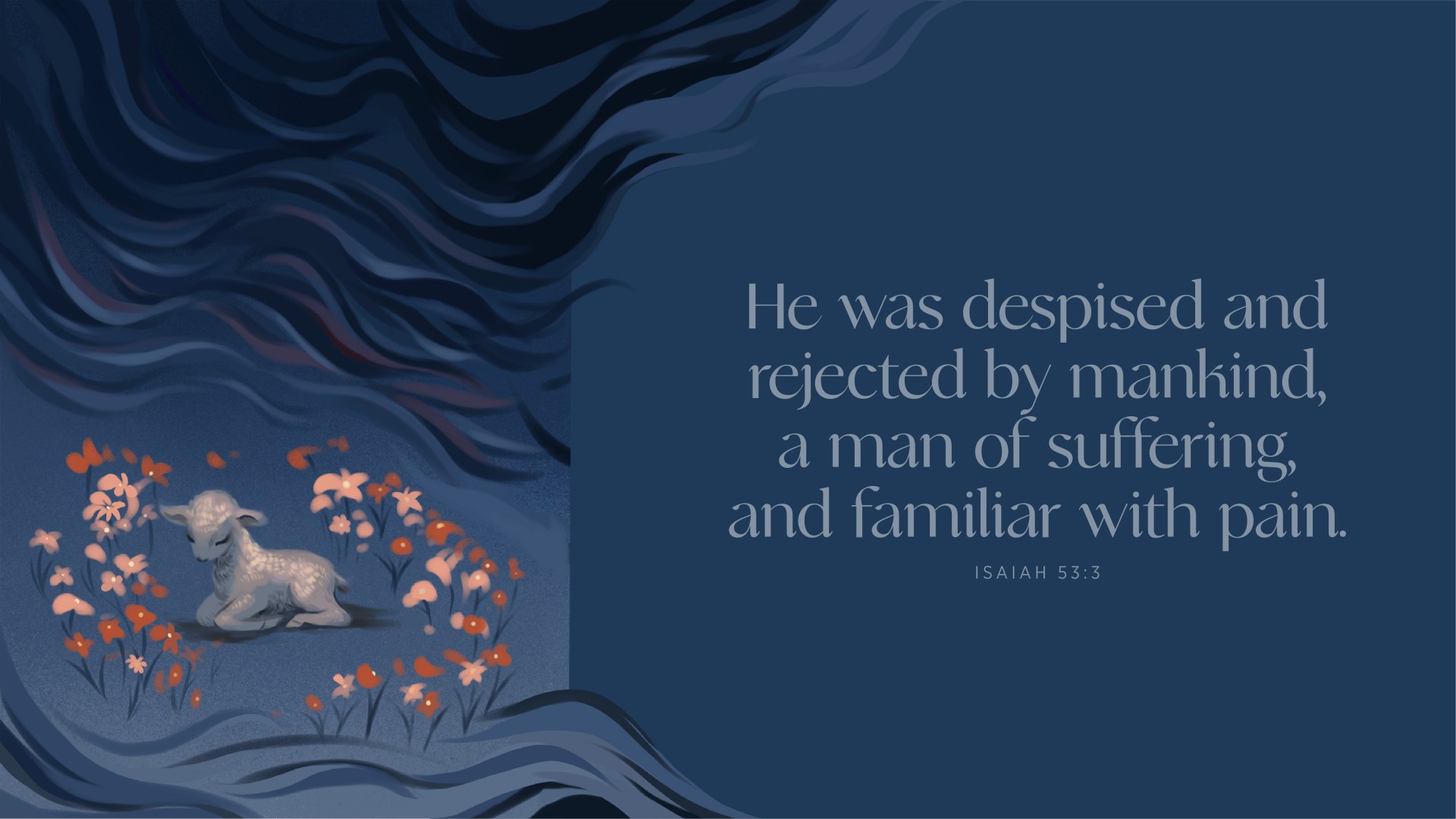
Jesus’ path to glory was not straightforward. Instead of being accepted by the world, he was despised and rejected (53:3). Instead of being exalted as king, he was tortured and murdered (53:5, 9). This is not merely a human tragedy—it is mysteriously part of the divine plan (53:10). Christ’s voluntary suffering reveals his willingness to be not only our High Priest, but also the sacrificial lamb.

This profound reality is more than a theological concept. Jesus suffered as a human being in a physical body, sharing in the most painful and dark aspects of the human experience. He knows what it is to be brutalized and humiliated (52:14), oppressed and abandoned (53:8). In the Incarnation, Jesus identifies with us even in our worst forms of suffering. For those who experience the holidays as painful or lonely, this aspect of Jesus’ life can be strangely comforting. No human tragedy extends beyond his understanding or his solidarity.

But Isaiah also makes it clear that Jesus’ story does not end in suffering and death. Rather, his affliction is the means through which he achieves his victory: “After he has suffered, he will see the light of life and be satisfied” (53:11). This is more than personal vindication. As God’s righteous servant, Jesus establishes justice and redemption for the nations of the earth. In other words, Jesus shares in our suffering so that we can share in his resurrection. His wounds redeem our own and become the very source of our healing (53:5).

As we contemplate the Incarnation in all its beauty, we can also be thankful for its grit. Jesus came down from heaven and then went further still: to the very depth of human shame and suffering. He did this for our sake. And when we meet him in our own suffering, sin, and shame, we can be confident that he will not leave us there—for by his wounds we are healed.

Hannah King is a priest and writer in the Anglican Church in North America. She serves as associate pastor at Village Church in Greenville, South Carolina.

Meditate on Isaiah 52:13–53:12.

What draws your attention most? How does this poetic prophecy deepen your engagement with gospel? Pray, reflecting on how these dark descriptions of what the servant would suffer are crucial in our observance of Advent.

Theology

What Hope Looks Like

An Advent reading for December 13.

Advent Week 3: Sacrifice and Salvation


God spoke through the prophets in the Old Testament, using poetic words and imagery, to describe the hope of salvation. This week, we contemplate prophecies pointing toward the Messiah—the servant, the light, the promised one God’s people longed for.

Read Isaiah 11:1–5 and Jeremiah 33:14–16.

I have three daughters, and I often consider them in wonder. I simply cannot wrap my mind around how whole worlds—my daughters’ lives and identities and futures—are generated from a microscopic, fertilized egg. How is the miracle and mystery of human life possible? God only knows.

From the prophet Isaiah’s time on down through Jeremiah’s time, generations of Israelites in the northern and southern kingdoms experienced destruction of their land, lives, families, and livelihoods as God’s judgment for their sins. All hope for a good outcome was lost. Too many generations had experienced death in a thousand different ways for them to believe their circumstances would turn out any differently. And yet they still ached for a savior to rescue them, for a messiah to snatch them from the clutches of their enemies.

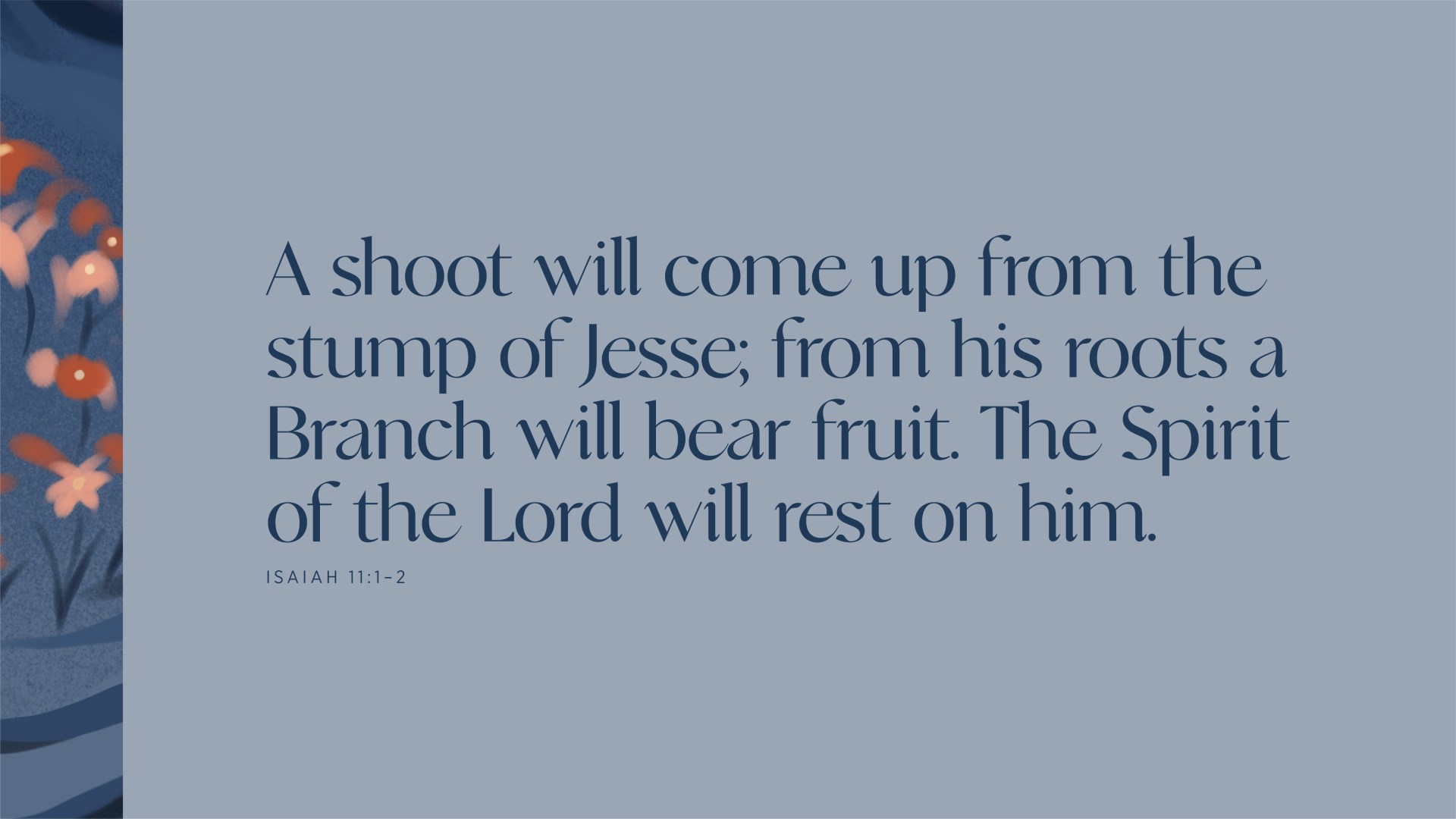
When hope vanished, when they were living as oppressed aliens in empires of destruction, the prophet Isaiah and later the prophet Jeremiah both spoke hope. Through them, God communicated this promise of hope, described as a tiny shoot coming “up from the stump of Jesse,” like a “righteous Branch” sprouting from “David’s line” (Isa. 11:1; Jer. 33:15).

Generations passed before God’s promised hope appeared. And yet fulfill his promise he did, through the advent of our Lord Jesus Christ. As generations of God’s people wondered if God would ever show up, at just the right time, Jesus came. Jesus, who is “Our Righteous Savior” (Jer. 33:16), the one on whom the Spirit rests, the one full of righteousness and justice.

In his humanity, Jesus sprang from the divine seed entrusted to Joseph and Mary. Jesus: a tiny shoot sprouting from the stump of Jesse who contains all worlds and possible worlds—for in him and “through him are all things made” and “in him all things hold together” (John 1:3; Col. 1:17). Again, I pause in wonder, in awe.

Just as I cannot fathom the nature of my daughters’ miraculous existence, I cannot fathom the mysteries of God’s salvation or the whos, whats, wheres, and whys of God’s timing. But I do know that God keeps his promises—in history, to his people, and to individuals. God always shows up. Always. He shows up when we least expect it and in ways we don’t expect—when all hope seems lost. Indeed, our God shows up like a tiny green shoot in a forest that has been burned to the ground. Watch for it.

Marlena Graves is a doctoral student and adjunct seminary professor. She is the author of several books, including The Way Up Is Down: Becoming Yourself by Forgetting Yourself.

Contemplate Isaiah 11:1–5 and Jeremiah 33:14–16.

What hope do these passages offer? What might the original recipients of these prophecies have thought or wondered? Pray, reflecting on the sprouting shoot of hope and salvation God promised for his people.

Theology

Bringing Us Home

An Advent reading for December 14.

Advent Week 3: Sacrifice and Salvation


God spoke through the prophets in the Old Testament, using poetic words and imagery, to describe the hope of salvation. This week, we contemplate prophecies pointing toward the Messiah—the servant, the light, the promised one God’s people longed for.

Read Isaiah 12:2–6; 52:7–10 and Zephaniah 3:14–20.

When you hear home, what comes to mind? For some, the word triggers trauma. Others feel ambivalent toward their notions and memories of home. Some are itching to get away from home. Others never felt at home. And, of course, there are many who are deeply fond of home, who cannot wait to get home. Many who’d even consider themselves “homebodies.”

It is part of the human condition to long for home—for a place where we belong. A place where we can be ourselves, where we are known and loved, and where we feel, well, at home. Home is to be a place of peace, where we are at ease instead of on guard. Home is safe. Ultimately, in some sense, all of us long to be homebodies—to be strangers to alienation.

In Zephaniah 3:20, the Lord says, “At that time I will gather you; at that time I will bring you home.” God promises to one day bring home his people all throughout the world. It is a home of feasting and singing because of all God has accomplished through his salvation (Isa. 52:9, 10). It is a home of regular, free-for-all, spur-of-the-moment flash mobs of celebration. It is a party for the ages because what is too good to be true is true (Zeph. 3:14–15). It is full of glee and praise. It is a place of refuge, where God is our “strength and defense” (Isa. 12:2). In this home, it is a level playing field where the lowly, the oppressed, and the exiles return to the place they feel most themselves (Zeph. 3:19–20). In each of these passages, God was speaking to a particular people in a particular time and place. But these prophecies also expand beyond their immediate context, for coming home is part and parcel of salvation itself.

Jesus echoes these sentiments about home when he proclaims, “Anyone who loves me will obey my teaching. My Father will love them, and we will come to them and make our home with them” (John 14:23). And earlier, in John 14:3, Jesus tells us that he is preparing a place, a home, just for us.

We are a home to God, at home in God, and God is preparing a home for us. But not just in the bye and bye; here and now we can find a semblance of home and be God’s home to others. We can “bring good news” and invite others to join us (Isa. 52:7). Who wouldn’t want to be in such a home?

Marlena Graves is a doctoral student and adjunct seminary professor. She is the author of several books, including The Way Up Is Down: Becoming Yourself by Forgetting Yourself.

Reflect on Isaiah 12:2–6; 52:7–10; and Zephaniah 3:14–20.

How do these prophecies expand your vision of salvation and what it means, and what Jesus came to oer? How do you desire to bring this good news of home to others? Pray, expressing your gratitude and worship to God.

Theology

True Hope

An Advent reading for December 15.

Advent Week 3: Sacrifice and Salvation


God spoke through the prophets in the Old Testament, using poetic words and imagery, to describe the hope of salvation. This week, we contemplate prophecies pointing toward the Messiah—the servant, the light, the promised one God’s people longed for.

Read Isaiah 42:1–7.

Sometimes we forget that we are idol makers. We cling to the idols of power, wealth, pride, other people, institutions, misinformation, tradition. And sometimes we also forget that God is not silent in the face of idolatry and evil. He exposes their empty promises and reveals Christ as the remedy for our idol-making tendencies.

In Isaiah 42, God responds to the empty idolatry and meaningless false gods he addressed in the previous chapter by announcing the coming of his servant in whom he delights, and chose, and in whom his Spirit dwells. While idols are weak and powerless, God’s promised, faithful servant will bring forth justice to the entire world. He will not tread on the vulnerable or boast in pride. Instead, his tender compassion will be shown toward those who are weak, hurting, or whose faith is faltering.

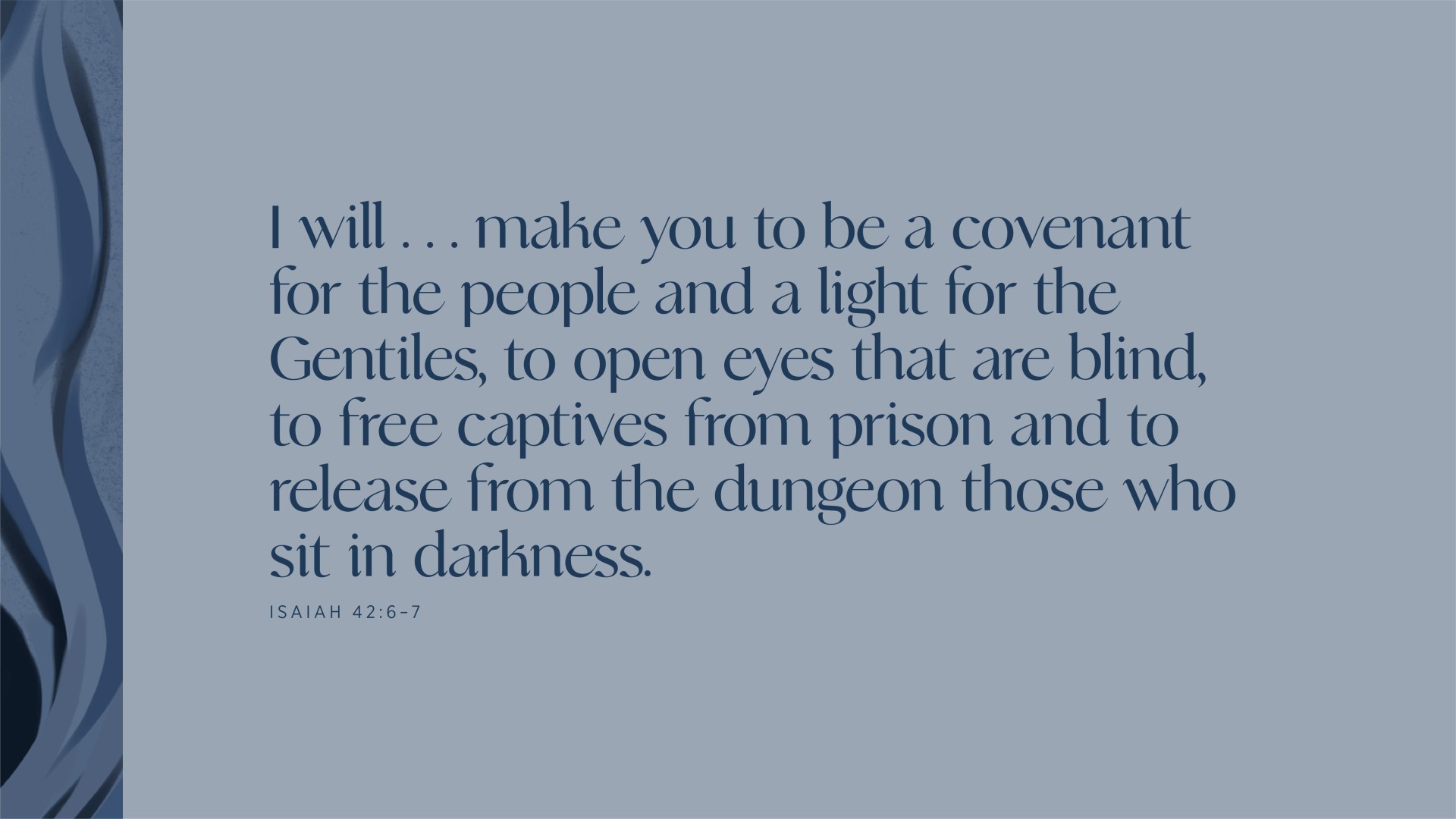
So much is happening in our world today that can cause us to question where God is when the attraction of idols deludes even the most faithful among us, when injustice envelops our world like a dark cloud, and when the weak can barely breathe because their cries for relief have rendered them weary. This passage reminds us that the promised servant will one day take all that is wrong with the world and make it right. He’s chosen by God to bring justice in humility and love. He’s called by God to be a covenant for his people, the blameless agent to carry out the word and will of God.

In Matthew 12:15–21, after Jesus has healed many people who were part of a large crowd that followed him, the Word tells us that “this was to fulfill what was spoken through the prophet Isaiah” in Isaiah 42:1–4. All the promises of God reside in Jesus and have their fulfillment in him (Matt. 5:17; 2 Cor. 1:20). Jesus embodies truth, justice, righteousness, faithfulness, humility, meekness, and every fruit of the Spirit. And for all who call him “Lord,” through our union with him, our lives are to reflect the same—albeit imperfectly. For only Jesus has the power to bring the nations out of darkness and into his marvelous light. Only Jesus can set prisoners free from sin and darkness.

As we reflect this Advent season on God’s faithfulness to send his servant, may we remember that while justice was ultimately served on the cross, it is also a future reality that we long for as we await the Second Advent.

Kristie Anyabwile is the editor of His Testimonies, My Heritage and the author of Literarily: How Understanding Bible Genres Transforms Bible Study (March 2022).

Ponder Isaiah 42:1–7. (Option: Also read Isaiah 41.)

What draws your attention in this description of the servant? How does Jesus fulfill these promises—and how will he? In prayer, confess ways you’ve placed hope in contemporary idols. Ask God to help you place all of your hope in him.

Theology

The Messiah’s Mission

An Advent reading for December 16.

Advent Week 3: Sacrifice and Salvation


God spoke through the prophets in the Old Testament, using poetic words and imagery, to describe the hope of salvation. This week, we contemplate prophecies pointing toward the Messiah—the servant, the light, the promised one God’s people longed for.

Read Isaiah 61:1-4, 8-11.

Debates frequently arise about the mission of the church. Are we supposed to evangelize or work for justice? Should Christians prioritize the forgiveness of sins or the care of the sick? These debates have deep roots in an old divide about both theology and mission. Broadly speaking, one group might be immovable about feeding the hungry but indifferent about the Virgin Birth; the other might be the reverse. One may give themselves to improving the world and the other to the promise of a heavenly afterlife.

Both sides of this divide would have been rebuked by Jesus. When he went to the synagogue and read from Isaiah 61, he announced his mission. The Spirit of the Lord had anointed him to bring “good news to the poor . . . to proclaim release to the captives and recovery of sight to the blind, to let the oppressed go free, to proclaim the year of the Lord’s favor’” (Luke 4:18–19, NRSV throughout). Jesus demonstrated how the kingdom of God brings forgiveness and freedom, healing and hope—all signs of the renewal of creation to come.

Isaiah himself looked ahead to the day when God would bring about a new heavens and a new earth where “all flesh” would come and worship (Isa. 66:22–23). Though Isaiah and Israel with him would have imagined it happening in one move, God in Christ—the Anointed One!—was inaugurating a reign that will one day culminate in the remaking of the world. He will start with us—with the God-human relationship that was at the heart of creation. And he will work through the justified to bring justice. The “set right” people join God in his work of setting the world right.

But in announcing the fulfillment of Isaiah’s prophecy, Jesus was also pointing to himself as the kingdom-bringer. This was no mere social improvement project. The total overhaul of the world and its systems would begin with a seed falling to the ground and dying (John 12:24). The Messiah alone inaugurates the kingdom.

The mission of the Messiah, the Spirit-Anointed One, continues through the Messiah’s people—the little anointed ones. Luke parallels this story in his second volume by talking about the Spirit anointing the followers of Jesus in the upper room. In a very real sense, the mission of the church is not really the mission of the church but of the Messiah. It is Jesus who started it; Jesus who by the Spirit empowers us to participate in it; and Jesus who will come again in glory to bring his reign to its culmination.

Glenn Packiam is an associate senior pastor at New Life Church in Colorado Springs. His books include Worship and the World to Come and The Resilient Pastor (February 2022).

Read Isaiah 61:1–4, 8–11. (Option: Also read Luke 4:14–21.)

Consider Isaiah’s original audience: What hope did this promise give? What did it emphasize about God’s character and plans? What stands out to you today as you read this promise in light of Jesus and the gospel?

Theology

The Light Is Coming

An Advent reading for December 17.

Advent Week 3: Sacrifice and Salvation


God spoke through the prophets in the Old Testament, using poetic words and imagery, to describe the hope of salvation. This week, we contemplate prophecies pointing toward the Messiah—the servant, the light, the promised one God’s people longed for.

Read Isaiah 9:1–2.

I won’t soon forget a short text message exchange I recently had with a friend from out of town. He was doing the whole NYC tourist thing. I asked him for an overview of his itinerary. He responded via text: “first stop is to the 9/11 memorial.” Reading those words put me in an immediate, unforced state of reflection.

You see, although I’m a native New Yorker, I’ve never been to the 9/11 memorial. It’s not that I don’t know how to get there. It’s just … well … darkness. I’d have to face the darkness of that day and be reminded of the ongoing manifestations of darkness that pervade our world—the wars, the racism, the loss and fragile nature of life. So much darkness.

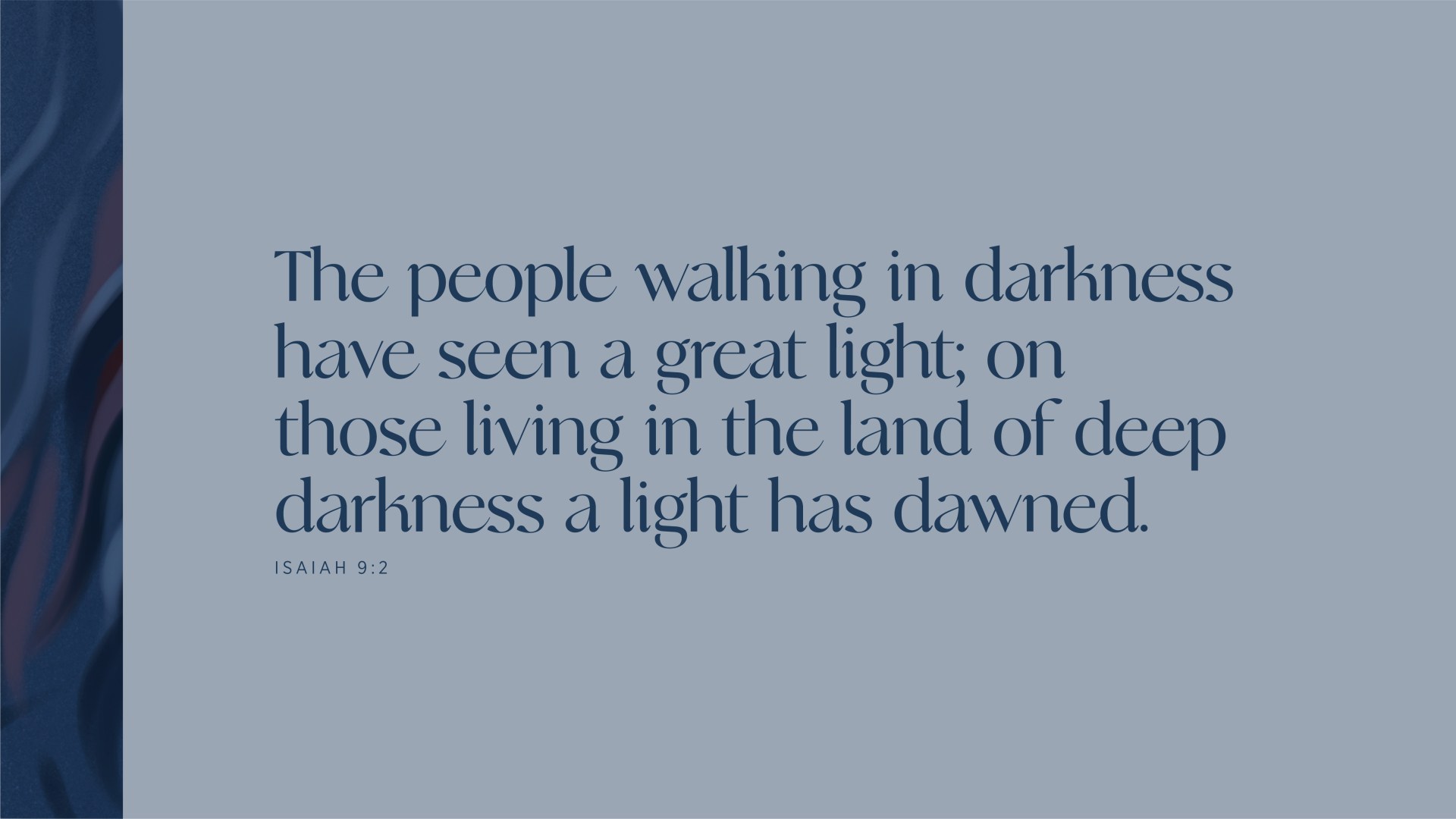
Yet, with all the darkness before us, Advent situates our world within a larger, more hopeful story. It’s the story of God’s overpowering light among his people. A light that illuminates the individual and collective darkness we experience and witness. A healing light.

Advent invites us into a prayerful expectation, a holy waiting, an attentive gaze. What are we awaiting? Resplendent light. God’s light.

Isaiah announces that a great light is coming—coming from an unexpected source. It’s making its way through a child, the Messiah. This light is not to be found in some new political power, or in some cultural movement. It’s not located in a particular ideology, but rather is found through the living-God-in-flesh. This is an important theme in Scripture, picked up by John, the Gospel writer. In John’s words, the light that has come is not some impersonal electromagnetic radiation. It’s the staggering truth of the personal manifestation of God’s very self in Jesus Christ. Jesus is the light that shines in the darkness, and the darkness has not overcome it (1:5).

Isaiah prophetically speaks about a day that would be coming—a day that has already come in Jesus. Yet we also await another day when the darkness will be fully and finally overpowered. This is the promise in this season.

Advent reminds us that no matter how dark it gets, the light has come, and the light is coming. So be of good cheer! The darkness you feel today will not have the last word. Neither will the grief, uncertainty, and despair. As Wendell Berry once said, “It gets darker and darker and darker, and then Jesus is born.”

Rich Villodas is the lead pastor of New Life Fellowship in Queens, New York. He is the author of The Deeply Formed Life: Five Transformative Values to Root Us in the Way of Jesus.

Contemplate Isaiah 9:1–2. (Option: Also read Matthew 4:12–17 and John 1:1–5.)

What darkness in this world or in your life is sometimes difficult to face? How does Isaiah’s promise encourage you? How has Jesus—the Light—overcome darkness in your life?

The Baby King

An Advent reading for December 18.

Advent Week 3: Sacrifice and Salvation


God spoke through the prophets in the Old Testament, using poetic words and imagery, to describe the hope of salvation. This week, we contemplate prophecies pointing toward the Messiah—the servant, the light, the promised one God’s people longed for.

Read Isaiah 9:6–7.

In my experience, watching cartoon movies has been an essential part of being a dad to three young boys. Boss Baby is one such movie. The film caricatures an infant who’s “all grown up” and constantly bossing around his seven-year-old brother behind their parents’ backs.

The irony in Isaiah 9:6–7 is a similar juxtaposition: a newborn baby who is “all grown up.” Isaiah describes this promised one as a newborn child, a government ruler, and the “Wonderful Counselor, Mighty God, Everlasting Father, Prince of Peace.”

The amazing testimony of this prophetic text is that Jesus is all of this, and so much more. Jesus, born as a human child, was both fully human and fully divine: the God-Man, the Baby King.

Isaiah was speaking to a discouraged Jewish community that had been groping in darkness, hoping to find a pathway to freedom from their “distress and darkness and fearful gloom” (8:22). Into this context, Isaiah prophesies, “He will reign on David’s throne and over his kingdom, establishing and upholding it with justice and righteousness from that time on and forever” (9:7) This reference to David’s throne hearkens back to God’s promise to David: “I will raise up your offspring to succeed you … I will establish his kingdom. … I will establish the throne of his kingdom forever” (2 Sam. 7:12–13). God is a covenant-keeping God. And nothing will stand in the way of this promised miracle: “The zeal of the Lord Almighty will accomplish this” (Isa. 9:7). God is zealous to keep his covenants with his people.

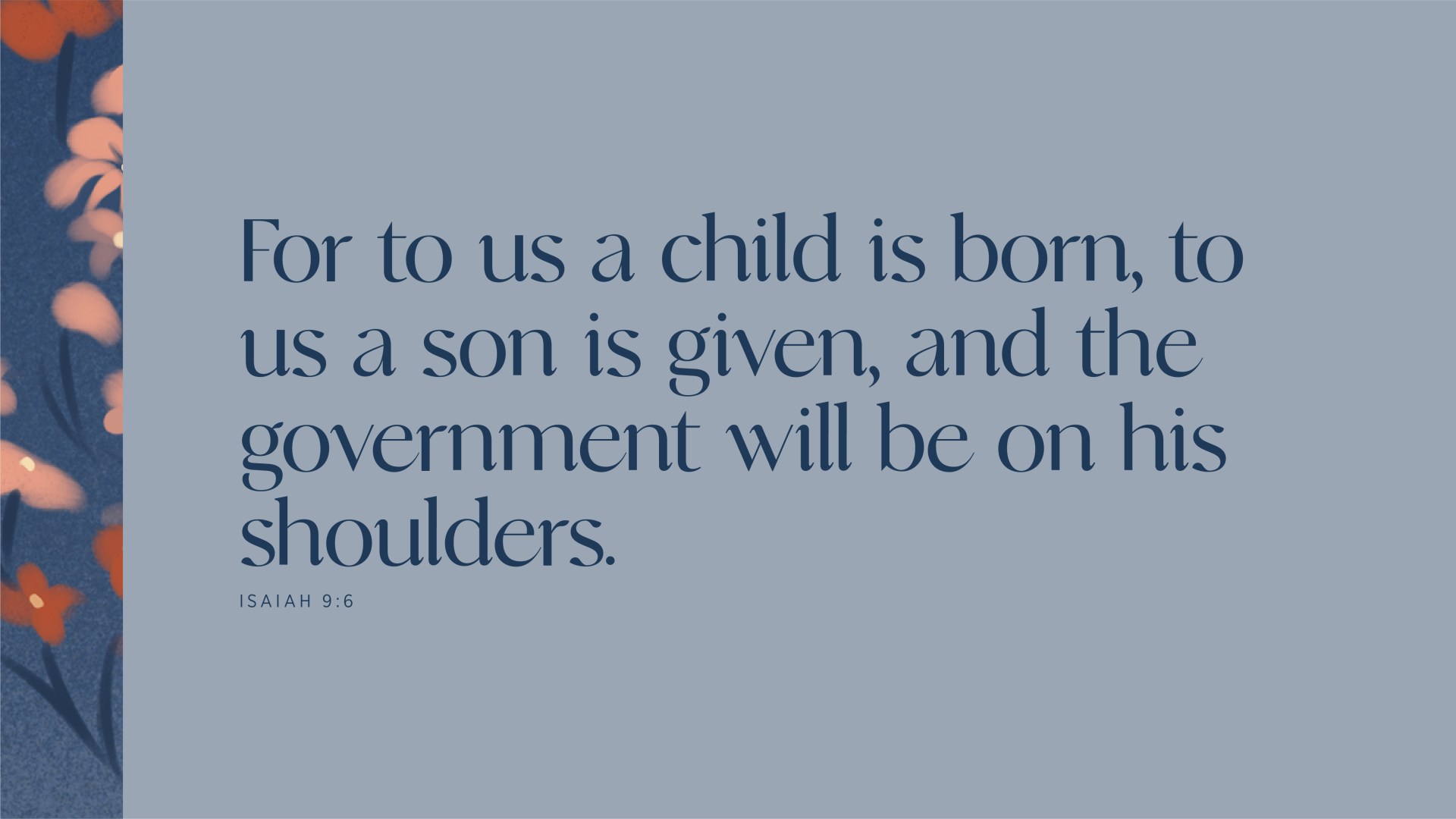
God is also zealous and passionate about the gospel. The Good News of Jesus becoming flesh is that in Christ there is no longer darkness (Isa. 9:2; John 1:4–5, 14). God is on the move, across the globe, on every continent, in every nation, exposing the darkness through the power of Christ’s first coming and his imminent return. Jesus’ incarnational entry into the world signifies a new day, “for to us a child is born, to us a son is given” (Isa. 9:6)!

This is the Good News, the gospel, that we must share with the world. The light has come; the light is Jesus! We no longer need to live in darkness and we can share this light with a world that needs to hear about our “Mighty God,” our “Prince of Peace.” May we proclaim it freely: Jesus, the Baby King, is here, and he wants to reign in your hearts.

Matthew D. Kim is the George F. Bennett Professor of Preaching and Practical Theology at Gordon-Conwell Theological Seminary and the author of Preaching to People in Pain.

Meditate on Isaiah 9:6–7. (Option: Also refl ect on John 1:14.)

In what ways does this promise point toward core tenets of the gospel? Which aspects of this prophecy most draw your attention? Why? Pray, praising Christ for each aspect of his identity described in Isaiah 9:6–7.

Apple PodcastsDown ArrowDown ArrowDown Arrowarrow_left_altLeft ArrowLeft ArrowRight ArrowRight ArrowRight Arrowarrow_up_altUp ArrowUp ArrowAvailable at Amazoncaret-downCloseCloseEmailEmailExpandExpandExternalExternalFacebookfacebook-squareGiftGiftGooglegoogleGoogle KeephamburgerInstagraminstagram-squareLinkLinklinkedin-squareListenListenListenChristianity TodayCT Creative Studio Logologo_orgMegaphoneMenuMenupausePinterestPlayPlayPocketPodcastRSSRSSSaveSaveSaveSearchSearchsearchSpotifyStitcherTelegramTable of ContentsTable of Contentstwitter-squareWhatsAppXYouTubeYouTube