History

Why John Perkins Didn’t Want More White Christians like Jonathan Edwards

A violent and sinful history calls for a clearer presentation of the gospel.

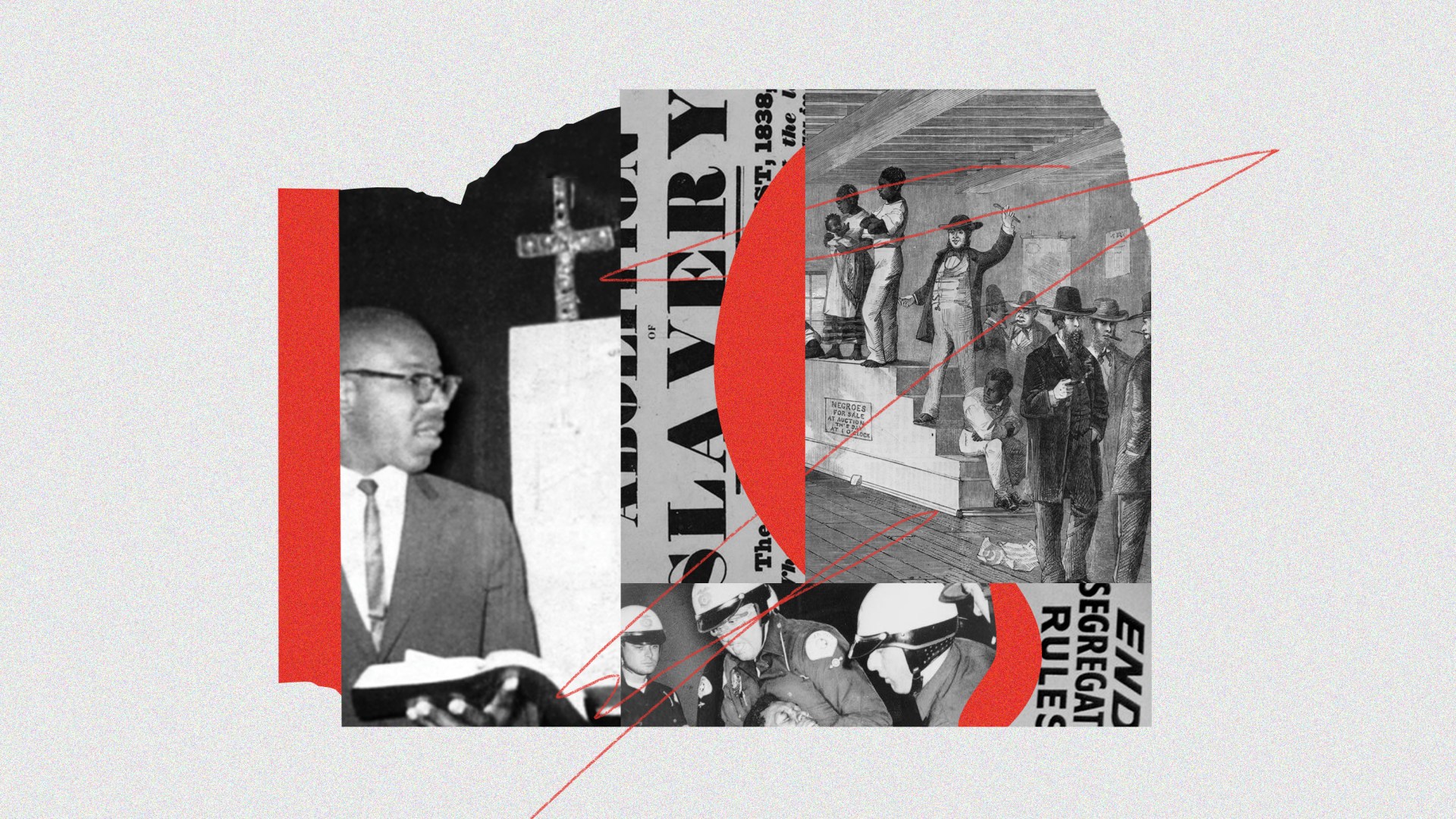
Left image: John M. Perkins preaching in 1961

Left image: John M. Perkins preaching in 1961

Christian History February 11, 2022
Illustration by Mallory Rentsch / Source Images: Courtesy of John and Vera Mae Perkins Foundation / WikiMedia Commons / Rischgitz / Stringer / Getty

John Perkins stood up at a planning meeting for a Billy Graham crusade in Jackson, Mississippi, in 1975.

The Black pastor and civil rights activist was invited to the meeting, along with a group of African American clergy from the area, because Graham himself had insisted the evangelistic event would be desegregated. Black and white Mississippians would hear the gospel together. Perkins loved Graham and his powerful gospel message, and he was excited to hear that the world’s leading evangelist was taking practical steps to end segregation in the church.

So he went to the Holiday Inn in Jackson and sat down on the Black side of the conference room, with all the Black pastors, and looked over at the white side, with all the white pastors.

Then he stood up.

He asked the white pastors whether their churches were committed to accepting new converts from the crusade into their congregations if the born-again brothers and sisters were Black.

He didn’t think they were ready for that in Mississippi. And if they weren’t ready, he didn’t know whether he was either.

“I don’t know whether or not I want to participate,” Perkins said, “in making the same kind of white Christians that we’ve had in the past.”

He was thinking of all the white Christians who had closed the doors of their churches to Black people. And the white Christians who had supported the Mississippi Plan to stop Black people from voting so they could, as one state legislator described it at the time, “establish white supremacy in the State, within the limits imposed by the Federal Constitution.”

He was thinking of the white Christians whose only response to racist violence perpetrated on Black bodies was to say, “Wait.” And the white Christians who not only had not been moved by the injustice of Jim Crow to join the civil rights protests but also had seen Black churches in their own towns obliterated—burned and bombed—and never said a thing.

And he may also have been thinking of Jonathan Edwards.
Opponents of abortion on demand had hoped the U.S. Supreme Court would rule in favor of an Illinois statute that restricts abortion. But in a decision early last month, all nine justices refused—on procedural grounds—to decide the case. The Court’s action has the effect of upholding an appeals court ruling against the law.The Illinois statute required doctors to provide information about abortion procedures and the unborn child to women seeking abortions. Doctors were required as well to use techniques most likely to preserve the life of a fetus that might survive an abortion.The law initially was challenged in federal district court by doctors who perform abortions. The court ruled that parts of the law that would impose criminal penalties on physicians were unconstitutional, in light of the Supreme Court’s Roe v. Wade decision legalizing abortion. An appeals court later affirmed the district court ruling against the Illinois law.A prolife physician named Eugene F. Diamond then appealed the case, known as Diamond v. Charles, to the Supreme Court. The state of Illinois, whose law was at stake, did not enter an appeal, but merely filed a “letter of interest” in the case. The Supreme Court refused to rule on the case, saying Diamond, acting on his own, did not have sufficient legal standing to appeal the case.The high court concluded that Diamond could not prove he had any direct stake in the case, even though he disagrees with the practice of abortion. “The presence of a disagreement, however sharp and acrimonious it may be, is insufficient by itself,” the Court said, to seek a resolution in the federal court system. The Supreme Court holds that persons seeking federal court action must show they suffered some actual or threatened injury in the matter that is being appealed.Douglas Johnson, of the National Right to Life Committee, said the ruling “should not discourage future efforts to defend state laws” restricting abortion. However, Johnson said, it is essential that state officials be party to those cases.WORLD SCENEIRELANDA Referendum on DivorceVoters in the Republic of Ireland could decide as early as this month whether to lift a constitutional ban on divorce.The government announced last month it would introduce legislation to hold a referendum on the divorce ban. The 1937 constitutional provision can be changed only by a majority of the popular vote in a referendum.Opinion polls indicate as many as 77 percent of the Irish population favor allowing divorce “in certain circumstances.” However, the same polls show only a narrow majority willing to vote for the complete removal of the constitutional prohibition.If the ban is removed, the government says divorce would be allowed only in cases where a marriage can be shown to have failed and the failure has continued for a period of five years. The Roman Catholic Church, which claims 90 percent of the Irish population, opposes divorce. However, Ireland’s bishops are divided over how actively they should oppose efforts to lift the constitutional ban.HUNGARYChurches Help Drug AddictsSeveral churches in Hungary are launching drug rehabilitation programs with the government’s permission. Hungarian Christians say the efforts are contributing to the relaxation of tensions between church and state in the communist country.Baptists in Budapest have established a coffee house that seeks to minister to people with drug and alcohol dependencies. They are also setting up a rehabilitation center about 125 miles from the city. Pentecostal churches are opening a rehabilitation center just outside Budapest. And the Free Christian Church Council is planning to establish treatment facilities.These developments gained impetus from meetings conducted last year by American evangelist Nicky Cruz. A former drug addict and New York City gang leader, Cruz visited Hungary at the invitation of Hungarian churches.The nation’s communist government earlier had asked the churches to help combat the growing problem of drug and alcohol dependency among young people.More than 5,000 people heard Cruz speak at two evangelistic meetings. In addition, physicians and church leaders from five East European nations attended a seminar on drug addiction led by Cruz.The evangelist stressed the spiritual component in rehabilitation, saying, “Only after they have truly received Christ and are born again will they begin to consider the way they talk, the way they dress, the company they keep, the places they go, the things they do.”LATIN AMERICAOpposing WEF MembershipMeeting in Venezuela, delegates to a general assembly of the Confraternity of Evangelicals in Latin America (CONELA) voted against joining the World Evangelical Fellowship (WEF).CONELA’s executive committee had recommended that the Latin American group join WEF. But a delegation from Mexico led an effort against the proposal, saying WEF needs to make itself better known among Latin American church leaders. While voting against WEF membership, the assembly did accept an invitation to send observers to WEF functions.After the vote, a CONELA official said most evangelical church leaders in Latin America object to the practices and policies of the World Council of Churches. As a result, he said, they view with suspicion any unknown international and interdenominational agency.In other action, delegates to the CONELA general assembly approved a declaration that calling it “another gospel [that offers] temporary liberation from physical problems such as poverty and certain political dictatorships.” The declaration calls for renewed evangelism across Latin America and asks both leftist and rightist governments to respect the “personal rights” of individuals.Delegates elected Virgilio Zapata, general secretary of the Evangelical Alliance of Guatemala, as CONELA’s new president. Outgoing president Marcelino Ortiz of Mexico will continue to serve on the organization’s executive committee. Formed four years ago in Panama, CONELA includes 206 denominations and Christian service agencies.ROMECompetition from ‘Sects’The Vatican has released a report recommending changes in Catholic parish life to help stem the loss of members to other religious groups. Chief Vatican spokesman Joaquin Navarro Valls says competition from non-Catholic groups is “one of the major dangers facing the church.”The 27-page document, titled “Sects or New Religious Movements: A Pastoral Challenge,” says sects have flourished because of “needs and aspirations which are seemingly not being met in the mainline churches.” Non-Catholic religious movements succeed because they provide “human warmth, care and support in small close-knit communities … [and] a style of prayer and preaching closer to the cultural traits and aspirations of the people.“The challenge of the new religious movements is to stimulate our own renewal for a greater pastoral efficiency,” the report states. The document cites “deficiencies and inadequacies in the actual behavior of the church which can facilitate the success of sects.” And it calls on the Catholic church to consider changes, including the creation of “more fraternal” church structures that are “more adapted to people’s life situations.… Preaching, worship and community prayer should not necessarily be confined to traditional places of worship.”The document drew from information contained in questionnaires completed by some 75 bishops’ conferences around the world. Luis Eduardo Castano, ecumenical officer for the Latin American Catholic Bishops’ Conference, said the church is concerned about the growth of fundamentalist and charismatic Protestant groups in Latin America.

Shaking Christians and convicting sinners

Edwards, of course, was a Puritan theologian and pastor in New England who had died more than 200 years before. He had a marked influence on American revivalists, from Charles Finney to Billy Graham. And he deeply shaped a number of notable 20th-century preachers, including John MacArthur and John Piper, who once said that Edwards’s writings were, for him, “more Christ-exalting, more God-revering, more Bible-illuminating, more righteousness-beckoning, more prayer-sweetening, more missions-advancing, and more love-deepening than any other author outside the Bible.”

For most of American history, Edwards was known specifically for his role in the Great Awakening. He preached an incredible sermon about hell and spiders that spurred on the fire of revival.

The sermon was so iconic, so central to what revivalistic-minded Christians in America meant when they said “revival,” that Billy Graham once preached the same sermon. In Los Angeles in 1949, Graham told his audience he was going to do something a little different and instead of preaching his own words, he was going to preach Jonathan Edwards’s.

“It’s not too long,” he said. “I’m going to read it, and extemporize part of it, but I want you to feel the grip, I want you to feel the language. I’m asking tonight the same blessed Holy Ghost that moved in that day to move again tonight in 1949 and shake us out of our lethargy as Christians and convict sinners that we might come to repentance.”

Perkins probably didn’t know that, though he was in LA at the time. He had fled to California from Mississippi two years before, after a white sheriff’s deputy killed his brother. But Perkins had not yet accepted the gospel and come to Jesus.

It wasn’t until 1957 that Perkins went to a Sunday school class with his son and heard and accepted the truth that he was loved by God. Then he went and studied how to be a preacher with John MacArthur’s father, Jack, and returned to Mississippi to start a ministry with the same name as Jack MacArthur’s radio program: Voice of Calvary Ministries.

So Perkins probably didn’t know that Graham had once preached “Sinners in the Hands of an Angry God.”

He probably also didn’t know that Edwards defended slavery and himself purchased two Black children in his life—a 14-year-old girl and a 3-year-old boy. Edwards’s argument for owning humans with a different skin color wasn’t published.

Buying humans

Edwards’s biographers briefly mentioned slaves and slavery but didn’t go into the details about how the minister had, at 27, personally driven more than 130 miles to pay 80 pounds for a 14-year-old girl who was named Venus by the men who stole her from Africa. When he returned home, the girl’s body, her work, and all her future children and their bodies and their work belonged to him by law. He had the receipt in his pocket that said she was his to “Use and behoof”—make use of—“for Ever.”

Nor did the biographers mention how, at 52, Edwards bought another human, a toddler named Titus. He paid 30 pounds for the three-year-old. When the boy was five, Edwards included him in his will, in a list of animals that he owned.

But if Perkins didn’t know about the famed preacher’s personal relationship to slavery or private defense of the practice, he did know that nothing in Edwards’s great sermon about sin had convinced anyone in Mississippi that slavery, race-based segregation, or white supremacy was wrong.

He knew the white Christians could embrace revivalist Christianity, from Edwards to Graham, without ever questioning the injustice that was visited on the Black people around them.

He knew that some white Christians in Mississippi even named their children Jonathan Edwards. And some of those children grew up to be violent racists.

Perkins knew one of them himself. So when he stood up in the evangelistic planning meeting and said “I don’t know whether or not I want to participate in making the same kind of white Christians that we’ve had in the past,” he may well have been thinking of that Jonathan Edwards.
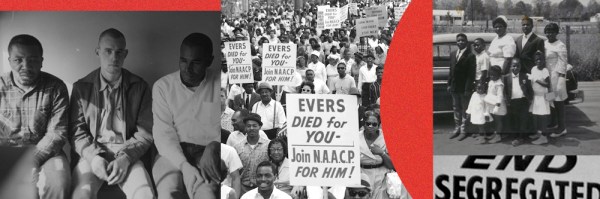
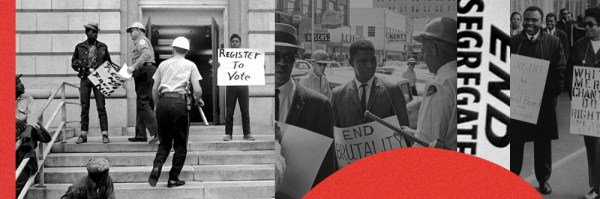
Left: Perkins arrested after protest in 1970 Middle: Medgar funeral march in 1963 Right: The Perkins Family in 1960

The other Jonathan Edwards

That other Edwards—Jonathan R. Edwards—was elected sheriff of Rankin County in 1962. One of the things he mentioned to voters in his campaign, besides his six years as a deputy and his deep roots in the community, was that he was a lifelong Baptist.

The month after he took office, Edwards was called to the Rankin County courthouse because three Black men were attempting to register to vote. At the time, there were 6,944 African Americans in Rankin County, but only 43 of them could vote. If these men registered, that would make it 46.

But Edwards and his deputies made sure that didn’t happen. The sheriff walked up to one of the men and hit him.

“I hit him and kept on hitting him,” Edwards later testified in court. “And if he hadn’t run I would have kept on hitting him.”

The Black man, who may have been trained by the Student Nonviolent Coordinating Committee, did not meet the sheriff’s violence with violence. That didn’t stop Edwards from hitting him more.

“I slapped him down the first time,” Edwards said. “I knocked him down and he fell here and I got in on him, and I don’t know how many times I hit him, just as many as I could.”

The judge in the case ruled that Edwards hadn’t violated the man’s civil rights. He said the sheriff wasn’t attempting to keep anyone from voting and it was “purely incidental” that the beating happened in the registrar’s office.

Besides, the judge concluded, this was a “past event” and “there was no reasonable justification to believe that such an incident would ever occur again.”

It did happen again. That time, the sheriff with the name of the great American preacher assaulted John Perkins.

In 1970, Perkins led more than 100 demonstrators in a march protesting segregated businesses in Mississippi. They chanted, “Do right, white man, do right.” On their way home from the march, 20 college students were arrested and taken to the Rankin County jail. Fearing the students might be lynched, Perkins and two other boycott leaders rushed to bail them out.

They found the sheriff’s deputies drinking corn whiskey. The deputies had forcibly shaved the heads of two protestors and were pouring the liquor over their raw scalps.

When Edwards saw Perkins coming into the jail, he recognized him as the leader. He said, “This is the smart n—.” Then he started beating him.

He hit Perkins, possibly with a blackjack, a weapon made out of wood and lead wrapped in leather. Perkins went down and Edwards kicked him, brutally and repeatedly, stopping only to retuck in his shirt.

When the beating was finished, the sheriff made the minister get up and mop his own blood off the floor.

Edwards later testified that Perkins had thrown an unprovoked punch at him but missed. No one else saw it. Perkins also had a pistol in his car, though he hadn’t brought it in with him and the sheriff didn’t know about it until after the arrest when he went and searched the car.

Edwards told the court, nevertheless, that the violence was justified.

“Sure they were roughed up,” he said, “but they asked for it.”

What the gospel can do

Perkins almost died from his injuries. In the hospital, he thought a lot about the racism that had put him there. He thought about white people—white Christians—who would name their son Jonathan Edwards and have him grow up to be a racist sheriff.

“I came to the conclusion, the hard conclusion,” Perkins later said, “that Mississippi white folks were cruel. And they were unjust. And the system was totally bankrupt. … I stayed with the idea that it had to be overthrown.”

As a Christian, Perkins believed the gospel could overthrow that system. God could reconcile sinners to himself and each other. Jesus could take hate from human hearts and replace it with love. The Holy Spirit could move people to give up power instead of defending it with violence.

Perkins would preach and protest and risk injury again because he believed in the power of the gospel.

It couldn’t be a gospel, though, that produced more Jonathan Edwardses.

Which is why he stood up in 1975 and asked the people planning a Billy Graham crusade a question that still resonates in America today: Will the gospel you are preaching produce a different kind of white Christian than it has in the past?

News

Super Bowl Betting Is a $7.6 Billion Problem Fewer Evangelicals Care About

As society doubles down on online sports gambling, older activists see a chance to renew the Christian conscience around the practice.

Christianity Today February 11, 2022
Julio Cortez / AP

The 1990s were a busy time for Christians combatting gambling at local levels: fighting a casino here or lottery expansions there.

Tom Grey, a Methodist minister, traveled 250 days a year with the National Coalition Against Legalized Gambling, which now goes by the name Stop Predatory Gambling. He can remember major wins, like keeping a casino out of Gettysburg, Pennsylvania, with the help of filmmaker Ken Burns.

“The problem is [gambling companies] just have to win once, and they’ve got it,” Grey said. “Mayors and other people would stand up and say, ‘We don’t want your casino.’ Now there aren’t choices any longer. Churches feel it’s over.”

Grey, 81, is retired, but now he is watching the latest iteration of the industry take off: sports betting.

The Super Bowl on Sunday will be the first big windfall in many states for online sports betting. Companies like Draft Kings and FanDuel have been running ads throughout game broadcasts and all over sports news sites, urging fans to put money on their favorite teams or fantasy leagues.

The American Gambling Association has projected a record 31.4 million Americans will put down $7.6 billion on this year’s LA Rams–Cincinnati Bengals matchup. That’s up more than one-third from last Super Bowl, as more states have legalized online betting. Sports betting is now legal in 30 states and Washington, DC. In some states, such betting happens at a physical venue, while others have begun allowing it online.

After the US Supreme Court ruled in favor of the practice in 2018, states lined up to legalize sports betting to get a slice of the tax revenue from the multibillon-dollar industry. State-level Christian organizations that tried to fight off the recent legalization of sports betting or put guardrails around it found that there was too much money on the other side of the issue and not much appetite for fighting in the pews.

Few Christians see sports gambling as a problem. A 2016 survey from Lifeway Research found that only 36 percent of Christians thought sports betting was morally wrong. Pastors carry more reservations, with a majority telling Lifeway in 2019 that betting on sports is morally wrong and three-quarters believing it should not be legal.

People responding on social media to critiques of gambling on Desiring God or The Gospel Coalition argued that the authors were being “legalistic” and that betting was no different than investing in the stock market or a 401(k).

Putting bucks on the big game through a few clicks on an app or sports site doesn’t have the social stigma that casino gambling used to carry. The 2020 Gallup figures on the issue showed that 71 percent of Americans said gambling was morally acceptable, the highest level in the 18 years it had done the survey.

But those who continue to be involved in antigambling activism say it’s still harmful.

“I think there’s going to be a lot of devastation to individuals and families the following weeks,” after the Super Bowl, said Anita Bedell, who worked to fight gambling in Illinois for decades as the head of Illinois Church Action on Alcohol and Addiction Problems. “What do you do when you’ve lost all that money? Paying it back, that could take a lifetime.”

After working on the issue since 1990, Bedell—known in the statehouse as the “Church Lady”—retired last week. She said it was “disheartening” how quickly sports betting has swept the state and the nation.

“They disregard the problems that could happen,” Bedell said. “Churches are going to see all the harm and there will be an outcry … it’s too accessible, there’s no safeguards for young people, or to prevent people from losing everything.”

For now, churches aren’t very interested in the issue. Grey says churches are “worn out” and have to “pick their issues to fight.” He said the Methodists and Baptists were the firewalls against gambling in recent decades, and “the Baptists still hold Alabama,” which largely bans any form of gambling.

The Southern Baptist Convention’s Ethics and Religious Liberty Commission (ERLC) puts out every year an antigambling church bulletin insert, which lays out in bullet points why gambling is a “sin against God.” The Assemblies of God adopted a position paper in 2015 calling gambling “unwise” and “a compromise of Christian ethics and witness.”

These leaders and denominations point not only to the biblical wisdom on the nature of work, stewardship, and avoiding greed, but also to the idea that the few who gain from it are doing so at the expense of the many–including the poor. The ERLC bulletin insert emphasizes that opposition to gambling is based on love for neighbor.

Jason McGuire, who heads up the evangelical organization New Yorkers for Constitutional Freedoms, fought the legalization of online betting in the state last year. His organization opposes online betting for similar reasons that the more liberal New York Daily News editorial board has consistently opposed it: They both see it as a tax on the poor. He also adds that the Bible prohibits making money from “ill-gotten gain” and that people underestimate the addictive side of gambling.

“The Christian community needs to understand, this is devastating to families that are impacted if people get caught up in this,” he said. “On the anonymity of their cellphone in the living room, they’re gambling away their mortgage money. The whole world is setting people up for failure.”

The New York Council on Problem Gambling, a state-funded group, estimates that two million Americans “meet the diagnostic criteria for disordered gambling.” (Gambling interests point out that is a tiny percentage of gamblers.) Grey said that the creation of state-funded groups for responsible gambling allowed politicians to feel at ease with the addictive side of betting—that they were using some of the revenue for treatment.

A study in Spain showed a significant increase in “young pathological gamblers” after the country legalized online gambling, adding that the immediacy and accessibility of online gambling made it “more addictive than any other type of game.”

Despite their gloom about the immediate impact, the Christians who worked on the issue for decades are a bit more optimistic about the future. “This is the third historical wave of gambling in America,” said Grey. “It has a boom-bust cycle to it. Why? Because it doesn’t work.”

Sports betting has surged recently without any curbs. That makes the problems with gambling more visible to Americans, he thinks, and will spur bipartisan interest in regulating the industry.

He remembered in 1999 arranging a meeting between Green Party presidential candidate Ralph Nader and Focus on the Family president James Dobson to discuss gambling, and the two wrote a joint letter calling gambling “the bane of millions of Americans.” Nader targeted Republicans who supported casino interests, and Dobson targeted Democrats.

“It’s that’s kind of movement that’s needed today … the same right-left combination, this is something we agree on,” said Grey. “Let’s call for more regulation and get advertising under control. Those are doable things.”

Books
Excerpt

The Waters of Baptism Flow Toward Humanity at Its Neediest

Just as Jesus’ baptism launched his public ministry, our own baptisms ordinate us to a life of humble obedience and costly service.

Christianity Today February 11, 2022
Sindre Strøm / Pexels

All four Gospels tell the story of Jesus’ baptism, as if every reader needs to hear it. Jesus’ cousin John, outfitted in a garment made of camel’s hair and a rustic leather belt, has set up camp in an unmarked wilderness to preach and prophesy. Everyone comes out to listen: the pious and the profane. The bankrupt and the ruined. The broken and the eccentric. Religious misfits and spiritual castoffs. All get a dose of John’s caustic threats and stern warnings. Each hears the message of impending judgment. Many confess and are baptized, one repentant sinner after another. And then Jesus, the Messiah, gets in line as if he’s in a Costco checkout.

Living Under Water: Baptism as a Way of Life (The Calvin Institute of Christian Worship Liturgical Studies (CICW))

Living Under Water: Baptism as a Way of Life (The Calvin Institute of Christian Worship Liturgical Studies (CICW))

Wm. B. Eerdmans

266 pages

Each Gospel offers its own angle on the story. Mark starts his Gospel with it, skipping Christmas as incidental and quickly launching into Jesus’ ministry. Luke copies much of Mark’s detail, following the gist of his telling but refusing to mention the involvement of the eccentric cousin. John emphasizes the Spirit lingering on Jesus like a dove, avoiding any awkward mention of an actual baptism.

The unique feature of Matthew’s version is the cousin conversation. John admires Jesus. He believes in Jesus. That’s exactly why he rebuts Jesus. He can’t stomach Jesus’ baptismal plan. Not one to hold back his opinions, John protests: Jesus shouldn’t be in the same line as the dreck of humanity. John’s baptismal liturgy is consistent: Repent, be baptized, live a new life. Why is Jesus in that line? What does he have to repent of?

The baptizer’s harsh, prophetic words can’t apply to the Savior. So he asserts that Jesus’ baptismal plans are backward. If one cousin is to baptize the other, Jesus should baptize him. The innocent should be the one baptizing, not the professional baptizer. “I need to be baptized by you,” John says, “and do you come to me?” (Matt. 3:14).

Heaven opens

It’s easy to imagine that in dusty first-century Palestine, where water was precious and dirt ever-present, a person might consider ritual cleansing a necessary preparation for meeting God. But when John talked about baptism, he emphasized repentance. And it wasn’t just proselytes who needed baptismal washing. Everyone did. Baptism meant repentance. It meant embracing the need for profound moral change. It still does.

Missionary-turned-Bible-commentator Dale Bruner calls Jesus’ baptism his “first miracle.” Standing in line, waiting his turn, dunked into murky water, Jesus forever identifies himself with the shadowy reality of humanity’s brokenness and our human need for repentance. His baptism miracle was his first step of humble obedience, setting him on a course to his death and resurrection.

At the very first Christian baptism, Jesus identified with sinners. It’s what he was ordained to do. Like his cousin, we may prefer that Jesus stay clear of scandalous connection with religious underachievers, but that’s how Jesus includes us. He didn’t need the heavens opened. But we do. As John Chrysostom explains, the heavens were opened to “inform thee that at thy baptism also this is done.”

Baptisms today aren’t usually accompanied by a voice like thunder or a visible flyover of the Holy Spirit. But the early church believed that the triune fullness of God is present at our baptisms. It’s as if heaven opens again. God gets to us. And maybe we get to God. The Spirit of healing and wholeness descends to make an ordinary person holy. And the Father’s voice issues another adoption decree; heaven opens and we understand that this is God’s beloved child.

Following Gospel footsteps, early church leaders taught that Jesus’ baptism identified him with forgiven sinners and launched his ministry. It was, to put it in Old Testament terms, his anointing. Jesus publicly recognized and accepted his special relationship with God and so began his public ministry.

Baptism, not Christmas, starts the story. Baptism is the set of glasses through which we can see all of Jesus’ life. His other miracles, his teaching, his friendships, his loving or tough words to broken people, his death on the cross—all are a working out of his baptism. “When the New Testament strikes the note of baptism,” Bruner writes, “all the overtones of the great chord of God’s salvation can be heard.”

Our baptisms too are anointings. Each baptism, in its specific place and time, marks the beginning of a life of baptism. Our entire postbaptismal life is lived under water. Every decision, each career move, and each sentence we speak is an overflow of baptismal waters, the outpouring of the Holy Spirit. In his baptism Jesus links himself to us, and in our baptisms we get linked to him. In faith we work with the Spirit toward humble obedience, to multiply life, to live our anointed calling, just as Jesus did.

That’s why, former archbishop of Canterbury Rowan Williams notes, we expect to find the baptized living out their ordination “in the neighbourhood of chaos … near to those places where humanity is most at risk, where humanity is most disordered, disfigured and needy.” Williams has witnessed thousands of Christians living their baptisms in ordinary or desperate places. “If being baptized is being led to where Jesus is,” he says, “then being baptized is being led towards the chaos and the neediness of a humanity that has forgotten its own destiny.”

Like Jesus, Williams adds, the baptized need not fear being contaminated by the mess of humanity because “they have a new level of solidarity with them.” It seems a contradiction that the baptized could both be in the center of God’s joy and pleasure and at the same time the center of mission. “And that of course means that the path of the baptized person is a dangerous one. Perhaps baptism really ought to have some health warnings attached to it: ‘If you take this step, if you go into these depths, it will be transfiguring, exhilarating, life-giving and very, very dangerous.’ To be baptized into Jesus is not to be in what the world thinks of as a safe place. Jesus’ first disciples discovered that in the Gospels, and his disciples have gone on discovering it ever since.”

Barbara Brown Taylor remembers reading about two paramedics who, on seeing the chaos and misery left by a flood in Honduras, immediately left their home to help. They had no Spanish-language skills. They had no place to stay. They had no illusions. They knew they would be pulling dead bodies out of the mud. But they “thought it might help the families to give them back their loved ones for burial.” They were simply living their baptismal ordination.

Living our ordination

When I was a pastor in small-town Minnesota, a friend who managed the local hardware store phoned me to say, “You’re going to want to come and see this.” New to small-town life, I was only slowly becoming aware of its tempos and rhythms. Of course, I knew we were in a drought; we had been praying for rain every Sunday for weeks. But the level of desperation had somehow missed me. Only a couple of our attendees were directly involved in agriculture.

When I drove, as directed, to the site of our sister church, I saw a row of semi trailers. A group of men, some of whom I knew but many of whom were unfamiliar, ambled about. Each truck bed was overflowing with hay—food that would feed livestock. Food that would mean these farmers could survive the season. A group of farmers from the other side of the state, which had experienced a few more “lucky” thunderstorms that summer, had heard about the plight of their neighbors from hundreds of miles away and had come to help. There were no news outlets recording the event. There was no public spotlight. There was just a group of unassuming farmers living their baptism ordination.

Again, we are challenged by Rowan Williams, “Baptism does not confer on us a status that marks us off from everybody else” so we might imagine ourselves more elite people who can “claim an extra dignity” or a “sort of privilege.” Rather, baptism moves us beyond ourselves. It calls us to an “openness to human need” and a “corresponding openness to the Holy Spirit.”

The baptized still struggle to be decent human beings. We are still tempted to be less than God created us to be. But in Jesus, God gives us spiritual power to choose a higher and better way. Because of our baptisms, we live inside the promise that we are loved and can live love.

Adapted from Living under Water: Baptism as a Way of Life by Kevin Adams (Eerdmans). Reprinted by permission of the publisher.

2021 Year In Review

Thank you to our ministry’s 2,049 donor partners in 2021.

2021 Year In Review

Download an infographic to see key CT highlights in 2021 and what our ministry’s donor partners made possible. Download now.

Theology

Love Lessons from an Arranged Marriage

I often lost hope that my husband and I would make it. Here’s why we did.

Christianity Today February 10, 2022
Rajat Sarki / Unsplash

On July 7, 2021, my husband and I celebrated 20 years of marriage. Every year when that date rolls around, I always wake up thinking, How did we ever make it? How did we ever survive?

The thought never lasts more than a few seconds. That’s because, over the past 20 years, we’ve spent most of our anniversaries surrounded by family members. So even if I had wanted to marinate on that thought, celebrating with others has always been the primary focus.

In the past two years, however, thanks to the global pandemic, I’ve had a little more time to reflect on how our marriage managed to survive.

At the ages of 27 and 23, my husband and I were brought together by mutual friends and family into a traditional Indian arranged marriage. Arranged marriages were all we had ever known. Generations of people before us had made it look successful and even easy. And since this existing formula had worked for centuries, I didn’t think it would be difficult for us.

But it was. The culture and community that had formed him and me—and the script that went with it—did not seem to work for us. Or to be more precise, it did not work for me.

Throughout our early years of marriage especially, I struggled, floundered, and wondered if it would be easier to just walk away. It was hard and painful, and there seemed to be no reward in sight.

Our romantic relationship did not look like it did in Indian movies—where boy meets girl, and they fall in love and run around trees together. And neither did it look like our married peers, who seemed to be getting along so much better than us.

In our Indian Christian community, our social caste, and our generation, parents arrange the marriage—preferably between an engineer boy and engineer girl or doctor boy and engineer girl.

After the couple gets married, both partners continue to work. Then, after a year or so, God willing, they have a child. Then they buy a home, or their parents gift them one. And then they have their grandparents or nanny care for the child. With each step in the formula, life is meant to move on seamlessly.

Our lives could have looked remarkably similar, but we decided to complicate things by packing our bags and moving to the United States. It was here that the real work of our marriage began. With no maid to care for the home and no nanny or granny to care for our children, we had to learn to navigate our relationship and family independently.

We did not have the natural guardrails of our family surrounding us, nor did our extended Indian community help us balance the arguments, disagreements, and spats that consumed our relationship.

We were in our late 20s with two children, navigating life in a country that was so different from the one we were familiar with. It looked like we had a perfect life on the outside, but it was another story on the inside.

I had been questioning everything that was expected of me since I was 22. The formula had not worked, so why was I still invested in this relationship? Yet even in my fledgling faith, I knew this thinking pattern was wrong. I knew I had tried to navigate this marriage through my own strength for years, and the time had come for me to surrender.

Twenty years later, I know now that God works in mysterious ways, and he has taught me some life-altering lessons that have changed my perspective on arranged marriage and marriage more generally.

1. The purpose of marriage is to make us holy.

In his book Sacred Marriage, Gary Thomas asks, “What if God designed marriage to make us holy more than to make us happy?”

This challenged everything I knew about marriage. It was a profound foundational shift in my thinking pattern that forced me to contend with a lot of my early formation.

I may not have been taught that marriage was intended to make us happy, but it was displayed in the culture and community that formed me. And no one ever told me that holiness was integral to marriage.

As far as I was concerned, God owed me. If I did everything right and was the perfect, dutiful wife, then it was my right to be happy. Moreover, my husband owed it to me to keep me happy no matter what.

In many aspects, my marriage was charmed. But we were two flawed, broken people who did not understand what it meant to live under the rule of a God who calls us to be holy because he is holy (1 Pet. 1:15–16).

When I started looking at my marriage as a way for God to refine me from my selfishness and immaturity, I learned the deeper truths and mysteries he had for us as a couple.

Worth noting: I am not advocating for staying in an abusive situation. Any who find themselves trapped in domestic violence should seek help. God’s heart is never for his people to suffer any kind of abuse.

But for the rest of us, holiness is still the mandate.

2. Our culture shapes our expectations of marriage.

Our upbringing, community, and culture shaped what my husband and I came to expect of marriage.

Although we belonged to the same caste and had similar backgrounds, we were raised very differently and brought different expectations to the table. I felt uncomfortable because I did not fit into the expected mold—and I was not entirely sure of what I brought to the relationship.

“Our culture says that feelings of love are the basis for actions of love,” writes Tim Keller in The Meaning of Marriage. “And of course that can be true. But it is truer to say that actions of love can lead consistently to feelings of love.” Keller likens marriage to a kind of spiritual friendship that “is eagerly helping one another know, serve, love, and resemble God in deeper and deeper ways.”

I did not start out with feelings of romantic love, but I grew familiar with the discipline of love. I began reminding myself that regular actions of love would eventually lead to feelings of love.

Through this process, I learned how to surrender and trust God. I needed to lean into my discomfort, let go of my control, and allow him to guide me. I learned to recognize my cultural expectations. And once I was able to let go of them, I found the freedom to discover what God was trying to teach me through my marriage.

Laying down what my culture expected of me and turning toward what God expected of me began to radically alter my expectations of marriage.

3. The Holy Spirit works in ways we cannot by our own strength.

There was a point in my marriage when I felt I could not move forward anymore, nor did I want to. It was too hard. I tried to quit and walk away.

I remember sitting and crying on the floor one morning, asking God for strength. Instead, I chose to surrender my will and my pride, to allow him to work his plan for us.

We both needed patience, gentleness, kindness, and self-control. But for that, we needed the Spirit of God to move in our marriage.

Love, in general, is at the bottom of the list in an arranged marriage. Honor and duty toward your spouse and your spouse’s family usually dictate the beginning of an arranged marriage. It did for me. But did love grow? Yes, the Spirit of God fostered in me a passion for the Lord and a love for my husband, which can only be called supernatural—the kind of love that grows out of embers and becomes a mighty flame.

John Piper’s definition of love from his book Desiring God is “the overflow of joy in God that gladly meets the needs of others.” God chose us before creation and loved us. His love changes us and gives us the ability to love others around us.

Agape love results from the covenant we make to God to love each other well. I needed him to search my heart and try me, refine me by fire, and keep removing the dross (1 Pet. 1:6–7). And in the process, God used my marriage to draw me closer to him.

My husband and I often talk about how our marriage has evolved over the years. To be fair, he had more faith that it would survive than I did. I did not think we would make it. There were many times I had lost hope. But God always met me during those times of despair, giving me faith and the spiritual sustenance needed to persevere.

A few years ago, when my husband and I visited India, one of our family members looked at us and said, “You both have changed since the early years of marriage. Something is different.” While she never expounded on the difference, I knew what it was. This comment was a meaningful gift I will never forget—and one that points to God’s enduring faithfulness.

Sherene Joseph Rajadurai is a third culture Indian American Christian and graduate of Dallas Theological Seminary.

Theology

The Most Dangerous Form of Deconstruction

What if some evangelicals are so burned out on church that they don’t even know it?

Christianity Today February 9, 2022
Illustration by Mallory Rentsch / Source Images: Boris Zhitkov / Getty / Pascal Meier / Unsplash / Shaun Menary / Lightstock

This piece was adapted from Russell Moore’s newsletter. Subscribe here.

With all this talk of deconstruction these days, one problem is that very few people mean precisely the same thing when they use that word.

For some people, deconstructing means losing their faith altogether—becoming atheists, agnostics, or spiritual-but-not-religious nones. For others, deconstructing means still believing in Jesus but struggling with how religious institutions have failed.

And there are also many for whom deconstructing means maintaining an ongoing commitment to orthodox Christianity, as well as a robust commitment to the church—but without the cultural-political baggage associated with the label “evangelicalism.”

On one level, these divergent meanings may suggest that the term deconstruction doesn’t signify any one thing specifically—not without a great deal of qualification, that is. This is true, come to think of it, of the word evangelical these days as well.

But that doesn’t mean that deconstruction is a lesser phenomenon than we think. As a matter of fact, I think the case could be made that all of American evangelical Christianity is deconstructing—at least in some sense of the word.

It’s just that I believe there’s more than one way to deconstruct.

At one level, we can see deconstruction happening in terms of institutions. Someone asked me a few weeks ago what percentage of churches or ministries I thought were divided by the same political and cultural tumults ripping through almost every other facet of American life. I answered, “All of them. One hundred percent.”

I don’t mean that every church is in conflict; many aren’t. But even the churches and ministries that are not descending into warfare are aware of the conflict, and many are vigilant—wondering if one word said, or an event scheduled, might set it off.

Beyond that, at the level of individuals and leaders, we are perhaps not aware that the most dangerous forms of deconstruction are not the people we know who are doubting, scandalized, or traumatized by what they’ve seen in the church. There’s a different form of deconstruction that that could actually destroy us.

I always thought of “burnout” as a rather banal way of communicating exhaustion from overwork. “Make sure you take a vacation,” one might say. “You don’t want to burn out.”

In his new book, The End of Burnout, though, Jonathan Malesic argues that burnout is something else entirely. It is instead “the experience of being pulled between expectations and reality at work.” To illustrate his point, he uses the metaphor of walking on stilts.

Walking on stilts, he writes, is the experience of holding both one’s ideals and the reality of one’s job together. When the two stilts are aligned, one can keep them together and move forward. That doesn’t mean it’s easy, but it’s possible for one to walk. However, when the stilts are misaligned—that is, when the ideal and the reality are radically different—people find different ways to cope, which can lead to a kind of burnout.

Some, he argues, might cling to their ideals while the reality swings away from them. In his case, the metaphor has clear limits—because his point is that we place too high of expectations on our work and careers, expecting them to give us meaning and purpose in life, which they cannot deliver.

In the case of the church, however, we have not expected too much, but too little. The church is meant to shape our character and, if not to grant meaning to our life, then to at least to point us toward the meaning—through worship, mission, and teaching.

Yet some have seen behind the veil to a kind of Christianity that does not even aspire to holiness, love, gentleness, Christlikeness, renewal of mind, bearing of burdens—the kind of church found in the New Testament. These people are often led to the point of exhaustion at the incongruity of it all, perhaps questioning if they were lied to all along.

For some, Malesic contends, the stilt walking falters when they ignore the reality and hold on to their ideals anyway. This is the sort of coping mechanism we see in those who wave away the current crisis in the church by saying, “Well, think of all the good things happening” or “Most people aren’t like that” or “The church was never meant to be made up of perfect people.”

Those things are easy to believe, because there’s a sense in which they are all true. But often, in times like these, what they really mean is “Don’t talk about these matters in public; we can handle them on our own in private, but we don’t want to give Jesus a bad reputation.” The problem is, Jesus never asked his church to protect his reputation, especially by covering up when something wrong or dangerous is done in his name.

But what’s more is that, as Malesic points out in the workplace, the “If we don’t talk about it, it will go away” mentality cannot hold. If our moral ideals are strong but we reassure ourselves with a false version of reality, we will end up seeing through our own delusions—and others certainly will.

And when that happens, it results in a different kind of burnout—frustration. That is, we begin to despair that anything ever can or will eventually be done to fix things.

The most dangerous form of deconstruction, however, is what we see happening in the lives of people who would never see themselves deconstructing. Many of them seem to believe what they’ve always believed, and they still belong to or lead the same institutions they always have.

In fact, they are often the ones heatedly denouncing those who are deconstructing—or the ones still left wondering how and why so much awful fruit could emerge from systems and institutions they presumed to be godly, trusted, and “confessional.”

For some of these people, there’s an entirely different kind of deconstruction or type of burnout.

Malesic argues that this form of burnout happens when their ideals and reality are so divergent that—having to choose one of the stilts on which to cling—they abandon the ideals to settle for the reality as it is.

At first, they can find all sorts of reasons why their former ideals are too unrealistic, even if these reasons are completely incongruent with what they once stood for. People who expect the church to live up to what Jesus demanded of it are said to be “currying favor with elites” or “not realistic about how the world works” or “not seeing what’s at stake if we don’t circle the wagons around ‘the base.’”

In following this strategy, people begin to depersonalize those around them. This leads to cynicism. Once the institution is all that’s left—or “the movement” or “the cause” or the “theology” or, even worse, their own position and platform—they have ultimately torn down their individual character, which is needed to protect and build those institutions.

Even worse, they have deadened the personal conscience needed to hear the call to repent. One can be a hack easily enough in the marketplace or in the political arena. But playing to whatever “the base” wants or expects from the church of Jesus Christ year after year does something far worse—and not just to the institution or the lives of those harmed, but to the very souls of those who play the game.

Once they have whittled down their moral principles to only those that are useful in maintaining their own place of belonging—they have essentially deconstructed themselves.

As we watch evangelicalism in the United States deconstructing in various ways, I wonder if what we should do is not avoid burnout but rather seek the right kind. After all, God’s most miraculous work seems to come at the point of our greatest frustration, helplessness, and even despair.

The prophet Elijah was not crazy to believe that he had encountered a hopeless situation. In his time, the people of God were captive to idols, and to vicious, predatory, narcissistic leadership. But Elijah had to get to the point where he could hear God saying to him, What are you doing here, Elijah?

John the Baptist was not being unreasonable when he sent his disciples to ask Jesus, “Are you the one who is to come, or shall we look for another?” (Luke 7:20) And when the disciples on the road to Emmaus said to their traveling companion, the recently crucified Jesus, “We had hoped that he was the one to redeem Israel” (24:21)—Jesus revealed to them that their hopes has been met in ways they couldn’t have imagined until that very moment.

The question is not whether we will deconstruct, but what we will deconstruct.

Will it be the wood, hay, and stubble that is destined to burn up and burn out? Or will it be our own souls? Sometimes the people we think are “deconstructing” are just grieving and asking God where he is at a moment like this. That has happened before.

By contrast, sometimes the people who appear most confident and certain—who are scanning the boundaries for heretics—are those who have given up belief in the new birth, in the renewal of the mind, and in the judgment seat of Christ. For them, all that’s left is an orthodoxy grounded not in a living Christ, but in a curated brand.

And that may be the saddest deconstruction of all.

Russell Moore leads the Public Theology Project at Christianity Today.

News

Bible Gateway Removes The Passion Translation

Popular among charismatics, the “heart-level” Bible version was criticized as a paraphrase posing as translation.

The Passion Translation (TPT) lead translator Brian Simmons, in a promotional video for the 2020 New Testament edition

The Passion Translation (TPT) lead translator Brian Simmons, in a promotional video for the 2020 New Testament edition

Christianity Today February 9, 2022
BroadStreet Publishing / YouTube

A Bible version designed to “recapture the emotion of God’s Word” was removed from Bible Gateway last week. The Passion Translation (TPT) is listed as “no longer available” among the site’s 90 English-language Bible offerings.

First released as a New Testament in 2017, The Passion Translation includes additions that do not appear in the source manuscripts, phrases meant to draw out God’s “tone” and “heart” in each passage.

Translator Brian Simmons—a former missionary linguist and pastor who now leads Passion and Fire Ministries—sees his work in Bible translation as part of a divine calling on his life to bring a word, the Word, to the nations. His translation has been endorsed by a range of apostolic charismatic Christians, including The Call’s Lou Engle, Bethel’s Bill Johnson, and Hillsong’s Bobbie Houston.

TPT’s publisher, BroadStreet Publishing Group, confirmed that Bible Gateway “made the disappointing decision to discontinue their license for The Passion Translation” as of January 2022.

“While no explanation was given, BroadStreet Publishing accepts that Bible Gateway has the right to make decisions as they see fit with the platforms they manage,” BroadStreet said in a statement.

Bible Gateway’s parent company, HarperCollins Christian Publishing, told CT, “We periodically review our content, making changes as necessary, to align with our business goals.” The company declined to offer further details about its reason for the decision. TPT remains available on YouVersion and Logos Bible Software.

Screenshots from Simmons’s social media showed he initially responded to The Passion Translation’s removal from Bible Gateway by saying, “Cancel culture is alive in the church world” and asking followers to request the site restore the version. That February 2 post no longer appears on his Facebook page.

https://twitter.com/BrianWSimmons/status/1491102365491302411

Simmons argues TPT’s additions and context “expand the essential meaning of the original language by highlighting the essence of God’s original message.”

“With The Passion Translation, we have a high goal to being accurate to the text, but accuracy involves the heart behind it,” Simmons said in an interview last month. “We’re trying to discover, communicate, and release God’s heart through the words we choose.”

Translation versus paraphrase

Simmons and his publisher describe TPT as a translation instead of a paraphrase because Simmons and his partners worked to develop the text from Greek, Hebrew, and Aramaic manuscripts rather than taking an existing English translation and putting it into his own words.

Simmons has repeatedly defended the translation label, saying that all Bible translations involve some paraphrase. He puts TPT in the same category as thought-for-thought translations like the New International Version (NIV).

But Bible scholars, including those who translated the NIV, use a more rigorous standard. A new version must closely adhere to the wording, syntax, and structure of its source. Critics of TPT say it doesn’t meet those standards and functions as a paraphrase while presenting itself as a translation. If TPT’s removal from Bible Gateway was related to the concerns over its translation claims, “I think that’s a good thing,” said Andrew Wilson, a Reformed charismatic who pastors at King’s Church London and a columnist for CT. “There are just too many additions to the text that have no basis in the original—which is fine (sort of) if it’s self-consciously a paraphrase, but not if people think it’s a translation.”

Wilson first raised concerns in a 2016 blog post about TPT and continues to get asked about the version from fellow charismatics. He wrote that he doesn’t recommend it, objects to the publisher’s advice to use it from the pulpit, and urges leaders to clarify that it’s not a translation.

Certain passages in TPT are twice as long as in other translations such as the NIV. The Lord’s Prayer in Luke 11, for example, is printed in red as Jesus’ words and reads:

Our heavenly Father, may the glory of your name be the center on which our life turns. May your Holy Spirit come upon us and cleanse us. Manifest your kingdom on earth. And give us our needed bread for the coming day. Forgive our sins as we ourselves release forgiveness to those who have wronged us. And rescue us every time we face tribulations.

A 2018 review in The Gospel Coalition journal Themelios critiqued Simmons’s translation process, specifically his overuse of “double translation,” bringing in multiple meanings of a word even if it wasn’t clear that wordplay was intended. It was written by a scholar on the NIV Committee on Bible Translation, who worried that Simmons’s own theology and favorite themes were driving his word choice.

Mike Winger, a Calvary Chapel–trained pastor who teaches through his online ministry Bible Thinker, has drawn in over one million YouTube views with a series examining The Passion Translation.

“Bible Gateway removing TPT after reviewing the work in more detail is a signal to everyone that the work may have issues,” he said. “When you add that to the growing number of scholars, pastors, and laymen who are raising the red flag about TPT, you have a loud and simple message: ‘TPT has enough issues that it is best to avoid it.’”

Translations and tribalism

Winger recruited evangelical scholars including Darrell Bock, Nijay Gupta, Douglas Moo, and Craig Blomberg to critique specific TPT passages. Gupta repeated some of his reservations to CT, saying, if TPT were to appear on a site alongside established translations “it should have a warning label: ‘One of these is not like the other.’ … non-academics should know that TPT does not have the backing of accredited seminaries and linguistic organizations experienced in translation work.”

Winger has called out Simmons for bringing in “large amounts of material that really have no presence in the Greek or Hebrew … and the words he’s adding are particular words that are part of a hyper-charismatic, signs and wonders movement, words that are about imparting and triggering and unleashing and releasing.”

Mark Ward, editor of Bible Study Magazine, fears a trend of subsets of the church creating Bible translations of and for their own. In his book, Authorized: The Use and Misuse of the King James Bible, he urges against letting translations become tribal boundary markers.

“As Paul said of himself and Peter and Apollos, ‘All are yours.’ I hate seeing the Bible caught in Christian tugs of war,” he told CT. “The reason Luther and Tyndale translated alone is that nooses stood ready nearby. That’s no longer our problem. I think the best way to promote each other’s trust in our good Bible translations is to use—and expect—multi-denominational, committee-based works.”

There is a long history of single-author Bible translations, with Robert Alter, N. T. Wright, and D. B. Hart releasing recent versions. The number of Bible resources is growing, and they’re becoming more accessible to the average reader through digital platforms like Bible Gateway, YouVersion, and Logos.

Peter Gurry, New Testament professor at Phoenix Seminary, said it’s not surprising that any new Bible project would want to position itself as both trustworthy and better than what’s available already.

For Christians cracking open or tapping over to new translations, he suggests they consider the audience of a new resource, look for consistency within its own principles, and see how it lines up with the versions they know already.

“For readers who don’t know the original languages (which is, of course, most of them) … you can start to form a judgment of a new translation by comparing it with those other translations that have gained a trusted readership over the years,” he said. “In the case of evangelicals, this means something like KJV, NIV, ESV, NASB.”

Christians who care about reading reliable and accurate biblical texts have been wary and sometimes critical of paraphrases. Even The Message—among the top 10 best-selling Bible versions in the world—has gotten dinged over the years by pastors and scholars alike for what it adds, misses, or rewords.

But its author, Eugene Peterson, was clear that he was putting the Bible into his voice—describing the project as a paraphrase, not a translation. He even said he felt “uneasy” about its use in worship and personally still preferred the originals in his devotions. (The Message, along with paraphrases such as the J. B. Phillips New Testament and The Living Bible, are available on Bible Gateway.)

Passion and power in the text

“Once you know God’s word through a standard translation, I love how paraphrases can yank you out of your Bible-reading rut and provide fresh insight into Scripture. Single-author translations likewise,” said Ward. “The one thing I have liked the most about TPT were those moments when I felt like I got to read a familiar phrase again for the first time, because Simmons just put it a little differently.”

For dedicated TPT readers, the new phrasing and the emotive power of the text are major draws.

https://twitter.com/migrjo/status/1490382910142271490

On Instagram, Jenn Johnson, known for her Bethel music hits like “Goodness of God,” regularly posts pictures of her daily reading from The Passion Translation, with whole passages underlined and phrases like “I spoke in faith” and “no wonder we never give up” (2 Corinthians 4) circled in pen.

Bill Johnson at Bethel Church still uses the New American Standard Bible (NASB) in most of his writing and preaching due to familiarity, he said in a clip from last year titled, “Is The Passion Translation Heresy?” He uses TPT for devotional reading, as he did with paraphrases before it. He believes they are particularly helpful for new believers, too, and Bethel sells a branded TPT in its bookstore.

“For inspiration, I love The Passion Translation,” the Bethel founder said. “Every time he (Simmons) deviates from what would be a traditional approach to a verse, he explains it so powerfully that even if you don’t agree with him, you at least understand where he’s coming from.”

Simmons is deliberate about making TPT passionate and readable. In a promotional video, he calls it “a dynamic new version of the Bible that is easy to read, unlocking the mystery of God’s heart, the passions he has for you, deep emotions that will evoke an overwhelming response of love as he unfolds the Scriptures before your very eyes.”

He describes how he has “uncovered” what he sees as “the love language of God that has been missing from many translations.”

“God’s love language is not hidden, or missing,” Wilson wrote as part of his critique from 2015. “It is in plain sight in the many excellent translations we have available.”

https://www.instagram.com/p/CYeSX3VrrcL/

TPT translation continues

While serving as missionaries in the 1980s, Simmons and his wife helped develop a new Bible translation for an unreached people group in Central America. After returning to the US, planting a church, and leading their Bible-teaching ministry, he began to work on The Passion Translation using the skills he honed on the mission field.

The Passion Translation contrasts this approach—where translations are done by necessity by individuals or small teams, whose main goal is to transfer the essential meaning of the text—with traditional translation work, which involves a broader committee of experts.

Simmons is used to facing questions about his credentials. During a recent interview with Life Today Live, he said, “I get asked that a lot. People say, ‘Do you feel qualified?’ I say, ‘Who in the world is?’ … My qualifications are that I was told to do this from the Lord. Whatever he tells you to do, he will meet the need you have to finish it.”

While Simmons serves as lead translator, TPT lists seven scholars who oversee and review his work. They are currently working on the remaining books of the Old Testament and moving forward with plans to release a full Bible edition around 2027.

https://twitter.com/tptbible/status/1483892275209977864

“An exhaustive and thorough review and update of the entire Bible will be undertaken ahead of its release in the next 5-6 years,” BroadStreet said in a statement. “The review of the text by our team of theologians and industry professionals will continue to address feedback, as has been our approach to-date.”

“We believe The Passion Translation will become one of the most widely read and beloved translations in the market for years to come,” the publisher said. “We hope this translation will help bring the Bible to life for this generation and through it, people will encounter Jesus and his love for them in new and exciting ways.”

Neither Bible Gateway nor YouVersion offered figures on its popularity; five years into publication, TPT does not currently rank among the top 25 best-selling Bibles in print.

Theology

The Early Christian Case for Reparations

Some ancient thinkers argued from Scripture that descendants of slaves deserve recompense.

Christianity Today February 9, 2022
Edits by Christianity Today / Source Images: WikiMedia Commons / Katie Harp / Unsplash

Reparations to Black Americans for centuries of slavery and oppression have been discussed for a long time. But ever since journalist and author Ta-Nehisi Coates wrote “The Case for Reparations” in The Atlantic in 2014, the conversation has taken on a new urgency. Just this month a House committee voted to create a commission to consider reparations.

However, debates over compensating a group of people for past injuries or abuses date back to at least the early centuries of the common era. As a professor of theology who teaches about Jewish and Christian antiquity, I have studied how the logic of reparations has roots in the Hebrew Bible and in early Christian biblical interpretation.

The classic text for thinking about reparations is the story of the Israelites’ flight from Egypt, recounted in detail in the Book of Exodus, the second book of the Old Testament.

The Israelites had been enslaved by the Egyptians and subjected to forced labor for hundreds of years. As the story goes, through divine intervention and the leadership of the prophet Moses, the people were set free and allowed to depart Egypt.

As God announces the plan in advance to Moses, he assures him:

“I will bring this people into such favor with the Egyptians that, when you go, you will not go empty-handed; each woman shall ask her neighbor and any woman living in the neighbor’s house for jewelry of silver and of gold, and clothing, and you shall put them on your sons and on your daughters; and so you shall plunder the Egyptians.” (Ex. 3:21–22, NRSV throughout)

When the Israelites ask as commanded, the Egyptians surprisingly comply. “And so,” the text laconically summarizes, “they plundered the Egyptians” (Ex. 12:36).

The story seems to have been a source of embarrassment to Jews and Christians in antiquity and even in more recent times.

Whether deceit was involved has been a matter of scholarly discussion, but at least one ancient historian used the account to paint the Jews of his day in a dim light. Around the turn of the millennium, Pompeius Trogus wrote that Moses led the Israelites in “carrying off by stealth the sacred utensils of the Egyptians.”

Perhaps in light of similar accusations, some Jews and, subsequently, Christians interpreted the text as a story about symbolic and not literal plunder.

The Jewish Alexandrian philosopher Philo, an older contemporary of Jesus in the first century, interpreted the event literally and justified the Israelites’ actions.

“For what resemblance is there between forfeiture of money and deprivation of liberty,” he wrote, “for which men of sense are willing to sacrifice not only their substance but their life?”

In other words, the Israelites were in the right to take material goods from the Egyptians since the Egyptians had deprived them of the far greater good of freedom.

But in another treatise, Philo gave an allegorical interpretation in which the Egyptians’ wealth represented pagan philosophy.

He felt that ideas that might originate in “pagan” philosophy could be put to good use—or “plundered”—for Jewish purposes. By way of comparison, one might imagine a contemporary preacher using, say, insights from psychoanalysis to elucidate the meaning of a biblical passage.

Two centuries later, the Christian scholar Origen of Alexandria used a similar argument to make the case that “pagan” philosophy should be studied by Christians as the “adjunct to Christianity”—to prepare for and supplement true Christian teaching.

He justifies this taking of intellectual property by using the example of the Israelites making off with the Egyptians’ possessions. He understood the biblical text’s account of the plundering of the Egyptians to be a symbolic authorization for Christians to take the intellectual property of the surrounding pagan culture.

Subsequent Christians theologians, from St. Augustine in the late fourth century onward through the medieval period, took up this line of interpretation.

But Philo’s literal understanding of the passage—that the Israelites took property from the Egyptians as a form of just repayment for their enslavement—also found followers among the early Christians.

In the second century A.D., a debate raged in the Christian church as to whether the Jewish scriptures should be authoritative for Christians. Marcion, a charismatic leader from the Black Sea region, contended that the Hebrew Bible attested an inferior god and so should be discarded. He and his followers urged that it contained morally reprehensible stories and held up the plundering of the Egyptians as an example.

The theologians Irenaeus of Lyons and Tertullian of North Africa, who argued for what ultimately became the form of Christian belief backed by political authorities, however, disagreed.

Irenaeus replied to the Marcionite argument in his treatise “Against Heresies,” which contains a remarkable display of the logic of reparations.

He writes that the Egyptians held the Israelites in “abject slavery” while at the same time contemplating their “utter annihilation.” Meanwhile, the Israelites built them “fenced cities” and made them even more wealthy.

“In what way, then,” Irenaeus asks, “did the Israelites act unjustly, if out of many things they took a few?”

His argument is straightforward: The Israelites deserved to be repaid for their forced labor. They contributed to the wealth of the Egyptians, and so had a right to a share of it.

Some 25 years later, Tertullian wrote a systematic refutation of Marcion’s position, entitled “Against Marcion.” In it, he repeated some of Irenaeus’ arguments, including his case for reparations.

Tertullian imagines a court in his own day hearing the claims of “the Hebrews.” He argues that no amount of gold and silver could repay the Israelites for their hardship.

“[They were] free men reduced to slavery,” he writes. “If their legal representatives were to display in court no more than their shoulders scarred with the abusive outrage of whippings, [any judge] would have agreed that the Hebrews must receive in recompense not just a few dishes and flagons … but the whole of those rich men’s property.”

Particularly notable is the fact that Tertullian makes the case for reparations to be paid to the descendants of the Israelites who had been forcibly enslaved centuries earlier. Although the force of the passage is driven by a debate about scriptural interpretation, its logic strikingly anticipates the case for reparations in the US today.

David Lincicum is an associate professor of theology at the University of Notre Dame.

This article is republished from The Conversation under a Creative Commons license. Read the original piece here.

Theology

Don’t Diss the Early-Marrieds

Recent research suggests that young couples are doing fine, despite the stereotypes.

Christianity Today February 9, 2022
Leah Hetteberg / Unsplash

Most single American adults aspire to be married. But for many now, marriage is supposed to be a capstone achievement rather than a cornerstone of young adult life. The “capstone model” says you are supposed to have all your ducks in a row—education, some professional success, and a clear adult identity—before you marry.

The median age at first marriage has increased over the past 50 years in the United States—from 23 in 1970 to about 30 in 2021 for men, and from 21 in 1970 to 28 in 2021 for women—with no sign of this upward trend leveling off.

Indeed, a recent national survey of millennials (ages 18–33) found the vast majority of respondents agree that marrying later means both people will be more mature, more likely to have achieved important personal goals, and more likely to have personal finances in order. Moreover, these young adults believe that later marriages will be more stable and of higher quality. That is the widely accepted cultural narrative.

Do later unions consistently provide better prospects for marital success than earlier ones? We often hear about the advantages of capstone marriage, but there has been little empirical investigation of those supposed benefits.

In a new State of Our Unions: 2022 report published by the National Marriage Project, the Wheatley Institution, and the School of Family Life at Brigham Young University, Alan Hawkins’s team of researchers reports on an empirical investigation of potential differences and similarities between two groups: early-marrieds (ages 20–24), who are more aligned with a “cornerstone marriage” model, and later-marrieds (25-plus), who are more aligned with a capstone marriage model. The study analyzes a wide range of marital outcomes.

(It’s important to note that our operational definition of cornerstone marriage is for those who tied the knot in their early 20s, not in their teens, when relationships are still at higher risk.)

To do so, we employed three recent data sets with large, nationally representative US samples and a rich set of marital outcomes. Overall, our analyses found few reasons to favor capstone marriage over cornerstone marriage. For most comparisons, we saw no statistically significant differences between early-marrieds and later-marrieds. When contrasts surfaced, they were almost always small in magnitude—and they tended to favor early-marrieds.

To be sure, we found weak (mostly nonsignificant) evidence that capstone marriages are more stable than cornerstone marriages. In other words, waiting to marry was linked to slightly more marital stability. However, there is new research that complicates that story. Lyman Stone and Brad Wilcox found that marriages formed around age 30 are the most stable for those who cohabit first, whereas marriages formed between 22 and 30 are the most stable for those who do not live together prior to marrying.

https://datawrapper.dwcdn.net/OizQc

But when it comes to marital quality, the story is more positive for cornerstone marriages, especially for men. We saw evidence that, on average, early-marrieds enjoy slightly higher marital quality than later-marrieds, as measured by such outcomes as relationship satisfaction and sexual satisfaction. (These findings controlled for religiosity, education, and length of marriage.) This is especially the case for husbands, as the figure above indicates.

We found only two large differences: Not surprisingly, early-marrieds felt like adults (at age 21 versus 23) and felt ready to marry (at age 21 versus 25) at significantly younger ages than later marrieds. Other research also indicates that religious young adults are more likely to tie the knot in their 20s than their more secular peers.

https://datawrapper.dwcdn.net/0l0KC

These findings run counter to the cultural narrative that early-marrieds will struggle in their relationships. At least today, those marrying in their early 20s appear a little more likely to enjoy wedded bliss than those marrying later.

Moreover, religious differences don’t explain away these findings. It was not faith per se but something else that seemed to account for these differences.

One of those explanations comes from what scholars call “selectivity” factors. Certain types of couples are more likely to select into younger marriages, and their distinctive values, relationship experiences, and traits likely figure into these patterns. This is especially true today, since those who marry in their early 20s do so because they want to, not because they have to or because a strong cultural script pushes them in that direction.

They may be unusually dedicated to marriage—or to one another. And later-marrying couples may have some significant challenges to surmount, such as the difficulty of forging a “we” identity after living for “me” for much of their early adulthood, or the fact that capstone marriages can seem unobtainable to less-advantaged couples these days.

Early-marrieds swim against a social current that too often questions the wisdom of their choices. But getting hitched doesn’t have to be a crowning capstone that signals successful young adult achievement—a status that too many will find difficult to attain. Instead, marriage can be the solid foundation on which to frame together the walls, windows, and rooms of a meaningful family life.

For that reason, our broader culture and even the church could stand to be more supportive of 21st-century cornerstone couples.

Alan Hawkins is a professor of family life at Brigham Young University. Brad Wilcox is nonresident senior fellow at the American Enterprise Institute and director of the National Marriage Project at the University of Virginia. Jason Carroll is associate director of the Wheatley Institution and a professor of family life at Brigham Young University.

News

In Ukraine, Mission Work Goes on During Russia Standoff

While some foreign missionaries have left for neighboring countries, many are standing alongside national church leaders to minister amid uncertainty.

Christianity Today February 9, 2022
Chris McGrath / Getty Images

Missionaries serving in Ukraine have sent out urgent prayer requests and asked the Lord for his protection and wisdom as they consider what’s ahead for them and their ministries as the threat of invasion looms.

Some missionaries have already left to wait out the situation in neighboring nations or even back in the US, while others remain even as the Russian military presence continues to build near the border.

Ukraine’s president Volodymyr Zelensky has urged citizens to remain calm, as invasion isn’t certain. However, the escalating crisis is impacting ministry at a time when evangelicals say a new generation of Ukrainian church leaders is gaining momentum.

At Kyiv Theological Seminary, American Rick Perhai—who has served in the country more than two decades—is taking his cues from his students.

“They want to be here to study, and that gives me great hope,” said Perhai, the school’s director of higher education development and a missionary with SEND International.

“Even in the midst of this kind of uncertainty, this kind of ominous threats, they’re trying to keep their focus on Jesus. That encourages me to keep my focus on Jesus. They really are a living cloud of witnesses.”

The current tensions and pressures are being exerted on a Protestant church that has grown substantially in the past few decades. The choice for missionaries to stay or go is complicated for both the missionaries themselves and for the organizations that send them.

SEND International has been sending missionaries to Ukraine since the 1990s. As of the beginning of February, most of its missionaries were still in the country. The organization trains missionaries to handle crisis situations and has a security team to evaluate risks and make plans for evacuation based on access to food, water, power, transportation, or communication.

“As leaders, some of us are not in those local areas, so it’s important to us to listen to our missionaries on the ground and what the Holy Spirit is telling them, then discerning that with the information that we get from government sources and others who are assessing the situation,” said CEO Michelle Atwell, who previously served in Kyiv herself.

In cases of disagreement, SEND will also bring the missionaries’ sending churches into the conversation, but in the end, the final decision about evacuation will rest with SEND’s director of corporate security and international director. However, decisions only reach this point after much evaluation and prayer.

ABWE International operates similarly to SEND, with a security director and crisis management teams. Most of ABWE’s missionaries to Ukraine have relocated to neighboring countries, but some remain. Alex Kocman, a communications officer for ABWE, said the decision to stay or go can depend on a number of factors, including if the missionaries have family and children with them.

Joshua Tokar, director of English language services at Ukraine Evangelical Theological Seminary, has relocated to a neighboring country with his family for the time being. He’s able to continue teaching virtually.

“It’s not a decision that’s taken lightly,” said Tokar, who has been in the country for eight years. “We have built long-term relationships [in Ukraine], and our goal is to stay as long as is reasonably possible.”

Ukraine’s current conflict extends back to when Russia annexed Crimea in 2014, but the countries have a history of tension. Under the USSR, Christians faced brutal persecution, recalls Ruslan Khmyz, president of Kyiv Theological Seminary.

“I know what it means to be persecuted,” Khmyz said. “When freedom came to Ukraine, many things completely changed. The number of churches started to grow very fast. Many new Christians dedicated themselves to Jesus, and they wanted to grow, to serve, and to proclaim the gospel.”

Khmyz described how the Communist regime tried to destroy Christian theology. Since Ukraine gained its independence in 1991, nationals, missionaries, and foreign ministry organizations have established seminaries and discipleship programs to help believers and develop church leaders.

“Ukraine is the main missionary-sending country for Eastern Europe and Central Asia,” said Tokar. “The church is very strong. As far as Europe is concerned, the Ukrainian church is perhaps the strongest and is doing the most for education, training, and sending out workers.”

Many ministry organizations working in Ukraine have shifted their approach to instead come alongside Ukrainian believers as they develop their own ministries and send their own missionaries.

“It’s not from the West to the rest. It’s from all peoples to all peoples,” said Perhai said. “That’s the only way that the Great Commission is going to be completed.”

In addition to being mission-minded, Ukrainian churches already have experience ministering to refugees from the conflict in the eastern Donbas region. With the threat of invasion, churches in western Ukraine say they are willing to take in Christians from churches in eastern Ukraine who may have to flee.

Khmyz said his church is encouraging its members to have enough food and water on hand to support their families for a few days and to share with others in a crisis. Doctors have also provided first aid training for church members. However, the greatest hope of Ukrainians is that these measures won’t be necessary. Khmyz’s church has also held packed prayer meetings. He said there’s a sense that many are searching for real hope.

“It’s not enough to say, ‘Everything will be okay.’ We need to give people the real hope of Jesus,” Khmyz said. “The task of the church in unforeseen circumstances and chaos is to stand strong in the Lord and act according to God’s will. Christians must be salt and light in all circumstances, even in times of war.”

Even as missionaries and nationals alike deal with these tensions, minister to people, and prepare for a possible crisis, everyday life goes on. For many, there is nothing to do but wait and see.

“The president of Ukraine was basically telling his people to be calm and keep living life. We sense that’s how our partners there are trying to live, and we also sense that they’re not going to just roll over and wait for the Russians to come,” Steve Eckert, president and executive director of READ Ministries, which advocates for the needs of the church in Ukraine and channels support to missionaries and seminaries in the country. “They’re continuing to work, and we will continue to work with them on initiatives for the future.”

At this time, Christians in Ukraine are asking for prayer that their country will be able to continue to live in freedom and peace. They also ask those who know someone serving in Ukraine to reach out, offer encouragement, and perhaps connect over video. Leaders see the current attention toward the church in the Ukraine as a chance to spread the word about the mission advancements being made amid such tense circumstances.

“Prayer is necessary because we feel unity with other Christians. It gives us the power to live and the power to serve. It gives unity in Jesus. We understand that we are very weak, but God is strong,” Khmyz said. “We hope that God by his mercy and his grace will protect our country.”

addApple PodcastsDown ArrowDown ArrowDown Arrowarrow_left_altLeft ArrowLeft ArrowRight ArrowRight ArrowRight Arrowarrow_up_altUp ArrowUp ArrowAvailable at Amazoncaret-downCloseCloseellipseEmailEmailExpandExpandExternalExternalFacebookfacebook-squarefolderGiftGiftGooglegoogleGoogle KeephamburgerInstagraminstagram-squareLinkLinklinkedin-squareListenListenListenChristianity TodayCT Creative Studio Logologo_orgMegaphoneMenuMenupausePinterestPlayPlayPocketPodcastprintremoveRSSRSSSaveSavesaveSearchSearchsearchSpotifyStitcherTelegramTable of ContentsTable of Contentstwitter-squareWhatsAppXYouTubeYouTube