Ideas

It’s Hamilton’s World. We’re Just Living in It.

Columnist; Contributor

The Broadway hit serves as a parable of the post-Christian West.

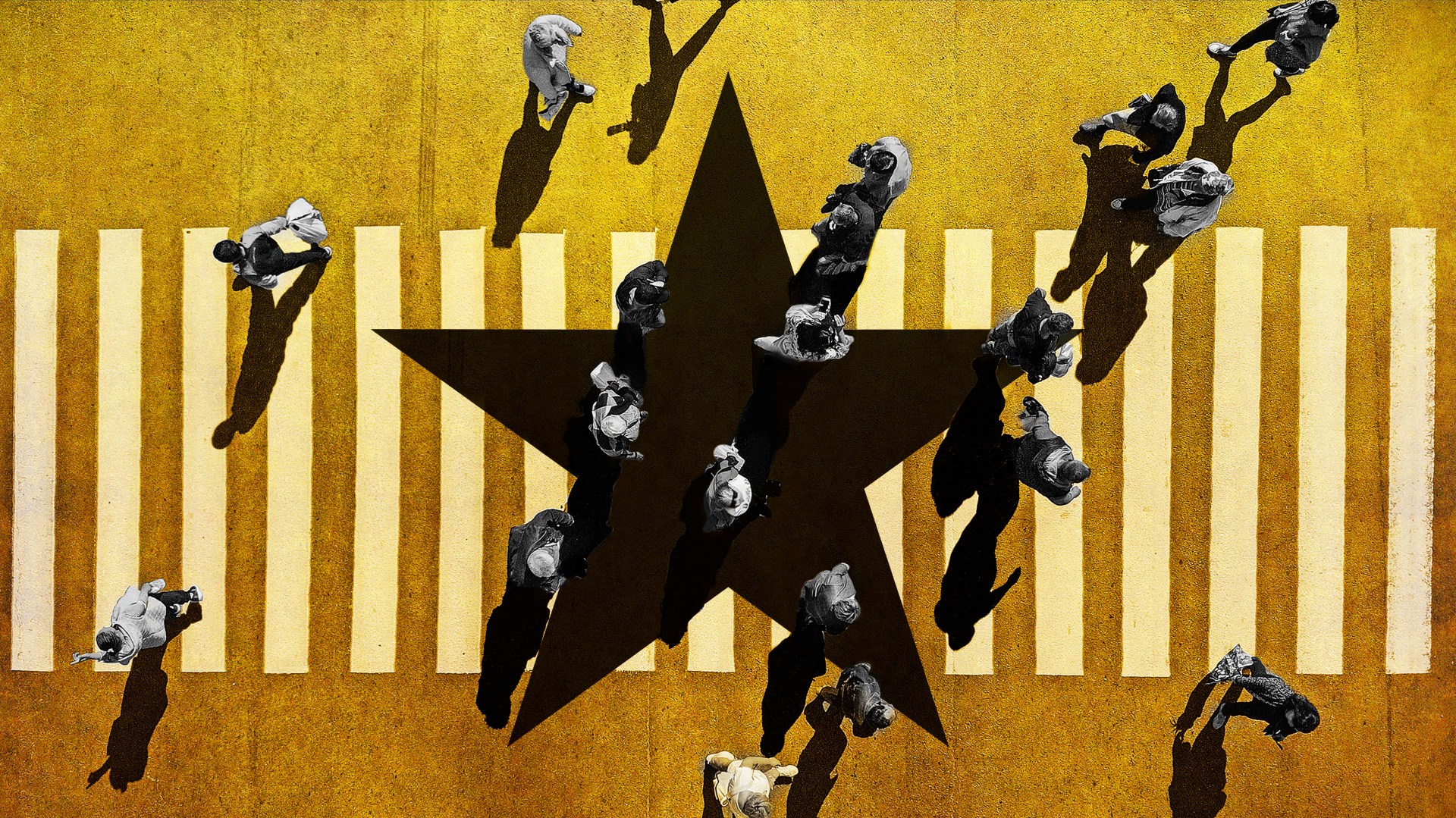
Illustration by Rick Szuecs / Source Image: Dmytro Varavin / Getty

Some stories serve as parables of the period they are written in. Romeo and Juliet and Hamlet depict the religious tensions of Reformation England without ever mentioning the words Protestant or Catholic. Frankenstein reflects anxieties about early industrialization: Will our scientific power turn around and destroy us? The Lord of the Rings evokes World War II and the fight against fascism. Great stories can encapsulate historical moments, and indeed entire civilizations.

If I had to choose a parable for the post-Christian West, it would be Lin-Manuel Miranda’s Hamilton. Even if you haven’t seen it, you know the story: An impoverished immigrant arrives in a new land with nothing but his wits, joins the revolution, writes his way to recognition, fights his way to victory, designs the nation’s financial system, founds a newspaper and a political party, antagonizes nearly everybody, cheats on his wife, loses his son, decides an election, gets shot and killed by the vice president, and ends up on the ten dollar bill.

But Hamilton is about more than one bright, scrappy immigrant fighting his way to the top. The show features multiple clashes between old and new worlds, in which young, brash, loquacious energy collides with stuffy, patrician traditionalism. At the personal level, Hamilton takes on Aaron Burr and Thomas Jefferson. At the national level, New York City and its banks struggle for supremacy against Virginia and its plantations. At the international level, America goes to war with Britain.

In each case, the new kid on the block is derided as big-mouthed, garishly dressed, and obsessed with money. Yet the new kid wins anyway, confirming that the future belongs to Hamilton, New York City, and America, not the slave-owning South or the crown-wearing buffoons across the Atlantic.

In that sense, Hamilton is the story of the modern West. Industrial economies displace agrarian ones. Polyglot democracies win out against patrician monarchies. Creative geniuses with quick wits and a commitment to follow their heart wherever it leads transform the culture. Economic value is determined by the banks in the cities, not the crops in the countryside. Traditional values, for good or ill, are upended by the sweeping power of the market and the social changes it ushers in.

Or consider Hamilton’s treatment of Christianity. For much of the show, faith plays a minimal role, despite its importance to much of the plot and many of the characters. Christian themes and biblical allusions do appear: providence and prayer, homilies and hymns, the sinners and the saints.

But you would never know how large a role Christianity played in the American Revolution or the battles over slavery, or that Eliza Hamilton was a devout Christian, or that Thomas Jefferson was decidedly not.

Then suddenly, when Hamilton’s son dies in a duel, it all comes pouring out. “It’s Quiet Uptown” is the musical’s most moving song, bringing the emotional catharsis we need after watching a teenage boy bleed out in front of his parents. We witness Hamilton’s spiritual renewal. He takes the children to church on Sunday, making the sign of the cross as he enters. He begins to pray. We hear about the grace that is too powerful to name. And then we see Eliza forgive him, not just for his infidelity but for failing to stop his son from getting himself killed.

It might as well be a parable of post-Christendom. Religion is firmly in the background while we are winning wars and making money, and even while we are making shady deals and having affairs. Although Christianity still shapes our history, ethics, architecture, and psychology, we rarely think about it when times are good.

But when things fall apart—when we lose our children or our partners, when we face death ourselves, when we have done something unimaginable and need forgiveness and grace—we know where to find help. We may head to church for the first time in years. We might start praying or reading the Scriptures. Spirituality returns.

Every generation has its parables, and Hamilton is one of ours. If we have ears to hear, there is plenty to learn from it. People may not feel they need the church like they used to, for all kinds of cultural and economic reasons. But they will always need grace.

Andrew Wilson is teaching pastor at King’s Church London and the author of God of All Things. Follow him on Twitter @AJWTheology.

Birth Behind Bars: Christians Fight ‘Cruel,’ Outdated Prison Policies

Ministry efforts aim to induce change and offer care for the growing number of new moms separated from their babies due to incarceration.

Illustration by Leonardo Santamaria

Vanessa Franklin lost her mother, her father, and her husband in a 12-month span. But the grief of their deaths paled in comparison to parting with her three teenage daughters in the same year, 2008, when she went to prison for fraud.

“Being separated from them was worse,” said Franklin, who served four years in Oklahoma.

She couldn’t imagine a deeper hurt until a few years later, when her daughter, Ashley Garrison, was sentenced while pregnant. The 20-year-old went into labor the day she checked into prison.

Garrison had a boy and named him William. She held him for an hour before she was forced to relinquish custody to his father’s family.

Babies can barely see when they’re born, but studies show that newborns still know their mothers—they recognize her voice, her smell, even the smell of her breast milk. Christians celebrate this as the design of a God who forms babies in their mother’s womb.

For Garrison, that meant her baby knew who she was but never saw her face.

“She’s not the same,” Franklin said. “She never recovered.”

In Oklahoma, where they live, roughly 151 of every 100,000 women are behind bars. That’s twice the national average.

Franklin, released from prison in 2012, now serves as the national director of field operations for the Christian ministry Prison Fellowship, working on behalf of a growing number of women and families like her own.

In 2019, there were 231,000 women and girls behind bars in the United States, a 775 percent increase since 1980. Most are serving time for nonviolent convictions, things like drug charges or theft. More than 60 percent were mothers to children under 18 at the time of sentencing. So as America’s mass incarceration problem grows, so does the number of moms in prison—and the number of babies born to women in prison.

But prison “facilities and policies have largely been built around incarcerated men,” said Heather Rice-Minus, a senior vice president at Prison Fellowship. That can make them dangerous for an expectant mother and her baby.

In 2016, three to four out of every 100 women admitted to state and federal prisons in the US were pregnant, according to research in the American Journal of Public Health. The report is believed to be the first systematic investigation of pregnancy in prison.

Most states still permit prisons to put pregnant women in solitary confinement. Sometimes, pregnant inmates are handcuffed or are shackled to their hospital bed by their wrists, ankles, or all four while giving birth. (Even before going into labor, being handcuffed can be dangerous for pregnant women. Baby bumps are a balancing act.)

In all states except Minnesota, prisons can take babies away from new moms—even nonviolent and nonaddicted moms—within days, or even hours, of birth. There is no nationwide standard for the treatment of babies born to women in prison, and there is no regular data on how often it happens.

Eleven states currently have some prison nursery facilities, where babies born to mothers with nonviolent convictions and no history of child abuse or neglect can stay with their mothers for anywhere from a few days to a couple of years. But case-by-case discretion and the lack of facilities in other states mean babies born to incarcerated moms in America have, at best, an uncertain path after leaving their moms’ wombs.

Over the past two years, the COVID-19 pandemic has added to the uncertainty. In some states, such as Colorado, judges have reportedly postponed or commuted the sentences of women who were pregnant when convicted. In light of reports of rapid spread of the virus inside prison facilities (and given its risk for expectant mothers), some states have revisited the sentences of pregnant women and, in some cases, have released them early.

At the beginning of the pandemic, Prison Fellowship celebrated this rare display of agility on the part of the corrections industry and lobbied for states to keep it up, carefully and quickly.

Christian rap artist Lecrae, who has volunteered with Prison Fellowship for years, joined the public effort by calling for Christians to urge their legislators to release nonviolent pregnant offenders after news broke in 2020 that a pregnant Native American woman from South Dakota died after contracting COVID-19 in a Texas prison. Her baby was delivered by C-section shortly before her death.

Rice-Minus said that even before the pandemic posed a risk to vulnerable prisoners, some judges would, upon their own discretion, take a woman’s pregnancy into account when considering sentencing. But it’s possible the pandemic will prove a catalyst for more concrete policy changes on behalf of pregnant prisoners.

Remembering those in prison

As the number of women in prison has skyrocketed, Christians and Christian ministries across the country have been working to protect vulnerable women and babies. From a bird’s-eye view, this modest cohort of ministries is working all angles of the issue—from legislative challenges to the care of the babies born inside prisons.

Prison Fellowship, founded by Charles Colson in 1976, has led the way pushing for policy change on a national scale and continues lobbying for better treatment of pregnant women in jail. Its Angel Tree program aims to care for the children of incarcerated parents by keeping them connected to their parents and, ideally, a local church.

Others focus on the babies who are born to incarcerated moms. My Village Ministries in Columbus, Ohio, offers short-term childcare for families in crisis, including incarcerated parents. A small Mennonite charity in Cañon City, Colorado, fosters babies born to incarcerated moms, keeping them in close, regular contact with their mothers until the two can reunite after their release.

The work done by these ministries follows Jesus’ command in Matthew 25 to visit those in prison, as well as Paul’s exhortation to “remember those in prison as if you were together with them in prison” (Heb. 13:3). These texts are part of a bigger, more profound concept Christians see woven through the entire biblical narrative: human dignity.

Christians who advocate for those in prison see their work as a testimony to the unshakable worth people have, no matter their rap sheet. Their efforts work against the stigmas, stereotypes, and social attitudes that suggest people lose their right to humane treatment once police and courts charge and convict.

Contemporary German theologian Wolfhart Pannenberg wrote that because human beings were made for fellowship with God, “no actual humiliation that might befall us can extinguish” our dignity.

The Bible attests to this feature over and over. In biblical accounts of human failure, the consequences can be viewed as prescribed in service to human dignity. The Book of Proverbs says God “disciplines those he loves” (3:12). The Old Testament often describes God “giving us over” to our sins—suggesting that in his sovereign respect for us as his image bearers, he may give us what we ask for.

Jesus constantly reminded those around him—both explicitly and implicitly—that no one, even through criminal wrongdoing, can forfeit his or her own human dignity or steal the dignity of others. Jesus publicly fellowshipped with Zacchaeus, a cheating tax collector who Jesus proclaimed was saved by God when he repented. He built his church upon the “rock” of Peter, the foolhardy disciple who publicly denied Jesus in his darkest hour (Matt. 16:18).

“Just as Jesus as God is known by his actions but not defined by his actions,” writes Daniel Darling in his book The Dignity Revolution, “so are those made in His image. You were valuable before you did anything. I would still be valuable even if I were rendered unable to do anything.”

Birth behind bars

An American Public Health Association survey of 22 state and federal prisons found that 753 women gave birth in those facilities in 2016; the total number of births behind bars each year is likely even higher when accounting for local jails.

Rice-Minus at Prison Fellowship said neglectful or dangerous policies affecting pregnant inmates reflect an indefensible delay: Corrections officials are updating their policies at a crawl while the number of women in prison explodes.

A shocking example made national headlines a few years ago. In July 2018, Diana Sanchez checked into the Denver County Jail for violating probation after an identity theft conviction. She was eight months pregnant and showed signs of drug use.

Illustration by Leonardo Santamaria

Two weeks later, Sanchez went into labor and delivered her baby alone on her cell bench. Prison officials could watch through a security camera. Nurses slid an absorbent pad under Sanchez’s cell door as she gave birth without assistance. A Denver firefighter had to cut the umbilical cord when responders arrived because the prison didn’t have the equipment.

After a lawsuit, the Denver Sheriff’s Office investigated and said that while they agreed Sanchez should’ve been taken to the hospital, jail officials hadn’t technically violated protocol. Because there was no protocol. The city of Denver ultimately paid Sanchez and her son a financial settlement and has since updated its policy to require pregnant inmates be taken to the hospital when in labor.

Rice-Minus, who is also the foster mom to a young girl whose mother is incarcerated, said she’s noticed over the past five years that more corrections officials are waking up to the need for change.

“Trauma-informed or gender-responsive programming is becoming more trendy in the corrections field,” she said. “We’re recognizing that there actually needs to be a different way of handling and rehabilitating women in the prison system.”

Part of that is thanks to work by Christians who recognize that pregnant inmates are incarcerated for two.

Legal fight over shackling pregnant women

A few days before Christmas 2018, just months after Sanchez delivered her own baby in her cell, President Donald Trump signed the First Step Act. Prison Fellowship had lobbied in its favor.

The law mandates that federal prisons provide feminine hygiene products. It also requires the federal government to track and report pregnancy outcomes in federal prisons and prohibits the handcuffing of pregnant women, though there are exemptions if law enforcement officials believe shackling is necessary for safety reasons.

Even with the exemptions, Rice-Minus said many people opposed the shackling prohibition.

“People will say, ‘Hey I’ve dealt with someone who has come into my jail who is high, or is experiencing a mental breakdown, or an episode where I genuinely feared for her safety … that she was going to harm herself, or harm the staff,’ ” she said.

Rice-Minus said it’s important that law enforcement assess whether a woman is a threat in the moment, not merely whether she was violent before.

It’s an inherent tension of prison reform: A system as vast as the US criminal justice system must, by virtue of its size, standardize procedures. Bureaucracy doesn’t favor flexibility.

But in prisons, where incarcerated people often struggle with mental health problems, drug abuse, or violent behavior, decisions are often made in the moment and stakes are high. Rice-Minus knows it can be a difficult and scary situation for law enforcement officers.

Still, “there are very few medical procedures where you need the patient to be so engaged” as giving birth, Rice-Minus said.

The First Step Act’s prohibition on handcuffing laboring women only applies to federal prisons, and the majority of incarcerated women are held in other facilities. Other Christian groups are trying to make change at that level.

In 2014, the Family Foundation of Virginia lobbied alongside Prison Fellowship for legislation to outlaw shackling pregnant women at state and local prisons and jails in Virginia.

Mary Rice Hasson, director of the Person and Identity Project at the Ethics and Public Policy Center in Washington, DC, called shackling pregnant women “barbaric.” Hasson, a lawyer and a Catholic, said that while she was glad for the First Step Act’s prohibition, she is concerned that it does not reach state or local prisons.

“Treating all people with dignity is at the core of the pro-life message,” Hasson said, “and that includes all moms and babies, including moms who are incarcerated.”

Today, 35 other states also prohibit the shackling of pregnant women.

Separation as a ‘primal wound’

Christians who fight for the humane treatment of incarcerated women giving birth do so knowing it will benefit both mom and baby.

“Forcibly separating a new mom and her infant is a cruelty that serves neither the mom and her child nor the interests of society,” Hasson said. “I would expect that forced separation would be likely to exacerbate the instability of the child’s upbringing.”

Especially in pregnancy and postpartum, mother and child are intertwined. Babies, with their fuzzy newborn vision, don’t even grasp that they are a separate being from their mothers.

Psychotherapist Nancy Verrier calls the separation of a baby from his or her mother a “primal wound.” She published data that suggest children who leave their moms early—even out of utter necessity—will suffer some negative consequences for the rest of their lives, regardless of the circumstances that follow the loss (such as a healthy adoption).

The bond between mother and infant is so inherent to our human nature and so powerful that Scripture uses it as a metaphor for God’s love. Isaiah 66 describes a mother laboring, nursing, and carrying a baby on her arm, with the Lord saying in verse 13, “As a mother comforts her child, so will I comfort you.”

Today’s standards of newborn care urge moms to keep close to the body that was once inside their own. Make time for skin-to-skin contact, they’re told. Babies need to hear your voice; they need to be touched. They need to bond.

Practices like breastfeeding benefit moms too, releasing oxytocin to prompt feelings of joy and affection. Breastfeeding also alerts the mother’s body to begin shrinking her uterus back down to its prepregnancy size. It’s a chemical metaphor for what so many mothers intuit: She needs her baby just as desperately as her baby needs her.

In a fallen world, sickness and circumstances inevitably separate moms and their babies. God told Eve after she and Adam had sinned in the garden that she would experience pain in childbirth, a pain that goes beyond physical delivery (Gen. 3:16). There’s pain in loving something so vulnerable and in the typical and the tragic ways children are separated from their parents.

But right now, in the US criminal justice system, advocates believe we’re inflicting this “primal wound” more than necessary.

“Treating all people with dignity is at the core of the pro-life message, and that includes moms who are incarcerated.” Mary Rice Hasson, EPPC

While most US prisons transfer laboring mothers to hospitals for delivery, what happens after varies widely. Some prisons automatically take babies away from their mothers and place them in the custody of family members or in foster care for the duration of their sentence. This move often ends up permanently severing the mother’s custody and increases the statistical likelihood that her child will one day be incarcerated.

In 11 states, including Indiana, California, and New York, pregnant women in prison can qualify for a nursery program, where they can bond with and breastfeed their children for a time after their birth in a set-apart area of the prison.

Two state prisons—one in Nebraska and one in Ohio—have dormitories where women with nonviolent convictions and short-term sentences can live with their babies.

Last May, Minnesota became the first state to pass a law prohibiting the separation of incarcerated moms and their newborns, likely paving the way for another dormitory-style program in that state.

These facilities aren’t without problems and criticism. Some studies have shown developmental delays in babies who spend time in these facilities; and no one, least of all moms, is particularly comfortable with the idea of babies in prison.

With those challenges in sight, other Christians are imagining restoration on a nonlegislative front.

Mennonite nannies ‘do the impossible’

Women inside Denver Women’s Correctional Facility know all about “the Mennonites.”

“The women who have cycled in and out of the correctional system … if they see someone who’s pregnant, they’ll say, ‘Hey, have you talked to the Mennonites?’ ” said Krista Burkholder, a caseworker for New Horizons Ministries in Cañon City, Colorado.

The small organization began in 1992, founded by two Mennonite men who wanted to help babies born to incarcerated moms.

Until COVID-19 kept pregnant women from entering prisons in the state, New Horizons functioned like a mini chapter in Colorado’s foster care system, almost exclusively for babies born to incarcerated moms.

Families in the Mennonite community sign up to foster and are licensed by the state. Since Colorado law doesn’t allow more than two children under two years old in any single-family foster home, New Horizons recruits young Mennonite women, 21 or older, from around the US to temporarily move to the area and volunteer, usually for a year or a bit more, as caregivers. At New Horizons—and within the walls of Denver Women’s Correctional—these are known as “the nannies.”

The nannies move into the home of one of New Horizons’ licensed foster families, and after a background check, CPR and first aid training, and training in trauma-informed care, they become the primary caretakers for babies born to local incarcerated moms.

https://www.instagram.com/p/CNI7rNosDGu/

New Horizons pays for the nannies’ costs of living, but nothing more. The women take the babies on regular visits to their moms in prison and stick around—they also develop a relationship with the moms until they are released or, if a mom is ultimately unable to raise the child, until the baby is adopted.

“We ask our foster parents and our nannies to basically do the impossible: They love these children as their own and then hold them with open hands and be willing to give them back,” said Burkholder, a trained social worker.

Burkholder’s boss, New Horizons executive director Arlynn Miller, and his wife have been “house parents” for years, opening their homes to several nannies and babies. The couple has adopted two girls they originally fostered through the program. At one point, they hosted four nannies and four babies under their roof at once.

Miller remembers a particularly chaotic scene after a visit to the prison several years ago. “We took 11 children to see their mothers … so I was carrying a baby, my wife was carrying a baby, and we had nine nannies.” The caravan went to a restaurant for lunch after the visit. “A guy comes up to me and he goes, ‘Are these all yours?!’ ” Miller said.

Those days are on hold for now, though, as Colorado has temporarily halted the sentencing of pregnant women to prison.

“If I remember correctly, they used the term ‘experiment,’ ” Miller said of a conversation between New Horizons and state corrections officials shortly after the start of the pandemic. As a result, the ministry hasn’t had any placements in over a year. Nor are there any nannies en route.

Burkholder and Miller say they trust God with the future of New Horizons. They’re also trusting God with the babies born now outside the prison system in Colorado, where she fears kids are being exposed to trauma without the help of ministries like theirs. “He’s doing something. We know he is,” she said.

https://www.instagram.com/p/COjDyxaMQ-I/

‘… Should they be a prisoner?’

Throughout the pandemic, Prison Fellowship has been able to maintain its Angel Tree program and church partnerships to support families affected by incarceration.

It was in prison that Vanessa Franklin first heard of Angel Tree, best known for providing the children of incarcerated parents with Christmas gifts. Franklin now helps run that program, which connects local churches to nearby prisons. The seasonal effort to collect children’s holiday wishes and deliver gifts from those churches can spur longer relationships between incarcerated families and local Christian communities.

For Franklin, those relationships were key for her family. Through Angel Tree, her daughters found a youth group, and Franklin kept a mom’s watchful eye through correspondence with the youth pastor. Was Chelsey playing cheery music on the piano, or did it sound too melancholy? Was Shelby telling enough jokes, or was she struggling again?

Several months ago, Franklin traveled to Ohio to introduce Ohio’s Reformatory for Women—one of only two programs in the country where incarcerated moms can live with their newborns—to Angel Tree. She lamented that Ohio’s program is so rare. Still, she’d ultimately rather see alternative sentencing for pregnant women.

“If we’re talking about drugs and alcohol, should someone be a patient, or should they be a prisoner?” Franklin said. “I think there are many times we need to decide the difference between the two.”

When Oklahoma Governor Kevin Stitt was elected in 2018, he called the state’s incarceration rate—then the highest in the nation—“ridiculous.” In the late fall of 2019, Stitt, a professing Christian, commuted the sentences of 462 Oklahoma inmates based on the recommendation of the state’s Pardon and Parole Board. It was the largest single commutation in US history.

Late last year, the board recommended clemency for Julius Jones, a death row inmate convicted of murder. Stitt, citing “prayerful consideration,” commuted Jones’s sentence to life without parole just hours before he was to be executed.

One of the inmates sitting before that Pardon and Parole Board is Ashley Garrison.

This is what the board will know about her: Ten years ago, Garrison and her husband at the time were cosleeping with their new daughter when the baby died of SIDS (sudden infant death syndrome). Police reported finding dangerous conditions in the couple’s home and unexplained bruises on their daughter. Garrison and her husband, Zachary, were each charged with felony child neglect. Zachary was sentenced to 10 years. Garrison got 20.

It was between her daughter’s death and her sentencing that Garrison became pregnant again, giving birth to her son William the day she entered prison. The baby was sent to live with the baby’s father’s family on a nearby reservation.

Now, a decade later, Garrison has not seen him a second time. She doesn’t even know if the relatives raising him still call him William.

Maria Baer is a CT contributing writer based in Ohio. She also writes and hosts a podcast for the Colson Center for Christian Worldview, named for Prison Fellowship founder Charles Colson. This essay is part of an ongoing CT series exploring how Christians engage the criminal justice system.

Ideas

We’re Not Mad Enough at Death

Contributor

Dying is a fact of life. It’s also the enemy we’re called to resist.

Illustration by Pete Ryan

I’ve never seen so many headlines about death.

Over the past two pandemic years, newspaper obituary sections grew fat with tributes, and my online feeds—keyed up to search for terms like pastor and minister—were filled with local news stories about churches who lost their leaders during the pandemic.

The death tolls we’re reaching now are the worst-case scenarios we couldn’t even imagine when COVID-19 first hit. As the United States commemorated 800,000 dead in late 2021, The Atlantic writer Clint Smith called it a number “so enormous that we risk becoming numb to its implications.”

There’s a sense of resignation in the way people, even fellow Christians, speak of the COVID-19 dead. Depending on their positions on vaccination, they may suggest that the unvaccinated put themselves at risk, or, on the other side, that it simply must have been their time to die.

On Ash Wednesday, Christians traditionally repeat a line aimed to remind each other of our mortality, that we will all die and “to dust we shall return.” We hardly need the reminder in the midst of a pandemic that has taken more than 5.7 million lives around the world.

It would be hard for that level of loss to not shift our conception of death, or move it further in the direction it was already headed.

We have seen a creeping fatalism toward the critically ill. The medically vulnerable have too often been reduced to their COVID-19 “risk factors” and “comorbidities,” as if such conditions justify another life lost.

Governments around the world are moving toward policies to sanction euthanasia. In Australia and the UK, politicians are lobbying to legalize “assisted dying,” and Switzerland debuted a futuristic “suicide capsule” designed for tranquil last moments. In the US, 10 states allow physician-assisted suicide, and this year, another 14 state legislatures will consider bills to legalize the practice.

The inevitability of death does not make it something to be invited or even matter-of-factly accepted—pandemic or not. It is our enemy. As R. C. Sproul writes, it is the intruder in the garden. It robs us of what God made and called good. It should make us mad. Especially when scores of people around us are dying needlessly.

Evangelicals often adopt the label of “pro-life.” But being pro-life also means the opposite: We oppose death.

We should work to save lives, to avoid careless deaths, in every area that we can: in public health and public safety, in wombs and suicide pods. We cannot conquer death on this side of eternity—thankfully, that feat has been accomplished for us—but we have a responsibility to cherish life and keep it while we can.

“The refusal to take COVID-19 seriously is not a case of people prizing eternity over biology. It’s actually the reverse: the refusal to place life over ideology,” CT’s public theologian Russell Moore told me. When we know how deadly this virus is yet continue to place others at risk with our actions and policies, we are playing God, “as though we could decide which lives are worth living,” he said. But as followers of Christ, we must remember that even our own lives are not our own.

I worry that, as people whose eternal fate is good news, we forget death is still bad news. God gave us life as a gift. Death isn’t our chance to level up into the presence of God; it’s the end of something God delights in and calls good on its own terms. Death is wrong.

“A Christian understanding of death,” theologian Tim Perry writes in Funerals: For the Care of Souls, “… presents death as the great severer of all loving relationships, as the punishment for sin, and as the final enemy.”

In his book full of liturgies around dying, Douglas Kaine McKelvey wrote a six-page intercession against the kingdom of death.

“To call death natural is a lie, to spin it as but one more spoke upon a ‘wheel of life’ is to ignore the groaning cry of your creatures, O Christ,” the prayer reads. “Death is a catastrophe, an obscene enemy, a poisoned arrow piercing the eye of creation, twisting history and nations, bereaving lovers, warping the constellations of community, of family, of flourishing.”

So when people around us die, particularly under circumstances that haunt us with what-ifs, it is right for us to sob in sadness and shake our fists in anger.

Let us linger in sorrow long after those around us deem it acceptable. Let us refuse to minimize the pain of losing our relative, our friend, our neighbor, our coworker. We may mourn for the rest of this life knowing that in the next, our God who conquered death will wipe away every tear.

Kate Shellnutt is CT’s senior news editor.

News

New Brethren Churches Wrestle with Details of Denominational Division

The doctrines separating them are clear. The legal process of disentanglement, less so.

Mt Joy, in Pennsylvania, is one of 52 congregations that have left the Church of the Brethren and joined the newly formed Covenant Brethren Church. The division, though uncontested, is legally complicated.

Mt Joy, in Pennsylvania, is one of 52 congregations that have left the Church of the Brethren and joined the newly formed Covenant Brethren Church. The division, though uncontested, is legally complicated.

Screengrab / Google Maps

Lee Smith thought he knew the name of the church cemetery.

He was pretty sure. But in his years as pastor at Mt Joy in southwestern Pennsylvania, Smith had never actually checked that the legal name of the burial grounds was the same as the name it was commonly called.

“We thought it was called Mt Joy Cemetery, and if that’s the case, there’s no need to change the name,” Smith told CT. “However, there are some forms for purchasing cemetery plots or deeds that say, ‘Mt Joy Church of the Brethren Cemetery’ on them. So we’re still trying to figure that out.”

Add that to the long list of suddenly important details that have to be dealt with when a congregation leaves a denomination.

Mt Joy is one of 52 churches across eight states and the Democratic Republic of the Congo that have separated from the Church of the Brethren and joined the newly formed Covenant Brethren Church in response to an ongoing dispute over homosexuality and the historic peace church’s theological commitment to not enforcing denominational policy.

The Pietistic-Anabaptist denomination is not the first to quarrel over the question of same-sex marriage and the affirmation of LGBT identities. Hundreds of congregations left the Episcopal Church after the ordination of an openly gay bishop in 2003. The United Methodist Church (UMC) and the Reformed Church in America (RCA) are negotiating similar splits.

But while the theological differences are well rehearsed, the actual legal details of division are much murkier. Many departing Episcopal congregations ended up in interminable lawsuits over property. UMC and RCA leaders are trying to figure out what a split means for denominational entities funded by generations of giving. And the Covenant Brethren are researching lots of little details, like the legal names of their graveyards.

Months after the Mt Joy congregation voted unanimously to leave the Church of the Brethren, Smith said the church still has a long list of legalities to straighten out.

The process is time consuming, if not actually difficult, according to Smith and others who are in the process of joining the new denomination. The Brethren, in keeping with their traditional claim that there should be “no force in religion,” are not fighting the departures or doing anything to make them more difficult. The Covenant Brethren, for its part, is encouraging interested congregations not to undertake the move without overwhelming support. The official recommendation is a 90 percent vote in favor, though the voting process and technical requirements vary depending on church district.

After Mt Joy voted to join the Covenant Brethren in April 2021, Smith started working on changing the church’s legal name, getting a new federal tax number, incorporating in Pennsylvania, and updating the church’s bylaws—not to mention changing the name on all the social media accounts.

“Actually, we’re still waiting for some of that,” Smith said.

Two months after sending in paperwork to amend Mt Joy’s incorporation documents with its updated name, Smith discovered a problem—one number in the church’s address line filled out by the state was wrong. Another two months later, after filing corrections and signing the forms again, Smith was told the state had sent the church the wrong form to be corrected.

“It’s almost a comedy of errors,” Smith said. “It’s been a longer process than it probably should have taken—we should have had it done a month and a half ago.”

Mt Joy is still waiting for state recognition of its new name: Mt Joy Covenant Brethren Church. When that happens, the church can start the process of changing the bank accounts. In the meantime, a Mt Joy trustee raised the issue of the cemetery’s official name, which could create an issue if the cemetery is technically owned by the Brethren and Mt Joy fails to transfer ownership.

Craig Alan Myers, an executive board member of Covenant Brethren, went through a similar experience after his congregation in Columbia City, Indiana, voted to leave the Church of the Brethren after 31 years.

“There’s just a lot of little things that you can’t imagine,” said Myers, whose church is now called Blue River Covenant Brethren Church. “We have a transition team. And we’re just taking things as they come. But there’s just a lot of things you don’t even think about when you start. I mean, what about your church sign? Who’s going to handle that?”

Some of the changes, according to Myers, aren’t that different from what a business would go through if it changed its name. But there are also details that are specific to churches.

Myers was recently preparing for a funeral when he realized the funeral home might not be aware of the church’s new name. He had to contact the funeral parlor to ensure the obituary and funeral programs would be printed correctly.

As a new denomination, Covenant Brethren tries to help joining churches anticipate some of the steps involved in switching. But the rules are different in different states and different Church of the Brethren districts, so official case-specific guidance is limited.

Brake Covenant Brethren Church in Petersburg, West Virginia, is still waiting for approval from the IRS for its name change on its employer identification number. The IRS website says churches can request a name change instead of closing and opening new bank accounts, but church business is pretty much on hold until it receives confirmation.

Craig Howard, pastor at Brake, said the church is also working with an attorney for a quitclaim deed to transfer church property.

In the West Marva district, where Brake Covenant is located, church property officially reverts back to the denomination if the congregation disaffiliates. But the district has agreed to sell the property to the congregation for $1, “just to make it a legal transaction,” Howard said.

Other districts have asked for a percentage of the property value to release the deed, or set a price per member for a property sale.

But even for $1, lawyers have to be hired and paperwork processed. The cemetery next to Brake Covenant is incorporated separately, so the church doesn’t have to worry about that detail, but it does have to reapply for its 501(c)(3) status.

Beyond that, the church shut down its former website, and the new one is still underway. Staff are still getting new email addresses, and the bylaws have to be changed to include the church’s new name.

“It’s just a lot of little details. You make a list and start checking it over,” Howard said. “It’s not hard, but it does take somebody putting in some serious amounts of time.”

Hannah McClellan is a reporter in North Carolina.

News

The Confederate Statues Are Gone. The Work of Repentance Continues.

These white evangelicals want to make the former capital of the Confederacy into the capital of racial reconciliation.

Pool / Getty Images

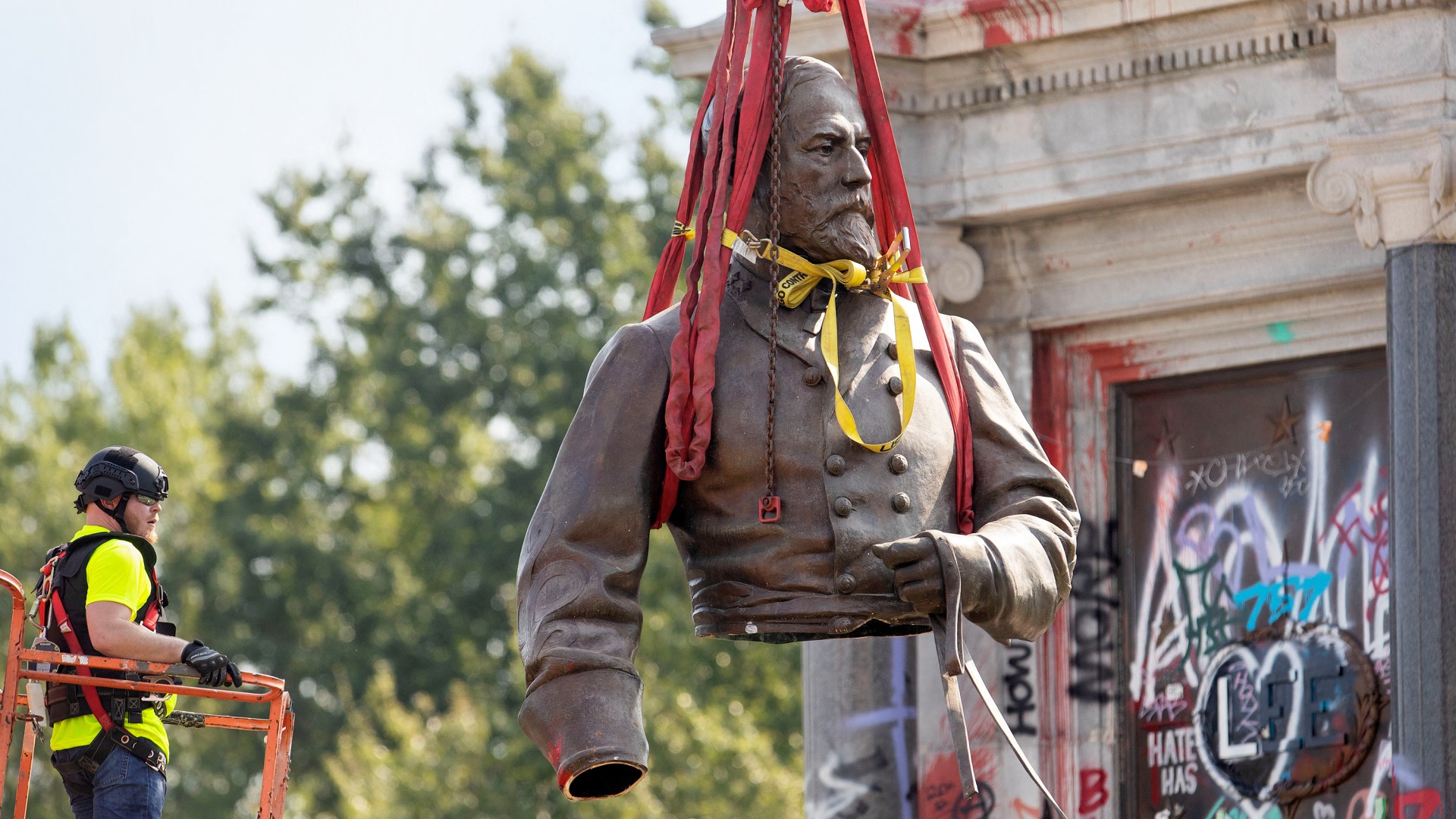
The statue of Robert E. Lee cast a racist shadow over Richmond, Virginia, for 131 years. But today it is gone.

The federal government sent a truck and a removal crew to Monument Avenue one misty day in September. The bronze likeness of the man who betrayed his country to lead the fight for a new nation that was heralded at the time as “the first in the history of the world” based on the belief that “the negro is not equal to the white man” was sawn into pieces. The pieces were hoisted off the marble pedestal. And carted away.

For Katie St. Germain, it felt a bit anticlimactic. She watched from her computer at work.

As a lifelong Virginian, she remembered seeing the statute and other Confederate monuments as a child from the backseat of her mom’s car, headed to ballet lessons. She didn’t know what they meant. She slowly learned as she got older that Richmond—her city—was proud of its heritage as the former capital of a four-year experiment in white supremacy.

When St. Germain graduated high school, a lot of her friends got a class ring adorned with the Confederate battle flag. A lot of her family had those rings too. But she decided she didn’t want one. She wasn’t proud of the Confederacy. As a white evangelical Christian, she thought it was wrong.

So St. Germain was glad to see the statue coming down. But it still felt incomplete.

“I’m not a big liturgy person, but I think we have to have a liturgy,” said St. Germain, who attends a nondenominational church called The Chapel. “I read Be the Bridge by Latasha Morrison and Just Mercy by Bryan Stevenson. Both of those authors talk about the importance of lament. It is a biblical response, to lament. It is a biblical response to repent. It brings healing.”

St. Germain started thinking about what that event could look like. A few months later, she met with community leaders from 15 churches and Christian organizations to start praying and planning—but most importantly praying—about a “big event.”

The community leaders may schedule a service of public lament for the one year anniversary. The idea is to have something that will, in a way, undo what white Christians did in 1890, when the statue went up. Churches in the city raised money to erect it. When it was unveiled, a Presbyterian pastor solemnized the occasion with prayer.

That’s what needs to happen now, many of the city’s evangelicals feel, but in reverse.

“We need formal, liturgical moments to mark this,” said Corey Widmer, pastor of Third Church, an evangelical Presbyterian congregation in Richmond. “We need to say, ‘Yes, we did this and want to be part of the repair, doing the work of repair that is needed.’ ”

Christians concerned about racism know that one event is not enough to accomplish justice and reconciliation, though. Public events are important, but the real work of unwinding racist history happens in private. For a year and a half now, evangelicals across the city have gathered in small groups to discuss this.

Some were organized by For Richmond, a nonprofit that connects and equips Christian leaders. The group is headed by Matt and Anna Shenk, former Cru ministers who were deeply influenced by evangelical civil rights activist John Perkins and have modeled their ministry on Perkins’s Christian Community Development Association and other organizations that bring churches together to serve a city, including For Charlotte, Unite Dallas, and Transforming the Bay with Christ.

“Our dream is that Richmond can go from the capital of the Confederacy to the capital of racial reconciliation,” Anna Shenk said.

In 2020, after the protests following George Floyd’s death in Minnesota, For Richmond hosted training for 80 pastors on how to lead congregations through difficult conversations and then launched 45 Be the Bridge groups to read and discuss the best-selling book.

In the process, the Shenks saw an increased number of suburban churches asking questions about the connections between white flight and church growth, and the way the creation of their communities by Christians in the 1960s hurt the city and Black people.

“There was a groundswell of prayer and lament and repentance,” Anna Shenk said. “I think it just became clear that just because you’re a suburban church, that doesn’t mean you’re not a part of it and doesn’t mean you’re not a part of the work God is doing on racial reconciliation.”

Wynelle Roland is a coleader of a Be the Bridge group at a Southern Baptist church. She’s not a member of that church but was invited to join and then help lead the group. As a Black Christian, she was leery at first about talking with white people about racism for an hour and a half every month. She was worried she might offend them with her perspective, and she didn’t want to be offended by theirs.

But she liked the idea of a faith-based conversation, so she decided to try. Her fears were quickly put to rest.

“They understood there is a need for racial reconciliation; they just didn’t know where to start,” Roland said. “They needed to have a productive place to talk about their feelings, to learn about racial injustice, and also to have avenues to get involved.”

Around the time the Lee statue came down, Roland’s group discussed the Haitian refugee crisis and ways to talk to family and friends who said derogatory things about Haitians.

A lot of the work white Christians need to do is just finding a way to overcome fear, said David Bailey, founder and CEO of Arrabon, a Richmond-based racial reconciliation ministry. Many are afraid of losing cultural power. Others don’t believe there will be forgiveness if they get it wrong.

“These are basic kindergarten Christianity kinds of things, but then when we try to reckon with race, it’s like overload,” Bailey said. “How does Christianity work when it’s committed to everybody’s flourishing and not just its own power? That’s unfamiliar to people, and it brings a lot of fear. And when you have fear, you don’t have the discipline of a sound mind.”

Bailey is encouraged, however, by the progress he’s seen since his father, a Black Pentecostal minister, made friends with a white pastor through Promise Keepers’ racial reconciliation efforts in the 1990s. Today, he said, it’s not so hard for ministers to connect across racial lines. And he sees white Christians who are willing to make sacrifices for racial justice.

“This isn’t a church growth strategy,” he said. “It’s work. It’s spiritual work.”

For some evangelicals, the work looks like learning that their faith calls them to a different kind of relationship with their neighbors.

“Especially in Richmond, I just don’t think you can be a faithful Christian unless you’re in deep solidarity with people of color,” said Widmer, the pastor of Third Church.

That message has come at a cost for his 1,300-person congregation. Third has lost some members in the past year. Many of those who left said that Widmer was getting too political.

On a Sunday shortly after Lee’s statue came down, however, Widmer’s sermon didn’t mention politics. He did call his congregation to acknowledge their privileged position in society and see how it could be an impediment to trusting God.

“Let’s be honest,” Widmer said. “Look around you. You’re a very nice-looking group of people. We’re very successful—financially, personally, professionally, and even in relationships.”

Christians, Widmer said, are called to turn away from their successes. They should repent of the times they clung to power and prestige, trust God, and be reconciled to their neighbors.

In public and in private, that’s exactly what a lot of white Christians who used to live under the shadow of Robert E. Lee are trying to do.

Daniel Silliman is news editor for Christianity Today.

Reply All

Responses to our December issue.

Garrhet Sampson / Unsplash / Edits by Rick Szuecs

Joseph’s Simplicity Was Actually Spiritual Maturity

I received this article in the print edition the week before I was scheduled to preach about the angel speaking to Joseph. It was perfect timing. I loved the parallels the article made between Joseph and internally displaced persons.

Jared Martin (Facebook)

My Boss Is a Jewish Construction Worker

I found myself wondering if “construction worker” culturally connotes Jesus’ place in society even more than “builder.” The idea of a builder can still cause one to envision an entrepreneur who designs and builds impressive structures, while a construction worker is more of a manual laborer working for others. But perhaps I am carrying it further than Monson (and the original Greek language) intended.

Kristen Kansiewicz Springfield, MO

Regional building practices in the US, and elsewhere, reflected local availability much more when long-distance transport of heavy materials was less practical. Such architectural evidence is apparent in older buildings and other structures throughout the world. So maybe carpenter and unemployed would have been synonymous in Nazareth. The author seems to imply that the King James Version translators originated the use of carpenter in English in Mark 6:3, although he doesn’t state that directly. Carpenter was, though, used in that verse in earlier English translations by Wycliffe and Tyndale, Matthew’s Bible, and the Geneva Bible.

Maynard Wright Citrus Heights, CA

As a former employee at the University of Northwestern, KTIS, I am proud of the diligent research you’ve done to identify Jesus as a common man. We think of the one who set aside the riches of heaven to take the form of a servant!

Wayne Pederson Naples, FL

We’ve No Less Days to Sing God’s Praise, But New Worship Songs Only Last a Few Years

As the worship teams keep a new rotation, those in the pew don’t know most of these new songs. The up-front folks should be prompters … not star actors!

George Williams Franklin, TN

If a Social Issue Matters to God, the Church Should Be Praying About It

This article says all that I have been thinking for a while about intercessory prayer and gives some fresh ideas how to “do” such prayers in contemporary worship. I would only add 2 Chronicles 20:12: “For we are powerless against this great horde that is coming against us. We do not know what to do, but our eyes are on you” (ESV). I have used that in intercessory prayers and feel it gets the plight and the answer.

John Faris Bangor, Northern Ireland

No One Took Christ Out of Christmas

I am surprised to see no mention of the Puritan view that heavily influenced Great Britain and the British colonies for almost two centuries and the rehabilitation of Christmas in the 19th century, including Dickens’s A Christmas Carol. His Scrooge says several things that indicate that he was not only a miser because of his unfortunate childhood, but that he was also raised as a Puritan and espoused a view of Christmas that was very common.

Wendy Pradels Strasbourg, France

It always brings a smile to my face when I am at a grocery store and “O Holy Night” comes on. Amazing! Especially love the second-to-final paragraph where Dr. Larsen puts the onus on us to celebrate “Christmas in a Christian manner.”

@SundaytoSaturd1 (Twitter)

Disowning ‘Evangelical’ Is a Denial of Responsibility

Perhaps I’m just very old, but evangelical does not seem to mean what it did when I first heard of it, decades ago. In fact, it seems to have gone through several iterations of meaning. In this article, the author neglected to provide even a brief definition of what the term generally refers to for those of us who, being of (old-fashioned and in my case, not Calvinist) mainstream Protestant denominations, are not even sure if we still qualify as “evangelical.” That would make it easier to know if the call to “own it” is speaking to me, too.

Gay Gragson Athens, GA

5 Books on the History of Christmas

I have benefitted greatly both personally and professionally from CT. That is why I am writing with a concern. The last line of one review says, “There is a special place in Hollywood hell for Santa Claus Conquers the Martians.” I don’t believe “Hollywood hell” is a term that CT truly wants to use. It minimizes hell, which is a real place where people who don’t know Christ actually go to experience the eternal, conscious torment all our sins deserve. This is like the opposite of using God’s name in vain, but I believe just as serious.

Luke Hatfield Ripon, WI

Ideas

Not All That Glitters Is Photoshopped

Columnist

When everything seems fake, Jesus says, “Put your hand in my side.”

Illustration by Rick Szuecs & Mallory Rentsch / Source Images: Europeana / Tirza van Dijk / Unsplash

We recently took a family road trip to the coast of Florida. Along the beach, the white sand pressed up around sprouts of tall, wavy grass. If you looked at it just right, the sand looked like snow.

A few weeks later, on another trip, we passed through New Mexico and encountered an unexpected snowfall. In that moment, the high desert looked a lot like the Florida coast, with tufts of grass poking out through a white blanket. This time, the snow looked like sand.

We all know that things aren’t always what they seem. Context is essential. Without the smell of the air or the sensation of temperature, you wouldn’t have known whether to bring your wool socks or your flip-flops.

And yet, we regularly act as if things are always what they seem. We see photographs on social media and news feeds and immediately forget that our perspective is limited, convinced that we know what we’re looking at. We communicate with one another in compartmentalized ways. We label others before asking deeper questions—and we often label ourselves before questions can be asked of us. We trade fuller expressions of ourselves for symbols and sound bites shared before abstract audiences of acquaintances.

Context can be cumbersome, yes. But without it, someone may attempt to convince us we’re near the coast when in fact we’re in the mountains. Someone may add their own captions to our stories in ways that mislead or misrepresent the truth.

And without context, we can even be tempted to affirm false narratives others spin about ourselves because we crave community and don’t want to risk isolation by denying the crowd. Given enough social pressure, we may become convinced we’re on the beach, only to find ourselves caught in a snowstorm unprepared.

When we experience this—and so many of us have—it is disorienting. We ask how we can know what’s real, what’s sand and what’s snow.

When it comes to faith, it’s popular today to respond to this challenge by mistrusting everyone, escaping out the back door, and deconstructing whether we believe sand or snow exist at all. We wonder if everything we saw was just photoshopped. Like Thomas, we doubt and withdraw to our private judgments.

To our suspicion Jesus says: “Put your finger here; see my hands. Reach out your hand and put it into my side. Stop doubting and believe” (John 20:27).

We can’t physically touch Jesus’ wounds, of course. But they still abide with us, when we meditate on these words with humility and hope, when we sing together, when we take someone a meal. There will be questions. But the truth of Christ is making itself known right here, in whatever real circumstances we are facing right now.

Seeing accurately is a gift. Where the truth is, there’s freedom. But seeing accurately takes effort. It takes holding the lens of Scripture up to our current events, our social media posts, our public and private conversations.

When we fail to do this, it’s not just that we cease to know the truth. We lose touch with our God, who is higher and who gives ultimate context to the truth.

He’s seen firsthand the Great Flood and the chaos that existed before creation, and he is the maker of both the sand and the snow. He is the culmination of all experience and wisdom.

Every day seems to bring the same old fears and temptations dressed up in some new fashion. Trends and half-truths come as relentlessly as the waves of the sea. But we can be unmoved. God’s peace is our light, even in dark times, taking hold of our hand, giving us help:

For I am the Lord your God
who takes hold of your right hand
and says to you, Do not fear;
I will help you. (Isa. 41:13)

God reveals himself to us in Spirit and in truth (John 16:13). So take courage, roll down the window, and find out if the air is cold or if it smells like ocean salt. Truth is knowable, and Jesus is Lord over every inch of this world. See for yourself, in bare feet or in boots.

Sandra McCracken is a singer-songwriter in Nashville and author of Send Out Your Light: The Illuminating Power of Scripture and Song.

We Live in a Global Generation

CT’s growing international team will serve the world’s growing church.

Illustration by Rick Szuecs / Source images: ShotPot / Los Muertos / Pexels / Usen Parmanov / Unsplash / Envato


When I was courting the brilliant woman who became my wife, I approached visits to her hometown of Atlanta with a certain trepidation. She belonged to a close-knit Chinese American Christian community. Most of the members of the older generation had immigrated from Taiwan for their graduate studies, built successful careers, and invested in their families and church. I was an outsider in more ways than one, and there was a no small amount of skepticism that our relationship could work.

So it meant a great deal when one of the elder statesmen of that community—let’s call him Thomas, because he never took credit for his own good deeds—welcomed me with open arms. He told me stories about the Atlanta church he had labored alongside his friends to build and about other churches he loved and served back in his homeland. It was all, at the end of the day, one church, one kingdom, one body of believers on every continent united by the Spirit of God.

Thomas died early in the coronavirus pandemic, leaving behind for a season a wife who loves him dearly and two sons who do him enormous credit. He also leaves behind a generation impacted by him and his love for the global church.

I’ve thought often about Thomas as we hired our first CT Asia editor. Sean Cheng comes to us through our friends at a missionary organization that has long served the people of East Asia. He is a deeply experienced editor and innovator in digital media. With time stateside and time overseas, Sean will help us source more stories on what God is doing among the fellowship of believers in that part of the world. We are also presently hiring editors or building our presence in strategic cities in South Korea, India, Southeast Asia, and the Middle East.

The American church itself is increasingly global, populated by men and women who come from far-flung places. It’s filled with people like Thomas, who inspire people like me to remember that the kingdom of God stretches immeasurably beyond our shores. CT’s Global Initiative is an effort to embrace and encompass that fact.

The kingdom of God is far greater than any of us can capture in a single glance. It is capacious and colorful, broken and beautiful, wise and joyful, and lovely in all its complexity. There is so much we have to learn from one another, so much we might do together. We hope the Global Initiative will raise up the next generation of Thomases: men and women who see the church as one many-colored garment wrapped around the planet, striving to serve the least and the lost.

Timothy Dalrymple is the president and CEO of Christianity Today.

Theology

Our March Issue: Defining Deconstruction

Why attempts at a synonym fail.

So it’s just what people are calling apostasy these days?”

My friend was trying to understand Christianity Today’s articles on people “deconstructing” their faith. I admitted that yes, it’s often apostasy. For example, when former pastor Joshua Harris announced on Instagram, “I am not a Christian,” he added, “I have undergone a massive shift in regard to my faith in Jesus. The popular phrase for this is ‘deconstruction,’ the biblical phrase is ‘falling away.’”

Others using the word, I told my friend, remain Christian but are disturbed by discovering how institutional conditioning and cultural assumptions have shaped many of their beliefs. Once you see how insidious and pervasive racism, sexism, and consumerism can be, Paul’s command to test all things (1 Thess. 5:21) takes on special urgency.

“Right,” my friend said. “ ‘Do not conform to the pattern of this world, but be transformed by the renewing of your mind’ (Rom. 12:2). That’s not deconstructing faith. That’s Christian faith. Or just call it ‘changing your mind.’”

As an editor, I assured him I usually prefer precise words to ambiguous ones like deconstruction. But at CT, I’m surrounded by good words that require constant clarification and differentiation, evangelical chief among them. In fact, frustration with the increasing ambiguity of evangelical is a common starting point for many who now describe themselves as deconstructing.

In this month’s cover story, theologian Kirsten Sanders offers a helpful definition of deconstruction: “the struggle to correct or deepen naive belief.” Even more helpfully, she rightly sees that struggle as akin to our theological work of knowing and loving God more deeply.

For my friends who identify as actively deconstructing, that struggle sometimes looks like questioning. Sometimes it’s more like fatigued despair or anger. But that’s how the great restorationist movements that have reformed churches and societies looked, too. Puritans, Hussites, Anabaptists, Moravians, Methodists, and even those hard-to-define evangelicals came together because they were horrified by sin, idolatries, and passive cultural Christianity. Yes, deconstruction must eventually give way to reformation. You can’t correct or deepen simply by staying angry at sin.

But you can’t rush the struggle, either. We won’t correct or deepen anything if we agree that the right biblical phrase is “falling away.” Instead, it’s the “You deceived me” of Jeremiah, the “How long” of the psalmist, the “They have taken my Lord away” of Mary at the tomb, and the “We had hoped” on the road to Emmaus.

Ted Olsen is executive editor of Christianity Today.

News

Eritrean Patriarch Abune Antonios Dies After 16 Years in Detention

Former Orthodox leader was long confined for resisting government requests to excommunicate thousands of members.

Abune Antonios, Eritrean Orthodox Patriarch

Abune Antonios, Eritrean Orthodox Patriarch

Christianity Today February 11, 2022
Photo courtesy of HRCE

Abune Antonios, a confined Eritrean Orthodox Church patriarch and the longest-serving prisoner of conscience in the Horn of Africa, died on February 9 at the age of 94.

He was still serving detention in the Eritrean capital, Asmara, after his arrest in 2006 just two years after his installation as the third patriarch of the Eritrean Orthodox Church. For 16 years, he was kept in solitary confinement under the orders of the country’s authoritarian leader, President Isaias Afwerki, for his resistance to government interference in the ancient church.

Eritrea has long been on the US State Department’s list of worst religious freedom violators, and ranks No. 6 on Open Doors’ 2022 list of where Christian persecution is worst.

Rashad Hussain, the newly confirmed US religious freedom ambassador, said in a tweet yesterday that he was “saddened by the news” and that “Patriarch Abune Antonios was a true leader.”

“It is very unfortunate that the patriarch died while in detention. There was no reason for the government of Eritrea to put him in detention,” Francis Kuria, the secretary general of the African Council of Religious Leaders, told RNS. “The Orthodox Church in Eritrea and elsewhere is always very supportive of the people’s development.”

Archbishop Angaelos of the Coptic Orthodox Church in London announced the loss on social media, saying the patriarch had passed away “after a long battle with illness, and an even more painful battle with injustice.”

The facade of Enda Mariam Coptic Cathedral of the Eritrean Orthodox Tewahedo Church, in Asmara, Eritrea.

Antonios was buried yesterday in Asmara at a monastery to which he belonged. A large crowd gathered at the burial site, many of whom had traveled long distances on foot, according to reports.

“We pray repose for His Holiness, and comfort and support for our #EritreanOrthodox sisters and brothers in Eritrea, Britain and around the world,” said Angaelos in a February 9 tweet.

The patriarch’s death in detention is likely to widen the split in the Eritrean Orthodox Church, triggered by Antonios’ removal and mistreatment.

In 2007, with the support of the Eritrean government, Antonios was replaced as patriarch by Abune Dioskoros. However, many adherents and clergy both in Eritrea and in the diaspora continued to follow Antonios during his detention.

One of the patriarch’s consistent advocates, the US Commission on International Religious Freedom (USCIRF), explains:

Very early in his reign as Patriarch, Abune Antonios confronted state interference within his church. He resisted government requests that he excommunicate 3,000 members and protested the arrest of priests. On January 20, 2006, authorities notified Patriarch Antonios he would be removed as Patriarch and placed him under house arrest.

One year later, on January 20, 2007, authorities confiscated Patriarch Antonios' personal pontifical insignia. On May 27, 2007, the Eritrean government replaced Patriarch Antonios with Bishop Dioscoros of Mendefera, forcefully removed the Patriarch from his home, and detained him at an undisclosed location. Patriarch Antonios continues to be held incommunicado and is reportedly being denied medical care despite suffering from severe diabetes. On July 16, 2017, authorities allowed Antonios to make a public appearance for the first time in over a decade. While under heavy security, Antonios attended mass at St. Mary's Cathedral in Asmara, but was prevented from giving a sermon or subsequently speaking with congregants. Three days later, on July 19, the government moved Antonios to a new location, reportedly to provide better living conditions.

In 2019, bishops of the Holy Synod of the Eritrean Orthodox Tewahedo Church excommunicated Antonios, accusing him of heresy. The move was condemned by the Standing Conference of Oriental Orthodox Churches.

Antonios’ death brought back into focus the continued persecution and lack of religious freedom in Eritrea.

Eritrea’s authoritarian regime, one of the most repressive in the world, often arbitrarily arrests, detains, and imprisons its people because of their faith, according to human rights and anti-persecution groups.

The US State Department estimates there are thousands of prisoners held for their faith. USCIRF includes more than 45 cases on its Victims List; Abune Antonios was listed as Prisoner #260.

At the moment, only the Roman Catholic Church, Coptic Orthodox Church, Sunni Islam, and the Lutheran Church-affiliated Evangelical Church of Eritrea are the legally permitted religious groups.

Some religious leaders from the Orthodox, Full Gospel, and Jehovah’s Witness faiths have remained in imprisonment for more than 15 years, according to human rights organizations. World Watch Monitor chronicles many incidents.

“We appeal to the government of Eritrea to create a conducive environment where freedom of religion and belief is fully exercised. There should be no reason to jail religious (people for their faith),” said Kuria. “The government should support religious leaders as partners. The action to constrain religion and religious leaders is counter productive.”

According to Kuria, the problem in Eritrea is that the government clamps down on any alternative voices—even the very mild and conservative—in a desire to be the only source of authority.

Antonios was arrested after he became critical of government excesses and resisted continued interference in Orthodox Church affairs by officials.

While in detention, Antonios had been denied the right to attend church services and was not allowed any visitors, including his followers, clergy, or relatives. He was not given a chance to challenge his detention in a court of law.

“Despite 16 years of unremitting pressure, mistreatment, and defamation, the patriarch never compromised, even when it would have led to his reinstatement,” said Mervyn Thomas, founder and president of CSW (Christian Solidarity Worldwide), in a February 10 statement. “He chose instead to protect the integrity and doctrine of the church with which he had been entrusted at the cost of freedom and comfort in his twilight years.”

Thomas urged the international community to honor the patriarch’s courageous stand for freedom of religion by galvanizing efforts to secure the release of three Orthodox priests for whom Antonios advocated as well as thousands of others detained on account of conscience, religion, and belief.

Additional reporting by CT

addApple PodcastsDown ArrowDown ArrowDown Arrowarrow_left_altLeft ArrowLeft ArrowRight ArrowRight ArrowRight Arrowarrow_up_altUp ArrowUp ArrowAvailable at Amazoncaret-downCloseCloseellipseEmailEmailExpandExpandExternalExternalFacebookfacebook-squarefolderGiftGiftGooglegoogleGoogle KeephamburgerInstagraminstagram-squareLinkLinklinkedin-squareListenListenListenChristianity TodayCT Creative Studio Logologo_orgMegaphoneMenuMenupausePinterestPlayPlayPocketPodcastprintremoveRSSRSSSaveSavesaveSearchSearchsearchSpotifyStitcherTelegramTable of ContentsTable of Contentstwitter-squareWhatsAppXYouTubeYouTube