News
Wire Story

Ketanji Brown Jackson Thanks God for Supreme Court Nomination

President Biden’s pick would be the first Black female justice.

Christianity Today February 25, 2022
Drew Angerer / Getty Images

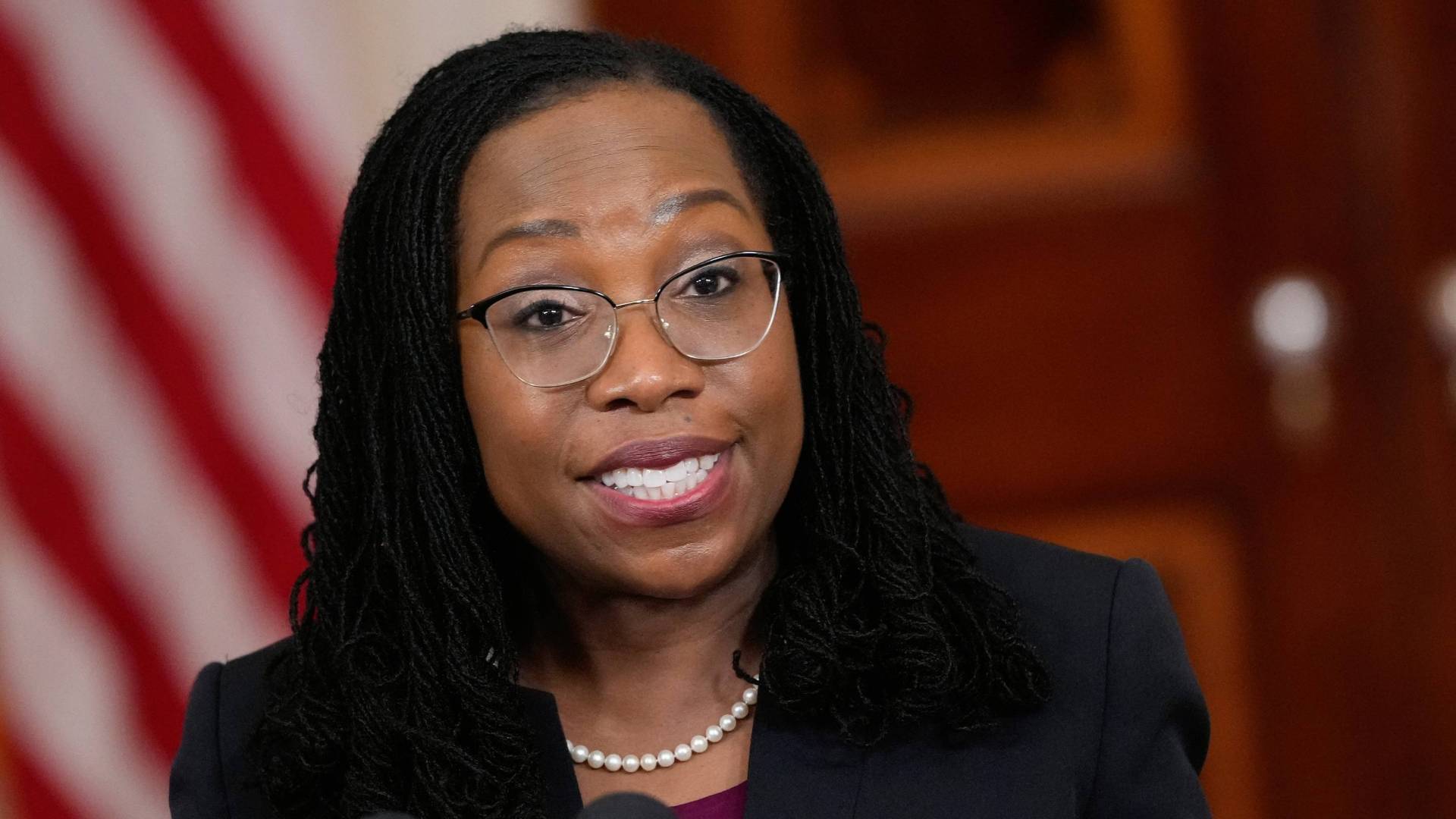
Immediately after President Joe Biden introduced Judge Ketanji Brown Jackson as his nominee to the US Supreme Court at a White House event on Friday, the federal appeals court judge stepped up to the podium and appealed to the divine.

“I must begin these very brief remarks by thanking God for delivering me to this point in my professional journey,” she said. “My life has been blessed beyond measure, and I do know that one can only come this far by faith.”

Jackson’s words marked the beginning of what promises to be a historic confirmation process: If approved by the US Senate, Jackson, 51, who currently serves on the D.C. Court of Appeals, would be the first Black woman to serve on the Supreme Court.

“If I’m fortunate enough to be confirmed as the next associate justice of the Supreme Court of the United States, I can only hope that my life and career, my love of this country and the Constitution, and my commitment to upholding the rule of law and the sacred principles upon which this great nation was founded, will inspire future generations of Americans,” she said.

Biden noted the landmark nature of Jackson’s nomination during his introduction, making good on a campaign promise to push for a Black woman on the country’s highest court.

“For too long, our government, our courts, haven’t looked like America,” he said. “I believe it’s time that we have a court that reflects the full talents and greatness of our nation with a nominee of extraordinary qualifications. And that we inspire all young people to believe that they can one day serve their country at the highest level.”

While outlining Jackson’s professional credentials and personal story—such as her two Harvard degrees and family members in law enforcement—Biden argued that she “strives to be fair, to get it right, to do justice.”

If confirmed, Jackson would also be the first federal public defender on the Supreme Court and would bring the total number of women serving on the bench to four—the most in US history.

Jackson did not mention a specific faith tradition in her remarks, so it was not immediately clear whether she would alter the religious makeup of the Supreme Court, which currently consists primarily of Catholic and Jewish justices (Justice Neil Gorsuch was raised Catholic but attended an Episcopal Church in Colorado).

[CT editor’s note: Jackson would fill the spot on the bench left by Stephen Breyer, for whom Jackson served as a clerk during the court’s 1999-2000 term. Breyer, 83, announced his plans to retire a month ago.]

Lawmakers and liberal religious organizations celebrated Jackson’s nomination.

“I applaud the historic nomination of Judge Ketanji Brown Jackson to the Supreme Court. Georgians want a nominee who is fair, qualified, and has a proven record of protecting Americans’ constitutional rights and freedoms. I look forward to reviewing this nomination,” Georgia Sen. Raphael Warnock, himself a pastor, said in a statement.

Longtime racial justice activist the Rev. Al Sharpton, who runs the National Action Network, tweeted out a statement of support for Jackson, calling her “exceptionally well qualified” and possessing the “experience, character, integrity, and dedication to the Constitution and the rule of law to serve on the nation’s highest Court.”

The National Council of Jewish Women also praised Biden’s choice of Jackson.

Religion has been a point of interest in recent Supreme Court nomination battles, particularly the debate over Justice Amy Coney Barrett. When she was nominated by former President Donald Trump in 2020, many observers questioned whether her conservative brand of Catholic faith would influence how she approached issues such as abortion.

Although Jackson reportedly has not ruled on a case narrowly focused on abortion, her appointment nonetheless drew attention of groups concerned about the issue. Jeanne Mancini, president of March for Life Education and Defense Fund said in a statement she expects Jackson to be “a reliable vote for the far left and the Biden administration’s radical abortion agenda.”

Meanwhile, Jamie L. Manson, president of Catholics for Choice praised Jackson as a jurist with “a long and distinguished record of legal work and judicial decisions that protect and advance the constitutional rights of marginalized Americans, including women and pregnant people, immigrants, and people with disabilities.”

Manson also made mention of Jackson’s April 2021 Senate confirmation hearing to serve on the US Court of Appeals. Manson said Jackson expressed “a clear and firm commitment to the principle that true religious liberty involves both freedom of and freedom from religion.”

During that hearing, Missouri Republican Sen. Josh Hawley noted Jackson had served on the board of Montrose Christian School. The Maryland school, which has since been closed, operated under a statement of faith that declared “we should speak on behalf of the unborn and contend for the sanctity of all human life from conception to natural death” and outlined a belief that marriage exists only between a man and a woman.

In responding to Hawley, who said he agreed with the statements, Jackson distanced herself from the school’s beliefs. She said she did not “necessarily agree with all of the statements,” and was not previously aware of their existence.

She went on to express support for religious liberty, describing it as a “foundational tenet of our entire government.”

News

Lincoln Christian University Announces Plan to Close

The Christian college had dropped most undergraduate majors, athletics, and residential life last year in favor of Bible degrees.

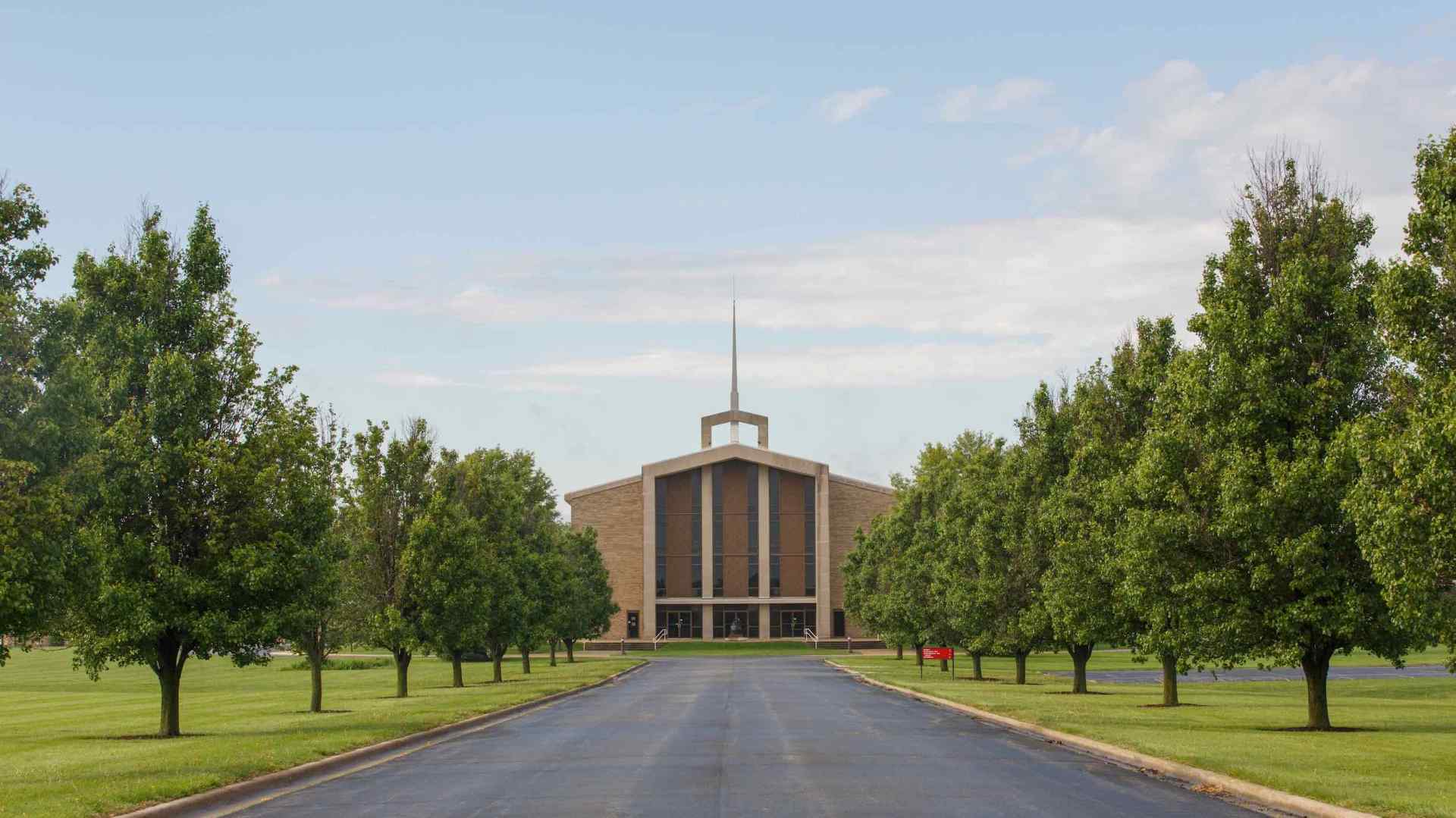
Lincoln Christian students have worshiped together every week in the campus chapel.

Lincoln Christian students have worshiped together every week in the campus chapel.

Christianity Today February 25, 2022
Courtesy of Lincoln Christian University

Update (October 12, 2023): Lincoln Christian University announced it will close at the end of this school year, and Ozark Christian College will acquire its seminary, which will retain the name Lincoln Seminary.

“There is no small amount of grief behind this news, but it is Christian grief of high order—not without hope,” said university president Silas McCormick in a statement.

—————

A small Christian college with sharply declining enrollment announced it had to “face the facts” this week and either change or die. Lincoln Christian University (LCU), in Lincoln, Illinois, is hoping deep cuts and a directional shift are enough to save it, but president Silas McCormick said the school had reached “the end of our runway” with its current model.

Lincoln Christian has about 500 students in undergraduate and graduate programs on a campus built for about 2,000, and it announced this week that it would be cutting most undergraduate majors, offering only Bible and Theology as well as Christian Ministry, and focusing instead on seminary education and vocational training at partner churches. The school is affiliated with the fellowship of Independent Christian Churches.

It will end most campus and residential activities and shut down athletics, but current students can finish out their degrees. It is considering what to do with its campus property.

“You have to face the hard facts,” said Tamsen Murray, the chair of Lincoln Christian’s board. “For me, this becomes a stewardship issue. … We will ask you to continue to invest kingdom dollars but in this new way that we think is sustainable.”

The school saw enrollment decline by 50 percent over the last decade and had a total net operating deficit of $3.5 million over that span. School leadership noticed that students were less interested in living on campus in downstate Illinois where the population was declining.

“There’s a lot of advantages to experiencing college in a residential setting,” McCormick told CT. “But you can’t force people to buy products that they don’t want.”

Many smaller Christian colleges and universities have seen declines in enrollment in recent years, although overall enrollment in Christian colleges showed a small uptick between 2010 and 2020, according to analysis of federal data by the Detroit Free Press. Schools historically similar to Lincoln Christian, like Grace University in Omaha, Nebraska, have closed. Small colleges without an endowment as a backstop have had trouble in a changing education environment.

Murray said the pandemic didn’t help.

COVID-19 “was the cherry on the sundae,” she said. Enrollment dropped “precipitously” from the fall to the spring semester, coinciding with the new omicron wave. “Illinois tightened things up again. … Schools in states that are less restrictive had fewer problems” with enrollment, she said.

LCU hopes its new idea works. The idea behind the institutional shift, according to McCormick, is that churches in their fellowship tend to train their own ministers. So LCU will focus recruitment not on 18-year-olds but on older adults who feel called to ministry and need additional theological education.

Leadership was trying to avoid a sudden closure like that in 2019 of Cincinnati Christian University, which was part of the same fellowship of Independent Christian Churches as Lincoln Christian. In late fall 2019, Cincinnati Christian announced that it was closing at the end of the semester. It had invested heavily in athletics as one last-ditch effort to save the school, but that seemed to worsen its financial problems.

By contrast, Lincoln Christian is cutting athletics completely and instead focusing more intensely on its original historic mission of training ministry leaders. Founded in 1944 as a Bible institute, LCU expanded to offer degrees in fields from business to philosophy. The university is a member of the Council for Christian Colleges and Universities (CCCU) and has remained in good standing with creditors and accreditation agencies.

But Lincoln Christian’s president’s memo about the changes is a frank assessment of problems at the school, from faculty morale to financial holes to windows that have needed fixing for years.

The memo even goes into detail about how a younger generation of students has been more hostile to professors over “any perspective that pushes back against their own” and adds that instead of engaging and resolving conflict, students will leave the school.

“When you factor these generational and cultural tendencies in with the fact that our residential student body has become very small, the result is what many of our students identify as one of our primary weaknesses: that they have not found the sense of community here that they—or we—expected,” he wrote. Later in the memo he says, “Collectively, the wind in our sails dissipated, and we are now a community in considerable need of hope.”

McCormick hopes a transparent approach helps build trust with staff, students, donors, and parents for this new chapter. McCormick and Murray wrote a note to alumni and donors saying that the greatest risk of this new plan failing was in the next 24 months and asking for their support.

Parents responding on the school’s Facebook page were largely on board with the changes, though sad. One parent, Jamie Glasford, mentioned that her son, a senior at Lincoln Christian, had already been through this because he was a student at Cincinnati Christian when it closed.

“I am … incredibly sad for all of the students who now must make some very difficult decisions,” Glasford wrote. “Too many of our Christian colleges are shutting their doors.”

“This is tough news to read not only as an alumni but as a pastor who is sending a student to LCU for next fall,” wrote Blake Canterbury. “To have them so excited, start to get things in place, and now find out that that degree they are going there for is being eliminated. It's sad and frustrating but mostly sad. I love LCU, the staff, and my time there. I pray for this strategy and leadership decision to be fruitful.”

Murray, the board chair, graduated from the LCU seminary in 1975. In her decades in Christian higher education, she has worked at small Bible colleges that had to close or merge with other schools.

“No one wants to see the mission abandoned,” she said. But she said the LCU board had been given information consistently that “this isn’t looking good.” It helped that the board adds two or three new people every year, she said, and this past year two accountants joined.

She said Cincinnati Christian is an “example of not facing the facts” and that its sudden closure produced “shockwaves” for the churches in their fellowship.

“I would say to another board of trustees, face the facts,” said Murray. “Don’t wait until the facts lead you to only one conclusion.”

Books
Review

Scripture Interprets Scripture. This Book Shows How.

Pastors and scholars can now explore cross-references throughout the Old Testament.

Christianity Today February 25, 2022
Illustration by Rick Szuecs / Source images: Sixteen Miles Out / Jonathan Castellon / Nathan Dumlao / Unsplash / Envato

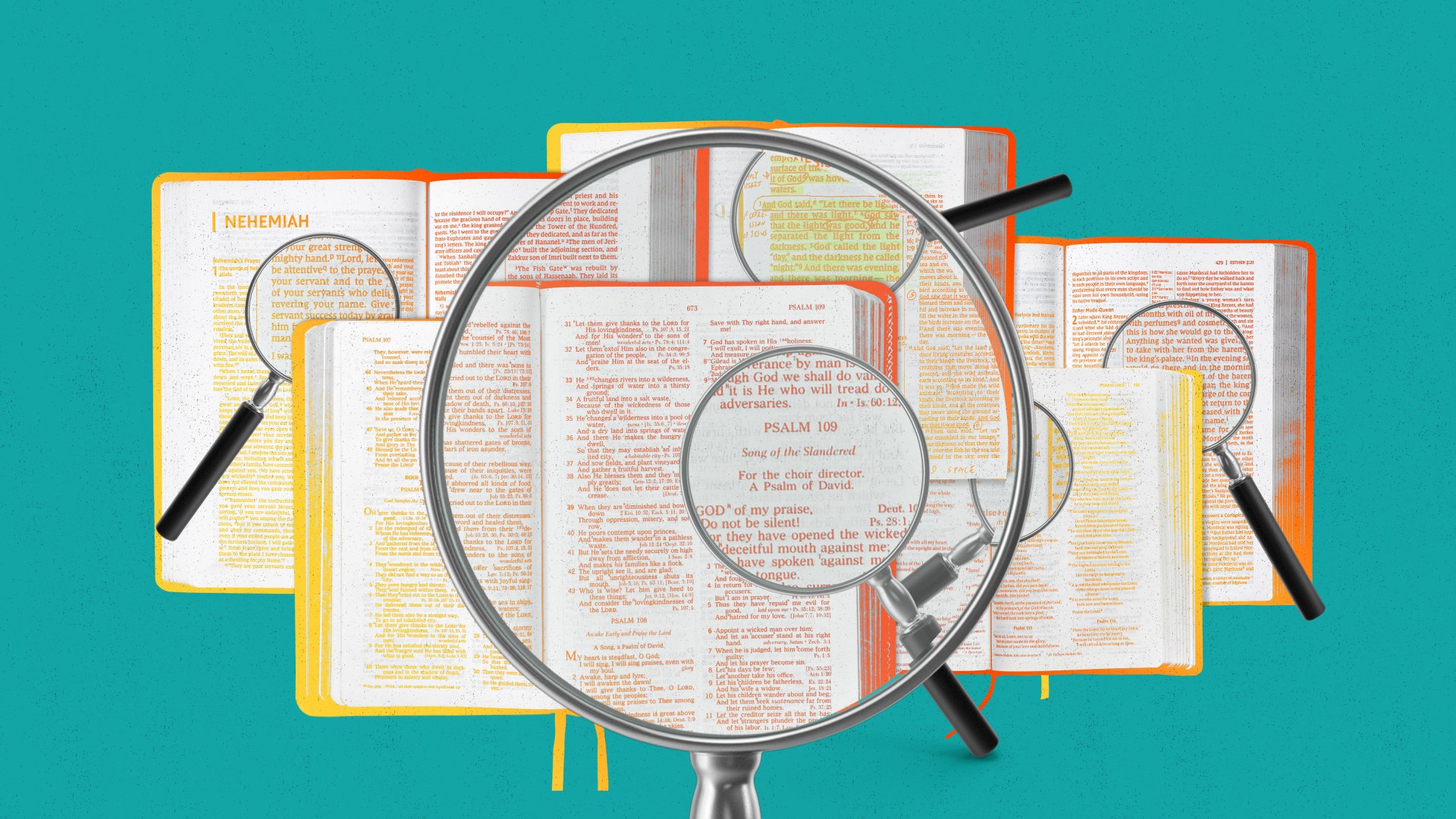
Zondervan Academic recently released a new biblical reference tool that is sure to end up in pastors’ personal libraries.

Old Testament Use of Old Testament: A Book-by-Book Guide

Old Testament Use of Old Testament: A Book-by-Book Guide

HarperCollins Children's Books

1104 pages

The book is titled Old Testament Use of Old Testament: A Book-by-Book Guide by Gary Edward Schnittjer. Weighing in at over four pounds, with over a thousand pages, it promises to be the definitive work on the Scripture’s use of Scripture for years to come.

Preaching on the New Testament without a firm grasp on the Old Testament bears some resemblance to a child’s retelling of her parents’ romance story—which can blend multiple events or conversations into one and confuse identities or timelines.

The truth is, a whole lot happened in history before Matthew or Paul showed up on the scene in the first century—but that fact can sometimes be missed when reading a standard Bible.

Some Bibles include footnotes for verses in the New Testament that refer to Old Testament passages—but they do not show how a particular phrase or theme evolved within and across the Old Testament itself. Simply identifying the Old Testament background of a New Testament text often collapses the trajectory of its development into a single reference point.

To tell the story of Scripture well, we must trace an idea’s full development before it showed up in the New Testament. Because by the time the authors of the New Testament appeal to an Old Testament text, it has often already had its own history of interpretive reuse within the OT.

While several reference tools explore how New Testament authors quote or allude to Old Testament texts, this work presents how Old Testament authors quote other Old Testament texts.

Schnittjer does not answer all the exegetical questions at play in each instance, but he organizes the data based on shared linguistic or thematic similarities in the text. His organizational approach allows readers to explore exegetical allusions throughout the Bible—where Scripture interprets Scripture.

To my knowledge, no one has attempted anything quite like this before.

Old Testament Use of Old Testament is rigorous in its methodology, creating a helpful system to classify allusions in the text. In each instance, Schnittjer assesses the likelihood that biblical authors were interpreting or cross-referencing based on another Old Testament text.

To illustrate how a pastor might use this tool to prepare for a sermon, I will offer an example. Imagine a pastor is preaching through Hebrews and comes to chapter 2, verses 6–8:

But there is a place where someone has testified:

“What is mankind that you are mindful of them,
a son of man that you care for him?
You made them a little lower than the angels;
you crowned them with glory and honor
and put everything under their feet.”

In putting everything under them, God left nothing that is not subject to them. Yet at present we do not see everything subject to them.

It is widely recognized that Hebrews 2:6–8 references a quotation of Psalm 8. However, Psalm 8 is itself dependent on an earlier Old Testament passage, Genesis 1:16, 26, 28—and it is further evoked in Job 7:17. So before we ever interpret Hebrews 2, we should first develop a clear sense of how Psalm 8 is interacting with these Old Testament texts.

For those unable to read Hebrew and Greek, Schnittjer’s tool provides a comparison of the following passages for English Bible users to highlight the similarities:

Then God said, “Let us make mankind in our image, in our likeness, so that they may rule over the fish in the sea and the birds in the sky, over the livestock and all the wild animals, and over all the creatures that move along the ground.” (Gen 1:26)

When I consider your heavens, the work of your fingers, the moon and the stars, which you have set in place,” what is mankind that you are mindful of them, human beings that you care for them? You have made them a little lower than God and crowned them with glory and honor. You made them rulers over the works of your hands; you put every thing under their feet: all flocks and herds, and the animals of the wild, the birds in the sky, and the fish in the sea, all that swim the paths of the seas. (Ps 8:3–8[4–9]. V. 5[6] lit.)

In the tool, bold and italics indicate use of the same words in Hebrew, underlined words are similar, and the dotted underline (depicted in bold italics above) draws attention to interpretive aspects of the text.

In the discussion that follows, Schnittjer considers whether the statement “Let us make mankind” in Genesis 1:26 is a reference to the divine council. He decides in favor of this view but notes the act of creation is still written in the masculine singular form: God alone makes humanity in his image alone.

This question ties to Psalm 8:5, which reads “God” in Hebrew and “angels” in Greek and is echoed in Heb 2:7, 9 as “angels.” Schnittjer considers possible explanations for this shift, noting that the Septuagint often employs euphemistic language.

He concludes that “the psalmist uses Elohim from Gen 1 in its sense as ‘God’; the Septuagintal translators use ‘celestial delegates’ as a euphemism; and the author to the Hebrews takes advantage of the Septuagint’s translation to advance revelation concerning Messiah”.

In other words, Schnittjer does not take Hebrews 2 as offering the definitive interpretation of Psalm 8; rather, he sees it as faithfully advancing revelation about Jesus. And whether one agrees with this assessment or not, Schnittjer’s insights have made plain what is at stake.

Finally, we turn to Schnittjer’s chapter on Job, where again he identifies the exegetical allusion as correlating to Psalm 8:4. In the section on Job 7:17, we encounter another two-page discussion of its allusion to Psalm 8, with attention to the role of Psalm 144.

As before, Schnittjer has helpfully laid out the relevant passages and flagged repeated words (bold or italics) and used a dotted underline line (in bold italics below) to indicate interpretive activity:

What is mankind that you are mindful of them, human beings that you care for them? You have made them a little lower than the angels and crowned them with glory and honor. You made them rulers over the works of your hands; you put everything under their feet. (Ps 8:4-6)

Yahweh, what are human beings that you care for them, mere mortals that you think of them? They are like a breath; their days are like a fleeting shadow. (144:3-4)

[Job] What is mankind that you make so much of them, that you give them so much attention, that you examine them every morning and test them every moment? Will you never look away from me, or let me alone even for an instant? If I have sinned, what have I done to you, you who sees everything we do? Why have you made me your target? Have I become a burden to you? (Job 7:17–20)

Schnittjer discusses this development and provides an interpretation of the allusion. In this case, he argues that Job is unhappy with the conditions outlined by Psalm 8—in which humanity is the center of God’s attention. By contrast, Job would prefer to be left alone by God.

Eliphaz also evokes Psalm 8 in Job 15:14, exposing his distorted view of how retribution works—a theme that Job picks up again in 19:19.

In his summary, Schnittjer concludes that “all of this demonstrates ways that the use of scriptural traditions in the debates in Job challenge the book’s readership to rethink and modify their faulty views of retribution.”

Careful attention to the contours of these exegetical allusions suggests that Job draws on a previous paradigm from Psalm 8 (and perhaps Psalm 144), which itself is an allusion to Genesis 1. A sermon on Hebrews 2, then, has a rich field of texts from which to draw insight.

Being aware of these possibilities helps pastors and scholars determine what to look for as they teach on both Old and New Testament passages—so they can present their congregations with a richer view of God and a fuller picture of Jesus as the fulfillment of the scriptural narrative.

Carmen Joy Imes is associate professor of Old Testament at Biola University and the author of Bearing God’s Name: Why Sinai Still Matters (InterVarsity Press). She’s currently writing a follow-up book, tentatively titled Being God’s Image: Why Creation Still Matters.

News

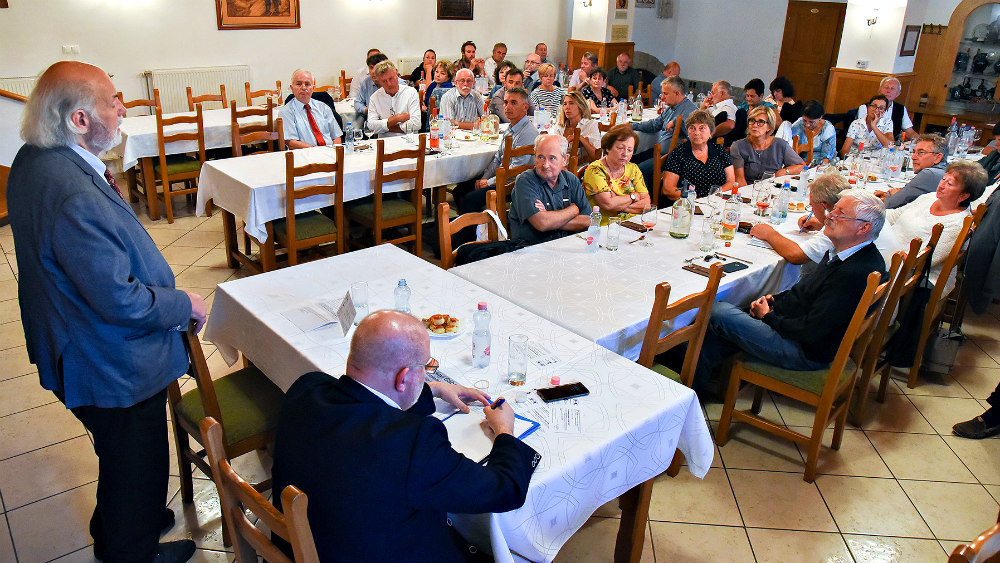
Hungarian Evangelical Fellowship Raided amid Ongoing Conflict with Viktor Orbán

Allegations of tax fraud latest trial for Wesleyan pastor who has spoken out against Christian nationalism.

Christianity Today February 25, 2022
Courtesy of the Hungarian Evangelical Fellowship

The wounds of a friend may be faithful, but Hungarian prime minister Viktor Orbán has not forgiven his former pastor for criticizing him and says he will not, ever.

“He called me a fascist,” Orbán told The Atlantic in 2019. “And that is the only thing for which I cannot forgive him.”

The years-long conflict between the nationalist political leader and Hungarian Evangelical Fellowship pastor Gábor Iványi led to a federal raid on Monday, amid allegations of “large-scale budgetary fraud.”

The evangelical association, which employs about 1,000 people, allegedly owes 156 million forints in payroll taxes, plus a 90 million forints fine (about $742,000 total). Orbán’s government revoked the fellowship’s legal status as a church in 2011, so Hungarian Christians cannot designate part of their paychecks as tithes, a standard way of funding churches in much of Europe.

The government also stopped paying the fellowship for social services it has been providing since 1989. The charitable arm of the church association provides food, health care, legal assistance, and social work for the nation’s poor and vulnerable. Iványi told the independent news organization Telex that the government owes the charity about 12 billion forints ($36 million)—more than enough to pay the tax bill.

The National Tax and Customs Administration does not appear to agree with that accounting.

On Monday, dozens of revenue agents searched the Budapest offices of the fellowship, homeless shelter, hospital, and theological college. Hungary Today reported they seized computers and documents, which they said could contain evidence and information about “assets.”

The mayor of Budapest, an Orbán opponent, dismissed the allegations against the fellowship and condemned the raid as a personal vendetta.

The mayor said Iványi is the “conscience of the Hungarian nation,” whose witness reminds Orbán of “the democrat he once used to be, who betrayed everything he once stood for.”

Iványi told local journalists he can still recall how Orbán rose up as a democratic leader opposed to the Communist dictatorship, but recent events make him wonder what happened to the man he once ministered to.

“I mourn him and have a hard time processing what happened,” the pastor said. “He was unspoiled, courageous, and pure in speech. I couldn’t have imagined that this man, who seemed to be the iconic figure of the flag’s desire for freedom, would ruin everything we fought for together two decades later.”

Orbán achieved national prominence in 1989 when he gave a bold speech demanding free elections and the withdrawal of Soviet troops. He was elected to Parliament the following year, and before the decade was out, he became prime minister. He was only 35.

In the transition from Communism to democracy, Hungary experienced a burst of religious freedom and Orbán, as a rising political leader, committed himself publicly to Christianity. He and his wife renewed their marriage vows in a church and had their first two children baptized.

For all three services, Orbán chose Iványi to preside.

Iványi, the son of a Methodist minister and a schoolteacher, first clashed with the Communists in 1968, when he was in high school. In 1974, he was expelled from a Hungarian seminary for opposing government control over church affairs. He became an independent Wesleyan, spent two brief stints in jail, and was occasionally forced to preach in the street when Communist authorities locked him out of his church.

In 1981, a group of separatist Wesleyans were allowed to form an association and founded the Magyarországi Evangéliumi Testvérközösség, or Hungarian Evangelical Fellowship. The fellowship is not part of the national evangelical alliance, where the Hungarian Methodist Church is a member, but acts as an independent denomination. It is an association for “sincere Christians who seek salvation through the atoning sacrifice of Jesus Christ, conform to His gospel, and follow Him.”

When the country first held free elections, Iványi and Orábn were part of the same broad group of new leaders pushing for reforms. However, the relationship grew cold, according to The New York Times, when Iványi declined to publicly endorse Orbán for reelection in the early 2000s.

Orbán lost, but his party came back into power in 2010 with a sweeping victory. When the minister-elect invited the pastor to pray at an official event, he declined and wrote a public letter objecting to Orbán’s Christian nationalism. Orbán proposed to transform Hungary into what he called an “illiberal democracy,” centralizing government power and restricting civil liberties to fight against multiculturalism, immigration, feminism, LGBT ideology, “wokeness,” and anything else that would erode the dominant cultural order.

Iványi and other evangelicals were especially alarmed because Orbán claimed that Christianity could survive only when defended by a strong state. In one famous speech, the prime minister explained that “the essence of illiberal democracy is Christian liberty and the protection of Christian liberty.”

One of the first actions of the Orbán government was to strip more than 200 mostly smaller churches of their legal status. The Hungarian Evangelical Fellowship was one of the groups targeted.

The nation’s top court overturned the ruling, saying it violated constitutional protections of religious freedom, but the fellowship’s legal status has remained in limbo since then. The fellowship has about 18,000 members and 40,000 people who have elected to contribute part of their paychecks to the fellowship’s charitable work, if that is legally allowed.

The ambiguous legal victory was followed by trouble with the National Tax and Customs Administration.

Some Christians in America have applauded Orbán and his vision for what they call “national conservatism.” Rod Dreher, author of The Benedict Option, argues that the soft totalitarianism of the Left may leave Christians no option but to seek political power as a “bulwark against cultural disintegration.”

Dreher cautions that he doesn’t know if Orbán’s approach—using the government, for example, to shut down gender studies programs at universities and banning children’s books that talk about homosexuality—will actually work. But, he said, “this is what an actual pro-family, socially conservative government acts like.”

Iványi, now 70, says Orbán’s approach does work, but it shouldn’t be called Christian. It gives one party power to shut down churches and ministries and to limit free speech, free assembly, and freedom of the press, while claiming to defend “Christian liberty.”

True Christian liberty, he argues, cannot be protected by a government. It is given to Christians by grace in baptism.

In 2019, the Hungarian Evangelical Fellowship released a statement condemning Orbán’s politics. It was modeled on the Barmen Declaration, when German Christians including Martin Niemöller, Karl Barth, and Dietrich Bonhoeffer condemned Nazi attempts to co-opt Christianity.

The Hungarian Christians called their statement the Advent Statement.

“We are concerned about the arrogance of power that mixes the language of national identity with the language of Christian identity in a manipulative way,” it said. “The authoritarian exercise of power … deliberately eliminates political differences of opinion through the eradication of independent media, spreading fake news, discrediting and character assassination, and harassment by authorities.”

That may be why Iványi wasn’t surprised to see government agents blocking the door to the fellowship offices on Monday. An independent video journalist, broadcasting live, showed the pastor walking up to the door, a disposable mask partly covering his large white beard, and addressing the agents calmly, before going inside to see what they took.

In this political climate, Iványi has said before, he is called to go straight into a headwind that might sweep his entire ministry away. But he trusts God.

“If it is swept away now, I will say that with the blessing of God we have endured [so many] years in the hurricane,” he told a Hungarian journalist. “As a deep believer, of course, I am convinced that our mission will not end when the head of government decides on it, but when the Eternal decides that he no longer needs this work. … My job is to go to the wall and trust firmly in the wisdom and mercy of the Good God, as he is one level above the [tax authority] and the head of government.”

Theology

Theology Cannot Save Us

The recent splinters in evangelicalism arise more from tribal loyalties and political rhetoric than doctrinal differences.

Christianity Today February 24, 2022
Illustration by Mallory Rentsch / Source Images: Tim Marshall / Tim Wildsmith / Unsplash

This piece was adapted from Russell Moore’s newsletter. Subscribe here.

Once when I was a youth pastor, a woman pleaded with me to let her rebellious son go to youth camp even though he missed the deadline to sign up.

“I just want him to get tired enough that he’s moved to walk down the aisle one time,” she said. “Then I’ll know that no matter what he does after that, at least he’ll be in heaven.”

I sighed at the cultural Christianity I’d come to know all too well—one that substituted a momentary repetition of words for the gospel. The problem was that I thought theology was the answer. Many of us did.

The folk religion and human-centeredness of much of American revivalism contrasts with a “big God” theology and a focus on fidelity to confessions of faith. This makes sense. A thorough-going pragmatism can lead quickly into a “whatever works” mindset. This kind of anticreedalism leads not to the absence of creeds but to the proliferation of unwritten and unspoken creeds.

At the same time, many of us thought the problem could be solved by connecting the rootlessness and overemphasis on novelty in American evangelicalism with an older theological tradition.

In one sense, I still think that’s valid. A church that learns from John Calvin or John Wesley is tied to a deeper stream, since Calvin and Wesley are themselves connected to Augustine, Irenaeus, and so on.

And yet, the quest for novelty and for narrowing parameters often turned out to be just as present in theologically focused evangelicals—and perhaps even more so. It’s easy, after all, to skip straight from the apostle John to John Calvin to Jonathan Edwards to the guy with the Jonathan Edwards portrait as his Twitter avatar.

Likewise, many of us thought a more theologically robust evangelicalism would keep us from fragmenting. After all, unlike those who believe that doctrine divides, we knew that a people who share deep and abiding convictions would be united, come what may.

But that’s not exactly how it worked.

The divides in American evangelicalism—and in various denominations—did not end up splitting along the lines we all thought they would: Calvinist vs. Arminian, complementarian vs. egalitarianism, revivalist vs. emerging church, or traditionalist vs. seeker sensitive.

Some of the people my 2007 self might have dismissed as theological pragmatists have ended up showing some of the most grit and conviction of anyone in the past several years. Alternatively, we saw some who were doctrinally precise do the exact opposite.

To imagine telling my younger self, 15 years ago, which people would now be considered allies and which ones would no longer be speaking to one another is jarring—especially when some who once emphasized the sufficiency of Scripture now align with activist atheists to critique the theology of evangelicals who should belong to the same tribe.

None of that would have been, as the cliché goes, on my 2007 bingo card.

Turns out, a lot of what we thought was evidence of a Christian worldview for some evangelicals turned out to be the same tribal loyalties and political rhetoric they would have employed if Jesus were still dead.

Some of that has to do with what we’ve discussed here before—the idea of “revealed preference,” mentioned in a political context by writer David Frum. Over time, we start to realize that even people who held the same views held them for different reasons. And often the differences were between what one saw as a central issue and what one saw as peripheral.

There’s a huge contrast between the complementarian who believes that the Pauline epistles prescribe, in a very limited number of callings, some differentiation between men and women and the complementarian for whom gender is the grid through which almost every cultural phenomenon is situated.

The egalitarian who thinks 1 Timothy 2 addresses a contextually local problem in Ephesus and that God gifts both men and women for pastoral leadership in the church differs from the egalitarian who thinks that Father, Son, and Holy Spirit are patriarchal words that must go away.

One Calvinist might see unconditional election as an explanatory doctrine meant to undergird what all Christians already believe—that Jesus “sought me and bought me with his redeeming blood.” Another might see predestination as a central theme of the Bible.

Likewise, a charismatic who believes all the gifts of the Spirit still operate for building up the church is radically different from the charismatic who believes that speaking in tongues or prophecy distinguishes “anointed” Christians from lifeless ones.

Sometimes theology leads us to another kind of pragmatism—for instance, a “seeker sensitivity” in which the seekers are defined as angry Christians looking to fight for the sake of fighting. Some forms of revivalism have confused a heightened emotional experience for conversion.

This has led to some Christians holding on to that felt experience for assurance and others despairing that their felt experience wasn’t dramatic enough. Still others fake the emotion, hoping that if they emote long enough, they’ll eventually find the real thing.

That can happen not only with emotions but also with the mind. A confession of faith can become a revival testimony for people who can’t cry at an altar or speak in tongues.

Theology matters. Obviously, I still believe that, or I wouldn’t spend my life connecting Christian theology to culture. But if we’ve seen anything in the evangelical meltdown of the past five years, it’s that theology is not enough. And left on its own, theology can become just as much of a prop for a cultural, politicized Christianity as anything else.

We cannot, as scientist and philosopher Alfred Korzybski put it about a very different matter, confuse the map for the territory—just as we cannot confuse our weather app for what’s actually happening outside. Theology is a word about God, which always points us back to the Word who became flesh and dwelt among us.

There’s a kind of theology that can illuminate how to worship God and be on mission in the world. But there another kind of theology that becomes defined by winning debates in whatever current controversy is trying to separate the Christian wheat from the Christian tares.

Theology defined by the Bible sees itself as the map, not the territory. It refuses to yield to the idea that faith is amorphous and without content. God has spoken and He has spoken in words.

Yet this sort of theology also will acknowledge that God has given us both clarity and mystery, speaking to us as whole persons—minds, hearts, consciences, intuitions. The God of the Bible cannot be reduced to a syllogism. But those who try to do so can easily replace a confession of faith for faith itself; ideology for the gospel; a theological tribe for the one holy, catholic, and apostolic church; or, worst of all, Christology for Christ Jesus himself.

When Jesus said that he was going away, he told his disciples, “You know the way to the place where I am going.” Thomas said exactly what I would have said: “Lord, we don’t know where you are going, so how can we know the way?” What he wanted was an abstraction, a map.

Jesus said, “I am the way and the truth and the life. No one comes to the Father except through me” (John 14:4–6). We need truth and life if we are to follow the Way. He never told us, “Here, memorize this.” He simply said, “Come, follow me.”

Theology is necessary, but it is not enough. Let’s not confuse the map for the territory.

Russell Moore leads the Public Theology Project at Christianity Today.

News

As Russia Invades Ukraine, Pastors Stay to Serve, Pray … and Resist

(UPDATED) Prayer requests from Donetsk: “First, to stop the aggressor. But then for peace of mind, to respond with Christian character and not from human hate.”

The body of Captain Anton Olegovich Sidorov, recently killed in Donetsk, is seen during his funeral on February 22, 2022 in Kyiv, Ukraine.

The body of Captain Anton Olegovich Sidorov, recently killed in Donetsk, is seen during his funeral on February 22, 2022 in Kyiv, Ukraine.

Christianity Today February 24, 2022
Chris McGrath / Getty Images

As Russia invaded Ukraine today, pressing near even to the capital of Kyiv, a Baptist home was destroyed and a seminary shaken by nearby blasts. Local sources told CT, however, that no churches or Christian buildings had been attacked so far.

President Vladimir Putin announced his forces were targeting only military installations. He also asserted that Ukraine does not truly exist as a nation.

Igor Bandura, vice president of the Baptist Union, the largest Protestant body in Ukraine, heard about collateral damage to the home of a Baptist in Donetsk during a Zoom call with his 25 regional superintendents.

Minus one. On the front lines of the eastern Donbas region, the Baptist leader from the occupied territory of Luhansk was unable to join.

But from the town of Chasov Yor on the front lines in neighboring Donetsk—in an area then still under Ukrainian government control—Bandura learned the local assessment.

“People don’t want to be under Russian control,” he was told. “But they feel helpless. What can ordinary people do?”

Pray. And remain calm.

This was the message put out by the Ukrainian Council of Churches and Religious Organizations (UCCRO), a day after its appeal to Putin went unanswered.

Ukraine’s chief rabbi invited Christian leaders to recite Psalm 31 together.

“We urge you to remain calm, not to give in to panic, and to comply with the orders of the Ukrainian state and military authorities,” stated the UCCRO. “The truth and the international community are on the Ukrainian side. We believe that good will prevail, with God’s help.”

Thousands of Ukrainians fled west as Russian missiles hit targets throughout the nation. Ukraine’s Ministry of Internal Affairs reported hundreds of instances of shelling.

President Volodymyr Zelensky announced by video shortly after midnight that 137 Ukrainians died during the invasion’s first day. “They are killing people and transforming peaceful cities into military targets,” he said, according to The New York Times. “That’s villainous and will never be forgiven.”

Valentin Siniy, president of Tavriski Christian Institute (TCI) in Kherson, about 50 miles from Crimea, had to evacuate his seminary along with a team of Bible translators as Russian helicopters attacked local targets.

“The majority of old pastors of the churches stayed in the cities. Youth leaders started evacuating young people,” he told CT. “We managed to purchase a van with 20 seats in order to evacuate people. About 30 people are in a safe place now, in western Ukraine. There are about 40 more people driving west [in] vehicles that are in bad condition.”

Meanwhile his church has opened its basement to shelter neighbors living in multi-story buildings from bombings.

“I and all ministers stay in Kyiv,” said Yuriy Kulakevych, foreign affairs director of the Ukrainian Pentecostal Church. “We continue our intercessory prayers, talk to people to reduce panic, and help those in need.”

In Kamyanka, 145 miles south, Vadym Kulynchenko of Our Legacy Ukraine reported that his church had already started to receive refugees from the east. Temporary shelter will be provided, and the main needs are food, medicine, fuel, hygiene products, and air mattresses.

Bombs hit three infrastructure centers in his city.

“Please pray for disciple-making in the country, safety for our people, and generosity in the midst of war,” Kulynchenko asked. “And also for discernment, as there is a lot of fake news.”

Kyiv Theological Seminary (KTS) had earlier issued a general warning.

“Generating panic through the spread of manipulative false information is exactly what the enemy seeks,” a communications professor wrote on Tuesday. “This war is not as much for our territories, as it is for our soul and our mind.”

On Thurs, KTS cited Isaiah 41:10 as it urged its Facebook audience “not to panic, but to remember how many times God in His Word says ‘don’t be afraid.’” The seminary noted that fear equals paralysis, while prayer, trust in God, and love of neighbor all give strength.

With a “leaden heart,” Taras Dyatlik wrote to supporters of theological education of the many prayer needs currently facing his fellow church and seminary leaders in Ukraine—including receiving refugees into their dorms.

“Many of them are thinking about evacuation of their workers and faculty and students within Ukraine, and some do not have any possibility to evacuate,” wrote the Overseas Council regional director for Eastern Europe and Central Asia.

He asked for prayer for families, including his own, as Ukraine’s announcement of total mobilization “means many students, graduates, faculty will be called for military duty to serve in the army and participate in the combats.” And he requested prayer for the spouses of male leaders. Since all men ages 18 to 60 are no longer allowed to leave the country, he said many wives are staying as well.

“Today I talked to [my wife] about evacuation out of Ukraine,” wrote Dyatlik. “She immediately refused and said: ‘I will be with you to the very end.’”

Students at Ukraine Evangelical Theological Seminary (UETS) outside Kyiv were instructed to shelter in place as military battled at a nearby airport, according to the school’s director of English language services, Josh Tokar. Those on campus are scared but not panicked, he said. The seminary president sent out a message from Psalm 27: “The Lord is my light and my salvation— whom shall I fear?”

Bandura did not resonate with the call for calm.

“Who are you to say our nation doesn’t exist?” he said of Putin’s rhetoric. “The truth is with us, and God is with us. We want to live in peace, but if Russia wants to take this from us, let’s fight.”

While some Ukrainians favor Russia, he said, half the population is ready to personally defend their nation.

Pictures have circulated of grandmothers with guns. A recent CNN poll, meanwhile, found 13 percent of Ukrainians in favor of Russia’s use of force to reunite the two nations. Only 36 percent of Russians were in favor. (73 percent and 43 percent disagreed, respectively.)

The Russian Evangelical Alliance (REA) conveyed its support for the UCCRO appeal for peacemaking initiatives.

“All evangelical Christians pray every day and ask the Almighty to give wisdom to all,” stated Vladimir Vlasenko, REA general secretary, “to preserve the fragile peace and not to plunge our countries into fratricidal conflict.”

“We see no justification for these actions and are deeply distressed by the death, destruction, chaos, and misery that will result,” stated Thomas Bucher, secretary general of the European Evangelical Alliance, according to Evangelical Focus.

“The invasion of Ukraine is both unjustified and unprovoked,” he stated. “It has been claimed that the attack is necessary to protect ethnic Russians within Ukraine and to stop Ukraine from threatening Russia. These claims are untrue. This disaster has been provoked into being by President Putin for wider geopolitical purposes.”

In Rivne in western Ukraine, local officials directed all churches to remain open, with church leaders staying in touch with residents to help coordinate aid as well as military equipment as needed.

Many in Ukraine are showing resilience.

“Our prayer today is that God’s will spreads on Earth as it is in Heaven,” said Siniy. “I encourage my staff and other Christian leaders that the mission stays the same even if we have to change geography.”

Staff at New Life Radio in Odessa, on the Black Sea coast, watched missiles fly past their homes. They told Evangelical Focus they are taking actions to hide equipment and preserve broadcasting, in case the station is raided in the near future.

Vasyl Ostryi, a pastor at Irpin Bible Church 18 miles northwest of Kyiv and a KTS professor of youth ministry, has also decided to stay.

“When this is over, the citizens of Kyiv will remember how Christians have responded in their time of need,” he wrote for The Gospel Coalition. “We will shelter the weak, serve the suffering, and mend the broken. And as we do, we offer the unshakable hope of Christ and his gospel.”

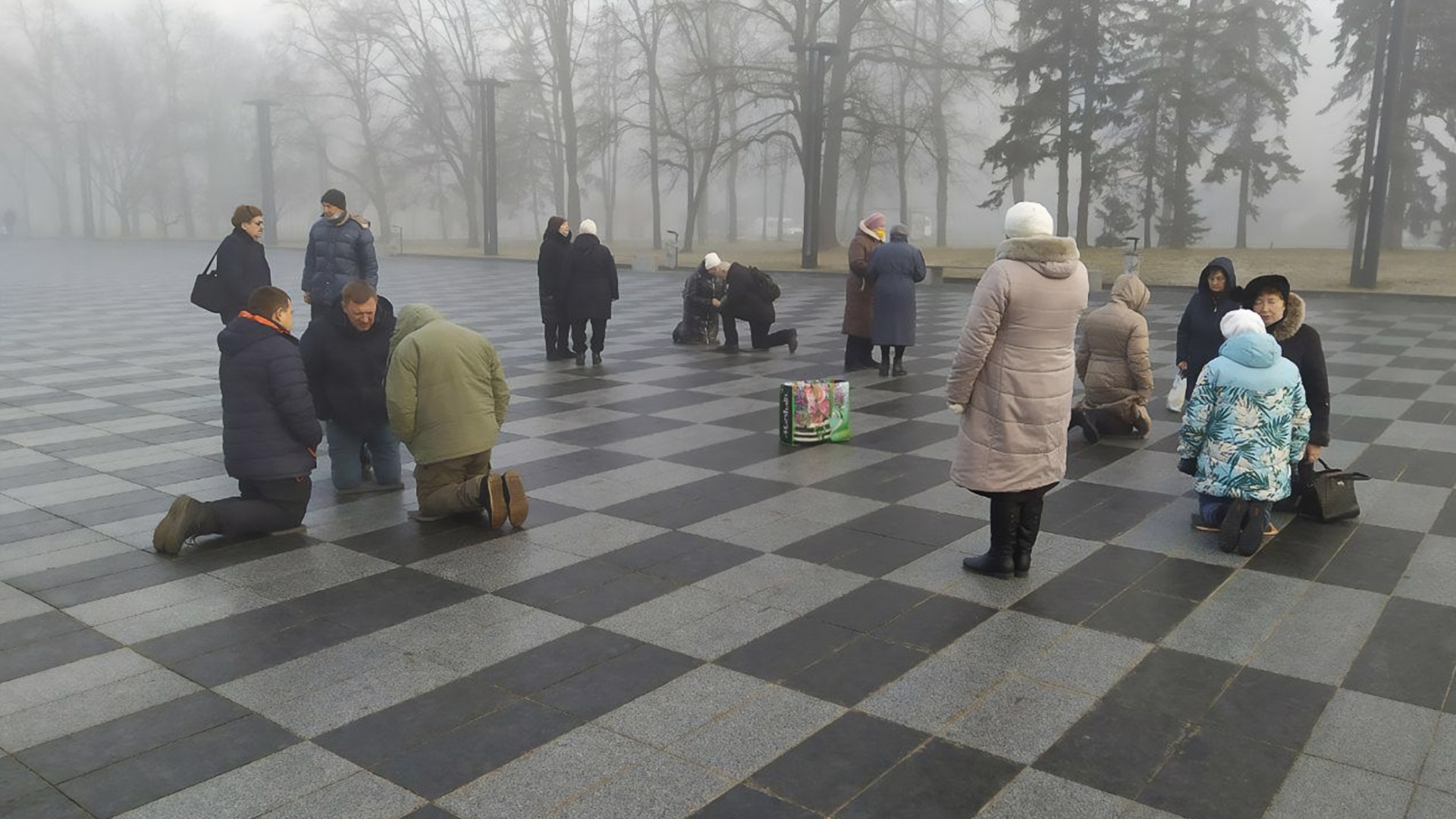
Photos have circulated showing Ukrainians kneeling in prayer in city streets.

Ukrainians praying in the central square of Kharkiv, Ukraine.

YouVersion noted a spike among Ukrainian and Russian users of its popular Bible App over the past three weeks: searches for fear increased 11 percent; searches for peace increased 44 percent.

“We printed Bibles for 2022 and we are now in second month of the year and the stock in our warehouse is almost gone,” Anatoliy Raychynets, deputy general secretary of the Ukrainian Bible Society, told Eternity News shortly before the invasion.

“In our churches—whether it is Orthodox, Catholic, Protestant, or Evangelical churches—there are more new people. Not only on Sundays or Saturdays, but also during the week,” he told the Australian Bible Society news service. “On evenings when we have a Bible study, new people are coming. They want to pray, to hear something that brings hope or comfort.”

Rick Perhai, director of advanced degrees at KTS, said the international church he pastors in Kyiv has several leaders recommending the congregation continue its worship this coming Sunday. Some of their expat members have fled; others want to stay and join the fight.

He laments that the enemy is seeking to destroy Ukraine as its Christians grow more and more poised to carry the gospel to surrounding nations. Nonetheless, he is praying for the Russians, asking for God to grant them repentance.

But his petition is also imprecatory.

“Pray that the nation of Russia would tire of their tyrant’s rantings at home and abroad,” Perhai said, “and that they would remove him.”

Dyatlik also requested prayer for “the truth,” citing all the “perspectives” in the media.

“We did not invite the war. The Kremlin and Vladimir Putin brought it to Ukraine. … There is moral evaluation of the acts of aggression like this,” wrote the theological educator. “These acts have biblical definition and biblical evaluation. Please pray for the spiritual discernment about these things.”

Dyatlik closed his prayer letter with requests for believers on both sides of the conflict:

Please pray about Russian Christians that they would raise their prayers and voice toward Russian government to stop the aggression; [that they] would not keep silent; please pray for the Western governments, of the US and European Union.

Finally, please pray about Ukrainian Christians, that we will serve and live as the community of hope in a full sense of this term; that during these terrible times we would invite more and more people to the relationships with God and His children, to the relationships of love, hope, encouragement, support; that our minds and characters would continue to transform into the character of Jesus Christ.

Western nations have roundly condemned Putin, and readied sanctions. Reports circulated of Russians lining up at ATMs to withdraw their cash, fearful the nation would be cut off from the international banking system.

Meanwhile in Donetsk, where 25 missionary teams have been working to establish churches, gas lines require a wait of hours for a rationed supply of five gallons. Grocery stories suffer empty shelves, as Ukrainians stock up on emergency food and water.

Bandura conveys his supervisor’s two main prayer requests.

“First, to stop the aggressor,” he said. “But then for peace of mind, to respond with Christian character and not from human hate.”

Additional reporting by Rachel Pfeiffer

Church Life

The Ukrainian Church: ‘We Need More Bibles’

As Eastern Europe goes to war, Scripture is in higher demand, say some.

Ukranians praying in the central square of Kharkiv, Ukraine.

Ukranians praying in the central square of Kharkiv, Ukraine.

Christianity Today February 24, 2022
Courtesy of Ukrainian Bible Society

On recent Sunday mornings in Ukraine, whispered reports have run through the churches: The soldiers on the eastern border have portable rocket launchers. The Bondarenko boy was shot in the leg; they say he won’t walk again. Did you know the Kovals left? Some questions have gone unspoken: Will we be here again next week?

Yesterday, those whispers became cries as a series of missiles hit near Kyiv.

The invasion puts the Ukrainian church at the heart of the conflict, as Christian leaders contend with people’s despair and uncertainty. They are standing, united and strong, and they’re helping Ukrainians find hope in God’s Word.

As the head of the American Bible Society, I’ve been in close contact with my friend and counterpart, Anatoliy Raychynets, who serves as the deputy general secretary of the Ukrainian Bible Society. Over the past few months, he has shared reports that are hard to read: mothers wailing for their sons outside the hospitals; children who won’t remember their fathers’ faces; thousands of people feeling hopeless and afraid.

But Anatoliy has noted something else too: church leaders working together for peace, and people seeking out the hope of Scripture.

In Anatoliy’s church, people are fearful they will lose everything. In response, he has been sharing Psalm 31 with anyone searching for reassurance. He reports that people are often surprised to hear words that, according to them, sound like they could have been written in Kyiv in 2022: “Praise be to the Lord, for he showed me the wonders of his love when I was in a city under siege” (v. 21).

As people grapple with unknown, many are experiencing the Bible’s message for the first time ever. According to Anatoliy, priests and pastors over the past weeks have been flocking to the Bible Society store in Kyiv to buy Bibles. Demand is so high that they’ve run out of copies.

This, Anatoliy says, is one of their biggest challenges: “We need more Bibles.”

Another resource offered by the church in Ukraine is Bible-based trauma healing. Although it was introduced only six years ago, the program has been incredibly effective, especially for family members of those killed in the conflict with Russia. It allows community leaders to guide small groups of people through a restorative process.

Now that it’s available in so many churches across the country, the Ukrainian Bible Society can’t keep up with requests for resources and training.

What, then, can we do to help?

Our brothers and sisters in Ukraine need Bibles for people searching for comfort in troubled times. They need trauma-healing resources to provide the balm of Scripture. And they need us to intercede for them.

“I ask you, in the name of Jesus Christ—whoever can pray, please keep us in your prayers,” says local pastor Viacheslav Khramov. “Today, the war started on our land. We ask everyone who is able to pray, please pray for us. Pray for Ukraine. Pray that lives are spared, as well as our bodies and souls."

Anatoliy, too, echoes this plea.

Out of everything he’s shared with me, I am most inspired by the show of solidarity from the Ukrainian church across confessions, borders, and party lines.

“We speak to our colleagues in Russia,” he told me. “We church leaders speak to one another, and we pray together. We are united in the Lord.”

This is exactly the gospel message we should be magnifying to a hurting world: God’s Word can reconcile enemies, drive out despair, and heal suffering hearts.

This is the vision of the united church we see shining in Ukraine. Amid war, politics, and division, the church of Jesus Christ is still spreading the gospel and building the kingdom.

Robert L. Briggs is president and CEO of American Bible Society.

Follow CT’s Ukraine-Russia coverage on Telegram: @ctmagazine (also available in Chinese and Russian).

News

The Big Quit Hits Homeless Ministries

They never stopped serving on the frontlines, but now short-staffed nonprofits are struggling to compete with flexible, virtual work that took off during the pandemic.

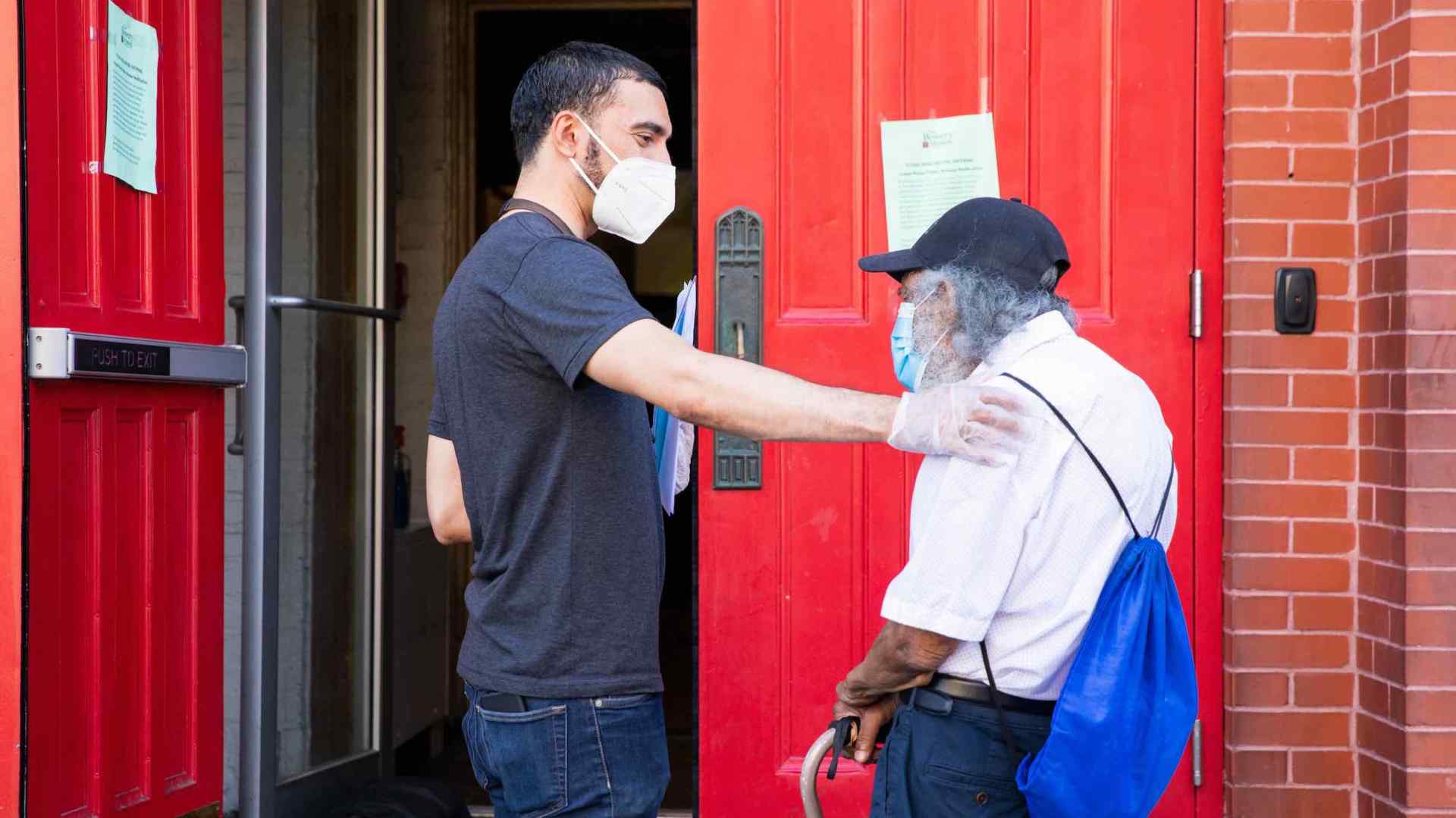
Bowery Mission staffer David Mason greets a guest at the mission's main chapel.

Bowery Mission staffer David Mason greets a guest at the mission's main chapel.

Christianity Today February 24, 2022
Courtesy of The Bowery Mission

At 6 a.m. and in a 40-degree rain, David Mason arrived at work at the Bowery Mission, New York City’s oldest ministry to those without homes, with addictions, or in need of a meal.

He has been working on the frontlines as a staff “ambassador” serving the city’s most vulnerable throughout the pandemic, without getting sick once, when others were working at home and the city was largely shuttered. He is a steady presence as the mission has seen staff and volunteer turnover.

Even when short on volunteers or kitchen workers, the mission starts the day by offering hot showers, a chapel service, and then breakfast to those on the street. It served 255,000 meals last year and housed 266 adults in its long-term residential programs. The mission’s main location in Manhattan, with its trademark red chapel doors, has been operating since before the last pandemic in 1918.

In this pandemic, though, volunteer numbers have been down and the mission has been short-staffed. About 10 percent of the Bowery Mission’s staff roles have gone unfilled for the past year, according to president and CEO James Winans, and the organization isn’t getting many applicants for those spots.

Winans said the organization set aside money in the budget for those roles “for a reason,” and the gaps put an extra burden on remaining staff. The omicron wave took another 10–15 percent of staff out of work temporarily, leaving the organization scrambling to continue serving hundreds of meals a day and offering shelter and residential programs in five 24/7 locations.

Until recently, the mission’s donations closet was a mountain of unorganized clothes and shoe donations because there weren’t volunteers to unpack and sort. The mission has turned to temp agencies to fill essential spots in kitchens or security and is leaning heavily on people like David Mason. The Bowery Mission is not alone in feeling these pangs.

The pandemic has led people to resign in record numbers across industries, with employees burned out and oftentimes eager for the flexibility of a new remote job. Volunteering has also slumped over the past couple of years. The Big Quit has left the Bowery Mission and many frontline ministries across the country short on help while demand for services has shot up. Across Christian shelters, drug recovery programs, food programs, and health clinics, ministries are having to rethink their operations in the long term while remaining staffers are shifting how they see their work. The work these employees do was already heavy and unrelenting, with drug overdose deaths, mental illness, and homelessness climbing.

Mason, though, liked working in-person through the pandemic and was grateful for a job. He’s an introvert but enjoys being with the people coming off the street. He used to work maintenance jobs where he didn’t have to talk to anyone, but now he is starting to see that he is empathetic and good at loving people. Still, working on the frontlines during the pandemic wears on a person.

“You don’t realize in the moment,” he said. “Everything is changing, but you’re just plowing through.”

He recognizes that guests coming to the Bowery Mission feel that too, and when someone getting help speaks harshly to him, he thinks about the stress everyone is under. At one point, as Mason was talking to people outside the entrance, a man who had been in a fight in the mission biked past and cursed at them.

On this particular February morning, men and women knocked on the mission’s chapel door with a string of requests for Mason. They were looking for pants, a copy of the Bible, a COVID-19 test, a pair of boots, and a haircut. Mason said this was a slow day because of the rain, but it didn’t feel slow, and his walkie-talkie buzzed.

A woman knocked on the chapel door as he was sorting out three different requests for clothes and showers. “Give me a few minutes,” he said, waving her in out of the rain. “Come in and have a seat.”

Some people just wanted to pray with Mason. He recognized each one who came in, which is the idea behind having a staff person in that position and not a volunteer. The mission wants staff to build relationships and know the stories of the people it serves. With a lot of new workers, Mason tries to make sure to introduce them to guests. Staff turnover means a loss of that institutional knowledge.

Mason greeted another man by name as he came in: “What’s up? We’re running low on a lot of stuff, but I’ll see if I can get you what you need.”

The appeal of remote work

Ask ministries working on the frontlines about staffing during the pandemic, and they’ll tell you how they’ve felt the pinch, from looking for cooks at temp agencies to deciding which programs could be temporarily cut. “The whole ecosystem is disrupted,” said Winans.

Across the city in Staten Island, Beacon Christian Community Health Center is short-staffed as it tries to keep up comprehensive health care offerings to low-income New Yorkers while administering COVID-19 vaccines and testing. Walker Methodist, a Christian assisted-living organization with multiple locations in Minnesota, has 77 openings and is offering a $1,000 signing bonus for cooks. A rescue mission in Boise, Idaho, has 10 staff openings, including multiple shelter staff and cooks. City Relief in New York, which also serves the homeless, is not short-staffed, but its referral partners like detox centers are, according to CEO Josiah Haken. That makes it hard to get men and women into drug recovery.

With nearly 800 staff members, the Salvation Army Greater New York Division is one of the largest nonprofits in the city, running disaster response, homeless shelters, food pantries, afterschool programs, daycare, homes for adults with developmental disabilities, and music lessons for children.

“We got hit like a truck,” said Major Kevin Stoops, the general secretary of New York’s Salvation Army, a role equivalent to the chief operating officer.

Its five daycare centers are short key positions, staffing at shelter services is at 80 percent, and the director of the afterschool program went on leave. No one has applied for that job. Stoops often gets one or two applicants for job postings, “so you don’t even get a choice.”

At the height of the pandemic, Stoops had to do three funerals for adults in homes for the developmentally disabled, one of whom had been in a Salvation Army group home 40 years–a death that was hard on staff. “Those types of impacts can’t be measured by a stat or a dollar,” Stoops said.

Three employees from the organization’s development department were headhunted by other organizations and left, more big losses of institutional knowledge. The Salvation Army has had to get employees from temp agencies for its afterschool programs and homes for those with disabilities in Queens, which is expensive. Overtime is up. Stoops has been at the Salvation Army for 34 years, and he has never seen such a shortage of people before.

The organization has had to cut back some services—mostly socialization programs for children and adults—but decided to prioritize basics like food distribution as much as possible.

Winans at Bowery and Stoops both heard from employees who were concerned about using public transit to commute and the safety of the workplace. Stoops added that the city has a strict vaccination mandate, and some employees resigned over that. Winans said people are sometimes choosing remote work at “a higher pay scale than we’re able to offer as a nonprofit ministry.”

“It’s the ministry of presence, and that’s the strain on employees and volunteers,” said Stoops. “I’m so grateful for some very committed people who are like, ‘Nope, we’ll still show up.’”

Revamping to keep staffers

The Salvation Army higher-ups have been meeting to talk about the “mental fallout” of the last two years, looking at staff facing anxiety, depression, and possible addiction. They’ve encouraged respite days as needed, and during particularly strained times in the pandemic, they sent clergy staff to one of their camps outside the city for a few days at a time, with orders: Breathe. Don’t check email. Walk in the woods.

Planning extra days off in the master schedule when the organization is already short-staffed is “a logistical nightmare,” said Stoops. But he’s trying to hold on to people: “The next wave has nothing to do with COVID; it has to do with fatigue. Fatigue is not, ‘I’m tired’; it’s, ‘I’m done.’”

During the height of the pandemic, the Bowery Mission arranged transportation and nearby housing for some staff doing night shifts, as well as hazard pay. Now it is trying to improve compensation, and it’s offering counseling through either a direct line staff can call at any time or reimbursements for outside counselors.

Research on resilience for frontline ministries coming out of the pandemic is scant, but the Hartford Institute for Religion Research did a survey last summer to measure some of the effects of the pandemic on congregations. What the survey found surprised Scott Thumma, the institute’s director.

The social safety net services that churches offered increased, as did giving in most places, even as churches reduced staff and saw a big drop in volunteers. Thumma found it remarkable that outreach increased while volunteers and staff decreased.

“Demand for food assistance, financial assistance, counseling … all went up,” Thumma said. “[Churches] did rally and address this crisis. … There is a tremendous amount of resilience … in one of the hardest years of their ministry.”

Now Thumma is interested to see, after “profound shifts” within churches the last two years, how that congregational social outreach continues as the pandemic abates. He will continue to survey congregations: “People are worn out. It’s been a roller coaster, but I don’t see a majority of them ready to get off the ride.”

Winans thinks the pendulum might swing back in a year or two as people feel more isolated in remote jobs.

“People may be looking for work in community, in close proximity with people, and in a place where I can touch and feel and see what I'm doing,” he said. “So many folks are working in situations where they're cut off from that kind of opportunity right now. Working from the bedroom or the kitchen and interacting mostly with coworkers and mostly on Zoom … I’m optimistic.”

Back on the frontlines, Mason was fielding requests and knocks at the mission’s chapel door. He picked up stray food left behind and swept the floor under a wall’s biblical inscription: “Come to me, all you who are weary.”

The Bowery Mission residents from the long-term recovery program upstairs came down for lunch before the lunchroom opened up to everyone on the street. Mason went outside to manage the lunch line of about 200 guests in the rain. He left at the end of his shift. He now tries to avoid working overtime and appreciates his regular time off more.

“Not to be super spiritual, but it’s by God’s grace,” Mason said, about staying in his job. “One person might thrive working here in a pandemic; another might not.”

Books
Review

The Arc of White Evangelical Racism Is Long, but Complicated

Anthea Butler’s book isn’t for those who don’t like being challenged, but her account leaves out important nuance.

Christianity Today February 24, 2022
Illustration by Mallory Rentsch / Source Images: Eduardo Dutra / Unsplash

The last several years have witnessed no small uptick in accessible academic books about evangelicals. Some of the most striking works have explored the political and racial history of the movement. This is evident in books like Jemar Tisby’s The Color of Compromise: The Truth About the American Church’s Complicity in Racism, John Fea’s Believe Me: The Evangelical Road to Donald Trump, and Thomas Kidd’s Who is an Evangelical?: The History of a Movement in Crisis.

White Evangelical Racism: The Politics of Morality in America (A Ferris and Ferris Book)

White Evangelical Racism: The Politics of Morality in America (A Ferris and Ferris Book)

University of North Carolina Press

176 pages

Into this rich body of work steps Anthea Butler’s White Evangelical Racism: The Politics of Morality in America, an analysis of American evangelicalism’s last 50 years that also includes a larger backstory. In some ways it is a cross between the spirit of The Color of Compromise and the style of Believe Me. Butler argues that the persistence of racism among evangelicals (not fear, as Fea argues) explains their support for Donald Trump and conservative politics since the 1970s.

Butler, a professor of religious studies at the University of Pennsylvania, provides a strong historical overview of the depth and breadth of racism in American evangelical culture since the early 19th century. A strong work of synthesis designed for a popular audience, White Evangelical Racism deftly weaves together cutting-edge scholarship on evangelicalism from the last 20 years. Citing such important scholars as Daniel K. Williams, Joseph Crespino, Kelly J. Baker, Darren Dochuk, and Randall Balmer, among others, Butler challenges evangelicals to reject their racism and lust for political power and to work cooperatively with their fellow Americans to build a better society.

Serious soul-searching

While prominent scholars of evangelicalism such as Mark Noll, George Marsden, David Bebbington, and Thomas Kidd define the movement theologically and historically, Butler argues that it is “not a simply religious group at all” but rather a “nationalistic political movement.” Evangelicals, she writes, have defined themselves by their “ubiquitous” support for the Republican Party and its conservative quest to retain America’s “status quo of patriarchy, cultural hegemony, and nationalism”—and this has made evangelicals, for all intents and purposes, culturally and politically “white.” She argues that racism and a quest for political power have defined evangelicalism for approximately the last 50 years.

While evangelicals often like to emphasize the proudest moral and racial moments of their past, Butler cares nothing about boosting their collective self-esteem. In fact, her project is designed to do the exact opposite. She wants to use history to jump-start some serious evangelical soul-searching.

To this end, she deliberately focuses on the “trajectory of evangelical history that supported slavery, the Lost Cause, Jim Crow, and lynching” because it is key to understanding how and why evangelicals “continue to use scripture, morality, and political power” today in support of racist and conservative policies and politicians. All this makes for painful reading, especially for those unfamiliar with the history. Butler argues emphatically and unapologetically that racism thoroughly infects all of evangelicalism. “Racism,” she declares, in one of her pithiest formulations, “is a feature, not a bug, of American evangelicalism.”

Butler is at her best when exposing and seamlessly weaving together the long arc of racist evangelical practices from the days of slavery to our own generation. (About half of the book covers national politics in the post-1970s era.) She offers a refreshing corrective to common popular misconceptions about 19th-century evangelicals and race, such as the notion that evangelical theology “required” believers to be abolitionists and that only Southern evangelicals were racists. She unflinchingly confronts evangelicals’ complicity in America’s lynchings (over 4,000, according to NAACP records), their support for Lost Cause ideology, their history of opposition to interracial marriage, and their contemporary insistence on a colorblind approach to race.

Butler’s analysis of the 20th century is impressively thorough as it draws in a wealth of prominent evangelical leaders, organizations, and initiatives: Billy Graham, the National Association of Evangelicals, W. A. Criswell, Jerry Falwell, James Dobson, Focus on the Family, the Moral Majority, the Christian Coalition, Bob Jones University, Oral Roberts, Pat Robertson, Jack Hayford, George W. Bush, Franklin Graham, John Hagee, the Memphis Miracle (a 1994 interracial gathering of charismatic denominations), and the 1995 Southern Baptist resolution repudiating racism and slavery.

For me, one of the most painful parts of the book involves the sad story of Butler being offended while she was a member of Church on the Way, a key turning point in her journey away from evangelicalism. Another involves her recounting of a pair of infamous quotes from conservative political operatives Paul Weyrich and Lee Atwater. In the 1980s, Weyrich had told a mostly Christian audience that they should not want as many people as possible to vote, and Atwater had explained how conservative political rhetoric, while less outwardly racist than in the 1950s, still aimed at policies with a similar “byproduct”: that “blacks get hurt worse than whites.”

Omitting nuance

While the arc of Butler’s narrative is largely accurate, she sometimes omits nuance to magnify the force of her argument. Black evangelicals, non-Trump-voting evangelicals in 2016, and self-identified progressive evangelicals will not find themselves well represented in this book. While she acknowledges the existence of these groups, she makes it clear that this book is not about them. In some ways Butler’s narrative implies either that they can’t be “real” evangelicals or that they are irrelevant to the story of evangelicalism. These groups already have a difficult time being heard within the movement, even without writers like Butler further downplaying their existence.

At times, Butler pushes her argument so passionately that she implies either that Black evangelical is an oxymoron or that all Black evangelicals have effectively become culturally white. Both views are quite disturbing. Butler’s book left me wondering whether she personally knows anyone in any of these evangelical subgroups and, if so, what she would say to them.

Furthermore, Butler sometimes uses dubious or uncontextualized statements to support her narrative. Her discussion of the argument that slavery resulted from the Curse of Ham lacks historical context. She implies that this understanding of Genesis 9 originated with Southern white slaveholders, when in fact it began in medieval times and involved non-Christian interpreters. When discussing the evangelical response to Hurricane Katrina’s impact on New Orleans, Butler highlights quotes from figures like Pat Robertson, Franklin Graham, President George W. Bush, and Dwight McKissic. But she omits the vast efforts undertaken by evangelical groups to provide relief to victims, leaving readers with a tremendously oversimplified picture. Just because the media emphasizes certain “high-profile” evangelicals does not mean that rank-and-file evangelicals believe these individuals represent their views.

On a related note, Butler sometimes demonstrates a shaky grasp of who belongs within the evangelical fold. Her definition of evangelicalism leads her to identify pastors Rod Parsley and John Hagee as on the “margins of the evangelical world,” while placing Dylann Roof, who killed nine Black parishioners during a Bible study at a historic Charleston church, squarely within it. I understand that there is some overlap, however regrettable, between the domains of white supremacists and evangelicals, but Butler presents no evidence that Roof inhabits that space.

Perhaps Butler’s most egregious statement comes when she asserts that evangelicals “have turned away from those who are impoverished and in need” to support powerful businesses and wealthy politicians. But a wealth of research tells a different story: After Mormons, on a per capita basis, evangelical Christians are the most generous givers in the United States.

While Butler’s book does not commit a lot of space to discussing Donald Trump specifically, it does argue that white evangelical racism helps to explain why so many overlooked his moral failures in order to vote for him.

All in all, Butler clearly aims to be a prophetic voice awakening evangelicals to their ongoing racism and its implications for American society. And while there are certainly other factors besides racism that explain individual evangelicals’ political choices in recent years, Butler is correct to make sure we don’t overlook the role racism has played overall. This is definitely not a book for people who don’t want to be challenged.

Paul Thompson is professor of history at North Greenville University.

News

Russia Keeps Punishing Evangelicals in Crimea

Last year, there was an uptick in fines to Protestants and fellow religious minorities in the region annexed from Ukraine.

In the largest city in Crimea, Sevastopol, several evangelicals faced penalties last year under Russia’s anti-evangelism law.

In the largest city in Crimea, Sevastopol, several evangelicals faced penalties last year under Russia’s anti-evangelism law.

Christianity Today February 23, 2022
Vladimir Zapletin / iStock / Getty Images

Since Russia annexed the Crimean Peninsula from Ukraine in 2014—one of the central points of conflict in the current clash between the two countries—Protestant Christians in the territory have faced greater government penalties for practicing their faith.

Like elsewhere in Russia, meeting together to sing and read Scripture or letting others know about a church gathering puts believers at risk under a strict 2016 anti-evangelism law. Last year, authorities prosecuted 23 cases of such activity in Crimea, up from 13 the year before, according to Forum 18, which tracks religious freedom violations in the region.

Evangelical Protestants in Crimea received the most penalties. At least nine people from Pentecostal, Baptist, and other Protestant churches were fined for “missionary activity.”

Four of those cases involved members of the Potter’s House, a Protestant congregation in Sevastopol, a southern port and the largest city in Crimea. Pastor Evgenii Kornev leads efforts to proclaim the gospel online and in the streets; his Twitter feed features clips of an Easter procession and service, new home Bible groups, ministry to former drug addicts, and open-air evangelism. Even when Kornev came down with COVID-19, he continued to preach over video.

But that activity has also gotten his church in trouble. Kornev and fellow pastor Aleksey Smirnov were fined in 2021 for leading services. One of the Potter’s House members, Ivan Nemchinov, was fined twice for performing music, praying, and participating in church gatherings, in part because authorities were tipped off by YouTube and social media posts.

The Christians tried to appeal the charges, but none of the cases brought by the Police Center for Countering Extremism have been overturned, Forum 18 reported.

Over the years, Potter’s House and its pastors have also been fined and warned for failing to inform government officials of its existence and for previous violations of the anti-evangelism law, including distributing information at a bus stop. Kornev celebrates the congregation’s evangelism and street preaching, saying it’s “priceless for God.”

During the pandemic, Russia has continued its crackdown on evangelism and unregistered church activity—which includes almost all religious practice outside of the Russian Orthodox Church. The 2016 regulations restrict people in Russia from sharing about their faith or announcing church activities, even online or at home, unless permitted through a religious organization that has registered with the Russian government. Even then, evangelism is only sanctioned to occur within those designated churches.

The regulations have targeted evangelicals along with minorities such as Jehovah’s Witnesses, who are banned in Russia, and Muslims. Most fines end up being 5,000 Russian rubles, which Forum 18 says is equivalent to five day’s pay (about $60).

Besides Potter’s House, another Sevastopol pastor was prosecuted last year for sharing his faith outside a movie theater. In the second-largest city in Crimea, Simferopol, the pastor of Generation of Faith Pentecostal Church was punished for at least the third time for ministry activity; Artyom Morev was fined in 2017, 2018, and again in 2021.

In the town of Saki, two Baptists were caught by anti-extremist police and fined, Forum 18 reported. Both had been sharing Christian resources and Scripture without permits.

Local authorities, at times, have partnered with Russian security officials (the FSB) to raid worship gatherings. In addition to raiding a mosque, they raided a Protestant church in Kerch in eastern Crimea.

Inspectors found that church leaders “told those gathered about faith, about god [sic], about hope for another life, read the Bible and sang songs.” They discovered that two women there had been invited to attend earlier that day. As a result of the invitation, I. Denisov of the church was fined and found guilty of sharing faith with people who were not church members—which is forbidden under the anti-evangelism law.

Though Russia regulates church activity nationwide, in Crimea this oversight takes place in an area that the international community still recognizes as part of Ukraine.

Last month, Yuriy Kulakevych, foreign affairs director of the Ukrainian Pentecostal Church, described how Pentecostals acquiesced to the new reality when Russia took over in Crimea and eventually realized as citizens how much Russian evangelicals suffer. Just last year, Russia declared Ukraine’s New Generation Pentecostal groups “undesirable,” effectively banning them from the country. (A New Generation pastor in Sevastopol, Sergei Kolomoets, had previously been charged under the anti-evangelism law.)

The other contested territory, the Donbas region in eastern Ukraine, has also been controlled by pro-Russia forces. During a recent visit to Kyiv, amid the escalating tensions and predictions of war, Elijah Brown of the Baptist World Alliance noted that Baptists—the largest Protestant group in Ukraine—had suffered prosecution as a result of the occupation. They have been designated as terrorists and 40 of their Donbas churches were shut down.

“If the occupation of these territories is a foreshadow of what may come to Ukraine,” he said, “it should lead all of us to pray with greater fervor.”

addApple PodcastsDown ArrowDown ArrowDown Arrowarrow_left_altLeft ArrowLeft ArrowRight ArrowRight ArrowRight Arrowarrow_up_altUp ArrowUp ArrowAvailable at Amazoncaret-downCloseCloseellipseEmailEmailExpandExpandExternalExternalFacebookfacebook-squarefolderGiftGiftGooglegoogleGoogle KeephamburgerInstagraminstagram-squareLinkLinklinkedin-squareListenListenListenChristianity TodayCT Creative Studio Logologo_orgMegaphoneMenuMenupausePinterestPlayPlayPocketPodcastprintremoveRSSRSSSaveSavesaveSearchSearchsearchSpotifyStitcherTelegramTable of ContentsTable of Contentstwitter-squareWhatsAppXYouTubeYouTube