The Baby King

An Advent reading for December 18.

Advent Week 3: Sacrifice and Salvation


God spoke through the prophets in the Old Testament, using poetic words and imagery, to describe the hope of salvation. This week, we contemplate prophecies pointing toward the Messiah—the servant, the light, the promised one God’s people longed for.

Read Isaiah 9:6–7.

In my experience, watching cartoon movies has been an essential part of being a dad to three young boys. Boss Baby is one such movie. The film caricatures an infant who’s “all grown up” and constantly bossing around his seven-year-old brother behind their parents’ backs.

The irony in Isaiah 9:6–7 is a similar juxtaposition: a newborn baby who is “all grown up.” Isaiah describes this promised one as a newborn child, a government ruler, and the “Wonderful Counselor, Mighty God, Everlasting Father, Prince of Peace.”

The amazing testimony of this prophetic text is that Jesus is all of this, and so much more. Jesus, born as a human child, was both fully human and fully divine: the God-Man, the Baby King.

Isaiah was speaking to a discouraged Jewish community that had been groping in darkness, hoping to find a pathway to freedom from their “distress and darkness and fearful gloom” (8:22). Into this context, Isaiah prophesies, “He will reign on David’s throne and over his kingdom, establishing and upholding it with justice and righteousness from that time on and forever” (9:7) This reference to David’s throne hearkens back to God’s promise to David: “I will raise up your offspring to succeed you … I will establish his kingdom. … I will establish the throne of his kingdom forever” (2 Sam. 7:12–13). God is a covenant-keeping God. And nothing will stand in the way of this promised miracle: “The zeal of the Lord Almighty will accomplish this” (Isa. 9:7). God is zealous to keep his covenants with his people.

God is also zealous and passionate about the gospel. The Good News of Jesus becoming flesh is that in Christ there is no longer darkness (Isa. 9:2; John 1:4–5, 14). God is on the move, across the globe, on every continent, in every nation, exposing the darkness through the power of Christ’s first coming and his imminent return. Jesus’ incarnational entry into the world signifies a new day, “for to us a child is born, to us a son is given” (Isa. 9:6)!

This is the Good News, the gospel, that we must share with the world. The light has come; the light is Jesus! We no longer need to live in darkness and we can share this light with a world that needs to hear about our “Mighty God,” our “Prince of Peace.” May we proclaim it freely: Jesus, the Baby King, is here, and he wants to reign in your hearts.

Matthew D. Kim is the George F. Bennett Professor of Preaching and Practical Theology at Gordon-Conwell Theological Seminary and the author of Preaching to People in Pain.
Meditate on Isaiah 9:6–7. (Option: Also refl ect on John 1:14.)

In what ways does this promise point toward core tenets of the gospel? Which aspects of this prophecy most draw your attention? Why? Pray, praising Christ for each aspect of his identity described in Isaiah 9:6–7.

Theology

What it Means to Be God

An Advent reading for December 19.

Nicole Xu

Advent Week 4: Incarnation and Nativity


This week, we step into the events of the Nativity and consider the miracle of the eternal Word entering the world as a human child. We learn lessons of faith from the people whom God chose to play a part in these events. And we celebrate the good news of great joy for all people!

Read Philippians 2:5–11.

One common way of understanding the beautiful hymn of praise to Jesus Christ in Philippians 2:5–11 is that it shows us an utterly incomprehensible paradox: The mighty Son of God, who, together with his Father, brought creation into being, subsequently deigned to become a lowly human being—the equivalent of a powerful monarch being reduced to a scuttling beetle.

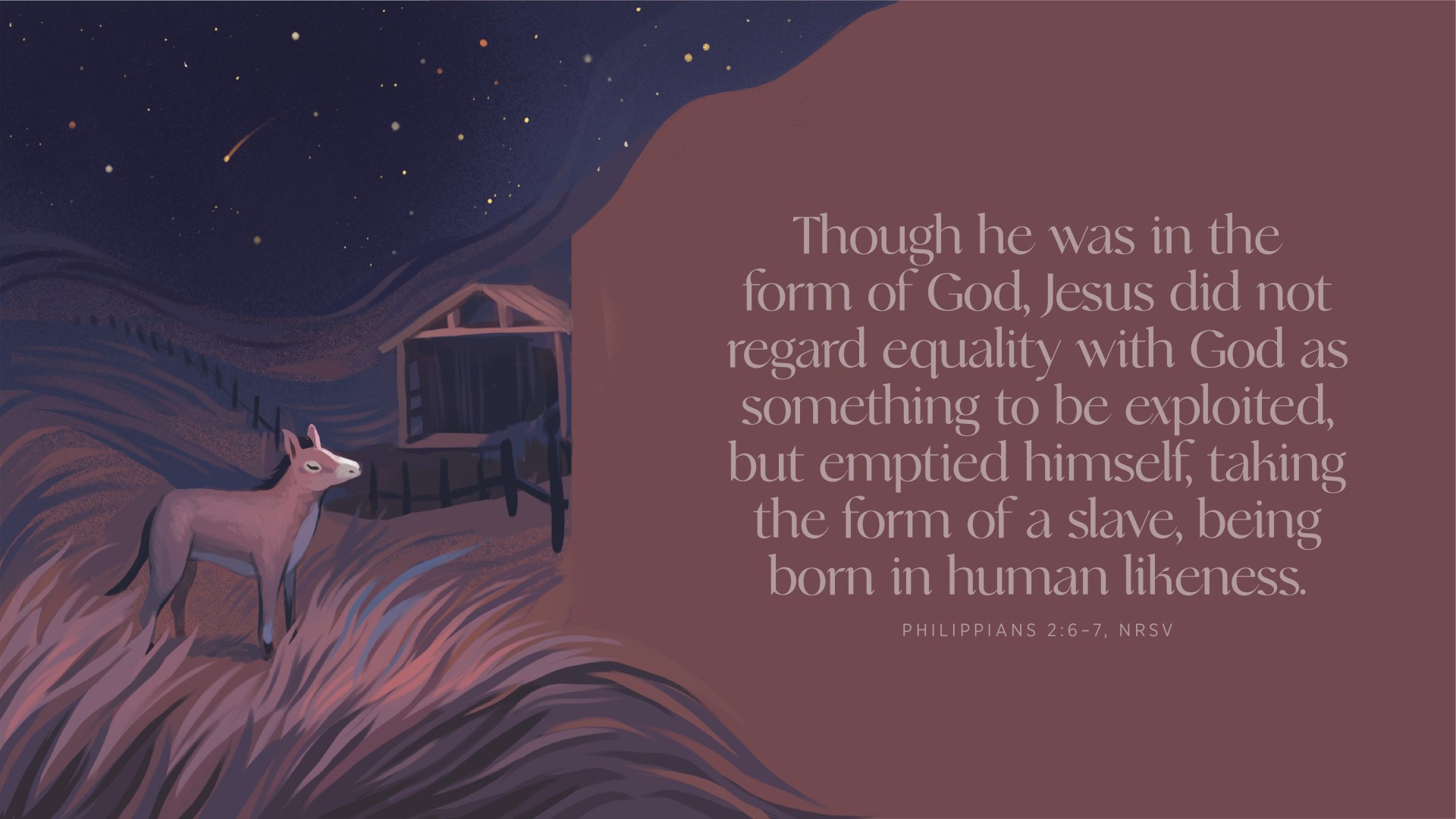
This way of reading Philippians 2 emphasizes the mismatch between the Son’s pre-incarnate glory and the humiliation he underwent during his earthly life. The little word though in most English translations has been the vital clue for this interpretation: “though he was in the form of God, [Jesus] did not regard equality with God as something to be exploited, but emptied himself, taking the form of a slave, being born in human likeness” (vv. 6–7, NRSV throughout, emphasis added). Despite sharing equality with God the Father, nevertheless Jesus the Son chose to give up that status for us.

That’s a plausible interpretation of Paul’s words, certainly. But the original language is ambiguous, and it’s possible to translate it differently, leaving out the contrastive connector though. Paul might easily have meant something subtly different: because he was in the form of God, therefore Jesus emptied himself.

In the first way of reading it, there’s something fundamentally incommensurate between the Son of God’s glory and his self-emptying. The former is understood in spite of the latter. And there’s obviously much truth in that way of interpreting Paul’s words, which underscores for us the cost God agreed to pay in order to draw near to us.

But in the second way of reading Paul’s hymn, there’s something mysteriously congruent between the eternal splendor of God’s Son and his voluntary self-abnegation in the Incarnation. The latter reveals or explains what the former is really all about, and it turns out that God’s character is self-giving love “all the way down,” so to speak.

In other words, if we want to understand what Jesus the Son’s equality with God the Father really means—what it looks like when it’s translated into the form of a human life—then we should look to that tiny baby on Mary’s breast, that forlorn figure on the cross of Calvary, and that tenderhearted gardener who speaks peace to his friends that first Easter morning. By living for us, dying for us, and rising for us, Jesus not only reveals true humanness to us—he shows us what God’s deity fundamentally amounts to.


Consider Philippians 2:5–11. (Option: Also reflect on John 1:14.) How does the Incarnation point us toward deep truths about the love and nature of God? How are these truths central to the gospel? How do they impact your daily life? Pray, expressing your response to God.

Wesley Hill is a priest serving at Trinity Episcopal Cathedral, Pittsburgh, Pennsylvania, and an associate professor of New Testament at Western Theological Seminary in Holland, Michigan.

Silent Time, Holy Time

An Advent reading for December 20.

Advent Week 4: Incarnation and Nativity


This week, we step into the events of the Nativity and consider the miracle of the eternal Word entering the world as a human child. We learn lessons of faith from the people whom God chose to play a part in these events. And we celebrate the good news of great joy for all people!

Read Luke 1:5–25, 57–66.

If you grew up with snow at Christmas, you know there’s nothing quite like the silence of a cold winter night. This is not just a sentimental idea—it’s part of God’s creational design. Fresh snow absorbs and dampens sound. Father Joseph Mohr was one such man who reflected on the phenomenon of a cold winter night. Mohr was the young priest who penned the words that became the beloved carol we often sing this time of year, “Silent Night.”

In the backstory to Jesus’ birth, we meet another priest, Zechariah, and his wife, Elizabeth. Luke tells us that they were both of priestly descent and were faithful and godly people. But they also suffered greatly—their long marriage had been childless and they were now old. Then a miracle happened: The angel Gabriel told Zechariah that God would answer their decades-long, anguished prayers. They were going to have a son!

This story could end there, and it would be a delightful Christmas tale of sadness being replaced with joy. But there’s an unexpected and dark note in the tune that we can’t ignore. Because Zechariah struggled to believe Gabriel’s message (and who wouldn’t?), he was struck mute for the entirety of Elizabeth’s pregnancy. He was silent. Zechariah went from being a respectable, articulate priest of God to an old man who could only communicate with hand signals. This was humbling—even humiliating. What are we to make of this troubling turn?

God is always doing a thousand good things in every situation, even if we can’t see them. God’s heart of compassion is yet at work here in providing this old couple with a son of joy. God’s power is manifested in eventually using this son to usher redemption into the world. He would become the famous baptizing prophet in the wilderness, calling God’s people back and pointing ahead to Jesus.

The story of Zechariah shows us that God continues to do his good and gracious work even amid our brokenness and disbelief. Zechariah’s stumbling faith was no hindrance to God’s power. Though Zechariah’s forced silence was frustrating and humbling, in reality, it was a gift. Through this negative miracle, God showed Zechariah and the world that these events were not mere coincidences. No, this silent season demonstrated that God was on the move in a new and powerful way to bring life into the world. As a result, Zechariah’s story didn’t end with judgment, but with God opening his mouth once again to proclaim the beauty of God’s mercy.

Jonathan T. Pennington is a professor of New Testament at Southern Seminary and a pastor of spiritual formation. His books include Jesus the Great Philosopher.

Read Luke 1:5–25, 57–66. (Option: Also revisit vv. 67–79.)

Zechariah was the first to learn God was doing something amazing—something God’s people had been waiting for. What do you imagine Zechariah thought or wondered during his months of silence? What does his story highlight about God and salvation?

Theology

Let it Be

An Advent reading for December 21.

Advent Week 4: Incarnation and Nativity


This week, we step into the events of the Nativity and consider the miracle of the eternal Word entering the world as a human child. We learn lessons of faith from the people whom God chose to play a part in these events. And we celebrate the good news of great joy for all people!

Read Luke 1:26–38.

Obedience would be easy if it all made sense. And if we agreed. Or if we thought of the plan ourselves. But I suppose then it wouldn’t really be obedience, would it?

When we read the stories of women and men of great faith, we imagine there was no struggle—that they heard the word of the Lord and rushed to obey right away. But the truth is, even when the word of the Lord is clear, obedience is challenging.

An angel of the Lord appeared to Mary. An angel! We might tell ourselves that if we were to have an angelic visitation, obedience would be easy—but we would be fooling ourselves. Mary, the Bible tells us, was “greatly troubled” (Luke 1:29). More than that, Mary had some serious questions. “Mary said to the angel, ‘How can this be, since I am a virgin?’ ” (v. 34, NRSV). Fair point.

In many respects, Mary’s question is not all that different from Zechariah’s. When the angel told him that he and his equally aged wife were going to have a son, Zechariah asked, “How can I be sure?” (v. 18), also translated as “How will I know?” (NRSV). And yet Zechariah was struck mute.

We might parse the grammar of their respective questions and mine the language for clues, but I suspect the answer is not so much in the initial response as in their subsequent reactions. We have no reason to think Zechariah moved beyond bewilderment or disbelief during this initial encounter. (Though in time, of course, he did.) But in verses 26–38, Mary seemed to quickly move to a posture of surrender. “Then Mary said, ‘Here am I, the servant of the Lord; let it be with me according to your word’ ” (Luke 1:38, NRSV).

Paul would later pray that Christ would be formed in us, Jesus’ followers (Gal. 4:19). But it is Mary who actually had Christ being formed in her—in her very womb! While the Virgin Birth and the Incarnation are cornerstone miracles in Christian confession, we also find in this moment of Mary’s a paradigm of spiritual formation. For Christ to be formed in us, like Mary we must move through our turbulence and uncertainty and doubt to the posture of surrender. Participation in Christ happens as we pray, “Here am I, the servant of the Lord; let it be with me according to your word.” Even when we are tempted to fixate on “How can this be?”, may God give us the grace to end up in the “Let it be” of faith.

Glenn Packiam is an associate senior pastor at New Life Church in Colorado Springs. His books include Worship and the World to Come and The Resilient Pastor (February 2022).

Ponder Luke 1:26–38.

Why is it signifi cant that Mary was initially “greatly troubled” and voiced a question? How does she exemplify spiritual formation here? How do you feel challenged or inspired by Mary’s response? Pray, expressing your total surrender to God.

Theology

A Pregnant Promise

An Advent reading for December 22.

Advent Week 4: Incarnation and Nativity


This week, we step into the events of the Nativity and consider the miracle of the eternal Word entering the world as a human child. We learn lessons of faith from the people whom God chose to play a part in these events. And we celebrate the good news of great joy for all people!

Read Luke 1:39–56.

Mary’s first recorded activity during her pregnancy was to visit her cousin Elizabeth. Both women were recipients of a miraculous pregnancy, and Luke links their stories so that we read them as a single narrative unit. This reminds us that the personal experiences of these two families are embedded in the same larger story of redemption.

Some see echoes of 2 Samuel 6 in Mary’s visit to Elizabeth. There we read of the ark of the covenant residing in the hill country of Judea for three months; of David asking, “How can the ark of the Lord ever come to me?” (v. 9); and then David eventually leaping and dancing in its presence (see also Luke 1:39, 41, 43, 56). These similarities led many church fathers to view the ark of the covenant (which represented the presence of God) as in some ways prefiguring Mary (who carried the Son of God within her own womb). The presence of the Lord that once overshadowed the ark in the tabernacle (Ex. 40:35) had now come to rest upon a lowly virgin (Luke 1:35). Mary is honored throughout church history because the Incarnation began within her.

Mary received this blessing by returning blessing to God. Her song of praise expresses gratitude for God’s favor (vv. 47–49), but immediately broadens in scope to describe God’s mercy toward all who fear him (v. 50). She recapitulates many scriptural themes, illustrating that God’s acts toward her are in continuity with the grand biblical narrative. God has not only done great things for one woman, but he has made good on his promise to rescue his people from oppression.

Mary’s song was also prophetic. In declaring God’s mighty acts, she exclusively used the past tense: He has shown strength, he has scattered the proud, he has exalted the humble. The arrival of Jesus guarantees God’s victory. Even though we don’t yet see it in fullness, God has already secured our salvation and the renewal of our world.

Though Mary’s role is unique, she is a model for all Christians. We can emulate her worshipful, hopeful response to God’s promises, even when they seem invisible. We can also remember her as an embodiment of the very promise she proclaims: the lowly will be exalted (vv. 48, 52). God chose her, a poor and unimportant girl, to carry the blessing and the presence of the Messiah. This privilege begins with Mary but belongs to all who fear God, to all who hunger and thirst for righteousness.

Hannah King is a priest and writer in the Anglican Church in North America. She serves as associate pastor at Village Church in Greenville, South Carolina.

Contemplate Luke 1:39–56. (Option: Also read 2 Samuel 6.)

What insights do you draw from the comparison of Mary and the ark of the covenant? How do Elizabeth’s and Mary’s reactions to these events speak you? Reflect on Mary’s song, then express your own words of praise to God.

Theology

Gospel Anticipation

An Advent reading for December 23.

Advent Week 4: Incarnation and Nativity


This week, we step into the events of the Nativity and consider the miracle of the eternal Word entering the world as a human child. We learn lessons of faith from the people whom God chose to play a part in these events. And we celebrate the good news of great joy for all people!

Read Matthew 1:18–25.

When we think of the Christmas story, we often envision a nicely packaged, stained-glass image of little baby Jesus lying in a manger with Mary and Joseph serenely nearby. Yet the events leading up to Jesus’ birth were far from neat. In fact, they were brimming with messiness and controversy. You can just feel the tension in Matthew’s narrative voice in 1:18–19 as he describes Mary’s pregnancy prior to their marriage and Joseph’s contemplation of divorce.

We can imagine the extent of Joseph’s shock—and perhaps even shame—regarding Mary’s pregnancy. But then he, like Mary, was visited by an angel. Joseph responded to the angel’s news with great humility and anticipation that this child to be born would “save his people from their sins” (v. 21). This news of salvation, too, would have been shocking—wonderfully shocking—for Joseph.

In our despondent world, there are times when the gospel message of salvation may lose its wow factor for Christians. We can easily take for granted that Jesus came to save sinners, which includes the unrepentant as well as the regenerate—in other words, us. This Advent and Christmas, may the shock of the highly anticipated event of Christ’s birth (especially for Joseph and Mary) not lose its impact on us. May we wonder and marvel afresh at Jesus’ willingness to be the sacrificial lamb who came to save his people from their sins.

Matthew points out another detail that can draw us into wonder: In the birth of Christ Jesus, we witness a prophetic fulfillment of Isaiah 7:14: “The virgin will conceive and give birth to a son, and will call him Immanuel.” Jesus is the Incarnation, Immanuel, who is “God with us” (Matt. 1:22–23).

During this season of global turmoil, the Incarnation of Jesus emboldens us in at least two ways. It can galvanize believers toward a deep-rooted faith in a Savior who indwells his people through the Holy Spirit. God is with us. We can live confidently and victoriously, not as victims but as victors in the Christian life.

And, for those of us who may have become apathetic in our faith, we are reminded that the gospel story generates vitality and purpose, especially for us to share this Good News with others. Jesus came as a helpless baby, but will come back as a just and righteous Lord at whose name every knee will bow and every tongue will confess (Phil. 2:10). May we share this Good News generously. The day of salvation is now.

Matthew D. Kim is the George F. Bennett Professor of Preaching and Practical Theology at Gordon-Conwell Theological Seminary and the author of Preaching to People in Pain.
Read Matthew 1:18–25.

Imagine these events from Joseph’s perspective: What emotions or questions might he have wrestled with? How was his faith challenged and changed? Now consider your own perspective: How does this passage emphasize key truths of the gospel?

Theology

Quietly Hidden

An Advent reading for December 24.

Advent Week 4: Incarnation and Nativity


This week, we step into the events of the Nativity and consider the miracle of the eternal Word entering the world as a human child. We learn lessons of faith from the people whom God chose to play a part in these events. And we celebrate the good news of great joy for all people!

Read Luke 2:1–7.

Emperor Augustus issued a sweeping decree for all in the Roman world to be registered in a census. Many of us are familiar with this detail in the story of Jesus’ birth because it’s what brought Mary and Joseph to Bethlehem—in fulfill­ment of the prophecy in Micah 5:2–5. But it’s also notable because it demonstrates Augustus’s considerable power as emperor. He says the word, and all must take notice. There was no option to ignore him.

Unlike the emperor, Jesus was easy to miss. His birth, which was prophesied and long awaited, contrasts sharply with Augustus’s power. Jesus was born in hum­ble and obscure circumstances, easy to overlook. As the Gospel narrative develops, there are people who are able to recognize Jesus as God in their midst, but they are a select few. As it turns out, the Incarnation is something that’s easy to ignore—and most do it without even knowing it.

If we want to be people who see and recognize the incarnate presence of God in our lives and our world, what do we do? It reminds me of a time I lost a contact lens in a large hotel lobby. I blinked, noticed an odd feeling in my eye, and before I knew it my contact lens had landed somewhere on the bright, patterned carpet.

I froze, searched, and tried to keep oth­ers from inadvertently crushing it. A cou­ple of hotel staff members took pity on me and helped. To my relief, we finally found it quietly hiding underneath a nearby chair. That experience taught me that when you’re trying to notice something that’s easily missed, it helps to stop, look closely, and get others to help you.

What if we, as God’s people, stopped and slowed down enough to look closely and take in the beauty of the Incarnation? The Word becoming flesh and entering our world as an infant in order to live “among us” is joyful news for a weary world (John 1:14)! But if we don’t make the intentional choice to stop and look intently, we too might miss truly seeing Jesus, quietly hid­den but present in each moment of our lives—a bit like a small contact lens unno­ticed in the busyness of people on their way to something else.

What if we chose to cultivate an aware­ness of God’s incarnate presence around us? And what if we helped each other to do that as community? May we long for the kind of lives that allow us to notice the Incarnation, to stop and see new life and hope, even when it appears in a manger.

Tracey Gee is a leadership development coach and consultant. She is the author of Mark (Alabaster Guided Meditations) and a coauthor of More Than Serving Tea.

Reflect on Luke 2:1–7. (Option: Also read Micah 5:2–5 and John 1:1–18.)

What does the simple description of Jesus’ birth in Luke 2:1–7 convey? How might it be surprising? How is it fitting? Pray, expressing your response to Jesus’ humble birth and the beauty of the Incarnation.

Great Joy for All People

A devotional reading for Christmas Day.

Christmas Day:

On this day, we celebrate the miracle of the eternal Word entering the world as a human child. We celebrate the good news of great joy for all people!

Read Luke 2:8–20.

The overwhelming tone of this passage is joy. God had sent his Son to earth, and heaven’s celebration spilled down to the world with praise and stunning glory. And to whom does the joyful announcement come? Not to the most glorious of humanity, but rather to the most normal, mundane, and even earthy. The text reeks of animals, from the sheep being watched by the shepherds to the feeding trough that cradled Jesus. Christmas is a stunning picture of the gospel: God did not abandon his creation, but went a great distance, at great cost, to personally redeem it.

Luke records a variety of responses to the proclamation. Understandably, the first feeling of the shepherds is fear as they are confronted by creatures so unlike themselves. But their fear was soon replaced by eagerness. After all, this first coming was not like the second will be. While the second coming of Christ will usher in the judgment of all, this first was an offer of joy to all people, which would result in true and lasting peace for those who responded to it (vv. 10, 14).

The shepherds’ diligence to seek out the sign was rewarded with finding the family, just as the angels had said. But the shepherds did not keep the news to themselves. They were just as diligent in reporting what they had been told as they were in seeking out the child. This is the heart of gospel proclamation: hearing it for ourselves, experiencing that God has kept his word, and sharing the very good news of sure salvation with others.

Those who heard the shepherds’ testimony were amazed (v. 18). This doesn’t necessarily mean they comprehended the full gravity of what the angels had told the shepherds about the infant: Savior, Messiah, Lord. Perhaps, hearing only average shepherds (and not an angelic host) and seeing only a common newborn, the glory was too obscured for some. Yet God calls us to live by faith in him, not by sight.

Mary, for her part, took it all to heart, turning it over in her mind. And the shepherds rounded out their spontaneous missionary journey by praising and glorifying God. Christ the Lord, our Savior, took on human nature for us and came to be our peace. May our response today—like the shepherds—resound in joy, praise, and glory!

Rachel Gilson serves on Cru’s leadership team for theological development and culture. She is the author of Born Again This Way: Coming Out, Coming to Faith, and What Comes Next.

Read Luke 2:8–20.

Reflect on all you’ve read and considered during Advent. How do you desire to respond in praise to God? How might you, like the shepherds, share this Good News with others? Pray—and rejoice!

Theology

A Light to the Nations

A devotional reading for Epiphany.

Epiphany:

On this day, we celebrate the visit of the Magi and their worship of Jesus. We reflect on the revelation of Jesus’ identity and purpose to the peoples of the world.

Read Matthew 2:1–12.

Who is the Good News for? When we get deals and offers in the mail, they sometimes call their sale or promotion a “friends and family” special. Some things are too good to keep to yourself, but they’re also too radical to open up to everyone. This marketing approach highlights how we’re conditioned to think that if something is exclusive—if we somehow have insider status—it’s valuable. And conversely, if it’s universal, it’s not.

That’s what makes the birth of Jesus so shockingly revolutionary. It is the best news the world could receive: God had come to save his people! But this salvation was not just for the people with whom God had made a covenant. It was for everyone—all people, in all places, at all times.

We see an early glimpse of this in Matthew 2 and the contrast it draws between King Herod and the true Messiah, King Jesus. Herod infamously rose to power through political opportunism and brutality. When word was going around that a new king of the Jews was born in Bethlehem, Herod would do everything in his power—including killing innocent babies (vv. 13–18)—to protect the power he had schemed to gain.

But where Herod’s story is about a rise to power, Jesus’ is about a descent from power. There in the manger was the one who “did not regard equality with God as something to be exploited,” who “emptied himself” for us (Phil. 2:6–7, NRSV). Where Herod lied and murdered to keep people away, Jesus in his infancy and early life was already drawing people near.

And not just some people, or even just God’s covenant people. Matthew tells us about Magi—astrologers or philosophers or men of wisdom—who came from afar, bearing gifts for this child. The worship these non-Jewish visitors offered Israel’s Messiah as they bowed down before him signals the expansive scope of God’s promise. The Christ child would be “a light for the Gentiles” so that God’s “salvation may reach to the ends of the earth” (Isa. 42:6; 49:6). In this scene from Jesus’ early childhood, we see the global reach of the gospel: “Nations will come to your light, and kings to the brightness of your dawn” (Isa. 60:3).

Despite Herod’s efforts to grasp at earthly power, there is only one King who at whose name every knee will bow (Phil. 2:10). Only one whose rule is Good News not for some, but for all. The Lord reigns—let the earth rejoice! Come and worship King Jesus!

Glenn Packiam is an associate senior pastor at New Life Church in Colorado Springs. His books include Worship and the World to Come and The Resilient Pastor (February 2022).

Reflect on Matthew 2:1–12. (Option: Also read Isaiah 49:1–6; 60:1–6; Philippians 2:6–7.)

Why is this early scene of Gentiles worshiping Jesus so significant? What does this scene convey about the Good News? How do you desire to respond to God?

Theology

The Ahmaud Arbery Case Equips Me for Advent

As we await full justice with Christ’s return, a guilty verdict only partly satisfies.

Christianity Today November 24, 2021
Sean Rayford / Stringer / Getty Images

As we prepare our hearts for the birth of Christ this Advent, many of us have also been preparing our hearts for another story: the trial of the men who killed Ahmaud Arbery. On November 24, a court in Brunswick, Georgia, delivered a verdict convicting them of murder.

“I never thought this day would come,” said Wanda Cooper-Jones, Arbery’s mother, outside the courthouse. “Thank you for those who marched, those who prayed.”

Over the past week, as I prepared to move to a new state, I found myself relying heavily on the power of distraction to avoid being anxious about the outcome of the trial. At times, worrying thoughts would creep into my mind, telling me I should prepare myself to hear a “not guilty” verdict. So when I heard the news of a “guilty” verdict, I breathed a sigh of relief, although the court’s decision will not bring Arbery back to life. Even after the good news, I still felt pent up tension and the lament of a life lost.

Arbery was killed on February 23, which happens to be my birthday. So when news of his murder finally became public knowledge, months after his death, I remember exactly where I was and what I was doing.

The 25-year-old was chased down and murdered while jogging. I’ve been a runner since middle school—and while I always knew to be vigilant about running alone, I never imagined that “running while Black” would be yet another reason for a Black life to be lost.

Advent reminds us to contemplate the many losses we experience as part of the human condition. The season is defined by the anticipation of Christ’s first coming and also his second. As we wait and draw near to Jesus, we repent of the habits and practices that turn us away from a loving God who is reaching out to be reconciled with us.

But in situations when we find ourselves waiting for justice, some people question the faith of those who are anxious about the outcome. They minimize such feelings with responses like, “Just have faith and everything will be fine.” Too often, the response of some Christians seems to align more with political partisanship than the way of Jesus and love of others.

As followers of Jesus, we are called to care about what happens in this life. If we do not lament injustices and pursue justice with and for others, we are falling short of fulfilling one of Christ’s greatest commandments: to love our neighbor. To embrace this calling means taking the time to listen to others, empathize, and advocate for justice and peace, just as Christ did.

So what does a faithful response as a Christian look like in these times of waiting?

I believe it begins with resting in the assurance that all will be made right when Jesus returns. But I also believe it means caring about, longing for, and actively pursuing justice in the meantime—especially for the marginalized. A faithful response centers on those the sidelines and prophetically calls for justice for them.

In times of uncertainty, we can cry out to God in lament, just as we see in the Book of Lamentations. Our God can handle our doubts, anger, and fear. He can also handle our shortcomings. We need to confess and repent—both individually and communally—of the sins of injustice, oppression, and white supremacy.

In Mary Had a Baby, an Advent Bible study based on African American spirituals, authors Cheryl Kirk-Duggan and Marilyn E. Thorton describe Advent as a season that “serves as our confession.” They go on to say that “even though we did not know who Jesus was when God came wrapped in flesh the first time, we are cultivating a value system that embraces the hope, joy, transformation, and communal healing that will be realized when Christ returns.”

The Gospel reading for the fourth Sunday of Advent is Luke 1:39–55. The second half of this reading is what’s often referred to as Mary’s Song, or the Magnificat. In the passage, the mother of Jesus proclaims:

He has shown the strength of his arm,
He has scattered the proud in their conceit.
He has cast down the mighty from their thrones,
and has lifted up the lowly.
He has filled the hungry with good things,
and the rich he has sent away empty.

Mary, facing uncertain times while she was pregnant with Jesus, praises God for his greatness. But she also finds hope in knowing that God looks on his lowly servant, scatters the proud, and casts down the mighty.

This is one of my favorite Advent readings, because it reminds us that our God is worthy of praise and that he actively pursues justice for the oppressed. He does not dismiss the pleas of the lowly by telling them, “Just wait” or, “Your faith is weak.”

Instead, he pursues justice for them. This tells us that God cares about injustice—just as he cares about the outcome of this case.

As I reflect on Advent and the verdict of this trial, I am reminded that a true Christian response is rooted in and motivated by our faith in Jesus. We trust that he will one day make all things right again, and we trust that he is with us in the here and now as we seek righteous justice.

Kimberly Deckel is a priest in the Anglican Church in North America. She will soon start a new job as executive pastor at Church of the Cross in Austin, Texas.

addApple PodcastsDown ArrowDown ArrowDown Arrowarrow_left_altLeft ArrowLeft ArrowRight ArrowRight ArrowRight Arrowarrow_up_altUp ArrowUp ArrowAvailable at Amazoncaret-downCloseCloseellipseEmailEmailExpandExpandExternalExternalFacebookfacebook-squarefolderGiftGiftGooglegoogleGoogle KeephamburgerInstagraminstagram-squareLinkLinklinkedin-squareListenListenListenChristianity TodayCT Creative Studio Logologo_orgMegaphoneMenuMenupausePinterestPlayPlayPocketPodcastprintremoveRSSRSSSaveSavesaveSearchSearchsearchSpotifyStitcherTelegramTable of ContentsTable of Contentstwitter-squareWhatsAppXYouTubeYouTube