News

All I Want for Christmas Is a Song that Mentions Jesus

Most-played hits around the world celebrate love, snow, and chestnuts before getting around to Christ.

Illustration by Rick Szuecs / Source images: Handout / Getty / Envato / Wikimedia Commons

Jesus is the reason for the season. But he doesn’t show up much in the top Christmas songs played on Spotify.

According to October 2021 data from the streaming service collected by Every Noise, the most-played Christmas song around the world is Mariah Carey’s “All I Want for Christmas,” followed by Wham!’s “Last Christmas,” and Ariana Grande’s “Santa Tell Me.” Some top songs make oblique references to the religious aspect of Christmas, but most stick to love, the weather, and an occasional chestnut.

Globally, the most popular Christmas song to mention Jesus is Boney M.’s “Mary’s Boy Child/Oh My Lord,” which comes in at No. 71. It is followed by Nina Nesbitt singing “O Holy Night” at 79 and Josh Groban and Faith Hill performing “The First Nöel” at 90.

The presence of Jesus in popular Christmas music varies widely by country, however, revealing differences in musical taste, holiday traditions, and the spread of Christianity by missionaries, militaries, markets, and immigration.

In Greenland, the top Christmas song to mention Jesus is in Danish, while in Vietnam, it’s an English rendition of “God Rest Ye Merry Gentlemen.” In Russia, the true meaning of the day is heralded by Diana Ross, who sings that “On Christmas morn new hope is born,” while in Qatar, the most popular Christian Christmas song is a hit from the Philippines that places Jesus at the center of the celebration:

Kikislap ang pag-asa
Kahit kanino man

Dahil ikaw Bro, dahil ikaw Bro
Ang star ng pasko

Hope will shine once again
Within everyone
Because of you, bro. Because of you, bro.
The star of Christmas.

https://open.spotify.com/embed/playlist/5ib9W3p3XLRih7gWDXOuSr?si=363e0a2ffe29492f
News

We’ve No Less Days to Sing God’s Praise, But New Worship Songs Only Last a Few Years

A study finds an increasingly rapid turnover time for church music.

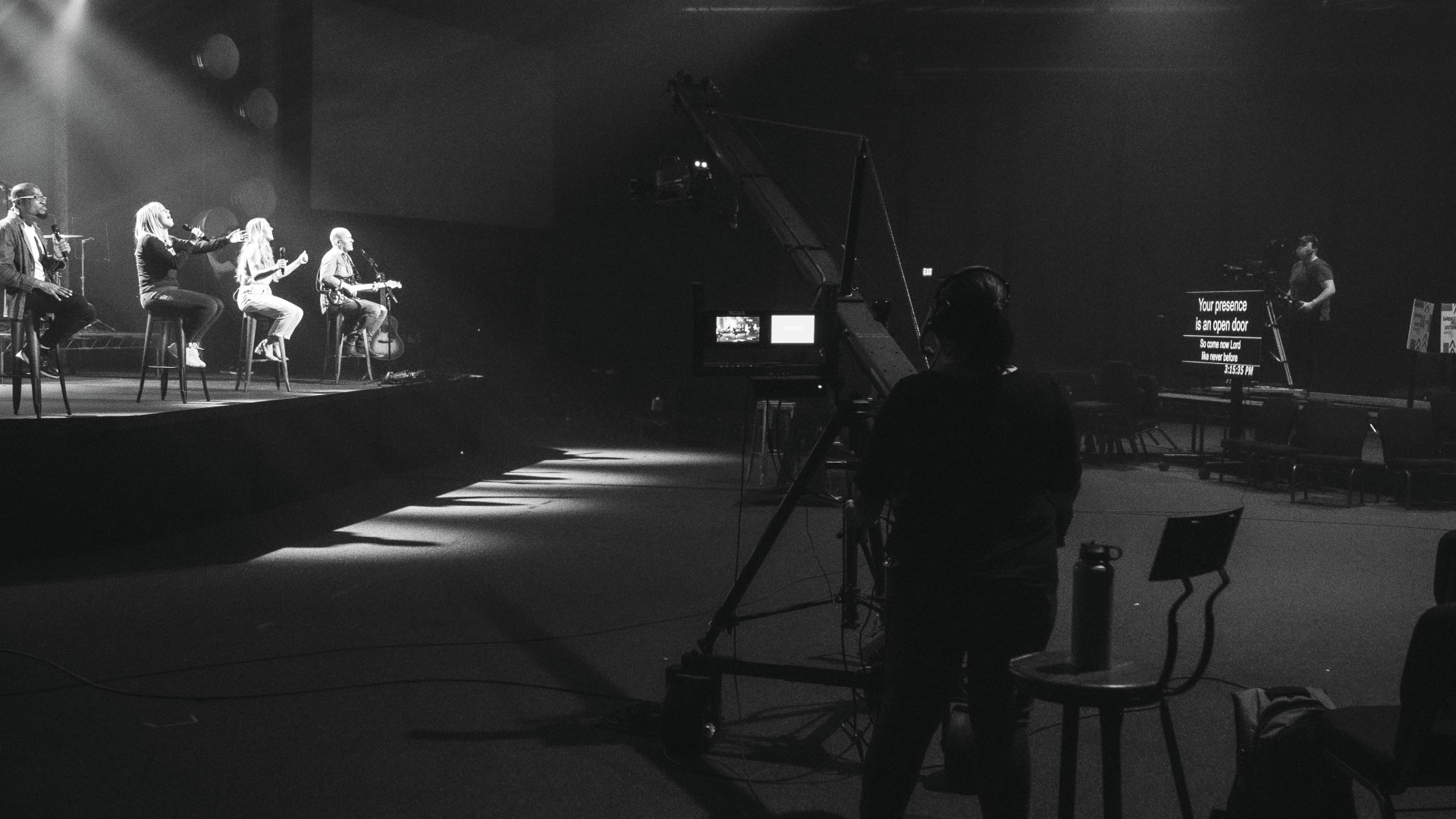
Courtesy of Sandals Church

Churches across the US and Canada sang, “Refiner’s fire / my heart’s one desire / is to be holy” for a full decade after Vineyard worship pastor Brian Doerksen released it in 1990.

Overcome,” written by megachurch worship leader Jon Egan in 2007, was just as popular. But North American churches only sang, “worthy of honor and glory / worthy of all our praise / you overcame” for about three years.

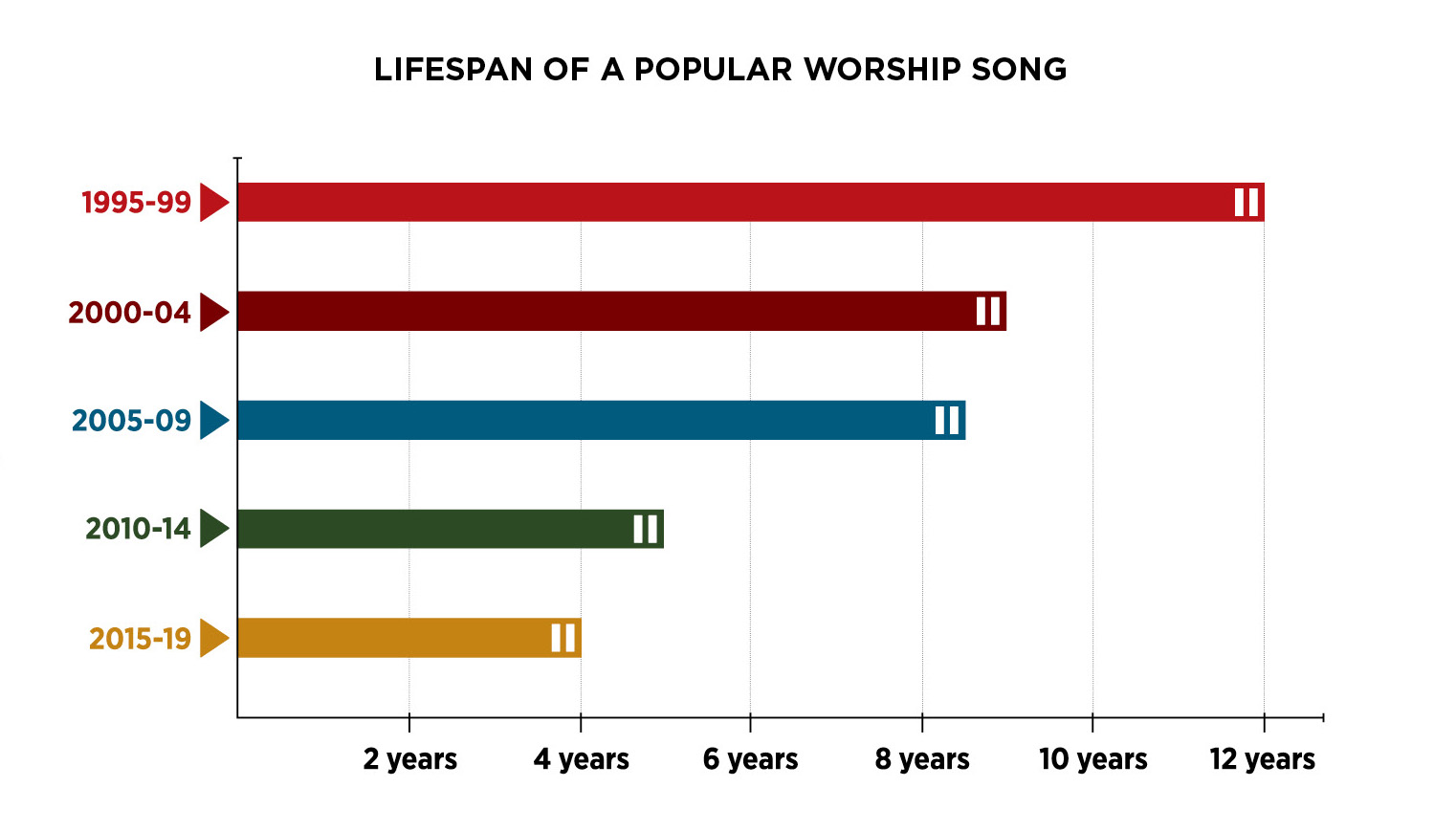
Worship songs don’t last as long as they used to. The average lifespan of a widely sung worship song is about a third of what it was 30 years ago, according to a study that will be published in the magazine Worship Leader in January.

For the study, Mike Tapper, a religion professor at Southern Wesleyan University, brought together two data analysts and two worship ministers to look at decades of records from Christian Copyright Licensing International (CCLI). The licensing organization provides copyright coverage for about 160,000 churches in North America and receives rotating reports on the worship music that is sung in those churches, tracking about 10,000 congregations at a time.

Looking at the top songs at those churches from 1988 to 2020, the researchers were able to identify a common life cycle for popular worship music, Tapper told CT. A song typically appears on the charts, rises, peaks, and then fades away as worship teams drop it from their Sunday morning set lists.

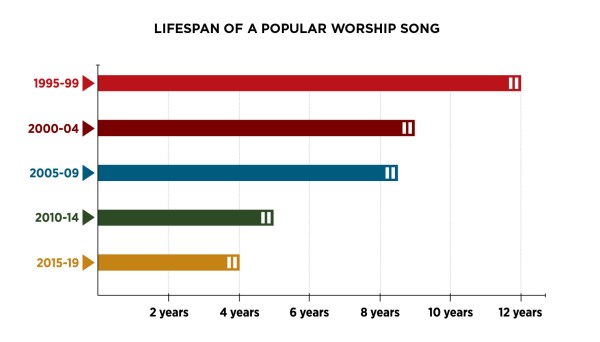
But the average arc of a worship song’s popularity has dramatically shortened, from 10 to 12 years to a mere 3 or 4. The researchers don’t know why.

Marc Jolicoeur, who worked on the study, said the data confirmed what many music ministers have felt intuitively. It matches his experience as a Wesleyan worship pastor in New Brunswick, Canada.

“I got three emails from people in my church this week saying, ‘Have you seen this new song?’” he said. “My pastor isn’t saying, ‘I need the latest and greatest worship song this week,’ but at the same time, a song seems stale, and it seems stale more quickly than it used to.”

The increasing speed of song turnover seems connected in some ways to changing musical styles, Jolicoeur said. The durable verse-chorus-verse model for a church song has given way to music like Elevation Worship and Maverick City’s 2021 release “Jireh,” which has verses that sound like choruses, followed by actual choruses, followed by multiple bridges—three or more, depending on who is preforming. “Jireh” is “a juggernaut of a song,” according to Jolicoeur, but it’s also an example of musical innovations that rapidly age.

“Songs have always changed,” Jolicoeur said. “But we want songs to change faster now. It’s the culture. It’s the soup we’re swimming in.”

Scholars who study Christian music, however, say it is probably not the songs themselves that are driving the change, but the way music is distributed.

In the ’90s, worship leaders learned of new songs at conferences. They then taught a song to their congregations by playing it three weeks in a row, skipping a week, playing it again the following Sunday, and then putting it into regular rotation. It might have stayed in rotation for a dozen years.

Now, worship leaders learn of new music when it comes out on Spotify, Apple Music, Amazon, iTunes, Pandora, and YouTube. Many Christians will stream a new song for weeks before they hear it in church. And the whole process moves at a different speed.

“It’s tied to the mechanisms of how people are discovering music, and how American consumption patterns are changing,” said Leah Payne, a theology professor at Portland Seminary who is writing a history of contemporary Christian music. “This is worship that is sensitive to consumption patterns.”

The new distribution model is organized around the “album drop” as an event, said Adam Perez, a postdoctoral fellow in liturgical studies at Duke Divinity School. That means everyone, from songwriter to worship leader to churchgoing fan is focused on the next new thing.

That model undercuts the older value of a common musical repertoire and accumulating a common stock of songs. But it also helps many churches fulfill their mission of reaching out and including new people.

For many congregations, it’s important to speak to the present moment, Perez said. Worship leaders are not concerned about whether a song that works today will also be relevant in 2033. It just needs to connect today. That gives them more freedom and encourages them to embrace new styles, keeping an ear out for songs that will appeal to new people.

Not everyone loves that, though. Some churches, of course, completely opt out of contemporary worship music. And those that do sing worship songs sometimes still feel the rapid turnover can create a sense that nothing is solid and nothing lasts, said Nathan Shaver, a Christian songwriter and musician who now pastors a church in Indianapolis. Constantly changing styles and fashions can leave people feeling like faith itself is a fad.

Worship Leader

“There is a reason some people are rediscovering the psalms and singing the psalms,” he said. “Something that’s familiar and ancient, that hasn’t changed and isn’t going to change tomorrow? I wonder if there isn’t a need for that.”

Shaver ultimately decided he needed to ignore market pressures when he wrote his music. He tried to approach it as a craft and a passion.

“You have to write because you love it. That’s where the best worship songs come from,” he said.

Mark Nicholas agrees. Vice president of publishing at Integrity Music, Nicholas said artists can get caught up in chasing after a hit and spend all their time analyzing popular themes and trends, instead of focusing on what God wants them to write.

“The struggle of our business—the struggle for any business, really—is holding our ideals in tension with the realities of economics,” Nicholas said. “You can sniff when a song is being constructed. When a song is written to meet a need in someone’s life, those songs carry something.”

That something might be sung in churches for 10 years or for just a few. But it doesn’t really matter, Nicholas said, as long as the right song connects with people at the right moment.

He recalled a time when he put his son to bed for the very first time after adopting him at age four. A line from the hymn “Great Is Thy Faithfulness” came to mind: “Blessings all mine and ten thousand beside.”

He couldn’t remember the last time he’d sung that, but it didn’t matter. It came to him when he needed it.

He hopes the songs that Integrity puts out into the world have that kind of impact, creating that kind of moment when a snatch of a line opens up a heart to God.

Last year, as COVID-19 infected thousands and then hundreds of thousands died, churches across North America sang, “Way maker, miracle worker, promise keeper / Light in the darkness, my God.” The song was promoted by Integrity, which partnered with the song’s creator, Nigerian worship leader Sinach, to have it covered by Michael W. Smith and the band Leeland. The song appeared on CCLI’s list, rose, and for a time held the top spot.

It might not be there next year. Churches might not need that song then.

But Nicholas thinks it still will have mattered. “Songs that accompany us in moments will stick with us, even if they fade a little faster,” he said. “‘Way Maker’ will mean something to people on their deathbed because it got them through a hard time.”

Whether churches sing it for a year or 10,000, that may be all you can ask a worship song to do.

Daniel Silliman is news editor of Christianity Today.

News

Two Kidnapped Missionaries Freed in Haiti

Christian Aid Ministries asks for continued prayer for 15 members still in captivity after 37 days.

Haitians protest for the release of 17 kidnapped missionaries near the Ohio-based Christian Aid Ministries headquarters in Titanyen, north of Port-au-Prince, Haiti, on Tuesday, Oct. 19, 2021.

Haitians protest for the release of 17 kidnapped missionaries near the Ohio-based Christian Aid Ministries headquarters in Titanyen, north of Port-au-Prince, Haiti, on Tuesday, Oct. 19, 2021.

Christianity Today November 21, 2021
Joseph Odelyn / AP Photo

Update (Dec. 16): All 17 hostages have now been released, according to Christian Aid Ministries and Haitian police.

Two members of a missionary group kidnapped in Haiti a month ago have finally been freed, leaving 15 Christians still in captivity.

“The two hostages who were released are safe, in good spirits, and being cared for,” stated Christian Aid Ministries (CAM) on its website. The Ohio-based group said it “cannot provide or confirm the names of those released, the reasons for their release, where they are from, or their current location.”

“We encourage you to continue to pray for the full resolution of this situation,” stated CAM. “While we rejoice at this release, our hearts are with the 15 people who are still being held. Continue to lift up the remaining hostages before the Lord.”

The group of 16 Americans and one Canadian was visiting an orphanage when they were kidnapped by 400 Mawozo, a powerful gang whose leader threatened to kill the hostages if demands for a million-dollar ransom per person were not met.

Christians in Haiti, both Haitian church leaders and other American missionaries, recently explained their concerns to CT about how the CAM workers could be released in ways that would embolden the gangs that have brought life in Haiti to a standstill.

Meanwhile, the consistently loving prayers of CAM supporters for the kidnappers themselves reveal three Anabaptist distinctives that other Christians should find both familiar and thought provoking, according to experts at the Young Center for Anabaptist and Pietist Studies at Elizabethtown College.

“Our hearts cry, ‘Lord, how much longer must this continue?’” wrote relatives of the captives in a message posted by CAM. “And yet, as the saga stretches on and we reach deeper for grace and courage, we find in mining the depths some beautiful shining gems….” They cited “the preciousness of belonging to … the body of Christ,” the “prayers, Scriptures, and messages of encouragement coming from many,” and the “days of collective prayer and fasting.”

“We see the hearts of Christians around the world drawing together as prayers continue for our loved ones and their captors,” they wrote. “Although we long for the waiting to end and for our loved ones to be set free, we are nonetheless grateful for the treasures that we have found in this valley—gifts from our God and from His people.”

CT’s Quick to Listen podcast recently explored how Haitian Christians persevere through crises and whether God really wants missionaries to risk their lives.

News
Wire Story

Christian Florist Settles Legal Battle With Same-Sex Couple

After eight years, the 77-year-old Washington state grandmother is retiring from her business and her religious liberty fight.

Christianity Today November 19, 2021
Elaine Thompson / AP

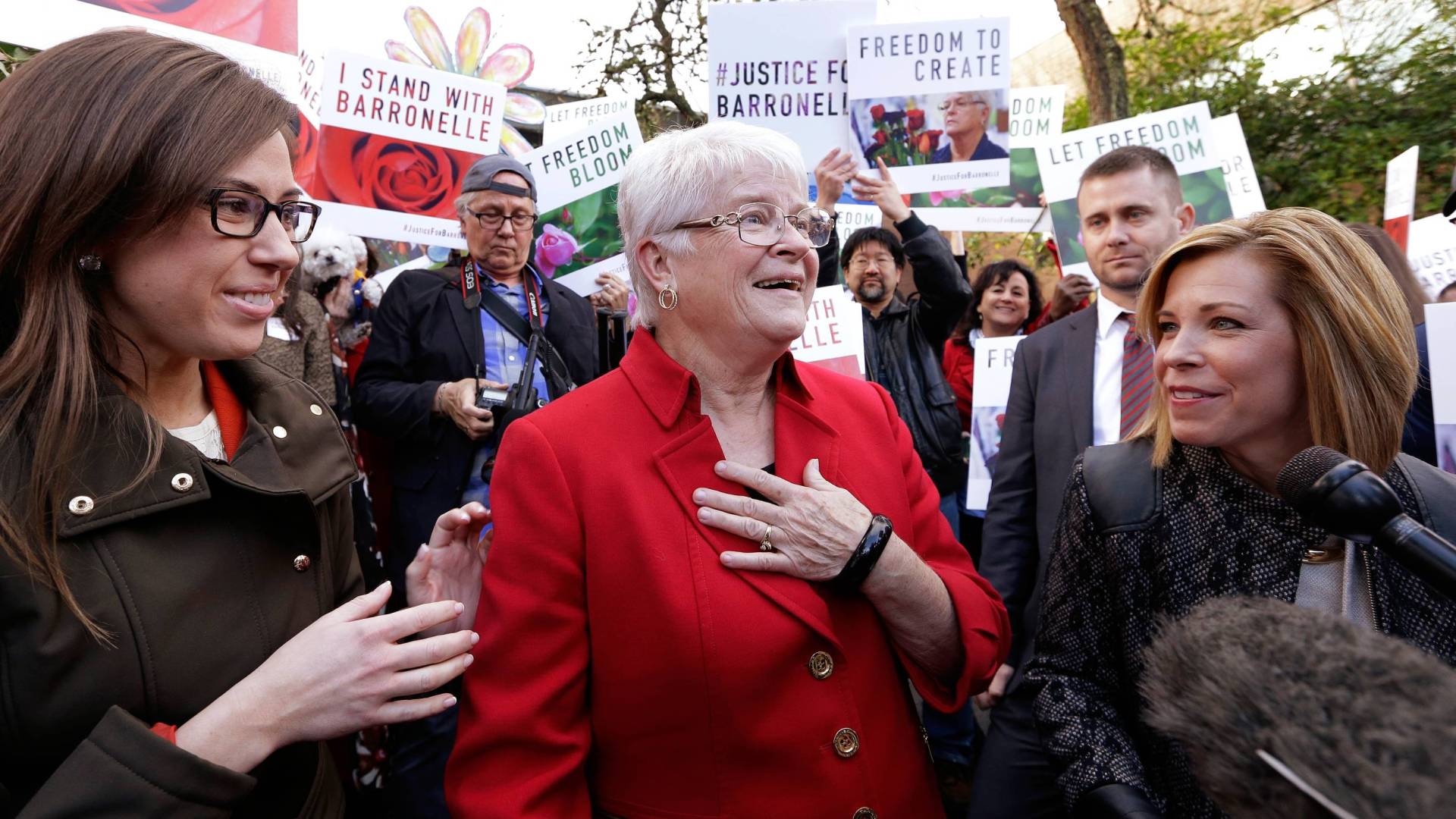
A florist in Washington state who was in an eight-year legal battle that reached the US Supreme Court will retire after settling with the same-sex couple whose wedding job she refused.

Barronelle Stutzman of Richland, Washington, announced the settlement Thursday, saying she has paid $5,000 to Robert Ingersoll, The Tri-City Herald reported.

She said Jesus “walked with me every step of the way” through her legal journey and also wished Ingersoll, who had been her customer at Arlene’s Flowers for almost a decade, “the very best.”

Ingersoll and his husband, Curt Freed, plan to donate the settlement payment to a local PFLAG chapter, and personally match the $5,000.

The agreement allows Stutzman to “preserve her conscience” by not forcing her to act against her Southern Baptist religious beliefs, according to a news release from her attorneys with Alliance Defending Freedom. They reached the settlement with the American Civil Liberties Union.

It also prevents Stutzman from having “to pay potentially ruinous attorneys’ fees,” the release said.

“I am willing to turn the legal struggle for freedom over to others. At age 77, it’s time to retire and give my business to someone else,” Stutzman said.

“I wish the culmination of all that I’ve been through could result in a new respect, culturally and legally, for freedom of conscience in our country,” Stutzman said. “From the beginning, I have asked no more than the freedom to act in accordance with my religious beliefs and personal convictions. I have treated those who persecuted me with respect, and with the assurance that I want for them the same freedom that I ask for myself.”

Alliance Defending Freedom has also defended fellow Christian wedding vendors who have cited their conscience in turning down business for same-sex ceremonies. The team represented a Christian baker in his 2018 Supreme Court victory and is continuing to argue on behalf of a Christian web designer, both challenging Colorado’s application of its anti-discrimination law.

The settlement by Stutzman leaves in place two unanimous decisions by the Washington state Supreme Court that the Constitution does not grant a license to discriminate against LGBTQ people, the ACLU of Washington said.

“We took on this case because we were worried about the harm being turned away would cause LGBTQ people,” Freed and Ingersoll said Thursday in a statement. “We are glad the Washington Supreme Court rulings will stay in place to ensure that same-sex couples are protected from discrimination and should be served by businesses like anyone else.”

The ACLU brought the anti-discrimination lawsuit against Stutzman in 2013 on behalf of Ingersoll and Freed.

Washington Attorney General Bob Ferguson sued separately, saying the floral artist violated the state’s Consumer Protection Act by declining to provide services based on sexual orientation.

A Benton County Superior Court judge in 2015 ruled that Stutzman must pay $1 in attorneys’ fees and costs to the state, along with a $1,000 civil penalty, for discriminating against the couple. That judgment still stands.

“We are pleased to hear that Arlene’s Flowers and Barronelle Stutzman have reached a settlement agreement with the couple they refused to serve,” Ferguson said in an email to the Tri-City Herald.

The two cases through appeals by Stutzman wen to the state Supreme Court, and then to the US Supreme Court.

The country’s highest court vacated Washington state’s previous ruling and sent it back to the lower court in 2018 for another review. The Washington Supreme Court in 2019 ruled unanimously that state courts did not act with animosity toward religion when they ruled Stutzman broke the state’s anti-discrimination laws by refusing on religious grounds to provide wedding flowers.

Stutzman and Alliance Defending Freedom—in their second attempt to get the case before the US Supreme Court—filed a petition for review in September 2019.

The Supreme Court in July declined to take up the case. Stutzman responded with a petition for rehearing, but she will withdraw it as part of her settlement.

News

Christians in Haiti Worry About Release of Kidnapped Missionaries

How the 17 Christian Aid Ministries captives are eventually freed could elevate the risks faced by local believers and American workers.

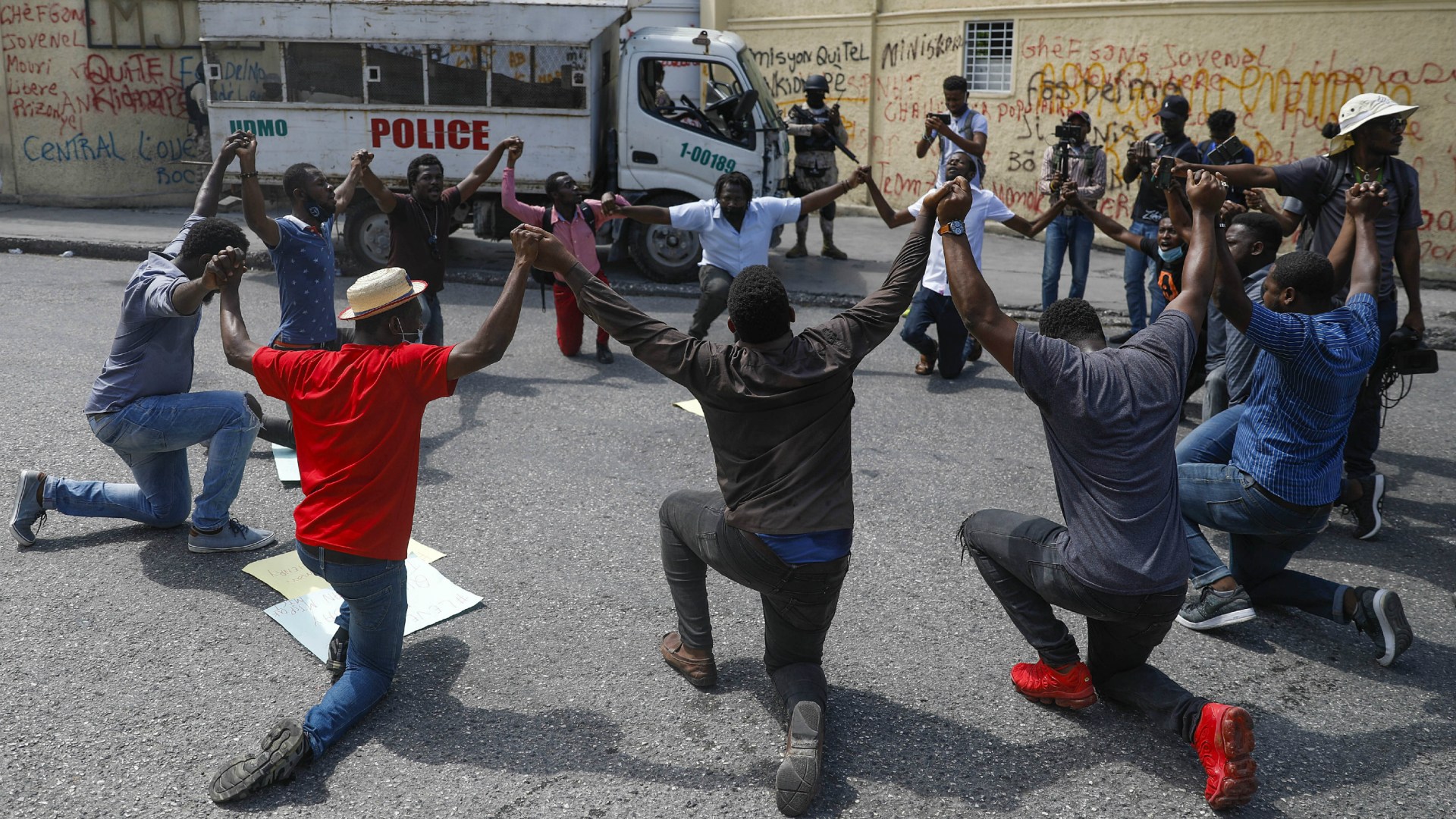
Haitians kneel outside the Justice Ministry to demand the resignation of Minister Liszt Quitel to protest kidnappings in Port-au-Prince, Haiti, on October 26, 2021.

Haitians kneel outside the Justice Ministry to demand the resignation of Minister Liszt Quitel to protest kidnappings in Port-au-Prince, Haiti, on October 26, 2021.

Christianity Today November 19, 2021
Odelyn Joseph / AP Photo

Update (Dec. 20): The final 12 Haiti missionary hostages made a daring escape overnight, instead of a paid ransom securing their release after two months, according to new details from Christian Aid Ministries. CAM says the missionaries forgive their kidnappers.

As months of routine violence and kidnapping take their toll in Haiti, some residents have resorted to humor.

“The average person lives with fear and trembling,” said Edner Jeanty, executive director of Barnabas Christian Leadership Center in the capital city, Port-au-Prince. “Many joke that the life expectancy of Haitians is now 24 hours, renewed every morning.”

For many, the dark humor hits too close to home—literally. A month after the kidnapping of 17 American and Canadian missionaries drew international attention and scrutiny once again to the Caribbean island nation, little has changed for residents of the greater Port-au-Prince area. A gang-inflicted fuel shortage has made navigating daily life all but impossible. And those who go out face kidnapping and violence, whether directed at them or experienced as bystanders.

Amid the interlocking security and fuel crises, attendance has plummeted at Haitian churches, and some congregations have ceased evening services. Recently, a debate broke out after several pastors encouraged attendees to bring machetes with them to church.

“It is a Haitian drama, but in reality, it is a culmination of years of neglect, abuse, and pillage by a small group of national leaders with the complacency of the international community,” said Edouard Lassegue, Compassion International ’s vice president of the Latin America and Caribbean regions.

“While I do not want to condone these acts of violence, I do not want to see them as isolated events. They are a brutal reaction to decades of abuse,” he said. “These very gangsters were once paid by key individuals from the economic and political sectors of Haitian society, and now these men have turned their guns against their very funders.”

‘A deteriorating security landscape’

Though the attack by the 400 Mawozo gang on Christian Aid Ministries (CAM) workers, now held for more than a month over million-dollar ransoms, caught the world’s attention, it was part of a wider escalation of underreported violence and kidnapping.

The Evangelical Theological Seminary of Port-au-Prince (STEP) was forced off its campus a year ago after gangs began occupying its brand-new facility that replaced the one lost in the 2010 earthquake. This past September, a deacon was killed and his wife kidnapped as they attempted to enter Sunday services at First Baptist Church Port-au-Prince. Two weeks ago, a student coordinator at STEP was driving his family home when gang members opened fire on his car, killing his seven-year-old son. Last week, a gang hijacked a bus with at least 50 people on board and demanded half a million dollars for each passenger.

“Haitians are resilient people. They ’ve lived through natural disasters and harsh living conditions. But the kidnappings and the extortion [that] comes alongside that criminality is taking a significant toll, where a ransom runs [from tens to hundreds] of thousands of dollars,” said David Shedd, a former CIA agent and executive adviser of VDI, a regional security consulting firm respected by American missionaries. “For those that live below the poverty line, [a ransom] is life-altering. They will never recover from the payout.”

Haiti ’s security situation began to crumble when UN peacekeepers left in 2019, says Shedd. Soon after, large numbers of Haitian National Police (HNP) officers defected and wealthy Haitians began to collude with gangs, hiring members for protection.

Today, gangs in the Port-au-Prince area informally work together to delineate turf so as to avoid committing fratricide. They also help members avoid HNP checkpoints and seamlessly move around the city of about a million people. Gangs often keep kidnapping victims inside ungoverned parts of the city.

“I don ’t think there ’s sufficient awareness of the vicious and enormous power that these gangs wield,” said Shedd.

Beyond upending the country ’s security, gangs also provoked a fuel crisis. For weeks, armed men prevented trucks from making diesel deliveries to gas stations, before notorious gang leader Barbecue authorized fuel to be released last Friday as he demanded Prime Minister Ariel Henry’s resignation. Without a stable power grid and largely reliant on generators, hospitals were forced to turn down patients, banks closed their doors, schools opened only a few days a week, and internet service became unreliable. Other vital resources were also threatened, as the country ’s drinking water pumps run on the blockaded fuel.

Years ago, many gangs primarily funded their operations by seizing international aid. Though kidnappings were not uncommon before 2021, there have been 20 times as many kidnappings this year as there were in 2018, said Jonathan D. VerHoeven, president of analysis at Concilium, an organization that helps international Christian ministries assess risk.

“To conduct a mass kidnapping of 17 people indicates that a gang feels very comfortable,” said VerHoeven. “That is a very deteriorating security landscape when you can basically get away with that.”

The primary takeaway for both ordinary Haitians and those who prey on them: Criminals will face no consequences for their actions.

“The terror traumatizes people who cannot get their medicine, cannot go to school, cannot leave the area,” said Jeanty. “People who are related to the victims are stressed out. Families and friends are forced to borrow to pay the ransom.”

Beyond the gangs’ military prowess—which includes outgunning the police—an ongoing constitutional crisis that preceded President Jovenel Moïse’s assassination in July means there’s no real functioning government backing up the HNP.

Thus the grim consequences that might accompany the release of the kidnapped CAM missionaries underscores the complexity and brokenness of Haiti ’s security situation.

“If ransom money is paid, [then] the gang becomes more powerful and our economy becomes even more unhealthy. If the national police force leads an operation, it could fail (as others before) and the gang is [then] perceived to be even more powerful than before,” Jeanty said. “If a special operation successfully liberates the hostages [yet] the key leaders of the gang are not brought to trial, the nation may miss an opportunity to know the truth about the source of our insecurity.”

STEP theology professor Andrikson Descollines believes the “inefficacy of the national police to give the proper answer to gang activities” will increase the risk for Haitians, more than the future release of the missionaries themselves. “If the government is not able to stop guns and ammunitions to get inside the country, to secure our borders and customs, to provide appropriate materials and equipment for the police, things will get worse for any social groups in Haiti.”

Paying a $17 million ransom would send a clear message to gangs: Crime pays.

“If the ransom is paid, fear will increase exponentially that no one is safe,” said Shedd. “If [instead] there is security applied to taking down the gang and rescuing all of them (or the majority), that would send a very different message that, in fact, the world does care [and] there is a way out of what looks to be a bottomless pit of criminality.”

But such a message may already be inconsistently applied. While the latest kidnappings seem to have finally forced the attention of the US government, it ’s unclear whether this will last after the hostage situation ends. A 79-year-old American pastor ’s kidnapping at the beginning of October received scant coverage. (Jean Pierre Ferrer Michel and a congregant were ultimately freed after at least $300,000 was paid for their release.)

Shedd believes that no systemic change will occur unless the US commits to training the HNP to effectively respond to kidnappings.

“I think criminal gangs are counting on the US to address [the CAM kidnapping] but not really any long-term commitment to bringing law and order or enabling the Haitian government,” he said.

Who stays, who goes

One message that the CAM kidnappings broadcasted around the globe: Church leaders and employees at faith-based organizations are not off-limits. The ongoing instability has already led many expats to leave the country. World Vision, for instance, has evacuated all its international staff from Haiti.

Concilium has a primary question for Christian NGOs weighing whether or not to continue working out of a given country: Can you do effective ministry?

“What do you believe that God has called you to do in Haiti? Is your presence adding stress to your local partners, or is it helping them?” said VerHoeven.

Right now, for many expat Christian ministries, the answer is no. Concilium is currently working with ministries trying to leave the country for now yet with plans to return in the near future. But not everyone will.

Luke Perkins, an American missionary who works at STEP, estimates 85 percent of missionaries to Haiti have left in the past three years.

“Some missionaries see the pain the innocent Haitian children are suffering to be a greater danger than the threat they are exposed [to] when they are here with us to help. So this horrendous act won ’t deter those kinds of missionaries to pursue their calling to help us,” said Guenson Charlot, president of Emmaus University in Acul du Nord near the northern coast. “Other missionaries and mission agencies see their personal safety as their prime concern. Those kinds are here only when things are quiet and safe and will fly to safety at the earliest sign of potential threat to their personal lives.”

After over a decade of ministry in Haiti, medical missionary David Vanderpool knows firsthand the brutality of gang violence there. In 2015, gang members severely beat his wife in an attempted kidnapping, and a few years ago, gang members murdered his base manager. The 400 Mawozo gang also kidnapped two of Vanderpool ’s team, who were foreign nationals, and held them for ransom. The men endured four days of torture with no food and little water before finally being freed.

In past years, gangs would largely leave Americans alone. That isn ’t the case any longer.

“It really represented a turning point that [400 Mawozo] would be that brazen, kidnapping women and children in broad daylight. These missionaries are in dire straits with a very aggressive, violent, evil gang,” said Vanderpool, founder and CEO of LiveBeyond.

On a call last week, the US State Department vehemently urged Vanderpool and other Americans to leave Haiti, which he agreed to do.

“There’s absolutely no reason an American needs to be in Haiti right now. The State Department has a lot more intel than we do, so if they say that it’s going to get worse, then it’s probably going to get worse,” Vanderpool said. “Ministries have to be run by indigenous people. It’s just way too dangerous for foreigners to be there right now.”

LiveBeyond’s efforts to meet medical, educational, and spiritual needs will continue via its Haitian staff—as supplies allow. Yet it’s questionable whether the situation is any safer for national workers.

Compassion International, whose ministry in Haiti employs only locals, has relocated many of its staff outside the capital area. Gas and food price increases have raised operation costs. Even prior to the recent spike in kidnappings, the pandemic kept many short-term missions teams—whose trip expenses often help underwrite the work of local ministries—out of the country.

In addition to the stress they face from their ministries, many locals are confronted with the burden of navigating everyday life, like choosing how to use fuel or deciding whether it ’s worth going grocery shopping or to church.

“There ’s this crazy-making of how you live each day. You begin to not have a long-term worldview because any day could be your last,” said Anna Hampton, author of Facing Danger: A Guide Through Risk, based on her decades of ministry in Afghanistan and other Central Asian and Middle Eastern nations.

“The fear is that they might give up on life. If they feel isolated and resigned to whatever happens to them and don ’t have hope in Jesus, then you give up or you adopt a mentality of ‘I can do whatever I want,’” she said. “So then you do things to people in the name of survival. The prayer is that the Lord will be there … but that doesn ’t mean they will have bread for the day.”

The Haitian church has long struggled with passivity toward social and political events because of theological teaching that narrowly defined what counts as spiritual activity and because of a government long hostile to evangelicals, said Lassegue. But since the 2010 earthquake, Haitian Christians have increasingly reflected on their responsibility to society.

“Whereas the Bible was used before to justify an isolationist position, today many sermons are preached on the need to be salt and light in this world. Passages like Jeremiah 29:7 and Matthew 5:13 are often quoted and preached on,” said Lassegue. “Hopefully, this will result in tangible change in the country. Pray for the Haitian church and Haitian Christians to wake up to the opportunity and responsibility we have before us.”

Additional reporting by Rachel Pfeiffer

Theology

I Can’t Quit My Evangelical Heritage. Neither Can You.

What exvangelicals teach us about our religious roots.

Christianity Today November 19, 2021
Illustration by Mallory Rentsch / Source Images: Suzy Hazelwood / Pexels / WikiMedia Commons

Like many of my peers, I am a child of American evangelicalism. I was born to professing parents, made my own public statement of faith at five, and was baptized a few years later—still so tiny that my pastor had to lift me up to reach the microphone. My parents themselves were raised in the broader evangelical movement and shared many of the same religious rites of passage: baptism, communion, VBS, church camp, and eventually Christian college. My paternal grandparents were steady churchgoing people, while my maternal grandparents came to faith through the revivals of the World War II era. Beyond that, things get murky. My family and I have discovered that some of my father’s forebearers were Anabaptists, but no relatives in living memory were part of that tradition.

I’ve occasionally wondered when exactly my ancestors might have converted from paganism to Christianity or what churches they would have worshiped in, but I don’t know the answers. And I have no way of finding out.

Such is the dilemma of many American evangelicals. In much the same way that countless immigrants gradually lost their ethnic heritage and traditions to racial categories, American evangelicals often lack a sense of our religious roots. As interfaith leader and rabbinic scholar Yehiel Poupko recently told me, “Neither Jews nor Christians pay enough attention to the influence of American culture on their respective faith communities.” Due in part to the pull of assimilation, our lack of attention also stems from the distinctly modern way evangelicals understand faith—as an individual expression of belief or experience.

In his new book, You Are Not Your Own, Alan Noble argues that, while the American church theoretically offers an alternative to this worldview, “far too many churches have adopted the contemporary anthropology. They assume that we are our own and provide us with options for meaning and identity like any other community.”

As we shift away from understanding faith as a shared generational experience, we put pressure on the individual, and that pressure is especially debilitating for those wrestling with the evangelical tradition into which they’ve been born.

For some, the pressure is so profound that they feel no other choice but to leave. The stories of these “exvangelicals” are varied, writes Blake Chastain, who coined the hashtag #exvangelical in 2016 to describe his own departure from evangelicalism and now hosts the podcast Exvangelical. But they also “have patterns—earnest struggles with doubt, the physical and emotional burden of purity culture, [and] authoritarian environments.”

Taken individually, these stories may seem like aberrations. But in many ways, exvangelicals’ dilemma is more native to American evangelicalism than we’re comfortable admitting. After all, it was their evangelical upbringing that suggested they’re solely responsible for the spiritual path they choose. It was evangelicalism that often taught them that their biblical faithfulness is measured by the church to which they belong. So when they see that very same tradition taking on an increasingly political quality, what are they supposed to do? Perhaps leaving evangelicalism, then, is a most evangelical response. But what if the way forward doesn’t lie in sorting through our various religious options? What if it lies instead in questioning the modern notions of self that tell us we are the sum of our personal choices?

Just as we do not choose our biological families of origin, there’s a sense in which we do not choose our religious families of origin either. Those of us who have been birthed or shaped by evangelicalism will never not be affected by it. You can be a former evangelical or a postevangelical. You can be a neo-evangelical. You can be a recovering evangelical—even a reforming evangelical. But you will never not be defined by your relationship to evangelicalism.

At the same time, acknowledging your evangelical roots does not mean turning a blind eye to the challenges facing the movement, nor does it mean defining evangelicalism so narrowly that you can absolve yourself of responsibility for it. To extend the family metaphor, evangelicalism may be comprised of your crazy cousins, embarrassing uncles, and perhaps even dysfunctional homes, but it’s still your family. “You don’t choose your family,” writes South African bishop Desmond Tutu in God Has a Dream. “Perhaps if we could, we might have chosen different brothers and sisters. Fortunately or unfortunately we can’t. We have them as they have us. And no matter how your brother may be, you can’t renounce him. He may be a murderer or worse, but he remains forever your brother.”

Owning our religious heritage doesn’t mean that we’re without agency or that we should stay trapped in abusive churches or unsustainable traditions. Every generation must take what it’s received, evaluate it, discard what is unhelpful, and keep what is. We have to erect healthy boundaries and break cycles of dysfunction. We have to take responsibility for our own lives. But doing so is not the same as attempting to start all over and create “whole cloth.” For some, taking responsibility for their own lives might mean staying within evangelicalism and owning it.

“I am talking to lots of evangelicals who want to give up the very word evangelical,” Poupko told me later in our conversation, “and I say to them, ‘Evangelical is at the core of what it means to be a Christian. What you have to do is not let the bad boys and girls in the schoolyard own it.’” Author and Episcopal priest Fleming Rutledge offers similar sentiments in a 2017 podcast interview:

Historically, [evangelical] was applied to a vast sweep of the church which does not correspond at all to the idea of American evangelicals in the way it is defined. … I still think the nomenclature is worth fighting for because … when someone uses the word evangelical in the wrong way, then that gives me an opportunity to talk about what I think it really means.

Quoting 20th-century evangelical theologian F. F. Bruce, she continues, “What is an evangelical? … He said, ‘An evangelical Christian is one who believes in the justification of the ungodly.’”

Plenty of scholars and writers have debated the merits of keeping or discarding the “evangelical” label. But that’s still an individual consideration. The deeper question is more pressing: How do we see and understand ourselves as part of a spiritual lineage that started well before us and will go on (in some form) long after?

Earlier this week, my husband came back from his parents’ house with a cardboard mailing tube. It had been repurposed, with the words “1 MAP PALESTINE N. T. TIMES” crossed out. Next to them, his grandmother had written, “Two genealogy charts—somewhat finished, to be researched.” Inside, we found the aforementioned charts, one of his paternal grandmother’s ancestry (“somewhat finished”) and one of his paternal grandfather’s ancestry (“to be researched”). I can’t help but hear an invitation here—an invitation to discover both our biological and religious roots. In the process, we’ll probably learn things we don’t like. After all, we enter our cultural, national, and religious stories already in process.

But for reasons God alone knows, this is the moment given to us. How we resist corruption and preserve our faith for future generations is a question for another time, but for now, we can rest in the knowledge that we are not the sum of our religious choices and we are not alone in them. We belong to Jesus Christ, and from that place, we belong to the generations—both those in the past and those yet to come.

Hannah Anderson is the author of Made for More, All That’s Good, and Humble Roots: How Humility Grounds and Nourishes Your Soul.

History

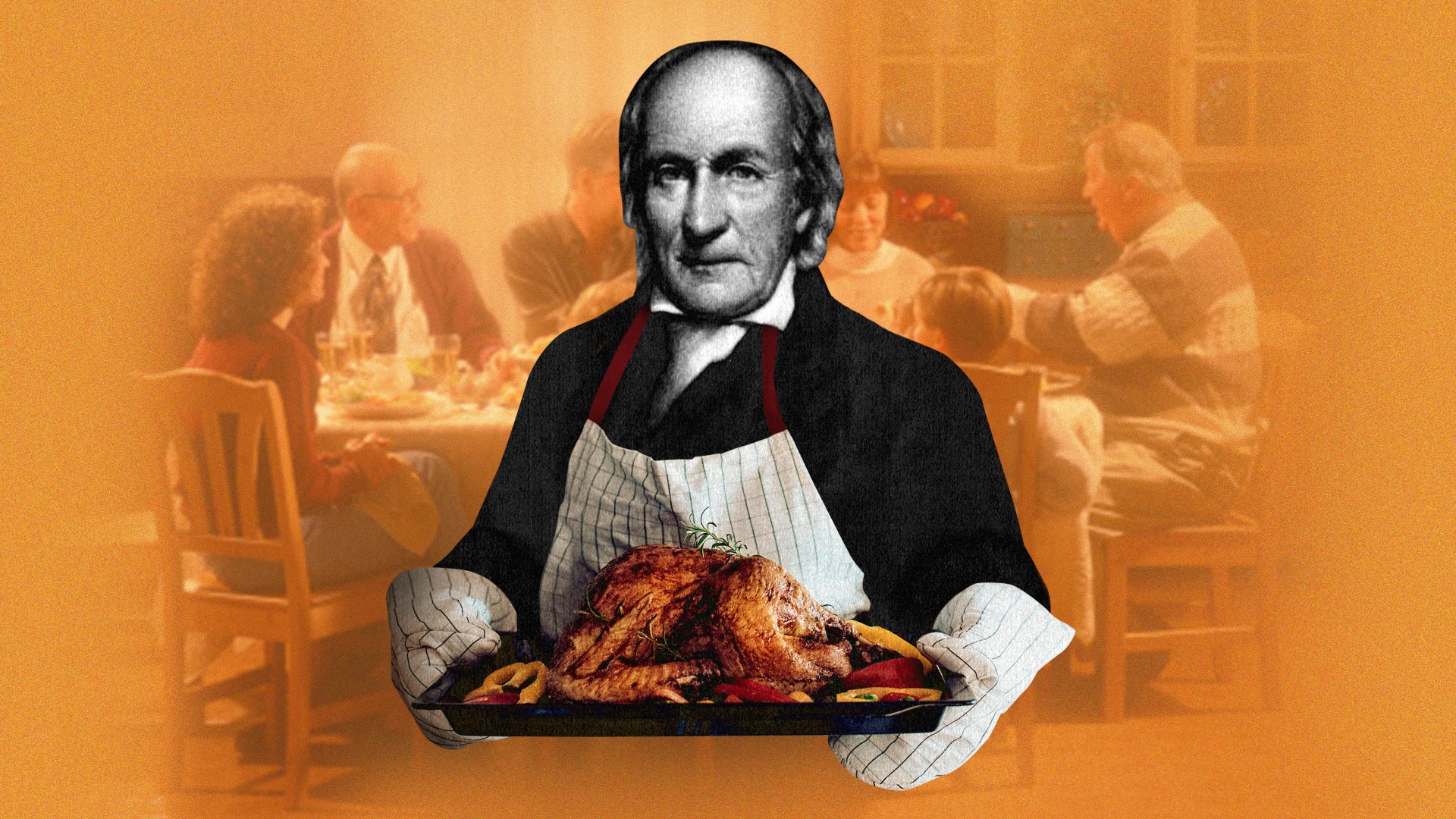
Why I’m Inviting John Leland to Thanksgiving Debates About Christian America

Pass the big wheel of cheese, and defend the Baptist legacy of freedom of conscience.

Christianity Today November 19, 2021
Illustration by Mallory Rentsch / Source Images: Burke / Triolo Productions / pixelfit / Getty Images / New York Public Library

As someone who studies religion and politics, I often find myself in “fun” conversations at the Thanksgiving table. As the turkey’s carved, the stuffing passed, and the pies put out to cool, my aunts or cousins or their plus ones will ask me to agree that America is in decline. It used to be, they will say, that this was a Christian nation, but now the government isn’t doing what it needs to do to defend our values.

As they nostalgically recall a golden age when America was a Christian nation, I am reminded of an eccentric Baptist minister with a 1,200-pound wheel of cheese who offered an alternative vision of confident religious conviction in the public square—confident enough that it didn’t need government support.

Maybe it’s not fair to call John Leland, a Revolutionary-era Baptist minister, eccentric. But he did once give President Thomas Jefferson a four-foot, four-and-a-half-inch wheel of cheese made from the milk of 900 cows. The author of the Declaration of Independence called it “an ebullition of the passion of republicanism.”

So, he was at least a little eccentric.

More important to me is that Leland spent his life articulating a vision of Christian confidence. He was a passionate advocate for religious freedom, arguing the truth needs no support from the government and doesn’t depend on social privilege.

Congregationalists and Anglicans at the time appealed to the state’s authority to uphold religious doctrine. They believed that an ordered society could not stand the jostle of diverse religious beliefs and that the truth needed protection from the government. Leland, along with other Baptists and evangelicals at the time, rejected this. He said only error needed support; the truth could flourish without the assistance of laws and law enforcement.

His argument for religious liberty is a model for Christians engaging culture because it recognizes both the inviolability of conscience and the inability of falsehood to stand in the face of truth. He shows us how to hold to the truth of the gospel with confidence, in a spirit that opposes fearmongering over a declining Christian culture.

At the core of Leland’s approach to religious liberty is a bedrock assumption that the conscience is inviolable. Leland is not alone in this sentiment among historic Baptists. In 1612, Thomas Helwys, an early English Baptist, argued for religious liberty for “heretics, Turks, Jews, or whatsoever.” In 1644, Roger Williams equated the violation of conscience by the Parliament of England with the violation of the body. But it is clearest in the words of John Leland who plainly stated, in his aptly named 1791 sermon “The Rights of Conscience Inalienable,” that the government has no right to interfere with the religious beliefs of its citizens.

“If government can answer for individuals at the day of judgment, let men be controlled by it in religious matters,” he wrote. “Otherwise, let men be free.”

This is not to say that the conscience is perfect. Leland, as a believer in the sinfulness of humanity, believed that the internal compass could err. But if it was to err, it should be because the individual freely chose it, not because of an outside compulsion such as the threat of punishment or the enticement of honors.

So strongly did he believe in this maxim of the relationship between the government and religion that he was willing to scuttle the United States Constitution when it was sent to Virginia for ratification. He and other members of the Baptist General Committee considered voting it down unless there was a guarantee of an amendment to secure religious liberty. This was noticed by James Madison, who was warned in several letters that the Baptists were against the proposal, especially John Leland, “the leader of the Virginia Baptists.” Only after Leland secured promises from Madison (in a meeting that has assumed legendary status) that an amendment to the Constitution securing the rights of conscience would be proposed did Baptists mobilize in support of the Constitution.

In his defense of conscience, Leland understood what should be increasingly clear to modern Christians: The privileges of the state do not lead to true converts. Rather, privileges encourage Christians to be nominal—more concerned with cultural favor than faithfulness.

This is becoming increasingly clear in contemporary America as those privileges are taken away, a point my family members rightly recognize in their holiday questions. Church membership has dropped below 50 percent for the first time since Gallup started asking the question. The religiously unaffiliated—often referred to as “nones”—are one of the fastest-growing and largest groups in America. Granted, there are many reasons for this, not the least of which is a devaluing of institutions in all areas of American life and rejection of the abuses and harms that have been revealed inside and perpetrated by the church. But where previous generations were more likely to at least identify as Christian to benefit from the social advantages of association with a church, that is changing.

But the changing landscape reveals the joy of Leland’s method for engagement. The truth does not need the protection of the government; it needs only a vocal and committed proponent. In this moment of history, each person must live convinced of his or her own position, and we are required only to hold it with humility. There must be a freedom to disagree, even vigorously. But at the end of the day, our minds should always be open to conviction, and each of us should be convinced of what we believe because we believe it to be true.

Christians used to be able to rely on governmental or even just cultural support for their positions. Now, with a crumbling Bible Belt and secularizing public square, that is no longer the case. But “it is error, and error alone, that needs human support,” according to Leland. Those who need the support of the government for their position reveal their underlying belief that something in their position cannot stand up to the light of scrutiny.

It is not because the truth is weak that Christians turn to cultural support. It is because Christians are unconvinced of their own positions. Leland calls for us not to protect the truth but to actually believe it and to confidently assert it in the public square, just as he did regularly in Virginia and New England.

And though Leland was a strict separationist (he even argued against Sabbath laws), he did not want the public square to be naked of religious claims, which, as public theologian Richard John Neuhaus has argued, is impossible. Leland just wanted neutrality. The same man who argued against state sponsorship of religion also preached to Congress in 1801. This requires a confidence on the part of Christians who do not bemoan declining acceptance of their beliefs but who boldly and prophetically declare to the world the truths of the kingdom of God and the rule of Christ over all areas of life—political, spiritual, sexual, economic, racial, and personal.

It also requires humility from Christians because we recognize that today’s atheist may be our future brother or sister. Christianity is not transmitted genetically but rather through the renewing of hearts and minds (Rom. 12:1–2). As CT’s public theologian Russell Moore has written, the next Billy Graham is likely not currently a believer. So, we do not enter the public square seeking to protect ourselves or to overthrow our enemies. Rather, like Leland, we seek the freedom to proclaim the truth and allow it to work in the minds and spirits of those who are listening. And Leland’s context for convictional engagement, the Second Great Awakening, should offer hope and optimism to those who worry about the state of religion in America.

Leland’s optimism about the power of reason and truth appears naïve in our age of outrage, sound bites, and fake news echo chambers. However, for the Christian, his method is incredibly useful. It recognizes that our interlocutors are not enemies even if they are ideological opponents. They are, at worst, deluded by a lie and thus need to be confronted with the truth with confidence and humility.

The tension between those two is one that we could all recover in an age of hot takes and attempts to score points for our tribes. It will take a confidence in the power of our arguments rather than the number in our voting bloc. It will take a humility able to admit error or be proven wrong rather than a bombastic spirit seeking to score points in the latest Twitter sparring match.

The same day Leland delivered that wheel of cheese to Jefferson, Jefferson wrote his famed letter to the Danbury Baptists declaring a “wall of separation” between government and religion. Leland supported this separation, even if he disagreed with Jefferson about what that looked like practically. Leland saw in America neither an embattled Zion nor a Babylonian exile but rather an Athenian hill asking for debate (Acts 17:16–34).

So, when we’re eating some pumpkin pie and listening to a cousin’s husband talk about the outrage du jour, maybe we can be more like Leland. Instead of wringing our hands about the threats of the future and bemoaning our inability to live in the past, we can follow the example of that eccentric Baptist and go about the work of proclaiming the truth and defending each individual’s right to live in accordance with the convictions of his or her conscience.

Alex Ward serves as the lead researcher for the Southern Baptist Convention’s Ethics and Religious Liberty Commission.

Theology

What Stand-Up Comedians Can Teach the Church

Good comedy is strange and surprising. So is the gospel.

Christianity Today November 18, 2021
Illustration by Mallory Rentsch / Source Images: Flashpop / Pastie / Feverpitched / Getty Images

This piece was adapted from Russell Moore’s newsletter. Subscribe here.

Apparently, comedian Dave Chappelle isn’t welcome at his own high school. According to news reports, the Duke Ellington School of the Arts delayed a ceremony to celebrate the renaming of its theater after the famous alum because students threatened to walk out.

Netflix fielded similar threats from its employees after Chappelle’s controversial standup comedy special aired on the streaming service. Many felt it was insulting toward transgender people and others. Chappelle’s special has since prompted a thousand debates about political correctness, cancel culture, and the nature of respect and civility in the public square.

While those debates are important, let’s set them aside for a moment and reflect instead on the question of who was laughing—and why.

As the Chappelle controversy has unfolded, I have found myself in conversations with two specific people on opposite sides of the “love him or hate him” spectrum. Both of these individuals were surprised by their mixed feelings—not about the social commentary or the rhetoric of the comedian but by their own reactions and responses.

One of them is a staunch conservative who’s been concerned about our country entering a “What are your pronouns?” era. He agreed with Chappelle’s arguments on that point but said he never laughed at them. In fact, he cringed several times at the crude language in the routine. “I was with him on the issue,” he said. “It just wasn’t my kind of humor.”

The other person is a committed progressive outraged by what he sees as Chappelle taking cheap shots at a vulnerable population—and yet he had the reverse response. “I hated what he was saying, at least at those parts,” he said, before looking down and wincing. “But I have to admit, he was funny.”

So while the conservative felt obligated to laugh, he felt left out because he didn’t. And although the progressive despised what was said, he felt guilty because he did laugh.

In September, David Sims of The Atlantic profiled another controversial and politically charged comedian, Norm Macdonald, after Macdonald’s death from cancer. As with Chappelle, part of Macdonald’s legacy was that he could prompt people to “laugh and gasp in shock in equal measure.” The key to all of this, Sims argued, was not Macdonald’s place on the political spectrum, which was to the right of most of his cohort. It wasn’t even his comedic material itself, which was often rather coarse. Instead, it was Macdonald’s view of what comedy is meant to do—or, more specifically, of how laughter works.

According to Sims, Macdonald argued that standups should “hunt for laughter, not applause.” The comedian went on to explain, “There’s a difference between a clap and a laugh. A laugh is involuntary, but the crowd is in complete control when they’re clapping. They’re saying, ‘We agree with what you’re saying; proceed!’ … But when they’re laughing, they’re genuinely surprised. And when they’re not laughing, they’re really surprised. And sometimes I think, in my little head, that that’s the best comedy of all.”

This seems to have little to do with the witness of the church. After all, we’re not trying to make people laugh. But that element of surprise—an involuntary reaction that goes beyond our sets of ideologies and expectations—is actually a key part of what we are called to do, and the lack of it partially explains why we so often fail.

In the mid-20th century, theologian Reinhold Niebuhr wrote an essay on the relationship between humor and faith that was utterly humorless but nonetheless insightful. In it, Niebuhr argued that at the core of human existence is a paradox. We see ourselves as insignificant in the broad sweep of space and time, per Psalm 8: “What is mankind that you are mindful of them, human beings that you care for them?” (v. 4). But our very ability to ponder that insignificance seems to place us at the center of the universe: “You have made them a little lower than the angels” (v. 5).

A person’s melancholy “over the prospect of death,” Niebuhr wrote, is “proof of his partial transcendence over the natural process which ends in death.” Our inner and outer worlds often fail to align—and humor and faith are two different human responses to this tension.

“Laughter is our reaction to immediate incongruities and those which do not affect us essentially,” Niebuhr wrote. “Faith is the only possible response to the ultimate incongruities of existence which threaten the very meaning of our life.”

Humor, in Niebuhr’s view, is a kind of no-man’s land between cynicism and contrition. When laughter is taken to its extreme, it becomes a kind of bitterness. Think about the people you know who are hilariously fun to be around but who became that way in order to create a kind of defense mechanism—either to distract themselves from sadness or to protect themselves from potential ridicule. This is not the worst way to survive, unless one adopts the kind of sarcasm and nihilism that laughs at everything and cries at nothing.

Successful comedians—whether the skilled millionaire professionals airing on Netflix or the kids whispering jokes in the church balcony—know how to point out the incongruities of life. They recognize, as Norm Macdonald said, that laughter works best when it is least expected, when it can surprise and even startle us. Good jokes that bring genuine laughter often relate and connect to the human experience in an unpredictable way, whether it produces a reaction of “Ha! I see what you did there!” or “I can’t believe she just said that!”

Most of us have experienced times when we laughed unexpectedly—sometimes at inappropriate moments or in inappropriate contexts.

Years ago, at a funeral in Louisville, I sat next to an elderly man who was a former faculty member at the seminary where I served at the time. One of his equally elderly colleagues, whom I’ll call Harold, began walking to the front of the chapel to give a eulogy. At that very moment, my seatmate (whose hearing was basically gone) said to me in a “whisper” loud enough that everyone could hear, “Look at how bad Harold looks! Man, he has aged! Mark my words—his funeral’s next!”

All of us watched in horror as Harold turned around mid-aisle to glare in my seatmate’s direction. Then a small smile crept to the corners of Harold’s mouth as he turned back to walk to the pulpit. The more I tried to stifle my laughter—the more I said to myself, “You can’t laugh! This is a funeral!”—the harder it was for me to keep my composure.

The Christian gospel itself is not humorous. Indeed, it deals with the most serious of matters. Its ultimate aim is not laughter, but nor is it applause. The power of the gospel took the first-century Roman Empire by storm—not because it met the expectations of Rome’s cultures and subcultures but because it was perceived as thoroughly strange.

A crucified Messiah. The resurrection of the body. A church of both Jew and Gentile, slave and free. None of these fit the existing expectations and formed opinions of almost anybody in that day and age. And that’s precisely why it stood out as so different.

When it comes to Dave Chappelle, there is plenty to debate about—for instance, whether he or any other comedian is “punching down” or whether that type of comedy becomes ridicule. How far is too far before comedy ends up trespassing the bounds of civil discourse? These are important conversations. However, it’s still worth observing the way standup comedians can make the familiar surprising and the strange relatable.

Comedy can involve social commentary or political advocacy but only in a very specific way. To make us truly laugh, not just applaud, it must strike us at a surprising place—one that’s much deeper than our surface-level opinions and stances.

Laughter does not always signify joy—just as melancholy does not always equal contrition. But sometimes it’s a start.

Russell Moore leads the Public Theology Project at Christianity Today.

Ideas

Why I Pray for Myanmar with Hope

Five reasons for the current crisis, three signs of hope, and three prayers for what is needed next.

Locals walk across U-Bein Bridge, an old teakwood structure spanning Taungthaman Lake, near Mandalay, Myanmar.

Locals walk across U-Bein Bridge, an old teakwood structure spanning Taungthaman Lake, near Mandalay, Myanmar.

Christianity Today November 18, 2021
Ian.CuiYi / Getty Images

Recent news from Myanmar, beset by both civil conflict and the pandemic, is heart-breaking.

According to my contacts in Yangon, COVID-19 is rife. The confirmed death toll has risen sharply to hundreds per day. Few are vaccinated. Almost a third of public hospitals are or have been closed. Relatives, friends, and aid providers risk being shot or detained as they queue to try to get oxygen cylinders to the sick under curfew.

It seemed the Southeast Asian nation was inching toward a more democratic regime. In the November 2020 election, there was yet another landslide vote for the National League for Democracy (NLD) party.

But the military junta, which rules Myanmar, was unable to contemplate more power-sharing. Citing election fraud, they declared a year-long state of emergency on February 1. The patience of the normally peace-loving people snapped and fury was unleashed.

Ominously the military’s 77th light infantry division, which was at the forefront of brutally repelling the Rohingya Muslims back in 2017, was deployed to deal with the protesters in Yangon, Naypyidaw, and Mandalay. First with tear gas and rubber bullets, and then with live rounds and even air attacks, as shown by mobile phone footage, soldiers gunned down unarmed students, teachers, and even medical workers. More than 900 civilians have been killed by security forces and over 5,000 more detained or sentenced.

In the plaintive words of one Burmese youth on the streets of Yangon: “We were just learning to fly, and now they have broken our wings.” What chance is there that the fledgling bird of Myanmar will fly again?

Falling in love with Burma

As a British teenager, I met a beautiful Burmese girl on the school bus. She and her family self-exiled in 1964, soon after Ne Win’s military coup, to start a new life in England. They arrived at Heathrow as immigrants with £100 each in their pockets. I was blown away by the affections of April and by the warm hospitality of her parents, whose home was filled with the unfamiliar aromas of eastern cooking and stories of Burma’s golden days. My fascination was fired for this far-off land.

But this misty-eyed romanticism about Burma was largely untested until April and I made an extended visit in 1995–96, along with our four teenage daughters. For April, not a lot had changed since her family’s hurried departure. For me, it was an arresting reality check.

How did this country, with such a regal past, swathed in natural beauty and populated by a people of unmistakable poise and serenity, slide into repression and obscurity? How could the upbeat memories of April’s parents be reconciled with Myanmar’s current malaise? I started to record the oral history and reminiscences of April’s Burmese family who were eyewitnesses to momentous events in mid-20th century Burma.

Then, between 2010 and 2018, April and I made seven successive visits to help teach at a small Bible college on the outskirts of Yangon, run by a couple from the Chin ethnic group. We took the opportunity to travel widely and talk to a range of young people. I began to unpeel the nation’s history, the mix of Buddhist faith and spirit worship, the warring interests of ethnic peoples (many with a strong Christin presence), the decimated education system, the unequal distribution of wealth, and the hidden human rights abuses labelled by Amnesty International as among the worst in the world.

What emerged was a far more nuanced picture of Burma (renamed to Myanmar by the military in 1997) than the media stereotype. Unexpectedly, hope dawned in the form of inspiring and energetic young millennials who were dedicated to restoring devastated lives and communities.

Drawing on this experience and research, I ask two questions. What factors have led to the current and long-standing malaise in Myanmar? And what signs of hope exist today for a radical shift in fortunes?

Five factors behind Myanmar’s malaise

Many post-colonial nations have struggled with newly won independence and their attempts to pursue democracy. The case of Burma, which gained independence from the British in 1948, is one such example. However, five factors suggest that Myanmar is a unique case.

First is the multiethnic nature of Myanmar. Within the national borders, there are at least 130 ethnic groups each with their own dialect or language, indigenous culture, and vested interests. Many, like the Karen, the Chin, the Kachin, and the Shan, have long maintained their own militias, fighting for basic human rights. The conflict between them and the dominant ethnic group, the Bamars, has continued unabated for 60 years.

A second factor is the intransigence of the junta. It is one thing to impose military dominance on a country in chaos, but the generals that rule Myanmar have shown remarkable resilience in retaining their iron grip over their peoples for six decades. Government legislation and affairs of state have been systematically passed from one small cadre of generals to another. The cards have been shuffled, but always from the same pack.

A third factor is the bullying nature of the military regime with frequent outbursts of extreme brutality. For long periods, the people of Myanmar have acquiesced. On the occasions when popular uprisings have occurred, they have been repulsed by intense ferocity—most notably student protests in 1990, the so-called Saffron Revolution in 2007 when monks led marches of civil unrest, and again since February this year.

A fourth factor is benign Buddhist beliefs have infused the Burmese mindset for centuries. Characteristics like tolerance, conservatism, pacifism, and profound respect for others do not readily lend themselves to armed revolt against the political status quo. It would seem that a combination of Bamar socio-ethnic superiority and Buddhist deference to one’s leaders lend multi-layered support to the continuing elitism of the generals in Myanmar.

For example, on our visit in 1995, April and I had the opportunity to have a personal meeting with Aung San Suu Kyi who had just been released from house arrest. It was evident that Buddhism was the beating heart of her hopes for her country. Her view was that non-violence is the way to end dictatorships.

A fifth factor to the junta’s durability in Myanmar is the cloak of secrecy with which they surround their political and social activities. Psychological research tells us that a heavily armed regime and extreme paranoia go hand in hand.

Three reasons for hope

The United Nations World Food Program recently stated that the crisis in Myanmar “will severely undermine the ability of the poorest and most vulnerable to put enough food on the family table.” The UN Development Program has warned that the impact of the pandemic and the political crisis could cause as many as 25 million people to slide into poverty by next year. The situation looks bleak; however, there are glimmers of hope.

1) The genie is out of the bottle: Social media is widely used in Myanmar. Young people in particular are media savvy—raised on Viber and Facebook—and well informed about external trends and events. Provided the authorities don’t interfere with internet access, this builds pressure from the bottom up as people get a taste for more egalitarian and democratic values. Since 2015 and the introduction of a civilian government, Myanmar has seen the growth of a new middle class, who have begun to enjoy a degree of freedom and economic opportunity unknown in the country for over half a century.

2) Millennials are returning: There is a growing contingent of millennials who are operating outside of government circles. These are alumni who have benefitted from scholarships for tertiary education and training in other countries and have returned to work in health, law, telecommunications, education, human rights, media, and community development in more rural areas of Myanmar. For example, London-based Prospect Burma has funded 1,400 such graduates over the last 30 years, with a particular emphasis on education. Many have taken up influential roles which are gradually having a societal impact, bringing a questioning mindset and critical thinking to their activities. All refer to the importance of early experiences, in many cases harrowing, and the influence of family members in forging their Christian or Buddhist values. Along with the tireless work of international NGOs like World Vision that are relieving deprivation in mainly rural areas, these are cracks of light in a dark situation.

3) Internal leadership: Individuals within Myanmar to pray for include: Cardinal Charles Maung Bo, appointed by Pope Francis and an outspoken and respected critic concerning the violation of human rights in Rakhine and Kachin states; Anna Sui Hluan, the Chin-born and Yangon-raised wife of Myanmar vice president Henry Van Thio, is a linguist, researcher, Christian preacher, and social activist writing extensively about language, human rights, and female emancipation; Thinzar Shunlei Yi, a young activist raised (significantly) in a military family, has gathered a following around a vision for a more peaceful future in Myanmar by speaking out against hate speech and intolerance.

Three priorities for prayer

As Myanmar faces the ignominy of being classified as a failed state, I would suggest three ambitious priorities for any potential leadership, whether that comes from within and/or is brokered externally. These might also direct and fuel our prayers for our Christian brothers and sisters in Myanmar.

1) Peace and a stable economy: There is an urgent, short-term need for peace-building, economic recovery, and legislative accountability. Combined with this are longer-term systemic and attitudinal shifts needed in the realms of education and emancipation. It goes without saying that a cessation of civil war is an essential prerequisite to nation-building. Backed by China and Russian military hardware, the junta’s weaponry far outweighs that of the protesters. A credible, trusted, and neutral party is required to mediate between opposing factions. The UN, while issuing economic sanctions, is unwilling or unable to fulfil this role and ASEAN shows no sign of brokering either. According to Thant Myint U, author of The Hidden History of Burma: Race, Capitalism, and the Crisis of Democracy in the 21st Century, the situation on the ground is likely to turn into a "withering stalemate" as the army seeks to take control of the streets while the civil disobedience campaign keeps much of the country ungovernable.

2) Educational uplift: Over the longer term, education is key, yet the system is in poor shape. Primary school children, especially in rural areas, lack good quality teachers, basic resources like classrooms, and often do not complete the four years of study to the age of 12. The Ministry of Education’s own Strategic Plan for 2016–21 recognizes that “most teaching still relies heavily on rote memorisation and didactic strategies that do not engage children, and therefore their learning outcomes are poor.” According to Prospect Burma, young Burmese are starting at year zero, with an urgent need for English: language, literacy, and digital skills.

Only a relatively small proportion—just over 7 percent, or about 2 million—of the population aged 25 and over has graduated from university or a higher level of education. This is skewed heavily to those in Yangon. Investment in teacher training, educational infrastructure, and learning resources is foundational to Myanmar’s future.

Tuition at tertiary and doctoral levels of study is needed to expose students to a different pedagogic style, encouraging a critical, analytic, questioning approach to learning. It will take 20 years or more for a new generation of returning millennials, trained in natural and social sciences, to bring societal shifts. As an example, according to doctoral student Phyu Pannu Khin, there are currently just four qualified clinical psychologists in Myanmar serving a population of 50 million people traumatized by decades of brutal dictatorship, with many in need of mental health services. From a deprived village background with no funds, she is supported by scholarships and aims to become the fifth.

3) Religious freedom: According to official government statistics, Buddhism is professed by 89 percent of the population, with Christians, Muslims, and animists making up the rest. Independent researchers estimate that the percentage of Christians—the long-term fruit of missionary activity in the 19th century—in Myanmar overall to be 5–8 percent, though this varies considerably across the ethnic groups. The first Karen conversion took place in 1828 and subsequently the faith spread rapidly and converts numbered about 12,000 within 25 years. Today, about 90 percent of Chin and Kachin are Christians, as are about 80 percent of Karenni and 40 percent of Karen. Most of the Naga people in Sagaing Division are also Christians.

The majority of Buddhists in Myanmar adhere to the principles of peace and compassion with the long-standing monastic tradition of education instilling these moral values in young people. However, among the Bamar people-group, who dominate the Irrawaddy basin in lower Myanmar and constitute most of the government, there has been a rise of Buddhist nationalism which has fueled a visceral hatred of Muslims in particular and Christians to a lesser extent. Even Buddhists among the ethnic minorities—the Shan, Mon, and Rakhine in particular—have suffered at the hands of Burmanization. Buddhism has been so much entwined with Bamar culture, nationality and heritage that Burmese rulers have tended to use a nationalistic strain of Buddhism for their political purposes, distorting Buddhism from a peaceful religion into a politicized creed.

Because religion and ethnicity are so intertwined, it is sometimes difficult to differentiate between religious and racial hatred or, especially in the case of the military, between religiously motivated violence and the wider conflict. It is clear however, that freedom of belief, which is a foundational human right in any democratic society, is under attack in Myanmar in various ways. In a thoroughly researched and far-reaching report published in 2019 called Burma’s Identity Crisis, CSW document persistent discrimination against Christians in Chin, Kachin, Karen, and Karenni states. Although there has been some improvement since 2011, the restriction and—in some cases—denial of human rights via legislation, hate speech, discrimination, intimidation, and violence all continue. The authors of the report list three principle drivers of religious intolerance towards Christians in Myanmar today.

Firstly, a rise in Bamar Buddhist nationalism, driven principally by certain Buddhist monks and their preaching. Secondly, the military seeking to strengthen its power by exploiting ethnic and religious identity to stoke conflict. Thirdly, civilian politicians—of various parties—do not share the Buddhist nationalist agenda but lack the political will or courage to confront it. In addition, various pieces of legislation such as the Citizenship Law (1982), the Peaceful Assembly Law (2012), and four Race and Religion Laws (2015), are used to discriminate against minorities. As the CSW report concludes: “If Burma is to have any hope of moving forward, religious intolerance must be confronted. Perpetrators of crimes against humanity must be held accountable, preachers of hate must be countered and brought to justice.”

How Christians can help from afar

Faced with atrocities on the streets of Myanmar, it’s easy to feel paralyzed and helpless from afar. But there are things we, as a Christian community, can do.

We can press for international agencies to bring to account key individuals within the military junta known to have ordered or been complicit with or perpetrated crimes against humanity, war crimes, and genocide. We can lobby our national politicians to urge the Myanmar government to reform all discriminatory and repressive laws which restrict freedom of religion or belief, freedom of expression, and freedom of peaceful assembly. This is no more than endorsing basic human rights and need not be seen as a partisan attempt to undermine those in power or foreign interference to help one group of Christians.

Furthermore, we can call for consultation with civil and religious leaders in Myanmar to invest in practical initiatives to promote interfaith dialogue, harmony, and reconciliation at a grassroots level. Crucially, this would include reform of the education system and curriculum, to ensure that the nation’s young people are taught about other religions in an accurate and fair way that promotes mutual understanding.

Of course, any such actions depend on cessation of violence and constructive dialogue. In recent months, the political crisis has deepened. Now many of the indigenous leaders who previously had the potential influence to facilitate such initiatives at the government level have been forced into hiding in the Karen hills and across the Thai border. The National Unity Government, formed of politicians ousted by the military coup in February, has declared a “people’s defensive war” but the outcome remains unclear.

A more personal response is to donate to worthy causes in Myanmar. I would recommend supporting Burmese students through nonprofits such as Prospect Burma. As students courageously return to their home country, the ripples of influence will spread rapidly. Also Medical Action Myanmar is adept at getting funds to the places where it is most needed.

Finally, petitioning Father God in prayer is perhaps the most precious and influential thing we can do. Matters shift in the heavenly realms when his people pray. Bring to him your heartfelt hopes and use the information in this article to bring your specific requests for people and events in Myanmar.

Meditate on Psalm 46, which speaks of immense opposition and natural calamities yet assures us that God is even greater than these. He is faithful and sovereign over world events. Let us pray that the bird will indeed fly again.

Chris Mabey is a chartered psychologist and emeritus professor at Middlesex University Business School. His latest book, Whispers of Hope: A Family Memoir of Myanmar, was published by Penguin Random House in July.

Speaking Out is Christianity Today’s guest opinion column and (unlike an editorial) does not necessarily represent the opinion of the publication.

News

Nigeria Removed, Russia Added to US State Department’s Religious Persecution List

USCIRF “appalled” at “unexplainable” Nigeria decision, “welcomes” Russia and Taliban inclusion, and wishes India, Syria, and Vietnam were also named and shamed.

Secretary of State Antony J. Blinken meets with the US Commission on International Religious Freedom in July 2021. USCIRF disagrees with the State Department's Countries of Particular Concern list of religious freedom violators.

Secretary of State Antony J. Blinken meets with the US Commission on International Religious Freedom in July 2021. USCIRF disagrees with the State Department's Countries of Particular Concern list of religious freedom violators.

Christianity Today November 17, 2021
Ron Przysucha / US State Dept

The US State Department has added Russia to its list of nations it considers among the world’s most egregious violators of religious freedom.

Russia joins Myanmar (referred to as Burma on the list), China, Eritrea, Iran, North Korea, Pakistan, Saudi Arabia, Tajikistan, and Turkmenistan on the 2021 list of “Countries of Particular Concern” (CPC).

The most controversial change: Nigeria, which was finally added to the top-tier CPC list last year, is no longer included.

Nor is the troubled West African nation listed on the second-tier “Special Watch List” (SWL), where Russia had been listed in the 2020 designations. Meanwhile, Algeria was added to the watchlist, joining Comoros, Cuba, and Nicaragua, which were also listed in 2020.

“In far too many places around the world, we continue to see governments harass, arrest, threaten, jail, and kill individuals simply for seeking to live their lives in accordance with their beliefs,” Secretary of State Antony J. Blinken said Wednesday in an announcement. “This Administration is committed to supporting every individual’s right to freedom of religion or belief, including by confronting and combating violators and abusers of this human right.”

“The challenges to religious freedom in the world today are structural, systemic, and deeply entrenched. They exist in every country,” stated Blinken. “They demand sustained global commitment from all who are unwilling to accept hatred, intolerance, and persecution as the status quo. … We will continue to press all governments to remedy shortcomings in their laws and practices, and to promote accountability for those responsible for abuses.”

Blinken also redesignated nine militant groups as “Entities of Particular Concern” (EPC): al-Shabab; Boko Haram; Hayat Tahrir al-Sham; the Houthis; the Islamic State group, or ISIS; ISIS-Greater Sahara; ISIS-West Africa (ISWAP); Jamaat Nasr al-Islam wal Muslimin; and the Taliban.

Reactions to Nigeria leaving the list

The US Commission on International Religious Freedom (USCIRF) said it was “appalled” at Nigeria’s “unexplainable” removal.

“While the State Department took steps forward on some designations, USCIRF is especially displeased with the removal of Nigeria from its CPC designation, where it was rightfully placed last year, as well as the omission of India, Syria, and Vietnam,” stated chair Nadine Maenza. “We urge the State Department to reconsider its designations based on facts presented in its own reporting.”

Sam Brownback, the State Department’s religous freedom ambassador when the 2020 designations were made, stated Nigeria’s “sudden removal” is a “serious blow” to religious freedom in the region.

“Just when we should be doing everything possible to stop the relentless violence that’s targeting Christians and others, we do the opposite,” stated Brownback, now a senior fellow at Open Doors USA, which ranks Nigeria ninth among the world’s top 50 persecutors. “This rewards the Nigerian government for tolerating severe religious freedom violations and sends a message to extremists that their actions will continue to go unpunished. People of faith in Nigeria will bear the fallout of this decision, and that’s unacceptable.”

Open Doors has “documented thousands of targeted killings of Nigerian Christians every year for more than a decade,” said CEO David Curry.

“In no other country on earth do we see such a sustained level of outright violence directed towards a Christian community, and the situation has only deteriorated over the past 12 months,” he stated. “The Nigerian government has stubbornly refused to address this violence. The removal of Nigeria from this list will embolden bad actors and strongly deter efforts to bring peace to the region.”

Samson Olasupo Ayokunle, president of the Christian Association of Nigeria (CAN), told CT that CAN was not consulted on last year’s designation or on this year’s removal. He said the Nigerian government needs to “prove that there is real religious freedom” amid “unprecedented insecurity.”

“It would be the joy of Christians in Nigeria if lip service was not paid to religious freedom,” the Baptist pastor said, “but that it was actually so.”

Ayokunle noted the two EPCs present in Nigeria, Boko Haram and ISWAP, are “hell-bent on wiping away Christians and Christianity from Nigeria,” especially in the northeast, and urged the government to work harder to ensure the militants are “subdued or totally eliminated.”

“This clearly shows the State Department recognizes the significant challenge of religious freedom in Nigeria,” said Gideon Para-Mallam, president of the Jos-based Para-Mallam Peace Foundation, of the EPC designations.

“It goes without saying that religious persecution in Nigeria today is ‘structural, systemic, and deeply entrenched,’” he said, purposefully echoing Blinken’s words, “and, in addition, involves very deadly physical attacks on Christians. The culture of denialism when it comes to religious persecution by this present government in Nigeria has blindfolded the US government.

“It is better listing Boko Haram and ISWAP on the EPC list than nothing at all, but this is insufficient,” Para-Mallam told CT. “First, the Fulani herdsmen killers and bandits will continue with their killing spree, as the Nigerian government has woefully failed to stop them. Second, the denialism narratives being churned out by this government and its apologists will continue. Third, people will lose faith in finding justice and will be tempted to resort to self defense.”

Ayokunle also urges the Nigerian government to demonstrate more clearly that its policies don’t favor Islam or Christianity, which he said number about 100 million adherents each. For example, the Ministry of Education supports a national board for Arabic and Islamic studies but not a parallel one for Christian education and biblical languages.

“We love our Muslim counterparts and we are constantly holding meetings with them towards peace-building in the country,” said Ayokunle, cochairman of the Nigeria Inter-Religious Council. Yet he cited the recent kidnappings of scores of Christians in the northern state of Kaduna.

“If the persecution the church is experiencing in Nigeria is not religious persecution, how do we then classify it—especially when the people responsible for these acts are Muslims?” he told CT. “While I do not support religious or ethnic profiling, we cannot at the same time say that we do not know those attacking us.”

“Though today Muslims are equally being attacked, because kidnapping has become a lucrative business and the madness of criminality has grown, the fact that these criminal acts began with some Islamic groups declaring war on Christians and Christianity makes what is happening in Nigeria to be regarded as religious persecution,” he said. “It is not the Christians that are killing Christians.”

Reactions to Russia joining the list

USCIRF “welcomed” Russia’s addition to the CPC list, having recommended such a designation since 2017.

“For years, USCIRF has raised the alarm regarding the Russian government’s purge of ‘non-traditional’ religions and religious freedom repression,” stated vice chair Nury Turkel. “USCIRF also applauds the inclusion of Algeria in the State Department’s SWL designations this year, which USCIRF has recommended since 2020 due to continued enforcement of blasphemy laws and restrictions on houses of worship for minority religious communities.”

Earlier in November, USCIRF had reiterated its recommendations for the State Department’s 2021 designations, advocating that four nations be added to the CPC list (India, Russia, Syria, and Vietnam) and that 10 nations be added to the watchlist (Afghanistan, Algeria, Azerbaijan, Egypt, Indonesia, Iraq, Kazakhstan, Malaysia, Turkey, and Uzbekistan).

“For years, the Russian government has conducted a purge of ‘non-traditional’ religions, frequently labeling as ‘extremists’ and imprisoning peaceful Jehovah’s Witnesses, and readers of the moderate Islamic theologian Said Nursi,” USCIRF stated in a November fact sheet. “Russian courts continue to deliver harsher and more numerous prison sentences for Jehovah’s Witnesses seeking to practice their faith.”

“In addition, Russia has exported its repressive religious regime to the neighboring country of Ukraine,” stated USCIRF. “‘Authorities” in Russian-occupied Crimea and the Russian-backed Donbas commit widespread religious freedom abuses, including false charges of Islamist terrorism to imprison Crimean Tatars.”

CT has reported how Russia’s efforts to prevent terrorism have restricted the religious freedom of non-Orthodox faiths, especially Jehovah’s Witnesses and evangelical Christians, including most recently seminary shutdowns. Germany has offered asylum to Baptists fleeing fines for evangelism, while Russian evangelicals have wrestled with whether to defend Jehovah’s Witnesses after the pacifist faith was banned as extremist.

Reporting by Adelle M. Banks for RNS. Additional reporting by Jeremy Weber for CT.

CT offers a report in Russian of the world’s 50 worst persecutors of Christians (according to Open Doors), alongside 11 other translations.

addApple PodcastsDown ArrowDown ArrowDown Arrowarrow_left_altLeft ArrowLeft ArrowRight ArrowRight ArrowRight Arrowarrow_up_altUp ArrowUp ArrowAvailable at Amazoncaret-downCloseCloseellipseEmailEmailExpandExpandExternalExternalFacebookfacebook-squarefolderGiftGiftGooglegoogleGoogle KeephamburgerInstagraminstagram-squareLinkLinklinkedin-squareListenListenListenChristianity TodayCT Creative Studio Logologo_orgMegaphoneMenuMenupausePinterestPlayPlayPocketPodcastprintremoveRSSRSSSaveSavesaveSearchSearchsearchSpotifyStitcherTelegramTable of ContentsTable of Contentstwitter-squareWhatsAppXYouTubeYouTube