News

Pointing to the Pasturelands: Reflections on Evangelicalism, Doctrine, & Culture

Selections from CT’s best J. I. Packer articles.

Christianity Today December 8, 2021

Theologian J. I. Packer was one of the most widely respected Christian writers of the 20th century. Author of over 40 books, he was known for profound theological writing that was always lively and worshipful.

Explore several articles included the anthology Pointing to the Pasturelands, a compilation of J. I. Packer’s columns and articles that covers several decades of Packer’s contributions in the pages of Christianity Today.

News

3 Kidnapped Missionaries Freed by Haiti Gang, 12 More Remain Hostage

Release after seven weeks of captivity comes as Christian Aid Ministries starts three days of prayer and fasting.

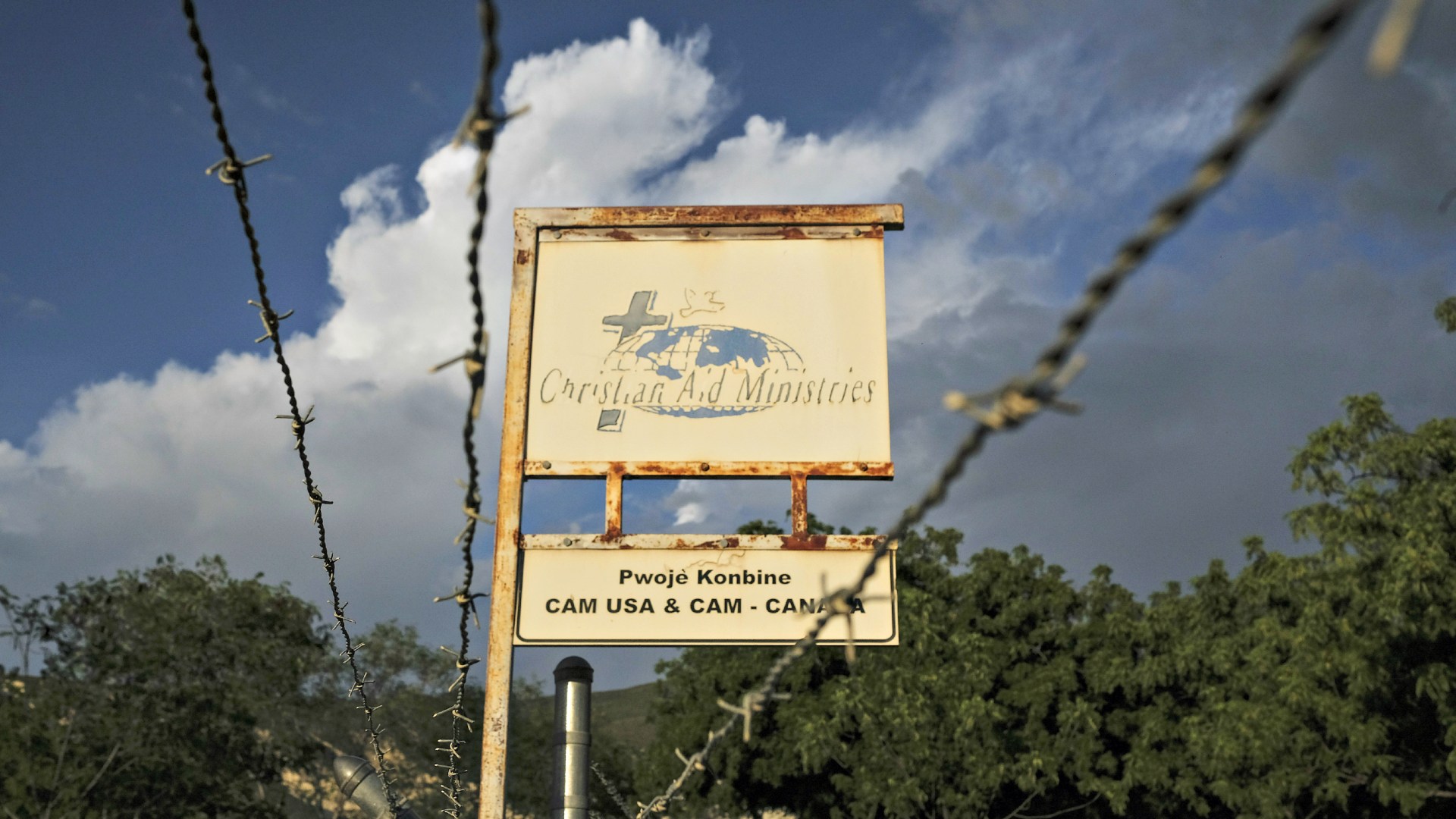
This Oct. 21, 2021, photo shows a sign outside Christian Aid Ministries in Titanyen, Haiti, which had 17 of their members kidnapped by the 400 Mawozo gang. Catholic priest Jean-Nicaisse Milien was kidnapped for 20 days along with other priests, nuns, and civilians in April by same gang.

This Oct. 21, 2021, photo shows a sign outside Christian Aid Ministries in Titanyen, Haiti, which had 17 of their members kidnapped by the 400 Mawozo gang. Catholic priest Jean-Nicaisse Milien was kidnapped for 20 days along with other priests, nuns, and civilians in April by same gang.

Christianity Today December 6, 2021
Matias Delacroix / AP Photo

Update (Dec. 16): All 17 hostages have now been released, according to Christian Aid Ministries and Haitian police.

A Christian aid group based in Ohio announced Monday that a violent gang in Haiti has released three more hostages, while another 12 remain abducted.

The statement from Christian Aid Ministries (CAM) said the people were released on Sunday in Haiti and are “safe and seem to be in good spirits.” The group provided no further details.

On November 21, CAM announced that the 400 Mawozo gang had released the first two hostages of a group of 17 kidnapped in mid-October after visiting an orphanage. There are 12 adults and five children in the group of 16 US citizens and one Canadian, including an 8-month-old.

The leader of the 400 Mawozo gang has threatened to kill the hostages unless his demands are met. Authorities have said the gang was seeking $1 million per person, although it wasn’t immediately clear that included the children in the group.

“We are thankful to God that three more hostages were released last night,” stated CAM, an Anabaptist missions organization based in Berlin, Ohio. “As with the previous release, we are not able to provide the names of the people released, the circumstances of the release, or any other details.”

The group reiterated its request—proposed by “a Haitian brother in Christ”—for supporters to devote Monday through Wednesday as days of prayer and fasting “to intercede for those who are still being held as well as those who have been released.” (Editor’s note: Throughout the ordeal, the prayers of CAM’s Anabaptist supporters have been noteworthy.)

“We recognize the power of prayer and fasting,” stated CAM. “We believe that it is Satan’s goal to destroy the work of God through strongholds of darkness. When Jesus and His disciples sought to overcome such strongholds in Matthew 17:21, Jesus said, ‘this kind does not go out except by prayer and fasting.’”

The release comes amid an ongoing spike in kidnappings in the capital of Port-au-Prince and elsewhere in Haiti, which is struggling to recover from the July 7 presidential assassination, a 7.2 magnitude deadly earthquake that struck in mid-August, and a severe fuel shortage.

On Sunday, a gang leader known as “Ti Lapli” posted a YouTube video warning people not to cross in upcoming days through the Martissant community, which has been the site of violent clashes between warring gangs.

“Insecurity has increased,” the gang leader said. “I invite the people of Martissant to stock up on food and gasoline. The next few days will be difficult … We will not remain with our arms crossed in face of those who try to destroy us.”

CAM had urged a day of prayer and fasting for Haiti on December 1.

“As we work through the kidnapping of our workers, we are aware that numerous kidnappings—mostly of Haitian people—continue to take place in Haiti,” the group stated. “[M]illions of Haitians face huge challenges, encounter danger, and struggle to provide for themselves. Pray for our Haitian friends.”

Haitian Christian leaders have told CT they are eager for the missionaries’ release yet fear what gangs will do next.

Smith reported from Pittsburgh. Additional reporting by CT.

Books
Review

The Prolific Deceivers at the Heart of ‘Roe v. Wade’

A journalist pieces together the messy lives of Norma McCorvey, her family, and other central figures from the case.

Christianity Today December 6, 2021
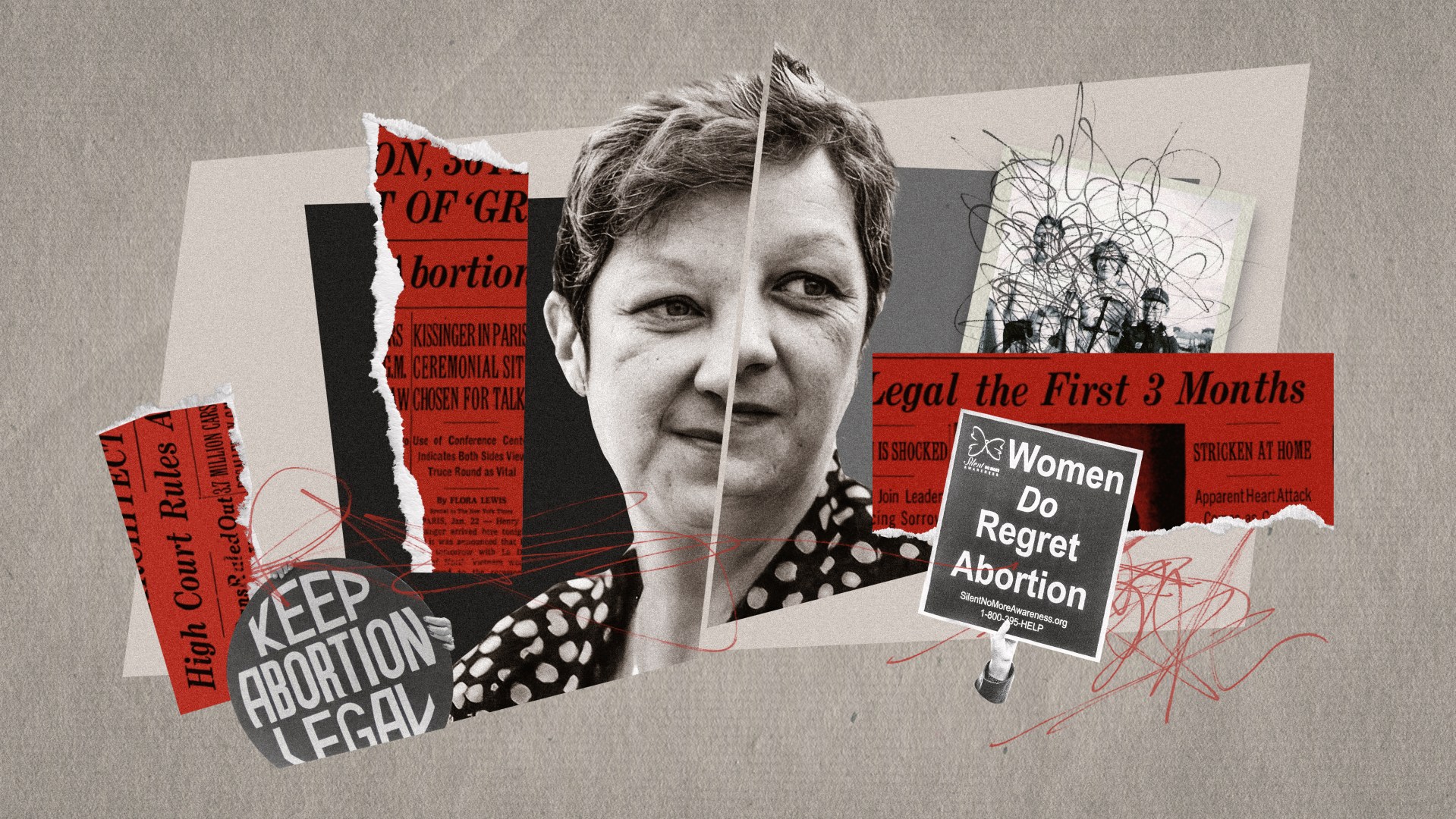
Illustration by Rick Szuecs / Source Images: Wikimedia Commons / Thomas Hawk / Flickr

The life of “Jane Roe” of Roe v. Wade was not what it seemed.

The Family Roe: An American Story

The Family Roe: An American Story

W. W. Norton & Company

672 pages

When Norma McCorvey, using the alias “Jane Roe,” sued Dallas district attorney Henry Wade for the right to an abortion that Texas law prohibited, she won plaudits from pro-choice feminists throughout the nation. Years later, in the late 1980s, McCorvey abandoned the anonymity of her alias and became a public advocate of abortion rights and a sought-out speaker on the pro-choice lecture circuit.

But in 1995, McCorvey took an action that made her a hero to a very different group of people: pro-life Christians. She renounced most of her earlier support for abortion rights and converted to evangelical Christianity. A photo that was widely reprinted in many evangelical publications showed an ecstatic Flip Benham—the director of Operation Rescue and the pastor of a Free Methodist church—baptizing a beaming McCorvey. Three years later, McCorvey converted to Catholicism, an action that may have linked her even more strongly to the pro-life cause. Yet in the last two years of her life, McCorvey distanced herself from organized religion, said that she supported abortion rights in at least the first trimester, and told a documentary filmmaker that her work for the pro-life movement had merely been an act.

So, which version of McCorvey was the real one? What does her complicated story tell us about the 50-year political battle over abortion rights in America? And what does it tell us about the Christians who have been caught up in that struggle?

Joshua Prager’s The Family Roe: An American Story is a masterpiece of journalistic research that uncovers the story not only of McCorvey but also her entire family, as well as a number of other Texans whose lives were caught up in Roe v. Wade.

(Full disclosure: Because I am a historian who has written about the pro-life movement, Prager reached out to me for help in locating a few archival sources, and at his invitation I offered comments on a few chapters before publication, but the research, interpretation, and story line are entirely his own).

A tragic story

If McCorvey always remained somewhat of a shadowy figure—with neither pro-choice nor pro-life activists knowing for sure what she really believed—her extended family is even more obscure. Yet Prager, an award-winning journalist and best-selling author, spent more than a decade tracking down every member of the “Roe” family he could find, including McCorvey’s three children, her mother and half-sister, and some of her long-term partners. In the process, he uncovered a tragic story of poverty, deceit, exploitation, and copious amounts of illicit sex and drugs.

McCorvey was an alcoholic, a chronic drug abuser, and a lesbian, but she was also a mother. Despite her landmark lawsuit, she had never had an abortion, even though she had wanted one. Two years before the Supreme Court ruled on her case, the child that she wanted to abort was instead given up for adoption—which meant (Prager knew) that the child could be located. Prager did locate her, along with her two older sisters, each of whom had been fathered by a different man and adopted by a different family. In addition, Prager interviewed many of McCorvey’s associates, including the lawyers who represented her in Roe v. Wade, along with numerous others associated with the legal battle over abortion in the 1970s.

McCorvey, he found, had grown up in a broken home, with an abusive alcoholic mother. For a short time, when McCorvey was in elementary school, her father tried to reform the family through religion: They were strict Jehovah’s Witnesses for a few years. But eventually, the family left religion, the father left the family, and the mother went back to drinking. McCorvey, in turn, came of age with a determination to try her parents’ vices, her father’s cigarettes and her mother’s alcohol. That, in turn, led to harder drugs—first marijuana and then cocaine and barbiturates. She began sleeping promiscuously with men but found relationships with women much more satisfying. McCorvey had many such same-sex relationships, and in between, she occasionally had trysts with men, some of whom she met in the bars where she worked or drank. Three of those relationships produced children.

The first child, Melissa, was raised partly by McCorvey’s mother and partly by an aunt. Her family was so dysfunctional—with so few sober drivers among her relatives—that the state of Texas gave her a “hardship license” in her early teens so that she could legally drive and take care of her family. The experience gave Melissa a determination not to drink or be like her relatives. What she longed for more than anything else was a stable home. Despite—or perhaps because of—her family’s drug abuse and promiscuity, she was drawn to the moral rectitude and assurance of a Southern Baptist church.

“Everything Norma stood for,” she said, “I didn’t want to be.” She did lapse in her standards a little, sleeping with three different men during her late teens, but then she got married and found joy in raising a child. And despite the abuse she had received from her mother, she was the only one of her sisters to care for McCorvey during her later years and to remain at her bedside when she passed away at the age of 69. Yet Melissa’s dream marriage ended in abuse and divorce, and at the end of the book, she is found postponing a hoped-for second marriage after her fiancé shocked her by downing four beers at a barbecue, an action that reactivated her deeply rooted fear of alcoholism.

The second daughter, Jennifer, was adopted at birth by an unrelated family and never knew about Norma McCorvey until she was an adult. Yet she developed an uncanny (and tragic) resemblance to her mother: She discovered in her teens that she was gay and loved alcohol. Like her biological mother, her own adult life became a life of heavy drinking and lesbian flings, mixed with unhappy relationships with men and two failed marriages. When she finally learned that both her mother and her biological father were bisexual, it all made sense, she thought; no wonder she was attracted to women. Today she is recovering from years of alcohol and drug abuse.

Shelley, the youngest, was adopted by a Lutheran family in the Northwest that started out looking like a picture-perfect Christian home but was eventually torn apart by her adopted father’s alcoholism and subsequent divorce. She was 19 when she learned that Norma was her mother—at which point she was aghast. She was pro-life, she said; she wanted nothing to do with a woman who had tried to abort her and was completely unapologetic about it. But over time, Shelley’s views moderated. She became pregnant out of wedlock herself, and though she ultimately decided to keep her baby, the experience made her more sympathetic to women like her mother who did want to terminate the pregnancy.

But that sympathy did not extend to McCorvey. At the end of the book, even after her mother’s death, Shelley states that she is unable to forgive her mother for first wanting to abort her and then wanting to exploit her in the tabloids after tracking her down many years later. And yet her bouts with depression and anger remind her that, despite her deep desires to transcend her biology, she is “just like Norma.”

As the book’s timeline concludes in 2020, just after the onset of the COVID-19 pandemic, all three sisters are pro-choice, and all have been divorced. None ever found the stable, long-term romantic relationship they were seeking. And Shelley, having lost her job in the pandemic, is struggling to pay her bills.

Deep secrets

Prager describes himself as pro-choice and says that he believes that a fetus is only a “potential child,” yet he recognizes the complexity of abortion choices. McCorvey, who never had an abortion, is tormented by the choice not to have one. Shelley, the daughter that McCorvey wanted to abort, spends a lifetime feeling unwanted and abandoned and struggles for decades with deep anger against the mother who wanted to end her existence before she was born. Both described themselves as both “pro-life” and “pro-choice” at different points in their lives, even though neither label fully fit. And if McCorvey and her daughter found it difficult to come to terms with abortion and Roe, so have many Americans, Prager suggests.

Throughout the book, Prager challenges readers’ presuppositions and refuses to fit the book’s messy stories into clear moral categories. Things (and people) are not always what they seem. Nearly all the people profiled in this book carry deep secrets that they refuse to reveal to others—but that Prager, as a master journalist, repeatedly succeeds in uncovering.

Take, for instance, Linda Coffee, the Texas attorney who represented McCorvey in Roe. She was both a strong abortion-rights activist and a faithful Texas Baptist who loved church and felt that she couldn’t tell her fellow parishioners that she was sexually attracted to women and didn’t believe in God. Or her fellow attorney Sarah Weddington. She was a Methodist minister’s daughter who presented herself as a devout Christian and felt that she couldn’t tell others about her own abortion in Mexico only a few years before Roe.

The Supreme Court justices who decided Roe didn’t publicize the abortions and unwanted pregnancies in their own families and close circle. Henry Wade, the Dallas district attorney whose name would forever be linked with Roe, didn’t tell people that he was actually a pro-choice liberal who only defended the Texas law out of duty, not because he believed in it. Mildred Jefferson, the president of the National Right to Life Association—for a while the nation’s most visible pro-life activist—used half-truths and outright lies to keep nearly all of her life hidden from public view. She covered up her financial mismanagement, her marriage troubles, the limits of her medical experience, the reasons for her childlessness, and her deep resentment of a world that had discriminated against her on the basis of both her race and her sex, despite her being the first African American woman to earn an MD from Harvard Medical School.

But perhaps the most prolific deceiver in the book is Norma McCorvey herself, who spent a lifetime fashioning so many falsehoods that none of her associates could quite figure out what to believe. Prager, though, thinks he has uncovered the truth: McCorvey was a woman who intensely craved attention and would make up stories about herself to win people over. She also remained a deeply selfish and bitter person who nevertheless was attracted by what she thought was Christian love from the evangelicals who sought to convert her.

She embraced the role of a pro-choice spokesperson—followed by pro-life activist—mainly to get attention and to become a hero. Inside, she was deeply conflicted about abortion. She never wanted to be a mother and she sensed that she did not have the skills. During the brief time when she cared for her oldest daughter Melissa, she locked the young girl in her car while she and her boyfriend went into her trailer to take drugs.

Yet she also longed for children. When she passed empty playgrounds, she was given to melancholy thoughts about the children who would never be born because of the case she had brought to trial. When she gave talks to pro-choice groups, she made the mistake of referring to abortion as killing. Years later, when she gave talks on the pro-life circuit, she made the mistake of saying repeatedly that abortion should be legal in the first trimester. She found interviews with both groups so unnerving that she made it a point to get drunk before each media appearance.

A useful symbol

Both pro-choice and pro-life activists exploited McCorvey. In 1970, when she came to Linda Coffee, she really wanted help in getting an abortion, which Coffee could have easily arranged by sending her to a doctor in Dallas who performed illegal abortions, or to a hospital in another state where abortion was legal. Yet Coffee did not do this, because she was more interested in winning a court case for women across the nation than in helping one woman terminate her pregnancy. McCorvey was useful to Coffee only as a symbol, not as a person.

Similarly, 25 years later, the pro-life activists who championed McCorvey’s conversion could have taken her off the media circuit in order to offer counseling and help to the woman who still lived with her lesbian lover and who often showed up drunk and confused to the events she was supposed to headline. But her symbolic value as a convert made it too risky to insinuate that her born-again experience was anything less than complete.

Prager’s story can easily be read as a near-hopeless tragedy. There’s plenty of religion in the book, but most of it seems powerless to change people’s lives. For most of the characters, religion is something they try for a while and then discard in frustration when members of their church reject them or when they decide they can’t live by its standards. Others in the book angrily reject religion as oppressive. Dallas’s leading abortion doctor grew up as a fundamentalist Baptist but then abandoned his plans for the ministry and embraced the cause of women’s rights and abortion access.

Still others, like Mildred Jefferson, found that religiously based moral rectitude could not prevent loneliness and alienation. Unlike nearly every other character in the book, Jefferson, the daughter of a Methodist minister, abstained from sex until marriage and from alcohol and tobacco for life. Yet her desire to own more things than she could afford led her into credit problems that derailed her medical career almost as soon as it began and destroyed her dream of becoming a surgeon. And her workaholic tendencies and lack of affection for her husband led him to leave her for another woman—after which Jefferson never remarried and became more bitter than ever.

Welcome the messiness

What should a Christian make of this complicated and often tawdry story? Should we conclude that sex outside of marriage is inevitable, that abortion is necessary in some circumstances, that a cycle of drugs and poverty is unlikely to be broken, and that churches are usually unable to change lives?

Obviously, this is not the message of the gospel. But Prager’s narrative should serve as a cautionary tale about the dangers of looking for easy solutions instead of engaging in the hard work of gospel-driven transformation. Sin is messy, and there are never any easy solutions to a sin problem.

Adoption—which Christians have often championed as the preferred solution to unwanted pregnancies—can be traumatic for both birth mothers and their children, as Prager’s book reminds us. It is not a cure-all for every ill. The vitriolic condemnations of homosexuality that McCorvey encountered in evangelical Christianity and the promises that a person with same-sex desires could easily overcome them were not helpful. And religiously driven moral standards without Spirit-produced heart transformation will lead, more often than not, to frustration rather than lasting change.

Prager’s book shows us the tragic results of these realities. But rather than giving an excuse for despair over the pro-life cause or evangelical Christianity in general, it should remind us not to rely too heavily on easy fixes in the campaign to save unborn lives. The lives of the people who want abortions—or who campaign against them—are more complicated than we might guess. The pro-life cause, then, should open itself to all this messiness—and the surprising people we might encounter along the way.

Daniel K. Williams is professor of history at the University of West Georgia. He is the author of Defenders of the Unborn: The Pro-Life Movement Before Roe v. Wade and The Politics of the Cross: A Christian Alternative to Partisanship.

News

Iran’s House Churches Are Not Illegal, Says Supreme Court Justice

(UPDATED) After unprecedented ruling asserts practicing Christianity at home is not a national security threat, a prosecutor drops charges against eight converts and says apostasy is not a crime under Iranian law.

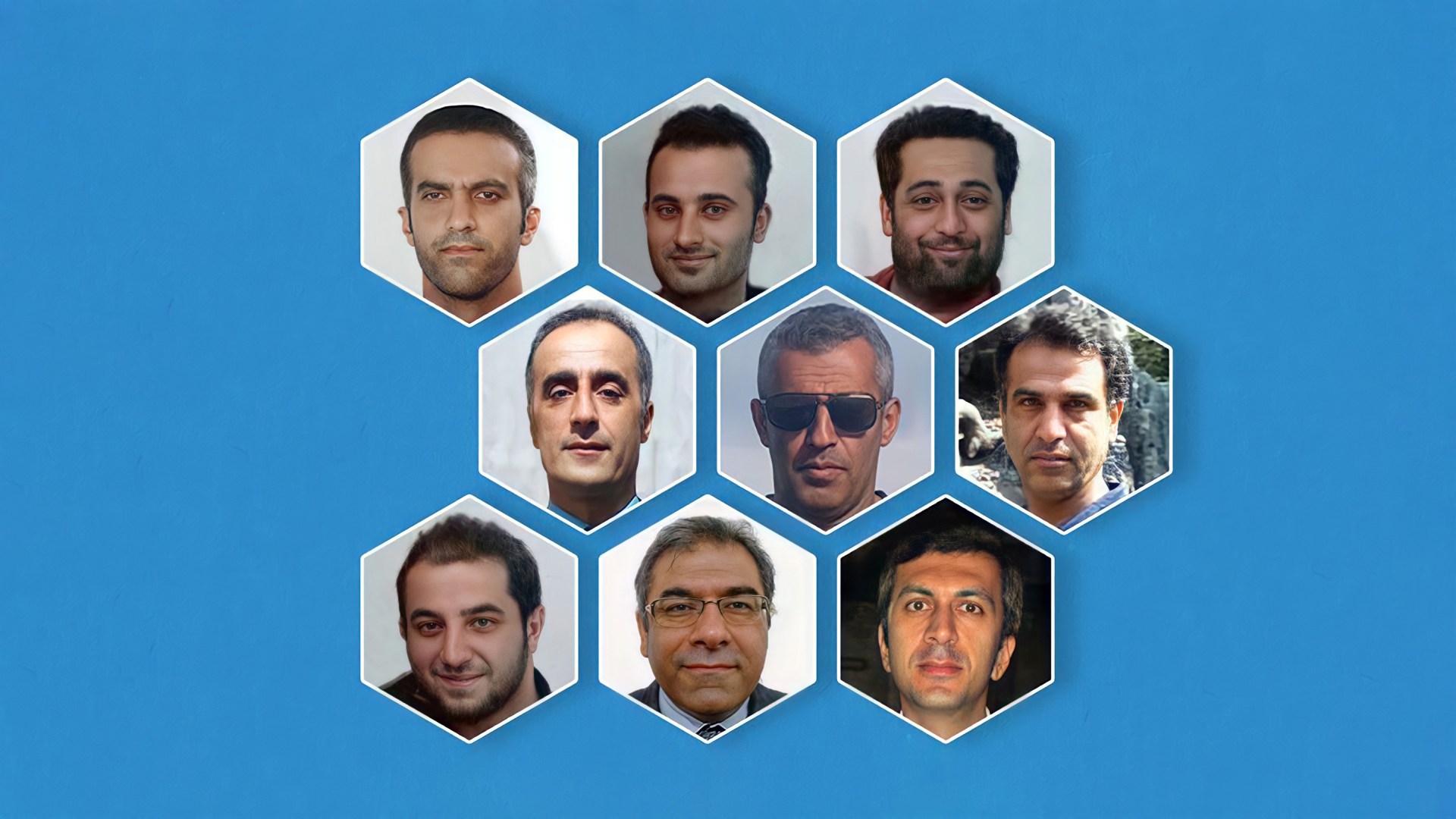
Nine Iranian Christians from Rasht facing national security charges.

Nine Iranian Christians from Rasht facing national security charges.

Christianity Today December 3, 2021
Courtesy of Article 18

Update (Mar. 1, 2022): The nine converts are officially acquitted. Branch 34 of the Tehran Court of Appeals agreed with the reasoning of the Supreme Court judge who ruled last November that the preaching of Christianity does not amount to acting against Iran’s national security.

On Monday, judges Seyed Ali Asghar Kamali and Akbar Johari accepted the converts’ lawyer’s testimony that their house church was “in accordance with the teachings of Christianity,” where they are taught to live in “obedience, submission, and support of the authorities.”

The precedent is strong, said Mansour Borji, advocacy director for Article 18, because the judges extensively outlined nine reasons in the acquittal, in line with the Iranian constitution and Islamic tradition.

But it may take time until the ruling becomes normative. One of the nine, Abdolreza Ali-Haghnejad, is already back in jail on a six-years-old separate charge of propagating Christianity, for which he was previously acquitted. And two others, Behnam Akhlaghi and Babak Hosseinzadeh, who made video appeals for freedom of worship, were charged with a separate crime of propaganda against the state.

Iranian Christians welcome the verdict, said Borji, but remain wary.

“This ruling is unlike any other of its type that I have seen,” he said. “[But] at least a dozen others … are still in prison—or enforced internal exile—following their own convictions on similar charges.”

Update (Dec. 21, 2021): While nine Iranian converts to Christianity made eligible for release by November’s Supreme Court ruling (see below) remain in prison for their faith, another case is contributing to the establishment of precedent.

A revolutionary court prosecutor in the city of Dezful, 450 miles southwest of Tehran, has declined to bring charges against eight Iranian converts to Christianity. Four were arrested in April, with four others later added to the case.

Hojjat Khalaf, Esmaeil Narimanpour, Alireza Varak-Shah, Mohammad Ali Torabi, Alireza Zadeh, Masoud Nabi, Mohammad Kayidgap, and Mohsen Zadeh were facing criminal accusations for “propaganda against the Islamic Republic of Iran.”

The judge provided a written explanation on November 30, which became public on December 21. According to Middle East Concern, the judge stated that although apostasy is a crime according to Islamic sharia, it is not an offense according to the laws of Iran.

Mansour Borji, advocacy director for Article 18, told CT the decision was unrelated to the recent Supreme Court ruling, as the Dezful case had not yet even made it to court.

“The prosecutor was simply not convinced with made-up charges by intelligence officers with no shred of evidence,” he said. “But his reasoning is very important.”

Currently at least 20 Christians are jailed in Iran because their faith was deemed a threat to the Islamic republic’s national security. Of the more than 100 Iranian believers imprisoned since 2012, all have faced similar charges.

But a recent decision by a Supreme Court justice gives hope to them all.

“Merely preaching Christianity … through family gatherings [house churches] is not a manifestation of gathering and collusion to disrupt the security of the country, whether internally or externally,” stated Seyed-Ali Eizadpanah.

“The promotion of Christianity and the formation of a house church is not criminalized in law.”

Two years ago, nine converts from the non-Trinitarian Church of Iran in Rasht, 200 miles northeast of Tehran near the Caspian Sea, were arrested in raids on their homes and church.

Sentenced to a five-year prison term in October 2019, Abdolreza Ali Haghnejad, Shahrooz Eslamdoust, Behnam Akhlaghi, Babak Hosseinzadeh, Mehdi Khatibi, Khalil Dehghanpour, Hossein Kadivar, Kamal Naamanian, and Mohammad Vafadar are now eligible for release.

Eizadpanah’s ruling, announced November 24, is “unprecedented,” according to multiple Iranian Christians and international advocates.

“The judge’s main argument is what we have been saying for years,” said Mansour Borji, advocacy director for Article 18, a UK-based organization promoting freedom of religion in Iran that tallied the cases noted above from available public records.

“But it astonished us to hear it at such a high level.”

It also cuts against the grain of international understanding. The US State Department’s latest religious freedom report on Iran described proselytization and conversion as punishable by death. Reza Esfandiari, an Iranian independent analyst also based in the UK, said execution would not be a normal punishment but efforts of local pastors to convert Muslims were “definitely illegal.”

“The ruling simply reflects that private belief is not a public or political issue,” he said, drawing attention to Article 23 of Iran’s constitution, “and that the state should not concern itself with house church worship and preaching.”

Public witness, he said, is not permitted.

Borji disputes this interpretation. Iran is signatory to the Universal Declaration of Human Rights and the International Covenant on Civil and Political Rights, both of which protect the freedom to propagate one’s faith.

“Iran cannot pick and choose between the parts of freedom of religion, saying you can exercise it only privately but not together,” he said. “Our rights are enshrined in the law, at least on paper.”

The complication comes through Article 167 of the nation’s constitution, which subjects all laws to Islamic sharia—as interpreted by a judge.

There is some diversity of opinion. Contrary to the ruling orthodoxy, now-deceased Grand Ayatollah Hussein-Ali Montazeri, once in line to be the nation’s supreme leader, said in 2005 that the charge of apostasy does not apply in the case of sincere investigation of Christianity.

Such clerical rulings have given lawyers leeway to argue the case of converts before sympathetic judges. The nine Church of Iran defendants, however, were sentenced by one nicknamed the “Judge of Death” for his harsh treatment of prisoners of conscience.

International advocates caution against attributing too much power to a single verdict. The case now returns to a different judge within the revolutionary court system, who may disregard the Supreme Court justice’s argument.

“The Iranian government has a history of not following its own rules,” said Hormoz Shariat, president of Iran Alive Ministries, which runs Shabakeh 7, a Farsi-language Christian satellite TV network. “Very likely this decision will not really help Christians.”

Specifically tasked with national security cases, the courts of the revolutionary guard often adjudicate behind closed doors. (Overall, Iran uses an inquisitorial legal system as in France versus an adversarial system as in the UK and the US, and judges play an active role in investigating cases.)

“This is unprecedented, but it remains to be seen how the revolutionary courts will evaluate,” stated Middle East Concern. “It is quite likely that a review will see the sentences reduced—but this is not enough.

“These men should be acquitted of any crime. That would be a game changer for the Christian converts in Iran.”

Iranian human rights lawyer Hossein Ahmadiniaz explained that if the Supreme Court ruling is not followed, the defendants will have the right to appeal. If their sentence is still upheld, they can refer the case back to the Supreme Court, to the same judge who issued the first decision.

Should Eizadpanah insist on his initial ruling, it becomes binding for the lower court on that case and advisory for other courts with similar cases. Should he change his opinion, the final judicial step would be to refer their case to the Supreme Court’s full body of about 50 justices. By majority, they would then issue a vote of judicial precedent—with the power of law.

In the past, the Supreme Court has ruled to compel the government to issue identification cards for the Baha’i community listing their faith. But it has also upheld the death penalty in a case of adultery, as well as against a journalist whose writings inspired antigovernment protests in 2017.

And last week, Borji said, a different judge in the Supreme Court upheld national security charges against two Christian converts.

Iran’s negotiations with the West over its nuclear program may have factored into Eizadpanah’s decision in the case of the nine Rasht believers, Borji speculated. But if so, it was likely pushed by a brave campaign launched from within Iran.

Two of the nine defendants penned an open letter to Iranian authorities.

“The government has hung a heavy yoke of persecution around [our] necks,” wrote Hosseinzadeh and Akhlaghi, joined by Saheb Fadaie, a house church pastor already serving a six-year sentence. “Day by day, this country is regressing and becoming ever more depleted of ideological diversity.”

They referenced Article 13 of the Islamic republic’s constitution, noting that the rights given to religious minorities make no mention of Armenian or Assyrian ethnicity. Officially tallied at 117,700 people in the last census, these historic Orthodox Christian communities receive three seats in Iran’s parliament and are allowed to perform their rites and ceremonies in their own languages.

The Persian believers also released video testimony.

“The churches that remain open are accessible for only certain people—those born into Christian families—and not to us [converts],” said Hosseinzadeh. “Where am I to worship after these five years?”

Akhlaghi argued similarly.

“If attending a house church is considered a crime, and [Farsi-speaking] churches are closed off,” he said, “how and where should I perform my religious rites?”

Joining them in solidarity was Mary Mohammadi, a 22-year-old in Iran who has been repeatedly jailed for her faith and was expelled from her university education.

Standing in front of a closed Seventh-day Adventist church, she joined the #place2worship hashtag campaign and its video advocacy.

“To have a formal and specific place dedicated as a church is not a privilege that a person or an institution or even the government should be able to determine, saying which group of Christians can have a church and which group cannot,” she said.

“Having a formal church building is an inalienable right.”

Esfandiari recognized a legal lacuna.

“The situation for Iranians who are ethnically Persian needs to be clarified by the law,” he told CT. “The issue now comes as to how to legally recognize Iranian Protestants and Catholics.”

Esfandiari estimates their number to be about 100,000. Some foreign Christian organizations count them as few as 10,000. Open Doors—which ranks Iran No. 8 on its World Watch List of countries where it is hardest to follow Jesus—tallies 800,000.

Rather than a legal loophole, however, Borji attributes the difficulties of converts to government policy. The Supreme Court ruling gives hope that Iran may be beginning a process of internal review. He suspects the revolutionary court will accept Eizadpanah’s decision, as Tehran attempts to clean up its image before the world.

“But this will only be a painkiller for a serious malady,” Borji said. “We shouldn’t be overly optimistic that this represents a radical change toward Christians.”

News

No Singing Christian Carols on December 25, Orders Patriarch of Jerusalem

Orthodox edict puts holiday unity in the Holy Land—where Christians in Jordan and Israel have long agreed to observe Western Christmas and Eastern Easter dates—in doubt.

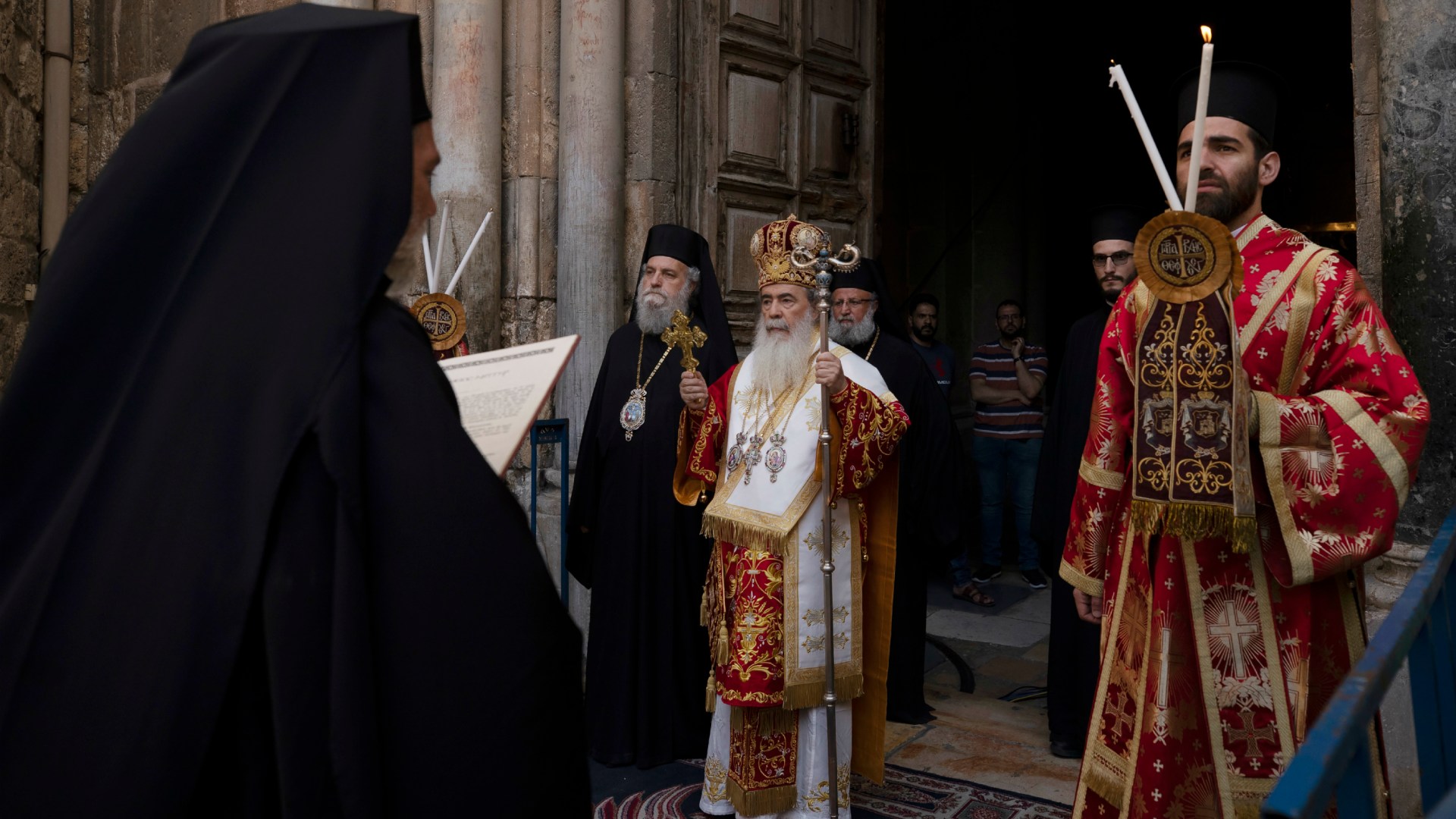
Greek Orthodox Patriarch of Jerusalem Theophilos III (center) walks in procession in the Old City of Jerusalem on April 29, 2021.

Greek Orthodox Patriarch of Jerusalem Theophilos III (center) walks in procession in the Old City of Jerusalem on April 29, 2021.

Christianity Today December 3, 2021
Maya Alleruzzo / AP Photo

AMMAN, Jordan — The Orthodox patriarch of Jerusalem, Theophilos III, whose authority extends over some 130,000 Middle Eastern Christians, has posted a memo on the patriarchate website that appears to overturn a 45-year-old agreement with Western Christian churches to unify the celebration of Christian holidays.

Since 1975, Western and Eastern Christians in Jordan, the Palestinian territories (with the exception of Jerusalem and Bethlehem), and Israel have publicly celebrated Christmas according to the Gregorian calendar, on December 25, and Easter according to the older Julian calendar, which the Eastern Orthodox Church still abides by to determine feast days.

On the Julian calendar, Christmas falls on January 7, while Easter is typically a week later than in the West.

In Muslim-majority Jordan, the 25th of December is a national holiday, while Easter is not. Muslims believe in the virgin birth of Jesus. Christmas is also celebrated publicly in majority-Palestinian cities in Israel such as Nazareth.

The patriarch’s memo, which appeared on Saturday (November 27), calls for abstaining from any Christian carols on December 25, which in the Eastern church is the feast of St. Spyridon. The memo says the liturgy for the day should observe the service of “Saints Spyridon, Bishop of Trimythus the wonderworker,” and “not the service of Christmas day of 25th December.”

The patriarch goes on to say: “During this day, after the observed service of the feast of Saint Spyridon, the members of the Greek Orthodox flock may proceed to demonstrations of a social but not ecclesiastical character.” The memo ends with the call for total observance of the memo, saying, “Expecting your conformity.”

Many Christians have responded, however, with anger and have vowed on social media not to heed the patriarch’s call. Others have said they will start a petition to oppose the memo.

Nidal Qaqish, a member of the Orthodox Central Council for Jordan and Palestine, told Religion News Service that the united holidays were agreed to by Christian leaders from all denominations and had the blessing of Jordan’s former ruler King Hussein.

“Any effort to reverse that is an attack against the will of the Christians in Jordan and that of His Majesty the King,” Qaqish said.

But Audeh Qawas, a Jordanian Christian member of the Senate who is close to the patriarch, told RNS that the patriarch’s decision is not new. The same edict is issued every year, Qawas said, and applies only to how Orthodox priests observe the holiday, not the public.

But critics have pointed out that the memo online addresses lay heads of local congregations as well as clergy. “We will wait to see it removed from the church’s website," said Qaqish.

Botrus Mansour, president of the Evangelical Council in Israel, said decisions about the Christian holidays should not be made by any one denomination. “We have gone a long way into unifying the holidays,” he said, “and now Patriarch Theophilos is bringing us backward.”

Mansour, who is also executive director of the Baptist School in Nazareth, said the Christian presence is so small that Christians need to work together to celebrate all at the time. “Unity has a special taste in the town that Jesus himself was raised and where the love of God was incarnated.”

Culture

Christianity Today’s 2021 Christmas Albums Roundup

Here are our favorite new releases by Christian artists, including The Porter’s Gate, Chris Tomlin, and more.

Christianity Today December 3, 2021

Last year at this time, my family was weighing decisions about whether to have Christmas gatherings. This year, we started celebrating earlier than usual, like we’re making up for lost holiday cheer. We have already decorated Christmas cookies and put the tree up before Thanksgiving. My Christmas 2021 playlist has been in the works since mid-October.

Perhaps, like me, you have an annual Christmas playlist that is populated almost entirely with nostalgic favorites. Mine always includes Amy Grant’s Christmas albums and a collection of wintery orchestral pieces that my mom has played on repeat every November and December for as long as I can remember. It takes a lot for a new song or album to break into my Christmas rotation.

This year, there are plenty of new Christmas releases with tracks that have already landed in my 2021 holiday playlist. Here are six fresh albums to accompany the season as you move through moments of joy, solemnity, excitement, solitude, and celebration.

Advent Songs by The Porter’s Gate

Advent Songs captures the somber hopefulness of the season in beautifully arranged originals that invite meditation and repose as we observe a period of waiting. I love festive, upbeat Christmas songs, but this year, The Porter’s Gate offers a welcome call to rest and seek quiet in the relentless holiday going and doing. Songs like “The Reign of Mercy” and “Isaiah (O Come)” reflect on the cosmic reality of the Word becoming flesh. Others, like “Mary’s Lullaby (Black Haired Boy)” and “Simeon’s Song,” are human and intimate, coaxing the listener to think about earthy, fleshly details of the Advent story.

At Christmas by Brian Courtney Wilson

Grammy-nominated gospel artist Brian Courtney Wilson’s At Christmas EP is a warm, soulful collection of four holiday standards. With vibrant orchestration and modern gospel sensibility, Wilson’s adaptations of familiar favorites like “The Christmas Song” feel fresh and festive, perfect if you’re looking for some upbeat music to add to your playlists for gatherings or maybe a winter jog (or not). The exuberant brass and soaring vocals on “This Christmas” (featuring Gene Moore) make it the kind of track that you’ll want on your playlist alongside Mariah Carey’s “All I Want for Christmas is You.”

Night Divine by Brian Fallon

Brian Fallon, formerly the lead singer of Gaslight Anthem, surprises with an understated collection of Christmas carols and traditional hymns. Fallon blends rock and folk styles, offering sparse instrumental arrangements driven by picked guitar, piano, and occasional strings. His raw, plaintive vocal style lends itself nicely to hymns like “Amazing Grace” and “Leaning on the Everlasting Arms.” The opening track, “Virgin Mary Had One Son,” is a stirring adaptation of a traditional spiritual. Fallon gives credit to performances of the song by Odetta and Joan Baez as major influences for his version of the song.

It’s an Advent album that feels personal and original. Perhaps most surprising is the final track— a quiet, meditative arrangement of the popular Elevation Worship song “The Blessing.” In the context of Advent, the song takes on new meaning, praying for and anxiously anticipating God’s coming gift for humanity.

Emmanuel: Christmas Songs of Worship by Chris Tomlin

Chris Tomlin’s live Christmas album, Emmanuel: Christmas Songs of Worship, is the fifth installment in his ongoing “Christmas Songs of Worship” project. The album features guests CeCe Winans, Matt Redman, Blessing Offor, and We the Kingdom in a series of spirited, worshipful tracks. As one would expect from one of Tomlin’s albums, there are singable originals and rearrangements that will almost certainly show up in Advent and Christmas Eve services this year. (Winans’s flawless rendition of “O Holy Night” is enough to get this album on my Christmas rotation for the year.)

Tomlin’s rewritten Easter hymn, “Crown Him with Many Crowns” features new lyrics set to the familiar tune and a simple original refrain. The new lyrics reorient the popular hymn and turn it into a reflection that begins with Christ’s birth:

Crown Him with many crowns / The King who left His throne / Creator of the universe / Born to the world He holds / And with that first drawn breath / The Word has become flesh / Emmanuel has come to us / O crown Him, all the earth.

In the Bleak Midwinter: Christmas Carols at King’s by the Choir of King’s College, Cambridge

If you aren’t usually someone who listens to choral music, let the Christmas season be the one time of year that you do. This latest Christmas release from the Choir of King’s College offers over an hour of rich arrangements of sacred music and carols, some familiar and some less so. “Of the Father’s Heart Begotten,” a setting of ancient poetry over a medieval plainchant melody, describes the miracle of the incarnation in weighty, reverent language:

Of the Father’s heart begotten / Ere the world from chaos rose / He is Alpha, from that Fountain / All that is and hath been flows / He is Omega, of all things / Yet to come the mystic Close / Evermore and evermore.

“Still, Still, Still” is a breathtaking, tender arrangement of the traditional Christmas lullaby. Of course, there are also congregational favorites like “O Come All Ye Faithful,” “Angels from the Realms of Glory,” and “Hark, the Herald Angels sing”—each piece shimmering and resonant.

Brett Young and Friends Sing the Christmas Classics by Brett Young

I have a feeling that Brett Young had fun putting together this light-hearted collection of Christmas tunes. Featuring an eclectic array of guest vocalists, including Colbie Caillat, Darius Rucker, Chris Tomlin, and Phil Wickham, it’s a pop-country compilation of holiday music that leans into camp in all the right ways (what could be more Christmas-campy than a rendition of “The Chipmunk Song”?).

Enjoy some laid-back, lounge-y renditions of “The Christmas Song” and “Have Yourself a Merry Little Christmas.” And don’t miss “Rockin’ Around the Christmas Tree” as an easygoing country duet with Darius Rucker.

Listen to our playlist below to get in the Christmas spirit with CT’s holiday mix.

https://open.spotify.com/embed/playlist/3Al3UxotyPiHFogWHZmQ3s?si=9701f83fe9974f48

Kelsey Kramer McGinnis is a musicologist, educator, and writer. She holds a PhD from the University of Iowa and researches music in Christian communities and music as propaganda.

Ideas

Side B Christians like Me Are an Asset Not a Threat

Same-sex-attracted believers pay the cost of discipleship every day. Our witness needs to be heard.

Christianity Today December 3, 2021
Illustration by Rick Szuecs / Source Images: Jgroup / Getty / Cottopnbro / Pexel

After a recent conference, a gay friend reached out to me with a heartbroken message: “I thought the yoke of Jesus was supposed to be light.” Some leaders responding to the event, he said, were “making it sound like faithfulness to Jesus either means Jesus changing something that he hasn’t changed yet” or “God really [wanting] me to lie to people and just say that I’m not gay anymore.” He felt like crying, he said.

My friend’s story is just one example of the sometimes-tense relationship between the evangelical church and the LGBT community. He and I and others involved in the Revoice community are part of a growing minority of Christians who desire to be honest about both our experiences of attraction and also our steadfast commitment to live in obedience to the sexual ethic presented in the Bible as God’s design for all people, regardless of attractions or orientations.

The conversation about gay identity is not new, but it has become much more acerbic of late. Following the Nashville Statement a few years ago, an increasing number of denominations have released their own declarations concerning marriage and sexuality.

The Presbyterian Church in America and the Anglican Church in North America have both published committee reports or position papers concerning the use of identification language among sexual minorities who are church members. Meanwhile the United Methodist Church is looking to disunify at their next gathering over affirmation of gay unions by some congregations.

All of this is quite personal to me. Friends to the theological left and right of me have attempted to interact with and understand me as a same-sex-attracted Christian. The public square has been less generous. In the years since I first shared my story, public interaction has become more polarized and absolute in its condemnation of Side B Christians like me and others.

From conservative commenters, we hear that any acknowledgment of same-sex attraction is sinful, and progressive writers accuse us of repressing our sexuality and causing suicidality among LGBT teens. Most of the denominational statements mentioned above conclude that using terms such as “gay Christian” range from “unwise” to “sinful” and claim that using these descriptors makes our sexuality of primary importance in our lives.

However, Side B Christians are not a threat but an asset to orthodox churches.

First, sexual minorities who stay in conservative communities do not want those spaces to become affirming. Quite the opposite, in fact. In the face of isolation or outright rejection, we remain in conservative churches because of our commitment to the faithfulness of Scripture. We are convicted that Jesus is better than sexual fulfillment, and many of us have committed to lifetime celibacy because of our belief in the traditional sexual ethic.

As Greg Johnson writes in Still Time to Care: What We Can Learn from the Church’s Failed Attempt to Cure Homosexuality, “Certainly, my faith has cost me more than a tithe, but God ’s people have not let me be alone. My narrative was that Jesus captured my heart. He is worth everything.” This is the testimony of gay Christians who remain in churches with a biblical view of sexual ethics. We have weighed the cost of following Jesus with our minds, hearts, and bodies and have found him to be worth the cost.

Second, we stay in the church based on principle, not for abstract political gains in a mostly abstract language war. Again, it’s hard to be a gay Christian in a theologically conservative church. Both in the body of Christ and in the culture at large, celibacy is a difficult commitment to maintain, especially long term. With it comes a loss of dreams and expectations, especially for those of us who were raised in evangelical churches.

At the height of the purity culture movement, I was a high school student terrified by my attractions and wondering when God was going to give me a miraculous healing followed by a husband and kids. Same-sex attraction was condemned as something that separated me from God, no matter how much I loved Jesus.

Instead of finding support for a probable lifetime as a single Christian, I consistently faced people who were well intentioned but determined to just find me a husband. Yet I stayed, despite loneliness, misunderstanding, and conversational homophobia. I stuck it out because of my deep conviction that my life as a celibate gay Christian was just as much a walking picture of the gospel as any of the marriages I encountered at church. Even today, I experience these same tensions in the church. What has changed, though, are my expectations for how God meets my human need for support and relational intimacy. Instead of longing for marriage, I embrace the deeply connected friends in my life and intentionally cultivate those relationships for a lifetime of love and support.

Finally, our presence is a witness to those both inside and outside the church. A friend once told me that she couldn’t imagine anyone better equipped to talk to Christian teens about living the traditional sexual ethic than a gay Christian committed to celibacy or a mixed-orientation marriage.

She argued that, in a world motivated by the twin mantras of “follow your heart” and “live your truth,” who better to demonstrate a countercultural lifestyle than those who could easily find love and acceptance in both progressive churches and secular culture at large, yet choose to remain faithful to God’s design?

By way of example, a friend of mine recently relayed a comment he received from a teen at his church. The student thanked him for talking to the youth group about his sexuality and commitment to celibacy. “You’re the first person I’ve met in church who is really giving something up for Jesus,” he said.

Statements like this are why we celibate gay Christians declare our sexuality so often and so publicly. We want future followers of Jesus to know that flourishing as a gay Christian is not only possible but life-giving. We want to model what it means to embrace the idea of chosen family and belonging that isn’t inherently connected to sexual relationships. Why? Because the Bible tells us this sort of intimacy and connection is what we’ll all experience in eternity (Matt. 22:30; Mark 12:25).

If we want the next generation to believe that sex and marriage are not the ultimate sources of Christian community, the church would do well to ensure we are not rejecting those whose very existence demonstrates that fact.

Correction: This piece previously included a link and reference to a document that did not in fact represent the views of the Church of the Nazarene denomination. That link has been removed.

Bekah Mason is a mother of two, the executive director of Revoice, and a founding member of the Pelican Project. Speaking Out is Christianity Today’s guest opinion column and (unlike an editorial) does not necessarily represent the opinion of the publication.

Theology

Look for Your Next Leader in the Background, Not the Spotlight

Yes, power corrupts some people. But maybe corruptible people seek power.

Christianity Today December 2, 2021
Greyson Joralemon / Unsplash

This piece was adapted from Russell Moore’s newsletter. Subscribe here.

A famous New Yorker cartoon depicts a flock of sheep grazing before a campaign billboard of a wolf—whose slogan is “I am going to eat you.” Under the frame, one sheep says to another, “He tells it like it is.”

I wince with recognition whenever I think of that cartoon, knowing that Jesus probably did not have blind allegiance in mind when he called his followers sheep. Still, maybe the message of the cartoon helps explain why we end up with so many terrible people in church leadership.

When evangelical Christians point out uncovered scandals or hidden abuse among church leaders, they often quote some version of this line attributed to Lord Acton: “Power tends to corrupt, and absolute power corrupts absolutely.”

But what if that perspective is wrong? A new book suggests it might be—and presents some findings that we as the church should carefully consider.

In Corruptible: Who Gets Power and How It Changes Us, political scientist Brian Klaas argues it’s not so much that power corrupts but that corruptible people seek out power.

Klaas invokes research showing how people in all kinds of leadership positions tend to express the “dark triad” of narcissism, psychopathy, and Machiavellianism. He argues that abusive people are the ones drawn to power in the first place.

So how does this manifest itself in church leadership?

Consider what many expect of pastors and other church leaders: the ability to be expert exegetes, social theorists, political practitioners, skilled CEOs, innovative entrepreneurs, as well as Christlike examples. Who looks at that list of qualifications and concludes, “Yep, I’m the person for the job”?

The answer is twofold: people with a strong sense of calling—and those with an urge for power. When the calling outweighs the thirst for power, the result can be very good. But when the will to power is stronger, the result can be terrible.

Moreover, it’s most often the abusive people who can endure what it takes to get and retain positions of power.

Using the example of rulers like Saddam Hussein and Muammar Gaddafi, Klaas observes how dangerous it is to be a dictator. Notice how many of them end up exiled, decapitated, or torn to pieces by mobs of their own people.

“So here’s the question,” Klaas says. “Who looks at that job and thinks, ‘I want to try that!’?” The answer is, he argues, narcissists and psychopaths and Machiavellian power seekers. These are the ones who think they are special enough to survive the onslaughts that will come. Or they are the ones with enough psychological distance not to care.

Klaas affirms that a certain amount of emotional distance is necessary. On the first day of medical school, his brother was required to dissect a cadaver. Trying to cope with the horror, Klaas’s brother asked the professor whether he should think of the person on the slab in front of him as “a piece of flesh or as someone’s grandpa”—to which the professor replied, “Both.”

Too much emotional proximity would render a doctor (or many other kinds of leaders) emotionally paralyzed, Klaas suggests. But too little proximity may lead to a cold technician who doesn’t see the stakes involved. A president of the United States not only must have empathy for the problems of his or her fellow citizens but must also be able to, if necessary, launch missiles that will wipe out human lives.

The men and women who can make these kinds of decisions—and endure the inevitable backlash—represent two kinds of people: those who are gifted with a unique resilience and those who just love to be in command. And these two groups are very different.

So why do awful people seem to get worse and worse the higher they go? Is power corrupting them? Not necessarily, Klaas writes. It may be that they are just getting better at what they do. Or it may be that they are gaining a wider field of possible options to do more harm.

In the book, Klaas describes Steve Raucci, a school-district maintenance worker who behaved like a power-hungry tyrant. Those who taught or studied where Raucci worked knew how he acted, but for many years, few outside the district limits were aware.

A restaurant patron who screams at the server might be seen only by a handful of people (and God). But someone who acts that way in a large church or ministry multiplies the potential number of people who may observe the behavior. In that case, what has changed is not the level of the leader’s corruption, but the number of people around to witness it and thus the stakes of the leader’s success or failure.

Apostle brothers James and John did not hold powerful positions when they approached Jesus about the seating arrangements in his kingdom, but they sure wanted to (Mark 10:35–40). Yet Jesus warned them about pursuing that kind of domineering power, saying, “Whoever wants to become great among you must be your servant, and whoever wants to be first must be slave of all” (vv. 43–44).

Klaas also explains why cults of personality or institutions of intimidation seem to get crazier over time: “If people are willing to publicly embarrass themselves by spouting obviously absurd lies about the ‘Dear Leader,’ then they’re more likely to be worthy of the regime’s trust,” he writes. “A henchman who parrots absurdities is a henchman worth investing in.”

But what happens when the leader’s absurdities become generally accepted—or at least so commonplace that people become bored with them?

Toxic leaders “keep inventing crazier and crazier myths, constantly testing people within the regime and within society to see who goes along with it and who doesn’t,” Kraas writes. “That strategy creates a ratcheting effect: if the lies don’t get more extreme, your loyalty tests become worthless.”

We’ve seen that a lot in the public square, as well as in the church.

There’s also the problem of survivorship bias, or the “caveman effect.” We often talk about prehistoric cave dwellers as the ones who drew art on the walls of caves. But maybe, Klaas points out, the people who lived in the woods or on the savannas were just as artistic. The difference in this case is that cave walls can preserve what is drawn on them, but animal hides and trees cannot.

I am often asked why there were no white pastors in the South who stood up to slavery or to Jim Crow. While the number is appallingly small, it’s not zero. It’s simply that those who went against slavery or segregation weren’t likely to survive in ministry for very long.

So what does survivorship bias have to do with the corruptibility of leadership? We should pay attention, Klaas tells us, not just to those who sign up for power but also to those who don’t want to be in power. Why do they avoid it?

Again, there are a couple possibilities. Some don’t see in themselves the gifting needed for leadership. But others simply can’t stand the thought of operating in a social Darwinian atmosphere that requires increasing levels of meanness, conflict, and outrage.

In an interview, Klaas gave the example of his mother who once served on their community’s school board. She was a civic-minded person who cared about education and children—exactly the type of person who typically ran for such positions.

However, since school-board meetings can now be as vitriolic and raucous as national political scenes, Klaas is quite sure she would not choose to run today. She would still care about children and education—but to be on the school board, she would have to be the kind of person who could endure death threats, lawsuits, or mistreatments such as being spat on when leaving a meeting. Or she would need to be the kind of person who actually likes such things.

Perhaps, he suggests, we should actively search for the people who don’t want to serve in such positions and find out why. These may be the very people we should recruit to lead. There are parallel examples throughout the evangelical Christian world—from the men and women serving in the secular civic world to those preaching the gospel or leading churches and denominations.

Maybe we should look for the people who love the Bible and the gospel and who don’t see the Sermon on the Mount as a suicide pact that will end their career or ministry.

For years, I heard a colleague in ministry tell younger people that churches and ministries are changed by “those who show up.” That is true. But maybe we need to do a better job seeking out those who don’t want to show up—and ask them why.

I’m not 100 percent persuaded by Klaas’s argument. Power does corrupt—as does the love of money or security (1 Tim. 6:10). Temptations like that can manifest themselves at any time (1 Cor. 10:12–14).

But overall, Klaas’s book helps to explain our present time of tumult and reckoning with abusive Christian leaders and institutions. In some cases, people started out with good motives and eventually lost their way. But some of them, perhaps more than we think, were already wired that way. And maybe—like sheep nodding at a wolf’s campaign billboard—we just don’t want to see or believe it.

Russell Moore leads the Public Theology Project at Christianity Today.

Theology

Singleness Lessons I Learned from the Early Church

The history of Christian celibacy is more complicated than we’d like to think.

Christianity Today December 2, 2021
Illustration by Mallory Rentsch / Source Images: WikiMedia Commons

Lately, Christians have cast their minds and social media musings back to the early church on the topics of singleness and sexuality. Much of the conversation centers on past spiritual practices of celibacy and claims about what early church leaders taught about singleness.

Some suggest that early church leaders enthusiastically ‘tore down’ the centrality of marriage within the church. Others argue that the way we understand the (so-called) “gift of singleness” today is a direct inheritance from apostles and the church’s earliest centuries.

As a history nerd, practical theologian, and never-married Christian woman, I may not agree with every supposition, but I’m delighted by the revitalized discussion about how we can see ancient ideas about singleness in a new light. After all, church history is our history, and this ancient era is ripe with fascinating insights (and quite a few conundrums) about singleness—many of which are still relevant to discussions on faith and church life today.
The lessons we can learn from the ancient church about singleness are many and mighty, but they are neither simple nor straightforward. In fact, early church leaders do not offer us a singular narrative about being single. However, when we examine the Christian history of celibacy on its own terms, the conversation yields something far more complex and interesting.

So what does it look like for us to approach this past honestly?

First, a proper historical methodology involves observing the details and nuances of the past, rather than painting it with broad brush strokes.

We must keep in mind that the early church era spanned almost 500 years and multiple continents. In that time and space, there was a great diversity of thought on being unmarried as a Christian. There was lots of agreement, but there was also strong disagreement.

For instance, consider the response to the fourth-century ex-monk Jovinian, who dared to suggest that “virgins, widows, and married women, who have been once passed through the laver of Christ … are of equal merit.” This affirmation of Christians’ shared equality in Christ, regardless of their marital status, eventually contributed to Jovinian being declared a heretic at multiple early church synods during his lifetime.

It also inspired numerous and lengthy critiques by patristic authors, like early church father Jerome (who begged “the reader not to be disturbed if he is compelled to read Jovinian’s nauseating trash”) and even Augustine (who was thankful that the church “opposed this monster very consistently and very forcefully” and who took steps to stop Jovinian from “secretly spreading poisons with all the power which the Lord gave me”).

Or consider that the unmarried Christian life in the eastern sphere of the empire was characterised quite differently to that of the western sphere. For half a millennium or so, each region developed its own independent theological rationales for and practical expressions of Christian singleness.

These are just two examples of how the early church’s understanding of what we call singleness today was genuinely complex rather than straightforward.

Second, engaging with the past depends on a firm commitment to understanding the dynamism of history.

In the recent evangelical re-popularisation of the term “celibacy,” contemporary discussions often define celibacy as a distinct, lifelong, and perhaps formalized commitment to a particular kind of singleness.

Some who make this claim consider celibacy a direct inheritance of ancient historical practice. And yet in its original context the word celibate, from the Latin term caelebs, simply meant “unmarried”—which is the functional equivalent of our term single.

What is more, before the eventual establishment of monastic communities (which is what we typically have in mind when we think of celibacy today), there was a diverse range of unmarried individuals that included itinerant teachers, lone desert dwellers, ascetic sect members, celibate priests, household virgins, widows and widowers, and more.

Not only were the earliest expressions of the unmarried Christian life much more varied, but some of them were also considered theologically problematic.

Take, for example, the Encratites—a second-century Christian sect that emphasised self-discipline through not eating meat, drinking wine, or most importantly, having sex. A cornerstone of Encratism was their rejection of marriage altogether.

The movement was popular for a time, but by the beginning of the third century, early church fathers like Ireneaus and Clement of Alexandria actively opposed the Encratites. They argued that forbidding marriage (and sex within it) was heretical. As David Hunter notes in his book Marriage, Celibacy, and Heresy in Ancient Christianity, “Christian ‘orthodoxy’ now entailed the acceptance of marriage and the repudiation of radical encratism.”

However inconvenient this may be to us as modern readers of history, there simply was no unambiguous approach to or singular practice of “celibacy” within the early church.

Third, engaging with the past requires careful navigation of historical continuity and discontinuity.

We must recognise that the present cultural context of singleness is remarkably different from that of the early church. For example, today’s Christian singles have a degree of personal autonomy in their decisions about why, who, and when to marry. Such marital independence would have been unimaginable for our ancient counterparts. To them, marriage was essentially a social construct and economic necessity—often initiated by their elders or family members, whether they liked the arrangement or not.

In fact, most unmarried Christians in the earliest centuries were not ‘never-married’ virgin adults, but rather widowed husbands and wives. In other words, long-term celibate status largely emerged out of previous marriage!

Even when more formalized practices of consecrated celibacy did begin to develop, the choice to commit oneself to such a life was seen to be a rare luxury and sometimes even self-indulgent. Such a privilege was generally available to only the most socially and financially elite who could afford to turn their back on their families’ expectations.

While we might be tempted to draw a straight line between singleness now and then, there is far more discontinuity than continuity. Of course, this does not mean the past cannot provide any potential insights for the present.

But it does suggest that many questions believers grapple with today are not the same ones our ancient Christian counterparts wrestled with. And as responsible readers of history, we must be careful not to arrogantly superimpose our present concerns onto past practices.

Finally, engaging with the past on its own terms means we must be completely honest about our motivations.

As we speak about Christian singleness today, we must be candid—with ourselves, as much as with each other—about our purpose in appealing to the past. Are we simply hoping to find convenient historical allies to bolster our pre-existing convictions?

In their book, Theology as Retrieval, authors David Buschart and Kent Eilers call this faulty instinct retrenchment. This strategy is motivated by a desire to ultimately fortify the trenches we’ve already dug and planted both our feet and our flag firmly in.

Alternatively, are we so disillusioned with the situation of singleness in the church today that we want to wipe the slate completely clean and start again from scratch? In other words, should we deposit the past wholesale into the present? This is what Buschart and Eilers would call repristination. It nostalgically sees the past through rose-tinted glasses.

What then are we supposed to do? If we should not use the past to retrench our present, nor repristinate the past into our present—then what use is history to us, especially when it comes to the thinking about singleness within the Christian life and community?

Our motivation to understand how our ancestors thought about being an unmarried Christian in relation to God and others should be what historians call ressourcement—which is the effort to study our history with a firm commitment to genuinely understand it on its own terms. That is, we should see the past as a rich resource to draw upon in order to understand, live out, and celebrate singleness in the present day.

But just as importantly, this approach signifies a commitment to actively discern church history according to another standard entirely—not one based on any human terms, but on the terms which God himself has defined through Scripture.

Historical practices of monastic celibacy may have relevance for how we might think about “doing” Christian singleness in community today. Indeed, the writings of many early church fathers elevated the value of singleness in ways that seem utterly wonderful (and foreign!) to us today.

But before we can appreciate the past as a resource for today, we must do some hard biblical work. As we consider whether to adopt certain conclusions or apply spiritual principles from the past, we must hold every perspective up to the light of God’s Word.

First, we honor the Scriptures’ teaching that the body of Christ, experienced within our local church communities, is our primary source of familial identity (1 Cor. 12:12f). Likewise, we resist any wholesale interpretation that early Christians altogether rejected the importance of marriage (because they didn’t).

Lastly, we must seek to understand how and why ancient believers thought the way they did—and whether their conclusions are supported by Scripture.

In much modern-day commentary on the “gift of singleness” (1 Cor. 7:7), there are those who will defend a single interpretation of a particular passage of Scripture as “the way it has always been.” But to be genuine in our effort to treat history as an important resource, we must ensure that it really was always or only interpreted in that way.

And when it comes to “the gift of singleness,” there often wasn’t a single standard interpretation. Even when and where there was, we still need to be convinced from the Word of God that both ancient and modern readers truly got it right.

As historians, we know that history is a valuable resource. Yet as Christians, we ultimately have only one invaluable resource. And in the end, it is only through the lens of Scripture, interpreted by God’s Spirit, that we can discern how and why the history of singleness in the church really does matter in our present context.

Danielle (Dani) Treweek is a theological author, speaker, and the founding director of Single Minded. Her doctoral research on singleness will be published with InterVarsity Press in 2022.

News

Vaccine Debates Are Responsible for 2021’s Fastest-Growing Bible Search Term: Sorcery

Does Scripture warn about Big Pharma? Endorse mask-wearing? Christians Googled for answers in 2021.

Christianity Today December 2, 2021
Michael Ciaglo / Getty Images

In this series

As the pandemic first hit in 2020, Christians sought out Scripture about fear, comfort, and healing. A year later, their Bible searching habits reflect ongoing clashes around COVID-19 responses.

The fastest-growing search term on Bible Gateway in the past year was “sorcery,” which drew 193 percent more queries than in 2020. The boost was inspired not by the recent rise in witchcraft but by arguments against the COVID-19 vaccine.

“The increase in sorceries is related to heightened interest in the Greek word pharmakeia, which, according to the Mounce Concise Greek-English Dictionary of the New Testament means ‘employment of drugs for any purpose; sorcery, magic, enchantment,’” wrote Jonathan Peterson, content manager for Bible Gateway. Analysis of Bible Gateway’s annual trends came from Stephen Smith, senior director of digital projects on the site and the Bible tech guru behind OpenBible.info.

Some Christians have brought up the term when claiming that Scripture prophetically warns against the vaccine and vaccine mandates, since it shares a root with the word pharmaceuticals.

Pharmakeia is used in Galatians 5:20, Peterson noted, where it is listed among the “acts of the flesh” that Paul advises against. In the vaccine debates, Christians are more likely to point out its use in Revelation 18:23, where it’s translated as “magic spell” in a declaration made against Babylon: “Your merchants were the world’s important people. By your magic spell all the nations were led astray.”

https://twitter.com/RyanTurnbull20/status/1438710929504493573

The pharmakeia argument tends to come up in among certain Christians with a focus on end times prophecy, often alongside suggestions that the vaccine represents the mark of the beast from Revelation.

In a USA Today article last summer, a Christian woman in the Hebrew Roots movement cited pharmakeia in Revelation 18:23 as her reason for requesting a religious exemption from the vaccination requirements at the Kentucky hospital where she works.

Danny Gokey, the Christian singer and American Idol star, called it out in a tweet this week, saying, “Revelations also emphasizes how the whole world will be deceived by Pharmakeia. Source: revelation 13:17 and 18:23.”

Before the pandemic, some charismatic leaders would reference “the spirit of pharmakeia” to warn of the spiritual dangers of drug use. Others have suggested that Paul used the term to reference and decry the method for ancient abortions, which were induced through medicinal potions.

The term has been brought into the discussion of “Big Pharma” profiting off the COVID-19 vaccination since the Revelation passage references the importance of “merchants” in Babylon.

Australian pastor Steve Cioccolanti, the author of multiple books about numerology and Donald Trump, recently tweeted, “Is it any wonder Revelation warns us about ‘pharmakeia’ drugs or sorcery? This is a drug mafia replacing Jehovah Rapha.”

This is not a mainstream biblical interpretation of Revelation’s warning against the “mark of the beast,” and it’s not how Christians who focus on the end times have traditionally understood the phrase. New Testament scholar and charismatic Christian Craig Keener shot down arguments that the COVID-19 vaccine could represent the mark of the beast, noting the medical treatment is not accompanied by demands to renounce Jesus or worship a false god.

The individual verse that saw the biggest increase in traffic in 2021 also got a major boost from pandemic debates. Leviticus 13:45-46, which references infected people covering their faces, was 626 percent more popular on the Bible Gateway site than the year before.

“Anyone with such a defiling disease must wear torn clothes, let their hair be unkempt, cover the lower part of their face and cry out, ‘Unclean! Unclean!’” it reads.As long as they have the disease they remain unclean. They must live alone; they must live outside the camp.”

This verse has been employed by Christians or people addressing Christians who want to encourage wearing masks and other public health precautions. An epidemiologist with the Federation of American Scientists shared the passage as an example of “masking and quarantining in the Bible.”

Rhoda Klein Miller, a pastor at Oakridge Adventist Church in Vancouver, reflected on how this passage represents some of the earliest documented community health measures and “God-given directives for disease prevention.”

“Though it took thousands of years for medical science to explain and confirm these practices, we shouldn’t be surprised that the Designer of these bodies knew how to best protect and care for them,” she wrote.

Smith at Bible Gateway found that the verse that saw the second-biggest bump in traffic was a line about Satan in Luke 10:18, which trended when rapper Lil Nas X released his “Satan shoes” in March. In the verse, Jesus says, “I saw Satan fall like lightning from heaven.” It was up 518 percent in the past year.

Bible Gateway saw around 3 million searches a day in 2021, while the popular YouVersion Bible app reached half a billion total installs last month. Most Scripture reading was not focused on COVID-19, with the most popular verse of the year being John 3:16 on Bible Gateway and Matthew 6:33 on YouVersion.

YouVersion announced named Matthew 6:33—“But seek first his kingdom and his righteousness, and all these things will be given to you as well”— as its verse of the year in an announcement yesterday. The passage was shared, bookmarked, and highlighted more than any other on the platform in 2021.

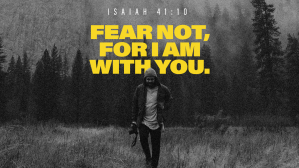
In several countries—Argentina, Ecuador, France, Guatemala, Italy, Mexico, Peru, and Spain—the most popular verse was Isaiah 41:10, which was the top verse overall last year. It reads, “So do not fear, for I am with you; do not be dismayed, for I am your God. I will strengthen you and help you; I will uphold you with my righteous right hand.”

The biggest gain in international Bible readers came from southeastern Europe, where engagement grew in Bosnia and Herzegovina, Croatia, Serbia, and Macedonia. Engagement doubled in Pakistan.

“We’re encouraged to see high levels of Bible engagement again this year because it means people are turning to God and the Bible for answers to their questions,” said YouVersion Founder Bobby Gruenewald in a press release.

addApple PodcastsDown ArrowDown ArrowDown Arrowarrow_left_altLeft ArrowLeft ArrowRight ArrowRight ArrowRight Arrowarrow_up_altUp ArrowUp ArrowAvailable at Amazoncaret-downCloseCloseellipseEmailEmailExpandExpandExternalExternalFacebookfacebook-squarefolderGiftGiftGooglegoogleGoogle KeephamburgerInstagraminstagram-squareLinkLinklinkedin-squareListenListenListenChristianity TodayCT Creative Studio Logologo_orgMegaphoneMenuMenupausePinterestPlayPlayPocketPodcastprintremoveRSSRSSSaveSavesaveSearchSearchsearchSpotifyStitcherTelegramTable of ContentsTable of Contentstwitter-squareWhatsAppXYouTubeYouTube