News

Haiti Gang Threatens to Kill Kidnapped Missionaries over Million Dollar Ransoms

Christian Aid Ministries asks for prayer as families of 16 Americans and one Canadian state, “God has given our loved ones the unique opportunity to live out our Lord’s command to love your enemies.”

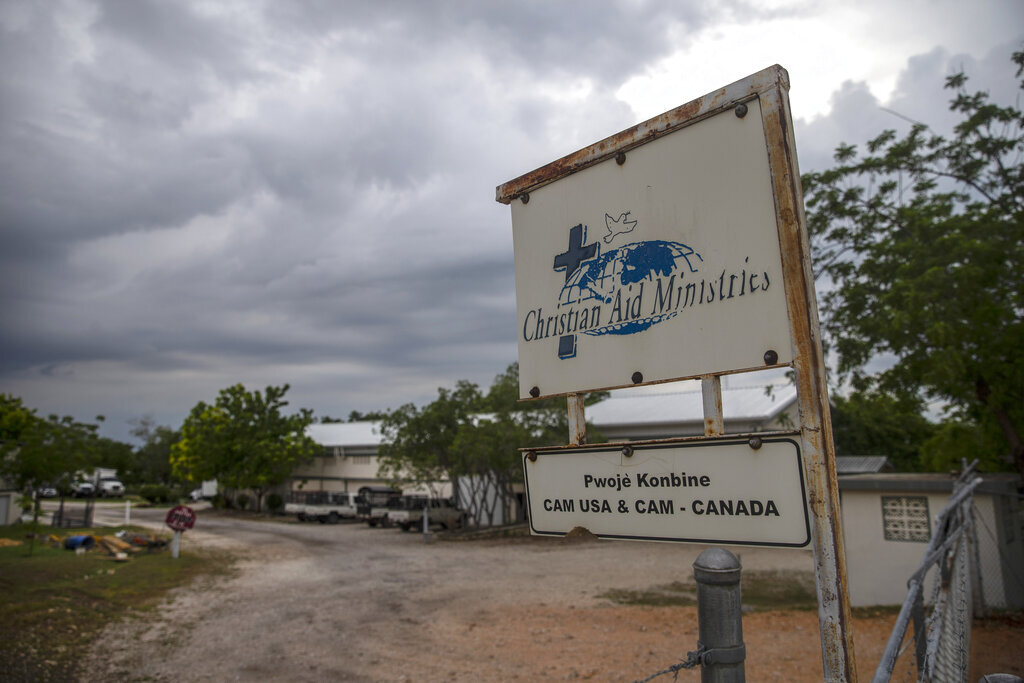
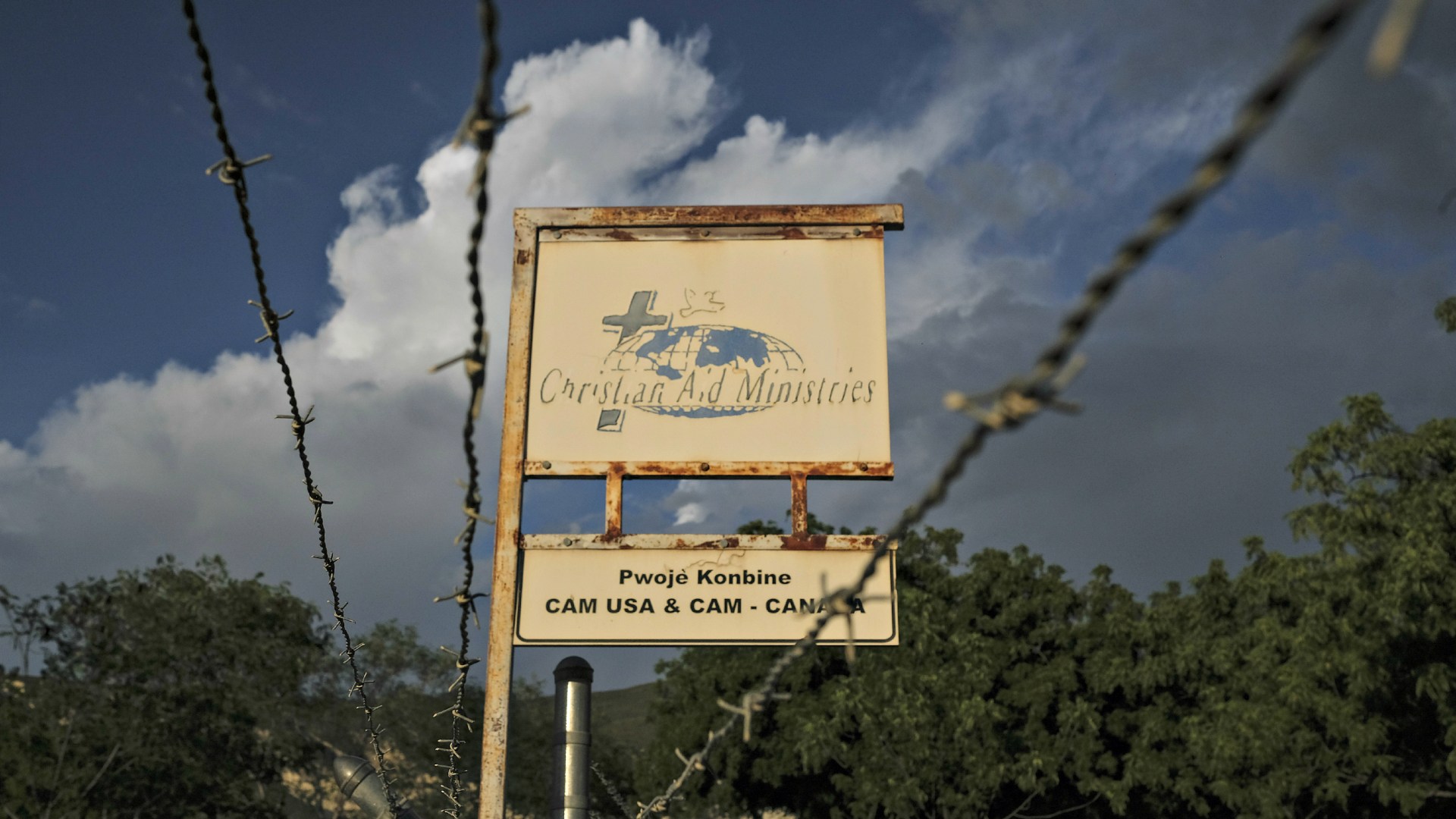
The sign outside Christian Aid Ministries in Titanyen, Haiti, on Thursday, Oct. 21, 2021.

The sign outside Christian Aid Ministries in Titanyen, Haiti, on Thursday, Oct. 21, 2021.

Christianity Today October 22, 2021
Matias Delacroix / AP Photo

PORT-AU-PRINCE, Haiti — A US religious organization whose 17 members were kidnapped in Haiti asked supporters on Friday to pray and share stories with the victims’ families of how their faith helped them through difficult times as efforts to recover them entered a sixth day.

Ohio-based Christian Aid Ministries issued the statement a day after a video was released showing the leader of the 400 Mawozo gang threatening to kill those abducted if his demands are not met. Haitian officials have said the gang is seeking a $1 million ransom per person, although they said it wasn’t clear if that includes the five children in the group, the youngest being 8 months old.

“You may wonder why our workers chose to live in a difficult and dangerous context, despite the apparent risks,” the organization said. "Before leaving for Haiti, our workers who are now being held hostage expressed a desire to faithfully serve God in Haiti."

The FBI is helping Haitian authorities recover the 16 Americans and one Canadian. A local human rights group said their Haitian driver also was kidnapped.

“Pray that their commitment to God could become even stronger during this difficult experience,” Christian Aid Ministries said.

The video posted on social media shows 400 Mawozo leader Wilson Joseph dressed in a blue suit, carrying a blue hat and wearing a large cross around his neck.

“I swear by thunder that if I don’t get what I’m asking for, I will put a bullet in the heads of these Americans,” he said in the video.

He also threatened Prime Minister Ariel Henry and Haiti’s national police chief as he spoke in front of the open coffins that apparently held several members of his gang who were recently killed.

“You guys make me cry. I cry water. But I’m going to make you guys cry blood,” he said.

An aerial view of Christian Aid Ministries headquarters in Titanyen, Haiti, on Thursday, Oct. 21, 2021.

At the White House on Friday, US press secretary Jen Psaki sidestepped questions about whether the Biden administration would look to halt deportations of Haitians to their home country or consider adding a US military presence on the ground in response to the missionaries’ kidnappings.

“We are working around the clock to bring these people home,” she said. “They are US citizens, and there has been targeting over the course of the last few years of US citizens in Haiti and other countries too … for kidnapping for ransom. That is one of the reasons that the State Department issued the warning they did in August about the risk of kidnapping for ransom.”

Psaki spoke a day after a couple hundred protestors shut down one neighborhood in Haiti’s capital to decry the country’s deepening insecurity and lack of fuel blamed on gangs, with some demanding the resignation of Prime Minister Ariel Henry.

The streets of Port-au-Prince were largely quiet and empty on Friday, although hundreds of supporters of Jimmy Cherizier, leader of “G9 Family and Allies,” a federation of nine gangs, marched through the seaside slum of Cité Soleil.

“We are not involved in kidnapping. We will never be involved in kidnapping,” Cherizier, known as Barbecue, claimed during a speech to supporters.

As they marched, the supporters sang and chanted that G9 is not involved in kidnappings. Some of them were carrying high caliber automatic weapons.

“This is the way they are running the country,” Cherizier, who is implicated in several massacres, said as he pointed to trash lining the streets with his assault weapon.

Amid the worsening insecurity, the prime minister’s office announced late Thursday that Léon Charles had resigned as head of Haiti's National Police and was replaced by Frantz Elbé. The newspaper Le Nouvelliste said Elbé was director of the police departments of the South East and Nippes and previously served as general security coordinator at the National Palace when Jocelerme Privert was provisional president.

“We would like for public peace to be restored, that we return to normal life and that we regain our way to democracy,” Henry said.
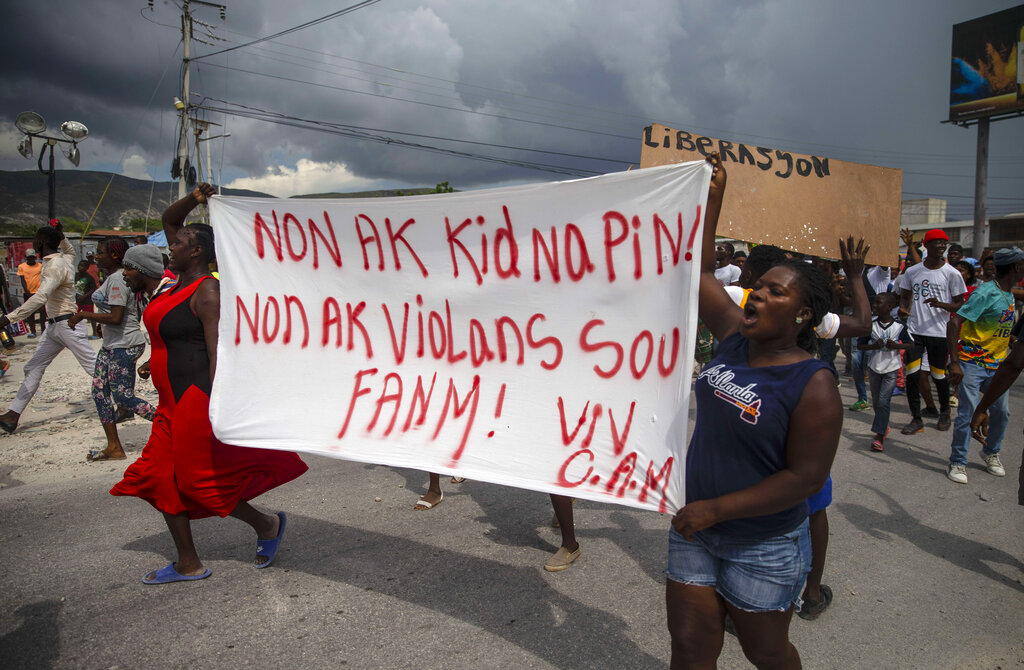
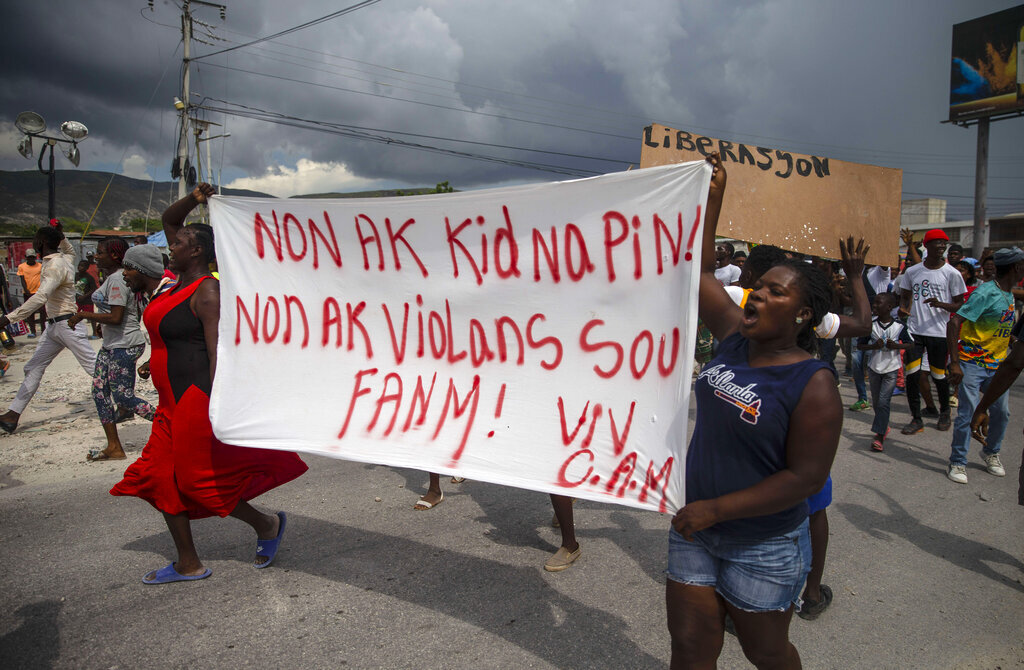
Haitians protest carrying a banner with a message that reads in Creole: "No to kidnappings, no to violence against women ! Long live Christian Aid Ministries," demanding the release of kidnapped missionaries, in Titanyen, north of Port-au-Prince, Haiti, on Tuesday, Oct. 19, 2021.
Haitians protest carrying a banner with a message that reads in Creole: “No to kidnappings, no to violence against women ! Long live Christian Aid Ministries,” demanding the release of kidnapped missionaries, in Titanyen, north of Port-au-Prince, Haiti, on Tuesday, Oct. 19, 2021.

Weston Showalter, spokesman for the religious group, has said the families of those kidnapped are from Amish, Mennonite, and other conservative Anabaptist communities in Ohio, Michigan, Wisconsin, Tennessee, Pennsylvania, Oregon, and Ontario, Canada. He read a letter from the families, who weren’t identified by name, in which they said, “God has given our loved ones the unique opportunity to live out our Lord’s command to love your enemies.”

The group invited people to join them in prayer for the kidnappers as well as those kidnapped and expressed gratitude for help from “people that are knowledgeable and experienced in dealing with” such situations.

“Pray for these families,” Showalter said. “They are in a difficult spot.”

The organization later issued a statement saying it would not comment on the video “until those directly involved in obtaining the release of the hostages have determined that comments will not jeopardize the safety and well-being of our staff and family members.”

The gang leader’s death threat added to the already intense concern in and around Holmes County, Ohio, where Christian Aid Ministries is based and which has one of the nation’s largest concentrations of Amish, conservative Mennonite, and related groups. Many members of those groups have supported the organization through donations or by volunteering at its warehouse.

“These kinds of things erase some of the boundaries that exist within our circles,” said Marcus Yoder, executive director of the Amish and Mennonite Heritage Center in Millersburg.

“Many people in the community feel helpless, but they also realize the power of prayer and the power of our historic theology,” he said, including the Anabaptist belief in nonresistance to violence.

The same day that the missionaries were kidnapped, a gang also abducted a Haiti university professor, according to a statement that Haiti’s ombudsman-like Office of Citizen Protection issued on Tuesday. It also noted that a Haitian pastor abducted earlier this month has not been released despite a ransom being paid.

“The criminals … operate with complete impunity, attacking all members of society,” the organization said.

UNICEF said Thursday that 71 women and 30 children have been kidnapped so far this year — surpassing the 59 women and 37 children abducted in all of last year. “They represent one third of the 455 kidnappings reported this year,” the agency said.

“Nowhere is safe for children in Haiti anymore,” Jean Gough, UNICEF regional director for Latin America and the Caribbean, said in a statement. “Whether on their way to school, at home or even at church, girls and boys are at risk of being kidnapped anywhere, at any time of the day or night.”

Kidnappers in Haiti usually demand “an exorbitant sum of money” as ransom and “quote unreasonably high amounts, knowing that the family of the hostage will negotiate down,” Dieumeme Noelliste, professor of theological ethics at Denver Seminary, told CT, citing local sources. “Ransoms are normally paid.”

He said while hostages have lost their lives in past kidnappings, in recent incidents gangs “seem to elect not to harm their victims, preferring to wait until a settlement is reached with the hostage’s family and friends.”

Noelliste, who recently advised CT on how Haitian Christians were impacted by the recent earthquake and assassination, has not heard of a “slowdown in missionary activity and presence in Haiti” following the dual crises. Meanwhile, he said, “Haiti has been reeling under this gang violence and the kidnapping problem for months now.

“They have posed violent acts and mayhem even to churches all over the Port-au-Prince metropolitan area. Just a couple of weeks ago, they attacked the iconic first Baptist Church of Port-au-Prince which is located a stone’s throw from the presidential palace, killing one of its deacons and taking his wife hostage,” he told CT. “I serve on the board of one of the leading seminaries in Haiti. The gangs have forced the school to flee its 70-year-old campus. They have been occupying it for months.

“But none of this made the news here [in the US]. This week’s attack makes the news because it is perpetrated against US citizens,” he said. “My hope is that this incident will result in the tackling of a problem that has caused so much suffering to the already stressed Haitian people.”

“The kidnapping of 17 Christian volunteers is a high-profile story,” Edner Jeanty, executive director of the Barnabas Christian Leadership Center, told CT. “It is unfortunate that it is also presented as the kidnapping of American citizens, as if American Christian lives mattered more than lives of Haitian Christians or the life of any human being created in the image of God.”

Noelliste also noted the lack of a “prophetic voice” in Haiti.

“The church, by and large, thought that as long as it had the ‘freedom’ to preach a truncated gospel, it could remain quiet from the political domain,” he told CT. “Yes, it did a lot of work in social services, and this did much good. But the so-called apolitical stance allowed injustice and corruption to permeate the structures, the institutions, and the social systems of the country unchecked.

“Now not even what the church thought it had under wrap—the freedom to operate unrestrained in the spiritual domain—is guaranteed. Christians are afraid to go to church because they fear for their lives.”

Associated Press writers Dánica Coto in San Juan, Puerto Rico, Aamer Madhani in Washington, D.C., Kantele Franko in Columbus, Ohio, and Peter Smith in Pittsburgh contributed to this report.

Additional reporting by Morgan Lee for CT.

News

Died: Ralph Carmichael, Composer Who Fought for Freedom of Christian Music

Founder of Light Records arranged for Nat King Cole, Duke Ellington, and Elvis Presley; scored “The Blob”; developed folk musicals; discovered Andraé Crouch; and believed any style could glorify God.

Christianity Today October 22, 2021

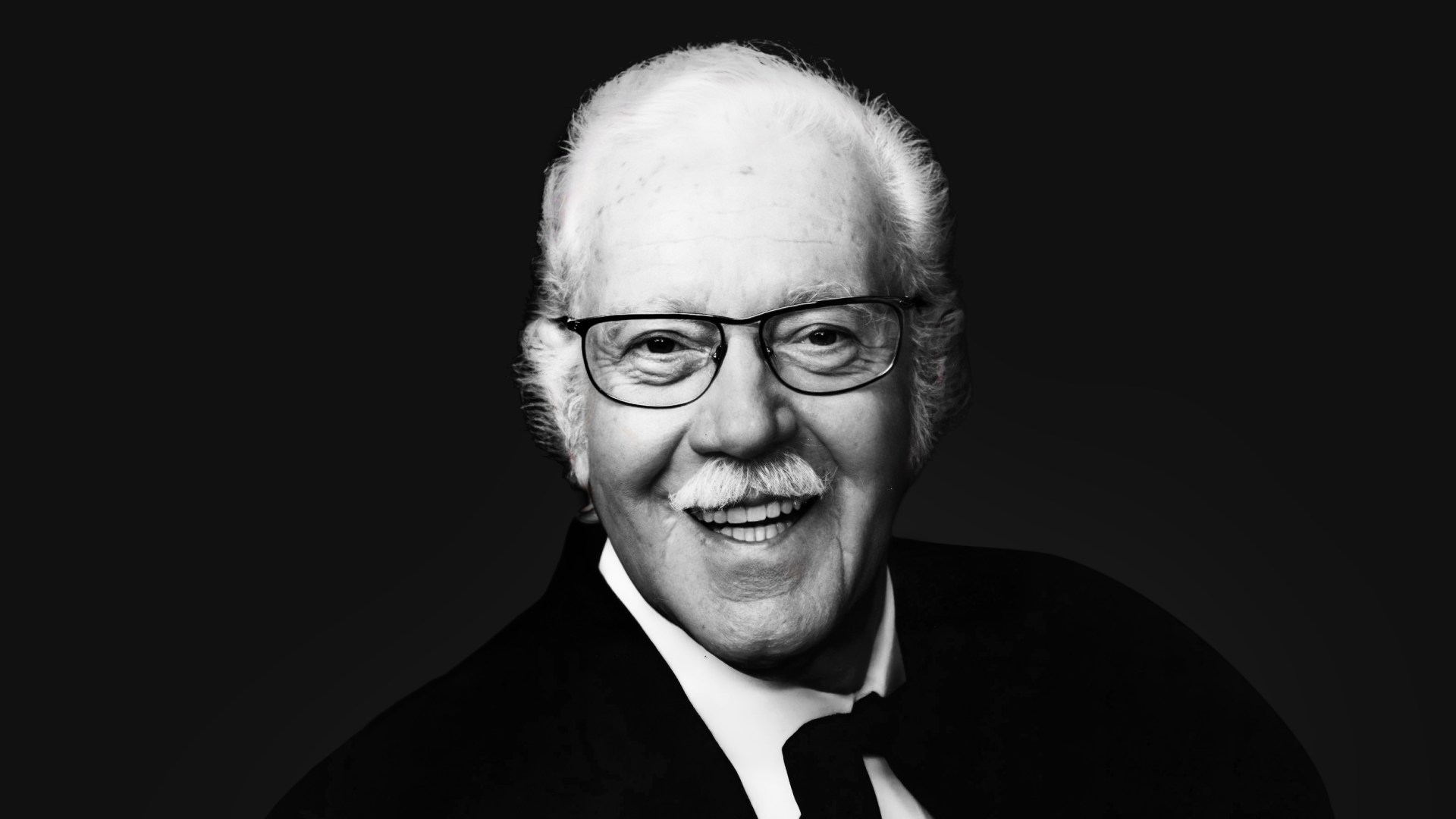
Ralph Carmichael, a composer and record producer who shaped the sound of contemporary Christian music, died on October 18 at age 94.

A violin prodigy with perfect pitch and a love for jazz chords, Carmichael built his reputation in Los Angeles TV and film studios before turning to Christian music and throwing open the doors for a new generation to use any and every style to sing about Jesus.

When he recorded his best-known song, “He’s Everything to Me,” featured on the Billy Graham World Wide Pictures production The Restless Ones, he brought two guitars, an electric bass, and drums into the studio and kicked off a firestorm of controversy. He featured the new sound in several popular youth musicals and later established Light Records as a label for rising contemporary Christian artists.

“What I have been doing most of my adult life,” he told the Christian Herald in 1986,is waging stubborn battle for the freedom and liberty to experiment with different kinds of music for the glory of God.”

When tributes poured in near the end of his life, many called Carmichael the “father of contemporary Christian music,” a title he sometimes shared with Christian rocker Larry Norman, despite their obvious differences in style.

Carmichael, for his part, didn’t buy into honorific titles or strictly defined music genres.

“I want neither credit nor blame for creating today’s musical forms,” he once told CT. “I ask only for guidance to know how to use them in good taste to reach ‘now’ people with a message that never changes.”

His “now” music would borrow from any style: pop, jazz, country, rock—all packaged with slick arrangements that sounded good on radio and television. Despite these commercial roots, his music became popular in evangelical worship services and influenced a rising generation of Christian music artists.

“I remember growing up going to my church in Kenova, West Virginia, and singing the music of Ralph Carmichael,” Michael W. Smith told CT this week. “I sang in the New Generation Choir every Sunday night—and I just had not heard anything like it. … He brought a fresh new sound to the 1970s that literally changed my life.”

Playing the ‘wrong’ notes

Carmichael was born in Quincy, Illinois, on May 27, 1927. His father, an ordained Assemblies of God minister, noted Ralph’s precocious affinity for music and started him on violin lessons at age three.

When his father took a church in San Jose, California, Ralph joined the local orchestra while still in high school. Insatiably curious about music theory, he often listened to radio orchestras while sitting at the piano, picking out the notes they played. Immediately he noticed a different sound than conventional hymnal harmony—chords with flatted fifths and ninths, jazz progressions that he taught himself to play.

At 17, he enrolled at Southern California Bible College (now Vanguard University), intending to become a preacher like his father and grandfather. Within a few weeks he was organizing music groups to minister at local churches, a passion that soon overshadowed his studies.

Classmates noticed his keen ear—he could write entire scores while sitting in the corner, away from the piano. The music faculty tried to correct his “wrong” notes, but Carmichael persisted, and his 17-piece stage band began playing on a local television station. The resulting show, The Campus Christian Hour, became a regional favorite.

After hearing Evangeline (Vangie) Otto sing on the radio in 1948, Carmichael tracked her down and they started dating. Soon they married, and for a time their musical relationship seemed ideal. A daughter, Carol Celeste, was born in 1949, but Carmichael’s professional obligations seemed to leave little time for his family.

The television show earned an Emmy in 1951, and suddenly Carmichael was very busy. Two Christian record labels were starting in the Los Angeles area—Sacred Records and Alma Records—and both needed music arrangements.

Carmichael also joined the staff of Temple Baptist in Los Angeles. Despite his Pentecostal roots, he was ordained a Baptist minister.

“In those days,” he later said, “I would work for anybody who could afford me, regardless of their denominational affiliation, so long as they named the name of Christ.”

Studio success

As the church grew, Carmichael created increasingly sophisticated musical programs that required the skills of professional musicians. He began hiring studio players for the church’s special events. Soon he was using the same players for his recording sessions with Christian artists.

Always thinking big, Carmichael persuaded the owner of Sacred Records to record a project with full orchestra. He recruited the studio players, paying them union scale, and rented Studio A at Capitol Records. Carmichael chose 12 hymns and wrote arrangements to sound exactly like the popular “dinner music” of the era. When Rhapsody in Sacred Music was released in 1958, it signaled a milestone in the fledgling industry.

Carmichael had discovered his secret sauce—the top-notch Los Angeles studio musicians who could play anything he imagined, with a level of perfection unattainable by the average church group. For the rest of his career, he enjoyed a unique relationship with these first-call players, and many played on his projects for decades.

His new album was discovered by a producer for Nat King Cole, who was planning a new Christmas album. They got along famously—Cole was also a preacher’s kid—and Carmichael ended up touring with him and arranging his studio albums.

For the next 40 years, whenever Hollywood needed a hymn arrangement or a Christmas album, they called Carmichael, the affable minister with the golden ears.

The celebrity musicians included Peggy Lee, Stan Kenton, Bing Crosby, Count Basie, Duke Ellington, Earl (Fatha) Hines, Eddie Fisher, Tex Ritter, Elvis Presley, and dozens more. He spent a year as music director for I Love Lucy, arranged music for several variety shows, and wrote film scores for Finians Rainbow (Fred Astaire) and The Blob (Steve McQueen).

Divorce

Despite his newfound success in the music world, his nonstop schedule took a toll on family life. Carmichael admitted to “indiscretions” and a growing addiction to Dexamyl, which kept him amped up for late-night scoring sessions.

After a year of separation from Vangie, the couple divorced in 1964. Carmichael hoped it would remain quiet, but the family split was reported by the Los Angeles Times: “The Song Is Ended for the Carmichaels.”

He threw himself even more fully into the music, working nonstop. In that difficult and lonely period before he was married a second time to a woman named Marvella Grace and became a father to her three children, he reflected on his failures.

“Until we give ourselves back to God, we can never be free,” Carmichael said in his 1986 autobiography. “Of course, by ‘free’ I surely don’t mean irresponsible. The fact is, the freer you are, the more responsible you become.”

‘He’s Everything to Me’

Social redemption came from an unexpected place. Billy Graham and Cliff Barrows were looking at their crusade audiences and noting a lot of gray heads. Their formula for stadium events seemed flat, and their innovative Youth for Christ music was now 25 years old. They wanted a new film that spoke to contemporary issues, and they wanted Carmichael to score it.

A year earlier Carmichael had experimented with rock-and-roll instrumentation for pianist Roger Williams, turning “Born Free” into a million-selling hit. Now he tried the same with the central song in The Restless Ones, “He’s Everything to Me,” giving it a straight-eighths rhythm and a hint of a backbeat.

The song sold five million copies in sheet music and was recorded by more than two hundred artists.

Was it rock? Sort of. The vocals were sung by a fresh-sounding youth choir, and the song ends with a tympani roll—not exactly a head-banger, and certainly not “rock” to upstarts like Larry Norman. But church leaders offered plenty of criticism, whatever it was.

But Carmichael continued writing in the new style, especially with composer and friend Kurt Kaiser, who called their new style “folk musicals.”

Carmichael continued to expand conceptions of “Christian music” with the discovery of Andraé Crouch, who was directing the Teen Challenge Addicts Choir. Carmichael followed Crouch for eight months, quizzed him about his spiritual commitment, then signed him to Light Records. They became fast friends, and the relationship led to several other Black musicians signing with Carmichael.

Though he viewed himself as a maverick, Carmichael lived long enough to see his music become mainstream. He recorded Strike Up the Band in 1994, a full album of gospel jazz, but found that many stores stocked it on the traditional shelf. The same was true for many of his songs. They became popular with youth groups, and a few were even added to evangelical hymnals, such as “The Savior Is Waiting” and “He’s Everything to Me.”

He scored or produced 200 albums and wrote 3,000 musical arrangements.

Near the end of his life, he donated his music library to the Great American Songbook Archives, Baylor University, and the University of Arizona Jazz and Popular Music Archive. He was inducted into the Gospel Music Hall of Fame and the National Religious Broadcasters Hall of Fame.

Carmichael is survived by his wife, Marvella; children Andrea, Greg, and Erin; and several grandchildren and great-grandchildren.

News

T4G Conference Will End in 2022

With another cofounder leaving, Together for the Gospel prepares for its final event.

Christianity Today October 21, 2021
dafongman / Flickr Creative Commons

The popular reformed evangelical pastors conference Together for the Gospel (T4G) will hold its final gathering in April 2022, following the departure of one of its founders, Albert Mohler.

Cofounders Mark Dever and Ligon Duncan announced Thursday that after 16 years of putting on the biannual event in Louisville, “This is it.”

Dever, Duncan, Mohler, and C. J. Mahaney developed the idea for T4G out of their friendship in ministry. They held the first T4G conference in 2006, drawing 3,000 attendees.

“We were all surprised how many people came,” said Dever, who leads Capitol Hill Baptist Church in Washington, DC.

Still, the founders deliberately limited the scope of T4G and saw the conference as a finite project.

“Our goal was to encourage pastors. We did not want to become a ministry. We did not want to become an organization,” said Duncan, CEO and chancellor of Reformed Theological Seminary. “We wanted to make it clear what’s happening in local churches is the important thing; T4G is not the important thing.”

https://twitter.com/T4Gorg/status/1451157581112745986

The end date for T4G comes as Mohler, the president of the Southern Baptist Theological Seminary, moves on.

In a video discussion on the T4G site, Dever said Mohler recently told them, “Brothers, I love you guys very much, but I’ve just got to do other things now.” Dever and Duncan cited Mohler’s involvement with a new opinion section at World magazine and his role in the Southern Baptist Convention (SBC), which is facing deepening divides and institutional shakeups.

Mohler said in a statement to CT, “Each of us faces questions of urgency and priority in life and ministry. At this stage in my life, I need to concentrate on helping the SBC and working on some important new priorities, including WORLD Opinions.”

“Ligon Duncan and Mark Dever are two of the closest and dearest friends I ever hope to have on earth,” he said, “and I pray God’s blessing on the T4G 2022 gathering, which will be a tremendous blessing to pastors.“

Pastors David Platt and Alistair Begg were added to the April 2022 lineup, with Mohler taken off.

Former attendees celebrated the legacy of T4G after the news broke of its plans to wind down. Many were drawn to the every-other-year conference not only for the well-regarded preaching—John Piper, H. B. Charles, and Kevin DeYoung are also on next year’s schedule—but also for the opportunity for fellowship. (Dever said that T4G, though held in the US, had represented the largest gathering of Canadian evangelical pastors.)

The Gospel Coalition’s Collin Hansen, in a tribute to T4G, called it “the visible manifestation of the ‘Young, Restless, Reformed,’” the name of his book about the movement, and celebrated it as an early gathering place for Reformed pastors.

T4G’s lineup has shifted over the years, especially as it addressed issues like sexual sin and racism.

Cofounder Mahaney, former president of Sovereign Grace Ministries, withdrew from T4G in 2018 as allegations of abuse and coverup at Mahaney’s former church continued to make headlines.

The following year, Mohler apologized for previously dismissing concerns raised over Mahaney’s response to abuse claims, including remarks made at T4G. Mohler has called for an independent investigation and for Mahaney to step down, and said he severed “all personal and ministry ties” with Mahaney as a result.

In 2018, Duncan repented of racial blindness and discussed his friendship with African American pastor Thabiti Anyabwile, who spoke at T4G events from 2008 to 2018. David Platt preached from Amos on race, asking why so many evangelical churches and ministries, including T4G, were so white.

Anyabwile didn’t speak at last year’s event, which was held online due to COVID-19, nor did pastor John MacArthur, who had spoken at every prior T4G conference. MacArthur is among a group of conservative pastors who have critiqued how Christians have applied Scripture to social justice concerns.

Sovereign Nations president Michael O’Fallon, another critic of what he sees as “woke” preaching and critical race theory infecting the SBC and broader evangelicalism, suggested Mohler was leaving T4G to “reinvent himself as a conservative.”

https://twitter.com/SovMichael/status/1451164855239647232

Hansen also reflected on how divides over public theology came into the Reformed movement, saying, “In retrospect the 2018 T4G probably signaled the end. Reformed theology no longer guarantees as much unity.”

“From left to right, many pastors find more in common with even unbelievers who share their political and cultural assumptions than with believers who affirm the same doctrine. Allegiance to parties and politicians obscures friendships in the fog of suspicion that has overtaken so much of the American church,” he said. “But when April 2022 comes, I’ll still give thanks for a time when we could delight in the wondrous gospel of ‘And Can It Be,’ singing shoulder to shoulder.

Dever and Duncan said there’s something exciting, or even freeing, about it being their final conference.

They emphasized being able to use the T4G stage to introduce new, lesser-known speakers this year who aren’t on what Duncan called the “celebrity circuit.” Four of 14 plenary speakers in the 2022 lineup are African or African American.

“I’m pretty pumped about this being the last one and maybe being the best one,” Dever said.

Because of the lineup change, organizers extended early bird rates through mid-November and also added an option to cancel tickets for a full refund. The final T4G is scheduled for April 19–21 in Louisville.

My Dad Taught Me How to Love the Exvangelical

What looks like rebellion might often be pain and despair.

Christianity Today October 21, 2021
Illustration by Mallory Rentsch / Source Images: Zayne Grantham Design / Lightstock

This piece was adapted from Russell Moore’s newsletter. Subscribe here.

A year ago last week, my father died. If anything, the one-year anniversary was even more grief inducing than the actual day of his death. I suppose that’s because, a year ago, I plunged immediately into activity—the writing of an obituary, the preparation of a eulogy, the mechanics of a funeral. And now, a year later, none of those things are before me—just the fact that he’s gone. With all the reflection over the past year, I’ve realized one thing that I never really knew before—my father taught me to love the exvangelical.

An exvangelical is the catchall term for people who have walked away, disillusioned and sometimes even traumatized by American evangelical Christianity. The word is really slippery because it can include everyone from committed orthodox churchgoers who no longer claim the word evangelical because of all the nonsense they’ve seen go under that name to those who have actually walked away from the faith altogether.

One of the most difficult days of my life was when, as a 21-year-old, I had to tell my father that I thought God was calling me into Christian ministry. It felt, I suppose, how it would feel to tell one’s parents one had been arrested or that one had decided to exercise one’s gifts at meth cooking. That was because I knew my father wouldn’t approve.

Unlike some people I’ve known, it was not because my father was against the church or religion; he was not. And it wasn’t because he was putting some sort of pressure on me to “succeed” in a way that would mean making a lot of money; he never did that. When I finally worked up the nerve to tell my father—I think the night before I told my church—he responded better than I thought he would. He said, “I wish you wouldn’t do it; I don’t want to see you hurt.”

My dad, you see, was a pastor’s son.

Over the years, the Bible Belt became a source of dismay and spiritual crisis, but the church was not. To me, my church meant home and belonging and acceptance. If I so much as smell something similar to my church foyer or a Sunday school room or those vacation Bible school cookies, I immediately calm down. And the hymns we sang together week after week after week bring to my mind, every time I hear them, whatever the opposite of trauma might be. But I had not grown up in a parsonage; my father had.

His father was his hero. Though my grandfather died when I was five years old, I grew up always around his reputation. He had been pastor of my home church; most of the people who taught me Sunday school or who led my youth group or who sang in our choir had been led to Christ by him or baptized by him or married by him. He was revered by all of them, and by no one more than my father. And he was the subtext of my father’s conflicted relationship with the church.

That night, talking through my call to ministry, my father said: “I’m going to say this this one time, and then I’ll never say it again. I’ll support you completely, whatever you decide to do. But I wish you wouldn’t do it. I just don’t want to see you get hurt the way they hurt my dad.”

My father’s disillusionment with the church never seemed to fit to me. My grandfather did not seem to be “hurt” by anyone. I had listened to his sermons on tape and listened to the people around me talk about him. If anything, he seemed ebullient and energetic. But my father was not talking about some big issue, but 1,001 little matters. He had observed, close up, the Darwinism and Machiavellianism that can happen in even the smallest of congregations. I’m not sure that such things even affected my grandfather. But he had a child who was watching.

My dad kept his word. He never said another word about wishing I wouldn’t do it. Never. He was always there if I was preaching anywhere around him. He was there for my ordination. When there were multiple opportunities to say, “Didn’t I warn you?” he never did—not once.

But what I realize now is that I judged my father too much for what I saw as a deficient spirituality—because I didn’t know what it was like to experience what he had.

He would often go to church—for great stretches of time—but his attendance would often taper off and then disappear. The only time I ever argued with my father—literally the only time about anything—was when I made a snarky comment as a young adult about his spotty church attendance. Let’s just say he was not happy—and I realized that there was a reason I had never engaged my father in a debate before that (or since). But I remember in that argument his saying something along the lines of, “You haven’t seen what I’ve seen.” And indeed I hadn’t.

After I was grown, I asked my grandmother why she had insisted that I be with her at church every time the doors were open—Sunday school, worship services, Training Union, Royal Ambassadors, Wednesday night prayer meetings. She said, “I wanted you to be a Christian.” I asked why she also insisted that we would skip one Wednesday night every month, her only explanation being “No church tonight; it’s business meeting.” She said, “Because I wanted you to be a Christian.” She didn’t want me to see the sort of carnality that could break out in a Baptist congregational business meeting.

My dad, though, never had that option. The business meetings came to him. They were in his living room, at his kitchen table, and he knew that at any time a business meeting gone wrong could result in his losing his home, his friends, and his school, and ending up somewhere entirely new. Maybe even more than that, he could see a man he revered cut apart by critics while smiling through it all and then showing up to those same people’s hospital rooms and then standing over their caskets to recite words of comfort when they died. I never had to see that.

I never thought about all of that until my 15-year-old son asked my wife in early 2021 whether I had had a moral failure, given the accusations of my being a liberal for not supporting a politician I believe to be unfit; a “critical race theorist” for saying that African American people are telling the truth when they say that racial injustice is still a problem; that I must be funded by George Soros because I think that the immigration system should be fixed, etc.

I invited my son to come with me to one of those “business meetings” where they read out their grievances against me. When we walked out, I said, “What did you think?” He said, “That whole meeting was so angry and so stupid. Why do we want to be a part of that?”

I didn’t have a good answer. But what I resolved at that moment, as I looked into his eyes, included two things. The first was that my son would never have to ask again if I had failed morally because of the machinations of such people. And the second was that I was going to make sure, as much as possible, that my sons never have to see the church the way my father had to see it.

I realized, only over the past several months, how despite the fact that I loved and revered my father, on this one point I had been judgmental. I chalked up to deficient spirituality what was mostly the result of pain. It wasn’t that my father had a low view of the church; it was that he had a high view of his dad.

Just this past week, I had multiple conversations with people who grew up in evangelical churches—some who had been very committed and devoted. And they had been hurt. They saw the church turn against them because they wouldn’t adopt as Scripture some political ideology or personality cult. Some had seen people they trusted revealed to be frauds or even predators.

Not one of them walked away because they wanted to curry favor with “elites” or because they wanted to rebel. If anything, the posture of many of these people was not that of the Prodigal Son off in the far country so much as that of his father, waiting by the road for a prodigal they loved and wanted to embrace again: their church.

My counsel to them was different than my counsel to many of you. To them, I talked about the dangers of cynicism and how to distinguish between the failure of an institution and a failure of the one worshiped by that institution.

To one I said, “If you look at Jesus and the Gospels and you decide you cannot follow him, that’s one thing. But it would be a shame to avoid even looking at the claims of the gospel because you want to avoid at all costs what a church that hurt you said they believed. That’s even more the case when your problem is that they didn’t seem to believe what they said they believed. And that’s even more the case when Jesus warned you—in Matthew 24 and Mark 13 and Revelation 1–3 and by the Spirit repeatedly in the letters of Paul and Peter and John and Jude—that such things would happen, and would happen in his name.”

But to you—to us—I would counsel: Let’s believe in Jesus enough to bear patiently with those who are hurt, especially those hurt by the church. Let’s not assume that, in every case, those disappointed or angry or at the verge of walking away are doing so because they hold a deficient worldview or because they want to chase immorality. There are some people for whom that is true, in every age.

But many, maybe most of them, are not Judas seeking to flee by night but are instead Simon Peter on the seashore, asking, “To whom shall we go?” (John 6:68). Many of them, like Peter himself, will conclude, “You have the words of eternal life, and we have believed, and have come to know, that you are the Holy One of God” (vv. 68–69, ESV). To many of these Jesus will say, as he did to Peter, “I have prayed for you … that your faith may not fail. And when you have turned back, strengthen your brothers” (Luke 22:32).

Let’s not mistake hurt for rebellion, trauma for infidelity, or a broken heart for an empty soul. We can only convince people not to give up on the church if we likewise refuse to give up on them.

Jesus does not need us to do public relations for his 99 sheep still in the pasture; he needs us to go looking for the one who’s lost in the woods. At some time or another, that’s all of us. And we will count on a church loving us enough to send in someone after us—not with hectoring and shaming but with patience and love. And it might even be that the one who comes to help you, in your darkest moment, is right now an exvangelical.

In the meantime, let’s have love for the exvangelical. Let’s have the kind of community that can counteract the business meetings.

It took 50 years, but my dad taught me that.

Russell Moore leads the Public Theology Project at Christianity Today.

News

UK Christians Walk 750 Miles to Urge Action on Climate Change

Headed to UN meeting in Glasgow, creation care advocates talk about what churches can do and what they are doing.

Christianity Today October 21, 2021
Young Christian Climate Network

Rachel Mander’s walk to Glasgow began with the Bible.

An evangelical from Sheffield, England, she had long been convinced of the connection between loving God and loving her neighbor. But when she was 19 or 20, she also saw the connection between loving her neighbor and caring for creation.

Then she couldn’t stop seeing it.

“It’s like looking for angels in the Bible,” she said. “You don’t notice how many there are until you actually look and then you see them popping up everywhere. Me and my friends started reexamining Scripture and seeing how being a person of faith means you care for the environment. Suddenly, it was on every page.”

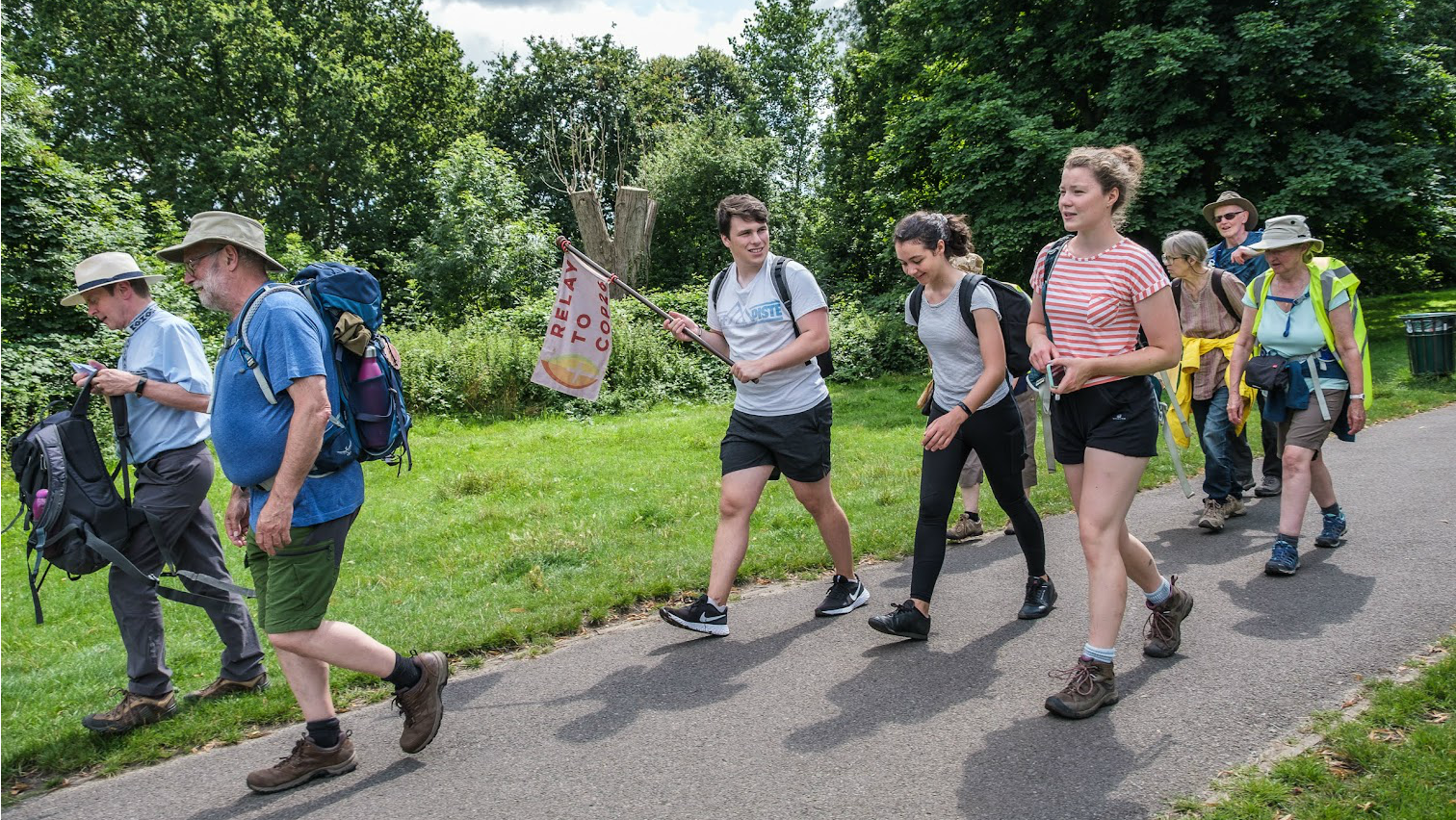
Today, 24-year-old Mander is one of the coleaders of a 750-mile relay-pilgrimage from the southwestern tip of the United Kingdom to Glasgow, Scotland, where this year’s UN Climate Change Conference, known as COP26, will begin opening ceremonies on October 31.

The Young Christian Climate Network (YCCN) has organized about 2,000 people to make the walk. Convicted that the climate crisis is pressing, urgent, and must be resolved in this generation, they are pleading with church institutions, governments, and local congregations to take concrete steps to reduce carbon emissions.

They hope that their journey will raise awareness, rally people to the cause, and put pressure on governments to address the fact that burning fossil fuels has substantially increased the atmospheric concentrations of greenhouse gases, with serious negative consequences around the world.

In 2015, at COP21 in Paris, 196 countries committed to take action that would limit the increase in the global mean temperature to 2 degrees Celsius and to pursue action that would limit the increase to 1.5 degrees. The legally binding international treaty is known as the Paris Agreement.

Mander said that so far, the commitments have failed to materialize and global temperatures continue to rise.

“I’m both really looking forward to walking into Glasgow with the relay to COP26 and simultaneously terrified of the false optimism of witnessing a conference happy to sleepwalk into a decade of emissions increasing 16 percent, not dropping 45 percent,” she said. “I’d like the church to see taking action on climate change as something for us all to take part in, as a journey we are all taking steps toward together.”

On the relay, creation care advocates compared notes on what churches can do, and what they are doing.

“We had some great conversations encouraging one another in what we were individually doing in our own churches,” said Sarah Moring, who walked with YCCN from Manchester to Leeds.

Moring said that it is easy to feel isolated by concerns about climate change and that there’s nothing that one person can do in the face of dire environmental threats. But with other Christians on the relay, she was reminded of the words of the Spanish poet Antonio Machado, who wrote, “The road is made by walking.” Often adopted as a metaphor for pilgrimage and spiritual journeys, Moring said it was also her clarion call for action. Even if the journey seems impossible, you have to make a start.

Melanie Gish, author of Gods Wounded World: American Evangelicals and the Challenge of Environmentalism, said there has been a small but persistent group of activists since the 1970s who have seen climate change as a gospel issue.

“For them, this isn’t just activism; creation care isn’t just a flimsy term,” she said. “The cause becomes a religious and civil obligation—their calling—inseparable from their evangelical faith.”

The activism has often involved “creative negotiation and diplomatic wrestling,” according to Gish, but evangelicals have built organizations and institutions to move Christians toward creation care and mobilize them to act. Examples include YCCN, as well as the Au Sable Institute, the Evangelical Environment Network, Young Evangelicals for Climate Action, the Evangelical Climate Initiative, Climate Intercessors, and Care of Creation.

One pioneer in the work that Mander and others in YCCN point to is Care of Creation founder Ed Brown, who has advocated for environmental stewardship for more than 20 years.

“Creation care is not optional,” Brown said. “It flows out of a genuine encounter with the gospel. We should be caring for creation even if it were not in crisis.”

It would be easier if there weren’t a crisis, though. According to a 2015 study from the Program on Climate Change Communication, evangelicals are most likely to believe God expects humans to be good stewards of creation. At the same time, they are the least likely among Christians to believe that climate change is real and human-caused.

There are also evangelicals who actively oppose the idea that burning fossil fuel is causing climate change, despite the extensive scientific evidence, and object to any government measures aimed at reducing emissions. The Cornwall Alliance for the Stewardship of Creation, for example, founded by evangelical Calvin Beisner and supported by James Dobson, D. James Kennedy, and others, argues “a sound environmental ethic” would focus on wise use of God’s creation, and not be led astray by “erroneous theological and anthropological positions.”

The Cornwall Alliance recently published an article calling the latest scientific assessment of climate change “silly” and warning readers that COP26 would be an excuse for “a crescendo of hyperbolic calls for action.”

That kind of rhetoric is frustrating to people like Brown.

“The calamitous effects of the climate crisis are accelerating more rapidly than we thought they would, and society is uniquely unprepared to cope with waves of refugees, disaster after disaster, and political turmoil,” he said. “It’s on the church to do something.”

Despite some strong opposition, though, Brown and creation care advocates are encouraged by growing numbers of Christians around the world who are concerned about climate change and want to do something. Besides the 2,000 people walking a portion of the road to Glasgow, Brown points to the Lausanne/World Evangelical Alliance Creation Care Network and its Global Campaign for Creation Care, which he helps lead. In the last nine years, the campaign has worked with evangelicals in 150 countries.

Another sign of new momentum, according to Brown, is Operation Noah’s Bright Now campaign, which has had notable success persuading churches in the UK to divest from fossil fuel.

In Ireland, the Anglican Church was convinced to reduce its investment in fossil fuel companies from 10 percent to zero—a total of 50 million euros, or about $58 million.

Stephen Trew, divestment campaigner for the Church of Ireland, said that kind of change often doesn’t come from church leaders, but from the laity. For young people in particular, environmental activism often starts at church.

“Help people in your community to connect the dots,” he said.

For the YCCN, helping people connect the dots has meant organizing the relay. At the end of October, three months after they began, the group will arrive at COP26.

“This is not a photo op, this is the story of my life, and in talking to others on the relay, it’s the story of our generation,” Mander said. “It’s up to us to put the world on track and to deliver on the climate.”

Looking ahead to COP26 and beyond, Mander said she hopes the relay serves as encouragement to others along the road.

“As we walk, we show the way,” she said. “There’s no road to zero emissions unless we start to move toward it together, today.”

News
Wire Story

100 Years After Ireland’s Divide, Church Cooperation Is Better Than Ever

Despite historic clashes, Roman Catholic and Protestant leaders have come together during the pandemic around Brexit, the legacy of the Troubles, and other issues that span both sides of the border.

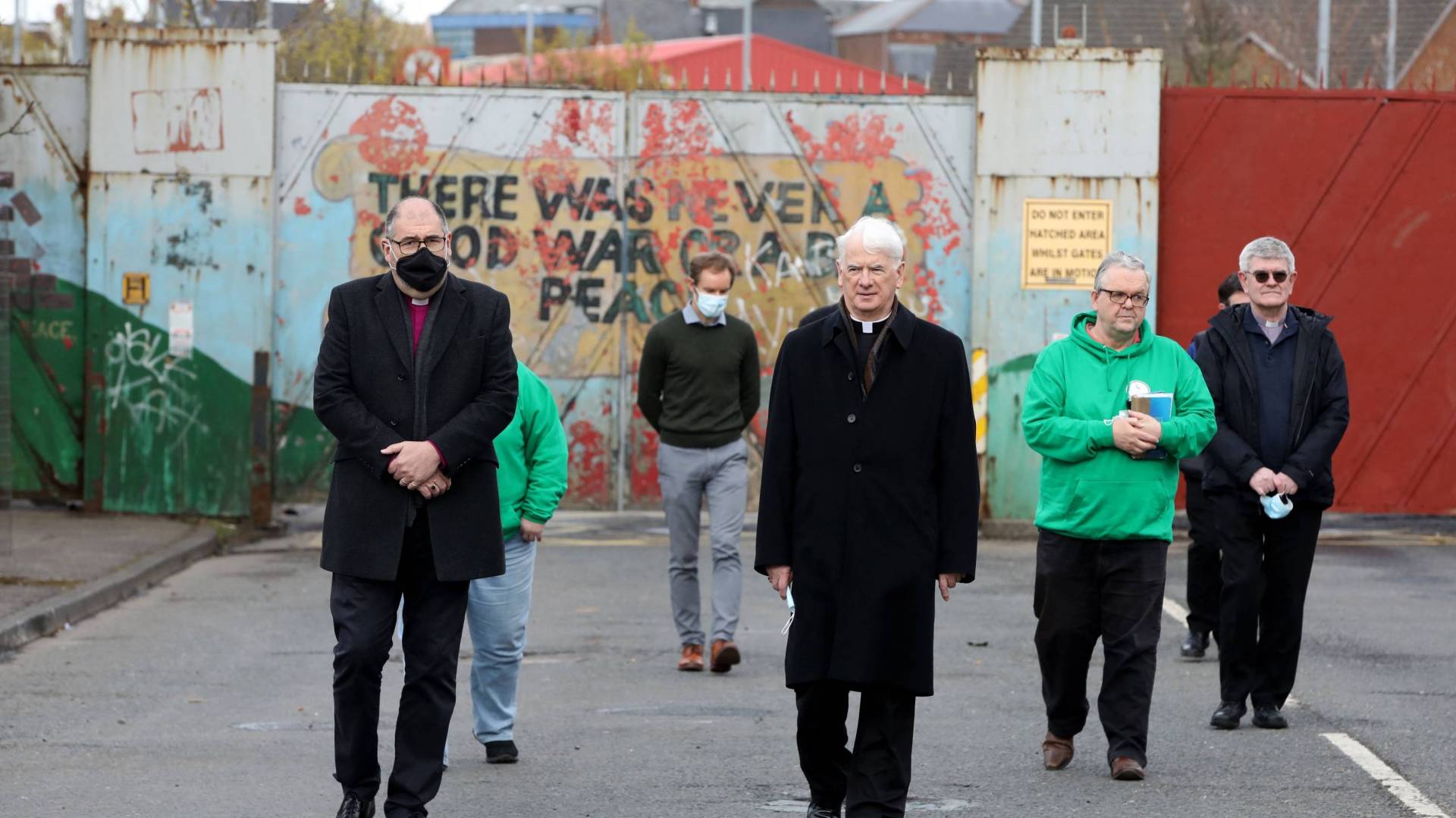
Church leaders from both communities gather at the peace wall in West Belfast in April 2021.

Church leaders from both communities gather at the peace wall in West Belfast in April 2021.

Christianity Today October 21, 2021
Paul Faith / AFP / Getty Images

Leaders from Ireland’s main Christian traditions will host a “Service of Reflection and Hope” in Armagh, Northern Ireland on October 21, 2021, marking 100 years since “the partition of Ireland and the formation of Northern Ireland.”

But the churches’ service has become controversial, underscoring tensions that linger on both sides of the border. In September, the president of Ireland, Michael D. Higgins, said he would decline his invitation because the event’s title was not politically “neutral.”

As an Irish-born academic working at the intersection of religion and international affairs, I believe the commotion over Higgins’ invitation has overshadowed an important story. Despite a history of sectarian strife, cooperation between the leaders of the Roman Catholic and Protestant churches in Ireland has deepened in recent years, with the churches increasingly speaking with one voice on important social and political issues.

The Church Leaders Group brings together the top leaders of the Catholic, Anglican, Presbyterian and Methodist churches in Ireland—whose jurisdictions extend across the whole island—as well as the president of the Irish Council of Churches. The five men have been coordinating more closely than ever on issues of peace-building, responses to the COVID-19 pandemic and recent political developments such as Brexit.

More than ‘huddling’

Churches have traditionally wielded significant influence in Irish politics and society. All have experienced sizable declines over the past couple of decades, however, as more people say they do not identify with any particular religion. The abuse scandals in the Catholic Church have contributed to the trend. (However, declining attendance does not necessarily mean faith is declining at the same rate, reflecting a phenomenon that British sociologist Grace Davie calls “believing without belonging.”)

Archbishop John McDowell, head of the Anglican Church of Ireland, told me in a recent interview that the churches’ increasing cooperation isn’t due to their diminishing size or influence—that they are not “huddling together to keep warm because it is getting cooler outside.” Indeed, despite Ireland’s long history of conflict along political and religious divides, official relations between the churches have always been collegial.

Rather, the recent increase in ecumenical activities is driven by a new generation of church leaders who grew up during the “Troubles,” a three-decade era of political violence in Northern Ireland, and share concerns over current issues. A recent analysis by Queen’s University finds that interchurch cooperation at the national level has been “more frequent and united during the pandemic than at perhaps any other time in Irish church history.”

An uneasy peace

Britain established the border separating Northern Ireland from the rest of the island in May 1921, and it has loomed over Irish politics ever since.

The north was largely Protestant, while the south was largely Catholic. The south won independence from the UK that same year.

From the late 1960s through the 1990s, “the Troubles” pitted nationalists who wanted a united Ireland against unionists who wanted Northern Ireland to remain in the UK Most nationalists were Catholic, while most unionists belonged to the territory’s Protestant majority.

The 1998 Good Friday Agreement ended most of the violence, which had killed several thousand people. To try to prevent further conflict, the agreement also introduced a form of power-sharing based on a model called “consociationalism.” While consociational democracy is designed to maintain social peace in societies with deep ethnic or religious divides, it may also entrench division and make it harder to overcome.

Indeed, aspects of Northern Ireland’s society, such as the educational system, continue to be divided along sectarian lines. More than 9 in 10 children attend schools that are segregated by religion, but this is slowly changing, with a significant majority of the public supporting integration.

Brexit and the border

One aim of the Good Friday Agreement was to make the border between Northern Ireland and the Republic of Ireland less of a lightning rod. It boosted cross-border cooperation, took down military installations and allowed citizens to travel freely between the north and south.

But the UK’s withdrawal from the European Union has returned the border to the center of politics. Under the “Northern Ireland protocol” negotiated between the UK and the EU, Northern Ireland remains aligned with the EU’s single market in order to avoid a “hard border” on the island of Ireland. However, this means that some goods coming from other parts of the UK will have to be inspected upon entry in Northern Ireland. In effect, the Johnson government devised an “Irish Sea border” in order to keep the land border open, but that idea has angered unionists who see it as dividing Northern Ireland from the rest of the UK

The Church Leaders Group was quick to recognize that Brexit could threaten the fragile peace. As Archbishop McDowell noted in an open letter to Prime Minister Boris Johnson in July 2019, the “border” is not just the actual line demarcating north from south. It is a division that “goes through every village and town in Northern Ireland, and in some places in Belfast it is so hard that it takes the form of very high brick walls topped by razor wire.”

Church leaders also shared a recognition that the post-Brexit period would involve a difficult economic adjustment. They collaborated on a consultation document to brief local congregations and interchurch groups on the likely local, regional and international impacts of Brexit.

Representatives of the Church Leaders Group tell me that the combination of increasing social and political pressures with the ease of virtual meetings—a byproduct of COVID-19 restrictions—meant that the group has been meeting much more frequently.

‘Captive churches’

Meanwhile, discussions began in late 2020 over how to mark the centenary of the partition of Ireland and the formation of Northern Ireland. The anniversary provokes very different feelings across the political divides, which is why the church leaders framed the event as a space for “reflection and hope,” not as a celebration or lament.

On Saint Patrick’s Day, the Church Leaders Group issued a joint message reflecting on the anniversary. Eamon Martin, the Catholic Archbishop of Armagh, acknowledged how churches had sometimes misused their power in the past, lamenting that “Too often we have been captive churches, not captive to the word of God but to the idols of state and nation.”

As Archbishop McDowell told me recently, “what happened in the past was that the churches tended to take our coloring from the communities that we were in, rather than trying to bring any kind of united message to a divided society.”

The continuing controversy over Higgins’ attendance has exposed a degree of polarization reminiscent of times past. Public support in the south quickly galvanized around the president and has remained high, with 68 percent approving of his decision to refuse the invitation. Irish commentators and academics in the south made forceful arguments that a commemoration of partition could never be politically neutral.

Amid the debate, the Church Leaders Group issued a statement to clarify the intent of the service and ask for prayerful support.

“We wish primarily to gather in prayer for healing of relationships,” they wrote, “and in doing so, to demonstrate a renewed commitment to working together for peace, reconciliation and the common good.”

Ger FitzGerald is a political scientist who works at the intersection of religion and international affairs. He teaches at George Mason University in Virginia.

News

Haiti Negotiates with Gang over $1 Million Ransom for Each Kidnapped Missionary

Christian Aid Ministries requests prayer for 17 captive Christians, including five children ages 15 to 8 months.

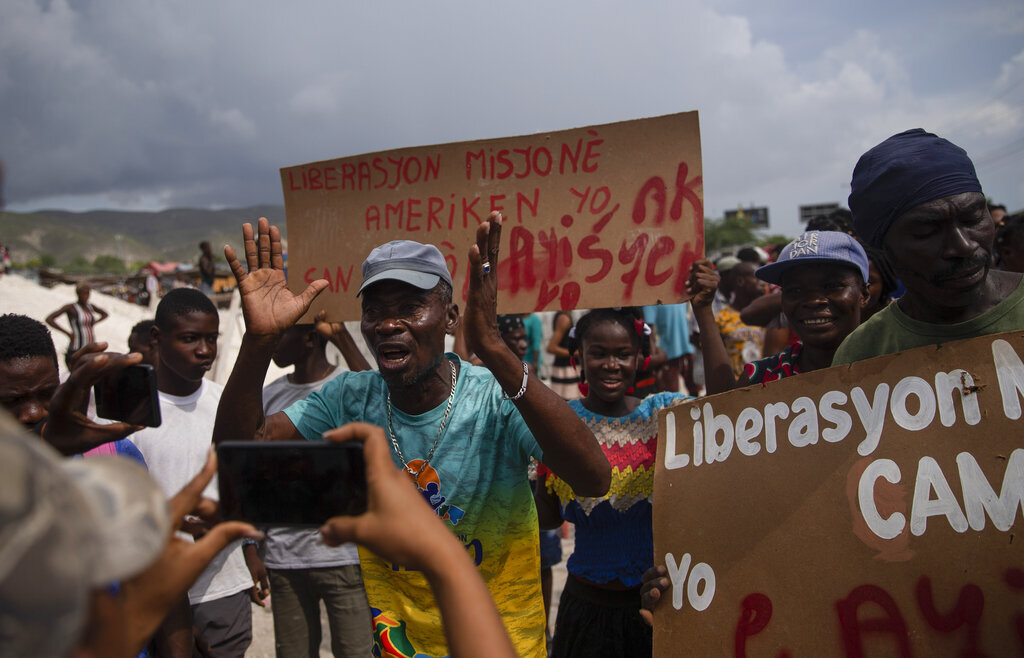
Haitians protest for the release of kidnapped American and Canadian missionaries near the Christian Aid Ministries headquarters in Titanyen, north of Port-au-Prince, Haiti, on Tuesday, October 19, 2021.

Haitians protest for the release of kidnapped American and Canadian missionaries near the Christian Aid Ministries headquarters in Titanyen, north of Port-au-Prince, Haiti, on Tuesday, October 19, 2021.

Christianity Today October 20, 2021
Joseph Odelyn / AP Photo

Editor’s note: The 400 Mawozo gang has threatened to kill the missionaries if their ransom demand is not met.

PORT-AU-PRINCE, Haiti — Negotiations stretched into a fourth day seeking the return of 17 members of a US-based missionary group kidnapped over the weekend by a violent gang that is demanding $1 million ransom per person.

The group includes five children whose ages range from 8 months to 15 years, although authorities were not clear whether the ransom amount included them, a top Haitian official said Tuesday. Sixteen of the abductees are Americans and one Canadian.

Christian Aid Ministries (CAM) said it would hold a day of fasting and prayer for its missionaries Thursday.

“We, along with government authorities, continue to work hard to bring them home safely,” the Ohio-based group said. “This time of difficulty reminds us of the ongoing suffering of millions of Haitians. While our workers chose to serve in Haiti, our Haitian friends endure crisis after crisis, continual violence, and economic hardship.”

The abduction is one of at least 119 kidnappings recorded in Haiti for the first half of October, according to the Center of Analysis and Research of Human Rights, a local nonprofit group. It said a Haitian driver was abducted along with the missionaries, bringing the total to 18 people taken by the gang.

The Haitian official, who was not authorized to speak to the press, told The Associated Press that someone from the 400 Mawozo gang made the ransom demand Saturday in a call to a leader of CAM shortly after the abduction.

“This group of workers has been committed to minister throughout poverty-stricken Haiti,” the Ohio group said, adding that the missionaries—who were returning from visiting an orphanage when they were abducted—worked most recently on a project to help rebuild homes lost in a magnitude-7.2 earthquake that struck southwestern Haiti on August 14.

A custom sign stands outside Christian Aid Ministries in Titanyen, north of Port-au-Prince, Haiti, on Tuesday, October 19, 2021.

Yesterday, CAM asked for prayer, stating:

Today, we again commit our workers to God’s care. “For He shall give His angels charge over you, to keep you in all your ways” (Psalm 91:11). Pray that our workers could respond to hatred with Jesus’ love, overcome the spirit of fear with faith, and face violence with a genuine desire to bless their oppressors.

We request prayers for the Haitian and American civil authorities who are working to resolve this situation. We believe the command of the Bible in I Timothy 2:2-3—“Therefore I exhort first of all that supplications, prayers, intercessions, and giving of thanks be made for all men, for kings and all who are in authority, that we may lead a quiet and peaceable life in all godliness and reverence.”

Responding to the recent wave of kidnappings, workers staged a protest strike that shuttered businesses, schools, and public transportation starting Monday. The work stoppage was a new blow to Haiti’s anemic economy. Unions and other groups vowed to continue the shutdown indefinitely.

In a peaceful demonstration Tuesday north of Port-au-Prince, dozens of people walked through the streets of Titanyen demanding the release of the missionaries. Some carried signs that read “Free the Americans” and “No to Kidnapping!” and explained that the missionaries helped pay bills and build roads and schools.

“They do a lot for us,” said Beatrice Jean.

Haitian protesters carry a banner with a message that reads in Creole: "No to kidnappings, no to violence against women! Long live Christian Aid Ministries," demanding the release of kidnapped missionaries, in Titanyen, north of Port-au-Prince, Haiti, on Tuesday, October 19, 2021.
Haitian protesters carry a banner with a message that reads in Creole: “No to kidnappings, no to violence against women! Long live Christian Aid Ministries,” demanding the release of kidnapped missionaries, in Titanyen, north of Port-au-Prince, Haiti, on Tuesday, October 19, 2021.

Meanwhile, the country’s fuel shortage worsened, with businesses blaming gangs for blocking roads and gas distribution terminals.

Hundreds of motorcycles zoomed through the streets of Port-au-Prince on Tuesday as the drivers yelled, “If there’s no fuel, we’re going to burn it all down!”

One protest took place near the prime minister’s residence, where police fired tear gas to disperse a crowd demanding fuel.

In Washington, White House press secretary Jen Psaki said Tuesday that the FBI was “part of a coordinated US government effort” to free the missionaries. The US Embassy in Port-au-Prince was coordinating with local officials and the hostages’ families.

“We know these groups target US citizens who they assume have the resources and finances to pay ransoms, even if that is not the case,” Psaki said, noting that the government has urged US citizens not to visit Haiti.

It is longstanding US policy not to negotiate with hostage takers, and Psaki declined to discuss details of the operation.

The kidnapping was the largest of its kind reported in recent years. Haitian gangs have grown more brazen as the country tries to recover from the July 7 assassination of President Jovenel Moïse and the earthquake that killed more than 2,200 people.

Haitians protest for the release of kidnapped missionaries near the Christian Aid Ministries headquarters in Titanyen, north of Port-au-Prince, Haiti, on Tuesday, October 19, 2021.

Christian Aid Ministries said the kidnapped group included six women, six men, and five children. “Their heart-felt desire is to share the love of Jesus,” it stated. “Before the kidnapping, their work throughout Haiti included supporting thousands of needy school children, distributing Bibles and Christian literature, supplying medicines for numerous clinics, teaching Haitian pastors, and providing food for the elderly and vulnerable.”

A sign on the door at the organization’s headquarters in Berlin, Ohio, said it was closed due to the kidnapping situation.

News of the kidnappings spread swiftly in and around Holmes County, Ohio, hub of one of the largest populations of Amish and conservative Mennonites in the United States, said Marcus Yoder, executive director of the Amish and Mennonite Heritage Center in nearby Millersburg, Ohio.

Christian Aid Ministries is supported by conservative Mennonite, Amish, and related groups that are part of the Anabaptist tradition.

The organization was founded in the early 1980s and began working in Haiti later that decade, said Steven Nolt, professor of history and Anabaptist studies at Elizabethtown College in Pennsylvania. The group has year-round mission staff in Haiti and several countries, he said, and it ships religious, school and medical supplies throughout the world.

“We greatly appreciate the prayers of believers around the world, including our many Amish and Mennonite supporters,” said CAM. “The Bible says, ‘The effective, fervent prayer of a righteous man avails much’ (James 5:16).

It continued:

Join us in prayer that God’s grace would sustain the men, women, and children who are being held hostage. In a world where violence and force are seen as the solution to problems, we believe in God’s call to Christians to “…not be overcome by evil, but overcome evil with good” (Romans 12:21). Pray that those being held hostage could find strength to demonstrate God’s love. The kidnappers, like all people, are created in the image of God and can be changed if they turn to Him. While we desire the safe release of our workers, we also desire that the kidnappers be transformed by the love of Jesus, the only true source of peace, joy, and forgiveness.

Coto reported from San Juan, Puerto Rico. Associated Press journalists Matías Delacroix in Port-au-Prince, Matthew Lee in Washington, Peter Smith in Pittsburgh, John Seewer in Toledo, Ohio, and Julie Carr Smyth in Berlin, Ohio, contributed to this report. Additional reporting by CT.

News
Wire Story

North Park Faculty Vote No Confidence in President Over ‘Toxic Climate’

Board continues to support leadership at the ECC school after concerns come up around recent firings and retention for students of color.

Christianity Today October 20, 2021
Rputera / Creative Commons

Faculty at North Park University voted no confidence in the school’s president, saying she created a hostile environment for students and faculty of color.

The 55–26 vote last week took aim at President Mary Surridge, who has led the Chicago evangelical school since 2018. In an accompanying document, the university’s faculty senate detailed “a toxic climate for students, faculty, and staff,” especially those of color. Specifically, the document took issue with a failure to hire and retain racially diverse people in leadership positions as well as athletes.

“The big picture is that we have a school that attracts a lot of students of color,” said Rachelle Ankney, senate faculty president and a professor of math. “But we are not providing an inclusive and welcoming atmosphere for those students. That’s not setting the school up for success in the long run.”

North Park enrolls some 2,800 students and more than half are people of color or mixed race, according to Ankney. But, she said, it has struggled to retain those students beyond the first and second year of their studies. A 2020 retention report from SPARK associates noted particularly high rates of departure among male student athletes of color at North Park, especially football players: In 2019–2020, 45 percent of first-year football players did not return the following year, compared with 25 percent of first-year students overall.

Recently, the school has also seen an exodus of staff and faculty of color; the faculty says those departing were pressured to sign nondisclosure agreements.

The 130-year-old private university is affiliated with the Evangelical Covenant Church and is a member of the Council for Christian Colleges and Universities. It shares a campus with North Park Theological Seminary, the Evangelical Covenant Church’s sole theological school, but seminary faculty did not vote on the confidence measure.

The university’s board of trustees issued a letter at the start of the senate’s vote, saying it was “unequivocally pleased” with the leadership of Surridge, the first woman to helm the school.

“She is setting the strong strategic course that North Park needs at this time in its history to assure its long- term viability and she is accelerating our forward momentum,” the letter written by the board’s executive committee said.

The letter cited one of the largest incoming classes of first-year students and a return to fiscal solvency among her accomplishments. It made no reference to problems over race and equity.

Board chair David Otfinoski said he was “deeply troubled” by the faculty no-confidence vote, even as he and the board support Surridge.

“While we disagree with the characterization of her leadership and believe there are inaccuracies in the document prepared for faculty, we are also acutely aware that there is pain in our community,” he said in a statement.

“We seek to move forward together, as one North Park,” Otfinoski’s statement said.

Votes of no confidence are increasingly common as faculty and boards at US universities struggle over governance and politics.

The North Park faculty’s long list of grievances include Surridge’s hiring of her husband to a senior-level position after he had retired as the head of the university’s athletic department. They also allege she violated university governing documents by firing four tenured professors without proper consultation with the faculty senate.

Surridge served as vice president for advancement at North Park before becoming president, raising $63 million for the school, according to the school’s website. She does not hold a doctorate degree.

Ankney said problems at the school arose before the coronavirus pandemic and included a student protest in February 2020. The lockdown that followed postponed any resolution of those issues. This is the first semester students and faculty are back on campus in person.

The school’s board of trustees begins several days of online meetings on Wednesday. Ankney said she doesn’t know yet if she will be invited to speak to the board.

The faculty senate has invited Surridge to its meeting on Monday. Ankney said she did not know if the president would attend.

Testimony

My Life in Seattle’s Street Gangs Was a Dead-End Street

How God used a stiff prison sentence and a church invitation to rescue me from a downward spiral of guns, drugs, and despair.

Christianity Today October 20, 2021
Illustration by Cassandra Bauman / Portrait Courtesy of James Croone / Source images: Benjamin Massello / Unslpash

Growing up as a Black American male in a rough Seattle neighborhood almost doomed my future. In many ways I was marked for failure. Even a violent early death.

My mother, a nurse, worked long hours providing for my sister Angela and me after our father left us. Although he lived 10 blocks away, he was never active in our lives, financially or otherwise.

My mother loved us and disciplined us, but I needed a strong and responsible male figure in my life. None of my friends were raised in a traditional two-parent home, either.

Racial disparities surfaced early on. In my preteens I learned how differently teachers disciplined white and Black kids. They singled us out more.

Yet I never crusaded against racial injustice. It just seemed normal for our community. The police hassled us regularly for just hanging out at a bus stop or street corner. Sometimes three or four squad cars pulled up with officers jumping out, yelling and cursing, to search our pockets for no good reason.

Seduced by the streets

In elementary and middle school, I made good grades and obeyed my mom’s warnings to behave. She never allowed me to stay out late in the streets. I was more or less a loner, rarely getting into trouble.

Things changed, however, when I entered high school in 1981 after being bussed into the suburbs. I began hanging out with the wrong guys. The gang culture, drugs, and partying eventually seduced me. I loved hip-hop music and street dancing. At 16, I joined the Emerald Street Boys Rap group. We performed around the city and made an album. Then I slowly lost interest in school, skipped classes, and quit altogether, worrying my mother.

California gangs began migrating to our neighborhood, where they sold cocaine and bred more violence. I went along with the flow, succumbing to occasional hard drugs but mostly alcohol and pot.

Selling drugs came next, providing a pseudo self-worth. You gained respect if you flashed wads of cash. From my late teens into my early 30s, I earned up to thousands of dollars a week. I bought gold jewelry, expensive gear, and gaudy cars, and I enjoyed clubbing and buying rounds of drinks. I was forever seeking recognition and thirsty for something that never satisfied. Money slipped through my fingers like melting ice in a scalding heat wave.

Random police incidents added fuel to my resentment of authorities. While driving my Caucasian girlfriend on a dinner date, a squad car flashing emergency lights stopped us. Officers ordered us from the car and forced us down on our hands and knees, frisking us. I was utterly embarrassed for my girlfriend, who wore a nice dress. They found nothing illegal and let us go.

Close calls

I had always known God existed from the time my grandmother brought me to Sunday school. But I viewed God through a distorted lens. I believed doing good things outweighed the bad stuff, which led me to sponsor a poor kid in a distant country through World Vision.

God dropped hints that I could be a better person. A police officer who recognized me from the gangs I ran with encouraged me to do something positive with my life. I still recall him coaxing me to straighten myself out.

Still, I kept putting myself in harm’s way, and I could have ended up dead many times. On one occasion, a friend sitting beside me in my classic Chevy Caprice whipped out his .38 caliber revolver and started shooting at guys on the sidewalk. He held the gun parallel to my face as I was trying to steer. Bullets whizzed past me out the driver’s side window, almost collapsing my eardrums.

In another close call, I was driving friends in my pickup truck to hang out in a local park when a rival gang’s car tailgated us while firing multiple rounds. Bullets penetrated the rear window, one of which grazed my girlfriend’s ear before passing through her cheek, spattering blood on the windshield. Another missed wasting my brain by millimeters.

Like other Black men in the neighborhood, I had no goals and no sense of what I could accomplish. Feeling worthless, I related to the angry pessimism many Black kids suffer from. I looked in the mirror and didn’t like who I saw. I scared my mother when I told her I didn’t expect to live beyond age 21.

Even so, I managed to earn my GED in 1985. I worked in the roofing trade while also dealing drugs. My wild lifestyle in the streets continued, punctuated by stints in jail for misdemeanors and petty assaults.

In 1998, at age 33, I was arrested for fighting with my live-in girlfriend, plus a serious weapons charge. Someone spotted her getting too friendly with other guys at a party, which whipped me into a jealous rage. A neighbor, hearing the ruckus, called the police, who found my semiautomatic Uzi and a stash of marijuana I had been dealing. All told, I was facing a five-year mandatory prison sentence.

One week after my arrest, I got out on bail and returned to roofing. Before the final sentencing date, my sister, a strong Christian, invited me to Lampstand Family Ministries, an independent Pentecostal church in Seattle.

I attended a Sunday service, if only reluctantly. Nevertheless, the pastor’s heart-wrenching sermon blew me away. It was a life-changing moment. I rushed to the altar crying. My decision to accept Christ as Savior and Lord shocked my gang-member friends. Many of them respected my decision, but others smirked, waiting for me to fall back into the old life.

Soon after, I was rearrested for communicating with my girlfriend in violation of a non-contact order. But this turned into a blessing. Locked up for two months, I devoured the Bible and several Christian books while attending chapel services. Meanwhile, a work-release program allowed me to attend services at Lampstand.

Upon returning to court for sentencing, I accepted a plea deal: a one-year sentence, reduced to eight months because of time already served. The judge said my testimony showed signs of remorse. And the court stenographer wept as she recorded the proceedings.

A new creature in Christ

Before I reported to jail, my pastor encouraged me to take courses from the Bishop A. L. Hardy Academy of Theology in Seattle. I earned a theology degree while incarcerated. Afterward, when I joined Lampstand Family Ministries, my passion for learning and teaching soared. I taught Sunday school and earned a promotion to superintendent. Four years later I joined another church, serving as an associate pastor for educational programs. By 2003, I completed a doctor of theology degree in religious education.

When another four years passed, I took a bold but tentative leap of faith. Seeing a hunger for theological training among the inner-city minority population, I founded Seattle Urban Bible College. The school was aimed at students unable to afford normal tuitions, which meant operating with lean finances. Local pastors taught courses weekday evenings in facilities volunteered by the Miracle Temple Ministries church. We trained about 100 students before dwindling resources forced us to suspend the school in 2011.

Giving up on the Bible college led me to spiritual and professional crossroads.

Praying and seeking advice from wise Christian brothers, I connected with the president of Northwest University in Kirkland, Washington, sharing how God had dramatically changed the trajectory of my dead-end life in the streets and planted a desire to teach others in the minority community. He awarded me a presidential scholarship, and I graduated with a master’s degree in theology and culture in 2013.

After graduation I joined the homeless ministry of the Seattle-based Union Gospel Mission. Enjoying my work there, I felt a new stirring from God to start an inner-city church. Aided by fervent prayer and the Holy Spirit’s guidance, that stirring culminated in the 2016 launch of Risen Church. It is located in a South Seattle neighborhood riddled with the very drug use and gang violence that had nearly cut my life short. We are blessed with a diverse congregation—Black, white, Latino—marked by a commitment to mutual love and respect.

Despite the failures and heartaches of my past, I am a new creature in Christ. The old ways are gone. Without his mercy, I would probably be dead today, another sad statistic in the litany of inner-city tragedy. Today, I have the privilege of encouraging young Black men who feel worthless to choose the worth they have in Christ. I considered myself worthless once, but now I am serving the living God, and in him, I am the man God destined me to be.

James D. Croone is lead pastor at Seattle’s Risen Church, an adjunct professor at Northwest University, and a pastoral care and recovery supervisor at Seattle’s Union Gospel Mission. Peter K. Johnson is a freelance writer living in Saranac Lake, New York.

Ideas

What I Learned From Gen Z’s Faithfulness During the Pandemic

Leading InterVarsity Christian Fellowship has given me a chance to see how younger believers model spiritual resilience.

Christianity Today October 20, 2021
Illustration by Cassandra Bauman / Source images: Robin Skjoldborg / Getty / Aaron Owens / Unsplash / Edward Cisneros / Unsplash

Recent reports of declining religious engagement paint a sad picture about the future of the church in the United States. But from my perspective leading InterVarsity Christian Fellowship, I’ve seen how younger Christians may offer us a road map for hope, particularly for those of us from earlier generations.

In some ways, it’s almost remarkable that Gen Z students still have a desire to grow spiritually at all. During a pivotal stage of life, which most of us remember as a season of optimism and opportunity, they are grappling with an ongoing pandemic, political divisions, racial injustices, and campus openings and closures.

In a time when practical discipleship may be the least of their worries, it would be easy to let the complexities and pressures of life crowd out the spiritual. But these recent crises have had a spiritually clarifying effect on them. This generation has a spiritual hunger and a desire to grow into disciples prepared to engage a turbulent world.

Here are five ways I’ve seen Gen Z college students modeling a deeper, more resilient faith that older generations can learn from.

1. Spiritually resilient people know how to wait

God is showing Gen Z how to wait in a culture that hates to wait for anything. It might come as a surprise that this generation of Christians—all of whom grew up with instantaneous access to the internet—has the capacity for patience. But I have watched them embrace what author and pastor Ben Patterson says in his book Waiting: Finding Hope When God Seems Silent: “At least as important as the things we wait for is the work God wants to do in us as we wait.” Where many in older generations have responded to delayed gratification with self-soothing, Gen Z Christians have prayed that God would sharpen their holy dissatisfaction instead. Hundreds of students joined last year’s “Freeish: A Virtual Juneteenth Gathering” sponsored by InterVarsity’s Black Campus Ministry amid renewed awareness of centuries of racial injustice. They used the Juneteenth holiday—which recognizes the delay between the end of the Civil War and the emancipation of enslaved people in Texas—as a gateway to experience the tension between the now/not yet of the kingdom of God.

They pressed into the tension of “Freeish” so that they could hunger and thirst for righteousness more keenly. They accepted responsibility to be pastors to sinful people and prophets to sinful systems. They understood that waiting with faith is an act of resistance to evil. While resisting the situations and injustices that might grind them, they flooded to BCM’s most recent national online conference, the title of which expressed their resolve and resilience: “Still Here.”

2. Spiritually resilient people are of good cheer

Throughout the past few years, I have been challenged and moved by the ways that Gen Z Christians move seamlessly from “How long, O Lord?” to “Hallelujah!” in worship. Perhaps this is shaped by their study of the Psalms and Revelation, both of which move from lament to praise in a breath. They have much to lament. InterVarsity Christian Fellowship recently surveyed Christian Gen Z students from 127 campuses. The results made clear that Gen Z sees the world in all its brokenness. The range of issues they care about defy simple political categorization yet reflect a deep awareness of our deepest cultural divides. Gen Z Christians care most, according to our survey, about the issues of racial injustice, climate change, and adoption and foster care. Reducing abortion, ensuring religious freedom, and reforming the criminal justice system round up the top issues they identified.

Gen Z Christians reject the ways some older Christians can be seduced by cynicism and partisanship as they engage these issues, as well as the way that others have turned to self-indulgence or denial. They are looking for a Scripture-defined faith that will help them engage and address the world’s problems. I remember the overwhelming student response to a medley of “We Shall Overcome,” “Great Is Thy Faithfulness”, and “Because He Lives” during one of our national online events. They reject despair. Their resilience is grounded in more than self-care, in more than naïve optimism in inevitable social progress. Instead, it’s grounded in God’s character and in Christ’s resurrection.

Spiritually resilient people can assess reality, even if it’s harsh, and weigh it against the reality of God’s presence and provision, continuing to live with hope and joy. In John 16, Jesus was clear about the difficult reality ahead when he spoke to his disciples before his arrest. He was also clear about his victory. “In this world you will have trouble. But take heart! I have overcome the world” (v. 33). The King James Version expresses it, “Be of good cheer.”

3. Spiritually resilient people hunger for the right thing

Even with such a broad interest in current issues, the discipleship resource these students wanted most was to learn how to study Scripture. This surprised me. Books on hermeneutics do not top the Christian bestseller list. Worship songs on the beauty of Scripture are not in heavy rotation according to CCLI. Graduation gifts for high school seniors tend to be filled with inspirational quotes and practical how-tos. But Gen Z Christians want to learn how to study Scripture. More than guidance on relationships, vocation, or sex, Gen Z Christians long to understand the Bible.

They are tired of therapeutic moral deism, with its shallow affirmations of their worth and its lifeless invitations to try harder. They aren’t looking for an inspirational but out-of-context Bible verse on Instagram. They want to hear God speak through his Word.

We see this hunger in InterVarsity’s ministry. Our core ministry on campus is a small-group Bible study that invites students to rigorously study God’s Word in community. They don’t gather to watch a video sermon or to answer questions in a workbook. They meet because they want to hear God speak directly into their lives through the Scriptures.

Gen Z Christians are resilient because they want to hear directly from God through his Word.

4. Spiritually resilient people put down deep spiritual roots in Christian community

During the earlier parts of the pandemic, life shut down. Gen Z Christians reported they struggled with loneliness (58%). Nearly 47 percent said their mental health had been negatively impacted by the pandemic. They wrestled with the isolation, in part, because they overwhelmingly affirmed that belonging to a campus Christian fellowship was the most important factor in growing their faith. They understand the importance of Christian community.

As the new school year begins, students are returning to campus fellowships enthusiastically. They want to worship, to study Scripture, and to pray together after a long season of isolation. This is the largest group of new students to step foot on campus for the first time, and as in-person ministry events are happening for the first time in 18 months, campus ministers are seeing surges of students attending.

At the University of Alabama in Huntsville, for instance, campus minister Amanda Koch has been planting a ministry for the past couple of years. At their first on-campus event of the year, she expected only around twenty students to attend but was surprised when over 70 showed up.

Similarly, Neal Overbay, campus staff minister at the University of Illinois at Urbana/Champaign, reported more students participated in their first campus-wide meeting this year than in pre-pandemic years.

Students know they need community. Those of us who have become too comfortable with passive participation in streamed church services should listen to the wisdom expressed by Gen Z.

5. The church’s spiritual resistance is tested together

We’re at a point in the pandemic where there is a lot of fatigue and a lot of mixed emotions. We all want life to return to normal, but many of us dread the thought of another school year, another fall, another winter of navigating the precautions. Or perhaps as we settle back into our routines, we realize how much has changed and hurt during the year-and-half of the pandemic.

Amid the fatigue, we must encourage each other to practice the disciplines of joy and hope and to not give in to self-pity or cynicism. This is the kind of strength that Scripture says we’re to aspire to and that is promised to us if we abide in Christ.

Traditionally, we think of discipleship as generationally top down—one generation passing what it’s learned to a younger generation. But discipleship can also be bottom up. Older generations, in humility, can take note of what younger people are learning and receive it, allowing it to reveal gaps in their own discipleship.

No generation is exempt from needing to grow in resilience. As we’re tested together, both now and in the future, we can praise God for the ways that the Spirit is filling gaps in our maturity, no matter which generation is the teacher.

Tom Lin is the president and CEO of InterVarsity Christian Fellowship/USA.

addApple PodcastsDown ArrowDown ArrowDown Arrowarrow_left_altLeft ArrowLeft ArrowRight ArrowRight ArrowRight Arrowarrow_up_altUp ArrowUp ArrowAvailable at Amazoncaret-downCloseCloseellipseEmailEmailExpandExpandExternalExternalFacebookfacebook-squarefolderGiftGiftGooglegoogleGoogle KeephamburgerInstagraminstagram-squareLinkLinklinkedin-squareListenListenListenChristianity TodayCT Creative Studio Logologo_orgMegaphoneMenuMenupausePinterestPlayPlayPocketPodcastprintremoveRSSRSSSaveSavesaveSearchSearchsearchSpotifyStitcherTelegramTable of ContentsTable of Contentstwitter-squareWhatsAppXYouTubeYouTube