Ideas

November’s Holy Week: A Modest Proposal for the Persecuted

From All Saints’ Day to the International Day of Prayer, let’s honor beleaguered believers by following three rules in advocating for religious freedom for all.

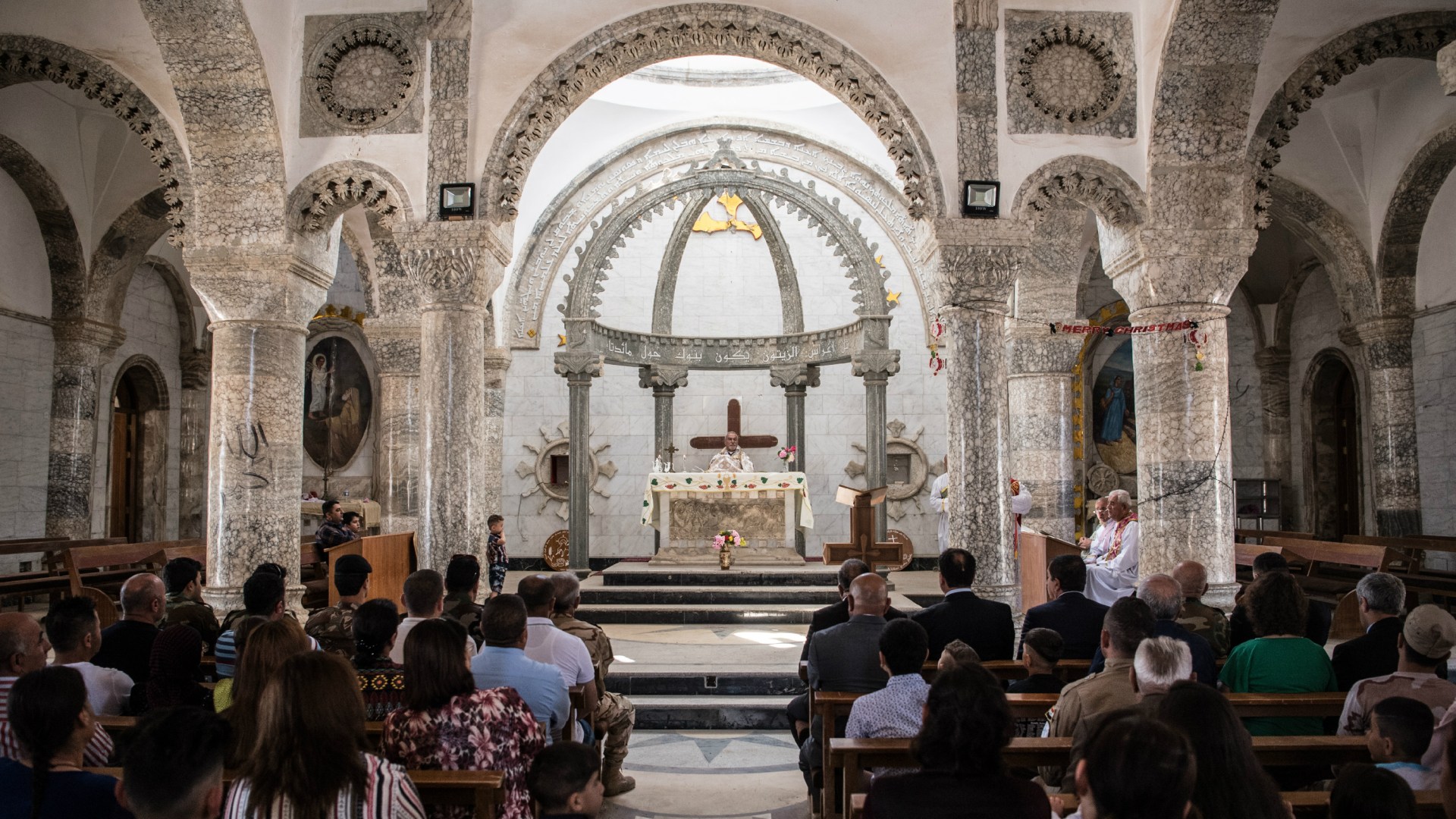
Easter service at Mar Yohanna Church in Qaraqosh, Iraq, in April 2017 after Iraqi forces recaptured nearby Mosul from ISIS.

Easter service at Mar Yohanna Church in Qaraqosh, Iraq, in April 2017 after Iraqi forces recaptured nearby Mosul from ISIS.

Christianity Today November 4, 2021
Carl Court / Getty Images

Two observances this week—All Saints' Day on November 1 and the International Day of Prayer for the Persecuted Church (IDOP) on November 7—represent a new kind of holy week. Together they provide an opportunity to remember our Christian brothers and sisters suffering for their faith overseas.

Followers of Christ living abroad face extreme circumstances in many places, as well as slow-rolling repression grinding the faithful down. These days provide an opportunity to pause in remembrance, to commit to advocating for their rights, and to honor their sacrifice by helping others persecuted for their different beliefs. (In the sidebar below, I offer three rules to follow.)

Christians are under regular physical assault. An alarming trend is terrorist violence targeting Christians, which—based on my diplomatic work over two decades—I believe represents the biggest challenge to the church globally.

Groups like the Taliban, ISIS, and Al Qaeda all have Christian blood on their hands. In ungoverned or under-governed countries, churches thrive but terrorists can also strike with impunity. Motives vary—including animosity towards Christianity, jealousy of resources, pure criminality, or all of the above—but regardless, fear hangs over entire communities.

For instance, Boko Haram’s violence in Nigeria against Christians stands out due to its severity and the size of the Christian population it victimizes. Boko Haram has burned churches, murdered pastors, and destroyed towns. In addition, Christian girls in Nigeria face physical and spiritual rape when kidnapped, forcibly converted, and married, such as Leah Sharibu.

Of course, governments also still persecute. Communist China is the largest persecutor of Christians in the world. Space for freedom of worship and practice is rapidly disappearing, replaced by a forced ideology to Chairman Xi Jinping and enforced by police and bulldozers. Flush with resources, the communist regime wants to crush the 70 million-strong Chinese church.

Elsewhere, North Korea assaults any independent practice of Christianity. In Burma (Myanmar), the military has escalated its war against ethnic and religious minorities who are predominantly Christian. Iran actively persecutes evangelicals, and Algeria’s new campaign against convert churches tarnishes a once bright spot in the Middle East. Conversion to Christianity is generally illegal across the Arab world, marking individuals for purely following their conscience.

And Christians are not alone. In almost every context, when Christian saints face persecution, others are also victimized for their beliefs, religious practices, or membership in a faith community.

Sometimes the persecution of others surpasses what Christians experience. For example, China’s war on religion also targets Tibetan Buddhists and Uighur Muslims with a genocidal vengeance. Perhaps unexpected, Muslims take the brunt of government repression worldwide. In addition to Muslim persecution, other groups feeling the impact of persecution include Baha’is, Hindus, Sikhs, and atheists.

These days of remembrance provide an opportunity to reflect on those suffering from our community and from others. While the Bible doesn’t use the phrase “human rights,” we find global concepts of dignity and justice interwoven throughout. The prophet Isaiah proclaimed, “Learn to do good; seek justice, correct oppression; bring justice to the fatherless, plead the widow’s cause” (Isaiah 1:17 ESV). Galatians 6:9-10 proclaims a responsibility to help everyone: “Let us not become weary in doing good…. Therefore, as we have opportunity, let us do good to all people, especially to those who belong to the family of believers.”

Christ put it plainly in the context of “the least of these” in Matthew 25. Here, Jesus challenges his followers (and us today) to help the stranger: “For I was hungry and you gave me food, I was thirsty and you gave me drink, I was a stranger and you welcomed me, I was naked and you clothed me, I was sick and you visited me, I was in prison and you came to me.” He concludes by saying, “Truly, I say to you, as you did it to one of the least of these my brothers, you did it to me.” We find a similar theme in the parable of the Good Samaritan in Luke 10. The hero helps his neighbor, despite differences of faith and nationality, with Jesus concluding his followers should “go and do likewise.”

Who are “the least of these” for religious freedom? Who is our neighbor? Any person facing torture, beatings, jailing, and even death on account of their beliefs. To truly care for our global neighbors, to love them as we love our own, we should speak up for them as well as for our brothers and sisters in the faith. Heroic love of neighbor calls for Christians to fight for human rights and to assist the suffering, both our own and others.

The international environment for religious freedom is dismal. We must begin this work now. Restoring respect for religious freedom will take decades, if not generations. To borrow from Eugene Peterson, success will require a long obedience in the same direction. What the late Congressman John Lewis wrote about fighting for civil rights in America certainly applies to advocating for international religious freedom: “Ours is the struggle of a lifetime, or maybe even many lifetimes, and each one of us in every generation must do our part.”

While most cannot travel to the front lines, all can be steadfast in prayer, consistent in petitioning our elected leaders to act, and supportive of organizations working to advance religious freedom for all. In addition, resources are available to educate believers on the facts, to guide them in prayer, and to help them advocate effectively with policymakers. Great examples include Open Doors, Stefanus Alliance, CSW, and others.

Many churches’ observance of Holy Week leading up to Easter is a daily reminder of the sacrifice Jesus made for all humanity. To mark this proposed new holy week between All Saints’ Day and IDOP, let’s remember the modern saints suffering physical violence for the simplest of reasons: their Christian faith.

And during this week, while remembering how our brothers and sisters need our help, we can pray for our global neighbors from other religious traditions who also beckon for assistance. The church can have no better testimony of God’s love than advocating for religious freedom for all.

Knox Thames served as the State Department Special Advisor for Religious Minorities for both the Obama and Trump administrations. He is currently writing a book on 21st century strategies to combat religious persecution. You can follow him on Twitter @KnoxThames.

Speaking Out is Christianity Today’s guest opinion column and (unlike an editorial) does not necessarily represent the opinion of the magazine.

Religious Freedom Advocacy 101:


By moving governments and international institutions to act, religious freedom advocacy can save lives, free prisoners, and increase religious liberties. Anyone wishing to advocate for the oppressed and persecuted must act wisely and with great discernment. For every good story about international advocacy freeing a religious prisoner or reforming laws, there is another about an overly aggressive or troubling ill-informed activist causing more harm than good.

When developing a plan of action, religious freedom advocates should consider the following three rules:

1) Abide by the Hippocratic Oath:

“Do no harm” is an absolute rule. Advocates must coordinate their efforts with the victims or their families, as they will bear the brunt of any response to international advocacy.

2) Speak out for all:

It is also important for religious freedom advocacy groups to speak out against all forms of religious persecution and repression even if their coreligionists are not affected or persons of no faith are targeted. Often a positive conclusion in one case will be useful to others in similar situations. If not everyone can enjoy religious freedom, then there is not complete religious freedom for anyone.

3) Be truthful and fact-based:

Advocates must be very careful about the facts. If they are found to exaggerate or misrepresent, or to be ill informed, then they will have a difficult time persuading persons of power and influence. Advocates must resist the temptation to exaggerate and make a situation sound more compelling in hopes of spurring a faster response. For instance, the word

persecution

is often carelessly thrown around without any thought as to its true meaning. Overuse only cheapens the term and lessens the impact in actual situations of persecution.

Excerpts from

International Religious Freedom Advocacy: A Guide to Organizations, Laws and NGOs

News

College Presidents Need Mentors Too

A conversation with Michael Lindsay and Beck Taylor.

Christianity Today November 4, 2021

On the surface, the life of a university president appears ideal: welcoming grateful alumni back to campus, dispensing wisdom to eager students over coffee, and conversing with erudite faculty members about their research.

The numbers, however, paint a different picture. For example, the American Council on Education’s American College President Study reports the average length of service for a university president continues to decline: 8.5 years in 2006, 7 years in 2011, and 6.5 in 2017.

In contrast to the previously noted activities, the American College President Study also reports the areas occupying a president’s time, in order, include (1) budget/financial management; (2) fundraising; (3) management of senior leaders; (4) relations with board members; and (5) enrollment management. Not surprising, only 25 percent of presidents previously served as presidents.

Some presidents, however, defy those trends. This week, Samford University hosts the inauguration of Beck A. Taylor as its 19th president. Earlier this fall, Taylor University hosted the inauguration of D. Michael Lindsay as its 18th president. (Lindsay sits on Christianity Today’s board of directors.)

Prior to their present appointments, these friends and fellow Baylor University graduates—Taylor from the class of 1992 and Lindsay from the class of 1994—respectively served as the presidents of Whitworth University for 11 years and Gordon College for 10 years. Part of what also makes them unique is that, even as they begin their second presidencies, Taylor and Lindsay are still more than a decade younger than the average university president’s 63 years.

Earlier this fall, Margaret Diddams, editor for Christian Scholar’s Review, talked with Taylor and Lindsay about their transitions, the people who helped prepare them for their previous and current appointments, and the role mentorship plays in preparing the next generation of leaders.

Theology

The Pro-Life Cause Is Now a Lower Priority for Christians. That’s Bad News for Everybody.

Human dignity is not an earned right but a signpost to God.

Christianity Today November 4, 2021
Illustration by Mallory Rentsch / Source Images: Alex Wong / Petekarici / Getty Images

In less than a month, the Supreme Court will take up arguments on a Mississippi case that could conceivably spell the end of Roe v. Wade, which legalized abortion as a constitutional right. At the same time, the justices sent signals that they were perhaps dubious of a recent Texas law that sought to restrict abortion through civil liability measures.

For the first time in a while, it seems that abortion is at the forefront of conversation in the United States. And yet, some surveys suggest that abortion is not the motivating factor for evangelicals that it once was.

Those who disagree with me on abortion may feel it is good news that evangelicals are lessening their priority on the pro-life issue—thinking perhaps that a cooling down in the culture wars might lead to a less polarized America. But such people would be wrong. As a matter of fact, if this trend continues, it could be bad news for everybody.

Political scientist Ryan Burge collected polling data this summer from the Public Religion Research Institute (PRRI) and compared that with recent data gathered from the Association of Religion Data Archives. The poll asked respondents how they would rank their relative priority on various sociopolitical issues. Burge noted that, over time, the abortion issue has decreased in priority among white evangelicals and other issues, like immigration, have increased.

Most of this data was aggregated before critical race theory and COVID-19 dominated the public square. But many pollsters and activists say they see far more energy spent discussing race, masks, vaccines, and other topics. Abortion is low on the list.

Some argue that this has always been the case. For example, in his book Bad Faith: Race and the Rise of the Religious Right, religion scholar Randall Balmer arguesagainst the common assumption that Roe mobilized evangelicals into political action. He calls this idea a myth, contending instead that segregated academies threatened with losing their tax-exempt status were the real motivators—and that abortion was merely a convenient cover for the politics of white racial grievance.

That may well be true for some of the political strategy leaders at the time, but I remain skeptical of Balmer’s overall thesis. Even with the most cynical view possible of political-religious activist leadership (and I think I’ve earned the right to some cynicism here), there has to be a reason why such leaders would choose to emphasize abortion in grassroot movements. The question isn’t whether political strategists can manipulate the issue but rather what exactly is being manipulated. That is, one can only mobilize people around an issue they fundamentally care about.

A week or so ago, I was talking with a friend who disagrees with me on abortion. They asked me—with genuine curiosity—“Why do you all want to impose your religious views on everyone else by restricting abortion?”

This would be a fair critique, I responded, if evangelicals and other pro-lifers sought to enact “blue laws,” which banned Sunday commerce for everyone based on Levitical laws.

When it comes to abortion, however, the debate is not about whether society should protect the vulnerable, but about how many vulnerable people we should care about. In a pro-choice view of the matter, there is only one—the pregnant woman who must decide what to do with her body. For those of us who are pro-life, there are two vulnerable people here—the pregnant woman and the child within her womb—and we have a responsibility to consider both.

Former US Representative Barney Frank famously quipped that pro-lifers believe life begins at conception and ends at birth. This might well be true in some direct-mail fundraising operations, but it is not true for those at the grassroots level—those for whom this issue is a matter of action as well as conviction, those who work on the frontlines with pregnant women in crisis, or those who help children find families and safe homes.

As a matter of fact, these pro-life people can sometimes be the most sensitive to a holistic vision of human life and dignity. They are usually the ones who advocate for job training, childcare, and health care for women, so that no woman is put into a position where she must choose between the life of her child and her own well-being. Other pro-lifers are working in the foster care system or caring for people with disabilities in their homes.

Nearly every day, I speak with foster or adoptive parents who are giving their lives in service to children they love—those ravaged by fetal alcohol syndrome, infant drug addiction, severe mental illness, or those coming from impoverished families—and I have found that these people have almost always learned to love such children because they are pro-life.

When anchored biblically—rather than merely as a partisan political strategy—a pro-life viewpoint is a contradiction of social Darwinism, which estimates human value in inverse proportion to vulnerability.

Ayn Rand’s conception of the poor as losers and takers is absolutely contradicted by the Sermon on the Mount (along with the rest of the Bible). In ideological frameworks like Rand’s, human rights are linked with “viability”—the ability to survive on one’s own, independent of the womb and the life of another.

But those of us who follow a crucified Christ must recognize that none of us are “viable” in that sense. We always leave one womb to enter another—that of our mother to that of the biosphere around us. All of us are dependent on oxygen, water, and nutrition—and we are all interdependent upon each other.

At its best, a pro-life vision reminds us of why Jesus was indignant when his disciples saw children as a distraction from his mission. He pointed out that “to such belongs the children of God,” and that those who do not “receive the kingdom of God like a child shall not enter it.” The Lord welcomed children—other people’s children—and “blessed them” (Mark 10:13–16, ESV throughout).

The entire Bible shows us why this is. We come before God as those who, in our utter dependence, cry out, “Abba! Father!” (Rom. 8:15), and we learn to receive others as we have been received (Rom. 15:7). This means that in following Christ, we, like him, are able to see the people we would rather or otherwise keep invisible—the poor, the stranger, the vulnerable, the unviable, the un-useful.

We see the folly in human boasts of strength—whether about one’s net worth, physical attractiveness, or “stage of development,” whether living in the uterus of a mother or in a nursing home forgotten by everyone. Human dignity is not an earned right but a signpost to God, pointing every human life back to the Word who took on flesh and dwelt among us.

That’s why we must constantly ask ourselves, “Who are the people in our lives for whom it is inconvenient—whether in terms of our social status, financial security, religious tribes, or political identities—for us to even see?”

The priest and the Levite in Jesus’ parable of the Good Samaritan probably did not think of themselves as antagonists in the story of the beaten man by the Jericho Road (Luke 10:25–37). They averted their eyes, seeing this man as a minor character, soon forgotten in the story of their lives. But Jesus says he will judge the “goats” on Judgment Day all the same for having no idea that they have neglected the poor, the naked, the hungry, and the imprisoned in their midst (Matt. 25:31–46).

This is why some of us were so concerned about political movements that celebrated winning and delighted in denigrating the weak—whether the disabled, refugees, or the elderly. It is also why some of us believed that waving away credible claims of sexual promiscuity and even sexual assault cannot sustain a pro-life movement long-term, no matter how many good judges are appointed.

When people are judged by their usefulness, the unborn are deemed dispensable as soon as they cannot help someone win an election. Whenever we make a determination on which people matter and which people don’t, we lose the possibility of building a culture that supports life and family values, human rights, or social justice. In the end, all we are left with are constituencies to reward and enemies to punish.

At its best, the pro-life movement once cut across the polarized culture wars. Despite the publicized images in popular culture of angry protesters screaming at women outside abortion clinics, this did not happen most of the time—for the very reason that most pro-life activists sought to persuade women to choose life for their children. You cannot do that if you are focused on demonizing, intimidating, or overpowering people. In order to be true to itself, the pro-life movement had to be about loving your neighbor, not about owning the libs.

White racial grievance and fear of those who are different, by contrast, is not about loving your neighbor but about preserving yourself. And when these become badges of identity, human life begins to be defined not by the image of God, but in terms of its likeness to us—and we define “us” more and more narrowly all the time. This is the way of Cain, especially when the way of Abel—or the way of the Cross—starts to look “weak.”

In his new book, A World After Liberalism: Philosophers of the Radical Right, Matthew Rose points with data to a phenomenon present in so-called populist movements in Europe and now in North America. Many of these groups claim Christian identity or use its symbolism, because it helps to use the struggle to preserve “Western civilization” or “Judeo-Christian culture” as a way to ground ethnic or national identity.

But often, the people driving ideas behind the scenes are hostile to Christianity—not because Christianity is too narrow, too moralistic, or too intolerant, but because it is too globalist and egalitarian. Christianity upends ethnic and national superiorities because, as Rose writes, it requires non-Jewish Gentiles of all nations to “adopt the sacred history and even the deity of another community, connecting their deepest beliefs to the unique experiences of a foreign people,” namely, the people of Israel.

Most importantly, these post-religious illiberal movements ultimately revolt against what Rose calls “the essence of the Christian Question,” which is this: “Christianity denied what antiquity had serenely assumed: that the strong are destined to rule the weak, that we have no obligations to strangers, and that our identities are constituted by our social status.”

Rose warns that a post-Christian populism would “give defiant expression to primordial passions, once disciplined by religion, that liberalism tried to repress—about preserving cultural differences, punishing enemies, and deposing disloyal elites.” In other words, as Ross Douthat says in issuing a warning to secular America: “If you thought the Religious Right was bad, just wait until you see the post-religious right.”

If the dignity and sanctity of human life is replaced in priority of passion with the will-to-power, the unborn will suffer. But they will not suffer alone. Every vulnerable person—whose dignity isn’t justified by his or her capacity—will suffer too.

Instead, we might find ourselves in a place where we don’t argue about abortion anymore, not because we’ve settled the issue, but because we’ve replaced the worldly gods of Zeus, Thor, or Baal—the gods of thunder, power, fertility, or various tribes—with this proclamation: “Yes, Jesus loves me; the Bible tells me so.”

Russell Moore leads the Public Theology Project at Christianity Today.

News
Wire Story

Army Attacks Continue in Myanmar’s Most Christian State

In a town in the Chin region, government soldiers burned and looted homes and churches.

Christianity Today November 3, 2021
Chin Human Rights Organization via AP

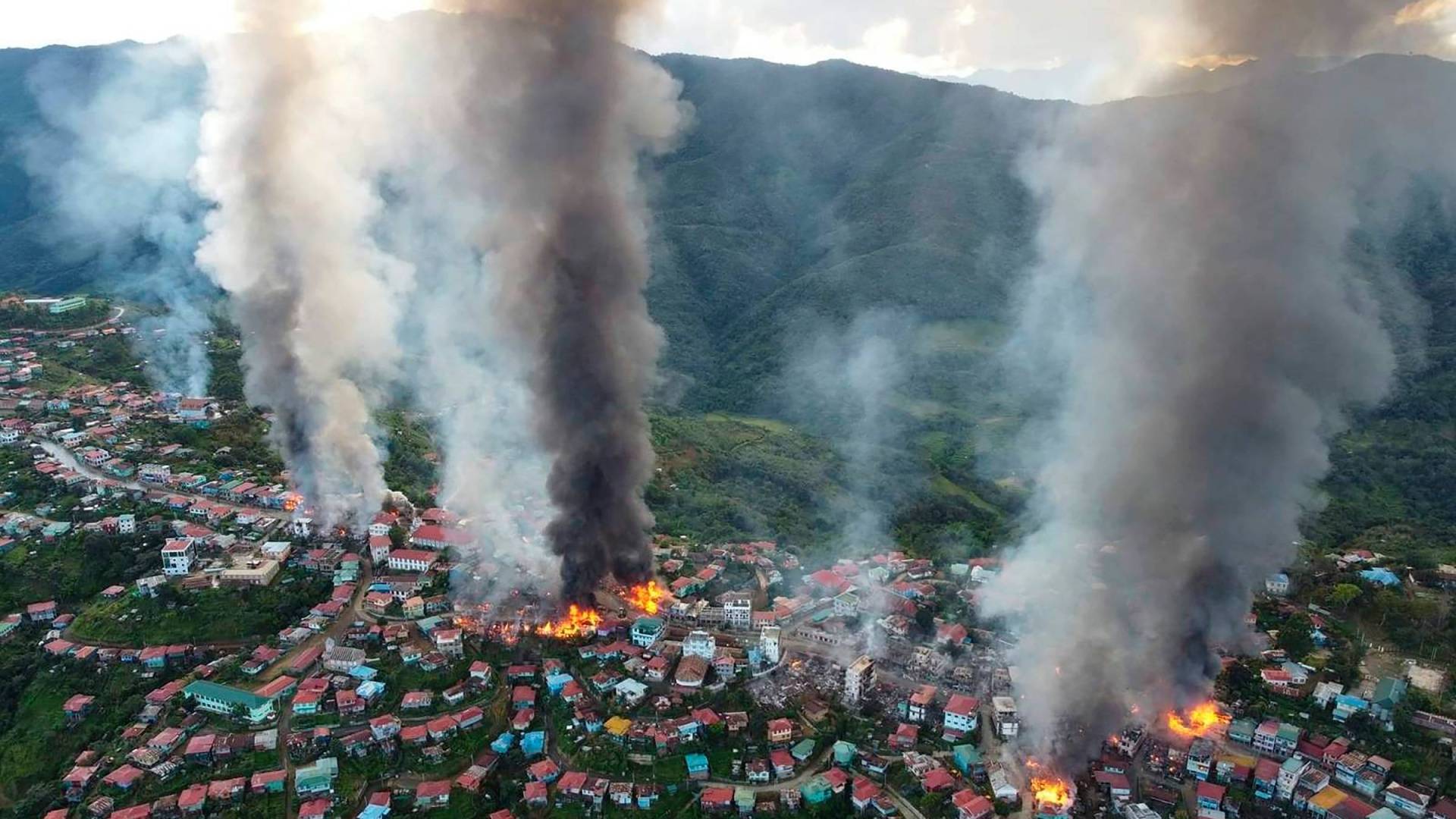
More than 160 buildings in a town in northwestern Myanmar, including at least two churches, have been destroyed by fires caused by shelling by government troops, local media and activists reported Saturday.

The destruction of parts of the town of Thantlang in Chin state appeared to be another escalation in the ongoing struggle between Myanmar’s military-installed government and forces opposed to it. The army seized power in February from the elected government of Aung San Suu Kyi, but has failed to quell the widespread resistance.

The Chin state is a heavily Christian area in the otherwise majority-Buddhist country. Over 90 percent of the ethnic Chin people identify as Christian, many of them Baptists after the history of Baptist missionaries in the region.

A government spokesman denied “nonsense allegations being reported in the country-destroying media,” and blamed insurgents for instigating the fighting and setting the fires.

Human rights groups and UN experts recently warned that the government is planning a major offensive in the country’s northwest, including Chin state, along with the regions of Magway and Sagaing. Residents of the rugged area have a reputation for their fierce fighting spirit, and have put up stiff resistance to military rule despite being only lightly armed with single-shot hunting rifles and homemade weapons.

There were no immediate reports of casualties from the fire, which started early Friday and burned through the night, according to reports.

Dave Eubank, head of the Christian humanitarian service movement Free Burma Rangers, said the attacks against Christian homes and businesses in the area are due to resistance to the regime, rather than targeting a particular faith.

“I do not see a large policy directed towards Christians, it’s just Christians are in the way,” he told CT.

The humanitarian aid agency Save the Children said its offices were in one of the buildings that was “deliberately set ablaze.”

“The destruction caused by this violence is utterly senseless. Not only has it damaged one of our offices, it risks destroying the whole town and the homes of thousands of families and children,” said a statement from the London-headquartered agency.

Thantlang had already been largely abandoned due to previous attacks by government soldiers.

Eighteen other houses and a hotel were destroyed by fire set off by another shelling on September 18, and a Christian pastor was shot when he tried to help put out the blaze. According to an Asia Pacific Baptists, pastor Cung Biak Hum had come to the assistance of a congregant whose home was burning.

More than 10,000 residents then fled the town, some staying temporarily in nearby villages and others seeking shelter across the border in Mizoram, India. About 20 staff and children in care of an orphanage on the outskirts of the town are believed to be its only remaining residents.

The Chin Human Rights Organization issued a statement saying the fires in Thantlang had died down by Saturday morning, after as many as 200 houses may have been destroyed.

“Most of the structures on the main street, which has shop stalls and all kinds of businesses, have been destroyed. There is nothing left to salvage,” said the statement, signed by the group’s deputy executive director, Salai Za Uk Ling. “The manner in which the fire was burning indicates that it was not just the incendiary rocket fires but also deliberately torching of houses and structures manually.”

According to the Chinland Defense Force-Thantlang, a local militia fighting the military, a Presbyterian Church and a building housing the Pentecostal Church on the Rock were among the 164 structures it had counted destroyed by fire.

The defense force said the shelling began after fighting broke out when it tried to prevent government soldiers from looting a house in the town.

In a phone interview Saturday night on state television MRTV, government spokesman Maj. Gen. Zaw Min Tun said the events began when members of the PDF—or People’s Defense Forces, as the local militia are generally known—attacked security forces, who returned fire. He said the insurgents took cover in houses in the town and set fires as they fled, keeping government reinforcements from putting out the flames by shooting at them.

He added that it was not possible to bring firefighting resources from the state capital, Hakha, because a bridge on the road connecting the towns had been blown up on October 21.

“It’s needless to say who blew up the bridge. These videos can be found on country-destroying media,” said Zaw Min Thin, in a reference to video that circulated widely on social video showing several explosive charges being detonated on the span. He described the sequence of events as “a deliberate plot.”

The statement from the Chin Human Rights Organization expressed concern that what happened may represent just the beginning of a major government offensive known as “Operation Anawrahta.” The government has not acknowledged such a plan.

“The high number of troops being sent to Chin state in recent days and weeks has been truly unprecedented. They have brought with them destruction and death,” said the human rights group. It called for urgent action on the part of the UN Security Council “to help prevent mass atrocities before they happen.”

Additional reporting by CT

News

Reaching Youth for Christ During Sudan’s Coup

When the military closed Khartoum’s airport and disrupted their discipleship training, a generational odd couple from YFC Lebanon improvised and preached to hundreds of students.

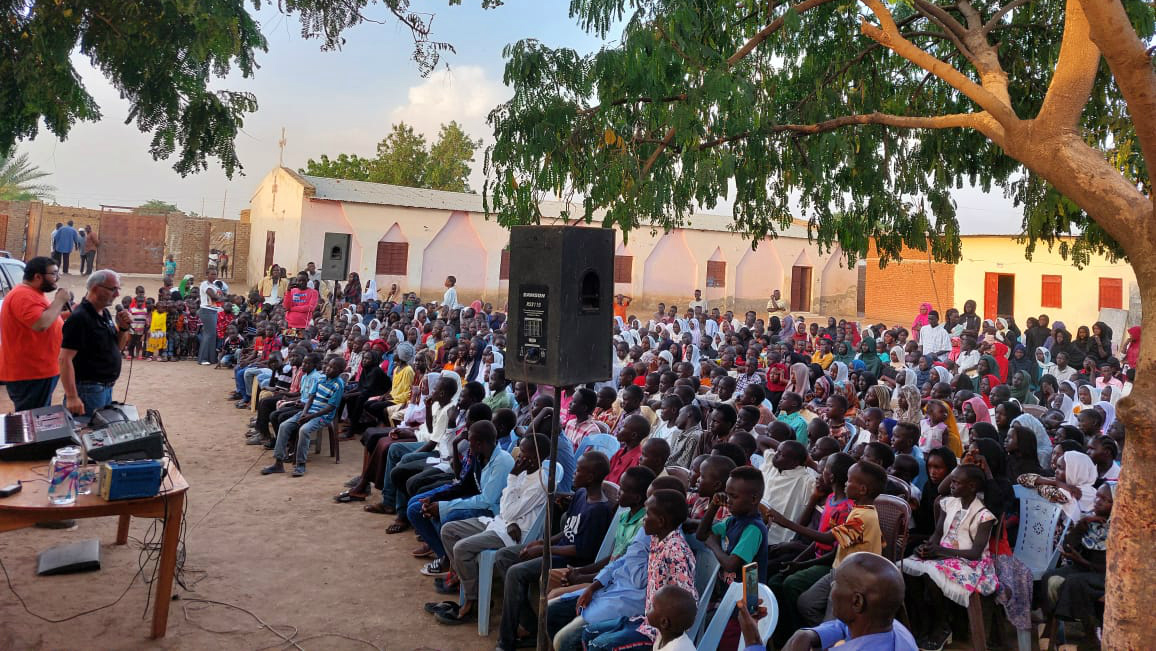
An outdoor YFC youth meeting in al-Thawra near Wad Madani, Sudan.

An outdoor YFC youth meeting in al-Thawra near Wad Madani, Sudan.

Christianity Today November 3, 2021
John Sagherian

At 6:30 a.m. last Monday, John Sagherian and Elie Heneine went down to the lobby of their three-star hotel in eastern Sudan and found a crowd gathered around a TV. Filtering in, they heard the news.

The military had staged a coup in the capital, Khartoum, 90 miles to the northwest.

“Instantly, everything we planned for that day was up in the air,” said Heneine, a 27-year-old staff worker with Youth for Christ (YFC) Lebanon. “Oh well, youth work is very organic.”

Sagherian, the 74-year-old YFC regional director, had long been “dying to visit” Sudan. Two years earlier, he had identified a promising country director named Sabet, who since then had recruited seven other volunteer staff members. Sabet even ignored the capital, concentrating instead on the poorer hinterland.

The Lebanese team of two were finally scheduled to meet their new Sudanese colleagues later that day. As malaria had been among their concerns, they had taken 100 mg of medication every day for two weeks prior. The visa had also been a complication, requiring multiple layers of bureaucracy. But it was the BBC app that now troubled Joy, Heneine’s American wife of five months, as Sudan increasingly filled her news feed.

Heneine himself was at peace. Not only was he used to instability as a Lebanese Christian, but Sabet and others assured them everything was fine—despite the political tumult between the once-cooperating military and civilian leaders.

In 2019, the Sudanese army backed massive protests to overthrow 30-year dictator Omar al-Bashir. A spate of religious freedom reforms replaced his Islamist governance, normalization agreements were signed with the nation’s former enemy Israel, and the US removed Sudan from its list of state sponsors of terrorism.

The economy was struggling, but the World Bank was poised to help. Sudan was almost ready to rejoin the community of nations. But politicians were bickering, and a military coup had been suppressed only one month earlier.

In the background was disagreement over sending Bashir to the International Criminal Court to be tried for war crimes in Darfur. Deeper still were issues of army control of large sectors of the economy. And at an unspecified but fast-approaching date, the transitional Sovereign Council was supposed to switch to civilian leadership.

Two days before the coup, the YFC team had traveled three hours over bumpy roads with multiple checkpoints to reach Wad Madani, Sudan’s ninth-largest city. Sabet’s youth office was located in an evangelical school, and he’d invited Sagherian to preach to the local congregation that Sunday evening.

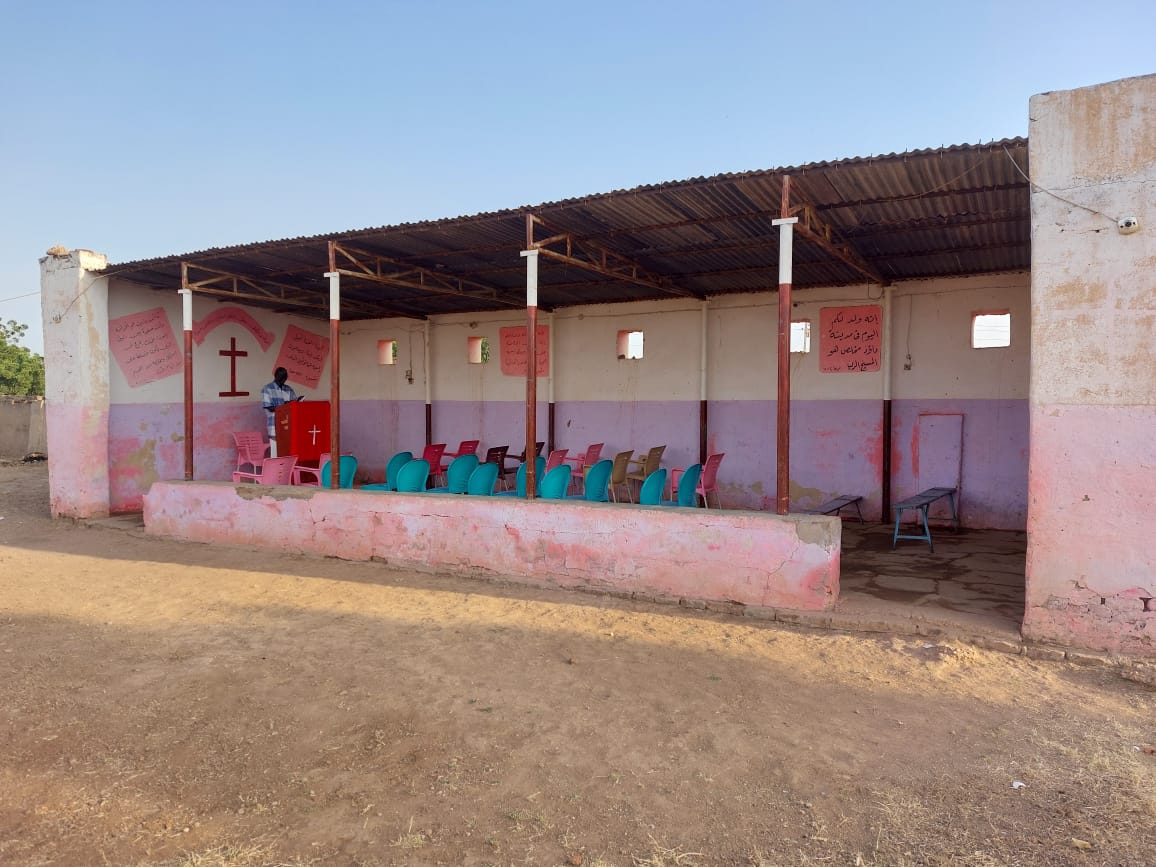
The Tekilat evangelical church in Wad Madani, Sudan

With men sitting up front on plastic chairs and women behind, about 30 people filled the three-walled, tin-roofed structure. Such impromptu invitations were not unusual for the still-active senior, so Sagherian pulled out a message he had given often to Lebanese, Syrian, and Egyptian youth.

The title proved prophetic: “Why Is God Doing This to Us?”

“Do we become angry and bitter or say, ‘What now, Lord?’” Sagherian recalled preaching. “And then the coup happened [the next day].”

He spoke from experience. Ten years earlier, his beloved wife, Nancy, died of cancer. Her acceptance of God’s will in their final weeks together inspired another decade of her husband’s ongoing service.

Eventually, the team learned that Christians in Wad Madani had joined their fellow Muslim citizens in overwhelmingly rejecting the coup. But first, YFC had to reach the local believers.

A group of 35 leaders from the three evangelical churches in the city had been prepped for their arrival. Sabet went to learn firsthand whether the training sessions would still be held; it was two hours of silence before he returned.

“They are waiting for you,” he said.

Sabet hailed a tuk-tuk, one of the three-wheeled auto rickshaws that serve as local taxis. The three leaders joined five others and a baby goat sitting on the rail, knees knocking, continuously jostling, as the 15-year-old driver navigated the poorly paved road.

“That was a lot of human beings, and I am like five people,” said Heneine. “It was the workout of our lives just to hold on.”

That was only the start. Moving across town, they witnessed protesters breaking up the sidewalk to pile makeshift barriers to block traffic. They circled the neighborhood looking for a thruway, only to turn back and discover a new one. Eventually they pleaded as “one of the people” and were allowed passage.

But there was no animosity, said Heneine. Unlike in his native Lebanon, there was incredible unity among the Sudanese, with none opposed to anyone except the coup leaders.

And they were also organized. The Sudanese would go to their jobs, except they would not work—answering the call for civil disobedience. And at noon they would gather in the streets, block roads, and burn tires. Even the bread lines, an unfortunate consequence of the economic stress, would disappear.

Sagherian instructed the youth workers from Psalm 78: David led the people with competence and integrity of heart. It appeared evident all around.

By Tuesday (October 25), the YFC team grew to recognize the rhythms of the protest and how to best move around. By the afternoon, the government had cut off phone and internet service across the nation to disrupt the protest movement. It also disrupted YFC’s best-laid plans.

So they continued to disciple Sabet and his seven staff members and resigned themselves to a reduced training schedule. Now relaxed, they enjoyed a fish lunch with lemonade on the banks of the Blue Nile. And they took a PCR test, ready to fly home the next day—only to learn on Wednesday that the airport had been closed.

Stuck, the YFC leaders scrambled and called for a youth meeting in a poor village on the outskirts of town the next evening.

Sabet worked with the headmaster, who about a decade earlier had become the neighborhood’s first convert to Christianity. But he wasn’t the last. Sharing the gospel, this man gathered new believers into a mud-hut home fellowship. Then he built a church; then, a school. And now he called the 95 percent Muslim student body to attend a youth rally—and told Sagherian he should preach clearly about Jesus.

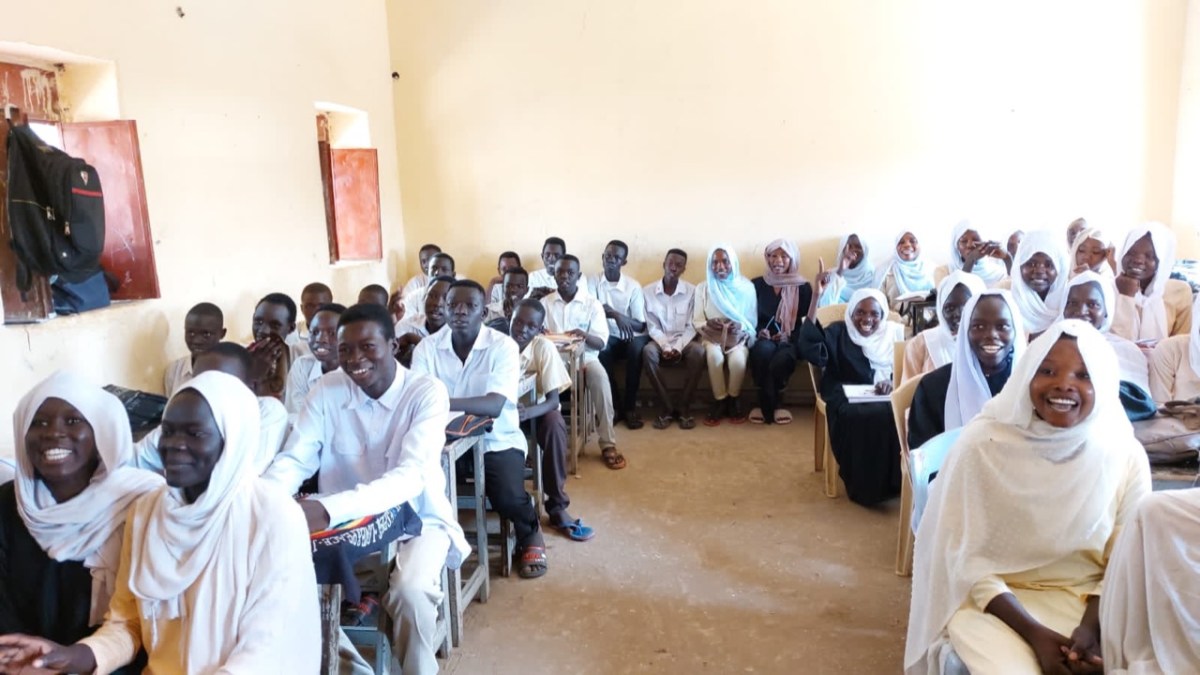
Students in a classroom in al-Thawra near Wad Madani, Sudan

Raised as a pastor’s kid in the Armenian evangelical community of Lebanon, Sagherian was familiar with altar calls. He assumed national leadership of YFC in 1974, becoming the Middle East and North Africa regional director in 2010. From decades of ministry experience among mostly Christian-background students, he expected maybe 100 kids to show up. It would be incredible if five gave their lives to the Lord.

Over 1,000 filled the dirt-covered schoolyard grounds.

Sagherian adapted his usual YFC anecdotes:

Imagine you had to swim from the Red Sea coast to India. Some of you might get farther than others. But none of you would make it. Your good lives cannot satisfy God.

Imagine if I suddenly had the mind of Ronaldo controlling me. I’m 74, but I’m darting all over the soccer field, scoring goals. This is what happens when Jesus comes into our lives: We now satisfy God.

He asked those who wanted to give their lives to Jesus to stand up. Nervous, one did here, then there. But before long, the entire student gathering was upright.

Wait—something was off. Sagherian pressed the importance of the decision. Having the students sit down, he asked them this time to raise their hands. Perhaps more aware, 80 percent did so.

God knows the heart, he counseled himself. And he remembered his father’s words from many years ago: “You talked to them about God. Now talk to God about them.”

Heading back to the hotel, the YFC team learned the airport would open the next day, but nothing was certain. They woke at 5:30 a.m. and providentially arranged a taxi. Entering Khartoum, they saw lines of well-armed police officers. Saturday was to be a million-man demonstration, and the security forces were preparing. (To date, 15 protesters have been killed.)

Another PCR test was required at the airport, but the office was closed. Somehow, the man in charge agreed to come, two hours later than promised. The clock was ticking. But the nose swab’s negative results were returned in five minutes—surely an example of Sudanese corruption but perhaps also of God’s provision.

The airport was sweltering, packed with people anxious to leave the country. But boarding was smooth, and after an overnight layover in Addis Ababa, their Ethiopian Airlines red-eye flight landed in Beirut.

“We were living out the promises of God,” said Sagherian. “I never felt we were in danger, and we learned that so many people were praying for us.”

They asked instead for a shift in focus.

“We were two people who did our ministry and left, while Sudan continues to fight with itself,” said Heneine. “Be praying for them.”

Sabet told them that he has always been free within church buildings. But only since the revolution had he been able to minister in the public square. “People don’t care about religious background any longer,” he told them, and his good reputation in the village earned him much trust.

But Sabet doesn’t know what will happen after the coup.

In a potentially ominous sign, military leaders have released some of Bashir’s top officials from jail. International actors continue to mediate, while the deposed prime minister holds his ground.

So much is at stake for the Sudanese.

But for the Lebanese, who simply expected a normal time of training youth, the experience was transformative. Sagherian choked up, recalling the opportunity to share the gospel with so many Muslim youth. Heneine learned how to “wait on the Lord” from his senior colleague.

“God moved circumstances and people, putting us in places we couldn’t have imagined,” said Heneine. “It was like a well-played chess match, and God won.”

News

Ministries Help Job Seekers Find a Paycheck with a Purpose

After losing shift work and blue collar jobs during shutdowns, Christians are thinking more carefully about the work of their hands as they reenter the marketplace.

Christianity Today November 3, 2021
Courtesy of Travis Lowe / Crea Company

No one dreams of seeking work after retirement, but sometimes a pension isn’t enough. West Virginian Henry Shinn, 61, found himself there last year as the COVID-19 pandemic wracked the nation.

With nothing but an unlikely product design brewing in his mind, he approached Crea Company—a faith-based organization that works with creators to bring their ideas to life.

Within months, Crea Company had helped him formulate a plan and secure the machines and materials necessary to launch West Virginia Trail Chips. The company produces durable wooden tokens in the form of unique, collection-worthy business cards. Shinn now earns a steady income from his part-time business, working from home and creating his products in the Crea workshop for an affordable monthly fee.

Crea’s mission-based framework to provide a “future that inspires hope” for West Virginians is one example of how Christians are helping one another through unsteady economic times and job difficulties.

Bonus? It comes with the perk of built-in coworkers. Fellow creators, who also believe in the Christian mission of the local “makerspace,” are there to ask questions, give advice, and offer direction.

“You are just more apt to be friendly and helpful in that kind of environment,” Shinn said in an interview with Christianity Today.

Crea cofounder Travis Lowe, who also pastors Crossroads Church in Bluefield, West Virginia, saw interest rise soon after the pandemic spawned. After starting Crea in 2019, its purpose shifted to meet the community’s needs as the pandemic hit.

“Our original model,” said Lowe, “was to offer community groups [the opportunity for] maker classes—like, come make a doormat or planter—and have memberships. But COVID made that almost impossible.”

In 2020, Lowe pivoted to a new model: making personal protective equipment (PPE) supplies to help local medical providers and offering the chance for others to create and sell their own products. Folks who lost work, such as “cleaners and restaurant workers,” were “looking for side gigs to make extra money,” Lowe said via email.

Now they’ve set up shop to repair lawn mower engines, design leather goods, fabricate metal signs, 3D-print materials, and print shirts, hats, and koozies.

One member, a disabled coal miner, made personalized masks and began selling them online; a popular version made wearers look like Hulk Hugan. An engineer seeking a side hustle used Crea’s 3D printers and recycled small engine parts to make props for student films at Liberty University. A local pastor used Crea’s lasers to custom engrave his woodwork, now displayed on each table in his son’s newly opened restaurant in town.

Employment struggles aren’t new to West Virginia, the sixth-poorest state in the nation with a 16 percent poverty rate. But things got tougher in 2020, as lockdowns demolished local economies.

Last year alone, the US lost 9.37 million jobs, the highest number in 80 years. And while the unemployment rate currently stands at 4.8 percent—and lower-level jobs are facing a worker shortage—many are still seeking jobs that will provide the same pay and benefits as pre-pandemic positions they lost. According to Pew, the vast majority of those people are pessimistic about their prospects and do not want to settle for unfulfilling, subordinate jobs.

That’s where churches and ministries like Crea can play a role, and many people are hoping they will continue to do so. Recently released Barna data finds that 1 in 5 US adults want the local church to address “vocational well-being.”

Larger churches have the capacity to do so more comprehensively. In 2013, Chicago-based Willow Creek Community Church launched the Willow Creek Care Center—a program developed in response to huge need within the church. The Care Center has played a pivotal role for church members in 2020 and 2021.

Though many of their popular in-person programs like counseling sessions, support groups, and job skills workshops were on hold in 2020, the center continued to facilitate outdoor job fairs and a variety of other online support opportunities.

“We are seeing unusually difficult cases [right now],” said Anne Rand, the center’s long-term solutions advocate. “It’s people who have been out of the workforce for many years, so they don’t have the computer skills or know-how to navigate a job search in today’s tech-savvy environment.”

Chicago resident Lisa Klavan sought help from Willow Creek this year. She appreciated that the center was willing to pray for her. “The level of concern and care was deeper than with a secular group,” said Klavan, who is still searching for a job.

Most churches don’t have a program as comprehensive as Willow Creek, but many do have job boards or partner with ministries invested in faith-based work endeavors.

Such partnerships are especially vital in this time of societal upheaval, said Andy Crouch, a partner at Praxis Labs, an organization dedicated to Christian entrepreneurs.

“I think the fact that churches have found creative ways to guide people towards employment is exactly what we should be doing,” he said. “When the system is broken down, redemptive people step in.”

The fact only 1 in 5 Americans are seeking the church’s help for vocational matters, per Barna’s data, demonstrates how many people don’t know that help is “available or plausible,” Crouch said.

“That’s what the church should be providing—asking everyone, ‘What’s broken? Can we help you think about how you could be a part of repairing what’s broken?’”

The good news is that younger generations are more likely to look for vocational guidance from faith groups: According to Barna, 7 in 10 Gen Z (67%) and millennial (69%) adults were interested.

David Bell had these groups in mind when he founded Circle City Fellows, a Christian nonprofit intended to encourage and disciple Christians in a wide variety of careers to live out their work “on mission” for Jesus. He’s worked with everyone from financial planners and realtors to bartenders and a stay-at-home mom. The program includes weekly classes on spiritual formation, theology, and other culturally relevant topics that affect work life. The fellowship also holds regular in-person meetings for relational connection, idea exchange, and encouragement.

Though the program is only three years old, Bell continued to push forward and help those working through the pandemic, despite the difficulties.

“The pandemic gave a different angle to the types of questions people were asking,” Bell said, adding that participants are “reflecting on themselves and what steps they can take to contribute to the thriving and flourishing of the city” in a deeper way.

Flourishing is certainly the ultimate goal, but equipping those in survival mode this past year has been a central focus for many churches. This shouldn’t necessarily be a primary function in the long term, however, said Crouch.

He believes that when society is functioning as it should—with well-built structures to support job creation and sustainment—churches are more of a secondary resource for job acquisition.

“When those [structures] are in place,” he said, “it is the church’s job, then, to help people understand why it is such a good thing to do good work and find good work and contribute to society through good work.” Otherwise, the church should “fill in the gaps for the most vulnerable,” which is what we have seen from many folks since the pandemic began.

As life gravitates back to normal and base-level work is acquired, people can begin thinking about the deeper purpose to their work. For some, the pandemic was the jump-start they needed to finally leap into a more meaningful vocation.

Louisa Saylor is one of those. The 33-year-old mother, musician, and ministry leader did something she never expected last year: quit her teaching job. When the expectations and pressure became untenable, she sought an exit strategy.

“My first year of teaching, I cried every day,” she said. “But I cried more during COVID teaching than I did during a typical school year—and I’ve worked in some pretty rough inner-city schools.”

The politics, policies, and added work for teachers during the pandemic broke her, and she began praying about leaving just two months after it began. Ultimately, it was a church that came to her rescue, in the form of a job offer to work in teen ministry. After applying to dozens of jobs, Saylor considered it an answered prayer—and it restored her back to the purpose she and so many other Christians long for in their work lives.

According to the Barna report, churchgoing Christians are more likely to seek and find purpose in their jobs than others. Most say their local churches do help them understand how to live out their faith in the workplace, and there has been an uprising of parachurch ministries structured around work-life purpose in recent years.

WorkFaith in Texas provides faith-based training and coaching for those seeking long-term employment. Faith Driven Entrepreneur gathers creators for support and purpose building. Colorado’s Denver Institute for Faith and Work explores the connection and tension between “what it means to love God and our neighbors through our work.”

And in Indianapolis, Purposeful Design trains and equips formerly homeless and addicted individuals for woodworking positions, focusing on marketable physical and attitudinal skills. Most organizations did continue throughout the pandemic, though they may have been operating at lower capacity.

It’s clear that many leaders, in both churches and outside ministries, have a passion for helping others obtain substantive work and find God-given purpose within it. The pandemic upended work life—slashing jobs, closing offices, and forcing health risks for frontline workers—but the innate human desire to thrive remained.

Lowe, the cofounder of Crea, felt called to facilitate that for others. He aims to help vulnerable people overcome barriers like startup expenses, necessary tools, business coaching, mentorships, and relational connections. And he has done so, offering men like Henry Shinn a chance to create profit when few other opportunities existed.

“When you couple opportunity with the ability to back it up with faith,” said Shinn, “even those with very little direction are now flourishing and profitable.”

News
Wire Story

With Pandemic Tithes Up, Churches Pay Back Millions in Stimulus Funds

It’s not just Lakewood. So far, 99 Christian orgs have repaid their Paycheck Protection Program loans.

Christianity Today November 2, 2021
Marc Piscotty / Getty Images

When Michigan’s governor required churches to stop meeting in person on March 16 last year, Kenton Sanders, director of operations at Mars Hill Bible Church, quickly did some worrying math.

About 40 percent of donations to the megachurch in Grandville, Michigan, came during in-person services that drew some 1,750 adults, students and children weekly. With in-person services shutting down, donations would surely tumble. If that happened, the church would have to lay off some of its staff.

“It was at the beginning of the pandemic, we had just gone online, and had no idea what was going to happen,” he said.

So, like more than 120,000 churches and other religious organizations nationwide, Mars Hill applied for help through the Paycheck Protection Program, the emergency loan program created by the CARES Act, a $2.2 trillion relief and stimulus package passed by Congress in March 2020. Under the PPP, the Small Business Administration would funnel funds to local banks, which would make loans to employers in their communities.

Mars Hill’s $295,000 loan, approved on April 14, 2020, would protect two dozen jobs at the church, at least for a few months.

But within a month after the loan was approved, Sanders noticed that giving had actually gone up. In addition to regular offerings that came in online, church members also contributed to a benevolence fund, known as “the white bucket project,” to help neighbors in need during the pandemic.

After talking with other Mars Hill leaders, Sanders called up the bank and returned the entire amount of the loan.

Mars Hill is one of a small number of religious organizations that took out large PPP loans only to return the funds without ever withdrawing a penny or to pay back the loan back in full.

According to an analysis by Religion News Service of data from the SBA, 13,408 religious groups, mainly churches, were approved for loans of $150,000 or more. Of those, 100 paid the loans back without asking for the loans to be forgiven. Fewer than 50 other groups were approved for the loans but did not withdraw the funds.

The repaid loans range from $4.37 million to $150,500 and totaled just over $66 million. Those repaying the loans include 99 Christian groups and one Muslim organization.

At least one well-known congregation, Lakewood Church in Houston, pastored by televangelist Joel Osteen, recently announced that it will pay back a $4.43 million dollar PPP loan. A church spokesman said the loan will be paid back with interest over 60 months.

More than 8,800 religious groups have asked for their loans to be forgiven—as the program was designed to allow, and a relatively common practice for all PPP borrowers. The status of another approximately 4,500 remaining loans has not yet been reported to the SBA by local banks.

All told, 11,823,594 PPP loans were approved, for a total of $799.8 billion.

For Philadelphia Baptist Church, based in Deville, Louisiana, getting approved for a PPP loan provided peace of mind when such peace was in short supply. Pastor Philip Robertson called the early days of the pandemic the most stressful time of his more than quarter-century as a pastor.

While the church had some reservations about the loan and whether it would come with government strings attached, Robertson said, “We wanted to make sure that we were able to continue to pay our staff and not have to endure catastrophic financial implications.”

From the beginning, church leaders decided to pay the $181,170 loan back if they could. The funds were set aside, said Robertson, and to be spent only if they were needed.

When giving remained steady, the church repaid the loan in July of 2020. Paying the loan back cost the church about $400 in interest, said Robertson, a small price to pay for the peace of mind that came with the loan.

Robertson said he’s thankful that the church was eligible for the loan—even though it was funded by the federal government—grateful that the loan turned out not to be needed and grateful for the continued giving of church members.

“The people of God give because they give out of obedience to the Lord and wanted to support the ministry and work of their church,” he said. “And that was a priority for them. Even in the midst of a global pandemic.”

Paul Spilker, lead executive pastor at College Park Church in Indianapolis, which paid back a $1,157,100 loan, was also surprised by the generosity of church people during the pandemic. The loan, he said, allowed the congregation to pay its staff during a time of great uncertainty. When giving to the church turned out to be higher than expected, he said, church leaders decided to pay it back.

“We thought, here’s a testimony to the generosity of our people,” Spilker said.

Spilker and other leaders of churches that repaid the loans said it was the right thing for their church. But they understand why other groups made different decisions.

To qualify for loan forgiveness, churches and other organizations had to certify that there was significant economic uncertainty when they applied for the loan—which was the case for nearly every for-profit and nonprofit organization in the United States.

There are some indications that congregations avoided major fiscal decline during the COVID-19 pandemic. More than half of the congregations in a fall 2020 study from Lake Institute on Faith and Giving at Indiana University-Purdue University Indianapolis said that giving had either stayed the same or gone up. Few (14%) said they had to lay off staff, while two-thirds applied for a PPP loan.

In their loan application, Mars Hill asked for enough money to pay the salaries of 24 staffers. All told, the PPP loans to religious groups were meant to pay salaries of 1.5 million staffers, with half of them at groups that borrowed more than $150,000.

Allison Gill, vice president of American Atheists, said she appreciates religious groups that paid back their PPP loans rather than asking for forgiveness.

“It shows an appreciation for the separation of church and state,” she said.

Still, American Atheists and other secular groups expressed concern over the program—especially if religious groups applied for forgiveness. That essentially turned loans into grants to pay the salaries of religious leaders, said Nick Little, vice president and general counsel of the Center for Inquiry, another atheist group.

Little said that having government funds paying the salaries of pastors, rabbis, priests and other leaders was “constitutionally troubling.”

The 2012 National Congregations Study found that about 25 percent of congregations had mortgages or other debt. Congregations that described themselves as more conservative (22.3%) were less likely to say they had debt than those that were more liberal (43.9%).

Uncertainty for many religious organizations, meanwhile, is far from over. At Mars Hill, Sanders said that the staff remains intact, and as the pandemic has eased, about 300 people now show up for weekend services. But others continue to attend only online. That makes long-term planning difficult.

“The hard part is that we don’t know how many people we have in our church anymore,” he said.

Still, he is thankful the PPP loan was repaid. “I am really proud to be part of a church that said, ‘No, we don’t need it—we are going to give it back.'”

News

A Year After the Election, Trump’s Effect on Evangelical Churches Lingers

Political tensions in the pews have calmed, and another survey shows leaders’ Trump support yielded more positives than negatives for evangelicals.

Christianity Today November 1, 2021
Eva Marie Uzcategui / Getty Images

Political polarization has subsided in most American churches a year after the 2020 presidential elections. But there are notable exceptions to that trajectory, and new research has found lingering effects of evangelical support for former president Donald Trump.

The remnants of tension are evident at congregations such as Seattle’s Downtown Cornerstone Church, where pastor Adam Sinnett has been surprised “at how challenging it is to really cultivate unity amidst [our] political differences.”

In the youthful, mobile, and tech-savvy church, members who “leaned more toward the far left and the far right tended to have the most difficult time in this last season,” Sinnett said, “and they also were the ones that gravitated away from the church.”

The Seattle congregation’s experience aligns with data released this week by Heart and Mind Strategies, a research and consulting organization. A survey of 1,000 US adults conducted in August found some remaining sources of political strife for evangelicals.

Around half of Americans believe evangelical leaders’ support of Trump hurt the church’s credibility. One in four say evangelical support for Trump reduced their desire to participate in religion. And among evangelicals, 33 percent say their leaders’ support of Trump made personal witness to friends and family more difficult.

https://datawrapper.dwcdn.net/TmdhH

The political strife the church has endured in recent years “shows the world that Jesus doesn’t really unite people like we say he does,” Sinnett said.

At Downtown Cornerstone, the political differences show up “in three primary spheres: personal relationships, small groups, and most pointedly around decisions of leadership” over whether to address social issues and whether to submit to the government on COVID-19 restrictions, among other issues.

“It’s somewhat of an indictment of the church that we are far more comfortable in our ideological circles than we are with people that have totally different political perspectives but worship the same Jesus,” Sinnett said.

Divides in many churches hit a breaking point in 2020, with heightened political polarization during Trump’s reelection campaign and pastors struggling to maintain unity over pandemic responses. In the aftermath of the contested election and the riot at the US Capitol, pastors even found themselves in conversations around conspiracy theories, fear, and truth.

Amid the tensions, some congregations clashed with their leaders, some pastors left their churches, some members went searching for a new church home, and some have taken a break from church life altogether.

But as the election recedes and pandemic outlooks improve, things feel a lot better in most churches than they did in 2020. The effects still linger, but the intensity of the debates have died down.

The question for analysts is whether the apparent calming of political tension among evangelicals stems from increased spiritual maturity or just the changing news cycle. Author and theologian Jonathan Leeman thinks it’s a combination of both.

“There are risks of dividing over things that are in the news,” said Leeman, coauthor of How Can I Love Church Members with Different Politics? “Now we’re not talking about a presidential election,” and the division is subsiding. “Everybody is talking about vaccines and mask mandates, so that’s where you’re going to feel the fissures.”

Still, Christians seem to be learning in 2021 to separate “whole church issues,” on which Christians must agree to be part of a congregation together, from “Christian freedom issues,” which are not as clear in Scripture, he said.

“At least a few more people are beginning to grab onto the idea of Christian freedom as a crucial doctrine that allows the temperatures of conversations to drop at least slightly,” said Leeman, editorial director at 9Marks in Washington, DC.

It can be hard to disagree over politics in church when so many believers see their vote and their political engagement as stemming from their Christian convictions and beliefs in right and wrong. Two-thirds of self-identified evangelicals, according to the Heart and Mind survey, say their faith influences their political beliefs, twice as many as Americans on average.

The majority of evangelicals (57%) believe their support of Trump in 2020 “showed moral courage to try and achieve policies and actions consistent with evangelical Christian values,” and more than a third of Americans overall agreed.

Most who identify as evangelicals or hold evangelical beliefs said evangelical stances on President Trump didn’t affect their church involvement either way. But for a sizable minority, it led them to become more engaged with their church and their faith.

Among self-identified evangelicals, 30 percent say they are more likely to attend Sunday services as a result of how their pastors addressed Trump in the last election, 27 percent say they’re more likely to make donations to their church, and 33 percent are more likely to witness to friends.

https://datawrapper.dwcdn.net/dG9yB

Approximately 80 percent of white evangelicals voted for Trump in 2016 and again in 2020, according to polling data. Trump’s evangelical allies, convened by friend and televangelist Paula White, included leaders like First Baptist Dallas pastor Robert Jeffress, Gateway Church pastor Robert Morris, and Samaritan’s Purse president Franklin Graham.

Some evangelicals who objected to Trump during the 2016 election—such as Southern Baptist Theological Seminary president Albert Mohler—ended up backing him in 2020 based on his track record on religious liberty, abortion, and other issues. In the Heart and Mind survey, evangelicals who were white, over 55, and weekly church attenders were most likely to agree with such stances, believing Trump kept his promises to champion matters important to faithful Christians.

The evangelical critics of the former president, though, said Trump’s brash approach, as well as his remarks on women and immigrants, revealed a character at odds with Christian values. Pastors like Andy Stanley at Atlanta’s North Point Community Church worried evangelical association with Trump would hurt the church’s reputation and outreach. In the survey, a minority of evangelicals believed the same, concerned about the impact on evangelical credibility and Christian witness.

But surveys so far haven’t reported a significant impact on evangelical affiliation. The new findings from Heart and Mind align with data released last month by the Pew Research Center showing there was no mass exodus from evangelicalism during the four years of Trump’s presidency despite pockets of turmoil. In fact, affiliation grew thanks to Trump’s political supporters adopting the label.

While evangelicalism at large looks to have survived the Trump era without major fissures, division remains for some Black Christians.

The Heart and Mind Strategies poll found 64 percent of Black evangelicals identified with the sentiment that “evangelical leaders’ obsessive support of Trump coupled with his personal failings does more harm than good, tarnishing numerous causes.” An identical percentage of white evangelicals (64%) agreed that they supported Trump because “while not a perfect person, he championed matters important to faithful Christians.”

Those racial differences manifested themselves in the departures of several African American pastors from the Southern Baptist Convention (SBC) last year. Now Marshal Ausberry, immediate past SBC first vice president and immediate past president of the SBC’s National African American Fellowship, says the suburban DC congregation he pastors may leave the SBC this year.

Members of Antioch Baptist Church in Fairfax Station, Virginia, are “deeply, deeply concerned” over appearances the convention is “in bed with a particular [political] party,” he said.

The Trump administration “reopened” past wounds of racial trauma for African Americans and brought grown men to tears, Ausberry said. Over the past year, the situation “has not improved because anytime you experience pain or racialized trauma resurfacing, it takes time to heal.”

The Hispanic community seems to mirror the larger trend of political calming, according to Javier Chavez, a Georgia pastor and global studies professor at Truett McConnell University. The 2020 election cycle was “difficult” for Latinos due to the “political noise.”

In different parts of the country and among Latinos with different backgrounds, views clashed over the president. Some churches split over the election, and some Hispanic believers changed churches over politics, Chavez said.

This year, however, “is a different story.” Currently, “the discussion of political ideology is not really what is transpiring in my community,” said Chavez, pastor of Amistad Cristiana International, a Spanish-speaking, predominantly Mexican and Central American church in Gainesville, Georgia. “At this moment, the concern is economics: inflation, constant noise of an approaching economic crisis, housing prices.”

https://datawrapper.dwcdn.net/BjvPD

Amid the slowdown of election conflict, half (52%) of evangelicals agree they are “proud that some in the evangelical community are seeking to separate the gospel message from Trump and toxic politics,” according to the Heart and Mind Strategies survey.

Evangelicals under 35, people of color including Asians and Hispanics, and those living in the Mountain and Midwest areas were most likely to agree.

Many of them likely have their own leaders in mind. Self-identified evangelicals gave their pastors higher marks in their handling of the 2020 election than evangelical leaders in general.

https://datawrapper.dwcdn.net/cWpHM

Respondents were more likely to say evangelical leaders did a fair or poor job speaking about the presidential election (43%). When asked about their own pastor or church leader, though, just over half (51%) gave them positive marks.

David Roach is a freelance reporter for CT and the pastor of Shiloh Baptist Church in Saraland, Alabama.

Books
Review

The Contentious Literary Family That Explains Global Anglicanism

How the dilemmas driving “The Brothers Karamazov” resemble those confronting the world’s third-largest Christian communion.

Christianity Today November 1, 2021
Illustration by Rick Szuecs / Source Images: Wikimedia Commons

C. S. Lewis envisioned Christianity as a house with “a hall out of which doors open into several rooms.” The rooms are ecclesial traditions that offer disciples a fire for warmth, a chair for rest, and a meal for nourishment and fellowship, whereas the hall is “mere” Christianity, a place where disciples greet and gift each other with riches from their respective rooms.

The Future of Orthodox Anglicanism

The Future of Orthodox Anglicanism

Crossway

288 pages

Against tradition without tradition (nondenominationalism), Lewis encouraged Christians to find themselves in a room because “the hall is a place to wait in, a place from which to try the various doors, not a place to live in.” He adds, “I am sure God keeps no one waiting unless He sees that it is good for him to wait. When you do get into your room you will find that the long wait has done you some kind of good which you would not have had otherwise.”

Lewis’s analogy has organized the shape of my Christ-life with remarkable clarity. My childhood and adolescence were spent in the hall, oblivious that it was a hall and unsuitable for the long haul. Only when I studied abroad and worshiped in the Church of England did I find a room—or it found me, satisfying questions that Lewis advises in our search: “Are these doctrines true: Is holiness here? Does my conscience move me towards this?”

The journey I made from generic evangelical to Anglican fits a recent pattern narrated by American theologian Robert Webber in his 1985 book, Evangelicals on the Canterbury Trail. The Anglican room welcomed Webber and other evangelicals, including myself, with six areas of orthodoxy that were “not adequately fulfilled” in our Christian experience: mystery and awe, liturgical worship, sacramental vision, historical consciousness, catholic sensibility, and holistic spirituality.

The analogy of Christianity to a house originates with Paul, who reminds Gentiles that they are no longer “alienated from the commonwealth of Israel and strangers to the covenants of promise,” but now “fellow citizens with the saints and members of the household of God, built on the foundation of the apostles and prophets, Christ Jesus himself being the cornerstone” (Eph. 2:12, 19–20, ESV unless specified, emphasis added). If we reside in a house, then logic holds we must also be members of a family—and no family, east of Eden, is free from dysfunction and discord.

Brother keeping

As I read The Future of Orthodox Anglicanism, an engaging collection of essays edited by Anglican priest and theologian Gerald McDermott, I realized that my Anglican family—the third-largest Christian communion in the world (85 million) behind Roman Catholicism and Eastern Orthodoxy—bears resemblance to the Karamazov family in Fyodor Dostoevsky’s novel The Brothers Karamazov.

For Dostoevsky, the family was an emblem of the promises and perils of 19th-century Russia. Just as that family was in a full-blown crisis, so too Anglicans face their own turning point five centuries after their inception in the 16th-century English Reformation. Who are we, and where are we going? The question of identity and destiny hangs not on which brother is the greatest but on whether the members of our family will practice the kind of fraternal love that Jesus exemplified when he washed the stinky and dirty feet of his disciples before they supped together for the last time.

Let me tease out the parallel between the fictional and ecclesial families. With absentee parents—mothers who desert or die and a father who is murdered—the Karamazov brothers have only each other. They must either learn to be each other’s keeper or refuse their appointed role, like Cain, through prideful disobedience or careless dereliction.

Each son in the Karamazov family represents an aspect of the human personality: Dmitri the body, Ivan the intellect, and Alyosha the spirit. Patricide exacerbates the fragmentation of the integrated personality: Together, the brothers will survive and perhaps even thrive; apart, they will dissolve. As tendencies, Dmitri’s passionate sensuality yields to bestial debauchery, Ivan’s cold intelligence succumbs to nihilistic despair, and Alyosha’s zealous spirituality detaches from worldly troubles, particularly his familial drama.

Zosima, the elder at the monastery, exhorts Alyosha to leave the security of the monastic enclosure and participate in God’s “ministry of reconciliation” (2 Cor. 5:18). Once equipped, Aloysha follows his mentor’s direction, “eager to maintain the unity of the Spirit in the bond of peace” (Eph. 4:3), starting with his own flesh and blood. Although the novel does not tidy up the messiness in the Karamazov family, it ends hopefully, as Alyosha demonstrates that he is his brother’s keeper not only inside the family but also outside with the neighborhood boys that he befriends.

Contemporary Anglicanism, like the Karamazovs, shows all the signs of a fractured fraternity: the Global North is an amalgam of the death-dealing brothers Dmitri and Ivan, whereas the Global South is a profile of the life-giving Alyosha, which makes it (in the words Dostoevsky uses to describe his protagonist) “a humble and indefinite hero” in the Anglican family.

If healing and harmony are in its future, the Anglican Communion, whose power and privilege reside in its birthplace of England, must give way to the new center of gravity in Africa, which boasts “more Christians than any other continent” as of 2018, according to McDermott. “Significantly, Nigeria has more Anglicans than any other country on the globe, and Nigeria is poised to become the third most populous nation on the planet by 2050, surpassing the United States.” Thus, McDermott reasonably claims Nigeria is “a harbinger of the future of orthodox Anglicanism. By itself, it tells us that future Anglicanism will be largely nonwhite, vibrant in mission, and a suffering church.”

Former Archbishop of Nigeria Peter Akinola puts it well: “We don’t need to go through Canterbury to get to Jesus,” which indicates that “the long season of British hegemony is over,” as his African brother Henry Luke Orombi, former Archbishop of Uganda, says. Of course, the stakeholders in the Global North are reluctant if not resistant to cede any ground, even though this appears to be a providential correction to the waywardness of the Anglo-American provinces, who have failed to “guard the good deposit [of faith] entrusted” to them (2 Tim. 1:14).

Somber notes

The volume, organized by regional, vocational, and ecclesiastical perspectives, ensures that readers hear the polyphonic voices of the worldwide Anglican Communion. Predictably, voices culled from the Global North carry a lower register of somber notes. They belong to “a remnant, chosen by grace” (Rom. 11:5); a majority of their brethren have bowed the knee to what Foley Beach, Archbishop of the Anglican Church in North America, provocatively but convincingly calls “neo-pagan Anglicanism”—Anglican in style but not substance.

Speaking with a prophetic mantle, Beach observes that “liberal innovations in theology and sexual ethics” are hidden within an orthodox façade, comparable, I would say, to the Trojan horse: This so-called gift to Anglicans in North America and Great Britain signals ruin. He bemoans:

Neo-pagan Anglicanism is beautifully packaged in some of the most elegant liturgy, music, and tradition in Christianity. But it has become liturgy for the sake of liturgy, music for the sake of music, and tradition for the sake of tradition. As the apostle Paul wrote, they are “having the appearance of godliness, but denying its power” (2 Tim. 3:5). And as Athanasius argued against Arius’s heresy, the Jesus whom they promote is not the Jesus of which the Bible speaks.

As a result of this tragic accommodation to culture, Beach eschews the flaccid slogans of Canterbury and New York City about “communion across difference,” “mutual flourishing,” and “walking together” because there can be no truce with heretics and schismatics who advance a counterfeit gospel (Rom. 16:17–18). Estranged Anglicans in the Global North, he argues, can address their “ecclesial deficit” by joining forces with Anglican leaders from the Global South, who, beginning in 2008, formed the Global Anglican Future Conference (GAFCON), which has continued to serve as a vital reform movement: “As colonial and aging wineskins continue to promote neo-pagan beliefs and practices, the new wine of Christ’s continuing redemptive work will burst out to transform lives and renew our churches among the nations.”

Other voices from the Global North are comparably grave, as if singing a requiem for Anglicanism. For example, theologians Ephraim Radner and Gerald Bray, the former an Episcopalian and the latter an evangelical Anglican, share a view that Anglicanism, as a “genetic linkage” of churches, may not survive the social upheaval of late modernity.

Radner posits that “God has, until the present, been using Anglicans as a figural outworking of Christian reconciliation in a fragmented, post-Babel world.” Reconciliation of the divided church has been achieved through Anglican habits encapsulated in three Latin phrases: ecclesia semper reformanda est (ongoing reform of the church), ad fontes (retrieval of the apostolic tradition), and lex orandi, lex credendi (reciprocation of prayer and belief). Another contributor to the book, Anglican journalist and theologian Barbara Gauthier, maintains that Anglicans have wrought reconciliation through the three streams of Scripture, sacrament, and Spirit, “representing Anglicanism’s evangelical, sacramental, and charismatic traditions.”

Because Anglicanism seems to be dying, Radner suggests letting it go as “a discrete ecclesial vocation and allowing its historic and contemporary forms to be remade for some further divine purpose.” This echoes the late Archbishop of Canterbury Michael Ramsey’s vision about the built-in obsolescence of Anglicanism, as summarized in the book by Stephen Bayne: “The vocation of Anglicanism is to disappear because Anglicanism does not believe in itself but believes only in the Catholic Church of Christ; therefore it is forever restless until it finds its place in that one Body.” Bray makes a similar point: “If Anglicanism is anything, it is a servant church in which every member has a ministry and in which all who believe in Christ are equally welcome.”

Indeed, a servant church may ultimately become invisible if the schisms in the worldwide church are healed, but ecclesial unity may not be possible without “Anglican essentials,” which have faded from the Global North. What other room off the hall summons the entire Christian family to the belief and practice of the undivided church during the first five centuries, as outlined by 16th-century Anglican Divine Lancelot Andrewes: “One canon reduced to writing by God himself, two testaments, three creeds, four general councils, five centuries and the Fathers in that period (the three centuries before Constantine and the two after) which determines the boundaries of our faith”?

The shorthand for Anglicanism is “reformed catholicism.” That seems as relevant today as ever because Geneva, Rome, and Constantinople have not come together in the ministry of Word and sacrament. And yet, as Bray recognizes, Anglicans in the Global North have either ignored or revised the formularies of the tradition—the Thirty-Nine Articles of Religion, the Homilies, the Ordinal, and the Book of Common Prayer—which are critical to its work of reconciliation: “Can a theological tradition exist without theology? That often seems where we are heading, but if we ever get there, Anglicanism will be as good as dead. Theological renewal is essential if we are to survive.” The via media of the Anglican tradition (interpreted in various ways as a mediator between Catholicism and Protestantism, Catholicism and Orthodoxy, popery and Puritanism) constitutes “the best of Anglicanism and its template for the future of Christianity after Christendom,” but also “evokes the worst aspects of Anglicanism: the spineless, muddling middle way that encourages a managerial mentality and gives rise to a false peace without principles,” avers ex-Episcopalian, Catholic theologian R. R. Reno.

Exultant notes

When the ear inclines to voices from the Global South, the reader experiences a jarring register break: Southern brethren hew to orthodox Christianity and therefore sing with a higher register of exultant notes. Listening to Eliud Wabukala from Kenya and Mouneer Anis from Egypt, one hears, against the rigor mortis that paralyzes the Global North, churchmen who are “resurrected by love,” to borrow Dostoevsky’s memorable phrase in his epilogue to Crime and Punishment. Their missional vigor, rooted in the formularies of the Anglican tradition, inspires hope.

“The ‘Anglican experiment’ is not ending in failure,” says Wabukala, “but is on the verge of a new and truly global future in which the original vision of the Reformers can be realized as never before.” When Archbishop of Canterbury Lord George Carey said in 1990, “You don’t have to be English to be Anglican,” he probably could not have foreseen that today, “Anglicans in the Global South represent more than 80 percent of the members of the Anglican Communion,” according to Anis.

All of which makes British colonial rule in a postcolonial world not only an anachronism but an anathema, insofar as pride of place must yield to the new reality with humility instead of reluctance and resentment. The mission field is reversed, where the once-evangelized are now the evangelizers. Fraternal love involves correction, which can be heard in Wabukala’s gentle rebuke: “Leaders from the Global North have led us down unhelpful paths. The so-called instruments of unity—the archbishop of Canterbury, the Anglican Consultative Council, and the Primates’ Meetings—have failed to provide unity and focus for effective mission.”

Africa not only shaped the Christian mind in the past but will shape its mind—and, just as importantly, its heart—in the future. The way forward is backward through a recovery of apostolic faith that took shape with first-century African theologians like Augustine of Hippo, Tertullian and Cyprian of Carthage, and Clement, Origin, Cyril, and Athanasius of Alexandria. In short, the Global South, like Alyosha, serves as a brother’s keeper to the Global North, loving the family to a healthier and holier future.

Fruitful death

The epigraph to The Brothers Karamazov, which quotes from the Gospel of John, fits the overall impression that The Future of Orthodox Anglicanism left with me: “Verily, verily, I say unto you, Except a corn of wheat fall into the ground and die, it abideth alone: but if it die, it bringeth forth much fruit” (12:24, KJV).

For the Christian, death is never the final word. What follows is greater: walking in “newness of life” (Rom. 6:4). It’s worth remembering that Anglicanism has died twice before: once in the 16th century during Queen Mary’s bloody reign, where she tried, in vain, to reverse the English Reformation, and again in the 17th century during the puritanical reign of Oliver Cromwell, whose commonwealth tried to banish, in vain, the Anglican Church.

In light of this history, what reason is there for fear? As Ray Sutton, presiding bishop of the Reformed Episcopal Church, observes, “Each resurgence of life after death left Anglicanism with a greater capacity to become a more unifying church. To cite the great Roman Catholic writer Henri Nouwen, out of the wounds came an ability to heal: a wounded healer. Anglicanism emerged with greater comprehensiveness, bringing in more branches of God’s vine.”

As Radner perceptively claims, the “giftedness of death is true for human persons; but it is equally true, as the Scriptures point out, for our communities of faith—Israel and the church both.” From the context of the Global North, where I worship, the Anglican family seems on the cusp of imprisonment like Dmitri or madness like Ivan. But I share Alyosha’s indefatigable hope in the Resurrection. Paul reminds us that we are “always carrying in the body the death of Jesus, so that the life of Jesus may also be manifested in our bodies” (2 Cor. 4:8–10).

In a final scene from The Brothers Karamazov, Kolya, the neighborhood scoffer turned seeker, asks Alyosha, “Can it really be true as religion says, that we all rise from the dead, and come to life”? When Alyosha replies, “half laughing, half in ecstasy,” he offers a word that inspires confidence in the fruitfulness of Anglican witness bearing in the future: “Certainly, we shall rise, certainly we shall see and gladly, joyfully tell one another all that has been.”

Christopher Benson serves as the curriculum director and humanities instructor at Augustine Classical Academy in Lakewood, Colorado, and worships at Wellspring Anglican Church in Englewood. He blogs at Bensonian.

Ideas

In Plain Prayer: Why Missionary Families Are Showing Love to Haiti Kidnappers

Response of Christian Aid Ministries and supporters reveals three Anabaptist distinctives that other Christians should find both familiar and thought provoking.

A man and woman hold children as they walk on the grounds of the Christian Aid Ministries headquarters in Titanyen, Haiti on Thursday, Oct. 21, 2021.

A man and woman hold children as they walk on the grounds of the Christian Aid Ministries headquarters in Titanyen, Haiti on Thursday, Oct. 21, 2021.

Christianity Today October 29, 2021
Matias Delacroix / AP Photo / Edits by Christianity Today

Update (Dec. 20): The final 12 Haiti missionary hostages made a daring escape overnight, instead of a paid ransom securing their release after two months, according to new details from Christian Aid Ministries. CAM says the missionaries forgive their kidnappers.

Like many others, we have been following the story of the 12 adults and five children associated with Christian Aid Ministries (CAM) who were kidnapped in Haiti on October 16 and are being held for ransom. The situation is difficult to contemplate, and we join countless individuals around the globe in praying for their release.

Unfortunately, circumstances in Haiti have allowed kidnapping to become all too common, routinely placing the lives of locals—and sometimes those of foreigners—at risk. But although the CAM abduction story fits a sad pattern of sorts, the official response has provoked queries from both religious and secular observers.

The nature and tone of CAM’s public statements and the prayer requests from the captives’ families have surprised many people because they have included prayer for the kidnappers and a desire to extend love and forgiveness to the gang members holding the 16 Americans and one Canadian captive.

Yet these responses did not surprise us. To be clear, we do not personally know any of those being held captive by the gang known as 400 Mawozo, nor are we privy to the private conversations of their relatives. However, the content of the public prayers and the calls to pray for the captives reflect deeply rooted Anabaptist dispositions that we believe the wider Christian community would find both surprisingly familiar and thought provoking.

From Ohio to the world

CAM is a relief and service organization supported by many churches on the more conservative side of the contemporary Anabaptist spectrum—plain-dressing traditionalist Mennonites, Amish-Mennonites, Dunkard Brethren, and not a small number of Old Order Mennonites and Amish. Along with Mennonite Central Committee (MCC), an international service agency that tends to draw support from the more assimilated side of the Mennonite family tree, CAM is one of the larger Anabaptist parachurch agencies today.

Begun in 1981, CAM was originally known as Christian Aid to Romania and grew out of an Ohio-based effort to ship care packages to Eastern Europe in the tense years of the late Cold War. Such gift giving challenged the easy way many Western Christians labeled those behind the iron curtain as the enemy.

Today CAM is involved in scores of countries. In Haiti, where CAM has been active since the late 1980s, its long-term work involves providing school supplies for children, medicines for clinics, and food for the elderly, as well as distributing Bibles and Christian literature. Short-term efforts included rebuilding in the wake of this summer’s earthquake. The hostages had been visiting an orphanage supported by CAM.

Three windows into the Anabaptist soul

In the days since the abduction, CAM and the captives’ families have issued at least ten public statements (from which come all the quotations that follow). In addition to fervent calls for prayer, the statements provide a window into the soul of the Plain Anabaptist community. They also offer an occasion for theological reflection for the rest of us.

What do we see in their response? Plain Anabaptists understand and exhibit their faith in different ways. Some are more comfortable with verbal evangelism than others. The degree to which they limit technology and avoid consumer culture also varies. Still, there is broad agreement on numerous matters, including things that bind them to other Christians.

Plain Anabaptists share many beliefs with evangelical Protestants, including the authority of the Bible, the sovereignty of God, and the availability of salvation through the work of Christ. CAM’s statement that “we commit this situation to God and trust Him to see us through” would likely resonate with many evangelicals, as would the organization’s hope that, regardless of the outcome, “the Lord Jesus [might] be magnified and many more people come to know His love and salvation.”

Much of the group’s language and its choice of biblical references would feel familiar to American evangelicals, including affirmations that “the effective, fervent prayer of a righteous man avails much” (James 5:16b) and that God invites us to call upon his name “in the day of trouble” (Psalm 50:15) and to “pray without ceasing” (1 Thessalonians 5:17).

But alongside these foundational sentiments, we also discover three distinctive refrains that reflect historic Anabaptist understandings of the Christian faith: the imperative to pray for the kidnappers, a nonresistant response to adversaries, and a commitment to forgive.

1) Praying for the kidnappers

In addition to asking supporters to pray for the safety of the captives as well as peace and comfort for their families back home, the CAM statements repeatedly ask us to include the kidnappers in our intercession—presenting them as humans whose actions, as horrifying as they are, do not place them beyond the bounds of love and concern:

  • “The kidnappers, like all people, are created in the image of God and can be changed if they turn to Him. While we desire the safe release of our workers, we also desire that the kidnappers be transformed by the love of Jesus, the only true source of peace, joy, and forgiveness.”
  • “One father of a hostage said this about the kidnappers, ‘We are interested in the salvation of these men and we love them.’”
  • “Many [Plain Anabaptist] children are praying for the people who have been kidnapped, [and] one three-year-old child prayed that ‘the naughty people would become good.’”

This last example, drawn from a young child’s words, illustrates how this fundamental orientation to enemies is passed on in Plain Anabaptist circles from one generation to the next across time.

Although none of the public statements explicitly refer to Anabaptist history, these sentiments enjoining prayer for enemies and longing for the transformation of adversaries is replete in the stories of Martyrs Mirror, the compendium of Anabaptist suffering in the 16th and early 17th centuries. Like the accounts in Martyrs Mirror, the calls from CAM are grounded in appeals to the example of Jesus, who said, “But I say to you, love your enemies, bless those who curse you, do good to those who hate you, and pray for those who spitefully use you and persecute you” (Matthew 5:44).

2) Nonresistance in the face of adversity

A closely related but distinct theological theme is responding to adversity—even dreadful circumstances—within the spirit of Jesus’ teaching in the Sermon on the Mount.

CAM’s leadership explained, “We have received various comments about our position on loving those who wrong us. This teaching, promoted for many years in Amish, Mennonite, and other conservative Anabaptist communities, we believe is God’s desire for all people.” The statement then linked to Matthew 5:10–11 to underscore that when we follow Jesus we love our enemies, bless those who curse us, do good to those who hate us, and pray for those who persecute us. The linked document also included these admonitions from Romans 12:19–21:

  • Do not take revenge on your enemy for doing wrong to you.
  • If your enemy is hungry, give him food.
  • If your enemy is thirsty, give him something to drink.

3) A commitment to forgive

CAM’s requests to pray for adversaries were accompanied with appeals to forgive the kidnappers, regardless of how the situation plays out:

  • “Jesus not only taught us to do these things, but also gave us an example of how to do them. When the Roman soldiers nailed Him to the cross, He called out to God, ‘Father, forgive them, for they know not what they do.’”
  • “A father [of a hostage] said, ‘As a family we are giving forgiveness to these men. We are not holding anything against them.’ Though the past week has been difficult, the families are united in their desire to follow Jesus’ teaching of forgiveness.”

Forgiveness in Anabaptist circles typically means rejecting revenge and extending grace, though it does not necessarily absolve accountability of the wrongdoer.

Confidence in God’s mercy

Underneath all these themes runs a calm and reflective tone, including a profound empathy for the Haitian people. “This time of difficulty reminds us of the ongoing suffering of millions of Haitians,” CAM noted. “While our workers chose to serve in Haiti, our Haitian friends endure crisis after crisis, continual violence, and economic hardship. Despite the difficulties and dangers involved in working there, both our Haitian and American workers carry a vision to minister the love of Jesus in Haiti … [and] to follow in the footsteps of Jesus, who ‘went about doing good’ (Acts 10:38).”

These sentiments demonstrate a posture that may seem at odds with the sectarianism that observers assume for Plain Anabaptist communities. Yet empathy is a close companion to the Anabaptist emphasis on humility, and both grow out of a confident—even if quietly asserted—sense of God’s abiding love and mercy.

As one supporter wrote:

“I have a beautiful mind picture—that of thousands, likely millions of believers joining hands around the globe, their prayers ascending as a sweet incense to the Father of mercies. It matters not so much what denomination, race, or culture; we are all joined in one common heart-rending plea,

Lord, have mercy.”

Donald B. Kraybill is senior fellow emeritus at the Young Center for Anabaptist and Pietist Studies at Elizabethtown (PA) College and Steven M. Nolt is senior scholar and interim director at the Young Center. They are the coauthors, with David L. Weaver-Zercher, of Amish Grace: How Forgiveness Transcended Tragedy.

addApple PodcastsDown ArrowDown ArrowDown Arrowarrow_left_altLeft ArrowLeft ArrowRight ArrowRight ArrowRight Arrowarrow_up_altUp ArrowUp ArrowAvailable at Amazoncaret-downCloseCloseellipseEmailEmailExpandExpandExternalExternalFacebookfacebook-squarefolderGiftGiftGooglegoogleGoogle KeephamburgerInstagraminstagram-squareLinkLinklinkedin-squareListenListenListenChristianity TodayCT Creative Studio Logologo_orgMegaphoneMenuMenupausePinterestPlayPlayPocketPodcastprintremoveRSSRSSSaveSavesaveSearchSearchsearchSpotifyStitcherTelegramTable of ContentsTable of Contentstwitter-squareWhatsAppXYouTubeYouTube