Ideas

The Story of Barabbas Is No Mere Prisoner Swap

Columnist; Contributor

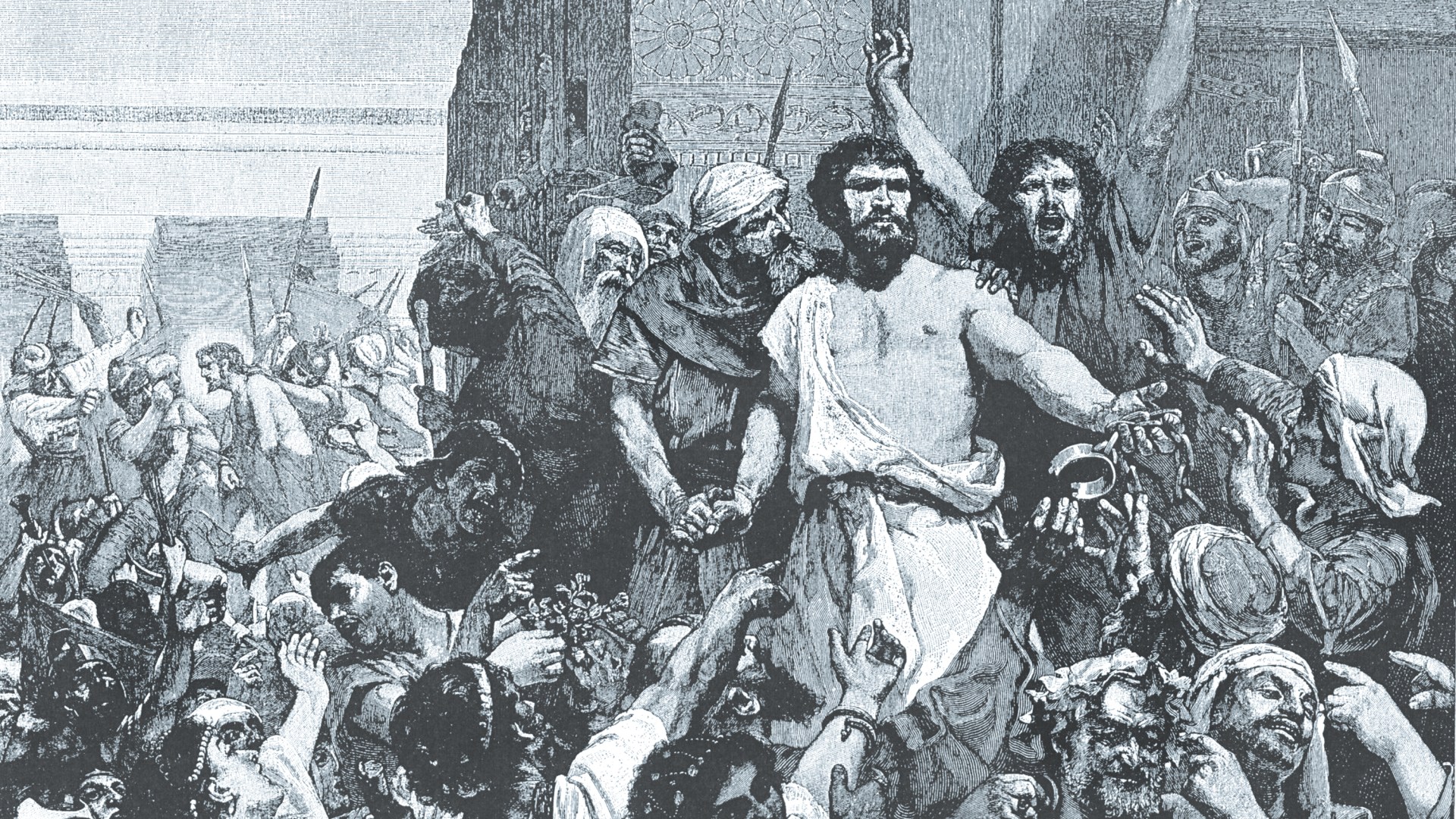
Much more was at stake than a criminal’s fate or a crowd’s preference.

Wikimedia Commons

One of the great marvels of Scripture is the way minor characters embody an entire narrative. The Bible is full of obscure individuals about whom we know little besides their names. Yet many of them, instead of shuffling on and off the stage to advance the story (like they would in Homer or Shakespeare), become living examples of the story itself.

The most dramatic examples, for my money, occur in the crucifixion story. Think, for instance, of Simon of Cyrene carrying the cross, as Christ told his disciples they would (Mark 15:21). Or the criminal crucified next to Jesus who receives forgiveness at the last minute, becoming the archetypal deathbed conversion (Luke 23:39–43). Or the Roman centurion who supervises the execution and then exclaims, on behalf of billions of Gentiles in the centuries to come, “Surely this man was the Son of God!” (Mark 15:39).

But my favorite example is Barabbas. At one level, his is a simple story of exchange. Barabbas is due to die for his sins, and he deserves to. Yet without doing anything to merit mercy, he discovers that Jesus is going to die instead. Having awoken on Friday morning expecting nothing but a slow, horrible death, by evening he is home with his family to celebrate the Sabbath. We are clearly intended to see ourselves in this man: destined for death but finding freedom and life through the death of another.

If we reflect for a moment, it becomes clear this is not merely an exchange, but a substitution. Jesus doesn’t just die instead of Barabbas; he dies in his place as his substitute, his representative. We know this because—and this is often missed—Barabbas and Jesus stand accused of the same crime: sedition, insurrection, treason. Barabbas is a revolutionary who has directly challenged Roman rule (Luke 23:18–19). And from a Roman point of view, Jesus’ claim to be king of the Jews poses a threat to Caesar. Few examples of substitutionary atonement in Scripture are clearer than Jesus, the innocent man, taking the penalty so that none remains for the guilty Barabbas.

There is also an Exodus dimension here. The Gospels point out that freeing prisoners is a Passover custom. In other words, it happens in honor of the night when Pharaoh’s firstborn son died so that God’s firstborn son (Israel) could be released. But the Gospels raise a subtle question: Which of these two accused men is really God’s firstborn son? The one whose name, Bar-abbas, means “son of the father”? Or the one claiming to be the Son of God? And is God’s Son playing the part of Israel, escaping to freedom—or that of the Passover lamb, shedding his blood to liberate others?

Another layer to the story is the question of how Israel should respond to Roman rule. Barabbas represents the way of war, strength, and violent insurrection. Jesus represents the way of peace, innocence, and sacrifice. When Pilate asks the crowd for their preference, this is the point at issue. And Jerusalem chooses the way of violence—“No, not him! Give us Barabbas!” (John 18:40)—as Jesus tearfully predicted it would (Luke 19:41–44). But the Prince of Peace will enjoy vindication—not least through the mouths of Roman soldiers, the men of violence par excellence (Matt. 27:54; Luke 23:47).

For a final lens on the Barabbas story, consider the Day of Atonement. On this crucial day in the Jewish year, the high priest would cast lots over two goats. One became the sacrificial goat, whose blood was spilled. The other became the scapegoat, who was released from the camp into the wilderness. The parallels with the Barabbas story are fascinating—one dies while the other is released—not least because it was the chief priests who wanted Barabbas released and Jesus killed (Mark 15:11). When, like a priest scrutinizing a sacrificial animal, Pilate explains that he has “examined” Jesus and found him faultless (Luke 23:14), the Levitical echoes grow louder still.

Barabbas was a revolutionary and a murderer. He has no right to be remembered at all, let alone held up as an example of divine grace. But that is the whole point. Neither do I, and Christ died for me anyway. And through his substitution, I become a Bar-abbas myself: a son of the Father.

Andrew Wilson is teaching pastor at King’s Church London and the author of God of All Things. Follow him on Twitter @AJWTheology.


Testimony

Christian Science Gave Me the ‘Principle’ of Christ, but Never Christ Himself

My journey from a religion of self-salvation to a faith that takes sin seriously.

Whitney Curtis

After the terrorist attacks of September 11, 2001, the world reeled in shock and disbelief. I did too—not only at the events themselves but also at the response I saw within my church.

Raised a fourth-generation Christian Scientist, I grew up on the St. Louis campus of Principia School, the world’s only pre-K-to-college school for Christian Scientists. Before 9/11, I lived within a Christian Science cocoon, enjoying what seemed like an idyllic childhood. In many ways, I acted like a Christian, reading my Bible every day, praying the Lord’s Prayer, and attending church twice a week.

Then everything exploded. Literally. The day after 9/11, hoping for comfort, I sought out the Wednesday night testimony meeting at my Christian Science church. But much of what I heard left me feeling profoundly uneasy. Some congregants boldly declared that a tragedy like this never could have occurred in God’s perfect world. Others lauded the New Yorkers who had prayed and stayed home that morning, subtly implying that the victims were to blame. How, I wondered, could they be so cavalier about the suffering we had witnessed?

Little did I know that this terrible day would launch me on a journey to saving faith in Jesus Christ.

Puzzled and aghast

Not to be confused with Scientology, Christian Science was founded by Mary Baker Eddy in the late 1800s. Its core teaching is influenced by gnostic, pantheistic, and metaphysical beliefs that portray sin, sickness, and death as illusions. Eddy taught that salvation comes through demonstrating the “Principle” of Christ rather than putting faith in Christ himself.

In her book Science and Health with Key to the Scriptures, which she called “divinely-authorized,” Eddy aspired to “reinstate primitive Christianity and its lost element of healing.” Christian Scientists read this book alongside the Bible, and it provides the lens through which they understand Scripture. Her teaching is considered inerrant, even when it contradicts the Bible.

A year before 9/11, I transferred from Principia College to Webster University, my first foray into the secular world. I joined a Bible study where participants worshiped Jesus and prayed for one another. This was deeply offensive. I had been taught that Jesus was merely a “way-shower,” a good teacher to follow. I considered myself a “graduate-school Christian” with a special knowledge, a “scientific” way of praying that allowed me to heal like Jesus.

I tried articulating Christian Science teachings. Instead of crying out to God for help, I explained, we pray to align our minds with the already harmonious spiritual reality of God. We experience illness only to the extent we believe we’re ill, and if we rely on physicians and medicine, we are giving in to the “mortal mind” and failing to “know the Truth.” All this left my friends puzzled and aghast.

After 9/11, I could no longer deny the reality of evil. In my heart I left Christian Science, but I didn’t tell anyone, since my life, family, and heritage were entangled in this world. I felt incredible betrayal, not knowing what to believe or do. With no one in whom to confide, I sank into misery and loneliness.

Eventually, I veered away from Christian Science practice and started seeing doctors. While it was amazing to find medical relief after years of headaches and menstrual cramps, I was plagued by guilt and shame.

Then, by God’s providence, I overheard a coffee-shop conversation on faith. Something in my heart stirred. One of the men in that discussion invited me to his church and gave me a copy of Francis Schaeffer’s book The God Who Is There. Schaeffer spoke to my existential angst with his assertion that the spiritual and physical world originated with a Creator God. I didn’t totally understand this, but it filled me with deep hope and a desire to learn more.

I remember sitting at a café on a glorious spring day, sipping Americanos with some atheist friends and realizing something was missing in their reasoning. As someone with artistic inclinations, I struggled to ascertain where love and beauty fit in their pragmatic, evolutionary framework. Ultimately, these friends believed that matter was an end in itself, a worldview as hollow as the faith I had just departed. In that moment, I knew I believed in God.

The next Sunday, I visited Grace and Peace Fellowship in St. Louis, where I came face to face with the living God. People there worshiped heartily rather than sitting passively in pews. In my Christian Science church, sin was never mentioned, but here it was freely confessed. These believers read Scripture like a real story rather than a set of standalone philosophical truths. They shared painful parts of their lives, and others came beside them to pray. I wept as I heard, for the first time, of God’s deep, sacrificial love for me. I was convicted of my sin and selfishness.

In the following months, I met with pastor Aaron Turner, hoping both to process my anger at Christian Science and to ask questions about biblical Christianity. When he told me I was a sinner, I actually thanked him. After a lifetime of denying and repressing my very humanity, I was relieved to finally admit my brokenness.

Then I met Jesus. In Christian Science, I knew him only as an exemplar, as someone who showed people how to work out their own salvation. I had been taught that he wasn’t divine and that he couldn’t suffer on our behalf. But Pastor Aaron introduced me to the Jesus of Scripture, who came to earth, took on flesh, and died and rose again to redeem his people and restore all creation.

A long recovery

When I accepted this Jesus as Lord and Savior, God turned my world upside down. Right away, I jumped into the life of the church. In some ways this was disorienting—like being plopped in front of an all-you-can-eat buffet. Everything was new. Christian Science used plenty of familiar Christian language, but always with its own twist. For example, it redefined the Trinity as “Life, Truth, and Love.” Heaven and hell became states of consciousness rather than places of reward or judgment.

Though surrounded by a wonderful church fellowship, I struggled to explain the trauma from my past. When I met another former Christian Scientist, I finally felt understood. We laughed and cried as we spoke of common experiences. Our conversation ignited a fire in my heart to help others leave this destructive group.

In 2014, after graduating from Covenant Theological Seminary, I started the Fellowship of Former Christian Scientists. We offer outreach through online support groups, “Get Wise” webinars, and a biannual conference. Every year we see more people making their escape.

In many ways, Christian Scientists resemble mature Christians—they are familiar with Scripture, constantly “trusting in the Lord,” and “always rejoicing.” Yet now I see that the object of their faith is Christian Science, not the gospel. Praise God for untangling my heart and mind from the delusion of self-salvation—and for rescuing me into new life with Christ and his church.

Katherine Beim-Esche is the founder and director of the Fellowship of Former Christian Scientists.

Our April Issue: Single Parenting by Choice

CT’s single-parent adoption pioneer shares her story.

Fernando Lavin / Unsplash / Courtesy of Cindy Cronk

Among the great Latin phrases from church history is Martin Luther’s famous description of the Christian as simul iustus et peccator—at once justified saint and sinner. Cindy Cronk, CT’s director of production services and our longest-serving employee by far (42 years!), appreciates good Protestant theology. She gets what Luther is saying. But she’s had enough of people thinking of her as saint and sinner. She prefers Mom.

Thirty-three years ago, Cronk was the second single person the Evangelical Child and Family Agency worked with in its foster-to-adopt program. Eventually, she says, ECFA greenlit her because they thought it was unlikely that the state would place a black child with a white, suburban, single woman. But they did. (The third single person to adopt through ECFA was Cronk’s caseworker.)

Church is notoriously difficult for single women. As a single, white woman with black children, it was even harder. “I had a real bad time with people mostly talking to me to figure out if I’d been sleeping with a black man,” Cronk says. “People never got to know me. They just made assumptions about me, my education, my work.”

Eventually she found a church where she and her family could be accepted. “But a church that’s good at accepting doesn’t mean a church that’s great about helping,” she says. Informal father-son gatherings tended to forget about her sons. A woman offered to take the kids to her house to bake cookies but couldn’t understand why Cronk asked if she could run a kid to a doctor’s appointment or to childcare instead. “Don’t take the fun stuff! Give me the ability to do the fun stuff!” she tried to explain.

Once church folks couldn’t fit Cronk into their category of sinner, they tried to label her a saint. One of my earliest conversations with Cronk took place shortly after someone had praised her “ministry.” People tend not to make that mistake twice. “They’re not my ministry; they’re my kids,” she answers kindly but forcefully. “I’m no saint. I’m a mom. But the needs really are there.” The people most likely to see her as a saint, she says, are those who seem most blind to the needs around them.

I was eager to hear what Cronk thought about this issue’s cover story. She gave it high praise: “It wasn’t stupid. Most articles on adoption are about parents as saviors.” (CT can be a tough crowd.) She’s glad to read that churches are getting better at integrating single-parent adoptive families. But she’s cautious. Adopting as a single person, especially transracially, is going to be hard even with church support. “A lot of days, you’re just praying a desperate prayer: ‘Lord, you say you’re our Father. Where are you? Show up and take over.’ And he does.”

Ted Olsen is editorial director of Christianity Today.

Ideas

What the Hummingbird Shows Us About God’s Handiwork

Columnist

When God seems invisible, he may just be moving faster than we can see.

Geronimo Giqueaux / Unsplash

A few years ago, I sat on the front porch of an old farmhouse in Vermont writing a new song with two friends. We sipped coffee, looking out over a summer field and testing lyrics that we scribbled in our notebooks. Above us, at the corner of the house, hung a hummingbird feeder. Tiny winged visitors stopped by intermittently to eavesdrop on our song while sipping nectar from the glass globe.

Hummingbird wings move at about 50 beats per second. But when they fly, hummingbirds can appear completely motionless. A miracle of fitness and form, God made these creatures to be a delicate display of paradox: They are still and active at the same time.

These birds are a moving metaphor for the kind of trust that God outlines in Isaiah 30:15: “You will be delivered by returning and resting; your strength will lie in quiet confidence” (CSB throughout). When I think of God’s grace at play in my own life, my most successful moments happen when I hold steady at the center. Confidence is not found in productivity, but in quietness of heart.

We are not measured by our success. We are simply called to faithfully rely upon God for the outcome of our efforts. “Such is the confidence we have through Christ before God. It is not that we are competent in ourselves to claim anything as coming from ourselves, but our adequacy is from God” (2 Cor. 3:4–5).

But the hummingbird metaphor extends beyond the physics of wings. By design, hummingbirds, like many migratory birds, accomplish great feats of travel by trusting that God will guide them where he has hard-wired them to go. They take their GPS coordinates from the moon, the weather changes, and their God-given intuition.

The coronavirus pandemic scrambled our life-coordinates as school went virtual, meet-ups with friends slowed, and church became a livestream. Our lives have been separated into pieces—as my middle-school-age daughter and I were discussing recently—like one of those “best friends” necklaces shaped like a broken heart. We feel lost and incomplete, holding one half of the heart around our neck and hoping to put it back together again soon.

Colossians 1:19–20 speaks directly to this sense of wandering: “For God was pleased to have all his fullness dwell in him, and through him to reconcile everything to himself, whether things on earth or things in heaven, by making peace through his blood, shed on the cross.” God is pulling the broken pieces of our lives back to wholeness.

He does not always do this in ways we expect. And that is one of the miracles of grace: God doesn’t just hand back the two sides of the necklace, nor does he simply return us to something we have lost. Instead, he himself restores and reconciles all things to himself. As he leads birds hundreds of miles year after year to return to the places where they belong but could never find on their own, he continually brings us to something new, giving us a hope and a future we never could have imagined.

He doesn’t promise that the journey will be peaceful. Instead, “he is our peace” (Eph. 2:14). Three years after that day spent song-writing in Vermont, I was working on an album in Nashville when the pandemic halted recording. For several years I had been gathering songs for this project, songs to protest anxiety, songs of comfort over fear. It turned out to be a timely effort as the other musicians and I were all faced with the sudden challenges of illness and isolation.

As we worked, I stumbled on a work-tape recording of a song I had written called “Patient Kingdom.” I had forgotten all about the song. We included it at the last minute, and it became the album’s title, a divinely orchestrated surprise. Recording Patient Kingdom long-distance across four states produced something in the end more beautiful than we could have known.

Our plans are not like his plans. As the hummingbird moves, his wings are invisible to us. So too the work of God is often hard to see in the moment, but nevertheless something remarkable is happening. This is what the Lord says: “Look, I am about to do something new; even now it is coming. Do you not see it?” (Isa. 43:19).

Sandra McCracken is a singer-songwriter who lives in Nashville. Follow her on Twitter @Sandramccracken.

Ideas

Healing Is a Foretaste of Resurrection

Vaccines feel like a miracle. How much more the real miracle of eternal life?

Illustration by Kumé Pather

The news has been relentlessly grim since last Easter. Any glimmers of light were quickly vanquished amid rising pandemic deaths, the social depression of distancing, racial violence, political discord, and even polar vortexes. With all we’ve suffered, who dares risk delight?

In a New York Times interview, noted sociologist and columnist Zeynep Tufekci attributed our current collective pessimism in part to the media’s and public health officials’ failure to sound the pandemic alarm early on. Ambiguous news from Wuhan, reiterated by the World Health Organization, intimated no human-to-human transmission of the coronavirus, despite evidence to the contrary. The inclination was to avoid overreacting so as not to incite panic. The lingering sting of that failure has fueled continued gloom and a more recent downplay of positive findings, whether in the decline of infection rates or the marvel of vaccine development.

Early predictions had any vaccine taking at least 12 to 18 months to emerge, with a modest goal of 50 percent efficacy against infection. Here at Lent’s end, we’ve achieved not one but as many as four vaccines, pushing 95 percent efficacy, an undertaking unprecedented in the history of medicine. This Easter dawns bearing much brighter light. Most churches won’t yet fully gather to worship, but the assuredness of vaccinations and eventual herd immunity mean coming back together is now an imaginable reality.

Rather than celebrating humanity’s remarkable accomplishment, however, Tufekci noted that the media and public health officials were wary of misinforming again. So they focused their reporting on the threat of variants, the need for continued mask wearing, and concerns about things unknown, despite the amazing fact we do know: The COVID-19 vaccines are an almost perfect defense against dying from the disease.

Of course, we all eventually die, but here is where the amazing news of Easter should not be downplayed. “I am the resurrection and the life,” Jesus said. “The one who believes in me will live, even though they die; and whoever lives by believing in me will never die” (John 11:25–26). The Message inserts an “ultimately” in this verse to make clear that Jesus didn’t mean we don’t die on earth. But eternal life need not be reserved solely for heaven. Paul made clear that we walk in newness of life now (Rom. 6:4; Gal. 2:20).

Jesus’ disciples happily believed this good news until things turned awful. His arrest and conviction caused panic, and they fled for their own lives. Huddled in hiding even after his resurrection, the disciples downplayed the women’s report of an empty tomb, dismissing it as “nonsense” (Luke 24:11). Unbelievably, their disbelief persisted even when the risen Jesus showed up in person (vv. 36–37). Resignation and despair at least coincide with grim reality. We humans will downplay good news as a means of hedging ourselves against disappointment.

According to Pew Research, 3 in 10 Americans (28%) reported stronger personal faith in January because of the pandemic. The report did not delineate between religions, nor did it indicate how many Americans have a personal faith to strengthen. But if current studies are any indication, upwards of 70 percent of Americans say they are Christians, meaning there are plenty whose faith did not grow stronger because of the pandemic.

Strength amid adversity is a hallmark of Christian discipleship, yet persistent adversity and its increasing severity can threaten faith, too. The disciple Thomas, having missed out on the risen Jesus’ debut, famously refused to believe unless he could see for himself. Jesus complied with an encore but then said, as a summons to the rest of us, “Blessed are those who have not seen and yet have believed” (John 20:24–29).

Knowing his disciples would still struggle, and by extension the rest of us too, Jesus breathed into them the Holy Spirit (v. 22). It is the Holy Spirit who testifies with our spirit that we are the children of God (Rom. 8:16) and that “our present sufferings are not worth comparing with the glory that will be revealed in us” (v. 18).

As a hospice volunteer, I received my vaccination at the beginning of Lent. I lined up with scores of others who eagerly anticipated a return to life lost. I walked out the clinic doors with not only immunity, but a certain feeling of lightness and courage. I was not only determined to retrieve lost life, but I felt strength to love and to serve and delight in new life, regardless of whatever trouble comes.

If such is the case with mere vaccinations, how much more with the Holy Spirit who ensures us eternal life?

Daniel Harrell is editor in chief of Christianity Today.

Ideas

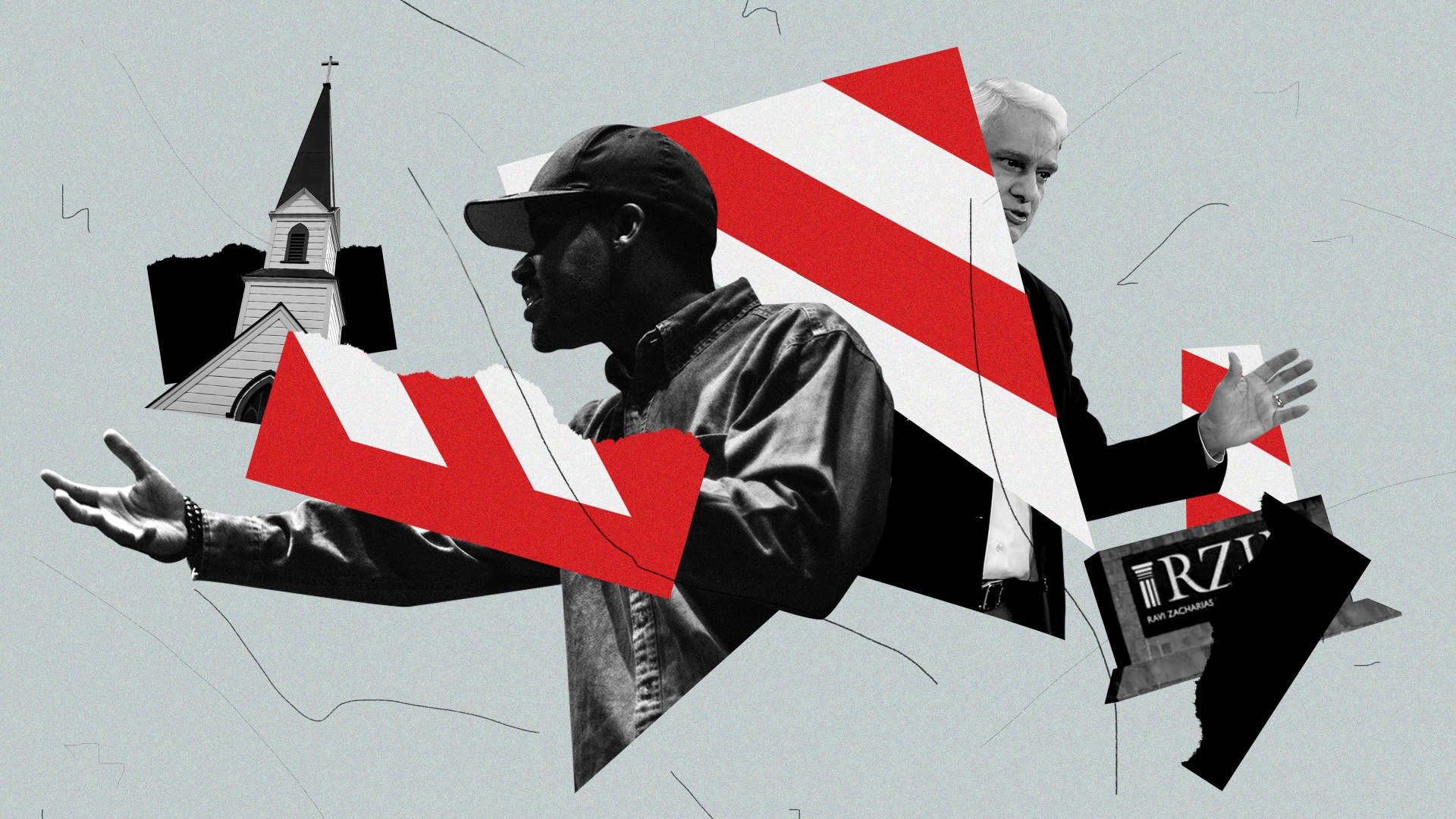
Apologetics Can Flourish After RZIM. But Only With ‘Lowercase Leaders’ and the Local Church.

To detractors, Ravi Zacharias’s fall means the end of a movement. But his demise reminds us to deepen our core commitments to gospel work.

Christianity Today March 15, 2021
Illustration by Mallory Rentsch / Source Images: Barry Daly / Lightstock / Courtesty of RZIM / Google Maps

When RZIM confirmed the reports that Ravi Zacharias was guilty of calculated, serial sexual abuse, I was gutted. I remember listening to Ravi’s program on the radio when I was in high school and hearing him hold a packed auditorium spellbound in college. I devoured as much of his content as I could. He seemed to me a modern-day C. S. Lewis, marrying reason and imagination, satisfying heart and mind, moving effortlessly between Malcolm Muggeridge and the Moody Blues.

Upon reflection, I realize that part of the pride I felt in hearing Ravi had to do with him looking like me. As a Filipino American who grew up in predominantly white spaces, Ravi, an India-born Canadian American, seemed to represent a best-case scenario of what I could become. Among other things, he gave me hope of being accepted by mainstream culture, a culture that could be conquered through education, erudition, and eloquence.

I recall Ravi once answering a questioner by quoting Francis Thompson’s poem, “In No Strange Land,” which imagines Jesus walking on the Thames River in London. He ended with a mic-drop moment: “He’ll meet you where you are!” But these years later, I’m devastated to learn where Ravi really was and what he was doing. It is equally crushing to learn how he had been insulated from accountability by an inner circle overwhelmed in part by his charisma and in part by outright intimidation.

As a pastor-professor who cares about the revitalization of apologetics for the sake of the gospel, the RZIM story sobers me a great deal as I look to the future of the broader movement. There is no question that Ravi’s depravity has irreparably damaged his legacy and the ministry that is changing its name and retiring from apologetics.

As CT reported recently, what was once the largest apologetics organization in the world will now downsize significantly and shift its resources toward repairing some of the damage by funding organizations that care for victims of sexual abuse.

To some observers, there is a troubling connection between the contemporary practice of apologetics and the potential for abuse. Our image of an apologist tends to be one of a sage on a stage—a rhetorician who is prepared for all possible objections. But lionizing oratorical brilliance may allow us to content ourselves with mastery of arguments while remaining unmastered by the Spirit. To detractors, Ravi’s fall is the final nail in the coffin of traditional apologetic practice.

Has Ravi’s fall revealed the folly and failure of popular apologetics? What effect, if any, will it have on the apologetics community more broadly?

Traditional apologetics, which is concerned with responding to objections to Christian belief, continues to have wide purchase within evangelical circles. Classic and contemporary works enjoy strong sales, worldview camps abound for students transitioning to college, and new voices are flourishing in online platforms like YouTube.

Most contemporary texts on the topic include a defense of apologetics against its cultured despisers. These authors maintain the problems are not so much with apologetics itself but rather with its poor execution. Some want to turn away from an over-reliance on rationality toward more revelational, relational, or imaginative resources. Others have advocated for approaches characterized by cruciform virtue: humility, gentleness, patience, and love.

But there are growing misgivings about the discipline, especially among younger evangelicals. Not long ago, I taught a class on apologetics at an evangelical seminary and was surprised by the number of students who sought an apology for the class. My students had some sharp questions: Isn’t it impossible to argue someone into faith? Isn’t apologetics only effective for the already convinced? Isn’t apologetics a poor substitute for relational evangelism and discipleship?

Ravi’s fall has brought new force to the criticisms of traditional models. It should humble us. As with the fall of other celebrity leaders, this story represents not just an individual failure but an institutional one.

Ravi’s former ministry is in the process of repentance and reparation. But as Christian thought leaders and members of the global church, how can we heal the culture of the larger apologetics community? How can we keep from perpetuating cycles of celebrity, complicity, and abuse? As we grieve and seek to be better, what lessons should we take to heart?

As I have listened to the conversations taking place among apologetics practitioners, four themes have emerged.

1. Demonstrate a commitment to truth even when the consequences hurt.

Apologists have traditionally presented themselves as fearless pursuers of the truth. But when questions were raised about Ravi’s personal character and conduct, some truth was off limits. And yet, as the late Dallas Willard used to say, reality is “what we run into when we are wrong, a collision in which we always lose.”

In a time of tribalism and political polarization, we’re tempted to seek out truth only insofar as it legitimizes our side as being right. If our only goal is to win, truth can become instrumental or even unnecessary to that aim. “Owning the other side” does not require our transformation, nor does it require truth’s two sisters, goodness and beauty.

“In a post-Christian West, which increasingly rejects the goodness and beauty of Christianity, we should own the fact that too often the empirical evidence supports this case,” Joshua Chatraw, director of the Center for Public Christianity, told me. “But perhaps this is also an opportunity. In a culture of spin, where most are flailing for the resources that would motivate sincere repentance, practicing public repentance is our first step to begin to make our case again.”

2. Distinguish (but don’t divide) the message from the messenger.

After Ravi’s fall, voices in the apologetics community processed feelings of grief and betrayal on their public platforms. A consistent chorus has emerged: Look to Jesus. Trust Jesus, who was never guilty of abuse of any kind. As Alissa Childers told the followers of her popular channel: “Don’t put your faith in your favorite YouTube apologist.”

Apologists are at their best when they point people to Jesus. Paul told the Corinthians that “what we preach is not ourselves, but Jesus Christ as Lord” (2 Cor. 4:5). There is a difference, however, in making this distinction before and after a scandal has been exposed.

When leaders fall, it’s tempting to separate message from messenger for the sake of image management, but distinguishing the two cannot be a public relations maneuver. The message is always embodied in the life of a person (or a community) who makes that idea believable. If we’re part of an organization or a church where darkness is uncovered, distancing ourselves from an abusive public figure doesn’t let us off the hook. Character counts. For this reason, leaders should be removed from office and their toxic institutional culture exposed.

And yet, for those who wonder about the help they received from disgraced leaders, the distinction matters. Students of church history will remember the Donatists, who argued that the value of pastoral acts depended on the purity of the one performing them. An unworthy minister would invalidate the grace that came through the sacraments. The question was clear: How good is grace when it comes through the hands of fallen ministers?

In response, the church rejected the Donatist line of thinking and took the position that grace is not dependent on the worthiness of the minister but on the God who works through the weak and unworthy. Moral failure may invalidate a minister, but it can never invalidate God’s grace, which comes to us through Christ.

As the church recovers from the fall of Zacharias and of RZIM, leaders who care about the Christian apologetics movement can carry it forward by clinging to this truth: We do not commend the faith because we have found all the answers but because we find ourselves in desperate need of the Savior that we commend.

3. Reclaim faith as a community project rather than an individual achievement.

Questions about apologetics are worth raising, not just for those who speak from a stage but also for those who address multitudes through screens. Indeed, what sort of character formation is required for the online apologist? A medium that privileges views and virality tempts leaders to develop an increasingly wide split between their public and private personas.

Yet any content creator will tell you that building an audience has as much to do with dedicated engagement as it does with production value. To the degree that real community can be cultivated in online spaces, online apologists can remain organically connected to those they seek to serve.

But even this is no substitute for embodied fellowship in a local congregation. In his recent book, After Doubt, A. J. Swoboda pleads with doubters not to replace the local church with disembodied voices.

“Order your pizzas and books online,” he writes, “but don’t take your deepest doubts and questions there. Bring them to us, God’s people on the ground. Please don’t replace us. Question the assumption that a PhD is the same as being wise, or the assumption that ‘most viewed’ or ‘viral’ has anything to do with veracity.”

In other words, Christian persuasion must be grounded in the thickness and concreteness of the Christian community. As church leaders and lay leaders, we often underestimate how important it is for our own faith to be intertwined with the faith of our communities. They can hold on to us when we have difficulty holding on for ourselves. But danger comes when we’re content to exchange our concrete rootedness in a local believing community for the seemingly unassailable faith of a strongman. We allow an authoritative public figure to do our thinking and believing for us.

By contrast, the best place for belief to become believable is in local, embodied fellowship. The sage on the stage (or screen) can supplement and prepare the way but must not replace the guides at our side.

4. Support both “uppercase” and “lowercase” apologists in context of the local church.

About ten years ago, the third Lausanne Congress on World Evangelization in Cape Town, South Africa brought together 4,200 evangelical leaders from 198 countries and produced the Cape Town Commitment, which included a call to “the hard work of robust apologetics.” Part of the invitation was to equip and pray for those “who can engage at the highest intellectual and public level.” I’ll call those “uppercase apologists.”

Uppercase apologists come equipped with answers, philosophical proofs, and compelling insights into difficult questions. Though sometimes despised, they play an important role in the wider world and often clear the road of intellectual barriers so that a person can move further along in faith or faith exploration. For example, I am thankful for the ministry of people like William Lane Craig, who has served the church in this space for years.

But on the whole, taking the uppercase apologist as the preferred model of Christian persuasion sets a dangerous precedent. If everyday practitioners have the potential to become addicted to “having all the answers,” then we can imagine the danger for those who offer answers professionally.

“Ravi was on the road often 200, 250 days a year; he wasn’t a member of a church,” said Sam Allberry, a well-known speaker for RZIM. The strain of being untethered and always on the move is risky for any leader, but especially so when you’re a public spokesperson for belief. Managing an aura of invincibility too easily becomes part of the job description.

In that way, uppercase practitioners need prayer and accountability. They need friends and colleagues who know them well enough not to be impressed by them—people who love them enough to tell them the truth. Individual apologists must be rooted in and under the authority of local congregations precisely because apologetics and faith are essentially communal endeavors.

The Cape Town Commitment included a second component in their apologetic commitment: “to equip all believers with the courage and the tools to relate the truth with prophetic relevance to everyday public conversation, and so to engage every aspect of the culture we live in.”

Mercifully, most of us are not and should not strive to become uppercase apologists. Rather, we seek to be lowercase apologists who are engaged in everyday conversations. We seek to bring the questions, hopes, and griefs of our neighbors—together with our own—before the Savior who calls us to follow him.

Justin Ariel Bailey is assistant professor of theology at Dordt University and the the author of Reimagining Apologetics (IVP Academic, 2020). He is also an ordained minister in the Christian Reformed Church and has served as a pastor in Filipino-American, Korean-American, and Caucasian-American settings. Speaking Out is Christianity Today’s guest opinion column and (unlike an editorial) does not necessarily represent the opinion of the publication.

Ideas

A Crack in the System: How Unfair Drug Sentencing Laws Disrupt Racial Justice

In the push for prison reform, Christians can stand against penalties that disproportionately affect minorities.

Christianity Today March 15, 2021
Illustration by Mallory Rentsch / Source Images: itakdalee / CAHKT / MirageC / Getty Images

The last few years have sounded the alarm for racial justice in America. We’ve seen the brutality of discrimination in our streets, our schools, and especially our courtrooms. Some of the most insidious forms of systemic injustice stem from unequal drug sentencing laws that disproportionally penalize blacks.

Although crack and powder cocaine are chemically almost identical and one is not more physically harmful than the other, nonetheless federal penalties for the two are calculated quite differently. Today it takes 18 times more powder cocaine than crack to earn the same sentence in federal prison. This 18-1 sentencing disparity is not arbitrary, since crack is more accessible in marginalized communities of color.

In 2019, 81 percent of federal defendants with crack cocaine charges were black. As a result, the federal crack-powder disparity has contributed to the overincarceration of black Americans. Their lives have been devastated by it.

As Christian ministry leaders who are involved with justice reform, we are hoping that Congress and President Joe Biden will pass and sign the recently introduced EQUAL Act (not to be confused with the Equality act) to end this sentencing disparity for good. Proverbs tells us that “the Lord detests dishonest scales, but accurate weights find favor with him” (11:1). We believe this significant piece of legislation will help bring balance.

Unjust sentencing has extended a long history of racial imbalances in the justice system. Though rates of drug use and trafficking are similar across all races, black males often face harsher-than-average sentences and fewer opportunities for reduced sentences, reduced charges, or plea agreements. This discrimination has harmed black communities and black families for far too long.

One story in particular illustrates the point. Matthew Charles spent years enduring firsthand the systemic disparities borne by black men. His story grabbed the nation’s attention: Arrested for selling crack in 1995, Matthew received a hefty 35-year sentence for his nonviolent crime. He became a Christian and a productive citizen while behind bars. After 16 years, he was released, but the US Department of Justice cited an error and reversed the decision, sending him back for two more years.

Nearly 140,000 people rallied to Matthew’s cause by signing a petition to support his release, and in 2019, he finally walked free for good. He was one of the first people released under the FIRST STEP Act, which allowed him to petition the court for a sentence consistent with the current 18-to-1 disparity for crack offenses. (It was an egregious 100 to 1 at the time he was sentenced.)

When Christians “remember those in prison,” as it says in Hebrews 13:3, we must evaluate the system that puts people behind bars (and for how long) and also speak up to the powers that be. Pursuing justice that reflects God’s heart is not optional. It’s central to the Christian life. God sees the downtrodden and the oppressed, and he cares about justice for all his children.

Every person dealing drugs, every person in addiction, and those who are affected by crime are all equally valuable in God’s sight. Christ followers are compelled to flee complacency and seek a restorative approach to justice. Jesus wouldn’t look the other way. Neither should we.

Heather Rice-Minus is the senior vice president of advocacy and church mobilization at Prison Fellowship. Justin E. Giboney is an attorney, political strategist, and president of the And Campaign.

They both serve as leaders within the Prayer & Action Justice Initiative, a diverse coalition of Christian organizations and leaders advocating for racial justice and nonpartisan criminal justice reform. Speaking Out is Christianity Today’s guest opinion column and (unlike an editorial) does not necessarily represent the opinion of the publication.

News

Why a Shiite Martyr’s Funeral Was Surprisingly Christian

A month after Lokman Slim’s murder, his family awaits answers in a story exemplifying the history of Middle East Protestants and the intrigue of Lebanon.

The funeral of Lokman Slim

The funeral of Lokman Slim

Christianity Today March 15, 2021
Diego Ibarra Sanchez / Stringer / Getty Images

A Protestant mother. A Shiite son. A plea for vengeance on his killers.

But unlike many responses to political martyrdoms in Lebanese history, she yields it to God.

Last month in the Hezbollah-controlled south of Lebanon, unknown gunmen shot Lokman Slim in the head. It was a targeted assassination of a man dedicated to the hope that his small Middle Eastern nation might overcome sectarian divisions.

He was his mother’s son.

“I will not go and kill them, but ask God to avenge him,” said the grieving 80-year-old, Selma Merchak. “This comes from my faith in God as the great authority.”

But her next response reflects the family’s—and Lebanon’s—complex religious identity.

“And as it says in Islam: Warn the killer he will be killed, though it tarries.”

Born in Egypt, Selma’s Protestant lineage traces back to her grandfather in Syria, who found Christ through the preaching of the first wave of Scottish missionaries to the Middle East. As a child, she attended the American School for Girls—now Ramses College—founded in 1908 by American Presbyterians.

The family attended Qasr el-Dobara Church, located in Cairo’s Tahrir Square. And Selma continued in the Protestant educational heritage, graduating with a degree in journalism from the American University in Cairo, which by then had become a secular institution.

The Merchak family mixed freely in an Egyptian upper class that was open to all religions, vacationing often in Lebanon’s mountains. But in the chaos of Gamal Abdel Nasser’s nationalizing of the Suez Canal, in 1957 Newsweek relocated its regional headquarters to Beirut, and Selma went with it.

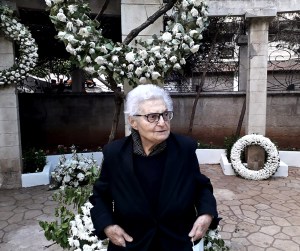
Selma Merchak, at her son Lokman Slim's funeral
Selma Merchak, at her son Lokman Slim’s funeral

She reconnected with Muhsin Slim, her childhood friend from the family vacations. The Slims were an influential Shiite family known for its good relations with the Lebanese Christian elite. Muhsin’s father served as a member of parliament in the 1960s, and during the civil war advocated against the use of Lebanon as a staging ground for the Palestinian armed struggle against Israel.

Now a lawyer, Muhsin married Selma shortly after her arrival in Lebanon. Her Egyptian accent was the toast of the town, aiding the political career of her parliamentary husband.

While Muhsin would only “pray in his heart,” Selma said, she worshiped on-and-off at the National Evangelical Church in Beirut, the oldest indigenous Protestant congregation in the Middle East.

Lokman, their second of three children, was born in 1962. Registered as Shiites within Lebanon’s sectarian system, Muhsin and Selma raised them to be moral, but to make up their own minds about religion.

Statues of Buddha were part of the décor of their 150-year-old home. On property located in what was once known as “The Plain of the Christians,” Muhsin’s grandfather raised silkworms and exported their product to France.

“The absence of a formal faith was a challenge for us,” said Lokman’s younger sister Rasha, who described a childhood hurt when queried about her sect. “Were we Muslims, Christians, or Buddhists? I wanted to know what we believed about God.”

Lokman, however, was more at ease with an amorphous spirituality. The children attended a French Catholic school, and in 1982 he left Lebanon to study at the Sorbonne in Paris. Two years after graduation, in 1990 Lokman founded Dar al-Jadeed publishing house with Rasha, introducing new and controversial works to society, including the books of Iran’s reformist president Mohammad Khatami.

By then, however, the neighborhood had transformed into a plain of Shiites, as the war years forced many from the south and Bekaa Valley into Beirut. Villa Slim, as their home was known, became an oasis of green as surrounding farmlands were sold and turned into cramped, lower-income apartments.

Hezbollah gained political control.

Lokman, meanwhile, stayed true to his upbringing. In 2004, he and his German wife, Monika Borgmann, filmed the award-winning Massaker documentary, about the 1982 slaughter of Palestinians in Beirut’s Sabra and Chatilla refugee camps.

Researching the film led to the discovery that Lebanon did not have a national archive, from which it could build a shared history among its periodically at-war sects.

So they built one themselves—in the family home.

One of the central exhibits of the Umam (peoples in Arabic) Documentation and Research Center is a collection of photographs of Lebanese who went missing during the civil war. Presumably killed or carted off to Syrian prisons, the pain of their families is now known—in truth, re-experienced—by Selma.

“If Lokman had died an old man like Muhsin, we could accept it as God’s will,” she said, as she did when her husband passed away after 46 years of marriage.

“This pain is different, and criminal.”

But it is not unfamiliar. One of Muhsin’s clients was Kamal Mrou, founder of the al-Hayat and Daily Star newspapers. A family friend, Mrou was assassinated in 1966 due to his opposition to Nasser-led Arab nationalism.

Lokman is one more victim, in a long line.

Selma hopes the courts will achieve justice.

Immediate suspicion for his killing fell on Hezbollah, which denied responsibility and condemned his murder. Indeed, Lokman’s archiving work was an implicit critique of all of Lebanon’s leaders. In 2005 he made it explicit, leading the Hayya Bina [Arabic for Let’s Go] movement to mobilize greater nonsectarian participation in elections.

Even so, Lokman was unusual as an outspoken Shiite critic of the Iran-backed entity. In 2019, during a massive popular uprising against the entire political class, Villa Slim was covered in graffiti labeling him a traitor.

“‘Do you scare me with death?’” Rasha recalled her brother saying, comforting her with the saying of Hussein, the seventh-century grandson of Muhammad and an extolled Shiite martyr.

“Lokman was not afraid of death.”

At the funeral, Selma, Monika, Rasha, and the rest of the family held aloft black signs with white Arabic lettering: No fear.

Others, however, are at least nervous.

“Hezbollah may not be the killer, but they created the environment,” said a Shiite professor at a Lebanese university, who requested anonymity.

“All Shiite activists have felt the hunch they could be a target. But you have to learn to live with it.”

Hezbollah emerged in 1982, fighting the Israeli occupation in southern Lebanon during the civil war until its withdrawal in 2000. In 2005, the militia entered politics, allying with Michel Aoun, the Maronite Catholic general—now the nation’s president—who leads the Free Patriotic Movement (FPM), the largest Christian party.

Hezbollah has been pragmatic in politics. But the professor was critical of its overall mentality of “us versus them, good versus evil.”

In contrast, he praised Selma’s continued faith as something “remarkable.” Today, he said, the norm is that a Muslim man will ask a Christian wife to convert to Islam.

But with Lokman, both faiths were embedded in him, sincerely.

Sheikh Mohamed al-Amili, a Shiite, agreed—speaking from a safe house in the Sunni Muslim mountainous region of the Chouf. In 2013, Lokman helped him establish Godly Without Borders, a group to move interfaith dialogue toward greater practical benefit to society.

“Some people want to paint Lokman as an atheist or nonbeliever,” he said. “But what interested him was the spirituality of religion, not its appearances.”

Frustrated by Lebanon’s sectarianism, some activists have turned against religion entirely. But this can fuel accusations by opponents that their colleagues have also denied God.

Amili, however, highlighted the saying of Muhammad that a Muslim is one “from which the people are safe, from his tongue and hand.” This fully characterized Lokman, and clearly not his opponents.

Their interfaith message resonated during meetings in cosmopolitan Beirut, Sunni-dominated Tripoli, and the heterodox Druze Muslim communities of the Chouf, Amili said.

But their group found no foothold in Hezbollah’s southern regions.

“We want people to have a pure faith in God,” said Amili, “not just a religion that is related to politics.”

In sectarian Lebanon, this is a difficult proposition.

For years, Shiite Lebanese were marginalized politically and economically. They bore the brunt of Israeli occupation. Even if they do not share Hezbollah’s ideology, many Shiites appreciate the strength given to their community.

By contrast, Christians and Sunni Muslims are internally divided. Those who blame Hezbollah for Lokman’s murder say that as Shiites also grow frustrated with the ruling political class, the assassination is a warning against dissent.

Others label it a warning to the United States, as the nation jockeys with Iran over the nuclear deal and fallout from the killing of Qassem Soleimani. The Iranian commander’s picture is plastered everywhere on the road to the airport through Shiite neighborhoods of Beirut. One superimposes his image over a torn US flag.

“We are called ‘Shiites of the [US] Embassy,’” said Amili.

At the funeral, the American ambassador to Lebanon came to Villa Slim to pay her respects.

“We all were robbed of a great man,” said Dorothy Shea, pledging to continue the partnership with his organizations.

“[Lokman] was tireless and relentless in his pursuit to reconcile Lebanon’s people, and to promote freedom and inclusion.

“So, like him, let us not be deterred.”

Rasha appreciates these words. But Shea was only one of several ambassadors present.

“I refuse the propaganda of the killers who accuse him of working for the embassy,” she said. “Lokman was respected by everyone as an analyst, while Hezbollah is the first to declare their coverage by Iran.”

But this was not the only controversial element of the funeral.

“This house has given much to Lebanon, and today offers and sacrifices its blood for its promotion,” said Amili in his remarks.

A fellow Shiite, Sheikh Ali al-Khalil, led the Muslim prayers. But after receiving fierce social media criticism for attending, he apologized, saying his political orientation [implying Hezbollah] was well known.

Meanwhile, the Christian component of the service included the chanting of “The Mother of Sorrows,” a Maronite hymn to the Virgin Mary. Traditionally sung only on Good Friday, its use at a funeral was met by strong criticism, including by the bishop of Beirut and by supporters of FPM.

Selma, however, had the most poignant testimony.

“If you want a homeland, you must cling to the principles for which Lokman was martyred,” she said.

“The burden will weigh heavy on you. [But] stay away from weapons; those have taken away my son.”

The funeral arrangements placed a picture of Lokman in the family garden, surrounded by wreaths laid in his honor. Every detail was planned meticulously by his loved ones.

“Some people want us to be atheists, others were offended by our interfaith service,” Rasha said. “But do not put walls between your God, and ours.”

Could this be a message also to Lebanon’s Protestants?

It was not intended to be—but might apply.

“Many evangelicals would leave their sectarian areas to preach Christ or open new house churches,” said Nabil Habibi, a pastor in the Nazarene church, who was invited to participate in the funeral.

“But many might not come here, not wanting to die for a political cause.”

He himself was nervous. Hezbollah would be watching, but he felt his clerical collar would protect him.

And it was important to take a stand against “the forces of darkness.” His presence at the funeral would join in the message that it is not right to kill those you disagree with.

It was also a message of national unity. All of Lebanon’s sects were invited, and Habibi wanted to ensure that Protestants were present.

Habibi was asked to offer a prayer, but in the end only the Shiite and Maronite invocations were spoken. He would have commended Lokman’s bravery.

“God, we have come here seeking justice, because your ears are not closed to the cries of the oppressed,” Habibi had prepared.

“Help this family in their grief. Forgive those who killed him.

“Show them your mercy, and bring them out of darkness.”

Martin Accad, associate professor of Islamic Studies at Arab Baptist Theological Seminary in Beirut, also attended the funeral. He did not know Lokman personally, and expected a secular event.

He was surprised it was so religious—but sensed this was how his family remembered him.

“Selma evidently has a faith commitment, and raised a son who valued truth and reconciliation,” he said. “It reflects her mainline Protestant ethic, which it seems Lokman fully embraced.”

A quiet but clear distinction exists between the two wings of the Supreme Council of the Evangelical Community in Syria and Lebanon. Though there is overlap, Presbyterians and Congregationalists tend toward ecumenical engagement, while Baptists and Pentecostals seek out converts. Yet both are engaged in social work, with friendly personal relations.

But Accad cautioned the evangelicals who might be wary of participating in such an interfaith event. Jealous for the gospel, they risk mirroring the same reactions as the Shiites and Maronites who spoke their offense.

And where mixed communities are the reality in society, evangelicals face the choice of staying in their corner—or joining with others to contribute positively.

Too few have reached out to the Shiites.

Imam Musa al-Sadr, Accad recalled, said that the voice of Jesus could be heard in the call of the minaret. The civil war leader’s “Movement of the Deprived” sought Shiite equality in Lebanon.

But after Sadr’s disappearance in 1978, the movement increasingly went militant. And later, its secular character gave way to Hezbollah’s religious ideology.

“The murder of Lokman is a picture of lethal sectarianism,” Accad said. “But Selma’s story illustrates the influence of evangelicals, in a multifaith society.”

Her Christian commitment helped shape Lokman for Lebanon.

The family, meanwhile, is both reeling and resolute.

“I want to believe in a just God,” said Rasha, who regularly reads from the Bible. “But all I see is injustice among the religions.”

“My mother says, ‘Pray.’

“I said, ‘You pray.’

“Lokman’s death is an eclipse of God, and I don’t have any answers.”

But one answer is clear.

“This project will never be silent,” said his widow, Monika. “They can kill Lokman, but they will not kill his ideas.”

And the family home, Selma reminds her neighbors, is older than Hezbollah.

“I will never close these doors and stop receiving people,” she said.

“If they want to kill us, let them tell their God that they are killers.”

Correction: An earlier version of this article misattributed a funeral quote (“This house has given much to Lebanon…”) to Sheikh Ali al-Khalil. It was Sheikh Mohammed al-Amili who gave that remark.

Blessed Are the Canceled? Finding Redemption in ‘The Bachelor’ Controversy

For those who choose to listen, there is a godly grief that leads to repentance.

Christianity Today March 15, 2021
© 2021 Disney General Entertainment Content. All rights reserved.

Reality television’s iconic host of The Bachelor, Chris Harrison, won’t be hosting the “After the Final Rose” episode on Monday night, or the next season of The Bachelorette. The 20-year veteran of the show announced he would step away for an unspecified period of time after a conversation between Harrison and former bachelorette and TV personality Rachel Lindsay on her entertainment show. During the 13-minute interview, Harrison addressed a controversy around Rachael Kirkconnell, one of bachelor Matt James’s final picks.

While the show was airing, Reddit users found social media posts by Kirkconnell that included racially insensitive Native American costumes and alleged support for conspiracy theories. But the controversy came to a head when photos surfaced of Kirkconnell at an “Old South” themed fraternity party in 2018.

When Lindsay, the first black lead of a Bachelor franchise show, asked Harrison in the interview about Kirkconnell’s social media posts, he railed against “cancel culture” and “the woke police.” “We all need to have a little grace, a little compassion, a little understanding because I’ve seen some stuff online,” he said. “Again, this judge-jury-executioner thing where people are just tearing this girl’s life apart … it’s unbelievably alarming to watch.”

Lindsay pushed back that a picture at the 2018 antebellum party was “not a good look,” to which Harrison quipped: “Well, Rachel, is it a good look in 2018? Or is it not a good look in 2021? Because there’s a big difference.” Lindsay responded: “It’s not a good look ever.”

Instead of hearing the criticisms leveled against Kirkconnell as a call for accountability for her harmful actions, Harrison leaned into a familiar refrain of those who get caught up in “call out culture”: Do not focus on the past. Give us grace, compassion, and understanding.

Of course, there are many insidious forms of cancel culture driven by self-righteousness or hatred rather than by wise judgment and correction. But at its very best, what if being “canceled” is a form of grace? What if the most compassionate thing a person in the wrong could receive is correction? What if they have to show humble understanding after receiving criticism and correction? Public confrontation is not a new phenomenon, and there is grace for those who face it.

Godly repentance and holy correction is a means of grace—whether we like the means or not. While many view cancel culture as solely de-platforming a leader or public shaming, the best of cancel culture happens in a context where people hold the well-being of others in mind and call for accountability in a spirit of loving correction.

When a celebrity or social media personality is rightly confronted for harmful actions, the means of the confrontation should not be dehumanization, violence, or abuse. Harassment and spiteful responses are not the same kind of “cancellation” as corrective grace. Done well, the goal of public rebuke should be that the person would step back, learn from the hurt they caused, and change for the better.

Consider the prophets of the Old Testament—men who were called to denounce the wrongs of those in power, regardless of their own safety or comfort. Before the infamous showdown with the prophets of Baal in 1 Kings, King Ahab had a familiarly dismissive tone toward the judgment of the prophet Elijah: “Is that you, you troubler of Israel?” (1 Kings 18:17). For the king, Elijah’s judgment was problematic, even though he came in the name of the Lord.

Elijah’s response was direct and corrective: “I have not troubled Israel, but you have, and your father’s house, because you have abandoned the commandments of the Lord and followed the Baals” (1 Kings 18:18, ESV). Elijah continued to call out the king and his supporters, because his ultimate goal was to convey God’s heart and will for his people.

After Ahab and Jezebel had a man murdered over a vineyard, God pronounced gruesome judgment over them through Elijah. But instead of doubling down, this time Ahab repented. And because of that, he receives mercy from the Lord: “Have you noticed how Ahab has humbled himself before me?” the Lord says to Elijah. “Because he has humbled himself, I will not bring this disaster in his day, but I will bring it on his house in the days of his son” (1 Kings 21:29).

It is human nature to reject correction, even if it comes from rightful authorities in our lives. In our defensiveness and pride, we hate to be called out for negative behavior. It’s uncomfortable, and the consequences can be inconvenient and unpredictable. Many fans believed that Harrison and Kirkconnell have been treated unfairly. Harrison’s announcement of stepping down caused some of the show’s fans to lash back at those who publicly criticized and “canceled” Harrison. Rachel Lindsay received so much negative backlash that she temporarily deactivated her Instagram account.

In the same way that we are prone to defensiveness when we are on the receiving end of cancel culture, self-righteousness runs rampant when there is someone to call out. Instead of wanting their repentance, we lean into a self-righteous response that calls for their ruin. But as Christians, our responses should mimic what Jesus said to the woman accused of adultery by the mob that was out for her blood: “Let any one of you who is without sin be the first to throw a stone at her” (John 8:7). We aren’t called to pile on any more than the men who wanted to cast stones.

The goal of public rebuke should be that the person would step back, learn from the hurt they caused, and change for the better.

The apostle Paul reminds the Corinthian church of the results of correction in those who accept it: alertness, earnestness, zeal, concern, and a desire to seek justice (2 Cor. 7:11). In other words, when we call out the wrongs of one another, we have a chance to restore virtues like empathy, justice, wisdom, and humility in our culture.

Since the Harrison-Lindsay interview, both Harrison and Kirkconnell have apologized, and many contestants have come forward with statements denouncing racist behavior and standing with Lindsay. The franchise tapped former NFL linebacker, sports analyst, and bestselling author Emmanuel Acho to host the “After the Final Rose” special on March 15. Acho’s web series about confronting racial prejudice and book, both titled Uncomfortable Conversations with a Black Man, make him a timely choice.

In a world of “I’m sorry you were offended” apologies, Kirkconnell’s is a rare display of leaning into her faults instead of providing excuses for her behavior: “I deserve to be held accountable for my actions. I will never grow unless I recognize what I have done wrong. I don’t think one apology means that I deserve your forgiveness, but rather I hope I can earn your forgiveness through my future actions.”

Kirkconnell’s apology reads like one from a person who has accepted and been moved to action by the critiques leveled at her. With all grace, it’s the choice of the receiver to accept it and the consequences that follow­ or reject it. A true apology is followed by corrective actions (repentance) that come from a contrite heart (Ps. 51:17). Amid all of the Instagram statements, one line from former bachelorette Jillian Harris stood out: “Being held accountable is LOVE; it allows us to grow, learn, and ultimately become better people.”

As Christians, we are called to offer one other grace and mercy. Excusing someone’s offensive actions is not grace. Being restored without taking the time to grow is not a triumph. And in our age of social media, public sin sometimes calls for public confrontation and public repentance.

Christians can strive to do so in a way that stands apart from the vitriol of the Twitter mob or Facebook trolls. For those who aim to offer corrective grace, we should remember that none of us is without sin. We shouldn’t call out with the intent to wound or destroy. We should correct out of the grace we’ve received. Godliness calls for contrition that leads to life-giving repentance (2 Cor. 7:10), but when we fan the flames of destruction and harassment, we stray from God’s desire in correction.

As believers, we are called to speak truth to one another in love (Eph. 4:15). And for the wrongdoer: “Whoever conceals their sins does not prosper,” says Proverbs 28:13, “but the one who confesses and renounces them finds mercy.”

Patnacia Goodman is an acquisitions editor at Baker Books, a division of Baker Publishing Group.

Pastors

Pastor, You Have One Job

Ministry is, first and foremost, about being a caretaker of a message.

Illustration by Lucy Naland | Source Images: Pearl / Lightstock | Oscar Wong | Lane Oatey / Blue Jean Images / Getty | Gift Habeshaw / Unsplash

Designer Frank Chimero has a recommendation for artists: Create “text playlists,” akin to Spotify song lineups but for favorite snippets of writing—poems you want to revisit, bits of advice or wisdom you need to be regularly reminded of, stories you know will kickstart your creativity on days when you need inspiration, and so on. “It’s almost a pep talk in text form,” Chimero explains. “I visit it when I’m down, when I’m lazy, when I’m feeling the inertia take over.” This idea isn’t original to Chimero—older generations would have called their text playlists “commonplace books”—but that makes it all the more worth embracing. Revisiting memorable texts is a way of ensuring they’ll be formative in our lives. It’s a practice that allows them to do their work of shaping our patterns of thought and action.

Recently I’ve begun compiling a text playlist for pastoral ministry. I was ordained last September, and now, in addition to teaching at a theological seminary, I work part-time at my local parish church. As I prepare sermons, visit parishioners in the hospital, lead Bible studies, and administer Communion, I find myself returning to some basic questions: What is the main thing I’m called to do? What is pastoral care, really? What does it mean to be a minister of the Good News?

In the months leading up to my ordination, as I prayed and pondered what I was about to embark on, I started collecting quotations that seemed to articulate with unique and striking clarity the answer to these questions.

News Agents for God

Consider this one, from the late Lutheran theologian Robert Jenson. When Jenson wrote these words (in his book on the sacraments, Visible Words), he was teaching future pastors at a seminary in Pennsylvania:

Ordination is God’s permission to speak and act for that gospel which invented the church and is not invented by the church, to speak and act for the gospel over against the community as a whole, if need be, in defiance of the community as a whole. … From the minister’s side, ordination is a sort of liberating oath: to preach and teach the gospel in accord with nothing but the gospel. The church rightly worries also about how much truth the world can stand, or about what will best motivate folk to the many works that need doing in the world, or about how not to offend the marginal with too much gospel; but ordination is permission to certain persons to worry in the opposite direction.

Many readers have remarked over the years about Jenson’s penchant for writing arresting sentences, and these are excellent examples. Where it might seem natural to think of our work as a form of public service in which we’re accountable to our customers (in this case, our congregants), Jenson says that being a pastor is more like a hall pass from God. We’re authorized to focus on one task above all others and to refuse other directives and expectations—even those from our most insistent parishioners—as distractions. Pastoral ministry is, first and foremost, about being a caretaker of a message. We are freed to be news agents for God, broadcasters of the same announcement that the women at the empty tomb were entrusted to deliver to the apostles on the first Easter Sunday morning. Jesus is risen!

The next track on my playlist sounds the same note, and it’s equally vivid in its idiom and imagery. It comes from Robert Farrar Capon, the late chef and food writer, Episcopal priest, and theological provocateur. In his feisty book The Mystery of Christ … and Why We Don’t Get It, Capon writes:

People come [to ministers] to ask for advice or to hear sermons for more reasons than there are dandelions in my lawn. Some of them come to learn, some to have their egos massaged, some to have their prejudices confirmed, and some to get the church to take over responsibility for their lives. But those reasons are all irrelevant to me as a counselor or a preacher. What I have to deal with is persons, not motives. It’s the warm bodies sitting in front of me that I’m called to minister to. And with whatever skills or disabilities I possess, my job is only to preach the Gospel, the Good News, to them.

The cultural ideal of pastor as professional CEO has conspired with individual dreams of self-fulfillment to dupe many of us into thinking our job description as ministers is to be omnicompetent managers, therapists, fundraisers, motivational speakers, and spiritual gurus rolled into one. But as Capon says elsewhere in the same book, in a paragraph that’s next on my text playlist, “[As a priest, I’m] not a psychologist, or a magician, or even a healer. Those are jobs for other professionals. Of course, if I can manage to get in a few amateurish licks at such crafts, well and good. But they’re not my profession: my job is inviting people to believe the Good News.”

In pastoral care, in particular, we do well to remember that we do not need to be experts in a million different fields to be faithful to our calling. We do not need to know how to handle every difficulty, hurt, or need presented to us. But we need to be faithful in this: proclaiming the news that Christ is risen.

Now that I’m in the business of the care of souls, reading through my text playlist feels something like putting on a favorite calming album: It centers me, draws me back to what matters, and allows me to forget, at least for a while, the other competitors for my attention.

All You Need Is the Spirit of Jesus

I recently had a chance to commend my text playlist to a group of graduating seminarians who had been students in my classroom for the past several years. I stood in the pulpit at their baccalaureate chapel service and looked out at their expectant faces, knowing they were about to be told—in various corners of the church and from multiple voices, many of whom they trust and admire—that they weren’t fully equipped for the pastoral care they were about to embark on. They would hear that they didn’t yet know the secret formula of being an effective minister. And the people telling them would promise that they have what you really need to succeed.

Over 20 years ago, in his book No Place for Truth, the evangelical theologian David Wells diagnosed this situation among pastors:

The yearning for wisdom [has been] transformed into a yearning to look more like a skilled lawyer, psychologist, or business executive than an ordained minister of the gospel. … [Ministers now] feel they must present themselves as having a desired competence, and that competence, as it turns out, is largely managerial.

And yet the catch-22 is that we are told over and over again that we don’t yet have that competence, so we need to engage the latest new game plan, conference, book, retreat, or website to get it.

In light of this relentless effort to convince pastors of their incompetence, I recommended to my seminary students that they add Paul’s letter to the Galatians—the entire thing, all six chapters—to their text playlists as counterprogramming.

After the apostle Paul founded the churches in the region of Galatia, he left, moving on to other mission fields. In the meantime, some other Christian missionaries, claiming the authority of the Jerusalem church, showed up in Galatia and tried to convince Paul’s converts that they were severely underequipped to live a fully Christian life. Yes, Paul had told them about Jesus, but he hadn’t told them the full story. He left out the part about how the Galatian Christians, or the males anyway, needed to get circumcised. He omitted the part about how everyone needed to start observing Jewish holidays and food regulations. He’d left his converts exposed to the evil impulse of the flesh and primed for inevitable moral failure. The Galatians, these missionaries claimed, were in trouble. They didn’t have what they needed to live the Christian life.

When Paul heard about this, he was incensed, and he fired off the letter we now know as Galatians. Surprisingly, his primary response wasn’t to scold the Galatians for their gullibility. Rather, he focused on offering them reassurance: “But I say, walk by the Spirit, and you will not gratify the desires of the flesh. … If we live by the Spirit, let us also keep in step with the Spirit” (5:16, 25, ESV throughout).

When I was growing up, I thought Paul was issuing a command here, and I felt guilty for failing to live up to it. Why did I always seem to be lagging behind the Spirit rather than keeping up with him? But in context Paul’s words amount to a promise. He says, in effect, “You Galatians are being told that I didn’t give you enough to protect you from the assaults of the flesh, that you need circumcision as a safeguard to keep you from the wiles of sin. But I’m here to tell you I did give you everything you need! You already have the Spirit. I preached Jesus Christ to you, and you received his personal presence. Just stay with the Spirit—walk alongside him—and you’ll have all the protection you need.”

The Spirit that Paul is talking about, as the rest of Galatians makes clear, is the Spirit of Jesus. The Spirit is the one who enables believers to join Jesus the Son in crying out “Abba!” to his Father and now, also, their Father (see 4:4–7). The Spirit is the seal of the union the Galatians have with God the Father through his Son, Jesus.

Earlier in the epistle, Paul reminds the Galatians how they first received this Spirit: “It was before your eyes that Jesus Christ was publicly portrayed as crucified. Let me ask you only this: Did you receive the Spirit by works of the law or by hearing with faith? Are you so foolish? Having begun by the Spirit, are you now being perfected by the flesh?”(3:1–3).

The Galatians received the Spirit of Jesus Christ when they heard Paul publicly proclaiming Christ crucified and risen from the dead and they believed in him. Paul told the Galatians that Jesus loved them and gave himself for them. He told them that the cross of Jesus delivered them from this present evil age. He told them that Jesus bore the curse of hanging on a tree on their behalf.

And they heard this message with faith and received Jesus’ own Spirit. They needed nothing more. If you have Jesus and his Spirit, what more could there possibly be to need?

Paul’s counsel is, in this way, refreshingly uncomplicated—for his initial recipients and also for us as we minister to those in our care: “Stick with what you already have and know. Keep in step with the Spirit you’ve already received. Don’t give in to the lie that you’re ill equipped.” And here’s the result: “The fruit of the Spirit is love, joy, peace, patience, kindness, goodness, faithfulness, gentleness, self-control; against such things there is no law” (5:22–23).

You do not need to have some elusive “more”—some expertise or skill set or secret formula—to succeed in ministry. The Spirit is sufficient. Christ is enough. You have everything you need.

And that is why we ministers need Galatians on our text playlists. When we pastors find ourselves wondering if we have what it takes to minister to the sick, the needy, the brokenhearted, the rebellious, the young, the old, the lost, or anyone else, the answer to our worry is, We have Jesus. Jesus is what we need—he is all we need—going forward.

The American philosopher Ralph Waldo Emerson once criticized historical Christianity for how it dwells “with noxious exaggeration about the person of Jesus.” I’d like to see us reclaim that slur as a goal. And as we set our sights there—on Jesus and his gospel—I hope we experience it as the sweet relief that it is.

Wesley Hill will join the faculty at Western Theological Seminary in Holland, Michigan this summer. He is alo an assistant priest at Trinity Episcopal Cathedral in Pittsburgh. His most recent book is The Lord’s Prayer: A Guide to Praying to Our Father.

Apple PodcastsDown ArrowDown ArrowDown Arrowarrow_left_altLeft ArrowLeft ArrowRight ArrowRight ArrowRight Arrowarrow_up_altUp ArrowUp ArrowAvailable at Amazoncaret-downCloseCloseEmailEmailExpandExpandExternalExternalFacebookfacebook-squareGiftGiftGooglegoogleGoogle KeephamburgerInstagraminstagram-squareLinkLinklinkedin-squareListenListenListenChristianity TodayCT Creative Studio Logologo_orgMegaphoneMenuMenupausePinterestPlayPlayPocketPodcastRSSRSSSaveSaveSaveSearchSearchsearchSpotifyStitcherTelegramTable of ContentsTable of Contentstwitter-squareWhatsAppXYouTubeYouTube