News

How Christians Are Rebuilding a Relationship with Colorado Springs

It’s one thing to tell the city that you’re there for its good. It’s another to show it.

Illustration by Michael Hirshon

Six weeks after Stu Davis left his job as pastor at one of Colorado Springs’s largest churches in 2013, most of his kitchen appliances broke. Then his car broke. When his employee health insurance ran out, all three of his children had to make separate visits to the hospital.

“There were definitely times when I was angry at the Lord,” Davis said. “It was just a super, super hard season.”

Those trials made Davis think differently about the role of the church in his city. He had helped build a large youth program at Woodmen Valley Chapel, an ambitious multiyear missions project to Swaziland, and, if he was being honest, a big platform for himself. But he hadn’t really focused on the problems of people struggling in Colorado Springs.

The experience changed him. He says the trials “dislodged” him. Now, Davis serves as the executive director of COSILoveYou, a Christian nonprofit that connects nearly 100 local churches to address suffering and promote flourishing in Colorado Springs.

In some ways, Davis’s story is the story of evangelicalism in Colorado Springs, the city of 464,000 that celebrates its 150th birthday this July. Evangelicals were really successful in the city starting in the 1980s, earning it the title of the “evangelical Vatican” as Colorado Springs became a platform for high-profile Christian leaders. Then there were some broken appliances—some dislodging—and the city’s evangelicals rediscovered the importance of caring for their local community.

“The majority of local churches that would describe themselves as evangelical churches have started to step back or dial back,” Davis said, “and focused a lot more on either gospel-centered issues or locally centered issues.”

Deb Walker, the former executive director of Citizens Project, an advocacy group that originally formed to oppose politically active evangelicals in the city, doesn’t know what to make of the change. But she definitely noticed.

“They changed their focus, their outward focus, to other things, so we didn’t have anything to explicitly oppose,” she said about her time at Citizens Project from 2014 to 2020.

Three decades ago, Colorado Springs became an evangelical seat of power. The city’s business leaders recruited dozens of parachurch organizations to pull the city out of economic hardship, offering the ministries cheap land, low taxes, and a city eager to have them.

When Focus on the Family opened its $30 million headquarters in 1993, founder James Dobson was given the keys to the building by a team of Air Force Academy skydivers while the mayor and a US senator applauded. By 1994, there were more than 60 ministries in the Springs. Today, they have a combined annual revenue of more than $1.7 billion, according to local journalist Steve Rabey.

The list includes Focus on the Family, Compassion International, The Navigators, Young Life, Promise Keepers, Association of Christian Schools International, and Biblica (formerly the International Bible Society).

With all the active evangelical Christians moving to the city, a number of local churches grew in prominence, including New Life Church, First Presbyterian Church, and Woodmen Valley.

With the help of new evangelicals in the area, there was an effort to change the state at the ballot box. The most famous example is Amendment 2, amending Colorado’s constitution to prohibit the recognition of gay, lesbian, or bisexual people as a protected class.

The measure was supported and promoted by Focus on the Family and other evangelical groups, and people saw it as a declaration of a Christian agenda.

Dobson was the most prominent politically active evangelical in the Springs in the 1990s. He seemed continually frustrated in his attempts to rally opposition to Bill Clinton and America’s moral decline, writing in 1998 that he was driven to despair by Americans’ willingness to wave off questions of character if the economy was doing well. While he didn’t stop Clinton, he did succeed in polarizing the local community.

“One of the things that makes Colorado Springs and gives it its reputation is not because there are so many evangelicals there, but because there are so many people who are not evangelical,” said Will Schultz, historian at the University of Chicago Divinity School and author of the forthcoming book Jesus Springs. “In terms of local power, in terms of being able to shape local politics, the 1990s are mostly a decade of frustration.”

The next decade, the city served as a platform to elevate megachurch pastor Ted Haggard to prominence. As the founder and pastor of the rapidly growing New Life, he became the president of the National Association of Evangelicals in 2003.

Haggard was less engaged in culture war than some of his peers. He did, however, eagerly support George W. Bush and celebrate evangelical access to the White House.

Haggard’s very public scandal, involving accusations of meth use and sex with a male prostitute in 2006, marked a turning point in Colorado Springs, locals say. It certainly started a transformation at New Life.

“Our reputation was soiled and broken when I came here because of the scandal,” said Brady Boyd, the senior pastor who succeeded Haggard.

To rebuild the trust, Boyd started asking what the community needed. He was surprised when he realized that the church didn’t know.

“It was stunning to us, startling to us, quite honestly, that our church had ignored the cries of the poor right here in our own city,” he said. “It’s one thing to promise the city that you’re here for their good; it’s another thing to show the city that you’re here for their good.”

That realization motivated New Life to build an apartment complex for 800 single mothers experiencing homelessness, which opened in 2015, and after that, a medical clinic for women.

Others didn’t go through scandal but similarly felt a need for change. Dobson left Focus on the Family in 2010, and the organization stopped spending time on locally controversial cultural issues.

“They decided to get out of politics, which was good for them,” said Dorian Wenzel, a local lesbian author who has written about the culture wars in the area. “I was surprised Focus on the Family mellowed down, and I think they lost a lot of revenue, a lot of support.”

Public tax records show that total revenues, which had been trending upward, dropped $21 million in 2010 and another $14 million in 2011.

Leaders of First Pres, the home congregation for many working in Christian ministries, felt the church had turned inward and grown quarrelsome because of the culture wars. Pastor Tim McConnell said there was “a season of resentment and anger and bitterness.”

The church decided that the answer was to turn outward and find ways to stretch their hands out to the city. In 2014, First Pres leaders and members teamed up with other area churches to organize CityServe Day, an event featuring worship and community service. It was so successful, they did it again the next year.

There are still plenty of conservative Christians active on the national stage from Colorado Springs, including Dobson and television evangelist Andrew Wommack. Evangelicals and other conservative voters still make the city and El Paso County a Republican stronghold.

In many churches and ministries, though, the focus has shifted. Where evangelicals once seemed like they were polarizing the city, now they’re looking for common ground and practical ways to serve their neighbors.

“Our city sees us differently,” McConnell said. “We are showing up in places of need—and when we show up, people who disagree with us on any number of issues are glad we’re there.”

COSILoveYou recently held its COSILoveSchools Day, when 26 churches volunteered at 30 schools. At Monterrey Elementary School, members of one evangelical church wrote letters to encourage teachers. At Mark Twain Elementary, volunteers from another church did landscaping work and reorganized the library. The day wasn’t for evangelizing, just helping, Davis said.

The COSILoveYou director says that through the initiative, evangelicals and nonevangelicals in the city “are starting to migrate a little more towards the middle” and see each other as neighbors.

Davis’s own journey is a testament of that, as he went from sitting with other prominent pastors in the state and country at Woodmen Valley to sitting with elementary school principals in a teacher’s lounge, asking them about what their schools need.

“If the Lord had not dislodged me from a very comfortable, effective youth ministry role that I was in, that I had been dreaming about for a long time,” Davis said, “if he had not dislodged me from that, there’s no way I would be doing what I am doing now.”

Liam Adams is a reporter in Colorado.

Reply All

Responses to our April issue.

20Twenty / Envato

Single Christians Aren’t Waiting for Marriage to Become Parents

Foster parents of any stripe need help from the church. We (married) had two natural children then fostered a two-year-old we later became guardians to. We had good church inclusion because we were pretty “regular” (like everyone else). Making yourself different by being a single mom, especially with children of another race, opens you to a world of hurt and greatly increased understanding of others who don’t fit the “regular” mold.

Grace Ely Kennewick, WA

Gleanings: April 2021

Hebrews warns us that the danger of being hardened and deceived by sin is a possibility for all of us. I will continue to read his books and pray for the future of his ministry.

John B. Rhodes Batesville, MS

A Kentucky Church’s Secret to Handling Abuse Allegations: Humility

Transparent investigations like this are preventative. Potential abusers know that there is a greater risk that they will be exposed and suffer the consequences.

Dan W. Martin (Facebook)

The Digital Devil Looks to Devour

This pandemic has forced all of us to rely on social media to stay connected with our brothers and sisters. But there is a cost. Instead of the approval of God, it is the approval of others we seek through likes and dislikes and ratings. Instead of telling truth, we perform for others.

Glyn Davies Aberdare, UK

The Cohabitation Dilemma Comes for America’s Pastors

As a military chaplain, I’ve had the opportunity to do premarital counseling with couples prior to one of them deploying. Too often, however, things like family traditions or cultural expectations prevent them from being able to have a ceremony in a church before one of them deploys. I have on occasion advised couples to get a courthouse wedding that allows the one left behind to get the civil benefits of marriage, and then supported the couple in the church ceremony with all the bells and whistles society expects upon the servicemember’s return.

Kevin L. Johnson Virginia Beach, VA

The church needs to get out of the wedding business. The conflict over who can be married in the church would be eliminated if people got married in a civil ceremony. Then people who truly wanted to celebrate God’s blessing on their marriage could have a church celebration. Pastors could then do postmarital enrichment.

Charles Cerling Niles, MI

Scripture may outline marriage, but it has no definition, lest it be the original decree: A man shall leave his father and mother, and cling to his woman. (And there is no word for wife or husband.) Clinging is marriage. Sex is marriage.

Derek Eshelbrenner Havana, KS

How a Mother’s Love Built a School that Can Transform Hearts and Brains

This is so very encouraging and a beautiful reminder of what love can do to heal. Not just the act of love but love in the person of #Jesus!

@MarthaNamie

The Missing Word in Our Reckonings on Race

I trust the authors [of Reparations] do not intend that readers conclude that the words repentance and reconciliation carry equivalent weight as white supremacy and reparations. The former come in power from the inspired Word of God and will hopefully generate the imagination of the church and motivate it to purge the infection of white supremacy and to follow the leading of the Spirit to repair its damage.

Mel Smith Nashville, TN

Gender Identity Conversations Don’t Have to Be Scary

Jesus and his disciples were a group of people who lived on the fringes of society. The fact that Jesus existed made the authorities feel threatened. He died as everyone’s shame was projected on him. I think his experience lines up very well with that of the LGBT community.

Danny Palmquist Bristol, CT

It is better to say how could church help [people] to get out of darkness rather than helping them to feel comfortable in their world. Jesus Christ came to make us free from our sin, not to comfort us while we are in captivity. Do you remember the story of Samaritan woman in John 4? What did Jesus do? With a humble approach, he asked her current issue then drew her to the truth.

Hilina Kebede Addis Ababa, Ethiopia

Christian Science Gave Me the ‘Principle’ of Christ, but Never Christ Himself

Thank you for publishing the illuminating and beautifully written testimony of Fellowship of Former Christian Scientists founder Katherine Beim-Esche! I have found the ministry to be a great blessing as I tried to deal with the difficult aftereffects of having been immersed in Christian Science.

David Brunell Knoxville, TN

Ideas

Christian College Boards: Stay Strong on Sexual Ethics

Columnist

CCCU schools are facing intense pressure. But it’s an opportunity, not a siege.

Image: Illustration by Rick Szuecs

“Please note:” the announcement for the protest vigil warned, “Prayers will be offered and certain testimonies may include dimensions of God and religion. If this is triggering for you, take any precautions you need.”

The protest was led by students at a Christian college, where one would hope that “dimensions of God and religion” would be both commonplace and triggering (of reproof, correction, and instruction in righteousness).

Student protests are not reliable indicators of institutional health. But in this case, the fliers and tweets promoting the student protest vigil at Seattle Pacific University (SPU), a member of the Council for Christian Colleges and Universities, are an indication that something has gone awry.

The candlelight vigil was held to protest the SPU Board of Trustees’ decision not to abandon its positions on human sexuality. The school’s “Employee Lifestyle Expectations” bar “sexually immoral behavior which is inconsistent with Biblical standards.” A “Statement on Human Sexuality” spells out what those biblical standards are. At 758 words, the human sexuality statement is a robust model for other Christian organizations. It’s not a list of dos and don’ts, but rather a robust theological framework affirming human creation in the image of God and “renounc[ing] the equation of sexuality with genital sex alone.”

Of course, most attention these days is on the statement’s affirmation that God intends sexual experience to be celebrated only between a man and a woman in the covenant of marriage. An adjunct nursing instructor sued the university in January, saying he was denied a full-time position because he is married to another man. (The school denies many of the lawsuit’s claims.) Meanwhile, an SPU alumnus is one of 33 people suing the US Department of Education, arguing that SPU and other religious schools with policies on sexual activity should not receive federal funds like student loans.

When the board in April said it would not change its policies, reaction was swift. The faculty overwhelmingly (72 percent) rebuked the board in a vote of no confidence. “The hiring policy and Statement on Human Sexuality are causing harm to individuals in the community,” the Faculty Senate said. They are policies “that LGBTQ+ persons and their allies find fundamentally dehumanizing.”

“The Board did not arrive at its decision quickly or lightly, and the board is not changing the University’s employment policy related to human sexuality,” board chair Cedric Davis replied. “However, the Board will be convening with a goal of working out a process for dialogue with the community.”

The board at SPU has our enthusiastic gratitude, as do the boards at the many other Christian colleges under tremendous financial strain, declining enrollments, internal turmoil, and legal challenges. Enrollments are plummeting across higher education due to demographic decline, the effects of COVID-19, and shifts in international student populations. We know that maintaining a biblical ethic on sexuality can strain efforts on accreditation, recruitment, and local partnerships, especially in progressive cities like Seattle. These boards have a charge to keep in a difficult time, and they’re keeping it.

Christian colleges’ temptation to surrender their Christian commitments is very real. So is the temptation of Christian college boards to develop a siege mentality. As Nathan Hatch (who retires this month as president of Wake Forest University) once lamented in a CT editorial, trustees can often undermine their work by believing their job is to save their colleges from their faculties.

But trustees, professors, and others at a Christian college are crucial to a community that confidently and joyfully holds to the revealed truths of Scripture while seeking truth in the sciences and humanities. The best focus for trustees isn’t on which errant professors to remove but how they can ensure healthy communities committed to Christian learning. Strong doctrinal statements are an essential part of that answer, but they are ineffective if they remain one of dozens of documents new hires sign their first day and then forget about. Signing such statements annually helps to reiterate core values and to identify drift from the community before it becomes a crisis. (Even worse is if they’re hidden: SPU faculty have said they were prohibited from sharing the school’s lifestyle expectations with job applicants.)

Similarly, college governors should be active in asking how faculty are being spiritually formed: If professors stop attending church, who notices? What opportunities are there to discuss the integration of Christian faith in each department? How are adjunct faculty cared for and encouraged to integrate faith and learning in their teaching? Where can professors go for support when their faith wavers? And what generous off ramps can the college offer if a professor can no longer affirm the school’s faith commitments?

As John Stott put it in Between Two Worlds, “I have often been disturbed by the loneliness of some Christian scholars. Whether it is they who have drifted away from the fellowship, or the fellowship which has allowed them to drift, in either case their isolation is an unhealthy and dangerous condition. As part of their own integrity Christian scholars need both to preserve the tension between openness and commitment, and to accept some measure of accountability to one another and responsibility for one another in the Body of Christ. In such a caring fellowship I think we might witness fewer casualties on the one hand and more theological creativity on the other.”

Trigger or not, we promise: Prayers will be offered.

Ted Olsen is CT’s executive editor.

News

Gleanings: June 2021

Ryan / Pexels

Lifeway loses Beth Moore

Bible teacher Beth Moore’s departure from the Southern Baptist Convention will majorly impact the denomination’s publishing arm, Lifeway Christian Resources. Moore was Lifeway’s best-selling author, at one point earning annual revenues of $30 million. Lifeway will continue selling Moore’s backlist of 25 Bible studies, but new material will be released by Tyndale House. Moore’s most recent title, Chasing Vines, sold 60,000 copies in one year. Lifeway was already struggling financially. In 2018, the year before it closed 170 retail outlets, it brought in $503 million. In 2020, after the impact of COVID-19, earnings were down to $206 million.

Missionary statue sent home

Walla Walla, Washington, will soon have two statues of Christian missionary Marcus Whitman. The state is replacing his statue in Washington, DC, with one honoring Billy Frank Jr., an activist who defended native fishing rights. The Legislature is sending the Whitman statue to Walla Walla, historic home of the Whitman mission. An identical statue stands there now, on the Whitman College campus. Historians debate Whitman’s success as a missionary, but his 1847 murder by members of the Cayuse tribe was used as political motivation for the annexation of the Oregon territory.

Pentecostals revise statement of faith

Australia’s largest network of Pentecostal churches has revised its statement of faith, updating the language and clarifying some of the Australian Christian Churches’ theology. References to the millennium were replaced by the historic proclamation that Jesus “will come again to judge the living and the dead.” Damnation is now described as “eternal separation from God,” without reference to “the lake which burns with fire and brimstone.” And the statement on Scripture, reduced by 85 words, now simply states the Bible is inspired and the highest authority in faith and practice.

Minister’s arrest prompts corruption charges

President Lazarus Chakwera was accused of corruption after an Assemblies of God minister was charged with misusing COVID-19 funds. Pastor Martin Mainja allegedly overcharged for capitol fumigation services and gave a kickback to the president’s son. Mainja reportedly defrauded the government of 96 million Malawian kwacha, the equivalent of about $122,000. Chakwera was head of the Malawi Assemblies of God for 24 years and has broad support from the church. He has previously fired one government minister and arrested 19 officials for misuse of COVID-19 money, pledging to end corruption.

Pentecostals clash with president

Bishop Francis Wale Oke, head of the Pentecostal Fellowship of Nigeria, condemned President Muhammadu Buhari for not doing enough to stop the violence in the northern part of the country. More than 1,000 people were killed last year, according to Amnesty International, and hundreds were kidnapped by groups identified variously as “bandits,” herdsmen fueding with farmers, or Islamist militants, including Boko Haram. Oke said the president should “should tell his kinsmen” to “stop the mindless killings.” Oke also announced that he was now praying that God would remove Buhari from office. Buhari, who ruled in a military dictatorship in the 1980s and was elected to office in 2015, has condemned Christian groups for strirring up trouble. He said they are plotting to subvert democracy and remove him from office, but he will retain control “even if some unruly feathers would be ruffled in the process.”

Seminaries stopped from certifying clergy

The government has stripped the license of the Evangelical-Lutheran Church of Ingria’s Theological Institute. The seminary is the fifth Protestant school to lose the legal right to offer formal religious education since Vladimir Putin was reelected in 2018. The others are a Baptist institute in the Caucuses, a Baptist seminary in Moscow, a Pentecostal seminary in Moscow, and a Lutheran seminary in St. Petersburg. A 2020 law will require all clergy trained outside of Russia to be retrained by a licensed seminary. If a denomination has no approved educational institutions, it will not be able to certify clergy.

Baptist leader flees to UK

The head of the Baptist Convention of Hong Kong resigned a minute before flying out of the country, apologizing to his congregation for not saying goodbye and thanking unnamed coworkers for keeping his secrets. Lo Hing-choi supported the pro-democracy movement protesting mainland China’s encroachment on Hong Kong’s autonomy and a Beijing-aligned newspaper accused him of “scheming underground subversion.” His departing message reminded Christians of Jesus’ words in Matthew 10:16, to “be as shrewd as snakes and as innocent as doves.”

Ideas

Why Do Some People Think Jesus Was a Racist?

Columnist; Contributor

They point to his dialogue with the Syrophoenician woman. But the story shows the opposite of what they claim.

Wikimedia Commons / Edits by Rick Szuecs

Every few months, it seems, a new article pops up claiming that Jesus was racist.

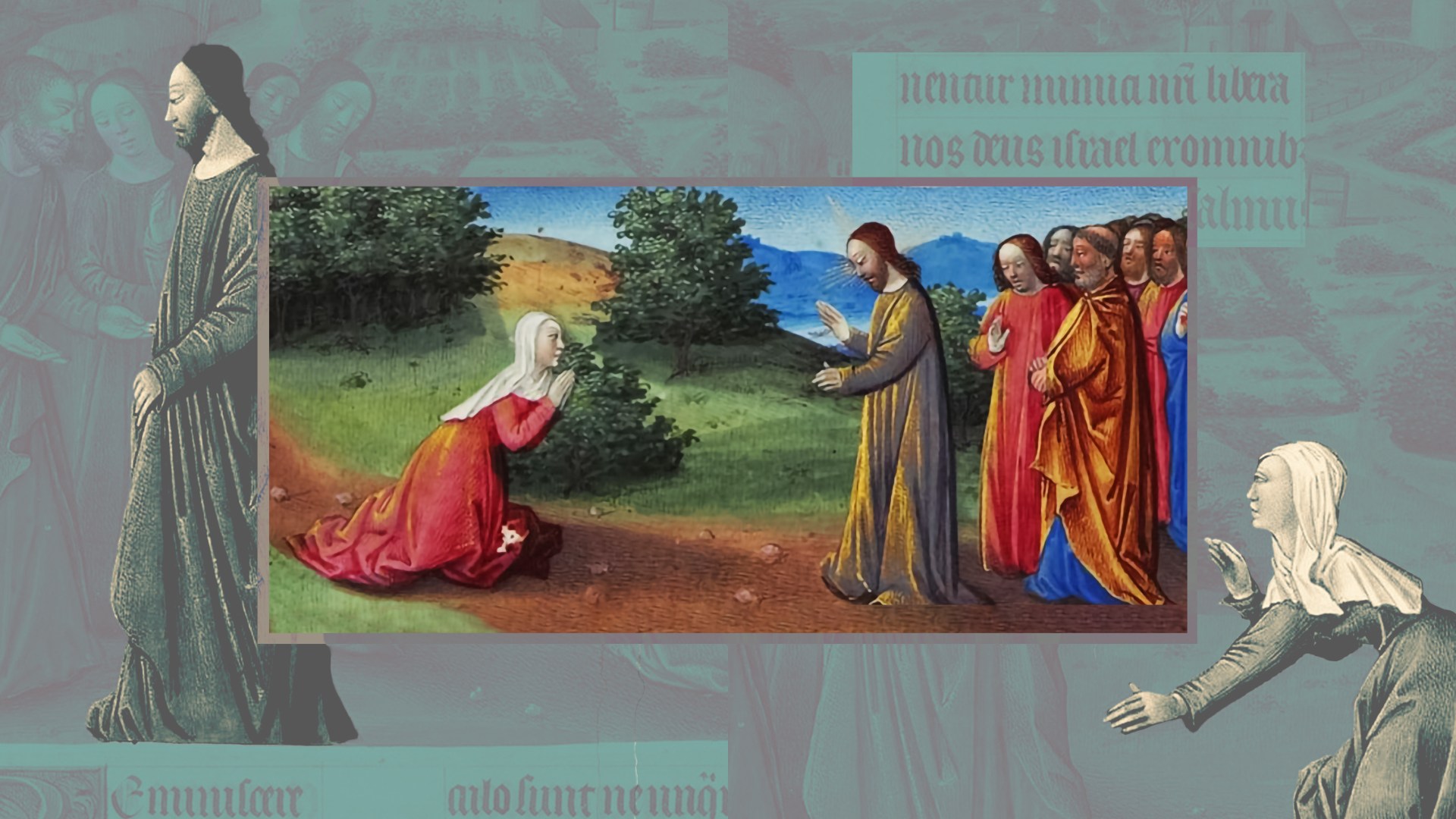
The claim is based on the story of Jesus healing the daughter of a Syrophoenician woman (Matt. 15:21–28; Mark 7:24–30). When the woman asks Jesus to heal her demon-possessed daughter, he says, “It is not right to take the children’s bread and toss it to the dogs.” The woman responds, “Even the dogs eat the crumbs that fall from their master’s table,” at which point Jesus commends her faith and heals her daughter instantly. Until now, the argument goes, Jesus has been racist, dismissing foreign people as “dogs.” Supposedly, this encounter shows him the error of his ways.

We could respond at several levels. Theologically, we know Jesus was without sin (Heb. 4:15). Exegetically, the Syrophoenician encounter resembles many other healing stories in the Gospels that take the same broad shape: a request for healing, followed by a dialogue where Jesus raises the stakes (“Do you believe that I am able to do this?” “Who touched me?” “Is it lawful to heal on the Sabbath?”), with the miracle completing the sequence.

Canonically, we should note the Gentiles Christ has healed already (Matt. 8:5–13, 28–34), not to mention his conversation with a Samaritan woman, which scandalized his disciples (John 4:1–42). And historically, talking about “race” in this period is anachronistic in the first place. It’s also implausible that Matthew, who opens with Gentile Magi worshiping the newborn King and finishes with a commission to go and make disciples of all nations, would include a story meant to portray Jesus as motivated by ethnic prejudice.

These are powerful arguments against deeming Jesus a racist. But ultimately, the best reason to resist this verdict is contextual. When we consider the Syrophoenician encounter within Matthew (and Mark) as a whole, we realize that Jesus’ provocative dialogue is making a crucial point about the breadth of his mission.

Much of Matthew 13–16 is about bread. There are parables about seeds, wheat, yeast, and flour (13:1–43), followed by Jesus providing bread for 5,000 people (14:13–21) and a debate about washing hands and eating meals (15:1–20). Then comes the Syrophoenician healing story, with its images of “bread” and “crumbs.” From there we have another story of Jesus providing bread, this time for 4,000 (15:32–39), and another debate about bread and the “leaven” of the Pharisees and Sadducees (16:5–12, ESV).

Together, these passages use food to explore the boundaries of God’s people. Are the Gentiles defiled by failing to observe Jewish food laws? And are they welcome to eat the “crumbs” that fall from the Jewish table? The answers to both questions reveal the widening scope of God’s welcome. What makes people clean is not the food that goes in but the behavior that comes out (15:11). And Gentiles who approach Christ in faith receive what they desire (15:28).

The two miraculous bread stories illustrate God’s plans for a multiethnic kingdom. The 5,000 at the first meal were Israelites; there were 12 basketfuls left over, one for each tribe. By contrast, the feeding of the 4,000—occurring immediately after Jesus heals the Syrophoenician woman’s daughter—takes place in the Decapolis, which is Gentile territory (Mark 7:31). Even though Israel eats first, the Gentiles are fed too. The “children” are provided for, but the “dogs” receive bread as well. This fits the message of Matthew as a whole: Christ’s mission is first to the Jews (Matt. 10:5–6) and then to the Gentiles (28:19).

One other layer to this story is worth mentioning. Jesus is the second example in Scripture of a prophet running from the official king and queen of Israel, encountering a desperate Gentile woman, having a conversation about food, and healing her child. In Elijah’s case (1 Kings 17:7–24), the woman provides food for the prophet. But the Bread of Life is different. He provides the food himself—not just for one person (or people group), but for the starving thousands, and indeed the world.

Andrew Wilson is teaching pastor at King’s Church London and the author of God of All Things. Follow him on Twitter @AJWTheology.

Testimony

Having Polio Was a Privilege, Not a Punishment

How a passage in John’s gospel transformed my perspective on God and suffering.

Tyler Northrup

Growing up, I was angry at God. To me, he was either heartless or distant, if he even existed at all. In any event, I wanted nothing to do with him.

My story begins in India, where I contracted polio as an infant before receiving the vaccine. The doctors mistakenly gave me cortisone to lower my high fever, allowing the virus to spread throughout my body, which left me paralyzed within days. They encouraged my parents to leave India to seek better medical care, so we moved to England and then to Canada. My first surgery was at age two, and I endured 21 major operations throughout childhood. Only at age seven was I able to walk.

What was then the Shriners Hospital for Crippled Children in Montreal functioned as a second home. I lived there for months at a time, once passing a nine-month stretch in a body cast. About a dozen other girls lived on the same ward. We could only see our families on weekends during the brief visiting hours.

Without parents around to guide us, we grew up on our own, making up our own rules and assumptions about life. We learned to do whatever the nurses asked, lest we get cold food, the last sponge bath, or the silent treatment. Since there was no one to hear our complaints, we all learned to stifle our feelings and do what we were told.

Giving God a chance

I vividly remember my friend Belva, one of the few mobile girls on the ward, who would play Barbies with me on my bed. She was sick for a few weeks and then suddenly disappeared. The next day, they took her things off her nightstand and remade her bed. When I asked where Belva was, I was sharply told to mind my own business. No one mentioned her again. I was perhaps too young to understand what had happened, but the loss hardened me.

Life between hospital visits was even more traumatic. Kids made fun of my pronounced limp, imitating the way I walked. Classmates bullied me frequently. One time, a group of boys threw stones at me as they knocked me down and called me a “cripple.” I became used to that word.

In fourth grade, I finally made a good friend. One afternoon, I accidentally overheard her talking to the teacher about me. “Do I have to stay with Vaneetha on the field trip?” she whispered. “I don’t want to push her in the wheelchair or walk slowly with her all day. Can’t someone else be her friend for once?”

After that, I kept to myself until I discovered A Christmas Carol by Charles Dickens and noticed how everyone loved Tiny Tim, the poor, “crippled” boy. When I was cheerful and uncomplaining, people praised me, just like Tiny Tim. Soon he became my new persona. People began seeing me as sweet and courageous, except for my sister, the one person I subjected to biting sarcasm and belittling comments. She alone bore the brunt of my bitterness and anger.

In high school, I started attending Fellowship of Christian Athletes meetings because all the popular kids were there. A friend and I would sit in the back and talk about boys—neither of us cared much about God. But then one weekend she went away on a retreat; when she came back, she excitedly told me that God was real. Unimpressed, I asked her to stop talking about God.

But she wouldn’t. She kept telling me what she was learning about God and asking what I thought about the FCA meetings. I didn’t care about the messages—I barely listened to them—but I did care that she was becoming more popular than me. And I wondered why everyone was talking about God as if they knew him. So one night, as I was falling asleep, I simply said, “God, if you are real, please show me.”

The next morning, I woke up and decided to give this God a chance. Opening the Bible for the first time on my own, I started reading in Leviticus, wondering how this book was relevant to anyone.

Before I closed the Bible, I asked God a question: “Why? Why did this happen to me if you are real and you’re supposed to be good?” I randomly turned to John 9 and read, “As he went along, he saw a man blind from birth. His disciples asked him, ‘Rabbi, who sinned, this man or his parents, that he was born blind?’ ‘Neither this man nor his parents sinned,’ said Jesus, ‘but this happened so that the works of God might be displayed in him’ ” (vv. 1–3).

I sat on my bed, shocked. The disciples were asking the same questions I was. But Jesus shifted the focus from whose fault it was to what purpose it served. Which meant the man’s blindness was a privilege, not a punishment. It seemed God was encouraging me to embrace my disability as an opportunity for him to display his works.

The Bible was finally making sense, so I kept reading, anxious to see if there was anything else relevant for me. The story of Lazarus intrigued me, and John 12:43 exposed me when Jesus said the Pharisees “loved human praise more than praise from God.” Jesus was talking about me—I thrived on the praise I won with my Tiny Tim act. Everyone thought I was kind and self-effacing.

But God saw beyond my angelic exterior. I felt known, understood, and unconditionally loved—a combination that simultaneously comforted and terrified me. Overcome with excitement and emotion, I knelt by the side of my bed and committed my life to Christ. I was 16 years old.

True healing

I didn’t tell my family about my conversion because I thought they wouldn’t understand. Although I had grown up in a churchgoing family, I had never discussed my doubts or my anger at God with anyone, so I assumed no one knew.

This made for a touching moment when, two years later, my mother asked me to give my testimony to the Sunday school class she was teaching. As I spoke, tears streamed down her face, and afterward she told me three things I will never forget. First, she and my sister both knew I had committed my life to Christ because I was markedly different. My sister noticed it first, seeing my cruel teasing replaced by genuine kindness.

Second, my mother said that when I contracted polio, she was devastated and blamed herself. Wondering what she had done wrong, she found great comfort in John’s account of the man born blind.

And last, she recalled—during a period of despair over my future—feeling a sense from God that I would be made whole at age 16. She had assumed this would involve a miraculous physical healing, but my testimony had reminded her how true healing comes through knowing Christ.

I didn’t fully understand all that God had shown me that morning when I first met him. But the conviction that God can use my suffering for his glory has sustained me ever since. As an adult, I’ve endured the loss of an infant son after a doctor took him off his lifesaving medicine. My health has continued to decline with post-polio syndrome, which could leave me a quadriplegic. I lost a 20-year marriage when my first husband left me for someone else.

Though I’ve pleaded with God to take away these trials, he has given me something immeasurably greater: the treasure of his presence. With every heartache, he draws closer, using my weakness to display his strength.

Vaneetha Rendall Risner is a writer living in Raleigh, North Carolina. She is the author of Walking Through Fire: A Memoir of Loss and Redemption.

News

US Evangelicals Promise Prayers and Support for Israel’s New Prime Minister

Letter welcomes Benjamin Netanyahu’s successor after Friends of Zion founder pledged to oppose the incoming leader.

Christianity Today June 18, 2021
Amir Levy / Getty Images

A diverse group of American evangelicals congratulated Naftali Bennett on becoming the new prime minister of Israel and successfully forming a coalition government, offering reassurance on to Israelis concerned about Christian support after Benjamin Netanyahu’s departure.

“We pray that God grants you wisdom and strength as you make hard decisions that will affect the lives of millions, and we trust that He will answer those prayers,” wrote more than 80 religious leaders, organized by the Philos Project, a group promoting “positive Christian engagement” with Israel and pluralism in the Middle East.

The letter expressed appreciation for Netanyahu and everything he did “to strengthen Israel and its alliances” over the past 12 years he served as prime minister. It also welcomed the change brought by Bennett, a religious Jew and former Netanyahu disciple who formed an alliance with multiple parties across the political spectrum to oust Netanyahu.

“We want to thank you in advance for protecting our shared values as they apply to Israel’s citizens, whether Jews, Christians, Muslims, or Druze; for guarding the holy sites and welcoming religious pilgrims from around the world to discover the birthplace of their faith; for defending Israel from outside aggression; and for continuing to work toward peace with Israel’s neighbors,” the letter said. “In return, we pledge to deepen our friendship with your country and its wonderful people.”

Some Israeli political commentators have worried about evangelical support for the new government. In the run-up to the election, former Israeli ambassador to the US Ron Dermer argued Israel should be very concerned about losing the support of American evangelicals.

Those fears seemed to be confirmed when Mike Evans, founder of the Jerusalem-based Friends of Zion Heritage Center and the Jerusalem Prayer Team, lambasted Bennett in an open letter.

The Jerusalem Prayer Team’s Facebook page had 77 million followers before it was taken down in May, and Evans is regularly described in Israeli media as a prominent American evangelical leader and even the “world’s largest evangelical leader.”

“Shame, shame, shame on you. Don't ever call yourself a defender of Zion. You're not,” Evans wrote to Bennett in early June, while Bennett was negotiating to form a coalition government.

“I will fight you every step of the way. You have lost the support of evangelicals 100 percent,” Evans said. “We gave you four years of miracles under Donald Trump. We evangelicals delivered it. You delivered nothing. What appreciation do you show us? You s— right on our face.”

Evans later apologized for using rude language, but repeated his opposition to Bennett and any other political figures who might attempt to replace Netanyahu.

“You’re gonna wave a white flag of surrender—not a blue and white flag—a white flag, because you’re so blinded by your hatred, by your petty politics and your obsessions with power that you can’t see the trees for the forest,” he said.

Evans also reiterated his claim to represent American evangelicals, and referred to “my 77 million evangelicals” in his press conference.

Other American evangelicals with a record of strong support for Israel stepped in to say that not everyone felt the same as Evans.

“While Evangelicals do highly respect and appreciate Netanyahu, their love for Israel is not tied to one man,” wrote Joel Rosenberg, a Christian fiction author and founder of All Israel News. “Christians of course know that at some point Netanyahu will move on, but they sincerely want to bless and strengthen Israel for the long haul regardless of who is in power.”

Rosenberg is one of the dozens of leaders who signed the Philos Project letter.

It was also signed by Methodist, Pentecostal, Southern Baptist, and Missionary Baptist pastors; bishops in the Anglican Church in North America and the International Pentecostal Holiness Church; and representatives from the National Day of Prayer Task Force, the National Hispanic Christian Leadership Conference, National Religious Broadcasters, Pastors Wives of America, and Promise Keepers.

Professors from The King’s College, Grove City College, Midwestern Baptist Theological Seminary, Dickerson-Green Theological Seminary, and Beeson Divinity School signed on, as did Tony Suarez and Johnnie Moore, who served as evangelical advisors to President Donald Trump.

Robert Nicholson, president of The Philos Project, said in a statement that the letter was designed to show broad support.

“This list represents tens of millions of Christians from all over the denominational spectrum,” he said, “who differ on many things but agree on the importance of Christian friendship with Israel based on shared values that come from the Bible.”

Books
Review

It’s Never Too Late to Forgive a Flawed Father—or to Ask How He Got His Scars

What an attention-starved son learned while reconstructing the life of his distant dad.

Christianity Today June 18, 2021
Rawpixel / Envato

Our family is a bit raw this week. Packing your whole life into a U-Haul and leaving behind everything called “home” has a way of putting everyone on edge. We moved several times during my childhood, but this was my first time doing it as a father. I remember moving to South Florida in the third grade—the tears, the uncertainty, the upheaval. It’s been hard to watch a familiar sorrow swell in the eyelids of my own kids.

Lament for a Father: The Journey to Understanding and Forgiveness

Lament for a Father: The Journey to Understanding and Forgiveness

P & R Publishing

120 pages

As fathers, we dream of passing down wisdom, character, and faith, but so often we end up leaving our children an inheritance of pain, hurt, and unfulfilled longing. In his latest offering, Lament for a Father: The Journey to Understanding and Forgiveness, prolific author and longtime World magazine editor in chief Marvin Olasky reflects on this mixed blessing. “Many people … have unresolved conflicts with dads, living or dead,” he writes. “So do I.”

Olasky styles the book as an elegy for his own dad, a father “simultaneously present and absent.” It’s a work so particularly about one father that it ends up being about every father.

Who is to blame?

Eight brief chapters piece together a mosaic of Eli Olasky, a son of immigrants who grew up in a Jewish ward of Malden, Massachusetts, just outside Boston. Using the present tense, the author narrates the life of a school principal with a Harvard degree who settles into a life of comic books, bridge, frequent job turnover, and disappointing his wife. Aloof and stoic, he shows a mysterious lack of ambition.

A sense of melancholy weighs heavily over the entire book. The discoveries the younger Olasky digs out of Harvard archives, newspaper clippings, and family photo albums give his prose the yellowed edges of a son who would rather have known his father in his own words. Chock full of details from a distinctly Jewish upbringing, Olasky’s vignettes benefit from a pen sharpened by decades in magazine editing:

In 1957 we drive down US Route 1 to Hollywood, Florida, where my father will be the principal of a Hebrew school that students attend after public school lets out. One night we eat at a Howard Johnson’s. The table looks a lot like the one we have at home, with the same laminate surface. My father orders a hamburger and a wedge of iceberg lettuce. No ketchup or mustard on the burger. No dressing on the non-salad salad. My mother orders beef burgundy.

I request a small wedge of lettuce and a child’s hamburger. Since we eat only kosher meat at home, I ask the waitress if it’s kosher. She laughs and walks away. My father says it isn’t. I ask, “Why are we eating it?” He says, “It’s not important.”

It’s funny what memories a son’s mind latches onto when it’s starved for a father. The older Olasky was always dodging his son’s probing queries with that same refrain—It’s not important.

The author unpacks his taciturn father’s past one dusty box at a time. He learns of the antisemitism he had to overcome to gain entrance to Harvard. He begins to comprehend his father’s love-hate relationship with his Jewish heritage after discovering the philosophies he encountered in college. He realizes that his detached father probably spent a lifetime coping with the horrific sights, smells, and sounds he brought home from concentration camps he saw during the Second World War. “Like many of his generation,” Olasky writes, “my father never spoke of his World War II experience. Like many of my generation, I didn’t ask.”

Olasky dignifies every unfolding detail of his father’s life like a skilled mortician. He chronicles the slide of his parents into middle age. They fight a lot, particularly over his father’s underachievement, and his mother fends off fatalism with the interjection, “I’m not going to end up like my mother!” Both hope their two boys will provide redemption for the family’s shortcomings. With wistful hindsight, Olasky writes, “That does not happen.” His father’s career disintegrates into administrative temp jobs while the son completes graduate school: “I don’t know anything about that, but I don’t ask.”

His tale concludes with the sentiment, Who should I blame? When fathers and sons have poor relationships, when families fall apart, who is at fault? The author warns, “Scapegoating is an occupational hazard for writers of family history: It’s easy to blame parents.” Part of Olasky’s recent journey as a son has been learning of all the sin, abuse, and trauma his parents suffered in their own lives:

I’ve realized in the course of this research how self-centered I was, not only as a child but as an adult. Why did I have so little interest in seeing my parents not primarily as people to meet my needs (or not), but as individuals with their own struggles? I never really cared to find out about them.

In these sheepish confessions, Olasky reiterates the book’s main thrust: Fathers and sons are meant to know and to be known by one another. He gives sons this bit of advice: “Persist in questioning while your father is still alive. Don’t take no for a final answer.”

As I was packing up our shed this past week before our move, my nine-year-old son unloaded a barrage of questions: “What’s that called? What’s it for? Where does it go?” I was hot, sweaty, and annoyed, so I began to respond with sarcastic non-answers meant to discourage further inquiry.

I read Olasky’s exhortation later that afternoon, and I had to go find my little boy to apologize. I never want to hinder or discourage his searching heart. Those persistent questions are the outward expression of a little soul that longs to know his father.

A together misery

In Lament, the author realizes that his father’s reticence may have stemmed from a desire to shield his son from trauma, pain, or personal sin. As fathers, it can feel shameful to be so known. Our kids see us at our worst; they know our bald spots better than we do. Rather than leaning into this intimacy, we can recoil from embarrassment and push our kids away. However, in hiding our flaws from our children, we hide ourselves.

One quibble readers might have with Olasky is that his lament ends abruptly with almost no conclusion or application. At only 100 pages in length, another chapter easily could have been justified. I’m sure readers would appreciate a few more reflections on what Olasky learned from unearthing his father’s past—and what he might have us learn.

But perhaps that is part of the point. Perhaps Olasky is resisting the trivialization of his father’s existence by boiling his life down to a few chirrupy lessons. The focus on the lost details of his father’s history—facts recounted without much commentary or digest—seem to be his way of saying, Eli Olasky has value not because of what he gave me or what he taught me but simply because he was my dad.

It is a human impulse to try to make sense of our bewildering tragedies by stringing together some greater purpose on our own—an artificial connecting of the dots to forge some cheap closure for ourselves. Olasky’s Lament refuses to do so. His elegy remains unresolved. Leaning into the dissonance of human sorrow and divine sovereignty, the author will not let God off the hook. Mankind cannot redeem his sorrows. Only God can—and he must.

The Olaskys of Lament for a Father lived a story so oddly specific and yet so eerily familiar. We all have moments where we see devastation in our relationships and say, “I wish it were not so.” Is this not the throb of the Christian heart in a world not yet fully redeemed? Commiseration is the point of lament. A together misery . A shared sadness. Lament is an invitation: Be wretched with me. Our sorrows are not all the same, but they are a part of the same fallen world.

My son and I were driving the moving van this weekend, a sieve of fresh-picked blueberries between us—the last vestige of the home we were leaving behind. As the miles passed, I regaled him with tales from my childhood: places I’d lived, friends I’d left behind, hardships I’d endured. Olasky’s encouragement echoed in my mind: “Even if it seems too late, it’s not.”

Fathers, find a place, an activity, a time, where you feel comfortable sharing yourself with your children. Ask Marvin Olasky, or any son who has lost a father. They know in their bones that this is true: Our kids don’t want a perfect dad; they just want Dad.

Chad Ashby is a graduate of the Southern Baptist Theological Seminary and Grove City College. He currently teaches literature, math, and theology at Greenville Classical Academy in Five Forks, South Carolina. He blogs at After+Math.

Church Life

Bringing Birth Fathers Back into Adoption Narratives

This Father’s Day, more families are recognizing the God-given dignity of adoptees’ biological dads.

Christianity Today June 18, 2021
Illustration by Mallory Rentsch / Source Images: Kindel Media / Nappy / Pexels

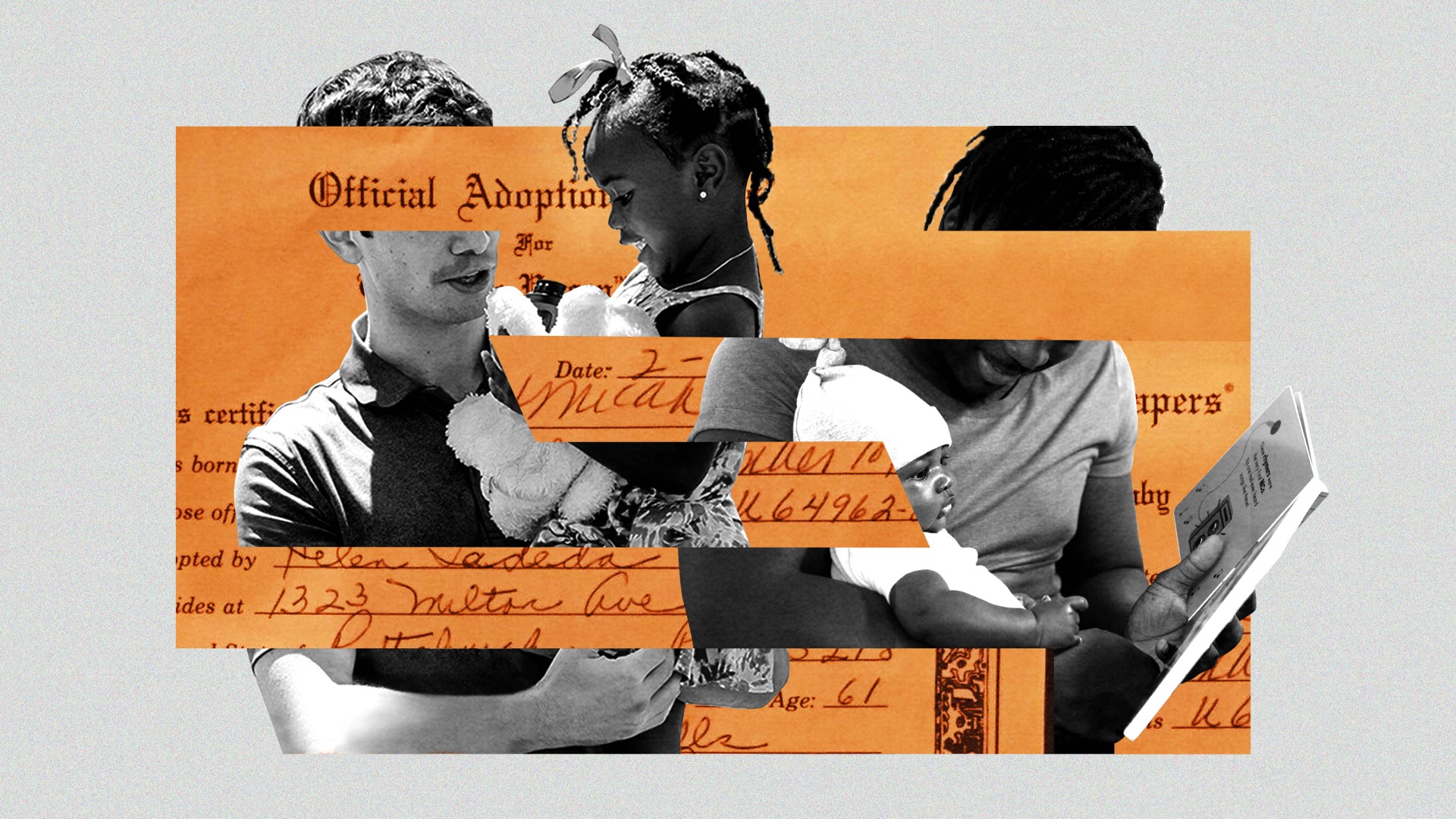
When Darrick Rizzo was 18, his girlfriend of three years told him she was pregnant. With the couple on the cusp of their college careers and unprepared to parent, his girlfriend chose to pursue adoption. Despite opposing the decision, Rizzo ultimately acquiesced, hoping to offer the best life possible for his son.

“I was willing to do anything for my boy, even if that meant listening to his mom and choosing an open adoption,” wrote Rizzo in his book, The Open Adoption: A Birth Father’s Journey.

Rizzo was committed to his role as a birth father and sent letters and gifts to his son. Years later, he learned his child had never received his correspondence. Despite a desire to be an involved birth father, his efforts were thwarted.

Whether or not they make the effort, the reality is that many birth fathers end up absent from the lives of their adopted children. And until recently, the relationship between adoptees and their birth fathers had not been given too much consideration in the context of the adoption conversation.

But as social media and family genealogy tracing allow more children to find and connect with their biological dads, Christians involved in adoption are thinking about the significance of such relationships.

“We’re starting to see a little more discussion around birth fathers, where historically they’ve been left out of the picture,” said Cam Lee, an adoptee and a Christian who now works as a therapist with adoptive families.

Most adoptions feature communication exclusively with birth mothers. Lee has noticed that adoptees on social media are speaking out more about their interest in their other parent too.

For Christians, these new conversations around birth fathers represent an opportunity to affirm their role and welcome them into the adoption story.

Paul Batura, the father of three boys through adoption, says it’s important to remember and uplift his sons’ biological dads. In a recent essay, he wrote a letter to them, extending his gratitude for their part in their existence. He also expressed a desire that they one day meet their sons, and that “it will further affirm them—and you” as beloved and important.

It’s a complicated reality, but nothing God didn’t anticipate. “As the adoptive son of Joseph, Jesus didn’t have an earthly biological father,” said Batura, who serves as vice president of communications for Focus on the Family. “But we can know with certainty that it was God’s plan because God doesn’t make mistakes.”

Given that his sons’ birth fathers know his name, Batura said he published the essay hoping they might recognize themselves in it. “We always try to honor them in our conversations and stories,” he said.

But many birth fathers aren’t aware they have a child on the way—or in the world. Until a couple generations ago, out-of-wedlock pregnancy carried such an intense stigma that unwed mothers were usually silently ferried away until delivery and adoption were complete. Fathers were rarely part of the decision-making. Back then, most adoptions were closed and identity records sealed. Prior to 1972, adoption didn’t even require the consent of an unmarried father. Today, birth father rights vary from state to state, and at least 24 states have a putative father registry, which allows unmarried fathers to establish their potential paternity and attempt to maintain legal rights.

In addition to more legal protection for fathers, now 60–70 percent of adoptions are open and 95 percent include at least some minimal type of contact between birth and adoptive families. This shift in adoption culture came after research showing that adoptees in open adoptions fare better personally and socially.

Bringing birth fathers into the narrative could be life-changing for families. If adoptees knowing their birth mothers produces better personal results, having knowledge of and relationship with birth fathers offers even better results.

“What we know is that when birth fathers are involved … it’s a better outcome,” said Jennifer McCallum, foster care and adoption counseling supervisor for Buckner International, a Christian organization that facilitates open adoptions.

“We tend to think of the expectant moms as the only one making a sacrifice or grieving,” said McCallum. “But we want birth fathers to be a part of the entire process.”

Both parents can experience a sense of loss when their child is adopted. There isn’t much research out there, but one study of 30 birth fathers found that they experience feelings similar to birth mothers: grief, distress, and pain, for example.

“Birth fathers reported similar waves of emotion around birthdays, holidays, major life events and other major triggers,” according to the National Council for Adoption’s report. Roger Matthews, 61, placed his son up for adoption over 40 years ago. He maintains it was the right decision for him and his girlfriend, both just 18 at the time, and one born out of their nascent Christian faith at the time.

Years later, Matthews met his adult son, and it was the beginning of a new family tree for them both. Matthews’s son initially sought contact with his birth mother, who then connected the three of them. “We now see them regularly,” Matthews said in an email. “I count them as part of our family.”

Theodora Blanchfield, 38, was adopted as a newborn. As an adult, she met her birth mother first. That desire felt “urgent” at the time. But it wasn’t long after that when she was compelled to find her birth father, too.

“Growing up, I had envy of people who weren’t adopted,” said Blanchfield. “People who took knowing stuff about themselves for granted.” Though she said meeting her father was somewhat anticlimactic, she was thankful for the opportunity.

Lee, the therapist who works with adoptive families, never met the birth father who died when he was a baby. But he has a “living curiosity” about him, including regular thoughts and dreams. “There’s a longing to humanize him,” he said.

He believes it would be beneficial to start incorporating birth fathers more into his work with families. Without the presence of a birth father in any way, he said, identity development can be harmed.

“If we were able to have access to them in some kind of way,” said Lee, “there’s a higher chance we could make sense of that story … and how we want to think or feel about it.” (He did acknowledge that there are some situations when connecting with a birth father would be “deemed unsafe.”)

For those who don’t know their birth fathers and never fully “make sense” of their backstories, God promises in the Bible to be a “Father to the fatherless” (Ps. 68:5). It’s a comfort for the many children who grow up without their biological fathers around, whether because of adoption or other circumstances. My husband, who grew up without a father, experienced the fulfillment of that promise, which we wrote about in our book, Leaving Cloud 9.

Darrick Rizzo continued to reach out to his son, and once his son was a teenager, they were able to form a personal relationship. Both say they are better off now that the puzzle pieces of their lives have come back together.

More recognition for birth fathers, wrote Roger Matthews, might “contradict the American worldview that views people merely as representatives of groups,” rather than individuals formed by a Creator for relationship, marriage, and family. It may also help equalize the pressure and stigma that so often falls onto birth mothers alone.

On Father’s Day and beyond, advocates like Batura say thanking birth fathers publicly is appropriate, validating, and kind. There will always be brokenness in an adoption story, but even in adoption, God’s design for humanity and family can be sustained.

Ericka Andersen is a freelance writer in Indianapolis. She hosts the Worth Your Time podcast and is writing a book about women and church.

News

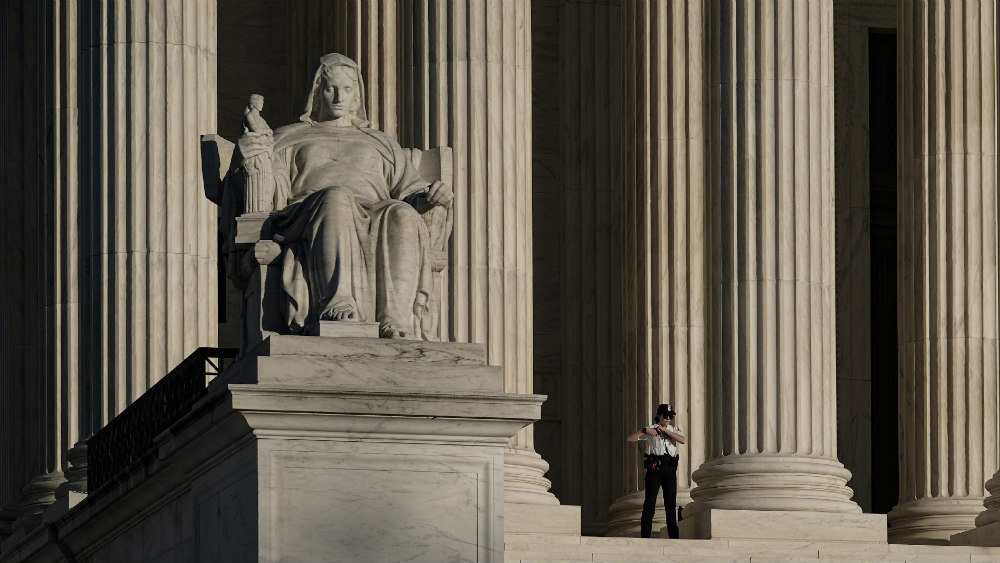
Supreme Court Sides with Catholic Foster Care Agency

But majority declines to revisit rules for religious accommodation, over protests from justices Samuel Alito and Neil Gorsuch.

Christianity Today June 17, 2021
AP Photo/J. Scott Applewhite

Update (June 17): The United States Supreme Court ruled decisively in favor of a Catholic foster care agency on Thursday, with all nine justices agreeing that the city of Philadelphia violated the First Amendment’s protection of religious liberty when it ended a contract with Catholic Social Services (CSS) over service to LGBT people.

“It is plain that the City’s actions have burdened CSS’s religious exercise by putting it to the choice of curtailing its mission or approving relationships inconsistent with its beliefs,” wrote Chief Justice John Roberts.

Philadelphia claimed the city could not contract foster care services with a Catholic agency that only served married heterosexual couples because of an antidiscrimination law ensuring that everyone, regardless of sexual orientation, has equal access to public accommodations. The court found, however, that foster parenting is not a “public accommodation,” since certification is not available to the public and “bears little resemblance to staying in a hotel, eating at a restaurant, or riding a bus.”

According to the court, there was also no evidence presented in the record that the Catholic agency’s policies ever prevented a same-sex couple from fostering a child, or that it would have that effect.

The majority opinion was joined by justices Stephen Breyer, Sonia Sotomayor, Elena Kagan, Brett Kavanaugh, and Amy Coney Barrett.

The other three justices—Samuel Alito, Neil Gorsuch, and Clarence Thomas—agreed with the judgement but signed on to two concurring opinions arguing the court should go further in defense of religious exercise. They wanted the court to overturn a 1990 precedent written by conservative legal icon Antonin Scalia, which made it easier for governments to justify laws that place a burden on religious activity.

In Employment Division vs. Smith, Scalia said that governments can burden religious practice as long as it is done “incidentally,” and religious activities are not being targeted by the “neutral” and “generally applicable” law.

In Thursday’s ruling, Roberts and the majority said Philadelphia was intentionally targeting the Catholic foster care agency. The law was not neutral toward religion and not generally applicable, since it was written with the Catholic agency in mind. The court decided not to overturn the 1990 precedent.

Gorsuch, in his concurring opinion, questioned the majorities’ decision to “dodge” the critical legal question of the standard for religious accommodation.

“Perhaps our colleagues believe today’s circuitous path will at least steer the court around the controversial subject matter and avoid ‘picking a side,’” he wrote. “But refusing to give CSS the benefit of what we know to be the correct interpretation of the Constitution is picking a side. Smith committed a constitutional error. Only we can fix it.”

Alito made a similar argument—at length. His opinion stretched to 77 pages, 62 more than the majority opinion, criticizing the court for not doing what it should do.

“I would overrule Smith,” Alito wrote. “After receiving more than 2,500 pages of briefing and after more than a half-year of post-argument cogitation, the Court has emitted a wisp of a decision that leaves religious liberty in a confused and vulnerable state. Those who count on this Court to stand up for the First Amendment have every right to be disappointed—as am I.”

Advocates for religious liberty and Catholic Social Services were celebrating the 9-0 decision when it came down, however.

Attorney David French called it “a big win for religious freedom” and celebrated the fact that “every justice concurred at least in the result.”

“Religious liberty should not be a partisan issue,” he said on Twitter.

Chelsea Patterson Sobolik, policy director for the Southern Baptist Convention’s Ethics and Religious Liberty Commission, agreed it was a “huge victory.”

“This ruling in Fulton means that children who need safe, permanent, and loving homes will be served by a foster-care system that welcomes all who are qualified to serve those in need,” she said.

Advocates for LGBT rights expressed disappointment in the ruling but appreciated the narrowness of the majority opinion.

“For years, the religious right has sought a First Amendment license to discriminate against LGBT folks,” wrote David Cole, the national legal director for the American Civil Liberties Union. “They didn't get it today in Fulton. We live to fight another day.”

—–

Original report (Nov. 5, 2020): While the nation focused on counting votes on Wednesday, the United States Supreme Court heard arguments in a case that could dramatically expand protections for religious liberty.

Lawyers for Philadelphia argued that the city should be allowed to discriminate against religious social service providers as long as the rules it uses are “neutral laws of general applicability,” citing a 1990 decision penned by conservative legal giant Antonin Scalia. Lawyers for Catholic Social Services, on the other side, argued the court should reconsider Scalia’s previous ruling in Employment Div. v. Smith, because it established a standard that allows governments to target religious minorities and place significant burdens on what the First Amendment calls their “free exercise.”

“The Free Exercise clause is at the heart of our pluralistic society, and it protects petitioners’ vital work for the Philadelphia community,” attorney Lori Windham argued in Fulton v. City of Philadelphia.

“The city is reaching out and telling a private religious ministry—which has been doing this work for two centuries—how to run its internal affairs. And trying to coerce it to make statements that are contrary to its religious beliefs as a condition of continuing to participate in the religious exercise that they have carried out in Philadelphia for two centuries.”

In 2018, a city official read a newspaper story about conservative Christian opposition to same-sex foster parents. Philadelphia had long contracted foster care services to Catholic Social Services. There weren’t any complaints about the church-run organization discriminating against LGBT people, but the official was nonetheless concerned and brought the issue to the city council. The council changed its contracting policies and passed a resolution opposing “discrimination that occurs under the guise of religious freedom.” The entire process took three days.

Catholic Social Services asked for an exemption from the city, noting it would be happy to refer same-sex couples who wanted to foster to the more than two dozen other agencies that also contract with the city. LGBT people wouldn’t be prevented from fostering, and the Catholic agency shouldn’t be required to give up its religious convictions just because they are unpopular. The city refused, saying the new standards had to be equally applied to everyone.

“A universal clause in every contract bars sexual orientation discrimination,” said Neal Katyal, the attorney representing Philadelphia. “That clause contains no exceptions, and it applies equally to every [foster care agency], religious and secular alike.”

Katyal was appealing to the 1990 case, when the court established “general applicability” as the standard for deciding when a law violates religious liberty. In that case, two members of the Native American Church were denied Oregon’s state unemployment benefits because they were fired for using peyote. They objected that the hallucinogenic was a religious sacrament in the church and should thus be protected.

Scalia, writing for the majority, said laws that specifically prohibit religious activity were not allowed under the First Amendment, but laws that incidentally prohibit religious activity are. As long as the law is not targeted at religious exercise, it is fine.

According to Scalia, this does “place at a relative disadvantage those religious practices that are not widely engaged in.” But that’s unavoidable. Religious minorities will receive less leeway for the exercise of their faith if it’s unpopular and they don’t have the political power to win legislative exemptions for themselves. The other option, he wrote, is “a system in which each conscience is a law unto itself”—pluralism leading to complete anarchy.

As American culture grows more accepting of LGBT people and the court has expanded protections of LGBT rights, religious conservatives have begun to worry that they will be the ones at a “relative disadvantage.” If traditional Christian teaching rejecting homosexual activity as sinful is widely unpopular, then cities and states are not likely to exempt religious organizations from “generally applicable” laws against LGBT discrimination. That could make life difficult for foster care services, Christian wedding cake bakers, evangelical colleges, and others, just as laws against drug use have made it hard for the Native American Church to practice its peyote sacrament.

The standard that Scalia set up has also been applied to Santeria priests who wanted exemption from local animal cruelty ordinances to sacrifice chickens, peace activists who don’t want to pay the portion of their taxes that funds the US military, and, quite recently, churches seeking exemptions from COVID-19 restrictions on public gatherings.

The court has, in recent years, protected religious liberty in multiple rulings, deciding in favor of religious business owners, religious employers, and religious schools. With the recent addition of three conservative justices—two of them Catholic—it does not seem like the court is poised to change course.

Several evangelical groups, including the National Association of Evangelicals, the Council for Christian Colleges and Universities, the Ethics and Religious Liberty Commission of the Southern Baptist Commission, and the Church of God in Christ, have asked the court to use this case to revisit the precedent set by Smith.

Court observers say, however, that the justices may not take the opportunity. They could, instead, say the city of Philadelphia did not meet the standard of a “generally applicable rule” because the council was specifically targeting the Catholic foster care agency. That would be similar to the court’s ruling in Masterpiece Cakeshop v. Colorado Civil Rights Commission in 2018, which focused narrowly on the commission’s process for evaluating the cake shop owner.

The justices might worry that overturning Smith would open up every city and state to unending lawsuits, as people attempt to win exemptions from every possible regulation. “The practical advantage of Smith,” a legal advocate for local governments argued, “is that it is simple. Smith is a bright line rule; no one is entitled to an exception from a valid, neutral, generally applicable law.”

The case is also one of the first heard by the newest justice, Amy Coney Barrett. Barrett clerked for Scalia and is seen as his legal disciple. It would be surprising if one of her first votes overturned one of his landmark opinions.

Justice Sonia Sotomayor, one of the more liberal judges, indicated interest in a limited ruling on religious liberty during the oral arguments.

“If one wanted to find a compromise in this case,” she asked one of the lawyers, “can you suggest one that wouldn’t do real damage to all the various lines of laws that have been implicated here?”

addApple PodcastsDown ArrowDown ArrowDown Arrowarrow_left_altLeft ArrowLeft ArrowRight ArrowRight ArrowRight Arrowarrow_up_altUp ArrowUp ArrowAvailable at Amazoncaret-downCloseCloseellipseEmailEmailExpandExpandExternalExternalFacebookfacebook-squarefolderGiftGiftGooglegoogleGoogle KeephamburgerInstagraminstagram-squareLinkLinklinkedin-squareListenListenListenChristianity TodayCT Creative Studio Logologo_orgMegaphoneMenuMenupausePinterestPlayPlayPocketPodcastprintremoveRSSRSSSaveSavesaveSearchSearchsearchSpotifyStitcherTelegramTable of ContentsTable of Contentstwitter-squareWhatsAppXYouTubeYouTube