Ideas

We Can Reach Conspiracy Theorists for Christ. Here’s How.

God rescued me from a conspiracy theory and terrorism, and he can save others as well.

Christianity Today July 1, 2021
Illustration by Rick Szuecs / Source Images: Klaus Vedfelt / Getty

We live in a time of social upheaval, and social upheaval is fertile soil for conspiracy theories. Most of them are based on error and misinformation, and some can be downright dangerous. The ones that ensnared me in the turbulent 1960s drew me into racial hatred and political extremism and led to a shootout with police that killed an accomplice and very nearly killed me—all in the name of Christian patriotism.

My story is just one of many that ended in tragedy. Back then, conspiracy theories were on the margins of society, but today, with the advent of the internet, they are proliferating. They have moved mainstream and now into the church, where low levels of biblical literacy and high levels of cultural seduction make people more vulnerable.

Some conspiracy theories are relatively harmless, like the idea that the moon landing was faked. Others, like the theories I believed, are dangerous. By intensifying fear, anger, and hatred, they led to violence.

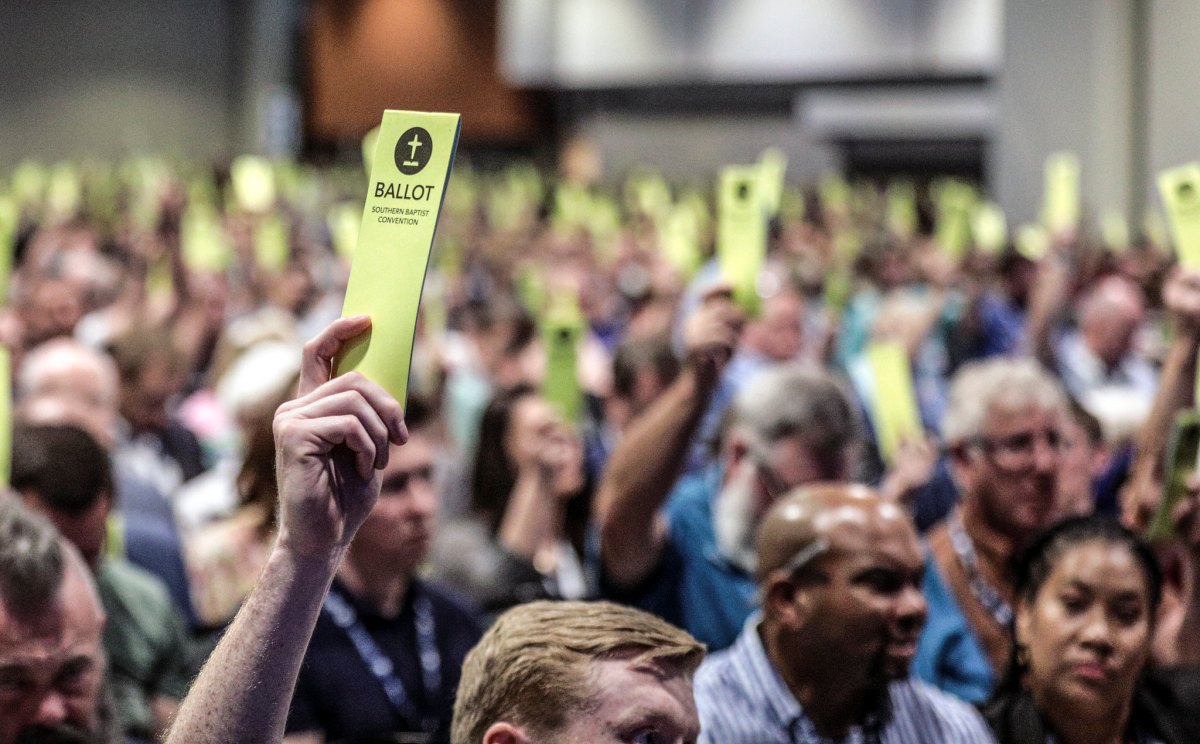
The most common conspiracy theories today are not as violent as before but can still deceive and lead people astray with serious consequences. QAnon, a right-wing theory that believes former President Donald Trump was fighting an underground ring of Satan-worshiping pedophiles, is probably the most popular right now and is making significant inroads in our culture and the church. Recent research from the American Enterprise Institute shows that 25 percent of white evangelicals affirm part or all of the QAnon conspiracy theory.

QAnon makes frequent use of scriptural references and eschatological allusions, giving it unmerited credibility and even leading some ministries to propose a merger of QAnon and Christianity. The Institute for Strategic Dialogue reports that QAnon grew by more than 175 percent on Facebook alone in 2020.

Professing Christians who believe these theories are on the dangerous thorny ground Jesus described in Matthew 13:22, where, as William Hendriksen puts it, “Constant anxiety about worldly affairs fill mind and heart with dark foreboding.” Instead of being eager to maintain the unity of the Spirit in the bond of peace through humility, gentleness, patience, and love (Eph. 4:2–3), they produce the works of the flesh, fostering dissensions and divisions that cause believers to take sides, argue, and fight with one another (Gal. 5:20). When things reach this point, the Devil has succeeded in using his age-old tools of deception and division to disrupt the church, and it underscores Peter’s caution that “whatever overcomes a person, to that he is enslaved” (2 Pet. 2:19, ESV throughout).

How do conspiracy theories begin? Some originate from the noetic effects of sin—flawed thinking. But others originate with “the god of this world,” who blinds “the minds of unbelievers, to keep them from seeing the light of the gospel of the glory of Christ” (2 Cor. 4:4). The Devil’s lies and deception began with Adam and Eve, and conspiracy theories were widespread as far back as Isaiah’s day (Isa. 8:11–13).

In the New Testament, Jesus warned his followers concerning his second coming: “See that no one leads you astray” (Matt. 24:4; Mark 13:5). Paul urged believers to “Let no one deceive you with empty words” (Eph. 5:6) and “Let no one deceive you in any way” (2 Thess. 2:3). John says, “Little children, let no one deceive you” (1 John. 3:7).

Unfortunately, I was not alert and on guard in the 1960s. As a teenager, I was a patriotic kid who attended a large Southern Baptist church, but I became deeply disoriented by the social upheaval around me and angered by the federally mandated desegregation of my high school and local public facilities. The world that I had grown up in was being turned upside down.

In the midst of the chaos, I stumbled onto some propaganda that was distributed at my school and later met those who were behind it. Their explanation for what was happening revolved around conspiracy theories that made sense to me at the time. They taught the superiority of white people and that a shadowy group of powerful Jews were conspiring to corrupt Christianity, undermine America, and take control of the world. The situation was dire, they said, and patriotic Americans needed to act before it was too late. This was the 1960s version of extreme Christian nationalism. Hitler used the same core ideas in Germany, and many millions died as a result.

That was the hook that drew me down the rabbit hole, the beginning of a downward spiral of indoctrination and deception that eventually led me into terrorist activity, two shootouts with law enforcement, the death of two accomplices, and a 35-year sentence in prison.

As in my high school years, the cultural, racial, and political turmoil we are experiencing today has created a swirling vortex that is psychologically disorienting and deeply unsettling for many people. This arouses fear about the future and a search for answers and solutions. A search for answers—for truth and reality—is not bad in itself; we are living in turbulent times and people should be concerned. However, we must be alert to and on guard against falling for simple answers to complex issues, which is the specialty of conspiracy theories.

Is it possible to help family, friends, or colleagues who are attracted to ideologies like Christian nationalism and conspiracy theories like QAnon? I believe it is. We can start by asking God to help us love the person, seek their good, and be an agent of his grace in their life. Then, we can ask the Holy Spirit to make us usable—to help us recognize and repent of any sinful attitudes toward the person: self-righteousness, pride, or arrogance because we see the truth and they don’t; or frustration, impatience, or anger because they resist facts, reality, and truth. These and other wrong attitudes can sabotage our efforts from the start.

Next, we need to remember that with QAnon we are in a battle with the forces of spiritual darkness. The “deceitful spirits and teachings of demons” that Paul warned Timothy about in the first century are just as prevalent today (1 Tim. 4:1). Personal prayer and even fasting are essential in this battle. Pray for insight, discernment, and wisdom, and be alert to any ideas from the Holy Spirit. We may also need to recruit others to join in prayer. Unknown to me, a group of godly women prayed weekly for two years for my deliverance and salvation.

This type of spiritual battle also requires us to do our homework. Articles and podcasts from credible sources are readily available. Learn from those who have experience in dealing with what you will face. Identify the weak points and vulnerabilities in your interlocutor’s belief system. (Many people have found Steven Hassan’s work helpful.) That will enable you to discern from the start how deeply the person is ensnared.

People are scattered all along the spectrum, from the hardcore to the marginally involved. Hardcore ideologues are the most difficult to work with and may require deeper study and the support of others. The marginally involved person may see the ideology or conspiracy theory as perhaps plausible, but they are not so convinced and alarmed by it that they are committed to action. They can often be reasoned with through friendly dialogue.

Conversations must be carried on with Christlike humility and “with gentleness and respect” (1 Pet. 3:15). This is crucial to gain a hearing and maintain a good relationship—without which there is no possibility of having a positive influence. Show respect and seek to build trust by patiently listening to their ideas (no matter how bizarre). Seek to understand them well enough that they agree that you correctly understand their position. For every hour you are together, spend 50 minutes listening.

Don’t be impatient and attempt to rush the process of relationship building and dialogue. It may take a number of sessions before you start to see progress. Arguments or debates almost never work in this type of situation. Instead, follow Paul’s advice to Timothy: “The Lord’s servant must not be quarrelsome but kind to everyone, able to teach, patiently enduring evil, correcting his opponents with gentleness. God may perhaps grant them repentance leading to a knowledge of the truth, and they may come to their senses and escape from the snare of the devil, after being captured by him to do his will” (2 Tim. 2:24–26). If you have done your homework, you will be prepared for opportunities to gently ask questions that expose errors of fact or reasoning. Jesus often used questions to penetrate defenses and prompt self-examination.

Keep alert for the underlying attraction for the person. Often, it is connected to a deep need. Both Christian nationalism and QAnon have cultish characteristics. Many people enter a cult because it “fitted with what they were looking for and lacked in normal society” says Eileen Barker, a sociologist and researcher at the London School of Economics. Meaningful community is often part of what people are looking for in extremist groups. If you are in a healthy church with sound biblical preaching and vibrant community life, invite them to come visit as your guest. And get some of your friends to connect with them. Engaging with a community of joyful, devoted followers of Jesus is in effect immersing oneself in his light, truth, and love. The Holy Spirit can do wonders in such an environment.

Finally, “Put on the whole armor of God, that you may be able to stand against the schemes of the devil” (Eph. 6:10–18), and keep reminding yourself that nothing is impossible with God. If he could save a deeply misguided, violent religious terrorist like Saul of Tarsus, or someone like me, he can save anyone.

Thomas Tarrants is the president emeritus of the C. S. Lewis Institute and author of Consumed by Hate, Redeemed by Love.

Speaking Out is Christianity Today’s guest opinion column and (unlike an editorial) does not necessarily represent the opinion of the publication.

Inkwell

Kindness

Inkwell July 1, 2021

what ferments when the quiet stirrings cease
as stillness comes upon a wrestling heart
the gift of knowing each day to receive
so fullness overflows in every part –
the dormitory floors that catch our cries,
the boiling pots that nourish aching heads,
the cups of coffee shared in every try,
the messages that soften morning dread,
the hands that clasp another’s trembling,
the firm embrace of learning how to grieve,
the company that holds unravelling
and slowly waits in learning to believe.
when mercy drifts to daylight once again,
we hold Your mottled hands and call You friend.

Jonathan Chan has been published by Quarterly Literary Review Singapore & Poems for Ephesians

News

Nepal Churches Struggle to Serve as COVID-19 Kills 100+ Pastors

Amid a second wave of infections, Christian leaders wrestle with leadership vacuum and how openly to raise funds to aid neighbors under a suspicious government.

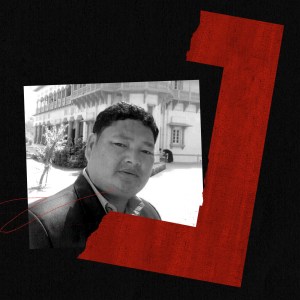
Nepali churches have assisted neighbors with food and medical care (right) amid a second wave of COVID-19 deaths among pastors (left).

Nepali churches have assisted neighbors with food and medical care (right) amid a second wave of COVID-19 deaths among pastors (left).

Christianity Today June 30, 2021
Illustration by Mallory Rentsch / Source Images: Courtesy of NCFN

Congregations in Nepal are reeling after a deadly surge in COVID-19 cases this spring threw the Himalayan nation into chaos, overflowing hospitals and crematoriums and leaving the national army to deal with 100 bodies a day in the Kathmandu Valley alone.

The Nepali church has lost more than 130 pastors during a second wave of the pandemic that has pushed reported cases past 635,000 and confirmed deaths past 9,000. Half of those cases and two-thirds of those deaths have been tallied since April.

“In the month of May, pastors were dying almost every day,” said B. P. Khanal, a pastor, theologian, and leader of the Janajagaran Party Nepal. “I have never seen something like that.”

Christians comprise a distinct minority of Nepal’s 29 million people: a 2011 census reports 1.4 percent, while local Christian leaders report 10 percent. Yet according to Khanal’s database, which tracks the pastor deaths, from February 2021 to today more than 500 pastors and their families have contracted the coronavirus, which multiple times has taken the lives of fathers and sons who co-led churches together.

For example, pastor Robert Karthak’s 56-year-old son, Samuel, died days after his respected father. While Robert had the privilege of a proper funeral, Samuel’s body was taken by the Nepali army which performed his last rites.

Other noteworthy deaths of Nepali pastors, according to Khanal, include Timothy Rai, Ambar Thapa, Man Bahadur Baudel, and Amar Phauja, as well as a Christian attorney and prominent religious freedom advocate, Ganesh Shrestha.

One of many COVID-19 victims: Pastor Simon Rana of Bethel Community Church

A “vacuum in leadership” now faces many churches, said Hanok Tamang, chairman of the National Church Fellowship of Nepal (NCFN).

“Some churches—particularly megachurches—had already prepared their second line of leadership to replace the pastors who went to be with the Lord,” he said. “But this is not true everywhere.” His fellowship has asked neighboring churches to “extend a hand of unconditional help" until replacement leaders can be prepared.

“Many young wives have lost their husbands. Some children have lost their both father and mother, and the number of semi-orphans and complete orphans remained still unaddressed,” said Tamang. “There are so many widows and hundreds of orphans.”

The overall pandemic, and particularly this second wave, has hit church finances hard in the mountainous country landlocked between India and China.

“Churches have been closed for almost one and a half years now. We have cooperated and complied with the government orders, and so the church has not been gathering,” said Dilli Ram Paudel, general secretary of the Nepal Christian Society (NCS). “But this has meant that the income of churches has gone down. Many people have lost jobs and they do not have money, so how will they give?”

In 2020, the majority of pandemic restrictions affected cities, meaning rural churches could still meet for Saturday services (on Nepal’s weekly day off). But 2021’s second wave not only kept churches shut down in cities but also finally prevented rural congregations from meeting in person. And while urban sites could still convene digitally, the lack of reliable internet and electricity has kept many congregations in villages from meeting online.

Giving in Secret?

Even as they continue to lose their people and leaders, the Christian community in Nepal has reached out to neighbors with food supplies, medical aid, awareness campaigns, and prayer. The NCFN and NCS coordinate efforts, representing more than 9 in 10 Nepali churches.

“We know this is an opportunity for the church to serve as much as we can,” said Tamang. “It has certainly brought us into united action, and we are working together and sharing resources and trying to reach out to our fellow citizens together.”

“Beyond caste, creed, or culture, everyone needs our help,” he told CT. “This is an opportunity for the body of Christ to demonstrate the unconditional love of God.”

Nepali Christians distribute relief items to COVID-19 patients.

But the current political situation makes it hard for believers to offer relief to their fellow citizens. (Nepal has tried to crack down on proselytization under 2017 legislation.) “Christians are facing a kind of an indirect ban at the hands of the authorities,” said Athar Kamal, a Muslim politician from the Nepali Congress Party and a member of the International Panel of Parliamentarians for Freedom of Religion or Belief.

“The government is keeping a watch on the Christians,” said a Nepali Christian leader who requested anonymity in order to protect his ministry. “They should know that we do not have any other agenda except to serve and help people. But they have been very cautious about what we have been doing.”

The World Evangelical Alliance (WEA) has issued a call to action and created an emergency fund to assist Nepali pastors through NCFN, its local affiliate, and NCS.

“Nepal [has] arguably the fastest-growing church in the world, and largely without the imposition of foreign mission agencies and denominations exporting their models. … And they are committed to serving their poor and suffering in the name of Christ, seizing this opportunity as the church’s finest hour,” stated Brian Winslade, WEA deputy secretary general, in his explanation of the campaign. He has visited Nepal six times in the past six years, and counted Thapa, the deceased pastor, as a “dear friend.”

“The WEA invites the world to partner with the church in Nepal in this 21st-century parallel to how the New Testament church responded to a famine in Judea, where many from far and wide partnered with the church amid the crisis,” stated Winslade.

Yet a Nepali Christian leader cautions against too much publicity.

“We appreciate the kind gesture and the concern. We need the funds to better help our own community and others, but we do not need the exposure as it can spell trouble for us,” he told CT, requesting anonymity due to security reasons. “The atmosphere in the country is not right. The anti-conversion law and social bias against Christians is apparent.”

For the Nepali Christians who are themselves giving toward the need for food and medical care, they are electing to do so in a more low-profile fashion.

“We are helping people and the families of those who died,” said Khanal, “but we are doing this locally from the funds we have raised here.”

Churches serve as community distribution centers, with their members as the volunteers. “But we are not able to fulfill the need,” said Tamang. “Many pastors have not been able to afford hospital costs and therefore came home. We wish we could serve those pastors.”

The Why to Pray

At the height of the pandemic’s second wave in May, crematoriums were packed and overburdened; hospitals were forced to turn the sick away after they ran out of beds, oxygen, and supplies; and COVID-19 tests took up to two weeks to process.

“The government was not prepared at all. They have failed in COVID-19 management,” Kamal told CT. “Most deaths took place within one month of the second wave. The infrastructure was just not there, even though we had a fair warning from the example of India.”

While migrants have been blamed for carrying the virus into Nepal—the vast majority of confirmed infections are the B.1.617 variant first discovered in neighboring India—they alone cannot be held responsible. The former king of Nepal, 73-year-old Gyanendra Bir Bikram Shah, and his wife, Komal, also tested positive after they returned from India after participating in the Kumbh Mela, a Hindu pilgrimage of millions and largely believed to be one of the triggers for India’s devastating second wave.

When the pandemic hit, Nepal was less than a decade removed from a 2015 earthquake that killed nearly 9,000 people and injured nearly 22,000.

“The earthquake caused great suffering, but it was visible and left its mark. It came and left, leaving the damage,” said Tamang. “But this is an invisible virus that has invaded human society and human bodies.

“In a sense, the earthquake brought the family together, but this pandemic has scattered the family and distanced us from our loved ones,” said the NCFN leader. “We cannot even touch each other or have normal fellowship. One does not know what will happen after 5–10 minutes.”

This uncertainty leaves the Nepali church appealing to prayer. This month, NCS has organized daily prayers from 3 p.m. to 5 p.m., along with fasting, while NCFN has organized a national prayer campaign for Wednesday afternoons.

Tamang remains saddened to see pastors remaining in hospitals, some in ICUs on ventilators.

“We have a lot of why questions. Our hearts are broken,” he said. “But we are praying for the restoration of our nation and for recovery.

“We are also expecting a third wave now, and don’t know where our country is heading to,” said Tamang. “We need to pray for Nepal. We really need to see Nepal recovered and restored again.”

Independence Day Calls Us to the Holy Work of Repair

Our flag symbolizes the beauty of American ideals and the brokenness of our history.

Christianity Today June 30, 2021
Ilustration by Rick Szuecs / Source Images: Michael D'avignon / EyeEm / Getty / David Todd Mccarty / Nicole Baster / Unsplash

When I was a kid, we spent two weeks each year with my grandparents in their old summer cottage on Long Island Sound. Every night around sunset, my grandfather lowered the American flag, folded it gently, and put it away. He raised it again the next morning.

Even with his attentive care, the flag became tattered by the salt spray and the wind. After subsequent generations failed to handle it with such faithfulness, the flag became threadbare. We eventually stopped flying it. All that remained was an aluminum pole that rattled in the breeze. It finally snapped in a storm.

As we approach this Fourth of July, I am thinking about those tattered and threadbare flags that led to an empty flagpole. I am thinking of the reasons my grandfather, a veteran of World War II and the Korean War, flew the flag with both humility and honor. I am thinking about what the flag represents, the ideals of liberty and justice for all, the idea of our common equality bestowed upon us not by our society but by our Creator. Those ideals have at times in our history become threadbare, putting us in the position of raising flags that no longer carry any meaning at all.

Around Memorial Day this year, another holiday with flags raised high, many Americans learned about the 100-year-old Tulsa Race Massacre, when an entire Black community was terrorized and destroyed. Many of us also reflected on the death of George Floyd and the subsequent protests and demonstrations that rippled across cities and towns last summer. The injustices of a century before lined up with the injustices of the recent past. Both stood as haunting representatives of so many other moments in American history that do not accord with the values our founding documents espouse.

Each act of injustice within our society is like a knife slashing through the fabric of the flag, like a spray of blood that stains those white stripes of freedom. And each remembrance, each protest against injustice is an act of veneration of those same stars and stripes. If the flag flies as a symbol of our nation, then it represents both beauty and brokenness. As we celebrate our nation’s independence, we need traditions, stories, and a theological imagination that allows us to hold both the beauty and the brokenness with hope for who we are yet becoming.

For Christians, despair and hope, bondage and freedom, brokenness and beauty are familiar tensions. The gospel records of Jesus’ resurrection invite us to pay attention to the wounded places as well as the possibility of healing. When Jesus appears to his disciples after his crucifixion and resurrection, he draws their attention not only to his embodied self, but specifically to his wounded places: “Look at my hands and my feet!” (Luke 24:39).

He isn’t simply proving that he is not a ghost. It is through attention to his scars—the places of wounding where he has been healed—that his disciples are to know his resurrected humanity. He turns their attention to the places where his body had been broken and has now been restored and even transformed. He turns their attention to the harm that has been forgiven but not forgotten.

The Japanese tradition of kintsugi demonstrates a similar conflation of beauty and brokenness, and it offers us an image of what the work of repair might look like within our own culture. I was introduced to this art form through Makoto Fujimura, a Japanese American Christian and visual artist. Fujimura has written about kintsugi in multiple places, including his most recent book Art and Faith.

Kintsugi emerged out of Japanese tea ceremonies that were interrupted by earthquakes. When the ground ruptured, the exquisite pottery often fell to the floor and shattered. Artisans took the shattered pieces and glued them back together with gold. They didn’t deny the fragmented nature of their artistic practice. Instead, they pieced together the broken places with beauty.

We need practices of repair within American culture to bring beauty out of our collective brokenness. Christians have an opportunity to lead in this work, as we follow the leadership of our wounded healer. Duke Kwon and Greg Thompson have recently written about the reparations—the work of repair—that the church is called to when it comes to racism and injustice in America. They name three areas where that repair needs to happen: money, power, and truth. Christians have opportunities to participate in the work of repairing all these areas of historic injustice by living with generosity, humility, and honesty on both an individual and collective level.

As we approach this Fourth of July, this holiday of patriotism and fireworks, parades and family gatherings, how can we tell the truth? How can we hold the beauty of the American ideals alongside the brokenness of our history? How can we participate in the work of repair?

There is much to do. We can participate in local elections and challenges to restrictive zoning laws. We can give to nonprofits and invest in communities that have a history of discrimination. We can teach our children the beauty and brokenness of our national and local stories, both in school and at home. We can practice lament, confess, and come before God in prayer for our future.

We also, like the tradition of kintsugi, can find ways to depict our story. We can reimagine our symbols. If I were a visual artist, I would find American flags that had been thrown away, burned, slashed, and trampled on—the ones typically declared unfit to fly. I would expose those tattered flags to the light as a way to acknowledge the truth of our past. The truth of injustice. The truth of suffering. The truth of separation and harm and murder and racism and discrimination. The truth that threatens to undo the ideals of freedom unless we reckon with it and then lament it and then work to repair it.

And then I would invite my community to mend those flags. To wash them. To stitch them together and let the seams show. To do the work of repairing what has been broken without trying to deny or hide the brokenness. To use beautiful materials and craftsmanship to allow the stars and stripes to fly, not in denial of the ugliness of our past, but with hope and faith in the promise of possibility for our future.

I envision a flag that has endured storms, that once was blood-stained, that was ignored and forgotten for generations. This Fourth of July, I imagine that flag flying again in a place of honor.

When we participate in the work of repairing the wounds of injustice, we participate in the resurrection of Christ. We receive the healing and forgiveness God offers, both personally and collectively. By his grace, when we acknowledge brokenness and seek to repair it, we not only see the pain of injustice. We also are invited into the beauty of healing. And then we are invited to become agents of that healing work.

Like many veterans, my grandfather fought for an ideal of American freedom when he went to war. He bore emotional scars, and he never wanted to talk about those experiences. But I saw the beauty that emerged out of his own brokenness when he folded that flag with care. It wasn’t an act of defiance or denial of the bloodshed and horror of the past. It was an act of humility and hope in who we wanted to be and who we one day could become.

Amy Julia Becker is the author, most recently, of White Picket Fences: Turning toward Love in a World Divided by Privilege.

News
Wire Story

Evangelical Covenant Church Rebukes Doctrine Justifying Colonization of Native Land

Standing with indigenous people, leaders are also calling for a deeper look into US residential schools.

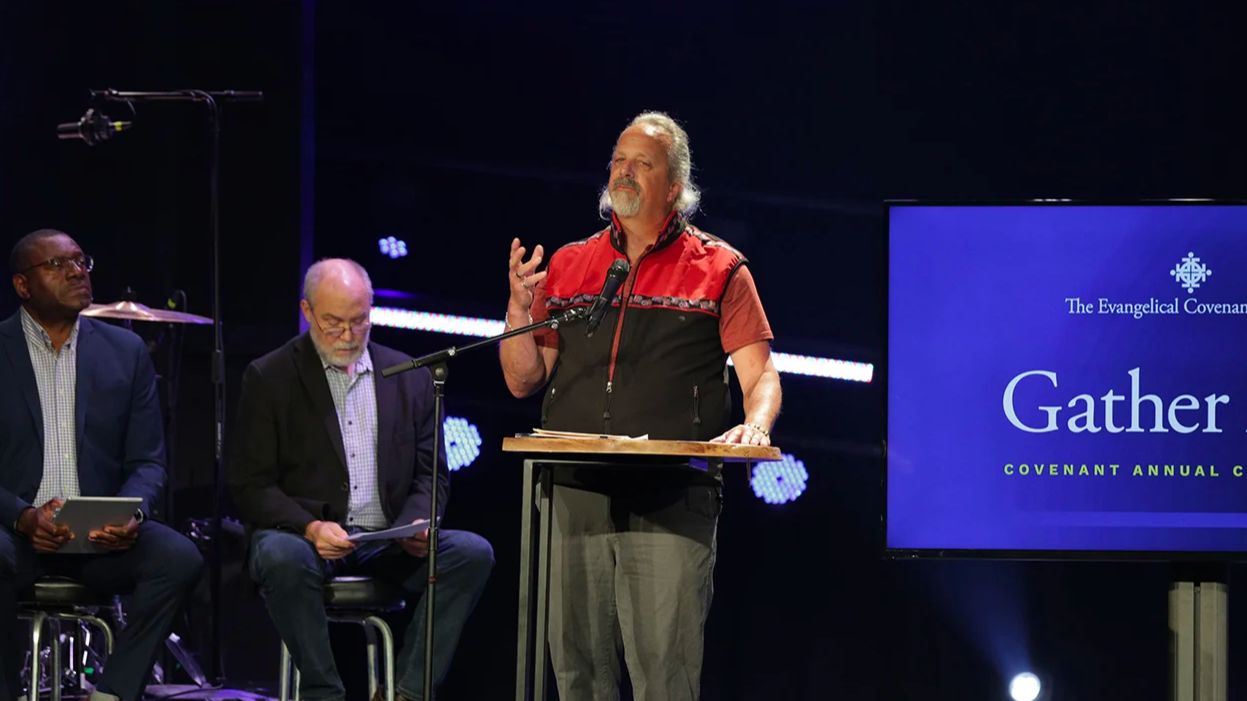
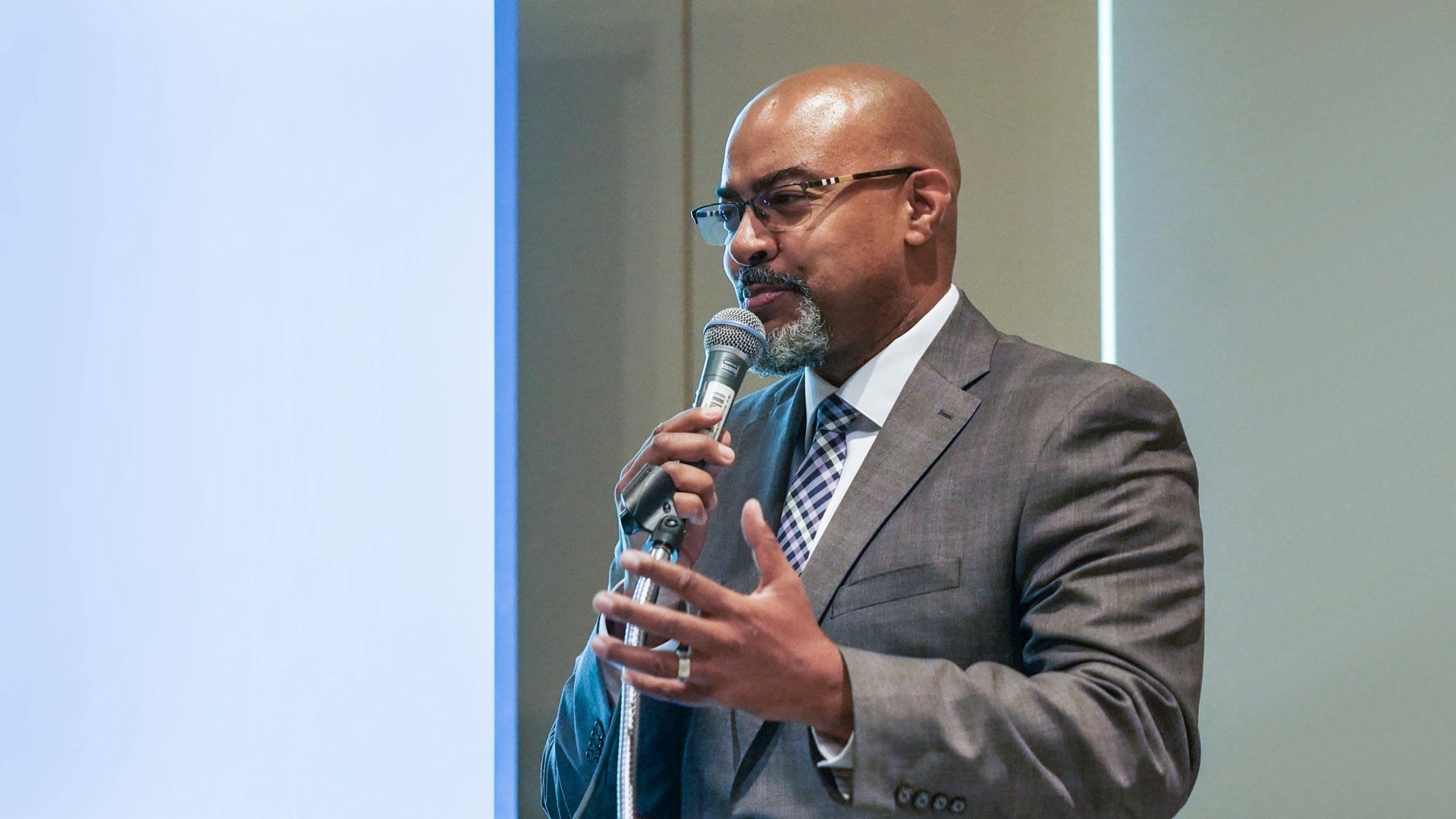
TJ Smith, president of the Indigenous Ministers Association

TJ Smith, president of the Indigenous Ministers Association

Christianity Today June 29, 2021
Irvin Segura / Evangelical Covenant Church / RNS

The Evangelical Covenant Church became the latest Protestant denomination in the United States to repudiate the Doctrine of Discovery, the theological justification that allowed the discovery and domination by European Christians of lands already inhabited by indigenous peoples.

Delegates at the Covenant Annual Connection voted overwhelmingly (84%) on Friday to approve a resolution acknowledging the damage done to indigenous peoples in the Americas by taking their land and rights and lamenting the church’s complicity in the continuing effects of that history.

“After 125 years, the healing is beginning in the Evangelical Covenant Church, and I’m grateful to be starting this journey with you today,” the Rev. TJ Smith, president of the indigenous Ministers Association, said in an emotional speech after the vote was taken.

While the Evangelical Covenant Church has been working on its resolution for the past five years, its action came the day after the Cowessess First Nation announced it had found indications of at least 751 unmarked graves near the former Marieval Indian Residential School in Saskatchewan.

Weeks earlier, the Tk’emlúps te Secwépemc First Nation had used ground-penetrating radar to confirm the remains of 215 children as young as 3 years old on the grounds of the former Kamloops Indian Residential School in British Columbia. Kamloops was opened by the Roman Catholic Church in 1890 and became the largest school in Canada’s Indian Affairs residential school system, with enrollment peaking at 500 students in the early 1950s, according to the Tk’emlúps te Secwépemc.

Smith, who is Lakota, and others drew a line from the Doctrine of Discovery to what were known as Indian residential schools in Canada and Indian boarding schools in the US.

“Please understand this isn’t just Canada,” he said.

The Doctrine of Discovery began as a series of 15th-century papal edicts and later was enshrined in the 1823 Supreme Court decision Johnson v. M’Intosh, which established that the US government, not Native American nations, determined ownership of property.

That doctrine led to practice, including the “violent assimilation of native children in Indian boarding schools,” added Lenore Three Stars, a Lakota speaker and public theologian who shared remarks with the Evangelical Covenant Church gathering by video. Those children were removed from their homes to attend boarding schools operated under the motto “kill the Indian, save the man.”

“Over time, practice affected institutionalized injustice, which persists today,” Three Stars said.

It’s important for the church to know and lament that history, said Curtis Ivanoff, an Inupiat and superintendent of the Evangelical Covenant Church’s Alaska Conference.

“That its beginnings can be traced to papal decrees means the church had a direct hand in launching this belief and practice. For this reason alone, it serves us well to shine light on this history, to not only remember, but as fellow ambassadors of Jesus, who has given us the ministry of reconciliation, to renounce such evil,” Ivanoff said.

In 2015, Canada’s Truth and Reconciliation Commission released a report on the history and legacy of Canada’s residential school system, which came after six years of investigation.

One of the commission’s accompanying calls to action asked the pope to come to Canada within the year to apologize to indigenous peoples there for the Catholic church’s role in administering residential schools.

“We call upon the Pope to issue an apology to Survivors, their families, and communities for the Roman Catholic Church’s role in the spiritual, cultural, emotional, physical, and sexual abuse of First Nations, Inuit, and Métis children in Catholic-run residential schools,” it read.

Last week, Canadian Prime Minister Justin Trudeau reiterated that call for an apology in Canada from Pope Francis.

But, Smith told delegates at the Evangelical Covenant Church’s annual meeting, “In the US, we haven’t done that. We’re invisible. They don’t even care enough to know.”

Canada operated more than 130 residential schools and has an idea how many children attended them, he said. Meanwhile, the US operated 367 boarding schools.

Repudiating the Doctrine of Discovery is an important first step toward healing and solidarity, Smith said.

In recent years, several mainline Protestant denominations have taken similar actions, including the United Methodist Church, the Episcopal Church, the Unitarian Universalist Association, the United Church of Christ, the Community of Christ, Presbyterian Church (USA) and the Evangelical Lutheran Church in America. They’ve been joined by the World Council of Churches and a number of Religious Society of Friends (Quaker) meetings.

And US Secretary of the Interior Deb Haaland, who is Laguna Pueblo, recently announced a Federal Indian Boarding School Initiative to look into the history of boarding schools in the US.

The latest resolution by the Evangelical Covenant Church sets the table for indigenous people to be seen and their stories heard, Smith said.

“With the passing of this resolution, you’ve advanced the Evangelical Covenant Church as a place where we as indigenous people and populations are seen and welcomed. We’re accepted and acknowledged as who we are and who we are created to be,” he said.

“With the passing of this resolution, we can now participate and learn from you and you can learn from us what the creator has for us.”

News

Pew: What India’s Christians, Hindus, Muslims and More Think About Religion

(UPDATED) Pew surveys 30,000 Indians across 6 faiths and 17 languages and finds support for tolerance yet also segregation.

Christianity Today June 29, 2021
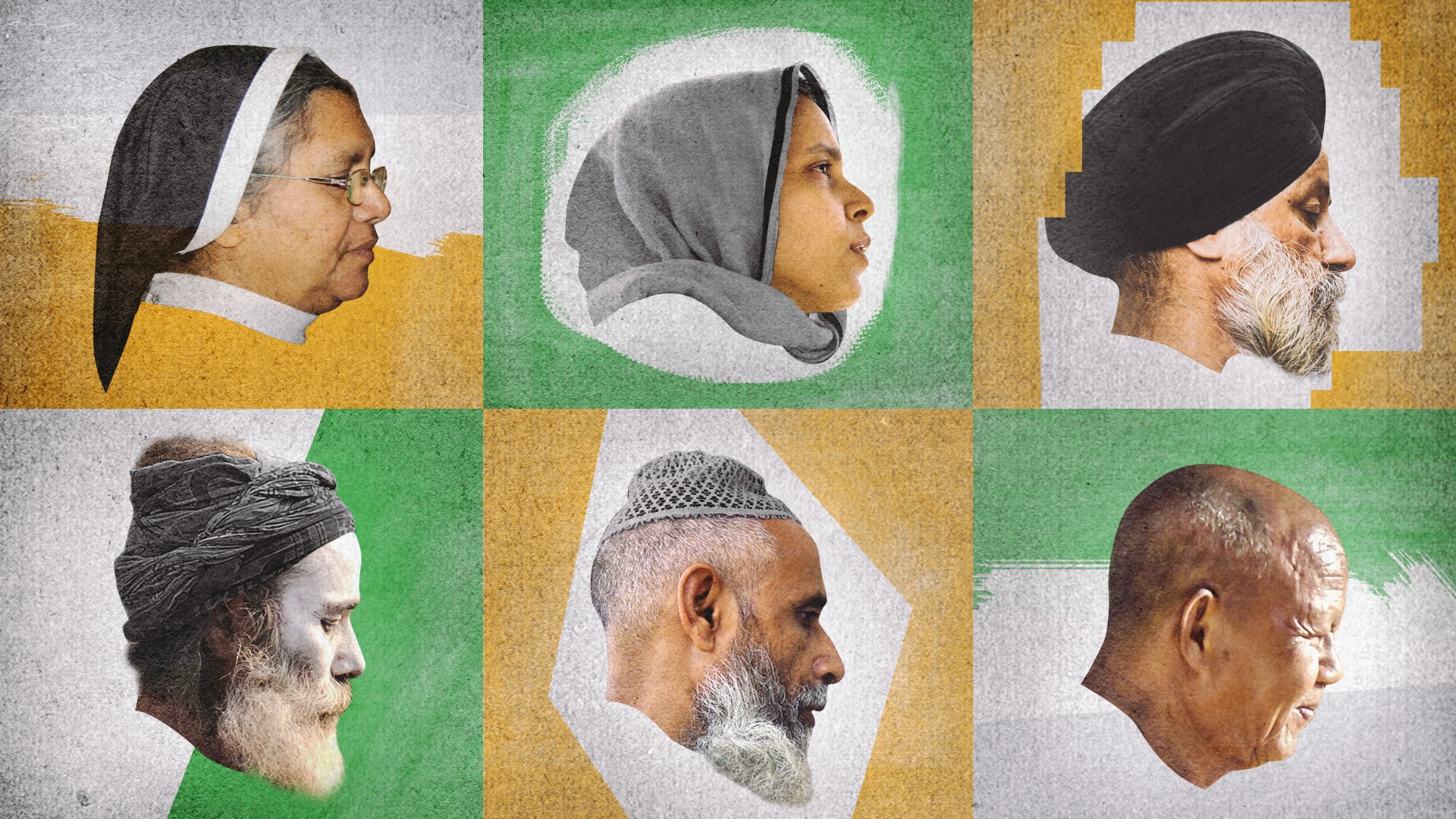
Illustration by Mallory Rentsch / Source Images: NurPhoto / Chadchai Ra-ngubpai / Frank Bienewald / Getty Images

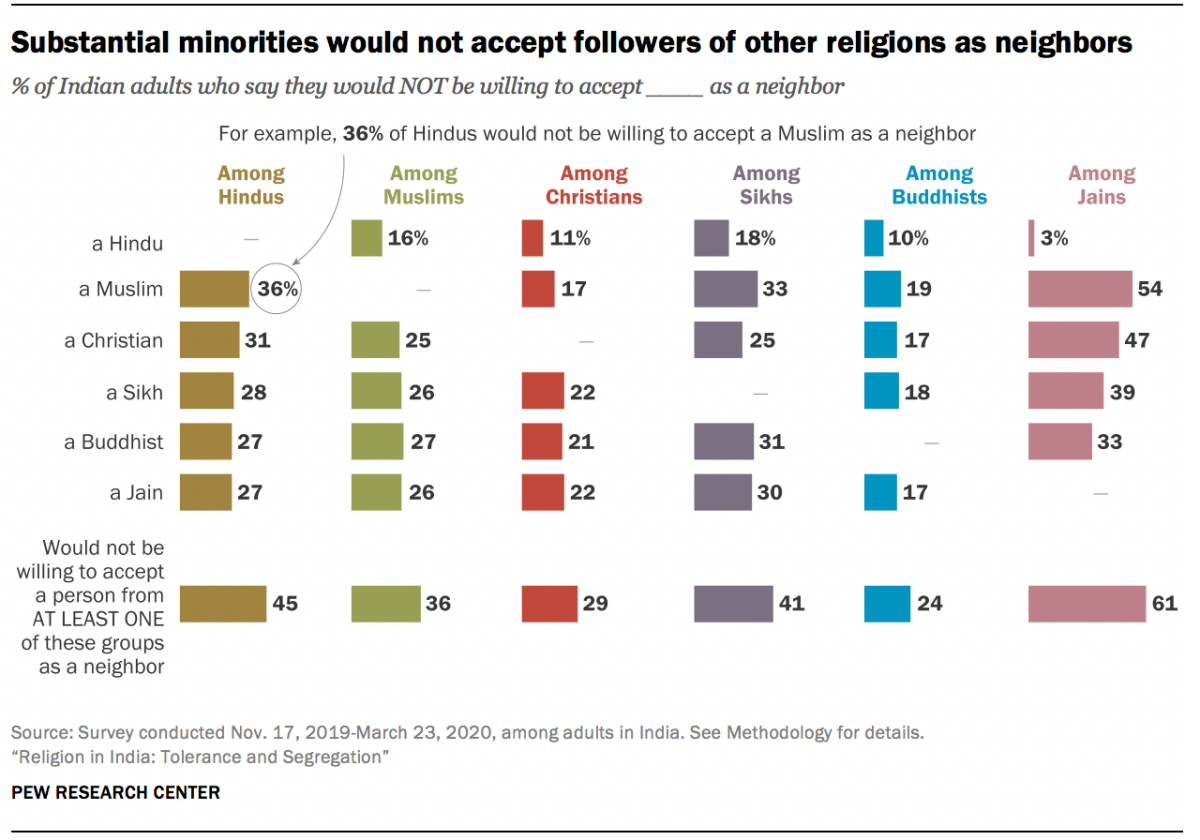
A third of Hindus in India would not be willing to accept a Christian as a neighbor. Neither would a quarter of Indian Muslims or Sikhs.

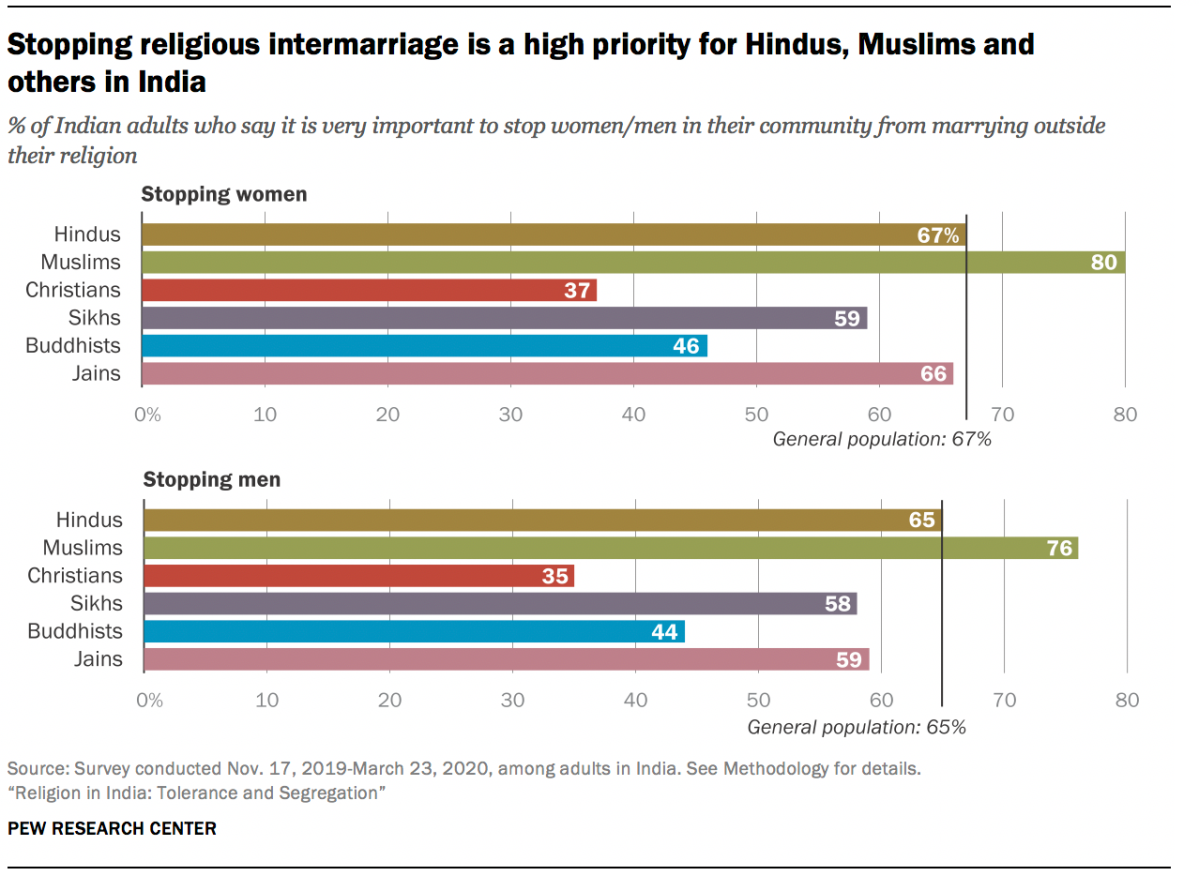
Only a third of Indian Christians are very concerned about stopping inter-religious marriage, vs. two-thirds or more of Hindus, Muslims, and the general Indian population.

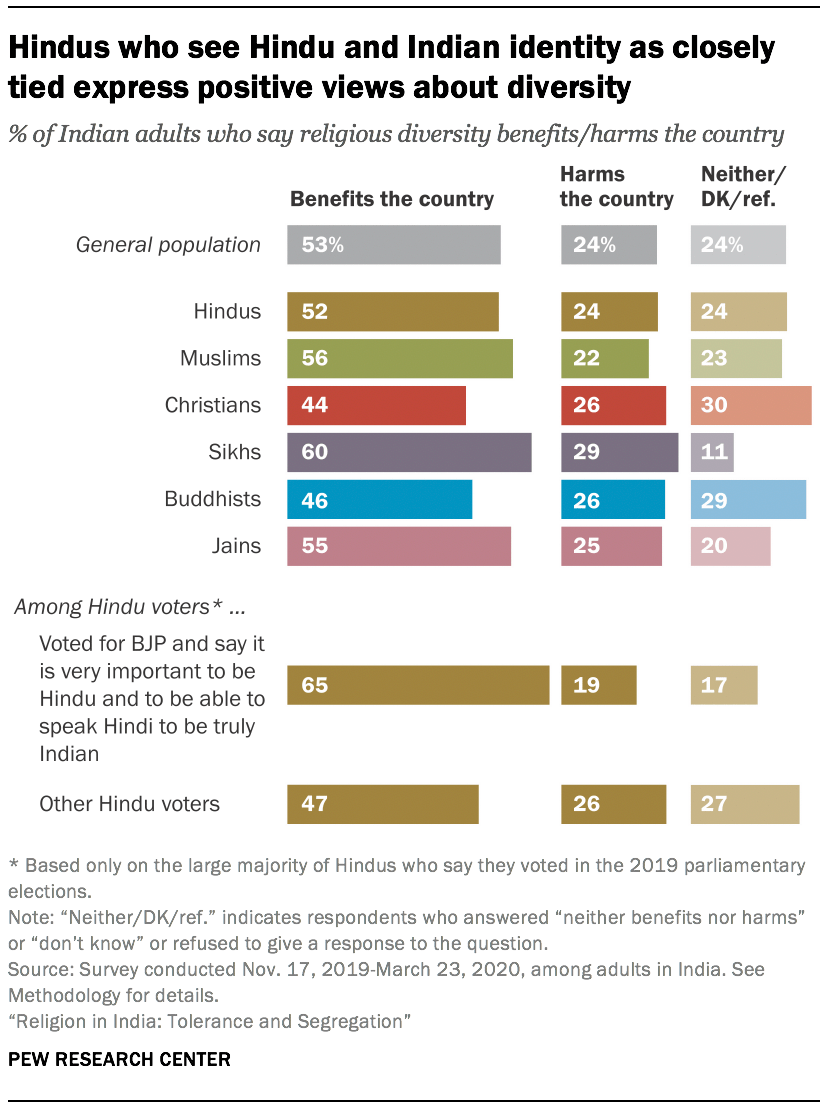
A quarter of Christians say religious diversity harms India, while about half say it benefits the country.

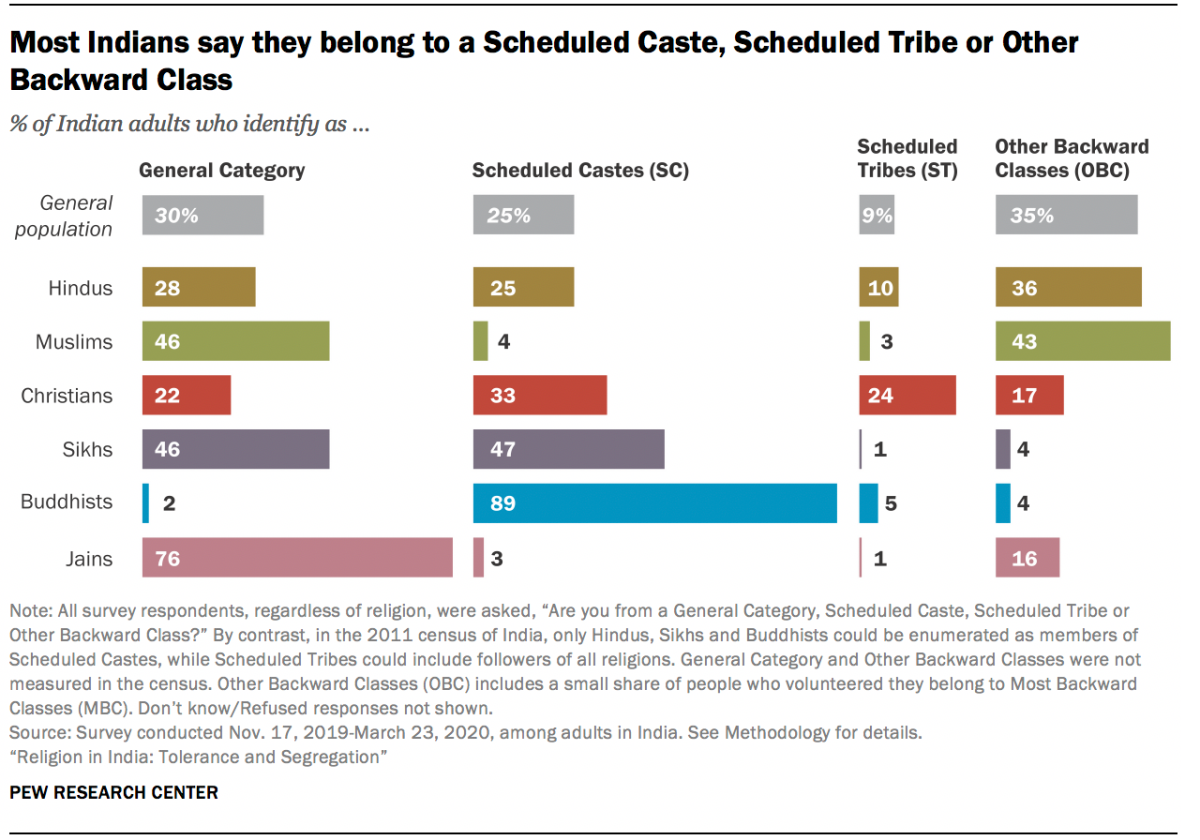
A third of Indian Christians identify as Catholics and half identify with Protestant denominations. A third of Christians identify as members of Scheduled Castes, often called Dalits (and formerly the pejorative untouchables).

Almost all Indian Christians are very proud to be Indian, and three-quarters agree that Indian culture is superior to others.

These are among the findings of “Religion in India: Tolerance and Segregation,” a significant new report released today by the Pew Research Center. Its conclusion, in a sentence: “Indians say it is important to respect all religions, but major religious groups see little in common and want to live separately.”

For its “most comprehensive, in-depth exploration” ever of India, Pew surveyed almost 30,000 Indian adults nationwide, face to face across 17 languages, between November 2019 and March 2020 just before the COVID-19 pandemic hit the subcontinent. The resulting survey, weighted to India’s 2011 census, is “calculated to have covered 98 percent of Indians ages 18 and older and had an 86 percent national response rate.”

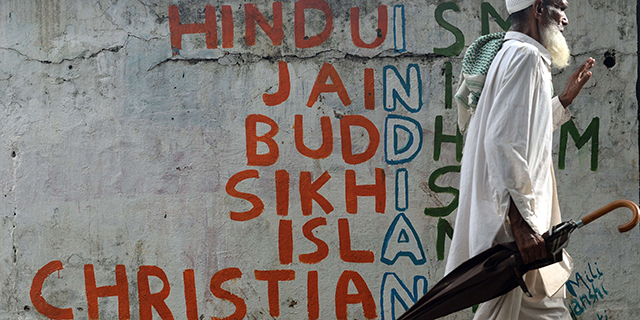
An Indian man walks past a wall graffiti on various religions in Mumbai on June 25, 2015.

Pew surveyed 22,975 Indians who identify as Hindu, 3,336 who identify as Muslim, 1,782 who identify as Sikh, 1,011 who identify as Christian, 719 who identify as Buddhist, 109 who identify as Jain, and 67 who identify as belonging to another religion or as religiously unaffiliated.

Christians only number 2.4 percent of India’s population, according to the 2011 census. Yet given its massive 1.38 billion people, India still ranks among the top 25 countries with the most Christians in 2020 (between Poland and Peru), according to Pew’s demographic estimates.

Most Indian Christian leaders interviewed by CT agreed that Pew’s report offers quantitative validation of their lived experience. Though in a nation as vast and complex as India, many saw areas or subsets that deserved more scrutiny so that local differences could be made even more apparent.

The report is “quite comprehensive, timely, and strategic,” said Atul Aghamkar, an expert scholar on urban missions in India. He cautioned the findings may represent the views of urban Indians more than rural ones.

“Most findings will find agreement with anyone who lives here in India,” said C. B. Samuel, a respected Bible teacher and former executive director of EFICOR (formerly the Evangelical Fellowship of India Commission on Relief). He believes the report accurately captures religion and communal relations in India in general, and noted how Northeast India, West Bengal, and South Indian states stand out when scrutinized.

Overall the report is “fine and well done” while it “presents a view of the Hindi heartland of India as the main view,” said Canon Vinay Samuel, founder of the Oxford Center for Mission Studies (OCMS) and the Oxford Center for Religion and Public Life (OCRPL). “The study validates a lot of what one has known over the years, and that is encouraging.”

Archbishop Felix Anthony Machado, general secretary of the Catholic Bishops Conference of India and a leader in interreligious dialogue—which he described as “the need of the hour”—said the findings “reflect the reality” of India in general.

The report “covered a wide range of issues pertinent to the country,” said Finny Philip, an Indian board member of the Lausanne Movement, but he wished that tribal religions had been surveyed alongside the six main faiths. Having long worked in India’s tribal belt, for him the survey “failed to capture the rural heart of India” where caste segregation runs deep.

John Dayal, a Delhi-based Christian political analyst and cofounder and past secretary general of the All India Christian Council, credited the report for its “good coverage of cultural issues” and said its findings were “almost on the dot” regarding intermarriage and “closest to the reality” on housing matters, which “will be of use in social action to diffuse tensions.”

But he also said the report failed to fully capture the “extreme polarization” caused by the recent election campaigns of Hindu nationalists and the resulting Islamophobia which “now permeates all aspects of national intuitional and public life.”

Tensions over increasing Hindu nationalism in India have caused the nation to climb the ranks of persecution watchdogs in recent years. Open Doors ranks India at No. 10 on its 2021 World Watch List of the 50 countries where it’s hardest to be a Christian. The US Commission on International Religious Freedom recommends India be added to the State Department’s list of Countries of Particular Concern. Pew itself calculates that India has the highest level of social hostilities regarding religion among the world’s 25 most-populous countries, as well as one of the higher levels of government restrictions.

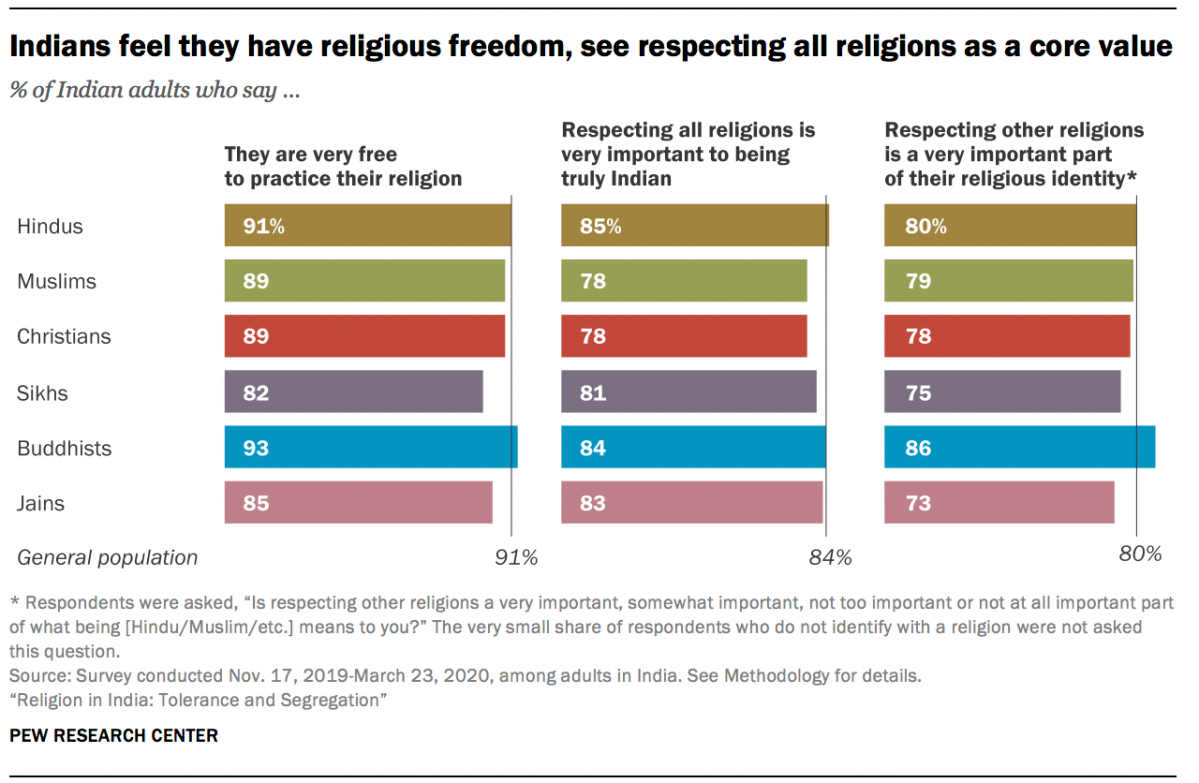
Yet Pew found that most Indians value religious pluralism and tolerance and feel very free to practice their faith, noting:

“More than 70 years after India became free from colonial rule, Indians generally feel their country has lived up to one of its post-independence ideals: a society where followers of many religions can live and practice freely.

Indians see religious tolerance as a central part of who they are as a nation. Across the major religious groups, most people say it is very important to respect all religions to be ‘truly Indian.’ And tolerance is a religious as well as civic value: Indians are united in the view that respecting other religions is a very important part of what it means to be a member of their own religious community.”

I Get That Flighty FeelingWhen David wrote that “the lines” had fallen to him ‘in pleasant places,’ he was obviously not talking about the airlines. Or haven’t you tried to make plane reservations lately?My wife and I had to be in Los Angeles, so I phoned the travel agent to discover what flights were available and how much the trip would cost. In order to be on time for our meeting, she said we would have to leave at 5:30 A.M., change planes twice in Denver, and pay a figure that got higher the longer I talked with her. I think she had an adding machine attached to her computer.“If you leave on a Tuesday,” she said in that consoling voice, “I can cut off your fare. No—sorry! That rule applies only to conventioneers who use carry-on luggage. Let me see—” I broke in: “I can’t leave on a Tuesday. It has to be a Wednesday.”“Is there any possibility you can get your firm to change the dates of the meeting? If you visit the World’s Fair en route, we give you 0 in play money to use as you please.”“I don’t want to visit the World’s Fair! Suppose we leave the night before? What flights are available?”“The night before—let me see. Oh, we have a dinner flight—no, sorry! That’s been canceled. If you and your wife can drive to Kansas City—”“I don’t want to drive to Kansas City! I live miles from Kansas City! I want to fly to Los Angeles, spend one day there, and then fly home!”“It’s too bad you can’t stay there a week. We have a fabulous plan that includes a visit to the Badlands of South Dakota as well as a tour of the Disneyland parking lot. It’s great for people who watch for license plates.”Trying to lift the conversation to a higher plane, I asked, “Just tell me what flights are available on Wednesday, what they cost, and when they leave. Maybe I can take out a loan or pawn my luggage.”“Well, if you won’t have any luggage, sir, we have a very special deal—no, that’s been canceled. If you and your wife’s combined ages totals more than 150, we can—”“They probably will total that by the time I get these reservations! Look, forget the whole thing. I’ll see if we can mail ourselves to Los Angeles.”“Oh, we have a marvelous overnight package service! Now, if you and your wife have a total weight—”Forgive me, but I gently placed the receiver on the cradle.EUTYCHUSCopyright FrustrationThree cheers for “God Gave Me a Song: Copyright Restrictions Took It Away” [Feb. 4], The current trend in Christian music copyright restrictions has made me wonder if there is a special translation of the Bible within the industry with hitherto unknown scriptural parentheses. For example: “All Scripture is inspired by God and profitable (if you first set it to music and copyright it).” “But to each one is given the manifestation of the Spirit for the common good (and if you can turn a buck in the process, so much the better).” And, “… speaking to one another in psalms (royalties to King David payable through his trust fund), and hymns (always properly prefaced by ‘permission granted for use in this particular conversation only’) and spiritual songs (permission to copyright granted by the Holy Spirit), singing (all the way to the bank)”!REV. ED MOOREEvangelical Free Church of NewarkFremont, Calif.Time For AcceptancePerhaps it is time for us to put aside our paranoia as well as our suspicion of esoteric motivation and just accept the new breath of liberating air at Harvard with appreciation and Christian humility. I find million-dollar rationale rather difficult to identify in Harvard’s recent appointment to a Merrill Fellowship of a relatively unknown missionary [myself] who ministers in Bangladesh with a small mission that is within the orbit of the unassailably evangelical Interdenominational Foreign Missions Association (IFMA).PHIL PARSHALLInternational Christian FellowshipLivonia, Mich.I suppose we should be pleased that an institution such as Harvard University is showing such an interest in evangelical scholarship, but there is a danger unmentioned in the various responses to Dr. Martin’s article. That danger is found in any faculty that permits a broad spectrum of theological opinion. Evangelicals are such because they believe the Bible. God warns us about the cancer of heresy, and tells us clearly what treatment the body of Christ must use to maintain spiritual health.We cannot expect our precious evangelical faith to remain healthy if our teachers cannot identify as cancerous the latest theological heresy. If I read Scripture correctly, I am called to hold to the sure word as taught, not be a creative theological innovator.REV. WILLIAM D. MCCOLLEYBellewood Presbyterian ChurchBellevue, Wash.If the evangelical movement is as strong as all indicators seem to show, if evangelical scholarship is as sound and respectable as an increasing number of nonevangelical scholars seem to recognize it to be, if the evangelical experience is as challenging and transforming as we profess it to be, then evangelicals should welcome the Harvard experiment—even on Harvard’s terms!M. ROBERT MULHOLLAND, JR.Asbury Theological SeminaryWilmore, Ky.Witness Or Stumblingblock?I believe Dr. Olshan in “Should We Live Like the Amish?” [Feb. 4] presented a somewhat romanticized view of the Amish. He points to their practices as a silent witness to the vitality and Anabaptist heritage of their Christianity. He didn’t mention, though, that those practices can also be a snare to the faith of the Amish themselves, and a stumblingblock to outsiders. One has to recognize the Amish for what they are: fellow sinners saved not by the particular form of institutionalized piety accepted in our little corner of Christianity, but, like the rest of us, by the blood of Jesus alone. To my knowledge that fact is rarely, if ever, articulated by the Amish to the community at large.PAT NIEDERHAUSBluffton, Ind.Misleading HeadingYour news article on the U.S. Center for World Mission [Jan. 21] is greatly appreciated; it is sensitive and balanced. Perhaps it was only at the last moment that the heading became misleading.First, it refers to “Ralph Winter’s Mission Center.” This gives me credit I do not deserve, and to me, at least, it seems to downplay the role of 300 mature people who work here every day. More embarrassing to me is the statement in the heading, “His ‘unreached people’ strategy seems to be taking hold …” Your readers must not fail to know that this strategy is neither my invention nor monopoly. It is a major trend. We have no more created the ‘unreached people’ concept than an incubator creates eggs.RALPH D. WINTERU.S. Center for World MissionPasadena, Calif.Freeze Or Fry?Kenneth Kantzer’s editorial “What Shall We Do About the Nuclear Problem?” [Jan. 21] clearly explores the ethics involved and wisely warns Christians against engaging in fads. Could it be that the nuclear freeze movement is verging on becoming a fad?There is much evidence to lead one to believe that the nuclear freeze idea is a public relations coup, born in Russia, that has, through Communist ingenuity, taken root in America. Its acceptance as “gospel” by many concerned Christians, and by millions of people of good will at large, is based on the false assumption that we only have two choices: freeze or fry.REV. ROBERT GORDON GRANTChristian VoicePacific Grove, Calif.Kantzer’s solution to the nuclear problem is neither “moral” nor “rational”; pragmatic perhaps, but not rational and certainly not moral. He moves illogically from the question of dying for something to the supposed right of killing for something. He also makes the mistake of equating tactical nuclear weapons with strategic ones, and says “tactical nuclear weapons are the only deterrent against the vast and impressive Russian military establishment.” The question at hand, however, concerns the massive destructive power of our strategic forces (ICBMs, SLBMs, etc.) not battle-tactical weapons.It seems Kantzer is caught up in the “Red scare” interpretation of Soviet activity, one that is being questioned by many internationalists in the free world. Hence, he is unable to consider creative and cooperative alternatives in our negotiations with the Russians.Similarly, he claims nuclear weapons have been the deterrent that alone has kept the peace for 30 years. Aside from the single-cause fallacy of such an assertion, he fails to see that his main argument is essentially utilitarian, hence he avoids the normative question altogether. The question is not when but whether nuclear weapons should ever be used.CHARLES E. MOOREDenver Conservative BaptistTheological SeminaryDenver, Colo.Two-Pronged ProtestI read with interest and support Menahem Ben Hayim’s article, “The Remnant in Israel Today” [Jan. 21]. The “two-pronged protest” he describes can also be found in similar communities in the United States.The main reason for the tension lies in the failure on the part of the synagogue and church to understand what the Messianic Jews hold as sacred, and to appreciate the cultural, sociological, and historical roots from which we descend. These roots are the basis for our unique theological perspectives and distinctive expression of faith. It is time for the church to rejoice in this rather than fear a reconstruction of the “dividing wall” which has been demolished by Messiah Jesus.Church leaders ought to consider the multitude of church denominations and affiliations that exist as potential “dividing walls” of their own, before attempting to remove the “speck” of Jewishness out of the eyes of Messianic Jews. The Jewish community, on the other hand, must realize that no matter how hard it might try to ignore us, Messianic Jews simply will not go away. Messianic Jews and leaders of the Jewish community must dialogue with one another.GARY DERECHINSKYBeth Sar Shalom Messianic CenterBrookline, Mass.I recently returned from a prolonged stay in Israel designed to investigate the possibility of immigrating there as an American Hebrew Christian. I found that the “two-pronged protest” against church and synagogue described in your article was merely heightened during this time. I have experienced the same struggle here in the United States ever since coming to faith in Jesus the Messiah.SANDRA BATDICKLos Angeles, Calif.

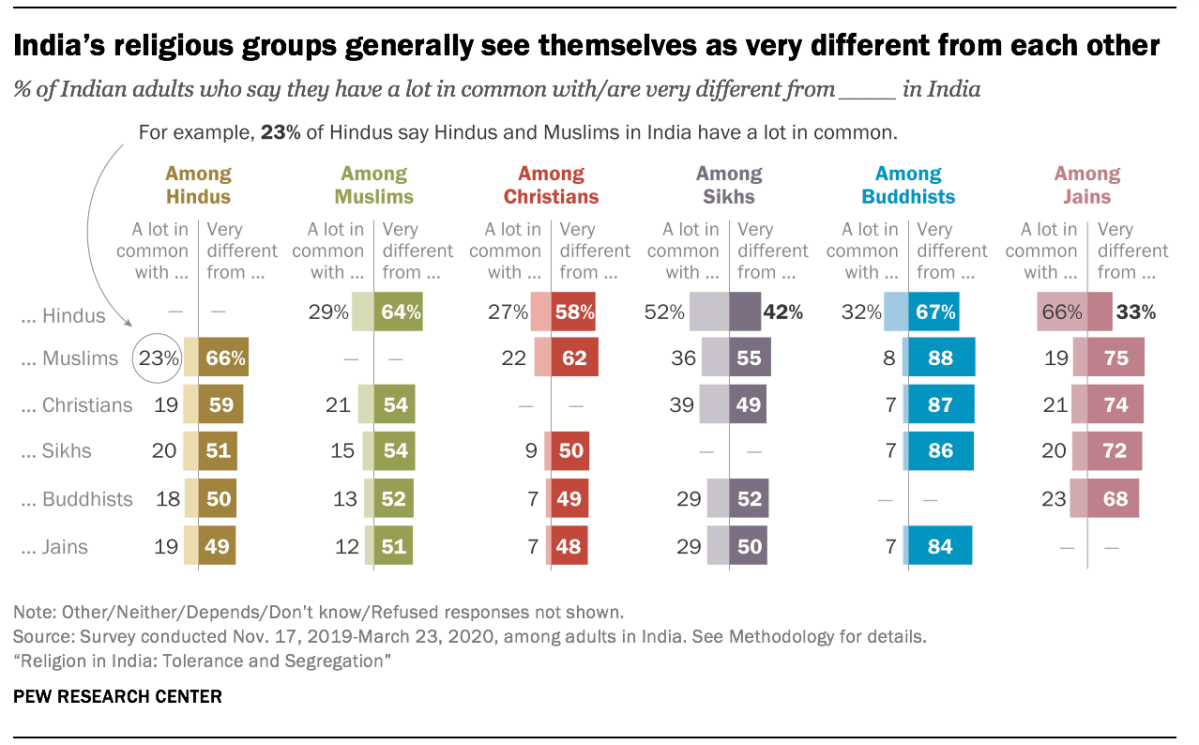
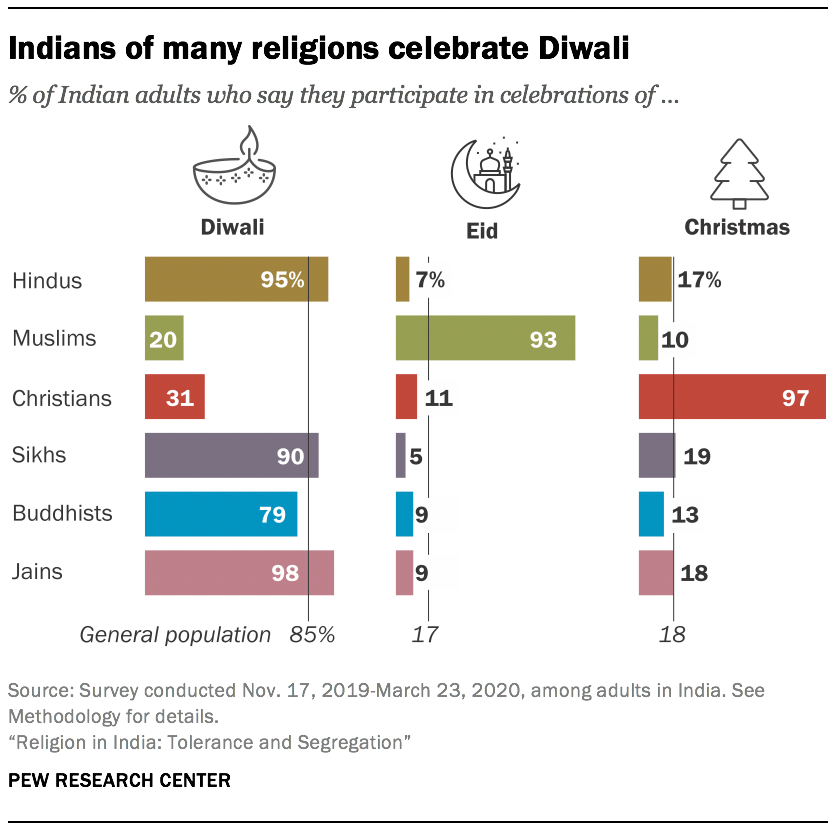
However, most Indians say they are “very different” from Indians who practice other religions. For example, only 1 in 5 Hindus (19%) say they have a lot in common with Christians in India, while 3 in 5 Hindus (59%) say they are very different. Meanwhile, 1 in 4 Christians (27%) say they have a lot in common with Hindus in India, while 3 in 5 (58%) say they are very different.

Pew found that interreligious marriage in India is rare, as is conversion. Yet the issues remain highly sensitive, as seen in the continued spread of anti-conversion laws at the state level and recurring allegations of “love jihad.”

Only a third of Indian Christians say it is very important to stop Christians from marrying non-Christians. This is a much lower level of concern than in every other religious group, including the two-thirds of Hindus and of Indians in general who see stopping religious intermarriage as a high priority. Muslims register the most concern, with about 4 out of 5 concerned about members marrying outside their faith.

I Get That Flighty FeelingWhen David wrote that “the lines” had fallen to him ‘in pleasant places,’ he was obviously not talking about the airlines. Or haven’t you tried to make plane reservations lately?My wife and I had to be in Los Angeles, so I phoned the travel agent to discover what flights were available and how much the trip would cost. In order to be on time for our meeting, she said we would have to leave at 5:30 A.M., change planes twice in Denver, and pay a figure that got higher the longer I talked with her. I think she had an adding machine attached to her computer.“If you leave on a Tuesday,” she said in that consoling voice, “I can cut off your fare. No—sorry! That rule applies only to conventioneers who use carry-on luggage. Let me see—” I broke in: “I can’t leave on a Tuesday. It has to be a Wednesday.”“Is there any possibility you can get your firm to change the dates of the meeting? If you visit the World’s Fair en route, we give you 0 in play money to use as you please.”“I don’t want to visit the World’s Fair! Suppose we leave the night before? What flights are available?”“The night before—let me see. Oh, we have a dinner flight—no, sorry! That’s been canceled. If you and your wife can drive to Kansas City—”“I don’t want to drive to Kansas City! I live miles from Kansas City! I want to fly to Los Angeles, spend one day there, and then fly home!”“It’s too bad you can’t stay there a week. We have a fabulous plan that includes a visit to the Badlands of South Dakota as well as a tour of the Disneyland parking lot. It’s great for people who watch for license plates.”Trying to lift the conversation to a higher plane, I asked, “Just tell me what flights are available on Wednesday, what they cost, and when they leave. Maybe I can take out a loan or pawn my luggage.”“Well, if you won’t have any luggage, sir, we have a very special deal—no, that’s been canceled. If you and your wife’s combined ages totals more than 150, we can—”“They probably will total that by the time I get these reservations! Look, forget the whole thing. I’ll see if we can mail ourselves to Los Angeles.”“Oh, we have a marvelous overnight package service! Now, if you and your wife have a total weight—”Forgive me, but I gently placed the receiver on the cradle.EUTYCHUSCopyright FrustrationThree cheers for “God Gave Me a Song: Copyright Restrictions Took It Away” [Feb. 4], The current trend in Christian music copyright restrictions has made me wonder if there is a special translation of the Bible within the industry with hitherto unknown scriptural parentheses. For example: “All Scripture is inspired by God and profitable (if you first set it to music and copyright it).” “But to each one is given the manifestation of the Spirit for the common good (and if you can turn a buck in the process, so much the better).” And, “… speaking to one another in psalms (royalties to King David payable through his trust fund), and hymns (always properly prefaced by ‘permission granted for use in this particular conversation only’) and spiritual songs (permission to copyright granted by the Holy Spirit), singing (all the way to the bank)”!REV. ED MOOREEvangelical Free Church of NewarkFremont, Calif.Time For AcceptancePerhaps it is time for us to put aside our paranoia as well as our suspicion of esoteric motivation and just accept the new breath of liberating air at Harvard with appreciation and Christian humility. I find million-dollar rationale rather difficult to identify in Harvard’s recent appointment to a Merrill Fellowship of a relatively unknown missionary [myself] who ministers in Bangladesh with a small mission that is within the orbit of the unassailably evangelical Interdenominational Foreign Missions Association (IFMA).PHIL PARSHALLInternational Christian FellowshipLivonia, Mich.I suppose we should be pleased that an institution such as Harvard University is showing such an interest in evangelical scholarship, but there is a danger unmentioned in the various responses to Dr. Martin’s article. That danger is found in any faculty that permits a broad spectrum of theological opinion. Evangelicals are such because they believe the Bible. God warns us about the cancer of heresy, and tells us clearly what treatment the body of Christ must use to maintain spiritual health.We cannot expect our precious evangelical faith to remain healthy if our teachers cannot identify as cancerous the latest theological heresy. If I read Scripture correctly, I am called to hold to the sure word as taught, not be a creative theological innovator.REV. WILLIAM D. MCCOLLEYBellewood Presbyterian ChurchBellevue, Wash.If the evangelical movement is as strong as all indicators seem to show, if evangelical scholarship is as sound and respectable as an increasing number of nonevangelical scholars seem to recognize it to be, if the evangelical experience is as challenging and transforming as we profess it to be, then evangelicals should welcome the Harvard experiment—even on Harvard’s terms!M. ROBERT MULHOLLAND, JR.Asbury Theological SeminaryWilmore, Ky.Witness Or Stumblingblock?I believe Dr. Olshan in “Should We Live Like the Amish?” [Feb. 4] presented a somewhat romanticized view of the Amish. He points to their practices as a silent witness to the vitality and Anabaptist heritage of their Christianity. He didn’t mention, though, that those practices can also be a snare to the faith of the Amish themselves, and a stumblingblock to outsiders. One has to recognize the Amish for what they are: fellow sinners saved not by the particular form of institutionalized piety accepted in our little corner of Christianity, but, like the rest of us, by the blood of Jesus alone. To my knowledge that fact is rarely, if ever, articulated by the Amish to the community at large.PAT NIEDERHAUSBluffton, Ind.Misleading HeadingYour news article on the U.S. Center for World Mission [Jan. 21] is greatly appreciated; it is sensitive and balanced. Perhaps it was only at the last moment that the heading became misleading.First, it refers to “Ralph Winter’s Mission Center.” This gives me credit I do not deserve, and to me, at least, it seems to downplay the role of 300 mature people who work here every day. More embarrassing to me is the statement in the heading, “His ‘unreached people’ strategy seems to be taking hold …” Your readers must not fail to know that this strategy is neither my invention nor monopoly. It is a major trend. We have no more created the ‘unreached people’ concept than an incubator creates eggs.RALPH D. WINTERU.S. Center for World MissionPasadena, Calif.Freeze Or Fry?Kenneth Kantzer’s editorial “What Shall We Do About the Nuclear Problem?” [Jan. 21] clearly explores the ethics involved and wisely warns Christians against engaging in fads. Could it be that the nuclear freeze movement is verging on becoming a fad?There is much evidence to lead one to believe that the nuclear freeze idea is a public relations coup, born in Russia, that has, through Communist ingenuity, taken root in America. Its acceptance as “gospel” by many concerned Christians, and by millions of people of good will at large, is based on the false assumption that we only have two choices: freeze or fry.REV. ROBERT GORDON GRANTChristian VoicePacific Grove, Calif.Kantzer’s solution to the nuclear problem is neither “moral” nor “rational”; pragmatic perhaps, but not rational and certainly not moral. He moves illogically from the question of dying for something to the supposed right of killing for something. He also makes the mistake of equating tactical nuclear weapons with strategic ones, and says “tactical nuclear weapons are the only deterrent against the vast and impressive Russian military establishment.” The question at hand, however, concerns the massive destructive power of our strategic forces (ICBMs, SLBMs, etc.) not battle-tactical weapons.It seems Kantzer is caught up in the “Red scare” interpretation of Soviet activity, one that is being questioned by many internationalists in the free world. Hence, he is unable to consider creative and cooperative alternatives in our negotiations with the Russians.Similarly, he claims nuclear weapons have been the deterrent that alone has kept the peace for 30 years. Aside from the single-cause fallacy of such an assertion, he fails to see that his main argument is essentially utilitarian, hence he avoids the normative question altogether. The question is not when but whether nuclear weapons should ever be used.CHARLES E. MOOREDenver Conservative BaptistTheological SeminaryDenver, Colo.Two-Pronged ProtestI read with interest and support Menahem Ben Hayim’s article, “The Remnant in Israel Today” [Jan. 21]. The “two-pronged protest” he describes can also be found in similar communities in the United States.The main reason for the tension lies in the failure on the part of the synagogue and church to understand what the Messianic Jews hold as sacred, and to appreciate the cultural, sociological, and historical roots from which we descend. These roots are the basis for our unique theological perspectives and distinctive expression of faith. It is time for the church to rejoice in this rather than fear a reconstruction of the “dividing wall” which has been demolished by Messiah Jesus.Church leaders ought to consider the multitude of church denominations and affiliations that exist as potential “dividing walls” of their own, before attempting to remove the “speck” of Jewishness out of the eyes of Messianic Jews. The Jewish community, on the other hand, must realize that no matter how hard it might try to ignore us, Messianic Jews simply will not go away. Messianic Jews and leaders of the Jewish community must dialogue with one another.GARY DERECHINSKYBeth Sar Shalom Messianic CenterBrookline, Mass.I recently returned from a prolonged stay in Israel designed to investigate the possibility of immigrating there as an American Hebrew Christian. I found that the “two-pronged protest” against church and synagogue described in your article was merely heightened during this time. I have experienced the same struggle here in the United States ever since coming to faith in Jesus the Messiah.SANDRA BATDICKLos Angeles, Calif.

Overall, 45 percent of Hindus accept having neighbors of all other religions. Yet an equal 45 percent are not willing to accept followers of at least one other religion.

For example, 31 percent of Hindus would not be willing to accept a Christian as a neighbor. Neither would 25 percent of Muslims or Sikhs. Jains were most likely not to accept Christian neighbors (47%), while Buddhists were least likely (17%).

Among Christians, only 1 in 10 would not be willing to accept a Hindu as a neighbor (11%). Meanwhile, 2 in 10 Christians would not accept neighbors who were Muslim (17%), Buddhist (21%), Sikh (22%), or Jain (22%). Overall, Christians were second only to Buddhists with registering the least discomfort with neighbors of other religions.

Is there more to it than merely playing harps and singing?Many people suspect that heaven is boring: you find there only harp playing and singing and casting down of crowns. Surely heaven will be boring after a million years or so!To escape that boredom, some people have imagined an eternity of activities—work, perhaps (maybe pruning the Tree of Life?), or a continuation of life vocations (like Kipling’s eternally painting artist). It would seem likely, however, that a surgeon would get bored with performing an infinite number of, say, tonsilectomies.Other, more “spiritual” people, see heaven as an eternal camp meeting or Bible conference. Presumably, there all the fine points of theology will be worked out.Still others seem to expect a posh (golden streets) retirement center, with God as the kindly caretaker (anyone for shuffleboard?).The idea of infinite time on one’s hands seems to be the major problem in contemplating heaven: the idea of infinity is really mind boggling. Consider these bits of mathematics: ∞ (infinity) plus 101000 (101000 is a short form of 1 followed by 1,000 zeros), or minus 101000, or times 101000, or divided by 101000. The answer is always ∞.Infinity appears invulnerable; whatever you do to it, it remains unaffected. What would it be like to celebrate New Year’s Day in A.D. 1,000,000 and know that so far as eternity is concerned, no time has passed? To imagine existence in a forever-ongoing eternity is truly mind boggling.But there is evidently something wrong in many speculations about heaven—for they really are speculation. Scripture tells us little about heaven, and what is there is mostly in symbols. But some speculations are better than others, and perhaps a suggestion may help: The core of the difficulty is that we have had little experience that would prepare us for heaven and eternity.First, our experience is earthbound, tied to jobs, houses or apartments, the kids, IRAS, and retirement. As a consequence, we are hardly equipped to think in terms other than the continuation of these concerns and activities. Probably that is why Paul can tell us that what is in prospect for us cannot be imagined; we have only what God tells us—and that’s not much (1 Cor. 2:9–10).Second, our experience is time bound. Our activities have a beginning, a continuance, and an end. Today we are conscious of a time structure and of the passage of time. We look forward to an end, to the achievement of some goal. It may be a United Way campaign, or woodworking, or a game—even writing an article on heaven. But heaven is different: there is beginning and continuance, but no end. There is no achievement to look forward to. There is only the continuing. And it is this continuing that threatens to be boring.Third, our earthly existence has been primarily self-centered. We have been busy with our careers and our families and our debts, with legislators and presidents. But in heaven, all these will be past, with heaven providing one long retirement from all those things we have been doing for ourselves.Of course, retirement often comes as a relief. Frequently, however, the relief lasts only for a while, and then boredom sets in. In light of all these factors, it is easy to see why it is difficult to speculate about heaven. We could simply abandon all speculation and wait for the reality.But one aspect of our earthly existence will persist eternally: it is our worship of God, glorifying and enjoying him. We do this on earth, we will do this in heaven—forever. Heaven will allow us to experience perfectly that famous answer in the catechism: “The chief end of man is to glorify God and enjoy him forever.”Note, however, that we shall not be enjoying ourselves, but God. Now, on earth, we are not heavenly minded; we tend to think of ourselves, of enjoying ourselves. But heaven will be different. In heaven the center is and will be God.But aren’t we back at square one with this idea of eternal worship—all those harps and so on? No, we are beyond them, for they are tools, maybe real, maybe symbolic. The reality beyond them is the state of heart and mind; it is our activity for eternity: glorifying and enjoying God. But is that boring?Have you ever noticed a couple deeply in love? They can simply sit and look at each other without a word. Suppose they could be frozen in one of those ecstatic moments, to go on with no end and with no sense of passing time. Would not this be “heaven” to them? In the same way, we must remember that heaven is not timebound. Time, and the sense of time, will be swallowed up in eternity. But there it will be the church worshiping.Think of a crowd of supporters whose athletic team has just won a championship game. Freeze them in that moment. Is that not “heaven” for them? Then think of the church caught up in glorifying and enjoying God and frozen there forever.Does heaven still sound boring?LAUREN A. KINGDr. King is English professor emeritus at Malone College, Canton, Ohio.

“Indians, then, simultaneously express enthusiasm for religious tolerance and a consistent preference for keeping their religious communities in segregated spheres—they live together separately,” wrote Pew researchers. “These two sentiments may seem paradoxical, but for many Indians they are not.” They conclude that most Indians prefer not a national “melting pot” of religions but “a country more like a patchwork fabric, with clear lines between groups.”

“Most Indians delude themselves and believe they respect other religions. In practice, this is not true,” OCRPL’s Samuel told CT. “The gap between espoused belief and actual practice could be more starkly highlighted.

“Religion continues to be important as a marker of identity, and that is encouraging in some ways,” he said. “But it is also true that religion has little influence on one’s ethical life in India. That does not appear in the study.”

Richard Howell, principal at the Caleb Institute of Theology and past general secretary of the Evangelical Fellowship of India, cautioned that the report could “create an impression all is well” but an “in-depth analysis of the consequences of segregated living and its impact on lower castes” is needed.

About half of Indians think religious diversity benefits India, while a quarter think it harms the country. Among Indian Christians, 26 percent say religious diversity harms India, while 44 percent say it benefits the country. Christians were the least likely of any religious group to say that religious diversity benefits India.

Of course, religion is not the only fault line in India. Pew also examined issues of caste.

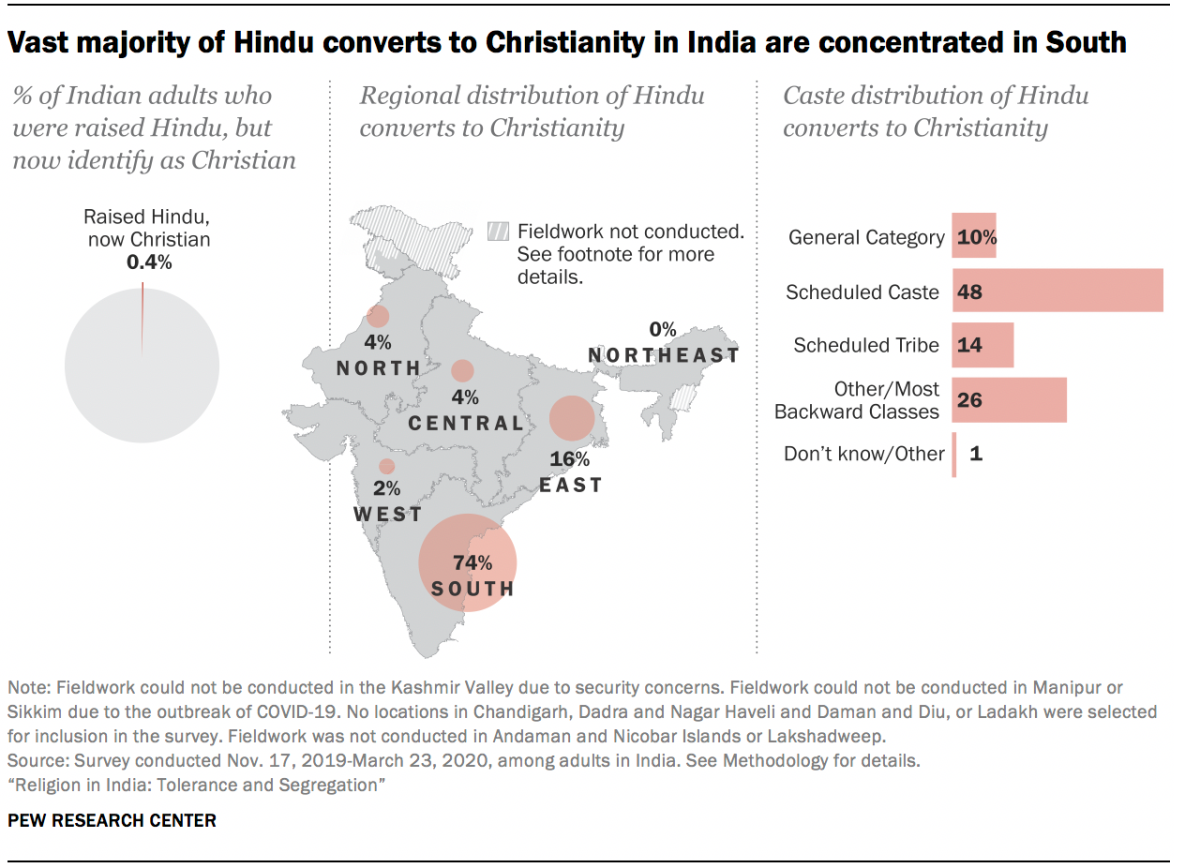
Only 22 percent of Indian Christians identify as General Category Indians—not belonging to any protected group—while 33 percent identify as members of Scheduled Castes (often referred to as Dalits, or formerly as “untouchables"), 24 percent as members of Scheduled Tribes, and 17 percent as members of Other Backward Classes (OBC). A higher share of Christians identify as Scheduled Tribes than of any other religious group or the general population.

Is there more to it than merely playing harps and singing?Many people suspect that heaven is boring: you find there only harp playing and singing and casting down of crowns. Surely heaven will be boring after a million years or so!To escape that boredom, some people have imagined an eternity of activities—work, perhaps (maybe pruning the Tree of Life?), or a continuation of life vocations (like Kipling’s eternally painting artist). It would seem likely, however, that a surgeon would get bored with performing an infinite number of, say, tonsilectomies.Other, more “spiritual” people, see heaven as an eternal camp meeting or Bible conference. Presumably, there all the fine points of theology will be worked out.Still others seem to expect a posh (golden streets) retirement center, with God as the kindly caretaker (anyone for shuffleboard?).The idea of infinite time on one’s hands seems to be the major problem in contemplating heaven: the idea of infinity is really mind boggling. Consider these bits of mathematics: ∞ (infinity) plus 101000 (101000 is a short form of 1 followed by 1,000 zeros), or minus 101000, or times 101000, or divided by 101000. The answer is always ∞.Infinity appears invulnerable; whatever you do to it, it remains unaffected. What would it be like to celebrate New Year’s Day in A.D. 1,000,000 and know that so far as eternity is concerned, no time has passed? To imagine existence in a forever-ongoing eternity is truly mind boggling.But there is evidently something wrong in many speculations about heaven—for they really are speculation. Scripture tells us little about heaven, and what is there is mostly in symbols. But some speculations are better than others, and perhaps a suggestion may help: The core of the difficulty is that we have had little experience that would prepare us for heaven and eternity.First, our experience is earthbound, tied to jobs, houses or apartments, the kids, IRAS, and retirement. As a consequence, we are hardly equipped to think in terms other than the continuation of these concerns and activities. Probably that is why Paul can tell us that what is in prospect for us cannot be imagined; we have only what God tells us—and that’s not much (1 Cor. 2:9–10).Second, our experience is time bound. Our activities have a beginning, a continuance, and an end. Today we are conscious of a time structure and of the passage of time. We look forward to an end, to the achievement of some goal. It may be a United Way campaign, or woodworking, or a game—even writing an article on heaven. But heaven is different: there is beginning and continuance, but no end. There is no achievement to look forward to. There is only the continuing. And it is this continuing that threatens to be boring.Third, our earthly existence has been primarily self-centered. We have been busy with our careers and our families and our debts, with legislators and presidents. But in heaven, all these will be past, with heaven providing one long retirement from all those things we have been doing for ourselves.Of course, retirement often comes as a relief. Frequently, however, the relief lasts only for a while, and then boredom sets in. In light of all these factors, it is easy to see why it is difficult to speculate about heaven. We could simply abandon all speculation and wait for the reality.But one aspect of our earthly existence will persist eternally: it is our worship of God, glorifying and enjoying him. We do this on earth, we will do this in heaven—forever. Heaven will allow us to experience perfectly that famous answer in the catechism: “The chief end of man is to glorify God and enjoy him forever.”Note, however, that we shall not be enjoying ourselves, but God. Now, on earth, we are not heavenly minded; we tend to think of ourselves, of enjoying ourselves. But heaven will be different. In heaven the center is and will be God.But aren’t we back at square one with this idea of eternal worship—all those harps and so on? No, we are beyond them, for they are tools, maybe real, maybe symbolic. The reality beyond them is the state of heart and mind; it is our activity for eternity: glorifying and enjoying God. But is that boring?Have you ever noticed a couple deeply in love? They can simply sit and look at each other without a word. Suppose they could be frozen in one of those ecstatic moments, to go on with no end and with no sense of passing time. Would not this be “heaven” to them? In the same way, we must remember that heaven is not timebound. Time, and the sense of time, will be swallowed up in eternity. But there it will be the church worshiping.Think of a crowd of supporters whose athletic team has just won a championship game. Freeze them in that moment. Is that not “heaven” for them? Then think of the church caught up in glorifying and enjoying God and frozen there forever.Does heaven still sound boring?LAUREN A. KINGDr. King is English professor emeritus at Malone College, Canton, Ohio.

Most Indians and most protected groups don’t say there is a lot of discrimination against SC/ST/OBC members in India today. Only about 1 in 5 say so, except for in the Northeast where 1 in 3 do.

And only a third of Christians say it is very important to stop believers from marrying into other castes. This is the lowest of any religious or demographic group measured, vs two-thirds of the general population saying marriage between castes is very important to stop.

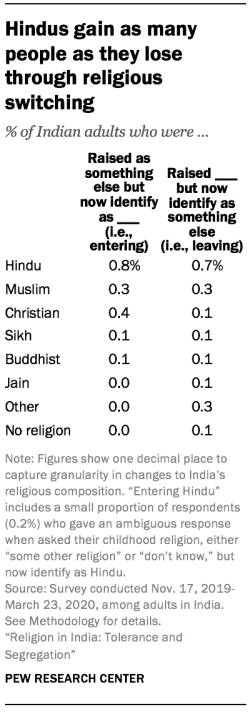
While Pew finds that religious conversion is rare in India, Hindus register the most conversions while Christians register the greatest “net gains.” Researchers found that 0.4 percent of survey respondents are former Hindus who now identify as Christian, while 0.1 percent are former Christians.

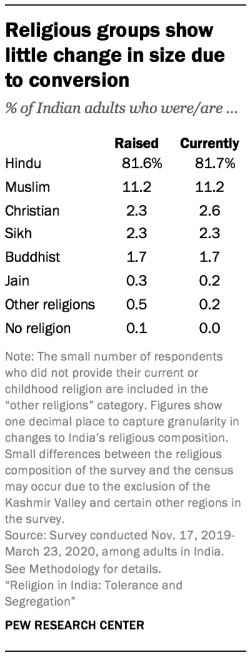
The vast majority of Indian adults (98%) say they are currently in the same religion they were raised, with Hindus registering the most switching into and out of their religion, followed by Muslims and Christians.

Pew found that 2.6 percent of Indian adults are currently Christians while 2.3 percent were raised Christian, as well as that 0.4 percent of all Indian adults were raised as something else but now identify as Christian. Given India’s population of about 1.38 billion, that would translate to between 4.1 million and 5.5 million Christian converts.

Pew researchers noted:

“In recent years, conversion of people belonging to lower castes (including Dalits) away from Hinduism—a traditionally non-proselytizing religion—to proselytizing religions, especially Christianity, has been a contentious political issue in India. As of early 2021, nine states have enacted laws against proselytism, and some previous surveys have shown that half of Indians support legal bans on religious conversions.

This survey, though, finds that religious switching, or conversion, has a minimal impact on the overall size of India’s religious groups. For example, according to the survey, 82% of Indians say they were raised Hindu, and a nearly identical share say they are currently Hindu, showing no net losses for the group through conversion to other religions. Other groups display similar levels of stability.

Changes in India’s religious landscape over time are largely a result of differences in fertility rates among religious groups, not conversion.”


Selected Writings of C. F. W. Walther, edited by Aug. R. Suelflow (Concordia Publishing House, 192 pp. each, .95 for the series: Law and Gospel, tr. Herbert J. A. Bouman; Selected Sermons, tr. Henry J. Eggold; Convention Essays, tr. Aug R. Suelflow, Walther on the Church, tr. John M. Drickamer; Selected Letters, tr. Roy A. Suelflow; Editorials from’ “Lehre und Wehre,” tr. Herbert J. A. Bouman), is reviewed by Mark A. Noll, visiting professor of history, Juniata College, Huntingdon, Pennsylvania.

Carl Ferdinand Wilhelm Walther (1811–1887) is one of the great figures of American church history. An immigrant from Saxony who arrived in the United States in 1839, Walther eight years later became the founding president of the Lutheran Church-Missouri Synod. For most of his adult life he edited a popular magazine, Der Lutheraner, and a scholarly journal, Lehre und Wehre (Doctrine and Defense), which promoted Lutheran confessionalism and warm piety in equal measure. He was president of Concordia Seminary (St. Louis) for 37 years, a dynamic preacher, a faithful pastor, a learned professor, a diligent scholar, and a prolific author. His views on the church (which favored a Congregationalism adapted to the free air of America) and on salvation (which advocated such a high view of grace as to be called “crypto-Calvinistic”) shaped the Missouri Synod during the years in which it emerged as a mighty American denomination. Yet no one beyond the Lutherans, and not even many of them, pay much attention to Walther today. One reason for this regrettable neglect is that all his writing was in German.Now Concordia Publishing House has released a substantial sample of Walther’s works in translation. No longer do evangelicals have any excuse to overlook this forceful teacher, whose work cries out for comparison with his better-known contemporaries. Walther’s sermons and letters reveal a Christian zeal as fervent as Moody’s. His editorials and convention essays rank him with Charles Hodge as a defender of the Trinitarian orthodoxy of the Reformation. His essays on the church speak as boldly for Lutheranism as C. I. Scofield did for dispensationalism. And his masterpiece, The Proper Distinction Between Law and Gospel (here presented in a competent abridgment), is one of the few truly significant works of evangelical theology produced in the United States. This series makes available some works from a mighty man of God. Our only regret can be that it has taken so long for them to appear in English.
Like It Was: The Diaries of Malcolm Muggeridge (Wm. Morrow, 542 pp., .00) is reviewed by Lloyd Billingsley, a writer living in Poway, California.

It would not work with any other author. The life of Malcolm Muggeridge has been recycled numerous times through the years, with each attempt producing another deep mine of raging truth. In these diaries, which cover the period from 1932 to 1962, Muggeridge shows himself incapable of writing badly. The familiar themes are all here, but all is fresh, alive, and wonderfully worth reading.The same disillusionment with the Soviet workers kingdom found in works such as Winter in Moscow fairly shouts from these pages. Visiting Lenin’s tomb, he writes, “I had a queer conviction that one day an enraged mob would tear him from his place and trample him under foot.”Following Muggeridge through his journalistic years in India, England, and America, the reader meets a host of VIPS: de Gaulle, Churchill, Dorothy Sayers, George Orwell, the Beatles, and many others, all brilliantly sketched. His private observations about mass media are interesting. He wrote that leftist journals such as the New Statesman had scored great propaganda success because they “established the position that to be intelligent is to be Left, whereas almost the exact opposite is true.” Also recorded is the abuse such observations earned him.Delightful insights on Muggeridge’s Christian experience pop up from time to time. While still in Russia, he wrote that he had been reading aloud from John Donne’s sermons and enjoying them. Describing the decay he saw on every hand in India, he writes of a longing for eternity. Back in England, on January 5, 1954, he wrote, “Bad night full of dark fears. While shaving suddenly thought with infinite longings how, of all things, I’d most love to live a Christian life. This is the only wish I’d now have.”Muggeridge’s eldest son Leonard (nicknamed “Pan”) had strong evangelical inclinations and eventually attended Bible college. Leonard’s influence on his father may, as the entries suggest, be greater than Muggeridge has let on in other works.Since the diaries stop in 1962, most readers will look forward to the release of the third volume of Muggeridge’s autobiography, where we hope the author will see fulfilled his wish stated in the entry for August 29, 1961: “May I be guided to eternity with my senses unclouded, my mind unafraid, and my soul full of love.”

Pew also examined India’s Hindu converts to Christianity more in-depth:

Three-quarters of India’s Hindu converts to Christianity (74%) are concentrated in the Southern part of the country – the region with the largest Christian population. As a result, the Christian population of the South shows a slight increase within the lifetime of survey respondents: 6% of Southern Indians say they were raised Christian, while 7% say they are currently Christian.

Some Christian converts (16%) reside in the East as well (the states of Bihar, Jharkhand, Odisha and West Bengal); about two-thirds of all Christians in the East (64%) belong to Scheduled Tribes.

Nationally, the vast majority of former Hindus who are now Christian belong to Scheduled Castes (48%), Scheduled Tribes (14%) or Other Backward Classes (26%). And former Hindus are much more likely than the Indian population overall to say there is a lot of discrimination against lower castes in India. For example, nearly half of converts to Christianity (47%) say there is a lot of discrimination against Scheduled Castes in India, compared with 20% of the overall population who perceive this level of discrimination against Scheduled Castes. Still, relatively few converts say they, personally, have faced discrimination due to their caste in the last 12 months (12%).


Selected Writings of C. F. W. Walther, edited by Aug. R. Suelflow (Concordia Publishing House, 192 pp. each, .95 for the series: Law and Gospel, tr. Herbert J. A. Bouman; Selected Sermons, tr. Henry J. Eggold; Convention Essays, tr. Aug R. Suelflow, Walther on the Church, tr. John M. Drickamer; Selected Letters, tr. Roy A. Suelflow; Editorials from’ “Lehre und Wehre,” tr. Herbert J. A. Bouman), is reviewed by Mark A. Noll, visiting professor of history, Juniata College, Huntingdon, Pennsylvania.

Carl Ferdinand Wilhelm Walther (1811–1887) is one of the great figures of American church history. An immigrant from Saxony who arrived in the United States in 1839, Walther eight years later became the founding president of the Lutheran Church-Missouri Synod. For most of his adult life he edited a popular magazine, Der Lutheraner, and a scholarly journal, Lehre und Wehre (Doctrine and Defense), which promoted Lutheran confessionalism and warm piety in equal measure. He was president of Concordia Seminary (St. Louis) for 37 years, a dynamic preacher, a faithful pastor, a learned professor, a diligent scholar, and a prolific author. His views on the church (which favored a Congregationalism adapted to the free air of America) and on salvation (which advocated such a high view of grace as to be called “crypto-Calvinistic”) shaped the Missouri Synod during the years in which it emerged as a mighty American denomination. Yet no one beyond the Lutherans, and not even many of them, pay much attention to Walther today. One reason for this regrettable neglect is that all his writing was in German.Now Concordia Publishing House has released a substantial sample of Walther’s works in translation. No longer do evangelicals have any excuse to overlook this forceful teacher, whose work cries out for comparison with his better-known contemporaries. Walther’s sermons and letters reveal a Christian zeal as fervent as Moody’s. His editorials and convention essays rank him with Charles Hodge as a defender of the Trinitarian orthodoxy of the Reformation. His essays on the church speak as boldly for Lutheranism as C. I. Scofield did for dispensationalism. And his masterpiece, The Proper Distinction Between Law and Gospel (here presented in a competent abridgment), is one of the few truly significant works of evangelical theology produced in the United States. This series makes available some works from a mighty man of God. Our only regret can be that it has taken so long for them to appear in English.
Like It Was: The Diaries of Malcolm Muggeridge (Wm. Morrow, 542 pp., .00) is reviewed by Lloyd Billingsley, a writer living in Poway, California.

It would not work with any other author. The life of Malcolm Muggeridge has been recycled numerous times through the years, with each attempt producing another deep mine of raging truth. In these diaries, which cover the period from 1932 to 1962, Muggeridge shows himself incapable of writing badly. The familiar themes are all here, but all is fresh, alive, and wonderfully worth reading.The same disillusionment with the Soviet workers kingdom found in works such as Winter in Moscow fairly shouts from these pages. Visiting Lenin’s tomb, he writes, “I had a queer conviction that one day an enraged mob would tear him from his place and trample him under foot.”Following Muggeridge through his journalistic years in India, England, and America, the reader meets a host of VIPS: de Gaulle, Churchill, Dorothy Sayers, George Orwell, the Beatles, and many others, all brilliantly sketched. His private observations about mass media are interesting. He wrote that leftist journals such as the New Statesman had scored great propaganda success because they “established the position that to be intelligent is to be Left, whereas almost the exact opposite is true.” Also recorded is the abuse such observations earned him.Delightful insights on Muggeridge’s Christian experience pop up from time to time. While still in Russia, he wrote that he had been reading aloud from John Donne’s sermons and enjoying them. Describing the decay he saw on every hand in India, he writes of a longing for eternity. Back in England, on January 5, 1954, he wrote, “Bad night full of dark fears. While shaving suddenly thought with infinite longings how, of all things, I’d most love to live a Christian life. This is the only wish I’d now have.”Muggeridge’s eldest son Leonard (nicknamed “Pan”) had strong evangelical inclinations and eventually attended Bible college. Leonard’s influence on his father may, as the entries suggest, be greater than Muggeridge has let on in other works.Since the diaries stop in 1962, most readers will look forward to the release of the third volume of Muggeridge’s autobiography, where we hope the author will see fulfilled his wish stated in the entry for August 29, 1961: “May I be guided to eternity with my senses unclouded, my mind unafraid, and my soul full of love.”

Philip found Pew’s findings on conversion to be the most surprising, including that conversions are so rare in India, that Hindus gain as many people as they lose, and that most conversions from Hinduism to Christianity happen in the South.

“It will be a disappointment to the government to realize that ‘religious conversions are rare in India,’” he said, “and it is encouraging to know that the efforts to enact the anti-conversion laws in most of the states are futile and a publicity stunt.”

Pew also examined theology and rituals in India, finding that India remains a highly religious nation with a fair amount of intermixing of beliefs and practices:

“As a result of living side by side for generations, India’s minority groups often engage in practices that are more closely associated with Hindu traditions than their own. For instance, many Muslim, Sikh, and Christian women in India say they wear a bindi (a forehead marking, often worn by married women), even though putting on a bindi has Hindu origins.

Similarly, many people embrace beliefs not traditionally associated with their faith: Muslims in India are just as likely as Hindus to say they believe in karma (77% each), and 54% of Indian Christians share this view. Nearly 3 in 10 Muslims and Christians say they believe in reincarnation (27% and 29%, respectively). While these may seem like theological contradictions, for many Indians, calling oneself a Muslim or a Christian does not preclude believing in karma or reincarnation—beliefs that do not have a traditional, doctrinal basis in Islam or Christianity.”

“Obviously, religion is something deep and one may not afford to remain on one’s limited understanding,” said Machado. “When I, as a religious leader, talk to my own Catholic Christians, I find how little they know of the richness of their faith. But they are who they are, and God does not punish them for that—although I do try to create a network to learn more about their own religious faith as well as the faith of their neighbors who may belong to other faiths.”

His influence cripples the mission to the Hindus.Though nearly a full generation has passed since the death of Gandhi, his spiritual and political legacy continues to exert a telling force upon the Christian mission to Hindu India. In a speech made 50 years ago to Christians at Leonard Theological College, Jabalpur, Gandhi laid out the terms under which they might assist his movement.Gandhi said that Christian missionaries could work to help eradicate the caste system that reduced the lowest strata of the Indian population to “untouchability,” but Christians should not try to convert Hindus. Gandi warned: “If you believe that Hinduism is a gift, not of God but of Satan, quite clearly you cannot accept my terms.”Because Western missionaries in India did not accept those terms, and continued to work for the religious conversions so abhorred by Gandhi, they now face extinction. While old career missionaries (mostly dating from the last great influx into India about 30 years ago) usually are able to secure a “no objection to return” endorsement upon their passports before coming home on furlough, young replacements do not often gain entrance into India. After filling out visa applications, the prospective stateside missionary must wait two to three months while his forms are sent to India for review. Granted visas are so rare that The Evangelical Alliance Mission (TEAM) has placed only one North American couple on the Indian field in the last 18 years. Entirely in keeping with Gandhian philosophy, the foreign missionary movement has been strangled slowly and nonviolently in the coils of bureaucratic red tape. However, some missionaries from British Commonwealth countries still trickle in, as well as other Western Christians who come in on student visas or to pursue “tentmaker” occupations for which no Indian national is qualified.Most converts to Christianity have come from the lower castes of India’s vast (presently 83 percent) Hindu population. Often, masses of dispossessed Harijans (untouchables) converted in the hope of gaining social or political benefits. Consequently, Christianity was stigmatized in the eyes of upper-caste Hindus, as witnessed by the scarcity of Brahmin converts today. Rising Hindu caste discrimination over the last several years has led to increasing numbers of Harijan converts and a reactionary zeal among right-wing Hindu groups to reclaim them. Sometimes, Harijans dissatisfied with their gains under Christianity, convert to Islam or back to Hinduism. The evangelism of the Indian church is often preoccupied with keeping nominal converts in the fold. Overall, relatively few Hindus are being added to the percentage of India’s 684 million population that calls itself Christian (2.6 percent are Christian, and two-thirds of them are Catholic or Orthodox).Hindu pressure against mission work in India escalated in 1979 when the Freedom of Religions Bill was introduced before the Indian Parliament. This bill sought to “prohibit all conversions from one religion to another by the use of force or inducement or by fraudulent means,” as well as conversion of any person under 18. Because of its excessively broad definitions of force, fraud, and inducement, the bill threatened to outlaw all Christian evangelism and charitable work in India.The bill was scuttled in 1980 in the wake of Indira Gandhi’s return to power, but similar strictures stand as law in the states of Orissa, Madhya Pradesh, and Arunachal Pradesh. In this last state, officially sanctioned persecutions of Christians belie fundamental rights guaranteed by the Indian constitution of freedom to practice, preach, and propagate religious belief.The temper of Hindu society militates against Western crusade-style evangelistic campaigns. High regard by individuals for their families, which would incur disgrace by conversion of a member to Christianity, precludes anything more than a polite hearing of the gospel. Mahendra Singhal, at present a Christian educator in the U.S., recalls that after his conversion in 1963 he was advised to change his name. Hindu evangelist Rabindranath Maharaj claims that after checking every nearby fellowship in the aftermath of a crusade in a large Indian city that drew thousands nightly, he found only one new convert actually added to a church.Hindu philosophical difficulties with Christianity are epitomized by Gandhi’s query: “Why should a Christian want to convert a Hindu to Christianity and vice versa? Why should he not be satisfied if the Hindu is a good or a godly man?” Maharaj says he meets the same response today when he presents the claims of Christ to his people. “Hindus will agree with all you have to say until you preach the uniqueness of Jesus Christ. Then you lose them. They cannot conceive that there is only one way to God.” According to Singhal, Hindus are spiritually very aware but never define God concretely. They must be shown that Jesus Christ is the true embodiment of their divine abstraction.The caste system is as integral to Hinduism as the first chapter of its sacred Bhagavad Gita, in which the god Krishna aquaints the man Arjuna with his caste obligations. Even Gandhi wrote in 1935: “It is a conviction daily growing upon me that the great and rich Christian missions will render true service to India if they can persuade themselves to confine their activities to humanitarian service without the ulterior motive of converting India, or at least her unsophisticated villagers, to Christianity, and destroying their social superstructure, which, notwithstanding its many defects, has stood now from time immemorial.…”“India’s real problem is a spiritual one, not a physical one as propagated by the media. The Hindu religion perpetuates a mindset that makes people accept the lot their gods have given them,” observes Paul Windsor, a New Zealander raised in India.Recent positive developments in indigenous Indian evangelism include the fruitful penetration of many Hindu villages by evangelists from the Friends’ Missionary Prayer Band and the 1982 release of the New Hindi Bible, which compares to the Old Hindi version much as the NIV compares to the KJV. In addition, there is a new array of social action programs aimed at aiding oppressed members of the lower castes. The 1979 Madras “Declaration of Evangelical Social Action” shaped a comprehensive new commitment by the Indian church to social justice and material relief alongside evangelism and education as means of spreading the gospel.One of the most remarkable examples of contextualization of the Christian mission to Hindu India is the growth of Christian ashrams (numbered at about 40 in 1973). Following the ideal of ancient and modern Hindu discipleship communities such as that of Gandhi at Sevagram, these ashrams provide a contemplative atmosphere conducive to communion with God. For example, the Aashiana community in New Delhi has about 25 members committed to a life of prayer, mutual support, and service to marginal people living in the city. Upper-caste Hindu youths who drop out of their society hippie-style are sometimes drawn to Aashiana alongside spiritual pilgrims from the West.In the light of Christianity’s historical impact upon Hinduism, it is ironic that some nominal Christians in the West are turning eastward to embrace one of a plethora of cults spawned in India. Danish Lutheran scholar Johannes Aagaard has documented the activities of the Visva Hindu Parished (VHP), the international missionary council of Hinduism that promoted a 60,000-strong world Hindu conference in Allahabad in 1979. The VHP’s avowed goals are to consolidate and strengthen Hindu society and to establish a mission for disseminating a dynamic Hinduism worldwide. Many of the guru associations operating in the West, such as Hare Krishna, function in cooperation with the VHP. Aagaard’s research has convinced him that Indian Hinduism is carrying on a vigorous mission program both at home and abroad, and that the strategies and goals of the VHP are the starting point for many of the new religious movements in the West.Already, many Westerners whose religious convictions have been relativized can say with Gandhi: “For me the different religions are beautiful flowers from the same garden, or they are branches of the same majestic tree. Therefore they are equally true.…” Rabi Maharaj is unequivocal about the recent momentum that Gandhi’s religious ideas have gained. “The film Gandhi presents a major stumbling block to evangelism both in the West and in India,” he declares. Maharaj fears that the West is being deluded into universalism and that the East is being reinforced in that ancient lie. “Many Indians have asked me, ‘Why should I look to Christ for the answer when so many of your Western Christians are looking to Hinduism for the answer?’ ”What can the Christian mission to Hindu learn from Gandhi and his religion? According to the Lausanne-sponsored report on Christian witness to Hindus, essential qualities for a spiritual leader in Hindu society are the very Gandhi-like qualities of being willing to wait, self-mortification of both body and desires, voluntary suffering of pain and fasting. “Christian leaders with this type of spiritual qualification are a powerful means of communication,” concludes the report.Of necessity, the classic Western mission program of mass evangelism, medical work, and education must become more and more “Indianized,” both in terms of personnel and methodology. Inevitably, the work of such stalwarts as the Bible and Medical Missionary Fellowship (BMMF), the Christian and Missionary Alliance, the International Christian Fellowship, and others must pass into indigenous hands and take on indigenous ways. What will be the best strategy for an effective Christian witness to Hindu India? Says Paul Windsor, who combines BMMF upbringing with research in missions, “If Christian missionaries would only present the poor, humble Jesus of the New Testament to the Hindu masses, rather than Jesus in the image of an English bishop or an American evangelist, then surely those masses would follow Christ just as they followed Gandhi.”A tribe of Guatemala Indians, fleeing guerrilla and government warfare in their homeland, has taken cover in a surprising location: downtown Los Angeles. After visiting three Christian members of the K’anjobal tribe in their little apartment, missionary Jim McKelvey discovered that there are hundreds more in the city. Many other Guatemalan believers are being uprooted, according to CAM International missionary Edward Sywulka. Two thousand left the town of Nenton, some are going to Mexico, and some to other parts of Guatemala. One CAM-related church housed 65 people from nine families until other arrangements could be made. The main translator of the New Testament into the Mam Indian language was killed in the fighting.Drought is afflicting wide areas of northern Africa again this year. In northern Ethiopia some 450,000 people need assistance, and a dozen relief camps and emergency food stations have drawn thousands from areas without water. In Chad, a United Nations relief official says at least 300,000 people are suffering from malnutrition so severe that thousands may die.“We know and understand that we have sinned, that we have abused power,” said Guatemala’s President Efraín Ríos Montt last month of excesses by the military. He then announced the exchange of the state of siege for a somewhat less restrictive “State of Alert-A,” and a second amnesty for guerrillas. He warned, however, that people who continued to harm the population would be punished. A wave of criticism followed his government’s execution of six guerrillas just prior to Pope John Paul II’s visit to Guatemala.Three mission agencies have decided on a joint effort to evangelize the Miguindanao people, a Muslim tribe on the island of Mindanao, Philippines. The three—Overseas Missionary Fellowship, SEND International, and International Christian Fellowship—are developing a strategy for using a contextual Muslim approach.”The Latin American Bishops Conference, opened by the Pope in Port-au-Prince, Haiti, on the last leg of his visit, zeroed in on rapid evangelical growth as a major concern. The conference was expected to order a study of the fast-growing denominations to help it work out a strategy to counter their inroads. A Central American bishop said the purpose would not be to enter into polemics, but “to study why the sects appeal to people and learn from this.” Likely elements of a Roman Catholic response: more aggressive use of radio and television, more use of the Bible in teaching, and more singing (and clapping) in services.North American SceneTwo Franciscan nuns and seven others have been found innocent of disorderly conduct on charges stemming from the jailing and transfer of Eddie Carthan. They had been charged with disturbing the peace during a protest of the transfer of Carthan to the state penitentiary in Parchman, Mississippi. Carthan, the first black mayor of Tchula, Mississippi, was jailed on a simple assault charge. Several groups contend he is a victim of racism (CT, Jan. 7, p. 46).For the eighth time, the New York City Council has rejected a proposed gay-rights bill. Both Edward Koch, the mayor, and Mario Cuomo, the governor of New York, lobbied for the measure’s passage. But fundamentalist Protestants, Orthodox Jews, and conservative Catholics, all of whom opposed the measure, won out. Following the vote, Mayor Koch promised the bill would be back.American Civil Liberties Union lawyers were denied permission to question New Jersey legislators who voted for a law requiring schools to observe a minute of silence each day. The ACLU has filed a suit against the law and is trying to prove that the purpose of the law is to reintroduce prayer into public schools.The antipornography Chicago Statement Foundation recently held a demonstration to praise General Motors, which, the foundation says, does not advertise in pornographic magazines such as Playboy and Penthouse. The demonstration was carried out by the foundation’s New York affiliate. The foundation praises advertisers who do not put their money into pornography outlets instead of criticizing those who do.Abortion foes and many other residents of Madison, Wisconsin, are upset at six live-birth abortions in the last 10 months in Madison. All six babies died within 27 hours after they were aborted. All the pregnancies were in the second three months of development, a time during which few infants survive natural delivery. Madison General Hospital has barred all abortions after 18 weeks unless the woman’s life is in danger. The University of Wisconsin Hospital now requires an ultrasound test for women whose pregnancies are more than 20 weeks old. Ultrasound is the most accurate way to determine fetal age.CorrectionAn article about armed forces chaplains (CT, Feb. 18, p. 24) mistakenly said that Navy Commander George E. Dobes conducted liturgical and nonliturgical Protestant services. Dobes, a Catholic priest, explains, “As senior chaplain (aboard an aircraft carrier), I was responsible for the religious needs of all who were stationed on board, but I did not conduct Protestant services. We had two Protestant chaplains who took responsibility for that.” CT regrets the error.

Three quarters of Indian Christians each say they consider their faith to be very important in their life, say they know a great deal about Christianity and its practices, and say they pray daily. Christians are more likely to say they pray daily than any other group surveyed, but are less likely to consider religion very important or to claim religious knowledge.

Among Indian Christians, 4 in 5 say they believe in God with absolute certainly while the remaining 1 in 5 still believe but with less certainty. Meanwhile, 68 percent of Indian Christians believe in “only one God,” while 24 percent believe in “only one God with many manifestations.” Another 5 percent believe in many gods.

Overall, 35 percent of Indians believe in only one God, while 54 percent believe in only one God with many manifestations and only 6 percent believe in many gods. “Even though Hinduism is sometimes referred to as a polytheistic religion, very few Hindus (7%) take the position that there are multiple gods,” noted Pew researchers. “Instead, the most common position among Hindus (as well as among Jains) is that there is “only one God with many manifestations” (61% among Hindus and 54% among Jains).”

Indians do not show the pattern of secularization seen in Europe, yet “the biggest exception is Christians,” wrote Pew researchers. “Among whom those with higher education and those who reside in urban areas show somewhat lower levels of observance. For example, among Christians who have a college degree, 59 percent say religion is very important in their life, compared with 78 percent among those who have less education.”

Additional findings of interest:

  • 1 in 10 Indian Christians report being discriminated against in the past 12 months because of their faith. This includes 19 percent of Christians in the East and 12 percent in the Northeast, vs. 6 percent in the South.
  • 49 percent of Indian Christians believe in “Judgment Day,” 48 percent believe in miracles, and 68 percent believe in angels while only 41 percent believe in demons
  • 50 percent of Indian Christians say politicians should have a lot or some influence on religious matters, while 44 percent say none or not too much. Among Indians in general, 62 percent want politicans involved in religion while 31 percent do not.
  • 29 percent of Indian Christians say being a Christian is mainly a matter of only religion, while 34 percent say it is only ancestry/culture and 27 percent say it is both religion and ancestry/culture.
  • 9 in 10 Christians are very proud to be Indian, as well as to be a member of their religion.
  • When asked whether Indian culture is superior to other cultures, 52 percent of Christians completely agree, 26 percent mostly agree, and 11 percent disagree. Indian Christians are least likely to completely agree and most likely to disagree among the religious groups surveyed.
  • A quarter of Indian Christians say they practice yoga (mostly monthly or less) while three-quarters say they never do. Among Hindus and the general population, about a third say they practice yoga while about two-thirds say they never do.

Potential good news in the report for those concerned about Christian persecution in India:

  • A solid 4 out of 5 Hindus say respecting other religions is “very important” to being Hindu and to “being truly Indian.”
  • Only 49 percent of Indian Hindus supported the BJP in the 2019 elections, as did 55 percent of Hindus who say being Hindu is very important to be truly Indian. And only 30 percent of Hindus say all three: that they voted for the BJP and they believe being Hindu and speaking Hindu are very important to being truly Indian.

This would suggest that Hindutva nationalists don’t represent majority opinion among Indian Hindus, and that advocates for Christian can find common allies, particularly in India’s South (where only 5 percent of Hindus say all three), Northeast (19%), West (26%), and East (28%).

Wilbur Patterson is general secretary of a small organization called the Commission on Voluntary Service and Action (CVSA). Its main reason for being is the yearly publication of a guide for people who want to volunteer for charitable work. The guide, Invest Yourself, has been published every year since 1946 and circulates mainly to colleges and churches.Most of the 180 listings in the guide are themselves connected with mainline Protestant churches, but 38 of them, with names such as the California Homemakers Association and the Eastern Farmworkers Association, are not. Patterson began to suspect that something in his guidebook was amiss when he began receiving complaints from volunteers that some of the organizations listed in it were fronts for a clandestine political group. It seemed that the CVSA had been infiltrated by, of all things, a Marxist revolutionary party.The puzzle fell together for Patterson late in 1981 when he received a letter from Jeff Whitnack, who had been drawn into the Marxist party after offering himself as a volunteer to the San Francisco Homemakers Association. Whitnack told Patterson that the goal of this party, ridiculous as it seems, is to carry out a Marxist revolution in the United States by 1984. Patterson agonized over the implications of what he was learning. In a confidential memo to others on his executive board, Patterson asked, “What are we allowing CVSA to become, wittingly or unwittingly?”Patterson’s memo wasn’t confidential enough. The chairman of the board, a woman named Diane Ramirez, turned out to be one of the leaders of the Marxist band. According to former members, the party has several names, the most common being the “Perente party” after its mysterious leader, Eugenio Perente. Whitnack says that Perente is actually a Marysville, California born radical named Jerri Doeden. The party began in the early 1970s and is headquartered in Brooklyn. It is said to have several hundred members.Its political indoctrination consists of heavy reading in the classic Marxist revolutionary canon, supplemented by large doses of Stalin’s works. Members are expected to work long hours with few days off. They work hard at raising money, primarily by door-to-door canvassing, bake sales at shopping centers, and telephone pitches to small businesses and churches. The party is reportedly obsessed with secrecy. One view of the Perente party is that it is part of a police intelligence plot to discredit the American Left. Whitnack says the group is no more Marxist than the Unification church is Christian. He regards it as a cult, claiming that people in the midst of life crises are likely candidates for recruits. Detailed information about the party is hard to come by because its leaders refuse to return phone calls.What is clear is that sometime before 1978 members of the party began moving in on Patterson and his volunteer agency. In 1978, Invest Yourself was in financial trouble and Diane Ramirez and several of her associates offered to take over the publication. Patterson eagerly accepted. Since then, Invest Yourself has been edited by a woman named Susan Angus, under the sponsorship of something called the National Foundation for Alternative Resources (NFAR), apparently another Perente party front group.Patterson became more and more concerned about the reports he was hearing of a secret organization behind some of the groups listed in his publication, and he realized he actually did not know by whom, or even where, Invest Yourself was being printed.As he put it to other worried members of his executive committee, whoever is behind these groups “now controls [Invest Yourself] 100 percent and therefore controls 90 percent of the reputation of CVSA. And we really do not know that organization.”Patterson confronted Angus and Ramirez at the executive committee meeting last March. They denied they were part of a subversive group. At the next meeting in July, Ramirez proposed that Angus and two other associates be added to the executive committee and that Patterson be dropped. That was beaten back, but Patterson’s motion to cancel the 1983 edition of Invest Yourself was also defeated, when Ramirez broke a tie by voting to publish (some of Patterson’s supporters on the board had to leave early because of other commitments). After the July meeting, several denominations—including United Methodists, Lutherans, and Episcopalians—withdrew their listings.Finally, at the September meeting, Patterson and his colleagues acted together. They replaced Ramirez as chairman, added several new committee members to shore up CVSA’s ties to mainstream groups, and resolved to try to reclaim Invest Yourself from its infiltrators.Patterson is not sure if there will be a 1983 edition of Invest Yourself. He contends that a legal contract with the printers requires that the draft of the publication be submitted to and approved by an editorial review board. But Patterson does not expect the NFAR to honor the contract. If Invest Yourself is published in 1983, the CVSA committee may take the matter to court. Patterson is convinced the CVSA could win, but he is not sure it can afford court costs. “We have no angels to bail us out,” he said. Meanwhile, the NFAR is threatening to take Patterson and the CVSA to court to challenge Ramirez’s removal.For Patterson and other concerned members of the CVSA, the experience has been a painful one. But he takes consolation in the fact that even if it takes the destruction of the CVSA to expose the Perente party, in this the CVSA will have performed one of the more important community services of its long and creditable career.

Yet the biggest concern for Aghamkar within Pew’s findings is “the clear trend toward Hindutva ideology” among India’s Hindu majority and the resulting impact on religious harmony. For example, attitudes toward conversion—whether Hindus becoming Christians or Christians becoming Hindus (known as “homecoming”)—seem to be aligning more with Hindutva beliefs, he said, based on how Hindus answered the report’s questions.

“I’ve had a fear that communal relations in the recent past have been deeply disturbed by the polarization of politics, and the report almost affirms that,” Aghamkar, with the National Center for Urban Transformation based in Bengaluru (formerly Bangalore), told CT. “The recent trend of mixing Hindutva with national identity is now clearly validated.”

“[More] Hindus are linking their identity with religion and politics. This was not the case earlier, as many Hindus and especially urban globalized Hindus were understood as moving away from traditional religious values that tended to [delink] them from their national identity.”

“The identity of religious faith with politics is a recent phenomenon,” said Machado. “It is ‘religion instrumentalized’ for vested interests.”

“There is a political move to exploit religious identities and create differences that can be used for gaining power,” said Samuel of EFICOR, who expects tolerance will reduce further.

Philip shares these concerns about the trends toward religious segregation and defining “true Indians” as Hindus and what both imply for communal harmony.

While the overlap Pew found on some religious beliefs and practices—such as wearing a bindi, celebrating festivals, or believing in karma and reincarnation—can be “used as bridge-building points to develop harmony,” he believes that “since tolerance is understood as segregation, ghettoing and minority targeting will be a worrying trend.”

Harmony is now ‘social distancing,’” said Philip.

In contrast, Aghamkar expressed encouragement that most Indians “still believe in God and want to express their faith,” as well as that religious tolerance “seems to be still evident.”

“In the despondency of the day,” said Dayal, “it is encouraging to know that two-thirds of all communities want to live in peace with each other.”

While the report’s findings describe favorably the religious freedom situation in India, Christian leaders offered mixed reactions.

The survey gives the impression that there is religious freedom for everyone to practice their faith, but this is not close to the truth,” said Philip. “The violence against the minority has increased considerably in the last 10 years.”

“I don’t think religious freedom is going to be looked at in India favorably in days to come unless some drastic political changes take place,” said Aghamkar. “International pressure would be required to bring some changes in allowing religious freedom.” He wants to see more collaborative efforts launched to “think nationally and bring pressure on the government to change certain policies that affects Christians.”

“To uphold the fundamental human right of religious freedom should be the supreme religious concern of any civilized society and every government,” said Machado. “Aberrations could be supervised, but the human right of religion is the first of all human rights because it is the supreme law of conscience of every human being.”

“The report does not come close to assessing the intensity of Hindu political hatred against Islam, the common Muslims, and their institutions,” said Dayal. “This is a critical issue in internal harmony and regional stability and peace.”

Dayal said the report “puts statistical annotations to common observations” yet wishes it could help gauge religious persecution by state and non-state actors and devise responses to challenge it. “There is urgent and pressing need to reverse the Islamophobia in governance and in public life,” he said. “There is need to devise institutions to bring communities on common platforms to discuss issues and diffuse tensions. And there is an urgent need to get religious minorities to believe that the national justice system will not sell them down the river.”

“I think the report’s optimism about religious freedom in India is right,” said Samuel of OCRPL. “I think there will always be freedom—not because of a belief in it, but due to the reality of religious diversity in India that cannot be subdued or controlled. It is too diverse and too vast for any group, however powerful, to control.”

However, he said, “the church must continue to provide a religious and moral basis for religious freedom.”

India’s religious divide and conflicts “will increase rather than decrease,” according to Samuel. “The current direction of Hinduism in India is driven by some forces that are linked to state power, which means that one form of Hindu religious nationalism will grow rapidly and is likely to clash with other forms of Hinduism and other religions.”

Yet in the area of religion itself, “India has not changed much,” he told CT. “I have seen religious suspicion and conflict for all my life. There are always pockets of cooperation and friendship between religions, but the Bollywood view of religious harmony in India is a myth and continues to be so.”

Wilbur Patterson is general secretary of a small organization called the Commission on Voluntary Service and Action (CVSA). Its main reason for being is the yearly publication of a guide for people who want to volunteer for charitable work. The guide, Invest Yourself, has been published every year since 1946 and circulates mainly to colleges and churches.Most of the 180 listings in the guide are themselves connected with mainline Protestant churches, but 38 of them, with names such as the California Homemakers Association and the Eastern Farmworkers Association, are not. Patterson began to suspect that something in his guidebook was amiss when he began receiving complaints from volunteers that some of the organizations listed in it were fronts for a clandestine political group. It seemed that the CVSA had been infiltrated by, of all things, a Marxist revolutionary party.The puzzle fell together for Patterson late in 1981 when he received a letter from Jeff Whitnack, who had been drawn into the Marxist party after offering himself as a volunteer to the San Francisco Homemakers Association. Whitnack told Patterson that the goal of this party, ridiculous as it seems, is to carry out a Marxist revolution in the United States by 1984. Patterson agonized over the implications of what he was learning. In a confidential memo to others on his executive board, Patterson asked, “What are we allowing CVSA to become, wittingly or unwittingly?”Patterson’s memo wasn’t confidential enough. The chairman of the board, a woman named Diane Ramirez, turned out to be one of the leaders of the Marxist band. According to former members, the party has several names, the most common being the “Perente party” after its mysterious leader, Eugenio Perente. Whitnack says that Perente is actually a Marysville, California born radical named Jerri Doeden. The party began in the early 1970s and is headquartered in Brooklyn. It is said to have several hundred members.Its political indoctrination consists of heavy reading in the classic Marxist revolutionary canon, supplemented by large doses of Stalin’s works. Members are expected to work long hours with few days off. They work hard at raising money, primarily by door-to-door canvassing, bake sales at shopping centers, and telephone pitches to small businesses and churches. The party is reportedly obsessed with secrecy. One view of the Perente party is that it is part of a police intelligence plot to discredit the American Left. Whitnack says the group is no more Marxist than the Unification church is Christian. He regards it as a cult, claiming that people in the midst of life crises are likely candidates for recruits. Detailed information about the party is hard to come by because its leaders refuse to return phone calls.What is clear is that sometime before 1978 members of the party began moving in on Patterson and his volunteer agency. In 1978, Invest Yourself was in financial trouble and Diane Ramirez and several of her associates offered to take over the publication. Patterson eagerly accepted. Since then, Invest Yourself has been edited by a woman named Susan Angus, under the sponsorship of something called the National Foundation for Alternative Resources (NFAR), apparently another Perente party front group.Patterson became more and more concerned about the reports he was hearing of a secret organization behind some of the groups listed in his publication, and he realized he actually did not know by whom, or even where, Invest Yourself was being printed.As he put it to other worried members of his executive committee, whoever is behind these groups “now controls [Invest Yourself] 100 percent and therefore controls 90 percent of the reputation of CVSA. And we really do not know that organization.”Patterson confronted Angus and Ramirez at the executive committee meeting last March. They denied they were part of a subversive group. At the next meeting in July, Ramirez proposed that Angus and two other associates be added to the executive committee and that Patterson be dropped. That was beaten back, but Patterson’s motion to cancel the 1983 edition of Invest Yourself was also defeated, when Ramirez broke a tie by voting to publish (some of Patterson’s supporters on the board had to leave early because of other commitments). After the July meeting, several denominations—including United Methodists, Lutherans, and Episcopalians—withdrew their listings.Finally, at the September meeting, Patterson and his colleagues acted together. They replaced Ramirez as chairman, added several new committee members to shore up CVSA’s ties to mainstream groups, and resolved to try to reclaim Invest Yourself from its infiltrators.Patterson is not sure if there will be a 1983 edition of Invest Yourself. He contends that a legal contract with the printers requires that the draft of the publication be submitted to and approved by an editorial review board. But Patterson does not expect the NFAR to honor the contract. If Invest Yourself is published in 1983, the CVSA committee may take the matter to court. Patterson is convinced the CVSA could win, but he is not sure it can afford court costs. “We have no angels to bail us out,” he said. Meanwhile, the NFAR is threatening to take Patterson and the CVSA to court to challenge Ramirez’s removal.For Patterson and other concerned members of the CVSA, the experience has been a painful one. But he takes consolation in the fact that even if it takes the destruction of the CVSA to expose the Perente party, in this the CVSA will have performed one of the more important community services of its long and creditable career.

How might Indian Christians respond to this examination of religion in India?

Being a minority, the church needs to take bold steps in bringing harmony,” said Philip. “The church has a great history of serving and building the nation through educational and medical missions. These core missions of the church can bring transformation to a disintegrated country along religious lines.”

“Some careful and prayerful reflections are required of the church in India, and innovative and contextually appropriate ways may need to be explored to move forward with witnessing in India,” said Aghamkar. “Taking into consideration those who do not agree with Hindutva ideology … may need to be taken into consideration for Christian witness, as these are the ones that are so called ‘open segments.’”

Samuel of EFICOR wants Christians to “intentionally become visible in doing good.”

“The faithful are led by their pastor, bishop, or cardinal. … That makes it incumbent on the church and community leadership not to fall prey to the evil of bigotry, which many do, and of caste,” said Dayal. “It is also important for many churches to shed their preconceptions which are born of ignorance or insufficient knowledge and training in cultural demography.

“A better understanding of the cultural landscape will help,” he said. “The survey makes it clear.”

Overall, Indian Christian leaders ask for prayer.

“The first item on our prayer list must be regional peace for India,” said Dayal. “Its religious peace depends on its relationship with Pakistan, for instance.

“The second item must be for wisdom for our leadership to forsake a policy of polarization, and for restoration and strengthening of democratic institutions and [the courts],” he told CT. “The third item must be for intercommunal peace and harmony through the dialogue of life and in the framework of a just and secular, democratic, constitutional justice system.

“The final item must be for wisdom and grace to Christian leaders to discern what is good for the people,” said Dayal, “and to constrict their evangelism, their social action programs, and their teaching curricula in accordance.”

Philip also offered four prayer points:

Pray for wisdom for the leaders of India to develop a unified identity incorporating all communities amid growing segregation. Pray against the “fear of the majority” that the minority will convert the majority to their beliefs and practices. That the government will intentionally work towards communal harmony of various religious groups. That the church will become a wonderful expression of unity and harmony in the nation.

“We need to be consciously praying for the clarity, direction, and cooperation within the leadership of the church to move forward and find specific ways to build the kingdom of God in India,” said Aghamkar.

Additional reporting by CT editors

News

While Southern Baptists Debate Critical Race Theory, Black Pastors Keep Hoping for Change

Frank I. Williams of the Bronx is optimistic the convention can continue to address racism and promote diversity—if leaders like him commit to being part of the solution.

Williams leads the National African American Fellowship of the SBC and pastors Bronx Baptist Church and Wake-Eden Community Baptist Church in New York.

Williams leads the National African American Fellowship of the SBC and pastors Bronx Baptist Church and Wake-Eden Community Baptist Church in New York.

Christianity Today June 29, 2021
Photo by Robin Jackson / Baptist Press

When pastor Frank I. Williams thinks about diversity in the majority-white Southern Baptist Convention (SBC), he sees signs of encouragement and hope.

Over his ministry career, the New York preacher has watched voices of Black leaders and other leaders of color become more prominent in the denomination. As the new president of the National African American Fellowship of the SBC, Williams is excited about the momentum around young, diverse pastors in the SBC, particularly as a new generation of church planters.

His optimism around these pastors is justified. At this month’s SBC annual meeting in Nashville, SBC Executive Committee president Ronnie Floyd celebrated how majority-Black congregations in the denomination have nearly quadrupled since 1990. In all, by 2018, 22.3 percent of its churches were majority-non-Anglo, he reported.

For more than decade, the nation’s largest Protestant denomination has grappled with declines in membership. Yet during that time, Asian, Hispanic, and African American tallies continued to grow—adding more Black members and majority-Black churches than any other group.

But the 2021 annual meeting, the largest Southern Baptist gathering in 25 years, seemed to reflect a different story about its diversity.

For one thing, though the SBC does not track the race of attendees, the room of nearly 16,000 messengers was overwhelmingly white. And when race did come up for discussion, it was brought up mostly by white leaders, not in the context of diversity fueling growth within the denomination but in the ongoing debate around critical race theory (CRT).

Over the two days of business in Nashville, concerns over critical race theory were mentioned repeatedly in motions from the floor, discussions of denominational resolutions, questions posed to seminary leaders, and remarks from outgoing SBC president J. D. Greear.

Some claim that Southern Baptist efforts to address racism and promote diversity represent a capitulation of biblical principles. Others say such accusations misrepresent the SBC’s approach—which entity leaders emphasize puts the gospel above any secular theory—and hurt relationships with Black pastors.

Suspicions around critical race theory in the SBC have been swirling for the past two years, promoted by pastors and outlets affiliated with groups like the Conservative Baptist Network and Founders Ministries. The topic became a central issue dividing alliances around presidential candidates and a priority for a significant minority of messengers in attendance.

After the last annual meeting in 2019, “groups started critiquing CRT as an ultimate evil, but most don’t understand CRT,” said George Yancey, a sociologist at Baylor University.

Any disagreement over approaches to racism, such as interpretations of Black Lives Matter or discussions of white privilege, has been conflated with critical race theory in the minds of its detractors, said Yancey, so much so that the theory has become broadly “symbolic of the things they don’t like,” even if those elements are not central to the theory itself. Even experts disagree on the definition of critical race theory, but it’s a scholarly and legal framework for examining systemic racisms in various spheres of society.

It was Greear who put the mania around critical race theory in contrast with the difficulties faced by Black pastors in the SBC and their role in the future of the denomination.

A panel of pastors at the SBC annual meeting discusses “Reaching, Equipping and Mobilizing African American Churches for the Great Commission.”

“We must make certain that our zeal to clarify what we think about CRT is accompanied by a pledge to fight with them against all forms of discrimination, to make clear that we stand with our brothers and sisters of color in their suffering, lamenting the pain of their past, and pledging to work tirelessly for justice in our present,” he preached.

Greear also warned that if the SBC did not address a pharisaical “leaven” within the denomination, concerns about secondary issues over the gospel, “we are going to alienate not only our brothers and sisters of color, we’re going to lose our own children.”

That alienation has begun already. Several Black pastors left the SBC over the past year, fueled by the focus on the critical race theory debate. Yancey at Baylor said the recent exodus and attention around racial issues has put pastors of color “on the defensive” to explain to people why they stay in the SBC.

After three years as vice president of the National African American Fellowship, Williams now assumes leadership of the network just as pressure is mounting from inside and the outside.

He said individual pastors and congregations have to decide whether to remain with the SBC based on their own contexts and circumstances. In his case, Williams thinks back to his mentor Samuel Simpson, the late founder of two churches Williams now pastors: Bronx Baptist Church and Wake-Eden Community Baptist Church.

Simpson was a pioneering Jamaican American Southern Baptist church planter starting in the 1960s—long before the recent surge in Black membership and congregations. His successful efforts to revitalize his community and foster racial reconciliation earned him the nickname “Bishop of the Bronx.”

Williams’s predecessor also knew firsthand the challenges of working in a majority white denomination for decades.

“He said to me that many pastors, going back to the ’70s and ’80s, questioned him about being part of this convention. He said, ‘You can either talk about the problem or you can be part of the solution. God has called me to be part of the solution,’” Williams recounted.

Williams was born in St. Kitts and Nevis in the Caribbean, but it was in Simpson’s church in the Bronx where his faith came alive back in the mid-1990s. Under the banner of a Baptist name and a church funded by what was once the Home Mission Board, he connected with people who brought him into a robust Christian community.

Decades later, as Williams looks forward to the African American fellowship’s upcoming church-planting partnership with what is now the North American Mission Board, he continues to rely on Simpson’s example.

“He has for me has been the inspiration and the model of ministry that I still continue today: to be present, to build relationships, and when you see something that’s not right, you call it out, but you do so in love,” he said. “You provide charity in a way that doesn't let anybody off the hook, but at the same time creates the atmosphere for change.”

There were signs of such change from the stage of the Southern Baptist Convention meeting this year, where most Black leaders to take the stage had held a historic role in the denomination, such as Fred Luter, the first Black SBC president, and Rolland Slade, the first Black chairman of the Executive Committee. A member of Williams’s church in the Bronx, Renée Trewick, was called out as the first African American woman to chair the board of trustees for GuideStone, the SBC’s financial services arm.

“I think it’s important to highlight those things,” Williams said. “It helps other people to see progress being made. It also helps the entity or the organization to recognize that its intentionality matters.”

Overall, the convention’s committees and trustee boards are significantly more diverse than they were just three years ago, thanks in part to Greear’s appointments.

Like Williams, Black leaders emphasize the work of the convention in their own lives and congregations and the importance of shared missional priorities.

Luter, when asked this month about why he remains in the SBC, remarked, “It’s a decision that I made back in 1986 when I became pastor of the Franklin Avenue Baptist Church. I looked at this convention, and I studied this convention, I looked at our stance at the Bible, on mission, on giving, on planting churches, on all the things that I love about this convention. Are we a perfect convention? No we’re not, but I believe we are doing all we can to reach the generations according to the word of God.” He worried that the recent gathering had showcased how much “we’re getting off the main thing,” the work of evangelism. “Because we’re not doing that, the Enemy has been successful in dividing us,” he said. “Guys, we’ve gotta make the main thing the main thing.”

The debates over critical race theory were not resolved at the annual meeting, but some leaders saw the election of Ed Litton, known for his racial reconciliation efforts, over Mike Stone, who has flagged concerns over “woke” theology in the denomination, as a sign of the denomination’s priorities on the issue.

“I think the election of pastor Ed Litton is a major statement on where the convention needs to be. I hope that he will be a healing presence in the SBC,” said Marshal Ausberry, who had served as SBC vice president and president of the National African American Fellowship while the arguments around critical race theory unfolded online.

Litton, in a segment on CNN after his election, tried to explain that Southern Baptists can recognize the reality of systemic racism without endorsing critical race theory outright.

Ausberry said there are places where critical race theory goes too far and that it cannot be a Christian’s worldview or ideology, but it can still be helpful.

“Some will tout that the Bible is the only answer we need. If that were completely true, we would not have had slavery and racism in America! If that were true, we would not have sexual abuse in America or in churches! Because many of the perpetrators of slavery, racism, and sexual abuse have the Bible,” he said. “Therefore, we need tools that give us insight to identify systems of racism, prejudice, and sexual abuse. Yes, we know ultimately it is sin, but we need tools that help us to identify those detrimental and systemic behaviors that the Bible does not directly address.”

Williams has a similar perspective. “The Bible tells us clearly that we are all sinners, that we have iniquity in our hearts, that we all transgressed the law. Those broad categories, while they are sufficient to diagnose the overall problem, sometimes you need help to pinpoint certain areas.”

Scholarly tools “can help us to uncover particular impacts or particular practices that are connected to the sin of racism,” he said. “You can see some value in it, without it becoming your way of seeing the world, or your way of understanding your faith, or your way of determining the remedy.”

A resolution stating that the convention rejects “any theory or worldview that denies that racism, oppression, or discrimination is rooted, ultimately, in anything other than sin” passed overwhelmingly at the Nashville meeting.

Those opposed to critical race theory and worried about its supposed influence in the denomination were disappointed that it was not called out explicitly, with messengers coming to the mics to condemn its “insufficient, vague, unclear” language.

On the other hand, Yancey, who belongs to a Southern Baptist church and attended the annual meeting, worried “it reduces racism to a sin aspect,” framing it as only an individual offense and not an institutional one.

Even with the critical race theory discussions taking so much time and attention, there are still Black pastors who see beyond the back-and-forth to the good work done by pastors within the convention. A non-Southern Baptist pastor who came to the annual meeting as a guest raved about how encouraged he was to be in a room—even as a minority—when so many fellow pastors were excited to partner and support the work of Black leaders for kingdom ends.

Today, Williams’s Afro-Caribbean congregations, totaling around 500 members, are not worried about the influence of critical race theory in the Southern Baptist Convention. But like people of color throughout the country, they have felt the grief of racism deepen over the past few years, as social media and cellphone videos bring cases like George Floyd’s to the forefront.

They are also still recovering from the aftermath of COVID-19. During the pandemic, Williams had members hospitalized on ventilators and ended up performing multiple funerals, including for his mentor Simpson’s brother. His own family, his wife and daughters, all came down with the virus.

“2020 was a challenging year for many churches, and our church was not exempt from that,” he said. “But I think it slowed everybody down to recognize how central our relationships are.”

Bronx Baptist recently returned to in-person services, and Wake-Eden will do so this Sunday.

Culture

America’s True Freedom Is Getting to Sing About God, Not Country

This Fourth of July, worship leaders work to focus devotion “In Christ Alone.”

Christianity Today June 28, 2021
Ilana Panich-Linsman for The Washington Post via Getty Images

Around star-spangled holidays like Memorial Day and Independence Day, churches have often faced pressure to feature a patriotic song or two in their worship service lineups. But this year, many worship leaders are thinking more carefully about those expectations and how they can recognize a national holiday while preserving God’s place as the sole focus of our devotion.

Cole Willig, worship leader at The Crossing in Milton, Delaware, anticipates some criticism over the absence of patriotic content in this year’s Fourth of July service.

“I’m not going to gear [the service] toward a man-made nation,” Willig said. “My job is to provide a space for people to worship, but then also to teach what worship is.”

For the Christian, faith and patriotism are not simply two dimensions of identity; worship music and patriotic music are not simply two “genres” of music. The worship of God through song is a distinct spiritual act of love and obedience. The singing of patriotic music is a voluntary act expressing varying degrees of allegiance and support for one’s country.

But throughout US history, we’ve seen generalized Christian faith and patriotism go side by side, as two complementary facets of American civic religion and identity.

During the final years of World War II, the US military found itself responsible for the internment of over 375,000 German prisoners of war. Those in charge of overseeing the massive internment project were interested in more than just containment—they realized that they had the opportunity to “reeducate” the enemy through carefully curated propaganda.

Music was part of this propaganda effort. A radio broadcast called “Cavalcade of American Music” led German POWs through a series of musical vignettes featuring both patriotic music and Christian hymns like “In the Garden” and “Abide with Me.”

A narrator referred to them as “national hymns” that emerged during difficult seasons, with no mention of worship or Christian faith. As the music accompanying the final hymn faded into the background, the narrator encouraged the listeners to “rise and stand at attention as the most-glorious strains of ‘The Star-Spangled Banner’ are sung …”

Patriotic music is propaganda. But so is worship music, in a way.

Singing to Two Masters

To call something propaganda is not necessarily to say that it is evil or dangerous. Propaganda is information or media intended to exert influence. Patriotic music is meant to stir the emotions, to inspire devotion, and to cultivate feelings of loyalty or gratitude. Worship music does this as well, though for the believer, it is most centrally a form of communication with the divine.

To give a platform to both the worship of God and the celebration of America in the same service is to serve two masters, to grant power to God and the state in the sanctuary. In doing so, one makes space for the glorification of two entities that are in no way equal in the life of a Christian.

Even if leaders make a distinction during services between “worship” and “patriotic music,” a gathered congregation singing songs celebrating the state is ceding some highly prized religious freedom: the freedom to worship without interference and without the requirement to pay homage to government.

Those in favor of singing a patriotic song or two as part of the service often suggest that it is just a way of expressing gratitude for the freedoms Americans enjoy. This straightforward justification fails to acknowledge that there are many groups for whom Independence Day brought no additional freedom. The gratitude many Americans feel for some of the comforts of living here is distorted by the oppression and injustice visited upon their families, communities, and ancestors.

Besides, there are ways to express gratitude for the freedoms and comforts one enjoys other than corporate singing in a sacred setting.

Are there gray areas here? Could a prelude or postlude include a selection of patriotic tunes? Might it be a good idea to have a “special music” feature of some kind?

Christine Loy, director of music ministry at New Hope Church in Powell, Ohio, has planned a 15-minute concert after the dismissal of the Sunday service on July 4. “We work very hard to make sure that we are worshiping Jesus in our worship service on Independence Day,” Loy told me.

But she is excited to offer an opportunity for musicians in her congregation to put on a special event. Her church community includes a number of gifted horn players, percussionists, singers, and an organist whose talents she wants to showcase in the post-service concert.

Does a separate event in a church provide the necessary distinction between worship and a secular celebration? It may depend on the congregation.

Acknowledging Without Fanfare

Church leaders who will forgo patriotic music of any kind during their Fourth of July services this year must still decide how to acknowledge the day. Ignoring it completely will be offensive to both those desiring some form of celebration and to those desiring an acknowledgement of America’s flaws.

Josh Diaz, worship and arts director at CityChurch in Fort Lauderdale, Florida, hopes that even though there are people in the congregation who might be hurt or angry, a carefully planned service will help orient hearts and minds toward Christ throughout the holiday. Songs such as “Turn Your Eyes Upon Jesus” or “In Christ Alone” might serve as reminders of where believers ought to place their hope.

“It will be acknowledged that, yes, this is the Fourth of July,” said Laura Creel, an artist in residence at CityChurch who will lead worship on the Fourth. “But ultimately we look to Christ for a new day and to model the new earth and to build the kingdom here.”

Diaz and Creel both spoke of the importance of corporate confession in their weekly services and noted that on the Fourth, their prayer will likely include confessions such as “We have not loved our neighbors as ourselves.” That confession could be a part of any Sunday service, but will hopefully encourage the congregation to newly consider its meaning in light of the holiday.

“People are longing for authenticity,” said Diaz. He senses that his congregation wants honest conversation about what their neighbors are feeling, even if that means confronting differences of opinion and experience.

Jason Bradley, worship pastor at City Central Church in Tacoma, Washington, said that even as someone from a military family with a deep sense of appreciation for his country, he does not plan to make patriotic music or display part of the Fourth of July service. “We recognize our freedom,” he said, “and I’m celebrating it by just doing—[we have] freedom to worship, so we sing and worship.”

Some leaders seem to be looking at this Fourth of July Sunday as an opportunity to remind people, here and abroad, that whatever beauty or goodness American Christians attribute to their country is dwarfed by the glory of God.

In conversations about the planning of worship services, leaders mentioned songs like Chris Tomlin’s “How Great is Our God,” and Phil Wickham’s “Great Things.” They are intentionally choosing songs that ascribe greatness, power, victoriousness, splendor, authority, and headship to God alone.

Worship and Loving Our Neighbors

In The Four Loves, C. S. Lewis writes about the many “ingredients” of patriotism or love of country, and how when they are out of balance, “a false transcendence is given to things which are very much of this world.” Lewis argues that something like the benign love of one’s home “asks only to be let alone” and “in any mind which has a pennyworth of imagination it produces a good attitude toward foreigners. How can I love my home without coming to realize that other men, no less rightly, love theirs?”

Kenneth Berding, professor of New Testament in the Talbot School of Theology at Biola University, wrote in a 2016 blog post of how congregants began to request that he include patriotic music in weekly worship services in the wake of 9/11, when he was serving as a worship leader in New York. In the midst of national mourning and widespread coalescence behind the war on terror, the Syrian, Lebanese, and Iranian families in his congregation were constantly on his mind. How would an increase in patriotic content affect them? How could it not add to their feelings of alienation in a country that was growing increasingly hostile toward the foreigner?

“I can’t imagine encouraging the singing of nationalistic songs,” Berding said in an interview. This moment in America, he added, “feels like a crisis, but it doesn’t feel like the 9/11 crisis … it’s a bit of a divergence.”

As leaders grapple with surging Christian nationalism in its current iteration, they are also realizing that the local church has become global during the pandemic.

“Because we’re streaming, we’ve got people in Canada and Italy and Tanzania,” said Cole Willig. “This relatively small church in southern Delaware is now a global church. It’s kind of forced us to get outside of ourselves.”

Streaming has opened the door for Christians to participate in worship services taking place all over the world. Churches that never intended to cultivate online congregations now have them, and are learning to serve a more diverse group of believers and seekers.

For a Christian in another part of the world, worship that places the glorification of God and country in the same space may give the impression that patriotism and Christian faith are just two parts of the cocktail of American identity, just as the spiritually vacant broadcast of hymns to German POWs presented American Christianity as a generalized civic religion, tame and therapeutic.

Kelsey Kramer McGinnis is a musicologist, educator, and writer who covers worship for CT. She holds a PhD from the University of Iowa and researches music in Christian communities and music as propaganda.

Ideas

First Denomination to Condemn Uyghur Muslim Genocide? Southern Baptists

Such statements that bridge faiths are rare, based on my two decades working on religious freedom. Christians need to make more.

Uyghur advocates protest in Istanbul, Turkey, in April 2021.

Uyghur advocates protest in Istanbul, Turkey, in April 2021.

Christianity Today June 28, 2021
Ozan Kose / AFP / Getty Images

While headlines focused on intra-Baptist fights during the recent Southern Baptist Convention (SBC) in Nashville, many commentators overlooked a remarkable resolution advocating for Uyghur Muslims in China.

With Resolution 8, Southern Baptists joined Pope Francis in highlighting the abuses suffered by Uyghurs but went a step further by labeling their persecution as genocide.

Uyghurs are an ethnolinguistic group, predominately Muslim, found in the western Chinese province of Xinjiang. Chinese atrocities specifically targeting Uyghurs and other traditionally Muslim ethnic groups are well documented. These abuses by China were a rare area of agreement between the Trump and Biden administrations, with both labeling the Chinese persecution as a genocide.

In Nashville, among resolutions dealing with sexual abuse and amid the election of a new SBC president, the 15,000 delegates or messengers considered “Resolution 8: On the Uyghur Genocide.” It cited “credible reporting from human rights journalists and researchers” that “concludes that more than a million Uyghurs, a majority Muslim ethnic group living in Central and East Asia, have been detained in a network of concentration camps in the Xinjiang Province.”  

Griffin Gulledge, a PhD student in systematic theology at Southeastern Baptist Theological Seminary, drafted the resolution. He became outspoken after watching videos of Uyghurs chained and shackled. “China is committing one of the grossest acts of human rights violations in modern history,” he wrote on Twitter, “and we aren’t saying a word because it financially benefits most of the rest of the world.”

Gulledge’s resolution built the biblical case for Christian human rights advocacy. From the Old Testament, it quoted Genesis 1:27 (people are made in God’s image) and cited the call in Psalm 82:3 to “provide justice for the needy … [to] uphold the rights of the oppressed and the destitute.” From the New Testament, it quoted the admonition in Hebrews 13:3 to “remember those in prison, as though you were in prison with them, and the mistreated, as though you yourselves were suffering bodily.”

The resolution commended the Ethics and Religious Liberty Commission (ERLC) for its advocacy and cited past SBC statements that “affirm the full dignity of every human being of whatever political or legal status or party and denounce rhetoric that diminishes the humanity of anyone.”

In the resolution, the SBC directly called out China. It urged “the Chinese Communist Party and the People’s Republic of China to cease its program of genocide against the Uyghur people immediately, restore to them their full God-given rights, and put an end to their captivity and systematic persecution and abuse.”

As Baptists would say, “Amen to that.”

Significantly, America’s largest Protestant denomination declared, “We stand together with these people against the atrocities committed against them.” The SBC encouraged US government efforts “to bring an end to the genocide of the Uyghur People, and work to secure their humane treatment, immediate release from reeducation camps, and religious freedom,” as well as to admit them as refugees into the United States.

Delegates vote at the Southern Baptist Convention's 2021 annual meeting in Nashville.Eric Brown / Baptist Press
Delegates vote at the Southern Baptist Convention’s 2021 annual meeting in Nashville.

Some may be surprised to see Southern Baptists advocating for the religious freedom of Muslims and their resettlement to America. Many recall when in 2017 the ERLC and the International Mission Board (IMB) were defending the right of American Muslims to build a mosque, the IMB changed its policy due to internal backlash. The Southern Baptist entity initially explained that its call on foreign governments to “support the religious freedom of their citizens will ring hollow if, in the USA, we only support freedom of religion for Christians.” However, IMB leaders finally decided to “speak only into situations that are directly tied to our mission.”

This month’s Resolution 8 breaks with past concerns. The statement was a human rights document, grounded in Christian theology, denouncing atrocity crimes against a non-Christian community because of their faith. It was a message of solidarity, with Southern Baptists committing to earnest prayer “for the Uyghur people as they suffer under such persecution.”

Observers such as Nury Turkel, chair of the Uyghur Human Rights Project and vice chair of the US Commission on International Religious Freedom (USCIRF), believe the resolution represented the first time an American denomination specifically labeled Uyghur persecution as a genocide.

“The [SBC] has blazed a trail for others to follow,” Turkel, who today was awarded the inaugural Notre Dame Prize for Religious Liberty, told CT. “This is a historic resolution where Baptists have come out to affirm solidarity in standing up against atrocities, no matter the ethnic and religious identity of the victims.”

Having worked in international religious freedom for two decades, I know that statements of concern that cross religious lines are unusual. And with restrictions on religion on the rise, more are needed.

Religious persecution impacts every community somewhere, with people daily confronting repression for what they believe. The Pew Research Center has reported how religious restrictions impact almost two-thirds of the global community. Christians of all stripes suffer from repression. But persecuted Christians are rarely alone—oppressors also target individuals of different faiths and no faith. And sometimes it is the others who suffer more, like the Uyghurs.

Christians should be at the forefront of human rights efforts, which is why the SBC resolution is so important. As our world continues to shrink and becomes more interconnected, the persecuted are our neighbors. Christians believe in all peoples’ inherent dignity, regardless of creed or nationality or beliefs. Fighting for our neighbors, including individuals different from ourselves overseas, is the most tangible testimony of God’s love we can show.

Freedom of conscience will not be fully enjoyed if it is only for favored communities. As someone who grew up in a Southern Baptist church, it was good to see Southern Baptists turn away from internecine fights to confront horrific persecution abroad. It hails back to the roots of Baptist life, focused on religious freedom for all and a sympathy for persecuted minorities.

While the SBC has many challenges, hopefully its strong statement will be an example to others of promoting religious freedom for all. If they and other faiths consistently speak up for the oppressed, regardless of race or creed, we may see a day where no one lives in fear of violence because of their beliefs.

Knox Thames served as the US State Department’s special advisor for religious minorities during both the Obama and Trump administrations. He is writing a book on 21st-century strategies to combat religious persecution. You can follow him on Twitter. 

Speaking Out is Christianity Today’s guest opinion column and (unlike an editorial) does not necessarily represent the opinion of the publication.

Correction: An earlier version of this article misattributed a citation from Psalm 139:14 to Genesis 1:27.

Books
Review

Meritocracy Is a Betrayal of the Protestant Ethic, not a Fulfillment

Why the “rhetoric of rising” is incompatible with Christian views of grace and the common good.

Christianity Today June 28, 2021
Illustration by Mallory Rentsch / Source Images: WikiMedia Commons / WikiArt

A nonnegotiable rule of political discourse these days is that it should operate on the basis of “public reason.” Debates about law and public policy, we are told, should only appeal to universally shared principles, rather than personal morality or religious belief, which vary from person to person. Therefore, in the public square, one must translate religious arguments into generally accepted “public reasons,” which in practice means secular reasons.

The Tyranny of Merit: What's Become of the Common Good?

The Tyranny of Merit: What's Become of the Common Good?

Farrar, Straus and Giroux

288 pages

In his latest book, The Tyranny of Merit: What’s Become of the Common Good?, Michael Sandel refreshingly turns the public-reason doctrine on its head. Sandel, a Harvard University professor as well as a popular author and speaker, casts secular arguments about social and political values in terms appealing to religious believers. Though the book betrays nothing about Sandel’s personal religious leanings (or lack thereof), it invokes concepts with deep roots in the soil of Christian theology—terms like humility, community, dignity, grace, purpose, and the common good.

Against the grain of modern political philosophy, Sandel argues for a decidedly thick view of public morality and personal well-being. He makes the case that politics ultimately requires us to ask who we want to be as a people, a question at the heart of a Christian understanding of history.

Frustration and resentment

Some years ago, a Newsweek profile described Sandel as a “rock star moralist.” This is a curious description, as Sandel remains modest and soft-spoken even amid his worldwide fame as a lecturer on issues of public morality, justice, and the common good. He converses with his audience as much as he lectures. Firm in his own views, he nevertheless remains generous toward those who disagree with him.

The Tyranny of Merit concerns one of the few propositions enjoying bipartisan support: America both aspires to be and substantially is a meritocracy, a place where success depends on ability rather than ancestry. To quote Barack Obama, in America “bright, motivated young people … have the chance to go as far as their talents and their work ethic and their dreams can take them.” Sandel labels this “the rhetoric of rising.” Presidents from Reagan through Obama, along with counterparts in other Western democracies, have made this rhetoric a campaign-speech staple.

What does Sandel think about this? “When politicians reiterate a hallowed verity with mind-numbing frequency,” he writes, “there is reason to suspect that it is no longer true.” And by 2016, he argues, the rhetoric of rising indeed “[rang] hollow.” Around the world, many nations—both industrialized and emerging—were outshining the United States in their levels of social mobility. More ominously, the rhetoric of rising started puffing up the pride of the risers. Financial success took on an aura of moral superiority. Sandel calls this “meritocratic hubris.” Wealth seemed to become an entitlement rather than a blessing. Hedge fund managers—Sandel’s poster children for meritocratic hubris—concluded that they deserved those seven figure bonuses. It was, to quote George Harrison (a true rock star), “I, me, mine” all the way down.

How did this happen? Politicians tell us that the key to rising is a college education. “You earn what you learn,” Bill Clinton liked to say. Unfortunately, the vaunted college degree wasn’t always delivering the goods. In the 1930s, Harvard president James Bryant Conant promoted the Scholastic Aptitude Test as a way to identify top-ranking students from all geographic regions and economic strata, with the goal of reducing Harvard’s overpopulation by the privileged few. Unfortunately, SAT testing turned out to correlate most strongly with family wealth, strengthening the very inequity it was designed to combat. As a result, a shockingly small percentage of college students actually rose from true poverty to wealth.

Worse yet, those who fail to achieve financial success now seem somehow culpable. Either they didn’t have the goods to begin with, or they haven’t worked hard enough. Earning capacity becomes a gauge of one’s intrinsic value. In place of Aristotle’s vision of justice as due recognition of, and reward for, moral virtue, argues Sandel, we now have a degraded, market-centered measure of personal worth. The rhetoric of rising, supposedly a message of hope and optimism, turns out to foster frustration and resentment, creating a patchwork of winners and losers that divides rather than unites us.

Among the products of this resentment, Sandel argues, are Brexit and Trumpism. It doesn’t stop there. It has crept into all areas of American culture. Sandel sees it, for instance, in libertarian objections to public health care. Those with poor health, the thinking goes, are probably smokers or drinkers or couch potatoes, responsible for their own physical woes. Sandel includes a brief discussion of the “prosperity gospel,” arguing that it rests ambiguously on the idea of being blessed by grace rather than blessed with talent and ability.

Ultimately, Sandel has little use for the prosperity gospel, which he finds “gratifying when things go well but demoralizing, even punitive, when things go badly.” This comes as part of his “brief moral history of merit,” which attempts to find parallels between 21st-century secular ideas of meritocracy and Puritan attitudes about predestination, salvation, and worldly success.

Unfortunately, this section is marred by Sandel’s choice to draw as much on German sociologist Max Weber and his “Protestant ethic” hypothesis as on real Protestant theologians.

According to Weber, capitalism flourished because of Protestant industry and wealth accumulation, first as a sign of God’s election but then as a way to secure salvation. Sandel carefully avoids the conclusion that Protestantism bears the responsibility for the current outbreak of meritocratic hubris, which “is not necessarily tied to religious assumptions.” He acknowledges that Scripture rejects the connection between merit and blessing—God’s speech to Job (38–41) being a case in point. The Augustinian view of salvation as pure grace won out over the Pelagian emphasis on works. Sandel notes, as well, how Luther and Calvin themselves were anti-meritocratic in their views of salvation: “Merit drives out grace,” he writes, “or else recasts it in its own image, as something we deserve.”


Nevertheless, Weber’s cameo appearance is both the one false note in the book and a missed opportunity to illustrate the kind of impoverished moral reflection that Sandel deplores. It would not be a stretch to call Weber’s Protestant ethic (not to mention the prosperity gospel) a “thin” version of Protestantism, bearing the same relation to Calvinism as marketplace morals do to Aristotelean virtue. Early Protestant capitalism was only a part of a larger social vision that emphasized the communal over the individual. Equity, common good, and special concern for the poor all figure prominently in Calvinism. Financial success carried with it an obligation to others.

Calvin would have deplored the whole meritocratic package: the theology behind it, the resulting assortment of people into winners and losers, and the abrogation of those duties the fortunate owe to the less fortunate. We can imagine Calvin riffing on the question raised by the book’s subtitle: What, indeed, becomes of the common good in a culture of winners and losers?

The true Protestant ethic

Not surprisingly (for those familiar with his previous work), Sandel concludes that theories of justice that prioritize individual freedom above “thicker” notions of human flourishing impair civic (and civil) engagement over moral issues. Sadly, if we can’t debate what constitutes the good life, we end up where we are today: stuck in endless shouting matches from one side or the other of a false binary. For example, Sandel says this about the current argument over the meaning of equality:

It is generally assumed that the only alternative to equality of opportunity is a sterile oppressive equality of results. But there is another alternative: a broad equality of condition that enables those who do not achieve great wealth or prestigious positions to live lives of decency and dignity—developing and exercising their abilities in work that wins social esteem, sharing in a widely-diffused culture of learning, and deliberating with their fellow citizens about public affairs.

This, Sandel says, describes a community truly dedicated to the common good—inclusive in its vision of who belongs and generous in the benefits it bestows. Wendell Berry, the farmer and agrarian writer, articulates a similar ideal: the “mental and spiritual condition of knowing that the place is shared, and that the people who share the place define and limit the possibilities of each other’s lives.” To get there, we must reject the rhetoric of rising and accept the inherently theological premise that all humans are of equal worth.

Here’s how Sandel closes The Tyranny of Merit:

The meritocratic conviction that people deserve whatever riches the market bestows on their talents makes solidarity an almost impossible project. For why do the successful owe anything to the less-advantaged members of society? The answer to this question depends on recognizing that, for all our striving, we are not self-made and self-sufficient; finding ourselves in a society that prizes our talents is a good fortune, not our due. A lively sense of the contingency of our lot can inspire a certain humility: “There, but for the grace of God, or the accident of birth, or the mystery of fate, go I.” Such humility is the beginning of the way back from the harsh ethic of success that drives us apart. It points beyond the tyranny of merit toward a less rancorous, more generous public life.

“There, but for the grace of God, go I.” This sentiment, frequently attributed to the Protestant martyr John Bradford, better expresses the true Protestant ethic than anything written by Max Weber. It is a fitting end to Sandel’s splendid book.

Daniel Rentfro is the managing editor of the Bible and the Contemporary World journal at the University of St Andrews, and a practicing attorney. He is the author of The Law of Freedom: Justice and Mercy in the Practice of Law.

addApple PodcastsDown ArrowDown ArrowDown Arrowarrow_left_altLeft ArrowLeft ArrowRight ArrowRight ArrowRight Arrowarrow_up_altUp ArrowUp ArrowAvailable at Amazoncaret-downCloseCloseellipseEmailEmailExpandExpandExternalExternalFacebookfacebook-squarefolderGiftGiftGooglegoogleGoogle KeephamburgerInstagraminstagram-squareLinkLinklinkedin-squareListenListenListenChristianity TodayCT Creative Studio Logologo_orgMegaphoneMenuMenupausePinterestPlayPlayPocketPodcastprintremoveRSSRSSSaveSavesaveSearchSearchsearchSpotifyStitcherTelegramTable of ContentsTable of Contentstwitter-squareWhatsAppXYouTubeYouTube