News

Ravi Zacharias’s Denomination Revokes Ordination

The Christian and Missionary Alliance finds “pattern of predatory behavior” but defends handling of previous accusation.

Christianity Today February 19, 2021
Illustration by Mallory Rentsch / Source images courtesy of RZIM and the CMA.

Ravi Zacharias was best known for the apologetics ministry that bears his name, but he spent his 46-year career licensed as a national evangelist with the Christian and Missionary Alliance (CMA). The denomination has now revoked the ordination of its highest-profile minister after its own limited investigation confirmed a “pattern of predatory behavior.”

Zacharias is believed to be the only person in the CMA’s 134-year history to be posthumously expelled from ministry.

The decision was announced to all CMA ministers in a February 12 email from vice president Terry Smith, sent the day after Ravi Zacharias International Ministries (RZIM)—which is not affiliated with the denomination or any CMA church—released the findings of its independent investigation.

The CMA did its own investigation, but the results are not being made public. Two investigators hired by the CMA spoke to 15 to 20 people, but that total includes massage therapists who declined to be interviewed and the CT news editor. However, the limited findings corroborated RZIM’s report, Smith said.

In a public statement, the CMA acknowledged “with great sorrow” that Zacharias “engaged in a pattern of sinful behavior that has caused enormous pain to many and undermined the witness of Christ’s Church.” The CMA also announced that itinerant ministers will now report to a district office rather than be licensed nationally, a move intended to offer more accountability.

Because Zacharias maintained his license as an Alliance worker and was considered a minister in good standing from 1974 until his death in 2020, the recent revelations around his abuse raise questions—particularly among victims and advocates—over the CMA’s response.

How the CMA dealt with accusations

The CMA received one accusation of sexual abuse against Zacharias in 2017, when news broke that Zacharias had settled a lawsuit with a Canadian woman he accused of attempting to blackmail him with sexually explicit texts and photos. The woman, Lori Anne Thompson, had contacted RZIM’s board saying Zacharias had groomed her for abuse and manipulated her into a sexting relationship.

In 2018, the CMA said it “completed a thorough inquiry of these accusations,” including “a review of all available documentation and records” and found no basis for discipline. RZIM leadership went on to cite the denomination’s response to defend its own determination at the time that Zacharias had done nothing wrong.

In an interview this week with CT, Smith clarified that the CMA did not do an investigation. It did a preliminary inquiry and then decided not to investigate. Smith also emphasized that the inquiry relied on available documentation and records, meaning publicly available. Two CMA staff members interviewed Zacharias in 2017 about the allegations but did not see phone or email records. Smith would not say whether the CMA asked to see evidence.

“They had an extensive conversation with Ravi,” he said. “The evidence was not made available to us at that time nor was it made available to RZIM.”

In 2020, investigators paid by RZIM found Zacharias’s phones contained hundreds of photos of young women, some of them nude. The report says Zacharias was soliciting sexually explicit images with women in the United States and abroad at the same time he was assuring people in his denomination there was nothing to investigate.

Thompson told CT that she called CMA leaders twice but they never followed up to retrieve evidence from her before concluding the inquiry.

“Our team did talk with her and did seek whatever evidence she could provide,” Smith said. “For whatever reason, none was provided.”

The denomination’s conclusion that there was no basis for discipline was held up by leaders at RZIM and Zacharias’s many supporters as evidence the allegations against him were false. Smith said that isn’t an accurate assessment of the CMA’s 2018 conclusion.

“We weren’t declaring him innocent. We simply didn’t have evidence to support the accusations—part of which may have been related to the NDA,” he said. “It was an inquiry. It could have led to an investigation had adequate evidence been presented at that point or if additional accusations had surfaced. That was the only accusation that had surfaced in 40 or 45 years of ministry.”

The CMA opened an investigation into allegations against Zacharias in October 2020, following reports that the apologist had abused massage therapists at day spas he owned in the Atlanta area. RZIM also launched its investigation at the time.

“The evidence that was made available at the end of 2020 and beginning of 2021 is a whole different set of evidence. Had we had that evidence at that time, then obviously we would have had corroborating evidence to believe the accusations,” Smith said.

One of the CMA’s investigators told CT they had not interviewed anyone with firsthand knowledge of the abuse. Smith said they “sought to speak to every victim,” but some were not willing to talk.

Even without the personal accounts, investigators “got more than enough evidence to corroborate the RZIM investigation,” he said.

‘I wouldn’t say we didn’t hold him accountable’

The denomination maintains that it is not responsible for what Zacharias did nor for the conditions that contributed to his sexual abuse or allowed it to happen.

“If ‘responsible' means we caused it or put circumstances in place where he was enabled to do that, no, I do not believe we were responsible,” Smith said. “Certainly we bear some level of responsibility for all of our official workers, but no more for Ravi Zacharias than any of those other official workers. We certainly regret what he did.”

The CMA includes 700 workers in the US, including 12 national evangelists or “ministers-at-large,” who aren’t salaried but are paid for preaching appearances. Smith said that because Zacharias was required to follow the same rules as other national evangelists, the denomination was doing what it was supposed to do, despite the evidence of predatory behavior stretching back to at least 2004.

“I wouldn’t say we didn’t hold him accountable. We require reports from those who have held the license that he held, which was national evangelist,” Smith said.

CT reporting found that Zacharias was not a member of a church and did not submit to a local pastor. Smith said he didn’t know about Zacharias’s church membership.

“We do want people to go to church. We want everyone to go to church. He should have been attending church. I don’t know if he was or not, but he should have been,” he said.

Changes coming to the CMA

The CMA announced one policy change in the February 12 letter. Evangelists will now all be licensed at the local, rather than national, level. According to Smith, this will heighten “connectivity and accountability.”

The denomination will also tap the Sensitive Issues Consultative Group to review the CMA’s response to allegations against workers and do an internal cultural review. Conversations about the specifics and the scope of the group’s review have not yet begun at the CMA.

Smith is nonetheless confident that the denomination followed its protocols, did a good job responding to the accusations against Zacharias, and is effectively holding its ministers accountable today.

Part of sin is deceit. So is it possible for someone to cover up sin? Obviously it is,” Smith said. “But I can tell you when we do discover it, and clearly discover it, we don’t look to find a rug to sweep things under.”
News

Witnesses Recall Church Massacre in Ethiopia’s Holy City of Axum

Hundreds killed by Eritrean soldiers, alleges deacon at the Church of St. Mary of Zion, which Ethiopian Orthodox believe hosts the Ark of the Covenant.

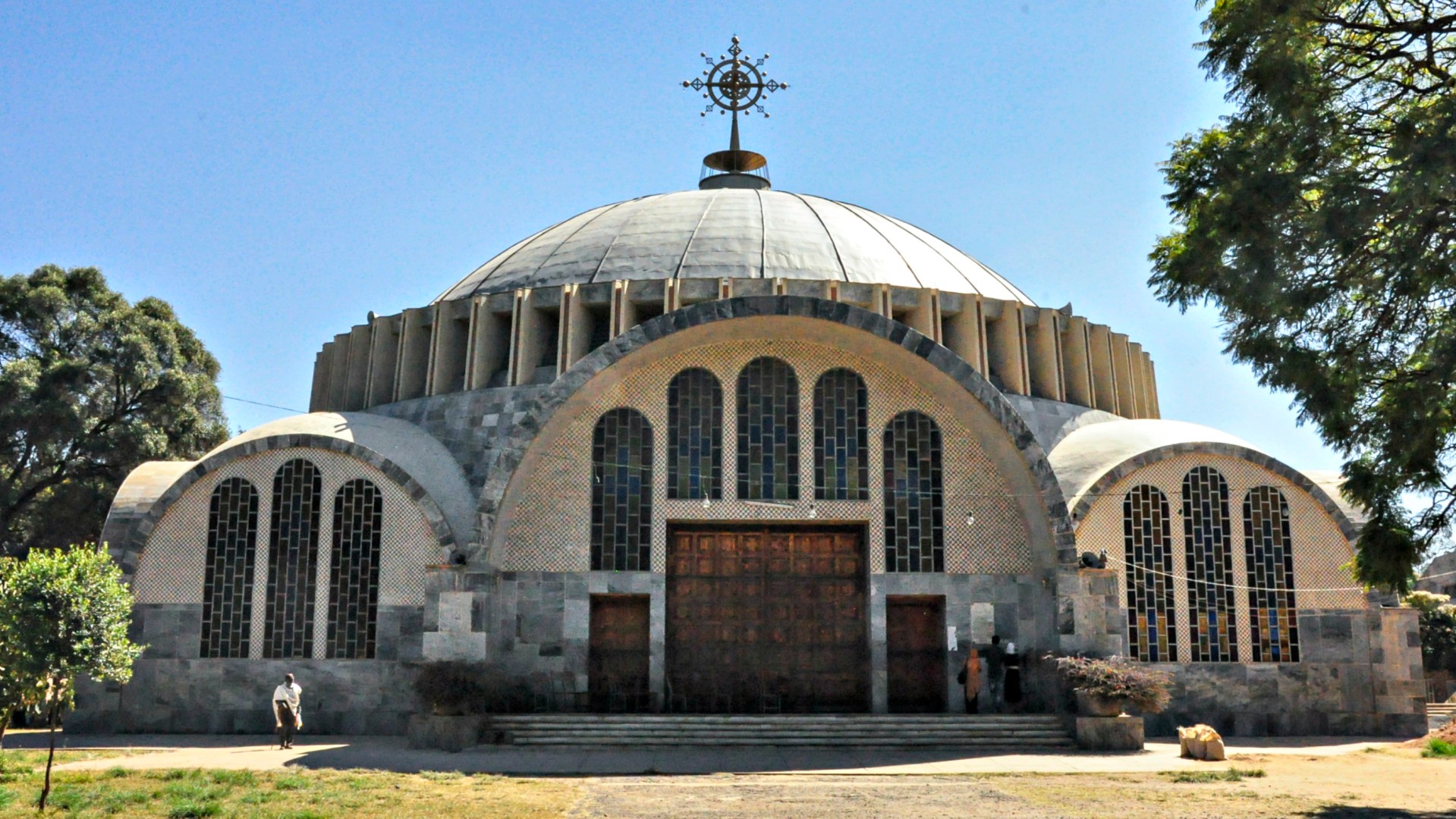
The Church of St. Mary of Zion in Axum, in the Tigray region of Ethiopia, in November 2013.

The Church of St. Mary of Zion in Axum, in the Tigray region of Ethiopia, in November 2013.

Christianity Today February 18, 2021
AP Photo

Update (Feb. 26): A new report by Amnesty International, based on interviews with 40 witnesses, also alleges that Eritrean soldiers systematically killed “many hundreds” of people in Axum.

Bodies with gunshot wounds lay in the streets for days in Ethiopia’s holiest city. At night, residents listened in horror as hyenas fed on the corpses of people they knew. But they were forbidden from burying their dead by the invading Eritrean soldiers.

Those memories haunt a deacon at the country’s most sacred Ethiopian Orthodox church in Axum, where local faithful believe the ancient Ark of the Covenant is housed. As Ethiopia’s Tigray region slowly resumes telephone service after three months of conflict, the deacon and other witnesses gave The Associated Press a detailed account of what might be its deadliest massacre.

For weeks, rumors circulated that something ghastly had occurred at the Church of St. Mary of Zion in late November, with estimates of several hundred people killed. But with Tigray cut off from the world and journalists blocked from entering, little could be verified as Ethiopian and allied fighters pursued the Tigray region’s fugitive leaders.

The deacon, who spoke on condition of anonymity because he remains in Axum, said he helped count the bodies—or what was left after hyenas fed. He gathered victims’ identity cards and assisted with burials in mass graves.

He believes some 800 people were killed that weekend at the church and around the city, and that thousands in Axum have died in all. The killing continues: On the day he spoke to the AP last week, he said he had buried three people.

“If we go to the rural areas, the situation is much worse,” the deacon said.

The atrocities of the Tigray conflict have occurred in the shadows. Ethiopian Prime Minister Abiy Ahmed, who won the Nobel Peace Prize in 2019 for making peace with neighboring Eritrea, announced the fighting as the world focused on the US election. He accused Tigray’s regional forces, whose leaders dominated Ethiopia for nearly three decades before he took office, of attacking the Ethiopian military. Tigray’s leaders called it self-defense after months of tensions.

While the world clamors for access to Tigray to investigate suspected atrocities on all sides and deliver aid to millions of hungry people, the prime minister has rejected outside “interference.” He declared victory in late November and said no civilians had been killed. His government denies the presence of thousands of soldiers from Eritrea, long an enemy of the Tigray leaders.

Ethiopia’s narrative, however, has crumbled as witnesses like the deacon emerge. The foreign ministry on Thursday acknowledged that “rape, plunder, callous & intentional mass killings” could occur in a conflict where “many are illegally armed.” Its statement blamed Tigray forces for leaving the region “vulnerable” and said any serious offense will be investigated. It did not mention Eritrean soldiers.

Eritrea’s government rejected as “outrageous lies” the claims of a massacre in Axum.

“Relevant Ethiopian institutions had long ascertained the utter fallacy of the story,” said Information Minister Yemane Gebremeskel in a series of Twitter posts.

Axum, with its ancient ruins and churches, holds major significance for the Ethiopian Orthodox faithful, who believe that the Ark of the Covenant, built to hold the tablets inscribed with the Ten Commandments, is located there.

“If you attack Axum, you attack first of all the identity of Orthodox Tigrayans but also of all Ethiopian Orthodox Christians,” said Wolbert Smidt, an ethnohistorian who specializes in the region. “Axum itself is regarded as a church in the local tradition, ‘Axum Zion.’”

Location map of Axum, Ethiopia

In a normal year, thousands of people would have gathered at the Zion church in late November to celebrate the day Ethiopians believe the Ark of the Covenant was brought there after it disappeared from Jerusalem in ancient times.

Instead, the church had become a refuge for people who fled the fighting elsewhere in Tigray. They sheltered there as worship services were underway two days before the anniversary.

Eritrean and Ethiopian soldiers had arrived in Axum more than a week earlier, with heavy bombardment. But on November 28, the Eritrean soldiers returned in force to hunt down members of the local militia who had mobilized against them in Axum and nearby communities.

The deacon recalled soldiers bursting into the church, cornering and dragging out worshipers and shooting at those who fled.

“I escaped by chance with a priest,” he said. “As we entered the street, we could hear gunfire all over.” They kept running, stumbling over the dead and wounded along with others trying to find places to hide.

Most of the hundreds of victims were killed that day, he said, but the shooting and looting continued the following day.

“They started to kill people who were moving from church to home or home to home, simply because they were on the street,” another witness, visiting university lecturer Getu Mak, told the AP. “It was a horrible act to see.” He watched the fighting from his hotel room, then ventured out as it eased.

“On every corner, almost, there was a body,” he said. “People were crying in every home.”

Another witness, who spoke on condition of anonymity for fear of retaliation, said soldiers killed a man at his home near the Zion church. “How can I tell you? So many dead,” said the man, who has since escaped to the Tigray capital, Mekele.

After the killings in Axum came an uneasy period with soldiers roaming the streets and families searching for loved ones. At night, hyenas descended from nearby hills.

The city began to smell of death as some bodies went untouched for days.

“I saw a horse cart carrying around 20 bodies to the church, but Eritrean soldiers stopped them and told people to throw them back on the street,” said Getu, the university lecturer.

Witnesses elsewhere in Tigray have reported being unable to bury bodies, calling it an added insult. They say soldiers tell them that “no one mourned our fighters, so why should we let you mourn?”

Finally, when the soldiers left the city to pursue other fighters, residents mobilized to bury the bodies, the deacon said.

“We could not do a formal burial,” he said. “We buried them en masse” in graves near the Zion church and others.

Some of the dead were among the hundreds of thousands of people in Tigray displaced by the conflict and not known to Axum residents. Their identity cards were collected in churches, where they await the discovery of loved ones.

The deacon said residents believe the Eritrean soldiers were taking revenge for the two-decade border war between Ethiopia and Eritrea that played out nearby and ended after Abiy became prime minister. Some of the soldiers told residents they had been instructed to kill people as young as 12, he said.

Another witness, a 39-year-old who gave only his first name, Mhretab, and escaped weeks ago to the United States, asserted that Ethiopian federal police did nothing to rein in the Eritrean soldiers.

“I said to them, ‘Listen, you’re Ethiopian, they’re destroying Ethiopian cities. How is this possible?’” Mhretab recalled.

”They said, ‘What can we do? This shouldn’t have happened from the beginning. This is from above,’” indicating that it had been decided by senior officials, he said.

He said he ferried bodies to a mass grave by the Zion church and estimated that he saw 300 to 400 there.

The deacon believes that the Eritrean soldiers, in their hunt for Tigray fighters, have killed thousands more people in villages outside Axum. “When they fight and lose, they take revenge on the farmers and kill everyone they can find,” he said. “This is what we’ve seen in the past three months.”

Getu echoed that belief, citing his uncle, who survived such a rural confrontation.

The deacon has not gone to the villages outside Axum. His work remains with his church, where services continue even as he says the Tigray conflict is as fierce as ever.

“We’re also protecting the church,” he said. “Even now, I’m talking to you from there. We are not armed. What we do is mostly watching. And, of course, praying that God protects us.”

News

Died: Jaime Murrell, Gospel Singer Who Brought Caribbean Styles to Worship Music

Dove nominee encouraged Latin American Christians with simple but profound lyrics.

Christianity Today February 18, 2021
Courtesy of Andrea Ortiz / Edits by Christianity Today

Panamanian gospel singer Jaime Murrell, who helped Latin America worship God in music that reflected the diversity of the region’s culture and history, died of COVID-19 on February 4. He was 71.

Murrell, along with American singer Marcos Witt and other pioneering worship leaders in Venezuela, Mexico, and Brazil, brought Caribbean styles and influences into worship music. His 2000 album Prometo Amarte was nominated for the Dove Awards’ best Spanish-language album in 2001. He also contributed to La Oracion de Jabes (the Prayer of Jabez) album, which was nominated for the same award in 2003. Today, Murrell’s music is sung in churches across Latin America.

“Jaime Murrell was a minister whose goal was to exalt the name of God,” said César Forero, a pastor at Centro de Restauración Familiar Nueva Vida in Panama City who first met Murrell in the ’90s. “It was clear that his goal was not the number of records, awards, or concerts, but to comply with the will of God and give glory to his name.”

As news spread of Murrell’s death, Christian artists and pastors from around Latin America mourned their loss and celebrated his life and accomplishments.

“Panama is a small Latin nation and sometimes, when we’re from small countries, sometimes we believe we don’t have potential and that we don’t matter,” said Serafin Contreras Galeano, a Venezuelan pastor who spent 18 years in Panama. “We forget that God chooses the small to glorify him.”

Murrell’s career began in the secular world, with his bands Los Mozambiques and Skorpio. When he began pursuing music in the 1970s, Latin Christian music was stylistically very similar to the music found in European and American churches. Often, congregants sang translated versions of hymns whose rhythms matched their Anglo counterparts. In the 1980s, Murrell was one of the worship leaders who started to expand the church’s musical repertoire.

“He merged the cadence of European and Caribbean musical styles,” said Kathryn Kemp, author of Make a Joyful Noise! A Brief History of Gospel Music Ministry in America. “His gospel music has a reggae beat, syncopated tempo with drums, cymbal, keyboard, and strings. His songs of adoration are of mixed tempo—slow when appropriate but with striking drum and guitar accompaniment.”

Murrell was most strongly associated with the ska sound in Latin American gospel music. A precursor to reggae, ska brought together elements of Jamaican calypso and folk music with American jazz and R&B.

Murrell was born in a small town in Panama in 1949. At age 18, he won a singing competition, an opportunity that put him on TV for the year and helped launch his band. He found commercial success as a secular musician, but it came with a cost. He struggled with drugs and depression.

In 1976, he made a decision to follow Christ. Just two weeks later, Murrell’s testimony sparked Ricardo Clarke, one of his musical collaborators from his Skorpio days, to accept Christ.

Murrell was already well known in Panama, so his conversion attracted significant attention. He started a new Christian band, Kyrios, and was invited on national television to perform during a Christmas special. Kyrios toured for four years.

“We were overcome with the vision of starting a band with the spirit of reaching those who had never heard about the Lord,” said band member Mario Fernando Vásquez, now an Assemblies of God pastor in Panama.

One of their first hits was “Pronto vendrá él” (“Soon I Will See Him”), and the (translated) chorus lyrics were “Bend the knee and go and seek more of God / only He can satisfy your soul.”

The band became known for detours off stage to tell people about Jesus and witnessed to people on the streets and in prisons, Vásquez said.

Kyrios ended in 1981 when Murrell decided to stop touring and take a youth ministry position at La Catedral del Pueblo in Miami.

When he struck out on his solo career in the 1990s, the music he created and sang was widely adopted by other Latin American pastors and worship leaders, and it inspired many Christians.

Forero said the song that meant the most to him was “Aquí estoy” (“Here I Am”).

“God used the simple yet profound lyrics of this song to minister to my life in my youth, as I made the decision to serve God as a full-time missionary,” he said. “Still today every time I hear that song, my mind and heart go back to that day of decision.”

Murrell and his wife Verna tested positive for COVID-19 on January 20. Murrell died of a heart attack related to complications caused by the coronavirus.

“He wanted to speak the truth and love God and neighbor,” his wife wrote on Instagram. “His messages and songs always tried to send the message, we love Christ as Christ loved us.”

He is survived by Verna and a son.

News

When I Had No Heat, You Welcomed Me: Texas Churches Offer Refuge

With freezes knocking out power across the state, ministry networks rally to help.

Christianity Today February 18, 2021
Montinique Monroe / Getty Images

In the deep freeze that has taken electricity from millions, cut water supply, iced roads, and disrupted communications, not even Texas’s churches can provide reliable sanctuary—but leaders are doing all they can to connect and comfort their communities.

“We were a little late to the game on the warming station because the church lost power for a while as well,” said Steve Bezner, senior pastor of Houston Northwest Church.

Once the building opened on Tuesday afternoon, more than 60 residents came through to escape the cold and charge devices during the day, and the church has also covered hotel stays for people without a warm place to sleep.

The state is going on four straight days of extended power outages and freezing weather, a crisis so widespread and dire that families are warming up in their cars or venturing to places still on the power grid, such as friends’ homes or churches like Bezner’s.

During the unseasonably cold temperatures, which has dropped to single digits, ministries are scrambling to offer shelter, distribute blankets, and provide food for people living on the streets, such as those in the downtown Austin homeless encampments that have swelled over the pandemic.

Down the street from one encampment, Christ Church of Austin closed its building after burst pipes flooded the building and blew the electrical system—unable to take in its neighbors or to offer an Ash Wednesday courtyard service and drive-thru ashes as planned.

Christine Warner, the Austin-based director of the Anglican Church in North America’s Matthew 25 Initiative, described how “the vulnerable are serving the vulnerable.” People are taking care of one another in the encampments as well as in communities of undocumented workers in trailer homes.

It’s often the working poor who have sought shelter in churches, since they aren’t as likely to have networks of friends and family to help, Warner said, noting that at least five suburban Austin congregations have opened up as warming centers.

The big and small acts of generosity—rides, meals, and supplies exchanged between neighbors, fellow church members, or near-strangers, people camping out in each other’s living rooms—seem both necessary given the circumstances and like a departure from the arms-length solidarity built up over the 11 months since COVID-19 hit.

“People are caring for their neighbors in a way that’s different than pandemic care, in a way that’s a bit bolder,” said Warner. “What’s happening is an awareness of the collective trauma fatigue. Everyone is so exhausted from that, and decision fatigue, and pivot, pivot, pivot.”

But the earlier disasters that linger in Texans’ minds—Hurricane Harvey in 2017, the hit of the COVID-19 pandemic last year—actually helped ready churches to respond quickly to this cold spell nobody imagined in the Lone Star State.

In Killeen, Skyline Baptist Church staff attended training last year to become a certified emergency shelter; three deacons have stayed at the church since Sunday afternoon to help 35 people staying in the gym, being fed by the local soup kitchen, Baptist Press reported.

After distributing emergency food and supplies during the COVID-19 pandemic, Highland Baptist Church in Waco opened as a shelter for around 60 people this week, with church members volunteering to host, pray, and bring hot meals for guests.

In Mesquite, a Seventh-day Adventist congregation is distributing free firewood. Across the state, others are offering working restrooms and showers for those without water, in addition to places to eat and sleep. Earlier in the week, Joel Osteen opened space at the massive Lakewood Church stadium in Houston.

https://twitter.com/lakewoodchurch/status/1361343164028715010

Jamie Aten, the executive director of the Humanitarian Disaster Institute at Wheaton College, recommends churches that want to offer shelter have an emergency plan in place and reach out to partner with local authorities or the Red Cross.

“Before opening up your doors, make sure your facility is safe to welcome others, from screened volunteers to basic resources,” he said. “I’d also highly encourage churches to reach out to local emergency management or other local authorities to see what resources may be available to support their outreach efforts. Another way churches can help is to reach out to other nonprofit organizations that specialize in shelter-in-place to explore partnering together, such as with the Red Cross.”

In The Woodlands, north of Houston, Church Project opened its building as a warming center with cots provided by the county, water and snacks from the local food bank, and support from Hope Beyond Bridges, a homeless ministry. Since Sunday evening, 23 people have come in, according to John Shaw, pastor of connections at Church Project.

The winter storm in Texas has compounded the psychological and physical toll of the pandemic. With rolling outages and boil-water advisories suddenly issued by text, people don’t know when they are in the clear. Although temperatures are supposed to rise, electricity providers in the Houston area say power outages could continue into the weekend.

“This is hard. It’s cold. Many of us are without power or water or both. We’re all still dealing with COVID frustrations and fears and anxieties,” tweeted David Norman, pastor of University Baptist Church in San Antonio. “But no one has to do this alone. Let’s make sure they don’t.”

https://twitter.com/davidgnorman/status/1362197007327260674

Even when power and water are restored, many will be left with the aftermath of their non-winterized homes being hit with such severe winter weather. Bezner at Houston Northwest Church is already preparing to mobilize to help families with home repairs, laundry, or financial assistance.

Like with COVID-19, the freeze has also exaggerated disparities in resources. Hope Community Church in Austin and the Immigration Coalition launched collections to offer blankets, clothing, and food to immigrants in their own community and along the border, quoting Matthew 25:35–36, “For I was hungry and you gave me something to eat, I was thirsty and you gave me something to drink, I was a stranger and you invited me in, I needed clothes and you clothed me.”

https://twitter.com/TheImmCoalition/status/1362142422398951424
News

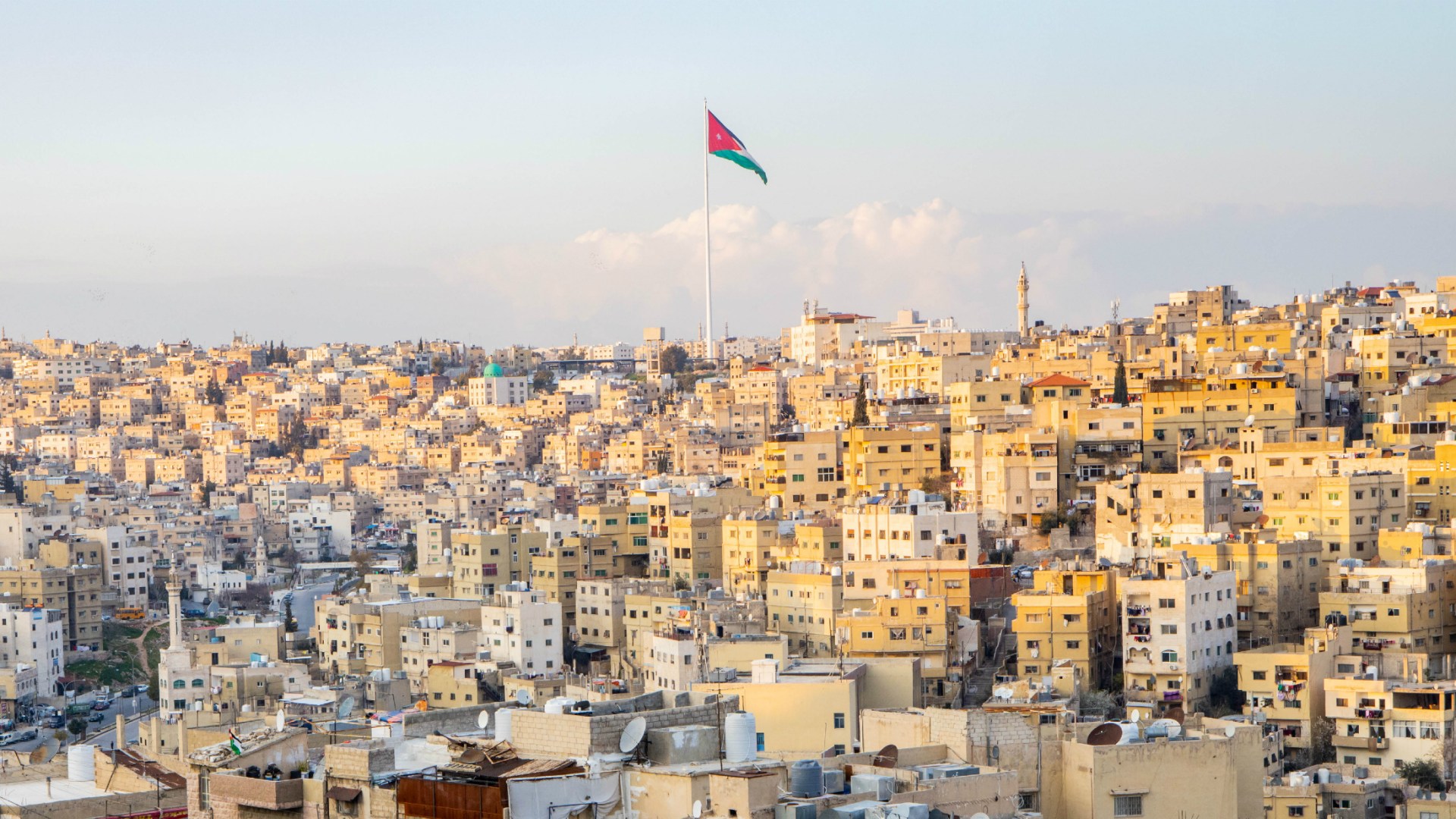
Jordan’s Orthodox Archbishop Moves to Deny Evangelicals Full Legal Recognition

Archbishop Christophoros Atallah told Judicial Council last month that evangelical churches are “a danger” to society.

Amman, Jordan

Amman, Jordan

Christianity Today February 17, 2021
Artur Debat / Getty Images

Long-simmering suspicions between Orthodox and evangelical Christians have blown up recently over the refusal of the Jordanian government to allow evangelical churches full legal standing under the country’s religiously divided judicial system.

In a January 26 letter to the country’s Judicial Council, Greek Orthodox Archbishop Christophoros Atallah attacked members of local evangelical churches, calling them “a danger” to society.

“There are great dangers from the teachings and ideas that are disseminated by these groups that are being spread within the Christian society,” the archbishop wrote. “These are strange ideas that depart from our Christian faith and the national identity of the local church.”

In addition, Atallah said, “these groups are funded from abroad and have outside and unclear agendas and we have reservations about them.”

In Jordan, the legal system is divided into civil courts, where commercial and criminal cases are heard, and separate religious courts that settle matters of marriage, divorce, and child custody according to canon law for the majority-Muslim population and for the 11 recognized Christian communities.

While United Pentecostal and Jehovah’s Witnesses members are allowed their own ecclesiastical courts, legal matters for members of nearly 60 other Protestant churches are heard in civil court, or, for minor matters, work through the court of the Anglican Church, one of the 11 approved denominations.

But on February 5, in response to Atallah’s letter, Judge Mohammad Al Ghazo, who heads Jordan’s Judicial Council, issued a memo disqualifying any Christian without an approved ecclesiastical court from using the civilian courts. Cases would instead be referred to the Council of Church Leaders, a government advisory body.

Legal scholars have said that this request is in direct violation of a 2014 law that updated the religious court system.

“Those clauses state clearly that the regular courts are the ones that are obliged to deal with cases brought to it by Christians who have no ecclesiastic court so long as it rules with fairness and justice and in accordance with the beliefs of these denominations,” Tagrid Doughmi, a lawyer and author of a study on Jordan’s religious groups, told Religion News Service.

Repeated requests for comment from the Jordanian government went unanswered.

David Rihani, head of the Assemblies of God denomination in Jordan, told RNS that the government action is an attempt to negate decades of work: “Evangelical churches have existed since the establishment of Jordan, and their marriage certificates and other personal status documents have been and continue to be accepted and registered within the official government records for decades.”

In 2006, the Jordan Evangelical Council was established with the aim of unifying the approximately 10,000 Christians now scattered among the Baptist Evangelical Church, Assemblies of God, the Evangelical Free Church, the Church of the Nazarene, and the Christian and Missionary Alliance under a single hierarchy.

According to Habes Nimat, president of the Jordan Evangelical Council, leaders of the unrecognized churches met almost a year ago with Prince Ghazi bin Muhammad, a member of King Abdullah’s cabinet known for his interest in religious affairs, seeking clarification of their status, but no progress has been made since then, despite following the prince’s recommendations.

Nimat said that the bid to deny evangelicals access to civilian courts put at risk thousands of Christian families whose marriages were properly licensed at an evangelical church but could now be declared void.

Audeh Quawas, a member of the Jordanian Senate and an Orthodox Christian, told RNS that the archbishop is attempting to avoid the unnecessary proliferation of small ecclesiastical courts.

“What the archbishop did was not against any specific church but in order to avoid duplication,” said Quawas.

The solution, the senator said, is to bring all the Christian groups together to rationalize the court system. “We should solve this problem as Christians by means of a religious and social dialogue,” he said, “with an eye to having the Orthodox, Eastern Orthodox, Catholic, and Protestant churches with equal representation.”

Church Life

Lent Is a Time to Sing the Blues

In the American music of brokenness and sorrow, my church learns to long for God’s restoration.

Christianity Today February 17, 2021
Illustration by Mallory Rentsch / Source Images: Hal Gatewood / Unsplash / Nicolas Castro / Lightstock

I was told once that during Lent, you don’t sing songs with the word hallelujah in them. I had never heard of that tradition, though my church in Atlanta had been observing Lent for a while. But I liked it. It made sense. Lent is a season of intense self-reflection, repentance, fasting, low-key suffering, and lament. Songs about victory could run the risk of sounding impatient, even lazy and unwilling.

The hallelujahs will have to wait, as we have some things to sort out first.

Years ago, our worship band started opening each Sunday of Lent with a blues song: Robert Johnson, Elmore James, Blind Willie McTell, Bessie Jones, Blind Willie Johnson, Eric Clapton, and down to The Black Crowes—the real stuff. We called it “Blues for Lent.” These were songs of pain and frustration, songs with very vivid pressure points on the hurt that exists in the world.

At first, they were just a way to get people in the room, a “last call” for those in the lobby. They turned into these moments, though, when a very particular tone was set for the morning. These preludes reminded us that life doesn’t always go well, and that the world we share is stuck in a loop of brokenness and trouble.

Broken hands, on broken ploughs,
Broken treaties, broken vows,
Broken pipes, broken tools,
People bending broken rules
Hound dog howling, bull frog croaking,
Everything is broken

Bob Dylan

The origins of the blues are notoriously hard to pin down, but the music and sentiment were born in the fields of American slavery, where men and women sang as a way to tell the truth about their lives, the troubles they had seen, and bear witness to the persistence of their endurance. The blues have been called “chronicles of personal catastrophe expressed lyrically and endured with grace and dignity.”

Before such music was marketed and made popular across the nation in 1920s, it lived mostly as a localized language inside the African American subcultures of work and religion. In church services, the “call and response” between the preacher and the congregation is the most well-known model of this music: a gospel proclamation followed by church confirmation, the “amen” as a means of participation.

It’s the combination of despair and hope that gives the blues such an approachable quality, as these two things often live together in the hearts of everyday people. The music acknowledges the truth of trouble in the world around us and in our own hearts. To call out such despair for what it is and then to undercut it with hope is what makes the blues so powerful.

Sadness and lament are emotions familiar to all people, and songs, when rightly written, have always been a place where these emotions can safely be expressed.

That might take the form of a traditional hymn: “Prone to wander, Lord I feel it / Prone to leave the God I love.” But there are other places you can hear the human cry of need for a savior: “Nobody loves me but my mother / And she could be jivin’ too.”

Allowing the nature of the blues to have a seat at the table of church life is good for the congregation. Reflective sadness has a place in the life of a congregation. There is “a time to mourn,” said the writer of Ecclesiastes (3:4), and more than any other season, Lent gives the church dedicated space to sorrow together.

It’s good for us to be shaken by the losses in our world that have taken place at the hands of injustice, inequality, poverty, depression, disease, and war. It’s more difficult to mourn over the ways we have played an active or passive or even unconscious role in these things. There’s grace in the courage it takes to reflect on our personal frailties, on our tendency to wander from the ways of Jesus. To name the ways we live as prodigals takes a level of courage that alludes to a world bent on building a perfected sense of self.

Lent won’t allow it. Lent is marked by an honesty about failure, about our own unjust dealings, and our own sense of self-righteousness. But also, an honesty about our sense of hopelessness, anger, fear, and sadness.

In her book The Liturgical Year, Joan Chittister writes, “Lent enables us to face ourselves, to see the weak places, to touch the wounds in our own soul, and to determine to try once more to live beyond our lowest aspirations.”

There are songs for these things.

The Bible is no stranger to the blues. It has a base conviction that the world is not as it should be. Its first words, even, describe a creation out of sorts, one longing for order and balance and rest. It is said that history is composed by the victors, but the writers of the Bible were formed more by loss, slavery, wandering, oppression, betrayal, exile, and the ongoing threat of extinction. Its stories and teachings and poems and laments are all voices from the margins that remind us of the unchecked darkness and injustice that can run wild in the world. It doesn’t pretend that these things aren’t real. The prophets of Israel, even, had to remind the people of God of their own involvement in such things, of their own amnesia around their calling to be a light and a way in the world.

Church services can often hurry too fast to victory. Sometimes all the songs and readings and sermons are about the glories of the mountaintop. They can be encouraging, but not always honest. In the Orthodox tradition, the spirit of Lent is described as “the Bright Sadness.” It’s the marriage of hope and pain, or, as we say in theology, the “here but not yet” state of the kingdom.

The apostle Paul said we do “not grieve as others do who have no hope” (1 Thess. 4:13, NRSV). But we do grieve. There’s an ecclesiastical skill in holding out hope while also being honest in naming the pains that are real in our world and in our lives. Not everything is fixed, not yet. For an hour a week we hear how everything has been overcome, and yet we still leave the church house with a heavy sense that we remain temporarily overwhelmed by the world.

Lent is permission to be overwhelmed.

If it keeps on rainin’, levee’s goin’ to break,
And when the levee breaks, I’ll have no place to stay

– Kansas Joe McCoy and Memphis Minnie

https://open.spotify.com/embed/track/3e7jWDpbYEoaYE7Q8sIvUV?si=0YVOz3SSQJ25b7hYsXHhJg

As the church enters Lent, I think about the testimony of a global community in mourning, the church committing itself to the 40-day path of reflection, lament, and repentance. Resurrection is coming, but it’s not here yet. Hope will be realized, but not just now. I think about what it means to fast, how the pains of hunger or desire or addiction or habit remind us that we are not all that independent, and that our lives are not completely of our own making. I think about the outcomes of the inward journey of Lent. As we explore even the darkest corners of our lives, we are reminded of the breadth of God’s grace, and how in remembering, we might learn to extend such grace to others.

I think the blues can teach us to take up residence in those troubling spaces where there is hurt and to practice the difficult speech of hopeful lament. For how can we be a people who long for the resurrection day when God will repair all that is broken if we cannot see and speak and sing of what is broken?

Lent asks us to take the world’s suffering and our own personal catastrophes as our muse as we await the coming restoration day.

He proved a friend to David
That same God that David served
Will give me a rest someday.
Trouble will soon be over,
Sorrow will have an end.

– Blind Willie Johnson

Derek Sweatman is the lead pastor of Atlanta Christian Church in Midtown, Atlanta. He is also an adjunct professor of biblical studies at Point University and host of the annual podcast Blues for Lent.

Blues for the church in Lent:

https://open.spotify.com/embed/track/5TzAiurXl4sxQRgl54KqYZ?si=Gz2Ftw8PRESW7awvxYUsUA
https://open.spotify.com/embed/track/0s90xcf2gZ6hJZA32yXE1V?si=YIjwjRiLRua-di_DZeDV8g
https://open.spotify.com/embed/track/7cJgHvkMpSkZDw9aYWYTWm?si=j7KvSnwRTYWT9DvXp0CvEg
https://open.spotify.com/embed/track/5UEsyERm7tsNvDDZFylZZf?si=2wc-8-g2RNyQEwC7hJ_8IA
https://open.spotify.com/embed/track/2En6kxGCjZxXmKJ1IYu4Fp?si=xks_Ca4fSv6f652K0jL3bg
https://open.spotify.com/embed/track/6Y54QIKrByOiR4bsu0cUAH
Ideas

Ash Wednesday’s Imposition of Humility

The dust from whence we came and will return dirties our hearts now.

Christianity Today February 17, 2021
Illustration by Mallory Rentsch / Source Images: Rizky Panuntun / Ezra Acayan / Stringer / Getty Images

With Ash Wednesday this pandemic year, the already dim light of Epiphany gives way to the murkier light of Lent. Epiphany, meaning revelation, marks the bright manifestation of Christ to Gentiles, represented by the Magi. It is a season devoted to shining outward. In Matthew’s gospel, Jesus tells his followers they are the light of the world. “Let your light shine before others,” he says, “that they may see your good deeds and glorify your Father in heaven” (Matt. 5:16).

Even so, Jesus then cautions against being too obvious about it. “Be careful not to practice your righteousness in front of others to be seen by them,” he warns (Matt. 6:1). Do it all in secret, “then your Father, who sees what is done in secret, will reward you” (6:4). While this is a huge relief for those for whom public displays of Christian devotion generate alarming awkwardness, it does seem contradictory. Do we shine our light for others to see or keep it on a dimmer switch?

It may be helpful to view these twin injunctions as counterbalancing rather than contradictory. The concern is over who gets the glory. Jesus encourages us to let our good deeds glow so people may give glory to God from whom all blessings flow. But danger lurks if in doing good you feel entitled to your own glory. Early Christians filed such entitlement under the category of vainglory, the deadly sin of doing the right thing for the wrong reason. With vainglory, you dutifully follow what God demands, yet grow irritated when nobody notices or gives you credit for being so righteous.

The Judaism of Jesus’ day came equipped with disciplines to ward off vainglory. These disciplines—alms-giving, fasting, and prayer—took the focus off yourself. They became disciplines for Christian Lent. However, human nature being what it is, Jesus warns how alms-giving, fasting, and prayer, designed to guard our hearts, can all be corrupted by our hearts. Ergo the Ash Wednesday punchline: “Those who exalt themselves will be humbled, and those who humble themselves will be exalted” (Matt. 23:12).

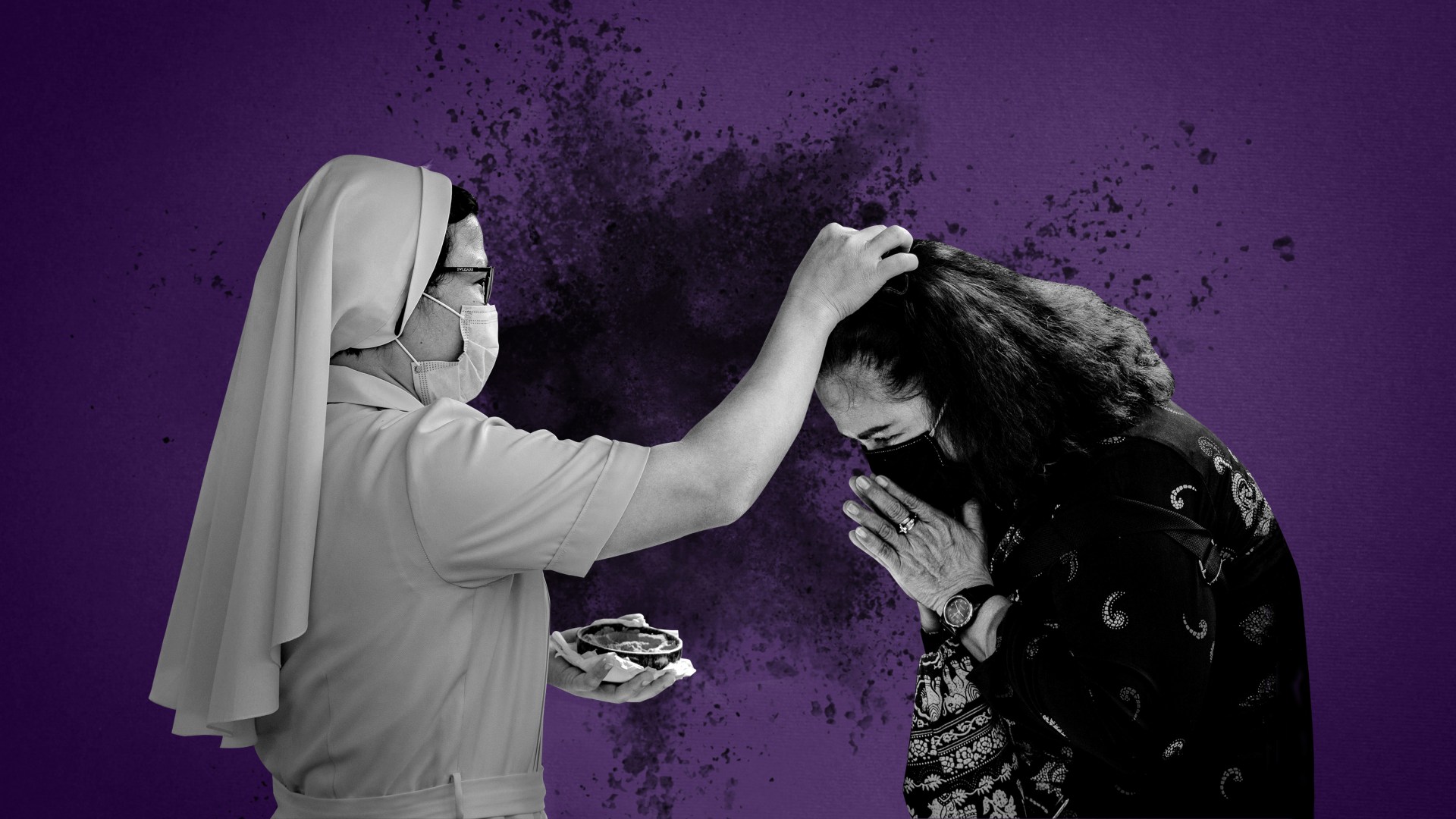
The Greek verb to humble has two distinct meanings depending on voice. In the active voice (where the subject does the action), to humble, as in to humble yourself, means to regard yourself as no better than anybody else. Humility is that quality of character that does the right thing because it’s the right thing to do, not out of any want for applause or payback or pride. The Greek etymology is uncertain, but the Latin comes from the root word humus, from whence we get the word human, as in God created humans out of the humus, the dirt and the dust of the ground. As liturgically minded believers gather in some churches, via Zoom, or once again by way of drive-thru (a so-called ash and dash experience), ashes will be applied to their foreheads with the words “Remember that you are dust, and to dust you shall return.”

Wearing ashes in public shows you’re not ashamed of the gospel. What if that makes you proud of your humility?

Many Protestants eschew ashes in keeping with Jesus’ warning against practicing your piety in front of others for show. Ashes are an ancient Jewish symbol of humility; but if you’re not careful, ashes can become substitutes for the humility they symbolize. It starts by thinking that wearing ashes in public shows you’re not ashamed of the gospel. But if that makes you proud of your humility, well, you see the irony.

There is a dark side to being humble. In the passive voice, the subject receives the action. Instead of humbling yourself, you get humbled by somebody else. In English, we make the distinction between humility with humiliation. We could interpret Jesus as saying, “All who exalt themselves will be humiliated, but all who humble themselves will be exalted.”

The verbs will be humiliated and will be exalted are also in the passive voice. Theologically rendered, the passive voice is often known as the divine passive voice, meaning God is the one doing the action. Ergo: Humble yourself and God will exalt you. (This is a good thing.) Or: Exalt yourself and God will humiliate you.(This is a bad thing.) And it’s especially bad because the verbs are in the future tense. Jesus uses Judgment Day language.

This is why we humble ourselves, as hard as that can be. The official liturgical term for donning ashes is imposition. Humility is always an imposition. Nobody likes being reminded they are dirt and that their destiny is in the dust.

Having now lived through a year of pandemic, with millions sick and dead, we’ve been forced to face our fragility. But our common suffering has united us too, even amid this past year’s political and racial divisions. We have learned to rely upon one another for our own health and well-being—wearing our masks, keeping our distance, offering up prayers, giving where needed, helping out as we can, hoping as we must.

We know how this will end as vaccines take hold, but we won’t be returning to normal as we knew it. Some will never fully recover from the pandemic’s dire economic effects. Others will mourn their loss of loved ones for a long time. Still others will suffer the lingering residue of the virus itself in their bodies. Indeed we are dust, and to dust we shall return.

Still, the Lenten aim remains resurrection. Ashes serve as fertile soil, providing for roots to take hold and good trees to grow and shine with Christ’s light. As Christians we are “buried with [Christ] through baptism into death, in order that, just as Christ was raised from the dead through the glory of the Father, we too may live a new life” (Rom. 6:4). New life is not one solely reserved for eternity. It begins here and now.

Daniel Harrell is editor in chief of Christianity Today.

News

Died: Carman, Christian Showman Who Topped Charts with Triumphant Faith

Singer of “Satan, Bite the Dust!” and “R.I.O.T. (Righteous Invasion of Truth)” believed in the power of celebrity and spectacle to draw people to Jesus.

Christianity Today February 16, 2021
Carman / Edits by Mallory Rentsch

After a 40-year career in Christian music, Carman died in Las Vegas Tuesday night due to complications from surgery. He was 65.

He was a one-name celebrity, and for those who knew him, the Christian singer and showman ranked in the highest echelons of American stardom, up there with the other mononymous divas: Madonna. Cher. Liberace. Carman.

For those who didn’t know him, the single name was repeated as a question. Carman? But if Carman’s star never quite secured its place at the zenith of American fame, he never let that dim his belief in his own celebrity, the awesome power of the concert-show-crusade-event, and his commitment to producing a pop spectacle for Jesus.

“The music is the best means I have of reaching the most people in the quickest way to win them to Christ,” Carman said. “I think an artist owes it to his audience to thrill them and impress them. It lets people know there is joy in being Christian.”

Carman, born Carmelo Domenic Licciardello and raised the youngest of three children in an Italian American family in Trenton, New Jersey, won seven Dove Awards. He was nominated for four Grammys, named Billboard’s Contemporary Christian Artist of the Year in 1990 and 1992, and sold more than 10 million albums. In 2013, 30 years after his first hit and on the heels of his cancer diagnosis, his fans raised $280,000 for him to go on a 60-city tour.

“When Carman resumed touring again a few years ago, he was concerned that no one would care that he was back. He was wrong. Every night fans packed out venues, and his ministry was as powerful as it ever was,” Matt Felts, Carman’s manager, said in tribute. “This world has lost a light in the darkness, but today Carman saw firsthand the fruit of his labors.”

A little bit of a vanity project

The singer had many fans who loved him effusively and described how much he had strengthened their faith.

“All of his music touches my heart. I thank God for blessing Carman with the gift of music,” wrote one Christian on Carman’s Facebook wall.

Another described how much his song “Satan, Bite the Dust” meant to her.

“That was the best Carman,” she wrote. “When the enemy attacks you, remember he’s defeated and when we get to heaven you’ll have the grand opportunity to kick the devil’s fat butt back into hell.”

The singer also had fans who celebrated him as the pinnacle of the weirdness of 1990s youth group culture. They could, like Carman himself, be both incredibly earnest and completely tongue-in-cheek in their appreciation of his art.

“It’s impossible to look at this body of work and not conclude that being a Christian pop/spoken word star wasn’t a little bit of a vanity project for Carman. Even more so than being a Christian pop star is in general, I mean,” wrote Tyler Huckabee, senior editor at Relevant magazine, ranking the singer’s top 10 music videos, which all star Carman.

“But let’s give him more credit than that. … He saw it all, first and foremost, as something exciting; a call to be Clint Eastwood, James Bond and William Wallace all rolled into one. If that’s a little bit egocentric, it’s also pretty fun.”

https://twitter.com/MatthewEPierce/status/1352009708345896961

Carman was born in 1956 to a meat cutter and a musician. He described his mother Nancy Licciardello as a “child prodigy on the accordion.” She gave Carman his love of the stage and his first chances to perform. He filled in when a band member failed to show up at a local New Jersey gig.

“I knew I wanted to,” Carman recalled, “and once I gave it a try, I loved it.”

Carman dropped out of high school at 17 and achieved some early success performing Top 40 in Atlantic City. When he turned 20, he decided to try to make it as a lounge act in Las Vegas.

In Carman’s heightened version of the story, repeated to reporters numerous times over the years, he was doing so well performing in the New Jersey casinos that a talent agent approached him about “representing my interests and helping my career,” but the agent was linked to the DeCavalcante crime family, which was known for extensive extortion and racketeering in New Jersey. The young Carman decided to leave town in his green Chevy Vega.

In Las Vegas, Carman struggled to break into the music scene or make a name for himself. He took a break to go visit his sister, also named Nancy, in Orange County, California. Nancy and her husband, Joe Magliato, pastor of the Son Light Christian Center, were worried about Carman’s salvation and tried to convince him to accept Jesus. Carman resisted, later recalling that he believed what they were saying but was just too proud.

Confronted with the truth

He wasn’t too proud to accept an invitation to go to a music festival at Disneyland, though, and Carman heard the gospel message again at the Andraé Crouch show. This time, he accepted.

“I was confronted with the truth and I received it,” Carman said. “It wasn’t that he was doing anything musically that hadn’t been done. But when he was singing you could feel the presence of God, and it was a whole new ballgame.”

The decision to follow Jesus ended Carman’s music career, and he spent the next five years doing odd jobs around Southern California—until he started performing in churches and then got swept up into the booming contemporary Christian music scene.

In 1981, Carman started traveling as an opening act for the Bill Gaither Trio. He signed with a new label, Priority, which almost ended his career when it closed within a year and didn’t release the rights to his recordings. He was snatched up by Myrrh, however, and started over with the song “Lazarus, Come Forth.”

He released “Sunday’s on the Way” in 1983, with the opening lyrics:

The demons were planning on having a party one night.
They had beer, Jack Daniels, and pretzels,
There was red wine, some white.
They were celebrating how they crucified Christ on that tree.

Carman had his first number one song with “The Champion” in 1985 and his first number one album on the Christian music charts with Revival in the Land in 1989.

https://open.spotify.com/embed/track/6V4Sr0WXTC8F7jUV4xGrSS?si=4m9z7DhNRq29Egh6EAG1Ug

Over the next 10 years, Carman released 12 albums, with five reaching the number one spot on the Christian charts. He absorbed and adapted every conceivable pop style, repurposing them into rock-opera-like narratives, “story songs,” starring Carman and built around his signature style of talk-singing. Huckabee described it as “a sort of rhyming, spoken word, preach-rap that defies description.”

The Gospel Music Hall of Fame said his performances were a “combination of drama, rock, comedy, funk, satire, acting, singing, and preaching, all woven together.”

Carman, for his part, celebrated the indescribability of his style.

“There’s one thing you can say about my music,” he said. “It’s uniquely my own. And you don’t have to listen to the same sound for 10 songs.”

With his success in Christian music, he expanded into music videos, films, and megaconcerts. He is believed to have set a record for the largest Christian concert in 1993 with 50,000 people in one venue in South Africa, and then again in 1994, with more than 71,000 in Texas.

He sometimes had his doubts about his success, though.

“I'd stand backstage and look at these huge crowds and think, I don’t get it. Nobody’s that good,” Carman said. “I always have this sinking feeling that at any moment they’re all going to turn to each other and say ‘what are we doing here’ and they’re all going to turn and leave.”

It started to happen in the 2000s. His career slowed, he was dropped by his record label, and he struggled to strike a deal with a new recording company. Then Carman suffered a series of personal tragedies: He lost money in the financial crisis; his brother died; he had a falling out with his sister; a close friend died in a small plane crash; he was in a car wreck and suffered internal injuries.

https://open.spotify.com/embed/track/5w1Oq2woEW7QpEBQSzCb5x?si=NdoIBMIYTN6dXlSzUHomNA

No Plan B

In 2013, he received a terminal cancer diagnosis. As Carman wrote to his fans on Facebook, the doctors told him he had incurable myeloma and three or four years to live.

After an outpouring of support, Carman launched a Kickstarter campaign to fund one final album and tour. He raised $280,000 and started the No Plan B tour. When the cancer went into remission, he attributed his healing to the faith of his fans.

“Folks, you are the ones who have literally willed this man and this ministry back to life!” Carman wrote.

Carman got married for the first time at the age of 61 and continued to tour when the cancer returned in 2020. He billed it as “Carman Live: A CinemaSonic Experience.” The tag line read, “It’s a concert. A movie. A play. A crusade. A must see event!”

According to Carman, he was doing the same thing he’d done his whole career: “I’m making Jesus very palatable to our American culture, I guess you can say. In a way that anybody can relate to.”

He died of complications following hiatal hernia surgery. At the end, he was planning another tour.

Ideas

In a Year of Death, Ash Wednesday Offers Unexpected Hope

Contributor

The liturgy of the first day of Lent leads us through dust to the Eucharist.

Christianity Today February 16, 2021
Illustration by Rick Szuecs / Source Images: Igor Ustynskyy / Getty / Envato / Evieshaffer / Lightstock

Most of us intentionally avoid thinking about death. Brandeis University anthropology professor Anita Hannig writes that most Americans label talk of death as “morbid” and “try to stave it off—along with death itself—as long as they can.”

Deep down we know we will die, but it isn’t the kind of thing we say out loud at dinner parties. So most years, the priest’s task on Ash Wednesday feels slightly transgressive and hardcore. We offer our yearly reminder: Do not avoid uncomfortable truths. We are mortal. No amount of wealth, busyness, or positive thinking can change that. We are dust and to dust we shall return. But 2021 is not like most years. During this global pandemic, death counts headline every newspaper as we tally those who have died of COVID-19—now nearly half a million people. We wear masks, stay home, and avoid crowds in order to prevent even more deaths. Our daily lives and routines have been shaped by the power of death in more obvious ways than many of us have ever experienced. This year, instead of proclaiming death to churchgoers preoccupied by other subjects, death seems to be continually thrust into our view. Many of us—despite our attempts—cannot deny the towering and terrible truth that death is all around us and coming for each of us. We’ve been living a long Ash Wednesday, so reminding people that they are going to die feels unusually redundant. But the truly countercultural message of Ash Wednesday is not that we will die. It’s that though death awaits us, despair is not inevitable. By naming the stark, intractable horror of death, we as a church—without triteness or saccharine denial—can proclaim true hope in the midst of it.

In our country, there is widespread (and warranted) outrage at the political mishandling of the COVID-19 crisis. Still, Ash Wednesday reminds us that no politician or party will be able to solve death altogether. Death, to paraphrase Flannery O’Connor, is in the end not a problem to be solved but a mystery to be endured. In his monastic rule, Benedict of Nursia outlines what he calls “Tools for Good Works” and instructs his monks to “day by day remind yourself that you are going to die.” The point of remembering death here isn’t to revel in it, much less to be chipper about it. The point is that by accepting our mortality and not denying it, sentimentalizing it, or running from it, we cease the mad task of living merely to keep ourselves alive.

For all of us, recalling the inevitability of death reminds us that the day to seek God, the day to repair relationships, the day to help others and bless the world around us is today—because it may be our last. Facing mortality leads us to ask necessary questions: Who are we, and what is life for?

On Ash Wednesday, the church answers these questions through our story. We remind ourselves that humans are made to know and enjoy God and that because of Jesus, this is possible, even beyond death.

What is most transgressive and shocking about Ash Wednesday this year—and perhaps every year—is not that we tell our parishioners they will die. It isn’t that we mark their heads with ashes—a practice many will have to alter this year due to COVID-19. It’s that, after the imposition of ashes (at least in ordinary years), we take the Eucharist together.

This Ash Wednesday, then, we will remember death as a Christian community, but we will also hold fast to the knowledge that death doesn’t have the final word. Jesus is the resurrection and the life. The pandemic has made us particularly hungry for that hope. In one of his diary entries, Henri Nouwen tells a beautiful story of watching Irishmen bury a farmer in Donegal. They laid a handmade coffin in the ground, covered it with sand and grass, and then one man took two pieces of wood and bound them together—a simple cross to mark his friend’s grave. The men made a sign of the cross and left silently. No words. No flowers. No funeral.

Nouwen says that it was never so clear to him that someone was dead—not just asleep or “passed away” or “laid to rest,” but dead. A picture of death, unadorned, towering, real. He writes, “Their realism became a transcendent realism by the simple unadorned wooden cross saying that where death is affirmed, hope finds its roots.”

Ash Wednesday is a practice in transcendent realism. In a year where the reality of death sounds very loud in our ears, it whispers to us that hope’s roots grow all the deeper.

Tish Harrison Warren is a priest in the Anglican Church in North America and the author of Liturgy of the Ordinary and Prayer in the Night (IVP, 2021).

News

The Black Church, Explained by Pew’s Biggest Survey of African Americans

In-depth study of the faith of 8,660 black Americans offers an unprecedented snapshot of their congregations and beliefs before COVID-19 and George Floyd.

Christianity Today February 16, 2021
Grace Cary / Getty Images

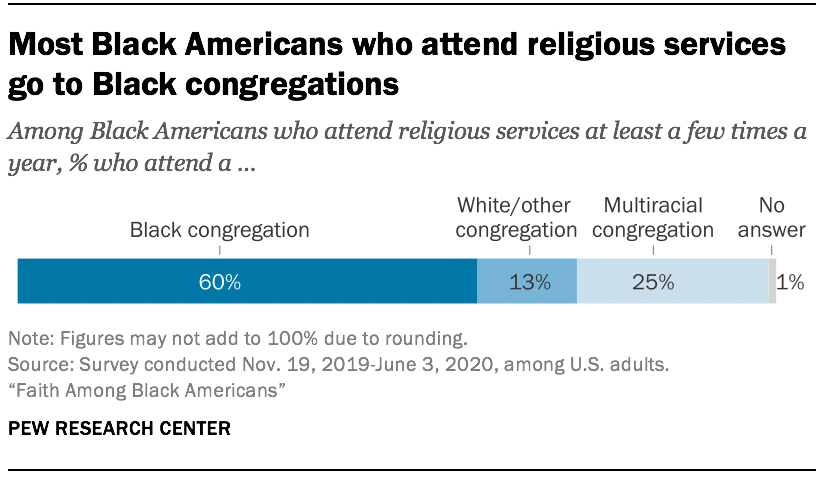
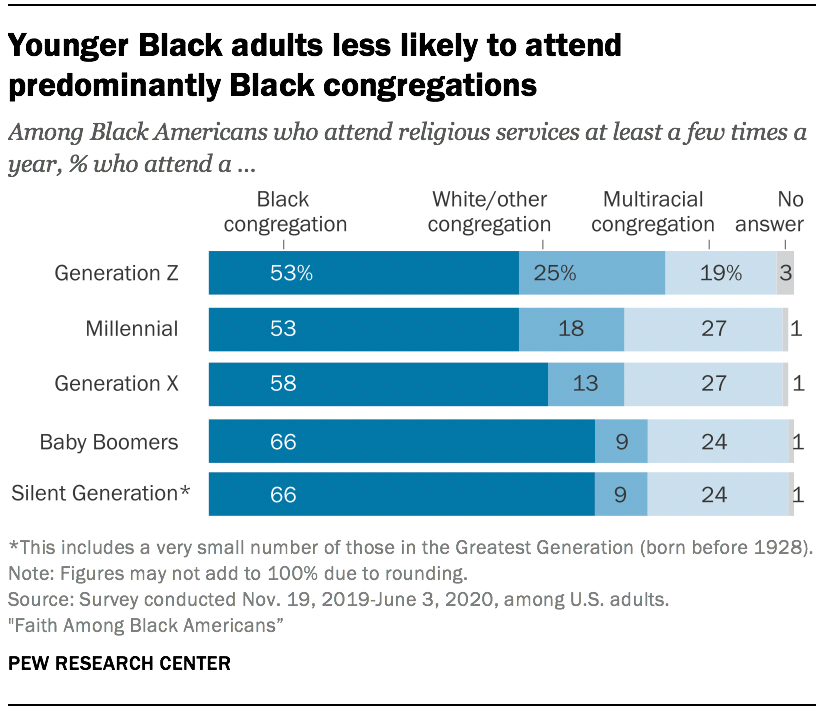
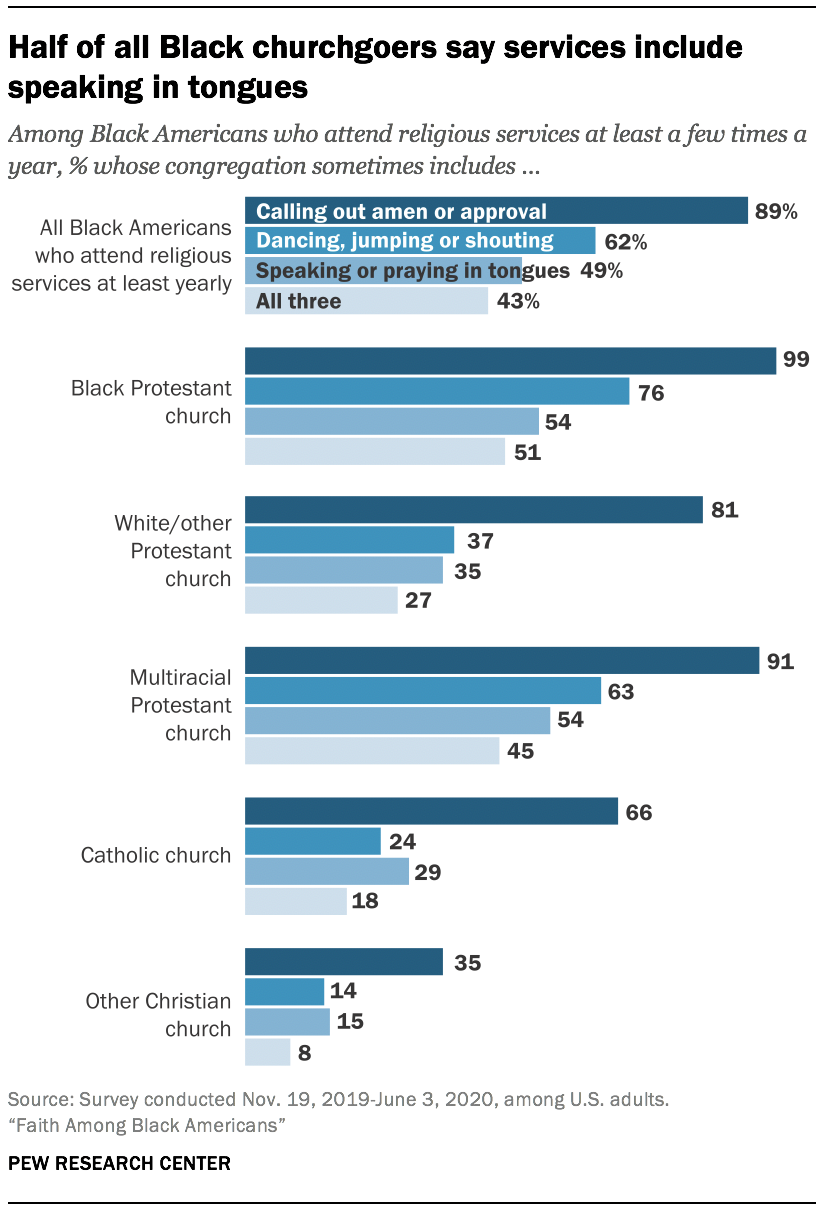
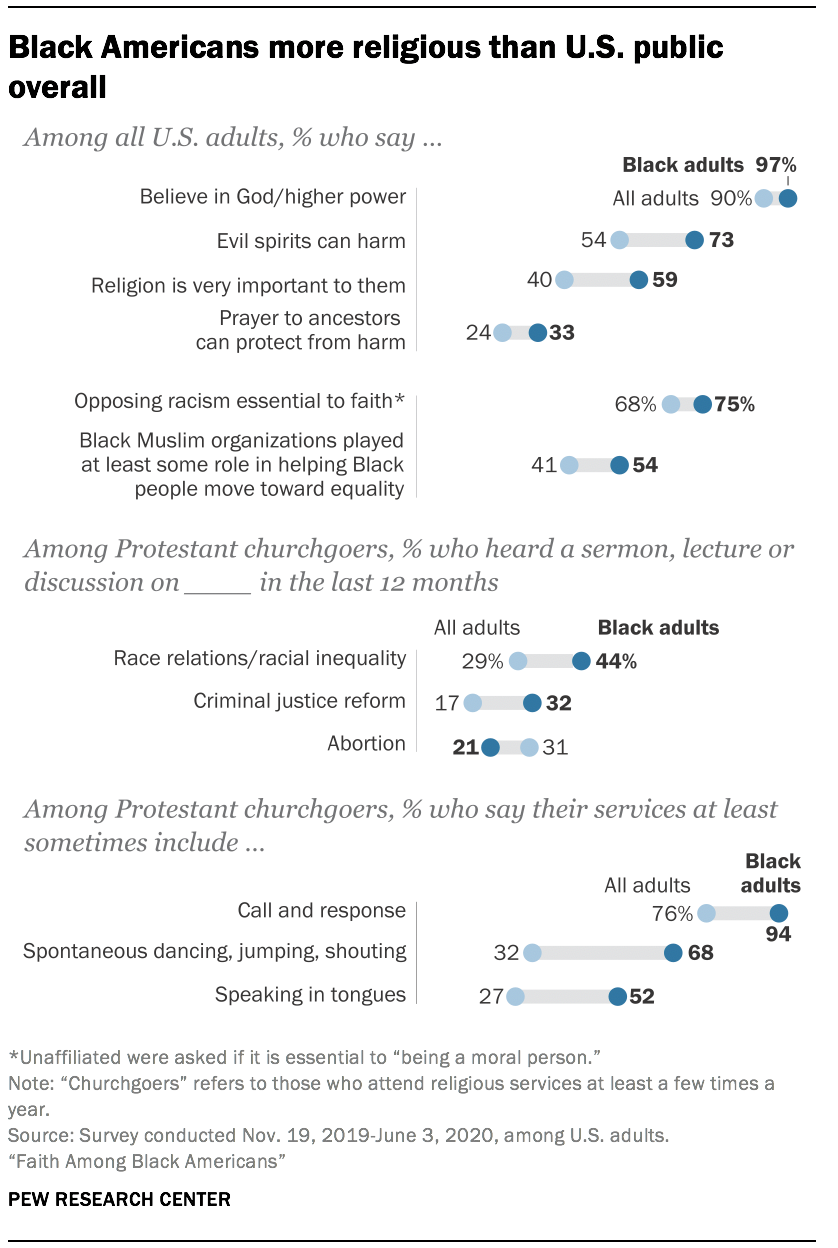
Black Americans remain more religious than other Americans, according to a massive new survey. Yet fewer are attending or seeking out predominantly black churches.

Among black worshipers:

  • 4 in 10 now attend a non-black congregation—including half of millennials and Gen Z.
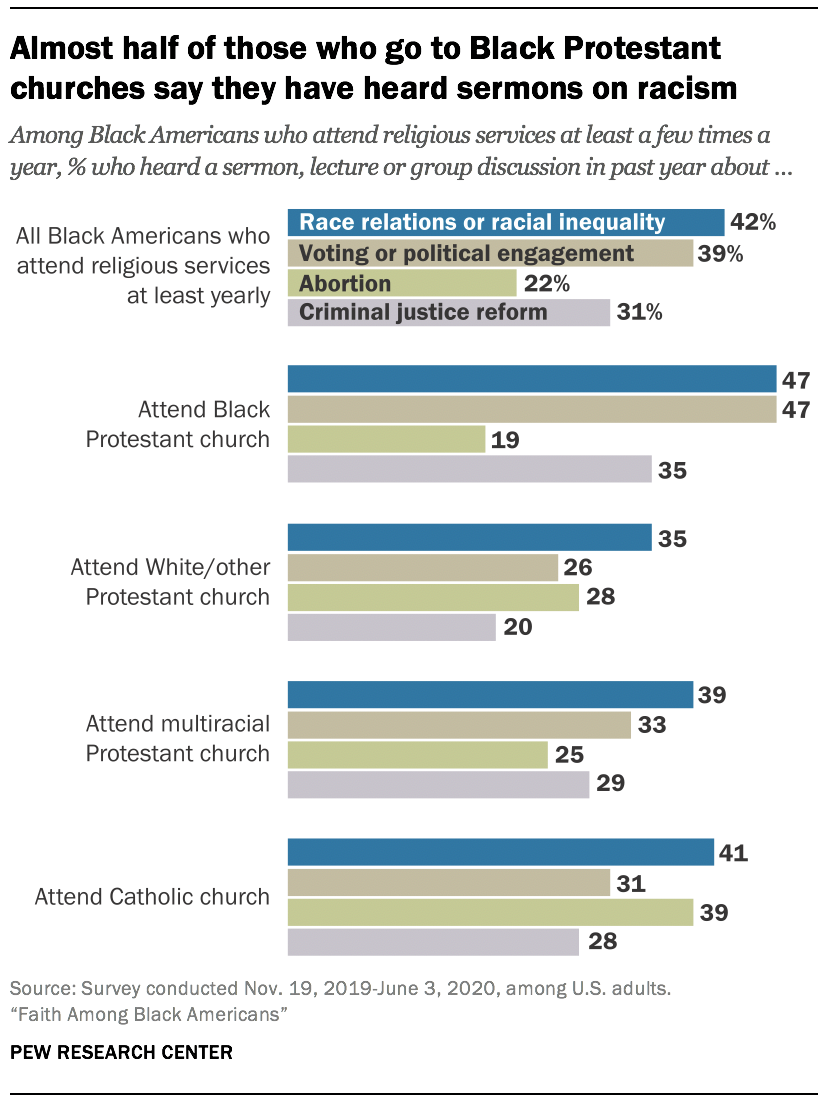
  • About half say it’s essential for churches to offer “racial affirmation or pride,” while only a quarter say sermons on political topics are essential.
  • 6 in 10 say black congregations should diversify.
  • 6 in 10 say when church shopping, finding a congregation where most attendees share their race is unimportant.

Two-thirds of black Americans identify as Protestants, but only 1 in 4 of these identify with historic black denominations.

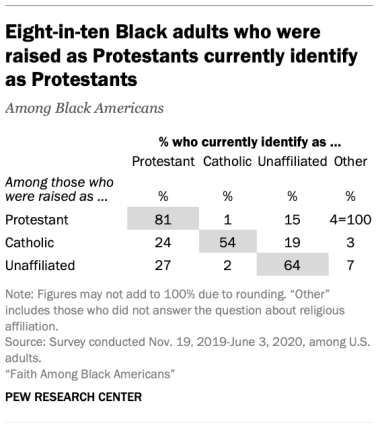
Yet retention is strong: 3 in 4 black adults have the same religious affiliation as when they were raised (significantly higher than the rate for Americans at large), while 1 in 4 black Americans who were raised as unaffiliated or as Catholic now identify as Protestant.

Note:

Pew defined

black

churches as “those where the respondent said that all or most attendees are Black and the senior religious leaders are Black.”

These are among the findings of “Faith Among Black Americans,” released today by the Pew Research Center. The study is Pew’s “most comprehensive, in-depth attempt to explore religion among Black Americans” ever, comprising both a national survey of 8,660 adults who identify as black or African American as well as guided small-group discussions and interviews with clergy.

“Many findings in this survey highlight the distinctiveness and vibrancy of Black congregations, demonstrating that the collective entity some observers and participants have called ‘the Black Church’ is alive and well in America today,” stated Pew researchers.

“But there also are some signs of decline, such as the gap between the shares of young adults and those in older generations who attend predominantly Black houses of worship.”

The fact that the black church isn’t declining as fast as the white church is not cause for celebration, says Mark Croston, national director of black church partnerships for LifeWay Christian Resources.

“An 81 percent retention rate may be a good number in business, but not for the church,” he said. “The gospel is relevant and needed in every generation. We have to make sure we are ministering it in ways that will cause it to connect with people we are missing.”

Sider and North spar over issue at Gordon-Conwell Seminary.Should Christians be pushing civil government to take an active role in the reduction of worldwide poverty? Two Christian scholars met April 6 at Gordon-Conwell Theological Seminary in South Hamilton, Massachusetts, to debate the biblical evidence of civil government’s role in relief of the poor.Ronald J. Sider, author of Rich Christians in an Age of Hunger and professor of theology and ethics at Eastern Baptist Theological Seminary in Philadelphia, charged that the biblical concept of justice demands that Christians work politically to break down the structural causes of poverty. Gary North, president of the Institute for Christian Economics and a staff member of the Chalcedon Foundation, agreed Christians do have a duty to feed the poor. But he argued that efforts should be made through the church, not civil government.Sider laid out the biblical foundation for the argument that Christians should be concerned for the poor; North agreed with his main point.The two men were far from agreement, however, on the critical question of what all that means to the church today. Sider argued that while charity and volunteerism are necessary, they are not enough in themselves. According to the prophets, he said, it is not just the individual poor person God is concerned with; it is also the social system that contributes to his poverty.The prophets Jeremiah, Ezekiel, Isaiah, and others condemn the rich for either gaining wealth by oppression and treachery or for turning a deaf ear to the cries of the poor, Sider said. God never intended there to be a wide social gap between rich and poor, he contended. The jubilee concept laid down in Leviticus is proof that “God does not want such a disadvantage.” When the Hebrews first occupied the land of Canaan, God divided the land equally, and “he wanted that arrangement to remain and to continue,” said Sider, to be sure every person “had an equal share in and means of providing wealth.” The legal return of land every 50 years to its original owner insured that equality, he noted.The jubilee underlines the biblical basis for an “institutionalized mechanism” for the relief of poverty “rather than haphazard handouts by wealthy philanthropists,” Sider claimed. The Christian’s duty then, he said, is to “demand that civil government design programs” to provide the poorer members of society with the resources they need to earn their fair share of the wealth.But North charged that the state cannot be trusted with the task of reducing poverty. Confessing he held the Puritan view in a four-centuries-old debate between Puritans and Anabaptists on this issue, North cited atrocities in American history as proving foreign aid often “leads to imperialism internationally.” Money sent to help the poor in the fields, he said, is used instead to build up urban complexes 40 stories high and to create large bureaucracies (e.g., the Bureau of Indian Affairs) where government employees end up absorbing the money intended for the poor.When Old Testament prophets came upon nations that had strayed from God’s standard, they directed rulers back to the law. The church today must do likewise, North stated. “Christians are to serve as salt,” and, he said, salt had two purposes in Bible times: it was used for flavoring and for destruction. “If we do our task well,” said North, “we’re going to replace the prevailing civil order.” Then Christians can establish a new government that would be “unquestionably geared to justice.”Meanwhile, the church is to be a model to the nation in working for the relief of the poor and hungry. Christians should tithe a tenth of their income and a portion of that should go to the alleviation of poverty.But Christians need to be freed from the tyranny of taxation so they can give more freely to charity, North continued. “And the Bible has just the solution. 1 Samuel 8 sets a limit on the amount the state can tax its people according to God’s law, at 10 percent; and that is how it should be done today.”North also challenged the idea that redistribution of the wealth would benefit the poor for more than one or two years and charged the motivating force of its proponents is envy. Envy, or “tearing down the rich just to get even,” he said, originated with Satan.Many Christians today feel guilty for having wealth, but if they are tithing, they have no reason to feel guilty, North stated. “If Christians began to tithe, they would change the face of the earth.” God blesses those who follow his law, and his law demands giving 10 percent of one’s earnings to God’s work.But the models North chose to illustrate this point raised a few eyebrows among his audience of 200 seminarians and professors. He praised the Mormons for building churches without going into debt, and Herbert Armstrong’s Worldwide Church of God for its obedience to the required tithe. Of Armstrong’s church, North said, “Look at the blessings God has given to that church. It’s incredible.”In his summary, Sider said Christians should use “reasoned, intelligent analysis” to make social changes “in light of what the Bible says we should be doing.” But North disagreed. He argued the Bible indeed is specific, and that what was good enough for the Old Testament prophets is good enough for him.The Legislative SceneAbortion Factions Skirmish Over Koop AppointmentCongressional supporters of C. Everett Koop are confident they can overcome a legislative roadblock that is threatening his appointment as U.S. surgeon general. Koop, chief surgeon at Philadelphia’s Children’s Hospital, is a well-known evangelical. Those who oppose him are doing so because of his strong stands against abortion and homosexuality, and they have found a technicality to use against him.The technicality is that Koop, 64, is six months over the age limit for the surgeon general’s job, making it necessary to pass a bill exempting him. Sen. Jesse Helms (R-N.C.) attached the legislation onto an unrelated bill (dealing with credit cards), and the Senate passed it. When it got to the House, however, Speaker Thomas P. O’Neill (D-Mass.) found an obscure procedure to strip the amendment and deposit it in the House Health and Environment Subcommittee.The chairman of that subcommittee is Henry Waxman (D-Cal.), one of the sponsors of a national gay rights bill, who differs with Koop’s conservative positions. Waxman called a subcommittee hearing to open a broad-range attack on Koop, and was further annoyed when Koop did not appear to defend himself. Waxman said last month that “Dr. Koop frightens me. He does not have a public health background, he’s dogmatically denounced those who disagree with him, and his intemperate views make me wonder about his and the administration’s judgment.”There was plenty of opposition to Koop at Waxman’s hearing. A spokesman for the American Public Health Association said that although Koop was “a distinguished pediatric surgeon,” he was untrained in public health. A spokesman for the National Gay Health Coalition said, “Koop appears to have strongly held beliefs about homosexuality which are not supported by established medical thought, practice, or science.” A spokesman for a women’s proabortion group also criticized him.Because the House passed the credit-card bill without the age exemption for Koop (as well as five other amendments the Senate added to the bill), a House-Senate conference committee, composed of members of both houses, will meet to reconcile the differences. Koop supporters hope the age exemption will be put back during the conference; if not, they have another strategy. Rep. Henry Hyde (R-Ill.) has introduced the age exemption as a separate bill. Although it has also been sent to Waxman’s subcommittee. Koop partisans hope to use a discharge petition to spring it out of the subcommittee directly to the House floor, where they believe it would pass easily. The discharge petition, however, is a cumbersome procedure that does not usually work.Carl Anderson, an assistant to Senator Helms, said, “We’ll do whatever has to be done to get this thing.Mennonites after SmoketownA Call To Move Beyond The Peace Issue To EvangelismSignals keep coming from Smoketown. This was observable at a recent Mennonite gathering in Berne, Indiana, where some 200 pastors and lay leaders talked and prayed about restoring the Mennonite tradition to a firm evangelical footing.They reaffirmed most of the concerns coming out of the so-called Smoketowr Consultation two years ago (held in Smoketown, Pennsylvania): reaffirmatior of the authority of Scripture, need for renewed evangelistic emphasis, and a reexamination of priorities, with the emphasis on the saving power of the gospel.A five-member convening group (four of them pastors) planned this second inter-Mennonite meeting, or “Consultation or Continuing Concerns,” as a way to spreac the vision of the earlier one, and to share new concerns. The meeting, in the Berne First Mennonite Church, was open to anyone, whereas Smoketown was a small, by-invitation-only gathering of about 20 pastors, educators, and lay leaders.A general feeling underlying both meetings was that Mennonite bodies have overemphasized their historic peace and social emphases at the expense of evangelism and discipleship, among other things. Several well-known Mennonite leaders echoed this in Berne, and touched on the broader issue of secularism. Some spoke to the grassroots criticism that Mennonite colleges have lost accountability to the local churches, and are being affected by liberalism.Albert Epp, Henderson, Nebraska, pastor who, with host pastor and fellow convener Kenneth Bauman of Berne serve the two largest congregations in the 60,000-member General Conference Mennonite church, opened the two-day session with a devotional, pointing out the power of prayer at Pentecost.When people become affluent or educated, warned Epp, one of the first casualties is prayer. “We have not because we ask not. Prayer can rescue the Mennonite brotherhood from shipwreck. The Holy Spirit can do in a minute what you and can’t do in a lifetime.”Theologian Myron S. Augsburger, immediate past president of Eastern Mennonite College and presently a scholar-in-residence at Princeton Theological Seminary, was concerned that “academic and cultural pseudo-sophistication not rob us of the freedom to share Christ.” Later in the meeting, speaker Benjamin Sprunger, past president of Bluffton (Ohio) College, was asked what he sees as the redeeming factor for the Mennonite church. He responded: “The Scripture speaks for ancient times, present times, and future times. Out of that presupposition we must find our way and not let that get diluted by secular and contemporary thought. We cannot ignore psychology, sociology, and science, but we cannot let those replace God’s Word.”In the third major address, moderator Vernon Wiebe of the Mennonite Brethren church praised his denomination for being “unashamedly evangelical and Anabaptist.” He noted, however, that sometimes “we have been afraid to join together in spiritual exercises. We are comfortable with relief sales, but not the study of the Word.”Eugene Witmer of Smoketown chaired the findings committee, which arrived at a list of 15 concerns. Witmer, also a convener of the Berne meeting, cited in an interview “sharp lines” of concern that prompted the meeting—for instance, the desire to address Mennonites “who place so much attention on the peace issue, but are strangely silent on abortion and alcoholism.”Conveners said attendance was about 150 percent better than expected, with many persons coming at their own expense. In many respects, the meeting mirrored developments in other denominations, where conservatives are trying to restore traditional, evangelical emphases.North American SceneParents of John W. Hinckley, Jr., the man charged with the presidential assassination attempt, made a Christian commitment in 1978. Since then they have given heavily to overseas relief and development projects, including those of World Vision. Jack Hinckley is a water resources consultant for World Vision, and reportedly had expressed concern about his son to some of the organization’s staff and requested special prayer for him.Called a devout fundamentalist Christian by acquaintances, Edward Michael Richardson, 22, of New Haven, Connecticut, was indicted last month on two counts of threatening the life of President Reagan. Federal investigators were checking similarities between Richardson’s alleged threats and a letter received by TV evangelist Jimmy Swaggart. He turned over to the FBI a note he received March 25 with the message scrawled on the back of a ministry fund-raising envelope: “Ronald Reagan will be shot to death and this country turned back to the left.”An interfaith forum was organized last month in Jefferson City, Missouri, with some observers calling it a new breakthrough for interfaith relations. Missouri leaders of 11 Protestant denominations, and four Roman Catholic bishops, announced formation of the so-called Missouri Christian Leadership Forum. Its purpose will be dialogue and possible cooperation on mutual concerns, such as issues before the Missouri legislature. The forum includes groups such as the Missouri Baptist Convention, and Catholics. The latter had refused membership in the Missouri Council of Churches, which they saw as too liberal and structured.Groups have a constitutional right to pass out literature at airports without notifying authorities in advance. So ruled the Ninth U.S. Circuit Court of Appeals last month. The court called unconstitutional a Portland, Oregon, ordinance that required groups to give one day’s notice before picketing or distributing literature at the city’s airport, and to provide names, addresses, and telephone numbers of those sponsoring the distribution. The decision reversed a U.S. District Court ruling upholding the ordinance, which was challenged by Jews for Jesus chairman Moishe Rosen. He had been arrested for violating the ordinance while distributing literature at the Portland terminal.A week of prayer emphasizing a call to national confession of sin and repentance is scheduled May 31 to June 7 as a prelude to this summer’s American Festival of Evangelism in Kansas City, Missouri. Festival spokesman Norval Hadley explained, “We are urging Christians to unite in prayer for America. We want God to help us see our condition as he sees it.” Hadley suggested churches provide opportunities for organized prayer during the week: prayer groups, prayer with sister churches, prayer partners, 24-hour prayer and fasting chains, and so on. The prayer week culminates on Pentecost Sunday, the day designated for the annual prayer effort for world evangelization sponsored by the Lausanne Comittee for World Evangelization.PersonaliaWar hero and sportsman Joe Foss was appointed international chairman of the billion-dollar evangelization campaign, Here’s Life, World, sponsored by Campus Crusade for Christ International. Foss, a Congressional Medal of Honor recipient during World War II and the first commissioner of the old American Football League, succeeds Wallace E. Johnson, cofounder of Holiday Inns, who asked to be relieved after suffering a mild heart attack last fall.Asia missions veteran Samuel H. Moffett, 65, accepted a three-year appointment as professor of ecumenics and mission at Princeton Theological Seminary. Moffett currently is vice-president of Presbyterian Seminary in South Korea, and a long-time missionary there. He has spent the last several years doing research for a book that will chronicle the history of the Christian church in East Asia.Academia: Ronald Youngblood, dean of Wheaton College Graduate School, has resigned and will join the Old Testament department at Trinity Evangelical Divinity School in Deerfield, Illinois, next fall; James Plueddemann, chairman of the school’s Christian ministries department, was named acting dean effective July 1. Gordon-Conwell Theological Seminary profesor David M. Scholer, Wheaton College and Harvard Divinity School trained, was appointed dean at 200-student Northern Baptist Theological Seminary near Chicago, succeeding Gerald Borchert, now at Southern Baptist Theological Seminary.World SceneFour out of fifteen Protestant churches in Lyon, France, have been destroyed by arson this year. The latest, a Pentecostal assembly structure that seated more than 500, was set ablaze in the early morning hours of Sunday, March 29. An outdoor baptismal service to have been held on the premises had been publicized for that evening. After the three January burnings, police increased surveillance of the evangelicals’ properties. So far they have no suspects in the acts of destruction, which evidence a common pattern of sabotage.Pope John Paul II will visit World Council of Churches headquarters in Geneva, Switzerland, next month. The June 5 visit to Philip Potter, WCC general secretary, and other council officials is the second papal visit. Pope Paul VI paid a visit to the ecumenical center in 1969.The Helsinki follow-up conference in Madrid has failed to inhibit Soviet authorities in oppression of religious believers. Orthodox priest Gleb Yakunin’s appeal of his 10-year sentence has been rejected, and presumably he has been transported from prison to a labor camp. Boris Perchatkin, a spokesman for the Pentecostal emigration movement who contacted foreign journalists in Moscow, has been sentenced to two years of labor. Eight Baptists arrested last June while operating a clandestine printing press have received sentences ranging from three to five years each, and the press has been confiscated. Keston College also reports sentences for five other believers.One in every two refugees in the world today is African. This shift may come as a surprise to many who grew accustomed to associating “refugee” with Southeast Asian “boat people.” Poul Hartling, the United Nations high commissioner for refugees, points out that Africa, with only 12 percent of the world’s population, has almost 50 percent of its refugees—some five million. Four out of five African refugees have found asylum in countries that are themselves among the least developed in the world. Host countries, says Hartling, have responded with traditional African hospitality. “The problem,” he says, “is that their hospitality is being offered from an empty table. Help from outside is crucial.”An official Protestant delegation from China took part in an Asian Christian consultation in Hong Kong last month. It was the first such visit outside the People’s Republic since the Communist takeover 32 years ago. The delegation was headed by Bishop Ding Guanxuan (K. H. Ting), president of the China Christian Council and chairman of the Three-Self Patriotic Movement (CT, Jan. 2, 1981, p. 46). Among Ding’s statements, as reported in the South China Morning Post:Only a minority of Chinese are Communists and the majority are both patriotic and theistic. Even though currently unable to meet the demand, the TSPM will not accept help in making Bibles available. The movement’s long-term policy, he said, is to enable every Protestant to own a copy of the Bible, many of which were burned during the cultural revolution. Religious broadcasts into China not approved by the TSPM would be considered unfriendly.

Most respondents were surveyed between January 21 and February 10, 2020, before COVID-19 disrupted church life and before protests against police brutality became widespread after the death of George Floyd.

Pew also surveyed 4,574 adults who do not identify as black or African American, in order to draw comparisons.

Overall, Pew found that black Americans are more likely than Americans at large to believe in God, attend religious services, say religion is “very important” in their lives, and affiliate with a religion.

Black Americans are:

  • More likely to say God talks to them (48% vs. 30%)
  • More likely to say they have a duty to convert others (51% vs. 34%)
  • More likely to say opposing racism is essential to their faith (75% vs. 68%)

Pew found that 60 percent of black churchgoers attend predominantly black congregations, while 25 percent attend a multiracial congregation and 13 percent attend a predominantly white (or Hispanic or Asian) congregation. Churchgoers who are Protestant were most likely to attend black congregations (67%), vs. those who were Catholic (17%) or of other faiths (29%).

Younger worshipers are less likely to attend black churches than older worshipers. Only half of Gen Z and millennial black worshipers (53%) attend black congregations, vs two-thirds of boomer and older black worshipers (66%). And a full 25 percent of Gen Z black worshipers attend a white (or other) congregation, while only 9 percent of boomers and older black worshipers do likewise.

“One might observe that Black churches have done well with spiritual nurturing the Black community through historic tough times and with fighting social and political injustice but not as well with pursuing an ecclesial vision for racial/ethnic inclusion,” said Antipas Harris, the president of Jakes Divinity School. “As a result, more white-led, multicultural churches are drawing Black millennials and Gen Zers into movements that do not have a clear or full vision for social and political racial conciliation necessary to transform a continued racist society into greater diversity, equity, and inclusion.”

They are well dressed, and most are professional people. These members of a house church in suburban San José, Costa Rica, sang some choruses, then moved into Bible study, and concluded with a sharing of prayer needs. Afterwards, many stayed around to discuss the movie, The Late Great Planet Earth, over sandwiches and chocolate cake in one of the group’s periodic “film forums.”

The attenders look and talk like North American evangelicals, but the group leader explains something that might break that mold. While most come from conservative and Inter-Varsity Christian Fellowship backgrounds, he explains, “it might come as a surprise to you that probably all of these people would vote for Marxist candidates in the Costa Rican elections.”

It is becoming increasingly difficult to put Latin American Christians into North American boxes. In fact, most Latin American Christians say one shouldn’t even try.

The frequently heard criticism of the church to the north is that Christians here too often judge and criticize without bothering to listen to their Latino brothers, while at the same time they are painfully ignorant of the Latin American culture and church.

Latin America Biblical Seminary professor Richard Foulkes explains, “Sometimes people from North America will just have to sit back and listen.”

Many Latin American Christians are asking how to live scriptural Christianity in difficult living situations—in countries that may have oppressive governments or thousands of poor with no chance of bettering themselves. The answers they are coming up with sometimes appear radical to those persons who, for instance, believe that the U.S. democratic and capitalist system is God-ordained, and that if it works in the U.S., it has to work in Latin America and anywhere else.

In El Salvador, an estimated 5 percent of the population own 80 percent of the land Even in Costa Rica, the most stable and affluent Central American republic, roughly 65 percent of the wage earners make less than 0 per month. In examining the options for improving such conditions, one prominent U.S. evangelical leader and long-time worker in Latin America commented, “It would be almost impossible for a U.S. missionary to work in Latin America and not become favorable toward socialism.”

Protestants in Latin America form a small minority—perhaps 25 million members. However, the church is growing: a recent survey showed that Protestant memberships in the Central American republics doubled or even tripled during the last decade. (PROCADES, a ministry of the Institute of In-depth Evangelization of Costa Rica, headed by LAM-USA associate Cliff Holland, is finishing an exhaustive study of Protestant membership in Central America. Through World Vision, PROCADES will publish English versions of its profiles of countries, which list Protestant churches, pastors, and organizations in the five Central American Republics, Panama, and Belize.)

There has been an explosion of new church bodies that are completely separate from North America mission ties. A recent survey showed 190 groups in Nicaragua, 41 of which list no U. S. or Canadian links.

At the same time, increasing tension is evident between U.S.-based missions and the churches their missionaries started. Many national churches want greater autonomy, and missionary agencies are not sure how they should (or if they should) relinquish control.

A small ad hoc committee, “Puente” (“Bridge”), composed of Latin American evangelical leaders and U.S. missions officials, functions to work through differences of this sort and to prevent conflicts of the kind that occurred in Costa Rica last January. Southern Baptists there went through a painful and messy split—some churches voting to sever all relationships with the U.S. church, and others choosing to maintain mission ties.

Generally, the grassroots Protestants in Latin America are theologically and politically conservative—explained partly in that 75 to 80 percent of Latin American Protestants are Pentecostal. (Latin Americans frequently use the term “evangelical” to describe any Protestant.) However, theologically conservative does not necessarily mean politically conservative, or vice versa.

Many pastors and churches strive to remain politically neutral, but are finding it increasingly difficult to do so because of pressures from the right and left (see p. 43). Others have felt conditions demanded their direct involvement. Believing violence the only way to halt the Somoza regime, allegedly responsible for widespread atrocities against Nicaraguans, some evangelical pastors there fought alongside the Sandinistas. Others, who did not fight, found themselves having to counsel teen-aged Christian young people who wanted to know if God would approve of them running to the mountains to join the Sandinistas. Most observers agree the revolution would not have succeeded without evangelicals’ support, and attribute the new Marxist-leaning government’s toleration, even support, of evangelical Christianity to that. At the same time, many evangelicals warn this toleration could cease when the Sandinistas no longer “need” the believers.

There are cases in which certain Latino Christians feel participation with Marxists or other non-Christian groups is the only way to present a strong enough force to fight a social or political evil. The house church members in San José, for instance, while knowing pure Marxists to be anti-God, may vote for a Marxist candidate if his election would mean improving conditions for the poor or stopping a corrupt right-winger.

In an address to a meeting of presidents of North American evangelical seminaries last January in San José, Dominican Republic educator J. Alfonso Lockward noted it is “almost impossible to avoid limited cooperation with Marxists in Latin America.” At the same time, he cautioned against evangelicals being “instrumentalized by Marxists without their knowledge.”

Lockward, a former presidential candidate in his own country, mentioned that attitudes toward political involvement among Latin American Christians range from the “ivory tower” approach (no involvement) to militant activity. He also complained that over the years, U.S. missionaries have exercised a double standard—forbidding their parishioners’ political involvement, while ardently supporting the political positions of the U.S. As an example, he cited a U.S. missionary to the Dominican Republic who became a decorated war hero in World War II, but who forbade his church members’ political action against the brutal Trujillo regime, which, Lockward asserted, committed atrocities just as awful as those by Hitler.

U.S.-based missionaries in Latin America also face difficult decisions regarding their own political involvements (or lack of them) and those of their Latino constituents. Earlier this year, at the Institute of the Spanish Language in San José—the chief language school for appointees of evangelical missions in the U.S.—missionaries encountered some of these issues. Two Mennonite college students attending the institute were ordered out of the country by the Costa Rican government; they had violated a little-used law forbidding foreigners’ political involvements by participating in a demonstration against Costa Rican and U.S. involvement in El Salvador.

Also, the murder in Colombia of Wycliffe missionary Chet Bitterman (a student at the institute just two years earlier), impressed the seriousness of the Latin situation upon many students—some of them headed for Colombia, and others, Wycliffe appointees.

The institute’s student government organized a round table discussion on the Christian’s approach to politics. While the consensus was that a missionary’s first task is presenting the gospel, several mentioned the impossibility of living isolated from one’s political context.

The missionaries realized that tough questions now facing some Latin American Christians are: When should a Christian seek to change corrupt systems, not only sinful man? Should expatriate missionaries support the cause of social justice?

Only 1 in 4 black Protestants identify with one of the eight historic denominations that compose the Conference of National Black Churches. Larger shares identify with evangelical or mainline denominations (30%) or offered a vague descriptor such as “just Baptist” or “just Pentecostal” (32%). The remainder said they were nondenominational (15%).

Among churchgoers, black Republicans are less likely than black Democrats to attend a black congregation (43% vs. 64%) and more likely to attend a white congregation (22% vs. 11%).

And while black “nones” are growing—now comprising almost 1 in 5 black adults (18%)—most of the unaffiliated still credit black churches with improving racial equality (66%) and more say that black churches have too little influence in society (35%) than too much influence (19%).

However, 6 in 10 of all black adults agree that “historically Black congregations should diversify” (61%). And those who worship at black (61%), white/other (66%), or multiracial (62%) congregations agree slightly more than those who seldom or never attend (60%).

“It is important to note that ‘multicultural’ generally means ‘monoculture with multicolors’ since most of the churches that fit this description tend to be white-led churches that have attracted blacks and not the other way around,” said Jeff Wright, the CEO of Urban Ministries.

The dominant culture’s “expectation” of “unilateral assimilation,” is something that Jacqueline Dyer, an associate professor of social work at Simmons University, has also noticed.

“I have had conversations with clergy who are noticing that in the wake of COVID-19, George Floyd and political unrest some Black church members in predominantly white churches are leaving to return to the Black Church,” she said. “The departing Black members are feeling disenfranchised.”

A continued one-way migration threatnes the gifts the black church offers not only to the black community, but to the Body of Christ as a whole, says Oneya Okuwobi, a researcher who studies the sociology of organizations, race, and religion.

“If we lose the spiritual heritage of the Black church as people and resources flow to other expressions, we will all be impoverished in the process,” said Okuwobi.

Meanwhile, 6 in 10 of all black adults agree that when church shopping, finding a new congregation where most attendees share their race would be “not too important” or “not at all important” (63%). A majority of those who worship at black congregations agree (58%), though they are less likely to do so than those who attend white/other (75%) or multiracial (69%) congregations or those who seldom or never attend (65%).

Liberation theology is at issue in school’s year of evaluation.President Carmelo Alvarez speaks almost proudly of 1981 as being “our year of evaluation.” At the invitation of the school’s board of directors, a seven-member team of theologians visited Latin America Biblical Seminary in San José, Costa Rica.This commission, selected to represent a broad spectrum of national and theological backgrounds, launched a full inspection in a week’s time. They talked with three former presidents of the school, with faculty who have recently resigned, students, and current school administrators. They are studying the school’s curriculum and facilities.Commission member Garth Rosell, academic dean of Gordon-Conwell Theological Seminary, explained there is no accrediting agency in the Latin American world, such as the Association of Theological Schools. The seminary’s board of directors therefore “is very interested in input.”Yet Rosell would be the first to admit the reasons for the study (the seminary avoids the term “investigation”) go far deeper. The school’s alleged overemphasis on so-called liberation theology has earned it sharp verbal attacks since the middle 1970s. Some observers, even former president Plutarco Bonilla (1975–78), question its academic credibility, as well as its educational slant. The school hit a financial crunch when many conservative churches withdrew their support.When the commission releases its full report next month, the many nonbinding recommendations may appear uncomplimentary to the school. Commission head Cecilio Arrastía, a Hispanic programs official with the United Presbyterian Church in the U.S.A., acknowledged “there are problems … theological problems.”Still, even many of the most severe critics assert their concern is to help the school, not hurt it. Established in 1923 by Latin America Mission founders Harry and Susan Strachan under the motto “For Christ and Latin America,” the interdenominational seminary (in Spanish, “Seminario Biblico Latinoamerica,” or SBL) for years held the reputation as providing the finest theological education for Latin American evangelicals. The school took the lead in providing pastoral training, which was taught by Latin Americans, and relevant to the Latin church and culture.But in its creditable efforts to relate theology to the troubled Latin American society, the seminary apparently upset a majority of its conservative, Protestant constituency. These grassroots evangelicals feel the seminary traded its historic emphasis on evangelism and building up the local church for a left-wing, political one.The seminary is small by North American standards—presently there are about 80 students in on-campus bachelor’s and licentiate (master’s) programs in theology, and another 100 or so in the “theological education at a distance” program. Yet its actual, and potential, influence is strong. Students come from practically all Latin American countries. The growing Latin American Protestant church needs trained leaders, and there are not all that many schools to choose from. If Latin America’s evangelical churches can’t send pastoral candidates to SBL, where can they send them?The Central American Mission’s seminary in Guatemala City is highly regarded, although some Latin theologians regard it as too conservative and dispensationalist. The U.S. Southern Baptists have seminaries in Cali, Colombia, and Buenos Aires, Argentina; the Evangelical Alliance Mission and the Evangelical Free Church of America jointly operate one in Maracay, Venezuela. If there is a criticism of these, it is that too few nationals serve on the respective faculties. The interdenominational ISEDET in Buenos Aires has top-flight academicians, but most Latin conservatives would feel uncomfortable there. One evangelical called it “the Union Seminary of Latin America.” Good Baptist, but Portuguese-language, seminaries in Brazil are also cited.But aside from these, many Latin evangelicals see only the separatist and conservative Bible institutes (many of these are tiny Pentecostal or fundamentalist schools) and liberal mainstream denominational schools. Theologian John Stam, who recently resigned from the SBL staff, sees a need for a good “third alternative,” somewhere between these conservative and liberal extremes. In his eyes, such a school would be “radical evangelical”—progressive in its approach to social issues, and evangelical in theology.Whether SBL will assume a leading role remains a question mark. Conservative evangelicals right now are skeptical. (Latin Americans frequently use the term “evangelical” to describe any Protestant.) But many do feel something can be learned by studying events there, which highlight key trends in the developing Latin American theology. A central question is: Can the Latin church address crucial social issues—such as poverty and political unrest—and at the same time be biblically sound and evangelistically active?Some missionaries and educators trace many of the school’s criticisms to North America evangelicals who do not really understand the Latin scene, and who air knee-jerk suspicions when something does not exactly fit their U.S.-formed concept of what a seminary should be and teach. Seminary officials frequently remind others that SBL is not a U.S.-owned or-operated school. It is owned and administered by an association of Latin American Christian leaders, and is responsible for its own financing and personnel.Because many North Americans think the Latin America Mission in the U.S.A. somehow controls the seminary, LAM-USA officials have spent a lot of their time denying responsibility for what goes on there. While LAM-USA missionaries may serve on the school’s faculty, the seminary functions independently of the U.S.-based mission.In 1971, the Latin America Mission was totally restructured and its many departments of ministry, including the seminary, became autonomous. Now, LAM-USA, LAM-Canada, and the seminary are among the some 25 separate entities that are members of the Community of Latin America Evangelical Ministries (CLAME).Independence from U.S.-based controls meant development of programs and ideals not always in line with those with which U.S. missioners feel comfortable. In the case of SBL, U.S. missioners became increasingly unhappy with the school’s drift toward liberation theology. The seminary rumbled through some troubled times in the middle 1970s, with ideological conflicts and numerous faculty changes.Developments to Watch in Today’s Latin ChurchSeveral trends characterize today’s church in Latin America, according to CLAME general secretary and CHRISTIANITY TODAY correspondent Paul Pretiz of San José, Costa Rica:• Continued growth of the charismatic movement, which has brought new vitality to the Roman Catholic church, and a crop of first-time Bible readers. Catholic charismatics often meet in house prayer groups, and, while many are rejected by the Catholic hierarchy, prefer keeping their Catholic identity rather than forming a Protestant one.• Sprouting of the small, grassroots worship communities, or base communities, among Catholics. There are 150,000 to 200,000 of these (an estimated 100,000 in Brazil) in Latin America. The groups have grown spontaneously, without a linking network, and generally are composed of the poor, who are reading the Bible and seeing its social implications.• Consolidation by the Catholic hierarchy, boosted by recent visits to Brazil and Mexico by the conservative Pope John Paul II. They are seeking to reaffirm traditional doctrine and bring offshoot groups “back into the fold.”• New ecumenicity among Protestants. Certain key Latin evangelicals are establishing a continent-wide fraternal body, CONELA (Consultation of Evangelicals in Latin America). They see their group as the conservatives’ alternative to the fledgling Latin American Council of Churches (CLAI) with its World Council of Churches ties. This group formed out of a meeting of 40 Latin Americans attending the 1980 Consultation on World Evangelization in Thailand. Executive secretary Marcelino Ortiz cited CONELA goals, including a transdenominational meeting in early 1982, an information network, and pastors’ retreats.• Development by local congregations of new worship models that are non-Western, and fitted to the Latin context. Experiments in evangelistic programs and theological education by extension also characterize many Protestant groups.Concerns refocused when LAM-USA decided 18 months ago no longer to endorse the seminary publicly. LAM-USA board initiated a year-long study in February 1979 to determine what should be the mission’s continuing relationship with SBL.In the report, issued a year later, LAM-USA noted its freedom to declare any of its theological or ideological differences of conviction or emphasis with the seminary. The mission also said it would continue sponsoring missionaries on the faculty. Finally, LAM-USA declared it “may also choose not to promote the SBL and to exercise its own criteria as it continues to engage in the communication of Latin American realities.”The mission communicated this report to certain key supporters and, as it has worked out in practice, said LAM-USA spokesman John Rasmussen, “we are no longer endorsing the seminary.” The mission no longer endorses the SBL in its publications, or raises funds for the school.Another recent development involves the Association of Costa Rican Bible Churches, which is composed mostly of congregations started by LAM missionaries. The association is starting its own Bible school in order to provide an alternative for the majority of the association’s 56 churches who do not support the seminary, said association administrator and LAM-USA missionary Bill Brown.Also, the resignation of Professor Stam shocked many observers, because Stam had identified so closely with the seminary’s push for a theological slant that more closely identified with the Latin American context.Stam, a professor at the school for 24 years, emphasized in an interview that his resignation was not meant as a statement against the seminary’s theological stance. Rather, he wanted to devote more time to grassroots pastoral work in Costa Rica and Nicaragua, as well as teach religion at the National University in Heredia, Costa Rica.However, he did admit his resignation was intended as an “alarm clock” for those who would allow the seminary to drift farther from its evangelical moorings.He also noted questions about lifestyle, such as standards now allowing students at the seminary to smoke, even though many conservative Latin churches would never accept a pastor who smoked and feel this would be the “kiss of death” to a student’s ministry. Stam’s resignation is one of at least five by faculty members who left during the past year for a variety of reasons.Richard Foulkes, who heads the seminary’s department of Bible and Christian thought, and his wife, Irene, Greek professor and director of the theological education “at a distance” program, are the last LAM-USA missionaries on contract with the seminary. LAM-USA associate Thomas Hanks teaches Old Testament there apart from his duties with a student ministry, but without a contract. He resigned from the faculty six years ago in disgust over a cutback in Bible courses, but stayed on, while working to strengthen and add to those that are offered. Mennonites Laverne and Harriett Rusch-man are the only other North Americans on a full-time staff of 14.Richard Foulkes and Hanks, while they agree certain evangelical doctrines have been neglected at SBL, presently intend to stay at the seminary and see it through its crisis period. They praise the school’s efforts to relate to crucial social issues in Latin America. They would not agree with all the views of certain liberation theologians on the faculty, but affirm the professors are evangelicals.One professor who left, Kenneth Mulholland, cautions North Americans against judging the school through their own filters. “This isn’t the old modernist controversy like we had in the U.S.,” he said.Mulholland, who left SBL last August for Columbia (South Carolina) Graduate School of Bible and Missions, believes all staff members affirm “classical, evangelical theology,” and would not quarrel with such key doctrines as the Virgin Birth. In fact, SBL in 1974 approved a conservative faith statement, “Affirmation of Faith and Commitment,” for its faculty. But what sets certain Latin scholars apart from others, Mulholland says, is their areas of emphasis.At the seminary right now, the main emphasis is social ethics, Mulholland believes. Problems come if an emphasis like this distorts biblical doctrines, such as the nature of man, he said.Liberation theologians with a Marxist slant “view man as inherently good, and corrupted by social structures, while Christians view man as fallen, and with evil proceeding from the inside out. Structures only magnify that evil,” he noted.He believes the seminary could “turn itself around” with renewed commitment to evangelism and the local church. “If those concerns came pressing in, with the school’s biblical evangelical heritage, it could regain the balance it has lost.”Questions about SBL always gravitate back to the so-called liberation theology, since this is the subject on which many believe it has gone off the deep end.Liberation theology works generally from identification with the poor, oppressed, and alleged victims of exploitative societies. Because the term means different things to different people, a better term is said to be “theologies of liberation.” Latin theologians often call it Latin American theology, calling it the first attempt since the early church to develop a systematic theology outside the European context.Evangelicals rebut those liberation theologians who view Christ as a political messiah, and who use Marxist thought as the starting point for their ideology. Most cite as redeeming factors its emphasis on faith practice, and its push to better the plight of the poor.Protestant treatments of liberation theology are found in: J. Andrew Kirk’s Liberation Theology: An Evangelical View from the Third World (John Knox, 1980); Orlando Costas’s The Church and Its Mission: A Shattering Critique from Ihe Third World (Tyndale, 1975); Carl E. Annerding’s Evangelicals and Liberation (Baker, 1977); Robert McAfee Brown’s Theology in a New Key: Responding to Liberation Theologies (Westminster Press, 1978); chapters from Tensions in Contemporary Theology, edited by Stanley Gundry and Alan F. Johnson (Moody Press. 1979); and the W. Dayton Roberts article in ct. Oct. 19. 1979. “Where Has Liberation Theology Gone Wrong?”Seminary professor Hanks, for instance, believes the emphasis on the poor is a key issue that North American evangelicals are ignoring. He says North Americans generally blame poverty on “underdevelopment,” or a person’s laziness or lack of education. However, he cites more than 120 biblical texts naming “oppression” as the cause of poverty. The church’s responsibility is locating those sources of oppression, and then denouncing them in the mode of the biblical prophets, he believes.The central complaint against SBL has been its alleged overemphasis on the left-wing political aspects of liberation theology, and a weak and flawed theological perspective on the subject.George Taylor, who left the seminary last December to accept a teaching post at Northern Baptist Theological Seminary near Chicago, says the seminary is right in teaching liberation theology. Such teaching is needed in the Third World because of its “identification with the poor,” he said. However, Taylor, a Panamanian who taught for 18 years at the seminary and was its interim president in 1974–75, adds that “maybe I was not in agreement with its heavy emphasis on politics.” He believes poverty must be addressed in the political arena, as well as the theological, but that the seminary now gives greater emphasis to the political aspect.Former seminary president Bonilla criticized the trends of the seminary more blatantly. Bonilla, a native of the Canary Islands who resigned last year from the faculty but is teaching a preaching course there without a contract, says the faculty and students are wrapped up in “political sloganism.” The theological course work has been diluted so much that the school lacks academic respectability, he asserts.Bonilla adds: “It seems to me that justification by faith is no longer one of the main themes at the seminary. I’m not saying the faculty don’t believe it, but they take for granted the theology and ignore it. The courses in theology are very weak.”Foulkes sees his continued role at the seminary as “keeping the biblical content high.” He laments the loss of Stam, a skilled New Testament theologian, but he is optimistic about the skills of new faculty members brought in to fill recent vacancies. He relies on Hanks to provide expertise in the Old Testament courses. Hanks complains of a “brain drain” of Latin American scholars; some of the most talented Latin theologians accept teaching posts in the States, such as Taylor, and Orlando Costas (whose resignation from the seminary in the middle 1970s over the liberal drift created tensions that some seminary sources say are still felt).Hanks and Foulkes both agree the seminary should attune students to the political realities of Latin America. Hanks did note problems can result if impressionable students get a one-sided view in the process. He describes a hypothetical SBL student as one who may be a new Christian and “may have read the Book of John and not much else.” The student may attend one class under an outspoken liberation theologian at SBL, and also classes at the University of Costa Rica (as many SBL students do) under a Marxist professor. With no counterbalancing explanations, before long the student “doesn’t know where he’s at,” Hanks notes.SBL president Alvarez, from Puerto Rico and the Disciples of Christ, says, “We want to help students understand what is going on in their own countries,” adding that the seminary can’t tell anyone what to believe.Alvarez, 33, a doctoral candidate in church history who has done graduate study in the U.S., criticizes North American Christians as “playing the church business and not taking seriously what it means to proclaim the kingdom.”People close to the seminary cite the election of a successor to Alvarez—whose three-year term expires in November—as crucial to the seminary’s future, and are hoping for a conservative evangelical. Former president Bonilla said he was asked to seek the post but turned it down because the seminary faculty “don’t show a willingness to change.”The seven-member commission’s report may provide direction to the seminary’s board. The team—not all members being conservative evangelicals by North American definition—has divided the work, each member focusing on a certain aspect of SBL. Besides Arrastia and Rosell, team members include Thomas Liggett, president of Christian Theological Seminary (Disciples of Christ) in Indianapolis; SBL alumni Julia Esquivel of Guatemala and Rodrigo Zapata of Ecuador (with HCJB in Quito); Aníbal Guzmán, a Bolivian Methodist; and Francis Ringer, of Lancaster (Pa.) Theological Seminary (United Church of Christ).When the team reports back to the SBL board with its full report in late June, commission head Arrastia hopes the results will be given a good hearing. The idea was that the report be used for SBL’s long-range planning through the next 10 to 15 years.Hanging in the balance, he says, is whether SBL “stays an evangelical seminary, or takes the full route of liberation theology.”GuatemalaGuatemalan Pastors: Between A Rock And A Hard PlaceThe Guatemalan pastors interviewed by CHRISTIANITY TODAY asked that their names be withheld for their personal safety.“We are trapped between right-wing and left-wing terrorists,” reported Guatemalan pastors recently. “Please ask Christians all over the world to pray for Guatemala, and for the believers here.”Violence has stained this emerald green Central American republic many times in its 160-year history. But rarely did the violence become as savage and sustained as it has during the current right-left battle for domination. Up to 25 violent deaths are reported daily in the national press, and many citizens believe the toll may be greater.Leaders of the Guatemalan evangelical church have tried to maintain a neutral position in the current political shooting match. But neither side seems content with the evangelicals’ neutrality.“First the leftist guerrillas come and want us to give them food and information, or they ask to use our church buildings for political meetings,” said one pastor. “If we refuse, they accuse us of supporting the right-wing terrorists. Then the rightists come and ask us for information or want us to preach against the leftists. If we don’t cooperate with them, they accuse us of defending the leftist guerrillas.”When a church leader does give in to the pressures, he is immediately marked by the other side for harassment, threatening letters and phone calls, or death. One informed source reported that three lay pastors were killed in Huehuetenango in late January. The same source also said that up to 10 local church leaders died violently during the first two months of 1981. Specific figures are hard to secure because some deaths have occurred in isolated indigenous areas, and local people are afraid to report the deaths because of possible reprisals.A climate of violent revenge has moved into some sections of the country and is a factor in many killings. An assassin will eliminate a client’s personal enemy for as little as . Some pastors have received anonymous threatening letters, presumably from disgruntled church members, which alarm them and their families.In other cases, right or left elements engage in “cleaning the record” operations. If any citizen has in the past belonged to or participated in political movements of either stripe, his adversaries may eliminate him for past actions, no matter what his current political attitude may be. Scores of Guatemalans have been shot in such “cleaning” operations. Church leaders who learn that their names are on a cleaning list will often leave the country hastily.Rightist officials are attempting to bring evangelicals into government programs to reunite Guatemala’s people. There is, however, the fear that joining such a program may create a leftist backlash against the evangelical church.Meanwhile, and in spite of the tension, churches are full. One pastor related, “We are seeing a harvest of conversions. The situation has awakened interest in the gospel, and people are coming to Christ.”“Christ is the only solution for Guatemala,” he went on. “As people repent of their hate and fear, and are reconciled by the Lord, they become new creatures.”Evangelist Luis Palau carried out a nationwide mass media crusade in Guatemala during April, using radio, television, newspapers, and thousands of specially prepared booklets.

“If most Black Americans say these congregations should diversify and the race of other attendees isn’t a top priority to them, what leads so many Black Americans to attend predominantly Black congregations?” stated Pew researchers. “The survey indicates that Black congregations are distinctive in numerous ways beyond just their racial makeup.

“Sermons are a prime example: Black Americans who attend Black Protestant churches are more likely to say they hear messages from the pulpit about certain topics—such as race relations and criminal justice reform—than are Black Protestant churchgoers who attend multiracial, White or other race churches.”

Despite these sermons, in the wake of the pandemic and last year’s racial injustice protests, “it became clearer that, while the black church still has a role, it is no longer the driving force for social justice,” said Harris, who also serves as associate pastor at the Potter's House of Dallas. “The onslaught of economic crises and the increase of food deserts challenged mere food pantries and homeless dinners and Saturday lunches. There is a need for a new model of doing church to sustain the essence of the black church spiritual, social and political involvement in social transformation.”

Although church teachings actively address racial injustice, “Protestants who go to Black congregations are somewhat less likely than others to have recently heard a sermon, lecture or group discussion about abortion,” stated Pew researchers.

They are well dressed, and most are professional people. These members of a house church in suburban San José, Costa Rica, sang some choruses, then moved into Bible study, and concluded with a sharing of prayer needs. Afterwards, many stayed around to discuss the movie, The Late Great Planet Earth, over sandwiches and chocolate cake in one of the group’s periodic “film forums.”

The attenders look and talk like North American evangelicals, but the group leader explains something that might break that mold. While most come from conservative and Inter-Varsity Christian Fellowship backgrounds, he explains, “it might come as a surprise to you that probably all of these people would vote for Marxist candidates in the Costa Rican elections.”

It is becoming increasingly difficult to put Latin American Christians into North American boxes. In fact, most Latin American Christians say one shouldn’t even try.

The frequently heard criticism of the church to the north is that Christians here too often judge and criticize without bothering to listen to their Latino brothers, while at the same time they are painfully ignorant of the Latin American culture and church.

Latin America Biblical Seminary professor Richard Foulkes explains, “Sometimes people from North America will just have to sit back and listen.”

Many Latin American Christians are asking how to live scriptural Christianity in difficult living situations—in countries that may have oppressive governments or thousands of poor with no chance of bettering themselves. The answers they are coming up with sometimes appear radical to those persons who, for instance, believe that the U.S. democratic and capitalist system is God-ordained, and that if it works in the U.S., it has to work in Latin America and anywhere else.

In El Salvador, an estimated 5 percent of the population own 80 percent of the land Even in Costa Rica, the most stable and affluent Central American republic, roughly 65 percent of the wage earners make less than 0 per month. In examining the options for improving such conditions, one prominent U.S. evangelical leader and long-time worker in Latin America commented, “It would be almost impossible for a U.S. missionary to work in Latin America and not become favorable toward socialism.”

Protestants in Latin America form a small minority—perhaps 25 million members. However, the church is growing: a recent survey showed that Protestant memberships in the Central American republics doubled or even tripled during the last decade. (PROCADES, a ministry of the Institute of In-depth Evangelization of Costa Rica, headed by LAM-USA associate Cliff Holland, is finishing an exhaustive study of Protestant membership in Central America. Through World Vision, PROCADES will publish English versions of its profiles of countries, which list Protestant churches, pastors, and organizations in the five Central American Republics, Panama, and Belize.)

There has been an explosion of new church bodies that are completely separate from North America mission ties. A recent survey showed 190 groups in Nicaragua, 41 of which list no U. S. or Canadian links.

At the same time, increasing tension is evident between U.S.-based missions and the churches their missionaries started. Many national churches want greater autonomy, and missionary agencies are not sure how they should (or if they should) relinquish control.

A small ad hoc committee, “Puente” (“Bridge”), composed of Latin American evangelical leaders and U.S. missions officials, functions to work through differences of this sort and to prevent conflicts of the kind that occurred in Costa Rica last January. Southern Baptists there went through a painful and messy split—some churches voting to sever all relationships with the U.S. church, and others choosing to maintain mission ties.

Generally, the grassroots Protestants in Latin America are theologically and politically conservative—explained partly in that 75 to 80 percent of Latin American Protestants are Pentecostal. (Latin Americans frequently use the term “evangelical” to describe any Protestant.) However, theologically conservative does not necessarily mean politically conservative, or vice versa.

Many pastors and churches strive to remain politically neutral, but are finding it increasingly difficult to do so because of pressures from the right and left (see p. 43). Others have felt conditions demanded their direct involvement. Believing violence the only way to halt the Somoza regime, allegedly responsible for widespread atrocities against Nicaraguans, some evangelical pastors there fought alongside the Sandinistas. Others, who did not fight, found themselves having to counsel teen-aged Christian young people who wanted to know if God would approve of them running to the mountains to join the Sandinistas. Most observers agree the revolution would not have succeeded without evangelicals’ support, and attribute the new Marxist-leaning government’s toleration, even support, of evangelical Christianity to that. At the same time, many evangelicals warn this toleration could cease when the Sandinistas no longer “need” the believers.

There are cases in which certain Latino Christians feel participation with Marxists or other non-Christian groups is the only way to present a strong enough force to fight a social or political evil. The house church members in San José, for instance, while knowing pure Marxists to be anti-God, may vote for a Marxist candidate if his election would mean improving conditions for the poor or stopping a corrupt right-winger.

In an address to a meeting of presidents of North American evangelical seminaries last January in San José, Dominican Republic educator J. Alfonso Lockward noted it is “almost impossible to avoid limited cooperation with Marxists in Latin America.” At the same time, he cautioned against evangelicals being “instrumentalized by Marxists without their knowledge.”

Lockward, a former presidential candidate in his own country, mentioned that attitudes toward political involvement among Latin American Christians range from the “ivory tower” approach (no involvement) to militant activity. He also complained that over the years, U.S. missionaries have exercised a double standard—forbidding their parishioners’ political involvement, while ardently supporting the political positions of the U.S. As an example, he cited a U.S. missionary to the Dominican Republic who became a decorated war hero in World War II, but who forbade his church members’ political action against the brutal Trujillo regime, which, Lockward asserted, committed atrocities just as awful as those by Hitler.

U.S.-based missionaries in Latin America also face difficult decisions regarding their own political involvements (or lack of them) and those of their Latino constituents. Earlier this year, at the Institute of the Spanish Language in San José—the chief language school for appointees of evangelical missions in the U.S.—missionaries encountered some of these issues. Two Mennonite college students attending the institute were ordered out of the country by the Costa Rican government; they had violated a little-used law forbidding foreigners’ political involvements by participating in a demonstration against Costa Rican and U.S. involvement in El Salvador.

Also, the murder in Colombia of Wycliffe missionary Chet Bitterman (a student at the institute just two years earlier), impressed the seriousness of the Latin situation upon many students—some of them headed for Colombia, and others, Wycliffe appointees.

The institute’s student government organized a round table discussion on the Christian’s approach to politics. While the consensus was that a missionary’s first task is presenting the gospel, several mentioned the impossibility of living isolated from one’s political context.

The missionaries realized that tough questions now facing some Latin American Christians are: When should a Christian seek to change corrupt systems, not only sinful man? Should expatriate missionaries support the cause of social justice?

The disparity between teaching social justice issues and theological-biblical teachings related to abortion and human sexuality is “concerning,” said Jamal-Dominique Hopkins, associate professor of religion and dean of Dickerson-Green Theological Seminary.

“This suggests that predominantly black churches focus less on Christian doctrine and spiritual formation and more on social justice issues. The two should not be mutually exclusive.”

“The Black Church does well in preaching about ‘big’ issues of race, criminal justice, and economic disparities,” said Quonekuia Day, an instructor of Old Testament and biblical Hebrew at Gordon-Conwell Theological Seminary. “However, issues that impact the individual and families (which eventually impact the community), such as abortion, mental health, domestic violence against women and men, do not receive adequate attention.”

Beyond particular sermon topics, many black churches also boast a “distinctive atmosphere for worship.” A full 9 in 10 black Americans who attend services at least yearly say their congregation includes “calling out Amen or approval” (89%). Then 6 in 10 say there is dancing, jumping, or shouting; 5 in 10 say there is speaking in tongues; and 4 in 10 say all three take place.

“Taken as a whole, about half of congregants who attend Black Protestant churches [51%] report that the services they attend feature all three of these practices at least some of the time, compared with roughly a quarter of Black Protestants in White or other race churches [27%] and 18% of Black Catholics,” stated researchers.

According to Pew’s small-group discussions, researchers noted, “Black Americans suggest that these distinctive characteristics may be more important than the churches’ racial makeup itself for explaining the continued appeal of these congregations.”

In addition to these distinctive characteristics, Okuwobi has observed that black congregants in multiethnic churches are more likely to experience racial discrimination, feel as though they have to give up parts of their racial/ ethnic identity to fit in, and struggle to build relationships.

“I’ve seen Black congregants retreating to ethnic affinity spaces where they can express their pain in a supportive community. This retreat has occurred as congregants consider leaving their multiracial churches for Black ones or have created Black spaces either within the multiracial church or on their own,” said Okuwobi. “…If younger generations continue to increasingly attend white and multiracial churches, pastors and leaders have a responsibility to make these congregations places of safety for them. Likewise, pastors and leaders of Black churches will have to make room for their leadership to attract and retain them.”

The stickiness of these particular characteristics will be tested in the coming years. Most of Pew’s research was conducted prior to the pandemic and the George Floyd protests. Harris believes that the pandemic will hurt long-term local church attendance and that millennials and Gen Z’s close relationship with technology will encourage people who do engage, to do so remotely.

But Vince Bantu, assistant professor of church history and black church studies at Fuller Seminary, believes that the events of the last year will lead to an opposite outcome.

“This study demonstrates that the Black Church is one of the most under-utilized resources in the Body of Christ,” he said. “Since the rise of the COVID pandemic and the heightened attention given to racial injustice, many members of the Black community that previously left the Black Church are beginning to come back. I think this is because the balanced preaching of the Black Church focusing on biblical truth and justice are an encouraging resource for all members of the Body of Christ.”

Liberation theology is at issue in school’s year of evaluation.President Carmelo Alvarez speaks almost proudly of 1981 as being “our year of evaluation.” At the invitation of the school’s board of directors, a seven-member team of theologians visited Latin America Biblical Seminary in San José, Costa Rica.This commission, selected to represent a broad spectrum of national and theological backgrounds, launched a full inspection in a week’s time. They talked with three former presidents of the school, with faculty who have recently resigned, students, and current school administrators. They are studying the school’s curriculum and facilities.Commission member Garth Rosell, academic dean of Gordon-Conwell Theological Seminary, explained there is no accrediting agency in the Latin American world, such as the Association of Theological Schools. The seminary’s board of directors therefore “is very interested in input.”Yet Rosell would be the first to admit the reasons for the study (the seminary avoids the term “investigation”) go far deeper. The school’s alleged overemphasis on so-called liberation theology has earned it sharp verbal attacks since the middle 1970s. Some observers, even former president Plutarco Bonilla (1975–78), question its academic credibility, as well as its educational slant. The school hit a financial crunch when many conservative churches withdrew their support.When the commission releases its full report next month, the many nonbinding recommendations may appear uncomplimentary to the school. Commission head Cecilio Arrastía, a Hispanic programs official with the United Presbyterian Church in the U.S.A., acknowledged “there are problems … theological problems.”Still, even many of the most severe critics assert their concern is to help the school, not hurt it. Established in 1923 by Latin America Mission founders Harry and Susan Strachan under the motto “For Christ and Latin America,” the interdenominational seminary (in Spanish, “Seminario Biblico Latinoamerica,” or SBL) for years held the reputation as providing the finest theological education for Latin American evangelicals. The school took the lead in providing pastoral training, which was taught by Latin Americans, and relevant to the Latin church and culture.But in its creditable efforts to relate theology to the troubled Latin American society, the seminary apparently upset a majority of its conservative, Protestant constituency. These grassroots evangelicals feel the seminary traded its historic emphasis on evangelism and building up the local church for a left-wing, political one.The seminary is small by North American standards—presently there are about 80 students in on-campus bachelor’s and licentiate (master’s) programs in theology, and another 100 or so in the “theological education at a distance” program. Yet its actual, and potential, influence is strong. Students come from practically all Latin American countries. The growing Latin American Protestant church needs trained leaders, and there are not all that many schools to choose from. If Latin America’s evangelical churches can’t send pastoral candidates to SBL, where can they send them?The Central American Mission’s seminary in Guatemala City is highly regarded, although some Latin theologians regard it as too conservative and dispensationalist. The U.S. Southern Baptists have seminaries in Cali, Colombia, and Buenos Aires, Argentina; the Evangelical Alliance Mission and the Evangelical Free Church of America jointly operate one in Maracay, Venezuela. If there is a criticism of these, it is that too few nationals serve on the respective faculties. The interdenominational ISEDET in Buenos Aires has top-flight academicians, but most Latin conservatives would feel uncomfortable there. One evangelical called it “the Union Seminary of Latin America.” Good Baptist, but Portuguese-language, seminaries in Brazil are also cited.But aside from these, many Latin evangelicals see only the separatist and conservative Bible institutes (many of these are tiny Pentecostal or fundamentalist schools) and liberal mainstream denominational schools. Theologian John Stam, who recently resigned from the SBL staff, sees a need for a good “third alternative,” somewhere between these conservative and liberal extremes. In his eyes, such a school would be “radical evangelical”—progressive in its approach to social issues, and evangelical in theology.Whether SBL will assume a leading role remains a question mark. Conservative evangelicals right now are skeptical. (Latin Americans frequently use the term “evangelical” to describe any Protestant.) But many do feel something can be learned by studying events there, which highlight key trends in the developing Latin American theology. A central question is: Can the Latin church address crucial social issues—such as poverty and political unrest—and at the same time be biblically sound and evangelistically active?Some missionaries and educators trace many of the school’s criticisms to North America evangelicals who do not really understand the Latin scene, and who air knee-jerk suspicions when something does not exactly fit their U.S.-formed concept of what a seminary should be and teach. Seminary officials frequently remind others that SBL is not a U.S.-owned or-operated school. It is owned and administered by an association of Latin American Christian leaders, and is responsible for its own financing and personnel.Because many North Americans think the Latin America Mission in the U.S.A. somehow controls the seminary, LAM-USA officials have spent a lot of their time denying responsibility for what goes on there. While LAM-USA missionaries may serve on the school’s faculty, the seminary functions independently of the U.S.-based mission.In 1971, the Latin America Mission was totally restructured and its many departments of ministry, including the seminary, became autonomous. Now, LAM-USA, LAM-Canada, and the seminary are among the some 25 separate entities that are members of the Community of Latin America Evangelical Ministries (CLAME).Independence from U.S.-based controls meant development of programs and ideals not always in line with those with which U.S. missioners feel comfortable. In the case of SBL, U.S. missioners became increasingly unhappy with the school’s drift toward liberation theology. The seminary rumbled through some troubled times in the middle 1970s, with ideological conflicts and numerous faculty changes.Developments to Watch in Today’s Latin ChurchSeveral trends characterize today’s church in Latin America, according to CLAME general secretary and CHRISTIANITY TODAY correspondent Paul Pretiz of San José, Costa Rica:• Continued growth of the charismatic movement, which has brought new vitality to the Roman Catholic church, and a crop of first-time Bible readers. Catholic charismatics often meet in house prayer groups, and, while many are rejected by the Catholic hierarchy, prefer keeping their Catholic identity rather than forming a Protestant one.• Sprouting of the small, grassroots worship communities, or base communities, among Catholics. There are 150,000 to 200,000 of these (an estimated 100,000 in Brazil) in Latin America. The groups have grown spontaneously, without a linking network, and generally are composed of the poor, who are reading the Bible and seeing its social implications.• Consolidation by the Catholic hierarchy, boosted by recent visits to Brazil and Mexico by the conservative Pope John Paul II. They are seeking to reaffirm traditional doctrine and bring offshoot groups “back into the fold.”• New ecumenicity among Protestants. Certain key Latin evangelicals are establishing a continent-wide fraternal body, CONELA (Consultation of Evangelicals in Latin America). They see their group as the conservatives’ alternative to the fledgling Latin American Council of Churches (CLAI) with its World Council of Churches ties. This group formed out of a meeting of 40 Latin Americans attending the 1980 Consultation on World Evangelization in Thailand. Executive secretary Marcelino Ortiz cited CONELA goals, including a transdenominational meeting in early 1982, an information network, and pastors’ retreats.• Development by local congregations of new worship models that are non-Western, and fitted to the Latin context. Experiments in evangelistic programs and theological education by extension also characterize many Protestant groups.Concerns refocused when LAM-USA decided 18 months ago no longer to endorse the seminary publicly. LAM-USA board initiated a year-long study in February 1979 to determine what should be the mission’s continuing relationship with SBL.In the report, issued a year later, LAM-USA noted its freedom to declare any of its theological or ideological differences of conviction or emphasis with the seminary. The mission also said it would continue sponsoring missionaries on the faculty. Finally, LAM-USA declared it “may also choose not to promote the SBL and to exercise its own criteria as it continues to engage in the communication of Latin American realities.”The mission communicated this report to certain key supporters and, as it has worked out in practice, said LAM-USA spokesman John Rasmussen, “we are no longer endorsing the seminary.” The mission no longer endorses the SBL in its publications, or raises funds for the school.Another recent development involves the Association of Costa Rican Bible Churches, which is composed mostly of congregations started by LAM missionaries. The association is starting its own Bible school in order to provide an alternative for the majority of the association’s 56 churches who do not support the seminary, said association administrator and LAM-USA missionary Bill Brown.Also, the resignation of Professor Stam shocked many observers, because Stam had identified so closely with the seminary’s push for a theological slant that more closely identified with the Latin American context.Stam, a professor at the school for 24 years, emphasized in an interview that his resignation was not meant as a statement against the seminary’s theological stance. Rather, he wanted to devote more time to grassroots pastoral work in Costa Rica and Nicaragua, as well as teach religion at the National University in Heredia, Costa Rica.However, he did admit his resignation was intended as an “alarm clock” for those who would allow the seminary to drift farther from its evangelical moorings.He also noted questions about lifestyle, such as standards now allowing students at the seminary to smoke, even though many conservative Latin churches would never accept a pastor who smoked and feel this would be the “kiss of death” to a student’s ministry. Stam’s resignation is one of at least five by faculty members who left during the past year for a variety of reasons.Richard Foulkes, who heads the seminary’s department of Bible and Christian thought, and his wife, Irene, Greek professor and director of the theological education “at a distance” program, are the last LAM-USA missionaries on contract with the seminary. LAM-USA associate Thomas Hanks teaches Old Testament there apart from his duties with a student ministry, but without a contract. He resigned from the faculty six years ago in disgust over a cutback in Bible courses, but stayed on, while working to strengthen and add to those that are offered. Mennonites Laverne and Harriett Rusch-man are the only other North Americans on a full-time staff of 14.Richard Foulkes and Hanks, while they agree certain evangelical doctrines have been neglected at SBL, presently intend to stay at the seminary and see it through its crisis period. They praise the school’s efforts to relate to crucial social issues in Latin America. They would not agree with all the views of certain liberation theologians on the faculty, but affirm the professors are evangelicals.One professor who left, Kenneth Mulholland, cautions North Americans against judging the school through their own filters. “This isn’t the old modernist controversy like we had in the U.S.,” he said.Mulholland, who left SBL last August for Columbia (South Carolina) Graduate School of Bible and Missions, believes all staff members affirm “classical, evangelical theology,” and would not quarrel with such key doctrines as the Virgin Birth. In fact, SBL in 1974 approved a conservative faith statement, “Affirmation of Faith and Commitment,” for its faculty. But what sets certain Latin scholars apart from others, Mulholland says, is their areas of emphasis.At the seminary right now, the main emphasis is social ethics, Mulholland believes. Problems come if an emphasis like this distorts biblical doctrines, such as the nature of man, he said.Liberation theologians with a Marxist slant “view man as inherently good, and corrupted by social structures, while Christians view man as fallen, and with evil proceeding from the inside out. Structures only magnify that evil,” he noted.He believes the seminary could “turn itself around” with renewed commitment to evangelism and the local church. “If those concerns came pressing in, with the school’s biblical evangelical heritage, it could regain the balance it has lost.”Questions about SBL always gravitate back to the so-called liberation theology, since this is the subject on which many believe it has gone off the deep end.Liberation theology works generally from identification with the poor, oppressed, and alleged victims of exploitative societies. Because the term means different things to different people, a better term is said to be “theologies of liberation.” Latin theologians often call it Latin American theology, calling it the first attempt since the early church to develop a systematic theology outside the European context.Evangelicals rebut those liberation theologians who view Christ as a political messiah, and who use Marxist thought as the starting point for their ideology. Most cite as redeeming factors its emphasis on faith practice, and its push to better the plight of the poor.Protestant treatments of liberation theology are found in: J. Andrew Kirk’s Liberation Theology: An Evangelical View from the Third World (John Knox, 1980); Orlando Costas’s The Church and Its Mission: A Shattering Critique from Ihe Third World (Tyndale, 1975); Carl E. Annerding’s Evangelicals and Liberation (Baker, 1977); Robert McAfee Brown’s Theology in a New Key: Responding to Liberation Theologies (Westminster Press, 1978); chapters from Tensions in Contemporary Theology, edited by Stanley Gundry and Alan F. Johnson (Moody Press. 1979); and the W. Dayton Roberts article in ct. Oct. 19. 1979. “Where Has Liberation Theology Gone Wrong?”Seminary professor Hanks, for instance, believes the emphasis on the poor is a key issue that North American evangelicals are ignoring. He says North Americans generally blame poverty on “underdevelopment,” or a person’s laziness or lack of education. However, he cites more than 120 biblical texts naming “oppression” as the cause of poverty. The church’s responsibility is locating those sources of oppression, and then denouncing them in the mode of the biblical prophets, he believes.The central complaint against SBL has been its alleged overemphasis on the left-wing political aspects of liberation theology, and a weak and flawed theological perspective on the subject.George Taylor, who left the seminary last December to accept a teaching post at Northern Baptist Theological Seminary near Chicago, says the seminary is right in teaching liberation theology. Such teaching is needed in the Third World because of its “identification with the poor,” he said. However, Taylor, a Panamanian who taught for 18 years at the seminary and was its interim president in 1974–75, adds that “maybe I was not in agreement with its heavy emphasis on politics.” He believes poverty must be addressed in the political arena, as well as the theological, but that the seminary now gives greater emphasis to the political aspect.Former seminary president Bonilla criticized the trends of the seminary more blatantly. Bonilla, a native of the Canary Islands who resigned last year from the faculty but is teaching a preaching course there without a contract, says the faculty and students are wrapped up in “political sloganism.” The theological course work has been diluted so much that the school lacks academic respectability, he asserts.Bonilla adds: “It seems to me that justification by faith is no longer one of the main themes at the seminary. I’m not saying the faculty don’t believe it, but they take for granted the theology and ignore it. The courses in theology are very weak.”Foulkes sees his continued role at the seminary as “keeping the biblical content high.” He laments the loss of Stam, a skilled New Testament theologian, but he is optimistic about the skills of new faculty members brought in to fill recent vacancies. He relies on Hanks to provide expertise in the Old Testament courses. Hanks complains of a “brain drain” of Latin American scholars; some of the most talented Latin theologians accept teaching posts in the States, such as Taylor, and Orlando Costas (whose resignation from the seminary in the middle 1970s over the liberal drift created tensions that some seminary sources say are still felt).Hanks and Foulkes both agree the seminary should attune students to the political realities of Latin America. Hanks did note problems can result if impressionable students get a one-sided view in the process. He describes a hypothetical SBL student as one who may be a new Christian and “may have read the Book of John and not much else.” The student may attend one class under an outspoken liberation theologian at SBL, and also classes at the University of Costa Rica (as many SBL students do) under a Marxist professor. With no counterbalancing explanations, before long the student “doesn’t know where he’s at,” Hanks notes.SBL president Alvarez, from Puerto Rico and the Disciples of Christ, says, “We want to help students understand what is going on in their own countries,” adding that the seminary can’t tell anyone what to believe.Alvarez, 33, a doctoral candidate in church history who has done graduate study in the U.S., criticizes North American Christians as “playing the church business and not taking seriously what it means to proclaim the kingdom.”People close to the seminary cite the election of a successor to Alvarez—whose three-year term expires in November—as crucial to the seminary’s future, and are hoping for a conservative evangelical. Former president Bonilla said he was asked to seek the post but turned it down because the seminary faculty “don’t show a willingness to change.”The seven-member commission’s report may provide direction to the seminary’s board. The team—not all members being conservative evangelicals by North American definition—has divided the work, each member focusing on a certain aspect of SBL. Besides Arrastia and Rosell, team members include Thomas Liggett, president of Christian Theological Seminary (Disciples of Christ) in Indianapolis; SBL alumni Julia Esquivel of Guatemala and Rodrigo Zapata of Ecuador (with HCJB in Quito); Aníbal Guzmán, a Bolivian Methodist; and Francis Ringer, of Lancaster (Pa.) Theological Seminary (United Church of Christ).When the team reports back to the SBL board with its full report in late June, commission head Arrastia hopes the results will be given a good hearing. The idea was that the report be used for SBL’s long-range planning through the next 10 to 15 years.Hanging in the balance, he says, is whether SBL “stays an evangelical seminary, or takes the full route of liberation theology.”GuatemalaGuatemalan Pastors: Between A Rock And A Hard PlaceThe Guatemalan pastors interviewed by CHRISTIANITY TODAY asked that their names be withheld for their personal safety.“We are trapped between right-wing and left-wing terrorists,” reported Guatemalan pastors recently. “Please ask Christians all over the world to pray for Guatemala, and for the believers here.”Violence has stained this emerald green Central American republic many times in its 160-year history. But rarely did the violence become as savage and sustained as it has during the current right-left battle for domination. Up to 25 violent deaths are reported daily in the national press, and many citizens believe the toll may be greater.Leaders of the Guatemalan evangelical church have tried to maintain a neutral position in the current political shooting match. But neither side seems content with the evangelicals’ neutrality.“First the leftist guerrillas come and want us to give them food and information, or they ask to use our church buildings for political meetings,” said one pastor. “If we refuse, they accuse us of supporting the right-wing terrorists. Then the rightists come and ask us for information or want us to preach against the leftists. If we don’t cooperate with them, they accuse us of defending the leftist guerrillas.”When a church leader does give in to the pressures, he is immediately marked by the other side for harassment, threatening letters and phone calls, or death. One informed source reported that three lay pastors were killed in Huehuetenango in late January. The same source also said that up to 10 local church leaders died violently during the first two months of 1981. Specific figures are hard to secure because some deaths have occurred in isolated indigenous areas, and local people are afraid to report the deaths because of possible reprisals.A climate of violent revenge has moved into some sections of the country and is a factor in many killings. An assassin will eliminate a client’s personal enemy for as little as . Some pastors have received anonymous threatening letters, presumably from disgruntled church members, which alarm them and their families.In other cases, right or left elements engage in “cleaning the record” operations. If any citizen has in the past belonged to or participated in political movements of either stripe, his adversaries may eliminate him for past actions, no matter what his current political attitude may be. Scores of Guatemalans have been shot in such “cleaning” operations. Church leaders who learn that their names are on a cleaning list will often leave the country hastily.Rightist officials are attempting to bring evangelicals into government programs to reunite Guatemala’s people. There is, however, the fear that joining such a program may create a leftist backlash against the evangelical church.Meanwhile, and in spite of the tension, churches are full. One pastor related, “We are seeing a harvest of conversions. The situation has awakened interest in the gospel, and people are coming to Christ.”“Christ is the only solution for Guatemala,” he went on. “As people repent of their hate and fear, and are reconciled by the Lord, they become new creatures.”Evangelist Luis Palau carried out a nationwide mass media crusade in Guatemala during April, using radio, television, newspapers, and thousands of specially prepared booklets.
How can such a small country have such immense problems? That is a question of observers who are trying to understand the complex situation in El Salvador. The Central American nation of 4.5 million has experienced tremendous upheaval and no little bloodletting in recent months.There are civilian and military leaders struggling for control within the current government, leftist elements that would like to overthrow that government, and appeals being made from both sides—the leftists and the government—for popular support. Sadly, many of the people they would profess to help are being killed.U.S. officials estimate 10,000 people were killed last year, most of them by members of that nation’s security forces acting on behalf of rightists. People also are victimized by violence from guerrillas. The result is that literally thousands of Salvadorians are fleeing the country, or living there in fear (see below).But as is often the case in troubled nations, the Christian church has grown. The small Protestant population, about 150,000 or 3 percent, is having an impact on the society—even on some of its leaders.At least three of the four members of the ruling civilian-military junta have had Bible study and prayer with their staffs. Junta president José Duarte, a graduate of Notre Dame University and close friend of its president, Theodore M. Hesburgh, and Col. Jaime Gutiérrez, junta vice-president and representative of the military, reportedly have made evangelical professions of faith. Duarte and José Morales Ehrlich, a liberal Christian Democrat who heads the country’s agrarian reform programs, have met on occasion with Assemblies of God and independent Baptist missionaries. (Little publicized is the report that former president Romero and his wife made professions of faith with evangelical pastors just prior to their ouster from the country.)Current Protestant growth indicates something of a revival. For instance, churches affiliated with Central American Mission (now CAM International) boast of a 30 percent growth rate during the past year, compared to a 4 percent increase the year before.Converts are coming from all levels of society. One CAM pastor describes the guerrilla who entered his office holding a beat-up tract he had been reading. The man said, “I’ve been in the field for eight months, and I have no peace in my heart. I would like to know more about Jesus Christ.” A number of army officers and soldiers also reportedly have made professions of faith and been baptized in churches in the capital city.Pentecostal churches probably make the biggest impact in El Salvador, if for no other reason than numbers. The Assemblies of God has an estimated 75,000 members, or half the Protestant population. Other large Protestant groupings include independent Baptists, United Pentecostals, Apostolic Pentecostals, and the CAM churches. All are evangelical and conservative.Other signs that the Salvadorian church is surviving—even thriving—despite the nation’s turmoil:• An especially active San Salvador Baptist church reports a membership of 200 university students and over 100 professionals, along with a strong evangelistic outreach.• More than 169,000 people were contacted, and 60,000 professions of faith made during last year’s Here’s Life program of Campus Crusade. That campaign continues, with decisions reported weekly.• Assemblies of God evangelist Jorge Raschke from Puerto Rico attracted more than 80,000 people to the national stadium in San Salvador last November. In his April rally in Santa Ana, more than 70,000 people came. Raschke mixed fervent evangelism with a healing ministry, and numerous healings were noted—even reportedly documented cases of filling of teeth with silver.• Christian literature is booming. An Assemblies of God literature missionary says sales are up 600 percent over last year. The Bible Society sells Bibles as fast as it can stock them.• Churches are getting involved in education. The Assemblies of God have created a school system in San Salvador, which enrolls more than 5,000 children, mostly from poor homes. The Baptists and CAM churches also have school systems, which enroll some 15,000 to 20,000 additional students.• An evangelical university of El Salvador is in formation and now ready to open its doors. The faculty includes Christian doctors, engineers, agronomists, and other professionals who will teach courses in their specialities. The government and general public greeted the university beginnings with enthusiasm.Because of the violence and social upheaval, the churches have entered into relief activities and are looked to for more leadership in this area. The interdenominational group CESAD (Evangelical Salvadorian Committee for Relief and Development) was organized about two years ago to foster rural and agricultural projects, but the worsening situation forced it into mostly refugee work.CESAD has sought to aid the more than 300,000 people that have been temporarily displaced at one time or another by the fighting. The committee provides food, clothing, medicines, and spiritual counsel. Its policy is to help anyone who does not bear arms.In its struggle to find enough funds to carry out its responsibility, CESAD has obtained assistance from several U.S. missions, including the Christian Reformed church, the Southern Baptist Foreign Mission Board, the Missouri Synod Lutherans, the Mennonite Central Committee, and World Vision.CESAD was originally slated to receive funds from Church World Service (,000 during this year, according to the correspondence CESAD has in its files). CESAD was cut off from assistance by the National Council of Churches agency when (according to informed sources) it refused to become politically active against the present government.The North American missionary presence has dropped more than 75 percent during the past year in El Salvador. The Assemblies of God, American Baptists, Christian Reformed, and many independent missionaries have been withdrawn. Interviews with these missionaries showed that few left voluntarily, but did so because mission boards under pressure from their constituencies ordered them to return home.Some ministries have suffered or stopped because of the violence. An Assemblies of God pastor who had a successful farm cooperative was killed by Marxists who apparently felt he undercut their support among the people. Two young Pentecostal evangelists carrying electric megaphones were mistakenly shot by police who thought they were political terrorists. A Campus Crusade volunteer worker disappeared during an evangelistic campaign in a village. A Baptist pastor and three youths were kidnapped by a leftist group. Other pastors report visits from leftist organizers who demand they join up or be killed.Several large evangelical churches in San Salvador have been forced by leftist elements to give up their morning offerings on threat of their buildings being burned. Whole congregations have fled the villages of heaviest fighting and have relocated elsewhere. Sources indicate that a few pastors and lay people (primarily from the American Baptist-related church) have been arrested or forced to flee the country by the government because of alleged involvement with the Marxists. Overall, most evangelical churches are reluctant to support the left since a disciplined core of Marxists controls it.Generally, the political wranglings are too complex even for seasoned observers to understand. What the thousands of poor campesinos (or farm laborers) do know is violence and unrest; the churches are finding out that many would rather know Christ. Under difficult conditions, the churches are being called on to provide a ministry for both the physical and the spiritual needs.RefugessThe Salvadorians’ Agony Spills Over Into HondurasThe refugee situation on the Honduras border was escalating daily last month as thousands of Salvadorians continued to flee their country. In the wake of the ongoing political and military conflict in El Salvador, some 40,000 peasants and day laborers have already entered Honduras and are scattered along the border in scanty camps and numerous villages.In an effort to assess the needs of the refugees, the World Relief Corporation of the National Association of Evangelicals visited the border area with an inspection team headed by Jerry Ballard, executive director. Ministers of the Honduran government invited World Relief’s reactions and suggestions for solving the growing refugee crisis.On April 2, the inspection team entered the border town of Colomoncagua. Nearby, 300 refugees had just arrived from El Salvador. Fleeing their country by night, these refugees traveled as many as 21 days to reach safety. In personal interviews, the refugees reported that some of their homes and possessions were burned and entire families caught in mortar attacks. Food was scarce and some people had not eaten for three days.One father, who was holding his dead five-month-old baby in the middle of the huddled group of refugees, represented the countless personal tragedies. In contrast to the grieving father was a mother who had given birth to a child the night before, just 200 feet inside the Honduran border.Andy Bishop, World Relief overseas ministry official, said at the border. “Prompt recognition of the problem and action by the Honduran government, the United Nations High Commissioner for Refugees, and voluntary agencies have averted a disaster.”U.S. officials estimate there are 75,000 to 80,000 refugees living in various camps inside El Salvador. These are operated by the government, the Red Cross, and the Catholic church. United Nations official Ingemar Cederberg told a reporter that the UN is aware of the presence of about 50,000 Salvadorian refugees in various parts of Central America, but that there could be three times that many.MARY WHITMER
addApple PodcastsDown ArrowDown ArrowDown Arrowarrow_left_altLeft ArrowLeft ArrowRight ArrowRight ArrowRight Arrowarrow_up_altUp ArrowUp ArrowAvailable at Amazoncaret-downCloseCloseellipseEmailEmailExpandExpandExternalExternalFacebookfacebook-squarefolderGiftGiftGooglegoogleGoogle KeephamburgerInstagraminstagram-squareLinkLinklinkedin-squareListenListenListenChristianity TodayCT Creative Studio Logologo_orgMegaphoneMenuMenupausePinterestPlayPlayPocketPodcastprintremoveRSSRSSSaveSavesaveSearchSearchsearchSpotifyStitcherTelegramTable of ContentsTable of Contentstwitter-squareWhatsAppXYouTubeYouTube