News

A World Vision Employee Is Still Awaiting Fair Trial in Israel

The charges against him don’t make sense. And his day in court has been delayed again and again.

Illustration by Kume Pather

Every day, at least once and sometimes more, Khalil el-Halabi logs on to Twitter and posts pictures, videos, and appeals on behalf of his son Mohammad.

Tagging people he believes might come to his aid—human rights lawyers, politicians, and journalists—he calls for justice and mercy. On January 4, he posted, “To our Israeli neighbours. My son will be brought to court for the 154th time Tuesday facing a charge he has not committed without any credible evidence.”

He closed the tweet with a quote from Amos 5:24: “Let justice roll down like waters, and righteousness like an ever-flowing stream.”

Khalil’s son Mohammad el-Halabi is the former Gaza director for World Vision International. He was arrested by Israeli authorities in 2016 on allegations of aiding terrorists by diverting millions of dollars from the evangelical humanitarian aid group to arm militants in Gaza—charges Mohammad el-Halabi, still employed at World Vision as a zonal manager, adamantly denies.

After more than four years, Halabi is still awaiting justice. He hasn’t had the chance to defend himself or even see much of the evidence against him. Human rights experts with the United Nations say Halabi has also been denied access to his lawyer and tortured. His case is causing consternation among politicians and legal experts and has cast a cloud over evangelical organizations doing charitable work in Gaza and the West Bank.

“World Vision has not seen any credible evidence supporting the charges,” said Kevin Jenkins, World Vision International’s president and CEO, in a statement immediately after the arrest. “None of the allegations against Mohammad el-Halabi have been tested in an open court, and we support the ongoing presumption of his innocence.”

Halabi was hired as a program director in 2006. The Palestinian became one of the approximately 150 employees serving nearly 40,000 children in Gaza, where the evangelical aid organization had worked since 1975. For the next decade, Halabi managed a variety of programs, focusing on everything from helping fishermen increase their household income to organizing classes for children.

A father of five, Halabi felt an extra passion for projects to keep children safe and make them feel valued. That work was especially challenging given patterns of domestic abuse in the region and the dangers of the ongoing conflicts between Gaza and Israel.

“The most rewarding part is when we manage to restore the smiles of children,” Halabi told World Vision in 2014. “Today I met the children whose houses were totally demolished and lost at least one of their beloved people, yet they are singing for peace in one of World Vision’s Child Friendly Spaces, which is unbelievable.”

Halabi was made regional director in 2014, amid an intense bout of fighting that destroyed more than 12,000 homes and killed more than 550 Gazan children.

“Anyone who visited Gaza saw his humanitarian heart,” his father told CT. “They could see how loved he was by the community.”

In his first year as regional director, the UN recognized him as a “humanitarian hero” and World Vision honored him as “humanitarian of the year.”

Israeli government officials claim that the whole time, Halabi was working for Hamas, the Palestinian Islamist political organization and militant group. Officials allege Halabi was infiltrating World Vision for access to international funds, and when he became director, he diverted millions of dollars from children in need to militants intent on attacking Israel.

Halabi was arrested in June 2016 while crossing a border between a Hamas-controlled area and Israel. An unnamed senior official with Israel’s internal security service told The New York Times that Halabi stole $40 to $50 million, giving the money to build a Hamas military base and sending food to Islamist fighters.

The allegations are baffling, according to World Vision. As regional director, Halabi didn’t have signing authority for more than $15,000. And over the course of 10 years, World Vision’s cumulative operating budget in Gaza was about $22.5 million, so it wouldn’t have been possible to misappropriate twice that amount in less than two years.

An independent forensic audit commissioned by World Vision did not find any irregularities in the Gaza budget. Additional reporting from the US Agency for International Development (USAID) and the Australian and German governments corroborated the results of the audit, finding no evidence of diverted funds.

In fact, a World Vision spokesperson said the independent audit showed “substantial evidence to the contrary, showing how Mohammad worked to ensure World Vision avoided improper interactions with Hamas.”

Nonetheless, World Vision has suspended operations in Gaza until further notice, and Halabi is still imprisoned, enduring endless delays and deferrals.

Maher Hanna, Halabi’s attorney, claims that Halabi was questioned for 50 days after his arrest without access to legal representation.

During that time, Hanna said, he was deprived of sleep and hung from a ceiling, which the International Committee of the Red Cross defines as torture.

Once Hanna started representing Halabi, the lawyer faced a labyrinthian legal process and unnecessary impediments, ranging from the poor translations of court documents to lack of access to critical evidence. The courts require that he receive permission from security officials to review evidence, and his requests are frequently denied.

The Israeli Justice Ministry said the protocol has been put in place because of “considerations related to the security of the state” and there is “no alternative.”

The treatment of Halabi has drawn sharp criticism from human rights advocates. A panel of experts at the Office of the UN High Commissioner for Human Rights issued a strongly worded statement that said treatment of the World Vision director is “not worthy of a democratic state.”

The experts called for Israel to either finish trying Halabi or release him.

Law professor Michael Lynk, one of the experts who contributed to the statement, said, “It may well be that the Israeli government is ready for prosecution and has a justifiable case to bring to trial.” But the authorities need to make their case in court.

“One would…expect full display of the evidence,” Lynk said, and “that the trial is going to be open—or at least open to the fullest extent possible—so that the public can know that what’s going on in the proceedings, that they are fair and compliant with the basic protections that any rule-of-law country would offer to its citizens.”

French human rights expert Agnès Callamard, who also contributed to the statement, said she has grave concern for Halabi’s well-being. She said she is not attacking Israel, but is insisting the state live up to its own standards.

“Israel is duty bound to apply the human rights conventions it has adopted and ratified,” Callamard said. “Our plea is simply that Israel uphold its own laws—its own obligations to fair trial and the other applicable standards. That is not a political message. It is a call for justice to be upheld.”

In the meantime, Halabi continues to sit in prison. His case has dragged on, with more than 150 trial hearings, mostly held in private. And World Vision’s Gaza projects are still out of operation.

For some critics of humanitarian aid to Palestinians, the case is evidence that World Vision is anti-Israel. The Gatestone Institute, a controversial conservative US think tank, has accused the evangelical organization of being part of a “jihad against Israel,” claiming World Vision did not care about the “needs of poor Israeli-Jewish children.”

Another group, the staunchly pro-Israel NGO Monitor, claimed World Vision had a Palestinian agenda and that the organization was “encouraging or at least condoning terrorism and incitement” in the region.

World Vision denies these charges and said it “strongly condemns any act of terrorism or support for those activities.” The charges against Halabi haven’t been proven, but World Vision also opposes the activity he is accused of, condemning “any diversion of aid funding.”

Until the trial is concluded, however, World Vision’s work in Gaza will remain on hold.

This saddens Michael Lassiter, a World Vision supporter who lives in Dallas. For him, the politics get in the way of the real issue. “No matter your perspective on Israel-Palestine, you have to be on the side of Gaza’s children,” Lassiter said, “who are growing up in desperate need of support, assistance, and compassion.”

He would like to sponsor a child in Gaza, but said he would need to know he could trust the sponsorship organization the way he trusts World Vision.

“But because of politics and accusations, Jesus’ love can’t reach people in places like Gaza right now,” he said, “and that’s a real shame.”

A World Vision spokesperson declined to comment for this article, saying the organization has heard Halabi’s trial will happen soon.

Khalil el-Halabi prays that is the case.

“I and my family trust and believe that Mohammad’s case will be ended,” he said, “and the Israeli democratic state will apologize to Mohammad about the hurt they caused to him.”

Until then, Khalil “appeals to evangelical Christians and all believers and people of faith—even the Jews and Israeli peoples” to stand with his son.

In the end, he said, “God knows that justice will win.”

Ken Chitwood is a writer and scholar of global religion living in Germany.

News

Christian Lawyers Fight COVID-19 Home Evictions

At legal aid clinics, attorneys ask “Who would Jesus represent in court?”

Illustration by Chris Gash

Ken Liu reads the Bible like an attorney. When Proverbs 31:9 says to “defend the rights of the poor and needy” and Psalm 82:3 says to “uphold the cause of the poor and oppressed,” he hears the Scriptures addressing lawyers like him.

“God really calls us attorneys specifically to serve the poor,” said Liu, director of Christian Legal Aid, a branch of the Christian Legal Society. “So many of the causes of poverty are legal issues…. In this country, lawyers have a monopoly on providing legal services. If we don’t help, no one else can.”

Liu is one of hundreds of lawyers in more than 60 clinics across the country who are motivated by their belief in Jesus and their understanding of the Bible to give their time and skill to minister in the justice system.

The clinics in the Christian Legal Aid network represent people who cannot afford market-rate legal representation, which averages $100–$400 per hour in the US. The Christian lawyers offer pro bono or “low bono” help, often with sliding-scale fees determined by what a client can afford.

Some of the clinics focus on helping immigrants and refugees. Vineyard Immigrant Counseling Service outside Columbus, Ohio, for example, focuses on defending people seeking asylum and immigrants who were brought to the US as children. Immigrant Hope, in Clifton, New Jersey, helps with naturalization, petitions, permanent resident card applications, and renewals, providing legal services in Spanish, Turkish, Arabic, Albanian, and Portuguese.

But the crisis that Christian legal aid clinics were bracing for at the start of 2021 was the eviction of poor people from their homes, as pandemic-related moratoriums protecting struggling renters started to disappear.

“COVID has taken an already-compromised situation for tenants and made it just untenable,” said Al Johnson, director of New Covenant Legal Services in St. Louis.

Since the start of the pandemic, a national eviction crisis has been held at bay by a patchwork of local, state, and federal measures protecting renters. Tenants who were behind on rent because of COVID-19 were allowed to stay in their homes—temporarily.

Experts predict as many as 12.4 million Americans could face eviction when the legal protections expire.

“It’s just a deteriorating situation,” Johnson said. “The minute those moratoriums are lifted, people are going to go out on the street.”

Even with the moratoriums in place, Johnson’s legal aid clinic has been busy throughout the pandemic, helping clients whose landlords misunderstood or ignored government orders. In St. Louis, they fought landlords who tried to start court-ordered evictions early, intimidated renters into leaving their homes, or simply locked out residents without warning. Some are already suing their tenants for back rent.

Most of the tenants cannot afford legal representation. St. Louis sees an average of about 50 people facing eviction every week, Johnson said, many unrepresented.

The legal help can make a huge difference. A 2001 study of New York City’s housing court found that 51 percent of unrepresented tenants lost their cases, while only 22 percent of represented tenants lost theirs.

In some civil cases, attorneys are not allowed to represent their clients; a pro bono lawyer can only make sure a client has properly filled out paperwork and knows as much as possible about the laws and technicalities that the judge will consider.

But all the coaching in the world can’t replace a law degree or courtroom experience, Johnson said. When attorneys are allowed to represent their clients in court, it’s only a fair fight if both sides have one.

Winning the court case is the goal, Liu said, but he hopes people find even more at Christian clinics. Many of the clients also need someone to talk to, maybe even pray with. Many are hurt and wounded in ways that a successful court case won’t fix.

“The legal problems are typically just the tip of the iceberg,” Liu said. “We see ourselves as the urgent care clinic down the street that sees people before they have to go to the hospital.”

When it’s time to go to court, the lawyers’ goal is to make sure that injustice is not heaped on top of clients’ mounting burdens.

Poor people face a lot of hurdles in the justice system, and the coronavirus has added more. Johnson said his clients, for example, now have to attend some court hearings over Zoom, and many don’t have the stable internet, quiet space, or technology to telecommute to court for a high-stakes hearing. One of his clients recently had to call into a Zoom meeting by phone from the car where she was living. Such circumstances are simply not conducive to fair outcomes, Johnson argued.

“This is where our mettle is being tested,” said Katina Werner, executive director of Christian Legal Collaborative Inc. in Sylvania, Ohio, near Toledo.

Werner recently found herself standing outside a hospital window to serve as a witness while her client signed documents inside. She had to get creative, she said, because the hospital was telling her that because of COVID-19 restrictions, the patient would have to sign without an attorney present to answer questions about the document.

While she understands the need to keep people safe from the virus, Werner said, those protocols cannot come at the expense of people’s legal rights. As a Christian and a lawyer, she has to find ways to protect people who are vulnerable to exploitation.

“Normal rules don’t apply [during COVID-19], but we have to do some problem solving,” she said.

As COVID-19 restrictions shift and change in response to the pandemic, vulnerable people are often forgotten or made more vulnerable. For Johnson, protecting clients like these is just what it means to follow Jesus. He says he knows many haven’t seen this kind of work as a priority for the church, but he hopes that will change.

He wants to see more Christians follow Jesus, who said in Luke 4:18, “The Spirit of the Lord is on me, because he has anointed me to proclaim good news to the poor. He has sent me to proclaim freedom for the prisoners and recovery of sight for the blind, to set the oppressed free.”

“If we’re looking for somewhere to serve,” Johnson said, justice for the poor “ought to be the first thing you do, not the last thing.”

For the hundreds of attorneys in Christian legal aid clinics, that means going to court.

Bekah McNeel is a Texas-based reporter.

Ideas

Pray to God for Protection. Then Praise Him for Your Mask.

Contributor

The concept of competitive agency pits God’s actions against our own. But they go hand in hand.

Illustration by Rick Szuecs / Source images: Envato

The first thing to say about our battle against COVID-19 is that it represents a feat of human genius and diligence. Our dash from discovering a deadly virus to administering the first batch of vaccines in less than a year is a testament to a lot of people doing a lot of hard work. Medical researchers, public health officials, doctors, nurses, and first responders have labored heroically, day in and day out.

The second thing to say about our battle against COVID-19 is that it represents an act of God. Vaccines, ventilators, hand washing, face masks, and healing are astounding gifts of grace amid suffering and illness.

There is no contradiction between these two ideas. Our work and God’s work are blessedly and inseparably entwined.

But in public discourse, we often pit human and divine causality—God’s efforts and ours—against each other. Case in point: Last April, New York Governor Andrew Cuomo explained declining coronavirus rates by saying, “Our behavior has stopped the spread of the virus. God did not stop the spread of the virus.”

In my latest book, I call this idea “competitive agency”: If human responsibility and work are involved, God’s responsibility and work are not, and vice versa.

This view runs rampant even among some Christians. In California, former congressional candidate DeAnna Lorraine put it bluntly: “If you have a mask on, it means you actually don’t trust God.” (It seems this logic could also apply to wearing seat belts, driving the speed limit, or locking your doors at night.)

Finance guru Dave Ramsey has suggested that to wear masks or take other COVID-19 precautions is to live in fear. Other leaders, too, have echoed this idea. The implication is that if we really trust God, we ignore public health recommendations. God’s protection does not come through human expertise or behavior but in spite of it.

Though masked (or unmasked, as the case may be) in pious language, this logic is largely based in a deistic understanding of the world. For Cuomo, Lorraine, Ramsey, and others, God’s protection has little to do with human action.

Functionally, this kind of deism excludes God from human work, efforts, and choices. In his book The Unintended Reformation, Brad S. Gregory notes how this “competitive, either-or relationship between God and creation” departs from historic Christian theology because it “presupposes that Christianity’s sacramental view of reality is false—that if God is real, he does not or cannot act in and through his own creation.”

Competitive agency therefore leaves us either as passive players trusting God to zap the world with protection, like a wizard, or as solo actors protecting ourselves in a world devoid of God.

The idea of competitive agency has shaped faith-and-science debates for some time, but it also seeps into how we think of our daily life and work. We might look to God for healing, protection, or blessing, but we make him distant from the quotidian world of work, governance, scientific research, budgeting, or doing the laundry. This false dichotomy between God’s actions and ours helps explain why the phrase “thoughts and prayers” has become a cultural meme to express passivity and inaction.

Competitive agency not only malforms our theology and spiritual practice; it also blinds us to God’s glory in the world and to the gratitude we owe each other. By contrast, a sacramental view of the world reminds us that God uses the stuff of earth to bring redemption. This vision motivates us to say, “How kind of God to allow the scientific community insight to limit the spread of this disease. What a mercy that God made the universe with order that can be studied and understood, and made human beings who give their lives to this work so that we can make the world safer and healthier for humankind.”

The human works of redemption in science, lawmaking, teaching, and, yes, mask wearing and social distancing, are expressions of God’s protection and mercy. Our work participates in his agency and activity. His Trinitarian love is the creative power over, under, and throughout all good and meaningful human action. We trust God, so we respond to his work, actively joining in as he makes all things new.

Tish Harrison Warren is a priest in the Anglican Church in North America and the author of Liturgy of the Ordinary and Prayer in the Night (IVP, 2021).

Church Life

Replanting Can Work. A Church Just Has to Die and Rise Again.

How one East Tennessee congregation took a leap of faith and witnessed a resurrection.

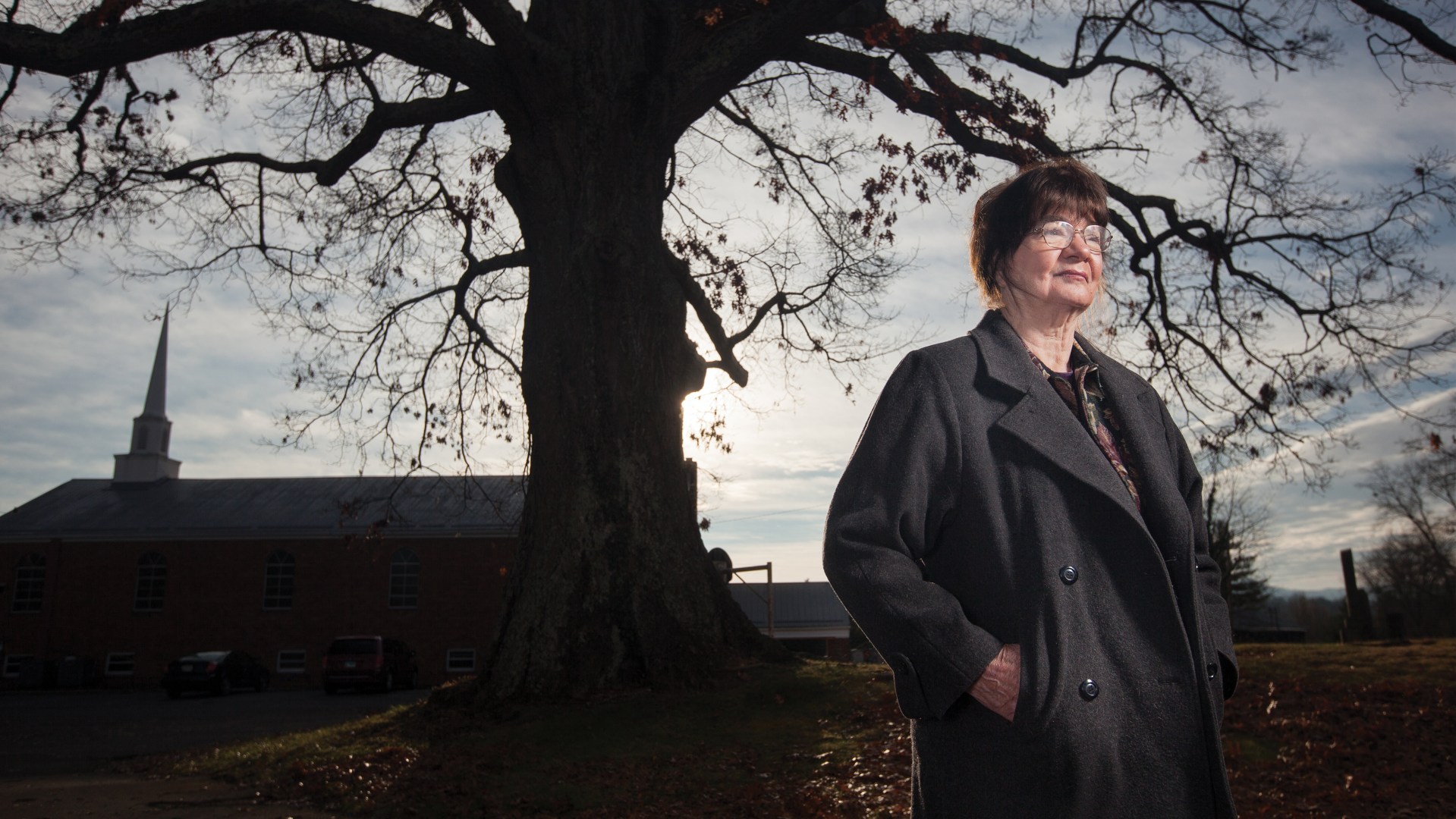
Linda Tipton joined Snow Memorial when she was nine years old. She has seen a lot of people come and go, but “God never left Snow,” she said.

Linda Tipton joined Snow Memorial when she was nine years old. She has seen a lot of people come and go, but “God never left Snow,” she said.

Andy Olsen

It’s hard to tell a church that you think it’s going to die, but Bryan Smith was trying.

There were less than 10 people left in a Southern Baptist congregation in East Tennessee. They didn’t have a pastor. They didn’t have enough elders for an elder’s board—just two men, both too sick to take on the responsibility. The money in the bank barely covered the utilities and the building was falling into disrepair.

The faithful few thought a new pastor and a few good sermons could save them. They wanted Smith, the church development specialist for the Holston Baptist Association, which serves Southern Baptist churches across four counties in the Appalachian Highlands, to find them someone who could really preach.

“That’s not going to work,” Smith said.

Smith didn’t think anything would work. He thought the church would die. He thought it should die, so that it could rise again.

Southern Baptists believe in resurrection—Jesus’ resurrection, of course, but also their own. They hold fast to the faith that the saved will rise up out of the ground on that last day. It is harder, though, to believe that institutions can pass away and rise again.

Smith described how the process would work: He wanted the church to turn over its property and bank account to the Baptist association, which would give them to a church planter to start a new congregation with a new name, a new style, and a fresh energy. The church shouldn’t hoard resources until nothing remained. Take what’s left, he said, and make an investment in something new.

But the 10 people in this church were having a hard time imagining it. They could see the end. It looked dark and cold and final.

By some estimates, 20 American churches close their doors for good every day. The decline of mainline Protestant denominations has been well documented, but evangelicals are also seeing the effects of a broad demographic shift as fewer Americans join churches and more people embrace individualized spirituality.

Southern Baptists are the largest Protestant denomination in the country, but for more than 10 years now, membership has been in decline. New baptisms continue to decline too, and according to the General Social Survey, only about half of children raised Southern Baptist continue to worship in the denomination as adults.

In East Tennessee, where roughly 30 percent of churches are Southern Baptist, that equals a lot of struggling congregations. Smith estimates that in his region, between 300 and 500 evangelical churches are in decline. No one’s talking about Appalachia becoming “post-Christian,” but you don’t have to travel far in the region to find people without much hope in their lives. And many churches that preach the hope of Jesus are going to close their doors.

Smith can help some struggling churches with revitalization. If a church has a critical mass of members—around 30, including some younger families—along with a building that doesn’t need a lot of work and a pastor in good health who is willing to push hard for three to five years, then a congregation with a plan has a chance of thriving again.

But if it doesn’t have those things, the church won’t make it. Smith has spent the past three years trying to convince some of these dying churches to accept this reality, so they can be like the kernel of wheat Jesus talks about in John 12:24. If they fall to the ground, he says, they can bring forth new life.

Mostly, his message has not been received as good news.

“It’s sort of like looking in the mirror in the morning and seeing a bump on your nose,” Smith said. “You know something’s wrong, but you don’t want someone to tell you that. People take offense at what I’m saying. They see anything I say as talking bad about the churches.”

He kept talking, though, and kept praying that someone would have the ears to hear what he was trying to say and the faith to take that leap.

“If they can change from thinking they are the person who closed the door of the church to thinking they are the person who gave the opportunity for life to begin again, then it can work,” he said. “I tell people, ‘You want to be part of the team who makes the decision to restore a gospel presence in this community.’ But not many leaders are willing to take that on.”

After talking to about a dozen churches, Smith finally got one to seriously consider his proposal. It wasn’t because of bold leaders, though. At Snow Memorial Baptist Church in Johnson City, a few women were frustrated with the pastors and elders who they felt hadn’t faced facts or made tough decisions. The women believed in the possibility of institutional resurrection.

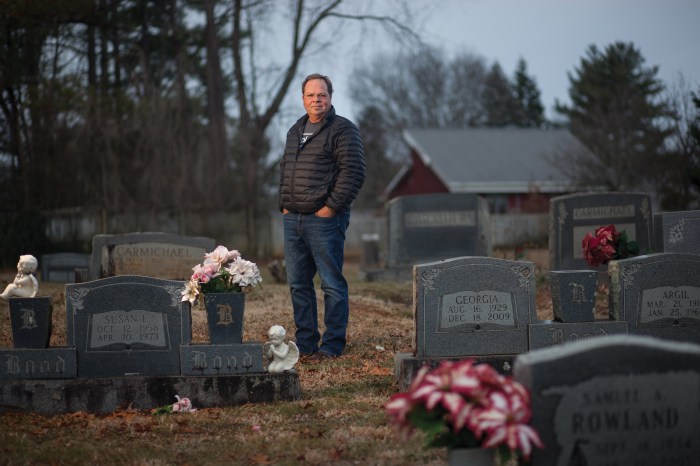
Bryan Smith stands among the gravestones where he often prayed for New Victory.Andy Olsen
Bryan Smith stands among the gravestones where he often prayed for New Victory.

Everyone was committed to Christ

Linda Tipton was buried with Christ in the water of baptism when she was nine and was raised again as part of the family of believers at Snow Memorial. She’s 75 now and can still feel the cold baptismal water if she thinks about it.

She recalls from her childhood a church of activity and outreach. There was always another bake sale, a bazaar, something to make money for missions. She thought maybe she would grow up to be a missionary.

“I was just committed to serving Christ,” she said. “My heart was in it. Everyone’s was.”

When she was 14, the congregation tore down the small building that had been there since 1893 and built a new brick church with a sharp white steeple. It had broad steps up from the street and tall windows where light could stream in. Behind the church was a graveyard where some from previous generations were buried. A big oak tree stretched its branches over them. Tipton felt like you could live your whole life in that church, from the baptismal to the pews to the burial grounds. And God would always be there.

Tipton stopped attending Snow when she got older. But even as she wandered a little in her spiritual life, she knew God’s presence was still at Snow. The Spirit was always there.

In the 1990s, an elder’s wife called her to help with children’s Bible school. Tipton didn’t see why they needed her when she hadn’t been part of the church for so long, but the woman “kept calling and calling,” so finally she went and taught the children.

Her first Sunday, the elder introduced her to everyone and said he and his wife had been praying to get her back for a long time, and they weren’t going to let her go. Tipton knew this wasn’t the elder speaking. This was God telling her that he was claiming her and this was where she belonged.

Snow was known for good preaching in those years, according to Debbie Brackins, who started attending a little while after Tipton returned. Good preaching, a lively youth group, and a sense of roots as deep as the oak tree in the back graveyard.

Then the minister retired and the church hired a new one. That, when Tipton and Brackins think back, seems like the tipping point. The church made a wrong choice, and everything changed.

“It has come to my attention in retrospect,” Brackins said, “sometimes you really don’t wait on the right person, the right pastor. It’s hard to find the right one to begin with, and after you make one mistake, you tumble into another.”

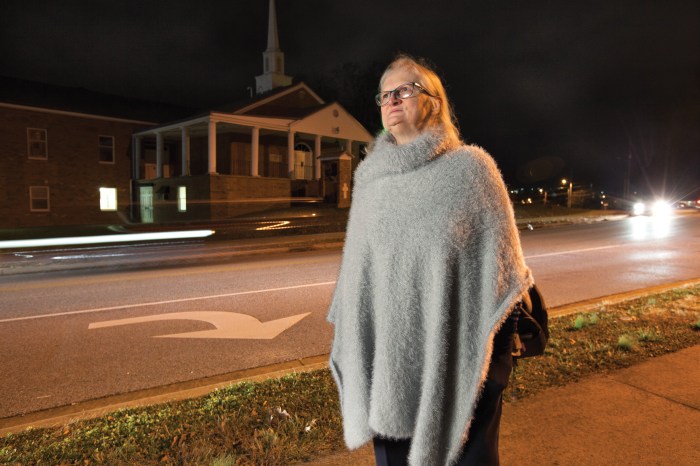
Debbie Brackins told her pastor that Snow Memorial would run out of money if something didn’t change. “I was mad.”Andy Olsen
Debbie Brackins told her pastor that Snow Memorial would run out of money if something didn’t change. “I was mad.”

People leaving by the handful

The new pastor was a Calvinist. Some of his ideas, like limited atonement, startled them. What he said seemed opposed to evangelism and missionary work. Did the new pastor think Baptists shouldn’t witness to their lost neighbors if Jesus actually didn’t die for them? That didn’t sound right.

There were other problems too. The new pastor reacted harshly to questions, especially from women. When one member asked him whether all of Calvinism was really in the Bible, he declared her an enemy of the gospel. She didn’t return to Snow after that.

“People were leaving, leaving by the handful, and I thought, Something is really wrong here,” Tipton said. “People would walk out while he was preaching, saying, ‘That’s not right. That’s not right.’ ”

The pastor also brought in a youth pastor, replacing the women who ran the Sunday school classes. That was fine with the women, who believed in strong male leadership—until the young people stopped coming. One day the youth group was full of life. The next, it was dead.

“There were a bunch of youth and he ran them off,” Tipton said. “The Devil was in that, there’s not much doubt about it.”

Then there was “the night of the big blowup,” as Brackins calls it now. There was a confrontation, and the pastor quit. One deacon resigned with him. The youth pastor left, and a chunk of the congregation too.

When the pastor drove out of the parking lot, he pronounced a curse on the church. He yelled out, “Ichabod,” which is what a woman in 1 Samuel 4:21 named her child when the Philistines captured the ark of the covenant: “Ichabod . . . The Glory has departed from Israel.”

Things weren’t the same at Snow Memorial after that.

“I don’t think we recovered,” Brackins said. “We just kept dwindling.”

The church found another minister, but he wasn’t interested in outreach. He just wanted to preach. There was one after that, but he was too young and seemed scared to actually lead. Another was too old and had health issues. No one seemed to believe the church could ever do missions again, or even neighborhood outreach.

“We were drawn inward,” Brackins said. “You can’t grow if you don’t evangelize. And we weren’t doing that. We looked to the pastors to lead us, and they weren’t doing that.”

After a while, only 12 people were left in the church. Some Sundays it would be more like four or five. There weren’t really elders anymore, with most of the men too sick or disinterested to lead. The women opened the doors, cleaned up afterward, closed the doors, and paid the bills.

Then Smith came and talked to them. They hoped he’d find a pastor for them—someone who could turn everything around—but he said that wasn’t going to happen. Because of the finances, the low attendance, and the long, bad history, revitalization wasn’t really an option. They should close and give their property and the remains of their bank account to a church planter who would start a new congregation. If they wanted to revive their gospel presence in their community, that’s what they needed to do.

The women immediately agreed. They knew this was right, they said. Snow needed to die so it could rise again.

The next Sunday, to their surprise, their elderly pastor got up and disagreed. He said the church should continue on without any change.

“I was more upset than mad, but I was mad,” Brackins said.

She showed the pastor the bank account and how fast they were running out of money. They would quickly come to the point where they couldn’t pay a minister, she said. And then they’d go to irregular “supply” preachers, probably a different one every week, and then the church would die.

But the pastor resisted, and several others in the church objected too. They didn’t want to be known as the people who shut the church down. So things continued on until the pastor had a heart attack and decided to retire. The church considered closing again but decided to search for a new pastor instead.

But Snow couldn’t find one, at least not one who would agree to more than interim leadership.

Finally, on November 24, 2019, the church voted to turn everything over to the Holston association, shut down for good, and tell Smith to look for a church planter. They would give the church away.

A few of the remaining members didn’t come to the vote. They said they knew it was the right thing to do, but they couldn’t bear to see it. Those who came voted unanimously.

More than 120 years after Snow was founded, with six men and eight women offering up “prayer and remarks” according to the congregational history, it was disbanded with a few women, a few tears, and an empty building. It was the end, but it wasn’t final.

God never left the church

A few months after the church was closed and services ended, Tipton saw a broken-down car in the parking lot. It was a young couple with six dogs, and they were waiting for someone to come fix their vehicle. Tipton invited them to wait inside the church. The couple reminded her of Joseph and Mary in the nativity story, but with more dogs. She fixed some coffee and popped popcorn, and they came in and warmed themselves.

She thought about the curse. That pastor was wrong, she thought. God’s glory hadn’t departed.

“God never left Snow,” she said. “Some people did. But God never did.”

She felt God telling her people were going to come to the church again. The love was still there. His presence was still there. When it opened back up, people would come.

They just had to wait and hope Smith could find a church planter.

The women trusted Smith was working on this, though they never saw it happening. He came by the church a lot. He assessed the property, audited the financial accounts, and made sure personal items were returned to their rightful owners. If someone’s grandmother donated the piano, they could have it back if they wanted. Smith also wandered the place and prayed.

Several people saw him in the graveyard, under the big oak tree, walking around and talking aloud to the headstones. He told the graves that the church was going to die, but death was not the end. New life was going to come—and new victory.

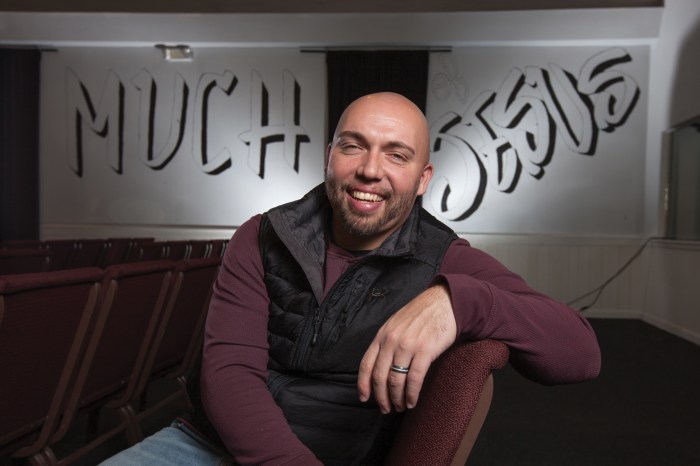
Tyler Dalton began replanting New Victory Church by rehabbing the old sanctuary. “He’s God-touched,” said Linda Tipton.Andy Olsen
Tyler Dalton began replanting New Victory Church by rehabbing the old sanctuary. “He’s God-touched,” said Linda Tipton.

The coming of New Victory

“I had always thought I was going to plant,” said Tyler Dalton, the pastor of New Victory Church. “It’s kind of funny how the Lord works.”

When Dalton was asked to take over as a senior pastor in nearby Jonesborough, Tennessee, in 2013, he said yes to the call, but with a caveat: He and his wife, Rachel, really felt like they were supposed to plant a church.

“We didn’t know when. We didn’t know where. But we would be doing it when the Lord affirmed,” Dalton said.

If the congregation could accept that he would leave at some point to start another Southern Baptist congregation, then Dalton was happy to be the senior pastor. The elders agreed. The church even supported the Daltons in praying about the prospective plant. As he felt led to look in Johnson City, the congregation loaded up the church vans, drove the 15 miles, and walked around downtown with their pastor, dreaming of that plant.

And that was that, for a while, until someone told the group they felt “there is already a church out there praying about replanting” and New Victory would be an answer to that prayer. Then Smith showed up to talk to Dalton in the summer of 2019 about whether his church would be interested in starting a new congregation at the site of Snow Memorial. Dalton said yes.

“We had 100 percent clarity from the Lord,” he said. “I am divinely ignorant, and I don’t know how to bring restoration, but I believed the Lord would show himself to be good.”

They set the launch for early 2020, but that got pushed back as the legalities of the transfers were worked out. Then they set it for April, but the coronavirus happened and it was pushed back again.

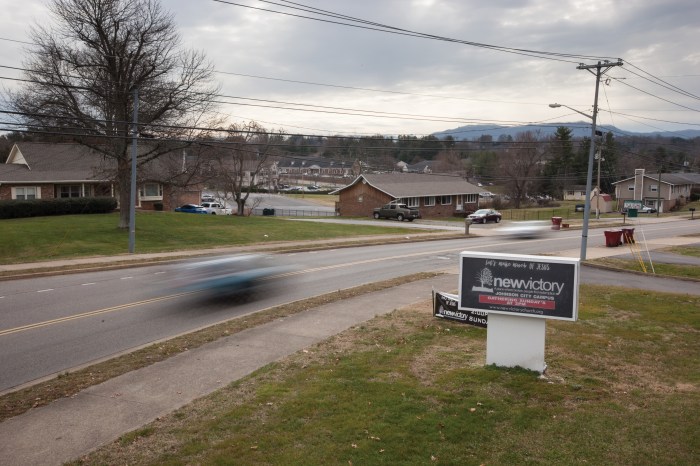
When churches in East Tennessee started meeting again in the fall, New Victory decided it was time to begin. They put up signs and made sure the church’s slogan was visible: “A place where broken people find redemption.” The doors opened. And people came.

The numbers fluctuated—85 adults at one service, 20 at the next—but it was a start. Dalton was excited to talk to the newcomers and find people who didn’t have a church. They had a Bible study on a Tuesday night and more than 30 people came. During the worship services on Sunday afternoons, there were kids running around again.

Dalton preached about the importance of trusting in Jesus and his work on the cross instead of in your own effort and work ethic.

“Satan will tell you, you got to pull yourself up by your own bootstraps,” he said. “And if Satan can get you to believe you’re strong enough, smart enough, capable enough to do it on your own, you’ll stop depending on Jesus.”

Someone shouted out, “That’s right!” And from their seats on the left side of the sanctuary, Tipton and Brackins nodded.

It’s odd to feel new at a church you’ve attended for decades, but that’s what it’s like for the two women. They are doing what they have done for decades, yet everything’s been made new. It happened so fast—like a trumpet blast, as 1 Corinthians 15 says, and all that was old was swallowed up in New Victory.

There are aspects of the change that still feel uncomfortable. Tipton and Brackins don’t see familiar faces, at least not yet. The sanctuary is dark, with the windows covered up and lights shining on the stage. The music is not what they would have chosen for themselves. (“I can get used to it,” Tipton said.)

But they are excited to see what’s happening. It’s resurrection, before their eyes.

Andy Olsen

Witness to the resurrection

When church after church after church couldn’t believe that death would lead to new life, Smith kept thinking that he only needed one. If one struggling congregation would take that leap of faith, he could prove the replanting idea could work. And then Snow happened.

“I told our team,” he said, “once we have Snow Memorial under our belt, there will be other churches that will step forward.”

But it didn’t happen like that.

Instead, Smith lost his job in a budget cut. Holston Baptist Association was struggling with declining giving from area churches, and during the coronavirus, giving went down even more. Smith’s bosses told him there wasn’t any question about the value of his work; they just didn’t have funds.

Smith is selling insurance now. It’s the first time since 1997 that he hasn’t been in ministry.

“It’s not the happiest place I’ve been in this world,” he said. “I don’t have a clue what happens next. I don’t know. Wish I did.”

But Smith still believes in resurrection. He’s seen it, after all. A small Appalachian church died, and now, by faith, it lives again.

Daniel Silliman is news editor for Christianity Today.

News

How Christian Bookstores Survived 2020

Optimism, adaptation, and increased Bible sales carried retailers through pandemic shutdowns, industry surveys report.

Christianity Today February 15, 2021
Mark Humphrey / AP Images

A new item at Christian bookstores in 2020 shot straight to the top of the sales charts: face masks with faith messages.

Christian retailers across the country sold masks with the messages “Not Today Satan” and “This too shall pass,” as well as “Faith Over Fear,” “Blessed Beyond Belief,” and “It is well with my soul,” as stores found creative ways to continue business in a pandemic.

Two new industry surveys show that Christian retail was hard hit by COVID-19 and the subsequent safety restrictions, but store owners persisted with stubborn optimism. The Parable Group’s 2021 State of Christian Retailing report found more than half of store owners are concerned about cash flow, but 87 percent predict a “healthy” or “steady” future—up 12 points from 2019.

More than a third of Christian bookstores were closed for more than two months because of the pandemic. Sales in March, April, and May were down 60 to 80 percent from the previous year. The Christian Retail Association (CRA) reports that sales stayed down for nine months in 2020, only recovering with Christmas shopping in December. Parable’s survey of 230 stores documented annual sales of $58 million—13 percent below 2019 revenue.

Looking at the year, however, individual store owners could see silver linings and God’s faithfulness. Kevin VanDuyne, owner of Joy Christian Bookstore, reported that his two outlets in Indiana were closed for a total of eight months, but his sales were only down 17 percent.

“Summary,” he wrote on the CRA survey: “GOD IS SO AMAZING, GOD IS SO….GOOD!!!”

Stephanie Gann, owner of Living Water Bookstore in Paris, Texas, had a similar testimony.

“Though I thought the COVID-shutdown would be the end of us, God has been SO faithful,” she wrote. “We’ve been able to pay our bills on time every month, and we had a little leftover at the end of the year.”

The industry is no stranger to struggle. Roughly 1,000 Christian bookstores closed between 2010 and 2020, including the two largest chains, Family Christian Stores and LifeWay Christian Stores. Neither recent industry report indicated how many Christian bookstores closed in 2020.

Parable Group president Greg Squires said there were at least a few that went out of business in the pandemic, but the number didn’t seem a lot higher than the trend. It’s possible the stores that survived the economic crisis and found ways to compete with Amazon in the last decade were the ones in the best position to survive a pandemic-related economic shutdown.

Christian booksellers adapted to COVID-19 conditions, offering curbside pickup and sometimes personal store reservations. One owner in Sheboygan, Michigan, had the store phone redirected to his personal cell and arranged to open the business for individual customers to shop. More than 40 percent of bookstores started delivery services. An increasing number also turned to email promotion, Facebook Live broadcasts, and social media marketing to connect with customers.

For some Christians, the bookstores’ social media presences served as an important connection point when they were cut off from other interaction. Vicki Geist, owner of Cedar Springs Christian Store in Knoxville, Tennessee, said her store only turned to Facebook Live broadcasts out of necessity, but then found the daily media posts mattered to their customers.

Squires observed that the stores met the spiritual needs of the moment. “When customers couldn’t go to their local church, they were encouraged and refreshed by finding fellowship in their Christian bookstore,” he told Publishers Weekly.

Christian bookstores also saw changes in their customers’ needs. Homeschool curricula only accounts for a tiny fraction of Christian books, but the retail stores saw a 68 percent increase in the sale of homeschooling materials. Bible sales—about a quarter of Christian bookstores’ business—increased by nearly 3 points, with the Zondervan’s compact New International Version and Tyndale House’s New Living Translation thinline reference Bibles topping the year’s bestsellers.

“We have seen a great interest in Bibles since we opened back up,” said Phillis Cowan, owner of Bread of Life in Melbourne, Arkansas. “Also, prophecy and end times books are selling as well as books and gifts with the ‘hope’ theme.”

Retailers also saw an increase in sales of church supplies, despite the drop in sales of Easter items and vacation Bible school curricula. According to the CRA report, the top three items sold in 2020 were Bibles, masks, and single-serving fellowship cups.

According to the CRA survey, about a third of Christian stores plan to keep selling face masks for the foreseeable future, offering customers a chance to wear their faith on their faces, with messages like “I can do all things through Christ,” “Wanna taco bout Jesus?” and the straightforward “Hope.”

The retailers themselves are not just optimistic about the future. They’re actively preparing. At the Christian Product Expo in Wilmington, Delaware, this winter, representatives from 56 stores placed more than 1,300 orders for books and items to sell in 2021.

“It is a bright, shining new year,” said Bob Munce, president of CRA, “and therefore, a great opportunity."

Books
Review

You May Not Know Judaism as Well as You Think

John Phelan’s evangelical guide to Jewish thought and history contains many revelations—some of them painful.

Christianity Today February 15, 2021
Illustration by Rick Szuecs / Source images: Dave Herring / Alireza Esmaeeli / Levi Clancy / Unsplash / Wikimedia Commons

I will never forget the day I stood on the ruins of a third-century synagogue in Capernaum, just a stone’s throw from the beautiful blue waters of the Sea of Galilee. I was leading a tour of Christian pilgrims. Our guide called our attention to Matthew 23:3, a verse I had read hundreds of times but which now suddenly jumped off the page: “You must be careful to do everything [the teachers of the law and Pharisees] tell you.”

Separated Siblings: An Evangelical Understanding of Jews and Judaism

Separated Siblings: An Evangelical Understanding of Jews and Judaism

Wm. B. Eerdmans

360 pages

I was shocked. How could Jesus have recommended the teachings of the Pharisees when he warned against their hypocrisy in the same verse (“But do not do what they do, for they do not practice what they preach.”)? How could I have missed this recommendation during decades of serious Bible study?

John E. Phelan Jr.’s Separated Siblings: An Evangelical Understanding of Jews and Judaism contains this and hundreds of other surprises. Phelan, a retired theology professor and one-time president of North Park Theological Seminary in Chicago, has provided Christians with one of the most engaging and comprehensive guides to Jewish thought and civilization in the last half-century. Readers are treated to detailed but delightful descriptions of Jewish terms, denominations, understandings of God, religious practices, historical events, and controversies. Phelan also uncovers new findings about the Jewishness of Jesus and Paul, and he relates the history of Zionism to the modern state of Israel.

Surprises in Store

The book is full of enlightening revelations. Christian readers will find resonance in Jewish texts they might otherwise overlook. The Kaddish, for example, is a daily Jewish prayer that begins with words nearly identical to the first petition in the Lord’s Prayer: “May His great Name grow exalted and sanctified.” Phelan observes that while the Talmud—a set of gargantuan reflections on both Jewish oral tradition and the Old Testament—might appear, to outsiders, as obsessed with “minor matters” of religious law, faithful Jews regard it as a divine guide to everyday holiness that puts reason to work “in service of love and obedience.”

Christians sometimes characterize Jewish practice as more focused on externals than matters of the heart. But Phelan points out, among many other examples of heart spirituality, the rabbinic insistence that the annual Day of Atonement “atones only for those who repent.”

Christian critics of Zionism often allege that Jewish yearning to return to Israel only began in the 19th century and was mostly secular. Yet Phelan notes that for the rabbis who edited the Babylonian Talmud in the fifth century, Israel was still the center of the world, and so “any Jew living outside of the land was missing something.” Only in the land could Jews observe the agricultural laws of Torah; therefore, as the Talmud states, “a small group of men in the Land of Israel is dearer to [the Holy One] than the great Sanhedrin outside of the land.”

This book should also surprise readers who have been led to believe that God rejected the Jews as his chosen people when most first-century Jews rejected Jesus as their Messiah. Phelan argues that while God’s covenant with Moses was conditional on Israel’s obedience, his covenant with Abraham was unconditional. Moses warned that God’s people would lose control of the land if they turned to idolatry (Deut. 28:36), but they would remain God’s chosen. As Paul himself states, “God’s gifts and his call are irrevocable” (Rom. 11:29). “Even the rejection of Jesus as messiah does not lead to the final rejection of the Jews,” writes Phelan. Paul “insisted in Romans 11 that the Jews are still ‘loved’ by God” (v. 28).

Phelan takes issue with a common evangelical interpretation of Paul’s teaching of salvation by faith. He argues that Luther’s teaching on justification has often been misunderstood as a form of “cheap grace,” under which works and obedience have nothing to do with saving faith. Yet Paul, as Phelan notes, wrote in Romans 2:13 that “it is not those who hear the law who are righteous in God’s sight, but it is those who obey the law who will be declared righteous.” Phelan says Paul “might have meant two different things” by “law”—law as a way of salvation and law as a guide for life—but “the important point is that Paul, along, by the way, with Jesus, clearly expected that to be a follower of Jesus was to be obedient to the law of God.”

If Paul was more positive toward Jewish law than many have thought, his teaching about the future of Israel was also more Jewish than most have imagined. His prophecy in Romans 11:26 that “all Israel will be saved” has bedeviled interpreters for millennia. But Phelan helpfully shows that this was a common rabbinic teaching that appears in the Mishna, the written record of oral teaching by the rabbis before and at the time of Paul. The Mishna states that “all Israelites will have a share in the world to come,” but it specifically excludes Jews who deny the resurrection of the dead or the inspiration of the Torah, as well as Jews who live licentious lives. Perhaps, then, Paul was adapting a familiar dictum that limited the definition of “Israel” to faithful representatives of all 12 tribes.

In an important chapter that tracks recent Jewish interpretations of Paul, Phelan traces the conclusions of Jewish scholars Daniel Boyarin, Pamela Eisenbaum, and Mark Nanos, who agree that Paul kept practicing Jewish law until his death and taught Jewish disciples of Jesus to do the same. At the same time, Paul taught Gentile disciples not to get circumcised, because Gentiles and Jews were to uphold the law, as Phelan puts it, “in their separate ways.”

If the surprises Phelan documents are intriguing, they are also painful. He highlights many moments in the last two millennia when Christian leaders taught hatred for and persecution of Jews. Erasmus, for instance, refused a trip to Spain because it was too “full of Jews.” Luther preached that if Jews would not convert, “We [Christians] should neither tolerate nor endure them among us.” As Phelan explains, even Karl Barth, Dietrich Bonhoeffer, and Martin Niemoller, who “spoke out against the Nazis and anti-Semitism” before and during World War II, nevertheless in their “records reveal anti-Jewish stances and equivocal support for Germany’s Jews until it was once again too late.” The Barmen Declaration (1934) famously declared that Jesus Christ was Germany’s only leader (Führer), but it said nothing about the persecution of Jews because “the Confessing Church would not have accepted it.”

The problem, writes Phelan, was not that Christians were “merely indifferent and uninformed.” Tragically, “throughout Europe, baptized Christians aided and abetted or enthusiastically joined in the slaughter.”

A Few Gaps

Despite the many virtues of this book, there are a few gaps. While Phelan records Rabbi Jacob Neusner’s complaint that Jesus did not address Israel as a whole, he fails to mention that Jesus did just that four times—when he said that in the new world his apostles would judge all 12 tribes of Israel (Matt. 19:28); when he predicted that one day all Jerusalem would welcome him (Luke 13:34–35); when, just before his ascension, he declared that the Father has fixed the time he will “restore the kingdom to Israel” (Acts 1:6–7); and when, by his Spirit, he inspired John to write of the day he would come on the clouds and “all the [Jewish] tribes of the land [of Israel] will wail because of him” (Rev. 1:7, LSV).

While Phelan makes clear the centrality of the Promised Land to Old Testament mentions of God’s covenant with his Jewish people, he neglects similar emphases in the New Testament. For example, besides references to the land as the center of God’s future work (Acts 1:6; Luke 13:34–35), Jesus predicted that one day Jerusalem would no longer be controlled by Gentiles but (implicitly) by God’s Jewish people (Luke 21:24). Paul also taught that God “gave [the Jewish patriarchs] their land as an inheritance” (Acts 13:19, ESV).

In his history of modern Israel, Phelan leaves out the following significant facts: Theodore Herzl, the father of modern “secular” Zionism, hoped for a government that would be Jewish “in character” to protect Jewish culture and religion; when Jordan annexed the West Bank in 1950, both the United Nations and the Arab League condemned this as an illegal violation of international law; and while it is tragic that 700,000 Arabs lost or abandoned their homes because of the Arab-Israeli War of 1948, the war also drove 800,000 Jews out of their homes in Arab lands.

Phelan closes this excellent book with a warning against four “dangerous” readings of the New Testament he calls “anti-Jewish.” First, that Jews are under a curse and even Satanic, a teaching he discerns in the MacArthur Study Bible. Second, that all Jews are responsible for killing Jesus, which he likens to the claim that “Americans killed Lincoln and Kennedy.” Third, that God is done with the Jews, which Phelan says Paul denies when he asserts, “God did not reject his people” (Rom. 11:2). And fourth, that the Pharisees, like all Jews, were invariably hypocrites and legalists—Phelan cites several occasions when they defended Paul, as they did before the Sanhedrin: “We find nothing wrong with this man” (Acts 23:9).

In a day and age when US law enforcement reports more hate crimes against Jews than any other religious group, and when scholars increasingly find that Jesus and the early church were more Jewish than previously thought, Separated Siblings promises to help Christians better understand the Jewish roots of their faith—and why that understanding is so important.

Gerald McDermott recently retired from the Anglican Chair of Divinity at Beeson Divinity School. He is the author of Israel Matters: Why Christians Must Think Differently about the People and the Land and the editor of Race and Covenant: Recovering the Religious Roots for American Reconciliation.

News
Wire Story

Biden Brings Back White House Faith Partnerships Office

President turns to Obama-era leader and his evangelical campaign outreach director to lead agency in efforts to “heal, unite, and rebuild.”

Christianity Today February 14, 2021
Alex Wong / Getty Images

President Joe Biden issued an executive order on Sunday reestablishing the White House Office of Faith-Based and Neighborhood Partnerships, undoing former President Donald Trump’s efforts to reshape an agency that went largely unstaffed for most of his tenure.

In a statement accompanying the announcement of the executive order, Biden echoed his recent remarks to the National Prayer Breakfast, bemoaning widespread physical and economic suffering due to the coronavirus pandemic, racism, and climate change. He added that those struggling “are fellow Americans” and are deserving of aid.

“This is not a nation that can, or will, simply stand by and watch the suffering around us. That is not who we are. That is not what faith calls us to be,” he said. “That is why I’m reestablishing the White House Office of Faith-Based and Neighborhood Partnerships to work with leaders of different faiths and backgrounds who are the frontlines of their communities in crisis and who can help us heal, unite, and rebuild.”

He added: “We still have many difficult nights to endure. But we will get through them together and with faith guiding us through the darkness and into the light.”

Biden appointed Melissa Rogers, a First Amendment lawyer and senior fellow at the Brookings Institution to oversee the office, as Rogers did in former President Barack Obama’s second term. Rogers, a lifelong Baptist, will also serve as senior director for faith and public policy in the White House Domestic Policy Council.

The office’s deputy director will be Josh Dickson, the evangelical who ran faith outreach for the Biden-Harris campaign. Trey Baker, who worked as the National Director of African American Engagement on Biden’s campaign, will serve as the White House office’s liaison to black communities, a role that includes black religious groups.

Besides fighting the pandemic and racism and assisting with economic recovery, the office will focus its efforts on helping disadvantaged communities, advancing global humanitarian work, strengthening pluralism, and protecting “cherished guarantees of church-state separation and freedom for people of all faiths and none.”

The announcement noted that the office will work with Centers for Faith-Based and Neighborhood Partnerships that are embedded in agencies across the federal government.

The faith-based office has been called by different names since President George W. Bush established it, and different presidents have granted its clients—religious and secular organizations—varying degrees of access.

Biden will return the name the office had during the Obama administration, when Rogers led it from 2013–2017.

Under President Trump, the office went largely unstaffed until 2019, when he tapped Pentecostal preacher and longtime Trump adviser Paula White to oversee what he called the Faith and Opportunity Initiative. Until then, much of Trump’s religious outreach involved informal meetings with mostly Christian faith leaders—especially a core group who became known as his unofficial evangelical advisers.

The two previous administrations made concerted efforts to connect with a wide array of faith groups, with bipartisan and interreligious access through the faith-based office, related cabinet-level offices, and task forces.

Rogers has been critical of what she saw as Trump’s disproportionate engagement with evangelicals, saying in 2017 that “the continuance of this Evangelical Executive Advisory Board, even unofficially, and the apparent failure to have any comparable entity that is open to non-evangelicals, sends a troubling message that the administration prefers evangelicals over other people of faith.”

Rogers also opposed Trump administration plans to remove the requirement that faith-based social service providers offer a secular alternative to people seeking their assistance.

“You can’t benefit from protections you don’t know you have,” she tweeted in January 2020. “The religious liberty of social service beneficiaries is as important as the religious liberty of faith-based providers.”

Rogers came to Biden’s defense in August when she said Trump made “wild assertions” about the former vice president during the 2020 campaign. She said the claims by Trump that Biden would have a “no religion, no anything” approach to faith if he became president “could not be more wrong.”

News

Died: Melvin E. Banks, Publisher of Black Sunday School Curriculum

When contextualizing Scripture was controversial, he said “the bottom line is Jesus.”

Christianity Today February 14, 2021
Urban Ministries, Inc.

Melvin E. Banks, founder of the largest black Christian publishing house in the United States, died on February 13 at age 86.

Banks started Urban Ministries Inc. in the basement of his home in Chicago in 1970, focusing on Sunday school curriculum and Bible study materials for African American Christians. The ministry grew to serve more than 50,000 black churches.

Banks contextualized Scripture to show its relevance to contemporary African American life and shocked many Christians, black and white, with depictions of Bible characters as people of color. Banks insisted the images were accurate, since the world of the biblical narrative included Middle Easterners as well as many North Africans, and also argued it was important. Black people needed to know they were part of Bible history.

“When I grew up, all the Sunday school literature was produced by white people and all the writing was done from a white perspective,” he said. “All the biblical characters were portrayed as white people. It dawned on me that the material as published did not connect.”

White evangelicals sometimes accused Banks of being a black separatist or even supporting segregation and racism by focusing his ministry on black Christians and black churches. Banks, a graduate of Moody Bible Institute and Wheaton College, rejected the idea, saying it was just clear that black Christians couldn’t count on white Christians to help them understand the Bible.

“The bottom line is Jesus,” he said, “and his supremacy.”

Moved to make his own commitment to Christ

Banks was born in Birmingham, Alabama, in 1934. He was largely raised by his sister, who was two years older than him, while his mother worked for a white family from Monday to Friday.

When Banks was 9, a black church planter from a Brethren Assembly in Detroit told him how to accept Jesus with a lesson about the Apostle Paul’s answer to the Phillippian jailer in Acts 16. Banks was moved to make his own commitment to Christ.

“The next week, on my own, I thought about what he said and I prayed, ‘Lord Jesus, come into my life and save me,’” Banks recalled during an oral history interview in 2004.

When Banks turned 12, the church planter started taking him to tell his testimony around Birmingham. Once, when Banks finished explaining “how to really get into the family of God … by believing in Jesus Christ, and not just running to church,” an elderly man gave him an encouraging word and a Bible quote.

“He had gray hair, and he was just sort of—hands behind his back,” Banks recalled. “He said, ‘You know, Hosea said it a long time ago, “My people are destroyed for lack of knowledge.”’ I had never heard of that verse before, but when he quoted it, it suddenly became a very important verse for me.”

Banks went to Moody in 1952 to study the Bible. Coming in from the South by train, he was first overwhelmed by the city’s large buildings, and gawked up at the men and women leaning out of the windows in the late summer heat. But the greater shock came at Moody, where Banks was one of about 10 black people at a school with 1,000 students. Some of his fellow students had never seen a black person and gawked at him as he went to and from classes. He wasn’t assigned a roommate, which he only later realized was because the school wouldn’t house a white student with a black student.

“While they were accepting a few black people, they really were not accepting them in the fullest sense of the word,” Banks said. “They were permitted to come and stay there.”

He didn’t need to escape his blackness

Banks didn’t leave campus to find a black church until a Bahamian chapel speaker from the Brethren Assemblies pulled him aside and said, “Melvin, you need to be finding some people, some of your kinfolks.” The visitor sent the young man to a Brethren church on the South Side of Chicago.

It was a critical moment for Banks. He realized he didn’t need to escape his blackness, and that acceptance by white people was not enough for him. He needed to understand his identity as a person and a Christian independent of what white people thought.

Banks met his wife, Olive Perkins, at the Brethren church. They married in 1956, one month after Banks turned 21. They helped plant a new church, Westlawn Gospel Chapel and Banks commuted from the city to Wheaton to study biblical archaeology.

When he graduated from Wheaton with an M.A. in 1960, he took a job at Scripture Press Publishers. He was hired to sell the company’s Sunday school material to black churches, but soon began to push the publisher to make changes to its curriculum.

“They had a desire to get literature—good stuff—into black churches, but they didn't know how to do it. So, I went out with the idea that I was going to do that, but then I ran into difficulty trying to persuade black churches to take literature that was white,” Banks explained.

At the same time, Banks was starting to think differently about race. He was provoked by the Nation of Islam leader Elijah Muhammed, who said black people didn’t know their own history because it was stolen from them like their fathers and mothers had been stolen from Africa. While the black nationalist was “just talking off the wall,” according to Banks, he also had a point. Banks realized that, apart from the time someone gave him a copy of Booker T. Washington’s Up From Slavery, he’d never been taught black history.

Banks then discovered The Black Man in the Old Testament and Its World, by Alfred G. Dunston Jr., a bishop in the African Methodist Episcopal Zion Church. He realized he’d never been taught the black history of the Bible. In fact, though most of the biblical stories are located in the Middle East and the people in the stories are from the Middle East, North Africa, and the Mediterranean, he personally imagined every character in the Bible as a Northern European.

Banks pitched the idea of Sunday school curriculum depicting black people to his bosses at Scripture Press Publishers, but they weren’t interested. Then he got a new white colleague who worked in marketing to pitch the idea, using the terminology of “niche marketing.” The plan was approved.

Banks, however, decided he needed to do it himself. He left Scripture Press Publishers with a blessing and a little financial backing, and started his own business.

“I decided that if this company is going to really go, it can’t be a part of a white company,” Banks recalled. “It needed to be independent, so that we could make our own decisions and do what we think is necessary to make it go.”

‘I thought you would stick with it’

The company almost didn’t survive the first few years. Banks struggled financially, running the business in the red. He thought about quitting all the time. In fact, there were more than 40 black-owned publishers launched in the US around 1970, and all but four or five of them went out of business within a few years. Banks, however, kept getting divine assurance that he should continue.

“Why did you ask me to take on this job?” he once asked God. “You know I am not a great business person.”

Then he felt the presence of the Holy Spirit like a physical vibration. He felt God say, “Melvin, I did not ask you to do this because I thought you were so smart …. I asked you because I thought you would stick with it.”

So Banks stuck with it.

Still, for a number of years he assumed he would be forced to close when he couldn’t pay the printer’s bills. But the white-owned company in Grand Rapids, Michigan, Dickinson Press, kept filling his new orders, even though he was delinquent on his past payments. When Banks later asked why, the Christian owners told him they could afford to support his new ministry, so they did.

Urban Ministries Inc. broke even for the first time in 1976 and then continued to grow and flourish. Banks identified 70 to 80 black-owned bookstores around the country to sell his publications, along with 400 to 500 white-owned Christian bookstores that served black churches. He established direct connections with churches around the country, and supplied them with new educational material every quarter for more than four decades.

Wheaton recognized Banks with an honorary doctorate in 1992; Moody named him Alumnus of the Year in 2008; and he received a lifetime achievement award from the Evangelical Christian Publishers Association in 2017.

Banks said that when he died, though, he just wanted to be remembered as someone who was faithful.

“If it could be said,” he told a historian in 2004, “that here was a man who had a dream of seeking to communicate the truth of God's Word to people, and he was able to make some contribution along that line, then I think I would be pleased.”

Banks is survived by his wife Olive and his three children Melvin Jr., Patrice Lee, and Reginald. Details about funeral arrangements will be announced soon.

News

Ravi Zacharias’s Books Pulled by HarperCollins After RZIM Investigative Report

Author Lee Strobel also plans to revise his “Case for Faith” to remove the late apologist.

Christianity Today February 12, 2021
mbtphotos / Getty Images

The biggest Christian publisher in the United States will no longer offer resources by the late Ravi Zacharias following the final report of an investigation confirming his years-long pattern of abuse, and is working with at least one prominent author to remove Zacharias from other works.

HarperCollins Christian Publishing—which includes Zondervan and Thomas Nelson—had published more than 20 titles authored, coauthored, or edited by Zacharias over a 26-year span, including Can Man Live Without God?, which had been released in 21 languages.

“In September, when the most-recent sexual misconduct allegations against the late Ravi Zacharias surfaced, HarperCollins Christian Publishing immediately suspended all projects and shipments of his work,” said Casey Francis Harrell, vice president of corporate communications.

“Following the findings in the independent report, the company will immediately take all his publications out of print. We are deeply saddened, and we mourn for the victims.”

The HarperCollins site listed 16 English titles authored by Zacharias, which totaled more than 2 million copies in sales by the time of his death in May 2020.

The month before Zacharias died, Zondervan had published Seeing Jesus from the East, which the apologist co-authored with Abdu Murray, and the book ranked No. 6 on the Evangelical Christian Publishers Association bestseller list last July. Other bestsellers included Who Made God? (2003) and The Logic of God (2019).

Jesus for You, Zacharias’s forthcoming book with Vince Vitale through Thomas Nelson, will no longer be released, blogger Steve Baughman confirmed last month.

Lee Strobel announced on Twitter on Friday that he and Zondervan decided to halt printings of his book The Case for Faith, which featured Zacharias, and would publish a revised version instead.

Strobel interviewed Zacharias more than 20 years ago. The interview spans 19 pages in the book, with Strobel describing the apologist as “gentle-spirited but with razor-sharp intellect” as he responds to questions about the exclusive claims of Christianity.

https://twitter.com/LeeStrobel/status/1360350020743139328

Zacharias is the latest Christian leader whose abuse revelations or other sinful behavior have caused followers to reconsider whether or not to keep using their teachings. Publishers have likewise pulled titles by leaders such as Bill Hybels, James MacDonald, and Mark Driscoll after they were forced from their leadership positions.

Jeff Crosby, the publisher of InterVarsity Press, previously told CT, “as a publisher, when a pastor-author has been credibly accused of or acknowledged wrong-doing in her or his leadership context, in particular, I believe we have an obligation to take the time to carefully and thoughtfully discern whether the published works should continue to be made available and act on what we discern even if it means lost revenue.”

The RZIM board statement did not indicate how the ministry will address promoting or sharing resources by Zacharias going forward; however, the apologist’s work has become less prominent on parts of its own site.

Zacharias’s titles Can Man Live Without God? and Beyond Opinion: Living the Faith We Defend, which appeared on RZIM’s list of “Recommended Reading” in Christian apologetics as recently as last fall, no longer appear on the page.

The board wrote in its statement Thursday that “we remain passionate about seeing the gospel preached through the questions of culture,” but that it would be “seeking the Lord’s will regarding the future of this ministry.”

The Extraordinary Cost of Lavish Love

Valentine’s Day can feel unnecessary when you’ve been married awhile. But when your spouse dies, you want every day to be Valentine’s.

Christianity Today February 12, 2021
Illustration by Mallory Rentsch / Source Images: Duckycards / Yulia Naumenko / Getty Images

During high school, I [Clarissa] often worked the Valentine’s Day shift at my town’s grocery store. Assigned to the quick checkout register, I rung up purchases for a steady stream of men, their arms overflowing with roses, stuffed animals, and champagne. Every once and awhile, a bashful gentleman would slide a gigantic red heart of chocolates onto the conveyor belt—no doubt “I hope she forgives me” chocolate—to make up for another missed special day.

I easily noticed that the flow of customers looked very different on Valentine’s—their purchases so extravagant, their intentions so ardent. I wondered how these demonstrations of affection jived with their behavior the other 364 days of the year. Did they always express themselves so generously? Was their love always this lavish?

Less than a decade later, I found myself on the receiving end of those Valentine’s gifts. My cynicism about this “Hallmark holiday” prompted me to ask my new husband, Rob, to buy me cheaper carnations instead of roses and discount candy marked down the day after. I reasoned that lavish displays of love were silly and unnecessary. Sure, I’d worked in a bridal store during graduate school, and I loved a romantic comedy just as much as any other young woman my age. But love, in the words of Anne of Green Gables, wasn’t “diamond sunbursts or marble halls.” Real love, my church had always taught me, was an act of the will. Reasonable, unemotional, steady, determined. Love loved the unattractive, the unlovable. Anything else was frivolity.

I found that steady, faithful, nonfrivolous kind of love in my marriage, and for 17 years I rested secure inside it. No couples’ tropical getaways. Just four children born in quick succession and days filled with washing dishes and carpooling to baseball practice. The deep, everyday love of my marriage seemed to confirm my Valentine’s Day suspicions. Real love wasn’t lavish and demonstrative. Real love was unadorned, simple, and faithful. I thought that way for almost two decades. Until my husband died.

My [Daniel’s] wife, Dawn, grew up a missionary kid with Scottish parents in Angola, so extravagant material expressions of love were always in short supply. As one who likes to lavish, my Valentine’s overtures of a couple dozen roses, poetry, and chocolate (sometimes in hope of forgiveness) overwhelmed as much as charmed. My most recent two dozen came compliments of a dear friend who made my run for the roses for me. Dawn had been diagnosed with pancreas cancer, and I needed to stay by her side. That Valentine’s Day was her last.

Each year, she’d hang her roses upside down to dry out into a bouquet that would bring beauty for the rest of the year. Her final arrangement of dessiccated flowers still resides in its special vase, the dark red slowly browning with the passing of time.

After Dawn left this world, I read in her journal about how she once offered me advice on our taxes as I was completing them. She wrote how my warm reception of her input meant more to her than any bouquet. We divided our household labors, me doing most of the finances and she making most of the parenting decisions; but as a missionary Scot, she felt my budgeting too luxuriant. I’d wave off her worries with an entreaty to trust me, which she did, saying she had no other choice. But she always thought I spent too much money. It was the only thing we ever really fought about.

As she died, she passed over the parenting to me and money no longer mattered. She spoke of our being parted by death, of the vows we’d made and promises kept. She had me move my wedding band from my left hand to my right, so as to hold on to all we’d shared but to acknowledge our marriage had been fulfilled. Despite our divergent financial philosophies, we’d enjoyed riches beyond measure.

The night I learned of Rob’s death in Mount Rainier National Park, I stood at my campsite 3,000 miles from home and these words tumbled out of my mouth unbidden. “See what great love the Father has lavished on us, that we should be called children of God! And that is what we are!” Even as I think of it now, a year and a half later, I wonder, Why those words? What made me think of that? In that very darkest hour of my life, what drew me to praise lavish love?

In that hour when I discovered I had become a widow, lavish love became my lifeline.

I can only believe that for my whole life I’d operated under a terribly truncated definition of love. Face to face with death, I suddenly discovered I craved something more—a passionate power that spoke worlds into existence and called the dead to live again, a love so extravagant it could save my soul and body from hell itself. All of those Valentine’s Days, I’d scoffed at the one thing I ran to for shelter when darkness fell on my life. In that hour when I discovered I had become a widow, lavish love became my lifeline.

Since Rob died, “redeeming love has been my theme,” to borrow the words of William Cowper. My loss has shown me how deep and lavish God’s love is for me. He intimately abides with the brokenhearted. He abundantly supplies the sorrowing. He mightily defends the widow and fatherless. Nothing about God’s love is ordinary or budget-conscious. Jesus lavishly demonstrates his love in our darkest hours, joining us in our deepest suffering and raising us up to new life after loss. We may know his thrilling presence on the mountaintops. But his passionate love also draws near to us in the valley of the shadow.

_______________

Valentine’s Day comes and I think of friends who’ve yet to love, who’ve failed or been burned by love, or who may never love as I did. I thank God for the passion and deep friendship I enjoyed with Dawn, a genuine gift of true grace. Grief is a price we gladly pay to love, as sad as we are when the bill finally comes due.

God knows this, of course, having factored it into the human experience and Christian faith (John 12:25). The cross, though an instrument of cruel suffering, has become the symbol of consummate love (1 Pet. 2:24). Grief may be love’s price, but Jesus’ cross and resurrection assure a hundredfold return somehow in this life and, in the age to come, eternal life (Mark 10:30).

How do I love my wife this Valentine’s Day now that she’s gone? In practical ways: raising our daughter (buying her chocolate) and letting Dawn’s influence continually shape my soul. The person I am, having loved her and been loved by her, abides and will grow. Love never fails. Inasmuch as love’s intensity (and immensity) elicits grief, grief beckons to love for its redemption. New relationships testify to a heart transformed. Among the surprises of grief is the courage to take new risks and go deeper with others than we might have otherwise.

_________________

I’m more determined than ever to love lavishly now. Since Rob died, I’m convinced that every day should be Valentine’s Day.

The intimacy I have discovered in grief’s darkness convinces me that the spiritual life is one not only of disciplined faithfulness but also of unabashed passion. Jesus has known me in the vulnerability of my imperfection and loved me gently in my weakness. As I still grieve my husband’s death, I can also profess with gladness, “I am my Beloved’s and my Beloved is mine.”

As I revel in Jesus’ extravagant love, my heart overflows with love for others. My life post-loss can become not just a memorial to my marriage and the love that was but also an ever-emerging picture of Christ and the church—a reflection of the lavish love that continues to woo and transform me. Every day becomes Valentine’s Day, an opportunity to act in love, give in love, and speak words of love.

My prayer in the face of death has formed around these words from Julian of Norwich.

God, of thy goodness, give me Thyself;
for Thou art enough for me;
and I can ask for nothing less
that can be full honor to Thee.

And if I ask anything that is less,
ever shall I be in want,
For only in Thee have I all.

In the depths of grief and on the heights of joy, my prayer has become simply this: Give me lavish Love itself. There is no better gift to receive, no more passionate Valentine’s prayer to offer.

Clarissa Moll is a writer, the widow of author Rob Moll, and the mother of their four children. Daniel Harrell, a widower and father, is editor in chief at Christianity Today. Their new podcast, Surprised by Grief, debuts February 18.

addApple PodcastsDown ArrowDown ArrowDown Arrowarrow_left_altLeft ArrowLeft ArrowRight ArrowRight ArrowRight Arrowarrow_up_altUp ArrowUp ArrowAvailable at Amazoncaret-downCloseCloseellipseEmailEmailExpandExpandExternalExternalFacebookfacebook-squarefolderGiftGiftGooglegoogleGoogle KeephamburgerInstagraminstagram-squareLinkLinklinkedin-squareListenListenListenChristianity TodayCT Creative Studio Logologo_orgMegaphoneMenuMenupausePinterestPlayPlayPocketPodcastprintremoveRSSRSSSaveSavesaveSearchSearchsearchSpotifyStitcherTelegramTable of ContentsTable of Contentstwitter-squareWhatsAppXYouTubeYouTube