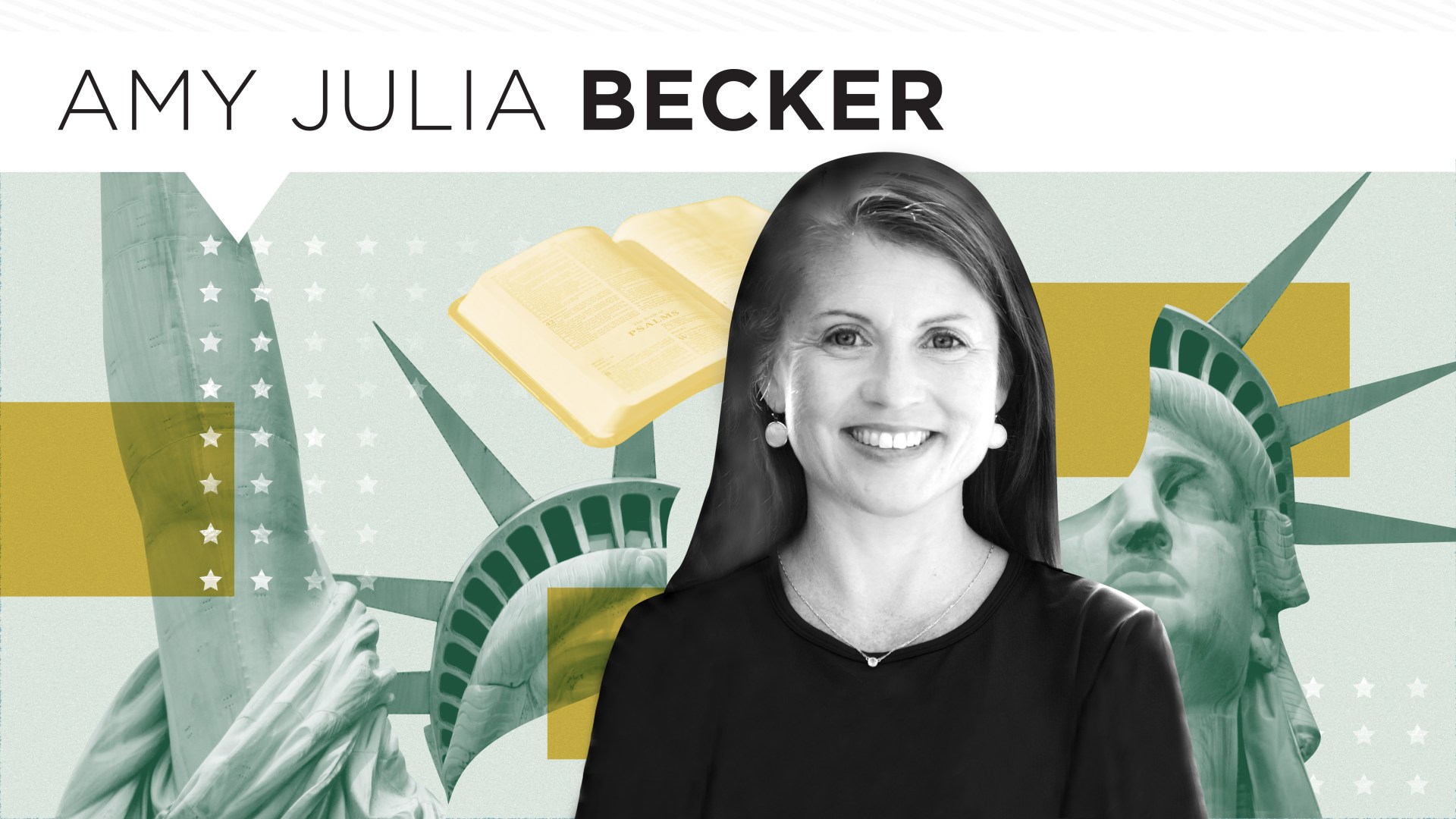






Enough to Share in the Land of Plenty

Why Christians should reject immigration policy rooted in scarcity.

Christianity Today June 9, 2020
Illustration by Mallory Rentsch / Source Images: Portrait Courtesy of Amy Julia Becker / Unsplash

In this series

Christianity Today asked a group of contributors how, if at all, the Bible should inform what a nation expects of immigrants. This is one of five essays in the series.

Last September, I traveled with a small group of evangelical women to El Paso, Texas, and Juárez, Mexico. We were hosted by Welcome, a collaboration between World Relief and the National Immigration Forum that offers an intellectual, theological, and personal understanding of the humanitarian crisis on our southern border. We met with local pastors and nonprofit leaders who have been providing shelter and care for migrants from Guatemala, El Salvador, and Honduras. We visited one of the shelters in Juárez that houses some of these migrants. We spoke with an immigration policy expert. We spent time with three border patrol agents to better understand the daily pressures they face protecting the border and caring for people in need.

When I was in El Paso, I heard a refrain: There is not enough. Not enough border patrol agents to process the migrants. Not enough detention facilities. Not enough judges. Not enough lawyers. Not enough discussion about changing the laws regarding legal entry and paths to citizenship. Not enough resources to house and clothe and feed and educate so many vulnerable people.

Certainly, the people and organizations at the border need more resources if they are going to care for immigrants in a humane way that honors the image of God. At the same time, citizens express their concern that the US is not prosperous enough to take on more people. We hear politicians say immigrants will overburden our social welfare systems.

So we become convinced that there is not enough. Not enough to care for immigrants at the border. Not enough to let them in.

But I follow a God who says there is always enough. Many of the women and men and children fleeing their home countries share my faith in Jesus. How can it be true that “God will meet all your needs” (Phil. 4:19) for them? How can it be true that they need not worry, for tomorrow “will take care of itself” (Matt. 6:34, CEV)?

When I was in El Paso, I kept thinking back to a simple incident with our three children. We were invited to a pool party, and our three kids knew that the supply of swimming goggles had dwindled to two desirable pairs. The older two quickly claimed the goggles, leaving Marilee, our 8-year old, with nothing. I threatened that no one would be able to swim if they couldn’t figure out a better solution. At that point Penny, our eldest, huffed, “Fine. I just won’t go swimming.”

My children could only see their situation through the lens of scarcity, and the only “solution” was total relinquishment, utter self-sacrifice, no swimming at all. Not one of them could come up with the idea of sharing the goggles.

Like my children, we have manufactured an impossible choice: Hoard what we have or give it all to the women, men, and children who are destitute and vulnerable. That is the way fear, scarcity, and isolation work. But that’s not the way abundance works. That’s not the way sharing works. That’s not the way God works.

The COVID-19 pandemic has only increased our sense of scarcity. There’s scarcity of simple resources like toilet paper and antibacterial soap. Scarcity of jobs. Scarcity of medical care. But even now, Christians are called to believe in the ongoing story of God’s abundant love for all people and God’s invitation to extend that abundant love even if it comes at a cost. The cost will not outweigh God’s provision. We hand to Jesus what “belongs” to us, with no guarantee that it will come back to us. But then we experience the miraculous reality that when we human beings decide to share, not only is there enough, but those acts of generosity spark human connection, gratitude, and joy.

Practically speaking, we are in a position to extend hospitality to our southern neighbors who are seeking refuge. The economic data about the role immigrants play, the economic data about our consumer spending habits, and a Christian ethos of abundance and generosity all challenge the idea that this immigration crisis threatens our country’s stability and that we should keep our borders closed. On an economic level, many sources, including the National Immigration Forum, report that immigrants in general contribute more dollars to the overall economy of the United States than they receive from it in social services. According to the Institute on Taxation and Economic Policy, undocumented immigrants pay over $11 billion in taxes each year, far more than they “take” from the system.

Moreover, until a few months ago, Americans lived in an era of low unemployment and of consistent (albeit slow) economic growth. Even today, by any economic measure, the United States is one of the wealthiest countries in the world. According to the Bureau of Labor Statistics, in 2018 we spent an average of $3,200 per person on entertainment (by contrast, we made “cash contributions,” which often indicates charitable giving, of $1,888 per person). We have heard a story of scarcity in recent years, but we would do well to remember an older American narrative. We live in a land of plenty, a land of opportunity, and immigrants only make it more so once they are safely settled among us.

To remedy the ongoing crisis on our southern border will require generosity, and such generosity could come at a cost, whether through voluntary charitable giving by individuals or increased spending on humanitarian resources. If there’s anything “staying at home” has taught me in recent months, it is that I can live without many of the events and upgrades that once seemed necessary.

For every American, there are economic, political, humanitarian, and ideological reasons to “share the goggles,” to welcome the asylum-seekers, to provide more funding for border patrol, more funding for immigration judges, and to change the laws and policies governing visas and paths to citizenship within this country. But Christians in particular have reasons to welcome those from foreign lands to our own shores.

Christians rely upon an ancient set of stories about a God of abundance who prompts his people to trust in his provision and generosity. In Exodus, we encounter the story of manna in the desert, when God regularly and miraculously provides food for his people for 40 years. The Israelites repeatedly experience situations in which there is not enough—not enough men to fight, not enough food to eat, not enough faith to endure—and God provides. Jesus similarly calls his followers to live with radical generosity as they trust a God of abundant provision. All four gospels record the feeding of the 5,000. This miracle happened only because a young boy volunteered to share his scanty resources with an overwhelming crowd. That boy then had a front-row seat to the abundance God provided through him.

Modern day examples of God’s abundance appear in stories like Gregory Boyle’s testimony of how “boundless compassion” can transform former gang members in Los Angeles, Kathy Izard’s story of provision in the face of a crisis of homelessness in Charlotte, North Carolina, Henri Nouwen’s witness to abundance in community with people with intellectual disabilities, and John Perkins’ recounting of the presence of God’s abundant love in confronting racism and injustice.

For God’s people to experience God’s abundant provision, we must begin with trust in God, which in turn enables us to entrust our time, energy, and resources to others.

We must take practical steps when it comes to public policy, funding, and long-term changes to our immigration system to both protect current Americans and welcome those in need. Christians who are US citizens have a unique opportunity to leverage that privileged position to shape a more just society for people of every ethnicity, class, and immigration status.

The narrative of abundance can seem unreasonably idealistic in the face of thousands and thousands of people in need. But we can translate an idealistic vision of abundance into a concrete willingness to change the way we consume goods and spend money. We can translate it into phone calls and letters to our elected officials. We can translate it into prayer for eyes to see and hearts to respond to need in the world. We can translate it into action that reflects the love of Christ. Indeed, the idealistic vision of God’s abundant love that cries out to us from the pages of Scripture—Love always trust, always hopes, always perseveres—will remain idealism unless God’s people, by God’s power, put that abundant love into action.

Amy Julia Becker is the author of White Picket Fences: Turning toward Love in a World Divided by Privilege, among other books. She lives in western Connecticut with her husband and three children.


Living Faithfully in Exile

God calls immigrants to seek the welfare of their new home.

Christianity Today June 9, 2020
Illustration by Mallory Rentsch / Source Images: Portrait Courtesy of Rondell Trevino / Unsplash

In this series

Christianity Today asked a group of contributors how, if at all, the Bible should inform what a nation expects of immigrants. This is one of five essays in the series.

Several years ago, I wanted to try out a new hobby, so I purchased a Batman puzzle. When I got home, I poured all of the pieces onto the dining room table and began putting the puzzle together. After about an hour, there was one last piece to be connected. But to my surprise, the final piece of the puzzle was nowhere to be found. I looked inside the box and around the table several times and didn’t see the piece anywhere. Finally, I broadened my search until I spotted the missing piece on the very chair in which I had been sitting.

When it comes to solving the puzzle of immigration, there’s a tremendous job being done addressing many of the necessary pieces. Many of us understand the need to love, do justice on behalf of, welcome, and care for immigrants. But I fear some of us have lost one vitally important piece: acknowledging the responsibility of immigrants to seek the welfare of the United States.

In Jeremiah 29, the Babylonians captured the nation of Judah, effectively exiling them from Jerusalem. They were forced out of the place they once called home and into Babylon. They became immigrants in a foreign land.

While in Babylon, God speaks through the prophet Jeremiah, giving the people of Judah a jaw-dropping command: Seek the welfare of the city (Jer. 29:7). In other words, seek the peace, prosperity, and success of Babylon by building houses, planting gardens, eating produce, getting married, having kids, and praying for the city. Despite the suffering and pain God’s chosen people are facing, he still gives them these challenging commands.

Today in the US, immigrants, whether documented or undocumented, feel exiled for a plethora of reasons. Many feel exiled from the country they once called home—because of gang violence, human trafficking, religious persecution, or for leaving their immediate family to seek a better life through an international student visa, tourist visa, work visa, or US residency. Many feel exiled in their new home because of racial discrimination and xenophobic attitudes.

Yet, in the midst of feeling exiled, all immigrants have a responsibility to seek the welfare of the country where they live. Here are four ways they should do so.

Pray

The second half of Jeremiah 29:7 says, “Pray to the Lord on its behalf. …” Immigrants should ask God for good things to happen in the United States. They can pray for its protection against the coronavirus pandemic. They can pray for unity and respect between those who disagree—even on the topic of immigration—and that God would give wisdom and discernment to the president, congress, senators, and local officials (1 Tim. 2:1–2). They can ask God to establish comprehensive immigration reform that offers compassion to immigrants and peace at the border.

Contribute

God instructed His people in Jeremiah 29:5 to build houses, plant gardens, and eat produce. In other words, he wanted them to contribute to Babylon. Immigrants living in the US should seek to do the same where they live. They can work, pay taxes, and start businesses. Many, if not most, immigrants are already doing these things today: Some of the most iconic American companies have been founded by immigrants, including Google, Kraft, Yahoo!, Ebay, AT&T, and Intel. Others can help families raise children, volunteer at local nonprofits, care for the sick and elderly, and take pride in maintaining their homes.

Establish Peace

The word welfare in Jeremiah 29:7 can be translated as peace. Peace means taking what is broken and making it complete or whole. Life is complex and full of moving parts, and when any of these is out of alignment, peace breaks down and must be restored. Immigrants today who are undocumented can try to establish peace by attempting to align with the law, though there are few options for doing so and government responses to COVID-19 have made it even more difficult.

Immigrants can also establish peace by calling attention to the need for immigration reform that shows compassion and secures the border—not just one or the other. Young immigrants here though Deferred Action for Childhood Arrivals (DACA) can continue to share their stories with pastors and legislators to help fix the program, which desperately needs completeness and sustainability.

Love Your Neighbor

The relationship between God’s people and the Babylonians was out of alignment and broken, and the Israelites could have established peace with the Babylonians by being an example of how to live a life that pleases God. Immigrants today, especially those who follow Jesus, can proactively establish peace with those they might deem enemies or disagree with—which will require humility, patience, listening, and kindness.

My wife, an immigrant from Guatemala, lived a great example of this. She once met a woman who openly shared her dislike for all immigrants, especially those who are undocumented. Though my wife was hurt, instead of retreating and never speaking to this women, she pursued a relationship with her.

Over the course of a couple of years, we had the woman in our home many times for dinner and fellowship. She has grown to love my wife, my two daughters, and me, even though we disagree on some things. My wife’s neighborly love, by God’s grace, has softened the woman’s heart toward immigrants.

When immigrants do as the Bible commands and seek the welfare of the place where God has brought them—even through terrible circumstances—they are not earning asylum or citizenship any more than they are earning God’s love. They are living out of a beloved and approved status that they already have, in God’s eyes.

Rondell Treviño is founder of The Immigration Coalition, a faith-based nonprofit providing biblically balanced resources that show compassion to immigrants and respect for the rule of law. He previously worked with the Evangelical Immigration Table.

In Search of the ‘Good Immigrant’

Consciously or not, the expectations we set for immigrants are impossible to meet. They’re also unbiblical.

Christianity Today June 9, 2020
Illustration by Mallory Rentsch / Source Images: Portrait by Brandon Tobias / Courtesy of Karen Gonzalez / Unsplash

In this series

Christianity Today asked a group of contributors how, if at all, the Bible should inform what a nation expects of immigrants. This is one of five essays in the series.

I am not a good immigrant. I don’t know any good immigrants. Good immigrants, according to our American mythology, work hard and keep their head down. They assume the necessary risks to keep our economy running during a health pandemic, and they don’t complain about being blocked from public benefits our economy affords or being excluded from CARES Act stimulus payments.

Good immigrants are eternally grateful for admission to this great country and never critique it. They speak English fluently and are fully assimilated into American culture, forgetting the old country except in the occasional nostalgic moment or holiday. They are so law abiding as to be above reproach. In short, they are shining examples of what it means to be an American.

Above all, good immigrants find a way to be legal immigrants, never mind an ever-shifting immigration system that favors some, marginalizes others, and strands many in a world of loopholes and technicalities. They would separate from their families, even see their children suffer, before they would cross a border without papers.

I used to aspire to this mythical and impossible level of perfection. Not only did it keep me from living fully into my identity as a child of God who bears the image of God, but it also kept me from seeing my own immigrant family and neighbors through the lens of the gospel. Instead, I demanded this impossible standard from them as well, evaluating them through the same rubric of worthiness used to evaluate me.

In simple terms, my aspirations for “good immigrant” status drew me away from the gospel, not toward it. We often run into problems, biblically speaking, when we label people as “good” or “bad”—immigrants included.

I migrated from Guatemala in the 1980s and have fought to preserve my first language and culture while integrating into American society. I am an image-bearer of God with flaws, struggles, and habitual sins. I often speed on the highway and have earned my share of parking tickets as a city-dweller. I get angry and frustrated with US laws that harm people, and I have taken part in protests. I collected unemployment for a season.

Our own history suggests that good immigrants, as we imagine them, were few and far between. Those who arrived in earlier centuries did not migrate to become “good Americans” but to replicate the best of their old country in a more favorable environment. They were often slow to learn English and integrate into American society. That is why we have New England and Pennsylvania Dutch Country, and why many cities have Little Italy and Chinatown.

Early immigrants didn’t think of themselves as “legal” or “illegal,” because that language wasn’t part of the national vocabulary. There was no mechanism to enforce the few immigration laws that existed, and newcomers came across our borders with ease, often without even an interview. For most of American history, our borders were, effectively, open borders.

The uncomfortable truth is that immigrants have changed little. Immigration laws and enforcement have changed a lot.

Followers of Christ can turn to their Bibles to find stories of imperfect immigrants, saints seeking to live as faithfully as they can in a land that is not their own.

Abram migrates to Egypt, fleeing a famine, and commits fraud by presenting Sarai as his sister instead of his wife (Gen. 12). Then he traffics her for his own well-being.

Naomi migrates to Moab, escaping a different famine and seeking economic security for her family (Ruth 1). Her sons marry Moabite women, an action God’s law explicitly prohibits (Deut. 23, Ezra 9, Neh. 13). Ignoring God’s law yet again, she later instructs her Moabite daughter-in-law, Ruth, to pursue and marry Boaz, a man from Bethlehem.

In the New Testament, a Syrophoenician woman—an unclean foreigner—invades Jesus’ privacy and threatens his honor as a Jewish man to seek a favor (Mark 7:24–30). In the end, Jesus grants her the favor and affirms her faith.

Somehow, all of these flawed biblical heroes are held up as pillars of the faith, examples for Christians to follow. We recognize that these imperfect people bore the imago Dei, and God’s plans and purposes are made known to us through them. For God, their offenses did not overshadow their identities as part of his family.

Jesus’ own humanity was complex and multi-faceted. His history included both forced migration as a child refugee and persecution under a foreign empire. His incarnation invites us to fully and unreservedly embrace our own and each other’s humanity. In our shared life in Christ, we do not escape our humanity, nor do we take it from one another. We delve more deeply into it, choosing truly to love our neighbors as ourselves, even our imperfect immigrant neighbors.

Subscribing to the rhetoric of the good and bad immigrant reduces our neighbors to objects that either benefit or don’t benefit us. But God sees us all as his beloved children and friends. Do we see as God sees?

Karen González is a speaker, immigrant advocate, and the author of The God Who Sees: Immigrants, The Bible, and the Journey to Belong. Find her on Twitter and Instagram @_karenjgonzalez.

Who Can Afford to Be Thy Neighbor?

Immigration policies rooted in economic favoritism don’t reflect biblical ethics.

Christianity Today June 9, 2020
Illustration by Mallory Rentsch / Source Images: Portrait by Luke Stringer / Courtesy of Abbie Storch / Unsplash

In this series

Christianity Today asked a group of contributors how, if at all, the Bible should inform what a nation expects of immigrants. This is one of five essays in the series.

I haven’t seen Gabriela lately, but I used to see her every week. On Saturday mornings, she came to the church food bank where I volunteer as a translator. Visibly pregnant, she would greet me in Spanish with a soft voice and a timid smile. Gabriela was born in Guatemala and came to the United States years ago, but she still speaks no English. Along with her mother and sister, Gabriela cobbles together food stamps and donations from the church food bank to feed her children. As far as I know, the father is out of the picture.

When we think of “good” immigrants—those highly educated, motivated individuals we often want to cherry-pick to make our country better—Gabriela is not who comes to mind. Recent policy changes that restrict participants in public programs like Medicaid or SNAP from applying for green cards suggest that Gabriela drains our resources without contributing anything in return. Many feel America is better off without people like her, no matter the violence she fled or the circumstances of her departure from Guatemala. Her worth is dependent on her economic capacity.

But this logic reflects the economy of this world, not the economy of God’s kingdom. It reduces the give and take of the social fabric to transactional exchanges. That mindset is death not only to our immigrant neighbors, but to all of us. If we accept that economic contribution is the primary prerequisite for living among us, why apply it only to immigrants?

Much has been written about the way Scripture frames the plight of poor immigrants and refugees. The writers of the Hebrew Scriptures consistently advocate for the welfare of the foreigner, admonishing the Hebrew people to remember their former status as alien migrants. But these verses are not simply proof texts; considered in context, they are far more potent than that.

When Jesus asserts the Golden Rule in Luke 10, he is quoting Leviticus 19, a passage of the Law that outlines proper treatment of the foreign-born. It should not come as a surprise that the neighbor to whom Jesus refers in the parable of the Good Samaritan is an outsider. After all, the Levitical dictum to “love your neighbor as yourself” is enshrined within the set of commands to treat the economically destitute migrant as oneself.

Leviticus 19 begins with the words of the Lord: “Be holy because I, the Lord your God, am holy.” He is not vague or mysterious about what holiness entails. Levitical law is as concerned with justice as it is with ritual purity codes, particularly justice that shows no favoritism toward the rich or the established:

Do not reap to the very edges of your field or gather the gleanings of your harvest. … Leave them for the poor and the foreigner. I am the Lord your God. (19:9–10)

Do not pervert justice; do not show partiality to the poor or favoritism to the great, but judge your neighbor fairly. (19:15)

When a foreigner resides among you in your land, do not mistreat them. The foreigner residing among you must be treated as your native-born. Love them as yourself, for you were foreigners in Egypt. I am the Lord your God. (19:33–34)

As Jesus illustrates in his parable, the command to “love your neighbor as yourself” is nestled among a litany of codes for how the people of Israel ought to treat both the native-born and the foreign-born, the economically comfortable and the economically destitute—namely, that they ought to treat them exactly the same.

The United States is not the kingdom of God. But we still have a choice between advocating for policy that increases our personal prosperity at the expense of others, or advocating for policy that furthers the ideas and priorities of Scripture.

As a descendant of Jewish immigrants from Eastern Europe, I am close enough to feel the steep price of the partiality that God decries in Leviticus. Fleeing Russian pogroms and Nazi Germany, several of my cousins sought refuge in America aboard the St. Louis. Though they had a well-founded fear of persecution, they were turned away from US soil. They were poor, they were Jews, they were reviled and discriminated against throughout all of Europe. I have records of one cousin who died in the Holocaust, but of course there were more whose records are lost.

My ancestors were not ideal immigrants. They were desperate—poor in spirit, mourning the countries that had disowned them, meek, and afraid—in other words, the exact kind of person Jesus calls blessed. It’s been said so many times before but is worth saying again: Like the Hebrew people, most of us are descended from refugees and migrants—economic, religious, or otherwise. Like the Hebrew people, in our prosperity we forget the vulnerability and fear our ancestors experienced during their journey. We forget that they were at the receiving end of a welcome that we are now in a position to extend.

Jesus knew that it is easy to love ourselves and those who contribute to our personal prosperity. He didn’t need to waste his words telling us to be self-interested. He spent his words educating us about a different system and telling us how to live within it.

As Christians, we may disagree on immigration policy. But we must resist the temptation to sort complex human beings, all of whom carry life’s difficulties, into economic categories of “good” and “bad.”

After each commandment to honor the foreigner in Leviticus 19, God declares, I am the Lord your God, as if to say, These foreigners, they are not yours to judge. If we fail to hear this, we just might find that God has already invited them to his table, while we were busy adjudicating their worth.

Abigail Storch is a graduate of Eastern University and Yale Divinity School. Originally from Greensboro, North Carolina, she now lives and works in New Haven, Connecticut.

What Should a Nation Expect of Its Newcomers?

Five evangelical thinkers consider the biblical obligations of immigrants to their host country.

Christianity Today June 9, 2020
Illustration by Mallory Rentsch / Source Images: Fabian Fauth / William Navarro / Aaron Burden / Unsplash

In this series

The US conversation on immigration has largely disappeared from the news as Americans have shifted their focus in 2020 to COVID-19 and, later, to widespread protests following a police killing in Minnesota. But the White House has continued enacting aggressive policies in the name of public safety, including effectively ending asylum at the US border and further restricting who can apply for a green card. Southwest border crossings have fallen dramatically from the beginning of the year.

Debate around immigration will surely heat up again as the November election nears. When it does, much of the rhetoric will revolve around various offshoots of the deeper questions: How does immigration benefit America? How do we ensure those who enter our country will contribute to it? Advocates on all sides will showcase exceptionally shining or delinquent examples and attempt to portray them as representative of the foreign-born as a whole.

Christianity Today asked a group of contributors how, if at all, the Bible should inform what a nation expects of immigrants. The answers mattered before COVID-19, and they matter now, when anti-immigrant sentiment is rising even though immigrants make up a large portion of the workers most exposed to the virus, such as cleaners and food industry employees.

The Editors

Ideas

Burl Cain Promises ‘Good Praying’ for Mississippi Prisons. It’s Not Enough.

For too long, evangelicals have compromised with the punitive politics of law and order.

Christianity Today June 8, 2020
Giles Clarke / Getty Images

Mississippi prisons are in crisis, and the governor’s new pick to lead the state’s Department of Corrections has an answer: “good food, good praying, good playing, and good medicine.” Burl Cain announced his fourfold plan with his trademark Louisiana twang, making a direct reference to his previous work as warden at Louisiana State Penitentiary, known as “Angola.” Under Cain’s leadership, that prison went “from beatings to Bible studies,” as Mississippi Governor Tate Reeves described it when he appointed Cain.

Reeves’s hope is that Cain can do the same thing for Mississippi prisons. The state is a national leader in imprisonment rates, with a dramatic overrepresentation of people of color in its prisons. The prison system has a long history of corruption and underfunding and a record of horrific conditions. Recently, the state’s prisons have been wracked by violence. The Mississippi State Penitentiary at Parchman has had more than 30 deaths since late December.

The hope in Mississippi is that Cain is the answer. There are reasons for that. Cain comes highly recommended, has been widely lauded, and has a record of reforms that have made a real difference in the lives of many prisoners. But there are also reasons for concern, particularly if his appointment prevents a fuller reckoning with broader injustices in Mississippi and the nation more broadly.

During his two decades at Angola, Cain oversaw changes that were a mix of standard administrative reforms aimed at improving conditions with overtly religious programming aimed at “moral rehabilitation”—changing the hearts and minds of incarcerated people through spiritual transformation. Cain invited New Orleans Baptist Theological Seminary to open a Bible college inside Angola. The religious programming at Angola, while officially open to prisoners of all faiths, has a distinctly evangelical flair. Even seemingly secular initiatives at Angola have evangelical resonances: Workers in the prison’s carpentry program built the caskets that held the bodies of Billy and Ruth Graham and, more recently, famed Christian apologist Ravi Zacharias.

When Cain explains his penal philosophy, he regularly asserts that religion makes people moral and “moral people are not criminals.” Audiences, both secular and religious, often hail him for this approach, calling it common-sense (and even “progressive”).

However, Cain still courts controversy. His new appointment is a reminder of the longer history of evangelical influence in criminal justice and the persistent tensions that exist around matters of religion and incarceration. In many ways, Cain is the product of a long history of evangelical concern about crime and punishment.

As I explore in my book Gods Law and Order, modern evangelicals have long seen personal conversion as the solution to crime and the solution to the ills of American incarceration. While some evangelicals, most notably Charles Colson, paired spiritual appeals with reformist advocacy, others focused less on material changes in prison conditions and more on saving souls. Complicating all of this work was the fact that many evangelicals, especially from the mid-1960s on, have been supporters of punitive politics. More than a few believers have advocated increasing rates of incarceration, “throwing away the key,” and prison proselytization, all at the same time.

Mississippi’s own history showcases the complexities of this religious landscape. Colson advocated for modest reforms to the prison system in Mississippi in 1982. The former political operative for Richard Nixon had been born again, served time in prison for his involvement in the Watergate scandal, and then founded the parachurch ministry Prison Fellowship. Colson brought a faith-informed message of reform to Mississippi, but he was rebuffed. His proposals were considered “soft on crime.”

The irony was that Colson was snubbed in Bible-belt Mississippi with distinctly Christian appeals to law and order. As one state senator put it as he dismissed Colson’s efforts, “The two reasons people do not commit serious crimes” are “a personal moral code based on Christian teachings and fear of swift and certain punishment as an effective deterrent to crime.” Colson gradually learned to accommodate the objections of tough-minded critics, and his long-term influence allowed conservatives to eventually take on the reformist mantle.

Besides Colson, perhaps no one has resolved the apparent tension in the conservative and evangelical belief in harsh punishment and the possibility of redemption better than Burl Cain. A star within evangelical and conservative criminal justice reform networks, Cain represents a powerful crystallization of humanitarian, punitive, and evangelistic sentiment and practice. Cain and like-minded evangelicals have praised religion’s disciplinary, crime-reducing potential and defended the divinely-ordained right of the state to incarcerate people and even take life.

Some Angola prisoners have found Cain’s moral rehabilitation initiatives personally meaningful. One recent study found that many prisoners embraced the programs’ “redemptive aspirations.” If Cain has his way, a similar reformist vision rooted in spiritual transformation will likely emerge system-wide in Mississippi. As with other conservative “right on crime” initiatives, it will allow Mississippi politicians to speak to prisoner welfare and at the same time maintain tough-on-crime personas. In this way, the original vision of Colson and his more punitive Mississippi opponents will be combined.

Other activists, religious leaders among them, have rallied for changes of a different sort in Mississippi. Danyelle Holmes, an organizer for the Mississippi Poor People’s Campaign, has linked the prison system’s crisis to the state’s broader history of racial injustice and over-reliance on imprisonment. “Parchman is everywhere,” she told a recent online gathering of activists. “It has a deeper history. … It is time we demand an end to mass incarceration.”

At the same gathering, William Barber II noted that Parchman “was detrimental and deadly before the violence” that has troubled state officials. He linked the efforts in Mississippi to the broader struggle against the “new Jim Crow.” Barber said, “I’m reminded that Jesus said how we treat the prisoners … he said, ‘inasmuch as you treat them, you treat me.’ … We cannot be silent on this issue.”

The Mississippi Poor People’s Campaign and the Mississippi Prison Reform Coalition have criticized Cain specifically. In a statement, the groups explained that his appointment is “antithetical” to their goals. They want to “tear down the oppressive and draconian ideology that has led to Mississippi’s high mass incarceration rate and inhumane prison conditions.”

I asked Rukia Lumumba, founder of the People’s Advocacy Institute in Jackson and steering committee member of the Mississippi Prison Reform Coalition, about Cain’s appointment. She acknowledged the benefits of religious programming that Cain will likely institute but said she is nonetheless disappointed.

“This is not the transformation we need in our system,” Lumumba said. “There are too many in Mississippi prisons who are there because they are poor or black. … There are too many in our prisons who are juveniles, elderly, disabled, who need medical care, or who present no danger.”

For Lumumba, there is a better answer: “Let people out.”

Some things in Cain’s record also raise red flags. A number of lawsuits have been filed by Angola prisoners, including non-Protestants complaining of unfair treatment and incarcerated journalists who say the warden muzzled their work. Cain has denied these allegations. He has also denied the allegations of financial misconduct, which led to his resignation from Angola in 2015.

It remains to be seen what will become of Cain’s work in Mississippi. If Cain can immediately improve conditions and reduce violence in the state’s prisons, his appointment will no doubt be considered a victory for the governor. Mississippi’s many evangelicals will also find Cain a powerful long-term ally, a man who speaks their language. And prisoners may indeed find sustenance and personal transformation through the gospel because of religious programming.

But, as observers of religion and prisons have noted, Cain’s appointment risks letting Americans, in Mississippi and elsewhere, continue believing that the problems of criminal justice are exclusively problems of the heart, not of racism, economic inequality, or punitive politics. Even defenders of Angola’s religious programs who support Cain’s appointment worry that expanding faith-based programming will increase divestment in other kinds of rehabilitative programming in prisons, as governments look to cut costs and rely on private actors (like churches) for delivery of services.

Given the recent killings of Ahmaud Arbery, Breonna Taylor, and George Floyd, we also should be deeply concerned that the concept of “moral rehabilitation” does nothing to challenge—and threatens to confirm—white Americans’ long-standing assumption that blackness is criminal, and therefore punishable (or choke-able). Creating conditions for “better praying” may offer solace to people on the inside, but what about the as-yet-unanswered prayers for an end to “law and order” politics, over-policing, drug arrests, draconian sentencing, and police brutality? Many have been praying and advocating for radical, lasting changes to these social ills, but their work stands to be eclipsed by religious programming that will not challenge injustice.

Cain’s re-emergence shows how evangelicals have accepted the existence of the prison state itself, a sad concession when there are alternatives to incarceration that are much more promising in terms of reducing crime, helping victims, and offering dignity to offenders. Prisons may be hellish, but they are not eternal. As a society we do not have to accept their presence as our fate. We should ask what other possibilities there might be for our nation. Perhaps, somehow, Mississippi may connect a gospel of individual conversion with the good news of freedom for prisoners. If that can happen, we might tell the story of a new transformation, one not only of our nation’s prisoners but of our nation itself.

Aaron Griffith is a history professor at Sattler College and the author of Gods Law and Order.

Speaking Out is Christianity Today’s guest opinion column and (unlike an editorial) does not necessarily represent the opinion of the publication.

Books
Review

Pastors and Their Strangely Attractive Scars

An intimate look at the joys and regrets of those who shepherd God’s flock.

Christianity Today June 8, 2020
Illustration by Mallory Rentsch / Source Images: PeopleImages / Getty Images / Daniel Gregory / Lightstock / WikiMedia Commons

There’s something about the art of pastoring souls that can’t be codified and taught in a classroom. Ministry is best learned in context. Just as medical doctors move through rotations during their hospital internships, so physicians of souls accumulate practical wisdom by serving the people of God patiently over the years. You don’t master this craft overnight; nor can you adequately sum it up in a how-to manual.

Diary of a Pastor's Soul: The Holy Moments in a Life of Ministry

Diary of a Pastor's Soul: The Holy Moments in a Life of Ministry

Brazos Press

240 pages

$10.98

M. Craig Barnes, president of Princeton Theological Seminary, has done us all a favor, whether or not we are pastors. His book, Diary of a Pastor’s Soul: The Holy Moments in a Life of Ministry, provides a unique picture of what it means to pastor people with sensitivity and grace. No, this is not a how-to manual, but that is its saving grace. We don’t need any more how-to manuals on ministry. Nor do we need yet another book tracing the latest trends of the day and forecasting how pastors and churches will need to scramble to reinvent themselves in the image and likeness of an ever-shifting culture.

Instead, Barnes’s book takes the long view on ministry. It takes seriously the formative impact of sheep on their shepherds over time. It traces the grooves of God’s grace worn deep in a pastor’s soul as he invests himself in caring for people through good times and bad. Those grooves do not appear overnight; there is no shortcut to sensitive and effective ministry in Jesus’ name. This book is the personal legacy of an academic whose first love is clearly the parish. Here he bares his soul for all to see, and so enriches us all.

Ministry Stories

Barnes notes in his preface that the old-timers—old Pietists, to be exact—used to speak a great deal more than we do about the necessity of gravitas among clergy. Personally, I think those Pietists were on to something. We’re all quick to list the qualities we’d like our pastors to possess: friendliness, cheerfulness, passion, drive, ambition, leadership skills, and so on. But gravitas? Not so much. Maybe that’s because we think of it as a turn-off. Who wants a dour, ponderous personage in their church’s pulpit? But Barnes is quick to clarify what the Pietists had in mind: Gravitas “was their description of a soul that had gained enough weightiness to be attractive, like all things with a gravitational pull.”

That’s what we need, don’t we? Pastors who don’t merely proclaim the coming of God’s kingdom but tug us toward it by their own example and faith—their lived experience of the grace of God at work in the tangle of daily life. But gravitas is not synonymous with longevity, as Barnes points out. Speaking of pastors who possess it, he writes:

It really has less to do with their age than with their response to the way life unfolds. They have scars, which are strangely attractive, but not open wounds. They’ve settled into themselves, and into the people God has given them to love, without any irritating plans for improvement.

So what does pastoral gravitas actually look like? Barnes tries to capture it by composing a series of journal entries from a fictionalized senior pastor of a fictionalized church, St. Andrews Presbyterian. This pastor, who is wrapping up his final year of active ministry, writes one entry per week for each month leading up to his retirement, offering a window into both his own life and the lives of many parishioners.

From the journal, we learn that the pastor’s wife was named Ellie, and that they had a daughter named Mackenzie. We never learn the pastor’s name, though I suspect he is modeled after Barnes himself. As Barnes (the author) confides, when he began writing about the formation of a pastor’s soul, he found himself telling stories—stories from his own ministry. They are fictional stories, he writes, both because he wanted to preserve pastoral confidentiality and because “I found myself wanting to rewrite some of my own stories that I might have lived differently if I had known then what I know now.”

What Barnes gives us, then, as he looks back on his pastoral career, is a book somewhere between fiction and nonfiction. Whether his stories are real or imagined, they all depict the real lives lived by parishioners and pastors. That’s the best part of this book: We can all find ourselves somewhere within its pages. And when we do, we will discover how God goes to work forming pastors after his own heart. As Barnes observes, “The formation of the pastoral soul does not lend itself to being explained as much as revealed.” Amen to that.

I’ll admit that I found myself, on occasion, wanting to enter into theological debate with the pastor of St. Andrews, as I suspect many readers will. Not all of us will agree with his theology—or his pastoral decisions, for that matter. But that’s not the point. This book is not a systematic theology; nor is it exactly a pastoral theology. But in these pages you will find all the ingredients for a truly pastoral disposition. These matters don’t call for argument or disputation, but emulation.

Barnes’s book brings to mind Eugene Peterson with its folksy whimsy blended with deep insight into the human heart. Through the shifting seasons of the church year and the changing weather of the passing months, I found myself captivated by the people of St. Andrews. I’ve met many of them myself over my own 49 years of ministry.

There’s Alice Matthews, matron of the church’s property committee. For 23 years she’s kept a vigilant eye on the parish’s aging edifice, ever prioritizing matters of structural soundness over spiritual mission. She was married in this building, as was her daughter. Her children were baptized there and her husband buried there. As Barnes notes: “Everything she knows about Jesus and his grace for us is lingering in the mortar that holds the stones of her church together.” Yet for all her limitations, Alice had a heart for service and a generous spirit.

In September we meet Esau, the family’s hairy sheepdog. The narrator notes that he’s learned a lot about ministry from his dog. Jesus is the true shepherd of the congregation, he writes: “It’s far more helpful to think of myself as a sheepdog that nudges sheep toward the only Savior of the flock.” Having run into that sheepdog analogy elsewhere, I was pleased to make Esau’s acquaintance while learning something else about pastoring. When chasing birds on the beach, Esau never runs straight at them. Rather, as a herding dog, he circles in on his targets. As Barnes observes, “Long ago I learned the value of not approaching problem parishioners with head-on confrontation, but by coming at them ‘slant’ as Eugene Peterson calls it.”

Another of my favorites at St. Andrews is Mrs. Thelma Parker—the “Queen of the congregation,” as Barnes calls her. From her key leadership position in the congregation, she saw to it that the wishes of the elders gained traction among church members. Smiling her way through the church fellowship hall, she smoothed ruffled feathers, calmed controversies, and answered questions about new staff members. “All the while,” Barnes writes, “she was sipping coffee and ‘just chatting.’” Every church could use a Thelma—someone who knows its inner politics and moves graciously and unassumingly within them, all in service of the kingdom. Blessed are the peacemakers.

Unworthy Servants

Diary of a Pastor’s Soul contains none of the usual platitudes about pastoral ministry. Instead, it paints a clear picture of the raw horror into which pastors pour the healing balm of the gospel with some regularity. We meet Stan, an early widower whose wife had been killed in a traffic accident shortly after the narrator had baptized their little baby girl, Mary Jane. Years later Stan brings his beautiful teenage daughter into the pastor’s study to disclose impending tragedy. Mary Jane has contracted a debilitating disease that will quickly paralyze her, leaving her in a wheelchair by the time prom rolls around. Tears flowed freely all around, all three “taking turns at the tissue box.”

Pastors encounter such heartbreaking scenes often enough; that much most people assume. But not many grasp the impact of these situations on a pastor’s soul. Here’s how Barnes sums up what he learned by caring for Stan and Mary Jane:

I assured them of my own sorrow and that the congregation would do everything to surround them with compassion and any help we could provide, and that most importantly none of this was lost on the God who created Mary Jane and would never leave her. These are the things I was trained to say long ago. Then I prayed for her healing. I actually begged God, which is something I didn’t learn in seminary.

When they left, I needed a pastor of my own, which is something else they didn’t teach me in seminary.

Diary of a Pastor’s Soul opens a window into the pastoral soul that will enrich both pastors and those who love them. In this captivating book we discover anew the profound gift God has given us in compassionate shepherds for our souls. As honest pastors can attest, they themselves need shepherding for the very reason we do—to grow in the grace and the knowledge of Christ Jesus.

Ultimately, this book underscores what every pastor already knows—that in the end, all of us are nothing more than unworthy servants. We’ve got nothing to give that we have not first received. The Apostle Paul expressed it well: “Although I am less than the least of all the Lord’s people, this grace was given to me: to preach to the Gentiles the boundless riches of Christ” (Eph. 3:8).

Harold L. Senkbeil is an executive director of Doxology: The Lutheran Center for Spiritual Care and Counsel. He is the author of The Care of Souls: Cultivating a Pastor’s Heart (Lexham) and Christ and Calamity: Grace and Gratitude in the Darkest Valley (Lexham).

Mitt Romney Joins Evangelical Racial Justice March in DC

Pastor Thabiti Anyabwile helped organize Sunday’s event, which drew hundreds of participants.

Christianity Today June 7, 2020
Samuel Corum / Getty Images

Utah Senator and former Republican presidential candidate Mitt Romney joined demonstrators against racial injustice on Sunday in a march to the US Capitol that was organized by evangelical Christian activists, telling reporters he was attending the demonstration to help “end brutality” before adding, “Black lives matter.”

Romney, a member of the Church of Jesus Christ of Latter-day Saints who has spoken often of his faith, also tweeted out a picture of himself at the Faith Works march below the caption “Black Lives Matter.”

The day before, Romney had tweeted an image of his father, George W. Romney, then governor of Michigan, participating in a civil rights march in the 1960s.

Romney’s office declined to comment regarding his decision to join the demonstration, or if his faith played a role.

Sunday’s march, already in progress for hours before Romney arrived, was called by local D.C. churches that count themselves as theologically conservative.

The event, described as a “Christian Response to Racial Injustice,” drew a diverse crowd and was supported by prominent preachers such as Thabiti Anyabwile, the pastor of Anacostia River Church, David Platt, lead pastor of McLean Bible Church in Vienna, Virginia, Mike Kelsey, McLean Bible Church’s lead pastor of preaching and culture, and Perrin Rogers of the Triumphant Church in Maryland.

Last year Platt prayed with President Trump at McLean Bible Church when the president made an impromptu visit, causing the pastor to explain the incident in a letter to the congregation.

Tyler Bowen, who attends Grace Meridian Hill, a church affiliated with the conservative Presbyterian Church in America, said the demonstration was indicative of a more advocacy-oriented strain of evangelicalism that is well represented in the churches that organized the march.

“There is a branch of the evangelical church—like we saw today—that is standing up against these issues, is speaking out, and believes that Jesus is calling them to speak out,” said Bowen. “Speaking out is being faithful to his commandments.”

Participants gathered in southeast Washington before processing toward the US Capitol, singing hymns such as “Amazing Grace” as they walked and holding signs with references to Bible verses such as “Do justice, love mercy, and walk humbly with your God,” from the Book of Micah.

Many also held signs that read “Black Lives Matter.”

Joshua Little, who attended Sunday’s demonstration and works at the evangelical Christian human rights advocacy group International Justice Mission, estimated that about 2,000 people showed up for the march.

“It represented a unified show of support of churches in the D.C. area marching for justice,” Little told Religion News Service. “We are uniting as Christians to stand up against racial injustice.”

He said that when marchers gathered near the reflecting pool outside the US Capitol to pray, the tenor was more upbeat and less “contentious” than other recent protests that have sprung up following the death of George Floyd, a black man who died begging for breath while a white police officer kneeled on his neck for nearly 9 minutes.

“I felt very glad that there was a protest movement that I could join without being worried that it was going to go in a direction that I wasn’t comfortable with—in terms of violence or in terms of espousing beliefs about the state or the nature of the problems that we face that I fundamentally don’t believe in,” Little said.

Trump’s response to the George Floyd protests have triggered admonishments from evangelical leaders such as Pat Robertson, and Trump’s support among white evangelicals dropped as many as 15 points in recent weeks, according to a poll conducted by the Public Religion Research Institute.

Trump has also faced ample criticism from religious leaders for having his photograph taken in front of St. John’s Episcopal church near the White House while brandishing a Bible, shortly after law enforcement personnel had forcefully cleared the church’s grounds of clergy who had been offering aid to protesters.

However, Little said he heard little to no overt criticism of Trump during Sunday’s demonstration, which was escorted by police and completed its march by walking from the Capitol to the White House.

News

Tim Keller Asks for Prayers for Pancreatic Cancer

The New York pastor and author announced his diagnosis Sunday and begins chemo next week.

Christianity Today June 7, 2020
Tim Keller

[You can now read this article in French, in addition to Spanish, Portuguese, Korean, Chinese (Simplified or Traditional), or Indonesian.]

Tim Keller asked followers for prayer as he begins chemotherapy for pancreatic cancer.

The popular Christian author and pastor announced the news of his diagnosis in an update on Instagram and Twitter Sunday morning.

“Less than three weeks ago I didn’t know I had cancer,” wrote Keller. “Today I’m headed to the National Cancer Institute at the [National Institutes of Health] for additional testing before beginning chemotherapy for pancreatic cancer next week in New York City.”

Keller, 69, said he has felt God present and felt physically great as he underwent initial tests, biopsies, and surgery. He sees it as providential intervention that doctors caught the cancer when they did.

“I have terrific human doctors, but most importantly I have the Great Physician himself caring for me,” he wrote.

Keller stepped down as senior pastor at Redeemer Presbyterian Church in Manhattan in 2017 after 28 years of ministry there. He has continued to write, preach, and work with Redeemer’s City To City church planting initiative. Keller requested prayers that he could continue his work despite the side effects of the treatment.

In recent weeks, Keller has shared his Gospel in Life series on the gospel and race and promoted Uncommon Ground, the book on Christian witness amid divides that he co-edited with John Inazu.

Keller was diagnosed with thyroid cancer in 2002, which he wrote about in his book Walking with God Through Pain and Suffering. He now has a familiar face at the NIH: director Francis Collins. Keller spoke with Collins, a fellow Christian and an award-winning geneticist, last month during an online conversation about faith amid the coronavirus pandemic. Collins has led the NIH amid a historic research push around cancer immunotherapy, including developments for the treatment of pancreatic, prostate, and breast cancer.

Pancreatic cancer can be a particularly hard-to-diagnose and aggressive form of cancer, accounting for about 3 percent of cancer diagnoses in the US and 7 percent of all cancer deaths.

In the past decade, fellow evangelical leaders including theologian Dallas Willard and former InterVarsity Christian Fellowship president Steve Hayner have died after battling pancreatic cancer.

Keller concluded his announcement with a reference to Hebrews 12:1–2: “Running the race set before me with joy, because Jesus ran an infinitely harder race, with joy, for me.”

Editor’s note: Want to read or share this article in Spanish, Portuguese, French, Korean, Chinese (Simplified or Traditional), or Indonesian? Now you can!

You can also follow articles like this on our new Telegram channel. Come join us!

Church Life

Hong Kong Christians Respond as Beijing’s Grip Tightens

Pastors repent for staying silent to protect ministry at the expense of justice.

Thousands gathered June 4 for the annual memorial vigil in Hong Kong's Victoria Park to mark the 1989 Tiananmen Square Massacre despite a police ban citing coronavirus social distancing restrictions.

Thousands gathered June 4 for the annual memorial vigil in Hong Kong's Victoria Park to mark the 1989 Tiananmen Square Massacre despite a police ban citing coronavirus social distancing restrictions.

Christianity Today June 5, 2020
Anthony Kwan / Getty Images

Moments before law enforcement officers violently cleared protesters in Lafayette Park so President Donald Trump could walk from the White House to St. John’s Church and have his picture taken holding a Bible, a journalist who had recently spent months on the streets of Hong Kong confidently donned a gas mask while nearby colleagues looked on confusedly as they became engulfed in the ensuing melee.

Chemical irritants and flash-bang grenades are not the only similarities between the clashes taking place in Washington DC and those that have consumed Hong Kong for the past year. As in the United States, Christians in Hong Kong struggle to define their role in a society marred by institutionalized injustice and sharp division.

An open letter drafted by a group of evangelical pastors, theologians, and parachurch leaders and signed by more than 3,500 [as of June 15] Christians in Hong Kong echoed sentiments shared by many believers in the US and elsewhere in the world: commitment to the fullness of the gospel; refusal to submit to an authoritarian regime; dedication to walk with the people of their community; and the church’s need to repent of apathy and inaction.

Whether in Washington or Hong Kong, the current conflicts center around abuse of official power. In Hong Kong’s case, China’s central government has effectively thrown out the “one country, two systems” formula under which the former British colony was to be governed for 50 years after 1997. Smashing through the wall of separation that was meant to protect the city from the vagaries of China’s socialist legal system, China’s leaders are now unilaterally imposing draconian national security measures that would render illegal any opposition in word or action to the regime in Beijing.

While Hong Kong churches and the many Christian organizations that play a vital role in the city’s social infrastructure continue to enjoy freedom as before, many have curtailed their outreach activities in mainland China. (Believers account for about 12 percent of the population in Hong Kong, compared with about 7 percent on the mainland.

Under the new security legislation, the appearance of connections to foreign “anti-China” individuals or groups, or to local political activists, could have possible legal consequences. So could speaking out on sensitive issues, including the treatment of Christians in the mainland.

Declaring God’s sovereignty in the face of this political overreach, the Hong Kong pastors stated in their letter:

“The King of Heaven does not rule by controlling the world. Rather, He rules by showing His love and humble servitude…. Thus, as the King of Heaven, His political blueprint is ‘to proclaim good news to the poor. He has sent me to proclaim freedom for the prisoners and recovery of sight for the blind, to set the oppressed free, to proclaim the year of the Lord’s favor.’ (Luke 4:18-19)”

Their letter confessed that churches have been “too focused on their internal affairs” and neglected social justice—including speaking up for oppressed minorities in the city—and have been silent in the face of mounting authoritarianism:

“When facing the authority’s strong governance and the persecution and suppression towards the dissidents, churches often chose to protect themselves. They engaged in self-censorship and remained silent towards the evil deeds of the authority, with their only wish being the smooth and uninterrupted operation of church ministries.”

Proclaiming Christ as the highest authority, the pastors offered “sincere repentance” and vowed not to submit to the leadership of any government entity or political party whose demands run counter to biblical teaching.

Pent-up Frustration

Similar to those protesting the murder of George Floyd in Minneapolis police custody, Hong Kong’s protesters are voicing the pent-up frustration of years of seeing personal liberties eroded as the Chinese government has systematically tightened its stranglehold on the city’s media, schools, civic organizations, and the business community, including a vibrant expat population that is key to Hong Kong’s status as an international financial center.

“Everybody understands that Hong Kong is very useful to China for the exchange of currency and many other things,” said Cardinal Joseph Zen, bishop emeritus of Hong Kong, in an interview last month. “And now, they are ready to destroy everything, and we can do nothing because Hong Kong is a small thing—[China] can crush it as they like.”

Many local politicians across the US have encouraged their citizens to seek change at the polls, not merely in the streets. In Hong Kong, however, the goalposts for universal suffrage promised under the “one country, two systems” framework continue to move further downfield with every new decision emanating from Beijing.

Hong Kong’s protestors have grown weary of tone-deaf local officials charged with looking out for the city’s interests who have increasingly defined those interests in terms of Beijing’s demands. This includes championing restrictive election reform measures designed to strengthen central government control, as well as white elephant infrastructure projects that enrich mainland companies and local business elites.

On the streets of Hong Kong, living under the watchful eye of what had been considered “Asia’s Finest” brings not reassurance but fear, compounded by the eventuality of China’s own national security agents being introduced into Hong Kong as part of the new national security provisions. In the eyes of those assigned to protect them, the people of Hong Kong have become the enemy, some being labeled as terrorists by officials.

Now that the gloves are off and Beijing has chosen to bypass Hong Kong’s partially elected legislature entirely, the local government has become largely irrelevant. Like many of those seen on American streets this week, Hong Kong’s protesters feel they have reached the end of their rope; there is no legitimate forum in which to air their grievances.

“We have nothing good to hope for,” said Cardinal Zen. “Hong Kong is simply completely under [China’s] control. We depend on China even for our food and water. But we put ourselves in the hands of God.”

Institutional Sins

The conflicts raging on the streets of Hong Kong and the US did not appear overnight, but are the result of deep-rooted institutional sins.

Hong Kong’s lopsided prosperity and its tenuous political situation are, paradoxically, the twin offspring of colonization, beginning with Britain’s military conquest in the opium wars of the mid-19th century. While in the 1980s, hopes of China’s eventual democratization inspired the optimistic rhetoric of the “one country, two systems” formula, Hong Kong has since gone from being seen as a laboratory for what China could become to an example of what China’s paranoid leaders fear most.

As these leaders become increasingly anti-foreign, Hong Kong becomes a casualty in the unraveling of China’s relationships with the West. How the Trump administration chooses to follow through on its recent determination that Hong Kong is no longer sufficiently autonomous to warrant special treatment will significantly impact the city’s future.

Like a tear gas canister lobbed abruptly into an unsuspecting crowd, the mainland government’s recent moves have left those who sought lasting change for Hong Kong gasping for air.

For many Hong Kong Christians, it is neither a time to retreat nor to take political matters into their own hands, but rather to double down on their commitment to the people of Hong Kong.

As Mimi Lau, a journalist with Hong Kong’s English daily South China Morning Post, urged in a Twitter thread:

“#HKers : now is not the time to desert your home. Rise up to your roles, become a KOL [key opinion leader] in your own fields and stand by your core values and believes. Most importantly, have #Faith. #HongKong is worth fighting for.

What else can I do as a #HK journalist? What can I do as a disciple of Christ? What can I do as a friend, as a collegue [sic], as a member of my community, as a daughter and as a sister? What would I give to #StandWithHongKong ?”

The pastors in their open letter pledged that “no matter how tough it gets, we shall hold onto our duty as the church to walk together with all Hongkongers, and to uphold Hong Kong ceaselessly with prayers and pastoral care, as a living testimony of ‘Emmanuel’ — God is here with those who are suffering.”

Affirming their belief that God will lead Hong Kong people through the dark days ahead, they offered a reminder that seems equally appropriate for Christians in the politically fractured United States:

“The church is neither a political party or a political organization, therefore, political agendas or demands should not become the main focus of the church. However, when facing injustice and evilness in the society, the church should act as the social conscience and fulfil [sic] its prophetic role to denounce injustice, to proclaim the will of God, and to bear witness to truth.”

Brent Fulton is founder and catalyst of ChinaSource.

Editor’s note: Want to read or share in Chinese (Simplified or Traditional) or Indonesian? Now you can!

You can now follow our best articles on our new Telegram channel. Come join us!

Apple PodcastsDown ArrowDown ArrowDown Arrowarrow_left_altLeft ArrowLeft ArrowRight ArrowRight ArrowRight Arrowarrow_up_altUp ArrowUp ArrowAvailable at Amazoncaret-downCloseCloseEmailEmailExpandExpandExternalExternalFacebookfacebook-squareGiftGiftGooglegoogleGoogle KeephamburgerInstagraminstagram-squareLinkLinklinkedin-squareListenListenListenChristianity TodayCT Creative Studio Logologo_orgMegaphoneMenuMenupausePinterestPlayPlayPocketPodcastRSSRSSSaveSaveSaveSearchSearchsearchSpotifyStitcherTelegramTable of ContentsTable of Contentstwitter-squareWhatsAppXYouTubeYouTube