Theology

Eat Phlegm. Chew Grass. Sit on a Pillar.

What early Christian ascetics teach us about the strange hope of Lent.

Christianity Today March 5, 2020
Source images: Stacy Marie / Daniel McCullough / Unsplash / Daniel Stylites / Menologion of Basil / CCO

Once upon a time in Egypt, likely sometime during the fourth or fifth century, some Christian monks were eating dates together. One of the brothers was ill and had a coughing fit that brought up phlegm. Some of it accidentally fell on another brother. The unlucky recipient’s initial impulse was to cry out in indignation, “Stop! Don’t spit on me!”

The Sayings of the Desert Fathers tells us what happened next: “To tame himself and restrain his own angry thought, he picked up what had been spat and put it in his mouth and swallowed it. Then he began to say to himself, ‘If you say to your brother what will sadden him, you will have to eat what nauseates you.’”

Even in this Lenten season, when many Christians put ashes on their heads, this behavior seems extreme. Isn’t it masochistic? How is anyone served by such a disgusting act of repentance and devotion? Other early Christian ascetics, too, were known for unusual feats. Simeon the Stylite sat atop a pillar for over 30 years. Others ate nothing but grass, confined themselves in tiny cells, lived among animals, or deprived themselves of food and other bodily necessities for extraordinary periods of time. In their own day as well as now, people have rightly questioned the purpose and spiritual value of these bizarre behaviors.

To us, suffering in general seems about as attractive as eating phlegm. We’ll do nearly anything to avoid it. But the monk in the original story has a different mindset: He’s more concerned with avoiding sin than avoiding suffering. Hating sin goes right alongside his willingness to suffer physical discomfort. “If a monk hates two things, he can be free of this world,” writes another monk. “A brother inquired, ‘What are they?’ He said, ‘Bodily comfort and conceit.’”

These quirky early Christians were not making an argument about the causes of suffering. Their point was not that every instance of suffering could be traced to a specific act of sin in the sufferer. Job and the explicit teachings of Jesus (John 9:3) would have ruled that logic out. Instead, they were acknowledging the fact that sin breeds suffering as surely as murder leads to death (Romans 6:23). It hurts the sinner, and its effects ripple outward to impact untold others as well.

Perhaps appropriately, then, the way to healing from sin often leads through suffering, not around it. We follow Christ by taking up our crosses, not by averting our eyes, hands, and hearts from the pain of Golgotha.

The message of the ascetics is simple: Lament your sin, even though it hurts.

For these “new martyrs,” as they were often called, lamenting sin was not just an abstract ideal. It was a concrete command of God that took skill, diligence, and divine assistance to obey. Their starting assumption was that repentance should be the continual pattern of the Christian life, not an unusual aberration. In the words of one hermit, “As the shadow goes everywhere with the body, so we ought to carry penitence and weeping with us everywhere we go.”

Of course, there’s more to the Christian journey than sorrow and tears. But if we want to make progress, we’ll need to keep these with us—at least until this life is over. No one is exempt from repentance. As another hermit put it, “When God struck Egypt there was not a house that did not mourn.” By that he means that sin and its effects are universal. We cannot delude ourselves by thinking that we stand squarely on the side of the victims. We are the Egyptians, every last one of us. The logs in our own eyes should be our first concern. Or in the words of yet another ancient Christian ascetic, “Always look at your own sins, and do not judge another’s.”

The desert fathers also address people who seem incapable of remorse or at least of external signs of it. When asked, “Why is my heart hard, and why do I not fear God?” one hermit recommends honest self-talk. They should remind themselves: “Remember that you have to meet God.” And one should ask probing, self-reflective questions: “What do I want with people?” Another hermit advises going straight to the top: “Ask God to give you inner grief of heart and humility.” Still another counsels patience and hope:

A brother asked a hermit, “I hear the hermits weeping, and my soul longs for tears, but they do not come, and I am worried about it.” He replied, “The children of Israel entered the promised land after forty years in the wilderness. Tears are the Promised Land … it is the will of God that we should be afflicted, so we may always be longing to enter that country.”

In other words, even the desire for holy grief is a step in the right direction.

Yet for all their emphasis on expressing sorrow over sin, the desert ascetics never regard this lament as an end in itself. Lament leaves gifts. As Abba Poemen said, “Grief is twofold: it creates good and it keeps away evil.” God works through our lament to realize what we pray for in the Lord’s Prayer: “Lead us not into temptation, but deliver us from evil” (Matt. 6:13). Yes, it helps us avoid what’s bad. But holy grief is also a creative act that leads us toward goodness.

The good it produces is multifold.

First, lament invites forgiveness—not just forgiveness in general but the very mercy of God. The desert father Hyperichius put it like this: “The watchful monk works night and day to pray continually: but if his heart is broken and lets tears flow, that calls God down from heaven to have mercy.” Psalm 51 echoes this message: “For you do not delight in sacrifice, or I would bring it. … The sacrifices of God are a broken spirit; a broken and a contrite heart, O God, you will not despise” (vv. 16–17).

Second, lamenting sin does not mean despairing of restoration. Despair is the work of the Devil. By contrast, godly grief gives rise to hope.

Finally, godly lament doesn’t lead to morose isolation but rather binds us to both God and others. In the story of the monks eating dates, the phlegm was swallowed as a sign of love. And this, according to the desert ascetics, is the great secret of lamenting sin unto suffering. In the words of Mother Syncletica, those in lament “are like people trying to light a fire. The smoke gets in their eyes, their eyes begin to water, but they succeed in what they want. It is written, ‘Our God is a consuming fire’ [Heb. 12:29].”Grief and lament move us closer to the joy of our ultimate desire: the radiant glory of God himself.

The monk who swallowed phlegm was not doing something disgusting for its own sake. He was seeking (through an admittedly dubious method) to cultivate a greater sense of revulsion toward sin than toward the broken body of his brother. Why? His act was driven by a love of neighbor, yes. But it was ultimately motivated by his desire to conform himself to Christ Jesus who, when spat upon by his fellows, swallowed the suffering out of love.

Han-luen Kantzer Komline is an assistant professor of church history and theology at Western Theological Seminary.

Theology

In Seoul, Coronavirus Forced Me to Give Up Community for Lent

Christians feel the cravings of the season even more acutely amid the outbreak.

Christianity Today March 5, 2020
Chung Sung-Jun / Getty Images

In South Korea, Lent and the coronavirus have settled in simultaneously. Although Daegu, about three hours south of Seoul, has been hit far harder, the capital city prepares for the worst.

As Christians spend certain days fasting, or swear off sugar, caffeine, or social media for the season, Seoul shuts down schools and churches, canceling everything from Fashion Week to Ash Wednesday services to BTS concerts.

It’s as if the whole sprawling, frantically productive city has been forced to sit and think. The greater Seoul area houses half of the country’s 50 million people, at twice the population density of New York City. We are accustomed to sardining into subways and buses, standing nose-to-nose with strangers. Now, for the most part, streets lie hushed. Occasionally a pedestrian in the ubiquitous mask wanders by.

Seoulites seek to balance sensible precautions with some semblance of normal life. For all the shuttered restaurants and museums, Costco still hums (how else can we stockpile liters of arctic krill oil?). We attempt to choose factual sources of information like the Centers for Disease Control and the World Health Organization over sensationalist clickbait. We do our best to prevent panic from making our decisions. Most patients with COVID-19 recover, after all.

Everyone evaluates how to live wisely. Some fellow expats have quietly evacuated. Those of us who remain receive daily text notifications from the government: Patient No. 40 visited this mall, patient No. 1050 shopped at that supermarket—our supermarket—before diagnosis. It feels like the virus awaits around every corner. Unless necessary, we do not leave our three-bedroom apartment in southeast Seoul.

Lent’s invitation to fast and pray could not come at a better time for a world nervously eyeing pandemic.

I spend curiously luxurious days at home with my family. The kids continue school online. In lieu of dodging taxis and forcing merges for the 50-minute school commute, we eat waffles together at the table for half the morning. We make eye contact. I read aloud a Lenten devotional, and we take time to meander down many a theological rabbit hole. I drink a cup of tea, still hot, in one sitting. Slow gifts of a gutted calendar.

Total isolation is not all brunch and quality time, of course. I try not to think about the confines of my “coronabubble” but continue to bump against its limits. We cannot go to the library or the playground. Churches get creative with virtual services, but my little international church can’t meet in person, and I miss our community. It is not good for man to be alone. I yearn for physical human presence: the smell of lavender and laundry one friend always carries, the lumpy heft of another’s newborn baby. Video calls just don’t cut it. God made us bodies on purpose.

And then there’s the communal fear, as the country’s case counter ticks over 2,000, then over 5,000, and keeps climbing. Each day adds hundreds of patients. It is wearying to fight the constant undertow of a collective, well-founded anxiety. Frankly, it’s during times like this when I would usually crave an engrossing TV show, a distracting scroll through Facebook feeds, or something indulgently delicious. Lent wants me to fast and pray. I want to binge and veg. Under threat, I scrabble for escapism like a caged rodent.

The metaphor is not far off. A study at University of California–San Francisco found that chronically stressed rats sought increased levels of sucrose and lard. Harvard Medical School corroborates. Sweet fats deliver high amounts of energy quickly, which would be useful in escaping predators if they were, say, actual tigers, rather than a lurking illness and creeping isolation. Comfort food tells an adrenalized system, “You’re okay now. You have what you need.” It’s a cheap substitute for the genuine, inexplicable peace God’s Spirit alone can bring.

Lent in the time of coronavirus lays bare my reliance on creature comforts and human contact. I feel like Edgar, the insectile alien in Men In Black, drawling ghoulishly for more sugar. I want touch. I want feast. I want Brooklyn 99.

Although the virus is novel, my mindset is not. I end up here early every Lent. I am always embarrassed by how intensely I crave whatever I give up. This year it feels particularly shameful, in the face of so much sickness and death, to think a thousand times a day of chocolate or Instagram like a tongue obsessively probing a lost tooth’s gap. When did these habits become so entangled with my sense of wholeness?

Lent arrives just in time. Part of the season’s purpose is to surgically expose just such unreliable dependencies and exchange them, once again, for Christ. As Father Matt Woodley writes, during Lent we “face the facts unflinchingly and hopefully choose to change. … It roots us in repentance and reminds us where to place our hope.” The 40 days before Easter are not about not beefing up our willpower to resist temptation. Rather, like the Old Covenant, they provide visceral proof that we are dust indeed. Encountering our true nature draws us to the cross.

My weakness pairs well with God’s power. The Holy Spirit is always trading my insufficiency for his fullness. It’s his signature move. Relationally, emotionally, sensually, I thirst, and the Living Water pours out. Here, now, God uses an atmosphere of fear to draw my attention to Scriptures about his sovereignty and strength. Fasting’s physical tremors remind me to pray. In loneliness, in a dearth of community, I am given sweetly focused time with God and my family.

I am weak, but he is strong. I am anxious, but he is good. I am lonely, but he is here.

During bedtime at the end of another day stuck indoors, my six-year-old shares her worries about not going to school and all the people getting sick. Lying side by side in the dark, we talk. I tell her I’m a little worried too, and that I’m glad we worship a God who takes care of people. Out loud, we recount story after story from the Bible about God working his surprising, excellent plan. Together we pray for Seoul, Daegu, China, Japan, and on out in expanding rings.

We cry out to our ever-present help in trouble. Lent’s invitation to fast and pray could not come at a better time for a world nervously eyeing pandemic.

Doctors need stamina, researchers need insight, patients need healing, believers need courage. Populations need peace, and leaders need wisdom to prepare and respond. And with a wildly craving heart, in a strangely still city, how deeply do I need Jesus.

Jeannie Whitlock is a freelance writer and mother of two in Seoul. She has written for Roads & Kingdoms, Backpacker Magazine, and StoryWarren, among others and blogs about culture, parenting, and the expat experience over at Roots in the Road.

Theology

Why I Gave Up Fasting for Lent

What Kierkegaard taught me about reviving the spirit of the season.

Christianity Today March 5, 2020
Source images: Fabrizio Verrecchia / Unsplash / Envato

Does giving up espresso bring me closer to God? This thought burned through my mind as I sat and listened to the boys’ choir sing Psalm 37 during Evensong at Christ Church Cathedral in Oxford, England, a few years ago. With Ash Wednesday a mere two days prior, it seemed like everyone was giving up lattes and social media and the internet and announcing it to the world. One friend defended fasting from these activities because of how they intrude on our daily lives. I agreed. I, too, could use a break from the digital world.

But what happens after Lent and Easter Sunday, I thought to myself. Business as usual? Fire up the espresso machines? Tweet that I’m back from my social media fast?

Though I respected the beauty and depth represented in the tradition of Lent, tension grew in me. I struggled to align the good and holy intent of Lenten fasts with the very public spectacle it has evolved into for Western Christianity. We announce our screen time fasts or “disfigure our faces” when asked why we won’t have a glass of wine. Jesus exhorts his disciples to keep fasting a secret matter—an unseen act of worship to the God who is unseen (Matt. 6:16–18).

I loved how the season leading up to Resurrection Sunday swelled into what J. R. R. Tolkien called the eucatastrophe or the joyous upturn in the story of the human race. But I also observed how the pageantry fades. I loved the idea of abstaining from vices and stepping into Christ’s suffering. But I thought the spiritual discipline of fasting was meant to be more than a seasonal practice to abstain from first-world luxuries.

It was then I began a personal quest to seek out the heart of Lent.

Seeking the Heart of Lent

Historically, some of the first indications of a seasonal fast appear to be even earlier than the Council of Nicea (c. A.D. 325) in practices like fasting before baptism and Easter, which only lasted a few days. But some church scholars now believe that the Lenten 40-day fast dates to a later time in the history of the church. Nicholas Russo, advising dean at the College of Arts and Humanities at the University of Notre Dame, suggests the fixed 40-day fast emerged after the Council of Nicaea, and that the early history of Lent is something of a “choose your own adventure,” and an “amalgamation of several early fasting customs and typologies.”

We may not know the direct origins of the present-day Lenten fast, but we do know the significance of the discipline. The Lenten 40-day fast pays homage to the iconic fasts found in Scripture—from Moses on Mount Sinai (Ex. 34:28) to Jesus’ wilderness fast (Luke 4:1–13). The Scriptures brim with other examples of fasting: Elijah, Ezra, Nehemiah, David, Esther, John the Baptist, and Paul, among many others.

We’re not wrong to follow suit. St. Augustine exhorted Christians to overcome “the temptations of this age, the crafty traps of the devil, the toils of the world, the allurements of the flesh, the swirl of turbulent times, and all bodily and spiritual adversity,” with fasting. We should use the nails of abstinence to hammer our lusts to the cross, he says.

But at the same time, he warned Christians not to make fasting a pretense by using Lent as a time to simply revise their pleasures, substituting one vice for a different one. “You must certainly beware of just revising, not reducing, your pleasures,” wrote Augustine in Sermon 207. “You can see some people searching out unusual liquors as a substitute for the usual wine. … The result is that the observance of Lent means, not the repression of old lusts, but the occasion for new enjoyments.”

We fast, according to Augustine, so that inordinate affections do not control us. When we fast, “the delights of the flesh are to be held in check. Esau wasn’t rejected over Weiner schnitzel or pâté de foie gras but an inordinate longing for lentils.”

Rowan Williams, master of Magdalene College at the University of Cambridge, said, “The self-denial involved in the period of Lent isn’t about just giving up chocolates or beer; it’s about trying to give up a certain set of pictures of God which are burned into our own selfish wants.”

Williams reminds us of the Pevensie children in C. S. Lewis’s The Lion, The Witch, and The Wardrobe when they first heard Mr. Beaver mention that Aslan was a lion. The children could not conceive of a lion that was both wild and good. Aslan represents something wholly other to the children. Our self-made notions of God quite often need to be (re)awakened to the God that is. We want a God who is safe, one made in our image. A self-centered approach to fasting echoes this sentiment.

The Israelites discovered this the hard way. In Isaiah 58, the premier biblical text for fasting, we find the Israelites confused. They fasted in hopes that God would draw near to them. But their empty religious expressions nauseated God. They fasted but treated others poorly. Their actions did not match their hearts.

“We humbled ourselves,” they complained. But God does not desire a show of humility. I’m reminded of Pascal’s words: “It is better not to fast, and be thereby humbled, than to fast and be self-satisfied therewith.” God desires a fasting in which we turn our hearts toward him and seek to love our neighbor.

In his book Fasting, Scot McKnight warns that evangelical Christianity can often treat fasting as something we do to get a result—like the Israelites in Isaiah 58. Need wisdom for a big decision? Fast. Need to reach your financial goal for that new youth wing? Fast. Need to break the cycle of checking your Instagram feed? Fast.

The Scriptures, however, show fasting used as both a pathway for spiritual breakthroughs (Joel 2:12) and as a response to a grievous sacred moment (2 Sam. 12:16–23). The central focus of fasting remains to draw near to God. It reveals sins from which we must repent. Fasting is an act of worship that changes our spiritual and physical posture toward God.

A Forgotten Discipline?

As a demanding form of worship, fasting causes dissonance in a culture of abundance. When Richard Foster first published his modern classic Celebration of Discipline in 1978, he noted that when he researched fasting, not one book on the discipline had been written in more than 100 years. Why? Foster suggests two reasons.

First, Christian culture reacted to the “excessive ascetic practices of the Middle Ages.” Second, our culture encourages the satisfaction of “every human appetite.” Foster is not alone in his observation of the Christian neglect of fasting.

On June 7, 1763, John Wesley wrote in his journal: “Is not the neglect of this plain duty (I mean fasting, ranked by our Lord with almsgiving and prayer) one general occasion of deadness among Christians? Can anyone willingly neglect it and be guiltless?” Going back further, Thomas A Kempis observed how Jesus “finds many to share his table, but few to take part in his fasting.”

More recently, in his book Eat, Fast, Feast, writer and scholar Jay W. Richards ascribes the near vanishing of fasting in the church to Christian divisions. From the East and West schism of 1054 to the Protestant Reformation in 1517, fasting gradually diminished to a vestigial practice, and calendar fasts like Lent devolved into selective abstention rather than true fasting. Richards laments, “It’s hard not to notice that a decline in fasting has tracked closely with a decline in holiness and faithfulness to perennial Christian teaching.

Proponents of the Lenten fast argue that it contributes to the act of refocusing our gaze upon God as we prepare for Easter. You can fast the rest of the year whenever you want—in theory. In reality, when it comes to fasting, Barna found in a 2004 study that people who adhere to a non-Christian faith are more likely to fast than Christians.

The same defenders of Lenten fasting admit that the very public and trendy participation in Lent has gotten out of hand, but they argue that doesn’t make observing the season wrong. However, it can and does reveal the substance of our devotion. If Lent becomes a substitute for a lifestyle of pursuing the spiritual discipline of biblical fasting, or if it loses the heart of devotion and simply becomes a trendy ritual, is it not worthless?

The ministerial traditions and accumulated wisdom of the church serves and guides us in our spiritual formation. But if a tradition of the church, such as Lent, takes on the veneer of our culture, then it’s time to revive the heart of the practice.

A Lenten Lifestyle

That day at Christ Church, as the rector prayed for a blessed “reordering during these Lenten days,” I wondered what my Christian life might look like if the spirit of Lent filled my days year-round, and not just the 40 days before Easter. Years later, the thought returned with new conviction.

On a holiday trip to visit relatives in Lititz, Pennsylvania, I grabbed my unread copy of Søren Kierkegaard’s Philosophical Fragments. The Danish philosopher seized my attention in a passage in which he observed the lowly lifestyle of Jesus. Jesus did not bring attention to himself, he said, and did not attempt to lure the masses. He lived humbly as a servant. He did not benefit from earthly possessions, nor do we get the sense from Scripture that Jesus desired possessions during his ministry.

“He did not trouble himself with house or home,” writes Kierkegaard. Jesus did not seek the romantic company of a woman, nor was he drawn to things that “usually claim the attention of men.” So far, I was tracking. But then Kierkegaard asked something that surprised me: Is it appropriate for us to follow Christ’s example of going without?

“The question,” says Kierkegaard, “is whether a human being may venture to express the same idea.” Meaning, should we seek to be physical and spiritual minimalists as the Christ apparently was, utterly reliant upon his Father in heaven? Kierkegaard answers this question with a resounding y es.

But there was a condition to his answer. A man or woman may so venture, he wrote, if he or she possesses the needed strength to:

lose himself in the service of the spirit that it never occurs to him to take care for meat and drink; if he is certain that want will not distract him, and that distress will not confound for him the structure of his life and teach him to rue that he did not first master the simple things before he presumed to understand more—then he may indeed venture, and his greatness will be more glorious than the serene security of the lilies of the field.

With our needs and wants literally at our fingertips, we deny ourselves nothing in this world. I am chief among the “Buy Now With 1-Click” crowd. We become accustomed to ease and nonchalance and convince ourselves we cannot go without.

The thread of simplicity in Kierkegaard’s sketch of Jesus challenged me to assess my own spiritual and physical flab. Had I become a glutton of the luxuries we so easily take for granted? I began cutting the fat: editing my closet, chucking junk in the garage, slapping a governor on my consumption, and embarking on an odyssey of regular fasting. Simplicity, as my friend Larry reminds me, serves as a precursor to fasting.

Kierkegaard’s most beautiful and passionate discourses ring with the idea of simplifying—of getting out from the crowd and being a solitary figure before the Lord. Here, joy abounds, like it does for the lilies and the birds; “a joy of silence and obedience.” In Purity of Heart, Kierkegaard sounds the bell for simplifying the distractions of life in order to get down to the spiritual business of confession. “To strip oneself,” writes Kierkegaard, “of all that is as full of noise as it is empty, in order to be hidden in the silence. … This silence is the simple festivity of the holy act of confession.”

I found in Lent an invitation to shed a bit of my selfish self for a time and to reorder my spiritual perspectives, as Williams suggests. But I also discovered a more costly yet spiritually beautiful life waiting beyond the seasonal fast.

Rather than a season, what if we practiced a daily lifestyle of Lenten reordering of fullness and joy as we look back on our marred selves and glory in its newness? What if we heeded St. Basil, who urges us to abandon “fasting done for publicity” and to “run to greet the cheerful act of the fast” as a gift from God?

That day, as I left Christ Church, the spirit of Lent whispered to me of reordering. How might I better align my daily cadence to God’s? How saturated are my purposes and desires in his? How obedient am I to his calling on my life? Does my fasting matter if I am not living obediently? Does my fasting matter if I live insistent upon satisfying my own cravings?

In Psalm 37, David shows us what a heart pursuant of God looks like. Trust in the Lord, take delight in the Lord, commit your way to the Lord, be still before the Lord, wait patiently, hope in the Lord, keep his way, take refuge in him. Trust, commit, delight, wait, silence; these are words of “giving up” of “going without” whatever the world offers and resting in God. But I must discipline myself in going without and resting in.

In fasting, a person must fight through the appetite to remain focused on the act of pursuing God and loving others. If a person can push through these hunger pains, they discover that they’re just fine on the other side of them. Pushing past that threshold of desire requires discipline and trust. It requires a person committed to “eating God” at that moment and relying on only him as sustenance. Fasting requires me to look to God continually. To talk to him. To open myself up to him in confession.

I’m not giving up anything for Lent this year. Instead, I am committing anew to hearing the voice of God in my life through regular fasting, and, by God’s grace, practicing the dance of the lilies and the song of the birds in the hidden theater of the unseen God.

Timothy Willard (PhD, King’s College London) is a writer, podcaster, and independent scholar based in Charlotte, North Carolina, where he lives with his wife, three daughters, and a band of rowdy Great Horned Owls. He is the author of three books and the rider of mountain trails.

News
Wire Story

Craig Groeschel Quarantined After Coronavirus Exposure at Willow Creek Germany

He and fellow Life.Church pastor Bobby Gruenewald are spending 14 days isolated at home after the leadership summit ended early.

Christianity Today March 4, 2020
Courtesy of Life.Church / RNS

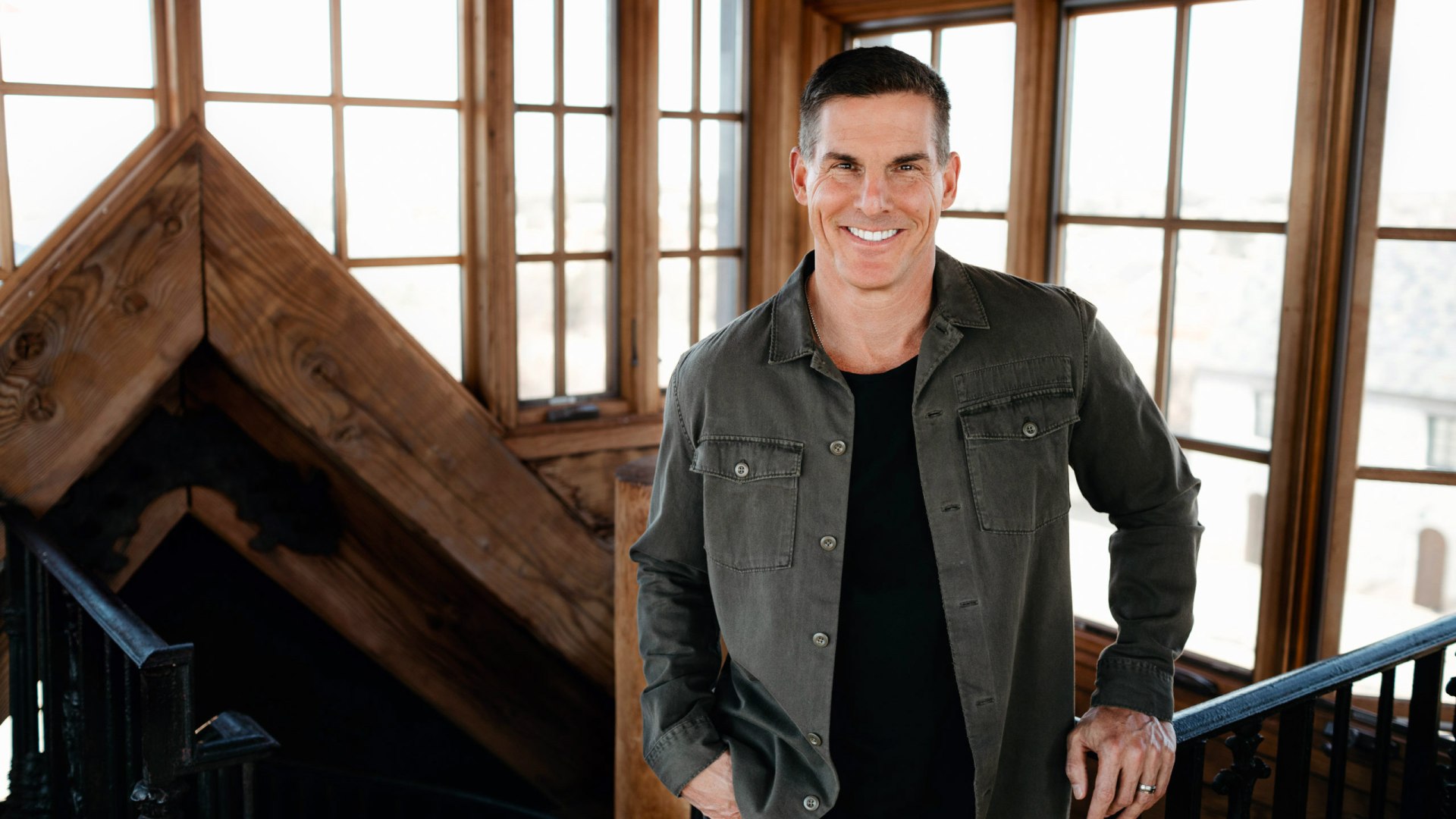
Life.Church pastors Craig Groeschel and Bobby Gruenewald are being quarantined by local health authorities at home in Oklahoma after being exposed to the new coronavirus at a leadership training conference in Germany.

Groeschel was a featured speaker at Willow Creek Deutschland Leitungskongress 2020, which took place Feb. 27–29 in Karlsruhe, in southwest Germany. He attended the meeting with Gruenewald, Life.Church’s pastor of innovation and the founder of the popular YouVersion Bible app.

The conference, which had about 7,400 attenders, was cut short after one presenter became ill with COVID-19, according to organizers. COVID-19 is the disease caused by the new coronavirus. As of Wednesday, more than 87,000 cases of the illness had been reported globally, according to the World Health Organization.

Groeschel and Gruenewald learned of their need to be quarantined while traveling back to the US. The two went into quarantine for 14 days after returning to their homes in the Oklahoma City suburbs, where they have had no direct contact with church members or their families.

Neither has shown any symptoms of COVID-19.

“Pastor Craig and I are at home and healthy,” Gruenewald, innovation leader for Life.Church, told Religion News Service in a statement. “While en route home from Germany, we were made aware of the situation at the conference. We immediately notified health authorities and have followed every recommendation. Out of an abundance of caution, we have been isolated in our homes the entire time, even limited from interaction with our families. We have no symptoms, and someone is checking on us regularly.”

Life.Church, which ranks as one of the biggest churches in the country with 34 campuses spread over 10 states, said it already has protocols in place to keep attendees healthy during flu season. The church is evaluating whether additional precautions are necessary, though Groeschel and Gruenewald themselves seemed determined to downplay their situation: The terms “coronavirus” and “COVID-19” were notably absent from the pastors’ statements.

Despite remaining active on social media, neither have posted about their quarantine.

Gruenewald said he and Groeschel remain in good spirits despite their isolation. “We’re making the most of this time to focus on ministry work and even doing some extra situps and pushups.”

Groeschel, whose book Fight made the New York Times bestseller list in 2013, serves as “champion” for the Global Leadership Summit, hosted each summer by Willow Creek Community Church, the influential Chicago area megachurch. He became the public face of the training conference after the retirement of Bill Hybels, Willow Creek’s founder.

According to a statement from the German conference organizers, anyone who had direct contact with the ill speaker has been quarantined. The speaker is “already on the mend,” said the statement. However, a couple who had contact with the speaker before the conference has tested positive for the virus.

“The significant point is the German Leadership Summit was prematurely ended as a precaution and currently it is proving to be the right decision,” said Tom De Vries, president and CEO of the Global Leadership Network, which organizes the summer event held at Willow Creek and other similar events in other countries.

“While disappointing, the participants at the Summit were appreciative of the time we experienced together, the protective steps taken to ensure the safety of the more than 7,400 people attending live in Karlsruhe, and were prayerful for those affected by contact with the speaker as well as the speaker himself.”

Scott Thumma, professor of the sociology of religion at Hartford Seminary, said megachurches like Life.Church are well prepared to deal with the absence of their pastor from worship.

Since the church has more than one site, the preacher often appears by video during services. And if he wanted, Groeschel could preach from quarantine, said Thumma, who studies megachurches.

Life.Church and similar megachurches also have extensive small group networks, where congregation members meet during the week, he noted. If there were a health crisis, they could keep doing church without the large group gatherings.

Many megachurches already stream their services online and have online giving and ways to share prayer requests online, said Thumma. And unlike liturgical churches, where congregants need to be present to partake of sacraments such as Communion, megachurch congregations can still worship without being in a church building.

So they could deal with health concerns and still do church.

“They could worship online for a month and not miss a beat,” he said.

Megachurches also have sophisticated security and safety practices and could easily take steps to reduce the risks of spreading the coronavirus, he said.

Because Life.Church’s congregation is split into many smaller campuses—rather than one large auditorium—there’s likely less risk of a virus spreading to large numbers of people.

A megachurch in South Korea is suspected of contributing to the spread of the virus in that country. Government officials have linked a number of cases in South Korea to the Shincheonji Church of Jesus, according to The Wall Street Journal.

News

Spiritual Abuse Definition Debated by UK Christians

Cases of Steve Timmis and Jonathan Fletcher illustrate debate over at what point a pastor’s exhortation crosses the line into coercion.

Christianity Today March 4, 2020
Source Image: York Creative / Lightstock

Last month, the board of Acts 29 voted to remove Steve Timmis as CEO of the global church planting network, following an investigation into his “abusive leadership.” Timmis then resigned as elder of The Crowded House, Sheffield, where he was also accused of spiritual abuse.

The allegations and subsequent fallout highlight an ongoing debate over the nature and extent of “spiritual abuse” in evangelical churches in the United Kingdom. At issue is how to define the controversial phrase, how to determine its limits and scope, and how to appropriately prevent and address it.

In 2017, more than 1,000 British Christians reported being victims or survivors of spiritual abuse in a study by CCPAS (Churches Child Protection Advisory Service), a UK Christian safeguarding charity now known as ThirtyOne:Eight.

Even so, the co-authors of the report—Lisa Oakley, associate professor at the University of Chester, and Justin Humphreys, CEO at ThirtyOne:Eight—acknowledged “the term ‘spiritual abuse’ is currently contentious.”

“In some areas, the use of this term is generally accepted,” said Humphreys. “In others, it is questioned, and in yet others it has raised anxiety and concerns.”

While there remains no legal definition of spiritual abuse, in 2018 a Church of England vicar was the first to be found guilty of it for his inappropriate actions against a teenage boy in Abingdon. This case, and that of Timmis, have caused consternation over where to draw the line between exhortation and coercion—between a challenging message and a toxic culture of control.

Oakley and Humphreys—who recently published Escaping the Maze of Spiritual Abuse: Creating Healthy Christian Cultures—define spiritual abuse as “a form of emotional and psychological abuse … characterized by a systematic pattern of coercive and controlling behavior in a religious context.”

For the authors, spiritual abuse adds an additional layer to an abusive experience “when it is grounded and justified with a level of spirituality,” said Humphreys.

However, critics of the term argue that there is no need to add “subsections” to the already accepted categories of abuse: sexual, physical, emotional, and neglect. Lee Gatiss, director of the Church Society, wrote that the accuracy of the term is “debatable” and that perhaps it can serve as an umbrella term for other forms of abuse, but it is not its own distinct form of abuse.

To be fair, Oakley said that while she initially argued for spiritual abuse to be a separate category, she has now come to a point where she believes “the evidence suggests it is a form of psychological and emotional abuse being evidenced by a systematic pattern of coercive and controlling behavior.”

There is also a fear that such specific terminology “might spiritualize criminal offenses” that are considered inappropriate in every context, not only within the confines of a religious community, said David Hilborn, chair of the Theological Advisory Group of the UK Evangelical Alliance.

In a 2018 report, Hilborn wrote that the term was too ambivalent and that there is nothing “substantively or categorically distinct about ‘spiritual abuse’ when compared to legal understandings of emotional and psychological abuse.”

While emphasizing that the Evangelical Alliance takes all forms of abuse in the church seriously, he said, “we don't want offenses committed specifically by pastors, or elders to be ghettoized by a language, which can only apply to those who are spiritual, however spiritual is defined.” For Hilborn, this raises the specter of attacks on religious freedom.

Giving spiritual abuse a status as “a criminal offense could specifically target religious people on the basis of their faith,” said Hilborn, “and that is deeply problematic.”

Although Oakley and Humphreys are not wed to the terminology, they both affirmed that “spiritual abuse is an appropriate term” because it identifies the particularities of abuse used “with direct reference to sacred texts or operating on behalf of a divine entity.”

Referencing the specificity of domestic abuse as “a clear example of coercive, controlling, and manipulative behavior in an intimate or family relationship,” Humphreys said that the concept of spiritual abuse “speaks directly to one’s soul and one’s being in a way that we just don’t see in any other context.”

Despite the debate, the term has cultural purchase. On various websites, social media platforms, and online forums, victims and survivors share their stories using the language of “spiritual abuse.”

Individuals like Jodie Stanley, whose father abused multiple members of his church and family, found that the term spoke to her own trauma. She said that the church’s lack of discernment on issues like spiritual abuse, and disdain for acknowledging them, creates a “noxious” environment where suffering like hers can readily occur.

Although there are no firm numbers, Kay Bruner, a licensed professional counselor working mostly with Christians in ministry, said, “spiritual abuse is absolutely endemic.”

Lois Gibson, who started the website SpiritualAbuse.org in 1997, believes it is on the rise. She said, “there are far too many who consider themselves a minister but are busy building little kingdoms for themselves while they trample on the people around them.”

In ThirtyOne:Eight’s statement on the issue, Humphreys said that while “holding a theological position is not in itself inherently spiritually abusive, [the] misuse of scripture, applied theology, and doctrine is often a component of spiritually abusive behavior.

“What we say is that we are talking about emotional, psychological abuse that involves systematic patterns that deny choice, freedom, or the ability to disagree,” he said.

Oakley is careful to point out that “this is not just a Christian phenomenon,” as recent reporting within Muslim communities in the US shows. Jeff Mallinson, professor of theology and philosophy at Concordia University Irvine and co-host of the podcast Protect Your Noggin, said he has seen it “among Zen masters, Hindu gurus, and secularized yogis.” He said, “it tends to be a common problem for any religious community that fails to cultivate and encourage the exercise of an individual’s conscience and trust in one’s own perceptions.”

Simon and Caroline Plant, directors of Replenished, which aims to provide a safe place for survivors of spiritual abuse in the UK, said that “those who have suffered from spiritual abuse find it hard enough to think about and even more difficult to explore.”

Sharing her own experience of leaving a church because of spiritual abuse, Caroline Plant said, “you should be able to question things,” but that she was “very afraid of speaking out and convinced that God would strike me down if I did, that terrible things would happen.”

Preventing and addressing spiritual abuse—in any form—starts with identifying the issue and creating a culture where people can speak openly about issues of power and control, according to the Plants.

In the 2017 CCPAS study, 33 percent of respondents said their religious community had a policy that included spiritual abuse. Only 24 percent said they had received training on the issue.

Working with a diverse range of partners, ThirtyOne:Eight has been providing training to churches across the UK. The training, Oakley said, “includes exploring what spiritual abuse is, the impact of this experience, how to respond well to disclosures, and what the hallmarks of a healthy Christian culture are.” Humphreys said such hallmarks include “active listening; understanding and empathy; taking the disclosure seriously; not minimizing the story or blaming the individual.”

ThirtyOne:Eight was recently commissioned to conduct an independent review of Emmanuel Church Wimbledon after allegations emerged against its former vicar, Jonathan Fletcher. After he retired in 2012, accusations of spiritual abuse—ice baths as a form of spiritual discipline, inappropriate touch, and nude massages with members of his community—were received by the Church of England’s Diocese of Southwark from five former members in 2017 and 2018. Fletcher was then barred from public ministry.

The review will focus on issues of church culture during Fletcher’s time as vicar and the parish’s safeguarding practices. The hope is that lessons can be learned from such a prominent case. The results of the review are due this May. Fletcher may yet face criminal charges over the alleged abuses.

On the point of safeguarding churches, Hilborn of the Evangelical Alliance agrees. “Churches and Christian organizations urgently need to make sure that their safeguarding policies are up to date and being applied,” he said. Relying on biblical models of servant leadership and the subversive nature of Jesus’ discourses on power, he said the Evangelical Alliance regularly advises churches to ensure they have procedures in place to address “bullying, manipulation, and the pastoral fallout from psychological abuse in church contexts.”

That is why, Humphreys said, that his charity welcomes the dialogue and debate around spiritual abuse. Notwithstanding the divergence of perspective on the issue, Humphreys said, “Whatever else we do, let’s be committed to exploring our understandings, exploring the impact, and committing ourselves to do something to prevent it and responding well.”

News

The Possible Decline of the Nones Isn’t a Boost for Evangelicals

The good news and bad news about Generation Z’s unexpected religious trends.

Christianity Today March 3, 2020
Ocamproductions / Lightstock

By now, we’ve all heard about the rise of the “nones.” Every year there seems to be another round of survey data indicating that the religiously unaffiliated in the US have jumped another percentage point or two.

But some recent findings about Generation Z may challenge that narrative, suggesting that the share of the nones may be leveling off.

The oldest members of Gen Z were born in 1995, which means that they joined survey populations when they turned 18, starting in 2013.

It would be fair to assume that their level of religious unaffiliation should exceed that of the millennials before them, the same way millennials left religion in larger numbers than Generation X. But that assumption is not borne out by the data.

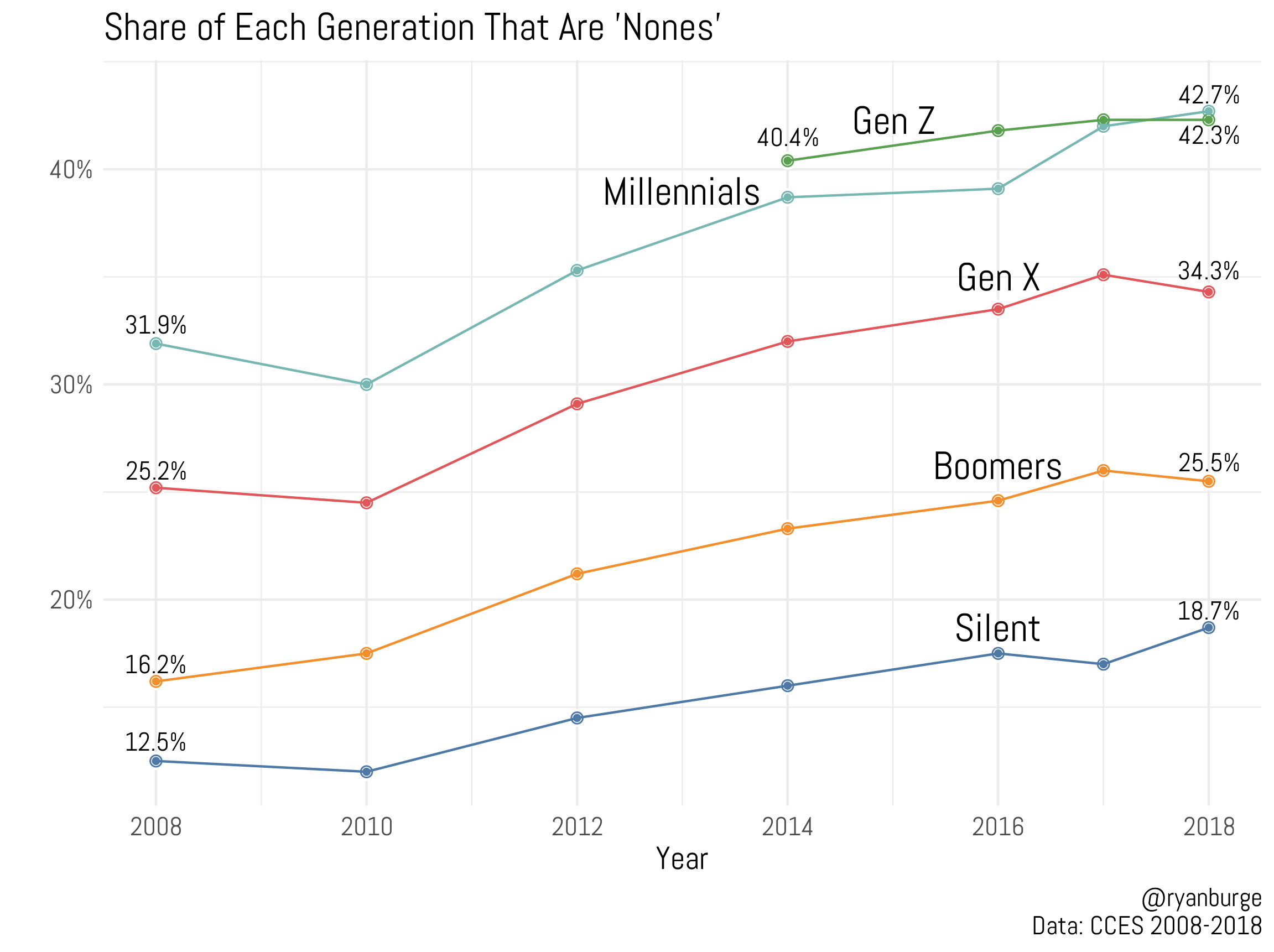
Although all age groups have increasingly stepped away from religion over the past decade, every generation except Gen Z showed significantly higher rates of disaffiliation than the ones before.

In 2008, boomers had 4 percent more nones than the Silent Generation, while Generation X was 9 percent higher than boomers. Millennials topped the charts at nearly a third of the population falling into the nones category.

That separation has persisted over the past decade. The rate of nones among the Silent Generation—the oldest subset—has increased by half, from 12.5 percent to 18.7 percent. By 2018, a quarter of boomers and a third of Gen Xers were unaffiliated. But the jump among millennials was truly unprecedented, climbing more than 10 percentage points in just 10 years to 42.7 percent.

Generation Z, during half the studied time, has appeared to chart a much different course. The rate of disaffiliation among Gen Z was just one percentage point higher than millennials in 2014. It moved up less than 2 percentage points in four years, meaning that the percentage of nones among Gen Z ended up no different than millennials: both around 42.5 percent.

Because Generation Z is still fairly young in these samples, it is possible many are still influenced by the religion of their parents. As a result, their disaffiliation may rise as they move into their late 20s and early 30s. Another possibility is that the nones have reached a natural ceiling at around 40 percent. However, that theory cannot be thoroughly tested until we have another decade of data.

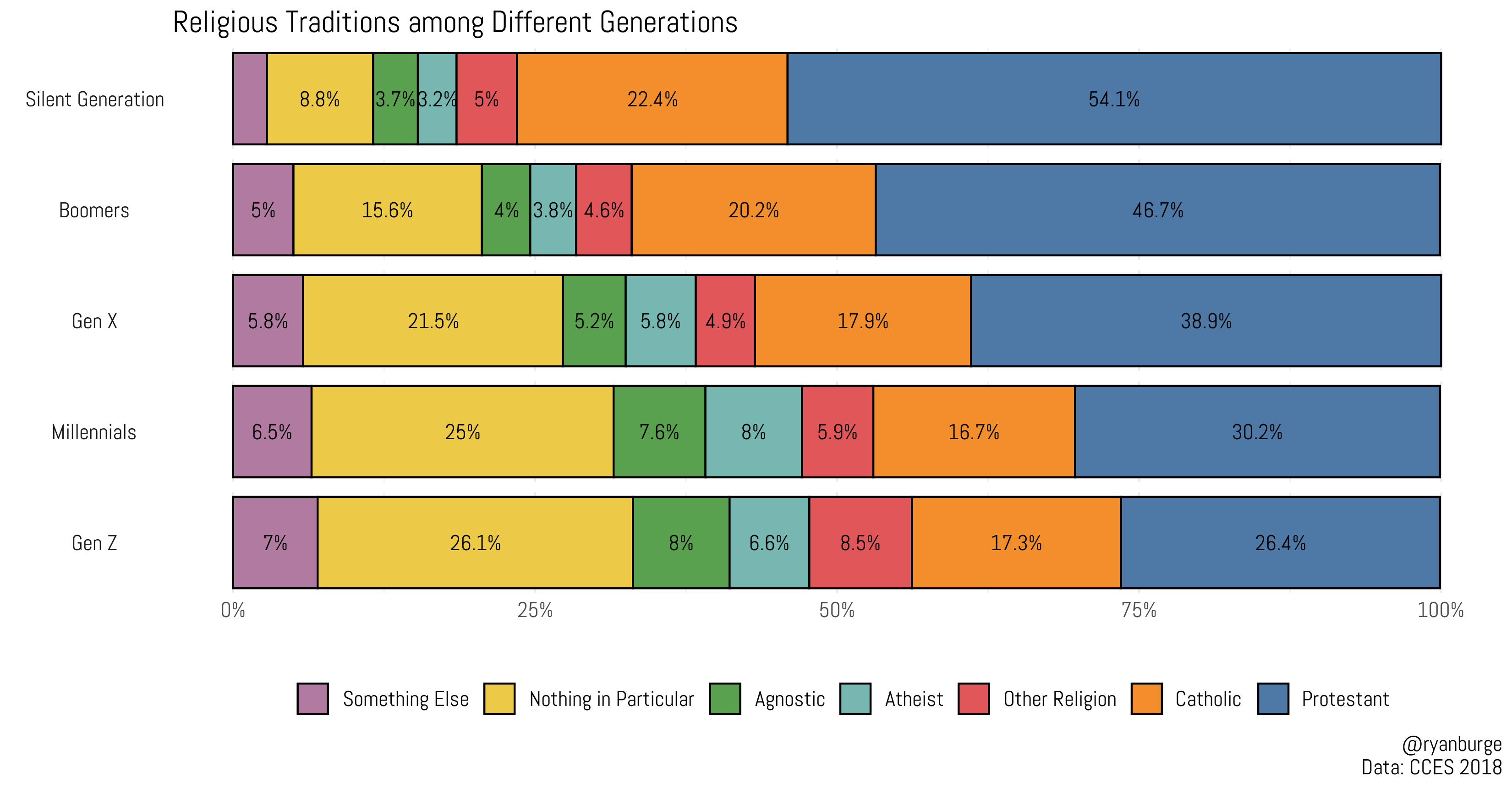
This finding does provide a glimmer of hope that religion’s decline may be abating, but there are other reasons to be cautious. Among millennials and Gen Z, though two in five are religiously unaffiliated, 60 percent are still attached to a religious tradition. This is where some different patterns emerge between the two youngest generations.

While 30.2 percent of millennials are Protestant, just 26.4 percent are in Gen Z. Today’s youngest adults are half as likely as the oldest (those born between 1925 and 1945) to belong to a Protestant church.

At the same time, the Catholic share of Gen Z has dropped by 5 percentage points, while those of another religious tradition (who responded with Buddhist, Hindu, Muslim, or Mormon) is higher, as well as the share that says that their religion is “something else.” So although the increasingly diverse Generation Z might not be growing in their disaffiliation, they are also much less likely to be Christians.

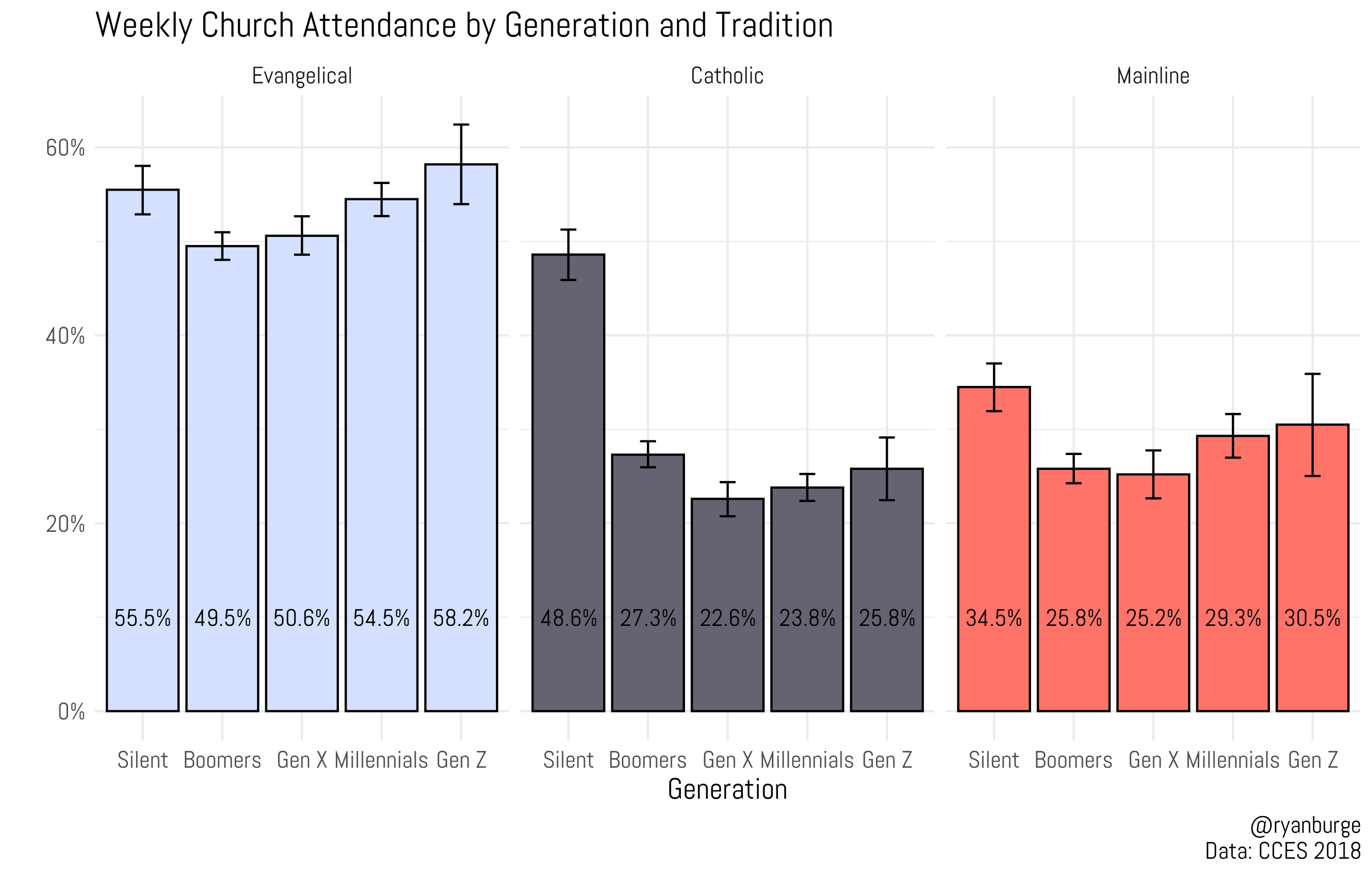
However, there is some nuance to the story regarding the religiosity of Gen Z. While the share of Gen Z that identifies as Christian is the smallest of any generation, those who still identify as Protestant or Catholic are incredibly devout. For instance, nearly 6 in 10 evangelical members of Gen Z attend church at least once a week. That’s as high as evangelicals older than 75 and statistically higher than baby boomers and those in Generation X. The same pattern emerges among mainline Protestants and Catholics, as well.

For mainline Protestants, there is no difference in weekly attendance rates between Gen Z and any other generation. For Catholics, the only cohort that attends Mass more than Gen Z is the Silent Generation, those born before 1946. The conclusion is straightforward: Though the share of Gen Z Christians is small, they are deeply committed to their faith.

It’s important to note that these data do not indicate that the overall rate of religious disaffiliation will decrease any time soon. Generational replacement is inevitable. Consider the fact that the Silent Generation, which is 18 percent nones, is decreasing by hundreds of members a day and is being replaced by Gen Z, which is 42 percent religiously unaffiliated.

There is no doubt that the rate will continue to rise, but it may find a plateau in the next few decades. At the same time, the United States will have a much smaller number of Christians, but those who remain will be committed to their faith and attend church regularly.

At the same time, the population of Buddhists, Muslims, Hindus, and those in other non-Christian traditions will become larger and more geographically dispersed across the US. Yet, even with these radical shifts in religious demography, there will still be tens of millions of Americans wrestling with issues of meaning and purpose. The mission field in the United States might be changing, but it is certainly not vanishing.

Ryan P. Burge is an instructor of political science at Eastern Illinois University. His research appears on the site Religion in Public, and he tweets at @ryanburge.

News

Nigeria’s Government Agrees: Islamist Terrorists Target Christians

The goal of Boko Haram and ISWAP is “to divide Christian brother against Muslim brother,” Buhari administration tells CT.

Nigerian Catholics march in Abuja on March 1 in protest of recent terrorist attacks.

Nigerian Catholics march in Abuja on March 1 in protest of recent terrorist attacks.

Christianity Today March 2, 2020
Kola Sulaimon / AFP via Getty Images

The Nigerian government now agrees with what church leaders have been complaining for years: Christians are the target of jihadist terrorism.

“In the wake of a renewed onslaught by our tireless military against Boko Haram and their ISWAP (Islamic State West Africa Province) allies in recent times, the insurgents have apparently changed their strategy,” said Lai Mohammed, the minister of information and culture, at a press conference last week.

“They have started targeting Christians and Christian villages for a specific reason, which is to trigger a religious war and throw the nation into chaos.”

In comments given exclusively to CT, the administration of President Muhammad Buhari clarified that this targeting is not new.

“Yes, Boko Haram is targeting individual Christians. In doing so, their target is all Nigerians, and their goal is to divide Christian brother against Muslim brother,” Mohammed, the information minister, told CT.

“What Boko Haram seeks—and always has sought—is to drive a wedge between Christians and Muslims in Nigeria.

“By targeting Christians, they seek to promulgate the falsehood that the democratically elected Nigerian government does not care to protect them.

“By targeting Muslims, they seek to promulgate the falsehood that the terrorists themselves follow truthfully Islamic teachings, and those they target do not.

“It is the strategy of the desperate.”

CT previously reported on the martyrdom of 11 Nigerian Christians killed by ISWAP around Christmas, as well as the January 21 killing of Lawan Andimi, a Brethren pastor and regional leader of the Christian Association of Nigeria (CAN), beheaded by Boko Haram.

In response, CAN declared that January 21 be commemorated as an annual national day of prayers for the persecuted Christians of Nigeria.

The government statement followed two two-year anniversaries.

On February 19, 2018, Boko Haram kidnapped 110 Dapchi schoolgirls. Only Leah Sharibu remains in captivity, for refusing to renounce her Christian faith, after the government secured release of the rest.

And on March 1, 2018, ISWAP kidnapped Alice Ngaddeh, a UNICEF nurse and mother of two, along with other aid workers. Others captured were killed or released, but Ngaddeh remains a “slave.”

“This government continues and seeks to secure the release of all children and captives of terrorists—and we do so regardless of their creed or the name of their creator,” said Buhari in a presidential statement released on the anniversary of Sharibu’s capture.

“And as we redouble our efforts for Leah’s return, we can never allow the terrorists to divide us—Christian against Muslim, Muslim against Christian. We are all sons of Abraham. And all Nigerians have the same worth and rights before the law, and before God.”

In an exclusive op-ed for CT in which he praised the faith of Andimi, Buhari said 90 percent of Boko Haram’s victims are Muslims. CAN “angrily” rejected this statement, and called on the president to reveal his sources.

In an article at the National Catholic Register decrying a “Christian genocide,” former Congressman Frank Wolf, author of the United States’ International Religious Freedom Act, and Toufic Baaklini, president of In Defense of Christians, compiled the following statistics:

  • Boko Haram has killed more than 27,000 civilians in Nigeria. This is greater than the amount of civilians ISIS killed in Iraq and Syria combined.
  • The Global Terrorism Index states that Nigeria is the third-most dangerous country after Afghanistan and Iraq.
  • Open Doors calculates that more than 7,000 Nigerian Christians have been killed because of their faith over the last three years, including 1,350 martyrs in 2019.
  • CAN reports 900 churches in northern Nigeria have been destroyed.

“The government statement represents tremendous progress, because Nigeria needs to walk in the truth in such trying times,” said Gideon Para-Mallam, the former Jos-based Africa ambassador for the International Fellowship of Evangelical Students, now an advocate for peace and social justice.

“To own up and say that indeed Boko Haram has changed tactics will make a difference. They [the Buhari administration] need to be commended for calling out targeted attacks on Christians, and now we can join hands as a nation.”

The earlier government narrative, he said, believed by many Muslims, is that Christians are not persecuted in Nigeria.

Though the Nigerian Supreme Council for Islamic Affairs (NSCIA) has called for a state of emergency against insecurity, following the information minister’s statement, it stood by its previous statement that it was wicked “to suggest that Boko Haram is a ploy to eliminate Christians,” as reported by Nigerian newspaper Punch.

Para-Mallam spoke to CT from London at a British Foreign Office conference to promote social cohesion in Nigeria. He said that Muslims there felt blamed when Nigeria was painted as a land of Christian persecution.

He said his offer to be given the names of all Muslims in captivity, that he might also advocate for them, was appreciated.

But this does not mean he disagrees with the pressure CAN has kept on the Nigerian government. Last month, CT reported on a nationwide march joined by prominent pastors across the country.

“The troubles CAN has made have added up, and brought the government to a proper understanding of the reality before us as a church and nation,” said Para-Mallam.

It has also brought international attention to Nigeria.

Johnnie Moore, a commissioner with the US Commission on International Religious Freedom (USCIRF), called for more efforts.

“The terrorists’ aim is to ethnically cleanse northern Nigeria of its Christians and to kill every Muslim who stands in their way,” he said, following a week-long personal visit with Rabbi Abraham Cooper, associate dean of the Simon Wiesenthal Center, during which they visited with more than 50 survivors of Islamist attacks.

“If things don’t change immediately, portions of Nigeria may soon become the most dangerous place on the planet.”

In December, the US State Department added Nigeria to its Special Watch List for countries that have engaged in or tolerated severe violations of religious freedom.

Moore called upon the US to appoint a special envoy and review all American assistance to Nigeria.

But he also echoed the Nigerian government’s plea.

“The best thing that Muslim, Christian, and other religious leaders in Nigeria—and around the world—can do, is to stand together in solidarity with the victims, instead of looking with suspicion and enmity at one another.”

Unfortunately, the federal government plays into the hands of conspiracy theorists, said Matthew Hassan Kukah, the Catholic bishop of Sokoto, a city in northwest Nigeria that he said was like the Vatican of Nigerian Muslims.

Islam came to Nigeria in the 11th century, and today is divided roughly 50-50 between Muslims and Christians. The Sokoto Caliphate governed a large stretch of territory in the 18th century, and today is the seat of the sultan, who heads the NSCIA.

Kukah noted that all national security posts and most of Buhari’s advisors are Muslims. Previous administrations sought to balance their religious makeup.

Kukah was “surprised” by the information minister’s statement.

“In a diverse environment, people need a sense that power is being shared,” Kukah said.

“Buahri has made himself vulnerable to the accusations about complicity and the Islamization of Nigeria.”

The vulnerability is widespread. In its 2016–2018 cycle of surveys, Afrobarometer found 73 percent of Nigerians believe that some or most senior officials in the federal government support or assist extremist groups.

Only slightly lower figures were reported for members of the military (69%) and local government officials (65%).

Perhaps paradoxically, 85 percent agree or strongly agree that the military keeps Nigeria safe from militants and insurgents.

Even so, 55 percent of Nigerians trusted the president “just a little” or “not at all.”

The Conference of Catholic Bishops invited churches to wear black for Ash Wednesday last week and then conduct a prayer march the following Sunday. Kukah also invited Muslims and made sure to coordinate with local security authorities.

Similarly, he wants Christians to work together with Muslims to prevent the spread of anti-government conspiracies, even as he calls its efforts “clearly not enough.”

“We wore black to focus on the killings across Nigeria, and not just of Christians,” Kukah said.

“We wanted to claim moral authority in this conversation, that this Lenten season we are mourning for the whole country.”

But according to John Hayab, a Baptist pastor and vice president of CAN for 19 northern Nigerian states, most of which are Muslim-majority, not all Muslim leaders cooperate.

Many understand Christians, he said, and he partners with one in particular to preach a message of being one family under God. Other Christian leaders recently hosted Muslims in their Lenten fasts.

But the terrorists have made others afraid to speak out in defense of Christians, while others use the message of hate for political gain.

A 2010 Pew Research Center poll found 49 percent of Nigerian Muslims express favorable views toward al-Qaeda.

But by 2014, this figure dropped to 22 percent. And only 10 percent of Nigerian Muslims expressed favorable opinions toward Boko Haram, with 80 percent negative.

Yet in 2017, 20 percent of Nigerian Muslims had a favorable view of ISIS, to which a branch of Boko Haram swore allegiance at the time.

Hayab said the government statement is “better late than never.” But he characterizes the jihadists’ strategy much differently.

“They are trying to make us live in fear and not identify publicly as Christians,” he said.

“It is not just to divide Nigerians, but to eliminate Christianity and stop evangelism.”

Some in his area have begun wearing Muslim clothing to blend in. Young evangelists have left the area. And over the past 12 months, $1.1 million in ransom has been paid by Christians to secure release of captives, he said, a process in which he has mournfully participated.

“Our leaders have lived in denial, saying ‘No, no, no,’” Hayab said. “What we want to see now is concrete steps to find solutions, because our cry has always been legitimate.”

The Nigerian government now agrees.

“Neither Nigerians nor the international community should confuse the intentions of the Government of Nigeria—which is committed completely, resolutely, and in full unity, to defend the right to life of all citizens,” Mohammed, the information minister, told CT.

“And every individual’s God-given right to follow the faith of their choosing.”

Billy Graham Is Still Shaping American Politics

The evangelist’s balancing act may be his most enduring legacy.

Christianity Today March 2, 2020
Illustration by Mallory Rentsch / Source Images: Courtesy of Elliot Gaiser / Photo by Rachel Brewer

In this series

Just before Christmas last year, Mark Galli of Christianity Today dropped a bomb in the already turbid waters of American evangelicalism. He called for President Donald Trump’s removal, either by ballot or by impeachment.

Billy Graham’s ghost stalked the drama that followed. The evangelist had founded the magazine in 1956. Though dead for nearly two years, and off the public stage for nearly 20, he still mattered.

Almost everyone invoked Graham one way or another. He usually appeared in one of two roles: as legitimator or as identifier. As legitimator, he purportedly backed up positions that the principals on all sides of the debate had taken. If Billy were still here, the rhetoric ran, he would have agreed with us. Other times he served as an identifier. His name provided not only an anchor in time and space but also, and more importantly, proof that this was a story worth reading.

Historians took a longer view. Years ago, George Marsden quipped that an evangelical could be defined as a person who really liked Billy Graham. The line invariably evoked a laugh because it rang true. When Graham died, another historian, Daniel Silliman—now news editor at CT—got the point exactly right. “For more than fifty years,” he said, “Graham was so famous people felt like they had to have an opinion about him. … [H]e became a lodestar of religious identity.”

Graham did not do it alone, of course. He built on a sprawling evangelical infrastructure already in place. And stinging attacks from mainline critics like Reinhold Niebuhr and fundamentalist ones like John R. Rice amplified his visibility. Even so, to tell fully the story of mid-century evangelicalism without Graham, and his lingering power to shape assumptions, is unimaginable.

So how did Billy become the unseen guest at the dinner table?

The short answer is that he spoke so much on so many topics that it is easy to find words from him that seem to support diverse positions. He authored or authorized 34 books, helped produce hundreds of articles, and talked on thousands of occasions. And on some topics, his views really did change—sometimes dramatically—between the fiery outings of the 1940s and the patriarchal benedictions of the early 2000s.

But this diversity ran deeper than sundry words uttered at different points in his life. Rather, Graham fathered distinguishable impulses not just within himself but deep within the movement itself. They might be called the centripetal and the centrifugal. The former term suggests an inclination to look inward, to locate and then preserve a still point in a turning world. The latter suggests a contrasting inclination to look outward, to see the trends of the age and then make the gospel relevant to them.

Or to adapt the helpful metaphors that CT’s CEO Timothy Dalrymple used, Billy’s ministry exemplified the flag—“here we stand”—and the table—“now let’s talk about it.” The task was to balance inherited convictions with new experiences.

To my knowledge, Graham never used the words centripetal or centrifugal, but he manifested their spirit. He instinctively understood that the two impulses needed each other. The preacher never budged an inch on the core convictions inherited from his evangelical teachers at Wheaton College and elsewhere, but a lifetime of circling the globe and encountering new people and new cultures forced him to speak in more winsome and capacious ways. The proportions shifted.

The centripetal—or flag-planting—inclination turned up everywhere, but perhaps most conspicuously in the founding of CT in 1956. Three motives fueled Graham’s efforts here. The first was to define a center point for the emerging yet amorphous movement. The second was to police its boundaries by publishing some authors and advertising some books—but not others. And the third was to help evangelical spokesmen (and virtually all were men—white men) gain a respected voice in the marketplace of public discussion. In time, all three motives saw considerable success.

The centrifugal—or table-setting—inclination showed up everywhere, but perhaps most conspicuously in the New York City crusade the following year, 1957. Other crusades were larger or posted more conversions, but none captured as much attention, then or later.

Here, too, Graham held three aims. The first was to reach beyond the largely “old stock” white constituency that had supported him from the beginning. His decision to invite Martin Luther King Jr. to pray—and King’s acceptance—marked a milestone. The second was to embrace mainline Protestants. Billy famously said he would work with anyone who would work with him if they did not ask him to change his message. The final one was to use print, electronic, and advertising media on a scale never seen in evangelism. The first aim enjoyed some success, the second significant, and the third massive.

Viewed as a whole, then, these centripetal and centrifugal motivations flowed like overlapping rivers through Graham’s ministry across 60 years. He held them together by the force of his personality, the genius of his organizational skills, and the power of his message to touch ordinary lives.

A late-in-life exchange with television celebrity Larry King showed how Graham’s thinking ran. King, a close friend, and a self-identified secular Jew, publicly asked Billy if he (King) would be doomed when he died. The question was reasonable, for Billy had never trimmed his insistence that Christ provided the only path to heaven. Yet Billy’s response then and later was classic Graham: I leave all that to God. First flag, then table.

Or again, Billy’s late-life view of same-sex relationships is instructive. From beginning to end he affirmed that they were sinful. But when a reporter asked how he would feel if he had a gay child, he said, simply, that he would love the child more because they would need it more. Again, first flag, then table.

At the beginning of the 2020s, the conventional narrative—which the mainstream media carefully cultivates—of relentless warfare between the bearers of the flag on one side and the setters of the table on the other holds considerable merit. I don’t see much room for compromise between, say, Paula White and Jim Wallis.

Even so, Graham’s pattern shows promising signs of vitality. The thoughtful comments of Peter Wehner, a senior fellow of the Ethics and Public Policy Center and a regular columnist for The New York Times, offer a case in point. Wehner identifies himself as a conservative evangelical Republican—but also a “never-Trumper.” Which is to say that he argues for a politics built on a (centripetal) foundation of enduring truths yet tempered by a (centrifugal) openness to the winds of change.

In today’s toxic atmosphere, words such as foundation and openness wedded in the same sentence raise eyebrows. But it is easy to believe that Billy would have considered the marriage both good sense and good theology.

Final word. It is risky to presume to know what Graham would have said if he were still with us today. Jerushah Duford, Billy’s granddaughter, captured the point well: “I believe that assigning feelings to a man who is not here to agree or disagree with those assignments is dangerous.”

Still, the long trajectory of Graham’s career suggests that he would have sought a third way—especially in the latter half of his public ministry—as he grew increasingly irenic and inclusive. I don’t think he would have taken the easy way out and counseled “just split the difference” or “just stay out of it.” Rather, he would have tried to blend timeless theological principles with reassuring words of heartfelt care for all.

Exactly how, I am not sure, and even if I did know, the formula would have changed from time to time and place to place. A systematic thinker Graham was not. But the instinct first to define and preserve, and then to revise and apply, remained firm. And that adroit balancing of centripetal and centrifugal impulses—flag and table—might well be Billy’s most enduring legacy.

Grant Wacker is the author of One Soul at a Time: The Story of Billy Graham (Eerdmans).

Politics Isn’t the Answer. But It’s an Answer.

Beware of the twin temptations of political engagement.

Christianity Today March 2, 2020
Illustration by Mallory Rentsch / Source Images: Courtesy of Jenny Yang

In this series

At the height of the immigration debate in 2016, I accompanied a group of pastors in Washington, DC, to meet with their members of Congress. One pastor of a prominent, large evangelical church, remarked afterward how he wanted to go back to his hotel and take a shower because he felt so “dirty” talking to politicians.

The disdain we feel for our elected officials and political systems is often rooted in a belief that politics are defined by insincerity and dishonesty. Subsequently, many Christians chose to be apolitical. They don’t contact their elected officials, vote, or even discuss issues that show up nonstop on their social media feeds, such as climate change, gun violence, and immigration.

Contrary to those who avoid politics are evangelical Christians for whom politics is the only salvation for a Christian society under threat. Their conviction is marked by a hyperpartisanship, a blind allegiance that neglects the values Christians historically hold. We give a blank check to our “tribe,” and that ends up harming the very people God calls us to love and serve. As Richard Land recently wrote, “to equate God with any human institution, particularly one as flawed and as intensely human as either political party, is a form of blasphemy.”

Evangelical political engagement should be marked by neither political disengagement nor hyperpartisanship. If we are biblically political, we can work for systems and structures that create human flourishing throughout our entire society. But overt partisanship attaches us to centers of empire power and perpetuates injustice.

So how can we engage faithfully in politics?

1. Affirm the Image of God in All People

Our political engagement should be rooted in the belief that everyone is created in the image of God. Our pro-life ethic should be for the entirety of life, from womb to tomb. We should support policies and hold our elected officials accountable to protect life and promote full human flourishing. Any language used by our elected officials to vilify others should not be the language of the church. No matter our politics, demonizing those of a different political persuasion is not consistent with the humility, decency, and propriety that marks us as followers of Jesus.

2. Be Consistent in Our Political Witness

Among the greatest challenges in churches is consistently applying the whole biblical truth in every area of our lives. A consistent pro-life ethic should mean we hold our elected officials accountable to creating policies based on biblical values we espouse and not remain silent when those elected officials, or parties, espouse policies that would harm human life, promote family separation, or diminish religious liberties. If your preferred political candidate is strongly against abortion, then you should also press that elected official to support that baby’s life after birth by ensuring that he or she has access to nutritious food and a quality education.

3. Pursue Politics as a Means of Advocacy for the “Least of These”

Scripture calls us to demonstrate preference for those who are downtrodden, marginalized, and oppressed, both through God’s commandments (Deut. 10:18; Ps. 146:9; Zech. 7:10; Mal. 3:5) and Jesus’s example (John 4:4–26; Luke 8:43–48; Mark 2:1–12). We therefore advocate for those with disabilities, immigrants, those experiencing homelessness and mental illness, and those in the foster care system, among others. The way that we speak and act, along with our political engagement, must show care and concern for those who are often least able to defend themselves. A recent Barna study found that 43 percent of 18-to-35-year-olds said caring for the poor and vulnerable is a defining mark of a Christian, along with combating corruption, extreme poverty, and racism.

4. Don’t Shy Away from Political Issues in Church

Conversations about race, immigration, gun violence, and mass incarceration are difficult. The church can foster community and provide space to come together despite political differences. Our political allegiance should never preclude us from reaching across the aisle to pray for one another, do ministry together, and carry each other’s burdens. Political issues can be addressed through biblical teaching without getting into the nuances of policy proposals and debates. Ultimately, politics provides an opportunity to shape the society around us in a way that reflects the shalom that God describes in the Bible.

A Strong, Consistent Political Witness

The church has a rich history of biblical activism. The Clapham Sect in the nineteenth century promoted abolition in England; Mahalia Jackson, Martin Luther King Jr., Ralph Abernathy, and Fred Shuttlesworth were civil rights leaders rooted in the black church; and Saddleback Church in California helped lead a movement to care for HIV/AIDS orphans, as well as a movement against sex trafficking.

I recently visited John Brown University, where I met students active in speaking up for refugees in Arkansas. They formed a group called Students for Refugees, and when the governor of Arkansas spoke at their chapel a few years ago, they held up signs and met with him to discuss the importance of keeping Arkansas a welcoming state. These students actively follow legislation in Washington, DC, that would strengthen the US refugee resettlement program and have contacted their legislators to express support.

These students provide hope that political engagement as Christians can be values-based, promoting the dignity of human life and the worth of the marginalized. At a time when most white evangelical Christians say that the U.S. becoming a majority-nonwhite country is a negative development, 66 percent of young white evangelicals (ages 18-34) say that immigrants strengthen the country because of their hard work and talents. Young evangelicals don’t view demographic shifts as a threat, nor do they believe their faith is under threat. Such perspective allows young evangelicals to become more active in advocating for their vulnerable neighbors. Their engagement is rooted in their theology and in real relationships they’ve built with those directly impacted by detrimental policies.

Politics is not the only answer to life’s problems, but politics is a means of advocating for our own freedom and freedom for the “least of these”—the poor, the immigrant, and the systemically disenfranchised. If we maintain a consistent political witness that both supports our preferred candidates and holds them accountable to our values, politics can be a fruitful means of pursuing and establishing justice in our country. The forcefulness of our convictions and our consistency in a political engagement that bears witness to true Christian and the kingdom of God will demonstrate to a watching world that we as Christians are not merely tools used by our elected officials for political gains. We do not use our voice only as a means for preserving Christian identity and freedom. We use our voice to speak up and defend the rights and value of those who are weakest in our society.

Jenny Yang is the vice president of advocacy and policy at World Relief.

Choosing the Agenda of the Lamb

Reject fundamentalism. Embrace co-belligerency.

Christianity Today March 2, 2020
Illustration by Mallory Rentsch / Source Images: Courtesy of Samuel Rodriguez

In this series

Whenever we speak about evangelicals and politics, a historic image that often comes to mind is the culture wars emanating from the Moral Majority of the 1980s—an association of influential conservative fundamentalists and evangelicals who played an indispensable role in politically mobilizing the American evangelical community. At the time, I was a teenager, and many of Christianity Today’s current readers were not even born.

Many see the Moral Majority as the political awakening of evangelicals, but it was not the beginning of evangelicals’ political involvement. Rather, it was the latest iteration in a two-millennia-old relationship with the public square. We have always been guided by Scripture to engage with the political culture—whether in rendering unto Caesar what is Caesar’s (Mark 12:17) or by the examples of the Apostle Paul using his Roman citizenship to escape Jerusalem or Esther entering a complex relationship with the Persian king.

Both the Old and New Testaments are intensely political and deal with the gray areas of life. The moral pronouncements of Scripture are generally clear for one’s personal life, but when that moral life intersects with broken, worldly systems, there are hard ethical choices to be made.

Two moral catalysts hang heavy over the era that began with the Moral Majority.

The first was a revisionist view of our First Amendment-guaranteed freedom of religion, which resulted in the removal of prayer from public schools. The second was the Supreme Court decision in 1973, Roe v. Wade, that legalized abortion in all its forms and at all times. The first threatened the dismantling of our First Amendment and the second threatened the dismantling of our constitutional right to life.

Evangelicals are accused of only supporting politicians who supersede constitutional limits and legislate belief, or of refusing to support politicians who do not align with their values even if they support other policies they find valuable. Our best political engagement avoids fixating on political personalities and stays focused on policies with a sometimes shifting group of alliances to advance them.

Within political philosophy, this concept has been labeled “co-belligerency,”and its popularity was inspired by the late theologian Francis Schaeffer. Schaeffer defined a co-belligerent as “a person who may not have any sufficient basis for taking the right position but takes the right position on a single issue. And I can join with him without any danger as long as I realize that he is not an ally and all we’re talking about is a single issue.”

Co-belligerency means you are not morally compromising if you work together on an area of mutual agreement with someone with whom you have grave disagreements in other areas of policy or in their personal lives. Co-belligerency was the biblical practice of people such as Joseph, Esther, Daniel, Nehemiah, and Paul. With co-belligerency, moral issues take preeminence.

Was the Apostle Paul complicit with the evil of Rome’s vicious occupying forces when he appealed to Roman justice in Acts 16? Or was Jesus complicit with the sin of tax collectors (government agents) when he chose to spend time in their presence over joining the religious scholars in the ritual study of Scripture? Nehemiah would have been accused of being a court evangelical for standing at the right hand of the king, but instead he followed longstanding Jewish teachings on the reverence afforded to all imperial leaders. Nehemiah became the king’s cupbearer, making him privy to confidential and private information that likely involved execution of innocent people, war crimes, and other sinful activities. Yet it was God’s plan for Nehemiah to live in the uneasy gap between heaven and earth where politicians try their hand at ruling God’s world.

Evangelicals make a mistake when they view the public square through a fundamentalist theological lens, whether that fundamentalism be conservative or liberal. Fundamentalists refuse to accept the inevitable tension that arises whenever faith meets the public square.

Over the past two decades, I have worked with the administrations of presidents George W. Bush, Barack Obama, and Donald Trump to advocate for the reform of our immigration and criminal justice systems. Had I been unwilling to work with those different than me—including those with different values than I have as a theologically conservative, Hispanic evangelical—I would have never succeeded in my work to make comprehensive immigration reform a central tenet of both political parties in the United States.

More than once—and on the same afternoon—I have received phone calls from the West Wing and the Speaker of the House when the two sides were at an impasse. Why? Because I was willing to engage with everyone. My faith requires it.

What if the righteous religious leaders of the civil rights era had refused to engage with John F. Kennedy or Lyndon B. Johnson, presidents whose moral compromise was not only well known but took place within the walls of the White House? We evangelicals must never be subservient to the donkey or the elephant. We must embrace Billy Graham’s message of righteousness and Martin Luther King Jr.’s mission of justice. Ours is a vertical and horizontal faith, which stands for what’s true and stands in the gap for what’s right.

We must also be wise as serpents, recognizing when we’re being hoodwinked by partisans into their charades. But as gentle doves, we must also accept that compromise can be ethical in pursuit of a righteous cause. This means taking a seat at the table, if you have it, and never leaving your mantel at the door.

In 2017, over dinner at the White House on the eve of the National Day of Prayer, Bishop Harry Jackson, the Rev. Johnnie Moore, and I began a consequential and passionate discussion with Jared Kushner and Ivanka Trump about the shortcomings of our criminal justice system. That conversation eventually led to Trump signing the most comprehensive criminal justice–reform legislation in 30 years.

I have similarly sat in meetings on other issues leading to expansive pro-life policies unprecedented in our nation, the most robust commitment to religious freedom we have ever seen in a presidential administration, and the virtual remaking of our federal judiciary in alignment with our founding, constitutional principles. I have seen the economic effect of record-low unemployment numbers in our Hispanic and African American communities, and I have watched as immigrants from Cuba, Venezuela, and Central American nations ravaged by cartels and traffickers have rejoiced over actions taken by our government.

Have there been policies I haven’t liked? Of course. Yet when I have expressed my dissatisfaction either publicly, or privately, I have never found a lack of opportunity to continue engaging. We must remember that the vast majority of our brothers and sisters around the world do not have the privilege of living in countries where they can elect anyone close to aligning with their values. Six in 10 evangelicals live in the global south, many in countries where they are minorities with absolutely no choice but to work with others who hold completely different beliefs and moral convictions.

When election season comes around, they are not thinking about whether a candidate is a “real” Christian or not; they are asking themselves who will afford them the opportunity to “live peaceful and quiet lives in all godliness and holiness” (1 Tim. 2:2).

As for me, I will engage with whomever is in power for the good of our community. As evangelicals, we must never be married to the agenda of the donkey or the elephant. We must be married exclusively to the agenda of the Lamb, the Lion of the tribe of Judah.

Samuel Rodriguez is the president of the National Hispanic Christian Leadership Conference and chairman of The Congress of Christian Leaders.

Apple PodcastsDown ArrowDown ArrowDown Arrowarrow_left_altLeft ArrowLeft ArrowRight ArrowRight ArrowRight Arrowarrow_up_altUp ArrowUp ArrowAvailable at Amazoncaret-downCloseCloseEmailEmailExpandExpandExternalExternalFacebookfacebook-squareGiftGiftGooglegoogleGoogle KeephamburgerInstagraminstagram-squareLinkLinklinkedin-squareListenListenListenChristianity TodayCT Creative Studio Logologo_orgMegaphoneMenuMenupausePinterestPlayPlayPocketPodcastRSSRSSSaveSaveSaveSearchSearchsearchSpotifyStitcherTelegramTable of ContentsTable of Contentstwitter-squareWhatsAppXYouTubeYouTube