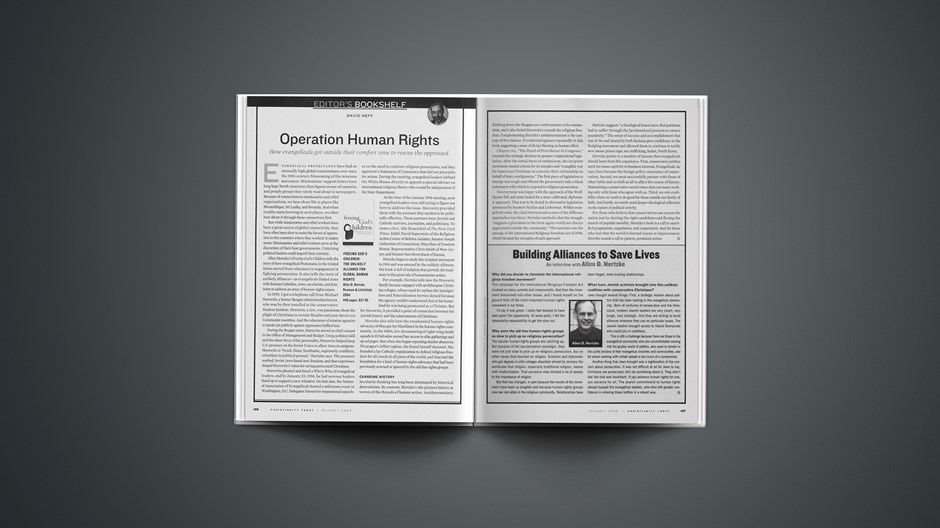
In 1996, evangelical Protestants awakened to the problems of religious persecution worldwide. To achieve results, they have learned to work with Jews, Catholics, Buddhists, Muslims, and secular human-rights activists. University of Oklahoma professor Allen D. Hertzke tracks these amazing developments in his new book, Freeing God's Children: The Unlikely Alliance for Global Human Rights (Rowman & Littlefield). CT editor David Neff interviewed Hertzke by telephone. Neff also reviewedFreeing God's Children.
How did the international religious freedom movement catch your attention? Why did you decide to chronicle it?
I've been poking around and writing about the religious-political world since 1982 when I started my graduate work at Wisconsin with explicit interest in studying religion and politics. In 1982, the Christian Right was all the rage, but I was interested in the full spectrum. I'd been involved in religious communities where political activities were a part of church life, so I felt like I had something to offer the political science community that it might not have.
In 1996 I read about the first conference that the National Association of Evangelicals held on religious persecution, so I was generally aware that this movement was percolating, but I didn't have any sense that it would be very big at all. I did some interviewing, and I thought it was an interesting phenomenon. And then I was asked to present a paper at an Ethics and Public Policy Center conference in January of 1998. It turns out a lot of the activists were there—Mike Horowitz and, I think, Nina Shea were there, and Paul Marshall. Mike Horowitz came up to me afterwards and said, in effect, For a political scientist, you have a pretty good view of this stuff—which was sort of a backhanded compliment.But then he said, You really ought to try to chronicle this movement.
The campaign for the International Religious Freedom Act was so fascinating. It involved so many currents and crosscurrents. And then the movement blossomed, and I found myself on the ground floor of what I call the most important human-rights movement in our times. And it was faith-based, largely, in alliance with a number of other organizations, and it was diverse and ecumenical. It showed a certain maturity in the evangelical community to build alliances with people they sometimes fight with on domestic issues.
I'd say it was grace. I really feel blessed to have been given this opportunity. It represents a kind of culmination of my work as a scholar trying to understand the religious public witness in America. This drew me into much greater awareness of global developments, and I now teach a course on religion and global politics that this movement sparked my interest in.
This is a more of an ethnographic kind of research than I've ever done before. I've always soaked and poked—interviewed and observed—but I really immersed myself in the movement, and I became a participant-observer. I've been deeply grateful for that because I've met so many wonderful and fascinating people, and I've watched inspiring things. And I've been in awe of some of the heroic individuals abroad that I've met.
At some point, I felt the stewardship responsibility to get the story out. I felt like I just watched this extraordinary thing happen on Capitol Hill. I'm the one who was now given the responsibility of writing about it.
Why were the old-line human-rights groups so slow to pick up on religious persecution? And do you think they have caught up yet?
The secular human-rights groups are catching up. And on the situation in Darfur in western Sudan, I think they've been quite impressive. But because of the secularization paradigm, they were not just slow to pick up on religious persecution, but on other issues that touched on religion. That is now waning, but scholars and diplomats who got degrees in elite colleges absorbed almost by osmosis this worldview, which was that religion, especially traditional religion, wanes with modernization. That pervasive view blinded a lot of people to the importance of religion.
Another related factor is the view that religion is backward, it's benighted, it represents the past, it represents the Spanish Inquisition, and so forth. So, a lot of secular activists are uneasy dealing with religion and being too closely identified with Christianity or with the cause of Christian persecution. There is sometimes even a tendency to discount the significance of the persecution of Christians or to subsume it under other categories like ethnic rivalry.
But that has changed, in part because the results of the movement have been so tangible and because human-rights groups now see real allies in the religious community. Relationships have been forged, more trusting relationships.
What have the various Jewish activists brought into this unlikely coalition with conservative Christians?
Jewish leaders and Jewish groups have been absolutely central to the movement. Jews brought several things: First, a strategic realism about politics that has been lacking in the evangelical community. Born of centuries of persecution and the Holocaust, modern Jewish leaders are very smart, very tough, very strategic. And they are willing to build alliances wherever they can on particular issues.
Article continues below
This is still a challenge because there are those in the evangelical community who are uncomfortable moving into the grubby world of politics, who want to remain in the purist enclave of their evangelical churches and communities, and for whom working with certain people is too much of a compromise. Let's say California Senator Barbara Boxer might work on North Korean human rights or domestic trafficking of children to prostitution. There are some evangelical leaders who are really uncomfortable with being part of any coalition that might include someone so identified with what they see as the militant pro-choice position.
So I think Jews brought in that strategic sense—Michael Horowitz, David Saperstein, Stacy Burdette at the Anti-Defamation League, Abe Rosenthal at TheNew York Times, and so forth.
Another thing they brought was a legitimation of the concern about persecution. It was not difficult at all for Jews to say, Christians are persecuted; let's do something about it. They didn't feel like that was favoritism or particularism. If you advance human rights for one, you advance for all. The Jewish leaders would say, We know what it's like when persecution of a group is deemed inconvenient to American foreign policy.
So there was a natural identification that happened, almost immediately on the part of Jewish leaders, when the extent of the persecution of Christians began to be made manifest.
The Jewish commitment to human rights abroad was very important. That buoyed the evangelical leaders, who then felt greater confidence in entering these battles in a robust way.
Plus, the Jewish leaders had access to liberal Democrats who could join in coalitions on different issues. So Reform Rabbi David Saperstein could talk with Senator Paul Wellstone about the Smith Anti-Trafficking Bill. And similarly, Jewish leaders could talk with feminist leaders. And that's one of the roles that Michael Horowitz has played: He has been a bridge between the evangelical elite, with whom he has very good relations, and feminist leaders, Jewish leaders, and so forth.
Where could this movement have gone off the rails?
Oh, it could have gone off the rails on the International Religious Freedom Act, right at the beginning. That was touch and go. The rivalries, the complexities, the newness of the coalition. It was fragile at that point.
Article continues below
That's a fascinating question because victories energize social movements. And legislative campaigns are an excellent tool for social movements to channel their energies. And if they achieve a victory, then it buoys and energizes people in the field to say, We actually can make an impact. If they hadn't won on that issue, the outcome of the movement could have been very different.
Is there enough trust in the coalition now that it should be able to move on to other issues without much difficulty?
There are still dangers, but I observe among certain leaders a level of trust that I could not have imagined a few years ago. That can overcome some of the difficulties that are inevitable.
Take the Darfur situation, for example. That was an exquisitely difficult issue for the coalition to take on, because while there were negotiations going on to bring a peace with the south of Sudan after a long, terrible 20 years of civil war, the outbreak in Darfur was just taking off. And so, not just the Christian community but negotiators, the Bush administration, U.N. people, had to say, How do we deal with this? Do we negotiate mostly to get a deal in the south first and then try to deal with Darfur? Do we deal with them at the same time?
That was a terribly difficult calculation. From February on, as this issue started to bubble up, the religious community was fragmented in its approaches to the Darfur situation. Some were protesting. Some were saying, This is a genocidal regime that should be held to war crimes tribunals. Others, like the folks in Midland, Texas, were communicating directly with the Sudanese ambassador and government officials, saying, You have got to turn this around because this is going to undermine the good faith that you've developed in the south. There were people who were engaged in quiet diplomacy, and there were people engaged in overt protest. But there wasn't a clear strategic focus. But now there's more of a clear focus gaining more international exposure and getting more support.
And look at North Korea, one of the important emerging developments. Here you have, in some ways, the political maturing of the Korean Christian community in America as they move into human-rights work abroad, in part because of the efforts of the coalition concerned about North Korea. A number of Korean American churches have formed a coalition. They're going to have a conference in late September focused on human rights in North Korea. They are basically saying, We are going to hold our government accountable for making sure that human rights is always a calculation in negotiations over weapons of mass destruction.
Article continues below
That will bring some new energy into the movement, and it will create some interesting coalitions. Philip Jenkins has talked about the importance of immigration into the United States. Some of the most fervent Christian organizations are immigrant groups, and the Korean Christian community could become quite important on foreign-policy issues.
So I think this movement has legs because of underlying conditions: the globalization of the Christian church, the increase in all the various communications networks, and immigration into the United States. That means that in American churches there will continue to be interest in what's happening around the world. The fact that American churches increasingly will become branches of global ministries, and that the global church in many ways is nested in places where there's poverty and war and persecution and exploitation, will mean that those stories will continue to flow into the American community.
You mention a number of issues the coalition has been working on. One that didn't get much play was the prison rape issue.
That legislation had a different coalition. There isn't a single coalition. There are floating coalitions that bring in different actors, but in some ways all of them have involved different evangelical and Jewish groups. That, so far, has been one of the more enduring elements.
I didn't include the broad discussion of prison rape in part because I was focused on international issues. Prison rape is important because it shows the potential of breaking through barriers and stereotypes and bringing moral voices from the religious community to bear on issues that are unfashionable to deal with. And the witness that Chuck Colson has provided for years gave him and others credibility to develop alliances with Ted Kennedy and other people who were focused on changing the prison environment.
Similarly, child domestic prostitution and trafficking of children into prostitution within the United States is going to become a focus. It will, in fact, unite feminist groups and African Americans and human-rights activists, evangelicals, Catholics, mainline Protestants, and Jews. It's horrendous, and when you learn about the fact that there are maybe half a million or more children being exploited in this way in our midst, such a violation of human dignity, has the potential to be one of those issues disparate groups can unite over.
Article continues below
The Bush administration has not been as quick to support the human-rights agenda that this core constituency seems to value so much. Where was the breakdown?
Within the Bush administration, the response has not been as quick as the activists want—or as aggressive or as assertive. Part of that is just the natural inertia and the natural clashes of power within any administration. That's part of the story.
Another part of the story, though, is that tension within conservative foreign-policy circles, between those who would advance human rights in our foreign policy and elevate them to a high status and those who are concerned that might undermine our strategic objectives, our economic interest, our flexibility in dealing with unsavory characters who might be helpful to us, and so forth.
So there really is a tension between the business conservatives and the moral conservatives. There is also tension between the proponents of realpolitik and the human-rights activists. That plays out in the Bush administration. And it would play out in a Kerry administration, although in different ways.
The U.S. Commission on International Religious Freedom recently claimed the State Department is seriously delinquent in designating countries of particular concern as the International Religious Freedom Act directed. What do you make of those charges?
What we're seeing is precisely the vision that the proponents of a strong commission had. If you look at the debates that were taking place among the various groups that were backing various legislative vehicles for religious freedom, one of the clear dividing lines was over how much you trust the State Department or any administration to tell a straight story. How much do you trust the State Department with all of its exquisite diplomatic trade-offs to level on certain issues? Those who backed the Wolf-Specter bill and then supported a strong commission basically did not trust the State Department much.
The other side had more faith in professional diplomats and in our diplomatic corps and did not see as much need for this second layer of accountability. The fact that the U.S. Commission on International Religious Freedom is criticizing the State Department is precisely what advocates of a strong commission wanted it to do.
Now, it's unpleasant for State Department officials, and it does send sometimes-conflicting messages abroad. There are some foreign news stories that say that this commission is the State Department speaking. That's what upsets some of the State Department diplomats.
Article continues below
But as a scholar looking at this, I would say that different actors are playing their roles, and that we expect State Department officials to be factoring into their calculus relations with other countries that are important to our strategic or economic interests. We expect them to couch things in diplomatic language, but we want the Commission to speak in plain, tough talk, and nudge the State Department in the direction that the law would like it to go.
Christianity Today sponsored a debate about how best to stop persecution, quiet diplomacy or public campaigns. Below is the conversation which prompted the debate, followed by the debate itself.
The USCIRF Is Only Cursing the Darkness | The increasingly irrelevant U.S. Commission on International Religious Freedom seems intent on attacking even those countries making improvements. (Oct. 16, 2002)
'Normalizing' Jewish Believers | How should Christianity's Jewish heritage change how Gentiles relate to their faith? An interview with Oskar Skarsaune (Sept. 15, 2003)
Sing Me to Heaven and My God And I
Thanks for the Memoirs | Two authors write about pain and God's elusive presence. (Aug. 19, 2003)
Choosing a Partner, Not a Future | Margaret Kim Peterson, author of Sing Me to Heaven, discusses her marriage to a man dying of AIDS and the theological lessons she learned. (Aug. 19, 2003)
Excerpt: A Green and Dying Tree | I saw the fruit of healing prayer even as AIDS was taking my husband's life. From Sing Me to Heaven. (Aug. 19, 2003)
Excerpt: The Unintentional Ethicist | How three assumptions about God can shape the moral choices we are called to make. From My God and I. (Aug. 19, 2003)
For the Glory of God: How Monotheism Led to Reformations, Science, Witch-Hunts, and the End of Slavery
Getting Western Civ Right | Christian theology is the catalyst, not the brake, for progress in Western history. (July 18, 2003)
Progress Through Theology | An interview with Rodney Stark, author of For the Glory of God: How Monotheism Led to Reformations, Science, Witch-hunts, and the End of Slavery. (July 18, 2003)
Converting 'Amazing Grace' | The story behind America's most beloved song shows the God-centered vision with which it was written. (March 31, 2003)
Amazing Myths, How Strange the Sound | An interview with Steve Turner, the author of Amazing Grace: The Story of America's Most Beloved Song. (March 31, 2003)
Blessed Are the Cynical: How Original Sin Can Make America A Better Place
Paradox Lost | Blessed Are the Cynical shows what happened to sin. (Feb. 17, 2003)















 While we pray for peace, we need moral clarity about this war.
 We’ve got little information on Jesus’ appearance and personality. But that’s the way God designed it.españolFrançais
 The plan would organize UMC churches in four global regions, with each given more leeway around same-sex marriage and other theological issues.






