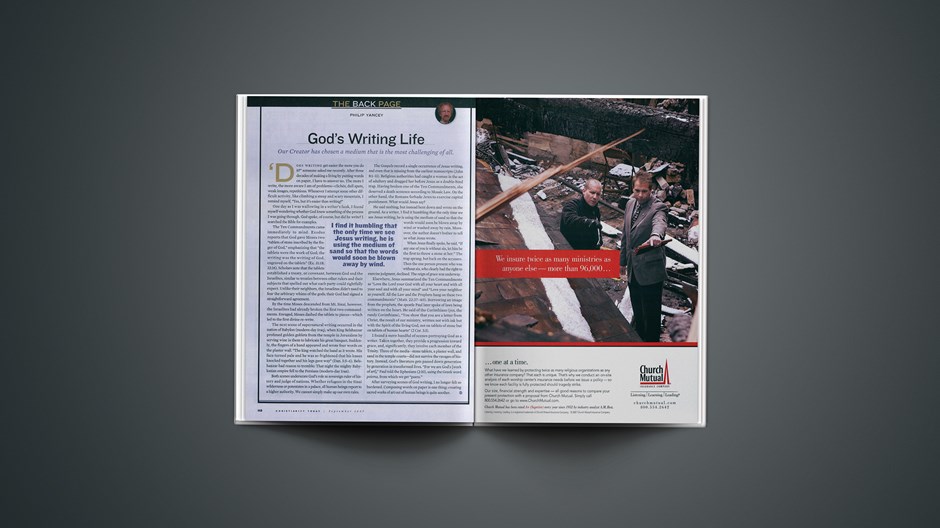
"Does writing get easier the more you do it?" someone asked me recently. After three decades of making a living by putting words on paper, I have to answer no. The more I write, the more aware I am of problems—clichés, dull spots, weak images, repetitions. Whenever I attempt some other difficult activity, like climbing a steep and scary mountain, I remind myself, "Yes, but it's easier than writing!"
One day as I was wallowing in a writer's funk, I found myself wondering whether God knew something of the process I was going through. God spoke, of course, but did he write? I searched the Bible for examples.
The Ten Commandments came immediately to mind. Exodus reports that God gave Moses two "tablets of stone inscribed by the finger of God," emphasizing that "the tablets were the work of God; the writing was the writing of God, engraved on the tablets" (Ex. 31:18; 32:16). Scholars note that the tablets established a treaty, or covenant, between God and the Israelites, similar to treaties between other rulers and their subjects that spelled out what each party could rightfully expect. Unlike their neighbors, the Israelites didn't need to fear the arbitrary whims of the gods; their God had signed a straightforward agreement.
By the time Moses descended from Mt. Sinai, however, the Israelites had already broken the first two commandments. Enraged, Moses dashed the tablets to pieces—which led to the first divine re-write.
The next scene of supernatural writing occurred in the nation of Babylon (modern-day Iraq), when King Belshazzar profaned golden goblets from the temple in Jerusalem by serving wine in them to lubricate his great banquet. Suddenly, the fingers of a hand appeared and wrote four words on the plaster wall. "The king watched the hand as it wrote. His face turned pale and he was so frightened that his knees knocked together and his legs gave way" (Dan. 5:5-6). Belshazzar had reason to tremble: That night the mighty Babylonian empire fell to the Persians (modern-day Iran).
Both scenes underscore God's role as sovereign ruler of history and judge of nations. Whether refugees in the Sinai wilderness or potentates in a palace, all human beings report to a higher authority. We cannot simply make up our own rules.
The Gospels record a single occurrence of Jesus writing, and even that is missing from the earliest manuscripts (John 8:1-11). Religious authorities had caught a woman in the act of adultery and dragged her before Jesus as a double-bind trap. Having broken one of the Ten Commandments, she deserved a death sentence according to Mosaic Law. On the other hand, the Romans forbade Jews to exercise capital punishment. What would Jesus say?
He said nothing, but instead bent down and wrote on the ground. As a writer, I find it humbling that the only time we see Jesus writing, he is using the medium of sand so that the words would soon be blown away by wind or washed away by rain. Moreover, the author doesn't bother to tell us what Jesus wrote.
When Jesus finally spoke, he said, "If any one of you is without sin, let him be the first to throw a stone at her." The trap sprang, but back on the accusers. Then the one person present who was without sin, who clearly had the right to exercise judgment, declined. The reign of grace was underway.
Elsewhere, Jesus summarized the Ten Commandments as "Love the Lord your God with all your heart and with all your soul and with all your mind" and "Love your neighbor as yourself. All the Law and the Prophets hang on these two commandments" (Matt. 22:37-40). Borrowing an image from the prophets, the apostle Paul later spoke of laws being written on the heart. He said of the Corinthians (yes, the randy Corinthians), "You show that you are a letter from Christ, the result of our ministry, written not with ink but with the Spirit of the living God, not on tablets of stone but on tablets of human hearts" (2 Cor. 3:3).
I found a mere handful of scenes portraying God as a writer. Taken together, they provide a progression toward grace, and, significantly, they involve each member of the Trinity. Three of the media—stone tablets, a plaster wall, and sand in the temple courts—did not survive the ravages of history. Instead, God's literature gets passed down generation by generation in transformed lives. "For we are God's [work of art]," Paul told the Ephesians (2:10), using the Greek word poiema, from which we get "poem."
After surveying scenes of God writing, I no longer felt so burdened. Composing words on paper is one thing; creating sacred works of art out of human beings is quite another.
Philip Yancey is editor at large of Christianity Today and cochair of the editorial board for Books and Culture. Yancey's most recent book is What Good Is God?: In Search of a Faith That Matters. His other books include Prayer (2006), Rumors of Another World (2003), Reaching for the Invisible God (2000), The Bible Jesus Read (1999), What's So Amazing About Grace? (1998), The Jesus I Never Knew (1995), Where is God When It Hurts (1990), and many others. His Christianity Today column ran from 1985 to 2009.















 While we pray for peace, we need moral clarity about this war.
 A Christian reconciliation group in Israel and Palestine warned that war would come. Now the war threatens their relevance.españolالعربيةFrançaisрусскийУкраїнська
 How groups like Hillsong learned to let go of the literal in favor of creative collaboration.españolPortuguês






