Our April Issue: How Place Shapes Church

Congregations can’t entirely be separated from the ground they occupy.

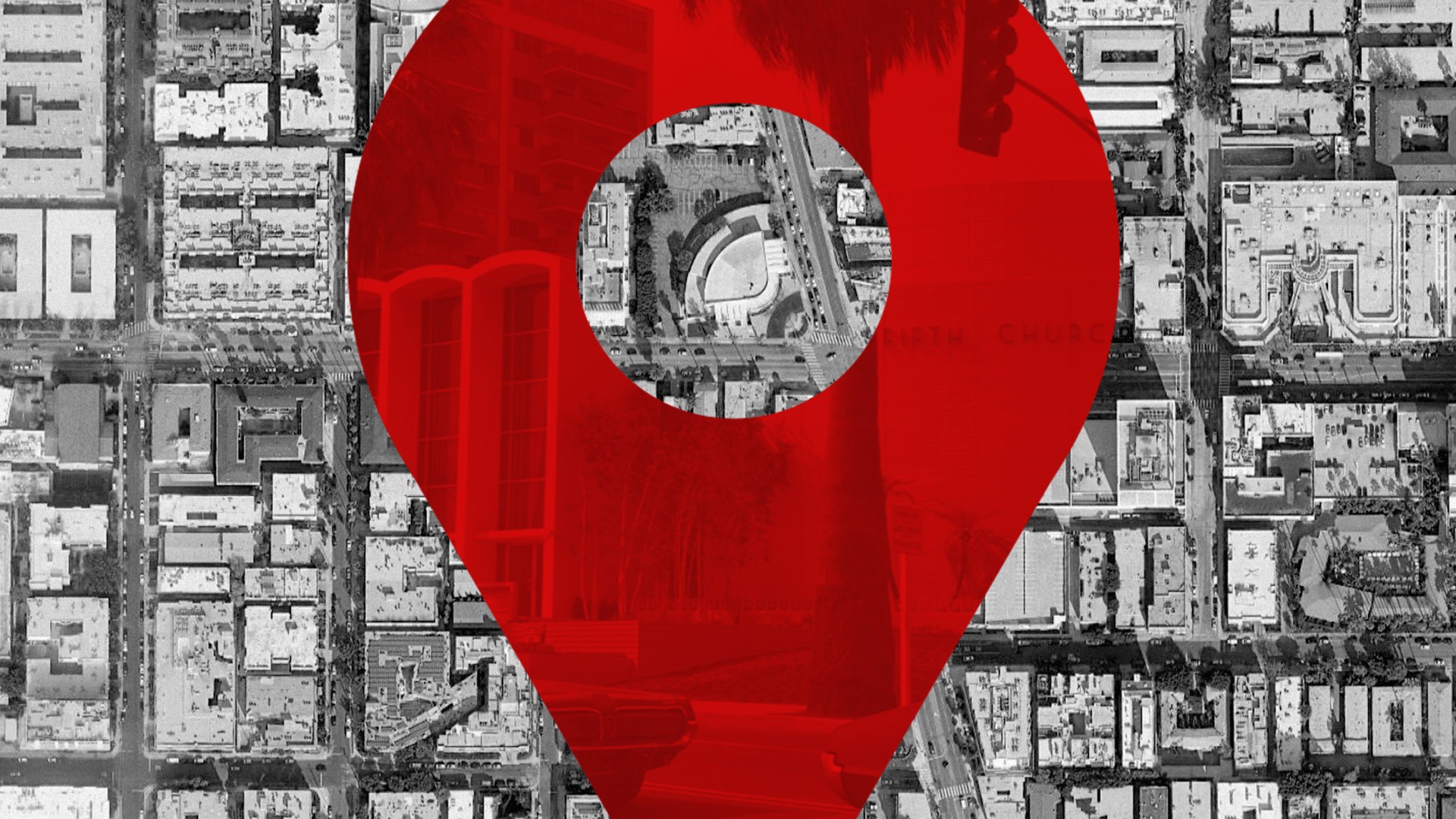
Sources: Google Maps / Los Angeles Public Library

The building at the corner of Hollywood Boulevard and La Brea Avenue has been many things to many people.

To the prominent Christian Science congregation that occupied it for nearly a century, it was an oasis of an eccentric sect that boomed in Hollywood alongside the film industry. Ginger Rogers worshiped there. In the late 1950s, the congregation tore down its original building and replaced it with a larger one.

To a grifter named Charles Sebesta, the church was an opportunity. He took a job there in 2001 as facilities manager, eventually became chairman of the declining congregation, and secretly embezzled more than $11 million from its coffers.

To the city of Los Angeles, the curved Modernist structure became, over time, a piece of architectural history in need of protection. Hollywood had frayed at the edges. But in the early 2000s, it was rebounding as a racially diverse quarter with arts, culture, mass transit, and meteoric real estate prices—the kind of place that threatened historic buildings.

To a New York real estate giant called LeFrak, the church building was an obstacle. The company bought it in 2008, wanting to tear it down and build high-rise apartments that looked out on the Hollywood Hills. The plan was thwarted after Los Angeles designated the church a historic monument.

And to Mosaic, the chic multisite evangelical church led by Erwin McManus, the building was a dream. Mosaic rented the space in 2011 and opened a campus there, growing even as McManus said people told him, “You really can’t do this thing called church in Hollywood.” In 2019, Mosaic launched an ambitious capital campaign to buy the property for around $20 million. People needed to know the church was there to stay, McManus said in a video—that it was “powerful and impossible to ignore.” As long as we’re renting, “we’re living like tourists that are just passing through.”

Mosaic fell short of its fundraising goal and abandoned its effort to buy the building. In announcing the disappointing news, McManus shifted his tone and told the church: “We have never been a building.”

A church is always more than the structure in which it meets, of course. But congregations are always shaped by the places they inhabit, as editor Kara Bettis explores this month. People are, too. All ministry is embodied. The Christian life is continually reworked within shifting physical limits, social networks, cultural contexts, and external demands. It is, somewhat like the church building on the corner of Hollywood and La Brea, ancient and renewed.

Andy Olsen is print managing editor of Christianity Today. Follow him on Twitter @AndyROlsen.

Also in this issue

A church is always more than the space in which it meets, but it is never less. Congregations cannot help being shaped by the places and neighborhoods they inhabit, as editor Kara Bettis explores this month in her reporting on the concept of “spiritual gentrification.” Churches are usually birthed around a shared vision for ministry. When the world around a church changes—gradually or suddenly—one of the most difficult challenges is discerning how, if at all, that shared vision should also change. PLUS: Rediscovering the Jewish roots of Easter.

China’s Public Schools Are Failing Christian Families

E. F. Gregory

Reply All

Faith Is More than a Feeling, but Not Less

Black Christian Homeschoolers Are Redefining the Movement

Liuan Huska

Don’t Expect Instant Gratification from Your ‘Quiet Time’

When the Congregation Leaves Town, Should the Building Follow?

Kara Bettis

Why We Need the Evangelical Jeremiad

Editorial

Don’t Make the Church Leadership Crisis Worse

Mike Cosper

Christ Conquered Death. He Didn’t Cancel It.

Jennifer M. Rosner

What Atonement Theories Tell Us About Our Politics

Visiting Prisoners in Jesus’ Day

David L. Stubbs

New & Noteworthy Fiction

Roseanna M. White

Testimony

The Booze-Filled Business Trip That Made Me a Christian

Stu Fuhlendorf

News

More Ministries Seek Alternatives to Child Sponsorships

Rebecca Hopkins

News

Gleanings: April 2022

News

Embezzlement Bedevils Global Church Giving

News

Are the Precise Words of Baptism Important?

Compiled by Daniel Silliman

News

Who Is My Neighbor? For Christians in the Balkans, the Answer Might be Troll Farms.

Jayson Casper

Help! I’ve Stopped Caring About God.

Interview by Matthew LaPine

Review

Jesus Is Risen! Now What?

Rhyne Putman

Review

Fearing God Means Living with the Grain of Reality

Anne Kennedy

5 Books on the Connection Between God and Animals

Caryn Rivadeneira

View issue

Our Latest

News

Washington Attack Suspect Sought to Justify Himself to Christians

In writings, Cole Tomas Allen thanked his church and argued that his attempt to assassinate Trump administration officials was compatible with his faith.

Being Human

Shame, Sexual Abuse, and Gaslighting with Christine Caine & Yana Jenay Conner

Can forgiveness meet reality when we navigate family trauma with truth?

The Revival That Wasn’t—and the One That May Be

Josh Packard and Raymond Chang

Young people remain deeply wary of large institutions, but they are undeniably interested in faith.

The Russell Moore Show

How Do I Teach My Children the Christian Faith?

Russell answers a listener question about how we can pass our Christian faith heritage to our children without making it weird.

You Don’t Graduate from Discernment

Paul Gutacker

As you seek your vocation with diploma in hand, the way of the Cross must still shape your days.

News

Australia’s Teen Social Media Ban Isn’t Perfect. But It’s Helping Analog Families.

Amy Lewis in Geelong, Australia

Teens have workarounds to get on the apps, but parents have it easier delaying children’s introduction to social networks.

The Bulletin

Attitudes Toward Israel, Kash Patel’s Lawsuit, and John Mark Comer’s Fame

Clarissa Moll, Russell Moore

Americans’ growing frustrations with Israel, Kash Patel sues The Atlantic for $250 million, and the popularity of John Mark Comer.

News

How a Kidnapping Changed a Theologian’s Mind

Interview by Emmanuel Nwachukwu

An interview with Sunday Bobai Agang about the lessons he learned from his abduction last month.

addApple PodcastsDown ArrowDown ArrowDown Arrowarrow_left_altLeft ArrowLeft ArrowRight ArrowRight ArrowRight Arrowarrow_up_altUp ArrowUp ArrowAvailable at Amazoncaret-downCloseCloseellipseEmailEmailExpandExpandExternalExternalFacebookfacebook-squarefolderGiftGiftGooglegoogleGoogle KeephamburgerInstagraminstagram-squareLinkLinklinkedin-squareListenListenListenChristianity TodayCT Creative Studio Logologo_orgMegaphoneMenuMenupausePinterestPlayPlayPocketPodcastprintremoveRSSRSSSaveSavesaveSearchSearchsearchSpotifyStitcherTelegramTable of ContentsTable of Contentstwitter-squareWhatsAppXYouTubeYouTube