News

Donated Clothes Still Being Sorted in Appalachia

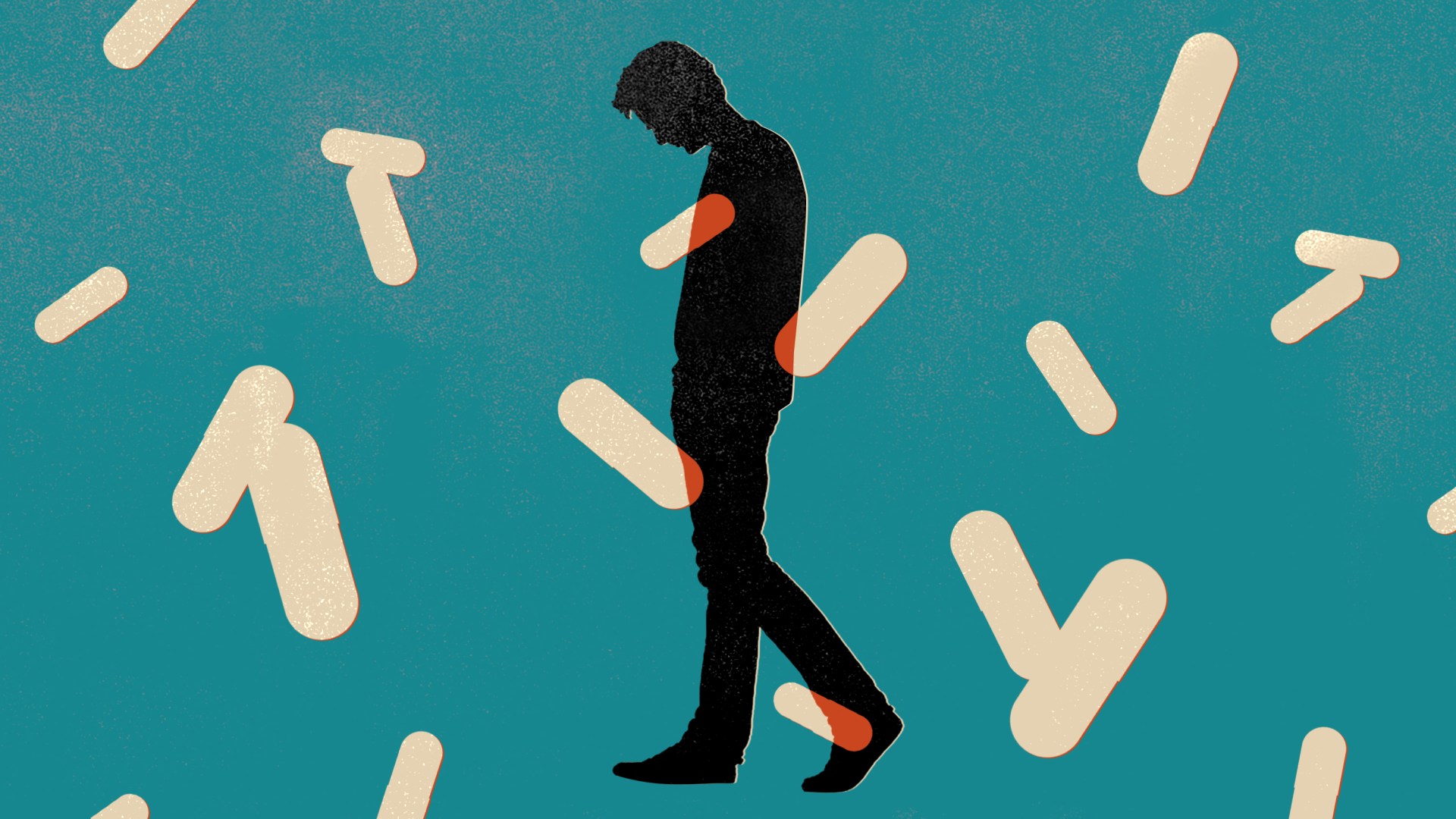
Six months after Hurricane Helene, the flood of fast fashion has yet to recede.

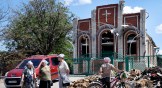
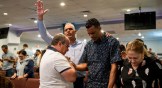
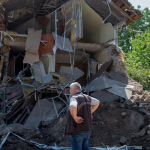
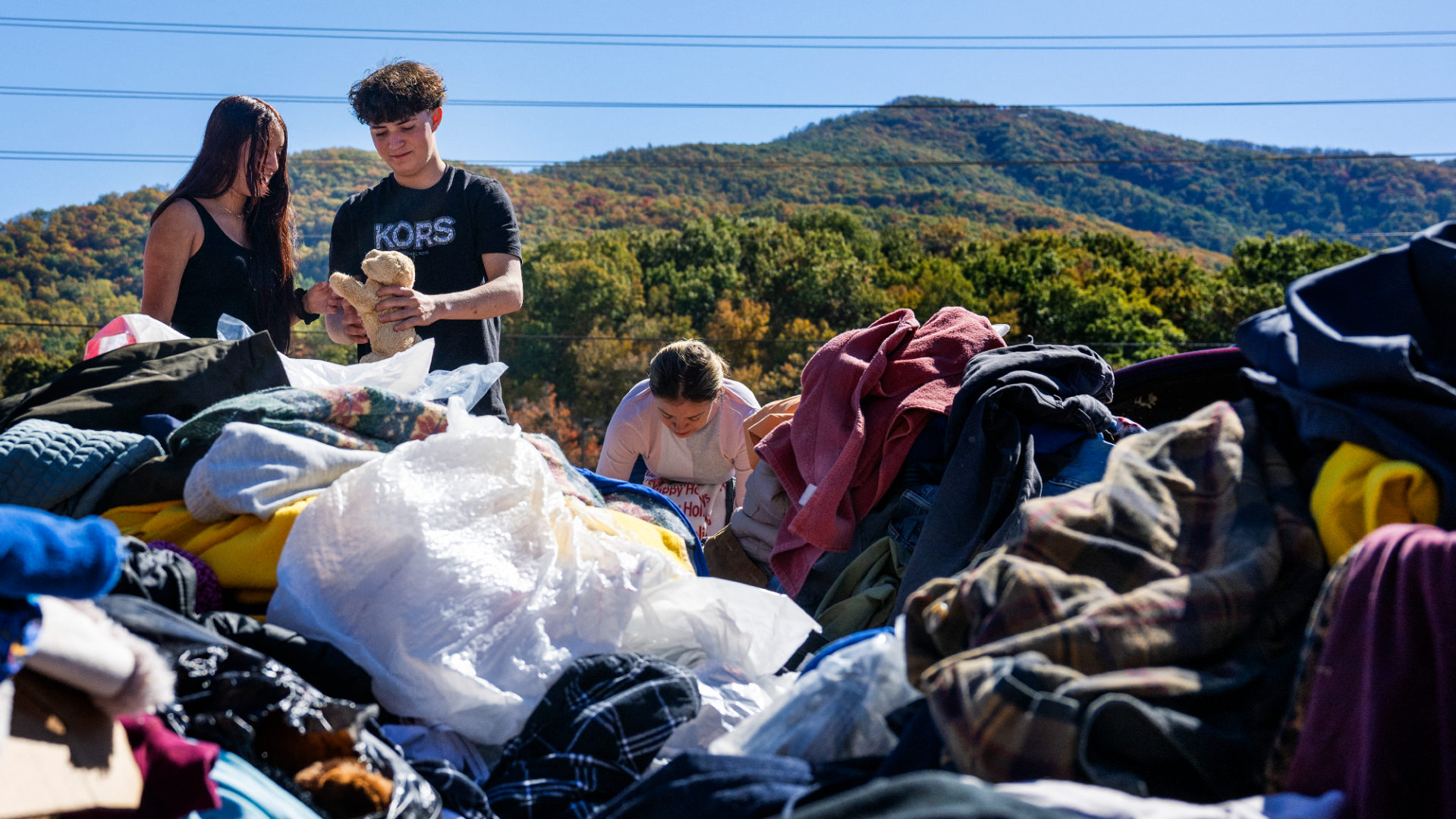
People in North Carolina sort through clothes after Hurricane Helene
Christianity Today March 27, 2025
Jim Watson/AFP via Getty Images

The water that flooded the Doe River when Hurricane Helene swept through East Tennessee has long since receded. The National Guard’s helicopters have come and gone. Cars full of eager volunteers no longer clog the roads. 

But six months after the disaster, First Baptist Church of Roan Mountain is still swimming in donations. 

“We’ve still got probably 10,000 toothbrushes,” pastor Geren Street told Christianity Today. “We’ve still got 20-something pallets of water bottles. I can’t tell you how much water we’ve given away, and to look out there and still see 20-something pallets? It’s crazy.”

Then there’s the flood of clothes. First Baptist had installed storage racks along the walls of a Sunday school classroom, and early on the church set up a semitruck trailer to take in all the donations. It’s not as full as it used to be, but it still holds bags and bags of clothes. 

“We’ve put a dent in it,” he said, “but we’ve still got work to do.”

Donations follow every natural disaster. People give, and give a lot. They are especially generous with old clothes. So generous, in fact, that the volume of donations can be overwhelming and create what experts call the “second disaster.”

Free clothes create complicated logistical problems. Where a toothbrush or a bottle of water can be given to anybody, a shirt or pair of pants has to fit. Sorting clothes and getting each item to someone who can wear it is much more more difficult.

Just storing the clothes until they are sorted can be challenging. At Unicoi County Care and Share, in Tennessee, donations quickly overran the small operation, so Care and Share asked nearby churches to take some bags. Soon the Unicoi Christian Church fellowship hall was full. The nursery was next. Volunteers piled bags into the space until it was stuffed floor to ceiling, wall to wall. 

“You physically could not enter the room,” said Ben Booher, executive director of Unicoi County Care and Share. 

The Christian benevolence ministry received donations from 25 different states—literally half the country. Booher posted lists of urgent needs online and got loads of cleaning supplies, hygiene products, and portable heaters that helped the ministry assist more than 1,000 households in 2024. 

The overflowing generosity meant volunteers worked nonstop. The organization saw a 371 percent increase in volunteer hours from 2023 to 2024.

“We kind of threw our normal hours out the window with Helene,” Booher said. “We were open 12 hours a day, many days in a row, just to respond to the need.”

But even with an experienced crew working extended hours, the onslaught of clothes was impossible to keep up with. It was more clothes than they could handle and more than people needed.

Booher recalled a box truck from Alabama, for example, arriving unannounced. It was full of winter coats.

“We don’t have that many people in the county,” Booher said. “Everyone would have four or five coats.” 

Another time, a woman drove all the way from Illinois in a Chevy Tahoe packed with used clothes. He couldn’t put them anywhere and had to turn the woman away. 

“There have been some people very mad at me,” Booher said. “I don’t want to say no, but at the same time … there have been points where we had so many clothes we couldn’t function as a ministry.”

An academic study of emergency management in America found a consistent “misalignment” between would-be donors and people in need. Donors told researchers they had seen the devastation on the news and wanted to help, wanted to feel they were doing something, but also saw giving as “purging with a purpose,” according to the study. 

Americans seem to give a lot of clothes because they have a lot of clothes. People buy an average of 53 new items of clothing every year, according to industry experts, and get rid of about 65 percent of them within one year. 

“Clothing has become so cheap in comparison to previous decades that we can afford to buy it unthinkingly,” said Dion Terrelonge, a psychologist who researches fast fashion and clothing consumption. “We have online shopping, next-day deliveries, free returns, pay later providers—everything is perfectly set up for us to meet and encourage our want for instant gratification.”

Between 1960 and 2018, US textile generation increased from 1.76 million tons to 17 million tons. A percentage of the excess clothing gets recycled. A lot—more than 10 million tons per year—gets thrown away. 

Trashing clothes can feel wasteful. Donating, in contrast, feels pretty good. People like to purge with a purpose—and they have a lot of clothes to purge.

Anthony Mullins, senior pastor at County Line Community Church in Chavies, Kentucky, said people have good intentions when they donate clothes but just haven’t thought through the whole process of dealing with them and considered whether their donations really meet people’s needs.

County Line Community Church became a main distribution site for donations after the flooding in Eastern Kentucky in 2022. Volunteers went through bags and bags of clothes. Mullins said some of the bags smelled bad from years of sitting in storage. 

“We would just have to throw those away,” he said. “I felt like if [the people hit by floods] had already lost everything, we didn’t need to give them something that wasn’t up to par. And we wanted to make sure they got good items and clean items.” 

According to Samantha Penta, professor of emergency management at the University at Albany in New York, most people who want to help after disasters would do more good if they gave money. Financial gifts can be redirected to the greatest needs or saved up to help people months and years after national attention has moved on. 

Donors often hesitate to give money, Penta said, for fear it will be wasted, misused, or even misappropriated. But money is used more effectively and efficiently than clothes or other goods.

“Find an organization with values that align to your own. Find an organization you can trust,” she said. “Do a little bit of that research now … and that way you can really have the biggest impact with your donation.”

In Western North Carolina, Asheville Buncombe Community Christian Ministry was able to use financial gifts that came in after Helene to buy heaters to distribute.

The ministry, which began as a collaboration between churches and today has the support of more than 300 congregations, was storing so many clothes at its four crisis centers that people had to turn sideways to walk through the buildings, said director of church engagement Chandler Carriker. Clothes pretty much filled up the ministry’s warehouse, too. But the money that people gave helped the most. It allowed the ministry to “act quickly and act directly,” Carriker said, and meet needs as they arose.

“Never think that a financial gift doesn’t come with the same sense of generosity, abundance, and faithfulness,” Carriker said. “It really does.”

In Unicoi County, Booher said Care and Share is transparent about its finances to reassure donors that every dollar is being used efficiently.

“We’ll gladly share our budget,” he said. “I’m happy to give everybody as much detail as they want—here’s what we bring in, here’s how it’s used, here are our plans, here’s our strategic plan.”

Care and Share redistributed donated funds to people who needed help with home repairs. Less than 1 percent of the 250,000 homes affected by the storm in East Tennessee carried flood insurance, according to state estimates, and an inch of water inside costs about $25,000 to fix. People who came to Unicoi Christian Church or Care and Share often didn’t need blouses, belts, or more T-shirts but money for drywall, plywood, or shingles.

Months later, Care and Share is still not accepting clothing donations. Booher hopes the remaining piles will be sorted and dealt with, one way or another, in the next month.

Up on Roan Mountain, First Baptist is still tidying up its grounds from the “second disaster.” The congregation recently turned a midweek Bible study into a church cleanup party. Volunteers took a bunch of the donations and donated them to Goodwill. One Sunday school room will continue to store clothes for the foreseeable future. 

Besides that, the Baptist pastor said, they hope to have the flood of donations cleaned up by Easter.
Theology

Don’t Deport the Constitution

Columnist

Criminals who are in America illegally should be sent away. But the rule of law, though fallible, must be preserved.

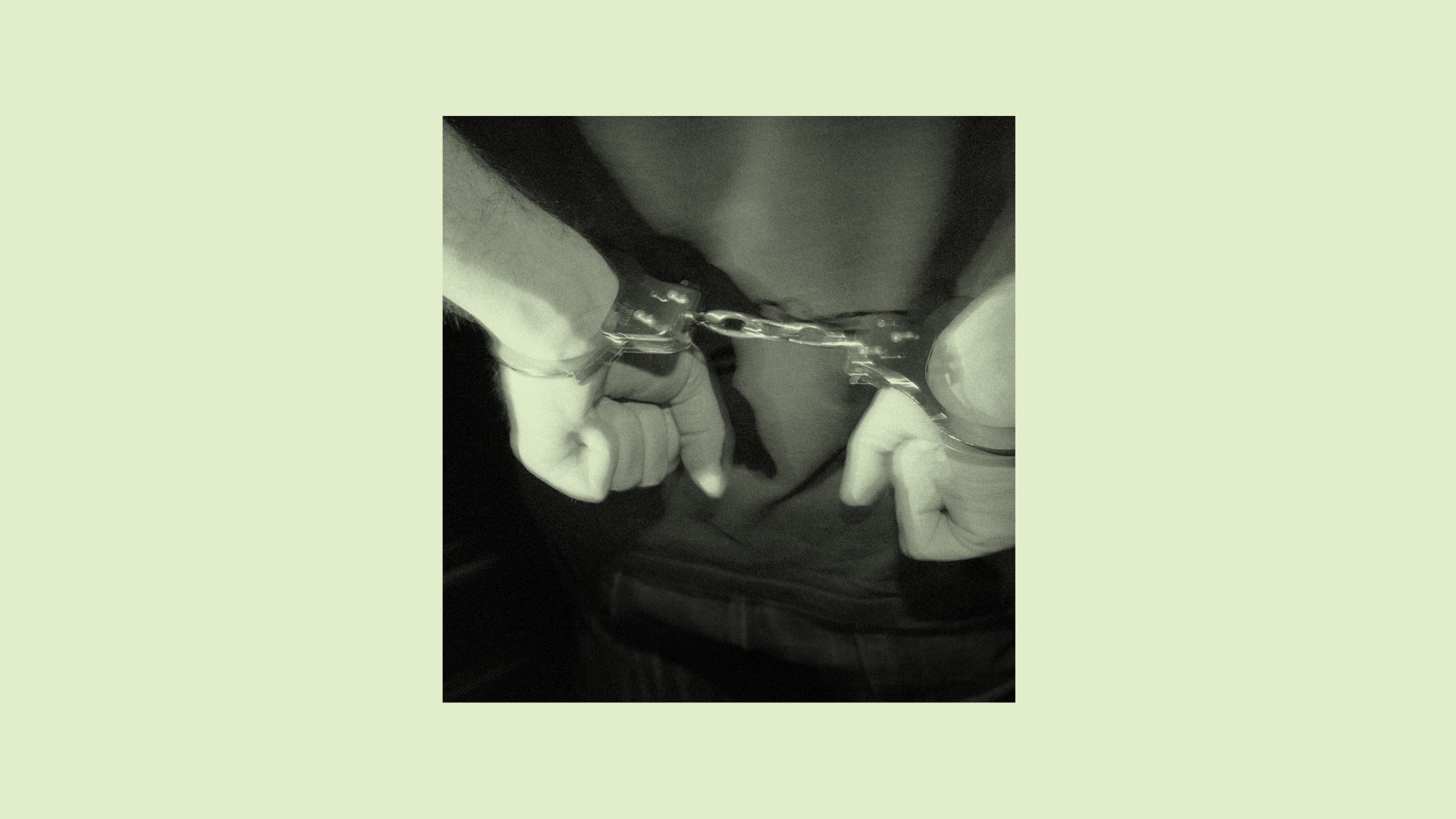
Hands in handcuffs
Christianity Today March 26, 2025
Illustration by Christianity Today / Source Images: Getty

This piece was adapted from Russell Moore’s newsletter. Subscribe here.

We should deport Venezuelan gang members and any other criminals who are illegally in this country. American Christians should not, and probably do not, object to that policy.

As Christians, we recognize that the most basic biblical justification for the existence of a state includes that state’s responsibility to uphold the law and protect its citizenry (Rom. 13:1–5).

And as Americans, we can see that our founders built into the constitutional republic of which we are a part the means for our government to do just that, to make sure the laws are faithfully executed. That means prosecuting dangerous criminals and sending those who are here illegally out of the country.

The what of that kind of deportation shouldn’t be in question, nor should the why. We ought, though, as both Christians and Americans, to recognize that we should also care about the how.

What alarmed me about the recent reports of the sweeping deportations of alleged members of the infamous Tren de Aragua was not that they were arrested or deported, nor was it, at first, about the questions of due process for these alleged criminals. Law enforcement is often charged with violating due process in some way or another, and usually these charges are met with government agents arguing why, on the basis of the law, they have the right to act as they did.

To some extent, that’s what White House border czar Tom Homan did when pressed by reporters as to whether the executive branch has the powers it is claiming under the Alien Enemies Act to deport these alleged offenders to an El Salvadorian prison. He said they do, and would fight for that right in court. That’s perfectly appropriate, and that kind of question is what courts were meant to discern.

What concerned me was what Homan said next.

To ABC News’ This Week, Homan responded to a question about due process with, “Where was Laken Riley’s due process? Where were all these young women that were killed and raped by members of TDA—where was their due process? … How about the young lady burned in that subway—where was her due process?”

Laken Riley, of course, was the nursing student murdered by an illegal immigrant. The cases Homan mentioned are all criminal and should be morally outrageous to any functioning conscience. The rhetoric here, however, confuses categories in ways that could have implications for much bigger questions of the size and scope of the state.

If your neighbor is apprehended by the police for running a meth lab in her basement, that arrest is a good thing. You don’t want to live in a society where laws against drug running are ignored by the authorities. Unless you are watching a Breaking Bad rerun, you probably won’t have any sympathy for meth dealers, nor should you.

But what if your neighbor’s meth lab is found not by suspicion of criminal activity, followed by a legal investigation of it, but by the fact that the government has installed secret surveillance cameras in every house?

If you object to this kind of unlawful spying without a warrant, someone might say, “What about the meth dealers we arrested? Are you pro-meth?”

Of course you’re not pro-meth or pro-murder. Your objection to a police state would be an objection to the government not following the law, even if the government’s lawbreaking led to some good results. In that, you would be recognizing one of the best aspects of liberal democracy: the idea that a people must give attention not just to lawful ends but also to lawful means, that what matters is not just what results we get but how we get them.  

Most of us take for granted that this system is just the way things have always worked. Some, such as journalist Jonah Goldberg, have argued for years that we ought to recognize what a miracle this kind of project is—a nation that operates not out of bonds of tribal loyalty but according to a system of laws accountable to the people, one that even protects the rights of the minority when the democratic majority wants to oppress them.

One very secular proponent of liberal democracy and constitutional republicanism argues that this “miracle” can be traced to at least one very unlikely source: Calvinism.

Francis Fukuyama wrote in 2017 that most of his fellow secularists discount the importance of the Protestant Reformation in the emergence of the modern state and that the Lutheran and Calvinist wings of the Reformation both contributed to the order we now take for granted.

Lutheranism added fire to the drive for mass literacy by encouraging the reading of the Bible by the laity. And in a later interview, Fukuyama said it was Calvinism’s “austere personal morality” that was crucial for eliminating corruption, especially “in the founding of modern bureaucracies in the Netherlands, in Prussia, in England, and in the United States.”

Fukuyama was not suggesting that Calvinism itself was (small l) liberal or (small d) democratic. Anabaptists—as they were fleeing Switzerland under threat of drowning by Calvinist magistrates for refusing to baptize their babies—would know that, as would Michael Servetus as he was led to the pyre for heresy.

Instead, Fukuyama argued that the kind of personal morality Calvinism emphasized ultimately led to something unnatural: an impersonal state. He continued:

I think in the end that corruption is a very natural thing. You want to help your friends, and you want to help your family. This idea that you should be impersonal and not steal on behalf of your friends or your family doesn’t occur to anyone unless they’re forced to do it. Calvinism imposed a kind of morality on its believers that was conducive to a strict order, in which you could tell bureaucrats that this is really wrong. Unless you internalize those rules, no amount of external surveillance is going to make people really honest.

Fukuyama is partially right. The “friend-enemy distinction” is indeed natural in this fallen universe east of Eden. That’s why, if we base our ethics, politics, or culture on nature, we will end up with something akin to the law of the jungle: those with the most guns or tanks win, and everyone else is subjugated.

That leads, by definition, to an unlimited and unrestricted state. It leads, and usually quickly, to a rule by bribery and intimidation in which criminality is defined not by what one does but by who one knows.

Only if one thinks there is something to which even the state is ultimately accountable—to a moral order that is about more than just who has the most votes—can one have a state that is in any way limited.

As Americans, we ought to care about the how and not just the what of any government action because we believe there’s a Constitution by which even the most popular notion must be constrained. As Christians, we ought to care about the means as well as the ends because we believe that rendering unto Caesar does not include recognizing Caesar as a god.

Venezuelan gangsters, Danish money launderers, Romanian human traffickers—we should prosecute them all, and remove from the country those who are here illegally.

But we ought to care how we do it. A liberal democracy slows down a lot of things we might like to do, but we will miss it when it’s gone. The rule of law is fallible, but it’s a good idea—one we can’t afford to deport.

Russell Moore is the editor in chief at Christianity Today and leads its Public Theology Project.

Inkwell

I Want to Lose an Eye to Heaven

Inkwell March 26, 2025
Photography by Shana Van Roosbroek

I want to lose an eye to heaven. 
Half-blind, I’ll see my 
morning coffee. Black, 
rippling reminiscence of 
a dying world. 

Oh, but with my other eye, 
I become whole. 
peering past this earth-colored
curtain—Eden’s lost gate, 
a world to come. 

Graham Varnell is a poet and pastor. He and his wife, Anna, are pastoral leaders at a small ministry school in the southernmost region of Hawaii, Ka’u. Graham obtained a Bachelor of Science in Ministry Leadership from Moody Bible Institute in 2024. Recent publications include The Clayjar Review. His heart is for people to have tangible encounters with God through beauty.
Culture

Meet the Non-Christian Fans of The Chosen

“I had goose bumps all over my body, and I didn’t know why but I felt so emotional.”

Christianity Today March 26, 2025

About a year ago, Vicki Neulinger was experiencing what she now calls “the abyss”: suffering from anxiety, navigating a difficult divorce, and feeling completely apathetic about life.

“I was in utter confusion,” said Neulinger, a 43-year-old woman from Virginia. “In that dark moment, I wasn’t living. I was surviving.”

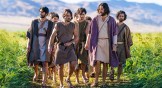
One day in March 2024, after moving in with her parents, she was browsing Amazon Prime Video for a new show to watch and came across The Chosen. The beloved historical drama about Jesus and his disciples will release the first two episodes of its fifth season in theaters on March 28.

The start of season 1 didn’t grab Neulinger right away. She switched it off. But then, she said, she heard a voice.

“I swear, I heard [God] say, ‘You go back to that show, and you turn it on, and you’re gonna watch it.’ And I did,” she said.

As Neulinger watched, she was reminded of her childhood encounters with God. Her grandmother, a devout Christian, had often brought her to Sunday school. Later in life, Neulinger drifted away from her faith, exploring materialism, New Age spirituality, and magic. She learned spells and practiced voodoo and joined Facebook groups where self-described witches ranted about Christianity.

This history meant she deeply related to the character of Mary Magdalene, who in The Chosen’s first episode is suffering from demonic possession. At first, Neulinger didn’t realize the character played by Jonathan Roumie was Jesus. It was when he addressed Mary that Neulinger remembered words her grandmother spoke over her when she was a child: “The Lord calls us by name.”

“That’s when I’m like, ‘Oh, it’s Jesus!’ and it made me cry,” she said.

Since its 2019 debut, The Chosen has become wildly popular. According to the show’s team, an estimated 280 million people have tuned in on Netflix, Amazon Prime Video, and a dedicated app, drawn in by prestige production values and the down-to-earth, culturally informed portrayal of Jesus and his disciples. The Chosen broke the record for the most-translated TV show, with availability in more than 50 languages. Its creators, led by showrunner Dallas Jenkins, have reportedly crowdfunded nearly $100 million and plan to produce seven seasons.

Season 5 will focus on Holy Week. After its theatrical release, it will stream on Prime Video for 90 days, then be available for free on The Chosen app.

Much of the discourse about The Chosen has focused on its enthusiastic—and sometimes controversial—reception among evangelicals, who make up the majority of the show’s fan base. But the show has also resonated with another demographic: fans who don’t identify (or at least, didn’t used to identify) as Christians. The show says a third of its fans are not religious.

Some, like Neulinger, grew up going to church but left the faith as adults; now, they’re reexploring Christianity through the show. Others are agnostics or atheists yet appreciate The Chosen’s grounded, personable portrayal of Jesus. Some started watching with hostility to Christianity and finished the four seasons with a change of heart.

Matthew Page, a UK-based independent scholar who has studied adaptations of the Bible in film and authored the book 100 Bible Films, said that the Jesus of The Chosen feels distinct from many other depictions of Christ: He laughs easily, dances on occasion, and looks and feels like a regular human being.

“There’s something very everyday and ordinary about him,” said Page, who has also blogged extensively about the show. “You see moments of him acting with divine power, but he’s very human, very easy to relate to, very Jewish.”

Taylor Chee-Schmidt, who lives in Seattle and works as a program manager for a tech company, identifies as an atheist. She started the show a month ago and has been binge-watching to try to finish past seasons before the new one arrives.

“I watched the first episode, and from the get-go there’s an exorcism,” Chee-Schmidt said. “It seemed real. It was a humanized exorcism. It reminded me of whenever I’m in a metro area in downtown Seattle, and there’s a lot of unhoused people and mentally unwell people, and sometimes they’ll have an episode.”

Chee-Schmidt also appreciated how the show felt authentic to first-century Galilee and Judea.

“It’s not just all blond, white, blue-eyed people. They actually have people of color who are portraying these roles,” Chee-Schmidt said. “It doesn’t feel like they just looked in the closet for biblical features of the 1930s and brought out props from golden-age Hollywood.”

For others, watching the show has been a way to reengage with childhood faith. Michael Lamping, a 29-year-old who works in IT in Wisconsin, grew up attending Catholic Mass but stopped believing in Christianity after the weekly ritual felt increasingly like a chore rather than an expression of worship.

During the COVID-19 pandemic, Lamping discovered The Chosen and was captivated. He became inspired to learn more about Christianity and began to engage with historical documents related to the Bible, critical analyses of Scripture, and lectures about faith.

“The story helped me immensely with realizing that faith isn’t something to be afraid of as a lot of media portray it,” he said.

The Chosen has also left an impact on people of other religions. Sabi Ali, a 26-year-old office administrator in London, grew up Muslim and would often debate with her Christian cousins about faith. Last year, her cousins convinced her to start watching The Chosen.

After the first episode, Ali was skeptical. But by the end of the second, she was in tears, and she ended up binge-watching the show in a week and a half. One scene in particular resonated deeply with her.

“It was when Jesus came to the boats with Simon Peter and Andrew and none of them were getting any fish,” Ali said. “Jesus said, ‘Throw the net again.’ I had goose bumps all over my body, and I didn’t know why but I felt so emotional.”

Ali began to doubt the teachings of Islam and the Quran, which says that Jesus was a miraculous prophet but not the incarnate Son of God.

Then, one day during her binge of The Chosen, she and her cousins were returning home when a man appeared and offered Ali a leaflet about the gospel. “Jesus loves you,” he said, and then he disappeared. Ali took it as a sign from God.

“My cousin was facing him, and he didn’t give it to my cousin. He gave it to me,” she said. She began going to church regularly and now identifies as a Christian.

Ali also introduced her mother—a staunch Muslim who had frowned upon Christianity—to the show. They began watching together; soon her mother was streaming the show even when Ali was away working. Now, her mother has also become a Christian and spends her free time reading the Bible and watching videos about faith.

“It was what I was looking for,” Ali said of The Chosen. “I needed something without realizing it was what I was looking for. God was like, ‘You need to know the truth, and this is going to help you understand.’”

Like Ali’s mother, Vicki Neulinger has also started reading the Bible more because of The Chosen. After starting to watch the show, she purchased an NIV Study Bible and found online guides that paired Scripture passages with each episode. She developed a routine: Before watching an episode, she would read the designated Bible passage. In this way, over the course of six months, she read the Bible cover to cover for the first time.

She still faces many difficulties, but she feels she’s in a better place now than last March. By the grace of God, she is crawling out of the abyss, and by some strange miracle, it is a television show that has helped her do it.

“I just think that God has been knocking on my door my whole life. He’s been banging on it,” she said. “And this was finally his way of saying, ‘Open the door.’”

Christopher Kuo is a freelance journalist based in Ireland. His work has been published in The New York TimesThe Los Angeles TimesDuke Magazine, and elsewhere. 

Books
Review

Why a Democracy Advocate in Putin’s Russia Didn’t Fear Death

Alexei Navalny’s memoir testifies to the political power of the Resurrection.

Alexei Navalny on a background going from light to dark
Christianity Today March 26, 2025
Illustration by Christianity Today / Source Images: Getty

Alexei Navalny is dead. And yet he lives.

He lives to trouble Vladimir Putin, the authoritarian strongman of Russia who may have had the advocate for democracy killed a little more than a year ago and who definitely had him poisoned before that.

Now Navalny is gone, but not gone enough for Putin. There are still those connected to him, including the Russian Orthodox priest who buried him and the lawyers who represented him.

There are still those inspired by him and the way he exposed Putin’s greed and corruption. They are willing to get arrested laying wreaths in Navalny’s memory at monuments to the victims of Soviet oppression, and they appeared at his funeral, defying authorities with chants of “We are not afraid.”

And there is his best-selling memoir, Patriot.

The cover shows his face staring out, refusing to look down, look away. Refusing to just be dead.

Navalny lives in another way too. He lives in the sense the apostle Paul spoke of in 1 Corinthians 15, as one who was sown perishable but will be raised imperishable, was sown in weakness and dishonor but will be raised in power and glory, with a mortal body that puts on immortality with Christ. He lives as one who believed in the Resurrection.

This is, in fact, how Navalny concludes the memoir, which one of his political allies called his gospel.

“Are you a disciple of the religion whose founder sacrificed himself for others, paying the price for their sins?” Navalny asks himself at the end. “Do you believe in the immortality of the soul and the rest of that cool stuff? If you can honestly answer yes, what is there left for you to worry about?”

The answer is clear: not death. Patriot testifies to that confidence from its opening sentence—“Dying really didn’t hurt”—to its final statement of faith in Jesus, who Navalny trusts to “take my punches for me.” This is the memoir of a man who is convinced that “the saying that is written will come true: ‘Death has been swallowed up in victory’” (1 Cor. 15:54).


For Navalny, the political part of this victory and the religious part are not unrelated. Yet the relationship between them is also complicated. He did not think that the religious could be reduced to the political, nor that the political could transubstantiate into the religious. Faith and political works are separate, as he understood them, but also always interconnected.

Seeing Navalny work this out is one of the most interesting parts of Patriot, though not one that most reviewers have focused on. The memoir is a powerful piece of writing. Patriot starts as an autobiography, recounting Navalny’s experience of being poisoned for anti-corruption activism and then circling back to his childhood outside Obninsk, a restricted-access city where the first Soviet nuclear reactor had been built. One of his vivid memories was seeing scientists and soldiers, including his father, scramble in response to the Chernobyl disaster 700 kilometers away.

“It was obvious the regime was hiding something, which meant it had something to hide, but you couldn’t say that openly,” Navalny writes. “In 1986, it hadn’t occurred to anyone that the Soviet Union and its vast apparatus for controlling thoughts and words would shortly cease to exist.”

The lies would be swallowed up by the truth, though, and Navalny tells the story of his awakening to the lies—a coming-of-age story—and his political education when the authoritarian regime collapsed. At first, tasting freedom, he put his energy into pursuing cars, dreaming of driving a Mercedes, a BMW, or a Chevy Tahoe. He wanted to be a successful lawyer and a cool dude.

But ultimately the corruption that came with the collapse of communism turned him into an advocate for democracy and good government. Which turned him into an opponent of Putin.

The former spymaster came to power in 1999, when Navalny was 23. Putin got promoted from intelligence-service director to deputy prime minister and then acting prime minister in a single day. He was made full prime minister that same month and acting president later that year—all without a vote. Putin passed laws making it harder for people to oppose him at the ballot box, used state media to promote himself, and took advantage of the war on terror to win election in 2000.

That was the start of Putinism, which one Russian observer at the time called the “final stage of bandit capitalism.”

Navalny saw it that way too. “One thing I really was sure of,” he writes in his memoir, “was that the Putin regime was founded on corruption.”

Patriot recounts the lengths to which Navalny went to expose that corruption and try to organize an effective opposition. He talks about political party meetings, public debates, shareholder activism, protest rallies, the discovery of the internet, and especially blogging. (There’s a lot on the thrill of blogging.)

Navalny was not ultimately successful. Putin’s government responded by subjecting him to criminal cases, politicized prosecution on trumped-up charges of embezzlement, and then prison.

The final part of Patriot is Navalny’s prison diary, an account of the minutia of incarceration that feels like an update to the Soviet-dissident classic One Day in the Life of Ivan Denisovich. Navalny describes the maddening bureaucracy of prison, the endless transportation between different cells, the sense of passing time, the sense of losing time, emerging friendships with fellow inmates, and the constant companion of hunger.

In the process, he discovers his faith. The political activist writes about faith not in terms of arguments but more as, to borrow a description from one of Augustine’s sermons, “a great jar in which you can receive a great gift.”

Navalny learned prayers as a child, spending summers with his Ukrainian grandmother, who also had him secretly baptized. When he had a daughter of his own, he realized he wasn’t an atheist. At some point he started to cross himself whenever he passed a church, a practice his friends and fellow activists regarded as wildly old-fashioned, superstitious, and gauche.

He didn’t disagree. In fact, he saw something about the gaucheness of religion—the uncoolness of Christian life—that attested to its truth.

In one scene in the memoir, Navalny recalls how an older prisoner who never really spoke to him gave him a prayer card with an angel on it. This was not a beautiful icon but kitsch. The prayer was written in a pseudo-Slavonic script, and Navalny jokes that “there seems to be a consensus that angels and archangels alight more readily” when there’s an old-timey font.

He received the card, however, as a sign. There was something about the incongruity, the aesthetic poverty, the complete uselessness of this item that in fact made it powerful. Navalny, by faith, rejected the valuation of authoritarianism.

It is no accident that, before this, he had taken to memorizing the Sermon on the Mount in Russian, English, French, and Latin. It is only a little more than 100 verses, he writes, and “if I was constantly going to find myself standing in line looking at a wall or a fence, I might as well learn it by heart.”

Navalny came to identify deeply with the Christian values of Jesus’ sermon. He grew to really believe that “everyone who hears these words of mine and puts them into practice is like a wise man who built his house on the rock” (Matt. 7:24).


Of course, the commands Jesus gave are wildly impractical in our world. Billionaire Elon Musk was right when he noted that it is dangerous, for example, to turn the other cheek. “If you’re facing sort of a predatory threat, and that threat is stronger than you,” Musk said, “you will just get, you know, executed.”

That is, sure enough, what happened to Jesus. That’s what happened to most of the disciples too. One can imagine Peter nodding along from where he hung upside down on his cross. “Love your enemies and pray for those who persecute you” (Matt. 5:44) is not good political strategy and not what strong people do.

Navalny’s friends and colleagues tried to tell him this too. He notes they discouraged him from talking about his faith in the final statements the Russian government allowed him to make before sentencing. And they were right, Navalny admitted, that such a statement wouldn’t “work.” He would seem, instead, like someone who had “gone nuts.”

But he did it anyway.

“Really, Your Honor, I’m not sure anymore what to talk about,” Navalny said in one statement, recorded in the memoir. “Do you think, perhaps, we should talk about God? And salvation? … The fact is, I’m religious.”

The fact is, he was “nuts” in the sense of rejecting political logic, authoritarian logic, the logic of gaining and maintaining power. Because of his faith, he could continue to advocate democracy and oppose Putinism even when the regime made it incredibly clear that he could not and would not win.

Navalny knew the inevitability of his own defeat, even his own death. But he also knew the truth of Easter, the truth that Christ has died (past tense) but is risen (present) and will come again (future).

That had consequences for his politics. He could disregard the fact that he would lose. He could not care that his course of action would likely lead to execution. He could start his memoir with the statement that dying didn’t really hurt.

“Faith makes life simpler,” Navalny writes. “My job is to seek the Kingdom of God and his righteousness, and leave it to good old Jesus and the rest of his family to deal with everything else.”

Daniel Silliman is senior news editor at Christianity Today.

Ideas

Ukrainian Children Are Not Expendable

Bureaucratic efficiency is no excuse for ignoring the vulnerable.

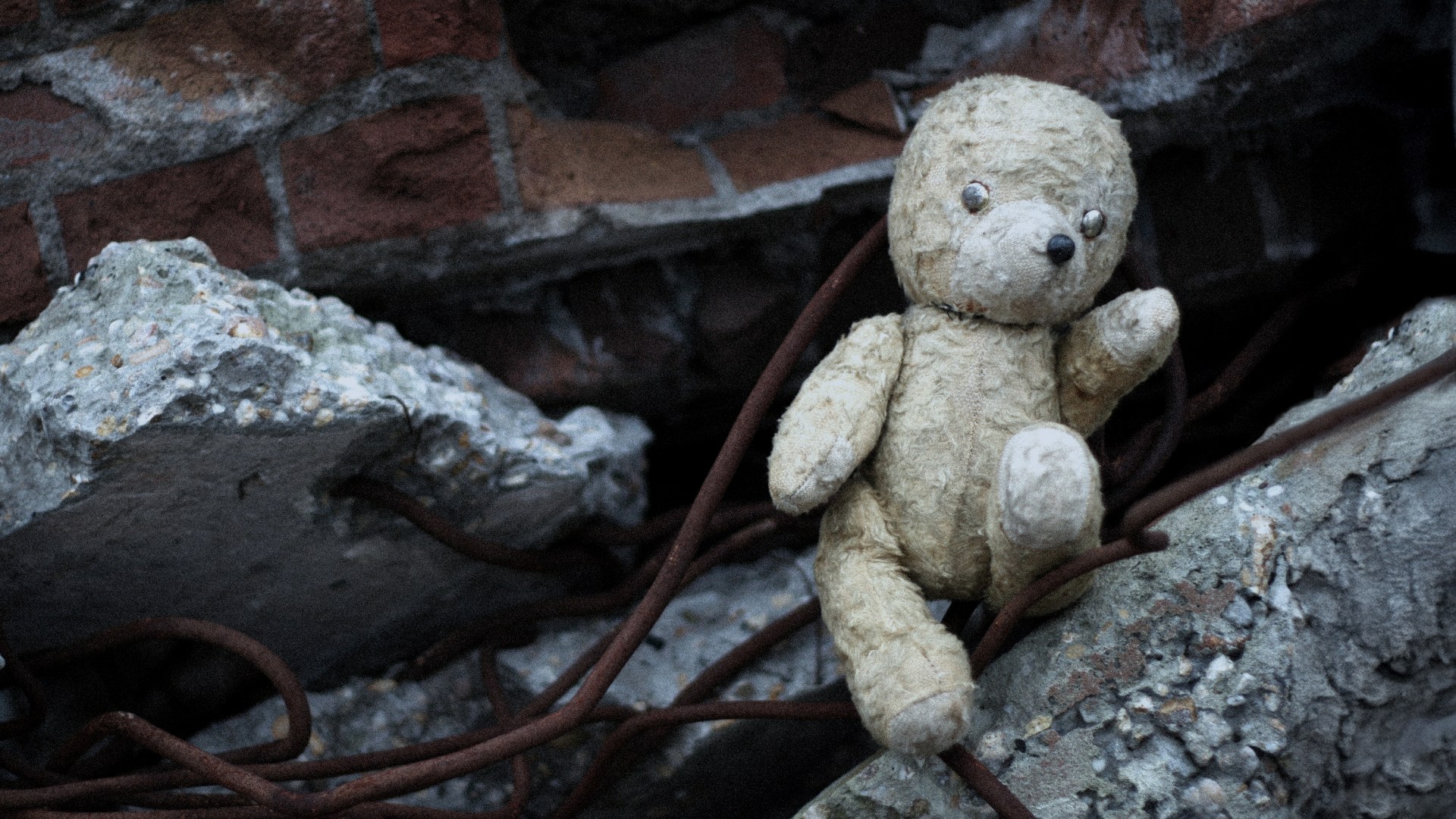
A stuffed animal bear in rubble
Christianity Today March 26, 2025
MirAgareb / Getty / Edits by CT

During times of war, the most vulnerable always pay the heaviest price. Women and children face unique vulnerabilities in the midst of crisis and conflict, and Russia’s attack on Ukraine in 2022 has proved no different.

Over the past decade, Russia has forcefully transferred almost 20,000 children from Ukraine to Russia and Russian-controlled territories. International awareness of the crisis only spread at the start of the war. At the time of capture, children ranged in age from 4 months to 17 years old and have been subjected to political reeducation camps and military training.

The United States is in active conversations with Russia and Ukraine to accept a short-term hiatus from the conflict as both sides negotiate a longer-term peace plan. One of Ukraine’s conditions is the return of the children “illegally deported to Russia and thousands of civilians detained in Russian prisons.”

Concurrent with the US peace deal negotiations, Elon Musk’s Department of Government Efficiency (DOGE) has stopped funding for Yale University researchers who are helping locate the abducted Ukrainian children. The team at Yale used “open-source technology including satellite imagery, social media and Russian publications, to trace the lost children and share their findings with the Ukrainian authorities to help them locate the abducted minors.”

Hundreds of Ukrainian children were illegally placed for adoption in Russia or placed in Russian families. In at least one case, the Yale researchers say, Russia’s government reissued the child’s birth certificate, “changing the child’s name and place of birth.” Many of these children have families. Abducted Ukrainian children have also been physically abused, separated indefinitely from their families in Ukraine, and given inadequate access to food and care.

Perhaps most monstrously, Russia “targeted vulnerable groups of children for deportation, including orphans, children with disabilities, children from low-income families, and children with parents in the military.” To this day, Russia has refused to offer a list of children taken to Russia and their whereabouts—as mandated by international law—and has concealed its forced deportation and illegal adoption of children from Ukraine.

Most egregiously, US lawmakers have “reason to believe that the data from the repository has been permanently deleted.” At a time when the US is pushing for a peace deal, the alleged actions send a chilling message—that the plight of these innocent children is expendable in the name of bureaucratic efficiency.

During President Donald Trump’s most recent phone call with Ukrainian president Volodymyr Zelensky on March 19, Trump asked about Ukraine’s missing children—including the ones who had been abducted—and promised to work closely with both Ukraine and Russia to ensure those children were returned home. I’m hopeful this signals that vulnerable children will be a top priority in a peace deal with the Kremlin.

Scripture speaks about the “quartet of the vulnerable”—the Old Testament’s emphasis on caring for the poor, widows, orphans, and foreigners—those in special need of protection and justice. We should care about the stolen Ukrainian children because each of those children bears God’s image and has been a victim of a crime. The heart of the Father is attuned to the suffering of the vulnerable—and so must we be as his hands and feet.

At its core, one of the fundamental responsibilities of government is to safeguard the well-being of the most vulnerable members of society, ensuring they are protected from harm and never reduced to pawns in political or ideological struggles. A just and moral society recognizes that the rights of children must be upheld with unwavering commitment, prioritizing their safety, stability, and opportunity to thrive.

As I’ve watched the war in Ukraine unfold over the past three years, I’ve been keenly attuned to the suffering of the children. I was adopted as an infant from Eastern Europe, and I have five siblings and a cousin also adopted from Eastern Europe. I’ve spent over 12 years working in child welfare, helping craft and advance public policy that puts the best interest of the child first.

When I worked on Capitol Hill, my boss led the Congressional Coalition on Adoption—Congress’s largest bipartisan, bicameral caucus. We led international congressional delegations to educate members of Congress and their staff on laws intended to protect children from trafficking and abuse. Our desire was for the US to be a global leader in protecting the smallest members of society.

The suffering of Ukrainian children is near to my heart partly because that part of the world is my birthplace and my heritage. Perhaps my body holds preverbal memories of my homeland and its neighbors. But I’ve also watched with a broken heart because I’ve dedicated my career to public policy that protects those experiencing vulnerabilities. Children must never be used as bargaining chips in any negotiation.

The Geneva Convention gives children special protection status during war, and deportation or forced transfer of a population is against international law and could constitute crimes against humanity.

The United States can seek efficiency without sacrificing the protection and safe return of abducted children. Ukraine’s children must come home without preconditions, and President Trump and Secretary of State Marco Rubio must continue to ensure that vulnerable children remain a top priority in peace conversations.

We must not turn a blind eye to the plight of stolen Ukrainian children.

Chelsea Sobolik serves as director of government relations for World Relief. Previously she worked for the Ethics and Religious Liberty Commission and on Capitol Hill. She is the author of Called to Cultivate: A Gospel Vision for Women and Work and Longing for Motherhood: Holding On to Hope in the Midst of Childlessness.

Ideas

Immigration’s Complicated Costs for My Town—and My Soul

Border regions like mine have absorbed so many new residents so quickly. I want to welcome them and to be honest about what I see.

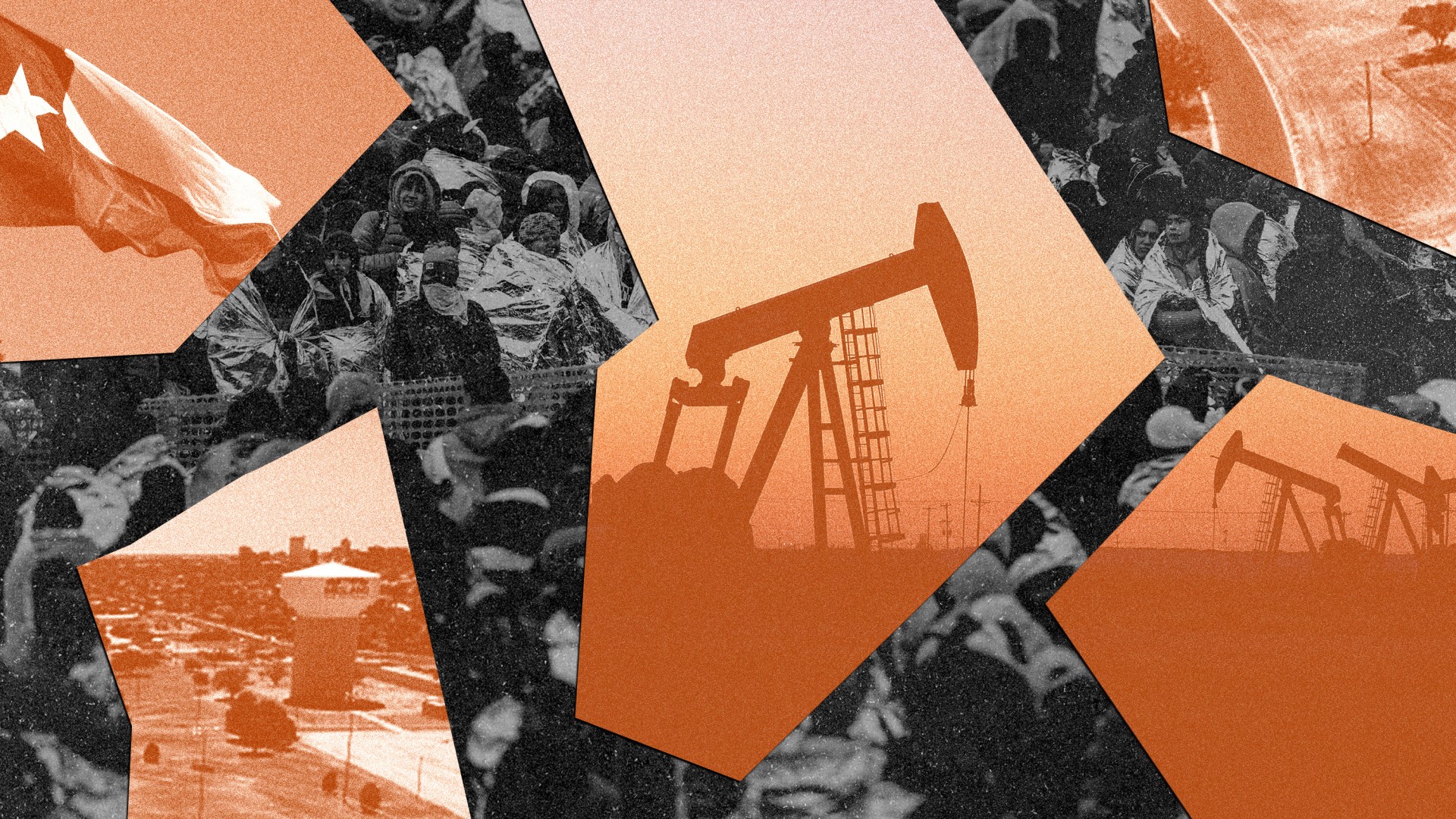
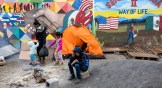
A collage of scenes from Texas and immigration.
Christianity Today March 26, 2025
Illustration by Christianity Today / Source Images: Getty, Wikimedia Commons

I notice it most when I go to Walmart: the way it feels as if I’ve entered another country. A week or so ago, I looked around as I pushed a cart through the store. Though I’m more than three hours from an international border, almost no one around was speaking English. 

These Spanish-speaking employees and customers alike mostly aren’t of Mexican descent, as the West Texas Hispanic population generally used to be. Instead, they’re Cuban, Venezuelan, and Honduran, recent arrivals who brought new cultures and dialects with them when they moved to town.

I don’t think it’s evidence of racism to admit that these trips to Walmart can be disorienting—and if they’re disorienting for me, how much more so for a 70-year-old who can’t find an English-speaking employee to help her locate the mayonnaise? It’s okay to be surprised by the effects of the rapid population shift we’ve experienced in the span of a few years here in Midland, Texas, as we’ve grappled with a massive influx of immigrants. It’s even okay to be disconcerted.

The reflexive retort from many on the progressive left to that kind of concern, should our elderly Walmart shopper muster the courage to voice it at all, is that she’s a bigot for daring to complain. But she’s not wrong that our town is evolving. She’s not wrong about the reality playing out before her eyes. And if she is not taken seriously by sober-minded leaders, she may become an easy target for unscrupulous politicians and pundits who want to turn that disconcert into something darker.

Can most of us agree that the national dialogue about immigrants swings between absurd extremes? That both politicians’ rhetoric and public responses have reached a fever-pitched frenzy? After years of what some have argued is a functionally open border, we’re now deporting Iranian Christians to Panama and Venezuelans to El Salvador. As Christians, how do we respond to this chaos and confusion?

On the one hand, the Bible seems to me to be inescapably clear about how Christians are to respond to foreigners: “When a foreigner resides among you in your land, do not mistreat them.The foreigner residing among you must be treated as your native-born. Love them as yourself, for you were foreigners in Egypt. I am the Lord your God” (Lev. 19:33–34).

And yet law and order matter too, of course. As a Christian in a border state who has long felt the scriptural command to show compassion to immigrants, I’m trying to find the moderate middle, grounding myself in the reality I see with my own eyes as I develop a more nuanced perspective on immigration. Over the last few months, I’ve tried to pay more attention to the high cost of mass migration for communities like mine that absorb so many new residents so quickly—and I’ve been looking for that cost not only on the surface, where political debates tend to dwell, but also on our very souls.

As I’ve paid attention to the world around me and the world within, I’ve learned that the challenges posed by shifting demographics and culture are real and meaningful and worthy of consideration. But they pale in comparison to the spiritual consequences of allowing illegal immigration to run unchecked. The closer I look at this brokenness, the more I realize that God tells us to care for the stranger (Heb 13:2) and to follow the laws of the land (Rom 13:1) precisely because it is only in this middle space where we all—local and stranger alike—find abundant life.

It isn’t only at Walmart that I notice the shifting demographics of my community. I see it in the public schools my children attend. Late last month, my eldest daughter came home saying that a friend of hers from school had missed class because “his mom was getting deported.” At first, she said, she’d thought he was joking, but in the weeks since, I’ve seen her worrying, wondering if it is true. “Surely he has a grandma or someone to live with, right, Mom?” she asked later. “I mean, he’s still coming to school every day. How would he get there if he didn’t have a ride?”

And my daughter’s too-close, too-young introduction to the intricacies and dysfunction of the US immigration system isn’t the only impact immigration is having on her education. Though the district doesn’t release data on students’ immigration status, we’ve seen an influx of non-English speakers in the last few years. 

In 2019, Midland Independent School District had 3,133 English language learners enrolled; in 2025, we have 5,728. That’s a nearly 83 percent increase in six years—83 percent more students who are not native English speakers, more than 2,500 children who in some cases arrived not even knowing how to say hello. 

Due to zoning and resourcing decisions, these students often end up clustered at a handful of schools. Their presence isn’t a problem, and it’s arguably not adding to taxpayers’ fiscal burdens. After all, through a complicated revenue system funded by property taxes (which Texas residents pay regardless of immigration status when we pay rent or mortgages) our school district receives funding for each student enrolled. 

But this large and rapid addition to our school system is inarguably complicated—and again, it’s not racist or anti-immigrant to say so. The academic needs of a child who doesn’t speak English are drastically different than the needs of those who speak English as their first language. I want our schools to meet these new students’ needs and care for them well. But I can also see that the strain of trying to meet their needs without neglecting the students already here is pushing a precarious system over the edge. We are dealing with poor school performance, frustrated teachers, and disgruntled parents. 

For many families in the Midland area with children in one of the schools that have absorbed these students, the single most identifiable pinch point comes at 3:00 p.m. on weekdays. It may seem like a small thing, but new immigrant parents unfamiliar with the highly orchestrated customs and mores surrounding the American Elementary School Car Pickup Line are prone to cutting in and cutting off, a sure-fire way to exasperate the locals. Is that as important as how you teach all these children math? Of course not, but like a pebble in a shoe, it is a real irritation nonetheless.

There are other, larger, more expensive complications too. A friend of mine who works in an area hospital—an immigrant herself—told me she sees a recurring pattern: People come across the border and go to the ER complaining of chest pains or arm numbness and get a battery of tests to rule out myriad health concerns. Then they head back to Mexico with their medical records and a clean bill of health in hand, leaving US taxpayers to foot the bill. 

“It’s almost like they have a playbook explaining what they need to say to get free health care in the US,” she told me. She was quick to add that she doesn’t judge—that there’s no way to instantly know who has a real emergency and who doesn’t, so the Hippocratic oath compels her and her colleagues to care for all without question. 

Her impression is that this practice is less common among more recent waves of migrants from Central America than it is among Mexicans with Texan families, who can cross the border with relative ease. But that’s a distinction lost on your average American taxpayer, and it’s certainly not a distinction teased out by our governor, who leads a state where residents pay hundreds of millions of dollars every year to cover the treatment of uninsured migrants.

Another one of my acquaintances owns an oil-field service company. His competitors often hire undocumented workers, paying them below market wages and leaving them unprotected in dangerous jobs by failing to properly train and outfit them with the necessary safety equipment, like monitors to alert them to deadly H2S gas. “The immigrants are expendable to them,” he told me. 

These practices also hurt his business because he can’t compete with lowball bids from companies paying unfair wages. He’s frustrated less by the flood of illegal immigrants in our community than by the locals who profit off them. As a small countermeasure, he’s begun to offer free oil-field safety trainings in Spanish to educate workers other companies left unprepared.

Living where I do, encountering immigration stories as I do, it is impossible for me to swing to one political extreme or the other on this, to countenance the absurd reductions of complicated realities that I hear from left and right alike. 

It is just not true that any concern about the cost of immigration expressed by conservative border communities is racist—a fact some on the left only seem to realize when large numbers of migrants get deposited in their cities, at which point talking costs suddenly becomes reasonable.

But it’s also just not true that the people speaking Spanish at Walmart might knife you in the parking lot—that immigrants are disproportionately murderers, rapists, and “bad hombres,” as President Donald Trump tends to claim. They’re overwhelmingly normal people, also there for mayonnaise. Many have been given legal permission to stay in the country while they pursue asylum claims, and they deserve due process

Here’s where I’ve landed in my months of paying attention: I want to welcome immigrants, but I also want to be honest about the meaningful costs borne by our schools, hospitals, and small businesses and about the demographic shifts that make what was once familiar seem a bit foreign. And as I’ve paid closer attention, I realize that maybe most of all, I want to take care and responsibility for how living here and now is shaping my soul.

What if the greatest cost to a community—or a nation—that allows immigration to run unchecked is not about money or medical care? What if the way we’re handling immigration runs the risk of dehumanizing us? What if it’s making it harder for us to imitate Jesus?

What if it makes us callous toward the people delivering our DoorDash and cleaning our houses and mowing our yards and picking our strawberries and butchering our meat? What if we grow ever more entangled, often in ways we don’t even notice, in economic systems that benefit us at their expense? And what if, when we do start to notice, we blame the victim instead of admitting that this arrangement does not—and should not—sit well with our souls?

In 2023, I wrote at CT about my conservative pastor friend who likes Trump’s border policies and also cares for migrants. The argument I made then remains true two years later. Both sides of our politics use migrants as political fodder, doing little to resolve the immigration crisis, perhaps because our whole culture has come to rely on the fruits of migrants’ ill-paid labor, including the labor of children. Individually, we do not know how to change any of this, so we pretend we do not see, like the travelers who passed the injured man before the Good Samaritan came along (Luke 10:25–30).

God has harsh words for those who live in comfort by “grinding the faces of the poor” (Isa. 3:15). A commentary on this verse from the Theology of Work Project says, “The exploitation of the poor for the advancement of the social elite was a breach of God’s covenant claims on his people to be his people.”

God’s people “were called to be different from the surrounding and competing cultures,” the commentary adds. God knew what they did not: that exploitation doesn’t only hurt the exploited. “Whoever is pregnant with evil conceives trouble and gives birth to disillusionment,” as David wrote. “The trouble they cause recoils on them; their violence comes down on their own heads” (Psalm 7:14, 16).

A few weeks ago, I sat in a ramshackle building alongside the Rio Grande river in Juárez, Mexico, where I’d traveled with a friend of mine who is an out-of-town reporter, as well as two local pastors, one of whom helps runs the shelter we visited.

From the shelter, I could see across the river to El Paso, a block and a world away. Sitting in a circle inside the shelter were about 30 migrants, mostly Venezuelan, who shared stories about their multimonth journeys through Central America. Many had been kidnapped by drug cartels and held for ransom. Now they worry that if they are captured by again, they will be killed because their families have nothing left to pay. 

We asked if any of the women had experienced or knew someone who had experienced sexual assault on the journey north. Every single one raised a hand. 

We asked them if they thought all immigrants should be allowed entry to the US (No! Of course not. No country could handle that) and who should be kept out (gang members and criminals, to start). 

We talked about their frustrations (So many people in America think we are all criminals, but we aren’t) and how they all still hope against hope to enter the United States in the coming weeks. 

Considering how impossible their circumstances now seem, we asked why they still wanted to cross the border. Work. “What kind of work do you want?” we asked. Anything, they said. We’ll do anything. The gravity of this weighs heavily on my heart: People this desperate are far too easy to exploit.

As I’ve pondered all this, I’ve been convicted to look for greed and gluttony in my own life. I like cheap strawberries and cheap meat, and I don’t want to pay higher prices to cover higher wages for the people who pick my berries and work the slaughterhouses. But maybe I need less meat and fewer strawberries?

I’m tempted to click “Buy It Now” on anything that strikes my fancy on Amazon. But I’ve started to notice the immigrant driver who drops the package at my door. What kind of wages is he making, and what is Amazon’s use of his labor doing to the mom-and-pop businesses right down the street?

I know I can’t single-handedly solve the immigration crisis, enact comprehensive immigration reform, or change these economic systems. My grocery store won’t notice if I’m buying fewer strawberries. I can’t affect Amazon’s bottom line. I’m not a member of Congress. 

But I can tell the truth that a more orderly and humane immigration system would be good for US communities—tense and straining under the weight of new arrivals—and good for those who so desperately want to come here. I can notice that as we dehumanize immigrants and use them for our own ends, we chisel out a deeper trough between God and ourselves—and I can try to help others notice it too.  

And I can get honest about the ravenous desires of my own heart and the people I use to fill them. I can recognize my temptation to greed and gluttony and admit these are not isolated, internal sins that affect only me. I can admit they often come at the expense of those who have less. 

Carrie McKean is a West Texas–based writer whose work has appeared in The New York TimesThe Atlantic, and Texas Monthly magazine. Find her at carriemckean.com.

Books
Review

Overdiagnosis Is a Medical Problem—and a Spiritual Problem, Too

Side effects may include needless worry, loss of agency, and inadequate explanations of human hardship.

A sad man with pills all around him
Christianity Today March 25, 2025
Illustration by Mallory Rentsch Tlapek / Source Images: Unsplash

“I have now been a doctor for over thirty years and a neurologist for twenty-five of those,” Suzanne O’Sullivan writes early in The Age of Diagnosis: How Our Obsession with Medical Labels Is Making Us Sicker. “In recent times, I have grown particularly worried for the large number of young people referred to me with three, four or five pre-existing diagnoses of chronic conditions, only some of which can be cured.”

I am not a doctor and indeed have no medical expertise. But I imagine there are few people in my position—an American, a millennial, the mother of school-age children—who have failed to notice what O’Sullivan more intimately sees: that diagnoses are on the rise.

There’s a certain delicacy in discussing this, a delicacy O’Sullivan acknowledges. Outside the unconstrained bombast of television talk shows and hot takes on social media, out here in the normal world where it still matters how we speak to and about one another, this is a difficult subject to broach for those of us without medical credentials. Certainly, I have neither the standing nor the appetite to question a single diagnosis.

But I do question the society-wide rise in diagnosis and the assumption in so many medical contexts that more screening, more testing, more diagnoses, and more treatment are always best. O’Sullivan questions all this too in a book that is at once fascinating and informative—and surprisingly relevant to leaders in today’s church.

More illness, less stigma, or overdiagnosis?

O’Sullivan isn’t unusual in encountering more patients with more diagnoses. The bare fact that diagnoses are proliferating—and for some conditions, proliferating rapidly—is not in dispute. The question is why this escalation is happening, and O’Sullivan posits three possible explanations.

It could be that we are simply sicker than we used to be: prone to inactivity, awash in microplastics, beset by the anxieties of modern life. Or it could be that we are no sicker than before but more willing and able to recognize and treat illness as medical technology advances and social stigmas decline.

There’s truth to both explanations, O’Sullivan grants, but ultimately she puts more weight on a third:

It could be that not all these new diagnoses are entirely what they seem. It could be that borderline medical problems are becoming ironclad diagnoses and that normal differences are being pathologised. These statistics could indicate that ordinary life experiences, bodily imperfections, sadness and social anxiety are being subsumed into the category of medical disorder. In other words: we are not getting sicker—we are attributing more to sickness.

There are two related problems here: overdiagnosis and overmedicalization. As O’Sullivan defines it, an overdiagnosis is technically “correct,” but it “does not benefit the patient and may arguably do harm.” By overmedicalization, she means the habit of giving medical labels to “ordinary human differences, behaviour, and life stages,” like treating normal “ageing, poor sleep, sex drive difficulties, menopause, and unhappiness” as illnesses to be medicated, perhaps for life.

Because the logic of overmedicalization is easier to grasp, O’Sullivan devotes most of her attention to overdiagnosis (which itself can encourage more overmedicalization). Throughout the book—which explores conditions as different as Huntington’s disease, cancer, autism, ADHD, Lyme disease, and long COVID—she emphasizes a core distinction: whether a diagnosis is narrowly correct or genuinely beneficial.

O’Sullivan lists a litany of assumptions that might seem preposterous to question:  “that any diagnosis is better than no diagnosis; that tests are more accurate than doctors; that test results are objective, immutable truths; that early intervention is always for the best; that treatments that work for one set of people will work equally well for others; that diagnosis is something fixed and definite; that pre-emptive testing is the surest way to long-term health; that more knowledge is always for the best.”

But the book mounts a compelling case for skepticism toward that received wisdom, pairing expert explanation of how various tests function with stories of patients from O’Sullivan’s own practice and beyond. The book details how some diagnostic criteria have expanded to sweep in people exhibiting no well-established symptoms of their ostensible disorders. It tracks how patients are hurried along to testing and intervention of dubious necessity, notwithstanding the clear risks to their peace of mind. And it laments that few in the medical profession have paused the rush of technological progress to ask, Could this do more harm than good?

What we know and how we experience it

As it surveys overdiagnosis in various fields of medicine, The Age of Diagnosis always takes patient suffering seriously. As a neurologist, O’Sullivan makes a point of validating psychosomatic pain alongside more familiar psychological and physical disorders. “Psychosomatic” does not mean “fake.” In all the cases she explores, even those where her skepticism of the patients’ diagnoses runs high, her compassion is clear. “The struggles are real,” she says; it’s just that “medicalising them may not be the solution.”

The stakes are high because inappropriate medicalization is risky. We may be tempted to shrug at overdiagnosis. Perhaps it’s unnecessary, but if it’s reasonably correct and if the patient wants it, what’s the harm?

The harm, as O’Sullivan writes, is that applying a diagnostic label is not a small or neutral act. It can reshape our self-conception and personal identity, rewrite our expectations for the future, and even—through the complex and imperfect interplay of body and mind—generate symptoms we otherwise would not have experienced, on balance reducing quality and even duration of life.

Simply “knowing you are at high risk of a disease could change how you use your body and how much you trust it,” O’Sullivan argues. “Worry and uncertainty creates fertile ground for the misinterpretation of every normal illness and bodily change. A medical label is not an inert thing.”

The book never explicitly discusses epistemology, that branch of philosophy concerned with knowledge and how to acquire it. But O’Sullivan is raising essentially epistemic questions: What can we know about our bodies and their futures? What should we want to know? When are we deluded about the extent of our understanding? How should we act on what we do understand? And how does the knowledge available to those in the modern West—so far beyond what much of today’s world, to say nothing of our ancestors, can access—influence us in ways we may not even recognize?

It is tempting to think we should always know as much as we can. It’s tempting, too, to envision modern medicine delivering that knowledge as surely and comprehensively as any hard science does. The Age of Diagnosis poses an incisive challenge to both notions. It asks readers to consider that good intentions are not the same as good outcomes and that more (or more high-tech) medicine is not necessarily the better alternative.

O’Sullivan is not a tech skeptic; in fact, my one substantive critique is that she is much too blasé about teen screen time. Nor is she reflexively critical of elite expertise or institutions. She is a doctor who wants to do right by her patients and has come to understand that doing right may sometimes mean doing less.

A book for every pastor

Again and again in the patient stories she shares, O’Sullivan raises the matter of how to care for people as they experience the ordinary hardships of human life. Overmedicalization has expanded disease definitions, she argues, “so that over time, people who would once have been considered healthy are drawn into the disease group.”

That may seem well outside the pastor’s purview, and no doubt it is where some diseases are concerned. Seminary doesn’t give you any special expertise in discerning signs of cancer or determining what blood sugar levels qualify as prediabetic.

But with other conditions, particularly those affecting behavior and mental state, O’Sullivan’s insights hold vast relevance to pastoral ministry and the larger work of the church. In fact, I would recommend this book to any pastor in the United States, and particularly pastors of churches with large populations of children and young adults. The Age of Diagnosis can equip pastors for tasks of both exhortation and encouragement.

Pastors are not doctors, of course, and they should have all due humility about physical and mental health care. But they should hesitate to bench themselves when they encounter physical, mental, and emotional distress. In some cases, what’s intended as deference to medical expertise may actually be abdication of pastoral responsibility toward suffering with some spiritual component.

The effects of such abdication can be far-reaching and deleterious. “The words we use to describe our suffering make a huge difference to how it is perceived,” O’Sullivan says. Attributing distress exclusively to internal biological pathologies (rather than, say, behavioral or spiritual responses to external stressors) may feel validating for people. It tells them their suffering is real, and often it is real.

But it may also unintentionally tell them that they have no agency over that suffering, that it is solely about chemicals and entirely separate from the state of their souls. “I fear that a view that talks too much about internal biological processes makes people passive victims of their medical disorder which takes away their control,” O’Sullivan warns. “A person who believes they are incapable behaves as if they are incapable, which provokes others to treat them as if they are incapable, and so the cycle feeds back into itself.”

Christians must be willing to reach for medical explanations and treatments when needed. Yet as people who believe in spiritual realities and the necessity of the church, we should be open to spiritual and relational explanations of suffering too. Pastors can’t change people’s brain or blood chemistry. But they can exhort those who are suffering to examine and change how they behave, how they think about themselves, how they respond to the difficulties and evils we will all encounter as aging people in a fallen world.

As for encouragement, O’Sullivan suggests that this, more than medication or other treatment, is what many patients fundamentally want when they seek a diagnosis. Several times throughout the book, in what reads like an unintentional echo of biblical language (like Mark 16:18, KJV), she speaks of patients’ deep gratitude for doctors who take the time to “lay hands” on them.

“Society has a general lack of caring institutions, except for medical facilities,” O’Sullivan observes. “This means that physical illness is always prioritised and so it is more straightforward when distress is expressed as a medical problem,” which will bring “a person under the jurisdiction of one of the few institutions available to offer support in a crisis.”

But there is another institution to offer such support—a very common institution, an institution with no bills or fees, an institution open to all comers, diagnosed or not. It is the church. And indeed, Christians reading O’Sullivan’s concluding comments can justly relate them to an absence of pastoral care, good theology, faithful practice, and thick church community:

People are struggling to live with uncertainty. We want answers. We want our failures explained. We expect too much of ourselves and too much of our children. An expectation of constant good health, success and a smooth transition through life is met by disappointment when it doesn’t work out that way. Medical explanations have become the sticking plaster we use to help us manage that disappointment.

And now the public and medical professionals are caught in a folie à deux [or “shared psychosis”] that we are struggling to acknowledge. There are many more questions put to medical professionals than we can actually answer. Worried people come to see us all the time hoping for a coherent explanation for their problem. We feel our patients’ needs and are relieved if we have an explanation to give. It may be that what some of those people really wanted was reassurance, but increasingly, the answer seems to come in the form of a label.

I am grateful to live in the age of modern medicine, the time of vaccines and anesthesia and antibiotics. I recently read a remarkable history of the plague as it moved through the United Kingdom in the mid-1300s, and it is sobering to grasp just how clean, safe, and healthy our lives are compared to those of our forebears. Whatever our rightful frustrations with our medical and insurance systems, we objectively have it very, very good.

Yet medicine is not the only answer to human woes—far from it. The Age of Diagnosis is right to caution us against overreliance on medicine’s still-imperfect remedies, to insist that sometimes we are not depressed but sorrowful, sometimes not clinically fatigued but overworked and underpaid, sometimes not hyperactive but undisciplined, sometimes not sick but sickened by sin (or the sins of our neighbors). I have already bought a copy for my church.

Bonnie Kristian is editorial director of ideas and books at Christianity Today.

News

In Bombed-Out Kharkiv, Ukrainians Live Under Russia’s Constant Threat

As spring arrives, skeleton buildings, numb or indignant people, and religious life remain.

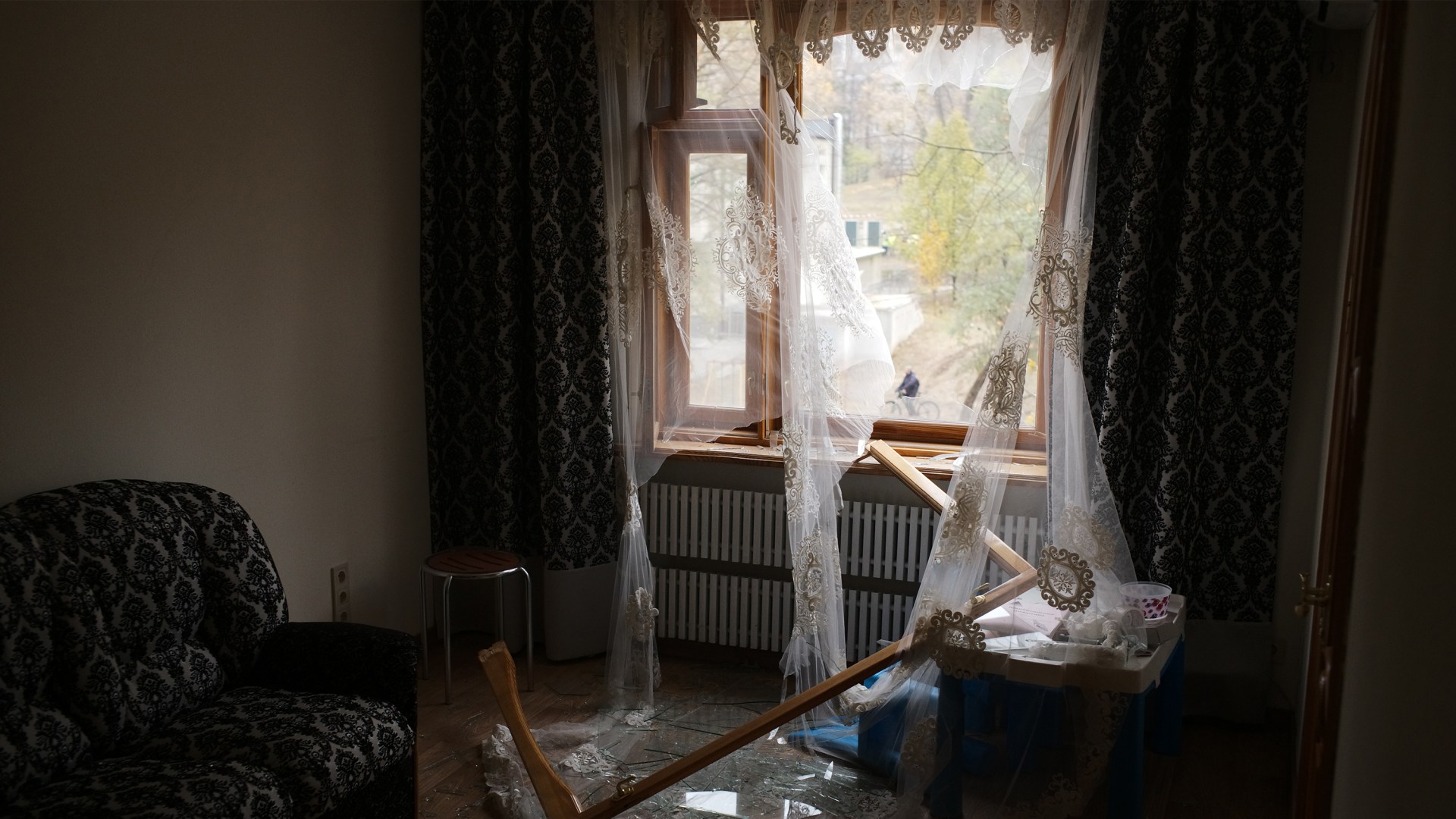
A damaged apartment after a rocket attack in the city of Kharkiv in Ukraine.

A damaged apartment after a rocket attack in the city of Kharkiv in Ukraine.

Christianity Today March 25, 2025
Anadolu / Getty

The once-thriving neighborhood of Northern Saltivka in the Ukrainian city of Kharkiv, 20 miles from the Russian border, is now mostly a ghost town. It took the brunt of Russia’s early offensive into Kharkiv in 2022.

Saltivka’s apartments were built during the Soviet Brezhnev era, mid-1960s to mid-1980s, known for the cold, gray architecture that many Americans have seen in movies and documentaries. Now, almost all the buildings are skeletons, with many bones broken. Nearly every window is shattered. Many are boarded up. Others remain as frames, either totally empty or with shards of glass.

This residential area included a school building, the remains of which are now fenced off—but a large hole in the ceiling shows where bombs fell. Abandoned, dirty swings and children’s playthings in small fields between the buildings make the cold reality of what happened here more haunting.

That I was able to view the devastation is the result of the stunning counteroffensive culminating in November 2022 that restored Ukrainian control of the city. In Kharkiv, only four days into the invasion, a mix of Ukrainian troops, police officers, and local militias killed most members of an elite Russian unit. Residents at that time saw it as a community victory, with the complete liberation of Kharkiv still months away.

Less than a mile from the apartment buildings, Russian bombs in 2024 destroyed the Ukrainian equivalent of a Home Depot and killed at least 16 people. Russian propagandists claimed the hardware store had been used to repair tanks. Bombardment continues: In virtually every Kharkiv neighborhood, damage to buildings, blown-out windows, holes in the sidewalk, and bullet holes in fences are common.

And yet life goes on. The hardware store was in the same parking lot complex as a modern mall that looks like an American one—and when I was there earlier this month, it was very much open for business. Another mall, only a block away from a municipal building badly damaged by Russian bombardment, was packed with people.

Religious life also goes on. On a cold and wet Sunday, I visited Anunciation, a stunningly ornate red and white building with gold trim and icons inside, which remains under the theological authority of Orthodox patriarchs from Moscow. Attendance was 150–200 despite physical dangers and the politically fraught split between Moscow-oriented churches, widely thought to be compromised by Putin’s government, and the Orthodox Church of Ukraine, recognized by the bishop of Constantinople and now followed by a majority of Ukrainians.

Parishioners at this church, though, didn’t seem to be thinking about church division. One young woman, Tanya, said, “I go because the choir is mesmerizing.” Nobody mentioned church politics. From a different denomination, evangelical pastor Ivan Rusyn told me he read the work of Holocaust chronicler Elie Wiesel, who questioned where God was during the killing of 6 million Jews. Ideas that God was there alongside the innocent, Rusyn said, “were very helpful to me, personally.”

As I left Kharkiv, an air-raid siren went off. Residents didn’t take much notice of it. Some seem numb to the constant threat. Others are indignant about Russian leaders and consider them or their apologists in the same way Jeremiah prophetically viewed adversaries in his day: “They dress the wound of my people as though it were not serious. ‘Peace, peace,’ they say, when there is no peace. Are they ashamed of their detestable conduct? No, they have no shame at all; they do not even know how to blush” (6:14–15).

News
Wire Story

After Thousands of Deaths and Kidnappings, Nigerian Christians Call on US to Recognize Their Persecution

“No one desires that their country is in the list, but putting Nigeria back there should encourage the government to act.”

Christianity Today March 24, 2025

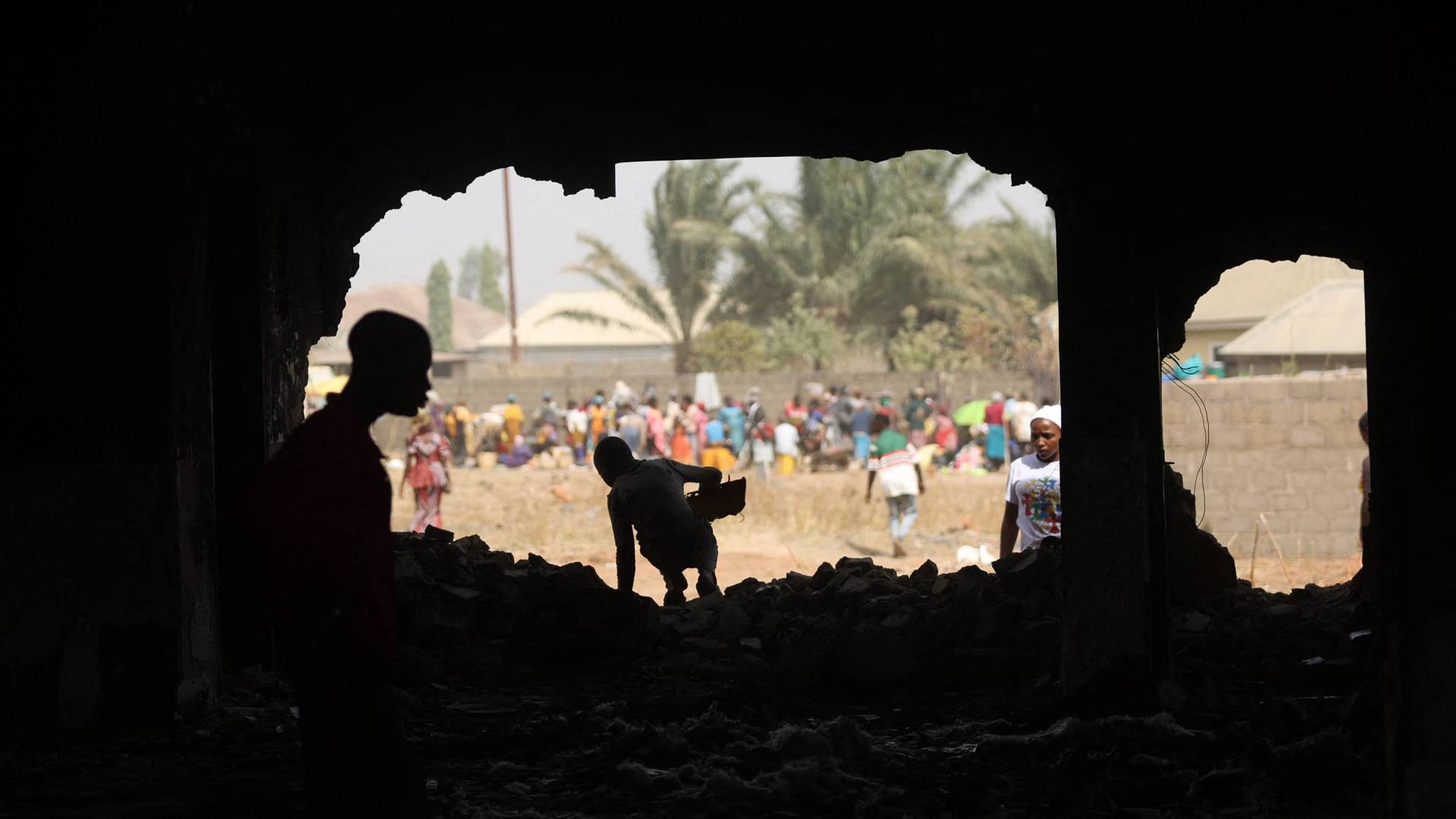
Nearly four years ago, the Biden administration removed Nigeria from a list of countries whose threats to religious freedom are of “particular concern,” but continued attacks on Christians and other religious groups by Islamist militias have prompted calls from local faith leaders and members of the US Congress for the designation to be restored.

In Africa’s most populous nation, a deadly cycle of violence has unfolded for several years, with Christian clergy and laypeople as well as moderate Muslims falling victim to murder and kidnapping. The Christian nonprofit Open Doors recently reported that in 2024 some 3,100 Christians were killed and more than 2,000 kidnapped in Nigeria.

Last week, US Rep. Chris Smith of New Jersey, chairman of the House Foreign Affairs Subcommittee on Africa, held a hearing on religious freedom violations in Nigeria that included testimony from Catholic Bishop Wilfred Anagbe of the Diocese of Makurdi, in central Nigeria, and Family Research Council President Tony Perkins, a former US Commission on International Religious Freedom commissioner.

Anagbe accused the Nigerian government and police of not taking action to stop the violence, and he told the subcommittee that in addition to killings, kidnapping and rape, Christians are routinely denied public office. “We live in fear, because at any point it can be our turn to be killed,” the bishop said.

Perkins appealed to the White House during the hearing to reassert “country of particular concern” status on Nigeria under the International Religious Freedom Act that allows the US president to impose economic penalties.

“The US should apply targeted economic sanctions on Nigerian officials that are complicit in religious persecution,” he said, adding that trade and security agreements should be used to pressure the government. Perkins also called for the Trump administration to name a new ambassador for international religious freedom.

In Nigeria, John Joseph Hayab, a Baptist minister and chairman of the Christian Association of Nigeria in 19 Northern States, told RNS, “No one desires that their country is in the list, but putting Nigeria back there should encourage the government to act.”

According to Hayab, the violence in Nigeria is not limited to Christians, and the designation would awaken the government to act for justice and give equal rights to all, such that no sect is treated as superior to another.

“All the people who have died should not have if the government had acted. I think it would encourage the government to wake up. I hope it does so before it’s listed,” said Hayab.

The Nigerian government has rebutted the claims of targeted killing of Christians, saying that while previous reports by the US Congress had led to Nigeria’s designation as a country of particular concern, the security challenges were complex and not rooted in religious persecution.

“The ongoing security challenges stem from criminality, terrorism, and communal clashes, particularly conflict between farmers and herders, which have been exacerbated by climate change, population growth and competition over land resources,” the Ministry of Foreign Affairs said in a statement.

Of Nigeria’s nearly 229 million people, Muslims comprise 53.5 percent, while 45.9 percent are Christians. The violence is largely the work of two groups—the extremist Islamist militant Boko Haram and its splinter factions, and a range of militias or bandits linked to Fulani herders, Muslims who have waged a campaign of land grabs against Christian farmers in the fertile, and more Christian, “Middle Belt” of central Nigeria as the Fulanis’ grazing land has dried up over the past decades.

In August, the Observatory for Religious Freedom in Africa reported that the little-known Fulani Ethnic Militia was carrying out most of the killings in Nigeria.

The militia, according to the August 29 report, has organized along ethnic and religious lines, carrying out attacks and abductions without resistance from the Nigerian security services. Although both Christians and Muslims are victims of the violence, Christians have endured most of the violence as attackers burned their homes and farms.

Over the last four years, the militia has killed over 55,000 people and carried out over 21,000 abductions in the North-Central Zone and Southern Kaduna, the report said.

Bishop Oliver Dashe Doeme of the Catholic Diocese of Maiduguri, in the northeastern corner of the country, backed relisting Nigeria as a country of concern.

“Let it be so that the world can know this is what we are going through. The naked truth is that Nigeria is on the brink of collapse,” he said in a telephone interview.

Calling Christian persecution “our daily experience,” the bishop said, “We have a government that is not functioning very well, and that is why these criminals move about terrorizing innocent citizens, including priests who are supposed to be highly respected. Let the world know. The Western world has been quiet about our experience here.”

Catholic Church leaders say that 145 priests have been kidnapped in the last 10 years, 11 of whom were killed; four are still missing.

In the latest incident, a 21-year-old seminarian and a priest were kidnapped March 3 in the Diocese of Auchi, in Edo state. The priest, freed 10 days later, said the seminarian had been killed. Another Catholic priest, from the Diocese of Kafanchan, was found murdered on March 5.

“They don’t see the priests as anything,” said Doeme. “They do not respect them, and that is why they are being abducted here and there, and some of them killed.”

He added, “But, then, we are people of faith and we do not give up our hope.”

addApple PodcastsDown ArrowDown ArrowDown Arrowarrow_left_altLeft ArrowLeft ArrowRight ArrowRight ArrowRight Arrowarrow_up_altUp ArrowUp ArrowAvailable at Amazoncaret-downCloseCloseellipseEmailEmailExpandExpandExternalExternalFacebookfacebook-squarefolderGiftGiftGooglegoogleGoogle KeephamburgerInstagraminstagram-squareLinkLinklinkedin-squareListenListenListenChristianity TodayCT Creative Studio Logologo_orgMegaphoneMenuMenupausePinterestPlayPlayPocketPodcastprintremoveRSSRSSSaveSavesaveSearchSearchsearchSpotifyStitcherTelegramTable of ContentsTable of Contentstwitter-squareWhatsAppXYouTubeYouTube