Culture
Review

Would You Die for a Friend?

The enormously popular adult animation “Ne Zha 2” tries, and fails, to grasp what sacrifice truly entails.

Twin towers in China are illuminated with Ne Zha and Ao Bing from the film, Ne Zha 2.

Twin towers in China are illuminated with Ne Zha and Ao Bing from the film Ne Zha 2.

Christianity Today March 21, 2025
VCG, Getty

This week, the Chinese animated film Ne Zha 2 beat Star Wars: The Force Awakens to become the fifth highest-grossing movie ever, making $2.08 billion in the international box office. The milestone comes a month after it gained the title of highest-grossing animated film of all time.

The film, which is based on traditional Chinese folklore and has Buddhist and Daoist influences, follows the rebellious demon-child Ne Zha as he overcomes his fate to emerge as a hero who defeats evil celestial authorities. Released in January in China and a month later in North America, the film engrossed viewers with its flashy, fast-paced action, stunning visuals, and slapstick (sometimes crude) humor. The sequel quickly surpassed the original Ne Zha film, which was released in 2019.

The story features the theme of sacrifice in the character of Ao Bing, Ne Zha’s enemy-turned-friend. Christians may notice the relationship is a shadow of the greater sacrifice found in Christ, which is even more awe-inspiring than what is portrayed in Ne Zha 2. At the same time, we may find the results of our own sacrifices less satisfactory than the victory that Ao Bing and Ne Zha achieve by the time credits roll. (Warning: spoilers ahead.)

In the film, Ao Bing and Ne Zha are destined to be rivals from before their births. Ao Bing’s father, the Dragon King, stole the Spirit Pearl, formed from the positive celestial energy of the universe, and placed it inside his own son although it was meant to be given to a reincarnated Ne Zha. Ao Bing is then charged with a mission to defeat Ne Zha and prove himself as the true bearer of this celestial power.

As he grows up, Ne Zha is shunned by his town for his brute strength and demonic nature. Ao Bing spends most of his time isolated under the water. The two become friends after an unexpected encounter by the sea when they unite forces to defeat a monster.

Yet when ferocious, fire-breathing dragons from Ao Bing’s clan attack Ne Zha, Ao Bing turns against his people to protect his friend from harm, even giving up his life.

“I took your place as the Spirit Pearl,” Ao Bing tells Ne Zha. “I deserve this. If my sacrifice can bring you back to life, then it’s a fair price to pay.”

“Who asked you to?” Ne Zha responded. “Don’t you dare die!” But his pleas are in vain as Ao Bing takes his final breath, asking his father to spare Ne Zha and his hometown.

Ao Bing’s sacrifice is reminiscent of what Jesus says in John 15:13: “Greater love has no one than this: to lay down one’s life for one’s friends.”

Yet Ne Zha 2 doesn’t end there. Ao Bing comes back to life as Ne Zha helps him rebuild his flesh and live again with a new body. After a misunderstanding drives them apart, the friends finally reconcile and unite in battle.

As in all the best stories, good wins in the end. Justice reigns. Oppressors are brought down. A hopeful future awaits.

But would Ao Bing still choose to die for Ne Zha if they had remained enemies? 

Ao Bing’s sacrifice is commendable, but it also seems like an effort to rectify a wrong. Ao Bing sees his death as a way to make up for his father’s theft of the Spirit Pearl at his birth. He decides to give up his life because he sees something good in Ne Zha—something he thinks is worth dying for.

Scripture, however, demonstrates the kind of sacrifice that goes beyond what mythical characters like Ao Bing can possibly offer: a sacrifice freely given for people who are undeserving.

“Very rarely will anyone die for a righteous person, though for a good person someone might possibly dare to die,” the apostle Paul writes in Romans 5:7–8. “But God demonstrates his own love for us in this: While we were still sinners, Christ died for us.”

I remember how mind-boggling these verses felt when I first heard them as a college student in China. How could God die for us, want to reconcile with us, and befriend us while we were still his enemies? We are people who fall short of his glory, unable to reach the holiness he requires.

What Jesus did sounded unsettling to me when I realized that he hung on bloodied nails for people who mocked and ridiculed him. Soldiers beat and flogged him. They pressed a crown of thorns onto his head. They crucified him. Yet despite all this, he said, “Father, forgive them, for they do not know what they are doing” (Luke 23:34).

Unlike what happens in Ne Zha 2, the reason for sacrificing your life for another doesn’t always make sense. The sacrificial love Jesus displayed on the cross ought to leave us stunned and amazed, as Jesus chose to give his life for people who were once against him, including you and me.

Sacrifice is also a means by which the characters in Ne Zha 2 prevent injustice from spreading. Deceitful, manipulative, and hypocritical characters in the film exploit others for their own gain, yet Ne Zha, Ao Bing, and their allies risk their powers and their lives to defeat the evil Wu Liang Xian Weng, monarch of the celestial realm, and his cronies.

Victory over wickedness occurs by the end of the film, but in the real world, sacrificing our time or energy to fight for justice might seem futile and even foolish. We clench our fists and grit our teeth when we see how despots and tyrants bulldoze over others, using their power to reap ill-gotten gains for themselves. We feel small and powerless to prevent any of this from happening.

Like Asaph in Psalm 82:3–4, we cry out to God: “Defend the weak and the fatherless; uphold the cause of the poor and the oppressed. Rescue the weak and the needy; deliver them from the hand of the wicked.”

At times, we cannot help but wonder: Is sacrificing our lives for the greater good really worth it if evil simply triumphs again and again?

Ne Zha 2 answers this question in an idealistic way. It gives us the resolution to the problem of injustice that we hope and wish for, and it reveals a natural yearning within us to see justice prevail. The film does not talk about what happens when reality fails to meet our expectations. But Scripture provides sound wisdom on talking to God when injustice, whether in our personal lives or in our neighborhoods, cities, and churches, inevitably arises.

In Scripture, the prophet Habakkuk wrestles with these questions when it seems God is allowing bad deeds to go unpunished: “Your eyes are too pure to look on evil; you cannot tolerate wrongdoing. Why then do you tolerate the treacherous? Why are you silent while the wicked swallow up those more righteous than themselves?” (1:13).

Habakkuk asks God all his tough questions and deep sorrows because he knows and trusts that God cares. He believes that God sees the terrors and struggles of the vulnerable and the brokenhearted. He knows that God does not ignore injustice. God is a just God, and one day, he will set things right.

Like Habakkuk, Christians are all involved in the slow and painful work of rectifying injustice in the world today. No matter how burdensome and tiring it can be to fight against wrongdoing, God assures us that our souls can find rest. “Do not fret because of those who are evil or be envious of those who do wrong; for like the grass they will soon wither, like green plants they will soon die away,” David declares in Psalm 37:1–2.

As the Book of Revelation depicts, the Lamb of God who gave his life for us will one day usher in perfect justice, a future for his people, and the ultimate victory of good over evil. Until then, we work and wait in expectation and hope.

Yixiao Ren is a freelance journalist based in New York City.

Theology

Firm Faith Doesn’t Require a Closed Mind

Christians should be known for embodying the virtues of curiosity and epistemic humility.

A collage of a brain and an open window.
Christianity Today March 21, 2025
Illustration by Elizabeth Kaye / Source Images: Unsplash, Wikimedia Commons

“Should a Christian have an open mind?” When a student raised that question in class, I did not know how to answer at first—I felt caught between two competing convictions.

On one hand, “open-mindedness” seems to run contrary to the Christian doctrine of the narrow road. Shouldn’t Christians be characterized by our unchanging, unshakeable faith? The letters of Paul repeatedly remind us to “stand firm,” holding tightly to truth amid doubt and confusion. Isn’t open-mindedness just another name for weak faith?

On the other hand, the Bible has a lot to say about humility. Our understanding is so small, and the ways of God and his creation are so vast. Should this not demand that we hold our views loosely? Isn’t closed-mindedness just another name for intellectual pride?

Making matters more complicated is the fact that well-intentioned and thoughtful Christians give very different answers to my student’s question.

Religion professor James Spiegel describes open-mindedness as “a midpoint between two intellectual vices, a sort of apex between the valleys of dogma and doubt,” and calls it “an especially important virtue at this time in history.”

On the other hand, Burk Parsons of Ligonier Ministries writes confidently, “As the closed-minded, Christ-minded faithful we must join arms against the satanic pluralism of our day.” This attitude is not uncommon among biblically faithful Christians.

What do we make of this? Should Christians be regarded for our intellectual openness or renowned for our resolute resolve?

Then again, what if there is no contradiction between unshakeable faith and intellectual humility? In the Bible, we see a compelling picture of life characterized by faith in the person of God and an openness to correction in our finite understanding of the world.

Too often, Christians are known for rampant stubbornness and intellectual pride. In our well-intentioned pursuit of faithfulness, we have left behind something essential to the Christian life: deep humility, which requires a certain kind of open-mindedness. In our praise and pursuit of a firm faith, we must not neglect the virtue of biblical epistemic humility.

In order to do so, we must first draw a clear distinction between two kinds of curiosity.

For much of church history, curiosity has been considered a dangerous vice. Often associated with pride and vanity, curiosity has been blamed for some of humanity’s greatest sins. In a certain sense, even the first sin of Adam and Eve could be blamed on curiosity. After all, the Serpent tempted Eve with the promise that her eyes would be “opened” and that she will “be like God, knowing good and evil” (Gen. 3:5). Was it not an illicit longing for forbidden knowledge which doomed humanity?

This theme is echoed elsewhere in Scripture. Paul warns Timothy against the inevitable temptation for people to “turn their ears away from the truth and turn aside to myths” (2 Tim. 4:4) and cautions the Ephesians against being “tossed back and forth by the waves, and blown here and there by every wind of teaching” (Eph. 4:14).

In light of these biblical warnings, influential Christians have likewise denounced the dangers of curiosity. Augustine writes in his Confessions that “curiosity makes semblance of a desire of knowledge” and identifies his own struggle with lust as a manifestation of sinful curiosity.

In The Imitation of Christ, Thomas à Kempis speaks of those who are “led by curiosity and pride … whilst they neglect themselves and their salvation.” Such people, he warns, are likely to “fall into great temptations.”

There is great wisdom in these warnings. Given the corruption of the human heart, curiosity can lead us to places we ought not go. As Joseph Samuel Exell and Thomas Henry Leale put it in their commentary on Genesis, “It is dangerous to the interests of the soul to indulge in the vain curiosity of knowing the evil ways of the world.”

Insofar as curiosity is an expression of pride and a vessel for temptation, it is certainly right for Christians to caution against this kind of open-mindedness. There is much evil against which we should resolutely close our hearts and minds.

There is, however, another kind of curiosity: the kind of open-mindedness that exists as an expression of humility and an acknowledgment of our own limitations. Scripture praises this posture, while warning against the arrogance of stubbornness and intellectual pride.

As the Bible attests, God’s people are not known for our responsiveness to input, receptivity to change, or willingness to listen. In fact, if anything can be called our most consistent trait across the millennia, it is probably our hard hearts and stubborn minds.

“I have seen this people, and behold, it is a stiff-necked people” (Ex. 32:9, ESV). So says the Lord to Moses when the people of Israel make for themselves a golden calf to worship in place of the God who brought them out of Egypt.

“All the house of Israel have a hard forehead and a stubborn heart” (Ezek. 3:7, ESV). Here, the Lord warns Ezekiel that the people will not listen or change their ways.

“Because I know that you are obstinate, and your neck is an iron sinew and your forehead brass” (Isa. 48:4, ESV). With these words through the mouth of Isaiah, the Lord further illustrates the hardheartedness of his people.

In ancient Hebrew thought, the heart and mind are not siloed off from one another as the centers of emotional and intellectual faculties. The heart is understood as the center of a whole person, including the intellect. As Puritan theologian John Owen puts it, “Generally, [the heart] denotes the whole soul of man and all the faculties of it … as they all concur in our doing of good and evil.”

When the Hebrew Scriptures describe humanity’s perennial hardness of heart, they describe not merely an emotional or spiritual reality. This describes the deep intellectual stubbornness of the holistic human condition. We insist on believing that we know what is true, real, and good, and we constantly resist all attempts to change our hearts and minds.

In other words, we are all inclined to be closed-minded people.

This stubbornness is precisely what God promises to deal with in the new covenant promised in Ezekiel 36: “I will give you a new heart and put a new spirit in you; I will remove from you your heart of stone and give you a heart of flesh” (v. 26).

This is the hope found in the new covenant: that in place of our hard hearts, we will be given soft, responsive ones. The good news of the gospel is that we can be transformed, reborn, and renewed—and in our renewal, we can become a people marked by humility, obedience, and readiness to listen and to be changed.

Yet we have found plenty of ways to continue the time-honored tradition of obstinacy and hardheartedness which defined the people of Israel. To make matters worse, we can convince ourselves that this stubbornness is a fruit of the Spirit rather than a weakness of the flesh. We do this whenever we confuse intellectual stubbornness for firmness of faith.

In his essay “On Obstinacy in Belief,” C. S. Lewis describes the difference. Christian faith is a matter of relational fidelity: deep trust in the goodness of God that is rooted in intimate familiarity with his character through the ages. When we learn to lean on this trust, we are not displaying closed-minded obstinacy. We are merely trusting, in much the same way that a child trusts a parent despite having limited understanding.

This kind of virtuous trust is not the same thing as intellectual stubbornness. A refusal to consider the possibility of error in one’s own judgment is not an admirable expression of faith but a dangerous expression of arrogance. In other words, there is a clear difference between epistemic arrogance and relational trust.

What does this mean for our inquiry into open-mindedness? It means that the Christian call to unwavering faith is by no means contrary to a spirit of intellectual humility. As the author of Hebrews instructs us, we can “hold unswervingly to the hope we profess, for he who promised is faithful” (Heb. 10:23, emphasis added).

The firmness of my faith ought not be rooted in my immovability or the stubbornness of my worldview but in the undying faithfulness of the one who loved me and gave himself for me. Gazing in full trust at Christ, we can be entirely consistent with the biblical definition of firm faith while also embracing the kind of soft-hearted humility commended in Scripture.

In his book The Intolerance of Tolerance, D. A. Carson points out that Christians have better cause than anyone to regard our intellects with suspicion and anticipate that we are likely to get things wrong. “We who are Christians have the most powerful reasons for living the self-examined life. We have little credibility when we urge a certain epistemic humility on the part of secularists if we ourselves are not characterized by humility.”

If we are to be characterized by epistemic humility, we must start with how we approach our own theology.

Over 20 years ago, Al Mohler challenged Christians to practice “theological triage” as an expression of spiritual and intellectual maturity. By this he meant wisely ranking various doctrines and ideas according to their relative importance and our level of certainty. Not every doctrine is of “first-rank” importance, and not every interpretation needs to be grasped with white-knuckled ferocity. Gavin Ortlund has also written about this.

Let me be very clear: The Christian faith is built on a set of specific historical and theological propositions. Without confessing the articles of faith and believing absolutely in the real life, death, and resurrection of Jesus, there is no Christianity. The call for humility is not a call to abandon the pillars of our faith and embrace postmodern skepticism.

Instead, a thoroughly biblical understanding of epistemic humility means rejoicing in a relationship with the eternal God and trusting that his vast and timeless knowledge far exceeds our own. I may not be certain about many things, but I have decided to follow Jesus, the only begotten Son of God, because he has given me good cause to trust him. In fact, I would do well to trust him more than I trust myself.

Jesus himself presents a remarkable example of this kind of humility. He alone had every right to approach life with absolute unmitigated certainty in the fullness of his knowledge, and yet he sought the will of his Father and submitted to the uncertainties of life in human form. Luke tells us that he “grew in wisdom,” listening to the priests and asking questions as a boy (2:52). He taught with divine authority but openly confessed that there were things he did not know which he left in the capable hands of the Father (Matt. 24:36).

If our Lord Jesus possessed and expressed this kind of humility, what excuse do we have?

In light of all this, I feel I can answer my student’s question with a bit more confidence. Yes, a Christian should have an open mind, if the term is rightly understood.

To be an “open-minded” Christian is to allow God to do what he promised: to replace my heart of stone with a heart of flesh—alive, responsive, and growing. It is to commit myself to seeking the truth, even if that means changing my mind when I turn out to be wrong.

By the grace of God, our hard and stubborn hearts can be brought to life. Let us not resist the humbling work of the Spirit in our lives. We must approach the throne of God with hearts softened and heads bowed, in imitation of Christ’s own humility.

Benjamin Vincent is a bivocational pastor and teacher in Southern California. He serves as assistant pastor at Journey of Faith Bellflower and as the department chair of history and theology at Pacifica Christian High School in Newport Beach, California.

Culture
Review

Does Beauty Need to Be Enforced?

An ambitious but flawed new film from A24, “Opus” wonders whether good things can speak for themselves.

John Malkovich as the legendary pop star, Alfred Moretti, and Ayo Edebiri as the young writer, Ariel Ecton, in Opus.

John Malkovich as Alfred Moretti and Ayo Edebiri as Ariel Ecton in Opus.

Christianity Today March 21, 2025
Anna Kooris / A24

There’s a long-running joke that those who can’t do, teach. The appropriate analog for the recently released Opus might be that those who can’t make, criticize. The debut film from director Mark Anthony Green invites its audience to explore this long-running tension between artist and critic—with a horrific twist.

Opus offers committed performances by its stars and compelling music by hitmakers Nile Rodgers and The-Dream. Ultimately, it’s hampered by underdeveloped insights—though it’s here that we find intriguing questions for the Christian about whether beautiful and true things need to be defended or whether they can speak for themselves. 

The movie centers on legendary pop star Alfred Moretti, played with pitch-perfect weirdness by John Malkovich, who’s resurfaced after a near 30-year absence with the announcement of  a new album called Caesar’s Request. In advance of its worldwide release, a handful of invitations to hear the new album go out. One is delivered to journalist Ariel Ecton, played by Ayo Edebiri.

Ariel—and her tagalong, slightly boorish editor—aren’t the only members of this doomed weekend party. Six members of the media—including a paparazzi photographer, radio shock jock, magazine editor, talk show host, and social media influencer—are invited inside a reclusive desert estate. Devotees clad in blue (“Levelists,” named for Alfred Moretti’s philosophy of art making) attend to the guests’ every need as, bit by bit, the new album is unveiled. The guests are closely surveilled, treated to lavish and sometimes bizarre entertainment. Moretti presides, clad in diamond brooches and crushed velvet. Apparently, there’s more to the man than his music.

As in Willy Wonka’s factory, one by one, guests of the wonderland begin to vanish. Through Ariel, we start to learn the place’s secrets. Is this a new cult? Just a deeply devoted fandom? No spoilers here.

What’s clear is that Moretti’s connection to each of these invitees is not random. Each of them belongs to the critic class who have made their living, in part, off lampooning and critiquing him, even as they admire his work. Mocking his baldness or odd behavior, they’ve distracted the public from the substance of his art. Meanwhile, their articles and radio segments are derivative, not offering anything new but riding on the coattails of what he’s already made.

By contrast, the Levelists have found in Moretti not a topic of conversation but a standard bearer. Their devotion, at times painful, isn’t to fame or money or success but to excellence itself. They pursue athletics and sculpture, painting and fine cuisine, even taxidermy, at the highest level. This common commitment to virtuosity binds their community together and ultimately pulls the movie forward toward its violent twist ending.

Long before that end, Opus’s major theme is obvious. Admittedly, it’s a little cliché. The parasitic relationship between critic and artist is one which others long before Green have tackled. The creatives are the great ones, paying humanity’s debt to the universe by producing beauty. Critics, by contrast, get in the way of artists offering their gifts to the world. Critics are pitifully dependent on artists; in one of Opus’s banquet scenes, the guests chew on a common loaf of bread provided by their patron. Their eventual suffering is a repayment for their crimes of judgment.

Great art goes into that world disrespected—but it doesn’t take this disrespect lying down. As Moretti puts it, “Royalty, even at the mercy of peasants, is still royalty.” For him, art making is an act which makes mortals into gods and must be venerated as such.

Here, though, the film seems unsure about how to best honor the art it adores. On the one hand, it implies, great art will find its audience without coercion. Levelists tell story after story of willingly leaving their old lives behind just to be a part of the vision. There are no social media campaigns for Moretti’s work—only the long-haired manager Soledad Yusef (played wonderfully by Tony Hale), who posts adoring rants on YouTube. There are no attempts to make Moretti relatable; at every juncture, he doubles down on the esoteric and arcane.

On the other hand, there’s a fragility to the mythos, one that the Levelists are continually propping up. Despite Moretti’s consistent insistence that he cares only for the art, his bus’s license plate reads CLAP4ME. His acolytes indulge his bad jokes and theatrics with applause. The compound itself is far from inviting, surrounded by miles of desert and barbed wire. There is an undercurrent of needfulness; good art requires not just itself but a captive audience. At the end, it’s evident that beauty cannot be valued in a brutal world without willingness to shed blood.

There are many places for criticism of Opus to land. The script is flat and cliché at times; it follows the well-trodden road of other A24 studio films interested in the relationship between violence and stardom; it frequently leans too heavily on the performances of Malkovich and Edebiri. But one of the places where the film shines is in a tension oddly overlooked by reviews so far: whether there is power in beauty alone or whether it must be supported by force.

Christians have debated this for centuries, wondering whether the holy fools, monastics, and beleaguered small communities—all devoted to sanctity and holiness—were enough. Does not something as grand as the gospel require all the tools we have at our disposal to draw attention to it? Might not we risk making use of the tools of Beelzebub to fight Beelzebub?

In Opus, art represents something like divine power, flashy glory which demands respect. The mysteries of the gospel are also pearls of great price—but they’re buried in a field, lying in wait for us to sell off all we have to obtain them. In both cases, commitment is required; sacrifice is necessary. But when it comes to the gospel, finding the great treasure is its own reward and needs no crowd to honor the gemstones.

In fact, the crowd will likely reject them. Consider ancient Christians who, faced with the demand to surrender their copies of Scripture, chose martyrdom. It was not that the gospel isn’t precious but that there is a right way of honoring great things: giving one’s life, not taking another’s, never resorting to coercion or violence.

Is the very power of God enough to create its own witness apart from compulsion? It’s a concern far more serious than one ambitious but flawed horror film can take up.

Fyodor Dostoevsky said that “beauty saves the world.” By this, he meant that beauty would remind, inspire, and move us to leave behind our pettiness for something greater. Perhaps. But as Opus reminds us, that which is great, true, and beautiful will always have its critics. The question is whether those critics should be loved or destroyed.

Myles Werntz is author of From Isolation to Community: A Renewed Vision for Christian Life Together. He writes at Taking Off and Landing and teaches at Abilene Christian University.

News

Hispanic Churches Groan Under Florida’s Double Immigration Crackdown

Some Latino pastors feel betrayed by the government’s harsh enforcement efforts, as worship leaders disappear and congregants stay home.

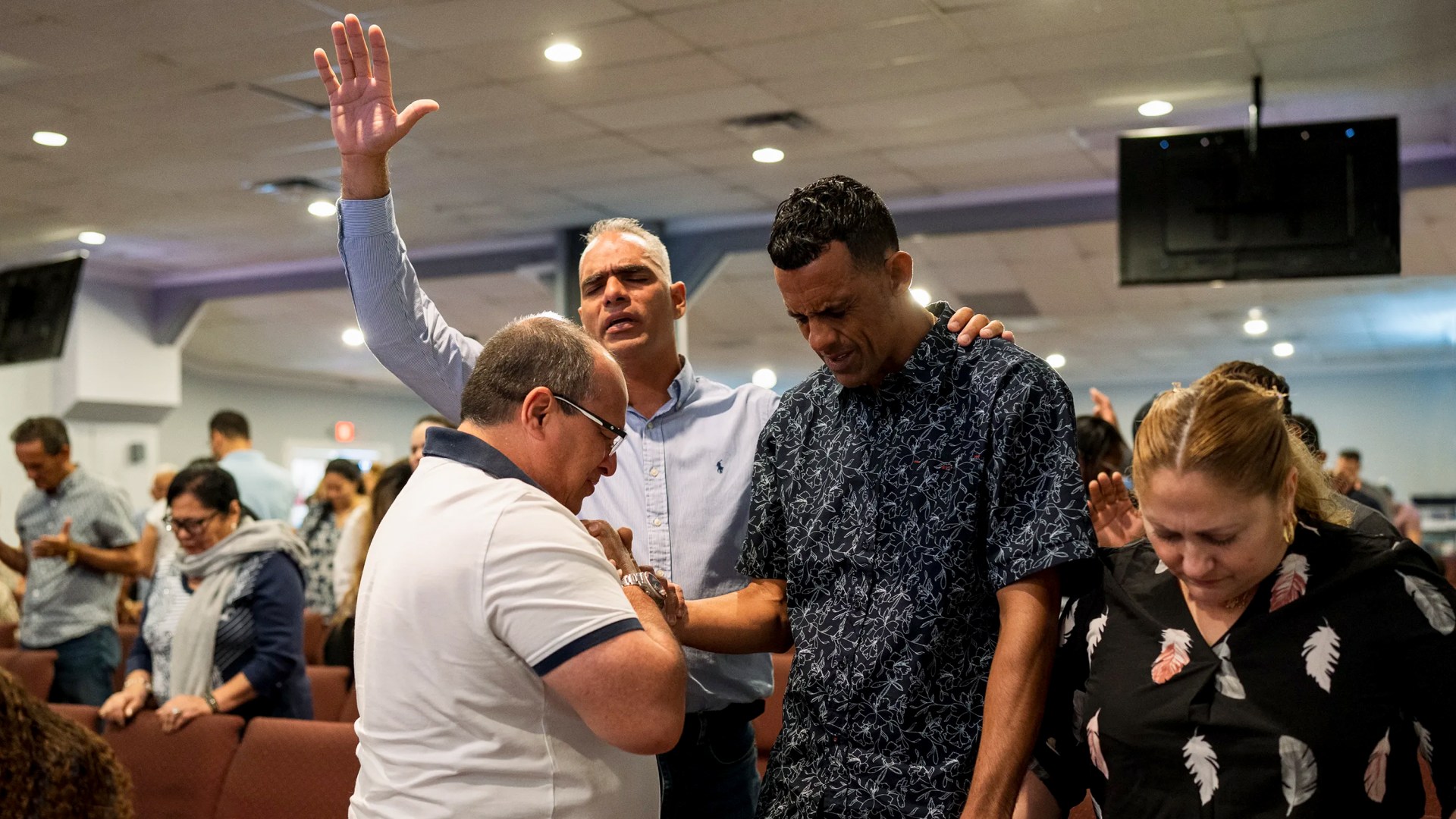
Parishioners pray for undocumented immigrants during a 2023 service at Iglesia Rescate in Miami.

Parishioners pray for undocumented immigrants during a 2023 service at Iglesia Rescate in Miami.

Christianity Today March 20, 2025
Bryan Cereijo / The Washington Post via Getty Images

Agustín Quiles monitors the anxiety of Florida’s pastors one phone call at a time.

Quiles, who heads an advocacy organization for Latino evangelicals in the state, hears anxiety in the voices of pastors who call him worried about youth who don’t want to go to school, afraid that immigration agents might intercept them. He hears it when pastors say yet another family stopped going to church—it was no longer safe.

He heard it in the pastor who rang him concerned about one of his church’s leaders, an undocumented Colombian national the pastor described as his right-hand man. The pastor said he could never fill the man’s shoes if something happened to him.

And Quiles has heard it when pastors have quietly told him they feel betrayed. They supported Donald Trump because of his conservative stance on issues like transgender rights. But 60 days into Trump’s second presidency, Quiles said, many of those pastors confess to him, “I feel regretful that I made the decision I made, because of what’s happening to my own brothers.”

The president’s swift actions to close the US border and deport thousands of immigrants have drawn cheers from supporters across the country, including many evangelicals, while also triggering protests and at least 29 immigration-related lawsuits.

But in Florida, which has become the leading edge of red-state efforts to match Trump’s aggressive policies with hard-line local enforcement, Hispanic church leaders say their communities are living in shock from a double threat.

Florida lawmakers have made a point of outdoing the rest of the country in cracking down on immigrants. In February, Republican governor Ron DeSantis signed a set of bills lawmakers had developed in consultation with the Trump administration.

The new laws make it a crime for undocumented immigrants to enter the state, and they also require local law enforcement to help federal officials detain immigrants. The laws increase penalties for immigrants without legal status who commit crimes—making the death penalty mandatory for those convicted of murder.

“In Florida, there’s a terrible fear,” said Blas Ramírez, a bishop with the International Pentecostal Holiness Church who lives in West Palm Beach and oversees several congregations up and down the state. He estimates that roughly a third of people in his churches are undocumented.

Attendance has dropped, Ramírez said. Venezuelans who might have worshiped in person last Sunday stayed home, for example, absorbing news that federal authorities had invoked an obscure wartime law to deport immigrants. They were processing constant rumors of sweeps by local police and reports that the federal government was flying Venezuelans to a megaprison in El Salvador, accusing them of being terrorists despite family members’ claims that some of them were only guilty of getting tattoos.

“Look, the president is applying a law from the 1800s to undocumented people, a law that applies to enemies of the United States,” Ramírez said. “What is that saying?”

Latino evangelicals overwhelmingly supported Donald Trump during the 2024 presidential election, resonating with his messaging on the economy and traditional stance on issues like abortion and sexuality. Nearly two-thirds of Hispanic Protestants voted for the president, compared with just 46 percent of Hispanics overall. In Florida, the president enjoys more support among Hispanics than he does in other states with large Latino populations.

But when it comes to the president’s immigration actions, some of the state’s Hispanic evangelicals say they are growing disillusioned.

“We agree with the deportation of violent criminals and securing the border,” said Gabriel Salguero, pastor of The Gathering Place, an Assemblies of God church in Orlando. “What we’re concerned about is that, although that’s the rhetoric, that’s actually not what’s happening.”

In fact, Immigration and Customs Enforcement (ICE) has been arresting more criminals across the country since Trump returned to the White House. During the first few weeks of February, the agency detained well over 20,000 immigrants with criminal records and pending criminal charges—more than it did in any month during the Biden administration, according to government data compiled by Syracuse University.

But those figures may be misleading. ICE scores violations as minor as driving with a broken taillight as criminal convictions; current data offer few clues about how many of those arrested actually committed violent crimes.

The numbers are clear about one trend, however: Arrests of noncriminals are soaring. In the middle two weeks of February, ICE swept up 3,721 immigrants with no criminal record—a 334 percent increase over the first two weeks of January.

Salguero is alarmed by the administration’s use of language that he says lumps all immigrants together and demonizes them. He sees how comfortable White House officials are, for example, labeling as “illegal” migrants who received Temporary Protected Status (TPS), a program created by President H. W. Bush to keep certain groups from being deported to unsafe countries.

“Let’s not play these games saying that TPS people are illegal criminals,” said Salguero, who is also president of the National Latino Evangelical Coalition. “It’s subtle: They started by saying, ‘We’re going after criminals.’ Now they’re saying, ‘All criminals.’ So speeding ticket? Jaywalking? Are you a criminal?”

As Salguero spoke, he rattled off text messages and phone calls he’d received in recent days. A pastor in Tampa had texted him that his church’s guitarist had been arrested, leaving his wife and US-citizen child behind. Leaders from a Pentecostal denomination reached out about a Latino pastors’ event where Salguero was scheduled to speak; they were moving the event online because pastors were afraid to travel.

Latino ministry leaders say they have never seen such elevated fear and vigilance within churches. They attribute much of it to the administration’s decision in January to allow immigration enforcement in churches, an order currently being challenged in court.

Luis Ávila, director of Hispanic ministries for the International Pentecostal Holiness Church, travels the country hearing from pastors of more than 100 Latino congregations in his denomination. Not everyone is paranoid, he said—churches with relatively few undocumented members are carrying on as normal.

Many churches, though, are watching everyone who comes in and out their doors. Worshipers are staying away or streaming services from home. “We’ve been through these kinds of situations before, but never before have we seen what we are going through right now,” Ávila said.

In Florida, Hispanic evangelicals have spoken out before against DeSantis’ support of harsh anti-immigration measures. Churches lobbied successfully to soften the language in a 2023 bill that would have made it a felony to drive a vehicle with undocumented passengers.

But the wins have been few, and ministry leaders say they struggle to reconcile the fact that so many state and national leaders pushing hard-line laws are outspoken about their faith and depend heavily on evangelical support. Last November, more than 80 percent of white evangelical voters in the US cast their ballots for Trump.

“In some ways, it feels for Latino evangelicals as if it’s a persecution,” Quiles said. “It sounds weird, but it’s like, ‘If you’re undocumented, it doesn’t matter if you’re a Christian. You don’t belong here.’”

Salguero pointed to Lifeway Research polling that consistently shows evangelicals want to see the church operating in the spirit of Romans 13, where all are subject to authority, but also in the spirit of Romans 12, not conforming to the pattern of this world. And he said the biblical pattern is clear when it comes to how evangelicals should shape policy toward immigrants: “The overwhelming biblical evidence, from the times of Abraham all the way to Jesus, is that we are to integrate immigrants in a humane way,” Salguero said.

What’s happening now, Ramírez said, appears to him like the exact opposite. The bishop recently met with a Venezuelan pastor and his wife whose fledgling Orlando church fell apart after immigration agents detained several of its members.

The church’s worship team was practicing one day in the clubhouse of a townhome community, according to Ramírez. When the musicians and other church leaders left the practice, agents met them in the parking lot and arrested at least half a dozen of the group. Days later, Ramírez said, agents returned and detained a second group of congregants after they left the clubhouse.

Evangelicals who tolerate aggressive immigration enforcement against noncriminals are “complicit in this unjust action,” Ramírez said. “The church is supposed to defend the oppressed. The church is not supposed to defend the enemy of the oppressed.”

Ramírez, a former lawyer from the Dominican Republic who took evangelism trips to Cuba on his way to full-time ministry in the United States, said he understands a thing or two about oppression. He said he was arrested and imprisoned twice in Cuba in the late 1990s for “preaching the gospel.”

When pastors have to whisper about what’s happening in their churches, when they’re afraid to speak about someone who was arrested, Ramírez said it’s a clear sign that individual liberties are being harmed.

“I thought I’d never see this kind of fear and terror again,” he said. “But people are living it now, here.”

Quiles is especially troubled by Florida’s new mandatory death penalty for undocumented immigrants who commit violent crimes. He’s the president of Mission Talk, a policy group that works with a diverse set of Latino churches in Florida—from conservative Pentecostals to more theologically progressive Cooperative Baptists—to engage them in state policymaking. In addition to lobbying for more compassionate immigration policy, his organization opposes capital punishment.

For several years now, Quiles has led church leaders on trips to Montgomery, Alabama, to study the Civil Rights Movement and America’s dark history of white supremacy.

“I never lived that,” Quiles said. “But it feels like they are trying to go back to those times where you would lynch anyone for any given reason. Is that the same spirit? Is that the same sin that we’ve never dealt with, where we have an obsession with just automatically adding the death penalty to someone who is undocumented?”

Hispanic leaders say they have spent the past two months in countless meetings discussing legal rights and church security, discussing what members need to do to prepare in the event they are detained. Do you have a power of attorney ready? Do you know who will care for your children if you disappear? Who will manage your home and your assets? Identical conversations have repeated thousands of times, in Florida and across the country.

If you pastor a Hispanic church in America right now, Ávila said, you cannot ignore immigration discussions. “It’s part of your life.”

But you also have to pray, he said. He doesn’t want criminals to come into the country, and he agrees that authorities have to stop anyone doing “bad stuff.” But he prays for a way through the mess for the immigrants in his churches.

“I know hundreds of families, and I say to myself, ‘Wow, these people, the only thing they do is good for the country,’” he said. “I see the way they are living, acting, working.”

When he prays for those families, Ávila said, he always starts with this: “Lord, I ask you to sensitize the hearts and minds of these lawmakers.”

Andy Olsen is senior features writer at Christianity Today.

Ideas

Big Digs, Bad Detectives

From the archaeological discoveries of Ur to Mount Ebal, Christians need to be more careful evaluating the facts.

A pile of dirt with a detective hat and magnifying glass on top.
Christianity Today March 20, 2025
Illustration by Elizabeth Kaye / Source Images: Getty

The best-selling fiction writer of all time was on her second solo trip in the Kingdom of Iraq in 1930 after a devastating divorce. While visiting friends at an archaeological site, novelist Agatha Christie met the University of London professor Max Mallowan, who would become her second husband and inspire seven novels set in the Near East.

Mallowan was a different sort of detective than the ones Christie often created for her novels. Today we would call him an Assyriologist, an expert in the language and history of the ancient Mesopotamian cultures that wrote Sumerian and Akkadian in cuneiform. Mallowan distinguished himself as an archaeologist directing digs in modern-day Syria and Iraq. When Christie met him, he was working with famed (and soon-to-be knighted) archaeologist Leonard Woolley to excavate a city in southern Iraq. 

Mallowan and Woolley found bricks and cylinders buried within buildings’ foundations, inscribed with cuneiform writing. As they read the ancient texts, they realized this city had a name many people would recognize: Ur. Hadn’t God said to Abraham, “I am the Lord, who brought you out of Ur” (Gen. 15:7)?

Like detectives, they put together the evidence and announced that they had discovered the biblical home of Abraham. Soon spectacular artifacts from the excavation were on display at museums in the United Kingdom and the United States, wowing the public. Each exhibit and many reports on their work and their discoveries carried the claim that this site in southern Iraq was the city of the great patriarch. 

Unlike the detectives of Christie’s novels, however, the archaeologists were wrong. Ur is like the Springfield of ancient Mesopotamia—many regions had a city with that name. The biblical text itself seems to place Abraham’s city in southern Turkey, where the city we now call Urfa has been inhabited since 9000 BC and where local tradition maintains it was Abraham’s home. In the Middle Bronze Age, the city was connected to Haran and Canaan by a major road. That Ur, long believed to be Abraham’s Ur, is about 1,000 miles from the city that Mallowan and Woolley excavated. 

It is unclear today whether the archaeologists made a simple mistake or they knew it wasn’t true. Perhaps, in their minds, they were simply suggesting the possibility that this could be Abraham’s ancient birthplace. They may have felt some pressure to get the public to care about their work and sought to connect the archaeological discoveries, however dubiously, to the public’s limited knowledge of ancient history. Most Westerners, then and now, only encounter the ancient Near East in Sunday school lessons, adventure stories, and fiction of the sort Christie would soon write, with titles including Death on the Nile, They Came to Baghdad, and Murder in Mesopotamia. If the archaeologists couldn’t associate themselves with Hercule Poirot, then tying Ur to Abraham was probably the next-best option for engaging an audience.

They were not the first to make flawed but flashy claims about Bible-related finds. European Christians flocked to the Holy Land in the Middle Ages and announced many discoveries based on unprovable local hearsay, including the location of Ararat and multiple contradictory sites of Christ’s birthplace, crucifixion, and tomb. The construction of churches in many of those places enshrined the early pilgrims’ claims but also made modern archaeological excavation nearly impossible. 

Nor were Mallowan and Woolley the last to go beyond the evidence and say they had discovered something without substantial support for that claim. Today, archaeologists face impossible pressures to produce sensational finds or, short of that, clickable headlines. Excavation projects often face severe financial constraints, and dig directors compete for donations and grants. Going public with bold claims of big discoveries that “prove the Bible” is one sure way to get attention, even if research has not yet been completed and the hypotheses are unlikely to be supported by the facts.

Going big and going early leads to an uptick in public interest and in those necessary donations. Unfortunately, it also spreads bad information and can lead to a loss of trust in experts, archaeology, and even the Bible itself when those hypotheses presented as fact are later proven wrong.

Scientists in all fields have been accustomed to years-long processes of discovery, debate (peer review), and then publication because they were concerned with accuracy. We need precision. We need to be able to trust the research, whether it’s for a new drug or new information about the world of Abraham. When history intersects with Scripture, our understanding of that history also impacts how we understand the Bible. Wild claims and bad detective work by archaeologists should be a concern to anyone who cares about God’s Word.

On March 24, 2022, a notification alerted me to a livestreamed press conference. A team of archaeologists was announcing its discovery of a tiny lead “curse tablet” they said contained the oldest Hebrew inscription ever found. They went on to claim that it demonstrated Israelites were capable of writing several centuries earlier than previously thought, which would impact how we understand the development of the biblical texts and language itself.

My jaw hit my desk, not because of the amazing discovery but because of the lack of support for the ostentatious claims. There were no images of the writing available at the press conference, only drawings. The dating of the item wasn’t very clear. It had been found in an excavation trash heap, making it impossible to date with stratigraphy and contextualize with surrounding artifacts. Also, what was it? The archaeologists at the press conference called it a “curse tablet,” but could the tiny piece of folded lead be anything else? 

Criticism from world-renowned scientists was quick, and debate continues today. The discoverers have released some high-resolution images of the marks inside the object that they identified as an ancient curse, but that has not convinced other experts. Some say it isn’t a “curse tablet” but a fishing-net weight or something else. Maybe the writing isn’t writing at all but clumsy tool impressions.

Debate will continue about the exact nature and possible importance of this folded piece of lead. However, most people who watched the original press conference and accepted the claims as facts will not follow the back-and-forth debate, the new evidence, and the contested interpretations. If they do hear about the expert criticisms of the extraordinary claims, Christians might just dismiss them as academics attacking the historical veracity of Scripture. 

That’s too bad. A public debate could be a good thing, teaching people about the detective work that goes into academically solid archaeological reports. The process of discovering the truth about the ancient past is complicated and time-consuming. It requires attention to detail, discipline, and a lot of care. The slow, dusty work of scraping dirt off dirt and cataloging artifacts can bore the outside observer and sometimes the excavators themselves, but it is necessary as archaeologists work to understand how our ancestors lived.

Sensationalism, on the other hand, is quick, cost-effective, and exciting. “Edutainment” series regularly engage viewers with a few facts and many wild, flawed theories. While they may intrigue and motivate future archaeologists to join the profession, their conclusions can’t be trusted. Viewers must remember such shows are designed to entertain more than to educate, and they should therefore watch with some curiosity and much discernment.

No matter how information about the ancient Near East is packaged and presented—at museums, during press conferences, or on our screens—we as Christians can take responsibility for our responses to big archaeological claims. We who care about the Bible and how it connects to the past and present can learn to evaluate competing claims and come to informed conclusions. 

As outside observers, we can begin by asking questions: 

  1. What is fact, and what is interpretation? We need to be able to distinguish the concrete details from the conclusion that is being drawn. There was an Ur in southern Iraq, but calling it “Abraham’s” is interpretation. There was a folded piece of lead at Mount Ebal, but calling it a “curse tablet” is interpretation.
  2. How careful is the interpretation? Trustworthy scholarship builds a solid case, as does a good detective. Archaeologists should thoroughly consider mountains of evidence and demonstrate that when they offer their interpretation.
  3. Do other experts agree? Scholars regularly challenge exaggerated claims and present alternative explanations. A press conference with a big claim rarely presents the full story, so we must watch for other interpretations of the facts even when they aren’t promoted as widely as the initial headlines.
  4. What more is there to learn? Science is rarely settled so long as exploration continues. Even as distant spectators, we can enter into the process of discovery if we are willing to recognize that our current interpretations aren’t facts, there may be new information, and we will need to consider changing our minds. 

We will never know everything about the ancient world or the mysteries of the Bible, but the search for better understanding can improve our abilities to discern between fact and fiction, Scripture and tradition. And for Christians, time spent asking questions, detecting answers, and refining our beliefs brings us into closer relationships with the God who created us and the earth we are privileged to investigate.

Amanda Hope Haley studied biblical archaeology under Lawrence Stager at Harvard University and has dug at Tel Ashkelon and Tel Shimron. Her book Stones Still Speak: How Biblical Archaeology Illuminates the Stories You Thought You Knew will be published by Revell in September.

Correction: A previous version of this article incorrectly stated that no epigraphers were involved in the press conference announcing the discovery of a “curse tablet.”

Theology

The Forgotten Woman Who Preached in Congress

In the 19th-century, Harriet Livermore boldly defended a women’s right to speak in the church and pulpit.

Harriet Livermore and the U.S. capitol building
Christianity Today March 20, 2025
Illustration by Mallory Rentsch Tlapek / Source Images: National Portrait Gallery, Smithsonian Institution, Library of Congress

On a brisk January morning in 1827, Harriet Livermore mounted the speaker’s chair in the Hall of Representatives and became one of the first women to deliver a sermon in the United States Congress. She preached to an overflowing crowd of more than a thousand, including President John Quincy Adams, who sat on the steps leading up to her since there were no other free seats.

After reading Psalm 112, she preached from 2 Samuel 23:3, which says, “He that ruleth over men must be just, ruling in the fear of God” (KJV). Newspaper reports of the crowd’s reaction, with quiet weeping and overt sobbing, were lavish with praise. Livermore would go on to speak in that very chamber three more times—from 1832 to 1843—and always before considerable crowds.

Livermore’s generation was one in which the Scriptures were under fresh scrutiny. Just six years after she was born in 1788, famed hero of the American Revolution Thomas Paine published The Age of Reason,in which he launched an assault on the Bible. At about the same time, Thomas Jefferson famously produced a Bible void of miracles. Yet in the end, such detractors did not win the day.

In fact, the Bible remained a dominant influence on early American life—a reality nowhere more apparent than in the founding of the American Bible Society (ABS) in 1816. The fledgling nation already boasted of over 100 local Bible societies—six times the number of states in the union. And by 1829, the ABS had announced its ambitious plans to put a Bible in every American home.

In such an era, women who fought for the right to preach had to defend their stance biblically. And defend they did! Within a generation of the American Revolution’s end, women began launching their first apologetic salvos—each beginning with the word scriptural.

In 1820, a woman named Deborah Peirce published a slender treatise entitled A Scriptural Vindication of Female Preaching, Prophesying, or Exhortation. Four years later, Harriet Livermore penned a more substantial work on the subject, entitled Scriptural Evidence in Favour of Female Testimony in Meetings for Christian Worship. Hers was an extraordinary defense—innovative and independent—that mirrored the remarkable, even eccentric, woman who wrote it.

Within three years, her work had garnered enough attention to merit her an invitation to preach on the national stage of Congress. And in view of last year’s 200th anniversary of Livermore’s landmark defense, hers is a story worth remembering this women’s history month.

As a young adult, thanks to her father’s high-profile position as a district attorney and member of Congress, Livermore enjoyed deftly navigating the Washington, DC, social circuit. Then, at the age of 23, she abruptly and inexplicably declared that she would devote herself to a religious life. Soon, the former party girl had transformed into the model of a pious and devoted debutante.

A decade later, in 1821, the intrepid Livermore spoke in public with men present for the first time at meetings of the Freewill Baptist Church. Her initial steps into public speaking were halting. The first time she spoke, she prayed aloud during a meeting. Another time, she spoke to the congregation for about five minutes after the preacher delivered a sermon. Although these steps were modest, her Christian friends criticized her for overstepping her biblical bounds as a woman. She quit public speaking—but not for long.

Livermore soon began touring New England, preaching as far south as Philadelphia. At that time, one of Livermore’s female friends named Julia asked her “to transcribe … those passages in Scripture, which might place the subject in a favourable point of view”—that is, the subject of female preaching. This letter became the basis of her book.

Livermore confronted long-standing views of women held by most Americans and also had the opportunity to address a bevy of influential British commentators, the likes of Matthew Henry, Philip Doddridge, Thomas Scott, and Adam Clarke—whose commentaries were so influential that they were published under the authors’ last names, including Matthew Henry’s Commentary, Scott’s Bible and Clarke’s Bible.

As part of her argument, Livermore pointed to an inconspicuous passage tucked into Paul’s letter to the Philippians. In chapter 4, verses 2–3, Paul referred to Euodia and Syntyche: “I implore Euodia and I implore Syntyche to be of the same mind in the Lord. And I urge you also, true companion, help these women who labored with me in the gospel, with Clement also, and the rest of my fellow workers, whose names are in the Book of Life” (NKJV).

At the time, most commentators insisted the “labor” mentioned here didn’t include preaching. For instance, Matthew Henry claimed that women assisted ministers “by entertaining the ministers, visiting the sick, instructing the ignorant, convincing the erroneous. Thus women may be helpful to ministers in the work of the Gospel.” Women, in short, could assist ministers but not preach themselves.

Yet Livermore countered by posing the rhetorical question, “Ah! Does Paul say they laboured for me? No, they laboured with me in the Gospel.” Labor in the gospel is not, she pointed out, labor for the gospel.

She went further still when she contended, on the basis of Augustin Calmet’s highly regarded Bible dictionary, that the infant church in Philippi “was disciplined and governed by two women,” not men. In an era of American history when women had no say in the governance of the church, with the exception of the Quakers, Livermore’s succinct declaration was explosive.

No defense of a woman’s right to preach would be compelling without addressing Paul’s mandate for women to be silent: “Women should remain silent in the churches. They are not allowed to speak, but must be in submission, as the law says” (1 Cor. 14:34, KJV).

When commentators interpreted passages on women in 1 Corinthians, they faced a conundrum. While chapter 14 seems to argue that women should not speak in church (v. 34), Paul referred to “every man who prays or prophesies” and equally to “every woman who prays or prophesies” chapters later (11:4–5). Commentators tended to crack this conundrum by distinguishing between inspired women who prophesied and prayed in 11:4–5 and uninspired women in 14:34–35.

Commentators also tended to describe the uninspired women of chapter 14 as disruptive. Thomas Scott, for example, conjectured that these women Paul addressed would speak publicly “when not under any immediate impulse of the Holy Spirit; and perhaps they interrupted the other speakers by enquiries or objections, according to the disputatious spirit that prevailed.” Adam Clarke concurred: “All that the apostle opposes here is their [the uninspired women] questioning, finding fault, disputing,&c, in the Christian Church.”

Livermore found allies in these commentators and followed their lead by drawing the same distinction. She described the women whom Paul silenced in 1 Corinthians 14 as conducting themselves “in a very unbecoming manner in their church meetings, opposing and contradicting the brethren; usurping authority over them.” Paul, as she interpreted his letter to mean, silenced these kinds of women in Corinth—but certainly not all women. This gave her a foothold to argue that inspired women in the early church did speak aloud.

Yet beyond the distinction between inspired and uninspired women, Livermore made a further distinction in the type of church gatherings in which women should be able to speak.

When she wrote her Scriptural Evidence, Livermore was associated with the Christian Connection, a church founded in New England in the early 1800s for the restoration of apostolic Christianity. It held two types of meetings. In meetings devoted to worship, women could speak; in business meetings, they could not. Livermore superimposed these two categories onto the context of 1 Corinthians: She identified worship meetings with women praying and prophesying in chapter 11 and business meetings with women remaining silent in chapter 14.

Yet—and this is essential for understanding Livermore—while she acknowledged the Christian Connection’s distinction, she herself breached the silence demanded of women in business meetings. In her autobiography, Livermore recounted how she had spoken in an all-male business meeting of elders.

But rather than vilifying her, “those brethren and fathers gained an evidence that the Holy Ghost was my teacher; for the same afternoon I received a certificate of their approbation to visit the [C]hristian churches.” Livermore broke the silence as an inspired woman, not just in worship gatherings but in church business meetings as well.

Soon after publishing her letters to her friend, Julia, however, Livermore left the constraints of the Christian Connection behind—and three years later, she was preaching on the national stage of Congress.

As Livermore grew older, her beliefs became stridently millennialist: She expected Jesus’ imminent return. She believed Native Americans were descendants of the ten lost tribes of Israel; their conversion to Christianity would be a prelude to the return of Jesus in Jerusalem. Motivated by this conviction, between 1836 and 1858, Livermore made no fewer than four transatlantic trips to Jerusalem, the last at age 70, to witness Jesus’ return.

Despite her blue-blooded birth, boarding-school education, and charismatic ability to sway crowds from Congress to Connecticut, Livermore’s popularity—and finances—dwindled as her millennial beliefs swelled. At one poignant moment in her later years of poverty, Livermore pawned her dead mother’s silver spoons to underwrite her itinerant preaching. She died in a Philadelphia almshouse and, at her request, was buried in an unmarked grave.

Harriet Livermore lived and died—as she described herself in a private letter to James Madison and in the title of one of her books—“a pilgrim stranger.”

Jack Levison holds the Power Chair at Perkins School of Theology. His recent books include a revised edition of Fresh Air. In 2021, his book A Boundless God won CT’s Award of Merit.

Priscilla Pope-Levison is research professor of practical theology in the Perkins School of Theology at Southern Methodist University. Her most recent book is Models of Evangelism.  

Theology

The Church’s Glory Is Between Three Birds

Columnist

The raven broods and the rooster struts, but the dove descends to show us a new world.

A dove flying in the sky
Christianity Today March 19, 2025
Illustration by Christianity Today / Source Images: Pexels

This piece was adapted from Russell Moore’s newsletter. Subscribe here.

If you wanted to convey to someone in a single image the idea that the church is glorious, holy, and ultimately triumphant, how would you do it?

I suppose you might start with a marketing plan and choose, like any other institution, something to signify trust, strength, and power. Nations, corporations, and even middle school basketball teams adopt symbols such as bears or eagles or rising suns. What you probably wouldn’t choose, however, is the face of a turncoat sobbing with shame.

That’s why I was reluctant to say yes when a colleague pitched a representation of Peter hearing the rooster crow for Christianity Today’s March/April issue cover art. “That’s too negative,” I said. “We want the picture of a bride coming down out of heaven adorned for her husband (Rev. 21:2) or an army awesome with banners (Song 6:10).” Not a shame-faced man after his denial of the Son of God.

It wasn’t until I actually saw the artwork that I realized how wrong I was. Illustrator Aedan Peterson did not soften the agony of the jarringly beautiful scene. One can feel in the posture and visage of the fallen disciple what it would be like to live out Jesus’ words, “Truly, I tell you, this very night, before the rooster crows twice, you will deny me three times” (Mark 14:30). The art prompts the body to feel Peter’s involuntary loss of control at that moment: “And he broke down and wept” (v. 72).

What I missed at first is that this scene really isn’t about the pathos of Peter. It’s about what’s going on in the background behind him: a bird in flight, representative of a struggle that starts at the beginning of the biblical canon and continues all the way to the end.

One bird is never pictured with the scene of Peter’s denial but shows up elsewhere in Scripture: the raven. Ravens are sometimes depicted positively in the Bible, such as in carrying food to the starving prophet Elijah to sustain him in his desert escape from Ahab and Jezebel (1 Kings 17:4–6).

But there’s a reason Edgar Allan Poe chose a raven to deliver the ominous line “Nevermore” in his unnerving poem. In Scripture, ravens are pronounced unclean, and the people of Israel are forbidden to eat them (Deut. 14:14), because the birds are carrion eaters. To see a raven, as to see a vulture, is to see a sign of the presence of death.

After the Flood, the first bird that Noah sent out as an intelligence-gathering operation was a raven, which went, Genesis tells us, “to and fro until the waters were dried up from the earth” (8:7). The raven could survive capably in such a situation—with corpses everywhere on which to feed.

Peter did not see a literal raven in his moment by the fire, but he did see the omen of death. One of the indignities and horrors of crucifixion in the Roman world was that those left on the crosses would often be eaten by scavenging birds. In the arrest of Jesus, Peter could see such a future for himself.

Literary scholar Erich Auerbach once described this scene as revolutionary and unprecedented in the literature of the time: the depiction of the emotional anguish not of a hero or king or god but of a common fisherman. The Eastern Orthodox theologian David Bentley Hart wrote too that this scene must have “seemed to its first readers to be an aesthetic mistake; for Peter, as a rustic, could not possibly have been a worthy object of a well-bred man’s sympathy, nor could his grief possibly have possessed the sort of tragic dignity necessary to make it worthy of anyone’s notice.”

Peter’s anguish and hopelessness in the face of death—that of his rabbi and likely his own—is crucial to his story of denial, included in all four Gospels. After all, when told of Jesus’ impending crucifixion, Peter’s first response was to rattle his swords. “Far be it from you, Lord! This shall never happen to you,” Peter said (Matt. 16:22). Peter saw the defeat of the Messiah by Rome to be a hindrance to the plan of the dawning of the kingdom of God, on earth as it is in heaven.

But Jesus said that Peter’s bravado was actually the hindrance—that it was carnal, even satanic (v. 23). Jesus continued, “If anyone would come after me, let him deny himself and take up his cross and follow me. For whoever would save his life will lose it, but whoever loses his life for my sake will find it” (vv. 24–25).

When Jesus is arrested, Peter’s first response is violence—to follow the way of the raven toward the death of his enemies, cutting off the ear of the servant of the high priest, earning once again a rebuke from Jesus: “Put your sword back into its place. For all who take the sword will perish by the sword” (26:52).

Crouched over the charcoal fire, Peter later tries to hide his Galilean background and his affiliation with the teacher out of a sense of self-protection. He doesn’t want to die. And that’s when he hears the call of another bird.

The crowing of the rooster is about more than just one man, even a man as significant as the apostle Peter, who was the first to confess Jesus as “the Christ, the Son of the living God” (16:16). Jesus gave him a name that meant “rock” to convey stability, fortitude, and dependability, saying, “Upon this rock I will build my church and the gates of hell shall not prevail against it” (v. 18).

With a name like that, we might wish to see a heroic, stalwart Peter as a model for us that we too can hold fast as the people of God. But if that’s what Jesus had shown us, we could not survive the shaking of the church. We would lose heart. We might even doubt that the church could withstand a time of secularization, dechurching, repetitive scandal, and scary global threats.

Where are the rock-like pillars of stability who can take us there? All we have are weak, fumbling Christians like us, who know how many times we have said to the outside world with our thoughts or actions or fear, with our lack of love or faith or hope, “I do not know the man” (26:74). We are not heroes, and we have none around us.

The cry of the rooster was one of the most familiar sounds in the life cycle of a first-century person, as common as the sound of an iPhone alarm is to us. It would probably have had the same effect then as it does now, causing the person hearing it to initially grumble.

We want to stay asleep, but the rooster’s cry is to wake us up. And part of what Peter had to hear is that he is not as strong as he thought he was. Neither are we. That’s why the sound of the rooster’s crowing—as painful as it is to hear—is actually grace.

The reason Peter wept when he heard that chicken’s call is that Jesus had told him ahead of time that this sound would coincide with Peter having denied him three times. If we get what’s really happening here, it can change everything.

If Jesus had simply nodded at all of Peter’s vows of commitment to the death, Peter would have had reason, after he had fallen into what he said he would never do, to despair. He would have thought that Jesus’ commitment to him was based on Peter’s own performance, on his own heroism. He would have believed that Jesus had simply thought him to be stronger or more faithful than he actually was.

But Jesus knew what would happen before the rooster crowed. And even knowing Peter’s fragility and flaw, Jesus said to him, in the same scene, “I have prayed for you that your faith may not fail. And when you have turned again, strengthen your brothers” (Luke 22:32).

That’s, of course, exactly what Peter does. Jesus meets Peter after his resurrection—at the very same setting of a charcoal fire—not to rebuke him but to reaffirm his love.

The rooster is there, representing all the ways we fumble and fall and fail, but the rooster’s crow is not the final sound. If you look closer at the March/April cover, you will see another bird. On the pillar behind the scene is the shadow of a dove. The raven had followed Peter all his life—“Satan demanded to have you, that he might sift you like wheat” (v. 31)—but so had the dove.

The dove, remember, was the second bird that Noah sent from the ark. The dove first brought back a branch—a sign of life on the other side—and then it didn’t return at all, having found a place to rest beyond the wreckage of judgment.

At Jesus’ baptism, which is his sign of solidarity with us sinners in the judgment we deserve, the Bible tells us that he saw “the Spirit of God descending like a dove and coming to rest on him; and behold, a voice from heaven said, ‘This is my beloved Son, with whom I am well pleased’” (Matt. 3:16–17).

That dove of the Spirit would descend once more after Jesus’ resurrection: on the disciples gathered in Jerusalem at Pentecost, giving birth to the church (Acts 2:1–21). The dove—like the one Noah once sent out from the ark—returns with signs of life, holding a branch from the Tree of Life in the new creation, beyond all we can see or imagine.

Crucially, this Spirit is not a reward for good behavior or heroic deeds. At Pentecost, it fell on a church filled not with geniuses and strategists but with fishermen and peasant women. And who was standing there announcing that a new day had dawned? Who was the first recorded to bear witness that day? Simon Peter, not one bit afraid to say the word Jesus over and over and over again (vv. 14–41).

That’s why we remain confident that the church we love will triumph. The raven broods and the rooster struts, but the dove descends.

The raven is an omen of the death and destruction around us. The rooster is an announcement of the dawn of another day, the day after we have failed yet again to live up to all our bluster.

The dove is less visible, less noticeable, except to the eyes of faith. But in its mouth, there’s a branch that shows there’s a new world on the other side of it all.

Russell Moore is the editor in chief at Christianity Today and leads its Public Theology Project.

Church Life

Bring Back Screen-Free Sunday School

Digital Bible lessons can’t replace teachers passing on the faith.

Several electronic devices in a garbage can.
Christianity Today March 19, 2025
Illustration by Elizabeth Kaye / Source Images: Getty, Pexels

My church’s children’s ministry was looking for volunteers one Sunday. “There are scripts and a video you can use, and all materials would be prepped for you,” the email said. “No prep needed.” The lesson plan I received for the story of Shadrach, Meshach, and Abednego in Daniel 3 contained icebreaker questions, Bible passages, and a link to the video teaching. Even the words of a prayer were all written out, ready for me to recite verbatim.

But I decided to formulate my own plan. “Act like a monkey! Sing ‘Baby Shark’ like an opera singer!” I said to my group of fourth and fifth graders at the start of the lesson. Then I asked them, “Have you ever been asked or told to do something that goes against God’s rules?” I told them a story of when I was a child in my karate class in Japan and my teacher asked me to bow down to a shrine. “Even though I was scared to go against the teacher, because I believed in Jesus, I chose not to bow when everyone else in the class bowed their heads.” Upon hearing how my faith was challenged, the kids’ smiling faces expressed surprise and bewilderment.

After some children participated in a trust-fall exercise to experience what having faith in someone else was like, I shared how we should live out our beliefs courageously in obeying God. I then asked them questions like “Do you want to come and play at my house this Sunday instead of going to church?” and “Do you want to play this cool game where we are evil priests who worship other gods?”

Nothing I did was particularly novel or exciting. But the kids in my class were attentive and engaged—surprising my fellow Sunday school teachers, who observed how the children did not display the same level of interest when watching videos about the Bible.

I have taught and led children’s ministry in various American churches for years, and I am alarmed by the growing number of churches that depend on prerecorded videos for Sunday school lessons. This may be partly influenced by a shift toward virtual worship services—children’s ministry included—during the COVID-19 pandemic. Before 2020, almost half of Christian congregations offered online church services, but that figure jumped to three-quarters in 2023. Some megachurches have dedicated YouTube channels for kids’ content featuring animated Bible videos, amassing tens of thousands of views. One video portraying Jesus’ life story has more than 3 million views. 

While I am not suggesting a full-scale rejection of the use of screens or technology in church, relying solely on videos during Sunday school seems to convey a poor biblical understanding of the role, function, and process of teaching.

Teaching Scripture through short videos that do not invite social interaction or dialogic thinking shrinks the role of “teacher” into one who is primarily (or only) concerned with communicating Bible knowledge. But Scripture reminds us that being a Bible teacher to little ones is more than simply disseminating facts or truths about the Word. A teacher is to assume an integral role in passing on the faith, exemplifying spiritual maturity, and modeling discipleship to Jesus.

There is certainly a plethora of biblically sound media geared toward kids. Some children’s ministry curricula go through the Bible canonically from beginning to end; others are organized topically. Some, like the BibleProject, offer robust reflections on key portions of Scripture via slick graphics in less than 10 minutes, while others include games and prizes.

Some videos are produced in-house by denominations to ensure theological alignment and supplement Sunday school staff and volunteer efforts. This frees up time spent on lesson preparation and lowers the barrier of entry into children’s ministry. Other videos aim to increase the entertainment value for kids by incorporating corny jokes that supposedly prevent little ones from thinking church is boring. 

But there are several glaring disadvantages to depending solely on video content. Kids can disengage cognitively and socially. It’s easy for them to zone out and become passive recipients of information when watching something onscreen since they do not need to actively engage with the content. A video does not invite children to read a passage, prompt follow-up questions, or challenge them to summarize what they’ve learned.

While we seldom see Jesus directly teaching children in the Gospels, they were certainly present during his sermons. In the feeding of the 5,000, the Bible explicitly states that those who ate the bread and fish included men, women, and children (Matt. 14:21). The feeding of the 4,000 similarly identifies children in the crowd (15:38).

In these scenes, Jesus’ role as a teacher is not the focal point of the story. Instead, both stories mention how Jesus saw the crowd and had compassion, which led him to feed the people—children included. However young they might be, the children in these biblical narratives learn about Jesus through their interactions with him. They experience him as giver and provider, one who meets physical needs like hunger with a practical, communal solution. These two narratives affirm that a teacher’s role is not merely about delivering knowledge but also about having tangible, real-life engagement with students.

Jesus is also not content with teaching children from a distance. In a story recorded in all the synoptic Gospels, people bring children and babies for Jesus to lay his hands on and pray over (Matt. 19:13; Mark 10:13; Luke 18:15). When the disciples rebuke the people and try to distance the children from Jesus, he calls the children to himself, lays his hands on them, and blesses them (Mark 10:16). Jesus also instructs his followers, “Let the little children come to me, and do not hinder them, for the kingdom of God belongs to such as these” (Luke 18:16).

This story powerfully demonstrates the importance of how Jesus ministers to children with words and deeds. Children should not simply be a detached audience that listens to Jesus from a distance. Jesus desires to interact directly with them, sharing his love and compassion.

Scripture reveals that a teacher must follow God and exhibit Christ-like attributes to all around them. The apostle Paul critiques “teacher[s] of little children” who teach the law but do not embody what they profess (Rom. 2:17–24). Christian leaders are given leadership roles in the church not simply due to their mastery of knowledge but due to their godly character (1 Tim. 3:1-13).

When children’s ministries increasingly depend on digital content for worship, teaching, and prayer at church, we must ask whether we are helping children experience and follow Christ. While children’s ministry curricula with video content certainly offer convenience and ease, we should not overlook the significant shortcomings churches can experience when they completely depend on videos for Sunday school.

What is the most tangible way we can communicate and show Christ’s love to young hearts and minds in our pews? First John 3:18 says, “Let us not love with words or speech but with actions and in truth.” We can be present with them, pray for them, and be living examples of the love of Christ.

This incarnational model of children’s ministry is challenging and requires a significant time investment. A Sunday school teacher should ideally begin by prayerfully and carefully studying and reflecting on the Scripture passage and what it communicates. Then the teacher can creatively think of ways to help children participate in the learning process.

Instead of using pre-scripted prayers, we can pray out of a genuine love and care for the children in the classroom. We can ask them about their lives and listen attentively to their stories. We can invite children to read Bible verses aloud from a regular Bible rather than a children’s Bible. We can challenge them to think about the “why” behind the stories they read in Scripture. We can cultivate space for them to wonder, imagine, and ask delightfully silly questions.  

Some of the most important teachable moments I’ve experienced are unscripted and organic. During our Sunday school lesson on Daniel 3, I asked the children: “If I give you $100, would you say, ‘I hate God’?” One boy jokingly said yes. I paused and responded, “I’m sad to hear this, because we know that in the Bible one of Jesus’ closest followers, named Judas, did this exact thing in turning away from Jesus for money.” The boy looked surprised, probably because he was not expecting me to respond and because what I said made him realize the serious implications of his words.

I don’t know what long-term effect that response had on my Sunday school class, but in that moment, I did something a video-based lesson couldn’t: respond to a spontaneous comment and perhaps help the children see how similar we are to the figures we read about in Scripture.

Kaz Hayashi is associate professor of Old Testament and biblical and theological studies at Bethel University/Seminary and a fellow of Every Voice, an organization that cultivates diversity in Christian theological education.

Books
Review

The Immigration Stories We Do Not See

A new book brings fresh focus on the reality and policy of migration in the Americas by sharing the testimonies of those searching for a new home.

The silhouette of a man crossing the border
Christianity Today March 19, 2025
Illustration by Mallory Rentsch Tlapek / Source Images: Getty / Unsplash

For many years, migration was both invisible to me and everywhere all at once. In retrospect, it seems impossible that I did not notice it in over a decade of living in Central Texas. But it was only on leaving Texas to teach in Florida that I realized how little I had seen.

In Florida, my students were from Venezuela and the Dominican Republic, and our next-door neighbors hailed from Lebanon, Senegal, and Haiti. We lived in Florida in 2015, when the world watched as thousands upon thousands fled conflicts in the Middle East. In this season, migration forever became part of my world. 

Upon returning to Texas in 2016, I came to see that migration is among the most significant social questions for Christians. It brings into focus not only what it means to love our neighbors but also what it means to do justice to all our neighbors. It knits together history, philosophy, political science, and theology. It requires us to pull together insights from psychology, economics, business, and ethics. It tangles up our politics, faith, and culture and demands we give better answers than I, for one, am usually equipped to supply. 

Migration scrambles our thinking because it scrambles all these categories. The challenge for Christians seeking to contend with it faithfully is to resist the urge to oversimplify, to imagine we can unscramble what we cannot.

Isaac Samuel Villegas’s Migrant God: A Christian Vision for Immigrant Justice enters this difficult conversation not as a policy proposal but as a testimony. I note this at the beginning because testimony is a theologically significant starting point. As Christians, so much of our faith is built around bearing witness to the testimony of others—of Jesus (John 5:36), his apostles (1 Cor. 1:6), and fellow Christians—and only then establishing how we will live. Faithful testimony invites us to encounter reality.

Villegas’s testimony begins with asking questions about death at the southern US border. Beginning in 1994, an approach called “Prevention Through Deterrence” was put in place, and it directed migrants from the South through a portion of the US-Mexico border with particularly dangerous terrain. This policy has resulted in hundreds of migrant deaths 

By redirecting migrants through more dangerous terrain, Villegas explains, the policy intended to deter migrants: The crossing is so difficult, especially in extreme weather, that perhaps they simply would not come. But they do still come, and some die on the way. Often, when the remains of migrants are discovered, their bodies are unrecognizable and unreturnable to their loved ones. And so, when a group gathered at the border wall in Arizona to hold a vigil in memory of those missing and presumed dead, Villegas gathered with them to bear witness to their names.

By beginning with this account of witnessing the deaths of migrants, Villegas sets the tone for the remainder of the book. We begin to understand migration by attending to those who migrate. 

Each chapter in the book is grounded in this way, built less on abstract theory than on names and places. The effect is deeply humanizing, giving flesh to a frequently inhuman debate in which faceless migrants and unknown citizens living in the borderlands are sidelined in favor of convoluted policy debates and legal procedures.  

But Migrant God is also grounded in Scripture, as Villegas recounts the stories of migrants as caught up in biblical stories. He describes meals of arroz y frijoles with the undocumented as mirrors of the Last Supper, and remembrances of loved ones lost in the borderlands echo Christian liturgies. Public laments for lost kinship with those on the other side of the border mirror the laments of the Psalms, and protests against divided families echo the prophets’ cries for God to act. Villegas frames words and deeds that might otherwise look like matters of politics alone as deeply theopolitical. He invites us to see God at work in the world. 

At the heart of Villegas’s account is a call to recollect God’s care for and history among migrant people. It is this theme that enables Villegas to see the world of Scripture come alive in contemporary testimonies. As he writes in the conclusion, 

We believe that our neighbors—regardless of citizenship status, residency documentation, or whether they live on this side or the other side of the border—are held in God’s care. The Bible reminds us that God has been known to join caravans in the wilderness. The Spirit of God dwells with people on the move. A migrant God for migrant life.

In addition to stories of migrant life in the United States, then, Villegas writes of the migrants of Scripture: Israel on a journey through the desert, the holy family fleeing from Herod. These familiar stories are used not as cudgels but as provocations, to invite the reader to connect them to present-day testimonies.

In this evocation of Scripture, this seeing of the present through the lens of the past, Villegas’s work becomes most potent. He reminds the reader that migration is not a new question, nor is migration necessarily a crisis. Through personal accounts, he reiterates that migrants are not irrational or erratic—that no one leaves a home country without a reason and that dwelling in a foreign land comes with great difficulty. Though we may miss it in “invasion” rhetoric, migration is always about humans leaving old homes and trying to make new ones.  

Villegas leaves some aspects of migration unexplored. God’s care for migrants is also concerned with finding them homes, with making it possible for the migration to end. Villegas does not make this connection, leaving unexamined what Scripture has to say about belonging, about building a home across borders, and about what role borders play in helping to establish our homes.

I raise the question of migration’s end not to challenge the testimonies Villegas offers but to suggest that there is another dimension to these stories: that God’s presence to migrants is ultimately for the end of their journeying. 

Beginning with this end in mind helps us to see more clearly why death is such an affront and what migrants long for in their laments. But it also invites us to consider the testimony of migrants alongside another group of testimonies: the testimonies of those among whom migrants will dwell. Beginning with mercy is appropriate, but moving toward justice invites us to consider testimonies of people of good faith who may want to welcome migrants but have honest questions and honest concerns. 

Villegas explicitly states that he is not trying to change anyone’s mind about immigration policy or the ethics of immigration. His aim is to give a human face to an issue often obscured by policy. At times, however, the book strays from this premise and stretches into analysis—theorizing about policing, the nature of borders, and the violence migrants suffer. This is, I think, inevitable: Beginning with testimony leads us to ask more questions about the dynamics underlying those stories. It is natural to turn to thinking about how we might remedy the suffering to which Villegas witnesses.

Yet whatever quibbles we might have over the place of testimony in deciding difficult political and moral questions, Villegas’s work stands out for never losing view of the migrants themselves. This is a habit to be widely imitated if we want more constructive debates about how to humanely and mercifully respond to immigration—if we want to do justice to those seeking a new life elsewhere and to those who are there already. 

Migrants are witnesses to a life many of us do not know. That’s not to suggest that their testimonies shouldn’t be subject to scrutiny or that those testimonies generate unassailable policy conclusions. But it is to say migrants cannot be reduced to obstacles or objects of pity or fear. Migrant God offers readers clear eyes and scriptural vision about God’s care for migrants, putting before us the stories and faces too often lost in our debates, mistreated by our laws, and diminished in our politics.

Myles Werntz is author of From Isolation to Community: A Renewed Vision for Christian Life Together. He writes at Taking Off and Landing and teaches at Abilene Christian University.

addApple PodcastsDown ArrowDown ArrowDown Arrowarrow_left_altLeft ArrowLeft ArrowRight ArrowRight ArrowRight Arrowarrow_up_altUp ArrowUp ArrowAvailable at Amazoncaret-downCloseCloseellipseEmailEmailExpandExpandExternalExternalFacebookfacebook-squarefolderGiftGiftGooglegoogleGoogle KeephamburgerInstagraminstagram-squareLinkLinklinkedin-squareListenListenListenChristianity TodayCT Creative Studio Logologo_orgMegaphoneMenuMenupausePinterestPlayPlayPocketPodcastprintremoveRSSRSSSaveSavesaveSearchSearchsearchSpotifyStitcherTelegramTable of ContentsTable of Contentstwitter-squareWhatsAppXYouTubeYouTube