News

Trump’s Visa Suspension Leaves Adoptive Families in Limbo

The government doesn’t provide a blanket exemption for international adoptions but will examine them case by case.

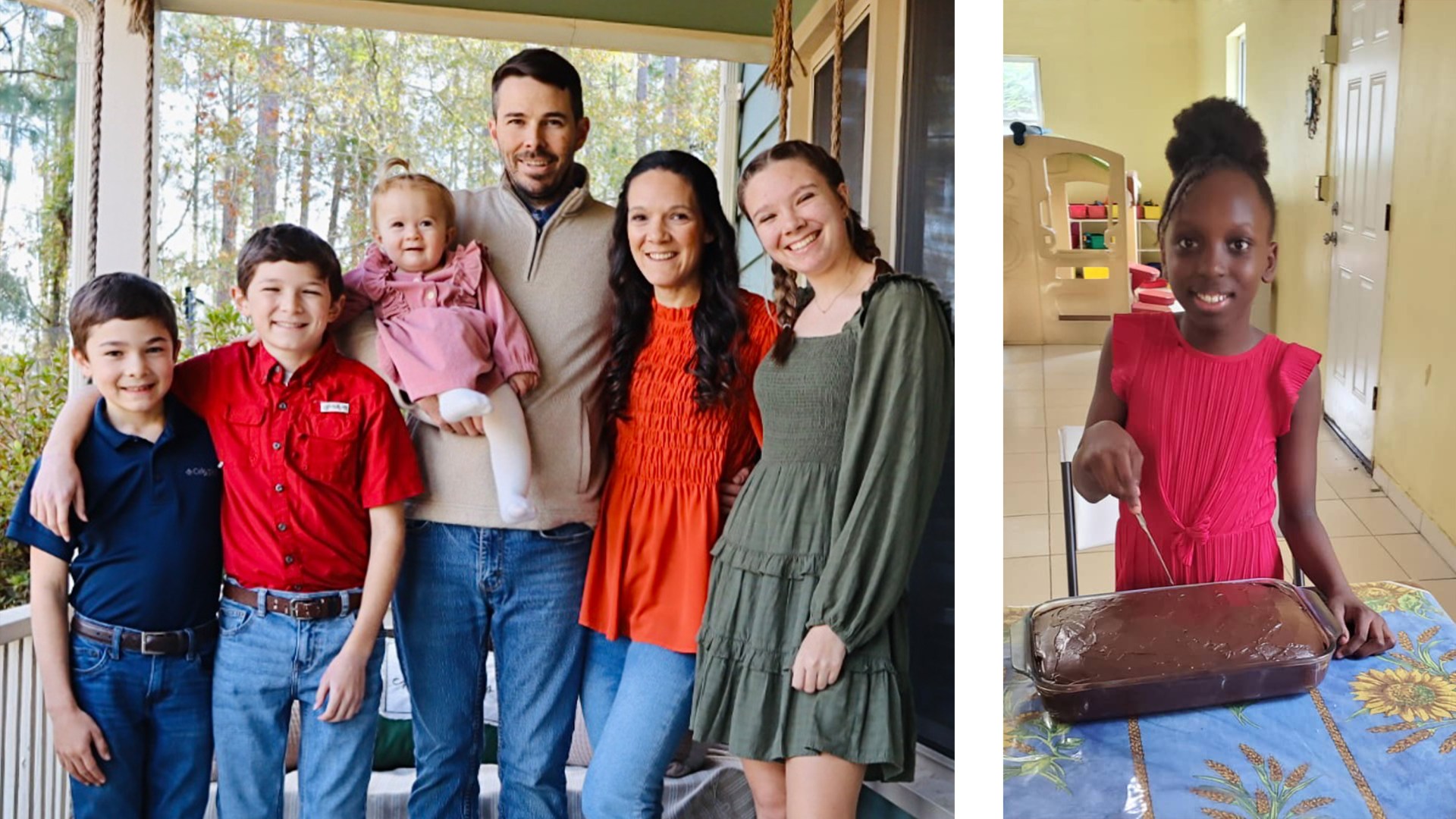
The Dowey family and their adopted daughter, Grace, who is currently in Haiti.

The Dowey family and their adopted daughter, Grace, who is currently in Haiti.

Christianity Today January 30, 2026
Images courtesy of Lifeline Children's Services

Grace and Dave Macchioni sat down excitedly for a call with their adoption agency in mid-January. After more than a year of submitting background checks, financial records, and other paperwork, they finally had a travel date to pick up their soon-to-be adopted daughter: January 24.

In Colombia, they would reunite with 14-year-old Zuli then head to the US embassy in Bogotá to obtain a visa to bring her home. Yet over the call, the case worker informed them that earlier that day, the Trump administration had issued a visa freeze for 75 countries, including Colombia.

The Macchionis recalled the case worker didn’t seem concerned and assured them it was probably an oversight. But the couple felt something was wrong.

“We looked at each other, and once we hung up the phone, I just bawled,” Grace Macchioni said. 

The Macchionis first met Zuli through a hosting program called Project 143. She spent a month in their Rhode Island home in 2024, where she experienced snow for the first time, attended a ceramic painting class, helped Macchioni’s aging mother walk to her appointments, and bonded with the Macchionis’ two sons.

“She became a part of the family,” Macchioni said. As soon as she left, the couple started working on the adoption process.

At the beginning of January, the Macchionis had a video call with Zuli, who had been transferred from her foster home to a waiting facility ahead of their arrival. Grace Macchioni showed her the bedroom she had prepared with all of Zuli’s favorite things–a purple butterfly bedspread, butterfly paintings, a Colombia nightlight to remind her of home, a wall hanging of a Spanish Bible verse, and figurines of Stitch from Disney’s Lilo and Stitch

“Are you happy?” Macchioni recalled asking Zuli. 

“I prayed to God for this,” she responded. 

Now the Macchionis, like hundreds of families in the international adoption process, have no idea when they’ll be able to bring their adopted daughter home. They canceled their flights as well as the caretaker they had hired for Macchioni’s mother. They called family members who were planning to stay with their boys and informed Dave’s work he would not be taking leave. 

The State Department’s January visa freeze temporarily halted the issuance of all immigrant visas for 75 “nationalities at high risk of public benefits usage.” It came on the heels of President Donald Trump’s December presidential proclamation, which banned immigration from 39 countries and could last until the end of his term. 

Past visa suspensions have always included a blanket exemption for adoption visas. Yet the December travel ban and January freeze do not.

The announcement sent shock waves through the adoption community. While grappling with the news of an indefinite delay on top of years of waiting and extensive vetting, adoptive parents mobilized. They shared their stories on social media, made calls, sent letters, signed petitions, met with their representatives, and urged others to do the same. 

Last Friday, the Congressional Coalition on Adoption wrote a joint bipartisan letter to Secretary of State Marco Rubio, urging him to reinstate the categorical exemption for adoption visas, provide pre-travel exemptions to adoptive families, or issue clear guidance on how to apply for case-by-case exceptions.

On January 28, the White House released a guidance instructing families to proceed in the adoption process, saying, “Consular posts have been instructed that intercountry adoptions are eligible for National Interest Exceptions under the current presidential proclamation and should be processed on a priority, case-by-case basis.”

Karla Thrasher, vice president of international ministries at Lifeline Children’s Services, the largest evangelical adoption agency in the country, said the adoption community is celebrating the news while still advocating for the categorical exemption to be reinstated. 

“The visas are going to be adjudicated on a case-by-case basis, and we’re just not quite sure what that means at this point,” Thrasher said. “Is there still a chance that a visa could be denied? And if so, what is that criteria? There’s still a lot of clarification that we’d like to see.”

Christine Deason of Louisville, Kentucky, is in the process of adopting a 7-year-old from Thailand. She and her husband never thought that getting a visa would be an issue in her two-and-a-half-year-long adoption process.

She said she doesn’t understand why the visa freeze would not have an exemption for adoption visas, since its stated purpose is to prevent the entry of immigrants who will become a “public charge,” or use government benefits. 

Most adopted children become citizens upon entry to the US, and the public charge rule only applies to noncitizens. Also, the adoption vetting process requires submitting extensive financial documentation, including the records of a designated guardian should something happen to the adoptive parents. 

“Time and time again, we’ve had to prove ourselves financially stable,” Deason said, adding that they’ve even postponed big purchases, like buying a house or car, to prevent any change in their records that could cause delays. 

The Deasons are hoping to bring their daughter home in April. Her room has been ready for two years, and in the corner sits a pile of wrapped presents—one for every birthday they’ve missed since she was born. 

“We were very excited about traveling in April, because she turns 8 in May,” Deason said. “Fingers crossed, we’re not gonna miss another birthday.”

Parents adopting from the 39 countries included in Trump’s December proclamation have now spent a month and a half in limbo.

Ashley and Ted Dowey of Camden, South Carolina, have been in the process of adopting their 10-year-old daughter, Grace, from Haiti for more than five years. After countless setbacks, the couple finally received their adoption decree from Haiti, meaning Grace is legally their child and Dowey is legally her last name. But since the announcement of the travel ban, they have no idea when, or if, she can come to the US.

“We expected delays from Haiti from the beginning,” Ashley Dowey said. “But the last thing we expected was to get almost to the end and then for it to be the [US] that’s causing a delay. That was really shocking and disappointing.”

Grace has been in an orphanage her whole life. She loves music, spaghetti, and the color yellow. The girl lives in a particularly unstable part of Haiti, so the Doweys have completed many hours of trauma training to prepare for her arrival. They speak with her once or twice a month on Zoom, and Dowey noted that she always asks, “When do I get to come home? When do I get to come live with you guys?”

Dowey is holding onto a line from Psalm 68:6: “God sets the lonely in families.” She prays this can be true for Grace soon.

Meanwhile, back in Rhode Island, Grace Macchioni said she is feeling “very hopeful” to hear the White House announcement that adoptions are eligible for exemptions. “There’s power in numbers,” she said, noting the adoption community’s petitions. “I’m hoping this is really a move forward.”

She spoke to Zuli on Wednesday, who she said seemed “restless” in the temporary waiting facility. “I reassured her,” Macchioni said. “I said, ‘Once they give us the green light, we’ll be there.’”

News

After Their Kids Survived the Annunciation Shooting, Parents Search for Healing

Families in the same Anglican church watched their young children deal with trauma, anxiety, and grief. They found one solution: each other.

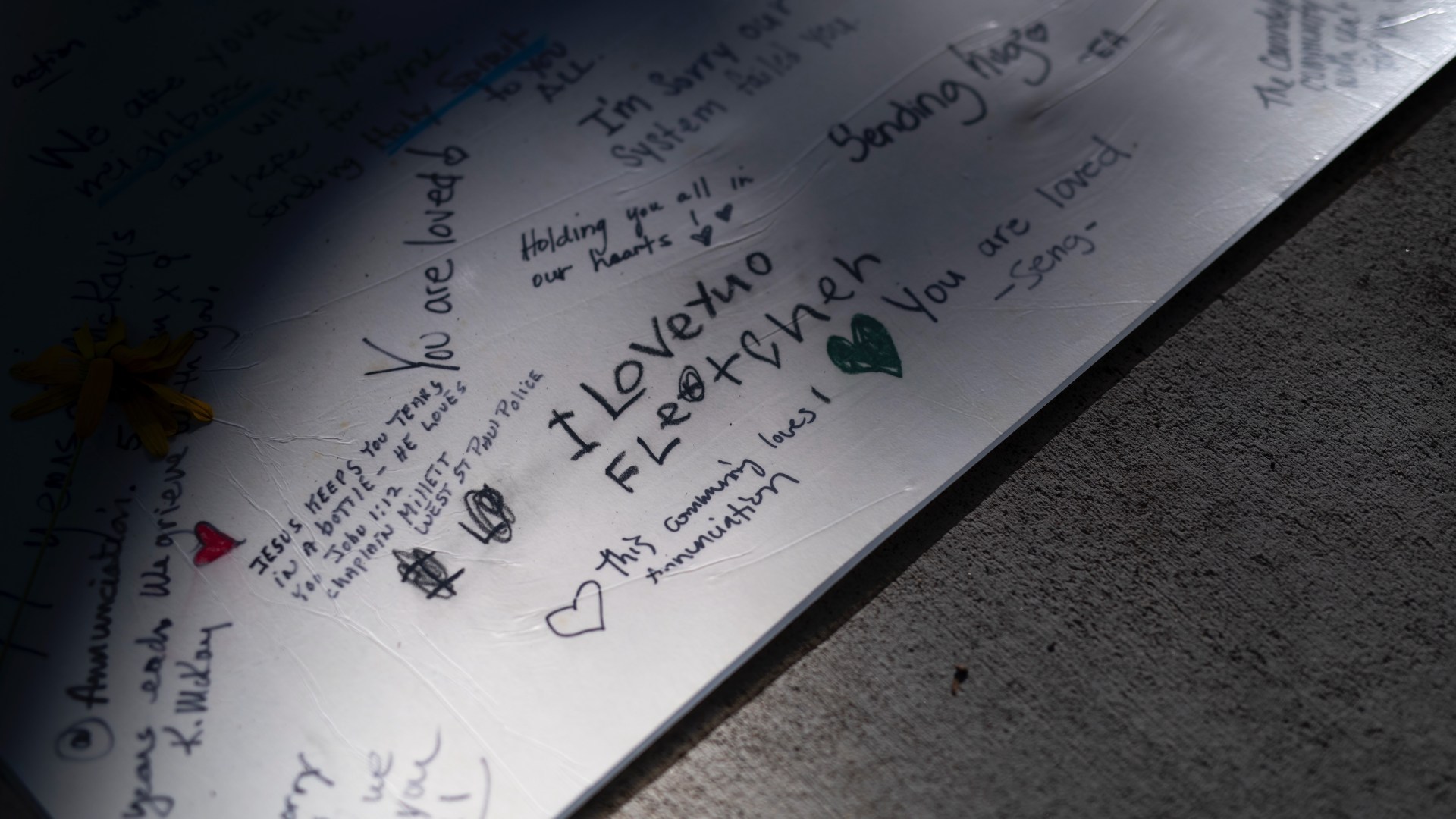
A note reading " I Love You Fletcher" is left outside Annunciation Church and School on August 30, 2025 in Minneapolis, Minnesota.

A note reading " I Love You Fletcher" is left outside Annunciation Church and School on August 30, 2025 in Minneapolis, Minnesota. Fletcher Merkel was killed in the shooting.

Christianity Today January 30, 2026
Photo by Stephen Maturen / Getty Images

Minneapolis lay under a blanket of snow and single-digit temperatures as parishioners poured into church on a Sunday morning in early December last year. They piled jackets into a coatroom and grabbed cups of strong coffee from the dispenser in the lobby. In the sanctuary of Restoration Anglican Church, vertical stained-glass windows sent shafts of light across the pews.

A regular sight in the small balcony next to the organ now is three families, all close friends: the Revells, Holines, and Sharpes. Their children attend Annunciation Catholic School and were there the morning of August 27, 2025, when the student body gathered for the first Mass of the school year and a shooter fired through the sanctuary windows from outside, riddling the Catholic church with 116 bullets. Two students were killed—Fletcher Merkel, 8, and Harper Moyski, 10—and 28 were injured.

In all, six families at Restoration Anglican have children at the school. All survived the shooting unharmed, but they’re dealing with the aftereffects of what one parent likened to a military ambush. Some of the children have nightmares and don’t sleep well. Loud noises or flashing lights or simply being alone can send them into an anxiety tailspin. The parents are fragile too.

The stained-glass windows lining Restoration’s sanctuary are similar enough to those at Annunciation that the children had a hard time returning to church services. So the Sunday after the shooting, Restoration church staff set aside space for the families to worship in the balcony so the kids feel less exposed. For the first few weeks, ministers brought Communion to the families.

Trip Sharpe, 8, who survived the shooting, likes sitting in the balcony.

“Being down there, no,” he told his dad Will Sharpe recently. Why? his dad asked. Trip said he liked just having their family around. Will Sharpe and Mary Marshall Revell are siblings, so some of Trip’s balcony buddies are his cousins.

Trip’s best friend, Fletcher, was killed in the shooting. Trip helped lead a procession at Fletcher’s funeral, holding hands with Fletcher’s brother. Trip’s dad, Will Sharpe, gave a eulogy. Trip can list off his friend’s birthday and tell stories about fishing trips they took together.

Ash Revell, whose big sister Ansley also survived the shooting, zoomed a car over the balcony pews during the service. Nearby was June Holine, a fourth grader who ran with her teacher out of the school during the attack.

June’s little sister Olive, a first grader, also survived. Annunciation has a buddy system for Mass, pairing older students with younger ones—Olive’s buddy laid on top of her during the shooting, then covered her head as they ran out.

The parents still worry in the balcony. Will Sharpe has to pray each service to keep violent images of a potential attack in church from entering his head. His sister, Mary Marshall Revell, struggles with the same thing, her imagination playing over and over what the shooting was like for their kids.

At the front of the sanctuary, two Advent candles were lit, and a child read Isaiah 11:1–10:

The wolf shall dwell with the lamb, and the leopard shall lie down with the young goat, and the calf and the lion and the fattened calf together; and a little child shall lead them. (v. 6, ESV)

“Does God interrupt the chaos of the world?” asked rector Rick Stawarz in his sermon on the passage.

Stawarz and his wife, Molly Stawarz, the pastor of mission at Restoration, had enrolled their 3-year-old, John, at Annunciation’s preschool. When they got word of the shooting, they drove as fast as they could toward the school. They couldn’t get close with all the activity around the school, so they ditched their car and ran, Rick losing his Birkenstock sandals and forgetting to turn off the engine. They found their son and “kissed him like crazy,” Rick said.

John had not been in the sanctuary—he was blessedly oblivious, thanks to a calm teacher who had them play “the quiet game” in their classroom during the attack. As John walked out, he was entranced by all the police and fire trucks; he asked to dress up as a firefighter for Halloween.

America’s ongoing scourge of school shootings not only takes lives but also leaves a pool of surviving children who carry the horror with them. More than 398,000 students have experienced gun violence at school since the Columbine shooting in 1999, according to data compiled by The Washington Post.

Research has shown long-lasting effects on surviving children—like struggling with depression or dropping out of school—but it has also revealed children can be incredibly resilient.

“The field of post-trauma is really big and developing all the time. There is so much we don’t know,” said Anna Mondal, a Christian counselor who specializes in trauma.

The families at Annunciation discovered quickly that there is a national infrastructure to respond to school shootings: trauma centers for children, parental support groups. Organizations showed up in Minneapolis with therapy dogs and bunnies, a big hit with the children.

Annunciation brought in the Washburn Center for Children, a local counseling group, to provide onsite mental health professionals for two school years. As Washburn’s chief clinical officer, Jenny Britton, described to me the close-knit community at Annunciation and how essential that is for trauma recovery, she took a call about an Annunciation student who needed help.

Yet even with all the resources, mass shootings tear an unimaginable hole in a community.

“You keep seeing the fracture continue to spread,” said Will Sharpe, Trip’s dad. Parents of kids in other school shootings have warned Annunciation parents that every step after the event—like deciding whether to reopen the site of the shooting or how to memorialize it—could bring dissension. 

“It was pretty shocking … how much it takes to clean up the pieces,” said Emily Collings, who leads the children’s ministry at Restoration and coordinated care for the families of child survivors. She sat in meeting after meeting discussing what to do next: how to support the families, how to navigate kids’ questions in Sunday school, whether to change the classroom locks. One parent asked her about hiring an armed guard.

All of it makes Collings angry at the shooter—such devastation wrought in so few minutes.

But the families at Restoration, taken together, might have something special that could speed their recovery—and help their kids bounce back and understand what happened. These families are seeing the value of close relationships in a trusted faith community in a country where people often suffer individually, out of sight.

Americans are becoming less and less socially connected. As their isolation grows, so do problems with their mental health. But even recovery from crises is often an individual activity with a therapist.

Scientists widely consider social connection one of the strongest predictors of survival at any stage of life. And research on mass shootings has shown that a religious community helps in recovery. The survivors and families at Restoration are learning this—but remaining in community is itself a struggle sometimes.

“Showing up to men’s prayer, showing up to church—showing up has been something that we’re telling ourselves to do. It’s not coming naturally,” said Anders Holine, the dad of June and Olive, who survived. “There are days where I just want to move to the woods and cut ties and be safe.”

But after church events, he said he almost always feels encouraged, renewed. It helps that Restoration’s rector personally understands his family’s terror.

The families say they feel comforted even as they struggle to find meaning in the tragedy.

“You’re not just making sense of it yourself. You’re making sense of it for your kids, who are asking, ‘Why?’” said Anders.

“It’s unnatural, what we experienced,” said Mary Marshall Revell.

Anders Holine and Will Sharpe went to high school together in a Twin Cities suburb but didn’t really know each other. When they were students, Will said, he was getting in trouble while Anders was “pursuing church and making good decisions.” They became friends after Will turned his life around.

Now their families live across the street from each other—a few blocks from Annunciation—and hang out all the time. They walk their kids to school.

Mary Marshall Revell is Will’s sister and also lives less than a five-minute drive away, with her husband, Micah Revell, and their two kids, Ansley, 9, a third grader at Annunciation, and preschooler Ash, 5.

The Holines, Sharpes, and Revells all go to church together. Will and his wife, Kacie, recommended Annunciation to their rector’s family, the Stawarzes.

The day of the shooting, Will and Anders walked their kids to school and then split off. Will went to a grocery store nearby, Anders went home. As Will walked back, he passed the campus. Trip and Fletcher and one of their friends called out to him from a window, laughing. Will laughed too but told them to get back to class. He returned home, took the family dog on a walk, then heard gunshots.

He hopped in the car to get to campus, parked in an alleyway next to school, and ran into the school parking lot. He found an older woman lying on the ground, shot in the leg. Then police came around the corner and told him to get away because they were concerned about a second shooter. Like other parents, he was desperate to find his son. (He knew kindergarteners, including his daughter, didn’t go to Mass.) Trip was in the church, a few rows up from his friend Fletcher.

Anders also heard the gunshots and drove to the school. First responders were just arriving. He saw a police officer come through the church doors with injured children. As the police opened the door, he went into the crime scene to find his girls Olive and June.

But his girls weren’t there. For the parents, the half hour of not knowing their children’s fate was hell. Some kids were hiding under pews. Others had run out at the start of the shooting and were in buildings around the area. They eventually reunited at a gym.

In the chaos of the shooting Ansley Revell, the third grader, tripped and fell over a shoe someone had lost, and then someone stepped on her finger. She got out, and she remembered her friends crying, but parts of her memory are blank.

“I want to remember all of it, but my body won’t let me,” she said, sitting on her couch next to her parents. “I can’t picture it in my mind.”

Ansley remembers that after her parents collected her, an officer checked off her name, noting that she was okay, and her mom and dad said she could have whatever she wanted for lunch. But she felt sick to her stomach and couldn’t eat. She had a popsicle, which helped. The kids may have blocked out the shooting, but they remember the food they ate that day—mostly pizza. Ansley had a smoothie bowl.

After the shooting, the three families piled in at the Sharpes’ house. The kids watched TV downstairs for hours, which they’re not normally allowed to do. The parents sat together upstairs, numb. They stayed at the Sharpes’ house until late. When the parents learned Fletcher had died, they pulled the children aside to tell them.

Ansley immediately went to Trip, knowing he would be upset, and they started talking, said her mom, Mary Marshall. The parents said the children sometimes found it easier to talk to each other about the shooting than to them. But now the kids ask deep questions about it at random times, like on the way to school.

One of Will’s friends came over the night of the shooting. They sat on the front steps, and Will cried, the first time he let himself lose it. Micah Revell lost it in his kitchen after he put his kids to bed. Micah’s dad, John Revell, got into full-time police chaplaincy in 2012, ministering to first responders in Newtown, Connecticut, who struggled after the Sandy Hook shooting.

The evening of the shooting, Restoration held a prayer vigil. After that, the three families said they ate more meals together than not, sometimes with the Stawarzes as well. They didn’t wallow in feelings about the shooting—sometimes they were just hanging out—but these times were a relief when other people either avoided talking about the event or wanted to move on quickly.

“Having the ability to process and talk through with each other was such a gift from God,” said Will.

Britton, from the children’s trauma counseling group, said well-meaning people often ask questions like “How are you doing?,” which can sometimes feel hard to answer, especially for kids. Instead she suggests having a normal conversation that is not about their recovery, like “I am so happy to see you today. I heard you joined the basketball team.”

The day after the shooting was Ansley’s birthday. Collings, the children’s pastor, pulled together a birthday gift and care package.

“Everyone’s like, ‘Oh my gosh, that must have been a horrible birthday.’It was a pretty good one,” said Ansley.

Restoration started a meal train for the families. Anders discovered there were skilled sourdough bread bakers in the church after several delicious homemade loaves showed up at his home.

“They had already, within a very short amount of time, thought through all of these ways to care for us so that we didn’t have to think of those things,” said Mary Marshall.

Will was asked to do a eulogy for Fletcher’s funeral. He processed it with his counselor and then with Rick Stawarz and prayed every morning for the right thing to say. He felt intimidated by the glare of attention. What came to him was Psalm 23: “I lack nothing” (v. 1). He clung to it. At the Restoration service before the funeral, Stawarz anointed him with oil. People laid hands on him and prayed.

Will had coached Fletcher in soccer, football, and basketball. In the eulogy he talked about the gift of being welcomed into the Merkels’ circle, then told the family, “We are here for you, and we are not going anywhere.”

He quoted 1 Corinthians 15 and said, “Because of Jesus, death has had no victory over Fletcher. … He is safe. He made it to his heavenly home, and boy do we miss him.”

After the funeral, the Sharpes, Revells, and Holines ate dinner together. By the end of the evening, they were even laughing.

“I remember looking around and thinking, Okay, this is how we’re going to survive this. Because we have this,” said Mary Marshall.

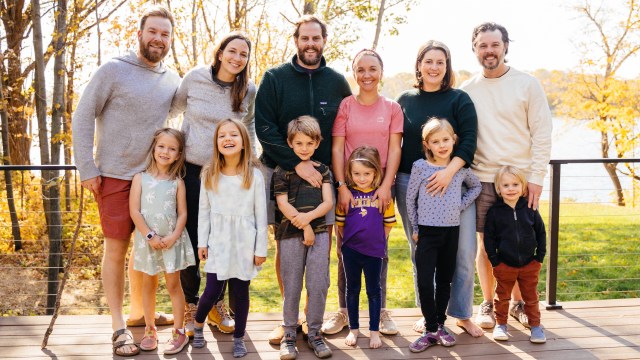
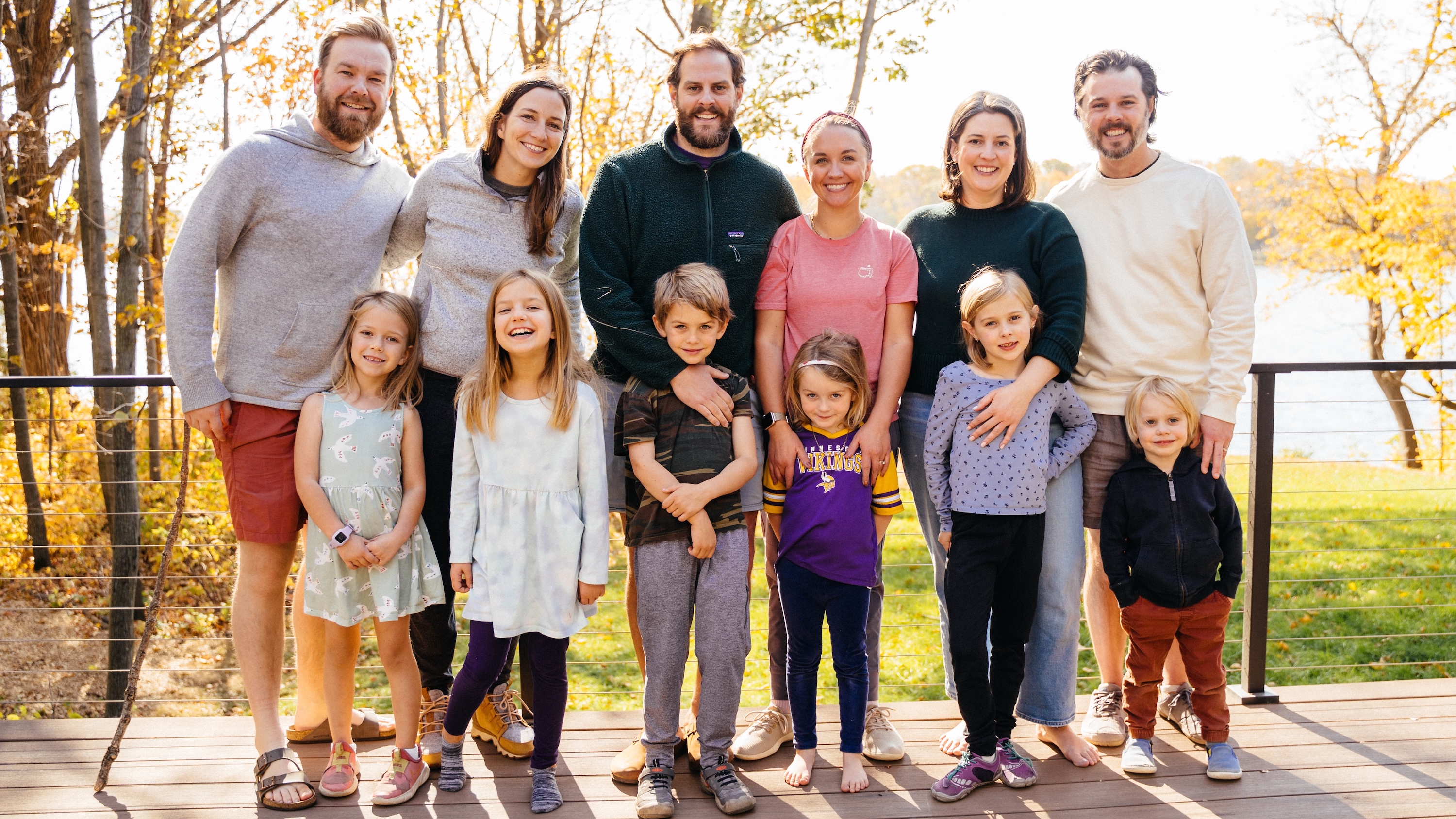
Three families whose children survived the Annunciation shooting go to the same church. Courtesy of Anders Holine
Three families—the Holines, Sharpes, and Revells—whose children survived the Annunciation shooting go to the same church.

Before the shooting, Micah Revell said the three sets of parents were struggling with some level of numbness with their faith. Now church is what brings out his emotions, even if he has felt disconnected during the week. Communion especially feels like “tangible comfort,” said Micah. “This really is the physical presence of Jesus.” The parents all brought up falling back on the sacraments and liturgy of the Anglican tradition.

Discussion of sorrow and suffering is “built into the way that the Anglican church, or our church, approaches daily life and the world,” said Sharpe, who is new to Anglicanism. The Holines and Sharpes weren’t at Restoration a year before the shooting, but Mary Marshall feels they were all drawn together into the same church as a gift.

“Church has always been really hard for me … for most of my life,” said Mary Marshall, mentioning some hurtful experiences at recent churches. But the time her family has been at Restoration has been “life-giving and healing,” she said. “Their response and their care for us—it couldn’t have been more different.”

Molly Stawarz said the Anglican tradition places a high value on kids’ involvement in church because of the belief that they can have a relationship with God—and, Rick Stawarz added, they can practice spiritual disciplines.

“This is a place where their kids are being given the space to process this—not just individually but to process it liturgically,” said Rick. “Whether they realize it or not, they’re being connected to the weekly rhythms of our church and the prayers of our church.”

In September, about two weeks after the shooting, June and Trip were scheduled to be baptized at Restoration. They both wanted to go forward with it. Usually the Anglican tradition does sprinkling baptism, but many in the congregation come from Baptist backgrounds, so the church does full immersion, too, which is what the kids did. June wore an Annunciation T-shirt. Anders told himself to keep it together as he watched, going into a sanctuary for the first time since the shooting.

“It’s the very basics of Christianity that I really should have practiced—fundamentally trusting God with your future, trusting the unknowns, entrusting your kids’ lives,” said Anders. “Am I really doing that? I’d rather have safe circumstances and just be safe physically. The Bible is really challenging. … I can’t pave my own road.”

Anders said June dried off from the baptism, they ate a quick lunch, and they went to Harper Moyski’s funeral.

Rick reflected on the baptisms later: “Yes, be reminded that by Christ’s death and resurrection, you are united to him, and nothing can separate you from him. You are claimed by him, united with him, and received into the household of God, which is both a local church reality, but it’s also this heavenly, cosmic reality as well. You belong to Jesus.”

But the parents still discover unexpected “pockets of pain,” as Will described it. The power flickered in the Revells’ house recently, and Ansley sprinted to Mary Marshall, screaming. Mary Marshall just held her. Ansley’s whole body was shaking.

“She has a really good game face, and I do believe she’s sharing with us, but there’s a lot more going on inside,” said Mary Marshall. The therapist the Revells see told them they didn’t need to rush her into therapy but should wait until she is ready—advice echoed by other therapists CT interviewed.

June Holine sleeps with her Bernedoodle sometimes because nights are hard now. She said if she could, she would have 50 dogs, and then she could crowd-surf on them.

“To have those friendships in place with these friends that are also at their church, and then the broader church community that we have, is going to be really good for Ans,” said Micah.

The Anglican families have felt cared for by the Catholic community at Annunciation, too. The parents go to a weekly meeting with other Annunciation parents at a local pizza place, where they’re forming a parents advocacy group that, among other things, is looking at pushing gun reforms. “The grief and helplessness is getting channeled into ‘Okay, what can we do?,’” said Mary Marshall.

One snowy night in December, Beth Holine, Anders’s wife, proposed to the parents a name and mission for their nonpartisan advocacy organization. Anders was watching their girls at home and followed the meeting on Zoom, and the Revells squished behind a table with other parents. The room was packed, and the floors were wet from snowmelt.

“I would love for there to be some kind of broader Christian response that can really make a change in our country,” said Molly later about the gun debate. “We are uniquely equipped to enter these incredibly difficult dialogues.”

Life goes on, with sports, parent meetings, and birthday parties, but the shooting comes up. When June’s basketball team lost recently, the winning team gave them bracelets as consolation because they were from Annunciation.

Recently, the Sharpe, Revell, and Holine children went back into the Annunciation sanctuary for the first time since the shooting. The parents noticed that June, Trip, Olive, and Ansley wandered to the choir loft on their own and prayed for the families of Fletcher and Harper.

Meanwhile, Restoration’s worship director, Derek Boemler, and another church musician, Chris Gisler, released a new worship song for their church that they wrote in response to the events:

“There is a refuge in your wings
A help in troubled times
You cause the broken heart to sing
And you’re singing now in mine.

“May I know the Comforter
May I know the God of peace
May I know the one who holds the stars
Is holding on to me.”

“The One Who Holds the Stars,” courtesy of Derek Boemler:

Books

How Football Shaped Christian Colleges

Three history books to read this month.

Three book covers.
Christianity Today January 30, 2026
Illustration by Christianity Today

This piece was adapted from CT’s books newsletter. Subscribe here.

Hunter M. Hampton, The Gridiron Gospel: Faith and College Football in Twentieth- Century America (University of Illinois Press, 2025)

In Gridiron Gospel, historian Hunter M. Hampton explores how Christian colleges and universities—his case studies are Notre Dame, Brigham Young, Wheaton, Wiley, Baylor, and Liberty—used football to promote Christian masculinity and adapt to the shifting social and religious landscapes of 20th-century America. Muscular Christianity plays such a central role in this book that it is surprising the word masculinity is not included in the title or subtitle.

The book contains a significant amount of straightforward football history, at times reminiscent of reading the sports section of an old newspaper. Hunter chronicles specific games, records of wins and losses, and coaching changes. However, his narrative is most compelling when he moves beyond these details to examine how administrators—many of whom initially questioned whether football was too violent for Christian colleges—concluded that the sport could build good Christian men.

Hunter demonstrates that administrators consistently integrated football programs into broader efforts to reinforce institutional identity. For instance, at Wiley University—a historically Black school in Texas—football strengthened the school’s Black identity. At Baylor, the sport reinforced the university’s commitment to racial segregation. At Wheaton, football facilitated the evangelical liberal arts college’s transition out of fundamentalism, though Hunter is not entirely clear about how this occurred.

In recent years, sport historians have begun to take religion seriously, while American religious historians are also starting to recognize the importance of sports. Hampton’s book fits squarely within these promising trends.

Pamela Walker Laird, Self-Made: The Stories That Forged an American Myth, Cambridge University Press, 2025)

What do 17th-century English Puritan statesman Oliver Cromwell have to do with 21st-century socialite and influencer Kylie Jenner? Both have been described as “self-made.” Like Hunter Hampton, Pamela Walker Laird is interested in the myth of the “self-made man.” In a sweeping narrative covering 400 years of American history, she examines how American culture celebrates “self-made” as a “badge of honor that rewards individualist ambitions while it hammers against community obligations.”

In Cromwell’s era, presenting oneself as “self-made” signaled sinful pride, selfishness, and unhealthy ambition. “Well aware of their roots and forces outside themselves,” Laird writes, “self-fashioners then did not—could not—see themselves as self-made.” By the 19th century, however, the term had become a largely positive character trait. Laird masterfully explains how this transformation occurred.

As historian Seth Rockman observes in his endorsement of this book, “To call someone ‘self-made’ has almost never been true.” Laird recognizes that the pursuit of individual ambition and self-fashioning was not accessible to all Americans. The ability to improve oneself or “rise up” was consistently limited by entrenched systems of inequality. Laird also points out that as Americans celebrated a meritocracy based on hard work and determination, they were simultaneously constructing the myth of “self-made failure.”

From Benjamin Franklin to Davy Crockett, from Horatio Alger to Donald Trump, the idea of the self-made American endures. For those interested in how such individualism and ambition may or may not contradict the teachings of the Christian faith, this book is an essential read.

Richard M. Gamble, The War for Righteousness: Progressive Christianity, the Great War, and the Rise of the Messianic Nation (ISI Books, 2003)

Progressive Christians are often associated with opposition to American wars. As historian Richard M. Gamble demonstrates, pacifism has a long tradition within this branch of modern American Christianity. Yet, progressive Christians—the advocates of what was called the “social gospel” in the first half of the 20th century—sometimes acted as war hawks.

The War for Righteousness did not receive the attention it deserved when it was first published in 2003. Gamble argues progressive Christians were “crusading interventionists” who championed United States involvement in World War I as a means of spreading a messianic vision of American exceptionalism and the coming kingdom of God throughout Europe. Today, much of this pro-war rhetoric might sooner be found coming from a Christian nationalist.

The key actors in Gamble’s book are the so-called modernists. They are the theologians and church leaders who sought to integrate Christianity with modern science (including Darwinism), taught critical methods of interpreting the Bible, and believed that social justice was a central feature of the gospel. They include Lyman Abbott, Washington Gladden, Shailer Mathews, Harry Emerson Fosdick, and the leaders of the Federal Council of the Churches of Christ.

Although many of these men were opposed to war in principle, they eventually viewed President Woodrow Wilson’s intervention in Europe during World War I as a means of preventing the spread of German evil and advancing the kingdom of God. As Gamble writes, “The great irony of the war was that, in the very name of perpetual peace, the Protestant liberal clergy rationalized and legitimized the mass destruction of the first total war of the twentieth century, and demanded that it be carried on to a decisive victory.”

John Fea is a visiting fellow in history at the Lumen Center in Madison, Wisconsin, and distinguished professor of history at Messiah University in Mechanicsburg, Pennsylvania.

History

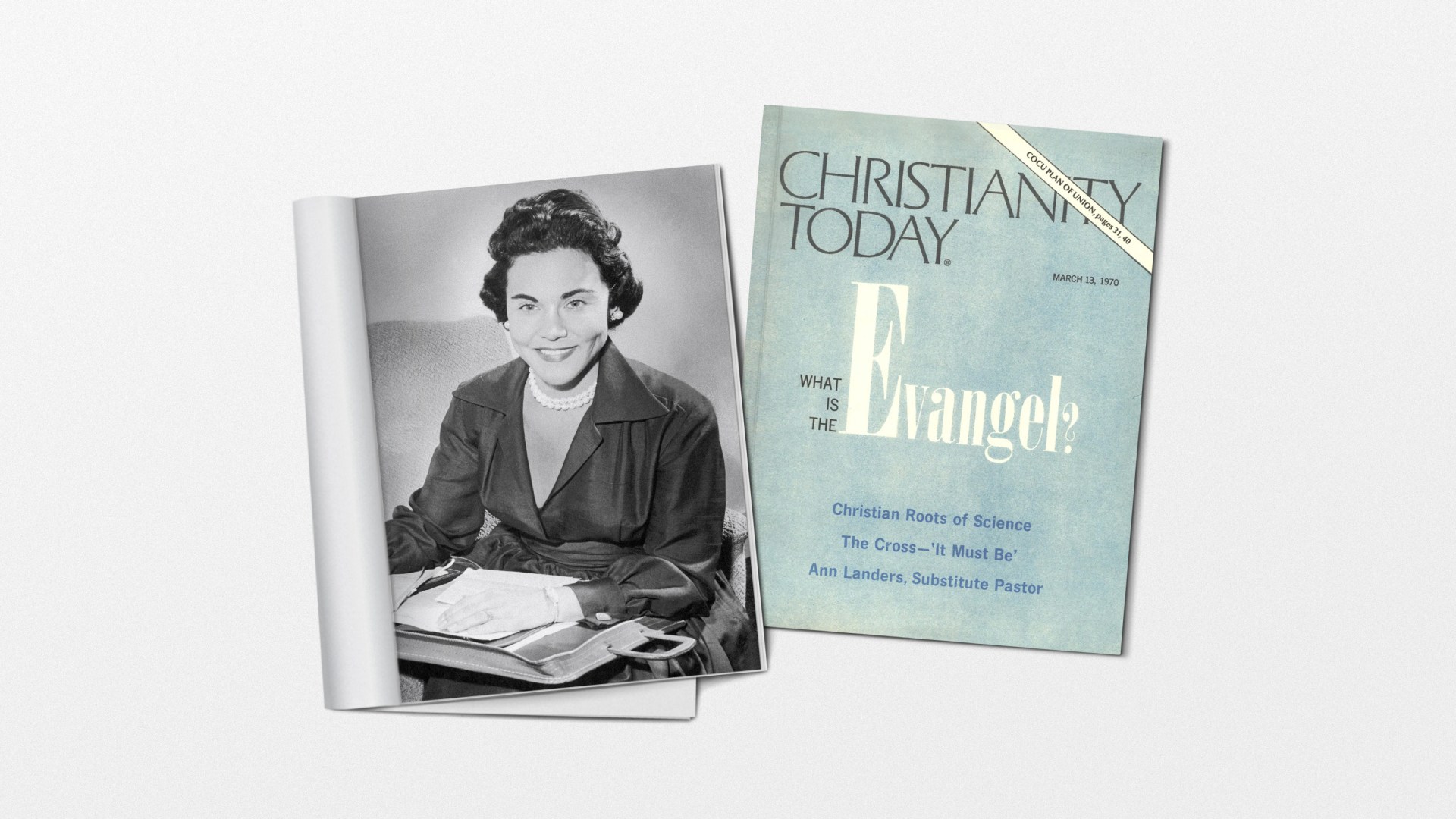
What CT Asked Advice Columnist Ann Landers

As America teetered on the edge of revolution, the magazine called for more innovation, responsibility, sensitivity, and stewardship.

A CT magazine cover from 1970 and an image of Ann Landers.
Christianity Today January 30, 2026
Illustration by Christianity Today / Source Images: Getty, CT Archives

In 1970, CT caught up with Ann Landers, the widely read newspaper columnist who answered personal, ethical questions. CT asked, “Why do you think people come to you for advice rather than seek the counsel of a clergyman?”  

My readers actually answer this question in the opening sentence of their letters. For example: “Please don’t tell me to see my clergyman about this problem. I’m ashamed to let anyone know we are having this kind of trouble in our family.” “It is easier for me to write to you because you do not know us.” …

I receive approximately 1,000 letters a day. Every letter that has a name and address receives a personal reply in the mail. …

Both clergymen and psychiatrists have written to me for help. Far more numerous are letters from wives of psychiatrists and clergymen. The wives of clergymen resent the criticism of women from the congregation. If they dress in style the word is, “She has no right to look like a fashion model.” If the clergyman’s wife underdresses, she is harpooned for “looking dowdy.”

Ministers appeared marginal in other popular media as well. CT noted a lack of “evangelical visibility in TV programming.” Part of the problem, according to the magazine, was that church leaders showed little interest in innovation

The churches are still trying to reach people within the confines of formal worship, and not on the level where they live. … The Church has to realize that just as evangelism must assume many different postures (as shown at the recent U. S. Congress on Evangelism), so spiritual television programming must find expression in a variety of situation contexts.

Here is the meat of what the Church can portray: examples of believers on the firing line of contemporary events and needs; enactments of Christian heritage, perhaps in a spiritually oriented “Saga of Western Man” series; modern-parable presentations of the Christian message in ways able to speak to all age groups; and exposure of the great music, art, and literature of the Church with an emphasis on the Church’s ability to continue to inspire the arts today. 

Many evangelicals were pessimistic about the future of America in 1970. The country seemed on the verge of collapse. 

More and more the question is asked: Will we soon need a new Gibbon to write The Decline and Fall of the United States of America? Signs of decay are not hard to find. The showy facade of affluence, technological advance, great knowledge, military might, and a high standard of living cannot hide the internal rot. … 

The frightening thing is the combination of ailments coupled with the patient’s disregard for his symptoms, and his unwillingness to seek a true cure. Is this not a way of committing suicide? 

We are engaged in a war that has terribly divided our people, brought near anarchy to some college campuses, and elicited a flood of obscenities, half-truths, name-calling, and irresponsible rhetoric. Emotion and fear and weakness, rather than reason and courage and strength, now seem to characterize our people. The social fabric is wearing thin and the holes are visible to all. 

Founding editor L. Nelson Bell was especially concerned about the anti-war movement and the possibility of a revolution.

We must recognize the forces with which we have to deal. We are not confronted merely by a group of idealists who wish to effect change by an over-activistic approach. True, many young enthusiasts have been captivated by the professed idealism of some leaders. But the fact is that we are faced with a hard core of student activists and others who are determined to tear down the present structures of society at any cost, and within their number are those whose basic philosophy is closely allied with that of either Moscow or Peking.

That spring, national guardsmen shot and killed four unarmed students at an anti-war protest at Kent State University in Ohio. CT invited an evangelical campus minister to write about the experience

I have never been in war, but that day as I stood with hundreds of students on the campus commons I knew how ugly war could be. … The whirlwind has begun. The unalterable laws of the spiritual dimension are proving their reliability. God is not mocked. What a man plants in his life and in the lives of others will yield back manyfold. And we have sown the wind. 

We have sown the wind of permissiveness in the home. … We have sown the wind of egotistic humanism. … My plea to the Church is to begin sowing the wind—the Spirit. Begin at the most crucial location in the nation: the college campus. Sow genuine love and spiritual power in the lives of students who may someday determine the direction of men and nations.

Evangelist Tom Skinner, author of Black and Free and How Black is the Gospel?, said America was in the midst of a racial revolution and the church faced a critical test.  

The black brothers on the street are not playing when they say that unless they get justice they will burn the system. Now the question is, Where does the Church stand in the midst of that revolution? What is the message of evangelism? What is the message of the Church? …

The New Testament Church also grew up in a time of revolution. It grew up in a time when the Romans were exploiting the Jews, and when the seeds of revolution were being sown by Jewish nationals who were saying that there was only one way to get that Roman honky off your back and that was to burn him out. 

In the midst of this there arose this radical group of disciples who had been with Jesus for 3 ½ years, who had walked with him and seen him live his life in total dependency upon his Father, had seen him crucified, resurrected, and ascended to his Father. Filled with his life they went out and impressed people that they had been with Jesus. … They said that real revolution lies in allowing the common clay of your humanity to be saturated with the deity of Christ.

CT reported on “gay rights” groups staging protests:

The Gay Liberation Front caused a furor among 600 Episcopal delegates to the Diocese of Michigan’s annual convention when two Gay Lib members spit out Communion wine near the altar. Others hugged and kissed in the pews and aisles at St. Paul’s Cathedral. … 

The diocesan convention was later adjourned early when twenty Gay Libbers marched to the podium carrying signs and shouting slogans. The disruption took place when a Gay Lib leader was not allowed to speak in favor of a resolution encouraging Episcopal churches to lend their facilities to homosexuals.

A Gay Lib member yelled to departing delegates: “What are you going to do when you have a Christian son or daughter that’s a homosexual? Are you going to disown them, too?”

Several days later in Washington, D. C., about thirty-five militant homosexuals held hands, hugged, kissed, and shouted obscenities as they disrupted a conference on theology and homosexuality at Catholic University. …

The spokesman (none of the dissidents revealed his or her name) demanded that conference members stop examining homosexuality and begin practicing it instead.

CT noted the emergence of a new denomination that rejected biblical condemnations of homosexuality—the first example of what would later be called an “affirming” church. 

People call the Metropolitan Community Church of Los Angeles the “gay” church. This doesn’t particularly please the 440-member congregation drawn overwhelmingly from the homosexual community. “We are a Christian church first, and homosexual second,” said its 56-year-old assistant minister, who prefers not to be identified lest his regular job in the “straight” world be jeopardized. … 

Its homosexual ministers are far from homogeneous in theology or even in their views of the basic cause of homosexuality. [Troy] Perry, whose sermons are fundamentalistic in tone, considers homosexuality essentially genetic. His assistant minister, a former United Church of Christ and Evangelical Reformed minister liberal in theology, believes homosexuality comes from psychological conditioning. Both men were married and fathered two children before turning to the gay life.

Some churches across the country were , CT reported. 

Christians who have lamented the drift of so many churches away from the faith centered in Jesus Christ and founded on Scripture should take joyful note of the list of congregations now returning to that faith. This list is increasing at a rate that may indicate a trend, and perhaps the beginning of a general movement. Throughout the country there is a growing network of pastors who have given themselves to leading churches back to the only solid foundation for Christian faith.

The Trinitarian Congregational Church in Wayland [Massachusetts] a good example.  … When the Reverend Donald S. Ewing became pastor of Trinitarian in 1955, the church was struggling to maintain its existence. Many of the 175 members were inactive. The church had a debt of more than $80,000 with an annual budget of only $12,000. Under Dr. Ewing’s ministry it has grown to a membership of more than 1,200 with an annual budget of more than $160,000.

But these statistics are only a reflection of the really significant developments, those that took place in individual lives. Commitment to Jesus Christ, interest in Scripture, and concern for people throughout the community are now common characteristics of the members.

Some congregations were experimenting with different kinds of music in worship. 

Evangelical churches have taken the lead in introducing a new kind of sacred music patterned after the popular folk rock. Country or Western music is also being appropriated by evangelical churches more than ever. Theologically liberal churches have been more reticent about such musical inroads, but in those congregations that allow it, these types of music as well as straight jazz are now heard. Most common are the folk and jazz “masses.”

Interestingly, the new movement is being welcomed by many respected church musicians, even those who have until now insisted upon classical forms. Others are critical. Church-music journals have generally been sympathetic, though they are publishing hot dialogues on the pros and cons.

“The Church is groping now for a new musical language,” says Dr. Donald Hustad, professor of church music at Southern Baptist Theological Seminary. “At the moment we go with the latest fad.” Hustad regards the current trend as secular music’s biggest invasion of the Church since about 1850.

As President Richard Nixon established a new government agency, the Environmental Protection Agency, an Asbury Theological Seminary professor wrote about Christian responsibility to steward creation, not exploit it. 

The Christian should face with frank realism the fact that the biblical understanding of things must run counter to many prevailing modes of thinking. He must, for example, challenge the current stress upon purely quantitative evaluations of economic success, usually stated in terms of the annual increase in our Gross National Product. It is not only that infinite expansion is impossible within a finite order, but also that “man’s life does not consist in the abundance of his possessions.” …

Taken seriously, the concept of biblical stewardship will permeate human life with the conviction that man holds his environment in trust, under God. It will remind man that abuse of his trust will bring, not only a searing final judgment from the God under whom man lives, but strong intermediate judgments in the form of impoverished lives and hungry bodies. It is in these terms that our decision-makers need to be reminded of the consequences of an outraged environment.

Toward the end of the year, reflecting on their stewardship of CT, editors published a statement of purpose, reminding themselves and readers of the goal of the magazine:  

We have tried to present orthodox Christianity to nonevangelicals reasonably and persuasively and to provide evangelicals with a scholarly apologetic for their faith. We have explored the relation between evangelism and social action on the part of Christians and have tried to stimulate a new sense of responsibility in those who formerly had shied away from involvement in the affairs of the world. At the same time we have given hearty support to personal and mass evangelism.

News

Kenyan Churches Compete with Bullfights on Sunday Morning

As the traditional sport regains popularity, pastors report young people have disconnected from church.

Spectators cheer as two bulls take part in a fight during a traditional bullfighting tournament in Malinya Stadium in Kenya on January 1, 2024.

Spectators cheer as two bulls take part in a fight during a traditional bullfighting tournament in Malinya Stadium in Kenya on January 1, 2024.

Christianity Today January 30, 2026
Fredrik Lerneryd / Contributor / Getty

On a Sunday morning in Kakamega County in western Kenya, two elderly women dust plastic chairs, open windows, and lay white linen on the tables at the front of the sanctuary inside Grace Calvary Christian Baptist Church. Pastor Jackson Sikolia prepares his sermon in his small office as members start arriving one by one.

When the 56-year-old Sikolia enters the sanctuary, half the seats are empty and only a handful of the attendees are young people. No youth sing in the choir. Only one teen girl helps with the children in Sunday school.

Yet outside, young men and women crowd the roads blowing vuvuzelas, whistling, or honking motorbike horns as they wait to accompany one of their village’s champion bulls to a fight a few miles away. Then they hop onto overloaded bikes—often holding four to six people—and carry tree branches (a traditional expression of excitement) as they cheer and follow the bull out of town.

Fights often start around 8 a.m. on Sunday mornings. Less successful “curtain raiser” bulls face off in up to 20 matches before the main event: a fight between the champion bulls. Matches only last a few minutes as the animals lock horns in an open space surrounded by a ring of spectators, while their owners wave sticks and shout to incite a fight. The match ends when one bull pushes the other out of the ring or when one falls down or runs away.

While locals celebrate the revival of the traditional form of bullfighting, pastors worry that the weekly events are leading young people to skip church. Although bullfighting used to take place on Saturdays and on public holidays, organizers now schedule them for Sundays, Sikolia said. For small churches like Grace Calvary’s 30-member congregation, a few more empty seats is a big loss.

Sikolia said his youth serve as the “main pillar” of the congregation, as the church’s current activities and future growth depend on them. Young people help with Bible readings, singing, and ushering on Sunday mornings. Now they’re not showing up.

“Sunday should be a day dedicated to God, not to fighting bulls,” Sikolia said. In Kakamega, about 1.7 million of the county’s 1.8 million residents identify as Christian.

Bullfighting in Kenya has centuries-old ties to the local Luhya culture. Its current form began in Kakamega in the 1960s as a post-harvest celebration and has grown in popularity, moving from fields to larger venues and capturing the attention of an increasing number of Kenyans. Fights can draw thousands, with some commuting hours to watch the events.

Now, even some prominent politicians, the county government, and a university in Kakamega promote bullfighting events on special occasions. Sociologist Kathleen Anangwe pointed to the country’s high unemployment and young people’s need for socialization as reasons for the rising popularity of bullfighting.

Francis Inganji, a 23-year-old from the village of Shibembe, said he prefers watching bullfighting to going to church. His mother required him to attend church services growing up, so he rarely had a chance to see the fights. After he dropped out of high school at age 15, Inganji started attending the fights with his friends. He still attends church on Sundays when no fights are scheduled.

These fights provide more than entertainment. Inganji said the bulls’ owners often treat fans to meals of beef or chicken, bread, rice, and sodas when they return from a fight to thank them for their support. Some owners build a fan base by giving money gifts as well.

One owner in his 70s, Joel Mulela, buys and sells bulls in Kakamega. He said since many families struggle to feed their children, free food from the owners can entice young people: “These children will never want to miss a bullfight.”

Some families invest in keeping bulls and grooming them to fight, hoping they will catch the eye of a wealthy buyer who wants aggressive animals for more elite fights, which come with cash prizes. Buyers may pay as much as 200,000 Kenyan shillings ($1,500 USD)—15 times the value of an ordinary cow at the village market, Mulela said. In contrast, selling a dairy cow’s milk only earns about 6,000–10,000 shillings ($47-77) per month.

Bullfight watchers also engage in gambling. Recently, sports betting companies such as Pepeta have started allowing people to place bets on bullfights, paying out cash to winners and making a profit off those who placed losing bets. Inganji admits he’s gambled on bulls. His occasional winnings keep him following the fights.

Pastor Moses Isachi of Friends Church Lurambi said he opposes bullfight gambling because it tempts young people to steal money from their parents: “We have had cases where these young people steal even chicken or eggs to go and sell in local shops to get money for gambling.”

He said gambling also encourages laziness and discourages learning jobs skills.

Brian Shinyaga, 25, another youth from Shibembe village, struggles to balance attending church on Sunday and watching bullfights. He said he tries to catch the 10 a.m. service at his Catholic church after attending a bullfight. Because of his frequent absences, he lost his position as youth group treasurer.

“A fight can last for between 10 and 30 minutes,” he said. “If it starts at 8, I have enough time to rush home and prepare for the next church service.”

Sometimes the crowds get rowdy. Shinyaga admits many youths end up fighting, falling off overloaded motorbikes, or engaging in sexual activities under the influence of drugs during these events. Bullfights can also lead to injuries as the overwhelmed bull seeks to escape from the ring, goring or trampling spectators in the process. 

Bishop Zadock Lubira of the Holy Peace Fire Church, an evangelical congregation in Nyayo Tea Zone, Kakamega, said that in the late 1990s, churches and concerned parents convinced county authorities to shift fights from Sundays to Saturdays. “How it went back to Sunday is what I don’t understand,” he said. “We should unite as a church to change this.”

Sikolia agrees, but he wants to do more than change the schedule. Youth need job skills and leadership opportunities, he said. In 2020, he began teaching young men how to make energy-saving stoves and charcoal briquettes—made from sawdust, maize stalks, or other organic materials—to sell to locals at an affordable price. He’s currently mentoring 20 youths, hoping they will encourage their peers to get more involved in church and abandon bullfighting.

Whenever he preaches at funerals, Sikolia also slots in a message for the youth against bullfighting. “I tell them to stop mixing dangerous events with the church, because God wants the youth,” he said, adding that young people who skip church to attend the events have sometimes been injured or even killed. “At the end of the day … the church [is] called to pray for [these youth].”

News

Refugee Arrests Shatter Sense of Safety in Minnesota

A federal judge ruled that ICE can no longer arrest legally admitted refugees in the state, many of whom are persecuted Christians. But damage has been done.

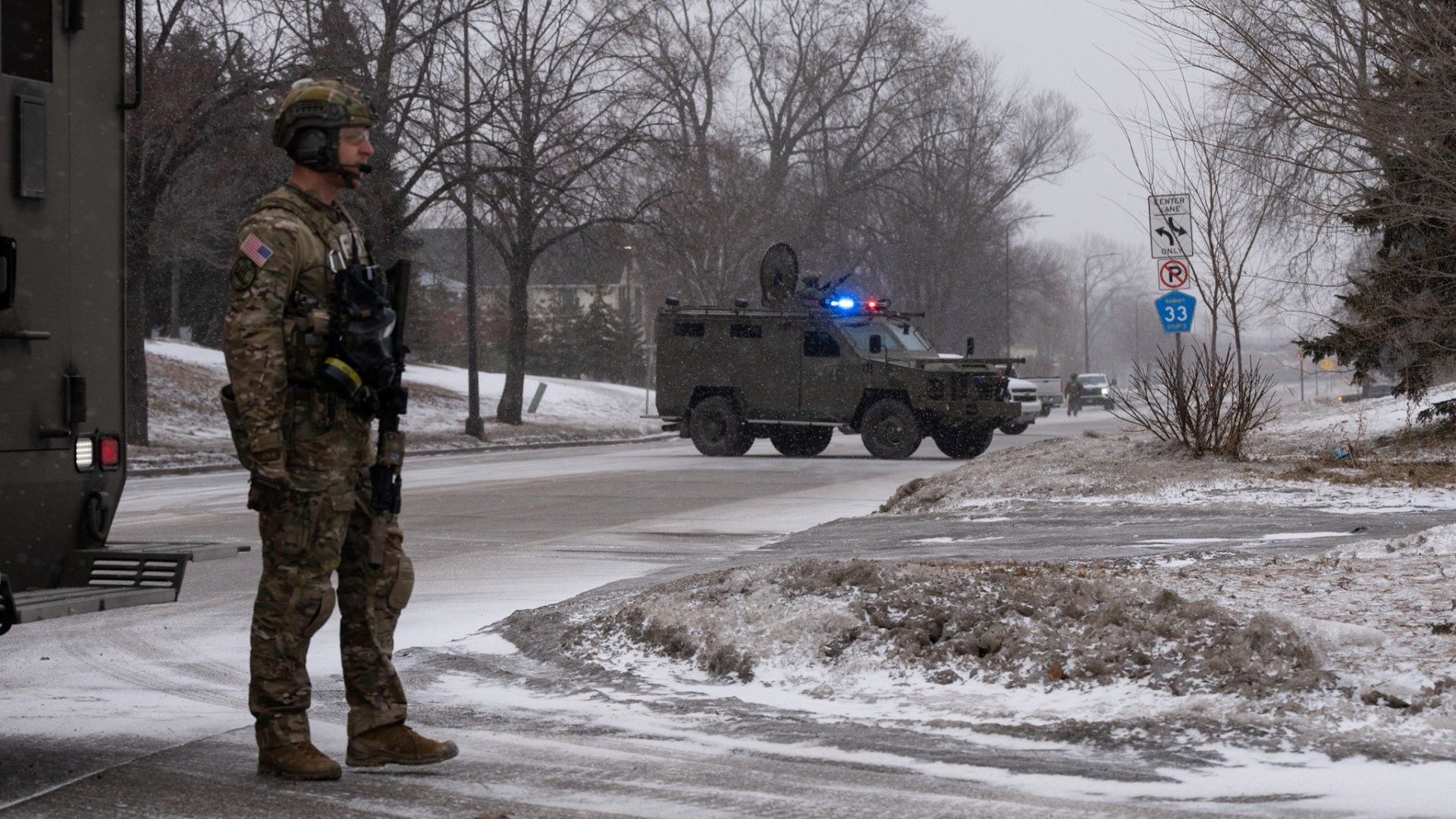
Federal law enforcement carry out an arrest in St. Paul, Minnesota on Jan. 16.

Law enforcement carry out an arrest in St. Paul, Minnesota on Jan. 16.

Christianity Today January 29, 2026
Mostafa Bassim / Anadolu via Getty Images

It was the coldest night in years for Minneapolis, but a young refugee’s friends there texted that they wanted him to come hang out.

He texted them back that he couldn’t come because his dad didn’t want him going out. Even as legal refugees, this Afghan family, whose identity is withheld for their safety, was concerned about ICE (Immigration and Customs Enforcement). The young man’s mom poured more saffron tea for everyone at their home as they sat on cushions and talked with friends who had come for dinner, a spread of rice, chicken, eggplant, and big rounds of naan.

Cheryl Hudson was helping one of the Afghan kids tape a script by their front door to remind family members what to say in case they were visited by ICE agents, who cannot enter without a warrant. Hudson helped the family resettle through her Minneapolis church, Urban Refuge, four years ago. Hudson’s family and two other church friends have since grown close to the Afghans—they’ve accompanied the refugees to the emergency room and have shared many late-night dinners.

Thousands of refugees, many of them persecuted Christians, have found a safe haven in Minnesota. But for weeks now, many of them have not left their homes on advice of their lawyers and local refugee-resettlement agencies.

The Afghan family applied for green cards but are still waiting for approval, which made them worry they were at risk of arrest under the Trump administration’s Operation PARRIS, an effort announced in early January to “reexamin[e]” refugees who have been granted legal status but are awaiting their green cards.

Instead of simply reinterviewing the refugees, which would be unusual on its own, federal immigration enforcement has been arresting and sending many of them to detention centers in Texas.

At least 100 refugees have been arrested in Minnesota, according to The Advocates for Human Rights, a legal aid group. The group did not know of any who had been deported to their home countries last week, but it said it could not know every situation among the more than 5,000 refugees in Minnesota potentially subject to reexamination.

“There’s been a large number of people arrested without access to an attorney or assistance, and DHS [the Department of Homeland Security] has no process or system in place to track who they are arresting or what is happening to them,” said Madeline Lohman, the group’s advocacy and outreach director, in an email to CT.

Agents did not inform refugees of what was happening to them during their arrests, according to CT interviews and lawsuits filed since.

Some refugees were released in Texas without a way to return home. Part of what immigrant churches in Minnesota have been doing in the last week is arranging travel for their refugee congregants to return home if the government releases them.

Unlike asylum, for which tens of thousands of immigrants in the United States apply even though odds of approval are low, refugee status can only be requested from abroad. Refugees must wait outside the country, often for years of vetting and background checks by multiple agencies, until they receive an invitation from the US government. They must prove that they face persecution in their home countries. They resettle in the US in partnership with an agency, often faith-based nonprofits like World Relief.

When the government first began arresting refugees a few weeks ago, World Relief’s CEO Myal Greene called it a “five-alarm fire.”

But on Wednesday night, a federal district judge issued a temporary restraining order barring further arrests and “unlawful detention” of refugees who have not been charged with any grounds for removal.

Judge John Tunheim also ordered the release within five days of all Minnesotan refugees who have been arrested. He ordered that the government return them to the state for their release and alert the refugees’ lawyers so someone can meet them, due to Minnesota’s stretch of dangerously cold weather.

A higher court could overrule the judge, and the judge could amend his own order after a fuller hearing, but refugee resettlement organizations like World Relief breathed a sigh of relief.

“Refugees have a legal right to be in the United States, a right to work, a right to live peacefully—and importantly, a right not to be subjected to the terror of being arrested and detained without warrants or cause in their homes or on their way to religious services or to buy groceries,” Tunheim noted in his ruling.

Already the arrests have shaken refugees’ sense of safety in their new country. In court filings and interviews with refugees and advocacy groups, a similar picture of ICE emerges: agents entering refugee homes without warrants and sometimes coaxing them outside through deception. A class action lawsuit recounted one plainclothes agent allegedly pretending he had hit a refugee’s car to get the refugee outside for an arrest, a tactic others shared in interviews with CT.

One refugee who was targeted at home said in the class action lawsuit that her “experience has caused her to relive similar experiences of armed men knocking on her door in the country she fled.”

US Citizenship and Immigration Services said its effort centered on “adjudicators conducting thorough background checks, reinterviews, and merit reviews of refugee claims.”

Tunheim, the federal judge, ruled Wednesday that the government could “conduct reinspections” of the refugees’ cases without arresting them.

At the Afghan family’s home, Hudson explained again why they couldn’t trust government agents or open the door for them. “I’m really sorry they’re not doing the right thing,” she told them.

But the warnings about ICE quickly gave way to happier dinner conversation. Hudson’s daughter and the Afghan kids recalled playing laser tag together and going on the flume ride at the Mall of America. Another church friend at dinner helped them refill a prescription by phone. After only four years here, some kids in the family already have American accents and talk with the young slang of 6-7 and brain rot.

“They’ve grown in their independence greatly,” Hudson said. “We’ve grown in depth of friendship.”

The Big Tent Initiative

The Big Tent Initiative is building bridges across the American Church.


The Church today stands at a crossroads. Political polarization, racial tension, and denominational divides have fractured our witness and weakened our unity. Many believers long for a faith community that reflects the beautiful diversity of God’s kingdom—where people can disagree without division and pursue truth together in love. The Big Tent Initiative exists to meet this need. 

The “Big Tent” is a place that brings together diverse groups of people who are united around the same core biblical beliefs. Through thoughtful conversations, creative media, and fresh theological resources, this initiative convenes Christian leaders and storytellers from many backgrounds to model a better way—one marked by grace, humility, and understanding.

By platforming underrepresented voices, learning from believers from different backgrounds, and creating spaces for honest, hopeful, and winsome dialogue, The Big Tent Initiative is helping the Church rediscover what unites us in Christ.

Your gift to the One Kingdom Campaign supports and extends this vital work. Learn more about The Big Tent Initiative and how you can make an impact here.

Theology

Christian Devotion Does Not Undermine Christian Charity

When Christians neglect the poor and oppressed, it’s not because we love Jesus too much but because we love him too little.

Anointing of Jesus by Alexandre Bida

Anointing of Jesus by Alexandre Bida

Christianity Today January 29, 2026
WikiMedia Commons / Edits by CT

It was a “social experiment” playing out on TikTok: A young Kentucky woman called churches asking if they’d buy formula to feed her (fictional) hungry baby. Only a handful agreed on the spot, and the stunt went viral, “proof” that Christians and other religious people are stingy hypocrites who can’t be bothered with the needy.

In reality, it proved nothing of the sort. A pastor who jumped at the chance to help was rightly honored. And while some responses were admittedly obtuse, there are also good reasons a church secretary wouldn’t instantly comply with a stranger on the phone. Baby formula—because it’s shelf-stable, relatively expensive, urgently needed, and subject to intermittent shortages—has long been a popular item for black market trading and schemes to defraud SNAP, the food stamps program. 

And beyond baby formula, the generosity of Christians and other religious Americans is well-established. While not free of hypocrisy, we’ve consistently set the curve on giving. “The evidence leaves no room for doubt: Religious people are far more charitable than nonreligious people,” writes Arthur Brooks in Who Really Cares, a painstaking study of American charitable action. “In years of research, I have never found a measurable way in which secularists are more charitable than religious people.” 

This generosity doesn’t just extend to houses of worship. Religious folks outperform secularists “in every measurable way,” Brooks documents—including giving to secular charities, volunteering, and donating blood. This has been true of Christians for centuries. Basil of Caesarea is credited with paving the way for the modern hospital, and the early church was renowned for its courageous care of the sick. Our culture’s deep assumption of the value of the young, weak, and vulnerable undeniably rests on the ethical foundation laid by the carpenter from Nazareth. 

Still the perception remains: this idea that Christians are all words and no deeds, too busy doing empty religious rituals to see Christ in beggarly form. Even Christians sometimes fall into this line of thinking, wondering if there’s a tension between the church’s worship and the Lord’s work. Do love and adoration for Christ feed our impulse to feed the hungry? Or is churchly devotion to Jesus a mere distraction from tending to a broken world filled with dire needs?

Certainly, we should welcome prods to action: The Christian disposition to care for the least of these cannot remain a mere disposition. “The goodness of caring for the poor,” Joseph Bottum warns in An Anxious Age, can become “much less about actually caring for the poor … and much more about feeling that the poor should be cared for.”

Yet it’s a mistake to pit worship and service against each other—a mistake that will diminish our worship and service alike. Hearing, praying, learning, and singing the stories of Jesus’ mercy each week confronts us with the fact that Christianity is not a historical curiosity. It demands to be lived. 

Christian devotion does not undermine charity but underwrites it. And going to church does not distract us from service but teaches us to serve. Far from competing with practical charity, devotion to Christ is what keeps his teachings in our lives. 

The church’s call to worship is a call to action. It is a call to awaken from sloth—from what theologian Ross McCullough describes as “the vice of failing to love [goodness] enough.” The virtue that Christians have traditionally prescribed to combat sloth is diligence, the Latin root of which is diligere, or “to love.” Love is an indispensable ingredient to the Christian life, as the apostle Paul says in one of his most-quoted chapters: “If I give all I possess to the poor … but do not have love, I gain nothing” (1 Cor. 13:3). 

When Christians neglect the poor, oppressed, and marginalized, it is not because we love Jesus too much but because we love him too little. Weekly fellowship with a church intent on doing justly (Mic. 6:8) is a practice and a source of diligence. The worship of Christ and the works of Christ are designed to go together, and any attempt to separate the two will ultimately fail.

This is the truth underneath the seemingly dismissive remark Jesus once made about the needy: “The poor you will always have with you” (Matt. 26:11). The line, a reference to Deuteronomy, comes in the story of Jesus’ anointing at Bethany. A woman breaks open an alabaster jar of expensive perfume and pours it on his head—much to the disciples’ dismay. 

“Why this waste?” they ask. “This perfume could have been sold at a high price and the money given to the poor” (Matt. 26:6–9). But Jesus calls the woman’s action “beautiful.” She was anointing him for burial, he says, adding that the disciples will always have the poor (vv. 10–12).

What are we to make of this strange episode? Does it confirm the caricature of callous religiosity? Is Jesus justifying Christian selfishness? 

The passage Jesus quoted points us to the answer. By invoking a fragment of Deuteronomy, Jesus was invoking the whole passage (a practice known as “metalepsis”), in which God addresses the ubiquity of poverty in order to command its redress: “Since there will never cease to be some in need on the earth, I therefore command you, ‘Open your hand to the poor and needy neighbor in your land’” (Deut. 15:11, NRSVue). Students of the Galilean rabbi would have known the citation’s implications.

The context in Matthew matters too. In the prior chapter, Matthew 25, Jesus points to treatment of the downtrodden as the criterion for eternal salvation and damnation, listing out feeding the hungry, giving a drink to the thirsty, welcoming the stranger, clothing the naked, caring for the sick, and visiting the imprisoned. “Whatever you did not do for one of the least of these,” Jesus says, “you did not do for me” (v. 45). From the Sermon on the Mount to the end of Matthew’s gospel, no one walks away with a license to ignore the lowly.

But what of the expensive ointment at Bethany? Does extravagant worship lavished on Jesus undercut care for the poor? 

Actually, the opposite. Matthew 25 says that whatever we do for the poor we have ultimately done for Jesus. And in Matthew 26, the principle is reversed: When the woman does a beautiful thing to Jesus, she also does it to the poor. 

That is, she doesn’t just anoint his body for death; she anoints his very way of life. She anoints his fellowship with the least, his touch of the untouchable. She anoints his sermon that starts by saying the poor in spirit are blessed (Matt. 5:3). Her worship is directed at the one who “became poor, so that you through his poverty might become rich” (2 Cor. 8:9)—not materially rich but “rich in good deeds” (1 Tim. 6:18). 

When I was in college, a friend of mine had an idea to start a movement called Sunday Morning Worship. The idea was to convince students to stop attending their local churches and instead spend Sunday mornings downtown serving the homeless. The heart behind the idea was good, echoing the call of Isaiah 1:12–17 to stop privileging solemn assemblies over seeking justice for the oppressed and needy.

But the “living sacrifice” of Christian service (Rom. 12:1–2) is never in competition with Christian worship. On the contrary, Sunday morning is precisely where we learn of Jesus’ heart for the destitute. And as it happened, our congregation on campus already had vibrant ministries to the poor. The work was being done; we needed only to join in. 

That isn’t always the case. Too many churches have been unfaithful to the ministry agenda of Jesus. We have not always mirrored his tender mercy. But fervent worship of Jesus is not the problem here. It is the beginning of the solution. 

In his comments on the story from Matthew 26, theologian Stanley Hauerwas reminds Christians of the work and worship incumbent upon every congregation: 

The wealth of the church is the wealth of the poor. The beauty of a cathedral is a beauty that does not exclude but in fact draws and includes the poor. The beauty of the church’s liturgy, its music and its hymns, is a beauty of and for the poor. … “The poor you always have with you” is not a description to legitimate a lack of concern for the poor, but rather a description of a faithful church. This woman, this unnamed woman, has done for Jesus what the church must always be for the world—precious ointment poured lavishly on the poor.

When Christians bend the knee to Jesus, we adopt his posture to the impoverished: humble service, devotion, and sacrifice. To mirror the posture of Jesus is to prepare to carry a cross.

Brett Vanderzee is preaching and music minister at The Springs Church of Christ in Edmond, Oklahoma, singer-songwriter, and cohost of the podcast Bible & Friends.

Ideas

This Winter, Be Bored

Contributor

This slow and quiet season is an opportunity to hear anew from God.

A person looking out of a snowy window.
Christianity Today January 29, 2026
EyeEm Mobile GmbH / Getty

Parenting literature these days is full of encouragement to let kids be bored. In an over-scheduled world, kids need downtime. Their brains benefit from white space, which ultimately results in greater creativity and motivation.

As a mom of three young children, I can attest to the benefits of boredom (although I can also attest to the messiness of its ensuing blanket forts and slime recipes). My own best memories of childhood are from a season when my siblings and I learned to entertain each other without a home television.

Adults aren’t given the same permission to be bored. Instead, we are encouraged to be productive. We evaluate our worth and usefulness in terms of busyness and efficiency. In our achievement-driven society, any kind of lull is perceived as evidence of poor planning or low ambition. The quiet rage I feel when I am held up in the grocery checkout line—without any more emails to respond to on my smartphone—exposes my pathological aversion to white space.

For me, and for many I’ve pastored, this “efficiency addiction” can often be subdued only by some kind of mind-numbing entertainment. In a discussion about Sabbath-keeping, some friends admitted to me that the only way they know how to disentangle from work is by bingeing Netflix shows. It seems that our consumer-capitalist framework has taught us to know only two modes: productive or entertained.

Many of us are currently riding that pendulum as we leave the constant stimulation of the end-of-year holidays for the fresh to-do lists of New Year’s resolutions. Our fluctuation between overwork and inertia demonstrates that we have forgotten how to exist apart from what we produce or consume.

Of course, productivity is part of our calling as God’s image bearers. Work predates the Fall and will likely last into eternity (Isa. 65:17–25). But we are more than what we do.

God declared creation to be “very good” before human beings did anything to develop it (Gen. 1:31). When my children embrace the natural lulls in activity on a given day, they are usually reconnecting with this good creation. They inspect icicles outside or play in a bubble bath. Sometimes they fall asleep. Their ability to receive the present moment, with all the limitations and pleasures of embodiment, convicts me. It exposes my disinterest with the world beyond my computer screen or to-do list. It exposes my fear of what might be deemed inefficient or insignificant.

I am challenging myself to welcome my own encounters with boredom as a spiritual discipline of sorts. In the spare moments of the day when I would typically turn to my phone for either a quick task or mindless clickbait—waiting in line at the store, sitting at a red light, even walking from the bedroom to the kitchen—I am seeking instead to be present.

This has made my life less productive and at times less interesting. But it is also reorienting me to a way of being in the world that is more expansive than my to-do list. When we resist the urge to fill every moment with a task or bit of amusement, we practice a subtle form of cultural resistance. We remind ourselves and others that life is more than a series of accomplishments and that enjoyment is not synonymous with entertainment. 

Getting there, of course, is not easy. Our commitment to preoccupation often stems from deeper anxieties than the day’s deadlines. Busyness can mask low self-esteem, unprocessed grief, fears about the future, and much more. But even these need to be given space to emerge so that we can address them honestly.

I have a friend who is a spiritual director. She encourages people not to overstuff their prayer lives with activity—because even good things like prayer lists can inadvertently feed our preoccupation. Our souls need white space, time to unfurl in God’s presence and be healed. We can’t hustle our way to holiness, Alex Sosler wrote for CT, because “formation is less about productivity and more about stillness.” 

This is how boredom can lead to breakthrough in our lives: not as an end in itself but—as its etymology suggests—as a boring through, like a hole that is bored or drilled into a solid object to make space for something else. If we can prayerfully receive it, boredom can create the conditions within us for deeper attunement and presence.

When we embrace white space, moments or even hours of inefficient, uninteresting time, we begin to reconnect with the basic truths of our existence in the world. We discover parts of ourselves that predate our productivity and will outlast the next episode on Netflix. When we practice the skill of presence, we retrain our senses to see the goodness of creation as it is right now and we increase our capacity to enjoy it.

Ultimately, strengthening our attunement to creation can serve another end: wonder. As I’ve practiced slowing down and paying attention to the present moment, I’ve realized that just because I’ve seen that icicle or the sunset for 36 years doesn’t mean I’ve exhausted their beauty or meaning.

Sometimes, after we’ve inoculated ourselves to the world’s gifts, we need to force ourselves to look again until we remember how to see. This too is a kind of attunement to God, who is always affirming creation by holding it together (Col. 1:17).  When we learn to value presence over productivity, we grow into his image and rediscover the wonder for which we were made.

In Orthodoxy, theologian G. K. Chesterton put it this way:

Because children have abounding vitality, because they are in spirit fierce and free, therefore they want things repeated and unchanged. They always say, “Do it again”; and the grown-up person does it again until he is nearly dead. For grown-up people are not strong enough to exult in monotony. But perhaps God is strong enough to exult in monotony. It is possible that God says every morning, “Do it again” to the sun; and every evening, “Do it again” to the moon. It may not be automatic necessity that makes all daisies alike; it may be that God makes every daisy separately, but has never got tired of making them. It may be that He has the eternal appetite of infancy; for we have sinned and grown old, and our Father is younger than we.

The inevitable winter lull, with its long stretches of routine and inclement weather, can lead to more frustration and determination to get things done. But if we let it, these months’ slower pace can reorient us to the gift of being, apart from questions of usefulness and productivity. We can choose to embrace these unavoidable inefficiencies—and the boredom they may evoke—as a kind of spiritual discipline that reconnects us to our true selves and to God.

As we become attuned to the people and things in front of us, we live counter-culturally, reflecting the image of the God who said in the beginning, “Let there be,” and it was good.

Hannah Miller King is the associate rector at The Vine Anglican Church in Western North Carolina and the author of Feasting on Hope: How God Sets a Table in the Wilderness.

Ideas

Nicki Minaj Is Right on Persecution—But Neglects Suffering Closer to Home

Contributor

The rapper’s political advocacy seems sincere, but she has fallen into political tribalism.

Nicki Minaj being interviewed by Erika Kirk at Turning Point USA's annual AmericaFest conference in Phoenix, Arizona on December 21, 2025.

Nicki Minaj being interviewed by Erika Kirk at Turning Point USA's annual AmericaFest conference in Phoenix, Arizona on December 21, 2025.

Christianity Today January 29, 2026
Caylo Seals / Stringer / Getty

This piece was adapted from the Mosaic newsletter. Subscribe here.

Nicki Minaj has gone MAGA.

The rapper’s political evolution seems to have begun last fall when she expressed rightful concern over the safety of believers in Nigeria. Minaj, who identifies as a Christian, has since started talking more about God and has expanded her commentary to other hot-button topics.

The modern right welcomed her with open arms: She exchanged compliments with Vice President JD Vance, spoke at a Donald Trump–friendly political event, and threw dehumanizing punches at media personality Don Lemon for his presence at an ill-mannered anti-ICE demonstration in a church. This week, Minaj also appeared with Trump at another event and called herself his “number one fan.” She said she is not concerned about the criticism she’s facing due to her alignment with the president. “It actually motivates me to support him more,” she added.

The problem with all this isn’t Minaj’s embrace of politically conservative principles. The Trinidadian-born rapper once had an expletive-filled one-liner in a song about voting for Mitt Romney. (She later said it was sarcasm.)

The problem is also not that she champions her faith or criticizes politicians over gender ideology—even though it is hypocritical to simultaneously promote her own debauchery-filled music. The real problem is her online taunts, middle-fingered Chucky memes, and the culture-war mentality that seems to fuel much of what she does. Her behavior is yet another sign that reveals what happens when genuine concern about social issues is formed by outrage.

I should say here that it’s possible everything she’s doing is part of a grift, as some have suggested. But as of right now, I’m not convinced by that theory.

Minaj, whose real name is Onika Tanya Maraj-Petty, grew up in a Christian home. It’s unclear if or where she goes to church, but she has previously pointed out she does have a pastor who leads a nondenominational ministry in Brooklyn, New York. Minaj speaks openly about prayer, baptism, and her desire to please God. She seems like she has sincere concerns about issues that resonate deeply with many believers—not just the persecution of Christians abroad and gender confusion but also the right to worship without intimidation.

These are not fringe concerns. They are real, morally serious questions, especially for Black Christians navigating a political landscape with two white-dominated parties that often treat faith as either a liability or a prop. But concern alone is not enough. Without discipleship, concern often curdles into grievance.

During an appearance last month at Turning Point USA’s AmericaFest, Minaj did not offer a comprehensive political platform or a detailed endorsement of the Trump administration’s policy agenda. The rapper had previously criticized the first Trump administration’s family-separation policy and revealed that she “came to this country as an illegal immigrant.” At the conference however, she didn’t bring up any of that.

Instead, she focused on areas of alignment with the administration—religious freedom, resistance to cultural coercion, and a shared sense of being bullied or silenced—complimented both Trump and Vance, and ignored the rest.

Omissions like this reflect the way our political culture increasingly trains participants, especially public figures, to emphasize alignment and bracket complexity. Internal critique is often framed as weakness, and complexity often seems like a liability rather than a virtue.

As a result, people amplify some of their concerns and become quieter on others, not because they abandoned those concerns but because they no longer feel speakable. Suppressing tension, however, doesn’t clarify our public witness; it only distorts it. Over time, many, including Christians, learn to say only what their tribe (or one they’re trying to belong to) will affirm.  

This explains why figures like Minaj can speak passionately about Christian persecution abroad while remaining silent on policies that harm vulnerable families at home, why outrage over cultural coercion can coexist with indifference to state coercion, and why people can pair Christian language with rhetoric that dehumanizes perceived enemies.

But removing inconvenient tensions is not a problem unique to MAGA. I have similar concerns with the left, which treats dissent—especially on sexuality, race, and identity—as worthy of social exile. This very trait has been on full display with former fans of Minaj, who are circulating petitions calling for her deportation to Trinidad. 

For Black Christians, the act of losing nuance can be especially dangerous. Historically, the Black church has held together moral commitments that do not fit neatly into America’s partisan binaries: a high view of human dignity alongside a strong sense of right and wrong, a demand for justice coupled with personal responsibility, and resistance to oppression in tandem with a search for reconciliation.

That tradition has always required discernment, not slogans. But discernment must be taught. And too often, it has not been.

Many churches, wary of political entanglement or exhausted by partisan conflict, have retreated from shaping consciences on public issues altogether. Others have functionally outsourced their political theology to one party or another, trading prophetic distance for access and affirmation.

But when churches fail to form believers politically—not by telling them who to vote for but by teaching them how to think Christianly about power, justice, and responsibility—the media, partisan movements, and social media often become places of discipleship and affirmation.

Minaj’s story illustrates this vividly. She does not arrive at Turning Point—or the recent event with Trump—as a policy technician or ideological theorist. She arrives as someone who feels pushed, mocked, silenced, and spiritually disrespected. And she is met not with patient theological conversations but with applause. Her anger is validated. Her “courage” is celebrated. Her complexity, however, is quietly narrowed.

The tragedy is that a community of Christians should be where someone like Minaj can bring all her convictions, examine them honestly, and refine them through Scripture and community. It should be among us that she can ask hard questions about immigration, religious liberty, gender, violence, and state power without hearing that only some of those concerns are welcome.

Unfortunately, both for Minaj and for the rest of us, these types of communities have become few and far between.

Chris Butler is a pastor in Chicago and the director of Christian civic formation at the Center for Christianity & Public Life. He is also the co-author of  Compassion & Conviction: The And Campaign’s Guide to Faithful Civic Engagement.

addApple PodcastsDown ArrowDown ArrowDown Arrowarrow_left_altLeft ArrowLeft ArrowRight ArrowRight ArrowRight Arrowarrow_up_altUp ArrowUp ArrowAvailable at Amazoncaret-downCloseCloseellipseEmailEmailExpandExpandExternalExternalFacebookfacebook-squarefolderGiftGiftGooglegoogleGoogle KeephamburgerInstagraminstagram-squareLinkLinklinkedin-squareListenListenListenChristianity TodayCT Creative Studio Logologo_orgMegaphoneMenuMenupausePinterestPlayPlayPocketPodcastprintremoveRSSRSSSaveSavesaveSearchSearchsearchSpotifyStitcherTelegramTable of ContentsTable of Contentstwitter-squareWhatsAppXYouTubeYouTube