Theology

Teaching ‘the Mystery of Joy’ to Protestants and Catholics

Editor in Chief

Philosopher Peter Kreeft, like Augustine, gains a reading from both sides of the Reformation.

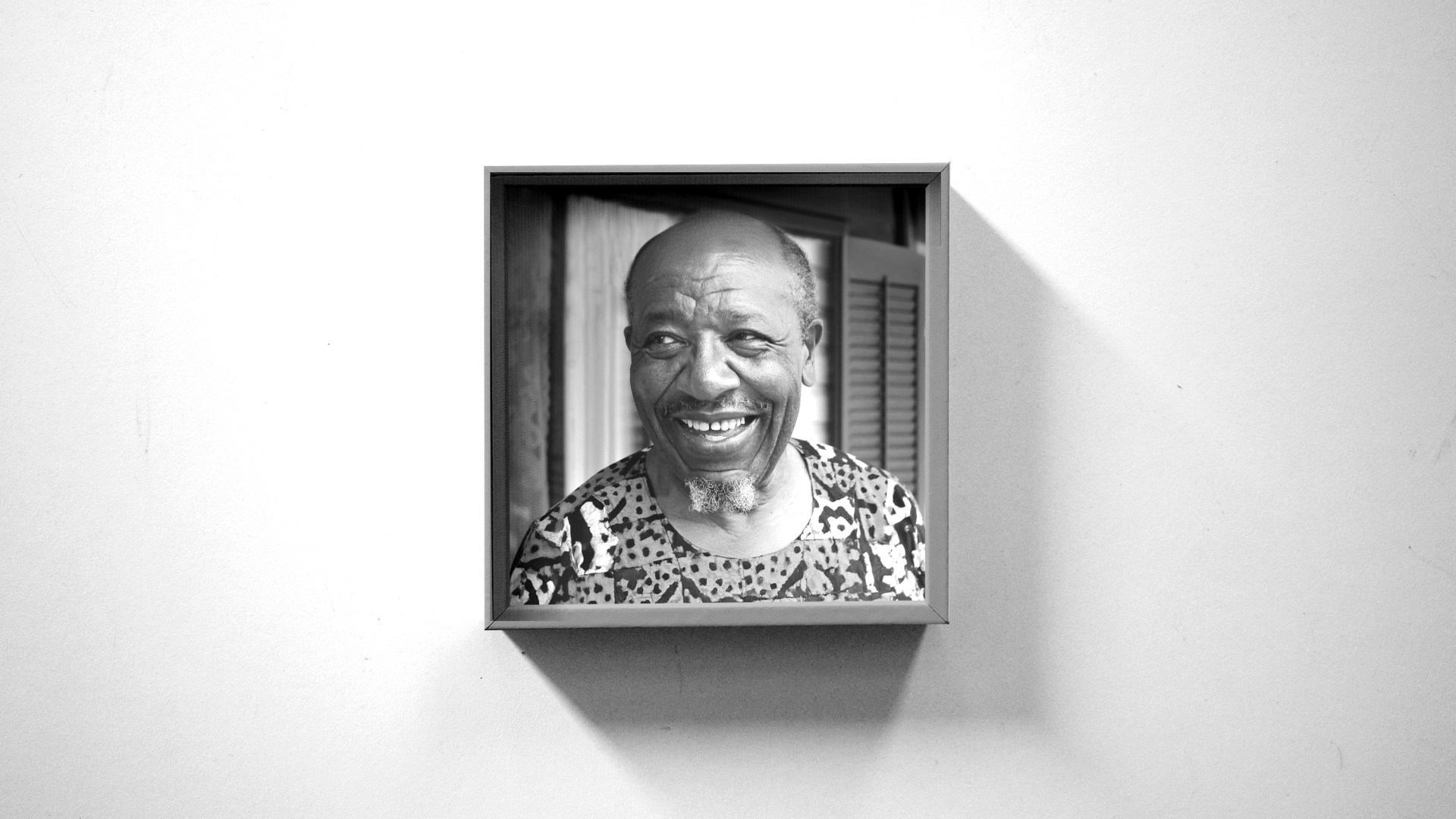
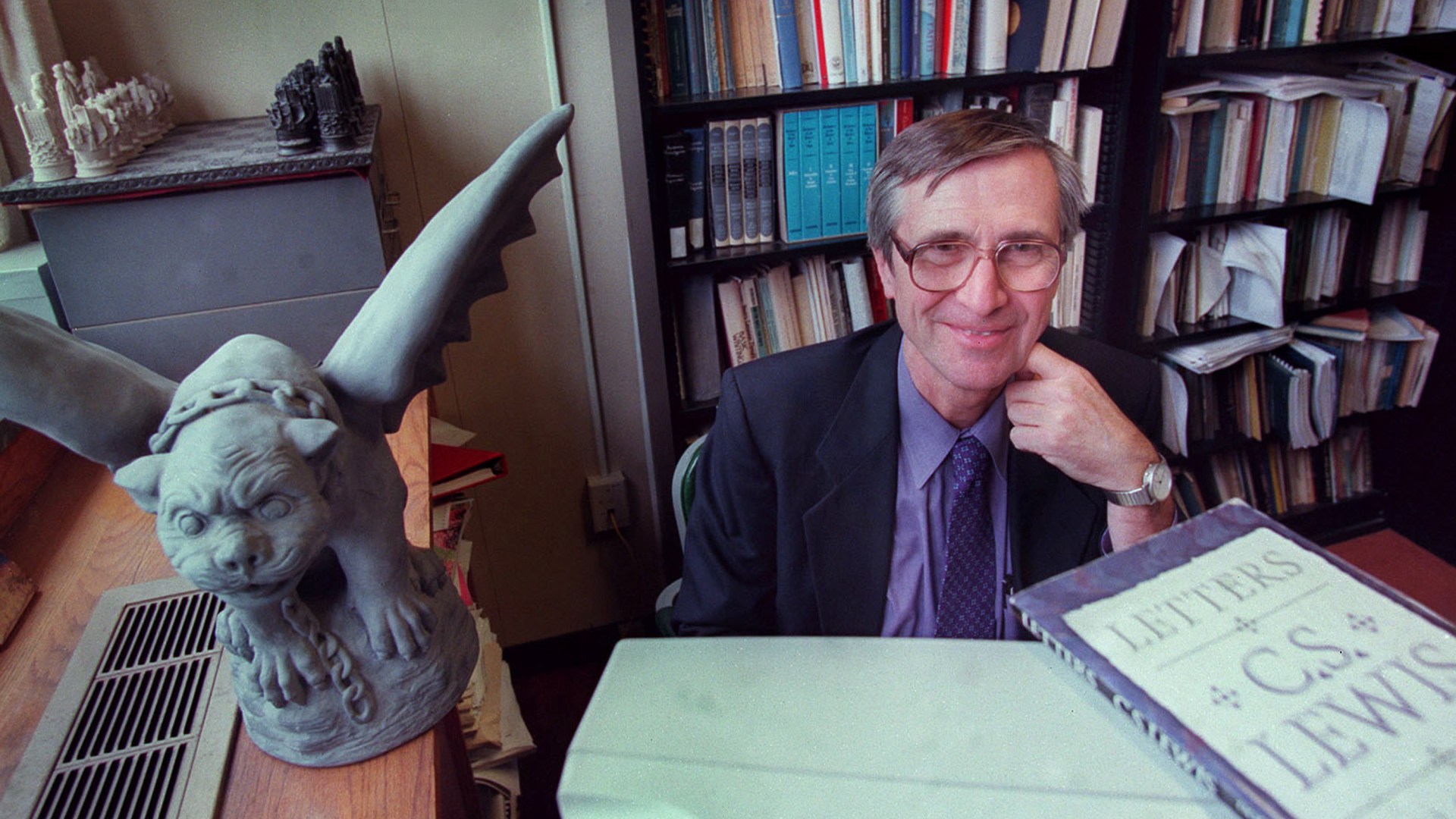
Peter Kreeft in his office.
Christianity Today March 16, 2026
MediaNews Group / Boston Herald / Contributor / Getty

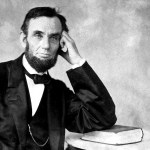
Christianity Today is by evangelicals and for evangelicals, but we learn from others—like Peter Kreeft, a Catholic professor who turned 89 Monday and has authored more than 100 books, including one entitled I Burned for Your Peace that unpacks Augustine’s Confessions.

Kreeft wrote that Augustine (AD 354–430) is “the major bridge between Catholics and Protestants. No other writer outside the Bible is so deeply loved and ‘claimed’ by ‘both sides’” of the Reformation. Augustine in the last third of his life encountered tragedies including the fall of Rome and the burning of the North African town in which he grew up. Kreeft similarly served as a bridge by teaching philosophy at both Catholic and Protestant schools and explaining the cultural as well as personal significance of abortion.

In Three Approaches to Abortion: A Thoughtful and Compassionate Guide to Today’s Most Controversial Issue, Kreeft laid groundwork for the eventual overturn of Roe v. Wade. In How to Destroy Western Civilization, Kreeft showed how having children is a civilization saver: Political attempts to make government-paid abortion part of health care were an attack on not only religious liberty but also civilization itself. 

Those two books used the Socratic method on current policies and personal issues, but most of Kreeft’s writing digs deep below the headlines to excavate the reasons our culture is on fire. His 2024 book What Would Socrates Say? takes readers through major philosophical issues: rationalism versus empiricism, the mind-body problem, the nature of reality and the unreasonableness of moral relativism, and more. 

Kreeft has degrees from Protestant and Catholic universities, Calvin and Fordham. He surveys the theological gaps and looks for ways to work together. Already past age 70 when we talked a lot from 2008 to 2011, he would rise early to take the train from Boston to New York City and would teach two three-hour philosophy seminars in a day at The King’s College, where I was provost. In between, he played chess with students or me. 

Although Kreeft describes himself as “not a joy-full person,” he emanated a contentment that sometimes mystified students consumed by uncertainty. That experience may have contributed to what he wrote in a book published last year, The Mystery of Joy: “The lack of deep joy has been true of all times, places, and cultures since Eden. But it is especially true of this time and this culture.” 

Maybe so, and his advice is helpful: “Joy is not essentially a feeling. … Joy is a marriage.” He writes of “God’s love as the cause of our deepest joy” and shows what can give us joy, including charity, communion, angels, beauty, art, music, and humor. Kreeft notes that “as every atom in our bodies is made of ‘star stuff,’ every event in our lives is made of ‘divine providence stuff.’”

Kreeft doesn’t minimize the hard stuff: While some words “seem beautiful on paper, our attempt to live them is a bloody mess of a war against the forces of selfishness, joylessness, faithlessness, hopelessness, and lovelessness, which are our real enemies and which have embedded themselves in our souls like little vampires sucking our lifeblood.” 

But the closing words of The Mystery of Joy could well serve as Kreeft’s last will and testament. He describes life by quoting C. S. Lewis’s description of Aslan in Narnia: “‘He isn’t safe. But he’s good.’ For He is love, and love is not safe. In fact, it is excruciating. But it is our supreme joy. Do it! Be a saint. What else is there?”

Marvin Olasky is editor in chief of Christianity Today.
Church Life

With Bible Translation in India’s Hadoti Language, ‘God Came Closer’

A missionary from south India initiated the translation in the language spoken by millions in southeastern Rajasthan state.

A view of the city of Bundi in the Hadoti region of Rajasthan State in India on July 16, 2019.

A view of the city of Bundi in the Hadoti region of Rajasthan State in India on July 16, 2019.

Christianity Today March 16, 2026
Eric Lafforgue / Art in All of Us / Contributor / Getty

On a cold December morning in India’s western state of Rajasthan, 38 worshipers sat on mats spread on the floor or on plastic chairs in the back of a small brick church as they heard the Bible read in their native language of Hadoti for the first time in their lives.

As the pastor read Psalm 23, some of the congregants smiled in amazement while others cried tears of joy.A few lifted their hands and cried out, ”Amen.”

“It felt [as if] God came closer,” said one congregant, recalling the Bible reading on the Sunday before Christmas. “The familiar verses … no longer sounded foreign.” CT agreed not to use the names of the Indian Christians interviewed due to threats from local Hindu nationalist groups.

Although spoken by several million people in southeastern Rajasthan and parts of Madhya Pradesh, Hadoti (also spelled Hadauti or Harauti) has long played second fiddle to Hindi, the language of administration, education, and employment. Similarly, in the church, hymns, Bibles, and sermons are all in Hindi.

“Many did not truly understand Hindi,” said a pastor from Kota, the third-largest city in Rajasthan. “Yet churches continued using it. We assumed this was normal.”

All this began to change when a homegrown mission organization translated and published the Hadoti New Testament in October 2021. An expanded edition, which includes the books of Psalms and Proverbs, reached the hands of believers last November. Currently, translators are working to translate the Old Testament, with the first draft of 17 books ready so far.

Despite Hadoti’s rich oral tradition—which includes folk songs, proverbs, and tales passed down through generations—books are seldom written in Hadoti, and the language is not taught in schools. A 2012 survey found that 75 percent of Hadoti speakers preferred their children speak only in Hindi, leading linguists to believe the language is “unsafe,” meaning it is at risk of disappearing as parents stop passing it on to the next generation. Young people speak Hadoti only at home among family and friends, as Hindi takes precedence in formal settings.

It was not a native Hadoti speaker but a missionary from South India who first decided to translate the Bible into the language. The grandson of a well-respected Hindu priest, he grew up in a devout Hindu household, yet his faith was shaken after his grandfather and then father passed away. He wondered why the Hindu gods they prayed to couldn’t save them. While he was in college, a friend gave him a Christian magazine to read, and that night, he had a vision of Jesus on the cross. The next day, he attended church with his friend and accepted Jesus as his Savior.

Several years later, he was reading the Bible during his morning devotions when he heard an audible voice say, You are reading Scripture in your mother tongue—but what about those who can’t?

He shrugged it off at the time but later realized translating the Bible was his calling when his mission organization sent him to southeastern Rajasthan in 2007. He witnessed a growing number of people coming to faith as he and other leaders planted churches. Yet the missionary said it felt strange for them to read the Word of God in Hindi rather than Hadoti.

He remembered the calling he heard and started officially translating the Bible into Hadoti in 2011. Yet through the process, he faced many challenges. Since he wasn’t a native speaker, he needed to train locals to help him translate. He also relied on community checking, where he read Bible passages aloud to people in the community and asked for their feedback.

The missionary recalls the team struggling to translate two words in particular: prophet and righteous.

The closest equivalent to the word prophet in Hadoti had a connotation that meant the person is a fortuneteller, astrologer, or Hindu priest. They settled on a word that is largely understood as “one who speaks on behalf of God.”

Similarly, they had difficulty translating the word righteous, as the closest equivalent had connotations of doing good works, helping the poor, and running religious programs. Hadoti believers were unhappy with the word as it didn’t fit the Bible’s meaning. After a lot of consultation, they arrived at a word that meant “one who is blameless in the eyes of God.”

“Translating technical words … into a new language is always a challenge due to their linguistic and cultural nuances,” said N. Subramani, assistant director of translations at the Bible Society of India, which helped with translation consulting, exegetical checking, and printing the Bibles. He added, “We approached it by converting nouns into verbs (salvation then became to be saved), providing footnotes with context, and by transliterating.”  

During the translation process, local Hindu nationalist groups were angry with the missionary for his Christian work, leading him and his family to change houses multiple times due to fear of attacks. A serious accident left him with fractures in his arm and leg. He was on the verge of giving up.

One Sunday, he was preaching while still recovering from his accident. During the sermon, he declared, “Do not stop. God is going before you.” Many in the congregation knelt and sobbed.

“That was the moment my own faith in God [was] renewed,” he said. “I picked myself up and returned to translation.”

After nearly a decade, he and nine other translators finished translating the New Testament. Today, Hadoti Bibles are used by 12 house churches planted by the mission organization, churches where many first-generation Christians worship. So far, 2,500 copies of the New Testament and 250 audio versions have been distributed.  

“For many believers, this became the first real piece of literature in their own language,” the missionary said.

He noted that many people said they read the Bible more now than they used to read the Hindi Bible and they understand the text better. They realized God is speaking to them directly. Even non-Christians are glad to see a religion text in their mother tongue, he said.

One pastor said it was transformative to hear his favorite verse, John 15:16, in Hadoti. It says, “You did not choose me, but I chose you and appointed you so that you might go and bear fruit—fruit that will last—and so that whatever you ask in my name the Father will give you.” The pastor said, “It is [more] deeply comforting to read it in my mother tongue than in Hindi. I feel I am now in safe hands.”

For one of the translators, the experience was not just linguistic but deeply personal. As he was translating, he became convicted of his sins, broke down, and returned things he had stolen in the past.

For the missionary, the work already feels complete, no matter how long the translation of the Old Testament could take.

“My life’s mission has been fulfilled,” the missionary said. “When I see people convicted, crying, responding as Scripture is read in Hadoti, I know it was worth it.”

News

Infanticide Rates Are Dropping in Africa, yet Child Abandonment Continues

Many view babies born with disabilities as cursed. Christians are fighting back.

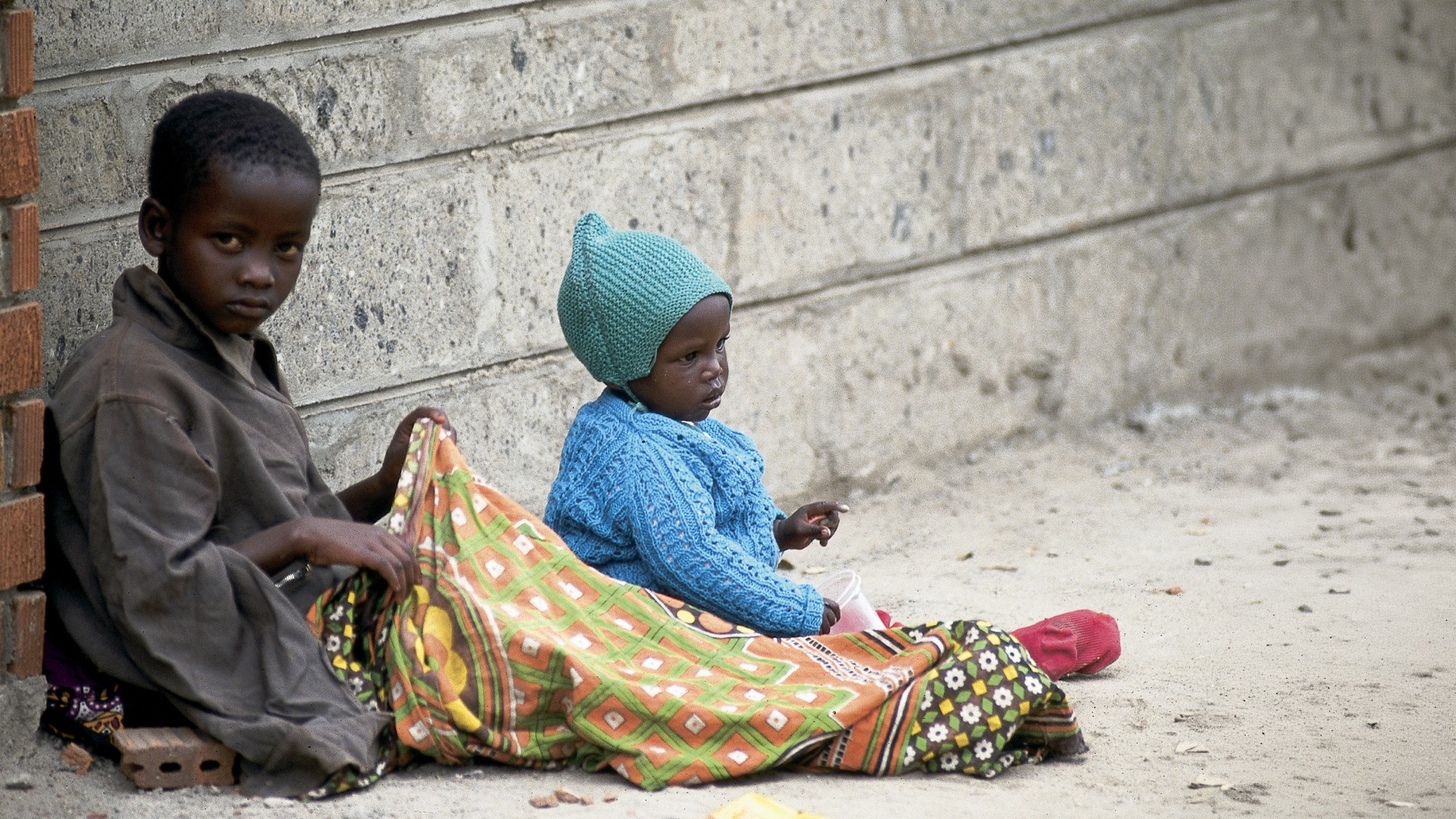
Two Kenyan children sitting on the streets of Nairobi.

Two Kenyan children sitting on the streets of Nairobi.

Christianity Today March 16, 2026
Independent Picture Service / Contributor / Getty / Edits by CT

Seventeen years ago, Ruth Mulongo had an affair with a young man from her village in Bungoma County, western Kenya. The 18-year-old became pregnant and nine months later delivered a baby girl at home during the night with her mother’s help. The baby looked weak, with one leg shorter than the other, so Mulongo’s mother told her the child was cursed. She feared her daughter wouldn’t be able to marry a good man if word got out that she’d had a disabled child. (CT agreed not to use Mulongo’s real name due to the social stigma.)

Mulongo said her mother, who had raised six children as a single mother, pressured her into agreeing to let her kill the child and hide the evidence from their community. Her mother wrapped the baby girl in a polythene bag and dumped her in a nearby shallow dam, where villagers drew water. The next morning villagers found the dead baby floating in the water and alerted local authorities.

Because neighbors knew about Mulongo’s pregnancy, she became the primary suspect. Fearing arrest, she fled in shame, first by foot and then bicycle and public transportation until she arrived in the town of Bungoma—the capital of the county, 60 miles away.

“I realized I had committed a big sin,” she said.

The killing of children born with disabilities has declined over the past two decades as laws have shifted and Christians have worked to change beliefs about disabilities inside and outside of church, according to Kupenda for the Children, a disability advocacy ministry. Still, child abandonment and occasional infanticide of children with disabilities remains a concern in West, Central, and East Africa, especially in rural areas.

Last year, police across Kenya reported spikes in child abandonment cases overall, and stigma remains a strong driver in why children with disabilities or single parents are especially affected. Though several African countries, including Kenya and Nigeria, have bolstered protections for citizens with disabilities, superstitions and misunderstandings about many conditions remain entrenched across Africa.

In May 2025, a Nigerian news station reported that infanticide continues in communities around the capital Abuja. Families often target children with albinism, babies whose mothers died in childbirth, as well as twins, which some tribes such as the Igbo and Bassa Komo believe are evil, possessing dangerous potential or supernatural powers. In a 2023 report by Africanews, Ugandan police expressed concern about a rise in abandoned babies and young children around its capital city of Kampala.

Many Africans see disability as judgment for unwed motherhood. For instance, in January, former Kenyan TV journalist Ann Ngugi spoke publicly about raising her now-22-year-old daughter, Angel, as a single mother. Angel was born with congenital hydrocephalus—a condition caused by excess fluid in the brain—and Ngugi remembers a relative blaming Angel’s enlarged head on her out-of-wedlock birth. At the time, doctors said Angel—who is now a gospel singer—might not survive.

“You have to carry all that as a mother and a caregiver and still tell this girl that she is beautiful,” Ngugi said.

Many Kenyans also believe married women who give birth to a disabled child are cursed. This has led some husbands to abandon their wives.

Pauline Imbiakha said her husband left her after the birth of their son Joseph, who had cerebral palsy. Even after Joseph fell ill with malaria and died when he couldn’t receive medical attention during a nurses’ strike, Imbiakha’s husband still didn’t return.

Seven years ago, her friend Rexina Imbenzi, the regional women’s leader for Grace to Grace Ministry—a church in Kakamega, Kenya—gave birth to a boy named Isaac with cerebral palsy. Imbenzi said her husband’s family tried to force him to divorce her, blaming her for the disability. Yet he refused. “If my husband wasn’t a born-again [Christian], I think I would have come back from church one day and found the baby killed because the pressure was from his family,” she said.

Imbenzi said extended family members question how she can be serving God but still give birth to such a child. Because babysitters cost too much and many refuse to watch Isaac as they believe he’s demon-possessed, Imbenzi’s 12-year-old daughter must sometimes stay home from school to watch him on days Imbenzi goes to church to run women’s ministry events.

Parents who fear stigmas often hide their children from their neighbors and pray for healing. Some may listen to radio and TV sermons of self-proclaimed prophets in Kenya who claim they can heal physical disabilities and attend their healing crusades, hoping for a miracle. Other Kenyans abandon their children at roadsides, hospitals, and churches.

“There are so many children who get abandoned at the health facilities by the young mothers, mostly university students and high school students,” said Eunice Obuya, a nurse from Kakamega, Kenya. “Some have disabilities, and some are normal.”

Health facilities often serve as unofficial safe havens, since Kenya doesn’t have designated places for safe abandonment. In Africa, Namibia has a safe haven law, allowing parents to turn in babies safely without penalty, but most countries do not.

Obuya said during 20 years of working in a public hospital, she witnessed more than 30 cases of abandoned children with disabilities, most of them with clubfoot, cerebral palsy, or congenital hydrocephalus. Parents abandoned one child because he had extra fingers on both hands, she said.

“Nobody wants to get closer to these children, especially the young medical workers,” Obuya said. “They still think it is a curse that can be transmitted.”

Christian health care facilities in Kenya provide corrective surgeries and rehabilitation for treatable conditions such as clubfoot and cleft lips and palates. Sometimes pastors intervene on behalf of babies at risk of being killed or abandoned, according to Kupenda for the Children. Disability ministries train parents and communities to reject stigmas, and some churches are designing ministries for children with disabilities.

Now, Ruth Mulongo said she helps lead one. After she fled her village years ago, the senior pastor of an evangelical church in Kanduyi prayed for her, counseled her through her trauma, and eventually appointed her as a youth pastor. The church also connected her to a popular repentance ministry and sent her to trainings offered by organizations promoting the rights of children with disabilities.

“If the church had not accepted me, I would not be here talking about this problem,” Mulongo said. “Maybe God had a plan for me to be the one speaking to families about child disability.”

Now married with three children, Mulongo serves as a junior pastor for her church, where she counsels parents with children who have disabilities, organizes educational seminars, and connects parents with support organizations like Kupenda for the Children and AIC-CURE hospital in Kijabe.

“Many [parents] feel ashamed to be seen with their disabled children in public … even in church,” Mulongo said. “But I tell them to accept what God gave them.”

Mulongo conducts home visits, praying with families before gathering their relatives and neighbors to teach them about disabilities and what causes them. She tells husbands not to blame their wives or assume they are cursed. She also prepares young couples psychologically for raising a child with a disability: “This changes their attitude towards disability, and they end up accepting that it is not always a curse.”

Mulongo also tells her own story, explaining how she caved to pressure from her mother to kill her child and how God forgave her.

“They should know that everything God does has a reason,” she said. “The pressure from relatives should not be a reason to kill an innocent baby.”

News

Died: John M. Perkins, Who Lived and Preached Racial Reconciliation

The civil rights leader believed in a gospel bigger than race or self-interest.

An image of John Perkins.
Christianity Today March 13, 2026
Illustration by Christianity Today

John M. Perkins, a bold evangelical voice who proclaimed the gospel against racism, died on Friday at the age of 95.

Perkins challenged Christians—especially white evangelicals—to repent of safe, narrow, and self-serving interpretations of the message of Jesus. He preached that opposition to racism was not a supplemental or optional activity but was core to living out the truth that would bring renewal and restoration to “the places long devastated” (Isa. 61:4).

“If it’s a holistic biblical ministry,” Perkins said in 1987, “I think that makes a difference between whether or not that church is an action church or whether it’s just become a self-centered worshipping congregation. And I think most churches are sort of self-centered worshipping. They see the church as ‘meeting my need, meeting my need,’ and the church doesn’t have a ministry, and a concept of ministry, and a philosophy of ministry, and a statement of mission to the world.”

His work influenced generations of white evangelicals wrestling with whether concerns about inequality, poverty, and injustice were distractions from a life of faith. Charles W. Colson called him a prophet. Russell Moore said few lived the gospel as fearlessly as Perkins. Shane Claiborne wrote, “He opened my eyes and set my heart on fire.”

Perkins developed a philosophy and methodology for Christian social engagement, which he explained as “relocation, reconciliation, and redistribution.” First, following the model of Christ’s incarnation, the church needs to go to the place of need: relocation. Second, because the gospel is “stronger than my race and stronger than my economic interests,” Christians should form new communities: reconciliation. Third, like the church in Acts 2:44–46, Christians have to voluntarily share what they own until no one is in need: redistribution.

Perkins founded the Christian Community Development Association (CCDA) as a network of churches committed to this vision, which he explained to Christianity Today in 2007 as “my old-fashioned reading of the Bible.”

Born into Mississippi segregation

Perkins didn’t see this interpretation of the Bible in the churches of his youth. He was born in 1930 to a Black family of sharecroppers in segregated Mississippi. The white churches wouldn’t welcome him or his family through their doors, and the Black churches seemed, to the young Perkins, like all they did was “wave and wail.”

His mother died when he was seven months old, and his father left soon after. His grandmother and extended family raised him. They eked out a living growing cotton on shares and working for the white landowners who had owned them until the Civil War. The family made extra money illegally, making whiskey and operating a lottery.

When Perkins was 16, a white police officer killed his older brother Clyde. Fearing police would kill him too, Perkins’ family raised money to send him to Southern California. He was one of about 50,000 African Americans who left Mississippi in the Great Migration, which historian Isabel Wilkerson called “the first mass act of independence by a people who were in bondage in this country for far longer than they had been free.”

Though he had only a third-grade education, Perkins found work in a foundry and quickly learned the trade, becoming a skilled laborer and union representative. He met and married Vera Mae Buckley, and they started a family.

Looking back at that time, Perkins said his only aim was making money. Then his young son Spencer invited him to attend Sunday school. There, Perkins recalled in an interview with the Wheaton College Billy Graham Center Archives, he came to think about his value in a different way. He was converted from the belief that “money and success” would bring him happiness.

“I realized I was loved by God,” Perkins said. “And if a God in heaven loves me, and if this God who is creator and Lord of the universe loves me, then I’m loved by a very significant person. And that person who loves me that much loves me enough to be concerned about my well-being.”

Perkins went on to study to be a minister and a Bible teacher with two white evangelical leaders who had popular radio ministries: J. Vernon McGee and Jack MacArthur (John MacArthur’s father). In 1960, MacArthur’s church gave Perkins financial support to return to Mississippi and start a church. Perkins called it Voice of Calvary Ministries, the same name as MacArthur’s radio program.

John and Vera Mae Perkins started teaching Bible classes, offering Sunday school, and holding the occasional tent revival. They started a church and a Bible college, but struggled to get incorporation papers. Perkins had to ask the National Association for the Advancement of Colored People (NAACP) to help—and that connection, along with his growing sense that God cared for all human needs, not just spiritual ones, led Perkins into social activism and the civil rights movement.

In 1965, he helped with a voter registration effort that registered more than 2,000 African Americans to vote in the rural areas outside of Jackson. His support from white California churches ended without explanation. Perkins pressed on, organizing a housing co-op, a farmer’s co-op, and a food co-op. A few years later, he led an effort to desegregate the public schools and started a boycott of white-owned businesses that refused to serve black customers.

Brutally beaten by a county sheriff

In February 1970, Perkins led more than 100 demonstrators in a 45-minute march protesting the segregated businesses, chanting, “Do right, white man, do right.” On the way home, authorities arrested several protesting college students for “reckless driving” and took them to the county jail. Fearing the men would be lynched, Perkins and two other boycott leaders went to the jail.

At the jail, they found sheriff’s deputies drinking corn whiskey. The deputies had forcibly shaved the protestors’ heads and were pouring the liquor over their raw scalps. “Then,” as one of the law enforcement officers later testified under oath, “a general fracas broke out.”

Sheriff Jonathan Edwards—named for the great Puritan minister—hit Perkins with a blackjack until the minister went down. Then he kicked Perkins on the ground, brutally and repeatedly, stopping only to retuck his shirt. Done with the beating, Edwards made the minister get up and mop his blood off the jail floor. Edwards later testified that Perkins threw an unprovoked punch at him but missed (though no one else saw it) and had a pistol in his car (though he didn’t get it out).

Recovering from the near-fatal beating in the hospital, Perkins thought about racism, his life, his mother’s death, his brother’s death, and now almost his own: “I came to the conclusion, the hard conclusion that Mississippi white folks [were] cruel. And they [were] unjust. And the system was totally bankrupt. … I stayed with the idea that it had to be overthrown.”

But the only thing that was powerful enough to overthrow it, Perkins decided, was the gospel. Only through the work of Christ and the power of the Holy Spirit could hate be replaced by love and enemies transformed into friends.

“It’s a profound mysterious truth—Jesus’s concept of love overpowering hate,” he later wrote. “The problem is spiritual: Black or white, we all need to be born again.”

Making a different kind of white Christian

Perkins took that message to the organizers of a Billy Graham crusade when they came to Mississippi in 1975. At Graham’s insistence, Black and white ministers were working together to plan a racially-integrated crusade. At an early planning meeting, Perkins asked the white pastors what they would do if a Black person converted at the crusade showed up at their church the next Sunday. Wasn’t their policy to turn Black people away?

In response to his question, the Graham association put him on the steering committee. They began to promote Perkins as an evangelical minister with an important message for Christians. The next year, Baker Books published Perkins’s first book, Let Justice Roll Down, making him a household name among evangelicals.

In the book, Perkins lamented that evangelicals had “surrendered their leadership” in the civil rights movement. He described his sadness “seeing those that I knew as brothers and sisters in Christ insist on a Sunday religion that didn’t sharpen their sense of justice.”

He then wrote other books: Beyond Charity, With Justice for All, Welcoming Justice (with Charles Marsh), Follow Me to Freedom (with Shane Claiborne), and One Blood: Parting Words to the Church on Race.

In his writing and ongoing work proclaiming the gospel, Perkins developed his philosophy of relocation, reconciliation, and redistribution. In 1989, Perkins and his wife founded the CCDA to bring together people committed to living out those principles of applying the gospel. The first year, 37 congregations joined. Today the network includes more than 600 Christian groups, from the Root Cellar in Lewiston, Maine, to the Tucson Coalition of Compassion Ministries in Arizona.

“It makes my blood run hot when I think that this God of heaven came down, redeeming a third-grade dropout, brought me into his Kingdom, gave me this opportunity to be working together with him in his redemptive purpose,” Perkins said in 2015. “I can do that, and we all can do that.”

Honored by white evangelicals

In the last decades of his life, Perkins received honorary degrees from 16 evangelical colleges and universities, including Wheaton College, which awarded him his first doctorate. In 2009, the Christian indie rock band Switchfoot’s song, “The Sound (John M. Perkins’ Blues),” was the No. 1 Christian rock song and the No. 7 alternative rock song on Billboard magazine’s charts. Two universities and two seminaries—Seattle Pacific University, Calvin University, Wesley Seminary, and Northern Seminary of Illinois—started programs in his name.

Perkins continued to push white evangelicals on the issue of racism, even urging them not simply to condemn riots in Black communities but to see them as opportunities to “authenticate the gospel.” In 2014, in response to one of the first major Black Lives Matter protests, Perkins called on Christians to recognize that racism will not be solved by people learning to be nice. Instead, he said, people need to be transformed by the gospel.

“We as Christians have to take some responsibility for that hostility [in Ferguson, Missouri], and affirm the love God has for all people,” Perkins said. “We minimize the gospel. We are supposed to be new creations in Christ Jesus, a peacemaking force. We have to come back to brotherhood and sisterhood.”

Perkins is survived by his wife, Vera Mae, and six children: Joanie, Derek, Deborah, Philip, Priscilla, and Elizabeth. His sons Wayne and Spencer predeceased him in 2017 and 1998, respectively.

Correction (March 19, 2026): A prior version of this obituary misstated how many of Perkins children survived their father.

Culture
Review

‘The Secret Agent’ Explores Memory and Authoritarianism in Brazil

The Oscar-nominated film reminds viewers to learn from the past—and to share our stories with the next generation.

Kleber Mendonça Filho accepts the Best International Film award for “The Secret Agent” during the 2026 Film Independent Spirit Awards at Hollywood Palladium on February 15, 2026 in Los Angeles, California.

Kleber Mendonça Filho accepts the Best International Film award for “The Secret Agent” at the 2026 Film Independent Spirit Awards on February 15, 2026.

Christianity Today March 13, 2026
Amy Sussman / Staff / Getty

I was born just a few years after the end of a dictatorship.

As Brazil’s fledgling democracy struggled to its feet in the 1990s, I learned about what had come before in school, in movies, and in songs. But I would also sometimes ask my grandmother what it was like when the Brazilian military seized power in 1964, stamping out dissent for the next two decades. Her answer has always been the same: “I don’t remember very well.”

At the time, my grandmother was a divorced woman, raising three daughters while working grueling hours to provide a decent life for them. It’s entirely understandable why that era is a blur in her mind.

But I’ve been thinking about memory a lot recently after watching The Secret Agent, an unsettling film released late last year and directed by Brazilian filmmaker Kleber Mendonça Filho.

From the country’s northeast, Mendonça Filho often explores an underappreciated region in his work. My own city, Recife, is almost its own character in this film. Born in Recife, the director—nicknamed KMF—has put down deep roots there and, in an act that is both protest and homage, has built his career telling stories set in the region.

It’s a protest because the country’s film and television industries are concentrated along the Rio–São Paulo axis, which often means stories about the Northeast and its people are told from the perspective of outsiders. And it’s an homage because Recife has long been a city of enormous importance to Brazil, especially culturally. The Northeastern capital is shaped by Dutch, Portuguese, Indigenous, and African influences. It is home to the first synagogue in the Americas and was the departure point for some of the first Jews who would later arrive in New York.

The Secret Agent tells the story of Marcelo, who is a technology specialist played by Wagner Moura, a Golden Globe nominee for best actor. And it demonstrates just how far the dictatorship reached, how it left no community untouched.

After moving from Recife to São Paulo for work, Marcelo returns to his home city in 1977, during the years of Brazil’s military dictatorship. The opening scene sets the film’s tone: A corpse lies abandoned at a roadside gas station in the countryside. No one—not even the station attendant—knows exactly what happened. Marcelo stops to refuel and, intrigued, tries to learn more. He fails. Two police officers arrive, notice the body, and do nothing. Instead, they intimidate Marcelo and extort a bribe before he can continue on his way.

Moura’s character continues, walking through Recife’s familiar streets and landmarks. Viewers feel a constant sense that every character is being watched and that everyone harbors secrets that may never come to light. KMF is unafraid of discomfort. His storytelling is not always easy to understand or immediately legible. It challenges audiences. The Secret Agent carries a weight and an uncertainty that resist precise description.

Most eerie, perhaps, is the feeling that The Secret Agent is being told by someone who does not know the entire story—or who, like my grandmother, has forgotten crucial parts of it.

Forgetting, in fact, is one of the film’s central themes. Marcelo retrieves his son in Recife, readying to flee the country as a powerful businessman from the Southeast hunts him. We never learn exactly why Marcelo is being pursued, and he himself seems unsure how his life reached that point. In the film’s final moments, we encounter Marcelo’s son, Fernando, now older and working at a blood donation center.

When asked about his father, he appears resentful—as if he has forgotten everything his father endured to survive.

This theme of memory is all too relevant in our world today as democracies around the world seem tempted to slide into dictatorship and autocracy. Here in Brazil, our memories of dictatorship frequently resurface in various ways, especially in recent years. We are a young democracy.

Memory is a powerful defense. The Spanish American philosopher George Santayana wrote in his 1905 book The Life of Reason that “those who cannot remember the past are condemned to repeat it.” Many of us have heard that famous quote at least once, and some of us could quote it from memory. But how many of us know our great-grandparents’ full names? Great-great grandparents? How many of us are willing to pass down the painful stories that don’t reflect ourselves or our societies the way we want them to?

When we lose touch with our own stories, we are in danger. And if we, as individuals and as societies, fail to learn from the mistakes of the past, we will inevitably repeat them—not because we want to but because we are fallen creatures, living in a world that constantly confronts us with our own capacity for evil.

Long before Santayana put those words on the page, God had already said the same.

In Ecclesiastes 12:1, God calls his people to remember him in their youth. In Psalm 105, the psalmist urges them to remember the wonders and mighty acts God performed on their behalf. In Isaiah 46:9, God commands his people to remember the former things of old. Throughout Scripture, remembering is not merely the preservation of memory; it is a command to learn, to allow what has happened in the past to shape how we walk toward the future, striving for what is good, true, and beautiful.

The Christian practice of the Lord’s Supper carries immeasurable spiritual significance, and it is also deeply formative in this respect. By repeating the same ritual again and again, we train our minds to remember that Jesus Christ died, rose again, and will return. “Do this in remembrance of me” (1 Cor. 11:24), Jesus tells his disciples. He knew his followers would have short memories, memories that often reject him and rush toward sin and addiction.

When God’s people forget what he has said or done, they do not simply lose information; they actively reject instruction. In Judges 3, when Israel “forgot the Lord” (v. 7) and worshiped the Baals and the Asherahs, they rejected the very first commandment given in Exodus 20: “You shall have no other gods before me” (v. 3).

We become what we learn and what we fail to learn. We are today the sum of what we have managed to remember and practice, whether consciously or not.

If Walter Salles’ I’m Still Here, another Brazilian film that left its mark in last year’s Golden Globes, places a magnifying glass over the suffering of a family during the military dictatorship, The Secret Agent goes further, removing that lens and forcing us to confront society as a whole, a society that has trouble remembering.

The Secret Agent tells the story of a father who does everything he can to save himself and his son, only to fall into the hands of his persecutors; of a son who moves on with his life and forgets what truly happened; and of a society condemned to face the same villains over and over because it forgets its past. Amid this sea of forgetting, may we as Christians be a people who engage in the radical act of remembering: recollecting both the evil that surrounds and tempts us and the goodness of God, who writes our stories and carries us forward.

Mariana Albuquerque is project manager for CT Translations.

Books
Review

Decoding the Supreme Court

Three books to read this month on politics and public life.

Three books on a gray background.
Christianity Today March 13, 2026
Illustration by Christianity Today

This piece was adapted from CT’s books newsletter. Subscribe here.

Sarah Isgur, Last Branch Standing: A Potentially Surprising, Occasionally Witty Journey Inside Today’s Supreme Court (Crown, 2026)

With a purported 6–3 conservative majority, why is it that the Supreme Court is taking on fewer cases and overturning fewer precedents? Why is the Trump administration more likely to lose than win its cases that reach the high court?

Sarah Isgur would love to tell you. Isgur, an editor at SCOTUSblog, has served in all three branches of government. Legal nerds will recognize her as host of The Dispatch’s flagship podcast, Advisory Opinions. (I overlapped with Isgur during my employment there.)

With the legislature mired in dysfunction and the executive branch making audacious power grabs, Isgur invites readers to better appreciate the Supreme Court’s role in preserving the rule of law. She acknowledges that the countermajoritarian institution is guaranteed to make all sides mad at some point or another, which is exactly what it has done. Currently, more Americans disapprove of the Court than approve of it.

But using her signature entertaining style to demystify both the high court and the justices who serve on it, Isgur mounts a defense of the court that is as credible as it is disarming. While an outspoken conservative herself, Isgur wants readers to take into account more than just the justices’ political dispositions and also measure their orientation to upholding institutions versus disrupting them. While pundits and partisans are quick to reach for a 6–3 split to explain the court’s ideological makeup, Isgur makes the case that it looks more like 3–3–3. That’s only one of many valuable insights in what I found to be an entertaining and informative read.

Jacob Siegel, The Information State: Politics in the Age of Total Control (Henry Holt and Co., 2026)

In his book debut, Tablet special features editor Jacob Siegelargues that modern society is in the grip of a surveillance state perpetuated by Big Tech, politicians, and a technocratic elite.

The boogeymen of Siegel’s work are primarily presidents (early on, Woodrow Wilson, and in the latter half of the book, Barack Obama), the national security complex (particularly the CIA), Silicon Valley tech companies (primarily Google), a technocratic elite (various figures), and the media (though there is little mention of the apparatus of right-wing press).

Under the guise of combating misinformation, this public–private partnership promotes sanctioned messages with the unquestioning devotion of religious zealots. Siegel cites examples of shifting public health messaging during the COVID-19 pandemic and social causes like Black Lives Matter. Those who run afoul of orthodoxy may find themselves the target of conspiracies themselves (like Donald Trump with Russiagate) or deplatformed. Meanwhile, the media suppressed damaging information on political allies.

Siegel raises legitimate questions about the reach of Silicon Valley giants, the actions of the national security apparatus, and the ability of the national press to hold experts and elites sufficiently accountable. But the book’s interesting premise undercuts its own effectiveness through selective and unbalanced anecdotes. It is largely silent on Republican errors while hypersensitive to Democratic abuses. Although Siegel decries the dangers of echo chambers, his work seems unlikely to make much headway outside its own.

Ben Sasse, The Vanishing American Adult: Our Coming-of-Age Crisis—and How to Rebuild a Culture of Self-Reliance (St. Martin’s Griffin, 2017)

When I was a cub reporter, one of my early assignments was to cover Supreme Court Justice Brett Kavanaugh’s confirmation hearing. Calling the hearing contentious is an understatement; the upshot of that assignment was that I rapidly became familiar with the judiciary committee. I still remember one rant from a wonky, young senator from Nebraska who concluded that really, Americans needed to watch more Schoolhouse Rock! That senator was Ben Sasse.

A few years later, Sasse would leave Congress to become president of the University of Florida. Today, having taken on the behemoths of politics and education, he’s now facing a different beast entirely: a diagnosis of metastasized, stage-four pancreatic cancer. It’s not often that politicians do hourlong interviews that I would universally recommend as worth your time, but Sasse’s recent interview with Sola Media on mortality is a must-watch.

After you’re done with the interview, you may be inclined to pick up one of his books. I recommend The Vanishing American Adult. In it, Sasse contends that there is a “coming-of-age crisis” among American youth. This generation of unprepared adults, he argues, poses a great threat to the health of the American experiment. The uptick in mental health diagnoses, entertainment media addictions, and vices like pornography and overconsumption are pervasive challenges. The last few years have shown his prescient thesis undersold these issues.

Some of his corrections to encourage the cultivation of virtue and discipline for children are out of reach for all but select families: Not everyone can send a 14-year-old to a cattle farm or take the family abroad for a month. But other remedies are actionable. Expose kids to hard work, to people older and wiser, and to excellent literature. Do what you can to cultivate virtue, and that sometimes includes learning to suffer well.

While his remedies for these ills are too modest to combat the scale of the problems, his current vivid example of enduring suffering shows that he has done what many politicians have not—to practice what he’s preached.

Harvest Prude is national political correspondent at Christianity Today.

Books

Jan Karon Looks Back on 89 Years of God’s Faithfulness

The author of the Mitford Years series married at 14, protested segregation, and wrote her first book at 57.

A portrait of Jan Karon.
Christianity Today March 13, 2026
Image courtesy of Jen Fariello Photography

Roughly 80 years ago, Christian novelist Jan Karon, creator of the beloved 15-volume Mitford Years series, stood in front of a mirror and told herself she would be a writer.

Roughly five years ago, the New York Times best-selling author felt like she lost her “reason to live.”

Karon, whose books have sold tens of millions of copies, has lived a life as rich and varied as the characters in her stories. Tomorrow she turns 89.

Although Karon is adamant that she writes for a secular audience, her books bear a decidedly religious outlook. “So many people don’t know that God loves them,” she told CBS in 2005. “[But] he made us and that makes us pretty interesting to him.”

Karon’s central protagonist in the Mitford Years series is Father Tim Kavanagh, an Episcopal priest in a rural mountain town in the American South. A lifelong bachelor, he rebuffs romantic overtures, takes in a loveable but neglected boy, wins the affection of an oversize stray dog, and marries at age 62, all while providing a bit of hope—and laughter—to scores of neighbors in need of community.

Readers have found the same comfort in the books, longing to live in a place like Mitford.

Like Father Tim’s marriage, Karon’s literary career began later in life. She published her first book, At Home in Mitford, at age 57. But her spiritual story began 14 years earlier when she gave her life to Jesus. She detailed this journey in a letter to her acquaintence Jo, stored today with her papers at the University of Virginia archives. Karon invited Jo to also follow Christ, adding that she hoped she had not offended her in any way.

This typical gentle spirit comes through in Karon’s reassuring words to Jo, which in describing conversion may also describe the two halves of Karon’s life. “In abandoning what we were, we begin to find out who we are,” she wrote. “And who we are is, well, it’s a whole lot of what we were.”

Young Karon had it rough. Janice Meredith Wilson was born on March 14, 1937, in the Blue Ridge foothills of North Carolina. At age 3 she saw her parents divorce, and she went to live with her maternal grandparents. A self-described anxious and quiet nail biter, Karon would sit on the porch churning butter as “Mama” told stories. She slept on a bed made from furniture-mill scraps, where she would read a copy of Robert Frost’s poems bought with the family egg money.

First-grade teacher Nan Downs brought Karon out of her shell by encouraging her to write on the blackboard and clap the erasers. Around age 10, Karon wrote a tale inspired by Gone with the Wind and won the short story contest at school. Two years later, she moved to Charlotte, North Carolina, with her mother, who had by then remarried. But at age 14, she dropped out of school to marry Robert Freeland, eloping to South Carolina, where it was still legal to wed so young. One year later, Karon gave birth to her only child, Candace. And at age 18, after a gun accident left her husband paralyzed, she divorced him and took a receptionist job at an advertising agency in Charlotte.

Bored of answering the phone, she started proposing ad copy. With a developing career, in her early 20s Karon married Bill Orth, a Unitarian chemist active in theater circles. She further nurtured her love of the creative arts, and in the early 1960s she launched “the South’s only independent literary quarterly,” Response, which won the praise of Harlem Renaissance leader Langston Hughes.

Race issues became important to Karon. At age 23, she joined one of Charlotte’s first civil rights protests, marching against segregated lunch counters. She fondly recalls holding placards next to two “Southern sisters” in their 80s, decked out in their hats, gloves, and pearl necklaces. Angry men shouted, spat, and threw lit matches as they walked by. But by the late 1960s, she and Orth divorced, and Karon married and obtained her now-famous last name from Arthur Karon, a clothing salesman.

Arthur moved the family to Berkeley, California, but they divorced three years later. Describing the city as “often in a state of civil warfare” due to the protest movements, Karon told Jo she felt her life was “breaking into fragments, coming apart in oddly-shaped pieces.” She longed for the familiarities of home, like Hickman’s Drug Store’s five-cent ice cream and fancy hats at church on Sunday. Yet she hated her past and its “death centered” Christianity. Her grandparents, she complained, kept an Old Testament household.

“It was all locusts, fleas, and floods,” Karon told CT. “Pick your nose and go to hell.”

Only later did she learn the lesson that “nothing pushed on us can soften the heart. … [That] only comes from being loved.”

In 1970, Karon, who by then was thrice divorced, brought Candace back to Charlotte, where she resumed her advertising career. Though Karon recalled the comforting image of Jesus holding a lamb, she dabbled in Eastern religions. Still discontented, she took a six-week road trip to New England in a rundown Volkswagen bus before settling down in an old farmhouse deep in the North Carolina countryside.

Living on subsistence wages as she did freelance advertising work, Karon called the next two years a “healing process”—both the most trying and the most nourishing time in her life. Contemplating azaleas blooming from the earthen-red clay, she began to pray.

Karon’s fledgling faith survived a 1974 move away from quiet farm life as she occasionally attended a “liberal” church and prayed from time to time, she wrote to Jo. Her career improved steadily, but five years later at age 42, Karon lost her job as a TV producer. A turning point came in May 1980, when for the first time she fell to her knees to pray.

“I don’t know what to pray for,” Karon told God. “I’m just here, and I need help and just change me.” She asked God simply to be gentle with her.

Nothing happened. Perhaps that was the answer she needed. There was no clap of thunder, no angels at her bedside, she said. If anything, she was afraid God would send her to Africa as a missionary. But slowly, everything changed. Little by little, Karon said, she learned that God loved her—and even more slowly, that God also forgave her. 

Life carried on, only more successfully. In 1987, Karon and a colleague won the advertising industry’s top Steven E. Kelly Award for their ad and split a $100,000 prize. A year later she quit her job, traded her Mercedes for a used Toyota, and moved back to the country in hope of becoming a writer.

The idea for Father Tim came in a vision of sorts as Mitford unfolded in her mind. Aware that a Baptist preacher conjured too many negative literary stereotypes, Karon crafted him as an Episcopalian, she said. His life began as a weekly serial publication in the local Blowing Rocket newspaper of Blowing Rock, North Carolina. Karon drew the illustrations. They paid her with a free copy of the 10-cent paper.

Circulation surged. But despite the local acclaim, Karon struggled through 11 publishing house rejections before Lion, a small Christian press, accepted At Home in Mitford. Two novels followed, as she used all her marketing skills to self-promote the books. But there was no national market for wholesome stories of simple characters, let alone with a Christian theme, Karon told World magazine. People preferred Stephen King.

“I don’t give you much of a ride. I just give you sort of a float!” Karon stated. “A lot of people tell me that my books put them to sleep, and I consider that a huge compliment.”

Her breakthrough came through well-connected word of mouth. Karon’s friend shared the first Mitford book with the owner of a bookstore in Raleigh. The owner then passed it on to a New York agent, who put it before an editor at Viking Penguin—who happened to be the daughter of a Lutheran minister. In 1996, the publisher purchased all three titles.

By the end of the decade, Karon was a best-selling author.

In 2000, Karon moved to a historic farm near Thomas Jefferson’s Monticello estate in Virginia. More novels followed, including A Common Life, a retrospective look at Father Tim’s wedding adventure; In This Mountain, where the now-retired cleric watches his adopted son become a veterinarian; and Shepherds Abiding, a Christmas quest to restore a derelict Nativity scene.  

Karon even wrote a Mitford-themed cookbook.

But some controversy came with the 2007 publication of Home to Holly Springs. After receiving a cryptic unsigned letter asking Father Tim to return to the Mississippi hometown he has long left behind, the priest discovers he has a long-lost Black half brother.

The Virginia archive reveals some readers were grateful the nonpolitical Mitford series now confronted racism. Others were offended. Karon chaffed at the notion that this was a new turn in her writing. Over the course of the novels, Miss Sadie, an elderly member of Father Tim’s congregation, develops a warm relationship with her friend Louella, who is Black and moved from the city to be her caretaker.

Yet Karon was deliberate with the Holly Springs story line. It is common in the South to have unknown siblings and unacknowledged interracial extended family, she said, though the issue is never talked about. And since Father Tim from earlier stories lamented being an only child, she decided to fix that.

“I gave him a brother,” Karon said, “and the reader a look at brotherhood.”

Karon’s work is celebrated by Christians and non-Christians alike—and suitably adapted by both audiences. In 2003, Focus on the Family produced At Home in Mitford as a radio drama. Fourteen years later, The Hallmark Channel produced it as a made-for-TV rom-com.

Karon’s publishing pace has since slowed amid a family tragedy. She published her 14th Mitford book in 2017, followed by a Father Tim compendium of spiritual nuggets the year after. But in 2021, her daughter died of pancreatic cancer at the age of 68, throwing the author into despair. She told CT she lost her desire to live, as Candace was the “sunshine” in her life.

Some preached sermons at her—Aren’t you a Christian?—as Karon struggled with depression, she said. But she went to God on her knees, honest about her faults and mistakes. And then, she threw herself into a different kind of storytelling.

That year, Karon founded The Mitford Museum and housed it in her former North Carolina elementary school. Its first gallery is her first-grade classroom, returning full circle to Nan Downs and the influence she had on a frightened country girl. Currently the project is constructing the Mitford Discovery Center, a hands-on workshop and art space meant to help others uncover the hidden gifts they have to offer the world.

“To be seen is marvelous,” Karon said.

And last October, she published her 15th Mitford novel, My Beloved, resurrecting an unfinished short story she rediscovered while navigating her grief. It’s a whimsical tale, and Karon said that remembering Candace gave it a depth that goes beyond the surface-level laughter. She is now researching for a new book about 16th-century Italy following a monthlong visit to the country.

Perhaps Karon’s journey has been more adventurous than those of her village-settled characters. But as she told Jo, who she is now, after following Jesus, retains a whole lot of what she was before. From falling apart in Berkeley to finding a new story in Rome, from joining protest marches to writing about interracial families, from discovering God’s love to illustrating it for others through Father Tim, Jan Karon has been a witness to millions.

“This is life,” she said, “and it taught me how to write books.”

Additional reporting by Harvest Prude.

Correction: An earlier version of this article misstated that Karon contemplated suicide after her daughter’s death. It also misstated the relationship between the characters Miss Sadie and Louella.

History

The Year of the Evangelical

America prepared for a bicentennial, and religious identity dominated the presidential campaign.

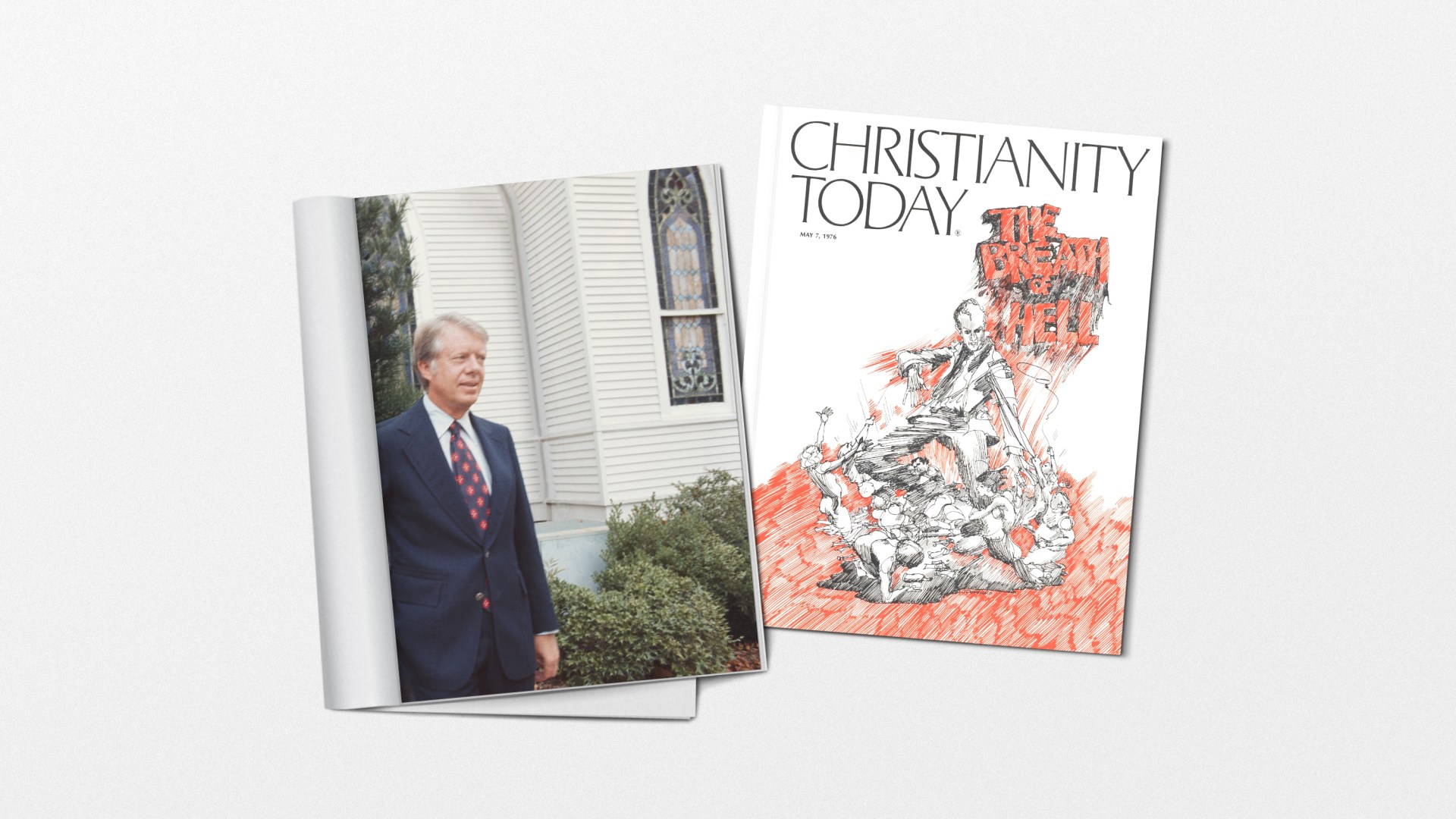
An image of President Carter and a CT magazine cover.
Christianity Today March 13, 2026
Illustration by Christianity Today / Source Images: Getty, CT Archives

CT started 1976 on a contrarian note. As the nation prepared to celebrate the 200th anniversary of the Declaration of Independence, a Gordon-Conwell Theological Seminary professor argued that the real birth of America happened not in 1776 but in 1740. The January 1976 cover story argued, “We’ve picked the wrong year.”

What occurred in [1740] was nothing less than an inner American revolution, a spiritual declaration of independence that made the political reshuffling thirty-six years later an inevitability. The year 1740 was the crest of that wave of spiritual power called the Great Awakening. …

The message of personal commitment and individual decision central to the Awakening reached a wider audience than the issue of taxation without representation. The merchant class of the port cities might be inflamed by the irritating tax laws, but how much popular appeal did that issue have? Colonial America was a rural society. One authority states that only one out of twenty Americans lived in the city. While Boston was certainly a powerful radiating center, it could influence only a minority in the northern colonies, and by no means the whole seaboard. 

To inflame the colonists sufficiently against Great Britain there had to be embers that were rekindled by the taxation issue, not created by it. The spiritual independence fostered by the Great Awakening saturated the colonies from Massachusetts to Georgia, from the Atlantic deep into the Appalachians.

Secondly, as a cause for rebellion the Great Awakening had a deeper appeal than the taxation issue. The spiritual appetite aroused in 1740 created a search for “something more,” a dissatisfaction with the status quo that refused to fade with time. Two centuries before, the Puritans of England had followed religious impulses that led to the beheading of King Charles. Is it any less likely that in 1740 transformed hearts would seek a transformed society and would want to free themselves once again from a monarch’s rule?

Most Christians, of course, were happy to celebrate 1776. CT reported that more than 1,000 overtly religious celebrations across the country were “thanking God for America.” 

These endeavors range from production of a new hymnal, drama and musical presentations, and a conference on religious liberty to bell-ringing and large-scale outreach efforts. In addition to the officially recognized projects are many by individual churches and other religious groups in just about every city in the land. They all add up to a gigantic religious celebration of the nation’s first two hundred years. 

The [American Revolution Bicentennial Administration] wants every bell in America rung on July 4 for two minutes at 2 p.m. EDST (11 A.M. Pacific time) when the Liberty Bell will be rung in Philadelphia. The American Bible Society is promoting participation by churches in the bell-ringing observance. In conjunction with it, the ABS is distributing to churches and synagogues a copper-colored bell-shaped pamphlet containing verses from Isaiah 61 and bearing the title “Proclaim Liberty Throughout the Land.”

CT’s regular arts column, Refiner’s Fire, noted a surge of interest in science fiction in the 1970s but couldn’t decide what it meant. 

Michael Crichton’s Andromeda Strain may have contributed to bringing scifi out of the closet. Crichton placed the action of the novel in the near enough future to avoid the fantastic ethos that has usually been a part of this genre. 

The most visible evidence of the new popularity of science fiction is the continual replaying of the television series “Star Trek.” It has gathered a group of fanatical fans among the young. …

All this new activity may be deeply significant or it may simply mean that the Saturday morning “Jetson” fans have grown up and are unwilling to leave science fiction behind. I leave that profound determination to someone else. …

The subjects of science fiction are overwhelmingly politics, technology, and their interaction. Religion, sex, and other interesting social activities normally appear only peripherally or occasionally.

A review of Bob Dylan’s music—from his early protest songs through his electric turn and the Rolling Thunder Revue tour—reached sharper conclusions about his “almost Christian” music.

He views man in the light of the cosmic struggle between good and evil. Man must choose to follow God and truth or fall into death, decay, and ultimate judgment. …

Bob Dylan pioneered the message song; he remains at its forefront. He asks metaphysical questions and tries to give some answers, which are less than Christian. But he has affected many young people and continues to do so. We need to understand what kind of spiritual guidance he gives.

CT also reviewed some notable names in literary fiction, including Saul Bellow, Joyce Carol Oates, and the madcap maximalist conspiracy-theory capers of Thomas Pynchon.

The vision of Pynchon is one of apocalypse, of decadence, of a streamlined Doomsday Machine tooling, to the accompaniment of a kazoo chorus, down “the street of the twentieth century, at whose far end or turning—we hope—is some sense of home or safety. But no guarantees” (V.).

At age thirty-nine, Thomas Pynchon is perhaps one of the most accomplished American writers of our time. He has published short stories in various magazines, but his reputation rests primarily on his three novels. … He synthesizes philosophy, sociology, science (he was an engineering major at Cornell), popular culture, the humanities, and theology. And his novels are brilliant collages of literary modes and styles, defying classification. One reviewer commented that it is easier to nail down a blob of mercury than to describe a novel by Pynchon.

The three novels have been aptly characterized as an extended meditation on the twentieth century.

CT’s most controversial article of the year challenged readers to rethink the way they understood the gospel, taking cues from James Cone’s Black liberation theology. The author, described as “an angry evangelical from Chicago,” wanted readers to join him in the declaration, “Down with the Honky Christ—Up with the Funky Jesus.” 

Most white people understand what a black person means when he calls someone a “honky.” If they can’t define it verbally they feel what it means—oppressor, bigot, slave-trader, exploiter, and in many ways, middle-class. A honky belongs to the status quo, the safe, the comfortable. 

“Funky,” on the other hand, may be a new term to many of you. In black parlance funky often has certain positive connotations. For example, if I call a song funky I mean that either voice or instrument stepped creatively from behind the strictures of the notes, boldly and freely authenticating his or her own soul in the rendition of the number. Funky stands opposite to honky—liberated, authentic, creative.

These two adjectives used in relation to the Gospel incarnate in Jesus pinpoint the problem I see in traditional evangelical circles, black or white. We and our leaders have been preaching a honky Christ to a world hungry for the funky Jesus of the Bible. The honky Christ stands with the status quo, the funky Jesus moves apart from the ruling religious system. Jesus stood with and for the poor and oppressed and disinherited. He came for the sick and needy.

A Black Baptist minister from Boston offered a more measured reflection on the racial politics of the era, looking at efforts to integrate public schools through busing programs.

First, the problem is racism. Certain minorities are not wanted, not liked, and/or feared. Many bugaboos, superstitions, and stereotypes have been resurrected, if they ever were dead, against blacks, Hispanics, and other minorities.

Second, some people have found the issues of integration and busing advantageous. Because of greed and overt political ambition, they are willing to exploit the school situation for their own self-aggrandizement and political advancement.

Third, too many flame-feeders wanted to keep the busing crisis alive because they have profited by it, particularly in overtime pay, while the situation remained heated. That is the economical issue.

Psychologically, the cost of busing cannot be measured … 

The big political story of the year was the presidential election. The Democrats nominated Jimmy Carter, a populist peanut farmer who told people he was a “born again” Christian, to run against incumbent Gerald Ford. The candidates’ religious commitments became a major campaign issue.

Ford is open, though not vocal, about his religious views. A lifelong Episcopalian, he credits the spiritual deepening of his life in recent years to involvement in prayer groups, study of the Bible, and the influence of other Christians, especially evangelist Billy Zeoli. 

In a letter to Zeoli he stated that he had received Christ as his personal saviour and was being helped through prayer and Bible study (he and Zeoli study together periodically using the paraphrased Living Bible). He encouraged his son Michael to select an evangelical seminary. But he smokes a pipe, dances, and drinks cocktails before supper, and these practices disturb many conservative Christians (Episcopalians traditionally have not looked on them as vices). … 

Carter, a Southern Baptist who takes a regular turn teaching a men’s Sunday-school class at the rural Plains (Georgia) Baptist Church, is the most outspoken of the four about his faith. He grew up in the church but not until 1966 did he have a conversion experience. He won’t discuss details but says he emerged from the experience a transformed person and began spending a lot of time in prayer and Bible reading. 

He said he spent more time on his knees during the four years he was governor than in all the rest of his life put together. He tells his critics that he’s never tried to use his position as a public official to promote his beliefs, adding, “and I never would.” But whatever role he might have in the future, he explains, it will be with the same personal relationship with Christ he’s had in the last ten years.

The year 1976 seemed like “the year of the evangelical.” Political reporters asked candidates if they were “born again,” and analysts asked each other, “Will evangelicals swing the election?” 

It is commonly acknowledged that America’s fastest-growing religious configuration is the evangelical Protestant community, whose current size is usually estimated to be some 40 million members—or at least 20 per cent of the population. If this percentage is projected to the electorate, it means that of, say, 80 million votes cast in the presidential election, 16 million will be by members of evangelical churches (both inside and outside the big denominations) and by those who identify with evangelical cultural traditions.

Evangelical voters are strongly concentrated in eleven southern states and six border ones (Maryland, West Virginia, Delaware, Kentucky, Missouri, and Oklahoma). They are also found in fairly large numbers in several midwestern and north-central states (such as Illinois, Indiana, Iowa, Kansas, and Nebraska). The southern and border states have 177 electoral votes, and Indiana, Iowa, Kansas, and Nebraska have 33, for a total of 210. This is short of the 270 needed for election, but evangelicals in other states (Ohio and Pennsylvania, for example) could provide the victory margin in a close election.

It is the candidacy of former Georgia governor Jimmy Carter, a Southern Baptist Sunday-school teacher that has people talking about a possible evangelical voting bloc. Carter’s public expression of down-home religious commitment has raised questions—and eyebrows—for some voters (especially Jewish ones), but it has unquestionably gained him evangelical support. Evangelicals and Carter speak the same born-again, Christ-is-my-Saviour language.

Not all evangelicals were happy with Carter. Some specially questioned his judgment when he gave an interview to Playboy, known for its nude centerfolds, and were disappointed by his stand on the moral issue of abortion

Carter’s positions appear ambiguous to some evangelical critics. His views on abortion have evoked the most vocal controversy to date. Contrary to many accusations, Carter says he had no input at all on the Democratic platform plank on abortion. That plank opposes a constitutional amendment to limit abortion. Carter says his position is similar, “but I would have worded it differently.” He also states that he personally opposes abortion and “will do everything possible to minimize its need” if he is elected President.

In a speech for anti-abortion candidate Ellen McCormack, convention delegate James Killilea cited opposition to Carter on the abortion issue by a Catholic writer and by Harold O. J. Brown, a teacher at Trinity seminary in suburban Chicago and a leader in the anti-abortion Christian Action Council. In describing Brown as “an evangelical like [Carter],” he quoted the theologian as saying: “For someone to say that he is morally opposed to abortion and then that he is against doing anything to stop the present flood of abortions is rather like Pontius Pilate’s action in washing his hands at the trial of Jesus.”

One pro-life picket outside the hall carried a sign saying, “Carter is nothing but a 621-month-old fetus.”

Many Republicans didn’t seem interested in talking about faith and tried to tamp down religious messages at the national convention. CT called readers’ attention to one conservative who seemed different: Ronald Reagan

Talk-show host George Otis of Van Nuys, California, recently interviewed former California governor Ronald Reagan on spiritual and moral issues. Excerpts of Reagan’s views: …

When you go out across the country and meet the people you can’t help but pray and remind God of Second Chronicles 7:14, because the people of this country are not beyond redemption. They are good people and believe this nation has a destiny as yet unfulfilled. … 

I certainly know what the meaning of “born again” is. … In my own experience there came a time when there developed a new relationship with God and it grew out of need. So, yes, I have had an experience that could be described as “born again.” …

You cannot interrupt a pregnancy without taking a human life. And the only way we can justify taking a life in our Judeo-Christian tradition is in self-defense.

Carter won in November, receiving about 1.6 million votes more than Ford. CT’s editor in chief reflected on what that said about prayer.

I have been musing over an indisputable fact: some Christians were praying for the election of Jimmy Carter and others were praying for the election of Gerald Ford. All had their prayers answered—God said no to some and yes to others.

Church Life

Q&A: Eric Mason on Ministering to Men and Witnessing in Politics

The Philadelphia-based pastor discusses how the church can engage Black men and have a biblical approach to government.

A silhouette of a man and the capitol building.
Christianity Today March 13, 2026
Illustration by Elizabeth Kaye / Source Images: Unsplash, WikiMedia Commons

Church conversations about masculinity are rooted in biblical truth but can sound different among Black Christians who have to contend with false ideological and religious movements, such as the Nation of Islam.

The Just Life’s Benjamin Watson sat down with pastor Eric Mason, who leads Epiphany Fellowship Church in Philadelphia, to talk about how the church can better engage Black men and give them tools to chart their own course. Mason believes the church has lost the manhood talk and must think creatively about ministering to men. Watson and Mason also discuss biblical justice and how the Chrisitan should relate with the government during times of disagreement.

Here are edited excerpts from their conversation.

We’ve lost the manhood talk the same way we’ve lost the justice talk. Because if you think about it, what would the Evil One want most to take out of our conversations from a biblical perspective? He wanted to take our manhood, obviously, because of the leadership, because of the order, because of all the sorts of things we see in Genesis, and because of all the ills that have a tie directly to manhood (or lack thereof). But he’d also want to come in and frustrate the justice talk because it keeps people in pain and hurt and without restoration.

I do believe what you said in relation to it. I’m going to give you the perfect example. The Nation of Islam is falling apart. Nobody knows that. Mosque No. 12, which Elijah Muhammad’s son started in Philly, and all the mosques, they’re now meeting in, like, a house, like a small little row house with barely any people in it.

But what keeps them relevant is that [Louis] Farrakhan has mastered the ability to talk to men about their key buttons. One of the things that we’re missing is the reason Black men are attracted to these different groups is because they talk about what’s wrong with the country, what’s wrong with situations.

They tell the whole story.

They’re saying we have to be responsible, and they speak truth to power. I believe that we have to have a comprehensive message that includes those things within it, in relation to how we apply the gospel to the area of justice. Because that is an issue that men want to know about. [They’re asking,] What can I do to be a change agent?

There’s another thing I see with men. I remember I was talking about how to manage money, and how it took years for me to get my wife and me out of debt, pay off our student loans, credit cards, and all of that. I said I ended up having to get an accountant, a financial planner, and started an LLC. I didn’t realize how much the men were listening. They were like, “Hey, Pastor, talk to us more about that.” So I related it and said, “I had to begin to have a financial vision for my home. And I believe God is going to hold me responsible for that and [for] building generational wealth for my kids, even as a pastor.”

Now, we have financial seminars with hundreds of people there. And dudes are in there connecting that. They’re saying, Why didn’t anybody tell me this? Particularly in our community, because we’re not taught from childhood about money in a particular way.

Let’s talk about politics for a little bit from a justice perspective. Do you think the church has the primary role in bringing about and correcting injustice, or is it the government? Or is it a combination of both? Some people would say the government has created policies over time—we can name a litany of them—that have been unjust policies, and we see the ramifications of those. The government needs to be the one to fix those things.

Then others would say, I can’t trust the government for anything and it’s the church that has to lead when it comes to racial injustice, but also poverty, education. How do you navigate the balance? Whose responsibility is it?

I want to come back to that because I want to address a bigger issue. In the Western world, we have a very entitled way that we look at the relationship between the church and government that wasn’t afforded the people of God in history.

I just haven’t had the time to do it, but I wanted to do a biblical theology of the relationship of the people of God throughout Scripture and throughout history with government. I want to ask the Bible questions. Anywhere in Scripture, did it make it the people of God’s responsibility to fix government? I’m just asking the Bible a question.

Now, what do I see in the Bible? I do see that the people of God were always a prophetic voice to government. I always saw that. Now, you got to understand, they were under absolute monarchies. We’re in a democratic republic. I would say we’re in new orders when it comes to the relationship.

When you think about world history, yes.

Yes, until the Edict of Milan, Christianity was illegal. So even our relationship with government before then was different until the Edict of Milan.

We’re some pretty entitled, privileged Christians.

So you understand what I’m saying? So in us approaching the subject … I have to say, “No, no, let’s back up. What does the Bible teach our relationship with government is in the New Testament?”

It’s two things. I’m going to sound like a sellout, but it’s the Bible. Fundamentally, it’s going to speak out against injustice, pray for government, and support where we can biblically.

Titus chapter 3 verse 1 says, “Remind them to submit to rulers and authorities, to obey, [and] be ready for every good work” (CSB). So we’re not talking about obeying carte blanche. We’re talking about obeying as long as God’s cool with what you’re being obedient to.

As long as they’re not telling you to do something totally incongruent to the gospel.

Absolutely. This is what it says though: “To be ready for every good work.” That means to serve government. Then it says, “To slander no one, to avoid fighting, and to be kind, always showing gentleness to all people” (v. 2). Why? Because verse 3 is going to tell you: you were lost. So don’t slander government officials. This is what the scriptures are saying.

CT Responds to the ‘We Are Not a Monolith’ Statement

A note from the editor in chief.

A stack of magazines
Christianity Today March 12, 2026
Andrey Cherkasov / Getty

Christianity Today does not have a large staff. Unlike the newspapers of old, we do not have dozens of beats, with a full-time reporter for each one. I don’t enjoy admitting it, but last year we had only one dedicated beat with a full-time reporter: immigration. Happily, that reporter is very dedicated and very talented: Andy Olsen in 2025 turned out numerous stories showing the tragic turn in immigration ultra-enforcement.

Here are just three of our 2025 headlines: “Migrants Pushed Chicago to the Brink. They Also Brought a Revival.” “ICE Goes After Church Leaders and Christians Fleeing Persecution.” “They Led at Saddleback Church. ICE Said They Were Safe.” These were deeply reported stories, not opinion pieces: street-level, not suite-level. But no one reading them would mistake which side CT was on: We headlined one story “The Churches That Fought for Due Process,” and CT fought for that as well.

In 2026, on this side of the chaos in Minneapolis, the Trump administration may be recalibrating. What comes next is up for debate throughout America, including among our Latino brothers and sisters in Christ. Late last month, Christianity Today published “ICE Is Devastating Some Latino Churches,” an opinion piece by Samuel Rodriguez, president of the National Hispanic Christian Leadership Conference (NHCLC).

In it, Rodriguez offered his political conclusions after observing plummeting Sunday service attendance in predominantly Latino churches. He also saw what we had learned: Congregants fear they may be subjected to heavy-handed and indiscriminate federal immigration enforcement under the Trump administration. Rodriguez has been a Trump supporter, and we welcomed his willingness to offer some criticism.

Others did not welcome that, noting that Rodriguez continues to support President Donald Trump. A coalition of Latino Christian leaders published an open letter—“We Are Not a Monolith, We Are a Multitude”—expressing “disagreement and concern with the media representation” of Rodriguez and his organization as “the primary voice representing the Latino evangelical community.” The group cited CT’s publication of the article as contributing to that notion.

That was not our intention. We thought it newsworthy that Rodriguez seemed to be backing away from some support of Trump. Maybe he is not: Time will tell. Regardless of what other media have done, we certainly did not say Rodriguez is “the primary voice” of Latino evangelicals, because as our coverage has shown, many Latinos (and others) vigorously oppose ICE policies. The NHCLC is important, but so are other organizations such as the National Latino Evangelical Coalition.

CT President and CEO Nicole Martin notes this: “CT has a robust record of speaking out against unjust immigration policies and practices. We take seriously the call of Christ to care for those in greatest need by elevating the stories of the most vulnerable (Matt. 25:40).”

She adds that Rodriguez’s article “speaks to the harsh realities facing Latino communities in America and the heartbreaking effects of federal enforcement in many churches. It is one piece of our extensive coverage of immigration under this administration, which includes on-the-ground reporting, listening and lament, and a diversity of opinion articles like this one.”

Martin concludes, “At CT, we know ethnic monoliths do not exist, believe Christians are called to compassion for immigrants, and appreciate the steadfastness of leaders consistent in their opposition to harsh immigration practices. We are committed to publishing a range of evangelical perspectives on this and other important matters.”

We take seriously the specific concern in the open letter that publishing Rodriguez’s column “reinforces the misleading notion that a single leader can speak for the breadth and diversity of the Latino Christian community.” But we know, and anyone aware of the variety of Latino experience and beliefs knows, that this is not the case. He is one well-known figure who wrote an op-ed.

We ask that CT be judged by the full breadth of our immigration coverage, especially stories by Andy Olsen and Emily Belz, and our commitment to publishing perspectives that represent the breadth and diversity of the Latino evangelical community. We grieve with those who grieve over the state of violence and the fear facing Latinos and immigrant communities in our country. 

Sho Baraka, editorial director of CT’s Big Tent program, says CT “will never conform to the current media zeitgeist, which rewards insular ideas and homogeneous thinking. CT continues to honor our brothers and sisters in Hispanic and Latino churches and invites them to bless us with their voices, making a more integrated witness of Jesus’ church.”

We invite more Latino leaders and journalists, whether liberal or conservative, to propose op-eds of their own. Of course we won’t be able to publish all, but we will publish some. As John Milton wrote nearly four centuries ago, “Who ever knew Truth put to the worse, in a free and open encounter?”

Marvin Olasky is editor in chief of Christianity Today.

addApple PodcastsDown ArrowDown ArrowDown Arrowarrow_left_altLeft ArrowLeft ArrowRight ArrowRight ArrowRight Arrowarrow_up_altUp ArrowUp ArrowAvailable at Amazoncaret-downCloseCloseellipseEmailEmailExpandExpandExternalExternalFacebookfacebook-squarefolderGiftGiftGooglegoogleGoogle KeephamburgerInstagraminstagram-squareLinkLinklinkedin-squareListenListenListenChristianity TodayCT Creative Studio Logologo_orgMegaphoneMenuMenupausePinterestPlayPlayPocketPodcastprintremoveRSSRSSSaveSavesaveSearchSearchsearchSpotifyStitcherTelegramTable of ContentsTable of Contentstwitter-squareWhatsAppXYouTubeYouTube